EP3143813B1 - Method, apparatus, and system for determining a location of a terminal - Google Patents
Method, apparatus, and system for determining a location of a terminal Download PDFInfo
- Publication number
- EP3143813B1 EP3143813B1 EP15727118.0A EP15727118A EP3143813B1 EP 3143813 B1 EP3143813 B1 EP 3143813B1 EP 15727118 A EP15727118 A EP 15727118A EP 3143813 B1 EP3143813 B1 EP 3143813B1
- Authority
- EP
- European Patent Office
- Prior art keywords
- address
- latitude
- longitude
- database
- mac address
- Prior art date
- Legal status (The legal status is an assumption and is not a legal conclusion. Google has not performed a legal analysis and makes no representation as to the accuracy of the status listed.)
- Active
Links
Images






Classifications
-
- H—ELECTRICITY
- H04—ELECTRIC COMMUNICATION TECHNIQUE
- H04W—WIRELESS COMMUNICATION NETWORKS
- H04W4/00—Services specially adapted for wireless communication networks; Facilities therefor
- H04W4/02—Services making use of location information
-
- H—ELECTRICITY
- H04—ELECTRIC COMMUNICATION TECHNIQUE
- H04L—TRANSMISSION OF DIGITAL INFORMATION, e.g. TELEGRAPHIC COMMUNICATION
- H04L67/00—Network arrangements or protocols for supporting network services or applications
- H04L67/50—Network services
- H04L67/52—Network services specially adapted for the location of the user terminal
-
- H—ELECTRICITY
- H04—ELECTRIC COMMUNICATION TECHNIQUE
- H04W—WIRELESS COMMUNICATION NETWORKS
- H04W64/00—Locating users or terminals or network equipment for network management purposes, e.g. mobility management
-
- G—PHYSICS
- G06—COMPUTING OR CALCULATING; COUNTING
- G06Q—INFORMATION AND COMMUNICATION TECHNOLOGY [ICT] SPECIALLY ADAPTED FOR ADMINISTRATIVE, COMMERCIAL, FINANCIAL, MANAGERIAL OR SUPERVISORY PURPOSES; SYSTEMS OR METHODS SPECIALLY ADAPTED FOR ADMINISTRATIVE, COMMERCIAL, FINANCIAL, MANAGERIAL OR SUPERVISORY PURPOSES, NOT OTHERWISE PROVIDED FOR
- G06Q30/00—Commerce
- G06Q30/02—Marketing; Price estimation or determination; Fundraising
- G06Q30/0241—Advertisements
- G06Q30/0251—Targeted advertisements
- G06Q30/0261—Targeted advertisements based on user location
-
- H—ELECTRICITY
- H04—ELECTRIC COMMUNICATION TECHNIQUE
- H04W—WIRELESS COMMUNICATION NETWORKS
- H04W4/00—Services specially adapted for wireless communication networks; Facilities therefor
- H04W4/02—Services making use of location information
- H04W4/025—Services making use of location information using location based information parameters
-
- H—ELECTRICITY
- H04—ELECTRIC COMMUNICATION TECHNIQUE
- H04W—WIRELESS COMMUNICATION NETWORKS
- H04W4/00—Services specially adapted for wireless communication networks; Facilities therefor
- H04W4/02—Services making use of location information
- H04W4/029—Location-based management or tracking services
-
- H—ELECTRICITY
- H04—ELECTRIC COMMUNICATION TECHNIQUE
- H04L—TRANSMISSION OF DIGITAL INFORMATION, e.g. TELEGRAPHIC COMMUNICATION
- H04L2101/00—Indexing scheme associated with group H04L61/00
- H04L2101/60—Types of network addresses
- H04L2101/618—Details of network addresses
- H04L2101/622—Layer-2 addresses, e.g. medium access control [MAC] addresses
-
- H—ELECTRICITY
- H04—ELECTRIC COMMUNICATION TECHNIQUE
- H04L—TRANSMISSION OF DIGITAL INFORMATION, e.g. TELEGRAPHIC COMMUNICATION
- H04L2101/00—Indexing scheme associated with group H04L61/00
- H04L2101/60—Types of network addresses
- H04L2101/69—Types of network addresses using geographic information, e.g. room number
-
- H—ELECTRICITY
- H04—ELECTRIC COMMUNICATION TECHNIQUE
- H04L—TRANSMISSION OF DIGITAL INFORMATION, e.g. TELEGRAPHIC COMMUNICATION
- H04L61/00—Network arrangements, protocols or services for addressing or naming
- H04L61/50—Address allocation
- H04L61/5007—Internet protocol [IP] addresses
-
- H—ELECTRICITY
- H04—ELECTRIC COMMUNICATION TECHNIQUE
- H04W—WIRELESS COMMUNICATION NETWORKS
- H04W24/00—Supervisory, monitoring or testing arrangements
Definitions
- the present application relates to a field of Internet technology.
- the present application relates to a method, a device, and a system for determining the location of a terminal.
- GPS Global Positioning System
- some applications that are provided in connection with a terminal include the use of location information of the terminal.
- such applications include acquiring user geographic location information (e.g., the location of the terminal).
- An example of an application that uses location information includes the display of promotional information.
- promotional information can include information on movie theaters, restaurants, shopping places, or the like near the location of the user. Because the application displays promotional information that can be configured according to a location of a user, greater accuracy in the location information of online users with such terminals will result in the display of promotional information that is more accurate and can improve user experience on such terminals.
- Collection of location information when a user accesses an application using a PC terminal and location information when the user accesses an application using a cell phone terminal can be used for security purposes such as determining whether a user account is at risk of being compromised based on a comparison between the location information of the PC terminal and the location information of the cell phone terminal (e.g., the distance between the two geographic locations).
- the location of a terminal can be determined using information from an IP bank (e.g., an IP address database) provided by an operator.
- the IP banks are commercially available databases that map a geographic location to a particular IP address (or range of IP addresses).
- the geographic location information for the IP address is queried (e.g., looked up) using the IP address of such a terminal.
- the IP banks provided by operators only provide a broad geographic location corresponding to an IP address (e.g., the geographic location provided by the IP banks generally only identifies a city as the geographic location corresponding to an IP address). Accordingly, the geographic location information provided by IP banks is imprecise. For example, in Hangzhou, Beijing, and other large cities, providing accurate positioning of a terminal using information from an IP bank is generally not possible.
- WO 2007 121331 describes a wireless connection between a mobile device and an IP-based wireless telecommunications network established when the mobile device registers with a network controller (NC) through an access point (AP).
- a geographical position is needed for the mobile device (e.g., a 911 call)
- messages are exchanged between the NC and a serving mobile location center (SMLC), where the SMLC retrieves information from a database that is used to identify the geographic position of the mobile device.
- the database can store a variety of information related to mobile devices such as: last known position, IP address, MAC address, a mobile or subscriber identifier (such as an International Mobile Subscriber Identity (IMSI)), last CGI, etc.
- IMSI International Mobile Subscriber Identity
- the invention can be implemented in numerous ways, including as a process; an apparatus; a system; a composition of matter; a computer program product embodied on a computer readable storage medium; and/or a processor, such as a processor configured to execute instructions stored on and/or provided by a memory coupled to the processor.
- these implementations, or any other form that the invention may take, may be referred to as techniques.
- the order of the steps of disclosed processes may be altered within the scope of the invention.
- a component such as a processor or a memory described as being configured to perform a task may be implemented as a general component that is temporarily configured to perform the task at a given time or a specific component that is manufactured to perform the task.
- the term 'processor' refers to one or more devices, circuits, and/or processing cores configured to process data, such as computer program instructions.
- a location e.g., a geographic location
- a device e.g., a terminal
- a database indicating locations associated with one or more Media Access Control (MAC) addresses can be configured.
- MAC Media Access Control
- IP Internet Protocol
- a location of the terminal in the event that a terminal connects to a network (e.g., the Internet), a location of the terminal can be determined by using (e.g., querying) a database indicating a location associated with the MAC address or the IP address of the terminal.
- a terminal generally refers to a device used (e.g., by a user) within a network system and used to communicate with one or more servers.
- a terminal may include communication functionality.
- a terminal may be a smart phone, a tablet Personal Computer (PC), a mobile phone, a video phone, an e-book reader, a desktop PC, a laptop PC, a netbook PC, a Personal Digital Assistant (PDA), a Portable Multimedia Player (PMP), an mp3 player, a mobile medical device, a camera, a wearable device (e.g., a Head-Mounted Device (HMD), electronic clothes, electronic braces, an electronic necklace, an electronic accessory, an electronic tattoo, or a smart watch), or the like.
- PDA Personal Digital Assistant
- PMP Portable Multimedia Player
- mp3 player a mobile medical device
- a camera a wearable device
- HMD Head-Mounted Device
- a terminal includes a smart home appliance with communication functionality.
- a smart home appliance can be, for example, a television, a Digital Video Disk (DVD) player, an audio device, a refrigerator, an air conditioner, a vacuum cleaner, an oven, a microwave oven, a washer, a dryer, an air purifier, a set-top box, a TV box (e.g., Samsung HomeSyncTM, Apple TVTM, or Google TVTM), a gaming console, an electronic dictionary, an electronic key, a camcorder, an electronic picture frame, or the like.
- DVD Digital Video Disk
- a terminal can be any combination of the foregoing devices.
- a terminal according to various embodiments of the present disclosure is not limited to the foregoing devices.
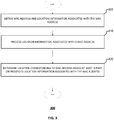
- FIG. 1 is a flowchart of a method for determining terminal location according to various embodiments of the present application.
- a method 100 for determining a location of a terminal is provided.
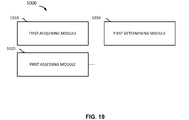
- the method 100 is implemented by device 1000 of FIG. 10 .
- the method 100 is implemented by system 1100 of FIG. 11 .
- a MAC address of a terminal is acquired.
- the MAC address of the terminal is acquired in the event that the terminal connects to a network such as the Internet or the like.
- a server e.g., a device connected to the network and configured to perform hosting or otherwise functions, and is associated with a website, a web service, or the like
- the message can be an access request or the like.
- the message can include the MAC address of the terminal.
- the message can be an HTTP message such as a GET message, a POST message, or a message in any other appropriate format.
- the server extracts the MAC address from the header or payload of a message received from the terminal.
- the MAC address can be a physical address or hardware address associated with the terminal.
- the MAC address can be globally unique.
- the terminal can connect to the network (e.g., the Internet) by receiving wireless network signals transmitted by wireless signal transceiver equipment.
- the wireless signal transceiver equipment can correspond to equipment configured to convert wired network signals to wireless network signals so as to provide the wireless network signals to equipment within a signal coverage range of the wireless signal transceiver equipment.
- Equipment e.g., a terminal
- a wireless router is an example of a wireless signal transceiver equipment that converts wired network signals to WiFi signals.
- Wireless network equipment e.g., WiFi-supporting notebook computers, cell phones, and tablet computers
- within the signal coverage range of the wireless signal transceiver equipment can access the Internet by receiving the WiFi signals transmitted by the wireless signal transceiver equipment.
- a determination of whether a database includes the MAC address of the terminal is made.
- a server determines whether the database includes the MAC address.
- the database can be a database that stores a mapping of a location (e.g., geographic location) associated with a MAC address.
- the database stores a plurality of records that respectively relate to a mapping of a location associated with a particular MAC address.
- the location can include information associated with a longitude and a latitude.
- the location can include information that indicates the longitude coordinates and the latitude coordinates corresponding to the location.
- the server can determine whether the database includes the MAC address by querying the database. For example, the server can determine whether the database includes the MAC address based at least in part on a response received in connection with a query of the database for location information associated with the MAC address. In the event that a response to the query of the database for location information associated with the MAC address is unresponsive (e.g., if the response indicates that no record exists, or location information does not exist), then the server can determine that the database does not include the MAC address.
- the database can be a commercially available service (e.g., provided by a third party).
- the database can be manually or automatically configured to include location information corresponding to a terminal associated with a MAC address in the event that the database does not include a MAC address (e.g., in the event that the database does not store a record including location information associated with the MAC address).
- the location information associated with a MAC address can be used to determine a location of a terminal corresponding to the MAC address.
- the location information can be used to determine a latitude and a longitude of the terminal corresponding to the MAC address.
- a location of the terminal can be returned.
- the location can be returned to the server.
- the server can determine the location based on information provided to the server in response to a query of the database for information associated with the acquired MAC address.
- the server can use the location information associated with the MAC address to provide context-based content (e.g., news, weather, advertisements, the like, or any combination thereof) to the terminal corresponding to the MAC address.
- an IP address of the terminal is acquired.
- the IP address of the terminal is acquired in the event that the terminal connects to a network such as the Internet or a private network.
- a server can receive a message from the terminal.
- the message can be an access request or the like.
- the message can include the IP address of the terminal in its header or payload.
- the message can be an HTTP message such as a GET message, a POST message, or a message in any other appropriate format.
- the server extracts the IP address from the header or payload of a message received from the terminal.
- the IP address can be globally unique.
- a server determines whether the database includes the IP address.
- the database can be a database that stores a mapping of a location (e.g., geographic location) associated with an IP address.
- the database e.g., the database indicating locations associated with IP addresses
- the location can include information associated with a longitude and a latitude.
- the location can include information that indicates the longitude coordinates and the latitude coordinates corresponding to the location.
- the server can determine whether the database includes the IP address by querying the database. For example, the server can determine whether the database includes the IP address based at least in part on a response received in connection with a query of the database for location information associated with the IP address. In the event that a response to the query of the database for location information associated with the IP address is unresponsive (e.g., if the response indicates that no record exists, or location information does not exist), then the server can determine that the database does not include the IP address.
- the database can be a commercially available service (e.g., provided by a third party).
- the database can be manually or automatically configured to include location information corresponding to a terminal associated with an IP address in the event that the database does not include an IP address (e.g., in the event that the database does not store a record including location information associated with the IP address).
- the location information associated with an IP address can be used to determine a location of a terminal corresponding to the IP address.
- the location information can be used to determine a latitude and a longitude of the terminal corresponding to the IP address.
- a location of the terminal can be returned.
- the location can be returned to the server.
- the server can determine the location based on information provided to the server in response to a query of the database for information associated with the acquired IP address.
- the server can use the location information associated with the IP address to provide context-based content (e.g., news, weather, advertisements, the like, or any combination thereof) to the terminal corresponding to the IP address.
- FIG. 2 is a flowchart of pre-configuring a database indicating locations associated with MAC addresses according to various embodiments of the present application.
- a method 200 for configuring a database indicating locations associated with MAC addresses is provided.
- the method 200 is implemented by device 1000 of FIG. 10 .
- the method 200 is implemented by system 1100 of FIG. 11 .
- a MAC address of a device and location information of a device are acquired.
- a server acquires (e.g., collects) the MAC address and the location information corresponding to the MAC address.
- the server can acquire the MAC address and the location information of the MAC address in connection with a network access event.
- the network access event can be a terminal accessing the Internet, browsing a web page, communicating with a network device, etc.
- the MAC addresses can correspond to the MAC addresses of wireless signal transceiver equipment (e.g., wireless routers, wireless switches, etc.) through which the terminal communicates, and can be attached to the header or payload of a message in a specified field.
- the location information can include latitude information (e.g., latitude coordinates) and longitude information (e.g., longitude coordinates), and be included in a packet header or payload.
- the location information of a terminal connecting to the Internet via the wireless signal transceiver equipment using wireless signals (e.g., WiFi signals) can be used to determine the location of a MAC address.
- the MAC address of the wireless signal transceiver equipment that is transmitting the wireless network signals can be acquired.
- the mobile device accesses the Internet, the mobile device sends a packet to the networking equipment, which attaches its MAC address to the packet header or payload and then forwards the packet to its destination.
- the MAC address of the wireless signal transceiver device e.g., network equipment
- the wireless signal transceiver device that the mobile device uses to access the Internet
- the MAC address of the wireless signal transceiver device can be acquired by analyzing the packet header or payload downstream from the wireless signal transceiver device, such as when the packet reaches its destination server.
- the location of the network device that the mobile device uses to access the Internet is pre-configured.
- the location information can be configured at installation time of the network device (e.g., obtained by invoking a GPS function on the network device or entered manually) and stored in a configuration file or the like.
- the location information is provided (e.g., included in a packet header or payload) when a terminal accesses the Internet via the network device.
- the location information (e.g., the latitude information and the longitude information) of the terminal when the terminal accesses the Internet (e.g., when the terminal goes online) using the wireless signal transceiver equipment can be acquired and serves as the location information corresponding to the MAC address of the wireless transceiver.
- GPS Global Positioning System
- various apps installed on the mobile terminal can be used to acquire the MAC address and the location information associated with the MAC address.
- an application installed on the mobile terminal can collect a large volume of log information in connection with the communication between the mobile terminal and the network device (e.g., the network equipment such as a wireless signal transceiver equipment).
- the log information can be collected when the mobile terminal receives responses from the network device so as to acquire the MAC address of the network device and the location information corresponding thereto.
- header information and/or payload information can be extracted from the responses sent by the network device to generate the log information including the MAC address and/or location information of the MAC address.
- a wireless signal receiver e.g., a WiFi receiver
- receives and records the wireless signal transceiver equipment information e.g., the MAC address, the IP address, the like, or any combination thereof
- location information of wireless network signals transmitted from various locations e.g., wireless network signals communicated between a mobile device and a network device in a city.
- the MAC addresses and corresponding location information of a device can be collected within a predetermined collection period of time prior to the current time (e.g., the time at which location of the terminal is determined using the database in connection with a location-based service).
- the MAC addresses and corresponding location information can be collected in connection with network communications that occurred within a predetermined collection period of time before the current time.
- the MAC address of wireless signal transceiver equipment can be collected when a terminal accessed a network such as the Internet. The location information of the terminal when the terminal accessed the Internet via the wireless signal transceiver equipment is collected.
- the terminal has a positioning function (e.g., a GPS function) that can be invoked to determine the location of the terminal when the terminal accesses the Internet.
- the terminal can communicate the location information associated with the MAC address when the terminal accesses the Internet and attaches the MAC address in the header or payload of a packet to a server.
- each piece of wireless signal transceiver equipment will collect one or more pieces of latitude information and longitude information from the different terminals that implement a positioning function. For example, a plurality of terminals, each respectively implementing a positioning function, can access the Internet using a network device. In the event that at least two of the plurality of terminals have different locations, then the location information used (e.g., collected) in connection with the MAC address of the network device will be different. For example, the location information associated with the network device can be different because of the different locations of the terminals that access the Internet using the network device.
- the location information corresponding to each MAC address includes one or more pieces (e.g., records) of latitude information and longitude information.
- Each of the one or more pieces of latitude information and longitude information corresponds to (i) the latitude information and the longitude information for the location of a different terminal when the terminal accessed the Internet using the wireless network signals provided by the wireless signal transceiver equipment, or (ii) the latitude information and the longitude information for the location of a particular terminal at the different times that the particular terminal accessed the Internet using the wireless network signals provided by the wireless signal transceiver equipment.
- a database is updated with the MAC address and the location information.
- a database indicating locations associated with MAC addresses is configured to store the acquired MAC address and location information.
- the database can be configured to store a mapping of the acquired location information to the acquired MAC address.
- the server can configure the database with the MAC address and the location information. In the even that a packet is received, the packet can include the MAC address and signal strength.
- a location of the mobile terminal can be determined by a positioning module.
- the server can configure, or otherwise update, the database with the MAC address and the location information at predetermined times (e.g., at predetermined time intervals), in response to receiving the MAC address and the location information corresponding to the MAC address, the like, or any combination thereof.
- the collected MAC address and corresponding location information can be used as a basis for determining the latitude and longitude corresponding to each MAC address so as to obtain a relationship between MAC addresses and corresponding locations stored in the database of MAC addresses and locations.
- FIG. 3 is a flowchart of generating a record in a database indicating locations associated with MAC addresses using a collected MAC address and corresponding location information as a basis for determining a latitude and a longitude corresponding to each MAC address according to various embodiments of the present disclosure.
- process 300 is implemented by device 1000 of FIG. 10 .
- process 300 is implemented by system 1100 of FIG. 11 .
- 220 of FIG. 2 is implemented by method 300.
- using each collected MAC address and corresponding location information as a basis for determining the latitude and the longitude corresponding to each MAC address includes 305- 320.
- a MAC address and its associated location information are obtained.
- the MAC address and the location information are obtained from specific fields in the header and/or payload of a specially marked packet received at the server.
- the mobile device in the event that a device is connected to a WiFi network, the mobile device can execute a map application that can determine a location (e.g., positioning) of the mobile device.
- the mobile phone can retrieve the MAC address associated with the WiFi networks (e.g., using a packet received during communication with the WiFi network, such as a router).
- the map application can store the MAC address and corresponding location information in a cache on the mobile device.
- the mobile device can update a database (e.g., a local database, a remote database hosted by a server, or the like).
- a database e.g., a local database, a remote database hosted by a server, or the like.
- the mobile device can update the database at predefined time intervals.
- the mobile device can update the database at predefined events (e.g., such as network or Internet access events).
- location information associated with a MAC address is processed.
- the server processes the location information associated with the MAC address.
- the database e.g., a processor operatively connected with the database
- the location information corresponding to each collected MAC address can be processed to obtain one or more pieces of MAC address latitude and longitude data corresponding to each MAC address.
- each piece of MAC address latitude and longitude data includes the MAC address and the latitude and longitude (e.g., the latitude information and the longitude information) corresponding to the MAC address.
- the latitude information and longitude information correspond to the latitude and longitude of the location of a device that accessed a network (e.g., a location of the device when the device connected to the Internet) using a network device corresponding to the MAC address.
- the location information corresponding to each MAC address can include one or more pieces of latitude information and longitude information.
- Each piece of latitude information and longitude information corresponds to the latitude information and longitude information for the location of a different terminal when the terminal accessed the network using the wireless network signals provided by the wireless signal transceiver equipment, or the latitude information and longitude information for the location of the particular terminal at the different times that the particular terminal accessed the Internet (e.g., went online) using the wireless network signals provided by the wireless signal transceiver equipment.
- the location information of each MAC address can be processed.
- One or more pieces of MAC address latitude and longitude data corresponding to each MAC address can be obtained.
- the one or more pieces of MAC address latitude and longitude data corresponding to each MAC address can be obtained based on the processing of the location information of each MAC address. For example, any piece of latitude and longitude information in the location information of a MAC address undergoes processing to obtain one piece of MAC address latitude and longitude data corresponding to the MAC address.
- a representative location corresponding to a particular MAC address is determined based at least in part on the one or more pieces of MAC address latitude and longitude data corresponding to the particular MAC address.
- the representative location corresponding to a particular MAC address can be determined according to an average of the one or more pieces of MAC address latitude and longitude data corresponding to the particular MAC address. In some embodiments, the representative location corresponding to a particular MAC address can be determined according to a median of the one or more pieces of MAC address latitude and longitude data corresponding to the particular MAC address. In some embodiments, the representative location corresponding to a particular MAC address can be determined according to a location that occurs most frequently among the one or more pieces of MAC address latitude and longitude data corresponding to the particular MAC address.
- the representative location corresponding to a particular MAC address can be determined according to a location that was most recently recorded (e.g., collected), or that otherwise relates to a most recent Internet access event, among the one or more pieces of MAC address latitude and longitude data corresponding to the particular MAC address.
- a format of the data (e.g., the MAC address information and location information corresponding to a MAC address) is "[mac, lat, long],” wherein “mac” represents the MAC address, “lat” represents latitude, and “long” represents longitude.
- the database indicating locations associated with MAC addresses can store a record according to such a format.
- each piece of MAC address latitude and longitude data includes the number of days on which the particular piece of MAC address latitude and longitude data has occurred.
- the number of days on which the particular piece of MAC address latitude and longitude data has occurred can correspond to a number of days on which the MAC address latitude and longitude data is recorded (e.g., collected).
- Each piece of MAC address latitude and longitude data can include a signal strength at the time of occurrence (e.g., a signal strength of a signal communicated by a wireless signal transceiver equipment that is received by a terminal).
- the data format can be "[mac, lat, long, signal, log_days].” “Signal” indicates signal strength, and “log_days” indicates the number of days on which an access of the Internet occurred.
- a piece of MAC address latitude and longitude data occurs on a day (e.g., any day during a predetermined collection time prior to the current time)
- the MAC address latitude and longitude data is recorded as having one occurrence day.
- the MAC address latitude and longitude will be recorded as having one occurrence day.
- the number of occurrence days associated with the one or more pieces of MAC address latitude and longitude data corresponding to each MAC address can be collected and the pieces of MAC address latitude and longitude data that have a number of occurrence days that is less than a predetermined threshold number of days can be filtered from the one or more pieces of MAC address latitude and longitude data corresponding to each MAC address. For example, a piece of MAC address latitude and longitude data occurred on only one day. The piece of MAC address latitude and longitude data that occurred on only one day can be deemed to likely be abnormal data because it falls below the threshold number five. Accordingly, such data can be deleted, or otherwise filtered out.
- the threshold number of days can be configured by a user, a server (e.g., a server that provides context-based content to a terminal), or the like.
- the threshold number of days can be determined according to a statistical analysis of the one or more pieces of MAC address latitude and longitude data that determines data that is deemed to be outliers according to a statistically relevant measure.
- a location corresponding to a MAC address can be determined.
- the location corresponding to the MAC address can be determined based at least in part on the processed location information associated with the MAC address.
- the one or more pieces of MAC address latitude and longitude data corresponding to a MAC address serve as a basis for determining the latitude and longitude corresponding to a MAC address.
- the location corresponding to a particular MAC address determined based at least in part on the one or more pieces of MAC address latitude and longitude data can be a representative location corresponding to the particular MAC address.
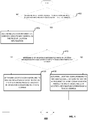
- FIG. 4 is a flowchart of determining a latitude and a longitude corresponding to a MAC address according to various embodiments of the present disclosure.
- process 400 includes a method for determining the latitude and longitude corresponding to each MAC address according to the one or more pieces of MAC address latitude and longitude data corresponding to each MAC address.
- process 400 is implemented by device 1000 of FIG. 10 .
- process 400 is implemented by system 1100 of FIG. 11 .
- 320 of FIG. 3 is implemented by method 400.
- a MAC address has a single piece of location information or multiple pieces of location information. If the MAC address has a single piece of location information, at 405, that piece of location information is determined to be the location information corresponding to the MAC address.
- the location information corresponding to the MAC address can be used to determine a current location of a terminal (e.g., that accesses the Internet using a network device with the MAC address).
- the location information corresponding to the MAC address can be provided as output or used to provide a location-based service.
- a server determines whether the distance between two pieces of location information corresponding to a MAC address is greater than the first threshold distance. The server can determine whether the distance between the locations corresponding to all combinations of two pieces of MAC address latitude and longitude data among the multiple pieces of MAC address latitude and longitude data corresponding to each MAC address exceeds the first threshold distance.
- a degree to which the multiple pieces of MAC address latitude and longitude data corresponding to a particular MAC address are clustered is measured based at least in part on whether a distance between any two pieces of location information corresponding to the MAC address is greater than a first threshold distance. Specifically, it is whether the distance between the locations corresponding to each two pieces of latitude and longitude data among multiple pieces of latitude and longitude data corresponding to each MAC address exceeds the first threshold distance. If so, the locations of the multiple pieces of latitude and longitude data corresponding to the MAC address are clustered.
- the degree to which the multiple pieces of MAC address latitude and longitude data corresponding to a particular MAC address are clustered is measured so as to exclude abnormal data (e.g., outliers) such as a mobile WiFi.
- a mobile WiFi has a decentralized position and thus a position according to a MAC address cannot be determined according to the MAC address for a device accessing the Internet using a mobile WiFi.
- the first threshold distance can be configured automatically by the server or manually by a user (e.g., based on settings for context-based content such as location-based content).
- the first threshold distance is set according to specific conditions. For example, wireless network signal transmitting equipment with wireless network signal coverage ranges of about 50 meters is relatively common (e.g., in the case of wireless routers). Accordingly, the first threshold distance can be set at 100 meters.
- a location corresponding to a particular MAC address can be determined based at least in part on the multiple pieces of location information corresponding to the MAC address. For example, the server can determine that a location corresponding to a particular MAC address is an average of the multiple pieces of (collected) location information corresponding to a particular MAC address.
- the server can determine that a location corresponding to a particular MAC address is an average of the multiple pieces of (collected) location information corresponding to a particular MAC address after the multiple pieces of (collected) location information corresponding to a particular MAC address have been filtered (e.g., processed) to remove outlier location information.
- an average of the latitude information and the longitude information of the multiple pieces of MAC address latitude and longitude data is determined to be the latitude information (e.g., latitude coordinate) and longitude information (e.g., longitude coordinate) corresponding to the particular MAC address.
- the location corresponding to a particular MAC address can be determined to be the average of the pieces of location information corresponding to the particular MAC address in the event that none of the distances between any two pieces of the location information corresponding to the particular MAC address is greater than the first threshold distance.
- the determined location corresponding to the particular MAC address can be stored in the database indicating locations associated with MAC addresses.
- the locations at which the multiple pieces of MAC address latitude and longitude data occur corresponding to the MAC address can be determined to be relatively clustered. Accordingly, respective averages of the latitudes and longitudes among the multiple pieces of MAC address latitude and longitude data can be determined and deemed to correspond to the location corresponding to the MAC address.
- a location corresponding to a particular MAC address can be determined based at least in part on a frequency of a particular location of the multiple pieces of location information corresponding to the MAC address. For example, a location corresponding to a particular MAC address can be determined to correspond to the location at which the Internet is accessed in connection with the MAC address most often.
- the latitude and longitude corresponding to a particular MAC address is determined according to a threshold quantity of pieces of MAC address latitude and longitude data having the most occurrence days among the multiple pieces of MAC address latitude and longitude data.
- the locations at which the multiple pieces of MAC address latitude and longitude data occur corresponding to the MAC address are deemed to be relatively dispersed (e.g., not clustered).
- the latitude information and longitude information e.g., the latitude and longitude coordinates
- the latitude information and longitude information can be determined according to a threshold quantity of pieces of MAC address latitude and longitude data having the most occurrence days among the multiple pieces of MAC address latitude and longitude data.
- the threshold quantity of pieces of MAC address latitude and longitude data can be configured by the server, by a user (e.g., based on settings for context-based content such as location-based content), or the like.
- the threshold quantity of pieces can be configured according to signal strength, time (e.g., time of a connection), or the like.
- the latitude and longitude corresponding to a particular MAC address can be determined according to the three pieces of MAC address latitude and longitude data having the most occurrence days among the multiple pieces of MAC address latitude and longitude data corresponding to the particular MAC address.
- the multiple pieces of MAC address latitude and longitude data corresponding to a particular MAC address can be ranked according to a number of occurrence days in order to extract the pieces of MAC address latitude and longitude data with the three most occurrence days corresponding to the particular MAC address.
- the latitude and longitude corresponding to the particular MAC address can be determined according to the number of occurrence days of the three pieces of MAC address latitude and longitude data having the most occurrence days and the distances between the locations corresponding thereto.
- the distance between the MAC address latitude and longitude data of the extracted pieces of MAC address latitude and longitude data e.g., the threshold quantity of pieces of MAC address latitude and longitude data having the most occurrence days among the multiple pieces of MAC address latitude and longitude data that are extracted from the multiple pieces of MAC address latitude and longitude data
- the locations corresponding to the other pieces of MAC address latitude and longitude data can be determined.
- the longitude data and the latitude data of the MAC address latitude and longitude data with the most occurrence days are weighted and averaged using the respective number of occurrence days as weights.
- the obtained average latitude and average longitude can be determined to be the latitude and longitude for the MAC address.
- the second threshold distance can be the same as the first threshold distance.
- the first threshold distance and the second threshold distance are both 100 meters.
- the distances between r1 and the locations corresponding to the other two pieces of MAC address latitude and longitude data (e.g., r2 and r3) can be separately calculated.
- the latitude data and the longitude data in r1, r2, and r3 are weighted and averaged using the number of occurrence days of rl, r2, and r3, respectively, as weights.
- the number of occurrence days of r1, r2, and r3 can be represented as n1, n2, and n3, respectively.
- the average latitude and average longitude can be computed as (n1/(n1+n2+n3)*r1 + (n2/(n1+n2+n3)*r2 + n3/(n1+n2+n3)*r3)/ (number of pieces of latitude and longitude data).
- the number of pieces of latitude and longitude data is 3.
- the obtained average latitude and average longitude are determined to be the latitude and longitude corresponding to the particular MAC address.
- the latitude data and the longitude data of r1 and r2 are weighted and averaged using the number of occurrence days of r1 and r2, respectively, as weights (e.g., n1 and n2, respectively).
- the average latitude and average longitude can be computed as (n1/(n1+n2)*r1 + (n2/(n1+n2)*r2) / (number of pieces of latitude and longitude data).
- the number of pieces of latitude and longitude data is 2 because the distance between the locations corresponding to r1 and r3 is greater than 100 meters.
- the pieces of latitude data and the longitude data for which the distance between the pieces of latitude data and longitude data having the most occurrence days (e.g., the latitude data and longitude data having the greatest frequency of occurrence) is less than the second distance threshold are used in determining the weighted average of the latitude information and the longitude information corresponding to a particular MAC address.
- the obtained average latitude and average longitude can be determined to be (e.g., deemed as being) the latitude and longitude corresponding to the MAC address.
- the latitude and longitude of r1 which has the most occurrence days can be determined to be (e.g., deemed as being) the latitude and longitude corresponding to the MAC address.
- a confidence level of the location corresponding to each MAC address can be determined.
- a confidence level of the location corresponding to each MAC address can be determined according to the signal strength corresponding to one or more pieces of MAC address latitude and longitude data corresponding to the MAC address.
- the signal strength corresponding to each piece of MAC address latitude and longitude data corresponding to the MAC address can be used as a basis for determining the confidence level of each piece of MAC address latitude and longitude data.
- I signal be the signal strength of the data obtained at a location.
- the confidence level for MAC address latitude and longitude data with a signal strength of -50 dbm ⁇ I signal ⁇ 0 dbm is set at 1 (the strongest confidence level).
- the confidence level for MAC address latitude and longitude data with a signal strength of -70 dbm ⁇ I signal ⁇ -50 dbm is set at 2.
- the confidence level for MAC address latitude and longitude data with a signal strength of -90 dbm ⁇ I signal ⁇ -70 dbm is set at 3, and so on.
- the confidence level with the highest number of occurrences among the confidence levels of the one or more pieces of MAC address latitude and longitude data corresponding to the MAC address is determined as the confidence level of the location corresponding to the MAC address.
- a most frequent confidence level associated with the one or more pieces of MAC address latitude and longitude information corresponding to the MAC address is determined to be the confidence level of the location information corresponding to the MAC address.
- the value of the confidence level can be inversely related to the degree of confidence. For example, a confidence level of 1 can correspond to the strongest degree of confidence, a confidence level of 2 can correspond to the second strongest degree of confidence, and the like.
- a database indicating locations associated with MAC addresses is used (e.g., to look-up, or otherwise determine, the location of a terminal), and the confidence level that is looked up for the location corresponding to the MAC address (e.g., of the wireless signal transceiver equipment associated with a terminal connecting to the Internet) is relatively high (e.g., above a confidence level threshold), then the location corresponding to the MAC address is further determined in combination with the pre-configured correspondences bank of IP addresses and locations.
- the location corresponding to the MAC address included in the database is determined to be (e.g., deemed as) the current location of the terminal. For example, if the database indicating locations associated with MAC addresses includes the MAC address of the network device (e.g., the wireless signal transceiver equipment) associated with the terminal connected to the Internet (e.g., the network device that the terminal uses to access the Internet), then the location corresponding to the MAC address (e.g., the latitude information and longitude information corresponding to the MAC address) is looked up in the database indicating locations associated with MAC addresses. The latitude information and longitude information corresponding to the MAC address is determined to be the latitude and longitude of the current location of the terminal.
- the network device e.g., the wireless signal transceiver equipment
- the location corresponding to the MAC address e.g., the latitude information and longitude information corresponding to the MAC address
- the latitude information and longitude information corresponding to the MAC address is determined to be the latitude
- the location of the terminal can be determined according to the IP address of the terminal.
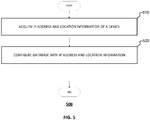
- FIG. 5 is a flowchart of pre-configuring a database indicating locations associated with IP addresses according to various embodiments of the present application.
- a method 500 for configuring a database indicating locations associated with IP addresses is provided.
- the method 500 is implemented by device 1000 of FIG. 10 .
- the method 500 is implemented by system 1100 of FIG. 11 .
- an IP address of a device and location information of a device are acquired.
- the device can be a terminal accessing the Internet, or the like.
- a server acquires (e.g., collects) the IP address and the location information corresponding to the IP address.
- the server can acquire the IP address and the location information of the device in connection with a network access event.
- the network access event can be a terminal accessing the Internet, browsing a web page, communicating with a network device, etc.
- the IP addresses can correspond to the IP addresses of wireless signal transceiver equipment (e.g., wireless routers, wireless switches, etc.) through which the terminal communicates, and can be attached to the header or payload of a message in a specified field.
- the location information corresponding to an IP address can include the latitude information (e.g., latitude coordinates) and longitude information (e.g., longitude coordinates), and can be included in a packet header or payload.
- the location information associated with a particular IP address can correspond to the location of a terminal at the time that the Internet is accessed via the particular IP address (e.g., when a terminal accesses the Internet, or otherwise goes online, via the IP address).
- the location information associated with the IP address can be used to determine the latitude and longitude of the location of the terminal.
- the IP address of the wireless signal transceiver equipment that is transmitting the wireless network signals can be acquired.
- the mobile device accesses the Internet, the mobile device sends a packet to the networking equipment, which attaches its IP address to the packet header or payload and then forwards the packet to its destination.
- the IP address of the wireless signal transceiver device e.g., network equipment
- the wireless signal transceiver device that the mobile device uses to access the Internet
- the IP address of the wireless signal transceiver device can be acquired by analyzing the packet header or payload downstream from the wireless signal transceiver device, such as when the packet reaches its destination server.
- location information stored in association with a particular IP address can have a valid time of data.
- the valid time of data can be a threshold amount of time that the location information associated with a particular IP address is valid.
- the IP addresses and corresponding location information of a device can be collected within a predetermined collection time period prior to a current time (e.g., the time at which location of the terminal is determined using the database in connection with a location-based service).
- the IP addresses and corresponding location information can be collected in connection with network communications that occurred within a predetermined collection period of time before the current time. For example, the IP addresses and location information of each IP address can be collected for the most recent 30 days.
- the locations e.g., latitudes and longitudes
- the locations may differ at different network access times.
- one or more pieces of location information are collected for each IP address.
- the location information of each IP address includes one or more pieces of latitude information and longitude information.
- each piece of latitude information and longitude information associated with an IP address corresponds to the latitude and longitude of a terminal at a different time when the terminal accessed the Internet (e.g., went online) via the IP address.
- a database is updated with the IP address and the location information.
- a database indicating locations associated with IP addresses is configured to store the acquired IP address and location information.
- the database can be configured to store a mapping of the acquired location information to the acquired IP address.
- the server can configure the database with the IP address and the location information.
- the server can configure, or otherwise update, the database with the MAC address and the location information at predetermined times (e.g., at predetermined time intervals), in response to receiving the MAC address and the location information corresponding to the MAC address, the like, or any combination thereof.
- the mobile device in the event that a device is connected to a WiFi network, can execute a map application that can determine a location (e.g., positioning) of the mobile device.
- the mobile phone can retrieve the MAC address associated with the WiFi networks (e.g., using a packet received during communication with the WiFi network, such as a router).
- the map application can store the MAC address and corresponding location information in a cache on the mobile device.
- the mobile device can update a database (e.g., a local database, a remote database hosted by a server, or the like).
- the mobile device can update the database at predefined time intervals.
- the mobile device can update the database at predefined events (e.g., such as network or Internet access events).
- the server can configure the database when the server receives an update (e.g., comprising MAC address information and location information) from the mobile device.
- the collected IP address and corresponding location information can be used as a basis for determining the latitude and longitude corresponding to each IP address so as to obtain a relationship between IP addresses and corresponding locations stored in the database of IP addresses and locations.
- the database can be used to determine a location of a terminal according to the IP address of the terminal.
- the IP address of the terminal can be determined based on a message (e.g., an access request) communicated to a server.
- FIG. 6 is a flowchart of determining a latitude and a longitude corresponding to an IP address according to various embodiments of the present disclosure.
- process 600 is implemented by device 1000 of FIG. 10 .
- process 600 is implemented by system 1100 of FIG. 11 .
- 520 of FIG. 5 is implemented by method 600.
- using the location information of each collected IP address as a basis for determining the latitude and longitude corresponding to each IP address includes 605-620.
- Each collected IP address can correspond to an IP address of a device when the device connects to the Internet.
- an IP address and its associated location information are obtained.
- the IP address and the location information are obtained from specific fields in the header and/or payload of a specially marked packet received at the server.
- location information associated with an IP address is processed.
- the server processes the location information associated with the IP address.
- the database e.g., a processor operatively connected with the database
- the collected IP addresses and the location information of each IP address are processed to obtain one or more pieces of IP address latitude and longitude data corresponding to each collected IP address.
- the geographic coordinate information included in the location information of each collected IP address can be processed to obtain IP address geographic coordinate data corresponding to each IP address. Because the location information of each IP address can include one or more pieces of geographic coordinate information, one or more pieces of IP address geographic coordinate data corresponding to a particular IP address can be obtained by processing the location information associated with the particular IP address. Each piece of IP address geographic coordinate data can include the IP address and a set of longitudinal and latitudinal data associated with the IP address. For example, any one piece of geographic coordinate information in the location information associated with an IP address can be processed to obtain a piece of IP address geographic coordinate data corresponding to the IP address.
- the format of the piece of IP address geographic coordinate data corresponding to the IP address data can be [ip, lat, long], wherein "ip” represents the IP address, "lat” represents latitude, and "long” represents longitude.
- the location information e.g., the latitudinal data and the longitudinal data
- the location information can be processed according to a predetermined rule based on a desired precision. For example, the last three digits after the decimal point can be retained (e.g., the three places following the decimal point can be captured) in the longitudinal data and in the latitudinal data to ensure reasonable error for the actual geographic location corresponding to each set of geographic coordinate data (e.g., 0.01 degree geographic coordinate error within 1 km).
- the determining of a location corresponding to an IP address, or otherwise configuring the database indicating locations associated with IP addresses can include deleting the pieces of IP address latitude and longitude data for which a number of occurrence days in the IP address latitude and longitude data obtained through processing is less than a threshold number of days. For example, a piece of IP address geographic coordinate data occurs only on one day. The piece of IP address geographic coordinate data can be deemed likely to be abnormal data because it falls below the threshold number five. Accordingly, such data can be deleted or otherwise filtered out.
- the threshold number of days can be configured by a user, a server (e.g., a server that provides context-based content to a terminal), or the like. The threshold number of days can be determined according to a statistical analysis of the one or more pieces of IP address latitude and longitude data that determines data that is deemed to be outliers according to a statistically relevant measure.
- a location corresponding to an IP address can be determined.
- the location corresponding to the IP address can be determined based at least in part on the processed location information associated with the IP address.
- the one or more pieces of IP address latitude and longitude data corresponding to an IP address serve as a basis for determining the latitude and longitude corresponding to an IP address.
- the location corresponding to a particular IP address determined based at least in part on the one or more pieces of IP address latitude and longitude data can be a representative location corresponding to the particular IP address.
- FIG. 7 is a flowchart of determining a latitude and a longitude corresponding to an IP address according to various embodiments of the present disclosure.
- process 700 is implemented by device 1000 of FIG. 10 .
- process 700 is implemented by system 1100 of FIG. 11 .
- 620 of FIG. 6 is implemented by method 700.
- the determining of the latitude and longitude corresponding to each IP address according to the one or more pieces of IP address latitude and longitude data corresponding to each IP address includes 710 and 720.
- a weighting of location information associated with an IP address is determined.
- a server e.g., a server operatively connected with the database indicating locations associated with IP addresses determines a weighting of the location information. For an IP address, the weight of each piece of IP address latitude and longitude data corresponding to the IP address is determined. For example, a weight of each piece of IP address geographic coordinate data among the one or more pieces of IP address geographic coordinate data corresponding to each collected IP address is determined.
- a weighting of location information associated with an IP address does not need to be determined. For example, the piece of IP address geographic coordinate data corresponding to the IP address can be deemed to be the location corresponding to the IP address.
- the weight of each piece of IP address geographic data can be determined according to the time at which the piece of IP address geographic data is collected (e.g., the time of the network access event, which can be a terminal accessing the Internet, browsing a web page, communicating with a network device, or the like). For example, a piece of IP address geographic data that is collected relatively more recently (e.g., a piece of IP address geographic data associated with a more recent network event) can be weighted relatively higher than a piece of IP address geographic data that is collected relatively less recently (e.g., a piece of IP address geographic data associated with a less recent network event). In some embodiments, because IP addresses can be dynamically located, a piece of IP address geographic data can become dated. The weight of each piece of IP address geographic data can be determined based at least in part on a time associated with the piece of IP address geographic data.
- the distance between the IP address latitude and longitude data of the extracted pieces of IP address latitude and longitude data e.g., the threshold quantity of pieces of IP address latitude and longitude data having the most occurrence days among the multiple pieces of IP address latitude and longitude data that are extracted from the multiple pieces of IP address latitude and longitude data
- the locations corresponding to the other pieces of IP address latitude and longitude data can be determined.
- the longitude data and the latitude data of the IP address latitude and longitude data with the most occurrence days are weighted and averaged using the respective number of occurrence days as weights.
- the obtained average latitude and average longitude can be determined to be the latitude and longitude for the IP address.
- the third threshold distance can be the same as the first threshold distance.
- the first threshold distance and the third threshold distance are both 100 meters.
- the distances between p1 and the locations corresponding to the other two pieces of IP address latitude and longitude data (e.g., p2 and p3) can be separately calculated.
- the latitude data and the longitude data in p1, p2, and p3 are weighted and averaged using the number of occurrence days of p1, p2, and p3, respectively, as weights.
- the number of occurrence days of p1, p2, and p3 can be represented as n1, n2, and n3, respectively.
- the average latitude and average longitude can be computed as (n1/(n1+n2+n3)*p1 + (n2/(n1+n2+n3)*p2 + n3/(n1+n2+n3)*p3) / (number of pieces of latitude and longitude data).
- the number of pieces of latitude and longitude data is 3.
- the obtained average latitude and average longitude are determined to be the latitude and longitude corresponding to the particular IP address.
- the latitude data and the longitude data of p1 and p2 are weighted and averaged using the number of occurrence days of p1 and p2, respectively, as weights (e.g., n1 and n2, respectively).
- the average latitude and average longitude can be computed as (n1/(n1+n2)*p1 + (n2/(n1+n2)*p2) / (number of pieces of latitude and longitude data).
- the number of pieces of latitude and longitude data is 2 because the distance between the locations corresponding to p1 and p3 is greater than 100 meters.
- the pieces of latitude data and the longitude data for which the distance between the pieces of latitude data and longitude data having the most occurrence days (e.g., the latitude data and longitude data having the greatest frequency of occurrence) is less than the third distance threshold are used in determining the weighted average of the latitude information and the longitude information corresponding to a particular IP address.
- the obtained average latitude and average longitude can be determined to be (e.g., deemed as being) the latitude and longitude corresponding to the IP address.
- the latitude and longitude of p1 which has the most occurrence days can be determined to be (e.g., deemed as being) the latitude and longitude corresponding to the IP address.
- a location associated with an IP address is determined based at least in part on the weighting of the location information.
- a server determines the location associated with a particular IP address. The determined location can be stored in the database indicating the location associated with the IP address.
- the location associated with a particular IP address can be determined contemporaneously with providing a terminal accessing the Internet using the particular IP address with a context-based (e.g., location-based) service.
- the location associated with an IP address can be determined using the weight of IP address geographic coordinate data corresponding to a collected IP address (e.g., using the weight of each piece of IP address geographic coordinate data among the one or more pieces of IP address geographic coordinate data corresponding to each collected IP address).
- FIG. 8 is a flowchart determining a weight of each piece of IP address latitude and longitude data corresponding to an IP address.
- a method 800 for determining a weight of each piece of IP address latitude and longitude data corresponding to an IP address is provided.
- process 800 is implemented by device 1000 of FIG. 10 .
- process 800 is implemented by system 1100 of FIG. 11 .
- 710 of FIG. 7 is implemented by method 800.
- the determining, for each IP address, of the weight of each piece of IP address latitude and longitude data corresponding to a particular IP address includes 810 and 820.
- one or more pieces of location information that occur within a fourth threshold distance of a piece of location information associated with an IP address are acquired. For example, one or more pieces of IP address latitude and longitude data that occur within a predetermined range (e.g., the fourth threshold distance) of the location corresponding to each piece of IP address latitude and longitude data corresponding to the IP address are acquired.
- a predetermined range e.g., the fourth threshold distance
- the fourth threshold distance can be 2 kilometers and a server can acquire all the IP address geographic coordinate data occurring within 2 kilometers of locations corresponding to geographic coordinates in each piece of IP address geographic coordinate data corresponding to the IP address.
- the one or more pieces of IP address latitude and longitude data corresponding to a particular IP address that occur within 2 kilometers of every other piece of IP address latitude and longitude data corresponding to the particular IP address are acquired.
- a weighting of location information is determined based at least in part on a number of occurrences of a particular location among the acquired one or more pieces of location information.
- the server e.g., a server operatively connected to the database indicating locations associated with IP addresses
- the weight of each piece of IP address latitude and longitude data corresponding to a particular IP address is determined according to a number of occurrence days of each piece of IP address latitude and longitude data corresponding to the IP address within a predetermined time period and the number of occurrence days of one or more pieces of IP address latitude and longitude data occurring within a predetermined range of a corresponding location.
- the predetermined range can correspond to the fourth threshold distance.
- the weight of each piece of IP address latitude and longitude data corresponding to a particular IP address is determined based on a number of days for which the Internet is accessed using the particular IP address from a particular location.
- the number of occurrence days of each piece of IP address latitude and longitude data among one or more pieces of IP address latitude and longitude data occurring within a predetermined range of locations corresponding to each of the pieces of IP address latitude and longitude data is summed.
- the predetermined range can correspond to the fourth threshold distance.
- the total number of days corresponding to the IP address latitude and longitude data is obtained, and the number of occurrence days of the IP address latitude and longitude data is counted.
- the total number of days and the number of occurrence days corresponding to each piece of IP address latitude and longitude data are weighted according to a predetermined weight. The weight for each piece of IP address latitude and longitude data is obtained.
- the number of occurrence days are counted for the one or more pieces of IP address latitude and longitude data corresponding to each collected IP address so as to obtain the number of days for all pieces of IP address latitude and longitude data.
- the occurrences of one piece of IP address latitude and longitude data during one day e.g., any one day in a predetermined collection time period prior to the current time
- all instances of the piece of IP address latitude and longitude data are recorded as one occurrence day for that piece of IP address latitude and longitude data.
- the number of occurrence days for all IP address latitude and longitude data within two kilometers of each piece of IP address latitude and longitude data may be acquired and summed, and the total number of days corresponding to this piece of IP address latitude and longitude data is obtained.
- the number of occurrence days of this piece of IP address latitude and longitude data within a predetermined time period e.g., during the seven days prior to the current time
- the corresponding total number of days and number of occurrence days are weighted according to a predetermined weight.
- the corresponding total number of days and the number of occurrence days can be weighted according to a weight of 1: 4.
- the weighted value is taken as the weight of a particular piece of IP address latitude and longitude data.
- the latitude and longitude in the IP address latitude and longitude data with the largest weight among the one or more pieces of IP address latitude and longitude data corresponding to the IP address can be determined to be the latitude and longitude corresponding to the IP address.
- the piece of IP address latitude and longitude data with the greatest weight therein can be determined, and at 720, the latitude and longitude in the IP address latitude and longitude data with the largest weight can be determined to be the latitude and longitude corresponding to the IP address, (e.g., the latitude and longitude of the location corresponding to the IP address).
- the latitude and longitude in the IP address latitude and longitude data associated with a particular IP address with the largest weight can be stored in the database indicating locations associated with IP addresses as the location information (e.g., the latitude and longitude) associated with the particular IP address.
- the determined latitude and longitude corresponding to each IP address and the previously acquired IP address base database are merged and processed to configure the database indicating locations associated with IP addresses.
- the determined latitude and longitude corresponding to each IP address is compared to the previously acquired IP address base database (e.g., an existing version of the database indicating locations associated with IP addresses). IP addresses that do not exist in the IP address base database and the latitudes and longitudes corresponding thereto are added to the database of IP addresses and locations that provides relationships between IP addresses and locations.
- IP address base database e.g., an existing version of the database indicating locations associated with IP addresses.
- IP addresses that do not exist in the IP address base database and the latitudes and longitudes corresponding thereto are added to the database of IP addresses and locations that provides relationships between IP addresses and locations.
- a determination is made as to whether the zone of the latitude and longitude corresponding to the IP address is the same as the zone of the latitude and longitude corresponding to the IP address in the IP address base database.
- the IP address and the latitude and longitude corresponding thereto can be added to the database indicating locations associated with IP addresses.
- the IP address and the latitude and longitude corresponding thereto in the IP address base database can be added to the database indicating locations associated with IP addresses so as to replace location information associated with an IP address.
- the determined latitude and longitude corresponding to each IP address and the previously acquired IP address base database can be merged into a database indicating locations associated with IP addresses.
- the IP address base database could be an operator IP database (e.g., a commercially available service that provides an indication of a location corresponding to a particular IP address).
- the operator IP database can provide latitudes and longitudes corresponding to IP addresses and the cities corresponding to the locations of the IP addresses.
- the latitude and longitude corresponding to an IP address as determined at 520 described above can be [lata, longa], where "lata" represents the latitude information (e.g., latitude coordinate), and "longa" represents the longitude information (e.g., longitude coordinate).
- the latitude and longitude corresponding to the IP address and the city corresponding to the location can be [latb, longb, cityb], where "cityb" represents the city corresponding to the location of the IP address.
- a determination can be made as to whether the latitude information and longitude information [lata, longa] are in the zone of cityb (e.g., using the limits of the city indicated by the latitude and longitude). If the location associated with the latitude information and longitude information is within the zone of cityb, then [lata, longa] can be determined to be (e.g., deemed as) the latitude information and longitude information corresponding to the IP address.
- the latitude information and longitude information [lata, longa] can be added to the database indicating locations associated with IP addresses. If the location associated with the latitude information and longitude information [lata, longa] is not in the zone of cityb, then [latb, longb] can be determined to be (e.g., deemed as) the latitude and longitude corresponding to the IP address and added to the database indicating locations associated with IP addresses.
- the database indicating locations associated with IP addresses in the event that the database indicating locations associated with IP addresses is configured, the database is updated at predetermined intervals. Because IP addresses are dynamically allocated, the location corresponding to an IP address can change, or an IP address that was not collected and thus does not exist in the database can subsequently be collected. Therefore, the database indicating locations associated with IP addresses can be updated at predetermined intervals. In some embodiments, the predetermined length of time is determined according to specific conditions. For example, the database indicating locations associated with IP addresses can be updated every 10 minutes.
- FIG. 9 is a flowchart of updating a database indicating locations associated with IP addresses at predetermined intervals according to various embodiments of the present application.
- process 900 is implemented by device 1000 of FIG. 10 . In some embodiments, process 900 is implemented by system 1100 of FIG. 11 .
- an IP address and location information associated with the IP address are collected.
- a server collects (e.g., acquires) the IP address and associated location information.
- the IP addresses which have occurred in the current day and the location information of each IP address are collected.
- location information currently corresponding to a particular IP address is determined.
- the server determines location information that currently corresponds to a particular IP address.
- the latitude information and the longitude information included in the location information of each IP address having an occurrence time that is closest to the current time can be determined to be the latitude information and longitude information currently corresponding to the IP address.
- the latest latitude and longitude information of each collected IP address is determined as the latitude and longitude currently corresponding to the IP address.
- the server determines whether the database indicating locations associated with IP addresses includes location information (e.g., the latitude information and the longitude information) associated with the particular IP address.
- the server can determine whether the database indicating locations associated with IP addresses includes the particular IP address (e.g., whether the database stores a record for the IP address). For example, a determination is made as to whether the IP address can be looked up in the database indicating locations associated with IP addresses.
- the particular IP address and location information associated therewith can be included in the database.
- an IP address and the latitude information and the longitude information currently corresponding to the particular IP address can be stored in the database.
- the threshold can correspond to the fourth threshold distance.
- a determination can be made as to whether the distance between the latitude and longitude corresponding to the IP address stored in the database indicating the locations associated with IP addresses and the latitude and longitude currently corresponding to the particular IP address exceeds the fourth threshold distance.
- the location information currently corresponding to the particular IP address in the database indicating locations associated with IP addresses is stored.
- the latitude information and longitude information corresponding to the IP address in the database indicating locations associated with IP addresses is replaced with the latitude information and longitude information currently corresponding to the particular IP address.
- the database indicating locations associated with the IP address can be unchanged in relation to the particular IP address.
- the database indicating locations associated with IP addresses can maintain the latitude and longitude that originally corresponded to the IP address.
- the location corresponding to the IP address can be determined to be the location of the terminal.
- the location e.g., the latitude and the longitude
- the current location of the terminal is determined to be the latitude and longitude of the location corresponding to the IP address stored in the database indicating locations associated with IP addresses.
- the positioning of the terminal can be determined to have failed.
- the method 100 can end without a location being provided for the terminal.
- the latitude and longitude corresponding to the IP address of the terminal could not be found in the database indicating locations associated with IP addresses. Accordingly, the positioning of the terminal has failed.
- FIG. 10 is a diagram of a device for determining a terminal location according to various embodiments of the present application.
- a device 1000 for determining a location of a terminal implements method 100 of FIG. 1 , method 200 of FIG. 2 , method 300 of FIG. 3 , method 400 of FIG. 4 , method 500 of FIG. 5 , method 600 of FIG. 6 , method 700 of FIG. 7 , method 800 of FIG. 8 , method 900 of FIG. 9 , or any combination thereof.
- the device 1000 can be implemented in system 1100 of FIG. 11 .
- the device 1000 can correspond to server 1120 of FIG. 11 , database 1140 of FIG. 11 , the like, or any combination thereof.
- the device 1000 corresponds to a server.
- the server can be a server that provides a location-based service to a client terminal.
- the server can correspond to a server that hosts a website or a web service.
- the device 1000 corresponds to a server that is connected to another server, which provides a location-based service to a client terminal.
- the device 1000 corresponds to a client terminal.
- the device 1000 includes a first acquiring module 1010, a first assessing module 1020, and a first determining module 1030.
- the first acquiring module 1010 can be configured to acquire the MAC address of network equipment (e.g., wireless signal transceiver equipment) when the terminal connects to the Internet.
- the terminal can connect to the Internet by receiving wireless network signals transmitted by the network equipment (e.g., the wireless signal transceiver equipment).
- the first assessing module 1020 can be configured to determine whether the database indicating locations associated with MAC addresses includes the MAC address corresponding to the terminal.
- the first determining module 1030 can be configured to determine the location corresponding to the MAC address included in the database (e.g., the database indicating locations associated with MAC addresses) to be the current location of the terminal in the event that the database includes the MAC address corresponding to the terminal.
- the database e.g., the database indicating locations associated with MAC addresses
- the device 1000 includes a second acquiring module, a second assessing module, and a second determining module.
- the second acquiring module can be configured to acquire the IP address of the terminal in the event that the database indicating locations associated with MAC addresses does not include the MAC address corresponding to the terminal.
- the second assessing module can be configured to determine whether the database indicating locations associated with IP addresses includes the IP address corresponding to the terminal.
- the second determining module can be configured to determine the location corresponding to the IP address as the current location of the terminal.
- the device 1000 can further include a first collecting module.
- the first collecting module can be configured to collect MAC addresses and location information corresponding thereto.
- the location information can include the latitudes and longitudes of locations of equipment (e.g., a device) that accesses the Internet when the equipment connects to the Internet using the wireless signal transceiver equipment corresponding to the MAC address.
- the device 1000 can further include a third determining module.
- the third determining module can be configured to use each collected MAC address and location information corresponding thereto as a basis for determining the latitude and longitude corresponding to each MAC address so as to obtain (e.g., configure) a database indicating locations associated with MAC addresses.
- the third determining module includes a first processing module and a first latitude and longitude determining module.
- the first processing module can be configured to process the location information corresponding to each collected MAC address to obtain one or more pieces of MAC address latitude and longitude data corresponding to each MAC address.
- the first latitude and longitude determining module can be configured to use the one or more pieces of MAC address latitude and longitude data corresponding to each MAC address as a basis for determining the latitude and longitude corresponding to each MAC address.
- the first latitude and longitude determining module includes a distance assessing module and a latitude and longitude determining sub module.
- the distance assessing module can be configured to determine whether the distance between the locations corresponding to each of two pieces of MAC address latitude and longitude data among the one or more pieces of MAC address latitude and longitude data corresponding to each MAC address exceeds a first threshold distance.
- the latitude and longitude determining sub module can be configured to determine that the average of the latitudes and longitudes of the one or more pieces of MAC address latitude and longitude data corresponds to the latitude and longitude corresponding to the MAC address in the event that none of the distances between the locations corresponding to each of two pieces of MAC address latitude and longitude data among the one or more pieces of MAC address latitude and longitude data exceeds a first threshold distance.
- the latitude and longitude sub determining module can further be configured to determine that a predetermined quantity of MAC address latitude and longitude data with the greatest number of occurrence days among the one or more pieces of MAC address latitude and longitude data serves as a basis for determining the latitude and longitude corresponding to the MAC address in the event that a distance between the locations corresponding to any two pieces of MAC address latitude and longitude data among the one or more pieces of MAC address latitude and longitude data exceeds a first predetermined distance.
- the device 1000 may further include a confidence level determining module.
- the confidence level module can be configured to use the signal strength corresponding to each MAC address as a basis for determining the confidence level of the latitude and longitude corresponding to each MAC address.
- the device 1000 can further include a second collecting module.
- the second collecting module can be configured to collect IP addresses and the location information of each IP address.
- the location information of the IP addresses can include latitudes and longitudes of the locations when the Internet is accessed via the IP addresses.
- the device 1000 can further include a fourth determining module.
- the fourth determining module can be configured to determine the latitude and longitude corresponding to each IP address according to the location information of each collected IP address.
- the device 1000 can further include a margining module.
- the merging module can be configured to merge and process the determined latitude and longitude corresponding to each IP address and the previously acquired IP address base database to obtain (e.g., configured) a database indicating locations associated with IP addresses.
- the device 1000 can include a fourth determining module.
- the fourth determining module can include a second processing module and a second latitude and longitude determining module.
- the second processing module can be configured to process each collected IP address and the location information of each IP address to obtain one or more pieces of IP address latitude and longitude data corresponding to each collected IP address.
- the second latitude and longitude determining module can be configured to use the one or more pieces of IP address latitude and longitude data corresponding to each collected IP address as a basis for determining the latitude and longitude corresponding to each IP address.
- the second determining module can further include a weight determining module and a second latitude and longitude determining sub module.
- the weight determining module can be configured to determine, for each IP address, the weight of each piece of IP address latitude and longitude data corresponding to the IP address.
- the second latitude and longitude determining sub module can be configured to determine the latitude and longitude in the IP address latitude and longitude data with the largest weight among the one or more pieces of IP address latitude and longitude data corresponding to the IP address as the latitude and longitude corresponding to the IP address.
- the weight determining module can further include an acquiring sub-module and a weight determining sub-module.
- the acquiring sub-module can be configured to acquire the one or more pieces of IP address geographic coordinate data that occur within a predetermined range of locations corresponding to each piece of IP address geographic coordinate data corresponding to the IP address.
- the weight determining sub-module can be configured to determine the weight of each piece of IP address latitude and longitude data corresponding to the IP address according to the number of occurrence days of each piece of IP address latitude and longitude data corresponding to the IP address within a predetermined time period and the number of occurrence days of one or more pieces of IP address latitude and longitude data occurring within a predetermined range of a corresponding location.
- device 1000 can further include an updating module to configure (e.g., update) a database indicating locations associated with IP addresses.
- the updating module can be configured to update the database indicating locations associated with IP addresses at predetermined intervals.
- the updating module may further include a collecting sub-module, a determining sub-module, a first assessing sub-module, and an adding sub-module.
- the collecting sub-module can be configured to collect IP addresses which have occurred in the current day and the location information of each IP address.
- the determining sub-module can be configured to determine the latitude and longitude in the location information of each IP address having an occurrence time that is closest to the current time as the latitude and longitude currently corresponding to the IP address.
- the first assessing sub-module can be configured to determine whether the database indicating locations associated with IP addresses includes the IP address.
- the adding sub-module can be configured to add the correspondence of the IP address to the currently corresponding latitude and longitude to the database indicating locations associated with IP addresses in the event that the database does not include the IP address.
- the updating module further includes a second assessing sub-module and a substituting sub-module.
- the second assessing sub-module can be configured to determine whether the distance between the location corresponding to the IP address in the database indicating locations associated with IP addresses and the latitude and longitude currently corresponding to the IP address exceeds a threshold distance (e.g., the fourth threshold distance) in the event that the database indicating locations associated with IP addresses includes the IP address.
- a threshold distance e.g., the fourth threshold distance
- the substituting sub-module can be configured to, if the distance between the location corresponding to said IP address in said correspondences database of IP addresses and locations and the latitude and longitude currently corresponding to said IP address exceeds a second predetermined distance, can be configured to substitute the latitude and longitude corresponding to the IP address in the database indicating locations associated with IP addresses with the latitude and longitude currently corresponding to the IP address in the event that the distance between the location corresponding to the IP address in the database indicating locations associated with IP addresses and the latitude and longitude currently corresponding to the IP address exceeds a threshold distance (e.g., the fourth threshold distance).
- a threshold distance e.g., the fourth threshold distance
- FIG. 11 is a structural block diagram of a system for determining a terminal location according to various embodiments of the present application.
- a system 1100 for determining a location of a terminal implements method 100 of FIG. 1 , method 200 of FIG. 2 , method 300 of FIG. 3 , method 400 of FIG. 4 , method 500 of FIG. 5 , method 600 of FIG. 6 , method 700 of FIG. 7 , method 800 of FIG. 8 , method 900 of FIG. 9 , or any combination thereof.
- the device 1000 of FIG. 10 can be implemented in system 1100.
- the device 1000 can correspond to server 1120, database 1140, the like, or any combination thereof.
- the system 1100 for determining a location of a terminal includes a client terminal 1110, and a server 1120.
- the system 1100 can also include a network over which the client terminal 1110 and the server 1120 can communicate.
- the network 1130 can be a LAN, a Wide Area Network (WAN), the Internet, or the like.
- the system 1100 can include one or more databases 1140.
- the database 1140 can correspond to a database indicating locations associated with MAC addresses.
- the database 1140 can correspond to a database indicating locations associated with IP addresses.
- the server 1120 can configure the database 1140. For example, the server 1120 can update the database 1140 (e.g., so as to update a mapping of locations to addresses such as a MAC address or an IP address).
- the server 1120 can query the database 1140 to determine a current location of terminal 1110 based at least in part on a MAC address or an IP address received from the terminal 1110 in connection with the access of the server 1120 (e.g., or the Internet) by the terminal 1110.
- FIG. 12 is a functional diagram of a computer system for determining a location of a terminal according to various embodiments of the present disclosure.
- Computer system 1200 for accessing a website or for determining whether a terminal accessing the website is a mobile terminal is provided.
- Computer system 1200 which includes various subsystems as described below, includes at least one microprocessor subsystem (also referred to as a processor or a central processing unit (CPU)) 1202.
- processor 1202 can be implemented by a single-chip processor or by multiple processors.
- processor 1202 is a general purpose digital processor that controls the operation of the computer system 1200. Using instructions retrieved from memory 1210, the processor 1202 controls the reception and manipulation of input data, and the output and display of data on output devices (e.g., display 1218).
- Processor 1202 is coupled bi-directionally with memory 1210, which can include a first primary storage, typically a random access memory (RAM), and a second primary storage area, typically a read-only memory (ROM).
- primary storage can be used as a general storage area and as scratch-pad memory, and can also be used to store input data and processed data.
- Primary storage can also store programming instructions and data, in the form of data objects and text objects, in addition to other data and instructions for processes operating on processor 1202.
- primary storage typically includes basic operating instructions, program code, data, and objects used by the processor 1202 to perform its functions (e.g., programmed instructions).
- memory 1210 can include any suitable computer-readable storage media, described below, depending on whether, for example, data access needs to be bi-directional or uni-directional.
- processor 1202 can also directly and very rapidly retrieve and store frequently needed data in a cache memory (not shown).
- a removable mass storage device 1212 provides additional data storage capacity for the computer system 1200, and is coupled either bi-directionally (read/write) or uni-directionally (read only) to processor 1202.
- storage 1212 can also include computer-readable media such as magnetic tape, flash memory, PC-CARDS, portable mass storage devices, holographic storage devices, and other storage devices.
- a fixed mass storage 1220 can also, for example, provide additional data storage capacity. The most common example of mass storage 1220 is a hard disk drive.
- Mass storage device 1212 and fixed mass storage 1220 generally store additional programming instructions, data, and the like that typically are not in active use by the processor 1202. It will be appreciated that the information retained within mass storage device 1212 and fixed mass storage 1220 can be incorporated, if needed, in standard fashion as part of memory 1210 (e.g., RAM) as virtual memory.
- bus 1214 can also be used to provide access to other subsystems and devices. As shown, these can include a display monitor 1218, a network interface 1216, a keyboard 1204, and a pointing device 1206, as well as an auxiliary input/output device interface, a sound card, speakers, and other subsystems as needed.
- the pointing device 1206 can be a mouse, stylus, track ball, or tablet, and is useful for interacting with a graphical user interface.
- the network interface 1216 allows processor 1202 to be coupled to another computer, computer network, or telecommunications network using a network connection as shown.
- the processor 1202 can receive information (e.g., data objects or program instructions) from another network or output information to another network in the course of performing method/process steps.
- Information often represented as a sequence of instructions to be executed on a processor, can be received from and outputted to another network.
- An interface card or similar device and appropriate software implemented by (e.g., executed/performed on) processor 1202 can be used to connect the computer system 1200 to an external network and transfer data according to standard protocols.
- various process embodiments disclosed herein can be executed on processor 1202, or can be performed across a network such as the Internet, intranet networks, or local area networks, in conjunction with a remote processor that shares a portion of the processing.
- Additional mass storage devices can also be connected to processor 1202 through network interface 1216.
- auxiliary I/O device interface (not shown) can be used in conjunction with computer system 1200.
- the auxiliary I/O device interface can include general and customized interfaces that allow the processor 1202 to send and, more typically, receive data from other devices such as microphones, touch-sensitive displays, transducer card readers, tape readers, voice or handwriting recognizers, biometrics readers, cameras, portable mass storage devices, and other computers.
- the computer system shown in FIG. 12 is but an example of a computer system suitable for use with the various embodiments disclosed herein.
- Other computer systems suitable for such use can include additional or fewer subsystems.
- bus 1214 is illustrative of any interconnection scheme serving to link the subsystems.
- Other computer architectures having different configurations of subsystems can also be utilized.
- the modules described above can be implemented as software components executing on one or more general purpose processors, as hardware such as programmable logic devices, and/or Application Specific Integrated Circuits designed to perform certain functions or a combination thereof.
- the modules can be embodied by a form of software products which can be stored in a nonvolatile storage medium (such as optical disk, flash storage device, mobile hard disk, etc.), including a number of instructions for making a computer device (such as personal computers, servers, network equipment, etc.) implement the methods described in the embodiments of the present invention.
- the modules may be implemented on a single device or distributed across multiple devices. The functions of the modules may be merged into one another or further split into multiple sub-modules.
Landscapes
- Engineering & Computer Science (AREA)
- Signal Processing (AREA)
- Computer Networks & Wireless Communication (AREA)
- Business, Economics & Management (AREA)
- Accounting & Taxation (AREA)
- Development Economics (AREA)
- Finance (AREA)
- Strategic Management (AREA)
- Economics (AREA)
- Marketing (AREA)
- Physics & Mathematics (AREA)
- General Business, Economics & Management (AREA)
- General Physics & Mathematics (AREA)
- Theoretical Computer Science (AREA)
- Game Theory and Decision Science (AREA)
- Entrepreneurship & Innovation (AREA)
- Mobile Radio Communication Systems (AREA)
- Telephonic Communication Services (AREA)
- Position Fixing By Use Of Radio Waves (AREA)
Applications Claiming Priority (3)
| Application Number | Priority Date | Filing Date | Title |
|---|---|---|---|
| CN201410199350.5A CN105100292B (zh) | 2014-05-12 | 2014-05-12 | 确定终端的位置的方法及装置 |
| US14/708,516 US9560621B2 (en) | 2014-05-12 | 2015-05-11 | Method, apparatus, and system for determining a location of a terminal |
| PCT/US2015/030304 WO2015175488A1 (en) | 2014-05-12 | 2015-05-12 | Method, apparatus, and system for determining a location of a terminal |
Publications (2)
| Publication Number | Publication Date |
|---|---|
| EP3143813A1 EP3143813A1 (en) | 2017-03-22 |
| EP3143813B1 true EP3143813B1 (en) | 2019-07-03 |
Family
ID=54369008
Family Applications (1)
| Application Number | Title | Priority Date | Filing Date |
|---|---|---|---|
| EP15727118.0A Active EP3143813B1 (en) | 2014-05-12 | 2015-05-12 | Method, apparatus, and system for determining a location of a terminal |
Country Status (7)
| Country | Link |
|---|---|
| US (2) | US9560621B2 (enExample) |
| EP (1) | EP3143813B1 (enExample) |
| JP (1) | JP6307176B2 (enExample) |
| KR (1) | KR101782810B1 (enExample) |
| CN (1) | CN105100292B (enExample) |
| TW (1) | TWI654867B (enExample) |
| WO (1) | WO2015175488A1 (enExample) |
Families Citing this family (36)
| Publication number | Priority date | Publication date | Assignee | Title |
|---|---|---|---|---|
| CN105100292B (zh) * | 2014-05-12 | 2018-12-18 | 阿里巴巴集团控股有限公司 | 确定终端的位置的方法及装置 |
| CN106603733B (zh) * | 2015-10-14 | 2019-12-27 | 阿里巴巴集团控股有限公司 | 路由器地址类型的识别方法及装置 |
| CN106936887B (zh) | 2015-12-31 | 2020-10-20 | 珠海金山办公软件有限公司 | 一种地理位置定位方法及装置 |
| CN105704781A (zh) * | 2016-01-13 | 2016-06-22 | 广东欧珀移动通信有限公司 | 一种移动终端定位方法、装置及移动终端 |
| WO2017147835A1 (zh) * | 2016-03-03 | 2017-09-08 | 臧利 | 基于基站的用户设备定位方法及系统 |
| CN107222585A (zh) * | 2016-03-21 | 2017-09-29 | 林政宗 | 适用于电子设备的现实地址与网络地址匹配的方法及系统 |
| CN105933294B (zh) * | 2016-04-12 | 2019-08-16 | 晶赞广告(上海)有限公司 | 网络用户定位方法、装置及终端 |
| CN106507482B (zh) * | 2016-12-07 | 2019-07-26 | Oppo广东移动通信有限公司 | 一种网络定位方法及终端设备 |
| CN106714103B (zh) * | 2016-12-07 | 2019-09-27 | Oppo广东移动通信有限公司 | 一种网络定位方法及终端设备 |
| CN106658705B (zh) * | 2016-12-07 | 2019-10-18 | Oppo广东移动通信有限公司 | 一种网络定位方法及终端设备 |
| CN108513351B (zh) * | 2017-02-24 | 2020-11-03 | 中国移动通信集团福建有限公司 | 通信位置确定方法及装置 |
| US20180351978A1 (en) * | 2017-06-05 | 2018-12-06 | Microsoft Technology Licensing, Llc | Correlating user information to a tracked event |
| CN107707648B (zh) * | 2017-09-28 | 2020-11-03 | 湖南省茂泽信息科技有限公司 | 一种可信定位方法 |
| CN108282808A (zh) * | 2017-12-22 | 2018-07-13 | 厦门市美亚柏科信息股份有限公司 | 无线终端的探测方法及其系统 |
| US10762103B2 (en) * | 2017-12-27 | 2020-09-01 | Paypal, Inc. | Calculating representative location information for network addresses |
| CN108269087B (zh) * | 2018-01-12 | 2020-07-28 | 阿里巴巴集团控股有限公司 | 位置信息的处理方法及装置 |
| CN108768862B (zh) * | 2018-05-11 | 2020-10-30 | 哈尔滨工业大学 | 一种多接口路由器地理定位方法 |
| CA3176812A1 (en) | 2018-07-11 | 2020-01-16 | Actym Therapeutics, Inc. | Engineered immunostimulatory bacterial strains and uses thereof |
| US10924560B2 (en) * | 2018-07-30 | 2021-02-16 | Facebook, Inc. | Determining geographic locations of network devices |
| CN109660503B (zh) * | 2018-09-28 | 2023-04-18 | 深圳壹账通智能科技有限公司 | 分析用户终端异常使用行为的方法、装置、设备及介质 |
| CN109583737A (zh) * | 2018-11-22 | 2019-04-05 | 深圳前海点点电工网络科技有限公司 | 充电设施运维安装o2o模式择优指派任务的方法 |
| US10893377B2 (en) * | 2019-03-28 | 2021-01-12 | Here Global B.V. | Determining a position estimate of a mobile device based on layout information |
| KR102145576B1 (ko) | 2019-03-28 | 2020-08-18 | (주)제로웹 | 주 거주공간 클러스터링 방법 |
| CN110049434B (zh) * | 2019-05-07 | 2020-11-17 | 腾讯科技(深圳)有限公司 | 一种定位方法、装置、设备及存储介质 |
| CN110138892B (zh) * | 2019-05-31 | 2021-12-07 | 秒针信息技术有限公司 | 确定设备地域信息的方法及装置 |
| CN110247989A (zh) * | 2019-07-05 | 2019-09-17 | 四川长虹电器股份有限公司 | 智能家居设备的地理位置信息获取方法及系统 |
| US11736437B2 (en) * | 2020-09-12 | 2023-08-22 | Near Intelligence Llc | Method for adaptive location assignment to IP-indexed data streams from partially observable data |
| US20220130003A1 (en) | 2020-10-26 | 2022-04-28 | Near Pte. Ltd. | Method for automatically inferring place properties based on spatial activity data using bayesian models |
| RU2766548C1 (ru) * | 2021-01-21 | 2022-03-15 | Общество с ограниченной ответственностью "Технологии Отраслевой Трансформации" (ООО "ТОТ") | Способ и устройство определения местоположения терминала |
| WO2022158995A1 (ru) * | 2021-01-21 | 2022-07-28 | Общество с ограниченной ответственностью "Технологии Отраслевой Трансформации" (ООО "ТОТ") | Способ и устройство определения местоположения терминала |
| US11411839B1 (en) * | 2021-02-10 | 2022-08-09 | Citrix Systems, Inc. | System and method to correlate end user experience with location |
| CN113259849B (zh) * | 2021-05-17 | 2022-12-16 | 深圳市酷开网络科技股份有限公司 | 基于用户标签的小区覆盖量确定方法、装置和存储介质 |
| CN113221092B (zh) * | 2021-05-26 | 2024-05-31 | 德明通讯(上海)股份有限公司 | 一种基于信任环境的屏幕解锁方法、终端 |
| CN115600020B (zh) * | 2021-07-09 | 2026-05-26 | 腾讯科技(深圳)有限公司 | 一种信息获取方法、装置和计算机可读存储介质 |
| CN116233753B (zh) * | 2022-12-15 | 2025-09-26 | 中国联合网络通信集团有限公司 | 位置信息的管理方法、装置、设备及存储介质 |
| US20240232613A1 (en) | 2023-01-08 | 2024-07-11 | Near Intelligence Holdings, Inc. | Method for performing deep similarity modelling on client data to derive behavioral attributes at an entity level |
Family Cites Families (49)
| Publication number | Priority date | Publication date | Assignee | Title |
|---|---|---|---|---|
| US5684959A (en) | 1995-04-19 | 1997-11-04 | Hewlett-Packard Company | Method for determining topology of a network |
| US5508708A (en) | 1995-05-08 | 1996-04-16 | Motorola, Inc. | Method and apparatus for location finding in a CDMA system |
| US5754767A (en) | 1996-09-04 | 1998-05-19 | Johnson Service Company | Method for automatically determining the physical location of devices on a bus networked control system |
| US6236365B1 (en) | 1996-09-09 | 2001-05-22 | Tracbeam, Llc | Location of a mobile station using a plurality of commercial wireless infrastructures |
| US5890068A (en) | 1996-10-03 | 1999-03-30 | Cell-Loc Inc. | Wireless location system |
| US6131119A (en) | 1997-04-01 | 2000-10-10 | Sony Corporation | Automatic configuration system for mapping node addresses within a bus structure to their physical location |
| US6684250B2 (en) | 2000-04-03 | 2004-01-27 | Quova, Inc. | Method and apparatus for estimating a geographic location of a networked entity |
| US6782436B1 (en) | 2000-04-21 | 2004-08-24 | Richard A. Baker | Method and apparatus for locating devices within a network system |
| US7000029B2 (en) | 2001-09-12 | 2006-02-14 | Tropic Networks Inc. | Method and system for automatic address allocation in a network and network protocol therefor |
| DE60334446D1 (de) * | 2002-03-01 | 2010-11-18 | Enterasys Networks Inc | Ortsbewusstes datennetzwerk |
| US6664925B1 (en) * | 2002-05-02 | 2003-12-16 | Microsoft Corporation | Method and system for determining the location of a mobile computer |
| US7734760B2 (en) * | 2003-02-14 | 2010-06-08 | Intel Corporation | Estimating the location of a network client using a media access control address |
| JP2004356950A (ja) * | 2003-05-29 | 2004-12-16 | Oki Electric Ind Co Ltd | 無線端末及び無線アクセスシステム |
| KR20050065194A (ko) * | 2003-12-24 | 2005-06-29 | 한국전자통신연구원 | 유엘아이디 위치식별 코드의 구조와 이를 이용한 위치정보획득 방법 및 그 위치기반서비스 시스템 |
| US7110779B2 (en) | 2004-01-29 | 2006-09-19 | Harris Corporation | Wireless communications system including a wireless device locator and related methods |
| US8369264B2 (en) * | 2005-10-28 | 2013-02-05 | Skyhook Wireless, Inc. | Method and system for selecting and providing a relevant subset of Wi-Fi location information to a mobile client device so the client device may estimate its position with efficient utilization of resources |
| US9392406B2 (en) * | 2005-02-03 | 2016-07-12 | Trueposition, Inc. | Method and system for location-based monitoring of a mobile device |
| US7502620B2 (en) * | 2005-03-04 | 2009-03-10 | Shyhook Wireless, Inc. | Encoding and compression of a location beacon database |
| US7702309B2 (en) | 2005-05-04 | 2010-04-20 | Nokia Corporation | Using MAC address of a WLAN access point as location information |
| US7961717B2 (en) | 2005-05-12 | 2011-06-14 | Iposi, Inc. | System and methods for IP and VoIP device location determination |
| US8364746B2 (en) * | 2005-10-21 | 2013-01-29 | T-Mobile Usa, Inc. | System and method for determining device location in an IP-based wireless telecommunications network |
| WO2007121331A2 (en) * | 2006-04-13 | 2007-10-25 | T-Mobile, Usa, Inc. | Mobile computing device geographic location determination |
| US7937067B2 (en) * | 2006-05-16 | 2011-05-03 | Red Sky Technologies, Inc. | System and method for an emergency location information service (E-LIS) |
| EP2062155A4 (en) * | 2006-09-12 | 2011-01-05 | Wayport Inc | PROVIDING POSITION-BASED SERVICES IN A DISTRIBUTED ENVIRONMENT WITHOUT DIRECT CONTROL OVER THE ACCESS POINT |
| CA2620249C (en) * | 2006-10-20 | 2016-04-19 | T-Mobile Usa, Inc. | Two stage mobile device geographic location determination |
| US20080252518A1 (en) | 2007-03-21 | 2008-10-16 | Yerachmiel Yeshayahu | Method and apparatus for determining location using a hybrid solution |
| US8880907B2 (en) | 2007-06-21 | 2014-11-04 | Schneider Electric It Corporation | Method and system for determining physical location of equipment |
| JP2009277111A (ja) * | 2008-05-16 | 2009-11-26 | Funai Electric Co Ltd | 情報処理装置 |
| US8812012B2 (en) * | 2008-12-16 | 2014-08-19 | The Nielsen Company (Us), Llc | Methods and apparatus for associating media devices with a demographic composition of a geographic area |
| CN101778349A (zh) * | 2009-01-14 | 2010-07-14 | 北京天昭信息通信系统开发有限责任公司 | 具有位置追踪和广告插播等功能的用户接入点ap设备 |
| US9131356B2 (en) * | 2010-04-22 | 2015-09-08 | Zipit Wireless, Inc. | System and method for administration and operation of one or more mobile electronic communications devices |
| US8412232B2 (en) * | 2010-08-20 | 2013-04-02 | Qualcomm Incorporated | Methods and apparatuses for use in estimating a location of a mobile device within a structure |
| US8548495B2 (en) * | 2010-09-08 | 2013-10-01 | Texas Instruments Incorporated | System and method for determining a position of a mobile wireless device by accessing access points alamanacs database |
| KR101462058B1 (ko) * | 2010-10-22 | 2014-11-19 | 에스케이 텔레콤주식회사 | 로그 데이터를 이용한 ap 위치 추정 방법과 그를 위한 장치 및 단말기 |
| US8402120B1 (en) | 2010-11-04 | 2013-03-19 | Adtran, Inc. | System and method for locating and configuring network device |
| CN102958152B (zh) * | 2011-08-24 | 2016-03-09 | 中国电信股份有限公司 | 实现第三方定位的wlan定位方法和定位服务器 |
| KR101921228B1 (ko) * | 2011-09-23 | 2019-02-13 | 알엑스 네트웍스 아이엔씨. | 모바일 장치의 지오-레퍼런스 기반한 포지셔닝 |
| GB201117723D0 (en) * | 2011-10-13 | 2011-11-23 | Sensewhere Ltd | Method of estimating the position of a user device using radio beacons and radio beacons adapted to facilitate the methods of the invention |
| CN103297915A (zh) | 2012-02-29 | 2013-09-11 | 腾讯科技(深圳)有限公司 | 一种收集位置信息的方法及系统 |
| US9026145B1 (en) * | 2012-03-23 | 2015-05-05 | Google Inc. | Systems and methods for mapping IP-addresses to geolocations |
| US8315649B1 (en) | 2012-03-23 | 2012-11-20 | Google Inc. | Providing a geographic location of a device while maintaining geographic location anonymity of access points |
| US9078099B2 (en) * | 2012-07-16 | 2015-07-07 | Qualcomm Incorporated | Localization method employing radio signal strength measurements of electric and gas meters |
| US9335175B2 (en) * | 2012-08-15 | 2016-05-10 | Google Inc. | Crowd-sourcing indoor locations |
| CN102892074A (zh) * | 2012-09-26 | 2013-01-23 | 上海顶竹通讯技术有限公司 | 获取终端位置信息的系统及方法 |
| US20140128093A1 (en) * | 2012-11-06 | 2014-05-08 | Qualcomm Incorporated | Portal transition parameters for use in mobile device positioning |
| US9198003B2 (en) * | 2013-01-31 | 2015-11-24 | Apple Inc. | Survey techniques for generating location fingerprint data |
| WO2015038145A1 (en) * | 2013-09-13 | 2015-03-19 | Intel Corporation | Indoor location determination of access points using mobile device indoor location information |
| CN104935676A (zh) * | 2014-03-17 | 2015-09-23 | 阿里巴巴集团控股有限公司 | 确定ip地址段及其对应的经纬度的方法及装置 |
| CN105100292B (zh) * | 2014-05-12 | 2018-12-18 | 阿里巴巴集团控股有限公司 | 确定终端的位置的方法及装置 |
-
2014
- 2014-05-12 CN CN201410199350.5A patent/CN105100292B/zh not_active Expired - Fee Related
- 2014-09-25 TW TW103133257A patent/TWI654867B/zh not_active IP Right Cessation
-
2015
- 2015-05-11 US US14/708,516 patent/US9560621B2/en active Active
- 2015-05-12 JP JP2016562219A patent/JP6307176B2/ja not_active Expired - Fee Related
- 2015-05-12 EP EP15727118.0A patent/EP3143813B1/en active Active
- 2015-05-12 KR KR1020167028157A patent/KR101782810B1/ko not_active Expired - Fee Related
- 2015-05-12 WO PCT/US2015/030304 patent/WO2015175488A1/en not_active Ceased
-
2016
- 2016-12-09 US US15/374,672 patent/US10278005B2/en active Active
Non-Patent Citations (1)
| Title |
|---|
| None * |
Also Published As
| Publication number | Publication date |
|---|---|
| KR101782810B1 (ko) | 2017-09-28 |
| TW201543859A (zh) | 2015-11-16 |
| US20170127228A1 (en) | 2017-05-04 |
| TWI654867B (zh) | 2019-03-21 |
| KR20160132443A (ko) | 2016-11-18 |
| US9560621B2 (en) | 2017-01-31 |
| US20150327007A1 (en) | 2015-11-12 |
| US10278005B2 (en) | 2019-04-30 |
| JP2017521637A (ja) | 2017-08-03 |
| EP3143813A1 (en) | 2017-03-22 |
| WO2015175488A1 (en) | 2015-11-19 |
| JP6307176B2 (ja) | 2018-04-04 |
| CN105100292A (zh) | 2015-11-25 |
| CN105100292B (zh) | 2018-12-18 |
Similar Documents
| Publication | Publication Date | Title |
|---|---|---|
| US10278005B2 (en) | Method, apparatus, and system for determining a location of a terminal | |
| US10791416B2 (en) | Systems and methods for optimizing message notification timing based on geographic location | |
| EP3162094B1 (en) | Matching users in a location-based service | |
| US10271083B2 (en) | Pre-roll advertisement playing method, terminal, and video server | |
| CN103069413A (zh) | 基于另一个用户的用户偏好为一个用户定制显示内容 | |
| CN105474675A (zh) | 检测移动装置的承载商 | |
| US8989701B2 (en) | Identifying a wireless device of a target user for communication interception based on individual usage pattern(S) | |
| CN108471376A (zh) | 数据处理方法、装置及系统 | |
| US10237244B2 (en) | Method and apparatus for managing device context using an IP address in a communication system | |
| JP2018510441A (ja) | プロモーション情報の配信の妥当性を決定するための方法、モニタリングサーバ、および端末 | |
| US9922094B1 (en) | Sharing data based on user ranking | |
| US11356352B2 (en) | Identifying reachability of network-connected devices | |
| WO2020257993A1 (zh) | 内容推送方法、装置、服务端及存储介质 | |
| KR101550192B1 (ko) | 통신망 선택을 통하여 통신연결하는 방법, 장치, 컴퓨터 판독가능 기록매체 및 컴퓨터 프로그램 | |
| CN111767481A (zh) | 访问处理方法、装置、设备和存储介质 | |
| US20180109465A1 (en) | Methods and Systems for Determining and Using Characteristics of Network Carriers in Connection with Access Requests | |
| CN107566467A (zh) | 信息推荐方法、装置、终端设备及存储介质 | |
| CN107040603B (zh) | 用于确定应用程序App活跃场景的方法和装置 | |
| WO2025017635A1 (en) | System and method for identifying network entities causing errors and timeouts |
Legal Events
| Date | Code | Title | Description |
|---|---|---|---|
| STAA | Information on the status of an ep patent application or granted ep patent |
Free format text: STATUS: THE INTERNATIONAL PUBLICATION HAS BEEN MADE |
|
| PUAI | Public reference made under article 153(3) epc to a published international application that has entered the european phase |
Free format text: ORIGINAL CODE: 0009012 |
|
| STAA | Information on the status of an ep patent application or granted ep patent |
Free format text: STATUS: REQUEST FOR EXAMINATION WAS MADE |
|
| 17P | Request for examination filed |
Effective date: 20161011 |
|
| AK | Designated contracting states |
Kind code of ref document: A1 Designated state(s): AL AT BE BG CH CY CZ DE DK EE ES FI FR GB GR HR HU IE IS IT LI LT LU LV MC MK MT NL NO PL PT RO RS SE SI SK SM TR |
|
| AX | Request for extension of the european patent |
Extension state: BA ME |
|
| DAV | Request for validation of the european patent (deleted) | ||
| DAX | Request for extension of the european patent (deleted) | ||
| GRAP | Despatch of communication of intention to grant a patent |
Free format text: ORIGINAL CODE: EPIDOSNIGR1 |
|
| STAA | Information on the status of an ep patent application or granted ep patent |
Free format text: STATUS: GRANT OF PATENT IS INTENDED |
|
| RIC1 | Information provided on ipc code assigned before grant |
Ipc: H04W 64/00 20090101AFI20181217BHEP Ipc: H04L 29/08 20060101ALI20181217BHEP Ipc: H04W 24/00 20090101ALN20181217BHEP Ipc: H04W 4/02 20180101ALI20181217BHEP Ipc: H04L 29/12 20060101ALI20181217BHEP |
|
| INTG | Intention to grant announced |
Effective date: 20190123 |
|
| GRAS | Grant fee paid |
Free format text: ORIGINAL CODE: EPIDOSNIGR3 |
|
| GRAA | (expected) grant |
Free format text: ORIGINAL CODE: 0009210 |
|
| STAA | Information on the status of an ep patent application or granted ep patent |
Free format text: STATUS: THE PATENT HAS BEEN GRANTED |
|
| AK | Designated contracting states |
Kind code of ref document: B1 Designated state(s): AL AT BE BG CH CY CZ DE DK EE ES FI FR GB GR HR HU IE IS IT LI LT LU LV MC MK MT NL NO PL PT RO RS SE SI SK SM TR |
|
| REG | Reference to a national code |
Ref country code: GB Ref legal event code: FG4D |
|
| REG | Reference to a national code |
Ref country code: CH Ref legal event code: EP Ref country code: AT Ref legal event code: REF Ref document number: 1152514 Country of ref document: AT Kind code of ref document: T Effective date: 20190715 |
|
| REG | Reference to a national code |
Ref country code: IE Ref legal event code: FG4D |
|
| REG | Reference to a national code |
Ref country code: DE Ref legal event code: R096 Ref document number: 602015033106 Country of ref document: DE |
|
| REG | Reference to a national code |
Ref country code: NL Ref legal event code: MP Effective date: 20190703 |
|
| REG | Reference to a national code |
Ref country code: LT Ref legal event code: MG4D |
|
| REG | Reference to a national code |
Ref country code: AT Ref legal event code: MK05 Ref document number: 1152514 Country of ref document: AT Kind code of ref document: T Effective date: 20190703 |
|
| PG25 | Lapsed in a contracting state [announced via postgrant information from national office to epo] |
Ref country code: CZ Free format text: LAPSE BECAUSE OF FAILURE TO SUBMIT A TRANSLATION OF THE DESCRIPTION OR TO PAY THE FEE WITHIN THE PRESCRIBED TIME-LIMIT Effective date: 20190703 Ref country code: FI Free format text: LAPSE BECAUSE OF FAILURE TO SUBMIT A TRANSLATION OF THE DESCRIPTION OR TO PAY THE FEE WITHIN THE PRESCRIBED TIME-LIMIT Effective date: 20190703 Ref country code: PT Free format text: LAPSE BECAUSE OF FAILURE TO SUBMIT A TRANSLATION OF THE DESCRIPTION OR TO PAY THE FEE WITHIN THE PRESCRIBED TIME-LIMIT Effective date: 20191104 Ref country code: AT Free format text: LAPSE BECAUSE OF FAILURE TO SUBMIT A TRANSLATION OF THE DESCRIPTION OR TO PAY THE FEE WITHIN THE PRESCRIBED TIME-LIMIT Effective date: 20190703 Ref country code: NO Free format text: LAPSE BECAUSE OF FAILURE TO SUBMIT A TRANSLATION OF THE DESCRIPTION OR TO PAY THE FEE WITHIN THE PRESCRIBED TIME-LIMIT Effective date: 20191003 Ref country code: BG Free format text: LAPSE BECAUSE OF FAILURE TO SUBMIT A TRANSLATION OF THE DESCRIPTION OR TO PAY THE FEE WITHIN THE PRESCRIBED TIME-LIMIT Effective date: 20191003 Ref country code: SE Free format text: LAPSE BECAUSE OF FAILURE TO SUBMIT A TRANSLATION OF THE DESCRIPTION OR TO PAY THE FEE WITHIN THE PRESCRIBED TIME-LIMIT Effective date: 20190703 Ref country code: NL Free format text: LAPSE BECAUSE OF FAILURE TO SUBMIT A TRANSLATION OF THE DESCRIPTION OR TO PAY THE FEE WITHIN THE PRESCRIBED TIME-LIMIT Effective date: 20190703 Ref country code: LT Free format text: LAPSE BECAUSE OF FAILURE TO SUBMIT A TRANSLATION OF THE DESCRIPTION OR TO PAY THE FEE WITHIN THE PRESCRIBED TIME-LIMIT Effective date: 20190703 Ref country code: HR Free format text: LAPSE BECAUSE OF FAILURE TO SUBMIT A TRANSLATION OF THE DESCRIPTION OR TO PAY THE FEE WITHIN THE PRESCRIBED TIME-LIMIT Effective date: 20190703 |
|
| PG25 | Lapsed in a contracting state [announced via postgrant information from national office to epo] |
Ref country code: IS Free format text: LAPSE BECAUSE OF FAILURE TO SUBMIT A TRANSLATION OF THE DESCRIPTION OR TO PAY THE FEE WITHIN THE PRESCRIBED TIME-LIMIT Effective date: 20191103 Ref country code: GR Free format text: LAPSE BECAUSE OF FAILURE TO SUBMIT A TRANSLATION OF THE DESCRIPTION OR TO PAY THE FEE WITHIN THE PRESCRIBED TIME-LIMIT Effective date: 20191004 Ref country code: RS Free format text: LAPSE BECAUSE OF FAILURE TO SUBMIT A TRANSLATION OF THE DESCRIPTION OR TO PAY THE FEE WITHIN THE PRESCRIBED TIME-LIMIT Effective date: 20190703 Ref country code: ES Free format text: LAPSE BECAUSE OF FAILURE TO SUBMIT A TRANSLATION OF THE DESCRIPTION OR TO PAY THE FEE WITHIN THE PRESCRIBED TIME-LIMIT Effective date: 20190703 Ref country code: AL Free format text: LAPSE BECAUSE OF FAILURE TO SUBMIT A TRANSLATION OF THE DESCRIPTION OR TO PAY THE FEE WITHIN THE PRESCRIBED TIME-LIMIT Effective date: 20190703 Ref country code: LV Free format text: LAPSE BECAUSE OF FAILURE TO SUBMIT A TRANSLATION OF THE DESCRIPTION OR TO PAY THE FEE WITHIN THE PRESCRIBED TIME-LIMIT Effective date: 20190703 |
|
| PG25 | Lapsed in a contracting state [announced via postgrant information from national office to epo] |
Ref country code: TR Free format text: LAPSE BECAUSE OF FAILURE TO SUBMIT A TRANSLATION OF THE DESCRIPTION OR TO PAY THE FEE WITHIN THE PRESCRIBED TIME-LIMIT Effective date: 20190703 |
|
| PG25 | Lapsed in a contracting state [announced via postgrant information from national office to epo] |
Ref country code: EE Free format text: LAPSE BECAUSE OF FAILURE TO SUBMIT A TRANSLATION OF THE DESCRIPTION OR TO PAY THE FEE WITHIN THE PRESCRIBED TIME-LIMIT Effective date: 20190703 Ref country code: IT Free format text: LAPSE BECAUSE OF FAILURE TO SUBMIT A TRANSLATION OF THE DESCRIPTION OR TO PAY THE FEE WITHIN THE PRESCRIBED TIME-LIMIT Effective date: 20190703 Ref country code: PL Free format text: LAPSE BECAUSE OF FAILURE TO SUBMIT A TRANSLATION OF THE DESCRIPTION OR TO PAY THE FEE WITHIN THE PRESCRIBED TIME-LIMIT Effective date: 20190703 Ref country code: DK Free format text: LAPSE BECAUSE OF FAILURE TO SUBMIT A TRANSLATION OF THE DESCRIPTION OR TO PAY THE FEE WITHIN THE PRESCRIBED TIME-LIMIT Effective date: 20190703 Ref country code: RO Free format text: LAPSE BECAUSE OF FAILURE TO SUBMIT A TRANSLATION OF THE DESCRIPTION OR TO PAY THE FEE WITHIN THE PRESCRIBED TIME-LIMIT Effective date: 20190703 |
|
| PG25 | Lapsed in a contracting state [announced via postgrant information from national office to epo] |
Ref country code: SK Free format text: LAPSE BECAUSE OF FAILURE TO SUBMIT A TRANSLATION OF THE DESCRIPTION OR TO PAY THE FEE WITHIN THE PRESCRIBED TIME-LIMIT Effective date: 20190703 Ref country code: IS Free format text: LAPSE BECAUSE OF FAILURE TO SUBMIT A TRANSLATION OF THE DESCRIPTION OR TO PAY THE FEE WITHIN THE PRESCRIBED TIME-LIMIT Effective date: 20200224 Ref country code: SM Free format text: LAPSE BECAUSE OF FAILURE TO SUBMIT A TRANSLATION OF THE DESCRIPTION OR TO PAY THE FEE WITHIN THE PRESCRIBED TIME-LIMIT Effective date: 20190703 |
|
| REG | Reference to a national code |
Ref country code: DE Ref legal event code: R097 Ref document number: 602015033106 Country of ref document: DE |
|
| PLBE | No opposition filed within time limit |
Free format text: ORIGINAL CODE: 0009261 |
|
| STAA | Information on the status of an ep patent application or granted ep patent |
Free format text: STATUS: NO OPPOSITION FILED WITHIN TIME LIMIT |
|
| PG2D | Information on lapse in contracting state deleted |
Ref country code: IS |
|
| 26N | No opposition filed |
Effective date: 20200603 |
|
| PG25 | Lapsed in a contracting state [announced via postgrant information from national office to epo] |
Ref country code: SI Free format text: LAPSE BECAUSE OF FAILURE TO SUBMIT A TRANSLATION OF THE DESCRIPTION OR TO PAY THE FEE WITHIN THE PRESCRIBED TIME-LIMIT Effective date: 20190703 |
|
| REG | Reference to a national code |
Ref country code: GB Ref legal event code: 732E Free format text: REGISTERED BETWEEN 20201001 AND 20201007 Ref country code: DE Ref legal event code: R082 Ref document number: 602015033106 Country of ref document: DE Representative=s name: HOEFER & PARTNER PATENTANWAELTE MBB, DE Ref country code: DE Ref legal event code: R081 Ref document number: 602015033106 Country of ref document: DE Owner name: ADVANCED NEW TECHNOLOGIES CO., LTD., GEORGE TO, KY Free format text: FORMER OWNER: ALIBABA GROUP HOLDING LIMITED, GEORGE TOWN, GRAND CAYMAN, KY |
|
| PG25 | Lapsed in a contracting state [announced via postgrant information from national office to epo] |
Ref country code: LI Free format text: LAPSE BECAUSE OF NON-PAYMENT OF DUE FEES Effective date: 20200531 Ref country code: CH Free format text: LAPSE BECAUSE OF NON-PAYMENT OF DUE FEES Effective date: 20200531 Ref country code: MC Free format text: LAPSE BECAUSE OF FAILURE TO SUBMIT A TRANSLATION OF THE DESCRIPTION OR TO PAY THE FEE WITHIN THE PRESCRIBED TIME-LIMIT Effective date: 20190703 |
|
| REG | Reference to a national code |
Ref country code: BE Ref legal event code: MM Effective date: 20200531 |
|
| PG25 | Lapsed in a contracting state [announced via postgrant information from national office to epo] |
Ref country code: LU Free format text: LAPSE BECAUSE OF NON-PAYMENT OF DUE FEES Effective date: 20200512 |
|
| PG25 | Lapsed in a contracting state [announced via postgrant information from national office to epo] |
Ref country code: IE Free format text: LAPSE BECAUSE OF NON-PAYMENT OF DUE FEES Effective date: 20200512 |
|
| PG25 | Lapsed in a contracting state [announced via postgrant information from national office to epo] |
Ref country code: BE Free format text: LAPSE BECAUSE OF NON-PAYMENT OF DUE FEES Effective date: 20200531 |
|
| PG25 | Lapsed in a contracting state [announced via postgrant information from national office to epo] |
Ref country code: MT Free format text: LAPSE BECAUSE OF FAILURE TO SUBMIT A TRANSLATION OF THE DESCRIPTION OR TO PAY THE FEE WITHIN THE PRESCRIBED TIME-LIMIT Effective date: 20190703 Ref country code: CY Free format text: LAPSE BECAUSE OF FAILURE TO SUBMIT A TRANSLATION OF THE DESCRIPTION OR TO PAY THE FEE WITHIN THE PRESCRIBED TIME-LIMIT Effective date: 20190703 |
|
| PG25 | Lapsed in a contracting state [announced via postgrant information from national office to epo] |
Ref country code: MK Free format text: LAPSE BECAUSE OF FAILURE TO SUBMIT A TRANSLATION OF THE DESCRIPTION OR TO PAY THE FEE WITHIN THE PRESCRIBED TIME-LIMIT Effective date: 20190703 |
|
| P01 | Opt-out of the competence of the unified patent court (upc) registered |
Effective date: 20230512 |
|
| PGFP | Annual fee paid to national office [announced via postgrant information from national office to epo] |
Ref country code: GB Payment date: 20240321 Year of fee payment: 10 |
|
| PGFP | Annual fee paid to national office [announced via postgrant information from national office to epo] |
Ref country code: FR Payment date: 20240308 Year of fee payment: 10 |
|
| PGFP | Annual fee paid to national office [announced via postgrant information from national office to epo] |
Ref country code: DE Payment date: 20240319 Year of fee payment: 10 |
|
| REG | Reference to a national code |
Ref country code: DE Ref legal event code: R119 Ref document number: 602015033106 Country of ref document: DE |
|
| GBPC | Gb: european patent ceased through non-payment of renewal fee |
Effective date: 20250512 |
|
| PG25 | Lapsed in a contracting state [announced via postgrant information from national office to epo] |
Ref country code: GB Free format text: LAPSE BECAUSE OF NON-PAYMENT OF DUE FEES Effective date: 20250512 |
|
| PG25 | Lapsed in a contracting state [announced via postgrant information from national office to epo] |
Ref country code: DE Free format text: LAPSE BECAUSE OF NON-PAYMENT OF DUE FEES Effective date: 20251202 |
|
| PG25 | Lapsed in a contracting state [announced via postgrant information from national office to epo] |
Ref country code: FR Free format text: LAPSE BECAUSE OF NON-PAYMENT OF DUE FEES Effective date: 20250531 |