EP3135784A1 - Pulverförmiges material mit magnetischen eigenschaften und verfahren zur herstellung des pulverförmigen materials mit magnetischen eigenschaften zur herstellung von verbundprodukten - Google Patents
Pulverförmiges material mit magnetischen eigenschaften und verfahren zur herstellung des pulverförmigen materials mit magnetischen eigenschaften zur herstellung von verbundprodukten Download PDFInfo
- Publication number
- EP3135784A1 EP3135784A1 EP15461561.1A EP15461561A EP3135784A1 EP 3135784 A1 EP3135784 A1 EP 3135784A1 EP 15461561 A EP15461561 A EP 15461561A EP 3135784 A1 EP3135784 A1 EP 3135784A1
- Authority
- EP
- European Patent Office
- Prior art keywords
- mass
- powder
- magnetic properties
- nano
- structural
- Prior art date
- Legal status (The legal status is an assumption and is not a legal conclusion. Google has not performed a legal analysis and makes no representation as to the accuracy of the status listed.)
- Withdrawn
Links
Images




Classifications
-
- C—CHEMISTRY; METALLURGY
- C22—METALLURGY; FERROUS OR NON-FERROUS ALLOYS; TREATMENT OF ALLOYS OR NON-FERROUS METALS
- C22C—ALLOYS
- C22C29/00—Alloys based on carbides, oxides, nitrides, borides, or silicides, e.g. cermets, or other metal compounds, e.g. oxynitrides, sulfides
- C22C29/02—Alloys based on carbides, oxides, nitrides, borides, or silicides, e.g. cermets, or other metal compounds, e.g. oxynitrides, sulfides based on carbides or carbonitrides
- C22C29/06—Alloys based on carbides, oxides, nitrides, borides, or silicides, e.g. cermets, or other metal compounds, e.g. oxynitrides, sulfides based on carbides or carbonitrides based on carbides, but not containing other metal compounds
-
- C—CHEMISTRY; METALLURGY
- C22—METALLURGY; FERROUS OR NON-FERROUS ALLOYS; TREATMENT OF ALLOYS OR NON-FERROUS METALS
- C22C—ALLOYS
- C22C32/00—Non-ferrous alloys containing at least 5% by weight but less than 50% by weight of oxides, carbides, borides, nitrides, silicides or other metal compounds, e.g. oxynitrides, sulfides, whether added as such or formed in situ
- C22C32/0047—Non-ferrous alloys containing at least 5% by weight but less than 50% by weight of oxides, carbides, borides, nitrides, silicides or other metal compounds, e.g. oxynitrides, sulfides, whether added as such or formed in situ with carbides, nitrides, borides or silicides as the main non-metallic constituents
- C22C32/0052—Non-ferrous alloys containing at least 5% by weight but less than 50% by weight of oxides, carbides, borides, nitrides, silicides or other metal compounds, e.g. oxynitrides, sulfides, whether added as such or formed in situ with carbides, nitrides, borides or silicides as the main non-metallic constituents only carbides
-
- C—CHEMISTRY; METALLURGY
- C22—METALLURGY; FERROUS OR NON-FERROUS ALLOYS; TREATMENT OF ALLOYS OR NON-FERROUS METALS
- C22C—ALLOYS
- C22C1/00—Making non-ferrous alloys
- C22C1/04—Making non-ferrous alloys by powder metallurgy
- C22C1/05—Mixtures of metal powder with non-metallic powder
- C22C1/051—Making hard metals based on borides, carbides, nitrides, oxides or silicides; Preparation of the powder mixture used as the starting material therefor
- C22C1/053—Making hard metals based on borides, carbides, nitrides, oxides or silicides; Preparation of the powder mixture used as the starting material therefor with in situ formation of hard compounds
- C22C1/055—Making hard metals based on borides, carbides, nitrides, oxides or silicides; Preparation of the powder mixture used as the starting material therefor with in situ formation of hard compounds using carbon
-
- B—PERFORMING OPERATIONS; TRANSPORTING
- B22—CASTING; POWDER METALLURGY
- B22F—WORKING METALLIC POWDER; MANUFACTURE OF ARTICLES FROM METALLIC POWDER; MAKING METALLIC POWDER; APPARATUS OR DEVICES SPECIALLY ADAPTED FOR METALLIC POWDER
- B22F2999/00—Aspects linked to processes or compositions used in powder metallurgy
Definitions
- the subject of the invention is a powder material with magnetic properties and the preparation method of the powder material with magnetic properties to be used for manufacturing composite products, such as polymer, ceramic and cermet composites which can be used as alternative catalysts, instead of noble metals, in a variety of reactions, including CO 2 reduction, hydrogenation reactions, desulphurisation, denitriding (removal of sulphur and/or nitrogen compounds from industrial wastes and liquid fuels, i.e. petrol and/or crude oil), isomerisation of hydrocarbons, steam reforming, hydrodeoxygenation (HDO), recycling of industrial wastes in the paper industry, production of hydrogen, magnetic resonance imaging in biomedicine, and for adsorption processes.
- CO 2 reduction CO 2 reduction
- hydrogenation reactions desulphurisation
- denitriding removal of sulphur and/or nitrogen compounds from industrial wastes and liquid fuels, i.e. petrol and/or crude oil
- isomerisation of hydrocarbons steam reforming, hydrodeoxygenation (HDO)
- HDO
- WO2005053881 provides information about a magnetic iron-based powder which contains niobium (formerly columbium), silicon, calcium, manganese, magnesium, carbon, boron, aluminium, titanium, molybdenum, chromium, copper, gold, nickel, vanadium, phosphorus, or their combinations.
- the material can be used in dampeners, containing a chamber and a piston that reciprocates in the chamber.
- the patent description PL115937 discussed a nickel-based magnetically soft alloy which contains 75.5-76.5 wt% Ni, 0.3-0.6 wt% Mn, max 0.015 wt% C, max 0.008 wt% S, 2.5-3.5 wt% Mo, 4.8-5.8 wt% Cu, 2.5-3.5 wt% Nb, 1.7-2.3 wt% Ti, max 0.01 wt% Zr, 0.1-0.3 wt% Si, max 0.008 wt% P, max 0.01 wt% O 2 , with the rest being made up of Fe. Induction smelting of the alloy is conducted in vacuum furnaces. Zackrisson, A. Larsson and H.-O.
- the cermet composite is produced using Ti, Mo, graphite and Ni powders in the process of mechanochemical grinding in a high speed grinder, sintered in vacuum at 1420°C for 2 h.
- Jon-Erik Mogonye in Solid Lubrication Mechanisms in Laser Deposited Nickel-Titanium-Carbon Metal Matrix Composites Master of Science, University of North Texas, December 2012 , discussed Ni-Ti-C composites obtained with Laser Engineered Net Shaping (LENS), one of rapid prototyping technologies.
- the resulting Ni-TiC-Graphite is characterised with a low friction coefficient (0.1) and with higher hardness and wear resistance than those of pure nickel obtained in the same conditions.
- a material in the form of a powder with magnetic properties is characterised in that it is a nano-structural cermet powder in a Ti-Mo-C-Ni system and it comprises 6-70 mass% nickel in proportion to the sum of the mass of constituent elements containing molybdenum and titanium carbides, with the Mo/Ti ratio between 0.1 and 0.4 g/g.
- the purpose of the present invention is a method of preparation of a material in the form of a powder with magnetic properties to produce composite products.
- the present invention is characterised in that through mixing and soaking of powders a mixture of nano-structural powders of molybdenum oxide and titanium oxide is formed, with the MoO 3 /TiO 2 mass proportion in the range of 0.1 ⁇ 0.4 and carbon material in excess of 45 mass%.
- 3 ⁇ 40 mass% nickel powder relative to the mass of the mixture is added and then the whole mixture is being ground under inert atmosphere, at ambient temperature to homogenise. Then, the resulting product of grinding is isothermally soaked in the temperature range of 1050 - 1500°C, under inert atmosphere (e.g.
- argon for 2 - 5 h to form a nano-structural cermet powder in a Ti-Mo-C-Ni system.
- Activated carbon and/or black carbon and/or nano-structural carbon is used as the carbon material.
- the reduction of nickel oxides occurs at the temperature of approximately 700°C
- the carbothermal reduction of molybdenum oxide occurs at 900°C and above 1050°C the carbothermal reduction of titanium oxides to titanium carbide takes place.
- TiC is being formed, a cermet powder is formed.
- the powder contains, among others, (Ti,Mo)C phases, Ni alloy and elemental carbon (C), which is easy to remove.
- the advantage of the invention is that powder obtained in this way displays specific magnetic properties, i.e. paramagnetism, ferromagnetism, antiferromagnetism and superparamagnetism while at the same time it is accompanied by attractive mechanical properties, such as high hardness.
- the solution can be obtained at the phase boundary, i.e. an intermediate layer is formed on the surface of ceramic and metal particles which binds the base with the reinforcement which provides conditions enabling the consolidation of the elements of the composite which is characterised with attractive mechanical and magnetic properties.
- the material obtained according to the invention has different magnetic sources (which was confirmed in EPR examinations).
- Magnetic ions are formed in the material obtained according to the invention.
- the samples contained the phases of (Mo,Ti)C and Ni displaying different magnetic properties.
- the powder material is magnetically dense, comprises nanoparticles for whom surface effects are of significance and nanoparticles form agglomerates.
- Fig. 1 showing EPR spectrum of "A" sample
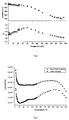
- Fig. 2 showing charts of integrated intensity and its reverse of "A” sample
- Fig. 3 showing the total width of EPR line (the line consists of a minimum of two lines) and g, a spectroscopic factor, in the function of temperature for "A" sample
- Fig. 4 showing the dependence of magnetic susceptibility on temperature, measured in decreasing temperature conditions with field cooling and with zero field cooling for "A” sample
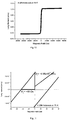
- Fig. 5 showing hysteresis loops taken at 52K and 150K for "A” sample
- Fig. 5a showing chart close ups from Fig. 5 which present the values of coercive field and residual
- Fig. 5 showing EPR spectrum of "A" sample
- Fig. 2 showing charts of integrated intensity and its reverse of "A” sample
- Fig. 3 showing the total width of EPR line (the line consists of a minimum of two lines) and g, a spectroscopic factor, in the function of temperature for "A
- FIG. 10 showing the magnetic hysteresis of "C” sample, recorded at 75K
- Fig. 11 showing the values of coercive field and residual for "C” sample (75K)
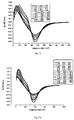
- Fig. 12 showing the EPR spectrum of "C” sample
- Fig. 12a showing the EPR spectrum of "B” sample
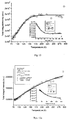
- Fig. 13 showing integrated intensity in the function of temperature for "C” sample and its reverse (inserts)
- Fig. 13a showing integrated intensity in the function of temperature for "B” sample and its reverse (inserts)
- Fig. 14 showing the width of EPR line and the resonance position of the line in the function of temperature for "B” sample.
- Fig. 1 showing the EPR spectrum of "A" sample from example I. EPR examination was carried out in the temperature range of 3.75K - 290K. "A" sample is characterised with an asymmetric and wide spectrum, containing signals from different phases. Up to the temperature of ⁇ 50 K, the spectrum does not change significantly. However, when temperature increases in excess of 50K, one of its spectral components is shifted, its amplitude [increase] and line width [decrease] are distinctly changed.
- Fig. 2 shows the dependence of integrated intensity in the function of temperature, which corresponds to the so-called EPR magnetic susceptibility.
- Fig. 4 shows the dependence of magnetic susceptibility on temperature, measured in decreasing temperature conditions with field cooling and with zero field cooling for "A" sample from example I.
- Fig. 5 shows hysteresis loops taken at 52K and 150K for "A" sample from example I.
- the magnetic susceptibility of samples was examined in decreasing temperature conditions with field cooling and with zero field cooling.
- sample cooling with field cooling causes an increase of the sample's magnetic susceptibility.
- the spectrum can be divided into three temperature intervals:
- Magnetic measurements were conducted using a SQUID MPMS-7 magnetometer, in the temperature range of 2 - 300K in different magnetic fields, in the following modes: a) with field cooling, b) with zero field cooling.
Landscapes
- Chemical & Material Sciences (AREA)
- Engineering & Computer Science (AREA)
- Materials Engineering (AREA)
- Mechanical Engineering (AREA)
- Metallurgy (AREA)
- Organic Chemistry (AREA)
- Powder Metallurgy (AREA)
- Carbon And Carbon Compounds (AREA)
Applications Claiming Priority (1)
| Application Number | Priority Date | Filing Date | Title |
|---|---|---|---|
| PL413627A PL230417B1 (pl) | 2015-08-24 | 2015-08-24 | Materiał w formie proszku o właściwościach magnetycznych i sposób wytwarzania materiału w formie proszku o właściwościach magnetycznych |
Publications (1)
| Publication Number | Publication Date |
|---|---|
| EP3135784A1 true EP3135784A1 (de) | 2017-03-01 |
Family
ID=55068947
Family Applications (1)
| Application Number | Title | Priority Date | Filing Date |
|---|---|---|---|
| EP15461561.1A Withdrawn EP3135784A1 (de) | 2015-08-24 | 2015-09-22 | Pulverförmiges material mit magnetischen eigenschaften und verfahren zur herstellung des pulverförmigen materials mit magnetischen eigenschaften zur herstellung von verbundprodukten |
Country Status (2)
| Country | Link |
|---|---|
| EP (1) | EP3135784A1 (de) |
| PL (1) | PL230417B1 (de) |
Cited By (1)
| Publication number | Priority date | Publication date | Assignee | Title |
|---|---|---|---|---|
| CN108393500A (zh) * | 2018-02-01 | 2018-08-14 | 安徽师范大学 | 一种Mo-Ni合金纳米粒子复合材料及其制备方法和应用 |
Families Citing this family (1)
| Publication number | Priority date | Publication date | Assignee | Title |
|---|---|---|---|---|
| CN110980667A (zh) * | 2019-12-25 | 2020-04-10 | 株洲鸿达实业有限公司 | 一种微纳米级TiCN粉体及其制备方法与应用 |
Citations (4)
| Publication number | Priority date | Publication date | Assignee | Title |
|---|---|---|---|---|
| US3981062A (en) * | 1973-10-01 | 1976-09-21 | Ford Motor Company | Apex seal composition for rotary engines |
| PL115937B2 (en) | 1979-12-22 | 1981-05-30 | Nickel based magnetically soft alloy | |
| WO2005053881A2 (en) | 2003-11-26 | 2005-06-16 | Hoeganaes Corporation | Metallurgical powder compositions and articles and methods utilizing the same |
| US20100267542A1 (en) * | 2007-12-26 | 2010-10-21 | Seoul National University Industry Foundation | Solid-solution carbide/carbonitride powder and method for preparing thereof under high temperature |
-
2015
- 2015-08-24 PL PL413627A patent/PL230417B1/pl unknown
- 2015-09-22 EP EP15461561.1A patent/EP3135784A1/de not_active Withdrawn
Patent Citations (4)
| Publication number | Priority date | Publication date | Assignee | Title |
|---|---|---|---|---|
| US3981062A (en) * | 1973-10-01 | 1976-09-21 | Ford Motor Company | Apex seal composition for rotary engines |
| PL115937B2 (en) | 1979-12-22 | 1981-05-30 | Nickel based magnetically soft alloy | |
| WO2005053881A2 (en) | 2003-11-26 | 2005-06-16 | Hoeganaes Corporation | Metallurgical powder compositions and articles and methods utilizing the same |
| US20100267542A1 (en) * | 2007-12-26 | 2010-10-21 | Seoul National University Industry Foundation | Solid-solution carbide/carbonitride powder and method for preparing thereof under high temperature |
Non-Patent Citations (14)
| Title |
|---|
| CHEN XIAO ET AL: "Characterization of Ti-based solid solution cermets prepared by mechanically induced self-sustained reaction and subsequent pressureless sintering", JOURNAL OF ALLOYS AND COMPOUNDS, vol. 583, 8 September 2013 (2013-09-08), pages 523 - 529, XP028747878, ISSN: 0925-8388, DOI: 10.1016/J.JALLCOM.2013.08.120 * |
| HIROYUKI HOSOKAWA; KIYOTAKA KATOU; KOJI SHIMOJIMA; RYOICHI FURUSHIMA; AKIHIRO MATSUMOTO: "Effect of Ni Contents on Microstructures and MechanicalProperties for (TiO.8MoO.2)C-Ni Cermets", MATERIALS TRANSACTIONS, vol. 55, no. 9, 2014, pages 1451 - 1454 |
| J.C. LASALVIA; D.K. KIM; R.A.LIPSETT; M.A. MEYERS, COMBUSTION SYNTHESIS IN THE TI-C-NI-MO SYSTEM: PART L, MICROMECHANISMS, METALLURGICAL AND MATERIALS TRANSACTIONS A, vol. 26A, 1995, pages 3001 - 3009 |
| JASMINE IMANI KEENE, CHARACTERIZATION OF A TI(MO)C-NI CERMET FOR USE IN IMPACT RESISTANT SANDWICH PANELS, December 2013 (2013-12-01) |
| JON-ERIK MOGONYE: "Solid Lubrication Mechanisms in Laser Deposited Nickel-Titanium-Carbon Metal Matrix Composites", MASTER OF SCIENCE, December 2012 (2012-12-01) |
| KIM Y K ET AL: "Mechanochemical synthesis of nanocomposite powder for ultrafine (Ti, Mo)C-Ni cermet without core-rim structure", INTERNATIONAL JOURNAL OF REFRACTORY METALS AND HARD MATERIALS, ELSEVIER, AMSTERDAM, NL, vol. 22, no. 4-5, 1 July 2004 (2004-07-01), pages 193 - 196, XP004627898, ISSN: 0263-4368, DOI: 10.1016/J.IJRMHM.2004.06.004 * |
| M. M. KULAK; B. B. KHINA: "Selfpropagation high-temperature synthesis in the Ti-C-Ni-Mo system on application of powerful ultrasound", JOURNAL OF ENGINEERING PHYSICS AND THERMOPHYSICS, vol. 87, no. 2, 2014, pages 333 - 343 |
| MA QIAN; L.C. LIM: "On the disappearance of Mo C during low-temperature sintering of Ti(C,N)-Mo C-Ni cermets", JOURNAL OF MATERIALS SCIENCE, vol. 34, 1999, pages 3677 - 3684 |
| MAREK JÕELEHT ET AL: "The formation of reactive sintered (Ti, Mo)C-Ni cermet from nanocrystalline powders", INTERNATIONAL JOURNAL OF REFRACTORY METALS AND HARD MATERIALS, vol. 43, 1 March 2014 (2014-03-01), AMSTERDAM, NL, pages 284 - 290, XP055338906, ISSN: 0263-4368, DOI: 10.1016/j.ijrmhm.2013.12.016 * |
| MART VILJUS; JURI PIRSO; KRISTJAN JUHANI; SERGEI LETUNOVITS: "Structure Formation in Ti-C-Ni-Mo Composites during Reactive Sintering, Materials science", MEDZIAGOTYRA, vol. 18, no. 1, 2012, pages 62 - 65 |
| T. VIATTE; T. CUTARD; G. FEUSIER; W. BENOIT: "High Temperature Mechanical Properties ofTi(C, N)-Mo2C-Ni Cermets Studied by Internal Friction Measurements", JOURNAL DE PHYSIQUE IV, COLLOQUE C8, SUPPLEMENT AU JOURNAL DE PHYSIQUE 111, vol. 6, 1996 |
| Y. F. YANG; S. B. JINB; Q. C. JIANG: "Effect of reactant C/Ti ratio on the stoichiometry, morphology of TiC and mechanical properties of TiC Ni composite", CRYST ENG COMMUNITY, vol. 15, 2013, pages 852 - 855 |
| YOUNGKWAN KIM; JAE-HYEOKSHIM; YOUNG WHANCHO; HYO-SEUNG YANG; JONG-KU PARK: "Mechanochemical synthesis of nanocomposite powder for ultrafine (Ti, Mo)C-Ni cermet without core-rim structure", INTERNATIONAL JOURNAL OF REFRACTORY METALS & HARD MATERIALS, vol. 22, 2004, pages 193 - 196 |
| ZACKRISSON, A. LARSSON; H.-O. ANDREN: "Microstructure of the Ni binder phase in a TiC-M 2C- i cermet", MICRO, vol. 32, 2001, pages 707 - 712 |
Cited By (1)
| Publication number | Priority date | Publication date | Assignee | Title |
|---|---|---|---|---|
| CN108393500A (zh) * | 2018-02-01 | 2018-08-14 | 安徽师范大学 | 一种Mo-Ni合金纳米粒子复合材料及其制备方法和应用 |
Also Published As
| Publication number | Publication date |
|---|---|
| PL230417B1 (pl) | 2018-10-31 |
| PL413627A1 (pl) | 2016-06-20 |
Similar Documents
| Publication | Publication Date | Title |
|---|---|---|
| El-Eskandarany | Structure and properties of nanocrystalline TiC full-density bulk alloy consolidated from mechanically reacted powders | |
| Su et al. | Effects of Ni on the microstructures and properties of WC–6Co cemented carbides fabricated by WC–6 (Co, Ni) composite powders | |
| Baldenebro-Lopez et al. | Simultaneous effect of mechanical alloying and arc-melting processes in the microstructure and hardness of an AlCoFeMoNiTi high-entropy alloy | |
| Panigrahi et al. | Microstructure and mechanical properties of novel tungsten heavy alloys prepared using FeNiCoCrCu HEA as binder | |
| US5589011A (en) | Nanostructured steel alloy | |
| EP2099945A2 (de) | Kubisches bornitrid enthaltende presskörper | |
| Goodwin et al. | Cementite-iron nanocomposite | |
| Alvaredo et al. | High temperature transformations in a steel-TiCN cermet | |
| Moskowitz et al. | High-strength tungsten carbides | |
| Parida et al. | Synthesis and characterization of Ti50Ni (50− X) FeX alloy produced by mechanical alloying and pressure-less sintering | |
| Ma et al. | An electrically conductive and ferromagnetic nano-structure manganese mono-boride with high Vickers hardness | |
| Jang et al. | Study on the solid-phase sintering of the nano-structured heavy tungsten alloy powder | |
| Acar et al. | Effect of pressure on the magnetic and structural properties of X2CrNiMo17-12-2 austenitic stainless steel prepared by powder metallurgy method | |
| Li et al. | Preparation of fine-grained W-Ni-Fe alloys by using W nanopowders | |
| Madej | Phase reactions during sintering of M3/2 based composites with WC additions | |
| Prasad et al. | In situ processing of Fe-based bulk metallic glass nanocomposites in supercooled liquid region by spark plasma sintering | |
| Gonsalves et al. | Synthesis and processing of nanostructured M50 type steel | |
| Nabati et al. | The effect of SiC nanoparticles and sintering temperature on the structural and wear properties of Cu–MWCNTs–SiC hybrid nanocomposites | |
| US5240495A (en) | In situ formation of metal-ceramic oxide microstructures | |
| PL230417B1 (pl) | Materiał w formie proszku o właściwościach magnetycznych i sposób wytwarzania materiału w formie proszku o właściwościach magnetycznych | |
| Salahinejad et al. | The effect of nitrogen on the glass-forming ability and micro-hardness of Fe–Cr–Mn–N amorphous alloys prepared by mechanical alloying | |
| Hu et al. | Synthesis and characterization of nanocrystalline iron aluminide intermetallic compounds | |
| Jing et al. | Reaction synthesis of Fe–(Ti, V) C composites | |
| Daoush et al. | Effect of binder compositions on microstructure, hardness and magnetic properties of (Ta, Nb) C–Co and (Ta, Nb) C–Ni cemented carbides | |
| Tugirumubano et al. | Magnetic and mechanical characterization of Al-MWCNT-Fe-Ni hybrid metal matrix composites |
Legal Events
| Date | Code | Title | Description |
|---|---|---|---|
| PUAI | Public reference made under article 153(3) epc to a published international application that has entered the european phase |
Free format text: ORIGINAL CODE: 0009012 |
|
| STAA | Information on the status of an ep patent application or granted ep patent |
Free format text: STATUS: REQUEST FOR EXAMINATION WAS MADE |
|
| 17P | Request for examination filed |
Effective date: 20150928 |
|
| AK | Designated contracting states |
Kind code of ref document: A1 Designated state(s): AL AT BE BG CH CY CZ DE DK EE ES FI FR GB GR HR HU IE IS IT LI LT LU LV MC MK MT NL NO PL PT RO RS SE SI SK SM TR |
|
| AX | Request for extension of the european patent |
Extension state: BA ME |
|
| STAA | Information on the status of an ep patent application or granted ep patent |
Free format text: STATUS: THE APPLICATION IS DEEMED TO BE WITHDRAWN |
|
| 18D | Application deemed to be withdrawn |
Effective date: 20170902 |