EP3135722A1 - Heat-curable resin composition - Google Patents
Heat-curable resin composition Download PDFInfo
- Publication number
- EP3135722A1 EP3135722A1 EP16185322.1A EP16185322A EP3135722A1 EP 3135722 A1 EP3135722 A1 EP 3135722A1 EP 16185322 A EP16185322 A EP 16185322A EP 3135722 A1 EP3135722 A1 EP 3135722A1
- Authority
- EP
- European Patent Office
- Prior art keywords
- resin
- heat
- curable resin
- resin composition
- group
- Prior art date
- Legal status (The legal status is an assumption and is not a legal conclusion. Google has not performed a legal analysis and makes no representation as to the accuracy of the status listed.)
- Withdrawn
Links
- 239000011342 resin composition Substances 0.000 title claims abstract description 44
- 229920005989 resin Polymers 0.000 claims abstract description 80
- 239000011347 resin Substances 0.000 claims abstract description 80
- -1 bismaleimide compound Chemical class 0.000 claims abstract description 50
- 239000007788 liquid Substances 0.000 claims abstract description 32
- 229920003192 poly(bis maleimide) Polymers 0.000 claims abstract description 24
- 238000000034 method Methods 0.000 claims abstract description 6
- 239000003822 epoxy resin Substances 0.000 claims description 46
- 229920000647 polyepoxide Polymers 0.000 claims description 46
- 239000003795 chemical substances by application Substances 0.000 claims description 31
- XLJMAIOERFSOGZ-UHFFFAOYSA-M cyanate Chemical compound [O-]C#N XLJMAIOERFSOGZ-UHFFFAOYSA-M 0.000 claims description 26
- 125000004432 carbon atom Chemical group C* 0.000 claims description 13
- 229920001568 phenolic resin Polymers 0.000 claims description 10
- 239000005011 phenolic resin Substances 0.000 claims description 10
- KXGFMDJXCMQABM-UHFFFAOYSA-N 2-methoxy-6-methylphenol Chemical compound [CH]OC1=CC=CC([CH])=C1O KXGFMDJXCMQABM-UHFFFAOYSA-N 0.000 claims description 8
- 125000002947 alkylene group Chemical group 0.000 claims description 7
- 125000000753 cycloalkyl group Chemical group 0.000 claims description 7
- JYEUMXHLPRZUAT-UHFFFAOYSA-N 1,2,3-triazine Chemical compound C1=CN=NN=C1 JYEUMXHLPRZUAT-UHFFFAOYSA-N 0.000 claims description 6
- 150000001875 compounds Chemical class 0.000 claims description 6
- XQUPVDVFXZDTLT-UHFFFAOYSA-N 1-[4-[[4-(2,5-dioxopyrrol-1-yl)phenyl]methyl]phenyl]pyrrole-2,5-dione Chemical class O=C1C=CC(=O)N1C(C=C1)=CC=C1CC1=CC=C(N2C(C=CC2=O)=O)C=C1 XQUPVDVFXZDTLT-UHFFFAOYSA-N 0.000 claims description 5
- HECLRDQVFMWTQS-RGOKHQFPSA-N 1755-01-7 Chemical compound C1[C@H]2[C@@H]3CC=C[C@@H]3[C@@H]1C=C2 HECLRDQVFMWTQS-RGOKHQFPSA-N 0.000 claims description 4
- 125000003903 2-propenyl group Chemical group [H]C([*])([H])C([H])=C([H])[H] 0.000 claims description 4
- 125000000962 organic group Chemical group 0.000 claims description 4
- CMLFRMDBDNHMRA-UHFFFAOYSA-N 2h-1,2-benzoxazine Chemical compound C1=CC=C2C=CNOC2=C1 CMLFRMDBDNHMRA-UHFFFAOYSA-N 0.000 claims description 3
- 229920000877 Melamine resin Polymers 0.000 claims description 3
- 239000004640 Melamine resin Substances 0.000 claims description 3
- 229920003180 amino resin Polymers 0.000 claims description 3
- 125000005842 heteroatom Chemical group 0.000 claims description 3
- 150000003949 imides Chemical class 0.000 claims description 3
- 239000012948 isocyanate Substances 0.000 claims description 3
- 150000002513 isocyanates Chemical class 0.000 claims description 3
- AHHWIHXENZJRFG-UHFFFAOYSA-N oxetane Chemical compound C1COC1 AHHWIHXENZJRFG-UHFFFAOYSA-N 0.000 claims description 3
- 229920002050 silicone resin Polymers 0.000 claims description 3
- 229920006337 unsaturated polyester resin Polymers 0.000 claims description 3
- 238000004382 potting Methods 0.000 abstract description 2
- IISBACLAFKSPIT-UHFFFAOYSA-N bisphenol A Chemical compound C=1C=C(O)C=CC=1C(C)(C)C1=CC=C(O)C=C1 IISBACLAFKSPIT-UHFFFAOYSA-N 0.000 description 16
- 239000000203 mixture Substances 0.000 description 15
- 229930185605 Bisphenol Natural products 0.000 description 11
- 150000002430 hydrocarbons Chemical group 0.000 description 9
- UFWIBTONFRDIAS-UHFFFAOYSA-N Naphthalene Chemical compound C1=CC=CC2=CC=CC=C21 UFWIBTONFRDIAS-UHFFFAOYSA-N 0.000 description 8
- VYPSYNLAJGMNEJ-UHFFFAOYSA-N Silicium dioxide Chemical compound O=[Si]=O VYPSYNLAJGMNEJ-UHFFFAOYSA-N 0.000 description 8
- 239000011256 inorganic filler Substances 0.000 description 8
- 229910003475 inorganic filler Inorganic materials 0.000 description 8
- 229920003986 novolac Polymers 0.000 description 8
- RAXXELZNTBOGNW-UHFFFAOYSA-N imidazole Natural products C1=CNC=N1 RAXXELZNTBOGNW-UHFFFAOYSA-N 0.000 description 7
- 150000002500 ions Chemical class 0.000 description 7
- 239000003505 polymerization initiator Substances 0.000 description 7
- RNFJDJUURJAICM-UHFFFAOYSA-N 2,2,4,4,6,6-hexaphenoxy-1,3,5-triaza-2$l^{5},4$l^{5},6$l^{5}-triphosphacyclohexa-1,3,5-triene Chemical compound N=1P(OC=2C=CC=CC=2)(OC=2C=CC=CC=2)=NP(OC=2C=CC=CC=2)(OC=2C=CC=CC=2)=NP=1(OC=1C=CC=CC=1)OC1=CC=CC=C1 RNFJDJUURJAICM-UHFFFAOYSA-N 0.000 description 6
- 238000010521 absorption reaction Methods 0.000 description 6
- 150000008065 acid anhydrides Chemical class 0.000 description 6
- 239000000654 additive Substances 0.000 description 6
- 125000004429 atom Chemical group 0.000 description 6
- 239000003063 flame retardant Substances 0.000 description 6
- RIOQSEWOXXDEQQ-UHFFFAOYSA-N triphenylphosphine Chemical compound C1=CC=CC=C1P(C=1C=CC=CC=1)C1=CC=CC=C1 RIOQSEWOXXDEQQ-UHFFFAOYSA-N 0.000 description 6
- 239000000463 material Substances 0.000 description 5
- 239000006082 mold release agent Substances 0.000 description 5
- 239000000126 substance Substances 0.000 description 5
- XLYOFNOQVPJJNP-UHFFFAOYSA-N water Substances O XLYOFNOQVPJJNP-UHFFFAOYSA-N 0.000 description 5
- RTZKZFJDLAIYFH-UHFFFAOYSA-N Diethyl ether Chemical compound CCOCC RTZKZFJDLAIYFH-UHFFFAOYSA-N 0.000 description 4
- 230000001771 impaired effect Effects 0.000 description 4
- 239000003999 initiator Substances 0.000 description 4
- UTOPWMOLSKOLTQ-UHFFFAOYSA-N octacosanoic acid Chemical compound CCCCCCCCCCCCCCCCCCCCCCCCCCCC(O)=O UTOPWMOLSKOLTQ-UHFFFAOYSA-N 0.000 description 4
- 125000003367 polycyclic group Chemical group 0.000 description 4
- 239000007870 radical polymerization initiator Substances 0.000 description 4
- 239000002904 solvent Substances 0.000 description 4
- 0 *N(C(C=C1)=O)C1=O Chemical compound *N(C(C=C1)=O)C1=O 0.000 description 3
- 239000004593 Epoxy Substances 0.000 description 3
- LFQSCWFLJHTTHZ-UHFFFAOYSA-N Ethanol Chemical compound CCO LFQSCWFLJHTTHZ-UHFFFAOYSA-N 0.000 description 3
- LYCAIKOWRPUZTN-UHFFFAOYSA-N Ethylene glycol Chemical compound OCCO LYCAIKOWRPUZTN-UHFFFAOYSA-N 0.000 description 3
- XUIMIQQOPSSXEZ-UHFFFAOYSA-N Silicon Chemical compound [Si] XUIMIQQOPSSXEZ-UHFFFAOYSA-N 0.000 description 3
- ZMANZCXQSJIPKH-UHFFFAOYSA-N Triethylamine Chemical compound CCN(CC)CC ZMANZCXQSJIPKH-UHFFFAOYSA-N 0.000 description 3
- 125000000217 alkyl group Chemical group 0.000 description 3
- 150000001412 amines Chemical class 0.000 description 3
- 230000000052 comparative effect Effects 0.000 description 3
- 238000000354 decomposition reaction Methods 0.000 description 3
- ZUOUZKKEUPVFJK-UHFFFAOYSA-N diphenyl Chemical compound C1=CC=CC=C1C1=CC=CC=C1 ZUOUZKKEUPVFJK-UHFFFAOYSA-N 0.000 description 3
- 125000003700 epoxy group Chemical group 0.000 description 3
- 238000010438 heat treatment Methods 0.000 description 3
- 125000002887 hydroxy group Chemical group [H]O* 0.000 description 3
- 238000004519 manufacturing process Methods 0.000 description 3
- 229910052698 phosphorus Inorganic materials 0.000 description 3
- 239000011574 phosphorus Substances 0.000 description 3
- 229910052710 silicon Inorganic materials 0.000 description 3
- 239000010703 silicon Substances 0.000 description 3
- 239000000377 silicon dioxide Substances 0.000 description 3
- 238000003756 stirring Methods 0.000 description 3
- NOBYOEQUFMGXBP-UHFFFAOYSA-N (4-tert-butylcyclohexyl) (4-tert-butylcyclohexyl)oxycarbonyloxy carbonate Chemical compound C1CC(C(C)(C)C)CCC1OC(=O)OOC(=O)OC1CCC(C(C)(C)C)CC1 NOBYOEQUFMGXBP-UHFFFAOYSA-N 0.000 description 2
- BEQKKZICTDFVMG-UHFFFAOYSA-N 1,2,3,4,6-pentaoxepane-5,7-dione Chemical compound O=C1OOOOC(=O)O1 BEQKKZICTDFVMG-UHFFFAOYSA-N 0.000 description 2
- IPJGAEWUPXWFPL-UHFFFAOYSA-N 1-[3-(2,5-dioxopyrrol-1-yl)phenyl]pyrrole-2,5-dione Chemical compound O=C1C=CC(=O)N1C1=CC=CC(N2C(C=CC2=O)=O)=C1 IPJGAEWUPXWFPL-UHFFFAOYSA-N 0.000 description 2
- FCEHBMOGCRZNNI-UHFFFAOYSA-N 1-benzothiophene Chemical compound C1=CC=C2SC=CC2=C1 FCEHBMOGCRZNNI-UHFFFAOYSA-N 0.000 description 2
- DMWVYCCGCQPJEA-UHFFFAOYSA-N 2,5-bis(tert-butylperoxy)-2,5-dimethylhexane Chemical compound CC(C)(C)OOC(C)(C)CCC(C)(C)OOC(C)(C)C DMWVYCCGCQPJEA-UHFFFAOYSA-N 0.000 description 2
- XMNIXWIUMCBBBL-UHFFFAOYSA-N 2-(2-phenylpropan-2-ylperoxy)propan-2-ylbenzene Chemical compound C=1C=CC=CC=1C(C)(C)OOC(C)(C)C1=CC=CC=C1 XMNIXWIUMCBBBL-UHFFFAOYSA-N 0.000 description 2
- CDAWCLOXVUBKRW-UHFFFAOYSA-N 2-aminophenol Chemical compound NC1=CC=CC=C1O CDAWCLOXVUBKRW-UHFFFAOYSA-N 0.000 description 2
- BZGMEGUFFDTCNP-UHFFFAOYSA-N 2-hydroperoxy-2-methylpentane Chemical compound CCCC(C)(C)OO BZGMEGUFFDTCNP-UHFFFAOYSA-N 0.000 description 2
- QTWJRLJHJPIABL-UHFFFAOYSA-N 2-methylphenol;3-methylphenol;4-methylphenol Chemical compound CC1=CC=C(O)C=C1.CC1=CC=CC(O)=C1.CC1=CC=CC=C1O QTWJRLJHJPIABL-UHFFFAOYSA-N 0.000 description 2
- BIISIZOQPWZPPS-UHFFFAOYSA-N 2-tert-butylperoxypropan-2-ylbenzene Chemical compound CC(C)(C)OOC(C)(C)C1=CC=CC=C1 BIISIZOQPWZPPS-UHFFFAOYSA-N 0.000 description 2
- ULKLGIFJWFIQFF-UHFFFAOYSA-N 5K8XI641G3 Chemical compound CCC1=NC=C(C)N1 ULKLGIFJWFIQFF-UHFFFAOYSA-N 0.000 description 2
- KDCGOANMDULRCW-UHFFFAOYSA-N 7H-purine Chemical compound N1=CNC2=NC=NC2=C1 KDCGOANMDULRCW-UHFFFAOYSA-N 0.000 description 2
- MQJKPEGWNLWLTK-UHFFFAOYSA-N Dapsone Chemical compound C1=CC(N)=CC=C1S(=O)(=O)C1=CC=C(N)C=C1 MQJKPEGWNLWLTK-UHFFFAOYSA-N 0.000 description 2
- YLQBMQCUIZJEEH-UHFFFAOYSA-N Furan Chemical compound C=1C=COC=1 YLQBMQCUIZJEEH-UHFFFAOYSA-N 0.000 description 2
- PEDCQBHIVMGVHV-UHFFFAOYSA-N Glycerine Chemical compound OCC(O)CO PEDCQBHIVMGVHV-UHFFFAOYSA-N 0.000 description 2
- SIKJAQJRHWYJAI-UHFFFAOYSA-N Indole Chemical compound C1=CC=C2NC=CC2=C1 SIKJAQJRHWYJAI-UHFFFAOYSA-N 0.000 description 2
- ISWSIDIOOBJBQZ-UHFFFAOYSA-N Phenol Chemical compound OC1=CC=CC=C1 ISWSIDIOOBJBQZ-UHFFFAOYSA-N 0.000 description 2
- LGRFSURHDFAFJT-UHFFFAOYSA-N Phthalic anhydride Natural products C1=CC=C2C(=O)OC(=O)C2=C1 LGRFSURHDFAFJT-UHFFFAOYSA-N 0.000 description 2
- 239000004962 Polyamide-imide Substances 0.000 description 2
- 239000004698 Polyethylene Substances 0.000 description 2
- ATUOYWHBWRKTHZ-UHFFFAOYSA-N Propane Chemical compound CCC ATUOYWHBWRKTHZ-UHFFFAOYSA-N 0.000 description 2
- KYQCOXFCLRTKLS-UHFFFAOYSA-N Pyrazine Chemical compound C1=CN=CC=N1 KYQCOXFCLRTKLS-UHFFFAOYSA-N 0.000 description 2
- JUJWROOIHBZHMG-UHFFFAOYSA-N Pyridine Chemical compound C1=CC=NC=C1 JUJWROOIHBZHMG-UHFFFAOYSA-N 0.000 description 2
- KAESVJOAVNADME-UHFFFAOYSA-N Pyrrole Chemical compound C=1C=CNC=1 KAESVJOAVNADME-UHFFFAOYSA-N 0.000 description 2
- SMWDFEZZVXVKRB-UHFFFAOYSA-N Quinoline Chemical compound N1=CC=CC2=CC=CC=C21 SMWDFEZZVXVKRB-UHFFFAOYSA-N 0.000 description 2
- 235000021355 Stearic acid Nutrition 0.000 description 2
- YTPLMLYBLZKORZ-UHFFFAOYSA-N Thiophene Chemical compound C=1C=CSC=1 YTPLMLYBLZKORZ-UHFFFAOYSA-N 0.000 description 2
- HCHKCACWOHOZIP-UHFFFAOYSA-N Zinc Chemical compound [Zn] HCHKCACWOHOZIP-UHFFFAOYSA-N 0.000 description 2
- XLOMVQKBTHCTTD-UHFFFAOYSA-N Zinc monoxide Chemical compound [Zn]=O XLOMVQKBTHCTTD-UHFFFAOYSA-N 0.000 description 2
- 230000000996 additive effect Effects 0.000 description 2
- PNEYBMLMFCGWSK-UHFFFAOYSA-N aluminium oxide Inorganic materials [O-2].[O-2].[O-2].[Al+3].[Al+3] PNEYBMLMFCGWSK-UHFFFAOYSA-N 0.000 description 2
- MWPLVEDNUUSJAV-UHFFFAOYSA-N anthracene Chemical compound C1=CC=CC2=CC3=CC=CC=C3C=C21 MWPLVEDNUUSJAV-UHFFFAOYSA-N 0.000 description 2
- 125000002029 aromatic hydrocarbon group Chemical group 0.000 description 2
- 238000005452 bending Methods 0.000 description 2
- IOJUPLGTWVMSFF-UHFFFAOYSA-N benzothiazole Chemical compound C1=CC=C2SC=NC2=C1 IOJUPLGTWVMSFF-UHFFFAOYSA-N 0.000 description 2
- 235000010290 biphenyl Nutrition 0.000 description 2
- 239000004305 biphenyl Substances 0.000 description 2
- PXKLMJQFEQBVLD-UHFFFAOYSA-N bisphenol F Chemical compound C1=CC(O)=CC=C1CC1=CC=C(O)C=C1 PXKLMJQFEQBVLD-UHFFFAOYSA-N 0.000 description 2
- JHIWVOJDXOSYLW-UHFFFAOYSA-N butyl 2,2-difluorocyclopropane-1-carboxylate Chemical compound CCCCOC(=O)C1CC1(F)F JHIWVOJDXOSYLW-UHFFFAOYSA-N 0.000 description 2
- 230000015556 catabolic process Effects 0.000 description 2
- 238000006243 chemical reaction Methods 0.000 description 2
- 229920001577 copolymer Polymers 0.000 description 2
- 229930003836 cresol Natural products 0.000 description 2
- ZSWFCLXCOIISFI-UHFFFAOYSA-N cyclopentadiene Chemical compound C1C=CC=C1 ZSWFCLXCOIISFI-UHFFFAOYSA-N 0.000 description 2
- 238000006731 degradation reaction Methods 0.000 description 2
- LSXWFXONGKSEMY-UHFFFAOYSA-N di-tert-butyl peroxide Chemical compound CC(C)(C)OOC(C)(C)C LSXWFXONGKSEMY-UHFFFAOYSA-N 0.000 description 2
- QGBSISYHAICWAH-UHFFFAOYSA-N dicyandiamide Chemical compound NC(N)=NC#N QGBSISYHAICWAH-UHFFFAOYSA-N 0.000 description 2
- ZZTCPWRAHWXWCH-UHFFFAOYSA-N diphenylmethanediamine Chemical compound C=1C=CC=CC=1C(N)(N)C1=CC=CC=C1 ZZTCPWRAHWXWCH-UHFFFAOYSA-N 0.000 description 2
- 230000000694 effects Effects 0.000 description 2
- 150000002148 esters Chemical class 0.000 description 2
- 125000001495 ethyl group Chemical group [H]C([H])([H])C([H])([H])* 0.000 description 2
- 238000011156 evaluation Methods 0.000 description 2
- NIHNNTQXNPWCJQ-UHFFFAOYSA-N fluorene Chemical compound C1=CC=C2CC3=CC=CC=C3C2=C1 NIHNNTQXNPWCJQ-UHFFFAOYSA-N 0.000 description 2
- 125000000524 functional group Chemical group 0.000 description 2
- ANSXAPJVJOKRDJ-UHFFFAOYSA-N furo[3,4-f][2]benzofuran-1,3,5,7-tetrone Chemical compound C1=C2C(=O)OC(=O)C2=CC2=C1C(=O)OC2=O ANSXAPJVJOKRDJ-UHFFFAOYSA-N 0.000 description 2
- 239000003365 glass fiber Substances 0.000 description 2
- 230000009477 glass transition Effects 0.000 description 2
- 125000000623 heterocyclic group Chemical group 0.000 description 2
- AWJUIBRHMBBTKR-UHFFFAOYSA-N isoquinoline Chemical compound C1=NC=CC2=CC=CC=C21 AWJUIBRHMBBTKR-UHFFFAOYSA-N 0.000 description 2
- FPYJFEHAWHCUMM-UHFFFAOYSA-N maleic anhydride Chemical compound O=C1OC(=O)C=C1 FPYJFEHAWHCUMM-UHFFFAOYSA-N 0.000 description 2
- 125000002496 methyl group Chemical group [H]C([H])([H])* 0.000 description 2
- 238000002156 mixing Methods 0.000 description 2
- 125000002950 monocyclic group Chemical group 0.000 description 2
- OQCDKBAXFALNLD-UHFFFAOYSA-N octadecanoic acid Natural products CCCCCCCC(C)CCCCCCCCC(O)=O OQCDKBAXFALNLD-UHFFFAOYSA-N 0.000 description 2
- 239000002245 particle Substances 0.000 description 2
- 150000002989 phenols Chemical class 0.000 description 2
- 229920002312 polyamide-imide Polymers 0.000 description 2
- 229920000573 polyethylene Polymers 0.000 description 2
- XSCHRSMBECNVNS-UHFFFAOYSA-N quinoxaline Chemical compound N1=CC=NC2=CC=CC=C21 XSCHRSMBECNVNS-UHFFFAOYSA-N 0.000 description 2
- 239000008117 stearic acid Substances 0.000 description 2
- 125000001424 substituent group Chemical group 0.000 description 2
- BPSIOYPQMFLKFR-UHFFFAOYSA-N trimethoxy-[3-(oxiran-2-ylmethoxy)propyl]silane Chemical compound CO[Si](OC)(OC)CCCOCC1CO1 BPSIOYPQMFLKFR-UHFFFAOYSA-N 0.000 description 2
- QLAGHGSFXJZWKY-UHFFFAOYSA-N triphenylborane;triphenylphosphane Chemical compound C1=CC=CC=C1B(C=1C=CC=CC=1)C1=CC=CC=C1.C1=CC=CC=C1P(C=1C=CC=CC=1)C1=CC=CC=C1 QLAGHGSFXJZWKY-UHFFFAOYSA-N 0.000 description 2
- 239000011701 zinc Substances 0.000 description 2
- 229910052725 zinc Inorganic materials 0.000 description 2
- JXCAHDJDIAQCJO-UHFFFAOYSA-N (1-tert-butylperoxy-2-ethylhexyl) hydrogen carbonate Chemical compound CCCCC(CC)C(OC(O)=O)OOC(C)(C)C JXCAHDJDIAQCJO-UHFFFAOYSA-N 0.000 description 1
- FVQMJJQUGGVLEP-UHFFFAOYSA-N (2-methylpropan-2-yl)oxy 2-ethylhexaneperoxoate Chemical compound CCCCC(CC)C(=O)OOOC(C)(C)C FVQMJJQUGGVLEP-UHFFFAOYSA-N 0.000 description 1
- HCXVPNKIBYLBIT-UHFFFAOYSA-N (2-methylpropan-2-yl)oxy 3,5,5-trimethylhexaneperoxoate Chemical compound CC(C)(C)CC(C)CC(=O)OOOC(C)(C)C HCXVPNKIBYLBIT-UHFFFAOYSA-N 0.000 description 1
- QEQBMZQFDDDTPN-UHFFFAOYSA-N (2-methylpropan-2-yl)oxy benzenecarboperoxoate Chemical compound CC(C)(C)OOOC(=O)C1=CC=CC=C1 QEQBMZQFDDDTPN-UHFFFAOYSA-N 0.000 description 1
- MYOQALXKVOJACM-UHFFFAOYSA-N (2-methylpropan-2-yl)oxy pentaneperoxoate Chemical compound CCCCC(=O)OOOC(C)(C)C MYOQALXKVOJACM-UHFFFAOYSA-N 0.000 description 1
- ZORJPNCZZRLEDF-UHFFFAOYSA-N (3-methoxy-3-methylbutoxy)carbonyloxy (3-methoxy-3-methylbutyl) carbonate Chemical compound COC(C)(C)CCOC(=O)OOC(=O)OCCC(C)(C)OC ZORJPNCZZRLEDF-UHFFFAOYSA-N 0.000 description 1
- NLBJAOHLJABDAU-UHFFFAOYSA-N (3-methylbenzoyl) 3-methylbenzenecarboperoxoate Chemical compound CC1=CC=CC(C(=O)OOC(=O)C=2C=C(C)C=CC=2)=C1 NLBJAOHLJABDAU-UHFFFAOYSA-N 0.000 description 1
- FKBMTBAXDISZGN-BOJSHJERSA-N (3ar,7as)-5-methyl-3a,4,5,6,7,7a-hexahydro-2-benzofuran-1,3-dione Chemical compound C1C(C)CC[C@@H]2C(=O)OC(=O)[C@H]12 FKBMTBAXDISZGN-BOJSHJERSA-N 0.000 description 1
- RIPYNJLMMFGZSX-UHFFFAOYSA-N (5-benzoylperoxy-2,5-dimethylhexan-2-yl) benzenecarboperoxoate Chemical compound C=1C=CC=CC=1C(=O)OOC(C)(C)CCC(C)(C)OOC(=O)C1=CC=CC=C1 RIPYNJLMMFGZSX-UHFFFAOYSA-N 0.000 description 1
- OBDUMNZXAIUUTH-HWKANZROSA-N (e)-tetradec-2-ene Chemical group CCCCCCCCCCC\C=C\C OBDUMNZXAIUUTH-HWKANZROSA-N 0.000 description 1
- BLKRGXCGFRXRNQ-SNAWJCMRSA-N (z)-3-carbonoperoxoyl-4,4-dimethylpent-2-enoic acid Chemical compound OC(=O)/C=C(C(C)(C)C)\C(=O)OO BLKRGXCGFRXRNQ-SNAWJCMRSA-N 0.000 description 1
- WBYWAXJHAXSJNI-VOTSOKGWSA-M .beta-Phenylacrylic acid Natural products [O-]C(=O)\C=C\C1=CC=CC=C1 WBYWAXJHAXSJNI-VOTSOKGWSA-M 0.000 description 1
- FYRCDEARNUVZRG-UHFFFAOYSA-N 1,1,5-trimethyl-3,3-bis(2-methylpentan-2-ylperoxy)cyclohexane Chemical compound CCCC(C)(C)OOC1(OOC(C)(C)CCC)CC(C)CC(C)(C)C1 FYRCDEARNUVZRG-UHFFFAOYSA-N 0.000 description 1
- VBQCFYPTKHCPGI-UHFFFAOYSA-N 1,1-bis(2-methylpentan-2-ylperoxy)cyclohexane Chemical compound CCCC(C)(C)OOC1(OOC(C)(C)CCC)CCCCC1 VBQCFYPTKHCPGI-UHFFFAOYSA-N 0.000 description 1
- VTEYUPDBOLSXCD-UHFFFAOYSA-N 1,1-bis(tert-butylperoxy)-2-methylcyclohexane Chemical compound CC1CCCCC1(OOC(C)(C)C)OOC(C)(C)C VTEYUPDBOLSXCD-UHFFFAOYSA-N 0.000 description 1
- NALFRYPTRXKZPN-UHFFFAOYSA-N 1,1-bis(tert-butylperoxy)-3,3,5-trimethylcyclohexane Chemical compound CC1CC(C)(C)CC(OOC(C)(C)C)(OOC(C)(C)C)C1 NALFRYPTRXKZPN-UHFFFAOYSA-N 0.000 description 1
- OTMBZPVYOQYPBE-UHFFFAOYSA-N 1,1-bis(tert-butylperoxy)cyclododecane Chemical compound CC(C)(C)OOC1(OOC(C)(C)C)CCCCCCCCCCC1 OTMBZPVYOQYPBE-UHFFFAOYSA-N 0.000 description 1
- HSLFISVKRDQEBY-UHFFFAOYSA-N 1,1-bis(tert-butylperoxy)cyclohexane Chemical compound CC(C)(C)OOC1(OOC(C)(C)C)CCCCC1 HSLFISVKRDQEBY-UHFFFAOYSA-N 0.000 description 1
- KTZQTRPPVKQPFO-UHFFFAOYSA-N 1,2-benzoxazole Chemical compound C1=CC=C2C=NOC2=C1 KTZQTRPPVKQPFO-UHFFFAOYSA-N 0.000 description 1
- BCMCBBGGLRIHSE-UHFFFAOYSA-N 1,3-benzoxazole Chemical compound C1=CC=C2OC=NC2=C1 BCMCBBGGLRIHSE-UHFFFAOYSA-N 0.000 description 1
- AYMDJPGTQFHDSA-UHFFFAOYSA-N 1-(2-ethenoxyethoxy)-2-ethoxyethane Chemical compound CCOCCOCCOC=C AYMDJPGTQFHDSA-UHFFFAOYSA-N 0.000 description 1
- XSZYESUNPWGWFQ-UHFFFAOYSA-N 1-(2-hydroperoxypropan-2-yl)-4-methylcyclohexane Chemical compound CC1CCC(C(C)(C)OO)CC1 XSZYESUNPWGWFQ-UHFFFAOYSA-N 0.000 description 1
- KWKAKUADMBZCLK-UHFFFAOYSA-N 1-octene Chemical group CCCCCCC=C KWKAKUADMBZCLK-UHFFFAOYSA-N 0.000 description 1
- HYZJCKYKOHLVJF-UHFFFAOYSA-N 1H-benzimidazole Chemical compound C1=CC=C2NC=NC2=C1 HYZJCKYKOHLVJF-UHFFFAOYSA-N 0.000 description 1
- BAXOFTOLAUCFNW-UHFFFAOYSA-N 1H-indazole Chemical compound C1=CC=C2C=NNC2=C1 BAXOFTOLAUCFNW-UHFFFAOYSA-N 0.000 description 1
- KHGHGZPESHUYCR-UHFFFAOYSA-N 1h-phosphindole Chemical compound C1=CC=C2PC=CC2=C1 KHGHGZPESHUYCR-UHFFFAOYSA-N 0.000 description 1
- HQOVXPHOJANJBR-UHFFFAOYSA-N 2,2-bis(tert-butylperoxy)butane Chemical compound CC(C)(C)OOC(C)(CC)OOC(C)(C)C HQOVXPHOJANJBR-UHFFFAOYSA-N 0.000 description 1
- 125000004825 2,2-dimethylpropylene group Chemical group [H]C([H])([H])C(C([H])([H])[H])(C([H])([H])[*:1])C([H])([H])[*:2] 0.000 description 1
- GQHTUMJGOHRCHB-UHFFFAOYSA-N 2,3,4,6,7,8,9,10-octahydropyrimido[1,2-a]azepine Chemical compound C1CCCCN2CCCN=C21 GQHTUMJGOHRCHB-UHFFFAOYSA-N 0.000 description 1
- CRJIYMRJTJWVLU-UHFFFAOYSA-N 2,4,4-trimethylpentan-2-yl 3-(5,5-dimethylhexyl)dioxirane-3-carboxylate Chemical compound CC(C)(C)CCCCC1(C(=O)OC(C)(C)CC(C)(C)C)OO1 CRJIYMRJTJWVLU-UHFFFAOYSA-N 0.000 description 1
- DPGYCJUCJYUHTM-UHFFFAOYSA-N 2,4,4-trimethylpentan-2-yloxy 2-ethylhexaneperoxoate Chemical compound CCCCC(CC)C(=O)OOOC(C)(C)CC(C)(C)C DPGYCJUCJYUHTM-UHFFFAOYSA-N 0.000 description 1
- CHKCPIUYSMYEEW-UHFFFAOYSA-N 2-(2-cyclohexylpropan-2-ylperoxy)-2-ethylhexanoic acid Chemical compound CCCCC(CC)(C(O)=O)OOC(C)(C)C1CCCCC1 CHKCPIUYSMYEEW-UHFFFAOYSA-N 0.000 description 1
- LJBWJFWNFUKAGS-UHFFFAOYSA-N 2-[bis(2-hydroxyphenyl)methyl]phenol Chemical compound OC1=CC=CC=C1C(C=1C(=CC=CC=1)O)C1=CC=CC=C1O LJBWJFWNFUKAGS-UHFFFAOYSA-N 0.000 description 1
- QIRNGVVZBINFMX-UHFFFAOYSA-N 2-allylphenol Chemical compound OC1=CC=CC=C1CC=C QIRNGVVZBINFMX-UHFFFAOYSA-N 0.000 description 1
- UXGVMFHEKMGWMA-UHFFFAOYSA-N 2-benzofuran Chemical compound C1=CC=CC2=COC=C21 UXGVMFHEKMGWMA-UHFFFAOYSA-N 0.000 description 1
- XKBHBVFIWWDGQX-UHFFFAOYSA-N 2-bromo-3,3,4,4,5,5,5-heptafluoropent-1-ene Chemical compound FC(F)(F)C(F)(F)C(F)(F)C(Br)=C XKBHBVFIWWDGQX-UHFFFAOYSA-N 0.000 description 1
- VSXHKKXYCVWKFG-UHFFFAOYSA-N 2-cyclohexylpropan-2-yl 7,7-dimethyloctaneperoxoate Chemical compound CC(C)(C)CCCCCC(=O)OOC(C)(C)C1CCCCC1 VSXHKKXYCVWKFG-UHFFFAOYSA-N 0.000 description 1
- MIRQGKQPLPBZQM-UHFFFAOYSA-N 2-hydroperoxy-2,4,4-trimethylpentane Chemical compound CC(C)(C)CC(C)(C)OO MIRQGKQPLPBZQM-UHFFFAOYSA-N 0.000 description 1
- WFUGQJXVXHBTEM-UHFFFAOYSA-N 2-hydroperoxy-2-(2-hydroperoxybutan-2-ylperoxy)butane Chemical compound CCC(C)(OO)OOC(C)(CC)OO WFUGQJXVXHBTEM-UHFFFAOYSA-N 0.000 description 1
- LXBGSDVWAMZHDD-UHFFFAOYSA-N 2-methyl-1h-imidazole Chemical compound CC1=NC=CN1 LXBGSDVWAMZHDD-UHFFFAOYSA-N 0.000 description 1
- RTEZVHMDMFEURJ-UHFFFAOYSA-N 2-methylpentan-2-yl 2,2-dimethylpropaneperoxoate Chemical compound CCCC(C)(C)OOC(=O)C(C)(C)C RTEZVHMDMFEURJ-UHFFFAOYSA-N 0.000 description 1
- YMMLZUQDXYPNOG-UHFFFAOYSA-N 2-methylpentan-2-yl 7,7-dimethyloctaneperoxoate Chemical compound CCCC(C)(C)OOC(=O)CCCCCC(C)(C)C YMMLZUQDXYPNOG-UHFFFAOYSA-N 0.000 description 1
- WXDJDZIIPSOZAH-UHFFFAOYSA-N 2-methylpentan-2-yl benzenecarboperoxoate Chemical compound CCCC(C)(C)OOC(=O)C1=CC=CC=C1 WXDJDZIIPSOZAH-UHFFFAOYSA-N 0.000 description 1
- RPBWMJBZQXCSFW-UHFFFAOYSA-N 2-methylpropanoyl 2-methylpropaneperoxoate Chemical compound CC(C)C(=O)OOC(=O)C(C)C RPBWMJBZQXCSFW-UHFFFAOYSA-N 0.000 description 1
- ZCUJYXPAKHMBAZ-UHFFFAOYSA-N 2-phenyl-1h-imidazole Chemical compound C1=CNC(C=2C=CC=CC=2)=N1 ZCUJYXPAKHMBAZ-UHFFFAOYSA-N 0.000 description 1
- VVSRVXKRHUGECE-UHFFFAOYSA-N 2-tert-butylperoxy-3-(2-methylbenzoyl)benzoic acid Chemical compound CC1=CC=CC=C1C(=O)C1=CC=CC(C(O)=O)=C1OOC(C)(C)C VVSRVXKRHUGECE-UHFFFAOYSA-N 0.000 description 1
- BQARUDWASOOSRH-UHFFFAOYSA-N 2-tert-butylperoxypropan-2-yl hydrogen carbonate Chemical compound CC(C)(C)OOC(C)(C)OC(O)=O BQARUDWASOOSRH-UHFFFAOYSA-N 0.000 description 1
- VHMICKWLTGFITH-UHFFFAOYSA-N 2H-isoindole Chemical compound C1=CC=CC2=CNC=C21 VHMICKWLTGFITH-UHFFFAOYSA-N 0.000 description 1
- KFGFVPMRLOQXNB-UHFFFAOYSA-N 3,5,5-trimethylhexanoyl 3,5,5-trimethylhexaneperoxoate Chemical compound CC(C)(C)CC(C)CC(=O)OOC(=O)CC(C)CC(C)(C)C KFGFVPMRLOQXNB-UHFFFAOYSA-N 0.000 description 1
- NFWPZNNZUCPLAX-UHFFFAOYSA-N 4-methoxy-3-methylaniline Chemical compound COC1=CC=C(N)C=C1C NFWPZNNZUCPLAX-UHFFFAOYSA-N 0.000 description 1
- TYOXIFXYEIILLY-UHFFFAOYSA-N 5-methyl-2-phenyl-1h-imidazole Chemical compound N1C(C)=CN=C1C1=CC=CC=C1 TYOXIFXYEIILLY-UHFFFAOYSA-N 0.000 description 1
- YPIFGDQKSSMYHQ-UHFFFAOYSA-M 7,7-dimethyloctanoate Chemical compound CC(C)(C)CCCCCC([O-])=O YPIFGDQKSSMYHQ-UHFFFAOYSA-M 0.000 description 1
- 229910052582 BN Inorganic materials 0.000 description 1
- 239000004342 Benzoyl peroxide Substances 0.000 description 1
- OMPJBNCRMGITSC-UHFFFAOYSA-N Benzoylperoxide Chemical compound C=1C=CC=CC=1C(=O)OOC(=O)C1=CC=CC=C1 OMPJBNCRMGITSC-UHFFFAOYSA-N 0.000 description 1
- PZNSFCLAULLKQX-UHFFFAOYSA-N Boron nitride Chemical compound N#B PZNSFCLAULLKQX-UHFFFAOYSA-N 0.000 description 1
- RCUBCQQYTIOBAO-UHFFFAOYSA-N C1(C=CC(N1)=O)=O.C1(C=CC(N1)=O)=O.C1(=CC=CC=C1)C(C)C1=CC=CC=C1 Chemical compound C1(C=CC(N1)=O)=O.C1(C=CC(N1)=O)=O.C1(=CC=CC=C1)C(C)C1=CC=CC=C1 RCUBCQQYTIOBAO-UHFFFAOYSA-N 0.000 description 1
- BUJXREZHLZPTLD-XVNBXDOJSA-N CC/C(/N(C(C=C1)=O)C1=O)=C\C Chemical compound CC/C(/N(C(C=C1)=O)C1=O)=C\C BUJXREZHLZPTLD-XVNBXDOJSA-N 0.000 description 1
- HDFGOPSGAURCEO-UHFFFAOYSA-N CCN(C(C=C1)=O)C1=O Chemical compound CCN(C(C=C1)=O)C1=O HDFGOPSGAURCEO-UHFFFAOYSA-N 0.000 description 1
- YIVJZNGAASQVEM-UHFFFAOYSA-N Lauroyl peroxide Chemical compound CCCCCCCCCCCC(=O)OOC(=O)CCCCCCCCCCC YIVJZNGAASQVEM-UHFFFAOYSA-N 0.000 description 1
- 240000007594 Oryza sativa Species 0.000 description 1
- 235000007164 Oryza sativa Nutrition 0.000 description 1
- ZCQWOFVYLHDMMC-UHFFFAOYSA-N Oxazole Chemical compound C1=COC=N1 ZCQWOFVYLHDMMC-UHFFFAOYSA-N 0.000 description 1
- PCNDJXKNXGMECE-UHFFFAOYSA-N Phenazine Natural products C1=CC=CC2=NC3=CC=CC=C3N=C21 PCNDJXKNXGMECE-UHFFFAOYSA-N 0.000 description 1
- OAICVXFJPJFONN-UHFFFAOYSA-N Phosphorus Chemical compound [P] OAICVXFJPJFONN-UHFFFAOYSA-N 0.000 description 1
- 239000004743 Polypropylene Substances 0.000 description 1
- WTKZEGDFNFYCGP-UHFFFAOYSA-N Pyrazole Chemical compound C=1C=NNC=1 WTKZEGDFNFYCGP-UHFFFAOYSA-N 0.000 description 1
- CZPWVGJYEJSRLH-UHFFFAOYSA-N Pyrimidine Chemical compound C1=CN=CN=C1 CZPWVGJYEJSRLH-UHFFFAOYSA-N 0.000 description 1
- 229910052581 Si3N4 Inorganic materials 0.000 description 1
- 239000006087 Silane Coupling Agent Substances 0.000 description 1
- PJANXHGTPQOBST-VAWYXSNFSA-N Stilbene Natural products C=1C=CC=CC=1/C=C/C1=CC=CC=C1 PJANXHGTPQOBST-VAWYXSNFSA-N 0.000 description 1
- FZWLAAWBMGSTSO-UHFFFAOYSA-N Thiazole Chemical compound C1=CSC=N1 FZWLAAWBMGSTSO-UHFFFAOYSA-N 0.000 description 1
- GWEVSGVZZGPLCZ-UHFFFAOYSA-N Titan oxide Chemical compound O=[Ti]=O GWEVSGVZZGPLCZ-UHFFFAOYSA-N 0.000 description 1
- JVZNDXYQYCDASH-UHFFFAOYSA-N [2,3-di(propan-2-yl)phenyl] 7,7-dimethyloctaneperoxoate Chemical compound CC(C)C1=CC=CC(OOC(=O)CCCCCC(C)(C)C)=C1C(C)C JVZNDXYQYCDASH-UHFFFAOYSA-N 0.000 description 1
- JUIBLDFFVYKUAC-UHFFFAOYSA-N [5-(2-ethylhexanoylperoxy)-2,5-dimethylhexan-2-yl] 2-ethylhexaneperoxoate Chemical compound CCCCC(CC)C(=O)OOC(C)(C)CCC(C)(C)OOC(=O)C(CC)CCCC JUIBLDFFVYKUAC-UHFFFAOYSA-N 0.000 description 1
- YRKCREAYFQTBPV-UHFFFAOYSA-N acetylacetone Natural products CC(=O)CC(C)=O YRKCREAYFQTBPV-UHFFFAOYSA-N 0.000 description 1
- 150000001298 alcohols Chemical class 0.000 description 1
- 125000002723 alicyclic group Chemical group 0.000 description 1
- 125000001931 aliphatic group Chemical group 0.000 description 1
- WNROFYMDJYEPJX-UHFFFAOYSA-K aluminium hydroxide Chemical compound [OH-].[OH-].[OH-].[Al+3] WNROFYMDJYEPJX-UHFFFAOYSA-K 0.000 description 1
- 239000003963 antioxidant agent Substances 0.000 description 1
- 230000003078 antioxidant effect Effects 0.000 description 1
- RFRXIWQYSOIBDI-UHFFFAOYSA-N benzarone Chemical compound CCC=1OC2=CC=CC=C2C=1C(=O)C1=CC=C(O)C=C1 RFRXIWQYSOIBDI-UHFFFAOYSA-N 0.000 description 1
- 235000019400 benzoyl peroxide Nutrition 0.000 description 1
- AJTNUOLFTQRAKF-UHFFFAOYSA-N bis[(2-methylpropan-2-yl)oxy] benzene-1,3-dicarboperoxoate Chemical compound CC(C)(C)OOOC(=O)C1=CC=CC(C(=O)OOOC(C)(C)C)=C1 AJTNUOLFTQRAKF-UHFFFAOYSA-N 0.000 description 1
- 229940049676 bismuth hydroxide Drugs 0.000 description 1
- 238000009835 boiling Methods 0.000 description 1
- NSGQRLUGQNBHLD-UHFFFAOYSA-N butan-2-yl butan-2-yloxycarbonyloxy carbonate Chemical compound CCC(C)OC(=O)OOC(=O)OC(C)CC NSGQRLUGQNBHLD-UHFFFAOYSA-N 0.000 description 1
- UHOVQNZJYSORNB-UHFFFAOYSA-N c1ccccc1 Chemical compound c1ccccc1 UHOVQNZJYSORNB-UHFFFAOYSA-N 0.000 description 1
- 239000004204 candelilla wax Substances 0.000 description 1
- 235000013868 candelilla wax Nutrition 0.000 description 1
- 229940073532 candelilla wax Drugs 0.000 description 1
- 125000002915 carbonyl group Chemical group [*:2]C([*:1])=O 0.000 description 1
- 239000004203 carnauba wax Substances 0.000 description 1
- 235000013869 carnauba wax Nutrition 0.000 description 1
- 229930016911 cinnamic acid Natural products 0.000 description 1
- 235000013985 cinnamic acid Nutrition 0.000 description 1
- WCZVZNOTHYJIEI-UHFFFAOYSA-N cinnoline Chemical compound N1=NC=CC2=CC=CC=C21 WCZVZNOTHYJIEI-UHFFFAOYSA-N 0.000 description 1
- 239000011248 coating agent Substances 0.000 description 1
- 238000000576 coating method Methods 0.000 description 1
- 239000003086 colorant Substances 0.000 description 1
- 238000013329 compounding Methods 0.000 description 1
- PMHQVHHXPFUNSP-UHFFFAOYSA-M copper(1+);methylsulfanylmethane;bromide Chemical compound Br[Cu].CSC PMHQVHHXPFUNSP-UHFFFAOYSA-M 0.000 description 1
- 239000007822 coupling agent Substances 0.000 description 1
- 229910052906 cristobalite Inorganic materials 0.000 description 1
- 229910002026 crystalline silica Inorganic materials 0.000 description 1
- 230000001351 cycling effect Effects 0.000 description 1
- ZBCBWPMODOFKDW-UHFFFAOYSA-N diethanolamine Chemical compound OCCNCCO ZBCBWPMODOFKDW-UHFFFAOYSA-N 0.000 description 1
- GYZLOYUZLJXAJU-UHFFFAOYSA-N diglycidyl ether Chemical class C1OC1COCC1CO1 GYZLOYUZLJXAJU-UHFFFAOYSA-N 0.000 description 1
- BVURNMLGDQYNAF-UHFFFAOYSA-N dimethyl(1-phenylethyl)amine Chemical compound CN(C)C(C)C1=CC=CC=C1 BVURNMLGDQYNAF-UHFFFAOYSA-N 0.000 description 1
- XXBDWLFCJWSEKW-UHFFFAOYSA-N dimethylbenzylamine Chemical compound CN(C)CC1=CC=CC=C1 XXBDWLFCJWSEKW-UHFFFAOYSA-N 0.000 description 1
- 239000006185 dispersion Substances 0.000 description 1
- KGGOIDKBHYYNIC-UHFFFAOYSA-N ditert-butyl 4-[3,4-bis(tert-butylperoxycarbonyl)benzoyl]benzene-1,2-dicarboperoxoate Chemical compound C1=C(C(=O)OOC(C)(C)C)C(C(=O)OOC(C)(C)C)=CC=C1C(=O)C1=CC=C(C(=O)OOC(C)(C)C)C(C(=O)OOC(C)(C)C)=C1 KGGOIDKBHYYNIC-UHFFFAOYSA-N 0.000 description 1
- 238000010292 electrical insulation Methods 0.000 description 1
- 238000005538 encapsulation Methods 0.000 description 1
- 238000005516 engineering process Methods 0.000 description 1
- 125000000816 ethylene group Chemical group [H]C([H])([*:1])C([H])([H])[*:2] 0.000 description 1
- 230000001747 exhibiting effect Effects 0.000 description 1
- 230000002349 favourable effect Effects 0.000 description 1
- 125000003983 fluorenyl group Chemical group C1(=CC=CC=2C3=CC=CC=C3CC12)* 0.000 description 1
- 235000011187 glycerol Nutrition 0.000 description 1
- IUJAMGNYPWYUPM-UHFFFAOYSA-N hentriacontane Chemical compound CCCCCCCCCCCCCCCCCCCCCCCCCCCCCCC IUJAMGNYPWYUPM-UHFFFAOYSA-N 0.000 description 1
- 125000004836 hexamethylene group Chemical group [H]C([H])([*:2])C([H])([H])C([H])([H])C([H])([H])C([H])([H])C([H])([H])[*:1] 0.000 description 1
- 238000005286 illumination Methods 0.000 description 1
- 239000012535 impurity Substances 0.000 description 1
- PZOUSPYUWWUPPK-UHFFFAOYSA-N indole Natural products CC1=CC=CC2=C1C=CN2 PZOUSPYUWWUPPK-UHFFFAOYSA-N 0.000 description 1
- RKJUIXBNRJVNHR-UHFFFAOYSA-N indolenine Natural products C1=CC=C2CC=NC2=C1 RKJUIXBNRJVNHR-UHFFFAOYSA-N 0.000 description 1
- CTAPFRYPJLPFDF-UHFFFAOYSA-N isoxazole Chemical compound C=1C=NOC=1 CTAPFRYPJLPFDF-UHFFFAOYSA-N 0.000 description 1
- 239000004973 liquid crystal related substance Substances 0.000 description 1
- VTHJTEIRLNZDEV-UHFFFAOYSA-L magnesium dihydroxide Chemical compound [OH-].[OH-].[Mg+2] VTHJTEIRLNZDEV-UHFFFAOYSA-L 0.000 description 1
- 239000000347 magnesium hydroxide Substances 0.000 description 1
- 229910001862 magnesium hydroxide Inorganic materials 0.000 description 1
- 239000000395 magnesium oxide Substances 0.000 description 1
- CPLXHLVBOLITMK-UHFFFAOYSA-N magnesium oxide Inorganic materials [Mg]=O CPLXHLVBOLITMK-UHFFFAOYSA-N 0.000 description 1
- AXZKOIWUVFPNLO-UHFFFAOYSA-N magnesium;oxygen(2-) Chemical compound [O-2].[Mg+2] AXZKOIWUVFPNLO-UHFFFAOYSA-N 0.000 description 1
- 238000002844 melting Methods 0.000 description 1
- 230000008018 melting Effects 0.000 description 1
- WBYWAXJHAXSJNI-UHFFFAOYSA-N methyl p-hydroxycinnamate Natural products OC(=O)C=CC1=CC=CC=C1 WBYWAXJHAXSJNI-UHFFFAOYSA-N 0.000 description 1
- 125000001570 methylene group Chemical group [H]C([H])([*:1])[*:2] 0.000 description 1
- 229910000476 molybdenum oxide Inorganic materials 0.000 description 1
- 239000012170 montan wax Substances 0.000 description 1
- 125000004108 n-butyl group Chemical group [H]C([H])([H])C([H])([H])C([H])([H])C([H])([H])* 0.000 description 1
- 239000010680 novolac-type phenolic resin Substances 0.000 description 1
- LYRFLYHAGKPMFH-UHFFFAOYSA-N octadecanamide Chemical compound CCCCCCCCCCCCCCCCCC(N)=O LYRFLYHAGKPMFH-UHFFFAOYSA-N 0.000 description 1
- QIQXTHQIDYTFRH-UHFFFAOYSA-N octadecanoic acid Chemical compound CCCCCCCCCCCCCCCCCC(O)=O QIQXTHQIDYTFRH-UHFFFAOYSA-N 0.000 description 1
- SRSFOMHQIATOFV-UHFFFAOYSA-N octanoyl octaneperoxoate Chemical compound CCCCCCCC(=O)OOC(=O)CCCCCCC SRSFOMHQIATOFV-UHFFFAOYSA-N 0.000 description 1
- PQQKPALAQIIWST-UHFFFAOYSA-N oxomolybdenum Chemical compound [Mo]=O PQQKPALAQIIWST-UHFFFAOYSA-N 0.000 description 1
- 238000005191 phase separation Methods 0.000 description 1
- NAKOELLGRBLZOF-UHFFFAOYSA-N phenoxybenzene;pyrrole-2,5-dione Chemical compound O=C1NC(=O)C=C1.O=C1NC(=O)C=C1.C=1C=CC=CC=1OC1=CC=CC=C1 NAKOELLGRBLZOF-UHFFFAOYSA-N 0.000 description 1
- 239000004033 plastic Substances 0.000 description 1
- 229920003023 plastic Polymers 0.000 description 1
- 229920001155 polypropylene Polymers 0.000 description 1
- 229920001296 polysiloxane Polymers 0.000 description 1
- BWJUFXUULUEGMA-UHFFFAOYSA-N propan-2-yl propan-2-yloxycarbonyloxy carbonate Chemical compound CC(C)OC(=O)OOC(=O)OC(C)C BWJUFXUULUEGMA-UHFFFAOYSA-N 0.000 description 1
- 239000001294 propane Substances 0.000 description 1
- 125000004805 propylene group Chemical group [H]C([H])([H])C([H])([*:1])C([H])([H])[*:2] 0.000 description 1
- PBMFSQRYOILNGV-UHFFFAOYSA-N pyridazine Chemical compound C1=CC=NN=C1 PBMFSQRYOILNGV-UHFFFAOYSA-N 0.000 description 1
- UMJSCPRVCHMLSP-UHFFFAOYSA-N pyridine Natural products COC1=CC=CN=C1 UMJSCPRVCHMLSP-UHFFFAOYSA-N 0.000 description 1
- JWVCLYRUEFBMGU-UHFFFAOYSA-N quinazoline Chemical compound N1=CN=CC2=CC=CC=C21 JWVCLYRUEFBMGU-UHFFFAOYSA-N 0.000 description 1
- 229910001404 rare earth metal oxide Inorganic materials 0.000 description 1
- 235000009566 rice Nutrition 0.000 description 1
- 239000004065 semiconductor Substances 0.000 description 1
- 235000012239 silicon dioxide Nutrition 0.000 description 1
- HQVNEWCFYHHQES-UHFFFAOYSA-N silicon nitride Chemical compound N12[Si]34N5[Si]62N3[Si]51N64 HQVNEWCFYHHQES-UHFFFAOYSA-N 0.000 description 1
- 239000007787 solid Substances 0.000 description 1
- PJANXHGTPQOBST-UHFFFAOYSA-N stilbene Chemical compound C=1C=CC=CC=1C=CC1=CC=CC=C1 PJANXHGTPQOBST-UHFFFAOYSA-N 0.000 description 1
- 235000021286 stilbenes Nutrition 0.000 description 1
- 230000035882 stress Effects 0.000 description 1
- 239000000454 talc Substances 0.000 description 1
- 229910052623 talc Inorganic materials 0.000 description 1
- OPQYOFWUFGEMRZ-UHFFFAOYSA-N tert-butyl 2,2-dimethylpropaneperoxoate Chemical compound CC(C)(C)OOC(=O)C(C)(C)C OPQYOFWUFGEMRZ-UHFFFAOYSA-N 0.000 description 1
- NMOALOSNPWTWRH-UHFFFAOYSA-N tert-butyl 7,7-dimethyloctaneperoxoate Chemical compound CC(C)(C)CCCCCC(=O)OOC(C)(C)C NMOALOSNPWTWRH-UHFFFAOYSA-N 0.000 description 1
- SWAXTRYEYUTSAP-UHFFFAOYSA-N tert-butyl ethaneperoxoate Chemical compound CC(=O)OOC(C)(C)C SWAXTRYEYUTSAP-UHFFFAOYSA-N 0.000 description 1
- CIHOLLKRGTVIJN-UHFFFAOYSA-N tert‐butyl hydroperoxide Chemical compound CC(C)(C)OO CIHOLLKRGTVIJN-UHFFFAOYSA-N 0.000 description 1
- 125000000383 tetramethylene group Chemical group [H]C([H])([*:1])C([H])([H])C([H])([H])C([H])([H])[*:2] 0.000 description 1
- 230000008646 thermal stress Effects 0.000 description 1
- 229920001169 thermoplastic Polymers 0.000 description 1
- 239000004416 thermosoftening plastic Substances 0.000 description 1
- 229930192474 thiophene Natural products 0.000 description 1
- OGIDPMRJRNCKJF-UHFFFAOYSA-N titanium oxide Inorganic materials [Ti]=O OGIDPMRJRNCKJF-UHFFFAOYSA-N 0.000 description 1
- QQOWHRYOXYEMTL-UHFFFAOYSA-N triazin-4-amine Chemical compound N=C1C=CN=NN1 QQOWHRYOXYEMTL-UHFFFAOYSA-N 0.000 description 1
- TUQOTMZNTHZOKS-UHFFFAOYSA-N tributylphosphine Chemical compound CCCCP(CCCC)CCCC TUQOTMZNTHZOKS-UHFFFAOYSA-N 0.000 description 1
- IUURMAINMLIZMX-UHFFFAOYSA-N tris(2-nonylphenyl)phosphane Chemical compound CCCCCCCCCC1=CC=CC=C1P(C=1C(=CC=CC=1)CCCCCCCCC)C1=CC=CC=C1CCCCCCCCC IUURMAINMLIZMX-UHFFFAOYSA-N 0.000 description 1
- WXAZIUYTQHYBFW-UHFFFAOYSA-N tris(4-methylphenyl)phosphane Chemical compound C1=CC(C)=CC=C1P(C=1C=CC(C)=CC=1)C1=CC=C(C)C=C1 WXAZIUYTQHYBFW-UHFFFAOYSA-N 0.000 description 1
- 229930195735 unsaturated hydrocarbon Natural products 0.000 description 1
- 239000001993 wax Substances 0.000 description 1
- 125000006839 xylylene group Chemical group 0.000 description 1
- 239000011787 zinc oxide Substances 0.000 description 1
Classifications
-
- C—CHEMISTRY; METALLURGY
- C08—ORGANIC MACROMOLECULAR COMPOUNDS; THEIR PREPARATION OR CHEMICAL WORKING-UP; COMPOSITIONS BASED THEREON
- C08K—Use of inorganic or non-macromolecular organic substances as compounding ingredients
- C08K5/00—Use of organic ingredients
- C08K5/16—Nitrogen-containing compounds
- C08K5/34—Heterocyclic compounds having nitrogen in the ring
- C08K5/3412—Heterocyclic compounds having nitrogen in the ring having one nitrogen atom in the ring
- C08K5/3415—Five-membered rings
-
- C—CHEMISTRY; METALLURGY
- C08—ORGANIC MACROMOLECULAR COMPOUNDS; THEIR PREPARATION OR CHEMICAL WORKING-UP; COMPOSITIONS BASED THEREON
- C08K—Use of inorganic or non-macromolecular organic substances as compounding ingredients
- C08K5/00—Use of organic ingredients
- C08K5/16—Nitrogen-containing compounds
- C08K5/34—Heterocyclic compounds having nitrogen in the ring
- C08K5/3442—Heterocyclic compounds having nitrogen in the ring having two nitrogen atoms in the ring
- C08K5/3445—Five-membered rings
-
- C—CHEMISTRY; METALLURGY
- C08—ORGANIC MACROMOLECULAR COMPOUNDS; THEIR PREPARATION OR CHEMICAL WORKING-UP; COMPOSITIONS BASED THEREON
- C08G—MACROMOLECULAR COMPOUNDS OBTAINED OTHERWISE THAN BY REACTIONS ONLY INVOLVING UNSATURATED CARBON-TO-CARBON BONDS
- C08G18/00—Polymeric products of isocyanates or isothiocyanates
- C08G18/06—Polymeric products of isocyanates or isothiocyanates with compounds having active hydrogen
- C08G18/28—Polymeric products of isocyanates or isothiocyanates with compounds having active hydrogen characterised by the compounds used containing active hydrogen
- C08G18/30—Low-molecular-weight compounds
- C08G18/32—Polyhydroxy compounds; Polyamines; Hydroxyamines
- C08G18/3225—Polyamines
- C08G18/3246—Polyamines heterocyclic, the heteroatom being oxygen or nitrogen in the form of an amino group
-
- C—CHEMISTRY; METALLURGY
- C08—ORGANIC MACROMOLECULAR COMPOUNDS; THEIR PREPARATION OR CHEMICAL WORKING-UP; COMPOSITIONS BASED THEREON
- C08G—MACROMOLECULAR COMPOUNDS OBTAINED OTHERWISE THAN BY REACTIONS ONLY INVOLVING UNSATURATED CARBON-TO-CARBON BONDS
- C08G59/00—Polycondensates containing more than one epoxy group per molecule; Macromolecules obtained by polymerising compounds containing more than one epoxy group per molecule using curing agents or catalysts which react with the epoxy groups
- C08G59/18—Macromolecules obtained by polymerising compounds containing more than one epoxy group per molecule using curing agents or catalysts which react with the epoxy groups ; e.g. general methods of curing
- C08G59/40—Macromolecules obtained by polymerising compounds containing more than one epoxy group per molecule using curing agents or catalysts which react with the epoxy groups ; e.g. general methods of curing characterised by the curing agents used
- C08G59/42—Polycarboxylic acids; Anhydrides, halides or low molecular weight esters thereof
-
- C—CHEMISTRY; METALLURGY
- C08—ORGANIC MACROMOLECULAR COMPOUNDS; THEIR PREPARATION OR CHEMICAL WORKING-UP; COMPOSITIONS BASED THEREON
- C08G—MACROMOLECULAR COMPOUNDS OBTAINED OTHERWISE THAN BY REACTIONS ONLY INVOLVING UNSATURATED CARBON-TO-CARBON BONDS
- C08G59/00—Polycondensates containing more than one epoxy group per molecule; Macromolecules obtained by polymerising compounds containing more than one epoxy group per molecule using curing agents or catalysts which react with the epoxy groups
- C08G59/18—Macromolecules obtained by polymerising compounds containing more than one epoxy group per molecule using curing agents or catalysts which react with the epoxy groups ; e.g. general methods of curing
- C08G59/40—Macromolecules obtained by polymerising compounds containing more than one epoxy group per molecule using curing agents or catalysts which react with the epoxy groups ; e.g. general methods of curing characterised by the curing agents used
- C08G59/42—Polycarboxylic acids; Anhydrides, halides or low molecular weight esters thereof
- C08G59/4238—Polycarboxylic acids; Anhydrides, halides or low molecular weight esters thereof heterocyclic
-
- C—CHEMISTRY; METALLURGY
- C08—ORGANIC MACROMOLECULAR COMPOUNDS; THEIR PREPARATION OR CHEMICAL WORKING-UP; COMPOSITIONS BASED THEREON
- C08G—MACROMOLECULAR COMPOUNDS OBTAINED OTHERWISE THAN BY REACTIONS ONLY INVOLVING UNSATURATED CARBON-TO-CARBON BONDS
- C08G59/00—Polycondensates containing more than one epoxy group per molecule; Macromolecules obtained by polymerising compounds containing more than one epoxy group per molecule using curing agents or catalysts which react with the epoxy groups
- C08G59/18—Macromolecules obtained by polymerising compounds containing more than one epoxy group per molecule using curing agents or catalysts which react with the epoxy groups ; e.g. general methods of curing
- C08G59/40—Macromolecules obtained by polymerising compounds containing more than one epoxy group per molecule using curing agents or catalysts which react with the epoxy groups ; e.g. general methods of curing characterised by the curing agents used
- C08G59/50—Amines
- C08G59/5033—Amines aromatic
-
- C—CHEMISTRY; METALLURGY
- C08—ORGANIC MACROMOLECULAR COMPOUNDS; THEIR PREPARATION OR CHEMICAL WORKING-UP; COMPOSITIONS BASED THEREON
- C08G—MACROMOLECULAR COMPOUNDS OBTAINED OTHERWISE THAN BY REACTIONS ONLY INVOLVING UNSATURATED CARBON-TO-CARBON BONDS
- C08G59/00—Polycondensates containing more than one epoxy group per molecule; Macromolecules obtained by polymerising compounds containing more than one epoxy group per molecule using curing agents or catalysts which react with the epoxy groups
- C08G59/18—Macromolecules obtained by polymerising compounds containing more than one epoxy group per molecule using curing agents or catalysts which react with the epoxy groups ; e.g. general methods of curing
- C08G59/40—Macromolecules obtained by polymerising compounds containing more than one epoxy group per molecule using curing agents or catalysts which react with the epoxy groups ; e.g. general methods of curing characterised by the curing agents used
- C08G59/50—Amines
- C08G59/5046—Amines heterocyclic
- C08G59/5053—Amines heterocyclic containing only nitrogen as a heteroatom
- C08G59/506—Amines heterocyclic containing only nitrogen as a heteroatom having one nitrogen atom in the ring
-
- C—CHEMISTRY; METALLURGY
- C08—ORGANIC MACROMOLECULAR COMPOUNDS; THEIR PREPARATION OR CHEMICAL WORKING-UP; COMPOSITIONS BASED THEREON
- C08G—MACROMOLECULAR COMPOUNDS OBTAINED OTHERWISE THAN BY REACTIONS ONLY INVOLVING UNSATURATED CARBON-TO-CARBON BONDS
- C08G59/00—Polycondensates containing more than one epoxy group per molecule; Macromolecules obtained by polymerising compounds containing more than one epoxy group per molecule using curing agents or catalysts which react with the epoxy groups
- C08G59/18—Macromolecules obtained by polymerising compounds containing more than one epoxy group per molecule using curing agents or catalysts which react with the epoxy groups ; e.g. general methods of curing
- C08G59/40—Macromolecules obtained by polymerising compounds containing more than one epoxy group per molecule using curing agents or catalysts which react with the epoxy groups ; e.g. general methods of curing characterised by the curing agents used
- C08G59/62—Alcohols or phenols
- C08G59/621—Phenols
-
- C—CHEMISTRY; METALLURGY
- C08—ORGANIC MACROMOLECULAR COMPOUNDS; THEIR PREPARATION OR CHEMICAL WORKING-UP; COMPOSITIONS BASED THEREON
- C08G—MACROMOLECULAR COMPOUNDS OBTAINED OTHERWISE THAN BY REACTIONS ONLY INVOLVING UNSATURATED CARBON-TO-CARBON BONDS
- C08G73/00—Macromolecular compounds obtained by reactions forming a linkage containing nitrogen with or without oxygen or carbon in the main chain of the macromolecule, not provided for in groups C08G12/00 - C08G71/00
- C08G73/06—Polycondensates having nitrogen-containing heterocyclic rings in the main chain of the macromolecule
- C08G73/10—Polyimides; Polyester-imides; Polyamide-imides; Polyamide acids or similar polyimide precursors
- C08G73/12—Unsaturated polyimide precursors
-
- C—CHEMISTRY; METALLURGY
- C08—ORGANIC MACROMOLECULAR COMPOUNDS; THEIR PREPARATION OR CHEMICAL WORKING-UP; COMPOSITIONS BASED THEREON
- C08G—MACROMOLECULAR COMPOUNDS OBTAINED OTHERWISE THAN BY REACTIONS ONLY INVOLVING UNSATURATED CARBON-TO-CARBON BONDS
- C08G73/00—Macromolecular compounds obtained by reactions forming a linkage containing nitrogen with or without oxygen or carbon in the main chain of the macromolecule, not provided for in groups C08G12/00 - C08G71/00
- C08G73/06—Polycondensates having nitrogen-containing heterocyclic rings in the main chain of the macromolecule
- C08G73/10—Polyimides; Polyester-imides; Polyamide-imides; Polyamide acids or similar polyimide precursors
- C08G73/12—Unsaturated polyimide precursors
- C08G73/124—Unsaturated polyimide precursors the unsaturated precursors containing oxygen in the form of ether bonds in the main chain
-
- C—CHEMISTRY; METALLURGY
- C08—ORGANIC MACROMOLECULAR COMPOUNDS; THEIR PREPARATION OR CHEMICAL WORKING-UP; COMPOSITIONS BASED THEREON
- C08G—MACROMOLECULAR COMPOUNDS OBTAINED OTHERWISE THAN BY REACTIONS ONLY INVOLVING UNSATURATED CARBON-TO-CARBON BONDS
- C08G73/00—Macromolecular compounds obtained by reactions forming a linkage containing nitrogen with or without oxygen or carbon in the main chain of the macromolecule, not provided for in groups C08G12/00 - C08G71/00
- C08G73/06—Polycondensates having nitrogen-containing heterocyclic rings in the main chain of the macromolecule
- C08G73/10—Polyimides; Polyester-imides; Polyamide-imides; Polyamide acids or similar polyimide precursors
- C08G73/12—Unsaturated polyimide precursors
- C08G73/128—Unsaturated polyimide precursors the unsaturated precursors containing heterocyclic moieties in the main chain
-
- C—CHEMISTRY; METALLURGY
- C08—ORGANIC MACROMOLECULAR COMPOUNDS; THEIR PREPARATION OR CHEMICAL WORKING-UP; COMPOSITIONS BASED THEREON
- C08K—Use of inorganic or non-macromolecular organic substances as compounding ingredients
- C08K5/00—Use of organic ingredients
- C08K5/04—Oxygen-containing compounds
- C08K5/09—Carboxylic acids; Metal salts thereof; Anhydrides thereof
-
- C—CHEMISTRY; METALLURGY
- C08—ORGANIC MACROMOLECULAR COMPOUNDS; THEIR PREPARATION OR CHEMICAL WORKING-UP; COMPOSITIONS BASED THEREON
- C08K—Use of inorganic or non-macromolecular organic substances as compounding ingredients
- C08K5/00—Use of organic ingredients
- C08K5/16—Nitrogen-containing compounds
- C08K5/17—Amines; Quaternary ammonium compounds
- C08K5/18—Amines; Quaternary ammonium compounds with aromatically bound amino groups
-
- C—CHEMISTRY; METALLURGY
- C08—ORGANIC MACROMOLECULAR COMPOUNDS; THEIR PREPARATION OR CHEMICAL WORKING-UP; COMPOSITIONS BASED THEREON
- C08L—COMPOSITIONS OF MACROMOLECULAR COMPOUNDS
- C08L63/00—Compositions of epoxy resins; Compositions of derivatives of epoxy resins
-
- C—CHEMISTRY; METALLURGY
- C08—ORGANIC MACROMOLECULAR COMPOUNDS; THEIR PREPARATION OR CHEMICAL WORKING-UP; COMPOSITIONS BASED THEREON
- C08L—COMPOSITIONS OF MACROMOLECULAR COMPOUNDS
- C08L63/00—Compositions of epoxy resins; Compositions of derivatives of epoxy resins
- C08L63/04—Epoxynovolacs
-
- C—CHEMISTRY; METALLURGY
- C08—ORGANIC MACROMOLECULAR COMPOUNDS; THEIR PREPARATION OR CHEMICAL WORKING-UP; COMPOSITIONS BASED THEREON
- C08L—COMPOSITIONS OF MACROMOLECULAR COMPOUNDS
- C08L75/00—Compositions of polyureas or polyurethanes; Compositions of derivatives of such polymers
-
- C—CHEMISTRY; METALLURGY
- C08—ORGANIC MACROMOLECULAR COMPOUNDS; THEIR PREPARATION OR CHEMICAL WORKING-UP; COMPOSITIONS BASED THEREON
- C08L—COMPOSITIONS OF MACROMOLECULAR COMPOUNDS
- C08L79/00—Compositions of macromolecular compounds obtained by reactions forming in the main chain of the macromolecule a linkage containing nitrogen with or without oxygen or carbon only, not provided for in groups C08L61/00 - C08L77/00
- C08L79/04—Polycondensates having nitrogen-containing heterocyclic rings in the main chain; Polyhydrazides; Polyamide acids or similar polyimide precursors
-
- C—CHEMISTRY; METALLURGY
- C08—ORGANIC MACROMOLECULAR COMPOUNDS; THEIR PREPARATION OR CHEMICAL WORKING-UP; COMPOSITIONS BASED THEREON
- C08L—COMPOSITIONS OF MACROMOLECULAR COMPOUNDS
- C08L79/00—Compositions of macromolecular compounds obtained by reactions forming in the main chain of the macromolecule a linkage containing nitrogen with or without oxygen or carbon only, not provided for in groups C08L61/00 - C08L77/00
- C08L79/04—Polycondensates having nitrogen-containing heterocyclic rings in the main chain; Polyhydrazides; Polyamide acids or similar polyimide precursors
- C08L79/08—Polyimides; Polyester-imides; Polyamide-imides; Polyamide acids or similar polyimide precursors
- C08L79/085—Unsaturated polyimide precursors
Definitions
- the present invention relates to a heat-curable resin composition containing a heat-curable resin and a liquid bismaleimide compound.
- cyanic ester resins are superior in heat resistance and are known as heat-curable resins with low electric permittivities and low dielectric losses.
- a cured product employing a novolac-type cyanic ester resin described in Patent document 1 is superior in terms of thermal expansion, the cured product has a high water absorption rate and may exhibit a reduced heat resistance after moisture absorption.
- Patent document 2 discloses a resin composition containing a polyamideimide resin (VYLOMAX HR16NN by Toyobo Co., Ltd.), diphenylethane bismaleimide (BMI-70 by K-I Chemical Industry Co., LTD.) and an allylphenol resin (MEH-8000H by Showa Kasei Kogyo Co., Ltd.). Since this resin composition employs a thermoplastic high-molecular-weight polyamideimide resin, the resin composition has a poor low-temperature meltability, and has a poor compatibility with a maleimide compound.
- phase separation may occur at the time of curing a contacting film of such resin composition, which makes it difficult to obtain an uniform coating film. Further, since there is used a high-boiling solvent such as NMP or the like, there exists a problem that the solvent will remain at B-stage.
- a high-boiling solvent such as NMP or the like
- Patent document 3 discloses an epoxy resin composition for semiconductor encapsulation which contains an epoxy resin, an imidazole compound and a maleimide compound.
- this resin composition has a high elasticity, cracks may occur in the cured product thereof when subjected to a stress such as a large temperature change in, for example, a temperature cycling test.
- the inventors of the present invention diligently conducted a series of studies to solve the abovementioned problems, and completed the invention as follows. That is, the inventors found that the above objectives could be achieved by a heat-curable resin composition containing the following heat-curable resin and liquid bismaleimide compound.
- the present invention is to provide the following heat-curable resin composition.
- the heat-curable resin composition of the present invention does not employ a solvent, but has a superior workability and exhibits an unimpaired resin reliability even under a high-humidity/temperature condition and a high-temperature condition.
- a heat-curable resin (A) of the present invention includes a heat-curable resin component (A1) and a curing agent (A2).
- heat-curable resin component (A1) examples include an epoxy resin, a phenolic resin, an unsaturated imide resin, a cyanate resin, an isocyanate resin, a benzoxazine resin, an oxetane resin, an amino resin, an unsaturated polyester resin, an allyl resin, a dicyclopentadiene resin, a silicone resin, a triazine resin and a melamine resin.
- Each of these resins may be used singularly, or two or more of them may be used in combination.
- Examples of the above epoxy resin include a bisphenol A-type epoxy resin; a bisphenol F-type epoxy resin; a bisphenol S-type epoxy resin; a phenol novolac type epoxy resin; a cresol novolac type epoxy resin; a bisphenol A novolac-type epoxy resin; a bisphenol F novolac-type epoxy resin; a stilbene type epoxy resin; a triazine skeleton-containing epoxy resin; an fluorene skeleton-containing epoxy resin; a triphenol alkane type epoxy resin; a biphenyl type epoxy resin; a xylylene type epoxy resin; a biphenyl aralkyl type epoxy resin; a naphthalene type epoxy resin; a dicyclopentadiene type epoxy resin; an alicyclic epoxy resin; an aminophenol type epoxy resin; a hydrogenated bisphenol type epoxy resin; an alcohol ether type epoxy resin; multifunctional phenols; diglycidyl ether compounds of polycyclic aromatics such as anthracene; and
- liquid bisphenol A-type epoxy resin a liquid bisphenol F-type epoxy resin, a liquid naphthalene type epoxy resin, a liquid aminophenol type epoxy resin, a liquid hydrogenated bisphenol type epoxy resin, a liquid alcohol ether type epoxy resin, a liquid cyclic aliphatic type epoxy resin and a liquid fluorene type epoxy resin which are in liquid form under room temperature.
- a liquid bisphenol A-type epoxy resin a liquid bisphenol F-type epoxy resin
- a liquid naphthalene type epoxy resin a liquid aminophenol type epoxy resin
- a liquid hydrogenated bisphenol type epoxy resin a liquid alcohol ether type epoxy resin
- a liquid cyclic aliphatic type epoxy resin a liquid fluorene type epoxy resin
- Examples of the above cyanate resin include a bisphenol-type cyanate resin such as a novolac type cyanate resin, a bisphenol A-type cyanate resin, a bisphenol E-type cyanate resin and a tetramethyl bisphenol F-type cyanate resin; and a prepolymer of any of these bisphenol-type cyanate resins that partially has a triazine.
- a bisphenol E-type cyanate resin and a novolac type cyanate resin are preferred in terms of heat resistance and workability.
- Each of the above examples may be used singularly, or two or more of them may be used in combination.
- a known curing agent may be selected in accordance with the kind of the heat-curable resin component (A1).
- curing agent There are no particular restrictions on such curing agent as long as it is a compound having functional groups reactive with epoxy groups (referred to as "epoxy reactive groups" hereunder).
- epoxy reactive groups examples include a phenolic resin, an acid anhydride and amines.
- a phenolic resin is preferred in view of a balance between a curability and a stability at stage B.
- phenolic resin examples include those of a novolac type, a bisphenol type, a tris (hydroxyphenyl) methane type, a naphthalene type, a cyclopentadiene type and a phenol aralkyl type.
- acid anhydride examples include a phthalic anhydride, a pyromellitic anhydride, a maleic anhydride and a maleic anhydride copolymer.
- amines examples include dicyandiamide, diaminodiphenylmethane and diaminodiphenyl sulfone.
- Each of these phenolic resins and acid anhydrides may be used singularly, or two or more of them may be mixed together.
- the curing agent be in liquid form.
- curing agents that are in liquid form at 25 to 200°C. More particularly, a bisphenol-type phenolic resin in liquid form at 25°C or a novolac-type phenolic resin in liquid form at 25°C is preferred.
- the curing agent for the epoxy resin be added in an amount at which an equivalent ratio of the epoxy reactive group in such curing agent to 1 equivalent of the epoxy group in the epoxy resin becomes 0.8 to 1.25, more preferably 0.9 to 1.1.
- equivalent ratio molar ratio
- unreacted epoxy groups will remain in a cured product obtained such that a glass-transition temperature may decrease, and that an adhesion to a base material may be impaired.
- the equivalent ratio molar ratio
- the cured product will become hard and brittle in a way such that cracks may occur at the time of performing reflow or being subjected to a temperature cycle.
- cyanate reactive groups there are no particular restrictions on a curing agent for curing such cyanate resin, as long as it is a compound having functional groups reactive with cyanate groups (referred to as "cyanate reactive groups" hereunder).
- cyanate reactive groups There may be used a known curing agent meeting the aforesaid requirement.
- the curing agent for such cyanate resin include phenolic resins, acid anhydrides and amines.
- phenol novolac resin such as a phenol novolac resin, a cresol novolac resin and an amino triazine novolac resin
- an amine compound such as dicyandiamide, diaminodiphenyl methane and diaminodiphenyl sulfone
- an acid anhydride such as phthalic anhydride, pyromellitic anhydride, maleic anhydride and a maleic anhydride copolymer.
- such curing agent be added in an amount at which a equivalent ratio of the cyanate reactive group in such curing agent to 1 equivalent of the cyanate group in the component (A) becomes 0.8 to 40, more preferably 0.9 to 30.
- equivalent ratio molar ratio
- the equivalent ratio (molar ratio) is lower than 0.8, unreacted cyanate groups will remain in the cured product obtained such that the glass-transition temperature may decrease, and that the adhesion to a base material may be impaired.
- the equivalent ratio (molar ratio) is greater than 40, the cured product will become hard and brittle in a way such that cracks may occur at the time of performing reflow or being subjected to a temperature cycle.
- the heat-curable resin (A) be contained in the composition of the present invention by an amount of 10 to 90% by mass, more preferably 20 to 80% by mass, or even more preferably 20 to 70% by mass.
- One example of a bismaleimide compound (B) in liquid form at room temperature (25°C) is a compound represented by the following formula (1).
- R 1 represents at least one kind of divalent organic group selected from the group consisting of a linear or branched alkylene group having 1 to 40 carbon atoms; a divalent cyclic hydrocarbon group that has 3 to 20 carbon atoms and may also have a hetero atom(s); -O-; -NH-; -S- ; and -SO 2 -.
- the number of the carbon atoms of the linear or branched alkylene group is appropriately selected in view of heat resistance and compatibility with other components such as (A) and (C).
- alkylene group include a methylene group, an ethylene group, a propylene group, a butylene group, a 2,2-dimethylpropylene group, a hexylene group, an octylene group, a decylene group, a dodecylene group, a tetradecylene group, a hexadecylene group and an octadecylene group.
- Such cyclic hydrocarbon group may be a homocyclic hydrocarbon group, a heterocyclic hydrocarbon group, an aliphatic hydrocarbon group, or an aromatic hydrocarbon group.
- such cyclic hydrocarbon group may be a monocyclic hydrocarbon group having one ring, a polycyclic hydrocarbon group having multiple rings, or a polycyclic condensed hydrocarbon group whose multiple rings are condensed.
- Each monocyclic hydrocarbon group preferably has 3 to 10 atoms, more preferably 4 to 8 atoms, even more preferably 5 to 7 atoms composing its ring.
- Each polycyclic condensed hydrocarbon group preferably has 8 to 20 atoms, more preferably 10 to 14 atoms, even more preferably 10 to 12 atoms composing its rings.
- Each of the above cyclic hydrocarbon groups may be used singularly, bonded to a single bond or even bonded to an other group represented by R 1 . Further, a ring structure in the cyclic hydrocarbon groups may also have a substituent group such as an alkyl group having 1 to 20 carbon atoms; a monovalent unsaturated hydrocarbon group having 2 to 20 carbon atoms; a hydroxyl group; and a carbonyl group.
- aromatic hydrocarbon group examples include groups represented by the following formulae (2) and (3).
- R 2 is selected from a single bond, -CH 2 -, -O-, -S-, -SO 2 - and -C(CH 3 ) 2 -, among which -CH 2 - is preferred.
- Each R 3 independently represents a group selected from a hydroxyl group; and a linear or branched alkyl group having 1 to 6 carbon atoms, where a methyl group or an ethyl group is preferred.
- a is preferably 0 to 4, more preferably 0, 1 or 2.
- each R 4 independently represents a group selected from a hydroxyl group; and a linear or branched alkyl group having 1 to 6 carbon atoms, where a methyl group or an ethyl group is preferred.
- b is preferably 0 to 4, more preferably 0, 1 or 2.
- heterocyclic hydrocarbon group examples include groups represented by the following formulae (4) and (5). - RingA - (4) - R 10 - RingA - R 11 - RingB - R 12 - (5)
- each of R 10 , R 11 and R 12 independently represents a single bond or a group selected from an alkylene group having 1 to 40 carbon atoms; -O-; -NH-; -S-; -SO 2 - or -C(CH 3 ) 2 -.
- Each of ring A and ring B independently represents a divalent group having a ring(s), such as furan, pyrrole, imidazole, thiophene, pyrazole, oxazole, isoxazole, thiazole, pyridine, pyrazine, pyrimidine, pyridazine, triazine, benzofuran, isobenzofuran, indole, isoindole, benzothiophene, benzophosphole, benzoimidazole, purine, indazole, benzoxazole, benzisoxazole, benzothiazole, naphthalene, quinoline, isoquinoline, quinoxaline, quinazoline and cinnoline.
- each of these groups may have a substituent group(s).
- the component (B) is said to be in a "liquid form,” when it exhibits a fluidity at 25°C under the atmosphere. Particularly, it is sufficient that such fluidity be that where a viscosity of the component (B) is measurable at 25 to 80°C, preferably 25 to 60°C, using a cone plate-type viscometer manufactured in accordance with JIS Z 8803:2011.
- the bismaleimide compound that is represented by formula (1) and is in liquid form at 25°C preferred are those containing at least two alkylene groups having 8 to 40 carbon atoms, as the organic group represented by R 1 in the general formula (1). Especially, preferred are those represented by the following formulae (1-1), (1-2) and (1-3).
- n 1 to 10
- m 8 to 40
- n 1 to 10
- m 8 to 40
- n 1 to 10
- m 8 to 40
- the bismaleimide compound as the component (B) be contained in the composition of the present invention, by an amount of 10 to 90% by mass, more preferably 20 to 80% by mass, and even more preferably 20 to 70% by mass.
- a compounding ratio as a mass ratio between the heat-curable resin as the component (A) and the bismaleimide compound as the component (B) be 90:10 to 10:90, more preferably 80:20 to 30:70, and even more preferably 80:20 to 50:50.
- the heat-curable resin composition of the present invention can be obtained by combining given amounts of the components (A) and (B).
- an other additive(s) as a component (C) may be added if necessary, without impairing the objectives and effects of the invention.
- additives include a curing accelerator, a polymerization initiator, an inorganic filler, a mold release agent, a flame retardant, an ion trapping agent, an antioxidant, an adhesion imparting agent, a low-stress agent, a coloring agent and a coupling agent.
- a curing accelerator as the component (C) of the present invention, as long as it is capable of accelerating the curing reaction.
- curing accelerator examples include a phosphorus compound such as triphenylphosphine, tributylphosphine, tri(p-methylphenyl)phosphine, tri(nonylphenyl)phosphine, triphenylphosphine-triphenylborane and tetraphenylphosphine-tetraphenylborate; a tertiary amine compound such as triethylamine, benzyldimethylamine, ⁇ -methylbenzyldimethylamine and 1,8-diazabicyclo [5.4.0] undecene-7; and an imidazole compound such as 2-methylimidazole, 2-phenylimidazole, 2-ethyl-4-methylimidazole and 2-phenyl-4-methylimidazole.
- a phosphorus compound such as triphenylphosphine, tributylphosphine, tri(p-methylphenyl)phosphine, tri(n
- triphenylphosphine and triphenylphosphine-triphenylborane are preferred. It is preferred that such curing accelerator be added in an amount of 0.5 to 10 parts by mass, more preferably 0.5 to 5 parts by mass, with respect to a total of 100 parts by mass of the components (A) and (B).
- a thermal radical polymerization initiator is preferred as the polymerization initiator.
- a thermal radical polymerization initiator be that bringing about a decomposition starting temperature (i.e. temperature at which a specimen starts to decompose, as temperature rises at a rate of 4°C / min, with 1 g of such specimen being placed on a hot plate) of 40 to 140°C in a rapid heating test. It is not preferable when the decomposition starting temperature is lower than 40°C, because the heat-curable resin composition will exhibit an impaired storability at normal temperature in such case.
- thermal radical polymerization initiator meeting these requirements include methylethylketone peroxide; methylcyclohexanone peroxide; methyl acetoacetate peroxide; acetylacetone peroxide; 1,1-bis (t-butylperoxy) 3,3,5-trimethyl cyclohexane; 1,1-bis (t-hexylperoxy) cyclohexane; 1,1-bis (t-hexylperoxy) 3,3,5-trimethyl cyclohexane; 1,1-bis (t-butylperoxy) cyclohexane; 2,2-bis (4,4-di-t-butylperoxycyclohexyl) propane; 1,1-bis (t-butylperoxy) cyclododecane; n-butyl 4,4-bis (t-
- polymerization initiators may be used singularly, or two or more of them may be used in combination. Even among the above thermal radical polymerization initiators, preferred are, for example, dicumyl peroxide; t-hexyl hydroperoxide; 2,5-dimethyl-2,5-bis (t-butylperoxy) hexane; ⁇ , ⁇ '-bis (t-butylperoxy) diisopropyl benzene; t-butylcumyl peroxide; and di-t-butyl peroxide. It is preferred that such polymerization initiator(s) be added in an amount of 0.5 to 10 parts by mass, more preferably 0.5 to 5 parts by mass, with respect to 100 parts by mass of the liquid bismaleimide (B).
- B liquid bismaleimide
- the heat-curable resin composition of the present invention is normally used under illumination such as fluorescent lighting.
- illumination such as fluorescent lighting.
- a viscosity of this composition will increase due to a photopolymerization reaction at the point of use, if containing a photopolymerization initiator.
- a photopolymerization initiator be substantively contained in the heat-curable resin composition.
- the expression “substantively” refers to an idea that a photopolymerization initiator is contained in a minute amount at which viscosity increase cannot be confirmed i.e. it is preferred that no photopolymerization initiator be contained.
- the inorganic filler is added to reduce a thermal expansion rate of and improve a moisture resistance reliability of the heat-curable resin composition.
- examples of such inorganic filler include silicas such as a molten silica, a crystalline silica and cristobalite; alumina; silicon nitride; aluminum nitride; boron nitride; titanium oxide; glass fibers; and magnesium oxide.
- An average particle diameter and shape of these inorganic fillers may be selected in accordance with the intended use. Particularly, a spherical alumina, a spherical molten silica and glass fibers are, for example, preferred.
- the inorganic filler is added in an amount of 20 to 1,500 parts by mass, more preferably 100 to 1,000 parts by mass, with respect to a total of 100 parts by mass of the components (A) and (B).
- the mold release agent is added to improve a mold releasability from a mold.
- Any known mold release agent can be used, and examples of such mold release agent include a carnauba wax; a rice wax; a candelilla wax; polyethylene; an oxidized polyethylene; polypropylene; a montanic acid; a montan wax as an ester compound of a montanic acid and an alcohol such as a saturated alcohol, 2-(2-hydroxyethylamino) ethanol, ethylene glycol or glycerin; a stearic acid; a stearic acid ester; and a stearic acid amide.
- the flame retardant is added to impart a flame retardance.
- flame retardant there are no particular restrictions on such flame retardant, and any known flame retardant may be used.
- the flame retardant include a phosphazene compound, a silicone compound, a zinc molybdate-supported talc, a zinc molybdate-supported zinc oxide, an aluminum hydroxide, a magnesium hydroxide and a molybdenum oxide.
- the ion trapping agent is added to trap the ion impurities contained in the liquid resin composition, and avoid a thermal degradation and a moisture absorption degradation. While there are no particular restrictions on such ion trapping agent; and any known ion trapping agent may be used, examples of such ion trapping agent include hydrotalcites, a bismuth hydroxide compound and rare-earth oxides.
- an additive(s) other than the inorganic filler are preferably in an amount of not larger than 2% by mass with respect to the whole heat-curable resin composition.
- the heat-curable resin composition of the present invention can, for example, be produced by the following method.
- a mixture of the components (A) and (B) can be obtained by simultaneously or separately mixing, stirring, melting and/or dispersing the heat-curable resin (A) and the liquid bismaleimide compound (B) while performing a heating treatment if necessary.
- At least one kind of the inorganic filler, mold release agent, flame retardant and ion trapping agent as the other additives (C) may be added to and mixed with the mixture of the components (A) and (B).
- Each of the components (A) to (C) may be used singularly, or two or more of these components may be used in combination.
- a production method of the composition and a device(s) for performing mixing, stirring and dispersion.
- specific examples of such device(s) include a kneader equipped with a stirring and heating devices, a twin-roll mill, a triple-roll mill, a ball mill, a planetary mixer and a mass-colloider. These devices can also be appropriately used in combination.
- the heat-curable resin composition of the invention thus obtained is superior in fluidity, and particularly exhibits a viscosity of 1 mPa ⁇ s to 850 Pa ⁇ s when measured by an E-type viscometer at 25°C in accordance with a method described in JIS Z8803:2011. It is preferred that such viscosity be 1 to 800 Pa ⁇ s, more preferably 3 to 600 Pa ⁇ s.
- An E-type viscometer was used to measure a viscosity of each composition at 25°C in accordance with a method described in JIS Z8803:2011. Specifically, measured was a viscosity two minutes after the composition had been set to the viscometer.
- a specimen for an adhesion test was obtained by applying the heat-curable resin composition of the invention to a 10 ⁇ 10 mm silicon wafer, mounting a silicon chip thereon, and then curing the same under the above curing condition.
- a bond tester DAGE-SERIES-4000PXY (by Nordson Advanced Technology Japan K.K.) was used to measure a shear adhesion force of the specimen at room temperature (25°C).
- an adhesion area between the frame of the specimen and the resin was 10 mm 2 .
- An adhesion at a high temperature was measured in a way such that the specimen was left at a stage of 260°C for 30 sec, followed by measuring the adhesion thereof as is the case under room temperature.
- a 50 mm diameter ⁇ 3 mm thickness disk that had been prepared under the above curing conditions was exposed to a saturated water vapor of 2.03 ⁇ 10 5 Pa at 121°C in a pressure cooker for 96 hours.
- a rate of increase in the weight of such disk was considered as a water absorption rate.
- a bending elastic modulus of a cured product prepared under the above curing conditions was measured in accordance with JIS K6911:2006.
- the heat-curable resin composition of the present invention does not employ a solvent. Since the composition of the invention uses the component (B) in liquid form at 25°C, the composition has a superior workability due to its low viscosity, exhibits a low elasticity, and will not have a resin reliability thereof impaired even under a high-humidity/temperature condition and a high-temperature condition.
Landscapes
- Chemical & Material Sciences (AREA)
- Health & Medical Sciences (AREA)
- Chemical Kinetics & Catalysis (AREA)
- Medicinal Chemistry (AREA)
- Polymers & Plastics (AREA)
- Organic Chemistry (AREA)
- Compositions Of Macromolecular Compounds (AREA)
Abstract
(A) a heat-curable resin; and
(B) a bismaleimide compound in liquid form at 25°C, and exhibits a viscosity of 1 mPa·s to 850 Pa·s when measured at 25°C in accordance with a method described in JIS Z8803:2011.
Description
- The present invention relates to a heat-curable resin composition containing a heat-curable resin and a liquid bismaleimide compound.
- In recent years, electronic devices such as mobile phones, smartphones, ultrathin liquid crystal or plasma TVs and light laptop computers have been downsized in a growing manner. Electronic parts used in these electronic devices have, for example, been highly densely integrated or even packaged in a growing manner as well. Further, it is required that a resin material used in these electronic parts be low-expansion one for the sake of a thermal stress that occurs at the time of manufacture and use. Furthermore, since these electronic parts will generate larger amounts of heat as they become highly integrated, it is required that the resin material also have a heat resistance.
- Conventionally, cyanic ester resins are superior in heat resistance and are known as heat-curable resins with low electric permittivities and low dielectric losses. However, while a cured product employing a novolac-type cyanic ester resin described in Patent document 1 is superior in terms of thermal expansion, the cured product has a high water absorption rate and may exhibit a reduced heat resistance after moisture absorption.
- As a resin composition capable of forming a cured product superior in mechanical strength, adhesion strength to an adherend, film-forming property, heat resistance and pressure resistance, Patent document 2 discloses a resin composition containing a polyamideimide resin (VYLOMAX HR16NN by Toyobo Co., Ltd.), diphenylethane bismaleimide (BMI-70 by K-I Chemical Industry Co., LTD.) and an allylphenol resin (MEH-8000H by Showa Kasei Kogyo Co., Ltd.). Since this resin composition employs a thermoplastic high-molecular-weight polyamideimide resin, the resin composition has a poor low-temperature meltability, and has a poor compatibility with a maleimide compound. Therefore, phase separation may occur at the time of curing a contacting film of such resin composition, which makes it difficult to obtain an uniform coating film. Further, since there is used a high-boiling solvent such as NMP or the like, there exists a problem that the solvent will remain at B-stage.
- In addition, as a resin composition exhibiting a favorable adhesion and capable of forming a cured product superior in moisture resistance, Patent document 3 discloses an epoxy resin composition for semiconductor encapsulation which contains an epoxy resin, an imidazole compound and a maleimide compound. However, since this resin composition has a high elasticity, cracks may occur in the cured product thereof when subjected to a stress such as a large temperature change in, for example, a temperature cycling test.
-
- [Patent document 1]
JP-A-H11-124433 - [Patent document 2]
JP-A-2004-168894 - [Patent document 3] Japanese Unexamined Patent Application Publication (Translation of PCT Application) No.
2014-521754 - Therefore, it is an object of the present invention to provide a heat-curable resin composition for use in electric and electronics industry which has a superior fluidity, a low viscosity, a superior moisture resistance reliability due to its low water absorption rate, a low elasticity; and is thus suitable as an underfill and for performing potting.
- The inventors of the present invention diligently conducted a series of studies to solve the abovementioned problems, and completed the invention as follows. That is, the inventors found that the above objectives could be achieved by a heat-curable resin composition containing the following heat-curable resin and liquid bismaleimide compound.
- Specifically, the present invention is to provide the following heat-curable resin composition.
- [1] A heat-curable resin composition containing:
- (A) a heat-curable resin; and
- (B) a bismaleimide compound in liquid form at 25°C, wherein
- [2] The heat-curable resin composition according to [1], wherein the heat-curable resin (A) includes a heat-curable resin component (A1) and a curing agent (A2).
- [3] The heat-curable resin composition according to [2], wherein the heat-curable resin component (A1) is at least one selected from an epoxy resin, a phenolic resin, an unsaturated imide resin, a cyanate resin, an isocyanate resin, a benzoxazine resin, an oxetane resin, an amino resin, an unsaturated polyester resin, an allyl resin, a dicyclopentadiene resin, a silicone resin, a triazine resin and a melamine resin.
- [4] The heat-curable resin composition according to [3], wherein the heat-curable resin component (A1) is an epoxy resin or a cyanate resin, and the curing agent (A2) is a curing agent for either an epoxy resin or a cyanate resin.
- [5] The heat-curable resin composition according to any one of [1] to [4], wherein the bismaleimide compound (B) in liquid form at 25°C is a compound represented by the following formula (1):

- [6] The heat-curable resin composition according to [5], wherein the bismaleimide compound represented by the formula (1) is at least one kind of bismaleimide compound selected from the group consisting of bismaleimide compounds represented by the following formulae (1-1), (1-2) and (1-3):


- The heat-curable resin composition of the present invention does not employ a solvent, but has a superior workability and exhibits an unimpaired resin reliability even under a high-humidity/temperature condition and a high-temperature condition.
- The present invention is described in detail hereunder.
- A heat-curable resin (A) of the present invention includes a heat-curable resin component (A1) and a curing agent (A2).
- Examples of such heat-curable resin component (A1) include an epoxy resin, a phenolic resin, an unsaturated imide resin, a cyanate resin, an isocyanate resin, a benzoxazine resin, an oxetane resin, an amino resin, an unsaturated polyester resin, an allyl resin, a dicyclopentadiene resin, a silicone resin, a triazine resin and a melamine resin. Each of these resins may be used singularly, or two or more of them may be used in combination. Among the above resins, preferred are an epoxy resin and a cyanate resin in terms of moldability of the composition and electrical insulation property of the cured product thereof.
- Examples of the above epoxy resin include a bisphenol A-type epoxy resin; a bisphenol F-type epoxy resin; a bisphenol S-type epoxy resin; a phenol novolac type epoxy resin; a cresol novolac type epoxy resin; a bisphenol A novolac-type epoxy resin; a bisphenol F novolac-type epoxy resin; a stilbene type epoxy resin; a triazine skeleton-containing epoxy resin; an fluorene skeleton-containing epoxy resin; a triphenol alkane type epoxy resin; a biphenyl type epoxy resin; a xylylene type epoxy resin; a biphenyl aralkyl type epoxy resin; a naphthalene type epoxy resin; a dicyclopentadiene type epoxy resin; an alicyclic epoxy resin; an aminophenol type epoxy resin; a hydrogenated bisphenol type epoxy resin; an alcohol ether type epoxy resin; multifunctional phenols; diglycidyl ether compounds of polycyclic aromatics such as anthracene; and a phosphorus-containing epoxy resin obtained by introducing an phosphorus compound into any of these epoxy materials. Among these examples and in terms of workability, preferred are a liquid bisphenol A-type epoxy resin, a liquid bisphenol F-type epoxy resin, a liquid naphthalene type epoxy resin, a liquid aminophenol type epoxy resin, a liquid hydrogenated bisphenol type epoxy resin, a liquid alcohol ether type epoxy resin, a liquid cyclic aliphatic type epoxy resin and a liquid fluorene type epoxy resin which are in liquid form under room temperature. Each of the above examples may be used singularly, or two or more of them may be used in combination.
- Examples of the above cyanate resin include a bisphenol-type cyanate resin such as a novolac type cyanate resin, a bisphenol A-type cyanate resin, a bisphenol E-type cyanate resin and a tetramethyl bisphenol F-type cyanate resin; and a prepolymer of any of these bisphenol-type cyanate resins that partially has a triazine. Among these examples, a bisphenol E-type cyanate resin and a novolac type cyanate resin are preferred in terms of heat resistance and workability. Each of the above examples may be used singularly, or two or more of them may be used in combination.
- As a curing agent (A2) for such heat-curable resin component (A1), a known curing agent may be selected in accordance with the kind of the heat-curable resin component (A1). There are no particular restrictions on such curing agent as long as it is a compound having functional groups reactive with epoxy groups (referred to as "epoxy reactive groups" hereunder). Examples of such curing agent for the epoxy resin include a phenolic resin, an acid anhydride and amines. Among these examples, a phenolic resin is preferred in view of a balance between a curability and a stability at stage B.
- Examples of such phenolic resin include those of a novolac type, a bisphenol type, a tris (hydroxyphenyl) methane type, a naphthalene type, a cyclopentadiene type and a phenol aralkyl type. Examples of such acid anhydride include a phthalic anhydride, a pyromellitic anhydride, a maleic anhydride and a maleic anhydride copolymer. Examples of such amines include dicyandiamide, diaminodiphenylmethane and diaminodiphenyl sulfone. Each of these phenolic resins and acid anhydrides may be used singularly, or two or more of them may be mixed together. In the present invention, it is preferred that the curing agent be in liquid form. Particularly, preferred are curing agents that are in liquid form at 25 to 200°C. More particularly, a bisphenol-type phenolic resin in liquid form at 25°C or a novolac-type phenolic resin in liquid form at 25°C is preferred.
- It is preferred that the curing agent for the epoxy resin be added in an amount at which an equivalent ratio of the epoxy reactive group in such curing agent to 1 equivalent of the epoxy group in the epoxy resin becomes 0.8 to 1.25, more preferably 0.9 to 1.1. When such equivalent ratio (molar ratio) is lower than 0.8, unreacted epoxy groups will remain in a cured product obtained such that a glass-transition temperature may decrease, and that an adhesion to a base material may be impaired. When the equivalent ratio (molar ratio) is greater than 1.25, the cured product will become hard and brittle in a way such that cracks may occur at the time of performing reflow or being subjected to a temperature cycle.
- Further, there are no particular restrictions on a curing agent for curing such cyanate resin, as long as it is a compound having functional groups reactive with cyanate groups (referred to as "cyanate reactive groups" hereunder). There may be used a known curing agent meeting the aforesaid requirement. Examples of the curing agent for such cyanate resin include phenolic resins, acid anhydrides and amines. Specific examples thereof include a multifunctional phenolic compound such as a phenol novolac resin, a cresol novolac resin and an amino triazine novolac resin; an amine compound such as dicyandiamide, diaminodiphenyl methane and diaminodiphenyl sulfone; and an acid anhydride such as phthalic anhydride, pyromellitic anhydride, maleic anhydride and a maleic anhydride copolymer. Each of these examples may be used singularly, or two or more of them may be mixed together. It is preferred that such curing agent be added in an amount at which a equivalent ratio of the cyanate reactive group in such curing agent to 1 equivalent of the cyanate group in the component (A) becomes 0.8 to 40, more preferably 0.9 to 30. When such equivalent ratio (molar ratio) is lower than 0.8, unreacted cyanate groups will remain in the cured product obtained such that the glass-transition temperature may decrease, and that the adhesion to a base material may be impaired. When the equivalent ratio (molar ratio) is greater than 40, the cured product will become hard and brittle in a way such that cracks may occur at the time of performing reflow or being subjected to a temperature cycle.
- It is preferred that the heat-curable resin (A) be contained in the composition of the present invention by an amount of 10 to 90% by mass, more preferably 20 to 80% by mass, or even more preferably 20 to 70% by mass.
- One example of a bismaleimide compound (B) in liquid form at room temperature (25°C) is a compound represented by the following formula (1).

- In the above formula (1), R1 represents at least one kind of divalent organic group selected from the group consisting of a linear or branched alkylene group having 1 to 40 carbon atoms; a divalent cyclic hydrocarbon group that has 3 to 20 carbon atoms and may also have a hetero atom(s); -O-; -NH-; -S- ; and -SO2-.
- The number of the carbon atoms of the linear or branched alkylene group is appropriately selected in view of heat resistance and compatibility with other components such as (A) and (C). Specific examples of such alkylene group include a methylene group, an ethylene group, a propylene group, a butylene group, a 2,2-dimethylpropylene group, a hexylene group, an octylene group, a decylene group, a dodecylene group, a tetradecylene group, a hexadecylene group and an octadecylene group.
- Such cyclic hydrocarbon group may be a homocyclic hydrocarbon group, a heterocyclic hydrocarbon group, an aliphatic hydrocarbon group, or an aromatic hydrocarbon group. Also, such cyclic hydrocarbon group may be a monocyclic hydrocarbon group having one ring, a polycyclic hydrocarbon group having multiple rings, or a polycyclic condensed hydrocarbon group whose multiple rings are condensed. Each monocyclic hydrocarbon group preferably has 3 to 10 atoms, more preferably 4 to 8 atoms, even more preferably 5 to 7 atoms composing its ring. Each polycyclic condensed hydrocarbon group preferably has 8 to 20 atoms, more preferably 10 to 14 atoms, even more preferably 10 to 12 atoms composing its rings.
- Each of the above cyclic hydrocarbon groups may be used singularly, bonded to a single bond or even bonded to an other group represented by R1. Further, a ring structure in the cyclic hydrocarbon groups may also have a substituent group such as an alkyl group having 1 to 20 carbon atoms; a monovalent unsaturated hydrocarbon group having 2 to 20 carbon atoms; a hydroxyl group; and a carbonyl group.
- Examples of the aromatic hydrocarbon group include groups represented by the following formulae (2) and (3).


- In the above formula (2), R2 is selected from a single bond, -CH2-, -O-, -S-, -SO2- and -C(CH3)2-, among which -CH2- is preferred.
- Each R3 independently represents a group selected from a hydroxyl group; and a linear or branched alkyl group having 1 to 6 carbon atoms, where a methyl group or an ethyl group is preferred. a is preferably 0 to 4, more preferably 0, 1 or 2.
- In the above formula (3), each R4 independently represents a group selected from a hydroxyl group; and a linear or branched alkyl group having 1 to 6 carbon atoms, where a methyl group or an ethyl group is preferred. b is preferably 0 to 4, more preferably 0, 1 or 2.
- Examples of the heterocyclic hydrocarbon group include groups represented by the following formulae (4) and (5).
- RingA - (4)
- R10 - RingA - R11 - RingB - R12 - (5)
- In the above formula (4) or (5), each of R10, R11 and R12 independently represents a single bond or a group selected from an alkylene group having 1 to 40 carbon atoms; -O-; -NH-; -S-; -SO2- or -C(CH3)2-.
- Each of ring A and ring B independently represents a divalent group having a ring(s), such as furan, pyrrole, imidazole, thiophene, pyrazole, oxazole, isoxazole, thiazole, pyridine, pyrazine, pyrimidine, pyridazine, triazine, benzofuran, isobenzofuran, indole, isoindole, benzothiophene, benzophosphole, benzoimidazole, purine, indazole, benzoxazole, benzisoxazole, benzothiazole, naphthalene, quinoline, isoquinoline, quinoxaline, quinazoline and cinnoline. Here, each of these groups may have a substituent group(s).
- In the present invention, the component (B) is said to be in a "liquid form," when it exhibits a fluidity at 25°C under the atmosphere. Particularly, it is sufficient that such fluidity be that where a viscosity of the component (B) is measurable at 25 to 80°C, preferably 25 to 60°C, using a cone plate-type viscometer manufactured in accordance with JIS Z 8803:2011.
- As the bismaleimide compound that is represented by formula (1) and is in liquid form at 25°C, preferred are those containing at least two alkylene groups having 8 to 40 carbon atoms, as the organic group represented by R1 in the general formula (1). Especially, preferred are those represented by the following formulae (1-1), (1-2) and (1-3).

- (In formula (1-1), n represents 1 to 10, and m represents 8 to 40)

- (In formula (1-2), n represents 1 to 10, and m represents 8 to 40)

- (In formula (1-3), n represents 1 to 10, and m represents 8 to 40)
- It is preferred that the bismaleimide compound as the component (B) be contained in the composition of the present invention, by an amount of 10 to 90% by mass, more preferably 20 to 80% by mass, and even more preferably 20 to 70% by mass. Here, it is preferred that a compounding ratio as a mass ratio between the heat-curable resin as the component (A) and the bismaleimide compound as the component (B) be 90:10 to 10:90, more preferably 80:20 to 30:70, and even more preferably 80:20 to 50:50.
- The heat-curable resin composition of the present invention can be obtained by combining given amounts of the components (A) and (B). However, an other additive(s) as a component (C) may be added if necessary, without impairing the objectives and effects of the invention. Examples of such additives include a curing accelerator, a polymerization initiator, an inorganic filler, a mold release agent, a flame retardant, an ion trapping agent, an antioxidant, an adhesion imparting agent, a low-stress agent, a coloring agent and a coupling agent.
- There are no particular restrictions on a curing accelerator as the component (C) of the present invention, as long as it is capable of accelerating the curing reaction.
- Examples of such curing accelerator include a phosphorus compound such as triphenylphosphine, tributylphosphine, tri(p-methylphenyl)phosphine, tri(nonylphenyl)phosphine, triphenylphosphine-triphenylborane and tetraphenylphosphine-tetraphenylborate; a tertiary amine compound such as triethylamine, benzyldimethylamine, α-methylbenzyldimethylamine and 1,8-diazabicyclo [5.4.0] undecene-7; and an imidazole compound such as 2-methylimidazole, 2-phenylimidazole, 2-ethyl-4-methylimidazole and 2-phenyl-4-methylimidazole. Here, preferred are triphenylphosphine and triphenylphosphine-triphenylborane. It is preferred that such curing accelerator be added in an amount of 0.5 to 10 parts by mass, more preferably 0.5 to 5 parts by mass, with respect to a total of 100 parts by mass of the components (A) and (B).
- Further, a thermal radical polymerization initiator is preferred as the polymerization initiator. There are no particular restrictions on such polymerization initiator, as long as it is normally used as a polymerization initiator. It is preferred that a thermal radical polymerization initiator be that bringing about a decomposition starting temperature (i.e. temperature at which a specimen starts to decompose, as temperature rises at a rate of 4°C / min, with 1 g of such specimen being placed on a hot plate) of 40 to 140°C in a rapid heating test. It is not preferable when the decomposition starting temperature is lower than 40°C, because the heat-curable resin composition will exhibit an impaired storability at normal temperature in such case. Also, it is not preferable when the decomposition starting temperature is greater than 140°C, because a curing time will become extremely long in such case. Specific examples of a thermal radical polymerization initiator meeting these requirements include methylethylketone peroxide; methylcyclohexanone peroxide; methyl acetoacetate peroxide; acetylacetone peroxide; 1,1-bis (t-butylperoxy) 3,3,5-trimethyl cyclohexane; 1,1-bis (t-hexylperoxy) cyclohexane; 1,1-bis (t-hexylperoxy) 3,3,5-trimethyl cyclohexane; 1,1-bis (t-butylperoxy) cyclohexane; 2,2-bis (4,4-di-t-butylperoxycyclohexyl) propane; 1,1-bis (t-butylperoxy) cyclododecane; n-butyl 4,4-bis (t-butylperoxy) valerate; 2,2-bis (t-butylperoxy) butane; 1,1-bis (t-butylperoxy)-2-methylcyclohexane; t-butyl hydroperoxide; p-menthane hydroperoxide; 1,1,3,3-tetramethylbutyl hydroperoxide; t-hexyl hydroperoxide; dicumyl peroxide; 2,5-dimethyl-2,5-bis (t-butylperoxy) hexane; α, α'-bis (t-butylperoxy) diisopropyl benzene; t-butylcumyl peroxide; di-t-butyl peroxide; 2,5-dimethyl-2,5-bis (t-butylperoxy) hexyne-3; isobutyryl peroxide; 3,5,5-trimethylhexanoyl peroxide; octanoyl peroxide; lauroyl peroxide; cinnamic acid peroxide; m-toluoyl peroxide; benzoyl peroxide; diisopropyl peroxydicarbonate; bis (4-t-butylcyclohexyl) peroxydicarbonate; di-3-methoxybutyl peroxydicarbonate; di-2-ethylhexyl peroxydicarbonate; di-sec-butyl peroxydicarbonate; di (3-methyl-3-methoxybutyl) peroxydicarbonate; di (4-t-butylcyclohexyl) peroxydicarbonate; α, α'-bis (neodecanoylperoxy) diisopropylbenzene; cumylperoxy neodecanoate; 1,1,3,3-tetramethylbutyl peroxyneodecanoate; 1-cyclohexyl-1-methylethyl peroxyneodecanoate; t-hexyl peroxyneodecanoate; t-butyl peroxyneodecanoate; t-hexyl peroxypivalate; t-butyl peroxypivalate; 2,5-dimethyl-2,5-bis (2-ethylhexanoylperoxy) hexane; 1,1,3,3-tetramethylbutylperoxy-2-ethylhexanoate; 1-cyclohexyl-1-methylethylperoxy-2-ethylhexanoate; t-hexylperoxy-2-ethylhexanoate; t-butylperoxy-2-ethylhexanoate; t-butylperoxy isobutyrate; t-butylperoxy maleic acid; t-butylperoxy laurate; t-butylperoxy-3,5,5-trimethyl hexanoate; t-butylperoxyisopropyl monocarbonate; t-butylperoxy-2-ethylhexyl monocarbonate; 2,5-dimethyl-2,5-bis (benzoylperoxy) hexane; t-butylperoxy acetate; t-hexylperoxy benzoate; t-butylperoxy-m-toluoylbenzoate; t-butylperoxy benzoate; bis (t-butylperoxy) isophthalate; t-butylperoxyallyl monocarbonate; and 3,3',4,4'-tetra (t-butylperoxycarbonyl) benzophenone. Each of these polymerization initiators may be used singularly, or two or more of them may be used in combination. Even among the above thermal radical polymerization initiators, preferred are, for example, dicumyl peroxide; t-hexyl hydroperoxide; 2,5-dimethyl-2,5-bis (t-butylperoxy) hexane; α, α'-bis (t-butylperoxy) diisopropyl benzene; t-butylcumyl peroxide; and di-t-butyl peroxide. It is preferred that such polymerization initiator(s) be added in an amount of 0.5 to 10 parts by mass, more preferably 0.5 to 5 parts by mass, with respect to 100 parts by mass of the liquid bismaleimide (B).
- Here, the heat-curable resin composition of the present invention is normally used under illumination such as fluorescent lighting. Thus, a viscosity of this composition will increase due to a photopolymerization reaction at the point of use, if containing a photopolymerization initiator. For this reason, it is not preferred that a photopolymerization initiator be substantively contained in the heat-curable resin composition. The expression "substantively" refers to an idea that a photopolymerization initiator is contained in a minute amount at which viscosity increase cannot be confirmed i.e. it is preferred that no photopolymerization initiator be contained.
- The inorganic filler is added to reduce a thermal expansion rate of and improve a moisture resistance reliability of the heat-curable resin composition. Examples of such inorganic filler include silicas such as a molten silica, a crystalline silica and cristobalite; alumina; silicon nitride; aluminum nitride; boron nitride; titanium oxide; glass fibers; and magnesium oxide. An average particle diameter and shape of these inorganic fillers may be selected in accordance with the intended use. Particularly, a spherical alumina, a spherical molten silica and glass fibers are, for example, preferred.
- The inorganic filler is added in an amount of 20 to 1,500 parts by mass, more preferably 100 to 1,000 parts by mass, with respect to a total of 100 parts by mass of the components (A) and (B).
- The mold release agent is added to improve a mold releasability from a mold. Any known mold release agent can be used, and examples of such mold release agent include a carnauba wax; a rice wax; a candelilla wax; polyethylene; an oxidized polyethylene; polypropylene; a montanic acid; a montan wax as an ester compound of a montanic acid and an alcohol such as a saturated alcohol, 2-(2-hydroxyethylamino) ethanol, ethylene glycol or glycerin; a stearic acid; a stearic acid ester; and a stearic acid amide.
- The flame retardant is added to impart a flame retardance. There are no particular restrictions on such flame retardant, and any known flame retardant may be used. Examples of the flame retardant include a phosphazene compound, a silicone compound, a zinc molybdate-supported talc, a zinc molybdate-supported zinc oxide, an aluminum hydroxide, a magnesium hydroxide and a molybdenum oxide.
- The ion trapping agent is added to trap the ion impurities contained in the liquid resin composition, and avoid a thermal degradation and a moisture absorption degradation. While there are no particular restrictions on such ion trapping agent; and any known ion trapping agent may be used, examples of such ion trapping agent include hydrotalcites, a bismuth hydroxide compound and rare-earth oxides.
- Although the amount of the component (C) added varies depending on the intended use of the heat-curable resin composition, an additive(s) other than the inorganic filler are preferably in an amount of not larger than 2% by mass with respect to the whole heat-curable resin composition.
- The heat-curable resin composition of the present invention can, for example, be produced by the following method.
- For example, a mixture of the components (A) and (B) can be obtained by simultaneously or separately mixing, stirring, melting and/or dispersing the heat-curable resin (A) and the liquid bismaleimide compound (B) while performing a heating treatment if necessary. At least one kind of the inorganic filler, mold release agent, flame retardant and ion trapping agent as the other additives (C) may be added to and mixed with the mixture of the components (A) and (B). Each of the components (A) to (C) may be used singularly, or two or more of these components may be used in combination.
- There are no particular restrictions on a production method of the composition and a device(s) for performing mixing, stirring and dispersion. However, specific examples of such device(s) include a kneader equipped with a stirring and heating devices, a twin-roll mill, a triple-roll mill, a ball mill, a planetary mixer and a mass-colloider. These devices can also be appropriately used in combination.
- The heat-curable resin composition of the invention thus obtained is superior in fluidity, and particularly exhibits a viscosity of 1 mPa·s to 850 Pa·s when measured by an E-type viscometer at 25°C in accordance with a method described in JIS Z8803:2011. It is preferred that such viscosity be 1 to 800 Pa·s, more preferably 3 to 600 Pa·s.
- The present invention is described in greater detail hereunder with reference to working and comparative examples. However, the invention is not limited to the following working examples.
- In each of working examples 1 to 26; and comparative examples 1 to 15, the components below were combined together at composition ratios shown in Tables 1 to 3 to prepare a heat-curable resin composition. Each heat-curable resin composition was later molded at 100°C for 2 hours, and then at 150°C for another 4 hours to obtain a cured product. Here, in Tables 1 to 3, the amounts of the components (A) to (C) are expressed as parts by mass.
- (A) Heat-curable resin
- (A1) Heat-curable resin component (Epoxy resin and cyanate resin)
- (A1-1) Bisphenol A-type epoxy resin (YD-8125 by Mitsubishi Chemical Corporation)
- (A1-2) Aminophenol-type trifunctional epoxy resin (jER630 by Mitsubishi Chemical Corporation)
- (A1-3) Bis-E type cyanate resin (LECy by LONZA Japan.)
- (A2) Curing agent
- (A2-1) Allyl phenol-type phenolic resin (MEH-8000H by MEIWA PLASTIC INDUSTRIES, LTD.)
- (A2-2) Acid anhydride curing agent (RIKACID MH by New Japan Chemical Co., Ltd.)
- (A2-3) 3,3'-diethyl-4,4'-diaminodiphenylmethane (KAYAHARD AA by Nippon Kayaku Co., Ltd.)
- (A1) Heat-curable resin component (Epoxy resin and cyanate resin)
- (B) Bismaleimide compound
- (B1) Liquid bismaleimide compound
- (B1-1) Liquid bismaleimide compound represented by the following formula (B1-1) (BMI-689 by Designer Molecules, Inc.)

- (B1-2) Liquid bismaleimide compound represented by the following formula (B1-2) (BMI-1500 by Designer Molecules, Inc.)

- (B1-3) Liquid bismaleimide compound represented by the following formula (B1-3) (BMI-1700 by Designer Molecules, Inc.)
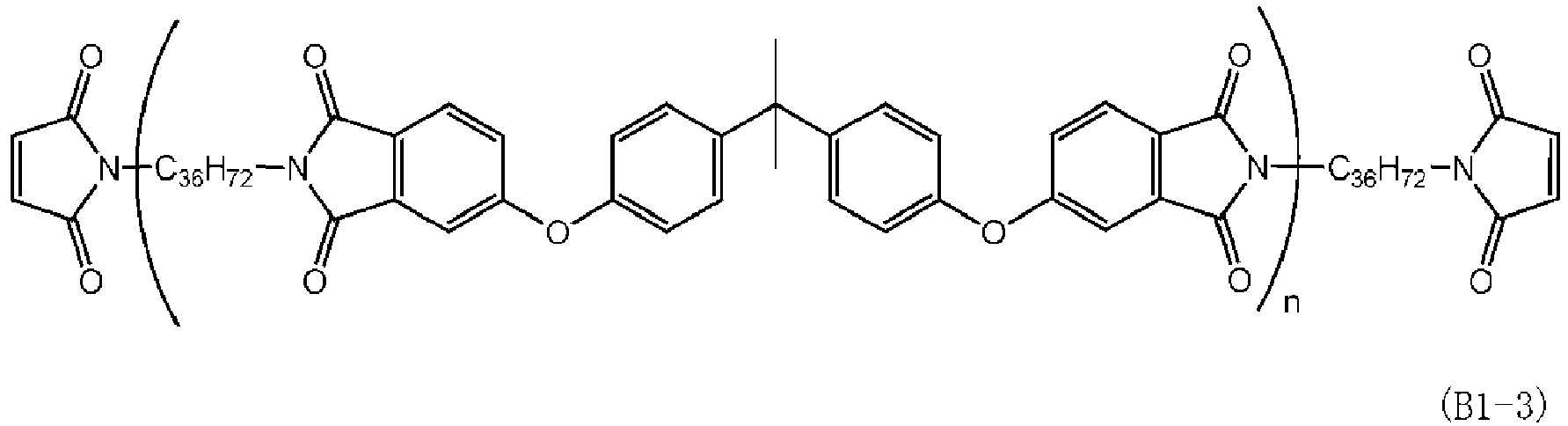
- (B1-1) Liquid bismaleimide compound represented by the following formula (B1-1) (BMI-689 by Designer Molecules, Inc.)
- (B2) Solid bismaleimide compound
- (B2-1) 4,4'-diphenylmethane bismaleimide (BMI-1000 by Daiwakasei Industry Co., Ltd.)
- (B2-2) m-phenylene bismaleimide (BMI-3000 by Daiwakasei Industry Co., Ltd.)
- (B2-3) Bisphenol A diphenyl ether bismaleimide (BMI-4000 by Daiwakasei Industry Co., Ltd.)
- (B1) Liquid bismaleimide compound
- (C) Other additives
- (C1) Curing accelerator
- (C1-1) 2-ethyl-4-methylimidazole (by SHIKOKU CHEMICALS CORPORATION.)
- (C1-2) Triphenylphosphine (by HOKKO CHEMICAL INDUSTRY CO., LTD.)
- (C2) Polymerization initiator
- (C2-1) PERCUMYL D (by NOF CORPORATION)
- (C3) Inorganic filler
- (C3-1) Molten spherical silica with an average particle diameter of 14 µm (by TATSUMORI LTD.)
- (C4) Silane coupling agent
- (C4-1) γ-glycidoxypropyltrimethoxysilane (KBM-403 by Shin-Etsu Chemical Co., Ltd.)
- (C1) Curing accelerator
- The following properties of each composition prepared at given composition ratios were measured, and the results thereof are shown in Table 1, Table 2 (working examples) and Table 3 (comparative examples).
- An E-type viscometer was used to measure a viscosity of each composition at 25°C in accordance with a method described in JIS Z8803:2011. Specifically, measured was a viscosity two minutes after the composition had been set to the viscometer.
- A specimen for an adhesion test was obtained by applying the heat-curable resin composition of the invention to a 10 × 10 mm silicon wafer, mounting a silicon chip thereon, and then curing the same under the above curing condition. A bond tester DAGE-SERIES-4000PXY (by Nordson Advanced Technology Japan K.K.) was used to measure a shear adhesion force of the specimen at room temperature (25°C). Here, an adhesion area between the frame of the specimen and the resin was 10 mm2. An adhesion at a high temperature was measured in a way such that the specimen was left at a stage of 260°C for 30 sec, followed by measuring the adhesion thereof as is the case under room temperature.
- A decrease rate in adhesion force to Si at a high temperature [%] was calculated using the following formula. Further, a similar evaluation was performed on a specimen employing a Cu lead frame instead of a silicon wafer, and a decrease rate in adhesion force to Cu at a high temperature [%] was also calculated in a similar manner.

- A 50 mm diameter × 3 mm thickness disk that had been prepared under the above curing conditions was exposed to a saturated water vapor of 2.03 × 10⁵ Pa at 121°C in a pressure cooker for 96 hours. A rate of increase in the weight of such disk was considered as a water absorption rate.
- A bending elastic modulus of a cured product prepared under the above curing conditions was measured in accordance with JIS K6911:2006.


- The heat-curable resin composition of the present invention does not employ a solvent. Since the composition of the invention uses the component (B) in liquid form at 25°C, the composition has a superior workability due to its low viscosity, exhibits a low elasticity, and will not have a resin reliability thereof impaired even under a high-humidity/temperature condition and a high-temperature condition.
Claims (6)
- A heat-curable resin composition comprising:(A) a heat-curable resin; and(B) a bismaleimide compound in liquid form at 25°C, whereinsaid heat-curable resin composition exhibits a viscosity of 1 mPa·s to 850 Pa·s when measured at 25°C in accordance with a method described in JIS Z8803:2011.
- The heat-curable resin composition according to claim 1, wherein said heat-curable resin (A) comprises a heat-curable resin component (A1) and a curing agent (A2).
- The heat-curable resin composition according to claim 2, wherein said heat-curable resin component (A1) is at least one selected from an epoxy resin, a phenolic resin, an unsaturated imide resin, a cyanate resin, an isocyanate resin, a benzoxazine resin, an oxetane resin, an amino resin, an unsaturated polyester resin, an allyl resin, a dicyclopentadiene resin, a silicone resin, a triazine resin and a melamine resin.
- The heat-curable resin composition according to claim 3, wherein said heat-curable resin component (A1) is an epoxy resin or a cyanate resin, and said curing agent (A2) is a curing agent for either an epoxy resin or a cyanate resin.
- The heat-curable resin composition according to any one of claims 1 to 4, wherein said bismaleimide compound (B) in liquid form at 25°C is a compound represented by the following formula (1):

- The heat-curable resin composition according to claim 5, wherein said bismaleimide compound represented by the formula (1) is at least one kind of bismaleimide compound selected from the group consisting of bismaleimide compounds represented by the following formulae (1-1), (1-2) and (1-3):


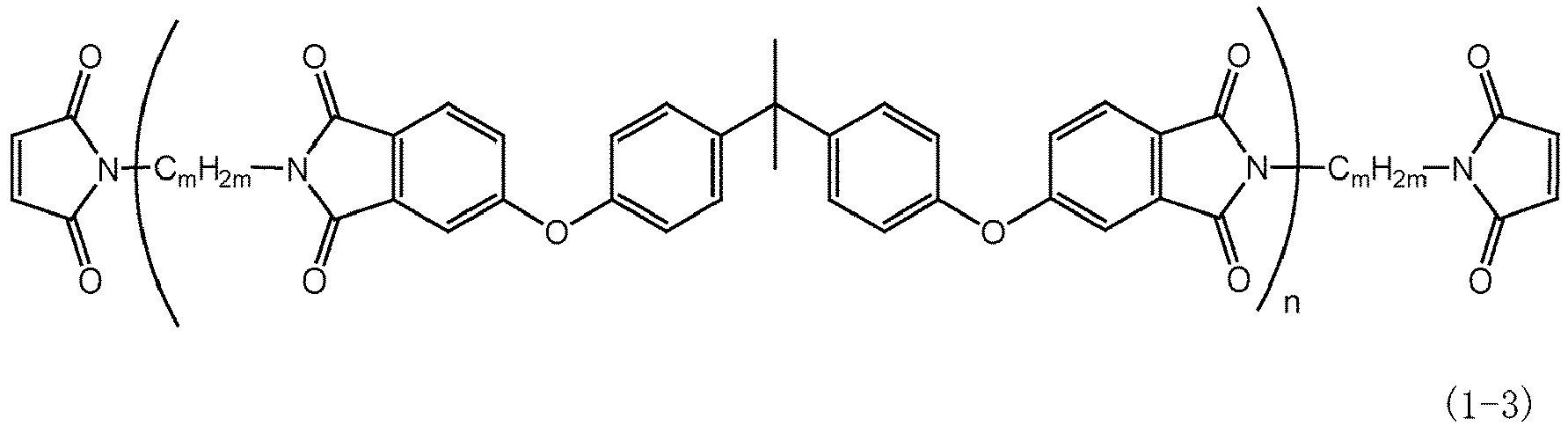
Applications Claiming Priority (1)
| Application Number | Priority Date | Filing Date | Title |
|---|---|---|---|
| JP2015164546 | 2015-08-24 |
Publications (1)
| Publication Number | Publication Date |
|---|---|
| EP3135722A1 true EP3135722A1 (en) | 2017-03-01 |
Family
ID=56799309
Family Applications (1)
| Application Number | Title | Priority Date | Filing Date |
|---|---|---|---|
| EP16185322.1A Withdrawn EP3135722A1 (en) | 2015-08-24 | 2016-08-23 | Heat-curable resin composition |
Country Status (6)
| Country | Link |
|---|---|
| US (1) | US20170058102A1 (en) |
| EP (1) | EP3135722A1 (en) |
| JP (1) | JP2017043767A (en) |
| KR (1) | KR20170023719A (en) |
| CN (1) | CN106479125A (en) |
| TW (1) | TW201718691A (en) |
Cited By (5)
| Publication number | Priority date | Publication date | Assignee | Title |
|---|---|---|---|---|
| USD813491S1 (en) | 2016-10-04 | 2018-03-27 | J.R. Simplot Company | Conical potato piece |
| EP3354674A1 (en) * | 2016-10-24 | 2018-08-01 | Shin-Etsu Chemical Co., Ltd. | Liquid epoxy resin composition |
| US20210189043A1 (en) * | 2019-12-18 | 2021-06-24 | Shin-Etsu Chemical Co., Ltd. | Heat-curable resin composition and uses thereof |
| EP3483214B1 (en) * | 2016-07-05 | 2023-08-30 | Resonac Corporation | Resin composition, resin film, laminate, multilayer printed wiring board and method for producing multilayer printed wiring board |
| WO2024184163A1 (en) | 2023-03-03 | 2024-09-12 | Huntsman Advanced Materials (Switzerland) Gmbh | Bismaleimide compounds and low dielectric resin composition comprising them |
Families Citing this family (28)
| Publication number | Priority date | Publication date | Assignee | Title |
|---|---|---|---|---|
| KR102478957B1 (en) * | 2016-07-20 | 2022-12-16 | 쇼와덴코머티리얼즈가부시끼가이샤 | Resin composition, resin layer-provided support, prepreg, laminate sheet, multilayer printed wiring board, and printed wiring board for millimeter-wave radar |
| JP6903282B2 (en) * | 2017-02-14 | 2021-07-14 | 三菱瓦斯化学株式会社 | Resin composition, prepreg, metal foil-clad laminate, resin sheet and printed wiring board |
| JP7127251B2 (en) * | 2017-06-05 | 2022-08-30 | 住友ベークライト株式会社 | Sealing resin composition and structure |
| JP6992333B2 (en) * | 2017-09-06 | 2022-01-13 | 味の素株式会社 | Resin composition |
| JP2019048933A (en) * | 2017-09-08 | 2019-03-28 | 昭和電工株式会社 | Curable resin composition, cured article thereof, manufacturing method of structure using the curable resin composition, and structure containing the cured article |
| JP7192202B2 (en) * | 2017-09-20 | 2022-12-20 | 横浜ゴム株式会社 | Cyanate ester resin composition for fiber reinforced composite material, prepreg and fiber reinforced composite material |
| JP2019099755A (en) * | 2017-12-07 | 2019-06-24 | 信越化学工業株式会社 | Thermosetting resin composition |
| CN111836843A (en) * | 2018-03-28 | 2020-10-27 | 积水化学工业株式会社 | Resin materials and multilayer printed wiring boards |
| JP7344471B2 (en) * | 2018-04-26 | 2023-09-14 | 三菱瓦斯化学株式会社 | Resin composition, laminate, semiconductor wafer with resin composition layer, semiconductor mounting substrate with resin composition layer, and semiconductor device |
| TWI804615B (en) * | 2018-05-18 | 2023-06-11 | 日商信越化學工業股份有限公司 | Thermosetting maleimide resin composition for semiconductor sealing and semiconductor device |
| JP7292831B2 (en) * | 2018-07-13 | 2023-06-19 | 株式会社トプコン | Target device and survey system |
| JP7024672B2 (en) * | 2018-09-12 | 2022-02-24 | 信越化学工業株式会社 | Thermosetting resin composition, thermosetting resin film and semiconductor device |
| CN109747263B (en) * | 2019-01-28 | 2020-10-23 | 江西省航宇新材料股份有限公司 | A new type of preparation process of copper clad laminate |
| JP2020138996A (en) * | 2019-02-26 | 2020-09-03 | 味の素株式会社 | Resin composition |
| KR20210143762A (en) * | 2019-03-22 | 2021-11-29 | 린텍 가부시키가이샤 | resin sheet |
| JP7188309B2 (en) * | 2019-07-26 | 2022-12-13 | 信越化学工業株式会社 | Thermosetting maleimide resin composition and semiconductor device |
| US11639398B2 (en) * | 2019-12-30 | 2023-05-02 | Rohm And Haas Electronic Materials Llc | Photosensitive bismaleimide composition |
| JP7424167B2 (en) * | 2020-03-31 | 2024-01-30 | 味の素株式会社 | Resin compositions, cured products of resin compositions, resin sheets, printed wiring boards, semiconductor chip packages, and semiconductor devices |
| JP6791428B2 (en) * | 2020-07-17 | 2020-11-25 | 味の素株式会社 | Resin composition |
| JP7409262B2 (en) * | 2020-08-24 | 2024-01-09 | 味の素株式会社 | resin composition |
| CN112048085A (en) * | 2020-09-09 | 2020-12-08 | 深圳市知猪互联科技有限公司 | A kind of preparation process of biodegradable resin matrix composite material |
| JP7417345B2 (en) * | 2020-12-23 | 2024-01-18 | 信越化学工業株式会社 | Cyclic imide resin compositions, prepregs, copper clad laminates and printed wiring boards |
| JP2022109412A (en) * | 2021-01-15 | 2022-07-28 | 信越化学工業株式会社 | Thermosetting resin composition |
| US20230040536A1 (en) * | 2021-07-12 | 2023-02-09 | Shin-Etsu Chemical Co., Ltd. | Photocurable maleimide resin composition |
| CN115073633B (en) * | 2021-08-31 | 2024-07-09 | 乐凯光电材料有限公司 | Polyvinyl acetal resin and preparation method thereof |
| CN117673463A (en) * | 2022-08-30 | 2024-03-08 | 蔚来汽车科技(安徽)有限公司 | An electrolyte and lithium-ion battery |
| CN118240374A (en) * | 2022-12-23 | 2024-06-25 | 广东生益科技股份有限公司 | Resin composition and application thereof |
| CN117844434B (en) * | 2024-01-04 | 2025-07-01 | 杭州之江有机硅化工有限公司 | BMI-containing insulating adhesive composition and application thereof |
Citations (8)
| Publication number | Priority date | Publication date | Assignee | Title |
|---|---|---|---|---|
| WO1998010920A1 (en) * | 1996-09-10 | 1998-03-19 | Quantum Materials, Inc. | Maleimide containing formulations and uses therefor |
| JPH11124433A (en) | 1997-10-22 | 1999-05-11 | Mitsubishi Gas Chem Co Inc | Phenol novolak type cyanate prepolymer |
| JP2004168894A (en) | 2002-11-20 | 2004-06-17 | Tomoegawa Paper Co Ltd | Heat resistant adhesive composition, laminate using the same, and flexible printed circuit board |
| EP1736520A1 (en) * | 2004-03-19 | 2006-12-27 | Sumitomo Bakelite Company, Ltd. | Resin composition and semiconductor devices made by using the same |
| JP2014001289A (en) * | 2012-06-18 | 2014-01-09 | Nippon Steel & Sumikin Chemical Co Ltd | Semiconductor sealing resin composition |
| JP2014521754A (en) | 2011-07-29 | 2014-08-28 | ナミックス株式会社 | Epoxy resin composition for semiconductor encapsulation, semiconductor device using the same, and semiconductor manufacturing method |
| JP2014194013A (en) * | 2013-03-01 | 2014-10-09 | Kyocera Chemical Corp | Thermosetting resin composition, semiconductor device and electric/electronic component |
| CN104629341A (en) * | 2013-11-08 | 2015-05-20 | 中山台光电子材料有限公司 | Low-dielectric resin composition, semi-solidified rubber sheet using same, copper clad plate, and circuit board |
Family Cites Families (1)
| Publication number | Priority date | Publication date | Assignee | Title |
|---|---|---|---|---|
| JP4587631B2 (en) * | 2002-01-30 | 2010-11-24 | Dic株式会社 | Thermosetting resin composition |
-
2016
- 2016-08-19 KR KR1020160105224A patent/KR20170023719A/en not_active Ceased
- 2016-08-22 JP JP2016161667A patent/JP2017043767A/en active Pending
- 2016-08-23 EP EP16185322.1A patent/EP3135722A1/en not_active Withdrawn
- 2016-08-23 TW TW105126918A patent/TW201718691A/en unknown
- 2016-08-23 US US15/244,188 patent/US20170058102A1/en not_active Abandoned
- 2016-08-24 CN CN201610720819.4A patent/CN106479125A/en active Pending
Patent Citations (8)
| Publication number | Priority date | Publication date | Assignee | Title |
|---|---|---|---|---|
| WO1998010920A1 (en) * | 1996-09-10 | 1998-03-19 | Quantum Materials, Inc. | Maleimide containing formulations and uses therefor |
| JPH11124433A (en) | 1997-10-22 | 1999-05-11 | Mitsubishi Gas Chem Co Inc | Phenol novolak type cyanate prepolymer |
| JP2004168894A (en) | 2002-11-20 | 2004-06-17 | Tomoegawa Paper Co Ltd | Heat resistant adhesive composition, laminate using the same, and flexible printed circuit board |
| EP1736520A1 (en) * | 2004-03-19 | 2006-12-27 | Sumitomo Bakelite Company, Ltd. | Resin composition and semiconductor devices made by using the same |
| JP2014521754A (en) | 2011-07-29 | 2014-08-28 | ナミックス株式会社 | Epoxy resin composition for semiconductor encapsulation, semiconductor device using the same, and semiconductor manufacturing method |
| JP2014001289A (en) * | 2012-06-18 | 2014-01-09 | Nippon Steel & Sumikin Chemical Co Ltd | Semiconductor sealing resin composition |
| JP2014194013A (en) * | 2013-03-01 | 2014-10-09 | Kyocera Chemical Corp | Thermosetting resin composition, semiconductor device and electric/electronic component |
| CN104629341A (en) * | 2013-11-08 | 2015-05-20 | 中山台光电子材料有限公司 | Low-dielectric resin composition, semi-solidified rubber sheet using same, copper clad plate, and circuit board |
Non-Patent Citations (2)
| Title |
|---|
| DATABASE WPI Week 201406, Derwent World Patents Index; AN 2014-A68820, XP002765196 * |
| DATABASE WPI Week 201470, Derwent World Patents Index; AN 2014-S13416, XP002765195 * |
Cited By (6)
| Publication number | Priority date | Publication date | Assignee | Title |
|---|---|---|---|---|
| EP3483214B1 (en) * | 2016-07-05 | 2023-08-30 | Resonac Corporation | Resin composition, resin film, laminate, multilayer printed wiring board and method for producing multilayer printed wiring board |
| USD813491S1 (en) | 2016-10-04 | 2018-03-27 | J.R. Simplot Company | Conical potato piece |
| EP3354674A1 (en) * | 2016-10-24 | 2018-08-01 | Shin-Etsu Chemical Co., Ltd. | Liquid epoxy resin composition |
| US20210189043A1 (en) * | 2019-12-18 | 2021-06-24 | Shin-Etsu Chemical Co., Ltd. | Heat-curable resin composition and uses thereof |
| US11639410B2 (en) * | 2019-12-18 | 2023-05-02 | Shin-Etsu Chemical Co., Ltd. | Heat-curable resin composition and uses thereof |
| WO2024184163A1 (en) | 2023-03-03 | 2024-09-12 | Huntsman Advanced Materials (Switzerland) Gmbh | Bismaleimide compounds and low dielectric resin composition comprising them |
Also Published As
| Publication number | Publication date |
|---|---|
| KR20170023719A (en) | 2017-03-06 |
| US20170058102A1 (en) | 2017-03-02 |
| CN106479125A (en) | 2017-03-08 |
| JP2017043767A (en) | 2017-03-02 |
| TW201718691A (en) | 2017-06-01 |
Similar Documents
| Publication | Publication Date | Title |
|---|---|---|
| US20170058102A1 (en) | Heat-curable resin composition | |
| EP3127933B1 (en) | Heat-curable epoxy resin composition | |
| KR102918667B1 (en) | Heat-curable resin composition, heat-curable resin film and semiconductor device | |
| JP2020045446A (en) | Thermosetting resin composition | |
| US20180112072A1 (en) | Liquid epoxy resin composition | |
| EP3257898B1 (en) | Epoxy resin composition | |
| JP2022099397A (en) | Cyclic imide resin composition, prepreg, copper-clad laminate, and printed wiring board | |
| US12110356B2 (en) | Heat-curable resin composition | |
| JP2019099755A (en) | Thermosetting resin composition | |
| JP2023062903A (en) | Cyclic imide resin composition, liquid adhesive, film, prepreg, copper-clad laminate, and printed wiring board | |
| WO2023090363A1 (en) | Resin composition, cured object, sheet, layered product, and printed wiring board | |
| JP7642295B2 (en) | Thermosetting resin composition | |
| US20250346788A1 (en) | Polymaleimide resin, resin composition, cured object, sheet, laminate, and printed wiring board | |
| US12565608B2 (en) | Thermally conductive resin composition | |
| JP2013142136A (en) | Flame-retardant liquid epoxy resin composition for encapsulating semiconductor and semiconductor device | |
| JP2022109412A (en) | Thermosetting resin composition | |
| WO2025100369A1 (en) | Maleimide resin, resin composition, cured product, sheet, laminate, and printed wiring board | |
| US20240425718A1 (en) | Underfill composition | |
| WO2025159125A1 (en) | Maleimide resin, resin composition, cured product, sheet, layered product, and printed wiring board |
Legal Events
| Date | Code | Title | Description |
|---|---|---|---|
| PUAI | Public reference made under article 153(3) epc to a published international application that has entered the european phase |
Free format text: ORIGINAL CODE: 0009012 |
|
| STAA | Information on the status of an ep patent application or granted ep patent |
Free format text: STATUS: THE APPLICATION HAS BEEN PUBLISHED |
|
| AK | Designated contracting states |
Kind code of ref document: A1 Designated state(s): AL AT BE BG CH CY CZ DE DK EE ES FI FR GB GR HR HU IE IS IT LI LT LU LV MC MK MT NL NO PL PT RO RS SE SI SK SM TR |
|
| AX | Request for extension of the european patent |
Extension state: BA ME |
|
| STAA | Information on the status of an ep patent application or granted ep patent |
Free format text: STATUS: REQUEST FOR EXAMINATION WAS MADE |
|
| 17P | Request for examination filed |
Effective date: 20170901 |
|
| RBV | Designated contracting states (corrected) |
Designated state(s): AL AT BE BG CH CY CZ DE DK EE ES FI FR GB GR HR HU IE IS IT LI LT LU LV MC MK MT NL NO PL PT RO RS SE SI SK SM TR |
|
| STAA | Information on the status of an ep patent application or granted ep patent |
Free format text: STATUS: EXAMINATION IS IN PROGRESS |
|
| 17Q | First examination report despatched |
Effective date: 20210521 |
|
| STAA | Information on the status of an ep patent application or granted ep patent |
Free format text: STATUS: THE APPLICATION HAS BEEN WITHDRAWN |
|
| 18W | Application withdrawn |
Effective date: 20210824 |