EP3134401B1 - Isoxazoline hydroxamic acid derivatives as lpxc inhibitors - Google Patents
Isoxazoline hydroxamic acid derivatives as lpxc inhibitors Download PDFInfo
- Publication number
- EP3134401B1 EP3134401B1 EP15721435.4A EP15721435A EP3134401B1 EP 3134401 B1 EP3134401 B1 EP 3134401B1 EP 15721435 A EP15721435 A EP 15721435A EP 3134401 B1 EP3134401 B1 EP 3134401B1
- Authority
- EP
- European Patent Office
- Prior art keywords
- mmol
- methyl
- equiv
- dihydroisoxazol
- methylsulfonyl
- Prior art date
- Legal status (The legal status is an assumption and is not a legal conclusion. Google has not performed a legal analysis and makes no representation as to the accuracy of the status listed.)
- Not-in-force
Links
- 239000003112 inhibitor Substances 0.000 title description 9
- WWCXTTVDOOAWMK-UHFFFAOYSA-N N-hydroxy-4,5-dihydro-1,2-oxazole-3-carboxamide Chemical class O1N=C(CC1)C(=O)NO WWCXTTVDOOAWMK-UHFFFAOYSA-N 0.000 title 1
- 150000001875 compounds Chemical class 0.000 claims description 255
- 150000003839 salts Chemical class 0.000 claims description 88
- 239000000203 mixture Substances 0.000 claims description 75
- -1 amino, hydroxy Chemical group 0.000 claims description 54
- 125000004178 (C1-C4) alkyl group Chemical group 0.000 claims description 43
- 239000003814 drug Substances 0.000 claims description 29
- 125000005843 halogen group Chemical group 0.000 claims description 27
- 238000011282 treatment Methods 0.000 claims description 27
- 239000008194 pharmaceutical composition Substances 0.000 claims description 26
- 125000005842 heteroatom Chemical group 0.000 claims description 21
- 125000000623 heterocyclic group Chemical group 0.000 claims description 21
- 229910052760 oxygen Inorganic materials 0.000 claims description 21
- 241000894006 Bacteria Species 0.000 claims description 19
- 229910052717 sulfur Inorganic materials 0.000 claims description 19
- 125000004765 (C1-C4) haloalkyl group Chemical group 0.000 claims description 18
- 239000003937 drug carrier Substances 0.000 claims description 14
- 208000027096 gram-negative bacterial infections Diseases 0.000 claims description 12
- 125000005913 (C3-C6) cycloalkyl group Chemical group 0.000 claims description 11
- 125000001997 phenyl group Chemical group [H]C1=C([H])C([H])=C(*)C([H])=C1[H] 0.000 claims description 11
- 208000035143 Bacterial infection Diseases 0.000 claims description 10
- 208000022362 bacterial infectious disease Diseases 0.000 claims description 10
- MYSWGUAQZAJSOK-UHFFFAOYSA-N ciprofloxacin Chemical compound C12=CC(N3CCNCC3)=C(F)C=C2C(=O)C(C(=O)O)=CN1C1CC1 MYSWGUAQZAJSOK-UHFFFAOYSA-N 0.000 claims description 10
- 125000000882 C2-C6 alkenyl group Chemical group 0.000 claims description 9
- 125000003601 C2-C6 alkynyl group Chemical group 0.000 claims description 9
- 208000015181 infectious disease Diseases 0.000 claims description 9
- 125000000229 (C1-C4)alkoxy group Chemical group 0.000 claims description 8
- 229940124597 therapeutic agent Drugs 0.000 claims description 8
- 125000006570 (C5-C6) heteroaryl group Chemical group 0.000 claims description 7
- JGSARLDLIJGVTE-MBNYWOFBSA-N Penicillin G Chemical compound N([C@H]1[C@H]2SC([C@@H](N2C1=O)C(O)=O)(C)C)C(=O)CC1=CC=CC=C1 JGSARLDLIJGVTE-MBNYWOFBSA-N 0.000 claims description 7
- 125000002496 methyl group Chemical group [H]C([H])([H])* 0.000 claims description 7
- 241000589291 Acinetobacter Species 0.000 claims description 6
- ULGZDMOVFRHVEP-RWJQBGPGSA-N Erythromycin Chemical compound O([C@@H]1[C@@H](C)C(=O)O[C@@H]([C@@]([C@H](O)[C@@H](C)C(=O)[C@H](C)C[C@@](C)(O)[C@H](O[C@H]2[C@@H]([C@H](C[C@@H](C)O2)N(C)C)O)[C@H]1C)(C)O)CC)[C@H]1C[C@@](C)(OC)[C@@H](O)[C@H](C)O1 ULGZDMOVFRHVEP-RWJQBGPGSA-N 0.000 claims description 6
- 241000589517 Pseudomonas aeruginosa Species 0.000 claims description 6
- 229910052739 hydrogen Inorganic materials 0.000 claims description 6
- 241001673062 Achromobacter xylosoxidans Species 0.000 claims description 5
- 241000588921 Enterobacteriaceae Species 0.000 claims description 5
- 241000588653 Neisseria Species 0.000 claims description 5
- 241000588769 Proteus <enterobacteria> Species 0.000 claims description 5
- 241000607142 Salmonella Species 0.000 claims description 5
- 241000122973 Stenotrophomonas maltophilia Species 0.000 claims description 5
- 229960003405 ciprofloxacin Drugs 0.000 claims description 5
- 229910052731 fluorine Inorganic materials 0.000 claims description 5
- WZPBZJONDBGPKJ-UHFFFAOYSA-N Antibiotic SQ 26917 Natural products O=C1N(S(O)(=O)=O)C(C)C1NC(=O)C(=NOC(C)(C)C(O)=O)C1=CSC(N)=N1 WZPBZJONDBGPKJ-UHFFFAOYSA-N 0.000 claims description 4
- 241000588807 Bordetella Species 0.000 claims description 4
- CEAZRRDELHUEMR-URQXQFDESA-N Gentamicin Chemical compound O1[C@H](C(C)NC)CC[C@@H](N)[C@H]1O[C@H]1[C@H](O)[C@@H](O[C@@H]2[C@@H]([C@@H](NC)[C@@](C)(O)CO2)O)[C@H](N)C[C@@H]1N CEAZRRDELHUEMR-URQXQFDESA-N 0.000 claims description 4
- 229930182566 Gentamicin Natural products 0.000 claims description 4
- 241000606790 Haemophilus Species 0.000 claims description 4
- 241000589248 Legionella Species 0.000 claims description 4
- 108010040201 Polymyxins Proteins 0.000 claims description 4
- 241000589516 Pseudomonas Species 0.000 claims description 4
- 241000607720 Serratia Species 0.000 claims description 4
- 241000607768 Shigella Species 0.000 claims description 4
- 239000004098 Tetracycline Substances 0.000 claims description 4
- 108010059993 Vancomycin Proteins 0.000 claims description 4
- 241000607734 Yersinia <bacteria> Species 0.000 claims description 4
- 229960004099 azithromycin Drugs 0.000 claims description 4
- MQTOSJVFKKJCRP-BICOPXKESA-N azithromycin Chemical compound O([C@@H]1[C@@H](C)C(=O)O[C@@H]([C@@]([C@H](O)[C@@H](C)N(C)C[C@H](C)C[C@@](C)(O)[C@H](O[C@H]2[C@@H]([C@H](C[C@@H](C)O2)N(C)C)O)[C@H]1C)(C)O)CC)[C@H]1C[C@@](C)(OC)[C@@H](O)[C@H](C)O1 MQTOSJVFKKJCRP-BICOPXKESA-N 0.000 claims description 4
- 229960003644 aztreonam Drugs 0.000 claims description 4
- WZPBZJONDBGPKJ-VEHQQRBSSA-N aztreonam Chemical compound O=C1N(S([O-])(=O)=O)[C@@H](C)[C@@H]1NC(=O)C(=N/OC(C)(C)C(O)=O)\C1=CSC([NH3+])=N1 WZPBZJONDBGPKJ-VEHQQRBSSA-N 0.000 claims description 4
- 125000002924 primary amino group Chemical group [H]N([H])* 0.000 claims description 4
- 229960001225 rifampicin Drugs 0.000 claims description 4
- 235000019364 tetracycline Nutrition 0.000 claims description 4
- 150000003522 tetracyclines Chemical class 0.000 claims description 4
- 229960000707 tobramycin Drugs 0.000 claims description 4
- NLVFBUXFDBBNBW-PBSUHMDJSA-N tobramycin Chemical compound N[C@@H]1C[C@H](O)[C@@H](CN)O[C@@H]1O[C@H]1[C@H](O)[C@@H](O[C@@H]2[C@@H]([C@@H](N)[C@H](O)[C@@H](CO)O2)O)[C@H](N)C[C@@H]1N NLVFBUXFDBBNBW-PBSUHMDJSA-N 0.000 claims description 4
- 229960003165 vancomycin Drugs 0.000 claims description 4
- MYPYJXKWCTUITO-UHFFFAOYSA-N vancomycin Natural products O1C(C(=C2)Cl)=CC=C2C(O)C(C(NC(C2=CC(O)=CC(O)=C2C=2C(O)=CC=C3C=2)C(O)=O)=O)NC(=O)C3NC(=O)C2NC(=O)C(CC(N)=O)NC(=O)C(NC(=O)C(CC(C)C)NC)C(O)C(C=C3Cl)=CC=C3OC3=CC2=CC1=C3OC1OC(CO)C(O)C(O)C1OC1CC(C)(N)C(O)C(C)O1 MYPYJXKWCTUITO-UHFFFAOYSA-N 0.000 claims description 4
- SGKRLCUYIXIAHR-AKNGSSGZSA-N (4s,4ar,5s,5ar,6r,12ar)-4-(dimethylamino)-1,5,10,11,12a-pentahydroxy-6-methyl-3,12-dioxo-4a,5,5a,6-tetrahydro-4h-tetracene-2-carboxamide Chemical compound C1=CC=C2[C@H](C)[C@@H]([C@H](O)[C@@H]3[C@](C(O)=C(C(N)=O)C(=O)[C@H]3N(C)C)(O)C3=O)C3=C(O)C2=C1O SGKRLCUYIXIAHR-AKNGSSGZSA-N 0.000 claims description 3
- 125000006569 (C5-C6) heterocyclic group Chemical group 0.000 claims description 3
- 241001453380 Burkholderia Species 0.000 claims description 3
- 241000589513 Burkholderia cepacia Species 0.000 claims description 3
- 208000007764 Legionnaires' Disease Diseases 0.000 claims description 3
- GSDSWSVVBLHKDQ-JTQLQIEISA-N Levofloxacin Chemical compound C([C@@H](N1C2=C(C(C(C(O)=O)=C1)=O)C=C1F)C)OC2=C1N1CCN(C)CC1 GSDSWSVVBLHKDQ-JTQLQIEISA-N 0.000 claims description 3
- 241000588621 Moraxella Species 0.000 claims description 3
- WKDDRNSBRWANNC-UHFFFAOYSA-N Thienamycin Natural products C1C(SCCN)=C(C(O)=O)N2C(=O)C(C(O)C)C21 WKDDRNSBRWANNC-UHFFFAOYSA-N 0.000 claims description 3
- 241000607598 Vibrio Species 0.000 claims description 3
- 229960004821 amikacin Drugs 0.000 claims description 3
- LKCWBDHBTVXHDL-RMDFUYIESA-N amikacin Chemical compound O([C@@H]1[C@@H](N)C[C@H]([C@@H]([C@H]1O)O[C@@H]1[C@@H]([C@@H](N)[C@H](O)[C@@H](CO)O1)O)NC(=O)[C@@H](O)CCN)[C@H]1O[C@H](CN)[C@@H](O)[C@H](O)[C@H]1O LKCWBDHBTVXHDL-RMDFUYIESA-N 0.000 claims description 3
- 229960000723 ampicillin Drugs 0.000 claims description 3
- AVKUERGKIZMTKX-NJBDSQKTSA-N ampicillin Chemical compound C1([C@@H](N)C(=O)N[C@H]2[C@H]3SC([C@@H](N3C2=O)C(O)=O)(C)C)=CC=CC=C1 AVKUERGKIZMTKX-NJBDSQKTSA-N 0.000 claims description 3
- 229960002100 cefepime Drugs 0.000 claims description 3
- 229960004261 cefotaxime Drugs 0.000 claims description 3
- AZZMGZXNTDTSME-JUZDKLSSSA-M cefotaxime sodium Chemical compound [Na+].N([C@@H]1C(N2C(=C(COC(C)=O)CS[C@@H]21)C([O-])=O)=O)C(=O)\C(=N/OC)C1=CSC(N)=N1 AZZMGZXNTDTSME-JUZDKLSSSA-M 0.000 claims description 3
- 229960004755 ceftriaxone Drugs 0.000 claims description 3
- VAAUVRVFOQPIGI-SPQHTLEESA-N ceftriaxone Chemical compound S([C@@H]1[C@@H](C(N1C=1C(O)=O)=O)NC(=O)\C(=N/OC)C=2N=C(N)SC=2)CC=1CSC1=NC(=O)C(=O)NN1C VAAUVRVFOQPIGI-SPQHTLEESA-N 0.000 claims description 3
- 229960002227 clindamycin Drugs 0.000 claims description 3
- KDLRVYVGXIQJDK-AWPVFWJPSA-N clindamycin Chemical compound CN1C[C@H](CCC)C[C@H]1C(=O)N[C@H]([C@H](C)Cl)[C@@H]1[C@H](O)[C@H](O)[C@@H](O)[C@@H](SC)O1 KDLRVYVGXIQJDK-AWPVFWJPSA-N 0.000 claims description 3
- 125000001559 cyclopropyl group Chemical group [H]C1([H])C([H])([H])C1([H])* 0.000 claims description 3
- 229960003722 doxycycline Drugs 0.000 claims description 3
- 229960003276 erythromycin Drugs 0.000 claims description 3
- 229960002182 imipenem Drugs 0.000 claims description 3
- ZSKVGTPCRGIANV-ZXFLCMHBSA-N imipenem Chemical compound C1C(SCC\N=C\N)=C(C(O)=O)N2C(=O)[C@H]([C@H](O)C)[C@H]21 ZSKVGTPCRGIANV-ZXFLCMHBSA-N 0.000 claims description 3
- 229960003376 levofloxacin Drugs 0.000 claims description 3
- DMJNNHOOLUXYBV-PQTSNVLCSA-N meropenem Chemical compound C=1([C@H](C)[C@@H]2[C@H](C(N2C=1C(O)=O)=O)[C@H](O)C)S[C@@H]1CN[C@H](C(=O)N(C)C)C1 DMJNNHOOLUXYBV-PQTSNVLCSA-N 0.000 claims description 3
- 229960002260 meropenem Drugs 0.000 claims description 3
- 125000004043 oxo group Chemical group O=* 0.000 claims description 3
- 229940056360 penicillin g Drugs 0.000 claims description 3
- 229960002292 piperacillin Drugs 0.000 claims description 3
- WCMIIGXFCMNQDS-IDYPWDAWSA-M piperacillin sodium Chemical compound [Na+].O=C1C(=O)N(CC)CCN1C(=O)N[C@H](C=1C=CC=CC=1)C(=O)N[C@@H]1C(=O)N2[C@@H](C([O-])=O)C(C)(C)S[C@@H]21 WCMIIGXFCMNQDS-IDYPWDAWSA-M 0.000 claims description 3
- 229960002180 tetracycline Drugs 0.000 claims description 3
- 229930101283 tetracycline Natural products 0.000 claims description 3
- 229960004659 ticarcillin Drugs 0.000 claims description 3
- OHKOGUYZJXTSFX-KZFFXBSXSA-N ticarcillin Chemical compound C=1([C@@H](C(O)=O)C(=O)N[C@H]2[C@H]3SC([C@@H](N3C2=O)C(O)=O)(C)C)C=CSC=1 OHKOGUYZJXTSFX-KZFFXBSXSA-N 0.000 claims description 3
- 125000004356 hydroxy functional group Chemical group O* 0.000 claims 3
- MMRINLZOZVAPDZ-LSGRDSQZSA-N (6r,7r)-7-[[(2z)-2-(2-amino-1,3-thiazol-4-yl)-2-methoxyiminoacetyl]amino]-3-[(1-methylpyrrolidin-1-ium-1-yl)methyl]-8-oxo-5-thia-1-azabicyclo[4.2.0]oct-2-ene-2-carboxylic acid;chloride Chemical compound Cl.S([C@@H]1[C@@H](C(N1C=1C([O-])=O)=O)NC(=O)\C(=N/OC)C=2N=C(N)SC=2)CC=1C[N+]1(C)CCCC1 MMRINLZOZVAPDZ-LSGRDSQZSA-N 0.000 claims 1
- JQXXHWHPUNPDRT-WLSIYKJHSA-N rifampicin Chemical compound O([C@](C1=O)(C)O/C=C/[C@@H]([C@H]([C@@H](OC(C)=O)[C@H](C)[C@H](O)[C@H](C)[C@@H](O)[C@@H](C)\C=C\C=C(C)/C(=O)NC=2C(O)=C3C([O-])=C4C)C)OC)C4=C1C3=C(O)C=2\C=N\N1CC[NH+](C)CC1 JQXXHWHPUNPDRT-WLSIYKJHSA-N 0.000 claims 1
- MYPYJXKWCTUITO-LYRMYLQWSA-O vancomycin(1+) Chemical compound O([C@@H]1[C@@H](O)[C@H](O)[C@@H](CO)O[C@H]1OC1=C2C=C3C=C1OC1=CC=C(C=C1Cl)[C@@H](O)[C@H](C(N[C@@H](CC(N)=O)C(=O)N[C@H]3C(=O)N[C@H]1C(=O)N[C@H](C(N[C@@H](C3=CC(O)=CC(O)=C3C=3C(O)=CC=C1C=3)C([O-])=O)=O)[C@H](O)C1=CC=C(C(=C1)Cl)O2)=O)NC(=O)[C@@H](CC(C)C)[NH2+]C)[C@H]1C[C@](C)([NH3+])[C@H](O)[C@H](C)O1 MYPYJXKWCTUITO-LYRMYLQWSA-O 0.000 claims 1
- XEKOWRVHYACXOJ-UHFFFAOYSA-N Ethyl acetate Chemical compound CCOC(C)=O XEKOWRVHYACXOJ-UHFFFAOYSA-N 0.000 description 271
- IAZDPXIOMUYVGZ-UHFFFAOYSA-N Dimethylsulphoxide Chemical compound CS(C)=O IAZDPXIOMUYVGZ-UHFFFAOYSA-N 0.000 description 250
- 239000011541 reaction mixture Substances 0.000 description 235
- 238000003786 synthesis reaction Methods 0.000 description 221
- 230000015572 biosynthetic process Effects 0.000 description 216
- OKKJLVBELUTLKV-UHFFFAOYSA-N Methanol Chemical compound OC OKKJLVBELUTLKV-UHFFFAOYSA-N 0.000 description 210
- 238000004895 liquid chromatography mass spectrometry Methods 0.000 description 196
- 238000005160 1H NMR spectroscopy Methods 0.000 description 182
- 238000000034 method Methods 0.000 description 153
- VLKZOEOYAKHREP-UHFFFAOYSA-N n-Hexane Chemical compound CCCCCC VLKZOEOYAKHREP-UHFFFAOYSA-N 0.000 description 153
- XLYOFNOQVPJJNP-UHFFFAOYSA-N water Substances O XLYOFNOQVPJJNP-UHFFFAOYSA-N 0.000 description 142
- YMWUJEATGCHHMB-UHFFFAOYSA-N Dichloromethane Chemical compound ClCCl YMWUJEATGCHHMB-UHFFFAOYSA-N 0.000 description 141
- WYURNTSHIVDZCO-UHFFFAOYSA-N Tetrahydrofuran Chemical compound C1CCOC1 WYURNTSHIVDZCO-UHFFFAOYSA-N 0.000 description 133
- 235000019439 ethyl acetate Nutrition 0.000 description 133
- 239000000047 product Substances 0.000 description 108
- VEXZGXHMUGYJMC-UHFFFAOYSA-N Hydrochloric acid Chemical compound Cl VEXZGXHMUGYJMC-UHFFFAOYSA-N 0.000 description 85
- LFQSCWFLJHTTHZ-UHFFFAOYSA-N Ethanol Chemical compound CCO LFQSCWFLJHTTHZ-UHFFFAOYSA-N 0.000 description 84
- PMZURENOXWZQFD-UHFFFAOYSA-L Sodium Sulfate Chemical compound [Na+].[Na+].[O-]S([O-])(=O)=O PMZURENOXWZQFD-UHFFFAOYSA-L 0.000 description 82
- 239000012044 organic layer Substances 0.000 description 82
- 229910052938 sodium sulfate Inorganic materials 0.000 description 82
- IXCSERBJSXMMFS-UHFFFAOYSA-N hydrogen chloride Substances Cl.Cl IXCSERBJSXMMFS-UHFFFAOYSA-N 0.000 description 80
- 235000011152 sodium sulphate Nutrition 0.000 description 80
- SJRJJKPEHAURKC-UHFFFAOYSA-N N-Methylmorpholine Chemical compound CN1CCOCC1 SJRJJKPEHAURKC-UHFFFAOYSA-N 0.000 description 78
- 239000012267 brine Substances 0.000 description 78
- HPALAKNZSZLMCH-UHFFFAOYSA-M sodium;chloride;hydrate Chemical compound O.[Na+].[Cl-] HPALAKNZSZLMCH-UHFFFAOYSA-M 0.000 description 78
- 238000010898 silica gel chromatography Methods 0.000 description 56
- GQHTUMJGOHRCHB-UHFFFAOYSA-N 2,3,4,6,7,8,9,10-octahydropyrimido[1,2-a]azepine Chemical compound C1CCCCN2CCCN=C21 GQHTUMJGOHRCHB-UHFFFAOYSA-N 0.000 description 48
- IAZDPXIOMUYVGZ-WFGJKAKNSA-N Dimethyl sulfoxide Chemical compound [2H]C([2H])([2H])S(=O)C([2H])([2H])[2H] IAZDPXIOMUYVGZ-WFGJKAKNSA-N 0.000 description 47
- 239000000243 solution Substances 0.000 description 43
- WSLDOOZREJYCGB-UHFFFAOYSA-N 1,2-Dichloroethane Chemical compound ClCCCl WSLDOOZREJYCGB-UHFFFAOYSA-N 0.000 description 39
- ZMANZCXQSJIPKH-UHFFFAOYSA-N Triethylamine Chemical compound CCN(CC)CC ZMANZCXQSJIPKH-UHFFFAOYSA-N 0.000 description 37
- HEMHJVSKTPXQMS-UHFFFAOYSA-M sodium hydroxide Inorganic materials [OH-].[Na+] HEMHJVSKTPXQMS-UHFFFAOYSA-M 0.000 description 37
- NPZTUJOABDZTLV-UHFFFAOYSA-N hydroxybenzotriazole Substances O=C1C=CC=C2NNN=C12 NPZTUJOABDZTLV-UHFFFAOYSA-N 0.000 description 36
- 239000002904 solvent Substances 0.000 description 35
- UIIMBOGNXHQVGW-UHFFFAOYSA-M Sodium bicarbonate Chemical compound [Na+].OC([O-])=O UIIMBOGNXHQVGW-UHFFFAOYSA-M 0.000 description 34
- GLXDVVHUTZTUQK-UHFFFAOYSA-M lithium;hydroxide;hydrate Chemical compound [Li+].O.[OH-] GLXDVVHUTZTUQK-UHFFFAOYSA-M 0.000 description 34
- RTZKZFJDLAIYFH-UHFFFAOYSA-N Diethyl ether Chemical compound CCOCC RTZKZFJDLAIYFH-UHFFFAOYSA-N 0.000 description 32
- ZMXDDKWLCZADIW-UHFFFAOYSA-N N,N-Dimethylformamide Chemical compound CN(C)C=O ZMXDDKWLCZADIW-UHFFFAOYSA-N 0.000 description 32
- YEDUAINPPJYDJZ-UHFFFAOYSA-N 2-hydroxybenzothiazole Chemical compound C1=CC=C2SC(O)=NC2=C1 YEDUAINPPJYDJZ-UHFFFAOYSA-N 0.000 description 31
- 238000000746 purification Methods 0.000 description 31
- 239000003153 chemical reaction reagent Substances 0.000 description 30
- 239000003795 chemical substances by application Substances 0.000 description 30
- NLXXVSKHVGDQAT-UHFFFAOYSA-N o-(oxan-2-yl)hydroxylamine Chemical compound NOC1CCCCO1 NLXXVSKHVGDQAT-UHFFFAOYSA-N 0.000 description 28
- 239000002253 acid Substances 0.000 description 25
- 235000019441 ethanol Nutrition 0.000 description 24
- HEDRZPFGACZZDS-UHFFFAOYSA-N Chloroform Chemical compound ClC(Cl)Cl HEDRZPFGACZZDS-UHFFFAOYSA-N 0.000 description 22
- 230000008569 process Effects 0.000 description 22
- RYHBNJHYFVUHQT-UHFFFAOYSA-N 1,4-Dioxane Chemical compound C1COCCO1 RYHBNJHYFVUHQT-UHFFFAOYSA-N 0.000 description 21
- 239000007864 aqueous solution Substances 0.000 description 21
- 238000006243 chemical reaction Methods 0.000 description 21
- BCJVBDBJSMFBRW-UHFFFAOYSA-N 4-diphenylphosphanylbutyl(diphenyl)phosphane Chemical compound C=1C=CC=CC=1P(C=1C=CC=CC=1)CCCCP(C=1C=CC=CC=1)C1=CC=CC=C1 BCJVBDBJSMFBRW-UHFFFAOYSA-N 0.000 description 20
- 230000002829 reductive effect Effects 0.000 description 20
- 229920006395 saturated elastomer Polymers 0.000 description 20
- 239000012043 crude product Substances 0.000 description 19
- 229910002666 PdCl2 Inorganic materials 0.000 description 18
- YNHIGQDRGKUECZ-UHFFFAOYSA-L PdCl2(PPh3)2 Substances [Cl-].[Cl-].[Pd+2].C1=CC=CC=C1P(C=1C=CC=CC=1)C1=CC=CC=C1.C1=CC=CC=C1P(C=1C=CC=CC=1)C1=CC=CC=C1 YNHIGQDRGKUECZ-UHFFFAOYSA-L 0.000 description 18
- 229910052805 deuterium Inorganic materials 0.000 description 18
- PIBWKRNGBLPSSY-UHFFFAOYSA-L palladium(II) chloride Chemical compound Cl[Pd]Cl PIBWKRNGBLPSSY-UHFFFAOYSA-L 0.000 description 18
- 239000003242 anti bacterial agent Substances 0.000 description 17
- 208000037265 diseases, disorders, signs and symptoms Diseases 0.000 description 17
- OFBQJSOFQDEBGM-UHFFFAOYSA-N n-pentane Natural products CCCCC OFBQJSOFQDEBGM-UHFFFAOYSA-N 0.000 description 17
- 229910000030 sodium bicarbonate Inorganic materials 0.000 description 17
- RIOQSEWOXXDEQQ-UHFFFAOYSA-N triphenylphosphine Chemical compound C1=CC=CC=C1P(C=1C=CC=CC=1)C1=CC=CC=C1 RIOQSEWOXXDEQQ-UHFFFAOYSA-N 0.000 description 17
- YZCKVEUIGOORGS-OUBTZVSYSA-N Deuterium Chemical compound [2H] YZCKVEUIGOORGS-OUBTZVSYSA-N 0.000 description 16
- 235000017557 sodium bicarbonate Nutrition 0.000 description 16
- WTDHULULXKLSOZ-UHFFFAOYSA-N Hydroxylamine hydrochloride Chemical compound Cl.ON WTDHULULXKLSOZ-UHFFFAOYSA-N 0.000 description 15
- 229940079593 drug Drugs 0.000 description 15
- 238000002953 preparative HPLC Methods 0.000 description 15
- 230000000844 anti-bacterial effect Effects 0.000 description 14
- 239000002585 base Substances 0.000 description 14
- 239000000463 material Substances 0.000 description 14
- QLNJFJADRCOGBJ-UHFFFAOYSA-N propionamide Chemical compound CCC(N)=O QLNJFJADRCOGBJ-UHFFFAOYSA-N 0.000 description 14
- KZPYGQFFRCFCPP-UHFFFAOYSA-N 1,1'-bis(diphenylphosphino)ferrocene Chemical compound [Fe+2].C1=CC=C[C-]1P(C=1C=CC=CC=1)C1=CC=CC=C1.C1=CC=C[C-]1P(C=1C=CC=CC=1)C1=CC=CC=C1 KZPYGQFFRCFCPP-UHFFFAOYSA-N 0.000 description 13
- WEVYAHXRMPXWCK-UHFFFAOYSA-N Acetonitrile Chemical compound CC#N WEVYAHXRMPXWCK-UHFFFAOYSA-N 0.000 description 13
- PEDCQBHIVMGVHV-UHFFFAOYSA-N Glycerine Chemical compound OCC(O)CO PEDCQBHIVMGVHV-UHFFFAOYSA-N 0.000 description 13
- 239000002552 dosage form Substances 0.000 description 13
- 125000006239 protecting group Chemical group 0.000 description 13
- UHOVQNZJYSORNB-UHFFFAOYSA-N Benzene Chemical compound C1=CC=CC=C1 UHOVQNZJYSORNB-UHFFFAOYSA-N 0.000 description 12
- 239000004480 active ingredient Substances 0.000 description 12
- 230000001580 bacterial effect Effects 0.000 description 12
- 238000009472 formulation Methods 0.000 description 12
- KFZMGEQAYNKOFK-UHFFFAOYSA-N Isopropanol Chemical compound CC(C)O KFZMGEQAYNKOFK-UHFFFAOYSA-N 0.000 description 11
- KDLHZDBZIXYQEI-UHFFFAOYSA-N Palladium Chemical compound [Pd] KDLHZDBZIXYQEI-UHFFFAOYSA-N 0.000 description 11
- 125000004432 carbon atom Chemical group C* 0.000 description 11
- 239000013078 crystal Substances 0.000 description 11
- 201000010099 disease Diseases 0.000 description 11
- 230000002401 inhibitory effect Effects 0.000 description 11
- IMNFDUFMRHMDMM-UHFFFAOYSA-N N-Heptane Chemical compound CCCCCCC IMNFDUFMRHMDMM-UHFFFAOYSA-N 0.000 description 10
- CDBYLPFSWZWCQE-UHFFFAOYSA-L Sodium Carbonate Chemical compound [Na+].[Na+].[O-]C([O-])=O CDBYLPFSWZWCQE-UHFFFAOYSA-L 0.000 description 10
- FJDQFPXHSGXQBY-UHFFFAOYSA-L caesium carbonate Chemical compound [Cs+].[Cs+].[O-]C([O-])=O FJDQFPXHSGXQBY-UHFFFAOYSA-L 0.000 description 10
- 238000010348 incorporation Methods 0.000 description 10
- FCHOBKLAYAXQCL-RHSMWYFYSA-N CC#CC1=CC=C(C=C1)C1=NO[C@@H](C[C@](C)(C(=O)NO)S(C)(=O)=O)C1 Chemical compound CC#CC1=CC=C(C=C1)C1=NO[C@@H](C[C@](C)(C(=O)NO)S(C)(=O)=O)C1 FCHOBKLAYAXQCL-RHSMWYFYSA-N 0.000 description 9
- YPIMPANKUDCNNQ-UHFFFAOYSA-N CCOC(=O)C(C)(CC=C)S(C)(=O)=O Chemical compound CCOC(=O)C(C)(CC=C)S(C)(=O)=O YPIMPANKUDCNNQ-UHFFFAOYSA-N 0.000 description 9
- DNIAPMSPPWPWGF-UHFFFAOYSA-N Propylene glycol Chemical compound CC(O)CO DNIAPMSPPWPWGF-UHFFFAOYSA-N 0.000 description 9
- RWRDLPDLKQPQOW-UHFFFAOYSA-N Pyrrolidine Chemical compound C1CCNC1 RWRDLPDLKQPQOW-UHFFFAOYSA-N 0.000 description 9
- VYPSYNLAJGMNEJ-UHFFFAOYSA-N Silicium dioxide Chemical compound O=[Si]=O VYPSYNLAJGMNEJ-UHFFFAOYSA-N 0.000 description 9
- 229960004132 diethyl ether Drugs 0.000 description 9
- 230000000694 effects Effects 0.000 description 9
- 239000007858 starting material Substances 0.000 description 9
- NLXLAEXVIDQMFP-UHFFFAOYSA-N Ammonia chloride Chemical compound [NH4+].[Cl-] NLXLAEXVIDQMFP-UHFFFAOYSA-N 0.000 description 8
- RVPLGBUQCDZREP-VQIMIIECSA-N C[C@@](C[C@H]1CC(=NO1)C1=CC=C(C=C1)C#CC1CC1)(C(=O)NO)S(C)(=O)=O Chemical compound C[C@@](C[C@H]1CC(=NO1)C1=CC=C(C=C1)C#CC1CC1)(C(=O)NO)S(C)(=O)=O RVPLGBUQCDZREP-VQIMIIECSA-N 0.000 description 8
- WHZDSRGUZYZLCB-CRAIPNDOSA-N C[C@@](C[C@H]1CC(=NO1)C1=CC=C(C=C1)C#CCCF)(C(=O)NO)S(C)(=O)=O Chemical compound C[C@@](C[C@H]1CC(=NO1)C1=CC=C(C=C1)C#CCCF)(C(=O)NO)S(C)(=O)=O WHZDSRGUZYZLCB-CRAIPNDOSA-N 0.000 description 8
- ZWSCVYBWYSGBCF-AUUYWEPGSA-N C[C@@](C[C@H]1CC(=NO1)C1=CC=C(C=C1)C1=C(C=NC=C1)C(F)(F)F)(C(=O)NO)S(C)(=O)=O Chemical compound C[C@@](C[C@H]1CC(=NO1)C1=CC=C(C=C1)C1=C(C=NC=C1)C(F)(F)F)(C(=O)NO)S(C)(=O)=O ZWSCVYBWYSGBCF-AUUYWEPGSA-N 0.000 description 8
- DMUUPNHIXITMDD-CRAIPNDOSA-N C[C@@](C[C@H]1CC(=NO1)C1=CC=C(C=C1)C1=CSC=C1)(C(=O)NO)S(C)(=O)=O Chemical compound C[C@@](C[C@H]1CC(=NO1)C1=CC=C(C=C1)C1=CSC=C1)(C(=O)NO)S(C)(=O)=O DMUUPNHIXITMDD-CRAIPNDOSA-N 0.000 description 8
- 229910052799 carbon Inorganic materials 0.000 description 8
- XBDQKXXYIPTUBI-UHFFFAOYSA-N dimethylselenoniopropionate Natural products CCC(O)=O XBDQKXXYIPTUBI-UHFFFAOYSA-N 0.000 description 8
- 125000001495 ethyl group Chemical group [H]C([H])([H])C([H])([H])* 0.000 description 8
- 125000002887 hydroxy group Chemical group [H]O* 0.000 description 8
- 230000005764 inhibitory process Effects 0.000 description 8
- 239000007788 liquid Substances 0.000 description 8
- 239000000546 pharmaceutical excipient Substances 0.000 description 8
- 239000000843 powder Substances 0.000 description 8
- 239000011369 resultant mixture Substances 0.000 description 8
- ZOPFQZFNZNMZEF-YFHOEESVSA-N (1z)-4-bromo-n-hydroxybenzenecarboximidoyl chloride Chemical compound O\N=C(/Cl)C1=CC=C(Br)C=C1 ZOPFQZFNZNMZEF-YFHOEESVSA-N 0.000 description 7
- HBAQYPYDRFILMT-UHFFFAOYSA-N 8-[3-(1-cyclopropylpyrazol-4-yl)-1H-pyrazolo[4,3-d]pyrimidin-5-yl]-3-methyl-3,8-diazabicyclo[3.2.1]octan-2-one Chemical class C1(CC1)N1N=CC(=C1)C1=NNC2=C1N=C(N=C2)N1C2C(N(CC1CC2)C)=O HBAQYPYDRFILMT-UHFFFAOYSA-N 0.000 description 7
- ARMFUHTVRBQGST-CZUORRHYSA-N BrC1=CC=C(C=C1)C1=NO[C@H](C1)C[C@](C(=O)OCC)(S(=O)(=O)C)C Chemical compound BrC1=CC=C(C=C1)C1=NO[C@H](C1)C[C@](C(=O)OCC)(S(=O)(=O)C)C ARMFUHTVRBQGST-CZUORRHYSA-N 0.000 description 7
- SFIUCSOHZINSKK-VGOFRKELSA-N CC(C)(O)C1=NC=CC(=C1)C1=CC=C(C=C1)C1=NO[C@@H](C[C@](C)(C(=O)NO)S(C)(=O)=O)C1 Chemical compound CC(C)(O)C1=NC=CC(=C1)C1=CC=C(C=C1)C1=NO[C@@H](C[C@](C)(C(=O)NO)S(C)(=O)=O)C1 SFIUCSOHZINSKK-VGOFRKELSA-N 0.000 description 7
- WNFNXHZRQVQPET-UHFFFAOYSA-N CC(CC1CC(=NO1)C1=CC=C(Br)C=C1)(C(=O)NO)S(C)(=O)=O Chemical compound CC(CC1CC(=NO1)C1=CC=C(Br)C=C1)(C(=O)NO)S(C)(=O)=O WNFNXHZRQVQPET-UHFFFAOYSA-N 0.000 description 7
- RZZZZWPNOSESER-CXAGYDPISA-N CC=C(/F)C1=CC=C(C=C1)C1=NO[C@@H](C[C@](C)(C(=O)NO)S(C)(=O)=O)C1 Chemical compound CC=C(/F)C1=CC=C(C=C1)C1=NO[C@@H](C[C@](C)(C(=O)NO)S(C)(=O)=O)C1 RZZZZWPNOSESER-CXAGYDPISA-N 0.000 description 7
- BWZIXURSISHNIJ-RHSMWYFYSA-N CC=CC1=CC=C(C=C1)C1=NO[C@@H](C[C@](C)(C(=O)NO)S(C)(=O)=O)C1 Chemical compound CC=CC1=CC=C(C=C1)C1=NO[C@@H](C[C@](C)(C(=O)NO)S(C)(=O)=O)C1 BWZIXURSISHNIJ-RHSMWYFYSA-N 0.000 description 7
- OOWYDDJPFMNDQG-RHSMWYFYSA-N CCCC1=CC=C(C=C1)C1=NO[C@@H](C[C@](C)(C(=O)NO)S(C)(=O)=O)C1 Chemical compound CCCC1=CC=C(C=C1)C1=NO[C@@H](C[C@](C)(C(=O)NO)S(C)(=O)=O)C1 OOWYDDJPFMNDQG-RHSMWYFYSA-N 0.000 description 7
- 0 C[C@@](C[C@@](C1)O*C1c(cc1)ccc1C#CC1CC1)(C(O)=O)S(C)(=O)=O Chemical compound C[C@@](C[C@@](C1)O*C1c(cc1)ccc1C#CC1CC1)(C(O)=O)S(C)(=O)=O 0.000 description 7
- 229940088710 antibiotic agent Drugs 0.000 description 7
- 238000004587 chromatography analysis Methods 0.000 description 7
- 238000002425 crystallisation Methods 0.000 description 7
- 230000008025 crystallization Effects 0.000 description 7
- SYSQUGFVNFXIIT-UHFFFAOYSA-N n-[4-(1,3-benzoxazol-2-yl)phenyl]-4-nitrobenzenesulfonamide Chemical class C1=CC([N+](=O)[O-])=CC=C1S(=O)(=O)NC1=CC=C(C=2OC3=CC=CC=C3N=2)C=C1 SYSQUGFVNFXIIT-UHFFFAOYSA-N 0.000 description 7
- IJGRMHOSHXDMSA-UHFFFAOYSA-N nitrogen Substances N#N IJGRMHOSHXDMSA-UHFFFAOYSA-N 0.000 description 7
- 229920001223 polyethylene glycol Polymers 0.000 description 7
- SCVFZCLFOSHCOH-UHFFFAOYSA-M potassium acetate Chemical compound [K+].CC([O-])=O SCVFZCLFOSHCOH-UHFFFAOYSA-M 0.000 description 7
- 239000003826 tablet Substances 0.000 description 7
- 230000001225 therapeutic effect Effects 0.000 description 7
- WFDIJRYMOXRFFG-UHFFFAOYSA-N Acetic anhydride Chemical compound CC(=O)OC(C)=O WFDIJRYMOXRFFG-UHFFFAOYSA-N 0.000 description 6
- XKRFYHLGVUSROY-UHFFFAOYSA-N Argon Chemical compound [Ar] XKRFYHLGVUSROY-UHFFFAOYSA-N 0.000 description 6
- OICIHXKRGXAGAI-SJKOYZFVSA-N CC#CC1=CC(F)=C(C=C1)C1=NO[C@@H](C[C@](C)(C(=O)NO)S(C)(=O)=O)C1 Chemical compound CC#CC1=CC(F)=C(C=C1)C1=NO[C@@H](C[C@](C)(C(=O)NO)S(C)(=O)=O)C1 OICIHXKRGXAGAI-SJKOYZFVSA-N 0.000 description 6
- HUTASXHNGGPPOU-CZUORRHYSA-N CCC1=CC=C(C=C1)C1=NO[C@@H](C[C@](C)(C(=O)NO)S(C)(=O)=O)C1 Chemical compound CCC1=CC=C(C=C1)C1=NO[C@@H](C[C@](C)(C(=O)NO)S(C)(=O)=O)C1 HUTASXHNGGPPOU-CZUORRHYSA-N 0.000 description 6
- KDKIXLQVNDQUBE-UHFFFAOYSA-N CCOC(=O)C(C)(CC1CC(=NO1)C1=NC=C(Br)C=C1)S(C)(=O)=O Chemical compound CCOC(=O)C(C)(CC1CC(=NO1)C1=NC=C(Br)C=C1)S(C)(=O)=O KDKIXLQVNDQUBE-UHFFFAOYSA-N 0.000 description 6
- NIQJNBZSPTZAQO-YLJYHZDGSA-N FCCC#CC1=CC=C(C=C1)C1=NO[C@H](C1)C[C@](C(=O)OCC)(S(=O)(=O)C)C Chemical compound FCCC#CC1=CC=C(C=C1)C1=NO[C@H](C1)C[C@](C(=O)OCC)(S(=O)(=O)C)C NIQJNBZSPTZAQO-YLJYHZDGSA-N 0.000 description 6
- GLUUGHFHXGJENI-UHFFFAOYSA-N Piperazine Chemical compound C1CNCCN1 GLUUGHFHXGJENI-UHFFFAOYSA-N 0.000 description 6
- KWYUFKZDYYNOTN-UHFFFAOYSA-M Potassium hydroxide Chemical compound [OH-].[K+] KWYUFKZDYYNOTN-UHFFFAOYSA-M 0.000 description 6
- YXFVVABEGXRONW-UHFFFAOYSA-N Toluene Chemical compound CC1=CC=CC=C1 YXFVVABEGXRONW-UHFFFAOYSA-N 0.000 description 6
- 238000010521 absorption reaction Methods 0.000 description 6
- WEVYAHXRMPXWCK-FIBGUPNXSA-N acetonitrile-d3 Chemical compound [2H]C([2H])([2H])C#N WEVYAHXRMPXWCK-FIBGUPNXSA-N 0.000 description 6
- 238000003556 assay Methods 0.000 description 6
- LUEHNHVFDCZTGL-UHFFFAOYSA-N but-2-ynoic acid Chemical compound CC#CC(O)=O LUEHNHVFDCZTGL-UHFFFAOYSA-N 0.000 description 6
- 239000002775 capsule Substances 0.000 description 6
- 239000000969 carrier Substances 0.000 description 6
- KRKNYBCHXYNGOX-UHFFFAOYSA-N citric acid Chemical compound OC(=O)CC(O)(C(O)=O)CC(O)=O KRKNYBCHXYNGOX-UHFFFAOYSA-N 0.000 description 6
- HPNMFZURTQLUMO-UHFFFAOYSA-N diethylamine Chemical compound CCNCC HPNMFZURTQLUMO-UHFFFAOYSA-N 0.000 description 6
- 239000003085 diluting agent Substances 0.000 description 6
- 208000035475 disorder Diseases 0.000 description 6
- 239000002158 endotoxin Substances 0.000 description 6
- 230000012010 growth Effects 0.000 description 6
- 239000000543 intermediate Substances 0.000 description 6
- BDERNNFJNOPAEC-UHFFFAOYSA-N n-propyl alcohol Natural products CCCO BDERNNFJNOPAEC-UHFFFAOYSA-N 0.000 description 6
- 108090000765 processed proteins & peptides Proteins 0.000 description 6
- 239000000725 suspension Substances 0.000 description 6
- QTBSBXVTEAMEQO-UHFFFAOYSA-N Acetic acid Chemical compound CC(O)=O QTBSBXVTEAMEQO-UHFFFAOYSA-N 0.000 description 5
- COWPCQLNAAKQQW-UHFFFAOYSA-N BrC1=C(C=C(C=C1)C1=NOC(C1)CC(C(=O)OCC)(S(=O)(=O)C)C)F Chemical compound BrC1=C(C=C(C=C1)C1=NOC(C1)CC(C(=O)OCC)(S(=O)(=O)C)C)F COWPCQLNAAKQQW-UHFFFAOYSA-N 0.000 description 5
- CTFMOMQRINHJQA-WIYYLYMNSA-N C1(CC1)C#CC1=CC=C(C=C1)C1=NO[C@H](C1)C[C@](C(=O)OCC)(S(=O)(=O)C)C Chemical compound C1(CC1)C#CC1=CC=C(C=C1)C1=NO[C@H](C1)C[C@](C(=O)OCC)(S(=O)(=O)C)C CTFMOMQRINHJQA-WIYYLYMNSA-N 0.000 description 5
- DMORARGUSPCWTG-UHFFFAOYSA-N CCOC(=O)C(C)(CC1CC(=NO1)C1=C(F)C=C(Br)C=C1)S(C)(=O)=O Chemical compound CCOC(=O)C(C)(CC1CC(=NO1)C1=C(F)C=C(Br)C=C1)S(C)(=O)=O DMORARGUSPCWTG-UHFFFAOYSA-N 0.000 description 5
- SENCNAYBPWRRLD-MLGOLLRUSA-N CCSC1=CC=C(C=C1)C1=NO[C@@H](C[C@](C)(C(=O)NO)S(C)(=O)=O)C1 Chemical compound CCSC1=CC=C(C=C1)C1=NO[C@@H](C[C@](C)(C(=O)NO)S(C)(=O)=O)C1 SENCNAYBPWRRLD-MLGOLLRUSA-N 0.000 description 5
- 206010011409 Cross infection Diseases 0.000 description 5
- UNBJLDRAJSWQAE-NTKDMRAZSA-N FC1=C(C=CC(=C1)C#CC)C1=NO[C@H](C1)C[C@](C(=O)OCC1=CC=CC=C1)(S(=O)(=O)C)C Chemical compound FC1=C(C=CC(=C1)C#CC)C1=NO[C@H](C1)C[C@](C(=O)OCC1=CC=CC=C1)(S(=O)(=O)C)C UNBJLDRAJSWQAE-NTKDMRAZSA-N 0.000 description 5
- SZUOJKGLUGIOMC-IIBYNOLFSA-N FC1=C(C=CC(=C1)C1=NO[C@H](C1)C[C@](C(=O)NO)(S(=O)(=O)C)C)C1=CC=C(C=C1)CO Chemical compound FC1=C(C=CC(=C1)C1=NO[C@H](C1)C[C@](C(=O)NO)(S(=O)(=O)C)C)C1=CC=C(C=C1)CO SZUOJKGLUGIOMC-IIBYNOLFSA-N 0.000 description 5
- 108010010803 Gelatin Proteins 0.000 description 5
- DGAQECJNVWCQMB-PUAWFVPOSA-M Ilexoside XXIX Chemical compound C[C@@H]1CC[C@@]2(CC[C@@]3(C(=CC[C@H]4[C@]3(CC[C@@H]5[C@@]4(CC[C@@H](C5(C)C)OS(=O)(=O)[O-])C)C)[C@@H]2[C@]1(C)O)C)C(=O)O[C@H]6[C@@H]([C@H]([C@@H]([C@H](O6)CO)O)O)O.[Na+] DGAQECJNVWCQMB-PUAWFVPOSA-M 0.000 description 5
- CZMRCDWAGMRECN-UGDNZRGBSA-N Sucrose Chemical compound O[C@H]1[C@H](O)[C@@H](CO)O[C@@]1(CO)O[C@@H]1[C@H](O)[C@@H](O)[C@H](O)[C@@H](CO)O1 CZMRCDWAGMRECN-UGDNZRGBSA-N 0.000 description 5
- 229930006000 Sucrose Natural products 0.000 description 5
- 150000007513 acids Chemical class 0.000 description 5
- 150000001412 amines Chemical class 0.000 description 5
- 239000003963 antioxidant agent Substances 0.000 description 5
- 235000006708 antioxidants Nutrition 0.000 description 5
- 229910000024 caesium carbonate Inorganic materials 0.000 description 5
- 239000003054 catalyst Substances 0.000 description 5
- 239000013058 crude material Substances 0.000 description 5
- 150000002148 esters Chemical class 0.000 description 5
- 239000000706 filtrate Substances 0.000 description 5
- 239000008273 gelatin Substances 0.000 description 5
- 229920000159 gelatin Polymers 0.000 description 5
- 235000019322 gelatine Nutrition 0.000 description 5
- 235000011852 gelatine desserts Nutrition 0.000 description 5
- 235000011187 glycerol Nutrition 0.000 description 5
- 238000004128 high performance liquid chromatography Methods 0.000 description 5
- 239000007924 injection Substances 0.000 description 5
- 238000002347 injection Methods 0.000 description 5
- 239000003921 oil Substances 0.000 description 5
- 239000002674 ointment Substances 0.000 description 5
- 230000003287 optical effect Effects 0.000 description 5
- 239000003755 preservative agent Substances 0.000 description 5
- 229910000029 sodium carbonate Inorganic materials 0.000 description 5
- 239000007787 solid Substances 0.000 description 5
- 239000007921 spray Substances 0.000 description 5
- 239000000126 substance Substances 0.000 description 5
- 239000005720 sucrose Substances 0.000 description 5
- 239000000829 suppository Substances 0.000 description 5
- IXZDIALLLMRYOU-UHFFFAOYSA-N tert-butyl hypochlorite Chemical compound CC(C)(C)OCl IXZDIALLLMRYOU-UHFFFAOYSA-N 0.000 description 5
- OYLDIGHVYUPXCY-KAGYGMCKSA-N (2R)-3-[(5R)-3-[4-[4-[(1R)-1,2-dihydroxyethyl]phenyl]phenyl]-4,5-dihydro-1,2-oxazol-5-yl]-N-hydroxy-2-methyl-2-methylsulfonylpropanamide Chemical compound O[C@@H](CO)C1=CC=C(C=C1)C1=CC=C(C=C1)C1=NO[C@H](C1)C[C@](C(=O)NO)(S(=O)(=O)C)C OYLDIGHVYUPXCY-KAGYGMCKSA-N 0.000 description 4
- REIWTWVVFCFHCB-RUDMXATFSA-N (NE)-N-[(5-bromopyridin-2-yl)methylidene]hydroxylamine Chemical compound [H]\C(=N/O)C1=CC=C(Br)C=N1 REIWTWVVFCFHCB-RUDMXATFSA-N 0.000 description 4
- DHBUKMPUUDCJTH-ONNFQVAWSA-N (ne)-n-[(4-bromo-2-fluorophenyl)methylidene]hydroxylamine Chemical compound O\N=C\C1=CC=C(Br)C=C1F DHBUKMPUUDCJTH-ONNFQVAWSA-N 0.000 description 4
- BWRQWJFKAYMQSH-ONNFQVAWSA-N (ne)-n-[(4-bromo-3-fluorophenyl)methylidene]hydroxylamine Chemical compound O\N=C\C1=CC=C(Br)C(F)=C1 BWRQWJFKAYMQSH-ONNFQVAWSA-N 0.000 description 4
- XMIIGOLPHOKFCH-UHFFFAOYSA-N 3-phenylpropionic acid Chemical compound OC(=O)CCC1=CC=CC=C1 XMIIGOLPHOKFCH-UHFFFAOYSA-N 0.000 description 4
- XLVFORMLDWREMI-UHFFFAOYSA-N 4-but-2-ynoxybenzaldehyde Chemical compound CC#CCOC1=CC=C(C=O)C=C1 XLVFORMLDWREMI-UHFFFAOYSA-N 0.000 description 4
- QEZWEEYWBFNZNO-UHFFFAOYSA-N 5-hydroxypent-2-ynoic acid Chemical compound OCCC#CC(O)=O QEZWEEYWBFNZNO-UHFFFAOYSA-N 0.000 description 4
- GUBGYTABKSRVRQ-XLOQQCSPSA-N Alpha-Lactose Chemical compound O[C@@H]1[C@@H](O)[C@@H](O)[C@@H](CO)O[C@H]1O[C@@H]1[C@@H](CO)O[C@H](O)[C@H](O)[C@H]1O GUBGYTABKSRVRQ-XLOQQCSPSA-N 0.000 description 4
- QGZKDVFQNNGYKY-UHFFFAOYSA-N Ammonia Chemical compound N QGZKDVFQNNGYKY-UHFFFAOYSA-N 0.000 description 4
- 241000416162 Astragalus gummifer Species 0.000 description 4
- BVKZGUZCCUSVTD-UHFFFAOYSA-M Bicarbonate Chemical compound OC([O-])=O BVKZGUZCCUSVTD-UHFFFAOYSA-M 0.000 description 4
- JZBSYIVHUCLWPX-QFKVHNDFSA-N BrC(C(F)C1=CC=C(C=C1)C1=NO[C@H](C1)C[C@](C(=O)OCC)(S(=O)(=O)C)C)C Chemical compound BrC(C(F)C1=CC=C(C=C1)C1=NO[C@H](C1)C[C@](C(=O)OCC)(S(=O)(=O)C)C)C JZBSYIVHUCLWPX-QFKVHNDFSA-N 0.000 description 4
- PBROPCFVGWBDEL-UHFFFAOYSA-N C(#CCC)C1=CC=C(C=C1)C1=NOC(C1)CC(C(=O)NOC1OCCCC1)(S(=O)(=O)C)C Chemical compound C(#CCC)C1=CC=C(C=C1)C1=NOC(C1)CC(C(=O)NOC1OCCCC1)(S(=O)(=O)C)C PBROPCFVGWBDEL-UHFFFAOYSA-N 0.000 description 4
- YRYADBONPNTVTO-UHFFFAOYSA-N C(#CCC)C1=CC=C(C=C1)C1=NOC(C1)CC(C(=O)OCC)(S(=O)(=O)C)C Chemical compound C(#CCC)C1=CC=C(C=C1)C1=NOC(C1)CC(C(=O)OCC)(S(=O)(=O)C)C YRYADBONPNTVTO-UHFFFAOYSA-N 0.000 description 4
- CQTBJEHJKUEQBB-VGOFRKELSA-N C(#N)CC1=CC=C(C=C1)C1=C(C=C(C=C1)C1=NO[C@H](C1)C[C@](C(=O)NO)(S(=O)(=O)C)C)F Chemical compound C(#N)CC1=CC=C(C=C1)C1=C(C=C(C=C1)C1=NO[C@H](C1)C[C@](C(=O)NO)(S(=O)(=O)C)C)F CQTBJEHJKUEQBB-VGOFRKELSA-N 0.000 description 4
- DFPVHFQBLXHKBN-BDJLRTHQSA-N C(C)C1=CC(=C(C=C1)C1=NO[C@H](C1)C[C@](C(=O)NO)(S(=O)(=O)C)C)F Chemical compound C(C)C1=CC(=C(C=C1)C1=NO[C@H](C1)C[C@](C(=O)NO)(S(=O)(=O)C)C)F DFPVHFQBLXHKBN-BDJLRTHQSA-N 0.000 description 4
- DXGCQOKYZJLSDJ-UHFFFAOYSA-N C1(=CC=C(C=C1)C1=NOC(C1)CC(C(=O)NOC1OCCCC1)(S(=O)(=O)C)C)C1=CC=CC=C1 Chemical compound C1(=CC=C(C=C1)C1=NOC(C1)CC(C(=O)NOC1OCCCC1)(S(=O)(=O)C)C)C1=CC=CC=C1 DXGCQOKYZJLSDJ-UHFFFAOYSA-N 0.000 description 4
- RTPDJLCTUPLSLG-UHFFFAOYSA-N C1(=CC=C(C=C1)C1=NOC(C1)CC(C(=O)O)(S(=O)(=O)C)C)C1=CC=CC=C1 Chemical compound C1(=CC=C(C=C1)C1=NOC(C1)CC(C(=O)O)(S(=O)(=O)C)C)C1=CC=CC=C1 RTPDJLCTUPLSLG-UHFFFAOYSA-N 0.000 description 4
- WQLPRMYRTQAHOB-UHFFFAOYSA-N C1(=CC=C(C=C1)C1=NOC(C1)CC(C(=O)OCC)(S(=O)(=O)C)C)C1=CC=CC=C1 Chemical compound C1(=CC=C(C=C1)C1=NOC(C1)CC(C(=O)OCC)(S(=O)(=O)C)C)C1=CC=CC=C1 WQLPRMYRTQAHOB-UHFFFAOYSA-N 0.000 description 4
- VHROYVAYNDROGC-UHFFFAOYSA-N C1(CC1)C#CC1=C(C=C(C=C1)C1=NOC(C1)CC(C(=O)NOC1OCCCC1)(S(=O)(=O)C)C)F Chemical compound C1(CC1)C#CC1=C(C=C(C=C1)C1=NOC(C1)CC(C(=O)NOC1OCCCC1)(S(=O)(=O)C)C)F VHROYVAYNDROGC-UHFFFAOYSA-N 0.000 description 4
- OCNJGOILOFEMER-UHFFFAOYSA-N C1(CC1)C#CC1=C(C=C(C=C1)C1=NOC(C1)CC(C(=O)OCC)(S(=O)(=O)C)C)F Chemical compound C1(CC1)C#CC1=C(C=C(C=C1)C1=NOC(C1)CC(C(=O)OCC)(S(=O)(=O)C)C)F OCNJGOILOFEMER-UHFFFAOYSA-N 0.000 description 4
- JWWGIGCYEZGOMN-UHFFFAOYSA-N C1(CC1)C#CC1=CC(=C(C=C1)C1=NOC(C1)CC(C(=O)NOC1OCCCC1)(S(=O)(=O)C)C)F Chemical compound C1(CC1)C#CC1=CC(=C(C=C1)C1=NOC(C1)CC(C(=O)NOC1OCCCC1)(S(=O)(=O)C)C)F JWWGIGCYEZGOMN-UHFFFAOYSA-N 0.000 description 4
- QYKROFQKNKKOIX-UHFFFAOYSA-N C1(CC1)C#CC1=CC(=C(C=C1)C1=NOC(C1)CC(C(=O)OCC)(S(=O)(=O)C)C)F Chemical compound C1(CC1)C#CC1=CC(=C(C=C1)C1=NOC(C1)CC(C(=O)OCC)(S(=O)(=O)C)C)F QYKROFQKNKKOIX-UHFFFAOYSA-N 0.000 description 4
- POCVEUHIVWHUPI-UHFFFAOYSA-N C1(CC1)C#CC=1C=CC(=NC=1)C1=NOC(C1)CC(C(=O)O)(S(=O)(=O)C)C Chemical compound C1(CC1)C#CC=1C=CC(=NC=1)C1=NOC(C1)CC(C(=O)O)(S(=O)(=O)C)C POCVEUHIVWHUPI-UHFFFAOYSA-N 0.000 description 4
- DTRCYFBZANXMLQ-UHFFFAOYSA-N C1(CC1)C#CC=1C=CC(=NC=1)C1=NOC(C1)CC(C(=O)OCC)(S(=O)(=O)C)C Chemical compound C1(CC1)C#CC=1C=CC(=NC=1)C1=NOC(C1)CC(C(=O)OCC)(S(=O)(=O)C)C DTRCYFBZANXMLQ-UHFFFAOYSA-N 0.000 description 4
- FSAYPUIJHQDTPN-UHFFFAOYSA-N C1(CC1)C1=CC=C(C=C1)C1=NOC(C1)CC(C(=O)OCC)(S(=O)(=O)C)C Chemical compound C1(CC1)C1=CC=C(C=C1)C1=NOC(C1)CC(C(=O)OCC)(S(=O)(=O)C)C FSAYPUIJHQDTPN-UHFFFAOYSA-N 0.000 description 4
- RCGLUKPQIJGLFZ-UHFFFAOYSA-N CC#CC1=C(F)C=C(C=C1)C1=NOC(CC(C)(C(=O)NOC2CCCCO2)S(C)(=O)=O)C1 Chemical compound CC#CC1=C(F)C=C(C=C1)C1=NOC(CC(C)(C(=O)NOC2CCCCO2)S(C)(=O)=O)C1 RCGLUKPQIJGLFZ-UHFFFAOYSA-N 0.000 description 4
- OICIHXKRGXAGAI-UHFFFAOYSA-N CC#CC1=CC(F)=C(C=C1)C1=NOC(CC(C)(C(=O)NO)S(C)(=O)=O)C1 Chemical compound CC#CC1=CC(F)=C(C=C1)C1=NOC(CC(C)(C(=O)NO)S(C)(=O)=O)C1 OICIHXKRGXAGAI-UHFFFAOYSA-N 0.000 description 4
- PWXBSTHZHDRJTA-UHFFFAOYSA-N CC#CC1=CC(F)=C(C=C1)C1=NOC(CC(C)(C(=O)NOC2CCCCO2)S(C)(=O)=O)C1 Chemical compound CC#CC1=CC(F)=C(C=C1)C1=NOC(CC(C)(C(=O)NOC2CCCCO2)S(C)(=O)=O)C1 PWXBSTHZHDRJTA-UHFFFAOYSA-N 0.000 description 4
- PWXBSTHZHDRJTA-UBOWHSQYSA-N CC#CC1=CC(F)=C(C=C1)C1=NO[C@@H](C[C@](C)(C(=O)NOC2CCCCO2)S(C)(=O)=O)C1 Chemical compound CC#CC1=CC(F)=C(C=C1)C1=NO[C@@H](C[C@](C)(C(=O)NOC2CCCCO2)S(C)(=O)=O)C1 PWXBSTHZHDRJTA-UBOWHSQYSA-N 0.000 description 4
- NTZPFCDYTNZTBA-RHSMWYFYSA-N CC#CC1=CC=C(C=C1)C1=NO[C@@H](C[C@](C)(C(O)=O)S(C)(=O)=O)C1 Chemical compound CC#CC1=CC=C(C=C1)C1=NO[C@@H](C[C@](C)(C(O)=O)S(C)(=O)=O)C1 NTZPFCDYTNZTBA-RHSMWYFYSA-N 0.000 description 4
- IGTUVKPCUASXTI-UHFFFAOYSA-N CC#CC1=CN=C(C=C1)C1=NOC(CC(C)(C(O)=O)S(C)(=O)=O)C1 Chemical compound CC#CC1=CN=C(C=C1)C1=NOC(CC(C)(C(O)=O)S(C)(=O)=O)C1 IGTUVKPCUASXTI-UHFFFAOYSA-N 0.000 description 4
- ICJXKDPJUWACHG-UHFFFAOYSA-N CC#CCOC1=CC=C(C=C1)C1=NOC(CC(C)(C(O)=O)S(C)(=O)=O)C1 Chemical compound CC#CCOC1=CC=C(C=C1)C1=NOC(CC(C)(C(O)=O)S(C)(=O)=O)C1 ICJXKDPJUWACHG-UHFFFAOYSA-N 0.000 description 4
- QOTVTDHUAKNKQA-VWRAKTAISA-N CC#CCOC1=CC=C(C=C1)C1=NO[C@@H](CC(C)(C(=O)NOC2CCCCO2)S(C)(=O)=O)C1 Chemical compound CC#CCOC1=CC=C(C=C1)C1=NO[C@@H](CC(C)(C(=O)NOC2CCCCO2)S(C)(=O)=O)C1 QOTVTDHUAKNKQA-VWRAKTAISA-N 0.000 description 4
- UROKURMUWRAUJU-UHFFFAOYSA-N CC#CCOC1=CC=C(C=NO)C=C1 Chemical compound CC#CCOC1=CC=C(C=NO)C=C1 UROKURMUWRAUJU-UHFFFAOYSA-N 0.000 description 4
- SVPUDNMNGPPWEP-UHFFFAOYSA-N CC(C(=O)NOC1OCCCC1)(CC1CC(=NO1)C1=NC=C(C=C1)C#CC)S(=O)(=O)C Chemical compound CC(C(=O)NOC1OCCCC1)(CC1CC(=NO1)C1=NC=C(C=C1)C#CC)S(=O)(=O)C SVPUDNMNGPPWEP-UHFFFAOYSA-N 0.000 description 4
- GXFXJTVGVGASPJ-UHFFFAOYSA-N CC(C(=O)OCC)(CC1CC(=NO1)C1=NC=C(C=C1)C#CC)S(=O)(=O)C Chemical compound CC(C(=O)OCC)(CC1CC(=NO1)C1=NC=C(C=C1)C#CC)S(=O)(=O)C GXFXJTVGVGASPJ-UHFFFAOYSA-N 0.000 description 4
- YDOMZMJDNHQQSQ-UHFFFAOYSA-N CC(CC1CC(=NO1)C1=C(F)C=C(C=C1)C#CC1CC1)(C(O)=O)S(C)(=O)=O Chemical compound CC(CC1CC(=NO1)C1=C(F)C=C(C=C1)C#CC1CC1)(C(O)=O)S(C)(=O)=O YDOMZMJDNHQQSQ-UHFFFAOYSA-N 0.000 description 4
- MSEHEBIZKHGSTK-UHFFFAOYSA-N CC(CC1CC(=NO1)C1=CC(F)=C(C=C1)C#CC1CC1)(C(O)=O)S(C)(=O)=O Chemical compound CC(CC1CC(=NO1)C1=CC(F)=C(C=C1)C#CC1CC1)(C(O)=O)S(C)(=O)=O MSEHEBIZKHGSTK-UHFFFAOYSA-N 0.000 description 4
- LZJKLKPPKCZHEZ-UHFFFAOYSA-N CC(CC1CC(=NO1)C1=CC=C(Br)C=C1)(C(=O)NOC1CCCCO1)S(C)(=O)=O Chemical compound CC(CC1CC(=NO1)C1=CC=C(Br)C=C1)(C(=O)NOC1CCCCO1)S(C)(=O)=O LZJKLKPPKCZHEZ-UHFFFAOYSA-N 0.000 description 4
- IHTZKYHPUMVXLD-UHFFFAOYSA-N CC(CC1CC(=NO1)C1=CC=C(C=C1)C1CC1)(C(=O)NOC1CCCCO1)S(C)(=O)=O Chemical compound CC(CC1CC(=NO1)C1=CC=C(C=C1)C1CC1)(C(=O)NOC1CCCCO1)S(C)(=O)=O IHTZKYHPUMVXLD-UHFFFAOYSA-N 0.000 description 4
- SUYCAKNUWFLNAX-UHFFFAOYSA-N CC(CC1CC(=NO1)C1=CC=C(C=C1)C1CC1)(C(O)=O)S(C)(=O)=O Chemical compound CC(CC1CC(=NO1)C1=CC=C(C=C1)C1CC1)(C(O)=O)S(C)(=O)=O SUYCAKNUWFLNAX-UHFFFAOYSA-N 0.000 description 4
- VKDUEOOESQQHAE-UHFFFAOYSA-N CC(CC1CC(=NO1)C1=NC=C(C=C1)C#CC1CC1)(C(=O)NO)S(C)(=O)=O Chemical compound CC(CC1CC(=NO1)C1=NC=C(C=C1)C#CC1CC1)(C(=O)NO)S(C)(=O)=O VKDUEOOESQQHAE-UHFFFAOYSA-N 0.000 description 4
- DWNRRUJVWGMXME-UHFFFAOYSA-N CC(CC1CC(=NO1)C1=NC=C(C=C1)C#CC1CC1)(C(=O)NOC1CCCCO1)S(C)(=O)=O Chemical compound CC(CC1CC(=NO1)C1=NC=C(C=C1)C#CC1CC1)(C(=O)NOC1CCCCO1)S(C)(=O)=O DWNRRUJVWGMXME-UHFFFAOYSA-N 0.000 description 4
- ULUYRYBBOREDCX-SRDOKRBCSA-N CC1=C(C=CC(=C1)C[C@@H](C)O)C1=CC=C(C=C1)C1=NO[C@H](C1)C[C@](C(=O)NO)(S(=O)(=O)C)C Chemical compound CC1=C(C=CC(=C1)C[C@@H](C)O)C1=CC=C(C=C1)C1=NO[C@H](C1)C[C@](C(=O)NO)(S(=O)(=O)C)C ULUYRYBBOREDCX-SRDOKRBCSA-N 0.000 description 4
- VFDLSIGNQYRZKH-OXQOHEQNSA-N CC1=C(C=CN=C1)C1=CC=C(C=C1)C1=NO[C@@H](C[C@](C)(C(=O)NO)S(C)(=O)=O)C1 Chemical compound CC1=C(C=CN=C1)C1=CC=C(C=C1)C1=NO[C@@H](C[C@](C)(C(=O)NO)S(C)(=O)=O)C1 VFDLSIGNQYRZKH-OXQOHEQNSA-N 0.000 description 4
- POTGNDBQCUJVPX-YLJYHZDGSA-N CC1=CC=C(C=N1)C1=CC=C(C=C1)C1=NO[C@@H](C[C@](C)(C(=O)NO)S(C)(=O)=O)C1 Chemical compound CC1=CC=C(C=N1)C1=CC=C(C=C1)C1=NO[C@@H](C[C@](C)(C(=O)NO)S(C)(=O)=O)C1 POTGNDBQCUJVPX-YLJYHZDGSA-N 0.000 description 4
- QJBVGZYLDORMTQ-IOVLZCAISA-N CC=C(/F)C1=CC=C(C=C1)C1=NO[C@@H](C[C@](C)(C(=O)NOC2CCCCO2)S(C)(=O)=O)C1 Chemical compound CC=C(/F)C1=CC=C(C=C1)C1=NO[C@@H](C[C@](C)(C(=O)NOC2CCCCO2)S(C)(=O)=O)C1 QJBVGZYLDORMTQ-IOVLZCAISA-N 0.000 description 4
- SEHMCMAERJHPMR-CXAGYDPISA-N CC=C(/F)C1=CC=C(C=C1)C1=NO[C@@H](C[C@](C)(C(O)=O)S(C)(=O)=O)C1 Chemical compound CC=C(/F)C1=CC=C(C=C1)C1=NO[C@@H](C[C@](C)(C(O)=O)S(C)(=O)=O)C1 SEHMCMAERJHPMR-CXAGYDPISA-N 0.000 description 4
- JAFZRMBDDROLGL-RHSMWYFYSA-N CC=CC1=CC=C(C=C1)C1=NO[C@@H](C[C@](C)(C(O)=O)S(C)(=O)=O)C1 Chemical compound CC=CC1=CC=C(C=C1)C1=NO[C@@H](C[C@](C)(C(O)=O)S(C)(=O)=O)C1 JAFZRMBDDROLGL-RHSMWYFYSA-N 0.000 description 4
- VQXXSDIPYFCXLT-UHFFFAOYSA-N CCC#CC1=CC=C(C=C1)C1=NOC(CC(C)(C(O)=O)S(C)(=O)=O)C1 Chemical compound CCC#CC1=CC=C(C=C1)C1=NOC(CC(C)(C(O)=O)S(C)(=O)=O)C1 VQXXSDIPYFCXLT-UHFFFAOYSA-N 0.000 description 4
- XGMUHDXNZRENKT-HCNFZCTASA-N CCCC1=CC=C(C=C1)C1=NO[C@@H](C[C@](C)(C(=O)NOC2CCCCO2)S(C)(=O)=O)C1 Chemical compound CCCC1=CC=C(C=C1)C1=NO[C@@H](C[C@](C)(C(=O)NOC2CCCCO2)S(C)(=O)=O)C1 XGMUHDXNZRENKT-HCNFZCTASA-N 0.000 description 4
- YJPOXBNWIQXJSE-RHSMWYFYSA-N CCCC1=CC=C(C=C1)C1=NO[C@@H](C[C@](C)(C(O)=O)S(C)(=O)=O)C1 Chemical compound CCCC1=CC=C(C=C1)C1=NO[C@@H](C[C@](C)(C(O)=O)S(C)(=O)=O)C1 YJPOXBNWIQXJSE-RHSMWYFYSA-N 0.000 description 4
- PZWQMPFXJWAJKR-UHFFFAOYSA-N CCOC(=O)C(C)(CC1CC(=NO1)C1=CC(F)=C(C=C1)C#CC)S(C)(=O)=O Chemical compound CCOC(=O)C(C)(CC1CC(=NO1)C1=CC(F)=C(C=C1)C#CC)S(C)(=O)=O PZWQMPFXJWAJKR-UHFFFAOYSA-N 0.000 description 4
- RCNJFINRXZYFEZ-UHFFFAOYSA-N CCOC(=O)C(C)(CC1CC(=NO1)C1=CC=C(C=C1)C#CCCO)S(C)(=O)=O Chemical compound CCOC(=O)C(C)(CC1CC(=NO1)C1=CC=C(C=C1)C#CCCO)S(C)(=O)=O RCNJFINRXZYFEZ-UHFFFAOYSA-N 0.000 description 4
- FQDVREKBJCJRAF-UHFFFAOYSA-N CCOC(=O)C(C)(CC1CC(=NO1)C1=CC=C(OCC#CC)C=C1)S(C)(=O)=O Chemical compound CCOC(=O)C(C)(CC1CC(=NO1)C1=CC=C(OCC#CC)C=C1)S(C)(=O)=O FQDVREKBJCJRAF-UHFFFAOYSA-N 0.000 description 4
- YOAMMQUKMRYZRS-JLTOFOAXSA-N COC1=NC=C(F)C(=C1)C1=CC=C(C=C1)C1=NO[C@@H](C[C@](C)(C(=O)NO)S(C)(=O)=O)C1 Chemical compound COC1=NC=C(F)C(=C1)C1=CC=C(C=C1)C1=NO[C@@H](C[C@](C)(C(=O)NO)S(C)(=O)=O)C1 YOAMMQUKMRYZRS-JLTOFOAXSA-N 0.000 description 4
- JLCIESIGQCMKGA-CWTRNNRKSA-N C[C@@](C[C@H]1CC(=NO1)C1=C(F)C=C(C=C1)C1=C(F)C=NC=C1)(C(=O)NO)S(C)(=O)=O Chemical compound C[C@@](C[C@H]1CC(=NO1)C1=C(F)C=C(C=C1)C1=C(F)C=NC=C1)(C(=O)NO)S(C)(=O)=O JLCIESIGQCMKGA-CWTRNNRKSA-N 0.000 description 4
- WMFWQBXAVJKDHZ-CWTRNNRKSA-N C[C@@](C[C@H]1CC(=NO1)C1=CC(F)=C(C=C1)C1=C(F)C=NC=C1)(C(=O)NO)S(C)(=O)=O Chemical compound C[C@@](C[C@H]1CC(=NO1)C1=CC(F)=C(C=C1)C1=C(F)C=NC=C1)(C(=O)NO)S(C)(=O)=O WMFWQBXAVJKDHZ-CWTRNNRKSA-N 0.000 description 4
- DLXXEIHVMZIBNT-YQNXBIPGSA-N C[C@@](C[C@H]1CC(=NO1)C1=CC=C(C=C1)C#CC1CC1)(C(=O)NOC1CCCCO1)S(C)(=O)=O Chemical compound C[C@@](C[C@H]1CC(=NO1)C1=CC=C(C=C1)C#CC1CC1)(C(=O)NOC1CCCCO1)S(C)(=O)=O DLXXEIHVMZIBNT-YQNXBIPGSA-N 0.000 description 4
- HBXPDQCJJJMATI-VQIMIIECSA-N C[C@@](C[C@H]1CC(=NO1)C1=CC=C(C=C1)C#CC1CC1)(C(O)=O)S(C)(=O)=O Chemical compound C[C@@](C[C@H]1CC(=NO1)C1=CC=C(C=C1)C#CC1CC1)(C(O)=O)S(C)(=O)=O HBXPDQCJJJMATI-VQIMIIECSA-N 0.000 description 4
- LHBLRYFCPMTJAE-WIYYLYMNSA-N C[C@@](C[C@H]1CC(=NO1)C1=CC=C(C=C1)C#CC1CCOCC1)(C(=O)NO)S(C)(=O)=O Chemical compound C[C@@](C[C@H]1CC(=NO1)C1=CC=C(C=C1)C#CC1CCOCC1)(C(=O)NO)S(C)(=O)=O LHBLRYFCPMTJAE-WIYYLYMNSA-N 0.000 description 4
- ZJKKEYZWWNMGMB-DICHZYRTSA-N C[C@@](C[C@H]1CC(=NO1)C1=CC=C(C=C1)C#CCCF)(C(=O)NOC1CCCCO1)S(C)(=O)=O Chemical compound C[C@@](C[C@H]1CC(=NO1)C1=CC=C(C=C1)C#CCCF)(C(=O)NOC1CCCCO1)S(C)(=O)=O ZJKKEYZWWNMGMB-DICHZYRTSA-N 0.000 description 4
- QKWQZUDOZRFDPO-CRAIPNDOSA-N C[C@@](C[C@H]1CC(=NO1)C1=CC=C(C=C1)C#CCCF)(C(O)=O)S(C)(=O)=O Chemical compound C[C@@](C[C@H]1CC(=NO1)C1=CC=C(C=C1)C#CCCF)(C(O)=O)S(C)(=O)=O QKWQZUDOZRFDPO-CRAIPNDOSA-N 0.000 description 4
- DJWGYFMQHRBSKD-RHSMWYFYSA-N C[C@@](C[C@H]1CC(=NO1)C1=CC=C(C=C1)C1=CSN=C1)(C(=O)NO)S(C)(=O)=O Chemical compound C[C@@](C[C@H]1CC(=NO1)C1=CC=C(C=C1)C1=CSN=C1)(C(=O)NO)S(C)(=O)=O DJWGYFMQHRBSKD-RHSMWYFYSA-N 0.000 description 4
- GWDUVTCEPOXLDV-HCNFZCTASA-N C[C@](C(=O)NOC1OCCCC1)(C[C@H]1CC(=NO1)C1=CC=C(C=C1)C#CC)S(=O)(=O)C Chemical compound C[C@](C(=O)NOC1OCCCC1)(C[C@H]1CC(=NO1)C1=CC=C(C=C1)C#CC)S(=O)(=O)C GWDUVTCEPOXLDV-HCNFZCTASA-N 0.000 description 4
- HERPYHGHUQXHKF-HCNFZCTASA-N C[C@](C(=O)NOC1OCCCC1)(C[C@H]1CC(=NO1)C1=CC=C(C=C1)C=CC)S(=O)(=O)C Chemical compound C[C@](C(=O)NOC1OCCCC1)(C[C@H]1CC(=NO1)C1=CC=C(C=C1)C=CC)S(=O)(=O)C HERPYHGHUQXHKF-HCNFZCTASA-N 0.000 description 4
- MTBXGZOHSHLEIS-VQIMIIECSA-N C[C@](C(=O)OCC)(C[C@H]1CC(=NO1)C1=CC=C(C=C1)CCC)S(=O)(=O)C Chemical compound C[C@](C(=O)OCC)(C[C@H]1CC(=NO1)C1=CC=C(C=C1)CCC)S(=O)(=O)C MTBXGZOHSHLEIS-VQIMIIECSA-N 0.000 description 4
- YESYTZACCOLDQT-OJFHPMDPSA-N C[C@](C(=O)OCC)(C[C@H]1CC(=NO1)C1=CC=C(C=C1)\C=C/C)S(=O)(=O)C Chemical compound C[C@](C(=O)OCC)(C[C@H]1CC(=NO1)C1=CC=C(C=C1)\C=C/C)S(=O)(=O)C YESYTZACCOLDQT-OJFHPMDPSA-N 0.000 description 4
- YESYTZACCOLDQT-FOMSVSHPSA-N C[C@](C(=O)OCC)(C[C@H]1CC(=NO1)C1=CC=C(C=C1)\C=C\C)S(=O)(=O)C Chemical compound C[C@](C(=O)OCC)(C[C@H]1CC(=NO1)C1=CC=C(C=C1)\C=C\C)S(=O)(=O)C YESYTZACCOLDQT-FOMSVSHPSA-N 0.000 description 4
- HJDIVZZWLLFNPQ-AJTFRIOCSA-N C[C@](C(=O)OCC1=CC=CC=C1)(C[C@H]1CC(=NO1)C1=CC=C(C=C1)B1OC(C(O1)(C)C)(C)C)S(=O)(=O)C Chemical compound C[C@](C(=O)OCC1=CC=CC=C1)(C[C@H]1CC(=NO1)C1=CC=C(C=C1)B1OC(C(O1)(C)C)(C)C)S(=O)(=O)C HJDIVZZWLLFNPQ-AJTFRIOCSA-N 0.000 description 4
- BVKZGUZCCUSVTD-UHFFFAOYSA-L Carbonate Chemical compound [O-]C([O-])=O BVKZGUZCCUSVTD-UHFFFAOYSA-L 0.000 description 4
- 108010078777 Colistin Proteins 0.000 description 4
- FEWJPZIEWOKRBE-JCYAYHJZSA-N Dextrotartaric acid Chemical compound OC(=O)[C@H](O)[C@@H](O)C(O)=O FEWJPZIEWOKRBE-JCYAYHJZSA-N 0.000 description 4
- GIOKYUHLTDYRCB-QHXAMGISSA-N FC1=C(C(=CC(=C1)C1=NO[C@H](C1)C[C@](C(=O)NO)(S(=O)(=O)C)C)F)C1=CC=C(C=C1)C[C@@H](C)O Chemical compound FC1=C(C(=CC(=C1)C1=NO[C@H](C1)C[C@](C(=O)NO)(S(=O)(=O)C)C)F)C1=CC=C(C=C1)C[C@@H](C)O GIOKYUHLTDYRCB-QHXAMGISSA-N 0.000 description 4
- FVNRSZJEPYEOBY-QVKFZJNVSA-N FC1=C(C(=CC(=C1)OC)F)C1=CC=C(C=C1)C1=NO[C@H](C1)C[C@](C(=O)NO)(S(=O)(=O)C)C Chemical compound FC1=C(C(=CC(=C1)OC)F)C1=CC=C(C=C1)C1=NO[C@H](C1)C[C@](C(=O)NO)(S(=O)(=O)C)C FVNRSZJEPYEOBY-QVKFZJNVSA-N 0.000 description 4
- CXJATSSDVSXBNV-UHFFFAOYSA-N FC1=C(C=CC(=C1)C#CC)C1=NOC(C1)CC(C(=O)O)(S(=O)(=O)C)C Chemical compound FC1=C(C=CC(=C1)C#CC)C1=NOC(C1)CC(C(=O)O)(S(=O)(=O)C)C CXJATSSDVSXBNV-UHFFFAOYSA-N 0.000 description 4
- PSIPVSOXWIALCU-UHFFFAOYSA-N FC1=C(C=CC(=C1)C#CC)C1=NOC(C1)CC(C(=O)OCC)(S(=O)(=O)C)C Chemical compound FC1=C(C=CC(=C1)C#CC)C1=NOC(C1)CC(C(=O)OCC)(S(=O)(=O)C)C PSIPVSOXWIALCU-UHFFFAOYSA-N 0.000 description 4
- AUVRZVHKONXVGH-OPAMFIHVSA-N FC1=C(C=CC(=C1)C1=NO[C@H](C1)C[C@](C(=O)NO)(S(=O)(=O)C)C)C1=C(C=C(C=C1)OC)C Chemical compound FC1=C(C=CC(=C1)C1=NO[C@H](C1)C[C@](C(=O)NO)(S(=O)(=O)C)C)C1=C(C=C(C=C1)OC)C AUVRZVHKONXVGH-OPAMFIHVSA-N 0.000 description 4
- ZCRAXVJDQLKUFF-UZUQRXQVSA-N FC1=C(C=CC(=C1)C1=NO[C@H](C1)C[C@](C(=O)NO)(S(=O)(=O)C)C)C1=CC=C(C=C1)C(C)(C)O Chemical compound FC1=C(C=CC(=C1)C1=NO[C@H](C1)C[C@](C(=O)NO)(S(=O)(=O)C)C)C1=CC=C(C=C1)C(C)(C)O ZCRAXVJDQLKUFF-UZUQRXQVSA-N 0.000 description 4
- REYIRDKVVMHKOV-CGROQTEOSA-N FC1=C(C=CC(=C1)C1=NO[C@H](C1)C[C@](C(=O)NO)(S(=O)(=O)C)C)C1=CC=C(C=C1)C[C@@H](C)O Chemical compound FC1=C(C=CC(=C1)C1=NO[C@H](C1)C[C@](C(=O)NO)(S(=O)(=O)C)C)C1=CC=C(C=C1)C[C@@H](C)O REYIRDKVVMHKOV-CGROQTEOSA-N 0.000 description 4
- SCFNRIABBUQXML-CGROQTEOSA-N FC1=C(C=CC(=C1)C[C@@H](C)O)C1=CC=C(C=C1)C1=NO[C@H](C1)C[C@](C(=O)NO)(S(=O)(=O)C)C Chemical compound FC1=C(C=CC(=C1)C[C@@H](C)O)C1=CC=C(C=C1)C1=NO[C@H](C1)C[C@](C(=O)NO)(S(=O)(=O)C)C SCFNRIABBUQXML-CGROQTEOSA-N 0.000 description 4
- QIWCFIZJFZNXII-JLTOFOAXSA-N FC=1C=C(C=CC1C1=CC(N(C=C1)C)=O)C1=NO[C@H](C1)C[C@](C(=O)NO)(S(=O)(=O)C)C Chemical compound FC=1C=C(C=CC1C1=CC(N(C=C1)C)=O)C1=NO[C@H](C1)C[C@](C(=O)NO)(S(=O)(=O)C)C QIWCFIZJFZNXII-JLTOFOAXSA-N 0.000 description 4
- XCVYZYVCPNKYGR-FOIQADDNSA-N FC=1C=C(C=CC1C=1C=NC(=CC1)CO)C1=NO[C@H](C1)C[C@](C(=O)NO)(S(=O)(=O)C)C Chemical compound FC=1C=C(C=CC1C=1C=NC(=CC1)CO)C1=NO[C@H](C1)C[C@](C(=O)NO)(S(=O)(=O)C)C XCVYZYVCPNKYGR-FOIQADDNSA-N 0.000 description 4
- ASIICORXCMGIJK-UHFFFAOYSA-N FC=1C=C(C=CC=1C#CC)C1=NOC(C1)CC(C(=O)O)(S(=O)(=O)C)C Chemical compound FC=1C=C(C=CC=1C#CC)C1=NOC(C1)CC(C(=O)O)(S(=O)(=O)C)C ASIICORXCMGIJK-UHFFFAOYSA-N 0.000 description 4
- IQAQGHKTNXLVGT-GVZOBCETSA-N F\C(=C/C)\C1=CC=C(C=C1)C1=NO[C@H](C1)C[C@](C(=O)OCC)(S(=O)(=O)C)C Chemical compound F\C(=C/C)\C1=CC=C(C=C1)C1=NO[C@H](C1)C[C@](C(=O)OCC)(S(=O)(=O)C)C IQAQGHKTNXLVGT-GVZOBCETSA-N 0.000 description 4
- 206010061218 Inflammation Diseases 0.000 description 4
- GUBGYTABKSRVRQ-QKKXKWKRSA-N Lactose Natural products OC[C@H]1O[C@@H](O[C@H]2[C@H](O)[C@@H](O)C(O)O[C@@H]2CO)[C@H](O)[C@@H](O)[C@H]1O GUBGYTABKSRVRQ-QKKXKWKRSA-N 0.000 description 4
- CSNNHWWHGAXBCP-UHFFFAOYSA-L Magnesium sulfate Chemical compound [Mg+2].[O-][S+2]([O-])([O-])[O-] CSNNHWWHGAXBCP-UHFFFAOYSA-L 0.000 description 4
- 241000124008 Mammalia Species 0.000 description 4
- 241001465754 Metazoa Species 0.000 description 4
- YNAVUWVOSKDBBP-UHFFFAOYSA-N Morpholine Chemical compound C1COCCN1 YNAVUWVOSKDBBP-UHFFFAOYSA-N 0.000 description 4
- SECXISVLQFMRJM-UHFFFAOYSA-N N-Methylpyrrolidone Chemical compound CN1CCCC1=O SECXISVLQFMRJM-UHFFFAOYSA-N 0.000 description 4
- IOFYVPHQHGIGPE-VQIMIIECSA-N N1=CC=C(C=C1)C1=CC=C(C=C1)C1=NO[C@H](C1)C[C@](C(=O)NO)(S(=O)(=O)C)C Chemical compound N1=CC=C(C=C1)C1=CC=C(C=C1)C1=NO[C@H](C1)C[C@](C(=O)NO)(S(=O)(=O)C)C IOFYVPHQHGIGPE-VQIMIIECSA-N 0.000 description 4
- HHWVEBAVUYNQBA-DICHZYRTSA-N OC(CCO)C1=CC=C(C=C1)C1=CC=C(C=C1)C1=NO[C@H](C1)C[C@](C(=O)NO)(S(=O)(=O)C)C Chemical compound OC(CCO)C1=CC=C(C=C1)C1=CC=C(C=C1)C1=NO[C@H](C1)C[C@](C(=O)NO)(S(=O)(=O)C)C HHWVEBAVUYNQBA-DICHZYRTSA-N 0.000 description 4
- JNYBHYLGOGXOCY-UHFFFAOYSA-N OCCC#CC1=CC=C(C=C1)C1=NOC(C1)CC(C(=O)O)(S(=O)(=O)C)C Chemical compound OCCC#CC1=CC=C(C=C1)C1=NOC(C1)CC(C(=O)O)(S(=O)(=O)C)C JNYBHYLGOGXOCY-UHFFFAOYSA-N 0.000 description 4
- RCNJFINRXZYFEZ-YLJYHZDGSA-N OCCC#CC1=CC=C(C=C1)C1=NO[C@H](C1)C[C@](C(=O)OCC)(S(=O)(=O)C)C Chemical compound OCCC#CC1=CC=C(C=C1)C1=NO[C@H](C1)C[C@](C(=O)OCC)(S(=O)(=O)C)C RCNJFINRXZYFEZ-YLJYHZDGSA-N 0.000 description 4
- YCGNSUKCVOMYHO-SRDOKRBCSA-N ONC([C@@](C[C@H]1CC(=NO1)C1=CC(=C(C=C1)C1=CC=C(C=C1)C[C@@H](C)O)C)(S(=O)(=O)C)C)=O Chemical compound ONC([C@@](C[C@H]1CC(=NO1)C1=CC(=C(C=C1)C1=CC=C(C=C1)C[C@@H](C)O)C)(S(=O)(=O)C)C)=O YCGNSUKCVOMYHO-SRDOKRBCSA-N 0.000 description 4
- DGNWOMXVKXKZPG-ICVLPIAYSA-N O[C@@H](CC1=CC=C(C=C1)C1=CC=C(C=C1)C1=NO[C@H](C1)C[C@](C(=O)NO)(S(=O)(=O)C)C)[C@@H](C)O Chemical compound O[C@@H](CC1=CC=C(C=C1)C1=CC=C(C=C1)C1=NO[C@H](C1)C[C@](C(=O)NO)(S(=O)(=O)C)C)[C@@H](C)O DGNWOMXVKXKZPG-ICVLPIAYSA-N 0.000 description 4
- GACQEKHETSVLHT-JCTONOIOSA-N O[C@@H](CO)C1=CC=C(C=C1)C#CC1=CC=C(C=C1)C1=NO[C@H](C1)C[C@](C(=O)NO)(S(=O)(=O)C)C Chemical compound O[C@@H](CO)C1=CC=C(C=C1)C#CC1=CC=C(C=C1)C1=NO[C@H](C1)C[C@](C(=O)NO)(S(=O)(=O)C)C GACQEKHETSVLHT-JCTONOIOSA-N 0.000 description 4
- OYLDIGHVYUPXCY-SYYKKAFVSA-N O[C@H](CO)C1=CC=C(C=C1)C1=CC=C(C=C1)C1=NO[C@H](C1)C[C@](C(=O)NO)(S(=O)(=O)C)C Chemical compound O[C@H](CO)C1=CC=C(C=C1)C1=CC=C(C=C1)C1=NO[C@H](C1)C[C@](C(=O)NO)(S(=O)(=O)C)C OYLDIGHVYUPXCY-SYYKKAFVSA-N 0.000 description 4
- MUBZPKHOEPUJKR-UHFFFAOYSA-N Oxalic acid Chemical compound OC(=O)C(O)=O MUBZPKHOEPUJKR-UHFFFAOYSA-N 0.000 description 4
- NBIIXXVUZAFLBC-UHFFFAOYSA-N Phosphoric acid Chemical compound OP(O)(O)=O NBIIXXVUZAFLBC-UHFFFAOYSA-N 0.000 description 4
- NQRYJNQNLNOLGT-UHFFFAOYSA-N Piperidine Chemical compound C1CCNCC1 NQRYJNQNLNOLGT-UHFFFAOYSA-N 0.000 description 4
- JUJWROOIHBZHMG-UHFFFAOYSA-N Pyridine Chemical compound C1=CC=NC=C1 JUJWROOIHBZHMG-UHFFFAOYSA-N 0.000 description 4
- FAPWRFPIFSIZLT-UHFFFAOYSA-M Sodium chloride Chemical compound [Na+].[Cl-] FAPWRFPIFSIZLT-UHFFFAOYSA-M 0.000 description 4
- 229920002472 Starch Polymers 0.000 description 4
- 229920001615 Tragacanth Polymers 0.000 description 4
- 229910052783 alkali metal Inorganic materials 0.000 description 4
- 235000019270 ammonium chloride Nutrition 0.000 description 4
- 229910052786 argon Inorganic materials 0.000 description 4
- 238000003776 cleavage reaction Methods 0.000 description 4
- 238000007796 conventional method Methods 0.000 description 4
- 125000004122 cyclic group Chemical group 0.000 description 4
- HQWPLXHWEZZGKY-UHFFFAOYSA-N diethylzinc Chemical compound CC[Zn]CC HQWPLXHWEZZGKY-UHFFFAOYSA-N 0.000 description 4
- 239000003995 emulsifying agent Substances 0.000 description 4
- 229940052303 ethers for general anesthesia Drugs 0.000 description 4
- VNXSGTCAPKXEGL-LRTDYKAYSA-N ethyl (2R)-2-methyl-2-methylsulfonyl-3-[3-(4-prop-1-ynylphenyl)-4,5-dihydro-1,2-oxazol-5-yl]propanoate Chemical compound CCOC(=O)[C@@](C)(CC1CC(=NO1)C1=CC=C(C=C1)C#CC)S(C)(=O)=O VNXSGTCAPKXEGL-LRTDYKAYSA-N 0.000 description 4
- 229940093499 ethyl acetate Drugs 0.000 description 4
- 125000004494 ethyl ester group Chemical group 0.000 description 4
- 238000001640 fractional crystallisation Methods 0.000 description 4
- 239000000499 gel Substances 0.000 description 4
- 229910052736 halogen Inorganic materials 0.000 description 4
- 150000002367 halogens Chemical class 0.000 description 4
- 125000001072 heteroaryl group Chemical group 0.000 description 4
- 150000004677 hydrates Chemical class 0.000 description 4
- 229930195733 hydrocarbon Natural products 0.000 description 4
- 150000002430 hydrocarbons Chemical group 0.000 description 4
- 239000001257 hydrogen Substances 0.000 description 4
- 238000011065 in-situ storage Methods 0.000 description 4
- 230000004054 inflammatory process Effects 0.000 description 4
- 150000002500 ions Chemical class 0.000 description 4
- QWTDNUCVQCZILF-UHFFFAOYSA-N isopentane Chemical compound CCC(C)C QWTDNUCVQCZILF-UHFFFAOYSA-N 0.000 description 4
- 230000000155 isotopic effect Effects 0.000 description 4
- 239000008101 lactose Substances 0.000 description 4
- HQKMJHAJHXVSDF-UHFFFAOYSA-L magnesium stearate Chemical compound [Mg+2].CCCCCCCCCCCCCCCCCC([O-])=O.CCCCCCCCCCCCCCCCCC([O-])=O HQKMJHAJHXVSDF-UHFFFAOYSA-L 0.000 description 4
- 230000002503 metabolic effect Effects 0.000 description 4
- 229910052751 metal Inorganic materials 0.000 description 4
- 239000002184 metal Substances 0.000 description 4
- 150000002772 monosaccharides Chemical class 0.000 description 4
- 229910052757 nitrogen Inorganic materials 0.000 description 4
- 235000019198 oils Nutrition 0.000 description 4
- 239000006072 paste Substances 0.000 description 4
- 239000006187 pill Substances 0.000 description 4
- 229920000642 polymer Polymers 0.000 description 4
- 238000002360 preparation method Methods 0.000 description 4
- 102000004196 processed proteins & peptides Human genes 0.000 description 4
- 229910052708 sodium Inorganic materials 0.000 description 4
- 239000011734 sodium Substances 0.000 description 4
- SUKJFIGYRHOWBL-UHFFFAOYSA-N sodium hypochlorite Chemical compound [Na+].Cl[O-] SUKJFIGYRHOWBL-UHFFFAOYSA-N 0.000 description 4
- 239000012453 solvate Substances 0.000 description 4
- 238000000638 solvent extraction Methods 0.000 description 4
- 239000011877 solvent mixture Substances 0.000 description 4
- 235000019698 starch Nutrition 0.000 description 4
- 125000001424 substituent group Chemical group 0.000 description 4
- 239000000454 talc Substances 0.000 description 4
- 235000012222 talc Nutrition 0.000 description 4
- 229910052623 talc Inorganic materials 0.000 description 4
- 125000000999 tert-butyl group Chemical group [H]C([H])([H])C(*)(C([H])([H])[H])C([H])([H])[H] 0.000 description 4
- YLQBMQCUIZJEEH-UHFFFAOYSA-N tetrahydrofuran Natural products C=1C=COC=1 YLQBMQCUIZJEEH-UHFFFAOYSA-N 0.000 description 4
- FYSNRJHAOHDILO-UHFFFAOYSA-N thionyl chloride Chemical compound ClS(Cl)=O FYSNRJHAOHDILO-UHFFFAOYSA-N 0.000 description 4
- 235000010487 tragacanth Nutrition 0.000 description 4
- 239000000196 tragacanth Substances 0.000 description 4
- 229940116362 tragacanth Drugs 0.000 description 4
- VZCYOOQTPOCHFL-UHFFFAOYSA-N trans-butenedioic acid Natural products OC(=O)C=CC(O)=O VZCYOOQTPOCHFL-UHFFFAOYSA-N 0.000 description 4
- 239000001993 wax Substances 0.000 description 4
- 239000000080 wetting agent Substances 0.000 description 4
- IJODLTUIUAZITN-UHFFFAOYSA-N 3-cyclopropylprop-2-ynoic acid Chemical compound OC(=O)C#CC1CC1 IJODLTUIUAZITN-UHFFFAOYSA-N 0.000 description 3
- 229920001817 Agar Polymers 0.000 description 3
- DECVMWDWGRULAO-WIYYLYMNSA-N C(C)C1=NC=CC(=C1)C1=CC=C(C=C1)C1=NO[C@H](C1)C[C@](C(=O)NO)(S(=O)(=O)C)C Chemical compound C(C)C1=NC=CC(=C1)C1=CC=C(C=C1)C1=NO[C@H](C1)C[C@](C(=O)NO)(S(=O)(=O)C)C DECVMWDWGRULAO-WIYYLYMNSA-N 0.000 description 3
- WCEITRLEJUESTK-UHFFFAOYSA-N CC#CC1=C(F)C=C(C=C1)C1=NOC(CC(C)(C(=O)NO)S(C)(=O)=O)C1 Chemical compound CC#CC1=C(F)C=C(C=C1)C1=NOC(CC(C)(C(=O)NO)S(C)(=O)=O)C1 WCEITRLEJUESTK-UHFFFAOYSA-N 0.000 description 3
- CXJATSSDVSXBNV-SJKOYZFVSA-N CC#CC1=CC(F)=C(C=C1)C1=NO[C@@H](C[C@](C)(C(O)=O)S(C)(=O)=O)C1 Chemical compound CC#CC1=CC(F)=C(C=C1)C1=NO[C@@H](C[C@](C)(C(O)=O)S(C)(=O)=O)C1 CXJATSSDVSXBNV-SJKOYZFVSA-N 0.000 description 3
- OFNFRKMQMGFZEF-UHFFFAOYSA-N CC#CC1=CN=C(C=C1)C1=NOC(CC(C)(C(=O)NO)S(C)(=O)=O)C1 Chemical compound CC#CC1=CN=C(C=C1)C1=NOC(CC(C)(C(=O)NO)S(C)(=O)=O)C1 OFNFRKMQMGFZEF-UHFFFAOYSA-N 0.000 description 3
- XYUJGIUXGXJTLS-UHFFFAOYSA-N CC#CCOC1=CC=C(C=C1)C1=NOC(CC(C)(C(=O)NO)S(C)(=O)=O)C1 Chemical compound CC#CCOC1=CC=C(C=C1)C1=NOC(CC(C)(C(=O)NO)S(C)(=O)=O)C1 XYUJGIUXGXJTLS-UHFFFAOYSA-N 0.000 description 3
- LCWBBKVJGCVQGV-VGOFRKELSA-N CC(C)(O)C1=CC=C(C=N1)C1=CC=C(C=C1)C1=NO[C@@H](C[C@](C)(C(=O)NO)S(C)(=O)=O)C1 Chemical compound CC(C)(O)C1=CC=C(C=N1)C1=CC=C(C=C1)C1=NO[C@@H](C[C@](C)(C(=O)NO)S(C)(=O)=O)C1 LCWBBKVJGCVQGV-VGOFRKELSA-N 0.000 description 3
- DJZIOWXDEILIOG-OPAMFIHVSA-N CC(C)C1=NC=CC(=C1)C1=C(F)C=C(C=C1)C1=NO[C@@H](C[C@](C)(C(=O)NO)S(C)(=O)=O)C1 Chemical compound CC(C)C1=NC=CC(=C1)C1=C(F)C=C(C=C1)C1=NO[C@@H](C[C@](C)(C(=O)NO)S(C)(=O)=O)C1 DJZIOWXDEILIOG-OPAMFIHVSA-N 0.000 description 3
- UIDUJUWXYOAOHP-UHFFFAOYSA-N CC(CC1CC(=NO1)C1=C(F)C=C(C=C1)C#CC1CC1)(C(=O)NO)S(C)(=O)=O Chemical compound CC(CC1CC(=NO1)C1=C(F)C=C(C=C1)C#CC1CC1)(C(=O)NO)S(C)(=O)=O UIDUJUWXYOAOHP-UHFFFAOYSA-N 0.000 description 3
- AMYMWYGWVOAITO-UHFFFAOYSA-N CC(CC1CC(=NO1)C1=CC(F)=C(C=C1)C#CC1CC1)(C(=O)NO)S(C)(=O)=O Chemical compound CC(CC1CC(=NO1)C1=CC(F)=C(C=C1)C#CC1CC1)(C(=O)NO)S(C)(=O)=O AMYMWYGWVOAITO-UHFFFAOYSA-N 0.000 description 3
- IDQCWPSXSJAAFA-UHFFFAOYSA-N CC(CC1CC(=NO1)C1=CC=C(Br)C=C1)(C(O)=O)S(C)(=O)=O Chemical compound CC(CC1CC(=NO1)C1=CC=C(Br)C=C1)(C(O)=O)S(C)(=O)=O IDQCWPSXSJAAFA-UHFFFAOYSA-N 0.000 description 3
- MMMIXEZCRKJNLQ-UHFFFAOYSA-N CC(CC1CC(=NO1)C1=CC=C(C=C1)C#CCCO)(C(=O)NO)S(C)(=O)=O Chemical compound CC(CC1CC(=NO1)C1=CC=C(C=C1)C#CCCO)(C(=O)NO)S(C)(=O)=O MMMIXEZCRKJNLQ-UHFFFAOYSA-N 0.000 description 3
- FYJXWNKHBZNVHT-UHFFFAOYSA-N CC(CC1CC(=NO1)C1=CC=C(C=C1)C#CCCO)(C(=O)NOC1CCCCO1)S(C)(=O)=O Chemical compound CC(CC1CC(=NO1)C1=CC=C(C=C1)C#CCCO)(C(=O)NOC1CCCCO1)S(C)(=O)=O FYJXWNKHBZNVHT-UHFFFAOYSA-N 0.000 description 3
- BNTGBSQVBWGZHL-UHFFFAOYSA-N CC(CC1CC(=NO1)C1=CC=C(C=C1)C1=CC=CC=C1)(C(=O)NO)S(C)(=O)=O Chemical compound CC(CC1CC(=NO1)C1=CC=C(C=C1)C1=CC=CC=C1)(C(=O)NO)S(C)(=O)=O BNTGBSQVBWGZHL-UHFFFAOYSA-N 0.000 description 3
- LQOSSINCZOPILK-UHFFFAOYSA-N CC(CC1CC(=NO1)C1=CC=C(C=C1)C1CC1)(C(=O)NO)S(C)(=O)=O Chemical compound CC(CC1CC(=NO1)C1=CC=C(C=C1)C1CC1)(C(=O)NO)S(C)(=O)=O LQOSSINCZOPILK-UHFFFAOYSA-N 0.000 description 3
- QVAPILRXXSJVPD-IIBYNOLFSA-N CC1=CC(=CC(C)=N1)C1=C(F)C=C(C=C1)C1=NO[C@@H](C[C@](C)(C(=O)NO)S(C)(=O)=O)C1 Chemical compound CC1=CC(=CC(C)=N1)C1=C(F)C=C(C=C1)C1=NO[C@@H](C[C@](C)(C(=O)NO)S(C)(=O)=O)C1 QVAPILRXXSJVPD-IIBYNOLFSA-N 0.000 description 3
- OAJHFDKWDRMWKI-UHFFFAOYSA-N CCC#CC1=CC=C(C=C1)C1=NOC(CC(C)(C(=O)NO)S(C)(=O)=O)C1 Chemical compound CCC#CC1=CC=C(C=C1)C1=NOC(CC(C)(C(=O)NO)S(C)(=O)=O)C1 OAJHFDKWDRMWKI-UHFFFAOYSA-N 0.000 description 3
- OAJHFDKWDRMWKI-CRAIPNDOSA-N CCC#CC1=CC=C(C=C1)C1=NO[C@@H](C[C@](C)(C(=O)NO)S(C)(=O)=O)C1 Chemical compound CCC#CC1=CC=C(C=C1)C1=NO[C@@H](C[C@](C)(C(=O)NO)S(C)(=O)=O)C1 OAJHFDKWDRMWKI-CRAIPNDOSA-N 0.000 description 3
- BMYIWBVBGGVNLJ-MLGOLLRUSA-N CCC1=C(F)C=C(C=C1)C1=NO[C@@H](C[C@](C)(C(=O)NO)S(C)(=O)=O)C1 Chemical compound CCC1=C(F)C=C(C=C1)C1=NO[C@@H](C[C@](C)(C(=O)NO)S(C)(=O)=O)C1 BMYIWBVBGGVNLJ-MLGOLLRUSA-N 0.000 description 3
- LJECCVPJIACEBH-JLTOFOAXSA-N COC1=CC=C(C=N1)C1=C(F)C=C(C=C1)C1=NO[C@@H](C[C@](C)(C(=O)NO)S(C)(=O)=O)C1 Chemical compound COC1=CC=C(C=N1)C1=C(F)C=C(C=C1)C1=NO[C@@H](C[C@](C)(C(=O)NO)S(C)(=O)=O)C1 LJECCVPJIACEBH-JLTOFOAXSA-N 0.000 description 3
- DKRIBOFNJNOPMK-PQNGQFLHSA-N COC[C@H](O)CC1=CC=C(C=C1)C1=CC=C(C=C1)C1=NO[C@@H](C[C@](C)(C(=O)NO)S(C)(=O)=O)C1 Chemical compound COC[C@H](O)CC1=CC=C(C=C1)C1=CC=C(C=C1)C1=NO[C@@H](C[C@](C)(C(=O)NO)S(C)(=O)=O)C1 DKRIBOFNJNOPMK-PQNGQFLHSA-N 0.000 description 3
- NHLLQGOJGNPJLC-PQNGQFLHSA-N CO[C@@H](CO)CC1=CC=C(C=C1)C1=CC=C(C=C1)C1=NO[C@@H](C[C@](C)(C(=O)NO)S(C)(=O)=O)C1 Chemical compound CO[C@@H](CO)CC1=CC=C(C=C1)C1=CC=C(C=C1)C1=NO[C@@H](C[C@](C)(C(=O)NO)S(C)(=O)=O)C1 NHLLQGOJGNPJLC-PQNGQFLHSA-N 0.000 description 3
- OUPKNFSZEHDZAO-AUUYWEPGSA-N C[C@@](C[C@H]1CC(=NO1)C1=CC=C(C=C1)C1=C(Cl)C=NC=C1)(C(=O)NO)S(C)(=O)=O Chemical compound C[C@@](C[C@H]1CC(=NO1)C1=CC=C(C=C1)C1=C(Cl)C=NC=C1)(C(=O)NO)S(C)(=O)=O OUPKNFSZEHDZAO-AUUYWEPGSA-N 0.000 description 3
- IDHZVKAFEKTWNB-AUUYWEPGSA-N C[C@@](C[C@H]1CC(=NO1)C1=CC=C(C=C1)C1=C(F)C=CN=C1)(C(=O)NO)S(C)(=O)=O Chemical compound C[C@@](C[C@H]1CC(=NO1)C1=CC=C(C=C1)C1=C(F)C=CN=C1)(C(=O)NO)S(C)(=O)=O IDHZVKAFEKTWNB-AUUYWEPGSA-N 0.000 description 3
- UNCSNHQTQIVJIB-AUUYWEPGSA-N C[C@@](C[C@H]1CC(=NO1)C1=CC=C(C=C1)C1=C(F)C=NC=C1)(C(=O)NO)S(C)(=O)=O Chemical compound C[C@@](C[C@H]1CC(=NO1)C1=CC=C(C=C1)C1=C(F)C=NC=C1)(C(=O)NO)S(C)(=O)=O UNCSNHQTQIVJIB-AUUYWEPGSA-N 0.000 description 3
- SVBUEOBCFFOLAW-DNVCBOLYSA-N C[C@@](C[C@H]1CC(=NO1)C1=CC=C(C=C1)C1=CC=C(N=C1)C(F)(F)F)(C(=O)NO)S(C)(=O)=O Chemical compound C[C@@](C[C@H]1CC(=NO1)C1=CC=C(C=C1)C1=CC=C(N=C1)C(F)(F)F)(C(=O)NO)S(C)(=O)=O SVBUEOBCFFOLAW-DNVCBOLYSA-N 0.000 description 3
- HJLWFOVAERZOCL-RCZVLFRGSA-N C[C@](C(=O)OCC1=CC=CC=C1)(C[C@H]1CC(=NO1)C1=CC=C(C=C1)C1=CSC=C1)S(=O)(=O)C Chemical compound C[C@](C(=O)OCC1=CC=CC=C1)(C[C@H]1CC(=NO1)C1=CC=C(C=C1)C1=CSC=C1)S(=O)(=O)C HJLWFOVAERZOCL-RCZVLFRGSA-N 0.000 description 3
- FBPFZTCFMRRESA-FSIIMWSLSA-N D-Glucitol Natural products OC[C@H](O)[C@H](O)[C@@H](O)[C@H](O)CO FBPFZTCFMRRESA-FSIIMWSLSA-N 0.000 description 3
- FBPFZTCFMRRESA-JGWLITMVSA-N D-glucitol Chemical compound OC[C@H](O)[C@@H](O)[C@H](O)[C@H](O)CO FBPFZTCFMRRESA-JGWLITMVSA-N 0.000 description 3
- 241000588914 Enterobacter Species 0.000 description 3
- 108090000790 Enzymes Proteins 0.000 description 3
- 102000004190 Enzymes Human genes 0.000 description 3
- 241000588724 Escherichia coli Species 0.000 description 3
- XMINFZVKBGQTDM-DBOTXTLRSA-N FC1=C(C=CC(=C1)C1=NO[C@H](C1)C[C@](C(=O)NO)(S(=O)(=O)C)C)C1=C(C=C(C=C1)C[C@@H](C)O)F Chemical compound FC1=C(C=CC(=C1)C1=NO[C@H](C1)C[C@](C(=O)NO)(S(=O)(=O)C)C)C1=C(C=C(C=C1)C[C@@H](C)O)F XMINFZVKBGQTDM-DBOTXTLRSA-N 0.000 description 3
- KEWACWIZTHACGL-VGOFRKELSA-N FC1=C(C=CC(=C1)C1=NO[C@H](C1)C[C@](C(=O)NO)(S(=O)(=O)C)C)C1=CC=C(C=C1)CCO Chemical compound FC1=C(C=CC(=C1)C1=NO[C@H](C1)C[C@](C(=O)NO)(S(=O)(=O)C)C)C1=CC=C(C=C1)CCO KEWACWIZTHACGL-VGOFRKELSA-N 0.000 description 3
- PXGOKWXKJXAPGV-UHFFFAOYSA-N Fluorine Chemical compound FF PXGOKWXKJXAPGV-UHFFFAOYSA-N 0.000 description 3
- VZCYOOQTPOCHFL-OWOJBTEDSA-N Fumaric acid Chemical compound OC(=O)\C=C\C(O)=O VZCYOOQTPOCHFL-OWOJBTEDSA-N 0.000 description 3
- AEMRFAOFKBGASW-UHFFFAOYSA-N Glycolic acid Chemical compound OCC(O)=O AEMRFAOFKBGASW-UHFFFAOYSA-N 0.000 description 3
- AVXURJPOCDRRFD-UHFFFAOYSA-N Hydroxylamine Chemical compound ON AVXURJPOCDRRFD-UHFFFAOYSA-N 0.000 description 3
- 235000010643 Leucaena leucocephala Nutrition 0.000 description 3
- 240000007472 Leucaena leucocephala Species 0.000 description 3
- AFVFQIVMOAPDHO-UHFFFAOYSA-N Methanesulfonic acid Chemical compound CS(O)(=O)=O AFVFQIVMOAPDHO-UHFFFAOYSA-N 0.000 description 3
- MJYQKRWLTUWLOP-DENIHFKCSA-N N=1N(N=CC1)C1=CC=C(C=C1)C1=CC=C(C=C1)C1=NO[C@H](C1)C[C@](C(=O)NO)(S(=O)(=O)C)C Chemical compound N=1N(N=CC1)C1=CC=C(C=C1)C1=CC=C(C=C1)C1=NO[C@H](C1)C[C@](C(=O)NO)(S(=O)(=O)C)C MJYQKRWLTUWLOP-DENIHFKCSA-N 0.000 description 3
- FFJONSXEJFIGOH-CZUORRHYSA-N N=1N(N=CC1)C1=CC=C(C=C1)C1=NO[C@H](C1)C[C@](C(=O)NO)(S(=O)(=O)C)C Chemical compound N=1N(N=CC1)C1=CC=C(C=C1)C1=NO[C@H](C1)C[C@](C(=O)NO)(S(=O)(=O)C)C FFJONSXEJFIGOH-CZUORRHYSA-N 0.000 description 3
- 229910019093 NaOCl Inorganic materials 0.000 description 3
- DSPBRMNTHISBOL-FUFSCUOVSA-N OC(C)(C)C1=NC=CC(=C1)C1=CC=C(C=C1)C1=NO[C@H](C1)C[C@](C(=O)OCC1=CC=CC=C1)(S(=O)(=O)C)C Chemical compound OC(C)(C)C1=NC=CC(=C1)C1=CC=C(C=C1)C1=NO[C@H](C1)C[C@](C(=O)OCC1=CC=CC=C1)(S(=O)(=O)C)C DSPBRMNTHISBOL-FUFSCUOVSA-N 0.000 description 3
- PAGICJYJCMCHII-NIRJSFQDSA-N ONC([C@@](C[C@H]1CC(=NO1)C1=CC(=C(C=C1)C1=C(C=C(C=C1F)C[C@@H](C)O)F)F)(S(=O)(=O)C)C)=O Chemical compound ONC([C@@](C[C@H]1CC(=NO1)C1=CC(=C(C=C1)C1=C(C=C(C=C1F)C[C@@H](C)O)F)F)(S(=O)(=O)C)C)=O PAGICJYJCMCHII-NIRJSFQDSA-N 0.000 description 3
- GXSLXPMGTJPKOY-WGNZSGQMSA-N ONC([C@@](C[C@H]1CC(=NO1)C1=CC=C(C=C1)C1=CC=C(C=C1)C(COC)(C)O)(S(=O)(=O)C)C)=O Chemical compound ONC([C@@](C[C@H]1CC(=NO1)C1=CC=C(C=C1)C1=CC=C(C=C1)C(COC)(C)O)(S(=O)(=O)C)C)=O GXSLXPMGTJPKOY-WGNZSGQMSA-N 0.000 description 3
- MPXLXGNCYWGUAQ-DCEODCJDSA-N ONC([C@@](C[C@H]1CC(=NO1)C1=CC=C(C=C1)C1=CC=C(C=C1)S(=O)(=N)C)(S(=O)(=O)C)C)=O Chemical compound ONC([C@@](C[C@H]1CC(=NO1)C1=CC=C(C=C1)C1=CC=C(C=C1)S(=O)(=N)C)(S(=O)(=O)C)C)=O MPXLXGNCYWGUAQ-DCEODCJDSA-N 0.000 description 3
- KUTGWWLLPOVKRF-KYZXBDMYSA-N ONC([C@@](C[C@H]1CC(=NO1)C1=CC=C(C=C1)C1=CC=C(C=C1)S(=O)C)(S(=O)(=O)C)C)=O Chemical compound ONC([C@@](C[C@H]1CC(=NO1)C1=CC=C(C=C1)C1=CC=C(C=C1)S(=O)C)(S(=O)(=O)C)C)=O KUTGWWLLPOVKRF-KYZXBDMYSA-N 0.000 description 3
- XZVPDLPQWNQYIY-OXQOHEQNSA-N ONC([C@@](C[C@H]1CC(=NO1)C1=CC=C(C=C1)C=1C=NC(=CC1)OC)(S(=O)(=O)C)C)=O Chemical compound ONC([C@@](C[C@H]1CC(=NO1)C1=CC=C(C=C1)C=1C=NC(=CC1)OC)(S(=O)(=O)C)C)=O XZVPDLPQWNQYIY-OXQOHEQNSA-N 0.000 description 3
- GACQEKHETSVLHT-KIFXHHALSA-N O[C@H](CO)C1=CC=C(C=C1)C#CC1=CC=C(C=C1)C1=NO[C@H](C1)C[C@](C(=O)NO)(S(=O)(=O)C)C Chemical compound O[C@H](CO)C1=CC=C(C=C1)C#CC1=CC=C(C=C1)C1=NO[C@H](C1)C[C@](C(=O)NO)(S(=O)(=O)C)C GACQEKHETSVLHT-KIFXHHALSA-N 0.000 description 3
- 239000002202 Polyethylene glycol Substances 0.000 description 3
- OFOBLEOULBTSOW-UHFFFAOYSA-N Propanedioic acid Natural products OC(=O)CC(O)=O OFOBLEOULBTSOW-UHFFFAOYSA-N 0.000 description 3
- 206010057190 Respiratory tract infections Diseases 0.000 description 3
- 206010040047 Sepsis Diseases 0.000 description 3
- FEWJPZIEWOKRBE-UHFFFAOYSA-N Tartaric acid Natural products [H+].[H+].[O-]C(=O)C(O)C(O)C([O-])=O FEWJPZIEWOKRBE-UHFFFAOYSA-N 0.000 description 3
- DTQVDTLACAAQTR-UHFFFAOYSA-N Trifluoroacetic acid Chemical class OC(=O)C(F)(F)F DTQVDTLACAAQTR-UHFFFAOYSA-N 0.000 description 3
- 230000002378 acidificating effect Effects 0.000 description 3
- 235000010419 agar Nutrition 0.000 description 3
- 235000010443 alginic acid Nutrition 0.000 description 3
- 229920000615 alginic acid Polymers 0.000 description 3
- 150000001408 amides Chemical class 0.000 description 3
- 150000003863 ammonium salts Chemical class 0.000 description 3
- 125000004429 atom Chemical group 0.000 description 3
- 230000008901 benefit Effects 0.000 description 3
- 235000012216 bentonite Nutrition 0.000 description 3
- WPYMKLBDIGXBTP-UHFFFAOYSA-N benzoic acid Chemical compound OC(=O)C1=CC=CC=C1 WPYMKLBDIGXBTP-UHFFFAOYSA-N 0.000 description 3
- 125000000484 butyl group Chemical group [H]C([*])([H])C([H])([H])C([H])([H])C([H])([H])[H] 0.000 description 3
- 239000011575 calcium Substances 0.000 description 3
- 229910052791 calcium Inorganic materials 0.000 description 3
- 125000003178 carboxy group Chemical group [H]OC(*)=O 0.000 description 3
- 150000001768 cations Chemical class 0.000 description 3
- JQXXHWHPUNPDRT-BQVAUQFYSA-N chembl1523493 Chemical compound O([C@](C1=O)(C)O\C=C/[C@@H]([C@H]([C@@H](OC(C)=O)[C@H](C)[C@H](O)[C@H](C)[C@@H](O)[C@@H](C)/C=C\C=C(C)/C(=O)NC=2C(O)=C3C(O)=C4C)C)OC)C4=C1C3=C(O)C=2C=NN1CCN(C)CC1 JQXXHWHPUNPDRT-BQVAUQFYSA-N 0.000 description 3
- 239000007795 chemical reaction product Substances 0.000 description 3
- 239000000460 chlorine Substances 0.000 description 3
- 230000001684 chronic effect Effects 0.000 description 3
- 238000000576 coating method Methods 0.000 description 3
- 239000003086 colorant Substances 0.000 description 3
- 239000000470 constituent Substances 0.000 description 3
- 239000006071 cream Substances 0.000 description 3
- 125000001995 cyclobutyl group Chemical group [H]C1([H])C([H])([H])C([H])(*)C1([H])[H] 0.000 description 3
- 238000011161 development Methods 0.000 description 3
- CSJLBAMHHLJAAS-UHFFFAOYSA-N diethylaminosulfur trifluoride Substances CCN(CC)S(F)(F)F CSJLBAMHHLJAAS-UHFFFAOYSA-N 0.000 description 3
- 239000006185 dispersion Substances 0.000 description 3
- 239000006196 drop Substances 0.000 description 3
- 239000000839 emulsion Substances 0.000 description 3
- 229940088598 enzyme Drugs 0.000 description 3
- 239000000945 filler Substances 0.000 description 3
- 238000001914 filtration Methods 0.000 description 3
- 239000011737 fluorine Substances 0.000 description 3
- 239000007789 gas Substances 0.000 description 3
- 239000008187 granular material Substances 0.000 description 3
- 150000002431 hydrogen Chemical group 0.000 description 3
- 238000001727 in vivo Methods 0.000 description 3
- 239000003701 inert diluent Substances 0.000 description 3
- 239000004615 ingredient Substances 0.000 description 3
- 239000010410 layer Substances 0.000 description 3
- 229920006008 lipopolysaccharide Polymers 0.000 description 3
- 238000001294 liquid chromatography-tandem mass spectrometry Methods 0.000 description 3
- 239000006210 lotion Substances 0.000 description 3
- 239000000314 lubricant Substances 0.000 description 3
- 238000004519 manufacturing process Methods 0.000 description 3
- 229950006780 n-acetylglucosamine Drugs 0.000 description 3
- 150000002825 nitriles Chemical class 0.000 description 3
- 239000004006 olive oil Substances 0.000 description 3
- 238000007911 parenteral administration Methods 0.000 description 3
- 230000004962 physiological condition Effects 0.000 description 3
- 229960005141 piperazine Drugs 0.000 description 3
- 229910052700 potassium Inorganic materials 0.000 description 3
- 239000011591 potassium Substances 0.000 description 3
- 235000011056 potassium acetate Nutrition 0.000 description 3
- 239000002244 precipitate Substances 0.000 description 3
- 235000018102 proteins Nutrition 0.000 description 3
- 102000004169 proteins and genes Human genes 0.000 description 3
- 108090000623 proteins and genes Proteins 0.000 description 3
- 230000002285 radioactive effect Effects 0.000 description 3
- 230000009467 reduction Effects 0.000 description 3
- 238000010992 reflux Methods 0.000 description 3
- 238000000926 separation method Methods 0.000 description 3
- 239000000741 silica gel Substances 0.000 description 3
- 229910002027 silica gel Inorganic materials 0.000 description 3
- RMAQACBXLXPBSY-UHFFFAOYSA-N silicic acid Chemical compound O[Si](O)(O)O RMAQACBXLXPBSY-UHFFFAOYSA-N 0.000 description 3
- 235000012239 silicon dioxide Nutrition 0.000 description 3
- 235000010356 sorbitol Nutrition 0.000 description 3
- 239000000600 sorbitol Substances 0.000 description 3
- 241000894007 species Species 0.000 description 3
- 238000003756 stirring Methods 0.000 description 3
- 238000007920 subcutaneous administration Methods 0.000 description 3
- 238000006467 substitution reaction Methods 0.000 description 3
- 235000000346 sugar Nutrition 0.000 description 3
- 150000008163 sugars Chemical class 0.000 description 3
- 239000004094 surface-active agent Substances 0.000 description 3
- 239000000375 suspending agent Substances 0.000 description 3
- 208000024891 symptom Diseases 0.000 description 3
- 235000002906 tartaric acid Nutrition 0.000 description 3
- 239000011975 tartaric acid Substances 0.000 description 3
- FPGGTKZVZWFYPV-UHFFFAOYSA-M tetrabutylammonium fluoride Chemical compound [F-].CCCC[N+](CCCC)(CCCC)CCCC FPGGTKZVZWFYPV-UHFFFAOYSA-M 0.000 description 3
- 230000000699 topical effect Effects 0.000 description 3
- MYPYJXKWCTUITO-LYRMYLQWSA-N vancomycin Chemical compound O([C@@H]1[C@@H](O)[C@H](O)[C@@H](CO)O[C@H]1OC1=C2C=C3C=C1OC1=CC=C(C=C1Cl)[C@@H](O)[C@H](C(N[C@@H](CC(N)=O)C(=O)N[C@H]3C(=O)N[C@H]1C(=O)N[C@H](C(N[C@@H](C3=CC(O)=CC(O)=C3C=3C(O)=CC=C1C=3)C(O)=O)=O)[C@H](O)C1=CC=C(C(=C1)Cl)O2)=O)NC(=O)[C@@H](CC(C)C)NC)[C@H]1C[C@](C)(N)[C@H](O)[C@H](C)O1 MYPYJXKWCTUITO-LYRMYLQWSA-N 0.000 description 3
- IPSRAFUHLHIWAR-UHFFFAOYSA-N zinc;ethane Chemical compound [Zn+2].[CH2-]C.[CH2-]C IPSRAFUHLHIWAR-UHFFFAOYSA-N 0.000 description 3
- PUPZLCDOIYMWBV-UHFFFAOYSA-N (+/-)-1,3-Butanediol Chemical compound CC(O)CCO PUPZLCDOIYMWBV-UHFFFAOYSA-N 0.000 description 2
- QBYIENPQHBMVBV-HFEGYEGKSA-N (2R)-2-hydroxy-2-phenylacetic acid Chemical compound O[C@@H](C(O)=O)c1ccccc1.O[C@@H](C(O)=O)c1ccccc1 QBYIENPQHBMVBV-HFEGYEGKSA-N 0.000 description 2
- OBETXYAYXDNJHR-SSDOTTSWSA-M (2r)-2-ethylhexanoate Chemical compound CCCC[C@@H](CC)C([O-])=O OBETXYAYXDNJHR-SSDOTTSWSA-M 0.000 description 2
- JNYAEWCLZODPBN-JGWLITMVSA-N (2r,3r,4s)-2-[(1r)-1,2-dihydroxyethyl]oxolane-3,4-diol Chemical compound OC[C@@H](O)[C@H]1OC[C@H](O)[C@H]1O JNYAEWCLZODPBN-JGWLITMVSA-N 0.000 description 2
- FZENGILVLUJGJX-NSCUHMNNSA-N (E)-acetaldehyde oxime Chemical compound C\C=N\O FZENGILVLUJGJX-NSCUHMNNSA-N 0.000 description 2
- KQZLRWGGWXJPOS-NLFPWZOASA-N 1-[(1R)-1-(2,4-dichlorophenyl)ethyl]-6-[(4S,5R)-4-[(2S)-2-(hydroxymethyl)pyrrolidin-1-yl]-5-methylcyclohexen-1-yl]pyrazolo[3,4-b]pyrazine-3-carbonitrile Chemical compound ClC1=C(C=CC(=C1)Cl)[C@@H](C)N1N=C(C=2C1=NC(=CN=2)C1=CC[C@@H]([C@@H](C1)C)N1[C@@H](CCC1)CO)C#N KQZLRWGGWXJPOS-NLFPWZOASA-N 0.000 description 2
- VBICKXHEKHSIBG-UHFFFAOYSA-N 1-monostearoylglycerol Chemical compound CCCCCCCCCCCCCCCCCC(=O)OCC(O)CO VBICKXHEKHSIBG-UHFFFAOYSA-N 0.000 description 2
- IIZPXYDJLKNOIY-JXPKJXOSSA-N 1-palmitoyl-2-arachidonoyl-sn-glycero-3-phosphocholine Chemical compound CCCCCCCCCCCCCCCC(=O)OC[C@H](COP([O-])(=O)OCC[N+](C)(C)C)OC(=O)CCC\C=C/C\C=C/C\C=C/C\C=C/CCCCC IIZPXYDJLKNOIY-JXPKJXOSSA-N 0.000 description 2
- BAXOFTOLAUCFNW-UHFFFAOYSA-N 1H-indazole Chemical compound C1=CC=C2C=NNC2=C1 BAXOFTOLAUCFNW-UHFFFAOYSA-N 0.000 description 2
- DPGSPRJLAZGUBQ-UHFFFAOYSA-N 2-ethenyl-4,4,5,5-tetramethyl-1,3,2-dioxaborolane Chemical compound CC1(C)OB(C=C)OC1(C)C DPGSPRJLAZGUBQ-UHFFFAOYSA-N 0.000 description 2
- WEQPBCSPRXFQQS-UHFFFAOYSA-N 4,5-dihydro-1,2-oxazole Chemical compound C1CC=NO1 WEQPBCSPRXFQQS-UHFFFAOYSA-N 0.000 description 2
- ALYNCZNDIQEVRV-UHFFFAOYSA-N 4-aminobenzoic acid Chemical compound NC1=CC=C(C(O)=O)C=C1 ALYNCZNDIQEVRV-UHFFFAOYSA-N 0.000 description 2
- RGHHSNMVTDWUBI-UHFFFAOYSA-N 4-hydroxybenzaldehyde Chemical compound OC1=CC=C(C=O)C=C1 RGHHSNMVTDWUBI-UHFFFAOYSA-N 0.000 description 2
- QGZKDVFQNNGYKY-UHFFFAOYSA-O Ammonium Chemical compound [NH4+] QGZKDVFQNNGYKY-UHFFFAOYSA-O 0.000 description 2
- CIWBSHSKHKDKBQ-JLAZNSOCSA-N Ascorbic acid Chemical compound OC[C@H](O)[C@H]1OC(=O)C(O)=C1O CIWBSHSKHKDKBQ-JLAZNSOCSA-N 0.000 description 2
- JBBYZIBWJFPNKF-HRAATJIYSA-N BrC1=CC(=C(C=C1)C1=NO[C@@H](C1)C[C@](C(=O)OCC1=CC=CC=C1)(S(=O)(=O)C)C)F Chemical compound BrC1=CC(=C(C=C1)C1=NO[C@@H](C1)C[C@](C(=O)OCC1=CC=CC=C1)(S(=O)(=O)C)C)F JBBYZIBWJFPNKF-HRAATJIYSA-N 0.000 description 2
- 206010006458 Bronchitis chronic Diseases 0.000 description 2
- 239000004322 Butylated hydroxytoluene Substances 0.000 description 2
- NLZUEZXRPGMBCV-UHFFFAOYSA-N Butylhydroxytoluene Chemical compound CC1=CC(C(C)(C)C)=C(O)C(C(C)(C)C)=C1 NLZUEZXRPGMBCV-UHFFFAOYSA-N 0.000 description 2
- AKLNUNQSKYLQKM-HYBUGGRVSA-N C(#N)C(C)(C)C1=CC=C(C=C1)C1=CC=C(C=C1)C1=NO[C@H](C1)C[C@](C(=O)NO)(S(=O)(=O)C)C Chemical compound C(#N)C(C)(C)C1=CC=C(C=C1)C1=CC=C(C=C1)C1=NO[C@H](C1)C[C@](C(=O)NO)(S(=O)(=O)C)C AKLNUNQSKYLQKM-HYBUGGRVSA-N 0.000 description 2
- YPIMPANKUDCNNQ-SECBINFHSA-N C[C@](C(=O)OCC)(CC=C)S(=O)(=O)C Chemical compound C[C@](C(=O)OCC)(CC=C)S(=O)(=O)C YPIMPANKUDCNNQ-SECBINFHSA-N 0.000 description 2
- OYPRJOBELJOOCE-UHFFFAOYSA-N Calcium Chemical compound [Ca] OYPRJOBELJOOCE-UHFFFAOYSA-N 0.000 description 2
- VTYYLEPIZMXCLO-UHFFFAOYSA-L Calcium carbonate Chemical compound [Ca+2].[O-]C([O-])=O VTYYLEPIZMXCLO-UHFFFAOYSA-L 0.000 description 2
- OKTJSMMVPCPJKN-UHFFFAOYSA-N Carbon Chemical compound [C] OKTJSMMVPCPJKN-UHFFFAOYSA-N 0.000 description 2
- 229930186147 Cephalosporin Natural products 0.000 description 2
- ZAMOUSCENKQFHK-UHFFFAOYSA-N Chlorine atom Chemical compound [Cl] ZAMOUSCENKQFHK-UHFFFAOYSA-N 0.000 description 2
- 208000006545 Chronic Obstructive Pulmonary Disease Diseases 0.000 description 2
- 241000588923 Citrobacter Species 0.000 description 2
- 229910021595 Copper(I) iodide Inorganic materials 0.000 description 2
- VMQMZMRVKUZKQL-UHFFFAOYSA-N Cu+ Chemical compound [Cu+] VMQMZMRVKUZKQL-UHFFFAOYSA-N 0.000 description 2
- XDTMQSROBMDMFD-UHFFFAOYSA-N Cyclohexane Chemical compound C1CCCCC1 XDTMQSROBMDMFD-UHFFFAOYSA-N 0.000 description 2
- FBPFZTCFMRRESA-KVTDHHQDSA-N D-Mannitol Chemical compound OC[C@@H](O)[C@@H](O)[C@H](O)[C@H](O)CO FBPFZTCFMRRESA-KVTDHHQDSA-N 0.000 description 2
- KCXVZYZYPLLWCC-UHFFFAOYSA-N EDTA Chemical compound OC(=O)CN(CC(O)=O)CCN(CC(O)=O)CC(O)=O KCXVZYZYPLLWCC-UHFFFAOYSA-N 0.000 description 2
- LVGKNOAMLMIIKO-UHFFFAOYSA-N Elaidinsaeure-aethylester Natural products CCCCCCCCC=CCCCCCCCC(=O)OCC LVGKNOAMLMIIKO-UHFFFAOYSA-N 0.000 description 2
- 241000192125 Firmicutes Species 0.000 description 2
- 241000206672 Gelidium Species 0.000 description 2
- WQZGKKKJIJFFOK-GASJEMHNSA-N Glucose Natural products OC[C@H]1OC(O)[C@H](O)[C@@H](O)[C@@H]1O WQZGKKKJIJFFOK-GASJEMHNSA-N 0.000 description 2
- 229910004373 HOAc Inorganic materials 0.000 description 2
- SIKJAQJRHWYJAI-UHFFFAOYSA-N Indole Chemical compound C1=CC=C2NC=CC2=C1 SIKJAQJRHWYJAI-UHFFFAOYSA-N 0.000 description 2
- XEEYBQQBJWHFJM-UHFFFAOYSA-N Iron Chemical compound [Fe] XEEYBQQBJWHFJM-UHFFFAOYSA-N 0.000 description 2
- 241000588748 Klebsiella Species 0.000 description 2
- 241000588747 Klebsiella pneumoniae Species 0.000 description 2
- WMFOQBRAJBCJND-UHFFFAOYSA-M Lithium hydroxide Chemical compound [Li+].[OH-] WMFOQBRAJBCJND-UHFFFAOYSA-M 0.000 description 2
- 229940123346 LpxC inhibitor Drugs 0.000 description 2
- 208000032376 Lung infection Diseases 0.000 description 2
- 229930195725 Mannitol Natural products 0.000 description 2
- 238000003820 Medium-pressure liquid chromatography Methods 0.000 description 2
- FXHOOIRPVKKKFG-UHFFFAOYSA-N N,N-Dimethylacetamide Chemical compound CN(C)C(C)=O FXHOOIRPVKKKFG-UHFFFAOYSA-N 0.000 description 2
- 229910017912 NH2OH Inorganic materials 0.000 description 2
- 239000007832 Na2SO4 Substances 0.000 description 2
- CTQNGGLPUBDAKN-UHFFFAOYSA-N O-Xylene Chemical compound CC1=CC=CC=C1C CTQNGGLPUBDAKN-UHFFFAOYSA-N 0.000 description 2
- OYLDIGHVYUPXCY-HCNFZCTASA-N OC(CO)C1=CC=C(C=C1)C1=CC=C(C=C1)C1=NO[C@H](C1)C[C@](C(=O)NO)(S(=O)(=O)C)C Chemical compound OC(CO)C1=CC=C(C=C1)C1=CC=C(C=C1)C1=NO[C@H](C1)C[C@](C(=O)NO)(S(=O)(=O)C)C OYLDIGHVYUPXCY-HCNFZCTASA-N 0.000 description 2
- FXZYZMVVTXKHFJ-OIKDLRADSA-N ONC([C@@](C[C@H]1CC(=NO1)C1=CC=C(C=C1)C#CC1CC(C1)COC)(S(=O)(=O)C)C)=O Chemical compound ONC([C@@](C[C@H]1CC(=NO1)C1=CC=C(C=C1)C#CC1CC(C1)COC)(S(=O)(=O)C)C)=O FXZYZMVVTXKHFJ-OIKDLRADSA-N 0.000 description 2
- FDVUMYAGCGBEQO-XMSQKQJNSA-N ONC([C@@](C[C@H]1CC(=NO1)C1=CC=C(C=C1)C1=C(C=C(C=C1)CO)C)(S(=O)(=O)C)C)=O Chemical compound ONC([C@@](C[C@H]1CC(=NO1)C1=CC=C(C=C1)C1=C(C=C(C=C1)CO)C)(S(=O)(=O)C)C)=O FDVUMYAGCGBEQO-XMSQKQJNSA-N 0.000 description 2
- PIGTWLHTCQLMSC-NFBKMPQASA-N ONC([C@@](C[C@H]1CC(=NO1)C1=CC=C(C=C1)C1=CC=C(C=C1)C1(CC1)CO)(S(=O)(=O)C)C)=O Chemical compound ONC([C@@](C[C@H]1CC(=NO1)C1=CC=C(C=C1)C1=CC=C(C=C1)C1(CC1)CO)(S(=O)(=O)C)C)=O PIGTWLHTCQLMSC-NFBKMPQASA-N 0.000 description 2
- LWAMOWSCFILMGA-DENIHFKCSA-N ONC([C@@](C[C@H]1CC(=NO1)C1=CC=C(C=C1)C1=CC=C(C=C1)CCO)(S(=O)(=O)C)C)=O Chemical compound ONC([C@@](C[C@H]1CC(=NO1)C1=CC=C(C=C1)C1=CC=C(C=C1)CCO)(S(=O)(=O)C)C)=O LWAMOWSCFILMGA-DENIHFKCSA-N 0.000 description 2
- HYZAMLHCWBJMKN-NFBKMPQASA-N ONC([C@@](C[C@H]1CC(=NO1)C1=CC=C(C=C1)C1=CC=C(C=C1)OCCOC)(S(=O)(=O)C)C)=O Chemical compound ONC([C@@](C[C@H]1CC(=NO1)C1=CC=C(C=C1)C1=CC=C(C=C1)OCCOC)(S(=O)(=O)C)C)=O HYZAMLHCWBJMKN-NFBKMPQASA-N 0.000 description 2
- RQWTYZUFDOPTBK-ZFUCPZCZSA-N ONC([C@@](C[C@H]1CC(=NO1)C1=CC=C(C=C1)C1=CC=C(C=C1)OC[C@@H](C)O)(S(=O)(=O)C)C)=O Chemical compound ONC([C@@](C[C@H]1CC(=NO1)C1=CC=C(C=C1)C1=CC=C(C=C1)OC[C@@H](C)O)(S(=O)(=O)C)C)=O RQWTYZUFDOPTBK-ZFUCPZCZSA-N 0.000 description 2
- RDKQGYXIYNSWEW-OXQOHEQNSA-N ONC([C@@](C[C@H]1CC(=NO1)C1=CC=C(C=C1)C1=CN(C(C=C1)=O)C)(S(=O)(=O)C)C)=O Chemical compound ONC([C@@](C[C@H]1CC(=NO1)C1=CC=C(C=C1)C1=CN(C(C=C1)=O)C)(S(=O)(=O)C)C)=O RDKQGYXIYNSWEW-OXQOHEQNSA-N 0.000 description 2
- HBDICBNWFKDFOT-YLJYHZDGSA-N ONC([C@@](C[C@H]1CC(=NO1)C1=CC=C(C=C1)C=1C=NC(=CC1)CO)(S(=O)(=O)C)C)=O Chemical compound ONC([C@@](C[C@H]1CC(=NO1)C1=CC=C(C=C1)C=1C=NC(=CC1)CO)(S(=O)(=O)C)C)=O HBDICBNWFKDFOT-YLJYHZDGSA-N 0.000 description 2
- 101150026476 PAO1 gene Proteins 0.000 description 2
- ISWSIDIOOBJBQZ-UHFFFAOYSA-N Phenol Chemical compound OC1=CC=CC=C1 ISWSIDIOOBJBQZ-UHFFFAOYSA-N 0.000 description 2
- ZLMJMSJWJFRBEC-UHFFFAOYSA-N Potassium Chemical compound [K] ZLMJMSJWJFRBEC-UHFFFAOYSA-N 0.000 description 2
- ATUOYWHBWRKTHZ-UHFFFAOYSA-N Propane Chemical compound CCC ATUOYWHBWRKTHZ-UHFFFAOYSA-N 0.000 description 2
- ZTHYODDOHIVTJV-UHFFFAOYSA-N Propyl gallate Chemical compound CCCOC(=O)C1=CC(O)=C(O)C(O)=C1 ZTHYODDOHIVTJV-UHFFFAOYSA-N 0.000 description 2
- 241000588770 Proteus mirabilis Species 0.000 description 2
- SMWDFEZZVXVKRB-UHFFFAOYSA-N Quinoline Chemical compound N1=CC=CC2=CC=CC=C21 SMWDFEZZVXVKRB-UHFFFAOYSA-N 0.000 description 2
- IWYDHOAUDWTVEP-UHFFFAOYSA-N R-2-phenyl-2-hydroxyacetic acid Natural products OC(=O)C(O)C1=CC=CC=C1 IWYDHOAUDWTVEP-UHFFFAOYSA-N 0.000 description 2
- 206010040070 Septic Shock Diseases 0.000 description 2
- DBMJMQXJHONAFJ-UHFFFAOYSA-M Sodium laurylsulphate Chemical compound [Na+].CCCCCCCCCCCCOS([O-])(=O)=O DBMJMQXJHONAFJ-UHFFFAOYSA-M 0.000 description 2
- QAOWNCQODCNURD-UHFFFAOYSA-N Sulfuric acid Chemical compound OS(O)(=O)=O QAOWNCQODCNURD-UHFFFAOYSA-N 0.000 description 2
- DHXVGJBLRPWPCS-UHFFFAOYSA-N Tetrahydropyran Chemical compound C1CCOCC1 DHXVGJBLRPWPCS-UHFFFAOYSA-N 0.000 description 2
- XLOMVQKBTHCTTD-UHFFFAOYSA-N Zinc monoxide Chemical compound [Zn]=O XLOMVQKBTHCTTD-UHFFFAOYSA-N 0.000 description 2
- 150000008065 acid anhydrides Chemical class 0.000 description 2
- 230000009471 action Effects 0.000 description 2
- 230000009798 acute exacerbation Effects 0.000 description 2
- 239000002671 adjuvant Substances 0.000 description 2
- 150000001298 alcohols Chemical class 0.000 description 2
- 239000000783 alginic acid Substances 0.000 description 2
- 229960001126 alginic acid Drugs 0.000 description 2
- 150000004781 alginic acids Chemical class 0.000 description 2
- 150000001340 alkali metals Chemical class 0.000 description 2
- 150000001341 alkaline earth metal compounds Chemical class 0.000 description 2
- 125000000217 alkyl group Chemical group 0.000 description 2
- HSFWRNGVRCDJHI-UHFFFAOYSA-N alpha-acetylene Natural products C#C HSFWRNGVRCDJHI-UHFFFAOYSA-N 0.000 description 2
- OBETXYAYXDNJHR-UHFFFAOYSA-N alpha-ethylcaproic acid Natural products CCCCC(CC)C(O)=O OBETXYAYXDNJHR-UHFFFAOYSA-N 0.000 description 2
- BJEPYKJPYRNKOW-UHFFFAOYSA-N alpha-hydroxysuccinic acid Natural products OC(=O)C(O)CC(O)=O BJEPYKJPYRNKOW-UHFFFAOYSA-N 0.000 description 2
- WNROFYMDJYEPJX-UHFFFAOYSA-K aluminium hydroxide Chemical compound [OH-].[OH-].[OH-].[Al+3] WNROFYMDJYEPJX-UHFFFAOYSA-K 0.000 description 2
- 229910000147 aluminium phosphate Inorganic materials 0.000 description 2
- 239000012080 ambient air Substances 0.000 description 2
- 229940024606 amino acid Drugs 0.000 description 2
- 235000001014 amino acid Nutrition 0.000 description 2
- 150000001413 amino acids Chemical class 0.000 description 2
- 125000003277 amino group Chemical group 0.000 description 2
- 229910021529 ammonia Inorganic materials 0.000 description 2
- 238000005349 anion exchange Methods 0.000 description 2
- 230000000845 anti-microbial effect Effects 0.000 description 2
- 239000012300 argon atmosphere Substances 0.000 description 2
- 150000004945 aromatic hydrocarbons Chemical class 0.000 description 2
- 125000003118 aryl group Chemical group 0.000 description 2
- 239000012298 atmosphere Substances 0.000 description 2
- QVGXLLKOCUKJST-UHFFFAOYSA-N atomic oxygen Chemical group [O] QVGXLLKOCUKJST-UHFFFAOYSA-N 0.000 description 2
- NBMKJKDGKREAPL-DVTGEIKXSA-N beclomethasone Chemical compound C1CC2=CC(=O)C=C[C@]2(C)[C@]2(Cl)[C@@H]1[C@@H]1C[C@H](C)[C@@](C(=O)CO)(O)[C@@]1(C)C[C@@H]2O NBMKJKDGKREAPL-DVTGEIKXSA-N 0.000 description 2
- 229940092705 beclomethasone Drugs 0.000 description 2
- 239000000440 bentonite Substances 0.000 description 2
- 229910000278 bentonite Inorganic materials 0.000 description 2
- SVPXDRXYRYOSEX-UHFFFAOYSA-N bentoquatam Chemical compound O.O=[Si]=O.O=[Al]O[Al]=O SVPXDRXYRYOSEX-UHFFFAOYSA-N 0.000 description 2
- SESFRYSPDFLNCH-UHFFFAOYSA-N benzyl benzoate Chemical compound C=1C=CC=CC=1C(=O)OCC1=CC=CC=C1 SESFRYSPDFLNCH-UHFFFAOYSA-N 0.000 description 2
- WQZGKKKJIJFFOK-VFUOTHLCSA-N beta-D-glucose Chemical compound OC[C@H]1O[C@@H](O)[C@H](O)[C@@H](O)[C@@H]1O WQZGKKKJIJFFOK-VFUOTHLCSA-N 0.000 description 2
- 102000006635 beta-lactamase Human genes 0.000 description 2
- 239000011230 binding agent Substances 0.000 description 2
- 102000023732 binding proteins Human genes 0.000 description 2
- 108091008324 binding proteins Proteins 0.000 description 2
- 229920002988 biodegradable polymer Polymers 0.000 description 2
- 239000004621 biodegradable polymer Substances 0.000 description 2
- QARVLSVVCXYDNA-UHFFFAOYSA-N bromobenzene Chemical compound BrC1=CC=CC=C1 QARVLSVVCXYDNA-UHFFFAOYSA-N 0.000 description 2
- 206010006451 bronchitis Diseases 0.000 description 2
- 239000000872 buffer Substances 0.000 description 2
- 239000006172 buffering agent Substances 0.000 description 2
- OTJZCIYGRUNXTP-UHFFFAOYSA-N but-3-yn-1-ol Chemical compound OCCC#C OTJZCIYGRUNXTP-UHFFFAOYSA-N 0.000 description 2
- 235000010354 butylated hydroxytoluene Nutrition 0.000 description 2
- 229940095259 butylated hydroxytoluene Drugs 0.000 description 2
- 229940043430 calcium compound Drugs 0.000 description 2
- 150000001674 calcium compounds Chemical class 0.000 description 2
- 238000011088 calibration curve Methods 0.000 description 2
- 150000001720 carbohydrates Chemical class 0.000 description 2
- 235000014633 carbohydrates Nutrition 0.000 description 2
- BVKZGUZCCUSVTD-UHFFFAOYSA-N carbonic acid Chemical class OC(O)=O BVKZGUZCCUSVTD-UHFFFAOYSA-N 0.000 description 2
- 150000004649 carbonic acid derivatives Chemical class 0.000 description 2
- PFKFTWBEEFSNDU-UHFFFAOYSA-N carbonyldiimidazole Chemical compound C1=CN=CN1C(=O)N1C=CN=C1 PFKFTWBEEFSNDU-UHFFFAOYSA-N 0.000 description 2
- 239000001768 carboxy methyl cellulose Substances 0.000 description 2
- 150000001244 carboxylic acid anhydrides Chemical class 0.000 description 2
- 150000001735 carboxylic acids Chemical class 0.000 description 2
- HVFLCNVBZFFHBT-ZKDACBOMSA-O cefepime(1+) Chemical compound S([C@@H]1[C@@H](C(N1C=1C(O)=O)=O)NC(=O)\C(=N/OC)C=2N=C(N)SC=2)CC=1C[N+]1(C)CCCC1 HVFLCNVBZFFHBT-ZKDACBOMSA-O 0.000 description 2
- 235000010980 cellulose Nutrition 0.000 description 2
- 229920002678 cellulose Polymers 0.000 description 2
- 239000001913 cellulose Substances 0.000 description 2
- 229940124587 cephalosporin Drugs 0.000 description 2
- 150000001780 cephalosporins Chemical class 0.000 description 2
- 229910052801 chlorine Inorganic materials 0.000 description 2
- OSASVXMJTNOKOY-UHFFFAOYSA-N chlorobutanol Chemical compound CC(C)(O)C(Cl)(Cl)Cl OSASVXMJTNOKOY-UHFFFAOYSA-N 0.000 description 2
- 238000013375 chromatographic separation Methods 0.000 description 2
- 208000007451 chronic bronchitis Diseases 0.000 description 2
- 235000015165 citric acid Nutrition 0.000 description 2
- 229960002626 clarithromycin Drugs 0.000 description 2
- AGOYDEPGAOXOCK-KCBOHYOISA-N clarithromycin Chemical compound O([C@@H]1[C@@H](C)C(=O)O[C@@H]([C@@]([C@H](O)[C@@H](C)C(=O)[C@H](C)C[C@](C)([C@H](O[C@H]2[C@@H]([C@H](C[C@@H](C)O2)N(C)C)O)[C@H]1C)OC)(C)O)CC)[C@H]1C[C@@](C)(OC)[C@@H](O)[C@H](C)O1 AGOYDEPGAOXOCK-KCBOHYOISA-N 0.000 description 2
- 238000011260 co-administration Methods 0.000 description 2
- 239000011248 coating agent Substances 0.000 description 2
- 229940110456 cocoa butter Drugs 0.000 description 2
- 235000019868 cocoa butter Nutrition 0.000 description 2
- 229960003346 colistin Drugs 0.000 description 2
- 229940125877 compound 31 Drugs 0.000 description 2
- 238000009833 condensation Methods 0.000 description 2
- 230000005494 condensation Effects 0.000 description 2
- 235000012343 cottonseed oil Nutrition 0.000 description 2
- 150000004292 cyclic ethers Chemical class 0.000 description 2
- 230000003111 delayed effect Effects 0.000 description 2
- 238000013461 design Methods 0.000 description 2
- 238000001514 detection method Methods 0.000 description 2
- 150000001975 deuterium Chemical group 0.000 description 2
- FAMRKDQNMBBFBR-BQYQJAHWSA-N diethyl azodicarboxylate Substances CCOC(=O)\N=N\C(=O)OCC FAMRKDQNMBBFBR-BQYQJAHWSA-N 0.000 description 2
- 238000010790 dilution Methods 0.000 description 2
- 239000012895 dilution Substances 0.000 description 2
- AFABGHUZZDYHJO-UHFFFAOYSA-N dimethyl butane Natural products CCCC(C)C AFABGHUZZDYHJO-UHFFFAOYSA-N 0.000 description 2
- 229940113088 dimethylacetamide Drugs 0.000 description 2
- 239000002270 dispersing agent Substances 0.000 description 2
- 238000009826 distribution Methods 0.000 description 2
- 239000008298 dragée Substances 0.000 description 2
- 238000000132 electrospray ionisation Methods 0.000 description 2
- 239000003480 eluent Substances 0.000 description 2
- 230000002255 enzymatic effect Effects 0.000 description 2
- DNJIEGIFACGWOD-UHFFFAOYSA-N ethanethiol Chemical compound CCS DNJIEGIFACGWOD-UHFFFAOYSA-N 0.000 description 2
- 150000002170 ethers Chemical class 0.000 description 2
- MMXKVMNBHPAILY-UHFFFAOYSA-N ethyl laurate Chemical compound CCCCCCCCCCCC(=O)OCC MMXKVMNBHPAILY-UHFFFAOYSA-N 0.000 description 2
- LVGKNOAMLMIIKO-QXMHVHEDSA-N ethyl oleate Chemical compound CCCCCCCC\C=C/CCCCCCCC(=O)OCC LVGKNOAMLMIIKO-QXMHVHEDSA-N 0.000 description 2
- 229940093471 ethyl oleate Drugs 0.000 description 2
- 125000002534 ethynyl group Chemical group [H]C#C* 0.000 description 2
- 239000003172 expectorant agent Substances 0.000 description 2
- 239000000796 flavoring agent Substances 0.000 description 2
- 230000004907 flux Effects 0.000 description 2
- 125000000524 functional group Chemical group 0.000 description 2
- 238000007429 general method Methods 0.000 description 2
- 229960002518 gentamicin Drugs 0.000 description 2
- 239000008103 glucose Substances 0.000 description 2
- 229940093915 gynecological organic acid Drugs 0.000 description 2
- 150000008282 halocarbons Chemical class 0.000 description 2
- XMBWDFGMSWQBCA-UHFFFAOYSA-N hydrogen iodide Chemical compound I XMBWDFGMSWQBCA-UHFFFAOYSA-N 0.000 description 2
- 150000004679 hydroxides Chemical class 0.000 description 2
- 235000010979 hydroxypropyl methyl cellulose Nutrition 0.000 description 2
- 239000001866 hydroxypropyl methyl cellulose Substances 0.000 description 2
- 229920003088 hydroxypropyl methyl cellulose Polymers 0.000 description 2
- UFVKGYZPFZQRLF-UHFFFAOYSA-N hydroxypropyl methyl cellulose Chemical compound OC1C(O)C(OC)OC(CO)C1OC1C(O)C(O)C(OC2C(C(O)C(OC3C(C(O)C(O)C(CO)O3)O)C(CO)O2)O)C(CO)O1 UFVKGYZPFZQRLF-UHFFFAOYSA-N 0.000 description 2
- 238000001802 infusion Methods 0.000 description 2
- 150000007529 inorganic bases Chemical class 0.000 description 2
- 238000001990 intravenous administration Methods 0.000 description 2
- 125000000959 isobutyl group Chemical group [H]C([H])([H])C([H])(C([H])([H])[H])C([H])([H])* 0.000 description 2
- 125000001449 isopropyl group Chemical group [H]C([H])([H])C([H])(*)C([H])([H])[H] 0.000 description 2
- 235000010445 lecithin Nutrition 0.000 description 2
- 239000000787 lecithin Substances 0.000 description 2
- 229940067606 lecithin Drugs 0.000 description 2
- 230000000670 limiting effect Effects 0.000 description 2
- GZQKNULLWNGMCW-PWQABINMSA-N lipid A (E. coli) Chemical compound O1[C@H](CO)[C@@H](OP(O)(O)=O)[C@H](OC(=O)C[C@@H](CCCCCCCCCCC)OC(=O)CCCCCCCCCCCCC)[C@@H](NC(=O)C[C@@H](CCCCCCCCCCC)OC(=O)CCCCCCCCCCC)[C@@H]1OC[C@@H]1[C@@H](O)[C@H](OC(=O)C[C@H](O)CCCCCCCCCCC)[C@@H](NC(=O)C[C@H](O)CCCCCCCCCCC)[C@@H](OP(O)(O)=O)O1 GZQKNULLWNGMCW-PWQABINMSA-N 0.000 description 2
- 239000002502 liposome Substances 0.000 description 2
- 239000008297 liquid dosage form Substances 0.000 description 2
- YNESATAKKCNGOF-UHFFFAOYSA-N lithium bis(trimethylsilyl)amide Chemical compound [Li+].C[Si](C)(C)[N-][Si](C)(C)C YNESATAKKCNGOF-UHFFFAOYSA-N 0.000 description 2
- DLEDOFVPSDKWEF-UHFFFAOYSA-N lithium butane Chemical compound [Li+].CCC[CH2-] DLEDOFVPSDKWEF-UHFFFAOYSA-N 0.000 description 2
- 210000004072 lung Anatomy 0.000 description 2
- 239000011777 magnesium Substances 0.000 description 2
- 229910052749 magnesium Inorganic materials 0.000 description 2
- 235000019359 magnesium stearate Nutrition 0.000 description 2
- 229910052943 magnesium sulfate Inorganic materials 0.000 description 2
- VZCYOOQTPOCHFL-UPHRSURJSA-N maleic acid Chemical compound OC(=O)\C=C/C(O)=O VZCYOOQTPOCHFL-UPHRSURJSA-N 0.000 description 2
- 229960002510 mandelic acid Drugs 0.000 description 2
- 239000000594 mannitol Substances 0.000 description 2
- 235000010355 mannitol Nutrition 0.000 description 2
- 239000002609 medium Substances 0.000 description 2
- 150000002736 metal compounds Chemical class 0.000 description 2
- 239000004530 micro-emulsion Substances 0.000 description 2
- 150000007522 mineralic acids Chemical class 0.000 description 2
- 238000000465 moulding Methods 0.000 description 2
- 230000000510 mucolytic effect Effects 0.000 description 2
- 229940066491 mucolytics Drugs 0.000 description 2
- MZRVEZGGRBJDDB-UHFFFAOYSA-N n-Butyllithium Substances [Li]CCCC MZRVEZGGRBJDDB-UHFFFAOYSA-N 0.000 description 2
- JORAUNFTUVJTNG-BSTBCYLQSA-N n-[(2s)-4-amino-1-[[(2s,3r)-1-[[(2s)-4-amino-1-oxo-1-[[(3s,6s,9s,12s,15r,18s,21s)-6,9,18-tris(2-aminoethyl)-3-[(1r)-1-hydroxyethyl]-12,15-bis(2-methylpropyl)-2,5,8,11,14,17,20-heptaoxo-1,4,7,10,13,16,19-heptazacyclotricos-21-yl]amino]butan-2-yl]amino]-3-h Chemical compound CC(C)CCCCC(=O)N[C@@H](CCN)C(=O)N[C@H]([C@@H](C)O)CN[C@@H](CCN)C(=O)N[C@H]1CCNC(=O)[C@H]([C@@H](C)O)NC(=O)[C@H](CCN)NC(=O)[C@H](CCN)NC(=O)[C@H](CC(C)C)NC(=O)[C@@H](CC(C)C)NC(=O)[C@H](CCN)NC1=O.CCC(C)CCCCC(=O)N[C@@H](CCN)C(=O)N[C@H]([C@@H](C)O)CN[C@@H](CCN)C(=O)N[C@H]1CCNC(=O)[C@H]([C@@H](C)O)NC(=O)[C@H](CCN)NC(=O)[C@H](CCN)NC(=O)[C@H](CC(C)C)NC(=O)[C@@H](CC(C)C)NC(=O)[C@H](CCN)NC1=O JORAUNFTUVJTNG-BSTBCYLQSA-N 0.000 description 2
- ZESIAEVDVPWEKB-ORCFLVBFSA-N n-[(2s)-4-amino-1-[[(2s,3r)-1-[[(2s)-4-amino-1-oxo-1-[[(3s,6s,9s,12s,15r,18s,21s)-6,9,18-tris(2-aminoethyl)-3-[(1r)-1-hydroxyethyl]-12,15-bis(2-methylpropyl)-2,5,8,11,14,17,20-heptaoxo-1,4,7,10,13,16,19-heptazacyclotricos-21-yl]amino]butan-2-yl]amino]-3-h Chemical compound OS(O)(=O)=O.OS(O)(=O)=O.CC(C)CCCCC(=O)N[C@@H](CCN)C(=O)N[C@H]([C@@H](C)O)CN[C@@H](CCN)C(=O)N[C@H]1CCNC(=O)[C@H]([C@@H](C)O)NC(=O)[C@H](CCN)NC(=O)[C@H](CCN)NC(=O)[C@H](CC(C)C)NC(=O)[C@@H](CC(C)C)NC(=O)[C@H](CCN)NC1=O.CCC(C)CCCCC(=O)N[C@@H](CCN)C(=O)N[C@H]([C@@H](C)O)CN[C@@H](CCN)C(=O)N[C@H]1CCNC(=O)[C@H]([C@@H](C)O)NC(=O)[C@H](CCN)NC(=O)[C@H](CCN)NC(=O)[C@H](CC(C)C)NC(=O)[C@@H](CC(C)C)NC(=O)[C@H](CCN)NC1=O ZESIAEVDVPWEKB-ORCFLVBFSA-N 0.000 description 2
- 125000004108 n-butyl group Chemical group [H]C([H])([H])C([H])([H])C([H])([H])C([H])([H])* 0.000 description 2
- RQTOOFIXOKYGAN-UHFFFAOYSA-N nedocromil Chemical compound CCN1C(C(O)=O)=CC(=O)C2=C1C(CCC)=C1OC(C(O)=O)=CC(=O)C1=C2 RQTOOFIXOKYGAN-UHFFFAOYSA-N 0.000 description 2
- 229960004398 nedocromil Drugs 0.000 description 2
- 238000006386 neutralization reaction Methods 0.000 description 2
- 230000003472 neutralizing effect Effects 0.000 description 2
- 239000012299 nitrogen atmosphere Substances 0.000 description 2
- 239000012457 nonaqueous media Substances 0.000 description 2
- 235000008390 olive oil Nutrition 0.000 description 2
- 210000000056 organ Anatomy 0.000 description 2
- 150000007524 organic acids Chemical class 0.000 description 2
- 235000005985 organic acids Nutrition 0.000 description 2
- 150000007530 organic bases Chemical class 0.000 description 2
- 239000001301 oxygen Chemical group 0.000 description 2
- YJVFFLUZDVXJQI-UHFFFAOYSA-L palladium(ii) acetate Chemical compound [Pd+2].CC([O-])=O.CC([O-])=O YJVFFLUZDVXJQI-UHFFFAOYSA-L 0.000 description 2
- 244000052769 pathogen Species 0.000 description 2
- 239000002304 perfume Substances 0.000 description 2
- HXITXNWTGFUOAU-UHFFFAOYSA-N phenylboronic acid Chemical compound OB(O)C1=CC=CC=C1 HXITXNWTGFUOAU-UHFFFAOYSA-N 0.000 description 2
- 235000011007 phosphoric acid Nutrition 0.000 description 2
- 238000006303 photolysis reaction Methods 0.000 description 2
- 230000015843 photosynthesis, light reaction Effects 0.000 description 2
- XDJYMJULXQKGMM-UHFFFAOYSA-N polymyxin E1 Natural products CCC(C)CCCCC(=O)NC(CCN)C(=O)NC(C(C)O)C(=O)NC(CCN)C(=O)NC1CCNC(=O)C(C(C)O)NC(=O)C(CCN)NC(=O)C(CCN)NC(=O)C(CC(C)C)NC(=O)C(CC(C)C)NC(=O)C(CCN)NC1=O XDJYMJULXQKGMM-UHFFFAOYSA-N 0.000 description 2
- KNIWPHSUTGNZST-UHFFFAOYSA-N polymyxin E2 Natural products CC(C)CCCCC(=O)NC(CCN)C(=O)NC(C(C)O)C(=O)NC(CCN)C(=O)NC1CCNC(=O)C(C(C)O)NC(=O)C(CCN)NC(=O)C(CCN)NC(=O)C(CC(C)C)NC(=O)C(CC(C)C)NC(=O)C(CCN)NC1=O KNIWPHSUTGNZST-UHFFFAOYSA-N 0.000 description 2
- 229920005862 polyol Polymers 0.000 description 2
- 150000003077 polyols Chemical class 0.000 description 2
- 238000002600 positron emission tomography Methods 0.000 description 2
- BWHMMNNQKKPAPP-UHFFFAOYSA-L potassium carbonate Chemical compound [K+].[K+].[O-]C([O-])=O BWHMMNNQKKPAPP-UHFFFAOYSA-L 0.000 description 2
- 239000003380 propellant Substances 0.000 description 2
- 125000001436 propyl group Chemical group [H]C([*])([H])C([H])([H])C([H])([H])[H] 0.000 description 2
- UMJSCPRVCHMLSP-UHFFFAOYSA-N pyridine Natural products COC1=CC=CN=C1 UMJSCPRVCHMLSP-UHFFFAOYSA-N 0.000 description 2
- 125000004076 pyridyl group Chemical group 0.000 description 2
- 238000003908 quality control method Methods 0.000 description 2
- 239000000376 reactant Substances 0.000 description 2
- 238000001953 recrystallisation Methods 0.000 description 2
- 238000006722 reduction reaction Methods 0.000 description 2
- 208000020029 respiratory tract infectious disease Diseases 0.000 description 2
- 238000004007 reversed phase HPLC Methods 0.000 description 2
- 230000007017 scission Effects 0.000 description 2
- 125000002914 sec-butyl group Chemical group [H]C([H])([H])C([H])([H])C([H])(*)C([H])([H])[H] 0.000 description 2
- 230000036303 septic shock Effects 0.000 description 2
- 239000008159 sesame oil Substances 0.000 description 2
- 235000011803 sesame oil Nutrition 0.000 description 2
- 238000002603 single-photon emission computed tomography Methods 0.000 description 2
- 239000011780 sodium chloride Substances 0.000 description 2
- 235000019333 sodium laurylsulphate Nutrition 0.000 description 2
- 159000000000 sodium salts Chemical class 0.000 description 2
- GEHJYWRUCIMESM-UHFFFAOYSA-L sodium sulfite Chemical compound [Na+].[Na+].[O-]S([O-])=O GEHJYWRUCIMESM-UHFFFAOYSA-L 0.000 description 2
- 239000007909 solid dosage form Substances 0.000 description 2
- 239000008247 solid mixture Substances 0.000 description 2
- 238000003797 solvolysis reaction Methods 0.000 description 2
- 238000001228 spectrum Methods 0.000 description 2
- 230000006641 stabilisation Effects 0.000 description 2
- 238000011105 stabilization Methods 0.000 description 2
- 238000010561 standard procedure Methods 0.000 description 2
- 239000008107 starch Substances 0.000 description 2
- 229940032147 starch Drugs 0.000 description 2
- 239000008223 sterile water Substances 0.000 description 2
- UCSJYZPVAKXKNQ-HZYVHMACSA-N streptomycin Chemical compound CN[C@H]1[C@H](O)[C@@H](O)[C@H](CO)O[C@H]1O[C@@H]1[C@](C=O)(O)[C@H](C)O[C@H]1O[C@@H]1[C@@H](NC(N)=N)[C@H](O)[C@@H](NC(N)=N)[C@H](O)[C@H]1O UCSJYZPVAKXKNQ-HZYVHMACSA-N 0.000 description 2
- 239000000758 substrate Substances 0.000 description 2
- 239000003765 sweetening agent Substances 0.000 description 2
- 230000002195 synergetic effect Effects 0.000 description 2
- 239000006188 syrup Substances 0.000 description 2
- 235000020357 syrup Nutrition 0.000 description 2
- 230000009885 systemic effect Effects 0.000 description 2
- 238000012360 testing method Methods 0.000 description 2
- 238000002560 therapeutic procedure Methods 0.000 description 2
- 238000004809 thin layer chromatography Methods 0.000 description 2
- 230000009466 transformation Effects 0.000 description 2
- WLPUWLXVBWGYMZ-UHFFFAOYSA-N tricyclohexylphosphine Chemical compound C1CCCCC1P(C1CCCCC1)C1CCCCC1 WLPUWLXVBWGYMZ-UHFFFAOYSA-N 0.000 description 2
- LWIHDJKSTIGBAC-UHFFFAOYSA-K tripotassium phosphate Chemical compound [K+].[K+].[K+].[O-]P([O-])([O-])=O LWIHDJKSTIGBAC-UHFFFAOYSA-K 0.000 description 2
- 229910000404 tripotassium phosphate Inorganic materials 0.000 description 2
- 238000010518 undesired secondary reaction Methods 0.000 description 2
- 239000003981 vehicle Substances 0.000 description 2
- CXNIUSPIQKWYAI-UHFFFAOYSA-N xantphos Chemical compound C=12OC3=C(P(C=4C=CC=CC=4)C=4C=CC=CC=4)C=CC=C3C(C)(C)C2=CC=CC=1P(C=1C=CC=CC=1)C1=CC=CC=C1 CXNIUSPIQKWYAI-UHFFFAOYSA-N 0.000 description 2
- 239000008096 xylene Substances 0.000 description 2
- 150000003952 β-lactams Chemical class 0.000 description 2
- QIJRTFXNRTXDIP-UHFFFAOYSA-N (1-carboxy-2-sulfanylethyl)azanium;chloride;hydrate Chemical compound O.Cl.SCC(N)C(O)=O QIJRTFXNRTXDIP-UHFFFAOYSA-N 0.000 description 1
- JNSXQIJPRDYMEI-XFFZJAGNSA-N (1z)-4-bromo-2-fluoro-n-hydroxybenzenecarboximidoyl chloride Chemical compound O\N=C(/Cl)C1=CC=C(Br)C=C1F JNSXQIJPRDYMEI-XFFZJAGNSA-N 0.000 description 1
- DNISEZBAYYIQFB-PHDIDXHHSA-N (2r,3r)-2,3-diacetyloxybutanedioic acid Chemical compound CC(=O)O[C@@H](C(O)=O)[C@H](C(O)=O)OC(C)=O DNISEZBAYYIQFB-PHDIDXHHSA-N 0.000 description 1
- CIDUJQMULVCIBT-MQDUPKMGSA-N (2r,3r,4r,5r)-2-[(1s,2s,3r,4s,6r)-4-amino-3-[[(2s,3r)-3-amino-6-(aminomethyl)-3,4-dihydro-2h-pyran-2-yl]oxy]-6-(ethylamino)-2-hydroxycyclohexyl]oxy-5-methyl-4-(methylamino)oxane-3,5-diol Chemical compound O([C@@H]1[C@@H](N)C[C@H]([C@@H]([C@H]1O)O[C@@H]1[C@@H]([C@@H](NC)[C@@](C)(O)CO1)O)NCC)[C@H]1OC(CN)=CC[C@H]1N CIDUJQMULVCIBT-MQDUPKMGSA-N 0.000 description 1
- YJLIKUSWRSEPSM-WGQQHEPDSA-N (2r,3r,4s,5r)-2-[6-amino-8-[(4-phenylphenyl)methylamino]purin-9-yl]-5-(hydroxymethyl)oxolane-3,4-diol Chemical compound C=1C=C(C=2C=CC=CC=2)C=CC=1CNC1=NC=2C(N)=NC=NC=2N1[C@@H]1O[C@H](CO)[C@@H](O)[C@H]1O YJLIKUSWRSEPSM-WGQQHEPDSA-N 0.000 description 1
- VIJSPAIQWVPKQZ-BLECARSGSA-N (2s)-2-[[(2s)-2-[[(2s)-2-[[(2s)-2-[[(2s)-2-[[(2s)-2-acetamido-5-(diaminomethylideneamino)pentanoyl]amino]-4-methylpentanoyl]amino]-4,4-dimethylpentanoyl]amino]-4-methylpentanoyl]amino]propanoyl]amino]-5-(diaminomethylideneamino)pentanoic acid Chemical compound NC(=N)NCCC[C@@H](C(O)=O)NC(=O)[C@H](C)NC(=O)[C@H](CC(C)C)NC(=O)[C@H](CC(C)(C)C)NC(=O)[C@H](CC(C)C)NC(=O)[C@H](CCCNC(N)=N)NC(C)=O VIJSPAIQWVPKQZ-BLECARSGSA-N 0.000 description 1
- UDQTXCHQKHIQMH-KYGLGHNPSA-N (3ar,5s,6s,7r,7ar)-5-(difluoromethyl)-2-(ethylamino)-5,6,7,7a-tetrahydro-3ah-pyrano[3,2-d][1,3]thiazole-6,7-diol Chemical compound S1C(NCC)=N[C@H]2[C@@H]1O[C@H](C(F)F)[C@@H](O)[C@@H]2O UDQTXCHQKHIQMH-KYGLGHNPSA-N 0.000 description 1
- OOKAZRDERJMRCJ-KOUAFAAESA-N (3r)-7-[(1s,2s,4ar,6s,8s)-2,6-dimethyl-8-[(2s)-2-methylbutanoyl]oxy-1,2,4a,5,6,7,8,8a-octahydronaphthalen-1-yl]-3-hydroxy-5-oxoheptanoic acid Chemical compound C1=C[C@H](C)[C@H](CCC(=O)C[C@@H](O)CC(O)=O)C2[C@@H](OC(=O)[C@@H](C)CC)C[C@@H](C)C[C@@H]21 OOKAZRDERJMRCJ-KOUAFAAESA-N 0.000 description 1
- HUWSZNZAROKDRZ-RRLWZMAJSA-N (3r,4r)-3-azaniumyl-5-[[(2s,3r)-1-[(2s)-2,3-dicarboxypyrrolidin-1-yl]-3-methyl-1-oxopentan-2-yl]amino]-5-oxo-4-sulfanylpentane-1-sulfonate Chemical compound OS(=O)(=O)CC[C@@H](N)[C@@H](S)C(=O)N[C@@H]([C@H](C)CC)C(=O)N1CCC(C(O)=O)[C@H]1C(O)=O HUWSZNZAROKDRZ-RRLWZMAJSA-N 0.000 description 1
- MPDDTAJMJCESGV-CTUHWIOQSA-M (3r,5r)-7-[2-(4-fluorophenyl)-5-[methyl-[(1r)-1-phenylethyl]carbamoyl]-4-propan-2-ylpyrazol-3-yl]-3,5-dihydroxyheptanoate Chemical compound C1([C@@H](C)N(C)C(=O)C2=NN(C(CC[C@@H](O)C[C@@H](O)CC([O-])=O)=C2C(C)C)C=2C=CC(F)=CC=2)=CC=CC=C1 MPDDTAJMJCESGV-CTUHWIOQSA-M 0.000 description 1
- YQOLEILXOBUDMU-KRWDZBQOSA-N (4R)-5-[(6-bromo-3-methyl-2-pyrrolidin-1-ylquinoline-4-carbonyl)amino]-4-(2-chlorophenyl)pentanoic acid Chemical compound CC1=C(C2=C(C=CC(=C2)Br)N=C1N3CCCC3)C(=O)NC[C@H](CCC(=O)O)C4=CC=CC=C4Cl YQOLEILXOBUDMU-KRWDZBQOSA-N 0.000 description 1
- STPKWKPURVSAJF-LJEWAXOPSA-N (4r,5r)-5-[4-[[4-(1-aza-4-azoniabicyclo[2.2.2]octan-4-ylmethyl)phenyl]methoxy]phenyl]-3,3-dibutyl-7-(dimethylamino)-1,1-dioxo-4,5-dihydro-2h-1$l^{6}-benzothiepin-4-ol Chemical compound O[C@H]1C(CCCC)(CCCC)CS(=O)(=O)C2=CC=C(N(C)C)C=C2[C@H]1C(C=C1)=CC=C1OCC(C=C1)=CC=C1C[N+]1(CC2)CCN2CC1 STPKWKPURVSAJF-LJEWAXOPSA-N 0.000 description 1
- XIYOPDCBBDCGOE-IWVLMIASSA-N (4s,4ar,5s,5ar,12ar)-4-(dimethylamino)-1,5,10,11,12a-pentahydroxy-6-methylidene-3,12-dioxo-4,4a,5,5a-tetrahydrotetracene-2-carboxamide Chemical compound C=C1C2=CC=CC(O)=C2C(O)=C2[C@@H]1[C@H](O)[C@H]1[C@H](N(C)C)C(=O)C(C(N)=O)=C(O)[C@@]1(O)C2=O XIYOPDCBBDCGOE-IWVLMIASSA-N 0.000 description 1
- FFTVPQUHLQBXQZ-KVUCHLLUSA-N (4s,4as,5ar,12ar)-4,7-bis(dimethylamino)-1,10,11,12a-tetrahydroxy-3,12-dioxo-4a,5,5a,6-tetrahydro-4h-tetracene-2-carboxamide Chemical compound C1C2=C(N(C)C)C=CC(O)=C2C(O)=C2[C@@H]1C[C@H]1[C@H](N(C)C)C(=O)C(C(N)=O)=C(O)[C@@]1(O)C2=O FFTVPQUHLQBXQZ-KVUCHLLUSA-N 0.000 description 1
- GUXHBMASAHGULD-SEYHBJAFSA-N (4s,4as,5as,6s,12ar)-7-chloro-4-(dimethylamino)-1,6,10,11,12a-pentahydroxy-3,12-dioxo-4a,5,5a,6-tetrahydro-4h-tetracene-2-carboxamide Chemical compound C1([C@H]2O)=C(Cl)C=CC(O)=C1C(O)=C1[C@@H]2C[C@H]2[C@H](N(C)C)C(=O)C(C(N)=O)=C(O)[C@@]2(O)C1=O GUXHBMASAHGULD-SEYHBJAFSA-N 0.000 description 1
- MZUSCPDSQJSBSY-UHFFFAOYSA-N (6-methylpyridin-3-yl)boronic acid Chemical compound CC1=CC=C(B(O)O)C=N1 MZUSCPDSQJSBSY-UHFFFAOYSA-N 0.000 description 1
- VUEGYUOUAAVYAS-JGGQBBKZSA-N (6ar,9s,10ar)-9-(dimethylsulfamoylamino)-7-methyl-6,6a,8,9,10,10a-hexahydro-4h-indolo[4,3-fg]quinoline Chemical compound C1=CC([C@H]2C[C@@H](CN(C)[C@@H]2C2)NS(=O)(=O)N(C)C)=C3C2=CNC3=C1 VUEGYUOUAAVYAS-JGGQBBKZSA-N 0.000 description 1
- WDLWHQDACQUCJR-ZAMMOSSLSA-N (6r,7r)-7-[[(2r)-2-azaniumyl-2-(4-hydroxyphenyl)acetyl]amino]-8-oxo-3-[(e)-prop-1-enyl]-5-thia-1-azabicyclo[4.2.0]oct-2-ene-2-carboxylate Chemical compound C1([C@@H](N)C(=O)N[C@H]2[C@@H]3N(C2=O)C(=C(CS3)/C=C/C)C(O)=O)=CC=C(O)C=C1 WDLWHQDACQUCJR-ZAMMOSSLSA-N 0.000 description 1
- GPYKKBAAPVOCIW-HSASPSRMSA-N (6r,7s)-7-[[(2r)-2-amino-2-phenylacetyl]amino]-3-chloro-8-oxo-1-azabicyclo[4.2.0]oct-2-ene-2-carboxylic acid;hydrate Chemical compound O.C1([C@H](C(=O)N[C@@H]2C(N3C(=C(Cl)CC[C@@H]32)C(O)=O)=O)N)=CC=CC=C1 GPYKKBAAPVOCIW-HSASPSRMSA-N 0.000 description 1
- 125000004191 (C1-C6) alkoxy group Chemical group 0.000 description 1
- 125000004169 (C1-C6) alkyl group Chemical group 0.000 description 1
- 125000006552 (C3-C8) cycloalkyl group Chemical group 0.000 description 1
- GVJHHUAWPYXKBD-IEOSBIPESA-N (R)-alpha-Tocopherol Natural products OC1=C(C)C(C)=C2O[C@@](CCC[C@H](C)CCC[C@H](C)CCCC(C)C)(C)CCC2=C1C GVJHHUAWPYXKBD-IEOSBIPESA-N 0.000 description 1
- QKDHBVNJCZBTMR-LLVKDONJSA-N (R)-temafloxacin Chemical compound C1CN[C@H](C)CN1C(C(=C1)F)=CC2=C1C(=O)C(C(O)=O)=CN2C1=CC=C(F)C=C1F QKDHBVNJCZBTMR-LLVKDONJSA-N 0.000 description 1
- MIOPJNTWMNEORI-GMSGAONNSA-N (S)-camphorsulfonic acid Chemical compound C1C[C@@]2(CS(O)(=O)=O)C(=O)C[C@@H]1C2(C)C MIOPJNTWMNEORI-GMSGAONNSA-N 0.000 description 1
- XUBOMFCQGDBHNK-JTQLQIEISA-N (S)-gatifloxacin Chemical compound FC1=CC(C(C(C(O)=O)=CN2C3CC3)=O)=C2C(OC)=C1N1CCN[C@@H](C)C1 XUBOMFCQGDBHNK-JTQLQIEISA-N 0.000 description 1
- BJEPYKJPYRNKOW-REOHCLBHSA-N (S)-malic acid Chemical compound OC(=O)[C@@H](O)CC(O)=O BJEPYKJPYRNKOW-REOHCLBHSA-N 0.000 description 1
- UIIZGAXKZZRCBN-WEVVVXLNSA-N (ne)-n-[(4-bromophenyl)methylidene]hydroxylamine Chemical compound O\N=C\C1=CC=C(Br)C=C1 UIIZGAXKZZRCBN-WEVVVXLNSA-N 0.000 description 1
- DEVSOMFAQLZNKR-RJRFIUFISA-N (z)-3-[3-[3,5-bis(trifluoromethyl)phenyl]-1,2,4-triazol-1-yl]-n'-pyrazin-2-ylprop-2-enehydrazide Chemical compound FC(F)(F)C1=CC(C(F)(F)F)=CC(C2=NN(\C=C/C(=O)NNC=3N=CC=NC=3)C=N2)=C1 DEVSOMFAQLZNKR-RJRFIUFISA-N 0.000 description 1
- JYEUMXHLPRZUAT-UHFFFAOYSA-N 1,2,3-triazine Chemical compound C1=CN=NN=C1 JYEUMXHLPRZUAT-UHFFFAOYSA-N 0.000 description 1
- 229940058015 1,3-butylene glycol Drugs 0.000 description 1
- KKHFRAFPESRGGD-UHFFFAOYSA-N 1,3-dimethyl-7-[3-(n-methylanilino)propyl]purine-2,6-dione Chemical compound C1=NC=2N(C)C(=O)N(C)C(=O)C=2N1CCCN(C)C1=CC=CC=C1 KKHFRAFPESRGGD-UHFFFAOYSA-N 0.000 description 1
- JBYHSSAVUBIJMK-UHFFFAOYSA-N 1,4-oxathiane Chemical compound C1CSCCO1 JBYHSSAVUBIJMK-UHFFFAOYSA-N 0.000 description 1
- QXOGPTXQGKQSJT-UHFFFAOYSA-N 1-amino-4-[4-(3,4-dimethylphenyl)sulfanylanilino]-9,10-dioxoanthracene-2-sulfonic acid Chemical compound Cc1ccc(Sc2ccc(Nc3cc(c(N)c4C(=O)c5ccccc5C(=O)c34)S(O)(=O)=O)cc2)cc1C QXOGPTXQGKQSJT-UHFFFAOYSA-N 0.000 description 1
- BSIMZHVOQZIAOY-SCSAIBSYSA-N 1-carbapenem-3-carboxylic acid Chemical compound OC(=O)C1=CC[C@@H]2CC(=O)N12 BSIMZHVOQZIAOY-SCSAIBSYSA-N 0.000 description 1
- FPIRBHDGWMWJEP-UHFFFAOYSA-N 1-hydroxy-7-azabenzotriazole Chemical compound C1=CN=C2N(O)N=NC2=C1 FPIRBHDGWMWJEP-UHFFFAOYSA-N 0.000 description 1
- DFPYXQYWILNVAU-UHFFFAOYSA-N 1-hydroxybenzotriazole Chemical compound C1=CC=C2N(O)N=NC2=C1.C1=CC=C2N(O)N=NC2=C1 DFPYXQYWILNVAU-UHFFFAOYSA-N 0.000 description 1
- LNETULKMXZVUST-UHFFFAOYSA-N 1-naphthoic acid Chemical compound C1=CC=C2C(C(=O)O)=CC=CC2=C1 LNETULKMXZVUST-UHFFFAOYSA-N 0.000 description 1
- NFTOEHBFQROATQ-UHFFFAOYSA-N 2,3-dihydrofuran-5-carboxylic acid Chemical compound OC(=O)C1=CCCO1 NFTOEHBFQROATQ-UHFFFAOYSA-N 0.000 description 1
- IWWLVWWEZSOTJH-UHFFFAOYSA-N 2,3-dihydroxy-4-(4-methylbenzoyl)oxy-4-oxobutanoic acid Chemical compound CC1=CC=C(C(=O)OC(=O)C(O)C(O)C(O)=O)C=C1 IWWLVWWEZSOTJH-UHFFFAOYSA-N 0.000 description 1
- UKHJNJFJCGBKSF-UHFFFAOYSA-N 2,5-diazabicyclo[2.2.1]heptane Chemical compound C1NC2CNC1C2 UKHJNJFJCGBKSF-UHFFFAOYSA-N 0.000 description 1
- WGFNXGPBPIJYLI-UHFFFAOYSA-N 2,6-difluoro-3-[(3-fluorophenyl)sulfonylamino]-n-(3-methoxy-1h-pyrazolo[3,4-b]pyridin-5-yl)benzamide Chemical compound C1=C2C(OC)=NNC2=NC=C1NC(=O)C(C=1F)=C(F)C=CC=1NS(=O)(=O)C1=CC=CC(F)=C1 WGFNXGPBPIJYLI-UHFFFAOYSA-N 0.000 description 1
- VCUXVXLUOHDHKK-UHFFFAOYSA-N 2-(2-aminopyrimidin-4-yl)-4-(2-chloro-4-methoxyphenyl)-1,3-thiazole-5-carboxamide Chemical compound ClC1=CC(OC)=CC=C1C1=C(C(N)=O)SC(C=2N=C(N)N=CC=2)=N1 VCUXVXLUOHDHKK-UHFFFAOYSA-N 0.000 description 1
- QEBYEVQKHRUYPE-UHFFFAOYSA-N 2-(2-chlorophenyl)-5-[(1-methylpyrazol-3-yl)methyl]-4-[[methyl(pyridin-3-ylmethyl)amino]methyl]-1h-pyrazolo[4,3-c]pyridine-3,6-dione Chemical compound C1=CN(C)N=C1CN1C(=O)C=C2NN(C=3C(=CC=CC=3)Cl)C(=O)C2=C1CN(C)CC1=CC=CN=C1 QEBYEVQKHRUYPE-UHFFFAOYSA-N 0.000 description 1
- CLVXFESSKJLAAE-UHFFFAOYSA-N 2-(4-bromopyridin-2-yl)propan-2-ol Chemical compound CC(C)(O)C1=CC(Br)=CC=N1 CLVXFESSKJLAAE-UHFFFAOYSA-N 0.000 description 1
- LBLYYCQCTBFVLH-UHFFFAOYSA-N 2-Methylbenzenesulfonic acid Chemical compound CC1=CC=CC=C1S(O)(=O)=O LBLYYCQCTBFVLH-UHFFFAOYSA-N 0.000 description 1
- IZXIZTKNFFYFOF-UHFFFAOYSA-N 2-Oxazolidone Chemical class O=C1NCCO1 IZXIZTKNFFYFOF-UHFFFAOYSA-N 0.000 description 1
- FMKGJQHNYMWDFJ-CVEARBPZSA-N 2-[[4-(2,2-difluoropropoxy)pyrimidin-5-yl]methylamino]-4-[[(1R,4S)-4-hydroxy-3,3-dimethylcyclohexyl]amino]pyrimidine-5-carbonitrile Chemical compound FC(COC1=NC=NC=C1CNC1=NC=C(C(=N1)N[C@H]1CC([C@H](CC1)O)(C)C)C#N)(C)F FMKGJQHNYMWDFJ-CVEARBPZSA-N 0.000 description 1
- WXHLLJAMBQLULT-UHFFFAOYSA-N 2-[[6-[4-(2-hydroxyethyl)piperazin-1-yl]-2-methylpyrimidin-4-yl]amino]-n-(2-methyl-6-sulfanylphenyl)-1,3-thiazole-5-carboxamide;hydrate Chemical compound O.C=1C(N2CCN(CCO)CC2)=NC(C)=NC=1NC(S1)=NC=C1C(=O)NC1=C(C)C=CC=C1S WXHLLJAMBQLULT-UHFFFAOYSA-N 0.000 description 1
- VVCMGAUPZIKYTH-VGHSCWAPSA-N 2-acetyloxybenzoic acid;[(2s,3r)-4-(dimethylamino)-3-methyl-1,2-diphenylbutan-2-yl] propanoate;1,3,7-trimethylpurine-2,6-dione Chemical compound CC(=O)OC1=CC=CC=C1C(O)=O.CN1C(=O)N(C)C(=O)C2=C1N=CN2C.C([C@](OC(=O)CC)([C@H](C)CN(C)C)C=1C=CC=CC=1)C1=CC=CC=C1 VVCMGAUPZIKYTH-VGHSCWAPSA-N 0.000 description 1
- KMGUEILFFWDGFV-UHFFFAOYSA-N 2-benzoyl-2-benzoyloxy-3-hydroxybutanedioic acid Chemical compound C=1C=CC=CC=1C(=O)C(C(C(O)=O)O)(C(O)=O)OC(=O)C1=CC=CC=C1 KMGUEILFFWDGFV-UHFFFAOYSA-N 0.000 description 1
- 125000002941 2-furyl group Chemical group O1C([*])=C([H])C([H])=C1[H] 0.000 description 1
- NEAQRZUHTPSBBM-UHFFFAOYSA-N 2-hydroxy-3,3-dimethyl-7-nitro-4h-isoquinolin-1-one Chemical compound C1=C([N+]([O-])=O)C=C2C(=O)N(O)C(C)(C)CC2=C1 NEAQRZUHTPSBBM-UHFFFAOYSA-N 0.000 description 1
- JNODDICFTDYODH-UHFFFAOYSA-N 2-hydroxytetrahydrofuran Chemical compound OC1CCCO1 JNODDICFTDYODH-UHFFFAOYSA-N 0.000 description 1
- DIQOUXNTSMWQSA-UHFFFAOYSA-N 2-oxa-5-azabicyclo[2.2.1]heptane Chemical compound C1OC2CNC1C2 DIQOUXNTSMWQSA-UHFFFAOYSA-N 0.000 description 1
- 125000004105 2-pyridyl group Chemical group N1=C([*])C([H])=C([H])C([H])=C1[H] 0.000 description 1
- 125000000389 2-pyrrolyl group Chemical group [H]N1C([*])=C([H])C([H])=C1[H] 0.000 description 1
- 125000000175 2-thienyl group Chemical group S1C([*])=C([H])C([H])=C1[H] 0.000 description 1
- LKDJYZBKCVSODK-UHFFFAOYSA-N 3,8-diazabicyclo[3.2.1]octane Chemical compound C1NCC2CCC1N2 LKDJYZBKCVSODK-UHFFFAOYSA-N 0.000 description 1
- DFRAKBCRUYUFNT-UHFFFAOYSA-N 3,8-dicyclohexyl-2,4,7,9-tetrahydro-[1,3]oxazino[5,6-h][1,3]benzoxazine Chemical compound C1CCCCC1N1CC(C=CC2=C3OCN(C2)C2CCCCC2)=C3OC1 DFRAKBCRUYUFNT-UHFFFAOYSA-N 0.000 description 1
- WFOVEDJTASPCIR-UHFFFAOYSA-N 3-[(4-methyl-5-pyridin-4-yl-1,2,4-triazol-3-yl)methylamino]-n-[[2-(trifluoromethyl)phenyl]methyl]benzamide Chemical compound N=1N=C(C=2C=CN=CC=2)N(C)C=1CNC(C=1)=CC=CC=1C(=O)NCC1=CC=CC=C1C(F)(F)F WFOVEDJTASPCIR-UHFFFAOYSA-N 0.000 description 1
- BMYNFMYTOJXKLE-UHFFFAOYSA-N 3-azaniumyl-2-hydroxypropanoate Chemical compound NCC(O)C(O)=O BMYNFMYTOJXKLE-UHFFFAOYSA-N 0.000 description 1
- 125000003682 3-furyl group Chemical group O1C([H])=C([*])C([H])=C1[H] 0.000 description 1
- MNILDQSRDHCFJG-UHFFFAOYSA-N 3-oxa-8-azabicyclo[3.2.1]octane Chemical compound C1OCC2CCC1N2 MNILDQSRDHCFJG-UHFFFAOYSA-N 0.000 description 1
- 125000003349 3-pyridyl group Chemical group N1=C([H])C([*])=C([H])C([H])=C1[H] 0.000 description 1
- 125000001397 3-pyrrolyl group Chemical group [H]N1C([H])=C([*])C([H])=C1[H] 0.000 description 1
- 125000001541 3-thienyl group Chemical group S1C([H])=C([*])C([H])=C1[H] 0.000 description 1
- HETSDWRDICBRSQ-UHFFFAOYSA-N 3h-quinolin-4-one Chemical class C1=CC=C2C(=O)CC=NC2=C1 HETSDWRDICBRSQ-UHFFFAOYSA-N 0.000 description 1
- MPMKMQHJHDHPBE-RUZDIDTESA-N 4-[[(2r)-1-(1-benzothiophene-3-carbonyl)-2-methylazetidine-2-carbonyl]-[(3-chlorophenyl)methyl]amino]butanoic acid Chemical compound O=C([C@@]1(N(CC1)C(=O)C=1C2=CC=CC=C2SC=1)C)N(CCCC(O)=O)CC1=CC=CC(Cl)=C1 MPMKMQHJHDHPBE-RUZDIDTESA-N 0.000 description 1
- UPCARQPLANFGQJ-UHFFFAOYSA-N 4-bromo-2-fluorobenzaldehyde Chemical compound FC1=CC(Br)=CC=C1C=O UPCARQPLANFGQJ-UHFFFAOYSA-N 0.000 description 1
- SWHUROFMIMHWKS-UHFFFAOYSA-N 4-bromo-3-fluorobenzaldehyde Chemical compound FC1=CC(C=O)=CC=C1Br SWHUROFMIMHWKS-UHFFFAOYSA-N 0.000 description 1
- ZRYZBQLXDKPBDU-UHFFFAOYSA-N 4-bromobenzaldehyde Chemical compound BrC1=CC=C(C=O)C=C1 ZRYZBQLXDKPBDU-UHFFFAOYSA-N 0.000 description 1
- DQAZPZIYEOGZAF-UHFFFAOYSA-N 4-ethyl-n-[4-(3-ethynylanilino)-7-methoxyquinazolin-6-yl]piperazine-1-carboxamide Chemical compound C1CN(CC)CCN1C(=O)NC(C(=CC1=NC=N2)OC)=CC1=C2NC1=CC=CC(C#C)=C1 DQAZPZIYEOGZAF-UHFFFAOYSA-N 0.000 description 1
- FJKROLUGYXJWQN-UHFFFAOYSA-N 4-hydroxybenzoic acid Chemical compound OC(=O)C1=CC=C(O)C=C1 FJKROLUGYXJWQN-UHFFFAOYSA-N 0.000 description 1
- 125000000339 4-pyridyl group Chemical group N1=C([H])C([H])=C([*])C([H])=C1[H] 0.000 description 1
- KDDQRKBRJSGMQE-UHFFFAOYSA-N 4-thiazolyl Chemical compound [C]1=CSC=N1 KDDQRKBRJSGMQE-UHFFFAOYSA-N 0.000 description 1
- VKLKXFOZNHEBSW-UHFFFAOYSA-N 5-[[3-[(4-morpholin-4-ylbenzoyl)amino]phenyl]methoxy]pyridine-3-carboxamide Chemical compound O1CCN(CC1)C1=CC=C(C(=O)NC=2C=C(COC=3C=NC=C(C(=O)N)C=3)C=CC=2)C=C1 VKLKXFOZNHEBSW-UHFFFAOYSA-N 0.000 description 1
- ZQVLPMNLLKGGIU-UHFFFAOYSA-N 5-bromopyridine-2-carbaldehyde Chemical compound BrC1=CC=C(C=O)N=C1 ZQVLPMNLLKGGIU-UHFFFAOYSA-N 0.000 description 1
- XFJBGINZIMNZBW-CRAIPNDOSA-N 5-chloro-2-[4-[(1r,2s)-2-[2-(5-methylsulfonylpyridin-2-yl)oxyethyl]cyclopropyl]piperidin-1-yl]pyrimidine Chemical compound N1=CC(S(=O)(=O)C)=CC=C1OCC[C@H]1[C@@H](C2CCN(CC2)C=2N=CC(Cl)=CN=2)C1 XFJBGINZIMNZBW-CRAIPNDOSA-N 0.000 description 1
- CWDWFSXUQODZGW-UHFFFAOYSA-N 5-thiazolyl Chemical group [C]1=CN=CS1 CWDWFSXUQODZGW-UHFFFAOYSA-N 0.000 description 1
- GDUANFXPOZTYKS-UHFFFAOYSA-N 6-bromo-8-[(2,6-difluoro-4-methoxybenzoyl)amino]-4-oxochromene-2-carboxylic acid Chemical compound FC1=CC(OC)=CC(F)=C1C(=O)NC1=CC(Br)=CC2=C1OC(C(O)=O)=CC2=O GDUANFXPOZTYKS-UHFFFAOYSA-N 0.000 description 1
- MPORYQCGWFQFLA-ONPDANIMSA-N 7-[(7s)-7-amino-5-azaspiro[2.4]heptan-5-yl]-8-chloro-6-fluoro-1-[(1r,2s)-2-fluorocyclopropyl]-4-oxoquinoline-3-carboxylic acid;trihydrate Chemical compound O.O.O.C([C@H]1N)N(C=2C(=C3C(C(C(C(O)=O)=CN3[C@H]3[C@H](C3)F)=O)=CC=2F)Cl)CC11CC1.C([C@H]1N)N(C=2C(=C3C(C(C(C(O)=O)=CN3[C@H]3[C@H](C3)F)=O)=CC=2F)Cl)CC11CC1 MPORYQCGWFQFLA-ONPDANIMSA-N 0.000 description 1
- ZCYVEMRRCGMTRW-UHFFFAOYSA-N 7553-56-2 Chemical compound [I] ZCYVEMRRCGMTRW-UHFFFAOYSA-N 0.000 description 1
- DGGKXQQCVPAUEA-UHFFFAOYSA-N 8-azabicyclo[3.2.1]octane Chemical compound C1CCC2CCC1N2 DGGKXQQCVPAUEA-UHFFFAOYSA-N 0.000 description 1
- XASOHFCUIQARJT-UHFFFAOYSA-N 8-methoxy-6-[7-(2-morpholin-4-ylethoxy)imidazo[1,2-a]pyridin-3-yl]-2-(2,2,2-trifluoroethyl)-3,4-dihydroisoquinolin-1-one Chemical compound C(N1C(=O)C2=C(OC)C=C(C=3N4C(=NC=3)C=C(C=C4)OCCN3CCOCC3)C=C2CC1)C(F)(F)F XASOHFCUIQARJT-UHFFFAOYSA-N 0.000 description 1
- POOPWPIOIMBTOH-UHFFFAOYSA-N 8-oxa-3-azabicyclo[3.2.1]octane Chemical compound C1NCC2CCC1O2 POOPWPIOIMBTOH-UHFFFAOYSA-N 0.000 description 1
- IRBAWVGZNJIROV-SFHVURJKSA-N 9-(2-cyclopropylethynyl)-2-[[(2s)-1,4-dioxan-2-yl]methoxy]-6,7-dihydropyrimido[6,1-a]isoquinolin-4-one Chemical compound C1=C2C3=CC=C(C#CC4CC4)C=C3CCN2C(=O)N=C1OC[C@@H]1COCCO1 IRBAWVGZNJIROV-SFHVURJKSA-N 0.000 description 1
- GSDSWSVVBLHKDQ-UHFFFAOYSA-N 9-fluoro-3-methyl-10-(4-methylpiperazin-1-yl)-7-oxo-2,3-dihydro-7H-[1,4]oxazino[2,3,4-ij]quinoline-6-carboxylic acid Chemical compound FC1=CC(C(C(C(O)=O)=C2)=O)=C3N2C(C)COC3=C1N1CCN(C)CC1 GSDSWSVVBLHKDQ-UHFFFAOYSA-N 0.000 description 1
- QTBSBXVTEAMEQO-UHFFFAOYSA-M Acetate Chemical compound CC([O-])=O QTBSBXVTEAMEQO-UHFFFAOYSA-M 0.000 description 1
- 241000588626 Acinetobacter baumannii Species 0.000 description 1
- 241000251468 Actinopterygii Species 0.000 description 1
- 239000005995 Aluminium silicate Substances 0.000 description 1
- VHUUQVKOLVNVRT-UHFFFAOYSA-N Ammonium hydroxide Chemical compound [NH4+].[OH-] VHUUQVKOLVNVRT-UHFFFAOYSA-N 0.000 description 1
- 235000003276 Apios tuberosa Nutrition 0.000 description 1
- 244000105624 Arachis hypogaea Species 0.000 description 1
- 235000010777 Arachis hypogaea Nutrition 0.000 description 1
- 235000010744 Arachis villosulicarpa Nutrition 0.000 description 1
- 241000271566 Aves Species 0.000 description 1
- IYHHRZBKXXKDDY-UHFFFAOYSA-N BI-605906 Chemical compound N=1C=2SC(C(N)=O)=C(N)C=2C(C(F)(F)CC)=CC=1N1CCC(S(C)(=O)=O)CC1 IYHHRZBKXXKDDY-UHFFFAOYSA-N 0.000 description 1
- 108010001478 Bacitracin Proteins 0.000 description 1
- 241000606125 Bacteroides Species 0.000 description 1
- 239000005711 Benzoic acid Substances 0.000 description 1
- 108020004256 Beta-lactamase Proteins 0.000 description 1
- 241000283690 Bos taurus Species 0.000 description 1
- JBBYZIBWJFPNKF-IIBYNOLFSA-N BrC1=CC(=C(C=C1)C1=NO[C@H](C1)C[C@](C(=O)OCC1=CC=CC=C1)(S(=O)(=O)C)C)F Chemical compound BrC1=CC(=C(C=C1)C1=NO[C@H](C1)C[C@](C(=O)OCC1=CC=CC=C1)(S(=O)(=O)C)C)F JBBYZIBWJFPNKF-IIBYNOLFSA-N 0.000 description 1
- XYUVMNZYWVMSTK-WIYYLYMNSA-N BrC1=CC=C(C=C1)C1=NO[C@H](C1)C[C@](C(=O)OCC1=CC=CC=C1)(S(=O)(=O)C)C Chemical compound BrC1=CC=C(C=C1)C1=NO[C@H](C1)C[C@](C(=O)OCC1=CC=CC=C1)(S(=O)(=O)C)C XYUVMNZYWVMSTK-WIYYLYMNSA-N 0.000 description 1
- CPELXLSAUQHCOX-UHFFFAOYSA-M Bromide Chemical compound [Br-] CPELXLSAUQHCOX-UHFFFAOYSA-M 0.000 description 1
- WKBOTKDWSSQWDR-UHFFFAOYSA-N Bromine atom Chemical compound [Br] WKBOTKDWSSQWDR-UHFFFAOYSA-N 0.000 description 1
- 241000589562 Brucella Species 0.000 description 1
- VOVIALXJUBGFJZ-KWVAZRHASA-N Budesonide Chemical compound C1CC2=CC(=O)C=C[C@]2(C)[C@@H]2[C@@H]1[C@@H]1C[C@H]3OC(CCC)O[C@@]3(C(=O)CO)[C@@]1(C)C[C@@H]2O VOVIALXJUBGFJZ-KWVAZRHASA-N 0.000 description 1
- YKRNUXPITUYPBB-OIKDLRADSA-N C(#N)CC1CC(C1)C#CC1=CC=C(C=C1)C1=NO[C@H](C1)C[C@](C(=O)NO)(S(=O)(=O)C)C Chemical compound C(#N)CC1CC(C1)C#CC1=CC=C(C=C1)C1=NO[C@H](C1)C[C@](C(=O)NO)(S(=O)(=O)C)C YKRNUXPITUYPBB-OIKDLRADSA-N 0.000 description 1
- JQUCWIWWWKZNCS-LESHARBVSA-N C(C1=CC=CC=C1)(=O)NC=1SC[C@H]2[C@@](N1)(CO[C@H](C2)C)C=2SC=C(N2)NC(=O)C2=NC=C(C=C2)OC(F)F Chemical compound C(C1=CC=CC=C1)(=O)NC=1SC[C@H]2[C@@](N1)(CO[C@H](C2)C)C=2SC=C(N2)NC(=O)C2=NC=C(C=C2)OC(F)F JQUCWIWWWKZNCS-LESHARBVSA-N 0.000 description 1
- PCUSJJHSLFKACU-VZUCSPMQSA-N C=[Br]c(ccc(/C=N/O)c1)c1F Chemical compound C=[Br]c(ccc(/C=N/O)c1)c1F PCUSJJHSLFKACU-VZUCSPMQSA-N 0.000 description 1
- NRIUYIDMFXKTLM-GNEHYTBFSA-N CC(C)(c1nccc(-c(cc2)ccc2C2=NO[C@@H](C[C@](C)(C3(OCc4ccccc4)OC3)S(C)(=O)=O)C2)c1)O Chemical compound CC(C)(c1nccc(-c(cc2)ccc2C2=NO[C@@H](C[C@](C)(C3(OCc4ccccc4)OC3)S(C)(=O)=O)C2)c1)O NRIUYIDMFXKTLM-GNEHYTBFSA-N 0.000 description 1
- DKANPNDJTVNMPF-UHFFFAOYSA-N CC(CC(C1)CN=C1c(cc1F)ccc1C#CC)(C(NO)=O)S(C)(=O)=O Chemical compound CC(CC(C1)CN=C1c(cc1F)ccc1C#CC)(C(NO)=O)S(C)(=O)=O DKANPNDJTVNMPF-UHFFFAOYSA-N 0.000 description 1
- UHNRLQRZRNKOKU-UHFFFAOYSA-N CCN(CC1=NC2=C(N1)C1=CC=C(C=C1N=C2N)C1=NNC=C1)C(C)=O Chemical compound CCN(CC1=NC2=C(N1)C1=CC=C(C=C1N=C2N)C1=NNC=C1)C(C)=O UHNRLQRZRNKOKU-UHFFFAOYSA-N 0.000 description 1
- ARMFUHTVRBQGST-UHFFFAOYSA-N CCOC(=O)C(C)(CC1CC(=NO1)C1=CC=C(Br)C=C1)S(C)(=O)=O Chemical compound CCOC(=O)C(C)(CC1CC(=NO1)C1=CC=C(Br)C=C1)S(C)(=O)=O ARMFUHTVRBQGST-UHFFFAOYSA-N 0.000 description 1
- LFHUGDZSWGYIFB-BDPMCISCSA-N CCOC([C@@](C)(CC(C1)ON=C1c(cc1)cc(C)c1C#CCCO)S(C)(=O)=O)=O Chemical compound CCOC([C@@](C)(CC(C1)ON=C1c(cc1)cc(C)c1C#CCCO)S(C)(=O)=O)=O LFHUGDZSWGYIFB-BDPMCISCSA-N 0.000 description 1
- YESYTZACCOLDQT-HPPUPQOWSA-N CCOC([C@@](C)(CC(C1)ON=C1c1ccc(/C=C/C)cc1)S(C)(=O)=O)=O Chemical compound CCOC([C@@](C)(CC(C1)ON=C1c1ccc(/C=C/C)cc1)S(C)(=O)=O)=O YESYTZACCOLDQT-HPPUPQOWSA-N 0.000 description 1
- BYCFCKVFCZBNGO-TZBSWOFLSA-N C[C@@](C[C@@H](C1)ON=C1c(cc1)ccc1-c1ccc(C[C@H](COC)O)cc1)(C(NC)=O)S(C)(=O)=O Chemical compound C[C@@](C[C@@H](C1)ON=C1c(cc1)ccc1-c1ccc(C[C@H](COC)O)cc1)(C(NC)=O)S(C)(=O)=O BYCFCKVFCZBNGO-TZBSWOFLSA-N 0.000 description 1
- CYQOYZIGQLJCTH-WIYYLYMNSA-N C[C@@](C[C@@H](C1)ON=C1c(cc1)ccc1Br)(C(OCC1=CCCC=C1)=O)S(C)(=O)=O Chemical compound C[C@@](C[C@@H](C1)ON=C1c(cc1)ccc1Br)(C(OCC1=CCCC=C1)=O)S(C)(=O)=O CYQOYZIGQLJCTH-WIYYLYMNSA-N 0.000 description 1
- TZLVUBUKBNUVGJ-SJKOYZFVSA-N C[C@@](C[C@@H](C1)ON=C1c(ccc(C#CC)c1)c1F)(C([N+]([O-])=O)=O)S(C)(=O)=O Chemical compound C[C@@](C[C@@H](C1)ON=C1c(ccc(C#CC)c1)c1F)(C([N+]([O-])=O)=O)S(C)(=O)=O TZLVUBUKBNUVGJ-SJKOYZFVSA-N 0.000 description 1
- IEYYBRZLEGANPE-AJTFRIOCSA-N C[C@@](C[C@@H](C1)ON=C1c1ccc(B2OC(C)(C)C(C)(C)O2)cc1)(C([O](C)Cc1ccccc1)=O)S=O Chemical compound C[C@@](C[C@@H](C1)ON=C1c1ccc(B2OC(C)(C)C(C)(C)O2)cc1)(C([O](C)Cc1ccccc1)=O)S=O IEYYBRZLEGANPE-AJTFRIOCSA-N 0.000 description 1
- PKMUHQIDVVOXHQ-HXUWFJFHSA-N C[C@H](C1=CC(C2=CC=C(CNC3CCCC3)S2)=CC=C1)NC(C1=C(C)C=CC(NC2CNC2)=C1)=O Chemical compound C[C@H](C1=CC(C2=CC=C(CNC3CCCC3)S2)=CC=C1)NC(C1=C(C)C=CC(NC2CNC2)=C1)=O PKMUHQIDVVOXHQ-HXUWFJFHSA-N 0.000 description 1
- YUUMUPOECYWFKI-HVGSDHEJSA-N C[C@H](Cc1cc(F)c(-c(cc2)ccc2C2=NOC(C)(C[C@](C)(C(NO)=O)S(C)(=O)=O)C2)c(F)c1)O Chemical compound C[C@H](Cc1cc(F)c(-c(cc2)ccc2C2=NOC(C)(C[C@](C)(C(NO)=O)S(C)(=O)=O)C2)c(F)c1)O YUUMUPOECYWFKI-HVGSDHEJSA-N 0.000 description 1
- 241000282472 Canis lupus familiaris Species 0.000 description 1
- 241000283707 Capra Species 0.000 description 1
- 239000004215 Carbon black (E152) Substances 0.000 description 1
- 229920002134 Carboxymethyl cellulose Polymers 0.000 description 1
- 241000046135 Cedecea Species 0.000 description 1
- UQLLWWBDSUHNEB-CZUORRHYSA-N Cefaprin Chemical compound N([C@H]1[C@@H]2N(C1=O)C(=C(CS2)COC(=O)C)C(O)=O)C(=O)CSC1=CC=NC=C1 UQLLWWBDSUHNEB-CZUORRHYSA-N 0.000 description 1
- GNWUOVJNSFPWDD-XMZRARIVSA-M Cefoxitin sodium Chemical compound [Na+].N([C@]1(OC)C(N2C(=C(COC(N)=O)CS[C@@H]21)C([O-])=O)=O)C(=O)CC1=CC=CS1 GNWUOVJNSFPWDD-XMZRARIVSA-M 0.000 description 1
- VEXZGXHMUGYJMC-UHFFFAOYSA-M Chloride anion Chemical compound [Cl-] VEXZGXHMUGYJMC-UHFFFAOYSA-M 0.000 description 1
- 239000004099 Chlortetracycline Substances 0.000 description 1
- KRKNYBCHXYNGOX-UHFFFAOYSA-K Citrate Chemical compound [O-]C(=O)CC(O)(CC([O-])=O)C([O-])=O KRKNYBCHXYNGOX-UHFFFAOYSA-K 0.000 description 1
- 241000588919 Citrobacter freundii Species 0.000 description 1
- 208000035473 Communicable disease Diseases 0.000 description 1
- 229940126639 Compound 33 Drugs 0.000 description 1
- RYGMFSIKBFXOCR-UHFFFAOYSA-N Copper Chemical compound [Cu] RYGMFSIKBFXOCR-UHFFFAOYSA-N 0.000 description 1
- 229920002261 Corn starch Polymers 0.000 description 1
- 229920002785 Croscarmellose sodium Polymers 0.000 description 1
- 201000003883 Cystic fibrosis Diseases 0.000 description 1
- RGHNJXZEOKUKBD-SQOUGZDYSA-M D-gluconate Chemical compound OC[C@@H](O)[C@@H](O)[C@H](O)[C@@H](O)C([O-])=O RGHNJXZEOKUKBD-SQOUGZDYSA-M 0.000 description 1
- AEMOLEFTQBMNLQ-AQKNRBDQSA-N D-glucopyranuronic acid Chemical compound OC1O[C@H](C(O)=O)[C@@H](O)[C@H](O)[C@H]1O AEMOLEFTQBMNLQ-AQKNRBDQSA-N 0.000 description 1
- FMTDIUIBLCQGJB-UHFFFAOYSA-N Demethylchlortetracyclin Natural products C1C2C(O)C3=C(Cl)C=CC(O)=C3C(=O)C2=C(O)C2(O)C1C(N(C)C)C(O)=C(C(N)=O)C2=O FMTDIUIBLCQGJB-UHFFFAOYSA-N 0.000 description 1
- 208000008960 Diabetic foot Diseases 0.000 description 1
- 235000019739 Dicalciumphosphate Nutrition 0.000 description 1
- 108090000204 Dipeptidase 1 Proteins 0.000 description 1
- 241000607473 Edwardsiella <enterobacteria> Species 0.000 description 1
- 241000589566 Elizabethkingia meningoseptica Species 0.000 description 1
- 241000588697 Enterobacter cloacae Species 0.000 description 1
- 241000283086 Equidae Species 0.000 description 1
- 239000001856 Ethyl cellulose Substances 0.000 description 1
- ZZSNKZQZMQGXPY-UHFFFAOYSA-N Ethyl cellulose Chemical compound CCOCC1OC(OC)C(OCC)C(OCC)C1OC1C(O)C(O)C(OC)C(CO)O1 ZZSNKZQZMQGXPY-UHFFFAOYSA-N 0.000 description 1
- XYWJVMDLDIBCJI-QVKFZJNVSA-N FC1=C(C=CC(=C1)C1=NO[C@H](C1)C[C@](C(=O)NO)(S(=O)(=O)C)C)C1=CC=C(C=C1)C=1N=NNN=1 Chemical compound FC1=C(C=CC(=C1)C1=NO[C@H](C1)C[C@](C(=O)NO)(S(=O)(=O)C)C)C1=CC=C(C=C1)C=1N=NNN=1 XYWJVMDLDIBCJI-QVKFZJNVSA-N 0.000 description 1
- CILWGFYXAHDZJT-IIBYNOLFSA-N FC1=C(C=CC(=C1)OC)C1=CC=C(C=C1)C1=NO[C@H](C1)C[C@](C(=O)NO)(S(=O)(=O)C)C Chemical compound FC1=C(C=CC(=C1)OC)C1=CC=C(C=C1)C1=NO[C@H](C1)C[C@](C(=O)NO)(S(=O)(=O)C)C CILWGFYXAHDZJT-IIBYNOLFSA-N 0.000 description 1
- HNRVZSCBDURASG-KIJVLWJYSA-N FC1CC(C1)C#CC1=CC=C(C=C1)C1=NO[C@H](C1)C[C@](C(=O)NO)(S(=O)(=O)C)C Chemical compound FC1CC(C1)C#CC1=CC=C(C=C1)C1=NO[C@H](C1)C[C@](C(=O)NO)(S(=O)(=O)C)C HNRVZSCBDURASG-KIJVLWJYSA-N 0.000 description 1
- 241000282326 Felis catus Species 0.000 description 1
- 239000004606 Fillers/Extenders Substances 0.000 description 1
- 241000589602 Francisella tularensis Species 0.000 description 1
- 108010015899 Glycopeptides Proteins 0.000 description 1
- 102000002068 Glycopeptides Human genes 0.000 description 1
- AIJTTZAVMXIJGM-UHFFFAOYSA-N Grepafloxacin Chemical compound C1CNC(C)CN1C(C(=C1C)F)=CC2=C1C(=O)C(C(O)=O)=CN2C1CC1 AIJTTZAVMXIJGM-UHFFFAOYSA-N 0.000 description 1
- 239000007821 HATU Substances 0.000 description 1
- 241000606768 Haemophilus influenzae Species 0.000 description 1
- XLYOFNOQVPJJNP-ZSJDYOACSA-N Heavy water Chemical compound [2H]O[2H] XLYOFNOQVPJJNP-ZSJDYOACSA-N 0.000 description 1
- 241000590002 Helicobacter pylori Species 0.000 description 1
- 239000004705 High-molecular-weight polyethylene Substances 0.000 description 1
- CPELXLSAUQHCOX-UHFFFAOYSA-N Hydrogen bromide Chemical compound Br CPELXLSAUQHCOX-UHFFFAOYSA-N 0.000 description 1
- 241000588915 Klebsiella aerogenes Species 0.000 description 1
- 241000588749 Klebsiella oxytoca Species 0.000 description 1
- 239000011786 L-ascorbyl-6-palmitate Substances 0.000 description 1
- QAQJMLQRFWZOBN-LAUBAEHRSA-N L-ascorbyl-6-palmitate Chemical compound CCCCCCCCCCCCCCCC(=O)OC[C@H](O)[C@H]1OC(=O)C(O)=C1O QAQJMLQRFWZOBN-LAUBAEHRSA-N 0.000 description 1
- CKLJMWTZIZZHCS-REOHCLBHSA-N L-aspartic acid Chemical compound OC(=O)[C@@H](N)CC(O)=O CKLJMWTZIZZHCS-REOHCLBHSA-N 0.000 description 1
- KDXKERNSBIXSRK-YFKPBYRVSA-N L-lysine Chemical compound NCCCC[C@H](N)C(O)=O KDXKERNSBIXSRK-YFKPBYRVSA-N 0.000 description 1
- XAGMUUZPGZWTRP-ZETCQYMHSA-N LSM-5745 Chemical compound C([C@@H](N1C2=C(C(C(C(O)=O)=C1)=O)C=C1F)C)OC2=C1C1(N)CC1 XAGMUUZPGZWTRP-ZETCQYMHSA-N 0.000 description 1
- JVTAAEKCZFNVCJ-UHFFFAOYSA-M Lactate Chemical compound CC(O)C([O-])=O JVTAAEKCZFNVCJ-UHFFFAOYSA-M 0.000 description 1
- OJMMVQQUTAEWLP-UHFFFAOYSA-N Lincomycin Natural products CN1CC(CCC)CC1C(=O)NC(C(C)O)C1C(O)C(O)C(O)C(SC)O1 OJMMVQQUTAEWLP-UHFFFAOYSA-N 0.000 description 1
- KDXKERNSBIXSRK-UHFFFAOYSA-N Lysine Natural products NCCCCC(N)C(O)=O KDXKERNSBIXSRK-UHFFFAOYSA-N 0.000 description 1
- 239000004472 Lysine Substances 0.000 description 1
- 108700041567 MDR Genes Proteins 0.000 description 1
- FYYHWMGAXLPEAU-UHFFFAOYSA-N Magnesium Chemical compound [Mg] FYYHWMGAXLPEAU-UHFFFAOYSA-N 0.000 description 1
- OFOBLEOULBTSOW-UHFFFAOYSA-L Malonate Chemical compound [O-]C(=O)CC([O-])=O OFOBLEOULBTSOW-UHFFFAOYSA-L 0.000 description 1
- 240000003183 Manihot esculenta Species 0.000 description 1
- 235000016735 Manihot esculenta subsp esculenta Nutrition 0.000 description 1
- RJQXTJLFIWVMTO-TYNCELHUSA-N Methicillin Chemical compound COC1=CC=CC(OC)=C1C(=O)N[C@@H]1C(=O)N2[C@@H](C(O)=O)C(C)(C)S[C@@H]21 RJQXTJLFIWVMTO-TYNCELHUSA-N 0.000 description 1
- 229920000168 Microcrystalline cellulose Polymers 0.000 description 1
- 241000588655 Moraxella catarrhalis Species 0.000 description 1
- 241000588771 Morganella <proteobacterium> Species 0.000 description 1
- 241000699670 Mus sp. Species 0.000 description 1
- LVDRREOUMKACNJ-BKMJKUGQSA-N N-[(2R,3S)-2-(4-chlorophenyl)-1-(1,4-dimethyl-2-oxoquinolin-7-yl)-6-oxopiperidin-3-yl]-2-methylpropane-1-sulfonamide Chemical compound CC(C)CS(=O)(=O)N[C@H]1CCC(=O)N([C@@H]1c1ccc(Cl)cc1)c1ccc2c(C)cc(=O)n(C)c2c1 LVDRREOUMKACNJ-BKMJKUGQSA-N 0.000 description 1
- GXCLVBGFBYZDAG-UHFFFAOYSA-N N-[2-(1H-indol-3-yl)ethyl]-N-methylprop-2-en-1-amine Chemical compound CN(CCC1=CNC2=C1C=CC=C2)CC=C GXCLVBGFBYZDAG-UHFFFAOYSA-N 0.000 description 1
- QIAFMBKCNZACKA-UHFFFAOYSA-N N-benzoylglycine Chemical compound OC(=O)CNC(=O)C1=CC=CC=C1 QIAFMBKCNZACKA-UHFFFAOYSA-N 0.000 description 1
- AVYVHIKSFXVDBG-UHFFFAOYSA-N N-benzyl-N-hydroxy-2,2-dimethylbutanamide Chemical compound C(C1=CC=CC=C1)N(C(C(CC)(C)C)=O)O AVYVHIKSFXVDBG-UHFFFAOYSA-N 0.000 description 1
- POFVJRKJJBFPII-UHFFFAOYSA-N N-cyclopentyl-5-[2-[[5-[(4-ethylpiperazin-1-yl)methyl]pyridin-2-yl]amino]-5-fluoropyrimidin-4-yl]-4-methyl-1,3-thiazol-2-amine Chemical compound C1(CCCC1)NC=1SC(=C(N=1)C)C1=NC(=NC=C1F)NC1=NC=C(C=C1)CN1CCN(CC1)CC POFVJRKJJBFPII-UHFFFAOYSA-N 0.000 description 1
- MBBZMMPHUWSWHV-BDVNFPICSA-N N-methylglucamine Chemical compound CNC[C@H](O)[C@@H](O)[C@H](O)[C@H](O)CO MBBZMMPHUWSWHV-BDVNFPICSA-N 0.000 description 1
- DNYNBLKRHFZGQG-UHFFFAOYSA-N N/C(/c(nc1)ccc1Br)=N\O Chemical compound N/C(/c(nc1)ccc1Br)=N\O DNYNBLKRHFZGQG-UHFFFAOYSA-N 0.000 description 1
- 238000005481 NMR spectroscopy Methods 0.000 description 1
- 229910002651 NO3 Inorganic materials 0.000 description 1
- CMWTZPSULFXXJA-UHFFFAOYSA-N Naproxen Natural products C1=C(C(C)C(O)=O)C=CC2=CC(OC)=CC=C21 CMWTZPSULFXXJA-UHFFFAOYSA-N 0.000 description 1
- 229930193140 Neomycin Natural products 0.000 description 1
- PVNIIMVLHYAWGP-UHFFFAOYSA-N Niacin Chemical compound OC(=O)C1=CC=CN=C1 PVNIIMVLHYAWGP-UHFFFAOYSA-N 0.000 description 1
- NHNBFGGVMKEFGY-UHFFFAOYSA-N Nitrate Chemical compound [O-][N+]([O-])=O NHNBFGGVMKEFGY-UHFFFAOYSA-N 0.000 description 1
- GRYLNZFGIOXLOG-UHFFFAOYSA-N Nitric acid Chemical compound O[N+]([O-])=O GRYLNZFGIOXLOG-UHFFFAOYSA-N 0.000 description 1
- 206010029803 Nosocomial infection Diseases 0.000 description 1
- NPRROTYPBPYGAB-AFYYWNPRSA-N OC(C(C[C@@H](C1)ON=C1c(cc1)ccc1C#CCCF)S)=O Chemical compound OC(C(C[C@@H](C1)ON=C1c(cc1)ccc1C#CCCF)S)=O NPRROTYPBPYGAB-AFYYWNPRSA-N 0.000 description 1
- GJHSIPVWEZYWHG-KCDYIMILSA-N ONC([C@@](C[C@H]1CC(=NO1)C1=CC=C(C=C1)C#CC#CC(C)O)(S(=O)(=O)C)C)=O Chemical compound ONC([C@@](C[C@H]1CC(=NO1)C1=CC=C(C=C1)C#CC#CC(C)O)(S(=O)(=O)C)C)=O GJHSIPVWEZYWHG-KCDYIMILSA-N 0.000 description 1
- CLABKMYYTPLFSE-IXOLTIFKSA-N ONC([C@@](C[C@H]1CC(=NO1)C1=CC=C(C=C1)C#CC1CC(C1)OC)(S(=O)(=O)C)C)=O Chemical compound ONC([C@@](C[C@H]1CC(=NO1)C1=CC=C(C=C1)C#CC1CC(C1)OC)(S(=O)(=O)C)C)=O CLABKMYYTPLFSE-IXOLTIFKSA-N 0.000 description 1
- SLTXQVCZOZNMRO-WIYYLYMNSA-N ONC([C@@](C[C@H]1CC(=NO1)C1=CC=C(C=C1)C1=CC(=CC=C1)CO)(S(=O)(=O)C)C)=O Chemical compound ONC([C@@](C[C@H]1CC(=NO1)C1=CC=C(C=C1)C1=CC(=CC=C1)CO)(S(=O)(=O)C)C)=O SLTXQVCZOZNMRO-WIYYLYMNSA-N 0.000 description 1
- RWZGQFBROHLIOY-DNVCBOLYSA-N ONC([C@@](C[C@H]1CC(=NO1)C1=CC=C(C=C1)C1=CC(=NC=C1)C(F)(F)F)(S(=O)(=O)C)C)=O Chemical compound ONC([C@@](C[C@H]1CC(=NO1)C1=CC=C(C=C1)C1=CC(=NC=C1)C(F)(F)F)(S(=O)(=O)C)C)=O RWZGQFBROHLIOY-DNVCBOLYSA-N 0.000 description 1
- SUXNZECPBIDCFD-RCZVLFRGSA-N ONC([C@@](C[C@H]1CC(=NO1)C1=CC=C(C=C1)C1=CC=C(C=C1)CN1CCOCC1)(S(=O)(=O)C)C)=O Chemical compound ONC([C@@](C[C@H]1CC(=NO1)C1=CC=C(C=C1)C1=CC=C(C=C1)CN1CCOCC1)(S(=O)(=O)C)C)=O SUXNZECPBIDCFD-RCZVLFRGSA-N 0.000 description 1
- RKDAJWJEZQUHTK-WIYYLYMNSA-N ONC([C@@](C[C@H]1CC(=NO1)C1=CC=C(C=C1)C1=CC=C(C=C1)CO)(S(=O)(=O)C)C)=O Chemical compound ONC([C@@](C[C@H]1CC(=NO1)C1=CC=C(C=C1)C1=CC=C(C=C1)CO)(S(=O)(=O)C)C)=O RKDAJWJEZQUHTK-WIYYLYMNSA-N 0.000 description 1
- ATYHZASSJSHBAC-ZFUCPZCZSA-N ONC([C@@](C[C@H]1CC(=NO1)C1=CC=C(C=C1)C1=CC=C(C=C1)C[C@@H](C)O)(S(=O)(=O)C)C)=O Chemical compound ONC([C@@](C[C@H]1CC(=NO1)C1=CC=C(C=C1)C1=CC=C(C=C1)C[C@@H](C)O)(S(=O)(=O)C)C)=O ATYHZASSJSHBAC-ZFUCPZCZSA-N 0.000 description 1
- ATYHZASSJSHBAC-UYGSHGSRSA-N ONC([C@@](C[C@H]1CC(=NO1)C1=CC=C(C=C1)C1=CC=C(C=C1)C[C@H](C)O)(S(=O)(=O)C)C)=O Chemical compound ONC([C@@](C[C@H]1CC(=NO1)C1=CC=C(C=C1)C1=CC=C(C=C1)C[C@H](C)O)(S(=O)(=O)C)C)=O ATYHZASSJSHBAC-UYGSHGSRSA-N 0.000 description 1
- ZTEBOVIYIGWXHO-DENIHFKCSA-N ONC([C@@](C[C@H]1CC(=NO1)C1=CC=C(C=C1)C1=CC=C(C=C1)OCCO)(S(=O)(=O)C)C)=O Chemical compound ONC([C@@](C[C@H]1CC(=NO1)C1=CC=C(C=C1)C1=CC=C(C=C1)OCCO)(S(=O)(=O)C)C)=O ZTEBOVIYIGWXHO-DENIHFKCSA-N 0.000 description 1
- XFMFWLXSCUGLFZ-DYESRHJHSA-N ONC([C@@](C[C@H]1CC(=NO1)C1=CC=C(C=C1)C1=CC=C(C=C1)S(=O)(=O)C)(S(=O)(=O)C)C)=O Chemical compound ONC([C@@](C[C@H]1CC(=NO1)C1=CC=C(C=C1)C1=CC=C(C=C1)S(=O)(=O)C)(S(=O)(=O)C)C)=O XFMFWLXSCUGLFZ-DYESRHJHSA-N 0.000 description 1
- CXTCJEFFDFWAFF-JSVDNDDVSA-N ONC([C@@](C[C@H]1CC(=NO1)C1=CC=C(C=C1)C1=CC=C(C=C1)[C@@H](C)O)(S(=O)(=O)C)C)=O Chemical compound ONC([C@@](C[C@H]1CC(=NO1)C1=CC=C(C=C1)C1=CC=C(C=C1)[C@@H](C)O)(S(=O)(=O)C)C)=O CXTCJEFFDFWAFF-JSVDNDDVSA-N 0.000 description 1
- CXTCJEFFDFWAFF-BPSNYSSFSA-N ONC([C@@](C[C@H]1CC(=NO1)C1=CC=C(C=C1)C1=CC=C(C=C1)[C@H](C)O)(S(=O)(=O)C)C)=O Chemical compound ONC([C@@](C[C@H]1CC(=NO1)C1=CC=C(C=C1)C1=CC=C(C=C1)[C@H](C)O)(S(=O)(=O)C)C)=O CXTCJEFFDFWAFF-BPSNYSSFSA-N 0.000 description 1
- 240000007817 Olea europaea Species 0.000 description 1
- 241000283973 Oryctolagus cuniculus Species 0.000 description 1
- 239000004100 Oxytetracycline Substances 0.000 description 1
- 229910019142 PO4 Inorganic materials 0.000 description 1
- 235000019483 Peanut oil Nutrition 0.000 description 1
- 241001494479 Pecora Species 0.000 description 1
- 229930182555 Penicillin Natural products 0.000 description 1
- 229930195708 Penicillin V Natural products 0.000 description 1
- NBIIXXVUZAFLBC-UHFFFAOYSA-L Phosphate ion(2-) Chemical compound OP([O-])([O-])=O NBIIXXVUZAFLBC-UHFFFAOYSA-L 0.000 description 1
- VQDBNKDJNJQRDG-UHFFFAOYSA-N Pirbuterol Chemical compound CC(C)(C)NCC(O)C1=CC=C(O)C(CO)=N1 VQDBNKDJNJQRDG-UHFFFAOYSA-N 0.000 description 1
- 206010035664 Pneumonia Diseases 0.000 description 1
- 229920003171 Poly (ethylene oxide) Polymers 0.000 description 1
- 239000004952 Polyamide Substances 0.000 description 1
- 229920002732 Polyanhydride Polymers 0.000 description 1
- 229920000954 Polyglycolide Polymers 0.000 description 1
- 229920001710 Polyorthoester Polymers 0.000 description 1
- 241000288906 Primates Species 0.000 description 1
- XBDQKXXYIPTUBI-UHFFFAOYSA-M Propionate Chemical compound CCC([O-])=O XBDQKXXYIPTUBI-UHFFFAOYSA-M 0.000 description 1
- 241000588768 Providencia Species 0.000 description 1
- 241000588778 Providencia stuartii Species 0.000 description 1
- CZPWVGJYEJSRLH-UHFFFAOYSA-N Pyrimidine Chemical compound C1=CN=CN=C1 CZPWVGJYEJSRLH-UHFFFAOYSA-N 0.000 description 1
- 241000700159 Rattus Species 0.000 description 1
- 235000004443 Ricinus communis Nutrition 0.000 description 1
- URWAJWIAIPFPJE-UHFFFAOYSA-N Rickamicin Natural products O1CC(O)(C)C(NC)C(O)C1OC1C(O)C(OC2C(CC=C(CN)O2)N)C(N)CC1N URWAJWIAIPFPJE-UHFFFAOYSA-N 0.000 description 1
- 229930189077 Rifamycin Natural products 0.000 description 1
- 229910006124 SOCl2 Inorganic materials 0.000 description 1
- 235000019485 Safflower oil Nutrition 0.000 description 1
- 241000607715 Serratia marcescens Species 0.000 description 1
- 208000019802 Sexually transmitted disease Diseases 0.000 description 1
- BQCADISMDOOEFD-UHFFFAOYSA-N Silver Chemical compound [Ag] BQCADISMDOOEFD-UHFFFAOYSA-N 0.000 description 1
- 229930192786 Sisomicin Natural products 0.000 description 1
- PNUZDKCDAWUEGK-CYZMBNFOSA-N Sitafloxacin Chemical compound C([C@H]1N)N(C=2C(=C3C(C(C(C(O)=O)=CN3[C@H]3[C@H](C3)F)=O)=CC=2F)Cl)CC11CC1 PNUZDKCDAWUEGK-CYZMBNFOSA-N 0.000 description 1
- 239000005708 Sodium hypochlorite Substances 0.000 description 1
- 235000002595 Solanum tuberosum Nutrition 0.000 description 1
- 244000061456 Solanum tuberosum Species 0.000 description 1
- 241000191967 Staphylococcus aureus Species 0.000 description 1
- SSZBUIDZHHWXNJ-UHFFFAOYSA-N Stearinsaeure-hexadecylester Natural products CCCCCCCCCCCCCCCCCC(=O)OCCCCCCCCCCCCCCCC SSZBUIDZHHWXNJ-UHFFFAOYSA-N 0.000 description 1
- 241000122971 Stenotrophomonas Species 0.000 description 1
- 108010034396 Streptogramins Proteins 0.000 description 1
- KDYFGRWQOYBRFD-UHFFFAOYSA-N Succinic acid Natural products OC(=O)CCC(O)=O KDYFGRWQOYBRFD-UHFFFAOYSA-N 0.000 description 1
- QAOWNCQODCNURD-UHFFFAOYSA-L Sulfate Chemical compound [O-]S([O-])(=O)=O QAOWNCQODCNURD-UHFFFAOYSA-L 0.000 description 1
- NHUHCSRWZMLRLA-UHFFFAOYSA-N Sulfisoxazole Chemical compound CC1=NOC(NS(=O)(=O)C=2C=CC(N)=CC=2)=C1C NHUHCSRWZMLRLA-UHFFFAOYSA-N 0.000 description 1
- NINIDFKCEFEMDL-UHFFFAOYSA-N Sulfur Chemical group [S] NINIDFKCEFEMDL-UHFFFAOYSA-N 0.000 description 1
- 239000005864 Sulphur Chemical group 0.000 description 1
- 108010053950 Teicoplanin Proteins 0.000 description 1
- YPWFISCTZQNZAU-UHFFFAOYSA-N Thiane Chemical compound C1CCSCC1 YPWFISCTZQNZAU-UHFFFAOYSA-N 0.000 description 1
- FZWLAAWBMGSTSO-UHFFFAOYSA-N Thiazole Chemical compound C1=CSC=N1 FZWLAAWBMGSTSO-UHFFFAOYSA-N 0.000 description 1
- HEDRZPFGACZZDS-MICDWDOJSA-N Trichloro(2H)methane Chemical compound [2H]C(Cl)(Cl)Cl HEDRZPFGACZZDS-MICDWDOJSA-N 0.000 description 1
- 108010003026 UDP-3-O-acyl-N-acetylglucosamine deacetylase Proteins 0.000 description 1
- 241000607493 Vibrionaceae Species 0.000 description 1
- 206010052428 Wound Diseases 0.000 description 1
- 208000027418 Wounds and injury Diseases 0.000 description 1
- 241000607479 Yersinia pestis Species 0.000 description 1
- 240000008042 Zea mays Species 0.000 description 1
- 235000005824 Zea mays ssp. parviglumis Nutrition 0.000 description 1
- 235000002017 Zea mays subsp mays Nutrition 0.000 description 1
- HCHKCACWOHOZIP-UHFFFAOYSA-N Zinc Chemical compound [Zn] HCHKCACWOHOZIP-UHFFFAOYSA-N 0.000 description 1
- SPXSEZMVRJLHQG-XMMPIXPASA-N [(2R)-1-[[4-[(3-phenylmethoxyphenoxy)methyl]phenyl]methyl]pyrrolidin-2-yl]methanol Chemical compound C(C1=CC=CC=C1)OC=1C=C(OCC2=CC=C(CN3[C@H](CCC3)CO)C=C2)C=CC=1 SPXSEZMVRJLHQG-XMMPIXPASA-N 0.000 description 1
- IOSLINNLJFQMFF-XMMPIXPASA-N [(2R)-1-[[4-[[3-[(4-fluorophenyl)methylsulfanyl]phenoxy]methyl]phenyl]methyl]pyrrolidin-2-yl]methanol Chemical compound FC1=CC=C(CSC=2C=C(OCC3=CC=C(CN4[C@H](CCC4)CO)C=C3)C=CC=2)C=C1 IOSLINNLJFQMFF-XMMPIXPASA-N 0.000 description 1
- PSLUFJFHTBIXMW-WYEYVKMPSA-N [(3r,4ar,5s,6s,6as,10s,10ar,10bs)-3-ethenyl-10,10b-dihydroxy-3,4a,7,7,10a-pentamethyl-1-oxo-6-(2-pyridin-2-ylethylcarbamoyloxy)-5,6,6a,8,9,10-hexahydro-2h-benzo[f]chromen-5-yl] acetate Chemical compound O([C@@H]1[C@@H]([C@]2(O[C@](C)(CC(=O)[C@]2(O)[C@@]2(C)[C@@H](O)CCC(C)(C)[C@@H]21)C=C)C)OC(=O)C)C(=O)NCCC1=CC=CC=N1 PSLUFJFHTBIXMW-WYEYVKMPSA-N 0.000 description 1
- ZWBTYMGEBZUQTK-PVLSIAFMSA-N [(7S,9E,11S,12R,13S,14R,15R,16R,17S,18S,19E,21Z)-2,15,17,32-tetrahydroxy-11-methoxy-3,7,12,14,16,18,22-heptamethyl-1'-(2-methylpropyl)-6,23-dioxospiro[8,33-dioxa-24,27,29-triazapentacyclo[23.6.1.14,7.05,31.026,30]tritriaconta-1(32),2,4,9,19,21,24,26,30-nonaene-28,4'-piperidine]-13-yl] acetate Chemical compound CO[C@H]1\C=C\O[C@@]2(C)Oc3c(C2=O)c2c4NC5(CCN(CC(C)C)CC5)N=c4c(=NC(=O)\C(C)=C/C=C/[C@H](C)[C@H](O)[C@@H](C)[C@@H](O)[C@@H](C)[C@H](OC(C)=O)[C@@H]1C)c(O)c2c(O)c3C ZWBTYMGEBZUQTK-PVLSIAFMSA-N 0.000 description 1
- CBMCZKMIOZYAHS-NSCUHMNNSA-N [(e)-prop-1-enyl]boronic acid Chemical compound C\C=C\B(O)O CBMCZKMIOZYAHS-NSCUHMNNSA-N 0.000 description 1
- CBMCZKMIOZYAHS-IHWYPQMZSA-N [(z)-prop-1-enyl]boronic acid Chemical compound C\C=C/B(O)O CBMCZKMIOZYAHS-IHWYPQMZSA-N 0.000 description 1
- SMNRFWMNPDABKZ-WVALLCKVSA-N [[(2R,3S,4R,5S)-5-(2,6-dioxo-3H-pyridin-3-yl)-3,4-dihydroxyoxolan-2-yl]methoxy-hydroxyphosphoryl] [[[(2R,3S,4S,5R,6R)-4-fluoro-3,5-dihydroxy-6-(hydroxymethyl)oxan-2-yl]oxy-hydroxyphosphoryl]oxy-hydroxyphosphoryl] hydrogen phosphate Chemical compound OC[C@H]1O[C@H](OP(O)(=O)OP(O)(=O)OP(O)(=O)OP(O)(=O)OC[C@H]2O[C@H]([C@H](O)[C@@H]2O)C2C=CC(=O)NC2=O)[C@H](O)[C@@H](F)[C@@H]1O SMNRFWMNPDABKZ-WVALLCKVSA-N 0.000 description 1
- 239000002250 absorbent Substances 0.000 description 1
- 230000002745 absorbent Effects 0.000 description 1
- 239000003655 absorption accelerator Substances 0.000 description 1
- 239000000370 acceptor Substances 0.000 description 1
- DPXJVFZANSGRMM-UHFFFAOYSA-N acetic acid;2,3,4,5,6-pentahydroxyhexanal;sodium Chemical compound [Na].CC(O)=O.OCC(O)C(O)C(O)C(O)C=O DPXJVFZANSGRMM-UHFFFAOYSA-N 0.000 description 1
- CSCPPACGZOOCGX-WFGJKAKNSA-N acetone d6 Chemical compound [2H]C([2H])([2H])C(=O)C([2H])([2H])[2H] CSCPPACGZOOCGX-WFGJKAKNSA-N 0.000 description 1
- 125000002777 acetyl group Chemical group [H]C([H])([H])C(*)=O 0.000 description 1
- YBCVMFKXIKNREZ-UHFFFAOYSA-N acoh acetic acid Chemical compound CC(O)=O.CC(O)=O YBCVMFKXIKNREZ-UHFFFAOYSA-N 0.000 description 1
- 239000003463 adsorbent Substances 0.000 description 1
- 239000008272 agar Substances 0.000 description 1
- NDAUXUAQIAJITI-UHFFFAOYSA-N albuterol Chemical compound CC(C)(C)NCC(O)C1=CC=C(O)C(CO)=C1 NDAUXUAQIAJITI-UHFFFAOYSA-N 0.000 description 1
- QBYJBZPUGVGKQQ-SJJAEHHWSA-N aldrin Chemical compound C1[C@H]2C=C[C@@H]1[C@H]1[C@@](C3(Cl)Cl)(Cl)C(Cl)=C(Cl)[C@@]3(Cl)[C@H]12 QBYJBZPUGVGKQQ-SJJAEHHWSA-N 0.000 description 1
- 125000003545 alkoxy group Chemical group 0.000 description 1
- BHELZAPQIKSEDF-UHFFFAOYSA-N allyl bromide Chemical compound BrCC=C BHELZAPQIKSEDF-UHFFFAOYSA-N 0.000 description 1
- 229940087168 alpha tocopherol Drugs 0.000 description 1
- 229910052782 aluminium Inorganic materials 0.000 description 1
- XAGFODPZIPBFFR-UHFFFAOYSA-N aluminium Chemical compound [Al] XAGFODPZIPBFFR-UHFFFAOYSA-N 0.000 description 1
- 235000012211 aluminium silicate Nutrition 0.000 description 1
- 230000009435 amidation Effects 0.000 description 1
- 238000007112 amidation reaction Methods 0.000 description 1
- 229940126575 aminoglycoside Drugs 0.000 description 1
- 229960003022 amoxicillin Drugs 0.000 description 1
- LSQZJLSUYDQPKJ-NJBDSQKTSA-N amoxicillin Chemical compound C1([C@@H](N)C(=O)N[C@H]2[C@H]3SC([C@@H](N3C2=O)C(O)=O)(C)C)=CC=C(O)C=C1 LSQZJLSUYDQPKJ-NJBDSQKTSA-N 0.000 description 1
- 230000000202 analgesic effect Effects 0.000 description 1
- 230000001088 anti-asthma Effects 0.000 description 1
- 230000001986 anti-endotoxic effect Effects 0.000 description 1
- 230000003110 anti-inflammatory effect Effects 0.000 description 1
- 239000000924 antiasthmatic agent Substances 0.000 description 1
- 239000003429 antifungal agent Substances 0.000 description 1
- 229940121375 antifungal agent Drugs 0.000 description 1
- 239000002246 antineoplastic agent Substances 0.000 description 1
- 235000010323 ascorbic acid Nutrition 0.000 description 1
- 229960005070 ascorbic acid Drugs 0.000 description 1
- 239000011668 ascorbic acid Substances 0.000 description 1
- 235000010385 ascorbyl palmitate Nutrition 0.000 description 1
- 229940009098 aspartate Drugs 0.000 description 1
- HONIICLYMWZJFZ-UHFFFAOYSA-N azetidine Chemical compound C1CNC1 HONIICLYMWZJFZ-UHFFFAOYSA-N 0.000 description 1
- 229960003623 azlocillin Drugs 0.000 description 1
- JTWOMNBEOCYFNV-NFFDBFGFSA-N azlocillin Chemical compound N([C@@H](C(=O)N[C@H]1[C@H]2SC([C@@H](N2C1=O)C(O)=O)(C)C)C=1C=CC=CC=1)C(=O)N1CCNC1=O JTWOMNBEOCYFNV-NFFDBFGFSA-N 0.000 description 1
- 229960003071 bacitracin Drugs 0.000 description 1
- 229930184125 bacitracin Natural products 0.000 description 1
- CLKOFPXJLQSYAH-ABRJDSQDSA-N bacitracin A Chemical compound C1SC([C@@H](N)[C@@H](C)CC)=N[C@@H]1C(=O)N[C@@H](CC(C)C)C(=O)N[C@H](CCC(O)=O)C(=O)N[C@@H]([C@@H](C)CC)C(=O)N[C@@H]1C(=O)N[C@H](CCCN)C(=O)N[C@@H]([C@@H](C)CC)C(=O)N[C@H](CC=2C=CC=CC=2)C(=O)N[C@@H](CC=2N=CNC=2)C(=O)N[C@H](CC(O)=O)C(=O)N[C@@H](CC(N)=O)C(=O)NCCCC1 CLKOFPXJLQSYAH-ABRJDSQDSA-N 0.000 description 1
- 230000003385 bacteriostatic effect Effects 0.000 description 1
- 150000007514 bases Chemical class 0.000 description 1
- 230000009286 beneficial effect Effects 0.000 description 1
- JUHORIMYRDESRB-UHFFFAOYSA-N benzathine Chemical compound C=1C=CC=CC=1CNCCNCC1=CC=CC=C1 JUHORIMYRDESRB-UHFFFAOYSA-N 0.000 description 1
- SRSXLGNVWSONIS-UHFFFAOYSA-M benzenesulfonate Chemical compound [O-]S(=O)(=O)C1=CC=CC=C1 SRSXLGNVWSONIS-UHFFFAOYSA-M 0.000 description 1
- 235000010233 benzoic acid Nutrition 0.000 description 1
- IWUXUMPMYUOEIY-CQSZACIVSA-N benzyl (2R)-2-methyl-2-methylsulfonylpent-4-enoate Chemical compound C[C@](C(=O)OCC1=CC=CC=C1)(CC=C)S(=O)(=O)C IWUXUMPMYUOEIY-CQSZACIVSA-N 0.000 description 1
- 229960002903 benzyl benzoate Drugs 0.000 description 1
- 125000001797 benzyl group Chemical group [H]C1=C([H])C([H])=C(C([H])=C1[H])C([H])([H])* 0.000 description 1
- 229940066363 beractant Drugs 0.000 description 1
- 230000004071 biological effect Effects 0.000 description 1
- 230000031018 biological processes and functions Effects 0.000 description 1
- 230000006696 biosynthetic metabolic pathway Effects 0.000 description 1
- SIPUZPBQZHNSDW-UHFFFAOYSA-N bis(2-methylpropyl)aluminum Chemical compound CC(C)C[Al]CC(C)C SIPUZPBQZHNSDW-UHFFFAOYSA-N 0.000 description 1
- 239000008280 blood Substances 0.000 description 1
- 210000004369 blood Anatomy 0.000 description 1
- 239000006161 blood agar Substances 0.000 description 1
- 230000036760 body temperature Effects 0.000 description 1
- 230000037396 body weight Effects 0.000 description 1
- UNXISIRQWPTTSN-UHFFFAOYSA-N boron;2,3-dimethylbutane-2,3-diol Chemical compound [B].[B].CC(C)(O)C(C)(C)O UNXISIRQWPTTSN-UHFFFAOYSA-N 0.000 description 1
- GDTBXPJZTBHREO-UHFFFAOYSA-N bromine Substances BrBr GDTBXPJZTBHREO-UHFFFAOYSA-N 0.000 description 1
- 229910052794 bromium Inorganic materials 0.000 description 1
- 238000002815 broth microdilution Methods 0.000 description 1
- 229960004436 budesonide Drugs 0.000 description 1
- NEEDEQSZOUAJMU-UHFFFAOYSA-N but-2-yn-1-ol Chemical compound CC#CCO NEEDEQSZOUAJMU-UHFFFAOYSA-N 0.000 description 1
- 239000001273 butane Substances 0.000 description 1
- 235000019437 butane-1,3-diol Nutrition 0.000 description 1
- KDYFGRWQOYBRFD-NUQCWPJISA-N butanedioic acid Chemical compound O[14C](=O)CC[14C](O)=O KDYFGRWQOYBRFD-NUQCWPJISA-N 0.000 description 1
- 235000019282 butylated hydroxyanisole Nutrition 0.000 description 1
- 229910000019 calcium carbonate Inorganic materials 0.000 description 1
- 235000010216 calcium carbonate Nutrition 0.000 description 1
- 239000001506 calcium phosphate Substances 0.000 description 1
- 235000012241 calcium silicate Nutrition 0.000 description 1
- CJZGTCYPCWQAJB-UHFFFAOYSA-L calcium stearate Chemical compound [Ca+2].CCCCCCCCCCCCCCCCCC([O-])=O.CCCCCCCCCCCCCCCCCC([O-])=O CJZGTCYPCWQAJB-UHFFFAOYSA-L 0.000 description 1
- 239000008116 calcium stearate Substances 0.000 description 1
- 235000013539 calcium stearate Nutrition 0.000 description 1
- 229940026290 calfactant Drugs 0.000 description 1
- MIOPJNTWMNEORI-UHFFFAOYSA-N camphorsulfonic acid Chemical compound C1CC2(CS(O)(=O)=O)C(=O)CC1C2(C)C MIOPJNTWMNEORI-UHFFFAOYSA-N 0.000 description 1
- 238000004850 capillary HPLC Methods 0.000 description 1
- 229940041011 carbapenems Drugs 0.000 description 1
- 229960003669 carbenicillin Drugs 0.000 description 1
- FPPNZSSZRUTDAP-UWFZAAFLSA-N carbenicillin Chemical compound N([C@H]1[C@H]2SC([C@@H](N2C1=O)C(O)=O)(C)C)C(=O)C(C(O)=O)C1=CC=CC=C1 FPPNZSSZRUTDAP-UWFZAAFLSA-N 0.000 description 1
- 235000010948 carboxy methyl cellulose Nutrition 0.000 description 1
- 239000008112 carboxymethyl-cellulose Substances 0.000 description 1
- 239000012876 carrier material Substances 0.000 description 1
- 239000004359 castor oil Substances 0.000 description 1
- 238000006555 catalytic reaction Methods 0.000 description 1
- QYIYFLOTGYLRGG-GPCCPHFNSA-N cefaclor Chemical compound C1([C@H](C(=O)N[C@@H]2C(N3C(=C(Cl)CS[C@@H]32)C(O)=O)=O)N)=CC=CC=C1 QYIYFLOTGYLRGG-GPCCPHFNSA-N 0.000 description 1
- 229960005361 cefaclor Drugs 0.000 description 1
- CZTQZXZIADLWOZ-CRAIPNDOSA-N cefaloridine Chemical compound O=C([C@@H](NC(=O)CC=1SC=CC=1)[C@H]1SC2)N1C(C(=O)[O-])=C2C[N+]1=CC=CC=C1 CZTQZXZIADLWOZ-CRAIPNDOSA-N 0.000 description 1
- 229960003866 cefaloridine Drugs 0.000 description 1
- OLVCFLKTBJRLHI-AXAPSJFSSA-N cefamandole Chemical compound CN1N=NN=C1SCC1=C(C(O)=O)N2C(=O)[C@@H](NC(=O)[C@H](O)C=3C=CC=CC=3)[C@H]2SC1 OLVCFLKTBJRLHI-AXAPSJFSSA-N 0.000 description 1
- 229960003012 cefamandole Drugs 0.000 description 1
- 229960004350 cefapirin Drugs 0.000 description 1
- 229960001139 cefazolin Drugs 0.000 description 1
- MLYYVTUWGNIJIB-BXKDBHETSA-N cefazolin Chemical compound S1C(C)=NN=C1SCC1=C(C(O)=O)N2C(=O)[C@@H](NC(=O)CN3N=NN=C3)[C@H]2SC1 MLYYVTUWGNIJIB-BXKDBHETSA-N 0.000 description 1
- 229960003719 cefdinir Drugs 0.000 description 1
- RTXOFQZKPXMALH-GHXIOONMSA-N cefdinir Chemical compound S1C(N)=NC(C(=N\O)\C(=O)N[C@@H]2C(N3C(=C(C=C)CS[C@@H]32)C(O)=O)=O)=C1 RTXOFQZKPXMALH-GHXIOONMSA-N 0.000 description 1
- 229960002129 cefixime Drugs 0.000 description 1
- OKBVVJOGVLARMR-QSWIMTSFSA-N cefixime Chemical compound S1C(N)=NC(C(=N\OCC(O)=O)\C(=O)N[C@@H]2C(N3C(=C(C=C)CS[C@@H]32)C(O)=O)=O)=C1 OKBVVJOGVLARMR-QSWIMTSFSA-N 0.000 description 1
- 229960004682 cefoperazone Drugs 0.000 description 1
- GCFBRXLSHGKWDP-XCGNWRKASA-N cefoperazone Chemical compound O=C1C(=O)N(CC)CCN1C(=O)N[C@H](C=1C=CC(O)=CC=1)C(=O)N[C@@H]1C(=O)N2C(C(O)=O)=C(CSC=3N(N=NN=3)C)CS[C@@H]21 GCFBRXLSHGKWDP-XCGNWRKASA-N 0.000 description 1
- 229960002682 cefoxitin Drugs 0.000 description 1
- 229960000466 cefpirome Drugs 0.000 description 1
- DKOQGJHPHLTOJR-WHRDSVKCSA-N cefpirome Chemical compound N([C@@H]1C(N2C(=C(C[N+]=3C=4CCCC=4C=CC=3)CS[C@@H]21)C([O-])=O)=O)C(=O)\C(=N/OC)C1=CSC(N)=N1 DKOQGJHPHLTOJR-WHRDSVKCSA-N 0.000 description 1
- 229960005090 cefpodoxime Drugs 0.000 description 1
- WYUSVOMTXWRGEK-HBWVYFAYSA-N cefpodoxime Chemical compound N([C@H]1[C@@H]2N(C1=O)C(=C(CS2)COC)C(O)=O)C(=O)C(=N/OC)\C1=CSC(N)=N1 WYUSVOMTXWRGEK-HBWVYFAYSA-N 0.000 description 1
- 229960002580 cefprozil Drugs 0.000 description 1
- 229960002588 cefradine Drugs 0.000 description 1
- 229960000484 ceftazidime Drugs 0.000 description 1
- NMVPEQXCMGEDNH-TZVUEUGBSA-N ceftazidime pentahydrate Chemical compound O.O.O.O.O.S([C@@H]1[C@@H](C(N1C=1C([O-])=O)=O)NC(=O)\C(=N/OC(C)(C)C(O)=O)C=2N=C(N)SC=2)CC=1C[N+]1=CC=CC=C1 NMVPEQXCMGEDNH-TZVUEUGBSA-N 0.000 description 1
- 229960004086 ceftibuten Drugs 0.000 description 1
- UNJFKXSSGBWRBZ-BJCIPQKHSA-N ceftibuten Chemical compound S1C(N)=NC(C(=C\CC(O)=O)\C(=O)N[C@@H]2C(N3C(=CCS[C@@H]32)C(O)=O)=O)=C1 UNJFKXSSGBWRBZ-BJCIPQKHSA-N 0.000 description 1
- 229960001991 ceftizoxime Drugs 0.000 description 1
- NNULBSISHYWZJU-LLKWHZGFSA-N ceftizoxime Chemical compound N([C@@H]1C(N2C(=CCS[C@@H]21)C(O)=O)=O)C(=O)\C(=N/OC)C1=CSC(N)=N1 NNULBSISHYWZJU-LLKWHZGFSA-N 0.000 description 1
- 229960001668 cefuroxime Drugs 0.000 description 1
- JFPVXVDWJQMJEE-IZRZKJBUSA-N cefuroxime Chemical compound N([C@@H]1C(N2C(=C(COC(N)=O)CS[C@@H]21)C(O)=O)=O)C(=O)\C(=N/OC)C1=CC=CO1 JFPVXVDWJQMJEE-IZRZKJBUSA-N 0.000 description 1
- RZEKVGVHFLEQIL-UHFFFAOYSA-N celecoxib Chemical compound C1=CC(C)=CC=C1C1=CC(C(F)(F)F)=NN1C1=CC=C(S(N)(=O)=O)C=C1 RZEKVGVHFLEQIL-UHFFFAOYSA-N 0.000 description 1
- 229960000590 celecoxib Drugs 0.000 description 1
- 229920002301 cellulose acetate Polymers 0.000 description 1
- 210000003169 central nervous system Anatomy 0.000 description 1
- 229940106164 cephalexin Drugs 0.000 description 1
- ZAIPMKNFIOOWCQ-UEKVPHQBSA-N cephalexin Chemical compound C1([C@@H](N)C(=O)N[C@H]2[C@@H]3N(C2=O)C(=C(CS3)C)C(O)=O)=CC=CC=C1 ZAIPMKNFIOOWCQ-UEKVPHQBSA-N 0.000 description 1
- RDLPVSKMFDYCOR-UEKVPHQBSA-N cephradine Chemical compound C1([C@@H](N)C(=O)N[C@H]2[C@@H]3N(C2=O)C(=C(CS3)C)C(O)=O)=CCC=CC1 RDLPVSKMFDYCOR-UEKVPHQBSA-N 0.000 description 1
- 229960000541 cetyl alcohol Drugs 0.000 description 1
- 239000002738 chelating agent Substances 0.000 description 1
- DDTDNCYHLGRFBM-YZEKDTGTSA-N chembl2367892 Chemical compound CC(=O)N[C@H]1[C@@H](O)[C@H](O)[C@H](CO)O[C@H]1O[C@@H]([C@H]1C(N[C@@H](C2=CC(O)=CC(O[C@@H]3[C@H]([C@H](O)[C@H](O)[C@@H](CO)O3)O)=C2C=2C(O)=CC=C(C=2)[C@@H](NC(=O)[C@@H]2NC(=O)[C@@H]3C=4C=C(O)C=C(C=4)OC=4C(O)=CC=C(C=4)[C@@H](N)C(=O)N[C@H](CC=4C=C(Cl)C(O5)=CC=4)C(=O)N3)C(=O)N1)C(O)=O)=O)C(C=C1Cl)=CC=C1OC1=C(O[C@H]3[C@H]([C@@H](O)[C@H](O)[C@H](CO)O3)NC(C)=O)C5=CC2=C1 DDTDNCYHLGRFBM-YZEKDTGTSA-N 0.000 description 1
- 238000004296 chiral HPLC Methods 0.000 description 1
- 239000012069 chiral reagent Substances 0.000 description 1
- 229960004926 chlorobutanol Drugs 0.000 description 1
- 150000005827 chlorofluoro hydrocarbons Chemical class 0.000 description 1
- CYDMQBQPVICBEU-UHFFFAOYSA-N chlorotetracycline Natural products C1=CC(Cl)=C2C(O)(C)C3CC4C(N(C)C)C(O)=C(C(N)=O)C(=O)C4(O)C(O)=C3C(=O)C2=C1O CYDMQBQPVICBEU-UHFFFAOYSA-N 0.000 description 1
- 229960004475 chlortetracycline Drugs 0.000 description 1
- CYDMQBQPVICBEU-XRNKAMNCSA-N chlortetracycline Chemical compound C1=CC(Cl)=C2[C@](O)(C)[C@H]3C[C@H]4[C@H](N(C)C)C(O)=C(C(N)=O)C(=O)[C@@]4(O)C(O)=C3C(=O)C2=C1O CYDMQBQPVICBEU-XRNKAMNCSA-N 0.000 description 1
- 235000019365 chlortetracycline Nutrition 0.000 description 1
- 239000004927 clay Substances 0.000 description 1
- QGPKADBNRMWEQR-UHFFFAOYSA-N clinafloxacin Chemical compound C1C(N)CCN1C1=C(F)C=C2C(=O)C(C(O)=O)=CN(C3CC3)C2=C1Cl QGPKADBNRMWEQR-UHFFFAOYSA-N 0.000 description 1
- 229950001320 clinafloxacin Drugs 0.000 description 1
- 238000010367 cloning Methods 0.000 description 1
- 229960003326 cloxacillin Drugs 0.000 description 1
- LQOLIRLGBULYKD-JKIFEVAISA-N cloxacillin Chemical compound N([C@@H]1C(N2[C@H](C(C)(C)S[C@@H]21)C(O)=O)=O)C(=O)C1=C(C)ON=C1C1=CC=CC=C1Cl LQOLIRLGBULYKD-JKIFEVAISA-N 0.000 description 1
- 238000003181 co-melting Methods 0.000 description 1
- 229910052681 coesite Inorganic materials 0.000 description 1
- 230000001332 colony forming effect Effects 0.000 description 1
- 238000004040 coloring Methods 0.000 description 1
- 229940126540 compound 41 Drugs 0.000 description 1
- 229940125936 compound 42 Drugs 0.000 description 1
- 229940125844 compound 46 Drugs 0.000 description 1
- 229940127271 compound 49 Drugs 0.000 description 1
- 229940127113 compound 57 Drugs 0.000 description 1
- 229940125900 compound 59 Drugs 0.000 description 1
- 229940126179 compound 72 Drugs 0.000 description 1
- 239000007891 compressed tablet Substances 0.000 description 1
- 238000007906 compression Methods 0.000 description 1
- 230000006835 compression Effects 0.000 description 1
- 238000013270 controlled release Methods 0.000 description 1
- 229910052802 copper Inorganic materials 0.000 description 1
- 239000010949 copper Substances 0.000 description 1
- 235000005822 corn Nutrition 0.000 description 1
- 235000005687 corn oil Nutrition 0.000 description 1
- 239000002285 corn oil Substances 0.000 description 1
- 239000008120 corn starch Substances 0.000 description 1
- 239000002385 cottonseed oil Substances 0.000 description 1
- 238000005859 coupling reaction Methods 0.000 description 1
- 229910052906 cristobalite Inorganic materials 0.000 description 1
- 235000010947 crosslinked sodium carboxy methyl cellulose Nutrition 0.000 description 1
- 239000001767 crosslinked sodium carboxy methyl cellulose Substances 0.000 description 1
- 238000006352 cycloaddition reaction Methods 0.000 description 1
- 125000000753 cycloalkyl group Chemical group 0.000 description 1
- 125000000113 cyclohexyl group Chemical group [H]C1([H])C([H])([H])C([H])([H])C([H])(*)C([H])([H])C1([H])[H] 0.000 description 1
- 125000001511 cyclopentyl group Chemical group [H]C1([H])C([H])([H])C([H])([H])C([H])(*)C1([H])[H] 0.000 description 1
- WLVKDFJTYKELLQ-UHFFFAOYSA-N cyclopropylboronic acid Chemical compound OB(O)C1CC1 WLVKDFJTYKELLQ-UHFFFAOYSA-N 0.000 description 1
- 229960001305 cysteine hydrochloride Drugs 0.000 description 1
- 229940127089 cytotoxic agent Drugs 0.000 description 1
- DEZRYPDIMOWBDS-UHFFFAOYSA-N dcm dichloromethane Chemical compound ClCCl.ClCCl DEZRYPDIMOWBDS-UHFFFAOYSA-N 0.000 description 1
- 230000034994 death Effects 0.000 description 1
- 231100000517 death Toxicity 0.000 description 1
- 230000003247 decreasing effect Effects 0.000 description 1
- 229960002398 demeclocycline Drugs 0.000 description 1
- UREBDLICKHMUKA-CXSFZGCWSA-N dexamethasone Chemical compound C1CC2=CC(=O)C=C[C@]2(C)[C@]2(F)[C@@H]1[C@@H]1C[C@@H](C)[C@@](C(=O)CO)(O)[C@@]1(C)C[C@@H]2O UREBDLICKHMUKA-CXSFZGCWSA-N 0.000 description 1
- 229960003957 dexamethasone Drugs 0.000 description 1
- NEFBYIFKOOEVPA-UHFFFAOYSA-K dicalcium phosphate Chemical compound [Ca+2].[Ca+2].[O-]P([O-])([O-])=O NEFBYIFKOOEVPA-UHFFFAOYSA-K 0.000 description 1
- 229940038472 dicalcium phosphate Drugs 0.000 description 1
- 229910000390 dicalcium phosphate Inorganic materials 0.000 description 1
- YNHIGQDRGKUECZ-UHFFFAOYSA-N dichloropalladium;triphenylphosphanium Chemical compound Cl[Pd]Cl.C1=CC=CC=C1[PH+](C=1C=CC=CC=1)C1=CC=CC=C1.C1=CC=CC=C1[PH+](C=1C=CC=CC=1)C1=CC=CC=C1 YNHIGQDRGKUECZ-UHFFFAOYSA-N 0.000 description 1
- YFAGHNZHGGCZAX-JKIFEVAISA-N dicloxacillin Chemical compound N([C@@H]1C(N2[C@H](C(C)(C)S[C@@H]21)C(O)=O)=O)C(=O)C1=C(C)ON=C1C1=C(Cl)C=CC=C1Cl YFAGHNZHGGCZAX-JKIFEVAISA-N 0.000 description 1
- 229960001585 dicloxacillin Drugs 0.000 description 1
- 235000014113 dietary fatty acids Nutrition 0.000 description 1
- ZBCBWPMODOFKDW-UHFFFAOYSA-N diethanolamine Chemical compound OCCNCCO ZBCBWPMODOFKDW-UHFFFAOYSA-N 0.000 description 1
- NBIIXXVUZAFLBC-UHFFFAOYSA-M dihydrogenphosphate Chemical compound OP(O)([O-])=O NBIIXXVUZAFLBC-UHFFFAOYSA-M 0.000 description 1
- 239000007884 disintegrant Substances 0.000 description 1
- 238000004090 dissolution Methods 0.000 description 1
- CETRZFQIITUQQL-UHFFFAOYSA-N dmso dimethylsulfoxide Chemical compound CS(C)=O.CS(C)=O CETRZFQIITUQQL-UHFFFAOYSA-N 0.000 description 1
- MOTZDAYCYVMXPC-UHFFFAOYSA-N dodecyl hydrogen sulfate Chemical compound CCCCCCCCCCCCOS(O)(=O)=O MOTZDAYCYVMXPC-UHFFFAOYSA-N 0.000 description 1
- 229940043264 dodecyl sulfate Drugs 0.000 description 1
- 108010067396 dornase alfa Proteins 0.000 description 1
- 230000001804 emulsifying effect Effects 0.000 description 1
- 238000003821 enantio-separation Methods 0.000 description 1
- 108010072542 endotoxin binding proteins Proteins 0.000 description 1
- 108010027836 endotoxin receptor Proteins 0.000 description 1
- 239000003623 enhancer Substances 0.000 description 1
- 229960002549 enoxacin Drugs 0.000 description 1
- IDYZIJYBMGIQMJ-UHFFFAOYSA-N enoxacin Chemical compound N1=C2N(CC)C=C(C(O)=O)C(=O)C2=CC(F)=C1N1CCNCC1 IDYZIJYBMGIQMJ-UHFFFAOYSA-N 0.000 description 1
- BJXYHBKEQFQVES-NWDGAFQWSA-N enpatoran Chemical compound N[C@H]1CN(C[C@H](C1)C(F)(F)F)C1=C2C=CC=NC2=C(C=C1)C#N BJXYHBKEQFQVES-NWDGAFQWSA-N 0.000 description 1
- 239000002702 enteric coating Substances 0.000 description 1
- 238000009505 enteric coating Methods 0.000 description 1
- 229940092559 enterobacter aerogenes Drugs 0.000 description 1
- 238000001952 enzyme assay Methods 0.000 description 1
- 238000006345 epimerization reaction Methods 0.000 description 1
- OLAMWIPURJGSKE-UHFFFAOYSA-N et2o diethylether Chemical compound CCOCC.CCOCC OLAMWIPURJGSKE-UHFFFAOYSA-N 0.000 description 1
- LHWWETDBWVTKJO-UHFFFAOYSA-N et3n triethylamine Chemical compound CCN(CC)CC.CCN(CC)CC LHWWETDBWVTKJO-UHFFFAOYSA-N 0.000 description 1
- AFAXGSQYZLGZPG-UHFFFAOYSA-L ethanedisulfonate group Chemical group C(CS(=O)(=O)[O-])S(=O)(=O)[O-] AFAXGSQYZLGZPG-UHFFFAOYSA-L 0.000 description 1
- CCIVGXIOQKPBKL-UHFFFAOYSA-M ethanesulfonate Chemical compound CCS([O-])(=O)=O CCIVGXIOQKPBKL-UHFFFAOYSA-M 0.000 description 1
- LJQKCYFTNDAAPC-UHFFFAOYSA-N ethanol;ethyl acetate Chemical compound CCO.CCOC(C)=O LJQKCYFTNDAAPC-UHFFFAOYSA-N 0.000 description 1
- BEFDCLMNVWHSGT-UHFFFAOYSA-N ethenylcyclopentane Chemical compound C=CC1CCCC1 BEFDCLMNVWHSGT-UHFFFAOYSA-N 0.000 description 1
- SRCZQMGIVIYBBJ-UHFFFAOYSA-N ethoxyethane;ethyl acetate Chemical compound CCOCC.CCOC(C)=O SRCZQMGIVIYBBJ-UHFFFAOYSA-N 0.000 description 1
- KVYLGLYBQFEJAK-UHFFFAOYSA-N ethyl 2-methylsulfonylpropanoate Chemical compound CCOC(=O)C(C)S(C)(=O)=O KVYLGLYBQFEJAK-UHFFFAOYSA-N 0.000 description 1
- GWNFQAKCJYEJEW-UHFFFAOYSA-N ethyl 3-[8-[[4-methyl-5-[(3-methyl-4-oxophthalazin-1-yl)methyl]-1,2,4-triazol-3-yl]sulfanyl]octanoylamino]benzoate Chemical compound CCOC(=O)C1=CC(NC(=O)CCCCCCCSC2=NN=C(CC3=NN(C)C(=O)C4=CC=CC=C34)N2C)=CC=C1 GWNFQAKCJYEJEW-UHFFFAOYSA-N 0.000 description 1
- 235000019325 ethyl cellulose Nutrition 0.000 description 1
- 229920001249 ethyl cellulose Polymers 0.000 description 1
- HZAIHFIZXXSPFA-UHFFFAOYSA-N ethynylcyclopropane Chemical compound [C+]#CC1CC1 HZAIHFIZXXSPFA-UHFFFAOYSA-N 0.000 description 1
- OJCSPXHYDFONPU-UHFFFAOYSA-N etoac etoac Chemical compound CCOC(C)=O.CCOC(C)=O OJCSPXHYDFONPU-UHFFFAOYSA-N 0.000 description 1
- 230000029142 excretion Effects 0.000 description 1
- 239000003885 eye ointment Substances 0.000 description 1
- 239000000194 fatty acid Substances 0.000 description 1
- 229930195729 fatty acid Natural products 0.000 description 1
- 238000003818 flash chromatography Methods 0.000 description 1
- 229960003306 fleroxacin Drugs 0.000 description 1
- XBJBPGROQZJDOJ-UHFFFAOYSA-N fleroxacin Chemical compound C1CN(C)CCN1C1=C(F)C=C2C(=O)C(C(O)=O)=CN(CCF)C2=C1F XBJBPGROQZJDOJ-UHFFFAOYSA-N 0.000 description 1
- 239000012530 fluid Substances 0.000 description 1
- 229960000676 flunisolide Drugs 0.000 description 1
- 229940124307 fluoroquinolone Drugs 0.000 description 1
- 229960002714 fluticasone Drugs 0.000 description 1
- MGNNYOODZCAHBA-GQKYHHCASA-N fluticasone Chemical compound C1([C@@H](F)C2)=CC(=O)C=C[C@]1(C)[C@]1(F)[C@@H]2[C@@H]2C[C@@H](C)[C@@](C(=O)SCF)(O)[C@@]2(C)C[C@@H]1O MGNNYOODZCAHBA-GQKYHHCASA-N 0.000 description 1
- 239000006260 foam Substances 0.000 description 1
- 229940118764 francisella tularensis Drugs 0.000 description 1
- 239000012458 free base Substances 0.000 description 1
- 229940050411 fumarate Drugs 0.000 description 1
- 239000001530 fumaric acid Substances 0.000 description 1
- 235000011087 fumaric acid Nutrition 0.000 description 1
- 229960001430 garenoxacin Drugs 0.000 description 1
- NJDRXTDGYFKORP-LLVKDONJSA-N garenoxacin Chemical compound N([C@@H](C1=CC=2)C)CC1=CC=2C(C=1OC(F)F)=CC=C(C(C(C(O)=O)=C2)=O)C=1N2C1CC1 NJDRXTDGYFKORP-LLVKDONJSA-N 0.000 description 1
- 210000001035 gastrointestinal tract Anatomy 0.000 description 1
- 229960003923 gatifloxacin Drugs 0.000 description 1
- 239000007903 gelatin capsule Substances 0.000 description 1
- 229960003170 gemifloxacin Drugs 0.000 description 1
- ZRCVYEYHRGVLOC-HYARGMPZSA-N gemifloxacin Chemical compound C1C(CN)C(=N/OC)/CN1C(C(=C1)F)=NC2=C1C(=O)C(C(O)=O)=CN2C1CC1 ZRCVYEYHRGVLOC-HYARGMPZSA-N 0.000 description 1
- 230000008570 general process Effects 0.000 description 1
- 229960001731 gluceptate Drugs 0.000 description 1
- KWMLJOLKUYYJFJ-VFUOTHLCSA-N glucoheptonic acid Chemical compound OC[C@@H](O)[C@@H](O)[C@H](O)[C@@H](O)[C@@H](O)C(O)=O KWMLJOLKUYYJFJ-VFUOTHLCSA-N 0.000 description 1
- 229940050410 gluconate Drugs 0.000 description 1
- 229960002442 glucosamine Drugs 0.000 description 1
- 229940097042 glucuronate Drugs 0.000 description 1
- YQEMORVAKMFKLG-UHFFFAOYSA-N glycerine monostearate Natural products CCCCCCCCCCCCCCCCCC(=O)OC(CO)CO YQEMORVAKMFKLG-UHFFFAOYSA-N 0.000 description 1
- SVUQHVRAGMNPLW-UHFFFAOYSA-N glycerol monostearate Natural products CCCCCCCCCCCCCCCCC(=O)OCC(O)CO SVUQHVRAGMNPLW-UHFFFAOYSA-N 0.000 description 1
- 150000002334 glycols Chemical class 0.000 description 1
- 244000000058 gram-negative pathogen Species 0.000 description 1
- 229960000642 grepafloxacin Drugs 0.000 description 1
- 238000000227 grinding Methods 0.000 description 1
- 230000009036 growth inhibition Effects 0.000 description 1
- JEGUKCSWCFPDGT-UHFFFAOYSA-N h2o hydrate Chemical compound O.O JEGUKCSWCFPDGT-UHFFFAOYSA-N 0.000 description 1
- 229940047650 haemophilus influenzae Drugs 0.000 description 1
- 230000036541 health Effects 0.000 description 1
- 238000010438 heat treatment Methods 0.000 description 1
- 229940037467 helicobacter pylori Drugs 0.000 description 1
- BXWNKGSJHAJOGX-UHFFFAOYSA-N hexadecan-1-ol Chemical compound CCCCCCCCCCCCCCCCO BXWNKGSJHAJOGX-UHFFFAOYSA-N 0.000 description 1
- IPCSVZSSVZVIGE-UHFFFAOYSA-M hexadecanoate Chemical compound CCCCCCCCCCCCCCCC([O-])=O IPCSVZSSVZVIGE-UHFFFAOYSA-M 0.000 description 1
- 239000003906 humectant Substances 0.000 description 1
- BHEPBYXIRTUNPN-UHFFFAOYSA-N hydridophosphorus(.) (triplet) Chemical group [PH] BHEPBYXIRTUNPN-UHFFFAOYSA-N 0.000 description 1
- QAOWNCQODCNURD-UHFFFAOYSA-M hydrogensulfate Chemical compound OS([O-])(=O)=O QAOWNCQODCNURD-UHFFFAOYSA-M 0.000 description 1
- 230000007062 hydrolysis Effects 0.000 description 1
- 238000006460 hydrolysis reaction Methods 0.000 description 1
- XLYOFNOQVPJJNP-UHFFFAOYSA-M hydroxide Chemical compound [OH-] XLYOFNOQVPJJNP-UHFFFAOYSA-M 0.000 description 1
- 239000005457 ice water Substances 0.000 description 1
- 238000003384 imaging method Methods 0.000 description 1
- 230000006872 improvement Effects 0.000 description 1
- 238000011534 incubation Methods 0.000 description 1
- PZOUSPYUWWUPPK-UHFFFAOYSA-N indole Natural products CC1=CC=CC2=C1C=CN2 PZOUSPYUWWUPPK-UHFFFAOYSA-N 0.000 description 1
- RKJUIXBNRJVNHR-UHFFFAOYSA-N indolenine Natural products C1=CC=C2CC=NC2=C1 RKJUIXBNRJVNHR-UHFFFAOYSA-N 0.000 description 1
- 239000007972 injectable composition Substances 0.000 description 1
- 230000000266 injurious effect Effects 0.000 description 1
- 239000002054 inoculum Substances 0.000 description 1
- 230000002452 interceptive effect Effects 0.000 description 1
- 239000013067 intermediate product Substances 0.000 description 1
- 238000001361 intraarterial administration Methods 0.000 description 1
- 238000007918 intramuscular administration Methods 0.000 description 1
- 238000010255 intramuscular injection Methods 0.000 description 1
- 239000007927 intramuscular injection Substances 0.000 description 1
- 238000007912 intraperitoneal administration Methods 0.000 description 1
- 238000007913 intrathecal administration Methods 0.000 description 1
- 229910052740 iodine Inorganic materials 0.000 description 1
- 239000011630 iodine Substances 0.000 description 1
- 239000003456 ion exchange resin Substances 0.000 description 1
- 229920003303 ion-exchange polymer Polymers 0.000 description 1
- OEXHQOGQTVQTAT-JRNQLAHRSA-N ipratropium Chemical compound O([C@H]1C[C@H]2CC[C@@H](C1)[N@@+]2(C)C(C)C)C(=O)C(CO)C1=CC=CC=C1 OEXHQOGQTVQTAT-JRNQLAHRSA-N 0.000 description 1
- 229960001888 ipratropium Drugs 0.000 description 1
- 229910052742 iron Inorganic materials 0.000 description 1
- UDIIBEDMEYAVNG-ZKFPOVNWSA-N isepamicin Chemical compound O1C[C@@](O)(C)[C@H](NC)[C@@H](O)[C@H]1O[C@@H]1[C@@H](O)[C@H](O[C@@H]2[C@@H]([C@@H](O)[C@H](O)[C@@H](CN)O2)O)[C@@H](N)C[C@H]1NC(=O)[C@@H](O)CN UDIIBEDMEYAVNG-ZKFPOVNWSA-N 0.000 description 1
- 229960000798 isepamicin Drugs 0.000 description 1
- SUMDYPCJJOFFON-UHFFFAOYSA-N isethionic acid Chemical compound OCCS(O)(=O)=O SUMDYPCJJOFFON-UHFFFAOYSA-N 0.000 description 1
- JJWLVOIRVHMVIS-UHFFFAOYSA-N isopropylamine Chemical compound CC(C)N JJWLVOIRVHMVIS-UHFFFAOYSA-N 0.000 description 1
- 239000007951 isotonicity adjuster Substances 0.000 description 1
- 125000000842 isoxazolyl group Chemical group 0.000 description 1
- 229960000318 kanamycin Drugs 0.000 description 1
- SBUJHOSQTJFQJX-NOAMYHISSA-N kanamycin Chemical compound O[C@@H]1[C@@H](O)[C@H](O)[C@@H](CN)O[C@@H]1O[C@H]1[C@H](O)[C@@H](O[C@@H]2[C@@H]([C@@H](N)[C@H](O)[C@@H](CO)O2)O)[C@H](N)C[C@@H]1N SBUJHOSQTJFQJX-NOAMYHISSA-N 0.000 description 1
- 229930027917 kanamycin Natural products 0.000 description 1
- 229930182823 kanamycin A Natural products 0.000 description 1
- NLYAJNPCOHFWQQ-UHFFFAOYSA-N kaolin Chemical compound O.O.O=[Al]O[Si](=O)O[Si](=O)O[Al]=O NLYAJNPCOHFWQQ-UHFFFAOYSA-N 0.000 description 1
- 239000003835 ketolide antibiotic agent Substances 0.000 description 1
- 229940001447 lactate Drugs 0.000 description 1
- 229940099584 lactobionate Drugs 0.000 description 1
- JYTUSYBCFIZPBE-AMTLMPIISA-N lactobionic acid Chemical compound OC(=O)[C@H](O)[C@@H](O)[C@@H]([C@H](O)CO)O[C@@H]1O[C@H](CO)[C@H](O)[C@H](O)[C@H]1O JYTUSYBCFIZPBE-AMTLMPIISA-N 0.000 description 1
- 229960005287 lincomycin Drugs 0.000 description 1
- OJMMVQQUTAEWLP-KIDUDLJLSA-N lincomycin Chemical compound CN1C[C@H](CCC)C[C@H]1C(=O)N[C@H]([C@@H](C)O)[C@@H]1[C@H](O)[C@H](O)[C@@H](O)[C@@H](SC)O1 OJMMVQQUTAEWLP-KIDUDLJLSA-N 0.000 description 1
- 229940041028 lincosamides Drugs 0.000 description 1
- 238000012417 linear regression Methods 0.000 description 1
- 229960003907 linezolid Drugs 0.000 description 1
- TYZROVQLWOKYKF-ZDUSSCGKSA-N linezolid Chemical compound O=C1O[C@@H](CNC(=O)C)CN1C(C=C1F)=CC=C1N1CCOCC1 TYZROVQLWOKYKF-ZDUSSCGKSA-N 0.000 description 1
- 239000006194 liquid suspension Substances 0.000 description 1
- RENRQMCACQEWFC-UGKGYDQZSA-N lnp023 Chemical compound C1([C@H]2N(CC=3C=4C=CNC=4C(C)=CC=3OC)CC[C@@H](C2)OCC)=CC=C(C(O)=O)C=C1 RENRQMCACQEWFC-UGKGYDQZSA-N 0.000 description 1
- 229960002422 lomefloxacin Drugs 0.000 description 1
- ZEKZLJVOYLTDKK-UHFFFAOYSA-N lomefloxacin Chemical compound FC1=C2N(CC)C=C(C(O)=O)C(=O)C2=CC(F)=C1N1CCNC(C)C1 ZEKZLJVOYLTDKK-UHFFFAOYSA-N 0.000 description 1
- 229960001977 loracarbef Drugs 0.000 description 1
- 239000007937 lozenge Substances 0.000 description 1
- 229960003646 lysine Drugs 0.000 description 1
- 239000003120 macrolide antibiotic agent Substances 0.000 description 1
- 229940041033 macrolides Drugs 0.000 description 1
- VTHJTEIRLNZDEV-UHFFFAOYSA-L magnesium dihydroxide Chemical compound [OH-].[OH-].[Mg+2] VTHJTEIRLNZDEV-UHFFFAOYSA-L 0.000 description 1
- 239000000347 magnesium hydroxide Substances 0.000 description 1
- 229910001862 magnesium hydroxide Inorganic materials 0.000 description 1
- 159000000003 magnesium salts Chemical class 0.000 description 1
- 235000019341 magnesium sulphate Nutrition 0.000 description 1
- 238000012423 maintenance Methods 0.000 description 1
- 230000014759 maintenance of location Effects 0.000 description 1
- 229940049920 malate Drugs 0.000 description 1
- 239000011976 maleic acid Substances 0.000 description 1
- 239000001630 malic acid Substances 0.000 description 1
- 235000011090 malic acid Nutrition 0.000 description 1
- IWYDHOAUDWTVEP-UHFFFAOYSA-M mandelate Chemical compound [O-]C(=O)C(O)C1=CC=CC=C1 IWYDHOAUDWTVEP-UHFFFAOYSA-M 0.000 description 1
- 238000004949 mass spectrometry Methods 0.000 description 1
- 238000001819 mass spectrum Methods 0.000 description 1
- 239000011159 matrix material Substances 0.000 description 1
- 230000007246 mechanism Effects 0.000 description 1
- BCVXHSPFUWZLGQ-UHFFFAOYSA-N mecn acetonitrile Chemical compound CC#N.CC#N BCVXHSPFUWZLGQ-UHFFFAOYSA-N 0.000 description 1
- 229960003194 meglumine Drugs 0.000 description 1
- 239000012528 membrane Substances 0.000 description 1
- COTNUBDHGSIOTA-UHFFFAOYSA-N meoh methanol Chemical compound OC.OC COTNUBDHGSIOTA-UHFFFAOYSA-N 0.000 description 1
- 230000004060 metabolic process Effects 0.000 description 1
- 150000002739 metals Chemical class 0.000 description 1
- LMOINURANNBYCM-UHFFFAOYSA-N metaproterenol Chemical compound CC(C)NCC(O)C1=CC(O)=CC(O)=C1 LMOINURANNBYCM-UHFFFAOYSA-N 0.000 description 1
- 229940042016 methacycline Drugs 0.000 description 1
- 229940098779 methanesulfonic acid Drugs 0.000 description 1
- JZMJDSHXVKJFKW-UHFFFAOYSA-M methyl sulfate(1-) Chemical compound COS([O-])(=O)=O JZMJDSHXVKJFKW-UHFFFAOYSA-M 0.000 description 1
- UAEPNZWRGJTJPN-UHFFFAOYSA-N methylcyclohexane Chemical compound CC1CCCCC1 UAEPNZWRGJTJPN-UHFFFAOYSA-N 0.000 description 1
- 229960003085 meticillin Drugs 0.000 description 1
- 229960000198 mezlocillin Drugs 0.000 description 1
- YPBATNHYBCGSSN-VWPFQQQWSA-N mezlocillin Chemical compound N([C@@H](C(=O)N[C@H]1[C@H]2SC([C@@H](N2C1=O)C(O)=O)(C)C)C=1C=CC=CC=1)C(=O)N1CCN(S(C)(=O)=O)C1=O YPBATNHYBCGSSN-VWPFQQQWSA-N 0.000 description 1
- 244000005700 microbiome Species 0.000 description 1
- 229940016286 microcrystalline cellulose Drugs 0.000 description 1
- 235000019813 microcrystalline cellulose Nutrition 0.000 description 1
- 239000008108 microcrystalline cellulose Substances 0.000 description 1
- 239000004005 microsphere Substances 0.000 description 1
- 235000013336 milk Nutrition 0.000 description 1
- 239000008267 milk Substances 0.000 description 1
- 210000004080 milk Anatomy 0.000 description 1
- 239000002480 mineral oil Substances 0.000 description 1
- 235000010446 mineral oil Nutrition 0.000 description 1
- 229960004023 minocycline Drugs 0.000 description 1
- 238000002156 mixing Methods 0.000 description 1
- 230000004048 modification Effects 0.000 description 1
- 238000012986 modification Methods 0.000 description 1
- 239000007932 molded tablet Substances 0.000 description 1
- 229940041009 monobactams Drugs 0.000 description 1
- 125000002950 monocyclic group Chemical group 0.000 description 1
- CQDGTJPVBWZJAZ-UHFFFAOYSA-N monoethyl carbonate Chemical compound CCOC(O)=O CQDGTJPVBWZJAZ-UHFFFAOYSA-N 0.000 description 1
- 239000002324 mouth wash Substances 0.000 description 1
- 229960003702 moxifloxacin Drugs 0.000 description 1
- FABPRXSRWADJSP-MEDUHNTESA-N moxifloxacin Chemical compound COC1=C(N2C[C@H]3NCCC[C@H]3C2)C(F)=CC(C(C(C(O)=O)=C2)=O)=C1N2C1CC1 FABPRXSRWADJSP-MEDUHNTESA-N 0.000 description 1
- LLYKPZOWCPVRPD-UHFFFAOYSA-N n,n-dimethylpyridin-2-amine;n,n-dimethylpyridin-4-amine Chemical compound CN(C)C1=CC=NC=C1.CN(C)C1=CC=CC=N1 LLYKPZOWCPVRPD-UHFFFAOYSA-N 0.000 description 1
- PSIRFUPZHPEKAE-UHFFFAOYSA-N n-[(2-bromophenyl)methylidene]hydroxylamine Chemical compound ON=CC1=CC=CC=C1Br PSIRFUPZHPEKAE-UHFFFAOYSA-N 0.000 description 1
- YGBMCLDVRUGXOV-UHFFFAOYSA-N n-[6-[6-chloro-5-[(4-fluorophenyl)sulfonylamino]pyridin-3-yl]-1,3-benzothiazol-2-yl]acetamide Chemical compound C1=C2SC(NC(=O)C)=NC2=CC=C1C(C=1)=CN=C(Cl)C=1NS(=O)(=O)C1=CC=C(F)C=C1 YGBMCLDVRUGXOV-UHFFFAOYSA-N 0.000 description 1
- YBSZEWLCECBDIP-UHFFFAOYSA-N n-[bis(dimethylamino)phosphoryl]-n-methylmethanamine Chemical compound CN(C)P(=O)(N(C)C)N(C)C.CN(C)P(=O)(N(C)C)N(C)C YBSZEWLCECBDIP-UHFFFAOYSA-N 0.000 description 1
- IJDNQMDRQITEOD-UHFFFAOYSA-N n-butane Chemical compound CCCC IJDNQMDRQITEOD-UHFFFAOYSA-N 0.000 description 1
- WOOWBQQQJXZGIE-UHFFFAOYSA-N n-ethyl-n-propan-2-ylpropan-2-amine Chemical compound CCN(C(C)C)C(C)C.CCN(C(C)C)C(C)C WOOWBQQQJXZGIE-UHFFFAOYSA-N 0.000 description 1
- GPXLMGHLHQJAGZ-JTDSTZFVSA-N nafcillin Chemical compound C1=CC=CC2=C(C(=O)N[C@@H]3C(N4[C@H](C(C)(C)S[C@@H]43)C(O)=O)=O)C(OCC)=CC=C21 GPXLMGHLHQJAGZ-JTDSTZFVSA-N 0.000 description 1
- 229960000515 nafcillin Drugs 0.000 description 1
- MHWLWQUZZRMNGJ-UHFFFAOYSA-N nalidixic acid Chemical compound C1=C(C)N=C2N(CC)C=C(C(O)=O)C(=O)C2=C1 MHWLWQUZZRMNGJ-UHFFFAOYSA-N 0.000 description 1
- 229960000210 nalidixic acid Drugs 0.000 description 1
- CMWTZPSULFXXJA-VIFPVBQESA-N naproxen Chemical compound C1=C([C@H](C)C(O)=O)C=CC2=CC(OC)=CC=C21 CMWTZPSULFXXJA-VIFPVBQESA-N 0.000 description 1
- 229960002009 naproxen Drugs 0.000 description 1
- IOMMMLWIABWRKL-WUTDNEBXSA-N nazartinib Chemical compound C1N(C(=O)/C=C/CN(C)C)CCCC[C@H]1N1C2=C(Cl)C=CC=C2N=C1NC(=O)C1=CC=NC(C)=C1 IOMMMLWIABWRKL-WUTDNEBXSA-N 0.000 description 1
- 230000017066 negative regulation of growth Effects 0.000 description 1
- 229960004927 neomycin Drugs 0.000 description 1
- 229960000808 netilmicin Drugs 0.000 description 1
- 235000001968 nicotinic acid Nutrition 0.000 description 1
- 239000011664 nicotinic acid Substances 0.000 description 1
- 229910017604 nitric acid Inorganic materials 0.000 description 1
- QJGQUHMNIGDVPM-UHFFFAOYSA-N nitrogen group Chemical group [N] QJGQUHMNIGDVPM-UHFFFAOYSA-N 0.000 description 1
- 231100000344 non-irritating Toxicity 0.000 description 1
- 239000000041 non-steroidal anti-inflammatory agent Substances 0.000 description 1
- 229940021182 non-steroidal anti-inflammatory drug Drugs 0.000 description 1
- 231100000252 nontoxic Toxicity 0.000 description 1
- 230000003000 nontoxic effect Effects 0.000 description 1
- 229960001180 norfloxacin Drugs 0.000 description 1
- OGJPXUAPXNRGGI-UHFFFAOYSA-N norfloxacin Chemical compound C1=C2N(CC)C=C(C(O)=O)C(=O)C2=CC(F)=C1N1CCNCC1 OGJPXUAPXNRGGI-UHFFFAOYSA-N 0.000 description 1
- 238000000655 nuclear magnetic resonance spectrum Methods 0.000 description 1
- QIQXTHQIDYTFRH-UHFFFAOYSA-M octadecanoate Chemical compound CCCCCCCCCCCCCCCCCC([O-])=O QIQXTHQIDYTFRH-UHFFFAOYSA-M 0.000 description 1
- QIQXTHQIDYTFRH-UHFFFAOYSA-N octadecanoic acid Chemical compound CCCCCCCCCCCCCCCCCC(O)=O QIQXTHQIDYTFRH-UHFFFAOYSA-N 0.000 description 1
- OIPZNTLJVJGRCI-UHFFFAOYSA-M octadecanoyloxyaluminum;dihydrate Chemical compound O.O.CCCCCCCCCCCCCCCCCC(=O)O[Al] OIPZNTLJVJGRCI-UHFFFAOYSA-M 0.000 description 1
- 229960001699 ofloxacin Drugs 0.000 description 1
- 229940049964 oleate Drugs 0.000 description 1
- ZQPPMHVWECSIRJ-KTKRTIGZSA-N oleic acid Chemical compound CCCCCCCC\C=C/CCCCCCCC(O)=O ZQPPMHVWECSIRJ-KTKRTIGZSA-N 0.000 description 1
- 238000010915 one-step procedure Methods 0.000 description 1
- 229960002657 orciprenaline Drugs 0.000 description 1
- 150000002895 organic esters Chemical class 0.000 description 1
- 239000003960 organic solvent Substances 0.000 description 1
- UWYHMGVUTGAWSP-JKIFEVAISA-N oxacillin Chemical compound N([C@@H]1C(N2[C@H](C(C)(C)S[C@@H]21)C(O)=O)=O)C(=O)C1=C(C)ON=C1C1=CC=CC=C1 UWYHMGVUTGAWSP-JKIFEVAISA-N 0.000 description 1
- 229960001019 oxacillin Drugs 0.000 description 1
- WCPAKWJPBJAGKN-UHFFFAOYSA-N oxadiazole Chemical compound C1=CON=N1 WCPAKWJPBJAGKN-UHFFFAOYSA-N 0.000 description 1
- 235000006408 oxalic acid Nutrition 0.000 description 1
- 125000002971 oxazolyl group Chemical group 0.000 description 1
- 230000003647 oxidation Effects 0.000 description 1
- 238000007254 oxidation reaction Methods 0.000 description 1
- 229960000321 oxolinic acid Drugs 0.000 description 1
- 229960000625 oxytetracycline Drugs 0.000 description 1
- IWVCMVBTMGNXQD-PXOLEDIWSA-N oxytetracycline Chemical compound C1=CC=C2[C@](O)(C)[C@H]3[C@H](O)[C@H]4[C@H](N(C)C)C(O)=C(C(N)=O)C(=O)[C@@]4(O)C(O)=C3C(=O)C2=C1O IWVCMVBTMGNXQD-PXOLEDIWSA-N 0.000 description 1
- 235000019366 oxytetracycline Nutrition 0.000 description 1
- LSQZJLSUYDQPKJ-UHFFFAOYSA-N p-Hydroxyampicillin Natural products O=C1N2C(C(O)=O)C(C)(C)SC2C1NC(=O)C(N)C1=CC=C(O)C=C1 LSQZJLSUYDQPKJ-UHFFFAOYSA-N 0.000 description 1
- 229910052763 palladium Inorganic materials 0.000 description 1
- NXJCBFBQEVOTOW-UHFFFAOYSA-L palladium(2+);dihydroxide Chemical compound O[Pd]O NXJCBFBQEVOTOW-UHFFFAOYSA-L 0.000 description 1
- 239000012188 paraffin wax Substances 0.000 description 1
- 239000002245 particle Substances 0.000 description 1
- 235000010603 pastilles Nutrition 0.000 description 1
- 229960002625 pazufloxacin Drugs 0.000 description 1
- 239000000312 peanut oil Substances 0.000 description 1
- 229960004236 pefloxacin Drugs 0.000 description 1
- FHFYDNQZQSQIAI-UHFFFAOYSA-N pefloxacin Chemical compound C1=C2N(CC)C=C(C(O)=O)C(=O)C2=CC(F)=C1N1CCN(C)CC1 FHFYDNQZQSQIAI-UHFFFAOYSA-N 0.000 description 1
- 229940049954 penicillin Drugs 0.000 description 1
- 235000019371 penicillin G benzathine Nutrition 0.000 description 1
- 229940056367 penicillin v Drugs 0.000 description 1
- MINRDQDGBLQBGD-UHFFFAOYSA-N pent-2-ynoic acid Chemical compound CCC#CC(O)=O MINRDQDGBLQBGD-UHFFFAOYSA-N 0.000 description 1
- 230000000737 periodic effect Effects 0.000 description 1
- 230000002093 peripheral effect Effects 0.000 description 1
- 239000000825 pharmaceutical preparation Substances 0.000 description 1
- BPLBGHOLXOTWMN-MBNYWOFBSA-N phenoxymethylpenicillin Chemical compound N([C@H]1[C@H]2SC([C@@H](N2C1=O)C(O)=O)(C)C)C(=O)COC1=CC=CC=C1 BPLBGHOLXOTWMN-MBNYWOFBSA-N 0.000 description 1
- WVDDGKGOMKODPV-ZQBYOMGUSA-N phenyl(114C)methanol Chemical compound O[14CH2]C1=CC=CC=C1 WVDDGKGOMKODPV-ZQBYOMGUSA-N 0.000 description 1
- NBIIXXVUZAFLBC-UHFFFAOYSA-K phosphate Chemical compound [O-]P([O-])([O-])=O NBIIXXVUZAFLBC-UHFFFAOYSA-K 0.000 description 1
- 239000010452 phosphate Substances 0.000 description 1
- 239000008363 phosphate buffer Substances 0.000 description 1
- PBMSWVPMRUJMPE-UHFFFAOYSA-N phthalylsulfathiazole Chemical compound OC(=O)C1=CC=CC=C1C(=O)NC1=CC=C(S(=O)(=O)\N=C\2SC=CN/2)C=C1 PBMSWVPMRUJMPE-UHFFFAOYSA-N 0.000 description 1
- 229960001106 phthalylsulfathiazole Drugs 0.000 description 1
- 229960005414 pirbuterol Drugs 0.000 description 1
- 229920002647 polyamide Polymers 0.000 description 1
- 229920001296 polysiloxane Polymers 0.000 description 1
- 235000013855 polyvinylpyrrolidone Nutrition 0.000 description 1
- 239000001267 polyvinylpyrrolidone Substances 0.000 description 1
- 229920000036 polyvinylpyrrolidone Polymers 0.000 description 1
- 229940061821 poractant alfa Drugs 0.000 description 1
- 229910000027 potassium carbonate Inorganic materials 0.000 description 1
- 229920001592 potato starch Polymers 0.000 description 1
- 230000002335 preservative effect Effects 0.000 description 1
- 230000002265 prevention Effects 0.000 description 1
- 150000003141 primary amines Chemical class 0.000 description 1
- 230000002035 prolonged effect Effects 0.000 description 1
- TVDSBUOJIPERQY-UHFFFAOYSA-N prop-2-yn-1-ol Chemical compound OCC#C TVDSBUOJIPERQY-UHFFFAOYSA-N 0.000 description 1
- 239000001294 propane Substances 0.000 description 1
- 230000000069 prophylactic effect Effects 0.000 description 1
- 235000019260 propionic acid Nutrition 0.000 description 1
- 239000000473 propyl gallate Substances 0.000 description 1
- 235000010388 propyl gallate Nutrition 0.000 description 1
- 229940075579 propyl gallate Drugs 0.000 description 1
- 229960004063 propylene glycol Drugs 0.000 description 1
- 235000013772 propylene glycol Nutrition 0.000 description 1
- 229940107568 pulmozyme Drugs 0.000 description 1
- 125000004307 pyrazin-2-yl group Chemical group [H]C1=C([H])N=C(*)C([H])=N1 0.000 description 1
- 125000002206 pyridazin-3-yl group Chemical group [H]C1=C([H])C([H])=C(*)N=N1 0.000 description 1
- 125000004940 pyridazin-4-yl group Chemical group N1=NC=C(C=C1)* 0.000 description 1
- 125000000246 pyrimidin-2-yl group Chemical group [H]C1=NC(*)=NC([H])=C1[H] 0.000 description 1
- 125000004527 pyrimidin-4-yl group Chemical group N1=CN=C(C=C1)* 0.000 description 1
- 125000004528 pyrimidin-5-yl group Chemical group N1=CN=CC(=C1)* 0.000 description 1
- HNJBEVLQSNELDL-UHFFFAOYSA-N pyrrolidin-2-one Chemical compound O=C1CCCN1 HNJBEVLQSNELDL-UHFFFAOYSA-N 0.000 description 1
- MIXMJCQRHVAJIO-TZHJZOAOSA-N qk4dys664x Chemical compound O.C1([C@@H](F)C2)=CC(=O)C=C[C@]1(C)[C@@H]1[C@@H]2[C@@H]2C[C@H]3OC(C)(C)O[C@@]3(C(=O)CO)[C@@]2(C)C[C@@H]1O.C1([C@@H](F)C2)=CC(=O)C=C[C@]1(C)[C@@H]1[C@@H]2[C@@H]2C[C@H]3OC(C)(C)O[C@@]3(C(=O)CO)[C@@]2(C)C[C@@H]1O MIXMJCQRHVAJIO-TZHJZOAOSA-N 0.000 description 1
- 150000003856 quaternary ammonium compounds Chemical class 0.000 description 1
- 238000010791 quenching Methods 0.000 description 1
- 230000000171 quenching effect Effects 0.000 description 1
- IUVKMZGDUIUOCP-BTNSXGMBSA-N quinbolone Chemical compound O([C@H]1CC[C@H]2[C@H]3[C@@H]([C@]4(C=CC(=O)C=C4CC3)C)CC[C@@]21C)C1=CCCC1 IUVKMZGDUIUOCP-BTNSXGMBSA-N 0.000 description 1
- 229960005442 quinupristin Drugs 0.000 description 1
- WTHRRGMBUAHGNI-LCYNINFDSA-N quinupristin Chemical compound N([C@@H]1C(=O)N[C@@H](C(N2CCC[C@H]2C(=O)N(C)[C@@H](CC=2C=CC(=CC=2)N(C)C)C(=O)N2C[C@@H](CS[C@H]3C4CCN(CC4)C3)C(=O)C[C@H]2C(=O)N[C@H](C(=O)O[C@@H]1C)C=1C=CC=CC=1)=O)CC)C(=O)C1=NC=CC=C1O WTHRRGMBUAHGNI-LCYNINFDSA-N 0.000 description 1
- 108700028429 quinupristin Proteins 0.000 description 1
- 150000003254 radicals Chemical class 0.000 description 1
- XFGOMLIRJYURLQ-GOKYHWASSA-N razupenem Chemical compound C=1([C@H](C)[C@@H]2[C@H](C(N2C=1C(O)=O)=O)[C@H](O)C)SC(SC=1)=NC=1C1=C[C@H](C)NC1 XFGOMLIRJYURLQ-GOKYHWASSA-N 0.000 description 1
- 210000000664 rectum Anatomy 0.000 description 1
- 230000008261 resistance mechanism Effects 0.000 description 1
- 239000003340 retarding agent Substances 0.000 description 1
- 238000004366 reverse phase liquid chromatography Methods 0.000 description 1
- 230000002441 reversible effect Effects 0.000 description 1
- 229960000885 rifabutin Drugs 0.000 description 1
- BTVYFIMKUHNOBZ-QXMMDKDBSA-N rifamycin s Chemical class O=C1C(C(O)=C2C)=C3C(=O)C=C1NC(=O)\C(C)=C/C=C\C(C)C(O)C(C)C(O)C(C)C(OC(C)=O)C(C)C(OC)\C=C/OC1(C)OC2=C3C1=O BTVYFIMKUHNOBZ-QXMMDKDBSA-N 0.000 description 1
- 229940081192 rifamycins Drugs 0.000 description 1
- WDZCUPBHRAEYDL-GZAUEHORSA-N rifapentine Chemical compound O([C@](C1=O)(C)O/C=C/[C@@H]([C@H]([C@@H](OC(C)=O)[C@H](C)[C@H](O)[C@H](C)[C@@H](O)[C@@H](C)\C=C\C=C(C)/C(=O)NC=2C(O)=C3C(O)=C4C)C)OC)C4=C1C3=C(O)C=2\C=N\N(CC1)CCN1C1CCCC1 WDZCUPBHRAEYDL-GZAUEHORSA-N 0.000 description 1
- 229960002599 rifapentine Drugs 0.000 description 1
- 229960003040 rifaximin Drugs 0.000 description 1
- NZCRJKRKKOLAOJ-XRCRFVBUSA-N rifaximin Chemical compound OC1=C(C(O)=C2C)C3=C4N=C5C=C(C)C=CN5C4=C1NC(=O)\C(C)=C/C=C/[C@H](C)[C@H](O)[C@@H](C)[C@@H](O)[C@@H](C)[C@H](OC(C)=O)[C@H](C)[C@@H](OC)\C=C\O[C@@]1(C)OC2=C3C1=O NZCRJKRKKOLAOJ-XRCRFVBUSA-N 0.000 description 1
- RZJQGNCSTQAWON-UHFFFAOYSA-N rofecoxib Chemical compound C1=CC(S(=O)(=O)C)=CC=C1C1=C(C=2C=CC=CC=2)C(=O)OC1 RZJQGNCSTQAWON-UHFFFAOYSA-N 0.000 description 1
- 229960000371 rofecoxib Drugs 0.000 description 1
- 235000005713 safflower oil Nutrition 0.000 description 1
- 239000003813 safflower oil Substances 0.000 description 1
- 229960002052 salbutamol Drugs 0.000 description 1
- YGSDEFSMJLZEOE-UHFFFAOYSA-M salicylate Chemical compound OC1=CC=CC=C1C([O-])=O YGSDEFSMJLZEOE-UHFFFAOYSA-M 0.000 description 1
- 229960001860 salicylate Drugs 0.000 description 1
- MOODSJOROWROTO-UHFFFAOYSA-N salicylsulfuric acid Chemical compound OC(=O)C1=CC=CC=C1OS(O)(=O)=O MOODSJOROWROTO-UHFFFAOYSA-N 0.000 description 1
- 238000007127 saponification reaction Methods 0.000 description 1
- 150000003335 secondary amines Chemical class 0.000 description 1
- 230000035945 sensitivity Effects 0.000 description 1
- 238000013207 serial dilution Methods 0.000 description 1
- 238000007493 shaping process Methods 0.000 description 1
- 150000004760 silicates Chemical class 0.000 description 1
- 239000000377 silicon dioxide Substances 0.000 description 1
- 229910052709 silver Inorganic materials 0.000 description 1
- 239000004332 silver Substances 0.000 description 1
- 238000009097 single-agent therapy Methods 0.000 description 1
- 229960005456 sisomicin Drugs 0.000 description 1
- URWAJWIAIPFPJE-YFMIWBNJSA-N sisomycin Chemical compound O1C[C@@](O)(C)[C@H](NC)[C@@H](O)[C@H]1O[C@@H]1[C@@H](O)[C@H](O[C@@H]2[C@@H](CC=C(CN)O2)N)[C@@H](N)C[C@H]1N URWAJWIAIPFPJE-YFMIWBNJSA-N 0.000 description 1
- 229960003177 sitafloxacin Drugs 0.000 description 1
- WBHQBSYUUJJSRZ-UHFFFAOYSA-M sodium bisulfate Chemical compound [Na+].OS([O-])(=O)=O WBHQBSYUUJJSRZ-UHFFFAOYSA-M 0.000 description 1
- 229910000342 sodium bisulfate Inorganic materials 0.000 description 1
- 229940100996 sodium bisulfate Drugs 0.000 description 1
- 235000019812 sodium carboxymethyl cellulose Nutrition 0.000 description 1
- 229920001027 sodium carboxymethylcellulose Polymers 0.000 description 1
- 239000001509 sodium citrate Substances 0.000 description 1
- NLJMYIDDQXHKNR-UHFFFAOYSA-K sodium citrate Chemical compound O.O.[Na+].[Na+].[Na+].[O-]C(=O)CC(O)(CC([O-])=O)C([O-])=O NLJMYIDDQXHKNR-UHFFFAOYSA-K 0.000 description 1
- HRZFUMHJMZEROT-UHFFFAOYSA-L sodium disulfite Chemical compound [Na+].[Na+].[O-]S(=O)S([O-])(=O)=O HRZFUMHJMZEROT-UHFFFAOYSA-L 0.000 description 1
- KSAVQLQVUXSOCR-UHFFFAOYSA-M sodium lauroyl sarcosinate Chemical compound [Na+].CCCCCCCCCCCC(=O)N(C)CC([O-])=O KSAVQLQVUXSOCR-UHFFFAOYSA-M 0.000 description 1
- 229940001584 sodium metabisulfite Drugs 0.000 description 1
- 235000010262 sodium metabisulphite Nutrition 0.000 description 1
- 239000001488 sodium phosphate Substances 0.000 description 1
- 229910000162 sodium phosphate Inorganic materials 0.000 description 1
- 239000008109 sodium starch glycolate Substances 0.000 description 1
- 229940079832 sodium starch glycolate Drugs 0.000 description 1
- 229920003109 sodium starch glycolate Polymers 0.000 description 1
- 229940001482 sodium sulfite Drugs 0.000 description 1
- 235000010265 sodium sulphite Nutrition 0.000 description 1
- 235000010199 sorbic acid Nutrition 0.000 description 1
- 239000004334 sorbic acid Substances 0.000 description 1
- 229940075582 sorbic acid Drugs 0.000 description 1
- 239000003549 soybean oil Substances 0.000 description 1
- 235000012424 soybean oil Nutrition 0.000 description 1
- 229960004954 sparfloxacin Drugs 0.000 description 1
- DZZWHBIBMUVIIW-DTORHVGOSA-N sparfloxacin Chemical compound C1[C@@H](C)N[C@@H](C)CN1C1=C(F)C(N)=C2C(=O)C(C(O)=O)=CN(C3CC3)C2=C1F DZZWHBIBMUVIIW-DTORHVGOSA-N 0.000 description 1
- 229960000268 spectinomycin Drugs 0.000 description 1
- UNFWWIHTNXNPBV-WXKVUWSESA-N spectinomycin Chemical compound O([C@@H]1[C@@H](NC)[C@@H](O)[C@H]([C@@H]([C@H]1O1)O)NC)[C@]2(O)[C@H]1O[C@H](C)CC2=O UNFWWIHTNXNPBV-WXKVUWSESA-N 0.000 description 1
- 229940114926 stearate Drugs 0.000 description 1
- 239000003206 sterilizing agent Substances 0.000 description 1
- 150000003431 steroids Chemical class 0.000 description 1
- 229910052682 stishovite Inorganic materials 0.000 description 1
- 229940041030 streptogramins Drugs 0.000 description 1
- 229960005322 streptomycin Drugs 0.000 description 1
- 238000010254 subcutaneous injection Methods 0.000 description 1
- 239000007929 subcutaneous injection Substances 0.000 description 1
- 229940086735 succinate Drugs 0.000 description 1
- KDYFGRWQOYBRFD-UHFFFAOYSA-L succinate(2-) Chemical compound [O-]C(=O)CCC([O-])=O KDYFGRWQOYBRFD-UHFFFAOYSA-L 0.000 description 1
- SEEPANYCNGTZFQ-UHFFFAOYSA-N sulfadiazine Chemical compound C1=CC(N)=CC=C1S(=O)(=O)NC1=NC=CC=N1 SEEPANYCNGTZFQ-UHFFFAOYSA-N 0.000 description 1
- 229960004306 sulfadiazine Drugs 0.000 description 1
- 229960000654 sulfafurazole Drugs 0.000 description 1
- 229960005404 sulfamethoxazole Drugs 0.000 description 1
- FDDDEECHVMSUSB-UHFFFAOYSA-N sulfanilamide Chemical class NC1=CC=C(S(N)(=O)=O)C=C1 FDDDEECHVMSUSB-UHFFFAOYSA-N 0.000 description 1
- 229940071103 sulfosalicylate Drugs 0.000 description 1
- JLKIGFTWXXRPMT-UHFFFAOYSA-N sulphamethoxazole Chemical compound O1C(C)=CC(NS(=O)(=O)C=2C=CC(N)=CC=2)=N1 JLKIGFTWXXRPMT-UHFFFAOYSA-N 0.000 description 1
- 230000001629 suppression Effects 0.000 description 1
- 229940080796 surfaxin Drugs 0.000 description 1
- 230000004083 survival effect Effects 0.000 description 1
- 238000001308 synthesis method Methods 0.000 description 1
- 238000007910 systemic administration Methods 0.000 description 1
- 229940095064 tartrate Drugs 0.000 description 1
- 229960001608 teicoplanin Drugs 0.000 description 1
- LJVAJPDWBABPEJ-PNUFFHFMSA-N telithromycin Chemical compound O([C@@H]1[C@@H](C)C(=O)[C@@H](C)C(=O)O[C@@H]([C@]2(OC(=O)N(CCCCN3C=C(N=C3)C=3C=NC=CC=3)[C@@H]2[C@@H](C)C(=O)[C@H](C)C[C@@]1(C)OC)C)CC)[C@@H]1O[C@H](C)C[C@H](N(C)C)[C@H]1O LJVAJPDWBABPEJ-PNUFFHFMSA-N 0.000 description 1
- 229960003250 telithromycin Drugs 0.000 description 1
- 229960004576 temafloxacin Drugs 0.000 description 1
- 229960001114 temocillin Drugs 0.000 description 1
- BVCKFLJARNKCSS-DWPRYXJFSA-N temocillin Chemical compound N([C@]1(OC)C(N2[C@H](C(C)(C)S[C@@H]21)C(O)=O)=O)C(=O)C(C(O)=O)C=1C=CSC=1 BVCKFLJARNKCSS-DWPRYXJFSA-N 0.000 description 1
- IWVCMVBTMGNXQD-UHFFFAOYSA-N terramycin dehydrate Natural products C1=CC=C2C(O)(C)C3C(O)C4C(N(C)C)C(O)=C(C(N)=O)C(=O)C4(O)C(O)=C3C(=O)C2=C1O IWVCMVBTMGNXQD-UHFFFAOYSA-N 0.000 description 1
- 125000004213 tert-butoxy group Chemical group [H]C([H])([H])C(O*)(C([H])([H])[H])C([H])([H])[H] 0.000 description 1
- JJXOIFHXNBFRNV-UHFFFAOYSA-N tert-butyl (2-methylpropan-2-yl)oxycarbonyl carbonate Chemical compound CC(C)(C)OC(=O)OC(=O)OC(C)(C)C.CC(C)(C)OC(=O)OC(=O)OC(C)(C)C JJXOIFHXNBFRNV-UHFFFAOYSA-N 0.000 description 1
- 150000003512 tertiary amines Chemical class 0.000 description 1
- 229940040944 tetracyclines Drugs 0.000 description 1
- WHRNULOCNSKMGB-UHFFFAOYSA-N tetrahydrofuran thf Chemical compound C1CCOC1.C1CCOC1 WHRNULOCNSKMGB-UHFFFAOYSA-N 0.000 description 1
- RAOIDOHSFRTOEL-UHFFFAOYSA-N tetrahydrothiophene Chemical compound C1CCSC1 RAOIDOHSFRTOEL-UHFFFAOYSA-N 0.000 description 1
- PHCBRBWANGJMHS-UHFFFAOYSA-J tetrasodium;disulfate Chemical compound [Na+].[Na+].[Na+].[Na+].[O-]S([O-])(=O)=O.[O-]S([O-])(=O)=O PHCBRBWANGJMHS-UHFFFAOYSA-J 0.000 description 1
- 125000003831 tetrazolyl group Chemical group 0.000 description 1
- WROMPOXWARCANT-UHFFFAOYSA-N tfa trifluoroacetic acid Chemical compound OC(=O)C(F)(F)F.OC(=O)C(F)(F)F WROMPOXWARCANT-UHFFFAOYSA-N 0.000 description 1
- 231100001274 therapeutic index Toxicity 0.000 description 1
- 230000004797 therapeutic response Effects 0.000 description 1
- VLLMWSRANPNYQX-UHFFFAOYSA-N thiadiazole Chemical compound C1=CSN=N1.C1=CSN=N1 VLLMWSRANPNYQX-UHFFFAOYSA-N 0.000 description 1
- 125000000335 thiazolyl group Chemical group 0.000 description 1
- 239000002562 thickening agent Substances 0.000 description 1
- QNMBSXGYAQZCTN-UHFFFAOYSA-N thiophen-3-ylboronic acid Chemical compound OB(O)C=1C=CSC=1 QNMBSXGYAQZCTN-UHFFFAOYSA-N 0.000 description 1
- 238000003354 tissue distribution assay Methods 0.000 description 1
- AOBORMOPSGHCAX-DGHZZKTQSA-N tocofersolan Chemical compound OCCOC(=O)CCC(=O)OC1=C(C)C(C)=C2O[C@](CCC[C@H](C)CCC[C@H](C)CCCC(C)C)(C)CCC2=C1C AOBORMOPSGHCAX-DGHZZKTQSA-N 0.000 description 1
- 229960000984 tocofersolan Drugs 0.000 description 1
- JOXIMZWYDAKGHI-UHFFFAOYSA-N toluene-4-sulfonic acid Chemical compound CC1=CC=C(S(O)(=O)=O)C=C1 JOXIMZWYDAKGHI-UHFFFAOYSA-N 0.000 description 1
- 238000011200 topical administration Methods 0.000 description 1
- 231100000331 toxic Toxicity 0.000 description 1
- 230000002588 toxic effect Effects 0.000 description 1
- 229910052723 transition metal Inorganic materials 0.000 description 1
- 150000003624 transition metals Chemical class 0.000 description 1
- 238000011269 treatment regimen Methods 0.000 description 1
- 229960005294 triamcinolone Drugs 0.000 description 1
- GFNANZIMVAIWHM-OBYCQNJPSA-N triamcinolone Chemical compound O=C1C=C[C@]2(C)[C@@]3(F)[C@@H](O)C[C@](C)([C@@]([C@H](O)C4)(O)C(=O)CO)[C@@H]4[C@@H]3CCC2=C1 GFNANZIMVAIWHM-OBYCQNJPSA-N 0.000 description 1
- 125000001425 triazolyl group Chemical group 0.000 description 1
- 229910052905 tridymite Inorganic materials 0.000 description 1
- 229960001082 trimethoprim Drugs 0.000 description 1
- IEDVJHCEMCRBQM-UHFFFAOYSA-N trimethoprim Chemical compound COC1=C(OC)C(OC)=CC(CC=2C(=NC(N)=NC=2)N)=C1 IEDVJHCEMCRBQM-UHFFFAOYSA-N 0.000 description 1
- LENZDBCJOHFCAS-UHFFFAOYSA-N tris Chemical compound OCC(N)(CO)CO LENZDBCJOHFCAS-UHFFFAOYSA-N 0.000 description 1
- RYFMWSXOAZQYPI-UHFFFAOYSA-K trisodium phosphate Chemical compound [Na+].[Na+].[Na+].[O-]P([O-])([O-])=O RYFMWSXOAZQYPI-UHFFFAOYSA-K 0.000 description 1
- 229960000281 trometamol Drugs 0.000 description 1
- 229960000497 trovafloxacin Drugs 0.000 description 1
- WVPSKSLAZQPAKQ-CDMJZVDBSA-N trovafloxacin Chemical compound C([C@H]1[C@@H]([C@H]1C1)N)N1C(C(=CC=1C(=O)C(C(O)=O)=C2)F)=NC=1N2C1=CC=C(F)C=C1F WVPSKSLAZQPAKQ-CDMJZVDBSA-N 0.000 description 1
- 229940121358 tyrosine kinase inhibitor Drugs 0.000 description 1
- 239000005483 tyrosine kinase inhibitor Substances 0.000 description 1
- 238000004704 ultra performance liquid chromatography Methods 0.000 description 1
- 230000002485 urinary effect Effects 0.000 description 1
- 235000015112 vegetable and seed oil Nutrition 0.000 description 1
- 235000019871 vegetable fat Nutrition 0.000 description 1
- 239000008158 vegetable oil Substances 0.000 description 1
- 239000003643 water by type Substances 0.000 description 1
- 239000011701 zinc Substances 0.000 description 1
- 229910052725 zinc Inorganic materials 0.000 description 1
- 235000016804 zinc Nutrition 0.000 description 1
- 239000011787 zinc oxide Substances 0.000 description 1
- 235000014692 zinc oxide Nutrition 0.000 description 1
- BXIZKCIGQKZYGR-UHFFFAOYSA-M zinc;propane;bromide Chemical compound Br[Zn+].CC[CH2-] BXIZKCIGQKZYGR-UHFFFAOYSA-M 0.000 description 1
- 239000002076 α-tocopherol Substances 0.000 description 1
- 235000004835 α-tocopherol Nutrition 0.000 description 1
Classifications
-
- C—CHEMISTRY; METALLURGY
- C07—ORGANIC CHEMISTRY
- C07D—HETEROCYCLIC COMPOUNDS
- C07D261/00—Heterocyclic compounds containing 1,2-oxazole or hydrogenated 1,2-oxazole rings
- C07D261/02—Heterocyclic compounds containing 1,2-oxazole or hydrogenated 1,2-oxazole rings not condensed with other rings
- C07D261/04—Heterocyclic compounds containing 1,2-oxazole or hydrogenated 1,2-oxazole rings not condensed with other rings having one double bond between ring members or between a ring member and a non-ring member
-
- A—HUMAN NECESSITIES
- A61—MEDICAL OR VETERINARY SCIENCE; HYGIENE
- A61K—PREPARATIONS FOR MEDICAL, DENTAL OR TOILETRY PURPOSES
- A61K31/00—Medicinal preparations containing organic active ingredients
- A61K31/33—Heterocyclic compounds
- A61K31/395—Heterocyclic compounds having nitrogen as a ring hetero atom, e.g. guanethidine or rifamycins
- A61K31/41—Heterocyclic compounds having nitrogen as a ring hetero atom, e.g. guanethidine or rifamycins having five-membered rings with two or more ring hetero atoms, at least one of which being nitrogen, e.g. tetrazole
- A61K31/42—Oxazoles
-
- A—HUMAN NECESSITIES
- A61—MEDICAL OR VETERINARY SCIENCE; HYGIENE
- A61K—PREPARATIONS FOR MEDICAL, DENTAL OR TOILETRY PURPOSES
- A61K31/00—Medicinal preparations containing organic active ingredients
- A61K31/33—Heterocyclic compounds
- A61K31/395—Heterocyclic compounds having nitrogen as a ring hetero atom, e.g. guanethidine or rifamycins
- A61K31/41—Heterocyclic compounds having nitrogen as a ring hetero atom, e.g. guanethidine or rifamycins having five-membered rings with two or more ring hetero atoms, at least one of which being nitrogen, e.g. tetrazole
- A61K31/42—Oxazoles
- A61K31/421—1,3-Oxazoles, e.g. pemoline, trimethadione
-
- A—HUMAN NECESSITIES
- A61—MEDICAL OR VETERINARY SCIENCE; HYGIENE
- A61K—PREPARATIONS FOR MEDICAL, DENTAL OR TOILETRY PURPOSES
- A61K31/00—Medicinal preparations containing organic active ingredients
- A61K31/33—Heterocyclic compounds
- A61K31/395—Heterocyclic compounds having nitrogen as a ring hetero atom, e.g. guanethidine or rifamycins
- A61K31/41—Heterocyclic compounds having nitrogen as a ring hetero atom, e.g. guanethidine or rifamycins having five-membered rings with two or more ring hetero atoms, at least one of which being nitrogen, e.g. tetrazole
- A61K31/42—Oxazoles
- A61K31/422—Oxazoles not condensed and containing further heterocyclic rings
-
- A—HUMAN NECESSITIES
- A61—MEDICAL OR VETERINARY SCIENCE; HYGIENE
- A61K—PREPARATIONS FOR MEDICAL, DENTAL OR TOILETRY PURPOSES
- A61K31/00—Medicinal preparations containing organic active ingredients
- A61K31/33—Heterocyclic compounds
- A61K31/395—Heterocyclic compounds having nitrogen as a ring hetero atom, e.g. guanethidine or rifamycins
- A61K31/41—Heterocyclic compounds having nitrogen as a ring hetero atom, e.g. guanethidine or rifamycins having five-membered rings with two or more ring hetero atoms, at least one of which being nitrogen, e.g. tetrazole
- A61K31/425—Thiazoles
- A61K31/427—Thiazoles not condensed and containing further heterocyclic rings
-
- A—HUMAN NECESSITIES
- A61—MEDICAL OR VETERINARY SCIENCE; HYGIENE
- A61K—PREPARATIONS FOR MEDICAL, DENTAL OR TOILETRY PURPOSES
- A61K31/00—Medicinal preparations containing organic active ingredients
- A61K31/33—Heterocyclic compounds
- A61K31/395—Heterocyclic compounds having nitrogen as a ring hetero atom, e.g. guanethidine or rifamycins
- A61K31/435—Heterocyclic compounds having nitrogen as a ring hetero atom, e.g. guanethidine or rifamycins having six-membered rings with one nitrogen as the only ring hetero atom
- A61K31/44—Non condensed pyridines; Hydrogenated derivatives thereof
- A61K31/4427—Non condensed pyridines; Hydrogenated derivatives thereof containing further heterocyclic ring systems
- A61K31/4439—Non condensed pyridines; Hydrogenated derivatives thereof containing further heterocyclic ring systems containing a five-membered ring with nitrogen as a ring hetero atom, e.g. omeprazole
-
- A—HUMAN NECESSITIES
- A61—MEDICAL OR VETERINARY SCIENCE; HYGIENE
- A61K—PREPARATIONS FOR MEDICAL, DENTAL OR TOILETRY PURPOSES
- A61K31/00—Medicinal preparations containing organic active ingredients
- A61K31/33—Heterocyclic compounds
- A61K31/395—Heterocyclic compounds having nitrogen as a ring hetero atom, e.g. guanethidine or rifamycins
- A61K31/535—Heterocyclic compounds having nitrogen as a ring hetero atom, e.g. guanethidine or rifamycins having six-membered rings with at least one nitrogen and one oxygen as the ring hetero atoms, e.g. 1,2-oxazines
- A61K31/5375—1,4-Oxazines, e.g. morpholine
- A61K31/5377—1,4-Oxazines, e.g. morpholine not condensed and containing further heterocyclic rings, e.g. timolol
-
- A—HUMAN NECESSITIES
- A61—MEDICAL OR VETERINARY SCIENCE; HYGIENE
- A61K—PREPARATIONS FOR MEDICAL, DENTAL OR TOILETRY PURPOSES
- A61K45/00—Medicinal preparations containing active ingredients not provided for in groups A61K31/00 - A61K41/00
- A61K45/06—Mixtures of active ingredients without chemical characterisation, e.g. antiphlogistics and cardiaca
-
- A—HUMAN NECESSITIES
- A61—MEDICAL OR VETERINARY SCIENCE; HYGIENE
- A61P—SPECIFIC THERAPEUTIC ACTIVITY OF CHEMICAL COMPOUNDS OR MEDICINAL PREPARATIONS
- A61P31/00—Antiinfectives, i.e. antibiotics, antiseptics, chemotherapeutics
- A61P31/04—Antibacterial agents
-
- A—HUMAN NECESSITIES
- A61—MEDICAL OR VETERINARY SCIENCE; HYGIENE
- A61P—SPECIFIC THERAPEUTIC ACTIVITY OF CHEMICAL COMPOUNDS OR MEDICINAL PREPARATIONS
- A61P43/00—Drugs for specific purposes, not provided for in groups A61P1/00-A61P41/00
-
- C—CHEMISTRY; METALLURGY
- C07—ORGANIC CHEMISTRY
- C07D—HETEROCYCLIC COMPOUNDS
- C07D413/00—Heterocyclic compounds containing two or more hetero rings, at least one ring having nitrogen and oxygen atoms as the only ring hetero atoms
- C07D413/02—Heterocyclic compounds containing two or more hetero rings, at least one ring having nitrogen and oxygen atoms as the only ring hetero atoms containing two hetero rings
- C07D413/04—Heterocyclic compounds containing two or more hetero rings, at least one ring having nitrogen and oxygen atoms as the only ring hetero atoms containing two hetero rings directly linked by a ring-member-to-ring-member bond
-
- C—CHEMISTRY; METALLURGY
- C07—ORGANIC CHEMISTRY
- C07D—HETEROCYCLIC COMPOUNDS
- C07D413/00—Heterocyclic compounds containing two or more hetero rings, at least one ring having nitrogen and oxygen atoms as the only ring hetero atoms
- C07D413/02—Heterocyclic compounds containing two or more hetero rings, at least one ring having nitrogen and oxygen atoms as the only ring hetero atoms containing two hetero rings
- C07D413/10—Heterocyclic compounds containing two or more hetero rings, at least one ring having nitrogen and oxygen atoms as the only ring hetero atoms containing two hetero rings linked by a carbon chain containing aromatic rings
-
- C—CHEMISTRY; METALLURGY
- C07—ORGANIC CHEMISTRY
- C07D—HETEROCYCLIC COMPOUNDS
- C07D417/00—Heterocyclic compounds containing two or more hetero rings, at least one ring having nitrogen and sulfur atoms as the only ring hetero atoms, not provided for by group C07D415/00
- C07D417/02—Heterocyclic compounds containing two or more hetero rings, at least one ring having nitrogen and sulfur atoms as the only ring hetero atoms, not provided for by group C07D415/00 containing two hetero rings
- C07D417/10—Heterocyclic compounds containing two or more hetero rings, at least one ring having nitrogen and sulfur atoms as the only ring hetero atoms, not provided for by group C07D415/00 containing two hetero rings linked by a carbon chain containing aromatic rings
-
- Y—GENERAL TAGGING OF NEW TECHNOLOGICAL DEVELOPMENTS; GENERAL TAGGING OF CROSS-SECTIONAL TECHNOLOGIES SPANNING OVER SEVERAL SECTIONS OF THE IPC; TECHNICAL SUBJECTS COVERED BY FORMER USPC CROSS-REFERENCE ART COLLECTIONS [XRACs] AND DIGESTS
- Y02—TECHNOLOGIES OR APPLICATIONS FOR MITIGATION OR ADAPTATION AGAINST CLIMATE CHANGE
- Y02A—TECHNOLOGIES FOR ADAPTATION TO CLIMATE CHANGE
- Y02A50/00—TECHNOLOGIES FOR ADAPTATION TO CLIMATE CHANGE in human health protection, e.g. against extreme weather
- Y02A50/30—Against vector-borne diseases, e.g. mosquito-borne, fly-borne, tick-borne or waterborne diseases whose impact is exacerbated by climate change
Definitions
- the disclosure pertains generally to compounds and compositions and other invention embodiments as given in the claims.
- the disclosure pertains to treating infections caused by Gram-negative bacteria. More particularly, the disclosure pertains to treating Gram-negative infections using compounds disclosed herein, as well as to the compounds in the claims for such use.
- the compounds are believed to act by inhibiting the activity of UDP-3-O-(R-3-hydroxydecanoyl)-N-acetylglucosamine deacetylase (LpxC).
- the invention includes compounds of Formula (I) which inhibit LpxC, pharmaceutical formulations containing such inhibitors.
- the inhibitors can be used to treat Gram-negative infections of patients. These compounds may be formulated as pharmaceutical compositions as such or in combination with other antibacterials.
- nosocomial infections Over the past several decades, the frequency of antimicrobial resistance and its association with serious infectious diseases have increased at alarming rates.
- nosocomial infections Of the over 2 million nosocomial infections occuring each year in the United States, 50 to 60% are caused by antimicrobial-resistant strains of bacteria.
- the high rate of resistance to commonly used antibacterial agents increases the morbidity, mortality, and costs associated with nosocomial infections.
- nosocomial infections In the United States, nosocomial infections are thought to contribute to or cause more than 77,000 deaths per year and cost approximately $5 to $10 billion annually.
- MRSA methicillin-(oxacillin-) resistant Staphylococcus aureus
- ⁇ -lactam-resistant and multidrug-resistant pneumococci and vancomycin-resistant enterococci.
- Gram-negative resistance Important causes of Gram-negative resistance include extended-spectrum ⁇ -lactamases (ESBLs) in Klebsiella pneumoniae, Escherichia coli, and Proteus mirabilis, high-level third-generation cephalosporin (Amp C) ⁇ -lactamase resistance among Enterobacter species and Citrobacter freundii, and multidrug-resistance genes observed in Pseudomonas, Acinetobacter, and Stenotrophomonas.
- ESBLs extended-spectrum ⁇ -lactamases
- Amp C cephalosporin
- the problem of antibacterial resistance is compounded by the existence of bacterial strains resistant to multiple antibacterials.
- Pseudomonas aeruginosa isolates resistant to fluoroquinolones are virtually all resistant to additional antibacterial medicines.
- WO 2012/137094 A1 relates to compounds and their antibacterial use as LpcX inhibitors, said compound comprising an isoxazole ring.
- the present invention provides novel compounds, pharmaceutical formulations including the compounds, and the compounds for use in methods of treating Gram-negative bacterial infections, as featured in the claims.
- the invention provides compounds of Formula (I), and compositions containing these compounds.
- Compounds of the invention are generally of Formula (I), or a pharmaceutically acceptable salt thereof, wherein:
- the present disclosure for reference purposes provides a method of inhibiting a deacetylase enzyme in Gram-negative bacteria, thereby affecting bacterial growth, comprising administering to a patient in need of such inhibition a compound of formula I.
- a deacetylase enzyme in Gram-negative bacteria, thereby affecting bacterial growth
- administering to a patient in need of such inhibition a compound of formula I.
- any species or subgenus of Formula I described herein can be used.
- the invention provides an inhibitory amount of a compound of formula I for use in the treatment of a Gram-negative bacterial infection
- the Gram-negative bacteria being preferably selected from the group consisting of Pseudomonas aeruginosa and other Pseudomonas species, Stenotrophomonas maltophilia, Burkholderia cepacia and other Burkholderia species, Alcaligenes xylosoxidans, species of Acinetobacter, Enterobacteriaceae, Haemophilus, Moraxella, Bacteroides, Fransicella, Shigella, Proteus, Vibrio, Salmonella, Bordetella, Helicobactor, Legionella, Citrobactor, Serratia, Campylobactor, Yersinia and Neisseria.
- compositions comprising a compound of Formula I admixed with a pharmaceutically acceptable carrier thereof.
- the composition comprises an effective amount of the compound of Formula I as described herein.
- compositions according to the present invention are provided which include any of the compounds described above and a pharmaceutically acceptable carrier.
- the formulation comprises at least two pharmaceutically acceptable carriers or excipients.
- the present text provides novel compounds as invention embodiment, discloses methods for inhibiting LpxC in Gram-negative bacteria, and discloses novel methods for treating bacterial infections.
- the compounds provided herein can be formulated into pharmaceutical formulations and medicaments that are for use in the methods of the invention.
- the disclosure also provides for the use of the compounds in preparing medicaments and pharmaceutical formulations, for use of the compounds in inhibiting LpxC, and for use of the compounds in treating bacterial infections in a subject.
- LpxC is an abbreviation that stands for UDP-3-O-(R-3-hydroxydecan- oyl)-N-acetylglucosamine deacetylase.
- This invention is directed to compounds of Formula I and subformulae thereof, , as well as pharmaceutical compositions containing the compounds for use in treatment of bacterial infections.
- This disclosure is also directed to the compounds of the invention or compositions thereof as LpxC inhibitors.
- the compounds are particularly useful in interfering with the life cycle of Gram-negative bacteria and in treating or preventing a Gram-negative bacterial infection or physiological conditions associated therewith.
- the present invention is also directed to combinations useful for therapy for treating or preventing an Gram-negative bacterial infection in patients using the compounds of the invention or pharmaceutical compositions, or kits thereof in combination with at least one other therapeutic agent.
- the term "subject” refers to an animal.
- the animal is a mammal.
- a subject also refers to for example, primates (e.g., humans), cows, sheep, goats, horses, dogs, cats, rabbits, rats, mice, fish, birds and the like.
- the subject is a human.
- the term “inhibition” or “inhibiting” refers to the reduction or suppression of a given condition, symptom, or disorder, or disease, or a significant decrease in the baseline activity of a biological activity or process.
- treating refers in one embodiment, to ameliorating the disease or disorder (i.e., slowing or arresting or reducing the development of the disease or at least one of the clinical symptoms thereof).
- treating refers to alleviating or ameliorating at least one physical parameter including those which may not be discernible by the patient.
- treating or “treatment” refers to modulating the disease or disorder, either physically, ( e.g., stabilization of a discernible symptom), physiologically, ( e.g., stabilization of a physical parameter), or both.
- “treating” or “treatment” refers to preventing or delaying the onset or development or progression of the disease or disorder.
- antibacterial agent refers to agents synthesized or modified in the laboratory that have either bactericidal or bacteriostatic activity.
- An "active” agent in this context will inhibit the growth of P. aeruginosa and / or other Gram-negative bacteria.
- the term “inhibiting the growth” indicates that the rate of increase in the numbers of a population of a particular bacterium is reduced. Thus, the term includes situations in which the bacterial population increases but at a reduced rate, as well as situations where the growth of the population is stopped, as well as situations where the numbers of the bacteria in the population are reduced or the population even eliminated. If an enzyme activity assay is used to screen for inhibitors, one can make modifications in bacterial uptake/efflux, solubility, half-life, etc. to compounds in order to correlate enzyme inhibition with growth inhibition.
- Optionally substituted means the group referred to can be substituted at one or more positions by any one or any combination of the radicals listed thereafter.
- Halo or "halogen”, as used herein, may be fluorine, chlorine, bromine or iodine.
- C 1 -C 6 -Alkyl denotes straight chain or branched alkyl having 1-8 carbon atoms. If a different number of carbon atoms is specified, such as C 6 or C 3 , then the definition is to be amended accordingly, such as "C 1 -C 4 -Alkyl” will represent methyl, ethyl, propyl, isopropyl, butyl, isobutyl, sec-butyl and tert-butyl.
- C 1 -C 6 -Alkoxy denotes straight chain or branched alkoxy having 1-8 carbon atoms. If a different number of carbon atoms is specified, such as C 6 or C 3 , then the edefinition is to be amended accordingly, such as "C 1 -C 4 -Alkoxy” will represent methoxy, ethoxy, propoxy, isopropoxy, butoxy, isobutoxy, sec-butoxy and tert-butoxy.
- C 1 -C 4 -Haloalkyl denotes straight chain or branched alkyl having 1-4 carbon atoms with at least one hydrogen substituted with a halogen. If a different number of carbon atoms is specified, such as C 6 or C 3 , then the definition is to be amended accordingly, such as "C 1 -C 4 -Haloalkyl” will represent methyl, ethyl, propyl, isopropyl, butyl, isobutyl, sec-butyl and tert-butyl that have at least one hydrogen substituted with halogen, such as where the halogen is fluorine: CF 3 CF 2 -, (CF 3 ) 2 CH-, CH 3 -CF 2 -, CF 3 CF 2 -, CF 3 , CF 2 H-, CF 3 CF 2 CHCF 3 or CF 3 CF 2 CF 2 CF 2 -.
- C 3 -C 8 -cycloalkyl refers to a saturated monocyclic hydrocarbon ring of 3 to 8 carbon atoms. Examples of such groups include cyclopropyl, cyclobutyl, cyclopentyl and cyclohexyl. If a different number of carbon atoms is specified, such as C 3 -C 6 , then the definition is to be amended accordingly.
- “4- to 8-Membered heterocyclyl”, “5- to 6- membered heterocyclyl”, “3- to 10-membered heterocyclyl”, “3- to 14-membered heterocyclyl”, “4- to 14-membered heterocyclyl” and “5- to 14-membered heterocyclyl”, refers, respectively, to 4- to 8-membered, 5- to 6-membered, 3- to 10-membered, 3- to 14-membered, 4- to 14-membered and 5- to 14-membered heterocyclic rings containing 1 to 7, 1 to 5 or 1 to 3 heteroatoms selected from the group consisting of nitrogen, oxygen and sulphur, which may be saturated, or partially saturated.
- heterocyclic group can be attached at a heteroatom or a carbon atom.
- heterocyclyl includes single ring groups, fused ring groups and bridged groups. Examples of such heterocyclyl include, but are not limited to pyrrolidine, piperidine, piperazine, pyrrolidine, pyrrolidinone, morpholine, tetrahydrofuran, tetrahydrothiophene, tetrahydrothiopyran, tetrahydropyran, 1,4-dioxane, 1,4-oxathiane, 8-aza-bicyclo[3.2.1]octane, 3,8-diazabicyclo[3.2.1]octane, 3-Oxa-8-aza-bicyclo[3.2.1]octane, 8-Oxa-3-aza-bicyclo[3.2.1]octane, 2-Oxa-5-aza-bicyclo[2.2.1]heptane, 2,5-Diaza-bic
- Heteroaryl is a completely unsaturated (aromatic) ring.
- the term “heteroaryl” refers to a 5-14 membered monocyclic- or bicyclic- or tricyclic-aromatic ring system, having 1 to 8 heteroatoms selected from N, O or S.
- the heteroaryl is a 5-10 membered ring system (e.g., 5-7 membered monocycle or an 8-10 membered bicycle) or a 5-7 membered ring system.
- Typical heteroaryl groups include furan, isotriazole, thiadiazole, oxadiazole, indazole, indazole, indole, quinoline, 2- or 3-thienyl, 2- or 3-furyl, 2- or 3-pyrrolyl, 2-, 4-, or 5-imidazolyl, 3-, 4-, or 5- pyrazolyl, 2-, 4-, or 5-thiazolyl, 3-, 4-, or 5-isothiazolyl, 2-, 4-, or 5-oxazolyl, 3-, 4-, or 5-isoxazolyl, 3- or 5-(1,2,4-triazolyl), 4- or 5-(1,2, 3-triazolyl), tetrazolyl, triazine, pyrimidine, 2-, 3-, or 4-pyridyl, 3- or 4-pyridazinyl, 3-, 4-, or 5-pyrazinyl, 2-pyrazinyl, and 2-, 4-, or 5-pyrimidinyl.
- hydroxy or "hydroxyl” includes groups with an -OH.
- the invention provides compounds of Formula (I) and various subgenera thereof as described herein, and methods of using these compounds to treat infections or inhibit bacterial growth or survival.
- the following enumerated embodiments represent certain aspects of the invention:
- the compounds of the invention may be synthesized by the general synthetic routes below, specific examples of which are described in more detail in the Examples.
- the disclosure further includes for reference purposes any variant of the present processes, in which an intermediate product obtainable at any stage thereof is used as starting material and the remaining steps are carried out, or in which the starting materials are formed in situ under the reaction conditions, or in which the reaction components are used in the form of their salts or optically pure material.
- protecting group a readily removable group that is not a constituent of the particular desired end product of the compounds of the present invention.
- the protection of functional groups by such protecting groups, the protecting groups themselves, and their cleavage reactions are described for example in standard reference works, such as J. F. W. McOmie, "Protective Groups in Organic Chemistry", Plenum Press, London and New York 1973 , in T. W. Greene and P. G. M. Wuts, "Protective Groups in Organic Synthesis", Third edition, Wiley, New York 1999 , in “ The Peptides”; Volume 3 (editors: E. Gross and J.
- Salts (which are pharmaceutically acceptable salts) of compounds of the present invention having at least one salt-forming group may be prepared in a manner known to those skilled in the art.
- salts of compounds of the present invention having acid groups may be formed, for example, by treating the compounds with metal compounds, such as alkali metal salts of suitable organic carboxylic acids, e.g.
- the sodium salt of 2-ethylhexanoic acid with organic alkali metal or alkaline earth metal compounds, such as the corresponding hydroxides, carbonates or hydrogen carbonates, such as sodium or potassium hydroxide, carbonate or hydrogen carbonate, with corresponding calcium compounds or with ammonia or a suitable organic amine, stoichiometric amounts or only a small excess of the salt-forming agent preferably being used.
- Acid addition salts of compounds of the present invention are obtained in customary manner, e.g. by treating the compounds with an acid or a suitable anion exchange reagent.
- Internal salts of compounds of the present invention containing acid and basic salt-forming groups, e.g. a free carboxy group and a free amino group may be formed, e.g. by the neutralisation of salts, such as acid addition salts, to the isoelectric point, e.g. with weak bases, or by treatment with ion exchangers.
- Salts can be converted into the free compounds in accordance with methods known to those skilled in the art.
- Metal and ammonium salts can be converted, for example, by treatment with suitable acids, and acid addition salts, for example, by treatment with a suitable basic agent.
- diastereoisomers can be separated, for example, by partitioning between polyphasic solvent mixtures, recrystallisation and/or chromatographic separation, for example over silica gel or by e.g. medium pressure liquid chromatography over a reversed phase column, and racemates can be separated, for example, by the formation of salts with optically pure salt-forming reagents and separation of the mixture of diastereoisomers so obtainable, for example by means of fractional crystallisation, or by chromatography over optically active column materials.
- Intermediates and final products can be worked up and/or purified according to standard methods, e.g. using chromatographic methods, distribution methods, (re-) crystallization, and the like.
- mixtures of isomers that are formed can be separated into the individual isomers, for example diastereoisomers or enantiomers, or into any desired mixtures of isomers, for example racemates or mixtures of diastereoisomers, for example analogously to the methods described under "Additional process steps”.
- solvents from which those solvents that are suitable for any particular reaction may be selected include those mentioned specifically or, for example, water, esters, such as lower alkyl-lower alkanoates, for example ethyl acetate, ethers, such as aliphatic ethers, for example diethyl ether, or cyclic ethers, for example tetrahydrofuran or dioxane, liquid aromatic hydrocarbons, such as benzene or toluene, alcohols, such as methanol, ethanol or 1- or 2-propanol, nitriles, such as acetonitrile, halogenated hydrocarbons, such as methylene chloride or chloroform, acid amides, such as dimethylformamide or dimethyl acetamide, bases, such as heterocyclic nitrogen bases, for example pyridine or N -methylpyrrolidin-2-one, carboxylic acid anhydrides, such as lower alkanoic acid anhydrides, for example acetic anhydride,
- the compounds of the present invention may also be obtained in the form of hydrates, or their crystals may, for example, include the solvent used for crystallization. Different crystalline forms may be present.
- the disclosure relates also to those forms of the process in which a compound obtainable as an intermediate at any stage of the process is used as starting material and the remaining process steps are carried out, or in which a starting material is formed under the reaction conditions or is used in the form of a derivative, for example in a protected form or in the form of a salt, or a compound obtainable by the process according to the invention is produced under the process conditions and processed further in situ.
- an optical isomer or "a stereoisomer” refers to any of the various stereoisomeric configurations which may exist for a given compound of the present invention and includes geometric isomers. It is understood that a substituent may be attached at a chiral center of a carbon atom.
- the term “chiral” refers to molecules which have the property of non-superimposability on their mirror image partner, while the term “achiral” refers to molecules which are superimposable on their mirror image partner. Therefore, the invention includes enantiomers, diastereomers or racemates of the compound. "Enantiomers” are a pair of stereoisomers that are non- superimposable mirror images of each other.
- a 1:1 mixture of a pair of enantiomers is a "racemic" mixture.
- the term is used to designate a racemic mixture where appropriate.
- "Diastereoisomers” are stereoisomers that have at least two asymmetric atoms, but which are not mirror-images of each other.
- the absolute stereochemistry is specified according to the Cahn- Ingold- Prelog R-S system. When a compound is a pure enantiomer the stereochemistry at each chiral carbon may be specified by either R or S.
- Resolved compounds whose absolute configuration is unknown can be designated (+) or (-) depending on the direction (dextro- or levorotatory) which they rotate plane polarized light at the wavelength of the sodium D line.
- Certain compounds described herein contain one or more asymmetric centers or axes and may thus give rise to enantiomers, diastereomers, and other stereoisomeric forms that may be defined, in terms of absolute stereochemistry, as ( R )- or ( S )-.
- the compounds can be present in the form of one of the possible isomers or as mixtures thereof, for example as pure optical isomers, or as isomer mixtures, such as racemates and diastereoisomer mixtures, depending on the number of asymmetric carbon atoms.
- the present invention is meant to include all such possible stereoisomers, including racemic mixtures, diasteriomeric mixtures and optically pure forms.
- Optically active ( R )- and ( S )- isomers may be prepared using chiral synthons or chiral reagents, or resolved using conventional techniques. If the compound contains a double bond, the substituent may be E or Z configuration. If the compound contains a disubstituted cycloalkyl, the cycloalkyl substituent may have a cis- or trans-configuration. All tautomeric forms are also intended to be included.
- Any resulting mixtures of isomers can be separated on the basis of the physicochemical differences of the constituents, into the pure or substantially pure geometric or optical isomers, diastereomers, racemates, for example, by chromatography and/or fractional crystallization.
- Any resulting racemates of final products or intermediates can be resolved into the optical antipodes by known methods, e.g., by separation of the diastereomeric salts thereof, obtained with an optically active acid or base, and liberating the optically active acidic or basic compound.
- a basic moiety may thus be employed to resolve the compounds of the present invention into their optical antipodes, e.g., by fractional crystallization of a salt formed with an optically active acid, e.g., tartaric acid, dibenzoyl tartaric acid, diacetyl tartaric acid, di- O , O' - p -toluoyl tartaric acid, mandelic acid, malic acid or camphor-10-sulfonic acid. Racemic products can also be resolved by chiral chromatography, e.g., high pressure liquid chromatography (HPLC) using a chiral adsorbent.
- HPLC high pressure liquid chromatography
- the compounds of the present invention can also be obtained in the form of their hydrates, or include other solvents used for their crystallization.
- the compounds of the present invention may inherently or by design form solvates with pharmaceutically acceptable solvents (including water); therefore, it is intended that the invention embrace both solvated and unsolvated forms.
- solvate refers to a molecular complex of a compound of the present invention (including pharmaceutically acceptable salts thereof) with one or more solvent molecules.
- solvent molecules are those commonly used in the pharmaceutical art, which are known to be innocuous to the recipient, e.g., water, ethanol, and the like.
- hydrate refers to the complex where the solvent molecule is water.
- the compounds of the present invention including salts, hydrates and solvates thereof, may inherently or by design form polymorphs.
- salt refers to an acid addition or base addition salt of a compound of the present invention.
- Salts are “pharmaceutically acceptable salts”.
- pharmaceutically acceptable salts refers to salts that retain the biological effectiveness and properties of the compounds of this invention and, which typically are not biologically or otherwise undesirable.
- the compounds of the present invention are capable of forming acid and/or base salts by virtue of the presence of amino and/or carboxyl groups or groups similar thereto.
- Pharmaceutically acceptable acid addition salts can be formed with inorganic acids and organic acids, e.g., acetate, aspartate, benzoate, besylate, bromide/hydrobromide, bicarbonate/carbonate, bisulfate/sulfate, camphorsulfonate, chloride/hydrochloride, chlortheophyllonate, citrate, ethandisulfonate, fumarate, gluceptate, gluconate, glucuronate, hippurate, hydroiodide/iodide, isethionate, lactate, lactobionate, laurylsulfate, malate, maleate, malonate, mandelate, mesylate, methylsulphate, naphthoate, napsylate, nicotinate, nitrate, octadecanoate, oleate, oxalate, palmitate, pamoate, phosphate/hydrogen phosphate/dihydrogen
- Inorganic acids from which salts can be derived include, for example, hydrochloric acid, hydrobromic acid, sulfuric acid, nitric acid, phosphoric acid, and the like.
- Organic acids from which salts can be derived include, for example, acetic acid, propionic acid, glycolic acid, oxalic acid, maleic acid, malonic acid, succinic acid, fumaric acid, tartaric acid, citric acid, benzoic acid, mandelic acid, methanesulfonic acid, ethanesulfonic acid, toluenesulfonic acid, sulfosalicylic acid, and the like.
- Pharmaceutically acceptable base addition salts can be formed with inorganic and organic bases.
- Inorganic bases from which salts can be derived include, for example, ammonium salts and metals from columns I to XII of the periodic table.
- the salts are derived from sodium, potassium, ammonium, calcium, magnesium, iron, silver, zinc, and copper; particularly suitable salts include ammonium, potassium, sodium, calcium and magnesium salts.
- Organic bases from which salts can be derived include, for example, primary, secondary, and tertiary amines, substituted amines including naturally occurring substituted amines, cyclic amines, basic ion exchange resins, and the like.
- Certain organic amines include isopropylamine, benzathine, cholinate, diethanolamine, diethylamine, lysine, meglumine, piperazine and tromethamine.
- the pharmaceutically acceptable salts of the present invention can be synthesized from a basic or acidic moiety, by conventional chemical methods.
- such salts can be prepared by reacting free acid forms of these compounds with a stoichiometric amount of the appropriate base (such as Na, Ca, Mg, or K hydroxide, carbonate, bicarbonate or the like), or by reacting free base forms of these compounds with a stoichiometric amount of the appropriate acid.
- a stoichiometric amount of the appropriate base such as Na, Ca, Mg, or K hydroxide, carbonate, bicarbonate or the like
- Such reactions are typically carried out in water or in an organic solvent, or in a mixture of the two.
- use of non-aqueous media like ether, ethyl acetate, ethanol, isopropanol, or acetonitrile is desirable, where practicable.
- any formula given herein is also intended to represent unlabeled forms as well as isotopically labeled forms of the compounds of the present invention.
- Isotopically labeled compounds have structures depicted by the formulas given herein except that one or more atoms are replaced by an atom having a selected atomic mass or mass number.
- isotopes that can be incorporated into compounds of the invention include isotopes of hydrogen, carbon, nitrogen, oxygen, phosphorous, fluorine, and chlorine, such as 2 H, 3 H, 11 C, 13 C, 14 C, 15 N, 18 F 31 P, 32 P, 35 S, 36 Cl, 125 I respectively.
- the invention includes various isotopically labeled compounds of the present invention, for example those into which radioactive isotopes, such as 3 H and 14 C, or those into which non-radioactive isotopes, such as 2 H and 13 C are present.
- isotopically labelled compounds are useful in metabolic studies (with 14 C), reaction kinetic studies (with, for example 2 H or 3 H), detection or imaging techniques, such as positron emission tomography (PET) or single-photon emission computed tomography (SPECT) including drug or substrate tissue distribution assays, or in radioactive treatment of patients.
- PET positron emission tomography
- SPECT single-photon emission computed tomography
- an 18 F labeled compound of the present invention may be particularly desirable for PET or SPECT studies.
- Isotopically-labeled compounds of the present invention can generally be prepared by conventional techniques known to those skilled in the art or by processes analogous to those described in the accompanying Examples and Preparations using an appropriate isotopically-labeled reagent in place of the non-labeled reagent previously employed.
- isotopic enrichment factor means the ratio between the isotopic abundance and the natural abundance of a specified isotope.
- a substituent in a compound of this invention is denoted deuterium, such compound has an isotopic enrichment factor for each designated deuterium atom of at least 3500 (52.5% deuterium incorporation at each designated deuterium atom), at least 4000 (60% deuterium incorporation), at least 4500 (67.5% deuterium incorporation), at least 5000 (75% deuterium incorporation), at least 5500 (82.5% deuterium incorporation), at least 6000 (90% deuterium incorporation), at least 6333.3 (95% deuterium incorporation), at least 6466.7 (97% deuterium incorporation), at least 6600 (99% deuterium incorporation), or at least 6633.3 (99.5% deuterium incorporation).
- solvates in accordance with the invention include those wherein the solvent of crystallization may be isotopically substituted, e.g. D 2 O, d 6 -acetone, d 6 -DMSO.
- Compounds of the present invention that contain groups capable of acting as donors and/or acceptors for hydrogen bonds may be capable of forming co-crystals with suitable co-crystal formers.
- These co-crystals may be prepared from compounds of the present invention by known co-crystal forming procedures. Such procedures include grinding, heating, co-subliming, co-melting, or contacting in solution compounds of the present invention with the co-crystal former under crystallization conditions and isolating co-crystals thereby formed.
- Suitable co-crystal formers include those described in WO 2004/078163 . Hence the invention further provides co-crystals comprising a compound of the present invention.
- the present invention provides novel compounds and pharmaceutical formulations including the compounds, and methods of inhibiting UDP-3-O-(R-3-hydroxydecanoyl)-N-acetylglucosamine deacetylase (LpxC), and methods of treating Gram-negative bacterial infections are disclosed.
- substitution with heavier isotopes such as deuterium, i.e. 2 H may afford certain therapeutic advantages resulting from greater metabolic stability, for example, increased in vivo half-life or reduced dosage requirements, and hence may be preferred in some circumstances.
- deuterium substitution at non-exchangeable hydrocarbon bonds e.g., C-H
- Isotopically-labeled compounds of the invention i.e. compounds of formula (I)
- compounds of formula (I) can generally be prepared by conventional techniques known to those skilled in the art or by processes analogous to those described in the accompanying Examples and Preparations Sections using an appropriate isotopically-labeled reagent in place of the non-labeled reagent previously.
- the present disclosure for reference purposes provides a method of inhibiting a deacetylase enzyme in a Gram-negative bacterium, the method comprising the step of contacting the Gram-negative bacteria with a compound of the invention, e.g., a compound of Formula I or salt thereof.
- the disclosure provides a method for treating a subject with a Gram-negative bacterial infection, the method comprising the step of administering to the subject in need thereof an antibacterially effective amount of a compound of the invention, e.g., a compound of Formula I or salt thereof with a pharmaceutically acceptable carrier.
- a compound of the invention e.g., a compound of Formula I or salt thereof with a pharmaceutically acceptable carrier.
- the compounds of the invention can be used for treating conditions caused by the bacterial production of endotoxin and, in particular, by Gram-negative bacteria and bacteria that use LpxC in the biosynthesis of lipopolysaccharide (LPS) or endotoxin.
- LPS lipopolysaccharide
- the compounds of the invention also are useful in the treatment of patients suffering from or susceptible to pneumonia, sepsis, cystic fibrosis, wound, complicated diabetic foot or complicated urinary track infections and sexually transmitted diseases caused by Gram-negative pathogens.
- the compounds of the invention also are useful in the conditions that are caused or exacerbated by the bacterial production of lipid A and LPS or endotoxin, such as sepsis, septic shock, systemic inflammation, localized inflammation, chronic obstructive pulmonary disease (COPD) and acute exacerbations of chronic bronchitis (AECB).
- treatment includes the administration of a compound of the invention, or a combination of compounds of the invention, optionally with a second agent wherein the second agent is a second antibacterial agent or a second non-antibacterial agent.
- preferred second non-antibacterial agents include antiendotoxins including endotoxin receptor-binding antibodies, endotoxin-binding antibodies, antiCD14-binding protein antibodies antilipopolysaccharide-binding protein antibodies and tyrosine kinase inhibitors.
- the compounds of the present invention may also be used with second non-antibacterial agents administered via inhalation.
- Preferred non-antibacterial agents used in this treatment include anti-inflammatory steroids, non-steroidal anti-inflammatory agents, bronchiodilators, mucolytics, anti-asthma therapeutics and lung fluid surfactants.
- the non-antibacterial agent may be selected from a group consisting of albuterol, salbuterol, budesonide, beclomethasone, dexamethasone, nedocromil, beclomethasone, fluticasone, flunisolide, triamcinolone, ibuprofin, rofecoxib, naproxen, celecoxib, nedocromil, ipratropium, metaproterenol, pirbuterol, salneterol, bronchiodilators, mucolytics, calfactant, beractant, poractant alfa, surfaxin and pulmozyme (also called domase alfa).
- the compounds of the invention can be used, alone or in combination with a second antibacterial agent for the treatment of a serious or chronic respiratory tract infection including serious lung and nosocomial infections such as those caused by Enterobacter aerogenes, Enterobacter cloacae, Escherichia coli, Klebsiella pneumoniae, Klebsiella oxytoca, Proteus mirabilis, Serratia marcescens, Stenotrophomonas maltophilia, Pseudomonas aeruginosa, Burkholderia cepacia, Acinetobacter baumanii, Alcaligenes xylosoxidans, Flavobacterium meningosepticum, Providencia stuartii and Citrobacter freundi, community lung infections such as those caused by Haemophilus influenzae, Legionella species, Moraxella catarrhalis, Enterobacter species, Acinetobacter species, Klebsiella species, and Proteus species, and infections caused by other bacterial
- a compound of the present invention may also be used in combination with other agents, e.g., an additional antibiotic agent that is or is not of the formula I, for treatment of a bacterial infection in a subject.
- combination is meant either a fixed combination in one dosage unit form, or a kit of parts for the combined administration where a compound of the present invention and a combination partner may be administered independently at the same time or separately within time intervals that especially allow that the combination partners show a cooperative, e.g., synergistic, effect, or any combination thereof.
- the compounds of the present invention can be used to sensitize Gram-negative bacteria to the effects of a second agent.
- An embodiment of the present invention is compounds of the present invention used in combination with a second antibacterial agent, non-limiting examples of antibacterial agents may be selected from the following groups:
- the second antibacterial agent may be administered in combination with the compounds of the present inventions wherein the second antibacterial agent is administered prior to, simultaneously, or after the compound or compounds of the present invention.
- a compound of the invention may be formulated with a second agent into the same dosage form.
- An example of a dosage form containing a compound of the invention and a second agent is a tablet or a capsule.
- the compounds of the invention may be used alone or in combination with a second antibacterial agent administered via inhalation.
- a preferred second antibacterial agent is selected from a group consisting of tobramycin, gentamicin, aztreonam, ciprofloxacin, polymyxin, colistin, colymycin, azithromycin and clarithromycin.
- an effective amount of the compound is that amount necessary or sufficient to treat or prevent a bacterial infection and/or a disease or condition described herein.
- an effective amount of the LpxC inhibitor is the amount sufficient to treat bacterial infection in a subject.
- an effective amount of the LpxC inhibitor is an amount sufficient to treat a bacterial infection, such as, but not limited to Pseudomonas aeruginosa and the like in a subject.
- the effective amount can vary depending on such factors as the size and weight of the subject, the type of illness, or the particular compound of the invention. For example, the choice of the compound of the invention can affect what constitutes an "effective amount.”
- One of ordinary skill in the art would be able to study the factors contained herein and make the determination regarding the effective amount of the compounds of the invention without undue experimentation.
- the regimen of administration can affect what constitutes an effective amount.
- the compound of the invention can be administered to the subject either prior to or after the onset of a bacterial infection. Further, several divided dosages, as well as staggered dosages, can be administered daily or sequentially, or the dose can be continuously infused, or can be a bolus injection. Further, the dosages of the compound(s) of the invention can be proportionally increased or decreased as indicated by the exigencies of the therapeutic or prophylactic situation.
- Compounds of the invention may be used in the treatment of states, disorders or diseases as described herein, or for the manufacture of pharmaceutical compositions for use in the treatment of these diseases.
- the present disclosure provides methods of use of compounds of the present invention in the treatment of these diseases or pharmaceutical preparations having compounds of the present invention for the treatment of these diseases.
- composition includes preparations suitable for administration to mammals, e.g., humans.
- pharmaceutical composition containing, for example, 0.1 to 99.5% (more preferably, 0.5 to 90%) of active ingredient in combination with a pharmaceutically acceptable carrier.
- phrases "pharmaceutically acceptable carrier” is art recognized and includes a pharmaceutically acceptable material, composition or vehicle, suitable for administering compounds of the present invention to mammals.
- the carriers include liquid or solid filler, diluent, excipient, solvent or encapsulating material, involved in carrying or transporting the subject agent from one organ, or portion of the body, to another organ, or portion of the body.
- Each carrier must be “acceptable” in the sense of being compatible with the other ingredients of the formulation and not injurious to the patient.
- materials which can serve as pharmaceutically acceptable carriers include: sugars, such as lactose, glucose and sucrose; starches, such as corn starch and potato starch; cellulose, and its derivatives, such as sodium carboxymethyl cellulose, ethyl cellulose and cellulose acetate; powdered tragacanth; malt; gelatin; talc; excipients, such as cocoa butter and suppository waxes; oils, such as peanut oil, cottonseed oil, safflower oil, sesame oil, olive oil, corn oil and soybean oil; glycols, such as propylene glycol; polyols, such as glycerin, sorbitol, mannitol and polyethylene glycol; esters, such as ethyl oleate and ethyl laurate; agar; buffering agents, such as magnesium hydroxide and aluminum hydroxide; alginic acid; pyrogen-free water; isotonic saline; Ringer'
- wetting agents such as sodium lauryl sulfate and magnesium stearate, as well as coloring agents, release agents, coating agents, sweetening, flavoring and perfuming agents, preservatives and antioxidants can also be present in the compositions.
- antioxidants examples include: water soluble antioxidants, such as ascorbic acid, cysteine hydrochloride, sodium bisulfate, sodium metabisulfite, sodium sulfite and the like; oil-soluble antioxidants, such as ascorbyl palmitate, butylated hydroxyanisole (BHA), butylated hydroxytoluene (BHT), lecithin, propyl gallate, ⁇ -tocopherol, and the like; and metal chelating agents, such as citric acid, ethylenediamine tetraacetic acid (EDTA), sorbitol, tartaric acid, phosphoric acid, and the like.
- water soluble antioxidants such as ascorbic acid, cysteine hydrochloride, sodium bisulfate, sodium metabisulfite, sodium sulfite and the like
- oil-soluble antioxidants such as ascorbyl palmitate, butylated hydroxyanisole (BHA), butylated hydroxytoluene (BHT), lecithin
- Formulations of the present invention include those suitable for oral, nasal, inhalation, topical, transdermal, buccal, sublingual, rectal, vaginal and/or parenteral administration.
- the formulations may conveniently be presented in unit dosage form and may be prepared by any methods well known in the art of pharmacy.
- the amount of active ingredient that can be combined with a carrier material to produce a single dosage form will generally be that amount of the compound that produces a therapeutic effect. Generally, out of one hundred per cent, this amount will range from about 1 per cent to about ninety-nine percent of active ingredient, preferably from about 5 per cent to about 70 per cent, most preferably from about 10 per cent to about 30 per cent.
- Methods of preparing these formulations or compositions include the step of bringing into association a compound of the present invention with the carrier and, optionally, one or more accessory ingredients.
- the formulations are prepared by uniformly and intimately bringing into association a compound of the present invention with liquid carriers, or finely divided solid carriers, or both, and then, if necessary, shaping the product.
- Formulations of the invention suitable for oral administration may be in the form of capsules, cachets, pills, tablets, lozenges (using a flavored basis, usually sucrose and acacia or tragacanth), powders, granules, or as a solution or a suspension in an aqueous or non-aqueous liquid, or as an oil-in-water or water-in-oil liquid emulsion, or as an elixir or syrup, or as pastilles (using an inert base, such as gelatin and glycerin, or sucrose and acacia) and/or as mouth washes and the like, each containing a predetermined amount of a compound of the present invention as an active ingredient.
- a compound of the present invention may also be administered as a bolus, electuary or paste.
- the active ingredient is mixed with one or more pharmaceutically acceptable carriers, such as sodium citrate or dicalcium phosphate, and/or any of the following: fillers or extenders, such as starches, lactose, sucrose, glucose, mannitol, and/or silicic acid; binders, such as, for example, carboxymethylcellulose, alginates, gelatin, polyvinyl pyrrolidone, sucrose and/or acacia; humectants, such as glycerol; disintegrating agents, such as agar-agar, calcium carbonate, potato or tapioca starch, alginic acid, certain silicates, and sodium carbonate; solution retarding agents, such as paraffin; absorption accelerators, such as quaternary ammonium compounds; wetting agents, such as, for example, cetyl alcohol and glycerol monostea
- compositions may also comprise buffering agents.
- Solid compositions of a similar type may also be employed as fillers in soft and hard-filled gelatin capsules using such excipients as lactose or milk sugars, as well as high molecular weight polyethylene glycols and the like.
- a tablet may be made by compression or molding, optionally with one or more accessory ingredients.
- Compressed tablets may be prepared using binder (for example, gelatin or hydroxypropylmethyl cellulose), lubricant, inert diluent, preservative, disintegrant (for example, sodium starch glycolate or cross-linked sodium carboxymethyl cellulose), surface-active or dispersing agent.
- Molded tablets may be made by molding in a suitable machine a mixture of the powdered compound moistened with an inert liquid diluent.
- the tablets, and other solid dosage forms of the pharmaceutical compositions of the present invention may optionally be scored or prepared with coatings and shells, such as enteric coatings and other coatings well known in the pharmaceutical-formulating art. They may also be formulated so as to provide slow or controlled release of the active ingredient therein using, for example, hydroxypropylmethyl cellulose in varying proportions to provide the desired release profile, other polymer matrices, liposomes and/or microspheres.
- compositions may be sterilized by, for example, filtration through a bacteria-retaining filter, or by incorporating sterilizing agents in the form of sterile solid compositions that can be dissolved in sterile water, or some other sterile injectable medium immediately before use.
- These compositions may also optionally contain opacifying agents and may be of a composition that they release the active ingredient(s) only, or preferentially, in a certain portion of the gastrointestinal tract, optionally, in a delayed manner.
- embedding compositions that can be used include polymeric substances and waxes.
- the active ingredient can also be in micro-encapsulated form, if appropriate, with one or more of the above-described excipients.
- Liquid dosage forms for oral administration of the compounds of the invention include pharmaceutically acceptable emulsions, microemulsions, solutions, suspensions, syrups and elixirs.
- the liquid dosage forms may contain inert diluent commonly used in the art, such as, for example, water or other solvents, solubilizing agents and emulsifiers, such as ethyl alcohol, isopropyl alcohol, ethyl carbonate, ethyl acetate, benzyl alcohol, benzyl benzoate, propylene glycol, 1,3-butylene glycol, oils (in particular, cottonseed, groundnut, corn, germ, olive, castor and sesame oils), glycerol, tetrahydrofuryl alcohol, polyethylene glycols and fatty acid esters of sorbitan, and mixtures thereof.
- inert diluent commonly used in the art, such as, for example, water or other solvents, solubilizing agents and e
- the oral compositions can also include adjuvants such as wetting agents, emulsifying and suspending agents, sweetening, flavoring, coloring, perfuming and preservative agents.
- adjuvants such as wetting agents, emulsifying and suspending agents, sweetening, flavoring, coloring, perfuming and preservative agents.
- Suspensions in addition to the active compounds, may contain suspending agents as, for example, ethoxylated isostearyl alcohols, polyoxyethylene sorbitol and sorbitan esters, microcrystalline cellulose, aluminum metahydroxide, bentonite, agar-agar and tragacanth, and mixtures thereof.
- suspending agents as, for example, ethoxylated isostearyl alcohols, polyoxyethylene sorbitol and sorbitan esters, microcrystalline cellulose, aluminum metahydroxide, bentonite, agar-agar and tragacanth, and mixtures thereof.
- Formulations of the pharmaceutical compositions of the invention for rectal or vaginal administration may be presented as a suppository, which may be prepared by mixing one or more compounds of the invention with one or more suitable nonirritating excipients or carriers comprising, for example, cocoa butter, polyethylene glycol, a suppository wax or a salicylate, and which is solid at room temperature, but liquid at body temperature and, therefore, will melt in the rectum or vaginal cavity and release the active compound.
- suitable nonirritating excipients or carriers comprising, for example, cocoa butter, polyethylene glycol, a suppository wax or a salicylate, and which is solid at room temperature, but liquid at body temperature and, therefore, will melt in the rectum or vaginal cavity and release the active compound.
- Formulations of the present invention which are suitable for vaginal administration also include pessaries, tampons, creams, gels, pastes, foams or spray formulations containing such carriers as are known in the art to be appropriate.
- Dosage forms for the topical or transdermal administration of a compound of this invention include powders, sprays, ointments, pastes, creams, lotions, gels, solutions, patches and inhalants.
- the active compound may be mixed under sterile conditions with a pharmaceutically acceptable carrier, and with any preservatives, buffers, or propellants that may be required.
- the ointments, pastes, creams and gels may contain, in addition to an active compound of this invention, excipients, such as animal and vegetable fats, oils, waxes, paraffins, starch, tragacanth, cellulose derivatives, polyethylene glycols, silicones, bentonites, silicic acid, talc and zinc oxide, or mixtures thereof.
- excipients such as animal and vegetable fats, oils, waxes, paraffins, starch, tragacanth, cellulose derivatives, polyethylene glycols, silicones, bentonites, silicic acid, talc and zinc oxide, or mixtures thereof.
- Powders and sprays can contain, in addition to a compound of this invention, excipients such as lactose, talc, silicic acid, aluminum hydroxide, calcium silicates and polyamide powder, or mixtures of these substances.
- Sprays can additionally contain customary propellants, such as chlorofluorohydrocarbons and volatile unsubstituted hydrocarbons, such as butane and propane.
- Transdermal patches have the added advantage of providing controlled delivery of a compound of the present invention to the body.
- dosage forms can be made by dissolving or dispersing the compound in the proper medium.
- Absorption enhancers can also be used to increase the flux of the compound across the skin. The rate of such flux can be controlled by either providing a rate controlling membrane or dispersing the active compound in a polymer matrix or gel.
- Ophthalmic formulations are also contemplated as being within the scope of this invention.
- compositions of this invention suitable for parenteral administration comprise one or more compounds of the invention in combination with one or more pharmaceutically acceptable sterile isotonic aqueous or nonaqueous solutions, dispersions, suspensions or emulsions, or sterile powders which may be reconstituted into sterile injectable solutions or dispersions just prior to use, which may contain antioxidants, buffers, bacteriostats, solutes which render the formulation isotonic with the blood of the intended recipient or suspending or thickening agents.
- aqueous and nonaqueous carriers examples include water, ethanol, polyols (such as glycerol, propylene glycol, polyethylene glycol, and the like), and suitable mixtures thereof, vegetable oils, such as olive oil, and injectable organic esters, such as ethyl oleate.
- polyols such as glycerol, propylene glycol, polyethylene glycol, and the like
- vegetable oils such as olive oil
- injectable organic esters such as ethyl oleate.
- Proper fluidity can be maintained, for example, by the use of coating materials, such as lecithin, by the maintenance of the required particle size in the case of dispersions, and by the use of surfactants.
- compositions may also contain adjuvants such as preservatives, wetting agents, emulsifying agents and dispersing agents. Prevention of the action of microorganisms may be ensured by the inclusion of various antibacterial and antifungal agents, for example, paraben, chlorobutanol, phenol sorbic acid, and the like. It may also be desirable to include isotonic agents, such as sugars, sodium chloride, and the like into the compositions. In addition, prolonged absorption of the injectable pharmaceutical form may be brought about by the inclusion of agents that delay absorption such as aluminum monostearate and gelatin.
- the absorption of the drug in order to prolong the effect of a drug, it is desirable to slow the absorption of the drug from subcutaneous or intramuscular injection. This may be accomplished by the use of a liquid suspension of crystalline or amorphous material having poor water solubility. The rate of absorption of the drug then depends upon its rate of dissolution which, in turn, may depend upon crystal size and crystalline form. Alternatively, delayed absorption of a parenterally-administered drug form is accomplished by dissolving or suspending the drug in an oil vehicle.
- Injectable depot forms are made by forming microencapsule matrices of the subject compounds in biodegradable polymers such as polylactide-polyglycolide. Depending on the ratio of drug to polymer, and the nature of the particular polymer employed, the rate of drug release can be controlled. Examples of other biodegradable polymers include poly(orthoesters) and poly(anhydrides). Depot injectable formulations are also prepared by entrapping the drug in liposomes or microemulsions that are compatible with body tissue.
- the preparations of the present invention may be given orally, parenterally, topically, or rectally. They are of course given by forms suitable for each administration route. For example, they are administered in tablets or capsule form, by injection, inhalation, eye lotion, ointment, suppository, etc., administration by injection, infusion or inhalation; topical by lotion or ointment; and rectal by suppositories. Oral administration is preferred.
- parenteral administration and “administered parenterally” as used herein means modes of administration other than enteral and topical administration, usually by injection, and includes, without limitation, intravenous, intramuscular, intraarterial, intrathecal, intracapsular, intraorbital, intracardiac, intradermal, intraperitoneal, transtracheal, subcutaneous, subcuticular, intraarticular, subcapsular, subarachnoid, intraspinal and intrasternal injection and infusion.
- systemic administration means the administration of a compound, drug or other material other than directly into the central nervous system, such that it enters the patient's system and, thus, is subject to metabolism and other like processes, for example, subcutaneous administration.
- These compounds may be administered to humans and other animals for therapy by any suitable route of administration, including orally, nasally, as by, for example, a spray, rectally, intravaginally, parenterally, intracisternally and topically, as by powders, ointments or drops, including buccally and sublingually.
- the compounds of the present invention which may be used in a suitable hydrated form, and/or the pharmaceutical compositions of the present invention, are formulated into pharmaceutically acceptable dosage forms by conventional methods known to those of skill in the art.
- Actual dosage levels of the active ingredients in the pharmaceutical compositions of this invention may be varied so as to obtain an amount of the active ingredient which is effective to achieve the desired therapeutic response for a particular patient, composition, and mode of administration, without being toxic to the patient.
- the selected dosage level will depend upon a variety of factors including the activity of the particular compound of the present invention employed, or the ester, salt or amide thereof, the route of administration, the time of administration, the rate of excretion of the particular compound being employed, the duration of the treatment, other drugs, compounds and/or materials used in combination with the particular compound employed, the age, sex, weight, condition, general health and prior medical history of the patient being treated, and like factors well known in the medical arts.
- a physician or veterinarian having ordinary skill in the art can readily determine and prescribe the effective amount of the pharmaceutical composition required. For example, the physician or veterinarian could start doses of the compounds of the invention employed in the pharmaceutical composition at levels lower than that required in order to achieve the desired therapeutic effect and gradually increase the dosage until the desired effect is achieved.
- a suitable daily dose of a compound of the invention will be that amount of the compound that is the lowest dose effective to produce a therapeutic effect. Such an effective dose will generally depend upon the factors described above.
- intravenous and subcutaneous doses of the compounds of this invention for a patient when used for the indicated analgesic effects, will range from about 0.0001 to about 100 mg per kilogram of body weight per day, more preferably from about 0.01 to about 50 mg per kg per day, and still more preferably from about 1.0 to about 100 mg per kg per day.
- An effective amount is that amount treats a bacterial infection.
- the effective daily dose of the active compound may be administered as two, three, four, five, six or more sub-doses administered separately at appropriate intervals throughout the day, optionally, in unit dosage forms. While it is possible for a compound of the present invention to be administered alone, it is preferable to administer the compound as a pharmaceutical composition.
- the compounds as defined in embodiments may be synthesized by the general synthetic routes below, specific examples of which are described in more detail in the Examples.
- a general method to synthesize compounds of Formula (I) is depicted in Scheme A.
- the first step is to generate a nitrile oxide in situ from aldoxime A-1, which then undergoes cycloaddition with an alkenesulfone A-2 to provide isoxazoline A-3.
- the group -L-A on the phenyl / pyridinyl ring in compound A-4 could be incorporated by transition metal catalyzed reactions with a phenyl bromide or pyridyl bromide as shown in Step 2.
- the coupling reactions can be carried out by a variety of techniques, which will be readily apparent to those skilled in the art.
- the ester in A-4 can be converted to hydroxamic acid I via saponification of the ethyl ester and amidation of the free acid with O-(tetrahydro-2H-pyran-2-yl)hydroxylamine (THPONH 2 ), followed by de-protection of the THP under acidic conditions.
- THPONH 2 O-(tetrahydro-2H-pyran-2-yl)hydroxylamine
- Salts of compounds of the present invention having at least one salt-forming group may be prepared in a manner known per se.
- salts of compounds of the present invention having acid groups may be formed, for example, by treating the compounds with metal compounds, such as alkali metal salts of suitable organic carboxylic acids, e.g., the sodium salt of 2-ethyl hexanoic acid, with organic alkali metal or alkaline earth metal compounds, such as the corresponding hydroxides, carbonates or hydrogen carbonates, such as sodium or potassium hydroxide, carbonate or hydrogen carbonate, with corresponding calcium compounds or with ammonia or a suitable organic amine, stoichiometric amounts or only a small excess of the salt-forming agent preferably being used.
- Acid addition salts of compounds of the present invention are obtained in customary manner, e.g., by treating the compounds with an acid or a suitable anion exchange reagent.
- Internal salts of compounds of the present invention containing acid and basic salt-forming groups may be formed, e.g., by the neutralisation of salts, such as acid addition salts, to the isoelectric point, e.g., with weak bases, or by treatment with ion exchangers.
- Salts can be converted in customary manner into the free compounds; metal and ammonium salts can be converted, for example, by treatment with suitable acids, and acid addition salts, for example, by treatment with a suitable basic agent.
- diastereoisomers can be separated in a manner known per se into the individual isomers; diastereoisomers can be separated, for example, by partitioning between polyphasic solvent mixtures, recrystallisation and/or chromatographic separation, for example over silica gel or by, e.g., medium pressure liquid chromatography over a reversed phase column, and racemates can be separated, for example, by the formation of salts with optically pure salt-forming reagents and separation of the mixture of diastereoisomers so obtainable, for example by means of fractional crystallisation, or by chromatography over optically active column materials.
- Intermediates and final products can be worked up and/or purified according to standard methods, e.g., using chromatographic methods, distribution methods, (re-) crystallization, and the like.
- the process steps to synthesize the compounds of the invention can be carried out under reaction conditions that are known per se, including those mentioned specifically, in the absence or, customarily, in the presence of solvents or diluents, including, for example, solvents or diluents that are inert towards the reagents used and dissolve them, in the absence or presence of catalysts, condensation or neutralizing agents, for example ion exchangers, such as cation exchangers, e.g., in the H + form, depending on the nature of the reaction and/or of the reactants at reduced, normal or elevated temperature, for example in a temperature range of from about -100 °C to about 190°C, including, for example, from approximately -80°C to approximately 150°C, for example at from -80 to -60°C, at room temperature, at from -20 to 40°C or at reflux temperature, under atmospheric pressure or in a closed vessel, where appropriate under pressure, and/or in an inert atmosphere, for example under an argon or
- mixtures of isomers that are formed can be separated into the individual isomers, for example diastereoisomers or enantiomers, or into any desired mixtures of isomers, for example racemates or mixtures of diastereoisomers, for example analogously to the methods described in Science of Synthesis: Houben-Weyl Methods of Molecular Transformation. Georg Thieme Verlag, Stuttgart, Germany. 2005 .
- solvents from which those solvents that are suitable for any particular reaction may be selected include those mentioned specifically or, for example, water, esters, such as lower alkyl-lower alkanoates, for example ethyl acetate, ethers, such as aliphatic ethers, for example diethyl ether, or cyclic ethers, for example tetrahydrofurane or dioxane, liquid aromatic hydrocarbons, such as benzene or toluene, alcohols, such as methanol, ethanol or 1- or 2-propanol, nitriles, such as acetonitrile, halogenated hydrocarbons, such as methylene chloride or chloroform, acid amides, such as dimethylformamide or dimethyl acetamide, bases, such as heterocyclic nitrogen bases, for example pyridine or N-methylpyrrolidin-2-one, carboxylic acid anhydrides, such as lower alkanoic acid anhydrides, for example acetic anhydride,
- the compounds, including their salts, may also be obtained in the form of hydrates, or their crystals may, for example, include the solvent used for crystallization. Different crystalline forms may be present.
- the present disclosure relates also to those forms of the process in which a compound obtainable as an intermediate at any stage of the process is used as starting material and the remaining process steps are carried out, or in which a starting material is formed under the reaction conditions or is used in the form of a derivative, for example in a protected form or in the form of a salt, or a compound obtainable by the process according to the disclosure is produced under the process conditions and processed further in situ.
- a pharmaceutical combination comprising a) a first agent which is a compound of the invention, e.g. a compound of formula I or any subformulae thereof, and b) a second therapeutic agent, e.g. a second drug agent as defined above.
- a compound for use in a method as defined above comprising co-administration, e.g. concomitantly or in sequence, of a therapeutically effective amount of a compound of the invention, e.g. a compound of formula I or any subformulae thereof, and a second therapeutic agent as defined above.
- co-administration or “combined administration” or the like as utilized herein are meant to encompass administration of the selected therapeutic agents to a single patient, and are intended to include treatment regimens in which the agents are not necessarily administered by the same route of administration or at the same time. Fixed combinations are also within the scope of the present invention.
- the administration of a pharmaceutical combination of the invention results in a beneficial effect, e.g. a synergistic therapeutic effect, compared to a monotherapy applying only one of its pharmaceutically active ingredients.
- Each component of a combination according to this invention may be administered separately, together, or in any combination thereof.
- the compound of the invention and any additional agent may be formulated in separate dosage forms.
- the compound of the invention and any additional agent may be formulated together in any combination.
- the compound of the invention inhibitor may be formulated in one dosage form and the additional agent may be formulated together in another dosage form.
- Any separate dosage forms may be administered at the same time or different times.
- a composition of this invention comprises an additional agent as described herein. Each component may be present in individual compositions, combination compositions, or in a single composition.
- the invention is further illustrated by the following examples, which should not be construed as further limiting.
- the assays used throughout the Examples are accepted. Demonstration of efficacy in these assays is predictive of efficacy in subjects.
- Mass spectra were run on LC-MS systems using electrospray ionization and a WATERS Acquity Single Quard Detector. [M+H] + refers to mono-isotopic molecular weights.
- NMR spectra were run on open access Varian 400 NMR spectrometers. Spectra were measured at 298K and were referenced using the solvent peak.
- the analytical UPLC conditions are as follows: Method A Column Phenonemax Kinetix C18 Column; 2.1 mm x 50 mm; 2.6 u core size Column Temperature 50 °C Eluents solvent A: water with 0.1% TFA; solvent B: CH 3 CN with 0.1% TFA Flow Rate 1.2 mL/min Gradient 2-88% solvent B in 9.5 mins
- Step 1 NH 2 OH.HCl, NaOH, water, 70 °C.
- Step 2 NaH (60%), N,N-dimethylformamide, 0 °C to room temperature.
- Step 3 Et 2 Zn, (R,R)-DIPT, tBuOCI, chloroform, 1,4-dioxane, 0 °C to room temperature, 3 h.
- Step 4 LiOH.H 2 O, MeOH, water, room temperature.
- Step 5 NH 2 O-THP, EDC.HCI, HOBT, TEA, dichloromethane, room temperature.
- Step 6 35.5% aq. HCI, EtOH, room temperature.
- Step 1 NCS, DMF, 50 °C.
- Step 2 TEA, diethyl ether, 0 °C to room temperature.
- Step 3 DBU, dppb, PdCl 2 (PPh 3 ) 2 , DMSO, 100 °C.
- Step 4 LiOH.H 2 O, THF, MeOH, water, room temperature.
- Step 5 NH 2 OTHP, EDC.HCI, HOBT, N-methyl morpholine, THF, room temperature.
- Step 6 HCI (in IPA), MeOH, dichloromethane, room temperature.
- Racemic material 1b was separated into two enantiomers by chiral HPLC with following conditions. Instrumentation: VWR La Prep. HPLC system; Mobile phase: Heptane/Ethanol 95/5; Flow rate: 170 mL/min; Column: Chiralpak AD 20 uM 7.65X39.3 cm + 5X50 cm; Detection UV: 210 nM. The second fraction was determined to be (R)-ethyl 2-methyl-2-(methylsulfonyl)pent-4-enoate ( R )-1b.
- Step 1 CH 3 COOK, PdCl 2 (dppf), 1,4-dioxane, 100°C.
- Step 2 LiOH.H 2 O, MeOH, water, room temperature.
- Step 3 NH 2 O-THP, EDC.HCI, HOBT, TEA, dichloromethane, room temperature.
- Step 4 35.5% aq.HCl, EtOH, room temperature.
- Step 1 Triphenylphosphine, DEAD, benzene, THF, room temperature.
- Step 2 NH 2 OH.HCl, NaOH, water, 70 °C.
- Step 3 Et 2 Zn, (R,R)-DIPT, t -BuOCl, chloroform, 1,4-dioxane, 0 °C to room temperature, 4 h.
- Step 4 LiOH.H 2 O, MeOH, water, room temperature.
- Step 5 NH 2 OTHP, EDC.HCI, HOBT, TEA, dichloromethane, room temperature.
- Step 6 35.5% aq. HCI, EtOH, room temperature.
- But-2-yn-1-ol (2.58 g, 36.9 mmol, 1.5 equiv), triphenylphosphine (7.73 g, 29.5 mmol, 1.2 equiv) and 4-hydroxybenzaldehyde (3 g, 24.6 mmol, 1.0 equiv) were mixed with benzene:THF (2:1, 30mL).
- the reaction mixture was stirred at room temperature for 10 minutes.
- DEAD (5.13 g, 29.5 mmol, 1.2 equiv) was added gradually and the reaction mixture was allowed to stir for 2 hours.
- the reaction mixture was quenched with water and extracted with EtOAc. The organic layer was washed with brine, dried over sodium sulfate and concentrated.
- Step 1 Pd(OAc) 2, tricyclohexyl phosphine, K 3 PO 4 , 1,4-dioxane, Water, 130 °C.
- Step 2 LiOH.H 2 O, THF, MeOH, water, room temperature.
- Step3 NH 2 O-THP, EDC.HCl, HOBT, TEA, dichloromethane, room temperature.
- Step 4 35.5% aq.HCl, EtOH, room temperature.
- Step 1 Diethyl amine, triphenyl phosphine, CuI, PdCl 2 (pph 3 ) 2 , DMF, 100 °C.
- Step 2 LiOH.H 2 O, THF, MeOH, water, room temperature.
- Step 3 NH 2 OTHP, EDC.HCl, HOBT, N-methyl morpholine, THF, room temperature.
- Step 4 HCl (in IPA), MeOH, dichloromethane, room temperature.
- Step 1 DBU, dppb, PdCl 2 (PPh 3 ) 2 , DMSO, 100 °C.
- Step2 LiOH.H 2 O, MeOH, water, room temperature.
- Step 3 NH 2 O-THP, EDC.HCl, HOBT, TEA, dichloromethane, room temperature.
- Step 4 35.5 % aq.HCl, EtOH, room temperature.
- Step 1 n-BuLi (2.5 M in hexane), CO 2 , THF, -40 °C.
- Step 2 DBU, dppb, PdCl 2 (PPh 3 ) 2 , DMSO, 100 °C.
- Step 3 LiOH.H 2 O, THF, MeOH, water, room temperature.
- Step 4 NH 2 O-THP, EDC.HCl, HOBt, N-methyl morpholine, THF, room temperature.
- Step 5 35.5% aq.HCl, EtOH, room temperature.
- But-3-yn-1-ol (1 g, 14.3 mmol, 1.0 equiv) was dissolved in THF (10 mL) and the reaction mixture was cooled at -40 °C.
- n-BuLi 2.5M in hexane
- the CO 2 gas was purged into reaction mixture and stirred at -40 °C for 1 hour.
- the reaction mixture was diluted with water, acidified by 35.5% aq. HCl solution to pH 3 to 4 and extracted with EtOAc.
- Step 1 NH 2 OH.HCl, NaOH, water, 70 °C.
- Step 2 Et 2 Zn, (R,R)-DIPT, tBuOCl, chloroform, 1,4-dioxane, 0 °C to room temperature.
- Step 3 DBU, dppb, PdCl 2 (PPh 3 ) 2 , DMSO, 90°C.
- Step 4 LiOH.H 2 O, THF, MeOH, water, room temperature to 40 °C.
- Step 5 NH 2 O-THP, EDC.HCl, HOBt, N-methyl morpholine, THF, room temperature.
- Step 6 35.5 % aq.HCl, EtOH, room temperature.
- Step 1 DBU, dppb, PdCl 2 (PPh 3 ) 2 , DMSO, 100°C.
- Step 2 NaOH, MeOH, room temperature.
- Step 3 NH 2 O-THP, EDC.HCl, HOBT, N-methyl morpholine, THF, room temperature.
- Step 4 35.5 % aq.HCl, EtOH, room temperature.
- Step 1 NH 2 OH.HCl, Na 2 CO 3 , MeOH, water, room temperature.
- Step 2 NaOCl (14%), chloroform, 0 °C to room temperature.
- Step 3 DBU, dppb, PdCl 2 (PPh 3 ) 2 , DMSO, 120°C.
- Step 4 LiOH.H 2 O, THF, MeOH, water, room temperature.
- Step 5 NH 2 O-THP, EDC.HCl, HOBt, N-methyl morpholine, THF, room temperature.
- Step 6 35.5% aq.HCl, EtOH, room temperature.
- Step 1 DBU, dppb, PdCl 2 (PPh 3 ) 2 , DMSO, 120°C.
- Step 2 LiOH.H 2 O, THF, MeOH, water, room temperature.
- Step 3 NH 2 O-THP, EDC.HCl, HOBT, N-methyl morpholine, THF, room temperature.
- Step 4 35.5% aq.HCl, EtOH, room temperature.
- Step 1 NH 2 OH.HCl, NaOH, water, 80 °C.
- Step 2 NaOCl, THF, room temperature.
- Step 3 DBU, dppb, PdCl 2 (PPh 3 ) 2 , DMSO, 120 °C.
- Step 4 LiOH.H 2 O, THF, MeOH, water, room temperature.
- Step 5 NH 2 O-THP, EDC.HCl, HOBT, N-methyl morpholine, THF, room temperature.
- Step 6 35.5 % aq.HCl, EtOH, room temperature.
- Step 1 DBU, dppb, PdCl 2 (PPh 3 ) 2 , DMSO, 120 °C.
- Step 2 LiOH.H 2 O, THF, MeOH, water, room temperature.
- Step 3 NH 2 O-THP, EDC.HCl, HOBt, N-methyl morpholine, THF, room temperature.
- Step 4 35.5 % aq.HCl, EtOH, room temperature.
- 17c (0.42 g, 0.87 mmol, 1.0 equiv) was dissolved in ethanol (10 mL). 35.5% aq. HCl (0.2 mL) was added and the reaction mixture was stirred at room temperature for 4 hours. The reaction mixture was diluted with water, neutralized by saturated aqueous sodium bicarbonate solution and extracted with EtOAc. The organic layer was washed with brine, dried over sodium sulfate and concentrated to afford crude residue. The crude residue was purified by preparative HPLC purification to afford 17 as two diastereomers. 17-A : 0.080 g, 25.6 % yield), LCMS (m/z): 409.4 [M+H].
- Step 1 Diethyl amine, triphenyl phosphine, CuI, PdCl 2 (pph 3 ) 2 , N,N-dimethylformamide, 100 °C.
- Step 2 DAST, dichloromethane, -78 °C to room temperature.
- Step 3 LiOH.H 2 O, THF, MeOH, water, room temperature.
- Step 4 NH 2 OTHP, EDC.HCl, HOBT, N-methyl morpholine, THF, room temperature.
- Step 5 HCl (in IPA), MeOH, dichloromethane, room temperature.
- Step 1 CuI, PdCl 2 (dppf), THF, 160 °C (MW).
- Step 2 LiOH.H 2 O, THF, MeOH, water, room temperature.
- Step 3 NH 2 OTHP, EDC.HCl, HOBT, N-methyl morpholine, THF, room temperature.
- Step 4 HCl (in IPA), MeOH, dichloromethane, 10 °C to room temperature.
- Step 1 Cs 2 CO 3 , PdCl 2 (dppf), 1,4-dioxane, 100 °C.
- Step 2 LiOH.H 2 O, THF, MeOH, water, room temperature.
- Step 3 NH 2 OTHP, EDC.HCl, HOBT, N-methyl morpholine, THF, room temperature.
- Step 4 HCl (in IPA), MeOH, dichloromethane, room temperature.
- Step 1 PdCl 2 (dppf) Cs 2 CO 3 , 1, 4-dioxane, 110 °C.
- Step 2 NEt 3 .3HF, NBS, dichloromethane, 0 °C to room temperature.
- Step 3 DBU, 85 °C.
- Step 4 LiOH.H 2 O, THF, MeOH, water, room temperature.
- Step 5 NH 2 OTHP, EDC.HCl, HOBT, N-Methyl morpholine, THF, room temperature.
- Step 6 HCl (in IPA), MeOH, dichloromethane, room temperature.
- Step 2 Synthesis of (R)-N-hydroxy-2-methyl-2-(methylsulfonyl)-3-((R)-3-(4-(thiophen-3-yl)phenyl)-4,5-dihydroisoxazol-5-yl)propanamide [91]
- Compound 91 could be synthesized from 91a by the procedure of 2-A or by the following one step procedure.
- Step 2 Synthesis of (R)-benzyl 3-((R)-3-(4-(2-(2-hydroxypropan-2-yl)pyridin-4-yl)phenyl)-4,5-dihydroisoxazol-5-yl)-2-methyl-2-(methylsulfonyl)propanoate [81b]
- Compound 67a was synthesized from 91a by the procedures described in the synthesis of 2-A .
- a mixture 67a (40 mg, 0.082 mmol), (6-methylpyridin-3-yl)boronic acid (22.39 mg, 0.163 mmol), PdCl 2 (dppf).CH 2 Cl 2 adduct (6.67 mg, 8.17 ⁇ mol) and Na 2 CO 3 (26.0 mg, 0.245 mmol) in DME (3 mL) was stirred at 110 °C for 15 min using microwave reactor.
- the reaction mixture was diluted water (10 ml) and extracted with EtOAc. The organic layer was washed with water. dried on Na 2 SO 4 , filtered, and concentrated.
- Step 1 Synthesis of (R)-benzyl 3-((S)-3-(4-bromo-2-fluorophenyl)-4,5-dihydroisoxazol-5-yl)-2-methyl-2-(methylsulfonyl)propanoate [123a]
- Step 2 Synthesis of (R)-benzyl 3-((R)-3-(2-fluoro-4-(prop-1-yn-1-yl)phenyl)-4,5-dihydroisoxazol-5-yl)-2-methyl-2-(methylsulfonyl)propanoate [123b]
- the resultant mixture was flushed with argon for 5 min.
- the mixture was stirred at 95 °C for 3 h after which, 200 mg of but-2-ynoic acid, 15 mg of 1,4-bis(diphenylphosphino)-butane, 10 mg of palladium catalyst and 0.3 ml of DBU was added.
- the flask was flushed again with argon, and the mixture was stirred at 95 °C for another 2 hours. After cooled to RT, the mixture was quenched with water and extracted with EtOAc. The organic layer was washed with brine, dried over sodium sulfate and concentrated.
- the P. aeruginosa LpxC protein is produced according to the general method of Hyland et al (Journal of Bacteriology 1997 179, 2029-2037 : Cloning, expression and purification of UDP-3-O-acyl-GlcNAc deacetylase from Pseudomonas aeruginosa : a metalloamidase of the lipid A biosynthesis pathway).
- the LC-MS/MS method for quantitation of LpxC product was developed using an Agilent 1200 Capillary HPLC system coupled to an Applied Biosystems MDS Sciex 4000QTRAP mass spectrometer. Both instruments are controlled using the Applied Biosystems MDS Sciex Analyst software.
- LpxC reaction product (UDP-3-O-(R-3-hydroxyacyl)-glucosamine) was produced by hydrolysis of LpxC substrate catalyzed by P.a. LpxC and purified using reversed phase chromatography on a Phenomenex Luna C18(2) 4.6 x 50 mm column. An LpxC product calibration curve was generated to evaluate the sensitivity and dynamic range of the LC-MS/MS method. Briefly, compounds are preincubated with 1 nM P. aeruginosa LpxC for 30 min. at room temperature. Reactions are initiated by the addition of 2 ⁇ M UDP-3-O-(R-3-hydroxydecanoyl)-GlcNAc.
- Reactions are conducted in a 384-well plate with a total volume of 50 ⁇ L in each well containing 50 mM Sodium phosphate pH 7.5, 0.005% Trition X-100 for 20 min at room temperature. After quenching with 1.8% HOAc (5 ⁇ L of a 20% HOAc added to each well), reaction mixtures are analyzed using the LC-MS/MS method and peak areas are transformed into product concentration using a LpxC product calibration curve. Total activity (0% inhibition control) is obtained from reactions with no inhibitors and 100% inhibition control is the background using quenched samples before reaction starts. For IC 50 determinations, peak areas are converted to percent inhibition in Microsoft Excel. Percent inhibition values are plotted vs. log compound concentration using XLfit. Data is fit to the four-parameter logistic equation using the non-linear regression algorithm in XLfit to return the IC 50 and hill slope values.
- Bacterial isolates were cultivated from -70°C frozen stocks by two consecutive overnight passages at 35°C in ambient air on 5% blood agar (Remel, Lenexa, Kans.). Quality control and P. aeruginosa ATCC 27853) is from the American Type Culture Collection (ATCC; Rockville, Md.) and PAO1 was received from Dr. K. Poole.
- MICs Minimal Inhibitory Concentrations
- CFU colony-forming units
Landscapes
- Chemical & Material Sciences (AREA)
- Health & Medical Sciences (AREA)
- Organic Chemistry (AREA)
- Life Sciences & Earth Sciences (AREA)
- Pharmacology & Pharmacy (AREA)
- Animal Behavior & Ethology (AREA)
- General Health & Medical Sciences (AREA)
- Public Health (AREA)
- Veterinary Medicine (AREA)
- Medicinal Chemistry (AREA)
- Epidemiology (AREA)
- General Chemical & Material Sciences (AREA)
- Nuclear Medicine, Radiotherapy & Molecular Imaging (AREA)
- Chemical Kinetics & Catalysis (AREA)
- Oncology (AREA)
- Communicable Diseases (AREA)
- Engineering & Computer Science (AREA)
- Bioinformatics & Cheminformatics (AREA)
- Pharmaceuticals Containing Other Organic And Inorganic Compounds (AREA)
- Heterocyclic Carbon Compounds Containing A Hetero Ring Having Nitrogen And Oxygen As The Only Ring Hetero Atoms (AREA)
- Plural Heterocyclic Compounds (AREA)
- Medicines That Contain Protein Lipid Enzymes And Other Medicines (AREA)
Description
- This invention pertains generally to compounds and compositions and other invention embodiments as given in the claims. The disclosure pertains to treating infections caused by Gram-negative bacteria. More particularly, the disclosure pertains to treating Gram-negative infections using compounds disclosed herein, as well as to the compounds in the claims for such use. Without being bound by theory, the compounds are believed to act by inhibiting the activity of UDP-3-O-(R-3-hydroxydecanoyl)-N-acetylglucosamine deacetylase (LpxC). The invention includes compounds of Formula (I) which inhibit LpxC, pharmaceutical formulations containing such inhibitors. The inhibitors can be used to treat Gram-negative infections of patients. These compounds may be formulated as pharmaceutical compositions as such or in combination with other antibacterials.
- Over the past several decades, the frequency of antimicrobial resistance and its association with serious infectious diseases have increased at alarming rates. The increasing prevalence of resistant pathogens, especially as agents causing nosocomial infections, also called hospital-acquired infections, is particularly disconcerting. Of the over 2 million nosocomial infections occuring each year in the United States, 50 to 60% are caused by antimicrobial-resistant strains of bacteria. The high rate of resistance to commonly used antibacterial agents increases the morbidity, mortality, and costs associated with nosocomial infections. In the United States, nosocomial infections are thought to contribute to or cause more than 77,000 deaths per year and cost approximately $5 to $10 billion annually. Among Gram-positive organisms, the most important resistant pathogens are methicillin-(oxacillin-) resistant Staphylococcus aureus (MRSA), β-lactam-resistant and multidrug-resistant pneumococci, and vancomycin-resistant enterococci. Important causes of Gram-negative resistance include extended-spectrum β-lactamases (ESBLs) in Klebsiella pneumoniae, Escherichia coli, and Proteus mirabilis, high-level third-generation cephalosporin (Amp C) β-lactamase resistance among Enterobacter species and Citrobacter freundii, and multidrug-resistance genes observed in Pseudomonas, Acinetobacter, and Stenotrophomonas.
- The problem of antibacterial resistance is compounded by the existence of bacterial strains resistant to multiple antibacterials. For example, Pseudomonas aeruginosa isolates resistant to fluoroquinolones are virtually all resistant to additional antibacterial medicines.
- Thus there is a need for new antibacterials, particularly antibacterials with novel mechanisms of action or novel chemical structures that avoid at least some of the prevalent resistance mechanisms. Much of the antibacterial discovery effort in the pharmaceutical industry is aimed at the development of drugs effective against gram-positive bacteria. However, there is also a need for new Gram-negative antibacterials. Gram-negative bacteria are in general more resistant to a large number of antibacterials and chemotherapeutic agents than are gram-positive bacteria.
-
WO 2012/137094 A1 relates to compounds and their antibacterial use as LpcX inhibitors, said compound comprising an isoxazole ring. - The present invention provides novel compounds, pharmaceutical formulations including the compounds, and the compounds for use in methods of treating Gram-negative bacterial infections, as featured in the claims.
- In one aspect, the invention provides compounds of Formula (I), and compositions containing these compounds. Compounds of the invention are generally of Formula (I),

- Z is N or CR1, where R1 is selected from H, halo, C1-4 alkyl and C1-4 haloalkyl;
- R2 and R3 are independently selected from C1-4 alkyl and C1-4 haloalkyl,
- R4 is H or C1-4 alkyl;
- X is selected from H, halo, C1-4 alkyl, C1-4 haloalkyl, and CN;
- L is selected from -C≡C-, -CR5=CR6-, -O-, -S-, and a direct bond between A and the ring containing Z;
- R5 and R6 are independently selected from H, halo, C1-4 alkyl, and C1-4 haloalkyl; and
- A is halo, CN, or an optionally substituted group selected from C1-4 alkyl, C3-6 cycloalkyl, phenyl, C2-6 alkenyl, C2-6 alkynyl, 5-6 membered heteroaryl containing up to four heteroatoms selected from N, O and S as ring members, and 4-6 membered heterocyclyl containing up to two heteroatoms selected from N, O and S as ring members,
wherein the C1-4 alkyl, C3-6 cycloalkyl, phenyl, C2-6 alkenyl, C2-6 alkynyl, 5-6 membered heteroaryl containing up to four heteroatoms selected from N, O and S as ring members, and 4-6 membered heterocyclyl containing up to two heteroatoms selected from N, O and S as ring members are each optionally substituted with up to three groups selected from halo, hydroxy, CN, R10, -(CH2)0-2OR10, -SR10, -S(O)R10,-SO2R10, -S(O)(NH)R10, and -(CH2)0-2N(R10)2;
where each R10 is independently H or C1-4 alkyl optionally substituted with one or two groups selected from amino, hydroxy, C1-4 alkoxy, and CN; and -N(R10)2 can represent a 5-6 membered heterocyclic ring optionally containing an additional heteroatom selected from N, O and S as a ring member, and optionally substituted with one or two groups selected from oxo, halo, hydroxy, C1-4 alkyl, C1-4 alkoxy, and amino. - Various embodiments of these compounds are described further herein and in the claims. The claims are therefore to be regarded as incorporated here.
- In one aspect, the present disclosure for reference purposes provides a method of inhibiting a deacetylase enzyme in Gram-negative bacteria, thereby affecting bacterial growth, comprising administering to a patient in need of such inhibition a compound of formula I. In this and the following aspects of the invention or the disclosure, any species or subgenus of Formula I described herein can be used.
- In another aspect, the invention provides an inhibitory amount of a compound of formula I for use in the treatment of a Gram-negative bacterial infection, the Gram-negative bacteria being preferably selected from the group consisting of Pseudomonas aeruginosa and other Pseudomonas species, Stenotrophomonas maltophilia, Burkholderia cepacia and other Burkholderia species, Alcaligenes xylosoxidans, species of Acinetobacter, Enterobacteriaceae, Haemophilus, Moraxella, Bacteroides, Fransicella, Shigella, Proteus, Vibrio, Salmonella, Bordetella, Helicobactor, Legionella, Citrobactor, Serratia, Campylobactor, Yersinia and Neisseria.
- Another embodiment of the invention provides a pharmaceutical composition comprising a compound of Formula I admixed with a pharmaceutically acceptable carrier thereof. In some embodiments, the composition comprises an effective amount of the compound of Formula I as described herein.
- Pharmaceutical formulations according to the present invention are provided which include any of the compounds described above and a pharmaceutically acceptable carrier. In some embodiments, the formulation comprises at least two pharmaceutically acceptable carriers or excipients.
- Other aspects of the invention are discussed infra.
- The present text provides novel compounds as invention embodiment, discloses methods for inhibiting LpxC in Gram-negative bacteria, and discloses novel methods for treating bacterial infections. The compounds provided herein can be formulated into pharmaceutical formulations and medicaments that are for use in the methods of the invention. The disclosure also provides for the use of the compounds in preparing medicaments and pharmaceutical formulations, for use of the compounds in inhibiting LpxC, and for use of the compounds in treating bacterial infections in a subject.
- The following abbreviations and definitions are used throughout this application:
"LpxC" is an abbreviation that stands for UDP-3-O-(R-3-hydroxydecan- oyl)-N-acetylglucosamine deacetylase. - This invention is directed to compounds of Formula I and subformulae thereof, , as well as pharmaceutical compositions containing the compounds for use in treatment of bacterial infections. This disclosure is also directed to the compounds of the invention or compositions thereof as LpxC inhibitors. The compounds are particularly useful in interfering with the life cycle of Gram-negative bacteria and in treating or preventing a Gram-negative bacterial infection or physiological conditions associated therewith. The present invention is also directed to combinations useful for therapy for treating or preventing an Gram-negative bacterial infection in patients using the compounds of the invention or pharmaceutical compositions, or kits thereof in combination with at least one other therapeutic agent.
- For purposes of interpreting this specification, the following definitions will apply unless specified otherwise and whenever appropriate, terms used in the singular will also include the plural and vice versa.
- Terms used in the specification have the following meanings:
As used herein, the term "subject" refers to an animal. In certain aspects, the animal is a mammal. A subject also refers to for example, primates (e.g., humans), cows, sheep, goats, horses, dogs, cats, rabbits, rats, mice, fish, birds and the like. In certain embodiments, the subject is a human. - As used herein, the term "inhibition" or "inhibiting" refers to the reduction or suppression of a given condition, symptom, or disorder, or disease, or a significant decrease in the baseline activity of a biological activity or process.
- As used herein, the term "treating" or "treatment" of any disease or disorder refers in one embodiment, to ameliorating the disease or disorder (i.e., slowing or arresting or reducing the development of the disease or at least one of the clinical symptoms thereof). In another embodiment "treating" or "treatment" refers to alleviating or ameliorating at least one physical parameter including those which may not be discernible by the patient. In yet another embodiment, "treating" or "treatment" refers to modulating the disease or disorder, either physically, (e.g., stabilization of a discernible symptom), physiologically, (e.g., stabilization of a physical parameter), or both. In yet another embodiment, "treating" or "treatment" refers to preventing or delaying the onset or development or progression of the disease or disorder.
- As used herein, the term "a," "an," "the" and similar terms used in the context of the present invention (especially in the context of the claims) are to be construed to cover both the singular and plural unless otherwise indicated herein or clearly contradicted by the context.
- All methods described herein can be performed in any suitable order unless otherwise indicated herein or otherwise clearly contradicted by context. The use of any and all examples, or exemplary language (e.g. "such as") provided herein is intended merely to better illuminate the invention and does not pose a limitation on the scope of the invention claimed.
- The term "antibacterial agent" refers to agents synthesized or modified in the laboratory that have either bactericidal or bacteriostatic activity. An "active" agent in this context will inhibit the growth of P. aeruginosa and / or other Gram-negative bacteria. The term "inhibiting the growth" indicates that the rate of increase in the numbers of a population of a particular bacterium is reduced. Thus, the term includes situations in which the bacterial population increases but at a reduced rate, as well as situations where the growth of the population is stopped, as well as situations where the numbers of the bacteria in the population are reduced or the population even eliminated. If an enzyme activity assay is used to screen for inhibitors, one can make modifications in bacterial uptake/efflux, solubility, half-life, etc. to compounds in order to correlate enzyme inhibition with growth inhibition.
- "Optionally substituted" means the group referred to can be substituted at one or more positions by any one or any combination of the radicals listed thereafter.
- "Halo" or "halogen", as used herein, may be fluorine, chlorine, bromine or iodine.
- "C1-C6-Alkyl", as used herein, denotes straight chain or branched alkyl having 1-8 carbon atoms. If a different number of carbon atoms is specified, such as C6 or C3, then the definition is to be amended accordingly, such as "C1-C4-Alkyl" will represent methyl, ethyl, propyl, isopropyl, butyl, isobutyl, sec-butyl and tert-butyl.
- "C1-C6-Alkoxy", as used herein, denotes straight chain or branched alkoxy having 1-8 carbon atoms. If a different number of carbon atoms is specified, such as C6 or C3, then the edefinition is to be amended accordingly, such as "C1-C4-Alkoxy" will represent methoxy, ethoxy, propoxy, isopropoxy, butoxy, isobutoxy, sec-butoxy and tert-butoxy.
- "C1-C4-Haloalkyl", as used herein, denotes straight chain or branched alkyl having 1-4 carbon atoms with at least one hydrogen substituted with a halogen. If a different number of carbon atoms is specified, such as C6 or C3, then the definition is to be amended accordingly, such as "C1-C4-Haloalkyl" will represent methyl, ethyl, propyl, isopropyl, butyl, isobutyl, sec-butyl and tert-butyl that have at least one hydrogen substituted with halogen, such as where the halogen is fluorine: CF3CF2-, (CF3)2CH-, CH3-CF2-, CF3CF2-, CF3, CF2H-, CF3CF2CHCF3 or CF3CF2CF2CF2-.
- "C3-C8-cycloalkyl" as used herein refers to a saturated monocyclic hydrocarbon ring of 3 to 8 carbon atoms. Examples of such groups include cyclopropyl, cyclobutyl, cyclopentyl and cyclohexyl. If a different number of carbon atoms is specified, such as C3-C6, then the definition is to be amended accordingly.
- "4- to 8-Membered heterocyclyl", "5- to 6- membered heterocyclyl", "3- to 10-membered heterocyclyl", "3- to 14-membered heterocyclyl", "4- to 14-membered heterocyclyl" and "5- to 14-membered heterocyclyl", refers, respectively, to 4- to 8-membered, 5- to 6-membered, 3- to 10-membered, 3- to 14-membered, 4- to 14-membered and 5- to 14-membered heterocyclic rings containing 1 to 7, 1 to 5 or 1 to 3 heteroatoms selected from the group consisting of nitrogen, oxygen and sulphur, which may be saturated, or partially saturated. The heterocyclic group can be attached at a heteroatom or a carbon atom. The term "heterocyclyl" includes single ring groups, fused ring groups and bridged groups. Examples of such heterocyclyl include, but are not limited to pyrrolidine, piperidine, piperazine, pyrrolidine, pyrrolidinone, morpholine, tetrahydrofuran, tetrahydrothiophene, tetrahydrothiopyran, tetrahydropyran, 1,4-dioxane, 1,4-oxathiane, 8-aza-bicyclo[3.2.1]octane, 3,8-diazabicyclo[3.2.1]octane, 3-Oxa-8-aza-bicyclo[3.2.1]octane, 8-Oxa-3-aza-bicyclo[3.2.1]octane, 2-Oxa-5-aza-bicyclo[2.2.1]heptane, 2,5-Diaza-bicyclo[2.2.1]heptane, azetidine, ethylenedioxo, oxtane or thiazole.
- "Heteroaryl" is a completely unsaturated (aromatic) ring. The term "heteroaryl" refers to a 5-14 membered monocyclic- or bicyclic- or tricyclic-aromatic ring system, having 1 to 8 heteroatoms selected from N, O or S. Typically, the heteroaryl is a 5-10 membered ring system (e.g., 5-7 membered monocycle or an 8-10 membered bicycle) or a 5-7 membered ring system. Typical heteroaryl groups include furan, isotriazole, thiadiazole, oxadiazole, indazole, indazole, indole, quinoline, 2- or 3-thienyl, 2- or 3-furyl, 2- or 3-pyrrolyl, 2-, 4-, or 5-imidazolyl, 3-, 4-, or 5- pyrazolyl, 2-, 4-, or 5-thiazolyl, 3-, 4-, or 5-isothiazolyl, 2-, 4-, or 5-oxazolyl, 3-, 4-, or 5-isoxazolyl, 3- or 5-(1,2,4-triazolyl), 4- or 5-(1,2, 3-triazolyl), tetrazolyl, triazine, pyrimidine, 2-, 3-, or 4-pyridyl, 3- or 4-pyridazinyl, 3-, 4-, or 5-pyrazinyl, 2-pyrazinyl, and 2-, 4-, or 5-pyrimidinyl.
- The term "hydroxy" or "hydroxyl" includes groups with an -OH.
- Various embodiments of the invention are described herein. It will be recognized that features specified in each embodiment may be combined with other specified features to provide further embodiments.
- The invention provides compounds of Formula (I) and various subgenera thereof as described herein, and methods of using these compounds to treat infections or inhibit bacterial growth or survival. The following enumerated embodiments represent certain aspects of the invention:
- 1. A compound of formula (I):

or a pharmaceutically acceptable salt thereof, wherein:- Z is N or CR1, where R1 is selected from H, halo, C1-4 alkyl and C1-4 haloalkyl;
- R2 and R3 are independently selected from C1-4 alkyl and C1-4 haloalkyl,
- R4 is H or C1-4 alkyl;
- X is selected from H, halo, C1-4 alkyl, C1-4 haloalkyl, and CN;
- L is selected from -C≡C-, -CR5=CR6-, -O-, -S-, and a direct bond between A and the ring containing Z;
- R5 and R6 are independently selected from H, halo, C1-4 alkyl, and C1-4 haloalkyl; and
- A is halo, CN, or an optionally substituted group selected from C1-4 alkyl, C3-6 cycloalkyl, phenyl, C2-6 alkenyl, C2-6 alkynyl, 5-6 membered heteroaryl containing up to four heteroatoms selected from N, O and S as ring members, and 4-6 membered heterocyclyl containing up to two heteroatoms selected from N, O and S as ring members,
wherein the C1-4 alkyl, C3-6 cycloalkyl, phenyl, C2-6 alkenyl, C2-6 alkynyl, 5-6 membered heteroaryl containing up to four heteroatoms selected from N, O and S as ring members, and 4-6 membered heterocyclyl containing up to two heteroatoms selected from N, O and S as ring members are each optionally substituted with up to three groups selected from halo, hydroxy, CN, R10, -(CH2)0-2OR10, -SR10, -S(O)R10,-SO2R10, -S(O)(NH)R10, and -(CH2)0-2N(R10)2;
where each R10 is independently H or C1-4 alkyl optionally substituted with one or two groups selected from amino, hydroxy, C1-4 alkoxy, and CN; and -N(R10)2 can represent a 5-6 membered heterocyclic ring optionally containing an additional heteroatom selected from N, O and S as a ring member, and optionally substituted with one or two groups selected from oxo, halo, hydroxy, C1-4 alkyl, C1-4 alkoxy, and amino.
In selected embodiments of these compounds,
Z is N or CR1, where R1 is selected from H, halo, C1-4 alkyl and C1-4 haloalkyl;
R2 and R3 are independently selected from C1-4 alkyl and C1-4 haloalkyl,
R4 is H or C1-4 alkyl;
X is selected from H, halo, C1-4 alkyl, C1-4 haloalkyl, and CN;
L is selected from -C≡C-, -CR5=CR6-, -O-, -S-, and a direct bond between A and the ring containing Z;
R5 and R6 are independently selected from H, halo, C1-4 alkyl, and C1-4 haloalkyl; and
A is halo, CN, or an optionally substituted group selected from C1-4 alkyl, C3-6 cycloalkyl, phenyl, C2-6 alkenyl, C2-6 alkynyl, and 4-6 membered heterocyclyl containing up to three heteroatoms selected from N, O and S as ring members,
wherein the C1-4 alkyl, C3-6 cycloalkyl, phenyl, C2-6 alkenyl, C2-6 alkynyl, and 4-6 membered heterocyclyl containing up to two heteroatoms selected from N, O and S as ring members are optionally substituted with up to three groups selected from halo, hydroxy, CN, -OR, and -NR2 where each R is independently H or C1-4 alkyl optionally substituted with one or two groups selected from amino, hydroxy, C1-4 alkoxy, and CN.
In some of these embodiments, A is halo, CN, or an optionally substituted group selected from C1-4 alkyl, C3-6 cycloalkyl, phenyl, C2-6 alkenyl, C2-6 alkynyl, 5-6 membered heteroaryl such as pyridinyl, triazolyl, oxazolyl or thiazolyl, and 4-6 membered heterocyclyl containing up to two heteroatoms selected from N, O and S as ring members, such as morpholine, piperidine, pyrrolidine, and piperazine.
Each of the compounds in Table A is a specific embodiment of the invention. - 2. The compound of embodiment 1 or a pharmaceutically acceptable salt thereof, wherein X is H or F.
- 3. The compound of embodiment 1 or 2 or a pharmaceutically acceptable salt thereof, wherein R2 is methyl.
- 4. The compound of any of embodiments 1-3 or a pharmaceutically acceptable salt thereof, wherein R3 is methyl.
- 5. The compound of any of embodiments 1-4 or a pharmaceutically acceptable salt thereof, wherein R4 is H.
- 6. The compound of any of embodiments 1-5 or a pharmaceutically acceptable salt thereof, wherein Z is CH or CF.
- 7. The compound of any of embodiments 1-5 or a pharmaceutically acceptable salt thereof, wherein Z is N.
- 8. The compound of any of embodiments 1-7 or a pharmaceutically acceptable salt thereof, wherein A-L- is a group of the formula

- 9. The compound of embodiment 8 or a pharmaceutically acceptable salt thereof, wherein A is C1-4 alkyl or cyclopropyl and is optionally substituted with F, OH, or OMe.
- 10. The compound of any of embodiments 1-9, which is of the formula:

- 11. A pharmaceutical composition, comprising:
- the compound according to any of embodiments 1 to 10 or a pharmaceutically acceptable salt thereof, and
- a pharmaceutically acceptable carrier.
- 12. A pharmaceutical combination comprising:
- a compound according to any of embodiments 1 to 10 or a pharmaceutically acceptable salt thereof,
- an antibacterially effective amount of a second therapeutic agent, and
- a pharmaceutically acceptable carrier.
- 13. The pharmaceutical combination composition according to embodiment 12, wherein the second therapeutic agent is selected from the group consisting of Ampicillin, Piperacillin, Penicillin G, Ticarcillin, Imipenem, Meropenem, Azithromycin, erythromycin, Aztreonam, Cefepime, Cefotaxime, Ceftriaxone, Cefatazidime, Ciprofloxacin, Levofloxacin, Clindamycin, Doxycycline, Gentamycin, Amikacin, Tobramycin, Tetracycline, Tegacyclin, Rifampicin, Vancomycin and Polymyxin.
- 14. A compound of the formula I according to any one of embodiments 1 to 10 or a pharmaceutically acceptable salt thereof for use as a medicament.
- 15. A compound of the formula I or a pharmaceutically acceptable salt thereof as defined in any one of embodiments 1 to 10 for treating of a Gram-negative bacterial infection, especially comprising:
administering to the subject an antibacterially effective amount of the compound according to any one of embodiments 1 to 10, or a pharmaceutically acceptable salt thereof, and a pharmaceutically acceptable carrier. - 16. The compound of the formula I, or a pharmaceutically acceptable salt thereof, of embodiment 15, wherein the gram negative bacterial infection is an infection comprising at least one bacterium selected from the group consisting of Pseudomonas, Stenotrophomonas maltophila, Burkholderia, Alcaligenes xylosoxidans, Acinetobacter, Enterobacteriaceae, Haemophilus, Moraxella, Bacteroids, Fransicella, Shigella, Proteus, Vibrio, Salmonella, Bordetella, Helicobactor, Legionella, Citrobactor, Serratia, Campylobactor, Yersinia and Neisseria.
- 17. The compound of the formula I, or a pharmaceutically acceptable salt thereof, of embodiment 16, wherein the bacterium is a Enterobacteriaceae which is selected from the group consisting of Serratia, Proteus, Klebsiella, Enterobacter, Citrobacter, Salmonella, Providencia, Morganella, Cedecea, Yersinia, and Edwardsiella species and Escherichia coli.
Compounds of the invention include each of the following, or any combination thereof, and their pharmaceutically acceptable salts:- 3-(3-(4-bromophenyl)-4,5-dihydroisoxazol-5-yl)-N-hydroxy-2-methyl-2-(methylsulfonyl)propanamide [1-A, 1-B]
- (R)-N-hydroxy-2-methyl-2-(methylsulfonyl)-3-((R)-3-(4-(prop-1-yn-1-yl)phenyl)-4,5-dihydroisoxazol-5-yl)propanamide [2-A]
- 3-(3-([1,1'-biphenyl]-4-yl)-4,5-dihydroisoxazol-5-yl)-N-hydroxy-2-methyl-2-(methylsulfonyl)propanamide [3-A, 3-B]
- 3-(3-(4-(but-2-yn-1-yloxy)phenyl)-4,5-dihydroisoxazol-5-yl)-N-hydroxy-2-methyl-2-(methylsulfonyl)propanamide [4-A, 4-B]
- 3-(3-(4-cyclopropylphenyl)-4,5-dihydroisoxazol-5-yl)-N-hydroxy-2-methyl-2-(methylsulfonyl)propanamide [5-A, 5-B]
- (R)-3-((R)-3-(4-(cyclopropylethynyl)phenyl)-4,5-dihydroisoxazol-5-yl)-N-hydroxy-2-methyl-2-(methylsulfonyl)propanamide [6-A]
- 3-(3-(4-(but-1-yn-1-yl)phenyl)-4,5-dihydroisoxazol-5-yl)-N-hydroxy-2-methyl-2-(methylsulfonyl)propanamide [8-A, 8-B]
- N-hydroxy-3-(3-(4-(4-hydroxybut-1-yn-1-yl)phenyl)-4,5-dihydroisoxazol-5-yl)-2-methyl-2-(methylsulfonyl)propanamide [10-A, 10-B]
- 3-(3-(3-fluoro-4-(prop-1-yn-1-yl)phenyl)-4,5-dihydroisoxazol-5-yl)-N-hydroxy-2-methyl-2-(methylsulfonyl)propanamide [12A, 12 B]
- 3-(3-(4-(cyclopropylethynyl)-3-fluorophenyl)-4,5-dihydroisoxazol-5-yl)-N-hydroxy-2-methyl-2-(methylsulfonyl)propanamide [13-A, 13-B]
- N-hydroxy-2-methyl-2-(methylsulfonyl)-3-(3-(5-(prop-1-yn-1-yl)pyridin-2-yl)-4,5-dihydroisoxazol-5-yl)propanamide [14-A, 14-B]
- 3-(3-(5-(cyclopropylethynyl)pyridin-2-yl)-4,5-dihydroisoxazol-5-yl)-N-hydroxy-2-methyl-2-(methylsulfonyl)propanamide [15-A, 15-B]
- 3-(3-(2-fluoro-4-(prop-1-yn-1-yl)phenyl)-4,5-dihydroisoxazol-5-yl)-N-hydroxy-2-methyl-2-(methylsulfonyl)propanamide [16-A, 16-B]
- 3-(3-(4-(cyclopropylethynyl)-2-fluorophenyl)-4,5-dihydroisoxazol-5-yl)-N-hydroxy-2-methyl-2-(methylsulfonyl)propanamide [17-A, 17-B]
- (R)-3-((R)-3-(4-(4-fluorobut-1-yn-1-yl)phenyl)-4,5-dihydroisoxazol-5-yl)-N-hydroxy-2-methyl-2-(methylsulfonyl)propanamide 22
- (R)-N-hydroxy-2-methyl-2-(methylsulfonyl)-3-((R)-3-(4-propylphenyl)-4,5-dihydroisoxazol-5-yl)propanamide [23]
- (R)-N-hydroxy-2-methyl-2-(methylsulfonyl)-3-((R)-3-(4-((E)-prop-1-en-1-yl)phenyl)-4,5-dihydroisoxazol-5-yl)propanamide [24]
- (R)-3-((R)-3-(4-((Z)-1-fluoroprop-1-en-1-yl)phenyl)-4,5-dihydroisoxazol-5-yl)-N-hydroxy-2-methyl-2-(methylsulfonyl)propanamide [29]
- 30. (2R)-N-hydroxy-3-((5R)-3-(4-(5-hydroxyhexa-1,3-diyn-1-yl)phenyl)-4,5-dihydroisoxazol-5-yl)-2-methyl-2-(methylsulfonyl)propanamide
- 31. (R)-3-((R)-3-(4-ethylphenyl)-4,5-dihydroisoxazol-5-yl)-N-hydroxy-2-methyl-2-(methylsulfonyl)propanamide
- 32. (R)-3-((R)-3-(4-(ethylthio)phenyl)-4,5-dihydroisoxazol-5-yl)-N-hydroxy-2-methyl-2-(methylsulfonyl)propanamide
- 33. (R)-3-((R)-3-(4-(3-fluoropropyl) phenyl)-4, 5-dihydroisoxazol-5-yl)-N-hydroxy-2-methyl-2-(methyl sulfonyl) propanamide
- 34. (R)-3-((R)-3-(4-(4-fluorobutyl) phenyl)-4, 5-dihydroisoxazol-5-yl)-N-hydroxy-2-methyl-2-(methyl sulfonyl) propanamide
- 39A. (R)-N-hydroxy-3-((R)-3-(4-(((1r,3R)-3-(2-hydroxypropan-2-yl)cyclobutyl)ethynyl)phenyl)-4,5-dihydroisoxazol-5-yl)-2-methyl-2-(methylsulfonyl)propanamide
- 39B. (R)-N-hydroxy-3-((R)-3-(4-(((1s,3S)-3-(2-hydroxypropan-2-yl)cyclobutyl)ethynyl)phenyl)-4,5-dihydroisoxazol-5-yl)-2-methyl-2-(methylsulfonyl)propanamide
- 40. (R)-N-hydroxy-3-((R)-3-(4'-(2-hydroxyethyl)-[1,1'-biphenyl]-4-yl)-4,5-dihydroisoxazol-5-yl)-2-methyl-2-(methylsulfonyl)
- 41. (R)-N-hydroxy-3-((R)-3-(4'-(hydroxymethyl)-[1,1'-biphenyl]-4-yl)-4,5-dihydroisoxazol-5-yl)-2-methyl-2-(methylsulfonyl)
- 42. (R)-3-((R)-3-(4-(3-fluoropyridin-4-yl)phenyl)-4,5-dihydroisoxazol-5-yl)-N-hydroxy-2-methyl-2-(methylsulfonyl)propanamide
- 43. (R)-3-((R)-3-(4-(2H-1,2,3-triazol-2-yl)phenyl)-4,5-dihydroisoxazol-5-yl)-N-hydroxy-2-methyl-2-(methylsulfonyl)propanamide
- 44. (R)-N-hydroxy-3-((R)-3-(4-((3-methoxycyclobutyl)ethynyl)phenyl)-4,5-dihydroisoxazol-5-yl)-2-methyl-2-(methylsulfonyl)propanamide
- 45. (R)-N-hydroxy-3-((R)-3-(4'-((R)-2-hydroxypropyl)-[1,1'-biphenyl]-4-yl)-4,5-dihydroisoxazol-5-yl)-2-methyl-2-(methylsulfonyl)
- 46. (R)-N-hydroxy-3-((R)-3-(4'-((S)-2-hydroxypropyl)-[1,1'-biphenyl]-4-yl)-4,5-dihydroisoxazol-5-yl)-2-methyl-2-(methylsulfonyl)
- 47. (R)-N-hydroxy-2-methyl-2-(methylsulfonyl)-3-((R)-3-(4'-(morpholinomethyl)-[1,1'-biphenyl]-4-yl)-4,5-dihydroisoxazol-5-yl)
- 48. (R)-N-hydroxy-3-((R)-3-(4'-(2-methoxyethoxy)-[1,1'-biphenyl]-4-yl)-4,5-dihydroisoxazol-5-yl)-2-methyl-2-(methylsulfonyl)propanamide
- 49. (R)-N-hydroxy-3-((R)-3-(4'-((R)-1-hydroxyethyl)-[1,1'-biphenyl]-4-yl)-4,5-dihydroisoxazol-5-yl)-2-methyl-2-(methylsulfonyl)
- 50. (R)-N-hydroxy-3-((R)-3-(4'-(2-hydroxyethoxy)-[1,1'-biphenyl]-4-yl)-4,5-dihydroisoxazol-5-yl)-2-methyl-2-(methylsulfonyl)
- 51. (2R)-N-hydroxy-3-((5R)-3-(4'-(2-hydroxy-1-methoxypropan-2-yl)-[1,1'-biphenyl]-4-yl)-4,5-dihydroisoxazol-5-yl)-2-methyl-2-(methylsulfonyl)propanamide
- 52. (R)-N-hydroxy-3-((R)-3-(4-((3-(methoxymethyl)cyclobutyl)ethynyl)phenyl)-4,5-dihydroisoxazol-5-yl)-2-methyl-2-(methylsulfonyl)propanamide
- 53. (R)-N-hydroxy-3-((R)-3-(4-((3-(methoxymethyl)cyclobutyl)ethynyl)phenyl)-4,5-dihydroisoxazol-5-yl)-2-methyl-2-(methylsulfonyl)propanamide
- 54. (R)-3-((R)-3-(4-((3-fluorocyclobutyl)ethynyl)phenyl)-4,5-dihydroisoxazol-5-yl)-N-hydroxy-2-methyl-2-(methylsulfonyl)propanamide
- 55. (R)-3-((R)-3-(4-((3-(cyanomethyl)cyclobutyl)ethynyl)phenyl)-4,5-dihydroisoxazol-5-yl)-N-hydroxy-2-methyl-2-(methylsulfonyl)propanamide
- 56. (R)-N-hydroxy-3-((R)-3-(4'-((S)-1-hydroxyethyl)-[1,1'-biphenyl]-4-yl)-4,5-dihydroisoxazol-5-yl)-2-methyl-2-(methylsulfonyl)
- 57. (R)-N-hydroxy-3-((R)-3-(3'-(hydroxymethyl)-[1,1'-biphenyl]-4-yl)-4,5-dihydroisoxazol-5-yl)-2-methyl-2-(methylsulfonyl)
- 58. (R)-N-hydroxy-2-methyl-2-(methylsulfonyl)-3-((R)-3-(4'-(methylsulfonyl)-[1,1'-biphenyl]-4-yl)-4,5-dihydroisoxazol-5-yl)
- 59. (R)-3-((R)-3-(2'-fluoro-4'-methoxy-[1,1'-biphenyl]-4-yl)-4,5-dihydroisoxazol-5-yl)-N-hydroxy-2-methyl-2-(methylsulfonyl)
- 60. (R)-N-hydroxy-3-((R)-3-(4'-((R)-2-hydroxy-3-methoxypropyl)-[1,1'-biphenyl]-4-yl)-4,5-dihydroisoxazol-5-yl)-2-methyl-2-(methylsulfonyl)propanamide
- 61. (R)-N-hydroxy-3-((R)-3-(4'-((R)-2-hydroxypropoxy)-[1,1'-biphenyl]-4-yl)-4,5-dihydroisoxazol-5-yl)-2-methyl-2-(methylsulfonyl)propanamide
- 62. (R)-3-((R)-3-(4-(but-1-yn-1-yl)phenyl)-4,5-dihydroisoxazol-5-yl)-N-hydroxy-2-methyl-2-(methylsulfonyl)propanamide
- 64. (R)-N-hydroxy-2-methyl-2-(methylsulfonyl)-3-((R)-3-(4-(6-(trifluoromethyl)pyridin-3-yl)phenyl)-4,5-dihydroisoxazol-5-yl)propanamide
- 65. (R)-N-hydroxy-3-((R)-3-(4-(6-(hydroxymethyl)pyridin-3-yl)phenyl)-4,5-dihydroisoxazol-5-yl)-2-methyl-2-(methylsulfonyl)propanamide
- 66. (R)-N-hydroxy-3-((R)-3-(4-(6-methoxypyridin-3-yl)phenyl)-4,5-dihydroisoxazol-5-yl)-2-methyl-2-(methylsulfonyl)propanamide
- 67. (R)-N-hydroxy-2-methyl-3-((R)-3-(4-(6-methylpyridin-3-yl)phenyl)-4,5-dihydroisoxazol-5-yl)-2-(methylsulfonyl)propanamide
- 68. (R)-N-hydroxy-2-methyl-3-((R)-3-(4-(1-methyl-6-oxo-1,6-dihydropyridin-3-yl)phenyl)-4,5-dihydroisoxazol-5-yl)-2-(methylsulfonyl)propanamide
- 69. (R)-3-((R)-3-(4'-(2-cyanopropan-2-yl)-[1,1'-biphenyl]-4-yl)-4,5-dihydroisoxazol-5-yl)-N-hydroxy-2-methyl-2-(methylsulfonyl)propanamide
- 70. (R)-N-hydroxy-2-methyl-2-(methylsulfonyl)-3-((R)-3-(4-(2-(trifluoromethyl)pyridin-4-yl)phenyl)-4,5-dihydroisoxazol-5-yl)
- 71. (R)-3-((R)-3-(4-(2-ethylpyridin-4-yl)phenyl)-4,5-dihydroisoxazol-5-yl)-N-hydroxy-2-methyl-2-(methylsulfonyl)propanamide
- 72. (2R)-3-((5R)-3-(4'-(1,2-dihydroxyethyl)-[1,1'-biphenyl]-4-yl)-4,5-dihydroisoxazol-5-yl)-N-hydroxy-2-methyl-2-(methylsulfonyl)propanamide
- 73. (R)-N-hydroxy-3-((R)-3-(4'-(1-(hydroxymethyl)cyclopropyl)-[1,1'-biphenyl]-4-yl)-4,5-dihydroisoxazol-5-yl)-2-methyl-2-(methylsulfonyl)propanamide
- 74. (2R)-N-hydroxy-2-methyl-3-((5R)-3-(4'-(methylsulfinyl)-[1,1'-biphenyl]-4-yl)-4,5-dihydroisoxazol-5-yl)-2-(methylsulfonyl)propanamide
- 75. (2R)-N-hydroxy-3-((5R)-3-(4'-(2-hydroxy-1-methoxyethyl)-[1,1'-biphenyl]-4-yl)-4,5-dihydroisoxazol-5-yl)-2-methyl-2-(methylsulfonyl)propanamidepropanamide[
- 76. (2R)-N-hydroxy-2-methyl-3-((5R)-3-(4'-(S-methylsulfonimidoyl)-[1,1'-biphenyl]-4-yl)-4,5-dihydroisoxazol-5-yl)-2-(methylsulfonyl)propanamide
- 77. (R)-3-((R)-3-(4'-(2H-1,2,3-triazol-2-yl)-[1,1'-biphenyl]-4-yl)-4,5-dihydroisoxazol-5-yl)-N-hydroxy-2-methyl-2-(methylsulfonyl)propanamide
- 78. (R)-3-((R)-3-(4-(pyridin-4-yl)phenyl)-4,5-dihydroisoxazol-5-yl)-N-hydroxy-2-methyl-2-(methylsulfonyl)propanamide
- 79. (R)-3-((R)-3-(2',6'-difluoro-4'-methoxy-[1,1'-biphenyl]-4-yl)-4,5-dihydroisoxazol-5-yl)-N-hydroxy-2-methyl-2-(methylsulfonyl)propanamide
- 80. (R)-3-((R)-3-(4-(5-fluoro-2-methoxypyridin-4-yl)phenyl)-4,5-dihydroisoxazol-5-yl)-N-hydroxy-2-methyl-2-(methylsulfonyl)propanamide
- 81. (R)-N-hydroxy-3-((R)-3-(4-(2-(2-hydroxypropan-2-yl)pyridin-4-yl)phenyl)-4,5-dihydroisoxazol-5-yl)-2-methyl-2-(methylsulfonyl)propanamide
- 82. (R)-3-((R)-3-(4-(3-chloropyridin-4-yl)phenyl)-4,5-dihydroisoxazol-5-yl)-N-hydroxy-2-methyl-2-(methylsulfonyl)propanamide
- 83. (R)-3-((R)-3-(4-(4-fluoropyridin-3-yl)phenyl)-4,5-dihydroisoxazol-5-yl)-N-hydroxy-2-methyl-2-(methylsulfonyl)propanamide
- 84. (R)-N-hydroxy-3-((R)-3-(4-(6-(2-hydroxypropan-2-yl)pyridin-3-yl)phenyl)-4,5-dihydroisoxazol-5-yl)-2-methyl-2-(methylsulfonyl)propanamide
- 85. (R)-3-((R)-3-(4-(3-methylpyridin-4-yl)phenyl)-4,5-dihydroisoxazol-5-yl)-N-hydroxy-2-methyl-2-(methylsulfonyl)propanamide
- 86. (R)-N-hydroxy-3-((R)-3-(4'-((R)-3-hydroxy-2-methoxypropyl)-[1,1'-biphenyl]-4-yl)-4,5-dihydroisoxazol-5-yl)-2-methyl-2-(methylsulfonyl)propanamide
- 87. (R)-N-hydroxy-3-((R)-3-(4'-(hydroxymethyl)-2'-methyl-[1,1'-biphenyl]-4-yl)-4,5-dihydroisoxazol-5-yl)-2-methyl-2-(methylsulfonyl)propanamide
- 88.(R)-3-((R)-3-(2',6'-difluoro-4'-((R)-2-hydroxypropyl)-[1,1'-biphenyl]-4-yl)-4,5-dihydroisoxazol-5-yl)-N-hydroxy-2-methyl-2-(methylsulfonyl)propanamide
- 89. (R)-3-((R)-3-(2'-fluoro-4'-((R)-2-hydroxypropyl)-[1,1'-biphenyl]-4-yl)-4,5-dihydroisoxazol-5-yl)-N-hydroxy-2-methyl-2-(methylsulfonyl)propanamide
- 90. (R)-3-((R)-3-(2'-methyl-4'-((R)-2-hydroxypropyl)-[1,1'-biphenyl]-4-yl)-4,5-dihydroisoxazol-5-yl)-N-hydroxy-2-methyl-2-(methylsulfonyl)propanamide
- 91. (R)-N-hydroxy-2-methyl-2-(methylsulfonyl)-3-((R)-3-(4-(thiophen-3-yl)phenyl)-4,5-dihydroisoxazol-5-yl)propanamide
- 92. (R)-N-hydroxy-3-((R)-3-(4-(isothiazol-4-yl)phenyl)-4,5-dihydroisoxazol-5-yl)-2-methyl-2-(methylsulfonyl)propanamide
- 93. (R)-3-((R)-3-(4'-((2S,3R)-2,3-dihydroxybutyl)-[1,1'-biphenyl]-4-yl)-4,5-dihydroisoxazol-5-yl)-N-hydroxy-2-methyl-2-(methylsulfonyl)propanamide.
- 94. (R)-3-((R)-3-(4'-((S)-1,2-dihydroxyethyl)-[1,1'-biphenyl]-4-yl)-4,5-dihydroisoxazol-5-yl)-N-hydroxy-2-methyl-2-(methylsulfonyl)propanamide
- 95. (R)-3-((R)-3-(4'-((R)-1,2-dihydroxyethyl)-[1,1'-biphenyl]-4-yl)-4,5-dihydroisoxazol-5-yl)-N-hydroxy-2-methyl-2-(methylsulfonyl)propanamide
- 96. (2R)-3-((5R)-3-(4'-(1,3-dihydroxypropyl)-[1,1'-biphenyl]-4-yl)-4,5-dihydroisoxazol-5-yl)-N-hydroxy-2-methyl-2-(methylsulfonyl)propanamide
- 97. (R)-3-((R)-3-(4-((4-((R)-1,2-dihydroxyethyl)phenyl)ethynyl)phenyl)-4,5-dihydroisoxazol-5-yl)-N-hydroxy-2-methyl-2-(methylsulfonyl)propanamide
- 98. (R)-N-hydroxy-2-methyl-2-(methylsulfonyl)-3-((R)-3-(4-((tetrahydro-2H-pyran-4-yl)ethynyl)phenyl)-4,5-dihydroisoxazol-5-yl)propanamide
- 99. (R)-3-((R)-3-(4-((4-((S)-1,2-dihydroxyethyl)phenyl)ethynyl)phenyl)-4,5-dihydroisoxazol-5-yl)-N-hydroxy-2-methyl-2-(methylsulfonyl)propanamide
- 100. (R)-N-hydroxy-2-methyl-2-(methylsulfonyl)-3-((R)-3-(4-(3-(trifluoromethyl)pyridin-4-yl)phenyl)-4,5-dihydroisoxazol-5-yl)propanamide
- 101. (R)-3-((R)-3-(4-ethyl-3-fluorophenyl)-4,5-dihydroisoxazol-5-yl)-N-hydroxy-2-methyl-2-(methylsulfonyl)propanamide
- 102. (R)-3-((R)-3-(2-fluoro-4'-(2-hydroxyethyl)-[1,1'-biphenyl]-4-yl)-4,5-dihydroisoxazol-5-yl)-N-hydroxy-2-methyl-2-(methylsulfonyl)
- 103. (R)-3-((R)-3-(2-fluoro-4'-(hydroxymethyl)-[1,1'-biphenyl]-4-yl)-4,5-dihydroisoxazol-5-yl)-N-hydroxy-2-methyl-2-(methylsulfonyl)propanamide
- 104. (R)-3-((R)-3-(4'-(cyanomethyl)-2-fluoro-[1,1'-biphenyl]-4-yl)-4,5-dihydroisoxazol-5-yl)-N-hydroxy-2-methyl-2-(methylsulfonyl)propanamide
- 105. (R)-3-((R)-3-(3-fluoro-4-(6-methoxypyridin-3-yl)phenyl)-4,5-dihydroisoxazol-5-yl)-N-hydroxy-2-methyl-2-(methylsulfonyl)propanamide
- 107. (R)-3-((R)-3-(2-fluoro-4'-((R)-2-hydroxypropyl)-[1,1'-biphenyl]-4-yl)-4,5-dihydroisoxazol-5-yl)-N-hydroxy-2-methyl-2-(methylsulfonyl)propanamide
- 108. (R)-3-((R)-3-(3-fluoro-4-(1-methyl-2-oxo-1,2-dihydropyridin-4-yl)phenyl)-4,5-dihydroisoxazol-5-yl)-N-hydroxy-2-methyl-2-(methylsulfonyl)propanamide
- 109. (R)-3-((R)-3-(3-fluoro-4-(6-(hydroxymethyl)pyridin-3-yl)phenyl)-4,5-dihydroisoxazol-5-yl)-N-hydroxy-2-methyl-2-(methylsulfonyl)propanamide
- 110. (R)-3-((R)-3-(2-fluoro-4'-(2-hydroxypropan-2-yl)-[1,1'-biphenyl]-4-yl)-4,5-dihydroisoxazol-5-yl)-N-hydroxy-2-methyl-2-(methylsulfonyl)propanamide
- 111. (R)-N-hydroxy-2-methyl-2-(methylsulfonyl)-3-((R)-3-(4-(3-(trifluoromethyl)pyridin-4-yl)phenyl)-4,5-dihydroisoxazol-5-yl)propanamide
- 112. (R)-3-((R)-3-(3-fluoro-4-(2-isopropylpyridin-4-yl)phenyl)-4,5-dihydroisoxazol-5-yl)-N-hydroxy-2-methyl-2-(methylsulfonyl)propanamide
- 113. (R)-3-((R)-3-(2-fluoro-4'-methoxy-2'-methyl-[1,1'-biphenyl]-4-yl)-4,5-dihydroisoxazol-5-yl)-N-hydroxy-2-methyl-2-(methylsulfonyl)propanamide
- 114. (R)-3-((R)-3-(2-fluoro-4'-(2H-tetrazol-5-yl)-[1,1'-biphenyl]-4-yl)-4,5-dihydroisoxazol-5-yl)-N-hydroxy-2-methyl-2-(methylsulfonyl)propanamide
- 115. (R)-3-((R)-3-(2,2'-difluoro-4'-((R)-2-hydroxypropyl)-[1,1'-biphenyl]-4-yl)-4,5-dihydroisoxazol-5-yl)-N-hydroxy-2-methyl-2-(methylsulfonyl)propanamide
- 116. (R)-N-hydroxy-2-methyl-2-(methylsulfonyl)-3-((R)-3-(2,2',6'-trifluoro-4'-((R)-2-hydroxypropyl)-[1,1'-biphenyl]-4-yl)-4,5-dihydroisoxazol-5-yl)propanamide
- 117. (R)-3-((R)-3-(3-fluoro-4-(3-fluoropyridin-4-yl)phenyl)-4,5-dihydroisoxazol-5-yl)-N-hydroxy-2-methyl-2-(methylsulfonyl)propanamide
- 118. (R)-3-((R)-3-(4-(2,6-dimethylpyridin-4-yl)-3-fluorophenyl)-4,5-dihydroisoxazol-5-yl)-N-hydroxy-2-methyl-2-(methylsulfonyl)propanamide
- 119. (R)-3-((R)-3-(2-fluoro-4-(3-fluoropyridin-4-yl)phenyl)-4,5-dihydroisoxazol-5-yl)-N-hydroxy-2-methyl-2-(methylsulfonyl)propanamide
- 120. (R)-3-((R)-3-(4-ethyl-2-fluorophenyl)-4,5-dihydroisoxazol-5-yl)-N-hydroxy-2-methyl-2-(methylsulfonyl)propanamide
- 121. (R)-N-hydroxy-3-((R)-3-(4'-((R)-2-hydroxypropyl)-2-methyl-[1,1'-biphenyl]-4-yl)-4,5-dihydroisoxazol-5-yl)-2-methyl-2-(methylsulfonyl)propanamide
- 122. (R)-3-((R)-3-(2,6-difluoro-4'-((R)-2-hydroxypropyl)-[1,1'-biphenyl]-4-yl)-4,5-dihydroisoxazol-5-yl)-N-hydroxy-2-methyl-2-(methylsulfonyl)propanamide
- 123. (R)-3-((R)-3-(2-fluoro-4-(prop-1-yn-1-yl)phenyl)-4,5-dihydroisoxazol-5-yl)-N-hydroxy-2-methyl-2-(methylsulfonyl)propanamide.
- The compounds of the invention may be synthesized by the general synthetic routes below, specific examples of which are described in more detail in the Examples.
- The disclosure further includes for reference purposes any variant of the present processes, in which an intermediate product obtainable at any stage thereof is used as starting material and the remaining steps are carried out, or in which the starting materials are formed in situ under the reaction conditions, or in which the reaction components are used in the form of their salts or optically pure material.
- Compounds of the present invention and intermediates can also be converted into each other according to methods generally known to those skilled in the art.
- Within the scope of this text, only a readily removable group that is not a constituent of the particular desired end product of the compounds of the present invention is designated a "protecting group", unless the context indicates otherwise. The protection of functional groups by such protecting groups, the protecting groups themselves, and their cleavage reactions are described for example in standard reference works, such as J. F. W. McOmie, "Protective Groups in Organic Chemistry", Plenum Press, London and New York 1973, in T. W. Greene and P. G. M. Wuts, "Protective Groups in Organic Synthesis", Third edition, Wiley, New York 1999, in "The Peptides"; Volume 3 (editors: E. Gross and J. Meienhofer), Academic Press, London and New York 1981, in "Methoden der organischen Chemie" (Methods of Organic Chemistry), Houben Weyl, 4th edition, Volume 15/l, Georg Thieme Verlag, Stuttgart 1974, in H.-D. Jakubke and H. Jeschkeit, "Aminosäuren, Peptide, Proteine" (Amino acids, Peptides, Proteins), Verlag Chemie, Weinheim, Deerfield Beach, and Basel 1982, and in Jochen Lehmann, "Chemie der Kohlenhydrate: Monosaccharide und Derivate" (Chemistry of Carbohydrates: Monosaccharides and Derivatives), Georg Thieme Verlag, Stuttgart 1974. A characteristic of protecting groups is that they can be removed readily (i.e. without the occurrence of undesired secondary reactions) for example by solvolysis, reduction, photolysis or alternatively under physiological conditions (e.g. by enzymatic cleavage).
- Salts (which are pharmaceutically acceptable salts) of compounds of the present invention having at least one salt-forming group may be prepared in a manner known to those skilled in the art. For example, salts of compounds of the present invention having acid groups may be formed, for example, by treating the compounds with metal compounds, such as alkali metal salts of suitable organic carboxylic acids, e.g. the sodium salt of 2-ethylhexanoic acid, with organic alkali metal or alkaline earth metal compounds, such as the corresponding hydroxides, carbonates or hydrogen carbonates, such as sodium or potassium hydroxide, carbonate or hydrogen carbonate, with corresponding calcium compounds or with ammonia or a suitable organic amine, stoichiometric amounts or only a small excess of the salt-forming agent preferably being used. Acid addition salts of compounds of the present invention are obtained in customary manner, e.g. by treating the compounds with an acid or a suitable anion exchange reagent. Internal salts of compounds of the present invention containing acid and basic salt-forming groups, e.g. a free carboxy group and a free amino group, may be formed, e.g. by the neutralisation of salts, such as acid addition salts, to the isoelectric point, e.g. with weak bases, or by treatment with ion exchangers.
- Salts can be converted into the free compounds in accordance with methods known to those skilled in the art. Metal and ammonium salts can be converted, for example, by treatment with suitable acids, and acid addition salts, for example, by treatment with a suitable basic agent.
- Mixtures of isomers obtainable according to the invention can be separated in a manner known to those skilled in the art into the individual isomers; diastereoisomers can be separated, for example, by partitioning between polyphasic solvent mixtures, recrystallisation and/or chromatographic separation, for example over silica gel or by e.g. medium pressure liquid chromatography over a reversed phase column, and racemates can be separated, for example, by the formation of salts with optically pure salt-forming reagents and separation of the mixture of diastereoisomers so obtainable, for example by means of fractional crystallisation, or by chromatography over optically active column materials.
- Intermediates and final products can be worked up and/or purified according to standard methods, e.g. using chromatographic methods, distribution methods, (re-) crystallization, and the like.
- The following applies in general to all processes mentioned herein before and hereinafter.
- All the above-mentioned process steps can be carried out under reaction conditions that are known to those skilled in the art, including those mentioned specifically, in the absence or, customarily, in the presence of solvents or diluents, including, for example, solvents or diluents that are inert towards the reagents used and dissolve them, in the absence or presence of catalysts, condensation or neutralizing agents, for example ion exchangers, such as cation exchangers, e.g. in the H+ form, depending on the nature of the reaction and/or of the reactants at reduced, normal or elevated temperature, for example in a temperature range of from about -100 °C to about 190 °C, including, for example, from approximately -80 °C to approximately 150 °C, for example at from -80 to -60 °C, at room temperature, at from -20 to 40 °C or at reflux temperature, under atmospheric pressure or in a closed vessel, where appropriate under pressure, and/or in an inert atmosphere, for example under an argon or nitrogen atmosphere.
- At all stages of the reactions, mixtures of isomers that are formed can be separated into the individual isomers, for example diastereoisomers or enantiomers, or into any desired mixtures of isomers, for example racemates or mixtures of diastereoisomers, for example analogously to the methods described under "Additional process steps".
- The solvents from which those solvents that are suitable for any particular reaction may be selected include those mentioned specifically or, for example, water, esters, such as lower alkyl-lower alkanoates, for example ethyl acetate, ethers, such as aliphatic ethers, for example diethyl ether, or cyclic ethers, for example tetrahydrofuran or dioxane, liquid aromatic hydrocarbons, such as benzene or toluene, alcohols, such as methanol, ethanol or 1- or 2-propanol, nitriles, such as acetonitrile, halogenated hydrocarbons, such as methylene chloride or chloroform, acid amides, such as dimethylformamide or dimethyl acetamide, bases, such as heterocyclic nitrogen bases, for example pyridine or N-methylpyrrolidin-2-one, carboxylic acid anhydrides, such as lower alkanoic acid anhydrides, for example acetic anhydride, cyclic, linear or branched hydrocarbons, such as cyclohexane, hexane or isopentane, methycyclohexane, or mixtures of those solvents, for example aqueous solutions, unless otherwise indicated in the description of the processes. Such solvent mixtures may also be used in working up, for example by chromatography or partitioning.
- The compounds of the present invention, including their salts, may also be obtained in the form of hydrates, or their crystals may, for example, include the solvent used for crystallization. Different crystalline forms may be present.
- The disclosure relates also to those forms of the process in which a compound obtainable as an intermediate at any stage of the process is used as starting material and the remaining process steps are carried out, or in which a starting material is formed under the reaction conditions or is used in the form of a derivative, for example in a protected form or in the form of a salt, or a compound obtainable by the process according to the invention is produced under the process conditions and processed further in situ.
- All starting materials, building blocks, reagents, acids, bases, dehydrating agents, solvents and catalysts utilized to synthesize the compounds of the present invention are either commercially available or can be produced by organic synthesis methods known to one of ordinary skill in the art (Houben-Weyl 4th Ed. 1952, Methods of Organic Synthesis, Thieme, Volume 21).
- The term "an optical isomer" or "a stereoisomer" refers to any of the various stereoisomeric configurations which may exist for a given compound of the present invention and includes geometric isomers. It is understood that a substituent may be attached at a chiral center of a carbon atom. The term "chiral" refers to molecules which have the property of non-superimposability on their mirror image partner, while the term "achiral" refers to molecules which are superimposable on their mirror image partner. Therefore, the invention includes enantiomers, diastereomers or racemates of the compound. "Enantiomers" are a pair of stereoisomers that are non- superimposable mirror images of each other. A 1:1 mixture of a pair of enantiomers is a "racemic" mixture. The term is used to designate a racemic mixture where appropriate. "Diastereoisomers" are stereoisomers that have at least two asymmetric atoms, but which are not mirror-images of each other. The absolute stereochemistry is specified according to the Cahn- Ingold- Prelog R-S system. When a compound is a pure enantiomer the stereochemistry at each chiral carbon may be specified by either R or S. Resolved compounds whose absolute configuration is unknown can be designated (+) or (-) depending on the direction (dextro- or levorotatory) which they rotate plane polarized light at the wavelength of the sodium D line. Certain compounds described herein contain one or more asymmetric centers or axes and may thus give rise to enantiomers, diastereomers, and other stereoisomeric forms that may be defined, in terms of absolute stereochemistry, as (R)- or (S)-.
- Depending on the choice of the starting materials and procedures, the compounds can be present in the form of one of the possible isomers or as mixtures thereof, for example as pure optical isomers, or as isomer mixtures, such as racemates and diastereoisomer mixtures, depending on the number of asymmetric carbon atoms. The present invention is meant to include all such possible stereoisomers, including racemic mixtures, diasteriomeric mixtures and optically pure forms. Optically active (R)- and (S)- isomers may be prepared using chiral synthons or chiral reagents, or resolved using conventional techniques. If the compound contains a double bond, the substituent may be E or Z configuration. If the compound contains a disubstituted cycloalkyl, the cycloalkyl substituent may have a cis- or trans-configuration. All tautomeric forms are also intended to be included.
- Any resulting mixtures of isomers can be separated on the basis of the physicochemical differences of the constituents, into the pure or substantially pure geometric or optical isomers, diastereomers, racemates, for example, by chromatography and/or fractional crystallization.
- Any resulting racemates of final products or intermediates can be resolved into the optical antipodes by known methods, e.g., by separation of the diastereomeric salts thereof, obtained with an optically active acid or base, and liberating the optically active acidic or basic compound. In particular, a basic moiety may thus be employed to resolve the compounds of the present invention into their optical antipodes, e.g., by fractional crystallization of a salt formed with an optically active acid, e.g., tartaric acid, dibenzoyl tartaric acid, diacetyl tartaric acid, di-O,O'-p-toluoyl tartaric acid, mandelic acid, malic acid or camphor-10-sulfonic acid. Racemic products can also be resolved by chiral chromatography, e.g., high pressure liquid chromatography (HPLC) using a chiral adsorbent.
- Furthermore, the compounds of the present invention, including their salts, can also be obtained in the form of their hydrates, or include other solvents used for their crystallization. The compounds of the present invention may inherently or by design form solvates with pharmaceutically acceptable solvents (including water); therefore, it is intended that the invention embrace both solvated and unsolvated forms. The term "solvate" refers to a molecular complex of a compound of the present invention (including pharmaceutically acceptable salts thereof) with one or more solvent molecules. Such solvent molecules are those commonly used in the pharmaceutical art, which are known to be innocuous to the recipient, e.g., water, ethanol, and the like. The term "hydrate" refers to the complex where the solvent molecule is water.
- The compounds of the present invention, including salts, hydrates and solvates thereof, may inherently or by design form polymorphs.
- As used herein, the terms "salt" or "salts" refers to an acid addition or base addition salt of a compound of the present invention. "Salts" are "pharmaceutically acceptable salts". The term "pharmaceutically acceptable salts" refers to salts that retain the biological effectiveness and properties of the compounds of this invention and, which typically are not biologically or otherwise undesirable. In many cases, the compounds of the present invention are capable of forming acid and/or base salts by virtue of the presence of amino and/or carboxyl groups or groups similar thereto.
- Pharmaceutically acceptable acid addition salts can be formed with inorganic acids and organic acids, e.g., acetate, aspartate, benzoate, besylate, bromide/hydrobromide, bicarbonate/carbonate, bisulfate/sulfate, camphorsulfonate, chloride/hydrochloride, chlortheophyllonate, citrate, ethandisulfonate, fumarate, gluceptate, gluconate, glucuronate, hippurate, hydroiodide/iodide, isethionate, lactate, lactobionate, laurylsulfate, malate, maleate, malonate, mandelate, mesylate, methylsulphate, naphthoate, napsylate, nicotinate, nitrate, octadecanoate, oleate, oxalate, palmitate, pamoate, phosphate/hydrogen phosphate/dihydrogen phosphate, polygalacturonate, propionate, stearate, succinate, sulfosalicylate, tartrate, tosylate and trifluoroacetate salts.
- Inorganic acids from which salts can be derived include, for example, hydrochloric acid, hydrobromic acid, sulfuric acid, nitric acid, phosphoric acid, and the like.
- Organic acids from which salts can be derived include, for example, acetic acid, propionic acid, glycolic acid, oxalic acid, maleic acid, malonic acid, succinic acid, fumaric acid, tartaric acid, citric acid, benzoic acid, mandelic acid, methanesulfonic acid, ethanesulfonic acid, toluenesulfonic acid, sulfosalicylic acid, and the like. Pharmaceutically acceptable base addition salts can be formed with inorganic and organic bases.
- Inorganic bases from which salts can be derived include, for example, ammonium salts and metals from columns I to XII of the periodic table. In certain embodiments, the salts are derived from sodium, potassium, ammonium, calcium, magnesium, iron, silver, zinc, and copper; particularly suitable salts include ammonium, potassium, sodium, calcium and magnesium salts.
- Organic bases from which salts can be derived include, for example, primary, secondary, and tertiary amines, substituted amines including naturally occurring substituted amines, cyclic amines, basic ion exchange resins, and the like. Certain organic amines include isopropylamine, benzathine, cholinate, diethanolamine, diethylamine, lysine, meglumine, piperazine and tromethamine.
- The pharmaceutically acceptable salts of the present invention can be synthesized from a basic or acidic moiety, by conventional chemical methods. Generally, such salts can be prepared by reacting free acid forms of these compounds with a stoichiometric amount of the appropriate base (such as Na, Ca, Mg, or K hydroxide, carbonate, bicarbonate or the like), or by reacting free base forms of these compounds with a stoichiometric amount of the appropriate acid. Such reactions are typically carried out in water or in an organic solvent, or in a mixture of the two. Generally, use of non-aqueous media like ether, ethyl acetate, ethanol, isopropanol, or acetonitrile is desirable, where practicable. Lists of additional suitable salts can be found, e.g., in "Remington's Pharmaceutical Sciences", 20th ed., Mack Publishing Company, Easton, Pa., (1985); and in "Handbook of Pharmaceutical Salts: Properties, Selection, and Use" by Stahl and Wermuth (Wiley-VCH, Weinheim, Germany, 2002).
- Any formula given herein is also intended to represent unlabeled forms as well as isotopically labeled forms of the compounds of the present invention. Isotopically labeled compounds have structures depicted by the formulas given herein except that one or more atoms are replaced by an atom having a selected atomic mass or mass number. Examples of isotopes that can be incorporated into compounds of the invention include isotopes of hydrogen, carbon, nitrogen, oxygen, phosphorous, fluorine, and chlorine, such as 2H, 3H, 11C, 13C, 14C, 15N, 18F 31P, 32P, 35S, 36Cl, 125I respectively. The invention includes various isotopically labeled compounds of the present invention, for example those into which radioactive isotopes, such as 3H and 14C, or those into which non-radioactive isotopes, such as 2H and 13C are present. Such isotopically labelled compounds are useful in metabolic studies (with 14C), reaction kinetic studies (with, for example 2H or 3H), detection or imaging techniques, such as positron emission tomography (PET) or single-photon emission computed tomography (SPECT) including drug or substrate tissue distribution assays, or in radioactive treatment of patients. In particular, an 18F labeled compound of the present invention may be particularly desirable for PET or SPECT studies. Isotopically-labeled compounds of the present invention can generally be prepared by conventional techniques known to those skilled in the art or by processes analogous to those described in the accompanying Examples and Preparations using an appropriate isotopically-labeled reagent in place of the non-labeled reagent previously employed.
- Further, substitution with heavier isotopes, particularly deuterium (i.e., 2H or D) may afford certain therapeutic advantages resulting from greater metabolic stability, for example increased in vivo half-life or reduced dosage requirements or an improvement in therapeutic index. It is understood that deuterium in this context is regarded as a substituent of a compound of the present invention. The concentration of such a heavier isotope, specifically deuterium, may be defined by the isotopic enrichment factor. The term "isotopic enrichment factor" as used herein means the ratio between the isotopic abundance and the natural abundance of a specified isotope. If a substituent in a compound of this invention is denoted deuterium, such compound has an isotopic enrichment factor for each designated deuterium atom of at least 3500 (52.5% deuterium incorporation at each designated deuterium atom), at least 4000 (60% deuterium incorporation), at least 4500 (67.5% deuterium incorporation), at least 5000 (75% deuterium incorporation), at least 5500 (82.5% deuterium incorporation), at least 6000 (90% deuterium incorporation), at least 6333.3 (95% deuterium incorporation), at least 6466.7 (97% deuterium incorporation), at least 6600 (99% deuterium incorporation), or at least 6633.3 (99.5% deuterium incorporation).
- Pharmaceutically acceptable solvates in accordance with the invention include those wherein the solvent of crystallization may be isotopically substituted, e.g. D2O, d6-acetone, d6-DMSO.
- Compounds of the present invention that contain groups capable of acting as donors and/or acceptors for hydrogen bonds may be capable of forming co-crystals with suitable co-crystal formers. These co-crystals may be prepared from compounds of the present invention by known co-crystal forming procedures. Such procedures include grinding, heating, co-subliming, co-melting, or contacting in solution compounds of the present invention with the co-crystal former under crystallization conditions and isolating co-crystals thereby formed. Suitable co-crystal formers include those described in
WO 2004/078163 . Hence the invention further provides co-crystals comprising a compound of the present invention. - All methods described herein can be performed in any suitable order unless otherwise indicated herein or otherwise clearly contradicted by context. The use of any and all examples, or exemplary language (e.g. "such as") provided herein is intended merely to better illuminate the invention and does not pose a limitation on the scope of the invention otherwise claimed.
- The present invention provides novel compounds and pharmaceutical formulations including the compounds, and methods of inhibiting UDP-3-O-(R-3-hydroxydecanoyl)-N-acetylglucosamine deacetylase (LpxC), and methods of treating Gram-negative bacterial infections are disclosed.
- Substitution with heavier isotopes such as deuterium, i.e. 2H, may afford certain therapeutic advantages resulting from greater metabolic stability, for example, increased in vivo half-life or reduced dosage requirements, and hence may be preferred in some circumstances. For example, deuterium substitution at non-exchangeable hydrocarbon bonds (e.g., C-H) may retard epimerization and/or metabolic oxidation in vivo.
- Isotopically-labeled compounds of the invention, i.e. compounds of formula (I), can generally be prepared by conventional techniques known to those skilled in the art or by processes analogous to those described in the accompanying Examples and Preparations Sections using an appropriate isotopically-labeled reagent in place of the non-labeled reagent previously.
- In another aspect, the present disclosure for reference purposes provides a method of inhibiting a deacetylase enzyme in a Gram-negative bacterium, the method comprising the step of contacting the Gram-negative bacteria with a compound of the invention, e.g., a compound of Formula I or salt thereof.
- In still another aspect, the disclosure provides a method for treating a subject with a Gram-negative bacterial infection, the method comprising the step of administering to the subject in need thereof an antibacterially effective amount of a compound of the invention, e.g., a compound of Formula I or salt thereof with a pharmaceutically acceptable carrier.
- The compounds of the invention can be used for treating conditions caused by the bacterial production of endotoxin and, in particular, by Gram-negative bacteria and bacteria that use LpxC in the biosynthesis of lipopolysaccharide (LPS) or endotoxin.
- The compounds of the invention also are useful in the treatment of patients suffering from or susceptible to pneumonia, sepsis, cystic fibrosis, wound, complicated diabetic foot or complicated urinary track infections and sexually transmitted diseases caused by Gram-negative pathogens. The compounds of the invention also are useful in the conditions that are caused or exacerbated by the bacterial production of lipid A and LPS or endotoxin, such as sepsis, septic shock, systemic inflammation, localized inflammation, chronic obstructive pulmonary disease (COPD) and acute exacerbations of chronic bronchitis (AECB). For these conditions, treatment includes the administration of a compound of the invention, or a combination of compounds of the invention, optionally with a second agent wherein the second agent is a second antibacterial agent or a second non-antibacterial agent.
- For sepsis, septic shock, systemic inflammation, localized inflammation, chronic obstructive pulmonary disease (COPD) and acute exacerbations of chronic bronchitis (AECB), preferred second non-antibacterial agents include antiendotoxins including endotoxin receptor-binding antibodies, endotoxin-binding antibodies, antiCD14-binding protein antibodies antilipopolysaccharide-binding protein antibodies and tyrosine kinase inhibitors.
- In treatment of serious or chronic respiratory tract infections, the compounds of the present invention may also be used with second non-antibacterial agents administered via inhalation. Preferred non-antibacterial agents used in this treatment include anti-inflammatory steroids, non-steroidal anti-inflammatory agents, bronchiodilators, mucolytics, anti-asthma therapeutics and lung fluid surfactants. In particular, the non-antibacterial agent may be selected from a group consisting of albuterol, salbuterol, budesonide, beclomethasone, dexamethasone, nedocromil, beclomethasone, fluticasone, flunisolide, triamcinolone, ibuprofin, rofecoxib, naproxen, celecoxib, nedocromil, ipratropium, metaproterenol, pirbuterol, salneterol, bronchiodilators, mucolytics, calfactant, beractant, poractant alfa, surfaxin and pulmozyme (also called domase alfa).
- The compounds of the invention can be used, alone or in combination with a second antibacterial agent for the treatment of a serious or chronic respiratory tract infection including serious lung and nosocomial infections such as those caused by Enterobacter aerogenes, Enterobacter cloacae, Escherichia coli, Klebsiella pneumoniae, Klebsiella oxytoca, Proteus mirabilis, Serratia marcescens, Stenotrophomonas maltophilia, Pseudomonas aeruginosa, Burkholderia cepacia, Acinetobacter baumanii, Alcaligenes xylosoxidans, Flavobacterium meningosepticum, Providencia stuartii and Citrobacter freundi, community lung infections such as those caused by Haemophilus influenzae, Legionella species, Moraxella catarrhalis, Enterobacter species, Acinetobacter species, Klebsiella species, and Proteus species, and infections caused by other bacterial species such as Neisseria species, Shigella species, Salmonella species, Helicobacter pylori, Vibrionaceae and Bordetella species as well as the infections is caused by a Brucella species, Francisella tularensis and/or Yersinia Pestis.
- A compound of the present invention may also be used in combination with other agents, e.g., an additional antibiotic agent that is or is not of the formula I, for treatment of a bacterial infection in a subject.
- By the term "combination", is meant either a fixed combination in one dosage unit form, or a kit of parts for the combined administration where a compound of the present invention and a combination partner may be administered independently at the same time or separately within time intervals that especially allow that the combination partners show a cooperative, e.g., synergistic, effect, or any combination thereof.
- When used for treating Gram-negative bacteria, the compounds of the present invention can be used to sensitize Gram-negative bacteria to the effects of a second agent.
- An embodiment of the present invention is compounds of the present invention used in combination with a second antibacterial agent, non-limiting examples of antibacterial agents may be selected from the following groups:
- (1) Macrolides or ketolides such as erythromycin, azithromycin, clarithromycin, and telithromycin;
- (2) Beta-lactams including penicillin such as penicillin G, penicillin V, methicillin, oxacillin, cloxacillin, dicloxacillin, nafcillin, ampicillin, amoxicillin, carbenicillin, ticarcillin, mezlocillin, piperacillin, azlocillin, temocillin, cephalosporin such as cepalothin, cephapirin, cephradine, cephaloridine, cefazolin, cefamandole, cefuroxime, cephalexin, cefprozil, cefaclor, loracarbef, cefoxitin, cefinetazole, cefotaxime, ceftizoxime, ceftriaxone, cefoperazone, ceftazidime, cefixime, cefpodoxime, ceftibuten, cefdinir, cefpirome, cefepime, and carbapenems such as carbapenem, imipenem, meropenem and PZ-601;
- (3) Monobactams such as aztreonam;
- (4) Quinolones such as nalidixic acid, oxolinic acid, norfloxacin, pefloxacin, enoxacin, ofloxacin, levofloxacin, ciprofloxacin, temafloxacin, lomefloxacin, fleroxacin, grepafloxacin, sparfloxacin, trovafloxacin, clinafloxacin, gatifloxacin, moxifloxacin, sitafloxacin, ganefloxacin, gemifloxacin and pazufloxacin;
- (5) Antibacterial sulfonanmides and antibacterial sulphanilamides, including para-aminobenzoic acid, sulfadiazine, sulfisoxazole, sulfamethoxazole and sulfathalidine;
- (6) Aminoglycosides such as streptomycin, neomycin, kanamycin, paromycin, gentamicin, tobramycin, amikacin, netilmicin, spectinomycin, sisomicin, dibekalin and isepamicin;
- (7) Tetracyclines such as tetracycline, chlortetracycline, demeclocycline, minocycline, oxytetracycline, methacycline, doxycycline, tegacycline;
- (8) Rifamycins such as rifampicin (also called rifampin), rifapentine, rifabutin, bezoxazinorifamycin and rifaximin;
- (9) Lincosamides such as lincomycin and clindamycin;
- (10) Glycopeptides such as vancomycin and teicoplanin;
- (11) Streptogramins such as quinupristin and daflopristin;
- (12) Oxazolidinones such as linezolid;
- (13) Polymyxin, colistin and colymycin;
- (14) Trimethoprim and bacitracin.
- (15) Efflux pump inhibitors.
- The second antibacterial agent may be administered in combination with the compounds of the present inventions wherein the second antibacterial agent is administered prior to, simultaneously, or after the compound or compounds of the present invention. When simultaneous administration of a compound of the invention with a second agent is desired and the route of administration is the same, then a compound of the invention may be formulated with a second agent into the same dosage form. An example of a dosage form containing a compound of the invention and a second agent is a tablet or a capsule.
- When for use for treating serious or chronic respiratory tract infections, the compounds of the invention may be used alone or in combination with a second antibacterial agent administered via inhalation. In the case of inhalation, a preferred second antibacterial agent is selected from a group consisting of tobramycin, gentamicin, aztreonam, ciprofloxacin, polymyxin, colistin, colymycin, azithromycin and clarithromycin.
- The language "effective amount" of the compound is that amount necessary or sufficient to treat or prevent a bacterial infection and/or a disease or condition described herein. In an example, an effective amount of the LpxC inhibitor is the amount sufficient to treat bacterial infection in a subject. In another example, an effective amount of the LpxC inhibitor is an amount sufficient to treat a bacterial infection, such as, but not limited to Pseudomonas aeruginosa and the like in a subject. The effective amount can vary depending on such factors as the size and weight of the subject, the type of illness, or the particular compound of the invention. For example, the choice of the compound of the invention can affect what constitutes an "effective amount." One of ordinary skill in the art would be able to study the factors contained herein and make the determination regarding the effective amount of the compounds of the invention without undue experimentation.
- The regimen of administration can affect what constitutes an effective amount. The compound of the invention can be administered to the subject either prior to or after the onset of a bacterial infection. Further, several divided dosages, as well as staggered dosages, can be administered daily or sequentially, or the dose can be continuously infused, or can be a bolus injection. Further, the dosages of the compound(s) of the invention can be proportionally increased or decreased as indicated by the exigencies of the therapeutic or prophylactic situation.
- Compounds of the invention may be used in the treatment of states, disorders or diseases as described herein, or for the manufacture of pharmaceutical compositions for use in the treatment of these diseases. The present disclosure provides methods of use of compounds of the present invention in the treatment of these diseases or pharmaceutical preparations having compounds of the present invention for the treatment of these diseases.
- The language "pharmaceutical composition" includes preparations suitable for administration to mammals, e.g., humans. When the compounds of the present invention are administered as pharmaceuticals to mammals, e.g., humans, they can be given per se or as a pharmaceutical composition containing, for example, 0.1 to 99.5% (more preferably, 0.5 to 90%) of active ingredient in combination with a pharmaceutically acceptable carrier.
- The phrase "pharmaceutically acceptable carrier" is art recognized and includes a pharmaceutically acceptable material, composition or vehicle, suitable for administering compounds of the present invention to mammals. The carriers include liquid or solid filler, diluent, excipient, solvent or encapsulating material, involved in carrying or transporting the subject agent from one organ, or portion of the body, to another organ, or portion of the body. Each carrier must be "acceptable" in the sense of being compatible with the other ingredients of the formulation and not injurious to the patient. Some examples of materials which can serve as pharmaceutically acceptable carriers include: sugars, such as lactose, glucose and sucrose; starches, such as corn starch and potato starch; cellulose, and its derivatives, such as sodium carboxymethyl cellulose, ethyl cellulose and cellulose acetate; powdered tragacanth; malt; gelatin; talc; excipients, such as cocoa butter and suppository waxes; oils, such as peanut oil, cottonseed oil, safflower oil, sesame oil, olive oil, corn oil and soybean oil; glycols, such as propylene glycol; polyols, such as glycerin, sorbitol, mannitol and polyethylene glycol; esters, such as ethyl oleate and ethyl laurate; agar; buffering agents, such as magnesium hydroxide and aluminum hydroxide; alginic acid; pyrogen-free water; isotonic saline; Ringer's solution; ethyl alcohol; phosphate buffer solutions; and other non-toxic compatible substances employed in pharmaceutical formulations.
- Wetting agents, emulsifiers and lubricants, such as sodium lauryl sulfate and magnesium stearate, as well as coloring agents, release agents, coating agents, sweetening, flavoring and perfuming agents, preservatives and antioxidants can also be present in the compositions.
- Examples of pharmaceutically acceptable antioxidants include: water soluble antioxidants, such as ascorbic acid, cysteine hydrochloride, sodium bisulfate, sodium metabisulfite, sodium sulfite and the like; oil-soluble antioxidants, such as ascorbyl palmitate, butylated hydroxyanisole (BHA), butylated hydroxytoluene (BHT), lecithin, propyl gallate, α-tocopherol, and the like; and metal chelating agents, such as citric acid, ethylenediamine tetraacetic acid (EDTA), sorbitol, tartaric acid, phosphoric acid, and the like.
- Formulations of the present invention include those suitable for oral, nasal, inhalation, topical, transdermal, buccal, sublingual, rectal, vaginal and/or parenteral administration. The formulations may conveniently be presented in unit dosage form and may be prepared by any methods well known in the art of pharmacy. The amount of active ingredient that can be combined with a carrier material to produce a single dosage form will generally be that amount of the compound that produces a therapeutic effect. Generally, out of one hundred per cent, this amount will range from about 1 per cent to about ninety-nine percent of active ingredient, preferably from about 5 per cent to about 70 per cent, most preferably from about 10 per cent to about 30 per cent.
- Methods of preparing these formulations or compositions include the step of bringing into association a compound of the present invention with the carrier and, optionally, one or more accessory ingredients. In general, the formulations are prepared by uniformly and intimately bringing into association a compound of the present invention with liquid carriers, or finely divided solid carriers, or both, and then, if necessary, shaping the product.
- Formulations of the invention suitable for oral administration may be in the form of capsules, cachets, pills, tablets, lozenges (using a flavored basis, usually sucrose and acacia or tragacanth), powders, granules, or as a solution or a suspension in an aqueous or non-aqueous liquid, or as an oil-in-water or water-in-oil liquid emulsion, or as an elixir or syrup, or as pastilles (using an inert base, such as gelatin and glycerin, or sucrose and acacia) and/or as mouth washes and the like, each containing a predetermined amount of a compound of the present invention as an active ingredient. A compound of the present invention may also be administered as a bolus, electuary or paste.
- In solid dosage forms of the invention for oral administration (capsules, tablets, pills, dragees, powders, granules and the like), the active ingredient is mixed with one or more pharmaceutically acceptable carriers, such as sodium citrate or dicalcium phosphate, and/or any of the following: fillers or extenders, such as starches, lactose, sucrose, glucose, mannitol, and/or silicic acid; binders, such as, for example, carboxymethylcellulose, alginates, gelatin, polyvinyl pyrrolidone, sucrose and/or acacia; humectants, such as glycerol; disintegrating agents, such as agar-agar, calcium carbonate, potato or tapioca starch, alginic acid, certain silicates, and sodium carbonate; solution retarding agents, such as paraffin; absorption accelerators, such as quaternary ammonium compounds; wetting agents, such as, for example, cetyl alcohol and glycerol monostearate; absorbents, such as kaolin and bentonite clay; lubricants, such a talc, calcium stearate, magnesium stearate, solid polyethylene glycols, sodium lauryl sulfate, and mixtures thereof; and coloring agents. In the case of capsules, tablets and pills, the pharmaceutical compositions may also comprise buffering agents. Solid compositions of a similar type may also be employed as fillers in soft and hard-filled gelatin capsules using such excipients as lactose or milk sugars, as well as high molecular weight polyethylene glycols and the like.
- A tablet may be made by compression or molding, optionally with one or more accessory ingredients. Compressed tablets may be prepared using binder (for example, gelatin or hydroxypropylmethyl cellulose), lubricant, inert diluent, preservative, disintegrant (for example, sodium starch glycolate or cross-linked sodium carboxymethyl cellulose), surface-active or dispersing agent. Molded tablets may be made by molding in a suitable machine a mixture of the powdered compound moistened with an inert liquid diluent.
- The tablets, and other solid dosage forms of the pharmaceutical compositions of the present invention, such as dragees, capsules, pills and granules, may optionally be scored or prepared with coatings and shells, such as enteric coatings and other coatings well known in the pharmaceutical-formulating art. They may also be formulated so as to provide slow or controlled release of the active ingredient therein using, for example, hydroxypropylmethyl cellulose in varying proportions to provide the desired release profile, other polymer matrices, liposomes and/or microspheres. They may be sterilized by, for example, filtration through a bacteria-retaining filter, or by incorporating sterilizing agents in the form of sterile solid compositions that can be dissolved in sterile water, or some other sterile injectable medium immediately before use. These compositions may also optionally contain opacifying agents and may be of a composition that they release the active ingredient(s) only, or preferentially, in a certain portion of the gastrointestinal tract, optionally, in a delayed manner. Examples of embedding compositions that can be used include polymeric substances and waxes. The active ingredient can also be in micro-encapsulated form, if appropriate, with one or more of the above-described excipients.
- Liquid dosage forms for oral administration of the compounds of the invention include pharmaceutically acceptable emulsions, microemulsions, solutions, suspensions, syrups and elixirs. In addition to the active ingredient, the liquid dosage forms may contain inert diluent commonly used in the art, such as, for example, water or other solvents, solubilizing agents and emulsifiers, such as ethyl alcohol, isopropyl alcohol, ethyl carbonate, ethyl acetate, benzyl alcohol, benzyl benzoate, propylene glycol, 1,3-butylene glycol, oils (in particular, cottonseed, groundnut, corn, germ, olive, castor and sesame oils), glycerol, tetrahydrofuryl alcohol, polyethylene glycols and fatty acid esters of sorbitan, and mixtures thereof.
- Besides inert diluents, the oral compositions can also include adjuvants such as wetting agents, emulsifying and suspending agents, sweetening, flavoring, coloring, perfuming and preservative agents.
- Suspensions, in addition to the active compounds, may contain suspending agents as, for example, ethoxylated isostearyl alcohols, polyoxyethylene sorbitol and sorbitan esters, microcrystalline cellulose, aluminum metahydroxide, bentonite, agar-agar and tragacanth, and mixtures thereof.
- Formulations of the pharmaceutical compositions of the invention for rectal or vaginal administration may be presented as a suppository, which may be prepared by mixing one or more compounds of the invention with one or more suitable nonirritating excipients or carriers comprising, for example, cocoa butter, polyethylene glycol, a suppository wax or a salicylate, and which is solid at room temperature, but liquid at body temperature and, therefore, will melt in the rectum or vaginal cavity and release the active compound.
- Formulations of the present invention which are suitable for vaginal administration also include pessaries, tampons, creams, gels, pastes, foams or spray formulations containing such carriers as are known in the art to be appropriate.
- Dosage forms for the topical or transdermal administration of a compound of this invention include powders, sprays, ointments, pastes, creams, lotions, gels, solutions, patches and inhalants. The active compound may be mixed under sterile conditions with a pharmaceutically acceptable carrier, and with any preservatives, buffers, or propellants that may be required.
- The ointments, pastes, creams and gels may contain, in addition to an active compound of this invention, excipients, such as animal and vegetable fats, oils, waxes, paraffins, starch, tragacanth, cellulose derivatives, polyethylene glycols, silicones, bentonites, silicic acid, talc and zinc oxide, or mixtures thereof.
- Powders and sprays can contain, in addition to a compound of this invention, excipients such as lactose, talc, silicic acid, aluminum hydroxide, calcium silicates and polyamide powder, or mixtures of these substances. Sprays can additionally contain customary propellants, such as chlorofluorohydrocarbons and volatile unsubstituted hydrocarbons, such as butane and propane.
- Transdermal patches have the added advantage of providing controlled delivery of a compound of the present invention to the body. Such dosage forms can be made by dissolving or dispersing the compound in the proper medium. Absorption enhancers can also be used to increase the flux of the compound across the skin. The rate of such flux can be controlled by either providing a rate controlling membrane or dispersing the active compound in a polymer matrix or gel.
- Ophthalmic formulations, eye ointments, powders, solutions and the like, are also contemplated as being within the scope of this invention.
- Pharmaceutical compositions of this invention suitable for parenteral administration comprise one or more compounds of the invention in combination with one or more pharmaceutically acceptable sterile isotonic aqueous or nonaqueous solutions, dispersions, suspensions or emulsions, or sterile powders which may be reconstituted into sterile injectable solutions or dispersions just prior to use, which may contain antioxidants, buffers, bacteriostats, solutes which render the formulation isotonic with the blood of the intended recipient or suspending or thickening agents.
- Examples of suitable aqueous and nonaqueous carriers that may be employed in the pharmaceutical compositions of the invention include water, ethanol, polyols (such as glycerol, propylene glycol, polyethylene glycol, and the like), and suitable mixtures thereof, vegetable oils, such as olive oil, and injectable organic esters, such as ethyl oleate. Proper fluidity can be maintained, for example, by the use of coating materials, such as lecithin, by the maintenance of the required particle size in the case of dispersions, and by the use of surfactants.
- These compositions may also contain adjuvants such as preservatives, wetting agents, emulsifying agents and dispersing agents. Prevention of the action of microorganisms may be ensured by the inclusion of various antibacterial and antifungal agents, for example, paraben, chlorobutanol, phenol sorbic acid, and the like. It may also be desirable to include isotonic agents, such as sugars, sodium chloride, and the like into the compositions. In addition, prolonged absorption of the injectable pharmaceutical form may be brought about by the inclusion of agents that delay absorption such as aluminum monostearate and gelatin.
- In some cases, in order to prolong the effect of a drug, it is desirable to slow the absorption of the drug from subcutaneous or intramuscular injection. This may be accomplished by the use of a liquid suspension of crystalline or amorphous material having poor water solubility. The rate of absorption of the drug then depends upon its rate of dissolution which, in turn, may depend upon crystal size and crystalline form. Alternatively, delayed absorption of a parenterally-administered drug form is accomplished by dissolving or suspending the drug in an oil vehicle.
- Injectable depot forms are made by forming microencapsule matrices of the subject compounds in biodegradable polymers such as polylactide-polyglycolide. Depending on the ratio of drug to polymer, and the nature of the particular polymer employed, the rate of drug release can be controlled. Examples of other biodegradable polymers include poly(orthoesters) and poly(anhydrides). Depot injectable formulations are also prepared by entrapping the drug in liposomes or microemulsions that are compatible with body tissue.
- The preparations of the present invention may be given orally, parenterally, topically, or rectally. They are of course given by forms suitable for each administration route. For example, they are administered in tablets or capsule form, by injection, inhalation, eye lotion, ointment, suppository, etc., administration by injection, infusion or inhalation; topical by lotion or ointment; and rectal by suppositories. Oral administration is preferred.
- The phrases "parenteral administration" and "administered parenterally" as used herein means modes of administration other than enteral and topical administration, usually by injection, and includes, without limitation, intravenous, intramuscular, intraarterial, intrathecal, intracapsular, intraorbital, intracardiac, intradermal, intraperitoneal, transtracheal, subcutaneous, subcuticular, intraarticular, subcapsular, subarachnoid, intraspinal and intrasternal injection and infusion.
- The phrases "systemic administration," "administered systemically," "peripheral administration" and "administered peripherally" as used herein mean the administration of a compound, drug or other material other than directly into the central nervous system, such that it enters the patient's system and, thus, is subject to metabolism and other like processes, for example, subcutaneous administration.
These compounds may be administered to humans and other animals for therapy by any suitable route of administration, including orally, nasally, as by, for example, a spray, rectally, intravaginally, parenterally, intracisternally and topically, as by powders, ointments or drops, including buccally and sublingually.
Regardless of the route of administration selected, the compounds of the present invention, which may be used in a suitable hydrated form, and/or the pharmaceutical compositions of the present invention, are formulated into pharmaceutically acceptable dosage forms by conventional methods known to those of skill in the art.
Actual dosage levels of the active ingredients in the pharmaceutical compositions of this invention may be varied so as to obtain an amount of the active ingredient which is effective to achieve the desired therapeutic response for a particular patient, composition, and mode of administration, without being toxic to the patient.
The selected dosage level will depend upon a variety of factors including the activity of the particular compound of the present invention employed, or the ester, salt or amide thereof, the route of administration, the time of administration, the rate of excretion of the particular compound being employed, the duration of the treatment, other drugs, compounds and/or materials used in combination with the particular compound employed, the age, sex, weight, condition, general health and prior medical history of the patient being treated, and like factors well known in the medical arts.
A physician or veterinarian having ordinary skill in the art can readily determine and prescribe the effective amount of the pharmaceutical composition required. For example, the physician or veterinarian could start doses of the compounds of the invention employed in the pharmaceutical composition at levels lower than that required in order to achieve the desired therapeutic effect and gradually increase the dosage until the desired effect is achieved.
In general, a suitable daily dose of a compound of the invention will be that amount of the compound that is the lowest dose effective to produce a therapeutic effect. Such an effective dose will generally depend upon the factors described above. Generally, intravenous and subcutaneous doses of the compounds of this invention for a patient, when used for the indicated analgesic effects, will range from about 0.0001 to about 100 mg per kilogram of body weight per day, more preferably from about 0.01 to about 50 mg per kg per day, and still more preferably from about 1.0 to about 100 mg per kg per day. An effective amount is that amount treats a bacterial infection.
If desired, the effective daily dose of the active compound may be administered as two, three, four, five, six or more sub-doses administered separately at appropriate intervals throughout the day, optionally, in unit dosage forms.
While it is possible for a compound of the present invention to be administered alone, it is preferable to administer the compound as a pharmaceutical composition. The compounds as defined in embodiments may be synthesized by the general synthetic routes below, specific examples of which are described in more detail in the Examples. - A general method to synthesize compounds of Formula (I) is depicted in Scheme A. The first step is to generate a nitrile oxide in situ from aldoxime A-1, which then undergoes cycloaddition with an alkenesulfone A-2 to provide isoxazoline A-3. The group -L-A on the phenyl / pyridinyl ring in compound A-4 could be incorporated by transition metal catalyzed reactions with a phenyl bromide or pyridyl bromide as shown in Step 2. The coupling reactions can be carried out by a variety of techniques, which will be readily apparent to those skilled in the art. The ester in A-4 can be converted to hydroxamic acid I via saponification of the ethyl ester and amidation of the free acid with O-(tetrahydro-2H-pyran-2-yl)hydroxylamine (THPONH2), followed by de-protection of the THP under acidic conditions.

- Compounds of the present invention are prepared from commonly available compounds using procedures known to those skilled in the art, including any one or more of the following conditions without limitation:
Within the scope of this text, only a readily removable group that is not a constituent of the particular desired end product of the compounds of the present invention is designated a "protecting group," unless the context indicates otherwise. The protection of functional groups by such protecting groups, the protecting groups themselves, and their cleavage reactions are described for example in standard reference works, such as e.g., Science of Synthesis: Houben-Weyl Methods of Molecular Transformation. Georg Thieme Verlag, Stuttgart, Germany. 2005. 41627 pp. (URL: http://www.science-of-synthesis.com (Electronic Version, 48 Volumes)); J. F. W. McOmie, "Protective Groups in Organic Chemistry", Plenum Press, London and New York 1973, in T. W. Greene and P. G. M. Wuts, "Protective Groups in Organic Synthesis", Third edition, Wiley, New York 1999, in "The Peptides"; Volume 3 (editors: E. Gross and J. Meienhofer), Academic Press, London and New York 1981, in "Methoden der organischen Chemie" (Methods of Organic Chemistry), Houben Weyl, 4th edition, Volume 15/l, Georg Thieme Verlag, Stuttgart 1974, in H.-D. Jakubke and H. - Jeschkeit, "Aminosäuren, Peptide, Proteine" (Amino acids, Peptides, Proteins), Verlag Chemie, Weinheim, Deerfield Beach, and Basel 1982, and in Jochen Lehmann, "Chemie der Kohlenhydrate: Monosaccharide und Derivate" (Chemistry of Carbohydrates: Monosaccharides and Derivatives), Georg Thieme Verlag, Stuttgart 1974. A characteristic of protecting groups is that they can be removed readily (i.e., without the occurrence of undesired secondary reactions) for example by solvolysis, reduction, photolysis or alternatively under physiological conditions (e.g., by enzymatic cleavage).
- Salts of compounds of the present invention having at least one salt-forming group may be prepared in a manner known per se. For example, salts of compounds of the present invention having acid groups may be formed, for example, by treating the compounds with metal compounds, such as alkali metal salts of suitable organic carboxylic acids, e.g., the sodium salt of 2-ethyl hexanoic acid, with organic alkali metal or alkaline earth metal compounds, such as the corresponding hydroxides, carbonates or hydrogen carbonates, such as sodium or potassium hydroxide, carbonate or hydrogen carbonate, with corresponding calcium compounds or with ammonia or a suitable organic amine, stoichiometric amounts or only a small excess of the salt-forming agent preferably being used. Acid addition salts of compounds of the present invention are obtained in customary manner, e.g., by treating the compounds with an acid or a suitable anion exchange reagent.
- Internal salts of compounds of the present invention containing acid and basic salt-forming groups, e.g., a free carboxy group and a free amino group, may be formed, e.g., by the neutralisation of salts, such as acid addition salts, to the isoelectric point, e.g., with weak bases, or by treatment with ion exchangers.
- Salts can be converted in customary manner into the free compounds; metal and ammonium salts can be converted, for example, by treatment with suitable acids, and acid addition salts, for example, by treatment with a suitable basic agent.
- Mixtures of isomers obtainable according to the invention can be separated in a manner known per se into the individual isomers; diastereoisomers can be separated, for example, by partitioning between polyphasic solvent mixtures, recrystallisation and/or chromatographic separation, for example over silica gel or by, e.g., medium pressure liquid chromatography over a reversed phase column, and racemates can be separated, for example, by the formation of salts with optically pure salt-forming reagents and separation of the mixture of diastereoisomers so obtainable, for example by means of fractional crystallisation, or by chromatography over optically active column materials. Intermediates and final products can be worked up and/or purified according to standard methods, e.g., using chromatographic methods, distribution methods, (re-) crystallization, and the like.
- The following applies in general to all processes mentioned throughout this disclosure.
- The process steps to synthesize the compounds of the invention can be carried out under reaction conditions that are known per se, including those mentioned specifically, in the absence or, customarily, in the presence of solvents or diluents, including, for example, solvents or diluents that are inert towards the reagents used and dissolve them, in the absence or presence of catalysts, condensation or neutralizing agents, for example ion exchangers, such as cation exchangers, e.g., in the H+ form, depending on the nature of the reaction and/or of the reactants at reduced, normal or elevated temperature, for example in a temperature range of from about -100 °C to about 190°C, including, for example, from approximately -80°C to approximately 150°C, for example at from -80 to -60°C, at room temperature, at from -20 to 40°C or at reflux temperature, under atmospheric pressure or in a closed vessel, where appropriate under pressure, and/or in an inert atmosphere, for example under an argon or nitrogen atmosphere.
- At all stages of the reactions, mixtures of isomers that are formed can be separated into the individual isomers, for example diastereoisomers or enantiomers, or into any desired mixtures of isomers, for example racemates or mixtures of diastereoisomers, for example analogously to the methods described in Science of Synthesis: Houben-Weyl Methods of Molecular Transformation. Georg Thieme Verlag, Stuttgart, Germany. 2005.
- The solvents from which those solvents that are suitable for any particular reaction may be selected include those mentioned specifically or, for example, water, esters, such as lower alkyl-lower alkanoates, for example ethyl acetate, ethers, such as aliphatic ethers, for example diethyl ether, or cyclic ethers, for example tetrahydrofurane or dioxane, liquid aromatic hydrocarbons, such as benzene or toluene, alcohols, such as methanol, ethanol or 1- or 2-propanol, nitriles, such as acetonitrile, halogenated hydrocarbons, such as methylene chloride or chloroform, acid amides, such as dimethylformamide or dimethyl acetamide, bases, such as heterocyclic nitrogen bases, for example pyridine or N-methylpyrrolidin-2-one, carboxylic acid anhydrides, such as lower alkanoic acid anhydrides, for example acetic anhydride, cyclic, linear or branched hydrocarbons, such as cyclohexane, hexane or isopentane, or mixtures of those solvents, for example aqueous solutions, unless otherwise indicated in the description of the processes. Such solvent mixtures may also be used in working up, for example by chromatography or partitioning.
- The compounds, including their salts, may also be obtained in the form of hydrates, or their crystals may, for example, include the solvent used for crystallization. Different crystalline forms may be present.
- The present disclosure relates also to those forms of the process in which a compound obtainable as an intermediate at any stage of the process is used as starting material and the remaining process steps are carried out, or in which a starting material is formed under the reaction conditions or is used in the form of a derivative, for example in a protected form or in the form of a salt, or a compound obtainable by the process according to the disclosure is produced under the process conditions and processed further in situ.
- In accordance with the foregoing the present invention provides in a yet further aspect: A pharmaceutical combination comprising a) a first agent which is a compound of the invention, e.g. a compound of formula I or any subformulae thereof, and b) a second therapeutic agent, e.g. a second drug agent as defined above.
- A compound for use in a method as defined above comprising co-administration, e.g. concomitantly or in sequence, of a therapeutically effective amount of a compound of the invention, e.g. a compound of formula I or any subformulae thereof, and a second therapeutic agent as defined above.
- The terms "co-administration" or "combined administration" or the like as utilized herein are meant to encompass administration of the selected therapeutic agents to a single patient, and are intended to include treatment regimens in which the agents are not necessarily administered by the same route of administration or at the same time. Fixed combinations are also within the scope of the present invention. The administration of a pharmaceutical combination of the invention results in a beneficial effect, e.g. a synergistic therapeutic effect, compared to a monotherapy applying only one of its pharmaceutically active ingredients.
- Each component of a combination according to this invention may be administered separately, together, or in any combination thereof.
- The compound of the invention and any additional agent may be formulated in separate dosage forms. Alternatively, to decrease the number of dosage forms administered to a patient, the compound of the invention and any additional agent may be formulated together in any combination. For example, the compound of the invention inhibitor may be formulated in one dosage form and the additional agent may be formulated together in another dosage form. Any separate dosage forms may be administered at the same time or different times. Alternatively, a composition of this invention comprises an additional agent as described herein. Each component may be present in individual compositions, combination compositions, or in a single composition.
- The invention is further illustrated by the following examples, which should not be construed as further limiting. The assays used throughout the Examples are accepted. Demonstration of efficacy in these assays is predictive of efficacy in subjects.
- All starting materials, building blocks, reagents, acids, bases, dehydrating agents, solvents, and catalysts utilized to synthesis the compounds of the present invention are either commercially available or can be produced by organic synthesis methods known to one of ordinary skill in the art (Houben-Weyl 4th Ed. 1952, Methods of Organic Synthesis, Thieme, Volume 21). Further, the compounds of the present invention can be produced by organic synthesis methods known to one of ordinary skill in the art as shown in the following examples.
-
- Ac
- acetyl
- ACN
- Acetonitrile
- AcOEt / EtOAc
- Ethyl acetate
- AcOH
- acetic acid
- aq
- aqueous
- Ar
- aryl
- Bn
- benzyl
- Bu
- butyl (nBu = n-butyl, tBu = tert-butyl)
- CDI
- Carbonyldiimidazole
- CH3CN
- Acetonitrile
- DBU
- 1,8-Diazabicyclo[5.4.0]-undec-7-ene
- Boc2O
- di-tert-butyl dicarbonate
- DCE
- 1,2-Dichloroethane
- DCM
- Dichloromethane
- DiBAI-H
- Diisobutylaluminum Hydride
- DIPEA
- N-Ethyldiisopropylamine
- DMAP
- Dimethylaminopyridine
- DMF
- N,N'-Dimethylformamide
- DMSO
- Dimethylsulfoxide
- EI
- Electrospray ionisation
- Et2O
- Diethylether
- Et3N
- Triethylamine
- Ether
- Diethylether
- EtOAc
- Ethylacetate
- EtOH
- Ethanol
- FC
- Flash Chromatography
- h
- hour(s)
- HATU
- O-(7-Azabenzotriazole-1-yl)-N,N,N'N'-tetramethyluronium hexafluorophosphate
- HBTU
- O-(Benzotriazol-1-yl)-N,N,N',N'-tetramethyluronium hexafluorophosphate
- HCI
- Hydrochloric acid
- HMPA
- Hexamethylphosphoramide
- HOBt
- 1-Hydroxybenzotriazole
- HPLC
- High Performance Liquid Chromatography
- H2O
- Water
- L
- liter(s)
- LC-MS
- Liquid Chromatography Mass Spectrometry
- LiHMDS
- Lithium bis(trimethylsilyl)amide
- MgSO4
- Magnesium Sulfate
- Me
- methyl
- Mel
- lodomethane
- MeOH
- Methanol
- mg
- milligram
- min
- minute(s)
- mL
- milliliter
- MS
- Mass Spectrometry
- NaHCO3
- Sodium Bicarbonate
- Na2SO4
- Sodium Sulfate
- NH2OH
- hydroxylamine
- Pd/C
- palladium on charcoal
- Pd(OH)2
- palladium hydroxide
- PG
- protecting group
- Ph
- phenyl
- Ph3P
- triphenyl phosphine
- Prep
- Preparative
- Rf
- ratio of fronts
- RP
- reverse phase
- Rt
- Retention time
- rt
- Room temperature
- SiO2
- Silica gel
- SOCl2
- Thionyl Chloride
- TBAF
- Tetrabutylammonium fluoride
- TEA
- Triethylamine
- TFA
- Trifluoroacetic acid
- THF
- Tetrahydrofuran
- TLC
- Thin Layer Chromatography
- Mass spectra were run on LC-MS systems using electrospray ionization and a WATERS Acquity Single Quard Detector. [M+H]+ refers to mono-isotopic molecular weights. NMR spectra were run on open access Varian 400 NMR spectrometers. Spectra were measured at 298K and were referenced using the solvent peak.
If not indicated otherwise, the analytical UPLC conditions are as follows:Method A Column Phenonemax Kinetix C18 Column; 2.1 mm x 50 mm; 2.6 u core size Column Temperature 50 °C Eluents solvent A: water with 0.1% TFA; solvent B: CH3CN with 0.1% TFA Flow Rate 1.2 mL/min Gradient 2-88% solvent B in 9.5 mins -


- Reagents: Step 1: NH2OH.HCl, NaOH, water, 70 °C. Step 2: NaH (60%), N,N-dimethylformamide, 0 °C to room temperature. Step 3: Et2Zn, (R,R)-DIPT, tBuOCI, chloroform, 1,4-dioxane, 0 °C to room temperature, 3 h. Step 4 : LiOH.H2O, MeOH, water, room temperature. Step 5: NH2O-THP, EDC.HCI, HOBT, TEA, dichloromethane, room temperature. Step 6: 35.5% aq. HCI, EtOH, room temperature.
-

- 4-Bromobenzaldehyde (5 g, 27.0 mmol, 1.0 equiv) was mixed with water (40 ml) and the reaction mixture was stirred at 70 °C. A solution of hydroxylamine hydrochloride (2.27 g, 32.0 mmol, 1.2 equiv) and sodium hydroxide (1.29 g, 35.0 mmol, 1.3 equiv) in water (10 mL) was added to the reaction mixture at same temperature. The reaction mixture was allowed to stir for 3 hours. The white precipitate was then filtered and dried to afford product 1a (5 g, 92% yield). 1H NMR (400 MHz, DMSO) δ 11.39 (s, 1H), 8.14 (s, 1H), 7.63 - 7.58 (m, 2H), 7.57 - 7.52 (m, 2H).
-

- Ethyl 2-(methylsulfonyl)propanoate (1 g, 5.6 mmol, 1.0 equiv) was dissolved in N,N-dimethylformamide (7 mL) and cooled to 0 °C. NaH (0.3 g, 60% in mineral oil, 8.3 mmol, 1.5 equiv) was added. The reaction mixture was stirred at 0 °C for 1 hr. Allyl bromide (0.73 g, 6.1 mmol, 1.1 equiv) was added to reaction mixture and the resulting mixture was stirred at room temperature for 5 hours. The reaction mixture was then quenched with water and extracted with EtOAc. The organic layer was washed with brine, dried over sodium sulfate and concentrated. The crude product was purified by silica gel column chromatography (0-30 % EtOAc in Hexane) to afford product 1b (0.7g, 61.4 % yield). LCMS (m/z): 238.2 [M+18]. 1H NMR (400 MHz, DMSO) δ 5.75 - 5.60 (m, 1H), 5.28 - 5.16 (m, 2H), 4.27 - 4.16 (m, 2H), 3.14 (d, J = 1.1 Hz, 3H), 2.97 (dd, J = 13.4, 6.8 Hz, 1H), 2.50 - 2.45 (m, 1H), 1.45 (d, J = 3.8 Hz, 3H), 1.26 - 1.19 (m, 3H).
-

- 1b (0.7 g, 3.4 mmol, 1.0 equiv) was dissolved in chloroform (10 ml) and cooled to 0 °C. Diethyl zinc (1M in hexane) (0.94 g, 7.5 mmol, 2.2 equiv) was added and the reaction mixture was stirred 0 °C for 10 minutes. (R,R)-DIPT (0.79 g, 3.4 mmol, 1.0 equiv) was added and the reaction mixture was stirred at 0 °C for 1 hour. 1a (0.61 g, 3.1 mmol, 1.0 equiv), 1,4-dioxane (0.73 g, 6.8 mmol, 2.0 equiv) and t-BuOCl (0.45g, 5.1 mmol, 1.5 equiv) were added. The reaction mixture was stirred at room temperature for 3 hours. The reaction mixture was quenched with saturated aqueous ammonium chloride solution and extracted with EtOAc. The organic layer was washed with brine, dried over sodium sulfate and concentrated. The crude product was purified by silica gel column chromatography (0-30 % EtOAc in Hexane) to afford product 1d (0.55 g, 37.0% yield). The product was further purified by preparative HPLC purification to afford two diastereomers. 1d-A (0.2 g, 14.08 %) LCMS (m/z): 418.2 [M-H]. 1d-B (0.19 g, 13.4 %). LCMS (m/z): 418.2 [M-H]. 1H NMR (400 MHz, DMSO) δ 7.72 - 7.65 (m, 2H), 7.64 - 7.58 (m, 2H), 5.01 - 4.87 (m, 1H), 4.27 - 4.11 (m, 2H), 3.57 (dd, J = 17.0, 10.2 Hz, 1H), 3.25 - 3.12 (m, 1H), 2.63 (dd, J = 13.8, 10.6 Hz, 1H), 2.06 (dd, J = 13.9, 3.4 Hz, 1H), 1.58 (s, 3H), 1.28 - 1.16 (m, 3H).
-

- 1d-A (0.2 g, 0.5 mmol, 1.0 equiv) was dissolved in MeOH (5 ml) and water (2 ml). LiOH.H2O (0.04g, 1.0 mmol, 2.0 equiv) was added and the reaction mixture was stirred at room temperature for 1 hour. The reaction mixture was diluted with water, acidified by 1N HCI aqueous solution to the pH 3 to 4 and extracted with EtOAc. The organic layer was washed with brine, dried over sodium sulfate and concentrated to afford product 1e (0.18 g, 96.5 % yield). LCMS (m/z): 390.2 [M-H]. 1H NMR (400 MHz, DMSO) δ 13.58 (s, 1H), 7.73 - 7.65 (m, 2H), 7.64 - 7.55 (m, 2H), 4.96 - 4.87 (m, 1H), 3.58 (dd, J = 17.0, 10.3 Hz, 1H), 3.19 (dd, J = 17.1, 6.6 Hz, 1H), 3.09 (s, 3H), 2.62 (dd, J = 13.9, 10.0 Hz, 1H), 2.08 (dd, J = 13.9, 3.7 Hz, 1H), 1.54 (s, 3H).
-

- 1e-A (0.18 g, 0.5 mmol, 1.0 equiv) was dissolved in dichloromethane (3 mL). TEA (0.23 g, 2.3 mmol, 5.0 equiv), EDC.HCI (0.13g, 0.7 mmol, 1.5 equiv), HOBT (0.11g, 0.8 mmol, 1.8 equiv) and O-(tetrahydro-2H-pyran-2-yl) hydroxylamine (0.11 g, 0.9 mmol, 2.0 equiv) were added. The reaction mixture was stirred at room temperature for 20 hours. The reaction mixture was concentrated under reduced pressure and the residue was purified by silica gel column chromatography (0-5 % MeOH in dichloromethane) to afford product 1f-A (0.2 g, 88.4 % yield). LCMS (m/z): 489.4 [M-H]. 1H NMR (400 MHz, DMSO) δ 11.32 (d, J = 21.4 Hz, 1H), 7.68 (d, J = 8.6 Hz, 2H), 7.60 (dd, J = 8.6, 1.2 Hz, 2H), 4.88 - 4.77 (m, 1H), 4.57 (d, J = 4.9 Hz, 1H), 4.01 (d, J = 12.0 Hz, 1H), 3.82 - 3.70 (m, 1H), 3.63 - 3.47 (m, 2H), 3.47 - 3.39 (m, 1H), 3.17 (ddd, J = 17.0, 7.5, 4.5 Hz, 1H), 3.04 (d, J = 5.6 Hz, 3H), 2.71 (td, J = 12.9, 9.1 Hz, 1H), 2.13 - 1.99 (m, 1H), 1.65 - 1.60 (m, 1H), 1.58 (s, 3H), 1.53 (dd, J = 15.2, 7.5 Hz, 3H), 1.49 - 1.42 (m, 3H).
-

- 1f-A (0.065 g, 1.0 mmol, 1.0 equiv) was dissolved in ethanol (1 mL). 35.5% aq. HCI (1 mL) was added and the reaction mixture was stirred at room temperature for 3 hours. The reaction mixture was concentrated under reduced pressure to afford a residue. The residue was triturated with n-pentane, solvent was decanted. The reaming material product was further purified by preparative HPLC purification to afford product 1-A (0.026g, 48.4 % yield). LCMS (m/z): 405.2 [M-H]. 1H NMR (400 MHz, DMSO) δ 10.87 (s, 1H), 9.15 (s, 1H), 7.68 (d, J = 8.6 Hz, 2H), 7.60 (d, J = 8.6 Hz, 2H), 4.78 (dd, J = 20.6, 10.7 Hz, 1H), 3.58 (dd, J = 17.0, 10.3 Hz, 1H), 3.16 (dd, J = 17.0, 7.9 Hz, 1H), 2.74 (dd, J = 13.8, 8.5 Hz, 1H), 2.07 (dd, J = 13.8, 4.4 Hz, 1H), 1.58 (d, J = 13.7 Hz, 3H).
- The diastereomer 3-(3-(4-bromophenyl)-4,5-dihydroisoxazol-5-yl)-N-hydroxy-2-methyl-2-(methylsulfonyl)propanamide [1-B] was synthesized from 1d-B following the procedures described in Step 4-6. LCMS (m/z): 405.2 [M-H]. 1H NMR (400 MHz, DMSO) δ 11.06 (s, 1H), 9.29 (s, 1H), 7.68 (d, J = 8.6 Hz, 2H), 7.60 (d, J = 8.6 Hz, 2H), 4.65 (td, J = 11.5, 3.5 Hz, 1H), 3.57 (dt, J = 26.4, 13.2 Hz, 1H), 3.14 (dd, J = 17.1, 8.1 Hz, 1H), 3.10 - 3.00 (m, 3H), 2.66 (dd, J = 14.0, 3.3 Hz, 1H), 2.12 - 1.99 (m, 1H), 1.59 (s, 3H).
-


- Reagents: Step 1: NCS, DMF, 50 °C. Step 2: TEA, diethyl ether, 0 °C to room temperature. Step 3: DBU, dppb, PdCl2(PPh3)2, DMSO, 100 °C. Step 4: LiOH.H2O, THF, MeOH, water, room temperature. Step 5: NH2OTHP, EDC.HCI, HOBT, N-methyl morpholine, THF, room temperature. Step 6: HCI (in IPA), MeOH, dichloromethane, room temperature.
-

- Bromobenzaldehyde oxime (2 g, 10.0 mmol, 1.0 equiv) was dissolved in DMF (20 mL). NCS (2 g, 15.0 mmol, 1.5 equiv) was added and the reaction mixture was stirred at 50 °C for 2 hours. The reaction was quenched with water and extracted with EtOAc. The organic layer was washed with brine, dried over sodium sulfate and concentrated to afford a crude residue. The crude residue was purified by silica gel column chromatography (10% Hexane) to afford the desired product 1a (2 g, 85 % yield). 1H NMR (400 MHz, DMSO) δ 12.56 (s, 1H), 7.78 - 7.64 (m, 4H).
-

- Racemic material 1b was separated into two enantiomers by chiral HPLC with following conditions. Instrumentation: VWR La Prep. HPLC system;
Mobile phase: Heptane/Ethanol 95/5;
Flow rate: 170 mL/min;
Column: Chiralpak AD 20 uM 7.65X39.3 cm + 5X50 cm;
Detection UV: 210 nM.
The second fraction was determined to be (R)-ethyl 2-methyl-2-(methylsulfonyl)pent-4-enoate (R)-1b. - A flask was charged with 1a (2.04 g, 10.2 mmol, 1.5 equiv), (R)-1d-A (1.5 g, 6.8 mmol, 1.0 equiv) and diethyl ether (25 mL). At 0 °C, TEA (1.37 g, 13.6 mmol, 2.0 equiv) was added and the reaction mixture was stirred at room temperature for 3 hours. The reaction mixture was quenched with water and extracted with EtOAc. The organic layer was washed with brine, dried over sodium sulfate and concentrated. The crude residue was purified by silica gel column chromatography (column packed in 50 % dichloromethane/ Hexane, eluent system-1 to 47 % EtOAc) to afford two diastereomers (R)-1d-A and (R)-1d-B. (R)-1d-A: (1 g, 35.1 % yield). LCMS (m/z): 418.3 [M+H]. 1H NMR (400 MHz, DMSO) δ 7.68 (d, J = 8.6 Hz, 2H), 7.61 (d, J = 8.6 Hz, 2H), 4.83 - 4.71 (m, 1H), 4.26 (q, J = 7.1 Hz, 2H), 3.62 (dd, J = 17.0, 10.4 Hz, 1H), 3.23 - 3.15 (m, 1H), 3.15 (d, J = 7.1 Hz, 3H), 2.60 (dd, J = 14.5, 3.3 Hz, 1H), 2.19 (dd, J = 14.5, 8.5 Hz, 1H), 1.63 (s, 3H), 1.26 (t, J = 7.1 Hz, 3H). (R)-1d-B: (0.8 g, 28 % yield). LCMS (m/z): 418.1 [M+H]. 1H NMR (400 MHz, DMSO) δ 7.68 (d, J = 8.6 Hz, 2H), 7.61 (d, J = 8.6 Hz, 2H), 4.98 - 4.89 (m, 1H), 4.19 (q, J = 7.1 Hz, 2H), 3.57 (dd, J = 17.0, 10.2 Hz, 1H), 3.22 - 3.15 (m, 1H), 3.11 (d, J = 13.6 Hz, 3H), 2.63 (dd, J = 13.9, 10.7 Hz, 1H), 2.06 (dd, J = 13.8, 3.3 Hz, 1H), 1.55 (d, J = 20.4 Hz, 3H), 1.23 (t, J = 7.1 Hz, 3H). The less polar diastereomer, structure shown as (R)-1d-Awas used in the following step.
-

- A flask was charged with (R)-1d-A (1 g, 2.39 mmol, 1.0 equiv) and DMSO (10 mL). But-2-ynoic acid (0.3 g, 3.58 mmol, 1.5 equiv), 1,4-Bis (diphenylphosphino) butane (0.023 g, 0.05 mmol, 0.02 equiv), DBU (0.73 g, 4.78 mmol, 2.0 equiv) were added and the reaction mixture was degassed for 10 minutes. PdCl2(PPh3)2 (0.018 g, 0.026 mmol, 0.01 equiv) was added and the reaction mixture was stirred at 100 °C for 3 hours. The reaction mixture was quenched with water and extracted with EtOAc. The organic layer was washed with brine, dried over sodium sulfate and concentrated. The crude residue was purified by silica gel column chromatography (35-40 % EtOAc/Hexane) to afford product 2b (0.8 g, 88 % yield). LCMS (m/z): 378.2 [M+H]. 1H NMR (400 MHz, DMSO) δ 7.62 (d, J = 8.4 Hz, 2H), 7.46 (d, J = 8.4 Hz, 2H), 4.76 (ddd, J = 11.3, 8.3, 3.4 Hz, 1H), 4.27 (q, J = 7.1 Hz, 2H), 3.61 (dd, J = 17.0, 10.3 Hz, 1H), 3.22 - 3.06 (m, 4H), 2.59 (dd, J = 14.4, 3.3 Hz, 1H), 2.19 (dd, J = 14.4, 8.5 Hz, 1H), 2.07 (s, 3H), 1.63 (s, 3H), 1.26 (t, J = 7.1 Hz, 3H).
-

- 2b (0.8 g, 2.12 mmol, 1.0 equiv) was dissolved in THF (16 mL), MeOH (2 mL) and water (2 mL). LiOH.H2O (0.17 g, 4.24 mmol, 2.0 equiv) was added and the reaction mixture was stirred at room temperature for 2 hours. The reaction mixture was acidified by 1.0 N HCI aqueous solution up to pH 4 to 5 and extracted with EtOAc. The organic layer was washed with brine, dried over sodium sulfate and concentrated to afford product 2c (0.62 g, 84 % yield). The product was directly used in the next step with no further purification. LCMS (m/z): 350.1 [M+H]. 1H NMR (400 MHz, DMSO) δ 14.03 (s, 1H), 7.70 - 7.58 (m, 2H), 7.46 (d, J = 8.3 Hz, 2H), 4.77 (dd, J = 15.6, 7.8 Hz, 1H), 3.62 (dd, J = 17.0, 10.4 Hz, 1H), 3.24 - 3.15 (m, 1H), 3.16 - 3.07 (m, 3H), 2.56 (d, J = 3.1 Hz, 1H), 2.15 (dd, J = 14.3, 8.5 Hz, 1H), 2.07 (s, 3H), 1.60 (s, 3H).
-

- A flask was charged with 2c (0.6 g, 1.7 mmol, 1.0 equiv) and THF (25 mL). N-methyl morpholine (0.87 g, 8.6 mmol, 5.0 equiv), HOBT (0.28 g, 2.0 mmol, 1.2 equiv), O-(tetrahydro-2H-pyran-2-yl) hydroxylamine (0.4 g, 3.4 mmol, 2.0 equiv), EDC.HCI (0.49 g, 2.6 mmol, 1.5 equiv) were added and the reaction mixture was stirred at room temperature for 24 hours. The reaction mixture was quenched with water and extracted with EtOAc. The organic layer was washed with brine, dried over sodium sulfate and concentrated. The residue was purified by silica gel column chromatography (35-50 % EtOAc/Hexane) to afford product 2d (0.65 g, 88 % yield). LCMS (m/z): 365.0 [M-THP]. 1H NMR (400 MHz, DMSO) δ 11.47 (s, 1H), 7.61 (dd, J = 8.4, 1.7 Hz, 2H), 7.46 (d, J = 8.4 Hz, 2H), 4.97 (d, J = 8.6 Hz, 1H), 4.67 (d, J = 9.8 Hz, 1H), 4.07 (dd, J = 18.4, 10.0 Hz, 1H), 3.64 - 3.43 (m, 2H), 3.14 (dd, J = 17.1, 7.5 Hz, 1H), 3.06 (d, J = 8.7 Hz, 3H), 2.71 - 2.63 (m, 1H), 2.06 (d, J = 6.7 Hz, 3H), 1.70 (s, 3H), 1.61 (d, J = 4.3 Hz, 3H), 1.54 (s, 3H).
-

- 2d (0.6 g, 1.33 mmol, 1.0 equiv) was dissolved in methanol (4 mL) and dichloromethane (4 mL). 10% HCI (in IPA) (0.3 mL) was added and the reaction mixture was stirred at room temperature for 2 hours. The reaction mixture was quenched with water, neutralized by saturated aqueous sodium bicarbonate solution and extracted with EtOAc. The organic layer was washed with brine, dried over sodium sulfate and concentrated. The residue was triturated with n-pentane/diethyl ether, solvent was decanted and dried to afford product 2-A (0.48 g, 90 % yield). LCMS (m/z): 365.1 [M+H]. 1H NMR (400 MHz, DMSO) δ 11.06 (s, 1H), 9.28 (s, 1H), 7.62 (d, J = 8.4 Hz, 2H), 7.46 (d, J = 8.4 Hz, 2H), 4.63 (dt, J = 11.6, 5.9 Hz, 1H), 3.57 (dd, J = 17.0, 10.4 Hz, 1H), 3.14 (dd, J = 17.1, 8.1 Hz, 1H), 3.05 (d, J = 11.5 Hz, 3H), 2.66 (dd, J = 14.2, 3.3 Hz, 1H), 2.07 (s, 3H), 2.02 (dd, J = 14.6, 6.2 Hz, 1H), 1.59 (s, 3H).
-

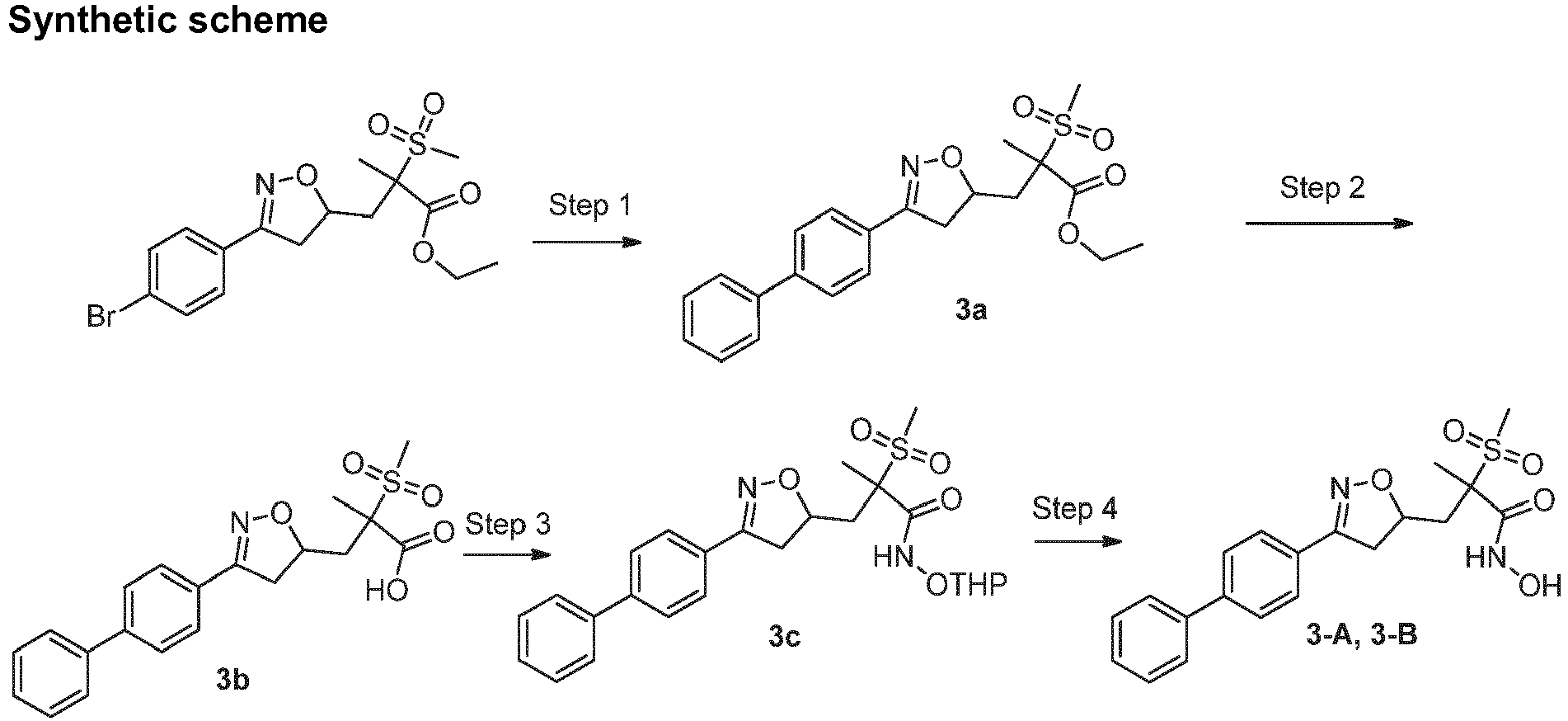
- Reagents: Step 1: CH3COOK, PdCl2 (dppf), 1,4-dioxane, 100°C. Step 2: LiOH.H2O, MeOH, water, room temperature. Step 3: NH2O-THP, EDC.HCI, HOBT, TEA, dichloromethane, room temperature. Step 4: 35.5% aq.HCl, EtOH, room temperature.
-

- 1d-A & 1-d-B (0.5 g, 1.0 mmol, 1.0 equiv), phenylboronic acid (0.18 g, 1.2 mmol, 1.2 equiv) and potassium acetate (0.351 g, 2.9 mmol, 3.0 equiv) were dissolved in 1, 4-dioxane (10 mL) and degassed for 5 minutes. PdCl2(dppf) (0.087 g, 0.1 mmol, 0.1 equiv) was added to the reaction mixture. The resulting reaction mixture was stirred at 100 °C for 4 hours. The reaction mixture was quenched with water and extracted with EtOAc. The organic layer was washed with brine, dried over sodium sulfate and concentrated. The residue was purified by silica gel column chromatography (0-50 % EtOAc in Hexane) to afford product 3a (0.35 g, 70.6 % yield). LCMS (m/z): 416 [M+H]. 1H NMR (400 MHz, DMSO) δ 7.75 (dt, J = 8.6, 7.5 Hz, 6H), 7.49 (t, J = 7.5 Hz, 2H), 7.40 (t, J = 7.4 Hz, 1H), 5.01 - 4.87 (m, 1H), 4.35 - 4.15 (m, 2H), 3.64 (dd, J = 17.7, 11.2 Hz, 1H), 3.29 - 3.16 (m, 1H), 3.11 (d, J = 21.0 Hz, 3H), 2.63 (t, J = 12.4 Hz, 1H), 2.19 (dd, J = 14.5, 8.5 Hz, 1H), 2.07 (d, J = 13.3 Hz, 1H), 1.68 - 1.53 (m, 3H), 1.26 - 1.18 (m, 3H).
-

- 3a (0.35 g, 0.8 mmol, 1.0 equiv) was dissolved in MeOH (4mL) and water (2 mL). LiOH.H2O (0.070 g, 1.6 mmol, 2.0 equiv) was added and the reaction mixture was stirred at room temperature for 1 hour. The reaction mixture was diluted with water, acidified by 1N HCI aqueous solution to the pH 3 to 4 and extracted with EtOAc. The organic layer was washed with brine, dried over sodium sulfate and concentrated to afford product 3b (0.24 g, 73.6 % yield). The product was used in the next step without further purification. LCMS (m/z): 388.1 [M+H]. 1H NMR (400 MHz, DMSO) δ 13.62 (s, 1H), 7.85 - 7.69 (m, 6H), 7.50 (t, J = 7.6 Hz, 2H), 7.45 - 7.38 (m, 1H), 5.02 - 4.70 (m, 1H), 3.76 - 3.57 (m, 1H), 3.23 (ddd, J = 16.9, 7.3, 4.3 Hz, 1H), 3.17 - 3.03 (m, 3H), 2.61 (ddd, J = 17.6, 13.9, 6.6 Hz, 1H), 2.14 (ddd, J = 17.5, 14.0, 6.0 Hz, 1H), 1.59 (d, J = 21.1 Hz, 3H).
-

- 3b (0.24 g, 0.6 mmol, 1.0 equiv) was dissolved in dichloromethane (5 mL). TEA (0.31 g, 3.0 mmol, 5.0 equiv) was added. EDC.HCI (0.18 g, 0.9 mmol, 1.5 equiv), HOBt (0.15 g, 1.1 mmol, 1.8 equiv) and O-(tetrahydro-2H-pyran-2-yl) hydroxylamine (0.145 g, 1.2 mmol, 2.0 equiv) were added. The reaction mixture was stirred at room temperature for 20 hours. The reaction mixture was concentrated under reduced pressure to afford a crude product. The crude product was purified by silica gel column chromatography (0-4 % MeOH in dichloromethane) to afford product 3c (0.2 g, 66.4 % yield). LCMS (m/z): 487.4 [M+H]. 1H NMR (400 MHz, DMSO) δ 7.76 (dt, J = 8.6, 7.9 Hz, 6H), 7.50 (t, J = 7.6 Hz, 2H), 7.41 (t, J = 7.3 Hz, 1H), 4.86 - 4.65 (m, 1H), 4.05 (dd, J = 28.6, 21.5 Hz, 1H), 3.77 (ddd, J = 11.1, 7.9, 3.1 Hz, 1H), 3.62 (ddd, J = 21.0, 10.3, 5.1 Hz, 1H), 3.47 - 3.39 (m, 2H), 3.27 - 3.15 (m, 1H), 3.07 (t, J = 7.2 Hz, 3H), 2.79 - 2.65 (m, 1H), 2.10 (ddd, J = 16.7, 9.9, 5.0 Hz, 1H), 1.65 - 1.52 (m, 6H).
-
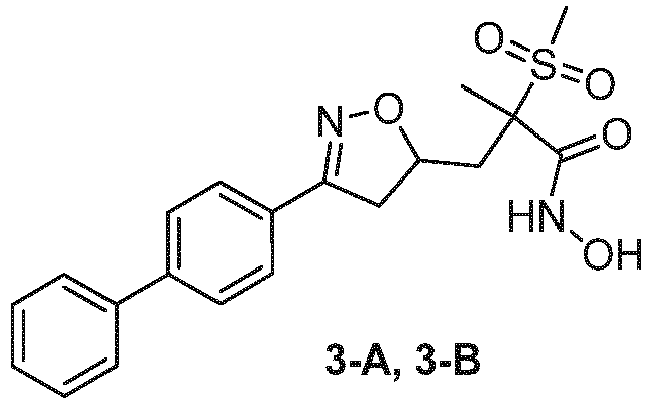
- 3c (0.2 g, 0.4 mmol, 1.0 equiv) was dissolved in ethanol (2 ml). 35.5% aq. HCI (1 mL) was added and the reaction mixture was stirred at room temperature for 3 hours. The reaction mixture was concentrated under reduced pressure to dryness to obtain a residue. The crude product was purified by preparative HPLC purification to afford product 3 as two diastereomers (3-A (0.027g, 16.3 % yield), LCMS (m/z): 403.2[M+H]. 1H NMR (400 MHz, DMSO) δ 10.86 (s, 1H), 9.17 (s, 1H), 7.75 (dt, J = 7.2, 6.6 Hz, 6H), 7.50 (t, J = 7.6 Hz, 2H), 7.41 (t, J = 7.3 Hz, 1H), 4.80 (d, J = 9.9 Hz, 1H), 3.63 (dd, J = 16.9, 10.3 Hz, 1H), 3.21 (dd, J = 17.0, 8.0 Hz, 1H), 3.07 (s, 3H), 2.76 (dd, J = 13.9, 8.6 Hz, 1H), 2.09 (dd, J = 13.9, 4.5 Hz, 1H), 1.58 (s, 3H). 3-B (0.023 g, 13.9 % yield), LCMS (m/z): 403.2 [M+H]. 1H NMR (400 MHz, DMSO) δ 11.08 (s, 1H), 9.31 (s, 1H), 7.85 - 7.70 (m, 6H), 7.50 (t, J = 7.5 Hz, 2H), 7.41 (t, J = 7.3 Hz, 1H), 4.66 (d, J = 7.0 Hz, 1H), 3.62 (dd, J = 16.9, 10.3 Hz, 1H), 3.19 (dd, J = 17.0, 8.0 Hz, 1H), 3.07 (d, J = 5.9 Hz, 3H), 2.69 (dd, J = 14.0, 3.5 Hz, 1H), 2.07 (dd, J = 14.0, 8.5 Hz, 1H), 1.61 (s, 3H).
-
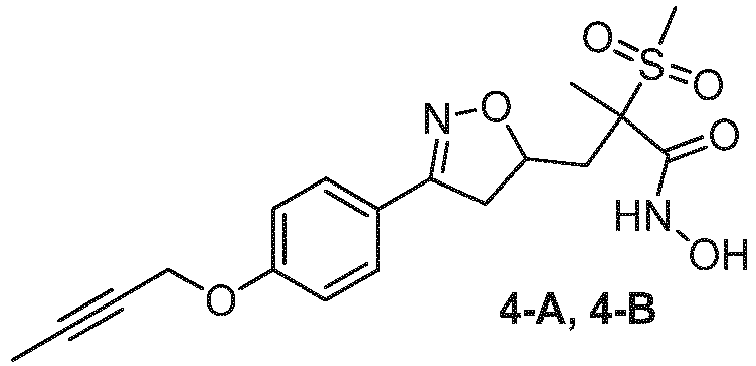

- Reagents: Step 1: Triphenylphosphine, DEAD, benzene, THF, room temperature. Step 2: NH2OH.HCl, NaOH, water, 70 °C. Step 3: Et2Zn, (R,R)-DIPT, t-BuOCl, chloroform, 1,4-dioxane, 0 °C to room temperature, 4 h. Step 4: LiOH.H2O, MeOH, water, room temperature. Step 5: NH2OTHP, EDC.HCI, HOBT, TEA, dichloromethane, room temperature. Step 6: 35.5% aq. HCI, EtOH, room temperature.
-

- But-2-yn-1-ol (2.58 g, 36.9 mmol, 1.5 equiv), triphenylphosphine (7.73 g, 29.5 mmol, 1.2 equiv) and 4-hydroxybenzaldehyde (3 g, 24.6 mmol, 1.0 equiv) were mixed with benzene:THF (2:1, 30mL). The reaction mixture was stirred at room temperature for 10 minutes. DEAD (5.13 g, 29.5 mmol, 1.2 equiv) was added gradually and the reaction mixture was allowed to stir for 2 hours. The reaction mixture was quenched with water and extracted with EtOAc. The organic layer was washed with brine, dried over sodium sulfate and concentrated. The residue was purified by silica gel column chromatography (0-25 % EtOAc in Hexane) to afford product 4a (3.5 g, 81.8 % yield). LCMS (m/z): 175.2 [M+H]. 1H NMR (400 MHz, DMSO) δ 9.92 - 9.84 (m, 1H), 7.95 - 7.83 (m, 2H), 7.24 - 7.10 (m, 2H), 4.89 (q, J = 2.3 Hz, 2H), 1.88 - 1.81 (m, 3H).
-

- A mixtue of 4a (3.5 g, 20.1 mmol, 1.0 equiv) and water (20 ml) was stirred at 70 °C. A solution of hydroxylamine hydrochloride (1.68 g, 24.1 mmol, 1.2 equiv) and sodium hydroxide (1.04 g, 26.1 mmol, 1.3 equiv) in water (10 mL) was added to the reaction mixture at same temperature. The reaction mixture was allowed to stir at 70 °C for 3 hours. The reaction mixture was cooled to 0 °C and the precipitate was collected by filtration to afford product 4b (2.8 g, 73.2 % yield). LCMS (m/z): 190.1 [M+H]. 1H NMR (400 MHz, DMSO) δ 11.01 (s, 1H), 8.07 (s, 1H), 7.53 (d, J = 8.8 Hz, 2H), 7.00 (t, J = 8.9 Hz, 2H), 4.78 (dq, J = 4.5, 2.3 Hz, 2H), 1.89 - 1.79 (m, 3H).
-

- 1b (1.25 g, 5.7 mmol, 1.0 equiv) was dissolved in chloroform (20 ml) and cooled to 0 °C. Diethyl zinc (1.0 M in hexane) (1.57 g, 12.5 mmol, 2.2 equiv) was added and the reaction mixture was stirred 0 °C for 10 minutes. (R, R)-DIPT (1.33 g, 5.7 mmol, 1.0 equiv) was added and the reaction mixture was stirred at 0 °C for 7 hours. 4b (1.29 g, 6.8 mmol, 1.0 equiv), 1,4-dioxane (0.75 g, 8.5 mmol, 1.5 equiv) and t-BuOCl (1.22 g, 11.4 mmol, 2.0 equiv) were then added. The reaction mixture was stirred at room temperature for 4 hours. The reaction mixture was quenched with saturated aqueous ammonium chloride solution and extracted with dichloromethane. The organic layer was washed with brine, dried over sodium sulfate and concentrated. The crude product was purified by silica gel column chromatography (0-60% EtOAc in Hexane) to afford product 4c (1.6 g, 69.2 % yield). LCMS (m/z): 408.3 [M+H]. 1H NMR (400 MHz, DMSO) δ 7.67 - 7.48 (m, 2H), 7.06 (t, J = 12.3 Hz, 2H), 4.93 (td, J = 12.2, 6.0 Hz, 1H), 4.88 - 4.76 (m, 2H), 4.38 - 4.13 (m, 3H), 3.65 - 3.46 (m, 1H), 3.23 - 3.04 (m, 4H), 2.68 - 2.55 (m, 1H), 2.10 (ddd, J = 17.2, 14.1, 5.9 Hz, 1H), 1.84 (t, J = 2.1 Hz, 3H), 1.68 - 1.50 (m, 3H), 1.21 (ddt, J = 16.0, 9.7, 5.0 Hz, 3H).
-

- 4c (1.6 g, 3.9 mmol, 1.0 equiv) was dissolved in MeOH (10 ml) and water (8 ml). LiOH.H2O (0.33 g, 7.8 mmol, 2.0 equiv) was added and the reaction mixture was stirred at room temperature for 1 hour. The reaction mixture was diluted with water, acidified by 1.0 N HCl aqueous solution to the pH 3and extracted with EtOAc. The organic layer was washed with brine, dried over sodium sulfate and concentrated. The crude product was triturated with n-pentane, the solvent was decanted to afford product 4d (1.05 g, 70.5 % yield. LCMS (m/z): 380.1 [M+H]. 1H NMR (400 MHz, DMSO) δ 13.78 (d, J = 180.1 Hz, 1H), 7.72 - 7.38 (m, 2H), 7.15 - 6.95 (m, 2H), 4.93 - 4.66 (m, 3H), 3.58 (ddd, J = 20.6, 16.9, 10.2 Hz, 1H), 3.23 - 2.94 (m, 4H), 2.69 - 2.52 (m, 1H), 2.09 (ddd, J = 17.4, 14.0, 6.0 Hz, 1H), 1.84 (t, J = 2.1 Hz, 3H), 1.69 - 1.45 (m, 3H).
-

- 4d (0.5 g, 1.3 mmol, 1.0 equiv) was dissolved in dichloromethane (10 mL). TEA (0.66g, 6.6 mmol, 5.0 equiv) was added. EDC.HCl (0.38 g, 2.0 mmol, 1.5 equiv), HOBT (0.32 g, 2.4 mmol, 1.8 equiv) and O-(tetrahydro-2H-pyran-2-yl) hydroxylamine (0.31 g, 2.6 mmol, 2.0 equiv) were added. The reaction mixture was stirred at room temperature for 20 hours. The reaction mixture was concentrated under reduced pressure. The crude product was purified by silica gel column chromatography (0-3 % MeOH in dichloromethane) to afford product 4e (0.47 g, 74.5 % yield). LCMS (m/z): 479.3 [M+H]. 1H NMR (400 MHz, DMSO) δ 7.68 - 7.56 (m, 2H), 7.04 (d, J = 8.9 Hz, 2H), 4.70 (d, J = 56.0 Hz, 1H), 4.07 (d, J = 37.1 Hz, 1H), 3.52 (ddd, J = 15.1, 10.6, 6.2 Hz, 2H), 3.20 - 2.97 (m, 4H), 2.75 - 2.61 (m, 1H), 2.12 - 1.95 (m, 1H), 1.56 (d, J = 16.6 Hz, 6H).
-

- 4e (0.47 g, 0.9 mmol, 1.0 equiv) was dissolved in ethanol (5 ml). 35.5% aq. HCl (2 mL) was added and the reaction mixture was stirred at room temperature for 3 hours. The reaction mixture was concentrated under reduced pressure. The crude product was purified by preparative HPLC purification to afford product 4 as two diastereomers (4-A (0.055 g, 14.5 % yield), LCMS (m/z): 395.3 [M+H]. 1H NMR (400 MHz, DMSO) δ 10.86 (s, 1H), 9.15 (s, 1H), 7.60 (d, J = 8.5 Hz, 2H), 7.04 (d, J = 8.3 Hz, 2H), 4.80 (s, 2H), 4.72 (s, 1H), 3.55 (dd, J = 17.0, 10.3 Hz, 1H), 3.13 (dd, J = 16.8, 7.9 Hz, 1H), 3.05 (s, 3H), 2.76 - 2.67 (m, 1H), 2.05 (d, J = 14.1 Hz, 1H), 1.84 (s, 3H), 1.56 (s, 3H). 4-B (0.050 g, 13.2 % yield) LCMS (m/z): 395.3 [M+H]. 1H NMR (400 MHz, DMSO) δ 11.05 (s, 1H), 9.28 (s, 1H), 7.60 (d, J = 8.5 Hz, 2H), 7.05 (d, J = 8.6 Hz, 2H), 4.81 (s, 2H), 4.59 (d, J = 7.5 Hz, 1H), 3.55 (dd, J = 17.1, 10.5 Hz, 1H), 3.19 - 3.09 (m, 1H), 3.07 (s, 3H), 2.65 (d, J = 17.1 Hz, 1H), 2.02 (dd, J = 14.2, 8.4 Hz, 1H), 1.84 (s, 3H), 1.59 (s, 3H).
-


- Reagents: Step 1: Pd(OAc)2, tricyclohexyl phosphine, K3PO4, 1,4-dioxane, Water, 130 °C. Step 2: LiOH.H2O, THF, MeOH, water, room temperature. Step3 : NH2O-THP, EDC.HCl, HOBT, TEA, dichloromethane, room temperature. Step 4: 35.5% aq.HCl, EtOH, room temperature.
-

- 1d-A & 1d-B (0.25 g, 0.6 mmol, 1.0 equiv), cyclopropylboronic acid (0.062 g, 0.7 mmol, 1.2 equiv), K3PO4 (0.38 g, 1.8 mmol, 3.0 equiv) and tricyclohexyl phosphine (0.017 g, 0.06 mmol, 0.1 equiv) were dissolved in 1,4-dioxane:water (4:1, 15 mL) and degassed for 10 minutes. Pd(OAc)2(0.007 g, 0.02 mmol, 0.05 equiv) was added and the resulting reaction mixture was stirred at 130 °C for 1 hour. The reaction mixture was quenched with water and extracted with EtOAc. The organic layer was washed with brine, dried over sodium sulfate and concentrated. The crude product was purified by silica gel column chromatography (20-30 % EtOAc in Hexane) to afford product 5a (0.19 g, 64.2 % yield). LCMS (m/z): 380.2 [M+H]. 1H NMR (400 MHz, DMSO) δ 7.65 (d, J = 20.3 Hz, 2H), 7.56 - 7.44 (m, 2H), 4.89 (d, J = 27.7 Hz, 1H), 4.34-4.12 (m, 2H), 3.58 (dd, J = 17.5, 10.5 Hz, 1H), 3.16 (ddd, J= 32.2, 19.0, 4.3 Hz, 4H), 2.71 - 2.55 (m, 1H), 2.26 - 2.11 (m, 1H), 2.08 (s, 1H), 1.61 (dd, J = 22.2, 3.7 Hz, 3H), 1.25 - 1.21 (m, 3H), 1.05 - 0.69 (m, 4H).
-

- 5a (0.19 g, 0.5 mmol, 1.0 equiv) was dissolved in THF (4 mL), MeOH (1mL) and water (1 mL). LiOH.H2O (0.063 g, 1.5 mmol, 3.0 equiv) was added and the reaction mixture was stirred at room temperature for 3 hours. The reaction mixture was concentrated under reduced pressure. The residue was diluted with water, acidified by 1.0 N HCl aqueous solution to the pH 3 and extracted with EtOAc. The organic layer was washed with brine, dried over sodium sulfate and concentrated to afford product 5b (0.155 g, 88.1 % yield). LCMS (m/z): 352.3 [M+H]. 1H NMR (400 MHz, DMSO) δ 7.67 (d, J = 4.4 Hz, 2H), 7.55 - 7.43 (m, 2H), 4.89 (s, 1H), 3.59 (dd, J = 18.3, 11.3 Hz, 1H), 3.20 (d, J = 13.9 Hz, 1H), 3.11 (dd, J = 16.9, 2.1 Hz, 3H), 2.64 (d, J = 32.5 Hz, 1H), 2.27 - 2.02 (m, 2H), 1.57 (dd, J = 20.8, 3.8 Hz, 3H), 1.20 - 0.99 (m, 2H), 0.90 - 0.69 (m, 2H).
-

- 5b (0.155 g, 0.4 mmol, 1.0 equiv) was dissolved in dichloromethane (5 mL). TEA (0.22 g, 2.22 mmol, 5.0 equiv) was added. EDC.HCl (0.13 g, 0.7 mmol, 1.5 equiv), HOBT (0.107 g, 0.8 mmol, 1.8 equiv) and O-(tetrahydro-2H-pyran-2-yl) hydroxylamine (0.103 g, 0.9 mmol, 2.0 equiv) were added. The reaction mixture was stirred at room temperature for 24 hours. The reaction mixture was concentrated under reduced pressure. The crude product was purified by silica gel column chromatography (0.5-2 % MeOH in dichloromethane) to afford product 5c (0.145 g, 72.5 % yield). LCMS (m/z): 454.3 [M+18]. 1H NMR (400 MHz, DMSO) δ 7.67 (d, J = 4.4 Hz, 2H), 7.55 - 7.43 (m, 2H), 4.89 (s, 1H), 3.59 (dd, J = 18.3, 11.3 Hz, 1H), 3.20 (d, J = 13.9 Hz, 1H), 3.11 (dd, J = 16.9, 2.1 Hz, 3H), 2.64 (d, J = 32.5 Hz, 1H), 2.27 - 2.02 (m, 2H), 1.57 (dd, J = 20.8, 3.8 Hz, 3H), 1.20 - 0.99 (m, 2H), 0.90 - 0.69 (m, 2H).
-

- 5c (0.145 g, 0.3 mmol, 1.0 equiv) was dissolved in ethanol (2 ml). 35.5% aq. HCl (0.5 mL) was added and the reaction mixture was stirred at room temperature for 6 hours. The reaction mixture was concentrated under reduced pressure to dryness. The crude product was purified by preparative HPLC purification to afford product 5 as two diastereomers. 5-A: 0.020 g, 17.1 % yield, LCMS (m/z): 367.2 [M+H]. 1H NMR (400 MHz, DMSO) δ 10.86 (s, 1H), 9.15 (s, 1H), 7.52 (d, J = 8.3 Hz, 2H), 7.15 (d, J = 8.4 Hz, 2H), 4.72 (s, 1H), 3.55 (dd, J = 16.9, 10.2 Hz, 2H), 3.15 (d, J = 8.1 Hz, 1H), 3.05 (s, 3H), 2.74 (d, J = 8.8 Hz, 1H), 2.07 (dd, J = 10.3, 6.0 Hz, 1H), 1.98 - 1.92 (m, 1H), 1.55 (s, 3H), 1.00 (dt, J = 6.2, 4.2 Hz, 2H), 0.72 (dt, J = 6.5, 4.3 Hz, 2H). 5-B (0.015 g, 12.8 % yield), LCMS (m/z): 367.2 [M+H]. 1H NMR (400 MHz, DMSO) δ 11.06 (s, 1H), 9.29 (s, 1H), 7.52 (d, J = 8.3 Hz, 2H), 7.16 (d, J = 8.4 Hz, 2H), 4.60 (s, 1H), 3.54 (dd, J = 16.9, 10.3 Hz, 1H), 3.16 - 3.08 (m, 1H), 3.07 (s, 3H), 2.64 (s, 1H), 2.07 - 1.92 (m, 2H), 1.59 (s, 3H), 1.00 (dt, J = 6.3, 4.2 Hz, 2H), 0.75 - 0.65 (m, 2H).
-


- Reagents: Step 1: Diethyl amine, triphenyl phosphine, CuI, PdCl2(pph3)2, DMF, 100 °C. Step 2: LiOH.H2O, THF, MeOH, water, room temperature. Step 3: NH2OTHP, EDC.HCl, HOBT, N-methyl morpholine, THF, room temperature. Step 4 : HCl (in IPA), MeOH, dichloromethane, room temperature.
-

- A flask was charged with (R)-1d-A (0.75 g, 1.79 mmol, 1.0 equiv), diethyl amine (10 mL) and DMF (2 mL). CuI (0.017 g, 0.089 mmol, 0.05 equiv), triphenyl phosphine (0.093 g, 0.36 mmol, 0.2 equiv) were added and the reaction mixture was degassed for 10 minutes. PdCl2(pph3)2 (0.062 g, 0.089 mmol, 0.05 equiv), ethynylcyclopropane (0.24 g, 3.58 mmol, 2.0 equiv) were added and the reaction mixture was stirred at 100 °C for 4 hours. The reaction mixture was quenched with water and extracted with EtOAc. The organic layer was washed with brine, dried over sodium sulfate and concentrated. The residue was purified by silica gel column chromatography (25-40 % EtOAc/Hexane) to afford product 6a (0.6 g, 83 % yield). LCMS (m/z): 404.2 [M+H]. 1H NMR (400 MHz, DMSO) δ 7.61 (d, J = 8.5 Hz, 2H), 7.43 (d, J = 8.5 Hz, 2H), 4.75 (d, J = 7.5 Hz, 1H), 4.26 (q, J = 7.1 Hz, 2H), 3.60 (dd, J = 17.0, 10.3 Hz, 1H), 3.20 - 3.11 (m, 4H), 2.61 (s, 1H), 2.21 - 2.16 (m, 1H), 1.63 (s, 3H), 1.60 - 1.55 (m, 1H), 1.25 (t, J = 7.1 Hz, 3H), 0.95 - 0.88 (m, 2H), 0.76 (dt, J = 6.9, 3.9 Hz, 2H).
-

- 6a (0.6 g, 1.49 mmol, 1.0 equiv) was dissolved in THF (12 mL), MeOH (3 mL) and water (3 mL). LiOH.H2O (0.13 g, 2.97 mmol, 2.0 equiv) was added and the reaction mixture was stirred at room temperature for 2 hours. The reaction mixture was poured to water, neutralized by 2.0 N HCl aqueous solution and extracted with EtOAc. The organic layer was washed with brine, dried over sodium sulfate and concentrated to afford product 6b (0.5 g, 90 % yield). LCMS (m/z): 376.2 [M+H]. The product was directly used in the next step with no further purification. 1H NMR (400 MHz, DMSO) δ 14.02 (s, 1H), 7.60 (d, J = 8.3 Hz, 2H), 7.43 (d, J = 8.3 Hz, 2H), 4.76 (d, J = 7.8 Hz, 1H), 3.61 (dd, J = 16.9, 10.3 Hz, 1H), 3.25 - 2.99 (m, 4H), 2.55 (s, 1H), 2.15 (dd, J = 14.3, 8.4 Hz, 1H), 1.73 - 1.49 (m, 4H), 0.98 - 0.85 (m, 2H), 0.83 - 0.64 (m, 2H).
-

- 6b (0.5 g, 1.34 mmol, 1.0 equiv) was dissolved in THF (35 mL). N-methyl morpholine (0.68 g, 6.68 mmol, 5.0 equiv), HOBT (0.22 g, 1.6 mmol, 1.2 equiv), O-(tetrahydro-2H-pyran-2-yl) hydroxylamine (0.32 g, 2.67 mmol, 2.0 equiv) and EDC.HCl (0.38 g, 2.0 mmol, 1.5 equiv) were added and the reaction mixture was stirred at room temperature for 24 hours. The reaction mixture was quenched with water and extracted with EtOAc. The organic layer was washed with brine, dried over sodium sulfate and concentrated. The residue was purified by silica gel column chromatography (40-60 % EtOAc/Hexane) to afford product 6c (0.55 g, 87 % yield). LCMS (m/z): 475.5 [M+H]. 1H NMR (400 MHz, DMSO) δ 11.47 (s, 1H), 7.59 (dd, J = 8.4, 1.7 Hz, 2H), 7.43 (d, J = 8.4 Hz, 2H), 4.97 (d, J = 8.3 Hz, 1H), 4.68 (s, 1H), 4.15 - 4.04 (m, 1H), 3.55 (ddd, J = 33.2, 16.6, 7.8 Hz, 2H), 3.14 (dd, J = 17.1, 8.1 Hz, 1H), 3.06 (d, J = 8.7 Hz, 3H), 2.66 (d, J = 10.8 Hz, 1H), 2.06 (dd, J = 13.7, 8.5 Hz, 1H), 1.69 (s, 3H), 1.64 - 1.38 (m, 6H), 0.96 - 0.85 (m, 2H), 0.81 - 0.64 (m, 2H).
-

- 6c (0.55 g, 1.16 mmol, 1.0 equiv) was dissolved in methanol (5 mL) and dichloromethane (5 mL). 10% HCl (in IPA) (0.25 mL) was added and the reaction mixture was stirred at room temperature for 2 hours. The reaction mixture was quenched with water, neutralized by saturated aqueous sodium bicarbonate solution and extracted with EtOAc. The organic layer was washed with brine, dried over sodium sulfate and concentrated to afford crude product. The crude product was triturated with n-pentane / diethyl ether to afford product 6-A (0.43 g, 94 % yield). LCMS (m/z): 391.2 [M+H]. 1H NMR (400 MHz, DMSO) δ 11.05 (s, 1H), 9.28 (s, 1H), 7.62 (t, J = 14.4 Hz, 2H), 7.44 (d, J = 8.5 Hz, 2H), 4.64 (d, J = 7.4 Hz, 1H), 3.56 (dd, J = 17.0, 10.4 Hz, 1H), 3.18 - 3.11 (m, 1H), 3.06 (s, 3H), 2.69 - 2.63 (m, 1H), 2.04 (dd, J = 14.0, 8.5 Hz, 1H), 1.65 - 1.50 (m, 4H), 0.96 - 0.87 (m, 2H), 0.80 - 0.69 (m, 2H).
-


- Reagents: Step 1: DBU, dppb, PdCl2(PPh3)2, DMSO, 100 °C. Step2 : LiOH.H2O, MeOH, water, room temperature. Step 3: NH2O-THP, EDC.HCl, HOBT, TEA, dichloromethane, room temperature. Step 4: 35.5 % aq.HCl, EtOH, room temperature.
-
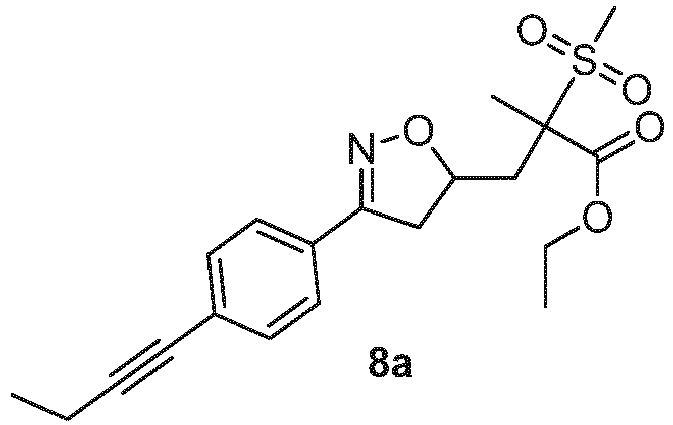
- 1d-A & 1d-B (0.5 g, 1.2 mmol, 1.0 equiv), pent-2-ynoic acid (0.12 g, 1.2 mmol, 1.0 equiv), 1,4-bis(diphenylphosphino)butane (0.011 g, 0.027 mmol, 0.02 equiv) were added in DMSO (5 mL). DBU (0.36 g, 2.4 mmol, 2.0 equiv) was added and the reaction mixture was degassed for 10 minutes. PdCl2(PPh3)2 (0.009 g, 0.012 mmol, 0.01 equiv) was added and the reaction mixture was stirred at 100 °C for 2 hours. The reaction mixture was quenched with water and extracted with EtOAc. The organic layer was washed with brine, dried over sodium sulfate and concentrated. The residue was purified by silica gel column chromatography (0-50 % EtOAc in Hexane) to afford product 8a (0.4 g, 86.6 % yield). LCMS (m/z): 392.5 [M+H]. 1H NMR (400 MHz, DMSO) δ 7.63 (dd, J = 8.3, 1.4 Hz, 2H), 7.49 (dd, J = 22.5, 21.1 Hz, 2H), 4.99 - 4.71 (m, 1H), 4.34 - 4.10 (m, 2H), 3.59 (td, J = 17.2, 10.3 Hz, 1H), 3.26 - 2.96 (m, 4H), 2.67 - 2.54 (m, 1H), 2.46 (q, J = 7.5 Hz, 2H), 2.12 (ddd, J = 17.2, 14.1, 5.9 Hz, 1H), 1.70 - 1.49 (m, 3H), 1.25 - 1.15 (m, 6H).
-

- 8a (0.4 g, 1.0 mmol, 1.0 equiv) was dissolved in MeOH (4 mL) and water (2 mL). LiOH.H2O (0.085 g, 2.0 mmol, 2.0 equiv) was added and the reaction mixture was stirred at room temperature for 2 hours. The reaction mixture was diluted with water, acidified by 1.0 N HCl aqueous solution to the pH 4 to 5 and extracted with EtOAc. The organic layer was washed with brine, dried over sodium sulfate and concentrated to afford product 8b (0.36 g, 96.9 % yield) which was used in next step without purification. LCMS (m/z): 364.3 [M+H]. 1H NMR (400 MHz, DMSO) δ 7.67 - 7.58 (m, 2H), 7.46 (d, J = 8.4 Hz, 2H), 4.94 - 4.87 (m, 1H), 3.61 (s, 1H), 3.10 (d, J = 14.7 Hz, 4H), 2.68 (s, 1H), 2.45 (s, 1H), 1.56 (d, J = 17.9 Hz, 3H).
-

- 8b (0.35 g, 1.0 mmol, 1.0 equiv) was dissolved in dichloromethane (5 mL). TEA (0.49 g, 4.8 mmol, 5.0 equiv), EDC.HCl (0.28 g, 1.4 mmol, 1.5 equiv), HOBT (0.23 g, 1.7 mmol, 1.8 equiv), O-(tetrahydro-2H-pyran-2-yl) hydroxylamine (0.23 g, 1.9 mmol, 2.0 equiv) were added and the reaction mixture was stirred at room temperature for 24 hours. The reaction mixture was concentrated under reduced pressure. The residue was purified by silica gel column chromatography (0-4 % MeOH in dichloromethane) to afford product 8c (0.38 g, 85.3 % yield). LCMS (m/z): 463.6 [M+H]. 1H NMR (400 MHz, DMSO) δ 7.62 (d, J = 6.9 Hz, 2H), 7.46 (d, J = 8.4 Hz, 2H), 4.95 (s, 1H), 4.85 - 4.75 (m, 1H), 4.06 - 3.99 (m, 1H), 3.56 (s, 1H), 3.52 (s, 2H), 3.17 - 3.10 (m, 1H), 3.05 (t, J = 7.3 Hz, 3H), 2.69 (s, 1H), 2.05 (s, 1H), 1.65 - 1.54 (m, 9H).
-

- 8c (0.38 g, 0.8 mmol, 1.0 equiv) was dissolved in ethanol (2 mL). 35.5% aq. HCl (1 mL) was added and the reaction mixture was stirred at room temperature for 4 hours. The reaction mixture was then concentrated under reduced pressure. The crude residue was purified by preparative HPLC to afford 8 as two diastereomers (8-A, 0.07 g, 22.4 % yield), LCMS (m/z): 379.2 [M+H]. 1H NMR (400 MHz, DMSO) δ 10.86 (s, 1H), 9.15 (s, 1H), 7.62 (d, J = 8.4 Hz, 2H), 7.46 (d, J = 8.4 Hz, 2H), 4.79 (s, 1H), 3.57 (dd, J = 16.9, 10.3 Hz, 1H), 3.16 (dd, J = 17.1, 7.9 Hz, 1H), 3.11 -2.95 (m, 3H), 2.77 - 2.65 (m, 1H), 2.45 (d, J = 7.4 Hz, 2H), 2.08 - 2.01 (m, 1H), 1.56 (s, 3H), 1.18 (t, J = 7.5 Hz, 3H). (8-B, 0.045 g, 14.4% yield), LCMS (m/z): 379.2 [M+H]. 1H NMR (400 MHz, DMSO) δ 11.03 (s, 1H), 9.10 (s, 1H), 7.61 (d, J = 8.4 Hz, 2H), 7.46 (d, J = 8.4 Hz, 2H), 3.54 (dd, J = 17.0, 10.4 Hz, 1H), 3.14 (dd, J = 17.1, 7.9 Hz, 1H), 3.06 (s, 3H), 2.63 (dd, J = 13.9, 3.7 Hz, 1H), 2.45 (d, J = 7.5 Hz, 2H), 2.02 (dd, J = 13.9, 8.1 Hz, 1H), 1.56 (s, 3H), 1.18 (t, J = 7.5 Hz, 3H).
-


- Reagents: Step 1: n-BuLi (2.5 M in hexane), CO2, THF, -40 °C. Step 2: DBU, dppb, PdCl2(PPh3)2, DMSO, 100 °C. Step 3: LiOH.H2O, THF, MeOH, water, room temperature. Step 4: NH2O-THP, EDC.HCl, HOBt, N-methyl morpholine, THF, room temperature. Step 5: 35.5% aq.HCl, EtOH, room temperature.
-

- But-3-yn-1-ol (1 g, 14.3 mmol, 1.0 equiv) was dissolved in THF (10 mL) and the reaction mixture was cooled at -40 °C. n-BuLi (2.5M in hexane) (6.8 mL, 17.1 mmol, 1.2 equiv) was added dropwise and the reaction mixture was stirred at -40 °C for 1 hour. The CO2 gas was purged into reaction mixture and stirred at -40 °C for 1 hour. The reaction mixture was diluted with water, acidified by 35.5% aq. HCl solution to pH 3 to 4 and extracted with EtOAc. The organic layer was washed with brine, dried over sodium sulfate and concentrated to afford product 10a (0.9 g, 69.3 % yield). The crude material was used in the next step without further purification. 1H NMR (400 MHz, DMSO) δ 13.36 (s, 1H), 4.98 (s, 1H), 3.51 (dt, J = 13.9, 6.7 Hz, 2H), 2.57 - 2.50 (m, 2H).
-

- 1d-A & 1d-B (0.77 g, 1.8 mmol, 1.0 equiv), 5-hydroxypent-2-ynoic acid (0.21 g, 1.8 mmol, 1.0 equiv), 1,4-bis(diphenylphosphino)butane (0.014 g, 0.04 mmol, 0.02 equiv) and DBU(0.56 g, 3.7 mmol, 2.0 equiv) were added in DMSO (10 mL) and the reaction mixture was degassed for 10 minutes. PdCl2(PPh3)2 (0.013 g, 0.02 mmol, 0.01 equiv) was added and the reaction mixture was stirred at 100 °C for 3 hours. The reaction mixture was quenched with water and extracted with EtOAc. The organic layer was washed with brine, dried over sodium sulfate and concentrated. The residue was purified by silica gel column chromatography (30-50 % EtOAc in Hexane) to afford product 10b (0.29 g, 74.5 % yield). LCMS (m/z): 408.3 [M+H].
-

- 10b (0.290 g, 0.7 mmol, 1.0 equiv) was dissolved in THF (4 mL), MeOH (1 mL) and water (1 mL). LiOH.H2O (0.086 g, 2.1 mmol, 3.0 equiv) was added and the reaction mixture was stirred at room temperature for 3 hours. The reaction mixture was diluted with water, acidified by 1.0 N HCl aqueous solution to the pH 3 to 4 and extracted with EtOAc. The organic layer was washed with brine, dried over sodium sulfate and concentrated to afford product 10c (0.23 g, 85.2 % yield) which was used without purification in next step. LCMS (m/z): 380.3 [M+H].
-

- 10c (0.18 g, 0.5 mmol, 1.0 equiv) was dissolved in THF (5 mL). N-methyl morpholine (0.24 g, 2.4 mmol, 5.0 equiv), EDC.HCl (0.14 g, 0.7 mmol, 1.5 equiv), HOBT (0.12 g, 0.8 mmol, 1.8 equiv), O-(tetrahydro-2H-pyran-2-yl) hydroxylamine (0.11 g, 0.9 mmol, 2.0 equiv) were added and the reaction mixture was stirred at room temperature for 24 hours. The reaction was then quenched with water and extracted with EtOAc. The organic layer was washed with brine, dried over sodium sulfate and concentrated. The residue was purified by silica gel column chromatography (1-2 % MeOH in dichloromethane) to afford product 10d (0.19 g, 63.8 % yield). LCMS (m/z): 395.2 [M-THP].
-

- 10 d (0.14 g, 0.3 mmol, 1.0 equiv) was dissolved in ethanol (5 mL). 35.5% aq. HCl (0.4 mL) was added and the reaction mixture was stirred at room temperature for 1 hour. The reaction mixture was diluted with water, neutralized by saturated aqueous sodium bicarbonate solution and extracted with EtOAc. The organic layer was washed with brine, dried over sodium sulfate and concentrated. The crude product was purified by preparative HPLC purification to afford 10 as two diastereomers. 10-A: 0.023g, 15.1 % yield. LCMS (m/z): 395.3 [M+H]. 1H NMR (400 MHz, DMSO) δ 10.81 (s, 1H), 9.16 (s, 1H), 7.62 (d, 2H), 7.47 (d, 2H), 4.96 (m, 1H), 4.77 (m, 1H), 3.59 (s, 3H), 3.12 (m, 1H), 3.05 (s, 3H), 2.73 (m, 1H), 2.58 (s, 2H), 2.07 (m, 1H), 1.55 (s, 3H). (10-B, 0.029 g, 19 % yield), LCMS (m/z): 395.5 [M+H]. 1H NMR (400 MHz, DMSO) δ 11.21 - 10.87 (m, 1H), 9.55 - 9.21 (m, 1H), 7.62 (d, J = 6.9 Hz, 2H), 7.47 (d, J = 6.6 Hz, 2H), 4.94 (m, 1H), 4.64 (m, 1H), 3.60 (s, 3H), 3.15 (s, 1H), 3.06 (s, 3H), 2.65 (d, J = 14.5 Hz, 1H), 2.58 (m, 2H), 2.04 (m, 1H), 1.58 (s, 3H).
-


- Reagents: Step 1: NH2OH.HCl, NaOH, water, 70 °C. Step 2: Et2Zn, (R,R)-DIPT, tBuOCl, chloroform, 1,4-dioxane, 0 °C to room temperature. Step 3: DBU, dppb, PdCl2(PPh3)2, DMSO, 90°C. Step 4: LiOH.H2O, THF, MeOH, water, room temperature to 40 °C. Step 5: NH2O-THP, EDC.HCl, HOBt, N-methyl morpholine, THF, room temperature. Step 6: 35.5 % aq.HCl, EtOH, room temperature.
-

- 4-bromo-3-fluorobenzaldehyde (10 g, 49.2 mmol, 1.0 equiv) was added in water (150 mL) and the reaction mixture was stirred at 70 °C. A solution of hydroxylamine hydrochloride (4.1 g, 59.1 mmol, 1.2 equiv) and sodium hydroxide (2.56 g, 64.0 mmol, 1.3 equiv) in water (50 mL) was added to the reaction mixture at same temperature and the reaction mixture was stirred for 4 hours. The reaction mixture was cooled to room temperature. The precipitate was collected by filtration and then washed with hexane to afford product 12a (7.5 g, 69.8 % yield). LCMS (m/z): 218.0 [M+H].
-

- A solution of 1b (6.9 g, 31.3 mmol, 1.0 equiv) in chloroform (80 mL) was cooled in a ice-water bath. Diethyl zinc (1M in hexane) (4.3 g, 34.1 mmol, 1.1 equiv) was added and the reaction mixture was stirred at 0 °C for 20 minutes. (R,R)-DIPT (7.3 g, 31.3 mmol, 1.0 equiv) was added and the reaction mixture was stirred at 0 °C for 1 hour. Diethyl zinc (1M in hexane) (4.3 g, 34.1 mmol, 1.1 equiv), 1,4-dioxane (4.14 g, 47.0 mmol, 1.5 equiv) and 12a (6.8 g, 31.3 mmol, 1.0 equiv) in chloroform (20 mL) were added slowly. t-BuOCl (6.8 g, 62.7 mmol, 2.0 equiv) was added and the reaction mixture was stirred at room temperature for 24 hours. The reaction mixture was quenched with saturated aqueous ammonium chloride solution and extracted with EtOAc. The organic layer was washed with brine, dried over sodium sulfate and concentrated. The crude product was purified by silica gel column chromatography (0-40 % EtOAc in Hexane) to afford product 12b (9.7 g, 70.9 % yield). LCMS (m/z): 436.6 [M+H]. 1H NMR (400 MHz, DMSO) δ 7.82 (t, J = 7.8 Hz, 1H), 7.63 (dt, J = 9.8, 1.7 Hz, 1H), 7.53 - 7.43 (m, 1H), 4.93 - 4.76 (m, 1H), 4.24 (ddd, J = 10.6, 10.0, 5.1 Hz, 2H), 3.66 - 3.54 (m, 1H), 3.23 - 3.17 (m, 1H), 3.11 (d, J = 9.0 Hz, 3H), 2.72 - 2.55 (m, 1H), 2.24 - 2.03 (m, 1H), 1.65 - 1.57 (m, 3H), 1.22 - 1.17 (m, 3H).
-

- 12b (0.25 g, 0.6 mmol, 1.0 equiv), but-2-ynoic acid (0.057 g, 0.7 mmol, 1.2 equiv), 1,4-bis(diphenylphosphino)butane (0.005 g, 0.013 mmol, 0.02 equiv) were added in DMSO (9 mL). DBU (0.17 g, 1.1 mmol, 2.0 equiv) was added and the reaction mixture was degassed for 10 minutes. PdCl2(PPh3)2 (0.004 g, 0.006 mmol, 0.01 equiv) was added and the reaction mixture was stirred at 90 °C for 6 hours. The reaction mixture was quenched with water and extracted with EtOAc. The organic layer was washed with brine, dried over sodium sulfate and concentrated. The residue was purified by silica gel column chromatography (0-40 % EtOAc in Hexane) to afford product 12c (0.18 g, 79.3 % yield). LCMS (m/z): 396.1 [M+H]. 1H NMR (400 MHz, DMSO) δ 7.64 - 7.44 (m, 3H), 4.91 - 4.73 (m, 1H), 4.23 (dq, J = 29.2, 7.1 Hz, 2H), 3.59 (ddd, J = 20.1, 17.0, 10.3 Hz, 1H), 3.19 (dd, J = 17.6, 6.3 Hz, 1H), 3.12 (d, J = 20.0 Hz, 3H), 2.68 - 2.55 (m, 1H), 2.14 - 1.98 (m, 4H), 1.68 - 1.55 (m, 3H), 1.23 - 1.20 (m, 3H).
-

- 12c (0.18 g, 0.5 mmol, 1.0 equiv) was dissolved in THF (2 mL), MeOH (1 mL) and water (1 mL). LiOH.H2O (0.038 g, 0.9 mmol, 2.0 equiv) was added and the reaction mixture was stirred at 40 °C for 2 hours. The reaction mixture was diluted with water and extracted with EtOAc. The aqueous layer was acidified by 1.0 N HCl aqueous solution to the pH 3 to 4 and extracted with EtOAc. The organic layer was washed with brine, dried over sodium sulfate and concentrated. To the residue was then added n-pentane. The solvent was decanted and the remaining materual was dried to afford product 12d (0.16 g, 94.7 % yield). LCMS (m/z): 368.4 [M+H]. 1H NMR (400 MHz, DMSO) δ 13.64 (s, 1H), 7.53 (ddd, J = 27.3, 17.5, 8.6 Hz, 3H), 4.88 (d, J = 56.3 Hz, 1H), 3.65 - 3.54 (m, 1H), 3.20 (dd, J = 12.6, 5.0 Hz, 1H), 3.12 (t, J = 11.9 Hz, 3H), 2.64 (d, J = 13.9 Hz, 1H), 2.27 - 2.00 (m,4H), 1.67 - 1.47 (m, 3H).
-

- 12d (0.16 g, 0.43 mmol, 1.0 equiv) was dissolved in THF (5 mL). N-methyl morpholine (0.22 g, 2.15 mmol, 5.0 equiv), EDC.HCl (0.12 g, 0.6 mmol, 1.5 equiv), HOBT (0.069 g, 0.5 mmol, 1.2 equiv), O-(tetrahydro-2H-pyran-2-yl) hydroxylamine (0.1 g, 0.8 mmol, 2.0 equiv) were added and the reaction mixture was stirred at room temperature for 15 hours. The reaction mixture was quenched with water and extracted with EtOAc. The organic layer was washed with brine, dried over sodium sulfate and concentrated. The residue was purified by silica gel column chromatography (0-5 % MeOH in dichloromethane) to afford product 12e (0.16 g, 76.8 % yield). LCMS (m/z): 467.4 [M+H]. 1H NMR (400 MHz, DMSO) δ 11.34 (s, 1H), 7.63 -7.41 (m, 3H), 4.95 (s, 1H), 4.71 (s, 1H), 3.58 (s, 1H), 3.44 (dd, J = 7.1, 3.6 Hz, 2H), 3.19 - 3.11 (m, 1H), 3.11 - 2.96 (m, 3H), 2.70 (d, J = 14.0 Hz, 1H), 2.06 (d, J = 9.9 Hz, 1H), 1.68 (d, J = 13.8 Hz, 3H), 1.44 (ddd, J = 13.0, 6.6, 3.2 Hz, 6H).
-

- 12e (0.16 g, 0.34 mmol, 1.0 equiv) was dissolved in ethanol (5 mL). 35.5% aq. HCl (0.3 mL) was added and the reaction mixture was stirred at room temperature for 1.5 hours. The reaction mixture was diluted with water, neutralized by saturated aqueous sodium bicarbonate solution and extracted with EtOAc. The organic layer was washed with brine, dried over sodium sulfate and concentrated. The crude product was purified by preparative HPLC purification to afford 12 as two diastereomers. 12-A: 0.023 g, 17.6 % yield. LCMS (m/z): 383.4 [M+H]. 1H NMR (400 MHz, DMSO) δ 10.87 (s, 1H), 9.15 (s, 1H), 7.64 - 7.41 (m, 3H), 4.80 (s, 1H), 3.57 (dd, J = 17.0, 10.4 Hz, 1H), 3.16 (dd, J = 17.1, 7.8 Hz, 1H), 3.11 - 2.99 (m, 3H), 2.74 (dd, J = 13.6, 8.4 Hz, 1H), 2.05 (dd, J = 13.8, 4.5 Hz, 1H), 1.62 - 1.48 (m, 3H). 12-B: 0.020 g, 15.3% yield. LCMS (m/z): 383.4 [M+H]. 1H NMR (400 MHz, DMSO) δ 11.07 (s, 1H), 9.29 (s, 1H), 7.60 - 7.45 (m, 3H), 4.67 (d, J = 6.8 Hz, 1H), 3.58 (dd, J = 17.0, 10.3 Hz, 1H), 3.14 (dd, J = 17.3, 8.1 Hz, 1H), 3.07 (s, 3H), 2.66 (d, J = 14.2 Hz, 1H), 2.05 (dd, J = 14.1, 8.5 Hz, 1H), 1.59 (s, 3H).
-


- Reagents: Step 1: DBU, dppb, PdCl2(PPh3)2, DMSO, 100°C. Step 2: NaOH, MeOH, room temperature. Step 3: NH2O-THP, EDC.HCl, HOBT, N-methyl morpholine, THF, room temperature. Step 4: 35.5 % aq.HCl, EtOH, room temperature.
-

- 12b (0.3 g, 0.7 mmol, 1.0 equiv), 3-cyclopropylpropiolic acid (0.075 g, 0.7 mmol, 1.0 equiv), 1,4-bis(diphenylphosphino)butane (0.007 g, 0.015 mmol, 0.02 equiv) were added in DMSO (8 mL). DBU(0.21 g, 1.3 mmol, 2.0 equiv) was added and the reaction mixture was degassed for 10 minutes. PdCl2(PPh3)2 (0.005 g, 0.007 mmol, 0.01 equiv) was added and the reaction mixture was stirred at 100 °C for 8 hours. The reaction mixture was quenched with water and extracted with EtOAc. The organic layer was washed with brine, dried over sodium sulfate and concentrated to afford a crude residue. The residue was purified by silica gel column chromatography (50-70 % EtOAc in Hexane) to afford product 13a (0.21 g, 72 % yield). LCMS (m/z): 422.5 [M+H]. 1H NMR (400 MHz, DMSO) δ 7.59 - 7.41 (m, 3H), 4.92 - 4.73 (m, 1H), 4.28 - 4.17 (m, 2H), 3.58 (ddd, J = 20.0, 17.1, 10.3 Hz, 1H), 3.22 - 3.15 (m, 1H), 3.12 (d, J = 20.0 Hz, 3H), 2.66 - 2.55 (m, 1H), 2.20 - 2.04 (m, 1H), 1.71 - 1.55 (m, 4H), 1.25 - 1.22 (m, 3H), 0.98 - 0.91 (m, 2H), 0.81 - 0.76 (m, 2H).
-

- 13a (0.21 g, 0.5 mmol, 1.0 equiv) was dissolved in MeOH (5 mL). NaOH (0.039 g, 0.9 mmol, 2.0 equiv) was added and the reaction mixture was stirred at room temperature for 2 hours. The reaction mixture was diluted with water and extracted with EtOAc. The aqueous layer was neutralized by 2.0 N HCl aqueous solution and extracted with EtOAc. The organic layer was washed with brine, dried over sodium sulfate and concentrated to afford product 13b (0.17 g, 87 % yield) which was used without purification in next step. LCMS (m/z): 394.4 [M+H].
-
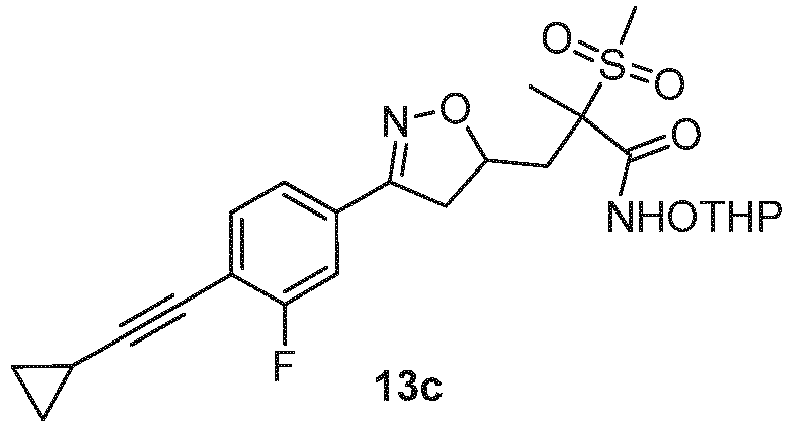
- 13b (0.17 g, 0.43 mmol, 1.0 equiv) was dissolved in THF (8 mL). N-methyl morpholine (0.22 g, 2.16 mmol, 5.0 equiv), EDC.HCl (0.12 g, 0.6 mmol, 1.5 equiv), HOBT (0.07 g, 0.5 mmol, 1.2 equiv), O-(tetrahydro-2H-pyran-2-yl) hydroxylamine (0.1 g, 0.9 mmol, 2.0 equiv) were added and the reaction mixture was stirred at room temperature for 24 hours. The reaction mixture was quenched with water and extracted with EtOAc. The organic layer was washed with brine, dried over sodium sulfate and concentrated to afford a crude residue. The residue was purified by silica gel column chromatography (50-70 % EtOAc in Hexane) to afford product 13c (0.18 g, 89.5 % yield). LCMS (m/z): 409.4 [M-THP]. 1H NMR (400 MHz, DMSO) δ 11.58 - 11.22 (m, 1H), 7.60 - 7.42 (m, 3H), 5.21 - 5.07 (m, 1H), 4.99 - 4.85 (m, 1H), 3.74 (qd, J = 8.9, 4.6 Hz, 1H), 3.52 (ddd, J = 12.6, 10.0, 4.1 Hz, 2H), 3.21 - 3.13 (m, 1H), 3.05 (dd, J = 10.2, 4.7 Hz, 3H), 2.70 (ddd, J = 21.8, 14.0, 8.1 Hz, 1H), 2.12 - 2.03 (m, 1H), 1.70 - 1.45 (m, 10H), 0.98 - 0.91 (m, 2H), 0.82 - 0.76 (m, 2H).
-
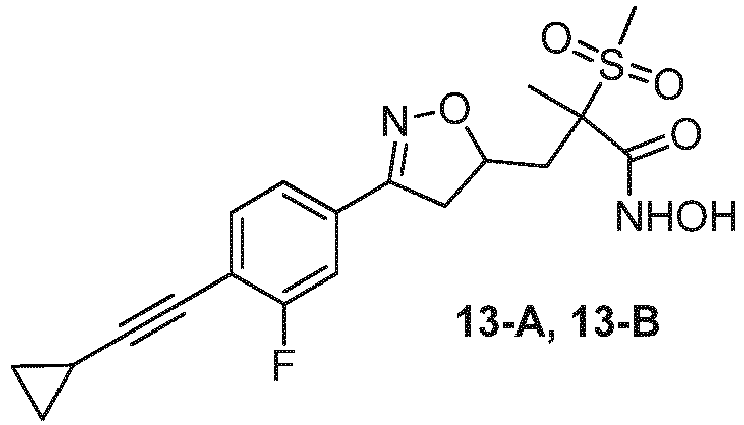
- 13c (0.18 g, 0.36 mmol, 1.0 equiv) was dissolved in ethanol (5 mL). 35.5% aq. HCl (0.2 mL) was added and the reaction mixture was stirred at room temperature for 2 hours. The reaction mixture was diluted with water, neutralized by saturated aqueous sodium bicarbonate solution and extracted with EtOAc. The organic layer was washed with brine, dried over sodium sulfate and concentrated to afford crude residue. The residue was purified by preparative HPLC purification to afford 13 as two diastereomers. 13-A: 0.028 g, 18.6% yield. LCMS (m/z): 409.3 [M+H]. 1H NMR (400 MHz, DMSO) δ 10.86 (s, 1H), 9.14 (s, 1H), 7.62 -7.40 (m, 3H), 4.78 (d, J = 4.5 Hz, 1H), 3.56 (dd, J = 17.1, 10.4 Hz, 1H), 3.16 (dd, J = 17.0, 7.9 Hz, 1H), 3.11 - 2.99 (m, 3H), 2.73 (dd, J = 13.7, 8.4 Hz, 1H), 2.05 (dd, J = 13.9, 4.7 Hz, 1H), 1.63 (ddd, J = 13.2, 8.2, 5.0 Hz, 1H), 1.53 (d, J = 20.1 Hz, 3H), 0.99-0.89 (m, 2H), 0.82 - 0.74 (m, 2H). 13-B: 0.020 g, 13.4 % yield. LCMS (m/z): 409.3 [M+H]. 1H NMR (400 MHz, DMSO) δ 11.07 (s, 1H), 9.29 (s, 1H), 7.58 - 7.42 (m, 3H), 4.66 (d, J = 7.9 Hz, 1H), 3.57 (dd, J = 17.1, 10.5 Hz, 1H), 3.13 (dd, J = 17.2, 8.0 Hz, 1H), 3.06 (s, 3H), 2.70 - 2.61 (m, 1H), 2.05 (dd, J = 14.0, 8.5 Hz, 1H), 1.68 - 1.61 (m, 1H), 1.59 (s, 3H), 0.95 (td, J = 6.7, 4.1 Hz, 2H), 0.84 - 0.76 (m, 2H).
-


- Reagents: Step 1: NH2OH.HCl, Na2CO3, MeOH, water, room temperature. Step 2: NaOCl (14%), chloroform, 0 °C to room temperature. Step 3: DBU, dppb, PdCl2(PPh3)2, DMSO, 120°C. Step 4: LiOH.H2O, THF, MeOH, water, room temperature. Step 5: NH2O-THP, EDC.HCl, HOBt, N-methyl morpholine, THF, room temperature. Step 6: 35.5% aq.HCl, EtOH, room temperature.
-

- 5-Bromopicolinaldehyde (1 g, 5.4 mmol, 1.0 equiv) was dissolved in MeOH (18 mL) and water (2 mL). Hydroxylamine hydrochloride (0.45 g, 6.4 mmol, 1.2 equiv), Sodium carbonate (0.57 g, 5.4 mmol, 1.0 equiv) in water (10 mL) was added and the reaction mixture was stirred at room temperature for 3 hours. The reaction mixture was quenched with water and extracted with EtOAc. The organic layer was washed with brine, dried over sodium sulfate and concentrated to afford product 14a (0.81 g, 75 % yield) which was used without purification in next step. LCMS (m/z): 201.1 [M+H]. 1H NMR (400 MHz, DMSO) δ 12.01 - 11.72 (m, 1H), 8.72 (d, J = 2.2 Hz, 1H), 8.30 - 7.91 (m, 2H), 7.75 (d, J = 8.5 Hz, 1H).
-

- 14a (0.6g, 3.0 mmol, 1.0 equiv) and 1b(0.72 g, 3.3 mmol, 1.1 equiv) were dissolved in chloroform (20 mL) and cooled to 0 °C. NaOCl (14%) (0.45 g, 6.0 mmol, 2.0 equiv) was added and the reaction mixture was stirred at room temperature for 24 hours. The reaction mixture was quenched with saturated aqueous ammonium chloride solution and extracted with EtOAc. The organic layer was washed with brine, dried over sodium sulfate and concentrated to afford a crude product. The crude product was purified by silica gel column chromatography (20-30 % EtOAc in Hexane) to afford product 14b (0.49 g, 33.6 % yield). LCMS (m/z): 419.3 [M+H]. 1H NMR (400 MHz, DMSO) δ 8.81 (s, 1H), 8.18 - 8.09 (m, 1H), 7.87 (d, J = 8.6 Hz, 1H), 4.75 (s, 1H), 4.26 - 4.14 (m, 2H), 3.58 (s, 1H), 3.13 (t, J = 9.6 Hz, 3H), 2.96 (s, 1H), 2.67 (s, 1H), 2.09 (s, 1H), 1.61 (d, J = 20.9 Hz, 3H), 1.27 - 1.24 (m, 4H).
-

- 14b (0.25 g, 0.6 mmol, 1.0 equiv), but-2-ynoic acid (0.055 g, 0.7 mmol, 1.1 equiv), 1,4-bis(diphenylphosphino)butane (0.005 g, 0.012 mmol, 0.02 equiv) were added in DMSO (5 mL). DBU (0.18 g, 1.2 mmol, 2.0 equiv) was added and the reaction mixture was degassed for 10 minutes. PdCl2(PPh3)2 (0.004 g, 0.006 mmol, 0.01 equiv) was added and the reaction mixture was stirred at 120 °C for 2 hours. The reaction mixture was quenched with water and extracted with EtOAc. The organic layer was washed with brine, dried over sodium sulfate and concentrated to afford a crude residue. The residue was purified by silica gel column chromatography (30-40 % EtOAc in Hexane) to afford product 14c (0.17 g, 73.3 % yield). LCMS (m/z): 379.4 [M+H].
-

- 14c (0.17 g, 0.4 mmol, 1.0 equiv) was dissolved in THF (2 mL), MeOH (1 mL) and water (1 mL). LiOH.H2O (0.055 g, 1.3 mmol, 3.0 equiv) was added and the reaction mixture was stirred at room temperature for 1 hour. The reaction mixture was diluted with water, acidified by 1.0 N HCl aqueous solution to the pH 5 to 6 and extracted with EtOAc. The organic layer was washed with brine, dried over sodium sulfate and concentrated to afford product 14d (0.095 g, 62.5 % yield) which was used without purification in next step. LCMS (m/z): 351.3 [M+H]. 1H NMR (400 MHz, DMSO) δ 14.24 - 13.67 (s, 1H), 8.63 (d, J = 22.9 Hz, 1H), 7.97 - 7.82 (m, 2H), 4.89 (d, J = 51.3 Hz, 1H), 3.65 - 3.59 (m, 1H), 3.23 (d, J = 8.7 Hz, 1H), 3.13 (s, 3H), 2.59 (s, 1H), 2.14 - 2.03 (m, 4H), 1.57 (d, J = 19.3 Hz, 3H).
-

- 14d (0.095 g, 0.3 mmol, 1.0 equiv) was dissolved in THF (5 mL). N-methyl morpholine (0.14 g, 1.4 mmol, 5.0 equiv), EDC.HCl (0.078 g, 0.4 mmol, 1.5 equiv), HOBT (0.066 g, 0.5 mmol, 1.8 equiv), O-(tetrahydro-2H-pyran-2-yl) hydroxylamine (0.063 g, 0.5 mmol, 2.0 equiv) were added and the reaction mixture was stirred at room temperature for 24 hours. The reaction mixture was quenched with water and extracted with EtOAc. The organic layer was washed with brine, dried over sodium sulfate and concentrated. The residue was purified by silica gel column chromatography (2-3 % MeOH in dichloromethane) to afford product 14e (0.09 g, 73.8 % yield) which was used directly in next step. LCMS (m/z): 366.4 [M-THP].
-

- 14e (0.09 g, 0.2 mmol, 1.0 equiv) was dissolved in ethanol (5 mL). 35.5% aq. HCl (0.2 mL) was added and the reaction mixture was stirred at room temperature for 1 hour. The reaction mixture was diluted with water, neutralized by saturated aqueous sodium bicarbonate solution and extracted with EtOAc. The organic layer was washed with brine, dried over sodium sulfate and concentrated to afford crude residue. The crude residue was purified by preparative HPLC purification to afford 14 as two diastereomers. 14-A: 0.009 g, 12.9% yield. LCMS (m/z): 366.4 [M+H]. 1H NMR (400 MHz, DMSO) δ 10.86 (s, 1H), 9.15 (s, 1H), 8.66 (s, 1H), 7.87 (s, 2H), 4.85 (s, 1H), 3.60 (d, J = 7.1 Hz, 1H), 3.18 (dd, J = 17.4, 8.2 Hz, 1H), 3.05 (s, 3H), 2.71 (d, J = 8.9 Hz, 1H), 2.10 (d, J = 13.3 Hz, 4H), 1.56 (s, 3H). 14-B: 0.014 g, 20 % yield. LCMS (m/z): 366.4 [M+H]. 1H NMR (400 MHz, DMSO) δ 11.06 (s, 1H), 9.31 (s, 1H), 8.66 (s, 1H), 7.88 (s, 2H), 4.69 (s, 1H), 3.59 (dd, J = 17.5, 10.3 Hz, 1H), 3.19 (dd, J = 17.9, 8.4 Hz, 1H), 3.07 (s, 3H), 2.69 (d, J = 10.6 Hz, 1H), 2.14 - 2.03 (m, 4H), 1.59 (s, 3H).
-


- Reagents: Step 1: DBU, dppb, PdCl2(PPh3)2, DMSO, 120°C. Step 2: LiOH.H2O, THF, MeOH, water, room temperature. Step 3: NH2O-THP, EDC.HCl, HOBT, N-methyl morpholine, THF, room temperature. Step 4: 35.5% aq.HCl, EtOH, room temperature.
-
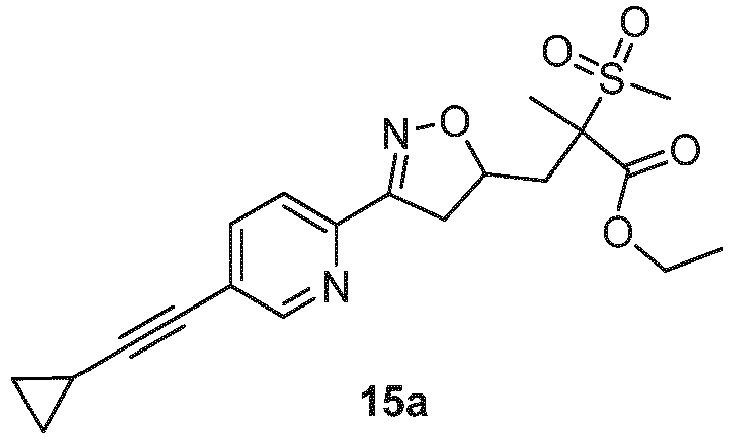
- 14b (0.24 g, 0.6 mmol, 1.0 equiv), 3-cyclopropylpropiolic acid (0.069 g, 0.7 mmol, 1.1 equiv), 1,4-bis(diphenylphosphino)butane (0.005 g, 0.012 mmol, 0.02 equiv) were added in DMSO (5 mL). DBU (0.17 g, 1.1 mmol, 2.0 equiv) was added and the reaction mixture was degassed for 10 minutes. PdCl2(PPh3)2 (0.004 g, 0.006 mmol, 0.01 equiv) was added and the reaction mixture was stirred at 120 °C for 2 hours. The reaction mixture was quenched with water and extracted with EtOAc. The organic layer was washed with brine, dried over sodium sulfate and concentrated. The residue was purified by silica gel column chromatography (30-40 % EtOAc in Hexane) to afford product 15a (0.17 g, 73.6 % yield).
-

- 15a (0.17 g, 0.4 mmol, 1.0 equiv) was dissolved in THF (2 mL), MeOH (1 mL) and water (1 mL). LiOH.H2O (0.053 g, 1.3 mmol, 3.0 equiv) was added and the reaction mixture was stirred at room temperature for 1 hour. The reaction mixture was diluted with water, acidified by 1.0 N HCl aqueous solution to the pH 5 to 6 and extracted with EtOAc. The organic layer was washed with brine, dried over sodium sulfate and concentrated to afford product 15b (0.1 g, 63.3 % yield) which was used in next step without purification. LCMS (m/z): 377.3 [M+H]. 1H NMR (400 MHz, DMSO) δ 12.09 (s, 1H), 8.63 (s, 1H), 7.91 (d, J = 44.3 Hz, 2H), 4.83 (s, 1H), 3.66 (s, 1H), 3.19 - 3.05 (m, 3H), 2.95 (s, 1H), 2.19 (s, 1H), 1.81 - 1.45 (m, 4H), 0.88 (d, J = 55.2 Hz, 4H).
-

- 15b (0.1 g, 0.3 mmol, 1.0 equiv) was dissolved in THF (5 mL). N-methyl morpholine (0.13 g, 1.3 mmol, 5.0 equiv), EDC.HCl (0.076 g, 0.4 mmol, 1.5 equiv), HOBT (0.065 g, 0.5 mmol, 1.8 equiv), O-(tetrahydro-2H-pyran-2-yl) hydroxylamine (0.062 g, 0.5 mmol, 2.0 equiv) were added and the reaction mixture was stirred at room temperature for 24 hours. The reaction mixture was quenched with water and extracted with EtOAc. The organic layer was washed with brine, dried over sodium sulfate and concentrated. The residue was purified by silica gel column chromatography (2-3 % MeOH in dichloromethane) to afford product 15c (0.09 g, 71.4 % yield). LCMS (m/z): 392.4 [M-THP].
-

- 15c (0.09 g, 0.2 mmol, 1.0 equiv) was dissolved in ethanol (5 mL). 35.5% aq. HCl (0.2 mL) was added and the reaction mixture was stirred at room temperature for 1 hour. The reaction mixture was diluted with water, neutralized by saturated aqueous sodium bicarbonate solution and extracted with EtOAc. The organic layer was washed with brine, dried over sodium sulfate and concentrated. The crude residue was purified by preparative HPLC purification to afford 15 as two diastereomers. 15-A: 0.007 g, 9.5 % yield. LCMS (m/z): 392.3 [M+H]. 1H NMR (400 MHz, DMSO) δ 10.86 (s, 1H), 9.15 (s, 1H), 8.62 (s, 1H), 7.85 (s, 2H), 4.84 (s, 1H), 3.59 (s, 1H), 3.21 - 3.15 (m, 1H), 3.05 (s, 3H), 2.68 (s, 1H), 2.08 (s, 1H), 1.56 (s, 4H), 0.89 (dd, J = 41.2, 13.1 Hz, 4H). 15-B: 0.010 g, 13.5% yield. LCMS (m/z): 392.3 [M+H]. 1H NMR (400 MHz, DMSO) δ 11.06 (s, 1H), 9.31 (s, 1H), 8.62 (s, 1H), 7.85 (s, 2H), 4.70 (s, 1H), 3.58 (dd, J = 17.6, 10.4 Hz, 1H), 3.18 (dd, J = 17.8, 8.1 Hz, 1H), 3.12 - 3.02 (m, 3H), 2.68 (d, J = 10.8 Hz, 1H), 2.06 (dd, J = 13.8, 8.3 Hz, 1H), 1.66 - 1.54 (m, 4H), 0.94 (dd, J = 8.2, 2.7 Hz, 2H), 0.80 (dd, J = 4.8, 2.5 Hz, 2H).
-


- Reagents: Step 1: NH2OH.HCl, NaOH, water, 80 °C. Step 2: NaOCl, THF, room temperature. Step 3: DBU, dppb, PdCl2(PPh3)2, DMSO, 120 °C. Step 4: LiOH.H2O, THF, MeOH, water, room temperature. Step 5: NH2O-THP, EDC.HCl, HOBT, N-methyl morpholine, THF, room temperature. Step 6: 35.5 % aq.HCl, EtOH, room temperature.
-

- 4-bromo-2-fluorobenzaldehyde (10 g, 49.2 mmol, 1.0 equiv) was dissolved in water (80 mL) and the reaction mixture was stirred at 70 °C. A solution of hydroxylamine hydrochloride (6.6 g, 98 mmol, 2.0 equiv) and sodium hydroxide (3.94 g, 98 mmol, 2.0 equiv) in water (20 mL) was added to the reaction mixture at same temperature. The reaction mixture was stirred at 70 °C for 6 hours. The reaction mixture was cooled to room temperature and filtered. The collected solid was triturated with hexane, the solvent was decanted and dried to afford product 16a (9.12 g, 84 % yield) which was used in next step without purification. 1H NMR (400 MHz, DMSO) δ 11.71 (d, J = 19.9 Hz, 1H), 8.16 (d, J = 20.1 Hz, 1H), 7.78 - 7.58 (m, 2H), 7.52 - 7.41 (m, 1H).
-

- 16a (6 g, 25 mmol, 1.0 equiv) was dissolved in THF (50 mL). 1b (5.6 g, 25 mmol, 1.0 equiv) and sodium hypochlorite (7.6 g, 50 mmol, 2.0 equiv) were added and the reaction mixture was stirred at room temperature for 6 hours. The reaction mixture was quenched with water and extracted with EtOAc. The organic layer was washed with brine, dried over sodium sulfate and concentrated. The crude residue was purified by silica gel column chromatography (10-15 % EtOAc in Hexane) to afford product 16b (8 g, 68 % yield). LCMS (m/z): 436.4 [M+H]. 1H NMR (400 MHz, DMSO) δ 7.78 - 7.65 (m, 2H), 7.54 (dd, J = 8.4, 2.0 Hz, 1H), 4.84 (dd, J = 68.4, 8.4 Hz, 1H), 4.29 - 4.16 (m, 2H), 3.63 (dd, J = 16.7, 8.5 Hz, 1H), 3.21 (d, J = 17.3 Hz, 1H), 3.17 - 3.09 (m, 3H), 2.68 - 2.57 (m, 1H), 2.25 - 2.10 (m, 1H), 1.63 (t, J = 20.8 Hz, 3H).
-

- 16b (0.6 g, 1.37 mmol, 1.0 equiv), but-2-ynoic acid (0.25 g, 2.75 mmol, 2.0 equiv), 1,4-bis(diphenylphosphino)butane (0.009 g, 0.027 mmol, 0.02 equiv) were added in DMSO (10 mL). DBU(0.41 g, 2.7 mmol, 2.0 equiv) was added and the reaction mixture was degassed for 10 minutes. PdCl2(PPh3)2 (0.012 g, 0.014 mmol, 0.01 equiv) was added and the reaction mixture was stirred at 120 °C for 12 hours. The reaction mixture was quenched with water and extracted with EtOAc. The organic layer was washed with brine, dried over sodium sulfate and concentrated. The residue was purified by silica gel column chromatography (20-25 % EtOAc in Hexane) to afford product 16c (0.42 g, 77 % yield). LCMS (m/z): 396.4 [M+H]. 1H NMR (400 MHz, DMSO) δ 7.69 (t, J = 7.4 Hz, 1H), 7.34 (dd, J = 29.6, 9.5 Hz, 2H), 4.83 (d, J = 67.9 Hz, 1H), 4.23 (dq, J = 24.8, 7.1 Hz, 2H), 3.22 (s, 1H), 3.16 - 3.07 (m, 3H), 2.65 - 2.58 (m, 1H), 2.20 (dd, J = 14.5, 8.5 Hz, 1H), 1.60 (d, J = 21.6 Hz, 3H), 1.24 (dt, J = 9.2, 7.1 Hz, 3H).
-

- 16c (0.42 g, 1.0 mmol, 1.0 equiv) was dissolved in THF (6 mL), MeOH (2 mL) and water (2 mL). LiOH.H2O (0.069 g, 1.6 mmol, 1.5 equiv) was added and the reaction mixture was stirred at room temperature for 3 hours. The reaction mixture was acidified by 1.0 N HCl aqueous solution to the pH 3 to 4 and extracted with EtOAc. The organic layer was washed with brine, dried over sodium sulfate and concentrated to afford product 16d (0.35 g, 92 % yield) which was used in next step without purification. LCMS (m/z): 368.3 [M+H]. 1H NMR (400 MHz, DMSO) δ 12.09 (s, 1H), 7.68 (td, J = 8.0, 3.3 Hz, 1H), 7.33 (dd, J = 28.9, 10.1 Hz, 2H), 4.83 (dd, J = 55.1, 8.4 Hz, 1H), 3.67 - 3.55 (m, 1H), 3.20 (dd, J = 17.1, 7.3 Hz, 1H), 3.11 (d, J = 15.3 Hz, 3H), 2.62 (dd, J = 13.9, 10.1 Hz, 1H), 2.20 - 2.04 (m, 4H), 1.54 (t, J = 18.6 Hz, 3H).
-

- 16d (0.35 g, 0.95 mmol, 1.0 equiv) was dissolved in THF (10 mL). N-methyl morpholine (0.48 g, 4.76 mmol, 5.0 equiv), EDC.HCl (0.33 g, 1.7 mmol, 1.8 equiv), HOBT (0.19 g, 1.43 mmol, 1.5 equiv), O-(tetrahydro-2H-pyran-2-yl) hydroxylamine (0.22 g, 1.9 mmol, 2.0 equiv) were added and the reaction mixture was stirred at room temperature for 24 hours. The reaction mixture was quenched with water and extracted with EtOAc. The organic layer was washed with brine, dried over sodium sulfate and concentrated. The residue was purified by silica gel column chromatography (30-40 % EtOAc in Hexane) to afford product 16e (0.3 g, 68 % yield). LCMS (m/z): 383.6 [M-THP]. 1H NMR (400 MHz, DMSO) δ 11.34 (s, 1H), 7.68 (d, J = 6.0 Hz, 1H), 7.33 (dd, J = 28.6, 9.9 Hz, 2H), 5.13 (d, J = 34.3 Hz, 1H), 4.84 (d, J = 26.2 Hz, 1H), 3.58 (s, 1H), 3.47 (d, J = 10.2 Hz, 2H), 3.17 (d, J = 18.0 Hz, 1H), 3.09 - 3.02 (m, 3H), 2.70 (d, J = 14.0 Hz, 1H), 2.06 (d, J = 20.6 Hz, 4H), 1.69 (s, 3H), 1.49 (d, J = 33.0 Hz, 6H).
-

- 16e (0.3 g, 0.64 mmol, 1.0 equiv) was dissolved in ethanol (10 mL). 35.5% aq. HCl (0.2 mL) was added and the reaction mixture was stirred at room temperature for 4 hours. The reaction mixture was diluted with water, neutralized by saturated aqueous sodium bicarbonate solution and extracted with EtOAc. The organic layer was washed with brine, dried over sodium sulfate and concentrated. The crude residue was purified by preparative HPLC purification to afford 16 as two diastereomers. 16-A: 0.030 g, 12.5 % yield. LCMS (m/z): 383.4 [M+18]. 1H NMR (400 MHz, DMSO) δ 10.84 (s, 1H), 9.15 (s, 1H), 7.68 (t, J = 7.9 Hz, 1H), 7.33 (dd, J = 28.0, 9.9 Hz, 2H), 4.77 (s, 1H), 3.60 (dd, J = 16.6, 10.7 Hz, 1H), 3.18 (dd, J= 16.7, 7.6 Hz, 1H), 3.14-2.89 (m, 3H), 2.72 (d, J = 15.4 Hz, 1H), 2.15 (d, J = 55.6 Hz, 4H), 1.55 (s, 3H). 16-B: 0.028 g, 11.7 % yield), LCMS (m/z): 383.4 [M+18]. 1H NMR (400 MHz, DMSO) δ 11.04 (s, 1H), 9.28 (s, 1H), 7.68 (t, J = 8.0 Hz, 1H), 7.33 (dd, J = 28.4, 10.0 Hz, 2H), 4.63 (d, J = 7.8 Hz, 1H), 3.69 - 3.58 (m, 1H), 3.18 (dd, J = 16.9, 7.6 Hz, 1H), 3.12 - 2.99 (m, 3H), 2.75 - 2.64 (m, 1H), 2.17 - 1.91 (m, 4H), 1.75 - 1.49 (m, 3H).
-


- Reagents: Step 1: DBU, dppb, PdCl2(PPh3)2, DMSO, 120 °C. Step 2: LiOH.H2O, THF, MeOH, water, room temperature. Step 3: NH2O-THP, EDC.HCl, HOBt, N-methyl morpholine, THF, room temperature. Step 4: 35.5 % aq.HCl, EtOH, room temperature.
-
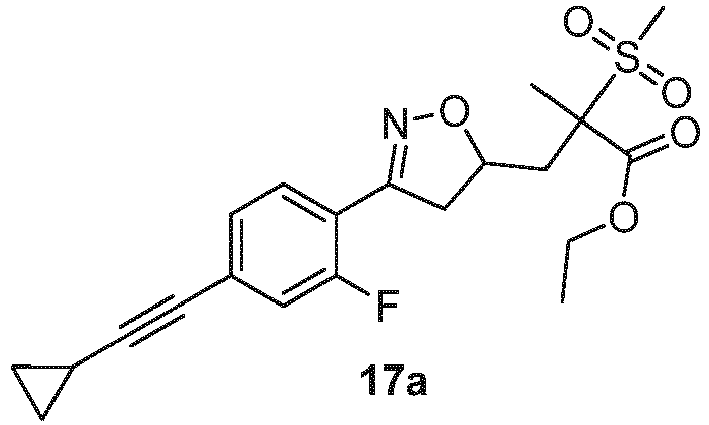
- 16b (0.6 g, 1.3 mmol, 1.0 equiv), 3-cyclopropylpropiolic acid (0.3 g, 2.7 mmol, 2.0 equiv), 1,4-bis(diphenylphosphino)butane (0.011 g, 0.027 mmol, 0.02 equiv) were added in DMSO (10 mL). DBU (0.41 g, 2.7 mmol, 2.0 equiv) was added and the reaction mixture was degassed for 10 minutes. PdCl2(PPh3)2 (0.009 g, 0.014 mmol, 0.01 equiv) was added and the reaction mixture was stirred at 120 °C for 15 hours. The reaction mixture was quenched with water and extracted with EtOAc. The organic layer was washed with brine, dried over sodium sulfate and concentrated. The residue was purified by silica gel column chromatography (20-22 % EtOAc in Hexane) to afford product 17a (0.54 g, 93 % yield). LCMS (m/z): 422.4 [M+H]. 1H NMR (400 MHz, DMSO) δ 7.68 (t, J = 7.5 Hz, 1H), 7.46 - 7.21 (m, 2H), 4.99 - 4.70 (m, 1H), 4.30 - 4.16 (m, 2H), 3.67 - 3.54 (m, 1H), 3.21 (d, J = 9.5 Hz, 1H), 3.15 - 3.07 (m, 3H), 2.61 (ddd, J = 18.2, 12.9, 9.6 Hz, 1H), 2.13 (ddd, J = 17.2, 14.2, 5.8 Hz, 1H), 1.71 - 1.50 (m, 4H), 1.24 (dt, J = 9.7, 7.1 Hz, 3H), 0.98 - 0.86 (m, 2H), 0.83 - 0.73 (m, 2H).
-

- 17a (0.54 g, 1.2 mmol, 1.0 equiv) was dissolved in THF (6 mL), MeOH (2 mL) and water (2 mL). LiOH.H2O (0.08 g, 1.9 mmol, 1.5 equiv) was added and the reaction mixture was stirred at room temperature for 4 hours. The reaction mixture was acidified by 1.0 N HCl aqueous solution to the pH 3 to 4 and extracted with EtOAc. The organic layer was washed with brine, dried over sodium sulfate and concentrated to afford product 17b (0.45 g, 83 % yield) which was used in next step without purification. LCMS (m/z): 394.4 [M+H].
-

- 17b (0.45 g, 1.14 mmol, 1.0 equiv) was dissolved in THF (10 mL). N-methyl morpholine (0.58 g, 5.71 mmol, 5.0 equiv), EDC.HCl (0.39 g, 2.05 mmol, 1.8 equiv), HOBT (0.23 g, 1.72 mmol, 1.5 equiv), O-(tetrahydro-2H-pyran-2-yl) hydroxylamine (0.27 g, 2.28 mmol, 2.0 equiv) were added and the reaction mixture was stirred at room temperature for 24 hours. The reaction mixture was quenched with water and extracted with EtOAc. The organic layer was washed with brine, dried over sodium sulfate and concentrated. The residue was purified by silica gel column chromatography (30-50 % EtOAc in Hexane) to afford product 17c (0.42 g, 75 % yield). LCMS (m/z): 491.5 [M+H]. 1H NMR (400 MHz, DMSO) δ 11.46 (s, 1H), 7.67 (d, J = 6.9 Hz, 1H), 7.30 (dd, J = 29.9, 10.0 Hz, 2H), 5.12 (d, J = 29.4 Hz, 1H), 4.84 (d, J = 25.4 Hz, 1H), 3.75 (d, J = 11.1 Hz, 1H), 3.53 (d, J = 36.4 Hz, 2H), 3.21 - 3.13 (m, 1H), 3.05 (dd, J = 8.7, 4.5 Hz, 3H), 2.68 (s, 1H), 2.06 (s, 1H), 1.79 - 1.64 (m, 4H), 1.56 (dd, J = 15.3, 8.9 Hz, 6H), 0.93 (dt, J = 6.3, 4.0 Hz, 2H), 0.81 - 0.75 (m, 2H).
-

- 17c (0.42 g, 0.87 mmol, 1.0 equiv) was dissolved in ethanol (10 mL). 35.5% aq. HCl (0.2 mL) was added and the reaction mixture was stirred at room temperature for 4 hours. The reaction mixture was diluted with water, neutralized by saturated aqueous sodium bicarbonate solution and extracted with EtOAc. The organic layer was washed with brine, dried over sodium sulfate and concentrated to afford crude residue. The crude residue was purified by preparative HPLC purification to afford 17 as two diastereomers. 17-A: 0.080 g, 25.6 % yield), LCMS (m/z): 409.4 [M+H]. 1H NMR (400 MHz, DMSO) δ 10.86 (s, 1H), 9.14 (s, 1H), 7.67 (t, J = 7.6 Hz, 1H), 7.30 (dd, J = 27.7, 9.8 Hz, 2H), 4.77 (s, 1H), 3.59 (dd, J = 16.8, 10.7 Hz, 1H), 3.17 (dd, J = 16.5, 7.5 Hz, 1H), 3.03 (d, J = 19.7 Hz, 3H), 2.85 - 2.61 (m, 1H), 2.08 (d, J = 10.4 Hz, 1H), 1.90 - 1.22 (m, 4H), 1.19 - 0.48 (m, 4H). 17-B: 0.070 g, 22.4 % yield. LCMS (m/z): 409.4 [M+H]. 1H NMR (400 MHz, DMSO) δ 11.01 (s, 1H), 9.28 (s, 1H), 7.67 (t, J = 8.0 Hz, 1H), 7.49 - 7.20 (m, 2H), 4.63 (dd, J = 15.5, 8.1 Hz, 1H), 3.59 (dd, J = 16.8, 10.1 Hz, 1H), 3.26 - 3.14 (m, 1H), 3.11 - 2.88 (m, 3H), 2.67 (dd, J = 14.0, 3.1 Hz, 1H), 2.13 - 1.94 (m, 1H), 1.77 - 1.33 (m, 4H), 1.05 - 0.64 (m, 4H).
-
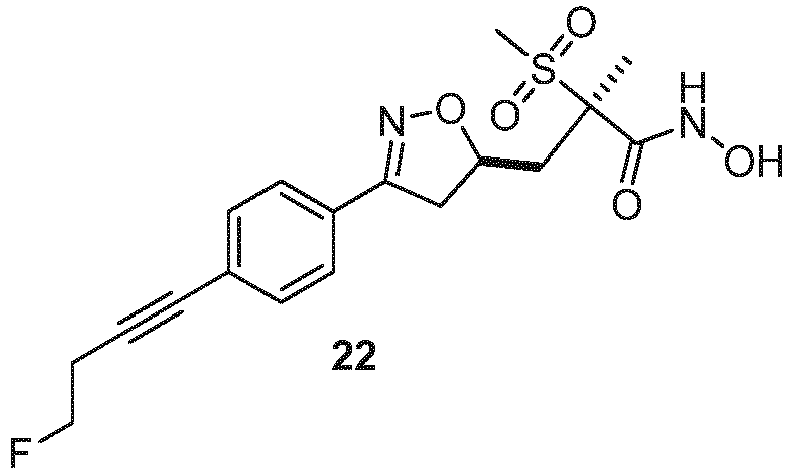

- Reagents: Step 1: Diethyl amine, triphenyl phosphine, CuI, PdCl2(pph3)2, N,N-dimethylformamide, 100 °C. Step 2: DAST, dichloromethane, -78 °C to room temperature. Step 3: LiOH.H2O, THF, MeOH, water, room temperature. Step 4: NH2OTHP, EDC.HCl, HOBT, N-methyl morpholine, THF, room temperature. Step 5: HCl (in IPA), MeOH, dichloromethane, room temperature.
-

- (R)-1d-A (0.25 g, 0.59 mmol, 1.0 equiv) was added with diethyl amine (10 mL) and N,N-dimethylformamide (2 mL). CuI (0.011 g, 0.059 mmol, 0.1 equiv), triphenyl phosphine (0.031 g, 0.12 mmol, 0.2 equiv) were added and the reaction mixture was degassed for 10 minutes. PdCl2(pph3)2 (0.02 g, 0.03 mmol, 0.05 equiv), but-3-yn-1-ol (0.083 g, 1.19 mmol, 2.0 equiv) were added and the reaction mixture was stirred at 100 °C for 2 hours. The reaction mixture was quenched with water and extracted with EtOAc. The organic layer was washed with brine, dried over sodium sulfate and concentrated. The residue was purified by silica gel column chromatography (50-55 % EtOAc/Hexane) to afford product 22a (0.2 g, 82 % yield). LCMS (m/z): 408.2 [M+H]. 1H NMR (400 MHz, DMSO) δ 7.63 (dd, J = 8.1, 4.3 Hz, 2H), 7.47 (d, J = 8.4 Hz, 2H), 4.94 (t, J = 5.6 Hz, 1H), 4.76 (td, J = 11.3, 3.3 Hz, 1H), 4.26 (q, J = 7.1 Hz, 2H), 3.65 - 3.53 (m, 3H), 3.22 - 3.06 (m, 4H), 2.59 (dd, J = 12.9, 6.1 Hz, 3H), 2.21 - 2.14 (m, 1H), 1.61 (d, J = 22.3 Hz, 3H), 1.26 (t, J = 7.1 Hz, 3H).
-

- 22a (0.18 g, 0.44 mmol, 1.0 equiv) was dissolved in dichloromethane (10 mL) and cooled to -78 °C. DAST (0.14 g, 0.88 mmol, 2.0 equiv) was added dropwisely and the reaction mixture was stirred at room temperature for 12 hours. The reaction mixture was poured to water, neutralized with saturated aqueous sodium bicarbonate solution and extracted with EtOAc. The organic layer was washed with brine, dried over sodium sulfate and concentrated. The residue was purified by silica gel column chromatography (25-30 % EtOAc/Hexane) to afford product 22b (0.08 g, 45 % yield). LCMS (m/z): 410.1 [M+H]. 1H NMR (400 MHz, DMSO) δ 7.64 (d, J = 8.4 Hz, 2H), 7.51 (t, J = 10.8 Hz, 2H), 4.76 (ddd, J = 18.8, 8.4, 3.3 Hz, 1H), 4.65 (t, J = 6.0 Hz, 1H), 4.54 (t, J = 6.0 Hz, 1H), 4.33 - 4.18 (m, 2H), 3.61 (dd, J = 17.0, 10.4 Hz, 1H), 3.24 - 3.04 (m, 4H), 2.93 (t, J = 6.0 Hz, 1H), 2.87 (t, J = 6.0 Hz, 1H), 2.59 (dd, J = 14.5, 3.2 Hz, 1H), 2.18 (dd, J = 9.3, 5.2 Hz, 1H), 1.61 (d, J = 22.2 Hz, 3H), 1.26 (t, J = 7.1 Hz, 3H).
-

- 22b (0.08 g, 0.19 mmol, 1.0 equiv) was dissolved in THF (4 mL), MeOH (1 mL) and water (1 mL). LiOH.H2O (0.024 g, 0.58 mmol, 3.0 equiv) was added and the reaction mixture was stirred at room temperature for 2 hours. The reaction mixture was poured to water, acidified by 1.0 N HCl aqueous solution up to pH 4 to 5 and extracted with EtOAc. The organic layer was washed with brine, dried over sodium sulfate and concentrated to afford product 22c (0.065 g, 87 % yield). The product was directly used in the next step with no further purification. LCMS (m/z): 382.1 [M+H]. 1H NMR (400 MHz, DMSO) δ 14.03 (s, 1H), 7.67 - 7.60 (m, 2H), 7.52 (dd, J = 22.8, 8.4 Hz, 2H), 4.77 (d, J = 7.4 Hz, 1H), 4.65 (t, J = 6.0 Hz, 1H), 4.54 (t, J = 6.0 Hz, 1H), 3.63 (dd, J = 17.0, 10.4 Hz, 1H), 3.23 - 3.16 (m, 1H), 3.14 (d, J = 7.7 Hz, 3H), 2.93 (t, J = 6.0 Hz, 1H), 2.87 (t, J = 6.1 Hz, 1H), 2.56 (s, 1H), 2.20 - 2.14 (m, 1H), 1.60 (s, 3H).
-

- 22c (0.065 g, 0.17 mmol, 1.0 equiv) was dissolved in THF (5 mL). N-methyl morpholine (0.086 g, 0.852 mmol, 5.0 equiv), HOBT (0.027 g, 0.2 mmol, 1.2 equiv), O-(tetrahydro-2H-pyran-2-yl) hydroxylamine (0.04 g, 0.34 mmol, 2.0 equiv), EDC.HCl (0.048 g, 0.26 mmol, 1.5 equiv) were added and the reaction mixture was stirred at room temperature for 24 hours. The reaction mixture was quenched with water and extracted with EtOAc. The organic layer was washed with brine, dried over sodium sulfate and concentrated. The residue was purified by silica gel column chromatography (30-40 % EtOAc/Hexane) to afford product 22d (0.065 g, 79 % yield). LCMS (m/z): 498.3 [M+18]. 1H NMR (400 MHz, DMSO) δ 11.47 (s, 1H), 7.71 - 7.59 (m, 2H), 7.52 (dd, J = 23.0, 8.4 Hz, 2H), 4.97 (d, J = 8.3 Hz, 1H), 4.65 (t, J = 6.0 Hz, 2H), 4.53 (t, J = 6.0 Hz, 1H), 4.05 (dt, J = 14.3, 9.8 Hz, 2H), 3.64 - 3.49 (m, 2H), 3.15 (dd, J = 17.3, 7.7 Hz, 1H), 3.06 (d, J = 8.7 Hz, 3H), 2.90 (dt, J = 24.2, 6.1 Hz, 2H), 2.68 (d, J = 12.3 Hz, 1H), 2.07 (dd, J = 13.0, 8.4 Hz, 1H), 1.70 (s, 3H), 1.61 (d, J = 4.3 Hz, 3H), 1.54 (s, 3H).
-

- 22d (0.065 g, 0.14 mmol, 1.0 equiv) was dissolved in methanol (2 mL) and dichloromethane (2 mL). 10% HCl (in IPA) (0.02 mL) was added and the reaction mixture was stirred at room temperature for 2 hours. The reaction mixture was quenched with water, neutralized by saturated aqueous sodium bicarbonate solution and extracted with EtOAc. The organic layer was washed with brine, dried over sodium sulfate and concentrated. The residue was triturated with n-pentane/diethyl ether. The solvent was decanted and the remaining material was dried to afford product 22 (0.02 g, 38 % yield). LCMS (m/z): 397.2 [M+H]. 1H NMR (400 MHz, DMSO) δ 11.07 (s, 1H), 9.29 (s, 1H), 7.64 (d, J = 8.4 Hz, 2H), 7.50 (d, J = 8.4 Hz, 2H), 4.65 (t, J = 6.0 Hz, 2H), 4.54 (t, J = 6.0 Hz, 1H), 3.58 (dd, J = 17.0, 10.5 Hz, 1H), 3.14 (dd, J = 17.0, 8.1 Hz, 1H), 3.07 (s, 3H), 2.93 (t, J = 6.0 Hz, 1H), 2.87 (t, J = 6.0 Hz, 1H), 2.70 - 2.62 (m, 1H), 2.04 (dd, J = 14.0, 8.4 Hz, 1H), 1.59 (s, 3H).
-



- Reagents: Step 1: CuI, PdCl2(dppf), THF, 160 °C (MW). Step 2: LiOH.H2O, THF, MeOH, water, room temperature. Step 3: NH2OTHP, EDC.HCl, HOBT, N-methyl morpholine, THF, room temperature. Step 4: HCl (in IPA), MeOH, dichloromethane, 10 °C to room temperature.
-

- (R)-1d-A (0.2 g, 0.47 mmol, 1.0 equiv) was dissolved in THF (1 mL). CuI (0.005 g, 0.024 mmol, 0.05 equiv), PdCl2 (dppf) (0.017 g, 0.024 mmol, 0.05 equiv), propylzinc (II) bromide (5.0M in THF) (1.9 mL, 9.56 mmol, 20.0 equiv) were added and the reaction mixture was stirred at 160 °C for 10 minutes under microwave irradiation. The reaction mixture was filtered through Celite, washed with EtOAc. Te filtrate was diluted with water and extracted with EtOAc. The organic layer was washed with brine, dried over sodium sulfate and concentrated. The residue was purified by silica gel column chromatography (15 % EtOAc/Hexane) to afford product 23a (0.1 g, 55 % yield). LCMS (m/z): 382.2 [M+H]. 1H NMR (400 MHz, DMSO) δ 7.57 (d, J = 8.2 Hz, 2H), 7.28 (d, J = 8.3 Hz, 2H), 4.72 (dt, J = 11.3, 5.5 Hz, 1H), 4.27 (q, J = 7.1 Hz, 2H), 3.60 (dd, J = 16.9, 10.3 Hz, 1H), 3.22 - 3.08 (m, 4H), 2.59 (dd, J = 9.3, 5.5 Hz, 3H), 2.17 (dd, J = 14.4, 8.5 Hz, 1H), 1.71 - 1.53 (m, 5H), 1.26 (t, J = 7.1 Hz, 3H), 0.89 (t, J = 7.3 Hz, 3H).
-

- 23a(0.1 g, 0.26 mmol, 1.0 equiv) was dissolved in THF (5 mL), MeOH (1 mL) and water (1 mL). LiOH.H2O (0.022 g, 0.52 mmol, 2.0 equiv) was added and the reaction mixture was stirred at room temperature for 2 hours. The reaction mixture was acidified by 1.0 N HCl aqueous solution to pH 3 to 4 and extracted with EtOAc. The organic layer was washed with brine, dried over sodium sulfate and concentrated to afford product 23b (0.09 g, 97.8 % yield). LCMS (m/z): 354.2 [M+H]. The product was directly used in the next step with no further purification. 1H NMR (400 MHz, DMSO) δ 7.55 (d, J = 8.2 Hz, 2H), 7.27 (d, J = 8.2 Hz, 2H), 4.77 - 4.68 (m, 1H), 3.58 (dd, J = 17.0, 10.3 Hz, 1H), 3.19 - 3.12 (m, 1H), 3.10 (d, J = 4.6 Hz, 3H), 2.57 (t, J = 7.5 Hz, 3H), 2.11 (dd, J = 14.3, 8.5 Hz, 1H), 1.63 - 1.46 (m, 5H), 0.86 (t, J = 7.3 Hz, 3H).
-

- 23b (0.09 g, 0.25 mmol, 1.0 equiv) was dissolved in THF (5 mL). N-methyl morpholine (0.13 g, 1.3 mmol, 5.0 equiv), HOBT (0.041 g, 0.31 mmol, 1.2 equiv), O-(tetrahydro-2H-pyran-2-yl) hydroxylamine (0.06 g, 0.5 mmol, 2.0 equiv), EDC.HCl (0.073 g, 0.38 mmol, 1.5 equiv) were added and the reaction mixture was stirred at room temperature for 24 hours. The reaction mixture was quenched with water and extracted with EtOAc. The organic layer was washed with brine, dried over sodium sulfate and concentrated. The residue was purified by silica gel column chromatography (30 % EtOAc/Hexane) to afford product 23c (0.09 g, 78.3 % yield). LCMS (m/z): 369.3 [M-THP]. 1H NMR (400 MHz, DMSO) δ 11.46 (s, 1H), 7.56 (d, J = 7.5 Hz, 2H), 7.28 (d, J = 8.1 Hz, 2H), 4.98 (d, J = 9.3 Hz, 1H), 4.64 (d, J = 6.9 Hz, 1H), 4.07 (dd, J = 28.7, 6.2 Hz, 1H), 3.63 - 3.46 (m, 2H), 3.14 (dd, J = 16.9, 8.0 Hz, 1H), 3.06 (d, J = 8.5 Hz, 3H), 2.67 (d, J = 14.3 Hz, 1H), 2.59 (t, J = 7.5 Hz, 2H), 2.06 (dd, J = 14.3, 8.8 Hz, 1H), 1.70 (s, 3H), 1.64 - 1.51 (m, 8H), 0.89 (t, J = 7.3 Hz, 3H).
-

- 23c (0.09 g, 0.19 mmol, 1.0 equiv) was dissolved in dichloromethane (2 mL), methanol (0.5 mL) and the reaction mixture was cooled to 10 °C. 10% HCl (in IPA) (0.2 mL) was added and the reaction mixture was stirred at room temperature for 1 hour. The reaction mixture was neutralized by saturated aqueous sodium bicarbonate solution and extracted with EtOAc. The organic layer was washed with brine, dried over sodium sulfate and concentrated to afford crude residue. The residue was triturated with n-pentane and diethyl ether. The solvent was decanted and the remaining soild was dried under vacuum to afford product 23 (0.043 g, 56.6 % yield). LCMS (m/z): 369.2 [M+H]. 1H NMR (400 MHz, DMSO) δ 11.11 (s, 1H), 9.11 (s, 1H), 7.56 (d, J = 8.0 Hz, 2H), 7.28 (d, J = 8.0 Hz, 2H), 4.63 (s, 1H), 3.53 (dd, J = 16.6, 10.0 Hz, 1H), 3.13 (dd, J = 16.7, 7.7 Hz, 1H), 3.06 (s, 3H), 2.70 - 2.55 (m, 3H), 2.02 (dd, J = 13.8, 8.1 Hz, 1H), 1.60 (dd, J = 16.0, 8.4 Hz, 5H), 0.89 (t, J = 7.3 Hz, 3H).
-


- Reagents: Step 1: Cs2CO3, PdCl2(dppf), 1,4-dioxane, 100 °C. Step 2: LiOH.H2O, THF, MeOH, water, room temperature. Step 3: NH2OTHP, EDC.HCl, HOBT, N-methyl morpholine, THF, room temperature. Step 4: HCl (in IPA), MeOH, dichloromethane, room temperature.
-

- (R)-1d-A (0.2 g, 0.48 mmol, 1.0 equiv) and Cs2CO3 (0.47 g, 1.43 mmol, 3.0 equiv) were added in 1, 4-dioxane (10 mL). (E)-prop-1-en-1-ylboronic acid (0.05 g, 0.57 mmol, 1.2 equiv) was added and the reaction mixture was degassed for 10 minutes. PdCl2(dppf) (0.024 g, 0.033 mmol, 0.07 equiv) was added and the reaction mixture was stirred at 100 °C for 24 hours. The reaction mixture was quenched with water and extracted with EtOAc. The organic layer was washed with brine, dried over sodium sulfate and concentrated. The residue was purified by silica gel column chromatography (25-35 % EtOAc/Hexane) to afford product 24a (0.15 g, 80 % yield). LCMS (m/z): 380.3 [M+H]. 1H NMR (400 MHz, DMSO) δ 7.67 (s, 1H), 7.59 (d, J = 8.1 Hz, 1H), 7.47 (s, 2H), 6.47 (d, J = 16.0 Hz, 1H), 4.74 (s, 1H), 4.35 - 4.19 (m, 2H), 3.61 (dt, J = 20.7, 10.3 Hz, 1H), 3.24 - 3.00 (m, 4H), 2.60 (d, J = 14.5 Hz, 1H), 2.19 (s, 1H), 1.87 (d, J = 4.9 Hz, 1H), 1.64 (s, 3H), 1.26 (t, J = 7.1 Hz, 3H).
-

- 24a (0.15 g, 0.38 mmol, 1.0 equiv) was dissolved in THF (4 mL), MeOH (1 mL) and water (1 mL). LiOH.H2O (0.024 g, 0.57 mmol, 1.5 equiv) was added and the reaction mixture was stirred at room temperature for 2 hours. The reaction mixture was poured to water, acidified by 1.0 N HCl aqueous solution up to pH 4 to 5 and extracted with EtOAc. The organic layer was washed with brine, dried over sodium sulfate and concentrated to afford product 24b (0.11 g, 78 % yield). LCMS (m/z): 352.2 [M+H]. 1H NMR (400 MHz, DMSO) δ 14.04 (s, 1H), 7.67 (s, 1H), 7.62 - 7.54 (m, 1H), 7.47 (s, 2H), 6.51 - 6.34 (m, 1H), 4.76 (s, 1H), 3.62 (dt, J = 16.9, 10.3 Hz, 1H), 3.19 (dd, J = 17.4, 9.7 Hz, 1H), 3.13 (s, 3H), 2.56 (s, 1H), 2.16 (dd, J = 11.8, 6.9 Hz, 1H), 1.88 (dd, J = 48.3, 43.2 Hz, 3H), 1.60 (s, 3H).
-

- 24b (0.11 g,0.3 mmol, 1.0 equiv) was dissolved in THF (10 mL). N-methyl morpholine (0.15 g, 1.5 mmol, 5.0 equiv), HOBT (0.048 g, 0.36 mmol, 1.2 equiv), O-(tetrahydro-2H-pyran-2-yl) hydroxylamine (0.071 g, 0.6 mmol, 2.0 equiv), EDC.HCl (0.086 g, 0.45 mmol, 1.5 equiv) were added and the reaction mixture was stirred at room temperature for 24 hours. The reaction mixture was quenched with water and extracted with EtOAc. The organic layer was washed with brine, dried over sodium sulfate and concentrated to afford product 24c (0.11 g, 78 % yield). LCMS (m/z): 450.4 [M+H]. 1H NMR (400 MHz, DMSO) δ 11.44 (s, 1H), 7.67 - 7.61 (m, 1H), 7.59 - 7.52 (m, 1H), 7.49 - 7.39 (m, 2H), 6.48 - 6.31 (m, 1H), 4.96 (d, J = 8.9 Hz, 1H), 4.63 (s, 1H), 4.16 - 4.02 (m, 1H), 3.65 - 3.42 (m, 2H), 3.14 (dd, J = 17.2, 8.5 Hz, 1H), 3.02 (t, J = 12.6 Hz, 3H), 2.72 - 2.60 (m, 1H), 2.10 - 2.00 (m, 1H), 1.82 (dd, J = 24.6, 5.3 Hz, 3H), 1.68 (s, 3H), 1.60 (d, J = 2.4 Hz, 3H), 1.53 (s, 3H).
-

- 24c (0.11 g, 0.23 mmol, 1.0 equiv) was dissolved in methanol (2 mL) and dichloromethane (2 mL). 10% HCl (in IPA) (0.05 mL) was added and the reaction mixture was stirred at room temperature for 2 hours. The reaction mixture was quenched with saturated aqueous sodium bicarbonate solution and extracted with EtOAc. The organic layer was washed with brine, dried over sodium sulfate and concentrated. The crude residue was purified by preparative HPLC to afford product 24 (0.02 g, 23 % yield). LCMS (m/z): 367.1 [M+H]. 1H NMR (400 MHz, DMSO) δ 11.05 (s, 1H), 9.28 (s, 1H), 7.58 (d, J = 8.4 Hz, 2H), 7.46 (d, J = 8.4 Hz, 2H), 6.52 - 6.35 (m, 2H), 4.62 (d, J = 7.3 Hz, 1H), 3.56 (dd, J = 17.0, 10.2 Hz, 1H), 3.13 (dd, J = 17.0, 8.1 Hz, 1H), 3.07 (s, 3H), 2.66 (d, J = 13.8 Hz, 1H), 2.04 (dd, J = 14.0, 8.4 Hz, 1H), 1.87 (d, J = 5.2 Hz, 3H), 1.59 (s, 3H).
-


- Reagents: Step 1: PdCl2(dppf) Cs2CO3, 1, 4-dioxane, 110 °C. Step 2: NEt3.3HF, NBS, dichloromethane, 0 °C to room temperature. Step 3: DBU, 85 °C. Step 4: LiOH.H2O, THF, MeOH, water, room temperature. Step 5: NH2OTHP, EDC.HCl, HOBT, N-Methyl morpholine, THF, room temperature. Step 6: HCl (in IPA), MeOH, dichloromethane, room temperature.
-

- (R)-1d-A (0.2 g, 0.47 mmol, 1.0 equiv), (Z)-prop-1-en-1-ylboronic acid (0.053 g, 0.62 mmol, 1.3 equiv) were added in 1, 4-dioxane (4 mL) in sealed tube. Cs2CO3 (0.47 g, 1.43 mmol, 3.0 equiv) was added and the reaction mixture was degassed for 15 minutes. PdCl2(dppf) (0.017 g, 0.023 mmol, 0.05 equiv) was added and the reaction mixture was stirred at 110 °C for 24 hours. The reaction mixture was filtered through Celite, washed with EtOAc and the filtrate was concentrated. The crude residue was purified by silica gel column chromatography (5 % MeOH/dichloromethane) to afford product 29a (0.17 g, 93.7 % yield). LCMS (m/z): 380.6 [M+H]. 1H NMR (400 MHz, DMSO) δ 7.65 (d, J = 8.4 Hz, 2H), 7.40 (d, J = 8.3 Hz, 2H), 6.47 (d, J = 13.8 Hz, 1H), 5.92 - 5.82 (m, 1H), 4.80 - 4.70 (m, 1H), 4.27 (q, J = 7.1 Hz, 2H), 3.66 - 3.57 (m, 1H), 3.23 - 3.06 (m, 4H), 2.60 (dd, J = 14.4, 3.2 Hz, 1H), 2.19 (dd, J = 14.4, 8.5 Hz, 1H), 1.89 (dt, J = 7.3, 3.6 Hz, 3H), 1.64 (s, 3H), 1.26 (t, J = 7.1 Hz, 3H).
-

- 29a (0.17 g, 0.44 mmol, 1.0 equiv) was added in dichloromethane (6 mL) and cooled to 0 °C. NEt3.3HF (0.11 g, 0.66 mmol, 1.5 equiv) and NBS (0.086 g, 0.48 mmol, 1.1 equiv) were added. The reaction mixture was stirred at room temperature for 24 hours. The reaction mixture was quenched with water and the mixture was neutralize by NH4OH. The mixture was then extracted with dichloromethane. The organic layer was washed with 1.0 N HCl and saturate aqueous sodium bicarbonate solution, dried over sodium sulfate and concentrated. The crude residue was purified by silica gel column chromatography (30-50 % EtOAc/Hexane) to afford product 29b (0.045 g, 20.9 % yield). LCMS (m/z): 480.3 [M+H]. 1H NMR (400 MHz, DMSO) δ 7.77 - 7.58 (m, 2H), 7.56 - 7.20 (m, 2H), 5.64 (ddd, J = 44.4, 22.9, 6.1 Hz, 1H), 4.75 (dd, J = 17.0, 6.5 Hz, 1H), 4.27 (q, J = 7.1 Hz, 2H), 3.68 - 3.57 (m, 1H), 3.24 - 3.04 (m, 4H), 2.64 - 2.53 (m, 1H), 2.19 (dd, J = 14.3, 8.5 Hz, 1H), 2.05 - 1.77 (m, 1H), 1.63 (q, J = 6.7 Hz, 3H), 1.25 (d, J = 7.1 Hz, 3H).
-

- 29b (0.19 g, 0.39 mmol, 1.0 equiv) was added in DBU (0.06 g, 0.39 mmol, 1.0 equiv) and the reaction mixture was stirred at 85 °C for 1 hour. The reaction mixture was quenched with water and extracted with dichloromethane. The organic layer was washed with brine, dried over sodium sulfate and concentrated. The residue was purified by silica gel column chromatography (30 % EtOAc/Hexane) to afford product 29c (0.09 g, 57.3 % yield). LCMS (m/z): 398.3 [M+H]. 1H NMR (400 MHz, DMSO) δ 7.80 - 7.35 (m, 4H), 5.88 (dt, J = 46.1, 6.9 Hz, 1H), 4.76 (d, J = 7.5 Hz, 1H), 4.27 (q, J = 7.1 Hz, 2H), 3.63 (dd, J = 17.0, 10.4 Hz, 1H), 3.26 - 3.09 (m, 4H), 2.60 (dd, J = 14.4, 3.3 Hz, 1H), 2.19 (dd, J = 14.4, 8.5 Hz, 1H), 2.04 - 1.68 (m, 3H), 1.69 - 1.57 (m, 3H), 1.26 (t, J = 7.1 Hz, 3H).
-

- 29c (0.09 g, 0.23 mmol, 1.0 equiv) was dissolved in THF (4 mL), MeOH (1 mL) and water (1 mL). LiOH.H2O (0.01 g, 0.23 mmol, 1.0 equiv) was added and the reaction mixture was stirred at room temperature for 3 hours. The reaction mixture was concentrated under reduced pressure. The residue was diluted with water and extracted with EtOAc. The aqueous layer was acidified by 1.0 N HCl aqueous solution to the pH 4 to 5 and extracted with EtOAc. The organic layer was washed with brine, dried over sodium sulfate and concentrated to afford product 29d (0.075 g, 90.4 % yield) which was used without purification in next step. LCMS (m/z): 370.3 [M+H].
-
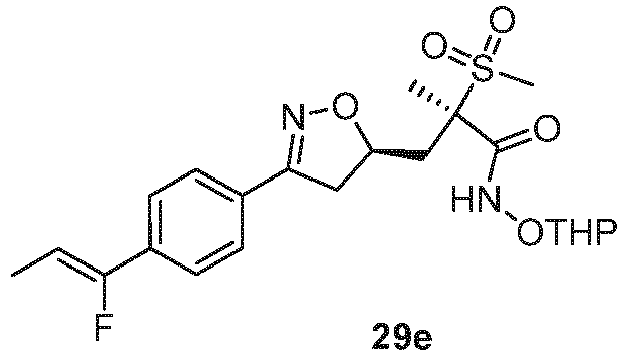
- 29d (0.075 g, 0.2 mmol, 1.0 equiv) was added in THF (5 mL). N-methyl morpholine (0.1 g, 1.01 mmol, 5.0 equiv), HOBT (0.033 g, 0.24 mmol, 1.2 equiv), O-(tetrahydro-2H-pyran-2-yl) hydroxylamine (0.047 g, 0.41 mmol, 2.0 equiv) were added and the reaction mixture was stirred at room temperature for 5 minutes. EDC.HCl (0.058 g, 0.3 mmol, 1.5 equiv) was added and the reaction mixture was stirred at room temperature for 6 hours. The reaction mixture was quenched with water and extracted with EtOAc. The organic layer was washed with brine, dried over sodium sulfate and concentrated to afford crude residue. The crude residue was purified by silica gel column chromatography (40 % EtOAc/Hexane) to afford product 29e (0.09 g, 94.7 % yield). LCMS (m/z): 385.3 [M-THP]. 1H NMR (400 MHz, DMSO) δ 11.47 (s, 1H), 7.87 - 7.53 (m, 4H), 5.88 (dd, J = 39.2, 7.1 Hz, 1H), 4.98 (d, J = 9.1 Hz, 1H), 4.68 (s, 1H), 4.09 - 3.97 (m, 1H), 3.58 (ddd, J = 28.7, 16.3, 11.2 Hz, 2H), 3.21 - 3.12 (m, 3H), 2.68 (dd, J = 8.3, 6.4 Hz, 1H), 2.09 (t, J = 6.0 Hz, 1H), 1.74 - 1.65 (m, 3H), 1.62 (d, J = 4.3 Hz, 3H), 1.55 (s, 3H), 1.27 - 1.20 (m, 3H).
-

- 29e (0.09 g, 0.19 mmol, 1.0 equiv) was dissolved in dichloromethane (4 mL) and methanol (1 mL). 10% HCl (in IPA) (0.1 mL) was added and the reaction mixture was stirred at room temperature for 2 hours. The reaction mixture was concentrated under reduced pressure, triturated with diethyl ether and n-pentane, the solvent was decanted to afford crude residue. The crude residue was purified by preparative HPLC purification to afford product 29 as Z-isomer (0.022 g, 30 % yield). LCMS (m/z): 385.3 [M+H]. 1H NMR (400 MHz, DMSO) δ 11.27 - 10.76 (m, 1H), 9.85 - 9.32 (m, 1H), 7.68 (d, J = 8.4 Hz, 2H), 7.65 - 7.56 (m, 2H), 5.88 (dq, J = 39.3, 7.0 Hz, 1H), 4.70 - 4.59 (m, 1H), 3.58 (dd, J = 16.9, 10.4 Hz, 1H), 3.16 (dd, J = 17.1, 8.0 Hz, 1H), 3.05 (d, J = 14.1 Hz, 3H), 2.65 (dd, J = 13.9, 3.4 Hz, 1H), 2.04 (dd, J = 14.0, 8.3 Hz, 1H), 1.78 (dd, J = 7.1, 2.2 Hz, 3H), 1.58 (s, 3H).
-

-

- (R)-1d-A (0.2 g, 0.48 mmol, 1.0 equiv) was dissolved in 1, 4-dioxane (5 mL). 4, 4, 5, 5-Tetramethyl-2-vinyl-1, 3, 2-dioxaborolane (0.1 g, 0.62 mmol, 1.3 equiv), Cs2CO3 (0.47 g, 1.43 mmol, 3.0 equiv) were added and the reaction mixture was degassed for 15 minutes. PdCl2(dppf) (0.025 g, 0.033 mmol, 0.07 equiv) was added and the reaction mixture was stirred at 100 °C for 24 hours. The reaction mixture was quenched with water and extracted with EtOAc. The organic layer was washed with brine, dried over sodium sulfate and concentrated to afford the desired product 31 (0.16 g, 94 % yield). LCMS (m/z): 366.3 [M+H]+. 1H NMR (400 MHz, DMSO) δ 7.60 (dd, J = 28.7, 8.3 Hz, 4H), 6.78 (dd, J = 17.8, 10.9 Hz, 1H), 5.94 (d, J = 17.7 Hz, 1H), 5.35 (d, J = 11.0 Hz, 1H), 4.75 (d, J = 8.1 Hz, 1H), 4.33 - 4.16 (m, 2H), 3.67 - 3.55 (m, 1H), 3.31 - 2.98 (m, 4H), 2.60 (d, J = 11.2 Hz, 1H), 2.19 (dd, J = 14.4, 8.5 Hz, 1H), 1.64 (s, 3H), 1.26 (t, J = 7.1 Hz, 3H).
-
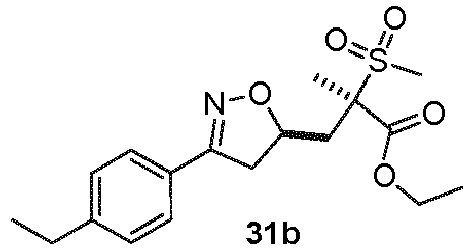
- 31a (0.16 g, 0.45 mmol, 1.0 equiv) was dissolved in methanol (5 mL). Pd/C (0.02 g) was added to the solution and the H2 (gas) was purged into the reaction mixture at room temperature for 50 minutes. The reaction mixture was filtered through celite bed and the filtrate was concentrated to afford a crude residue. The crude residue was purified by silica gel column chromatography (20 % EtOAc/Hexane) to afford the desired product 31b (0.13 g, 78 % yield). LCMS (m/z): 368.4 [M+H]+. 1H NMR (400 MHz, DMSO) δ 7.58 (d, J = 8.2 Hz, 2H), 7.31 (d, J = 8.2 Hz, 2H), 4.72 (d, J = 7.7 Hz, 1H), 4.27 (q, J = 7.1 Hz, 2H), 3.60 (dd, J = 16.9, 10.2 Hz, 1H), 3.21 - 3.11 (m, 4H), 2.64 (dd, J = 15.3, 7.8 Hz, 3H), 2.17 (dd, J = 14.3, 8.4 Hz, 1H), 1.64 (s, 3H), 1.26 (d, J = 1.9 Hz, 3H), 1.19 (t, J = 7.6 Hz, 3H).
- Ethyl ester 31b was converted to compound 31 by the procedures described for the synthesis of 2-A. LCMS (m/z): 355.2 [M+H]+. 1H NMR (400 MHz, DMSO) δ 11.06 (s, 1H), 9.29 (s, 1H), 7.57 (d, J = 7.8 Hz, 2H), 7.31 (d, J = 8.0 Hz, 2H), 4.60 (s, 1H), 3.56 (dd, J = 17.1, 10.3 Hz, 1H), 3.20 - 3.10 (m, 1H), 3.07 (s, 3H), 2.64 (dd, J = 14.8, 7.7 Hz, 3H), 2.03 (dd, J = 13.4, 8.8 Hz, 1H), 1.59 (s, 3H), 1.20 (dd, J = 17.7, 10.2 Hz, 3H).
-

- Compound 101 was synthesized by the process of example 31. LCMS (m/z): 373.1 [M+H]+. 1H NMR (400 MHz, CD3CN) 1.23 (t, J=7.56 Hz, 3 H) 1.69 (s, 3 H) 2.22 (dd, J=14.18, 8.66 Hz, 1 H) 2.55 - 2.81 (m, 3 H) 3.01 (s, 3 H) 3.11(dd, J=16.92, 8.36 Hz, 1 H) 3.54 (dd, J=16.92, 10.37 Hz, 1 H) 4.56 - 4.87 (m, 1 H) 7.19 - 7.47 (m, 3 H)
-

- Compound 120 was synthesized by the process of example 31. LCMS (m/z): 373.0 [M+H]+. 1H NMR (400 MHz, CD3CN) 1.24 (t, J=7.63 Hz, 3 H) 1.96 (dt, J=4.69, 2.35 Hz, 4 H) 2.17 (dd, J=13.89, 3.72 Hz, 1 H) 2.63 - 2.82 (m, 4 H)3.01 (s, 3 H) 3.19 (ddd, J=17.22, 7.43, 1.96 Hz, 1 H) 3.61 (ddd, J=17.22, 10.17, 1.96 Hz, 1 H) 4.86 (dt, J=7.14, 3.28 Hz, 1 H) 6.94 - 7.23 (m, 2 H) 7.68 (t, J=8.02 Hz, 1 H) 9.35 - 9.67 (m, 1 H)
-

-

- K2CO3 (0.07 g, 0.48 mmol, 1.0 equiv) was dissolved in xylene (4 mL) and cooled to 0 °C. Ethanethiol (0.15 g, 2.39 mmol, 5.0 equiv) was added drop wise and the reaction mixture was stirred at room temperature for 1 hour. (R)-1d-A (0.2 g, 0.48 mmol, 1.0 equiv), Pd2(dba)3 (0.022 g, 0.024 mmol, 0.05 equiv), xantphos (0.028 g, 0.048 mmol, 0.1 equiv) were added in xylene (8 mL). The reaction mixture was stirred at room temperature for 20 minutes. This solution was added to above potassium thiolate and the reaction mixture was stirred at reflux temperature for 24 hours. The reaction mixture was quenched with water and extracted with EtOAc. The organic layer was washed with brine, dried over sodium sulfate and concentrated to afford a crude residue. The crude residue was purified by silica gel column chromatography (60 % EtOAc/Hexane) to afford the desired product 32a (0.17 g, 86.2 % yield). LCMS (m/z): 400.4 [M+H]+. 1H NMR (400 MHz, DMSO) δ 7.60 (t, J = 8.6 Hz, 2H), 7.37 (d, J = 8.6 Hz, 2H), 4.73 (dd, J = 15.3, 8.0 Hz, 1H), 4.27 (q, J = 7.1 Hz, 2H), 3.59 (dd, J = 16.9, 10.3 Hz, 1H), 3.20 - 3.11 (m, 4H), 3.07 - 3.00 (m, 2H), 2.59 (dd, J = 14.4, 3.2 Hz, 1H), 2.21 (dd, J = 10.1, 5.4 Hz, 1H), 1.63 (s, 3H), 1.27 (dd, J = 7.2, 1.1 Hz, 3H).
-

- Ethyl ester 32a was converted to compound 31 by the procedures described for the synthesis of 2-A. LCMS (m/z): 387.4 [M+H]+. 1H NMR (400 MHz, DMSO) δ 11.00 (s, 1H), 9.28 (s, 1H), 7.58 (d, J = 8.4 Hz, 2H), 7.37 (d, J = 8.5 Hz, 2H), 4.62 (d, J = 7.2 Hz, 1H), 3.55 (dd, J = 17.0, 10.3 Hz, 1H), 3.12 (dd, J = 17.0, 8.0 Hz, 1H), 3.04 (dd, J = 13.9, 6.6 Hz, 5H), 2.65 (dd, J = 14.0, 3.1 Hz, 1H), 2.08 - 1.99 (m, 1H), 1.59 (s, 3H), 1.26 (t, J = 7.3 Hz, 3H).
-

-

- (R)-1d-A (0.3 g, 0.72 mmol, 1.0 equiv) was dissolved in diethyl amine: N, N-dimethylformamide (5:1) (20 mL). Cul (0.013 g, 0.071 mmol, 0.1 equiv), triphenylphosphine (0.037 g, 0.14 mmol, 0.2 equiv) were added and the reaction mixture was degassed for 15 minutes. PdCl2(pph3)2 (0.024 g, 0.035 mmol, 0.05 equiv), prop-2-yn-1-ol (0.06 g, 1.07 mmol, 1.5 equiv) were added and the reaction mixture was stirred at 120 °C for 24 hours. The reaction mixture was quenched with water and extracted with EtOAc. The organic layer was washed with brine, dried over sodium sulfate and concentrated to afford a crude residue. The crude residue was purified by silica gel column chromatography (65-70 % EtOAc/Hexane) to afford product 33a (0.27 g, 87.1 % yield). LCMS (m/z): 394.4 [M+H]+. 1H NMR (400 MHz, DMSO) δ 7.66 (d, J = 8.2 Hz, 2H), 7.51 (d, J = 8.2 Hz, 2H), 5.39 (t, J = 6.0 Hz, 1H), 4.78 (s, 1H), 4.33 (d, J = 6.0 Hz, 1H), 4.27 (d, J = 7.1 Hz, 1H), 3.61 (s, 1H), 3.27 - 3.07 (m, 4H), 2.61 (s, 1H), 2.19 (dd, J = 14.5, 8.5 Hz, 1H), 1.64 (s, 3H), 1.26 (t, J = 7.1 Hz, 3H).
-
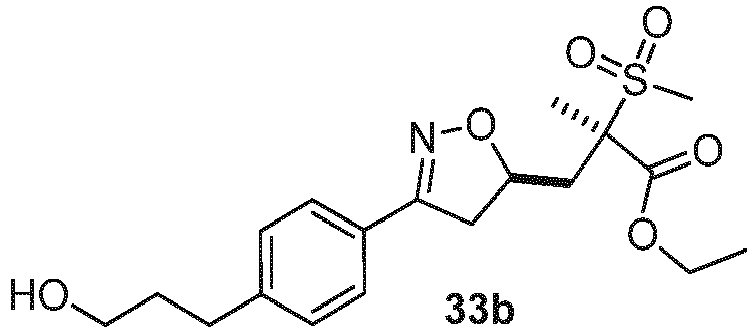
- 33a (0.27 g, 0.68 mmol, 1.0 equiv) was dissolved in methanol (10 mL). Pd/C (10%) (0.027 g) was added to the solution and the H2 (gas) was purged into the reaction mixture at room temperature for 1 hour. The reaction mixture was filtered through celite bed, washed with methanol and the filtrate was concentrated to afford the desired product 33b (0.2 g, 73.5 % yield). LCMS (m/z): 398.5 [M+H]+. 1H NMR (400 MHz, DMSO) δ 7.58 (s, 2H), 7.29 (d, J = 8.2 Hz, 2H), 4.79 - 4.69 (m, 1H), 4.51 (s, 1H), 4.27 (q, J = 7.1 Hz, 2H), 3.60 (dd, J = 16.9, 10.3 Hz, 1H), 3.41 (dd, J = 10.4, 6.1 Hz, 2H), 3.18 - 3.16 (m, 1H), 3.14 (s, 3H), 2.68 - 2.62 (m, 2H), 2.59 (dd, J = 14.6, 3.4 Hz, 1H), 2.17 (dd, J = 14.4, 8.5 Hz, 1H), 1.77 - 1.67 (m, 2H), 1.64 (s, 3H), 1.26 (t, J = 7.1 Hz, 3H).
-

- 33b (0.15 g, 0.38 mmol, 1.0 equiv) was dissolved in dichloromethane (18 mL) and cooled to -78 °C. DAST (0.12 g, 0.75 mmol, 2.0 equiv) was added drop wise and the reaction mixture was stirred at room temperature for 3 hours. The reaction mixture was quenched with saturated aqueous sodium bicarbonate solution and extracted with EtOAc. The organic layer was washed with brine, dried over sodium sulfate and concentrated to afford a crude residue. The crude residue was purified by silica gel column chromatography (30-35 % EtOAc/Hexane) to afford the desired product 33c (0.1 g, 49.8 % yield). LCMS (m/z): 400.4 [M+H]+. 1H NMR (400 MHz, DMSO) δ 7.59 (d, J = 8.3 Hz, 2H), 7.32 (d, J = 8.3 Hz, 2H), 4.73 (d, J = 7.5 Hz, 1H), 4.51 (t, J = 6.0 Hz, 1H), 4.39 (t, J = 6.0 Hz, 1H), 4.27 (q, J = 7.1 Hz, 2H), 3.65 - 3.55 (m, 1H), 3.21 - 3.09 (m, 4H), 2.74 - 2.69 (m, 1H), 2.59 (d, J = 14.7 Hz, 2H), 2.18 (dt, J = 15.8, 6.5 Hz, 2H), 2.00 (d, J = 5.8 Hz, 1H), 1.64 (s, 3H), 1.26 (dd, J = 8.7, 5.5 Hz, 3H).
- Ethyl ester 33ca was converted to compound 33 by the procedures described for the synthesis of 2-A. LCMS (m/z): 387.5 [M+H]+. 1H NMR (400 MHz, DMSO) δ 11.15 - 10.72 (m, 1H), 9.51 - 9.09 (m, 1H), 7.58 (d, J = 7.8 Hz, 2H), 7.32 (d, J = 7.7 Hz, 2H), 4.63 (s, 1H), 4.51 (t, J = 5.7 Hz, 1H), 4.40 (t, J = 6.0 Hz, 1H), 3.55 (dd, J = 17.1, 10.0 Hz, 1H), 3.20 - 3.11 (m, 1H), 3.07 (s, 3H), 2.76 - 2.69 (m, 2H), 2.65 (d, J = 14.9 Hz, 1H), 2.00 (dd, J = 29.9, 21.4 Hz, 3H), 1.58 (s, 3H).
-

- Compound 34 was synthesized by the process of example 33. LCMS (m/z): 401.4 [M+H]+. 1H NMR (400 MHz, DMSO) δ 11.06 (s, 1H), 9.29 (s, 1H), 7.57 (d, J = 7.8 Hz, 2H), 7.30 (d, J = 8.0 Hz, 2H), 4.60 (s, 1H), 4.52 (s, 1H), 4.40 (s, 1H), 3.55 (s, 1H), 3.19 - 3.00 (m, 4H), 2.65 (d, J = 6.6 Hz, 3H), 2.08 - 1.98 (m, 1H), 1.63 (d, J = 31.6 Hz, 7H).
-

- 39A (0.065 g, 21.9 % yield). LCMS (m/z): 463.6 [M+H]+. 1H NMR (400 MHz, DMSO) δ 11.07 (s, 1H), 9.29 (s, 1H), 7.62 (d, J = 8.4 Hz, 2H), 7.47 (d, J = 8.4 Hz, 2H), 4.64 (d, J = 6.7 Hz, 1H), 4.25 (s, 1H), 3.62 - 3.51 (m, 1H), 3.19 - 3.09 (m, 2H), 3.07 (s, 3H), 2.66 (d, J = 13.5 Hz, 1H), 2.46 (d, J = 8.0 Hz, 1H), 2.37 (dd, J = 18.1, 8.3 Hz, 2H), 2.08 - 1.95 (m, 3H), 1.59 (s, 3H), 1.01 (s, 6H). 39B (0.055 g, 18.6 % yield). LCMS (m/z): 463.6 [M+H]+. 1H NMR (400 MHz, DMSO) δ 11.21 - 10.94 (m, 1H), 9.45 - 9.16 (m, 1H), 7.61 (d, J = 8.4 Hz, 2H), 7.44 (d, J = 8.3 Hz, 2H), 4.63 (s, 1H), 4.23 (s, 1H), 3.56 (dd, J = 17.1, 10.5 Hz, 1H), 3.14 (dd, J = 17.2, 7.8 Hz, 1H), 3.06 (s, 3H), 3.02 (d, J = 8.2 Hz, 1H), 2.65 (d, J = 14.6 Hz, 1H), 2.16 (s, 1H), 2.15 (d, J = 5.9 Hz, 3H), 2.11 - 2.00 (m, 3H), 1.58 (s, 3H), 0.97 (s, 6H).
- Compounds 40-122 was synthesized by one of the following methods. Method A.
-

-

- To a mixture of (R)-benzyl 3-((R)-3-(4-bromophenyl)-4,5-dihydroisoxazol-5-yl)-2-methyl-2-(methylsulfonyl)propanoate (91a, 70 mg, 0.146 mmol) and thiophen-3-ylboronic acid (37.3 mg, 0.291 mmol) in DME (2 mL) was added PdCl2(dppf).CH2Cl2 adduct (11.90 mg, 0.015 mmol), followed by Na2CO3 (46.3 mg, 0.437 mmol) and water (0.5 mL). The resultant mixture was sealed and was stirred at 110 °C for 10 min using microwave reactor. The reaction mixture was diluted with EtOAc. The organic layer was separated, dried over Na2SO4, and concentrated. The crude residue was purified byu silica gel column chromatography (EtOAc/heptane, 10 to 80%) to give product 91b (29 mg, 41.2 % yield). LCMS: m/e: 484.3 [M+H]+.
-

- Compound 91 could be synthesized from 91a by the procedure of 2-A or by the following one step procedure.
- To a mixture of 91a and NH2OH (0.091 mL, 50% in water, 2.89 mmol) in THF (0.15 mL) and MeOH (0.30 mL) was added NaOH (23.16 mg, 0.579 mmol). The resultant mixture was stirred at rt for 1 hour. The mixture was purified on reverse phase HPLC to afford product 91 (9 mg, 0.021 mmol, 36.5 % yield). LCMS: m/e: 409.3 [M+H]+, 1H NMR (400 MHz, DMSO) 1.58 (s, 4 H) 1.93 - 2.14 (m, 2 H) 2.59 - 2.74 (m, 2 H) 3.05 (s, 3 H) 3.09 - 3.23 (m, 2 H) 3.49 - 3.67 (m, 1 H) 4.50 - 4.80 (m, 2 H) 7.66 (d, J=7.68 Hz, 4 H) 7.80 (s, 2 H) 7.88 - 8.08 (m, 1 H) 9.14 - 9.39 (m, 1 H) 10.84 - 11.19 (m, 1 H)
-

-

- A solution of 91a (140 mg, 0.29 mmol, 1.0 equiv), pinacol diboron (81 mg, 0.32 mmol, 1.1 equiv) and potassium acetate (86 mg, 0.87 mmol, 3.0 equiv) in 1, 4-dioxane (1.5 mL) was degassed for 5 minutes. PdCl2(dppf).CH2Cl2 (12 mg, 0.015 mmol, 0.05 equiv) was added to the reaction mixture. The resulting reaction mixture was stirred at 100 °C for 2 hours. The reaction mixture was quenched with water and extracted with EtOAc. The organic layer was washed with brine, dried over sodium sulfate and concentrated. The residue was purified by silica gel column chromatography (20-75 % EtOAc in Hexane) to afford 81a (145 mg, 94 % yield). LCMS (m/z): 528.3 [M+H]+. 1H NMR (400 MHz, Chloroform-d) 7.82 (d, J = 8.2 Hz, 2H), 7.57 (d, J = 8.2 Hz, 2H), 7.42 - 7.34 (m, 5H), 5.32 (d, J = 12.1 Hz, 1H), 5.27 (d, J = 12.1 Hz, 1H), 4.79 (qd, J = 8.3, 3.5 Hz, 1H), 3.39 (dd, J = 16.7, 10.3 Hz, 1H), 3.01 - 2.95 (m, 1H), 2.97 (s, 3H), 2.61 (dd, J = 14.2, 3.4 Hz, 1H), 2.41 (dd, J = 14.2, 8.4 Hz, 1H), 1.55 (s, 3H), 1.35 (s, 12H).
-

- 81a (60 mg, 0.114 mmol, 1.0 equiv), 2-(4-bromopyridin-2-yl)propan-2-ol (0.32 mmol, 1.2 equiv) and potassium acetate (60 mg, 0.284 mmol, 2.5 equiv) were dissolved in THF (0.6 mL)/H2O (0.3 mL) and degassed for 5 minutes. PdCl2(dppf).CH2Cl2 (10 mg, 0.012 mmol, 0.1 equiv) was added to the reaction mixture. The resulting reaction mixture was stirred at 65 °C overnight. The reaction mixture was quenched with water and extracted with EtOAc. The organic layer was washed with brine, dried over sodium sulfate and concentrated. The residue was purified by silica gel column chromatography (25-100 % EtOAc in Hexane) to give product (32 mg, 52% yield). LCMS (m/z): 537.3 [M+H]+.
-

- Compound 81 was synthesized from 81b by the procedure described for the synthesis of 91 step 2. LCMS (m/z): 462.2 [M+H]+. 1H NMR (400 MHz, DMSO-d 6) 11.04 (s, 1H), 8.63 (d, J = 5.4 Hz, 1H), 8.20 - 8.12 (m, 1H), 7.99 (d, J = 7.7 Hz, 2H), 7.82 (d, J = 8.4 Hz, 2H), 4.76 - 4.61 (m, 1H), 3.63 (dd, J = 17.0, 10.4 Hz, 1H), 3.20 (dd, J = 17.1, 8.1 Hz, 1H), 3.05 (s, 3H), 2.72 - 2.63 (m, 1H), 2.06 (dd, J = 13.8, 8.6 Hz, 1H), 1.59 (s, 3H), 1.55 (s, 6H).
-

- Compound 67a was synthesized from 91a by the procedures described in the synthesis of 2-A. A mixture 67a (40 mg, 0.082 mmol), (6-methylpyridin-3-yl)boronic acid (22.39 mg, 0.163 mmol), PdCl2(dppf).CH2Cl2 adduct (6.67 mg, 8.17 µmol) and Na2CO3 (26.0 mg, 0.245 mmol) in DME (3 mL) was stirred at 110 °C for 15 min using microwave reactor. The reaction mixture was diluted water (10 ml) and extracted with EtOAc. The organic layer was washed with water. dried on Na2SO4, filtered, and concentrated. The crude material was dissolved in MeOH (5.0 mL) followed by 4.0 N HCl in dioxane (1.0 mL). The resultant mixture was stirred for 25 min and then was concentrated. The residue was purified by reverse phase HPLC to give product 67 (22 mg, 61.2 % yield). LCMS (m/z): 418.1 [M+H]+. 1H NMR (400 MHz, DMSO-d6) ppm 1.50 - 1.67 (m, 3 H) 2.05 (dd, J=13.99, 8.41 Hz, 1 H) 2.59 - 2.74 (m, 4 H) 2.99 - 3.10 (m, 3 H) 3.18 (dd, J=17.07, 8.12 Hz, 2 H) 3.61 (dd, J=16.99, 10.39 Hz, 3 H) 4.66 (d, J=7.09 Hz, 2 H) 7.64 - 7.97 (m, 5 H) 8.43 (d, J=7.63 Hz, 1 H) 8.99 (d, J=1.61 Hz, 1 H) 11.04 (br. s., 1 H)
-

- Compound 40 was synthesized by method A. LCMS (m/z): 447.4 [M+H]+. 1H NMR (400 MHz, DMS0-d6) ppm 1. 59 (s, 3 H) 1. 89 - 2. 14 (m, 1 H) 2. 59 - 2. 71 (m, 1 H) 2. 75 (t, J=6.94 Hz, 2 H) 3.05 (s, 3 H) 3. 18 (d, J=8. 17Hz, 1 H) 3.47 - 3.73 (m, 3 H) 4.64 (br. s., 2 H) 7.31 (d, J=8. 12 Hz, 2 H) 7.61 (d, J=8. 12 Hz, 2 H) 7.65 - 7.80 (m, 4 H) 9.25 (s, 1 H) 11.03 (s, 1 H)
-

- Compound 41 was synthesized by method A. LCMS (m/z): 433.4 [M+H]+. 1H NMR (400 MHz, DMS0-d6) ppm 1. 59 (s, 3 H) 2.05 (dd, J=14.06, 8. 34 Hz, 1 H) 2.66 (dd, J=14.06, 3.35 Hz, 1 H) 3.05 (s, 3 H) 3. 16 (dd, J=17. 04, 8.09 Hz, 1 H) 3.59 (dd, J=16. 95, 10.29 Hz, 1 H) 4.53 (s, 2 H) 4.63 (dd, J=10.27, 3.13 Hz, 1 H) 5.07 - 5.42 (m, 1 H) 7.41 (d, J=8.12 Hz, 2H) 7.61 - 7.84 (m, 6 H) 9.26 (s, 1 H) 11.04 (s, 1 H)
-

- Compound 42 was synthesized by method A. LCMS (m/z): 422.2 [M+H]+. 1H NMR (400 MHz, DMSO-d 6) 11.05 (s, 1H), 8.69 (d, J = 2.6 Hz, 1H), 8.54 (d, J = 5.6 Hz, 1H), 7.84 - 7.76 (m, 4H), 7.69 (dd, J = 7.0, 5.0 Hz, 1H), 4.68 (ddt, J = 11.8, 8.6, 3.7 Hz, 1H), 3.63 (dd, J = 17.0, 10.4 Hz, 1H), 3.20 (dd, J = 17.1, 8.2 Hz, 1H), 3.06 (s, 3H), 2.76 - 2.66 (m, 1H), 2.13 - 2.04 (m, 1H), 1.61 (s, 3H).
-
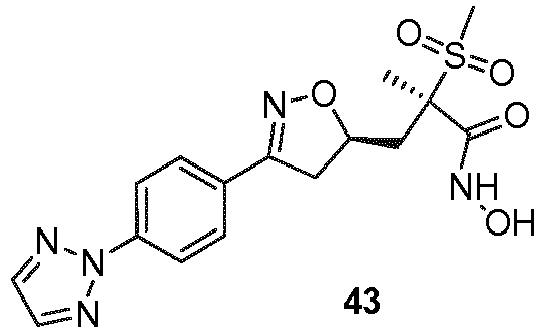
- LCMS (m/z): 394.3 [M+H]+. 1H NMR (400 MHz, DMSO-d 6) 11.04 (s, 1H), 9.26 (s, 1H), 8.16 (s, 2H), 8.10 (d, J = 8.7 Hz, 2H), 7.83 (d, J = 8.7 Hz, 2H), 4.64 (dd, J = 13.4, 5.3 Hz, 1H), 3.61 (dd, J = 17.0, 10.4 Hz, 1H), 3.20 (dd, J = 17.1, 8.2 Hz, 1H), 3.05 (s, 3H), 2.71 - 2.64 (m, 1H), 2.05 (dd, J = 14.0, 8.5 Hz, 1H), 1.59 (s, 3H).
-

- Compound 45 was synthesized by method A. LCMS (m/z): 461.3 [M+H]+. 1H NMR (400 MHz, DMS0-d6) ppm 1.04 (d, J=6.11 Hz, 3 H) 1.59 (s, 3 H) 1.95 - 2.16 (m, 1 H) 2.68 (s, 3 H) 3.05 (s, 3 H) 3.12 - 3.22 (m, 2 H) 3.51 - 3.69 (m, 2 H) 3.73 - 3.93 (m, 1 H) 4.48 - 4.71 (m, 1 H) 7.29 (d, J=8.17 Hz, 2 H) 7.53 - 7.82 (m, 6 H) 11.03 (s, 1 H)
-

- Compound 46 was synthesized by method A. LCMS (m/z): 461.3 [M+H]+. 1H NMR (400 MHz, DMS0-d6) ppm 1.04 (d, J=6.11 Hz, 3 H) 1.59 (s, 3 H) 2.05 (dd, J=14. 18, 8.22 Hz, 1 H) 2.54 - 2.76 (m, 3 H) 2.97 - 3.08 (m, 3H) 3.16 (dd, J=17.02, 8.12 Hz, 1 H) 3.59 (dd, J=16. 92, 10.27 Hz, 7 H) 3.77 - 3.93 (m, 2 H) 4.51 - 4.74 (m, 1 H) 7.29 (d, J=8.12 Hz, 2 H) 7.54 - 7.82 (m, 6 H) 11.04 (br. s., 1 H)
-

- Compound 47 was synthesized by method C. LCMS (m/z): 502.5 [M+H]+. 1H NMR (400 MHz, DMS0-d6) ppm 1. 59 (s, 3 H) 1. 93 - 2. 16 (m, 1 H) 2. 60 - 2. 74 (m, 1 H) 3. 05 (s, 3 H) 3.08 - 3.22 (m, 4 H) 3.54 - 3.70 (m, 3 H) 3.84 - 4.05 (m, 2 H) 4.39 (br. s., 2 H) 4.56 - 4.78 (m, 1 H) 7.43 - 7.97 (m, 8 H) 9.06 - 9.38 (m, 1 H) 9.69 - 10.06 (m, 1 H) 11.04 (s, 1 H)
-

- Compound 48 was synthesized by method C. LCMS (m/z): 477.4 [M+H]+. 1H NMR (400 MHz, DMS0-d6) ppm 1. 59 (s, 3 H) 2. 06 (d, J=8.41 Hz, 1 H) 2.65 (br. s., 1 H) 3. 05 (s, 3 H) 3.15 (dd, J=17.04, 8.09 Hz, 1 H) 3.52 - 3.63 (m, 1 H) 3.63 - 3.72 (m, 2 H) 4.05 - 4.24 (m, 2 H) 4.49 - 4.76 (m, 1 H) 7.03 (d, J=8.75 Hz, 2 H) 7.47 - 7.81 (m, 6 H) 9. 08 - 9. 41 (m, 1 H) 11. 03 (s, 1 H)
-

- Compound 49 was synthesized by method C. LCMS (m/z): 447.3 [M+H]+. 1H NMR (400 MHz, DMS0-d6) ppm 1.19 - 1.40 (m, 3 H) 1.50 - 1.66 (m, 3 H) 1.93 - 2.13 (m, 1 H) 2.57 - 2.77 (m, 2 H) 3.05 (s, 3 H) 3.10 - 3.24 (m, 2 H) 3.50 - 3.74 (m, 1 H) 4.52 - 4.68 (m, 1 H) 4.69 - 4.85 (m, 1 H) 4.99 - 5.38 (m, 1 H) 7.30 - 7.54 (m, 2 H) 7.58 - 7.90 (m, 5 H) 9.02 - 9.48 (m, 1H) 10.92 - 11.17 (m, 1 H)
-

- Compound 50 was synthesized by method C. LCMS (m/z): 463.4 [M+H]+. 1H NMR (400 MHz, DMS0-d6) ppm 1. 59 (s, 3 H) 2.04 (dd, J=14.04, 8. 36 Hz, 1 H) 2.66 (dd, J=13.96, 3.35 Hz, 1 H) 3.05 (s, 3 H) 3. 15 (dd, J=16. 99, 8. 14 Hz, 2 H) 3.58 (dd, J=16. 97, 10.32 Hz, 2 H) 3.72 (t, J=4.96 Hz, 2 H) 4.02 (t, J=4.99 Hz, 2 H) 4.46 - 4.72 (m, 1 H) 7.03 (d, J=8.80 Hz, 2 H) 7.59 - 7.79 (m, 6 H) 11.03 (s, 1 H)
-

- Compound 51 was synthesized by method A. LCMS (m/z): 491.2 [M+H]+. 1H NMR (400 MHz, DMSO-d 6) 11.06 (s, 1H), 7.76 (d, J = 8.5 Hz, 2H), 7.72 (d, J = 8.5 Hz, 2H), 7.65 (d, J = 8.4 Hz, 2H), 7.55 (d, J = 8.5 Hz, 2H), 4.68 - 4.62 (m, 1H), 3.61 (dd, J = 16.9, 10.3 Hz, 1H), 3.45 - 3.35 (m, 2H), 3.24 (s, 3H), 3.18 (dd, J = 17.0, 8.1 Hz, 1H), 3.07 (s, 3H), 2.68 (dd, J = 14.2, 3.6 Hz, 1H), 2.10 - 2.04 (m, 1H), 1.61 (s, 3H), 1.43 (s, 3H).
-

- Compound 56 was synthesized by method C. LCMS (m/z): 447.3 [M+H]+. 1H NMR (400 MHz, DMS0-d6) ppm 1. 27 - 1. 38 (m, 3 H) 1. 97 - 2. 14 (m, 1 H) 2. 62 - 2. 73 (m, 1 H) 2. 98 - 3.08 (m, 3 H) 3.10 - 3.22 (m, 2 H) 3.51 - 3.67 (m, 2 H) 4.54 - 4.69 (m, 1 H) 4.70 - 4.82 (m, 1 H) 5.08 - 5.29 (m, 1 H) 7.32 - 7.49 (m, 2 H) 7.60 - 7.67 (m, 2 H) 7. 68 - 7. 82 (m, 3 H)
-

- Compound 57 was synthesized by method C. LCMS (m/z): 433.4 [M+H]+. 1H NMR (400 MHz, DMS0-d6) ppm 1. 59 (s, 3 H) 1. 92 - 2. 16 (m, 1 H) 2. 58 - 2. 73 (m, 1 H) 3. 05 (s, 3 H) 3.11 - 3.22 (m, 2 H) 3.48 - 3.59 (m, 1 H) 4.56 (s, 2 H) 4.59 - 4.72 (m, 1 H) 7.24 - 7.37 (m, 1 H) 7.37 - 7.49 (m, 1 H) 7.73 (d, J=4.11 Hz, 6 H) 10.88 - 11.18 (m, 1 H)
-

- Compound 58 was synthesized by method C. LCMS (m/z): 481.4 [M+H]+. 1H NMR (400 MHz, DMS0-d6) ppm 1. 51 - 1. 68 (m, 3 H) 1. 90 - 2. 18 (m, 2 H) 2. 59 - 2. 78 (m, 2 H) 3. 05 (s, 3 H) 3.10 - 3.20 (m, 1 H) 3.25 (s, 4 H) 3.53 - 3.74 (m, 1 H) 4.54 - 4.79 (m, 1 H) 7.70 - 7.82 (m, 2 H) 7.82 - 7.90 (m, 2 H) 7.92 - 8.12 (m, 4 H) 9.12 - 9.37 (m, 1 H) 10.93 - 11. 13 (m, 1 H)
-

- Compound 59 was synthesized by method C. LCMS (m/z): 451.4 [M+H]+. 1H NMR (400 MHz, DMS0-d6) ppm 1. 44 - 1. 66 (m, 3 H) 2.05 (dd, J=14. 06, 8.34 Hz, 1 H) 2.40 - 2.53 (m, 4 H) 2.66 (dd, J=14.04, 3.33 Hz, 27H) 2.99 - 3.07 (m, 2 H) 3.16 (dd, J=17.02, 8.12 Hz, 1 H) 3.59 (dd, J=16.97, 10.27 Hz, 1 H) 3.74 - 3.87 (m, 2 H) 4.63 (dd, J=10. 17, 3.28 Hz, 1H) 6.80 - 7.05 (m, 2 H) 7.42 - 7.77 (m, 6 H) 9.01 - 9.09 (m, 1 H) 11.04 (s, 1 H)
-

- Compound 60 was synthesized by method A. LCMS (m/z): 491.3 [M+H]+. 1H NMR (400 MHz, DMSO-d 6) 11.06 (s, 1H), 9.29 (s, 1H), 7.75 (d, J = 8.5 Hz, 2H), 7.72 (d, J = 8.5 Hz, 2H), 7.62 (d, J = 8.2 Hz, 2H), 7.32 (d, J = 8.2 Hz, 2H), 4.69 - 4.62 (m, 1H), 3.81 (dd, J = 7.7, 5.0 Hz, 1H), 3.60 (dd, J = 17.0, 10.4 Hz, 1H), 3.27 (s, 3H), 3.26 - 3.23 (m, 2H), 3.18 (dd, J = 17.0, 8.1 Hz, 1H), 3.07 (s, 3H), 2.78 (dd, J = 13.6, 4.7 Hz, 1H), 2.68 (d, J = 14.1 Hz, 1H), 2.61 (dd, J = 13.6, 7.7 Hz, 1H), 2.09 - 2.03 (m, 2H), 1.60 (s, 3H).
-

- Compound 61 was synthesized by method C. LCMS (m/z): 477.1 [M+H]+. 1H NMR (400 MHz, DMS0-d6) ppm 1. 15 (d, J=6.26 Hz, 3 H) 1. 59 (s, 3 H) 1.93 - 2. 14 (m, 1 H) 2.54 - 2.74 (m, 1 H) 3.05 (s, 3 H) 3.09 - 3.24 (m, 2H) 3.49 - 3.67 (m, 1 H) 3.75 - 3.89 (m, 2 H) 3.89 - 4.03 (m, 1 H) 4.52 - 4.76 (m, 1 H) 7.02 (d, J=8.75 Hz, 2 H) 7.49 - 7.81 (m, 6 H) 9.02 - 9.42 (m, 1H) 10.85 - 11.19 (m, 1 H)
-

- Compound 62 was synthesized by method C. LCMS (m/z): 379.3 [M+H]+. 1H NMR (400 MHz, DMSO-d 6) 11.04 (s, 1H), 9.28 - 9.22 (m, 1H), 7.61 (d, J = 8.4 Hz, 2H), 7.45 (d, J = 8.4 Hz, 2H), 4.68 - 4.59 (m, 1H), 3.56 (dd, J = 17.0, 10.4 Hz, 1H), 3.17 - 3.09 (m, 1H), 3.06 (s, 3H), 2.67 - 2.61 (m, 1H), 2.47 - 2.42 (m, 2H), 2.04 (dd, J = 14.1, 8.4 Hz, 1H), 1.59 (s, 3H), 1.17 (t, J = 7.5 Hz, 3H).
-
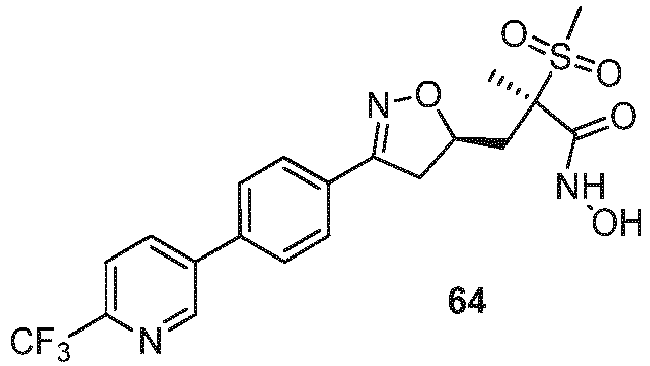
- Compound 64 was synthesized by method A. LCMS (m/z): 472.2 [M+H]+. 1H NMR (400 MHz, DMSO-d 6) 11.06 (s, 1H), 9.28 (s, 1H), 9.16 (s, 1H), 8.44 (d, J = 8.2 Hz, 1H), 8.02 (d, J = 8.3 Hz, 1H), 7.95 (d, J = 8.5 Hz, 2H), 7.82 (d, J = 8.4 Hz, 2H), 4.68 (qd, J = 8.4, 3.4 Hz, 1H), 3.64 (dd, J = 17.0, 10.4 Hz, 1H), 3.21 (dd, J = 17.2, 8.2 Hz, 1H), 3.07 (s, 3H), 2.75 - 2.66 (m, 1H), 2.08 (dd, J = 14.1, 8.4 Hz, 1H), 1.61 (s, 3H).
-

- Compound 65 was synthesized by method C. LCMS (m/z): 434.1 [M+H]+. 1H NMR (400 MHz, DMS0-d6) ppm 1. 59 (s, 3 H) 2.05 (dd, J=14. 01, 8. 39 Hz, 1 H) 2. 56 - 2. 75 (m, 1 H) 2.99 - 3. 10 (m, 3 H) 3. 18 (dd, J=17. 07, 8. 22Hz, 2 H) 3.61 (dd, J=17. 02, 10.42 Hz, 5 H) 4.67 (s, 3 H) 7.68 (d, J=8. 17 Hz, 1 H) 7.76 (d, J=8.36 Hz, 2 H) 7.80 - 7.97 (m, 2 H) 8.31 (d, J=8.12 Hz, 1 H) 8.90 (d, J=2.01 Hz, 1 H) 11.04 (s, 1 H)
-

- Compound 66 was synthesized by method C. LCMS (m/z): 434.0 [M+H]+. 1H NMR (400 MHz, DMS0-d6) ppm 1.59 (s, 3 H) 2.05 (dd, J=14.04, 8.41 Hz, 1 H) 2.66 (dd, J=14.01, 3.45 Hz, 1 H) 3.05 (s, 3 H) 3. 16 (dd, J=17. 04, 8. 14 Hz, 2 H) 3.89 (s, 4 H) 4.63 (d, J=7.14 Hz, 1 H) 6.92 (d, J=8.71 Hz, 1 H) 7.59 - 7.85 (m, 4 H) 8.06 (dd, J=8.66, 2.59 Hz, 1 H) 8.54 (d, J=2. 45 Hz, 1 H) 11.04 (br. s., 1 H)
-

- Compound 68 was synthesized by method C. LCMS (m/z): 434.1 [M+H]+. 1H NMR (400 MHz, DMS0-d6) ppm 1.58 (s, 3 H) 1.92 - 2.15 (m, 1 H) 2.58 - 2.73 (m, 1 H) 3.05 (s, 3 H) 3.15 (dd, J=17.02, 8.12 Hz, 2 H) 4.45 - 4.76 (m, 1 H) 6.48 (d, J=9.44 Hz, 1 H) 7.67 (s, 3 H) 7.87 (dd, J=9.44, 2.64 Hz, 1 H) 8.22 (d, J=2.54 Hz, 1 H) 11.03 (s, 1 H)
-

- Compound 69 was synthesized by method C. LCMS (m/z): 470.1 [M+H]+. 1H NMR (400 MHz, DMS0-d6) ppm 1. 45 - 1. 78 (m, 9 H) 2. 07 (d, J=8. 36 Hz, 1 H) 2. 65 (d, J=2. 64 Hz, 1 H) 3.05 (s, 3 H) 3.10 - 3.25 (m, 2 H) 3.50 - 3.69 (m, 1 H) 4.51 - 4.78 (m, 1 H) 7.61 (d, J=8.46 Hz, 2 H) 7.67 - 7.84 (m, 5 H) 11.04 (s, 1 H)
-

- Compound 70 was synthesized by method C. LCMS (m/z): 472.0 [M+H]+. 1H NMR (400 MHz, DMSO-d6) ppm 1.59 (s, 3 H) 2.06 (dd, J=14.01, 8.39 Hz, 1 H) 2.67 (dd, J=14. 11, 3.30 Hz, 1 H) 3.05 (s, 3 H) 3. 19 (dd, J=17. 12, 8. 17 Hz, 2 H) 3.56 - 3.70 (m, 3 H) 4.67 (d, J=7.09 Hz, 1 H) 7.80 (d, J=8.41 Hz, 2 H) 8.03 (d, J=8.41 Hz, 2 H) 8.09 (d, J=4. 30 Hz, 1 H) 8.23 (s, 1 H) 8.83 (d, J=5. 14 Hz, 1 H) 11.04 (s, 1 H)
-

- Compound 71 was synthesized by method C. LCMS (m/z): 432.1 [M+H]+. 1H NMR (400 MHz, DMSO-d6) ppm 1.16 - 1.39 (m, 2 H) 1.49 - 1.66 (m, 2 H) 2.09 (s, 1 H) 2.65 (br. s., 1 H) 2.85 - 2.99 (m, 2 H) 3.00 - 3.10 (m, 2H) 3.20 (dd, J=17. 22, 8.17 Hz, 2 H) 3.63 (dd, J=16. 99, 10.39 Hz, 2 H) 4.51 - 4.81 (m, 2 H) 7.74 - 8. 13 (m, 4 H) 8.71 (d, J=5.58 Hz, 1 H) 11.05 (s, 1H)
-

- Compound 72 was synthesized by method A. LCMS (m/z): 463.1 [M+H]+. 1H NMR (400 MHz, DMSO-d6) ppm 1. 59 (s, 3 H) 1. 94 - 2. 14 (m, 1 H) 2. 60 - 2. 74 (m, 1 H) 3. 05 (s, 3 H) 3.10 - 3.22 (m, 2 H) 3.41 - 3.51 (m, 2 H) 3.53 - 3.70 (m, 1 H) 4.42 - 4.77 (m, 3 H) 7.27 - 7.50 (m, 2 H) 7.72 (d, J=7.68 Hz, 6 H) 9.11 - 9.35 (m, 1 H) 10.89 - 11. 15 (m, 1 H)
-

- Compound 73 was synthesized by method C. LCMS (m/z): 473.1 [M+H]+. 1H NMR (400 MHz, DMSO-d6) ppm 0.64 - 0.91 (m, 4 H) 1.59 (s, 3 H) 1.92 - 2. 15 (m, 1 H) 2.57 - 2.74 (m, 2 H) 3.05 (s, 3 H) 3.10 - 3.23 (m, 2 H)3.55 (s, 3 H) 4.46 - 4.78 (m, 2 H) 7.38 (d, J=8.31 Hz, 2 H) 7.51 - 7.82 (m, 6 H) 9.05 - 9.42 (m, 1 H) 11.03 (s, 1 H)
-
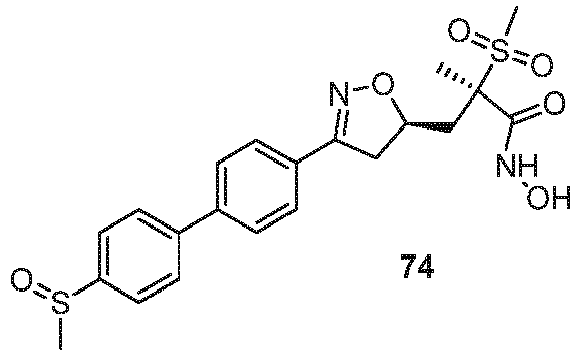
- Compound 74 was synthesized by method A. LCMS (m/z): 465.2 [M+H]+. 1H NMR (400 MHz, DMSO-d 6) 11.07 (s, 1H), 7.94 (d, J = 8.5 Hz, 2H), 7.85 (d, J = 8.6 Hz, 2H), 7.80 (d, J = 8.4 Hz, 2H), 7.77 (d, J = 8.4 Hz, 2H), 4.67 (qd, J = 8.4, 3.8 Hz, 1H), 3.63 (dd, J = 16.9, 10.3 Hz, 1H), 3.20 (dd, J = 17.0, 8.1 Hz, 1H), 3.08 (s, 3H), 2.80 (s, 3H), 2.69 (dd, J = 14.0, 3.5 Hz, 1H), 2.08 (dd, J = 14.0, 8.4 Hz, 1H), 1.62 (s, 3H).
-

- Compound 75 was synthesized by method A. LCMS (m/z): 477.3 [M+H]+. 1H NMR (400 MHz, DMSO-d 6) 1H NMR (500 MHz, DMSO-d 6) 11.06 (s, 1H), 9.29 (s, 1H), 7.77 (d, J = 8.6 Hz, 2H), 7.73 (d, J = 8.6 Hz, 2H), 7.71 (d, J = 8.3 Hz, 2H), 7.40 (d, J = 8.3 Hz, 2H), 4.65 (qd, J = 8.3, 3.5 Hz, 1H), 4.27 - 4.22 (m, 1H), 3.65 - 3.53 (m, 2H), 3.44 (dd, J = 11.4, 4.5 Hz, 1H), 3.21 (s, 3H), 3.22 - 3.14 (m, 1H), 3.07 (s, 3H), 2.68 (dd, J = 14.1, 3.4 Hz, 1H), 2.06 (dd, J = 13.9, 8.3 Hz, 1H), 1.60 (s, 3H).
-

- Compound 76 was synthesized by method A. LCMS (m/z): 480.2 [M+H]+. 1H NMR (500 MHz, DMSO-d 6) 11.08 (s, 1H), 8.15 (d, J = 8.7 Hz, 2H), 8.10 (d, J = 8.8 Hz, 2H), 7.91 (d, J = 8.6 Hz, 2H), 7.81 (d, J = 8.5 Hz, 2H), 4.72 - 4.65 (m, 1H), 3.73 - 3.59 (m, 1H), 3.64 (s, 3H), 3.21 (dd, J = 17.0, 8.1 Hz, 1H), 3.08 (s, 3H), 2.73 - 2.67 (m, 1H), 2.13 - 2.05 (m, 1H), 1.62 (s, 3H).
-

- Compound 77 was synthesized by method A. LCMS (m/z): 470.2 [M+H]+. 1H NMR (400 MHz, DMSO-d 6) 11.04 (s, 1H), 9.26 (s, 1H), 8.15 (s, 2H), 8.12 (d, J = 8.8 Hz, 2H), 7.93 (d, J = 8.8 Hz, 2H), 7.84 (d, J = 8.5 Hz, 2H), 7.75 (d, J = 8.5 Hz, 2H), 4.70 - 4.58 (m, 1H), 3.61 (dd, J = 17.0, 10.3 Hz, 1H), 3.18 (dd, J = 17.0, 8.2 Hz, 1H), 3.06 (s, 3H), 2.67 (dd, J = 14.6, 4.3 Hz, 1H), 2.06 (dd, J = 14.2, 8.4 Hz, 1H), 1.59 (s, 3H).
-

- Compound 78 was synthesized by method A. LCMS (m/z): 404.3 [M+H]+. 1H NMR (400 MHz, DMSO-d 6) 11.05 (s, 1H), 8.88 - 8.79 (m, 2H), 8.19 - 8.08 (m, 2H), 8.03 (d, J = 7.9 Hz, 2H), 7.82 (d, J = 8.2 Hz, 2H), 4.68 (ddt, J = 12.1, 8.7, 3.9 Hz, 1H), 3.63 (dd, J = 17.0, 10.4 Hz, 1H), 3.19 (dd, J = 17.1, 8.1 Hz, 1H), 3.05 (s, 3H), 2.68 (dd, J = 14.9, 3.6 Hz, 1H), 2.11 - 2.02 (m, 1H), 1.59 (s, 3H).
-

- Compound 79 was synthesized by method A. LCMS (m/z): 469.2 [M+H]+. 1H NMR (400 MHz, DMSO-d 6) 1H NMR (400 MHz, DMSO-d 6) 11.05 (s, 1H), 9.29 (s, 1H), 7.74 (d, J = 8.4 Hz, 2H), 7.50 (d, J = 8.2 Hz, 2H), 6.89 (d, J = 10.1 Hz, 2H), 4.72 - 4.60 (m, 1H), 3.84 (s, 3H), 3.61 (dd, J = 17.0, 10.3 Hz, 1H), 3.18 (dd, J = 17.1, 8.1 Hz, 1H), 3.07 (s, 3H), 2.72 - 2.66 (m, 1H), 2.07 (dd, J = 13.7, 8.7 Hz, 1H), 1.60 (s, 3H).
-

- Compound 80 was synthesized by method A. LCMS (m/z): 452.2 [M+H]+. 1H NMR (400 MHz, DMSO-d 6) 11.04 (s, 1H), 8.25 (d, J = 2.4 Hz, 1H), 7.77 (d, J = 8.6 Hz, 2H), 7.73 (d, J = 7.4 Hz, 2H), 7.04 (d, J = 5.4 Hz, 1H), 4.72 - 4.58 (m, 1H), 3.87 (s, 3H), 3.61 (dd, J = 17.0, 10.4 Hz, 1H), 3.17 (dd, J = 17.1, 8.1 Hz, 1H), 3.05 (s, 3H), 2.67 (dd, J = 13.8, 2.8 Hz, 1H), 2.05 (dd, J = 14.1, 8.5 Hz, 1H), 1.59 (s, 3H).
-

- Compound 82 was synthesized by method A. LCMS (m/z): 438.2 [M+H]+. 1H NMR (400 MHz, DMSO-d 6) 11.04 (s, 1H), 8.75 (s, 1H), 8.60 (d, J = 5.0 Hz, 1H), 7.78 (d, J = 8.4 Hz, 2H), 7.61 (d, J = 8.4 Hz, 2H), 7.51 (d, J = 4.8 Hz, 1H), 4.70 - 4.61 (m, 1H), 3.62 (dd, J = 17.0, 10.3 Hz, 1H), 3.18 (dd, J = 17.1, 8.1 Hz, 1H), 3.05 (s, 3H), 2.73 - 2.64 (m, 1H), 2.06 (dd, J = 14.2, 8.4 Hz, 1H), 1.59 (s, 3H).
-

- Compound 83 was synthesized by method B. LCMS (m/z): 422.2 [M+H]+. 1H NMR (400 MHz, DMSO-d 6) 11.05 (s, 1H), 8.69 (d, J = 2.9 Hz, 1H), 8.15 (d, J = 8.6 Hz, 2H), 8.15 - 8.10 (m, 1H), 7.86 (td, J = 8.8, 3.0 Hz, 1H), 7.77 (d, J = 8.5 Hz, 2H), 4.67 (ddt, J = 11.8, 8.6, 4.0 Hz, 1H), 3.62 (dd, J = 17.0, 10.4 Hz, 1H), 3.19 (dd, J = 17.0, 8.1 Hz, 1H), 3.07 (s, 3H), 2.76 - 2.64 (m, 1H), 2.07 (dd, J = 14.0, 8.4 Hz, 1H), 1.61 (s, 3H).
-

- Compound 84 was synthesized by method B. LCMS (m/z): 462.3 [M+H]+. 1H NMR (400 MHz, DMSO-d 6) 11.05 (s, 1H), 8.85 (s, 1H), 8.28 - 8.13 (m, 1H), 7.84 (d, J = 8.0 Hz, 2H), 7.83 - 7.77 (m, 1H), 7.76 (d, J = 8.3 Hz, 2H), 4.71 - 4.58 (m, 1H), 3.62 (dd, J = 17.0, 10.3 Hz, 1H), 3.18 (dd, J = 17.0, 8.1 Hz, 1H), 3.06 (s, 3H), 2.68 (dd, J = 13.6, 2.8 Hz, 1H), 2.06 (dd, J = 14.0, 8.5 Hz, 1H), 1.60 (s, 3H), 1.49 (s, 6H).
-

- Compound 85 was synthesized by method B. LCMS (m/z): 418.2 [M+H]+. 1H NMR (400 MHz, DMSO-d 6) 11.06 (s, 1H), 8.84 - 8.58 (m, 3H), 7.80 (d, J = 8.2 Hz, 2H), 7.58 (d, J = 8.3 Hz, 2H), 4.76 - 4.62 (m, 1H), 3.64 (dd, J = 17.0, 10.4 Hz, 1H), 3.26 - 3.14 (m, 1H), 3.07 (s, 3H), 2.72 - 2.65 (m, 1H), 2.34 (s, 3H), 2.07 (dd, J = 14.1, 8.4 Hz, 1H), 1.61 (s, 3H).
-

- Compound 86 was synthesized by method B. LCMS (m/z): 491.3 [M+H]+. 1H NMR (400 MHz, DMSO-d 6) 11.03 (s, 1H), 9.25 (s, 1H), 7.75 (d, J = 8.5 Hz, 2H), 7.70 (d, J = 8.5 Hz, 2H), 7.62 (d, J = 8.2 Hz, 2H), 7.32 (d, J = 8.2 Hz, 2H), 4.63 (ddt, J = 11.6, 8.4, 3.6 Hz, 1H), 3.59 (dd, J = 16.9, 10.3 Hz, 1H), 3.40 - 3.23 (m, 2H), 3.26 (s, 3H), 3.16 (dd, J = 17.0, 8.1 Hz, 1H), 3.05 (s, 3H), 2.85 - 2.62 (m, 3H), 2.05 (dd, J = 14.6, 7.8 Hz, 1H), 1.59 (s, 3H).
-

- Compound 87 was synthesized by method C. LCMS (m/z): 447.3 [M+H]+. 1H NMR (400 MHz, DMSO-d6) ppm 1.15 (s, 2 H) 1. 59 (s, 3 H) 1.99 - 2.12 (m, 1 H) 2.22 (s, 3 H) 2.60 - 2.73 (m, 1 H) 3.05 (s, 3 H) 3.12 - 3.23 (m, 2H) 3.51 - 3.66 (m, 2 H) 3.93 - 4.11 (m, 1 H) 4.49 (s, 2 H) 4.56 - 4.75 (m, 1 H) 5.73 (s, 3 H) 7.09 - 7.28 (m, 3 H) 7.40 (d, J=8.12 Hz, 2 H) 7.69 (d, J=8. 07 Hz, 2 H) 11.04 (s, 1 H)
-
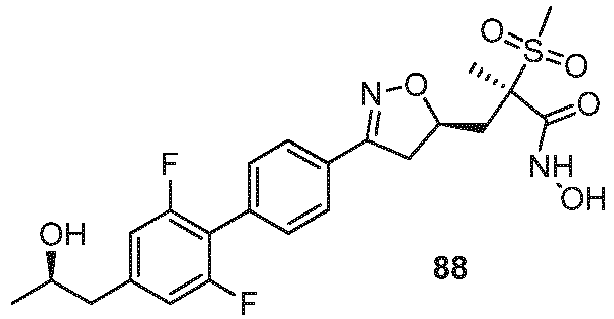
- Compound 88 was synthesized by method B. LCMS (m/z): 497.2 [M+H]+. 1H NMR (400 MHz, DMSO-d 6) 11.04 (s, 1H), 9.25 (s, 1H), 7.83 (d, J = 8.5 Hz, 2H), 7.71 (d, J = 8.4 Hz, 2H), 7.47 (d, J = 8.6 Hz, 2H), 4.71 - 4.57 (m, 1H), 3.85 (q, J = 6.5 Hz, 1H), 3.60 (dd, J = 17.0, 10.4 Hz, 1H), 3.16 (dd, J = 17.0, 8.1 Hz, 1H), 3.05 (s, 3H), 2.75 (dd, J = 13.1, 6.8 Hz, 1H), 2.65 (m, 2H), 2.05 (dd, J = 14.0, 8.4 Hz, 1H), 1.58 (s, 3H), 1.07 (d, J = 6.1 Hz, 3H).
-

- Compound 89 was synthesized by method A. LCMS (m/z): 479.2 [M+H]+. 1H NMR (400 MHz, DMSO-d 6) 11.06 (s, 1H), 9.28 (s, 1H), 7.74 (d, J = 8.3 Hz, 2H), 7.62 (d, J = 7.2 Hz, 2H), 7.38 (m, 1H), 7.34 (m, 1H), 7.22 (t, J = 7.6 Hz, 1H), 4.73 - 4.53 (m, 1H), 3.89 (q, J = 6.1 Hz, 1H), 3.62 (dd, J = 16.9, 10.2 Hz, 1H), 3.24 - 3.13 (m, 1H), 3.07 (s, 3H), 2.77 (dd, J = 13.7, 6.8 Hz, 1H), 2.73 - 2.64 (m, 2H), 2.07 (dd, J = 14.1, 8.4 Hz, 1H), 1.61 (s, 3H), 1.09 (d, J = 6.1 Hz, 3H).
-

- Compound 90 was synthesized by method A. LCMS (m/z): 475.4 [M+H]+. 1H NMR (400 MHz, DMSO-d 6) 11.05 (s, 1H), 9.27 (s, 1H), 7.70 (d, J = 8.3 Hz, 2H), 7.42 (d, J = 8.3 Hz, 2H), 7.14 - 7.07 (m, 3H), 4.72 - 4.60 (m, 1H), 3.88 - 3.80 (m, 1H), 3.61 (dd, J = 16.9, 10.5 Hz, 1H), 3.24 - 3.16 (m, 1H), 3.07 (s, 3H), 2.74 - 2.66 (m, 1H), 2.62 - 2.53 (m, 2H), 2.22 (s, 3H), 2.06 (dd, J = 15.1, 7.5 Hz, 1H), 1.61 (s, 3H), 1.07 (d, J = 6.1 Hz, 3H).
-

- Compound 92 was synthesized by method A. LCMS (m/z): 410.3 [M+H]+. 1H NMR (400 MHz, DMSO-d6) ppm 1. 59 (s, 3 H) 1. 96 - 2. 19 (m, 1 H) 2. 58 - 2. 76 (m, 1 H) 3. 05 (s, 3 H) 3.12 - 3.25 (m, 1 H) 3.49 - 3.74 (m, 1 H)4.52 - 4.78 (m, 1 H) 7.71 (d, J=8.02 Hz, 2 H) 7.90 (d, J=8.02 Hz, 2 H) 9. 10 (s, 1 H) 9. 19 - 9.34 (m, 1 H) 9.45 (s, 1 H) 10.88 - 11.25 (m, 1 H)
-

- Compound 93 was synthesized by method A. LCMS (m/z): 491.4 [M+H]+. 1H NMR (400 MHz, CD3CN) ppm 1. 18 (d, J=5.48 Hz, 3 H) 1. 71 (s, 3 H) 1. 96 (br. s., 4 H) 2.55 - 2.79 (m, 3 H) 2.83 - 2.99 (m, 2 H) 3.11 - 3.33 (m, 1 H) 3.50 - 3.80 (m, 3 H) 4.75 (d,
- J=7.48 Hz, 1 H) 7.22 - 7. 47 (m, 2 H) 7. 51 - 7. 90 (m, 6 H)
-

- Compound 94 was synthesized by method A. LCMS (m/z): 463.1 [M+H]+. 1H NMR (400 MHz, DMSO-d6) ppm 1. 59 (s, 3 H) 1. 89 - 2. 13 (m, 1 H) 2.66 (dd, J=14. 01, 3.30 Hz, 1 H) 3.05 (s, 3 H) 3.16 (dd, J=17.02, 8.12 Hz, 2H) 3.41 - 3.48 (m, 4 H) 3.59 (dd, J=16.97, 10.27 Hz, 2 H) 4.47 - 4.76 (m, 2 H) 7.28 - 7.87 (m, 8 H)
-

- Compound 95 was synthesized by method A. LCMS (m/z): 463.1 [M+H]+. 1H NMR (400 MHz, DMSO-d6) ppm 1.59 (s, 3 H) 1.92 - 2.17 (m, 1 H) 2.54 - 2.80 (m, 1 H) 3.05 (s, 3 H) 3.11 - 3.23 (m, 1 H) 3.45 (d, J=5.87 Hz, 2H) 3.51 - 3.71 (m, 1 H) 4.57 (s, 3 H) 5. 13 - 5.35 (m, 1 H) 7.43 (d, J=8.27 Hz, 2 H) 7.57 - 7.86 (m, 6 H) 9.24 (s, 1 H)
-

- Compound 96 was synthesized by method B. LCMS (m/z): 477.2 [M+H]+. 1H NMR (500 MHz, DMSO-d 6) 11.06 (s, 1H), 9.29 (s, 1H), 7.83 - 7.70 (m, 4H), 7.68 (d, J = 8.3 Hz, 2H), 7.43 (d, J = 8.3 Hz, 2H), 5.24 - 5.09 (m, 1H), 4.72 (dd, J = 7.8, 4.9 Hz, 1H), 4.66 (dd, J = 10.2, 3.5 Hz, 1H), 3.66 - 3.58 (m, 1H), 3.58 - 3.50 (m, 1H), 3.46 (dt, J = 10.4, 6.1 Hz, 1H), 3.19 (dd, J = 17.0, 8.1 Hz, 1H), 3.08 (s, 3H), 2.69 (dd, J = 14.1, 3.4 Hz, 1H), 2.11 - 2.03 (m, 1H), 1.87 - 1.68 (m, 2H), 1.61 (s, 3H).
-

- Compound 97 was synthesized by the process of example 22. LCMS (m/z): 487.3 [M+H]+. 1H NMR (400 MHz, DMSO-d6) ppm 1.58 (s, 3 H) 1.89 - 2.18 (m, 3 H) 2.56 - 2.80 (m, 2 H) 3.05 (s, 3 H) 3.09 - 3.23 (m, 2 H) 3.36 - 3.48 (m, 3 H) 3.48 - 3.69 (m, 1 H) 4.45 - 4.58 (m, 1 H) 4.58 - 4.98 (m, 2 H) 5.19 - 5.47 (m, 1 H) 7.25 - 7.87 (m, 8 H)
-

- Compound 98 was synthesized by the process of example 22. LCMS (m/z): 487.3 [M+H]+. 1H NMR (400 MHz, DMSO-d6) ppm 1. 49 - 1. 67 (m, 5 H) 1. 75 - 1. 89 (m, 2 H) 2. 03 (dd, J=13.62, 7.95 Hz, 1 H) 2.63 (dd, J=14.04, 3.28 Hz, 1 H) 2. 78 - 3.05 (m, 4 H) 3. 12 (dd, J=17.04, 8.05 Hz, 2 H) 3.54 (dd, J=17.02, 10.42 Hz, 2 H) 3.79 (dt, J=11. 51, 4.18 Hz, 2 H) 4.63 (dd, J=10.25, 3.06 Hz, 1 H) 7.35 - 7.74 (m, 4 H) 11.01 (s, 1 H)
-

- Compound 99 was synthesized by the process of example 22.. LCMS (m/z): 487.3 [M+H]+. 1H NMR (400 MHz, DMSO-d6) ppm 1. 58 (s, 3 H) 1. 89 - 2. 18 (m, 3 H) 2. 56 - 2. 80 (m, 2 H) 3.05 (s, 3 H) 3.09 - 3.23 (m, 2 H) 3.36 - 3.48 (m, 3 H) 3.48 - 3.69 (m, 1 H) 4.45 - 4.58 (m, 1 H) 4.58 - 4.98 (m, 2 H) 5.19 - 5.47 (m, 1 H) 7.25 - 7.87 (m, 8 H)
-

- Compound 100 was synthesized by method A. LCMS (m/z): 440.2 [M+H]+. 1H NMR (400 MHz, DMSO-d 6) 11.05 (s, 1H), 8.67 (s, 2H), 7.90 - 7.74 (m, 2H), 7.74 - 7.58 (m, 2H), 4.69 (dtd, J = 11.7, 8.4, 3.6 Hz, 1H), 3.69 - 3.57 (m, 1H), 3.20 (dd, J = 17.1, 8.1 Hz, 1H), 3.07 (s, 3H), 2.78 - 2.62 (m, 1H), 2.08 (dd, J = 14.1, 8.4 Hz, 1H), 1.61 (s, 3H).
-

- Compound 102 was synthesized by method A. LCMS (m/z): 465.4 [M+H]+. 1H NMR (400 MHz, CD3CN) ppm 1.50 - 1.78 (m, 3 H) 1.87 - 2.07 (m, 10 H) 2.75 - 3.07 (m, 4 H) 3.17 (dd, J=16.99, 8.49 Hz, 1 H) 3.60 (dd, J=16. 92, 10.32 Hz, 1 H) 3.77 (t, J=6.77 Hz, 2 H) 4.70 - 4.98 (m, 2 H) 7.38 (d, J=8.12 Hz, 2 H) 7.44 - 7.73 (m, 4 H).
-

- Compound 103 was synthesized by method C. LCMS (m/z): 451.0 [M+H]+. 1H NMR (400 MHz, CD3CN) ppm 1. 63 - 1. 75 (m, 4 H) 1. 76 - 1. 85 (m, 2 H) 2. 61 - 2. 79 (m, 3 H) 3.02 (s, 3 H) 3.09 - 3.27 (m, 2 H) 3.50 - 3.71 (m, 2 H) 4.59 - 4.70 (m, 2 H) 4.71 - 4.87 (m, 1 H) 7.42 - 7. 51 (m, 2 H) 7. 51 - 7.67 (m, 5 H)
-

- Compound 104 was synthesized by method A. LCMS (m/z): 460.4 [M+H]+. 1H NMR (400 MHz, DMSO-d6) ppm 1. 59 (s, 4 H) 1. 94 - 2. 18 (m, 1 H) 2. 58 - 2. 72 (m, 1 H) 3. 05 (s, 3 H) 3.09 - 3.24 (m, 2 H) 3.48 - 3.68 (m, 1 H), 4.10 (s, 3 H) 4.55 - 4.78 (m, 1 H) 6.51 (s, 1 H) 7.47 (d, J=8.17 Hz, 3 H) 7.52 - 7.72 (m, 6 H) 9.25 (s, 1 H) 11.04 (s, 1 H)
-

- Compound 105 was synthesized by method C, LCMS (m/z): 452.4 [M+H]+. 1H NMR (400 MHz, DMSO-d6) ppm 1. 58 (s, 3 H) 1.97 - 2. 18 (m, 2 H) 2.61 - 2. 75 (m, 2 H) 3.05 (s, 4 H) 3.10 - 3.24 (m, 3 H) 3.50 - 3.72 (m, 3 H)3.89 (s, 3 H) 4.50 - 4.81 (m, 2 H) 6.83 - 7.07 (m, 2 H) 7.50 - 7.60 (m, 2 H) 7.60 - 7.74 (m, 1 H) 7.87 - 8.06 (m, 1 H) 8.26 - 8.52 (m, 1 H)
-

- Compound 107 was synthesized by method C. LCMS (m/z): 479.4 [M+H]+. 1H NMR (400 MHz, DMSO-d6) ppm 1.04 (d, J=6.11 Hz, 3 H) 1.59 (s, 3 H) 1.95 - 2.16 (m, 1 H) 2.68 (s, 3 H) 3.05 (s, 3 H) 3.12 - 3.22 (m, 2 H) 3.51 - 3.69 (m, 2 H) 3.73 - 3.93 (m, 1 H) 4.48 - 4.71 (m, 1 H) 7.29 (d, J=8.17 Hz, 2 H) 7.53 - 7.82 (m, 5 H), 9.30 (s, 1H), 11.03 (s, 1 H)
-

- Compound 108 was synthesized by method C. LCMS (m/z): 452.4 [M+H]+. 1H NMR (400 MHz, DMSO-d6) ppm 1. 58 (s, 3 H) 1. 98 - 2. 16 (m, 1 H) 2. 56 - 2. 78 (m, 1 H) 3.05 (s, 3 H) 3.09 - 3.24 (m, 2 H) 3.57 (d, J=10. 37 Hz, 2H) 4.58 - 4.79 (m, 1 H) 6.42 (d, J=7.04 Hz, 1 H) 6.57 (s, 1 H) 7.47 - 7.61 (m, 2 H) 7.66 (s, 1 H) 7.78 (d, J=7.09 Hz, 1 H) 11.04 (s, 1 H)
-

- Compound 109 was synthesized by method C. LCMS (m/z): 452.4 [M+H]+. 1H NMR (400 MHz, DMSO-d6) ppm 1.59 (s, 3 H) 1.96 - 2.17 (m, 2 H) 2.58 - 2.74 (m, 2 H) 3.05 (s, 3 H) 3. 12 - 3.23 (m, 3 H) 3.54 - 3.68 (m, 3 H) 4.62 (s, 3 H) 7.61 (s, 3 H) 7.66 - 7.76 (m, 1 H) 7.94 - 8.13 (m, 1 H) 8.58 - 8.81 (m, 1 H) 10.88 - 11.12 (m, 1 H)
-

- Compound 110 was synthesized by method C. LCMS (m/z): 479.4 [M+H]+. 1H NMR (400 MHz, DMSO-d6) ppm 1.31 - 1.67 (m, 8 H) 1.95 - 2.11 (m, 2 H) 2.60 - 2.78 (m, 2 H) 3.05 (s, 3 H) 3.11 - 3.22 (m, 2 H) 3.47 - 3.70 (m, 2 H) 4.51 - 4.80 (m, 2 H) 7.56 (s, 7 H) 9.11 - 9.42 (m, 1 H) 10.84 - 11.15 (m, 1 H)
-

- Compound 111 was synthesized by method B. LCMS (m/z): 472.2 [M+H]+. 1H NMR (400 MHz, DMSO-d 6) 11.05 (s, 1H), 9.05 (s, 1H), 8.93 (d, J = 5.0 Hz, 1H), 7.78 (d, J = 8.4 Hz, 2H), 7.53 (d, J = 5.1 Hz, 1H), 7.48 (d, J = 8.2 Hz, 2H), 4.75 - 4.59 (m, 1H), 3.64 (dd, J = 17.0, 10.3 Hz, 1H), 3.20 (dd, J = 17.1, 8.0 Hz, 1H), 3.07 (s, 3H), 2.73 - 2.66 (m, 1H), 2.08 (dd, J = 14.1, 8.4 Hz, 1H), 1.61 (s, 3H).
-

- Compound 112 was synthesized by method C. LCMS (m/z): 464.1 [M+H]+. 1H NMR (400 MHz, DMSO-d6) ppm 1. 02 - 1. 35 (m, 10 H) 2. 01 - 2. 17 (m, 2 H) 2. 55 - 2. 75 (m, 2 H) 2.91 - 3.27 (m, 8 H) 4.01 (d, J=7.09 Hz, 2 H) 4.57 - 4.80 (m, 1 H) 7.51 (s, 1 H) 7.59 (d, J=9.83 Hz, 2 H) 7.71 (s, 1 H) 7.92 - 8.11 (m, 1 H) 8.74 (s, 1 H) 11.04 (s, 1 H)
-

- Compound 113 was synthesized by method C. LCMS (m/z): 465.1 [M+H]+. 1H NMR (400 MHz, DMSO-d6) ppm 1.58 (s, 3 H) 2.11 (s, 5 H) 2.55 - 2.73 (m, 2 H) 3.05 (s, 3 H) 3.10 - 3.22 (m, 2 H) 3.77 (s, 5 H) 4.54 - 4.79 (m, 1H) 6.72 - 6.96 (m, 2 H) 7. 04 - 7. 18 (m, 1 H) 7.31 - 7.41 (m, 1 H) 7.44 - 7.57 (m, 2 H) 9. 12 - 9.37 (m, 1 H) 10.89 - 11. 11 (m, 1 H)
-

- Compound 114 was synthesized by method C. LCMS (m/z): 489.1 [M+H]+. 1H NMR (400 MHz, DMSO-d6) ppm 1. 94 - 2. 18 (m, 2 H) 2. 57 - 2. 75 (m, 2 H) 3. 05 (s, 3 H) 3. 10 - 3.23 (m, 3 H) 3.53 - 3.69 (m, 1 H) 4.58 - 4.80 (m, 2 H) 7.54 - 7.89 (m, 6 H) 8. 06 - 8.23 (m, 2 H) 9.11 - 9.33 (m, 1 H) 10.93 - 11.13 (m, 1 H)
-

- Compound 115 was synthesized by method C. LCMS (m/z): 497.3 [M+H]+. 1H NMR (400 MHz, DMSO-d6) ppm 1. 06 (d, J=6.06 Hz, 3 H) 1. 97 - 2.15 (m, 1 H) 2.67 (d, J=12.08 Hz, 4 H) 3.05 (s, 3 H) 3.20 (s, 2 H) 3.52 - 3.69 (m, 2 H) 3.76 - 3.95 (m, 1 H) 4.53 - 4.78 (m, 2 H) 7.23 (d, J=7.53 Hz, 2 H) 7.37 (s, 1 H) 7.45 - 7.65 (m, 3 H) 11.04 (s, 1 H)
-

- Compound 116 was synthesized by method C. LCMS (m/z): 515.3 [M+H]+. 1H NMR (400 MHz, DMSO-d6) ppm 0. 98 - 1. 15 (m, 3 H) 1. 18 - 1. 31 (m, 1 H) 1. 99 - 2. 17 (m, 2 H) 2.59 - 2.70 (m, 2 H) 2.70 - 2.81 (m, 1 H) 3.05 (s, 3 H) 3.10 - 3.22 (m, 2 H) 3.52 - 3.66 (m, 1 H) 3.76 - 3.95 (m, 1 H) 4.58 - 4.74 (m, 1 H) 4.75 - 4.86 (m, 1 H) 7.23 - 7.37 (m, 2 H) 7.48 - 7.62 (m, 2H) 7.64 - 7.79 (m, 1 H)
-

- Compound 117 was synthesized by method A. LCMS (m/z): 440.2 [M+H]+. 1H NMR (400 MHz, DMSO-d 6) 11.04 (s, 1H), 8.72 (d, J = 1.7 Hz, 1H), 8.60 - 8.53 (m, 1H), 7.70 - 7.57 (m, 5H), 4.70 (ddd, J = 19.0, 8.5, 3.9 Hz, 1H), 3.63 (dd, J = 17.1, 10.4 Hz, 1H), 3.19 (dd, J = 17.2, 8.2 Hz, 1H), 3.06 (s, 3H), 2.71 - 2.63 (m, 1H), 2.14 - 2.04 (m, 1H), 1.60 (s, 3H).
-

- Compound 118 was synthesized by method C. LCMS (m/z): 450.1 [M+H]+. 1H NMR (400 MHz, DMS0-d6) ppm 1.59 (s, 2 H) 1.90 - 2.19 (m, 1 H) 2.57 - 2.69 (m, 3 H) 2.98 - 3.10 (m, 2 H) 3.12 - 3.27 (m, 1 H) 3.57 - 3.70 (m, 2 H) 4.49 - 4.90 (m, 2 H) 7. 44 - 7.88 (m, 3 H) 9.11 - 9.45 (m, 1 H) 11.05 (s, 1 H)
-

- Compound 119 was synthesized by method A. LCMS (m/z): 440.2 [M+H]+. 1H NMR (400 MHz, DMSO-d 6) 11.04 (s, 1H), 8.72 (d, J = 2.6 Hz, 1H), 8.55 (dd, J = 5.0, 1.0 Hz, 1H), 7.88 (t, J = 8.0 Hz, 1H), 7.77 - 7.67 (m, 2H), 7.62 (dt, J = 8.2, 1.6 Hz, 1H), 4.67 (dtd, J = 10.4, 8.4, 3.5 Hz, 1H), 3.65 (ddd, J = 17.4, 10.5, 1.7 Hz, 1H), 3.24 (ddd, J = 17.4, 8.4, 1.7 Hz, 1H), 3.07 (s, 3H), 2.71 (dd, J = 14.2, 3.5 Hz, 1H), 2.12 - 2.05 (m, 1H), 1.61 (s, 3H).
-
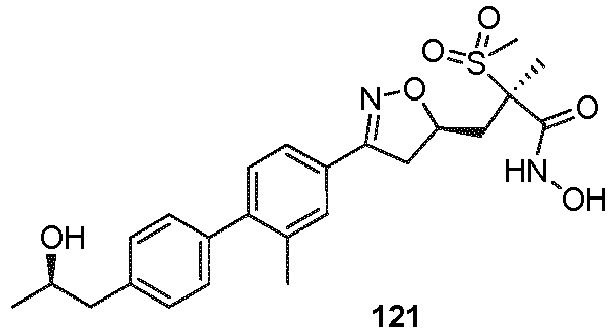
- Compound 121 was synthesized by method A. LCMS (m/z): 475.3 [M+H]+. 1H NMR (400 MHz, DMS0-d6) ppm 1.06 (d, J=6.06 Hz, 4 H) 1.88 - 2.11 (m, 2 H) 2.26 (s, 4 H) 2.55 - 2.77 (m, 4 H) 3.05 (s, 3 H) 3.09 - 3.20 (m, 2H) 3.47 - 3.65 (m, 2 H) 3.74 - 3.97 (m, 1 H) 4.51 - 4.75 (m, 1 H) 7.25 (d, J=2.35 Hz, 5 H) 7.41 - 7.64 (m, 2 H) 10.86 - 11. 13 (m, 1 H)
-

- Compound 122 was synthesized by method A. LCMS (m/z): 497.3 [M+H]+. 1H NMR (400 MHz, DMS0-d6) ppm 1.06 (d, J=6.11 Hz, 3 H) 1.96 - 2.20 (m, 2 H) 2.55 - 2.76 (m, 3 H) 3.05 (s, 3 H) 3.08 - 3.22 (m, 2 H) 3.51 - 3.67 (m, 2 H) 3.76 - 3.96 (m, 1 H) 4.57 - 4.81 (m, 1 H) 7.34 (q, J=8.15 Hz, 4 H) 7.46 (d, J=8.12 Hz, 2 H) 11.05 (s, 1 H)
-

-

- To a mixture of (R)-benzyl 2-methyl-2-(methylsulfonyl)pent-4-enoate (11 g, 39.0 mmol) and (Z)-4-bromo-2-fluoro-N-hydroxybenzimidoyl chloride (11.02 g, 43.6 mmol) in Et2O (150 mL) at RT was added triethylamine (10.86 mL, 78 mmol). White suspension was formed right after the addition of the TEA. The reaction mixture was stirred at RT for 3 hours. The reaction mixture was diluted with EtOAc, then filtered. The solution was concentrated and the remaining material was purified by silica gel column chromatography (EtOAc/heptane, 5 to 20%). The less polar fraction is the desired diastereomer (3.2 g, 6.42 mmol, 16.48 % yield). LCMS: (m/z): 500.1 [M+H]+
-
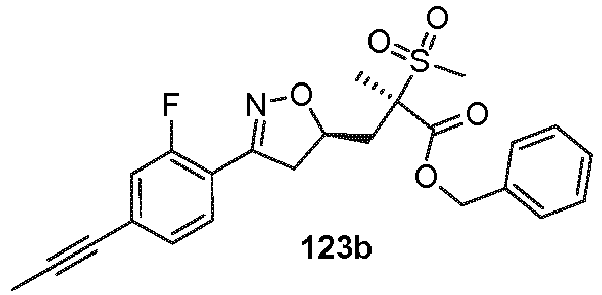
- To a mixture of (R)-benzyl 3-((R)-3-(4-bromo-2-fluorophenyl)-4,5-dihydroisoxazol-5-yl)-2-methyl-2-(methylsulfonyl)propanoate (1.4 g, 2.81 mmol), but-2-ynoic acid (0.354 g, 4.21 mmol), DBU (0.847 mL, 5.62 mmol), 1,4-bis(diphenylphosphino)-butane (0.024 g, 0.056 mmol) and bis(triphenylphosphine)palladium dichloride (0.020 g, 0.028 mmol) was added DMSO (14 mL). The resultant mixture was flushed with argon for 5 min. The mixture was stirred at 95 °C for 3 h after which, 200 mg of but-2-ynoic acid, 15 mg of 1,4-bis(diphenylphosphino)-butane, 10 mg of palladium catalyst and 0.3 ml of DBU was added. The flask was flushed again with argon, and the mixture was stirred at 95 °C for another 2 hours. After cooled to RT, the mixture was quenched with water and extracted with EtOAc. The organic layer was washed with brine, dried over sodium sulfate and concentrated. The crude material was purified by silica gel column chromatography, (EtOAc/heptane, 10 to 40%) to give product 123b (570 mg, 44.3 % yield). LCMS: (m/z) 458.4 [M+H]+.
-

- To a mixture of (R)-benzyl 3-((R)-3-(2-fluoro-4-(prop-1-yn-1-yl)phenyl)-4,5-dihydroisoxazol-5-yl)-2-methyl-2-(methylsulfonyl)propanoate (470 mg, 1.027 mmol) in MeOH (3ml),THF (3mL) and Water (3 mL) was added LiOH (123 mg, 5.14 mmol). The resultant mixture was stirred at 25 °C for 2 h. The reaction mixture was concentrated, diluted with 5 ml of water, and was then acidified with 3.0 N aq HCl solution. The resultant mixture was extracted with EtOAc. The organic layer was washed with water, dried over sodium sulfate and concentrated. The crude material was continued to the next step with no further purification. LCMS: (m/z) 368.2 [M+H]+.
-

- To (R)-3-((R)-3-(2-fluoro-4-(prop-1-yn-1-yl)phenyl)-4,5-dihydroisoxazol-5-yl)-2-methyl-2-(methylsulfonyl)propanoic acid (377 mg, 1.027 mmol) in DCM (4 mL) was added EDC.HCl (354 mg, 1.849 mmol) and HOAT (280 mg, 2.054 mmol) and the resultant mixture was stirred for 10-20 min. Triethylamine (0.358 mL, 2.57 mmol) was then added , followed by O-(Tetrahydro-2H-pyran-2-yl)hydroxylamine (241 mg, 2.054 mmol). The mixture was stirred at room temperature for 18 hours. The reaction mixture was filtered and the filtrate was purified by silica gel column chromatography, (EtOAc/heptane, 20 to 75%) to give product 123d (397 mg, 83 % yield).
-

- To a solution of 123d (397 mg, 0.851 mmol) in MeOH (20 mL) was added a solution of HCl in dioxane (4.0 M, 3.19 mL, 12.76 mmol). The resultant mixture was stirred at 25 °C for 25 min. The reaction solution was then concentrated, and the crude material was purified by silica gel column chromatography, (MeOH/DCM, 0% to 2.5%) to give product 123 (235 mg, 71.5 % yield). LC-MS: (m/z) 383.3 [M+H]+. 1H NMR (400 MHz, CD3CN) 1.69 (s, 3 H) 1.90 - 2.02 (m, 1 H) 2.02 - 2.11 (m, 3 H) 2.13 - 2.29 (m, 6 H) 2.66 (dd, J=14.18, 3.33 Hz, 1 H) 3.01 (s, 3 H) 3.18 (ddd, J=17.31, 8.51, 2.01 Hz, 1 H) 3.60 (ddd, J=17.30, 10.36, 2.03 Hz, 1 H) 4.65 - 4.82 (m, 1 H) 7.08 - 7.31 (m, 2 H) 7.58 - 7.79 (m, 1 H)
- The P. aeruginosa LpxC protein is produced according to the general method of Hyland et al (Journal of Bacteriology 1997 179, 2029-2037: Cloning, expression and purification of UDP-3-O-acyl-GlcNAc deacetylase from Pseudomonas aeruginosa: a metalloamidase of the lipid A biosynthesis pathway). The LC-MS/MS method for quantitation of LpxC product was developed using an Agilent 1200 Capillary HPLC system coupled to an Applied Biosystems MDS Sciex 4000QTRAP mass spectrometer. Both instruments are controlled using the Applied Biosystems MDS Sciex Analyst software. LpxC reaction product (UDP-3-O-(R-3-hydroxyacyl)-glucosamine) was produced by hydrolysis of LpxC substrate catalyzed by P.a. LpxC and purified using reversed phase chromatography on a Phenomenex Luna C18(2) 4.6 x 50 mm column. An LpxC product calibration curve was generated to evaluate the sensitivity and dynamic range of the LC-MS/MS method. Briefly, compounds are preincubated with 1 nM P. aeruginosa LpxC for 30 min. at room temperature. Reactions are initiated by the addition of 2 µM UDP-3-O-(R-3-hydroxydecanoyl)-GlcNAc. Reactions are conducted in a 384-well plate with a total volume of 50 µL in each well containing 50 mM Sodium phosphate pH 7.5, 0.005% Trition X-100 for 20 min at room temperature. After quenching with 1.8% HOAc (5 µL of a 20% HOAc added to each well), reaction mixtures are analyzed using the LC-MS/MS method and peak areas are transformed into product concentration using a LpxC product calibration curve. Total activity (0% inhibition control) is obtained from reactions with no inhibitors and 100% inhibition control is the background using quenched samples before reaction starts. For IC50 determinations, peak areas are converted to percent inhibition in Microsoft Excel. Percent inhibition values are plotted vs. log compound concentration using XLfit. Data is fit to the four-parameter logistic equation using the non-linear regression algorithm in XLfit to return the IC50 and hill slope values.
- Bacterial isolates were cultivated from -70°C frozen stocks by two consecutive overnight passages at 35°C in ambient air on 5% blood agar (Remel, Lenexa, Kans.). Quality control and P. aeruginosa ATCC 27853) is from the American Type Culture Collection (ATCC; Rockville, Md.) and PAO1 was received from Dr. K. Poole.
- Minimal Inhibitory Concentrations (MICs) were determined by the broth microdilution method in accordance with Clinical and Laboratories Institute (CLSI) guidelines. In brief, fresh bacterial overnight cultures were resuspended in sterile saline, adjusted to a 0.5 McFarland turbidity standard and then diluted 20010-fold in cation adjusted Mueller-Hinton Broth II (MHB; Remel BBL) to yield a final inoculum of approximately 5x10⁵ colony-forming units (CFU)/mL. Two-fold serial dilutions of compounds were prepared in 100% dimethyl sulfoxide (DMSO) at 100-fold the highest final assay concentration; the resulting dilution series of compounds were diluted 1:10 with sterile water. Ten µl of the drug dilution series in 10% DMSO was transferred to microtiter wells and 90 µl of bacterial suspension was inoculated into the wells. All inoculated microdilution trays were incubated in ambient air at 37 35°C for 20 hours. Following incubation, assay plates were read in a microtiter plate reader at 600 nm and visually inspected to confirm the MIC endpoint well with the OD value. Tthe lowest concentration of the compound that prevented visible growth was recorded as the MIC. Performance of the assay was monitored by testing ciprofloxacin against laboratory quality control strains in accordance with guidelines of the CLSI.
- The P. aeruginosa LpxC inhibitory activity for selected compounds and MIC data for inhibition of growth of P. aeruginosa measured by the methods described above are reported in Table A.
Table A. Cmpd No. Compound structure LCMS [M+H]+ PA LpxC IC50 (nM) PAO1 MIC (ug/mL) 1-B 
424.1 [M+18] <0.0005 1.0 2-A 
365.3 0.0008 0.25 3-B 
403.2 0.001 0.25 4-B 
395.3 0.024 8 5-A 
367.2 0.007 2 6-A 
391.3 0.0007 0.25 8-B 
379.2 0.0005 1 10-B 
395.3 <0.0005 1 12-B 
383.4 0.002 2 13-B 
409.3 0.001 1 14-B 
366.4 0.017 8 15-B 
392.3 0.004 8 16-B 
383.4 [M+18] 0.0006 1 17-B 
409.4 <0.0005 0.5 22 
397.2 <0.0005 0.5 23 
369.2 <0.0005 0.5 24 
367.1 0.0008 0.5 29 
385.3 0.0006 0.125 30 
419.4 0.0005 0.06 31 
355.2 0.001 0.22 32 
387.4 0.0009 0.4 33 
387.5 0.002 0.5 34 
401.4 0.002 0.5 39A 
463.6 0.0005 0.5 39B 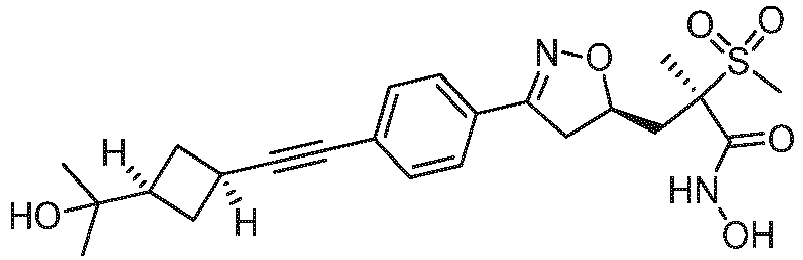
463.6 0.002 1 40 
447.4 0.0005 0.16 41 
433.4 0.0005 0.125 42 
422.2 0.0005 0.25 43 
394.3 0.005 1.4 44 
435.4 0.0008 0.5 45 
461.3 0.0006 0.16 46 
461.3 0.001 0.125 47 
502.5 0.0006 0.35 48 
477.4 0.001 0.25 49 
447.3 0.001 0.25 50 
463.4 0.0007 0.18 51 
491.2 0.0008 1.4 52 
449.9 0.0008 1 53 
449.9 0.0005 0.5 54 
423.5 0.0007 1 55 
444.7 <0.0005 0.5 56 
447.3 0.001 0.25 57 
433.4 <0.0005 1 58 
481.4 <0.0005 0.5 59 
451.4 <0.0005 0.35 60 
491.3 <0.0005 0.25 61 
477.1 0.25 62 
379.3 <0.0005 0.33 64 
472.2 [ <0.0005 0.25 65 
434.1 <0.0005 1 66 
434.0 <0.0005 0.25 67 
418.1 <0.0005 0.35 68 
434.1 0.002 16 69 
470.1 <0.0005 0.71 70 
472.0 0.002 8 71 
432.1 0.006 0.71 72 
463.1 0.35 73 
473.1 0.25 74 
465.2 <0.0005 0.71 75 
477.3 <0.0005 0.5 76 
480.2 <0.0005 2 77 
470.2 <0.0005 2 78 
404.3 <0.0005 1 79 
469.2 <0.0005 0.35 80 
452.2 1 81 
462.2 0.002 16 82 
438.2 <0.0005 0.35 83 
422.2 <0.0005 1 84 
462.3 <0.0005 1 85 
418.2 <0.0005 0.5 86 
491.3 <0.0005 0.35 87 
447.3 <0.0005 0.25 88 
497.2 <0.0005 0.25 89 
479.2 <0.0005 0.71 90 
475.4 <0.0005 0.5 91 
409.3 <0.0005 0.125 92 
410.3 <0.0005 0.35 93 
491.4 <0.0005 2 94 
463.1 <0.0005 0.25 95 
463.1 <0.0001 0.25 96 
477.2 <0.0005 0.5 97 
487.3 0.71 98 
487.3 0.0006 2 99 
487.3 100 
440.2 <0.0005 0.25 101 
373.1 <0.0005 0.35 102 
465.4 <0.0005 0.18 103 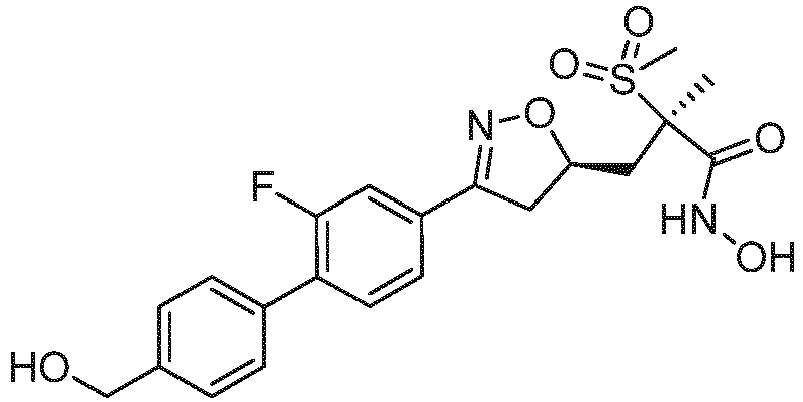
451.0 0.0006 0.18 104 
460.4 0.0005 0.125 105 
452.4 0.001 107 
479.4 0.0005 0.25 108 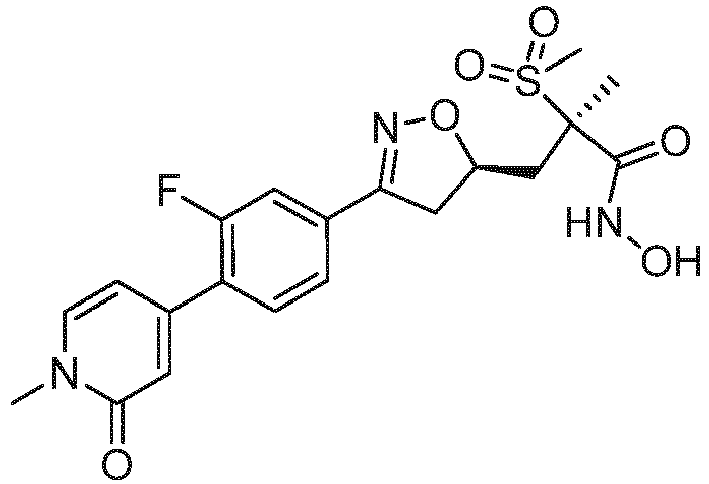
452.4 0.002 8 109 
452.4 0.005 110 
479.4 <0.0005 0.5 111 
472.2 <0.0005 1 112 
464.1 <0.0005 1 113 
465.1 <0.0005 0.71 114 
489.1 <0.0005 32 115 
497.3 <0.0005 1 116 
515.3 <0.0005 0.5 117 
440.2 <0.0005 0.35 118 
450.1 0.004 4 119 
440.2 <0.0005 0.71 120 
373.0 0.0006 0.5 121 
475.3 <0.0005 0.5 122 
497.3 <0.0005 0.5 123 
383.3 <0.0005 0.25
Claims (17)
- A compound of formula (I):
 Z is N or CR1, where R1 is selected from H, halo, C1-4 alkyl and C1-4 haloalkyl;R2 and R3 are independently selected from C1-4 alkyl and C1-4 haloalkyl,R4 is H or C1-4 alkyl;X is selected from H, halo, C1-4 alkyl, C1-4 haloalkyl, and CN;L is selected from -C≡C-, -CR5=CR6-, -O-, -S-, and a direct bond between A and the ring containing Z;R5 and R6 are independently selected from H, halo, C1-4 alkyl, and C1-4 haloalkyl; andA is halo, CN, or an optionally substituted group selected from C1-4 alkyl, C3-6 cycloalkyl, phenyl, C2-6 alkenyl, C2-6 alkynyl, 5-6 membered heteroaryl containing up to four heteroatoms selected from N, O and S as ring members, and 4-6 membered heterocyclyl containing up to two heteroatoms selected from N, O and S as ring members,
wherein the C1-4 alkyl, C3-6 cycloalkyl, phenyl, C2-6 alkenyl, C2-6 alkynyl, 5-6 membered heteroaryl containing up to four heteroatoms selected from N, O and S as ring members, and 4-6 membered heterocyclyl containing up to two heteroatoms selected from N, O and S as ring members are each optionally substituted with up to three groups selected from halo, hydroxy, CN, R10, -(CH2)0-2OR10, -SR10, -S(O)R10,-SO2R10, -S(O)(NH)R10, and -(CH2)0-2N(R10)2;
where each R10 is independently H or C1-4 alkyl optionally substituted with one or two groups selected from amino, hydroxy, C1-4 alkoxy, and CN; and -N(R10)2 can represent a 5-6 membered heterocyclic ring optionally containing an additional heteroatom selected from N, O and S as a ring member, and optionally substituted with one or two groups selected from oxo, halo, hydroxy, C1-4 alkyl, C1-4 alkoxy, and amino. - The compound of claim 1 or a pharmaceutically acceptable salt thereof, wherein X is H or F.
- The compound of claim 1 or 2 or a pharmaceutically acceptable salt thereof, wherein R2 is methyl.
- The compound of any of claims 1-3 or a pharmaceutically acceptable salt thereof, wherein R3 is methyl.
- The compound of any of claims 1-4 or a pharmaceutically acceptable salt thereof, wherein R4 is H.
- The compound of any of claims 1-5 or a pharmaceutically acceptable salt thereof, wherein Z is CH or CF.
- The compound of any of claims 1-5 or a pharmaceutically acceptable salt thereof, wherein Z is N.
- The compound of any of claims 1-7 or a pharmaceutically acceptable salt thereof, wherein A-L- is a group of the formula

- The compound of claim 8 or a pharmaceutically acceptable salt thereof, wherein A is C1-4 alkyl or cyclopropyl and is optionally substituted with F, OH, or OMe.
- The compound of any of claims 1-9, which is of the formula:

- A pharmaceutical composition, comprising:the compound according to any of claims 1 to 10 or a pharmaceutically acceptable salt thereof, anda pharmaceutically acceptable carrier.
- A pharmaceutical combination comprising:a compound according to any of claims 1 to 10 or a pharmaceutically acceptable salt thereof,an antibacterially effective amount of a second therapeutic agent, anda pharmaceutically acceptable carrier.
- The pharmaceutical combination composition according to claim 12, wherein the second therapeutic agent is selected from the group consisting of Ampicillin, Piperacillin, Penicillin G, Ticarcillin, Imipenem, Meropenem, Azithromycin, erythromycin, Aztreonam, Cefepime, Cefotaxime, Ceftriaxone, Cefatazidime, Ciprofloxacin, Levofloxacin, Clindamycin, Doxycycline, Gentamycin, Amikacin, Tobramycin, Tetracycline, Tegacyclin, Rifampicin, Vancomycin and Polymyxin.
- A compound according to any one of claims 1 to 10 or a pharmaceutically acceptable salt thereof, for use as a medicament.
- A compound according to any one of claims 1 to 10 or a pharmaceutically acceptable salt thereof, for use in treatment of a Gram-negative bacterial infection.
- A compound according to any one of claims 1 to 10 or a pharmaceutically acceptable salt thereof for use according to claim 15 in treatment of a Gram-negative bacterial infection, wherein the gram negative bacterial infection is an infection comprising at least one bacterium selected from the group consisting of Pseudomonas, Stenotrophomonas maltophila, Burkholderia, Alcaligenes xylosoxidans, Acinetobacter, Enterobacteriaceae, Haemophilus, Moraxella, Bacteroids, Fransicella, Shigella, Proteus, Vibrio, Salmonella, Bordetella, Helicobactor, Legionella, Citrobactor, Serratia, Campylobactor, Yersinia and Neisseria.
- A compound according to any one of claims 1 to 10 or a pharmaceutically acceptable salt thereof, for use according to claim 15 in treatment of a Gram-negative bacterial infection, wherein the bacterial infection is selected from Pseudomonas aeruginosa, Stenotrophomonas maltophila, Burkholderia cepacia, Alcaligenes xylosoxidans, Acinetobacter, Enterobacteriaceae, Haemophilus, and Neisseria species.
Applications Claiming Priority (2)
| Application Number | Priority Date | Filing Date | Title |
|---|---|---|---|
| US201461982467P | 2014-04-22 | 2014-04-22 | |
| PCT/US2015/027009 WO2015164458A1 (en) | 2014-04-22 | 2015-04-22 | Isoxazoline hydroxamic acid derivatives as lpxc inhibitors |
Publications (2)
| Publication Number | Publication Date |
|---|---|
| EP3134401A1 EP3134401A1 (en) | 2017-03-01 |
| EP3134401B1 true EP3134401B1 (en) | 2018-06-13 |
Family
ID=53059459
Family Applications (1)
| Application Number | Title | Priority Date | Filing Date |
|---|---|---|---|
| EP15721435.4A Not-in-force EP3134401B1 (en) | 2014-04-22 | 2015-04-22 | Isoxazoline hydroxamic acid derivatives as lpxc inhibitors |
Country Status (6)
| Country | Link |
|---|---|
| US (2) | US9637482B2 (en) |
| EP (1) | EP3134401B1 (en) |
| JP (1) | JP6514716B2 (en) |
| CN (1) | CN106573924B (en) |
| ES (1) | ES2687393T3 (en) |
| WO (1) | WO2015164458A1 (en) |
Families Citing this family (7)
| Publication number | Priority date | Publication date | Assignee | Title |
|---|---|---|---|---|
| RU2018124788A (en) * | 2015-12-08 | 2020-01-15 | Глэксосмитклайн Интеллекчуал Проперти Дивелопмент Лимитед | SUBSTITUTED BENZAZINONES AS ANTIBACTERIAL COMPOUNDS |
| HRP20201524T1 (en) * | 2016-06-14 | 2021-03-05 | Novartis Ag | Crystalline form of (r)-4-(5-(cyclopropylethynyl)isoxazol-3-yl)-n-hydroxy-2-methyl-2-(methylsulfonyl)butanamide as an antibacterial agent |
| WO2018062924A1 (en) * | 2016-09-28 | 2018-04-05 | Dong-A St Co., Ltd. | Tetrahydropyridine derivatives and their use as antibacterial agents |
| TW202039478A (en) * | 2018-11-21 | 2020-11-01 | 日商大正製藥股份有限公司 | Novel imidazole derivative |
| EP3906226A4 (en) * | 2019-01-06 | 2023-03-15 | Psomagen, Inc. | Htra inhibitors and caga inhibitors and use thereof |
| WO2024067812A1 (en) * | 2022-09-28 | 2024-04-04 | 浙江海正药业股份有限公司 | Aromatic acetylene derivative, preparation method therefor, and use thereof |
| CN120569379A (en) * | 2023-01-19 | 2025-08-29 | 浙江海正药业股份有限公司 | Aromatic acetylene derivative and preparation method and application thereof |
Family Cites Families (11)
| Publication number | Priority date | Publication date | Assignee | Title |
|---|---|---|---|---|
| ATE154932T1 (en) * | 1993-11-26 | 1997-07-15 | Pfizer | ISOXAZOLINE COMPOUNDS AS ANTI-INFLAMMATORY AGENTS |
| WO2004043349A2 (en) * | 2002-11-06 | 2004-05-27 | Bristol-Myers Squibb Company | Isoxazoline derivatives as inhibitors of matrix metalloproteinases and/or tnf-alpha converting enzyme |
| SG159388A1 (en) | 2003-01-08 | 2010-03-30 | Chiron Corp | Antibacterial agents |
| CA2514733A1 (en) | 2003-02-28 | 2004-09-16 | Transform Pharmaceuticals, Inc. | Pharmaceutical co-crystal compositions of drugs such as carbamazepine, celecoxib, olanzapine, itraconazole, topiramate, modafinil, 5-fluorouracil, hydrochlorothiazide, acetaminophen, aspirin, flurbiprofen, phenytoin and ibuprofen |
| US8722686B2 (en) | 2008-09-19 | 2014-05-13 | Pfizer Inc. | Hydroxamic acid derivatives useful as antibacterial agents |
| CA2774250C (en) * | 2009-10-13 | 2013-12-17 | Pfizer Inc. | C-linked hydroxamic acid derivatives useful as antibacterial agents |
| PL2512474T3 (en) | 2009-12-16 | 2015-03-31 | Pfizer | N-linked hydroxamic acid derivatives useful as antibacterial agents |
| GEP20156370B (en) | 2011-03-07 | 2015-09-25 | Pfizer | Fluoro-pyridinone derivatives useful as antibacterial agents |
| EP2694488B1 (en) * | 2011-04-08 | 2014-11-12 | Pfizer Inc | Isoxazole derivatives useful as antibacterial agents |
| KR20120137094A (en) * | 2011-06-10 | 2012-12-20 | 현대자동차주식회사 | Muffler for vehicle |
| WO2014160649A1 (en) | 2013-03-29 | 2014-10-02 | Novartis Ag | Hydroxamic acid derivatives as lpxc inhibitors for the treatment of bacterial infections |
-
2015
- 2015-04-22 EP EP15721435.4A patent/EP3134401B1/en not_active Not-in-force
- 2015-04-22 WO PCT/US2015/027009 patent/WO2015164458A1/en not_active Ceased
- 2015-04-22 CN CN201580033532.8A patent/CN106573924B/en not_active Expired - Fee Related
- 2015-04-22 ES ES15721435.4T patent/ES2687393T3/en active Active
- 2015-04-22 JP JP2016564087A patent/JP6514716B2/en not_active Expired - Fee Related
- 2015-04-22 US US15/304,044 patent/US9637482B2/en not_active Expired - Fee Related
-
2017
- 2017-03-09 US US15/454,187 patent/US9718792B2/en not_active Expired - Fee Related
Non-Patent Citations (1)
| Title |
|---|
| None * |
Also Published As
| Publication number | Publication date |
|---|---|
| JP6514716B2 (en) | 2019-05-15 |
| US9718792B2 (en) | 2017-08-01 |
| WO2015164458A1 (en) | 2015-10-29 |
| JP2017513892A (en) | 2017-06-01 |
| ES2687393T3 (en) | 2018-10-25 |
| EP3134401A1 (en) | 2017-03-01 |
| CN106573924B (en) | 2019-06-25 |
| US20170029415A1 (en) | 2017-02-02 |
| CN106573924A (en) | 2017-04-19 |
| US20170174640A1 (en) | 2017-06-22 |
| US9637482B2 (en) | 2017-05-02 |
Similar Documents
| Publication | Publication Date | Title |
|---|---|---|
| US9718792B2 (en) | Isoxazoline hydroxamic acid derivatives as LpxC inhibitors | |
| EP3233843B1 (en) | Isoxazole hydroxamic acid compounds as lpxc inhibitors | |
| WO2014160649A1 (en) | Hydroxamic acid derivatives as lpxc inhibitors for the treatment of bacterial infections | |
| WO2010031750A1 (en) | Organic compounds for applications in bacterial infections treatment | |
| KR20210093884A (en) | Novel imidazole derivatives | |
| EP3307725A1 (en) | Efflux-pump inhibitors and therapeutic uses thereof | |
| WO2015066413A1 (en) | Oxazolidinone hydroxamic acid compounds for the treatment of bacterial infections | |
| EP3468957B1 (en) | Crystalline form of (r)-4-(5-(cyclopropylethynyl)isoxazol-3-yl)-n-hydroxy-2-methyl-2-(methylsulfonyl)butanamide as an antibacterial agent | |
| HK40008443A (en) | Imidazopyrrolopyridine as inhibitors of the jak family of kinases | |
| HK40003017A (en) | Crystalline form of (r)-4-(5-(cyclopropylethynyl)isoxazol-3-yl)-n-hydroxy-2-methyl-2-(methylsulfonyl)butanamide as an antibacterial agent | |
| HK40003017B (en) | Crystalline form of (r)-4-(5-(cyclopropylethynyl)isoxazol-3-yl)-n-hydroxy-2-methyl-2-(methylsulfonyl)butanamide as an antibacterial agent |
Legal Events
| Date | Code | Title | Description |
|---|---|---|---|
| STAA | Information on the status of an ep patent application or granted ep patent |
Free format text: STATUS: THE INTERNATIONAL PUBLICATION HAS BEEN MADE |
|
| PUAI | Public reference made under article 153(3) epc to a published international application that has entered the european phase |
Free format text: ORIGINAL CODE: 0009012 |
|
| STAA | Information on the status of an ep patent application or granted ep patent |
Free format text: STATUS: REQUEST FOR EXAMINATION WAS MADE |
|
| 17P | Request for examination filed |
Effective date: 20161122 |
|
| AK | Designated contracting states |
Kind code of ref document: A1 Designated state(s): AL AT BE BG CH CY CZ DE DK EE ES FI FR GB GR HR HU IE IS IT LI LT LU LV MC MK MT NL NO PL PT RO RS SE SI SK SM TR |
|
| AX | Request for extension of the european patent |
Extension state: BA ME |
|
| DAV | Request for validation of the european patent (deleted) | ||
| DAX | Request for extension of the european patent (deleted) | ||
| GRAP | Despatch of communication of intention to grant a patent |
Free format text: ORIGINAL CODE: EPIDOSNIGR1 |
|
| STAA | Information on the status of an ep patent application or granted ep patent |
Free format text: STATUS: GRANT OF PATENT IS INTENDED |
|
| INTG | Intention to grant announced |
Effective date: 20180103 |
|
| GRAS | Grant fee paid |
Free format text: ORIGINAL CODE: EPIDOSNIGR3 |
|
| GRAA | (expected) grant |
Free format text: ORIGINAL CODE: 0009210 |
|
| STAA | Information on the status of an ep patent application or granted ep patent |
Free format text: STATUS: THE PATENT HAS BEEN GRANTED |
|
| AK | Designated contracting states |
Kind code of ref document: B1 Designated state(s): AL AT BE BG CH CY CZ DE DK EE ES FI FR GB GR HR HU IE IS IT LI LT LU LV MC MK MT NL NO PL PT RO RS SE SI SK SM TR |
|
| REG | Reference to a national code |
Ref country code: GB Ref legal event code: FG4D |
|
| REG | Reference to a national code |
Ref country code: CH Ref legal event code: EP Ref country code: AT Ref legal event code: REF Ref document number: 1008395 Country of ref document: AT Kind code of ref document: T Effective date: 20180615 |
|
| REG | Reference to a national code |
Ref country code: IE Ref legal event code: FG4D |
|
| REG | Reference to a national code |
Ref country code: DE Ref legal event code: R096 Ref document number: 602015012251 Country of ref document: DE |
|
| REG | Reference to a national code |
Ref country code: NL Ref legal event code: MP Effective date: 20180613 |
|
| REG | Reference to a national code |
Ref country code: ES Ref legal event code: FG2A Ref document number: 2687393 Country of ref document: ES Kind code of ref document: T3 Effective date: 20181025 Ref country code: LT Ref legal event code: MG4D |
|
| PG25 | Lapsed in a contracting state [announced via postgrant information from national office to epo] |
Ref country code: CY Free format text: LAPSE BECAUSE OF FAILURE TO SUBMIT A TRANSLATION OF THE DESCRIPTION OR TO PAY THE FEE WITHIN THE PRESCRIBED TIME-LIMIT Effective date: 20180613 Ref country code: SE Free format text: LAPSE BECAUSE OF FAILURE TO SUBMIT A TRANSLATION OF THE DESCRIPTION OR TO PAY THE FEE WITHIN THE PRESCRIBED TIME-LIMIT Effective date: 20180613 Ref country code: FI Free format text: LAPSE BECAUSE OF FAILURE TO SUBMIT A TRANSLATION OF THE DESCRIPTION OR TO PAY THE FEE WITHIN THE PRESCRIBED TIME-LIMIT Effective date: 20180613 Ref country code: BG Free format text: LAPSE BECAUSE OF FAILURE TO SUBMIT A TRANSLATION OF THE DESCRIPTION OR TO PAY THE FEE WITHIN THE PRESCRIBED TIME-LIMIT Effective date: 20180913 Ref country code: NO Free format text: LAPSE BECAUSE OF FAILURE TO SUBMIT A TRANSLATION OF THE DESCRIPTION OR TO PAY THE FEE WITHIN THE PRESCRIBED TIME-LIMIT Effective date: 20180913 Ref country code: LT Free format text: LAPSE BECAUSE OF FAILURE TO SUBMIT A TRANSLATION OF THE DESCRIPTION OR TO PAY THE FEE WITHIN THE PRESCRIBED TIME-LIMIT Effective date: 20180613 |
|
| PG25 | Lapsed in a contracting state [announced via postgrant information from national office to epo] |
Ref country code: GR Free format text: LAPSE BECAUSE OF FAILURE TO SUBMIT A TRANSLATION OF THE DESCRIPTION OR TO PAY THE FEE WITHIN THE PRESCRIBED TIME-LIMIT Effective date: 20180914 Ref country code: RS Free format text: LAPSE BECAUSE OF FAILURE TO SUBMIT A TRANSLATION OF THE DESCRIPTION OR TO PAY THE FEE WITHIN THE PRESCRIBED TIME-LIMIT Effective date: 20180613 Ref country code: HR Free format text: LAPSE BECAUSE OF FAILURE TO SUBMIT A TRANSLATION OF THE DESCRIPTION OR TO PAY THE FEE WITHIN THE PRESCRIBED TIME-LIMIT Effective date: 20180613 Ref country code: LV Free format text: LAPSE BECAUSE OF FAILURE TO SUBMIT A TRANSLATION OF THE DESCRIPTION OR TO PAY THE FEE WITHIN THE PRESCRIBED TIME-LIMIT Effective date: 20180613 |
|
| REG | Reference to a national code |
Ref country code: AT Ref legal event code: MK05 Ref document number: 1008395 Country of ref document: AT Kind code of ref document: T Effective date: 20180613 |
|
| PG25 | Lapsed in a contracting state [announced via postgrant information from national office to epo] |
Ref country code: NL Free format text: LAPSE BECAUSE OF FAILURE TO SUBMIT A TRANSLATION OF THE DESCRIPTION OR TO PAY THE FEE WITHIN THE PRESCRIBED TIME-LIMIT Effective date: 20180613 |
|
| PG25 | Lapsed in a contracting state [announced via postgrant information from national office to epo] |
Ref country code: CZ Free format text: LAPSE BECAUSE OF FAILURE TO SUBMIT A TRANSLATION OF THE DESCRIPTION OR TO PAY THE FEE WITHIN THE PRESCRIBED TIME-LIMIT Effective date: 20180613 Ref country code: AT Free format text: LAPSE BECAUSE OF FAILURE TO SUBMIT A TRANSLATION OF THE DESCRIPTION OR TO PAY THE FEE WITHIN THE PRESCRIBED TIME-LIMIT Effective date: 20180613 Ref country code: RO Free format text: LAPSE BECAUSE OF FAILURE TO SUBMIT A TRANSLATION OF THE DESCRIPTION OR TO PAY THE FEE WITHIN THE PRESCRIBED TIME-LIMIT Effective date: 20180613 Ref country code: EE Free format text: LAPSE BECAUSE OF FAILURE TO SUBMIT A TRANSLATION OF THE DESCRIPTION OR TO PAY THE FEE WITHIN THE PRESCRIBED TIME-LIMIT Effective date: 20180613 Ref country code: IS Free format text: LAPSE BECAUSE OF FAILURE TO SUBMIT A TRANSLATION OF THE DESCRIPTION OR TO PAY THE FEE WITHIN THE PRESCRIBED TIME-LIMIT Effective date: 20181013 Ref country code: PL Free format text: LAPSE BECAUSE OF FAILURE TO SUBMIT A TRANSLATION OF THE DESCRIPTION OR TO PAY THE FEE WITHIN THE PRESCRIBED TIME-LIMIT Effective date: 20180613 Ref country code: SK Free format text: LAPSE BECAUSE OF FAILURE TO SUBMIT A TRANSLATION OF THE DESCRIPTION OR TO PAY THE FEE WITHIN THE PRESCRIBED TIME-LIMIT Effective date: 20180613 |
|
| PG25 | Lapsed in a contracting state [announced via postgrant information from national office to epo] |
Ref country code: SM Free format text: LAPSE BECAUSE OF FAILURE TO SUBMIT A TRANSLATION OF THE DESCRIPTION OR TO PAY THE FEE WITHIN THE PRESCRIBED TIME-LIMIT Effective date: 20180613 |
|
| REG | Reference to a national code |
Ref country code: DE Ref legal event code: R097 Ref document number: 602015012251 Country of ref document: DE |
|
| PLBE | No opposition filed within time limit |
Free format text: ORIGINAL CODE: 0009261 |
|
| STAA | Information on the status of an ep patent application or granted ep patent |
Free format text: STATUS: NO OPPOSITION FILED WITHIN TIME LIMIT |
|
| 26N | No opposition filed |
Effective date: 20190314 |
|
| PG25 | Lapsed in a contracting state [announced via postgrant information from national office to epo] |
Ref country code: SI Free format text: LAPSE BECAUSE OF FAILURE TO SUBMIT A TRANSLATION OF THE DESCRIPTION OR TO PAY THE FEE WITHIN THE PRESCRIBED TIME-LIMIT Effective date: 20180613 Ref country code: DK Free format text: LAPSE BECAUSE OF FAILURE TO SUBMIT A TRANSLATION OF THE DESCRIPTION OR TO PAY THE FEE WITHIN THE PRESCRIBED TIME-LIMIT Effective date: 20180613 |
|
| PG25 | Lapsed in a contracting state [announced via postgrant information from national office to epo] |
Ref country code: AL Free format text: LAPSE BECAUSE OF FAILURE TO SUBMIT A TRANSLATION OF THE DESCRIPTION OR TO PAY THE FEE WITHIN THE PRESCRIBED TIME-LIMIT Effective date: 20180613 |
|
| REG | Reference to a national code |
Ref country code: CH Ref legal event code: PL |
|
| REG | Reference to a national code |
Ref country code: BE Ref legal event code: MM Effective date: 20190430 |
|
| PG25 | Lapsed in a contracting state [announced via postgrant information from national office to epo] |
Ref country code: MC Free format text: LAPSE BECAUSE OF FAILURE TO SUBMIT A TRANSLATION OF THE DESCRIPTION OR TO PAY THE FEE WITHIN THE PRESCRIBED TIME-LIMIT Effective date: 20180613 Ref country code: LU Free format text: LAPSE BECAUSE OF NON-PAYMENT OF DUE FEES Effective date: 20190422 |
|
| PG25 | Lapsed in a contracting state [announced via postgrant information from national office to epo] |
Ref country code: CH Free format text: LAPSE BECAUSE OF NON-PAYMENT OF DUE FEES Effective date: 20190430 Ref country code: LI Free format text: LAPSE BECAUSE OF NON-PAYMENT OF DUE FEES Effective date: 20190430 |
|
| PG25 | Lapsed in a contracting state [announced via postgrant information from national office to epo] |
Ref country code: BE Free format text: LAPSE BECAUSE OF NON-PAYMENT OF DUE FEES Effective date: 20190430 |
|
| PG25 | Lapsed in a contracting state [announced via postgrant information from national office to epo] |
Ref country code: TR Free format text: LAPSE BECAUSE OF FAILURE TO SUBMIT A TRANSLATION OF THE DESCRIPTION OR TO PAY THE FEE WITHIN THE PRESCRIBED TIME-LIMIT Effective date: 20180613 |
|
| PG25 | Lapsed in a contracting state [announced via postgrant information from national office to epo] |
Ref country code: IE Free format text: LAPSE BECAUSE OF NON-PAYMENT OF DUE FEES Effective date: 20190422 |
|
| PG25 | Lapsed in a contracting state [announced via postgrant information from national office to epo] |
Ref country code: PT Free format text: LAPSE BECAUSE OF FAILURE TO SUBMIT A TRANSLATION OF THE DESCRIPTION OR TO PAY THE FEE WITHIN THE PRESCRIBED TIME-LIMIT Effective date: 20181015 |
|
| PG25 | Lapsed in a contracting state [announced via postgrant information from national office to epo] |
Ref country code: MT Free format text: LAPSE BECAUSE OF FAILURE TO SUBMIT A TRANSLATION OF THE DESCRIPTION OR TO PAY THE FEE WITHIN THE PRESCRIBED TIME-LIMIT Effective date: 20180613 Ref country code: HU Free format text: LAPSE BECAUSE OF FAILURE TO SUBMIT A TRANSLATION OF THE DESCRIPTION OR TO PAY THE FEE WITHIN THE PRESCRIBED TIME-LIMIT; INVALID AB INITIO Effective date: 20150422 |
|
| PGFP | Annual fee paid to national office [announced via postgrant information from national office to epo] |
Ref country code: FR Payment date: 20210423 Year of fee payment: 7 Ref country code: DE Payment date: 20210115 Year of fee payment: 7 Ref country code: IT Payment date: 20210427 Year of fee payment: 7 |
|
| PGFP | Annual fee paid to national office [announced via postgrant information from national office to epo] |
Ref country code: ES Payment date: 20210621 Year of fee payment: 7 Ref country code: GB Payment date: 20210422 Year of fee payment: 7 |
|
| PG25 | Lapsed in a contracting state [announced via postgrant information from national office to epo] |
Ref country code: MK Free format text: LAPSE BECAUSE OF FAILURE TO SUBMIT A TRANSLATION OF THE DESCRIPTION OR TO PAY THE FEE WITHIN THE PRESCRIBED TIME-LIMIT Effective date: 20180613 |
|
| REG | Reference to a national code |
Ref country code: DE Ref legal event code: R119 Ref document number: 602015012251 Country of ref document: DE |
|
| GBPC | Gb: european patent ceased through non-payment of renewal fee |
Effective date: 20220422 |
|
| PG25 | Lapsed in a contracting state [announced via postgrant information from national office to epo] |
Ref country code: GB Free format text: LAPSE BECAUSE OF NON-PAYMENT OF DUE FEES Effective date: 20220422 Ref country code: FR Free format text: LAPSE BECAUSE OF NON-PAYMENT OF DUE FEES Effective date: 20220430 Ref country code: DE Free format text: LAPSE BECAUSE OF NON-PAYMENT OF DUE FEES Effective date: 20221103 |
|
| PG25 | Lapsed in a contracting state [announced via postgrant information from national office to epo] |
Ref country code: IT Free format text: LAPSE BECAUSE OF NON-PAYMENT OF DUE FEES Effective date: 20220422 |
|
| REG | Reference to a national code |
Ref country code: ES Ref legal event code: FD2A Effective date: 20230601 |
|
| PG25 | Lapsed in a contracting state [announced via postgrant information from national office to epo] |
Ref country code: ES Free format text: LAPSE BECAUSE OF NON-PAYMENT OF DUE FEES Effective date: 20220423 |