EP3125107A1 - Framework that supports driverless printing - Google Patents
Framework that supports driverless printing Download PDFInfo
- Publication number
- EP3125107A1 EP3125107A1 EP16187920.0A EP16187920A EP3125107A1 EP 3125107 A1 EP3125107 A1 EP 3125107A1 EP 16187920 A EP16187920 A EP 16187920A EP 3125107 A1 EP3125107 A1 EP 3125107A1
- Authority
- EP
- European Patent Office
- Prior art keywords
- printer
- component
- data
- client
- capability information
- Prior art date
- Legal status (The legal status is an assumption and is not a legal conclusion. Google has not performed a legal analysis and makes no representation as to the accuracy of the status listed.)
- Granted
Links
Images




Classifications
-
- G—PHYSICS
- G06—COMPUTING OR CALCULATING; COUNTING
- G06F—ELECTRIC DIGITAL DATA PROCESSING
- G06F3/00—Input arrangements for transferring data to be processed into a form capable of being handled by the computer; Output arrangements for transferring data from processing unit to output unit, e.g. interface arrangements
- G06F3/12—Digital output to print unit, e.g. line printer, chain printer
- G06F3/1293—Printer information exchange with computer
-
- G—PHYSICS
- G06—COMPUTING OR CALCULATING; COUNTING
- G06F—ELECTRIC DIGITAL DATA PROCESSING
- G06F3/00—Input arrangements for transferring data to be processed into a form capable of being handled by the computer; Output arrangements for transferring data from processing unit to output unit, e.g. interface arrangements
- G06F3/12—Digital output to print unit, e.g. line printer, chain printer
- G06F3/1201—Dedicated interfaces to print systems
- G06F3/1223—Dedicated interfaces to print systems specifically adapted to use a particular technique
- G06F3/1237—Print job management
- G06F3/126—Job scheduling, e.g. queuing, determine appropriate device
-
- G—PHYSICS
- G06—COMPUTING OR CALCULATING; COUNTING
- G06F—ELECTRIC DIGITAL DATA PROCESSING
- G06F3/00—Input arrangements for transferring data to be processed into a form capable of being handled by the computer; Output arrangements for transferring data from processing unit to output unit, e.g. interface arrangements
- G06F3/12—Digital output to print unit, e.g. line printer, chain printer
- G06F3/1201—Dedicated interfaces to print systems
- G06F3/1202—Dedicated interfaces to print systems specifically adapted to achieve a particular effect
- G06F3/1203—Improving or facilitating administration, e.g. print management
- G06F3/1204—Improving or facilitating administration, e.g. print management resulting in reduced user or operator actions, e.g. presetting, automatic actions, using hardware token storing data
-
- G—PHYSICS
- G06—COMPUTING OR CALCULATING; COUNTING
- G06F—ELECTRIC DIGITAL DATA PROCESSING
- G06F3/00—Input arrangements for transferring data to be processed into a form capable of being handled by the computer; Output arrangements for transferring data from processing unit to output unit, e.g. interface arrangements
- G06F3/12—Digital output to print unit, e.g. line printer, chain printer
- G06F3/1201—Dedicated interfaces to print systems
- G06F3/1223—Dedicated interfaces to print systems specifically adapted to use a particular technique
- G06F3/1224—Client or server resources management
- G06F3/1228—Printing driverless or using generic drivers
-
- G—PHYSICS
- G06—COMPUTING OR CALCULATING; COUNTING
- G06F—ELECTRIC DIGITAL DATA PROCESSING
- G06F3/00—Input arrangements for transferring data to be processed into a form capable of being handled by the computer; Output arrangements for transferring data from processing unit to output unit, e.g. interface arrangements
- G06F3/12—Digital output to print unit, e.g. line printer, chain printer
- G06F3/1201—Dedicated interfaces to print systems
- G06F3/1223—Dedicated interfaces to print systems specifically adapted to use a particular technique
- G06F3/1229—Printer resources management or printer maintenance, e.g. device status, power levels
- G06F3/1232—Transmitting printer device capabilities, e.g. upon request or periodically
-
- G—PHYSICS
- G06—COMPUTING OR CALCULATING; COUNTING
- G06F—ELECTRIC DIGITAL DATA PROCESSING
- G06F3/00—Input arrangements for transferring data to be processed into a form capable of being handled by the computer; Output arrangements for transferring data from processing unit to output unit, e.g. interface arrangements
- G06F3/12—Digital output to print unit, e.g. line printer, chain printer
- G06F3/1201—Dedicated interfaces to print systems
- G06F3/1223—Dedicated interfaces to print systems specifically adapted to use a particular technique
- G06F3/1237—Print job management
- G06F3/1244—Job translation or job parsing, e.g. page banding
-
- G—PHYSICS
- G06—COMPUTING OR CALCULATING; COUNTING
- G06F—ELECTRIC DIGITAL DATA PROCESSING
- G06F3/00—Input arrangements for transferring data to be processed into a form capable of being handled by the computer; Output arrangements for transferring data from processing unit to output unit, e.g. interface arrangements
- G06F3/12—Digital output to print unit, e.g. line printer, chain printer
- G06F3/1201—Dedicated interfaces to print systems
- G06F3/1278—Dedicated interfaces to print systems specifically adapted to adopt a particular infrastructure
- G06F3/1292—Mobile client, e.g. wireless printing
-
- G—PHYSICS
- G06—COMPUTING OR CALCULATING; COUNTING
- G06F—ELECTRIC DIGITAL DATA PROCESSING
- G06F3/00—Input arrangements for transferring data to be processed into a form capable of being handled by the computer; Output arrangements for transferring data from processing unit to output unit, e.g. interface arrangements
- G06F3/12—Digital output to print unit, e.g. line printer, chain printer
- G06F3/1296—Printer job scheduling or printer resource handling
-
- G—PHYSICS
- G06—COMPUTING OR CALCULATING; COUNTING
- G06F—ELECTRIC DIGITAL DATA PROCESSING
- G06F3/00—Input arrangements for transferring data to be processed into a form capable of being handled by the computer; Output arrangements for transferring data from processing unit to output unit, e.g. interface arrangements
- G06F3/12—Digital output to print unit, e.g. line printer, chain printer
- G06F3/1297—Printer code translation, conversion, emulation, compression; Configuration of printer parameters
- G06F3/1298—Printer language recognition, e.g. program control language, page description language
Definitions
- the disclosed embodiments relate to printers for computer systems. More specifically, the disclosed embodiments relate to a computer-based printing system that operates without having to manage printer-specific driver software.
- Printers are often a problem for computer users.
- the cabling and power cords are typically not a problem to hook up.
- the user typically has to install a printer-specific driver, which involves loading the driver from a disk or navigating to a website and downloading the driver.
- the printer driver is already loaded into the computer system, the user often has to load and install an update for the driver from the printer manufacturer's website.
- the disclosed embodiments provide a system that facilitates driverless printing.
- This system includes a discovery component configured to identify accessible printers and to facilitate selection of an accessible printer, wherein the discovery component is also configured to obtain capability information from accessible printers.
- the system also includes a transport component configured to transport data to the selected printer, wherein the transport component is also configured to obtain capability information from the selected printer.
- the system includes a page-description-language component configured to generate printer data for the selected printer based on obtained capability information for the selected printer.
- the system provides an integrated framework that enables the discovery component, the transport component and the page-description-language component to be accessed by an application.
- the integrated framework includes one or more application programming interfaces (APIs) that provide access to the discovery component, the transport component and/or the page-description-language component.
- APIs application programming interfaces
- These APIs enable a calling application to interact with other application code being called through the API.
- Various function calls, messages or other types of invocations which further may include various kinds of parameters, can be transferred via the API between the calling application and the code being called.
- the API may provide the calling application code the ability to use data types or classes defined in the API and implemented in the called application code.
- a method for operating through this API includes transferring one or more function calls, messages, other types of invocations or parameters via the API.
- the discovery component while obtaining the capability information from accessible printers, is configured to obtain current status information from the accessible printers.
- the current status information can specify: whether the printer is off-line; whether the printer is busy; or whether an error condition exists in the printer.
- the capability information for a printer can specify, for example, the file sizes supported by the printer; the file-format versions supported by the printer; the file-format extensions supported by the printer; the color spaces supported by the printer; the bit depths supported by the printer; or the resolutions supported by the printer.
- the capability information obtained from the selected printer enables the system to generate printer data for the selected printer without the need for the system to maintain printer-specific software or printer-specific configuration information for the selected printer.
- Some embodiments include one or more application programming interfaces (APIs) in an environment with calling program code that interacts with other program code being called through the one or more interfaces.
- APIs application programming interfaces
- Various function calls, messages or other types of invocations, which further may include various kinds of parameters, can be transferred via the APIs between the calling program and the code being called.
- an API may provide the calling program code the ability to use data types or classes defined within the API and implemented in the called program code.
- At least certain embodiments include an environment with a calling software component interacting with a called software component through an API.
- a method for operating through an API in this environment includes transferring one or more function calls, messages, and other types of invocations or parameters via the API.
- non-transitory computer-readable storage medium which may be any device or medium that can store code and/or data for use by a computer system.
- the non-transitory computer-readable storage medium includes, but is not limited to, volatile memory, non-volatile memory, magnetic and optical storage devices such as disk drives, magnetic tape, CDs (compact discs), DVDs (digital versatile discs or digital video discs), or other media capable of storing code and/or data now known or later developed.
- the methods and processes described in the detailed description section can be embodied as code and/or data, which can be stored in a non-transitory computer-readable storage medium as described above.
- a computer system reads and executes the code and/or data stored on the non-transitory computer-readable storage medium, the computer system performs the methods and processes embodied as data structures and code and stored within the non-transitory computer-readable storage medium.
- the methods and processes described below can be included in hardware modules.
- the hardware modules can include, but are not limited to, application-specific integrated circuit (ASIC) chips, field-programmable gate arrays (FPGAs), and other programmable-logic devices now known or later developed. When the hardware modules are activated, the hardware modules perform the methods and processes included within the hardware modules.
- ASIC application-specific integrated circuit
- FPGAs field-programmable gate arrays
- the disclosed embodiments facilitate "driverless printing,” which enables a computing device to print to a printer without having to worry about installing or updating associated printer driver software. This is accomplished by augmenting a discovery protocol (such as BonjourTM) and an associated network-printing protocol (such as IPP), so that the protocols return printer capability information which is used to generate printer data for a selected printer.
- a discovery protocol such as BonjourTM
- IPP network-printing protocol
- the disclosed embodiments differ from existing systems which need to maintain specific drivers for each supported printer.
- the features and capabilities for specific printers arc stored in static capability files created by the printer vendors, such as a PostScript Printer Description (PPD) file, and these static capability files are stored on the mobile device itself.
- PPD PostScript Printer Description
- the disclosed embodiments query a printer (not a static file) to determine the "current" operational capabilities of a printer.
- the disclosed embodiments also provide a page-description language that specifies the appearance of printed pages.
- the disclosed embodiments additionally provide a framework which enables an application to easily use the discovery protocol, the network-printing protocol and the page-description language.
- This framework can be implemented using one or more APIs which enable an application to access these components. Details of the disclosed embodiments are described below, but first we describe the printing system.
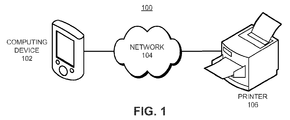
- FIG. 1 illustrates a printing system 100 in accordance with the disclosed embodiments.
- Printing system 100 includes a computing device 102 and a printer 106.
- Computing device 102 can generally include any type of computer system or computing device, such as a personal computer system, a server computer system, a laptop computer, a notebook computer, a tablet computer, a personal digital assistant, a digital media receiver (such as Apple TVTM), a digital picture frame, a cellular telephone or a portable navigation system.
- Printer 106 can generally include any device or system capable of printing textual data or images onto some type of print media, such as paper or photo media.
- printer 106 can comprise a stand-alone printer, or alternatively a printing system, which includes a print server that is coupled to one or more printers.
- Network 104 can generally include any type of communication channel capable of coupling together network nodes.
- network 104 can include a wireless network connection, such as a BluetoothTM network connection; a cellular networking connection (e.g., a 3G/4G network or an Edge network); a networking connection based on the standards described in Institute for Electrical and Electronic Engineers (IEEE) 802.11; a wireless personal-area networking (PAN) connection, such as a network connection based on the standards described in IEEE 802.15; or any peer-to-peer (wireless or wired) networking technology.
- Network 104 can also include a wired network connection, such as a network connection based on the standards described in IEEE 802.3.
- computing device 102 initially makes contact with printer 106 through a discovery protocol as is described in more detail below.
- printer 106 is identified and selected, there arc a number of ways that printing can be accomplished. If computing device 102 possesses a driver for printer 106, or if printer 106 supports driverless printing, computing device 102 can use the driver or the driverless printing protocol to generate printer data for a print job. The printer data can then be sent to printer 106 through network 104. This process is described in more detail below. (Note that the term "driverless printing” refers to a printing technique which operates without the need for printer-specific software or printer-specific configuration on a computing device.)
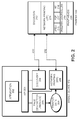
- FIG. 2 illustrates components involved in performing a printing operation in accordance with the disclosed embodiments.
- computing device 102 includes an application 202 which needs to perform a printing operation.
- application 202 can include a printing utility that allows a user to print a specific file.
- application 202 can include any type of general-purpose or special-purpose computer-based application that periodically needs to perform a printing operation, such as a word processor.
- Application 202 makes calls to API 203, which provides a framework that facilitates access to a number of components, including a discovery component 204, a page-description-language component 205 and a network-printing component 206.
- application 202 uses discovery component 204, which implements a discovery protocol (such as BonjourTM) to identify available printers and to facilitate selecting one of the identified printers.
- discovery component 204 communicates with a corresponding discovery component 212 in printer 106 (illustrated by dashed line 230).
- application 202 uses page-description-language component 205 to render a print job to produce corresponding printer data 208.
- Printer data 208 is then sent to network-printing component 206, which implements a network protocol for remote printing, such as an Internet Printing Protocol (IPP).
- Network-printing component 206 communicates printer data 208 to a corresponding network-printing component 214 within printer 106 (illustrated by dashed line 232).
- IPP Internet Printing Protocol
- printer 106 contains a discovery component 212 and a network-printing component 214.
- printer 106 includes components that support printing using, for example, the JPEG (Joint Photographic Experts Group) standard 216, the PDF (Portable Document Format) standard 217, and a RF (Raster Format) standard 218. These components send data through print controller 219 to print heads 220 within printer 106, so that print controller 219 can translate the data and print heads 220 can print the translated data onto some type of print media, such as paper.
- JPEG Joint Photographic Experts Group
- PDF Portable Document Format
- RF Raster Format
- FIG. 3 presents a flow chart illustrating the printing process in accordance with the disclosed embodiments.
- the system uses a discovery protocol, such as the BonjourTM protocol, to identify printers that can be accessed by computing device 102 (step 302). As mentioned above, this discovery protocol also obtains capability information from the printer.
- the system presents a list of available printers to a user (or an application) and allows the user (or the application) to select one of the identified printers (step 304).
- the system checks interoperability of the selected printer (step 306). For example, the system can obtain information from the printer indicating that the printer supports JPEG, PDF and RF, in which case the system can use any of the supported formats. On the other hand, if the information indicates the printer can only support RF, the system uses RF to send data to the printer.
- the system has a number of options. If the selected printer supports driverless printing, the system can obtain printer capability information from the selected printer and can generate printer data for the printer based on the obtained printer capability information. Next, the system can send the generated printer data to the selected printer (step 308). As mentioned above, this capability information can be obtained from the selected printer during a query for the discovery protocol, or during a subsequent network-printing protocol query. On the other hand, if the mobile device contains a specific driver for the selected printer, the system can use the specific driver to generate and send printer data to the selected printer (step 310). The system can alternatively send the print job to a cloud comprising one or more servers that provide a printing service. This enables the cloud to generate the printer data for the selected printer (step 312).
- the system can select among driverless printing, cloud printing and using a local driver based on a number of factors, such as power consumption and/or computational load.
- the system uses driverless printing if possible, and if driverless printing is not supported, the system uses a local driver for the printer. Finally, if such a local driver is not supported, the system uses the cloud to generate the printer data.
- the printer capability information can be obtained from the selected printer during a query for the discovery protocol (BonjourTM), or during a subsequent network-printing protocol (IPP) query. More specifically, during the discovery protocol, the selected printer can return printer-specific information specifying what types of data the selected printer can accept and information specifying the selected printer's capabilities. Moreover, this printer-specific information enables the computer device to generate the printer data for the selected printer without the need for the computer to maintain printer-specific software or printer-specific configuration information for the selected printer. Once the mobile device is actually communicating with the printer through IPP, the IPP protocol can provide the same printer-specific information. (This prevents having to cache information between the discovery protocol and the network-printing protocol.)
- This printer capability information can specify attributes of the print media, such as media sizes, types (e.g., paper or photo media) and margins.
- This printer capability information can also specify finishing attributes, such as attributes related to stapling, hole punching and booklets.
- the printer capability information can additionally specify information related to printer features, such as whether it can print on two sides of a page (duplex), which output bit to use, and which media source (tray) to use.
- the printer capability attributes can also specify file-related attributes, such as the file sizes supported by the printer, the file-format versions supported by the printer, and the file-format extensions supported by the printer.
- the printer capability information can also specify various printer capabilities, such as the color spaces supported by the printer, the bit depths supported by the printer, and the resolutions supported by the printer.
- This printer capability information can additionally specify current status information obtained from printers.
- this current status information can specify: whether the printer is off-line; whether the printer is busy; or whether an error condition exists in the printer.
- This current status information can be presented to the user while the user is selecting an available printer.
- FIG. 4 presents a flow chart illustrating the driverless printing process in accordance with the disclosed embodiments.
- This flow chart illustrates some of the operations which take place during the driverless printing process which occurs in step 308 of FIG. 3 .
- the system obtains capability information for the selected printer (step 402). As mentioned above, this capability information can be obtained from the printer during a query which is part of the initial discovery protocol, or during a subsequent IPP query.
- the system queues to the selected printer (step 404) and allows a user (or an application) to select a specific type of media for the print job (step 406).
- the system then generates printer data for the selected printer based on the obtained capability information (step 408).
- the printer sends the printer data to the selected printer (step 410).
- the system receives status information for the selected printer, which indicates whether the printer data was successfully printed (step 412).
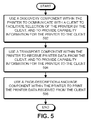
- FIG. 5 presents a flow chart illustrating the printing process from the printer's perspective in accordance with the disclosed embodiments.
- the printer uses a discovery component within the printer to communicate with a client to facilitate selection of the printer by the client.
- the discovery component can provide capability information for the printer to the client (step 502).
- the printer uses a transport component within the printer to receive printer data from the client.
- the transport component can also provide capability information for the printer to the client (step 504).
- the printer can use a page-description-language component within the printer to print the printer data received from the client (step 506).
- some of the disclosed embodiments have added new keys to the Internet Printing Protocol (IPP) standard.
- IPP Internet Printing Protocol
- some embodiments include a new document-format-preferred key (as a MIME media type), which enables the printer to specify a "preferred" document format out of all of the document formats that are supported by the printer.
- This preferred document format can be used to improve performance. For example, the preferred document format may be more efficient to print than other document formats supported by the printer.
- the IPP standard already provides a document-format-supported key which specifies that a specific document format is supported by a printer.
- the existing IPP standard does not provide any way to indicate which of the supported document formats is preferred.
- Some embodiments have also added a new "URF-supported key" to a discovery protocol and a transport protocol. More specifically, some embodiments have added a new URF-supported key to the discovery protocol as part of a BonjourTM TXT record, and have also added an analogous URF-supported key to the transport protocol as a new printer description attribute for the IPP protocol.
- This URF-supported key specifies a standardized set of capabilities that are supported by a printer which enables a client to generate printer data for the client without the need for the client to maintain printer-specific software or printer-specific configuration information for the selected printer.
- This standardized set of capabilities is selected to enable the client to generate printer data for any type of printer.
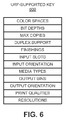
- the standardized set of capabilities includes the following which also appear in the diagram of the URF-supported key 600 in FIG. 6 ,
- Some embodiments support a new device-independent bitmap container for printer data.
- the device-independent bitmap container can be implemented as a Multipurpose Internet Mail Extensions (MIME) subtype.
- MIME Multipurpose Internet Mail Extensions
- This new device-independent bitmap container includes a file header, and at least one set of a page header and a page bitmap.
- the page header can have a predetermined format that specifies the following attributes for a page to be printed by a printer. (These attributes also appear in the device-independent bitmap container 700 which is illustrated in FIG. 7 .)
- the system can perform optimizations to improve speed, increase print quality and save battery power. This can be accomplished by selecting a file type for the printer data that reduces the number of computational operations involved in generating the printer data, thereby improving speed and reducing the amount of power consumed by the computing device. For example, if a printer supports PDF and the computing device is printing a PDF file, it uses much less battery power and is faster to send the PDF file to the printer instead of converting the PDF file into raster data and sending the raster data to the printer.
- the system can select a file format which reduces the size of the printer data file. This reduces the number of data transfer operations required to forward the printer data to the printer, and thereby improves speed and reduces the amount of power consumed by the computing device.
- the system can save power by selecting between driverless printing and cloud printing based on whether or not the power consumed while transferring data to and from the cloud will be offset by the power saved by off-loading the printer-related rendering operations to the cloud.
- power-consuming computational operations can be off-loaded from a mobile device (that runs on battery power) to a server within a cloud (that runs on wall power), which can potentially save a significant amount of battery power.
- a printer manufacturer may attempt to implement a printer which adheres to the driverless printer specification, but the implementation may have one or more bugs.
- the system can maintain a database containing such known bugs for specific printer models. During a printing operation, the system can first perform a lookup in the database, and if one or more known bugs exist for a printer, the system can adjust how the printer data is generated to compensate for these known bugs.
- APIs Application Programming Interfaces
- An API is an interface implemented by a program code component (hereinafter “API-implementing component") that allows a different program code component (hereinafter “API-calling component”) to access and use one or more functions, methods, procedures, data structures, classes, and/or other services provided by the API-implementing component.
- API-implementing component a program code component
- API-calling component a different program code component
- An API can define one or more parameters that are passed between the API-calling component and the API-implementing component.
- An API allows a developer of an API-calling component (which may be a third-party developer) to leverage specified features provided by an API-implementing component. There may be one API-calling component, or there may be more than one such component.
- An API can be a source code interface that a computer system or program library provides in order to support requests for services from an application.
- An API can be specified in terms of a programming language that can be interpreted or compiled when an application is built.
- the API-implementing component may provide more than one API, each providing a different view of or that access different aspects of the functionality implemented by the API-implementing component.
- the API-implementing component may itself call one or more other components via an underlying API, and thus be both an API-calling component and an API-implementing component.
- An API defines the language and parameters that API-calling components use when accessing and using specified features of the API-implementing component. For example, an API-calling component accesses the specified features of the API-implementing component through one or more API calls or invocations (embodied, for example, by function or method calls) exposed by the API, and passes data and control information using parameters via the API calls or invocations.
- the API-implementing component may return a value through the APT in response to an API call from an API-calling component. While the API defines the syntax and result of an API call (e.g., how to invoke the API call and what the API call does), the API may not reveal how the API call accomplishes the function specified by the API call.
- API calls are transferred via the one or more application programming interfaces between the calling (API-calling component) and an API-implementing component. Transferring the API calls may include issuing, initiating, invoking, calling, receiving, returning, or responding to the function calls or messages.
- the function calls or other invocations of the API may send or receive one or more parameters through a parameter list or other structure.
- a parameter can be a constant, key, data structure, object, object class, variable, data type, pointer, array, list or a pointer to a function or method or another way to reference a data or other item to be passed via the API.
- data types or classes may be provided by the API and implemented by the API-implementing component.
- the API-calling component may declare variables, use pointers to, use or instantiate constant values of such types or classes by using definitions provided in the API.
- an API can be used to access a service or data provided by the API-implementing component, or to initiate performance of an operation or computation provided by the API-implementing component.
- the API-implementing component and the API-calling component may be an operating system, a library, a device driver, an API, an application program, or other module (it should be understood that the API-implementing component and the API-calling component may be the same or different type of module from each other).
- API-implementing components may in some cases be embodied at least in part in firmware, microcode, or other hardware logic.
- an API may allow a client program to use the services provided by a Software Development Kit (SDK) library.
- SDK Software Development Kit
- an application or other client program may use an API provided by an Application Framework.
- the application or client program may incorporate calls to functions or methods provided by the SDK and provided by the API, or use data types or objects defined in the SDK and provided by the API.
- An application framework may in these embodiments provide a main event loop for a program that responds to various events defined by the framework.
- the API allows the application to specify the events and the responses to the events using the application framework.
- an API call can report to an application the capabilities or state of a hardware device, including those related to aspects such as input capabilities and state, output capabilities and state, processing capability, power state, storage capacity and state, communications capability, etc., and the API may be implemented in part by firmware, microcode, or other low-level logic that executes in part on the hardware component.
- the API-calling component may be a local component (i.e., on the same data processing system as the API-implementing component) or a remote component (i.e., on a different data processing system from the API-implementing component) that communicates with the API-implementing component through the API over a network. It should be understood that an API-implementing component may also act as an API-calling component (i.e., it may make API calls to an API exposed by a different API-implementing component), and an API-calling component may also act as an API-implementing component by implementing an API that is exposed to a different API-calling component.
- the API may allow multiple API-calling components written in different programming languages to communicate with the API-implementing component (thus, the API may include features for translating calls and returns between the API-implementing component and the API-calling component); however, the API may be also implemented in terms of a specific programming language.
- FIG. 8 is a block diagram illustrating an exemplary API architecture, which may be used in some embodiments of the invention.
- the API architecture 800 includes the API-implementing component 810 (e.g., an operating system, a library, a device driver, an API, an application program, or other module) that implements the API 820.
- the API 820 specifies one or more functions, methods, classes, objects, protocols, data structures, formats and/or other features of the API-implementing component that may be used by the API-calling component 830.
- the API 820 can specify at least one calling convention that specifies how a function in the API-implementing component receives parameters from the API-calling component and how the function returns a result to the API-calling component.
- the API-calling component 830 (e.g., an operating system, a library, a device driver, an API, an application program, or other module) makes API calls through the API 820 to access and use the features of the API-implementing component 810 that are specified by the API 820.
- the API-implementing component 810 may return a value through the API 820 to the API-calling component 830 in response to an API call.
- the API-implementing component 810 may include additional functions, methods, classes, data structures, and/or other features that are not specified through the API 820 and are not available to the API-calling component 830. It should be understood that the API-calling component 830 may be on the same system as the API-implementing component 810 or may be located remotely and access the API-implementing component 810 using the API 820 over a network. While FIG. 8 illustrates a single API-calling component 830 interacting with the API 820, it should be understood that other API-calling components, which may be written in different languages (or the same language) than the API-calling component 830, may use the API 820.
- the API-implementing component 810, the API 820, and the API-calling component 830 may be stored in a machine-readable medium, which includes any mechanism for storing information in a form readable by a machine (e.g., a computer or other data processing system).
- a machine-readable medium includes magnetic disks, optical disks, random access memory, read only memory, flash memory devices, etc.
- applications can make calls to Services A or B using Service API and to Operating System (OS) using OS API.
- Services A and B can make calls to OS using OS API.
- a system that facilitates driverless printing, comprising: a discovery component configured to identify accessible printers and to facilitate selection of an accessible printer, wherein the discovery component is also configured to obtain capability information from accessible printers; a transport component configured to transport data to the selected printer; and a page-description-language component configured to generate printer data for the selected printer based on obtained capability information for the selected printer; wherein the capability information obtained from the selected printer enables the system to generate the printer data for the selected printer without the need for the system to maintain printer-specific software or printer-specific configuration information for the selected printer.
- the system provides an integrated framework that enables the discovery component, the transport component and the page-description-language component to be accessed by an application.
- the integrated framework includes one or more application programming interfaces (APIs) that provide access to the discovery component, the transport component and the page-description-language component.
- APIs application programming interfaces
- the discovery component is configured to obtain current status information from the accessible printers.
- the current status information specifies one or more of the following: whether the printer is off-line; whether the printer is busy; and whether an error condition exists in the printer.
- the capability information for a printer specifies one or more of the following: resolutions; color spaces; bit depths; input slots; face-up/face-down input orientation; output bins; face-up/face-down output orientation; duplex printing support; media types; copy support; supported finishings; and print quality.
- the capability information for the printer additionally specifies one or more of the following: file sizes; file-format versions; and file-format extensions.
- the transport component is also configured to obtain capability information from the selected printer.
- a computing device that facilitates driverless printing, comprising: a discovery component within the computing device configured to identify accessible printers and to facilitate selection of an accessible printer, wherein the discovery component is also configured to obtain capability information from accessible printers; a transport component within the computing device configured to transport data to the selected printer; and a page-description-language component within the computing device configured to generate the printer data for the selected printer based on obtained capability information for the selected printer; wherein the capability information obtained from the selected printer enables the computing device to generate the printer data for the selected printer without the need for the computing device to maintain printer-specific software or printer-specific configuration information for the selected printer.
- the discovery component is configured to obtain current status information from the accessible printers.
- the transport component is also configured to obtain capability information from the selected printer.
- a method for facilitating driverless printing comprising: using a discovery component to identify accessible printers and to facilitate selection of an accessible printer, wherein the discovery component is also configured to obtain capability information from accessible printers; using a transport component to transport data to the selected printer; and using a page-description-language component to generate printer data for the selected printer based on obtained capability information for the selected printer; wherein the capability information obtained from the selected printer enables the method to generate the printer data for the selected printer without the need for a computing device upon which the method operates to maintain printer-specific software or printer-specific configuration information for the selected printer.
- the discovery component, the transport component and the page-description-language component are accessed through a unified framework which can be accessed by an application.
- the integrated framework includes one or more application programming interfaces (APIs) that provide access to the discovery component, the transport component and the page-description-language component.
- APIs application programming interfaces
- the discovery component is configured to obtain current status information from the accessible printers.
- the current status information specifies one or more of the following: whether the printer is off-line; whether the printer is busy; and whether an error condition exists in the printer.
- the capability information for a printer specifies one or more of the following: resolutions; color spaces; bit depths; input slots; face-up/face-down input orientation; output bins; face-up/ face-down output orientation; duplex printing support; media types; copy support; supported finishings; and print quality.
- the capability information for the printer additionally specifies one or more of the following: file sizes; file-format versions; and file-format extensions.
- the transport component is also configured to obtain capability information from the selected printer.
- a computer-readable storage medium storing instructions that when executed by a computer cause the computer to provide a system that facilitates driverless printing, wherein the instructions implement a number of components, including: a discovery component configured to identify accessible printers and to facilitate selection of an accessible printer, wherein the discovery component is also configured to obtain capability information from accessible printers; a transport component configured to transport data to the selected printer; and a page-description-language component configured to generate printer data for the selected printer based on obtained capability information for the selected printer; wherein the capability information obtained from the selected printer enables the system to generate the printer data for the selected printer without the need for the system to maintain printer-specific software or printer-specific configuration information for the selected printer.
- a machine-implemented method in an environment which uses an Application Programming Interface comprising: transferring a discovery call through the API to cause a discovery component to identify accessible printers and to facilitate selection of an accessible printer, wherein the discovery component is also configured to obtain capability information from accessible printers; transferring a transport call through the API to cause a transport component to transport data to the selected printer; and transferring a rendering call through the API to cause a page-description-language component to generate printer data for the selected printer based on obtained capability information for the selected printer; wherein the capability information obtained from the selected printer enables the system to generate the printer data for the selected printer without the need for the system to maintain printer-specific software or printer-specific configuration information for the selected printer.
- API Application Programming Interface
- the discovery component is configured to obtain current status information from the accessible printers.
- the transport component is also configured to obtain capability information from the selected printer.
- a data processing system comprising:a processor to execute instructions; and a memory coupled with the processor to store instructions which, when executed by the processor, cause the processor to: interface a discovery component of the data processing system with an Application Programming Interface (API)-calling component to identify accessible printers to facilitate selecting an accessible printer, and to obtain capability information from accessible printers; interface a transport component of the data processing system with the API-calling component to transport data to the selected printer; and interface a page-description-language component of the data processing system with the API-calling component to generate printer data for the selected printer based on obtained capability information for the selected printer; wherein the capability information obtained from the selected printer enables the processor to generate the printer data for the selected printer without the need for the data processing system to maintain printer-specific software or printer-specific configuration information for the selected printer.
- API Application Programming Interface
Landscapes
- Engineering & Computer Science (AREA)
- Theoretical Computer Science (AREA)
- Human Computer Interaction (AREA)
- Physics & Mathematics (AREA)
- General Engineering & Computer Science (AREA)
- General Physics & Mathematics (AREA)
- Computer Networks & Wireless Communication (AREA)
- Accessory Devices And Overall Control Thereof (AREA)
Abstract
Description
- The disclosed embodiments relate to printers for computer systems. More specifically, the disclosed embodiments relate to a computer-based printing system that operates without having to manage printer-specific driver software.
- Printers are often a problem for computer users. When a computer user initially installs a printer, the cabling and power cords are typically not a problem to hook up. However, the user typically has to install a printer-specific driver, which involves loading the driver from a disk or navigating to a website and downloading the driver. Even if the printer driver is already loaded into the computer system, the user often has to load and install an update for the driver from the printer manufacturer's website. These installation operations are time-consuming and commonly require the user to find and enter a long software-license key.
- Hence, what is needed is a system that facilitates installing a printer without the above-described problems.
- The disclosed embodiments provide a system that facilitates driverless printing. This system includes a discovery component configured to identify accessible printers and to facilitate selection of an accessible printer, wherein the discovery component is also configured to obtain capability information from accessible printers. The system also includes a transport component configured to transport data to the selected printer, wherein the transport component is also configured to obtain capability information from the selected printer. Finally, the system includes a page-description-language component configured to generate printer data for the selected printer based on obtained capability information for the selected printer.
- In some embodiments, the system provides an integrated framework that enables the discovery component, the transport component and the page-description-language component to be accessed by an application.
- In some embodiments, the integrated framework includes one or more application programming interfaces (APIs) that provide access to the discovery component, the transport component and/or the page-description-language component. These APIs enable a calling application to interact with other application code being called through the API. Various function calls, messages or other types of invocations, which further may include various kinds of parameters, can be transferred via the API between the calling application and the code being called. In addition, the API may provide the calling application code the ability to use data types or classes defined in the API and implemented in the called application code. A method for operating through this API includes transferring one or more function calls, messages, other types of invocations or parameters via the API.
- In some embodiments, while obtaining the capability information from accessible printers, the discovery component is configured to obtain current status information from the accessible printers.
- In some embodiments, the current status information can specify: whether the printer is off-line; whether the printer is busy; or whether an error condition exists in the printer.
- In some embodiments, the capability information for a printer can specify, for example, the file sizes supported by the printer; the file-format versions supported by the printer; the file-format extensions supported by the printer; the color spaces supported by the printer; the bit depths supported by the printer; or the resolutions supported by the printer.
- In some embodiments, the capability information obtained from the selected printer enables the system to generate printer data for the selected printer without the need for the system to maintain printer-specific software or printer-specific configuration information for the selected printer.
- Some embodiments include one or more application programming interfaces (APIs) in an environment with calling program code that interacts with other program code being called through the one or more interfaces. Various function calls, messages or other types of invocations, which further may include various kinds of parameters, can be transferred via the APIs between the calling program and the code being called. In addition, an API may provide the calling program code the ability to use data types or classes defined within the API and implemented in the called program code.
- At least certain embodiments include an environment with a calling software component interacting with a called software component through an API. A method for operating through an API in this environment includes transferring one or more function calls, messages, and other types of invocations or parameters via the API.
-
-
FIG. 1 illustrates a printing system in accordance with the disclosed embodiments. -
FIG. 2 illustrates components involved in performing a printing operation in accordance with the disclosed embodiments. -
FIG. 3 presents a flow chart illustrating the printing process in accordance with the disclosed embodiments. -
FIG. 4 presents a flow chart illustrating the driverless printing process in accordance with the disclosed embodiments. -
FIG. 5 presents a flow chart illustrating the printing process from the printer's perspective in accordance with the disclosed embodiments. -
FIG. 6 illustrates the structure of a universal-raster-format-supported (URF-supported) key in accordance with the disclosed embodiments. -
FIG. 7 illustrates the structure of a device-independent bitmap container in accordance with the disclosed embodiments. -
FIG. 8 illustrates how software components call each other through an API in accordance with the disclosed embodiments. -
FIG. 9 illustrates how API calls can be made through a system stack in accordance with the disclosed embodiments. - The following description is presented to enable any person skilled in the art to make and use the disclosed embodiments, and is provided in the context of a particular application and its requirements. Various modifications to the disclosed embodiments will be readily apparent to those skilled in the art, and the general principles defined herein may be applied to other embodiments and applications without departing from the spirit and scope of the disclosed embodiments. Thus, the disclosed embodiments are not limited to the embodiments shown, but arc to be accorded the widest scope consistent with the principles and features disclosed herein.
- The data structures and code described in this detailed description are typically stored on a non-transitory computer-readable storage medium, which may be any device or medium that can store code and/or data for use by a computer system. The non-transitory computer-readable storage medium includes, but is not limited to, volatile memory, non-volatile memory, magnetic and optical storage devices such as disk drives, magnetic tape, CDs (compact discs), DVDs (digital versatile discs or digital video discs), or other media capable of storing code and/or data now known or later developed.
- The methods and processes described in the detailed description section can be embodied as code and/or data, which can be stored in a non-transitory computer-readable storage medium as described above. When a computer system reads and executes the code and/or data stored on the non-transitory computer-readable storage medium, the computer system performs the methods and processes embodied as data structures and code and stored within the non-transitory computer-readable storage medium. Furthermore, the methods and processes described below can be included in hardware modules. For example, the hardware modules can include, but are not limited to, application-specific integrated circuit (ASIC) chips, field-programmable gate arrays (FPGAs), and other programmable-logic devices now known or later developed. When the hardware modules are activated, the hardware modules perform the methods and processes included within the hardware modules.
- The disclosed embodiments facilitate "driverless printing," which enables a computing device to print to a printer without having to worry about installing or updating associated printer driver software. This is accomplished by augmenting a discovery protocol (such as Bonjour™) and an associated network-printing protocol (such as IPP), so that the protocols return printer capability information which is used to generate printer data for a selected printer.
- Note that the disclosed embodiments differ from existing systems which need to maintain specific drivers for each supported printer. In these existing systems, the features and capabilities for specific printers arc stored in static capability files created by the printer vendors, such as a PostScript Printer Description (PPD) file, and these static capability files are stored on the mobile device itself. In contrast, the disclosed embodiments query a printer (not a static file) to determine the "current" operational capabilities of a printer. In addition to the discovery protocol and the network-printing protocol, the disclosed embodiments also provide a page-description language that specifies the appearance of printed pages.
- The disclosed embodiments additionally provide a framework which enables an application to easily use the discovery protocol, the network-printing protocol and the page-description language. This framework can be implemented using one or more APIs which enable an application to access these components. Details of the disclosed embodiments are described below, but first we describe the printing system.
-
FIG. 1 illustrates aprinting system 100 in accordance with the disclosed embodiments.Printing system 100 includes acomputing device 102 and aprinter 106.Computing device 102 can generally include any type of computer system or computing device, such as a personal computer system, a server computer system, a laptop computer, a notebook computer, a tablet computer, a personal digital assistant, a digital media receiver (such as Apple TV™), a digital picture frame, a cellular telephone or a portable navigation system.Printer 106 can generally include any device or system capable of printing textual data or images onto some type of print media, such as paper or photo media. For example,printer 106 can comprise a stand-alone printer, or alternatively a printing system, which includes a print server that is coupled to one or more printers. -
Computing device 102 is coupled toprinter 106 throughnetwork 104.Network 104 can generally include any type of communication channel capable of coupling together network nodes. For example,network 104 can include a wireless network connection, such as a Bluetooth™ network connection; a cellular networking connection (e.g., a 3G/4G network or an Edge network); a networking connection based on the standards described in Institute for Electrical and Electronic Engineers (IEEE) 802.11; a wireless personal-area networking (PAN) connection, such as a network connection based on the standards described in IEEE 802.15; or any peer-to-peer (wireless or wired) networking technology.Network 104 can also include a wired network connection, such as a network connection based on the standards described in IEEE 802.3. - During the printing process,
computing device 102 initially makes contact withprinter 106 through a discovery protocol as is described in more detail below. Next, afterprinter 106 is identified and selected, there arc a number of ways that printing can be accomplished. Ifcomputing device 102 possesses a driver forprinter 106, or ifprinter 106 supports driverless printing,computing device 102 can use the driver or the driverless printing protocol to generate printer data for a print job. The printer data can then be sent toprinter 106 throughnetwork 104. This process is described in more detail below. (Note that the term "driverless printing" refers to a printing technique which operates without the need for printer-specific software or printer-specific configuration on a computing device.) -
FIG. 2 illustrates components involved in performing a printing operation in accordance with the disclosed embodiments. Referring toFIG. 2 ,computing device 102 includes anapplication 202 which needs to perform a printing operation. For example,application 202 can include a printing utility that allows a user to print a specific file. Alternatively,application 202 can include any type of general-purpose or special-purpose computer-based application that periodically needs to perform a printing operation, such as a word processor.Application 202 makes calls toAPI 203, which provides a framework that facilitates access to a number of components, including adiscovery component 204, a page-description-language component 205 and a network-printing component 206. - During operation,
application 202 usesdiscovery component 204, which implements a discovery protocol (such as Bonjour™) to identify available printers and to facilitate selecting one of the identified printers. Note thatdiscovery component 204 communicates with acorresponding discovery component 212 in printer 106 (illustrated by dashed line 230). Next, after aprinter 106 is selected,application 202 uses page-description-language component 205 to render a print job to producecorresponding printer data 208.Printer data 208 is then sent to network-printing component 206, which implements a network protocol for remote printing, such as an Internet Printing Protocol (IPP). Network-printing component 206 communicatesprinter data 208 to a corresponding network-printing component 214 within printer 106 (illustrated by dashed line 232). - As mentioned above,
printer 106 contains adiscovery component 212 and a network-printing component 214. In addition,printer 106 includes components that support printing using, for example, the JPEG (Joint Photographic Experts Group) standard 216, the PDF (Portable Document Format) standard 217, and a RF (Raster Format) standard 218. These components send data throughprint controller 219 to printheads 220 withinprinter 106, so thatprint controller 219 can translate the data andprint heads 220 can print the translated data onto some type of print media, such as paper. -
FIG. 3 presents a flow chart illustrating the printing process in accordance with the disclosed embodiments. First, the system uses a discovery protocol, such as the Bonjour™ protocol, to identify printers that can be accessed by computing device 102 (step 302). As mentioned above, this discovery protocol also obtains capability information from the printer. Next, the system presents a list of available printers to a user (or an application) and allows the user (or the application) to select one of the identified printers (step 304). - Next, the system checks interoperability of the selected printer (step 306). For example, the system can obtain information from the printer indicating that the printer supports JPEG, PDF and RF, in which case the system can use any of the supported formats. On the other hand, if the information indicates the printer can only support RF, the system uses RF to send data to the printer.
- Next, the system has a number of options. If the selected printer supports driverless printing, the system can obtain printer capability information from the selected printer and can generate printer data for the printer based on the obtained printer capability information. Next, the system can send the generated printer data to the selected printer (step 308). As mentioned above, this capability information can be obtained from the selected printer during a query for the discovery protocol, or during a subsequent network-printing protocol query. On the other hand, if the mobile device contains a specific driver for the selected printer, the system can use the specific driver to generate and send printer data to the selected printer (step 310). The system can alternatively send the print job to a cloud comprising one or more servers that provide a printing service. This enables the cloud to generate the printer data for the selected printer (step 312).
- In general, the system can select among driverless printing, cloud printing and using a local driver based on a number of factors, such as power consumption and/or computational load. In one embodiment, the system uses driverless printing if possible, and if driverless printing is not supported, the system uses a local driver for the printer. Finally, if such a local driver is not supported, the system uses the cloud to generate the printer data.
- As mentioned above, the printer capability information can be obtained from the selected printer during a query for the discovery protocol (Bonjour™), or during a subsequent network-printing protocol (IPP) query. More specifically, during the discovery protocol, the selected printer can return printer-specific information specifying what types of data the selected printer can accept and information specifying the selected printer's capabilities. Moreover, this printer-specific information enables the computer device to generate the printer data for the selected printer without the need for the computer to maintain printer-specific software or printer-specific configuration information for the selected printer. Once the mobile device is actually communicating with the printer through IPP, the IPP protocol can provide the same printer-specific information. (This prevents having to cache information between the discovery protocol and the network-printing protocol.)
- This printer capability information can specify attributes of the print media, such as media sizes, types (e.g., paper or photo media) and margins. This printer capability information can also specify finishing attributes, such as attributes related to stapling, hole punching and booklets. The printer capability information can additionally specify information related to printer features, such as whether it can print on two sides of a page (duplex), which output bit to use, and which media source (tray) to use. The printer capability attributes can also specify file-related attributes, such as the file sizes supported by the printer, the file-format versions supported by the printer, and the file-format extensions supported by the printer. The printer capability information can also specify various printer capabilities, such as the color spaces supported by the printer, the bit depths supported by the printer, and the resolutions supported by the printer.
- This printer capability information can additionally specify current status information obtained from printers. For example, this current status information can specify: whether the printer is off-line; whether the printer is busy; or whether an error condition exists in the printer. This current status information can be presented to the user while the user is selecting an available printer.
-
FIG. 4 presents a flow chart illustrating the driverless printing process in accordance with the disclosed embodiments. (This flow chart illustrates some of the operations which take place during the driverless printing process which occurs instep 308 ofFIG. 3 .) First, the system obtains capability information for the selected printer (step 402). As mentioned above, this capability information can be obtained from the printer during a query which is part of the initial discovery protocol, or during a subsequent IPP query. Next, the system queues to the selected printer (step 404) and allows a user (or an application) to select a specific type of media for the print job (step 406). - The system then generates printer data for the selected printer based on the obtained capability information (step 408). Next, the printer sends the printer data to the selected printer (step 410). Finally, the system receives status information for the selected printer, which indicates whether the printer data was successfully printed (step 412).
-
FIG. 5 presents a flow chart illustrating the printing process from the printer's perspective in accordance with the disclosed embodiments. First, the printer uses a discovery component within the printer to communicate with a client to facilitate selection of the printer by the client. During this discovery process, the discovery component can provide capability information for the printer to the client (step 502). Next, the printer uses a transport component within the printer to receive printer data from the client. During this process, the transport component can also provide capability information for the printer to the client (step 504). Finally, the printer can use a page-description-language component within the printer to print the printer data received from the client (step 506). - To facilitate driverless printing, some of the disclosed embodiments have added new keys to the Internet Printing Protocol (IPP) standard. In particular, some embodiments include a new document-format-preferred key (as a MIME media type), which enables the printer to specify a "preferred" document format out of all of the document formats that are supported by the printer. This preferred document format can be used to improve performance. For example, the preferred document format may be more efficient to print than other document formats supported by the printer.
- Note that the IPP standard already provides a document-format-supported key which specifies that a specific document format is supported by a printer. However, the existing IPP standard does not provide any way to indicate which of the supported document formats is preferred.
- Some embodiments have also added a new "URF-supported key" to a discovery protocol and a transport protocol. More specifically, some embodiments have added a new URF-supported key to the discovery protocol as part of a Bonjour™ TXT record, and have also added an analogous URF-supported key to the transport protocol as a new printer description attribute for the IPP protocol.
- This URF-supported key specifies a standardized set of capabilities that are supported by a printer which enables a client to generate printer data for the client without the need for the client to maintain printer-specific software or printer-specific configuration information for the selected printer. This standardized set of capabilities is selected to enable the client to generate printer data for any type of printer.
- In one embodiment, the standardized set of capabilities includes the following which also appear in the diagram of the URF-supported key 600 in
FIG. 6 , - (1) color spaces that are supported by the printer;
- (2) bit depths that are supported by the printer for specific color spaces;
- (3) a maximum number of copies supported by the printer;
- (4) whether duplex printing is supported by the printer;
- (5) specific finishings that are supported by the printer (e.g., stapling, folding, hole punching);
- (6) input slots supported by the printer;
- (7) face-up/face-down input orientation;
- (8) media types supported by the printer (e.g., plain paper, glossy);
- (9) output bins supported by the printer;
- (10) face-up/face-down output orientation;
- (11) supported print qualities; and
- (12) supported resolutions.
- Some embodiments support a new device-independent bitmap container for printer data. For example, the device-independent bitmap container can be implemented as a Multipurpose Internet Mail Extensions (MIME) subtype.
- This new device-independent bitmap container includes a file header, and at least one set of a page header and a page bitmap. In one embodiment, the page header can have a predetermined format that specifies the following attributes for a page to be printed by a printer. (These attributes also appear in the device-independent bitmap container 700 which is illustrated in
FIG. 7 .) - (1) a bit depth;
- (2) a color space;
- (3) a duplex mode;
- (4) a print quality;
- (5) a media type;
- (6) an input slot;
- (7) an output bin
- (8) a number of copies;
- (9) one or more finishings;
- (10) a width;
- (11) a height; and
- (12) a resolution.
- In some embodiments, the system can perform optimizations to improve speed, increase print quality and save battery power. This can be accomplished by selecting a file type for the printer data that reduces the number of computational operations involved in generating the printer data, thereby improving speed and reducing the amount of power consumed by the computing device. For example, if a printer supports PDF and the computing device is printing a PDF file, it uses much less battery power and is faster to send the PDF file to the printer instead of converting the PDF file into raster data and sending the raster data to the printer. (Note that, by saving computational operations and computational time, the system frees up resources and time to perform other operations, for example to increase print quality.) Also, in the case where the cloud returns the generated printer data to the computing device, the system can select a file format which reduces the size of the printer data file. This reduces the number of data transfer operations required to forward the printer data to the printer, and thereby improves speed and reduces the amount of power consumed by the computing device.
- In another example, the system can save power by selecting between driverless printing and cloud printing based on whether or not the power consumed while transferring data to and from the cloud will be offset by the power saved by off-loading the printer-related rendering operations to the cloud. By using a cloud, power-consuming computational operations can be off-loaded from a mobile device (that runs on battery power) to a server within a cloud (that runs on wall power), which can potentially save a significant amount of battery power.
- In some cases, a printer manufacturer may attempt to implement a printer which adheres to the driverless printer specification, but the implementation may have one or more bugs. In this case, the system can maintain a database containing such known bugs for specific printer models. During a printing operation, the system can first perform a lookup in the database, and if one or more known bugs exist for a printer, the system can adjust how the printer data is generated to compensate for these known bugs.
- One or more Application Programming Interfaces (APIs) may be used in some embodiments. An API is an interface implemented by a program code component (hereinafter "API-implementing component") that allows a different program code component (hereinafter "API-calling component") to access and use one or more functions, methods, procedures, data structures, classes, and/or other services provided by the API-implementing component. An API can define one or more parameters that are passed between the API-calling component and the API-implementing component.
- An API allows a developer of an API-calling component (which may be a third-party developer) to leverage specified features provided by an API-implementing component. There may be one API-calling component, or there may be more than one such component. An API can be a source code interface that a computer system or program library provides in order to support requests for services from an application. An API can be specified in terms of a programming language that can be interpreted or compiled when an application is built.
- In some embodiments the API-implementing component may provide more than one API, each providing a different view of or that access different aspects of the functionality implemented by the API-implementing component. In other embodiments the API-implementing component may itself call one or more other components via an underlying API, and thus be both an API-calling component and an API-implementing component.
- An API defines the language and parameters that API-calling components use when accessing and using specified features of the API-implementing component. For example, an API-calling component accesses the specified features of the API-implementing component through one or more API calls or invocations (embodied, for example, by function or method calls) exposed by the API, and passes data and control information using parameters via the API calls or invocations. The API-implementing component may return a value through the APT in response to an API call from an API-calling component. While the API defines the syntax and result of an API call (e.g., how to invoke the API call and what the API call does), the API may not reveal how the API call accomplishes the function specified by the API call. Various API calls are transferred via the one or more application programming interfaces between the calling (API-calling component) and an API-implementing component. Transferring the API calls may include issuing, initiating, invoking, calling, receiving, returning, or responding to the function calls or messages. The function calls or other invocations of the API may send or receive one or more parameters through a parameter list or other structure. A parameter can be a constant, key, data structure, object, object class, variable, data type, pointer, array, list or a pointer to a function or method or another way to reference a data or other item to be passed via the API.
- Furthermore, data types or classes may be provided by the API and implemented by the API-implementing component. Thus, the API-calling component may declare variables, use pointers to, use or instantiate constant values of such types or classes by using definitions provided in the API.
- Generally, an API can be used to access a service or data provided by the API-implementing component, or to initiate performance of an operation or computation provided by the API-implementing component. By way of example, the API-implementing component and the API-calling component may be an operating system, a library, a device driver, an API, an application program, or other module (it should be understood that the API-implementing component and the API-calling component may be the same or different type of module from each other). API-implementing components may in some cases be embodied at least in part in firmware, microcode, or other hardware logic. In some embodiments, an API may allow a client program to use the services provided by a Software Development Kit (SDK) library. In other embodiments an application or other client program may use an API provided by an Application Framework.
- In these embodiments the application or client program may incorporate calls to functions or methods provided by the SDK and provided by the API, or use data types or objects defined in the SDK and provided by the API. An application framework may in these embodiments provide a main event loop for a program that responds to various events defined by the framework. The API allows the application to specify the events and the responses to the events using the application framework. In some implementations, an API call can report to an application the capabilities or state of a hardware device, including those related to aspects such as input capabilities and state, output capabilities and state, processing capability, power state, storage capacity and state, communications capability, etc., and the API may be implemented in part by firmware, microcode, or other low-level logic that executes in part on the hardware component.
- The API-calling component may be a local component (i.e., on the same data processing system as the API-implementing component) or a remote component (i.e., on a different data processing system from the API-implementing component) that communicates with the API-implementing component through the API over a network. It should be understood that an API-implementing component may also act as an API-calling component (i.e., it may make API calls to an API exposed by a different API-implementing component), and an API-calling component may also act as an API-implementing component by implementing an API that is exposed to a different API-calling component.
- The API may allow multiple API-calling components written in different programming languages to communicate with the API-implementing component (thus, the API may include features for translating calls and returns between the API-implementing component and the API-calling component); however, the API may be also implemented in terms of a specific programming language.
-
FIG. 8 is a block diagram illustrating an exemplary API architecture, which may be used in some embodiments of the invention. As shown inFIG. 8 , theAPI architecture 800 includes the API-implementing component 810 (e.g., an operating system, a library, a device driver, an API, an application program, or other module) that implements theAPI 820. TheAPI 820 specifies one or more functions, methods, classes, objects, protocols, data structures, formats and/or other features of the API-implementing component that may be used by the API-callingcomponent 830. TheAPI 820 can specify at least one calling convention that specifies how a function in the API-implementing component receives parameters from the API-calling component and how the function returns a result to the API-calling component. The API-calling component 830 (e.g., an operating system, a library, a device driver, an API, an application program, or other module) makes API calls through theAPI 820 to access and use the features of the API-implementingcomponent 810 that are specified by theAPI 820. The API-implementingcomponent 810 may return a value through theAPI 820 to the API-callingcomponent 830 in response to an API call. - It will be appreciated that the API-implementing
component 810 may include additional functions, methods, classes, data structures, and/or other features that are not specified through theAPI 820 and are not available to the API-callingcomponent 830. It should be understood that the API-callingcomponent 830 may be on the same system as the API-implementingcomponent 810 or may be located remotely and access the API-implementingcomponent 810 using theAPI 820 over a network. WhileFIG. 8 illustrates a single API-callingcomponent 830 interacting with theAPI 820, it should be understood that other API-calling components, which may be written in different languages (or the same language) than the API-callingcomponent 830, may use theAPI 820. - The API-implementing
component 810, theAPI 820, and the API-callingcomponent 830 may be stored in a machine-readable medium, which includes any mechanism for storing information in a form readable by a machine (e.g., a computer or other data processing system). For example, a machine-readable medium includes magnetic disks, optical disks, random access memory, read only memory, flash memory devices, etc. - In
FIG. 9 ("Software Stack"), an exemplary embodiment, applications can make calls to Services A or B using Service API and to Operating System (OS) using OS API. Services A and B can make calls to OS using OS API. - The foregoing descriptions of embodiments have been presented for purposes of illustration and description only. They are not intended to be exhaustive or to limit the present description to the forms disclosed. Accordingly, many modifications and variations will be apparent to practitioners skilled in the art. Additionally, the above disclosure is not intended to limit the present description. The scope of the present description is defined by the appended claims.
- There is provided a system that facilitates driverless printing, comprising: a discovery component configured to identify accessible printers and to facilitate selection of an accessible printer, wherein the discovery component is also configured to obtain capability information from accessible printers; a transport component configured to transport data to the selected printer; and a page-description-language component configured to generate printer data for the selected printer based on obtained capability information for the selected printer; wherein the capability information obtained from the selected printer enables the system to generate the printer data for the selected printer without the need for the system to maintain printer-specific software or printer-specific configuration information for the selected printer.
- Preferably, wherein the system provides an integrated framework that enables the discovery component, the transport component and the page-description-language component to be accessed by an application.
- Preferably, wherein the integrated framework includes one or more application programming interfaces (APIs) that provide access to the discovery component, the transport component and the page-description-language component.
- Preferably, wherein while obtaining the capability information from accessible printers, the discovery component is configured to obtain current status information from the accessible printers.
- Preferably, wherein the current status information specifies one or more of the following: whether the printer is off-line; whether the printer is busy; and whether an error condition exists in the printer.
- Preferably, wherein the capability information for a printer specifies one or more of the following: resolutions; color spaces; bit depths; input slots; face-up/face-down input orientation; output bins; face-up/face-down output orientation; duplex printing support; media types; copy support; supported finishings; and print quality.
- Preferably, wherein the capability information for the printer additionally specifies one or more of the following: file sizes; file-format versions; and file-format extensions.
- Preferably, wherein the transport component is also configured to obtain capability information from the selected printer.
- There is provided a computing device that facilitates driverless printing, comprising: a discovery component within the computing device configured to identify accessible printers and to facilitate selection of an accessible printer, wherein the discovery component is also configured to obtain capability information from accessible printers; a transport component within the computing device configured to transport data to the selected printer; and a page-description-language component within the computing device configured to generate the printer data for the selected printer based on obtained capability information for the selected printer; wherein the capability information obtained from the selected printer enables the computing device to generate the printer data for the selected printer without the need for the computing device to maintain printer-specific software or printer-specific configuration information for the selected printer.
- Preferably, wherein while obtaining the capability information from accessible printers, the discovery component is configured to obtain current status information from the accessible printers.
- Preferably, wherein the transport component is also configured to obtain capability information from the selected printer.
- There is provided a method for facilitating driverless printing, comprising: using a discovery component to identify accessible printers and to facilitate selection of an accessible printer, wherein the discovery component is also configured to obtain capability information from accessible printers; using a transport component to transport data to the selected printer; and using a page-description-language component to generate printer data for the selected printer based on obtained capability information for the selected printer; wherein the capability information obtained from the selected printer enables the method to generate the printer data for the selected printer without the need for a computing device upon which the method operates to maintain printer-specific software or printer-specific configuration information for the selected printer.
- Preferably, wherein the discovery component, the transport component and the page-description-language component are accessed through a unified framework which can be accessed by an application.
- Preferably, wherein the integrated framework includes one or more application programming interfaces (APIs) that provide access to the discovery component, the transport component and the page-description-language component.
- Preferably, wherein while obtaining the capability information from accessible printers, the discovery component is configured to obtain current status information from the accessible printers.
- Preferably, wherein the current status information specifies one or more of the following: whether the printer is off-line; whether the printer is busy; and whether an error condition exists in the printer.
- Preferably, wherein the capability information for a printer specifies one or more of the following: resolutions; color spaces; bit depths; input slots; face-up/face-down input orientation; output bins; face-up/ face-down output orientation; duplex printing support; media types; copy support; supported finishings; and print quality.
- Preferably, wherein the capability information for the printer additionally specifies one or more of the following: file sizes; file-format versions; and file-format extensions.
- Preferably, wherein the transport component is also configured to obtain capability information from the selected printer.
- There is provided a computer-readable storage medium storing instructions that when executed by a computer cause the computer to provide a system that facilitates driverless printing, wherein the instructions implement a number of components, including: a discovery component configured to identify accessible printers and to facilitate selection of an accessible printer, wherein the discovery component is also configured to obtain capability information from accessible printers; a transport component configured to transport data to the selected printer; and a page-description-language component configured to generate printer data for the selected printer based on obtained capability information for the selected printer; wherein the capability information obtained from the selected printer enables the system to generate the printer data for the selected printer without the need for the system to maintain printer-specific software or printer-specific configuration information for the selected printer.
- There is provided a machine-implemented method in an environment which uses an Application Programming Interface (API), the method comprising: transferring a discovery call through the API to cause a discovery component to identify accessible printers and to facilitate selection of an accessible printer, wherein the discovery component is also configured to obtain capability information from accessible printers; transferring a transport call through the API to cause a transport component to transport data to the selected printer; and transferring a rendering call through the API to cause a page-description-language component to generate printer data for the selected printer based on obtained capability information for the selected printer; wherein the capability information obtained from the selected printer enables the system to generate the printer data for the selected printer without the need for the system to maintain printer-specific software or printer-specific configuration information for the selected printer.
- Preferably, wherein while obtaining the capability information from accessible printers, the discovery component is configured to obtain current status information from the accessible printers.
- Preferably, wherein the transport component is also configured to obtain capability information from the selected printer.
- There is provided a data processing system, comprising:a processor to execute instructions; and a memory coupled with the processor to store instructions which, when executed by the processor, cause the processor to: interface a discovery component of the data processing system with an Application Programming Interface (API)-calling component to identify accessible printers to facilitate selecting an accessible printer, and to obtain capability information from accessible printers; interface a transport component of the data processing system with the API-calling component to transport data to the selected printer; and interface a page-description-language component of the data processing system with the API-calling component to generate printer data for the selected printer based on obtained capability information for the selected printer; wherein the capability information obtained from the selected printer enables the processor to generate the printer data for the selected printer without the need for the data processing system to maintain printer-specific software or printer-specific configuration information for the selected printer.
Claims (15)
- A printer (106) that facilitates driverless printing, comprising:a discovery component (212) configured to identify the printer (106) to a client (102), facilitate selection of the printer (106) by the client (102), obtain capability information from the printer (106), and send the capability information to the client (102);a transport component (214) configured to receive printer data (208) from the client (102); anda page-description-language component configured to print the received printer data (208);wherein the capability information enables the client device (102) to generate the printer data (208) for the printer (106) without the client device (102) needing to maintain printer-specific software or printer-specific configuration information for the printer (106);
characterised by:the capability information including identification of a preferred document format, from a plurality of document formats supported by the printer (106), wherein the preferred document format comprises a format that is more efficiently printed by the printer (106) than another of the printer's supported document formats; andthe printer data (208) being generated in the preferred document format. - The printer (106) of claim 1, wherein the printer (106) provides an integrated framework that enables the discovery component (212), the transport component (214), and the page-description-language component within the printer (106) to be accessed by an application (202).
- The printer (106) of claim 2, wherein the integrated framework includes one or more application programming interfaces (APIs) (203; 820) that provide access to the discovery component (212), the transport component (214) and the page-description-language component within the printer (106).
- The printer (106) of any preceding claim, wherein the discovery component (212) provides current status information from the printer (106) to the client (102).
- The printer (106) of any preceding claim, wherein a cloud printing system facilitates cloud printing in lieu of driverless printing by receiving the printer data (208) from the client (102) and printing the printer data (208) in response to a determination that power consumed while transferring data to and from the cloud printing system will be offset by power saved by off-loading printer-related rendering operations to the cloud printing system.
- The printer (106) of any preceding claim, wherein the capability information for the printer specifies one or more of the following:resolutions;color spaces;bit depths;input slots;face-up/face-down input orientation;output bins;face-up/face-down output orientation;duplex printing support;media types;copy support;supported finishings; andprint quality.
- The printer (106) of claim 6, wherein the capability information for the printer additionally specifies one or more of the following:file sizes;file-format versions; andfile-format extensions.
- The printer (106) of any preceding claim, wherein the preferred document format is specified using a MIME media type.
- A method for using a printer (106) that facilitates driverless printing, the printer (106) comprising a discovery component (212), a transport component (214), and a page-description-language component, and the method comprising:using the discovery component (212) to identify the printer (106) to a client (102), facilitate selection of the printer (106) by the client (102), obtain capability information from the printer (106), and send the capability information to the client (102);using the transport component (214) to receive printer data (208) from the client (102); andusing the page-description-language component to print the received printer data (208);wherein the capability information enables the client device (102) to generate the printer data (208) for the printer (106) without the client device (102) needing to maintain printer-specific software or printer-specific configuration information for the printer (106);
the capability information including identification of a preferred document format, from a plurality of document formats supported by the printer (106), wherein the preferred document format comprises a format that is more efficiently printed by the printer (106) than another of the printer's supported document formats; and
the printer data (208) being generated in the preferred document format. - The method of claim 9, wherein the discovery component (212), the transport component (214), and the page-description-language component are accessed through a unified framework which can be accessed by an application, and wherein the unified framework includes one or more application programming interfaces (APIs) (203;820) that provide access to the discovery component (212), the transport component (214) and the page-description-language component within the printer (106).
- The method of claims 9 or 10, further comprising:using the discovery component (212) to provide current status information from the printer (106) to the client (102).
- The method of claims 9, 10, or 11, wherein the capability information for the printer specifies one or more of the following:resolutions;color spaces;bit depths;input slots;face-up/face-down input orientation;output bins;face-up/ face-down output orientation;duplex printing support;media types;copy support;supported finishings;print quality;file sizes;file-format versions; andfile-format extensions.
- The method of claims 9, 10, 11, or 12, further comprising:using a cloud printing system to facilitate cloud printing in lieu of driverless printing, wherein the cloud printing system is to receive the printer data (208) from the client (102) and to print the printer data (208) in response to a determination that power consumed while transferring data to and from the cloud printing system will be offset by power saved by off-loading printer-related rendering operations to the cloud printing system.
- A computer-readable storage medium storing instructions that when executed by a computer cause the computer to provide a printer (106) that facilitates driverless printing, wherein the instructions implement a number of components, including:a discovery component (212) to identify the printer (106) to a client (102), facilitate selection of the printer (106) by the client (102), obtain capability information from the printer (106), and send the capability information to the client (102);a transport component (214) to receive printer data (208) from the client (102); anda page-description-language component to print the received printer data (208);wherein the capability information enables the client device (102) to generate the printer data (208) for the printer (106) without the client device (102) needing to maintain printer-specific software or printer-specific configuration information for the printer (106);
the capability information including identification of a preferred document format, from a plurality of document formats supported by the printer (106), wherein the preferred document format comprises a format that is more efficiently printed by the printer (106) than another of the printer's supported document formats; and
the printer data (208) being generated in the preferred document format. - The computer-readable storage medium of claim 14, further comprising instructions that when executed by a computer cause the computer to facilitate cloud printing in lieu of driverless printing, wherein the instructions implement a number of components, including:a cloud printing system to receive the printer data (208) from the client (102) and to print the printer data (208), wherein the cloud printing system receives and prints the printer data (208) in response to a determination that power consumed while transferring data to and from the cloud printing system will be offset by power saved by off-loading printer-related rendering operations to the cloud printing system.
Applications Claiming Priority (10)
| Application Number | Priority Date | Filing Date | Title |
|---|---|---|---|
| US30291610P | 2010-02-09 | 2010-02-09 | |
| US30292210P | 2010-02-09 | 2010-02-09 | |
| US35146110P | 2010-06-04 | 2010-06-04 | |
| US35146610P | 2010-06-04 | 2010-06-04 | |
| US35830610P | 2010-06-24 | 2010-06-24 | |
| US37882710P | 2010-08-31 | 2010-08-31 | |
| US37883210P | 2010-08-31 | 2010-08-31 | |
| US12/882,116 US8610928B2 (en) | 2010-02-09 | 2010-09-14 | Framework that supports driverless printing |
| EP11703991.7A EP2534573B1 (en) | 2010-02-09 | 2011-02-02 | Framework that supports driverless printing |
| PCT/US2011/023474 WO2011100148A1 (en) | 2010-02-09 | 2011-02-02 | Framework that supports driverless printing |
Related Parent Applications (2)
| Application Number | Title | Priority Date | Filing Date |
|---|---|---|---|
| EP11703991.7A Division-Into EP2534573B1 (en) | 2010-02-09 | 2011-02-02 | Framework that supports driverless printing |
| EP11703991.7A Division EP2534573B1 (en) | 2010-02-09 | 2011-02-02 | Framework that supports driverless printing |
Publications (2)
| Publication Number | Publication Date |
|---|---|
| EP3125107A1 true EP3125107A1 (en) | 2017-02-01 |
| EP3125107B1 EP3125107B1 (en) | 2020-04-15 |
Family
ID=43711658
Family Applications (2)
| Application Number | Title | Priority Date | Filing Date |
|---|---|---|---|
| EP11703991.7A Active EP2534573B1 (en) | 2010-02-09 | 2011-02-02 | Framework that supports driverless printing |
| EP16187920.0A Active EP3125107B1 (en) | 2010-02-09 | 2011-02-02 | Framework that supports driverless printing |
Family Applications Before (1)
| Application Number | Title | Priority Date | Filing Date |
|---|---|---|---|
| EP11703991.7A Active EP2534573B1 (en) | 2010-02-09 | 2011-02-02 | Framework that supports driverless printing |
Country Status (6)
| Country | Link |
|---|---|
| US (1) | US8610928B2 (en) |
| EP (2) | EP2534573B1 (en) |
| CN (2) | CN202171797U (en) |
| GB (1) | GB2477610B (en) |
| TW (1) | TWI451324B (en) |
| WO (1) | WO2011100148A1 (en) |
Families Citing this family (22)
| Publication number | Priority date | Publication date | Assignee | Title |
|---|---|---|---|---|
| CA2680381C (en) * | 2008-09-23 | 2016-10-18 | Vroomen/White Design Inc. | Bicycle frame with storage element |
| US20110194124A1 (en) * | 2010-02-09 | 2011-08-11 | Apple Inc. | Data formats to support driverless printing |
| US8610928B2 (en) | 2010-02-09 | 2013-12-17 | Apple Inc. | Framework that supports driverless printing |
| US8736878B2 (en) | 2011-11-23 | 2014-05-27 | Canon U.S.A., Inc. | System and method for obtaining an electronic document |
| US8675215B2 (en) | 2012-01-31 | 2014-03-18 | Apple Inc. | Using regions of interest to scale print data for print jobs |
| US9298401B2 (en) | 2012-02-03 | 2016-03-29 | Apple Inc. | Configuring print jobs associated with unsupported document formats |
| US8891115B2 (en) * | 2012-02-03 | 2014-11-18 | Apple Inc. | Configuration of print data for print jobs based on document-processing capabilities of printers |
| US8922795B2 (en) * | 2012-02-03 | 2014-12-30 | Apple Inc. | Enabling access to supported capabilities of printers prior to installing printer-specific software for the printers |
| US20130201503A1 (en) * | 2012-02-03 | 2013-08-08 | Apple Inc. | Filtering of printers for driverless printing |
| JP5729344B2 (en) * | 2012-03-29 | 2015-06-03 | ブラザー工業株式会社 | Image processing apparatus and image processing system |
| US8983998B1 (en) | 2012-04-25 | 2015-03-17 | Google Inc. | Prioritizing points of interest in unfamiliar regions |
| JP6008617B2 (en) * | 2012-06-29 | 2016-10-19 | キヤノン株式会社 | COMMUNICATION DEVICE, ITS CONTROL METHOD, AND PROGRAM |
| US9961494B2 (en) | 2012-08-14 | 2018-05-01 | Google Llc | Sharing content with nearby devices |
| TWI489283B (en) * | 2012-11-23 | 2015-06-21 | Teco Image Sys Co Ltd | Install method, print method and print equipment using same |
| US20150220371A1 (en) * | 2013-03-04 | 2015-08-06 | Rongzhen Yang | Energy aware information processing framework for computation and communication devices coupled to a cloud |
| JP2015157473A (en) * | 2014-01-27 | 2015-09-03 | キヤノン株式会社 | Image forming apparatus, information processing method, and program |
| JP6433378B2 (en) * | 2015-05-29 | 2018-12-05 | キヤノン株式会社 | Information processing apparatus, information processing method, and computer program |
| JP7309348B2 (en) * | 2018-11-30 | 2023-07-18 | キヤノン株式会社 | Program and control method |
| JP7224877B2 (en) * | 2018-11-30 | 2023-02-20 | キヤノン株式会社 | Information processing device and program |
| JP7293684B2 (en) * | 2019-02-01 | 2023-06-20 | ブラザー工業株式会社 | Support program, information processing device, and printing method |
| JP7282567B2 (en) * | 2019-03-29 | 2023-05-29 | キヤノン株式会社 | Information processing device and program |
| JP7726085B2 (en) * | 2022-01-27 | 2025-08-20 | ブラザー工業株式会社 | Support Program |
Citations (2)
| Publication number | Priority date | Publication date | Assignee | Title |
|---|---|---|---|---|
| EP1450515A2 (en) * | 2003-02-18 | 2004-08-25 | Hewlett-Packard Development Company, L.P. | Wireless device imaging |
| US20070226238A1 (en) * | 2006-03-27 | 2007-09-27 | Microsoft Corporation | Media file conversion using plug-ins |
Family Cites Families (24)
| Publication number | Priority date | Publication date | Assignee | Title |
|---|---|---|---|---|
| US5287194A (en) * | 1992-11-25 | 1994-02-15 | Xerox Corporation | Distributed printing |
| JPH0991102A (en) * | 1995-09-26 | 1997-04-04 | Ricoh Co Ltd | Print job execution result notification method in network system, scan condition setting method in network system, and network printing / scanning system |
| JP3720544B2 (en) | 1997-08-07 | 2005-11-30 | 株式会社リコー | Printer control device |
| US6268927B1 (en) * | 1997-11-17 | 2001-07-31 | Ricoh Company, Ltd. | Computer-related form overlay method and apparatus |
| US6201611B1 (en) | 1997-11-19 | 2001-03-13 | International Business Machines Corporation | Providing local printing on a thin client |
| US6549654B1 (en) * | 1998-04-27 | 2003-04-15 | Canon Kabushiki Kaisha | Image processing method and apparatus and storage medium storing processes of executing the method |
| US7953818B2 (en) * | 2000-11-20 | 2011-05-31 | Flexiworld Technologies, Inc. | Output device and system for rendering digital content |
| US20020089687A1 (en) * | 2001-01-11 | 2002-07-11 | Ferlitsch Andrew Rodney | Methods and systems for print-processor-based printer status detection and print task distribution |
| US20020138564A1 (en) * | 2001-03-21 | 2002-09-26 | Treptow Jay A. | Universal printing and document imaging system and method |
| US7321437B2 (en) * | 2001-09-28 | 2008-01-22 | Hewlett-Packard Development Company, L.P. | E-mail to job retention |
| US7365872B2 (en) | 2003-01-03 | 2008-04-29 | Microsoft Corporation | Client computer system, method and computer readable medium comprising executable instructions for rendering printable documents in a native printer language on the network |
| GB2400928A (en) * | 2003-04-22 | 2004-10-27 | Sharp Kk | Distributed periperal device control system |
| US20050050013A1 (en) * | 2003-08-28 | 2005-03-03 | Sharp Laboratories Of America, Inc. | System and method for policy-driven device queries |
| US20050046886A1 (en) * | 2003-08-28 | 2005-03-03 | Sharp Laboratories Of America, Inc. | Direct printing component architecture for installed printers |
| JP4262186B2 (en) * | 2004-10-21 | 2009-05-13 | キヤノン株式会社 | Image supply apparatus, control method for the apparatus, and printing system |
| US7804612B2 (en) * | 2006-01-31 | 2010-09-28 | Ricoh Company, Ltd. | Network printing with driverless clients |
| US7936472B2 (en) * | 2006-11-15 | 2011-05-03 | Sharp Laboratories Of America, Inc. | Driverless image printing |
| US20080180712A1 (en) | 2007-01-30 | 2008-07-31 | Ricoh Company Ltd. | Universal print driver with full discovery |
| US8223363B2 (en) * | 2007-01-30 | 2012-07-17 | Ricoh Company, Ltd. | Universal print driver with best fit discovery |
| US9189192B2 (en) | 2007-03-20 | 2015-11-17 | Ricoh Company, Ltd. | Driverless printing system, apparatus and method |
| US20090059272A1 (en) * | 2007-08-31 | 2009-03-05 | Mitsugu Matsushita | Printer auto installation |
| TW201005625A (en) * | 2008-07-16 | 2010-02-01 | Hgiga Inc | Method for printing document and print system thereof |
| US8610928B2 (en) | 2010-02-09 | 2013-12-17 | Apple Inc. | Framework that supports driverless printing |
| US20110194124A1 (en) * | 2010-02-09 | 2011-08-11 | Apple Inc. | Data formats to support driverless printing |
-
2010
- 2010-09-14 US US12/882,116 patent/US8610928B2/en active Active
-
2011
- 2011-01-18 TW TW100101786A patent/TWI451324B/en active
- 2011-01-19 GB GB1100896.8A patent/GB2477610B/en not_active Expired - Fee Related
- 2011-02-02 WO PCT/US2011/023474 patent/WO2011100148A1/en not_active Ceased
- 2011-02-02 EP EP11703991.7A patent/EP2534573B1/en active Active
- 2011-02-02 EP EP16187920.0A patent/EP3125107B1/en active Active
- 2011-02-09 CN CN2011200349601U patent/CN202171797U/en not_active Expired - Lifetime
- 2011-02-09 CN CN201110034596.3A patent/CN102147715B/en active Active
Patent Citations (2)
| Publication number | Priority date | Publication date | Assignee | Title |
|---|---|---|---|---|
| EP1450515A2 (en) * | 2003-02-18 | 2004-08-25 | Hewlett-Packard Development Company, L.P. | Wireless device imaging |
| US20070226238A1 (en) * | 2006-03-27 | 2007-09-27 | Microsoft Corporation | Media file conversion using plug-ins |
Also Published As
| Publication number | Publication date |
|---|---|
| GB2477610B (en) | 2014-02-26 |
| GB201100896D0 (en) | 2011-03-02 |
| CN102147715A (en) | 2011-08-10 |
| HK1159816A1 (en) | 2012-08-03 |
| TW201203093A (en) | 2012-01-16 |
| EP2534573B1 (en) | 2016-11-16 |
| US20110194141A1 (en) | 2011-08-11 |
| WO2011100148A1 (en) | 2011-08-18 |
| TWI451324B (en) | 2014-09-01 |
| GB2477610A (en) | 2011-08-10 |
| EP2534573A1 (en) | 2012-12-19 |
| CN202171797U (en) | 2012-03-21 |
| EP3125107B1 (en) | 2020-04-15 |
| CN102147715B (en) | 2014-09-10 |
| US8610928B2 (en) | 2013-12-17 |
Similar Documents
| Publication | Publication Date | Title |
|---|---|---|
| EP3125107B1 (en) | Framework that supports driverless printing | |
| US20110194123A1 (en) | Printer that supports driverless printing | |
| US8928899B2 (en) | Web services printer driver | |
| US20030090694A1 (en) | Just-in-time printer discovery and driver installation system and method | |
| US9661040B2 (en) | Collaboration processing apparatus, collaboration processing system, and program | |
| CN106104476A (en) | Image processing system and image forming method | |
| US20110164268A1 (en) | Image forming apparatus, information processing method, and recording medium storing information processing program | |
| JP2003208324A (en) | Imaging device | |
| US20070052995A1 (en) | Portable device capable of printing documents and method of printing documents from portable device | |
| US20160006891A1 (en) | Image reading apparatus, image reading method, image processing system, and storage medium | |
| US8760703B2 (en) | Job control system and job control method | |
| HK1180051B (en) | Framework that supports driverless printing | |
| HK1180051A (en) | Framework that supports driverless printing | |
| HK1159798A (en) | Printer, method and system that facilitate driverless printing | |
| HK1159816B (en) | Method, system and computing device that facilitate driverless printing | |
| JP5933929B2 (en) | Print job scheduling system and method | |
| HK1159560A (en) | System that facilitates driverless printing | |
| US7367029B2 (en) | Method and system for handling data | |
| JP2009054153A (en) | System and method for customizing document processing device drivers | |
| JP6292064B2 (en) | Print processing program, print processing method, and information processing apparatus | |
| JP2014219861A (en) | Information processor, data processing method of information processor, and program | |
| JP2003233487A (en) | Printing system, control method, and computer-readable storage medium |
Legal Events
| Date | Code | Title | Description |
|---|---|---|---|
| PUAI | Public reference made under article 153(3) epc to a published international application that has entered the european phase |
Free format text: ORIGINAL CODE: 0009012 |
|
| STAA | Information on the status of an ep patent application or granted ep patent |
Free format text: STATUS: REQUEST FOR EXAMINATION WAS MADE |
|
| 17P | Request for examination filed |
Effective date: 20160908 |
|
| AC | Divisional application: reference to earlier application |
Ref document number: 2534573 Country of ref document: EP Kind code of ref document: P |
|
| AK | Designated contracting states |
Kind code of ref document: A1 Designated state(s): AL AT BE BG CH CY CZ DE DK EE ES FI FR GB GR HR HU IE IS IT LI LT LU LV MC MK MT NL NO PL PT RO RS SE SI SK SM TR |
|
| RAP1 | Party data changed (applicant data changed or rights of an application transferred) |
Owner name: APPLE INC. |
|
| STAA | Information on the status of an ep patent application or granted ep patent |
Free format text: STATUS: EXAMINATION IS IN PROGRESS |
|
| 17Q | First examination report despatched |
Effective date: 20190201 |
|
| GRAP | Despatch of communication of intention to grant a patent |
Free format text: ORIGINAL CODE: EPIDOSNIGR1 |
|
| STAA | Information on the status of an ep patent application or granted ep patent |
Free format text: STATUS: GRANT OF PATENT IS INTENDED |
|
| INTG | Intention to grant announced |
Effective date: 20191120 |
|
| RIN1 | Information on inventor provided before grant (corrected) |
Inventor name: MILLER, HOWARD Inventor name: SWEET, MICHAEL R. |
|
| GRAS | Grant fee paid |
Free format text: ORIGINAL CODE: EPIDOSNIGR3 |
|
| GRAA | (expected) grant |
Free format text: ORIGINAL CODE: 0009210 |
|
| STAA | Information on the status of an ep patent application or granted ep patent |
Free format text: STATUS: THE PATENT HAS BEEN GRANTED |
|
| AC | Divisional application: reference to earlier application |
Ref document number: 2534573 Country of ref document: EP Kind code of ref document: P |
|
| AK | Designated contracting states |
Kind code of ref document: B1 Designated state(s): AL AT BE BG CH CY CZ DE DK EE ES FI FR GB GR HR HU IE IS IT LI LT LU LV MC MK MT NL NO PL PT RO RS SE SI SK SM TR |
|
| REG | Reference to a national code |
Ref country code: CH Ref legal event code: EP |
|
| REG | Reference to a national code |
Ref country code: DE Ref legal event code: R096 Ref document number: 602011066339 Country of ref document: DE |
|
| REG | Reference to a national code |
Ref country code: IE Ref legal event code: FG4D |
|
| REG | Reference to a national code |
Ref country code: AT Ref legal event code: REF Ref document number: 1258095 Country of ref document: AT Kind code of ref document: T Effective date: 20200515 |
|
| REG | Reference to a national code |
Ref country code: NL Ref legal event code: MP Effective date: 20200415 |
|
| REG | Reference to a national code |
Ref country code: LT Ref legal event code: MG4D |
|
| PG25 | Lapsed in a contracting state [announced via postgrant information from national office to epo] |
Ref country code: NL Free format text: LAPSE BECAUSE OF FAILURE TO SUBMIT A TRANSLATION OF THE DESCRIPTION OR TO PAY THE FEE WITHIN THE PRESCRIBED TIME-LIMIT Effective date: 20200415 Ref country code: FI Free format text: LAPSE BECAUSE OF FAILURE TO SUBMIT A TRANSLATION OF THE DESCRIPTION OR TO PAY THE FEE WITHIN THE PRESCRIBED TIME-LIMIT Effective date: 20200415 Ref country code: PT Free format text: LAPSE BECAUSE OF FAILURE TO SUBMIT A TRANSLATION OF THE DESCRIPTION OR TO PAY THE FEE WITHIN THE PRESCRIBED TIME-LIMIT Effective date: 20200817 Ref country code: LT Free format text: LAPSE BECAUSE OF FAILURE TO SUBMIT A TRANSLATION OF THE DESCRIPTION OR TO PAY THE FEE WITHIN THE PRESCRIBED TIME-LIMIT Effective date: 20200415 Ref country code: GR Free format text: LAPSE BECAUSE OF FAILURE TO SUBMIT A TRANSLATION OF THE DESCRIPTION OR TO PAY THE FEE WITHIN THE PRESCRIBED TIME-LIMIT Effective date: 20200716 Ref country code: IS Free format text: LAPSE BECAUSE OF FAILURE TO SUBMIT A TRANSLATION OF THE DESCRIPTION OR TO PAY THE FEE WITHIN THE PRESCRIBED TIME-LIMIT Effective date: 20200815 Ref country code: NO Free format text: LAPSE BECAUSE OF FAILURE TO SUBMIT A TRANSLATION OF THE DESCRIPTION OR TO PAY THE FEE WITHIN THE PRESCRIBED TIME-LIMIT Effective date: 20200715 Ref country code: SE Free format text: LAPSE BECAUSE OF FAILURE TO SUBMIT A TRANSLATION OF THE DESCRIPTION OR TO PAY THE FEE WITHIN THE PRESCRIBED TIME-LIMIT Effective date: 20200415 |
|
| REG | Reference to a national code |
Ref country code: AT Ref legal event code: MK05 Ref document number: 1258095 Country of ref document: AT Kind code of ref document: T Effective date: 20200415 |
|
| PG25 | Lapsed in a contracting state [announced via postgrant information from national office to epo] |
Ref country code: HR Free format text: LAPSE BECAUSE OF FAILURE TO SUBMIT A TRANSLATION OF THE DESCRIPTION OR TO PAY THE FEE WITHIN THE PRESCRIBED TIME-LIMIT Effective date: 20200415 Ref country code: RS Free format text: LAPSE BECAUSE OF FAILURE TO SUBMIT A TRANSLATION OF THE DESCRIPTION OR TO PAY THE FEE WITHIN THE PRESCRIBED TIME-LIMIT Effective date: 20200415 Ref country code: LV Free format text: LAPSE BECAUSE OF FAILURE TO SUBMIT A TRANSLATION OF THE DESCRIPTION OR TO PAY THE FEE WITHIN THE PRESCRIBED TIME-LIMIT Effective date: 20200415 Ref country code: BG Free format text: LAPSE BECAUSE OF FAILURE TO SUBMIT A TRANSLATION OF THE DESCRIPTION OR TO PAY THE FEE WITHIN THE PRESCRIBED TIME-LIMIT Effective date: 20200715 |
|
| PG25 | Lapsed in a contracting state [announced via postgrant information from national office to epo] |
Ref country code: AL Free format text: LAPSE BECAUSE OF FAILURE TO SUBMIT A TRANSLATION OF THE DESCRIPTION OR TO PAY THE FEE WITHIN THE PRESCRIBED TIME-LIMIT Effective date: 20200415 |
|
| REG | Reference to a national code |
Ref country code: DE Ref legal event code: R097 Ref document number: 602011066339 Country of ref document: DE |
|
| PG25 | Lapsed in a contracting state [announced via postgrant information from national office to epo] |
Ref country code: RO Free format text: LAPSE BECAUSE OF FAILURE TO SUBMIT A TRANSLATION OF THE DESCRIPTION OR TO PAY THE FEE WITHIN THE PRESCRIBED TIME-LIMIT Effective date: 20200415 Ref country code: CZ Free format text: LAPSE BECAUSE OF FAILURE TO SUBMIT A TRANSLATION OF THE DESCRIPTION OR TO PAY THE FEE WITHIN THE PRESCRIBED TIME-LIMIT Effective date: 20200415 Ref country code: ES Free format text: LAPSE BECAUSE OF FAILURE TO SUBMIT A TRANSLATION OF THE DESCRIPTION OR TO PAY THE FEE WITHIN THE PRESCRIBED TIME-LIMIT Effective date: 20200415 Ref country code: AT Free format text: LAPSE BECAUSE OF FAILURE TO SUBMIT A TRANSLATION OF THE DESCRIPTION OR TO PAY THE FEE WITHIN THE PRESCRIBED TIME-LIMIT Effective date: 20200415 Ref country code: IT Free format text: LAPSE BECAUSE OF FAILURE TO SUBMIT A TRANSLATION OF THE DESCRIPTION OR TO PAY THE FEE WITHIN THE PRESCRIBED TIME-LIMIT Effective date: 20200415 Ref country code: DK Free format text: LAPSE BECAUSE OF FAILURE TO SUBMIT A TRANSLATION OF THE DESCRIPTION OR TO PAY THE FEE WITHIN THE PRESCRIBED TIME-LIMIT Effective date: 20200415 Ref country code: SM Free format text: LAPSE BECAUSE OF FAILURE TO SUBMIT A TRANSLATION OF THE DESCRIPTION OR TO PAY THE FEE WITHIN THE PRESCRIBED TIME-LIMIT Effective date: 20200415 Ref country code: EE Free format text: LAPSE BECAUSE OF FAILURE TO SUBMIT A TRANSLATION OF THE DESCRIPTION OR TO PAY THE FEE WITHIN THE PRESCRIBED TIME-LIMIT Effective date: 20200415 |
|
| PLBE | No opposition filed within time limit |
Free format text: ORIGINAL CODE: 0009261 |
|
| STAA | Information on the status of an ep patent application or granted ep patent |
Free format text: STATUS: NO OPPOSITION FILED WITHIN TIME LIMIT |
|
| PG25 | Lapsed in a contracting state [announced via postgrant information from national office to epo] |
Ref country code: SK Free format text: LAPSE BECAUSE OF FAILURE TO SUBMIT A TRANSLATION OF THE DESCRIPTION OR TO PAY THE FEE WITHIN THE PRESCRIBED TIME-LIMIT Effective date: 20200415 Ref country code: PL Free format text: LAPSE BECAUSE OF FAILURE TO SUBMIT A TRANSLATION OF THE DESCRIPTION OR TO PAY THE FEE WITHIN THE PRESCRIBED TIME-LIMIT Effective date: 20200415 |
|
| 26N | No opposition filed |
Effective date: 20210118 |
|
| PG25 | Lapsed in a contracting state [announced via postgrant information from national office to epo] |
Ref country code: SI Free format text: LAPSE BECAUSE OF FAILURE TO SUBMIT A TRANSLATION OF THE DESCRIPTION OR TO PAY THE FEE WITHIN THE PRESCRIBED TIME-LIMIT Effective date: 20200415 |
|
| PG25 | Lapsed in a contracting state [announced via postgrant information from national office to epo] |
Ref country code: MC Free format text: LAPSE BECAUSE OF FAILURE TO SUBMIT A TRANSLATION OF THE DESCRIPTION OR TO PAY THE FEE WITHIN THE PRESCRIBED TIME-LIMIT Effective date: 20200415 |
|
| GBPC | Gb: european patent ceased through non-payment of renewal fee |
Effective date: 20210202 |
|
| REG | Reference to a national code |
Ref country code: BE Ref legal event code: MM Effective date: 20210228 |
|
| PG25 | Lapsed in a contracting state [announced via postgrant information from national office to epo] |
Ref country code: LU Free format text: LAPSE BECAUSE OF NON-PAYMENT OF DUE FEES Effective date: 20210202 Ref country code: LI Free format text: LAPSE BECAUSE OF NON-PAYMENT OF DUE FEES Effective date: 20210228 Ref country code: CH Free format text: LAPSE BECAUSE OF NON-PAYMENT OF DUE FEES Effective date: 20210228 |
|
| PG25 | Lapsed in a contracting state [announced via postgrant information from national office to epo] |
Ref country code: GB Free format text: LAPSE BECAUSE OF NON-PAYMENT OF DUE FEES Effective date: 20210202 Ref country code: FR Free format text: LAPSE BECAUSE OF NON-PAYMENT OF DUE FEES Effective date: 20210228 Ref country code: IE Free format text: LAPSE BECAUSE OF NON-PAYMENT OF DUE FEES Effective date: 20210202 |
|
| PG25 | Lapsed in a contracting state [announced via postgrant information from national office to epo] |
Ref country code: BE Free format text: LAPSE BECAUSE OF NON-PAYMENT OF DUE FEES Effective date: 20210228 |
|
| PG25 | Lapsed in a contracting state [announced via postgrant information from national office to epo] |
Ref country code: HU Free format text: LAPSE BECAUSE OF FAILURE TO SUBMIT A TRANSLATION OF THE DESCRIPTION OR TO PAY THE FEE WITHIN THE PRESCRIBED TIME-LIMIT; INVALID AB INITIO Effective date: 20110202 Ref country code: CY Free format text: LAPSE BECAUSE OF FAILURE TO SUBMIT A TRANSLATION OF THE DESCRIPTION OR TO PAY THE FEE WITHIN THE PRESCRIBED TIME-LIMIT Effective date: 20200415 |
|
| P01 | Opt-out of the competence of the unified patent court (upc) registered |
Effective date: 20230526 |
|
| PG25 | Lapsed in a contracting state [announced via postgrant information from national office to epo] |
Ref country code: MK Free format text: LAPSE BECAUSE OF FAILURE TO SUBMIT A TRANSLATION OF THE DESCRIPTION OR TO PAY THE FEE WITHIN THE PRESCRIBED TIME-LIMIT Effective date: 20200415 |
|
| PG25 | Lapsed in a contracting state [announced via postgrant information from national office to epo] |
Ref country code: MT Free format text: LAPSE BECAUSE OF FAILURE TO SUBMIT A TRANSLATION OF THE DESCRIPTION OR TO PAY THE FEE WITHIN THE PRESCRIBED TIME-LIMIT Effective date: 20200415 |
|
| PG25 | Lapsed in a contracting state [announced via postgrant information from national office to epo] |
Ref country code: TR Free format text: LAPSE BECAUSE OF FAILURE TO SUBMIT A TRANSLATION OF THE DESCRIPTION OR TO PAY THE FEE WITHIN THE PRESCRIBED TIME-LIMIT Effective date: 20200415 |
|
| PGFP | Annual fee paid to national office [announced via postgrant information from national office to epo] |
Ref country code: DE Payment date: 20251210 Year of fee payment: 16 |