EP3119082B1 - Head-mounted display - Google Patents
Head-mounted display Download PDFInfo
- Publication number
- EP3119082B1 EP3119082B1 EP15761982.6A EP15761982A EP3119082B1 EP 3119082 B1 EP3119082 B1 EP 3119082B1 EP 15761982 A EP15761982 A EP 15761982A EP 3119082 B1 EP3119082 B1 EP 3119082B1
- Authority
- EP
- European Patent Office
- Prior art keywords
- fastening band
- head
- user
- mounted display
- display unit
- Prior art date
- Legal status (The legal status is an assumption and is not a legal conclusion. Google has not performed a legal analysis and makes no representation as to the accuracy of the status listed.)
- Active
Links
Images



Classifications
-
- G—PHYSICS
- G02—OPTICS
- G02B—OPTICAL ELEMENTS, SYSTEMS OR APPARATUS
- G02B27/00—Optical systems or apparatus not provided for by any of the groups G02B1/00 - G02B26/00, G02B30/00
- G02B27/02—Viewing or reading apparatus
- G02B27/028—Viewing or reading apparatus characterised by the supporting structure
-
- G—PHYSICS
- G02—OPTICS
- G02B—OPTICAL ELEMENTS, SYSTEMS OR APPARATUS
- G02B27/00—Optical systems or apparatus not provided for by any of the groups G02B1/00 - G02B26/00, G02B30/00
- G02B27/01—Head-up displays
- G02B27/017—Head mounted
- G02B27/0176—Head mounted characterised by mechanical features
-
- G—PHYSICS
- G02—OPTICS
- G02B—OPTICAL ELEMENTS, SYSTEMS OR APPARATUS
- G02B27/00—Optical systems or apparatus not provided for by any of the groups G02B1/00 - G02B26/00, G02B30/00
- G02B27/02—Viewing or reading apparatus
- G02B27/022—Viewing apparatus
-
- G—PHYSICS
- G02—OPTICS
- G02B—OPTICAL ELEMENTS, SYSTEMS OR APPARATUS
- G02B7/00—Mountings, adjusting means, or light-tight connections, for optical elements
- G02B7/02—Mountings, adjusting means, or light-tight connections, for optical elements for lenses
- G02B7/021—Mountings, adjusting means, or light-tight connections, for optical elements for lenses for more than one lens
-
- G—PHYSICS
- G09—EDUCATION; CRYPTOGRAPHY; DISPLAY; ADVERTISING; SEALS
- G09G—ARRANGEMENTS OR CIRCUITS FOR CONTROL OF INDICATING DEVICES USING STATIC MEANS TO PRESENT VARIABLE INFORMATION
- G09G5/00—Control arrangements or circuits for visual indicators common to cathode-ray tube indicators and other visual indicators
-
- G—PHYSICS
- G02—OPTICS
- G02B—OPTICAL ELEMENTS, SYSTEMS OR APPARATUS
- G02B27/00—Optical systems or apparatus not provided for by any of the groups G02B1/00 - G02B26/00, G02B30/00
- G02B27/01—Head-up displays
- G02B27/0149—Head-up displays characterised by mechanical features
- G02B2027/0154—Head-up displays characterised by mechanical features with movable elements
- G02B2027/0158—Head-up displays characterised by mechanical features with movable elements with adjustable nose pad
-
- G—PHYSICS
- G02—OPTICS
- G02B—OPTICAL ELEMENTS, SYSTEMS OR APPARATUS
- G02B27/00—Optical systems or apparatus not provided for by any of the groups G02B1/00 - G02B26/00, G02B30/00
- G02B27/01—Head-up displays
- G02B27/0149—Head-up displays characterised by mechanical features
- G02B2027/0154—Head-up displays characterised by mechanical features with movable elements
- G02B2027/0159—Head-up displays characterised by mechanical features with movable elements with mechanical means other than scaning means for positioning the whole image
Definitions
- the present invention relates to a head-mounted display.
- the HMD includes a display unit having a display device for being placed in front of the eyes of the user and a mount to be mounted on the head of the user, the mount supporting the display unit.
- Some HMDs have a fastening band for sandwiching the head of the user along the anterior-posterior directions (e.g., Japanese Patent Laid-open No. Hei 09-304724 ).
- Other previously proposed arrangements are disclosed in WO 2004/049850 A1 and EP 2 685 712 A1 .
- Some of the HMDs have a mechanism incorporated in the fastening band for adjusting the length of the fastening band.
- the HMD When the user matches the length of the fastening band to the size of its own head, the HMD is stably supported on the head.
- the conventional HMDs have a problem in that the process of adjusting the length of the fastening band is cumbersome. For example, if the length of the fastening band does not fit the head of the user, then the user attempts to adjust the length of the fastening band while the HMD is being mounted on the head. However, since the HMD tends to change in position or attitude during the adjusting process, the adjusting process becomes cumbersome.
- a head-mounted display according to the definition of independent claim 1.
- the head-mounted display thus constructed allows the lengths of the fastening bands to be adjusted easily and can be mounted on the head of the user with increased stability.
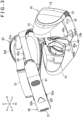
- FIGS. 1 through 3 are views illustrating a head-mounted display 1 according to the embodiment of the present invention (the head-mounted display will hereinafter be referred to as "HMD").
- FIG. 1 is a perspective view
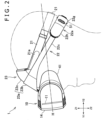
- FIG. 2 is a side elevational view
- FIG. 3 is a perspective view of the HMD 1 as viewed from an angle different from that of FIG. 1 .
- FIG. 4 is a set of views illustrating a rear support 22a of a second fastening band 22 to be described later, FIG. 4(a) being a view of a rear side of the rear support 22a and
- FIG. 4(b) a view illustrating a length adjusting mechanism M1 for the second fastening band 22.
- Y1 and Y2 illustrated in the above figures represent an anterior direction and a posterior direction, respectively, X1 and X2 a leftward direction and a rightward direction, respectively, and Z1 and Z2 an upward direction and a downward direction, respectively.
- the HMD 1 has a display unit 10 including a display device 11 (see FIG. 2 ) on its front side.
- the display device 11 displays three-dimensional images.
- the display device 11 displays an image for the right eye in its right area and an image for the left eye in its left area.
- the display device 11 may display three-dimensional images in a frame sequential format.
- the images displayed by the display device 11 are not limited to three-dimensional images, but may be two-dimensional images.
- the display device 11 may include a liquid crystal display device or an organic electroluminescence (EL) display device, but is not limited to any particular types.
- EL organic electroluminescence
- the fastening bands 21 and 22 extend rearwardly from the front support 23.
- the front support 23 and the first fastening band 21 are of an annular shape
- the front support 23 and the second fastening band 22 are also of an annular shape.
- the user can adjust the length of the second fastening band 22 using its both hands. Furthermore, as the second fastening band 22 is made of a material less expandable than the first fastening band 21, the second fastening band 22 is mounted on the head of the user with increased stability.
- the first fastening band 21 is made of an elastically expandable material in its entirety. According to another example of the HMD 1, only a portion of the first fastening band 21 may be made of an elastically expandable material so that the first fastening band 21 can be expanded in its lengthwise direction.
- the first fastening band 21 may have an unexpandable portion (a portion held against the rear side of the head of the user) in its rear portion, and side portions (portions held against the right and left sides of the head of the user) made of an expandable material.
- the second fastening band 22 has the mechanism M1 for adjusting the length thereof (the mechanism M1 will hereinafter be referred to as "length adjusting mechanism").
- the second fastening band 22 has a rear support 22a in its rear portion which is held against the rear side of the head of the user.
- the rear support 22a has a case 22h housing the length adjusting mechanism M1 (see FIG. 4(b) ) therein.
- the rear support 22a preferably has a cushion 22b (see FIG. 1 ) on an inner surface thereof (a surface to be held against the rear side of the head of the user).
- the second fastening band 22 in the example described herein has left and right frames 22c.
- the frames 22c are made of the material (e.g., plastics) which is less expandable than the material of the first fastening band 21, as described above.
- the left and right frames 22c extend from the front side to rear side of the HMD 1, and are connected respectively to the left and right ends of the rear support 22a.
- the frames 22c extend rearwardly from the right and left sides of the front support 23 and have rear portions fitted in the case 22h of the rear support 22a.
- the length adjusting mechanism M1 is preferably arranged such that the rear support 22a will move equally with respect to the left and right frames 22c. With this arrangement, the position of the rear support 22a is prevented from being shifted to the right or left.
- racks 22d are formed on rear portions of the frames 22c.
- the rack 22d of the right frame 22c and the rack 22d of the left frame 22c are disposed so as to face each other in the vertical, namely up-down directions.
- the rear support 22a includes a rotatable operating member 22e (the operating member 22e will hereinafter be referred to as "length adjusting member").
- the length adjusting member 22e is disposed between the racks 22d of the two frames 22c, and a gear (not illustrated) engaging the racks 22d is coupled to the length adjusting member 22e.
- a gear (not illustrated) engaging the racks 22d is coupled to the length adjusting member 22e.
- the rear support 22a moves equally with respect to the left and right frames 22c, causing the right and left portions of the second fastening band 22 to contract or expand equally.
- the rear support 22a moves along the anterior-posterior directions equally with respect to the left and right frames 22c.
- the length adjusting member 22e is coupled to both of the two frames 22c. Specifically, the gear of the length adjusting member 22e is held in engagement with both of the gears of the two frames 22c.
- the length adjusting mechanism M1 should preferably have a stopper mechanism for allowing the gear of the length adjusting member 22e to rotate in a direction to contract the frames 22c and locking the gear against rotation in the opposite direction.
- the length adjusting mechanism M1 should also preferably have an operating member (hereinafter referred to as "stopper canceling member") for canceling the locking of the gear against rotation (stopper) by the stopper mechanism in response to an operation of the user.
- stopper canceling member an operating member for canceling the locking of the gear against rotation (stopper) by the stopper mechanism in response to an operation of the user.
- the rear support 22a includes a stopper canceling member 22f exposed on its rear surface.
- the stopper canceling member 22f is coupled to a stopper which is held in engagement with the gear disposed between the racks 22d for preventing the gear from rotating. The stopper is released out of engagement with the gear when the stopper canceling member 22f is operated (pushed or slid).
- the first fastening band 21 should also preferably be adjustable in length.
- a length adjusting mechanism for the first fastening band 21 may include a surface fastener, a buckle, or a ratchet mechanism, for example.
- the length adjusting mechanism is provided on each of the right and left sides of the first fastening band 21, thereby preventing the elastic force of the first fastening band 21 from becoming uneven on the right and left sides of the first fastening band 21.
- the foremost portion of the first fastening band 21 is supported by a pin (not illustrated) mounted on the front support 23, and the first fastening band 21 has an adjuster 21a reversed rearwardly and folded back from the pin.
- the adjuster 21a is detachably disposed on a side of the first fastening band 21.
- a surface fastener for example, is attached to the side of the side of the first fastening band 21 and the adjuster 21a.
- the HMD 1 has the front support 23 as described above.
- the front support 23 is coupled to an upper portion of the display unit 10.
- the front support 23 extends upwardly and rearwardly obliquely from the display unit 10.
- the front support 23 is held against the forehead of the user (see FIG. 2 ).
- the front support 23 is less expandable than the first fastening band 21 and more rigid than the first fastening band 21.
- the front support 23 is preferably formed in a plate-like shape and curved so that its central portion along the left-right directions bulges forwardly, thereby making itself mountable on the forehead of the user with increased stability.
- a cushion 23f (see FIG. 3 ) is attached to a rear surface of the front support 23 (a surface to be held against the forehead of the user).
- the first fastening band 21 and the second fastening band 22 extend rearwardly from the front support 23. Specifically, the fastening bands 21 and 22 are connected to the left and right side portions of the front support 23. According to an example of the HMD 1, as illustrated in FIG. 2 , each of the first fastening band 21 and the second fastening band 22 is connected to the front support 23. According to another example of the HMD 1, the second fastening band 22 may be connected to the front support 23, and the first fastening band 21 may be connected to sides (specifically, the frames 22c) of the second fastening band 22. As described in detail later, the display unit 10 is adjustable in its position relative to the front support 23.
- the front support 23 is formed in a plate-like shape and the fastening bands 21 and 22 are connected to right and left edges of the front support 23.
- the front support 23 has a joint 23g disposed centrally on its lower end and coupled to the display unit 10.
- the front support 23 also has a plate-like main body 23a extending upwardly from the joint 23g and spreading along the rightward and leftward directions.
- the main body 23a is held against the forehead of the user.
- the main body 23a should preferably be curved so that its central portion along the left-right directions bulges forwardly.
- the main body 23a thus arranged is disposed along the forehead of the user when the HMD 1 is in use, increasing the stability with which the HMD 1 is mounted in place.
- the fastening bands 21 and 22 are connected to right and left edges of the main body 23a. With this structure, since the force by which the fastening bands 21 and 22 hold the head is easier to act on the main body 23a in other words, the forehead of the user, the stability with which the HMD 1 is mounted in place is further increased.
- the second fastening band 22 may be connected to the right and left edges of the main body 23a of the front support 23, whereas the first fastening band 21 may be connected to the sides (specifically, the frames 22c) of the second fastening band 22. In this case, too, the force by which the fastening bands 21 and 22 hold the head is easier to act on the forehead of the user, increasing the stability with which the HMD 1 is mounted in place.
- each of the first fastening band 21 and the second fastening band 22 extends rearwardly from the front support 23.
- This structure makes it easier to keep the length of the first fastening band 21 than a structure wherein the first fastening band 21 is connected to the frames 22c of the second fastening band 22, for example.
- the first fastening band 21 is allowed to expand by an increased amount, it is easier to tentatively secure the HMD 1 using the first fastening band 21.
- the user can mount the first fastening band 21 on its head by expanding the first fastening band 21 without using the adjuster 21a. As illustrated in FIG.
- the second fastening band 22 in the example described herein extends rearwardly from the lower portion 23b of the main body 23a of the front support 23.
- the first fastening band 21 extends rearwardly from a position higher than the position where the second fastening band 22 is connected.
- the first fastening band 21 extends rearwardly from an upper portion 23c (see FIG. 1 ) of the main body 23a of the front support 23.
- the frames 22c may be integrally formed with the lower portion 23b of the main body 23a, thereby simplifying the structure of the mount 20.
- the first fastening band 21 and the second fastening band 22 extend rearwardly and downwardly from the front side of the HMD 1. More specifically, the first fastening band 21 and the second fastening band 22 extend rearwardly and downwardly obliquely from the front support 23.
- the direction along which the first fastening band 21 extends and the direction along which the second fastening band 22 extends are inclined to a horizontal direction H so that the positions of their rear portions are lower than the positions of their front portions.
- the horizontal direction H is a direction perpendicular to the display device 11.
- the head of the user generally has a portion bulging rearwardly.
- the fastening bands 21 and 22 make it possible to have their rear portions placed on a lower portion (a position lower than the bulging portion) of the rear side of the head of the user. As a consequence, even if the display unit 10 is heavy, the position of the display unit 10 is prevented from being lowered because the positions of the rear portions of the fastening bands 21 and 22 do not move upwardly as they are caught by the bulging portion of the head. In the example described herein, the rear support 22a of the second fastening band 22 is held against the lower portion of the rear side of the head of the user.
- the second fastening band 22 is positioned beneath the first fastening band 21. Therefore, the rear portion of the second fastening band 22 can reliably be caught by the bulging portion of the head compared with a structure wherein the second fastening band 22 is positioned above the first fastening band 21.
- the second fastening band 22 is made of a material less expandable than the first fastening band 21 and has the mechanism M1 for adjusting its own length. Consequently, the second fastening band 22 can hold the head of the user more firmly than the first fastening band 21.
- the rear portion of the second fastening band 22 which has such high holding power is reliably caught by the bulging portion of the head, the position of the display unit 10 is more reliably prevented from being lowered.
- the rear portion of the second fastening band 22 has a lower end 22g disposed at a position lower than the lower surface of the display unit 10.
- the second fastening band 22 is inclined more downwardly than the first fastening band 21.
- the counterweights 22i are made of a material which is denser than the material of the case 22h. This makes it easier to increase the weight of the rear portion of the second fastening band 22.
- the material of the counterweights 22i is a metal.
- the material of the counterweights 22i is not limited to a metal, but may be the same as the material of the case 22h, for example.
- the counterweights 22i may be integrally formed with the case 22h. Counterweights may be mounted on the rear portion of the first fastening band 21. In this case, it is also easy to keep a balance between the weight of the front portion (display unit 10) of the HMD 1 and the weight of the rear portion of the HMD 1.
- the mount 20 has the front support 23 on its front side.
- the front support 23 is connected to the upper portion of the display unit 10.
- the display unit 10 is movable along the anterior-posterior directions relatively to the mount 20, i.e., the front support 23, thereby allowing the user to adjust the distance between the display device 11 and the eyes.
- the user moves the display unit 10 forwardly, the user can see downwardly while keeping the HMD 1 mounted on the head. For example, if the HMD 1 is used in playing a game, then the user can see a game controller held by hands.
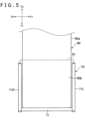
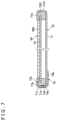
- FIGS. 5 through 7 are views illustrating a mechanism for guiding the display unit 10 along directions of relative movement. These figures illustrate a first guide 61 provided on the mount 20 and a second guide 70 provided on the display unit 10.
- FIG. 5 is a plan view
- FIG. 6 a side elevational view
- FIG. 7 a cross-sectional view taken along line VII - VII of FIG. 6 .
- the mount 20 has a plate-like frame 60.
- the frame 60 has a fixture 60a fixed in the front support 23.
- the first guide 61 is provided on the frame 60.
- the frame 60 has a support 60b extending forwardly from the fixture 60a.
- the first guide 61 is mounted on the support 60b.
- the first guide 61 and the support 60b are disposed on an upper portion of the housing 14 of the display unit 10.
- the display unit 10 has the second guide 70 on the upper portion of the housing 14.
- the second guide 70 guides the first guide 61 for movement along the anterior-posterior directions.
- the second guide 70 has a base 71.
- the base 71 is of a plate-like shape.
- the first guide 61 is disposed above the base 71, for example.
- the first guide 61 may be disposed below the base 71.
- the base 71 has side guides 71R and 71L on its right and left sides.
- the first guide 61 is disposed between the two side guides 71R and 71L.
- the right side guide 71R and the left side guide 71L are positioned respectively on the right and left sides of the first guide 61, and extend along the edges of the first guide 61.
- the side guides 71R and 71L and the base 71 are integrally formed of a metal, for example.
- the guide rail 73L has a portion 73b (see FIG. 7 ) capable of bearing a force directed toward the edge of the first guide 61 from an outer side (specifically, a left side) of the guide rail 73L in the horizontal directions (the portion will hereinafter be referred to as "pressed portion 73b").
- the guide rail 73L has the pressed portion 73b disposed midway along its longitudinal directions.
- the guide rail 73L should have a plurality of pressed portions 73b spaced from each other along its longitudinal directions.
- the side guides 71R and 71L are of a wall-like shape, and are disposed along the guide rails 73R and 73L.
- the side guide 71L has a hole 71a defined therein through which a portion of the side surface of the guide rail 73L is exposed.
- the guide rail 73L can be pressed toward the edge of the first guide 61 through the hole 71a in the side guide 71L.
- a portion of the side surface of the guide rail 73L which corresponds to the hole 71a serves as the pressed portion 73b.
- the side guide 71L may have a plurality of holes 71a spaced from each other along the longitudinal directions of the guide rail 73L.
- the base 71 and the guide rail 73L are arranged so that the position of the guide rail 73L can be slightly moved along the horizontal directions before a fixed member 74 to be described later is fixed to the second guide 70.
- the position of the guide rail 73L along the horizontal directions is secured by a separate member from the base 71 and the guide rail 73L.
- the member which secures the position of the guide rail 73L should preferably have a portion held in contact with the pressed portion 73b.
- the position of the guide rail 73L along the horizontal directions is secured while the guide rail 73L is held in contact with the edge of the first guide 61.
- the "separate member" referred to above includes a structure (e.g., a screw or a fixed member to be described later) or a material (e.g., an adhesive) which can be moved separately from the base 71 and the guide rail 73L before it is used to secure the guide rail 73L.
- a structure e.g., a screw or a fixed member to be described later
- a material e.g., an adhesive
- the fixed portion 74b is of a plate-like shape, for example.
- the pressing portions 74a project upwardly or downwardly from the edge of the fixed portion 74b.
- the fixed member 74 has the plural pressing portions 74a spaced from each other along the lengthwise directions of the guide rail 73L.
- the fixed portion 74b is disposed on the lower surface of the base 71 and fixed to the base 71.
- the fixed portion 74b is welded to the base 71, for example.
- the fixed portion 74b may be fused or bonded to the base 71.
- the guide rail 73L may be fixed to the base 71 by an adhesive rather than the plate-like fixed member 74.
- an adhesive may be introduced through the holes 71a to fill the space between the guide rail 73L and the side guide 71L.
- the adhesive which is solidified functions as a fixed member.
- the base 71 and the guide rail 73L are arranged so that the position of the guide rail 73L can be slightly moved along the horizontal directions.
- the base 71 has holes defined therein and the guide rail 73L has protrusions fitted in the holes.
- the size of the holes along the horizontal directions is slightly larger than the size of the protrusions of the guide rail 73L.
- the side guide 71L has a retaining wall 71b.
- the guide rail 73L is vertically sandwiched by the base 71 and the retaining wall 71b. Consequently, before the position of the guide rail 73L is secured by the fixed member 74, the guide rail 73L is retained by the base 71 while being slightly movable.
- the side guide 71R is of the same structure as the side guide 71L except that the side guide 71L has the holes 71a defined therein.
- the side guide 71R may also have holes 71a defined therein.
- the second guide 70 which has the guide rails 73L and 73R and the fixed member 74 is provided on the display unit 10
- the first guide 61 is provided on the mount 20.
- the second guide 70 which has the guide rails 73L and 73R and the fixed member 74 may be provided on the mount 20, and the first guide 61 may be provided on the display unit 10.
- the locking member 24 may be mounted on the frame 60.
- the locking member 24 and a lower portion (the support 60b described above) of the frame 60 are coupled to the display unit 10.
- the locking member 24 and the lower portion of the frame 60 are guided for movement relative to the display unit 10 by the second guide 70 described above which is provided on the display unit 10.
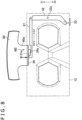
- the display unit 10 in the example illustrated in FIG. 8 has the locked member 31 on an upper portion thereof.
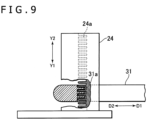
- the locking member 24 has an engaging portion 24a on a lower side thereof.
- the engaging portion 24a includes a plurality of combtooth-shaped convexities arrayed along the anterior-posterior directions (Y1 - Y2 directions).
- the locked member 31 is disposed on a lower side of the locking member 24 and has an engaged portion 31a formed on an upper side thereof.
- the engaged portion 31a also includes a plurality of convexities which engage the plural convexities composing of the engaging portion 24a.
- the locked member 31 is movable between a locked position and an unlocked position.
- the position adjusting mechanism M2 is able to switch between a state wherein the position of the display unit 10 with respect to the front support 23 can be adjusted and a state wherein the position of the displayed unit 10 with respect to the front support 23 is prevented from being adjusted in response to the operation of the lock canceling member 33 by the user.
- a light shielding member may be mounted on the display unit 10.
- the light shielding member should preferably be made of a flexible material.
- the light shielding member is made of an elastomer.
- the display unit 10 has side guards 41 extending rearwardly from the sides of the display unit 10 as an example of the light shielding member.
- the side guards 41 block light on the right and left sides of the HMD 1 when the HMD 1 is in use.
- the frame 13 of the display unit 10 has openings 13a defined in the right and left sides of a rear surface thereof.
- the lenses 12 and the display device 11 are disposed on the inside of the openings 13a.
- the user can see images displayed on the display device 11 through the openings 13a.
- a recess 13b which is open rearwardly and downwardly is defined between the left and right openings 13a.
- a light shielding member 42 may also be disposed in the recess 13b.
- the light shielding member 42 is disposed so as to cover the inside of the recess 13b when the display unit 10 is viewed from behind.
- the light shielding member 42 prevents ambient light from reaching the eyes of the user through the gap between the inner surface of the recess 13b and the nose of the user when the HMD1 is in use.
- the light shielding member 42 is of a sheet-like shape covering (closing) the recess 13b.
- the sheet-like light shielding member 42 is formed of a flexible material, for example.
- the light shielding member 42 may be integrally formed with the side guards 41.
- the light shielding member 42 may be a member separate from the side guards 41, which is mounted on the frame 13 of the display unit 10. In this case, the light shielding member 42 may be detachably mounted on the frame 13.
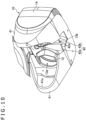
- FIG. 10 is a view illustrating a modification of the light shielding member.
- the display unit 10 has the side guards 41 and the light shielding member 42.
- the side guards 41 have curved edges 41a.
- the curved edges 41a reduce the discomfort which is caused by the edges 41a of the side guards 41 that are pressed against the face of the user when the HMD 1 is mounted on the head.
- the light shielding member 42 has a right side portion 42a and a left side portion 42b opposite the slit 42c.
- the right side portion 42a and the left side portion 42b should preferably have curved edges 42d.
- the curved edges 42d reduce the discomfort which is caused by the edges 42d of the light shielding member 42 that are pressed against the nose of the user when the HMD 1 is mounted on the head.
- the mount 20 may have a front pad on its front side for contacting the front side of the head of the user.
- the front pad should preferably have a cushion.
- the front pad is provided on the rear side of the upper portion 23c of the front support 23.
- the front pad should preferably be supported in a manner to make the angle of the front pad in the anterior-posterior directions adjustable.
- the front pad thus arranged makes it possible to vary the angle of the front pad depending on the shape and size of the head of the user.
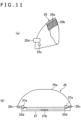
- FIG. 11 is a set of views illustrating an example of a structure which is capable of adjusting the angle of a front pad 25.
- FIG. 11(a) is a side elevational view, partly cut away, of the front pad 25.
- FIG. 11(b) is a plan view of the front pad 25.
- the front pad 25 has a bracket 25a.
- the bracket 25a is formed of a material that is of relatively high rigidity, such as plastics or metal. According to an example of the front pad 25, the bracket 25a is of a plate-like shape.
- a cushion 25b referred to above is attached to the bracket 25a.
- the bracket 25a has shafts 25c on its right and left sides. The shafts 25c are supported in the front support 23, for example. The shafts 25c are positioned on a lower portion of the front pad 25 as viewed in side elevation. An upper portion of the front pad 25 can move about the shafts 25c in the anterior-posterior directions, thereby making it possible to adjust the angle of the front pad 25.
- the mount 20 has an operating member 27 for the user to move the front pad 25.
- the operating member 27 is housed in the front support 23.
- the operating member 27 is supported for sliding movement along the horizontal directions.
- the bracket 25a has pressed portions 25d projecting forwardly.
- the operating member 27 has pressing surfaces 27a for pressing the pressed portions 25d.
- the pressing surfaces 27a are inclined to vary the position of the pressed portions 25d of the bracket 25a in the anterior-posterior directions depending on the position of the operating member 27 in the horizontal directions.
- the operating member 27 has an operating portion 27b exposed on the outer surface of the front support 23.
- the HMD 1 in the example described herein has a plurality of light emitters 51 which include light-emitting elements such as LEDs or the like. As described later, when the HMD 1 is in use, an information processing apparatus to which the HMD 1 is connected detects the positions of the plural light emitters 51 through a camera, for thereby detecting the orientation of the head of the user and controlling images displayed on the display device 11 and objects displayed on the display device 11 depending on the orientation of the head. According to an example of the HMD 1, as illustrated in FIGS. 1 and 2 , the plural light emitters 51 are disposed in spaced apart relation to each other on the display unit 10 (in FIGS. 1 and 2 , the light emitters 51 are illustrated hatched for clarification).
- the plural light emitters 51 are disposed in outer peripheral regions of the front surface of the display unit 10. Since the spacing between the light emitters 51 thus arranged is large, the accuracy with which to detect the orientation of the head is increased.
- four light emitters 51 are disposed on the four corners of the front surface of the display unit 10. More specifically, in the example illustrated in FIGS. 1 and 2 , the light emitters 51 are disposed on the four corners of the front surface so that the light emitters 51 extend over both the front and side surfaces of the display unit 10. Stated otherwise, the light emitters 51 are disposed obliquely to the front surface of the display unit 10 so as to face the outer sides of the outer edges of the front surface of the display unit 10.
- the layout of the light emitters 51 is not limited to those described above, but may be modified appropriately.
- the display unit 10 may have only two light emitters 51 spaced from each other in the horizontal directions.
- the display unit 10 may have only two light emitters 51 spaced from each other in the vertical directions.
- the light emitters 51 may not necessarily be provided on the rear support 22a.
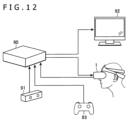
- FIG. 12 is a view illustrating an example of the manner in which the HMD 1 is used.
- a camera 91 is connected to an information processing apparatus 90.
- the information processing apparatus 90 detects the positions of the plural light emitters 51 through the camera 91, and detects the orientation of the head of the user on the basis of the positions of the plural light emitters 51.
- the information processing apparatus 90 generates or corrects a moving-image signal depending on the orientation of the user, and outputs the moving-image signal to the HMD 1.
- the information processing apparatus 90 may output a moving-image signal to a display device 92 such as a television or the like in addition to the HMD 1.
- the moving-image signal output to the HMD 1 and the moving-image signal output to the display device 92 may be different from each other.
- the information processing apparatus 90 may output a moving-image signal for a two-dimensional image to the display device 92, and may output a moving-image signal for a three-dimensional image to the display device 11 of the HMD 1.
- the moving-image signals of those two types may be generated by a dedicated apparatus which is different from the information processing apparatus 90.
- the display unit 10 of the HMD 1 may be provided with sensors such as an acceleration sensor, a gyro sensor, etc.
- the information processing apparatus 90 may generate moving-image signals on the basis of the outputs from the sensors.
- the information processing apparatus 90 may generate moving-image signals on the basis of a signal from an operating device 93 which is manually operated by the user.
- the HMD 1 has the first fastening band 21 and the second fastening band 22 which extend from the front side toward rear side of the HMD 1 for being fastened to the head of the user. At least a portion of the first fastening band 21 is made of an elastically expandable material.
- the second fastening band 22 is made of a material which is less expandable than the above material of the first fastening band 21 and includes the mechanism M1 for adjusting its length.
- the display unit 10 includes the display device 11 and is supported by the first fastening band 21 and the second fastening band 22.
- the user when the user is to mount the HMD 1 on its head, the user initially tentatively secures the position and attitude of the HMD 1 using the first fastening band 21, and then can adjust the length of the second fastening band 22 while the HMD 1 is being tentatively secured. Therefore, when the user adjusts the length of the second fastening band 22, the position and attitude of the HMD 1 is prevented from being varied, allowing the user to adjust the length of the second fastening band 22 easily. Furthermore, as the second fastening band 22 is made of a material less expandable than the first fastening band 21, the second fastening band 22 is mounted on the head of the user with increased stability.
- the present invention is not limited to the HMD 1 described above, but can be modified in various ways.
- first fastening band 21 and the second fastening band 22 may extend rearwardly from the display unit 10 rather than the front support 23.
- one of the first fastening band 21 and the second fastening band 22 may extend rearwardly from the display unit 10, whereas the other band may extend rearwardly from the front support 23.
- One of the first fastening band 21 and the second fastening band 22 may extend rearwardly and upwardly obliquely from the front side of the HMD 1.
- One of the first fastening band 21 and the second fastening band 22 may extend rearwardly horizontally from the front side of the HMD 1.
Landscapes
- Physics & Mathematics (AREA)
- General Physics & Mathematics (AREA)
- Optics & Photonics (AREA)
- Engineering & Computer Science (AREA)
- Computer Hardware Design (AREA)
- Theoretical Computer Science (AREA)
Description
- The present invention relates to a head-mounted display.
- Heretofore, the development of a head-mounted display to be mounted on the head of a user for use has been underway (the head-mounted display will hereinafter be referred to as "HMD"). The HMD includes a display unit having a display device for being placed in front of the eyes of the user and a mount to be mounted on the head of the user, the mount supporting the display unit. Some HMDs have a fastening band for sandwiching the head of the user along the anterior-posterior directions (e.g.,
Japanese Patent Laid-open No. Hei 09-304724 WO 2004/049850 A1 andEP 2 685 712 A1 . - Some of the HMDs have a mechanism incorporated in the fastening band for adjusting the length of the fastening band. When the user matches the length of the fastening band to the size of its own head, the HMD is stably supported on the head. However, the conventional HMDs have a problem in that the process of adjusting the length of the fastening band is cumbersome. For example, if the length of the fastening band does not fit the head of the user, then the user attempts to adjust the length of the fastening band while the HMD is being mounted on the head. However, since the HMD tends to change in position or attitude during the adjusting process, the adjusting process becomes cumbersome.
- A head-mounted display according to the definition of
independent claim 1. - The head-mounted display thus constructed allows the lengths of the fastening bands to be adjusted easily and can be mounted on the head of the user with increased stability.
-
- [
FIG. 1 ]
FIG. 1 is a perspective view of a head-mounted display according to an embodiment of the present invention. - [
FIG. 2 ]
FIG. 2 is a side elevational view of the head-mounted display. - [
FIG. 3 ]
FIG. 3 is a perspective view of the head-mounted display as viewed from an angle different from that ofFIG. 1 . - [
FIG. 4 ]
FIG. 4 is a set of views illustrating a rear support of a second fastening band,FIG. 4(a) being a view of a rear side of the rear support andFIG. 4(b) a view illustrating a length adjusting mechanism for the second fastening band. - [
FIG. 5 ]
FIG. 5 is a plan view of a mechanism for guiding a display unit along directions of relative movement. - [
FIG. 6 ]
FIG. 6 is a side elevational view of the mechanism illustrated inFIG. 5 . - [
FIG. 7 ]
FIG. 7 is a cross-sectional view taken along line VII - VII ofFIG. 6 . - [
FIG. 8 ]
FIG. 8 is a schematic view illustrating a mechanism for locking the display unit and a mount against relative movement along the anterior-posterior directions. - [
FIG. 9 ]
FIG. 9 is a view of the mechanism illustrated inFIG. 8 , as viewed along the direction IX inFIG. 8 , illustrating a locking member and a locked member. - [
FIG. 10 ]
FIG. 10 is a view illustrating a modification of a light shielding member. - [
FIG. 11 ]
FIG. 11 is a set of views illustrating an example of a structure for making it possible to adjust the angle of a front pad. - [
FIG. 12 ]
FIG. 12 is a view illustrating an example of the manner in which the head-mounted display is used. - An embodiment of the present invention will be described below with reference to the drawings.
FIGS. 1 through 3 are views illustrating a head-mounteddisplay 1 according to the embodiment of the present invention (the head-mounted display will hereinafter be referred to as "HMD").FIG. 1 is a perspective view,FIG. 2 is a side elevational view, andFIG. 3 is a perspective view of theHMD 1 as viewed from an angle different from that ofFIG. 1 .FIG. 4 is a set of views illustrating arear support 22a of asecond fastening band 22 to be described later,FIG. 4(a) being a view of a rear side of therear support 22a andFIG. 4(b) a view illustrating a length adjusting mechanism M1 for thesecond fastening band 22. - In the description which follows, Y1 and Y2 illustrated in the above figures represent an anterior direction and a posterior direction, respectively, X1 and X2 a leftward direction and a rightward direction, respectively, and Z1 and Z2 an upward direction and a downward direction, respectively.
- The HMD 1 has a
display unit 10 including a display device 11 (seeFIG. 2 ) on its front side. Thedisplay device 11 displays three-dimensional images. For example, thedisplay device 11 displays an image for the right eye in its right area and an image for the left eye in its left area. Thedisplay device 11 may display three-dimensional images in a frame sequential format. The images displayed by thedisplay device 11 are not limited to three-dimensional images, but may be two-dimensional images. Thedisplay device 11 may include a liquid crystal display device or an organic electroluminescence (EL) display device, but is not limited to any particular types. In an example of theHMD 1, as illustrated inFIG. 2 , thedisplay device 11 may be inclined with respect to a front surface of thedisplay unit 10 or a rear surface of the display unit 10 (a surface facing the face of the user). As illustrated inFIG. 3 , thedisplay unit 10 may have lenses 12 (seeFIG. 3 ) for increasing the viewing angle of thedisplay device 11. Thedisplay unit 10 has a frame 13 (seeFIG. 3 ) that supports thedisplay device 11 and thelenses 12, and a box-shaped housing 14 (seeFIG. 1 ) which houses therein thedisplay device 11, thelenses 12, and theframe 13. - As illustrated in
FIG. 1 , the HMD 1 has amount 20 for being mounted on the head of the user. Themount 20 has afirst fastening band 21 and asecond fastening band 22 which extend from the front side toward rear side of the HMD 1 and support thedisplay unit 10. As illustrated inFIG. 2 , thefastening bands HMD 1 is in use. Thefastening bands mount 20 has afront support 23 to be described later. The front support 23, thefirst fastening band 21, and thesecond fastening band 22 sandwich the head of the user along the anterior-posterior directions. In the example illustrated inFIGS. 1 through 3 , thefastening bands front support 23. In a plan view of theHMD 1, thefront support 23 and thefirst fastening band 21 are of an annular shape, and thefront support 23 and thesecond fastening band 22 are also of an annular shape. - At least a portion of the
first fastening band 21 is made of an elastically expandable material. Thefirst fastening band 21 can elastically be expanded in its lengthwise direction as its material is expanded. In other words, when the material of thefirst fastening band 21 is expanded, the size of the annular shape made up of thefront support 23 and thefirst fastening band 21 is varied. Thesecond fastening band 22 is made of a material which is less expandable than the material of thefirst fastening band 21. As described later, thesecond fastening band 22 has a mechanism M1 (seeFIG. 4 ) for adjusting its length. As a result, when the mechanism M1 adjusts the length of thesecond fastening band 22, the size of the annular shape made up of thefront support 23 and thesecond fastening band 22 is adjusted. When the user is to mount theHMD 1 on its own head, the user initially tentatively secures the position and attitude of theHMD 1 using thefirst fastening band 21, and then can adjust the length of thesecond fastening band 22 while theHMD 1 is being tentatively secured. Therefore, when the user adjusts the length of thesecond fastening band 22, the position and attitude of theHMD 1 is prevented from being varied, allowing the user to adjust the length of thesecond fastening band 22 easily. For example, since theHMD 1 is tentatively secured by thefirst fastening band 21, the user can adjust the length of thesecond fastening band 22 using its both hands. Furthermore, as thesecond fastening band 22 is made of a material less expandable than thefirst fastening band 21, thesecond fastening band 22 is mounted on the head of the user with increased stability. - When the
first fastening band 21 is in its free state (when the elastic material thereof is not expanded), thefirst fastening band 21 is positioned within thesecond fastening band 22. When the user is to use theHMD 1, the user elastically expands thefirst fastening band 21, increasing the size of the annular shape made up of thefirst fastening band 21 and thefront support 23, so that the user can mount them on the head. Thereafter, the user operates the mechanism M1 to adjust the length of thesecond fastening band 22, reducing the size of the annular shape made up of thesecond fastening band 22 and thefront support 23, so that the user can secure them on the head. - The material of the
first fastening band 21 may be rubber, for example. An example of the material of thesecond fastening band 22 is a resin such as plastics. The material of thesecond fastening band 22 may be a metal. Preferably, the material of thesecond fastening band 22 is not only less expandable than the material of thefirst fastening band 21, but also more rigid than the material of thefirst fastening band 21. - According to an example of the
HMD 1, thefirst fastening band 21 is made of an elastically expandable material in its entirety. According to another example of theHMD 1, only a portion of thefirst fastening band 21 may be made of an elastically expandable material so that thefirst fastening band 21 can be expanded in its lengthwise direction. For example, thefirst fastening band 21 may have an unexpandable portion (a portion held against the rear side of the head of the user) in its rear portion, and side portions (portions held against the right and left sides of the head of the user) made of an expandable material. - As described above, the
second fastening band 22 has the mechanism M1 for adjusting the length thereof (the mechanism M1 will hereinafter be referred to as "length adjusting mechanism"). In the example illustrated inFIG. 2 , thesecond fastening band 22 has arear support 22a in its rear portion which is held against the rear side of the head of the user. Therear support 22a has acase 22h housing the length adjusting mechanism M1 (seeFIG. 4(b) ) therein. Therear support 22a preferably has acushion 22b (seeFIG. 1 ) on an inner surface thereof (a surface to be held against the rear side of the head of the user). - The
second fastening band 22 in the example described herein has left andright frames 22c. Theframes 22c are made of the material (e.g., plastics) which is less expandable than the material of thefirst fastening band 21, as described above. The left andright frames 22c extend from the front side to rear side of theHMD 1, and are connected respectively to the left and right ends of therear support 22a. In the example described herein, theframes 22c extend rearwardly from the right and left sides of thefront support 23 and have rear portions fitted in thecase 22h of therear support 22a. - The length adjusting mechanism M1 is preferably arranged such that the
rear support 22a will move equally with respect to the left andright frames 22c. With this arrangement, the position of therear support 22a is prevented from being shifted to the right or left. According to an example of theHMD 1, as illustrated inFIG. 4(b) , racks 22d are formed on rear portions of theframes 22c. Therack 22d of theright frame 22c and therack 22d of theleft frame 22c are disposed so as to face each other in the vertical, namely up-down directions. Therear support 22a includes arotatable operating member 22e (the operatingmember 22e will hereinafter be referred to as "length adjusting member"). Thelength adjusting member 22e is disposed between theracks 22d of the twoframes 22c, and a gear (not illustrated) engaging theracks 22d is coupled to thelength adjusting member 22e. According to this structure, when the gear rotates, therear support 22a moves equally with respect to the left andright frames 22c, causing the right and left portions of thesecond fastening band 22 to contract or expand equally. In other words, therear support 22a moves along the anterior-posterior directions equally with respect to the left andright frames 22c. Thelength adjusting member 22e is coupled to both of the twoframes 22c. Specifically, the gear of thelength adjusting member 22e is held in engagement with both of the gears of the twoframes 22c. Therefore, since the position of therear support 22a with respect to both of the twoframes 22c can be adjusted simply by operating the singlelength adjusting member 22e, the process of adjusting the length of thesecond fastening member 22 is made easy. As a result, the size of the annular shape made up of thefront support 23 and thesecond fastening band 22 can easily be adjusted (increased and reduced). - The length adjusting mechanism M1 should preferably have a stopper mechanism for allowing the gear of the
length adjusting member 22e to rotate in a direction to contract theframes 22c and locking the gear against rotation in the opposite direction. The length adjusting mechanism M1 should also preferably have an operating member (hereinafter referred to as "stopper canceling member") for canceling the locking of the gear against rotation (stopper) by the stopper mechanism in response to an operation of the user. Inasmuch as thesecond fastening band 22 is not extended unless the stopper is canceled by operating the stopper canceling member, thesecond fastening band 22 of the HMD1 is mounted in position with increased stability. In the example illustrated inFIG. 4 , therear support 22a includes astopper canceling member 22f exposed on its rear surface. Thestopper canceling member 22f is coupled to a stopper which is held in engagement with the gear disposed between theracks 22d for preventing the gear from rotating. The stopper is released out of engagement with the gear when thestopper canceling member 22f is operated (pushed or slid). - The
first fastening band 21 should also preferably be adjustable in length. A length adjusting mechanism for thefirst fastening band 21 may include a surface fastener, a buckle, or a ratchet mechanism, for example. According to an example of thefirst fastening band 21, the length adjusting mechanism is provided on each of the right and left sides of thefirst fastening band 21, thereby preventing the elastic force of thefirst fastening band 21 from becoming uneven on the right and left sides of thefirst fastening band 21. In the example illustrated inFIG. 1 , the foremost portion of thefirst fastening band 21 is supported by a pin (not illustrated) mounted on thefront support 23, and thefirst fastening band 21 has anadjuster 21a reversed rearwardly and folded back from the pin. Theadjuster 21a is detachably disposed on a side of thefirst fastening band 21. A surface fastener, for example, is attached to the side of the side of thefirst fastening band 21 and theadjuster 21a. By adjusting the length of theadjuster 21a (the length from the pin to the end of theadjuster 21a), it is possible to adjust the length of the first fastening band 21 (the size of the annular shape made up of thefront support 23 and the first fastening band 21). This can increase or reduce the range in which thefirst fastening band 21 made of the above material (the elastically expandable material) is expandable. - The
HMD 1 according to the example described herein has thefront support 23 as described above. As illustrated inFIG. 1 , thefront support 23 is coupled to an upper portion of thedisplay unit 10. Thefront support 23 extends upwardly and rearwardly obliquely from thedisplay unit 10. When theHMD 1 is in use, thefront support 23 is held against the forehead of the user (seeFIG. 2 ). Thefront support 23 is less expandable than thefirst fastening band 21 and more rigid than thefirst fastening band 21. As illustrated inFIG. 1 , thefront support 23 is preferably formed in a plate-like shape and curved so that its central portion along the left-right directions bulges forwardly, thereby making itself mountable on the forehead of the user with increased stability. Preferably, acushion 23f (seeFIG. 3 ) is attached to a rear surface of the front support 23 (a surface to be held against the forehead of the user). - The
first fastening band 21 and thesecond fastening band 22 extend rearwardly from thefront support 23. Specifically, thefastening bands front support 23. According to an example of theHMD 1, as illustrated inFIG. 2 , each of thefirst fastening band 21 and thesecond fastening band 22 is connected to thefront support 23. According to another example of theHMD 1, thesecond fastening band 22 may be connected to thefront support 23, and thefirst fastening band 21 may be connected to sides (specifically, theframes 22c) of thesecond fastening band 22. As described in detail later, thedisplay unit 10 is adjustable in its position relative to thefront support 23. According to this structure wherein thefastening bands front support 23 rather than thedisplay unit 10, the user is able to adjust the position of thedisplay unit 10 while theHMD 1 is being mounted on its head using thefront support 23 and thefastening bands - In the example of the
HMD 1, as illustrated inFIG. 1 , thefront support 23 is formed in a plate-like shape and thefastening bands front support 23. Particularly, thefront support 23 has a joint 23g disposed centrally on its lower end and coupled to thedisplay unit 10. Thefront support 23 also has a plate-likemain body 23a extending upwardly from the joint 23g and spreading along the rightward and leftward directions. When theHMD 1 is in use, themain body 23a is held against the forehead of the user. As illustrated inFIG. 1 , themain body 23a should preferably be curved so that its central portion along the left-right directions bulges forwardly. Themain body 23a thus arranged is disposed along the forehead of the user when theHMD 1 is in use, increasing the stability with which theHMD 1 is mounted in place. Thefastening bands main body 23a. With this structure, since the force by which thefastening bands main body 23a in other words, the forehead of the user, the stability with which theHMD 1 is mounted in place is further increased. Thesecond fastening band 22 may be connected to the right and left edges of themain body 23a of thefront support 23, whereas thefirst fastening band 21 may be connected to the sides (specifically, theframes 22c) of thesecond fastening band 22. In this case, too, the force by which thefastening bands HMD 1 is mounted in place. - In the example of the
HMD 1, as described above, each of thefirst fastening band 21 and thesecond fastening band 22 extends rearwardly from thefront support 23. This structure makes it easier to keep the length of thefirst fastening band 21 than a structure wherein thefirst fastening band 21 is connected to theframes 22c of thesecond fastening band 22, for example. As a result, since thefirst fastening band 21 is allowed to expand by an increased amount, it is easier to tentatively secure theHMD 1 using thefirst fastening band 21. For example, the user can mount thefirst fastening band 21 on its head by expanding thefirst fastening band 21 without using theadjuster 21a. As illustrated inFIG. 1 , thesecond fastening band 22 in the example described herein extends rearwardly from thelower portion 23b of themain body 23a of thefront support 23. Thefirst fastening band 21 extends rearwardly from a position higher than the position where thesecond fastening band 22 is connected. In the exampled described herein, thefirst fastening band 21 extends rearwardly from anupper portion 23c (seeFIG. 1 ) of themain body 23a of thefront support 23. According to an example of thesecond fastening band 22, theframes 22c may be integrally formed with thelower portion 23b of themain body 23a, thereby simplifying the structure of themount 20. - As illustrated in
FIG. 2 , in the example of theHMD 1, thefirst fastening band 21 and thesecond fastening band 22 extend rearwardly and downwardly from the front side of theHMD 1. More specifically, thefirst fastening band 21 and thesecond fastening band 22 extend rearwardly and downwardly obliquely from thefront support 23. In other words, the direction along which thefirst fastening band 21 extends and the direction along which thesecond fastening band 22 extends are inclined to a horizontal direction H so that the positions of their rear portions are lower than the positions of their front portions. Here, the horizontal direction H is a direction perpendicular to thedisplay device 11. The head of the user generally has a portion bulging rearwardly. Thefastening bands display unit 10 is heavy, the position of thedisplay unit 10 is prevented from being lowered because the positions of the rear portions of thefastening bands rear support 22a of thesecond fastening band 22 is held against the lower portion of the rear side of the head of the user. - In the example of the
HMD 1, thesecond fastening band 22 is positioned beneath thefirst fastening band 21. Therefore, the rear portion of thesecond fastening band 22 can reliably be caught by the bulging portion of the head compared with a structure wherein thesecond fastening band 22 is positioned above thefirst fastening band 21. Thesecond fastening band 22 is made of a material less expandable than thefirst fastening band 21 and has the mechanism M1 for adjusting its own length. Consequently, thesecond fastening band 22 can hold the head of the user more firmly than thefirst fastening band 21. Since the rear portion of thesecond fastening band 22 which has such high holding power is reliably caught by the bulging portion of the head, the position of thedisplay unit 10 is more reliably prevented from being lowered. As illustrated inFIG. 2 , in the example of theHMD 1, the rear portion of thesecond fastening band 22 has alower end 22g disposed at a position lower than the lower surface of thedisplay unit 10. In the example of theHMD 1, thesecond fastening band 22 is inclined more downwardly than thefirst fastening band 21. - The
first fastening band 21 and thesecond fastening band 22 may not necessarily be limited to the above layout. For example, thesecond fastening band 22 may be positioned upwardly of thefirst fastening band 21. In this case, thefirst fastening band 21 may extend rearwardly and downwardly obliquely from the front side of theHMD 1, whereas thesecond fastening band 22 may extend horizontally. - As described above, the
second fastening band 22 in the example described herein has therear support 22a in its rear portion. Therear support 22a has thecase 22h housing the length adjusting mechanism M1 therein. This structure increases the weight of the rear portion of thesecond fastening band 22 compared with a structure wherein a length adjusting mechanism is provided on a side of thesecond fastening band 22, for example. As a result, it is easy to keep a balance between the weight of the front portion (display unit 10) of theHMD 1 and the weight of the rear portion of theHMD 1, preventing the position of thedisplay unit 10 from being lowered. - As illustrated in
FIG. 4(a) , thesecond fastening band 22 in the example hascounterweights 22i in its rear portion. This structure makes it easy to increase the weight of the rear portion of thesecond fastening band 22. In the example illustrated inFIG. 4(a) , thecounterweights 22i are housed in thecase 22h. The plural (two in the example illustrated inFIG. 4(a) )counterweights 22i that are disposed in thecase 22h are horizontally spaced from each other. In the example illustrated inFIG. 4(a) , thecounterweights 22i are disposed in right and left portions of thecase 22h. According to an example, thecounterweights 22i include members separate from thecase 22h, and should preferably be made of a material different from thecase 22h. More specifically, thecounterweights 22i are made of a material which is denser than the material of thecase 22h. This makes it easier to increase the weight of the rear portion of thesecond fastening band 22. For example, the material of thecounterweights 22i is a metal. However, the material of thecounterweights 22i is not limited to a metal, but may be the same as the material of thecase 22h, for example. Thecounterweights 22i may be integrally formed with thecase 22h. Counterweights may be mounted on the rear portion of thefirst fastening band 21. In this case, it is also easy to keep a balance between the weight of the front portion (display unit 10) of theHMD 1 and the weight of the rear portion of theHMD 1. - As described above, the
mount 20 has thefront support 23 on its front side. Thefront support 23 is connected to the upper portion of thedisplay unit 10. Thedisplay unit 10 is movable along the anterior-posterior directions relatively to themount 20, i.e., thefront support 23, thereby allowing the user to adjust the distance between thedisplay device 11 and the eyes. When the user moves thedisplay unit 10 forwardly, the user can see downwardly while keeping theHMD 1 mounted on the head. For example, if theHMD 1 is used in playing a game, then the user can see a game controller held by hands. -
FIGS. 5 through 7 are views illustrating a mechanism for guiding thedisplay unit 10 along directions of relative movement. These figures illustrate afirst guide 61 provided on themount 20 and asecond guide 70 provided on thedisplay unit 10.FIG. 5 is a plan view,FIG. 6 a side elevational view, andFIG. 7 a cross-sectional view taken along line VII - VII ofFIG. 6 . - The
mount 20 has a plate-like frame 60. Theframe 60 has afixture 60a fixed in thefront support 23. Thefirst guide 61 is provided on theframe 60. Specifically, theframe 60 has asupport 60b extending forwardly from thefixture 60a. Thefirst guide 61 is mounted on thesupport 60b. Thefirst guide 61 and thesupport 60b are disposed on an upper portion of thehousing 14 of thedisplay unit 10. Thedisplay unit 10 has thesecond guide 70 on the upper portion of thehousing 14. Thesecond guide 70 guides thefirst guide 61 for movement along the anterior-posterior directions. - As illustrated in
FIG. 7 , thesecond guide 70 has abase 71. According to an example of thesecond guide 70, thebase 71 is of a plate-like shape. Thefirst guide 61 is disposed above thebase 71, for example. Thefirst guide 61 may be disposed below thebase 71. Thebase 71 has side guides 71R and 71L on its right and left sides. Thefirst guide 61 is disposed between the two side guides 71R and 71L. Specifically, the right side guide 71R and theleft side guide 71L are positioned respectively on the right and left sides of thefirst guide 61, and extend along the edges of thefirst guide 61. The side guides 71R and 71L and the base 71 are integrally formed of a metal, for example. - The
second guide 70 has guide rails formed separately from the side guides 71R and 71L and thebase 71. Thesecond guide 70 hasguide rails first guide 61. The guide rails 73R and 73L are made of a resin such as plastics, for example. Thefirst guide 61 is also made of a resin such as plastics, for example. The guide rails 73R and 73L may be made of a metal. As illustrated inFIG. 7 , theguide rails first guide 61, thereby reducing friction between thefirst guide 61 and thesecond guide 70. - The
guide rail 73L has a portion 73b (seeFIG. 7 ) capable of bearing a force directed toward the edge of thefirst guide 61 from an outer side (specifically, a left side) of theguide rail 73L in the horizontal directions (the portion will hereinafter be referred to as "pressed portion 73b"). Theguide rail 73L has the pressed portion 73b disposed midway along its longitudinal directions. Preferably, theguide rail 73L should have a plurality of pressed portions 73b spaced from each other along its longitudinal directions. - As illustrated in
FIG. 6 , the side guides 71R and 71L are of a wall-like shape, and are disposed along theguide rails hole 71a defined therein through which a portion of the side surface of theguide rail 73L is exposed. Theguide rail 73L can be pressed toward the edge of thefirst guide 61 through thehole 71a in theside guide 71L. In other words, a portion of the side surface of theguide rail 73L which corresponds to thehole 71a serves as the pressed portion 73b. The side guide 71L may have a plurality ofholes 71a spaced from each other along the longitudinal directions of theguide rail 73L. - The
base 71 and theguide rail 73L are arranged so that the position of theguide rail 73L can be slightly moved along the horizontal directions before a fixedmember 74 to be described later is fixed to thesecond guide 70. The position of theguide rail 73L along the horizontal directions is secured by a separate member from thebase 71 and theguide rail 73L. The member which secures the position of theguide rail 73L should preferably have a portion held in contact with the pressed portion 73b. The position of theguide rail 73L along the horizontal directions is secured while theguide rail 73L is held in contact with the edge of thefirst guide 61. The "separate member" referred to above includes a structure (e.g., a screw or a fixed member to be described later) or a material (e.g., an adhesive) which can be moved separately from thebase 71 and theguide rail 73L before it is used to secure theguide rail 73L. - As described above, the
second guide 70 has the base 71 having the side guides 71R and 71L and theguide rail 73L positioned between the side guide 71L and the edge of thefirst guide 61. Theguide rail 73L has the pressed portion 73b capable of bearing a force directed toward thefirst guide 61 from the outer side in the horizontal directions. Thesecond guide 70 has the separate member from thebase 71 and theguide rail 73L for securing the position of theguide rail 73L with respect to thebase 71 along the horizontal directions. - The
second guide 70 of the above structure can be manufactured as follows: The guide rails 73R and 73L are placed inwardly of the side guides 71R and 71L. Thereafter, thefirst guide 61 is placed between theguide rails side guide rail 73L is being pushed toward the edge of thefirst guide 61, the position of theguide rail 73L along the horizontal directions is secured by the separate member from thebase 71 and theguide rail 73L. In this manner, the distance between theguide rails first guide 61, allowing thefirst guide 61 to move linearly along the anterior-posterior directions. - As illustrated in
FIGS. 6 and7 , thesecond guide 70 has the separate fixedmember 74 from thebase 71 and theguide rail 73L. The fixedmember 74 haspressing portions 74a. Thepressing portions 74a are positioned in theholes 71a in theside guide 71L and held in contact with the pressed portions 73b of theguide rail 73L. The fixedmember 74 has a fixedportion 74b that is fixed to thebase 71. The fixedmember 74 thus constructed makes it easy to secure the position of theguide rail 73L. - The fixed
portion 74b is of a plate-like shape, for example. Thepressing portions 74a project upwardly or downwardly from the edge of the fixedportion 74b. The fixedmember 74 has the pluralpressing portions 74a spaced from each other along the lengthwise directions of theguide rail 73L. As illustrated inFIG. 7 , the fixedportion 74b is disposed on the lower surface of thebase 71 and fixed to thebase 71. The fixedportion 74b is welded to thebase 71, for example. The fixedportion 74b may be fused or bonded to thebase 71. Theguide rail 73L may be fixed to thebase 71 by an adhesive rather than the plate-like fixedmember 74. For example, an adhesive may be introduced through theholes 71a to fill the space between theguide rail 73L and theside guide 71L. The adhesive which is solidified functions as a fixed member. - As described above, the
base 71 and theguide rail 73L are arranged so that the position of theguide rail 73L can be slightly moved along the horizontal directions. For example, thebase 71 has holes defined therein and theguide rail 73L has protrusions fitted in the holes. The size of the holes along the horizontal directions is slightly larger than the size of the protrusions of theguide rail 73L. Before the position of theguide rail 73L is secured by the fixedmember 74, therefore, the position of theguide rail 73L can be slightly moved. As illustrated inFIG. 7 , theside guide 71L has aretaining wall 71b. Theguide rail 73L is vertically sandwiched by thebase 71 and theretaining wall 71b. Consequently, before the position of theguide rail 73L is secured by the fixedmember 74, theguide rail 73L is retained by thebase 71 while being slightly movable. - The side guide 71R is of the same structure as the
side guide 71L except that theside guide 71L has theholes 71a defined therein. The side guide 71R may also haveholes 71a defined therein. In the example described above, thesecond guide 70 which has theguide rails member 74 is provided on thedisplay unit 10, and thefirst guide 61 is provided on themount 20. However, thesecond guide 70 which has theguide rails member 74 may be provided on themount 20, and thefirst guide 61 may be provided on thedisplay unit 10. -
FIGS. 8 and9 are schematic views illustrating a mechanism for locking thedisplay unit 10 and themount 10 against relative movement along the anterior-posterior directions (the mechanism will hereinafter be referred to as "position adjusting mechanism M2").FIG. 9 is a view of the position adjusting mechanism M2, as viewed along the direction IX inFIG. 8 , illustrating a lockingmember 24 and a lockedmember 31. - According to an example of the
HMD 1, the lockingmember 24 may be mounted on theframe 60. The lockingmember 24 and a lower portion (thesupport 60b described above) of theframe 60 are coupled to thedisplay unit 10. The lockingmember 24 and the lower portion of theframe 60 are guided for movement relative to thedisplay unit 10 by thesecond guide 70 described above which is provided on thedisplay unit 10. - The
display unit 10 in the example illustrated inFIG. 8 has the lockedmember 31 on an upper portion thereof. According to an example of the position adjusting mechanism M2, as illustrated inFIG. 9 , the lockingmember 24 has an engagingportion 24a on a lower side thereof. The engagingportion 24a includes a plurality of combtooth-shaped convexities arrayed along the anterior-posterior directions (Y1 - Y2 directions). The lockedmember 31 is disposed on a lower side of the lockingmember 24 and has an engagedportion 31a formed on an upper side thereof. The engagedportion 31a also includes a plurality of convexities which engage the plural convexities composing of the engagingportion 24a. The lockedmember 31 is movable between a locked position and an unlocked position. The locked position refers to the position of the lockedmember 31 illustrated inFIG. 8 . When the lockedmember 31 is in the locked position, the engagedportion 31a of the lockedmember 31 engages the engagingportion 24a of the lockingmember 24, preventing the lockingmember 24 and theframe 60 from moving relatively to thedisplay unit 10. The unlocked position refers to a position spaced in the leftward direction (D2 direction inFIG. 8 ) from the position of the lockedmember 31 illustrated inFIG. 8 . When the lockedmember 31 is in the unlocked position, the engagedportion 31a of the lockedmember 31 disengages from the engagingportion 24a of the lockingmember 24, allowing relative movement of thedisplay unit 10. - The
display unit 10 in the example illustrated inFIG. 8 has alock canceling member 33 responsive to a user's operation. Thelock canceling member 33 is provided on a lower surface of the display unit 10 (seeFIG. 3 ). Thedisplay unit 10 has ajoint member 32 for transmitting movement of thelock canceling member 33 to the lockedmember 31. Thejoint member 32 has an upper end coupled to the lockedmember 31 and a lower end coupled to thelock canceling member 33. The lockedmember 31 is moved between the locked position and the unlocked position in response to movement of thelock canceling member 33. Thejoint member 32 in the example illustrated herein includes a lever movable about ashaft 32a. When thelock canceling member 33 slides in the rightward direction (D1 direction inFIG. 8 ) while the lockedmember 31 is in the locked position, the lockedmember 31 moves in the leftward direction (D2 direction inFIG. 8 ) toward the unlocked position. Thedisplay unit 10 can now be adjusted in its relative position with respect to the front support 23 (more specifically, the frame 60). Since the lockedmember 31 is biased toward the locked position, when the force tending to cause the lockedmember 31 to slide in the rightward direction (D1 direction inFIG. 8 ) is canceled, the lockedmember 31 moves in the rightward direction toward the locked position, and thelock canceling member 33 moves in the opposite leftward direction (D2 direction inFIG. 8 ). The relative position of thedisplay unit 10 with respect to thefront support 23 is now prevented from being adjusted. - According to the example of the
HMD 1, the position adjusting mechanism M2 is able to switch between a state wherein the position of thedisplay unit 10 with respect to thefront support 23 can be adjusted and a state wherein the position of the displayedunit 10 with respect to thefront support 23 is prevented from being adjusted in response to the operation of thelock canceling member 33 by the user. - As illustrated in
FIG. 3 , a light shielding member may be mounted on thedisplay unit 10. The light shielding member should preferably be made of a flexible material. For example, the light shielding member is made of an elastomer. - As illustrated in
FIG. 3 , thedisplay unit 10 hasside guards 41 extending rearwardly from the sides of thedisplay unit 10 as an example of the light shielding member. The side guards 41 block light on the right and left sides of theHMD 1 when theHMD 1 is in use. - As illustrated in
FIG. 3 , theframe 13 of thedisplay unit 10 hasopenings 13a defined in the right and left sides of a rear surface thereof. Thelenses 12 and thedisplay device 11 are disposed on the inside of theopenings 13a. The user can see images displayed on thedisplay device 11 through theopenings 13a. Arecess 13b which is open rearwardly and downwardly is defined between the left andright openings 13a. When theHMD 1 is in use, the nose of the user is positioned in therecess 13b. As illustrated inFIG. 3 , alight shielding member 42 may also be disposed in therecess 13b. According to an example of thelight shielding member 42, thelight shielding member 42 is disposed so as to cover the inside of therecess 13b when thedisplay unit 10 is viewed from behind. Thelight shielding member 42 prevents ambient light from reaching the eyes of the user through the gap between the inner surface of therecess 13b and the nose of the user when the HMD1 is in use. - According to an example of the
light shielding member 42, as illustrated inFIG. 3 , thelight shielding member 42 is of a sheet-like shape covering (closing) therecess 13b. The sheet-likelight shielding member 42 is formed of a flexible material, for example. As illustrated inFIG. 3 , thelight shielding member 42 may be integrally formed with the side guards 41. Thelight shielding member 42 may be a member separate from the side guards 41, which is mounted on theframe 13 of thedisplay unit 10. In this case, thelight shielding member 42 may be detachably mounted on theframe 13. Thelight shielding member 42 thus arranged makes it possible to vary the position of thelight shielding member 42 in therecess 13b, or stated otherwise, the position of thelight shielding member 42 along the anterior-posterior directions, depending on the size of the nose of the user. In the example illustrated inFIG. 3 , thelight shielding member 42 is of a sheet-like shape and has aslit 42c defined centrally therein which extends vertically. Thelight shielding member 42 thus constructed prevents itself from obstructing the way in which theHMD 1 is comfortably mounted when theHMD 1 is in use. - According to another example of the
light shielding member 42, thelight shielding member 42 is formed of a cushioning material and disposed in covering relation to the inside of therecess 13b. Stated otherwise, the cushioninglight shielding member 42 is disposed in therecess 13b and attached to the inner surface of therecess 13b. Thelight shielding member 42 thus arranged also prevents ambient light from reaching the eyes of the user through the gap between the inner surface of therecess 13b and the nose of the user. -
FIG. 10 is a view illustrating a modification of the light shielding member. In the example illustrated inFIG. 10 , thedisplay unit 10 has the side guards 41 and thelight shielding member 42. In the illustrated example, the side guards 41 havecurved edges 41a. Thecurved edges 41a reduce the discomfort which is caused by theedges 41a of the side guards 41 that are pressed against the face of the user when theHMD 1 is mounted on the head. Thelight shielding member 42 has aright side portion 42a and aleft side portion 42b opposite theslit 42c. Theright side portion 42a and theleft side portion 42b should preferably havecurved edges 42d. Thecurved edges 42d reduce the discomfort which is caused by theedges 42d of thelight shielding member 42 that are pressed against the nose of the user when theHMD 1 is mounted on the head. - The
mount 20 may have a front pad on its front side for contacting the front side of the head of the user. The front pad should preferably have a cushion. The front pad is provided on the rear side of theupper portion 23c of thefront support 23. The front pad should preferably be supported in a manner to make the angle of the front pad in the anterior-posterior directions adjustable. The front pad thus arranged makes it possible to vary the angle of the front pad depending on the shape and size of the head of the user. -
FIG. 11 is a set of views illustrating an example of a structure which is capable of adjusting the angle of afront pad 25.FIG. 11(a) is a side elevational view, partly cut away, of thefront pad 25.FIG. 11(b) is a plan view of thefront pad 25. - The
front pad 25 has abracket 25a. Thebracket 25a is formed of a material that is of relatively high rigidity, such as plastics or metal. According to an example of thefront pad 25, thebracket 25a is of a plate-like shape. Acushion 25b referred to above is attached to thebracket 25a. Thebracket 25a hasshafts 25c on its right and left sides. Theshafts 25c are supported in thefront support 23, for example. Theshafts 25c are positioned on a lower portion of thefront pad 25 as viewed in side elevation. An upper portion of thefront pad 25 can move about theshafts 25c in the anterior-posterior directions, thereby making it possible to adjust the angle of thefront pad 25. - As illustrated in
FIG. 11(b) , themount 20 has an operatingmember 27 for the user to move thefront pad 25. The operatingmember 27 is housed in thefront support 23. The operatingmember 27 is supported for sliding movement along the horizontal directions. Thebracket 25a has pressedportions 25d projecting forwardly. The operatingmember 27 haspressing surfaces 27a for pressing the pressedportions 25d. Thepressing surfaces 27a are inclined to vary the position of the pressedportions 25d of thebracket 25a in the anterior-posterior directions depending on the position of the operatingmember 27 in the horizontal directions. The operatingmember 27 has an operatingportion 27b exposed on the outer surface of thefront support 23. With this structure, when the user moves the position of the operatingmember 27 along the horizontal directions through the operatingportion 27b, the angle of thefront pad 25 is varied. - The
HMD 1 in the example described herein has a plurality oflight emitters 51 which include light-emitting elements such as LEDs or the like. As described later, when theHMD 1 is in use, an information processing apparatus to which theHMD 1 is connected detects the positions of theplural light emitters 51 through a camera, for thereby detecting the orientation of the head of the user and controlling images displayed on thedisplay device 11 and objects displayed on thedisplay device 11 depending on the orientation of the head. According to an example of theHMD 1, as illustrated inFIGS. 1 and2 , theplural light emitters 51 are disposed in spaced apart relation to each other on the display unit 10 (inFIGS. 1 and2 , thelight emitters 51 are illustrated hatched for clarification). In the illustrated example, theplural light emitters 51 are disposed in outer peripheral regions of the front surface of thedisplay unit 10. Since the spacing between thelight emitters 51 thus arranged is large, the accuracy with which to detect the orientation of the head is increased. In the example illustrated inFIGS. 1 and2 , fourlight emitters 51 are disposed on the four corners of the front surface of thedisplay unit 10. More specifically, in the example illustrated inFIGS. 1 and2 , thelight emitters 51 are disposed on the four corners of the front surface so that thelight emitters 51 extend over both the front and side surfaces of thedisplay unit 10. Stated otherwise, thelight emitters 51 are disposed obliquely to the front surface of thedisplay unit 10 so as to face the outer sides of the outer edges of the front surface of thedisplay unit 10. With this layout of thelight emitters 51, it is easy for the information processing apparatus to detect light from thelight emitters 51 through the camera. For example, even when the user faces in a direction different from the direction of the camera, the information processing apparatus can detect light from thelight emitters 51. - According to an example of the
HMD 1, as illustrated inFIG. 4(a) , theHMD 1 haslight emitters 51 on its rear portion (inFIG. 4(a) , thelight emitters 51 are illustrated hatched for clarification). In the example illustrated inFIG. 4(a) , the plural (two inFIG. 4(a) )light emitters 51 are provided on therear support 22a of thesecond fastening band 22. Theplural light emitters 51 are spaced from each other in the horizontal directions. With this layout of thelight emitters 51, it is easy to detect light from thelight emitters 51 through the camera. For example, even when the head of the user faces in a direction opposite to the direction of the camera, light from thelight emitters 51 can be detected. - The layout of the
light emitters 51 is not limited to those described above, but may be modified appropriately. For example, thedisplay unit 10 may have only twolight emitters 51 spaced from each other in the horizontal directions. Alternatively, thedisplay unit 10 may have only twolight emitters 51 spaced from each other in the vertical directions. Thelight emitters 51 may not necessarily be provided on therear support 22a. -
FIG. 12 is a view illustrating an example of the manner in which theHMD 1 is used. Acamera 91 is connected to aninformation processing apparatus 90. As described above, theinformation processing apparatus 90 detects the positions of theplural light emitters 51 through thecamera 91, and detects the orientation of the head of the user on the basis of the positions of theplural light emitters 51. In the example of the manner in which theHMD 1 is used, theinformation processing apparatus 90 generates or corrects a moving-image signal depending on the orientation of the user, and outputs the moving-image signal to theHMD 1. Theinformation processing apparatus 90 may output a moving-image signal to adisplay device 92 such as a television or the like in addition to theHMD 1. In this case, the moving-image signal output to theHMD 1 and the moving-image signal output to thedisplay device 92 may be different from each other. For example, theinformation processing apparatus 90 may output a moving-image signal for a two-dimensional image to thedisplay device 92, and may output a moving-image signal for a three-dimensional image to thedisplay device 11 of theHMD 1. The moving-image signals of those two types may be generated by a dedicated apparatus which is different from theinformation processing apparatus 90. Thedisplay unit 10 of theHMD 1 may be provided with sensors such as an acceleration sensor, a gyro sensor, etc. Theinformation processing apparatus 90 may generate moving-image signals on the basis of the outputs from the sensors. Theinformation processing apparatus 90 may generate moving-image signals on the basis of a signal from an operatingdevice 93 which is manually operated by the user. - As described above, the
HMD 1 has thefirst fastening band 21 and thesecond fastening band 22 which extend from the front side toward rear side of theHMD 1 for being fastened to the head of the user. At least a portion of thefirst fastening band 21 is made of an elastically expandable material. Thesecond fastening band 22 is made of a material which is less expandable than the above material of thefirst fastening band 21 and includes the mechanism M1 for adjusting its length. Thedisplay unit 10 includes thedisplay device 11 and is supported by thefirst fastening band 21 and thesecond fastening band 22. With thisHMD 1, when the user is to mount theHMD 1 on its head, the user initially tentatively secures the position and attitude of theHMD 1 using thefirst fastening band 21, and then can adjust the length of thesecond fastening band 22 while theHMD 1 is being tentatively secured. Therefore, when the user adjusts the length of thesecond fastening band 22, the position and attitude of theHMD 1 is prevented from being varied, allowing the user to adjust the length of thesecond fastening band 22 easily. Furthermore, as thesecond fastening band 22 is made of a material less expandable than thefirst fastening band 21, thesecond fastening band 22 is mounted on the head of the user with increased stability. - The present invention is not limited to the
HMD 1 described above, but can be modified in various ways. - For example, the
first fastening band 21 and thesecond fastening band 22 may extend rearwardly from thedisplay unit 10 rather than thefront support 23. Alternatively, one of thefirst fastening band 21 and thesecond fastening band 22 may extend rearwardly from thedisplay unit 10, whereas the other band may extend rearwardly from thefront support 23. - One of the
first fastening band 21 and thesecond fastening band 22 may extend rearwardly and upwardly obliquely from the front side of theHMD 1. One of thefirst fastening band 21 and thesecond fastening band 22 may extend rearwardly horizontally from the front side of theHMD 1.
Claims (14)
- A head-mounted display (1) comprising:a first fastening band (21) for being fastened to a head of a user, the first fastening band including at least a portion made of an elastically expandable material and extending rearwardly from a front side of the head-mounted display;a second fastening band (22) for being fastened to the head of the user, the second fastening band being made of a material which is less expandable than the material of the first fastening band, including a mechanism (M1) for adjusting the length of the second fastening band, and extending rearwardly from the front side of the head-mounted display; anda display unit (10) including a display device and supported by at least one of the first fastening band and the second fastening band;characterized in that the first fastening band is positioned within the second fastening band, when the first fastening band is in its free state.
- The head-mounted display according to claim 1, wherein the second fastening band is made of material which is different from the material of the first fastening band.
- The head-mounted display according to claim 1 or 2, wherein the first fastening band has a mechanism (21a) for adjusting the length of the first fastening band.
- The head-mounted display according to any one of claims 1 to 3, wherein a position and attitude of the head-mounted display is initially secured on the head of the user using the first fastening band, then the position and attitude of the head-mounted display is finally secured on the head of the user using the second fastening band.
- The head-mounted display according to any one of claims 1 to 4, wherein the first fastening band is connected to the sides of the second fastening band.
- The head-mounted display according to any one of claims 1 to 5, wherein the first fastening band extends rearwardly from the front side of the head-mounted display in a direction inclined with respect to the display unit so that a rear portion of the first fastening band is positioned on a lower portion of the user's head than a front portion of the first fastening band when fastened to the head of the user.
- The head-mounted display according to claim 1, further comprising:a front support (23) for being mounted on the forehead of the user, the front support being coupled to the display unit and adjustable in its position with respect to the display unit;wherein the first fastening band and the second fastening band extend rearwardly from the front support.
- The head-mounted display according to claim 1 or 7, wherein one of the first fastening band and the second fastening band is positioned beneath the other fastening band; and
the one of the first fastening band and the second fastening band extends rearwardly and downwardly. - The head-mounted display according to any one of claims 1, 7 or 8, wherein the second fastening band is positioned beneath the first fastening band.
- The head-mounted display according to claim 8 or 9, wherein the second fastening band has in a rear portion of the second fastening band a mechanism (M1) for adjusting the length of the second fastening band and a case (22h) housing the mechanism.
- The head-mounted display according to claim 8 or 9, wherein at least one of the first fastening band and the second fastening band has a counterweight (22i) in a rear portion.
- The head-mounted display (1) according to claim 1 comprising:a front support (23) being connected to the display unit; anda rear support (22a),wherein one end and another end of the second fastening band are each connected to the rear support (22a), andwherein the mechanism (M1) for adjusting the length of the second fastening band is constructed by a rotatable operating member (22e).
- The head-mounted display according to claim 12, wherein the rotatable operating member is connected to the one end and the another end of the second fastening band.
- The head-mounted display according to claim 12, wherein the front support has a joint (23g) coupled to the display unit.
Applications Claiming Priority (2)
| Application Number | Priority Date | Filing Date | Title |
|---|---|---|---|
| JP2014052711 | 2014-03-14 | ||
| PCT/JP2015/055920 WO2015137165A1 (en) | 2014-03-14 | 2015-02-27 | Head-mounted display |
Publications (3)
| Publication Number | Publication Date |
|---|---|
| EP3119082A1 EP3119082A1 (en) | 2017-01-18 |
| EP3119082A4 EP3119082A4 (en) | 2017-11-22 |
| EP3119082B1 true EP3119082B1 (en) | 2025-03-26 |
Family
ID=54071613
Family Applications (1)
| Application Number | Title | Priority Date | Filing Date |
|---|---|---|---|
| EP15761982.6A Active EP3119082B1 (en) | 2014-03-14 | 2015-02-27 | Head-mounted display |
Country Status (5)
| Country | Link |
|---|---|
| US (1) | US9703103B2 (en) |
| EP (1) | EP3119082B1 (en) |
| JP (1) | JP6253763B2 (en) |
| CN (2) | CN106105183B (en) |
| WO (1) | WO2015137165A1 (en) |
Families Citing this family (84)
| Publication number | Priority date | Publication date | Assignee | Title |
|---|---|---|---|---|
| US9753288B2 (en) * | 2014-01-21 | 2017-09-05 | Osterhout Group, Inc. | See-through computer display systems |
| WO2016136657A1 (en) | 2015-02-27 | 2016-09-01 | 株式会社ソニー・インタラクティブエンタテインメント | Head-mounted display |
| CN104793452B (en) * | 2015-04-29 | 2016-08-17 | 北京小鸟看看科技有限公司 | A kind of micro-projection device |
| CN105404004A (en) * | 2015-11-23 | 2016-03-16 | 厦门灵境信息科技有限公司 | Head display device |
| JP1561099S (en) * | 2016-04-27 | 2016-10-17 | ||
| JP1561100S (en) * | 2016-04-27 | 2016-10-17 | ||
| JP1561101S (en) * | 2016-04-27 | 2016-10-17 | ||
| JP1561098S (en) * | 2016-04-27 | 2016-10-17 | ||
| CN106054391B (en) * | 2016-08-01 | 2019-02-15 | 上海乐蜗信息科技有限公司 | A kind of virtual reality glasses of scalable headband |
| US10663729B2 (en) * | 2016-09-15 | 2020-05-26 | Daqri, Llc | Peripheral device for head-mounted display |
| US10656731B2 (en) | 2016-09-15 | 2020-05-19 | Daqri, Llc | Peripheral device for head-mounted display |
| KR102240087B1 (en) | 2016-09-27 | 2021-04-15 | 스냅 인코포레이티드 | Eyewear device mode indication |
| DE202017105948U1 (en) * | 2016-10-03 | 2018-03-07 | Google LLC (n.d.Ges.d. Staates Delaware) | Augmented reality and / or virtual reality headset |
| EP3531187B1 (en) * | 2016-10-18 | 2022-11-23 | LG Electronics Inc. | Head-mounted display |
| US11583447B2 (en) * | 2016-12-07 | 2023-02-21 | Bernd WOERMANN | Apparatus for protecting eyes from radiation |
| TWI626468B (en) * | 2017-01-25 | 2018-06-11 | 研能科技股份有限公司 | Virtual reality head mounted display |
| JP2020507386A (en) * | 2017-02-01 | 2020-03-12 | ルーティーヘルス,インク. | Retinal photographing apparatus and retinal photographing method using the same |
| CN206863338U (en) * | 2017-02-24 | 2018-01-09 | 深圳市大疆创新科技有限公司 | Video eyeglasses headband and video eyeglasses |
| CN107065186A (en) * | 2017-03-31 | 2017-08-18 | 张航铭 | A kind of wear-type VR eyeglass devices |
| US10848751B2 (en) * | 2017-05-19 | 2020-11-24 | Facebook Technologies, Llc | Interpupillary distance adjustment in a head-mounted display |
| JP6923648B2 (en) | 2017-05-31 | 2021-08-25 | 株式会社ソニー・インタラクティブエンタテインメント | Head mounted display |
| KR102482756B1 (en) * | 2017-06-14 | 2022-12-30 | 삼성전자주식회사 | Head-mounted display apparatus |
| CN107588170B (en) * | 2017-09-08 | 2021-05-18 | 联想(北京)有限公司 | Electronic equipment and distance adjusting mechanism thereof |
| WO2019058875A1 (en) | 2017-09-22 | 2019-03-28 | 株式会社ソニー・インタラクティブエンタテインメント | Head-mounted display |
| JP2019062345A (en) | 2017-09-26 | 2019-04-18 | 株式会社ソニー・インタラクティブエンタテインメント | Head-mounted device |
| WO2019131689A1 (en) | 2017-12-25 | 2019-07-04 | Ricoh Company, Ltd. | Head-mounted display device and display system |
| JP7200637B2 (en) | 2017-12-25 | 2023-01-10 | 株式会社リコー | Head-mounted display and display system |
| KR102592264B1 (en) * | 2018-02-02 | 2023-10-20 | 삼성전자주식회사 | Hmd(head mounted display) apparatus and operating method thereof |
| JP1628839S (en) * | 2018-02-23 | 2019-04-08 | ||
| JP1628837S (en) * | 2018-02-23 | 2019-04-08 | ||
| JP1628842S (en) * | 2018-02-23 | 2019-04-08 | ||
| JP1628843S (en) * | 2018-02-23 | 2019-04-08 | ||
| JP1628840S (en) * | 2018-02-23 | 2019-04-08 | ||
| JP1628838S (en) * | 2018-02-23 | 2019-04-08 | ||
| KR102602848B1 (en) | 2018-03-23 | 2023-11-16 | 엘지전자 주식회사 | Head mounted display |
| US11006043B1 (en) | 2018-04-03 | 2021-05-11 | Snap Inc. | Image-capture control |
| US10905186B2 (en) * | 2018-05-03 | 2021-02-02 | Htc Corporation | Head-mounted display device |
| US11966054B2 (en) * | 2018-05-15 | 2024-04-23 | Sony Corporation | Display device |
| CN112425154B (en) * | 2018-07-24 | 2024-07-30 | 索尼公司 | Head-mounted display |
| US11181748B1 (en) * | 2018-09-26 | 2021-11-23 | Apple Inc. | Head support for head-mounted display |
| US11740459B2 (en) | 2018-10-15 | 2023-08-29 | National University Corporation Tokyo University Of Agriculture And Technology | Head-mounted display and method for designing wide-focus lens to be used for the head-mounted display |
| CN109239927A (en) * | 2018-11-15 | 2019-01-18 | 潍坊歌尔电子有限公司 | Headband regulating mechanism and wear display equipment |
| US11347303B2 (en) * | 2018-11-30 | 2022-05-31 | Sony Interactive Entertainment Inc. | Systems and methods for determining movement of a controller with respect to an HMD |
| US11914420B2 (en) | 2018-12-06 | 2024-02-27 | Sony Group Corporation | Drive mechanism and head-mounted display |
| CN109407324B (en) * | 2018-12-21 | 2025-02-11 | 歌尔科技有限公司 | Strap adjustment mechanism and head-mounted smart device |
| JP7279151B2 (en) * | 2019-03-19 | 2023-05-22 | 株式会社ソニー・インタラクティブエンタテインメント | head mounted display |
| TWI765197B (en) * | 2019-03-29 | 2022-05-21 | 宏達國際電子股份有限公司 | Head-mounted device and strap structure thereof |
| US11163333B2 (en) | 2019-03-29 | 2021-11-02 | Htc Corporation | Head-mounted display |
| US11366323B2 (en) | 2019-05-02 | 2022-06-21 | Lg Electronics Inc. | Electronic device for VA, AR, and MR |
| CN111965816B (en) * | 2019-05-20 | 2022-05-03 | 宏达国际电子股份有限公司 | Head-mounted display |
| KR102808965B1 (en) | 2019-08-09 | 2025-05-20 | 엘지전자 주식회사 | Electronic device |
| US10712791B1 (en) * | 2019-09-13 | 2020-07-14 | Microsoft Technology Licensing, Llc | Photovoltaic powered thermal management for wearable electronic devices |
| JP7392433B2 (en) | 2019-11-29 | 2023-12-06 | 株式会社リコー | head mounted display device |
| CN110908121B (en) * | 2019-12-06 | 2022-08-02 | Oppo广东移动通信有限公司 | Head-mounted device |
| CN110989170B (en) * | 2019-12-06 | 2022-06-07 | Oppo广东移动通信有限公司 | headset |
| CN110824715B (en) | 2019-12-06 | 2022-01-18 | Oppo广东移动通信有限公司 | Head-mounted device |
| CN110908120B (en) * | 2019-12-06 | 2021-11-09 | Oppo广东移动通信有限公司 | Head-mounted device |
| JP2023510204A (en) * | 2019-12-31 | 2023-03-13 | レスメド・アジア・ピーティーイー・リミテッド | Positioning structure, stabilizing structure and interfacing structure and system using the same |
| US11262589B2 (en) * | 2020-03-27 | 2022-03-01 | ResMed Pty Ltd | Positioning and stabilising structure and system incorporating same |
| US12256057B2 (en) * | 2019-12-31 | 2025-03-18 | ResMed Asia Pte. Ltd. | Positioning, stabilising, and interfacing structures and system incorporating same |
| US12461371B2 (en) | 2020-01-23 | 2025-11-04 | National University Corporation Tokyo University Of Agriculture And Technology | Head-mounted display and virtual image forming lens to be used for the head-mounted display |
| US11598967B2 (en) | 2020-03-27 | 2023-03-07 | ResMed Pty Ltd | Positioning and stabilising structure and system incorporating same |
| US12178276B2 (en) | 2020-03-27 | 2024-12-31 | ResMed Pty Ltd | Positioning and stabilising structure and system incorporating same |
| US12554140B2 (en) | 2020-03-27 | 2026-02-17 | ResMed Pty Ltd | Positioning, stabilising, and interfacing structures and system incorporating same |
| US12564236B2 (en) | 2020-03-27 | 2026-03-03 | ResMed Pty Ltd | Positioning and stabilising structure and system incorporating same |
| US11686948B2 (en) | 2020-03-27 | 2023-06-27 | ResMed Pty Ltd | Positioning, stabilising, and interfacing structures and system incorporating same |
| US11846390B2 (en) * | 2020-06-04 | 2023-12-19 | Meta Platforms Technologies, Llc | Pass-through ratcheting mechanism |
| US12399372B1 (en) | 2020-06-12 | 2025-08-26 | Apple Inc. | Support band for wearable electronic device |
| CN115918062A (en) * | 2020-07-21 | 2023-04-04 | 索尼集团公司 | Head-mounted device |
| KR102614739B1 (en) * | 2020-09-14 | 2023-12-15 | 주식회사 메가젠임플란트 | Head mounted display device |
| US12019248B1 (en) | 2020-09-15 | 2024-06-25 | Apple Inc. | Adjustable head securement for head-mountable device |
| CN111929901B (en) * | 2020-09-22 | 2021-01-26 | 歌尔光学科技有限公司 | A double-layer strap-type head-mounted device |
| US11726523B1 (en) | 2020-09-25 | 2023-08-15 | Apple Inc. | Head-mountable device with variable stiffness head securement |
| KR102619431B1 (en) | 2021-07-01 | 2024-01-02 | 주식회사 피앤씨솔루션 | Head-mounted display apparatus that automatically adjusts its size using motor and distance measuring sensor |
| KR102576239B1 (en) * | 2021-07-01 | 2023-09-08 | 가온그룹 주식회사 | Augmented-Reality glass device for head mount wearing |
| JP7717829B2 (en) | 2021-11-08 | 2025-08-04 | 株式会社ソニー・インタラクティブエンタテインメント | head-mounted display |
| JP7734059B2 (en) * | 2021-11-29 | 2025-09-04 | 株式会社ソニー・インタラクティブエンタテインメント | Light-shielding materials, head-mounted displays |
| TWM630629U (en) * | 2022-01-24 | 2022-08-11 | 模里西斯商鴻建裕醫療投資股份有限公司 | Augmented reality head-mounted display device |
| EP4492205A4 (en) | 2022-03-10 | 2026-02-25 | Sony Interactive Entertainment Inc | Display Control System, Display Control Method and Program |
| US11762208B1 (en) * | 2022-03-31 | 2023-09-19 | Lenovo Global Technology (United States) Inc. | Cooling a virtual reality headset |
| CA3260824A1 (en) | 2022-06-28 | 2024-01-04 | Niantic Spatial, Inc. | Compact head-mounted augmented reality system |
| US12449841B2 (en) | 2022-07-21 | 2025-10-21 | Apple Inc. | Devices with detachable headbands |
| WO2024039405A1 (en) * | 2022-08-19 | 2024-02-22 | Google Llc | Thermal management for head mounted wearable device |
| CN117369137A (en) * | 2023-10-25 | 2024-01-09 | 维沃移动通信有限公司 | headsets |
Family Cites Families (11)
| Publication number | Priority date | Publication date | Assignee | Title |
|---|---|---|---|---|
| JP3042353B2 (en) * | 1995-03-22 | 2000-05-15 | 三菱電機株式会社 | Head mounted display |
| JPH09304724A (en) | 1996-05-15 | 1997-11-28 | Sony Corp | Optical vision device |
| JPH1175142A (en) * | 1997-08-29 | 1999-03-16 | Shimadzu Corp | Head mounted display device |
| US6115846A (en) * | 1998-11-30 | 2000-09-12 | Truesdale; Max T | Headgear combined with a fan, electronic communication device and binoculars |
| US6392798B1 (en) * | 2000-03-22 | 2002-05-21 | Hevec, L.L.C. | Apparatus for holding viewing devices at eye level |
| JP2002247482A (en) * | 2001-02-16 | 2002-08-30 | Mixed Reality Systems Laboratory Inc | Head mount mechanism and head mount device |
| JP3576985B2 (en) * | 2001-02-28 | 2004-10-13 | キヤノン株式会社 | Position adjustment mechanism and head mounted display device |
| US6931668B2 (en) * | 2001-12-21 | 2005-08-23 | Itt Manufacturing Enterprises, Inc. | Headmount apparatus for attaching and supporting devices |
| US6785046B2 (en) * | 2002-06-12 | 2004-08-31 | Darrel D. Newkirk | Zoom monocular and viewing screen |
| SE525238C2 (en) * | 2002-11-29 | 2005-01-11 | Saab Ab | Device adapted to be worn on a user's head, as well as head-worn display with such device |
| JP2012186660A (en) * | 2011-03-06 | 2012-09-27 | Sony Corp | Head mounted display |
-
2015
- 2015-02-27 EP EP15761982.6A patent/EP3119082B1/en active Active
- 2015-02-27 CN CN201580012555.0A patent/CN106105183B/en active Active
- 2015-02-27 WO PCT/JP2015/055920 patent/WO2015137165A1/en not_active Ceased
- 2015-02-27 JP JP2016507452A patent/JP6253763B2/en active Active
- 2015-02-27 US US15/123,739 patent/US9703103B2/en active Active
- 2015-02-27 CN CN201910342808.0A patent/CN109917552B/en active Active
Also Published As
| Publication number | Publication date |
|---|---|
| JP6253763B2 (en) | 2017-12-27 |
| EP3119082A1 (en) | 2017-01-18 |
| CN106105183A (en) | 2016-11-09 |
| US9703103B2 (en) | 2017-07-11 |
| CN109917552B (en) | 2022-09-20 |
| WO2015137165A1 (en) | 2015-09-17 |
| US20170017085A1 (en) | 2017-01-19 |
| EP3119082A4 (en) | 2017-11-22 |
| CN109917552A (en) | 2019-06-21 |
| JPWO2015137165A1 (en) | 2017-04-06 |
| CN106105183B (en) | 2019-05-21 |
Similar Documents
| Publication | Publication Date | Title |
|---|---|---|
| EP3119082A1 (en) | Head-mounted display | |
| US12144133B2 (en) | Head-mounted display | |
| US20210132398A1 (en) | Head-mounted display | |
| US7480133B2 (en) | Head mounted apparatus | |
| EP3023828B1 (en) | Image display apparatus | |
| ES2926524T3 (en) | Improvements in or related to image display systems | |
| JP6833051B2 (en) | Head mounted display | |
| WO2019017187A1 (en) | Head-mounted display | |
| JP2002247482A (en) | Head mount mechanism and head mount device | |
| US20220244549A1 (en) | Attachment and head-mounted display | |
| JP2018136369A (en) | Head mounted display | |
| JP2021125706A (en) | Image display device | |
| CN115598850B (en) | Head-mounted devices | |
| CN115903238B (en) | Head-mounted display mechanism and head-mounted device | |
| JP3121579U (en) | Head-mounted display device | |
| KR20220003010U (en) | Holding Device For Head Mount Display | |
| JP2018191128A (en) | Head-mounted display device |
Legal Events
| Date | Code | Title | Description |
|---|---|---|---|
| PUAI | Public reference made under article 153(3) epc to a published international application that has entered the european phase |
Free format text: ORIGINAL CODE: 0009012 |
|
| STAA | Information on the status of an ep patent application or granted ep patent |
Free format text: STATUS: REQUEST FOR EXAMINATION WAS MADE |
|
| 17P | Request for examination filed |
Effective date: 20160910 |
|
| AK | Designated contracting states |
Kind code of ref document: A1 Designated state(s): AL AT BE BG CH CY CZ DE DK EE ES FI FR GB GR HR HU IE IS IT LI LT LU LV MC MK MT NL NO PL PT RO RS SE SI SK SM TR |
|
| AX | Request for extension of the european patent |
Extension state: BA ME |
|
| DAX | Request for extension of the european patent (deleted) | ||
| RAP1 | Party data changed (applicant data changed or rights of an application transferred) |
Owner name: SONY INTERACTIVE ENTERTAINMENT INC. |
|
| A4 | Supplementary search report drawn up and despatched |
Effective date: 20171024 |
|
| RIC1 | Information provided on ipc code assigned before grant |
Ipc: G02B 27/01 20060101ALI20171018BHEP Ipc: H04N 5/64 20060101AFI20171018BHEP Ipc: G09G 5/00 20060101ALI20171018BHEP |
|
| STAA | Information on the status of an ep patent application or granted ep patent |
Free format text: STATUS: EXAMINATION IS IN PROGRESS |
|
| 17Q | First examination report despatched |
Effective date: 20200730 |
|
| GRAP | Despatch of communication of intention to grant a patent |
Free format text: ORIGINAL CODE: EPIDOSNIGR1 |
|
| STAA | Information on the status of an ep patent application or granted ep patent |
Free format text: STATUS: GRANT OF PATENT IS INTENDED |
|
| INTG | Intention to grant announced |
Effective date: 20241030 |
|
| GRAS | Grant fee paid |
Free format text: ORIGINAL CODE: EPIDOSNIGR3 |
|
| GRAA | (expected) grant |
Free format text: ORIGINAL CODE: 0009210 |
|
| STAA | Information on the status of an ep patent application or granted ep patent |
Free format text: STATUS: THE PATENT HAS BEEN GRANTED |
|
| P01 | Opt-out of the competence of the unified patent court (upc) registered |
Free format text: CASE NUMBER: APP_4478/2025 Effective date: 20250127 |
|
| AK | Designated contracting states |
Kind code of ref document: B1 Designated state(s): AL AT BE BG CH CY CZ DE DK EE ES FI FR GB GR HR HU IE IS IT LI LT LU LV MC MK MT NL NO PL PT RO RS SE SI SK SM TR |
|
| REG | Reference to a national code |
Ref country code: GB Ref legal event code: FG4D |
|
| REG | Reference to a national code |
Ref country code: CH Ref legal event code: EP |
|
| REG | Reference to a national code |
Ref country code: DE Ref legal event code: R096 Ref document number: 602015091291 Country of ref document: DE |
|
| REG | Reference to a national code |
Ref country code: IE Ref legal event code: FG4D |
|
| PG25 | Lapsed in a contracting state [announced via postgrant information from national office to epo] |
Ref country code: RS Free format text: LAPSE BECAUSE OF FAILURE TO SUBMIT A TRANSLATION OF THE DESCRIPTION OR TO PAY THE FEE WITHIN THE PRESCRIBED TIME-LIMIT Effective date: 20250626 |
|
| PG25 | Lapsed in a contracting state [announced via postgrant information from national office to epo] |
Ref country code: FI Free format text: LAPSE BECAUSE OF FAILURE TO SUBMIT A TRANSLATION OF THE DESCRIPTION OR TO PAY THE FEE WITHIN THE PRESCRIBED TIME-LIMIT Effective date: 20250326 |
|
| REG | Reference to a national code |
Ref country code: LT Ref legal event code: MG9D |
|
| PG25 | Lapsed in a contracting state [announced via postgrant information from national office to epo] |
Ref country code: NO Free format text: LAPSE BECAUSE OF FAILURE TO SUBMIT A TRANSLATION OF THE DESCRIPTION OR TO PAY THE FEE WITHIN THE PRESCRIBED TIME-LIMIT Effective date: 20250626 |
|
| PG25 | Lapsed in a contracting state [announced via postgrant information from national office to epo] |
Ref country code: HR Free format text: LAPSE BECAUSE OF FAILURE TO SUBMIT A TRANSLATION OF THE DESCRIPTION OR TO PAY THE FEE WITHIN THE PRESCRIBED TIME-LIMIT Effective date: 20250326 |
|
| PG25 | Lapsed in a contracting state [announced via postgrant information from national office to epo] |
Ref country code: LV Free format text: LAPSE BECAUSE OF FAILURE TO SUBMIT A TRANSLATION OF THE DESCRIPTION OR TO PAY THE FEE WITHIN THE PRESCRIBED TIME-LIMIT Effective date: 20250326 |
|
| PG25 | Lapsed in a contracting state [announced via postgrant information from national office to epo] |
Ref country code: GR Free format text: LAPSE BECAUSE OF FAILURE TO SUBMIT A TRANSLATION OF THE DESCRIPTION OR TO PAY THE FEE WITHIN THE PRESCRIBED TIME-LIMIT Effective date: 20250627 Ref country code: BG Free format text: LAPSE BECAUSE OF FAILURE TO SUBMIT A TRANSLATION OF THE DESCRIPTION OR TO PAY THE FEE WITHIN THE PRESCRIBED TIME-LIMIT Effective date: 20250326 |
|
| REG | Reference to a national code |
Ref country code: NL Ref legal event code: MP Effective date: 20250326 |
|
| PG25 | Lapsed in a contracting state [announced via postgrant information from national office to epo] |
Ref country code: NL Free format text: LAPSE BECAUSE OF FAILURE TO SUBMIT A TRANSLATION OF THE DESCRIPTION OR TO PAY THE FEE WITHIN THE PRESCRIBED TIME-LIMIT Effective date: 20250326 |
|
| PG25 | Lapsed in a contracting state [announced via postgrant information from national office to epo] |
Ref country code: SE Free format text: LAPSE BECAUSE OF FAILURE TO SUBMIT A TRANSLATION OF THE DESCRIPTION OR TO PAY THE FEE WITHIN THE PRESCRIBED TIME-LIMIT Effective date: 20250326 |
|
| REG | Reference to a national code |
Ref country code: AT Ref legal event code: MK05 Ref document number: 1780134 Country of ref document: AT Kind code of ref document: T Effective date: 20250326 |
|
| PG25 | Lapsed in a contracting state [announced via postgrant information from national office to epo] |
Ref country code: SM Free format text: LAPSE BECAUSE OF FAILURE TO SUBMIT A TRANSLATION OF THE DESCRIPTION OR TO PAY THE FEE WITHIN THE PRESCRIBED TIME-LIMIT Effective date: 20250326 |
|
| PG25 | Lapsed in a contracting state [announced via postgrant information from national office to epo] |
Ref country code: ES Free format text: LAPSE BECAUSE OF FAILURE TO SUBMIT A TRANSLATION OF THE DESCRIPTION OR TO PAY THE FEE WITHIN THE PRESCRIBED TIME-LIMIT Effective date: 20250326 Ref country code: PT Free format text: LAPSE BECAUSE OF FAILURE TO SUBMIT A TRANSLATION OF THE DESCRIPTION OR TO PAY THE FEE WITHIN THE PRESCRIBED TIME-LIMIT Effective date: 20250728 |
|
| PG25 | Lapsed in a contracting state [announced via postgrant information from national office to epo] |
Ref country code: PL Free format text: LAPSE BECAUSE OF FAILURE TO SUBMIT A TRANSLATION OF THE DESCRIPTION OR TO PAY THE FEE WITHIN THE PRESCRIBED TIME-LIMIT Effective date: 20250326 Ref country code: IT Free format text: LAPSE BECAUSE OF FAILURE TO SUBMIT A TRANSLATION OF THE DESCRIPTION OR TO PAY THE FEE WITHIN THE PRESCRIBED TIME-LIMIT Effective date: 20250326 |
|
| PG25 | Lapsed in a contracting state [announced via postgrant information from national office to epo] |
Ref country code: AT Free format text: LAPSE BECAUSE OF FAILURE TO SUBMIT A TRANSLATION OF THE DESCRIPTION OR TO PAY THE FEE WITHIN THE PRESCRIBED TIME-LIMIT Effective date: 20250326 |
|
| PG25 | Lapsed in a contracting state [announced via postgrant information from national office to epo] |
Ref country code: EE Free format text: LAPSE BECAUSE OF FAILURE TO SUBMIT A TRANSLATION OF THE DESCRIPTION OR TO PAY THE FEE WITHIN THE PRESCRIBED TIME-LIMIT Effective date: 20250326 |
|
| PG25 | Lapsed in a contracting state [announced via postgrant information from national office to epo] |
Ref country code: RO Free format text: LAPSE BECAUSE OF FAILURE TO SUBMIT A TRANSLATION OF THE DESCRIPTION OR TO PAY THE FEE WITHIN THE PRESCRIBED TIME-LIMIT Effective date: 20250326 |
|
| PG25 | Lapsed in a contracting state [announced via postgrant information from national office to epo] |
Ref country code: SK Free format text: LAPSE BECAUSE OF FAILURE TO SUBMIT A TRANSLATION OF THE DESCRIPTION OR TO PAY THE FEE WITHIN THE PRESCRIBED TIME-LIMIT Effective date: 20250326 |
|
| PG25 | Lapsed in a contracting state [announced via postgrant information from national office to epo] |
Ref country code: IS Free format text: LAPSE BECAUSE OF FAILURE TO SUBMIT A TRANSLATION OF THE DESCRIPTION OR TO PAY THE FEE WITHIN THE PRESCRIBED TIME-LIMIT Effective date: 20250726 |
|
| REG | Reference to a national code |
Ref country code: DE Ref legal event code: R097 Ref document number: 602015091291 Country of ref document: DE |
|
| PG25 | Lapsed in a contracting state [announced via postgrant information from national office to epo] |
Ref country code: DK Free format text: LAPSE BECAUSE OF FAILURE TO SUBMIT A TRANSLATION OF THE DESCRIPTION OR TO PAY THE FEE WITHIN THE PRESCRIBED TIME-LIMIT Effective date: 20250326 |
|
| PG25 | Lapsed in a contracting state [announced via postgrant information from national office to epo] |
Ref country code: CZ Free format text: LAPSE BECAUSE OF FAILURE TO SUBMIT A TRANSLATION OF THE DESCRIPTION OR TO PAY THE FEE WITHIN THE PRESCRIBED TIME-LIMIT Effective date: 20250326 |
|
| PLBE | No opposition filed within time limit |
Free format text: ORIGINAL CODE: 0009261 |
|
| STAA | Information on the status of an ep patent application or granted ep patent |
Free format text: STATUS: NO OPPOSITION FILED WITHIN TIME LIMIT |
|
| REG | Reference to a national code |
Ref country code: CH Ref legal event code: L10 Free format text: ST27 STATUS EVENT CODE: U-0-0-L10-L00 (AS PROVIDED BY THE NATIONAL OFFICE) Effective date: 20260211 |
|
| 26N | No opposition filed |
Effective date: 20260105 |
|
| PGFP | Annual fee paid to national office [announced via postgrant information from national office to epo] |
Ref country code: GB Payment date: 20260122 Year of fee payment: 12 |
|
| PGFP | Annual fee paid to national office [announced via postgrant information from national office to epo] |
Ref country code: DE Payment date: 20260121 Year of fee payment: 12 |
|
| PGFP | Annual fee paid to national office [announced via postgrant information from national office to epo] |
Ref country code: FR Payment date: 20260121 Year of fee payment: 12 |