EP3115383A1 - Polymer, photosensitive resin composition, and electronic device - Google Patents
Polymer, photosensitive resin composition, and electronic device Download PDFInfo
- Publication number
- EP3115383A1 EP3115383A1 EP15758231.3A EP15758231A EP3115383A1 EP 3115383 A1 EP3115383 A1 EP 3115383A1 EP 15758231 A EP15758231 A EP 15758231A EP 3115383 A1 EP3115383 A1 EP 3115383A1
- Authority
- EP
- European Patent Office
- Prior art keywords
- group
- resin composition
- photosensitive resin
- polymer
- film
- Prior art date
- Legal status (The legal status is an assumption and is not a legal conclusion. Google has not performed a legal analysis and makes no representation as to the accuracy of the status listed.)
- Withdrawn
Links
- 229920000642 polymer Polymers 0.000 title claims abstract description 52
- 239000011342 resin composition Substances 0.000 title claims description 58
- 125000000962 organic group Chemical group 0.000 claims abstract description 31
- 125000004432 carbon atom Chemical group C* 0.000 claims abstract description 21
- 125000004435 hydrogen atom Chemical group [H]* 0.000 claims abstract description 12
- 150000001875 compounds Chemical class 0.000 claims description 13
- 125000003055 glycidyl group Chemical group C(C1CO1)* 0.000 claims description 8
- 125000003178 carboxy group Chemical group [H]OC(*)=O 0.000 claims description 7
- 239000010408 film Substances 0.000 description 80
- 239000000758 substrate Substances 0.000 description 30
- 239000011347 resin Substances 0.000 description 18
- 229920005989 resin Polymers 0.000 description 18
- OKKJLVBELUTLKV-UHFFFAOYSA-N Methanol Chemical compound OC OKKJLVBELUTLKV-UHFFFAOYSA-N 0.000 description 12
- 239000002253 acid Substances 0.000 description 12
- 238000000034 method Methods 0.000 description 12
- 239000002904 solvent Substances 0.000 description 12
- 239000003795 chemical substances by application Substances 0.000 description 11
- 229920001577 copolymer Polymers 0.000 description 10
- 239000010410 layer Substances 0.000 description 10
- WGTYBPLFGIVFAS-UHFFFAOYSA-M tetramethylammonium hydroxide Chemical compound [OH-].C[N+](C)(C)C WGTYBPLFGIVFAS-UHFFFAOYSA-M 0.000 description 10
- -1 N-substituted maleimide Chemical class 0.000 description 9
- 239000011229 interlayer Substances 0.000 description 9
- 239000004973 liquid crystal related substance Substances 0.000 description 9
- 239000004065 semiconductor Substances 0.000 description 9
- 239000004094 surface-active agent Substances 0.000 description 9
- IJGRMHOSHXDMSA-UHFFFAOYSA-N Atomic nitrogen Chemical compound N#N IJGRMHOSHXDMSA-UHFFFAOYSA-N 0.000 description 8
- WYURNTSHIVDZCO-UHFFFAOYSA-N Tetrahydrofuran Chemical compound C1CCOC1 WYURNTSHIVDZCO-UHFFFAOYSA-N 0.000 description 8
- 239000000178 monomer Substances 0.000 description 7
- 230000008569 process Effects 0.000 description 7
- 239000007787 solid Substances 0.000 description 7
- ZWEHNKRNPOVVGH-UHFFFAOYSA-N 2-Butanone Chemical compound CCC(C)=O ZWEHNKRNPOVVGH-UHFFFAOYSA-N 0.000 description 6
- 230000001070 adhesive effect Effects 0.000 description 6
- 125000000217 alkyl group Chemical group 0.000 description 6
- 238000006243 chemical reaction Methods 0.000 description 6
- 239000000463 material Substances 0.000 description 6
- VLKZOEOYAKHREP-UHFFFAOYSA-N n-Hexane Chemical compound CCCCCC VLKZOEOYAKHREP-UHFFFAOYSA-N 0.000 description 6
- YCKRFDGAMUMZLT-UHFFFAOYSA-N Fluorine atom Chemical compound [F] YCKRFDGAMUMZLT-UHFFFAOYSA-N 0.000 description 5
- 125000003342 alkenyl group Chemical group 0.000 description 5
- 125000002877 alkyl aryl group Chemical group 0.000 description 5
- 125000001118 alkylidene group Chemical group 0.000 description 5
- 125000000304 alkynyl group Chemical group 0.000 description 5
- 125000003710 aryl alkyl group Chemical group 0.000 description 5
- 125000003118 aryl group Chemical group 0.000 description 5
- 125000000753 cycloalkyl group Chemical group 0.000 description 5
- 229910052731 fluorine Inorganic materials 0.000 description 5
- 239000011737 fluorine Substances 0.000 description 5
- 238000010438 heat treatment Methods 0.000 description 5
- OZAIFHULBGXAKX-UHFFFAOYSA-N 2-(2-cyanopropan-2-yldiazenyl)-2-methylpropanenitrile Chemical compound N#CC(C)(C)N=NC(C)(C)C#N OZAIFHULBGXAKX-UHFFFAOYSA-N 0.000 description 4
- ZCYVEMRRCGMTRW-UHFFFAOYSA-N 7553-56-2 Chemical compound [I] ZCYVEMRRCGMTRW-UHFFFAOYSA-N 0.000 description 4
- WKBOTKDWSSQWDR-UHFFFAOYSA-N Bromine atom Chemical compound [Br] WKBOTKDWSSQWDR-UHFFFAOYSA-N 0.000 description 4
- ZAMOUSCENKQFHK-UHFFFAOYSA-N Chlorine atom Chemical compound [Cl] ZAMOUSCENKQFHK-UHFFFAOYSA-N 0.000 description 4
- 239000003963 antioxidant agent Substances 0.000 description 4
- 230000003078 antioxidant effect Effects 0.000 description 4
- QVGXLLKOCUKJST-UHFFFAOYSA-N atomic oxygen Chemical compound [O] QVGXLLKOCUKJST-UHFFFAOYSA-N 0.000 description 4
- GDTBXPJZTBHREO-UHFFFAOYSA-N bromine Substances BrBr GDTBXPJZTBHREO-UHFFFAOYSA-N 0.000 description 4
- 229910052794 bromium Inorganic materials 0.000 description 4
- 229910052801 chlorine Inorganic materials 0.000 description 4
- 239000000460 chlorine Substances 0.000 description 4
- LZCLXQDLBQLTDK-UHFFFAOYSA-N ethyl 2-hydroxypropanoate Chemical compound CCOC(=O)C(C)O LZCLXQDLBQLTDK-UHFFFAOYSA-N 0.000 description 4
- 125000005843 halogen group Chemical group 0.000 description 4
- CATSNJVOTSVZJV-UHFFFAOYSA-N heptan-2-one Chemical compound CCCCCC(C)=O CATSNJVOTSVZJV-UHFFFAOYSA-N 0.000 description 4
- 150000002430 hydrocarbons Chemical group 0.000 description 4
- 239000011630 iodine Substances 0.000 description 4
- 229910052740 iodine Inorganic materials 0.000 description 4
- 238000004519 manufacturing process Methods 0.000 description 4
- 229910052757 nitrogen Inorganic materials 0.000 description 4
- 239000001301 oxygen Substances 0.000 description 4
- 229910052760 oxygen Inorganic materials 0.000 description 4
- YLQBMQCUIZJEEH-UHFFFAOYSA-N tetrahydrofuran Natural products C=1C=COC=1 YLQBMQCUIZJEEH-UHFFFAOYSA-N 0.000 description 4
- 239000010409 thin film Substances 0.000 description 4
- ARXJGSRGQADJSQ-UHFFFAOYSA-N 1-methoxypropan-2-ol Chemical compound COCC(C)O ARXJGSRGQADJSQ-UHFFFAOYSA-N 0.000 description 3
- RTZKZFJDLAIYFH-UHFFFAOYSA-N Diethyl ether Chemical compound CCOCC RTZKZFJDLAIYFH-UHFFFAOYSA-N 0.000 description 3
- PEEHTFAAVSWFBL-UHFFFAOYSA-N Maleimide Chemical compound O=C1NC(=O)C=C1 PEEHTFAAVSWFBL-UHFFFAOYSA-N 0.000 description 3
- BLRPTPMANUNPDV-UHFFFAOYSA-N Silane Chemical compound [SiH4] BLRPTPMANUNPDV-UHFFFAOYSA-N 0.000 description 3
- XUIMIQQOPSSXEZ-UHFFFAOYSA-N Silicon Chemical compound [Si] XUIMIQQOPSSXEZ-UHFFFAOYSA-N 0.000 description 3
- YXFVVABEGXRONW-UHFFFAOYSA-N Toluene Chemical compound CC1=CC=CC=C1 YXFVVABEGXRONW-UHFFFAOYSA-N 0.000 description 3
- 238000012644 addition polymerization Methods 0.000 description 3
- 230000015572 biosynthetic process Effects 0.000 description 3
- 239000011248 coating agent Substances 0.000 description 3
- 238000000576 coating method Methods 0.000 description 3
- 238000001914 filtration Methods 0.000 description 3
- 238000010528 free radical solution polymerization reaction Methods 0.000 description 3
- JFNLZVQOOSMTJK-KNVOCYPGSA-N norbornene Chemical compound C1[C@@H]2CC[C@H]1C=C2 JFNLZVQOOSMTJK-KNVOCYPGSA-N 0.000 description 3
- 230000003287 optical effect Effects 0.000 description 3
- 229910000077 silane Inorganic materials 0.000 description 3
- 239000010703 silicon Substances 0.000 description 3
- 229910052710 silicon Inorganic materials 0.000 description 3
- 239000000243 solution Substances 0.000 description 3
- 238000004528 spin coating Methods 0.000 description 3
- 239000000126 substance Substances 0.000 description 3
- 238000003786 synthesis reaction Methods 0.000 description 3
- WYTZZXDRDKSJID-UHFFFAOYSA-N (3-aminopropyl)triethoxysilane Chemical compound CCO[Si](OCC)(OCC)CCCN WYTZZXDRDKSJID-UHFFFAOYSA-N 0.000 description 2
- CNJRPYFBORAQAU-UHFFFAOYSA-N 1-ethoxy-2-(2-methoxyethoxy)ethane Chemical compound CCOCCOCCOC CNJRPYFBORAQAU-UHFFFAOYSA-N 0.000 description 2
- WFUGQJXVXHBTEM-UHFFFAOYSA-N 2-hydroperoxy-2-(2-hydroperoxybutan-2-ylperoxy)butane Chemical compound CCC(C)(OO)OOC(C)(CC)OO WFUGQJXVXHBTEM-UHFFFAOYSA-N 0.000 description 2
- 125000000094 2-phenylethyl group Chemical group [H]C1=C([H])C([H])=C(C([H])=C1[H])C([H])([H])C([H])([H])* 0.000 description 2
- 125000003903 2-propenyl group Chemical group [H]C([*])([H])C([H])=C([H])[H] 0.000 description 2
- ZYAASQNKCWTPKI-UHFFFAOYSA-N 3-[dimethoxy(methyl)silyl]propan-1-amine Chemical compound CO[Si](C)(OC)CCCN ZYAASQNKCWTPKI-UHFFFAOYSA-N 0.000 description 2
- SJECZPVISLOESU-UHFFFAOYSA-N 3-trimethoxysilylpropan-1-amine Chemical compound CO[Si](OC)(OC)CCCN SJECZPVISLOESU-UHFFFAOYSA-N 0.000 description 2
- WVYWICLMDOOCFB-UHFFFAOYSA-N 4-methyl-2-pentanol Chemical compound CC(C)CC(C)O WVYWICLMDOOCFB-UHFFFAOYSA-N 0.000 description 2
- 239000004342 Benzoyl peroxide Substances 0.000 description 2
- OMPJBNCRMGITSC-UHFFFAOYSA-N Benzoylperoxide Chemical compound C=1C=CC=CC=1C(=O)OOC(=O)C1=CC=CC=C1 OMPJBNCRMGITSC-UHFFFAOYSA-N 0.000 description 2
- MHAJPDPJQMAIIY-UHFFFAOYSA-N Hydrogen peroxide Chemical compound OO MHAJPDPJQMAIIY-UHFFFAOYSA-N 0.000 description 2
- SECXISVLQFMRJM-UHFFFAOYSA-N N-Methylpyrrolidone Chemical compound CN1CCCC1=O SECXISVLQFMRJM-UHFFFAOYSA-N 0.000 description 2
- VYPSYNLAJGMNEJ-UHFFFAOYSA-N Silicium dioxide Chemical compound O=[Si]=O VYPSYNLAJGMNEJ-UHFFFAOYSA-N 0.000 description 2
- KYIKRXIYLAGAKQ-UHFFFAOYSA-N abcn Chemical compound C1CCCCC1(C#N)N=NC1(C#N)CCCCC1 KYIKRXIYLAGAKQ-UHFFFAOYSA-N 0.000 description 2
- NIXOWILDQLNWCW-UHFFFAOYSA-N acrylic acid group Chemical group C(C=C)(=O)O NIXOWILDQLNWCW-UHFFFAOYSA-N 0.000 description 2
- 125000005073 adamantyl group Chemical group C12(CC3CC(CC(C1)C3)C2)* 0.000 description 2
- 125000002947 alkylene group Chemical group 0.000 description 2
- 235000019400 benzoyl peroxide Nutrition 0.000 description 2
- 125000001797 benzyl group Chemical group [H]C1=C([H])C([H])=C(C([H])=C1[H])C([H])([H])* 0.000 description 2
- 238000004061 bleaching Methods 0.000 description 2
- 239000003431 cross linking reagent Substances 0.000 description 2
- 125000000113 cyclohexyl group Chemical group [H]C1([H])C([H])([H])C([H])([H])C([H])(*)C([H])([H])C1([H])[H] 0.000 description 2
- 125000000640 cyclooctyl group Chemical group [H]C1([H])C([H])([H])C([H])([H])C([H])([H])C([H])(*)C([H])([H])C([H])([H])C1([H])[H] 0.000 description 2
- 125000001511 cyclopentyl group Chemical group [H]C1([H])C([H])([H])C([H])([H])C([H])(*)C1([H])[H] 0.000 description 2
- 125000002704 decyl group Chemical group [H]C([H])([H])C([H])([H])C([H])([H])C([H])([H])C([H])([H])C([H])([H])C([H])([H])C([H])([H])C([H])([H])C([H])([H])* 0.000 description 2
- LSXWFXONGKSEMY-UHFFFAOYSA-N di-tert-butyl peroxide Chemical compound CC(C)(C)OOC(C)(C)C LSXWFXONGKSEMY-UHFFFAOYSA-N 0.000 description 2
- 238000010586 diagram Methods 0.000 description 2
- 230000000694 effects Effects 0.000 description 2
- 125000001495 ethyl group Chemical group [H]C([H])([H])C([H])([H])* 0.000 description 2
- 229940116333 ethyl lactate Drugs 0.000 description 2
- 125000000219 ethylidene group Chemical group [H]C(=[*])C([H])([H])[H] 0.000 description 2
- 125000002534 ethynyl group Chemical group [H]C#C* 0.000 description 2
- 239000000945 filler Substances 0.000 description 2
- 239000011521 glass Substances 0.000 description 2
- 125000003187 heptyl group Chemical group [H]C([*])([H])C([H])([H])C([H])([H])C([H])([H])C([H])([H])C([H])([H])C([H])([H])[H] 0.000 description 2
- 125000004051 hexyl group Chemical group [H]C([H])([H])C([H])([H])C([H])([H])C([H])([H])C([H])([H])C([H])([H])* 0.000 description 2
- 150000003949 imides Chemical group 0.000 description 2
- 230000006872 improvement Effects 0.000 description 2
- 125000000959 isobutyl group Chemical group [H]C([H])([H])C([H])(C([H])([H])[H])C([H])([H])* 0.000 description 2
- 125000001449 isopropyl group Chemical group [H]C([H])([H])C([H])(*)C([H])([H])[H] 0.000 description 2
- FSQQTNAZHBEJLS-UPHRSURJSA-N maleamic acid Chemical compound NC(=O)\C=C/C(O)=O FSQQTNAZHBEJLS-UPHRSURJSA-N 0.000 description 2
- FPYJFEHAWHCUMM-UHFFFAOYSA-N maleic anhydride Chemical compound O=C1OC(=O)C=C1 FPYJFEHAWHCUMM-UHFFFAOYSA-N 0.000 description 2
- ZQMHJBXHRFJKOT-UHFFFAOYSA-N methyl 2-[(1-methoxy-2-methyl-1-oxopropan-2-yl)diazenyl]-2-methylpropanoate Chemical compound COC(=O)C(C)(C)N=NC(C)(C)C(=O)OC ZQMHJBXHRFJKOT-UHFFFAOYSA-N 0.000 description 2
- 125000002496 methyl group Chemical group [H]C([H])([H])* 0.000 description 2
- 125000001442 methylidyne group Chemical group [H]C#[*] 0.000 description 2
- 125000004108 n-butyl group Chemical group [H]C([H])([H])C([H])([H])C([H])([H])C([H])([H])* 0.000 description 2
- 125000004123 n-propyl group Chemical group [H]C([H])([H])C([H])([H])C([H])([H])* 0.000 description 2
- 125000001624 naphthyl group Chemical group 0.000 description 2
- 125000001971 neopentyl group Chemical group [H]C([*])([H])C(C([H])([H])[H])(C([H])([H])[H])C([H])([H])[H] 0.000 description 2
- 125000001400 nonyl group Chemical group [H]C([*])([H])C([H])([H])C([H])([H])C([H])([H])C([H])([H])C([H])([H])C([H])([H])C([H])([H])C([H])([H])[H] 0.000 description 2
- 125000002347 octyl group Chemical group [H]C([*])([H])C([H])([H])C([H])([H])C([H])([H])C([H])([H])C([H])([H])C([H])([H])C([H])([H])[H] 0.000 description 2
- 150000001451 organic peroxides Chemical class 0.000 description 2
- 238000000059 patterning Methods 0.000 description 2
- 125000002255 pentenyl group Chemical group C(=CCCC)* 0.000 description 2
- 125000001147 pentyl group Chemical group C(CCCC)* 0.000 description 2
- 125000001997 phenyl group Chemical group [H]C1=C([H])C([H])=C(*)C([H])=C1[H] 0.000 description 2
- 239000003505 polymerization initiator Substances 0.000 description 2
- 229920001296 polysiloxane Polymers 0.000 description 2
- LLHKCFNBLRBOGN-UHFFFAOYSA-N propylene glycol methyl ether acetate Chemical compound COCC(C)OC(C)=O LLHKCFNBLRBOGN-UHFFFAOYSA-N 0.000 description 2
- 238000006798 ring closing metathesis reaction Methods 0.000 description 2
- 125000002914 sec-butyl group Chemical group [H]C([H])([H])C([H])([H])C([H])(*)C([H])([H])[H] 0.000 description 2
- FZHAPNGMFPVSLP-UHFFFAOYSA-N silanamine Chemical compound [SiH3]N FZHAPNGMFPVSLP-UHFFFAOYSA-N 0.000 description 2
- IYMSIPPWHNIMGE-UHFFFAOYSA-N silylurea Chemical compound NC(=O)N[SiH3] IYMSIPPWHNIMGE-UHFFFAOYSA-N 0.000 description 2
- TXDNPSYEJHXKMK-UHFFFAOYSA-N sulfanylsilane Chemical compound S[SiH3] TXDNPSYEJHXKMK-UHFFFAOYSA-N 0.000 description 2
- 125000000999 tert-butyl group Chemical group [H]C([H])([H])C(*)(C([H])([H])[H])C([H])([H])[H] 0.000 description 2
- 125000003944 tolyl group Chemical group 0.000 description 2
- BPSIOYPQMFLKFR-UHFFFAOYSA-N trimethoxy-[3-(oxiran-2-ylmethoxy)propyl]silane Chemical compound CO[Si](OC)(OC)CCCOCC1CO1 BPSIOYPQMFLKFR-UHFFFAOYSA-N 0.000 description 2
- 125000000391 vinyl group Chemical group [H]C([*])=C([H])[H] 0.000 description 2
- UKRDPEFKFJNXQM-UHFFFAOYSA-N vinylsilane Chemical compound [SiH3]C=C UKRDPEFKFJNXQM-UHFFFAOYSA-N 0.000 description 2
- XLYOFNOQVPJJNP-UHFFFAOYSA-N water Substances O XLYOFNOQVPJJNP-UHFFFAOYSA-N 0.000 description 2
- 125000005023 xylyl group Chemical group 0.000 description 2
- BQTPKSBXMONSJI-UHFFFAOYSA-N 1-cyclohexylpyrrole-2,5-dione Chemical compound O=C1C=CC(=O)N1C1CCCCC1 BQTPKSBXMONSJI-UHFFFAOYSA-N 0.000 description 1
- 150000003923 2,5-pyrrolediones Chemical class 0.000 description 1
- SBASXUCJHJRPEV-UHFFFAOYSA-N 2-(2-methoxyethoxy)ethanol Chemical compound COCCOCCO SBASXUCJHJRPEV-UHFFFAOYSA-N 0.000 description 1
- LKMJVFRMDSNFRT-UHFFFAOYSA-N 2-(methoxymethyl)oxirane Chemical compound COCC1CO1 LKMJVFRMDSNFRT-UHFFFAOYSA-N 0.000 description 1
- PMJIKKNFJBDSHO-UHFFFAOYSA-N 3-[3-aminopropyl(diethoxy)silyl]oxy-3-methylpentane-1,5-diol Chemical compound NCCC[Si](OCC)(OCC)OC(C)(CCO)CCO PMJIKKNFJBDSHO-UHFFFAOYSA-N 0.000 description 1
- HXLAEGYMDGUSBD-UHFFFAOYSA-N 3-[diethoxy(methyl)silyl]propan-1-amine Chemical compound CCO[Si](C)(OCC)CCCN HXLAEGYMDGUSBD-UHFFFAOYSA-N 0.000 description 1
- LVNLBBGBASVLLI-UHFFFAOYSA-N 3-triethoxysilylpropylurea Chemical compound CCO[Si](OCC)(OCC)CCCNC(N)=O LVNLBBGBASVLLI-UHFFFAOYSA-N 0.000 description 1
- UUEWCQRISZBELL-UHFFFAOYSA-N 3-trimethoxysilylpropane-1-thiol Chemical compound CO[Si](OC)(OC)CCCS UUEWCQRISZBELL-UHFFFAOYSA-N 0.000 description 1
- YEJRWHAVMIAJKC-UHFFFAOYSA-N 4-Butyrolactone Chemical compound O=C1CCCO1 YEJRWHAVMIAJKC-UHFFFAOYSA-N 0.000 description 1
- WXYSZTISEJBRHW-UHFFFAOYSA-N 4-[2-[4-[1,1-bis(4-hydroxyphenyl)ethyl]phenyl]propan-2-yl]phenol Chemical compound C=1C=C(C(C)(C=2C=CC(O)=CC=2)C=2C=CC(O)=CC=2)C=CC=1C(C)(C)C1=CC=C(O)C=C1 WXYSZTISEJBRHW-UHFFFAOYSA-N 0.000 description 1
- RWSOTUBLDIXVET-UHFFFAOYSA-N Dihydrogen sulfide Chemical class S RWSOTUBLDIXVET-UHFFFAOYSA-N 0.000 description 1
- 239000004593 Epoxy Substances 0.000 description 1
- 0 NC1*CC*CCC1 Chemical compound NC1*CC*CCC1 0.000 description 1
- OAICVXFJPJFONN-UHFFFAOYSA-N Phosphorus Chemical compound [P] OAICVXFJPJFONN-UHFFFAOYSA-N 0.000 description 1
- 239000006087 Silane Coupling Agent Substances 0.000 description 1
- 239000007877 V-601 Substances 0.000 description 1
- 239000000654 additive Substances 0.000 description 1
- 125000002723 alicyclic group Chemical group 0.000 description 1
- 239000003513 alkali Substances 0.000 description 1
- 150000001412 amines Chemical class 0.000 description 1
- 150000001454 anthracenes Chemical class 0.000 description 1
- 150000004056 anthraquinones Chemical class 0.000 description 1
- 239000007864 aqueous solution Substances 0.000 description 1
- TXVHTIQJNYSSKO-UHFFFAOYSA-N benzo[e]pyrene Chemical class C1=CC=C2C3=CC=CC=C3C3=CC=CC4=CC=C1C2=C34 TXVHTIQJNYSSKO-UHFFFAOYSA-N 0.000 description 1
- FYGUSUBEMUKACF-UHFFFAOYSA-N bicyclo[2.2.1]hept-2-ene-5-carboxylic acid Chemical compound C1C2C(C(=O)O)CC1C=C2 FYGUSUBEMUKACF-UHFFFAOYSA-N 0.000 description 1
- 239000003054 catalyst Substances 0.000 description 1
- 230000003197 catalytic effect Effects 0.000 description 1
- 150000001846 chrysenes Chemical class 0.000 description 1
- 239000000470 constituent Substances 0.000 description 1
- 238000001816 cooling Methods 0.000 description 1
- 239000012792 core layer Substances 0.000 description 1
- 150000004292 cyclic ethers Chemical group 0.000 description 1
- GAURFLBIDLSLQU-UHFFFAOYSA-N diethoxy(methyl)silicon Chemical compound CCO[Si](C)OCC GAURFLBIDLSLQU-UHFFFAOYSA-N 0.000 description 1
- OTARVPUIYXHRRB-UHFFFAOYSA-N diethoxy-methyl-[3-(oxiran-2-ylmethoxy)propyl]silane Chemical compound CCO[Si](C)(OCC)CCCOCC1CO1 OTARVPUIYXHRRB-UHFFFAOYSA-N 0.000 description 1
- SBZXBUIDTXKZTM-UHFFFAOYSA-N diglyme Chemical compound COCCOCCOC SBZXBUIDTXKZTM-UHFFFAOYSA-N 0.000 description 1
- PKTOVQRKCNPVKY-UHFFFAOYSA-N dimethoxy(methyl)silicon Chemical compound CO[Si](C)OC PKTOVQRKCNPVKY-UHFFFAOYSA-N 0.000 description 1
- 238000004090 dissolution Methods 0.000 description 1
- 230000032050 esterification Effects 0.000 description 1
- 238000005886 esterification reaction Methods 0.000 description 1
- FWDBOZPQNFPOLF-UHFFFAOYSA-N ethenyl(triethoxy)silane Chemical compound CCO[Si](OCC)(OCC)C=C FWDBOZPQNFPOLF-UHFFFAOYSA-N 0.000 description 1
- NKSJNEHGWDZZQF-UHFFFAOYSA-N ethenyl(trimethoxy)silane Chemical compound CO[Si](OC)(OC)C=C NKSJNEHGWDZZQF-UHFFFAOYSA-N 0.000 description 1
- WOXXJEVNDJOOLV-UHFFFAOYSA-N ethenyl-tris(2-methoxyethoxy)silane Chemical compound COCCO[Si](OCCOC)(OCCOC)C=C WOXXJEVNDJOOLV-UHFFFAOYSA-N 0.000 description 1
- 125000001153 fluoro group Chemical group F* 0.000 description 1
- 235000019239 indanthrene blue RS Nutrition 0.000 description 1
- 239000011256 inorganic filler Substances 0.000 description 1
- 229910003475 inorganic filler Inorganic materials 0.000 description 1
- QSHDDOUJBYECFT-UHFFFAOYSA-N mercury Chemical compound [Hg] QSHDDOUJBYECFT-UHFFFAOYSA-N 0.000 description 1
- 229910052753 mercury Inorganic materials 0.000 description 1
- 239000012046 mixed solvent Substances 0.000 description 1
- 239000000203 mixture Substances 0.000 description 1
- 230000004048 modification Effects 0.000 description 1
- 238000012986 modification Methods 0.000 description 1
- YLBPOJLDZXHVRR-UHFFFAOYSA-N n'-[3-[diethoxy(methyl)silyl]propyl]ethane-1,2-diamine Chemical compound CCO[Si](C)(OCC)CCCNCCN YLBPOJLDZXHVRR-UHFFFAOYSA-N 0.000 description 1
- KBJFYLLAMSZSOG-UHFFFAOYSA-N n-(3-trimethoxysilylpropyl)aniline Chemical compound CO[Si](OC)(OC)CCCNC1=CC=CC=C1 KBJFYLLAMSZSOG-UHFFFAOYSA-N 0.000 description 1
- 239000012299 nitrogen atmosphere Substances 0.000 description 1
- 125000003566 oxetanyl group Chemical group 0.000 description 1
- 238000005192 partition Methods 0.000 description 1
- 238000002161 passivation Methods 0.000 description 1
- 150000002987 phenanthrenes Chemical class 0.000 description 1
- 239000002530 phenolic antioxidant Substances 0.000 description 1
- 229910052698 phosphorus Inorganic materials 0.000 description 1
- 239000011574 phosphorus Substances 0.000 description 1
- 229920002120 photoresistant polymer Polymers 0.000 description 1
- 238000006116 polymerization reaction Methods 0.000 description 1
- 239000004810 polytetrafluoroethylene Substances 0.000 description 1
- 229920001343 polytetrafluoroethylene Polymers 0.000 description 1
- 239000011148 porous material Substances 0.000 description 1
- 238000002360 preparation method Methods 0.000 description 1
- 238000000746 purification Methods 0.000 description 1
- 150000003220 pyrenes Chemical class 0.000 description 1
- 238000010526 radical polymerization reaction Methods 0.000 description 1
- 239000011541 reaction mixture Substances 0.000 description 1
- 230000009257 reactivity Effects 0.000 description 1
- 125000005372 silanol group Chemical group 0.000 description 1
- 239000000377 silicon dioxide Substances 0.000 description 1
- 125000006850 spacer group Chemical group 0.000 description 1
- 150000003512 tertiary amines Chemical class 0.000 description 1
- 150000003568 thioethers Chemical class 0.000 description 1
- YRHRIQCWCFGUEQ-UHFFFAOYSA-N thioxanthen-9-one Chemical class C1=CC=C2C(=O)C3=CC=CC=C3SC2=C1 YRHRIQCWCFGUEQ-UHFFFAOYSA-N 0.000 description 1
- FBBATURSCRIBHN-UHFFFAOYSA-N triethoxy-[3-(3-triethoxysilylpropyldisulfanyl)propyl]silane Chemical compound CCO[Si](OCC)(OCC)CCCSSCCC[Si](OCC)(OCC)OCC FBBATURSCRIBHN-UHFFFAOYSA-N 0.000 description 1
- VTHOKNTVYKTUPI-UHFFFAOYSA-N triethoxy-[3-(3-triethoxysilylpropyltetrasulfanyl)propyl]silane Chemical compound CCO[Si](OCC)(OCC)CCCSSSSCCC[Si](OCC)(OCC)OCC VTHOKNTVYKTUPI-UHFFFAOYSA-N 0.000 description 1
- DQZNLOXENNXVAD-UHFFFAOYSA-N trimethoxy-[2-(7-oxabicyclo[4.1.0]heptan-4-yl)ethyl]silane Chemical compound C1C(CC[Si](OC)(OC)OC)CCC2OC21 DQZNLOXENNXVAD-UHFFFAOYSA-N 0.000 description 1
- PZJJKWKADRNWSW-UHFFFAOYSA-N trimethoxysilicon Chemical compound CO[Si](OC)OC PZJJKWKADRNWSW-UHFFFAOYSA-N 0.000 description 1
- 239000002966 varnish Substances 0.000 description 1
- 150000007964 xanthones Chemical class 0.000 description 1
Images
Classifications
-
- C—CHEMISTRY; METALLURGY
- C08—ORGANIC MACROMOLECULAR COMPOUNDS; THEIR PREPARATION OR CHEMICAL WORKING-UP; COMPOSITIONS BASED THEREON
- C08F—MACROMOLECULAR COMPOUNDS OBTAINED BY REACTIONS ONLY INVOLVING CARBON-TO-CARBON UNSATURATED BONDS
- C08F222/00—Copolymers of compounds having one or more unsaturated aliphatic radicals, each having only one carbon-to-carbon double bond, and at least one being terminated by a carboxyl radical and containing at least one other carboxyl radical in the molecule; Salts, anhydrides, esters, amides, imides, or nitriles thereof
- C08F222/36—Amides or imides
- C08F222/40—Imides, e.g. cyclic imides
-
- G—PHYSICS
- G03—PHOTOGRAPHY; CINEMATOGRAPHY; ANALOGOUS TECHNIQUES USING WAVES OTHER THAN OPTICAL WAVES; ELECTROGRAPHY; HOLOGRAPHY
- G03F—PHOTOMECHANICAL PRODUCTION OF TEXTURED OR PATTERNED SURFACES, e.g. FOR PRINTING, FOR PROCESSING OF SEMICONDUCTOR DEVICES; MATERIALS THEREFOR; ORIGINALS THEREFOR; APPARATUS SPECIALLY ADAPTED THEREFOR
- G03F7/00—Photomechanical, e.g. photolithographic, production of textured or patterned surfaces, e.g. printing surfaces; Materials therefor, e.g. comprising photoresists; Apparatus specially adapted therefor
- G03F7/004—Photosensitive materials
- G03F7/022—Quinonediazides
- G03F7/023—Macromolecular quinonediazides; Macromolecular additives, e.g. binders
- G03F7/0233—Macromolecular quinonediazides; Macromolecular additives, e.g. binders characterised by the polymeric binders or the macromolecular additives other than the macromolecular quinonediazides
-
- C—CHEMISTRY; METALLURGY
- C08—ORGANIC MACROMOLECULAR COMPOUNDS; THEIR PREPARATION OR CHEMICAL WORKING-UP; COMPOSITIONS BASED THEREON
- C08G—MACROMOLECULAR COMPOUNDS OBTAINED OTHERWISE THAN BY REACTIONS ONLY INVOLVING UNSATURATED CARBON-TO-CARBON BONDS
- C08G61/00—Macromolecular compounds obtained by reactions forming a carbon-to-carbon link in the main chain of the macromolecule
- C08G61/02—Macromolecular compounds containing only carbon atoms in the main chain of the macromolecule, e.g. polyxylylenes
- C08G61/04—Macromolecular compounds containing only carbon atoms in the main chain of the macromolecule, e.g. polyxylylenes only aliphatic carbon atoms
-
- C—CHEMISTRY; METALLURGY
- C08—ORGANIC MACROMOLECULAR COMPOUNDS; THEIR PREPARATION OR CHEMICAL WORKING-UP; COMPOSITIONS BASED THEREON
- C08G—MACROMOLECULAR COMPOUNDS OBTAINED OTHERWISE THAN BY REACTIONS ONLY INVOLVING UNSATURATED CARBON-TO-CARBON BONDS
- C08G61/00—Macromolecular compounds obtained by reactions forming a carbon-to-carbon link in the main chain of the macromolecule
- C08G61/02—Macromolecular compounds containing only carbon atoms in the main chain of the macromolecule, e.g. polyxylylenes
- C08G61/04—Macromolecular compounds containing only carbon atoms in the main chain of the macromolecule, e.g. polyxylylenes only aliphatic carbon atoms
- C08G61/06—Macromolecular compounds containing only carbon atoms in the main chain of the macromolecule, e.g. polyxylylenes only aliphatic carbon atoms prepared by ring-opening of carbocyclic compounds
- C08G61/08—Macromolecular compounds containing only carbon atoms in the main chain of the macromolecule, e.g. polyxylylenes only aliphatic carbon atoms prepared by ring-opening of carbocyclic compounds of carbocyclic compounds containing one or more carbon-to-carbon double bonds in the ring
-
- G—PHYSICS
- G03—PHOTOGRAPHY; CINEMATOGRAPHY; ANALOGOUS TECHNIQUES USING WAVES OTHER THAN OPTICAL WAVES; ELECTROGRAPHY; HOLOGRAPHY
- G03F—PHOTOMECHANICAL PRODUCTION OF TEXTURED OR PATTERNED SURFACES, e.g. FOR PRINTING, FOR PROCESSING OF SEMICONDUCTOR DEVICES; MATERIALS THEREFOR; ORIGINALS THEREFOR; APPARATUS SPECIALLY ADAPTED THEREFOR
- G03F7/00—Photomechanical, e.g. photolithographic, production of textured or patterned surfaces, e.g. printing surfaces; Materials therefor, e.g. comprising photoresists; Apparatus specially adapted therefor
- G03F7/004—Photosensitive materials
- G03F7/038—Macromolecular compounds which are rendered insoluble or differentially wettable
-
- C—CHEMISTRY; METALLURGY
- C08—ORGANIC MACROMOLECULAR COMPOUNDS; THEIR PREPARATION OR CHEMICAL WORKING-UP; COMPOSITIONS BASED THEREON
- C08F—MACROMOLECULAR COMPOUNDS OBTAINED BY REACTIONS ONLY INVOLVING CARBON-TO-CARBON UNSATURATED BONDS
- C08F222/00—Copolymers of compounds having one or more unsaturated aliphatic radicals, each having only one carbon-to-carbon double bond, and at least one being terminated by a carboxyl radical and containing at least one other carboxyl radical in the molecule; Salts, anhydrides, esters, amides, imides, or nitriles thereof
- C08F222/36—Amides or imides
- C08F222/40—Imides, e.g. cyclic imides
- C08F222/402—Alkyl substituted imides
Definitions
- the invention relates to a polymer, a photosensitive resin composition, and an electronic device.
- Patent Document 1 describes a photoresist composition including an alkalisoluble resin and a photosensitive agent.
- Patent Document 1 Japanese Unexamined Patent Publication No. H2-146045
- a polymer including a structural unit represented by the following Formula (1a), a structural unit represented by the following Formula (1b) and a structural unit represented by the following Formula (1c).
- Formula (1a) n represents 0, 1 or 2.
- R 1 , R 2 , R 3 and R 4 independently represents a hydrogen atom or an organic group having 1 to 10 carbon atoms.
- R 5 represents an organic group having 1 to 10 carbon atoms.
- a photosensitive resin composition used to form a permanent film including the above-described polymer and a photo active compound.
- an electronic device including a permanent film formed using the above-described photosensitive resin composition.
- a new polymer which can improve the reliability of the materials used in a manufacturing process of an electronic device can be provided.
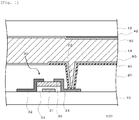
- Fig. 1 shows a cross-sectional diagram showing an example of an electronic device.
- a polymer (a first polymer) according to the present embodiment includes a structural unit represented by the following Formula (1a), a structural unit represented by the following Formula (1b) and a structural unit represented by the following Formula (1c).
- Formula (1a) n represents 0, 1 or 2.
- R 1 , R 2 , R 3 and R 4 independently represents a hydrogen atom or an organic group having 1 to 10 carbon atoms.
- R 5 represents an organic group having 1 to 10 carbon atoms.
- a process margin can be mentioned as a criterion to determine the reliability of the materials used in a manufacturing process of an electronic device.
- the process margin shows the tolerance with respect to misalignment resulting from various devices and processes, and, for example, an effect on a pattern dimension after a dwell time in a process from exposure to development is exemplified.
- curing reaction proceeds due to catalytic action by acid or alkali present in the process during the dwell time, there is a concern that a problem in that residue remains occurs in case that rework is required.
- these problems also affect the yield of the electronic device, development of a new polymer which is excellent in rework property, and can realize the photosensitive resin composition having a large process margin is required.
- the present inventors performed thorough studies on a new polymer which can improve the rework property. As a result, the inventors newly developed the first polymer having a structural unit represented by the above Formula (1a), a structural unit represented by the above Formula (1b) and a structural unit represented by the above Formula (1c).
- a new polymer which can increase the process margin and improve the reliability in a manufacturing process of an electronic device can be provided.
- the first polymer according to the embodiment consists of a copolymer having a structural unit represented by the following Formula (1a), a structural unit represented by the following Formula (1b) and a structural unit represented by the following Formula (1c).
- n 0, 1 or 2.
- R 1 , R 2 , R 3 and R 4 independently represents a hydrogen atom or an organic group having 1 to 10 carbon atoms.
- R 5 represents an organic group having 1 to 10 carbon atoms.
- a molar ratio of the structural unit represented by the Formula (1a), which is not particularly limited, is preferably equal to or more than 10 and equal to or less than 90 with respect to the entire first polymer (100).
- a molar ratio of the structural unit represented by the Formula (1b), which is not particularly limited, is preferably equal to or more than 1 and equal to or less than 50 with respect to the entire first polymer (100).
- a molar ratio of the structural unit represented by the Formula (1c), which is not particularly limited, is preferably equal to or more than 1 and equal to or less than 50 with respect to the entire first polymer (100).
- a first polymer as the polymer comprising the photosensitive resin composition, it is possible to improve the rework characteristic while maintaining the characteristics required for the resin film such as heat resistance, transparency, low dielectric constant, low birefringence, chemical resistance and water repellency with regard to the resin film formed by using the photosensitive resin composition. It is supposed to be due to the fact that in addition to a structural unit derived from norbornene having an alicyclic skeleton, a structural unit derived from an N-substituted maleimide and a structural unit derived from a non-substituted maleimide are included in the first polymer.
- each structure of each structural unit represented by the above Formula (1a) can be independently determined. This is the same with regard to each of the structural unit represented by the above Formula (1b) and the structural unit represented by the above Formula (1c).
- Examples of the organic group having 1 to 10 carbon atoms constituting R 1 , R 2 , R 3 and R 4 include hydrocarbon groups having 1 to 10 carbon atoms such as an alkyl group, an alkenyl group, an alkynyl group, an alkylidene group, an aryl group, an aralkyl group, an alkaryl group or a cycloalkyl group, or an organic group having 1 to 10 carbon atoms including a carboxyl group or a glycidyl group.
- Examples of the alkyl group include a methyl group, an ethyl group, an n-propyl group, an isopropyl group, an n-butyl group, an isobutyl group, a sec-butyl group, a tert-butyl group, a pentyl group, a neopentyl group, a hexyl group, a heptyl group, an octyl group, a nonyl group and a decyl group.
- Examples of the alkenyl group include an allyl group, a pentenyl group and a vinyl group.
- Examples of the alkynyl group include an ethynyl group.
- Examples of the alkylidene group include a methylidyne group and an ethylidene group.
- Examples of the aryl group include a phenyl group and a naphthyl group.
- Examples of the aralkyl group include a benzyl group and a phenethyl group.
- Examples of the alkaryl group include a tolyl group and a xylyl group.
- Examples of the cycloalkyl group include an adamantyl group, a cyclopentyl group, a cyclohexyl group and a cyclooctyl group.
- one or more hydrogen atoms of these alkyl group, alkenyl group, alkynyl group, alkylidene group, aryl group, aralkyl group, alkaryl group and cycloalkyl group are may be substituted with halogen atoms such as fluorine, chlorine, bromine or iodine.
- the organic group having 1 to 10 carbon atoms including a glycidyl group, constituting R 1 , R 2 , R 3 and R 4
- the organic group represented by the following Formula (6) is exemplified.
- Y represents a single bond or a divalent organic group having 1 to 7 carbon atoms.
- a divalent organic group constituting Y may have one or two or more of oxygen, nitrogen and silicon, and is a linear or branched divalent hydrocarbon group.
- Y can be an alkylene group having 1 to 7 carbon atoms.
- one or more hydrogen atoms among the organic groups constituting Y may be substituted with halogen atoms such as fluorine, chlorine, bromine or iodine.
- the above organic group including a glycidyl group is preferably the organic group represented by the following Formula (7).
- the organic group having 1 to 10 carbon atoms including a carboxyl group, constituting R 1 , R 2 , R 3 and R 4
- the organic group represented by the following Formula (8) is exemplified.
- Z represents a single bond or a divalent organic group having 1 to 9 carbon atoms.
- a divalent organic group constituting Z may have one or two or more of oxygen, nitrogen and silicon, and is a linear or branched divalent hydrocarbon group.
- Z can be a single bond or an alkylene group having 1 to 7 carbon atoms.
- one or more hydrogen atoms among the organic groups constituting Z may be substituted with halogen atoms such as fluorine, chlorine, bromine or iodine.
- the above organic group containing a carboxyl group is preferably the organic group represented by the following Formula (9).
- Formula (9) the organic group represented by the following Formula (9).
- At least one of R 1 , R 2 , R 3 and R 4 is preferably the organic group containing a carboxyl group or a glycidyl group.
- a copolymer constituting the first polymer preferably includes a structural unit in which at least one of R 1 , R 2 , R 3 and R 4 is an organic group containing a glycidyl group as at least a part of a structural unit derived from norbornene.
- copolymers represents by the following formula (11) are exemplified.
- those exemplified by the above Formulas (1a) and (1c) can be applied to n, R 1 , R 2 , R 3 and R 4 and R 5 .
- Those exemplified by the above Formula (6) can be applied to Y.
- Examples of the organic group having 1 to 10 carbon atoms constituting R 5 include hydrocarbon groups having 1 to 10 carbon atoms such as an alkyl group, an alkenyl group, an alkynyl group, an alkylidene group, an aryl group, an aralkyl group, an alkaryl group or a cycloalkyl group.
- Examples of the alkyl group include a methyl group, an ethyl group, an n-propyl group, an isopropyl group, an n-butyl group, an isobutyl group, a sec-butyl group, a tert-butyl group, a pentyl group, a neopentyl group, a hexyl group, a heptyl group, an octyl group, a nonyl group and a decyl group.
- Examples of the alkenyl group include an allyl group, a pentenyl group and a vinyl group.
- Examples of the alkynyl group include an ethynyl group.
- Examples of the alkylidene group include a methylidyne group and an ethylidene group.
- Examples of the aryl group include a phenyl group and a naphthyl group.
- Examples of the aralkyl group include a benzyl group and a phenethyl group.
- Examples of the alkaryl group include a tolyl group and a xylyl group.
- Examples of the cycloalkyl group include an adamantyl group, a cyclopentyl group, a cyclohexyl group and a cyclooctyl group.
- one or more hydrogen atoms included in R 5 may be substituted with halogen atoms such as fluorine, chlorine, bromine or iodine.
- the copolymer constituting the first polymer within a range which does not impair the effects of the invention, may include a structural unit other than the structural unit represented by the above Formula (1a), the structural unit represented by the above Formula (1b) and the structural unit represented by the above Formula (1c).
- first polymer As the first polymer according to the embodiment, polymers shown below can be exemplified. Moreover, the first polymer is not limited to the following.
- the first polymer may include one kind or two or more kinds of a monomer represented by the following Formula (12), a monomer represented by the following Formula (13) and maleimide as a low molecular weight component.
- a monomer represented by the following Formula (12) a monomer represented by the following Formula (13)
- maleimide as a low molecular weight component.
- n, R 1 , R 2 , R 3 and R 4 can be those exemplified by the above Formula (1a).
- R 5 can be that exemplified by the above Formula (1c).
- the first polymer can be synthesized, for example, in the following manner.
- norbornene-type monomer represented by the above Formula (12), maleimide and N-substituted maleimide represented by the above Formula (13) are prepared as a monomer.
- the prepared monomer is subjected to addition polymerization to obtain a copolymer (Copolymer 1).
- the addition polymerization is performed by radical polymerization.
- solution polymerization can be performed by heating for a predetermined time. At this time, for example, heating temperature can be in the range of 50°C to 80°C. In addition, for example, heating time can be in the range of 1 hour to 20 hours. Moreover, it is more preferable to perform the solution polymerization after dissolved oxygen in the solvent is removed by sparging with nitrogen.
- methyl ethyl ketone MEK
- propylene glycol monomethyl ether diethyl ether
- tetrahydrofuran THF
- toluene toluene
- polymerization initiator one kind or two or more kinds of an azo compound and an organic peroxide can be used.
- the azo compound include azobisisobutyronitrile (AIBN), dimethyl 2,2'-azobis(2-methylpropionate) and 1,1'-azobis(cyclohexanecarbonitrile) (ABCN).
- the organic peroxide include hydrogen peroxide, ditertiary butyl peroxide (DTBP), benzoyl peroxide (BPO) and methyl ethyl ketone peroxide (MEKP).
- the structural unit represented by the above Formula (1c) can also be obtained by a method in which after maleic anhydride is subjected to addition polymerization with another monomer to synthesize a copolymer, a structural unit derived from maleic anhydride is ring-opened by amines to obtain maleamic acid, and the maleamic acid is subjected to an imide ring closure.
- the imide ring closure is performed by heating in the presence of a catalyst such as tertiary amine.
- a reaction solution including the copolymer 1 obtained in the above manner is added to hexane or methanol to precipitate a polymer.
- the polymer was collected by filtration, it was washed with hexane or methanol, and it was dried.
- the first polymer can be synthesized in this way.
- the photosensitive resin composition is used to form a permanent film.
- the permanent film is constituted with a resin film obtained by curing the photosensitive resin composition.
- a coating film comprising with the photosensitive resin composition is subjected to patterning into a desired shape by exposure and development, the coating film is heat-treated to be cured, and as a result, a permanent film is formed.
- the permanent film formed using the photosensitive resin composition examples include an interlayer film, a surface protecting film or a dam material.
- the permanent film can also be used as an optical material such as an optical lens.
- application of the permanent film is not limited thereto.
- the interlayer film refers to an insulating film provided in a multilayer structure, and the type thereof is not particularly limited.
- the interlayer film include interlayer films used in semiconductor device applications such as an insulating interlayer constituting a multilayer interconnection structure of a semiconductor element, a build-up layer or a core layer constituting a circuit substrate.
- examples of the interlayer film also include interlayer films used in display device applications such as a planarization film covering a thin film transistor (TFT) in a display device, a liquid crystal orientation film, a projection provided on a color filter substrate of a multi domain vertical alignment (MVA)-type liquid crystal display device, or a partition wall for forming a cathode of an organic EL element.
- TFT thin film transistor
- MVA multi domain vertical alignment
- the surface protecting film refers to an insulating film which is formed on a surface of an electronic component or an electronic device for protecting the surface, and the type thereof is not particularly limited. Examples of such a surface protecting film include a passivation film, a bump protecting film or a buffer coat layer provided on a semiconductor element, or a cover coat provided on a flexible substrate.
- the dam material is a spacer used to form a hollow portion for positioning an optical element on a substrate.
- the photosensitive resin composition includes the first polymer and a photo active compound.
- the photosensitive resin composition according to the embodiment can include one kind or two or more kinds of the first polymer exemplified above.
- the content of the first polymer in the photosensitive resin composition which is not particularly limited, is preferably equal to or greater than 20% by mass and equal to or less than 90% by mass, and more preferably equal to or greater than 30% by mass and equal to or less than 80% by mass with respect to the entire solid content of the photosensitive resin composition.
- the solid content of the photosensitive resin composition refers to components excluding the solvent included in the photosensitive resin composition.
- the photosensitive resin composition can have a diazoquinone compound as the photo active compound which provides TMAH (Tetramethylammonium hydroxide) dissolution contrast in the film upon exposure to light.
- TMAH Tetramethylammonium hydroxide
- the diazoquinone compound used as the photo active compound includes a compound exemplified below. (n2 represents an integer of equal to or greater than 1 and equal to or less than 5.)
- Q represents any one of the structures (a), (b) and (c) shown below, or a hydrogen atom.
- at least one of Q included in each compound is any one of the structures (a), (b) and (c).
- o-naphthoquinone diazide sulfonic acid derivatives which have the structure (a) or (b) are more preferable.
- the content of the photo active compound in the photosensitive resin composition is preferably equal to or greater than 5% by mass and equal to or less than 40% by mass, and more preferably equal to or greater than 10% by mass and equal to or less than 30% by mass with respect to the entire solid content of the photosensitive resin composition.
- the photosensitive resin composition may have sulfonium salts such as CPI-100P, 101A, 110B, 200K and 210S (here before, manufactured by San-Apro LTD.) as photoacid generating agents.
- the photosensitive resin composition according to the embodiment can also include one kind or two or more kinds of the photo-acid generating agent exemplified above.
- the photosensitive resin composition can have an acid generating agent (thermal acid generating agent) which generates acid by heat.
- the thermal acid generating agent can includes an aromatic sulfonium salt such as SI-45L, SI-60L, SI-80L, SI-100L, SI-110L, SI-150L (hereinbefore, manufactured by Sanshin Chemical Industry Co., Ltd.) as the acid generating agents (thermal acid generating agent) which generates acid by heat.
- the photo-acid generating agent exemplified hereinbefore and a thermal acid generating agent thereof can also be used in combination.
- the content of the acid generating agent in the photosensitive resin composition is preferably equal to or greater than 0.1% by mass and equal to or less than 20% by mass, and more preferably equal to or greater than 0.5% by mass and equal to or less than 10% by mass with respect to the entire solid content of the photosensitive resin composition.
- the photosensitive resin composition may include an adhesive property improver.
- an adhesive property improver which is not particularly limited, silane coupling agents such as aminosilane, epoxysilane, acrylic silane, mercaptosilane, vinylsilane, ureidosilane or sulfidesilane can be used. These may be used alone as one type or may be used in a combination of two or more types. Among these, from the viewpoint of effectively improving the adhesive property with respect to other members, the epoxy silane is more preferably used.
- aminosilane examples include bis(2-hydroxyethyl)-3-aminopropyltriethoxysilane, ⁇ -aminopropyltriethoxysilane, ⁇ -aminopropyltrimethoxysilane, ⁇ -aminopropylmethyldiethoxysilane, ⁇ -aminopropylmethyldimethoxysilane, N- ⁇ (aminoethyl) ⁇ -aminopropyltrimethoxysilane, N- ⁇ (aminoethyl) ⁇ -aminopropyltriethoxysilane, N- ⁇ (aminoethyl) ⁇ -aminopropylmethyldimethoxysilane, N- ⁇ (aminoethyl) ⁇ -aminopropylmethyldiethoxysilane or N-phenyl- ⁇ -amino-propyltrimethoxysilane.
- Examples of the epoxysilane includes ⁇ -glycidoxypropyltrimethoxysilane, ⁇ -glycidoxypropylmethyldiethoxysilane or ⁇ -(3,4epoxycyclohexyl)ethyltrimethoxysilane.
- Examples of the acrylic silane include ⁇ -(methacryloxypropyl)trimethoxysilane, ⁇ -(methacryloxypropyl)methyldimethoxysilane or ⁇ -(methacryloxypropyl)methyldiethoxysilane.
- Examples of the mercaptosilane include ⁇ -mercaptopropyltrimethoxysilane.
- Examples of the vinylsilane include vinyltris( ⁇ -methoxyethoxy)silane, vinyltriethoxysilane or vinyltrimethoxysilane.
- Examples of the ureidosilane include 3-ureidopropyltriethoxysilane.
- Examples of the sulfidesilane include bis(3-(triethoxysilyl)propyl)disulfide or bis(3-(triethoxysilyl)propyl)tetrasulfide.
- the content of the adhesive property improver in the photosensitive resin composition is preferably equal to or greater than 1% by mass and equal to or less than 10% by mass, and more preferably equal to or greater than 2% by mass and equal to or less than 8% by mass with respect to the entire solid content of the photosensitive resin composition. Thus, it is possible to further effectively improve the adhesive property with respect to other members of the resin film formed using the photosensitive resin composition.
- the photosensitive resin composition may include a surfactant.
- the surfactant includes a compound including a fluorine group (for example, a fluorinated alkyl group) or a silanol group, or a compound having a siloxane bond as a main skeleton.
- a surfactant in the embodiment surfactants including a fluorine-based surfactant or a silicone-based surfactant are particularly preferable.
- the surfactant include a Megaface F557 manufactured by DIC Corporation and the like, and the surfactant is not limited thereto.
- the content of the surfactant in the photosensitive resin composition is preferably equal to or greater than 0.1% by mass and equal to or less than 3% by mass, and more preferably equal to or greater than 0.2% by mass and equal to or less than 2% by mass with respect to the entire solid content of the photosensitive resin composition.
- the content of the surfactant in the photosensitive resin composition is preferably equal to or greater than 0.1% by mass and equal to or less than 3% by mass, and more preferably equal to or greater than 0.2% by mass and equal to or less than 2% by mass with respect to the entire solid content of the photosensitive resin composition.
- additives such as a crosslinking agent, an antioxidant, a filler or a sensitizer may be added as necessary.
- the crosslinking agent has a reactive group forming a crosslinked structure by a reaction with a carboxyl group in the first polymer.
- the reactive group a cyclic ether group is preferable, and a glycidyl group or an oxetane group is particularly preferable.
- the antioxidant can include one kind or two or more kinds selected from a group of a phenolic antioxidant, a phosphorus-based antioxidant and a thioether-based antioxidant.
- the filler can include one kind or two or more kinds selected from an inorganic filler such as silica.
- the sensitizer can includes one kind or two or more kinds selected from a group of anthracenes, xanthones, anthraquinones, phenanthrenes, chrysenes, benzopyrenes, fluoracenes, rubrenes, pyrenes, indanthrenes and thioxanthen-9-ones.
- the photosensitive resin composition may include a solvent.
- the photosensitive resin composition enters a varnish state.
- the solvent can include one kind or two or more kinds of propylene glycol monomethyl ether (PGME), propylene glycol monomethyl ether acetate (PGMEA), ethyl lactate, methylisobutyl carbinol (MIBC), gamma-butyrolactone (GBL), N-methylpyrrolidone (NMP), methyl n-amyl ketone (MAK), diethylene glycol monomethyl ether, diethylene glycol dimethyl ether, and diethylene glycol methylethyl ether.
- the solvent capable of being used in the embodiment is not limited thereto.
- the electronic device 100 is provided with an insulating film 20 which is a permanent film formed using the photosensitive resin composition described above.
- the electronic device 100 according to the embodiment is not particularly limited as long as it is provided with an insulating film formed using the photosensitive resin composition.
- a display device having an insulating film 20 as a planarization film or a microlens, and a semiconductor device provided with a multilayer interconnection structure in which the insulating film 20 is used as an insulating interlayer are exemplified.
- Fig. 1 shows a cross-sectional diagram showing an example of the electronic device 100.
- the electronic device 100 is a liquid crystal display device, and a case where the insulating film 20 is used as the planarizing film is exemplified.
- the electronic device 100 shown in Fig. 1 is provided with a substrate 10, a transistor 30 provided on the substrate 10, the insulating film 20 provided on the substrate 10 so as to cover the transistor 30, and an interconnection 40 provided on the insulating film 20.
- the substrate 10 is a glass substrate.
- the transistor 30 is a thin film transistor constituting a switching element of a liquid crystal display device.
- a plurality of the transistors 30 is arranged on the substrate 10 in an array pattern.
- the transistor 30 shown in Fig. 1 is constituted with a gate electrode 31, a source electrode 32, a drain electrode 33, a gate insulating film 34 and a semiconductor layer 35.
- the gate electrode 31 is provided on the substrate 10.
- the gate insulating film 34 is provided on the substrate 10 so as to cover the gate electrode 31.
- the semiconductor layer 35 is provided on the gate insulating film 34.
- the semiconductor layer 35 is a silicon layer.
- the source electrode 32 is provided on the substrate 10 so as to come partly into contact with the semiconductor layer 35.
- the drain electrode 33 is provided on the substrate 10 so as to be away from the source electrode 32, and come partly into contact with the semiconductor layer 35.
- the insulating film 20 functions as a planarization film for eliminating a difference in level due to the transistor 30 or the like, and for forming a flat surface on the substrate 10.
- the insulating film 20 is constituted with a cured product of the photosensitive resin composition described above.
- An opening 22 that penetrates the insulating film 20 so as to connect to the drain electrode 33 is provided in the insulating film 20.
- An interconnection 40 that connects to the drain electrode 33 is formed on the insulating film 20 and in the opening 22.
- the interconnection 40 functions as a pixel electrode constituting a pixel with a liquid crystal.
- an orientation film 90 is provided on the insulating film 20 so as to cover the interconnection 40.
- a counter substrate 12 is disposed over one surface provided with the transistor 30 of the substrate 10 so as to face the substrate 10.
- An interconnection 42 is provided on one surface facing the substrate 10 of the counter substrate 12.
- the interconnection 42 is provided at a position facing the interconnection 40.
- an orientation film 92 is provided on the one surface of the counter substrate 12 so as to cover the interconnection 42.
- a liquid crystal constituting a liquid crystal layer 14 is filled in between the substrate 10 and the counter substrate 12,
- the electronic device 100 shown in Fig. 1 can be formed in the following manner.
- the transistor 30 is formed on the substrate 10.
- the photosensitive resin composition is coated on one surface provided on the transistor 30 of the substrate 10 by a printing method or a spin coating method to form the insulating film 20 covering the transistor 30.
- the insulating film 20 is exposed to ultraviolet rays or the like, and developed, thereby patterning the insulating film 20.
- the opening 22 is formed in a part of the insulating film 20.
- the insulating film 20 is subjected to heating and curing.
- the insulating film 20 which is a planarization film is formed on the substrate 10.
- the interconnection 40 that is connected to the drain electrode 33 is formed in the opening 22 of the insulating film 20.
- the counter substrate 12 is disposed on the insulating film 20, and a liquid crystal is filled in between the counter substrate 12 and the insulating film 20, thereby forming the liquid crystal layer 14.
- the electronic device 100 shown in Fig. 1 is formed.
- the invention is not limited to the embodiments described above, and modification, improvement and the like in a range of achieving the object of the invention are included in the invention.
- Methylglycidylether norbornene (7.2 g, 40 mmol), norbornene carboxylic acid (1.3 g, 10 mmol), maleimide (2.9 g, 30 mmol), and N-cyclohexyl maleimide (3.6 g, 20 mmol) were weighed and added into a reaction vessel provided with a stirrer and a cooling tube. Furthermore, V-601 (0.46 g, 2 mmol) and 12.5 g of THF were added into the reaction vessel, and the resultant was stirred and dissolved. Next, after dissolved oxygen in the system was removed by sparging with nitrogen, the reaction was performed for 5 hours while maintaining the temperature at 60°C in a nitrogen atmosphere.
- the reaction mixture was cooled to room temperature, and it was diluted by adding 22 g of THF thereto.
- the diluted solution was poured into a large amount of methanol to precipitate a polymer.
- the polymer was collected by filtration, further washed with methanol, and vacuum-dried at 30°C for 16 hours.
- the obtained amount of the polymer was 7.0 g, and the yield was 47%.
- the weight average molecular weight of the obtained polymer was 7,100, and the dispersity was 1.37.
- the polymer had a structure represented by the following Formula (18).
- the rework characteristic of the photosensitive resin composition in Example 1 was measured in the following manner.
- the photosensitive resin composition was spin-coated (revolution speed: 500 rpm to 2,500 rpm) on a 1737 glass substrate manufactured by Corning Inc. having sizes of a horizontal width of 100 mm and a vertical width of 100 mm, and the resultant was pre-baked at 100°C for 120 seconds using a hotplate, thereby obtaining a resin film having a thickness of about 3.0 ⁇ m.
- the resin film was exposed to g+h+i rays such that an accumulated amount of light is 300 mJ/cm 2 by a g+h+i ray mask aligner (PLA-501F (ultrahigh-pressure mercury lamp) manufactured by Canon Inc.).
- the resultant film was subjected to a developing treatment with a tetramethyl ammonium hydroxide aqueous solution of 0.5% for 90 seconds, and further rinsed with pure water, thereby obtaining a thin film with patterns.
- a bleaching treatment was performed on the thin film such that an accumulated amount of light is 300 mJ/cm 2 without using a mask.
- the bleaching treatment was further performed on the resin film such that an accumulated amount of light of the g+h+i rays is 300 mJ/cm 2 without using a mask.
- the resin film was immersed in a 2.38% TMAH (tetramethyl ammonium hydroxide) solution of 23 ⁇ 1°C for 120 seconds. At this time, the presence or absence of a residue of the resin film on the substrate was observed using a microscope.
- TMAH tetramethyl ammonium hydroxide
- Example 1 the residue of the resin film was not observed.
Landscapes
- Physics & Mathematics (AREA)
- Chemical & Material Sciences (AREA)
- Spectroscopy & Molecular Physics (AREA)
- Health & Medical Sciences (AREA)
- Chemical Kinetics & Catalysis (AREA)
- Medicinal Chemistry (AREA)
- Polymers & Plastics (AREA)
- Organic Chemistry (AREA)
- General Physics & Mathematics (AREA)
- Materials For Photolithography (AREA)
- Addition Polymer Or Copolymer, Post-Treatments, Or Chemical Modifications (AREA)
Abstract

Description
- The invention relates to a polymer, a photosensitive resin composition, and an electronic device.
- As an insulating film comprising an electronic device, a resin film obtained by exposing a photosensitive resin composition is used. For example, as a technique for such a photosensitive resin composition, a technique disclosed in Patent Document 1 can be referenced. Patent Document 1 describes a photoresist composition including an alkalisoluble resin and a photosensitive agent.
- [Patent Document 1] Japanese Unexamined Patent Publication No.
H2-146045 - In recent years, development of a new polymer which can improve the reliability of the materials used in a manufacturing process of an electronic device has been required.
- According to the present invention, there is provided a polymer including a structural unit represented by the following Formula (1a), a structural unit represented by the following Formula (1b) and a structural unit represented by the following Formula (1c).

- In addition, according to the present invention, there is provided a photosensitive resin composition used to form a permanent film including the above-described polymer and a photo active compound.
- In addition, according to the present invention, there is provided an electronic device including a permanent film formed using the above-described photosensitive resin composition.
- According to the invention, a new polymer which can improve the reliability of the materials used in a manufacturing process of an electronic device can be provided.
- The above-described and other objects, features, and advantages will become more apparent with reference to preferred embodiments described below and the accompanying drawing.
-
Fig. 1 shows a cross-sectional diagram showing an example of an electronic device. - Hereinafter, embodiments will be described with refer ence to the accompanying drawing. In addition, in the draw ing, the same constituent elements are denoted by the same reference numerals and the description thereof will not be repeated.
- A polymer (a first polymer) according to the present embodiment includes a structural unit represented by the following Formula (1a), a structural unit represented by the following Formula (1b) and a structural unit represented by the following Formula (1c).

- A process margin can be mentioned as a criterion to determine the reliability of the materials used in a manufacturing process of an electronic device. The process margin shows the tolerance with respect to misalignment resulting from various devices and processes, and, for example, an effect on a pattern dimension after a dwell time in a process from exposure to development is exemplified. In particular, in a case where since polymerizable groups are contained in the photosensitive resin composition for forming a permanent film such as an insulating interlayer, curing reaction proceeds due to catalytic action by acid or alkali present in the process during the dwell time, there is a concern that a problem in that residue remains occurs in case that rework is required. As a result, since these problems also affect the yield of the electronic device, development of a new polymer which is excellent in rework property, and can realize the photosensitive resin composition having a large process margin is required.
- The present inventors performed thorough studies on a new polymer which can improve the rework property. As a result, the inventors newly developed the first polymer having a structural unit represented by the above Formula (1a), a structural unit represented by the above Formula (1b) and a structural unit represented by the above Formula (1c). Thus, according to the embodiment, a new polymer which can increase the process margin and improve the reliability in a manufacturing process of an electronic device can be provided.
- Hereinafter, the first polymer, the photosensitive resin composition and the electronic device will be described in detail.
- First, the first polymer will be described.
- As described above, the first polymer according to the embodiment consists of a copolymer having a structural unit represented by the following Formula (1a), a structural unit represented by the following Formula (1b) and a structural unit represented by the following Formula (1c).

- In the above Formula (1a), n represents 0, 1 or 2. Each of R1, R2, R3 and R4 independently represents a hydrogen atom or an organic group having 1 to 10 carbon atoms. In the above Formula (1c), R5 represents an organic group having 1 to 10 carbon atoms. A molar ratio of the structural unit represented by the Formula (1a), which is not particularly limited, is preferably equal to or more than 10 and equal to or less than 90 with respect to the entire first polymer (100). A molar ratio of the structural unit represented by the Formula (1b), which is not particularly limited, is preferably equal to or more than 1 and equal to or less than 50 with respect to the entire first polymer (100). A molar ratio of the structural unit represented by the Formula (1c), which is not particularly limited, is preferably equal to or more than 1 and equal to or less than 50 with respect to the entire first polymer (100).
- By using such a first polymer as the polymer comprising the photosensitive resin composition, it is possible to improve the rework characteristic while maintaining the characteristics required for the resin film such as heat resistance, transparency, low dielectric constant, low birefringence, chemical resistance and water repellency with regard to the resin film formed by using the photosensitive resin composition. It is supposed to be due to the fact that in addition to a structural unit derived from norbornene having an alicyclic skeleton, a structural unit derived from an N-substituted maleimide and a structural unit derived from a non-substituted maleimide are included in the first polymer.
- Moreover, in the copolymer, in a case where a plurality of the structural units represented by the above Formula (1a) is present, each structure of each structural unit represented by the above Formula (1a) can be independently determined. This is the same with regard to each of the structural unit represented by the above Formula (1b) and the structural unit represented by the above Formula (1c).
- Examples of the organic group having 1 to 10 carbon atoms constituting R1, R2, R3 and R4 include hydrocarbon groups having 1 to 10 carbon atoms such as an alkyl group, an alkenyl group, an alkynyl group, an alkylidene group, an aryl group, an aralkyl group, an alkaryl group or a cycloalkyl group, or an organic group having 1 to 10 carbon atoms including a carboxyl group or a glycidyl group. Examples of the alkyl group include a methyl group, an ethyl group, an n-propyl group, an isopropyl group, an n-butyl group, an isobutyl group, a sec-butyl group, a tert-butyl group, a pentyl group, a neopentyl group, a hexyl group, a heptyl group, an octyl group, a nonyl group and a decyl group. Examples of the alkenyl group include an allyl group, a pentenyl group and a vinyl group. Examples of the alkynyl group include an ethynyl group. Examples of the alkylidene group include a methylidyne group and an ethylidene group. Examples of the aryl group include a phenyl group and a naphthyl group. Examples of the aralkyl group include a benzyl group and a phenethyl group. Examples of the alkaryl group include a tolyl group and a xylyl group. Examples of the cycloalkyl group include an adamantyl group, a cyclopentyl group, a cyclohexyl group and a cyclooctyl group. Moreover, one or more hydrogen atoms of these alkyl group, alkenyl group, alkynyl group, alkylidene group, aryl group, aralkyl group, alkaryl group and cycloalkyl group are may be substituted with halogen atoms such as fluorine, chlorine, bromine or iodine.
- As the organic group having 1 to 10 carbon atoms, including a glycidyl group, constituting R1, R2, R3 and R4, the organic group represented by the following Formula (6) is exemplified.

- In the above Formula (6), Y represents a single bond or a divalent organic group having 1 to 7 carbon atoms. A divalent organic group constituting Y may have one or two or more of oxygen, nitrogen and silicon, and is a linear or branched divalent hydrocarbon group. In the embodiment, for example, Y can be an alkylene group having 1 to 7 carbon atoms. Moreover, one or more hydrogen atoms among the organic groups constituting Y may be substituted with halogen atoms such as fluorine, chlorine, bromine or iodine.
- In the embodiment, for example, the above organic group including a glycidyl group is preferably the organic group represented by the following Formula (7). Thus, it is possible to further effectively improve the balance of the rework characteristic, stability over time and solvent resistance with respect to the resin film formed using the photosensitive resin composition including the first polymer.

- In addition, as the organic group having 1 to 10 carbon atoms, including a carboxyl group, constituting R1, R2, R3 and R4, the organic group represented by the following Formula (8) is exemplified.


- In the above Formula (8), Z represents a single bond or a divalent organic group having 1 to 9 carbon atoms. A divalent organic group constituting Z may have one or two or more of oxygen, nitrogen and silicon, and is a linear or branched divalent hydrocarbon group. In the embodiment, for example, Z can be a single bond or an alkylene group having 1 to 7 carbon atoms. Moreover, one or more hydrogen atoms among the organic groups constituting Z may be substituted with halogen atoms such as fluorine, chlorine, bromine or iodine.
- In the embodiment, for example, the above organic group containing a carboxyl group is preferably the organic group represented by the following Formula (9). Thus, it is possible to further effectively improve the balance of the rework characteristic, stability over time and solvent resistance with respect to the resin film formed using the photosensitive resin composition including the first polymer.


- In the embodiment, at least one of R1, R2, R3 and R4 is preferably the organic group containing a carboxyl group or a glycidyl group. Thus, it is possible to improve the balance between the rework characteristic and solvent resistance with respect to the resin film formed using the photosensitive resin composition having the first polymer. In addition, it is possible to contribute to the improvement of the heat resistance and mechanical strength. In addition, from the viewpoint of further effectively improving the balance between the rework characteristic and solvent resistance, it is preferable that at least one of R1, R2, R3 and R4 be the organic group containing a carboxyl group or a glycidyl group, and the others be hydrogen atoms.
- In the embodiment, a copolymer constituting the first polymer preferably includes a structural unit in which at least one of R1, R2, R3 and R4 is an organic group containing a glycidyl group as at least a part of a structural unit derived from norbornene. Thus, it is possible to further effectively improve the solvent resistance with respect to the resin film formed using the photosensitive resin composition having the first polymer. As such copolymers, copolymers represents by the following formula (11) are exemplified.

- Examples of the organic group having 1 to 10 carbon atoms constituting R5 include hydrocarbon groups having 1 to 10 carbon atoms such as an alkyl group, an alkenyl group, an alkynyl group, an alkylidene group, an aryl group, an aralkyl group, an alkaryl group or a cycloalkyl group. Examples of the alkyl group include a methyl group, an ethyl group, an n-propyl group, an isopropyl group, an n-butyl group, an isobutyl group, a sec-butyl group, a tert-butyl group, a pentyl group, a neopentyl group, a hexyl group, a heptyl group, an octyl group, a nonyl group and a decyl group. Examples of the alkenyl group include an allyl group, a pentenyl group and a vinyl group. Examples of the alkynyl group include an ethynyl group. Examples of the alkylidene group include a methylidyne group and an ethylidene group. Examples of the aryl group include a phenyl group and a naphthyl group. Examples of the aralkyl group include a benzyl group and a phenethyl group. Examples of the alkaryl group include a tolyl group and a xylyl group. Examples of the cycloalkyl group include an adamantyl group, a cyclopentyl group, a cyclohexyl group and a cyclooctyl group. Moreover, one or more hydrogen atoms included in R5 may be substituted with halogen atoms such as fluorine, chlorine, bromine or iodine.
- Moreover, the copolymer constituting the first polymer, within a range which does not impair the effects of the invention, may include a structural unit other than the structural unit represented by the above Formula (1a), the structural unit represented by the above Formula (1b) and the structural unit represented by the above Formula (1c).
- As the first polymer according to the embodiment, polymers shown below can be exemplified. Moreover, the first polymer is not limited to the following.


- Moreover, the first polymer may include one kind or two or more kinds of a monomer represented by the following Formula (12), a monomer represented by the following Formula (13) and maleimide as a low molecular weight component.


- The first polymer can be synthesized, for example, in the following manner.
- First, norbornene-type monomer represented by the above Formula (12), maleimide and N-substituted maleimide represented by the above Formula (13) are prepared as a monomer.
- Next, the prepared monomer is subjected to addition polymerization to obtain a copolymer (Copolymer 1). Herein, for example, the addition polymerization is performed by radical polymerization. In the embodiment, after the above monomer and a polymerization initiator are dissolved in a solvent, solution polymerization can be performed by heating for a predetermined time. At this time, for example, heating temperature can be in the range of 50°C to 80°C. In addition, for example, heating time can be in the range of 1 hour to 20 hours. Moreover, it is more preferable to perform the solution polymerization after dissolved oxygen in the solvent is removed by sparging with nitrogen.
- As the solvent used in the solution polymerization, one kind or two or more kinds of methyl ethyl ketone (MEK), propylene glycol monomethyl ether, diethyl ether, tetrahydrofuran (THF) and toluene can be used. In addition, as the polymerization initiator, one kind or two or more kinds of an azo compound and an organic peroxide can be used. Examples of the azo compound include azobisisobutyronitrile (AIBN), dimethyl 2,2'-azobis(2-methylpropionate) and 1,1'-azobis(cyclohexanecarbonitrile) (ABCN). Examples of the organic peroxide include hydrogen peroxide, ditertiary butyl peroxide (DTBP), benzoyl peroxide (BPO) and methyl ethyl ketone peroxide (MEKP).
- Moreover, for example, the structural unit represented by the above Formula (1c) can also be obtained by a method in which after maleic anhydride is subjected to addition polymerization with another monomer to synthesize a copolymer, a structural unit derived from maleic anhydride is ring-opened by amines to obtain maleamic acid, and the maleamic acid is subjected to an imide ring closure. For example, the imide ring closure is performed by heating in the presence of a catalyst such as tertiary amine.
- A reaction solution including the copolymer 1 obtained in the above manner is added to hexane or methanol to precipitate a polymer. Next, after the polymer is collected by filtration, it was washed with hexane or methanol, and it was dried. In the embodiment, for example, the first polymer can be synthesized in this way.
- The photosensitive resin composition is used to form a permanent film.
- The permanent film is constituted with a resin film obtained by curing the photosensitive resin composition. In the embodiment, for example, after a coating film comprising with the photosensitive resin composition is subjected to patterning into a desired shape by exposure and development, the coating film is heat-treated to be cured, and as a result, a permanent film is formed.
- Examples of the permanent film formed using the photosensitive resin composition include an interlayer film, a surface protecting film or a dam material. In addition, for example, the permanent film can also be used as an optical material such as an optical lens. Moreover, application of the permanent film is not limited thereto.
- The interlayer film refers to an insulating film provided in a multilayer structure, and the type thereof is not particularly limited. Examples of the interlayer film include interlayer films used in semiconductor device applications such as an insulating interlayer constituting a multilayer interconnection structure of a semiconductor element, a build-up layer or a core layer constituting a circuit substrate. In addition, examples of the interlayer film also include interlayer films used in display device applications such as a planarization film covering a thin film transistor (TFT) in a display device, a liquid crystal orientation film, a projection provided on a color filter substrate of a multi domain vertical alignment (MVA)-type liquid crystal display device, or a partition wall for forming a cathode of an organic EL element.
- The surface protecting film refers to an insulating film which is formed on a surface of an electronic component or an electronic device for protecting the surface, and the type thereof is not particularly limited. Examples of such a surface protecting film include a passivation film, a bump protecting film or a buffer coat layer provided on a semiconductor element, or a cover coat provided on a flexible substrate. In addition, the dam material is a spacer used to form a hollow portion for positioning an optical element on a substrate.
- The photosensitive resin composition includes the first polymer and a photo active compound.
- As the first polymer, those exemplified above can be used. The photosensitive resin composition according to the embodiment can include one kind or two or more kinds of the first polymer exemplified above. The content of the first polymer in the photosensitive resin composition, which is not particularly limited, is preferably equal to or greater than 20% by mass and equal to or less than 90% by mass, and more preferably equal to or greater than 30% by mass and equal to or less than 80% by mass with respect to the entire solid content of the photosensitive resin composition. Moreover, the solid content of the photosensitive resin composition refers to components excluding the solvent included in the photosensitive resin composition. Hereinafter, the same is applied in the present specification.
- For example, the photosensitive resin composition can have a diazoquinone compound as the photo active compound which provides TMAH (Tetramethylammonium hydroxide) dissolution contrast in the film upon exposure to light. For example, the diazoquinone compound used as the photo active compound includes a compound exemplified below.


- In each compound described above, Q represents any one of the structures (a), (b) and (c) shown below, or a hydrogen atom. However, at least one of Q included in each compound is any one of the structures (a), (b) and (c). From the viewpoint of a dielectric constant and a transparency of the photosensitive resin composition, o-naphthoquinone diazide sulfonic acid derivatives which have the structure (a) or (b) are more preferable.

- The content of the photo active compound in the photosensitive resin composition is preferably equal to or greater than 5% by mass and equal to or less than 40% by mass, and more preferably equal to or greater than 10% by mass and equal to or less than 30% by mass with respect to the entire solid content of the photosensitive resin composition.
- In addition, the photosensitive resin composition may have sulfonium salts such as CPI-100P, 101A, 110B, 200K and 210S (here before, manufactured by San-Apro LTD.) as photoacid generating agents. The photosensitive resin composition according to the embodiment can also include one kind or two or more kinds of the photo-acid generating agent exemplified above.
- For example, the photosensitive resin composition can have an acid generating agent (thermal acid generating agent) which generates acid by heat. The thermal acid generating agent can includes an aromatic sulfonium salt such as SI-45L, SI-60L, SI-80L, SI-100L, SI-110L, SI-150L (hereinbefore, manufactured by Sanshin Chemical Industry Co., Ltd.) as the acid generating agents (thermal acid generating agent) which generates acid by heat. Moreover, in the embodiment, the photo-acid generating agent exemplified hereinbefore and a thermal acid generating agent thereof can also be used in combination.
- The content of the acid generating agent in the photosensitive resin composition is preferably equal to or greater than 0.1% by mass and equal to or less than 20% by mass, and more preferably equal to or greater than 0.5% by mass and equal to or less than 10% by mass with respect to the entire solid content of the photosensitive resin composition. Thus, it is possible to effectively improve the balance of the reactivity of the photosensitive resin composition, and the rework characteristic and developability of the resin film formed using the photosensitive resin composition.
- The photosensitive resin composition may include an adhesive property improver. As the adhesive property improver, which is not particularly limited, silane coupling agents such as aminosilane, epoxysilane, acrylic silane, mercaptosilane, vinylsilane, ureidosilane or sulfidesilane can be used. These may be used alone as one type or may be used in a combination of two or more types. Among these, from the viewpoint of effectively improving the adhesive property with respect to other members, the epoxy silane is more preferably used.
- Examples of the aminosilane include bis(2-hydroxyethyl)-3-aminopropyltriethoxysilane, γ-aminopropyltriethoxysilane, γ-aminopropyltrimethoxysilane, γ-aminopropylmethyldiethoxysilane, γ-aminopropylmethyldimethoxysilane, N-β(aminoethyl)γ-aminopropyltrimethoxysilane, N-β(aminoethyl)γ-aminopropyltriethoxysilane, N-β(aminoethyl)γ-aminopropylmethyldimethoxysilane, N-β(aminoethyl)γ-aminopropylmethyldiethoxysilane or N-phenyl-γ-amino-propyltrimethoxysilane. Examples of the epoxysilane includes γ-glycidoxypropyltrimethoxysilane, γ-glycidoxypropylmethyldiethoxysilane or β-(3,4epoxycyclohexyl)ethyltrimethoxysilane. Examples of the acrylic silane include γ-(methacryloxypropyl)trimethoxysilane, γ-(methacryloxypropyl)methyldimethoxysilane or γ-(methacryloxypropyl)methyldiethoxysilane. Examples of the mercaptosilane include γ-mercaptopropyltrimethoxysilane. Examples of the vinylsilane include vinyltris(β-methoxyethoxy)silane, vinyltriethoxysilane or vinyltrimethoxysilane. Examples of the ureidosilane include 3-ureidopropyltriethoxysilane. Examples of the sulfidesilane include bis(3-(triethoxysilyl)propyl)disulfide or bis(3-(triethoxysilyl)propyl)tetrasulfide.
- The content of the adhesive property improver in the photosensitive resin composition is preferably equal to or greater than 1% by mass and equal to or less than 10% by mass, and more preferably equal to or greater than 2% by mass and equal to or less than 8% by mass with respect to the entire solid content of the photosensitive resin composition. Thus, it is possible to further effectively improve the adhesive property with respect to other members of the resin film formed using the photosensitive resin composition.
- The photosensitive resin composition may include a surfactant. For example, the surfactant includes a compound including a fluorine group (for example, a fluorinated alkyl group) or a silanol group, or a compound having a siloxane bond as a main skeleton. As a surfactant in the embodiment, surfactants including a fluorine-based surfactant or a silicone-based surfactant are particularly preferable. Examples of the surfactant include a Megaface F557 manufactured by DIC Corporation and the like, and the surfactant is not limited thereto.
- The content of the surfactant in the photosensitive resin composition is preferably equal to or greater than 0.1% by mass and equal to or less than 3% by mass, and more preferably equal to or greater than 0.2% by mass and equal to or less than 2% by mass with respect to the entire solid content of the photosensitive resin composition. Thus, it is possible to effectively improve flatness of the photosensitive resin composition. In addition, when performing a spin coating, it is possible to more reliably prevent radial striations from occurring on the coating film.
- In the photosensitive resin composition, additives such as a crosslinking agent, an antioxidant, a filler or a sensitizer may be added as necessary. For example, the crosslinking agent has a reactive group forming a crosslinked structure by a reaction with a carboxyl group in the first polymer. For example, as the reactive group, a cyclic ether group is preferable, and a glycidyl group or an oxetane group is particularly preferable. For example, the antioxidant can include one kind or two or more kinds selected from a group of a phenolic antioxidant, a phosphorus-based antioxidant and a thioether-based antioxidant. For example, the filler can include one kind or two or more kinds selected from an inorganic filler such as silica. For example, the sensitizer can includes one kind or two or more kinds selected from a group of anthracenes, xanthones, anthraquinones, phenanthrenes, chrysenes, benzopyrenes, fluoracenes, rubrenes, pyrenes, indanthrenes and thioxanthen-9-ones.
- The photosensitive resin composition may include a solvent. In this case, the photosensitive resin composition enters a varnish state. For example, the solvent can include one kind or two or more kinds of propylene glycol monomethyl ether (PGME), propylene glycol monomethyl ether acetate (PGMEA), ethyl lactate, methylisobutyl carbinol (MIBC), gamma-butyrolactone (GBL), N-methylpyrrolidone (NMP), methyl n-amyl ketone (MAK), diethylene glycol monomethyl ether, diethylene glycol dimethyl ether, and diethylene glycol methylethyl ether. Moreover, the solvent capable of being used in the embodiment is not limited thereto.
- Next, an
electronic device 100 according the embodiment will be described below. - For example, the
electronic device 100 is provided with an insulatingfilm 20 which is a permanent film formed using the photosensitive resin composition described above. Theelectronic device 100 according to the embodiment is not particularly limited as long as it is provided with an insulating film formed using the photosensitive resin composition. A display device having an insulatingfilm 20 as a planarization film or a microlens, and a semiconductor device provided with a multilayer interconnection structure in which the insulatingfilm 20 is used as an insulating interlayer are exemplified. -
Fig. 1 shows a cross-sectional diagram showing an example of theelectronic device 100. - In
Fig. 1 , theelectronic device 100 is a liquid crystal display device, and a case where the insulatingfilm 20 is used as the planarizing film is exemplified. For example, theelectronic device 100 shown inFig. 1 is provided with asubstrate 10, a transistor 30 provided on thesubstrate 10, the insulatingfilm 20 provided on thesubstrate 10 so as to cover the transistor 30, and aninterconnection 40 provided on the insulatingfilm 20. - For example, the
substrate 10 is a glass substrate. For example, the transistor 30 is a thin film transistor constituting a switching element of a liquid crystal display device. For example, a plurality of the transistors 30 is arranged on thesubstrate 10 in an array pattern. For example, the transistor 30 shown inFig. 1 is constituted with agate electrode 31, asource electrode 32, adrain electrode 33, agate insulating film 34 and asemiconductor layer 35. For example, thegate electrode 31 is provided on thesubstrate 10. Thegate insulating film 34 is provided on thesubstrate 10 so as to cover thegate electrode 31. Thesemiconductor layer 35 is provided on thegate insulating film 34. In addition, for example, thesemiconductor layer 35 is a silicon layer. Thesource electrode 32 is provided on thesubstrate 10 so as to come partly into contact with thesemiconductor layer 35. Thedrain electrode 33 is provided on thesubstrate 10 so as to be away from thesource electrode 32, and come partly into contact with thesemiconductor layer 35. - The insulating
film 20 functions as a planarization film for eliminating a difference in level due to the transistor 30 or the like, and for forming a flat surface on thesubstrate 10. The insulatingfilm 20 is constituted with a cured product of the photosensitive resin composition described above. An opening 22 that penetrates the insulatingfilm 20 so as to connect to thedrain electrode 33 is provided in the insulatingfilm 20. - An
interconnection 40 that connects to thedrain electrode 33 is formed on the insulatingfilm 20 and in the opening 22. Theinterconnection 40 functions as a pixel electrode constituting a pixel with a liquid crystal. - In addition, an
orientation film 90 is provided on the insulatingfilm 20 so as to cover theinterconnection 40. - A
counter substrate 12 is disposed over one surface provided with the transistor 30 of thesubstrate 10 so as to face thesubstrate 10. Aninterconnection 42 is provided on one surface facing thesubstrate 10 of thecounter substrate 12. Theinterconnection 42 is provided at a position facing theinterconnection 40. In addition, anorientation film 92 is provided on the one surface of thecounter substrate 12 so as to cover theinterconnection 42. - A liquid crystal constituting a
liquid crystal layer 14 is filled in between thesubstrate 10 and thecounter substrate 12, - For example, the
electronic device 100 shown inFig. 1 can be formed in the following manner. - First, the transistor 30 is formed on the
substrate 10. Next, the photosensitive resin composition is coated on one surface provided on the transistor 30 of thesubstrate 10 by a printing method or a spin coating method to form the insulatingfilm 20 covering the transistor 30. Next, the insulatingfilm 20 is exposed to ultraviolet rays or the like, and developed, thereby patterning the insulatingfilm 20. Thus, the opening 22 is formed in a part of the insulatingfilm 20. Next, the insulatingfilm 20 is subjected to heating and curing. Thus, the insulatingfilm 20 which is a planarization film is formed on thesubstrate 10. - Next, the
interconnection 40 that is connected to thedrain electrode 33 is formed in the opening 22 of the insulatingfilm 20. Thereafter, thecounter substrate 12 is disposed on the insulatingfilm 20, and a liquid crystal is filled in between thecounter substrate 12 and the insulatingfilm 20, thereby forming theliquid crystal layer 14. - Thus, the
electronic device 100 shown inFig. 1 is formed. - Moreover, the invention is not limited to the embodiments described above, and modification, improvement and the like in a range of achieving the object of the invention are included in the invention.
- Next, the examples of the invention will be described.
- Methylglycidylether norbornene (7.2 g, 40 mmol), norbornene carboxylic acid (1.3 g, 10 mmol), maleimide (2.9 g, 30 mmol), and N-cyclohexyl maleimide (3.6 g, 20 mmol) were weighed and added into a reaction vessel provided with a stirrer and a cooling tube. Furthermore, V-601 (0.46 g, 2 mmol) and 12.5 g of THF were added into the reaction vessel, and the resultant was stirred and dissolved. Next, after dissolved oxygen in the system was removed by sparging with nitrogen, the reaction was performed for 5 hours while maintaining the temperature at 60°C in a nitrogen atmosphere. Next, the reaction mixture was cooled to room temperature, and it was diluted by adding 22 g of THF thereto. The diluted solution was poured into a large amount of methanol to precipitate a polymer. Next, the polymer was collected by filtration, further washed with methanol, and vacuum-dried at 30°C for 16 hours. The obtained amount of the polymer was 7.0 g, and the yield was 47%. The weight average molecular weight of the obtained polymer was 7,100, and the dispersity was 1.37. In addition, the polymer had a structure represented by the following Formula (18).

- 10.0 g of a polymer synthesized by Synthesis Example 1,3.0 g of an esterification product (PA-15 manufactured by Daito Chemix Corporation) of 4,4'-(1-{4-[1-(4-hydroxyphenyl)-1-methylethyl]phenyl}ethylidene)bisphenol and 1,2-naphthoquinonediazide-5-sulfonyl chloride, 0.4 g of 1-naphthylmethyl methyl-p-hydroxyphenyl sulfonium hexafluoroantimonate (SI-60L manufactured by Sanshin Chemical Industry Co., Ltd.), 0.5 g of KBM-403 (manufactured by Shin-Etsu Silicones Co., Ltd.) for improving adhesive property, and 0.1 g of F-557 (manufactured by DIC Corporation) for preventing radial striation which may occur on a resist film when performing a spin coating were dissolved so as to have a solid content of 20% in a mixed solvent in which ethyl lactate and diethylene glycol methyl ethyl ether were mixed at a ratio of 70:30. Filtration was performed on the resultant through a PTFE filter having a pore size of 0.2 µm, thereby preparing a photosensitive resin composition.
- The rework characteristic of the photosensitive resin composition in Example 1 was measured in the following manner.
- First, the photosensitive resin composition was spin-coated (revolution speed: 500 rpm to 2,500 rpm) on a 1737 glass substrate manufactured by Corning Inc. having sizes of a horizontal width of 100 mm and a vertical width of 100 mm, and the resultant was pre-baked at 100°C for 120 seconds using a hotplate, thereby obtaining a resin film having a thickness of about 3.0 µm. Next, using a mask having a mask pattern with a width of 5 µm, the resin film was exposed to g+h+i rays such that an accumulated amount of light is 300 mJ/cm2 by a g+h+i ray mask aligner (PLA-501F (ultrahigh-pressure mercury lamp) manufactured by Canon Inc.). Thereafter, the resultant film was subjected to a developing treatment with a tetramethyl ammonium hydroxide aqueous solution of 0.5% for 90 seconds, and further rinsed with pure water, thereby obtaining a thin film with patterns. A bleaching treatment was performed on the thin film such that an accumulated amount of light is 300 mJ/cm2 without using a mask. Next, after the resin film was left to stand for 24 hours in a yellow room (HEPA filter was used) which was maintained at a temperature of 23±1°C and a humidity of 40±5%, the bleaching treatment was further performed on the resin film such that an accumulated amount of light of the g+h+i rays is 300 mJ/cm2 without using a mask. Next, the resin film was immersed in a 2.38% TMAH (tetramethyl ammonium hydroxide) solution of 23±1°C for 120 seconds. At this time, the presence or absence of a residue of the resin film on the substrate was observed using a microscope.
- In Example 1, the residue of the resin film was not observed.
- This application claims priority based on
U.S. Provisional Application Ser. No.61/949,088, filed March 6, 2014
Claims (4)
- A polymer comprising:a structural unit represented by the following Formula (1a);a structural unit represented by the following Formula (1b); anda structural unit represented by the following Formula (1c).

- The polymer according to Claim 1,wherein any one of R1, R2, R3 and R4 is an organic group containing a carboxyl group or a glycidyl group, and the others are hydrogen atoms.
- A photosensitive resin composition used to form a permanent film comprising:the polymer according to Claim 1 or 2; anda photo active compound.
- An electronic device comprising a permanent film formed using the photosensitive resin composition according to Claim 3.
Applications Claiming Priority (2)
| Application Number | Priority Date | Filing Date | Title |
|---|---|---|---|
| US201461949088P | 2014-03-06 | 2014-03-06 | |
| PCT/JP2015/054965 WO2015133306A1 (en) | 2014-03-06 | 2015-02-23 | Polymer, photosensitive resin composition, and electronic device |
Publications (2)
| Publication Number | Publication Date |
|---|---|
| EP3115383A1 true EP3115383A1 (en) | 2017-01-11 |
| EP3115383A4 EP3115383A4 (en) | 2018-04-18 |
Family
ID=54016725
Family Applications (1)
| Application Number | Title | Priority Date | Filing Date |
|---|---|---|---|
| EP15758231.3A Withdrawn EP3115383A4 (en) | 2014-03-06 | 2015-02-23 | Polymer, photosensitive resin composition, and electronic device |
Country Status (7)
| Country | Link |
|---|---|
| US (1) | US9527943B2 (en) |
| EP (1) | EP3115383A4 (en) |
| JP (2) | JP6445525B2 (en) |
| KR (1) | KR102289175B1 (en) |
| CN (1) | CN106068288B (en) |
| TW (1) | TW201542611A (en) |
| WO (1) | WO2015133306A1 (en) |
Families Citing this family (3)
| Publication number | Priority date | Publication date | Assignee | Title |
|---|---|---|---|---|
| TWI666257B (en) * | 2014-12-30 | 2019-07-21 | Sumitomo Bakelite Co., Ltd. | Photoimageable compositions containing thermal base generators |
| JP6555115B2 (en) * | 2015-12-18 | 2019-08-07 | 住友ベークライト株式会社 | Photosensitive resin material |
| TWI692674B (en) * | 2015-12-31 | 2020-05-01 | 日商住友電木股份有限公司 | Polymers derived from norbornadiene and maleic anhydride and use thereof |
Family Cites Families (20)
| Publication number | Priority date | Publication date | Assignee | Title |
|---|---|---|---|---|
| US4857435A (en) * | 1983-11-01 | 1989-08-15 | Hoechst Celanese Corporation | Positive photoresist thermally stable compositions and elements having deep UV response with maleimide copolymer |
| WO1989007786A1 (en) * | 1988-02-17 | 1989-08-24 | Tosoh Corporation | Photoresist composition |
| JPH02146045A (en) * | 1988-02-17 | 1990-06-05 | Tosoh Corp | Photoresist composition |
| JP2638887B2 (en) * | 1988-02-26 | 1997-08-06 | 東ソー株式会社 | Photosensitive composition |
| JPH05297591A (en) * | 1992-04-20 | 1993-11-12 | Fujitsu Ltd | Positive radiation resist and forming method for resist pattern |
| US5843624A (en) * | 1996-03-08 | 1998-12-01 | Lucent Technologies Inc. | Energy-sensitive resist material and a process for device fabrication using an energy-sensitive resist material |
| JPH11338151A (en) * | 1998-05-28 | 1999-12-10 | Fuji Photo Film Co Ltd | Positive type photosensitive composition |
| KR20000014580A (en) * | 1998-08-21 | 2000-03-15 | 김영환 | New photoresist polymer and photoresist compound using the polymer |
| JP3587743B2 (en) * | 1998-08-26 | 2004-11-10 | 株式会社ハイニックスセミコンダクター | A photoresist monomer and a method for producing the same, a photoresist copolymer and a method for producing the same, a photoresist composition, a method for forming a photoresist pattern, and a semiconductor device. |
| JP2003131375A (en) * | 2001-10-25 | 2003-05-09 | Hitachi Ltd | Method for forming patterned insulating film |
| US20100056671A1 (en) * | 2007-04-12 | 2010-03-04 | Designer Molecules, Inc. | Polyfunctional epoxy oligomers |
| JP5153204B2 (en) * | 2007-05-08 | 2013-02-27 | 住友ベークライト株式会社 | Resin composition |
| JP5176589B2 (en) * | 2008-02-25 | 2013-04-03 | 住友ベークライト株式会社 | Resin composition |
| JP5310633B2 (en) * | 2010-04-08 | 2013-10-09 | 住友ベークライト株式会社 | Optical waveguide structure and electronic device |
| US8822614B2 (en) * | 2010-05-28 | 2014-09-02 | Asahi Kasei Chemicals Corporation | Acrylic thermoplastic resin and molded object thereof |
| WO2012073742A1 (en) * | 2010-11-30 | 2012-06-07 | 日産化学工業株式会社 | Photosensitive resin composition for microlenses |
| TWI450038B (en) * | 2011-06-22 | 2014-08-21 | Shinetsu Chemical Co | Patterning process and resist composition |
| JP5822225B2 (en) * | 2011-08-30 | 2015-11-24 | 株式会社クラレ | Hydrocarbon copolymer, process for producing the same, and molded article |
| JP2015007770A (en) * | 2013-05-29 | 2015-01-15 | 住友ベークライト株式会社 | Photosensitive resin composition, and electronic device |
| JP2015064576A (en) * | 2013-08-29 | 2015-04-09 | 住友ベークライト株式会社 | Photosensitive resin composition |
-
2015
- 2015-02-23 KR KR1020167027208A patent/KR102289175B1/en active Active
- 2015-02-23 WO PCT/JP2015/054965 patent/WO2015133306A1/en not_active Ceased
- 2015-02-23 CN CN201580012274.5A patent/CN106068288B/en not_active Expired - Fee Related
- 2015-02-23 JP JP2016506428A patent/JP6445525B2/en active Active
- 2015-02-23 EP EP15758231.3A patent/EP3115383A4/en not_active Withdrawn
- 2015-03-03 TW TW104106577A patent/TW201542611A/en unknown
- 2015-03-06 US US14/640,405 patent/US9527943B2/en not_active Expired - Fee Related
-
2018
- 2018-03-28 JP JP2018062816A patent/JP2018115337A/en active Pending
Also Published As
| Publication number | Publication date |
|---|---|
| CN106068288B (en) | 2018-05-01 |
| EP3115383A4 (en) | 2018-04-18 |
| TW201542611A (en) | 2015-11-16 |
| WO2015133306A1 (en) | 2015-09-11 |
| KR20160130264A (en) | 2016-11-10 |
| CN106068288A (en) | 2016-11-02 |
| US9527943B2 (en) | 2016-12-27 |
| JP2018115337A (en) | 2018-07-26 |
| JP6445525B2 (en) | 2018-12-26 |
| JPWO2015133306A1 (en) | 2017-04-06 |
| US20150252132A1 (en) | 2015-09-10 |
| KR102289175B1 (en) | 2021-08-17 |
Similar Documents
| Publication | Publication Date | Title |
|---|---|---|
| TWI695850B (en) | Method for producing polymer, photosensitive resin composition and electronic device | |
| WO2015141527A1 (en) | Photosensitive resin composition and electronic device | |
| JP6624049B2 (en) | Polymer, photosensitive resin composition and electronic device | |
| JP2015007770A (en) | Photosensitive resin composition, and electronic device | |
| US9527943B2 (en) | Polymer, photosensitive resin composition and electronic device | |
| JP6459192B2 (en) | Photosensitive resin composition | |
| JP2015182957A (en) | Compound, and photosensitive resin composition | |
| JP6720480B2 (en) | Polymer, photosensitive resin composition, resin film and electronic device | |
| WO2015141525A1 (en) | Photosensitive resin composition and electronic device | |
| JP6558479B2 (en) | Polymer and photosensitive resin composition | |
| JP2017044860A (en) | Positive photosensitive resin composition, cured film and electronic device | |
| JP7180189B2 (en) | Photosensitive resin composition, structure, optical component, and method for producing optical component | |
| JP6772443B2 (en) | Polymer manufacturing methods, polymers, photosensitive resin compositions, resin films and electronic devices | |
| US20170174807A1 (en) | Polymer, photosensitive resin composition, and electronic device | |
| JP6710903B2 (en) | Photosensitive resin composition |
Legal Events
| Date | Code | Title | Description |
|---|---|---|---|
| PUAI | Public reference made under article 153(3) epc to a published international application that has entered the european phase |
Free format text: ORIGINAL CODE: 0009012 |
|
| 17P | Request for examination filed |
Effective date: 20161004 |
|
| AK | Designated contracting states |
Kind code of ref document: A1 Designated state(s): AL AT BE BG CH CY CZ DE DK EE ES FI FR GB GR HR HU IE IS IT LI LT LU LV MC MK MT NL NO PL PT RO RS SE SI SK SM TR |
|
| AX | Request for extension of the european patent |
Extension state: BA ME |
|
| DAX | Request for extension of the european patent (deleted) | ||
| A4 | Supplementary search report drawn up and despatched |
Effective date: 20180320 |
|
| RIC1 | Information provided on ipc code assigned before grant |
Ipc: C08F 222/40 20060101ALI20180314BHEP Ipc: C08F 232/08 20060101AFI20180314BHEP Ipc: C08G 59/00 20060101ALI20180314BHEP |
|
| GRAP | Despatch of communication of intention to grant a patent |
Free format text: ORIGINAL CODE: EPIDOSNIGR1 |
|
| INTG | Intention to grant announced |
Effective date: 20180925 |
|
| STAA | Information on the status of an ep patent application or granted ep patent |
Free format text: STATUS: THE APPLICATION IS DEEMED TO BE WITHDRAWN |
|
| 18D | Application deemed to be withdrawn |
Effective date: 20190206 |