EP3113266A1 - Lithium primary battery using composite electrolyte - Google Patents
Lithium primary battery using composite electrolyte Download PDFInfo
- Publication number
- EP3113266A1 EP3113266A1 EP15754849.6A EP15754849A EP3113266A1 EP 3113266 A1 EP3113266 A1 EP 3113266A1 EP 15754849 A EP15754849 A EP 15754849A EP 3113266 A1 EP3113266 A1 EP 3113266A1
- Authority
- EP
- European Patent Office
- Prior art keywords
- electrolyte
- battery
- lithium
- sulfonyl
- socl
- Prior art date
- Legal status (The legal status is an assumption and is not a legal conclusion. Google has not performed a legal analysis and makes no representation as to the accuracy of the status listed.)
- Granted
Links
Images

Classifications
-
- H—ELECTRICITY
- H01—ELECTRIC ELEMENTS
- H01M—PROCESSES OR MEANS, e.g. BATTERIES, FOR THE DIRECT CONVERSION OF CHEMICAL ENERGY INTO ELECTRICAL ENERGY
- H01M6/00—Primary cells; Manufacture thereof
- H01M6/24—Cells comprising two different electrolytes
-
- H—ELECTRICITY
- H01—ELECTRIC ELEMENTS
- H01M—PROCESSES OR MEANS, e.g. BATTERIES, FOR THE DIRECT CONVERSION OF CHEMICAL ENERGY INTO ELECTRICAL ENERGY
- H01M4/00—Electrodes
- H01M4/02—Electrodes composed of, or comprising, active material
- H01M4/36—Selection of substances as active materials, active masses, active liquids
- H01M4/368—Liquid depolarisers
-
- H—ELECTRICITY
- H01—ELECTRIC ELEMENTS
- H01M—PROCESSES OR MEANS, e.g. BATTERIES, FOR THE DIRECT CONVERSION OF CHEMICAL ENERGY INTO ELECTRICAL ENERGY
- H01M4/00—Electrodes
- H01M4/02—Electrodes composed of, or comprising, active material
- H01M4/36—Selection of substances as active materials, active masses, active liquids
- H01M4/38—Selection of substances as active materials, active masses, active liquids of elements or alloys
- H01M4/381—Alkaline or alkaline earth metals elements
- H01M4/382—Lithium
-
- H—ELECTRICITY
- H01—ELECTRIC ELEMENTS
- H01M—PROCESSES OR MEANS, e.g. BATTERIES, FOR THE DIRECT CONVERSION OF CHEMICAL ENERGY INTO ELECTRICAL ENERGY
- H01M4/00—Electrodes
- H01M4/02—Electrodes composed of, or comprising, active material
- H01M4/36—Selection of substances as active materials, active masses, active liquids
- H01M4/58—Selection of substances as active materials, active masses, active liquids of inorganic compounds other than oxides or hydroxides, e.g. sulfides, selenides, tellurides, halogenides or LiCoFy; of polyanionic structures, e.g. phosphates, silicates or borates
- H01M4/583—Carbonaceous material, e.g. graphite-intercalation compounds or CFx
-
- H—ELECTRICITY
- H01—ELECTRIC ELEMENTS
- H01M—PROCESSES OR MEANS, e.g. BATTERIES, FOR THE DIRECT CONVERSION OF CHEMICAL ENERGY INTO ELECTRICAL ENERGY
- H01M4/00—Electrodes
- H01M4/02—Electrodes composed of, or comprising, active material
- H01M4/36—Selection of substances as active materials, active masses, active liquids
- H01M4/58—Selection of substances as active materials, active masses, active liquids of inorganic compounds other than oxides or hydroxides, e.g. sulfides, selenides, tellurides, halogenides or LiCoFy; of polyanionic structures, e.g. phosphates, silicates or borates
- H01M4/583—Carbonaceous material, e.g. graphite-intercalation compounds or CFx
- H01M4/587—Carbonaceous material, e.g. graphite-intercalation compounds or CFx for inserting or intercalating light metals
-
- H—ELECTRICITY
- H01—ELECTRIC ELEMENTS
- H01M—PROCESSES OR MEANS, e.g. BATTERIES, FOR THE DIRECT CONVERSION OF CHEMICAL ENERGY INTO ELECTRICAL ENERGY
- H01M6/00—Primary cells; Manufacture thereof
- H01M6/14—Cells with non-aqueous electrolyte
-
- H—ELECTRICITY
- H01—ELECTRIC ELEMENTS
- H01M—PROCESSES OR MEANS, e.g. BATTERIES, FOR THE DIRECT CONVERSION OF CHEMICAL ENERGY INTO ELECTRICAL ENERGY
- H01M6/00—Primary cells; Manufacture thereof
- H01M6/50—Methods or arrangements for servicing or maintenance, e.g. for maintaining operating temperature
- H01M6/5044—Cells or batteries structurally combined with cell condition indicating means
-
- H—ELECTRICITY
- H01—ELECTRIC ELEMENTS
- H01M—PROCESSES OR MEANS, e.g. BATTERIES, FOR THE DIRECT CONVERSION OF CHEMICAL ENERGY INTO ELECTRICAL ENERGY
- H01M2300/00—Electrolytes
- H01M2300/0017—Non-aqueous electrolytes
- H01M2300/002—Inorganic electrolyte
Definitions
- the present invention relates to a lithium primary battery, and more particularly, to a lithium primary battery using a composite electrolyte, wherein, in order to maximize advantages of a lithium thionyl battery and a lithium sulfonyl battery, electrolytes of the two batteries are mixed to proceed two-stage discharging, thereby making it possible to check the battery usage.
- a lithium thionyl (Li/SOCl 2 ) battery has characteristics such as a high operation voltage of 3.5 V, a high capacity, and a low self-discharging rate of less than 1% per year, and a freezing point of a thionyl (SOCl 2 ) electrolyte is -105°C, which allows the battery to be used within a broad range of temperature from -55°C to 85°C.
- the lithium thionyl battery has been used as a primary battery power source of a device that requires characteristics of long-term use for 10 years or more, but the battery has a disadvantage of rapid battery capacity decrease under the condition of a high current.
- a driving voltage of the lithium sulfonyl (Li/SO 2 Cl 2 ) battery is about 3.8 V, which has an advantage of maintaining a discharging capacity under the conditions of a driving voltage and a current higher than those of a lithium thionyl (Li/SOCl 2 ) battery, rapid capacity decrease may occur at a low temperature due to a physical property, where a freezing point of a sulfonyl (SO 2 Cl 2 ) electrolyte is -54°C, and thus environment for using the battery is limited by a temperature range of -20°C to 85°C.
- the related prior documents include Korean Patent No. 2001-0104540 (published on November 26, 2001), which discloses a lithium primary battery.
- a lithium primary battery using a composite electrolyte has a bobbin shape and includes a lithium anode including a metal lithium; a cathode including a carbon powder; and the composite electrolyte that is contained in a battery case, wherein the composite electrolyte is prepared by mixing a sulfonyl (SO 2 Cl 2 ) electrolyte and a thionyl (SOCl 2 ) electrolyte, and a weight ratio of the sulfonyl (SO 2 Cl 2 ) electrolyte to the thionyl (SOCl 2 ) electrolyte in the composite electrolyte ranges from 6:4 to 9:1, wherein the lithium primary battery is characterized in having two stage discharging voltages, which are a battery voltage maintained at 3.8V ⁇ 0.2V by the sulfonyl (SO 2 Cl 2 ) electrolyte during an initial operation and then a battery voltage maintained at 3.5V ⁇ 0.2
- a lithium primary battery using a composite electrolyte uses the composite electrolyte prepared by mixing electrolytes of a lithium sulfonyl (Li/SO 2 Cl 2 ) battery and a lithium thionyl (Li/SOCl 2 ) battery to proceed stage-wise discharging including maintaining a battery voltage at 3.8 V by the sulfonyl (SO 2 Cl 2 ) electrolyte during an initial operation, and then maintaining a battery voltage at 3.5 V by the thionyl (SOCl 2 ) electrolyte after consuming the sulfonyl (SO 2 Cl 2 ) electrolyte, thereby making it possible to check the battery usage.
- the lithium primary battery using a composite electrolyte according to the present invention has two-stage discharging voltages, which makes it possible to check a remaining capacity of the battery in use, and thus the time for battery replacement may be recognized as well as a problem of rapid capacity decrease at a low temperature, which is a disadvantage of a lithium sulfonyl (Li/SO 2 Cl 2 ) battery, may be supplemented while improving a discharging capacity, which is another disadvantage of a lithium sulfonyl (Li/SO 2 Cl 2 ) battery.
- Fig. 1 is a cross-sectional view of a lithium primary battery 100 using a composite electrolyte according to an embodiment of the present invention.
- the lithium primary battery 100 using a composite electrolyte may be of a battery type having a bobbin structure that includes a battery case 110, a composite electrolyte 120, a lithium anode 130, a cathode 140, and a header pin 160, but it is not limited thereto.
- the lithium primary battery 100 using a composite electrolyte may be of a battery type having a spiral structure that is prepared by winding the lithium anode 130 and the cathode 140 in a jelly-roll shape, and the composite electrolyte 120 may be used the same in this case.
- the composite electrolyte 120 is contained in the battery case 110.
- the composite electrolyte 120 is prepared by mixing a sulfonyl (SO 2 Cl 2 ) electrolyte and a thionyl (SOCl 2 ) electrolyte.
- SO 2 Cl 2 sulfonyl
- SOCl 2 thionyl
- the lithium anode 130 having a bobbin shape is attached on an inner wall of the battery case 110.
- the lithium primary battery 100 having a bobbin shape is prepared by attaching the lithium anode 130 on the inner wall of the battery case 110, inserting each of a lower insulator 152 and a side-wall insulator 154 into the battery case 110, additionally inserting the lithium anode 130 and an upper insulator 156, inserting the header pin 160 to an insulating plate 190 bound to glass 170 to adhere to the battery case 110, and then welding the resultant.
- the composite electrolyte 120 is contained in the battery case 110, and then the battery case 110 is finally sealed by welding with SUS balls 180, as a finishing material.
- the cathode 150 may be formed of a material including carbon and a binder, and polytetrafluoroethylene (PTFE) may be used as the binder, but it is not limited thereto.
- PTFE polytetrafluoroethylene
- the lithium primary battery 100 using a composite electrolyte is characterized in using a mixture of the sulfonyl (SO 2 Cl 2 ) electrolyte and the thionyl (SOCl 2 ) electrolyte as the composite electrolyte 120.
- the composite electrolyte 120 may be prepared by adding the thionyl (SOCl 2 ) electrolyte to the sulfonyl (SO 2 Cl 2 ) electrolyte.
- the composite electrolyte 120 may be prepared by adding the sulfonyl (SO 2 Cl 2 ) electrolyte to the thionyl (SOCl 2 ) electrolyte.
- the composite electrolyte 120 may preferably use the mixture including mixture of the sulfonyl (SO 2 Cl 2 ) electrolyte and the thionyl (SOCl 2 ) electrolyte at a weight ratio ranging from 6:4 to 9:1.
- compositions of the composite electrolyte 120 may be prepared as SO 2 Cl 2 60% + SO 2 Cl 2 40%, SO 2 Cl 2 70% + SO 2 Cl 2 30%, SO 2 Cl 2 80% + SO 2 Cl 2 20%, and SO 2 Cl 2 90% + SO 2 Cl 2 10%, respectively.
- a lithium salt used in the composite electrolyte 120 may be formed of at least one selected from lithium aluminum chloride (LiAlCl 4 ) and lithium gallium chloride (LiGaCl 4 ), and a concentration of the lithium salt may be preferably in a range of 0.1 M to 3.0 M.
- the lithium primary battery 100 using a composite electrolyte according to an embodiment of the present invention undergoes a two-stage discharging process that includes maintaining a battery voltage at 3.8 ⁇ 0.2V by the sulfonyl (SO 2 Cl 2 ) electrolyte during an initial operation and maintaining a battery voltage at 3.5 ⁇ 0.2V by the thionyl (SOCl 2 ) electrolyte.
- SO 2 Cl 2 sulfonyl
- SOCl 2 thionyl
- a lithium primary battery using a composite electrolyte uses the composite electrolyte prepared by mixing electrolytes of a lithium sulfonyl (Li/SO 2 Cl 2 ) battery and a lithium thionyl (Li/SOCl 2 ) battery to proceed stage-wise discharging including maintaining a battery voltage at 3.8 V by the sulfonyl (SO 2 Cl 2 ) electrolyte during an initial operation, and then maintaining a battery voltage at 3.5 V by the thionyl (SOCl 2 ) electrolyte after consuming the sulfonyl (SO 2 Cl 2 ) electrolyte, thereby making it possible to check the battery usage.
- the lithium primary battery using a composite electrolyte according to the present invention has two-stage discharging voltages, which makes it possible to check a remaining capacity of the battery in use, and thus the time for battery replacement may be recognized as well as a problem of rapid capacity decrease at a low temperature, which is a disadvantage of a lithium sulfonyl (Li/SO 2 Cl 2 ) battery, may be supplemented while improving a discharging capacity, which is another disadvantage of a lithium sulfonyl (Li/SO 2 Cl 2 ) battery.
- Lithium primary batteries according to Example 1 and Comparative Examples 1 and 2 were prepared under the conditions of electrolyte compositions and lithium salt concentrations shown in Table 1.
- Table 1 Electrolyte Lithium salt concentration Example 1 70% of SO 2 Cl 2 + 30% of SO 2 Cl 2 1 M LiAlCl 4 Comparative Example 1 100% of SO 2 Cl 2 1 M LiAlCl 4 Comparative Example 2 100% of SO 2 Cl 2 1 M LiAlCl 4
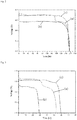
- Table 2 shows the results of evaluation of discharging characteristics of the lithium primary batteries according to Example 1 and Comparative Examples 1 and 2. Also, Fig. 2 is a view representing the results of discharging characteristic tests performed on the batteries prepared according to Example 1 and Comparative Examples 1 and 2 under the conditions including 20°C and a current at an intensity of 1 mA/cm 2 .
- the lithium primary battery according to Example 1 using the composite electrolyte including 70% of SO 2 Cl 2 + 30% of SOCl 2 exhibited graph characteristics of a driving voltage of about 3.8 V, which is one characteristic of a SO 2 Cl 2 battery, until about 70% of a discharging capacity was consumed from the beginning of the discharging process. Then, after performing the discharging process, the battery underwent stage-wise discharging at a voltage of 3.4 V, which is one characteristic of a SO 2 Cl 2 battery, and the process ended.
- the lithium thionyl (Li/SOCl 2 ) battery according to Comparative Example 1 using an electrolyte of 100% SO 2 Cl 2 exhibited a constant voltage of 3.4 V until the discharging process ended as a characteristic of a general discharging process.
- the lithium sulfonyl (Li/SO 2 Cl 2 ) battery according to Comparative Example 2 using an electrolyte of 100% SO 2 Cl 2 exhibited a constant voltage of 3.8 V until the discharging process ended as a characteristic of a general discharging process.
- the lithium primary battery according to Example 1 had a voltage difference per stage during the discharging process due to the use of the composite electrolyte having a composition of 70% of SO 2 Cl 2 + 30% of SOCl 2 , and thus it has been made possible to check a remaining capacity of the battery when the usage of the battery was about 70%.
- the lithium primary battery of Example 1 showed stage-wise voltage characteristics, and thus the battery usage may be checked along with improvement in a low temperature performance, which is a disadvantage of a lithium sulfonyl (Li/SO 2 Cl 2 ) battery, and high efficiency characteristics, which are disadvantages of the lithium thionyl (Li/SOCl 2 ) battery.
- Fig. 3 is a view representing the results of discharging characteristic tests performed on the batteries prepared according to Example 1 and Comparative Examples 1 and 2 under the conditions including 20°C and a current at an intensity of 5 mA/cm 2 .
- the results show discharging characteristic tests performed with a current at an intensity of 5 mA/cm 2 , that is about 5 times higher than the test condition of Fig. 2 .
- the battery of Example 1 exhibited two stage discharging characteristics due to using the composite electrolyte of 70% of SO 2 Cl 2 + 30% of SOCl 2 , and thus the discharging process was confirmed.
- the discharging time of the lithium primary battery according to Example 1 exhibited a capacity at about 190% level, which implied improvement in high efficiency characteristics, which are disadvantages of the lithium thionyl (Li/SOCl 2 ) battery, and when compared with Comparative Example 2 using the electrolyte of 100% of SO 2 Cl 2 , the lithium primary battery according to Example 1 exhibited a capacity at 95% level.
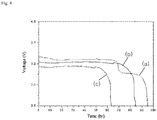
- Fig. 4 is a view representing the results of discharging characteristic tests performed on the batteries prepared according to Example 1 and Comparative Examples 1 and 2 under the conditions including -30°C and a current at an intensity of 1 mA/cm 2 .
- Fig. 4 shows the results of discharging characteristic tests performed at -30°C and by supplying a current at an intensity of 1 mA/cm 2 .
- the lithium primary battery according to Example 1 using the composite electrolyte having a composition of 70% of SO 2 Cl 2 + 30% of SOCl 2 was discharged while exhibiting two stage voltage characteristics as in the case of Fig. 3 .
- the discharging time of the lithium primary battery according to Example 1 exhibited a capacity at about 110% level, and, when compared with the lithium sulfonyl (Li/SO 2 Cl 2 ) battery using the electrolyte of 100% of SO 2 Cl 2 , the discharging time of the lithium primary battery according to Example 1 exhibited a capacity at about 150% level.
- improvement in low temperature characteristics, which are disadvantages of the lithium sulfonyl (Li/SO 2 Cl 2 ) battery was confirmed.
Landscapes
- Chemical & Material Sciences (AREA)
- Chemical Kinetics & Catalysis (AREA)
- Electrochemistry (AREA)
- General Chemical & Material Sciences (AREA)
- Engineering & Computer Science (AREA)
- Manufacturing & Machinery (AREA)
- Inorganic Chemistry (AREA)
- Materials Engineering (AREA)
- Primary Cells (AREA)
Abstract
Description
- The present invention relates to a lithium primary battery, and more particularly, to a lithium primary battery using a composite electrolyte, wherein, in order to maximize advantages of a lithium thionyl battery and a lithium sulfonyl battery, electrolytes of the two batteries are mixed to proceed two-stage discharging, thereby making it possible to check the battery usage.
- A lithium thionyl (Li/SOCl2) battery has characteristics such as a high operation voltage of 3.5 V, a high capacity, and a low self-discharging rate of less than 1% per year, and a freezing point of a thionyl (SOCl2) electrolyte is -105°C, which allows the battery to be used within a broad range of temperature from -55°C to 85°C. Thus, the lithium thionyl battery has been used as a primary battery power source of a device that requires characteristics of long-term use for 10 years or more, but the battery has a disadvantage of rapid battery capacity decrease under the condition of a high current.
- On the contrary, although a driving voltage of the lithium sulfonyl (Li/SO2Cl2) battery is about 3.8 V, which has an advantage of maintaining a discharging capacity under the conditions of a driving voltage and a current higher than those of a lithium thionyl (Li/SOCl2) battery, rapid capacity decrease may occur at a low temperature due to a physical property, where a freezing point of a sulfonyl (SO2Cl2) electrolyte is -54°C, and thus environment for using the battery is limited by a temperature range of -20°C to 85°C.
- Also, since voltages of the lithium thionyl (Li/SOCl2) battery and the lithium sulfonyl (Li/SO2Cl2) battery are very constant during a charging process, a remaining capacity of the batteries during the use may not be checked, and thus the time for battery replacement may not be exactly recognized.
- The related prior documents include Korean Patent No.
2001-0104540 - It is an aspect of the present invention to provide a lithium primary battery using a composite electrolyte, wherein, in order to maximize advantages of a lithium thionyl battery and a lithium sulfonyl battery, electrolytes of the two batteries are mixed to proceed two-stage discharging, thereby making it possible to check the battery usage.
- In accordance with one aspect of the present invention, a lithium primary battery using a composite electrolyte has a bobbin shape and includes a lithium anode including a metal lithium; a cathode including a carbon powder; and the composite electrolyte that is contained in a battery case, wherein the composite electrolyte is prepared by mixing a sulfonyl (SO2Cl2) electrolyte and a thionyl (SOCl2) electrolyte, and a weight ratio of the sulfonyl (SO2Cl2) electrolyte to the thionyl (SOCl2) electrolyte in the composite electrolyte ranges from 6:4 to 9:1, wherein the lithium primary battery is characterized in having two stage discharging voltages, which are a battery voltage maintained at 3.8V±0.2V by the sulfonyl (SO2Cl2) electrolyte during an initial operation and then a battery voltage maintained at 3.5V±0.2V by the thionyl (SOCl2) electrolyte, thereby making it possible to check a remaining capacity of the battery in use.
- According to the present invention, a lithium primary battery using a composite electrolyte uses the composite electrolyte prepared by mixing electrolytes of a lithium sulfonyl (Li/SO2Cl2) battery and a lithium thionyl (Li/SOCl2) battery to proceed stage-wise discharging including maintaining a battery voltage at 3.8 V by the sulfonyl (SO2Cl2) electrolyte during an initial operation, and then maintaining a battery voltage at 3.5 V by the thionyl (SOCl2) electrolyte after consuming the sulfonyl (SO2Cl2) electrolyte, thereby making it possible to check the battery usage.
- Also, the lithium primary battery using a composite electrolyte according to the present invention has two-stage discharging voltages, which makes it possible to check a remaining capacity of the battery in use, and thus the time for battery replacement may be recognized as well as a problem of rapid capacity decrease at a low temperature, which is a disadvantage of a lithium sulfonyl (Li/SO2Cl2) battery, may be supplemented while improving a discharging capacity, which is another disadvantage of a lithium sulfonyl (Li/SO2Cl2) battery.
-
-
Fig. 1 is a cross-sectional view of a lithium primary battery using a composite electrolyte according to an embodiment of the present invention; -
Fig. 2 is a view representing the results of discharging characteristic tests performed on batteries prepared according to Example 1 and Comparative Examples 1 and 2 under the conditions including 20°C and a current at an intensity of 1 mA/cm2; -
Fig. 3 is a view representing the results of discharging characteristic tests performed on the batteries prepared according to Example 1 and Comparative Examples 1 and 2 under the conditions including 20°C and a current at an intensity of 5 mA/cm2; -
Fig. 4 is a view representing the results of discharging characteristic tests performed on the batteries prepared according to Example 1 and Comparative Examples 1 and 2 under the conditions including -30°C and a current at an intensity of 1 mA/cm2. - The advantages and features of the present disclosure and methods for achieving these will be clarified in detail through embodiments described hereinafter in conjunction with the accompanying drawings. However, embodiments of the present invention may, however, be implemented in many different forms and should not be construed as being limited to the embodiments set forth herein. Rather, these embodiments are provided so that this disclosure will be thorough and complete, and will fully convey the scope of the invention to those skilled in the art and are defined by the claim coverage of the present invention. Throughout the specification, the same reference numerals will be used to designate the same or like components.
- Hereinafter, a lithium primary battery using a composite electrolyte according to a preferable embodiment of the present invention will be described in detail with reference to the accompanying drawing.
-
Fig. 1 is a cross-sectional view of a lithiumprimary battery 100 using a composite electrolyte according to an embodiment of the present invention. - Referring to
Fig. 1 , the lithiumprimary battery 100 using a composite electrolyte according to an embodiment of the present invention may be of a battery type having a bobbin structure that includes abattery case 110, acomposite electrolyte 120, alithium anode 130, acathode 140, and aheader pin 160, but it is not limited thereto. - Although not shown in detail in the drawing, the lithium
primary battery 100 using a composite electrolyte according to an embodiment of the present invention may be of a battery type having a spiral structure that is prepared by winding thelithium anode 130 and thecathode 140 in a jelly-roll shape, and thecomposite electrolyte 120 may be used the same in this case. - The
composite electrolyte 120 is contained in thebattery case 110. Here, thecomposite electrolyte 120 is prepared by mixing a sulfonyl (SO2Cl2) electrolyte and a thionyl (SOCl2) electrolyte. A core of the present invention is using thecomposite electrolyte 120, and the detailed description thereof will be provided later in the specification. - The
lithium anode 130 having a bobbin shape is attached on an inner wall of thebattery case 110. Here, the lithiumprimary battery 100 having a bobbin shape is prepared by attaching thelithium anode 130 on the inner wall of thebattery case 110, inserting each of alower insulator 152 and a side-wall insulator 154 into thebattery case 110, additionally inserting thelithium anode 130 and anupper insulator 156, inserting theheader pin 160 to aninsulating plate 190 bound toglass 170 to adhere to thebattery case 110, and then welding the resultant. - Thereafter, the
composite electrolyte 120 is contained in thebattery case 110, and then thebattery case 110 is finally sealed by welding withSUS balls 180, as a finishing material. - Here, the cathode 150 may be formed of a material including carbon and a binder, and polytetrafluoroethylene (PTFE) may be used as the binder, but it is not limited thereto.
- The lithium
primary battery 100 using a composite electrolyte according to an embodiment of the present invention is characterized in using a mixture of the sulfonyl (SO2Cl2) electrolyte and the thionyl (SOCl2) electrolyte as thecomposite electrolyte 120. Here, thecomposite electrolyte 120 may be prepared by adding the thionyl (SOCl2) electrolyte to the sulfonyl (SO2Cl2) electrolyte. On the other hand, thecomposite electrolyte 120 may be prepared by adding the sulfonyl (SO2Cl2) electrolyte to the thionyl (SOCl2) electrolyte. - The
composite electrolyte 120 may preferably use the mixture including mixture of the sulfonyl (SO2Cl2) electrolyte and the thionyl (SOCl2) electrolyte at a weight ratio ranging from 6:4 to 9:1. Here, when a remaining amount of a discharging capacity after using 60%, 70%, 80%, and 90% are to be checked, compositions of thecomposite electrolyte 120 may be prepared as SO2Cl2 60% + SO2Cl2 40%, SO2Cl2 70% + SO2Cl2 30%, SO2Cl2 80% + SO2Cl2 20%, and SO2Cl2 90% + SO2Cl2 10%, respectively. - When a weight ratio of the sulfonyl (SO2Cl2) electrolyte and the thionyl (SOCl2) electrolyte is lower than 6:4, a problem of rapid decrease in a battery capacity may occur under a high current condition due to a relatively increased amount of the thionyl electrolyte. On the contrary, when a weight ratio of the sulfonyl (SO2Cl2) electrolyte and the thionyl (SOCl2) electrolyte is higher than 9:1, an amount of the thionyl electrolyte is insignificant, and thus a remaining amount of the battery may be checked, but low-temperature characteristics may relatively deteriorate.
- Here, a lithium salt used in the
composite electrolyte 120 may be formed of at least one selected from lithium aluminum chloride (LiAlCl4) and lithium gallium chloride (LiGaCl4), and a concentration of the lithium salt may be preferably in a range of 0.1 M to 3.0 M. - In particular, it was confirmed that the lithium
primary battery 100 using a composite electrolyte according to an embodiment of the present invention undergoes a two-stage discharging process that includes maintaining a battery voltage at 3.8±0.2V by the sulfonyl (SO2Cl2) electrolyte during an initial operation and maintaining a battery voltage at 3.5±0.2V by the thionyl (SOCl2) electrolyte. - As described above, according to an embodiment of the present invention, a lithium primary battery using a composite electrolyte uses the composite electrolyte prepared by mixing electrolytes of a lithium sulfonyl (Li/SO2Cl2) battery and a lithium thionyl (Li/SOCl2) battery to proceed stage-wise discharging including maintaining a battery voltage at 3.8 V by the sulfonyl (SO2Cl2) electrolyte during an initial operation, and then maintaining a battery voltage at 3.5 V by the thionyl (SOCl2) electrolyte after consuming the sulfonyl (SO2Cl2) electrolyte, thereby making it possible to check the battery usage.
- Also, the lithium primary battery using a composite electrolyte according to the present invention has two-stage discharging voltages, which makes it possible to check a remaining capacity of the battery in use, and thus the time for battery replacement may be recognized as well as a problem of rapid capacity decrease at a low temperature, which is a disadvantage of a lithium sulfonyl (Li/SO2Cl2) battery, may be supplemented while improving a discharging capacity, which is another disadvantage of a lithium sulfonyl (Li/SO2Cl2) battery.
- Hereinafter, features and functions of the present invention will be described in greater detail with reference to examples of the present invention. However, it is to be understood that the examples are provided herein for illustrative purposes only and should not be construed as limiting the present invention in any fashion.
- Contents that are not described herein are descriptions that may be technically derived by those of ordinary skill in the art, and thus the descriptions are omitted.
- Lithium primary batteries according to Example 1 and Comparative Examples 1 and 2 were prepared under the conditions of electrolyte compositions and lithium salt concentrations shown in Table 1.
[Table 1] Electrolyte Lithium salt concentration Example 1 70% of SO2Cl2 + 30% of SO2Cl2 1 M LiAlCl4 Comparative Example 1 100% of SO2Cl2 1 M LiAlCl4 Comparative Example 2 100% of SO2Cl2 1 M LiAlCl4 - Table 2 shows the results of evaluation of discharging characteristics of the lithium primary batteries according to Example 1 and Comparative Examples 1 and 2. Also,
Fig. 2 is a view representing the results of discharging characteristic tests performed on the batteries prepared according to Example 1 and Comparative Examples 1 and 2 under the conditions including 20°C and a current at an intensity of 1 mA/cm2.[Table 2] Discharging time Voltage characteristics 20°C, 1 mA/ cm 220°C, 5 mA/cm2 -30°C, 1 mA/cm2 Example 1 212 hours 53 hours 95 hours Two stage voltage Comparative Example 1 212 hours 28 hours 85 hours One stage voltage Comparative Example 2 212 hours 57 hours 64 hours One stage voltage - Referring to Tables 1 and 2 and
Fig. 2 , it may be confirmed that the lithium primary battery according to Example 1 using the composite electrolyte including 70% of SO2Cl2 + 30% of SOCl2 exhibited graph characteristics of a driving voltage of about 3.8 V, which is one characteristic of a SO2Cl2 battery, until about 70% of a discharging capacity was consumed from the beginning of the discharging process. Then, after performing the discharging process, the battery underwent stage-wise discharging at a voltage of 3.4 V, which is one characteristic of a SO2Cl2 battery, and the process ended. - On the other hand, it may be confirmed that the lithium thionyl (Li/SOCl2) battery according to Comparative Example 1 using an electrolyte of 100% SO2Cl2 exhibited a constant voltage of 3.4 V until the discharging process ended as a characteristic of a general discharging process.
- Also, it may be confirmed that the lithium sulfonyl (Li/SO2Cl2) battery according to Comparative Example 2 using an electrolyte of 100% SO2Cl2 exhibited a constant voltage of 3.8 V until the discharging process ended as a characteristic of a general discharging process.
- Therefore, the lithium primary battery according to Example 1 had a voltage difference per stage during the discharging process due to the use of the composite electrolyte having a composition of 70% of SO2Cl2 + 30% of SOCl2, and thus it has been made possible to check a remaining capacity of the battery when the usage of the battery was about 70%.
- In particular, as shown in Table 2, when the discharging times of the lithium primary batteries according to Example 1 and Comparative Examples 1 and 2 were compared, the lithium primary battery of Example 1 showed stage-wise voltage characteristics, and thus the battery usage may be checked along with improvement in a low temperature performance, which is a disadvantage of a lithium sulfonyl (Li/SO2Cl2) battery, and high efficiency characteristics, which are disadvantages of the lithium thionyl (Li/SOCl2) battery.
- However,
Fig. 3 is a view representing the results of discharging characteristic tests performed on the batteries prepared according to Example 1 and Comparative Examples 1 and 2 under the conditions including 20°C and a current at an intensity of 5 mA/cm2. Here, in order to compare battery performance at a high current, the results show discharging characteristic tests performed with a current at an intensity of 5 mA/cm2, that is about 5 times higher than the test condition ofFig. 2 . - As shown in
Fig. 3 , the battery of Example 1 exhibited two stage discharging characteristics due to using the composite electrolyte of 70% of SO2Cl2 + 30% of SOCl2, and thus the discharging process was confirmed. - Here, when compared with Comparative Example 1 using the electrolyte of 100% of SOCl2, the discharging time of the lithium primary battery according to Example 1 exhibited a capacity at about 190% level, which implied improvement in high efficiency characteristics, which are disadvantages of the lithium thionyl (Li/SOCl2) battery, and when compared with Comparative Example 2 using the electrolyte of 100% of SO2Cl2, the lithium primary battery according to Example 1 exhibited a capacity at 95% level.
- Also,
Fig. 4 is a view representing the results of discharging characteristic tests performed on the batteries prepared according to Example 1 and Comparative Examples 1 and 2 under the conditions including -30°C and a current at an intensity of 1 mA/cm2. Here, in order to compare battery performances at a low temperature,Fig. 4 shows the results of discharging characteristic tests performed at -30°C and by supplying a current at an intensity of 1 mA/cm2. - As shown in
Fig. 4 , the lithium primary battery according to Example 1 using the composite electrolyte having a composition of 70% of SO2Cl2 + 30% of SOCl2 was discharged while exhibiting two stage voltage characteristics as in the case ofFig. 3 . Also, when compared with the lithium thionyl (Li/SOCl2) battery according to Comparative Example 1 using the electrolyte of 100% of SOCl2, the discharging time of the lithium primary battery according to Example 1 exhibited a capacity at about 110% level, and, when compared with the lithium sulfonyl (Li/SO2Cl2) battery using the electrolyte of 100% of SO2Cl2, the discharging time of the lithium primary battery according to Example 1 exhibited a capacity at about 150% level. Thus, improvement in low temperature characteristics, which are disadvantages of the lithium sulfonyl (Li/SO2Cl2) battery, was confirmed. - Although the invention has been described and illustrated in the foregoing exemplary embodiments, it is understood that the present disclosure has been made only by way of example, and that numerous changes or modifications may be made without departing from the spirit and scope of the present invention. The present invention is thus limited only by the following claims.
Claims (5)
- A lithium primary battery using a composite electrolyte, wherein the lithium primary battery has a bobbin shape and comprises:a lithium anode comprising a metal lithium;a cathode comprising a carbon powder; andthe composite electrolyte that is contained in a battery case,wherein the composite electrolyte is prepared by mixing a sulfonyl (SO2Cl2) electrolyte and a thionyl (SOCl2) electrolyte, and a weight ratio of the sulfonyl (SO2Cl2) electrolyte to the thionyl (SOCl2) electrolyte in the composite electrolyte ranges from 6:4 to 9:1,wherein the lithium primary battery is characterized in having two stage discharging voltages, which are a battery voltage maintained at 3.8V±0.2V by the sulfonyl (SO2Cl2) electrolyte during an initial operation and then a battery voltage maintained at 3.5V±0.2V by the thionyl (SOCl2) electrolyte, to make it possible to check a remaining capacity of the battery in use.
- A lithium primary battery using a composite electrolyte, wherein the lithium primary battery has a spiral shape and comprises:a lithium anode comprising a metal lithium;a cathode comprising a carbon powder; andthe composite electrolyte that is contained in a battery case,wherein the composite electrolyte is prepared by mixing a sulfonyl (SO2Cl2) electrolyte and a thionyl (SOCl2) electrolyte, and a weight ratio of the sulfonyl (SO2Cl2) electrolyte to the thionyl (SOCl2) electrolyte in the composite electrolyte ranges from 6:4 to 9:1,wherein the lithium primary battery is characterized in having two stage discharging voltages, which are a battery voltage maintained at 3.8V±0.2V by the sulfonyl (SO2Cl2) electrolyte during an initial operation and then a battery voltage maintained at 3.5V±0.2V by the thionyl (SOCl2) electrolyte, to make it possible to check a remaining capacity of the battery in use.
- The lithium primary battery of claim 1 or 2, wherein the composite electrolyte is prepared by mixing the sulfonyl (SO2Cl2) electrolyte and the thionyl (SOCl2) electrolyte at a weight ratio ranging from 6:4 to 7:3.
- The lithium primary battery of claim 1 or 2, wherein a lithium salt in the composite electrolyte is at least one lithium salt selected from a lithium aluminum chloride (LiAlCl4) and a lithium gallium chloride (LiGaCl4), wherein a concentration of the lithium salt ranges from 0.1 M to 3.0 M.
- The lithium primary battery of claim 1 or 2, wherein the composite electrolyte is prepared by directly adding the thionyl (SOCl2) electrolyte to the sulfonyl (SO2Cl2) electrolyte or directly adding the sulfonyl (SO2Cl2) electrolyte to the thionyl (SOCl2) electrolyte.
Applications Claiming Priority (2)
| Application Number | Priority Date | Filing Date | Title |
|---|---|---|---|
| KR1020140022333A KR101478217B1 (en) | 2014-02-26 | 2014-02-26 | Lithium first battery using complex electrolyte |
| PCT/KR2015/000438 WO2015130009A1 (en) | 2014-02-26 | 2015-01-15 | Lithium primary battery using composite electrolyte |
Publications (3)
| Publication Number | Publication Date |
|---|---|
| EP3113266A1 true EP3113266A1 (en) | 2017-01-04 |
| EP3113266A4 EP3113266A4 (en) | 2017-03-01 |
| EP3113266B1 EP3113266B1 (en) | 2018-05-02 |
Family
ID=52680370
Family Applications (1)
| Application Number | Title | Priority Date | Filing Date |
|---|---|---|---|
| EP15754849.6A Active EP3113266B1 (en) | 2014-02-26 | 2015-01-15 | Method of checking the remaining capacity of a lithium primary battery |
Country Status (5)
| Country | Link |
|---|---|
| US (1) | US9997789B2 (en) |
| EP (1) | EP3113266B1 (en) |
| KR (1) | KR101478217B1 (en) |
| CN (1) | CN105934841A (en) |
| WO (1) | WO2015130009A1 (en) |
Cited By (1)
| Publication number | Priority date | Publication date | Assignee | Title |
|---|---|---|---|---|
| WO2025005962A1 (en) * | 2023-06-30 | 2025-01-02 | The Board Of Trustees Of The Leland Stanford Junior University | Ultra-low temperature rechargeable li/cl2 batteries with thionyl chloride electrolytes |
Families Citing this family (2)
| Publication number | Priority date | Publication date | Assignee | Title |
|---|---|---|---|---|
| KR101996543B1 (en) * | 2019-01-02 | 2019-07-04 | 주식회사 비츠로셀 | Lithium primary battery with improved output property and method of manufacturing the same |
| US12087931B2 (en) | 2019-12-23 | 2024-09-10 | Cnpc Usa Corporation | Hybrid battery system with multiple discharge voltage plateaus and greater charge capacity of metal in the negative electrode |
Family Cites Families (5)
| Publication number | Priority date | Publication date | Assignee | Title |
|---|---|---|---|---|
| KR100357958B1 (en) | 2000-05-15 | 2002-10-25 | 삼성에스디아이 주식회사 | Lithium primary battery |
| KR100551002B1 (en) | 2003-07-18 | 2006-02-13 | 삼성에스디아이 주식회사 | Conductive material for lithium sulfur battery positive electrode, anode for lithium sulfur battery and lithium sulfur battery comprising the same |
| KR100945203B1 (en) | 2009-03-24 | 2010-03-03 | 한국지질자원연구원 | Spent lithium primary battery treatment method |
| KR101112688B1 (en) * | 2010-03-23 | 2012-02-15 | 주식회사 비츠로셀 | Lithium battery |
| CN102290604A (en) * | 2011-07-30 | 2011-12-21 | 苏州金科发锂电池有限公司 | Li/SOCl2 battery capable of vibration and impact resistance |
-
2014
- 2014-02-26 KR KR1020140022333A patent/KR101478217B1/en active Active
-
2015
- 2015-01-15 EP EP15754849.6A patent/EP3113266B1/en active Active
- 2015-01-15 WO PCT/KR2015/000438 patent/WO2015130009A1/en not_active Ceased
- 2015-01-15 US US15/107,920 patent/US9997789B2/en active Active
- 2015-01-15 CN CN201580005809.6A patent/CN105934841A/en active Pending
Cited By (1)
| Publication number | Priority date | Publication date | Assignee | Title |
|---|---|---|---|---|
| WO2025005962A1 (en) * | 2023-06-30 | 2025-01-02 | The Board Of Trustees Of The Leland Stanford Junior University | Ultra-low temperature rechargeable li/cl2 batteries with thionyl chloride electrolytes |
Also Published As
| Publication number | Publication date |
|---|---|
| EP3113266A4 (en) | 2017-03-01 |
| US9997789B2 (en) | 2018-06-12 |
| EP3113266B1 (en) | 2018-05-02 |
| KR101478217B1 (en) | 2014-12-31 |
| CN105934841A (en) | 2016-09-07 |
| WO2015130009A1 (en) | 2015-09-03 |
| US20160322647A1 (en) | 2016-11-03 |
Similar Documents
| Publication | Publication Date | Title |
|---|---|---|
| KR102452005B1 (en) | A nitrogen doped sulfide-based solid electrolyte for all solid state battery | |
| Deivanayagam et al. | Progress in development of electrolytes for magnesium batteries | |
| KR20170039369A (en) | Electrolyte additives for secondary battery and secondary battery comprising same | |
| US10693131B2 (en) | Composite for cathode of Li-ion battery, its preparation process and the Li-ion battery | |
| KR102761292B1 (en) | Positive electrode active material, methods for manufacture thereof and all solid-state battery using the same | |
| EP3113266A1 (en) | Lithium primary battery using composite electrolyte | |
| Kappler et al. | Understanding the Redox Mechanism of Sulfurized Poly (acrylonitrile) as Highly Rate and Cycle Stable Cathode Material for Sodium-Sulfur Batteries | |
| CN114520372A (en) | Oxidation-resistant electrolyte, lithium ion battery and preparation method | |
| KR101960600B1 (en) | Aqueous secondary battery capable of low-temperature operation using anti-freezing additive | |
| KR102137665B1 (en) | Electrolyte solution for secondary battery and additive therefor | |
| KR101922249B1 (en) | All solid state battery having LTO-containing anode electrode composite | |
| CN106410274B (en) | Manufacturing method and battery assembly of non-aqueous electrolyte secondary battery | |
| Pereira et al. | Elevated temperature performance of high voltage Li1+ yMn1. 5Ni0. 5O4− xFx spinel in window-shifted Li-ion cells | |
| CN106328993A (en) | Electrolyte used for lithium iron phosphate high-magnification lithium ion battery | |
| CN104157903B (en) | High-voltage lithium ion battery carbonate-based electrolyte solution and preparation method and application thereof | |
| KR101743556B1 (en) | Lithium primary battery capable of internal short current detection and self discharge rate prediction | |
| KR101987490B1 (en) | Electrolytes containing sulfone compound for lithium-sulfur cells | |
| US10886567B1 (en) | Liquid electrolyte for a lithium metal battery | |
| CN109314269A (en) | Lithium-ion battery and preparation method thereof | |
| KR101714126B1 (en) | Glyme liquid electrolyte composition for lithium air rechargeable | |
| JP2015022985A (en) | Nonaqueous organic electrolytic solution, and lithium primary battery | |
| KR102431233B1 (en) | Electrolyte composition for lithium metal battery, and lithium secondary battery comprising same | |
| CN107611447A (en) | A kind of lithium ion battery collector and preparation method thereof, lithium ion battery pole piece and lithium ion battery | |
| CN104201416B (en) | A kind of high-voltage lithium-ion battery functional electrolyte and its preparation method and application | |
| CN104157908A (en) | Lithium salt electrolyte, preparation method and application thereof |
Legal Events
| Date | Code | Title | Description |
|---|---|---|---|
| PUAI | Public reference made under article 153(3) epc to a published international application that has entered the european phase |
Free format text: ORIGINAL CODE: 0009012 |
|
| STAA | Information on the status of an ep patent application or granted ep patent |
Free format text: STATUS: REQUEST FOR EXAMINATION WAS MADE |
|
| 17P | Request for examination filed |
Effective date: 20160620 |
|
| AK | Designated contracting states |
Kind code of ref document: A1 Designated state(s): AL AT BE BG CH CY CZ DE DK EE ES FI FR GB GR HR HU IE IS IT LI LT LU LV MC MK MT NL NO PL PT RO RS SE SI SK SM TR |
|
| AX | Request for extension of the european patent |
Extension state: BA ME |
|
| A4 | Supplementary search report drawn up and despatched |
Effective date: 20170201 |
|
| RIC1 | Information provided on ipc code assigned before grant |
Ipc: H01M 6/14 20060101ALI20170126BHEP Ipc: H01M 4/587 20100101ALI20170126BHEP Ipc: H01M 4/36 20060101ALI20170126BHEP Ipc: H01M 4/38 20060101ALI20170126BHEP Ipc: H01M 6/22 20060101ALI20170126BHEP Ipc: H01M 6/24 20060101AFI20170126BHEP |
|
| DAX | Request for extension of the european patent (deleted) | ||
| GRAP | Despatch of communication of intention to grant a patent |
Free format text: ORIGINAL CODE: EPIDOSNIGR1 |
|
| STAA | Information on the status of an ep patent application or granted ep patent |
Free format text: STATUS: GRANT OF PATENT IS INTENDED |
|
| RIC1 | Information provided on ipc code assigned before grant |
Ipc: H01M 6/14 20060101ALI20171219BHEP Ipc: H01M 4/36 20060101ALI20171219BHEP Ipc: H01M 4/38 20060101ALI20171219BHEP Ipc: H01M 4/587 20100101ALI20171219BHEP Ipc: H01M 6/50 20060101ALI20171219BHEP Ipc: H01M 6/24 20060101AFI20171219BHEP |
|
| INTG | Intention to grant announced |
Effective date: 20180118 |
|
| GRAS | Grant fee paid |
Free format text: ORIGINAL CODE: EPIDOSNIGR3 |
|
| GRAA | (expected) grant |
Free format text: ORIGINAL CODE: 0009210 |
|
| STAA | Information on the status of an ep patent application or granted ep patent |
Free format text: STATUS: THE PATENT HAS BEEN GRANTED |
|
| AK | Designated contracting states |
Kind code of ref document: B1 Designated state(s): AL AT BE BG CH CY CZ DE DK EE ES FI FR GB GR HR HU IE IS IT LI LT LU LV MC MK MT NL NO PL PT RO RS SE SI SK SM TR |
|
| REG | Reference to a national code |
Ref country code: GB Ref legal event code: FG4D |
|
| REG | Reference to a national code |
Ref country code: CH Ref legal event code: EP Ref country code: AT Ref legal event code: REF Ref document number: 996199 Country of ref document: AT Kind code of ref document: T Effective date: 20180515 |
|
| REG | Reference to a national code |
Ref country code: DE Ref legal event code: R096 Ref document number: 602015010803 Country of ref document: DE Ref country code: IE Ref legal event code: FG4D |
|
| REG | Reference to a national code |
Ref country code: DE Ref legal event code: R096 Ref document number: 602015010803 Country of ref document: DE |
|
| REG | Reference to a national code |
Ref country code: NL Ref legal event code: FP |
|
| REG | Reference to a national code |
Ref country code: LT Ref legal event code: MG4D |
|
| PG25 | Lapsed in a contracting state [announced via postgrant information from national office to epo] |
Ref country code: ES Free format text: LAPSE BECAUSE OF FAILURE TO SUBMIT A TRANSLATION OF THE DESCRIPTION OR TO PAY THE FEE WITHIN THE PRESCRIBED TIME-LIMIT Effective date: 20180502 Ref country code: SE Free format text: LAPSE BECAUSE OF FAILURE TO SUBMIT A TRANSLATION OF THE DESCRIPTION OR TO PAY THE FEE WITHIN THE PRESCRIBED TIME-LIMIT Effective date: 20180502 Ref country code: LT Free format text: LAPSE BECAUSE OF FAILURE TO SUBMIT A TRANSLATION OF THE DESCRIPTION OR TO PAY THE FEE WITHIN THE PRESCRIBED TIME-LIMIT Effective date: 20180502 Ref country code: FI Free format text: LAPSE BECAUSE OF FAILURE TO SUBMIT A TRANSLATION OF THE DESCRIPTION OR TO PAY THE FEE WITHIN THE PRESCRIBED TIME-LIMIT Effective date: 20180502 Ref country code: NO Free format text: LAPSE BECAUSE OF FAILURE TO SUBMIT A TRANSLATION OF THE DESCRIPTION OR TO PAY THE FEE WITHIN THE PRESCRIBED TIME-LIMIT Effective date: 20180802 Ref country code: BG Free format text: LAPSE BECAUSE OF FAILURE TO SUBMIT A TRANSLATION OF THE DESCRIPTION OR TO PAY THE FEE WITHIN THE PRESCRIBED TIME-LIMIT Effective date: 20180802 |
|
| PG25 | Lapsed in a contracting state [announced via postgrant information from national office to epo] |
Ref country code: GR Free format text: LAPSE BECAUSE OF FAILURE TO SUBMIT A TRANSLATION OF THE DESCRIPTION OR TO PAY THE FEE WITHIN THE PRESCRIBED TIME-LIMIT Effective date: 20180803 Ref country code: RS Free format text: LAPSE BECAUSE OF FAILURE TO SUBMIT A TRANSLATION OF THE DESCRIPTION OR TO PAY THE FEE WITHIN THE PRESCRIBED TIME-LIMIT Effective date: 20180502 Ref country code: LV Free format text: LAPSE BECAUSE OF FAILURE TO SUBMIT A TRANSLATION OF THE DESCRIPTION OR TO PAY THE FEE WITHIN THE PRESCRIBED TIME-LIMIT Effective date: 20180502 Ref country code: HR Free format text: LAPSE BECAUSE OF FAILURE TO SUBMIT A TRANSLATION OF THE DESCRIPTION OR TO PAY THE FEE WITHIN THE PRESCRIBED TIME-LIMIT Effective date: 20180502 |
|
| REG | Reference to a national code |
Ref country code: AT Ref legal event code: MK05 Ref document number: 996199 Country of ref document: AT Kind code of ref document: T Effective date: 20180502 |
|
| PG25 | Lapsed in a contracting state [announced via postgrant information from national office to epo] |
Ref country code: SK Free format text: LAPSE BECAUSE OF FAILURE TO SUBMIT A TRANSLATION OF THE DESCRIPTION OR TO PAY THE FEE WITHIN THE PRESCRIBED TIME-LIMIT Effective date: 20180502 Ref country code: DK Free format text: LAPSE BECAUSE OF FAILURE TO SUBMIT A TRANSLATION OF THE DESCRIPTION OR TO PAY THE FEE WITHIN THE PRESCRIBED TIME-LIMIT Effective date: 20180502 Ref country code: EE Free format text: LAPSE BECAUSE OF FAILURE TO SUBMIT A TRANSLATION OF THE DESCRIPTION OR TO PAY THE FEE WITHIN THE PRESCRIBED TIME-LIMIT Effective date: 20180502 Ref country code: AT Free format text: LAPSE BECAUSE OF FAILURE TO SUBMIT A TRANSLATION OF THE DESCRIPTION OR TO PAY THE FEE WITHIN THE PRESCRIBED TIME-LIMIT Effective date: 20180502 Ref country code: PL Free format text: LAPSE BECAUSE OF FAILURE TO SUBMIT A TRANSLATION OF THE DESCRIPTION OR TO PAY THE FEE WITHIN THE PRESCRIBED TIME-LIMIT Effective date: 20180502 Ref country code: RO Free format text: LAPSE BECAUSE OF FAILURE TO SUBMIT A TRANSLATION OF THE DESCRIPTION OR TO PAY THE FEE WITHIN THE PRESCRIBED TIME-LIMIT Effective date: 20180502 Ref country code: CZ Free format text: LAPSE BECAUSE OF FAILURE TO SUBMIT A TRANSLATION OF THE DESCRIPTION OR TO PAY THE FEE WITHIN THE PRESCRIBED TIME-LIMIT Effective date: 20180502 |
|
| REG | Reference to a national code |
Ref country code: DE Ref legal event code: R097 Ref document number: 602015010803 Country of ref document: DE |
|
| PG25 | Lapsed in a contracting state [announced via postgrant information from national office to epo] |
Ref country code: SM Free format text: LAPSE BECAUSE OF FAILURE TO SUBMIT A TRANSLATION OF THE DESCRIPTION OR TO PAY THE FEE WITHIN THE PRESCRIBED TIME-LIMIT Effective date: 20180502 |
|
| PLBE | No opposition filed within time limit |
Free format text: ORIGINAL CODE: 0009261 |
|
| STAA | Information on the status of an ep patent application or granted ep patent |
Free format text: STATUS: NO OPPOSITION FILED WITHIN TIME LIMIT |
|
| 26N | No opposition filed |
Effective date: 20190205 |
|
| PG25 | Lapsed in a contracting state [announced via postgrant information from national office to epo] |
Ref country code: SI Free format text: LAPSE BECAUSE OF FAILURE TO SUBMIT A TRANSLATION OF THE DESCRIPTION OR TO PAY THE FEE WITHIN THE PRESCRIBED TIME-LIMIT Effective date: 20180502 |
|
| PG25 | Lapsed in a contracting state [announced via postgrant information from national office to epo] |
Ref country code: MC Free format text: LAPSE BECAUSE OF FAILURE TO SUBMIT A TRANSLATION OF THE DESCRIPTION OR TO PAY THE FEE WITHIN THE PRESCRIBED TIME-LIMIT Effective date: 20180502 |
|
| REG | Reference to a national code |
Ref country code: CH Ref legal event code: PL |
|
| PG25 | Lapsed in a contracting state [announced via postgrant information from national office to epo] |
Ref country code: LU Free format text: LAPSE BECAUSE OF NON-PAYMENT OF DUE FEES Effective date: 20190115 |
|
| REG | Reference to a national code |
Ref country code: BE Ref legal event code: MM Effective date: 20190131 |
|
| REG | Reference to a national code |
Ref country code: IE Ref legal event code: MM4A |
|
| PG25 | Lapsed in a contracting state [announced via postgrant information from national office to epo] |
Ref country code: AL Free format text: LAPSE BECAUSE OF FAILURE TO SUBMIT A TRANSLATION OF THE DESCRIPTION OR TO PAY THE FEE WITHIN THE PRESCRIBED TIME-LIMIT Effective date: 20180502 Ref country code: BE Free format text: LAPSE BECAUSE OF NON-PAYMENT OF DUE FEES Effective date: 20190131 |
|
| PG25 | Lapsed in a contracting state [announced via postgrant information from national office to epo] |
Ref country code: CH Free format text: LAPSE BECAUSE OF NON-PAYMENT OF DUE FEES Effective date: 20190131 Ref country code: LI Free format text: LAPSE BECAUSE OF NON-PAYMENT OF DUE FEES Effective date: 20190131 |
|
| REG | Reference to a national code |
Ref country code: DE Ref legal event code: R082 Ref document number: 602015010803 Country of ref document: DE Representative=s name: STRAUS, ALEXANDER, DIPL.-CHEM.UNIV. DR.PHIL., DE Ref country code: DE Ref legal event code: R082 Ref document number: 602015010803 Country of ref document: DE Representative=s name: 2K PATENT- UND RECHTSANWAELTE PARTNERSCHAFT MB, DE |
|
| PG25 | Lapsed in a contracting state [announced via postgrant information from national office to epo] |
Ref country code: IE Free format text: LAPSE BECAUSE OF NON-PAYMENT OF DUE FEES Effective date: 20190115 |
|
| PG25 | Lapsed in a contracting state [announced via postgrant information from national office to epo] |
Ref country code: TR Free format text: LAPSE BECAUSE OF FAILURE TO SUBMIT A TRANSLATION OF THE DESCRIPTION OR TO PAY THE FEE WITHIN THE PRESCRIBED TIME-LIMIT Effective date: 20180502 |
|
| PG25 | Lapsed in a contracting state [announced via postgrant information from national office to epo] |
Ref country code: PT Free format text: LAPSE BECAUSE OF FAILURE TO SUBMIT A TRANSLATION OF THE DESCRIPTION OR TO PAY THE FEE WITHIN THE PRESCRIBED TIME-LIMIT Effective date: 20180903 Ref country code: MT Free format text: LAPSE BECAUSE OF NON-PAYMENT OF DUE FEES Effective date: 20190115 |
|
| PG25 | Lapsed in a contracting state [announced via postgrant information from national office to epo] |
Ref country code: CY Free format text: LAPSE BECAUSE OF FAILURE TO SUBMIT A TRANSLATION OF THE DESCRIPTION OR TO PAY THE FEE WITHIN THE PRESCRIBED TIME-LIMIT Effective date: 20180502 |
|
| PG25 | Lapsed in a contracting state [announced via postgrant information from national office to epo] |
Ref country code: IS Free format text: LAPSE BECAUSE OF FAILURE TO SUBMIT A TRANSLATION OF THE DESCRIPTION OR TO PAY THE FEE WITHIN THE PRESCRIBED TIME-LIMIT Effective date: 20180902 |
|
| PG25 | Lapsed in a contracting state [announced via postgrant information from national office to epo] |
Ref country code: HU Free format text: LAPSE BECAUSE OF FAILURE TO SUBMIT A TRANSLATION OF THE DESCRIPTION OR TO PAY THE FEE WITHIN THE PRESCRIBED TIME-LIMIT; INVALID AB INITIO Effective date: 20150115 |
|
| PG25 | Lapsed in a contracting state [announced via postgrant information from national office to epo] |
Ref country code: MK Free format text: LAPSE BECAUSE OF FAILURE TO SUBMIT A TRANSLATION OF THE DESCRIPTION OR TO PAY THE FEE WITHIN THE PRESCRIBED TIME-LIMIT Effective date: 20180502 |
|
| REG | Reference to a national code |
Ref country code: DE Ref legal event code: R082 Ref document number: 602015010803 Country of ref document: DE Representative=s name: STRAUS, ALEXANDER, DIPL.-CHEM.UNIV. DR.PHIL., DE |
|
| PGFP | Annual fee paid to national office [announced via postgrant information from national office to epo] |
Ref country code: NL Payment date: 20251124 Year of fee payment: 12 |
|
| PGFP | Annual fee paid to national office [announced via postgrant information from national office to epo] |
Ref country code: GB Payment date: 20251203 Year of fee payment: 12 |
|
| PGFP | Annual fee paid to national office [announced via postgrant information from national office to epo] |
Ref country code: FR Payment date: 20251201 Year of fee payment: 12 |
|
| PGFP | Annual fee paid to national office [announced via postgrant information from national office to epo] |
Ref country code: DE Payment date: 20251208 Year of fee payment: 12 |
|
| PGFP | Annual fee paid to national office [announced via postgrant information from national office to epo] |
Ref country code: IT Payment date: 20251209 Year of fee payment: 12 |