EP3112356A1 - Method for manufacturing 1,1-disubstituted hydrazine compound - Google Patents
Method for manufacturing 1,1-disubstituted hydrazine compound Download PDFInfo
- Publication number
- EP3112356A1 EP3112356A1 EP15755563.2A EP15755563A EP3112356A1 EP 3112356 A1 EP3112356 A1 EP 3112356A1 EP 15755563 A EP15755563 A EP 15755563A EP 3112356 A1 EP3112356 A1 EP 3112356A1
- Authority
- EP
- European Patent Office
- Prior art keywords
- group
- compound
- carbon atoms
- atom
- formula
- Prior art date
- Legal status (The legal status is an assumption and is not a legal conclusion. Google has not performed a legal analysis and makes no representation as to the accuracy of the status listed.)
- Withdrawn
Links
- -1 1,1-disubstituted hydrazine compound Chemical class 0.000 title claims abstract description 48
- 238000000034 method Methods 0.000 title claims abstract description 34
- 238000004519 manufacturing process Methods 0.000 title claims abstract description 12
- 150000001875 compounds Chemical class 0.000 claims abstract description 66
- 125000004432 carbon atom Chemical group C* 0.000 claims abstract description 54
- 239000002585 base Substances 0.000 claims abstract description 27
- 229910052757 nitrogen Inorganic materials 0.000 claims abstract description 25
- 125000000217 alkyl group Chemical group 0.000 claims abstract description 22
- 239000002798 polar solvent Substances 0.000 claims abstract description 22
- 150000008044 alkali metal hydroxides Chemical class 0.000 claims abstract description 18
- 229910001860 alkaline earth metal hydroxide Inorganic materials 0.000 claims abstract description 15
- 125000004435 hydrogen atom Chemical group [H]* 0.000 claims abstract description 14
- 229910052717 sulfur Inorganic materials 0.000 claims abstract description 9
- 125000004434 sulfur atom Chemical group 0.000 claims abstract description 9
- 125000003545 alkoxy group Chemical group 0.000 claims abstract description 8
- 229910052801 chlorine Inorganic materials 0.000 claims abstract description 8
- 125000001309 chloro group Chemical group Cl* 0.000 claims abstract description 8
- WKBOTKDWSSQWDR-UHFFFAOYSA-N Bromine atom Chemical group [Br] WKBOTKDWSSQWDR-UHFFFAOYSA-N 0.000 claims abstract description 7
- 125000000962 organic group Chemical group 0.000 claims abstract description 7
- 125000004093 cyano group Chemical group *C#N 0.000 claims abstract description 6
- 125000005843 halogen group Chemical group 0.000 claims abstract description 6
- 125000000449 nitro group Chemical group [O-][N+](*)=O 0.000 claims abstract description 6
- 125000004433 nitrogen atom Chemical group N* 0.000 claims abstract description 6
- 125000004430 oxygen atom Chemical group O* 0.000 claims abstract description 6
- ZCYVEMRRCGMTRW-UHFFFAOYSA-N 7553-56-2 Chemical group [I] ZCYVEMRRCGMTRW-UHFFFAOYSA-N 0.000 claims abstract description 4
- 125000003709 fluoroalkyl group Chemical group 0.000 claims abstract description 4
- 229910052740 iodine Inorganic materials 0.000 claims abstract description 4
- 238000006243 chemical reaction Methods 0.000 claims description 97
- KWYUFKZDYYNOTN-UHFFFAOYSA-M Potassium hydroxide Chemical compound [OH-].[K+] KWYUFKZDYYNOTN-UHFFFAOYSA-M 0.000 claims description 60
- ZMXDDKWLCZADIW-UHFFFAOYSA-N N,N-Dimethylformamide Chemical compound CN(C)C=O ZMXDDKWLCZADIW-UHFFFAOYSA-N 0.000 claims description 48
- HEMHJVSKTPXQMS-UHFFFAOYSA-M Sodium hydroxide Chemical group [OH-].[Na+] HEMHJVSKTPXQMS-UHFFFAOYSA-M 0.000 claims description 42
- 239000011541 reaction mixture Substances 0.000 claims description 35
- XLYOFNOQVPJJNP-UHFFFAOYSA-N water Substances O XLYOFNOQVPJJNP-UHFFFAOYSA-N 0.000 claims description 33
- WEVYAHXRMPXWCK-UHFFFAOYSA-N Acetonitrile Chemical compound CC#N WEVYAHXRMPXWCK-UHFFFAOYSA-N 0.000 claims description 18
- IAZDPXIOMUYVGZ-UHFFFAOYSA-N Dimethylsulphoxide Chemical compound CS(C)=O IAZDPXIOMUYVGZ-UHFFFAOYSA-N 0.000 claims description 14
- 239000003586 protic polar solvent Substances 0.000 claims description 9
- 125000003277 amino group Chemical group 0.000 claims description 8
- SECXISVLQFMRJM-UHFFFAOYSA-N N-Methylpyrrolidone Chemical compound CN1CCCC1=O SECXISVLQFMRJM-UHFFFAOYSA-N 0.000 claims description 7
- 230000000694 effects Effects 0.000 claims description 7
- CYSGHNMQYZDMIA-UHFFFAOYSA-N 1,3-Dimethyl-2-imidazolidinon Chemical compound CN1CCN(C)C1=O CYSGHNMQYZDMIA-UHFFFAOYSA-N 0.000 claims description 6
- 238000002425 crystallisation Methods 0.000 claims description 5
- 230000008025 crystallization Effects 0.000 claims description 5
- FXHOOIRPVKKKFG-UHFFFAOYSA-N N,N-Dimethylacetamide Chemical compound CN(C)C(C)=O FXHOOIRPVKKKFG-UHFFFAOYSA-N 0.000 claims description 4
- 125000004414 alkyl thio group Chemical group 0.000 claims description 3
- XEKOWRVHYACXOJ-UHFFFAOYSA-N Ethyl acetate Chemical compound CCOC(C)=O XEKOWRVHYACXOJ-UHFFFAOYSA-N 0.000 description 84
- 239000007787 solid Substances 0.000 description 47
- 230000000052 comparative effect Effects 0.000 description 42
- IJGRMHOSHXDMSA-UHFFFAOYSA-N Atomic nitrogen Chemical compound N#N IJGRMHOSHXDMSA-UHFFFAOYSA-N 0.000 description 38
- 239000000243 solution Substances 0.000 description 31
- JYSUYJCLUODSLN-UHFFFAOYSA-N 1,3-benzothiazol-2-ylhydrazine Chemical class C1=CC=C2SC(NN)=NC2=C1 JYSUYJCLUODSLN-UHFFFAOYSA-N 0.000 description 29
- 239000000203 mixture Substances 0.000 description 29
- IMNFDUFMRHMDMM-UHFFFAOYSA-N N-Heptane Chemical compound CCCCCCC IMNFDUFMRHMDMM-UHFFFAOYSA-N 0.000 description 28
- 239000000047 product Substances 0.000 description 23
- 239000002904 solvent Substances 0.000 description 21
- 238000005160 1H NMR spectroscopy Methods 0.000 description 20
- HEDRZPFGACZZDS-MICDWDOJSA-N Trichloro(2H)methane Chemical compound [2H]C(Cl)(Cl)Cl HEDRZPFGACZZDS-MICDWDOJSA-N 0.000 description 20
- 230000015572 biosynthetic process Effects 0.000 description 17
- FJDQFPXHSGXQBY-UHFFFAOYSA-L caesium carbonate Chemical compound [Cs+].[Cs+].[O-]C([O-])=O FJDQFPXHSGXQBY-UHFFFAOYSA-L 0.000 description 17
- 238000003786 synthesis reaction Methods 0.000 description 17
- 229940125904 compound 1 Drugs 0.000 description 14
- VLKZOEOYAKHREP-UHFFFAOYSA-N n-Hexane Chemical compound CCCCCC VLKZOEOYAKHREP-UHFFFAOYSA-N 0.000 description 14
- BWHMMNNQKKPAPP-UHFFFAOYSA-L potassium carbonate Chemical compound [K+].[K+].[O-]C([O-])=O BWHMMNNQKKPAPP-UHFFFAOYSA-L 0.000 description 14
- 239000012456 homogeneous solution Substances 0.000 description 13
- PMZURENOXWZQFD-UHFFFAOYSA-L Sodium Sulfate Chemical compound [Na+].[Na+].[O-]S([O-])(=O)=O PMZURENOXWZQFD-UHFFFAOYSA-L 0.000 description 12
- 229910000024 caesium carbonate Inorganic materials 0.000 description 12
- YXFVVABEGXRONW-UHFFFAOYSA-N Toluene Chemical compound CC1=CC=CC=C1 YXFVVABEGXRONW-UHFFFAOYSA-N 0.000 description 9
- 238000000605 extraction Methods 0.000 description 8
- 238000010898 silica gel chromatography Methods 0.000 description 8
- 229910052938 sodium sulfate Inorganic materials 0.000 description 8
- 235000011152 sodium sulphate Nutrition 0.000 description 8
- 125000004051 hexyl group Chemical group [H]C([H])([H])C([H])([H])C([H])([H])C([H])([H])C([H])([H])C([H])([H])* 0.000 description 7
- 229910000027 potassium carbonate Inorganic materials 0.000 description 7
- KFZMGEQAYNKOFK-UHFFFAOYSA-N Isopropanol Chemical compound CC(C)O KFZMGEQAYNKOFK-UHFFFAOYSA-N 0.000 description 6
- 239000002994 raw material Substances 0.000 description 6
- 125000002914 sec-butyl group Chemical group [H]C([H])([H])C([H])([H])C([H])(*)C([H])([H])[H] 0.000 description 6
- 125000001424 substituent group Chemical group 0.000 description 6
- 125000003118 aryl group Chemical group 0.000 description 4
- 239000003153 chemical reaction reagent Substances 0.000 description 4
- 239000012141 concentrate Substances 0.000 description 4
- 125000001495 ethyl group Chemical group [H]C([H])([H])C([H])([H])* 0.000 description 4
- 239000000706 filtrate Substances 0.000 description 4
- 239000010410 layer Substances 0.000 description 4
- 125000002496 methyl group Chemical group [H]C([H])([H])* 0.000 description 4
- 239000012044 organic layer Substances 0.000 description 4
- 238000000746 purification Methods 0.000 description 4
- ZWEHNKRNPOVVGH-UHFFFAOYSA-N 2-Butanone Chemical compound CCC(C)=O ZWEHNKRNPOVVGH-UHFFFAOYSA-N 0.000 description 3
- CSCPPACGZOOCGX-UHFFFAOYSA-N Acetone Chemical compound CC(C)=O CSCPPACGZOOCGX-UHFFFAOYSA-N 0.000 description 3
- WVDDGKGOMKODPV-UHFFFAOYSA-N Benzyl alcohol Chemical compound OCC1=CC=CC=C1 WVDDGKGOMKODPV-UHFFFAOYSA-N 0.000 description 3
- LFQSCWFLJHTTHZ-UHFFFAOYSA-N Ethanol Chemical compound CCO LFQSCWFLJHTTHZ-UHFFFAOYSA-N 0.000 description 3
- LYCAIKOWRPUZTN-UHFFFAOYSA-N Ethylene glycol Chemical compound OCCO LYCAIKOWRPUZTN-UHFFFAOYSA-N 0.000 description 3
- PEDCQBHIVMGVHV-UHFFFAOYSA-N Glycerine Chemical compound OCC(O)CO PEDCQBHIVMGVHV-UHFFFAOYSA-N 0.000 description 3
- WMFOQBRAJBCJND-UHFFFAOYSA-M Lithium hydroxide Chemical compound [Li+].[OH-] WMFOQBRAJBCJND-UHFFFAOYSA-M 0.000 description 3
- DNIAPMSPPWPWGF-UHFFFAOYSA-N Propylene glycol Chemical compound CC(O)CO DNIAPMSPPWPWGF-UHFFFAOYSA-N 0.000 description 3
- JFDZBHWFFUWGJE-UHFFFAOYSA-N benzonitrile Chemical compound N#CC1=CC=CC=C1 JFDZBHWFFUWGJE-UHFFFAOYSA-N 0.000 description 3
- 239000006227 byproduct Substances 0.000 description 3
- 125000002147 dimethylamino group Chemical group [H]C([H])([H])N(*)C([H])([H])[H] 0.000 description 3
- 125000001301 ethoxy group Chemical group [H]C([H])([H])C([H])([H])O* 0.000 description 3
- 229910052731 fluorine Inorganic materials 0.000 description 3
- 125000001153 fluoro group Chemical group F* 0.000 description 3
- 150000002430 hydrocarbons Chemical group 0.000 description 3
- 125000000956 methoxy group Chemical group [H]C([H])([H])O* 0.000 description 3
- 125000000250 methylamino group Chemical group [H]N(*)C([H])([H])[H] 0.000 description 3
- 125000001997 phenyl group Chemical group [H]C1=C([H])C([H])=C(*)C([H])=C1[H] 0.000 description 3
- 238000003756 stirring Methods 0.000 description 3
- 0 *c1c(*)c(*)nc2c1*C(NN)=N2 Chemical compound *c1c(*)c(*)nc2c1*C(NN)=N2 0.000 description 2
- OJMVRGXLTANFRG-UHFFFAOYSA-N 1-(2-chloroethoxy)butane Chemical compound CCCCOCCCl OJMVRGXLTANFRG-UHFFFAOYSA-N 0.000 description 2
- MNDIARAMWBIKFW-UHFFFAOYSA-N 1-bromohexane Chemical compound CCCCCCBr MNDIARAMWBIKFW-UHFFFAOYSA-N 0.000 description 2
- 125000001637 1-naphthyl group Chemical group [H]C1=C([H])C([H])=C2C(*)=C([H])C([H])=C([H])C2=C1[H] 0.000 description 2
- QQZOPKMRPOGIEB-UHFFFAOYSA-N 2-Oxohexane Chemical compound CCCCC(C)=O QQZOPKMRPOGIEB-UHFFFAOYSA-N 0.000 description 2
- 125000001622 2-naphthyl group Chemical group [H]C1=C([H])C([H])=C2C([H])=C(*)C([H])=C([H])C2=C1[H] 0.000 description 2
- MLHXKYLLJRLHGH-UHFFFAOYSA-N 3-bromoheptane Chemical compound CCCCC(Br)CC MLHXKYLLJRLHGH-UHFFFAOYSA-N 0.000 description 2
- WDBQJSCPCGTAFG-QHCPKHFHSA-N 4,4-difluoro-N-[(1S)-3-[4-(3-methyl-5-propan-2-yl-1,2,4-triazol-4-yl)piperidin-1-yl]-1-pyridin-3-ylpropyl]cyclohexane-1-carboxamide Chemical compound FC1(CCC(CC1)C(=O)N[C@@H](CCN1CCC(CC1)N1C(=NN=C1C)C(C)C)C=1C=NC=CC=1)F WDBQJSCPCGTAFG-QHCPKHFHSA-N 0.000 description 2
- BWGRDBSNKQABCB-UHFFFAOYSA-N 4,4-difluoro-N-[3-[3-(3-methyl-5-propan-2-yl-1,2,4-triazol-4-yl)-8-azabicyclo[3.2.1]octan-8-yl]-1-thiophen-2-ylpropyl]cyclohexane-1-carboxamide Chemical compound CC(C)C1=NN=C(C)N1C1CC2CCC(C1)N2CCC(NC(=O)C1CCC(F)(F)CC1)C1=CC=CS1 BWGRDBSNKQABCB-UHFFFAOYSA-N 0.000 description 2
- NWWWGAKVHCSAEU-UHFFFAOYSA-N 5-bromopentanenitrile Chemical compound BrCCCCC#N NWWWGAKVHCSAEU-UHFFFAOYSA-N 0.000 description 2
- JLTDJTHDQAWBAV-UHFFFAOYSA-N N,N-dimethylaniline Chemical compound CN(C)C1=CC=CC=C1 JLTDJTHDQAWBAV-UHFFFAOYSA-N 0.000 description 2
- LRHPLDYGYMQRHN-UHFFFAOYSA-N N-Butanol Chemical compound CCCCO LRHPLDYGYMQRHN-UHFFFAOYSA-N 0.000 description 2
- LFZAGIJXANFPFN-UHFFFAOYSA-N N-[3-[4-(3-methyl-5-propan-2-yl-1,2,4-triazol-4-yl)piperidin-1-yl]-1-thiophen-2-ylpropyl]acetamide Chemical compound C(C)(C)C1=NN=C(N1C1CCN(CC1)CCC(C=1SC=CC=1)NC(C)=O)C LFZAGIJXANFPFN-UHFFFAOYSA-N 0.000 description 2
- 125000000738 acetamido group Chemical group [H]C([H])([H])C(=O)N([H])[*] 0.000 description 2
- 125000003342 alkenyl group Chemical group 0.000 description 2
- 125000000304 alkynyl group Chemical group 0.000 description 2
- 150000001408 amides Chemical class 0.000 description 2
- UUWSLBWDFJMSFP-UHFFFAOYSA-N bromomethylcyclohexane Chemical compound BrCC1CCCCC1 UUWSLBWDFJMSFP-UHFFFAOYSA-N 0.000 description 2
- 125000000480 butynyl group Chemical group [*]C#CC([H])([H])C([H])([H])[H] 0.000 description 2
- 239000000460 chlorine Substances 0.000 description 2
- 229940125782 compound 2 Drugs 0.000 description 2
- 229940126214 compound 3 Drugs 0.000 description 2
- 229940125898 compound 5 Drugs 0.000 description 2
- 125000000753 cycloalkyl group Chemical group 0.000 description 2
- 125000001511 cyclopentyl group Chemical group [H]C1([H])C([H])([H])C([H])([H])C([H])(*)C1([H])[H] 0.000 description 2
- 125000001559 cyclopropyl group Chemical group [H]C1([H])C([H])([H])C1([H])* 0.000 description 2
- KZTYYGOKRVBIMI-UHFFFAOYSA-N diphenyl sulfone Chemical compound C=1C=CC=CC=1S(=O)(=O)C1=CC=CC=C1 KZTYYGOKRVBIMI-UHFFFAOYSA-N 0.000 description 2
- 125000003438 dodecyl group Chemical group [H]C([H])([H])C([H])([H])C([H])([H])C([H])([H])C([H])([H])C([H])([H])C([H])([H])C([H])([H])C([H])([H])C([H])([H])C([H])([H])C([H])([H])* 0.000 description 2
- FKRCODPIKNYEAC-UHFFFAOYSA-N ethyl propionate Chemical compound CCOC(=O)CC FKRCODPIKNYEAC-UHFFFAOYSA-N 0.000 description 2
- 125000000031 ethylamino group Chemical group [H]C([H])([H])C([H])([H])N([H])[*] 0.000 description 2
- 125000003187 heptyl group Chemical group [H]C([*])([H])C([H])([H])C([H])([H])C([H])([H])C([H])([H])C([H])([H])C([H])([H])[H] 0.000 description 2
- FFUAGWLWBBFQJT-UHFFFAOYSA-N hexamethyldisilazane Chemical compound C[Si](C)(C)N[Si](C)(C)C FFUAGWLWBBFQJT-UHFFFAOYSA-N 0.000 description 2
- ZSIAUFGUXNUGDI-UHFFFAOYSA-N hexan-1-ol Chemical compound CCCCCCO ZSIAUFGUXNUGDI-UHFFFAOYSA-N 0.000 description 2
- 125000002887 hydroxy group Chemical group [H]O* 0.000 description 2
- 125000001449 isopropyl group Chemical group [H]C([H])([H])C([H])(*)C([H])([H])[H] 0.000 description 2
- SKTCDJAMAYNROS-UHFFFAOYSA-N methoxycyclopentane Chemical compound COC1CCCC1 SKTCDJAMAYNROS-UHFFFAOYSA-N 0.000 description 2
- 125000004108 n-butyl group Chemical group [H]C([H])([H])C([H])([H])C([H])([H])C([H])([H])* 0.000 description 2
- 125000001280 n-hexyl group Chemical group C(CCCCC)* 0.000 description 2
- 125000000740 n-pentyl group Chemical group [H]C([H])([H])C([H])([H])C([H])([H])C([H])([H])C([H])([H])* 0.000 description 2
- 125000004123 n-propyl group Chemical group [H]C([H])([H])C([H])([H])C([H])([H])* 0.000 description 2
- 150000002825 nitriles Chemical class 0.000 description 2
- LQNUZADURLCDLV-UHFFFAOYSA-N nitrobenzene Chemical compound [O-][N+](=O)C1=CC=CC=C1 LQNUZADURLCDLV-UHFFFAOYSA-N 0.000 description 2
- 150000002832 nitroso derivatives Chemical class 0.000 description 2
- XNLICIUVMPYHGG-UHFFFAOYSA-N pentan-2-one Chemical compound CCCC(C)=O XNLICIUVMPYHGG-UHFFFAOYSA-N 0.000 description 2
- 150000003462 sulfoxides Chemical class 0.000 description 2
- 125000000999 tert-butyl group Chemical group [H]C([H])([H])C(*)(C([H])([H])[H])C([H])([H])[H] 0.000 description 2
- UVNPEUJXKZFWSJ-LMTQTHQJSA-N (R)-N-[(4S)-8-[6-amino-5-[(3,3-difluoro-2-oxo-1H-pyrrolo[2,3-b]pyridin-4-yl)sulfanyl]pyrazin-2-yl]-2-oxa-8-azaspiro[4.5]decan-4-yl]-2-methylpropane-2-sulfinamide Chemical compound CC(C)(C)[S@@](=O)N[C@@H]1COCC11CCN(CC1)c1cnc(Sc2ccnc3NC(=O)C(F)(F)c23)c(N)n1 UVNPEUJXKZFWSJ-LMTQTHQJSA-N 0.000 description 1
- XLSXKCPCBOMHON-UHFFFAOYSA-N 1,1-dimethoxypropan-1-ol Chemical compound CCC(O)(OC)OC XLSXKCPCBOMHON-UHFFFAOYSA-N 0.000 description 1
- XMBLEHYSCJNOHQ-UHFFFAOYSA-N 1-(1,3-benzothiazol-2-yl)-1-methylhydrazine Chemical compound C1=CC=C2SC(N(N)C)=NC2=C1 XMBLEHYSCJNOHQ-UHFFFAOYSA-N 0.000 description 1
- HMUNWXXNJPVALC-UHFFFAOYSA-N 1-[4-[2-(2,3-dihydro-1H-inden-2-ylamino)pyrimidin-5-yl]piperazin-1-yl]-2-(2,4,6,7-tetrahydrotriazolo[4,5-c]pyridin-5-yl)ethanone Chemical compound C1C(CC2=CC=CC=C12)NC1=NC=C(C=N1)N1CCN(CC1)C(CN1CC2=C(CC1)NN=N2)=O HMUNWXXNJPVALC-UHFFFAOYSA-N 0.000 description 1
- LNNXOEHOXSYWLD-UHFFFAOYSA-N 1-bromobut-2-yne Chemical compound CC#CCBr LNNXOEHOXSYWLD-UHFFFAOYSA-N 0.000 description 1
- PBLNBZIONSLZBU-UHFFFAOYSA-N 1-bromododecane Chemical compound CCCCCCCCCCCCBr PBLNBZIONSLZBU-UHFFFAOYSA-N 0.000 description 1
- LSXKDWGTSHCFPP-UHFFFAOYSA-N 1-bromoheptane Chemical compound CCCCCCCBr LSXKDWGTSHCFPP-UHFFFAOYSA-N 0.000 description 1
- 125000006219 1-ethylpentyl group Chemical group [H]C([H])([H])C([H])([H])C([H])([H])C([H])([H])C([H])(*)C([H])([H])C([H])([H])[H] 0.000 description 1
- MBDUIEKYVPVZJH-UHFFFAOYSA-N 1-ethylsulfonylethane Chemical compound CCS(=O)(=O)CC MBDUIEKYVPVZJH-UHFFFAOYSA-N 0.000 description 1
- GCDPERPXPREHJF-UHFFFAOYSA-N 1-iodododecane Chemical compound CCCCCCCCCCCCI GCDPERPXPREHJF-UHFFFAOYSA-N 0.000 description 1
- LMHCYRULPLGEEZ-UHFFFAOYSA-N 1-iodoheptane Chemical compound CCCCCCCI LMHCYRULPLGEEZ-UHFFFAOYSA-N 0.000 description 1
- ANOOTOPTCJRUPK-UHFFFAOYSA-N 1-iodohexane Chemical compound CCCCCCI ANOOTOPTCJRUPK-UHFFFAOYSA-N 0.000 description 1
- VZSRBBMJRBPUNF-UHFFFAOYSA-N 2-(2,3-dihydro-1H-inden-2-ylamino)-N-[3-oxo-3-(2,4,6,7-tetrahydrotriazolo[4,5-c]pyridin-5-yl)propyl]pyrimidine-5-carboxamide Chemical compound C1C(CC2=CC=CC=C12)NC1=NC=C(C=N1)C(=O)NCCC(N1CC2=C(CC1)NN=N2)=O VZSRBBMJRBPUNF-UHFFFAOYSA-N 0.000 description 1
- XNWFRZJHXBZDAG-UHFFFAOYSA-N 2-METHOXYETHANOL Chemical compound COCCO XNWFRZJHXBZDAG-UHFFFAOYSA-N 0.000 description 1
- PTTPXKJBFFKCEK-UHFFFAOYSA-N 2-Methyl-4-heptanone Chemical compound CC(C)CC(=O)CC(C)C PTTPXKJBFFKCEK-UHFFFAOYSA-N 0.000 description 1
- SXAMGRAIZSSWIH-UHFFFAOYSA-N 2-[3-[2-(2,3-dihydro-1H-inden-2-ylamino)pyrimidin-5-yl]-1,2,4-oxadiazol-5-yl]-1-(2,4,6,7-tetrahydrotriazolo[4,5-c]pyridin-5-yl)ethanone Chemical compound C1C(CC2=CC=CC=C12)NC1=NC=C(C=N1)C1=NOC(=N1)CC(=O)N1CC2=C(CC1)NN=N2 SXAMGRAIZSSWIH-UHFFFAOYSA-N 0.000 description 1
- XXZCIYUJYUESMD-UHFFFAOYSA-N 2-[4-[2-(2,3-dihydro-1H-inden-2-ylamino)pyrimidin-5-yl]-3-(morpholin-4-ylmethyl)pyrazol-1-yl]-1-(2,4,6,7-tetrahydrotriazolo[4,5-c]pyridin-5-yl)ethanone Chemical compound C1C(CC2=CC=CC=C12)NC1=NC=C(C=N1)C=1C(=NN(C=1)CC(=O)N1CC2=C(CC1)NN=N2)CN1CCOCC1 XXZCIYUJYUESMD-UHFFFAOYSA-N 0.000 description 1
- WWSJZGAPAVMETJ-UHFFFAOYSA-N 2-[4-[2-(2,3-dihydro-1H-inden-2-ylamino)pyrimidin-5-yl]-3-ethoxypyrazol-1-yl]-1-(2,4,6,7-tetrahydrotriazolo[4,5-c]pyridin-5-yl)ethanone Chemical compound C1C(CC2=CC=CC=C12)NC1=NC=C(C=N1)C=1C(=NN(C=1)CC(=O)N1CC2=C(CC1)NN=N2)OCC WWSJZGAPAVMETJ-UHFFFAOYSA-N 0.000 description 1
- FYELSNVLZVIGTI-UHFFFAOYSA-N 2-[4-[2-(2,3-dihydro-1H-inden-2-ylamino)pyrimidin-5-yl]-5-ethylpyrazol-1-yl]-1-(2,4,6,7-tetrahydrotriazolo[4,5-c]pyridin-5-yl)ethanone Chemical compound C1C(CC2=CC=CC=C12)NC1=NC=C(C=N1)C=1C=NN(C=1CC)CC(=O)N1CC2=C(CC1)NN=N2 FYELSNVLZVIGTI-UHFFFAOYSA-N 0.000 description 1
- ZRPAUEVGEGEPFQ-UHFFFAOYSA-N 2-[4-[2-(2,3-dihydro-1H-inden-2-ylamino)pyrimidin-5-yl]pyrazol-1-yl]-1-(2,4,6,7-tetrahydrotriazolo[4,5-c]pyridin-5-yl)ethanone Chemical compound C1C(CC2=CC=CC=C12)NC1=NC=C(C=N1)C=1C=NN(C=1)CC(=O)N1CC2=C(CC1)NN=N2 ZRPAUEVGEGEPFQ-UHFFFAOYSA-N 0.000 description 1
- YJLUBHOZZTYQIP-UHFFFAOYSA-N 2-[5-[2-(2,3-dihydro-1H-inden-2-ylamino)pyrimidin-5-yl]-1,3,4-oxadiazol-2-yl]-1-(2,4,6,7-tetrahydrotriazolo[4,5-c]pyridin-5-yl)ethanone Chemical compound C1C(CC2=CC=CC=C12)NC1=NC=C(C=N1)C1=NN=C(O1)CC(=O)N1CC2=C(CC1)NN=N2 YJLUBHOZZTYQIP-UHFFFAOYSA-N 0.000 description 1
- NEBYCXAKZCQWAW-UHFFFAOYSA-N 2-bromohexane Chemical compound CCCCC(C)Br NEBYCXAKZCQWAW-UHFFFAOYSA-N 0.000 description 1
- BSQLQMLFTHJVKS-UHFFFAOYSA-N 2-chloro-1,3-benzothiazole Chemical compound C1=CC=C2SC(Cl)=NC2=C1 BSQLQMLFTHJVKS-UHFFFAOYSA-N 0.000 description 1
- 125000004182 2-chlorophenyl group Chemical group [H]C1=C([H])C(Cl)=C(*)C([H])=C1[H] 0.000 description 1
- 125000003903 2-propenyl group Chemical group [H]C([*])([H])C([H])=C([H])[H] 0.000 description 1
- 125000001494 2-propynyl group Chemical group [H]C#CC([H])([H])* 0.000 description 1
- 125000004207 3-methoxyphenyl group Chemical group [H]C1=C([H])C(*)=C([H])C(OC([H])([H])[H])=C1[H] 0.000 description 1
- MGGVALXERJRIRO-UHFFFAOYSA-N 4-[2-(2,3-dihydro-1H-inden-2-ylamino)pyrimidin-5-yl]-2-[2-oxo-2-(2,4,6,7-tetrahydrotriazolo[4,5-c]pyridin-5-yl)ethyl]-1H-pyrazol-5-one Chemical compound C1C(CC2=CC=CC=C12)NC1=NC=C(C=N1)C=1C(=NN(C=1)CC(=O)N1CC2=C(CC1)NN=N2)O MGGVALXERJRIRO-UHFFFAOYSA-N 0.000 description 1
- DMAYBPBPEUFIHJ-UHFFFAOYSA-N 4-bromobut-1-ene Chemical compound BrCCC=C DMAYBPBPEUFIHJ-UHFFFAOYSA-N 0.000 description 1
- 125000000590 4-methylphenyl group Chemical group [H]C1=C([H])C(=C([H])C([H])=C1*)C([H])([H])[H] 0.000 description 1
- CONKBQPVFMXDOV-QHCPKHFHSA-N 6-[(5S)-5-[[4-[2-(2,3-dihydro-1H-inden-2-ylamino)pyrimidin-5-yl]piperazin-1-yl]methyl]-2-oxo-1,3-oxazolidin-3-yl]-3H-1,3-benzoxazol-2-one Chemical compound C1C(CC2=CC=CC=C12)NC1=NC=C(C=N1)N1CCN(CC1)C[C@H]1CN(C(O1)=O)C1=CC2=C(NC(O2)=O)C=C1 CONKBQPVFMXDOV-QHCPKHFHSA-N 0.000 description 1
- DFGKGUXTPFWHIX-UHFFFAOYSA-N 6-[2-[4-[2-(2,3-dihydro-1H-inden-2-ylamino)pyrimidin-5-yl]piperazin-1-yl]acetyl]-3H-1,3-benzoxazol-2-one Chemical compound C1C(CC2=CC=CC=C12)NC1=NC=C(C=N1)N1CCN(CC1)CC(=O)C1=CC2=C(NC(O2)=O)C=C1 DFGKGUXTPFWHIX-UHFFFAOYSA-N 0.000 description 1
- DKPFZGUDAPQIHT-UHFFFAOYSA-N Butyl acetate Natural products CCCCOC(C)=O DKPFZGUDAPQIHT-UHFFFAOYSA-N 0.000 description 1
- MEDWZXTZFVTTHO-UHFFFAOYSA-N CCCCC(C)N(c1nc2ccccc2[s]1)N Chemical compound CCCCC(C)N(c1nc2ccccc2[s]1)N MEDWZXTZFVTTHO-UHFFFAOYSA-N 0.000 description 1
- 125000006519 CCH3 Chemical group 0.000 description 1
- JJHHIJFTHRNPIK-UHFFFAOYSA-N Diphenyl sulfoxide Chemical compound C=1C=CC=CC=1S(=O)C1=CC=CC=C1 JJHHIJFTHRNPIK-UHFFFAOYSA-N 0.000 description 1
- 238000004566 IR spectroscopy Methods 0.000 description 1
- NTIZESTWPVYFNL-UHFFFAOYSA-N Methyl isobutyl ketone Chemical compound CC(C)CC(C)=O NTIZESTWPVYFNL-UHFFFAOYSA-N 0.000 description 1
- UIHCLUNTQKBZGK-UHFFFAOYSA-N Methyl isobutyl ketone Natural products CCC(C)C(C)=O UIHCLUNTQKBZGK-UHFFFAOYSA-N 0.000 description 1
- RJUFJBKOKNCXHH-UHFFFAOYSA-N Methyl propionate Chemical compound CCC(=O)OC RJUFJBKOKNCXHH-UHFFFAOYSA-N 0.000 description 1
- KWYHDKDOAIKMQN-UHFFFAOYSA-N N,N,N',N'-tetramethylethylenediamine Chemical compound CN(C)CCN(C)C KWYHDKDOAIKMQN-UHFFFAOYSA-N 0.000 description 1
- NUGPIZCTELGDOS-QHCPKHFHSA-N N-[(1S)-3-[4-(3-methyl-5-propan-2-yl-1,2,4-triazol-4-yl)piperidin-1-yl]-1-pyridin-3-ylpropyl]cyclopentanecarboxamide Chemical compound C(C)(C)C1=NN=C(N1C1CCN(CC1)CC[C@@H](C=1C=NC=CC=1)NC(=O)C1CCCC1)C NUGPIZCTELGDOS-QHCPKHFHSA-N 0.000 description 1
- 238000005481 NMR spectroscopy Methods 0.000 description 1
- IOVCWXUNBOPUCH-UHFFFAOYSA-N Nitrous acid Chemical compound ON=O IOVCWXUNBOPUCH-UHFFFAOYSA-N 0.000 description 1
- XBDQKXXYIPTUBI-UHFFFAOYSA-M Propionate Chemical compound CCC([O-])=O XBDQKXXYIPTUBI-UHFFFAOYSA-M 0.000 description 1
- XSQUKJJJFZCRTK-UHFFFAOYSA-N Urea Chemical compound NC(N)=O XSQUKJJJFZCRTK-UHFFFAOYSA-N 0.000 description 1
- KXKVLQRXCPHEJC-UHFFFAOYSA-N acetic acid trimethyl ester Natural products COC(C)=O KXKVLQRXCPHEJC-UHFFFAOYSA-N 0.000 description 1
- 125000004018 acid anhydride group Chemical group 0.000 description 1
- 239000003905 agrochemical Substances 0.000 description 1
- 229910052783 alkali metal Inorganic materials 0.000 description 1
- 150000001340 alkali metals Chemical class 0.000 description 1
- 125000003368 amide group Chemical group 0.000 description 1
- 150000001412 amines Chemical class 0.000 description 1
- 239000007864 aqueous solution Substances 0.000 description 1
- RQPZNWPYLFFXCP-UHFFFAOYSA-L barium dihydroxide Chemical compound [OH-].[OH-].[Ba+2] RQPZNWPYLFFXCP-UHFFFAOYSA-L 0.000 description 1
- 229910001863 barium hydroxide Inorganic materials 0.000 description 1
- 235000019445 benzyl alcohol Nutrition 0.000 description 1
- 238000009835 boiling Methods 0.000 description 1
- 229940043232 butyl acetate Drugs 0.000 description 1
- AXCZMVOFGPJBDE-UHFFFAOYSA-L calcium dihydroxide Chemical compound [OH-].[OH-].[Ca+2] AXCZMVOFGPJBDE-UHFFFAOYSA-L 0.000 description 1
- 239000000920 calcium hydroxide Substances 0.000 description 1
- 229910001861 calcium hydroxide Inorganic materials 0.000 description 1
- 239000004202 carbamide Substances 0.000 description 1
- 125000003178 carboxy group Chemical group [H]OC(*)=O 0.000 description 1
- 239000003638 chemical reducing agent Substances 0.000 description 1
- 229940125773 compound 10 Drugs 0.000 description 1
- 208000012839 conversion disease Diseases 0.000 description 1
- 125000000582 cycloheptyl group Chemical group [H]C1([H])C([H])([H])C([H])([H])C([H])([H])C([H])(*)C([H])([H])C1([H])[H] 0.000 description 1
- HPXRVTGHNJAIIH-UHFFFAOYSA-N cyclohexanol Chemical compound OC1CCCCC1 HPXRVTGHNJAIIH-UHFFFAOYSA-N 0.000 description 1
- 125000000113 cyclohexyl group Chemical group [H]C1([H])C([H])([H])C([H])([H])C([H])(*)C([H])([H])C1([H])[H] 0.000 description 1
- XCIXKGXIYUWCLL-UHFFFAOYSA-N cyclopentanol Chemical compound OC1CCCC1 XCIXKGXIYUWCLL-UHFFFAOYSA-N 0.000 description 1
- 125000001664 diethylamino group Chemical group [H]C([H])([H])C([H])([H])N(*)C([H])([H])C([H])([H])[H] 0.000 description 1
- 239000003814 drug Substances 0.000 description 1
- 229940079593 drug Drugs 0.000 description 1
- 238000000921 elemental analysis Methods 0.000 description 1
- 239000003759 ester based solvent Substances 0.000 description 1
- 229940093499 ethyl acetate Drugs 0.000 description 1
- 125000004705 ethylthio group Chemical group C(C)S* 0.000 description 1
- 150000002366 halogen compounds Chemical class 0.000 description 1
- FUZZWVXGSFPDMH-UHFFFAOYSA-N hexanoic acid Chemical compound CCCCCC(O)=O FUZZWVXGSFPDMH-UHFFFAOYSA-N 0.000 description 1
- XLYOFNOQVPJJNP-UHFFFAOYSA-M hydroxide Chemical compound [OH-] XLYOFNOQVPJJNP-UHFFFAOYSA-M 0.000 description 1
- 238000009776 industrial production Methods 0.000 description 1
- 125000004491 isohexyl group Chemical group C(CCC(C)C)* 0.000 description 1
- 125000001972 isopentyl group Chemical group [H]C([H])([H])C([H])(C([H])([H])[H])C([H])([H])C([H])([H])* 0.000 description 1
- JMMWKPVZQRWMSS-UHFFFAOYSA-N isopropanol acetate Natural products CC(C)OC(C)=O JMMWKPVZQRWMSS-UHFFFAOYSA-N 0.000 description 1
- 125000000555 isopropenyl group Chemical group [H]\C([H])=C(\*)C([H])([H])[H] 0.000 description 1
- 229940011051 isopropyl acetate Drugs 0.000 description 1
- GWYFCOCPABKNJV-UHFFFAOYSA-N isovaleric acid Chemical compound CC(C)CC(O)=O GWYFCOCPABKNJV-UHFFFAOYSA-N 0.000 description 1
- ZLVXBBHTMQJRSX-VMGNSXQWSA-N jdtic Chemical compound C1([C@]2(C)CCN(C[C@@H]2C)C[C@H](C(C)C)NC(=O)[C@@H]2NCC3=CC(O)=CC=C3C2)=CC=CC(O)=C1 ZLVXBBHTMQJRSX-VMGNSXQWSA-N 0.000 description 1
- 239000005453 ketone based solvent Substances 0.000 description 1
- VTHJTEIRLNZDEV-UHFFFAOYSA-L magnesium dihydroxide Chemical compound [OH-].[OH-].[Mg+2] VTHJTEIRLNZDEV-UHFFFAOYSA-L 0.000 description 1
- 239000000347 magnesium hydroxide Substances 0.000 description 1
- 229910001862 magnesium hydroxide Inorganic materials 0.000 description 1
- 238000004949 mass spectrometry Methods 0.000 description 1
- 238000005259 measurement Methods 0.000 description 1
- 229940017219 methyl propionate Drugs 0.000 description 1
- 125000002816 methylsulfanyl group Chemical group [H]C([H])([H])S[*] 0.000 description 1
- HDZGCSFEDULWCS-UHFFFAOYSA-N monomethylhydrazine Chemical compound CNN HDZGCSFEDULWCS-UHFFFAOYSA-N 0.000 description 1
- YKYONYBAUNKHLG-UHFFFAOYSA-N n-Propyl acetate Natural products CCCOC(C)=O YKYONYBAUNKHLG-UHFFFAOYSA-N 0.000 description 1
- 125000006606 n-butoxy group Chemical group 0.000 description 1
- 125000003136 n-heptyl group Chemical group [H]C([H])([H])C([H])([H])C([H])([H])C([H])([H])C([H])([H])C([H])([H])C([H])([H])* 0.000 description 1
- QVKPPRYUGJFISN-UHFFFAOYSA-N n-methyl-1,3-benzothiazol-2-amine Chemical compound C1=CC=C2SC(NC)=NC2=C1 QVKPPRYUGJFISN-UHFFFAOYSA-N 0.000 description 1
- 125000003506 n-propoxy group Chemical group [H]C([H])([H])C([H])([H])C([H])([H])O* 0.000 description 1
- 125000001971 neopentyl group Chemical group [H]C([*])([H])C(C([H])([H])[H])(C([H])([H])[H])C([H])([H])[H] 0.000 description 1
- 150000002828 nitro derivatives Chemical class 0.000 description 1
- LYGJENNIWJXYER-UHFFFAOYSA-N nitromethane Chemical compound C[N+]([O-])=O LYGJENNIWJXYER-UHFFFAOYSA-N 0.000 description 1
- 125000006340 pentafluoro ethyl group Chemical group FC(F)(F)C(F)(F)* 0.000 description 1
- BDERNNFJNOPAEC-UHFFFAOYSA-N propan-1-ol Chemical compound CCCO BDERNNFJNOPAEC-UHFFFAOYSA-N 0.000 description 1
- FVSKHRXBFJPNKK-UHFFFAOYSA-N propionitrile Chemical compound CCC#N FVSKHRXBFJPNKK-UHFFFAOYSA-N 0.000 description 1
- 229940090181 propyl acetate Drugs 0.000 description 1
- 125000002568 propynyl group Chemical group [*]C#CC([H])([H])[H] 0.000 description 1
- 230000035484 reaction time Effects 0.000 description 1
- 238000000926 separation method Methods 0.000 description 1
- 150000005846 sugar alcohols Polymers 0.000 description 1
- 150000003457 sulfones Chemical class 0.000 description 1
- 239000000725 suspension Substances 0.000 description 1
- 238000001308 synthesis method Methods 0.000 description 1
- 125000002023 trifluoromethyl group Chemical group FC(F)(F)* 0.000 description 1
- NQPDZGIKBAWPEJ-UHFFFAOYSA-N valeric acid Chemical compound CCCCC(O)=O NQPDZGIKBAWPEJ-UHFFFAOYSA-N 0.000 description 1
- 125000000391 vinyl group Chemical group [H]C([*])=C([H])[H] 0.000 description 1
Classifications
-
- C—CHEMISTRY; METALLURGY
- C07—ORGANIC CHEMISTRY
- C07D—HETEROCYCLIC COMPOUNDS
- C07D277/00—Heterocyclic compounds containing 1,3-thiazole or hydrogenated 1,3-thiazole rings
- C07D277/60—Heterocyclic compounds containing 1,3-thiazole or hydrogenated 1,3-thiazole rings condensed with carbocyclic rings or ring systems
- C07D277/62—Benzothiazoles
- C07D277/68—Benzothiazoles with hetero atoms or with carbon atoms having three bonds to hetero atoms with at the most one bond to halogen, e.g. ester or nitrile radicals, directly attached in position 2
- C07D277/82—Nitrogen atoms
Definitions
- the present invention relates to a method that industrially advantageously produces a 1,1-disubstituted hydrazine compound (that is useful as a production intermediate) at low cost in high yield.
- the following methods are known as a method for producing a 1,2-disubstituted hydrazine compound.
- the known method for producing a 1,1-disubstituted hydrazinobenzothiazole includes effecting the reaction using a large amount of expensive reagent, and removing a 1,2-disubstituted hydrazinobenzothiazole or the like (i.e., by-product) through column purification, it is very difficult to implement the method on an industrial scale in terms of cost.
- An object of the invention is to provide a method that synthesizes a 1,1-disubstituted hydrazine compound (e.g., 1,1-disubstituted hydrazinobenzothiazole) at low cost using inexpensive and readily-available hydrazinobenzothiazole or the like as a raw material, and using an inexpensive reagent.
- a 1,1-disubstituted hydrazine compound e.g., 1,1-disubstituted hydrazinobenzothiazole
- the inventors of the invention conducted extensive studies in order to solve the above problem. As a result, the inventors found that the target 1,1-disubstituted hydrazine compound represented by the following formula (II) can be produced in high yield by reacting a compound represented by the following formula (I) with a halogen compound represented by the following formula (III) in an aprotic polar solvent in the presence of a specific amount of base selected from an alkali metal hydroxide and alkaline-earth metal hydroxide. This finding has led to the completion of the invention.
- a method for producing a 1,1-disubstituted hydrazine compound including reacting a hydrazino compound represented by the following formula (I) with a compound represented by the formula (III): R-Hal in an aprotic polar solvent in the presence of a base selected from an alkali metal hydroxide and alkaline-earth metal hydroxide in an amount of 1.0 to 3.0 equivalents based on the hydrazino compound, wherein Hal represents a chlorine atom, a bromine atom, or an iodine atom, and R represents a substituted or unsubstituted organic group having 1 to 12 carbon atoms, wherein X represents an oxygen atom, a sulfur atom, -CH 2 -, -CHR 1 -, -CR 1 R 2 -, or -NR 1 -, where
- substituted or unsubstituted used herein in connection with a group or the like means that the group or the like is unsubstituted, or substituted with a substituent.
- the method according to one aspect of the invention can produce a 1,1-disubstituted hydrazine compound (e.g., 1,1-disubstituted hydrazinobenzothiazole) in high yield by introducing a substituent directly into hydrazinobenzothiazole or the like (that is produced industrially and readily available) used as a raw material with high reaction selectivity using only an inexpensive reagent.
- a 1,1-disubstituted hydrazine compound e.g., 1,1-disubstituted hydrazinobenzothiazole
- a method for producing a 1. 1 -disubstituted hydrazine compound includes reacting a hydrazino compound represented by the following formula (I) (hereinafter may be referred to as "hydrazino compound (I)”) with a compound represented by the formula (III): R-Hal (hereinafter may be referred to as "compound (III)”) in an aprotic polar solvent in the presence of a base selected from an alkali metal hydroxide and alkaline-earth metal hydroxide in an amount of 1.0 to 3.0 equivalents based on the hydrazino compound, the 1,1-disubstituted hydrazine compound being represented by the following formula (II).
- X represents an oxygen atom, a sulfur atom, -CH 2 -, -CHR 1 -, -CR 1 R 2 -. or -NR 1 -.
- each of R 1 and R 2 independently represents a hydrogen atom, or a substituted or unsubstituted alkyl group having 1 to 10 carbon atoms.
- Examples of the alkyl group having 1 to 10 carbon atoms that forms the substituted or unsubstituted alkyl group having 1 to 10 carbon atoms represented by R 1 and R 2 include a methyl group, an ethyl group, an n-propyl group, an isopropyl group, an n-butyl group, a sec-butyl group, a t-butyl group, an n-pentyl group, an isopentyl group, a neopentyl group, an n-hexyl group, an isohexyl group, a 3-heptyl group, an n-octyl group, an n-nonyl group, an n-decyl group, and the like.
- Examples of a substituent that may substitute the alkyl group having 1 to 10 carbon atoms include a halogen atom such as a fluorine atom and a chlorine atom; a cyano group; a substituted amino group such as a methylamino group and a dimethylamino group; an alkoxy group having 1 to 6 carbon atoms, such as a methoxy group and an ethoxy group; a nitro group; an aryl group such as a phenyl group, a 1-naphthyl group, and a 2-naphthyl group; a cycloalkyl group having 3 to 8 carbon atoms, such as a cyclopropyl group and a cyclopentyl group; a hydroxyl group; and the like.
- a halogen atom such as a fluorine atom and a chlorine atom
- a cyano group such as a fluorine atom and a chlorine atom
- X be an oxygen atom, a sulfur atom, or -CH 2 -, more preferably an oxygen atom or a sulfur atom, and particularly preferably a sulfur atom, since the advantageous effects of the invention can be more easily achieved.
- Each of R X represents a hydrogen atom, a halogen atom (e.g., fluorine atom, chlorine atom, or a bromine atom), an alkyl group having 1 to 6 carbon atoms (e.g., methyl group or ethyl group), a cyano group, a nitro group, a fluoroalkyl group having 1 to 6 carbon atoms (e.g., trifluoromethyl group or pentafluoroethyl group), an alkoxy group having 1 to 6 carbon atoms (e.g., methoxy group or ethoxy group), an alkylthio group having 1 to 6 carbon atoms (e.g., methylthio group or ethylthio group), a monosubstituted amino group (e.g., methylamino group, ethylamino group, or acetylamino group), a disubstituted amino group (e.g., dimethyl
- Examples of the substituted or unsubstituted alkyl group having 1 to 10 carbon atoms represented by R 3 include those mentioned above in connection with the substituted or unsubstituted alkyl group having 1 to 10 carbon atoms represented by R 1 and the like.
- R X are identical to or different from each other, and an arbitrary C-R X that forms the ring is optionally substituted with a nitrogen atom.
- Specific examples of the compound represented by the formula (I) in which one or more C-R X are substituted with a nitrogen atom include, but are not limited to, the compounds shown below. It is preferable that R X be an alkyl group having 1 to 6 carbon atoms or a hydrogen atom, and particularly preferably a hydrogen atom.
- Hal in the formula (III) represents a chlorine atom, a bromine atom, or an iodine atom.
- a chlorine atom and a bromine atom are preferable since the advantageous effects of the invention can be more easily achieved.
- R represents a substituted or unsubstituted organic group having 1 to 12 carbon atoms.
- the organic group having 1 to 12 carbon atoms is not particularly limited.
- Examples of the organic group having 1 to 12 carbon atoms include a hydrocarbon group such as an alkyl group having 1 to 12 carbon atoms, an alkenyl group having 2 to 12 carbon atoms, an alkynyl group having 2 to 12 carbon atoms, and an aryl group having 6 to 12 carbon atoms; a carboxyl group; an acid anhydride group; an amide group; and the like. Note that the number of carbon atoms of the organic group excludes the number of carbon atoms of a substituent.
- alkenyl group having 2 to 12 carbon atoms examples include a vinyl group, an allyl group, an isopropenyl group, a butynyl group, and the like.
- alkynyl group having 2 to 12 carbon atoms examples include a propynyl group, a propargyl group, a butynyl group, and the like.
- aryl group having 6 to 12 carbon atoms examples include a phenyl group, a 1-naphthyl group, a 2-naphthyl group, and the like.
- R be a substituted or unsubstituted hydrocarbon group having 1 to 12 carbon atoms, and more preferably a substituted or unsubstituted alkyl group having 1 to 12 carbon atoms.
- an alkali metal hydroxide or an alkaline-earth metal hydroxide is used as the base.
- alkali metal hydroxide examples include lithium hydroxide, sodium hydroxide, potassium hydroxide, and the like.
- alkaline-earth metal hydroxide examples include calcium hydroxide, barium hydroxide, and the like. Magnesium hydroxide may also be used.
- the base is normally used in an amount of 1.0 to 3.0 equivalents, and preferably 1.0 to 2.0 equivalents. When the base is used in an amount within the above range, the target product can be obtained in high yield.
- aprotic polar solvent refers to a polar solvent that does not have a proton-donating capability.
- the aprotic polar solvent include a ketone-based solvent such as acetone, methyl ethyl ketone, 2-pentanone, 2-hexanone, methyl isobutyl ketone, and diisobutyl ketone; an ester-based solvent such as methyl acetate, ethyl acetate, propyl acetate, isopropyl acetate, butyl acetate, methyl propionate, and ethyl propionate; a sulfone-based solvent such as diethyl sulfone and diphenyl sulfone; a sulfoxide-based solvent such as dimethyl sulfoxide and diphenyl sulfoxide; an amine-based solvent such as N,N,N',N'-tetramethylethylenediamine and N
- a sulfoxide-based solvent an amide-based solvent, or a nitrile-based solvent, more preferably N,N-dimethylformamide, N,N-dimethylacetamide, N-methylpynolidone, acetonitrile, 1,3-dimethyl-2-imidazolidinone, or dimethyl sulfoxide, since the advantageous effects of the invention can be more easily achieved.
- the compound (I) and the compound (III) are normally used in a molar ratio (compound (I):compound (III)) of 1:1 to 1:2, and preferably 1:1 to 1:1.3.
- the compound (I) and the compound (III) are used in a ratio within the above range, the target product can be obtained in high yield.
- the compound (I) and the compound (III) are reacted using a method ( ⁇ ) that dissolves the compound (I) in the aprotic polar solvent, adds a specific amount of base (that is selected from an alkali metal hydroxide and an alkaline-earth metal hydroxide) and the compound (III) to the solution, and stirs the mixture, a method (( ⁇ ) that dissolves the compound (III) in the aprotic polar solvent, adds a specific amount of base (that is selected from an alkali metal hydroxide and an alkaline-earth metal hydroxide) and the compound (I) to the solution, and stirs the mixture, a method (y) that dissolves the compound (I) and the compound (III) in the aprotic polar solvent, adds a specific amount of base (that is selected from an alkali metal hydroxide and an alkaline-earth metal hydroxide) to the solution, and stirs the mixture, or the like. It is preferable to use the method ( ⁇ )
- a specific amount of base (that is selected from an alkali metal hydroxide and an alkaline-earth metal hydroxide) and the compound (III) may be simultaneously added to the solution prepared by dissolving the compound (I) in the aprotic polar solvent, or a specific amount of base (that is selected from an alkali metal hydroxide and an alkaline-earth metal hydroxide) may be added to the solution prepared by dissolving the compound (I) in the aprotic polar solvent, and the compound (III) may be added to the resulting mixture.
- the base (that is selected from an alkali metal hydroxide and an alkaline-earth metal hydroxide) may be added to the reaction mixture in a solid state, or a solution (suspension) prepared by dissolving (suspending) the base (that is selected from an alkali metal hydroxide and an alkaline-earth metal hydroxide) in the aprotic polar solvent may be added to the reaction mixture.
- the compound (III) may be added directly to the reaction mixture, or a solution prepared by dissolving the compound (III) in the aprotic polar solvent may be added to the reaction mixture.
- the reaction temperature is normally set within the range from -10°C to the boiling point of the solvent, and preferably 0 to 60°C.
- the reaction time is determined taking account of the reaction scale, but is normally set to several minutes to several hours.
- the reaction is preferably effected in an inert atmosphere (e.g., nitrogen stream).
- an inert atmosphere e.g., nitrogen stream
- the target product may be isolated by performing a post-treatment operation normally employed in synthetic organic chemistry.
- the method according to one embodiment of the invention include adding a protic solvent to the reaction mixture to effect direct crystallization.
- direct crystallization is effected without purification, a high-purity target product can be easily obtained in high yield.
- the protic solvent is not particularly limited as long as the protic solvent is a poor solvent for the target 1,1-disubstituted hydrazine compound.
- the protic solvent include water; a monohydric alcohol such as ethanol, propanol, butanol, hexanol, cyclopentanol, cyclohexanol, and benzyl alcohol; a polyhydric alcohol such as ethylene glycol, propylene glycol, and glycerol; an oxyalcohol compound such as methyl cellosolve and dimethoxypropanol; and the like. It is particularly preferable to use water as the protic solvent.
- the structure of the target product may be identified by measurement/elemental analysis (e.g., NMR spectrometry, IR spectrometry, or mass spectrometry), and the like.
- measurement/elemental analysis e.g., NMR spectrometry, IR spectrometry, or mass spectrometry
- the method according to one embodiment of the invention can produce the target 1,1-disubstituted hydrazine compound in high yield with high reaction selectivity using the compound (I) that is readily available as a raw material while using an inexpensive reagent.
- a three-necked reactor equipped with a thermometer was charged with 5.00 g (30.3 mol) of 2-hydrazinobenzothiazole and 40 ml of N-methylpyrrolidone under a nitrogen stream to prepare a homogeneous solution. After the addition of 1.82 g (45.4 mol) of sodium hydroxide and 4.90 g (36.3 mol) of 4-bromo-1-butene to the solution, the mixture was stirred at 25°C for 3 hours. After completion of the reaction, the reaction mixture was cooled to 5°C, and 40 ml of water was added to the reaction mixture to precipitate a solid, which was filtered off.
- a reaction was effected (80°C, 6 hours) substantially in the same manner as in Example 1, except that cyclopentyl methyl ether was used as the solvent. After the addition of 20 ml of ethyl acetate, a post-treatment was performed substantially in the same manner as in Example 1 to obtain 2.14 g of the compound 1 (conversion rate: 48.3%, reaction selectivity: 72.9%, yield: 28.3%).
- a reaction was effected (80°C, 6 hours) substantially in the same manner as in Example 1, except that toluene was used as the solvent.
- a post-treatment was performed substantially in the same manner as in Example 1 to obtain 0.26 g of the compound 1 (conversion rate: 12.1 %, reaction selectivity: 59.4%, yield: 3.5%).
- a reaction was effected (80°C, 6 hours) substantially in the same manner as in Example 1, except that the solvent was not used. After the addition of 20 ml of ethyl acetate, a post-treatment was performed substantially in the same manner as in Example 1 to obtain 2.95 g of the compound 1 (conversion rate: 55.1%, reaction selectivity: 76.4%, yield: 39.1%).
- a reaction was effected (50°C, 8 hours) substantially in the same manner as in Example 1, except that a 40% potassium hydroxide aqueous solution was used as the base.
- a post-treatment was then performed substantially in the same manner as in Example 1 to obtain 2.61 g of the compound 1 (conversion rate: 72.5%, reaction selectivity: 66.7%, yield: 34.6%).
- a three-necked reactor equipped with a thermometer was charged with 2.00 g (12.1 mmol) of 2-hydrazinobenzothiazole and 30 ml of N,N-dimethylformamide under a nitrogen stream to prepare a solution. After the addition of 7.88 g (24.2 mol) of cesium carbonate to the solution, the mixture was cooled to 25°C. After the dropwise addition of 3.28 g (14.5 mmol) of 1-iodoheptane to the mixture over 5 minutes, the mixture was stirred at 25°C for 3 hours. After completion of the reaction, 200 ml of water was added to the reaction mixture, followed by extraction twice with 100 ml of ethyl acetate.
- the organic layer was dried over sodium sulfate, and concentrated using a rotary evaporator.
- a three-necked reactor equipped with a thermometer was charged with 2.00 g (12.1 mmol) of 2-hydrazinobenzothiazole and 30 ml of N,N-dimethylformamide under a nitrogen stream to prepare a solution. After the addition of 7.88 g (24.2 mol) of cesium carbonate to the solution, the mixture was cooled to 0°C. After the dropwise addition of 2.39 g (14.5 mmol) of 2-bromohexane to the mixture over 5 minutes, the mixture was stirred at 25°C for 3 hours. After completion of the reaction, 200 ml of water was added to the reaction mixture, followed by extraction twice with 100 ml of ethyl acetate.
- the organic layer was dried over sodium sulfate, and concentrated using a rotary evaporator.
- a three-necked reactor equipped with a thermometer was charged with 2.00 g (12.1 mmol) of 2-hydrazinobenzothiazole and 30 ml of N,N-dimethylformamide under a nitrogen stream to prepare a solution. After the addition of 7.88 g (24.2 mol) of cesium carbonate to the solution, the mixture was cooled to 0°C. After the dropwise addition of 2.60 g (14.5 mmol) of 3-bromoheptane to the mixture over 5 minutes, the mixture was stirred at 25°C for 3 hours. After completion of the reaction, 200 ml of water was added to the reaction mixture, followed by extraction twice with 100 ml of ethyl acetate.
- the organic layer was dried over sodium sulfate, and concentrated using a rotary evaporator.
- a four-necked reactor equipped with a thermometer was charged with 5.00 g (30.3 mmol) of 2-hydrazinobenzothiazole and 100 ml of N,N-dimethylformamide under a nitrogen stream to prepare a homogeneous solution.
- the mixture was stirred at 60°C for 8 hours.
- the reaction mixture was cooled to 20°C, and added to 500 ml of water, followed by extraction with 500 ml of ethyl acetate.
Landscapes
- Chemical & Material Sciences (AREA)
- Organic Chemistry (AREA)
- Organic Low-Molecular-Weight Compounds And Preparation Thereof (AREA)
- Thiazole And Isothizaole Compounds (AREA)
Abstract
Description
- The present invention relates to a method that industrially advantageously produces a 1,1-disubstituted hydrazine compound (that is useful as a production intermediate) at low cost in high yield.
- A 1,1-disubstituted hydrazine compound (e.g., 1,1-disubstituted hydrazinobenzothiazole) is a compound that is useful as an industrial raw material and an intermediate for producing a drug, an agricultural chemical, and the like.
- The following methods are known as a method for producing a 1,2-disubstituted hydrazine compound.
- (a) Patent Literature 1 discloses that 2-(1-methylhydrazino)benzothiazole is "obtained by reacting 2-chlorobenzothiazole with methylhydrazine, or converting 2-(N-methylamino)benzothiazole or the like into a nitroso compound using nitrous acid, and reducing the nitroso compound using a reducing agent, for example". However, Patent Literature 1 does not disclose the details of the production method, the reaction yield, and the like.
-
- (b) Patent Literature 2 discloses synthesis examples of various 1,1-disubstituted hydrazinobenzothiazoles in which hydrazinobenzothiazole is used as a raw material, and potassium carbonate, cesium carbonate, or hexamethyldisilazane is used as a base.
Since hydrazinobenzothiazole that is used for the production method disclosed in Patent Literature 2 is produced industrially and readily available, hydrazinobenzothiazole is a raw material that is advantageous for industrial production. However, the method disclosed in Patent Literature 2 has a problem in that a competing reaction proceeds when a substituent is introduced directly into hydrazinobenzothiazole, whereby a 1,2-disubstituted hydrazinobenzothiazole is produced as a by-product. This makes it difficult to obtain the target product in high yield. Moreover, since it is necessary to use expensive cesium carbonate or the like as the base in large excess, the production cost increases. Since the synthesis method disclosed in Patent Literature 2 requires column purification after separation, it is difficult to produce the target product on an industrial scale. - Specifically, since the known method for producing a 1,1-disubstituted hydrazinobenzothiazole includes effecting the reaction using a large amount of expensive reagent, and removing a 1,2-disubstituted hydrazinobenzothiazole or the like (i.e., by-product) through column purification, it is very difficult to implement the method on an industrial scale in terms of cost.
-
- Patent Literature 1:
JP-A-61-151181 - Patent Literature 2:
WO2012-147904 (US2014/0142266A1 ) - The invention was conceived in view of the above situation. An object of the invention is to provide a method that synthesizes a 1,1-disubstituted hydrazine compound (e.g., 1,1-disubstituted hydrazinobenzothiazole) at low cost using inexpensive and readily-available hydrazinobenzothiazole or the like as a raw material, and using an inexpensive reagent.
- The inventors of the invention conducted extensive studies in order to solve the above problem. As a result, the inventors found that the target 1,1-disubstituted hydrazine compound represented by the following formula (II) can be produced in high yield by reacting a compound represented by the following formula (I) with a halogen compound represented by the following formula (III) in an aprotic polar solvent in the presence of a specific amount of base selected from an alkali metal hydroxide and alkaline-earth metal hydroxide. This finding has led to the completion of the invention.
- One aspect of the invention provides the following method for producing a 1,1-disubstituted hydrazine compound (see (1) to (10)). (1) A method for producing a 1,1 -disubstituted hydrazine compound including reacting a hydrazino compound represented by the following formula (I) with a compound represented by the formula (III): R-Hal in an aprotic polar solvent in the presence of a base selected from an alkali metal hydroxide and alkaline-earth metal hydroxide in an amount of 1.0 to 3.0 equivalents based on the hydrazino compound,


-
- (2) The method according to (1), further including adding a protic solvent to the reaction mixture obtained by the reaction to effect direct crystallization.
- (3) The method according to (2), wherein the protic solvent is water.
- (4) The method according to any one of (1) to (3), wherein the compound represented by the formula (I) is the compound represented by the formula (1) in which each of RX is a hydrogen atom.
-
- (5) The method according to any one of (1) to (4), wherein the compound represented by the formula (1) is the compound represented by the formula (I) in which X is a sulfur atom.
- (6) The method according to any one of (1) to (5), wherein the compound represented by the formula (III): R-Hal is the compound represented by the formula (III) in which R is a substituted or unsubstituted alkyl group having 1 to 12 carbon atoms.
- (7) The process according to any one of (1) to (6), wherein the base is an alkali metal hydroxide.
-
- (8) The process according to any one of (1) to (7), wherein the base is sodium hydroxide or potassium hydroxide.
- (9) The process according to any one of (1) to (8), wherein the base is used in an amount of 1.0 to 2.0 equivalents based on the hydrazino compound.
- (10) The method according to any one of (1) to (9), wherein the aprotic polar solvent is at least one aprotic polar solvent selected from the group consisting of N,N-dimethylformamide, N,N-dimethylacetamide, N-methylpyrrolidone, acetonitrile, 1,3-dimethyl-2-imidazolidinone, and dimethyl sulfoxide.
- Note that the expression "substituted or unsubstituted" used herein in connection with a group or the like means that the group or the like is unsubstituted, or substituted with a substituent.
- The method according to one aspect of the invention can produce a 1,1-disubstituted hydrazine compound (e.g., 1,1-disubstituted hydrazinobenzothiazole) in high yield by introducing a substituent directly into hydrazinobenzothiazole or the like (that is produced industrially and readily available) used as a raw material with high reaction selectivity using only an inexpensive reagent.
- Specifically, the method according to one aspect of the invention can produce the target compound (II) (1,1-disubstituted hydrazine compound) in high yield with high reaction selectivity without producing a 1,2-disubstituted hydrazine compound shown below as a by-product.
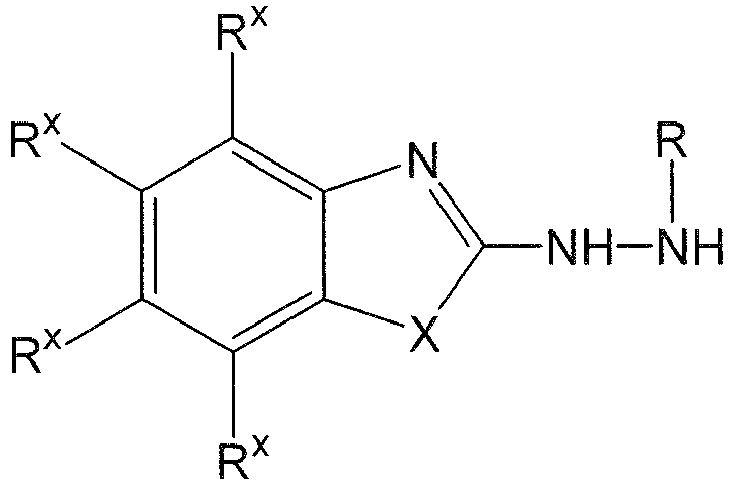
- When direct crystallization is effected without purification, a high-purity target product can be obtained by short-step synthesis in high yield.
- The invention is described in detail below.
- A method for producing a 1. 1 -disubstituted hydrazine compound according to one embodiment of the invention includes reacting a hydrazino compound represented by the following formula (I) (hereinafter may be referred to as "hydrazino compound (I)") with a compound represented by the formula (III): R-Hal (hereinafter may be referred to as "compound (III)") in an aprotic polar solvent in the presence of a base selected from an alkali metal hydroxide and alkaline-earth metal hydroxide in an amount of 1.0 to 3.0 equivalents based on the hydrazino compound, the 1,1-disubstituted hydrazine compound being represented by the following formula (II).
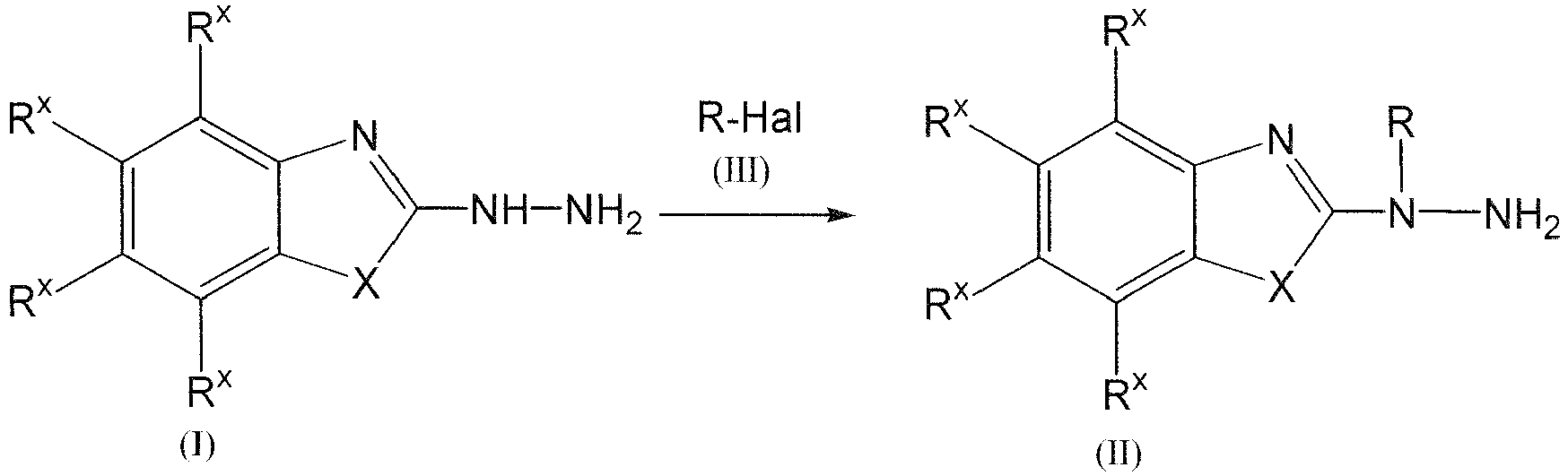
- Note that each of R1 and R2 independently represents a hydrogen atom, or a substituted or unsubstituted alkyl group having 1 to 10 carbon atoms.
- Examples of the alkyl group having 1 to 10 carbon atoms that forms the substituted or unsubstituted alkyl group having 1 to 10 carbon atoms represented by R1 and R2 include a methyl group, an ethyl group,
an n-propyl group, an isopropyl group, an n-butyl group, a sec-butyl group, a t-butyl group, an n-pentyl group, an isopentyl group, a neopentyl group, an n-hexyl group, an isohexyl group, a 3-heptyl group, an n-octyl group, an n-nonyl group, an n-decyl group, and the like. - Examples of a substituent that may substitute the alkyl group having 1 to 10 carbon atoms include a halogen atom such as a fluorine atom and a chlorine atom; a cyano group; a substituted amino group such as a methylamino group and a dimethylamino group; an alkoxy group having 1 to 6 carbon atoms, such as a methoxy group and an ethoxy group; a nitro group; an aryl group such as a phenyl group, a 1-naphthyl group, and a 2-naphthyl group; a cycloalkyl group having 3 to 8 carbon atoms, such as a cyclopropyl group and a cyclopentyl group; a hydroxyl group; and the like.
- It is preferable that X be an oxygen atom, a sulfur atom, or -CH2-, more preferably an oxygen atom or a sulfur atom, and particularly preferably a sulfur atom, since the advantageous effects of the invention can be more easily achieved.
- Each of RX represents a hydrogen atom, a halogen atom (e.g., fluorine atom, chlorine atom, or a bromine atom), an alkyl group having 1 to 6 carbon atoms (e.g., methyl group or ethyl group), a cyano group, a nitro group, a fluoroalkyl group having 1 to 6 carbon atoms (e.g., trifluoromethyl group or pentafluoroethyl group), an alkoxy group having 1 to 6 carbon atoms (e.g., methoxy group or ethoxy group), an alkylthio group having 1 to 6 carbon atoms (e.g., methylthio group or ethylthio group), a monosubstituted amino group (e.g., methylamino group, ethylamino group, or acetylamino group), a disubstituted amino group (e.g., dimethylamino group. diethylamino group, or phenylmethylamino group), or -C(=O)-O-R3. Note that R3 represents a hydrogen atom, or a substituted or unsubstituted alkyl group having 1 to 10 carbon atoms.
- Examples of the substituted or unsubstituted alkyl group having 1 to 10 carbon atoms represented by R3 include those mentioned above in connection with the substituted or unsubstituted alkyl group having 1 to 10 carbon atoms represented by R1 and the like.
- RX are identical to or different from each other, and an arbitrary C-RX that forms the ring is optionally substituted with a nitrogen atom. Specific examples of the compound represented by the formula (I) in which one or more C-RX are substituted with a nitrogen atom include, but are not limited to, the compounds shown below.


- Hal in the formula (III) represents a chlorine atom, a bromine atom, or an iodine atom. Among these, a chlorine atom and a bromine atom are preferable since the advantageous effects of the invention can be more easily achieved.
- R represents a substituted or unsubstituted organic group having 1 to 12 carbon atoms. The organic group having 1 to 12 carbon atoms is not particularly limited. Examples of the organic group having 1 to 12 carbon atoms include a hydrocarbon group such as an alkyl group having 1 to 12 carbon atoms, an alkenyl group having 2 to 12 carbon atoms, an alkynyl group having 2 to 12 carbon atoms, and an aryl group having 6 to 12 carbon atoms; a carboxyl group; an acid anhydride group; an amide group; and the like. Note that the number of carbon atoms of the organic group excludes the number of carbon atoms of a substituent.
- Examples of the alkyl group having 1 to 12 carbon atoms include a methyl group, an ethyl group, an n-propyl group, an isopropyl group, an n-butyl group, a sec-butyl group, a t-butyl group, an n-pentyl group, an n-hexyl group, an n-heptyl group, an n-undecyl group, an n-dodecyl group, a 1-methylpentyl group, a 1-ethylpentyl group, and the like.
- Examples of the alkenyl group having 2 to 12 carbon atoms include a vinyl group, an allyl group, an isopropenyl group, a butynyl group, and the like.
- Examples of the alkynyl group having 2 to 12 carbon atoms include a propynyl group, a propargyl group, a butynyl group, and the like. Examples of the aryl group having 6 to 12 carbon atoms include a phenyl group, a 1-naphthyl group, a 2-naphthyl group, and the like.
- Examples of a substituent that may substitute the hydrocarbon group include a cyano group; a nitro group; a hydroxyl group; a halogen atom such as a fluorine atom, a chlorine atom, and a bromine atom; an alkyl group having 1 to 6 carbon atoms, such as a methyl group and an ethyl group; an alkoxy group having 1 to 6 carbon atoms, such as a methoxy group, an ethoxy group, an n-propoxy group, an n-butoxy group, and a t-butoxy group; an alkoxy group having 1 to 6 carbon atoms that is substituted with an alkoxy group having 1 to 6 carbon atoms, such as a methoxymethoxy group, a methoxyethoxy group, and an ethoxyethoxy group; a substituted or unsubstituted aryl group such as a phenyl group, a 2-chlorophenyl group, a 3-methoxyphenyl group, a 4-methylphenyl group, and a 2,4-dimethylphenyl group; a cycloalkyl group having 3 to 8 carbon atoms, such as a cyclopropyl group, a cyclopentyl group, a cyclohexyl group, and a cycloheptyl group; a substituted amino group such as a methylamino group, an ethylamino group, an acetylamino group, and a dimethylamino group; and the like.
- It is preferable that R be a substituted or unsubstituted hydrocarbon group having 1 to 12 carbon atoms, and more preferably a substituted or unsubstituted alkyl group having 1 to 12 carbon atoms.
- In one embodiment of the invention, an alkali metal hydroxide or an alkaline-earth metal hydroxide is used as the base.
- Examples of the alkali metal hydroxide include lithium hydroxide, sodium hydroxide, potassium hydroxide, and the like. Examples of the alkaline-earth metal hydroxide include calcium hydroxide, barium hydroxide, and the like. Magnesium hydroxide may also be used.
- Among these, an alkali metal hydroxide is preferable, and sodium hydroxide and potassium hydroxide are particularly preferable.
- The base is normally used in an amount of 1.0 to 3.0 equivalents, and preferably 1.0 to 2.0 equivalents. When the base is used in an amount within the above range, the target product can be obtained in high yield.
- The reaction is effected in an aprotic polar solvent.
- The term "aprotic polar solvent" used herein refers to a polar solvent that does not have a proton-donating capability. Examples of the aprotic polar solvent include a ketone-based solvent such as acetone, methyl ethyl ketone, 2-pentanone, 2-hexanone, methyl isobutyl ketone, and diisobutyl ketone; an ester-based solvent such as methyl acetate, ethyl acetate, propyl acetate, isopropyl acetate, butyl acetate, methyl propionate, and ethyl propionate; a sulfone-based solvent such as diethyl sulfone and diphenyl sulfone; a sulfoxide-based solvent such as dimethyl sulfoxide and diphenyl sulfoxide; an amine-based solvent such as N,N,N',N'-tetramethylethylenediamine and N,N-dimethylaniline; an amide-based solvent such as N,N-dimethylformamide, N,N-dimethylacetamide, and N-methylpyrrolidone; a urea-based solvent such as 1,3-dimethyl-2-imidazolidinone; a nitrile-based solvent such as acetonitrile, propionitrile, and benzonitrile; a nitro compound such as nitromethane and nitrobenzene; and the like. These solvents may be used either alone or in combination.
- It is preferable to use a sulfoxide-based solvent, an amide-based solvent, or a nitrile-based solvent, more preferably N,N-dimethylformamide, N,N-dimethylacetamide, N-methylpynolidone, acetonitrile, 1,3-dimethyl-2-imidazolidinone, or dimethyl sulfoxide, since the advantageous effects of the invention can be more easily achieved.
- The solvent may be used in an arbitrary amount. The solvent is normally used in an amount of 0.1 to 50 ml, preferably 0.5 to 20 ml, and more preferably 1 to 15 ml, per gram of the compound represented by the formula (I).
- The compound (I) and the compound (III) are normally used in a molar ratio (compound (I):compound (III)) of 1:1 to 1:2, and preferably 1:1 to 1:1.3. When the compound (I) and the compound (III) are used in a ratio within the above range, the target product can be obtained in high yield.
- The compound (1) and the compound (III) are reacted in the aprotic polar solvent in the presence of the base selected from an alkali metal hydroxide and an alkaline-earth metal hydroxide.
- More specifically, the compound (I) and the compound (III) are reacted using a method (α) that dissolves the compound (I) in the aprotic polar solvent, adds a specific amount of base (that is selected from an alkali metal hydroxide and an alkaline-earth metal hydroxide) and the compound (III) to the solution, and stirs the mixture, a method ((β) that dissolves the compound (III) in the aprotic polar solvent, adds a specific amount of base (that is selected from an alkali metal hydroxide and an alkaline-earth metal hydroxide) and the compound (I) to the solution, and stirs the mixture, a method (y) that dissolves the compound (I) and the compound (III) in the aprotic polar solvent, adds a specific amount of base (that is selected from an alkali metal hydroxide and an alkaline-earth metal hydroxide) to the solution, and stirs the mixture, or the like. It is preferable to use the method (α).
- When using the method (α), a specific amount of base (that is selected from an alkali metal hydroxide and an alkaline-earth metal hydroxide) and the compound (III) may be simultaneously added to the solution prepared by dissolving the compound (I) in the aprotic polar solvent, or a specific amount of base (that is selected from an alkali metal hydroxide and an alkaline-earth metal hydroxide) may be added to the solution prepared by dissolving the compound (I) in the aprotic polar solvent, and the compound (III) may be added to the resulting mixture.
- The base (that is selected from an alkali metal hydroxide and an alkaline-earth metal hydroxide) may be added to the reaction mixture in a solid state, or a solution (suspension) prepared by dissolving (suspending) the base (that is selected from an alkali metal hydroxide and an alkaline-earth metal hydroxide) in the aprotic polar solvent may be added to the reaction mixture.
- The compound (III) may be added directly to the reaction mixture, or a solution prepared by dissolving the compound (III) in the aprotic polar solvent may be added to the reaction mixture.
- The reaction temperature is normally set within the range from -10°C to the boiling point of the solvent, and preferably 0 to 60°C. The reaction time is determined taking account of the reaction scale, but is normally set to several minutes to several hours.
- The reaction is preferably effected in an inert atmosphere (e.g., nitrogen stream).
- After completion of the reaction, the target product may be isolated by performing a post-treatment operation normally employed in synthetic organic chemistry. Note that it is preferable that the method according to one embodiment of the invention include adding a protic solvent to the reaction mixture to effect direct crystallization. When direct crystallization is effected without purification, a high-purity target product can be easily obtained in high yield.
- The protic solvent is not particularly limited as long as the protic solvent is a poor solvent for the target 1,1-disubstituted hydrazine compound. Examples of the protic solvent include water; a monohydric alcohol such as ethanol, propanol, butanol, hexanol, cyclopentanol, cyclohexanol, and benzyl alcohol; a polyhydric alcohol such as ethylene glycol, propylene glycol, and glycerol; an oxyalcohol compound such as methyl cellosolve and dimethoxypropanol; and the like. It is particularly preferable to use water as the protic solvent.
- The structure of the target product may be identified by measurement/elemental analysis (e.g., NMR spectrometry, IR spectrometry, or mass spectrometry), and the like.
- The method according to one embodiment of the invention can produce the target 1,1-disubstituted hydrazine compound in high yield with high reaction selectivity using the compound (I) that is readily available as a raw material while using an inexpensive reagent.
- The invention is further described below by way of examples. Note that the invention is not limited to the following examples. The conversion rate and the reaction selectivity were calculated as described below.
- The conversion rate was calculated using the following expression.

- The reaction selectivity was calculated using the following expression.

-

- A three-necked reactor equipped with a thermometer was charged with 5.00 g (30.3 mol) of 2-hydrazinobenzothiazole and 40 ml of N,N-dimethylformamide under a nitrogen stream to prepare a homogeneous solution. After the addition of 2.55 g (45.4 mol) of potassium hydroxide and 6.00 g (36.3 mol) of 1-bromohexane to the solution, the mixture was stirred at 25°C for 2 hours. After completion of the reaction, the reaction mixture was cooled to 5°C, and 40 ml of water was added to the reaction mixture to precipitate a solid, which was filtered off. The solid was washed with 10 ml of water and 25 ml of n-heptane, and dried using a vacuum dryer to obtain 6.42 g of a compound 1 as a white solid (conversion rate: 95.1%, reaction selectivity: 96.7%, yield: 85.0%).
- The structure of the target product was identified by 1H-NMR.
- 1H-NMR (500 MHz, CDCl3, TMS, δ ppm): 7.60 (dd, 1H, J=1.0 Hz, 8.0 Hz), 7.53 (dd, 1H, J=1.0 Hz, 8.0 Hz), 7.27 (ddd, 1H, J=1.0 Hz, 8.0 Hz, 8.0 Hz), 7.06 (ddd, 1H, J=1.0 Hz, 8.0 Hz, 8.0 Hz), 4.22 (s, 2H), 3.74 (t, 2H, J=7.5 Hz), 1.69-1.76 (m, 2H), 1.29-1.42 (m, 6H), 0.89 (t, 3H, J=7.0 Hz)
-

- A three-necked reactor equipped with a thermometer was charged with 5.00 g (30.3 mol) of 2-hydrazinobenzothiazole and 40 ml of N,N-dimethylformamide under a nitrogen stream to prepare a homogeneous solution. 1.82 g (45.4 mol) of sodium hydroxide and 6.50 g (36.3 mol) of 1-bromoheptane to the solution After completion of the reaction, the reaction mixture was cooled to 5°C, and 40 ml of water was added to the reaction mixture to precipitate a solid, which was filtered off. The solid was washed with 10 ml of water and 25 ml of n-heptane, and dried using a vacuum dryer to obtain 6.97 g of a compound 2 as a white solid (conversion rate: 94.6%, reaction selectivity: 95.7%, yield: 87.3%).
- The structure of the target product was identified by 1H-NMR.
- 1H-NMR (500 MHz, CDCl3, TMS, δ ppm): 7.59 (dd, 1H, J=1.5 Hz, 8.0 Hz), 7.53 (dd, 1H, J=1.5 Hz, 8.0 Hz), 7.06-7.28 (m, 2H), 4.22 (s, 2H), 3.75 (t, 2H, J=7.0 Hz), 1.29-1.38 (m, 10H), 0.88 (t, 3H, J=7.0 Hz)
-

- A three-necked reactor equipped with a thermometer was charged with 5.00 g (30.3 mol) of 2-hydrazinobenzothiazole and 40 ml of dimethyl sulfoxide under a nitrogen stream to prepare a homogeneous solution. After the addition of 2.55 g (45.4 mol) of potassium hydroxide and 9.05 g (36.3 mol) of 1-bromododecane to the solution, the mixture was stirred at 25°C for 3 hours. After completion of the reaction, the reaction mixture was cooled to 5°C, and 40 ml of water was added to the reaction mixture to precipitate a solid, which was filtered off. The solid was washed with 10 ml of water and 25 ml of n-heptane, and dried using a vacuum dryer to obtain 8.48 g of a compound 3 as a white solid (conversion rate: 91.3%, reaction selectivity: 97.7%, yield: 83.9%).
- The structure of the target product was identified by 1H-NMR.
- 1H-NMR (500 MHz, CDCl3, TMS, δ ppm): 7.60 (dd, 1H, J=1.0 Hz, 8.0 Hz), 7.53 (dd, 1H, J=1.0 Hz, 8.0 Hz), 7.27 (ddd, 1H, J=1.0 Hz, 7.5 Hz, 8.0 Hz), 7.06 (ddd, 1H, J=1.0 Hz, 7.5 Hz, 8.0 Hz), 4.22 (s, 2H), 3.74 (t, 2H, J=7.5 Hz), 1.73 (tt, 2H, J=7.5 Hz, 7.5 Hz), 1.41 -1.25 (m, 18H), 0.88 (t, 3H, J=7.0 Hz)
-

- A three-necked reactor equipped with a thermometer was charged with 5.00 g (30.3 mol) of 2-hydrazinobenzothiazole and 40 ml of dimethyl sulfoxide under a nitrogen stream to prepare a homogeneous solution. After the addition of 2.55 g (45.4 mol) of potassium hydroxide and 5.99 g (36.3 mol) of 1-bromohexane to the solution, the mixture was stirred at 25°C for 2 hours. After completion of the reaction, the reaction mixture was cooled to 5°C, and 40 ml of water was added to the reaction mixture to precipitate a solid, which was filtered off. The solid was washed with 10 ml of water and 25 ml of n-heptane, and dried using a vacuum dryer to obtain 6.39 g of a compound 4 as a white solid (conversion rate: 92.3%, reaction selectivity: 96.6%, yield: 84.5%).
- The structure of the target product was identified by 1H-NMR.
- 1H-NMR (500 MHz, CDCl3, TMS, δ ppm): 7.59 (dd, 1H, J=1.0 Hz, 8.0 Hz), 7.52 (dd, 1H, J=1.0 Hz, 8.0 Hz), 7.24-7.30 (m, 1H), 7.05 (ddd, 1H, J=1.0 Hz, 8.0 Hz, 8.0 Hz), 3.97 (s, 2H), 1.47-1.74 (m, 3H), 1.20-1.41 (m, 7H), 0.89 (t, 3H, J=5.5 Hz)
-

- A three-necked reactor equipped with a thermometer was charged with 5.00 g (30.3 mol) of 2-hydrazinobenzothiazole and 40 ml of acetonitrile under a nitrogen stream to prepare a homogeneous solution. After the addition of 1.82 g (45.4 mol) of sodium hydroxide and 6.50 g (36.3 mol) of 3-bromoheptane to the solution, the mixture was stirred at 25°C for 2 hours. After completion of the reaction, the reaction mixture was cooled to 5°C, and 40 ml of water was added to the reaction mixture to precipitate a solid, which was filtered off. The solid was washed with 10 ml of water and 25 ml of n-heptane, and dried using a vacuum dryer to obtain 6.80 g of a compound 5 as a white solid (conversion rate: 93.0%, reaction selectivity: 95.5%, yield: 85.2%).
- The structure of the target product was identified by 1H-NMR.
- 1H-NMR (500 MHz, CDCl3, TMS, δ ppm): 7.58 (dd, 1H, J=1.0 Hz, 7.5 Hz), 7.51 (dd, 1H, J=1.0 Hz, 7.5 Hz), 7.27 (ddd, 1H, J=1.0 Hz, 7.5 Hz, 7.5 Hz), 7.04 (ddd, 1H, J=1.0 Hz, 7.5 Hz, 7.5 Hz), 3.94 (s, 2H), 1.48-1.72 (m, 5H), 1.18-1.41 (m, 4H), 0.91 (t, 3H, J=7.5 Hz), 0.86 (t, 3H, J=7.5 Hz)
-

- A three-necked reactor equipped with a thermometer was charged with 5.00 g (30.3 mol) of 2-hydrazinobenzothiazole and 40 ml of 1,3-dimethyl-2-imidazolidinone under a nitrogen stream to prepare a homogeneous solution. After the addition of 1.82 g (45.4 mol) of sodium hydroxide and 6.43 g (36.3 mol) of (bromomethyl)cyclohexane to the solution, the mixture was stirred at 25°C for 4 hours. After completion of the reaction, the reaction mixture was cooled to 5°C, and 40 ml of water was added to the reaction mixture to precipitate a solid, which was filtered off. The solid was washed with 10 ml of water and 25 ml of n-heptane, and dried using a vacuum dryer to obtain 6.66 g of a compound 6 as a white solid (conversion rate: 91.3%, reaction selectivity: 95.6%, yield: 84.1%).
- The structure of the target product was identified by 1H-NMR.
- 1H-NMR (400 MHz, CDCl3, TMS, δ ppm): 7.58 (d, 1H, J=8.5 Hz), 7.51 (d, 1H, J=8.1 Hz), 7.26 (dd, 1H, J=7.0 Hz, 8.1 Hz), 7.04 (dd, 1H, J=7.0 Hz, 8.1 Hz), 4.24 (s, 2H), 3.59 (d, 2H, J=7.4 Hz), 1.84-1.92 (m, 1H), 1.67-1.77 (m, 5H), 1.16-1.29 (m, 3H), 1.02-1.13 (m, 2H)
-

- A three-necked reactor equipped with a thermometer was charged with 5.00 g (30.3 mol) of 2-hydrazinobenzothiazole and 40 ml of N-methylpyrrolidone under a nitrogen stream to prepare a homogeneous solution. After the addition of 2.55 g (45.5 mol) of potassium hydroxide and 4.96 g (36.3 mol) of butyl 2-chloroethyl ether to the solution, the mixture was stirred for 2 hours. After completion of the reaction, the reaction mixture was cooled to 5°C, and 40 ml of water was added to the reaction mixture to precipitate a solid, which was filtered off at 5°C. The solid was washed with 10 ml of water and 25 ml of n-heptane, and dried using a vacuum dryer to obtain 6.73 g of a compound 7 as a white solid (conversion rate: 90.8%, reaction selectivity: 94.4%, yield: 83.7%).
- The structure of the target product was identified by 1H-NMR.
- 1H-NMR (500 MHz, CDCl3, TMS, δ ppm): 7.61 (dd, 1H, J=1.0 Hz, 8.0 Hz), 7.50 (dd, 1H, J=1.0 Hz, 8.0 Hz), 7.27-7.29 (m, 1H), 7.04-7.08 (m, 1H), 4.70 (s, 2H), 4.01 (t, 2H, J=5.0 Hz), 3.82 (t, 2H, J=5.0 Hz), 3.44 (t, 2H, J=7.0 Hz), 1.52-1.57 (m, 2H), 1.31-1.39 (m, 2H), 0.90 (t, 3H, J=7.0 Hz)
-

- A three-necked reactor equipped with a thermometer was charged with 5.00 g (30.3 mol) of 2-hydrazinobenzothiazole and 40 ml of N-methylpyrrolidone under a nitrogen stream to prepare a homogeneous solution. After the addition of 1.82 g (45.4 mol) of sodium hydroxide and 5.88 g (36.3 mol) of 5-bromovaleronitrile to the solution. the mixture was stirred at 25°C for 3 hours. After completion of the reaction, the reaction mixture was cooled to 5°C, and 40 ml of water was added to the reaction mixture to precipitate a solid, which was filtered off. The solid was washed with 10 ml of water and 25 ml of n-heptane, and dried using a vacuum dryer to obtain 6.19 g of a compound 8 as a white solid (conversion rate: 91.1%, reaction selectivity: 97.7%, yield: 82.9%).
- The structure of the target product was identified by 1H-NMR.
- 1H-NMR (400 MHz, CDCl3, TMS, δ ppm): 7.60 (d, 1H, J=7.8 Hz), 7.51 (d, 1H, J=8.1 Hz), 7.28 (dd, 1H, J=7.3 Hz, 7.8 Hz), 7.07 (dd, 1H, J=7.3 Hz, 7.8 Hz), 4.23 (s, 2H), 3.81 (t, 2H, J=6.9 Hz), 2.46 (t, 2H, J=7.1 Hz), 1.88-1.95 (m, 2H), 1.71-1.79 (m, 2H)
-

- A three-necked reactor equipped with a thermometer was charged with 5.00 g (30.3 mol) of 2-hydrazinobenzothiazole and 40 ml of N,N-dimethylformamide under a nitrogen stream to prepare a homogeneous solution. After the addition of 2.55 g (45.4 mol) of potassium hydroxide and 4.83 g (36.3 mol) of 1-bromo-2-butyne to the solution, the mixture was stirred at 25°C for 2 hours. After completion of the reaction, the reaction mixture was cooled to 5°C, and 40 ml of water was added to the reaction mixture to precipitate a solid, which was filtered off. The solid was washed with 10 ml of water and 25 ml of heptane, and dried using a vacuum dryer to obtain 5.47 g of a compound 9 as a white solid (conversion rate: 94.1%, reaction selectivity: 95.7%, yield: 85.1%).
- The structure of the target product was identified by 1H-NMR.
- 1H-NMR (500 MHz, CDCl3, TMS, δ ppm): 7.63 (dd, 1H, J=1.3 Hz, 7.8 Hz), 7.58 (dd, 1H, J=1.3 Hz, 7.8 Hz), 7.29 (ddd, 1H, J=1.3 Hz, 7.8 Hz, 7.8 Hz), 7.10 (ddd, 1H, J=1.3 Hz, 7.8 Hz, 7.8 Hz), 4.56 (q, 2H, J=2.5 Hz), 4.36 (s, 2H), 1.84 (t, 3H, J=2.5 Hz)
-

- A three-necked reactor equipped with a thermometer was charged with 5.00 g (30.3 mol) of 2-hydrazinobenzothiazole and 40 ml of N-methylpyrrolidone under a nitrogen stream to prepare a homogeneous solution. After the addition of 1.82 g (45.4 mol) of sodium hydroxide and 4.90 g (36.3 mol) of 4-bromo-1-butene to the solution, the mixture was stirred at 25°C for 3 hours. After completion of the reaction, the reaction mixture was cooled to 5°C, and 40 ml of water was added to the reaction mixture to precipitate a solid, which was filtered off. The solid was washed with 10 ml of water and 25 ml of heptane, and dried using a vacuum dryer to obtain 6.00 g of a compound 10 as a white solid (conversion rate: 94.0%, reaction selectivity: 96.6%, yield: 84.9%).
- The structure of the target product was identified by 1H-NMR.
- 1H-NMR (500 MHz, CDCl3, TMS, δ ppm): 7.60 (d, 1H, J=7.8 Hz), 7.54 (d, 1H, J=7.5 Hz), 7.30 (dd, 1H, J=7.8 Hz, 7.8 Hz), 7.07 (dd, 1H, J=7.5 Hz, 7.8 Hz), 5.89 (ddt, 1H, J=10.3 Hz, 17.0 Hz, 7.0 Hz), 5.18 (dd, 1H, J=1.5 Hz, 17.0 Hz), 5.09 (dd, 1H, J=1.5 Hz, 10.3 Hz), 4.27 (s, 2H), 3.86 (t, 2H, J=7.0 Hz), 2.53 (dt, 2H, J=7.0 Hz, 7.0 Hz)
- A reaction was effected (80°C, 6 hours) substantially in the same manner as in Example 1, except that 2-propanol was used as the solvent. After the addition of 20 ml of ethyl acetate, a post-treatment was performed substantially in the same manner as in Example 1 to obtain 2.67 g of the compound 1 (conversion rate: 68.3%, reaction selectivity: 56.4%, yield: 35.4%).
- A reaction was effected (80°C, 6 hours) substantially in the same manner as in Example 1, except that cyclopentyl methyl ether was used as the solvent. After the addition of 20 ml of ethyl acetate, a post-treatment was performed substantially in the same manner as in Example 1 to obtain 2.14 g of the compound 1 (conversion rate: 48.3%, reaction selectivity: 72.9%, yield: 28.3%).
- A reaction was effected (80°C, 6 hours) substantially in the same manner as in Example 1, except that toluene was used as the solvent. A post-treatment was performed substantially in the same manner as in Example 1 to obtain 0.26 g of the compound 1 (conversion rate: 12.1 %, reaction selectivity: 59.4%, yield: 3.5%).
- A reaction was effected (80°C, 6 hours) substantially in the same manner as in Example 1, except that the solvent was not used. After the addition of 20 ml of ethyl acetate, a post-treatment was performed substantially in the same manner as in Example 1 to obtain 2.95 g of the compound 1 (conversion rate: 55.1%, reaction selectivity: 76.4%, yield: 39.1%).
- A reaction was effected (50°C, 8 hours) substantially in the same manner as in Example 1, except that a 40% potassium hydroxide aqueous solution was used as the base. A post-treatment was then performed substantially in the same manner as in Example 1 to obtain 2.61 g of the compound 1 (conversion rate: 72.5%, reaction selectivity: 66.7%, yield: 34.6%).
- A four-necked reactor equipped with a thermometer was charged with 2.00 g (12.1 mmol) of 2-hydrazinobenzothiazole and 20 ml of N,N-dimethylformamide under a nitrogen stream to prepare a homogeneous solution. After the addition of 8.36 g (60.5 mmol) of potassium carbonate and 3.08 g (14.5 mmol) of 1-iodohexane to the solution, the mixture was stirred at 50°C for 7 hours. After completion of the reaction, the reaction mixture was cooled to 20°C, and added to 200 ml of water, followed by extraction with 300 ml of ethyl acetate. The ethyl acetate layer was dried over anhydrous sodium sulfate, and sodium sulfate was filtered off. Ethyl acetate was evaporated from the filtrate under reduced pressure using a rotary evaporator to obtain a yellow solid. The yellow solid was purified by silica gel column chromatography (n-hexane:ethyl acetate=75:25 (volume ratio (hereinafter the same))) to obtain 2.10 g of the compound 1 as a white solid (conversion rate: 92.1%, reaction selectivity: 73.3%, yield: 69.6%).
- A three-necked reactor equipped with a thermometer was charged with 2.00 g (12.1 mmol) of 2-hydrazinobenzothiazole and 30 ml of N,N-dimethylformamide under a nitrogen stream to prepare a solution. After the addition of 7.88 g (24.2 mol) of cesium carbonate to the solution, the mixture was cooled to 25°C. After the dropwise addition of 3.28 g (14.5 mmol) of 1-iodoheptane to the mixture over 5 minutes, the mixture was stirred at 25°C for 3 hours. After completion of the reaction, 200 ml of water was added to the reaction mixture, followed by extraction twice with 100 ml of ethyl acetate. The organic layer was dried over sodium sulfate, and concentrated using a rotary evaporator. The concentrate was purified by silica gel column chromatography (n-hexane:ethyl acetate=85:15) to obtain 1.81 g of the compound 2 as a white solid (conversion rate: 90.3%, reaction selectivity: 70.6%, yield: 56.9%).
- A four-necked reactor equipped with a thermometer was charged with 3.00 g (18.2 mmol) of 2-hydrazinobenzothiazole and 45 ml of N,N-dimethylformamide under a nitrogen stream to prepare a solution. After the addition of 11.9 g (36.4 mmol) of cesium carbonate and 6.45 g (21.8 mmol) of 1-iodododecane to the solution, the mixture was stirred at room temperature for 20 hours. After completion of the reaction, the reaction mixture was added to 200 ml of water, followed by extraction with 300 ml of ethyl acetate. The ethyl acetate layer was dried over anhydrous sodium sulfate, and sodium sulfate was filtered off. Ethyl acetate was evaporated from the filtrate under reduced pressure using a rotary evaporator to obtain a yellow solid. The yellow solid was purified by silica gel column chromatography (toluene:ethyl acetate=95:5) to obtain 2.93 g of the compound 3 as a white solid (conversion rate: 89.0%, reaction selectivity: 72.2%, yield: 48.3%).
- A three-necked reactor equipped with a thermometer was charged with 2.00 g (12.1 mmol) of 2-hydrazinobenzothiazole and 30 ml of N,N-dimethylformamide under a nitrogen stream to prepare a solution. After the addition of 7.88 g (24.2 mol) of cesium carbonate to the solution, the mixture was cooled to 0°C. After the dropwise addition of 2.39 g (14.5 mmol) of 2-bromohexane to the mixture over 5 minutes, the mixture was stirred at 25°C for 3 hours. After completion of the reaction, 200 ml of water was added to the reaction mixture, followed by extraction twice with 100 ml of ethyl acetate. The organic layer was dried over sodium sulfate, and concentrated using a rotary evaporator. The concentrate was purified by silica gel column chromatography (n-hexane:ethyl acetate=93:7) to obtain 1.61 g of the compound 4 as a white solid (conversion rate: 90.2%, reaction selectivity: 63.5%, yield: 53.4%).
- A three-necked reactor equipped with a thermometer was charged with 2.00 g (12.1 mmol) of 2-hydrazinobenzothiazole and 30 ml of N,N-dimethylformamide under a nitrogen stream to prepare a solution. After the addition of 7.88 g (24.2 mol) of cesium carbonate to the solution, the mixture was cooled to 0°C. After the dropwise addition of 2.60 g (14.5 mmol) of 3-bromoheptane to the mixture over 5 minutes, the mixture was stirred at 25°C for 3 hours. After completion of the reaction, 200 ml of water was added to the reaction mixture, followed by extraction twice with 100 ml of ethyl acetate. The organic layer was dried over sodium sulfate, and concentrated using a rotary evaporator. The concentrate was purified by silica gel column chromatography (n-hexane:ethyl acetate=9:1) to obtain 1.80 g of the compound 5 as a white solid (conversion rate: 88.9%, reaction selectivity: 66.7%, yield: 56.4%).
- A four-necked reactor equipped with a thermometer was charged with 3.00 g (18.2 mmol) of 2-hydrazinobenzothiazole and 30 ml of N,N-dimethylformamide under a nitrogen stream to prepare a homogeneous solution. After the addition of 7.55 g (54.6 mmol) of potassium carbonate and 3.86 g (21.8 mmol) of (bromomethyl)cyclohexane to the solution, the mixture was stirred at 80°C for 9 hours. After completion of the reaction, the reaction mixture was cooled to 20°C, and added to 300 ml of water, followed by extraction with 500 ml of ethyl acetate. The ethyl acetate layer was dried over anhydrous sodium sulfate, and sodium sulfate was filtered off. Ethyl acetate was evaporated from the filtrate under reduced pressure using a rotary evaporator to obtain a yellow solid. The yellow solid was purified by silica gel column chromatography (n-hexane:ethyl acetate=85:15) to obtain 2.36 g of the compound 6 as a white solid (conversion rate: 87.3%, reaction selectivity: 65.6%, yield: 49.7%).
- A three-necked reactor equipped with a thermometer was charged with 2.00 g (12.1 mmol) of 2-hydrazinobenzothiazole and 30 ml of N,N-dimethylformamide under a nitrogen stream to prepare a solution. After the addition of 7.88 g (24.2 mol) of cesium carbonate to the solution, the mixture was cooled to 0°C. After the dropwise addition of 1.98 g (14.5 mmol) of butyl 2-chloroethyl ether to the mixture over 5 minutes, the mixture was stirred at 25°C for 3 hours. After completion of the reaction, 200 ml of water was added to the reaction mixture, followed by extraction twice with 100 ml of ethyl acetate. The organic layer was dried over sodium sulfate, and concentrated using a rotary evaporator. The concentrate was purified by silica gel column chromatography (n-hexane:ethyl acetate=75:25) to obtain 1.70 g of the compound 7 as a white solid (conversion rate: 86.3%, reaction selectivity: 69.4%, yield: 53.0%).
- A four-necked reactor equipped with a thermometer was charged with 5.00 g (30.3 mmol) of 2-hydrazinobenzothiazole and 100 ml of N,N-dimethylformamide under a nitrogen stream to prepare a homogeneous solution. After the addition of 20.9 g (152 mmol) of potassium carbonate and 5.17 g (31.9 mmol) of 5-bromovaleronitrile to the solution, the mixture was stirred at 60°C for 8 hours. After completion of the reaction, the reaction mixture was cooled to 20°C, and added to 500 ml of water, followed by extraction with 500 ml of ethyl acetate. The ethyl acetate layer was dried over anhydrous sodium sulfate, and sodium sulfate was filtered off. Ethyl acetate was evaporated from the filtrate under reduced pressure using a rotary evaporator to obtain a yellow solid. The yellow solid was purified by silica gel column chromatography (n-hexane:ethyl acetate=60:40) to obtain 3.41 g of the compound 8 as a white solid (conversion rate: 87.3%, reaction selectivity: 66.3%, yield: 45.7%).
- The results of Examples 1 to 10 and Comparative Examples 1 to 13 are shown in Table 1.
- Note that each solvent shown in Table 1 has the following meaning.
- 1: N,N-Dimethylformamide
- 2: Dimethyl sulfoxide
- 3: Acetonitrile
- 4: 1,3-Dimethyl-2-imidazolidinone
- 5: N-Methylpyrrolidone
- 6: 2-Propanol
- 7: Cyclopentyl methyl ether
- 8: Toluene
- 9: Water
- The symbol "*" shown in Table 1 indicates that the nitrogen atom is bonded.
TABLE 1 Compound (II) Compound (I) Base R Hal Equivalents (eq) RX X Type Equivalents (eq) Example 1 C6H13 Br 1.2 H S KOH 1.5 Example 2 C7H15 Br 1.2 H S NaOH 1.5 Example 3 C12H25 Br 1.2 H S KOH 1.5 Example 4 CH(CH3)C4H9 Br 1.2 H S KOH 1.5 Example 5 CH(C2H5)C4H9 Br 1.2 H S NaOH 1.5 Example 6 
Br 1.2 H S NaOH 1.5 Example 7 C2H4OC4H9 Cl 1.2 H S KOH 1.5 Example 8 C4H8CN Br 1.2 H S NaOH 1.5 Example 9 CH2C≡CCH3 Br 1.2 H S KOH 1.5 Example 10 CH2CH2CH=CH2 Br 1.2 H S NaOH 1.5 Comparative Example 1 I C6H13 I 1.2 H S KOH 1.5 Comparative Example 2 C6H13 I 1.2 H S KOH 1.5 Comparative Example 3 C6H13 I 1.2 H S KOH 1.5 Comparative Example 4 C6H13 I 1.2 H S KOH 1.5 Comparative Example 5 C6H13 I 1.2 H S KOH 1.5 Comparative Example 6 C6H13 I 1.2 H S K2CO3 5 Comparative Example 7 C7H15 I 1.2 H S Cs2CO3 2 Comparative Example 8 C12H25 I 1.2 H S Cs2CO3 2 Comparative Example 9 CH(CH3)C4H9 Br 1.2 H S Cs2CO3 2 Comparative Example 10 CH(C2H5)C4H9 Br 1.2 H S Cs2CO3 2 Comparative Example 11 
Br 1.2 H S K2CO3 3 Comparative Example 12 C2H4OC4H9 Cl 1.2 H S Cs2CO3 2 Comparative Example 13 C4H8CN Br 1.1 H S K2CO3 5 Solvent Reaction Conversion rate (%) Reaction selectivity (%) Isolated yield (%) Temperature (°C) Time (h) Example 1 1 25 2 95.1 96.7 85 Example 2 1 25 2 94.6 95.7 87.3 Example 3 1 25 3 91.3 97.7 83.9 Example 4 I 25 2 92.3 96.6 84.5 Example 5 3 25 2 93 95.5 85.2 Example 6 4 25 4 91.3 95.6 84.1 Example 7 5 25 2 90.8 94.4 83.7 Example 8 5 25 3 91.1 97.7 82.9 Example 9 1 25 2 94.1 95.7 85.1 Example 10 5 25 3 94 96.6 84.9 Comparative Example 1 6 80 6 68.3 56.4 35.4 Comparative Example 2 7 80 6 48.3 72.9 28.3 Comparative Example 3 8 80 6 12.1 59.4 3.5 Comparative Example 4 - 80 6 55.1 76.4 39.1 Comparative Example 5 1/9 50 8 72.5 66.7 34.6 Comparative Example 6 1 50 7 92.1 73.3 69.6 Comparative Example 7 1 25 3 90.3 70.6 56.9 Comparative Example 8 1 25 20 89 72.2 48.3 Comparative Example 9 1 25 3 90.2 63.5 53.4 Comparative Example 10 1 25 3 88.9 66.7 56.4 Comparative Example 11 1 80 9 87.3 65.6 49.7 Comparative Example 12 1 25 3 86.3 69.4 53 Comparative Example 13 1 60 8 87.3 66.3 45.7 - As shown in Table 1, the target product was obtained in Examples 1 to 10 in high yield while achieving a high conversion rate and high reaction selectivity.
- In Comparative Examples 6 to 13 in which a hydroxide of an alkali metal or the like was not used as the base, the reaction selectivity and the isolated yield of the target product were low. In Comparative Examples 1 to 5 in which an aprotic polar solvent was not used as the solvent, the conversion rate, the reaction selectivity, and the isolated yield were low.
Claims (10)
- A method for producing a 1,1-disubstituted hydrazine compound comprising reacting a hydrazino compound represented by a formula (I) with a compound represented by a formula (III): R-Hal in an aprotic polar solvent in the presence of a base selected from an alkali metal hydroxide and alkaline-earth metal hydroxide in an amount of 1.0 to 3.0 equivalents based on the hydrazino compound,
 wherein Hal represents a chlorine atom, a bromine atom, or an iodine atom, and R represents a substituted or unsubstituted organic group having 1 to 12 carbon atoms, wherein X represents an oxygen atom, a sulfur atom, -CH2-, -CHR1-, -CR1R2-, or -NR1-, wherein each of R1 and R2 independently represents a hydrogen atom, or a substituted or unsubstituted alkyl group having 1 to 10 carbon atoms, andwherein each of RX represents a hydrogen atom, a halogen atom, an alkyl group having 1 to 6 carbon atoms, a cyano group, a nitro group, a fluoroalkyl group having 1 to 6 carbon atoms, an alkoxy group having 1 to 6 carbon atoms, an alkylthio group having 1 to 6 carbon atoms, a monosubstituted amino group, a disubstituted amino group, or -C(=O)-O-R3,wherein R3 represents a hydrogen atom, or a substituted or unsubstituted alkyl group having 1 to 10 carbon atoms, provided that RX are identical to or different from each other, and an arbitrary C-RX that forms the ring is optionally substituted with a nitrogen atom,the 1,1-disubstituted hydrazine compound being represented by a formula (II),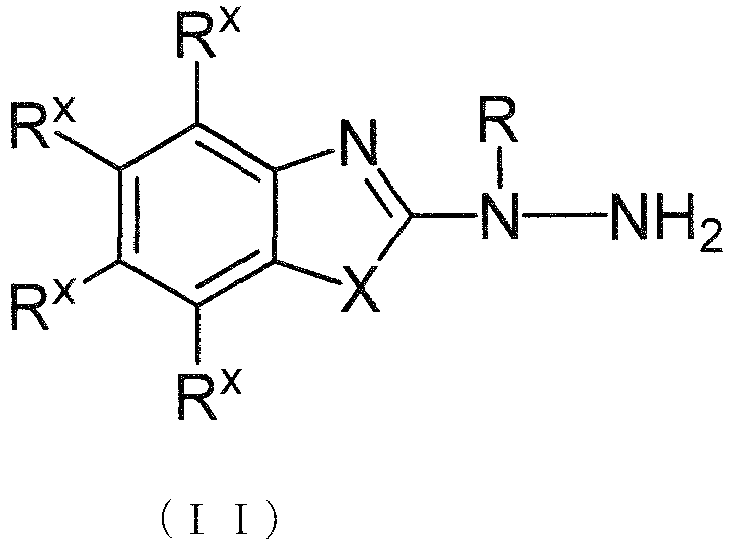
- The method according to claim 1, further comprising adding a protic solvent to a reaction mixture obtained by the reaction to effect direct crystallization.
- The method according to claim 2, wherein the protic solvent is water.
- The method according to any one of claims 1 to 3, wherein the compound represented by the formula (I) is the compound represented by the formula (I) in which each of RX is a hydrogen atom.
- The method according to any one of claims 1 to 4, wherein the compound represented by the formula (I) is the compound represented by the formula (I) in which X is a sulfur atom.
- The method according to any one of claims 1 to 5, wherein the compound represented by the formula (III): R-Hal is the compound represented by the formula (III) in which R is a substituted or unsubstituted alkyl group having 1 to 12 carbon atoms.
- The method according to any one of claims 1 to 6, wherein the base is an alkali metal hydroxide.
- The method according to any one of claims 1 to 7, wherein the base is sodium hydroxide or potassium hydroxide.
- The method according to any one of claims 1 to 8, wherein the base is used in an amount of 1.0 to 2.0 equivalents based on the hydrazino compound.
- The method according to any one of claims 1 to 9, wherein the aprotic polar solvent is at least one aprotic polar solvent selected from a group consisting of N,N-dimethylformamide, N,N-dimethylacetamide, N-methylpyrrolidone, acetonitrile, 1,3-dimethyl-2-imidazolidinone, and dimethyl sulfoxide.
Applications Claiming Priority (2)
| Application Number | Priority Date | Filing Date | Title |
|---|---|---|---|
| JP2014039673 | 2014-02-28 | ||
| PCT/JP2015/055122 WO2015129654A1 (en) | 2014-02-28 | 2015-02-24 | Method for manufacturing 1,1-disubstituted hydrazine compound |
Publications (2)
| Publication Number | Publication Date |
|---|---|
| EP3112356A1 true EP3112356A1 (en) | 2017-01-04 |
| EP3112356A4 EP3112356A4 (en) | 2017-10-04 |
Family
ID=54008972
Family Applications (1)
| Application Number | Title | Priority Date | Filing Date |
|---|---|---|---|
| EP15755563.2A Withdrawn EP3112356A4 (en) | 2014-02-28 | 2015-02-24 | Method for manufacturing 1,1-disubstituted hydrazine compound |
Country Status (5)
| Country | Link |
|---|---|
| US (1) | US9643942B2 (en) |
| EP (1) | EP3112356A4 (en) |
| JP (1) | JP6394690B2 (en) |
| CN (1) | CN106029641B (en) |
| WO (1) | WO2015129654A1 (en) |
Families Citing this family (6)
| Publication number | Priority date | Publication date | Assignee | Title |
|---|---|---|---|---|
| CN103492363B (en) * | 2011-04-27 | 2016-08-24 | 日本瑞翁株式会社 | Polymerizable compounds, polymerizable compositions, polymers, and optically anisotropic substances |
| KR102392614B1 (en) * | 2016-03-30 | 2022-04-29 | 디아이씨 가부시끼가이샤 | Method for producing 2-hydrazinobenzothiazole derivatives |
| WO2018168778A1 (en) | 2017-03-17 | 2018-09-20 | 日本ゼオン株式会社 | Polymerizable compound, polymerizable liquid crystal mixture, polymer, optical film, optically anisotropic body, polarizing plate, display device, antireflection film, and compound |
| KR20190128644A (en) | 2017-03-23 | 2019-11-18 | 니폰 제온 가부시키가이샤 | Polymerizable compound and its manufacturing method, polymerizable composition, polymer, optical film, optically anisotropic body, polarizing plate, display device, antireflection film, and compound and method of use thereof |
| WO2019151263A1 (en) * | 2018-02-05 | 2019-08-08 | 日本ゼオン株式会社 | Method for producing 1,1-disubstituted hydrazine compound and method for producing polymerizable compound |
| JP7110708B2 (en) * | 2018-05-08 | 2022-08-02 | 大日本印刷株式会社 | Method for producing 1,1-disubstituted hydrazine compound |
Family Cites Families (4)
| Publication number | Priority date | Publication date | Assignee | Title |
|---|---|---|---|---|
| JPS61151181A (en) * | 1984-12-25 | 1986-07-09 | Toshiba Corp | Hydrazone compound |
| CN103492363B (en) * | 2011-04-27 | 2016-08-24 | 日本瑞翁株式会社 | Polymerizable compounds, polymerizable compositions, polymers, and optically anisotropic substances |
| KR102094007B1 (en) * | 2012-07-09 | 2020-03-26 | 제온 코포레이션 | Polymerizable compound, polymerizable composition, polymer, optically anisotropic body, and method for producing polymerizable compound |
| AR091857A1 (en) * | 2012-07-25 | 2015-03-04 | Sova Pharmaceuticals Inc | CISTATIONIN-g-LIASA INHIBITORS (CSE) |
-
2015
- 2015-02-24 CN CN201580009083.3A patent/CN106029641B/en not_active Expired - Fee Related
- 2015-02-24 US US15/119,191 patent/US9643942B2/en not_active Expired - Fee Related
- 2015-02-24 EP EP15755563.2A patent/EP3112356A4/en not_active Withdrawn
- 2015-02-24 WO PCT/JP2015/055122 patent/WO2015129654A1/en not_active Ceased
- 2015-02-24 JP JP2016505217A patent/JP6394690B2/en active Active
Also Published As
| Publication number | Publication date |
|---|---|
| CN106029641A (en) | 2016-10-12 |
| JP6394690B2 (en) | 2018-09-26 |
| WO2015129654A1 (en) | 2015-09-03 |
| US20170008862A1 (en) | 2017-01-12 |
| EP3112356A4 (en) | 2017-10-04 |
| JPWO2015129654A1 (en) | 2017-03-30 |
| US9643942B2 (en) | 2017-05-09 |
| CN106029641B (en) | 2018-04-27 |
Similar Documents
| Publication | Publication Date | Title |
|---|---|---|
| US9643942B2 (en) | Method for manufacturing 1,1-disubstituted hydrazine compound | |
| WO2013047749A1 (en) | Production method for 4, 4-difluoro-3,4-dihydroisoquinoline derivative | |
| JP6618699B2 (en) | Process for producing 1,1-disubstituted hydrazine compounds | |
| EP3121168A1 (en) | Method for producing polymerizable compound | |
| JP5412742B2 (en) | Process for producing 4-perfluoroisopropylanilines | |
| CA2641542C (en) | Improved process for producing nitroisourea derivatives | |
| ES2706755T3 (en) | Procedure for the preparation of bis (3-aminophenyl) disulfides and 3-aminothiols | |
| KR101435703B1 (en) | 4-(trichloromethylthio)aniline, method for producing the same, and method for producing 4-(trifluoromethylthio)aniline | |
| JP6952974B2 (en) | Method for producing amide compound | |
| Bazhin et al. | One-step synthesis of epoxy (perfluoroalkyl) alkenes | |
| JP2008174552A (en) | Method for producing 4-perfluoroisopropylanilines | |
| JP2017149687A (en) | O-benzenesulfonyl-acetohydroxamic acid ester derivative and manufacturing method of nitryl compound | |
| JP6941918B2 (en) | Method for Producing Alkali Metal Salt of Sulfonimide | |
| US20100267940A1 (en) | Method for Producing 4-Deoxy-4-Fluoro-D-Glucose Derivative | |
| JP2013180976A (en) | METHOD OF MANUFACTURING α,α-DIFLUORO AROMATIC COMPOUND | |
| Musalov et al. | Synthesis of deca-1, 9-diene-4, 6-diyne from diacetylene | |
| JP7110708B2 (en) | Method for producing 1,1-disubstituted hydrazine compound | |
| Smolobochkin et al. | Reaction of 4-chloro-and 4-bromobenzene-1, 3-diols with 1-alkyl-3-(4, 4-diethoxybutyl) ureas in the presence of trifluoroacetic acid | |
| JP4869739B2 (en) | Fluorine-containing dihydroquinoline compound and method for producing fluorine-containing quinoline compound | |
| EP3369726A1 (en) | Method for producing 2-amino-4-substituted phenol | |
| JP2022011265A (en) | Difluoromethylene compound and method for producing the same | |
| JP2012201668A (en) | Method for producing 1,3-difluoroacetone | |
| JPH03258768A (en) | Preparation of 1,3,5-perhydrotriazine-2,4,6-trithione derivative | |
| Korkmaz et al. | SYNTHESIS AND CHARACTERISATION OF NOVEL CHIRAL THIOUREA DERIVATIVES AS POTENTIAL BIOLOGICAL ACTIVE AGENTS | |
| JP2016138069A (en) | Optically active fluorine-containing amine compound and method for producing the same |
Legal Events
| Date | Code | Title | Description |
|---|---|---|---|
| PUAI | Public reference made under article 153(3) epc to a published international application that has entered the european phase |
Free format text: ORIGINAL CODE: 0009012 |
|
| 17P | Request for examination filed |
Effective date: 20160905 |
|
| AK | Designated contracting states |
Kind code of ref document: A1 Designated state(s): AL AT BE BG CH CY CZ DE DK EE ES FI FR GB GR HR HU IE IS IT LI LT LU LV MC MK MT NL NO PL PT RO RS SE SI SK SM TR |
|
| AX | Request for extension of the european patent |
Extension state: BA ME |
|
| DAX | Request for extension of the european patent (deleted) | ||
| A4 | Supplementary search report drawn up and despatched |
Effective date: 20170905 |
|
| RIC1 | Information provided on ipc code assigned before grant |
Ipc: C07B 61/00 20060101ALI20170830BHEP Ipc: C07D 277/82 20060101AFI20170830BHEP |
|
| GRAP | Despatch of communication of intention to grant a patent |
Free format text: ORIGINAL CODE: EPIDOSNIGR1 |
|
| INTG | Intention to grant announced |
Effective date: 20191129 |
|
| STAA | Information on the status of an ep patent application or granted ep patent |
Free format text: STATUS: THE APPLICATION IS DEEMED TO BE WITHDRAWN |
|
| 18D | Application deemed to be withdrawn |
Effective date: 20200603 |