EP3111665B1 - Coiffe anti-vent d'un capteur acoustique et capteur acoustique correspondant - Google Patents
Coiffe anti-vent d'un capteur acoustique et capteur acoustique correspondant Download PDFInfo
- Publication number
- EP3111665B1 EP3111665B1 EP15707107.7A EP15707107A EP3111665B1 EP 3111665 B1 EP3111665 B1 EP 3111665B1 EP 15707107 A EP15707107 A EP 15707107A EP 3111665 B1 EP3111665 B1 EP 3111665B1
- Authority
- EP
- European Patent Office
- Prior art keywords
- acoustic sensor
- wind cap
- foam layer
- sound pick
- sound
- Prior art date
- Legal status (The legal status is an assumption and is not a legal conclusion. Google has not performed a legal analysis and makes no representation as to the accuracy of the status listed.)
- Active
Links
Images

Classifications
-
- H—ELECTRICITY
- H04—ELECTRIC COMMUNICATION TECHNIQUE
- H04R—LOUDSPEAKERS, MICROPHONES, GRAMOPHONE PICK-UPS OR LIKE ACOUSTIC ELECTROMECHANICAL TRANSDUCERS; ELECTRIC HEARING AIDS; PUBLIC ADDRESS SYSTEMS
- H04R1/00—Details of transducers, loudspeakers or microphones
- H04R1/08—Mouthpieces; Microphones; Attachments therefor
- H04R1/083—Special constructions of mouthpieces
- H04R1/086—Protective screens, e.g. all weather or wind screens
-
- H—ELECTRICITY
- H04—ELECTRIC COMMUNICATION TECHNIQUE
- H04R—LOUDSPEAKERS, MICROPHONES, GRAMOPHONE PICK-UPS OR LIKE ACOUSTIC ELECTROMECHANICAL TRANSDUCERS; ELECTRIC HEARING AIDS; PUBLIC ADDRESS SYSTEMS
- H04R1/00—Details of transducers, loudspeakers or microphones
- H04R1/10—Earpieces; Attachments therefor ; Earphones; Monophonic headphones
- H04R1/1083—Reduction of ambient noise
-
- H—ELECTRICITY
- H04—ELECTRIC COMMUNICATION TECHNIQUE
- H04R—LOUDSPEAKERS, MICROPHONES, GRAMOPHONE PICK-UPS OR LIKE ACOUSTIC ELECTROMECHANICAL TRANSDUCERS; ELECTRIC HEARING AIDS; PUBLIC ADDRESS SYSTEMS
- H04R2410/00—Microphones
- H04R2410/07—Mechanical or electrical reduction of wind noise generated by wind passing a microphone
Definitions
- the present invention relates to the field of sound recording systems including those used in the field of detection.
- Sound recording systems comprising one or more acoustic sensor (s) have various applications.
- such systems can be used to detect a sound source in order to characterize and / or locate it.
- An advantageous application is for example the detection of a shot to locate the origin by equipping military vehicles.
- These sound recording systems include acoustic sensors for example embedded on the roof of the vehicle. These acoustic sensors are therefore exposed to winds of both climatic and aerodynamic origin (caused by the movement of the vehicle).
- foam wind caps are relatively effective at filtering wind noise but are likely to become waterlogged during inclement weather.
- the windshields of synthetic fur protect relatively well from the weather, but their filtering power aerodynamic noise is not sufficient to ensure a sound quality sufficient to detect the sounds characteristic of a shot.
- synthetic fur coats are likely to harvest sand or dust, which affects the quality of sound recording.
- the document JP 2006 060479 A describes a windshield placed around an acoustic sensor, and covered on its outer surface with an impermeable film.
- the invention overcomes at least one of the aforementioned drawbacks by providing a sound pickup system capable of detecting the sounds characteristic of a shot even in a windy environment while being robust to weather and dust.
- the invention proposes a sound recording system according to the subject of claim 1.
- the windshield has the particularity of attenuating the acoustic signals in a spectrally uniform manner. It is then possible to reconstitute the original acoustic signal by a simple amplification.
- the windshield particularly effectively filters the parasitic noise characteristic of the aerodynamic effects generated on the acoustic sensor exposed to a flow of air while propagating the acoustic waves at the characteristic frequencies of a shot.
- the sound pickup system is then able to detect the characteristic sounds of a shot even in a windy environment while being robust to weather and dust.
- the windshield also has the advantage of being liquid- and particle-tight, allowing the sound system to be operational even when exposed to weather or dust.
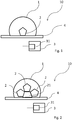
- a sound pick-up system 10 comprising an acoustic sensor 2, a windshield 1, and a processing unit 3 is shown.
- the acoustic sensor 2 transforms the acoustic signals it receives into electrical signals which are transmitted to the processing unit 3, which performs a signal processing adapted to an intended application (for example characterize or locate a sound source).
- the wind cap 1 is advantageously fixed on a base 4 so as to form with it a sealed compartment inside which is placed the acoustic sensor 2.
- the base 4 may for example be the roof of the vehicle on which the system of sound recording 10 is installed.
- a sound pickup system 10 comprising a plurality of acoustic sensors 2 (three acoustic sensors 2 are represented here but of course, the sound pickup system 10 may comprise a different number) positioned on a support 21 and oriented in different directions.
- the support 21 and the acoustic sensors 2 are placed inside the sealed compartment defined by the windshield 1 and the base 4.
- the windshield 1 is preferably of hemispherical general shape.
- the wind cap 1 consists of a layer of foam 11 covered on its outer surface with a waterproof film 12 with water and environmental particles, and in particular sand and dust.
- the foam layer 11 has sound insulation properties.
- the foam layer 11 effectively filters the parasitic aerodynamic noise in the audible frequency band, due to the flow of air in front of the acoustic sensor while allowing the capture of the background noise.
- the wind cap 1 has the particularity of attenuating the acoustic signals in a spectrally uniform manner. It is then possible to reconstitute the original acoustic signal by a simple amplification. This is why the processing unit 3 comprises in particular an amplifier 31 making it possible to compensate for the loss of useful signal introduced by the windshield 1, to obtain a signal-to-noise ratio sufficient for the intended application.
- the open-cell foam layer 11 allows propagation of the acoustic waves while filtering the aerodynamic noises.
- the waterproof film 12 allows air to pass through and thus allows optimal propagation of acoustic waves while blocking liquids and small particles
- the foam layer 11 preferably has a thickness of between 10 and 25 mm.
- the foam layer 11 is preferably a cross-linked foam layer with open cells and preferably made of polyurethane foam.
- the net density of the foam is preferably between 25 and 35 kg / m 3 .
- the compressive strength at 40% of the foam is preferably between 2.5 and 4.5 kPa.
- the average diameter of a cell of the foam is preferably between 500 and 800 micron.
- the sealed film 12 is preferably made of polyurethane resin and preferably has a thickness of between 10 ⁇ m and 15 ⁇ m.
- the density of the sealed film 12 is preferably between 1.15 and 1.35 kg / m3.
- the foam layer 11 of the windshield is shaped by thermoforming or by cold stress.
- the thermoforming allows an optimum fit to the shape of the support 21 carrying the acoustic sensors 2. This adjustment avoids any vibrations of the windshield 1 that could cause noise in the areas in depressions.
- the waterproof film 12 is deposited by coating on the foam layer 11 before, during or after shaping thereof.
- the sealed film 12 is preferably deposited by hot gluing at a temperature between 80 ° C and 200 ° C.
- the waterproof film 12 is preferably made of two layers 13 and 14 of superimposed polyurethane resin. Indeed, it has been shown that Wind cap exhibited better acoustic characteristics when the waterproof film 12 consisted of two layers 13 and 14 of polyurethane resin deposited successively rather than a single layer of double thickness.
Landscapes
- Physics & Mathematics (AREA)
- Engineering & Computer Science (AREA)
- Acoustics & Sound (AREA)
- Signal Processing (AREA)
- Measurement Of Mechanical Vibrations Or Ultrasonic Waves (AREA)
Description
- La présente invention concerne le domaine des systèmes de prise de son notamment ceux utilisés dans le domaine de la détection.
- Les systèmes de prise de son comprenant un ou plusieurs capteur(s) acoustiques ont des applications diverses.
- En particulier, de tels systèmes peuvent être utilisés pour détecter une source sonore afin de la caractériser et/ou la localiser.
- Une application avantageuse est par exemple la détection d'un tir pour en localiser l'origine en équipant des véhicules militaires.
- Ces systèmes de prise de son comportent des capteurs acoustiques par exemple embarqués sur le toit du véhicule. Ces capteurs acoustiques sont par conséquent exposés à des vents aussi bien d'origine climatique qu'aérodynamique (occasionné par le déplacement du véhicule).
- Afin de filtrer les bruits parasites, et en particulier liés au vent afin de préserver une prise de son de qualité, il est connu d'utiliser des coiffes anti-vent en combinaison avec les capteurs acoustiques.
- On connait notamment des coiffes anti-vent en mousse, et en fourrure synthétique.
- Toutefois les coiffes anti-vent en mousse filtrent relativement efficacement les bruits générés par le vent mais sont susceptibles de se gorger d'eau en cas d'intempérie.
- En outre, les coiffes anti-vent en fourrure synthétique protègent relativement bien des intempéries, mais leur pouvoir de filtrage des bruits aérodynamiques n'est pas suffisant pour assurer une qualité de prise de son suffisante pour détecter les sons caractéristiques d'un tir. De plus, les coiffes anti-vent en fourrure synthétique sont susceptibles de récolter du sable ou des poussières, ce qui nuit à la qualité de la prise de son.
- Le document
JP 2006 060479 A - L'invention permet de pallier au moins un des inconvénients précités en proposant un système de prise de son capable de détecter les sons caractéristiques d'un tir même dans un milieu exposé au vent tout en étant robuste aux intempéries et aux poussières.
- A cet effet, l'invention propose un système de prise de son selon l'objet de la revendication 1.
- L'invention est avantageusement complétée par les caractéristiques suivantes, prises individuellement ou en l'une quelconque de leurs combinaisons techniquement possibles :
- le système de prise de son comporte en outre une unité de traitement comportant notamment un amplificateur, ladite unité de traitement étant configurée pour compenser des propriétés d'isolation sonores de ladite coiffe anti-vent ;
- la couche de mousse est une couche de mousse de polyuréthane réticulée à cellules ouvertes ;
- le film étanche est déposé par enduction sur la couche de mousse ;
- le film étanche est déposé par collage, laminage ou transfert, à une température comprise entre 80 °C et 200 °C.
- Les avantages de l'invention sont multiples.
- La coiffe anti-vent a la particularité d'atténuer les signaux acoustiques de manière spectralement uniforme. Il est alors possible de reconstituer le signal acoustique d'origine par une simple amplification.
- La coiffe anti-vent filtre notamment efficacement les bruits parasites caractéristiques des effets aérodynamiques générés sur le capteur acoustique exposé à un flux d'air tout en propageant les ondes acoustiques aux fréquences caractéristiques d'un tir.
- Le système de prise de son est alors capable de détecter les sons caractéristiques d'un tir même dans un milieu exposé au vent tout en étant robuste aux intempéries et aux poussières.
- La coiffe anti-vent présente en outre l'avantage d'être étanche aux liquides et aux particules, ce qui permet au système de prise de son d'être opérationnel même lorsqu'il est exposé aux intempéries ou aux poussières.
- D'autres objectifs, caractéristiques et avantages sortiront de la description détaillée qui suit en référence aux dessins donnés à titre illustratif et non limitatif parmi lesquels :
- la
figures 1 et 2 représentent des systèmes de prise de son conformes à l'invention ; - la
figure 3 est une vue en coupe des différentes couches constituant une coiffe anti-vent d'un système de prise de son desfigures 1 et 2 . - Sur la
figure 1 est représenté un système de prise de son 10 comportant un capteur acoustique 2, une coiffe anti-vent 1, et une unité de traitement 3. Le capteur acoustique 2 transforme les signaux acoustiques qu'il reçoit en signaux électriques qui sont transmis à l'unité de traitement 3, qui effectue un traitement du signal adapté à une application envisagée (par exemple caractériser ou localiser une source sonore). - La coiffe anti-vent 1 est avantageusement fixée sur un socle 4 de manière à former avec lui un compartiment étanche à l'intérieur duquel est placé le capteur acoustique 2. Le socle 4 peut par exemple être le toit du véhicule sur lequel le système de prise de son 10 est installé.
- Sur la
figure 2 est représenté un système de prise de son 10, comportant plusieurs capteurs acoustiques 2 (trois capteurs acoustiques 2 sont ici représentés mais bien entendu, le système de prise de son 10 peut en comporter un nombre différent) positionnés sur un support 21 et orientés dans des directions différentes. Le support 21 et les capteurs acoustiques 2 sont placés à l'intérieur du compartiment étanche défini par la coiffe anti-vent 1 et le socle 4. - La coiffe anti-vent 1 est préférentiellement de forme générale hémisphérique.
- En référence à la
figure 3 , la coiffe anti-vent 1 est constituée d'une couche de mousse 11 recouverte sur sa surface extérieure d'un film étanche 12 à l'eau et aux particules environnementales, et en particulier le sable et les poussières. - La couche de mousse 11 présente des propriétés d'isolation sonores. La couche de mousse 11 filtre efficacement les bruits aérodynamiques parasites dans la bande de fréquence audible, dû à l'écoulement de l'air devant le capteur acoustique tout en permettant la captation du fond sonore.
- La coiffe anti-vent 1 a la particularité d'atténuer les signaux acoustiques de manière spectralement uniforme. Il est alors possible de reconstituer le signal acoustique d'origine par une simple amplification. C'est pourquoi l'unité de traitement 3 comporte notamment un amplificateur 31 permettant de compenser la perte de signal utile introduite par la coiffe anti-vent 1, afin d'obtenir un rapport signal sur bruit suffisant pour l'application envisagée.
- La couche de mousse 11 à cellules ouvertes permet la propagation des ondes acoustiques tout en filtrant les bruits aérodynamiques. Le film étanche 12 laisse passer l'air et donc permet une propagation optimale des ondes acoustiques tout en bloquant les liquides et les petites particules
- La couche de mousse 11 a préférentiellement une épaisseur comprise entre 10 et 25 mm. La couche de mousse 11 est préférentiellement une couche de mousse réticulée à cellules ouvertes et préférentiellement en mousse de polyuréthane. La densité nette de la mousse est préférentiellement comprise entre 25 et 35 kg/m3. La résistance à la compression à 40% de la mousse est préférentiellement comprise entre 2,5 et 4,5 kPa. Le diamètre moyen d'une cellule de la mousse est préférentiellement compris entre 500 et 800 micron.
- Le film étanche12 est préférentiellement en résine de polyuréthane et a préférentiellement une épaisseur comprise entre 10 µm et 15 µm. La densité du film étanche 12 est préférentiellement comprise entre 1,15 et 1,35 kg/m3.
- La couche de mousse 11 de la coiffe anti-vent est mise en forme par thermoformage ou par contrainte à froid. Le thermoformage permet un ajustement optimum à la forme du support 21 portant les capteurs acoustiques 2. Cet ajustement évite d'éventuelles vibrations de la coiffe anti-vent 1 qui pourraient occasionner des bruits dans les zones en dépressions.
- Le film étanche 12 est déposé par enduction sur la couche de mousse 11 avant, pendant ou après, mise en forme de celle-ci. Le film étanche 12 est préférentiellement déposé par collage à chaud à une température comprise entre 80 °C et 200 °C. Le film étanche 12 est préférentiellement constitué de deux couches 13 et 14 de résine de polyuréthane superposées. En effet, il a été démontré qu'une coiffe anti-vent présentait de meilleures caractéristiques acoustiques lorsque le film étanche 12 était constitué de deux couches 13 et 14 de résine de polyuréthane déposées successivement plutôt que d'une seule couche d'épaisseur double.
Claims (5)
- Système de prise de son (10) comportant au moins un capteur acoustique (2), et une coiffe anti-vent (1) entourant le capteur acoustique (2), la coiffe anti-vent (1) comportant une couche de mousse (11) ayant des propriétés d'isolation sonores recouverte sur sa surface extérieure d'un film étanche (12) à l'eau et aux particules environnementales, le système de prise de son (10) étant caractérisé en ce que le film étanche (12) comprend deux couches (13, 14) de résine de polyuréthane déposées successivement, en ce que la coiffe anti-vent (1) est de forme générale hémisphérique et est fixée sur un socle (4) de manière à former avec lui un compartiment étanche à l'intérieur duquel est placé le capteur acoustique (2), et en ce que la couche de mousse (11) de la coiffe anti-vent (1) est mise en forme par thermoformage.
- Système de prise de son (10) selon la revendication précédente, comportant en outre une unité de traitement (3) comprenant un amplificateur (31) configuré pour compenser des propriétés d'isolation sonores de ladite coiffe anti-vent (1).
- Système de prise de son (10) selon l'une des revendications précédentes, dans lequel la couche de mousse (11) est une couche de mousse de polyuréthane réticulée à cellules ouvertes.
- Système de prise de son (10) selon l'une des revendications précédentes, dans lequel le film étanche (12) est déposé par enduction sur la couche de mousse (1).
- Système de prise de son (10) selon l'une des revendications précédentes, dans lequel le film étanche (12) est déposé par collage, laminage ou transfert, à une température comprise entre 80 °C et 200 °C.
Applications Claiming Priority (2)
| Application Number | Priority Date | Filing Date | Title |
|---|---|---|---|
| FR1451603A FR3017944B1 (fr) | 2014-02-27 | 2014-02-27 | Coiffe anti-vent d'un capteur acoustique et capteur acoustique correspondant |
| PCT/EP2015/054003 WO2015128410A1 (fr) | 2014-02-27 | 2015-02-26 | Coiffe anti-vent d'un capteur acoustique et capteur acoustique correspondant |
Publications (2)
| Publication Number | Publication Date |
|---|---|
| EP3111665A1 EP3111665A1 (fr) | 2017-01-04 |
| EP3111665B1 true EP3111665B1 (fr) | 2019-08-21 |
Family
ID=51168030
Family Applications (1)
| Application Number | Title | Priority Date | Filing Date |
|---|---|---|---|
| EP15707107.7A Active EP3111665B1 (fr) | 2014-02-27 | 2015-02-26 | Coiffe anti-vent d'un capteur acoustique et capteur acoustique correspondant |
Country Status (4)
| Country | Link |
|---|---|
| US (1) | US9998814B2 (fr) |
| EP (1) | EP3111665B1 (fr) |
| FR (1) | FR3017944B1 (fr) |
| WO (1) | WO2015128410A1 (fr) |
Citations (2)
| Publication number | Priority date | Publication date | Assignee | Title |
|---|---|---|---|---|
| US20100128901A1 (en) * | 2007-02-16 | 2010-05-27 | David Herman | Wind noise rejection apparatus |
| US20100270102A1 (en) * | 2009-04-22 | 2010-10-28 | Chad Banter | Splash Proof Acoustically Resistive Color Assembly |
Family Cites Families (4)
| Publication number | Priority date | Publication date | Assignee | Title |
|---|---|---|---|---|
| FR1527599A (fr) * | 1966-06-17 | 1968-05-31 | Akg Akustische Kino Geraete | Capteur de sons protégé vis-à-vis des secousses et des courants d'air |
| US6702061B2 (en) * | 2001-03-15 | 2004-03-09 | Siemens Vdo Automotive, Inc. | Environmentally protected microphone for an active noise control system |
| JP4455221B2 (ja) * | 2004-08-19 | 2010-04-21 | 株式会社オーディオテクニカ | マイクロホンの風防カバー |
| US20070003081A1 (en) * | 2005-06-30 | 2007-01-04 | Insound Medical, Inc. | Moisture resistant microphone |
-
2014
- 2014-02-27 FR FR1451603A patent/FR3017944B1/fr active Active
-
2015
- 2015-02-26 EP EP15707107.7A patent/EP3111665B1/fr active Active
- 2015-02-26 US US15/121,597 patent/US9998814B2/en active Active
- 2015-02-26 WO PCT/EP2015/054003 patent/WO2015128410A1/fr not_active Ceased
Patent Citations (2)
| Publication number | Priority date | Publication date | Assignee | Title |
|---|---|---|---|---|
| US20100128901A1 (en) * | 2007-02-16 | 2010-05-27 | David Herman | Wind noise rejection apparatus |
| US20100270102A1 (en) * | 2009-04-22 | 2010-10-28 | Chad Banter | Splash Proof Acoustically Resistive Color Assembly |
Also Published As
| Publication number | Publication date |
|---|---|
| WO2015128410A1 (fr) | 2015-09-03 |
| FR3017944A1 (fr) | 2015-08-28 |
| EP3111665A1 (fr) | 2017-01-04 |
| US9998814B2 (en) | 2018-06-12 |
| US20160373846A1 (en) | 2016-12-22 |
| FR3017944B1 (fr) | 2018-05-04 |
Similar Documents
| Publication | Publication Date | Title |
|---|---|---|
| EP2212506B1 (fr) | Vitrage a propriete d'amortissement vibro-acoustique ameliore, procede de fabrication d'un tel vitrage et procede de protection acoustique dans un habitacle de vehicule | |
| EP3074223B1 (fr) | Vitrage comprenant un intercalaire plastique viscoelastique pour un amortissement vibro-acoustique | |
| EP2852495A1 (fr) | Intercalaire plastique viscoelastique pour un amortissement vibro-acoustique et vitrage comprenant un tel intercalaire | |
| CA3026735A1 (fr) | Intercalaire plastique viscoelastique pour un amortissement vibro-acoustique et vitrage comprenant un tel intercalaire | |
| FR3046382A1 (fr) | Procede de fabrication d'un vitrage feuillete de vehicule dans lequel est incorpore un ecran oled | |
| EP2067137B1 (fr) | Composant d'insonorisation pour organe structurel rigide d' automobile | |
| FR2978584A1 (fr) | Procede et dispositif pour saisir des objets de l'environnement d'un vehicule | |
| EP3074224B1 (fr) | Vitrage comprenant un intercalaire plastique viscoelastique pour un amortissement vibro-acoustique | |
| WO2015079158A1 (fr) | Vitrage feuillete destine a etre utilise comme ecran de systeme de visualisation tete haute | |
| FR2908826A1 (fr) | Procede et dispositif de diagnostic d'un moteur a combustion interne de vehicule automobile. | |
| FR2969770A1 (fr) | Procede, dispositif et unite de reception pour l'acquisition sismique au fond de la mer | |
| FR2938599A1 (fr) | Dispositif de vitrage acoustiquement isolant notamment pour aeronef et procede d'isolation acoustique pour vitrage | |
| WO2015128410A1 (fr) | Coiffe anti-vent d'un capteur acoustique et capteur acoustique correspondant | |
| FR2983148A1 (fr) | Composant de protection acoustique pour vehicule automobile | |
| EP2419288B1 (fr) | Vitrage a propriete d'amortissement vibro-acoustique ameliore, procede de fabrication d'un tel vitrage et procede de protection acoustique dans un habitacle de vehicule | |
| EP4150918B1 (fr) | Vitrage de vehicule avec excitateur audio | |
| EP0897176B1 (fr) | Absorbeur acoustique sous-marin | |
| FR2772472A1 (fr) | Procede et dispositif de detection acoustique en presence de source de bruit parasite a faible rapport signal sur bruit | |
| EP0689944B1 (fr) | Ecran phonique, son procédé de montage sur une pièce tournante et pièce tournante comportant un tel écran | |
| WO2003069594A2 (fr) | Antenne acoustique surfacique pour sous-marins | |
| FR3105095A1 (fr) | Roue comportant une piece de recouvrement a reponse en frequence optimisee | |
| WO2024141530A1 (fr) | Dispositif avec vitrage feuilleté de véhicule et une caméra | |
| FR2986998A3 (fr) | Rideau acoustique pour vehicule | |
| FR3147985A1 (fr) | vitrage pour une émission et/ou une réception d’une onde vibro-acoustique | |
| WO2021234268A1 (fr) | Systeme d'amplification vocale pour vehicule |
Legal Events
| Date | Code | Title | Description |
|---|---|---|---|
| PUAI | Public reference made under article 153(3) epc to a published international application that has entered the european phase |
Free format text: ORIGINAL CODE: 0009012 |
|
| STAA | Information on the status of an ep patent application or granted ep patent |
Free format text: STATUS: REQUEST FOR EXAMINATION WAS MADE |
|
| 17P | Request for examination filed |
Effective date: 20160823 |
|
| AK | Designated contracting states |
Kind code of ref document: A1 Designated state(s): AL AT BE BG CH CY CZ DE DK EE ES FI FR GB GR HR HU IE IS IT LI LT LU LV MC MK MT NL NO PL PT RO RS SE SI SK SM TR |
|
| AX | Request for extension of the european patent |
Extension state: BA ME |
|
| DAX | Request for extension of the european patent (deleted) | ||
| STAA | Information on the status of an ep patent application or granted ep patent |
Free format text: STATUS: EXAMINATION IS IN PROGRESS |
|
| 17Q | First examination report despatched |
Effective date: 20181116 |
|
| GRAP | Despatch of communication of intention to grant a patent |
Free format text: ORIGINAL CODE: EPIDOSNIGR1 |
|
| STAA | Information on the status of an ep patent application or granted ep patent |
Free format text: STATUS: GRANT OF PATENT IS INTENDED |
|
| GRAS | Grant fee paid |
Free format text: ORIGINAL CODE: EPIDOSNIGR3 |
|
| INTG | Intention to grant announced |
Effective date: 20190624 |
|
| GRAA | (expected) grant |
Free format text: ORIGINAL CODE: 0009210 |
|
| STAA | Information on the status of an ep patent application or granted ep patent |
Free format text: STATUS: THE PATENT HAS BEEN GRANTED |
|
| AK | Designated contracting states |
Kind code of ref document: B1 Designated state(s): AL AT BE BG CH CY CZ DE DK EE ES FI FR GB GR HR HU IE IS IT LI LT LU LV MC MK MT NL NO PL PT RO RS SE SI SK SM TR |
|
| REG | Reference to a national code |
Ref country code: GB Ref legal event code: FG4D Free format text: NOT ENGLISH |
|
| REG | Reference to a national code |
Ref country code: CH Ref legal event code: EP |
|
| REG | Reference to a national code |
Ref country code: DE Ref legal event code: R096 Ref document number: 602015036213 Country of ref document: DE |
|
| REG | Reference to a national code |
Ref country code: AT Ref legal event code: REF Ref document number: 1171101 Country of ref document: AT Kind code of ref document: T Effective date: 20190915 |
|
| REG | Reference to a national code |
Ref country code: IE Ref legal event code: FG4D Free format text: LANGUAGE OF EP DOCUMENT: FRENCH |
|
| REG | Reference to a national code |
Ref country code: LT Ref legal event code: MG4D |
|
| REG | Reference to a national code |
Ref country code: NL Ref legal event code: MP Effective date: 20190821 |
|
| PG25 | Lapsed in a contracting state [announced via postgrant information from national office to epo] |
Ref country code: PT Free format text: LAPSE BECAUSE OF FAILURE TO SUBMIT A TRANSLATION OF THE DESCRIPTION OR TO PAY THE FEE WITHIN THE PRESCRIBED TIME-LIMIT Effective date: 20191223 Ref country code: FI Free format text: LAPSE BECAUSE OF FAILURE TO SUBMIT A TRANSLATION OF THE DESCRIPTION OR TO PAY THE FEE WITHIN THE PRESCRIBED TIME-LIMIT Effective date: 20190821 Ref country code: SE Free format text: LAPSE BECAUSE OF FAILURE TO SUBMIT A TRANSLATION OF THE DESCRIPTION OR TO PAY THE FEE WITHIN THE PRESCRIBED TIME-LIMIT Effective date: 20190821 Ref country code: NL Free format text: LAPSE BECAUSE OF FAILURE TO SUBMIT A TRANSLATION OF THE DESCRIPTION OR TO PAY THE FEE WITHIN THE PRESCRIBED TIME-LIMIT Effective date: 20190821 Ref country code: HR Free format text: LAPSE BECAUSE OF FAILURE TO SUBMIT A TRANSLATION OF THE DESCRIPTION OR TO PAY THE FEE WITHIN THE PRESCRIBED TIME-LIMIT Effective date: 20190821 Ref country code: NO Free format text: LAPSE BECAUSE OF FAILURE TO SUBMIT A TRANSLATION OF THE DESCRIPTION OR TO PAY THE FEE WITHIN THE PRESCRIBED TIME-LIMIT Effective date: 20191121 Ref country code: LT Free format text: LAPSE BECAUSE OF FAILURE TO SUBMIT A TRANSLATION OF THE DESCRIPTION OR TO PAY THE FEE WITHIN THE PRESCRIBED TIME-LIMIT Effective date: 20190821 Ref country code: BG Free format text: LAPSE BECAUSE OF FAILURE TO SUBMIT A TRANSLATION OF THE DESCRIPTION OR TO PAY THE FEE WITHIN THE PRESCRIBED TIME-LIMIT Effective date: 20191121 |
|
| PG25 | Lapsed in a contracting state [announced via postgrant information from national office to epo] |
Ref country code: LV Free format text: LAPSE BECAUSE OF FAILURE TO SUBMIT A TRANSLATION OF THE DESCRIPTION OR TO PAY THE FEE WITHIN THE PRESCRIBED TIME-LIMIT Effective date: 20190821 Ref country code: GR Free format text: LAPSE BECAUSE OF FAILURE TO SUBMIT A TRANSLATION OF THE DESCRIPTION OR TO PAY THE FEE WITHIN THE PRESCRIBED TIME-LIMIT Effective date: 20191122 Ref country code: RS Free format text: LAPSE BECAUSE OF FAILURE TO SUBMIT A TRANSLATION OF THE DESCRIPTION OR TO PAY THE FEE WITHIN THE PRESCRIBED TIME-LIMIT Effective date: 20190821 Ref country code: ES Free format text: LAPSE BECAUSE OF FAILURE TO SUBMIT A TRANSLATION OF THE DESCRIPTION OR TO PAY THE FEE WITHIN THE PRESCRIBED TIME-LIMIT Effective date: 20190821 Ref country code: AL Free format text: LAPSE BECAUSE OF FAILURE TO SUBMIT A TRANSLATION OF THE DESCRIPTION OR TO PAY THE FEE WITHIN THE PRESCRIBED TIME-LIMIT Effective date: 20190821 Ref country code: IS Free format text: LAPSE BECAUSE OF FAILURE TO SUBMIT A TRANSLATION OF THE DESCRIPTION OR TO PAY THE FEE WITHIN THE PRESCRIBED TIME-LIMIT Effective date: 20191221 |
|
| REG | Reference to a national code |
Ref country code: AT Ref legal event code: MK05 Ref document number: 1171101 Country of ref document: AT Kind code of ref document: T Effective date: 20190821 |
|
| PG25 | Lapsed in a contracting state [announced via postgrant information from national office to epo] |
Ref country code: TR Free format text: LAPSE BECAUSE OF FAILURE TO SUBMIT A TRANSLATION OF THE DESCRIPTION OR TO PAY THE FEE WITHIN THE PRESCRIBED TIME-LIMIT Effective date: 20190821 |
|
| PG25 | Lapsed in a contracting state [announced via postgrant information from national office to epo] |
Ref country code: RO Free format text: LAPSE BECAUSE OF FAILURE TO SUBMIT A TRANSLATION OF THE DESCRIPTION OR TO PAY THE FEE WITHIN THE PRESCRIBED TIME-LIMIT Effective date: 20190821 Ref country code: PL Free format text: LAPSE BECAUSE OF FAILURE TO SUBMIT A TRANSLATION OF THE DESCRIPTION OR TO PAY THE FEE WITHIN THE PRESCRIBED TIME-LIMIT Effective date: 20190821 Ref country code: AT Free format text: LAPSE BECAUSE OF FAILURE TO SUBMIT A TRANSLATION OF THE DESCRIPTION OR TO PAY THE FEE WITHIN THE PRESCRIBED TIME-LIMIT Effective date: 20190821 Ref country code: EE Free format text: LAPSE BECAUSE OF FAILURE TO SUBMIT A TRANSLATION OF THE DESCRIPTION OR TO PAY THE FEE WITHIN THE PRESCRIBED TIME-LIMIT Effective date: 20190821 Ref country code: IT Free format text: LAPSE BECAUSE OF FAILURE TO SUBMIT A TRANSLATION OF THE DESCRIPTION OR TO PAY THE FEE WITHIN THE PRESCRIBED TIME-LIMIT Effective date: 20190821 Ref country code: DK Free format text: LAPSE BECAUSE OF FAILURE TO SUBMIT A TRANSLATION OF THE DESCRIPTION OR TO PAY THE FEE WITHIN THE PRESCRIBED TIME-LIMIT Effective date: 20190821 |
|
| PG25 | Lapsed in a contracting state [announced via postgrant information from national office to epo] |
Ref country code: SK Free format text: LAPSE BECAUSE OF FAILURE TO SUBMIT A TRANSLATION OF THE DESCRIPTION OR TO PAY THE FEE WITHIN THE PRESCRIBED TIME-LIMIT Effective date: 20190821 Ref country code: CZ Free format text: LAPSE BECAUSE OF FAILURE TO SUBMIT A TRANSLATION OF THE DESCRIPTION OR TO PAY THE FEE WITHIN THE PRESCRIBED TIME-LIMIT Effective date: 20190821 Ref country code: SM Free format text: LAPSE BECAUSE OF FAILURE TO SUBMIT A TRANSLATION OF THE DESCRIPTION OR TO PAY THE FEE WITHIN THE PRESCRIBED TIME-LIMIT Effective date: 20190821 Ref country code: IS Free format text: LAPSE BECAUSE OF FAILURE TO SUBMIT A TRANSLATION OF THE DESCRIPTION OR TO PAY THE FEE WITHIN THE PRESCRIBED TIME-LIMIT Effective date: 20200224 |
|
| REG | Reference to a national code |
Ref country code: DE Ref legal event code: R097 Ref document number: 602015036213 Country of ref document: DE |
|
| PLBE | No opposition filed within time limit |
Free format text: ORIGINAL CODE: 0009261 |
|
| STAA | Information on the status of an ep patent application or granted ep patent |
Free format text: STATUS: NO OPPOSITION FILED WITHIN TIME LIMIT |
|
| PG2D | Information on lapse in contracting state deleted |
Ref country code: IS |
|
| 26N | No opposition filed |
Effective date: 20200603 |
|
| PG25 | Lapsed in a contracting state [announced via postgrant information from national office to epo] |
Ref country code: SI Free format text: LAPSE BECAUSE OF FAILURE TO SUBMIT A TRANSLATION OF THE DESCRIPTION OR TO PAY THE FEE WITHIN THE PRESCRIBED TIME-LIMIT Effective date: 20190821 |
|
| REG | Reference to a national code |
Ref country code: CH Ref legal event code: PL |
|
| REG | Reference to a national code |
Ref country code: BE Ref legal event code: MM Effective date: 20200229 |
|
| PG25 | Lapsed in a contracting state [announced via postgrant information from national office to epo] |
Ref country code: MC Free format text: LAPSE BECAUSE OF FAILURE TO SUBMIT A TRANSLATION OF THE DESCRIPTION OR TO PAY THE FEE WITHIN THE PRESCRIBED TIME-LIMIT Effective date: 20190821 Ref country code: LU Free format text: LAPSE BECAUSE OF NON-PAYMENT OF DUE FEES Effective date: 20200226 |
|
| PG25 | Lapsed in a contracting state [announced via postgrant information from national office to epo] |
Ref country code: CH Free format text: LAPSE BECAUSE OF NON-PAYMENT OF DUE FEES Effective date: 20200229 Ref country code: LI Free format text: LAPSE BECAUSE OF NON-PAYMENT OF DUE FEES Effective date: 20200229 |
|
| PG25 | Lapsed in a contracting state [announced via postgrant information from national office to epo] |
Ref country code: IE Free format text: LAPSE BECAUSE OF NON-PAYMENT OF DUE FEES Effective date: 20200226 |
|
| PG25 | Lapsed in a contracting state [announced via postgrant information from national office to epo] |
Ref country code: BE Free format text: LAPSE BECAUSE OF NON-PAYMENT OF DUE FEES Effective date: 20200229 |
|
| PG25 | Lapsed in a contracting state [announced via postgrant information from national office to epo] |
Ref country code: MT Free format text: LAPSE BECAUSE OF FAILURE TO SUBMIT A TRANSLATION OF THE DESCRIPTION OR TO PAY THE FEE WITHIN THE PRESCRIBED TIME-LIMIT Effective date: 20190821 Ref country code: CY Free format text: LAPSE BECAUSE OF FAILURE TO SUBMIT A TRANSLATION OF THE DESCRIPTION OR TO PAY THE FEE WITHIN THE PRESCRIBED TIME-LIMIT Effective date: 20190821 |
|
| PG25 | Lapsed in a contracting state [announced via postgrant information from national office to epo] |
Ref country code: MK Free format text: LAPSE BECAUSE OF FAILURE TO SUBMIT A TRANSLATION OF THE DESCRIPTION OR TO PAY THE FEE WITHIN THE PRESCRIBED TIME-LIMIT Effective date: 20190821 |
|
| PGFP | Annual fee paid to national office [announced via postgrant information from national office to epo] |
Ref country code: GB Payment date: 20260219 Year of fee payment: 12 |
|
| PGFP | Annual fee paid to national office [announced via postgrant information from national office to epo] |
Ref country code: DE Payment date: 20260217 Year of fee payment: 12 |
|
| PGFP | Annual fee paid to national office [announced via postgrant information from national office to epo] |
Ref country code: FR Payment date: 20260219 Year of fee payment: 12 |