EP3111444B1 - Sinusoidal interpolation across missing data - Google Patents
Sinusoidal interpolation across missing data Download PDFInfo
- Publication number
- EP3111444B1 EP3111444B1 EP15710664.2A EP15710664A EP3111444B1 EP 3111444 B1 EP3111444 B1 EP 3111444B1 EP 15710664 A EP15710664 A EP 15710664A EP 3111444 B1 EP3111444 B1 EP 3111444B1
- Authority
- EP
- European Patent Office
- Prior art keywords
- objects
- peaks
- segment
- peak
- interpolation
- Prior art date
- Legal status (The legal status is an assumption and is not a legal conclusion. Google has not performed a legal analysis and makes no representation as to the accuracy of the status listed.)
- Active
Links
Images



Classifications
-
- G—PHYSICS
- G06—COMPUTING OR CALCULATING; COUNTING
- G06F—ELECTRIC DIGITAL DATA PROCESSING
- G06F11/00—Error detection; Error correction; Monitoring
- G06F11/22—Detection or location of defective computer hardware by testing during standby operation or during idle time, e.g. start-up testing
- G06F11/26—Functional testing
- G06F11/27—Built-in tests
-
- G—PHYSICS
- G10—MUSICAL INSTRUMENTS; ACOUSTICS
- G10L—SPEECH ANALYSIS TECHNIQUES OR SPEECH SYNTHESIS; SPEECH RECOGNITION; SPEECH OR VOICE PROCESSING TECHNIQUES; SPEECH OR AUDIO CODING OR DECODING
- G10L19/00—Speech or audio signals analysis-synthesis techniques for redundancy reduction, e.g. in vocoders; Coding or decoding of speech or audio signals, using source filter models or psychoacoustic analysis
- G10L19/005—Correction of errors induced by the transmission channel, if related to the coding algorithm
-
- G—PHYSICS
- G06—COMPUTING OR CALCULATING; COUNTING
- G06F—ELECTRIC DIGITAL DATA PROCESSING
- G06F3/00—Input arrangements for transferring data to be processed into a form capable of being handled by the computer; Output arrangements for transferring data from processing unit to output unit, e.g. interface arrangements
- G06F3/16—Sound input; Sound output
- G06F3/162—Interface to dedicated audio devices, e.g. audio drivers, interface to CODECs
-
- G—PHYSICS
- G10—MUSICAL INSTRUMENTS; ACOUSTICS
- G10L—SPEECH ANALYSIS TECHNIQUES OR SPEECH SYNTHESIS; SPEECH RECOGNITION; SPEECH OR VOICE PROCESSING TECHNIQUES; SPEECH OR AUDIO CODING OR DECODING
- G10L19/00—Speech or audio signals analysis-synthesis techniques for redundancy reduction, e.g. in vocoders; Coding or decoding of speech or audio signals, using source filter models or psychoacoustic analysis
- G10L19/02—Speech or audio signals analysis-synthesis techniques for redundancy reduction, e.g. in vocoders; Coding or decoding of speech or audio signals, using source filter models or psychoacoustic analysis using spectral analysis, e.g. transform vocoders or subband vocoders
-
- G—PHYSICS
- G10—MUSICAL INSTRUMENTS; ACOUSTICS
- G10H—ELECTROPHONIC MUSICAL INSTRUMENTS; INSTRUMENTS IN WHICH THE TONES ARE GENERATED BY ELECTROMECHANICAL MEANS OR ELECTRONIC GENERATORS, OR IN WHICH THE TONES ARE SYNTHESISED FROM A DATA STORE
- G10H2210/00—Aspects or methods of musical processing having intrinsic musical character, i.e. involving musical theory or musical parameters or relying on musical knowledge, as applied in electrophonic musical tools or instruments
- G10H2210/031—Musical analysis, i.e. isolation, extraction or identification of musical elements or musical parameters from a raw acoustic signal or from an encoded audio signal
- G10H2210/051—Musical analysis, i.e. isolation, extraction or identification of musical elements or musical parameters from a raw acoustic signal or from an encoded audio signal for extraction or detection of onsets of musical sounds or notes, i.e. note attack timings
-
- G—PHYSICS
- G10—MUSICAL INSTRUMENTS; ACOUSTICS
- G10H—ELECTROPHONIC MUSICAL INSTRUMENTS; INSTRUMENTS IN WHICH THE TONES ARE GENERATED BY ELECTROMECHANICAL MEANS OR ELECTRONIC GENERATORS, OR IN WHICH THE TONES ARE SYNTHESISED FROM A DATA STORE
- G10H2210/00—Aspects or methods of musical processing having intrinsic musical character, i.e. involving musical theory or musical parameters or relying on musical knowledge, as applied in electrophonic musical tools or instruments
- G10H2210/031—Musical analysis, i.e. isolation, extraction or identification of musical elements or musical parameters from a raw acoustic signal or from an encoded audio signal
- G10H2210/061—Musical analysis, i.e. isolation, extraction or identification of musical elements or musical parameters from a raw acoustic signal or from an encoded audio signal for extraction of musical phrases, isolation of musically relevant segments, e.g. musical thumbnail generation, or for temporal structure analysis of a musical piece, e.g. determination of the movement sequence of a musical work
-
- G—PHYSICS
- G10—MUSICAL INSTRUMENTS; ACOUSTICS
- G10H—ELECTROPHONIC MUSICAL INSTRUMENTS; INSTRUMENTS IN WHICH THE TONES ARE GENERATED BY ELECTROMECHANICAL MEANS OR ELECTRONIC GENERATORS, OR IN WHICH THE TONES ARE SYNTHESISED FROM A DATA STORE
- G10H2250/00—Aspects of algorithms or signal processing methods without intrinsic musical character, yet specifically adapted for or used in electrophonic musical processing
- G10H2250/131—Mathematical functions for musical analysis, processing, synthesis or composition
- G10H2250/215—Transforms, i.e. mathematical transforms into domains appropriate for musical signal processing, coding or compression
- G10H2250/235—Fourier transform; Discrete Fourier Transform [DFT]; Fast Fourier Transform [FFT]
-
- G—PHYSICS
- G10—MUSICAL INSTRUMENTS; ACOUSTICS
- G10H—ELECTROPHONIC MUSICAL INSTRUMENTS; INSTRUMENTS IN WHICH THE TONES ARE GENERATED BY ELECTROMECHANICAL MEANS OR ELECTRONIC GENERATORS, OR IN WHICH THE TONES ARE SYNTHESISED FROM A DATA STORE
- G10H2250/00—Aspects of algorithms or signal processing methods without intrinsic musical character, yet specifically adapted for or used in electrophonic musical processing
- G10H2250/541—Details of musical waveform synthesis, i.e. audio waveshape processing from individual wavetable samples, independently of their origin or of the sound they represent
-
- G—PHYSICS
- G10—MUSICAL INSTRUMENTS; ACOUSTICS
- G10L—SPEECH ANALYSIS TECHNIQUES OR SPEECH SYNTHESIS; SPEECH RECOGNITION; SPEECH OR VOICE PROCESSING TECHNIQUES; SPEECH OR AUDIO CODING OR DECODING
- G10L15/00—Speech recognition
- G10L15/08—Speech classification or search
- G10L15/14—Speech classification or search using statistical models, e.g. Hidden Markov Models [HMMs]
-
- G—PHYSICS
- G10—MUSICAL INSTRUMENTS; ACOUSTICS
- G10L—SPEECH ANALYSIS TECHNIQUES OR SPEECH SYNTHESIS; SPEECH RECOGNITION; SPEECH OR VOICE PROCESSING TECHNIQUES; SPEECH OR AUDIO CODING OR DECODING
- G10L19/00—Speech or audio signals analysis-synthesis techniques for redundancy reduction, e.g. in vocoders; Coding or decoding of speech or audio signals, using source filter models or psychoacoustic analysis
- G10L19/04—Speech or audio signals analysis-synthesis techniques for redundancy reduction, e.g. in vocoders; Coding or decoding of speech or audio signals, using source filter models or psychoacoustic analysis using predictive techniques
-
- G—PHYSICS
- G10—MUSICAL INSTRUMENTS; ACOUSTICS
- G10L—SPEECH ANALYSIS TECHNIQUES OR SPEECH SYNTHESIS; SPEECH RECOGNITION; SPEECH OR VOICE PROCESSING TECHNIQUES; SPEECH OR AUDIO CODING OR DECODING
- G10L19/00—Speech or audio signals analysis-synthesis techniques for redundancy reduction, e.g. in vocoders; Coding or decoding of speech or audio signals, using source filter models or psychoacoustic analysis
- G10L19/04—Speech or audio signals analysis-synthesis techniques for redundancy reduction, e.g. in vocoders; Coding or decoding of speech or audio signals, using source filter models or psychoacoustic analysis using predictive techniques
- G10L19/06—Determination or coding of the spectral characteristics, e.g. of the short-term prediction coefficients
Definitions
- Packet loss and clock drift between different devices can lead to missing segments or discontinuities in audio signals. Both the insertion of zeros and discontinuities in the signal are clearly audible to individuals. While various approaches have been proposed for restoring the continuity of the signal, such approaches are generally aimed only at speech signals, and do not work well for audio generally.
- a computer-implemented method comprising: computing spectra of segments of an audio signal, the segments located on opposite sides of a missing segment of the audio signal;determining magnitude peaks of the computed spectra;ordering the determined peaks according to magnitude;determining neighbor peaks on the opposite side of the missing segment from the peaks, thereby forming pairs of spectral peaks, wherein neighbor peaks are determined for each of the magnitude peaks beginning with the highest peak, and wherein a neighbor peak is determined using a matching criterion which is proportional to the peak value of the neighbor peak multiplied by a distance-dependent weighting that favors peaks that are nearby in frequency; and performing interpolation across an interval of the missing segment of the audio signal using the pairs of spectral peaks to generate restoration data for the missing segment, wherein a length of the interval is determined based on minimizing a measure of alignment of the interpolation, wherein the measure aligns, for each pair of peaks, the phase of the interpolation with the phase of the audio signal at the end
- Embodiments of the present disclosure relate to methods and systems for concealing (e.g., restoring) missing segments and/or discontinuities in an audio signal and thereby restoring the continuity of the signal.
- the methods and systems are based on interpolation and extrapolation operations, and may also be used to stretch or shorten audio segments.
- packet-loss concealment methods Methods that restore missing segments and/or discontinuities in an audio signal are sometimes referred to as packet-loss concealment methods.
- Conventional packet-loss concealment methods typically have been aimed only at speech, as speech signals are prevalent in real-time applications where retransmission is not possible.
- packet-loss concealment for general audio signals has become more important.
- Existing packet-loss concealment methods that are aimed only at speech rely heavily on the pitch structure of the speech signal and, as a result, these methods do not perform well for music, where the signal structure generally is more complex and is not well represented by the simple model that can be used for speech. Accordingly, the methods and systems of the present disclosure are designed to perform well for audio (in the more general sense as compared to only speech) applications.
- embodiments of the present disclosure provide methods and systems for concealing packet loss and discontinuities in audio signals that is capable of operating in real-time.
- an extrapolation is followed by an interpolation and an interpolation is followed by observed data. Both the interpolation and extrapolation operations represent the signal as a sum of sinusoids.
- a set of sinusoids may be detected in the last observed data, while for interpolation a first set of sinusoids may be detected in the data observed or generated before the missing segment and a second set of sinusoids may be detected in the observations after the missing data segment.
- the interpolation method of the present disclosure sorts the sinusoids by their amplitude before pairing up sinusoids observed before and after the missing segment.
- the sinusoids are described as the real part of a complex exponential.
- the complex gain and the frequency of the sinusoid are linearly interpolated.
- the interpolation method can operate in two modes: a synchronous mode and an asynchronous mode.
- a synchronous mode the length of the segment of missing data is fixed (and normally consistent with the original signal). If the interpolation model does not fit the data well in the synchronous mode, the complex exponentials will have excursions in their amplitude, which may be audible.
- the asynchronous mode the length of the missing data segment is adjusted to reduce the significance of these excursions.
- FIG. 1 illustrates an example application for the extrapolation and interpolation of audio signals in accordance with one or more embodiments of the present disclosure.
- two users e.g., musicians
- 120a and 120b may be playing music at different physical locations (e.g., remote environments), where user 120a is at "Location 1" and user 120b is at "Location 2.”
- the users 120a and 120b may be in communication with each over, for example, a wired connection or network, and each of the users 120a and 120b may have a loudspeaker 105 and a microphone 110 for rendering and capturing, respectively, audio (e.g., music) signals.
- a plurality of signal sources 105 e.g., loudspeakers
- packets When transmitting data (e.g., audio) packets across a communications network, packets may sometimes go missing for an extended period of time, or get lost altogether, before being received at a receiving end of the network.
- data e.g., audio
- packets may sometimes go missing for an extended period of time, or get lost altogether, before being received at a receiving end of the network.
- something must be done to compensate for such loss of data.
- one existing approach is to insert zeros in place of the missing data.
- such an approach provides an inadequate solution as users are subject to degraded performance and audio quality.
- AR autoregressive
- a filter e.g., a filter
- AR autoregressive
- a short-term model describes the spectral envelope
- the long-term model describes the pitch structure.
- More important for packet-loss concealment is the long-term model, which typically captures correlations ranging from 2.5 to 15 milliseconds (ms). In some cases the long-term model is assigned a unity filter gain.
- Some existing approaches to packet-loss concealment make minimum mean square error extrapolation estimates of the missing segments by running the AR models (e.g., filters) with zero excitation over the gap of missing samples, the initial filter state being based on the signal prior to the gap.
- One existing interpolative method based on the AR signal model describes a complete coding scheme that considers the encoder as a set of measurements for a Kalman estimator, which naturally leads to optimal interpolation when packets are lost and can account for known data in the future and in the past in relation to the gap.
- this existing approach is not compatible for operation in conjunction with existing coders.
- Some existing approaches explore methods other than AR models for extrapolation or interpolation over segments where data are missing. For example, one approach uses a well-known sinusoidal model for interpolation between sinusoids identified from spectra of the signal before and after the gap. Other approaches model the signal as a sum of appropriate basis vectors and an AR model and then simultaneously optimize the gains of the basis vectors and the AR model signal contribution.
- the basis vectors can be sinusoids, but no effective selection process for the basis vectors is provided in such methods.
- embodiments of the present disclosure provide improved methods and systems for extrapolation and interpolation over missing segments.
- the methods and systems are designed for and targeted at audio signals, are based on the interpolation and extrapolation of sinusoids, and do not rely on the assumption that the sinusoids are harmonic.
- the methods and systems of the present disclosure (i) facilitate asynchronous interpolation, (ii) use an interpolation procedure that corresponds to time-domain waveform interpolation if the signal is harmonic, and (iii) have a peak selection procedure that is effective for audio signals.
- a Fourier transform represents a signal (e.g., an audio signal) in a basis of complex exponentials. Since the signal is real, the expansion in complex exponentials can be rearranged as an expansion in sinusoids. As such, the spectral peaks can be interpreted as gains of sinusoids at the peak frequency. Whereas a Fourier transform expands the signal in terms of steady-state sinusoids (in the case of a discrete Fourier transform, the sinusoids extend over a finite time segment), a natural extension of this view is to see the signal as a summation of sinusoids that have continuously changing gain and frequency. A Fourier transform over a windowed signal segment can then be interpreted as an approximate snapshot of the state of these sinusoids, with each peak representing a sinusoid.
- the algorithms of the present disclosure aim to restore a segment of consecutive missing data samples (where such segment may be a missing segment or a discontinuity in the audio signal). While data is nearly always available at the past end of a missing data segment, such is not necessarily the case for the future side of the segment.
- the length of the data segment to be restored may be specified before the algorithm is started.
- the restoration segment can be shorter than the missing data segment, thus allowing for the case where data for the future side of the missing segment has not yet been received.
- the algorithm may perform extrapolation.
- interpolation may be performed over the missing segment.
- a subsequent set of extrapolation operations is followed by an interpolation operation and an interpolation operation concludes the restoration of a missing data segment.
- FIG. 2 is a simplified example of interpolation (220) and extrapolation (210) operations on a signal 205 (e.g., audio signal) in accordance with one or more embodiments described herein.
- the application of extrapolation (210) differs from that commonly used in AR-model based systems, where the extrapolated signal is subject to a merging operation between the extrapolated data and signal data at the future side of the missing-data segment.
- FIG. 3 illustrates an example interpolation operation 300, where data are available at both past and future ends of a segment of an audio signal to be restored (e.g., sequentially before and after a missing segment of an audio signal), in accordance with one or more embodiments described herein.
- segments of the audio signal located before and after a missing segment may be computed.
- segments of the audio signal coming sequentially before (e.g., earlier in time than) the missing segment may be considered on a first side (or past end) of the missing segment while segments coming sequentially after (e.g., later in time than) the missing segment may be considered on a second side (or future end) of the missing segment.
- magnitude peaks of the spectra computed at block 305 may be determined.
- the peaks determined at block 310 may be ordered (e.g., arranged, listed, etc.) according to magnitude.
- the peaks determined at block 310 may be placed in list form and sorted by decreasing/increasing magnitude. It should be noted that peaks of the past end and the future end of the missing segment may be contained in a single list.
- the list at block 310 may include information for each peak, whether the peak belongs to the past or future end of the missing segment.
- neighbors on the other side of the missing data segment (of the audio signal) may be determined, subject to some conditions.
- peaks that have already been selected as a neighbor may be skipped during the performance of block 320.
- the sorting of the peaks according to magnitude ensures that the highest peaks have appropriate neighbors. It should be noted that the operations at block 320 may leave some small peaks that are not critical to audible performance unpaired (one method to deal with these remaining peaks is described in greater detail below).
- the resulting spectral-peak pairs at the future and past ends of the missing data segment may be used as a basis for interpolation across the segment.
- the data may be faded with the existing data by an overlap-add operation at the past and future ends of the interpolation stage.
- the extrapolation operation of the present disclosure is similar to the interpolation operation except that the future-end spectrum is replaced by the past-end spectrum with appropriate precession of the phase.
- the sinusoidal frequencies are assumed to be constant during extrapolation.
- the fading operation may be omitted at the future end of an extrapolation operation if it is followed by another extrapolation. On the other hand, if it is followed by an interpolation, fading may be needed to account for small peaks that are not part of a future-past peak pair.
- a 32 millisecond (ms) window may be used. At 16 kHz this window corresponds to 512 samples.
- the signal may be windowed with a Hann window and padded with zeros to obtain a sequence of 2048 samples, on which the Fast Fourier Transform (FFT) may be performed.
- FFT Fast Fourier Transform
- the significant sinusoids identified at the past and future-ends of the missing signal segment may be paired up.
- the method of the present disclosure orders the peaks and then, starting from the highest peaks, finds suitable complementary peaks. Starting from the largest peaks is an indication that the number of important mismatches is small (e.g., mismatches generally occur, if at all, only on minor peaks).
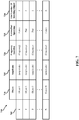
- Each entry 705 in the table 700 may be a different object 710 (e.g., the objects identified at block 505 in the example process 500) and may include, for each of the objects 710, the amplitude of the object (e.g., peak amplitude) 715, the frequency where the object is located 720, a label indicating whether the object belongs to future or past spectrum 725, and the location in the table 700 (e.g., entry number 705) of the matching peak in the complementary spectrum (which may be left empty or include zero if there is no match).
- table 700 may include various other data, arranged in various other formats, in addition to or instead of the example data and formats described above, which are provided only for purposes of illustration.
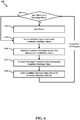
- example process 600 may be performed in an iterative manner for each of the objects in the list of objects created at block 505 of the example process 500 (e.g., one object for each peak of both the past and future spectra).
- one of the candidate matching objects may be selected as the matching object for the current object based on the evaluated matching criterion. For example, in accordance with one embodiment described herein, the candidate matching object having a highest (e.g., maximum) value for the matching criterion (as compared with the matching criterion values of the other candidate matching objects based on, for example, the evaluation performed at block 625) may be selected at block 630 as the matching object for the current object. It should be understood, however, that it may be the case that no matching object is found (e.g., that there is no matching peak) for the current object.
- the complementary spectrum may have no objects remaining for selection as a matching object, or the matching criterion may not allow for the selection of a remaining peak from the complementary spectrum.
- the system of the present disclosure is designed so that such a scenario (namely, there being no matching object) will generally only occur for minor peaks.
- the asynchronous interpolation method of the present disclosure may be distinguished from a straightforward time-domain alignment procedure in that the method described herein includes the interpolation of the frequency.
- the interpolation method described herein minimizes reverberation as it minimizes excursions of the sinusoids in amplitude. It is important to note in this respect that the complex-coefficient interpolation method has no frequency excursions in any case.
Landscapes
- Engineering & Computer Science (AREA)
- Physics & Mathematics (AREA)
- Health & Medical Sciences (AREA)
- Audiology, Speech & Language Pathology (AREA)
- Human Computer Interaction (AREA)
- Multimedia (AREA)
- Computational Linguistics (AREA)
- Signal Processing (AREA)
- Acoustics & Sound (AREA)
- Theoretical Computer Science (AREA)
- General Engineering & Computer Science (AREA)
- Spectroscopy & Molecular Physics (AREA)
- General Physics & Mathematics (AREA)
- Quality & Reliability (AREA)
- Computer Hardware Design (AREA)
- General Health & Medical Sciences (AREA)
- Compression, Expansion, Code Conversion, And Decoders (AREA)
- Complex Calculations (AREA)
- Noise Elimination (AREA)
- Transmission Systems Not Characterized By The Medium Used For Transmission (AREA)
- Signal Processing For Digital Recording And Reproducing (AREA)
Applications Claiming Priority (2)
| Application Number | Priority Date | Filing Date | Title |
|---|---|---|---|
| US14/194,192 US9672833B2 (en) | 2014-02-28 | 2014-02-28 | Sinusoidal interpolation across missing data |
| PCT/US2015/017992 WO2015131040A1 (en) | 2014-02-28 | 2015-02-27 | Sinusoidal interpolation across missing data |
Publications (2)
| Publication Number | Publication Date |
|---|---|
| EP3111444A1 EP3111444A1 (en) | 2017-01-04 |
| EP3111444B1 true EP3111444B1 (en) | 2020-09-02 |
Family
ID=52686491
Family Applications (1)
| Application Number | Title | Priority Date | Filing Date |
|---|---|---|---|
| EP15710664.2A Active EP3111444B1 (en) | 2014-02-28 | 2015-02-27 | Sinusoidal interpolation across missing data |
Country Status (8)
| Country | Link |
|---|---|
| US (1) | US9672833B2 (https=) |
| EP (1) | EP3111444B1 (https=) |
| JP (1) | JP6306718B2 (https=) |
| KR (2) | KR20160102061A (https=) |
| CN (1) | CN105940380B (https=) |
| AU (1) | AU2015222922B2 (https=) |
| BR (1) | BR112016015557B1 (https=) |
| WO (1) | WO2015131040A1 (https=) |
Families Citing this family (4)
| Publication number | Priority date | Publication date | Assignee | Title |
|---|---|---|---|---|
| EP3107097B1 (en) * | 2015-06-17 | 2017-11-15 | Nxp B.V. | Improved speech intelligilibility |
| US9984701B2 (en) * | 2016-06-10 | 2018-05-29 | Apple Inc. | Noise detection and removal systems, and related methods |
| CN108922551B (zh) * | 2017-05-16 | 2021-02-05 | 博通集成电路(上海)股份有限公司 | 用于补偿丢失帧的电路及方法 |
| CN111640442B (zh) * | 2020-06-01 | 2023-05-23 | 北京猿力未来科技有限公司 | 处理音频丢包的方法、训练神经网络的方法及各自的装置 |
Family Cites Families (15)
| Publication number | Priority date | Publication date | Assignee | Title |
|---|---|---|---|---|
| US3649765A (en) * | 1969-10-29 | 1972-03-14 | Bell Telephone Labor Inc | Speech analyzer-synthesizer system employing improved formant extractor |
| JPH06130998A (ja) * | 1992-10-22 | 1994-05-13 | Oki Electric Ind Co Ltd | 圧縮音声復号化装置 |
| US5517595A (en) * | 1994-02-08 | 1996-05-14 | At&T Corp. | Decomposition in noise and periodic signal waveforms in waveform interpolation |
| DE69633164T2 (de) * | 1995-05-22 | 2005-08-11 | Ntt Mobile Communications Network Inc. | Tondekoder |
| US6377915B1 (en) * | 1999-03-17 | 2002-04-23 | Yrp Advanced Mobile Communication Systems Research Laboratories Co., Ltd. | Speech decoding using mix ratio table |
| US20040054525A1 (en) * | 2001-01-22 | 2004-03-18 | Hiroshi Sekiguchi | Encoding method and decoding method for digital voice data |
| US7143032B2 (en) * | 2001-08-17 | 2006-11-28 | Broadcom Corporation | Method and system for an overlap-add technique for predictive decoding based on extrapolation of speech and ringinig waveform |
| US6747581B2 (en) * | 2002-02-01 | 2004-06-08 | Octiv, Inc. | Techniques for variable sample rate conversion |
| US20040002856A1 (en) * | 2002-03-08 | 2004-01-01 | Udaya Bhaskar | Multi-rate frequency domain interpolative speech CODEC system |
| JP2006510938A (ja) * | 2002-12-19 | 2006-03-30 | コーニンクレッカ フィリップス エレクトロニクス エヌ ヴィ | 音声符号化における正弦波の選択 |
| JP2006510937A (ja) * | 2002-12-19 | 2006-03-30 | コーニンクレッカ フィリップス エレクトロニクス エヌ ヴィ | オーディオ符号化における正弦波選択 |
| US7519535B2 (en) * | 2005-01-31 | 2009-04-14 | Qualcomm Incorporated | Frame erasure concealment in voice communications |
| WO2006121101A1 (ja) * | 2005-05-13 | 2006-11-16 | Matsushita Electric Industrial Co., Ltd. | 音声符号化装置およびスペクトル変形方法 |
| US9208821B2 (en) * | 2007-08-06 | 2015-12-08 | Apple Inc. | Method and system to process digital audio data |
| CN101437009B (zh) * | 2007-11-15 | 2011-02-02 | 华为技术有限公司 | 丢包隐藏的方法及其系统 |
-
2014
- 2014-02-28 US US14/194,192 patent/US9672833B2/en active Active
-
2015
- 2015-02-27 AU AU2015222922A patent/AU2015222922B2/en active Active
- 2015-02-27 KR KR1020167020196A patent/KR20160102061A/ko not_active Ceased
- 2015-02-27 WO PCT/US2015/017992 patent/WO2015131040A1/en not_active Ceased
- 2015-02-27 BR BR112016015557-2A patent/BR112016015557B1/pt active IP Right Grant
- 2015-02-27 JP JP2016544134A patent/JP6306718B2/ja active Active
- 2015-02-27 EP EP15710664.2A patent/EP3111444B1/en active Active
- 2015-02-27 KR KR1020187011991A patent/KR102188620B1/ko active Active
- 2015-02-27 CN CN201580006162.9A patent/CN105940380B/zh active Active
Non-Patent Citations (1)
| Title |
|---|
| None * |
Also Published As
| Publication number | Publication date |
|---|---|
| JP6306718B2 (ja) | 2018-04-04 |
| US9672833B2 (en) | 2017-06-06 |
| EP3111444A1 (en) | 2017-01-04 |
| KR20160102061A (ko) | 2016-08-26 |
| BR112016015557A2 (https=) | 2017-10-03 |
| JP2017509006A (ja) | 2017-03-30 |
| WO2015131040A1 (en) | 2015-09-03 |
| AU2015222922A1 (en) | 2016-06-23 |
| AU2015222922B2 (en) | 2017-12-07 |
| CN105940380B (zh) | 2019-03-15 |
| KR20180049182A (ko) | 2018-05-10 |
| BR112016015557B1 (pt) | 2022-11-29 |
| CN105940380A (zh) | 2016-09-14 |
| KR102188620B1 (ko) | 2020-12-08 |
| US20150248893A1 (en) | 2015-09-03 |
Similar Documents
| Publication | Publication Date | Title |
|---|---|---|
| JP6017687B2 (ja) | オーディオ信号分析 | |
| EP3537436B1 (en) | Frame loss compensation method and apparatus for voice frame signal | |
| EP3111444B1 (en) | Sinusoidal interpolation across missing data | |
| CN113284507B (zh) | 语音增强模型的训练方法和装置及语音增强方法和装置 | |
| WO2008066265A1 (en) | Frame error concealment method and apparatus and error concealment scheme construction method and apparatus | |
| US20150371641A1 (en) | Enhanced audio frame loss concealment | |
| US20160027421A1 (en) | Audio signal analysis | |
| WO2021093808A1 (zh) | 一种有效语音信号的检测方法、装置及设备 | |
| KR20180067920A (ko) | 화성 성분에 기반한 음성 끝점 검출 장치 및 방법 | |
| US20190057705A1 (en) | Methods and apparatus to identify a source of speech captured at a wearable electronic device | |
| CN103915099A (zh) | 语音基音周期检测方法和装置 | |
| McKenna | Automatic glottal closed-phase location and analysis by Kalman filtering | |
| CN113436641A (zh) | 一种音乐转场时间点检测方法、设备及介质 | |
| EP4372739B1 (en) | Sound signal downmixing method, sound signal encoding method, sound signal downmixing device, sound signal encoding device, and program | |
| CN108074588B (zh) | 一种音高计算方法及装置 | |
| JP6064561B2 (ja) | 拍情報推定装置 | |
| US11004463B2 (en) | Speech processing method, apparatus, and non-transitory computer-readable storage medium for storing a computer program for pitch frequency detection based upon a learned value | |
| JP2007072005A (ja) | 非定常雑音判別方法、その装置、そのプログラム及びその記録媒体 | |
| JP6140685B2 (ja) | 帯域パワー算出装置及び帯域パワー算出方法 | |
| Kleijn et al. | Sinusoidal interpolation across missing data | |
| JP6754004B2 (ja) | ピッチ情報を決定するための装置および方法 | |
| US11069373B2 (en) | Speech processing method, speech processing apparatus, and non-transitory computer-readable storage medium for storing speech processing computer program | |
| Mertens et al. | Reliable tracking based on speech sample salience of vocal cycle length perturbations. | |
| CN121789695A (zh) | 一种语音丢包隐藏方法、装置、电子设备及存储介质 | |
| JP6152690B2 (ja) | 音響解析装置 |
Legal Events
| Date | Code | Title | Description |
|---|---|---|---|
| PUAI | Public reference made under article 153(3) epc to a published international application that has entered the european phase |
Free format text: ORIGINAL CODE: 0009012 |
|
| STAA | Information on the status of an ep patent application or granted ep patent |
Free format text: STATUS: REQUEST FOR EXAMINATION WAS MADE |
|
| 17P | Request for examination filed |
Effective date: 20160804 |
|
| AK | Designated contracting states |
Kind code of ref document: A1 Designated state(s): AL AT BE BG CH CY CZ DE DK EE ES FI FR GB GR HR HU IE IS IT LI LT LU LV MC MK MT NL NO PL PT RO RS SE SI SK SM TR |
|
| AX | Request for extension of the european patent |
Extension state: BA ME |
|
| DAX | Request for extension of the european patent (deleted) | ||
| STAA | Information on the status of an ep patent application or granted ep patent |
Free format text: STATUS: EXAMINATION IS IN PROGRESS |
|
| 17Q | First examination report despatched |
Effective date: 20171004 |
|
| RAP1 | Party data changed (applicant data changed or rights of an application transferred) |
Owner name: GOOGLE LLC |
|
| GRAP | Despatch of communication of intention to grant a patent |
Free format text: ORIGINAL CODE: EPIDOSNIGR1 |
|
| STAA | Information on the status of an ep patent application or granted ep patent |
Free format text: STATUS: GRANT OF PATENT IS INTENDED |
|
| INTG | Intention to grant announced |
Effective date: 20191029 |
|
| GRAS | Grant fee paid |
Free format text: ORIGINAL CODE: EPIDOSNIGR3 |
|
| GRAJ | Information related to disapproval of communication of intention to grant by the applicant or resumption of examination proceedings by the epo deleted |
Free format text: ORIGINAL CODE: EPIDOSDIGR1 |
|
| GRAL | Information related to payment of fee for publishing/printing deleted |
Free format text: ORIGINAL CODE: EPIDOSDIGR3 |
|
| STAA | Information on the status of an ep patent application or granted ep patent |
Free format text: STATUS: EXAMINATION IS IN PROGRESS |
|
| GRAP | Despatch of communication of intention to grant a patent |
Free format text: ORIGINAL CODE: EPIDOSNIGR1 |
|
| STAA | Information on the status of an ep patent application or granted ep patent |
Free format text: STATUS: GRANT OF PATENT IS INTENDED |
|
| INTC | Intention to grant announced (deleted) | ||
| INTG | Intention to grant announced |
Effective date: 20200406 |
|
| GRAS | Grant fee paid |
Free format text: ORIGINAL CODE: EPIDOSNIGR3 |
|
| GRAA | (expected) grant |
Free format text: ORIGINAL CODE: 0009210 |
|
| STAA | Information on the status of an ep patent application or granted ep patent |
Free format text: STATUS: THE PATENT HAS BEEN GRANTED |
|
| AK | Designated contracting states |
Kind code of ref document: B1 Designated state(s): AL AT BE BG CH CY CZ DE DK EE ES FI FR GB GR HR HU IE IS IT LI LT LU LV MC MK MT NL NO PL PT RO RS SE SI SK SM TR |
|
| REG | Reference to a national code |
Ref country code: GB Ref legal event code: FG4D |
|
| REG | Reference to a national code |
Ref country code: AT Ref legal event code: REF Ref document number: 1309742 Country of ref document: AT Kind code of ref document: T Effective date: 20200915 Ref country code: CH Ref legal event code: EP |
|
| REG | Reference to a national code |
Ref country code: DE Ref legal event code: R096 Ref document number: 602015058322 Country of ref document: DE |
|
| REG | Reference to a national code |
Ref country code: IE Ref legal event code: FG4D |
|
| REG | Reference to a national code |
Ref country code: LT Ref legal event code: MG4D |
|
| PG25 | Lapsed in a contracting state [announced via postgrant information from national office to epo] |
Ref country code: NO Free format text: LAPSE BECAUSE OF FAILURE TO SUBMIT A TRANSLATION OF THE DESCRIPTION OR TO PAY THE FEE WITHIN THE PRESCRIBED TIME-LIMIT Effective date: 20201202 Ref country code: GR Free format text: LAPSE BECAUSE OF FAILURE TO SUBMIT A TRANSLATION OF THE DESCRIPTION OR TO PAY THE FEE WITHIN THE PRESCRIBED TIME-LIMIT Effective date: 20201203 Ref country code: FI Free format text: LAPSE BECAUSE OF FAILURE TO SUBMIT A TRANSLATION OF THE DESCRIPTION OR TO PAY THE FEE WITHIN THE PRESCRIBED TIME-LIMIT Effective date: 20200902 Ref country code: HR Free format text: LAPSE BECAUSE OF FAILURE TO SUBMIT A TRANSLATION OF THE DESCRIPTION OR TO PAY THE FEE WITHIN THE PRESCRIBED TIME-LIMIT Effective date: 20200902 Ref country code: LT Free format text: LAPSE BECAUSE OF FAILURE TO SUBMIT A TRANSLATION OF THE DESCRIPTION OR TO PAY THE FEE WITHIN THE PRESCRIBED TIME-LIMIT Effective date: 20200902 Ref country code: BG Free format text: LAPSE BECAUSE OF FAILURE TO SUBMIT A TRANSLATION OF THE DESCRIPTION OR TO PAY THE FEE WITHIN THE PRESCRIBED TIME-LIMIT Effective date: 20201202 Ref country code: SE Free format text: LAPSE BECAUSE OF FAILURE TO SUBMIT A TRANSLATION OF THE DESCRIPTION OR TO PAY THE FEE WITHIN THE PRESCRIBED TIME-LIMIT Effective date: 20200902 |
|
| REG | Reference to a national code |
Ref country code: NL Ref legal event code: MP Effective date: 20200902 |
|
| REG | Reference to a national code |
Ref country code: AT Ref legal event code: MK05 Ref document number: 1309742 Country of ref document: AT Kind code of ref document: T Effective date: 20200902 |
|
| PG25 | Lapsed in a contracting state [announced via postgrant information from national office to epo] |
Ref country code: PL Free format text: LAPSE BECAUSE OF FAILURE TO SUBMIT A TRANSLATION OF THE DESCRIPTION OR TO PAY THE FEE WITHIN THE PRESCRIBED TIME-LIMIT Effective date: 20200902 Ref country code: RS Free format text: LAPSE BECAUSE OF FAILURE TO SUBMIT A TRANSLATION OF THE DESCRIPTION OR TO PAY THE FEE WITHIN THE PRESCRIBED TIME-LIMIT Effective date: 20200902 Ref country code: LV Free format text: LAPSE BECAUSE OF FAILURE TO SUBMIT A TRANSLATION OF THE DESCRIPTION OR TO PAY THE FEE WITHIN THE PRESCRIBED TIME-LIMIT Effective date: 20200902 |
|
| PG25 | Lapsed in a contracting state [announced via postgrant information from national office to epo] |
Ref country code: PT Free format text: LAPSE BECAUSE OF FAILURE TO SUBMIT A TRANSLATION OF THE DESCRIPTION OR TO PAY THE FEE WITHIN THE PRESCRIBED TIME-LIMIT Effective date: 20210104 Ref country code: NL Free format text: LAPSE BECAUSE OF FAILURE TO SUBMIT A TRANSLATION OF THE DESCRIPTION OR TO PAY THE FEE WITHIN THE PRESCRIBED TIME-LIMIT Effective date: 20200902 Ref country code: EE Free format text: LAPSE BECAUSE OF FAILURE TO SUBMIT A TRANSLATION OF THE DESCRIPTION OR TO PAY THE FEE WITHIN THE PRESCRIBED TIME-LIMIT Effective date: 20200902 Ref country code: RO Free format text: LAPSE BECAUSE OF FAILURE TO SUBMIT A TRANSLATION OF THE DESCRIPTION OR TO PAY THE FEE WITHIN THE PRESCRIBED TIME-LIMIT Effective date: 20200902 Ref country code: SM Free format text: LAPSE BECAUSE OF FAILURE TO SUBMIT A TRANSLATION OF THE DESCRIPTION OR TO PAY THE FEE WITHIN THE PRESCRIBED TIME-LIMIT Effective date: 20200902 Ref country code: CZ Free format text: LAPSE BECAUSE OF FAILURE TO SUBMIT A TRANSLATION OF THE DESCRIPTION OR TO PAY THE FEE WITHIN THE PRESCRIBED TIME-LIMIT Effective date: 20200902 |
|
| PG25 | Lapsed in a contracting state [announced via postgrant information from national office to epo] |
Ref country code: ES Free format text: LAPSE BECAUSE OF FAILURE TO SUBMIT A TRANSLATION OF THE DESCRIPTION OR TO PAY THE FEE WITHIN THE PRESCRIBED TIME-LIMIT Effective date: 20200902 Ref country code: AL Free format text: LAPSE BECAUSE OF FAILURE TO SUBMIT A TRANSLATION OF THE DESCRIPTION OR TO PAY THE FEE WITHIN THE PRESCRIBED TIME-LIMIT Effective date: 20200902 Ref country code: AT Free format text: LAPSE BECAUSE OF FAILURE TO SUBMIT A TRANSLATION OF THE DESCRIPTION OR TO PAY THE FEE WITHIN THE PRESCRIBED TIME-LIMIT Effective date: 20200902 Ref country code: IS Free format text: LAPSE BECAUSE OF FAILURE TO SUBMIT A TRANSLATION OF THE DESCRIPTION OR TO PAY THE FEE WITHIN THE PRESCRIBED TIME-LIMIT Effective date: 20210102 |
|
| REG | Reference to a national code |
Ref country code: DE Ref legal event code: R097 Ref document number: 602015058322 Country of ref document: DE |
|
| PG25 | Lapsed in a contracting state [announced via postgrant information from national office to epo] |
Ref country code: SK Free format text: LAPSE BECAUSE OF FAILURE TO SUBMIT A TRANSLATION OF THE DESCRIPTION OR TO PAY THE FEE WITHIN THE PRESCRIBED TIME-LIMIT Effective date: 20200902 |
|
| PLBE | No opposition filed within time limit |
Free format text: ORIGINAL CODE: 0009261 |
|
| STAA | Information on the status of an ep patent application or granted ep patent |
Free format text: STATUS: NO OPPOSITION FILED WITHIN TIME LIMIT |
|
| 26N | No opposition filed |
Effective date: 20210603 |
|
| PG25 | Lapsed in a contracting state [announced via postgrant information from national office to epo] |
Ref country code: DK Free format text: LAPSE BECAUSE OF FAILURE TO SUBMIT A TRANSLATION OF THE DESCRIPTION OR TO PAY THE FEE WITHIN THE PRESCRIBED TIME-LIMIT Effective date: 20200902 Ref country code: SI Free format text: LAPSE BECAUSE OF FAILURE TO SUBMIT A TRANSLATION OF THE DESCRIPTION OR TO PAY THE FEE WITHIN THE PRESCRIBED TIME-LIMIT Effective date: 20200902 |
|
| PG25 | Lapsed in a contracting state [announced via postgrant information from national office to epo] |
Ref country code: MC Free format text: LAPSE BECAUSE OF FAILURE TO SUBMIT A TRANSLATION OF THE DESCRIPTION OR TO PAY THE FEE WITHIN THE PRESCRIBED TIME-LIMIT Effective date: 20200902 |
|
| REG | Reference to a national code |
Ref country code: BE Ref legal event code: MM Effective date: 20210228 |
|
| PG25 | Lapsed in a contracting state [announced via postgrant information from national office to epo] |
Ref country code: IT Free format text: LAPSE BECAUSE OF FAILURE TO SUBMIT A TRANSLATION OF THE DESCRIPTION OR TO PAY THE FEE WITHIN THE PRESCRIBED TIME-LIMIT Effective date: 20200902 Ref country code: CH Free format text: LAPSE BECAUSE OF NON-PAYMENT OF DUE FEES Effective date: 20210228 Ref country code: LI Free format text: LAPSE BECAUSE OF NON-PAYMENT OF DUE FEES Effective date: 20210228 Ref country code: LU Free format text: LAPSE BECAUSE OF NON-PAYMENT OF DUE FEES Effective date: 20210227 |
|
| PG25 | Lapsed in a contracting state [announced via postgrant information from national office to epo] |
Ref country code: FR Free format text: LAPSE BECAUSE OF NON-PAYMENT OF DUE FEES Effective date: 20210228 Ref country code: IE Free format text: LAPSE BECAUSE OF NON-PAYMENT OF DUE FEES Effective date: 20210227 |
|
| PG25 | Lapsed in a contracting state [announced via postgrant information from national office to epo] |
Ref country code: BE Free format text: LAPSE BECAUSE OF NON-PAYMENT OF DUE FEES Effective date: 20210228 |
|
| PG25 | Lapsed in a contracting state [announced via postgrant information from national office to epo] |
Ref country code: HU Free format text: LAPSE BECAUSE OF FAILURE TO SUBMIT A TRANSLATION OF THE DESCRIPTION OR TO PAY THE FEE WITHIN THE PRESCRIBED TIME-LIMIT; INVALID AB INITIO Effective date: 20150227 |
|
| P01 | Opt-out of the competence of the unified patent court (upc) registered |
Effective date: 20230505 |
|
| PG25 | Lapsed in a contracting state [announced via postgrant information from national office to epo] |
Ref country code: CY Free format text: LAPSE BECAUSE OF FAILURE TO SUBMIT A TRANSLATION OF THE DESCRIPTION OR TO PAY THE FEE WITHIN THE PRESCRIBED TIME-LIMIT Effective date: 20200902 |
|
| PG25 | Lapsed in a contracting state [announced via postgrant information from national office to epo] |
Ref country code: MK Free format text: LAPSE BECAUSE OF FAILURE TO SUBMIT A TRANSLATION OF THE DESCRIPTION OR TO PAY THE FEE WITHIN THE PRESCRIBED TIME-LIMIT Effective date: 20200902 |
|
| PG25 | Lapsed in a contracting state [announced via postgrant information from national office to epo] |
Ref country code: TR Free format text: LAPSE BECAUSE OF FAILURE TO SUBMIT A TRANSLATION OF THE DESCRIPTION OR TO PAY THE FEE WITHIN THE PRESCRIBED TIME-LIMIT Effective date: 20200902 |
|
| PG25 | Lapsed in a contracting state [announced via postgrant information from national office to epo] |
Ref country code: MT Free format text: LAPSE BECAUSE OF FAILURE TO SUBMIT A TRANSLATION OF THE DESCRIPTION OR TO PAY THE FEE WITHIN THE PRESCRIBED TIME-LIMIT Effective date: 20200902 |
|
| PGFP | Annual fee paid to national office [announced via postgrant information from national office to epo] |
Ref country code: GB Payment date: 20260227 Year of fee payment: 12 |
|
| PGFP | Annual fee paid to national office [announced via postgrant information from national office to epo] |
Ref country code: DE Payment date: 20260227 Year of fee payment: 12 |