EP3101198A1 - Flooring material and method for preparing same - Google Patents
Flooring material and method for preparing same Download PDFInfo
- Publication number
- EP3101198A1 EP3101198A1 EP14705465.4A EP14705465A EP3101198A1 EP 3101198 A1 EP3101198 A1 EP 3101198A1 EP 14705465 A EP14705465 A EP 14705465A EP 3101198 A1 EP3101198 A1 EP 3101198A1
- Authority
- EP
- European Patent Office
- Prior art keywords
- fibers
- flooring material
- mixture
- material according
- parts
- Prior art date
- Legal status (The legal status is an assumption and is not a legal conclusion. Google has not performed a legal analysis and makes no representation as to the accuracy of the status listed.)
- Granted
Links
- 238000009408 flooring Methods 0.000 title claims abstract description 205
- 239000000463 material Substances 0.000 title claims abstract description 191
- 238000000034 method Methods 0.000 title claims abstract description 38
- 239000000835 fiber Substances 0.000 claims abstract description 140
- 239000000203 mixture Substances 0.000 claims abstract description 62
- 239000004014 plasticizer Substances 0.000 claims abstract description 60
- 238000004519 manufacturing process Methods 0.000 claims abstract description 43
- 229920005992 thermoplastic resin Polymers 0.000 claims abstract description 36
- 239000012784 inorganic fiber Substances 0.000 claims abstract description 32
- 239000007788 liquid Substances 0.000 claims abstract description 24
- 238000002156 mixing Methods 0.000 claims abstract description 14
- 238000007906 compression Methods 0.000 claims abstract description 11
- 239000003365 glass fiber Substances 0.000 claims description 16
- 239000004800 polyvinyl chloride Substances 0.000 claims description 15
- 239000000945 filler Substances 0.000 claims description 13
- 239000004743 Polypropylene Substances 0.000 claims description 12
- MQIUGAXCHLFZKX-UHFFFAOYSA-N Di-n-octyl phthalate Natural products CCCCCCCCOC(=O)C1=CC=CC=C1C(=O)OCCCCCCCC MQIUGAXCHLFZKX-UHFFFAOYSA-N 0.000 claims description 10
- BJQHLKABXJIVAM-UHFFFAOYSA-N bis(2-ethylhexyl) phthalate Chemical compound CCCCC(CC)COC(=O)C1=CC=CC=C1C(=O)OCC(CC)CCCC BJQHLKABXJIVAM-UHFFFAOYSA-N 0.000 claims description 10
- -1 polyethylene Polymers 0.000 claims description 10
- 229920001155 polypropylene Polymers 0.000 claims description 10
- 239000004801 Chlorinated PVC Substances 0.000 claims description 6
- 239000002033 PVDF binder Substances 0.000 claims description 6
- 239000004698 Polyethylene Substances 0.000 claims description 6
- 239000004372 Polyvinyl alcohol Substances 0.000 claims description 6
- ZFMQKOWCDKKBIF-UHFFFAOYSA-N bis(3,5-difluorophenyl)phosphane Chemical compound FC1=CC(F)=CC(PC=2C=C(F)C=C(F)C=2)=C1 ZFMQKOWCDKKBIF-UHFFFAOYSA-N 0.000 claims description 6
- 229920000457 chlorinated polyvinyl chloride Polymers 0.000 claims description 6
- HBGGXOJOCNVPFY-UHFFFAOYSA-N diisononyl phthalate Chemical compound CC(C)CCCCCCOC(=O)C1=CC=CC=C1C(=O)OCCCCCCC(C)C HBGGXOJOCNVPFY-UHFFFAOYSA-N 0.000 claims description 6
- 229920000573 polyethylene Polymers 0.000 claims description 6
- 239000011118 polyvinyl acetate Substances 0.000 claims description 6
- 229920002689 polyvinyl acetate Polymers 0.000 claims description 6
- 229920002451 polyvinyl alcohol Polymers 0.000 claims description 6
- 235000019422 polyvinyl alcohol Nutrition 0.000 claims description 6
- 229920002981 polyvinylidene fluoride Polymers 0.000 claims description 6
- BVKZGUZCCUSVTD-UHFFFAOYSA-L Carbonate Chemical compound [O-]C([O-])=O BVKZGUZCCUSVTD-UHFFFAOYSA-L 0.000 claims description 4
- OEIWPNWSDYFMIL-UHFFFAOYSA-N dioctyl benzene-1,4-dicarboxylate Chemical compound CCCCCCCCOC(=O)C1=CC=C(C(=O)OCCCCCCCC)C=C1 OEIWPNWSDYFMIL-UHFFFAOYSA-N 0.000 claims description 4
- 239000010881 fly ash Substances 0.000 claims description 3
- 229920001778 nylon Polymers 0.000 claims description 3
- 239000005033 polyvinylidene chloride Substances 0.000 claims description 3
- 239000002893 slag Substances 0.000 claims description 3
- 239000000454 talc Substances 0.000 claims description 3
- 229910052623 talc Inorganic materials 0.000 claims description 3
- 239000002241 glass-ceramic Substances 0.000 claims description 2
- 125000003118 aryl group Chemical group 0.000 claims 1
- 230000000052 comparative effect Effects 0.000 description 27
- VTYYLEPIZMXCLO-UHFFFAOYSA-L Calcium carbonate Chemical compound [Ca+2].[O-]C([O-])=O VTYYLEPIZMXCLO-UHFFFAOYSA-L 0.000 description 22
- 230000008859 change Effects 0.000 description 15
- 239000000654 additive Substances 0.000 description 12
- 239000004760 aramid Substances 0.000 description 12
- 229910000019 calcium carbonate Inorganic materials 0.000 description 11
- 230000003993 interaction Effects 0.000 description 11
- 229920000915 polyvinyl chloride Polymers 0.000 description 11
- 239000000853 adhesive Substances 0.000 description 10
- 230000001070 adhesive effect Effects 0.000 description 9
- 229920006231 aramid fiber Polymers 0.000 description 9
- 229920005989 resin Polymers 0.000 description 8
- 239000011347 resin Substances 0.000 description 8
- 230000007547 defect Effects 0.000 description 7
- 239000006185 dispersion Substances 0.000 description 7
- 230000008569 process Effects 0.000 description 7
- 230000000996 additive effect Effects 0.000 description 6
- 230000008602 contraction Effects 0.000 description 6
- 239000006057 Non-nutritive feed additive Substances 0.000 description 5
- 239000012760 heat stabilizer Substances 0.000 description 5
- 229920009204 Methacrylate-butadiene-styrene Polymers 0.000 description 4
- 239000000314 lubricant Substances 0.000 description 4
- 239000012744 reinforcing agent Substances 0.000 description 4
- VEXZGXHMUGYJMC-UHFFFAOYSA-M Chloride anion Chemical compound [Cl-] VEXZGXHMUGYJMC-UHFFFAOYSA-M 0.000 description 3
- 229920003235 aromatic polyamide Polymers 0.000 description 3
- 238000003490 calendering Methods 0.000 description 3
- 230000000704 physical effect Effects 0.000 description 3
- KKEYFWRCBNTPAC-UHFFFAOYSA-L terephthalate(2-) Chemical compound [O-]C(=O)C1=CC=C(C([O-])=O)C=C1 KKEYFWRCBNTPAC-UHFFFAOYSA-L 0.000 description 3
- 229920001169 thermoplastic Polymers 0.000 description 3
- 239000004416 thermosoftening plastic Substances 0.000 description 3
- 229920000271 Kevlar® Polymers 0.000 description 2
- VVQNEPGJFQJSBK-UHFFFAOYSA-N Methyl methacrylate Chemical compound COC(=O)C(C)=C VVQNEPGJFQJSBK-UHFFFAOYSA-N 0.000 description 2
- 239000002253 acid Substances 0.000 description 2
- WWNGFHNQODFIEX-UHFFFAOYSA-N buta-1,3-diene;methyl 2-methylprop-2-enoate;styrene Chemical compound C=CC=C.COC(=O)C(C)=C.C=CC1=CC=CC=C1 WWNGFHNQODFIEX-UHFFFAOYSA-N 0.000 description 2
- 229910052791 calcium Inorganic materials 0.000 description 2
- 239000011575 calcium Substances 0.000 description 2
- 239000003086 colorant Substances 0.000 description 2
- 238000005520 cutting process Methods 0.000 description 2
- 230000006866 deterioration Effects 0.000 description 2
- 230000002542 deteriorative effect Effects 0.000 description 2
- 239000000975 dye Substances 0.000 description 2
- 230000000694 effects Effects 0.000 description 2
- 238000010438 heat treatment Methods 0.000 description 2
- 230000006872 improvement Effects 0.000 description 2
- 239000004761 kevlar Substances 0.000 description 2
- 238000010030 laminating Methods 0.000 description 2
- 238000005259 measurement Methods 0.000 description 2
- 238000002844 melting Methods 0.000 description 2
- 230000008018 melting Effects 0.000 description 2
- 239000000049 pigment Substances 0.000 description 2
- 238000002360 preparation method Methods 0.000 description 2
- FERIUCNNQQJTOY-UHFFFAOYSA-M Butyrate Chemical compound CCCC([O-])=O FERIUCNNQQJTOY-UHFFFAOYSA-M 0.000 description 1
- FERIUCNNQQJTOY-UHFFFAOYSA-N Butyric acid Natural products CCCC(O)=O FERIUCNNQQJTOY-UHFFFAOYSA-N 0.000 description 1
- OYPRJOBELJOOCE-UHFFFAOYSA-N Calcium Chemical compound [Ca] OYPRJOBELJOOCE-UHFFFAOYSA-N 0.000 description 1
- ATJFFYVFTNAWJD-UHFFFAOYSA-N Tin Chemical compound [Sn] ATJFFYVFTNAWJD-UHFFFAOYSA-N 0.000 description 1
- 239000004676 acrylonitrile butadiene styrene Substances 0.000 description 1
- 125000001931 aliphatic group Chemical group 0.000 description 1
- QVGXLLKOCUKJST-UHFFFAOYSA-N atomic oxygen Chemical compound [O] QVGXLLKOCUKJST-UHFFFAOYSA-N 0.000 description 1
- LKAVYBZHOYOUSX-UHFFFAOYSA-N buta-1,3-diene;2-methylprop-2-enoic acid;styrene Chemical compound C=CC=C.CC(=C)C(O)=O.C=CC1=CC=CC=C1 LKAVYBZHOYOUSX-UHFFFAOYSA-N 0.000 description 1
- 150000002148 esters Chemical class 0.000 description 1
- 230000005484 gravity Effects 0.000 description 1
- VKYKSIONXSXAKP-UHFFFAOYSA-N hexamethylenetetramine Chemical compound C1N(C2)CN3CN1CN2C3 VKYKSIONXSXAKP-UHFFFAOYSA-N 0.000 description 1
- 238000003475 lamination Methods 0.000 description 1
- 229910052760 oxygen Inorganic materials 0.000 description 1
- 239000001301 oxygen Substances 0.000 description 1
- 239000002245 particle Substances 0.000 description 1
- 238000003825 pressing Methods 0.000 description 1
- 238000000926 separation method Methods 0.000 description 1
- 239000002904 solvent Substances 0.000 description 1
- 239000008117 stearic acid Substances 0.000 description 1
- 229920002554 vinyl polymer Polymers 0.000 description 1
Images


Classifications
-
- E—FIXED CONSTRUCTIONS
- E04—BUILDING
- E04F—FINISHING WORK ON BUILDINGS, e.g. STAIRS, FLOORS
- E04F15/00—Flooring
- E04F15/16—Flooring, e.g. parquet on flexible web, laid as flexible webs; Webs specially adapted for use as flooring; Parquet on flexible web
-
- E—FIXED CONSTRUCTIONS
- E04—BUILDING
- E04F—FINISHING WORK ON BUILDINGS, e.g. STAIRS, FLOORS
- E04F15/00—Flooring
- E04F15/02—Flooring or floor layers composed of a number of similar elements
- E04F15/10—Flooring or floor layers composed of a number of similar elements of other materials, e.g. fibrous or chipped materials, organic plastics, magnesite tiles, hardboard, or with a top layer of other materials
- E04F15/105—Flooring or floor layers composed of a number of similar elements of other materials, e.g. fibrous or chipped materials, organic plastics, magnesite tiles, hardboard, or with a top layer of other materials of organic plastics with or without reinforcements or filling materials
-
- C—CHEMISTRY; METALLURGY
- C08—ORGANIC MACROMOLECULAR COMPOUNDS; THEIR PREPARATION OR CHEMICAL WORKING-UP; COMPOSITIONS BASED THEREON
- C08J—WORKING-UP; GENERAL PROCESSES OF COMPOUNDING; AFTER-TREATMENT NOT COVERED BY SUBCLASSES C08B, C08C, C08F, C08G or C08H
- C08J3/00—Processes of treating or compounding macromolecular substances
- C08J3/20—Compounding polymers with additives, e.g. colouring
- C08J3/203—Solid polymers with solid and/or liquid additives
-
- C—CHEMISTRY; METALLURGY
- C08—ORGANIC MACROMOLECULAR COMPOUNDS; THEIR PREPARATION OR CHEMICAL WORKING-UP; COMPOSITIONS BASED THEREON
- C08J—WORKING-UP; GENERAL PROCESSES OF COMPOUNDING; AFTER-TREATMENT NOT COVERED BY SUBCLASSES C08B, C08C, C08F, C08G or C08H
- C08J5/00—Manufacture of articles or shaped materials containing macromolecular substances
- C08J5/04—Reinforcing macromolecular compounds with loose or coherent fibrous material
- C08J5/046—Reinforcing macromolecular compounds with loose or coherent fibrous material with synthetic macromolecular fibrous material
-
- C—CHEMISTRY; METALLURGY
- C08—ORGANIC MACROMOLECULAR COMPOUNDS; THEIR PREPARATION OR CHEMICAL WORKING-UP; COMPOSITIONS BASED THEREON
- C08J—WORKING-UP; GENERAL PROCESSES OF COMPOUNDING; AFTER-TREATMENT NOT COVERED BY SUBCLASSES C08B, C08C, C08F, C08G or C08H
- C08J5/00—Manufacture of articles or shaped materials containing macromolecular substances
- C08J5/04—Reinforcing macromolecular compounds with loose or coherent fibrous material
- C08J5/047—Reinforcing macromolecular compounds with loose or coherent fibrous material with mixed fibrous material
-
- C—CHEMISTRY; METALLURGY
- C08—ORGANIC MACROMOLECULAR COMPOUNDS; THEIR PREPARATION OR CHEMICAL WORKING-UP; COMPOSITIONS BASED THEREON
- C08K—Use of inorganic or non-macromolecular organic substances as compounding ingredients
- C08K3/00—Use of inorganic substances as compounding ingredients
- C08K3/01—Use of inorganic substances as compounding ingredients characterized by their specific function
- C08K3/013—Fillers, pigments or reinforcing additives
-
- C—CHEMISTRY; METALLURGY
- C08—ORGANIC MACROMOLECULAR COMPOUNDS; THEIR PREPARATION OR CHEMICAL WORKING-UP; COMPOSITIONS BASED THEREON
- C08K—Use of inorganic or non-macromolecular organic substances as compounding ingredients
- C08K5/00—Use of organic ingredients
- C08K5/0008—Organic ingredients according to more than one of the "one dot" groups of C08K5/01 - C08K5/59
- C08K5/0016—Plasticisers
-
- C—CHEMISTRY; METALLURGY
- C08—ORGANIC MACROMOLECULAR COMPOUNDS; THEIR PREPARATION OR CHEMICAL WORKING-UP; COMPOSITIONS BASED THEREON
- C08K—Use of inorganic or non-macromolecular organic substances as compounding ingredients
- C08K5/00—Use of organic ingredients
- C08K5/04—Oxygen-containing compounds
- C08K5/10—Esters; Ether-esters
-
- C—CHEMISTRY; METALLURGY
- C08—ORGANIC MACROMOLECULAR COMPOUNDS; THEIR PREPARATION OR CHEMICAL WORKING-UP; COMPOSITIONS BASED THEREON
- C08K—Use of inorganic or non-macromolecular organic substances as compounding ingredients
- C08K5/00—Use of organic ingredients
- C08K5/04—Oxygen-containing compounds
- C08K5/10—Esters; Ether-esters
- C08K5/12—Esters; Ether-esters of cyclic polycarboxylic acids
-
- C—CHEMISTRY; METALLURGY
- C08—ORGANIC MACROMOLECULAR COMPOUNDS; THEIR PREPARATION OR CHEMICAL WORKING-UP; COMPOSITIONS BASED THEREON
- C08K—Use of inorganic or non-macromolecular organic substances as compounding ingredients
- C08K7/00—Use of ingredients characterised by shape
- C08K7/02—Fibres or whiskers
- C08K7/04—Fibres or whiskers inorganic
-
- C—CHEMISTRY; METALLURGY
- C08—ORGANIC MACROMOLECULAR COMPOUNDS; THEIR PREPARATION OR CHEMICAL WORKING-UP; COMPOSITIONS BASED THEREON
- C08L—COMPOSITIONS OF MACROMOLECULAR COMPOUNDS
- C08L101/00—Compositions of unspecified macromolecular compounds
-
- C—CHEMISTRY; METALLURGY
- C08—ORGANIC MACROMOLECULAR COMPOUNDS; THEIR PREPARATION OR CHEMICAL WORKING-UP; COMPOSITIONS BASED THEREON
- C08L—COMPOSITIONS OF MACROMOLECULAR COMPOUNDS
- C08L27/00—Compositions of homopolymers or copolymers of compounds having one or more unsaturated aliphatic radicals, each having only one carbon-to-carbon double bond, and at least one being terminated by a halogen; Compositions of derivatives of such polymers
- C08L27/02—Compositions of homopolymers or copolymers of compounds having one or more unsaturated aliphatic radicals, each having only one carbon-to-carbon double bond, and at least one being terminated by a halogen; Compositions of derivatives of such polymers not modified by chemical after-treatment
- C08L27/04—Compositions of homopolymers or copolymers of compounds having one or more unsaturated aliphatic radicals, each having only one carbon-to-carbon double bond, and at least one being terminated by a halogen; Compositions of derivatives of such polymers not modified by chemical after-treatment containing chlorine atoms
- C08L27/06—Homopolymers or copolymers of vinyl chloride
-
- C—CHEMISTRY; METALLURGY
- C08—ORGANIC MACROMOLECULAR COMPOUNDS; THEIR PREPARATION OR CHEMICAL WORKING-UP; COMPOSITIONS BASED THEREON
- C08J—WORKING-UP; GENERAL PROCESSES OF COMPOUNDING; AFTER-TREATMENT NOT COVERED BY SUBCLASSES C08B, C08C, C08F, C08G or C08H
- C08J2327/00—Characterised by the use of homopolymers or copolymers of compounds having one or more unsaturated aliphatic radicals, each having only one carbon-to-carbon double bond, and at least one being terminated by a halogen; Derivatives of such polymers
- C08J2327/02—Characterised by the use of homopolymers or copolymers of compounds having one or more unsaturated aliphatic radicals, each having only one carbon-to-carbon double bond, and at least one being terminated by a halogen; Derivatives of such polymers not modified by chemical after-treatment
- C08J2327/04—Characterised by the use of homopolymers or copolymers of compounds having one or more unsaturated aliphatic radicals, each having only one carbon-to-carbon double bond, and at least one being terminated by a halogen; Derivatives of such polymers not modified by chemical after-treatment containing chlorine atoms
- C08J2327/06—Homopolymers or copolymers of vinyl chloride
-
- C—CHEMISTRY; METALLURGY
- C08—ORGANIC MACROMOLECULAR COMPOUNDS; THEIR PREPARATION OR CHEMICAL WORKING-UP; COMPOSITIONS BASED THEREON
- C08J—WORKING-UP; GENERAL PROCESSES OF COMPOUNDING; AFTER-TREATMENT NOT COVERED BY SUBCLASSES C08B, C08C, C08F, C08G or C08H
- C08J2477/00—Characterised by the use of polyamides obtained by reactions forming a carboxylic amide link in the main chain; Derivatives of such polymers
- C08J2477/06—Polyamides derived from polyamines and polycarboxylic acids
-
- C—CHEMISTRY; METALLURGY
- C08—ORGANIC MACROMOLECULAR COMPOUNDS; THEIR PREPARATION OR CHEMICAL WORKING-UP; COMPOSITIONS BASED THEREON
- C08K—Use of inorganic or non-macromolecular organic substances as compounding ingredients
- C08K2201/00—Specific properties of additives
- C08K2201/002—Physical properties
- C08K2201/003—Additives being defined by their diameter
-
- C—CHEMISTRY; METALLURGY
- C08—ORGANIC MACROMOLECULAR COMPOUNDS; THEIR PREPARATION OR CHEMICAL WORKING-UP; COMPOSITIONS BASED THEREON
- C08K—Use of inorganic or non-macromolecular organic substances as compounding ingredients
- C08K2201/00—Specific properties of additives
- C08K2201/002—Physical properties
- C08K2201/004—Additives being defined by their length
Definitions
- the present invention relates to a flooring material and a method for manufacturing the same.
- thermoplasticresins such as polyvinyl chloride (PVC) have been used for buildings, such as houses, offices, and the like. Flooring materialsformed ofpolyvinyl chloridehave low heat resistance and thus can suffer from severe contractionwhen heated, for example, when used with an under-floor heating system.
- a glass fibers sheet or glass fiber scrim may be separately prepared and stacked thereon, or additives for preventing contraction may beadded thereto.
- thermoplastic resinshaving goodprocessability various attempts have been made to prevent contractionof the thermoplastic resinswhile securing economic feasibility and improving mechanical properties.
- a flooring material includes: a plasticizer; fibers comprisingat least one type of inorganic fibers or at least one type of organic fibers; and a thermoplastic resin,wherein the fibers havean alignment.
- the plasticizer and the fibers may have polarity.
- the plasticizer may be present in an amount of 20 parts by weight to 30 parts by weightbased on 100 parts by weight of the thermoplastic resin.
- the fibers may be present in an amount of 0.1. parts by weight to 10 parts by weightbased on 100 parts by weight of the thermoplastic resin.
- the thermoplastic resin may include at least one selected from the group consisting of polyvinyl chloride (PVC), polyvinylidene chloride (PVDC), polyvinylidene fluoride (PVF), chlorinated polyvinyl chloride (CPVC), polyvinyl alcohol (PVA), polyvinyl acetate (PVAc), polyvinyl butyrate (PVB), polyethylene (PE), polypropylene (PP), and combinations thereof.
- PVC polyvinyl chloride
- PVDC polyvinylidene chloride
- PVF polyvinylidene fluoride
- CPVC chlorinated polyvinyl chloride
- PVA polyvinyl alcohol
- PVB polyvinyl acetate
- PVB polyvinyl butyrate
- PE polyethylene
- PP polypropylene
- the plasticizer may includeat least one selected from the group consisting of diisononylphthalate (DINP), dioctyl terephthalate (DOTP), dioctylphthalate (DOP), dioctyladipate (DOA), and combinations thereof.
- DIPP diisononylphthalate
- DOP dioctyl terephthalate
- DOA dioctyladipate
- the inorganic fibers may include glass fibers or ceramic fibers.
- the inorganic fibers may have a diameter of about 2 ⁇ m to about 6 ⁇ m.
- the inorganic fibers may have a length of about 1mm to about 3mm.
- the organic fibers may includeat least one selected from the group consisting of aromatic polyamide fibers, nylon fibers, polypropylene (PP) fibers, and combinations thereof.
- the organic fibers may have a diameter of about 2 ⁇ m to about 20 ⁇ m.
- the organic fibers may have a length of about 3 mm to about 50 mm.
- the flooring material may further comprise fillers.
- the fillers may be present in an amount of about 100 parts by weight to about 600 parts by weightbased on 100 parts by weight of thethermoplastic resin.
- the fillers may includeat least one selected from the group consisting of calcium carbonate, talc, fly ash, blast-furnace slag, and combinations thereof.
- the flooring material may have a thickness of about 2 mm to about 7 mm.
- amethod for manufacturing a flooring material includes:preparing a first mixture by mixing a liquid plasticizer with fibers comprisingat least one type of inorganic fibers or at least one type of organic fibers;preparing a second mixture in which the fibers are dispersed in the liquid plasticizer by agitating the first mixture; preparing a third mixture by mixing the second mixture with a thermoplastic resin; andforming a floor material through thermo-compression of the third mixture.
- liquid plasticizer and the fibers mayhave polarity
- the first mixture may be agitated at a speed ofabout 5 rpm to about 100 rpm.
- Thermo-compression of the third mixture may be performed such thatthe fibers havean alignment
- the flooring material has good strength, exhibits excellent properties in terms of heat resistance and dimensional stability, and may beused in various ways as adhesive or non-adhesive type flooring materials.
- the method for manufacturingaflooring material mayreduce a process defect rate, manufacturing costs, and processing time, while improving dimensional stability of the flooring material.
- One embodiment of the invention provides a flooring material that includes a plasticizer; fibers comprisingat least one type of inorganic fibers or at least one type of organic fibers; and a thermoplastic resin, whereinthe fibers havean alignment.
- Flooring materials are generally manufactured using a thermoplastic resin having excellent processability.
- thermoplastic resins havelow heat resistanceand are likely to suffer from signification contraction when heated, for example, when used with an under-floor heating system, thereby limiting utilization of the flooring materials.
- a large amount of additive for preventing contraction is generally added.
- this method is inefficient due to deterioration in workability and tensile load.
- a separate sheet or scrim is prepared and stacked on one side of the flooring material to prevent contraction.
- the sheet or scrim may be formed of, for example, glass fibers or the like. In this case, the manufacturing process requires a separate laminating machine, thereby increasing manufacturing costs and causing a high defect rate.
- one embodiment of the present invention provides a flooring material that includes a plasticizer; fibers comprisingat least one type of inorganic fibers or at least one type of organic fibers; and a thermoplastic resin, in which the fibers havean alignment.
- Fig. 1 schematically shows a flooring material according to one embodiment of the present invention, which is fracturedto a predetermined size.
- onedirection of the flooring material may be defined as a longitudinal direction and a direction perpendicular to the longitudinal direction may be defined as a transverse direction.
- Fig. 1 schematically shows the flooring material as one example of the present invention, in which the fibers havean alignment in the longitudinal direction.
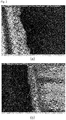
- pictures of Fig. 2 show a fracture surface 110 taken in the longitudinal direction and a fracture surface 120 taken in the transverse direction.
- (a) of Fig. 2 is a picture of the fracture surface 110, which wasphotographed while looking down the flooring material in a thickness direction after fracturing the flooring material in the longitudinal direction
- (b) is a picture of the fracture surface 120, which wasphotographed while looking down the flooring material in the thickness direction after fracturing the flooring material in the transverse direction
- Figs. 3(a) and 3(b) are views schematizing (a) and (b) of Fig. 2 , respectively.
- the fibers havean alignment means that the fibers are aligned in a certain direction,instead of meaning that all of the fibers are parallel to each other.
- the expression "the fibers havean alignmentin the longitudinal direction” may mean that the number of fibers per unit area of the fracture surface 120 in the transverse direction is greater than the number of fibers per unit area of the fracture surface 110 in the longitudinal direction.
- the flooring material of Fig. 1 contains the fibers, which are aligned in the longitudinal direction.
- the fibers havean alignment, it is possible to improve dimensional stability,heat resistance and durability of the flooring material. As a result, application range of the flooring materialcan be extended.
- the flooring material includes the plasticizerandthe fibers.
- the plasticizerandthe fibers There are two types of interaction between the plasticizerandthe fibers,that is, polarity-polarity interaction and polarity-nonpolarityinteraction.
- the plasticizerandthe fibers may have polarity.Polarity-polarity interaction is more effective in mixing and dispersionthan polarity-nonpolarityinteraction.
- polarity-polarity interaction between the fibers and the plasticizer allows the fibers to be more stably and uniformly dispersed in the flooring material, thereby improving durability of the flooring material.
- the flooring material may includeabout 20 parts by weight to about 30 parts by weight of the plasticizer based on 100 parts by weight of the thermoplastic resin. If the amount of the plasticizer is less than about 20 parts by weight, the flooring material requires a long processing time. If the amount of the plasticizer exceeds about 30 parts by weight, the flooring materialcan be deteriorated in tensile load.
- the flooring material may includeabout 0.1 parts by weight to about 10 parts by weight of the fibersbased on 100 parts by weight of the thermoplastic resin. If the amount of the fibersis less than about 0.1 parts by weight, it is difficult to improve heat resistance and tensile load of the flooring material. If the amount of the fibersexceeds about 10 parts by weight,the flooring material can be deteriorated in processability.
- the thermoplastic resin may include at least one selected from the group consisting ofpolyvinyl chloride (PVC), polyvinylidene chloride (PVDC), polyvinylidene fluoride (PVF), chlorinatedpolyvinyl chloride (CPVC), polyvinylalcohol (PVA), polyvinylacetate (PVAc), polyvinylbutyrate (PVB), polyethylene (PE), polypropylene (PP), and combinations thereof.
- PVC polyvinyl chloride
- PVDC polyvinylidene chloride
- PVF polyvinylidene fluoride
- CPVC chlorinatedpolyvinyl chloride
- PVA polyvinylalcohol
- PVAc polyvinylacetate
- PVbutyrate polyethylene
- PE polypropylene
- PP polypropylene
- the thermoplastic resin may bepolyvinyl chloride (PVC), or a resin whereinpolyvinyl chloride (PVC) andpolyvinylbutyrate (PVB) are mixed.
- PVC polyvinyl chloride
- PVC exhibitsexcellent processability and low heat resistance.
- the plasticizer is a liquid solvent of low volatility,facilitatesprocessing by softening the thermoplastic resin, and impartsflexibility to the flooring material.
- the plasticizer improves durability and dimensional stability of the flooring material at high temperature through good compatibility with the fibers.
- the plasticizer may include at least one selected from the group consisting of diisononylphthalate (DINP), dioctylphthalate (DOP), dioctyl terephthalate (DOTP)which isa non-phthalate compound, dioctyladipate (DOA), which is an aliphatic dibasic acid ester, and combinations thereof.
- DINP diisononylphthalate
- DOP dioctylphthalate
- DOTA dioctyl terephthalate
- DOA dioctyladipate
- the plasticizer may bedioctylphthalate (DOP) ordioctyl terephthalate (DOTP).
- DOP bedioctylphthalate
- Dioctyl terephthalate DOP
- the plasticizer has good polarity to improve dispersion of the polar fibers, thereby improving tensile load of the flooring materialwhilesecuringgood dimensional stability thereof.
- the at least one type of inorganic fibers may include glass fibers orceramic fibers.
- the inorganic fibers may beglass fibers and, in this case, the glass fibers may have a suitable diameter and length.
- the glass fibers have a suitable diameter and length, it is possible to improve dispersion of the plasticizer in manufacture of the flooring material,whereby the plasticizercan be uniformly dispersed inthe flooring material, thereby improving durabilityanddimensional stability.
- the inorganic fibers may have a diameter ofabout 2 ⁇ m to about 6 ⁇ m. If the diameter of the inorganic fibers is within this range, it is possible to improve dispersion of the plasticizer in manufacture of the flooring material, whereby the plasticizer can be uniformly dispersed throughout the flooring material, thereby improving durabilityanddimensional stability.
- the polar inorganic fibers may have a length of about 1 mmto about 3 mm. If the length of the inorganic fibers is within this range, it is possible to improve dispersion of the plasticizer in manufacture of the flooring material, whereby the plasticizer can be uniformly dispersed throughout the flooring material, thereby improving durability and dimensional stability.
- the at least one type of organic fibers may include at least one selected from the group consisting of aromatic polyamide fibers, nylon fibers, polypropylene (PP) fibers,and combinations thereof.
- the organic fibers may include aromatic polyamide fibers, that is, aramidfibers.
- the organic fibers include aramid fibers,dispersion stability of the polar plasticizercan be improved, and the flooring material have improved cost effectivephysical properties in terms of mechanical strength, the dimensional stability, and the like.
- the organic fibers may include aramidfibers, and, when aramid fibers are dispersed inthe polar plasticizer, such asdioctylphthalate (DOP) ordioctyl terephthalate (DOTP), dispersionis optimized since the aramidfibers have a similar specific gravity to that of the polar plasticizer, whereby the flooring material has excellent dimensional stability and durability.
- aramid fibers are dispersed inthe polar plasticizer, such asdioctylphthalate (DOP) ordioctyl terephthalate (DOTP)
- the organic fibers are added to the flooring materialto improve dimensional stability and physical propertiessuch as durability, and the like.
- the organic fibers may have a diameter of about 2 ⁇ m to about 20 ⁇ m. If the diameter of the polar organic fibers is less than about 2 ⁇ m, it is difficult to improve dimensional stability even though the flooring material includes the fibers. If the diameter of the polar organic fibers is longer than about 20 ⁇ m, the organic fibers cannot be uniformly dispersed in the plasticizer in manufacture of the flooring material, thereby deteriorating processability.
- the organic fibers may have a length of about 3 mmto about 50 mm. If the length of the organic fibers is less thanabout 3 mm, it is difficult to improvedimensional stability. If the length of the organic fibers is longer than about 50 mm, the organic fibers cannot be uniformly dispersed in the polar plasticizer and can be entangledin manufacture of the flooring material, thereby deteriorating durability and strength of the flooring material.
- the fibers may includeat least one type of organic fibers, orat least one type of inorganic fibers, or may includeamixture thereof.
- the fibers may includeat least one type of organic fibers.
- the flooring material may have good thermal stability at high temperature, and have improved dimensional stability and durability.
- the flooring material may further include fillers to improve product strength, heat resistance and durability while reducing manufacturing costs.
- the fillers may include at least one selected from the group consisting of calcium carbonate, talc, fly ash, blast-furnace slag, and combinations thereof.
- the fillers may have isotropy. In this case,particles having a proper size may be selectively used in consideration of both economic feasibility and improvement inphysical properties.
- the flooring material may include calcium carbonate as the fillersin terms of price and versatility.
- the flooring material containscalcium carbonate
- calcium carbonate improve heat resistance and durability, but also contributes to improvement in dimensional stability and tensile load of the flooring material that contains the thermoplastic resin and the fibers.
- the fillers may be present in an amount of about 100 parts by weightto about 600 parts by weight, for example, about 200 parts by weight to about 400 parts by weight, based on 100 parts by weight of the thermoplastic resin. If the amount of the fillers is within this range, the flooring material can exhibit good cost-effective processability.
- calcium carbonate may be present in amount of about 100 parts by weight to about 600 parts by weight based on 100 parts by weight of the thermoplastic resin.
- the calcium carbonate provides good cost-effective processability and is advantageous in terms of interaction with the fibers to improve dimensional stability of the flooring material.
- the flooring material may include at least one an additive selected from the group consisting of heat stabilizers, lubricants, processing aids, reinforcing agents, colorants, and combinations thereof, as needed.
- the flooring material may further include about 0.3 parts by weight to about 10 parts by weight of the additive based on 100 parts by weight of the thermoplastic resin. If the amount of the additive is within this range, the additive can provide advantages in terms of effects thereof and economic feasibility.
- the heat stabilizer serves to prevent the thermoplastic resin from being changed in original properties as the thermoplastic resin is decomposed and aged by oxygen in air, light, thermal energy, etc.
- the heat stabilizer may include at least one selected from the group consisting of Ba/Zn, Ca/Zn, Tin, leadstearic acid, and combinations thereof.
- the flooring material may include Ba/Zn-stearic acid as the heat stabilizer. In this case,the flooring materialcan have good viscosity and thermal stability.
- the flooring material may include lubricants such as stearic acidorrosin.In this case,the lubricants reduce temperature and time for processing the flooring material, while improving workability in manufacture of the flooring material.
- the processing aids are added to improve processability and formability of the flooring material, and may include, for example,methyl methacrylate(MMA). Methyl methacrylate may have aweight-average molecular weight of about 100,000 to about 3,000,000.
- MMA methyl methacrylate
- the processing aids may be used to achieve uniform mixing of components for the flooring materialwhileimproving mechanical and physical properties of the flooring material.
- the reinforcing agent improves mechanical strength of the flooring material, and may representatively include at least one selected from the group consisting of transparent methyl methacrylate-butadiene-styrene (MBS), opaquemethyl methacrylate-butadiene-styrene (MBS), acrylonitrile-butadiene-styrene (ABS), and combinations thereof.
- the flooring material may include opaque methyl methacrylate-butadiene-styrene (MBS) as the reinforcing agent, which advantageouslyimprovesimpact strength of the flooring material.
- Thecolorants refer to dyes or pigments that are added to impart color in order to improve aesthetic appearance and practical effectsas needed.
- the flooring material may include various dyes or pigments, and a mixture thereof as needed.
- the flooring material may have a thickness from about 2 mmto about 7 mm, for example,from about 2 mmto about 4 mm.
- a conventional flooring material is manufactured by stacking a separate scrim or the like, or is relatively thickly manufactured so as to have proper strength and durability, thereby causingincrease in manufacturing costs,deterioration in processability and mobility, and the like.
- the flooring materialaccording to the present invention includes a plasticizerandfibers,which havean alignment, thereby achieving good resistance, durability, and dimensional stability even within the aforementioned thickness range, and enabling application not only to adhesive type flooring materialsusing adhesives or the like, but also to non-adhesive type flooring materialsusing fastening members or the like.
- the flooring material may have a thickness of about 2 mmto about 3 mm, and has good tensile strength and dimensional stability due to the composition thereof, thereby enabling applicationnot only to adhesive type flooring materials but also tonon-adhesive type flooring materials within the aforementioned thickness range, while improving processability.
- amethod for manufacturing a flooring material includes: preparing a first mixture by mixing a liquid plasticizer with fibers comprisingat least one type of inorganic fibers or at least one type of organic fibers; preparing a second mixture in which the fibers are dispersed in the liquid plasticizer by agitating the first mixture; preparing a third mixture by mixing the second mixture with a thermoplastic resin; and forming a floor material through thermo-compression of the third mixture.
- a conventional flooring material is prevented from contraction by manufacturing and stacking a separate sheet or scrim on a thermoplastic resinlayer.
- the sheetorscrim may be formed of, for example,glass fibers or the like. In this case, the manufacturing process requires a separatelaminating machine, thereby increasing manufacturing costs and defect rate.
- the method for manufacturing a flooring material secures dimensional stability by mixing the flooring material with the fibers without any separate laminating process, and may include preparing a first mixture and preparing a second mixture.
- the method includes preparing the first mixture by mixing the liquid plasticizer with the fibers, and preparing the second mixture by agitating the first mixture to disperse the fibersinthe liquid plasticizer.
- the fibers are first mixed and dispersed inthe liquid plasticizer, whereby the fibers can be uniformly dispersed in the flooring material without any separate laminatingprocess, thereby reducing manufacturing costs and process defect rate while improving durability and dimensional stability of the flooring material.
- the liquid plasticizerandthe fibers may have polarity.
- polarity-polarity interaction is more effective in mixture and dispersion than polarity-nonpolarity interaction.
- polarity-polarity interaction allows the fibers to be more stably and uniformly dispersed in the flooring material, thereby improving durability and dimensional stability of the flooring material.
- the flooring material when the polar fibers are dispersed in the polar plasticizer, it is more effective than the case where the nonpolar fibers are dispersed in the polarplasticizer,the flooring materialcan provide excellent processability and have improved physical properties in terms of durability, heat resistance, and the like.
- the plasticizer having polarity may include dioctylphthalate (DOP)ordioctyl terephthalate (DOTP), and the fibers mixed there with may include glass fibers oraramidfibers.In this case, a good dispersioneffect can be achieved.
- the inorganic fibers and the organic fibers satisfy the aforementioned diameter and length ranges, it is possible to further improve dispersion of the liquid plasticizerin preparation of the second mixture. As aresult, it is possible to improve durability and dimensional stability of the flooring material.
- the method for manufacturing a flooring material includes preparing the first mixture,andpreparing the second mixture, whereby the fibers can be first mixed with and dispersed inthe liquid plasticizer.
- the fibers can be uniformly disposed throughout the flooring material without any separate cutting process, thereby reducing manufacturing cost and time while achieving good durability and dimensional stability of the flooring material.
- the fibers may be placedin bulk or roll formin the liquid plasticizer. Then, the fibers are preferentially mixed with and dispersed in the liquid plasticizer by operation of preparing the second mixture,whereby the fiberscan be uniformly dispersedin the final flooring materialwhile improving durabilityanddimensional stability of the flooring material.
- the term "bulk or roll form” means that inorganic ororganic fibers having a predetermined length are aggregatedto have a bulky or long string shape of a predetermined size.Although the inorganic fibers andthe organic fibers are placed in bulk and roll form without any separate process, they can be uniformly dispersed throughout the flooring material, thereby simplifying manufacturing process while reducing manufacturing cost and time.
- the method for manufacturing the flooring material includes preparing the second mixture, in which the first mixture is agitated to disperse the fibersin the liquid plasticizer.
- the first mixture may be agitated at a speed ofabout 5 rpm to about 100 rpm. If the rate is slower than about 5 rpm, the inorganic fibers orthe organic fibers are not sufficiently dispersed inthe liquid plasticizer. On the other hand, if the rate is faster than about 100 rpm, the fibers can bedamaged during the manufacturing process, thereby making it difficult to improve strength and dimensional stability of the flooring material.
- the fibers when the first mixture is agitated,at least one type of inorganic fibers orat least one type of organic fibers may be swollen inthe liquid plasticizer and thus not well agitated. In this case, when the fibers are immersed in the liquid plasticizer for about 5 minutes or more and then agitated, the fibers can be uniformly dispersed within the agitating speed range.
- the method may further include preparing a third mixture by mixing the second mixture with the thermoplastic resin.
- the thermoplastic resin is mixed with the second mixturein which the fibers are mixed with and dispersed in the liquid plasticizer, thereby preparing the third mixture.Thus, in the third mixture,the fibers are uniformly dispersed, whereby the flooring material can exhibit good durability and heat resistance.
- the third mixture may further include fillers to improve heat resistance and durability of the flooring material while reducing manufacturing costs.
- the fillers are the same as mentioned above.
- the third mixture may include at least one additive selected from the group consisting of heat stabilizers, lubricants, processing aids, reinforcing agents, colorants, and combinations thereof, as needed. Details of the additives and the kind thereof are the same as described above.
- the method for manufacturing the flooring material may include forming the flooring material through thermo-compression of the third mixture.
- the operation of forming the flooring material through thermo-compression of the third mixture may include thermo-compressingthe fibers to havean alignment.
- Thermo-compression may be performed by pressing orcalendering. For thermocompression,calendering makes it easy to align the fibers in a certain direction and is advantageous for mass production of the flooring material.
- a withdrawal direction of the flooring material may be defined as the longitudinal direction and a direction perpendicular to the withdrawal direction may be defined as the transverse direction.
- the flooring material may be subjected to thermo-compression to be aligned in the longitudinal direction.
- thermo-compression it is possible to effectively improve dimensional stability and heat resistance of the flooring material in the longitudinal direction.
- the flooring material includes the plasticizer; the fibers comprisingat least one type of inorganic fibersorat least one type of organic fibers; andthe thermoplastic resin, in which the fibers havean alignment so as to improveheat resistance and dimensional stability, thereby allowing various applications toadhesive and non-adhesive type flooring materials.
- the flooring material manufactured by the method according to this embodiment has a decreasedprocess defect rate, reduces manufacturing costs, and shortens manufacturing time.
- the flooring material manufactured by the method according to this embodiment has excellent dispersioneffects that further improve durability and dimensional stability.
- Aliquid plasticizer (NEO-T, Aekyung) was prepared and mixed with fibers comprisingaramid fibers (Kevlar, DuPont) in bulky form having a diameter of 10 ⁇ m and a length of 5 mm, thereby preparing a first mixture. Then, the first mixture was agitated for 10 minutes at a speed of 10 rpm to 50 rpm, thereby preparing a second mixture. Then, a PVC resin (LS100, LG Chemistry), calcium carbonate, and other additives were added to the second mixture, thereby preparing a third mixture. Then,the third mixture was thermo-compressed at 180°C by calendering for 5 minutes, thereby manufacturing a flooring material.
- the fibers werepresent in an amount of 0.5 parts by weight based on 100 parts by weight of the PVC resin, and were alignedin the withdrawal direction of the flooring material.
- a flooring material was manufactured in the same manner as in Example 1 except that fibers containedaramid fibers having a diameter of 10 ⁇ m and a length of 10 mm in bulky form.
- a flooring material was manufactured in the same manner as in Example 1 except that fibers containedaramid fibers (Kevlar, DuPont) having a diameter of 10 ⁇ m and a length of 5 mm in bulky form, and glass fibers having a diameter of 5 ⁇ m anda length of 3 mm in bulky form, in which a weight ratio of the aramid fibers to the glass fibers was75:25.
- aramid fibers Kevlar, DuPont
- a flooring material was manufactured in the same manner as in Example 1 except that the third mixturedidnot includecalcium carbonate.
- a flooring material was manufactured in the same manner as in Example2 except thatthe third mixturedidnot include calcium carbonate.
- a PVC resin (LS100, LG Chemistry) was prepared and mixed with aramid fibers having a diameter of 10 ⁇ m and a length of 10 mmin bulky form. Then, aplasticizer(NEO-T, Aekyung), calcium carbonate, and other additives were added to and mixed with the PVC resin.Thereafter, thermo-compressing was performed at 180°C for 5 minutes, thereby manufacturing a flooring material in which the aramidfibers are aligned in a withdrawal direction of the flooring material.
- a flooring material was manufactured in the same manner as in Examplel 1 except that the third mixturedidnot includefibers and includes a PVC resin (LS100 LG Chemistry), aliquid plasticizer(NEO-T, Aekyung), calcium carbonate, and other additives.
- the third mixture didnot includefibers and includes a PVC resin (LS100 LG Chemistry), aliquid plasticizer(NEO-T, Aekyung), calcium carbonate, and other additives.
- a flooring material was manufactured in the same manner as inExample2 except that the third mixturedidnot includecalcium carbonate.
- Glass fiber scrim was prepared in a mesh form having a diameter of 14 ⁇ m and a hole interval of 4 mm.A composition including a PVC resin (LS100, LG Chemistry), aliquid plasticizer(NEO-T), calcium carbonate, and other additives was melt and thermo-compressed at 180°C for 5 minutes, thereby manufacturing a sheet.Then, the glass fiber scrimwas attached to one side of the sheet, thereby manufacturing a flooring material having a laminated structure.
- PVC resin LS100, LG Chemistry
- NEO-T liquid plasticizer
- the flooring materials prepared in Examples and Comparative Examples were cut to a size of 20 mmx150 mm x 2 mm (widthxlengthxheight), and tensile load of each specimen was measured at a tensile speed of 200 mm/minusing a tensile tester (M350-5kN, Testometric).
- a withdrawal direction of the flooring material was defined as alongitudinal direction, and the direction perpendicular thereto was defined as a transverse direction.
- the longitudinal direction as the length and the transverse direction as the width
- specimensof the flooring materials each having a size of 225 mmx 225 mmx 2 mm (width x lengthx height) were prepared.
- Example 1 The components of Examples and Comparative Examples, and tensile load and dimensional change rate are shown in Table 1.
- Table 1 Dimensional change rate Aramid fibers Glass fibers Calcium carbonate Tensiles load(kgf) (%) Longitudinal direction Transverse direction
- Example 1 ⁇ (length 5 mm) - ⁇ 38.69 -0.01 -0.04
- Example 2 ⁇ (length 10 mm) - ⁇ 41.99 -0.06 -0.07
- Example 3 ⁇ (length 5 mm) ⁇ (length 3 mm) ⁇ 42.01 -0.07 -0.08
- Example 4 ⁇ (length 5 mm) - - - -0.31 -0.32
- Example 5 ⁇ (length 10 mm) - - - -0.31 -0.21
- Example 6 ⁇ (length 10 mm) - ⁇ 39.11 -0.07 -0.08 Comparative Examples 1 - - ⁇ 36.31 -0.13 -0.08 Comparative
- the flooring materials of Examples 1 to 3 were manufactured by the method according to the invention and includedthe organic fibers orthe inorganic fibers, whereas the flooring material of the Comparative Examples 1 did not include the organic fibers orthe inorganic fibers.As such, these flooring materialshad different components and were manufactured by different methods.
- the flooring materials of Examples 1 to 3 had a tensile load from about 38 kgf to about 42 kgf, whereas the flooring material of the Comparative Examples 1 has a tensile load of 36.31 kgf. Therefore, it could be seen thatthe flooring materials of Examples 1 to 3had increased tensile load and good durability by including the organic fibers or the inorganic fibers.
- the flooring materials of Examples 4 and 5 were manufactured by the method according to the invention and included the organic fibers orthe inorganic fibers,whereas the flooring materials of Comparative Example 2 did not include the organic fibers or the inorganic fibers.As such, these flooring materials had different components and were manufactured by different methods. All of absolute values of the dimensional change rates in the longitudinal direction and the transverse direction in the flooring materials of Examples 4 and 5were in the range of 0.20 to 0.35, whereas the absolute value of the dimensional change rate in flooring materials of Comparative Example 2was 0.85 or more.Therefore, it can be seen thatthe flooring materials of Examples 4 and 5hadfurther improved dimensional stability than that of Comparative Example 2.
- the flooring materials of Examples 1 to 3 were manufactured by the method according to the invention and included the organic fibers or the inorganic fibers uniformly dispersed in the flooring material without any separate laminationprocess.
- the flooring material of Comparative Example 3 wasmanufactured by preparing a glass fiber scrimthrough a separate laminationprocess and attaching the scrim to the sheet including PVC.Thus,the flooring material of Comparative Example 3 was manufactured by a different method than Examples 1 to 3.
- all of absolute values of the dimensional change rates of Examples 1 to 3inthe longitudinal direction and the transverse direction were 0.1 or less, whereas the absolute value of the dimensional change rate of the Comparative Example 3was higher than 0.1, particularly, in the longitudinal direction. Therefore, it can be seen thatthe flooring materials of Examples 1 to 3had better dimensional stability than that of Comparative Example 3.
- the flooring material of the Example 3 was manufactured without any separate lamination process, thereby reducing manufacturing cost and time and a process defect rate as compared with Comparative Example 3.
- the flooring material of Example 2 was manufactured by the method according to the invention, i.e. by primarily dispersing the organic fibers having a bulky form in the plasticizer such that the fibers could be uniformly dispersed in the flooring material.
- the flooring material of Example 6 was manufactured by cutting the organic fibers having the same physical properties as that of Example 2 and then directly mixing the fibers with PVC. Accordingly, these flooring materialswere manufactured by different methods.
- Example 2 had a tensile load of 41.99 kgf, whereas the flooring material of Example 6 has a tensile load of 39.11 kgf.
- the tensile load of Example 2 is about 10% higher than that of Example 6.
- Example 6 had a lower tensile load smaller than that of Example 2, the flooring material of Example 6exhibitedhighertensile load than that of Comparative Example 1, which did not include anyfibers.
- the absolute values of the dimensional change rates in the longitudinal direction and the transverse direction of the flooring material of Example 2 were 0.06 and 0.07, respectively, and the absolute values of Example 6 were 0.07 and 0.08, respectively. Accordingly, it can be seen that the flooring material of Example 2 had better dimensional stability than that of Example 6.
- Example 6 had lower dimensional stability than that of Example 2, the flooring material of Example 6 hadalower dimensional change rate than those of Comparative Examples 1 and 2 and had higher dimensional stability than those of Comparative Examples 1 and 2 that did not include any fibers,according to the dimensional change rate, particularly,in the longitudinal direction.
- the flooring material of Example 6 included the fibersdispersed inthe flooring material, whereas the flooring material of Comparative Example 3 included the scrimseparately manufactured and laminated.
- these flooring materials had different components and the flooring material of Example 6 had better dimensional stability than that of the Comparative Example 3.
- the flooring materialaccording to the invention exhibits excellent properties in terms of heat resistance and dimensional stability, and has good strength suitable for application to adhesive type or non-adhesive typeflooring materials.
- the method according to the present invention improves dimensional stability of the flooring material.
Landscapes
- Chemical & Material Sciences (AREA)
- Health & Medical Sciences (AREA)
- Chemical Kinetics & Catalysis (AREA)
- Medicinal Chemistry (AREA)
- Polymers & Plastics (AREA)
- Organic Chemistry (AREA)
- Engineering & Computer Science (AREA)
- Architecture (AREA)
- Civil Engineering (AREA)
- Structural Engineering (AREA)
- Manufacturing & Machinery (AREA)
- Materials Engineering (AREA)
- Compositions Of Macromolecular Compounds (AREA)
- Floor Finish (AREA)
Abstract
Description
- The present invention relates to a flooring material and a method for manufacturing the same.
- Flooring materials based on thermoplasticresins such as polyvinyl chloride (PVC) have been used for buildings, such as houses, offices, and the like. Flooring materialsformed ofpolyvinyl chloridehave low heat resistance and thus can suffer from severe contractionwhen heated, for example, when used with an under-floor heating system. To prevent this problem, in general, a glass fibers sheet or glass fiber scrimmay be separately prepared and stacked thereon, or additives for preventing contraction may beadded thereto. Recently,to achieve widespread application of thermoplastic resinshaving goodprocessability, various attempts have been made to prevent contractionof the thermoplastic resinswhile securing economic feasibility and improving mechanical properties.
- It is an aspect of the present invention to provide a flooring material which exhibitsexcellent heat resistance and dimensional stability, has good strength and is applicable to various fields.
- It is another aspect of the present invention to provide a method for manufacturing a flooring material, which can reducea process defect rate, manufacturing costs, and processing time.
- In accordance with one aspect of the present invention, a flooring material includes: a plasticizer; fibers comprisingat least one type of inorganic fibers or at least one type of organic fibers; and a thermoplastic resin,wherein the fibers havean alignment.
- The plasticizer and the fibers may have polarity.
- The plasticizer may be present in an amount of 20 parts by weight to 30 parts by weightbased on 100 parts by weight of the thermoplastic resin.
- The fibers may be present in an amount of 0.1. parts by weight to 10 parts by weightbased on 100 parts by weight of the thermoplastic resin.
- The thermoplastic resin may include at least one selected from the group consisting of polyvinyl chloride (PVC), polyvinylidene chloride (PVDC), polyvinylidene fluoride (PVF), chlorinated polyvinyl chloride (CPVC), polyvinyl alcohol (PVA), polyvinyl acetate (PVAc), polyvinyl butyrate (PVB), polyethylene (PE), polypropylene (PP), and combinations thereof.
- The plasticizer may includeat least one selected from the group consisting of diisononylphthalate (DINP), dioctyl terephthalate (DOTP), dioctylphthalate (DOP), dioctyladipate (DOA), and combinations thereof.
- The inorganic fibers may include glass fibers or ceramic fibers.
- The inorganic fibers may have a diameter of about 2µm to about 6µm.
- The inorganic fibers may have a length of about 1mm to about 3mm.
- The organic fibers may includeat least one selected from the group consisting of aromatic polyamide fibers, nylon fibers, polypropylene (PP) fibers, and combinations thereof.
- The organic fibers may havea diameter of about 2 µm to about 20 µm.
- The organic fibers may havea length of about 3 mm to about 50 mm.
- The flooring material may further comprise fillers.
- The fillersmay be present in an amount of about 100 parts by weight to about 600 parts by weightbased on 100 parts by weight of thethermoplastic resin.
- The fillers may includeat least one selected from the group consisting of calcium carbonate, talc, fly ash, blast-furnace slag, and combinations thereof.
- The flooring material may have a thickness of about 2 mm to about 7 mm.
- In accordance with one aspect of the present invention, amethod for manufacturing a flooring material includes:preparing a first mixture by mixing a liquid plasticizer with fibers comprisingat least one type of inorganic fibers or at least one type of organic fibers;preparing a second mixture in which the fibers are dispersed in the liquid plasticizer by agitating the first mixture; preparing a third mixture by mixing the second mixture with a thermoplastic resin; andforming a floor material through thermo-compression of the third mixture.
- The liquid plasticizer and the fibers mayhave polarity
- The first mixture may be agitated at a speed ofabout 5 rpm to about 100 rpm.
- Thermo-compression of the third mixture may be performed such thatthe fibers havean alignment
- According to the present invention, the flooring material has good strength, exhibits excellent properties in terms of heat resistance and dimensional stability, and may beused in various ways as adhesive or non-adhesive type flooring materials.
- According to the present invention, the method for manufacturingaflooring material mayreduce a process defect rate, manufacturing costs, and processing time, while improving dimensional stability of the flooring material.
-
-
Fig. 1 schematically shows a flooring material according to one embodiment of the present invention. -
Fig. 2(a) is a picture showing a fracture surface of the flooring material taken ina longitudinal direction. -
Fig. 2(b) is a picture showing a fracture surface of the flooring material taken in a transverse direction. -
Fig. 3(a) is a view schematizing (a) ofFig. 2 . -
Fig. 3(b) is a view schematizing (b) ofFig. 2 . - Hereinafter, embodiments of the present invention will be described in detail such that the embodiments can be easily realized by a person having ordinary knowledge in the art. However, it should be understood that the following embodiments are provided for illustration only and are not to be construed in any way as limiting the present invention. The scope of the present invention is defined only by the claims.
- One embodiment of the invention provides a flooring material that includes a plasticizer; fibers comprisingat least one type of inorganic fibers or at least one type of organic fibers; and a thermoplastic resin, whereinthe fibers havean alignment.
- Flooring materials are generally manufactured using a thermoplastic resin having excellent processability. However, most thermoplastic resins havelow heat resistanceand are likely to suffer from signification contraction when heated, for example, when used with an under-floor heating system, thereby limiting utilization of the flooring materials. To prevent this problem, a large amount of additive for preventing contraction is generally added. However, this method is inefficient due to deterioration in workability and tensile load.In another method,a separate sheet or scrim is prepared and stacked on one side of the flooring material to prevent contraction. The sheet or scrim may be formed of, for example, glass fibers or the like. In this case, the manufacturing process requires a separate laminating machine, thereby increasing manufacturing costs and causing a high defect rate.
- In order to prevent contraction without a separate laminationprocess, one embodiment of the present invention provides a flooring material that includes a plasticizer; fibers comprisingat least one type of inorganic fibers or at least one type of organic fibers; and a thermoplastic resin, in which the fibers havean alignment.
-
Fig. 1 schematically shows a flooring material according to one embodiment of the present invention, which is fracturedto a predetermined size. - Referring to
Fig. 1 , in the flooring materialcut to a predetermined size,onedirection of the flooring material may be defined as a longitudinal direction and a direction perpendicular to the longitudinal direction may be defined as a transverse direction. Here,Fig. 1 schematically shows the flooring material as one example of the present invention, in which the fibers havean alignment in the longitudinal direction. - With regard to the flooring material shown in
Fig. 1 , pictures ofFig. 2 show afracture surface 110 taken in the longitudinal direction and afracture surface 120 taken in the transverse direction. Specifically, (a) ofFig. 2 is a picture of thefracture surface 110, which wasphotographed while looking down the flooring material in a thickness direction after fracturing the flooring material in the longitudinal direction and (b) is a picture of thefracture surface 120, which wasphotographed while looking down the flooring material in the thickness direction after fracturing the flooring material in the transverse direction -
Figs. 3(a) and 3(b) are views schematizing (a) and (b) ofFig. 2 , respectively. - The expression "the fibers havean alignment"means that the fibers are aligned in a certain direction,instead of meaning that all of the fibers are parallel to each other.
- In addition,referring to
Figs. 1 to 3 , the expression "the fibers havean alignmentin the longitudinal direction" may mean that the number of fibers per unit area of thefracture surface 120 in the transverse direction is greater than the number of fibers per unit area of thefracture surface 110 in the longitudinal direction. - Referring to
Figs. 1 to 3 , since the fibers ofFig. 1 are aligned in the longitudinal direction, the fibers do not protrude from thefracture surface 110 in the longitudinal direction, as shown inFig. 2(a) . - Since the fibers are aligned inthe longitudinal direction, cut ends of the fibersprotrude from the
fracture surface 120 in the transverse direction. That is, it can be seen thatthe fibersprotrude from thefracture surface 120 in the transverse direction, unlike the fibers shown inFig. 2(a) . - That is,from difference in shape of the fracture surface between (a) and (b) of
Fig. 2 , it can be seen that the flooring material ofFig. 1 contains the fibers, which are aligned in the longitudinal direction. - As such, since the fibers havean alignment, it is possible to improve dimensional stability,heat resistance and durability of the flooring material. As a result, application range of the flooring materialcan be extended.
- The flooring material includes the plasticizerandthe fibers. There are two types of interaction between the plasticizerandthe fibers,that is, polarity-polarity interaction and polarity-nonpolarityinteraction.
- Specifically,the plasticizerandthe fibers may have polarity.Polarity-polarity interaction is more effective in mixing and dispersionthan polarity-nonpolarityinteraction. For example, when the flooring material contains polar fibers and a polar plasticizer, polarity-polarity interaction between the fibers and the plasticizer allows the fibers to be more stably and uniformly dispersed in the flooring material, thereby improving durability of the flooring material.
- Specifically,the flooring material may includeabout 20 parts by weight to about 30 parts by weight of the plasticizer based on 100 parts by weight of the thermoplastic resin. If the amount of the plasticizer is less than about 20 parts by weight, the flooring material requires a long processing time. If the amount of the plasticizer exceeds about 30 parts by weight, the flooring materialcan be deteriorated in tensile load.
- In addition,the flooring materialmay includeabout 0.1 parts by weight to about 10 parts by weight of the fibersbased on 100 parts by weight of the thermoplastic resin. If the amount of the fibersis less than about 0.1 parts by weight, it is difficult to improve heat resistance and tensile load of the flooring material. If the amount of the fibersexceeds about 10 parts by weight,the flooring material can be deteriorated in processability.
- The thermoplastic resin may include at least one selected from the group consisting ofpolyvinyl chloride (PVC), polyvinylidene chloride (PVDC), polyvinylidene fluoride (PVF), chlorinatedpolyvinyl chloride (CPVC), polyvinylalcohol (PVA), polyvinylacetate (PVAc), polyvinylbutyrate (PVB), polyethylene (PE), polypropylene (PP), and combinations thereof.
- Specifically,the thermoplastic resin may bepolyvinyl chloride (PVC), or a resin whereinpolyvinyl chloride (PVC) andpolyvinylbutyrate (PVB) are mixed. Polyvinyl chloride (PVC) exhibitsexcellent processability and low heat resistance. Thus, when PVCis contained inthe thermoplastic resin of the flooring material, dimensional stability of the flooring material can beoptimally improved, and when PVCis contained together with the plasticizerandthe fibers,the flooring material has improved tensile load and impact strength.
- The plasticizer is a liquid solvent of low volatility,facilitatesprocessing by softening the thermoplastic resin, and impartsflexibility to the flooring material.In addition,the plasticizer improves durability and dimensional stability of the flooring material at high temperature through good compatibility with the fibers.
- Specifically,the plasticizer may include at least one selected from the group consisting of diisononylphthalate (DINP), dioctylphthalate (DOP), dioctyl terephthalate (DOTP)which isa non-phthalate compound, dioctyladipate (DOA), which is an aliphatic dibasic acid ester, and combinations thereof.
- For example,the plasticizer may bedioctylphthalate (DOP) ordioctyl terephthalate (DOTP).In this case,the plasticizer has good polarity to improve dispersion of the polar fibers, thereby improving tensile load of the flooring materialwhilesecuringgood dimensional stability thereof.
- The at least one type of inorganic fibers may include glass fibers orceramic fibers.Specifically,the inorganic fibers may beglass fibers and, in this case, the glass fibers may have a suitable diameter and length. When the glass fibers have a suitable diameter and length, it is possible to improve dispersion of the plasticizer in manufacture of the flooring material,whereby the plasticizercan be uniformly dispersed inthe flooring material, thereby improving durabilityanddimensional stability.
- Specifically,the inorganic fibers may have a diameter ofabout 2 µm to about 6 µm. If the diameter of the inorganic fibers is within this range, it is possible to improve dispersion of the plasticizer in manufacture of the flooring material, whereby the plasticizer can be uniformly dispersed throughout the flooring material, thereby improving durabilityanddimensional stability.
- In addition,the polar inorganic fibers may have a length of about 1 mmto about 3 mm. If the length of the inorganic fibers is within this range, it is possible to improve dispersion of the plasticizer in manufacture of the flooring material, whereby the plasticizer can be uniformly dispersed throughout the flooring material, thereby improving durability and dimensional stability.
- The at least one type of organic fibers may include at least one selected from the group consisting of aromatic polyamide fibers, nylon fibers, polypropylene (PP) fibers,and combinations thereof. Specifically,the organic fibers may include aromatic polyamide fibers, that is, aramidfibers.
- If the organic fibers include aramid fibers,dispersion stability of the polar plasticizercan be improved, and the flooring material have improved cost effectivephysical properties in terms of mechanical strength, the dimensional stability, and the like.
- More specifically,the organic fibers may include aramidfibers, and, when aramid fibers are dispersed inthe polar plasticizer, such asdioctylphthalate (DOP) ordioctyl terephthalate (DOTP), dispersionis optimized since the aramidfibers have a similar specific gravity to that of the polar plasticizer, whereby the flooring material has excellent dimensional stability and durability.
- The organic fibers are added to the flooring materialto improve dimensional stability and physical propertiessuch as durability, and the like. The organic fibers may have a diameter of about 2µm to about 20 µm. If the diameter of the polar organic fibers is less than about 2µm, it is difficult to improve dimensional stability even though the flooring material includes the fibers. If the diameter of the polar organic fibers is longer than about 20µm, the organic fibers cannot be uniformly dispersed in the plasticizer in manufacture of the flooring material, thereby deteriorating processability.
- In addition,the organic fibers may have a length of about 3 mmto about 50 mm. If the length of the organic fibers is less thanabout 3 mm, it is difficult to improvedimensional stability. If the length of the organic fibers is longer than about 50 mm, the organic fibers cannot be uniformly dispersed in the polar plasticizer and can be entangledin manufacture of the flooring material, thereby deteriorating durability and strength of the flooring material.
- The fibersmay includeat least one type of organic fibers, orat least one type of inorganic fibers, or may includeamixture thereof. Specifically, the fibersmay includeat least one type of organic fibers.For example,whenthe fibers includearamidfibers,the flooring material may have good thermal stability at high temperature, and have improved dimensional stability and durability.
- The flooring material may further include fillers to improve product strength, heat resistance and durability while reducing manufacturing costs.The fillers may include at least one selected from the group consisting of calcium carbonate, talc, fly ash, blast-furnace slag, and combinations thereof.The fillers may have isotropy. In this case,particles having a proper size may be selectively used in consideration of both economic feasibility and improvement inphysical properties. Specifically,the flooring material may include calcium carbonate as the fillersin terms of price and versatility.
- In addition,whenthe flooring material containscalcium carbonate, not only does calcium carbonate improve heat resistance and durability, but also contributes to improvement in dimensional stability and tensile load of the flooring material that contains the thermoplastic resin and the fibers.
- When the flooring material includes the fillers,the fillers may be present in an amount of about 100 parts by weightto about 600 parts by weight, for example, about 200 parts by weight to about 400 parts by weight, based on 100 parts by weight of the thermoplastic resin.If the amount of the fillers is within this range, the flooring material can exhibit good cost-effective processability.
- For example,in the flooring material, calcium carbonate may be present in amount of about 100 parts by weight to about 600 parts by weight based on 100 parts by weight of the thermoplastic resin. In this case,the calcium carbonateprovides good cost-effective processability and is advantageous in terms of interaction with the fibers to improve dimensional stability of the flooring material.
- The flooring material may include at least one an additive selected from the group consisting of heat stabilizers, lubricants, processing aids, reinforcing agents, colorants, and combinations thereof, as needed.
- The flooring material may further include about 0.3 parts by weight to about 10 parts by weight of the additive based on 100 parts by weight of the thermoplastic resin. If the amount of the additive is within this range, the additive can provide advantages in terms of effects thereof and economic feasibility.
- Specifically,the heat stabilizer serves to prevent the thermoplastic resin from being changed in original properties as the thermoplastic resin is decomposed and aged by oxygen in air, light, thermal energy, etc. Specifically, the heat stabilizer may include at least one selected from the group consisting of Ba/Zn, Ca/Zn, Tin, leadstearic acid, and combinations thereof.For example,the flooring material may include Ba/Zn-stearic acid as the heat stabilizer. In this case,the flooring materialcan have good viscosity and thermal stability.
- The lubricantfacilitates flow of the thermoplastic resin and mold separation upon processing of the thermoplastic resin. Specifically,the flooring material may include lubricants such as stearic acidorrosin.In this case,the lubricants reduce temperature and time for processing the flooring material, while improving workability in manufacture of the flooring material.
- The processing aids are added to improve processability and formability of the flooring material, and may include, for example,methyl methacrylate(MMA). Methyl methacrylate may have aweight-average molecular weight of about 100,000 to about 3,000,000. When the flooring material includes the processing aids, it is possible to shorten melting time in a manufacturing process and to improve melting strength.In addition,the processing aids may be used to achieve uniform mixing of components for the flooring materialwhileimproving mechanical and physical properties of the flooring material.
- The reinforcing agent improves mechanical strength of the flooring material, and may representatively include at least one selected from the group consisting of transparent methyl methacrylate-butadiene-styrene (MBS), opaquemethyl methacrylate-butadiene-styrene (MBS), acrylonitrile-butadiene-styrene (ABS), and combinations thereof.For example,the flooring material may include opaque methyl methacrylate-butadiene-styrene (MBS) as the reinforcing agent, which advantageouslyimprovesimpact strength of the flooring material.
- Thecolorants refer to dyes or pigments that are added to impart color in order to improve aesthetic appearance and practical effectsas needed. The flooring material may include various dyes or pigments, and a mixture thereof as needed. The flooring material may have a thickness from about 2 mmto about 7 mm, for example,from about 2 mmto about 4 mm.A conventional flooring material is manufactured by stacking a separate scrim or the like, or is relatively thickly manufactured so as to have proper strength and durability, thereby causingincrease in manufacturing costs,deterioration in processability and mobility, and the like.Conversely, the flooring materialaccording to the present invention includes a plasticizerandfibers,which havean alignment, thereby achieving good resistance, durability, and dimensional stability even within the aforementioned thickness range, and enabling application not only to adhesive type flooring materialsusing adhesives or the like, but also to non-adhesive type flooring materialsusing fastening members or the like.
- For example,the flooring materialmay have a thickness of about 2 mmto about 3 mm, and has good tensile strength and dimensional stability due to the composition thereof, thereby enabling applicationnot only to adhesive type flooring materials but also tonon-adhesive type flooring materials within the aforementioned thickness range, while improving processability.
- According to another embodiment, amethod for manufacturing a flooring material includes: preparing a first mixture by mixing a liquid plasticizer with fibers comprisingat least one type of inorganic fibers or at least one type of organic fibers; preparing a second mixture in which the fibers are dispersed in the liquid plasticizer by agitating the first mixture; preparing a third mixture by mixing the second mixture with a thermoplastic resin; and forming a floor material through thermo-compression of the third mixture.
- A conventional flooring material is prevented from contraction by manufacturing and stacking a separate sheet or scrim on a thermoplastic resinlayer.The sheetorscrim may be formed of, for example,glass fibers or the like. In this case, the manufacturing process requires a separatelaminating machine, thereby increasing manufacturing costs and defect rate.
- Thus, the method for manufacturing a flooring material according to the embodiment secures dimensional stability by mixing the flooring material with the fibers without any separate laminating process, and may include preparing a first mixture and preparing a second mixture. Specifically,the method includes preparing the first mixture by mixing the liquid plasticizer with the fibers, and preparing the second mixture by agitating the first mixture to disperse the fibersinthe liquid plasticizer.
- In this way, the fibers are first mixed and dispersed inthe liquid plasticizer, whereby the fibers can be uniformly dispersed in the flooring material without any separate laminatingprocess, thereby reducing manufacturing costs and process defect rate while improving durability and dimensional stability of the flooring material.
- In the method for manufacturing a flooring material, the liquid plasticizerandthe fibers may have polarity. As described above, there may be two types of interaction between the plasticizer and the fibers,namely, polarity-polarity interaction and polarity-nonpolarity interaction. Polarity-polarity interaction is more effective in mixture and dispersion than polarity-nonpolarity interaction. Thus, when the polar fibers are dispersed in the polar plasticizer, polarity-polarity interaction allows the fibers to be more stably and uniformly dispersed in the flooring material, thereby improving durability and dimensional stability of the flooring material.
- Specifically, when the polar fibers are dispersed in the polar plasticizer, it is more effective than the case where the nonpolar fibers are dispersed in the polarplasticizer,the flooring materialcan provide excellent processability and have improved physical properties in terms of durability, heat resistance, and the like.
- For example,the plasticizer having polarity may include dioctylphthalate (DOP)ordioctyl terephthalate (DOTP), and the fibers mixed there with may include glass fibers oraramidfibers.In this case,a good dispersioneffect can be achieved.
- In addition,whenthe inorganic fibers andthe organic fibers satisfy the aforementioned diameter and length ranges, it is possible to further improve dispersion of the liquid plasticizerin preparation of the second mixture. As aresult, it is possible to improve durability and dimensional stability of the flooring material.
- The method for manufacturing a flooring material includes preparing the first mixture,andpreparing the second mixture, whereby the fibers can be first mixed with and dispersed inthe liquid plasticizer. Thus, even when the fibers are used in the form of bulkor roll, the fibers can be uniformly disposed throughout the flooring material without any separate cutting process, thereby reducing manufacturing cost and time while achieving good durability and dimensional stability of the flooring material.
- For example,in preparation of the first mixture, the fibers may be placedin bulk or roll formin the liquid plasticizer. Then, the fibers are preferentially mixed with and dispersed in the liquid plasticizer by operation of preparing the second mixture,whereby the fiberscan be uniformly dispersedin the final flooring materialwhile improving durabilityanddimensional stability of the flooring material.
- Here,the term "bulk or roll form"means that inorganic ororganic fibers having a predetermined length are aggregatedto have a bulky or long string shape of a predetermined size.Although the inorganic fibers andthe organic fibers are placed in bulk and roll form without any separate process, they can be uniformly dispersed throughout the flooring material, thereby simplifying manufacturing process while reducing manufacturing cost and time.
- The method for manufacturing the flooring material includes preparing the second mixture, in which the first mixture is agitated to disperse the fibersin the liquid plasticizer.
- In operation of preparing the second mixture, the first mixture may be agitated at a speed ofabout 5 rpm to about 100 rpm.If the rate is slower than about 5 rpm, the inorganic fibers orthe organic fibers are not sufficiently dispersed inthe liquid plasticizer. On the other hand, if the rate is faster than about 100 rpm, the fibers can bedamaged during the manufacturing process, thereby making it difficult to improve strength and dimensional stability of the flooring material.
- In practice, when the first mixture is agitated,at least one type of inorganic fibers orat least one type of organic fibers may be swollen inthe liquid plasticizer and thus not well agitated. In this case, when the fibers are immersed in the liquid plasticizer for about 5 minutes or more and then agitated, the fibers can be uniformly dispersed within the agitating speed range.
- The method may further include preparing a third mixture by mixing the second mixture with the thermoplastic resin.The thermoplastic resin is mixed with the second mixturein which the fibers are mixed with and dispersed in the liquid plasticizer, thereby preparing the third mixture.Thus, in the third mixture,the fibers are uniformly dispersed, whereby the flooring material can exhibit good durability and heat resistance.
- Further, the third mixture may further include fillers to improve heat resistance and durability of the flooring material while reducing manufacturing costs. Here, the fillers are the same as mentioned above.
- In addition,the third mixture may include at least one additive selected from the group consisting of heat stabilizers, lubricants, processing aids, reinforcing agents, colorants, and combinations thereof, as needed. Details of the additives and the kind thereof are the same as described above.
- The method for manufacturing the flooring material may include forming the flooring material through thermo-compression of the third mixture. Here, the operation of forming the flooring material through thermo-compression of the third mixture may include thermo-compressingthe fibers to havean alignment. Thermo-compression may be performed by pressing orcalendering. For thermocompression,calendering makes it easy to align the fibers in a certain direction and is advantageous for mass production of the flooring material.
- Specifically,whenthe third mixture is subjected to thermo-compression by calendering to manufacture the flooring material, a withdrawal direction of the flooring material may be defined as the longitudinal direction and a direction perpendicular to the withdrawal direction may be defined as the transverse direction.
- For example,the flooring material may be subjected to thermo-compression to be aligned in the longitudinal direction. In this case, it is possible to effectively improve dimensional stability and heat resistance of the flooring material in the longitudinal direction.
- In this way, the flooring material includes the plasticizer; the fibers comprisingat least one type of inorganic fibersorat least one type of organic fibers; andthe thermoplastic resin, in which the fibers havean alignment so as to improveheat resistance and dimensional stability, thereby allowing various applications toadhesive and non-adhesive type flooring materials.
- In addition,the flooring material manufactured by the method according to this embodiment has a decreasedprocess defect rate, reduces manufacturing costs, and shortens manufacturing time. The flooring material manufactured by the method according to this embodiment has excellent dispersioneffects that further improve durability and dimensional stability.
- Next, the present invention will be described with reference to some examples. However, it should be understood thatthe following examples are provided for illustration only and are not tobe construed in any way aslimiting the present invention.
- Aliquid plasticizer (NEO-T, Aekyung) was prepared and mixed with fibers comprisingaramid fibers (Kevlar, DuPont) in bulky form having a diameter of 10 µm and a length of 5 mm, thereby preparing a first mixture. Then, the first mixture was agitated for 10 minutes at a speed of 10 rpm to 50 rpm, thereby preparing a second mixture. Then, a PVC resin (LS100, LG Chemistry), calcium carbonate, and other additives were added to the second mixture, thereby preparing a third mixture. Then,the third mixture was thermo-compressed at 180°C by calendering for 5 minutes, thereby manufacturing a flooring material. Here, the fibers werepresent in an amount of 0.5 parts by weight based on 100 parts by weight of the PVC resin, and were alignedin the withdrawal direction of the flooring material.
- A flooring materialwas manufactured in the same manner as in Example 1 except that fibers containedaramid fibers having a diameter of 10 µm and a length of 10 mm in bulky form.
- A flooring material was manufactured in the same manner as in Example 1 except that fibers containedaramid fibers (Kevlar, DuPont) having a diameter of 10µm and a length of 5 mm in bulky form, and glass fibers having a diameter of 5 µm anda length of 3 mm in bulky form, in which a weight ratio of the aramid fibers to the glass fibers was75:25.
- A flooring material was manufactured in the same manner as in Example 1 except that the third mixturedidnot includecalcium carbonate.
- A flooring material was manufactured in the same manner as in Example2 except thatthe third mixturedidnot include calcium carbonate.
- A PVC resin (LS100, LG Chemistry) was prepared and mixed with aramid fibers having a diameter of 10 µm and a length of 10 mmin bulky form. Then, aplasticizer(NEO-T, Aekyung), calcium carbonate, and other additives were added to and mixed with the PVC resin.Thereafter, thermo-compressing was performed at 180°C for 5 minutes, thereby manufacturing a flooring material in which the aramidfibers are aligned in a withdrawal direction of the flooring material.
- A flooring material was manufactured in the same manner as in Examplel 1 except that the third mixturedidnot includefibers and includes a PVC resin (LS100 LG Chemistry), aliquid plasticizer(NEO-T, Aekyung), calcium carbonate, and other additives.
- A flooring material was manufactured in the same manner as inExample2 except that the third mixturedidnot includecalcium carbonate.
- Glass fiber scrim was prepared in a mesh form having a diameter of 14 µm and a hole interval of 4 mm.A composition including a PVC resin (LS100, LG Chemistry), aliquid plasticizer(NEO-T), calcium carbonate, and other additives was melt and thermo-compressed at 180°C for 5 minutes, thereby manufacturing a sheet.Then, the glass fiber scrimwas attached to one side of the sheet, thereby manufacturing a flooring material having a laminated structure.
- The flooring materials prepared in Examples and Comparative Exampleswere cut to a size of 20 mmx150 mm x 2 mm (widthxlengthxheight), and tensile load of each specimen was measured at a tensile speed of 200 mm/minusing a tensile tester (M350-5kN, Testometric).
- In the flooring materials of Examples and Comparative Examples, a withdrawal direction of the flooring material was defined as alongitudinal direction, and the direction perpendicular thereto was defined as a transverse direction. Regarding the longitudinal direction as the length and the transverse direction as the width, specimensof the flooring materials each having a size of 225 mmx 225 mmx 2 mm (width x lengthx height)were prepared.
- Next, an initial length and an initial width of eachspecimenwere measured at room temperature.Thereafter,the specimen was kept at about 75°C to 85°C for 6 hours and kept again at about 20°C to 25°C(room temperature) for 2 hours,followed by measuring a final length and a final width of the specimen. Based on the initial and final dimensions, the dimensional change rates of the flooring materials were measured according toEquations 1 and 2inthe longitudinal direction and the transverse direction.


- The components of Examples and Comparative Examples, and tensile load and dimensional change rate are shown in Table 1.
[Table 1] Dimensional change rate Aramid fibers Glass fibers Calcium carbonate Tensiles load(kgf) (%) Longitudinal direction Transverse direction Example 1 ○ (length 5 mm) - ○ 38.69 -0.01 -0.04 Example 2 ○ (length 10 mm) - ○ 41.99 -0.06 -0.07 Example 3 ○ (length 5 mm) ○ (length 3 mm) ○ 42.01 -0.07 -0.08 Example 4 ○ (length 5 mm) - - - -0.31 -0.32 Example 5 ○ (length 10 mm) - - - -0.31 -0.21 Example 6 ○ (length 10 mm) - ○ 39.11 -0.07 -0.08 Comparative Examples 1 - - ○ 36.31 -0.13 -0.08 Comparative Examples 2 - - - - -0.85 -0.88 Comparative Examples 3 - ○ (scrimlamina tion) ○ 43.2 -0.12 -0.08 - Referring to Table 1, the flooring materials of Examples 1 to 3were manufactured by the method according to the invention and includedthe organic fibers orthe inorganic fibers, whereas the flooring material of the Comparative Examples 1 did not include the organic fibers orthe inorganic fibers.As such, these flooring materialshad different components and were manufactured by different methods.
- In this case,the flooring materials of Examples 1 to 3had a tensile load from about 38 kgf to about 42 kgf, whereas the flooring material of the Comparative Examples 1 has a tensile load of 36.31 kgf. Therefore, it could be seen thatthe flooring materials of Examples 1 to 3had increased tensile load and good durability by including the organic fibers or the inorganic fibers.
- In addition,all of absolute values of the dimensional change ratesof the flooring materials of Examples 1 to 3wereless than 0.1 or less in the longitudinal direction and the transverse direction, whereas the absolute value of the dimensional change rate of the Comparative Example 1 was greater than 0.1, particularly, in the longitudinal direction. Thus,it could be seen that the flooring materials of Examples 1 to 3 had better dimensional stability than that of Comparative Example 1.
- Likewise, the flooring materials of Examples 4 and 5were manufactured by the method according to the invention and included the organic fibers orthe inorganic fibers,whereas the flooring materials of Comparative Example 2 did not include the organic fibers or the inorganic fibers.As such, these flooring materials had different components and were manufactured by different methods. All of absolute values of the dimensional change rates in the longitudinal direction and the transverse direction in the flooring materials of Examples 4 and 5were in the range of 0.20 to 0.35, whereas the absolute value of the dimensional change rate in flooring materials of Comparative Example 2was 0.85 or more.Therefore, it can be seen thatthe flooring materials of Examples 4 and 5hadfurther improved dimensional stability than that of Comparative Example 2.
- The flooring materials of Examples 1 to 3were manufactured by the method according to the invention and included the organic fibers or the inorganic fibers uniformly dispersed in the flooring material without any separate laminationprocess. On the other hand, the flooring material of Comparative Example 3wasmanufactured by preparing a glass fiber scrimthrough a separate laminationprocess and attaching the scrim to the sheet including PVC.Thus,the flooring material of Comparative Example 3 was manufactured by a different method than Examples 1 to 3. Here,all of absolute values of the dimensional change rates of Examples 1 to 3inthe longitudinal direction and the transverse directionwere 0.1 or less, whereas the absolute value of the dimensional change rate of the Comparative Example 3was higher than 0.1, particularly, in the longitudinal direction. Therefore, it can be seen thatthe flooring materials of Examples 1 to 3had better dimensional stability than that of Comparative Example 3.
- In addition,the flooring material of the Example 3was manufactured without any separate lamination process, thereby reducing manufacturing cost and time and a process defect rate as compared with Comparative Example 3.
- The flooring material of Example 2was manufactured by the method according to the invention, i.e. by primarily dispersing the organic fibers having a bulky form in the plasticizer such that the fibers could be uniformly dispersed in the flooring material. On the other hand, the flooring material of Example 6was manufactured by cutting the organic fibers having the same physical properties as that of Example 2 and then directly mixing the fibers with PVC. Accordingly, these flooring materialswere manufactured by different methods.
- The flooring material of Example 2had a tensile load of 41.99 kgf, whereas the flooring material of Example 6 has a tensile load of 39.11 kgf. Thus, it can be seen that the tensile load of Example 2 is about 10% higher than that of Example 6.
- Although the flooring material of Example 6had a lower tensile load smaller than that of Example 2, the flooring material of Example 6exhibitedhighertensile load than that of Comparative Example 1, which did not include anyfibers.
- In addition,the absolute values of the dimensional change rates in the longitudinal direction and the transverse direction of the flooring material of Example 2 were 0.06 and 0.07, respectively, andthe absolute values of Example 6 were 0.07 and 0.08, respectively. Accordingly, it can be seen that the flooring material of Example 2 had better dimensional stability than that of Example 6.
- Although the flooring material of Example 6 had lower dimensional stability than that of Example 2, the flooring material of Example 6 hadalower dimensional change rate than those of Comparative Examples 1 and 2 and had higher dimensional stability than those of Comparative Examples 1 and 2 that did not include any fibers,according to the dimensional change rate, particularly,in the longitudinal direction.
- In addition,the flooring material of Example 6 included the fibersdispersed inthe flooring material, whereas the flooring material of Comparative Example 3 included the scrimseparately manufactured and laminated. Thus, it can be seen that these flooring materialshad different components and the flooring material of Example 6 had better dimensional stability than that of the Comparative Example 3.
- Thus, it can be seen thatthe flooring materialaccording to the invention exhibits excellent properties in terms of heat resistance and dimensional stability, and has good strength suitable for application to adhesive type or non-adhesive typeflooring materials.
- In addition, it can be seen thatthe method according to the present invention improves dimensional stability of the flooring material.
-
- 100: Flooring material
- 110: Fracture surface with respect to longitudinal direction
- 120: Fracture surface with respect to transverse direction
Claims (20)
- A flooring material comprising:a plasticizer;fibers comprisingat least one type of inorganic fibers or at least one type of organic fibers; anda thermoplastic resin,wherein the fibers havean alignment.
- The flooring material according to claim 1, wherein the plasticizer and the fibershave polarity.
- The flooring material according to claim 1, wherein the plasticizer is present in an amount of 20 parts by weight to 30 parts by weight based on 100 parts by weight of the thermoplastic resin.
- The flooring material according to claim 1, wherein the fibers are present in an amount of 0.1 parts by weight to 10 parts by weight based on 100 parts by weight of the thermoplastic resin.
- The flooring material according to claim 1, wherein the thermoplastic resin comprises at least one selected from the group consisting of polyvinyl chloride (PVC), polyvinylidene chloride (PVDC), polyvinylidene fluoride (PVF), chlorinated polyvinyl chloride (CPVC), polyvinylalcohol (PVA), polyvinylacetate (PVAc), polyvinylbutyrate (PVB), polyethylene (PE), polypropylene (PP), and combinations thereof.
- The flooring material according to claim 1, wherein the plasticizer comprises at least one selected from the group consisting of diisononylphthalate (DINP), dioctyl terephthalate (DOTP), dioctylphthalate (DOP), dioctyladipate (DOA), and combinations thereof.
- The flooring material according to claim 1, wherein the inorganic fibers comprise glass fibers or ceramic fibers.
- The flooring material according to claim 1, wherein the inorganic fibers have a diameter of about 2 µm to about 6 µm.
- The flooring material according to claim 1, wherein the inorganic fibers have a length of about 1 mm to about 3 mm.
- The flooring material according to claim 1, wherein the organic fibers comprise at least one selected from the group consisting of aromatic polyamidefibers,nylonfibers,polypropylene (PP) fibers,and combinations thereof.
- The flooring material according to claim 1, wherein the organic fibers have a diameter of about 2 µm to about 20 µm.
- The flooring material according to claim 1, wherein the organic fibers have a length of about 3 mm to about 50 mm.
- The flooring material according to claim 1, further comprising: fillers.
- The flooring material according to claim 13, wherein the fillers are present in an amount of about 100 parts by weight to about 600 parts by weight based on 100 parts by weight of the thermoplastic resin.
- The flooring material according to claim 13, wherein the fillers comprise at least one selected from the group consisting ofcalcium carbonate, talc, fly ash, blast-furnace slag, and combinations thereof.
- The flooring material according to claim 1, wherein the flooring material has a thickness of about 2 mm to about 7 mm.
- A method for manufacturing a flooring material, comprising:preparing a first mixture by mixing a liquid plasticizer with fibers comprising at least one type of inorganic fibers or at least one type of organic fibers;preparing a second mixture in which the fibers are dispersed in the liquid plasticizer by agitating the first mixture;preparing a third mixture by mixing the second mixture with a thermoplastic resin; andforming a floor material through thermo-compression of the third mixture.
- The method according to claim 17, wherein the liquid plasticizer and the fibers have polarity.
- The method according to claim 17, wherein the first mixture is agitated at a speed ofabout 5 rpm toabout 100 rpm.
- The method according to claim 17, wherein thermo-compression of the third mixture are performed such thatthe fibers havean alignment.
Applications Claiming Priority (2)
| Application Number | Priority Date | Filing Date | Title |
|---|---|---|---|
| KR1020140009610A KR101455956B1 (en) | 2014-01-27 | 2014-01-27 | Flooring material and the method for the same |
| PCT/KR2014/001032 WO2015111784A1 (en) | 2014-01-27 | 2014-02-06 | Flooring material and method for preparing same |
Publications (3)
| Publication Number | Publication Date |
|---|---|
| EP3101198A1 true EP3101198A1 (en) | 2016-12-07 |
| EP3101198A4 EP3101198A4 (en) | 2017-02-22 |
| EP3101198B1 EP3101198B1 (en) | 2019-04-10 |
Family
ID=51998961
Family Applications (1)
| Application Number | Title | Priority Date | Filing Date |
|---|---|---|---|
| EP14705465.4A Active EP3101198B1 (en) | 2014-01-27 | 2014-02-06 | Flooring material and method for preparing same |
Country Status (5)
| Country | Link |
|---|---|
| US (1) | US9809985B2 (en) |
| EP (1) | EP3101198B1 (en) |
| KR (1) | KR101455956B1 (en) |
| CN (1) | CN104995361A (en) |
| WO (1) | WO2015111784A1 (en) |
Families Citing this family (12)
| Publication number | Priority date | Publication date | Assignee | Title |
|---|---|---|---|---|
| KR20160100427A (en) * | 2015-02-13 | 2016-08-24 | (주)엘지하우시스 | Flooring material |
| TW201708673A (en) * | 2015-07-02 | 2017-03-01 | Afi授權有限責任公司 | Laminated surface coverings |
| KR102014572B1 (en) * | 2015-12-02 | 2019-10-21 | (주)엘지하우시스 | PVC tiles comprising polyester fibers |
| CN105778288A (en) * | 2016-04-29 | 2016-07-20 | 太仓龙益塑业有限公司 | Glass-fiber-reinforced PP board with anti-corrosion effect |
| KR101852003B1 (en) * | 2016-08-08 | 2018-04-25 | 한우아이엘(주) | Improved flooring for home |
| CN106633561A (en) * | 2016-12-13 | 2017-05-10 | 安庆市吉美装饰材料有限责任公司 | Sound-insulating and impact-resisting high polymer floor |
| CN107286468B (en) * | 2017-07-07 | 2020-06-09 | 泾县凡泽科技服务有限公司 | Preparation method of high-load wood-plastic floor |
| CN107722500A (en) * | 2017-10-24 | 2018-02-23 | 融水县鼎丰竹木制品有限公司 | A kind of fir wood floor material |
| US10840953B2 (en) * | 2018-07-18 | 2020-11-17 | Ppg Industries Ohio, Inc. | Coated articles demonstrating electromagnetic radiation transparency and method of mitigating contaminant build-up on a substrate |
| US10954408B2 (en) * | 2018-07-18 | 2021-03-23 | Ppg Industries Ohio, Inc. | Curable film-forming compositions prepared from multiple hydrophobic polymers and method of mitigating dirt build-up on a substrate |
| TWI685522B (en) * | 2019-02-19 | 2020-02-21 | 益立達實業有限公司 | Manufacturing method of base material of plastic tile |
| EP4172431A4 (en) * | 2020-06-12 | 2024-07-10 | Välinge Innovation AB | CONSTRUCTION PANEL COMPRISING A MINERAL LAYER |
Family Cites Families (19)
| Publication number | Priority date | Publication date | Assignee | Title |
|---|---|---|---|---|
| JPH0684675B2 (en) * | 1990-05-10 | 1994-10-26 | 新日鐵化学株式会社 | Inorganic fiber tatami floor |
| JP2903281B2 (en) * | 1992-08-05 | 1999-06-07 | ワイケイケイ株式会社 | Fully open door |
| JPH0658037U (en) * | 1993-01-25 | 1994-08-12 | 東リ株式会社 | Stone tiles |
| JP2000297495A (en) * | 1998-12-11 | 2000-10-24 | Ibiden Co Ltd | Composite building materials |
| JP2000297496A (en) * | 1998-12-11 | 2000-10-24 | Ibiden Co Ltd | Composite building materials |
| US20050192382A1 (en) * | 1999-12-20 | 2005-09-01 | Maine Francis W. | Method and apparatus for extruding composite material and composite material therefrom |
| JP2002088229A (en) * | 2000-09-18 | 2002-03-27 | Asahi Denka Kogyo Kk | Aqueous resin composition |
| US7256223B2 (en) * | 2002-11-26 | 2007-08-14 | Michigan State University, Board Of Trustees | Environmentally friendly polylactide-based composite formulations |
| ATE370192T1 (en) * | 2003-03-28 | 2007-09-15 | Dow Global Technologies Inc | LOW-SHINE THERMOFORMABLE FLOORING CONSTRUCTION |
| US7029750B2 (en) * | 2003-07-14 | 2006-04-18 | Mitsubishi Rayon Co., Ltd. | Thermoplastic resin composition and production method thereof |
| KR100614754B1 (en) | 2003-10-15 | 2006-08-21 | 주식회사 엘지화학 | Flooring material with improved thermal conductivity using carbon fiber |
| US20060179733A1 (en) * | 2005-02-11 | 2006-08-17 | Havco Wood Products, L.L.C. | Durable wood-plastic composite flooring for trailers |
| US7785509B2 (en) * | 2005-12-21 | 2010-08-31 | Pascale Industries, Inc. | Expansible yarns and threads, and products made using them |
| KR101430770B1 (en) * | 2006-04-18 | 2014-08-18 | 가부시키가이샤 구라레 | Thermoplastic resin composition and floor tile comprising the same |
| AU2008324765B2 (en) * | 2007-11-07 | 2013-10-31 | Interface Aust Pty Limited | A carpet tile, a method for making a carpet tile and compositions for use in making a carpet tile |
| US20100021718A1 (en) * | 2008-07-23 | 2010-01-28 | Sandra Fritz Vos | Thermoplastic composite material with improved smoke generation, heat release, and mechanical properties |
| DE102009034767A1 (en) * | 2009-07-25 | 2011-01-27 | Lanxess Deutschland Gmbh & Co. Kg | Organoblechstrukturbauteil |
| KR20120105135A (en) | 2011-03-15 | 2012-09-25 | 주식회사 케이씨씨 | Molded article for container flooring and method for preparing the article |
| KR101513780B1 (en) * | 2012-05-21 | 2015-04-22 | (주)엘지하우시스 | Yarn for preventing nap and woven decorative flooring using the same |
-
2014
- 2014-01-27 KR KR1020140009610A patent/KR101455956B1/en not_active Expired - Fee Related
- 2014-02-06 EP EP14705465.4A patent/EP3101198B1/en active Active
- 2014-02-06 WO PCT/KR2014/001032 patent/WO2015111784A1/en not_active Ceased
- 2014-02-06 US US14/240,867 patent/US9809985B2/en not_active Expired - Fee Related
- 2014-02-06 CN CN201480000016.0A patent/CN104995361A/en active Pending
Also Published As
| Publication number | Publication date |
|---|---|
| KR101455956B1 (en) | 2014-10-28 |
| US9809985B2 (en) | 2017-11-07 |
| EP3101198B1 (en) | 2019-04-10 |
| EP3101198A4 (en) | 2017-02-22 |
| WO2015111784A1 (en) | 2015-07-30 |
| CN104995361A (en) | 2015-10-21 |
| US20160258168A1 (en) | 2016-09-08 |
Similar Documents
| Publication | Publication Date | Title |
|---|---|---|
| EP3101198B1 (en) | Flooring material and method for preparing same | |
| EP2509789B1 (en) | Multilayer film with high puncture- and tear propagation resistance | |
| KR20110128836A (en) | Vinylidene fluoride resin film | |
| US8784990B2 (en) | Adhesive film composition for glass lamination | |
| JP6018312B2 (en) | Rigid IPVC pipe resin composition and rigid IPVC pipe excellent in strength and water pressure resistance | |
| US20130319510A1 (en) | Fluoropolymer-based film for photovoltaic application | |
| JP2014518326A (en) | Melt-processable composition and production method | |
| CN111093946A (en) | Resin film for vacuum forming | |
| KR102260182B1 (en) | coating composition of building membrane structures | |
| JP6679562B2 (en) | Resin composition, molded article and laminate | |
| WO2025070782A1 (en) | Intermediate film, laminate, methods for producing these, and laminated glass | |
| JP2011246595A (en) | Glass fiber-reinforced composite material and production method therefor | |
| KR102184481B1 (en) | Decoration sheet | |
| KR101712416B1 (en) | Composite sheet having excellent weather-ability | |
| CN108299808A (en) | A kind of PBT house ornamentations film and the adhesive tape using film production | |
| JP6825924B2 (en) | Polychlorinated resin composition and polyvinyl chloride resin sheet | |
| KR100956331B1 (en) | Highly flexible flame retardant polyester film | |
| CN120461975A (en) | A PVC composite film and preparation method thereof | |
| KR20160020031A (en) | Flooring material and the method of manufacturing the same | |
| JP7563917B2 (en) | Polyvinyl chloride-based carbon fiber reinforced composite material | |
| KR100956333B1 (en) | Flexible polyester film | |
| KR20190004748A (en) | 3D printed PLA article | |
| KR102073608B1 (en) | Glueless locking flooring material | |
| JP2530830B2 (en) | Stretch-molded product of laminate and method for producing the same | |
| KR20250100122A (en) | Decorative material |
Legal Events
| Date | Code | Title | Description |
|---|---|---|---|
| PUAI | Public reference made under article 153(3) epc to a published international application that has entered the european phase |
Free format text: ORIGINAL CODE: 0009012 |
|
| STAA | Information on the status of an ep patent application or granted ep patent |
Free format text: STATUS: REQUEST FOR EXAMINATION WAS MADE |
|
| 17P | Request for examination filed |
Effective date: 20160825 |
|
| AK | Designated contracting states |
Kind code of ref document: A1 Designated state(s): AL AT BE BG CH CY CZ DE DK EE ES FI FR GB GR HR HU IE IS IT LI LT LU LV MC MK MT NL NO PL PT RO RS SE SI SK SM TR |
|
| AX | Request for extension of the european patent |
Extension state: BA ME |
|
| A4 | Supplementary search report drawn up and despatched |
Effective date: 20170124 |
|
| RIC1 | Information provided on ipc code assigned before grant |
Ipc: C08J 3/20 20060101ALI20170118BHEP Ipc: E04F 13/16 20060101AFI20170118BHEP Ipc: E04F 15/16 20060101ALI20170118BHEP |
|
| DAX | Request for extension of the european patent (deleted) | ||
| STAA | Information on the status of an ep patent application or granted ep patent |
Free format text: STATUS: EXAMINATION IS IN PROGRESS |
|
| 17Q | First examination report despatched |
Effective date: 20171103 |
|
| REG | Reference to a national code |
Ref country code: DE Ref legal event code: R079 Ref document number: 602014044375 Country of ref document: DE Free format text: PREVIOUS MAIN CLASS: E04F0013160000 Ipc: C08K0005120000 |
|
| RIC1 | Information provided on ipc code assigned before grant |
Ipc: C08J 3/20 20060101ALI20180227BHEP Ipc: C08K 5/12 20060101AFI20180227BHEP Ipc: E04F 15/16 20060101ALI20180227BHEP Ipc: C08K 7/04 20060101ALI20180227BHEP |
|
| GRAP | Despatch of communication of intention to grant a patent |
Free format text: ORIGINAL CODE: EPIDOSNIGR1 |
|
| STAA | Information on the status of an ep patent application or granted ep patent |
Free format text: STATUS: GRANT OF PATENT IS INTENDED |
|
| INTG | Intention to grant announced |
Effective date: 20181004 |
|
| GRAJ | Information related to disapproval of communication of intention to grant by the applicant or resumption of examination proceedings by the epo deleted |
Free format text: ORIGINAL CODE: EPIDOSDIGR1 |
|
| STAA | Information on the status of an ep patent application or granted ep patent |
Free format text: STATUS: EXAMINATION IS IN PROGRESS |
|
| GRAR | Information related to intention to grant a patent recorded |
Free format text: ORIGINAL CODE: EPIDOSNIGR71 |
|
| GRAS | Grant fee paid |
Free format text: ORIGINAL CODE: EPIDOSNIGR3 |
|
| STAA | Information on the status of an ep patent application or granted ep patent |
Free format text: STATUS: GRANT OF PATENT IS INTENDED |
|
| INTC | Intention to grant announced (deleted) | ||
| GRAA | (expected) grant |
Free format text: ORIGINAL CODE: 0009210 |
|
| STAA | Information on the status of an ep patent application or granted ep patent |
Free format text: STATUS: THE PATENT HAS BEEN GRANTED |
|
| INTG | Intention to grant announced |
Effective date: 20190208 |
|
| AK | Designated contracting states |
Kind code of ref document: B1 Designated state(s): AL AT BE BG CH CY CZ DE DK EE ES FI FR GB GR HR HU IE IS IT LI LT LU LV MC MK MT NL NO PL PT RO RS SE SI SK SM TR |
|
| REG | Reference to a national code |
Ref country code: GB Ref legal event code: FG4D |
|
| REG | Reference to a national code |
Ref country code: CH Ref legal event code: EP Ref country code: AT Ref legal event code: REF Ref document number: 1118578 Country of ref document: AT Kind code of ref document: T Effective date: 20190415 |
|
| REG | Reference to a national code |
Ref country code: IE Ref legal event code: FG4D |
|
| REG | Reference to a national code |
Ref country code: DE Ref legal event code: R096 Ref document number: 602014044375 Country of ref document: DE |
|
| REG | Reference to a national code |
Ref country code: NL Ref legal event code: MP Effective date: 20190410 |
|
| REG | Reference to a national code |
Ref country code: LT Ref legal event code: MG4D |
|
| REG | Reference to a national code |
Ref country code: AT Ref legal event code: MK05 Ref document number: 1118578 Country of ref document: AT Kind code of ref document: T Effective date: 20190410 |
|
| PG25 | Lapsed in a contracting state [announced via postgrant information from national office to epo] |
Ref country code: NL Free format text: LAPSE BECAUSE OF FAILURE TO SUBMIT A TRANSLATION OF THE DESCRIPTION OR TO PAY THE FEE WITHIN THE PRESCRIBED TIME-LIMIT Effective date: 20190410 |
|
| PG25 | Lapsed in a contracting state [announced via postgrant information from national office to epo] |
Ref country code: HR Free format text: LAPSE BECAUSE OF FAILURE TO SUBMIT A TRANSLATION OF THE DESCRIPTION OR TO PAY THE FEE WITHIN THE PRESCRIBED TIME-LIMIT Effective date: 20190410 Ref country code: LT Free format text: LAPSE BECAUSE OF FAILURE TO SUBMIT A TRANSLATION OF THE DESCRIPTION OR TO PAY THE FEE WITHIN THE PRESCRIBED TIME-LIMIT Effective date: 20190410 Ref country code: ES Free format text: LAPSE BECAUSE OF FAILURE TO SUBMIT A TRANSLATION OF THE DESCRIPTION OR TO PAY THE FEE WITHIN THE PRESCRIBED TIME-LIMIT Effective date: 20190410 Ref country code: FI Free format text: LAPSE BECAUSE OF FAILURE TO SUBMIT A TRANSLATION OF THE DESCRIPTION OR TO PAY THE FEE WITHIN THE PRESCRIBED TIME-LIMIT Effective date: 20190410 Ref country code: AL Free format text: LAPSE BECAUSE OF FAILURE TO SUBMIT A TRANSLATION OF THE DESCRIPTION OR TO PAY THE FEE WITHIN THE PRESCRIBED TIME-LIMIT Effective date: 20190410 Ref country code: SE Free format text: LAPSE BECAUSE OF FAILURE TO SUBMIT A TRANSLATION OF THE DESCRIPTION OR TO PAY THE FEE WITHIN THE PRESCRIBED TIME-LIMIT Effective date: 20190410 Ref country code: PT Free format text: LAPSE BECAUSE OF FAILURE TO SUBMIT A TRANSLATION OF THE DESCRIPTION OR TO PAY THE FEE WITHIN THE PRESCRIBED TIME-LIMIT Effective date: 20190910 Ref country code: NO Free format text: LAPSE BECAUSE OF FAILURE TO SUBMIT A TRANSLATION OF THE DESCRIPTION OR TO PAY THE FEE WITHIN THE PRESCRIBED TIME-LIMIT Effective date: 20190710 |
|
| PG25 | Lapsed in a contracting state [announced via postgrant information from national office to epo] |
Ref country code: GR Free format text: LAPSE BECAUSE OF FAILURE TO SUBMIT A TRANSLATION OF THE DESCRIPTION OR TO PAY THE FEE WITHIN THE PRESCRIBED TIME-LIMIT Effective date: 20190711 Ref country code: PL Free format text: LAPSE BECAUSE OF FAILURE TO SUBMIT A TRANSLATION OF THE DESCRIPTION OR TO PAY THE FEE WITHIN THE PRESCRIBED TIME-LIMIT Effective date: 20190410 Ref country code: LV Free format text: LAPSE BECAUSE OF FAILURE TO SUBMIT A TRANSLATION OF THE DESCRIPTION OR TO PAY THE FEE WITHIN THE PRESCRIBED TIME-LIMIT Effective date: 20190410 Ref country code: RS Free format text: LAPSE BECAUSE OF FAILURE TO SUBMIT A TRANSLATION OF THE DESCRIPTION OR TO PAY THE FEE WITHIN THE PRESCRIBED TIME-LIMIT Effective date: 20190410 Ref country code: BG Free format text: LAPSE BECAUSE OF FAILURE TO SUBMIT A TRANSLATION OF THE DESCRIPTION OR TO PAY THE FEE WITHIN THE PRESCRIBED TIME-LIMIT Effective date: 20190710 |
|
| PG25 | Lapsed in a contracting state [announced via postgrant information from national office to epo] |
Ref country code: AT Free format text: LAPSE BECAUSE OF FAILURE TO SUBMIT A TRANSLATION OF THE DESCRIPTION OR TO PAY THE FEE WITHIN THE PRESCRIBED TIME-LIMIT Effective date: 20190410 Ref country code: IS Free format text: LAPSE BECAUSE OF FAILURE TO SUBMIT A TRANSLATION OF THE DESCRIPTION OR TO PAY THE FEE WITHIN THE PRESCRIBED TIME-LIMIT Effective date: 20190810 |
|
| REG | Reference to a national code |
Ref country code: DE Ref legal event code: R097 Ref document number: 602014044375 Country of ref document: DE |
|
| REG | Reference to a national code |
Ref country code: DE Ref legal event code: R082 Ref document number: 602014044375 Country of ref document: DE Representative=s name: 2K PATENT- UND RECHTSANWAELTE PARTNERSCHAFT MB, DE |
|
| PG25 | Lapsed in a contracting state [announced via postgrant information from national office to epo] |
Ref country code: EE Free format text: LAPSE BECAUSE OF FAILURE TO SUBMIT A TRANSLATION OF THE DESCRIPTION OR TO PAY THE FEE WITHIN THE PRESCRIBED TIME-LIMIT Effective date: 20190410 Ref country code: RO Free format text: LAPSE BECAUSE OF FAILURE TO SUBMIT A TRANSLATION OF THE DESCRIPTION OR TO PAY THE FEE WITHIN THE PRESCRIBED TIME-LIMIT Effective date: 20190410 Ref country code: CZ Free format text: LAPSE BECAUSE OF FAILURE TO SUBMIT A TRANSLATION OF THE DESCRIPTION OR TO PAY THE FEE WITHIN THE PRESCRIBED TIME-LIMIT Effective date: 20190410 Ref country code: DK Free format text: LAPSE BECAUSE OF FAILURE TO SUBMIT A TRANSLATION OF THE DESCRIPTION OR TO PAY THE FEE WITHIN THE PRESCRIBED TIME-LIMIT Effective date: 20190410 Ref country code: SK Free format text: LAPSE BECAUSE OF FAILURE TO SUBMIT A TRANSLATION OF THE DESCRIPTION OR TO PAY THE FEE WITHIN THE PRESCRIBED TIME-LIMIT Effective date: 20190410 |
|
| PLBE | No opposition filed within time limit |
Free format text: ORIGINAL CODE: 0009261 |
|
| STAA | Information on the status of an ep patent application or granted ep patent |
Free format text: STATUS: NO OPPOSITION FILED WITHIN TIME LIMIT |
|
| PG25 | Lapsed in a contracting state [announced via postgrant information from national office to epo] |
Ref country code: SM Free format text: LAPSE BECAUSE OF FAILURE TO SUBMIT A TRANSLATION OF THE DESCRIPTION OR TO PAY THE FEE WITHIN THE PRESCRIBED TIME-LIMIT Effective date: 20190410 Ref country code: IT Free format text: LAPSE BECAUSE OF FAILURE TO SUBMIT A TRANSLATION OF THE DESCRIPTION OR TO PAY THE FEE WITHIN THE PRESCRIBED TIME-LIMIT Effective date: 20190410 |
|
| 26N | No opposition filed |
Effective date: 20200113 |
|
| PG25 | Lapsed in a contracting state [announced via postgrant information from national office to epo] |
Ref country code: TR Free format text: LAPSE BECAUSE OF FAILURE TO SUBMIT A TRANSLATION OF THE DESCRIPTION OR TO PAY THE FEE WITHIN THE PRESCRIBED TIME-LIMIT Effective date: 20190410 |
|
| PG25 | Lapsed in a contracting state [announced via postgrant information from national office to epo] |
Ref country code: SI Free format text: LAPSE BECAUSE OF FAILURE TO SUBMIT A TRANSLATION OF THE DESCRIPTION OR TO PAY THE FEE WITHIN THE PRESCRIBED TIME-LIMIT Effective date: 20190410 |
|
| REG | Reference to a national code |
Ref country code: CH Ref legal event code: PL |
|
| REG | Reference to a national code |
Ref country code: BE Ref legal event code: MM Effective date: 20200229 |
|
| PG25 | Lapsed in a contracting state [announced via postgrant information from national office to epo] |
Ref country code: LU Free format text: LAPSE BECAUSE OF NON-PAYMENT OF DUE FEES Effective date: 20200206 Ref country code: MC Free format text: LAPSE BECAUSE OF FAILURE TO SUBMIT A TRANSLATION OF THE DESCRIPTION OR TO PAY THE FEE WITHIN THE PRESCRIBED TIME-LIMIT Effective date: 20190410 |
|
| PG25 | Lapsed in a contracting state [announced via postgrant information from national office to epo] |
Ref country code: LI Free format text: LAPSE BECAUSE OF NON-PAYMENT OF DUE FEES Effective date: 20200229 Ref country code: CH Free format text: LAPSE BECAUSE OF NON-PAYMENT OF DUE FEES Effective date: 20200229 |
|
| PG25 | Lapsed in a contracting state [announced via postgrant information from national office to epo] |
Ref country code: FR Free format text: LAPSE BECAUSE OF NON-PAYMENT OF DUE FEES Effective date: 20200229 Ref country code: IE Free format text: LAPSE BECAUSE OF NON-PAYMENT OF DUE FEES Effective date: 20200206 |
|
| PG25 | Lapsed in a contracting state [announced via postgrant information from national office to epo] |
Ref country code: BE Free format text: LAPSE BECAUSE OF NON-PAYMENT OF DUE FEES Effective date: 20200229 |
|
| PGFP | Annual fee paid to national office [announced via postgrant information from national office to epo] |
Ref country code: GB Payment date: 20211220 Year of fee payment: 9 |
|
| PGFP | Annual fee paid to national office [announced via postgrant information from national office to epo] |
Ref country code: DE Payment date: 20211220 Year of fee payment: 9 |
|
| PG25 | Lapsed in a contracting state [announced via postgrant information from national office to epo] |
Ref country code: MT Free format text: LAPSE BECAUSE OF FAILURE TO SUBMIT A TRANSLATION OF THE DESCRIPTION OR TO PAY THE FEE WITHIN THE PRESCRIBED TIME-LIMIT Effective date: 20190410 Ref country code: CY Free format text: LAPSE BECAUSE OF FAILURE TO SUBMIT A TRANSLATION OF THE DESCRIPTION OR TO PAY THE FEE WITHIN THE PRESCRIBED TIME-LIMIT Effective date: 20190410 |
|
| PG25 | Lapsed in a contracting state [announced via postgrant information from national office to epo] |
Ref country code: MK Free format text: LAPSE BECAUSE OF FAILURE TO SUBMIT A TRANSLATION OF THE DESCRIPTION OR TO PAY THE FEE WITHIN THE PRESCRIBED TIME-LIMIT Effective date: 20190410 |
|
| REG | Reference to a national code |
Ref country code: DE Ref legal event code: R119 Ref document number: 602014044375 Country of ref document: DE |
|
| GBPC | Gb: european patent ceased through non-payment of renewal fee |
Effective date: 20230206 |
|
| PG25 | Lapsed in a contracting state [announced via postgrant information from national office to epo] |
Ref country code: GB Free format text: LAPSE BECAUSE OF NON-PAYMENT OF DUE FEES Effective date: 20230206 |
|
| PG25 | Lapsed in a contracting state [announced via postgrant information from national office to epo] |
Ref country code: GB Free format text: LAPSE BECAUSE OF NON-PAYMENT OF DUE FEES Effective date: 20230206 Ref country code: DE Free format text: LAPSE BECAUSE OF NON-PAYMENT OF DUE FEES Effective date: 20230901 |