EP3100104B1 - Brillen mit prismatischen linsen - Google Patents
Brillen mit prismatischen linsen Download PDFInfo
- Publication number
- EP3100104B1 EP3100104B1 EP15707805.6A EP15707805A EP3100104B1 EP 3100104 B1 EP3100104 B1 EP 3100104B1 EP 15707805 A EP15707805 A EP 15707805A EP 3100104 B1 EP3100104 B1 EP 3100104B1
- Authority
- EP
- European Patent Office
- Prior art keywords
- frame
- prismatic lenses
- eyeglasses
- lenses
- prismatic
- Prior art date
- Legal status (The legal status is an assumption and is not a legal conclusion. Google has not performed a legal analysis and makes no representation as to the accuracy of the status listed.)
- Active
Links
- 239000011521 glass Substances 0.000 title 1
- 230000007246 mechanism Effects 0.000 claims description 21
- 230000001105 regulatory effect Effects 0.000 claims description 12
- 230000001144 postural effect Effects 0.000 claims description 10
- 238000011161 development Methods 0.000 claims description 7
- 230000005489 elastic deformation Effects 0.000 claims 1
- 230000000284 resting effect Effects 0.000 claims 1
- 230000000007 visual effect Effects 0.000 description 37
- 238000000034 method Methods 0.000 description 16
- 230000000694 effects Effects 0.000 description 11
- 230000003387 muscular Effects 0.000 description 9
- 230000010354 integration Effects 0.000 description 7
- 230000002093 peripheral effect Effects 0.000 description 7
- 230000018109 developmental process Effects 0.000 description 6
- 230000004807 localization Effects 0.000 description 6
- 208000021392 Specific Learning disease Diseases 0.000 description 5
- 238000013459 approach Methods 0.000 description 5
- 230000007613 environmental effect Effects 0.000 description 5
- 210000003128 head Anatomy 0.000 description 5
- 230000008447 perception Effects 0.000 description 5
- 238000012545 processing Methods 0.000 description 5
- 208000014584 Specific learning disability Diseases 0.000 description 4
- 230000003542 behavioural effect Effects 0.000 description 4
- 230000004044 response Effects 0.000 description 4
- 210000001525 retina Anatomy 0.000 description 4
- 238000012360 testing method Methods 0.000 description 4
- 230000008859 change Effects 0.000 description 3
- 230000004064 dysfunction Effects 0.000 description 3
- 230000004438 eyesight Effects 0.000 description 3
- 230000001771 impaired effect Effects 0.000 description 3
- 208000014674 injury Diseases 0.000 description 3
- 230000033001 locomotion Effects 0.000 description 3
- 239000000463 material Substances 0.000 description 3
- 210000003205 muscle Anatomy 0.000 description 3
- 230000004433 ocular motility Effects 0.000 description 3
- 229920003229 poly(methyl methacrylate) Polymers 0.000 description 3
- 239000004926 polymethyl methacrylate Substances 0.000 description 3
- 230000009467 reduction Effects 0.000 description 3
- 230000002207 retinal effect Effects 0.000 description 3
- 230000001953 sensory effect Effects 0.000 description 3
- 230000008733 trauma Effects 0.000 description 3
- 230000004382 visual function Effects 0.000 description 3
- 206010019233 Headaches Diseases 0.000 description 2
- 206010066856 Visual midline shift syndrome Diseases 0.000 description 2
- 238000004458 analytical method Methods 0.000 description 2
- 230000009286 beneficial effect Effects 0.000 description 2
- 230000006866 deterioration Effects 0.000 description 2
- 238000010586 diagram Methods 0.000 description 2
- 206010013395 disorientation Diseases 0.000 description 2
- 230000004424 eye movement Effects 0.000 description 2
- 230000006870 function Effects 0.000 description 2
- 230000005021 gait Effects 0.000 description 2
- 231100000869 headache Toxicity 0.000 description 2
- 230000004973 motor coordination Effects 0.000 description 2
- 230000003565 oculomotor Effects 0.000 description 2
- 230000002265 prevention Effects 0.000 description 2
- 230000003449 preventive effect Effects 0.000 description 2
- 230000008569 process Effects 0.000 description 2
- 230000000272 proprioceptive effect Effects 0.000 description 2
- 230000009017 pursuit movement Effects 0.000 description 2
- 230000008672 reprogramming Effects 0.000 description 2
- 201000009487 Amblyopia Diseases 0.000 description 1
- 208000032544 Cicatrix Diseases 0.000 description 1
- 208000003164 Diplopia Diseases 0.000 description 1
- 241001511570 Myopias Species 0.000 description 1
- 206010028813 Nausea Diseases 0.000 description 1
- 208000029091 Refraction disease Diseases 0.000 description 1
- 208000028752 abnormal posture Diseases 0.000 description 1
- 230000004308 accommodation Effects 0.000 description 1
- 230000002350 accommodative effect Effects 0.000 description 1
- 230000009471 action Effects 0.000 description 1
- 230000004913 activation Effects 0.000 description 1
- 230000004075 alteration Effects 0.000 description 1
- 230000004430 ametropia Effects 0.000 description 1
- 230000006399 behavior Effects 0.000 description 1
- 230000008901 benefit Effects 0.000 description 1
- 238000006243 chemical reaction Methods 0.000 description 1
- 230000036992 cognitive tasks Effects 0.000 description 1
- 230000001447 compensatory effect Effects 0.000 description 1
- 208000004209 confusion Diseases 0.000 description 1
- 238000012937 correction Methods 0.000 description 1
- 230000008878 coupling Effects 0.000 description 1
- 238000010168 coupling process Methods 0.000 description 1
- 238000005859 coupling reaction Methods 0.000 description 1
- 230000007547 defect Effects 0.000 description 1
- 230000001419 dependent effect Effects 0.000 description 1
- 238000001514 detection method Methods 0.000 description 1
- 238000009792 diffusion process Methods 0.000 description 1
- 208000037265 diseases, disorders, signs and symptoms Diseases 0.000 description 1
- 208000035475 disorder Diseases 0.000 description 1
- 208000002173 dizziness Diseases 0.000 description 1
- 239000012530 fluid Substances 0.000 description 1
- 230000004927 fusion Effects 0.000 description 1
- 230000004886 head movement Effects 0.000 description 1
- 230000010365 information processing Effects 0.000 description 1
- 230000003155 kinesthetic effect Effects 0.000 description 1
- 238000004519 manufacturing process Methods 0.000 description 1
- 210000001259 mesencephalon Anatomy 0.000 description 1
- 238000003801 milling Methods 0.000 description 1
- 230000004379 myopia Effects 0.000 description 1
- 208000001491 myopia Diseases 0.000 description 1
- 230000008693 nausea Effects 0.000 description 1
- 210000005036 nerve Anatomy 0.000 description 1
- 230000000926 neurological effect Effects 0.000 description 1
- 230000002232 neuromuscular Effects 0.000 description 1
- 238000005498 polishing Methods 0.000 description 1
- 230000000750 progressive effect Effects 0.000 description 1
- 208000014733 refractive error Diseases 0.000 description 1
- 231100000241 scar Toxicity 0.000 description 1
- 230000037387 scars Effects 0.000 description 1
- 206010039722 scoliosis Diseases 0.000 description 1
- 230000009291 secondary effect Effects 0.000 description 1
- 230000035807 sensation Effects 0.000 description 1
- 230000037078 sports performance Effects 0.000 description 1
- 230000000638 stimulation Effects 0.000 description 1
- 230000002459 sustained effect Effects 0.000 description 1
- 208000011580 syndromic disease Diseases 0.000 description 1
- 210000001738 temporomandibular joint Anatomy 0.000 description 1
- 238000002560 therapeutic procedure Methods 0.000 description 1
- 210000003901 trigeminal nerve Anatomy 0.000 description 1
- 230000001720 vestibular Effects 0.000 description 1
- 230000009278 visceral effect Effects 0.000 description 1
Images


Classifications
-
- G—PHYSICS
- G02—OPTICS
- G02C—SPECTACLES; SUNGLASSES OR GOGGLES INSOFAR AS THEY HAVE THE SAME FEATURES AS SPECTACLES; CONTACT LENSES
- G02C1/00—Assemblies of lenses with bridges or browbars
- G02C1/06—Bridge or browbar secured to or integral with closed rigid rims for the lenses
- G02C1/08—Bridge or browbar secured to or integral with closed rigid rims for the lenses the rims being tranversely split and provided with securing means
-
- G—PHYSICS
- G02—OPTICS
- G02C—SPECTACLES; SUNGLASSES OR GOGGLES INSOFAR AS THEY HAVE THE SAME FEATURES AS SPECTACLES; CONTACT LENSES
- G02C5/00—Constructions of non-optical parts
- G02C5/001—Constructions of non-optical parts specially adapted for particular purposes, not otherwise provided for or not fully classifiable according to technical characteristics, e.g. therapeutic glasses
-
- G—PHYSICS
- G02—OPTICS
- G02C—SPECTACLES; SUNGLASSES OR GOGGLES INSOFAR AS THEY HAVE THE SAME FEATURES AS SPECTACLES; CONTACT LENSES
- G02C5/00—Constructions of non-optical parts
- G02C5/008—Spectacles frames characterized by their material, material structure and material properties
-
- G—PHYSICS
- G02—OPTICS
- G02C—SPECTACLES; SUNGLASSES OR GOGGLES INSOFAR AS THEY HAVE THE SAME FEATURES AS SPECTACLES; CONTACT LENSES
- G02C5/00—Constructions of non-optical parts
- G02C5/02—Bridges; Browbars; Intermediate bars
- G02C5/04—Bridges; Browbars; Intermediate bars with adjustable means
-
- G—PHYSICS
- G02—OPTICS
- G02C—SPECTACLES; SUNGLASSES OR GOGGLES INSOFAR AS THEY HAVE THE SAME FEATURES AS SPECTACLES; CONTACT LENSES
- G02C7/00—Optical parts
- G02C7/14—Mirrors; Prisms
-
- G—PHYSICS
- G02—OPTICS
- G02C—SPECTACLES; SUNGLASSES OR GOGGLES INSOFAR AS THEY HAVE THE SAME FEATURES AS SPECTACLES; CONTACT LENSES
- G02C2200/00—Generic mechanical aspects applicable to one or more of the groups G02C1/00 - G02C5/00 and G02C9/00 - G02C13/00 and their subgroups
- G02C2200/16—Frame or frame portions made from rubber
-
- G—PHYSICS
- G02—OPTICS
- G02C—SPECTACLES; SUNGLASSES OR GOGGLES INSOFAR AS THEY HAVE THE SAME FEATURES AS SPECTACLES; CONTACT LENSES
- G02C2202/00—Generic optical aspects applicable to one or more of the subgroups of G02C7/00
- G02C2202/06—Special ophthalmologic or optometric aspects
-
- G—PHYSICS
- G02—OPTICS
- G02C—SPECTACLES; SUNGLASSES OR GOGGLES INSOFAR AS THEY HAVE THE SAME FEATURES AS SPECTACLES; CONTACT LENSES
- G02C2202/00—Generic optical aspects applicable to one or more of the subgroups of G02C7/00
- G02C2202/10—Optical elements and systems for visual disorders other than refractive errors, low vision
-
- G—PHYSICS
- G02—OPTICS
- G02C—SPECTACLES; SUNGLASSES OR GOGGLES INSOFAR AS THEY HAVE THE SAME FEATURES AS SPECTACLES; CONTACT LENSES
- G02C3/00—Special supporting arrangements for lens assemblies or monocles
- G02C3/006—Arrangements for fitting and securing to the head or neck not in the position of use
Definitions
- This invention relates to eyeglasses equipped with prismatic lenses.
- This invention relates particularly to eyeglasses for the visual rehabilitation and/or posture of a patient having for example visual-perceptual problems of orientation and/or space relation, of eyes-teeth-posture of the equilibrium relation along the trigeminal way.
- Prisms are known, particularly yoked prisms.
- two prisms are defined yoked when both prisms are oriented with the bases in the same direction.
- the known yoked prisms have a dioptric power, generally measured in prism diopters, greater than 0.5.
- These prisms can be used by special eyeglasses intended to correct disorders and/or problems of spatial orientation, equilibrium-posture and general awareness of the patient wearing them.
- the eyeglasses equipped with prismatic lenses with dioptric power greater than 0.5 have some drawbacks. First of all, they show a considerable thickness which implies a particular discomfort in the assembly of prismatic lenses to the frame and also in the use of eyeglasses.
- a known visual therapy method using yoked prisms with dioptric powers ranging from 1 to 10 diopters is for instance disclosed in document US 2001/048503 .
- Another use of yoked prisms is disclosed in ALLISON ET AL: "An optometric approach to patients with sensory integration disfunction", OPTOMETRY - JOURNAL OF THE AMERICAN OPTOMETRIC ASSOCIATION, ELSEVIER, NL, vol. 78, no. 12, 10 December 2007 (2007-12-10), pages 644-651 .
- Main object of this invention is to solve one or more of the problems met in the prior art.
- One object of this invention is to provide eyeglasses that, even when worn for long periods, do not entail the side effects and extend the indication of use for patients as per list submitted further down in this description.
- eyeglasses in accordance with what is expressed in one or more of the appended claims, taken alone or in combination with each other or in combination with any of the other aspects or characteristics described below.
- the invention may also relate to eyeglasses in which:
- the eyeglasses in accordance with this invention comprise two yoked rotatable prismatic lenses.
- yoked lenses, or yoked prisms are intended prismatic lenses having their respective major bases, or increased thickness portions, oriented in the same direction, while for rotatable prismatic lenses, or rotatable prisms, are intended lenses the angular position of which can be adjusted and/or modulated relative to the frame of the eyeglasses.
- the eyeglasses in accordance with this invention can be used in a method of assessment and in a treatment of visual rehabilitation aimed to reduce the visual-perceptual interference which, through the trigeminal way, harmonises the relation between eyes, teeth and posture.
- the trigeminal way develops substantially along the trigeminal nerve.
- This method is based essentially on a specific visual and behavioural functional assessment with interdisciplinary approach.
- rehabilitation it also requires the use of yoked prismatic lenses of very low dioptric power, or micro-prisms, in accordance with what is explained below, arranged in low base to raise awareness of the environmental-peripheral visual information as further support to the relationship with space.
- yoked micro-prismsTM is intended the trade name used by the Applicant to distinguish these prismatic lenses.
- yoked prismatic lenses in low base are intended prisms having their respective major bases, or increased thickness portions, arranged at the lower portion of the frame and/or of the eyeglasses.
- the low base prisms divert the light downward, resulting in a diffusion of the image more open to the outside and better distributed over the peripheral retinal areas of the patient with the effect of changing the perception of the objects and increase that of the environment.
- the typical response is a low density or muscular relaxation so as to induce the patient to assume greater environmental awareness and a better spatial relationship with more upright posture and balance.
- This response is consequent to stimulation of the peripheral retinal areas of the patient; in fact, the nerve fibres coming from the peripheral retina (approximately 18% of all retinal fibres) travel towards the midbrain to provide processing related to spatial orientation, general awareness, equilibrium-posture, motion perception, anticipation of change.
- the method improves the sensory modality of the relationship between the various muscular systems through the following actions: destructuring, re-programming and rehabilitating, from the eye muscles (ocular motility), to balance the tension of the muscle chains and balance the unique relation between the eyes (visual receptor), teeth (stomatognathic receptor) and atlas/occiput (postural receptor).
- the method is aimed at reducing the visual-perceptual stiffness, through the greater peripheral-environment awareness, and the relaxation of the muscular tensions that affect the postural order.
- the yoked rotatable prismatic lenses used in the method have a dioptric power, measured in prism diopters, less than 0.25, particularly between 0.05 and 0.24. These lenses substantially induce a new visual processing in the patient wearing eyeglasses in accordance with this invention; this new visual processing involves a new perceptual organisation in the patient.
- the method utilising the above eyeglasses equipped with prismatic lenses is applied for example for patients with:
- the method can also be applied:
- the method can also be applied to:
- the method also finds particular application in preschool and school age and in adults, in the following cases:
- the optometric behavioural approaches is followed, which considers the visual system as a dynamic process interacting with all the other information processing systems and motor and sensorial functions (kinesthetic, proprioceptive, tactile, auditory, vestibular); this approach takes into consideration the conduct, posture, environment in which the subject lives, studies and works.
- the assessment of the subject's suitability consists of a first, a second and a third phase.
- the first phase consists in the collection of information about the patient's medical history ( anamnesis ), particularly by means of specific questions directed to the patient, while the second phase consists essentially in the collection of optometric data relating to the patient and includes particularly a series of tests to investigate his visual abilities.
- the third phase consists in the observation and in the analysis of the patient from the point of view of his relation, localisation and spatial orientation, of his coordination and his posture by means of a series of analyses, tests and/or activities that will be described below. The three phases will be described below in more detail.
- the patient's medical history (anamnesis) collection includes the collection of most of the information related to the history of the patient, including:
- the Optometric Analytical Sequence is a battery of tests developed and concatenated according to the OEP ( Optometric Extension Programme ) analytical sequence of the relation between accommodation (identification activities or focus) and convergence (localisation activities).
- OEP Optometric Extension Programme
- the Optometric Analytical Sequence of the visual function is a battery of clinical data (defined as scientific) that allows to accurately predicting the visual performance through daily life.
- the main proposals of the Optometric Analytical Sequence can be summarised in three points: to allow the optometrist to interpret and asses the visual performance of the examined subject during many daily visual conditions that may occur to him, allowing to obtain information on the functional visual state that are not determinable by other methods and that do not consider the common trigeminal way between the visual receptor, the stomatognathic receptor and the postural receptor and finally determine the visual values that the assessed subject can use comfortably and even for preventive purpose and remedially, besides for rehabilitation or compensatory purpose.
- the Analytical Sequence of the visual function is always preceded by a preliminary optometric assessment that includes a series of tests to investigate the visual skills, as described below, and the binocular vision state by giving preference to the qualitative and quantitative state and a series of behavioural observations in addition to the preliminary medical history (anamnesis) interview.
- the visual skills are a group of neuromuscular activities and are: ability to fixation, ocular motility and pursuit, focusing or identification, convergence or localisation, binocular fusion and coordination stereoscopic sense.
- the third phase of the subject's suitability assessment consists of objective and subjective observations with the patient in the upright position both in the stationary position and during walking. These observations relate particularly to:
- the optometrist chooses the dioptric power of the prismatic lenses and their positioning, particularly angular with respect to the frame of the eyeglasses, and provides the indications and timing of use of the eyeglasses equipped with the chosen prismatic lenses.
- use of these eyeglasses is integrated with rehabilitation programmes of visual function.
- the method using eyeglasses according to this invention may be associated with language reprogramming activities and logopedic activities in subjects with Specific Learning Disorders.
- the prismatic lenses because of their shape, are designed to spread the image, by making work, besides the central part of the retina of the patient wearing the eyeglasses also the peripheral part of the retina, connected to space processing, contextualisation, and equilibrium.
- the prismatic lenses the geometry of which will be hereinafter described in detail, are adapted to activate the fibres of the peripheral areas of the retina.
- the prismatic lenses mounted on eyeglasses in accordance with this invention are adapted to let the patient process images in such a way as to give a new visual sensation and learning experience, as a result of which the patient changes his behavioural responses and assumes a new posture with better and correct equilibrium.
- the eyeglasses 1 in accordance with this invention comprise a first prismatic lens 2, a second prismatic lens 3 and a frame 4 configured to house the first and the second prismatic lenses 2, 3.
- the eyeglasses 1 in addition comprise an adjustment portion 5 configured to allow mounting of the first and the second prismatic lenses 2, 3 to the frame 4 and/or the adjustment of the first and the second prismatic lenses 2, 3 relatively to the frame 4.
- the frame 4 comprises a central portion 6, a first end portion 7 and a second end portion 8; the central portion 6 develops in interposition between the first and the second end portions 7, 8.
- the frame 4 in addition comprises a first and a second housing seats 9, 10 intended to house respectively the first and second prisms 2, 3.
- the first and the second housing seats 9, 10 are defined at the central portion 6 of the frame 4.
- the frame 4 in addition comprises an inner portion 11 defined at the first and the second housing seat 9, 10.
- the inner portion 11 of the frame 4 is in contact with an outer perimeter portion of the first and the second prismatic lenses 2, 3 so as to hold the prismatic lenses 2, 3 in the respective housing seats 9, 10.
- the frame 4 in addition comprises a front surface 40 and a rear surface 41 opposite to the front surface 40.
- the frame 4 may comprise in addition a lower portion 12 and an upper portion 13 mutually opposite and longitudinally defined along a direction of the preferential development of the frame 4.
- the adjustment portion 5 is defined at the upper portion 13 of the frame 4.
- the frame 4 is at least partially elastically deformable, particularly at least at a portion interposed between the first and the second housing seats 9, 10; preferably, the frame 4 is elastically deformable at the central portion 6.
- the frame 4 is configurable between at least one locking configuration, in which the first and the second prismatic lenses are fixed with respect to the frame, and an adjustment configuration, in which the first and the second prismatic lenses 2, 3 are movable with respect to the frame 4.
- the eyeglasses 1 comprise a regulating mechanism 14 associated with the frame 4 and configured to control the elastic deformability of the frame 4.
- the regulating mechanism 14 is operatively connected to the frame 4 and can be activated between at least two positions of stability such as a first holding position and a second release position.
- first holding position the regulating mechanism 14 holds substantially the first and the second prismatic lenses 2, 3 in a fixed position with respect to the frame 4 in the locking configuration, while in the second release position, defining the adjustment configuration of the frame 4, at least one portion of the frame 4 is loose and the first and the second prismatic lenses 2, 3 are movable with respect to the frame 4.
- the regulating mechanism 14 is developed at the adjustment portion 5 of the eyeglasses 1 interposed between the first and the second housing seat 8, 9; therefore, in the mounted condition of the eyeglasses 1, the regulating mechanism 14 is developed in interposition between the first and the second prismatic lenses 2, 3.
- the regulating mechanism 14 can be any mechanism configured to operate the locking and the adjustment of the prismatic lenses 2, 3 and/or of the frame 4 as described above; for example, the regulating mechanism 14 may include a screw mechanism or a snap on mechanism or a spring mechanism.
- the regulating mechanism comprises a screw mechanism comprising an adjustment screw 15 by means of which the regulating mechanism 14 can be actuated at least between a first holding position and a second releasing position.
- the adjustment screw 15 may project with respect to the upper portion 13 of the frame 4 at the adjustment portion 5, as shown for example in Figures 3, 4 and 6 ; alternatively, the adjustment screw 15 can be housed in the frame 4 in such a way as not to present, at least in the first holding position, projecting portions with respect to the upper portion 13 of the frame 4.
- first and the second prismatic lenses 2, 3 they develop in interposition between the first and the second end portions 7, 8 at the central portion 6 of the frame 4.
- the first and the second prismatic lenses 2, 3 are yoked rotary prisms having a dioptric power, measured in prism diopters, equal for the two lenses and less than 0.25, Particularly, between 0.05 and 0.24 and/or between 0.05 and 0.20 and/or between 0.05 and 0.18, preferably between 0.07 and 0.18.
- the first and the second prismatic lenses 2, 3 have the same prismatic geometry; they have a front surface 16, a rear surface 17 and a side surface which develops circumferentially with respect to the prismatic lenses 2, 3 and which acts as a connection between the front surface 16 and the rear surface 17.
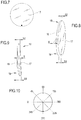
- the front surface 16 and the rear surface 17 of the prismatic lenses 2, 3 are mutually opposed and substantially flat and they develop on holding planes mutually non-parallel; in other words the front surface 16 and the rear surface 17 are mutually inclined, as shown in Figure 8 and Figure 9 .
- the lenses have a prismatic geometry, the first surface 16 and the second surface 17 of each lens are not mutually parallel, but rather inclined.
- the non-parallelism of the front surface 16 and of the rear surface 17 involves a thickness of the prismatic lenses 2, 3 not constant, as described below.
- the prismatic lenses 2, 3 are characterised by a variable thickness S; particularly, the thickness S varies linearly between a first portion 18 and a second portion 19 of the prismatic lenses 2, 3, Particularly, the first portion 18 of the prismatic lenses 2, 3 is characterised by a first thickness S1 and the second portion 19 of the prismatic lenses 2, 3 is characterised by a second thickness S2; the first thickness S1 is greater than the second thickness S2.
- the variability of the thickness S of the lenses between a first and a second thicknesses S1, 82 gives to the lenses the prismatic shape.
- the first portion 18 of the prismatic lenses 2, 3 is positioned at the lower portion 12 of the frame 4, while the second portion 19 of the prismatic lenses 2, 3 is positioned at the upper portion 13 of the frame 4.
- the prismatic lenses 2, 3 have their portion to a greater thickness (the first portion 18) at the lower portion 12 of the frame 4 in the mounted condition of the eyeglasses 1, the prismatic lenses 2, 3 are prisms with low base, and particularly low base yoked prisms.
- the thicknesses S1 and 82 are dependent on the prismatic power and the material of the prismatic lenses 2, 3, particularly by the refractive index of the material. Therefore, the thicknesses S1, S2, and/or the relative proportion, may vary depending on the material with which the prismatic lenses are made.
- the prismatic lenses 2, 3 can be made of Polymethylmethacrylate (PMMA); preferably the prismatic lenses can be made by milling and polishing of a PMMA slab.
- PMMA Polymethylmethacrylate
- the first and the second prismatic lenses 2, 3 are housed respectively at the first and second housing seats 9, 10.
- the first and the second housing seats 9, 10 and the first and the second prismatic lenses 2, 3 are circular.
- the first and the second prismatic lenses 2, 3 are housed rotatable at the respective housing seats 9, 10.
- the prismatic lenses 2, 3 are rotatable at least in the adjustment configuration of the frame 4, while in the locking configuration of the frame 4 the prismatic lenses 2, 3 are locked in a fixed position with respect to the frame 4.
- the rotation of the prismatic lenses 2, 3 is preferably defined in a plane coinciding with a prevailing development plane of the prismatic lenses 2, 3 and/or with a storing plane of the front surface 16 and/or of the rear surface 17 of the first and of the second prismatic lenses 2, 3 and/or substantially orthogonal to the thickness S.
- the first and the second prismatic lenses 2, 3 are selectively rotatable between at least a first and a second angular position.
- the first and the second lenses 2, 3 may comprise respectively a first and a second reference indicators 20, 21 of its angular position, such as a small notch, a dot, the head of an arrow, etc., at the first portion 18 of the lens at a greater thickness (or low base).
- the first and the second reference indicators 20, 21 are defined at the front surface 16 or rear surface 17, respectively of the first and of the second prismatic lenses 2, 3.
- the frame 4, in order to allow reading of the angular position of the prismatic lenses 2, 3, can comprise means for the detection of the angular position of the first and of the second prismatic lenses 2, 3, such as a first and a second graduated portions 22, 23,
- the first and the second graduated portions 22, 23 are defined respectively at the first and the second housing seats 9, 10, preferably at the lower portion 12 of the frame 4.
- the first and the second graduated portions 22, 23 develop at the rear surface 41 of the frame 4, as shown, for example, in Figures 4 , 5 and 6 .
- the rotation of the prismatic lenses 2, 3 at the respective seats with respect to the first and the second graduated portions 22, 23, respectively can vary within an angular interval of 60°, particularly of 30°
- the rotation of the prismatic lenses 2, 3 with respect to the first and the second graduated portions 22, 23, respectively can be defined in an angular range between 240° and 300°, preferably between 255° and 285°.
- the angular range is measured clockwise in accordance with the diagram shown in Figure 10 .
- the first and the second reference indicator 20, 21 have a same angular position with respect to the first and the second graduated portions 22, 23, respectively.
- the first and the second prismatic lenses 2, 3 can have a section of the side surface with a circumferential development substantially as a "V", as shown in Figure 9 .
- the section substantially as a "V” develops circumferentially with respect to the prismatic lenses 2, 3.
- the first and the second housing seats 9, 10 can comprise a first and a second grooved seats, configured and sized to house respectively the first and the second prismatic lenses 2, 3.
- the first and the second grooved seat can develop circumferentially at the internal portion 11 of the frame 4.
- the first and the second grooved seat can comprise respectively a first and a second circumferential notch.
- the first and the second circumferential notch can be configured to house respectively the first and the second prismatic lenses 2, 3; particularly, the first and the second circumferential notch can be counter-shaped with respect to the section substantially as a "V" of the side surface with a circumferential development of the prismatic lenses 2, 3.
- the eyeglasses 1 can in addition comprise a first and a second supporting rods 24, 25 operatively connected to the frame 4 respectively at the first and the second end portions 7, 8 of the frame 4.
- the first and the second supporting rods 24, 25 can develop in a direction substantially parallel and comprise an end portion 26 and a mounting portion 27 opposed to the end portion 26; the end portions 26 of the supporting rods 24, 25 can be at least partially curved, as shown in Figures 3 and 4 .
- the first and the second supporting rods 24, 25 are operatively connected respectively to the first and the second end portions 7, 8 of the frame 4 at the respective mounting portions 27, as shown in Figure 4 .
- the first and the second supporting rods 24, 25 are hinged to the frame 4 at the respective mounting portions 27.
- the eyeglasses 1 can comprise a joint 28 at least partially elastic operatively connected to the frame 4, as shown in Figure 6 .
- the frame 4 can comprise one or more openings configured to house the joint 28.
- the joint 28 is housed at least at a first opening 29, 30 and at least at a second opening 31, 32 of the frame 4.
- the first openings 29, 30 and the second openings 31, 32 are defined respectively at the first and at the second end portion 7, 8 of the frame 4, as shown in Figure 6 .
- the joint 28 can be engaged at both the first openings 29, 30 at the first end portion 7 and at both the second openings 31, 32 at the second end portion 8.
- the eyeglasses 1 in accordance with this invention can be configured and sized to be worn by children and adults, and can be manufactured in different measures for this purpose.
- This invention further relates to the use of the eyeglasses 1 for visual-perceptual and/or postural rehabilitation in harmony with the trigeminal way of a patient.
- the eyeglasses in accordance with this invention do not involve side effects in patients who wear them. Furthermore, the invention enables to destructuring muscular tensions, rehabilitate and reprogramme visual dysfunctions and postural defects even of slight entity and/or to act in patients rigidly organised, by improving the sensory modalities of relation among the various muscular systems from the oculomotor to balance the unique relation between eyes, teeth and posture.
- the invention is applicable to any patient and age, in children aged 2 years and a half; in addition, it proves to be of convenient use, easy to implement and of simple and economical manufacture.
Landscapes
- Physics & Mathematics (AREA)
- Health & Medical Sciences (AREA)
- Ophthalmology & Optometry (AREA)
- General Physics & Mathematics (AREA)
- Optics & Photonics (AREA)
- General Health & Medical Sciences (AREA)
- Eyeglasses (AREA)
Claims (8)
- Brille (1) zur visuellen Wahrnehmungs- und/oder Haltungs-Rehabilitation, umfassend:- eine erste prismatische Linse (2) und eine zweite prismatische Linse (3),- einen Rahmen (4), welcher dazu konfiguriert ist, die erste und die zweite prismatische Linse (2; 3) aufzunehmen,wobei der Rahmen (4) einen unteren Abschnitt (12) und einen oberen Abschnitt (13) aufweist und wobei die erste und die zweite prismatische Linse (2; 3) eine variable Dicke (S), insbesondere linear, zwischen einer ersten Dicke (S1), welche in einem ersten Abschnitt (18) der prismatischen Linsen (2; 3) definiert ist, welcher an dem unteren Abschnitt (12) des Rahmens (4) angeordnet ist, und einer zweiten Dicke (S2) aufweisen, welche in einem zweiten Abschnitt (19) der prismatischen Linsen (2; 3) definiert ist, welcher an dem oberen Abschnitt (13) des Rahmens (4) angeordnet ist, wobei die erste Dicke (S1) in Bezug auf die zweite Dicke (S2) größer ist, wobei die erste und die zweite prismatische Linse (2; 3) verbundene Prismen sind, welche einen in Prisma-Dioptrien gemessenen Brechwert aufweisen, welcher für die beiden Linsen gleich ist und zwischen 0,05 und 0,24 umfasst ist.
- Brille (1) nach Anspruch 1, wobei der Rahmen (4) konfigurierbar ist zwischen wenigstens einer gesperrten Konfiguration, wobei die erste und die zweite prismatische Linse (2; 3) in Bezug auf den Rahmen (4) fixiert sind, und einer Einstellkonfiguration, wobei die erste und die zweite prismatische Linse (2; 3) in Bezug auf den Rahmen (4) bewegbar sind.
- Brille (1) nach Anspruch 2, wobei die Brille (1) einen Einstellmechanismus (14) umfasst, welcher mit dem Rahmen (4) verbunden ist und wenigstens zwei Stabilitätspositionen aufweist, wobei der Einstellmechanismus (14) zwischen wenigstens einer ersten Halteposition, wobei er die erste und die zweite prismatische Linse in Bezug auf den Rahmen (4) in einer fixierten Position in der gesperrten Konfiguration hält, und einer zweiten Freigabeposition bedienbar ist, welche die Einstellkonfiguration des Rahmens (4) definiert, wobei wenigstens ein Abschnitt des Rahmens (4) gelöst ist und die erste und die zweite prismatische Linse (2; 3) in Bezug auf den Rahmen (4) bewegbar sind und/oder wobei sich der Stellmechanismus (14) an einem Einstellabschnitt (5) der Brille (1) entfaltet, welcher zwischen der ersten und der zweiten prismatischen Linse (2; 3) eingefügt ist.
- Brille (1) nach den Ansprüchen 1 oder 2 oder 3, wobei wenigstens ein Abschnitt des Rahmens (4) elastisch verformbar ist und/oder wobei die elastische Verformung wenigstens eines Abschnitts des Rahmens (4) durch den Einstellmechanismus (14) gesteuert ist.
- Brille (1) nach den Ansprüchen 2 oder 3 oder 4, wobei in der Einstellkonfiguration die erste und die zweite prismatische Linse (2; 3) selektiv drehbar sind zwischen wenigstens einer ersten und einer zweiten Winkelposition, wobei die Drehung in einer Ebene definiert ist, welche mit einer Primärentfaltungsebene der prismatischen Linsen (2; 3) und/oder mit einer Anlageebene wenigstens einer zwischen einer vorderen Fläche (16) und einer hinteren Fläche (17) der ersten und der zweiten prismatischen Linse (2; 3) zusammenfällt und/oder im Wesentlichen senkrecht zu der Dicke (S) ist.
- Brille (1) nach einem der vorhergehenden Ansprüche, wobei die erste und die zweite prismatische Linse (2; 3) eine erste bzw. eine zweite Referenzanzeige (20; 21) der Winkelposition davon aufweisen und/oder wobei der Rahmen (4) Identifizierungsmittel der Winkelposition der ersten und der zweiten prismatischen Linse (2; 3) aufweist.
- Brille (1) nach dem vorhergehenden Anspruch, wobei die Identifizierungsmittel der Winkelposition der ersten und der zweiten prismatischen Linse (2; 3) aus einem ersten bzw. einem zweiten abgestuften Abschnitt (22; 23) bestehen und/oder wobei der erste und der zweite abgestufte Abschnitt (22; 23) an einem unteren Abschnitt (12) des Rahmens (4) definiert sind und ein Winkelintervall von weniger als oder gleich 60°, insbesondere von etwa 30°, definieren und/oder wobei die erste und die zweite Referenzanzeige (20; 21) in Bezug auf den ersten bzw. den zweiten abgestuften Abschnitt (22; 23) die gleiche Winkelposition aufweisen.
- Brille (1) nach einem der vorhergehenden Ansprüche, wobei die erste und die zweite prismatische Linse (2; 3) einen in Prisma-Dioptrien gemessenen Brechwert aufweisen, welcher für die beiden Linsen gleich ist und zwischen 0,05 und 0,20 und/oder zwischen 0,05 und 0,18 und/oder zwischen 0,07 und 0,18 umfasst ist.
Priority Applications (1)
| Application Number | Priority Date | Filing Date | Title |
|---|---|---|---|
| PL15707805T PL3100104T3 (pl) | 2014-01-28 | 2015-01-26 | Okulary z soczewkami pryzmatycznymi |
Applications Claiming Priority (2)
| Application Number | Priority Date | Filing Date | Title |
|---|---|---|---|
| ITMI20140108 | 2014-01-28 | ||
| PCT/IB2015/050569 WO2015114504A1 (en) | 2014-01-28 | 2015-01-26 | Glasses with prismatic lenses |
Publications (2)
| Publication Number | Publication Date |
|---|---|
| EP3100104A1 EP3100104A1 (de) | 2016-12-07 |
| EP3100104B1 true EP3100104B1 (de) | 2019-08-28 |
Family
ID=50336447
Family Applications (1)
| Application Number | Title | Priority Date | Filing Date |
|---|---|---|---|
| EP15707805.6A Active EP3100104B1 (de) | 2014-01-28 | 2015-01-26 | Brillen mit prismatischen linsen |
Country Status (5)
| Country | Link |
|---|---|
| US (1) | US10126565B2 (de) |
| EP (1) | EP3100104B1 (de) |
| ES (1) | ES2755388T3 (de) |
| PL (1) | PL3100104T3 (de) |
| WO (1) | WO2015114504A1 (de) |
Families Citing this family (14)
| Publication number | Priority date | Publication date | Assignee | Title |
|---|---|---|---|---|
| RU2017106629A (ru) | 2014-08-03 | 2018-09-04 | Поготек, Инк. | Система носимых камер и устройств, а также способ прикрепления систем камер или других электронных устройств к носимым изделиям |
| MX375883B (es) | 2014-12-23 | 2025-03-07 | Pogotec Inc | Sistema y metodos de camara inalambrica. |
| US10481417B2 (en) | 2015-06-10 | 2019-11-19 | PogoTec, Inc. | Magnetic attachment mechanism for electronic wearable device |
| EP3308216B1 (de) | 2015-06-10 | 2021-04-21 | Pogotec, Inc. | Brille mit magnetspur für am körper tragbare elektronische vorrichtung |
| TW201729610A (zh) | 2015-10-29 | 2017-08-16 | 帕戈技術股份有限公司 | 適用於無線功率接收之助聽器 |
| US10663765B2 (en) | 2015-11-20 | 2020-05-26 | Santana L. Nottage | Customizable eyeglass system and method of use |
| US10670886B2 (en) | 2015-11-20 | 2020-06-02 | Santana L. Nottage | Customizable scope system and method of use |
| US11558538B2 (en) | 2016-03-18 | 2023-01-17 | Opkix, Inc. | Portable camera system |
| US10863060B2 (en) | 2016-11-08 | 2020-12-08 | PogoTec, Inc. | Smart case for electronic wearable device |
| CN108333793B (zh) * | 2018-02-02 | 2019-09-13 | 永康市普方铝业有限公司 | 一种基于物联网的便于镜片装卸的多功能智能眼镜 |
| US11300857B2 (en) | 2018-11-13 | 2022-04-12 | Opkix, Inc. | Wearable mounts for portable camera |
| IT201900004269A1 (it) * | 2019-03-25 | 2020-09-25 | Restorative Neurotechnologies S R L | Sistema per il potenziamento o la riabilitazione cognitiva |
| USD1004683S1 (en) * | 2021-06-23 | 2023-11-14 | Benartzi Investments Llc | Eye glasses |
| USD1079793S1 (en) * | 2023-06-16 | 2025-06-17 | Louis Vuitton Malletier | Sunglasses |
Family Cites Families (9)
| Publication number | Priority date | Publication date | Assignee | Title |
|---|---|---|---|---|
| US4787730A (en) * | 1987-04-06 | 1988-11-29 | Alexander Bristol | Eyeglass assembly |
| US5459534A (en) | 1993-11-22 | 1995-10-17 | Morrison International, Inc. | Modular universal eyeglass frame |
| US6431708B2 (en) * | 1999-12-21 | 2002-08-13 | Paul A. Krebs | Vision therapy system and method |
| US6428165B1 (en) | 2001-09-07 | 2002-08-06 | John C. Rivera | Interchangeable lens eyeglass system with interchangeable nosepiece |
| FR2907557B1 (fr) | 2006-10-18 | 2009-02-13 | Risheng Xia | Lunettes a element de decor amovible. |
| US7494219B2 (en) * | 2007-04-20 | 2009-02-24 | Bahman Shahkarami | Eyewear for redirected viewing with auxiliary lenses |
| US8157375B2 (en) * | 2009-08-10 | 2012-04-17 | Cronin John V | Variable prism eyeglasses |
| US20110032477A1 (en) * | 2009-08-10 | 2011-02-10 | Roger Vahram Ohanesian | Variable Prism Eyeglasses and Method of Making Same |
| US10001662B2 (en) * | 2014-03-14 | 2018-06-19 | Daniel D. Gottlieb | Method and device for treating averted gaze |
-
2015
- 2015-01-26 EP EP15707805.6A patent/EP3100104B1/de active Active
- 2015-01-26 PL PL15707805T patent/PL3100104T3/pl unknown
- 2015-01-26 ES ES15707805T patent/ES2755388T3/es active Active
- 2015-01-26 US US15/115,181 patent/US10126565B2/en active Active
- 2015-01-26 WO PCT/IB2015/050569 patent/WO2015114504A1/en not_active Ceased
Non-Patent Citations (1)
| Title |
|---|
| ALLISON ET AL: "An optometric approach to patients with sensory integration dysfunction", OPTOMETRY - JOURNAL OF THE AMERICAN OPTOMETRIC ASSOCIATION, ELSEVIER, NL, vol. 78, no. 12, 10 December 2007 (2007-12-10), pages 644 - 651, XP022370511, ISSN: 1529-1839, DOI: 10.1016/J.OPTM.2007.05.012 * |
Also Published As
| Publication number | Publication date |
|---|---|
| EP3100104A1 (de) | 2016-12-07 |
| US10126565B2 (en) | 2018-11-13 |
| US20160349533A1 (en) | 2016-12-01 |
| WO2015114504A1 (en) | 2015-08-06 |
| ES2755388T3 (es) | 2020-04-22 |
| PL3100104T3 (pl) | 2020-04-30 |
Similar Documents
| Publication | Publication Date | Title |
|---|---|---|
| EP3100104B1 (de) | Brillen mit prismatischen linsen | |
| US12419513B2 (en) | Apparatus, systems, and methods for vision assessment and treatment | |
| Kapoor et al. | Vision disturbances following traumatic brain injury | |
| RU2481606C1 (ru) | Мультифокальные офтальмологические линзы, способ тренировки систем аккомодации и вергенции на их основе и устройства для осуществления способа | |
| Fox et al. | Vision rehabilitation after traumatic brain injury | |
| Hertle | Examination and refractive management of patients with nystagmus | |
| Hellerstein et al. | Visual rehabilitation for patients with brain injury | |
| WO2023141460A1 (en) | Methods, apparatus, and articles to enhance brain function via presentation of visual effects in far and/or ultra-far peripheral field | |
| Ciner et al. | Management of vision problems for children with special needs | |
| Gottlieb et al. | Innovative concepts in hemianopsia and complex visual loss—Low vision rehabilitation for our older population | |
| Kokotas | The effects of yoked prisms on body posture and egocentric perception in a normal population | |
| Baroud et al. | Presbyopia onset affects dynamic visual acuity via motor adaptation in naturalistic viewing conditions | |
| Proctor | Traumatic brain injury and binasal occlusion. | |
| Yap et al. | Advances in the management of oculomotor dysfunction in adults and children with concussion | |
| Suhr et al. | Recognizing TBI-related vision disorders: these visual signs and symptoms can help uncover concussions and will guide your approach to intervention | |
| Harris | The use of lenses to improve quality of life following brain injury | |
| Waldorf | Treatment of Traumatic Brain Injury-Induced Oculomotor and Binocular Vision Dysfunctions with Vision Therapy. | |
| Durham et al. | Immediate Effects of Yoked Prism on Gait in Individuals with Acquired Brain Injury. | |
| Goldstein et al. | Evaluation and Management of the Patient with Low Vision | |
| HAN | The role of the neuro-rehabilitation optometrist | |
| JPH0576574A (ja) | 視力矯正装置 | |
| Bannon | SPACE PERCEPTION—SOME PHYSIOLOGICAL AND PSYCHOLOGICAL ASPECTS | |
| Orlandi et al. | The optometrist | |
| Green | I work for EssilorLuxiottica I previously worked for Neurolens | |
| Wenberg et al. | Post traumatic vision syndrome and the locomotor system: Part 2: Screening and collaborative care |
Legal Events
| Date | Code | Title | Description |
|---|---|---|---|
| PUAI | Public reference made under article 153(3) epc to a published international application that has entered the european phase |
Free format text: ORIGINAL CODE: 0009012 |
|
| STAA | Information on the status of an ep patent application or granted ep patent |
Free format text: STATUS: REQUEST FOR EXAMINATION WAS MADE |
|
| 17P | Request for examination filed |
Effective date: 20160805 |
|
| AK | Designated contracting states |
Kind code of ref document: A1 Designated state(s): AL AT BE BG CH CY CZ DE DK EE ES FI FR GB GR HR HU IE IS IT LI LT LU LV MC MK MT NL NO PL PT RO RS SE SI SK SM TR |
|
| AX | Request for extension of the european patent |
Extension state: BA ME |
|
| DAX | Request for extension of the european patent (deleted) | ||
| STAA | Information on the status of an ep patent application or granted ep patent |
Free format text: STATUS: EXAMINATION IS IN PROGRESS |
|
| 17Q | First examination report despatched |
Effective date: 20180215 |
|
| REG | Reference to a national code |
Ref country code: DE Ref legal event code: R079 Ref document number: 602015036650 Country of ref document: DE Free format text: PREVIOUS MAIN CLASS: G02C0007140000 Ipc: G02C0001080000 |
|
| RIC1 | Information provided on ipc code assigned before grant |
Ipc: G02C 5/04 20060101ALI20190115BHEP Ipc: G02C 1/08 20060101AFI20190115BHEP Ipc: G02C 5/00 20060101ALI20190115BHEP Ipc: G02C 7/14 20060101ALI20190115BHEP Ipc: G02C 3/00 20060101ALI20190115BHEP |
|
| GRAP | Despatch of communication of intention to grant a patent |
Free format text: ORIGINAL CODE: EPIDOSNIGR1 |
|
| STAA | Information on the status of an ep patent application or granted ep patent |
Free format text: STATUS: GRANT OF PATENT IS INTENDED |
|
| INTG | Intention to grant announced |
Effective date: 20190321 |
|
| RIN1 | Information on inventor provided before grant (corrected) |
Inventor name: GRASSI, MARCO |
|
| GRAS | Grant fee paid |
Free format text: ORIGINAL CODE: EPIDOSNIGR3 |
|
| GRAA | (expected) grant |
Free format text: ORIGINAL CODE: 0009210 |
|
| STAA | Information on the status of an ep patent application or granted ep patent |
Free format text: STATUS: THE PATENT HAS BEEN GRANTED |
|
| AK | Designated contracting states |
Kind code of ref document: B1 Designated state(s): AL AT BE BG CH CY CZ DE DK EE ES FI FR GB GR HR HU IE IS IT LI LT LU LV MC MK MT NL NO PL PT RO RS SE SI SK SM TR |
|
| REG | Reference to a national code |
Ref country code: GB Ref legal event code: FG4D |
|
| REG | Reference to a national code |
Ref country code: CH Ref legal event code: EP |
|
| REG | Reference to a national code |
Ref country code: AT Ref legal event code: REF Ref document number: 1173129 Country of ref document: AT Kind code of ref document: T Effective date: 20190915 |
|
| REG | Reference to a national code |
Ref country code: IE Ref legal event code: FG4D |
|
| REG | Reference to a national code |
Ref country code: DE Ref legal event code: R096 Ref document number: 602015036650 Country of ref document: DE |
|
| REG | Reference to a national code |
Ref country code: CH Ref legal event code: NV Representative=s name: ING. ALESSANDRO GALASSI C/O PGA S.P.A., MILANO, CH |
|
| REG | Reference to a national code |
Ref country code: NL Ref legal event code: MP Effective date: 20190828 |
|
| REG | Reference to a national code |
Ref country code: LT Ref legal event code: MG4D |
|
| PG25 | Lapsed in a contracting state [announced via postgrant information from national office to epo] |
Ref country code: LT Free format text: LAPSE BECAUSE OF FAILURE TO SUBMIT A TRANSLATION OF THE DESCRIPTION OR TO PAY THE FEE WITHIN THE PRESCRIBED TIME-LIMIT Effective date: 20190828 Ref country code: HR Free format text: LAPSE BECAUSE OF FAILURE TO SUBMIT A TRANSLATION OF THE DESCRIPTION OR TO PAY THE FEE WITHIN THE PRESCRIBED TIME-LIMIT Effective date: 20190828 Ref country code: NL Free format text: LAPSE BECAUSE OF FAILURE TO SUBMIT A TRANSLATION OF THE DESCRIPTION OR TO PAY THE FEE WITHIN THE PRESCRIBED TIME-LIMIT Effective date: 20190828 Ref country code: NO Free format text: LAPSE BECAUSE OF FAILURE TO SUBMIT A TRANSLATION OF THE DESCRIPTION OR TO PAY THE FEE WITHIN THE PRESCRIBED TIME-LIMIT Effective date: 20191128 Ref country code: SE Free format text: LAPSE BECAUSE OF FAILURE TO SUBMIT A TRANSLATION OF THE DESCRIPTION OR TO PAY THE FEE WITHIN THE PRESCRIBED TIME-LIMIT Effective date: 20190828 Ref country code: BG Free format text: LAPSE BECAUSE OF FAILURE TO SUBMIT A TRANSLATION OF THE DESCRIPTION OR TO PAY THE FEE WITHIN THE PRESCRIBED TIME-LIMIT Effective date: 20191128 Ref country code: PT Free format text: LAPSE BECAUSE OF FAILURE TO SUBMIT A TRANSLATION OF THE DESCRIPTION OR TO PAY THE FEE WITHIN THE PRESCRIBED TIME-LIMIT Effective date: 20191230 Ref country code: FI Free format text: LAPSE BECAUSE OF FAILURE TO SUBMIT A TRANSLATION OF THE DESCRIPTION OR TO PAY THE FEE WITHIN THE PRESCRIBED TIME-LIMIT Effective date: 20190828 |
|
| PG25 | Lapsed in a contracting state [announced via postgrant information from national office to epo] |
Ref country code: IS Free format text: LAPSE BECAUSE OF FAILURE TO SUBMIT A TRANSLATION OF THE DESCRIPTION OR TO PAY THE FEE WITHIN THE PRESCRIBED TIME-LIMIT Effective date: 20191228 Ref country code: GR Free format text: LAPSE BECAUSE OF FAILURE TO SUBMIT A TRANSLATION OF THE DESCRIPTION OR TO PAY THE FEE WITHIN THE PRESCRIBED TIME-LIMIT Effective date: 20191129 Ref country code: RS Free format text: LAPSE BECAUSE OF FAILURE TO SUBMIT A TRANSLATION OF THE DESCRIPTION OR TO PAY THE FEE WITHIN THE PRESCRIBED TIME-LIMIT Effective date: 20190828 Ref country code: AL Free format text: LAPSE BECAUSE OF FAILURE TO SUBMIT A TRANSLATION OF THE DESCRIPTION OR TO PAY THE FEE WITHIN THE PRESCRIBED TIME-LIMIT Effective date: 20190828 Ref country code: LV Free format text: LAPSE BECAUSE OF FAILURE TO SUBMIT A TRANSLATION OF THE DESCRIPTION OR TO PAY THE FEE WITHIN THE PRESCRIBED TIME-LIMIT Effective date: 20190828 |
|
| REG | Reference to a national code |
Ref country code: AT Ref legal event code: MK05 Ref document number: 1173129 Country of ref document: AT Kind code of ref document: T Effective date: 20190828 |
|
| PG25 | Lapsed in a contracting state [announced via postgrant information from national office to epo] |
Ref country code: TR Free format text: LAPSE BECAUSE OF FAILURE TO SUBMIT A TRANSLATION OF THE DESCRIPTION OR TO PAY THE FEE WITHIN THE PRESCRIBED TIME-LIMIT Effective date: 20190828 |
|
| REG | Reference to a national code |
Ref country code: ES Ref legal event code: FG2A Ref document number: 2755388 Country of ref document: ES Kind code of ref document: T3 Effective date: 20200422 |
|
| PG25 | Lapsed in a contracting state [announced via postgrant information from national office to epo] |
Ref country code: AT Free format text: LAPSE BECAUSE OF FAILURE TO SUBMIT A TRANSLATION OF THE DESCRIPTION OR TO PAY THE FEE WITHIN THE PRESCRIBED TIME-LIMIT Effective date: 20190828 Ref country code: RO Free format text: LAPSE BECAUSE OF FAILURE TO SUBMIT A TRANSLATION OF THE DESCRIPTION OR TO PAY THE FEE WITHIN THE PRESCRIBED TIME-LIMIT Effective date: 20190828 Ref country code: IT Free format text: LAPSE BECAUSE OF FAILURE TO SUBMIT A TRANSLATION OF THE DESCRIPTION OR TO PAY THE FEE WITHIN THE PRESCRIBED TIME-LIMIT Effective date: 20190828 Ref country code: DK Free format text: LAPSE BECAUSE OF FAILURE TO SUBMIT A TRANSLATION OF THE DESCRIPTION OR TO PAY THE FEE WITHIN THE PRESCRIBED TIME-LIMIT Effective date: 20190828 Ref country code: EE Free format text: LAPSE BECAUSE OF FAILURE TO SUBMIT A TRANSLATION OF THE DESCRIPTION OR TO PAY THE FEE WITHIN THE PRESCRIBED TIME-LIMIT Effective date: 20190828 |
|
| PG25 | Lapsed in a contracting state [announced via postgrant information from national office to epo] |
Ref country code: SK Free format text: LAPSE BECAUSE OF FAILURE TO SUBMIT A TRANSLATION OF THE DESCRIPTION OR TO PAY THE FEE WITHIN THE PRESCRIBED TIME-LIMIT Effective date: 20190828 Ref country code: IS Free format text: LAPSE BECAUSE OF FAILURE TO SUBMIT A TRANSLATION OF THE DESCRIPTION OR TO PAY THE FEE WITHIN THE PRESCRIBED TIME-LIMIT Effective date: 20200224 Ref country code: SM Free format text: LAPSE BECAUSE OF FAILURE TO SUBMIT A TRANSLATION OF THE DESCRIPTION OR TO PAY THE FEE WITHIN THE PRESCRIBED TIME-LIMIT Effective date: 20190828 Ref country code: CZ Free format text: LAPSE BECAUSE OF FAILURE TO SUBMIT A TRANSLATION OF THE DESCRIPTION OR TO PAY THE FEE WITHIN THE PRESCRIBED TIME-LIMIT Effective date: 20190828 |
|
| REG | Reference to a national code |
Ref country code: DE Ref legal event code: R097 Ref document number: 602015036650 Country of ref document: DE |
|
| PLBE | No opposition filed within time limit |
Free format text: ORIGINAL CODE: 0009261 |
|
| STAA | Information on the status of an ep patent application or granted ep patent |
Free format text: STATUS: NO OPPOSITION FILED WITHIN TIME LIMIT |
|
| PG2D | Information on lapse in contracting state deleted |
Ref country code: IS |
|
| 26N | No opposition filed |
Effective date: 20200603 |
|
| PG25 | Lapsed in a contracting state [announced via postgrant information from national office to epo] |
Ref country code: MC Free format text: LAPSE BECAUSE OF FAILURE TO SUBMIT A TRANSLATION OF THE DESCRIPTION OR TO PAY THE FEE WITHIN THE PRESCRIBED TIME-LIMIT Effective date: 20190828 Ref country code: SI Free format text: LAPSE BECAUSE OF FAILURE TO SUBMIT A TRANSLATION OF THE DESCRIPTION OR TO PAY THE FEE WITHIN THE PRESCRIBED TIME-LIMIT Effective date: 20190828 |
|
| PG25 | Lapsed in a contracting state [announced via postgrant information from national office to epo] |
Ref country code: LU Free format text: LAPSE BECAUSE OF NON-PAYMENT OF DUE FEES Effective date: 20200126 |
|
| PG25 | Lapsed in a contracting state [announced via postgrant information from national office to epo] |
Ref country code: IE Free format text: LAPSE BECAUSE OF NON-PAYMENT OF DUE FEES Effective date: 20200126 |
|
| PGFP | Annual fee paid to national office [announced via postgrant information from national office to epo] |
Ref country code: DE Payment date: 20220127 Year of fee payment: 8 |
|
| PG25 | Lapsed in a contracting state [announced via postgrant information from national office to epo] |
Ref country code: MT Free format text: LAPSE BECAUSE OF FAILURE TO SUBMIT A TRANSLATION OF THE DESCRIPTION OR TO PAY THE FEE WITHIN THE PRESCRIBED TIME-LIMIT Effective date: 20190828 Ref country code: CY Free format text: LAPSE BECAUSE OF FAILURE TO SUBMIT A TRANSLATION OF THE DESCRIPTION OR TO PAY THE FEE WITHIN THE PRESCRIBED TIME-LIMIT Effective date: 20190828 |
|
| PGFP | Annual fee paid to national office [announced via postgrant information from national office to epo] |
Ref country code: PL Payment date: 20220107 Year of fee payment: 8 Ref country code: FR Payment date: 20220126 Year of fee payment: 8 Ref country code: BE Payment date: 20220126 Year of fee payment: 8 |
|
| PG25 | Lapsed in a contracting state [announced via postgrant information from national office to epo] |
Ref country code: MK Free format text: LAPSE BECAUSE OF FAILURE TO SUBMIT A TRANSLATION OF THE DESCRIPTION OR TO PAY THE FEE WITHIN THE PRESCRIBED TIME-LIMIT Effective date: 20190828 |
|
| P01 | Opt-out of the competence of the unified patent court (upc) registered |
Effective date: 20230328 |
|
| REG | Reference to a national code |
Ref country code: DE Ref legal event code: R119 Ref document number: 602015036650 Country of ref document: DE |
|
| REG | Reference to a national code |
Ref country code: BE Ref legal event code: MM Effective date: 20230131 |
|
| PG25 | Lapsed in a contracting state [announced via postgrant information from national office to epo] |
Ref country code: DE Free format text: LAPSE BECAUSE OF NON-PAYMENT OF DUE FEES Effective date: 20230801 |
|
| PG25 | Lapsed in a contracting state [announced via postgrant information from national office to epo] |
Ref country code: FR Free format text: LAPSE BECAUSE OF NON-PAYMENT OF DUE FEES Effective date: 20230131 Ref country code: BE Free format text: LAPSE BECAUSE OF NON-PAYMENT OF DUE FEES Effective date: 20230131 |
|
| PG25 | Lapsed in a contracting state [announced via postgrant information from national office to epo] |
Ref country code: PL Free format text: LAPSE BECAUSE OF NON-PAYMENT OF DUE FEES Effective date: 20230126 |
|
| PG25 | Lapsed in a contracting state [announced via postgrant information from national office to epo] |
Ref country code: PL Free format text: LAPSE BECAUSE OF NON-PAYMENT OF DUE FEES Effective date: 20230126 |
|
| PGFP | Annual fee paid to national office [announced via postgrant information from national office to epo] |
Ref country code: ES Payment date: 20250210 Year of fee payment: 11 |
|
| PGFP | Annual fee paid to national office [announced via postgrant information from national office to epo] |
Ref country code: CH Payment date: 20250201 Year of fee payment: 11 |
|
| PGFP | Annual fee paid to national office [announced via postgrant information from national office to epo] |
Ref country code: GB Payment date: 20250121 Year of fee payment: 11 |