EP3098919A1 - Gas-insulated electric apparatus - Google Patents
Gas-insulated electric apparatus Download PDFInfo
- Publication number
- EP3098919A1 EP3098919A1 EP14880096.4A EP14880096A EP3098919A1 EP 3098919 A1 EP3098919 A1 EP 3098919A1 EP 14880096 A EP14880096 A EP 14880096A EP 3098919 A1 EP3098919 A1 EP 3098919A1
- Authority
- EP
- European Patent Office
- Prior art keywords
- foreign matter
- gas
- metal foreign
- covering film
- electrical device
- Prior art date
- Legal status (The legal status is an assumption and is not a legal conclusion. Google has not performed a legal analysis and makes no representation as to the accuracy of the status listed.)
- Granted
Links
Images


Classifications
-
- H—ELECTRICITY
- H02—GENERATION; CONVERSION OR DISTRIBUTION OF ELECTRIC POWER
- H02B—BOARDS, SUBSTATIONS OR SWITCHING ARRANGEMENTS FOR THE SUPPLY OR DISTRIBUTION OF ELECTRIC POWER
- H02B13/00—Arrangement of switchgear in which switches are enclosed in, or structurally associated with, a casing, e.g. cubicle
- H02B13/02—Arrangement of switchgear in which switches are enclosed in, or structurally associated with, a casing, e.g. cubicle with metal casing
- H02B13/035—Gas-insulated switchgear
- H02B13/045—Details of casing, e.g. gas tightness
-
- H—ELECTRICITY
- H02—GENERATION; CONVERSION OR DISTRIBUTION OF ELECTRIC POWER
- H02G—INSTALLATION OF ELECTRIC CABLES OR LINES, OR OF COMBINED OPTICAL AND ELECTRIC CABLES OR LINES
- H02G5/00—Installations of bus-bars
- H02G5/06—Totally-enclosed installations, e.g. in metal casings
- H02G5/063—Totally-enclosed installations, e.g. in metal casings filled with oil or gas
- H02G5/065—Particle traps
-
- H—ELECTRICITY
- H02—GENERATION; CONVERSION OR DISTRIBUTION OF ELECTRIC POWER
- H02B—BOARDS, SUBSTATIONS OR SWITCHING ARRANGEMENTS FOR THE SUPPLY OR DISTRIBUTION OF ELECTRIC POWER
- H02B13/00—Arrangement of switchgear in which switches are enclosed in, or structurally associated with, a casing, e.g. cubicle
- H02B13/02—Arrangement of switchgear in which switches are enclosed in, or structurally associated with, a casing, e.g. cubicle with metal casing
- H02B13/035—Gas-insulated switchgear
- H02B13/055—Features relating to the gas
Definitions
- the present invention relates to a gas-insulated electrical device including a high-voltage conductor and electrical equipment, such as switchgear and a current transformer, stored in an airtight container, and configured so as to insulate components and the high-voltage conductor from the airtight container by filling the airtight container with an insulation gas.
- a high-voltage conductor and electrical equipment such as switchgear and a current transformer
- a gas-insulated electrical device includes a cylindrical ground tank and a current-carrying cylindrical high-voltage conductor disposed coaxially in the ground tank, and the ground tank is hermetically filled with an insulation gas represented by a chief insulation medium, such as a sulfur hexafluoride gas, dry air, nitrogen, a carbon dioxide gas, CF 4 , CHI 3 , C 2 F 6 , and C 3 F 8 , or a mixed gas obtained by combining the foregoing gases.
- a chief insulation medium such as a sulfur hexafluoride gas, dry air, nitrogen, a carbon dioxide gas, CF 4 , CHI 3 , C 2 F 6 , and C 3 F 8 , or a mixed gas obtained by combining the foregoing gases.
- the gas-insulated electrical device configured as above is chiefly used as a high-voltage device.
- a sulfur hexafluoride gas has a dielectric strength about three times higher than that of air. Accordingly, when a sulfur hexafluoride gas is employed, a distance between a high voltage portion and a ground electrode can be shorter and hence a size of the device can be reduced.
- the gas-insulated device Normally, a gas used as an insulation medium in the gas-insulated device is pressurized to or above an atmospheric pressure in order to enhance insulation performance and breaking performance. Therefore, in order to hermetically seal the gas and maintain an equal insulation distance, the gas-insulated device adopts a structure in which a tank forming the airtight container described above is of a cylindrical shape and a high-voltage conductor of also a cylindrical shape is disposed coaxially with the tank.
- the metal foreign matter however, becomes electrically charged due to an action, such as electrostatic induction, and starts to move according to a potential gradient between the tank and the high-voltage conductor while the device is in operation. In the beginning, the metal foreign matter that has been lying flat stands up.
- the metal foreign matter standing up starts to float and moves so as to eventually come in close proximity to the high-voltage conductor or make contact with the high-voltage conductor.
- the metal foreign matter accumulates while behaving in the vicinity of the conductor particularly when the high-voltage conductor is charged to a negative polarity.
- the electric field becomes highest in the vicinity of the high-voltage conductor.
- the metal foreign matter becomes extremely inhomogeneous and the electric field becomes high in the vicinity of the metal foreign matter.
- an overvoltage such as a lightning surge
- flows into the device in such a state a ground fault may possibly occur.
- An effective countermeasure against a decrease of a withstand voltage in the presence of the metal foreign matter is a tank inner surface structure, by which incoming metal foreign matter is forced to rest on the tank bottom surface as much as possible to suppress the foreign matter from floating.
- this is a method to enhance withstand voltage performance against foreign matter by providing an insulation material of at least 0.2 mm thick to the inner surface of a tank wall (see, for example, PTL 1).
- an amount of charge of the foreign matter is suppressed by providing a non-linear resistance film on an inner surface of the tank to suppress the foreign matter from floating (see, for example, PTL 2).
- an insulation material is provided to the inner surface of the tank made of metal as a protection structure against foreign matter.
- a non-linear resistance film having field-dependent resistivity is provided on the tank surface.
- a characteristic of the non-linear resistance film against the foreign matter is a structure that can ease a high electric field developed in the fine gap in comparison with the insulation cover film described above. Hence, the non-linear resistance film can raise a floating electric field higher than does the insulation cover film by suppressing the foreign matter from becoming electrically charged.
- the characteristic of the non-linear resistance film depends on an electric field, and the non-linear resistance film can exert an effect when the non-linear resistance film has a distribution characteristic appropriate for a resistance distribution such that resistivity is reduced by the electric field more than by an electric field during normal operation in the absence of foreign matter.
- the electric field acting on the tank bottom surface of the gas-insulated electric device varies from region to region in the gas-insulated electric device.
- the non-linear resistance film may exert an electric field easing effect in one region whereas the non-linear resistance film may fail to exert the electric field easing effect in another region under the action of a different electric field or when the non-linear resistance film is applied to a device of a different voltage class.
- the invention was devised to solve the problems discussed above and has an object to provide a gas-insulated electrical device which is a DC device and capable of suppressing metal foreign matter in an airtight container from coming in close proximity to a conductor by suppressing the foreign matter from floating when the conductor is charged to a negative polarity.
- a gas-insulated electrical device of the invention includes a conductor to which a high voltage is applied, an airtight container made of metal to enclose the conductor and filled with an insulation gas, and a covering film covering an inner surface of the airtight container.
- the covering film is made of a material that becomes more positively charged than metals in a triboelectric series.
- the covering film made of a material that becomes positively charged upon contact with metals is provided to the inner surface of the airtight container. Owing to this configuration, when metal foreign matter generated in the device comes into contact with a bottom surface of the airtight container, the covering film becomes positively charged and conversely the metal foreign matter becomes negatively charged.
- the metal foreign matter can be suppressed from floating and the metal foreign matter can be also suppressed from coming in close proximity to the high-voltage conductor. Consequently, insulation reliability of the gas-insulated electrical device can be enhanced.
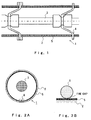
- FIG. 1 is a sectional side view of a gas-insulated electrical device 1 according to the first embodiment of the invention taken along an axial direction.
- FIG. 2A is a sectional view of the gas-insulated electrical device 1 in a direction perpendicular to the axial direction.
- FIG. 2B is an enlarged sectional view of metal foreign matter 6 on a bottom surface of a ground tank 2 of FIG. 2A .
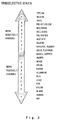
- FIG. 3 is a view showing a triboelectric series of various materials indicating which becomes more electrically charged than which.
- the gas-insulated electrical device 1 includes a cylindrical ground tank 2 made of metal, which is an airtight container filled with an insulation gas and also a pressure container, a high-voltage conductor (conductor) 3 electrically connected to components(not shown), such as a breaker and a disconnector, and disposed on a central axis line of the ground tank (airtight container) 2, and insulation spacers 4 which are solid insulators supporting the high-voltage conductor 3.
- An insulation covering film 5 that becomes more positively charged than metals is provided on an inner surface of the ground tank 2.
- An insulation gas layer is present between the high-voltage conductor 3 and the covering film 5.
- the insulation covering film 5 is a dielectric covering film made of positively-charging resin which gives rise to positive electrification upon contact with a metal material.
- Materials of the covering film 5 can be, for example, rayon, nylon, and polymethylmethacrylate. In the triboelectric series shown in FIG. 3 , rayon and polymethylmethacrylate are at the position of fur and these are materials that become more positively charged.
- the covering film 5 made of positively-charging resin can be provided by more than one method.
- the covering film 5 made of synthetic resin is obtained, the covering film 5 is provided by forming a thin-film sheet of synthetic resin and by laminating the thin-film sheet along the inner surface of the ground tank 2.
- the covering film 5 may be provided by preparing a woven fabric of synthetic resin fibers and laminating the woven fabric along the inner surface of the ground tank 2.
- thermoplastic resin resin is turned to gel by heating at or above a certain temperature and the covering film 5 is molded so as to conform to an inner surface shape of the ground tank 2.
- the covering film 5 made of thermoplastic resin can be provided because an allowable temperature is higher than in a case where the covering film 5 is provided on the insulation spacers 4 made of resin.
- powdery particles having a particle size of several ⁇ m to several tens ⁇ m are mixed with a liquid of binder resin, and a thin film of the mixture formed by spray coating, brush coating, baking finishing, or dip painting is allowed to set.
- the positively-charging resin has to account for a greater volume percent of the mixture than the other mixed materials.
- materials applicable to the gas-insulated electrical device 1 have to satisfy the following conditions. That is, the materials are insulators, do not produce a cracked gas, undergo performance deterioration only slightly with operation time, and maintain performance in a thermal environment at approximately 100 degrees.
- a physical phenomenon occurring in the gas-insulated electrical device 1 according to the first embodiment of the invention will now be described. Most of parts forming the gas-insulated electrical device 1 are put together in a clean room in a factory and the assembly is transported to a site. However, some of the parts are put together at the site by reason of the transportation limit.
- the metal foreign matter 6 may possibly come into the gas-insulated electrical device 1 during the on-site assembling work. Most of the metal foreign matter 6 is removed at an inspection step. It is, however, difficult to find the metal foreign matter 6 of 3 mm or less in length and 0.2 mm or less in thickness. The metal foreign matter 6 of such a size may be overlooked and left in the ground tank 2.
- Fresh metal foreign matter 6 falls down to the bottom surface in the ground tank 2 due to gravity and lies flat.
- Metal forming the ground tank 2 directly makes contact with the metal foreign matter 6 in a case where the covering film 5 is not provided to the inner surface of the ground tank 2, and in an operation state during which a voltage is applied to the high-voltage conductor 3, a phenomenon induced by electrostatic induction acts on the metal foreign matter 6. Charges are thus supplied from the ground tank 2 to the metal foreign matter 6 regardless of the polarities and the metal material 6 becomes electrically charged.
- a phenomenon relating to the metal foreign matter 6 since it starts to float until it reaches the high-voltage conductor 3 is a phenomenon that occurs when an electric field on the bottom surface of the ground tank 2 exceeds a floating electric field, and this phenomenon occurs when the metal foreign matter 6 becomes negatively charged in a case where the high-voltage conductor 3 is charged to a positive polarity or conversely when the metal foreign matter 6 becomes positively charged in a case where the high-voltage conductor 3 is charged to a negative polarity.
- the metal foreign matter 6 remains in a state in which the metal foreign matter 6 accumulates in the vicinity of the high-voltage conductor 3.
- the metal foreign matter 6 takes various shapes and a most harmful shape from the viewpoint of insulation is a needle shape.
- the needle-shaped foreign matter accumulates with its longitudinal direction aligned in a radial direction along an orientation of the electric field.
- FIG. 4 is a sectional view showing in which manner the metal foreign matter 6 receives charges when making contact with the bottom surface of the ground tank 2 of the gas-insulated electrical device 1 of the first embodiment.
- the metal foreign matter 6 fell down and lying flat on the container bottom surface of the ground tank 2 is made of metal materials of the members forming the gas-insulated electrical device 1.
- the metal foreign matter 6 receives negative charges upon contact with the covering film 5 as shown in FIG. 4 and changes to a negatively charged state.
- the covering film 5 receives positive charges upon contact with the metal foreign matter 6 and changes to a positively charged state.
- FIG. 5 is a view showing a cross section of a major portion in the gas-insulated electrical device 1. More specifically, FIG. 5 is a sectional view schematically showing a state in which the metal foreign matter 6 in contact with the bottom surface of the ground tank 2 becomes negatively charged and the high-voltage conductor 3 is charged to the negative polarity.
- FIG. 6 shows a case where the phenomenon described above is verified by a test. More specifically, FIG. 6 shows a result when the covering film 5 made of epoxy resin that becomes negatively charged and the covering film 5 made of polymethylmethacrylate resin that becomes positively charged were provided separately and a floating electric field was obtained by applying a negative polarity to the high-voltage conductor 3. In FIG. 6 , the ordinate is used for the floating electric field and the floating electric field in the absence of the covering film 5 is normalized to 1.
- epoxy resin used as a comparative subject is close to natural rubber and, as has been described above, polymethylmethacrylate resin corresponds to fur in the triboelectric series. That is, polymethylmethacrylate resin is a substance that becomes more positively charged than epoxy resin. It can be understood from FIG. 6 that the floating electric field is apparently enhanced by making the covering film 5 out of positively-charging resin.
- FIG. 7 is a view showing dependency on a film thickness of the covering film 5 of an electric field (floating electric field) necessary for the metal foreign matter 6 to float.
- the floating electric field when a film thickness of the covering film 5 is 600 ⁇ m is normalized to 1. It is understood from FIG. 7 that an electric field necessary for the foreign matter to float becomes smaller as the film thickness of the covering film 5 is increased, which is ascribed to a phenomenon as follows.
- a force making the metal foreign matter 6 move toward the high-voltage conductor 3 is a Coulomb's force by an electric field developed by the charging.
- a force by which the metal foreign matter 6 is attracted to the ground tank 2 in a direction opposite to the floating direction from the ground tank 2 also acts on the metal foreign matter 6 by an imaging force.
- the imaging force is inversely proportional to the square of a distance between the metal foreign matter 6 and the ground electrode (ground tank 2). Hence, the imaging force acting on the metal foreign matter 6 becomes smaller as the film thickness of the covering film 5 increases.
- the metal foreign matter 6 floats even when an electric field developed by the charging is small. As is shown in FIG. 7 , an electric field necessary for the metal foreign matter 6 to float becomes noticeably large when the film thickness is at or less than 200 ⁇ m. It is therefore understood that the film thickness of the covering film 5 is preferably 200 ⁇ m or less.
- the covering film 5 made of positively-charging resin is provided to the inner surface of the ground tank 2, the metal foreign matter 6 becomes negatively charged upon contact with the positively-charging resin and a Coulomb's force acts in a direction away from the high-voltage conductor 3 of the negative polarity.
- the metal foreign matter 6 is restricted from floating up from the bottom surface of the ground tank 2. Hence, the floating electric field is enhanced and the metal foreign matter 6 is suppressed from coming in close proximity to the high-voltage conductor 3. Consequently, the gas-insulated electrical device 1 achieving high reliability can be obtained.
- a structure of a gas-insulated electric device 1 includes a mechanism with a metal-to-metal contact, such as a contact of a breaker portion or a disconnector portion to a high-voltage conductor 3. Fine particles generated by such a physical metal-to-metal contact form metal foreign matter 6. Although an absolute amount is small, copper and silver are used in a contact portion of the high-voltage conductor 3. The metal foreign matter 6 therefore contains a material, such as copper and silver.
- ground tanks 2 are fastened to each other with bolts, metal pieces, such as burrs left on bolt surfaces and bolt through-holes, are thought to form the metal foreign matter 6 in the ground tanks 2.
- the metal foreign matter 6 formed from the bolts fastening the ground tanks 2 is chiefly made of iron.
- a covering film 5 is made of a material that becomes more positively charged than metal materials used in a zone (a structural object surrounded by the insulation spaces 4 of FIG. 1 ) in which the metal foreign matter 6 is physically generated.
- the metal foreign matter 6 that is inevitably generated becomes negatively charged upon contact with the covering film 5 and a Coulomb's force acts in a direction away from the high-voltage conductor 3 of a negative polarity. Accordingly, the metal foreign matter 6 is suppressed from floating up from a bottom surface of the ground tank 2. Hence, a floating voltage of the metal foreign matter 6 is enhanced. Consequently, a gas-insulated electric device 1 achieving high reliability can be obtained.
- the second embodiment above has described a case where the metal foreign matter 6 generated in an airtight space divided by the two insulation spacers 4 is made of metal materials, such as copper, silver, and iron.
- a third embodiment will describe a case where metal foreign matter 6 is made of aluminum which has a lighter specific gravity and becomes more positively charged than the metal materials specified in the second embodiment above in the triboelectric series.
- the metal foreign matter 6 is made of a different material depending on a place where the metal foreign matter 6 is generated.
- the metal foreign matter 6 generated from a high-voltage conductor 3 is chiefly made of aluminum.
- the metal foreign matter 6 is thus suppressed from floating up from a bottom surface of a ground tank 2. Hence, when the metal foreign matter 6 is made of aluminum, a floating voltage is enhanced. Consequently, a gas-insulated electrical device 1 achieving high reliability can be obtained.
- the invention as described in the first through third embodiments above discloses that the covering film 5 is provided in the ground tank 2. However, suppression of a leak current via the covering film 5 has not been described.
- a fourth embodiment attention is paid to volume resistivity indicating insulation properties of the covering film 5 and the volume resistivity of an insulation material forming the covering film 5 is set to a value at which a leak current from the bottom surface of the ground tank 2 can be controlled to be small.
- the volume resistivity of the covering film 5 adequate so as to control a leak current flowing via the covering film 5 to be small, charges given to the metal foreign matter 6 in the ground tank 2 can be suppressed. Consequently, the metal foreign matter 6 becomes less electrically charged.
- a material having volume resistivity (definition of insulators) of 10 8 ⁇ m or higher is selected as an insulation material forming the covering film 5. It is, however, more preferable to select a material having volume resistivity of 10 10 ⁇ m or higher.
- the metal foreign matter 6 becomes negatively charged upon contact with the covering film 5 and a Coulomb's force acts in a direction away from the high-voltage conductor 3 of a negative polarity. Owing to the effects as above, the metal foreign matter 6 is suppressed from floating up from the bottom surface of the ground tank 2 and a floating electric field is enhanced. Consequently, a gas-insulated electrical device 1 achieving high reliability can be obtained.
- the first through fourth embodiments above have described the coating on the inner surface of the ground tank 2.
- An effect when the coating is applied to the high-voltage conductor 3 in the structural object described in the first embodiment above will be described in the following.
- metal foreign matter 6 may possibly float up from a bottom surface of a ground tank 2 due to mechanical vibrations and float toward a high-voltage conductor 3 even when the structure on the side of the ground tank 2 exerts the float suppression effect.
- the metal foreign matter 6 floating toward the high-voltage conductor 3 behaves as described above in the vicinity of the high-voltage conductor 3, that is, the metal foreign matter 6 accumulates in the vicinity of the high-voltage conductor 3 while moving with its longitudinal direction pointing perpendicularly to the high-voltage conductor 3.
- FIG. 8 is a sectional side view of a gas-insulated electrical device 1 according to a fifth embodiment of the invention
- the high-voltage conductor 3 is provided with an insulation covering layer 7 that readily gives rise to contact electrification with metal
- charges are exchanged between the metal foreign matter 6 in contact with the high-voltage conductor 3 and the covering layer 7 and an imaging force to attract the metal foreign matter 6 toward the high-voltage conductor 3 acts on the metal foreign matter 6.
- the metal foreign matter 6 is attracted and lies flat on the covering layer 7.
- the covering layer 7 provided to the high-voltage conductor 3 can be made of a material that gives rise to contact electrification with the metal foreign matter 6, that is, a material on either a positive or negative side from the metal foreign matter 6 in the triboelectric series.
- the metal foreign matter 6 becomes positively charged when the covering layer 7 is on the negative side and an electrostatic force is generated between the metal foreign matter 6 and the high-voltage conductor 3 in addition to an imaging force.
- insulation performance can be enhanced even when the metal foreign matter 6 floats toward the high-voltage conductor 3 by letting the metal foreign matter 6 become electrically charged upon contact with the covering layer 7.
Landscapes
- Chemical & Material Sciences (AREA)
- Oil, Petroleum & Natural Gas (AREA)
- Engineering & Computer Science (AREA)
- Power Engineering (AREA)
- Gas-Insulated Switchgears (AREA)
- Installation Of Bus-Bars (AREA)
Abstract
Description
- The present invention relates to a gas-insulated electrical device including a high-voltage conductor and electrical equipment, such as switchgear and a current transformer, stored in an airtight container, and configured so as to insulate components and the high-voltage conductor from the airtight container by filling the airtight container with an insulation gas.
- A gas-insulated electrical device includes a cylindrical ground tank and a current-carrying cylindrical high-voltage conductor disposed coaxially in the ground tank, and the ground tank is hermetically filled with an insulation gas represented by a chief insulation medium, such as a sulfur hexafluoride gas, dry air, nitrogen, a carbon dioxide gas, CF4, CHI3, C2F6, and C3F8, or a mixed gas obtained by combining the foregoing gases.
- The gas-insulated electrical device configured as above is chiefly used as a high-voltage device. In particular, a sulfur hexafluoride gas has a dielectric strength about three times higher than that of air. Accordingly, when a sulfur hexafluoride gas is employed, a distance between a high voltage portion and a ground electrode can be shorter and hence a size of the device can be reduced.
- Normally, a gas used as an insulation medium in the gas-insulated device is pressurized to or above an atmospheric pressure in order to enhance insulation performance and breaking performance. Therefore, in order to hermetically seal the gas and maintain an equal insulation distance, the gas-insulated device adopts a structure in which a tank forming the airtight container described above is of a cylindrical shape and a high-voltage conductor of also a cylindrical shape is disposed coaxially with the tank.
- While a sulfur hexafluoride gas has a very high dielectric strength, it should be noted that insulation performance deteriorates under an inhomogeneous electric field. In the case of switchgear, metal foreign matter in the order of millimeters may possibly be generated from a sliding portion where metal is joined to metal and a contact portion where conductors, such as a breaker and a disconnector, are in contact with each other. The metal foreign matter thus generated first rests on a bottom surface in the tank forming the airtight container.
- The metal foreign matter, however, becomes electrically charged due to an action, such as electrostatic induction, and starts to move according to a potential gradient between the tank and the high-voltage conductor while the device is in operation. In the beginning, the metal foreign matter that has been lying flat stands up.
- In the case of a DC device, in particular, the metal foreign matter standing up starts to float and moves so as to eventually come in close proximity to the high-voltage conductor or make contact with the high-voltage conductor.
- The metal foreign matter accumulates while behaving in the vicinity of the conductor particularly when the high-voltage conductor is charged to a negative polarity. In the coaxial cylindrical shape, the electric field becomes highest in the vicinity of the high-voltage conductor.
- Hence, the metal foreign matter becomes extremely inhomogeneous and the electric field becomes high in the vicinity of the metal foreign matter. When an overvoltage, such as a lightning surge, flows into the device in such a state, a ground fault may possibly occur.
- An effective countermeasure against a decrease of a withstand voltage in the presence of the metal foreign matter is a tank inner surface structure, by which incoming metal foreign matter is forced to rest on the tank bottom surface as much as possible to suppress the foreign matter from floating.
- More specifically, this is a method to enhance withstand voltage performance against foreign matter by providing an insulation material of at least 0.2 mm thick to the inner surface of a tank wall (see, for example, PTL 1).
- Also, an amount of charge of the foreign matter is suppressed by providing a non-linear resistance film on an inner surface of the tank to suppress the foreign matter from floating (see, for example, PTL 2).
-
- PTL 1:
-
JP 08-149 667 A - PTL 2:
-
JP 2009-284 651 A - In the gas-insulated electrical device in the related art described in
PTL 1, an insulation material is provided to the inner surface of the tank made of metal as a protection structure against foreign matter. By providing the insulation material, a direct supply of charges can be avoided in comparison with a structure uncovered with an insulation material. Hence, a floating electric field can be raised above the foreign matter lying flat by suppressing the foreign matter from becoming electrically charged. - However, an extremely high electric field develops in a fine gap formed at a contact portion of the foreign matter and the insulation material and a partial discharge takes place. A Coulomb's force therefore acts on the metal foreign matter due to electrification by discharge, which allows the metal foreign matter to start to float.
- In the protection structure against the foreign matter in the gas-insulated electrical device described in
PTL 2, a non-linear resistance film having field-dependent resistivity is provided on the tank surface. A characteristic of the non-linear resistance film against the foreign matter is a structure that can ease a high electric field developed in the fine gap in comparison with the insulation cover film described above. Hence, the non-linear resistance film can raise a floating electric field higher than does the insulation cover film by suppressing the foreign matter from becoming electrically charged. - The characteristic of the non-linear resistance film depends on an electric field, and the non-linear resistance film can exert an effect when the non-linear resistance film has a distribution characteristic appropriate for a resistance distribution such that resistivity is reduced by the electric field more than by an electric field during normal operation in the absence of foreign matter.
- However, the electric field acting on the tank bottom surface of the gas-insulated electric device varies from region to region in the gas-insulated electric device. When an electric field having a unique resistance distribution is generated, the non-linear resistance film may exert an electric field easing effect in one region whereas the non-linear resistance film may fail to exert the electric field easing effect in another region under the action of a different electric field or when the non-linear resistance film is applied to a device of a different voltage class.
- Materials that become more negatively charged than metals are used for the insulation material of
PTL 1 and the non-linear resistance film ofPTL 2 provided in the tank. - The invention was devised to solve the problems discussed above and has an object to provide a gas-insulated electrical device which is a DC device and capable of suppressing metal foreign matter in an airtight container from coming in close proximity to a conductor by suppressing the foreign matter from floating when the conductor is charged to a negative polarity.
- A gas-insulated electrical device of the invention includes a conductor to which a high voltage is applied, an airtight container made of metal to enclose the conductor and filled with an insulation gas, and a covering film covering an inner surface of the airtight container. The covering film is made of a material that becomes more positively charged than metals in a triboelectric series.
- According to the gas-insulated electrical device of the invention, the covering film made of a material that becomes positively charged upon contact with metals is provided to the inner surface of the airtight container. Owing to this configuration, when metal foreign matter generated in the device comes into contact with a bottom surface of the airtight container, the covering film becomes positively charged and conversely the metal foreign matter becomes negatively charged.
- Hence, while a DC of a negative polarity is applied to the high-voltage conductor, the metal foreign matter can be suppressed from floating and the metal foreign matter can be also suppressed from coming in close proximity to the high-voltage conductor. Consequently, insulation reliability of the gas-insulated electrical device can be enhanced.
- The foregoing and other objects, features, aspects, and advantages of the present invention will become more apparent from the following detailed description of the present invention when taken in conjunction with the accompanying drawings.
-
- FIG. 1
- is a sectional side view of a gas-insulated electrical device according to a first embodiment of the invention.
- FIGS. 2A, 2B
- are views of the gas-insulated electrical device according to the first embodiment of the invention, wherein
- FIG. 2A
- is a sectional view showing metal foreign matter resting on a bottom surface of a ground tank, and
- FIG. 2B
- is an enlarged sectional view of the metal foreign matter.
- FIG. 3
- is a view showing a triboelectric series of various materials necessary to describe the first embodiment of the invention.
- FIG. 4
- is a sectional view showing in which manner the metal foreign matter receives charges upon contact with the bottom surface of the ground tank of the gas-insulated electrical device according to the first embodiment of the invention.
- FIG. 5
- is a sectional view of the gas-insulated electrical device according to the first embodiment of the invention when the metal foreign matter making contact with the bottom surface of the ground tank becomes negatively charged and a high-voltage conductor is charged to a negative polarity.
- FIG. 6
- is a view showing floating voltages in the gas-insulated electrical device according to the first embodiment of the invention in the absence of a covering film on the bottom surface of the ground tank and in the presence of a covering film made of epoxy resin that becomes negatively charged and a covering film made of polymethylmethacrylate resin which is a material that becomes positively charged.
- FIG. 7
- is a view showing an electric field necessary for foreign matter to float with respect to a film thickness of the covering film provided to an inner surface of the ground tank according to the first embodiment of the invention.
- FIG. 8
- is a sectional side view of a gas-insulated electrical device according to a fifth embodiment of the invention.
- Hereinafter, a gas-insulated electrical device according to a first embodiment of the invention will be described with reference to
FIG. 1 through FIG. 7 . A description will be given by labeling same or equivalent members and portions with same reference numerals in respective drawings.FIG. 1 is a sectional side view of a gas-insulatedelectrical device 1 according to the first embodiment of the invention taken along an axial direction. -
FIG. 2A is a sectional view of the gas-insulatedelectrical device 1 in a direction perpendicular to the axial direction.FIG. 2B is an enlarged sectional view of metalforeign matter 6 on a bottom surface of aground tank 2 ofFIG. 2A .FIG. 3 is a view showing a triboelectric series of various materials indicating which becomes more electrically charged than which. - The gas-insulated
electrical device 1 according to the first embodiment of the invention includes acylindrical ground tank 2 made of metal, which is an airtight container filled with an insulation gas and also a pressure container, a high-voltage conductor (conductor) 3 electrically connected to components(not shown), such as a breaker and a disconnector, and disposed on a central axis line of the ground tank (airtight container) 2, andinsulation spacers 4 which are solid insulators supporting the high-voltage conductor 3. - An
insulation covering film 5 that becomes more positively charged than metals is provided on an inner surface of theground tank 2. An insulation gas layer is present between the high-voltage conductor 3 and thecovering film 5. - The
insulation covering film 5 is a dielectric covering film made of positively-charging resin which gives rise to positive electrification upon contact with a metal material. Materials of thecovering film 5 can be, for example, rayon, nylon, and polymethylmethacrylate. In the triboelectric series shown inFIG. 3 , rayon and polymethylmethacrylate are at the position of fur and these are materials that become more positively charged. - The covering
film 5 made of positively-charging resin can be provided by more than one method. For example, in a case where thecovering film 5 made of synthetic resin is obtained, the coveringfilm 5 is provided by forming a thin-film sheet of synthetic resin and by laminating the thin-film sheet along the inner surface of theground tank 2. - Alternatively, the covering
film 5 may be provided by preparing a woven fabric of synthetic resin fibers and laminating the woven fabric along the inner surface of theground tank 2. - Further, in a case where resin making the
covering film 5 is thermoplastic resin, resin is turned to gel by heating at or above a certain temperature and thecovering film 5 is molded so as to conform to an inner surface shape of theground tank 2. In a case where thecovering film 5 is provided to theground tank 2 made of metal, the coveringfilm 5 made of thermoplastic resin can be provided because an allowable temperature is higher than in a case where thecovering film 5 is provided on theinsulation spacers 4 made of resin. - As still another method of providing the
covering film 5, powdery particles having a particle size of several µm to several tens µm are mixed with a liquid of binder resin, and a thin film of the mixture formed by spray coating, brush coating, baking finishing, or dip painting is allowed to set. In this case, however, because a material different from positively-charging resin is mixed as a material making thecovering film 5, the positively-charging resin has to account for a greater volume percent of the mixture than the other mixed materials. - Among materials that become more positively charged, materials applicable to the gas-insulated
electrical device 1 have to satisfy the following conditions. That is, the materials are insulators, do not produce a cracked gas, undergo performance deterioration only slightly with operation time, and maintain performance in a thermal environment at approximately 100 degrees. - A physical phenomenon occurring in the gas-insulated
electrical device 1 according to the first embodiment of the invention will now be described. Most of parts forming the gas-insulatedelectrical device 1 are put together in a clean room in a factory and the assembly is transported to a site. However, some of the parts are put together at the site by reason of the transportation limit. - Accordingly, the metal
foreign matter 6 may possibly come into the gas-insulatedelectrical device 1 during the on-site assembling work. Most of the metalforeign matter 6 is removed at an inspection step. It is, however, difficult to find the metalforeign matter 6 of 3 mm or less in length and 0.2 mm or less in thickness. The metalforeign matter 6 of such a size may be overlooked and left in theground tank 2. - Fresh metal
foreign matter 6 falls down to the bottom surface in theground tank 2 due to gravity and lies flat. Metal forming theground tank 2 directly makes contact with the metalforeign matter 6 in a case where thecovering film 5 is not provided to the inner surface of theground tank 2, and in an operation state during which a voltage is applied to the high-voltage conductor 3, a phenomenon induced by electrostatic induction acts on the metalforeign matter 6. Charges are thus supplied from theground tank 2 to the metalforeign matter 6 regardless of the polarities and themetal material 6 becomes electrically charged. - On the contrary, in a case as is shown in
FIG. 2A where theinsulation covering film 5 is provided to the inner surface of theground tank 2, the metalforeign matter 6 becomes electrically charged with ions generated by a discharge due to a fine gap formed in the vicinity of a contact portion of the metalforeign matter 6 and thecovering film 5 as shown inFIG. 2B . An electric field is developed between the high-voltage conductor 3 and theground tank 2 in theground tank 2 being charged. - Hence, a Coulomb's force corresponding to an amount of charge acts on the electrically charged metal
foreign matter 6. The metalforeign matter 6 that has been lying flat thus stands up and floats toward the high-voltage conductor 3. Eventually, the metalforeign matter 6 comes in close proximity to the high-voltage conductor 3 and makes contact with the high-voltage conductor 3. - A phenomenon relating to the metal
foreign matter 6 since it starts to float until it reaches the high-voltage conductor 3 is a phenomenon that occurs when an electric field on the bottom surface of theground tank 2 exceeds a floating electric field, and this phenomenon occurs when the metalforeign matter 6 becomes negatively charged in a case where the high-voltage conductor 3 is charged to a positive polarity or conversely when the metalforeign matter 6 becomes positively charged in a case where the high-voltage conductor 3 is charged to a negative polarity. - In the case of negative polarity charging by which a negative polarity is applied to the high-
voltage conductor 3, the metalforeign matter 6 remains in a state in which the metalforeign matter 6 accumulates in the vicinity of the high-voltage conductor 3. - The metal
foreign matter 6 takes various shapes and a most harmful shape from the viewpoint of insulation is a needle shape. The needle-shaped foreign matter accumulates with its longitudinal direction aligned in a radial direction along an orientation of the electric field. - Hence, the electric field becomes high at the tip end of the metal
foreign matter 6 and a partial discharge takes place. When an overvoltage, such as a lightning surge, flows into the device in the state as above, a ground fault may possibly occur. - On the other hand, in the case of positive polarity charging by which a positive polarity is applied to the high-
voltage conductor 3, the metalforeign matter 6 does not rest on the high-voltage conductor 3 as does in the case of the negative polarity charging, and moves within the container forming theground tank 2 or floats between the high-voltage conductor 3 and theground tank 2. Hence, a risk of insulation ground fault is low in comparison with the negative polarity charging. - The above has described the phenomenon by which the metal
foreign matter 6 that has been lying flat in theground tank 2 stands up and floats. In the following, the gas-insulatedelectrical device 1 according to the first embodiment of the invention configured so as to hardly let the metalforeign matter 6 float will be described. -
FIG. 4 is a sectional view showing in which manner the metalforeign matter 6 receives charges when making contact with the bottom surface of theground tank 2 of the gas-insulatedelectrical device 1 of the first embodiment. In the first embodiment, the metalforeign matter 6 fell down and lying flat on the container bottom surface of theground tank 2 is made of metal materials of the members forming the gas-insulatedelectrical device 1. - Hence, by providing the
covering film 5 made of positively-charging resin that becomes more positively charged than metals as indicated in the triboelectric series ofFIG. 3 on the inner surface of theground tank 2, the metalforeign matter 6 receives negative charges upon contact with thecovering film 5 as shown inFIG. 4 and changes to a negatively charged state. At the same time, the coveringfilm 5 receives positive charges upon contact with the metalforeign matter 6 and changes to a positively charged state. -
FIG. 5 is a view showing a cross section of a major portion in the gas-insulatedelectrical device 1. More specifically,FIG. 5 is a sectional view schematically showing a state in which the metalforeign matter 6 in contact with the bottom surface of theground tank 2 becomes negatively charged and the high-voltage conductor 3 is charged to the negative polarity. - In a case where the negative polarity is applied to the high-
voltage conductor 3 as is shown inFIG. 5 , a Coulomb's force in a direction away from the high-voltage conductor 3 acts on the negatively-charged metalforeign matter 6. Hence, the metalforeign matter 6 does not float up from the bottom surface of theground tank 2. - Should a partial discharge take place in the vicinity where the metal
foreign matter 6 and thecovering film 5 are in contact with each other, because the metalforeign matter 6 is negatively charged from the start, a possibility that the metalforeign matter 6 becomes positively charged is low and an amount of the charge is small in comparison with the structure in the related art. Hence, a condition to be satisfied in order to let the metalforeign matter 6 float is to develop a larger electric field by the charging. -
FIG. 6 shows a case where the phenomenon described above is verified by a test. More specifically,FIG. 6 shows a result when thecovering film 5 made of epoxy resin that becomes negatively charged and thecovering film 5 made of polymethylmethacrylate resin that becomes positively charged were provided separately and a floating electric field was obtained by applying a negative polarity to the high-voltage conductor 3. InFIG. 6 , the ordinate is used for the floating electric field and the floating electric field in the absence of thecovering film 5 is normalized to 1. - In the triboelectric series shown in
FIG. 3 , epoxy resin used as a comparative subject is close to natural rubber and, as has been described above, polymethylmethacrylate resin corresponds to fur in the triboelectric series. That is, polymethylmethacrylate resin is a substance that becomes more positively charged than epoxy resin. It can be understood fromFIG. 6 that the floating electric field is apparently enhanced by making thecovering film 5 out of positively-charging resin. -
FIG. 7 is a view showing dependency on a film thickness of thecovering film 5 of an electric field (floating electric field) necessary for the metalforeign matter 6 to float. The floating electric field when a film thickness of thecovering film 5 is 600 µm is normalized to 1. It is understood fromFIG. 7 that an electric field necessary for the foreign matter to float becomes smaller as the film thickness of thecovering film 5 is increased, which is ascribed to a phenomenon as follows. - That is, a force making the metal
foreign matter 6 move toward the high-voltage conductor 3 is a Coulomb's force by an electric field developed by the charging. In addition, a force by which the metalforeign matter 6 is attracted to theground tank 2 in a direction opposite to the floating direction from theground tank 2 also acts on the metalforeign matter 6 by an imaging force. - The imaging force is inversely proportional to the square of a distance between the metal
foreign matter 6 and the ground electrode (ground tank 2). Hence, the imaging force acting on the metalforeign matter 6 becomes smaller as the film thickness of thecovering film 5 increases. - Accordingly, given that an amount of the charge by a discharge is constant, then the metal
foreign matter 6 floats even when an electric field developed by the charging is small. As is shown inFIG. 7 , an electric field necessary for the metalforeign matter 6 to float becomes noticeably large when the film thickness is at or less than 200 µm. It is therefore understood that the film thickness of thecovering film 5 is preferably 200 µm or less. - Hence, when the
covering film 5 made of positively-charging resin is provided to the inner surface of theground tank 2, the metalforeign matter 6 becomes negatively charged upon contact with the positively-charging resin and a Coulomb's force acts in a direction away from the high-voltage conductor 3 of the negative polarity. - Accordingly, the metal
foreign matter 6 is restricted from floating up from the bottom surface of theground tank 2. Hence, the floating electric field is enhanced and the metalforeign matter 6 is suppressed from coming in close proximity to the high-voltage conductor 3. Consequently, the gas-insulatedelectrical device 1 achieving high reliability can be obtained. - A structure of a gas-insulated
electric device 1 includes a mechanism with a metal-to-metal contact, such as a contact of a breaker portion or a disconnector portion to a high-voltage conductor 3. Fine particles generated by such a physical metal-to-metal contact form metalforeign matter 6. Although an absolute amount is small, copper and silver are used in a contact portion of the high-voltage conductor 3. The metalforeign matter 6 therefore contains a material, such as copper and silver. - Also, because
ground tanks 2 are fastened to each other with bolts, metal pieces, such as burrs left on bolt surfaces and bolt through-holes, are thought to form the metalforeign matter 6 in theground tanks 2. The metalforeign matter 6 formed from the bolts fastening theground tanks 2 is chiefly made of iron. - As is indicated in the triboelectric series of
FIG. 3 , it is understood that metals made of different materials vary in readiness to become positively or negatively charged. By taking such variance into consideration, acovering film 5 is made of a material that becomes more positively charged than metal materials used in a zone (a structural object surrounded by theinsulation spaces 4 ofFIG. 1 ) in which the metalforeign matter 6 is physically generated. - When configured in this manner, the metal
foreign matter 6 that is inevitably generated becomes negatively charged upon contact with thecovering film 5 and a Coulomb's force acts in a direction away from the high-voltage conductor 3 of a negative polarity. Accordingly, the metalforeign matter 6 is suppressed from floating up from a bottom surface of theground tank 2. Hence, a floating voltage of the metalforeign matter 6 is enhanced. Consequently, a gas-insulatedelectric device 1 achieving high reliability can be obtained. - The second embodiment above has described a case where the metal
foreign matter 6 generated in an airtight space divided by the twoinsulation spacers 4 is made of metal materials, such as copper, silver, and iron. A third embodiment will describe a case where metalforeign matter 6 is made of aluminum which has a lighter specific gravity and becomes more positively charged than the metal materials specified in the second embodiment above in the triboelectric series. - As has been described, the metal
foreign matter 6 is made of a different material depending on a place where the metalforeign matter 6 is generated. The metalforeign matter 6 generated from a high-voltage conductor 3 is chiefly made of aluminum. - As is indicated in the triboelectric series of
FIG. 3 , aluminum becomes more negatively charged than the other metals, namely, copper, silver, and iron. Hence, in a case where the metalforeign matter 6 is made of aluminum, the metalforeign matter 6 becomes negatively charged without fail upon contact with acovering film 5 and a Coulomb's force acts in a direction away from the high-voltage conductor 3 of a negative polarity. - The metal
foreign matter 6 is thus suppressed from floating up from a bottom surface of aground tank 2. Hence, when the metalforeign matter 6 is made of aluminum, a floating voltage is enhanced. Consequently, a gas-insulatedelectrical device 1 achieving high reliability can be obtained. - As has been described in the first embodiment above, when a
covering film 5 is absent, charges are given to aground tank 2 due to electrostatic induction from a bottom surface of theground tank 2. In the case of DC charging, charges of an opposite polarity to a high-voltage conductor 3 are given. - Hence, when the high-
voltage conductor 3 is of a negative polarity, positive charges are given to metalforeign matter 6. Even in the presence of thecovering film 5, electrostatic induction cannot be suppressed when volume resistivity of an insulation material is not adequate. Hence, the metalforeign matter 6 becomes electrically charged and the metalforeign matter 6 floats. - The invention as described in the first through third embodiments above discloses that the
covering film 5 is provided in theground tank 2. However, suppression of a leak current via thecovering film 5 has not been described. In a fourth embodiment, attention is paid to volume resistivity indicating insulation properties of thecovering film 5 and the volume resistivity of an insulation material forming thecovering film 5 is set to a value at which a leak current from the bottom surface of theground tank 2 can be controlled to be small. - By making the volume resistivity of the
covering film 5 adequate so as to control a leak current flowing via thecovering film 5 to be small, charges given to the metalforeign matter 6 in theground tank 2 can be suppressed. Consequently, the metalforeign matter 6 becomes less electrically charged. - Herein, a material having volume resistivity (definition of insulators) of 108 Ωm or higher is selected as an insulation material forming the
covering film 5. It is, however, more preferable to select a material having volume resistivity of 1010 Ωm or higher. By forming thecovering film 5 from the materials specified as above, charges given from the bottom surface of theground tank 2 can be reduced. - In addition, the metal
foreign matter 6 becomes negatively charged upon contact with thecovering film 5 and a Coulomb's force acts in a direction away from the high-voltage conductor 3 of a negative polarity. Owing to the effects as above, the metalforeign matter 6 is suppressed from floating up from the bottom surface of theground tank 2 and a floating electric field is enhanced. Consequently, a gas-insulatedelectrical device 1 achieving high reliability can be obtained. - The first through fourth embodiments above have described the coating on the inner surface of the
ground tank 2. An effect when the coating is applied to the high-voltage conductor 3 in the structural object described in the first embodiment above will be described in the following. In the case of DC charging, metalforeign matter 6 may possibly float up from a bottom surface of aground tank 2 due to mechanical vibrations and float toward a high-voltage conductor 3 even when the structure on the side of theground tank 2 exerts the float suppression effect. - Unless any treatment is applied to the high-
voltage conductor 3, the metalforeign matter 6 floating toward the high-voltage conductor 3 behaves as described above in the vicinity of the high-voltage conductor 3, that is, the metalforeign matter 6 accumulates in the vicinity of the high-voltage conductor 3 while moving with its longitudinal direction pointing perpendicularly to the high-voltage conductor 3. - Hence, an electric field becomes extremely high at the tip end of the metal
foreign matter 6 and there is a risk that insulation performance deteriorates in comparison with a case where the metalforeign matter 6 is absent. - Under such a circumstance, as is shown in
FIG. 8 which is a sectional side view of a gas-insulatedelectrical device 1 according to a fifth embodiment of the invention, in a case where the high-voltage conductor 3 is provided with aninsulation covering layer 7 that readily gives rise to contact electrification with metal, charges are exchanged between the metalforeign matter 6 in contact with the high-voltage conductor 3 and thecovering layer 7 and an imaging force to attract the metalforeign matter 6 toward the high-voltage conductor 3 acts on the metalforeign matter 6. Hence, the metalforeign matter 6 is attracted and lies flat on thecovering layer 7. - In a case where the metal
foreign matter 6 lies flat on thecovering layer 7, an electric field at the tip end of the metalforeign matter 6 becomes lower than an electric field developed in a case where the metalforeign matter 6 moves in the vicinity of the high-voltage conductor 3 when no film is provided to the high-voltage conductor 3. Hence, withstand voltage performance is enhanced. - The
covering layer 7 provided to the high-voltage conductor 3 can be made of a material that gives rise to contact electrification with the metalforeign matter 6, that is, a material on either a positive or negative side from the metalforeign matter 6 in the triboelectric series. - It should be noted, however, that in a case where the high-
voltage conductor 3 is charged to a negative polarity, the metalforeign matter 6 becomes positively charged when thecovering layer 7 is on the negative side and an electrostatic force is generated between the metalforeign matter 6 and the high-voltage conductor 3 in addition to an imaging force. - An attraction force is thus increased and the metal
foreign matter 6 more readily lies flat. When thecovering layer 7 is on the positive side, a generated electrostatic force acts as a repulsion force. Hence, the metalforeign matter 6 is not attracted to thecovering layer 7 and falls off from the high-voltage conductor 3. - In a case where the
covering layer 7 is provided to the high-voltage conductor 3 as above, insulation performance can be enhanced even when the metalforeign matter 6 floats toward the high-voltage conductor 3 by letting the metalforeign matter 6 become electrically charged upon contact with thecovering layer 7. - It should be appreciated that the respective embodiments of the invention can be combined without any restriction within the scope of the invention and the respective embodiments can be modified and omitted as needed.
Claims (7)
- A gas-insulated electrical device characterized in that:the gas-insulated electrical device comprises,- a conductor to which a high voltage is applied,- an airtight container made of metal to enclose the conductor and filled with an insulation gas,- a covering film covering an inner surface of the airtight container, and- an insulation gas layer made of the insulation gas and disposed between the conductor and the covering film; andin that the covering film is made of a material that becomes more positively charged than metals in a triboelectric series.
- The gas-insulated electrical device according to claim 1,
characterized in that:the covering film becomes positively charged upon contact with metal foreign matter in the airtight container whereas the metal foreign matter becomes negatively charged upon contact with the covering film. - The gas-insulated electrical device according to claim 2,
characterized in that:when the conductor is charged to a negative polarity, a Coulomb's force acts on the metal foreign matter in contact with the covering film in the airtight container in a direction away from the conductor. - The gas-insulated electrical device according to any one of claims 1 to 3,
characterized in that:the covering film is made of a material that becomes more positively charged than the metal forming the airtight container among the metals in the triboelectric series. - The gas-insulated electrical device according to any one of claims 1 to 4,
characterized in that:the covering film is made of a material that becomes more positively charged than aluminum in the triboelectric series. - The gas-insulated electrical device according to any one of claims 1 to 5,
characterized in that:an insulation material making the covering film has volume resistivity high enough to reduce charges given to metal foreign matter in the airtight container by a leak current from a bottom surface of the airtight container. - The gas-insulated electrical device according to any one of claims 1 to 6,
characterized in that:the gas-insulated electrical device further comprises an insulation covering layer covering the conductor; andmetal foreign matter in the airtight container gives rise to contact electrification upon contact with the covering layer.
Applications Claiming Priority (2)
| Application Number | Priority Date | Filing Date | Title |
|---|---|---|---|
| JP2014009103 | 2014-01-22 | ||
| PCT/JP2014/064699 WO2015111236A1 (en) | 2014-01-22 | 2014-06-03 | Gas-insulated electric apparatus |
Publications (3)
| Publication Number | Publication Date |
|---|---|
| EP3098919A1 true EP3098919A1 (en) | 2016-11-30 |
| EP3098919A4 EP3098919A4 (en) | 2017-08-23 |
| EP3098919B1 EP3098919B1 (en) | 2020-05-20 |
Family
ID=53681059
Family Applications (1)
| Application Number | Title | Priority Date | Filing Date |
|---|---|---|---|
| EP14880096.4A Active EP3098919B1 (en) | 2014-01-22 | 2014-06-03 | Gas-insulated electric apparatus |
Country Status (5)
| Country | Link |
|---|---|
| US (1) | US10096979B2 (en) |
| EP (1) | EP3098919B1 (en) |
| JP (1) | JP6067150B2 (en) |
| DK (1) | DK3098919T3 (en) |
| WO (1) | WO2015111236A1 (en) |
Families Citing this family (7)
| Publication number | Priority date | Publication date | Assignee | Title |
|---|---|---|---|---|
| WO2016080018A1 (en) * | 2014-11-20 | 2016-05-26 | 三菱電機株式会社 | Gas-insulated switching device |
| JP6807276B2 (en) * | 2017-05-19 | 2021-01-06 | 株式会社日立製作所 | Insulation spacer and gas insulation switchgear using it |
| CN110649543A (en) * | 2018-06-26 | 2020-01-03 | 江苏中顺电气有限公司 | Power transmission bus |
| EP3920351A4 (en) * | 2019-02-01 | 2022-02-16 | Mitsubishi Electric Corporation | GAS ISOLATION DEVICE |
| WO2022085544A1 (en) * | 2020-10-22 | 2022-04-28 | Agc株式会社 | Electric equipment |
| EP4160625A3 (en) * | 2021-08-11 | 2023-06-14 | General Electric Company | Cable for electric power transmission |
| JP7603905B1 (en) * | 2024-06-26 | 2024-12-20 | 三菱電機株式会社 | Electrical equipment and circuit breakers |
Family Cites Families (14)
| Publication number | Priority date | Publication date | Assignee | Title |
|---|---|---|---|---|
| US3856978A (en) * | 1974-02-21 | 1974-12-24 | Westinghouse Electric Corp | Adherent coating for captivating small particles in gas-insulated electrical equipment |
| KR900001481B1 (en) * | 1984-04-18 | 1990-03-12 | 가부시기가이샤 히다찌세이사꾸쇼 | Gas Insulated Electric Equipment and Assembly Method |
| US4667061A (en) * | 1985-04-02 | 1987-05-19 | Hitachi, Ltd. | Gas insulated apparatus with internal coated insulation layer of high dielectric constant |
| JPS62196010A (en) | 1986-02-21 | 1987-08-29 | 株式会社東芝 | Enclosed type bus |
| JPH08149667A (en) | 1994-11-17 | 1996-06-07 | Hitachi Ltd | Gas insulated busbar and gas insulated switchgear |
| JPH08265927A (en) | 1995-03-27 | 1996-10-11 | Hitachi Ltd | High-voltage electrical equipment and method for trapping conductive foreign matter in high-voltage electrical equipment |
| JP2000166065A (en) * | 1998-11-24 | 2000-06-16 | Mitsubishi Electric Corp | Gas insulated switchgear |
| JP2000184563A (en) * | 1998-12-14 | 2000-06-30 | Mitsubishi Electric Corp | Gas insulated equipment bus |
| JP2002315118A (en) * | 2001-04-12 | 2002-10-25 | Mitsubishi Electric Corp | Gas insulation equipment |
| JP4954631B2 (en) | 2006-07-28 | 2012-06-20 | ソマール株式会社 | Method for manufacturing power insulating device, power insulating device and insulating film |
| JP5065994B2 (en) | 2008-05-22 | 2012-11-07 | 株式会社東芝 | Sealed insulation device and operation method thereof |
| JP5583074B2 (en) * | 2010-10-22 | 2014-09-03 | 三菱電機株式会社 | Gas insulated switchgear and method for manufacturing the same |
| JP5554746B2 (en) * | 2011-05-06 | 2014-07-23 | 株式会社日立製作所 | Gas insulation bus and method for removing foreign matter from gas insulation bus |
| JP6202857B2 (en) * | 2013-04-02 | 2017-09-27 | 株式会社東芝 | Coating material for electrical equipment |
-
2014
- 2014-06-03 DK DK14880096.4T patent/DK3098919T3/en active
- 2014-06-03 US US15/036,507 patent/US10096979B2/en active Active
- 2014-06-03 JP JP2015558719A patent/JP6067150B2/en active Active
- 2014-06-03 EP EP14880096.4A patent/EP3098919B1/en active Active
- 2014-06-03 WO PCT/JP2014/064699 patent/WO2015111236A1/en not_active Ceased
Also Published As
| Publication number | Publication date |
|---|---|
| JPWO2015111236A1 (en) | 2017-03-23 |
| EP3098919B1 (en) | 2020-05-20 |
| WO2015111236A1 (en) | 2015-07-30 |
| DK3098919T3 (en) | 2020-06-22 |
| US20160268784A1 (en) | 2016-09-15 |
| EP3098919A4 (en) | 2017-08-23 |
| US10096979B2 (en) | 2018-10-09 |
| JP6067150B2 (en) | 2017-01-25 |
Similar Documents
| Publication | Publication Date | Title |
|---|---|---|
| EP3098919B1 (en) | Gas-insulated electric apparatus | |
| CN104919667B (en) | Gas Insulated Electrical Equipment | |
| CN102341982B (en) | Sealed Insulation Device | |
| JP5705384B1 (en) | Gas insulation equipment | |
| US10069285B2 (en) | Gas-insulated switchgear | |
| US20220310288A1 (en) | Post insulator and direct current power transmission device | |
| Murugan et al. | Design optimization of high voltage composite insulator using electric field computations | |
| US20150357801A1 (en) | Gas-insulated switchgear | |
| US20090266600A1 (en) | High voltage dc bushing and device comprising such high voltage bushing | |
| WO2018012012A1 (en) | Gas-insulated electric apparatus and manufacturing method for gas-insulated electric apparatus | |
| JP6352782B2 (en) | Insulating spacer | |
| JPH0279711A (en) | Gas insulation vessel | |
| JP6608099B1 (en) | Gas insulation equipment | |
| WO2020152952A1 (en) | Gas insulated switchgear and manufacturing method thereof | |
| JPWO2017098553A1 (en) | Gas insulation equipment | |
| JP2016131415A (en) | Gas insulated switchgear | |
| Ryu et al. | Comparison of movement behavior of wire and spherical particles applying AC and DC voltage | |
| US9680294B2 (en) | Conductor system for use in a dielectric | |
| Han et al. | Flashover Characteristics of the Interface of SF6-Epoxy Resin Impregnated Paper with Particles Contamination | |
| WO2019093071A1 (en) | Gas insulated switchgear | |
| Nunnally et al. | Insulation Directions for High Power Space Systems | |
| SE541645C2 (en) | Dc insulating component | |
| Tanthanuch et al. | Electrostatic behavior of conductive particles on conductive and dielectric surfaces in gas-insulated substation environments | |
| Qureshi et al. | Insulation requirements of high-voltage power systems in future spacecraft |
Legal Events
| Date | Code | Title | Description |
|---|---|---|---|
| PUAI | Public reference made under article 153(3) epc to a published international application that has entered the european phase |
Free format text: ORIGINAL CODE: 0009012 |
|
| 17P | Request for examination filed |
Effective date: 20160721 |
|
| AK | Designated contracting states |
Kind code of ref document: A1 Designated state(s): AL AT BE BG CH CY CZ DE DK EE ES FI FR GB GR HR HU IE IS IT LI LT LU LV MC MK MT NL NO PL PT RO RS SE SI SK SM TR |
|
| AX | Request for extension of the european patent |
Extension state: BA ME |
|
| DAX | Request for extension of the european patent (deleted) | ||
| A4 | Supplementary search report drawn up and despatched |
Effective date: 20170721 |
|
| RIC1 | Information provided on ipc code assigned before grant |
Ipc: H02G 5/06 20060101AFI20170714BHEP Ipc: H02B 13/055 20060101ALN20170714BHEP |
|
| GRAP | Despatch of communication of intention to grant a patent |
Free format text: ORIGINAL CODE: EPIDOSNIGR1 |
|
| STAA | Information on the status of an ep patent application or granted ep patent |
Free format text: STATUS: GRANT OF PATENT IS INTENDED |
|
| RIC1 | Information provided on ipc code assigned before grant |
Ipc: H02B 13/055 20060101ALN20191106BHEP Ipc: H02G 5/06 20060101AFI20191106BHEP |
|
| INTG | Intention to grant announced |
Effective date: 20191203 |
|
| GRAS | Grant fee paid |
Free format text: ORIGINAL CODE: EPIDOSNIGR3 |
|
| GRAA | (expected) grant |
Free format text: ORIGINAL CODE: 0009210 |
|
| STAA | Information on the status of an ep patent application or granted ep patent |
Free format text: STATUS: THE PATENT HAS BEEN GRANTED |
|
| AK | Designated contracting states |
Kind code of ref document: B1 Designated state(s): AL AT BE BG CH CY CZ DE DK EE ES FI FR GB GR HR HU IE IS IT LI LT LU LV MC MK MT NL NO PL PT RO RS SE SI SK SM TR |
|
| REG | Reference to a national code |
Ref country code: GB Ref legal event code: FG4D |
|
| REG | Reference to a national code |
Ref country code: CH Ref legal event code: EP Ref country code: CH Ref legal event code: NV Representative=s name: VALIPAT S.A. C/O BOVARD SA NEUCHATEL, CH |
|
| REG | Reference to a national code |
Ref country code: DE Ref legal event code: R096 Ref document number: 602014065778 Country of ref document: DE |
|
| REG | Reference to a national code |
Ref country code: AT Ref legal event code: REF Ref document number: 1273247 Country of ref document: AT Kind code of ref document: T Effective date: 20200615 |
|
| REG | Reference to a national code |
Ref country code: DK Ref legal event code: T3 Effective date: 20200615 |
|
| REG | Reference to a national code |
Ref country code: LT Ref legal event code: MG4D |
|
| REG | Reference to a national code |
Ref country code: NL Ref legal event code: MP Effective date: 20200520 |
|
| PG25 | Lapsed in a contracting state [announced via postgrant information from national office to epo] |
Ref country code: IS Free format text: LAPSE BECAUSE OF FAILURE TO SUBMIT A TRANSLATION OF THE DESCRIPTION OR TO PAY THE FEE WITHIN THE PRESCRIBED TIME-LIMIT Effective date: 20200920 Ref country code: GR Free format text: LAPSE BECAUSE OF FAILURE TO SUBMIT A TRANSLATION OF THE DESCRIPTION OR TO PAY THE FEE WITHIN THE PRESCRIBED TIME-LIMIT Effective date: 20200821 Ref country code: NO Free format text: LAPSE BECAUSE OF FAILURE TO SUBMIT A TRANSLATION OF THE DESCRIPTION OR TO PAY THE FEE WITHIN THE PRESCRIBED TIME-LIMIT Effective date: 20200820 Ref country code: LT Free format text: LAPSE BECAUSE OF FAILURE TO SUBMIT A TRANSLATION OF THE DESCRIPTION OR TO PAY THE FEE WITHIN THE PRESCRIBED TIME-LIMIT Effective date: 20200520 Ref country code: SE Free format text: LAPSE BECAUSE OF FAILURE TO SUBMIT A TRANSLATION OF THE DESCRIPTION OR TO PAY THE FEE WITHIN THE PRESCRIBED TIME-LIMIT Effective date: 20200520 Ref country code: FI Free format text: LAPSE BECAUSE OF FAILURE TO SUBMIT A TRANSLATION OF THE DESCRIPTION OR TO PAY THE FEE WITHIN THE PRESCRIBED TIME-LIMIT Effective date: 20200520 Ref country code: PT Free format text: LAPSE BECAUSE OF FAILURE TO SUBMIT A TRANSLATION OF THE DESCRIPTION OR TO PAY THE FEE WITHIN THE PRESCRIBED TIME-LIMIT Effective date: 20200921 |
|
| PG25 | Lapsed in a contracting state [announced via postgrant information from national office to epo] |
Ref country code: HR Free format text: LAPSE BECAUSE OF FAILURE TO SUBMIT A TRANSLATION OF THE DESCRIPTION OR TO PAY THE FEE WITHIN THE PRESCRIBED TIME-LIMIT Effective date: 20200520 Ref country code: RS Free format text: LAPSE BECAUSE OF FAILURE TO SUBMIT A TRANSLATION OF THE DESCRIPTION OR TO PAY THE FEE WITHIN THE PRESCRIBED TIME-LIMIT Effective date: 20200520 Ref country code: LV Free format text: LAPSE BECAUSE OF FAILURE TO SUBMIT A TRANSLATION OF THE DESCRIPTION OR TO PAY THE FEE WITHIN THE PRESCRIBED TIME-LIMIT Effective date: 20200520 Ref country code: BG Free format text: LAPSE BECAUSE OF FAILURE TO SUBMIT A TRANSLATION OF THE DESCRIPTION OR TO PAY THE FEE WITHIN THE PRESCRIBED TIME-LIMIT Effective date: 20200820 |
|
| REG | Reference to a national code |
Ref country code: AT Ref legal event code: MK05 Ref document number: 1273247 Country of ref document: AT Kind code of ref document: T Effective date: 20200520 |
|
| PG25 | Lapsed in a contracting state [announced via postgrant information from national office to epo] |
Ref country code: AL Free format text: LAPSE BECAUSE OF FAILURE TO SUBMIT A TRANSLATION OF THE DESCRIPTION OR TO PAY THE FEE WITHIN THE PRESCRIBED TIME-LIMIT Effective date: 20200520 Ref country code: NL Free format text: LAPSE BECAUSE OF FAILURE TO SUBMIT A TRANSLATION OF THE DESCRIPTION OR TO PAY THE FEE WITHIN THE PRESCRIBED TIME-LIMIT Effective date: 20200520 |
|
| PG25 | Lapsed in a contracting state [announced via postgrant information from national office to epo] |
Ref country code: ES Free format text: LAPSE BECAUSE OF FAILURE TO SUBMIT A TRANSLATION OF THE DESCRIPTION OR TO PAY THE FEE WITHIN THE PRESCRIBED TIME-LIMIT Effective date: 20200520 Ref country code: RO Free format text: LAPSE BECAUSE OF FAILURE TO SUBMIT A TRANSLATION OF THE DESCRIPTION OR TO PAY THE FEE WITHIN THE PRESCRIBED TIME-LIMIT Effective date: 20200520 Ref country code: CZ Free format text: LAPSE BECAUSE OF FAILURE TO SUBMIT A TRANSLATION OF THE DESCRIPTION OR TO PAY THE FEE WITHIN THE PRESCRIBED TIME-LIMIT Effective date: 20200520 Ref country code: AT Free format text: LAPSE BECAUSE OF FAILURE TO SUBMIT A TRANSLATION OF THE DESCRIPTION OR TO PAY THE FEE WITHIN THE PRESCRIBED TIME-LIMIT Effective date: 20200520 Ref country code: SM Free format text: LAPSE BECAUSE OF FAILURE TO SUBMIT A TRANSLATION OF THE DESCRIPTION OR TO PAY THE FEE WITHIN THE PRESCRIBED TIME-LIMIT Effective date: 20200520 Ref country code: IT Free format text: LAPSE BECAUSE OF FAILURE TO SUBMIT A TRANSLATION OF THE DESCRIPTION OR TO PAY THE FEE WITHIN THE PRESCRIBED TIME-LIMIT Effective date: 20200520 Ref country code: EE Free format text: LAPSE BECAUSE OF FAILURE TO SUBMIT A TRANSLATION OF THE DESCRIPTION OR TO PAY THE FEE WITHIN THE PRESCRIBED TIME-LIMIT Effective date: 20200520 |
|
| REG | Reference to a national code |
Ref country code: DE Ref legal event code: R097 Ref document number: 602014065778 Country of ref document: DE |
|
| PG25 | Lapsed in a contracting state [announced via postgrant information from national office to epo] |
Ref country code: PL Free format text: LAPSE BECAUSE OF FAILURE TO SUBMIT A TRANSLATION OF THE DESCRIPTION OR TO PAY THE FEE WITHIN THE PRESCRIBED TIME-LIMIT Effective date: 20200520 Ref country code: SK Free format text: LAPSE BECAUSE OF FAILURE TO SUBMIT A TRANSLATION OF THE DESCRIPTION OR TO PAY THE FEE WITHIN THE PRESCRIBED TIME-LIMIT Effective date: 20200520 Ref country code: MC Free format text: LAPSE BECAUSE OF FAILURE TO SUBMIT A TRANSLATION OF THE DESCRIPTION OR TO PAY THE FEE WITHIN THE PRESCRIBED TIME-LIMIT Effective date: 20200520 |
|
| PLBE | No opposition filed within time limit |
Free format text: ORIGINAL CODE: 0009261 |
|
| STAA | Information on the status of an ep patent application or granted ep patent |
Free format text: STATUS: NO OPPOSITION FILED WITHIN TIME LIMIT |
|
| PG25 | Lapsed in a contracting state [announced via postgrant information from national office to epo] |
Ref country code: LU Free format text: LAPSE BECAUSE OF NON-PAYMENT OF DUE FEES Effective date: 20200603 |
|
| REG | Reference to a national code |
Ref country code: BE Ref legal event code: MM Effective date: 20200630 |
|
| 26N | No opposition filed |
Effective date: 20210223 |
|
| PG25 | Lapsed in a contracting state [announced via postgrant information from national office to epo] |
Ref country code: IE Free format text: LAPSE BECAUSE OF NON-PAYMENT OF DUE FEES Effective date: 20200603 |
|
| PG25 | Lapsed in a contracting state [announced via postgrant information from national office to epo] |
Ref country code: BE Free format text: LAPSE BECAUSE OF NON-PAYMENT OF DUE FEES Effective date: 20200630 Ref country code: SI Free format text: LAPSE BECAUSE OF FAILURE TO SUBMIT A TRANSLATION OF THE DESCRIPTION OR TO PAY THE FEE WITHIN THE PRESCRIBED TIME-LIMIT Effective date: 20200520 |
|
| PG25 | Lapsed in a contracting state [announced via postgrant information from national office to epo] |
Ref country code: TR Free format text: LAPSE BECAUSE OF FAILURE TO SUBMIT A TRANSLATION OF THE DESCRIPTION OR TO PAY THE FEE WITHIN THE PRESCRIBED TIME-LIMIT Effective date: 20200520 Ref country code: MT Free format text: LAPSE BECAUSE OF FAILURE TO SUBMIT A TRANSLATION OF THE DESCRIPTION OR TO PAY THE FEE WITHIN THE PRESCRIBED TIME-LIMIT Effective date: 20200520 Ref country code: CY Free format text: LAPSE BECAUSE OF FAILURE TO SUBMIT A TRANSLATION OF THE DESCRIPTION OR TO PAY THE FEE WITHIN THE PRESCRIBED TIME-LIMIT Effective date: 20200520 |
|
| PG25 | Lapsed in a contracting state [announced via postgrant information from national office to epo] |
Ref country code: MK Free format text: LAPSE BECAUSE OF FAILURE TO SUBMIT A TRANSLATION OF THE DESCRIPTION OR TO PAY THE FEE WITHIN THE PRESCRIBED TIME-LIMIT Effective date: 20200520 |
|
| REG | Reference to a national code |
Ref country code: DE Ref legal event code: R084 Ref document number: 602014065778 Country of ref document: DE |
|
| REG | Reference to a national code |
Ref country code: GB Ref legal event code: 746 Effective date: 20230123 |
|
| P01 | Opt-out of the competence of the unified patent court (upc) registered |
Effective date: 20230512 |
|
| PGFP | Annual fee paid to national office [announced via postgrant information from national office to epo] |
Ref country code: DE Payment date: 20250429 Year of fee payment: 12 |
|
| PGFP | Annual fee paid to national office [announced via postgrant information from national office to epo] |
Ref country code: GB Payment date: 20250501 Year of fee payment: 12 Ref country code: DK Payment date: 20250618 Year of fee payment: 12 |
|
| PGFP | Annual fee paid to national office [announced via postgrant information from national office to epo] |
Ref country code: FR Payment date: 20250508 Year of fee payment: 12 |
|
| PGFP | Annual fee paid to national office [announced via postgrant information from national office to epo] |
Ref country code: CH Payment date: 20250701 Year of fee payment: 12 |