EP3096136A1 - Composition, method for preparing sugar chain sample, and method for analyzing sugar chain - Google Patents
Composition, method for preparing sugar chain sample, and method for analyzing sugar chain Download PDFInfo
- Publication number
- EP3096136A1 EP3096136A1 EP15737741.7A EP15737741A EP3096136A1 EP 3096136 A1 EP3096136 A1 EP 3096136A1 EP 15737741 A EP15737741 A EP 15737741A EP 3096136 A1 EP3096136 A1 EP 3096136A1
- Authority
- EP
- European Patent Office
- Prior art keywords
- sugar chain
- composition
- polymer particles
- group
- acid
- Prior art date
- Legal status (The legal status is an assumption and is not a legal conclusion. Google has not performed a legal analysis and makes no representation as to the accuracy of the status listed.)
- Withdrawn
Links
- 239000000203 mixture Substances 0.000 title claims abstract description 139
- 238000000034 method Methods 0.000 title claims description 91
- 239000002245 particle Substances 0.000 claims abstract description 248
- 229920000642 polymer Polymers 0.000 claims abstract description 212
- 230000008859 change Effects 0.000 claims abstract description 33
- 125000000524 functional group Chemical group 0.000 claims abstract description 30
- 238000011534 incubation Methods 0.000 claims abstract description 12
- 229910052799 carbon Inorganic materials 0.000 claims abstract description 6
- -1 sorbitan fatty acid ester Chemical class 0.000 claims description 70
- 239000004094 surface-active agent Substances 0.000 claims description 62
- XLYOFNOQVPJJNP-UHFFFAOYSA-N water Substances O XLYOFNOQVPJJNP-UHFFFAOYSA-N 0.000 claims description 39
- 230000008569 process Effects 0.000 claims description 30
- 238000005406 washing Methods 0.000 claims description 28
- 125000004432 carbon atom Chemical group C* 0.000 claims description 25
- 150000002430 hydrocarbons Chemical group 0.000 claims description 17
- 239000000194 fatty acid Substances 0.000 claims description 16
- 235000014113 dietary fatty acids Nutrition 0.000 claims description 14
- 229930195729 fatty acid Natural products 0.000 claims description 14
- 229920006037 cross link polymer Polymers 0.000 claims description 12
- 238000002156 mixing Methods 0.000 claims description 12
- 125000002344 aminooxy group Chemical group [H]N([H])O[*] 0.000 claims description 10
- 238000001035 drying Methods 0.000 claims description 6
- 239000003945 anionic surfactant Substances 0.000 claims description 5
- 239000000178 monomer Substances 0.000 description 60
- 239000000243 solution Substances 0.000 description 57
- 238000006243 chemical reaction Methods 0.000 description 55
- 239000003960 organic solvent Substances 0.000 description 44
- QTBSBXVTEAMEQO-UHFFFAOYSA-N Acetic acid Chemical compound CC(O)=O QTBSBXVTEAMEQO-UHFFFAOYSA-N 0.000 description 39
- 238000006116 polymerization reaction Methods 0.000 description 38
- 239000002253 acid Substances 0.000 description 37
- 239000002904 solvent Substances 0.000 description 30
- OKKJLVBELUTLKV-UHFFFAOYSA-N Methanol Chemical compound OC OKKJLVBELUTLKV-UHFFFAOYSA-N 0.000 description 28
- 230000000052 comparative effect Effects 0.000 description 28
- 239000003505 polymerization initiator Substances 0.000 description 27
- 239000012046 mixed solvent Substances 0.000 description 25
- WEVYAHXRMPXWCK-UHFFFAOYSA-N Acetonitrile Chemical compound CC#N WEVYAHXRMPXWCK-UHFFFAOYSA-N 0.000 description 21
- DTQVDTLACAAQTR-UHFFFAOYSA-N Trifluoroacetic acid Chemical compound OC(=O)C(F)(F)F DTQVDTLACAAQTR-UHFFFAOYSA-N 0.000 description 20
- 125000006239 protecting group Chemical group 0.000 description 19
- 239000000523 sample Substances 0.000 description 19
- 230000002776 aggregation Effects 0.000 description 18
- 150000001875 compounds Chemical class 0.000 description 18
- 238000004220 aggregation Methods 0.000 description 17
- 150000001733 carboxylic acid esters Chemical class 0.000 description 17
- IJGRMHOSHXDMSA-UHFFFAOYSA-N Atomic nitrogen Chemical compound N#N IJGRMHOSHXDMSA-UHFFFAOYSA-N 0.000 description 16
- 239000006185 dispersion Substances 0.000 description 14
- 238000002360 preparation method Methods 0.000 description 14
- 239000001587 sorbitan monostearate Substances 0.000 description 14
- 229940035048 sorbitan monostearate Drugs 0.000 description 14
- HVUMOYIDDBPOLL-XWVZOOPGSA-N Sorbitan monostearate Chemical group CCCCCCCCCCCCCCCCCC(=O)OC[C@@H](O)[C@H]1OC[C@H](O)[C@H]1O HVUMOYIDDBPOLL-XWVZOOPGSA-N 0.000 description 13
- 239000003431 cross linking reagent Substances 0.000 description 13
- 235000011076 sorbitan monostearate Nutrition 0.000 description 13
- 239000003381 stabilizer Substances 0.000 description 13
- HEDRZPFGACZZDS-UHFFFAOYSA-N Chloroform Chemical compound ClC(Cl)Cl HEDRZPFGACZZDS-UHFFFAOYSA-N 0.000 description 12
- XDTMQSROBMDMFD-UHFFFAOYSA-N Cyclohexane Chemical compound C1CCCCC1 XDTMQSROBMDMFD-UHFFFAOYSA-N 0.000 description 12
- NBIIXXVUZAFLBC-UHFFFAOYSA-N Phosphoric acid Chemical compound OP(O)(O)=O NBIIXXVUZAFLBC-UHFFFAOYSA-N 0.000 description 12
- BDAGIHXWWSANSR-UHFFFAOYSA-N methanoic acid Natural products OC=O BDAGIHXWWSANSR-UHFFFAOYSA-N 0.000 description 12
- 238000004458 analytical method Methods 0.000 description 11
- 229910052757 nitrogen Inorganic materials 0.000 description 11
- 239000000126 substance Substances 0.000 description 11
- VEXZGXHMUGYJMC-UHFFFAOYSA-N Hydrochloric acid Chemical compound Cl VEXZGXHMUGYJMC-UHFFFAOYSA-N 0.000 description 10
- 239000011248 coating agent Substances 0.000 description 10
- 238000000576 coating method Methods 0.000 description 10
- LFQSCWFLJHTTHZ-UHFFFAOYSA-N Ethanol Chemical compound CCO LFQSCWFLJHTTHZ-UHFFFAOYSA-N 0.000 description 9
- VYPSYNLAJGMNEJ-UHFFFAOYSA-N Silicium dioxide Chemical compound O=[Si]=O VYPSYNLAJGMNEJ-UHFFFAOYSA-N 0.000 description 9
- 239000004359 castor oil Substances 0.000 description 9
- 238000005119 centrifugation Methods 0.000 description 9
- KRKNYBCHXYNGOX-UHFFFAOYSA-N citric acid Chemical compound OC(=O)CC(O)(C(O)=O)CC(O)=O KRKNYBCHXYNGOX-UHFFFAOYSA-N 0.000 description 9
- RTZKZFJDLAIYFH-UHFFFAOYSA-N ether Substances CCOCC RTZKZFJDLAIYFH-UHFFFAOYSA-N 0.000 description 9
- OZAIFHULBGXAKX-UHFFFAOYSA-N 2-(2-cyanopropan-2-yldiazenyl)-2-methylpropanenitrile Chemical compound N#CC(C)(C)N=NC(C)(C)C#N OZAIFHULBGXAKX-UHFFFAOYSA-N 0.000 description 8
- PXBFMLJZNCDSMP-UHFFFAOYSA-N 2-Aminobenzamide Chemical compound NC(=O)C1=CC=CC=C1N PXBFMLJZNCDSMP-UHFFFAOYSA-N 0.000 description 8
- LYCAIKOWRPUZTN-UHFFFAOYSA-N Ethylene glycol Chemical compound OCCO LYCAIKOWRPUZTN-UHFFFAOYSA-N 0.000 description 8
- PEDCQBHIVMGVHV-UHFFFAOYSA-N Glycerol Natural products OCC(O)CO PEDCQBHIVMGVHV-UHFFFAOYSA-N 0.000 description 8
- 230000015572 biosynthetic process Effects 0.000 description 8
- 210000004027 cell Anatomy 0.000 description 8
- 239000007795 chemical reaction product Substances 0.000 description 8
- 238000004128 high performance liquid chromatography Methods 0.000 description 8
- IKDUDTNKRLTJSI-UHFFFAOYSA-N hydrazine hydrate Chemical compound O.NN IKDUDTNKRLTJSI-UHFFFAOYSA-N 0.000 description 8
- 238000003756 stirring Methods 0.000 description 8
- 238000003860 storage Methods 0.000 description 8
- 238000010557 suspension polymerization reaction Methods 0.000 description 8
- 239000007762 w/o emulsion Substances 0.000 description 8
- 229920003171 Poly (ethylene oxide) Polymers 0.000 description 7
- IJCWFDPJFXGQBN-RYNSOKOISA-N [(2R)-2-[(2R,3R,4S)-4-hydroxy-3-octadecanoyloxyoxolan-2-yl]-2-octadecanoyloxyethyl] octadecanoate Chemical compound CCCCCCCCCCCCCCCCCC(=O)OC[C@@H](OC(=O)CCCCCCCCCCCCCCCCC)[C@H]1OC[C@H](O)[C@H]1OC(=O)CCCCCCCCCCCCCCCCC IJCWFDPJFXGQBN-RYNSOKOISA-N 0.000 description 7
- 239000012472 biological sample Substances 0.000 description 7
- 235000019438 castor oil Nutrition 0.000 description 7
- ZEMPKEQAKRGZGQ-XOQCFJPHSA-N glycerol triricinoleate Natural products CCCCCC[C@@H](O)CC=CCCCCCCCC(=O)OC[C@@H](COC(=O)CCCCCCCC=CC[C@@H](O)CCCCCC)OC(=O)CCCCCCCC=CC[C@H](O)CCCCCC ZEMPKEQAKRGZGQ-XOQCFJPHSA-N 0.000 description 7
- 229920003023 plastic Polymers 0.000 description 7
- 239000004033 plastic Substances 0.000 description 7
- DNIAPMSPPWPWGF-UHFFFAOYSA-N propylene glycol Substances CC(O)CO DNIAPMSPPWPWGF-UHFFFAOYSA-N 0.000 description 7
- 235000018102 proteins Nutrition 0.000 description 7
- 102000004169 proteins and genes Human genes 0.000 description 7
- 108090000623 proteins and genes Proteins 0.000 description 7
- 235000011078 sorbitan tristearate Nutrition 0.000 description 7
- 239000001589 sorbitan tristearate Substances 0.000 description 7
- 229960004129 sorbitan tristearate Drugs 0.000 description 7
- OSWFIVFLDKOXQC-UHFFFAOYSA-N 4-(3-methoxyphenyl)aniline Chemical compound COC1=CC=CC(C=2C=CC(N)=CC=2)=C1 OSWFIVFLDKOXQC-UHFFFAOYSA-N 0.000 description 6
- WFDIJRYMOXRFFG-UHFFFAOYSA-N Acetic anhydride Chemical compound CC(=O)OC(C)=O WFDIJRYMOXRFFG-UHFFFAOYSA-N 0.000 description 6
- XEKOWRVHYACXOJ-UHFFFAOYSA-N Ethyl acetate Chemical compound CCOC(C)=O XEKOWRVHYACXOJ-UHFFFAOYSA-N 0.000 description 6
- 102000003886 Glycoproteins Human genes 0.000 description 6
- 108090000288 Glycoproteins Proteins 0.000 description 6
- OAKJQQAXSVQMHS-UHFFFAOYSA-N Hydrazine Chemical compound NN OAKJQQAXSVQMHS-UHFFFAOYSA-N 0.000 description 6
- DBMJMQXJHONAFJ-UHFFFAOYSA-M Sodium laurylsulphate Chemical compound [Na+].CCCCCCCCCCCCOS([O-])(=O)=O DBMJMQXJHONAFJ-UHFFFAOYSA-M 0.000 description 6
- QAOWNCQODCNURD-UHFFFAOYSA-N Sulfuric acid Chemical compound OS(O)(=O)=O QAOWNCQODCNURD-UHFFFAOYSA-N 0.000 description 6
- 125000003172 aldehyde group Chemical group 0.000 description 6
- XAGFODPZIPBFFR-UHFFFAOYSA-N aluminium Chemical compound [Al] XAGFODPZIPBFFR-UHFFFAOYSA-N 0.000 description 6
- 229910052782 aluminium Inorganic materials 0.000 description 6
- 229910000147 aluminium phosphate Inorganic materials 0.000 description 6
- 235000019253 formic acid Nutrition 0.000 description 6
- 150000003839 salts Chemical class 0.000 description 6
- 235000019333 sodium laurylsulphate Nutrition 0.000 description 6
- 238000003786 synthesis reaction Methods 0.000 description 6
- IAZDPXIOMUYVGZ-UHFFFAOYSA-N Dimethylsulphoxide Chemical compound CS(C)=O IAZDPXIOMUYVGZ-UHFFFAOYSA-N 0.000 description 5
- 238000010306 acid treatment Methods 0.000 description 5
- 229920001222 biopolymer Polymers 0.000 description 5
- 229920001577 copolymer Polymers 0.000 description 5
- 235000011187 glycerol Nutrition 0.000 description 5
- KWIUHFFTVRNATP-UHFFFAOYSA-N glycine betaine Chemical compound C[N+](C)(C)CC([O-])=O KWIUHFFTVRNATP-UHFFFAOYSA-N 0.000 description 5
- 238000002372 labelling Methods 0.000 description 5
- VLKZOEOYAKHREP-UHFFFAOYSA-N n-Hexane Chemical compound CCCCCC VLKZOEOYAKHREP-UHFFFAOYSA-N 0.000 description 5
- 239000007764 o/w emulsion Substances 0.000 description 5
- 230000002441 reversible effect Effects 0.000 description 5
- 239000006228 supernatant Substances 0.000 description 5
- VZCYOOQTPOCHFL-UHFFFAOYSA-N trans-butenedioic acid Natural products OC(=O)C=CC(O)=O VZCYOOQTPOCHFL-UHFFFAOYSA-N 0.000 description 5
- VZCYOOQTPOCHFL-OWOJBTEDSA-N Fumaric acid Chemical compound OC(=O)\C=C\C(O)=O VZCYOOQTPOCHFL-OWOJBTEDSA-N 0.000 description 4
- ZRALSGWEFCBTJO-UHFFFAOYSA-N Guanidine Chemical compound NC(N)=N ZRALSGWEFCBTJO-UHFFFAOYSA-N 0.000 description 4
- OFBQJSOFQDEBGM-UHFFFAOYSA-N Pentane Chemical compound CCCCC OFBQJSOFQDEBGM-UHFFFAOYSA-N 0.000 description 4
- 229920001214 Polysorbate 60 Polymers 0.000 description 4
- 239000002280 amphoteric surfactant Substances 0.000 description 4
- 239000011324 bead Substances 0.000 description 4
- 239000001913 cellulose Substances 0.000 description 4
- 229920002678 cellulose Polymers 0.000 description 4
- 239000003638 chemical reducing agent Substances 0.000 description 4
- 239000003814 drug Substances 0.000 description 4
- 230000000694 effects Effects 0.000 description 4
- STVZJERGLQHEKB-UHFFFAOYSA-N ethylene glycol dimethacrylate Substances CC(=C)C(=O)OCCOC(=O)C(C)=C STVZJERGLQHEKB-UHFFFAOYSA-N 0.000 description 4
- 238000011049 filling Methods 0.000 description 4
- 229930195733 hydrocarbon Natural products 0.000 description 4
- 150000002632 lipids Chemical class 0.000 description 4
- 239000007788 liquid Substances 0.000 description 4
- 230000007935 neutral effect Effects 0.000 description 4
- 102000004196 processed proteins & peptides Human genes 0.000 description 4
- 108090000765 processed proteins & peptides Proteins 0.000 description 4
- 238000010926 purge Methods 0.000 description 4
- 230000035484 reaction time Effects 0.000 description 4
- 239000000741 silica gel Substances 0.000 description 4
- 229910002027 silica gel Inorganic materials 0.000 description 4
- 239000001593 sorbitan monooleate Substances 0.000 description 4
- 229940035049 sorbitan monooleate Drugs 0.000 description 4
- NHJVRSWLHSJWIN-UHFFFAOYSA-N 2,4,6-trinitrobenzenesulfonic acid Chemical compound OS(=O)(=O)C1=C([N+]([O-])=O)C=C([N+]([O-])=O)C=C1[N+]([O-])=O NHJVRSWLHSJWIN-UHFFFAOYSA-N 0.000 description 3
- ZWEHNKRNPOVVGH-UHFFFAOYSA-N 2-Butanone Chemical compound CCC(C)=O ZWEHNKRNPOVVGH-UHFFFAOYSA-N 0.000 description 3
- UHOVQNZJYSORNB-UHFFFAOYSA-N Benzene Chemical compound C1=CC=CC=C1 UHOVQNZJYSORNB-UHFFFAOYSA-N 0.000 description 3
- WSFSSNUMVMOOMR-UHFFFAOYSA-N Formaldehyde Chemical compound O=C WSFSSNUMVMOOMR-UHFFFAOYSA-N 0.000 description 3
- 102000005744 Glycoside Hydrolases Human genes 0.000 description 3
- 108010031186 Glycoside Hydrolases Proteins 0.000 description 3
- CERQOIWHTDAKMF-UHFFFAOYSA-N Methacrylic acid Chemical compound CC(=C)C(O)=O CERQOIWHTDAKMF-UHFFFAOYSA-N 0.000 description 3
- LRHPLDYGYMQRHN-UHFFFAOYSA-N N-Butanol Chemical compound CCCCO LRHPLDYGYMQRHN-UHFFFAOYSA-N 0.000 description 3
- IMNFDUFMRHMDMM-UHFFFAOYSA-N N-Heptane Chemical compound CCCCCCC IMNFDUFMRHMDMM-UHFFFAOYSA-N 0.000 description 3
- 239000004372 Polyvinyl alcohol Substances 0.000 description 3
- OFOBLEOULBTSOW-UHFFFAOYSA-N Propanedioic acid Natural products OC(=O)CC(O)=O OFOBLEOULBTSOW-UHFFFAOYSA-N 0.000 description 3
- 229930006000 Sucrose Natural products 0.000 description 3
- YXFVVABEGXRONW-UHFFFAOYSA-N Toluene Chemical compound CC1=CC=CC=C1 YXFVVABEGXRONW-UHFFFAOYSA-N 0.000 description 3
- ZMANZCXQSJIPKH-UHFFFAOYSA-N Triethylamine Chemical compound CCN(CC)CC ZMANZCXQSJIPKH-UHFFFAOYSA-N 0.000 description 3
- 238000010521 absorption reaction Methods 0.000 description 3
- 150000007513 acids Chemical class 0.000 description 3
- 125000001931 aliphatic group Chemical group 0.000 description 3
- 150000001338 aliphatic hydrocarbons Chemical class 0.000 description 3
- 125000003277 amino group Chemical group 0.000 description 3
- 125000001584 benzyloxycarbonyl group Chemical group C(=O)(OCC1=CC=CC=C1)* 0.000 description 3
- 229960003237 betaine Drugs 0.000 description 3
- 238000011161 development Methods 0.000 description 3
- 230000018109 developmental process Effects 0.000 description 3
- 238000011156 evaluation Methods 0.000 description 3
- 238000001704 evaporation Methods 0.000 description 3
- 238000001914 filtration Methods 0.000 description 3
- 230000006870 function Effects 0.000 description 3
- 230000002209 hydrophobic effect Effects 0.000 description 3
- VZCYOOQTPOCHFL-UPHRSURJSA-N maleic acid Chemical compound OC(=O)\C=C/C(O)=O VZCYOOQTPOCHFL-UPHRSURJSA-N 0.000 description 3
- 239000011976 maleic acid Substances 0.000 description 3
- 238000005259 measurement Methods 0.000 description 3
- 102000039446 nucleic acids Human genes 0.000 description 3
- 108020004707 nucleic acids Proteins 0.000 description 3
- 150000007523 nucleic acids Chemical class 0.000 description 3
- 239000005056 polyisocyanate Substances 0.000 description 3
- 229920001228 polyisocyanate Polymers 0.000 description 3
- 229920002451 polyvinyl alcohol Polymers 0.000 description 3
- 239000000047 product Substances 0.000 description 3
- 238000000746 purification Methods 0.000 description 3
- 239000007870 radical polymerization initiator Substances 0.000 description 3
- 238000007789 sealing Methods 0.000 description 3
- BEOOHQFXGBMRKU-UHFFFAOYSA-N sodium cyanoborohydride Chemical compound [Na+].[B-]C#N BEOOHQFXGBMRKU-UHFFFAOYSA-N 0.000 description 3
- 239000007787 solid Substances 0.000 description 3
- 239000005720 sucrose Substances 0.000 description 3
- WTKQMHWYSBWUBE-UHFFFAOYSA-N (3-nitropyridin-2-yl) thiohypochlorite Chemical group [O-][N+](=O)C1=CC=CN=C1SCl WTKQMHWYSBWUBE-UHFFFAOYSA-N 0.000 description 2
- ZORQXIQZAOLNGE-UHFFFAOYSA-N 1,1-difluorocyclohexane Chemical compound FC1(F)CCCCC1 ZORQXIQZAOLNGE-UHFFFAOYSA-N 0.000 description 2
- LMDZBCPBFSXMTL-UHFFFAOYSA-N 1-ethyl-3-(3-dimethylaminopropyl)carbodiimide Chemical compound CCN=C=NCCCN(C)C LMDZBCPBFSXMTL-UHFFFAOYSA-N 0.000 description 2
- WYGWHHGCAGTUCH-UHFFFAOYSA-N 2-[(2-cyano-4-methylpentan-2-yl)diazenyl]-2,4-dimethylpentanenitrile Chemical compound CC(C)CC(C)(C#N)N=NC(C)(C#N)CC(C)C WYGWHHGCAGTUCH-UHFFFAOYSA-N 0.000 description 2
- ICSNLGPSRYBMBD-UHFFFAOYSA-N 2-aminopyridine Chemical compound NC1=CC=CC=N1 ICSNLGPSRYBMBD-UHFFFAOYSA-N 0.000 description 2
- DBCAQXHNJOFNGC-UHFFFAOYSA-N 4-bromo-1,1,1-trifluorobutane Chemical compound FC(F)(F)CCCBr DBCAQXHNJOFNGC-UHFFFAOYSA-N 0.000 description 2
- 125000004217 4-methoxybenzyl group Chemical group [H]C1=C([H])C(=C([H])C([H])=C1OC([H])([H])[H])C([H])([H])* 0.000 description 2
- 125000006181 4-methyl benzyl group Chemical group [H]C1=C([H])C(=C([H])C([H])=C1C([H])([H])[H])C([H])([H])* 0.000 description 2
- XZIIFPSPUDAGJM-UHFFFAOYSA-N 6-chloro-2-n,2-n-diethylpyrimidine-2,4-diamine Chemical compound CCN(CC)C1=NC(N)=CC(Cl)=N1 XZIIFPSPUDAGJM-UHFFFAOYSA-N 0.000 description 2
- CMOLPZZVECHXKN-UHFFFAOYSA-N 7-aminonaphthalene-1,3-disulfonic acid Chemical compound C1=C(S(O)(=O)=O)C=C(S(O)(=O)=O)C2=CC(N)=CC=C21 CMOLPZZVECHXKN-UHFFFAOYSA-N 0.000 description 2
- NIXOWILDQLNWCW-UHFFFAOYSA-M Acrylate Chemical compound [O-]C(=O)C=C NIXOWILDQLNWCW-UHFFFAOYSA-M 0.000 description 2
- RGSFGYAAUTVSQA-UHFFFAOYSA-N Cyclopentane Chemical compound C1CCCC1 RGSFGYAAUTVSQA-UHFFFAOYSA-N 0.000 description 2
- SRBFZHDQGSBBOR-IOVATXLUSA-N D-xylopyranose Chemical compound O[C@@H]1COC(O)[C@H](O)[C@H]1O SRBFZHDQGSBBOR-IOVATXLUSA-N 0.000 description 2
- 241000196324 Embryophyta Species 0.000 description 2
- MHAJPDPJQMAIIY-UHFFFAOYSA-N Hydrogen peroxide Chemical compound OO MHAJPDPJQMAIIY-UHFFFAOYSA-N 0.000 description 2
- KFZMGEQAYNKOFK-UHFFFAOYSA-N Isopropanol Chemical compound CC(C)O KFZMGEQAYNKOFK-UHFFFAOYSA-N 0.000 description 2
- 239000004166 Lanolin Substances 0.000 description 2
- AMQJEAYHLZJPGS-UHFFFAOYSA-N N-Pentanol Chemical compound CCCCCO AMQJEAYHLZJPGS-UHFFFAOYSA-N 0.000 description 2
- CHJJGSNFBQVOTG-UHFFFAOYSA-N N-methyl-guanidine Natural products CNC(N)=N CHJJGSNFBQVOTG-UHFFFAOYSA-N 0.000 description 2
- 238000005481 NMR spectroscopy Methods 0.000 description 2
- 108091005804 Peptidases Proteins 0.000 description 2
- 239000004365 Protease Substances 0.000 description 2
- 102100037486 Reverse transcriptase/ribonuclease H Human genes 0.000 description 2
- 229920002472 Starch Polymers 0.000 description 2
- PPBRXRYQALVLMV-UHFFFAOYSA-N Styrene Chemical compound C=CC1=CC=CC=C1 PPBRXRYQALVLMV-UHFFFAOYSA-N 0.000 description 2
- WYURNTSHIVDZCO-UHFFFAOYSA-N Tetrahydrofuran Chemical compound C1CCOC1 WYURNTSHIVDZCO-UHFFFAOYSA-N 0.000 description 2
- ZJCCRDAZUWHFQH-UHFFFAOYSA-N Trimethylolpropane Chemical compound CCC(CO)(CO)CO ZJCCRDAZUWHFQH-UHFFFAOYSA-N 0.000 description 2
- 108090000631 Trypsin Proteins 0.000 description 2
- 102000004142 Trypsin Human genes 0.000 description 2
- 230000002378 acidificating effect Effects 0.000 description 2
- RWZYAGGXGHYGMB-UHFFFAOYSA-N anthranilic acid Chemical compound NC1=CC=CC=C1C(O)=O RWZYAGGXGHYGMB-UHFFFAOYSA-N 0.000 description 2
- 230000010056 antibody-dependent cellular cytotoxicity Effects 0.000 description 2
- 239000012062 aqueous buffer Substances 0.000 description 2
- 150000004945 aromatic hydrocarbons Chemical class 0.000 description 2
- QVGXLLKOCUKJST-UHFFFAOYSA-N atomic oxygen Chemical compound [O] QVGXLLKOCUKJST-UHFFFAOYSA-N 0.000 description 2
- 239000012166 beeswax Substances 0.000 description 2
- 125000000051 benzyloxy group Chemical group [H]C1=C([H])C([H])=C(C([H])=C1[H])C([H])([H])O* 0.000 description 2
- SQVRNKJHWKZAKO-UHFFFAOYSA-N beta-N-Acetyl-D-neuraminic acid Natural products CC(=O)NC1C(O)CC(O)(C(O)=O)OC1C(O)C(O)CO SQVRNKJHWKZAKO-UHFFFAOYSA-N 0.000 description 2
- 238000007664 blowing Methods 0.000 description 2
- 238000009835 boiling Methods 0.000 description 2
- 239000012888 bovine serum Substances 0.000 description 2
- 239000007853 buffer solution Substances 0.000 description 2
- 238000005251 capillar electrophoresis Methods 0.000 description 2
- 239000003093 cationic surfactant Substances 0.000 description 2
- 239000003153 chemical reaction reagent Substances 0.000 description 2
- 125000002933 cyclohexyloxy group Chemical group C1(CCCCC1)O* 0.000 description 2
- 230000002542 deteriorative effect Effects 0.000 description 2
- 230000004069 differentiation Effects 0.000 description 2
- SWSQBOPZIKWTGO-UHFFFAOYSA-N dimethylaminoamidine Natural products CN(C)C(N)=N SWSQBOPZIKWTGO-UHFFFAOYSA-N 0.000 description 2
- 238000009826 distribution Methods 0.000 description 2
- VHJLVAABSRFDPM-QWWZWVQMSA-N dithiothreitol Chemical compound SC[C@@H](O)[C@H](O)CS VHJLVAABSRFDPM-QWWZWVQMSA-N 0.000 description 2
- POULHZVOKOAJMA-UHFFFAOYSA-N dodecanoic acid Chemical compound CCCCCCCCCCCC(O)=O POULHZVOKOAJMA-UHFFFAOYSA-N 0.000 description 2
- 229940079593 drug Drugs 0.000 description 2
- 150000002148 esters Chemical class 0.000 description 2
- 150000004665 fatty acids Chemical class 0.000 description 2
- 239000001530 fumaric acid Substances 0.000 description 2
- 239000007789 gas Substances 0.000 description 2
- 238000002523 gelfiltration Methods 0.000 description 2
- IPCSVZSSVZVIGE-UHFFFAOYSA-N hexadecanoic acid Chemical compound CCCCCCCCCCCCCCCC(O)=O IPCSVZSSVZVIGE-UHFFFAOYSA-N 0.000 description 2
- 239000013067 intermediate product Substances 0.000 description 2
- PGLTVOMIXTUURA-UHFFFAOYSA-N iodoacetamide Chemical compound NC(=O)CI PGLTVOMIXTUURA-UHFFFAOYSA-N 0.000 description 2
- 229940039717 lanolin Drugs 0.000 description 2
- 235000019388 lanolin Nutrition 0.000 description 2
- 238000004949 mass spectrometry Methods 0.000 description 2
- 238000001840 matrix-assisted laser desorption--ionisation time-of-flight mass spectrometry Methods 0.000 description 2
- 230000007246 mechanism Effects 0.000 description 2
- 150000004702 methyl esters Chemical class 0.000 description 2
- UAEPNZWRGJTJPN-UHFFFAOYSA-N methylcyclohexane Chemical compound CC1CCCCC1 UAEPNZWRGJTJPN-UHFFFAOYSA-N 0.000 description 2
- GDOPTJXRTPNYNR-UHFFFAOYSA-N methylcyclopentane Chemical compound CC1CCCC1 GDOPTJXRTPNYNR-UHFFFAOYSA-N 0.000 description 2
- 229930014626 natural product Natural products 0.000 description 2
- 239000002736 nonionic surfactant Substances 0.000 description 2
- 210000000056 organ Anatomy 0.000 description 2
- 150000001451 organic peroxides Chemical class 0.000 description 2
- 239000001301 oxygen Substances 0.000 description 2
- 229910052760 oxygen Inorganic materials 0.000 description 2
- 150000002978 peroxides Chemical class 0.000 description 2
- 229920001983 poloxamer Polymers 0.000 description 2
- 229920001451 polypropylene glycol Polymers 0.000 description 2
- 239000011148 porous material Substances 0.000 description 2
- USHAGKDGDHPEEY-UHFFFAOYSA-L potassium persulfate Chemical compound [K+].[K+].[O-]S(=O)(=O)OOS([O-])(=O)=O USHAGKDGDHPEEY-UHFFFAOYSA-L 0.000 description 2
- 230000035755 proliferation Effects 0.000 description 2
- 238000006268 reductive amination reaction Methods 0.000 description 2
- 238000011160 research Methods 0.000 description 2
- 239000012488 sample solution Substances 0.000 description 2
- SQVRNKJHWKZAKO-OQPLDHBCSA-N sialic acid Chemical compound CC(=O)N[C@@H]1[C@@H](O)C[C@@](O)(C(O)=O)OC1[C@H](O)[C@H](O)CO SQVRNKJHWKZAKO-OQPLDHBCSA-N 0.000 description 2
- BAZAXWOYCMUHIX-UHFFFAOYSA-M sodium perchlorate Chemical compound [Na+].[O-]Cl(=O)(=O)=O BAZAXWOYCMUHIX-UHFFFAOYSA-M 0.000 description 2
- 229940035044 sorbitan monolaurate Drugs 0.000 description 2
- 235000011069 sorbitan monooleate Nutrition 0.000 description 2
- 239000008107 starch Substances 0.000 description 2
- 235000019698 starch Nutrition 0.000 description 2
- 239000011550 stock solution Substances 0.000 description 2
- OPQYOFWUFGEMRZ-UHFFFAOYSA-N tert-butyl 2,2-dimethylpropaneperoxoate Chemical compound CC(C)(C)OOC(=O)C(C)(C)C OPQYOFWUFGEMRZ-UHFFFAOYSA-N 0.000 description 2
- 125000000999 tert-butyl group Chemical group [H]C([H])([H])C(*)(C([H])([H])[H])C([H])([H])[H] 0.000 description 2
- 125000004044 trifluoroacetyl group Chemical group FC(C(=O)*)(F)F 0.000 description 2
- 239000012588 trypsin Substances 0.000 description 2
- FVQMJJQUGGVLEP-UHFFFAOYSA-N (2-methylpropan-2-yl)oxy 2-ethylhexaneperoxoate Chemical compound CCCCC(CC)C(=O)OOOC(C)(C)C FVQMJJQUGGVLEP-UHFFFAOYSA-N 0.000 description 1
- OBNFNCQPJDJZOG-ZFWWWQNUSA-N (2S)-2-amino-N-[(2S)-2-[(2-aminooxyacetyl)amino]-3-(1H-indol-3-yl)propanoyl]-5-(diaminomethylideneamino)pentanamide Chemical compound N[C@@H](CCCNC(N)=N)C(=O)NC([C@@H](NC(CON)=O)CC1=CNC2=CC=CC=C12)=O OBNFNCQPJDJZOG-ZFWWWQNUSA-N 0.000 description 1
- CUNWUEBNSZSNRX-RKGWDQTMSA-N (2r,3r,4r,5s)-hexane-1,2,3,4,5,6-hexol;(z)-octadec-9-enoic acid Chemical compound OC[C@H](O)[C@@H](O)[C@H](O)[C@H](O)CO.OC[C@H](O)[C@@H](O)[C@H](O)[C@H](O)CO.CCCCCCCC\C=C/CCCCCCCC(O)=O.CCCCCCCC\C=C/CCCCCCCC(O)=O.CCCCCCCC\C=C/CCCCCCCC(O)=O CUNWUEBNSZSNRX-RKGWDQTMSA-N 0.000 description 1
- JNYAEWCLZODPBN-JGWLITMVSA-N (2r,3r,4s)-2-[(1r)-1,2-dihydroxyethyl]oxolane-3,4-diol Chemical compound OC[C@@H](O)[C@H]1OC[C@H](O)[C@H]1O JNYAEWCLZODPBN-JGWLITMVSA-N 0.000 description 1
- WRIDQFICGBMAFQ-UHFFFAOYSA-N (E)-8-Octadecenoic acid Natural products CCCCCCCCCC=CCCCCCCC(O)=O WRIDQFICGBMAFQ-UHFFFAOYSA-N 0.000 description 1
- PSBDWGZCVUAZQS-UHFFFAOYSA-N (dimethylsulfonio)acetate Chemical compound C[S+](C)CC([O-])=O PSBDWGZCVUAZQS-UHFFFAOYSA-N 0.000 description 1
- 125000003088 (fluoren-9-ylmethoxy)carbonyl group Chemical group 0.000 description 1
- FCAXDVKLWVSHGT-KVVVOXFISA-N (z)-docos-13-enoic acid;propane-1,2,3-triol Chemical compound OCC(O)CO.CCCCCCCC\C=C/CCCCCCCCCCCC(O)=O FCAXDVKLWVSHGT-KVVVOXFISA-N 0.000 description 1
- FABAOYOFJNAVHB-KVVVOXFISA-N (z)-octadec-9-enoic acid;propane-1,2,3-triol Chemical compound OCC(O)CO.CCCCCCCC\C=C/CCCCCCCC(O)=O FABAOYOFJNAVHB-KVVVOXFISA-N 0.000 description 1
- NWUYHJFMYQTDRP-UHFFFAOYSA-N 1,2-bis(ethenyl)benzene;1-ethenyl-2-ethylbenzene;styrene Chemical compound C=CC1=CC=CC=C1.CCC1=CC=CC=C1C=C.C=CC1=CC=CC=C1C=C NWUYHJFMYQTDRP-UHFFFAOYSA-N 0.000 description 1
- AYMDJPGTQFHDSA-UHFFFAOYSA-N 1-(2-ethenoxyethoxy)-2-ethoxyethane Chemical compound CCOCCOCCOC=C AYMDJPGTQFHDSA-UHFFFAOYSA-N 0.000 description 1
- GKQHIYSTBXDYNQ-UHFFFAOYSA-M 1-dodecylpyridin-1-ium;chloride Chemical compound [Cl-].CCCCCCCCCCCC[N+]1=CC=CC=C1 GKQHIYSTBXDYNQ-UHFFFAOYSA-M 0.000 description 1
- LJCZNYWLQZZIOS-UHFFFAOYSA-N 2,2,2-trichlorethoxycarbonyl chloride Chemical compound ClC(=O)OCC(Cl)(Cl)Cl LJCZNYWLQZZIOS-UHFFFAOYSA-N 0.000 description 1
- RPZANUYHRMRTTE-UHFFFAOYSA-N 2,3,4-trimethoxy-6-(methoxymethyl)-5-[3,4,5-trimethoxy-6-(methoxymethyl)oxan-2-yl]oxyoxane;1-[[3,4,5-tris(2-hydroxybutoxy)-6-[4,5,6-tris(2-hydroxybutoxy)-2-(2-hydroxybutoxymethyl)oxan-3-yl]oxyoxan-2-yl]methoxy]butan-2-ol Chemical compound COC1C(OC)C(OC)C(COC)OC1OC1C(OC)C(OC)C(OC)OC1COC.CCC(O)COC1C(OCC(O)CC)C(OCC(O)CC)C(COCC(O)CC)OC1OC1C(OCC(O)CC)C(OCC(O)CC)C(OCC(O)CC)OC1COCC(O)CC RPZANUYHRMRTTE-UHFFFAOYSA-N 0.000 description 1
- LCPVQAHEFVXVKT-UHFFFAOYSA-N 2-(2,4-difluorophenoxy)pyridin-3-amine Chemical compound NC1=CC=CN=C1OC1=CC=C(F)C=C1F LCPVQAHEFVXVKT-UHFFFAOYSA-N 0.000 description 1
- AVTLBBWTUPQRAY-UHFFFAOYSA-N 2-(2-cyanobutan-2-yldiazenyl)-2-methylbutanenitrile Chemical compound CCC(C)(C#N)N=NC(C)(CC)C#N AVTLBBWTUPQRAY-UHFFFAOYSA-N 0.000 description 1
- SMZOUWXMTYCWNB-UHFFFAOYSA-N 2-(2-methoxy-5-methylphenyl)ethanamine Chemical compound COC1=CC=C(C)C=C1CCN SMZOUWXMTYCWNB-UHFFFAOYSA-N 0.000 description 1
- JAHNSTQSQJOJLO-UHFFFAOYSA-N 2-(3-fluorophenyl)-1h-imidazole Chemical compound FC1=CC=CC(C=2NC=CN=2)=C1 JAHNSTQSQJOJLO-UHFFFAOYSA-N 0.000 description 1
- PIGCSKVALLVWKU-UHFFFAOYSA-N 2-Aminoacridone Chemical compound C1=CC=C2C(=O)C3=CC(N)=CC=C3NC2=C1 PIGCSKVALLVWKU-UHFFFAOYSA-N 0.000 description 1
- NIXOWILDQLNWCW-UHFFFAOYSA-N 2-Propenoic acid Natural products OC(=O)C=C NIXOWILDQLNWCW-UHFFFAOYSA-N 0.000 description 1
- PFHOSZAOXCYAGJ-UHFFFAOYSA-N 2-[(2-cyano-4-methoxy-4-methylpentan-2-yl)diazenyl]-4-methoxy-2,4-dimethylpentanenitrile Chemical compound COC(C)(C)CC(C)(C#N)N=NC(C)(C#N)CC(C)(C)OC PFHOSZAOXCYAGJ-UHFFFAOYSA-N 0.000 description 1
- 125000006282 2-chlorobenzyl group Chemical group [H]C1=C([H])C(Cl)=C(C([H])=C1[H])C([H])([H])* 0.000 description 1
- OBETXYAYXDNJHR-UHFFFAOYSA-M 2-ethylhexanoate Chemical compound CCCCC(CC)C([O-])=O OBETXYAYXDNJHR-UHFFFAOYSA-M 0.000 description 1
- WFUGQJXVXHBTEM-UHFFFAOYSA-N 2-hydroperoxy-2-(2-hydroperoxybutan-2-ylperoxy)butane Chemical compound CCC(C)(OO)OOC(C)(CC)OO WFUGQJXVXHBTEM-UHFFFAOYSA-N 0.000 description 1
- BIISIZOQPWZPPS-UHFFFAOYSA-N 2-tert-butylperoxypropan-2-ylbenzene Chemical compound CC(C)(C)OOC(C)(C)C1=CC=CC=C1 BIISIZOQPWZPPS-UHFFFAOYSA-N 0.000 description 1
- LQJBNNIYVWPHFW-UHFFFAOYSA-N 20:1omega9c fatty acid Natural products CCCCCCCCCCC=CCCCCCCCC(O)=O LQJBNNIYVWPHFW-UHFFFAOYSA-N 0.000 description 1
- FRIBMENBGGCKPD-UHFFFAOYSA-N 3-(2,3-dimethoxyphenyl)prop-2-enal Chemical compound COC1=CC=CC(C=CC=O)=C1OC FRIBMENBGGCKPD-UHFFFAOYSA-N 0.000 description 1
- AJHPGXZOIAYYDW-UHFFFAOYSA-N 3-(2-cyanophenyl)-2-[(2-methylpropan-2-yl)oxycarbonylamino]propanoic acid Chemical compound CC(C)(C)OC(=O)NC(C(O)=O)CC1=CC=CC=C1C#N AJHPGXZOIAYYDW-UHFFFAOYSA-N 0.000 description 1
- XZCDNYLQUPGUGD-UHFFFAOYSA-N 3-(6-aminopyridin-2-yl)propanenitrile Chemical compound NC1=CC=CC(CCC#N)=N1 XZCDNYLQUPGUGD-UHFFFAOYSA-N 0.000 description 1
- FPQQSJJWHUJYPU-UHFFFAOYSA-N 3-(dimethylamino)propyliminomethylidene-ethylazanium;chloride Chemical compound Cl.CCN=C=NCCCN(C)C FPQQSJJWHUJYPU-UHFFFAOYSA-N 0.000 description 1
- BXAAQNFGSQKPDZ-UHFFFAOYSA-N 3-[1,2,2-tris(prop-2-enoxy)ethoxy]prop-1-ene Chemical compound C=CCOC(OCC=C)C(OCC=C)OCC=C BXAAQNFGSQKPDZ-UHFFFAOYSA-N 0.000 description 1
- XSSOJMFOKGTAFU-UHFFFAOYSA-N 3-[2-(2-prop-2-enoxyethoxy)ethoxy]prop-1-ene Chemical compound C=CCOCCOCCOCC=C XSSOJMFOKGTAFU-UHFFFAOYSA-N 0.000 description 1
- FYRWKWGEFZTOQI-UHFFFAOYSA-N 3-prop-2-enoxy-2,2-bis(prop-2-enoxymethyl)propan-1-ol Chemical compound C=CCOCC(CO)(COCC=C)COCC=C FYRWKWGEFZTOQI-UHFFFAOYSA-N 0.000 description 1
- XWNSFEAWWGGSKJ-UHFFFAOYSA-N 4-acetyl-4-methylheptanedinitrile Chemical compound N#CCCC(C)(C(=O)C)CCC#N XWNSFEAWWGGSKJ-UHFFFAOYSA-N 0.000 description 1
- YBAZINRZQSAIAY-UHFFFAOYSA-N 4-aminobenzonitrile Chemical compound NC1=CC=C(C#N)C=C1 YBAZINRZQSAIAY-UHFFFAOYSA-N 0.000 description 1
- JDRMYOQETPMYQX-UHFFFAOYSA-M 4-methoxy-4-oxobutanoate Chemical compound COC(=O)CCC([O-])=O JDRMYOQETPMYQX-UHFFFAOYSA-M 0.000 description 1
- GZAJOEGTZDUSKS-UHFFFAOYSA-N 5-aminofluorescein Chemical compound C12=CC=C(O)C=C2OC2=CC(O)=CC=C2C21OC(=O)C1=CC(N)=CC=C21 GZAJOEGTZDUSKS-UHFFFAOYSA-N 0.000 description 1
- ZYSOYLBBCYWEMB-UHFFFAOYSA-N 7-aminonaphthalen-1-ol Chemical compound C1=CC=C(O)C2=CC(N)=CC=C21 ZYSOYLBBCYWEMB-UHFFFAOYSA-N 0.000 description 1
- UBDHSURDYAETAL-UHFFFAOYSA-N 8-aminonaphthalene-1,3,6-trisulfonic acid Chemical compound OS(=O)(=O)C1=CC(S(O)(=O)=O)=C2C(N)=CC(S(O)(=O)=O)=CC2=C1 UBDHSURDYAETAL-UHFFFAOYSA-N 0.000 description 1
- FZWIIGKQNLYDQI-UHFFFAOYSA-K 8-aminopyrene-1,3,6-trisulfonate Chemical compound C1=C2C(N)=CC(S([O-])(=O)=O)=C(C=C3)C2=C2C3=C(S([O-])(=O)=O)C=C(S([O-])(=O)=O)C2=C1 FZWIIGKQNLYDQI-UHFFFAOYSA-K 0.000 description 1
- QSBYPNXLFMSGKH-UHFFFAOYSA-N 9-Heptadecensaeure Natural products CCCCCCCC=CCCCCCCCC(O)=O QSBYPNXLFMSGKH-UHFFFAOYSA-N 0.000 description 1
- CBEFMGJHEKAMNI-UHFFFAOYSA-N 9-oxofluorene-1-carboxylic acid Chemical group C12=CC=CC=C2C(=O)C2=C1C=CC=C2C(=O)O CBEFMGJHEKAMNI-UHFFFAOYSA-N 0.000 description 1
- HTPXFGUCAUTOEL-UHFFFAOYSA-N 9h-fluorene-1-carboxylic acid Chemical group C1C2=CC=CC=C2C2=C1C(C(=O)O)=CC=C2 HTPXFGUCAUTOEL-UHFFFAOYSA-N 0.000 description 1
- DNVJGJUGFFYUPT-UHFFFAOYSA-N 9h-fluorene-9-carboxylic acid Chemical group C1=CC=C2C(C(=O)O)C3=CC=CC=C3C2=C1 DNVJGJUGFFYUPT-UHFFFAOYSA-N 0.000 description 1
- OZAIFHULBGXAKX-VAWYXSNFSA-N AIBN Substances N#CC(C)(C)\N=N\C(C)(C)C#N OZAIFHULBGXAKX-VAWYXSNFSA-N 0.000 description 1
- HRPVXLWXLXDGHG-UHFFFAOYSA-N Acrylamide Chemical compound NC(=O)C=C HRPVXLWXLXDGHG-UHFFFAOYSA-N 0.000 description 1
- ATRRKUHOCOJYRX-UHFFFAOYSA-N Ammonium bicarbonate Chemical compound [NH4+].OC([O-])=O ATRRKUHOCOJYRX-UHFFFAOYSA-N 0.000 description 1
- 229910000013 Ammonium bicarbonate Inorganic materials 0.000 description 1
- 241000416162 Astragalus gummifer Species 0.000 description 1
- DKPFZGUDAPQIHT-UHFFFAOYSA-N Butyl acetate Natural products CCCCOC(C)=O DKPFZGUDAPQIHT-UHFFFAOYSA-N 0.000 description 1
- 229920002134 Carboxymethyl cellulose Polymers 0.000 description 1
- 108090000317 Chymotrypsin Proteins 0.000 description 1
- SHZGCJCMOBCMKK-UHFFFAOYSA-N D-mannomethylose Natural products CC1OC(O)C(O)C(O)C1O SHZGCJCMOBCMKK-UHFFFAOYSA-N 0.000 description 1
- WQZGKKKJIJFFOK-QTVWNMPRSA-N D-mannopyranose Chemical compound OC[C@H]1OC(O)[C@@H](O)[C@@H](O)[C@@H]1O WQZGKKKJIJFFOK-QTVWNMPRSA-N 0.000 description 1
- 239000004641 Diallyl-phthalate Substances 0.000 description 1
- 239000001856 Ethyl cellulose Substances 0.000 description 1
- ZZSNKZQZMQGXPY-UHFFFAOYSA-N Ethyl cellulose Chemical compound CCOCC1OC(OC)C(OCC)C(OCC)C1OC1C(O)C(O)C(OC)C(CO)O1 ZZSNKZQZMQGXPY-UHFFFAOYSA-N 0.000 description 1
- FPVVYTCTZKCSOJ-UHFFFAOYSA-N Ethylene glycol distearate Chemical compound CCCCCCCCCCCCCCCCCC(=O)OCCOC(=O)CCCCCCCCCCCCCCCCC FPVVYTCTZKCSOJ-UHFFFAOYSA-N 0.000 description 1
- PNNNRSAQSRJVSB-SLPGGIOYSA-N Fucose Natural products C[C@H](O)[C@@H](O)[C@H](O)[C@H](O)C=O PNNNRSAQSRJVSB-SLPGGIOYSA-N 0.000 description 1
- 108010010803 Gelatin Proteins 0.000 description 1
- WQZGKKKJIJFFOK-GASJEMHNSA-N Glucose Natural products OC[C@H]1OC(O)[C@H](O)[C@@H](O)[C@@H]1O WQZGKKKJIJFFOK-GASJEMHNSA-N 0.000 description 1
- 229930186217 Glycolipid Natural products 0.000 description 1
- 102000002068 Glycopeptides Human genes 0.000 description 1
- 108010015899 Glycopeptides Proteins 0.000 description 1
- 239000005057 Hexamethylene diisocyanate Substances 0.000 description 1
- 239000004354 Hydroxyethyl cellulose Substances 0.000 description 1
- 229920000663 Hydroxyethyl cellulose Polymers 0.000 description 1
- DGAQECJNVWCQMB-PUAWFVPOSA-M Ilexoside XXIX Chemical compound C[C@@H]1CC[C@@]2(CC[C@@]3(C(=CC[C@H]4[C@]3(CC[C@@H]5[C@@]4(CC[C@@H](C5(C)C)OS(=O)(=O)[O-])C)C)[C@@H]2[C@]1(C)O)C)C(=O)O[C@H]6[C@@H]([C@H]([C@@H]([C@H](O6)CO)O)O)O.[Na+] DGAQECJNVWCQMB-PUAWFVPOSA-M 0.000 description 1
- SHZGCJCMOBCMKK-DHVFOXMCSA-N L-fucopyranose Chemical compound C[C@@H]1OC(O)[C@@H](O)[C@H](O)[C@@H]1O SHZGCJCMOBCMKK-DHVFOXMCSA-N 0.000 description 1
- 239000005639 Lauric acid Substances 0.000 description 1
- YIVJZNGAASQVEM-UHFFFAOYSA-N Lauroyl peroxide Chemical compound CCCCCCCCCCCC(=O)OOC(=O)CCCCCCCCCCC YIVJZNGAASQVEM-UHFFFAOYSA-N 0.000 description 1
- 102000004856 Lectins Human genes 0.000 description 1
- 108090001090 Lectins Proteins 0.000 description 1
- UIHCLUNTQKBZGK-UHFFFAOYSA-N Methyl isobutyl ketone Natural products CCC(C)C(C)=O UIHCLUNTQKBZGK-UHFFFAOYSA-N 0.000 description 1
- OVRNDRQMDRJTHS-CBQIKETKSA-N N-Acetyl-D-Galactosamine Chemical compound CC(=O)N[C@H]1[C@@H](O)O[C@H](CO)[C@H](O)[C@@H]1O OVRNDRQMDRJTHS-CBQIKETKSA-N 0.000 description 1
- OVRNDRQMDRJTHS-UHFFFAOYSA-N N-acelyl-D-glucosamine Natural products CC(=O)NC1C(O)OC(CO)C(O)C1O OVRNDRQMDRJTHS-UHFFFAOYSA-N 0.000 description 1
- MBLBDJOUHNCFQT-UHFFFAOYSA-N N-acetyl-D-galactosamine Natural products CC(=O)NC(C=O)C(O)C(O)C(O)CO MBLBDJOUHNCFQT-UHFFFAOYSA-N 0.000 description 1
- OVRNDRQMDRJTHS-FMDGEEDCSA-N N-acetyl-beta-D-glucosamine Chemical compound CC(=O)N[C@H]1[C@H](O)O[C@H](CO)[C@@H](O)[C@@H]1O OVRNDRQMDRJTHS-FMDGEEDCSA-N 0.000 description 1
- MBLBDJOUHNCFQT-LXGUWJNJSA-N N-acetylglucosamine Natural products CC(=O)N[C@@H](C=O)[C@@H](O)[C@H](O)[C@H](O)CO MBLBDJOUHNCFQT-LXGUWJNJSA-N 0.000 description 1
- CTQNGGLPUBDAKN-UHFFFAOYSA-N O-Xylene Chemical compound CC1=CC=CC=C1C CTQNGGLPUBDAKN-UHFFFAOYSA-N 0.000 description 1
- 239000005642 Oleic acid Substances 0.000 description 1
- ZQPPMHVWECSIRJ-UHFFFAOYSA-N Oleic acid Natural products CCCCCCCCC=CCCCCCCCC(O)=O ZQPPMHVWECSIRJ-UHFFFAOYSA-N 0.000 description 1
- 102000015636 Oligopeptides Human genes 0.000 description 1
- 108010038807 Oligopeptides Proteins 0.000 description 1
- 235000021314 Palmitic acid Nutrition 0.000 description 1
- RZKYEQDPDZUERB-UHFFFAOYSA-N Pindone Chemical group C1=CC=C2C(=O)C(C(=O)C(C)(C)C)C(=O)C2=C1 RZKYEQDPDZUERB-UHFFFAOYSA-N 0.000 description 1
- 229920002845 Poly(methacrylic acid) Polymers 0.000 description 1
- 239000004153 Potassium bromate Substances 0.000 description 1
- GOOHAUXETOMSMM-UHFFFAOYSA-N Propylene oxide Chemical group CC1CO1 GOOHAUXETOMSMM-UHFFFAOYSA-N 0.000 description 1
- 102000016611 Proteoglycans Human genes 0.000 description 1
- 108010067787 Proteoglycans Proteins 0.000 description 1
- 229920002125 Sokalan® Polymers 0.000 description 1
- IYFATESGLOUGBX-YVNJGZBMSA-N Sorbitan monopalmitate Chemical compound CCCCCCCCCCCCCCCC(=O)OC[C@@H](O)[C@H]1OC[C@H](O)[C@H]1O IYFATESGLOUGBX-YVNJGZBMSA-N 0.000 description 1
- 239000004147 Sorbitan trioleate Substances 0.000 description 1
- PRXRUNOAOLTIEF-ADSICKODSA-N Sorbitan trioleate Chemical compound CCCCCCCC\C=C/CCCCCCCC(=O)OC[C@@H](OC(=O)CCCCCCC\C=C/CCCCCCCC)[C@H]1OC[C@H](O)[C@H]1OC(=O)CCCCCCC\C=C/CCCCCCCC PRXRUNOAOLTIEF-ADSICKODSA-N 0.000 description 1
- 235000021355 Stearic acid Nutrition 0.000 description 1
- VBIIFPGSPJYLRR-UHFFFAOYSA-M Stearyltrimethylammonium chloride Chemical compound [Cl-].CCCCCCCCCCCCCCCCCC[N+](C)(C)C VBIIFPGSPJYLRR-UHFFFAOYSA-M 0.000 description 1
- CZMRCDWAGMRECN-UGDNZRGBSA-N Sucrose Chemical compound O[C@H]1[C@H](O)[C@@H](CO)O[C@@]1(CO)O[C@@H]1[C@H](O)[C@@H](O)[C@H](O)[C@@H](CO)O1 CZMRCDWAGMRECN-UGDNZRGBSA-N 0.000 description 1
- 229920002359 Tetronic® Polymers 0.000 description 1
- 229920001615 Tragacanth Polymers 0.000 description 1
- 239000007983 Tris buffer Substances 0.000 description 1
- XTXRWKRVRITETP-UHFFFAOYSA-N Vinyl acetate Chemical compound CC(=O)OC=C XTXRWKRVRITETP-UHFFFAOYSA-N 0.000 description 1
- QYKIQEUNHZKYBP-UHFFFAOYSA-N Vinyl ether Chemical compound C=COC=C QYKIQEUNHZKYBP-UHFFFAOYSA-N 0.000 description 1
- 241000700605 Viruses Species 0.000 description 1
- NCHJGQKLPRTMAO-XWVZOOPGSA-N [(2R)-2-[(2R,3R,4S)-3,4-dihydroxyoxolan-2-yl]-2-hydroxyethyl] 16-methylheptadecanoate Chemical compound CC(C)CCCCCCCCCCCCCCC(=O)OC[C@@H](O)[C@H]1OC[C@H](O)[C@H]1O NCHJGQKLPRTMAO-XWVZOOPGSA-N 0.000 description 1
- KYIKRXIYLAGAKQ-UHFFFAOYSA-N abcn Chemical compound C1CCCCC1(C#N)N=NC1(C#N)CCCCC1 KYIKRXIYLAGAKQ-UHFFFAOYSA-N 0.000 description 1
- 238000002835 absorbance Methods 0.000 description 1
- 230000001133 acceleration Effects 0.000 description 1
- 125000002777 acetyl group Chemical group [H]C([H])([H])C(*)=O 0.000 description 1
- 238000005054 agglomeration Methods 0.000 description 1
- 150000001298 alcohols Chemical class 0.000 description 1
- 150000001299 aldehydes Chemical class 0.000 description 1
- 235000010443 alginic acid Nutrition 0.000 description 1
- 239000000783 alginic acid Substances 0.000 description 1
- 229920000615 alginic acid Polymers 0.000 description 1
- 229960001126 alginic acid Drugs 0.000 description 1
- 150000004781 alginic acids Chemical class 0.000 description 1
- 239000003513 alkali Substances 0.000 description 1
- 125000000217 alkyl group Chemical group 0.000 description 1
- WQZGKKKJIJFFOK-PHYPRBDBSA-N alpha-D-galactose Chemical compound OC[C@H]1O[C@H](O)[C@H](O)[C@@H](O)[C@H]1O WQZGKKKJIJFFOK-PHYPRBDBSA-N 0.000 description 1
- BNABBHGYYMZMOA-AHIHXIOASA-N alpha-maltoheptaose Chemical compound O[C@@H]1[C@@H](O)[C@H](O)[C@@H](CO)O[C@@H]1O[C@@H]1[C@@H](CO)O[C@H](O[C@@H]2[C@H](O[C@H](O[C@@H]3[C@H](O[C@H](O[C@@H]4[C@H](O[C@H](O[C@@H]5[C@H](O[C@H](O[C@@H]6[C@H](O[C@H](O)[C@H](O)[C@H]6O)CO)[C@H](O)[C@H]5O)CO)[C@H](O)[C@H]4O)CO)[C@H](O)[C@H]3O)CO)[C@H](O)[C@H]2O)CO)[C@H](O)[C@H]1O BNABBHGYYMZMOA-AHIHXIOASA-N 0.000 description 1
- 150000001408 amides Chemical class 0.000 description 1
- 235000012538 ammonium bicarbonate Nutrition 0.000 description 1
- 239000001099 ammonium carbonate Substances 0.000 description 1
- ROOXNKNUYICQNP-UHFFFAOYSA-N ammonium peroxydisulfate Substances [NH4+].[NH4+].[O-]S(=O)(=O)OOS([O-])(=O)=O ROOXNKNUYICQNP-UHFFFAOYSA-N 0.000 description 1
- VAZSKTXWXKYQJF-UHFFFAOYSA-N ammonium persulfate Chemical compound [NH4+].[NH4+].[O-]S(=O)OOS([O-])=O VAZSKTXWXKYQJF-UHFFFAOYSA-N 0.000 description 1
- 229910001870 ammonium persulfate Inorganic materials 0.000 description 1
- 229940125644 antibody drug Drugs 0.000 description 1
- 239000007864 aqueous solution Substances 0.000 description 1
- PYMYPHUHKUWMLA-UHFFFAOYSA-N arabinose Natural products OCC(O)C(O)C(O)C=O PYMYPHUHKUWMLA-UHFFFAOYSA-N 0.000 description 1
- 125000000637 arginyl group Chemical group N[C@@H](CCCNC(N)=N)C(=O)* 0.000 description 1
- 150000001555 benzenes Chemical class 0.000 description 1
- BLFLLBZGZJTVJG-UHFFFAOYSA-N benzocaine Chemical compound CCOC(=O)C1=CC=C(N)C=C1 BLFLLBZGZJTVJG-UHFFFAOYSA-N 0.000 description 1
- 125000003236 benzoyl group Chemical group [H]C1=C([H])C([H])=C(C([H])=C1[H])C(*)=O 0.000 description 1
- 125000001797 benzyl group Chemical group [H]C1=C([H])C([H])=C(C([H])=C1[H])C([H])([H])* 0.000 description 1
- SRBFZHDQGSBBOR-UHFFFAOYSA-N beta-D-Pyranose-Lyxose Natural products OC1COC(O)C(O)C1O SRBFZHDQGSBBOR-UHFFFAOYSA-N 0.000 description 1
- WQZGKKKJIJFFOK-VFUOTHLCSA-N beta-D-glucose Chemical compound OC[C@H]1O[C@@H](O)[C@H](O)[C@@H](O)[C@@H]1O WQZGKKKJIJFFOK-VFUOTHLCSA-N 0.000 description 1
- 238000007068 beta-elimination reaction Methods 0.000 description 1
- 230000004071 biological effect Effects 0.000 description 1
- QUDWYFHPNIMBFC-UHFFFAOYSA-N bis(prop-2-enyl) benzene-1,2-dicarboxylate Chemical compound C=CCOC(=O)C1=CC=CC=C1C(=O)OCC=C QUDWYFHPNIMBFC-UHFFFAOYSA-N 0.000 description 1
- 230000000903 blocking effect Effects 0.000 description 1
- 210000004369 blood Anatomy 0.000 description 1
- 239000008280 blood Substances 0.000 description 1
- QHXLIQMGIGEHJP-UHFFFAOYSA-N boron;2-methylpyridine Chemical compound [B].CC1=CC=CC=N1 QHXLIQMGIGEHJP-UHFFFAOYSA-N 0.000 description 1
- QFLVHLKRNQNMGT-UHFFFAOYSA-N boron;methanamine Chemical compound [B].NC QFLVHLKRNQNMGT-UHFFFAOYSA-N 0.000 description 1
- RJTANRZEWTUVMA-UHFFFAOYSA-N boron;n-methylmethanamine Chemical compound [B].CNC RJTANRZEWTUVMA-UHFFFAOYSA-N 0.000 description 1
- NNTOJPXOCKCMKR-UHFFFAOYSA-N boron;pyridine Chemical compound [B].C1=CC=NC=C1 NNTOJPXOCKCMKR-UHFFFAOYSA-N 0.000 description 1
- JDRMYOQETPMYQX-UHFFFAOYSA-N butanedioic acid monomethyl ester Natural products COC(=O)CCC(O)=O JDRMYOQETPMYQX-UHFFFAOYSA-N 0.000 description 1
- CAOORZKTUYFGHM-UHFFFAOYSA-N butyl 4-[(2-aminooxyacetyl)amino]benzoate Chemical compound CCCCOC(=O)C1=CC=C(NC(=O)CON)C=C1 CAOORZKTUYFGHM-UHFFFAOYSA-N 0.000 description 1
- SHZIWNPUGXLXDT-UHFFFAOYSA-N caproic acid ethyl ester Natural products CCCCCC(=O)OCC SHZIWNPUGXLXDT-UHFFFAOYSA-N 0.000 description 1
- 235000010948 carboxy methyl cellulose Nutrition 0.000 description 1
- 239000001768 carboxy methyl cellulose Substances 0.000 description 1
- 239000008112 carboxymethyl-cellulose Substances 0.000 description 1
- 230000021164 cell adhesion Effects 0.000 description 1
- 230000005859 cell recognition Effects 0.000 description 1
- 210000002421 cell wall Anatomy 0.000 description 1
- 230000007969 cellular immunity Effects 0.000 description 1
- 230000003196 chaotropic effect Effects 0.000 description 1
- 238000004587 chromatography analysis Methods 0.000 description 1
- 229960002376 chymotrypsin Drugs 0.000 description 1
- 238000005352 clarification Methods 0.000 description 1
- MRUAUOIMASANKQ-UHFFFAOYSA-N cocamidopropyl betaine Chemical compound CCCCCCCCCCCC(=O)NCCC[N+](C)(C)CC([O-])=O MRUAUOIMASANKQ-UHFFFAOYSA-N 0.000 description 1
- 229940073507 cocamidopropyl betaine Drugs 0.000 description 1
- 235000012343 cottonseed oil Nutrition 0.000 description 1
- 239000002385 cottonseed oil Substances 0.000 description 1
- GLNDAGDHSLMOKX-UHFFFAOYSA-N coumarin 120 Chemical compound C1=C(N)C=CC2=C1OC(=O)C=C2C GLNDAGDHSLMOKX-UHFFFAOYSA-N 0.000 description 1
- LDHQCZJRKDOVOX-NSCUHMNNSA-N crotonic acid Chemical compound C\C=C\C(O)=O LDHQCZJRKDOVOX-NSCUHMNNSA-N 0.000 description 1
- 125000000113 cyclohexyl group Chemical group [H]C1([H])C([H])([H])C([H])([H])C([H])(*)C([H])([H])C1([H])[H] 0.000 description 1
- 125000001511 cyclopentyl group Chemical group [H]C1([H])C([H])([H])C([H])([H])C([H])(*)C1([H])[H] 0.000 description 1
- 125000000151 cysteine group Chemical group N[C@@H](CS)C(=O)* 0.000 description 1
- 230000036425 denaturation Effects 0.000 description 1
- 238000004925 denaturation Methods 0.000 description 1
- 238000010511 deprotection reaction Methods 0.000 description 1
- 238000011033 desalting Methods 0.000 description 1
- 238000001514 detection method Methods 0.000 description 1
- 230000006866 deterioration Effects 0.000 description 1
- LSXWFXONGKSEMY-UHFFFAOYSA-N di-tert-butyl peroxide Chemical compound CC(C)(C)OOC(C)(C)C LSXWFXONGKSEMY-UHFFFAOYSA-N 0.000 description 1
- 239000012933 diacyl peroxide Substances 0.000 description 1
- 238000003745 diagnosis Methods 0.000 description 1
- 150000005690 diesters Chemical class 0.000 description 1
- 235000019329 dioctyl sodium sulphosuccinate Nutrition 0.000 description 1
- AXZAYXJCENRGIM-UHFFFAOYSA-J dipotassium;tetrabromoplatinum(2-) Chemical compound [K+].[K+].[Br-].[Br-].[Br-].[Br-].[Pt+2] AXZAYXJCENRGIM-UHFFFAOYSA-J 0.000 description 1
- 201000010099 disease Diseases 0.000 description 1
- 208000037265 diseases, disorders, signs and symptoms Diseases 0.000 description 1
- YHAIUSTWZPMYGG-UHFFFAOYSA-L disodium;2,2-dioctyl-3-sulfobutanedioate Chemical compound [Na+].[Na+].CCCCCCCCC(C([O-])=O)(C(C([O-])=O)S(O)(=O)=O)CCCCCCCC YHAIUSTWZPMYGG-UHFFFAOYSA-L 0.000 description 1
- 239000002612 dispersion medium Substances 0.000 description 1
- 238000010494 dissociation reaction Methods 0.000 description 1
- 230000005593 dissociations Effects 0.000 description 1
- 238000001962 electrophoresis Methods 0.000 description 1
- 230000008030 elimination Effects 0.000 description 1
- 238000003379 elimination reaction Methods 0.000 description 1
- 238000005516 engineering process Methods 0.000 description 1
- 150000002170 ethers Chemical class 0.000 description 1
- VMYCWAUXLLQVBJ-UHFFFAOYSA-N ethyl 4-[(2-aminooxyacetyl)amino]benzoate Chemical compound CCOC(=O)C1=CC=C(NC(=O)CON)C=C1 VMYCWAUXLLQVBJ-UHFFFAOYSA-N 0.000 description 1
- 235000019325 ethyl cellulose Nutrition 0.000 description 1
- 229920001249 ethyl cellulose Polymers 0.000 description 1
- 230000005284 excitation Effects 0.000 description 1
- 238000002474 experimental method Methods 0.000 description 1
- 238000005194 fractionation Methods 0.000 description 1
- 229930182830 galactose Natural products 0.000 description 1
- 239000007863 gel particle Substances 0.000 description 1
- 239000008273 gelatin Substances 0.000 description 1
- 229920000159 gelatin Polymers 0.000 description 1
- 235000019322 gelatine Nutrition 0.000 description 1
- 235000011852 gelatine desserts Nutrition 0.000 description 1
- 239000008103 glucose Substances 0.000 description 1
- 239000003292 glue Substances 0.000 description 1
- 229930182470 glycoside Natural products 0.000 description 1
- 229910052736 halogen Inorganic materials 0.000 description 1
- 150000002367 halogens Chemical class 0.000 description 1
- 238000010438 heat treatment Methods 0.000 description 1
- DMEGYFMYUHOHGS-UHFFFAOYSA-N heptamethylene Natural products C1CCCCCC1 DMEGYFMYUHOHGS-UHFFFAOYSA-N 0.000 description 1
- RRAMGCGOFNQTLD-UHFFFAOYSA-N hexamethylene diisocyanate Chemical compound O=C=NCCCCCCN=C=O RRAMGCGOFNQTLD-UHFFFAOYSA-N 0.000 description 1
- FUZZWVXGSFPDMH-UHFFFAOYSA-M hexanoate Chemical compound CCCCCC([O-])=O FUZZWVXGSFPDMH-UHFFFAOYSA-M 0.000 description 1
- 238000006698 hydrazinolysis reaction Methods 0.000 description 1
- 239000001257 hydrogen Substances 0.000 description 1
- 229910052739 hydrogen Inorganic materials 0.000 description 1
- 230000007062 hydrolysis Effects 0.000 description 1
- 238000006460 hydrolysis reaction Methods 0.000 description 1
- WGCNASOHLSPBMP-UHFFFAOYSA-N hydroxyacetaldehyde Natural products OCC=O WGCNASOHLSPBMP-UHFFFAOYSA-N 0.000 description 1
- 235000019447 hydroxyethyl cellulose Nutrition 0.000 description 1
- 229920003063 hydroxymethyl cellulose Polymers 0.000 description 1
- 229940031574 hydroxymethyl cellulose Drugs 0.000 description 1
- 235000010979 hydroxypropyl methyl cellulose Nutrition 0.000 description 1
- 239000001866 hydroxypropyl methyl cellulose Substances 0.000 description 1
- 229920003088 hydroxypropyl methyl cellulose Polymers 0.000 description 1
- UFVKGYZPFZQRLF-UHFFFAOYSA-N hydroxypropyl methyl cellulose Chemical compound OC1C(O)C(OC)OC(CO)C1OC1C(O)C(O)C(OC2C(C(O)C(OC3C(C(O)C(O)C(CO)O3)O)C(CO)O2)O)C(CO)O1 UFVKGYZPFZQRLF-UHFFFAOYSA-N 0.000 description 1
- MTNDZQHUAFNZQY-UHFFFAOYSA-N imidazoline Chemical compound C1CN=CN1 MTNDZQHUAFNZQY-UHFFFAOYSA-N 0.000 description 1
- 238000001727 in vivo Methods 0.000 description 1
- 230000002401 inhibitory effect Effects 0.000 description 1
- 230000003993 interaction Effects 0.000 description 1
- 230000008611 intercellular interaction Effects 0.000 description 1
- 230000035990 intercellular signaling Effects 0.000 description 1
- 239000003456 ion exchange resin Substances 0.000 description 1
- 229920003303 ion-exchange polymer Polymers 0.000 description 1
- QXJSBBXBKPUZAA-UHFFFAOYSA-N isooleic acid Natural products CCCCCCCC=CCCCCCCCCC(O)=O QXJSBBXBKPUZAA-UHFFFAOYSA-N 0.000 description 1
- 125000001449 isopropyl group Chemical group [H]C([H])([H])C([H])(*)C([H])([H])[H] 0.000 description 1
- 229940094506 lauryl betaine Drugs 0.000 description 1
- 239000002523 lectin Substances 0.000 description 1
- FPYJFEHAWHCUMM-UHFFFAOYSA-N maleic anhydride Chemical compound O=C1OC(=O)C=C1 FPYJFEHAWHCUMM-UHFFFAOYSA-N 0.000 description 1
- 238000004519 manufacturing process Methods 0.000 description 1
- 239000003550 marker Substances 0.000 description 1
- 239000011159 matrix material Substances 0.000 description 1
- DCUFMVPCXCSVNP-UHFFFAOYSA-N methacrylic anhydride Chemical compound CC(=C)C(=O)OC(=O)C(C)=C DCUFMVPCXCSVNP-UHFFFAOYSA-N 0.000 description 1
- JTQAQXNXBAJVHV-UHFFFAOYSA-N methyl 4-[(2-aminooxyacetyl)amino]benzoate Chemical compound COC(=O)C1=CC=C(NC(=O)CON)C=C1 JTQAQXNXBAJVHV-UHFFFAOYSA-N 0.000 description 1
- 229920000609 methyl cellulose Polymers 0.000 description 1
- GYNNXHKOJHMOHS-UHFFFAOYSA-N methyl-cycloheptane Natural products CC1CCCCCC1 GYNNXHKOJHMOHS-UHFFFAOYSA-N 0.000 description 1
- 235000010981 methylcellulose Nutrition 0.000 description 1
- 239000001923 methylcellulose Substances 0.000 description 1
- LVHBHZANLOWSRM-UHFFFAOYSA-N methylenebutanedioic acid Natural products OC(=O)CC(=C)C(O)=O LVHBHZANLOWSRM-UHFFFAOYSA-N 0.000 description 1
- 230000005012 migration Effects 0.000 description 1
- 238000013508 migration Methods 0.000 description 1
- 239000011259 mixed solution Substances 0.000 description 1
- 150000002772 monosaccharides Chemical class 0.000 description 1
- ZIUHHBKFKCYYJD-UHFFFAOYSA-N n,n'-methylenebisacrylamide Chemical compound C=CC(=O)NCNC(=O)C=C ZIUHHBKFKCYYJD-UHFFFAOYSA-N 0.000 description 1
- CSJXLKVNKAXFSI-UHFFFAOYSA-N n-(2-aminoethyl)-5-(dimethylamino)naphthalene-1-sulfonamide Chemical compound C1=CC=C2C(N(C)C)=CC=CC2=C1S(=O)(=O)NCCN CSJXLKVNKAXFSI-UHFFFAOYSA-N 0.000 description 1
- WQEPLUUGTLDZJY-UHFFFAOYSA-N n-Pentadecanoic acid Natural products CCCCCCCCCCCCCCC(O)=O WQEPLUUGTLDZJY-UHFFFAOYSA-N 0.000 description 1
- YKYONYBAUNKHLG-UHFFFAOYSA-N n-Propyl acetate Natural products CCCOC(C)=O YKYONYBAUNKHLG-UHFFFAOYSA-N 0.000 description 1
- QYZFTMMPKCOTAN-UHFFFAOYSA-N n-[2-(2-hydroxyethylamino)ethyl]-2-[[1-[2-(2-hydroxyethylamino)ethylamino]-2-methyl-1-oxopropan-2-yl]diazenyl]-2-methylpropanamide Chemical compound OCCNCCNC(=O)C(C)(C)N=NC(C)(C)C(=O)NCCNCCO QYZFTMMPKCOTAN-UHFFFAOYSA-N 0.000 description 1
- BTWRPQHFJAFXJR-UHFFFAOYSA-N n-[2-(ethylaminooxy)ethoxy]ethanamine Chemical compound CCNOCCONCC BTWRPQHFJAFXJR-UHFFFAOYSA-N 0.000 description 1
- 229950006780 n-acetylglucosamine Drugs 0.000 description 1
- DVEKCXOJTLDBFE-UHFFFAOYSA-N n-dodecyl-n,n-dimethylglycinate Chemical compound CCCCCCCCCCCC[N+](C)(C)CC([O-])=O DVEKCXOJTLDBFE-UHFFFAOYSA-N 0.000 description 1
- SCFWPBNXBHJUKX-UHFFFAOYSA-N o-(3-methylpyridin-2-yl)hydroxylamine Chemical compound CC1=CC=CN=C1ON SCFWPBNXBHJUKX-UHFFFAOYSA-N 0.000 description 1
- UOISMTPJFYEVBW-UHFFFAOYSA-N o-[(2,3,4,5,6-pentafluorophenyl)methyl]hydroxylamine Chemical compound NOCC1=C(F)C(F)=C(F)C(F)=C1F UOISMTPJFYEVBW-UHFFFAOYSA-N 0.000 description 1
- OJYSJFUYARGLPG-UHFFFAOYSA-N o-[(4-nitrophenyl)methyl]hydroxylamine Chemical compound NOCC1=CC=C([N+]([O-])=O)C=C1 OJYSJFUYARGLPG-UHFFFAOYSA-N 0.000 description 1
- XYEOALKITRFCJJ-UHFFFAOYSA-N o-benzylhydroxylamine Chemical compound NOCC1=CC=CC=C1 XYEOALKITRFCJJ-UHFFFAOYSA-N 0.000 description 1
- UOKZUTXLHRTLFH-UHFFFAOYSA-N o-phenylhydroxylamine Chemical compound NOC1=CC=CC=C1 UOKZUTXLHRTLFH-UHFFFAOYSA-N 0.000 description 1
- YEZMCEAGAWAGGF-UHFFFAOYSA-N o-pyridin-2-ylhydroxylamine Chemical compound NOC1=CC=CC=N1 YEZMCEAGAWAGGF-UHFFFAOYSA-N 0.000 description 1
- QIQXTHQIDYTFRH-UHFFFAOYSA-N octadecanoic acid Chemical compound CCCCCCCCCCCCCCCCCC(O)=O QIQXTHQIDYTFRH-UHFFFAOYSA-N 0.000 description 1
- OQCDKBAXFALNLD-UHFFFAOYSA-N octadecanoic acid Natural products CCCCCCCC(C)CCCCCCCCC(O)=O OQCDKBAXFALNLD-UHFFFAOYSA-N 0.000 description 1
- CKQVRZJOMJRTOY-UHFFFAOYSA-N octadecanoic acid;propane-1,2,3-triol Chemical compound OCC(O)CO.CCCCCCCCCCCCCCCCCC(O)=O CKQVRZJOMJRTOY-UHFFFAOYSA-N 0.000 description 1
- 239000003921 oil Substances 0.000 description 1
- 239000012053 oil suspension Substances 0.000 description 1
- 235000019198 oils Nutrition 0.000 description 1
- ZQPPMHVWECSIRJ-KTKRTIGZSA-N oleic acid Chemical compound CCCCCCCC\C=C/CCCCCCCC(O)=O ZQPPMHVWECSIRJ-KTKRTIGZSA-N 0.000 description 1
- 125000006353 oxyethylene group Chemical group 0.000 description 1
- 238000010979 pH adjustment Methods 0.000 description 1
- 235000010987 pectin Nutrition 0.000 description 1
- 239000001814 pectin Substances 0.000 description 1
- 229920001277 pectin Polymers 0.000 description 1
- VLTRZXGMWDSKGL-UHFFFAOYSA-N perchloric acid Chemical class OCl(=O)(=O)=O VLTRZXGMWDSKGL-UHFFFAOYSA-N 0.000 description 1
- 230000035699 permeability Effects 0.000 description 1
- 125000000864 peroxy group Chemical group O(O*)* 0.000 description 1
- JRKICGRDRMAZLK-UHFFFAOYSA-L persulfate group Chemical group S(=O)(=O)([O-])OOS(=O)(=O)[O-] JRKICGRDRMAZLK-UHFFFAOYSA-L 0.000 description 1
- COLNVLDHVKWLRT-QMMMGPOBSA-N phenylalanine group Chemical group N[C@@H](CC1=CC=CC=C1)C(=O)O COLNVLDHVKWLRT-QMMMGPOBSA-N 0.000 description 1
- 239000008055 phosphate buffer solution Substances 0.000 description 1
- 210000002381 plasma Anatomy 0.000 description 1
- 229920002401 polyacrylamide Polymers 0.000 description 1
- 239000004584 polyacrylic acid Substances 0.000 description 1
- 229920000647 polyepoxide Polymers 0.000 description 1
- 229920005862 polyol Polymers 0.000 description 1
- 150000003077 polyols Chemical class 0.000 description 1
- 229920001296 polysiloxane Polymers 0.000 description 1
- 235000019422 polyvinyl alcohol Nutrition 0.000 description 1
- 239000001267 polyvinylpyrrolidone Substances 0.000 description 1
- 229920000036 polyvinylpyrrolidone Polymers 0.000 description 1
- 235000013855 polyvinylpyrrolidone Nutrition 0.000 description 1
- 235000019396 potassium bromate Nutrition 0.000 description 1
- 229940094037 potassium bromate Drugs 0.000 description 1
- VKJKEPKFPUWCAS-UHFFFAOYSA-M potassium chlorate Chemical compound [K+].[O-]Cl(=O)=O VKJKEPKFPUWCAS-UHFFFAOYSA-M 0.000 description 1
- 229910001487 potassium perchlorate Inorganic materials 0.000 description 1
- 238000001556 precipitation Methods 0.000 description 1
- 238000002203 pretreatment Methods 0.000 description 1
- 125000002924 primary amino group Chemical group [H]N([H])* 0.000 description 1
- BDERNNFJNOPAEC-UHFFFAOYSA-N propan-1-ol Chemical compound CCCO BDERNNFJNOPAEC-UHFFFAOYSA-N 0.000 description 1
- 229940090181 propyl acetate Drugs 0.000 description 1
- 238000003908 quality control method Methods 0.000 description 1
- 230000009257 reactivity Effects 0.000 description 1
- 238000011084 recovery Methods 0.000 description 1
- 230000002829 reductive effect Effects 0.000 description 1
- 210000003296 saliva Anatomy 0.000 description 1
- FSYKKLYZXJSNPZ-UHFFFAOYSA-N sarcosine Chemical compound C[NH2+]CC([O-])=O FSYKKLYZXJSNPZ-UHFFFAOYSA-N 0.000 description 1
- 210000002966 serum Anatomy 0.000 description 1
- 125000005629 sialic acid group Chemical group 0.000 description 1
- 239000000377 silicon dioxide Substances 0.000 description 1
- 239000011734 sodium Substances 0.000 description 1
- 229910052708 sodium Inorganic materials 0.000 description 1
- BTURAGWYSMTVOW-UHFFFAOYSA-M sodium dodecanoate Chemical compound [Na+].CCCCCCCCCCCC([O-])=O BTURAGWYSMTVOW-UHFFFAOYSA-M 0.000 description 1
- 229940082004 sodium laurate Drugs 0.000 description 1
- 229940045845 sodium myristate Drugs 0.000 description 1
- 229950005425 sodium myristyl sulfate Drugs 0.000 description 1
- RYYKJJJTJZKILX-UHFFFAOYSA-M sodium octadecanoate Chemical compound [Na+].CCCCCCCCCCCCCCCCCC([O-])=O RYYKJJJTJZKILX-UHFFFAOYSA-M 0.000 description 1
- 229910001488 sodium perchlorate Inorganic materials 0.000 description 1
- CHQMHPLRPQMAMX-UHFFFAOYSA-L sodium persulfate Substances [Na+].[Na+].[O-]S(=O)(=O)OOS([O-])(=O)=O CHQMHPLRPQMAMX-UHFFFAOYSA-L 0.000 description 1
- 229940080350 sodium stearate Drugs 0.000 description 1
- DAJSVUQLFFJUSX-UHFFFAOYSA-M sodium;dodecane-1-sulfonate Chemical compound [Na+].CCCCCCCCCCCCS([O-])(=O)=O DAJSVUQLFFJUSX-UHFFFAOYSA-M 0.000 description 1
- KBAFDSIZQYCDPK-UHFFFAOYSA-M sodium;octadecane-1-sulfonate Chemical compound [Na+].CCCCCCCCCCCCCCCCCCS([O-])(=O)=O KBAFDSIZQYCDPK-UHFFFAOYSA-M 0.000 description 1
- NWZBFJYXRGSRGD-UHFFFAOYSA-M sodium;octadecyl sulfate Chemical compound [Na+].CCCCCCCCCCCCCCCCCCOS([O-])(=O)=O NWZBFJYXRGSRGD-UHFFFAOYSA-M 0.000 description 1
- JUQGWKYSEXPRGL-UHFFFAOYSA-M sodium;tetradecanoate Chemical compound [Na+].CCCCCCCCCCCCCC([O-])=O JUQGWKYSEXPRGL-UHFFFAOYSA-M 0.000 description 1
- UPUIQOIQVMNQAP-UHFFFAOYSA-M sodium;tetradecyl sulfate Chemical compound [Na+].CCCCCCCCCCCCCCOS([O-])(=O)=O UPUIQOIQVMNQAP-UHFFFAOYSA-M 0.000 description 1
- 229940100515 sorbitan Drugs 0.000 description 1
- 235000011071 sorbitan monopalmitate Nutrition 0.000 description 1
- 239000001570 sorbitan monopalmitate Substances 0.000 description 1
- 229940031953 sorbitan monopalmitate Drugs 0.000 description 1
- 229960005078 sorbitan sesquioleate Drugs 0.000 description 1
- 235000019337 sorbitan trioleate Nutrition 0.000 description 1
- 229960000391 sorbitan trioleate Drugs 0.000 description 1
- 238000001179 sorption measurement Methods 0.000 description 1
- 230000002269 spontaneous effect Effects 0.000 description 1
- 230000006641 stabilisation Effects 0.000 description 1
- 238000011105 stabilization Methods 0.000 description 1
- 239000010421 standard material Substances 0.000 description 1
- 239000008117 stearic acid Substances 0.000 description 1
- 229940117986 sulfobetaine Drugs 0.000 description 1
- 239000000725 suspension Substances 0.000 description 1
- SWAXTRYEYUTSAP-UHFFFAOYSA-N tert-butyl ethaneperoxoate Chemical compound CC(=O)OOC(C)(C)C SWAXTRYEYUTSAP-UHFFFAOYSA-N 0.000 description 1
- ILMRJRBKQSSXGY-UHFFFAOYSA-N tert-butyl(dimethyl)silicon Chemical group C[Si](C)C(C)(C)C ILMRJRBKQSSXGY-UHFFFAOYSA-N 0.000 description 1
- 125000005931 tert-butyloxycarbonyl group Chemical group [H]C([H])([H])C(OC(*)=O)(C([H])([H])[H])C([H])([H])[H] 0.000 description 1
- CIHOLLKRGTVIJN-UHFFFAOYSA-N tert‐butyl hydroperoxide Chemical compound CC(C)(C)OO CIHOLLKRGTVIJN-UHFFFAOYSA-N 0.000 description 1
- 238000012360 testing method Methods 0.000 description 1
- YLQBMQCUIZJEEH-UHFFFAOYSA-N tetrahydrofuran Natural products C=1C=COC=1 YLQBMQCUIZJEEH-UHFFFAOYSA-N 0.000 description 1
- 125000004187 tetrahydropyran-2-yl group Chemical group [H]C1([H])OC([H])(*)C([H])([H])C([H])([H])C1([H])[H] 0.000 description 1
- 210000001519 tissue Anatomy 0.000 description 1
- DVKJHBMWWAPEIU-UHFFFAOYSA-N toluene 2,4-diisocyanate Chemical compound CC1=CC=C(N=C=O)C=C1N=C=O DVKJHBMWWAPEIU-UHFFFAOYSA-N 0.000 description 1
- 125000002088 tosyl group Chemical group [H]C1=C([H])C(=C([H])C([H])=C1C([H])([H])[H])S(*)(=O)=O 0.000 description 1
- 235000010487 tragacanth Nutrition 0.000 description 1
- 239000000196 tragacanth Substances 0.000 description 1
- 229940116362 tragacanth Drugs 0.000 description 1
- LDHQCZJRKDOVOX-UHFFFAOYSA-N trans-crotonic acid Natural products CC=CC(O)=O LDHQCZJRKDOVOX-UHFFFAOYSA-N 0.000 description 1
- 150000005691 triesters Chemical class 0.000 description 1
- 125000000026 trimethylsilyl group Chemical group [H]C([H])([H])[Si]([*])(C([H])([H])[H])C([H])([H])[H] 0.000 description 1
- LENZDBCJOHFCAS-UHFFFAOYSA-N tris Chemical compound OCC(N)(CO)CO LENZDBCJOHFCAS-UHFFFAOYSA-N 0.000 description 1
- GRPURDFRFHUDSP-UHFFFAOYSA-N tris(prop-2-enyl) benzene-1,2,4-tricarboxylate Chemical compound C=CCOC(=O)C1=CC=C(C(=O)OCC=C)C(C(=O)OCC=C)=C1 GRPURDFRFHUDSP-UHFFFAOYSA-N 0.000 description 1
- SVETUDAIEHYIKZ-IUPFWZBJSA-N tris[(z)-octadec-9-enyl] phosphate Chemical compound CCCCCCCC\C=C/CCCCCCCCOP(=O)(OCCCCCCCC\C=C/CCCCCCCC)OCCCCCCCC\C=C/CCCCCCCC SVETUDAIEHYIKZ-IUPFWZBJSA-N 0.000 description 1
- 125000002221 trityl group Chemical group [H]C1=C([H])C([H])=C([H])C([H])=C1C([*])(C1=C(C(=C(C(=C1[H])[H])[H])[H])[H])C1=C([H])C([H])=C([H])C([H])=C1[H] 0.000 description 1
- 125000000430 tryptophan group Chemical group [H]N([H])C(C(=O)O*)C([H])([H])C1=C([H])N([H])C2=C([H])C([H])=C([H])C([H])=C12 0.000 description 1
- 125000001493 tyrosinyl group Chemical group [H]OC1=C([H])C([H])=C(C([H])=C1[H])C([H])([H])C([H])(N([H])[H])C(*)=O 0.000 description 1
- 210000002700 urine Anatomy 0.000 description 1
- NQPDZGIKBAWPEJ-UHFFFAOYSA-N valeric acid Chemical compound CCCCC(O)=O NQPDZGIKBAWPEJ-UHFFFAOYSA-N 0.000 description 1
- 239000008096 xylene Substances 0.000 description 1
Images

Classifications
-
- B—PERFORMING OPERATIONS; TRANSPORTING
- B01—PHYSICAL OR CHEMICAL PROCESSES OR APPARATUS IN GENERAL
- B01J—CHEMICAL OR PHYSICAL PROCESSES, e.g. CATALYSIS OR COLLOID CHEMISTRY; THEIR RELEVANT APPARATUS
- B01J20/00—Solid sorbent compositions or filter aid compositions; Sorbents for chromatography; Processes for preparing, regenerating or reactivating thereof
- B01J20/30—Processes for preparing, regenerating, or reactivating
- B01J20/32—Impregnating or coating ; Solid sorbent compositions obtained from processes involving impregnating or coating
- B01J20/3291—Characterised by the shape of the carrier, the coating or the obtained coated product
- B01J20/3293—Coatings on a core, the core being particle or fiber shaped, e.g. encapsulated particles, coated fibers
-
- B—PERFORMING OPERATIONS; TRANSPORTING
- B01—PHYSICAL OR CHEMICAL PROCESSES OR APPARATUS IN GENERAL
- B01J—CHEMICAL OR PHYSICAL PROCESSES, e.g. CATALYSIS OR COLLOID CHEMISTRY; THEIR RELEVANT APPARATUS
- B01J20/00—Solid sorbent compositions or filter aid compositions; Sorbents for chromatography; Processes for preparing, regenerating or reactivating thereof
- B01J20/22—Solid sorbent compositions or filter aid compositions; Sorbents for chromatography; Processes for preparing, regenerating or reactivating thereof comprising organic material
- B01J20/24—Naturally occurring macromolecular compounds, e.g. humic acids or their derivatives
-
- B—PERFORMING OPERATIONS; TRANSPORTING
- B01—PHYSICAL OR CHEMICAL PROCESSES OR APPARATUS IN GENERAL
- B01J—CHEMICAL OR PHYSICAL PROCESSES, e.g. CATALYSIS OR COLLOID CHEMISTRY; THEIR RELEVANT APPARATUS
- B01J20/00—Solid sorbent compositions or filter aid compositions; Sorbents for chromatography; Processes for preparing, regenerating or reactivating thereof
- B01J20/22—Solid sorbent compositions or filter aid compositions; Sorbents for chromatography; Processes for preparing, regenerating or reactivating thereof comprising organic material
- B01J20/26—Synthetic macromolecular compounds
- B01J20/261—Synthetic macromolecular compounds obtained by reactions only involving carbon to carbon unsaturated bonds
-
- B—PERFORMING OPERATIONS; TRANSPORTING
- B01—PHYSICAL OR CHEMICAL PROCESSES OR APPARATUS IN GENERAL
- B01J—CHEMICAL OR PHYSICAL PROCESSES, e.g. CATALYSIS OR COLLOID CHEMISTRY; THEIR RELEVANT APPARATUS
- B01J20/00—Solid sorbent compositions or filter aid compositions; Sorbents for chromatography; Processes for preparing, regenerating or reactivating thereof
- B01J20/30—Processes for preparing, regenerating, or reactivating
- B01J20/32—Impregnating or coating ; Solid sorbent compositions obtained from processes involving impregnating or coating
- B01J20/3202—Impregnating or coating ; Solid sorbent compositions obtained from processes involving impregnating or coating characterised by the carrier, support or substrate used for impregnation or coating
- B01J20/3206—Organic carriers, supports or substrates
- B01J20/3208—Polymeric carriers, supports or substrates
- B01J20/321—Polymeric carriers, supports or substrates consisting of a polymer obtained by reactions involving only carbon to carbon unsaturated bonds
-
- B—PERFORMING OPERATIONS; TRANSPORTING
- B01—PHYSICAL OR CHEMICAL PROCESSES OR APPARATUS IN GENERAL
- B01J—CHEMICAL OR PHYSICAL PROCESSES, e.g. CATALYSIS OR COLLOID CHEMISTRY; THEIR RELEVANT APPARATUS
- B01J20/00—Solid sorbent compositions or filter aid compositions; Sorbents for chromatography; Processes for preparing, regenerating or reactivating thereof
- B01J20/30—Processes for preparing, regenerating, or reactivating
- B01J20/32—Impregnating or coating ; Solid sorbent compositions obtained from processes involving impregnating or coating
- B01J20/3231—Impregnating or coating ; Solid sorbent compositions obtained from processes involving impregnating or coating characterised by the coating or impregnating layer
- B01J20/3242—Layers with a functional group, e.g. an affinity material, a ligand, a reactant or a complexing group
- B01J20/3244—Non-macromolecular compounds
- B01J20/3246—Non-macromolecular compounds having a well defined chemical structure
- B01J20/3248—Non-macromolecular compounds having a well defined chemical structure the functional group or the linking, spacer or anchoring group as a whole comprising at least one type of heteroatom selected from a nitrogen, oxygen or sulfur, these atoms not being part of the carrier as such
-
- B—PERFORMING OPERATIONS; TRANSPORTING
- B01—PHYSICAL OR CHEMICAL PROCESSES OR APPARATUS IN GENERAL
- B01J—CHEMICAL OR PHYSICAL PROCESSES, e.g. CATALYSIS OR COLLOID CHEMISTRY; THEIR RELEVANT APPARATUS
- B01J20/00—Solid sorbent compositions or filter aid compositions; Sorbents for chromatography; Processes for preparing, regenerating or reactivating thereof
- B01J20/30—Processes for preparing, regenerating, or reactivating
- B01J20/32—Impregnating or coating ; Solid sorbent compositions obtained from processes involving impregnating or coating
- B01J20/3231—Impregnating or coating ; Solid sorbent compositions obtained from processes involving impregnating or coating characterised by the coating or impregnating layer
- B01J20/3289—Coatings involving more than one layer of same or different nature
-
- G—PHYSICS
- G01—MEASURING; TESTING
- G01N—INVESTIGATING OR ANALYSING MATERIALS BY DETERMINING THEIR CHEMICAL OR PHYSICAL PROPERTIES
- G01N30/00—Investigating or analysing materials by separation into components using adsorption, absorption or similar phenomena or using ion-exchange, e.g. chromatography or field flow fractionation
- G01N30/02—Column chromatography
- G01N30/88—Integrated analysis systems specially adapted therefor, not covered by a single one of the groups G01N30/04 - G01N30/86
- G01N2030/8809—Integrated analysis systems specially adapted therefor, not covered by a single one of the groups G01N30/04 - G01N30/86 analysis specially adapted for the sample
- G01N2030/8813—Integrated analysis systems specially adapted therefor, not covered by a single one of the groups G01N30/04 - G01N30/86 analysis specially adapted for the sample biological materials
- G01N2030/8836—Integrated analysis systems specially adapted therefor, not covered by a single one of the groups G01N30/04 - G01N30/86 analysis specially adapted for the sample biological materials involving saccharides
Definitions
- the present invention relates to a composition, a method for preparing a sugar chain sample, and a method for analyzing a sugar chain.
- Biopolymers such as sugar chains, glycoproteins, glycopeptides, peptides, oligopeptides, proteins, nucleic acids, and lipids, play an important role in the field of biotechnologies, such as medicine, cell engineering, and organ engineering, and the clarification of control mechanisms of biological reactions by these substances contributes to the development of biotechnologies.
- Sugar chain is the generic term for molecules which are bonded in the form of a chain by the glycoside bonds of monosaccharides, such as glucose, galactose, mannose, fucose, xylose, N-acetyl glucosamine, N-acetylgalactosamine, sialic acid, and derivatives thereof. It has been found that, among biopolymers, sugar chains are very rich in diversity, and are deeply involved in various functions of organisms present in nature, for example, intercellular signaling, adjustment of functions and interactions of proteins, and the like.
- Sugar chains often exist as a glycoconjugate bonded to proteins or lipids in vivo.
- biopolymers having sugar chains include proteoglycans of cell walls of plant cells contributing to the stabilization of cells, glycolipids having an influence on the differentiation, proliferation, adhesion, or migration of cells, and glycoproteins involved in intercellular interaction or cell recognition. It has been gradually found that the sugar chains contained in these biopolymers have a mechanism for controlling a highly-precise biological reaction while carrying out, aiding, amplifying, adjusting, or inhibiting the function with these biopolymers. If relationships of differentiation and proliferation of sugar chains and cells, cell adhesion, immunity, and cancerization of cells are clearly defined, it can be expected to achieve new developments by combining this sugar chain engineering with medicine, cell engineering, or organ engineering.
- sugar chains In glycoprotein drugs, there are many cases where the sugar chains thereof play an important role in biological activity expression or the like. Therefore, as a parameter of quality control of glycoprotein drugs, the evaluation of sugar chains is very important. Particularly, for antibody drugs, it has been reported that this sugar chain structure affects antibody-dependent cellular cytotoxicity activity (ADCC activity), and the importance of sugar chain structure analysis has increased.
- ADCC activity antibody-dependent cellular cytotoxicity activity
- the present inventors have examined the quality stability of polymer particles having a functional group for capturing sugar chains under a high-temperature condition. As a result, it was found that the aggregation of the polymer particles occurs under a high-temperature condition of 60°C. Since this aggregation has an influence on the performance and operability of the polymer particles, it is necessary to suppress the aggregation.
- An object of the present invention is to provide polymer particles having a functional group for capturing sugar chains, the aggregation of the polymer particles being suppressed under a high-temperature condition.
- the polymer particle having a functional group for capturing sugar chains according to the present invention, it is possible to suppress the aggregation of the polymer particle under a high-temperature condition without deteriorating the sugar chain-capturing ability thereof.
- a composition comprising: polymer particles having a functional group for capturing a sugar chain, wherein the rate of change of mass calculated by Equation (F1) below is more than 90% and less than 112%.
- Equation (F1) A represents the mass of the composition after incubation for 4 hours under an environment of a relative humidity of 50% and a temperature of 25°C, and B represents the mass of the composition before the incubation.
- Rate of change % A / B ⁇ 100
- the present inventors found that, in the composition in which the rate of change of mass calculated by Equation (F1) above is within the above range, the aggregation of polymer particles in the composition under a high-temperature condition is suppressed. Based on the finding, the present invention has been completed.
- the rate of change of mass calculated by Equation (F1) above may be, for example, more than 95% and less than 112%, more than 100% and less than 112%, more than 105% and less than 112%, more than 90% and less than 110%, more than 95% and less than 110%, more than 100% and less than 110%, and more than 105% and less than 110%.
- the reason why the agglomeration of the polymer particles under a high-temperature condition is suppressed is presumed as follows by the present inventors. That is, there are many cases in which a functional group capable of reacting with a sugar chain represented by a hydrazide group or an aminooxy group is hydrophilic. Thus, the polymer particles having the functional group for capturing a sugar chain easily absorb moisture in the air. In this case, it is presumed that some of the water molecules in the moisture absorbed in the polymer particles are adsorbed on the surface of the polymer particles, and thus the polymer particles are aggregated by hydrogen bonds through these water molecules during storage at high temperature. Therefore, it is considered that the aggregation of the polymer particles is suppressed by reducing the amount of moisture absorbed in the polymer particles, particularly, the amount of water molecules adsorbed on the surface of the polymer particles.
- the composition contains a surfactant.
- the surfactant coat the polymer particle.
- the "coating" means that the surfactant adheres to at least a part of the surface of the polymer particle.
- polymer particle solid particles or gel particles can be preferably used. If such polymer particles are used, these polymer particles can be easily recovered by means such as centrifugation or filtration after allowing the polymer particles to capture a sugar chain.
- the polymer particles can also be used in a state of filling a column. The method of using the polymer particles in the state of filling the column is particularly important from the viewpoint of continuous operation.
- a plurality of samples can be treated at the same time by using a filter plate (for example, Multiscreen Solvinert Filter Plate manufactured by Millipore Corporation) as a reaction container. In this case, for example, the throughput of purification can be greatly improved in comparison with conventional purification means by a column operation typified by gel filtration. If magnetic beads are used as the polymer particles, these beads are collected on the wall surface of a container by a magnetic force, and thus the washing of the beads can be easily carried out.
- a filter plate for example, Multiscreen Solvinert Filter Plate manufactured by Millipore Corporation
- the shape of the polymer particle is not particularly limited, but preferably a sphere or a shape similar thereto is preferable.
- the average particle diameter thereof is preferably 0.05 ⁇ m to 1000 ⁇ m, more preferably 0.05 ⁇ m to 200 ⁇ m, further more preferably 0.1 ⁇ m to 200 ⁇ m, and most preferably 0.1 ⁇ m to 100 ⁇ m. If the average particle diameter thereof is less than the lower limit value, when the polymer particles are used in a state of filling a column, liquid permeability easily deteriorates, and thus it is necessary to apply a large pressure. In addition, it becomes difficult to recover the polymer particles by centrifugation or filtration.
- the contact area of the polymer particles and the sample solution becomes small, and the efficiency of capturing sugar chains is lowered. In addition, it becomes difficult to suck the polymer particles with a pipette or the like.
- the rate of change of the average particle diameter of the polymer particles in the composition is preferably 90% to 120%, 95% to 110%, or 95% to 105%.
- C represents the average particle diameter of the polymer particles in the composition, measured by a laser diffraction/scattering type particle size analyzer after the heat-retaining treatment of the composition at 60°C for 3 days under a drying condition and suspending the composition in water
- D represents the average particle diameter of the polymer particles in the composition, measured by a laser diffraction/scattering type particle size analyzer before the heat-retaining treatment of the composition and suspending the composition in water.
- Rate of change % C / D ⁇ 100
- the "drying condition" may be a state in which the target composition is dried in a vacuum at about 23°C for 12 hours or more, and then tightly sealed in an aluminum bag together with a silica gel desiccant.
- the composition sealed in the aluminum bag in this way is heat-retained at 60°C for 3 days, and then the above-described measurement may be performed.
- a hydrazide group or an aminooxy group is preferable. This functional group reacts with an aldehyde group of a sugar chain to be able to capture the sugar chain by a hydrazide bond or an oxime bond. In the present invention, a hydrazide group is particularly preferable.
- the polymer particle having a hydrazide group is not limited as long as it satisfies Equation (F1) above, but is preferably a particle having a crosslinked polymer structure represented by Formula (1) below.
- each of R 1 and R 2 represents a hydrocarbon chain of 1 to 20 carbon atoms which may be interrupted by -O-, -S-, -NH-, -CO-, or -CONH-; and each of R 3 , R 4 , and R 5 represents H, CH 3 , or a hydrocarbon chain of 2 to 5 carbon atoms.
- a method for preparing the polymer particle having the above-described structure as described in the present embodiment, a method using a suspension polymerization reaction or a method using a reverse phase suspension polymerization reaction may be exemplified.
- the basic reaction process for example, is described in PCT International Publication No. WO 2008/018170 .
- the polymer particle of the present invention is characterized by being coated with a surfactant.
- the hygroscopicity of the polymer particles can be significantly reduced, and the aggregation of the polymer particles under a high-temperature condition can be significantly suppressed. Therefore, in an embodiment, the present invention provides a method of reducing the hygroscopicity of the polymer particles having a functional group for capturing a sugar chain, which is characterized by coexistence of the polymer particles and the surfactant, and a method of suppressing the aggregation of the polymer particles having a functional group for capturing a sugar chain under a high-temperature condition, which is characterized by coexistence of the polymer particles and the surfactant.
- the "high-temperature condition" when evaluating the aggregation of the polymer particles of the present invention is typically 60°C.
- the coexistence of the polymer particles and the surfactant means that the polymer particles and the surfactant exist together in a state where the surfactant has an influence on the contact of the polymer particles.
- the surfactant may adhere to the surface of the polymer particles, and the polymer particles may also be coated with the surfactant.
- the surfactant coexisting with the polymer particles is not particularly limited as long as it imparts the above-described characteristics to the polymer particles.
- the surfactant can be suitably selected from various types of surfactants, such as nonionic surfactants, anionic surfactants, cationic surfactants, and amphoteric surfactants. It is preferable that the surfactant be solid at room temperature in terms of operability of the polymer particles after treatment with the surfactant.
- surfactant examples include: sorbitan fatty acid esters, such as sorbitan monostearate, sorbitan tristearate, sorbitan monooleate, sorbitan monoisostearate, sorbitan monolaurate, sorbitan monopalmitate, sorbitan sesquioleate, sorbitan trioleate, penta-2-ethylhexyl acid diglycerolsorbitan, and tetra-2-ethylhexyl acid diglycerolsorbitan; POE-sorbitan fatty acid esters, such as polyoxyethylene (POE)-sorbitan monooleate, POE-sorbitan monostearate, POE-sorbitan monooleate, and POE-sorbitan tetraoleate; glycerin fatty acid esters, such as mono cottonseed oil fatty acid glycerin, monoerucic acid glycerin, sesquioleic acid glycerin g
- sorbitan monostearate, sorbitan tristearate, and sodium lauryl sulfate are particularly preferable from the viewpoint of the balance between good operability and moisture absorption suppressing effect after treatment.
- the polymer particles are the same as those in the above-described composition containing polymer particles and a surfactant. That is, it is preferable that the functional group for capturing sugar chains be a hydrazide group, and the polymer particle have a crosslinked polymer structure represented by Formula (1) below.
- crosslinked polymer structure be represented by Formula (2) below.
- the present invention provides a method for preparing a composition, including: a mixing process of mixing polymer particles having a functional group for capturing a sugar chain with a liquid containing a surfactant and a solvent; and a drying process of removing the solvent.
- the coating of polymer particles with a surfactant can be simply carried out by dispersing the polymer particles in a solution of the surfactant and then removing the solvent to dry the polymer particles.
- the surfactant is preferably a sorbitan fatty acid ester or an anionic surfactant.
- the concentration of the surfactant solution in the liquid containing a surfactant and a solvent may be 0.01% to 10 w/v%, and may also be 0.1 % to 5%.
- a solvent having a boiling point of 130°C or lower is preferable, from the viewpoint of being easily removed later.
- the solvent include water; alcohols, such as methanol, ethanol, propanol, and isopropanol; hydrocarbons, such as pentane, hexane, and cyclohexane; esters, such as ethyl acetate, propyl acetate, and butyl acetate; and ethers, such as diethyl ether and tetrahydrofuran.
- these solvent may be used alone, and may also be used in a combination of two or more.
- the polymer particles may be polymer particles prepared by a polymer particle synthesis process in which (A1) a carboxylic acid ester monomer containing a polymerizable group or (A2) a monomer containing a polymerizable group and a hydrazyl group or oxylamino group protected with a protective group [P] and (B) a crosslinking agent are polymerized to synthesize (C) the polymer particles.
- the polymer particle synthesis process is preferably performed in a water-in-oil emulsion from the viewpoint of improving the yield of the polymer particles, but can also be performed in an oil-in-water emulsion.
- a monomer represented by Formula (3) is exemplified.
- R 11 represents a hydrocarbon chain of 1 to 20 carbon atoms which may be interrupted by at least one selected from the group consisting of -O-, -S-, -NH-, -CO-, and -CONH-; and R 12 represents H, CH 3 , or a hydrocarbon chain of 2 to 5 carbon atoms.
- R" is represented by Formula (4) or (5) below.
- each of a, b, and d represents an integer of 1 to 5
- c represents an integer of 1 to 10.
- the content of the monomer (A1) in a reaction solution before a polymerization reaction is 5 mmol to 50 mmol, 5 mmol to 30 mmol, or 10 mmol to 20 mmol, with respect to 100 mL of a solvent.
- the monomer (A1) can be used alone or in a mixture of two or more.
- a process of applying a hydrazide group to the obtained polymer particles (C) is performed.
- the process of applying a hydrazide group to the polymer particles (C) is performed by treating the polymer particles (C) obtained by the polymerization reaction with a hydrazine solution.
- the concentration of hydrazine in the hydrazine solution is 10 vol% or more, 30 vol% or more, 80 vol% or more, 90 vol% or more, or 98 vol% or more.
- the monomer (A2) containing a polymerizable group and a hydrazyl group or oxylamino group protected with a protective group [P] (hereinafter, referred to as "monomer (A2)"), which is used in the present embodiment, contains a polymerizable group, and contains a hydrazyl group or oxylamino group protected with a protective group [P].
- monomer (A2) a monomer represented by Formula (7) or (8) below is exemplified.
- R 13 represents a hydrocarbon chain of 1 to 20 carbon atoms which may be interrupted by at least one selected from the group consisting of -O-, -S-, -NH-, -CO-, and -CONH-;
- R 14 represents H, CH 3 , or a hydrocarbon chain of 2 to 5 carbon atoms; and
- [P] represents a protective group.
- R 13 is represented by Formula (9) or (10) below.
- each of e, f, and h represents an integer of 1 to 5; and g represents an integer of 1 to 10.
- R 13 is represented by Formula (11) or (12) below.
- each of i and k represents an integer of 1 to 5; and j represents an integer of 1 to 10.
- the content of the monomer (A2) in a reaction solution before a polymerization reaction is 5 mmol to 50 mmol, 5 mmol to 30 mmol, or 10 mmol to 20 mmol, with respect to 100 mL of a solvent.
- Examples of the protective group [P] include a 9-fluorenylmethyloxycarbonyl group (Fmoc), a tert-butoxycarbonyl group (Boc), a benzyloxycarbonyl group (Cbz), a 2,2,2-trichloroethoxycarbonyl group (Troc), an allyloxycarbonyl group (Alloc), 4-methoxytrityl group (Mmt), an amino group, an alkyl group of 3 to 20 carbon atoms, a 9-fluorene acetyl group, a 1-fluorene carboxylic acid group, a 9-fluorene carboxylic acid group, a 9-fluorenone-1-carboxylic acid group, a benzyloxycarbonyl group, a xanthyl group (Xan), a trityl group (Trt), a 4-methyltrityl group (Mtt), a 4-methoxy 2,3,6-trimethyl-benz
- the monomer (A2) for example, is a compound represented by Formula (15) below.
- the protective group [P] of the obtained polymer particle (C) is deprotected.
- the deprotection can be performed by a commonly known method depending on the kind of the protective group.
- crosslinking agent (B) a polyfunctional compound, which is a compound copolymerizable with a carboxylic acid ester monomer, can be suitably used. Examples thereof include:
- crosslinking agent (B) may include ethylene glycol di(meth)acrylate, propylene glycol di(meth)acrylate, and N,N'-methylenebis(meth)acrylamide.
- the content of the crosslinking agent (B) in a reaction solution before a polymerization reaction is 1 mol% to 30 mol%, 3 mol% to 20 mol%, or 3 mol% to 15 mol%, with respect to the monomer (A1 or A2).
- the addition timing of the crosslinking agent (B) to a polymerization reaction system is not particularly limited, and the crosslinking agent (B) can be added at any time of before polymerization, during polymerization, and after polymerization.
- the "polymerization in a water-in-oil emulsion” refers to reverse phase suspension polymerization.
- the reverse phase suspension polymerization refers to a method of performing water-in-oil suspension polymerization by dispersing or suspending a water phase containing a water-soluble monomer, if necessary, other monomers, a crosslinking agent and a polymerization initiator in an oil phase containing a hydrophobic organic solvent inactive in polymerization.
- the polymerization reaction can be performed in a water-in-oil emulsion after forming the water-in-oil emulsion by dispersing a mixture containing (A1) a carboxylic acid ester monomer containing a polymerizable group or (A2) a monomer containing a polymerizable group and a hydrazyl group or oxylamino group protected with a protective group [P], (B) a crosslinking agent, water, and a polymerization initiator in an organic solvent.
- the organic solvent is a hydrophobic organic solvent inactive in polymerization. Since the organic solvent is used to disperse a mixture containing (A1) a carboxylic acid ester monomer containing a polymerizable group or (A2) a monomer containing a polymerizable group and a hydrazyl group or oxylamino group protected with a protective group [P], (B) a crosslinking agent, water and a polymerization initiator, this organic solvent can be referred to as an organic dispersion medium.
- Examples of the organic solvent that can be used in the preparation method of the present embodiment include aliphatic hydrocarbons, alicyclic hydrocarbons, aromatic hydrocarbons, aliphatic alcohols, aliphatic ketones, and aliphatic esters.
- aliphatic hydrocarbons aliphatic hydrocarbons of 5 carbon atoms or more, such as n-pentane, n-hexane, and n-heptane, are exemplified.
- As the alicyclic hydrocarbons alicyclic hydrocarbons of 5 carbon atoms or more, such as cyclopentane, methylcyclopentane, cyclohexane, and methylcyclohexane, are exemplified.
- aromatic hydrocarbons benzene derivatives, such as benzene, toluene, and xylene, are exemplified.
- aliphatic alcohols aliphatic alcohols of 4 carbon atoms or more or 4 to 6 carbon atoms, such as n-butyl alcohol and n-amyl alcohol, are exemplified.
- aliphatic ketones aliphatic ketones of 4 carbon atoms or more or 4 to 6 carbon atoms, such as methyl ethyl ketone, are exemplified.
- aliphatic esters As the aliphatic esters, aliphatic esters of 4 carbon atoms or more or 4 to 6 carbon atoms, such as ethyl acetate, are exemplified.
- the organic solvent that can be used in the preparation method of the present embodiment can be used alone or in a mixture of two or more.
- the amount of the organic solvent used is not particularly limited, and can be suitably set depending on the amount of the monomer (A1 or A2).
- the amount of the organic solvent used is 500 parts by mass to 5000 parts by mass or 500 parts by mass to 3000 parts by mass with respect to 100 parts by mass of the monomer (A1 or A2).
- the polymerization initiator is not particularly limited as long as it is used in this system, but is a water-soluble radical polymerization initiator.
- the polymerization initiator include: (1) hydrogen peroxide; (2) persulfates, such as sodium persulfate, potassium persulfate, and ammonium persulfate; (3) perchlorates, such as potassium perchlorate, and sodium perchlorate; (4) halogen acid salts, such as potassium chlorate and potassium bromate; (5) peroxides, such as t-butyl hydroperoxide, cumene hydroperoxide, dialkyl peroxide (di-t-butyl peroxide, t-butyl cumyl peroxide, and the like); (6) ketone peroxides, such as methyl ethyl ketone peroxide and methyl isobutyl ketone peroxide; (7) alkyl peroxy esters, such as t-butyl peroxy acetate, t-
- the amount of the polymerization initiator used can be suitably set depending on the condition of polymerization.
- the amount of the polymerization initiator used is 0.005 parts by mass to 20 parts by mass, 0.01 parts by mass or greater and 10 parts by mass, 0.02 parts by mass to 10 parts by mass, or 0.05 parts by mass to 5 parts by mass, with respect to 100 parts by mass of the monomer (A1 or A2).
- the method of adding the polymerization initiator is not particularly limited.
- the polymerization initiator may be added to a solvent separately from the monomer (A1 or A2).
- the polymerization initiator may also be added to a solution of the monomer (A1 or A2) in advance to prepare a polymerization initiator-containing solution, and this solution may be added to a solvent.
- a dispersion stabilizer When carrying out the polymerization, it is preferable to include a dispersion stabilizer in a solvent.
- a dispersion stabilizer having a HLB of 3 to 10 or 3 to 9 is exemplified.
- an oil-soluble dispersion stabilizer is preferable, and examples thereof include sorbitan fatty acid esters (sorbitan monostearate, sorbitan monolaurate, sorbitan, sorbitan monooleate, and sorbitan tristearate), and sucrose fatty acid esters (mono-, di-, or tri-esters of sucrose and fatty acids such as stearic acid, palmitic acid, lauric acid, and oleic acid).
- the dispersion stabilizer can be used alone or in a mixture of two or more.
- the amount of the dispersion stabilizer used is not particularly limited, and can be suitably selected depending on the condition of polymerization.
- the amount of the dispersion stabilizer used is 0.1 parts by mass to 20 parts by mass, 0.1 parts by mass to 15 parts by mass, or 0.1 parts by mass to 10 parts by mass, with respect to 100 parts by mass of the monomer (A1 or A2).
- polymerization is performed by suspending the water-in-oil emulsion in which a mixture containing (A1) a carboxylic acid ester monomer containing a polymerizable group or (A2) a monomer containing a polymerizable group and a hydrazyl group or oxylamino group protected with a protective group [P], (B) a crosslinking agent, water, and a polymerization initiator is dispersed in an organic solvent while blowing N 2 gas in a reaction tank.
- the formation and suspension of the water-in-oil emulsion may be simultaneously performed, and the formation of the water-in-oil emulsion may be performed in advance.
- Each of the components may be mixed in a total amount before the polymerization reaction, and may also be added and mixed with stirring a part or total thereof.
- temperature is 50°C to 90°C or 60°C to 80°C
- time is 0.5 hours to 24 hours or 1 hour to 20 hours.
- the polymerization reaction may be performed in an oil-in-water emulsion after forming the oil-in-water emulsion by dispersing a mixture containing (A1) a carboxylic acid ester monomer containing a polymerizable group or (A2) a monomer containing a polymerizable group and a hydrazyl group or oxylamino group protected with a protective group [P], (B) a crosslinking agent, an organic solvent, and a polymerization initiator in water.
- A1 a carboxylic acid ester monomer containing a polymerizable group
- A2 a monomer containing a polymerizable group and a hydrazyl group or oxylamino group protected with a protective group [P]
- B a crosslinking agent, an organic solvent, and a polymerization initiator in water.
- the polymerization reaction is performed in the oil-in-water emulsion, for example, a mixture containing (A1) a carboxylic acid ester monomer containing a polymerizable group or (A2) a monomer containing a polymerizable group and a hydrazyl group or oxylamino group protected with a protective group [P], (B) a crosslinking agent, an organic solvent, and a polymerization initiator is put into a reaction tank while stirring a solvent with blowing N 2 gas in the solvent in the reaction tank to form monomer droplets, and then the polymerization reaction may be performed at 50°C to 90°C or 60°C to 80°C for 0.5 hours to 24 hours or 1 hour to 20 hours.
- a radical polymerization initiator is exemplified.
- the polymerization initiator is not particularly limited within a range in which objects of the present invention can be attained, but azo-based polymerization initiators, such as 2,2'-azobisisobutyronitrile (AIBN), 2,2'-azobis-(2-methylpropanenitrile), 2,2'-azobis-(2,4-dimethylpentanenitrile), 2,2'-azobis-(2-methylbutanenitrile), 1,1'-azobis-(cyclohexanecarbonitrile), 2,2'-azobis-(2,4-dimethyl-4-methoxyvaleronitrile), and 2,2'-azobis-(2,4-dimethylvaleronitrile), can be mainly exemplified.
- AIBN 2,2'-azobisisobutyronitrile
- an organic peroxide-based polymerization initiator can also be applied to the present invention.
- the organic peroxide-based polymerization initiator may include peroxy esters, such as t-butyl peroxypivalate, t-butyl peroxy 2-ethyl hexanoate, and cumylperoxy 2-ethyl hexanoate; and diacyl peroxides, such as di-3,5,5-trimethyl hexanoyl peroxide and dilauroyl peroxide.
- the radical polymerization initiator may be used alone, and may also be used by suitably mixing two or more thereof.
- the amount of the polymerization initiator used can be suitably set depending on the condition of polymerization.
- the amount of the polymerization initiator used is 0.005 parts by mass to 20 parts by mass, 0.01 parts by mass to 10 parts by mass, 0.02 parts by mass to 10 parts by mass, or 0.05 parts by mass to 5 parts by mass, with respect to 100 parts by mass of the monomer (A1) or (A2).
- the method of adding the polymerization initiator is not particularly limited.
- the polymerization initiator may be added to a solvent separately from the monomer (A1) or (A2).
- the polymerization initiator may also be added to a solution of the monomer (A1) or (A2) in advance to prepare a polymerization initiator-containing solution, and this solution may be added to a solvent.
- examples of the dispersion stabilizer include cellulose derivatives, such as polyvinyl alcohol, methyl cellulose, ethyl cellulose, hydroxymethyl cellulose, hydroxypropyl methyl cellulose, hydroxybutyl methyl cellulose, hydroxyethyl cellulose, carboxymethyl cellulose, aminomethylhydroxypropyl cellulose, and aminoethylhydroxypropyl cellulose; starch, tragacanth, pectin, glue, and alginic acid or salts thereof; gelatin, polyvinyl pyrrolidone, polyacrylic acid or salts thereof, polymethacrylic acid or salts thereof; polyacrylamide and polymethacrylamide; copolymers of vinyl acetate and unsaturated acids, such as maleic acid, maleic anhydride, acrylic acid, methacrylic acid, itaconic acid, fumaric acid, and crotonic acid; copolymers of styrene and the unsaturated acids;
- cellulose derivatives such as polyvinyl alcohol
- the amount of the dispersion stabilizer used is not particularly limited, and can be suitably selected depending on the condition of polymerization.
- the amount of the dispersion stabilizer used is 0.1 parts by mass to 20 parts by mass, 0.1 parts by mass to 15 parts by mass, or 0.1 parts by mass to 10 parts by mass, with respect to 100 parts by mass of the monomer (A1) or (A2).
- the preparation method of the present embodiment can be said to be a method for preparing "polymer particles having a carboxylic acid ester".
- Polymer particles having a hydrazide group can be prepared by performing a process of applying a hydrazide group to the polymer particles (C) obtained in this way.
- the method of applying a hydrazide group to the polymer particles (C) the above-mentioned method is exemplified.
- the preparation method of the present embodiment can be said to be a method for preparing "polymer particles having a hydrazyl group protected with a protective group [P]".
- Polymer particles having a hydrazide group can be prepared by deprotecting the polymer particles (C) obtained in this way.
- the method of deprotecting the polymer particles (C) the above-mentioned method is exemplified.
- the preparation method of the present embodiment can be said to be a method for preparing "polymer particles having an oxylamino group protected with a protective group [P]".
- Polymer particles having an oxylamino group can be prepared by deprotecting the polymer particles (C) obtained in this way.
- the method of deprotecting the polymer particles (C) the above-mentioned method is exemplified.
- the present invention provides a composition containing polymer particles having a functional group for capturing sugar chains, and a surfactant.
- the polymer particles are coated with the surfactant.
- the aggregation of the polymer particles under a high-temperature condition can be suppressed, and the hygroscopicity thereof can be deteriorated, without deteriorating the sugar chain capturing capability of the polymer particles having a functional group for capturing sugar chains.
- Equation (F1) the rate of change of mass calculated by Equation (F1) below is 90% to 112%.
- A represents the mass of the composition after incubation for 4 hours under an environment of a relative humidity of 50% and a temperature of 25°C
- B represents the mass of the composition before the incubation.
- Rate of change % A / B ⁇ 100
- the above-described polymer particles and the above-described surfactant can be used.
- the present invention provides a method for preparing a sugar chain sample using the above-described composition and a method for analyzing sugar chains in the sample.
- the polymer particles in the above-described composition surprisingly have excellent sugar chain capturing capability even in a state of coexisting with a surfactant. Therefore, these polymer particles can be directly used in capturing sugar chains without removing a surfactant from the composition, and are also excellent in terms of convenience.
- a sample containing a sugar chain is brought into contact with the above-described composition to bond the sugar chain to the polymer particles in the composition (process (a)).
- the polymer particles capture the sugar chain.
- sample containing a sugar chain can be prepared from a biological sample.
- biological sample include whole blood, serum, plasma, urine, saliva, cells, tissue, viruses, and plant tissues.
- purified or unpurified glycoprotein can be used.
- the sample may be pre-treated by a method, such as defatting, desalting, protein fractionation, or thermal denaturation.
- sugar chain liberation means it is possible to liberate a sugar chain from molecules (for example, glycoprotein molecules) including a sugar chain contained in the biological sample by using sugar chain liberation means.
- sugar chain liberation means glycosidase treatment using N-glycosidase or O-glycosidase, hydrazinolysis, or ⁇ -elimination by alkali treatment can be used.
- a method using N-glycosidase is preferable.
- protease treatment using trypsin or chymotrypsin may be performed prior to glycosidase treatment.
- the sample prepared in this way is brought into contact with the polymer particles of the present invention, thereby allowing the polymer particles to capture a sugar chain.
- Sugar chain is a sole substance having an aldehyde group, among substances in the body.
- Sugar chains are configured such that cyclic hemiacetal type sugar chains and noncyclic aldehyde type sugar chains exist in equilibrium in the state of an aqueous solution or the like.
- Substances in the body other than the sugar chain, such as protein, nucleic acid, and lipid do not contain an aldehyde group. From this viewpoint, if polymer particles having a hydrazide group or an aminooxy group forming stable bonds by specifically reacting with an aldehyde group are used, it is possible to selectively capture only a sugar chain.
- the pH of a reaction system is preferably 2 to 9, more preferably 2 to 7, and further more preferably 2 to 6.
- various buffer solutions can be used.
- a mixed solvent of an acid and an organic solvent can be used as the solvent at the time of capturing sugar chains.
- the acid used is not particularly limited, but examples thereof preferably include acetic acid, formic acid, trifluoroacetic acid, hydrochloric acid, citric acid, phosphoric acid, and sulfuric acid, more preferably acetic acid, formic acid, trifluoroacetic acid, and phosphoric acid, and further more preferably acetic acid and trifluoroacetic acid.
- the organic solvent is not particularly limited as long as it dissolves sugar and the above acid, but an organic solvent having a relatively low boiling point, such as acetonitrile, is suitably used because capturing efficiency is increased in many cases if this organic solvent is dried at the time of capturing.
- the mixing ratio of acid and organic solvent is preferably 0.1:99.9 to 10:90, more preferably 0.5:99.5 to 5:95, and most preferably 1:99 to 5:95.
- the temperature at the time of capturing sugar chains is preferably 4°C to 90°C, more preferably 30°C to 90°C, further more preferably 30°C to 80°C, and most preferably 40°C to 80°C. Reaction time can be suitably set.
- the polymer particles may pass through a sample solution by filling a column with these polymer particles.
- substances other than sugar chain can be removed by washing the polymer particles capturing a sugar chain.
- a method of washing the polymer particles with an aqueous guanidine solution that is a chaotropic reagent capable of dissociating a hydrophobic bond or a method of washing the polymer particles with pure water or an aqueous buffer solution (for example, a phosphate buffer solution or a tris buffer solution) can be used.
- the washing conditions in the washing process the temperature is 4°C to 40°C, and washing time is 10 seconds to 30 minutes.
- the polymer particles can be washed by immersing these polymer particles in a washing solution and repeating the exchange of the washing solution.
- the polymer particles are put into a centrifugal tube or a tube, a washing solution is added thereto, shaking is performed, and then the polymer particles are precipitated by centrifugation, and operations of removing the supernatant are repeated, thereby washing the polymer particles.
- the polymer particles are put into a centrifugal tube, a washing solution is added thereto, and then the polymer particles are precipitated by spontaneous precipitation or forcibly precipitated by centrifugation, and operations of removing the supernatant are repeated, thereby washing the polymer particles.
- the washing operations are performed three times to six times. In the case of using magnetic beads, centrifugation is not required, which is convenient.
- a filter tube which is a tubular container and which is provided at the bottom thereof with a liquid-permeable filter having a pore with a pore size that makes the polymer particles impermeable. If the filter tube filled with polymer particles is used, a washing solution necessary for washing can be removed through a filter, and thus the process of removing the supernatant after centrifugation is not required, thereby improving workability.
- multi-well plates of 6 to 384 wells are commercially available, and it is possible to obtain high throughput by using these plates.
- a multi-well plate of 96 wells is most suitable for high throughput with the development of a solution-dispensing apparatus, a suction removal system, and a plate transport system.
- washing treatment may be continuously performed in the sugar chain capture reaction by passing a washing solution through a column. Further, in the case of using a multi-plate, substances other than the polymer particles capturing a sugar chain may be removed by filtration or centrifugation.
- excess functional groups on the polymer particles for example, can be capped by using acetic anhydride or the like.
- sugar chains is liberated from the polymer particles bonded with a sugar chain (capturing a sugar chain) (process (c)).
- a mixed solvent of an acid and an organic solvent or a mixed solvent of an acid, water, and an organic solvent can be used.
- the content of water is preferably 0.1 % to 90%, more preferably 0.1 % to 80%, and further more preferably 0.1% to 50%.
- This mixed solvent may contain an aqueous buffer solution instead of water.
- the concentration of the buffer solution is preferably 0.1 mM to 1 M, more preferably 0.1 mM to 500 mM, and further more preferably 1 mM to 100 mM.
- the pH of a reaction solution is preferably 2 to 9, more preferably 2 to 7, and further more preferably 2 to 6.
- the acid used preferably include acetic acid, formic acid, trifluoroacetic acid, hydrochloric acid, citric acid, phosphoric acid, and sulfuric acid, more preferably acetic acid, formic acid, trifluoroacetic acid, and phosphoric acid, and further more preferably acetic acid and trifluoroacetic acid.
- Reaction temperature is preferably 4°C to 90°C, more preferably 25°C to 90°C, and further more preferably 40°C to 90°C.
- Reaction time is 10 minutes to 24 hours, preferably 10 minutes to 8 hours, and more preferably 10 minutes to 3 hours. It is preferable that the reaction be performed in an open system to completely evaporate a solvent, from the viewpoint of efficiently performing the reaction by liberating sugar chains.
- the liberation reaction of a sugar chain can be performed around neutral from weak acid, it is possible to suppress the occurrence of hydrolysis of a sugar chain, such as elimination of sialic acid residues, compared to the excision reaction in the presence of strong acid, caused by conventional strong acid treatment, for example, such as 10% trifluoroacetic acid treatment.
- a sugar chain is labeled by a compound having an amino group.
- a mixed solvent of an acid and an organic solvent or a mixed solvent of an acid, water, and an organic solvent can be used.
- the acid used is not particularly limited, but examples thereof preferably include acetic acid, formic acid, trifluoroacetic acid, hydrochloric acid, citric acid, phosphoric acid, and sulfuric acid, more preferably acetic acid, formic acid, trifluoroacetic acid, and phosphoric acid, and further more preferably acetic acid and trifluoroacetic acid.
- the organic solvent is not particularly limited as long as it dissolves the acid, but dimethyl sulfoxide is preferably used.
- the mixing ratio of acid and organic solvent is preferably 1:99 to 50:50, more preferably 5:95 to 50:50, and most preferably 10:90 to 50:50.
- the results obtained at the time of measuring pH regardless of the ratio of the organic solvent are preferably conditions ranging from acidic to neutral.
- the pH of the mixed solvent is preferably 2 to 9, more preferably 2 to 8, and further more preferably 2 to 7.
- the reaction temperature is preferably 4°C to 90°C, more preferably 25°C to 90°C, and further more preferably 40°C to 90°C.
- the concentration of an amino compound is preferably 1 mM to 10 M, and the concentration of a reducing agent is preferably 1 mM to 10 M.
- the reaction time is 10 minutes to 24 hours, preferably 10 minutes to 8 hours, and more preferably 10 minutes to 3 hours.
- the compound having an amino group has UV-visible absorption characteristics or fluorescent characteristics.
- the compound is preferably at least one selected from the group consisting of 8-aminopyrene-1,3,6-trisulfonate, 8-aminonaphthalene-1,3,6-trisulphonate, 7-amino-1,3-naphthalenedisulfonic acid, 2-amino 9(10H)-acridone, 5-aminofluorescein, dansylethylenediamine, 2-aminopyridine, 7-amino-4-methylcoumarine, 2-aminobenzamide, 2-aminobenzoic acid, 3-aminobenzoic acid, 7-amino-1-naphthol, 3-(acetylamino)-6-aminoacrdine, 2-amino-6-cyanoethylpyridine, ethyl p-aminobenzoate, p-aminobenzonitrile, and 7-amin
- reaction conditions are as follows.
- a mixed solvent of an acid and an organic solvent or a mixed solvent of an acid, water, and an organic solvent can be used.
- the mixing ratio of acid and organic solvent is preferably 1:99 to 50:50, more preferably 5:95 to 50:50, and most preferably 10:90 to 50:50.
- the results obtained at the time of measuring pH regardless of the ratio of the organic solvent are preferably conditions ranging from acidic to neutral.
- the pH of the mixed solvent is preferably 2 to 9, more preferably 2 to 8, and further more preferably 2 to 7.
- the reaction temperature is preferably 4°C to 90°C, more preferably 30°C to 90°C, and further more preferably 40°C to 80°C.
- the concentration of the amino compound is 1 mM to 10 M, preferably 10 mM to 10 M, and more preferably 100 mM to 1 M.
- the concentration of the reducing agent is 1 mM to 10 M, preferably 10 mM to 10 M, and more preferably 100 mM to 2 M.
- the reaction time is 10 minutes to 24 hours, preferably 10 minutes to 8 hours, and more preferably 1 hour to 3 hours.
- sodium cyanoborohydride for example, sodium cyanoborohydride, methylamine borane, dimethylamineborane, trimethylamineborane, picolineborane, and pyridine borane are available, but it is preferable to use sodium cyanoborohydride in terms of reactivity.
- the solution obtained after the foregoing process of dissociating sugar chains contains labeled sugar chains, an excessive amount of an unreacted amino compound, and an excessive amount of a reducing agent, it is preferable to perform a process of removing these excessive reagents.
- Any method of removal by silica column, removal by gel filtration, removal by ion exchange resin may be used, but it is preferable that the solvent used for preventing the dissociation of sialic acid be neutral.
- a sugar chain is dissociated from the polymer particles by a hydrazine-oxime exchange reaction (in the case where the functional group specifically reacting with an aldehyde group of a sugar chain is a hydrazide group) or an oxime-oxime exchange reaction (in the case where the functional group specifically reacting with an aldehyde group of a sugar chain is an aminooxy group), and are labeled by an aminooxy compound. Therefore, in the case of this labeling method, the operation for separating a sugar chain from the polymer particles by acid treatment is not required.
- the compound having an aminooxy group include a portion composed of at least one of arginine residue, tryptophan residue, phenylalanine residue, tyrosine residue, cysteine residue, and derivatives thereof.
- a compound having a structure represented by Formula (16) or (17) below is preferable.
- a mixed solvent of an acid and an organic solvent or a mixed solvent of an acid, water, and an organic solvent can be used.
- the mixing ratio of acid and organic solvent is preferably 0.1:99.9 to 10:90, more preferably 0.5:99.5 to 5:95, and most preferably 1:99 to 5:95.
- the pH of the mixed solvent is preferably 2 to 7, more preferably 3 to 6, and most preferably 3.5 to 5.5.
- the pH of the reaction solution can be adjusted within the above range by adding an acetic acid/acetonitrile solution.
- the temperature at the time of the exchange reaction is preferably 50°C to 95°C, more preferably 60°C to 90°C, and most preferably 70°C to 90°C.
- a reaction container is opened, and heating is performed, so that the exchange reaction proceeds while evaporating a solvent, and dryness is finally obtained, thereby efficiently performing the exchange reaction.
- a sugar chain sample can be prepared.
- the sugar chain liberated by the above-described sugar chain preparation method are analyzed (process (d)).
- the sugar chain solution recovered through the above method can be subjected to analysis of a sugar chain (for example, analysis of structure and amount of a sugar chain) by a commonly known method, such as mass spectrometry (for example, MALDI-TOF MS), chromatography (for example, HPLC and HPAE-PAD), or electrophoresis (for example, capillary electrophoresis) directly or after removing the excessively contained labeled compound.
- mass spectrometry for example, MALDI-TOF MS
- chromatography for example, HPLC and HPAE-PAD
- electrophoresis for example, capillary electrophoresis
- the residues obtained by evaporating a solvent from the obtained reaction solution passed through a silica gel column (developing solvent: mixed solvent of chloroform 90 vol. / methanol 10 vol.) to extract a predetermined fraction, and the solvent was evaporated from this fraction, so as to obtain a carboxylic acid ester monomer (e) containing a polymerizable group.
- the obtained compound (e) was confirmed to be a target product by NMR or matrix-assisted laser ionization-time-of flight mass spectrometer (MALDI-TOF-MS).
- a sealable polymerization container was filled with 40 mL of 0.2% sorbitan monostearate-containing cyclohexane, and the oxygen in the system was purged by nitrogen.
- the formed polymer particles were recovered by centrifugation, and were washed with ethanol and water.
- Example 2 A composition of Example 2 was obtained in the same manner as in Example 1, except that, at the time of coating with a surfactant in Example 1, a 2 wt% cyclohexane solution of sorbitan tristearate was used instead of the 2 wt% cyclohexane solution of sorbitan monostearate.
- Example 3 A composition of Example 3 was obtained in the same manner as in Example 1, except that, at the time of coating with a surfactant in Example 1, a 2 wt% ethanol solution of sodium lauryl sulfate was used instead of the 2 wt% cyclohexane solution of sorbitan monostearate.
- a sealable polymerization container was filled with 40 mL of a 0.15% aqueous polyvinyl alcohol solution, and the oxygen in the system was purged by nitrogen.
- polymer particles having a hydrazide group 100 mg were dispersed in 1 mL of a 2 wt% cyclohexane solution of sorbitan monostearate, and then centrifuged. Thereafter, the supernatant was removed, and then the polymer particles were dried in a vacuum and coated with a surfactant, so as to obtain polymer particles of Example 4 (composition containing polymer particles and a surfactant).
- Example 5 A composition of Example 5 was obtained in the same manner as in Example 1, except that, at the time of coating with a surfactant in Example 4, a 2 wt% cyclohexane solution of sorbitan tristearate was used instead of the 2 wt% cyclohexane solution of sorbitan monostearate.
- Example 6 A composition of Example 6 was obtained in the same manner as in Example 1, except that, at the time of coating with a surfactant in Example 4, a 2 wt% methanol solution of sodium lauryl sulfate was used instead of the 2 wt% cyclohexane solution of sorbitan monostearate.
- Example 1 A composition in which the polymer particles were not coated with a surfactant in Example 1 was used as a composition of Comparative Example 1.
- Example 4 A composition in which the polymer particles were not coated with a surfactant in Example 4 was used as a composition of Comparative Example 2.
- each of the compositions of Examples and Comparative Examples 50 mg was dried in a vacuum at 23°C for 12 hours or longer. Subsequently, each of the compositions was put into a plastic container, the plastic container filled with the composition was introduced into an aluminum bag together with a silica gel desiccant, and the aluminum bag was sealed. Then, the heat retaining thereof was performed in an oven at 60°C for 3 days.
- the particle size distribution of the composition heat-retained at 60°C was measured using a laser diffraction/scattering type particle size analyzer MT3300 manufactured by NIKKISO CO., LTD., and the average particle diameter of polymer particles in the composition was compared to the measurement result before storage at 60°C.
- Equation (F2) The rate of change of the average particle diameter was calculated by Equation (F2) below.
- C represents the average particle diameter of the polymer particles in the composition after heat-retaining treatment
- D represents the average particle diameter of the polymer particles in the composition before the heat-retaining treatment.
- Rate of change % C / D ⁇ 100 [Table 1]
- Example 1 Example 2
- Example 3 Comparative Example 1
- Example 4 Example 5
- Example 6 Comparative Example 2 Before storage ( ⁇ m) 82 83 81 80 68 69 68 After storage ( ⁇ m) 78 81 80 123 67 70 68 118 Rate of change (%) 95.1 97.6 98.8 153.8 98.5 101.4 98.6 173.5
- the amount of a hydrazide group was not changed by heat-retaining treatment at 60°C. That is, the amount of a hydrazide group was maintained at 60°C, regardless of the presence or absence of surfactant treatment.
- Equation (F1) A represents the mass of the composition after incubation for 4 hours under an environment of a relative humidity of 50% and a temperature of 25°C, and B represents the mass of the composition before the incubation.
- Rate of change % A / B ⁇ 100
- Example 1 Example 2
- Example 3 Comparative Example 1
- Example 4 Example 5
- Example 6 Comparative Example 2 Rate of change of mass (%) 108 106 109 115 107 105 108 110
- Example 1 Example 2
- Example 4 Example 5
- Example 6 Comparative Example 2 Rate of change or mass (%) 108 107 111 118 108 106 109 116
- bovine serum-derived IgG 1 mg was dissolved in 50 ⁇ L of 100 mM ammonium bicarbonate, and then 5 ⁇ L of 120 mM DTT (dithiothreitol) was added thereto, and a reaction was performed at 60°C for 30 minutes. After the completion of the reaction, 10 ⁇ L of 123 mM IAA (iodoacetamide) was added thereto, and a reaction was performed at room temperature for 1 hour under light blocking. Subsequently, protease treatment was performed using trypsin of 400 U, and protein moiety was fragmented into peptides. After the reaction solution was treated at 90°C for 5 minutes, treatment using glycosidase F of 5 U was performed to liberate sugar chains from the peptides, so as to obtain a pre-treated biological sample.
- DTT dithiothreitol
- the obtained labeled sugar chains were measured by HPLC.
- the labeled sugar chains were measured at an excitation wavelength of 330 nm and a fluorescent wavelength of 420 nm using an amino column (Shodex Asahipak NH2P-50). As a result, sugar chains labeled by 2AB were detected.
- FIG. 1 shows the total peak areas calculated from HPLC charts obtained in Examples 1 and 4 and Comparative Examples 1 and 2. As shown in FIG. 1 , in all of the compositions, the total peak areas were equal to each other. That is, in all of the compositions, the total sugar chain capturing amounts were equal to each other. Similar results were obtained in other Examples.
- FIG. 2 shows the area ratios of the main seven peaks detected by HPLC charts obtained in Examples 1 and 4 and Comparative Examples 1 and 2.
- the horizontal axis shows the peak number.
- Example 4 and Comparative Example 2 Each of the compositions of Example 4 and Comparative Example 2 was collected in a plastic container in a predetermined amount and dried in a vacuum at about 23°C for 12 hours or longer, and then the plastic container filled with the composition was introduced into an aluminum bag together with a silica gel desiccant, and the aluminum bag was sealed. Then, in this sealed state, the plastic container filled with the composition was kept at 37°C for 3 months. This treatment corresponds to storage at 4°C for 2.8 years from the results of an Arrhenius plot separately carried out.
- the average particle diameter of the polymer particles in the composition of Comparative Example 2 was greatly increased from 68 ⁇ m to 133 ⁇ m, and thus aggregation had proceeded.
- the average particle diameter of the polymer particles in the composition of Example 4 was slightly increased from 68 ⁇ m to 85 ⁇ m.
- FIG. 3 is a graph showing the examined results of sugar chain capturing capability. As shown in FIG. 3 , before and after standing treatment, no change in the total peak area obtained from HPLC chart was observed. These results show that the composition after standing treatment maintains sugar chain capturing capability.
- compositions of Examples can suppress the aggregation of polymer particles while maintaining sugar chain capturing capability, compared to conventional compositions.
- the polymer particles of the present invention are excellent in quality stability and operability in addition to sugar chain capturing capability.
- Sugar chain research can be used in the recovery of sugar chains from natural products or the manufacture of sugar chain standard materials from natural products, and can also be applied in the medical field of disease marker research by sugar chain analysis, diagnosis by sugar chain analysis, or the like.
Landscapes
- Chemical & Material Sciences (AREA)
- Analytical Chemistry (AREA)
- Organic Chemistry (AREA)
- Chemical Kinetics & Catalysis (AREA)
- Addition Polymer Or Copolymer, Post-Treatments, Or Chemical Modifications (AREA)
- Treatment Of Liquids With Adsorbents In General (AREA)
- Solid-Sorbent Or Filter-Aiding Compositions (AREA)
Abstract
Description
- The present invention relates to a composition, a method for preparing a sugar chain sample, and a method for analyzing a sugar chain.
- Biopolymers, such as sugar chains, glycoproteins, glycopeptides, peptides, oligopeptides, proteins, nucleic acids, and lipids, play an important role in the field of biotechnologies, such as medicine, cell engineering, and organ engineering, and the clarification of control mechanisms of biological reactions by these substances contributes to the development of biotechnologies.
- Sugar chain is the generic term for molecules which are bonded in the form of a chain by the glycoside bonds of monosaccharides, such as glucose, galactose, mannose, fucose, xylose, N-acetyl glucosamine, N-acetylgalactosamine, sialic acid, and derivatives thereof. It has been found that, among biopolymers, sugar chains are very rich in diversity, and are deeply involved in various functions of organisms present in nature, for example, intercellular signaling, adjustment of functions and interactions of proteins, and the like.
- Sugar chains often exist as a glycoconjugate bonded to proteins or lipids in vivo. Examples of biopolymers having sugar chains include proteoglycans of cell walls of plant cells contributing to the stabilization of cells, glycolipids having an influence on the differentiation, proliferation, adhesion, or migration of cells, and glycoproteins involved in intercellular interaction or cell recognition. It has been gradually found that the sugar chains contained in these biopolymers have a mechanism for controlling a highly-precise biological reaction while carrying out, aiding, amplifying, adjusting, or inhibiting the function with these biopolymers. If relationships of differentiation and proliferation of sugar chains and cells, cell adhesion, immunity, and cancerization of cells are clearly defined, it can be expected to achieve new developments by combining this sugar chain engineering with medicine, cell engineering, or organ engineering.
- In glycoprotein drugs, there are many cases where the sugar chains thereof play an important role in biological activity expression or the like. Therefore, as a parameter of quality control of glycoprotein drugs, the evaluation of sugar chains is very important. Particularly, for antibody drugs, it has been reported that this sugar chain structure affects antibody-dependent cellular cytotoxicity activity (ADCC activity), and the importance of sugar chain structure analysis has increased.
- Thus, in recent years, a method for analyzing a sugar chain structure with rapidity, simplicity, and high accuracy has been required, and the analysis of a sugar chain has been carried out by a wide variety of methods, such as high-performance liquid chromatography (HPLC), nuclear magnetic resonance, capillary electrophoresis (CE method), mass spectrometry, and a lectin array method.
- In order to analyze a sugar chain using these various methods, it is required to separate and purify proteins, peptides, lipids, nucleic acids contained in a biological sample from a sugar chain in advance. The purification and labeling of these sugar chains need time and man-hours, and it is difficult to prepare a large amount of various kinds of samples at one time.
- As a technology for solving this problem, a method has been reported for preparing a sugar chain sample using polymer particles having a functional group for capturing sugar chains such as a hydrazide group and an aminooxy group (refer to PTL 1).
- [PTL 1] PCT International Publication No.
WO 2008/018170 - During the transportation of products, it is also considered that the products are often subjected to a temperature condition of higher than 50°C. Thus, the present inventors have examined the quality stability of polymer particles having a functional group for capturing sugar chains under a high-temperature condition. As a result, it was found that the aggregation of the polymer particles occurs under a high-temperature condition of 60°C. Since this aggregation has an influence on the performance and operability of the polymer particles, it is necessary to suppress the aggregation.
- An object of the present invention is to provide polymer particles having a functional group for capturing sugar chains, the aggregation of the polymer particles being suppressed under a high-temperature condition.
-
- [1] A composition, comprising: polymer particles having a functional group for capturing a sugar chain, wherein the rate of change of mass calculated by Equation (F1) below is more than 90% and less than 112%.

- [2] The composition according to [1], wherein the rate of change of average particle diameter calculated by Equation (F2) below is 90% to 120%.

- [3] The composition according to [1] or [2], wherein the composition containing the polymer particles further contains a surfactant.
- [4] The composition according to [3], wherein the polymer particles are coated with the surfactant.
- [5] The composition according to [3] or [4], wherein the surfactant is a sorbitan fatty acid ester or an anionic surfactant.
- [6] The composition according to any one of [1] to [5], wherein the average particle diameter of the polymer particles is 0.05 µm to 1000 µm.
- [7] The composition according to any one of [1] to [6], wherein the functional group is a hydrazide group or an aminooxy group.
- [8] The composition according to any one of [1] to [7], wherein each of the polymer particles has a crosslinked polymer structure represented by Formula (1) below.

- [9] The composition according to [8], wherein the crosslinked polymer structure is represented by Formula (2) below.

- [10] A method for preparing a sugar chain sample, comprising the processes of: (a) mixing a sample containing a sugar chain with the composition according to any one of [1] to [9] to bond the sugar chain to the polymer particle in the composition; (b) washing the polymer particle bonded to the sugar chain; and (c) liberating the sugar chain from the polymer particle bonded to the sugar chain.
- [11] A method for analyzing a sugar chain in a sample, comprising the processes of: (a) mixing a sample containing a sugar chain with the composition according to any one of [1] to [9] to bond the sugar chain to the polymer particle in the composition; (b) washing the polymer particle bonded to the sugar chain; (c) liberating the sugar chain from the polymer particle bonded to the sugar chain; and (d) analyzing the liberated sugar chain.
- (1) A polymer particle having a functional group for capturing a sugar chain and coated with a surfactant.
- (2) The polymer particle according to (1), wherein the functional group for capturing a sugar chain is a hydrazide group or an aminooxy group.
- (3) The polymer particle according to (2), wherein the polymer particle has a crosslinked polymer structure represented by (Formula 1) below.

- (4) The polymer particle according to (3), wherein the crosslinked polymer structure is represented by (Formula 2) below.

- (5) The polymer particle according to any one of (1) to (4), wherein the surfactant is sorbitan monostearate, sorbitan tristearate, or sodium lauryl sulfate.
- (6) A method of suppressing the aggregation of polymer particles having a functional group for capturing a sugar chain under a high-temperature condition, comprising coating the polymer particles with a surfactant.
- (7) A method of reducing the hygroscopicity of polymer particle having a functional group for capturing a sugar chain, comprising coating the polymer particle with a surfactant.
- (8) The method according to (6) or (7), wherein the functional group for capturing a sugar chain is a hydrazide group.
- (9) The method according to (8), wherein the polymer particle has a crosslinked polymer structure represented by (Formula 1) below.


- (10) The method according to (9), wherein the polymer particle has a crosslinked polymer structure represented by (Formula 2) below.


- (11) The method according to any one of (6) to (10), wherein the surfactant is sorbitan monostearate, sorbitan tristearate, or sodium lauryl sulfate.
- (12) A method for preparing a sugar chain sample, comprising the processes of:
- (a) bringing a sample containing a sugar chain into contact with the polymer particle according to any one of (1) to (5) to allow the polymer particle to capture the sugar chain;
- (b) washing the polymer particle capturing the sugar chain; and (c) liberating the sugar chain from the polymer particle capturing the sugar chain.
- (13) A method for analyzing a sugar chain in a sample, comprising the processes of: (a) bringing a sample containing a sugar chain into contact with the polymer particle according to any one of (1) to (5) to allow the polymer particles to capture the sugar chain; (b) washing the polymer particle capturing the sugar chain; and (c) liberating the sugar chain from the polymer particle capturing the sugar chain; and (d) analyzing the liberated sugar chain.
- In the polymer particle having a functional group for capturing sugar chains according to the present invention, it is possible to suppress the aggregation of the polymer particle under a high-temperature condition without deteriorating the sugar chain-capturing ability thereof.
-
-
FIG. 1 is a graph showing the total peak areas calculated from HPLC charts obtained in Examples 1 and 4 and Comparative Examples 1 and 2. -
FIG. 2 is a graph showing the area ratios of the respective peaks detected by HPLC charts obtained in Examples 1 and 4 and Comparative Examples 1 and 2. -
FIG. 3 is a graph showing the evaluation results of sugar chain capturing performance. - In an embodiment of the present invention, a composition is provided, comprising: polymer particles having a functional group for capturing a sugar chain, wherein the rate of change of mass calculated by Equation (F1) below is more than 90% and less than 112%. In Equation (F1), A represents the mass of the composition after incubation for 4 hours under an environment of a relative humidity of 50% and a temperature of 25°C, and B represents the mass of the composition before the incubation.

- The present inventors found that, in the composition in which the rate of change of mass calculated by Equation (F1) above is within the above range, the aggregation of polymer particles in the composition under a high-temperature condition is suppressed. Based on the finding, the present invention has been completed.
- The rate of change of mass calculated by Equation (F1) above may be, for example, more than 95% and less than 112%, more than 100% and less than 112%, more than 105% and less than 112%, more than 90% and less than 110%, more than 95% and less than 110%, more than 100% and less than 110%, and more than 105% and less than 110%.
- In the composition in which the rate of change of mass is within the above range, the reason why the agglomeration of the polymer particles under a high-temperature condition is suppressed is presumed as follows by the present inventors. That is, there are many cases in which a functional group capable of reacting with a sugar chain represented by a hydrazide group or an aminooxy group is hydrophilic. Thus, the polymer particles having the functional group for capturing a sugar chain easily absorb moisture in the air. In this case, it is presumed that some of the water molecules in the moisture absorbed in the polymer particles are adsorbed on the surface of the polymer particles, and thus the polymer particles are aggregated by hydrogen bonds through these water molecules during storage at high temperature. Therefore, it is considered that the aggregation of the polymer particles is suppressed by reducing the amount of moisture absorbed in the polymer particles, particularly, the amount of water molecules adsorbed on the surface of the polymer particles.
- As an example of a configuration for achieving a case of the rate of change of mass being within the above range, a configuration in which the composition contains a surfactant is exemplified. In this case, it is preferable that the surfactant coat the polymer particle. Here, the "coating" means that the surfactant adheres to at least a part of the surface of the polymer particle.
- As the "polymer particle", solid particles or gel particles can be preferably used. If such polymer particles are used, these polymer particles can be easily recovered by means such as centrifugation or filtration after allowing the polymer particles to capture a sugar chain. In addition, the polymer particles can also be used in a state of filling a column. The method of using the polymer particles in the state of filling the column is particularly important from the viewpoint of continuous operation. A plurality of samples can be treated at the same time by using a filter plate (for example, Multiscreen Solvinert Filter Plate manufactured by Millipore Corporation) as a reaction container. In this case, for example, the throughput of purification can be greatly improved in comparison with conventional purification means by a column operation typified by gel filtration. If magnetic beads are used as the polymer particles, these beads are collected on the wall surface of a container by a magnetic force, and thus the washing of the beads can be easily carried out.
- The shape of the polymer particle is not particularly limited, but preferably a sphere or a shape similar thereto is preferable. In the case where the polymer particle is spherical, the average particle diameter thereof is preferably 0.05 µm to 1000 µm, more preferably 0.05 µm to 200 µm, further more preferably 0.1 µm to 200 µm, and most preferably 0.1 µm to 100 µm. If the average particle diameter thereof is less than the lower limit value, when the polymer particles are used in a state of filling a column, liquid permeability easily deteriorates, and thus it is necessary to apply a large pressure. In addition, it becomes difficult to recover the polymer particles by centrifugation or filtration. If the average particle diameter thereof exceeds the upper limit value, the contact area of the polymer particles and the sample solution becomes small, and the efficiency of capturing sugar chains is lowered. In addition, it becomes difficult to suck the polymer particles with a pipette or the like.
- In the above-described composition, the rate of change of the average particle diameter of the polymer particles in the composition, calculated by Equation (F2) below, is preferably 90% to 120%, 95% to 110%, or 95% to 105%. In Equation (F2), C represents the average particle diameter of the polymer particles in the composition, measured by a laser diffraction/scattering type particle size analyzer after the heat-retaining treatment of the composition at 60°C for 3 days under a drying condition and suspending the composition in water, and D represents the average particle diameter of the polymer particles in the composition, measured by a laser diffraction/scattering type particle size analyzer before the heat-retaining treatment of the composition and suspending the composition in water.

- Here, the "drying condition" may be a state in which the target composition is dried in a vacuum at about 23°C for 12 hours or more, and then tightly sealed in an aluminum bag together with a silica gel desiccant. The composition sealed in the aluminum bag in this way is heat-retained at 60°C for 3 days, and then the above-described measurement may be performed.
- As the "functional group for capturing a sugar chain" in the polymer particle, a hydrazide group or an aminooxy group is preferable. This functional group reacts with an aldehyde group of a sugar chain to be able to capture the sugar chain by a hydrazide bond or an oxime bond. In the present invention, a hydrazide group is particularly preferable.
- The polymer particle having a hydrazide group is not limited as long as it satisfies Equation (F1) above, but is preferably a particle having a crosslinked polymer structure represented by Formula (1) below.

- In Formula (1), each of R1 and R2 represents a hydrocarbon chain of 1 to 20 carbon atoms which may be interrupted by -O-, -S-, -NH-, -CO-, or -CONH-; and each of R3, R4, and R5 represents H, CH3, or a hydrocarbon chain of 2 to 5 carbon atoms. Further, each of m and n represents the number of monomer units, and the ratio of m and n is m:n = 99:1 to 70:30.
- It is preferable that the above-described crosslinked polymer structure be represented by Formula (2) below.

- In Formula (2), each of m and n represents the number of monomer units, and the ratio of m and n satisfies m:n = 99:1 to 70:30.
- As a method for preparing the polymer particle having the above-described structure, as described in the present embodiment, a method using a suspension polymerization reaction or a method using a reverse phase suspension polymerization reaction may be exemplified. The basic reaction process, for example, is described in PCT International Publication No.
WO 2008/018170 . - In an embodiment, as described above, the polymer particle of the present invention is characterized by being coated with a surfactant. Thus, the hygroscopicity of the polymer particles can be significantly reduced, and the aggregation of the polymer particles under a high-temperature condition can be significantly suppressed. Therefore, in an embodiment, the present invention provides a method of reducing the hygroscopicity of the polymer particles having a functional group for capturing a sugar chain, which is characterized by coexistence of the polymer particles and the surfactant, and a method of suppressing the aggregation of the polymer particles having a functional group for capturing a sugar chain under a high-temperature condition, which is characterized by coexistence of the polymer particles and the surfactant. The "high-temperature condition" when evaluating the aggregation of the polymer particles of the present invention is typically 60°C.
- The coexistence of the polymer particles and the surfactant means that the polymer particles and the surfactant exist together in a state where the surfactant has an influence on the contact of the polymer particles. For example, the surfactant may adhere to the surface of the polymer particles, and the polymer particles may also be coated with the surfactant.
- The surfactant coexisting with the polymer particles is not particularly limited as long as it imparts the above-described characteristics to the polymer particles. The surfactant can be suitably selected from various types of surfactants, such as nonionic surfactants, anionic surfactants, cationic surfactants, and amphoteric surfactants. It is preferable that the surfactant be solid at room temperature in terms of operability of the polymer particles after treatment with the surfactant.
- Preferable examples of the surfactant include: sorbitan fatty acid esters, such as sorbitan monostearate, sorbitan tristearate, sorbitan monooleate, sorbitan monoisostearate, sorbitan monolaurate, sorbitan monopalmitate, sorbitan sesquioleate, sorbitan trioleate, penta-2-ethylhexyl acid diglycerolsorbitan, and tetra-2-ethylhexyl acid diglycerolsorbitan; POE-sorbitan fatty acid esters, such as polyoxyethylene (POE)-sorbitan monooleate, POE-sorbitan monostearate, POE-sorbitan monooleate, and POE-sorbitan tetraoleate; glycerin fatty acid esters, such as mono cottonseed oil fatty acid glycerin, monoerucic acid glycerin, sesquioleic acid glycerin, monostearic acid glycerin, and monooleic acid glycerin; POE-glycerin fatty acid esters, such as POE-glycerin monostearate, POE-glycerin monoisostearate, and POE-glycerin triisostearate; POE-fatty acid esters, such as POE-monooleate, POE-distearate, POE-monodioleate, and ethylene glycol distearate; POE-alkyl ethers, such as POE-lauryl ether, POE-oleyl ether, POE-stearyl ether, POE-behenyl ether, POE-2-octyldodecyl ether, and POE-cholestanol ether; pluronic type surfactants, such as pluronic; POE-polyoxypropylene (POP)-alkyl ethers, such as POE/POP-2-decyltetradecyl ether, POE/POP-monobutyl ether, POE/POP-hydrogenated lanolin, and POE/POP-glycerin ether; tetraPOE/tetraPOP-ethylenediamine condensates, such as tetronic; POE-castor oil derivatives and POE-cured castor oil derivatives, such as POE-castor oil, POE-cured castor oil, POE-cured castor oil monoisostearate, POE-cured castor oil triisostearate, POE-cured castor oil monopyroglutamic acid monoisostearic acid diester, and POE-cured castor oil maleic acid; POE-beeswax·lanolin derivatives, such as POE-sorbeth-beeswax; polyglycerin fatty acid esters, such as POE-propylene glycol fatty acid ester, POE-alkyl amines, POE-fatty acid amides, sucrose fatty acid ester, POE-nonylphenyl formaldehyde condensate, an alkyl ethoxydimethylamine oxide, trioleyl phosphate, polyglyceryl sesquicaprylate, polyglyceryl dicaprylate, polyglyceryl monolaurate, polyglyceryl monostearate, polyglyceryl monooleate, polyglyceryl distearate, and polyglyceryl dioleate; modified silicones, such as methylpolysiloxane·cetylmethylpolysiloxane·poly(oxyethylene·oxypropylene)methylpol ysiloxane copolymers; nonionic surfactants, such as cured castor oil derivatives, glycerin alkyl ethers, and decylglucosides; anionic surfactants, such as sodium lauryl sulfate, sodium stearyl sulfate, sodium myristyl sulfate, sodium stearate, sodium laurate, sodium myristate, sodium stearylsulfonate, sodium lauryl sulfonate, and sodium dioctylsulfosuccinate; cationic surfactants, such as stearyltrimethyl ammonium chloride and lauryl pyridinium chloride; and various amphoteric surfactants including imidazoline-based amphoteric surfactants, such as 2-undecyl-N,N,N-(hydroxyethylcarboxymethyl)-2-imidazoline sodium, and betaine-based amphoteric surfactants, such as alkyl betaine (such as lauryldimethylamino acetatebetaine, cocamidopropylbetaine, and lauryl betaine), amide betaine, sulfobetaine, and coco betaine. These surfactants can be used alone or in a combination of two or more.
- Among these, sorbitan monostearate, sorbitan tristearate, and sodium lauryl sulfate are particularly preferable from the viewpoint of the balance between good operability and moisture absorption suppressing effect after treatment.
- In the method of reducing the hygroscopicity of the polymer particles having a functional group for capturing sugar chains and the method of suppressing the aggregation of the polymer particles having a functional group for capturing sugar chains, the polymer particles are the same as those in the above-described composition containing polymer particles and a surfactant. That is, it is preferable that the functional group for capturing sugar chains be a hydrazide group, and the polymer particle have a crosslinked polymer structure represented by Formula (1) below.

- In Formula (1), each of R1 and R2 represents a hydrocarbon chain of 1 to 20 carbon atoms which may be interrupted by -O-, -S-, -NH-, -CO-, or -CONH-; each of R3, R4, and R5 represents H, CH3, or a hydrocarbon chain of 2 to 5 carbon atoms; and m:n = 99:1 to 70:30 is satisfied.
- It is particularly preferable that crosslinked polymer structure be represented by Formula (2) below.

- In Formula (2), m:n = 99:1 to 70:30 is satisfied.
- In an embodiment, the present invention provides a method for preparing a composition, including: a mixing process of mixing polymer particles having a functional group for capturing a sugar chain with a liquid containing a surfactant and a solvent; and a drying process of removing the solvent.
- The coating of polymer particles with a surfactant, as described in the present embodiment, can be simply carried out by dispersing the polymer particles in a solution of the surfactant and then removing the solvent to dry the polymer particles.
- In the preparation method of the present embodiment, the surfactant is preferably a sorbitan fatty acid ester or an anionic surfactant.
- The concentration of the surfactant solution in the liquid containing a surfactant and a solvent may be 0.01% to 10 w/v%, and may also be 0.1 % to 5%.
- As the solvent in the liquid containing a surfactant and a solvent, a solvent having a boiling point of 130°C or lower is preferable, from the viewpoint of being easily removed later. Examples of the solvent include water; alcohols, such as methanol, ethanol, propanol, and isopropanol; hydrocarbons, such as pentane, hexane, and cyclohexane; esters, such as ethyl acetate, propyl acetate, and butyl acetate; and ethers, such as diethyl ether and tetrahydrofuran. These solvent may be used alone, and may also be used in a combination of two or more.
- In the preparation method of the present embodiment, the polymer particles may be polymer particles prepared by a polymer particle synthesis process in which (A1) a carboxylic acid ester monomer containing a polymerizable group or (A2) a monomer containing a polymerizable group and a hydrazyl group or oxylamino group protected with a protective group [P] and (B) a crosslinking agent are polymerized to synthesize (C) the polymer particles. The polymer particle synthesis process is preferably performed in a water-in-oil emulsion from the viewpoint of improving the yield of the polymer particles, but can also be performed in an oil-in-water emulsion.
- As the carboxylic acid ester monomer containing a polymerizable group (A1) (hereinafter, referred to as "monomer (A1)"), which is used in the preparation method of the present embodiment, a monomer represented by Formula (3) below is exemplified.

- In Formula (3), R" is represented by Formula (4) or (5) below. In Formula (4) or (5) below, each of a, b, and d represents an integer of 1 to 5, and c represents an integer of 1 to 10.


- As the compound of Formula (3) above, a compound represented by Formula (6) below is exemplified.

- The content of the monomer (A1) in a reaction solution before a polymerization reaction is 5 mmol to 50 mmol, 5 mmol to 30 mmol, or 10 mmol to 20 mmol, with respect to 100 mL of a solvent. The monomer (A1) can be used alone or in a mixture of two or more.
- In the case where the preparation method of the present embodiment is performed using the monomer (A1), after the polymerization reaction, a process of applying a hydrazide group to the obtained polymer particles (C) is performed. The process of applying a hydrazide group to the polymer particles (C) is performed by treating the polymer particles (C) obtained by the polymerization reaction with a hydrazine solution. The concentration of hydrazine in the hydrazine solution is 10 vol% or more, 30 vol% or more, 80 vol% or more, 90 vol% or more, or 98 vol% or more.
- The monomer (A2) containing a polymerizable group and a hydrazyl group or oxylamino group protected with a protective group [P] (hereinafter, referred to as "monomer (A2)"), which is used in the present embodiment, contains a polymerizable group, and contains a hydrazyl group or oxylamino group protected with a protective group [P]. As the monomer (A2), a monomer represented by Formula (7) or (8) below is exemplified.

- In Formula (7), R13 is represented by Formula (9) or (10) below. In Formula (9) or (10) below, each of e, f, and h represents an integer of 1 to 5; and g represents an integer of 1 to 10.
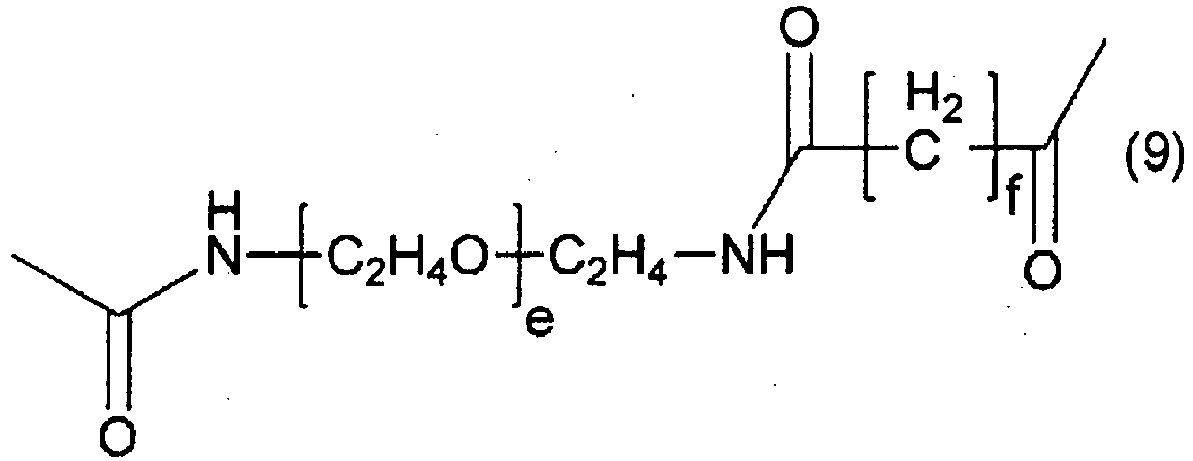

- In Formula (8), R13 is represented by Formula (11) or (12) below. In Formula (11) or (12) below, each of i and k represents an integer of 1 to 5; and j represents an integer of 1 to 10.

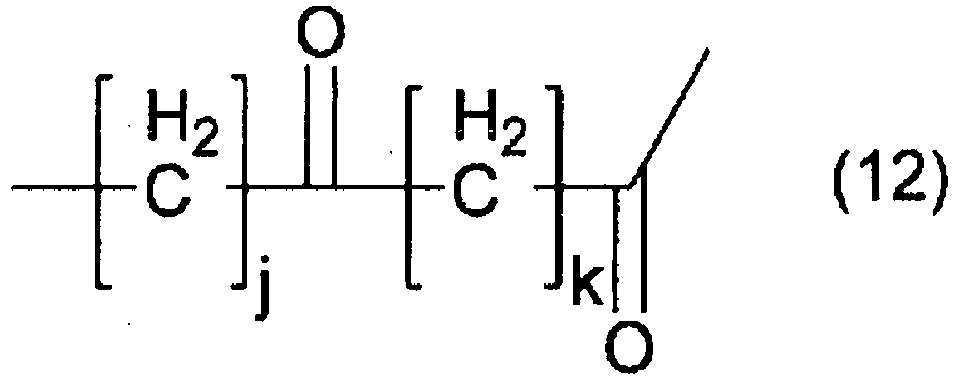
- As the compound represented by Formula (7) or (8), a compound represented by Formula (13) or (14) below is exemplified.


- The content of the monomer (A2) in a reaction solution before a polymerization reaction is 5 mmol to 50 mmol, 5 mmol to 30 mmol, or 10 mmol to 20 mmol, with respect to 100 mL of a solvent.
- Examples of the protective group [P] include a 9-fluorenylmethyloxycarbonyl group (Fmoc), a tert-butoxycarbonyl group (Boc), a benzyloxycarbonyl group (Cbz), a 2,2,2-trichloroethoxycarbonyl group (Troc), an allyloxycarbonyl group (Alloc), 4-methoxytrityl group (Mmt), an amino group, an alkyl group of 3 to 20 carbon atoms, a 9-fluorene acetyl group, a 1-fluorene carboxylic acid group, a 9-fluorene carboxylic acid group, a 9-fluorenone-1-carboxylic acid group, a benzyloxycarbonyl group, a xanthyl group (Xan), a trityl group (Trt), a 4-methyltrityl group (Mtt), a 4-methoxy 2,3,6-trimethyl-benzenesulfonyl group (Mtr), a mesitylene-2-sulfonyl group (Mts), a 4,4-dimethoxybenzhydryl group (Mbh), a tosyl group (Tos), a 2,2,5,7,8-pentamethylchromane-6-sulfonyl group (Pmc), a 4-methyl benzyl group (MeBzl), a 4-methoxybenzyl group (MeOBzl), a benzyloxy group (BzlO), a benzyl group (Bzl), a benzoyl group (Bz), a 3-nitro-2-pyridine sulfenyl group (Npys), a 1-(4,4-dimethyl 2,6-dioxocyclohexylidene)ethyl group (Dde), a 2,6-dichlorobenzyl group (2,6-DiCl-Bzl), a 2-chlorobenzyloxycarbonyl group (2-Cl-Z), a 2-bromobenzyloxycarbonyl group (2-Br-Z), a benzyloxymethyl group (Bom), a cyclohexyloxy group (cHxO), a t-butoxymethyl group (Bum), a t-butoxy group (tBuO), a t-butyl group (tBu), an acetyl group (Ac), a trifluoroacetyl group (TFA), an o-bromobenzyloxycarbonyl group, a t-butyl dimethyl silyl group, a 2-chlorobenzyl group (Cl-z), a cyclohexyl group, a cyclopentyl group, an isopropyl group, a pivalyl group, a tetrahydropyran-2-yl group, and a trimethylsilyl group.
- The monomer (A2), for example, is a compound represented by Formula (15) below.

- In the case where the preparation method of the present embodiment is performed using the monomer (A2), after the polymerization reaction, the protective group [P] of the obtained polymer particle (C) is deprotected. The deprotection can be performed by a commonly known method depending on the kind of the protective group.
- As the crosslinking agent (B), a polyfunctional compound, which is a compound copolymerizable with a carboxylic acid ester monomer, can be suitably used. Examples thereof include:
- (1) di- or tri- (meth)acrylic acid esters of polyols, for example, di- or tri-(meth)acrylic acid esters of ethylene glycol, propylene glycol, trimethylolpropane, glycerine, polyoxyethylene glycol, polyoxypropylene glycol, and polyglycerin;
- (2) (1) in which the unsaturated acid is other than (meth)acrylic acid, for example, maleic acid and fumaric acid;
- (3) bisacrylamides, for example, N,N'-methylenebisacrylamide;
- (4) di- or tri- (meth)acrylic acid esters obtained by reacting polyepoxide and (meth)acrylic acid;
- (5) di(meth)acrylic acid carbamyl esters obtained by reacting polyisocyanate and (meth)acrylic acid hydroxy ester, for example, di(meth)acrylic acid carbamyl esters obtained by reacting polyisocyanate and (meth)acrylic acid hydroxy ester in which polyisocyanates are tolylenediisocyanate and hexamethylenediisocyanate; and
- (6) polyvalentallyl compounds, for example, allylated starch, allylated cellulose, diallyl phthalate, tetraallyloxy ethane, pentaerythritol triallyl ether, trimethylolpropane triallyl ether, diethylene glycol diallyl ether, and triallyl trimellitate.
- Examples of the crosslinking agent (B) may include ethylene glycol di(meth)acrylate, propylene glycol di(meth)acrylate, and N,N'-methylenebis(meth)acrylamide.
- The content of the crosslinking agent (B) in a reaction solution before a polymerization reaction is 1 mol% to 30 mol%, 3 mol% to 20 mol%, or 3 mol% to 15 mol%, with respect to the monomer (A1 or A2).
- The addition timing of the crosslinking agent (B) to a polymerization reaction system is not particularly limited, and the crosslinking agent (B) can be added at any time of before polymerization, during polymerization, and after polymerization.
- In the preparation method of the present embodiment, the "polymerization in a water-in-oil emulsion" refers to reverse phase suspension polymerization. The reverse phase suspension polymerization refers to a method of performing water-in-oil suspension polymerization by dispersing or suspending a water phase containing a water-soluble monomer, if necessary, other monomers, a crosslinking agent and a polymerization initiator in an oil phase containing a hydrophobic organic solvent inactive in polymerization. The polymerization reaction can be performed in a water-in-oil emulsion after forming the water-in-oil emulsion by dispersing a mixture containing (A1) a carboxylic acid ester monomer containing a polymerizable group or (A2) a monomer containing a polymerizable group and a hydrazyl group or oxylamino group protected with a protective group [P], (B) a crosslinking agent, water, and a polymerization initiator in an organic solvent.
- The organic solvent is a hydrophobic organic solvent inactive in polymerization. Since the organic solvent is used to disperse a mixture containing (A1) a carboxylic acid ester monomer containing a polymerizable group or (A2) a monomer containing a polymerizable group and a hydrazyl group or oxylamino group protected with a protective group [P], (B) a crosslinking agent, water and a polymerization initiator, this organic solvent can be referred to as an organic dispersion medium. Examples of the organic solvent that can be used in the preparation method of the present embodiment include aliphatic hydrocarbons, alicyclic hydrocarbons, aromatic hydrocarbons, aliphatic alcohols, aliphatic ketones, and aliphatic esters. As the aliphatic hydrocarbons, aliphatic hydrocarbons of 5 carbon atoms or more, such as n-pentane, n-hexane, and n-heptane, are exemplified. As the alicyclic hydrocarbons, alicyclic hydrocarbons of 5 carbon atoms or more, such as cyclopentane, methylcyclopentane, cyclohexane, and methylcyclohexane, are exemplified. As the aromatic hydrocarbons, benzene derivatives, such as benzene, toluene, and xylene, are exemplified. As the aliphatic alcohols, aliphatic alcohols of 4 carbon atoms or more or 4 to 6 carbon atoms, such as n-butyl alcohol and n-amyl alcohol, are exemplified. As the aliphatic ketones, aliphatic ketones of 4 carbon atoms or more or 4 to 6 carbon atoms, such as methyl ethyl ketone, are exemplified. As the aliphatic esters, aliphatic esters of 4 carbon atoms or more or 4 to 6 carbon atoms, such as ethyl acetate, are exemplified. The organic solvent that can be used in the preparation method of the present embodiment can be used alone or in a mixture of two or more.
- The amount of the organic solvent used is not particularly limited, and can be suitably set depending on the amount of the monomer (A1 or A2). The amount of the organic solvent used is 500 parts by mass to 5000 parts by mass or 500 parts by mass to 3000 parts by mass with respect to 100 parts by mass of the monomer (A1 or A2).
- The polymerization initiator is not particularly limited as long as it is used in this system, but is a water-soluble radical polymerization initiator. Examples of the polymerization initiator include: (1) hydrogen peroxide; (2) persulfates, such as sodium persulfate, potassium persulfate, and ammonium persulfate; (3) perchlorates, such as potassium perchlorate, and sodium perchlorate; (4) halogen acid salts, such as potassium chlorate and potassium bromate; (5) peroxides, such as t-butyl hydroperoxide, cumene hydroperoxide, dialkyl peroxide (di-t-butyl peroxide, t-butyl cumyl peroxide, and the like); (6) ketone peroxides, such as methyl ethyl ketone peroxide and methyl isobutyl ketone peroxide; (7) alkyl peroxy esters, such as t-butyl peroxy acetate, t-butyl peroxyisobutyrate, and t-butyl peroxypivalate; and (8) azo compounds, such as azobisisobutyronitrile and 2,2'-azobis(N,N'-dimethylene isobutyl amidine)dihydrochloride.
- The amount of the polymerization initiator used can be suitably set depending on the condition of polymerization. The amount of the polymerization initiator used is 0.005 parts by mass to 20 parts by mass, 0.01 parts by mass or greater and 10 parts by mass, 0.02 parts by mass to 10 parts by mass, or 0.05 parts by mass to 5 parts by mass, with respect to 100 parts by mass of the monomer (A1 or A2). The method of adding the polymerization initiator is not particularly limited. The polymerization initiator may be added to a solvent separately from the monomer (A1 or A2). The polymerization initiator may also be added to a solution of the monomer (A1 or A2) in advance to prepare a polymerization initiator-containing solution, and this solution may be added to a solvent.
- When carrying out the polymerization, it is preferable to include a dispersion stabilizer in a solvent. As the dispersion stabilizer, a dispersion stabilizer having a HLB of 3 to 10 or 3 to 9 is exemplified.
- In the case where the polymerization reaction is performed in an organic solvent, an oil-soluble dispersion stabilizer is preferable, and examples thereof include sorbitan fatty acid esters (sorbitan monostearate, sorbitan monolaurate, sorbitan, sorbitan monooleate, and sorbitan tristearate), and sucrose fatty acid esters (mono-, di-, or tri-esters of sucrose and fatty acids such as stearic acid, palmitic acid, lauric acid, and oleic acid).
- The dispersion stabilizer can be used alone or in a mixture of two or more.
- The amount of the dispersion stabilizer used is not particularly limited, and can be suitably selected depending on the condition of polymerization. The amount of the dispersion stabilizer used is 0.1 parts by mass to 20 parts by mass, 0.1 parts by mass to 15 parts by mass, or 0.1 parts by mass to 10 parts by mass, with respect to 100 parts by mass of the monomer (A1 or A2).
- In the reverse phase suspension polymerization reaction, polymerization is performed by suspending the water-in-oil emulsion in which a mixture containing (A1) a carboxylic acid ester monomer containing a polymerizable group or (A2) a monomer containing a polymerizable group and a hydrazyl group or oxylamino group protected with a protective group [P], (B) a crosslinking agent, water, and a polymerization initiator is dispersed in an organic solvent while blowing N2 gas in a reaction tank. The formation and suspension of the water-in-oil emulsion may be simultaneously performed, and the formation of the water-in-oil emulsion may be performed in advance. Each of the components may be mixed in a total amount before the polymerization reaction, and may also be added and mixed with stirring a part or total thereof. In the polymerization reaction conditions, temperature is 50°C to 90°C or 60°C to 80°C, and time is 0.5 hours to 24 hours or 1 hour to 20 hours.
- The polymerization reaction may be performed in an oil-in-water emulsion after forming the oil-in-water emulsion by dispersing a mixture containing (A1) a carboxylic acid ester monomer containing a polymerizable group or (A2) a monomer containing a polymerizable group and a hydrazyl group or oxylamino group protected with a protective group [P], (B) a crosslinking agent, an organic solvent, and a polymerization initiator in water.
- In the case where the polymerization reaction is performed in the oil-in-water emulsion, for example, a mixture containing (A1) a carboxylic acid ester monomer containing a polymerizable group or (A2) a monomer containing a polymerizable group and a hydrazyl group or oxylamino group protected with a protective group [P], (B) a crosslinking agent, an organic solvent, and a polymerization initiator is put into a reaction tank while stirring a solvent with blowing N2 gas in the solvent in the reaction tank to form monomer droplets, and then the polymerization reaction may be performed at 50°C to 90°C or 60°C to 80°C for 0.5 hours to 24 hours or 1 hour to 20 hours.
- As the polymerization initiator, a radical polymerization initiator is exemplified. The polymerization initiator is not particularly limited within a range in which objects of the present invention can be attained, but azo-based polymerization initiators, such as 2,2'-azobisisobutyronitrile (AIBN), 2,2'-azobis-(2-methylpropanenitrile), 2,2'-azobis-(2,4-dimethylpentanenitrile), 2,2'-azobis-(2-methylbutanenitrile), 1,1'-azobis-(cyclohexanecarbonitrile), 2,2'-azobis-(2,4-dimethyl-4-methoxyvaleronitrile), and 2,2'-azobis-(2,4-dimethylvaleronitrile), can be mainly exemplified. In addition, an organic peroxide-based polymerization initiator can also be applied to the present invention. Specific examples of the organic peroxide-based polymerization initiator may include peroxy esters, such as t-butyl peroxypivalate, t-butyl peroxy 2-ethyl hexanoate, and cumylperoxy 2-ethyl hexanoate; and diacyl peroxides, such as di-3,5,5-trimethyl hexanoyl peroxide and dilauroyl peroxide. The radical polymerization initiator may be used alone, and may also be used by suitably mixing two or more thereof.
- The amount of the polymerization initiator used can be suitably set depending on the condition of polymerization. The amount of the polymerization initiator used is 0.005 parts by mass to 20 parts by mass, 0.01 parts by mass to 10 parts by mass, 0.02 parts by mass to 10 parts by mass, or 0.05 parts by mass to 5 parts by mass, with respect to 100 parts by mass of the monomer (A1) or (A2). The method of adding the polymerization initiator is not particularly limited. The polymerization initiator may be added to a solvent separately from the monomer (A1) or (A2). The polymerization initiator may also be added to a solution of the monomer (A1) or (A2) in advance to prepare a polymerization initiator-containing solution, and this solution may be added to a solvent.
- In the case where the polymerization reaction is performed in water, examples of the dispersion stabilizer include cellulose derivatives, such as polyvinyl alcohol, methyl cellulose, ethyl cellulose, hydroxymethyl cellulose, hydroxypropyl methyl cellulose, hydroxybutyl methyl cellulose, hydroxyethyl cellulose, carboxymethyl cellulose, aminomethylhydroxypropyl cellulose, and aminoethylhydroxypropyl cellulose; starch, tragacanth, pectin, glue, and alginic acid or salts thereof; gelatin, polyvinyl pyrrolidone, polyacrylic acid or salts thereof, polymethacrylic acid or salts thereof; polyacrylamide and polymethacrylamide; copolymers of vinyl acetate and unsaturated acids, such as maleic acid, maleic anhydride, acrylic acid, methacrylic acid, itaconic acid, fumaric acid, and crotonic acid; copolymers of styrene and the unsaturated acids; copolymers of vinyl ether and the unsaturated acids; and salts or esters of the copolymers. The dispersion stabilizer can be used alone or in a mixture of two or more.
- The amount of the dispersion stabilizer used is not particularly limited, and can be suitably selected depending on the condition of polymerization. The amount of the dispersion stabilizer used is 0.1 parts by mass to 20 parts by mass, 0.1 parts by mass to 15 parts by mass, or 0.1 parts by mass to 10 parts by mass, with respect to 100 parts by mass of the monomer (A1) or (A2).
- In the case where polymerization is performed using (A1) a carboxylic acid ester monomer containing a polymerizable group, as the polymer particles (C), polymer particles having a carboxylic acid ester can be obtained. Therefore, the preparation method of the present embodiment can be said to be a method for preparing "polymer particles having a carboxylic acid ester".
- Polymer particles having a hydrazide group can be prepared by performing a process of applying a hydrazide group to the polymer particles (C) obtained in this way. As the method of applying a hydrazide group to the polymer particles (C), the above-mentioned method is exemplified.
- In the case where polymerization is performed using (A2) a monomer containing a polymerizable group and a hydrazyl group protected with a protective group [P], as the polymer particles (C), polymer particles having a hydrazyl group protected with a protective group [P] can be obtained. Therefore, the preparation method of the present embodiment can be said to be a method for preparing "polymer particles having a hydrazyl group protected with a protective group [P]".
- Polymer particles having a hydrazide group can be prepared by deprotecting the polymer particles (C) obtained in this way. As the method of deprotecting the polymer particles (C), the above-mentioned method is exemplified.
- In the case where polymerization is performed using (A2) a monomer containing a polymerizable group and an oxylamino group protected with a protective group [P], as the polymer particles (C), polymer particles having an oxylamino group protected with a protective group [P] can be obtained. Therefore, the preparation method of the present embodiment can be said to be a method for preparing "polymer particles having an oxylamino group protected with a protective group [P]".
- Polymer particles having an oxylamino group can be prepared by deprotecting the polymer particles (C) obtained in this way. As the method of deprotecting the polymer particles (C), the above-mentioned method is exemplified.
- In another embodiment, the present invention provides a composition containing polymer particles having a functional group for capturing sugar chains, and a surfactant. Preferably, the polymer particles are coated with the surfactant.
- According to the composition of the present embodiment, the aggregation of the polymer particles under a high-temperature condition can be suppressed, and the hygroscopicity thereof can be deteriorated, without deteriorating the sugar chain capturing capability of the polymer particles having a functional group for capturing sugar chains.
- In the above-described composition, the rate of change of mass calculated by Equation (F1) below is 90% to 112%. In Equation (F1), A represents the mass of the composition after incubation for 4 hours under an environment of a relative humidity of 50% and a temperature of 25°C, and B represents the mass of the composition before the incubation.

- In the composition of the present embodiment, as the polymer particles and the surfactant, the above-described polymer particles and the above-described surfactant can be used.
- In an embodiment, the present invention provides a method for preparing a sugar chain sample using the above-described composition and a method for analyzing sugar chains in the sample. The polymer particles in the above-described composition surprisingly have excellent sugar chain capturing capability even in a state of coexisting with a surfactant. Therefore, these polymer particles can be directly used in capturing sugar chains without removing a surfactant from the composition, and are also excellent in terms of convenience.
- In the method of the present embodiment, first, a sample containing a sugar chain is brought into contact with the above-described composition to bond the sugar chain to the polymer particles in the composition (process (a)). In other words, the polymer particles capture the sugar chain.
- The "sample containing a sugar chain", for example, can be prepared from a biological sample. Examples of the biological sample include whole blood, serum, plasma, urine, saliva, cells, tissue, viruses, and plant tissues. In the present invention, purified or unpurified glycoprotein can be used. The sample may be pre-treated by a method, such as defatting, desalting, protein fractionation, or thermal denaturation.
- It is possible to liberate a sugar chain from molecules (for example, glycoprotein molecules) including a sugar chain contained in the biological sample by using sugar chain liberation means. As the sugar chain liberation means, glycosidase treatment using N-glycosidase or O-glycosidase, hydrazinolysis, or β-elimination by alkali treatment can be used. In the case of performing analysis of a N-type sugar chain, a method using N-glycosidase is preferable. Prior to glycosidase treatment, protease treatment using trypsin or chymotrypsin may be performed.
- The sample prepared in this way is brought into contact with the polymer particles of the present invention, thereby allowing the polymer particles to capture a sugar chain. Sugar chain is a sole substance having an aldehyde group, among substances in the body. Sugar chains are configured such that cyclic hemiacetal type sugar chains and noncyclic aldehyde type sugar chains exist in equilibrium in the state of an aqueous solution or the like. Substances in the body other than the sugar chain, such as protein, nucleic acid, and lipid, do not contain an aldehyde group. From this viewpoint, if polymer particles having a hydrazide group or an aminooxy group forming stable bonds by specifically reacting with an aldehyde group are used, it is possible to selectively capture only a sugar chain.
- When a sugar chain is captured by the polymer particles, the pH of a reaction system is preferably 2 to 9, more preferably 2 to 7, and further more preferably 2 to 6. For pH adjustment, various buffer solutions can be used. Further, as the solvent at the time of capturing sugar chains, a mixed solvent of an acid and an organic solvent can be used. The acid used is not particularly limited, but examples thereof preferably include acetic acid, formic acid, trifluoroacetic acid, hydrochloric acid, citric acid, phosphoric acid, and sulfuric acid, more preferably acetic acid, formic acid, trifluoroacetic acid, and phosphoric acid, and further more preferably acetic acid and trifluoroacetic acid. The organic solvent is not particularly limited as long as it dissolves sugar and the above acid, but an organic solvent having a relatively low boiling point, such as acetonitrile, is suitably used because capturing efficiency is increased in many cases if this organic solvent is dried at the time of capturing. The mixing ratio of acid and organic solvent is preferably 0.1:99.9 to 10:90, more preferably 0.5:99.5 to 5:95, and most preferably 1:99 to 5:95. The temperature at the time of capturing sugar chains is preferably 4°C to 90°C, more preferably 30°C to 90°C, further more preferably 30°C to 80°C, and most preferably 40°C to 80°C. Reaction time can be suitably set. The polymer particles may pass through a sample solution by filling a column with these polymer particles.
- Subsequently, the polymer particles bonded with a sugar chain (capturing a sugar chain) are washed (process (b)).
- Among the substances captured by the polymer particles, substances other than sugar chain (non-specifically adsorbed substances) can be removed by washing the polymer particles capturing a sugar chain.
- As the method of removing the substance other than sugar chain, a method of washing the polymer particles with an aqueous guanidine solution that is a chaotropic reagent capable of dissociating a hydrophobic bond, or a method of washing the polymer particles with pure water or an aqueous buffer solution (for example, a phosphate buffer solution or a tris buffer solution) can be used. As the washing conditions in the washing process, the temperature is 4°C to 40°C, and washing time is 10 seconds to 30 minutes. In the washing method, the polymer particles can be washed by immersing these polymer particles in a washing solution and repeating the exchange of the washing solution.
- Specifically, the polymer particles are put into a centrifugal tube or a tube, a washing solution is added thereto, shaking is performed, and then the polymer particles are precipitated by centrifugation, and operations of removing the supernatant are repeated, thereby washing the polymer particles. For example, the polymer particles are put into a centrifugal tube, a washing solution is added thereto, and then the polymer particles are precipitated by spontaneous precipitation or forcibly precipitated by centrifugation, and operations of removing the supernatant are repeated, thereby washing the polymer particles. Preferably, the washing operations are performed three times to six times. In the case of using magnetic beads, centrifugation is not required, which is convenient.
- Further, it is also possible to use a filter tube which is a tubular container and which is provided at the bottom thereof with a liquid-permeable filter having a pore with a pore size that makes the polymer particles impermeable. If the filter tube filled with polymer particles is used, a washing solution necessary for washing can be removed through a filter, and thus the process of removing the supernatant after centrifugation is not required, thereby improving workability.
- Various multi-well plates of 6 to 384 wells, each being provided at the bottom thereof with the filter, are commercially available, and it is possible to obtain high throughput by using these plates. Particularly, a multi-well plate of 96 wells is most suitable for high throughput with the development of a solution-dispensing apparatus, a suction removal system, and a plate transport system.
- In the case of performing a sugar chain capture reaction in a continuous manner, washing treatment may be continuously performed in the sugar chain capture reaction by passing a washing solution through a column. Further, in the case of using a multi-plate, substances other than the polymer particles capturing a sugar chain may be removed by filtration or centrifugation.
- Meanwhile, excess functional groups on the polymer particles, for example, can be capped by using acetic anhydride or the like.
- Subsequently, sugar chains is liberated from the polymer particles bonded with a sugar chain (capturing a sugar chain) (process (c)).
- In order to separate a sugar chain from the polymer particles, it is preferable to perform acid treatment. In the acid treatment, a mixed solvent of an acid and an organic solvent or a mixed solvent of an acid, water, and an organic solvent can be used. In the case of the mixed solvent of an acid, water, and an organic solvent, the content of water is preferably 0.1 % to 90%, more preferably 0.1 % to 80%, and further more preferably 0.1% to 50%. This mixed solvent may contain an aqueous buffer solution instead of water. The concentration of the buffer solution is preferably 0.1 mM to 1 M, more preferably 0.1 mM to 500 mM, and further more preferably 1 mM to 100 mM. The pH of a reaction solution is preferably 2 to 9, more preferably 2 to 7, and further more preferably 2 to 6. Examples of the acid used preferably include acetic acid, formic acid, trifluoroacetic acid, hydrochloric acid, citric acid, phosphoric acid, and sulfuric acid, more preferably acetic acid, formic acid, trifluoroacetic acid, and phosphoric acid, and further more preferably acetic acid and trifluoroacetic acid. Reaction temperature is preferably 4°C to 90°C, more preferably 25°C to 90°C, and further more preferably 40°C to 90°C. Reaction time is 10 minutes to 24 hours, preferably 10 minutes to 8 hours, and more preferably 10 minutes to 3 hours. It is preferable that the reaction be performed in an open system to completely evaporate a solvent, from the viewpoint of efficiently performing the reaction by liberating sugar chains.
- Since the liberation reaction of a sugar chain can be performed around neutral from weak acid, it is possible to suppress the occurrence of hydrolysis of a sugar chain, such as elimination of sialic acid residues, compared to the excision reaction in the presence of strong acid, caused by conventional strong acid treatment, for example, such as 10% trifluoroacetic acid treatment.
- Subsequently, it is also possible to label the free sugar chains obtained in the above process. As the labeling method, a reductive amination method and an exchange reaction method are exemplified.
- In the reductive amination method, a sugar chain is labeled by a compound having an amino group. In a reaction system, a mixed solvent of an acid and an organic solvent or a mixed solvent of an acid, water, and an organic solvent can be used. The acid used is not particularly limited, but examples thereof preferably include acetic acid, formic acid, trifluoroacetic acid, hydrochloric acid, citric acid, phosphoric acid, and sulfuric acid, more preferably acetic acid, formic acid, trifluoroacetic acid, and phosphoric acid, and further more preferably acetic acid and trifluoroacetic acid. The organic solvent is not particularly limited as long as it dissolves the acid, but dimethyl sulfoxide is preferably used. In the case of the mixed solvent of an acid and an organic solvent, the mixing ratio of acid and organic solvent is preferably 1:99 to 50:50, more preferably 5:95 to 50:50, and most preferably 10:90 to 50:50. In the case of the mixed solvent of an acid, water, and an organic solvent, the results obtained at the time of measuring pH regardless of the ratio of the organic solvent are preferably conditions ranging from acidic to neutral. The pH of the mixed solvent is preferably 2 to 9, more preferably 2 to 8, and further more preferably 2 to 7. In both the case of the mixed solvent of an acid and an organic solvent and the case of the mixed solvent of an acid, water, and an organic solvent, the reaction temperature is preferably 4°C to 90°C, more preferably 25°C to 90°C, and further more preferably 40°C to 90°C. The concentration of an amino compound is preferably 1 mM to 10 M, and the concentration of a reducing agent is preferably 1 mM to 10 M. The reaction time is 10 minutes to 24 hours, preferably 10 minutes to 8 hours, and more preferably 10 minutes to 3 hours.
- Here, preferably, the compound having an amino group has UV-visible absorption characteristics or fluorescent characteristics. Specifically, the compound is preferably at least one selected from the group consisting of 8-aminopyrene-1,3,6-trisulfonate, 8-aminonaphthalene-1,3,6-trisulphonate, 7-amino-1,3-naphthalenedisulfonic acid, 2-amino 9(10H)-acridone, 5-aminofluorescein, dansylethylenediamine, 2-aminopyridine, 7-amino-4-methylcoumarine, 2-aminobenzamide, 2-aminobenzoic acid, 3-aminobenzoic acid, 7-amino-1-naphthol, 3-(acetylamino)-6-aminoacrdine, 2-amino-6-cyanoethylpyridine, ethyl p-aminobenzoate, p-aminobenzonitrile, and 7-aminonaphthalene-1,3-disulfonic acid.
- Particularly, in the case where the amino compound is 2-aminobenzamide, reaction conditions are as follows. In a reaction system, a mixed solvent of an acid and an organic solvent or a mixed solvent of an acid, water, and an organic solvent can be used. In the case of the mixed solvent of an acid and an organic solvent, the mixing ratio of acid and organic solvent is preferably 1:99 to 50:50, more preferably 5:95 to 50:50, and most preferably 10:90 to 50:50. In the case of the mixed solvent of an acid, water, and an organic solvent, the results obtained at the time of measuring pH regardless of the ratio of the organic solvent are preferably conditions ranging from acidic to neutral. The pH of the mixed solvent is preferably 2 to 9, more preferably 2 to 8, and further more preferably 2 to 7. The reaction temperature is preferably 4°C to 90°C, more preferably 30°C to 90°C, and further more preferably 40°C to 80°C. The concentration of the amino compound is 1 mM to 10 M, preferably 10 mM to 10 M, and more preferably 100 mM to 1 M. The concentration of the reducing agent is 1 mM to 10 M, preferably 10 mM to 10 M, and more preferably 100 mM to 2 M. The reaction time is 10 minutes to 24 hours, preferably 10 minutes to 8 hours, and more preferably 1 hour to 3 hours.
- As the reducing agent, for example, sodium cyanoborohydride, methylamine borane, dimethylamineborane, trimethylamineborane, picolineborane, and pyridine borane are available, but it is preferable to use sodium cyanoborohydride in terms of reactivity.
- Since the solution obtained after the foregoing process of dissociating sugar chains contains labeled sugar chains, an excessive amount of an unreacted amino compound, and an excessive amount of a reducing agent, it is preferable to perform a process of removing these excessive reagents. Any method of removal by silica column, removal by gel filtration, removal by ion exchange resin may be used, but it is preferable that the solvent used for preventing the dissociation of sialic acid be neutral.
- Meanwhile, in the exchange reaction method, when applying the compound having an aminooxy group after the washing operation, a sugar chain is dissociated from the polymer particles by a hydrazine-oxime exchange reaction (in the case where the functional group specifically reacting with an aldehyde group of a sugar chain is a hydrazide group) or an oxime-oxime exchange reaction (in the case where the functional group specifically reacting with an aldehyde group of a sugar chain is an aminooxy group), and are labeled by an aminooxy compound. Therefore, in the case of this labeling method, the operation for separating a sugar chain from the polymer particles by acid treatment is not required.
- It is preferable that the compound having an aminooxy group include a portion composed of at least one of arginine residue, tryptophan residue, phenylalanine residue, tyrosine residue, cysteine residue, and derivatives thereof.
- As an example of the compound containing these residues and derivatives thereof, a substance or a salt thereof selected from O-benzylhydroxylamine; O-phenylhydroxylamine; O-(2,3,4,5,6-pentafluorobenzyl) hydroxylamine; O-(4-nitrobenzyl) hydroxylamine; 2-aminooxypyridine; 2-aminooxy methylpyridine; 4-[(aminooxyacetyl) amino] benzoic acid methyl ester; 4-[(aminooxyacetyl) amino] benzoic acid ethyl ester; 4-[(aminooxyacetyl) amino] benzoic acid n-butylester; and N-aminooxyacetyl-tryptophyl (arginine amide) is exemplified. In particular, a compound having a structure represented by Formula (16) or (17) below is preferable.


- In the reaction system at the time of the exchange reaction, a mixed solvent of an acid and an organic solvent or a mixed solvent of an acid, water, and an organic solvent can be used. In the case of the mixed solvent of an acid and an organic solvent, the mixing ratio of acid and organic solvent is preferably 0.1:99.9 to 10:90, more preferably 0.5:99.5 to 5:95, and most preferably 1:99 to 5:95. In the case of the mixed solvent of an acid, water, and an organic solvent, from the results obtained at the time of measuring pH regardless of the ratio of the organic solvent, the pH of the mixed solvent is preferably 2 to 7, more preferably 3 to 6, and most preferably 3.5 to 5.5. The pH of the reaction solution can be adjusted within the above range by adding an acetic acid/acetonitrile solution. The temperature at the time of the exchange reaction is preferably 50°C to 95°C, more preferably 60°C to 90°C, and most preferably 70°C to 90°C. At the time of the exchange reaction, a reaction container is opened, and heating is performed, so that the exchange reaction proceeds while evaporating a solvent, and dryness is finally obtained, thereby efficiently performing the exchange reaction.
- By the above process, a sugar chain sample can be prepared. In the analysis method of a sugar chain in the sample, the sugar chain liberated by the above-described sugar chain preparation method are analyzed (process (d)). The sugar chain solution recovered through the above method can be subjected to analysis of a sugar chain (for example, analysis of structure and amount of a sugar chain) by a commonly known method, such as mass spectrometry (for example, MALDI-TOF MS), chromatography (for example, HPLC and HPAE-PAD), or electrophoresis (for example, capillary electrophoresis) directly or after removing the excessively contained labeled compound. In the analysis of a sugar chain, if necessary, various databases (for example, GlycoMod, Glycosuite, SimGlycan(R), and the like) can be referred thereto.
- Hereinafter, the present invention will be described in more detail with reference to Examples and Comparative Examples. However, the present invention is not limited to the following Examples.
- A compound (e), which is a carboxylic acid ester monomer containing a polymerizable group, was synthesized by the following scheme.

- A solution, in which methacrylic anhydride (MAH: 5 g, 0.03 mol) was dissolved in 100 mL of chloroform, was dropped into a solution, in which 25 g of (ethylenedioxy) bis(ethylamine) (EDBEA: 25 g, 0.17 mol) was dissolved in 100 mL of chloroform, on an ice bath. Nitrogen was sealed thereinto, and stirring was performed overnight, so as to obtain a reaction solution. The residues obtained by evaporating a solvent from the obtained reaction solution passed through a silica gel column, (developing solvent: mixed solvent of chloroform 90 vol. /
methanol 10 vol.) to extract a predetermined fraction, and a solvent was evaporated from this fraction, so as to obtain an intermediate product (c). 5 g (0.023 mol) of this intermediate product (c) was dissolved in 100 mL of chloroform to obtain a solution, and 1.5 equivalents of monomethyl succinate and 1.5 equivalents of 1-ethyl-3-(3-dimethylaminopropyl) carbodiimide, which is a water-soluble carbodiimide compound (WSC), were added to this solution, and sealing was performed. Nitrogen was sealed thereinto, and stirring was performed overnight, so as to obtain a reaction solution. The residues obtained by evaporating a solvent from the obtained reaction solution passed through a silica gel column (developing solvent: mixed solvent of chloroform 90 vol. /methanol 10 vol.) to extract a predetermined fraction, and the solvent was evaporated from this fraction, so as to obtain a carboxylic acid ester monomer (e) containing a polymerizable group. The obtained compound (e) was confirmed to be a target product by NMR or matrix-assisted laser ionization-time-of flight mass spectrometer (MALDI-TOF-MS). - A sealable polymerization container was filled with 40 mL of 0.2% sorbitan monostearate-containing cyclohexane, and the oxygen in the system was purged by nitrogen. A mixture including 2 g (6 mmol) of the carboxylic acid ester monomer (e), ethylene glycol dimethacrylate (EGDMA: 5 mol% with respect to methyl ester-containing monomer), 1.5 mL of pure water, and 0.0175 g of potassium peroxodisulfate (1 mol% with respect to the total monomer) was introduced into the polymerization container with nitrogen purging, and was dispersed in the sorbitan monostearate-containing cyclohexane. After nitrogen purging was stopped and sealing was performed, a reaction was performed at 70°C for 16 hours with stirring, so as to form polymer particles.
- The formed polymer particles were recovered by centrifugation, and were washed with ethanol and water.
- 500 mg of the polymer particles were put into a container, 4 mL of hydrazine monohydrate (stock solution, 98 vol% or more) was added thereto, followed by stirring and standing treatment at room temperature for 2 hours. After the reaction, hydrazine monohydrate was removed from the reaction product, the reaction product was washed with methanol, and then the reaction product was rinsed with 1M hydrochloric acid. Thereafter, the reaction product was further washed with pure water, so as to obtain polymer particles having a hydrazide group.
- 100 mg of the polymer particles having a hydrazide group were dispersed in 1 mL of a 2 wt% cyclohexane solution of sorbitan monostearate, and then centrifuged. Thereafter, the supernatant was removed, and then the polymer particles were dried in a vacuum and coated with a surfactant, so as to obtain polymer particles of Example 1 (composition containing polymer particles and a surfactant).
- A composition of Example 2 was obtained in the same manner as in Example 1, except that, at the time of coating with a surfactant in Example 1, a 2 wt% cyclohexane solution of sorbitan tristearate was used instead of the 2 wt% cyclohexane solution of sorbitan monostearate.
- A composition of Example 3 was obtained in the same manner as in Example 1, except that, at the time of coating with a surfactant in Example 1, a 2 wt% ethanol solution of sodium lauryl sulfate was used instead of the 2 wt% cyclohexane solution of sorbitan monostearate.
- A sealable polymerization container was filled with 40 mL of a 0.15% aqueous polyvinyl alcohol solution, and the oxygen in the system was purged by nitrogen. A mixture including 2 g (6 mmol) of the carboxylic acid ester monomer (e), ethylene glycol dimethacrylate (EGDMA: 5 mol% with respect to methyl ester-containing monomer), 1.5 mL of chloroform, and 0.011 g of azobisisobutyronitrile (1 mol% with respect to the total monomer) was introduced into the polymerization container with nitrogen purging, and was dispersed in the aqueous polyvinyl alcohol solution. After nitrogen purging was stopped and sealing was performed, a reaction was performed at 70°C for 16 hours with stirring, so as to form polymer particles. The formed polymer particles were recovered by centrifugation, and were washed with methanol and water.
- 500 mg of the polymer particles were put into a container, 4 mL of hydrazine monohydrate (stock solution, 98 vol% or more) was added thereto, followed by stirring and standing treatment at room temperature for 2 hours. After the reaction, hydrazine monohydrate was removed from the reaction product, the reaction product was washed with methanol, and then the reaction product was rinsed with 1M hydrochloric acid. Thereafter, the reaction product was further washed with pure water, so as to obtain polymer particles having a hydrazide group.
- 100 mg of the polymer particles having a hydrazide group were dispersed in 1 mL of a 2 wt% cyclohexane solution of sorbitan monostearate, and then centrifuged. Thereafter, the supernatant was removed, and then the polymer particles were dried in a vacuum and coated with a surfactant, so as to obtain polymer particles of Example 4 (composition containing polymer particles and a surfactant).
- A composition of Example 5 was obtained in the same manner as in Example 1, except that, at the time of coating with a surfactant in Example 4, a 2 wt% cyclohexane solution of sorbitan tristearate was used instead of the 2 wt% cyclohexane solution of sorbitan monostearate.
- A composition of Example 6 was obtained in the same manner as in Example 1, except that, at the time of coating with a surfactant in Example 4, a 2 wt% methanol solution of sodium lauryl sulfate was used instead of the 2 wt% cyclohexane solution of sorbitan monostearate.
- A composition in which the polymer particles were not coated with a surfactant in Example 1 was used as a composition of Comparative Example 1.
- A composition in which the polymer particles were not coated with a surfactant in Example 4 was used as a composition of Comparative Example 2.
- 50 mg of each of the compositions of Examples and Comparative Examples was dried in a vacuum at 23°C for 12 hours or longer. Subsequently, each of the compositions was put into a plastic container, the plastic container filled with the composition was introduced into an aluminum bag together with a silica gel desiccant, and the aluminum bag was sealed. Then, the heat retaining thereof was performed in an oven at 60°C for 3 days.
- The particle size distribution of the composition heat-retained at 60°C was measured using a laser diffraction/scattering type particle size analyzer MT3300 manufactured by NIKKISO CO., LTD., and the average particle diameter of polymer particles in the composition was compared to the measurement result before storage at 60°C.
- The rate of change of the average particle diameter was calculated by Equation (F2) below. In Equation (F2), C represents the average particle diameter of the polymer particles in the composition after heat-retaining treatment, and D represents the average particle diameter of the polymer particles in the composition before the heat-retaining treatment.

[Table 1] Example 1 Example 2 Example 3 Comparative Example 1 Example 4 Example 5 Example 6 Comparative Example 2 Before storage (µm) 82 83 81 80 68 69 69 68 After storage (µm) 78 81 80 123 67 70 68 118 Rate of change (%) 95.1 97.6 98.8 153.8 98.5 101.4 98.6 173.5 - In all of the Examples in which surfactant treatment had been carried out, there was hardly any change in particle diameter before and after heat-retaining treatment at 60°C. In contrast, in Comparative Examples in which surfactant treatment had not been carried out, the particle diameter increased after heat-retaining treatment at 60°C. That is, it was considered that the aggregation of polymer particles in heat-retaining treatment at 60°C could be suppressed by surfactant treatment.
- In each of the compositions of Examples and Comparative Examples, the amount of a hydrazide group before and after heat-retaining treatment at 60°C was measured using 2,4,6-trinitrobenzene sulfonic acid (TNBS). That is, each of the compositions was dispersed in an aqueous TNBS solution, and the amount of a hydrazide group was calculated from the difference in absorbance at 345 nm before and after the dispersion. The measurement results thereof are shown below.
[Table 2] Example 1 Example 2 Example 3 Comparative Example 1 Example 4 Example 5 Example 6 Comparative Example 2 Before storage 3.0 2.9 3.0 3.0 3.4 3.3 3.5 3.4 After storage 3.0 3.0 2.9 3.0 3.4 3.4 3.4 3.3 Unit: µmol/mg - In both Examples and Comparative Examples, the amount of a hydrazide group was not changed by heat-retaining treatment at 60°C. That is, the amount of a hydrazide group was maintained at 60°C, regardless of the presence or absence of surfactant treatment.
- Each of the compositions of Examples and Comparative Examples was collected in a plastic container in a predetermined amount, and released in the air (standing-treated under an environment of a relative humidity of 50% and a temperature of 25°C), the rate of change of mass after 4 hours was examined, and hygroscopicity was evaluated. The rate of change of mass was calculated by Equation (F1) below. In Equation (F1), A represents the mass of the composition after incubation for 4 hours under an environment of a relative humidity of 50% and a temperature of 25°C, and B represents the mass of the composition before the incubation.

- The experiments were carried out several times. Representative experimental results are shown in Tables 3 and 4.
[Table 3] Example 1 Example 2 Example 3 Comparative Example 1 Example 4 Example 5 Example 6 Comparative Example 2 Rate of change of mass (%) 108 106 109 115 107 105 108 110 [Table 4] Example 1 Example 2 Example 3 Comparative Example 1 Example 4 Example 5 Example 6 Comparative Example 2 Rate of change or mass (%) 108 107 111 118 108 106 109 116 - As a result, although there is some variation, it was found that the hygroscopicity of each of the compositions of Examples was lower than (the rate of change of mass was smaller than) that of each of the compositions of Comparative Examples. Further, in Comparative Example 1, deterioration of operability, such as aggregation of polymer particles or adsorption of polymer particles on a plastic container, occurred with moisture absorption, but in all of the compositions of Examples in which surfactant treatment had been carried out, no such phenomenon was observed.
- 1 mg of bovine serum-derived IgG was dissolved in 50 µL of 100 mM ammonium bicarbonate, and then 5 µL of 120 mM DTT (dithiothreitol) was added thereto, and a reaction was performed at 60°C for 30 minutes. After the completion of the reaction, 10 µL of 123 mM IAA (iodoacetamide) was added thereto, and a reaction was performed at room temperature for 1 hour under light blocking. Subsequently, protease treatment was performed using trypsin of 400 U, and protein moiety was fragmented into peptides. After the reaction solution was treated at 90°C for 5 minutes, treatment using glycosidase F of 5 U was performed to liberate sugar chains from the peptides, so as to obtain a pre-treated biological sample.
- 20 µL of suspended solids of the pre-treated biological sample and 180 µL of a 2% acetic acid/acetonitrile solution were added to a disposable column filled with 5 mg of the polymer particles (composition) of each of Examples and Comparative Examples, and a reaction was performed at 80°C for 1 hour. The reaction was performed in an open system, and it was visually observed that a solvent was completely evaporated from the composition, and thus the composition was present in the state of dryness. Subsequently, after the polymer particles were washed with a guanidine solution, pure water, methanol, or a triethylamine solution, 10% acetic anhydride/methanol was added thereto, and a reaction was performed at room temperature for 30 minutes, thereby capping the unreacted hydrazide group. After the capping, the composition was washed with pure water.
- Next, 20 µL of pure water and 180 µL of a 2% acetic acid/acetonitrile solution were added to the disposable column, and a reaction was performed at 70°C for 1.5 hours. The reaction was performed in an open system, and it was visually observed that a solvent was completely evaporated from the composition, and thus the composition was present in the state of dryness.
- Further, 50 µL of a solution, in which 2-aminobenzamide (2-AB) and sodium cyanoborohydride were dissolved in a 30% acetic acid/DMSO mixed solvent such that final concentrations thereof were adjusted to 0.35 M and 1 M, respectively, was added, and a reaction was performed at 60°C for 2 hours.
- The above sugar chain-capturing process (a), washing process (b), sugar chain liberating process (c), and labeling process (d) were performed in the disposable column that is the same container.
- 50 µL of a reaction solution was recovered, diluted tenfold with acetonitrile, and then added to a column packed with silica gel (Iatrobeads, 6RS-8060, manufactured by Mitsubishi Chemical Iatron Corporation) to allow the silica gel to adsorb the labeled sugar chains. The column was washed with acetonitrile or an acetonitrile/water mixed solution (95:5), and then the labeled sugar chains were recovered by 50 µL of pure water.
- The obtained labeled sugar chains were measured by HPLC. The labeled sugar chains were measured at an excitation wavelength of 330 nm and a fluorescent wavelength of 420 nm using an amino column (Shodex Asahipak NH2P-50). As a result, sugar chains labeled by 2AB were detected.
-
FIG. 1 shows the total peak areas calculated from HPLC charts obtained in Examples 1 and 4 and Comparative Examples 1 and 2. As shown inFIG. 1 , in all of the compositions, the total peak areas were equal to each other. That is, in all of the compositions, the total sugar chain capturing amounts were equal to each other. Similar results were obtained in other Examples. -
FIG. 2 shows the area ratios of the main seven peaks detected by HPLC charts obtained in Examples 1 and 4 and Comparative Examples 1 and 2. The horizontal axis shows the peak number. As shown inFIG. 2 , it was understood that, in all of the compositions, the respective area ratios were equal to each other, and the same sugar chains can be captured at the same ratio. Even in other Examples, similar results were obtained. - As described above, it was shown that the surfactant did not deteriorate the sugar chain capturing capability.
- Each of the compositions of Example 4 and Comparative Example 2 was collected in a plastic container in a predetermined amount and dried in a vacuum at about 23°C for 12 hours or longer, and then the plastic container filled with the composition was introduced into an aluminum bag together with a silica gel desiccant, and the aluminum bag was sealed. Then, in this sealed state, the plastic container filled with the composition was kept at 37°C for 3 months. This treatment corresponds to storage at 4°C for 2.8 years from the results of an Arrhenius plot separately carried out.
- When these compositions were dispersed in water and sucked with a pipette, in the composition of Comparative Example 2, polymer particles clogged the tip of the pipette, whereas, in the composition of Example 4, no such phenomenon was observed.
- Subsequently, when the particle size distribution of these particles was measured in the same manner as above and the average particle diameters thereof before and after standing treatment were compared, the average particle diameter of the polymer particles in the composition of Comparative Example 2 was greatly increased from 68 µm to 133 µm, and thus aggregation had proceeded. In contrast, the average particle diameter of the polymer particles in the composition of Example 4 was slightly increased from 68 µm to 85 µm.
- In the composition of Example 4 after standing treatment and the composition of Example 4 having been kept at 4°C during the standing treatment, when the amounts of a hydrazide group were determined, both of the amounts were the same as those immediately after preparation, and no difference was observed.
- In addition, sugar chain capturing capability was examined using 0.1 µg of maltoheptaose in the same manner as in Example 4.
FIG. 3 is a graph showing the examined results of sugar chain capturing capability. As shown inFIG. 3 , before and after standing treatment, no change in the total peak area obtained from HPLC chart was observed. These results show that the composition after standing treatment maintains sugar chain capturing capability. - From the above results, it was clearly found that the compositions of Examples can suppress the aggregation of polymer particles while maintaining sugar chain capturing capability, compared to conventional compositions.
- The polymer particles of the present invention are excellent in quality stability and operability in addition to sugar chain capturing capability. Sugar chain research can be used in the recovery of sugar chains from natural products or the manufacture of sugar chain standard materials from natural products, and can also be applied in the medical field of disease marker research by sugar chain analysis, diagnosis by sugar chain analysis, or the like.
Claims (11)
- A composition, comprising:polymer particles having a functional group for capturing a sugar chain,wherein the rate of change of mass calculated by Equation (F1) below is more than 90% and less than 112%

- The composition according to Claim 1,
wherein the rate of change of average particle diameter calculated by Equation (F2) below is 90% to 120%
- The composition according to Claim 1 or 2,
wherein the composition containing the polymer particles further contains a surfactant. - The composition according to Claim 3,
wherein the polymer particles are coated with the surfactant. - The composition according to Claim 3 or 4,
wherein the surfactant is a sorbitan fatty acid ester or an anionic surfactant. - The composition according to any one of claims 1 to 5,
wherein the average particle diameter of the polymer particles is 0.05 µm to 1000 µm. - The composition according to any one of Claims 1 to 6,
wherein the functional group is a hydrazide group or an aminooxy group. - The composition according to any one of Claims 1 to 7,
wherein each of the polymer particles has a crosslinked polymer structure represented by Formula (1) below
- The composition according to Claim 8,
wherein the crosslinked polymer structure is represented by Formula (2) below.
- A method for preparing a sugar chain sample, comprising the processes of:(a) mixing a sample containing a sugar chain with the composition according to any one of Claims 1 to 9 to bond the sugar chain to the polymer particle in the composition;(b) washing the polymer particle bonded to the sugar chain; and(c) liberating the sugar chain from the polymer particle bonded to the sugar chain.
- A method for analyzing a sugar chain in a sample, comprising the processes of:(a) mixing a sample containing a sugar chain with the composition according to any one of Claims 1 to 9 to bond the sugar chain to the polymer particle in the composition;(b) washing the polymer particle bonded to the sugar chain;(c) liberating the sugar chain from the polymer particle bonded to the sugar chain; and(d) analyzing the liberated sugar chain.
Applications Claiming Priority (2)
| Application Number | Priority Date | Filing Date | Title |
|---|---|---|---|
| JP2014005861 | 2014-01-16 | ||
| PCT/JP2015/050602 WO2015108020A1 (en) | 2014-01-16 | 2015-01-13 | Composition, method for preparing sugar chain sample, and method for analyzing sugar chain |
Publications (2)
| Publication Number | Publication Date |
|---|---|
| EP3096136A1 true EP3096136A1 (en) | 2016-11-23 |
| EP3096136A4 EP3096136A4 (en) | 2017-08-30 |
Family
ID=53542909
Family Applications (1)
| Application Number | Title | Priority Date | Filing Date |
|---|---|---|---|
| EP15737741.7A Withdrawn EP3096136A4 (en) | 2014-01-16 | 2015-01-13 | Composition, method for preparing sugar chain sample, and method for analyzing sugar chain |
Country Status (5)
| Country | Link |
|---|---|
| EP (1) | EP3096136A4 (en) |
| JP (1) | JPWO2015108020A1 (en) |
| CN (1) | CN105874330A (en) |
| SG (1) | SG11201604454QA (en) |
| WO (1) | WO2015108020A1 (en) |
Families Citing this family (2)
| Publication number | Priority date | Publication date | Assignee | Title |
|---|---|---|---|---|
| JP6746919B2 (en) * | 2016-01-15 | 2020-08-26 | 日立化成株式会社 | Separation material and column |
| CN106525986A (en) * | 2016-09-22 | 2017-03-22 | 上海颢哲信息科技有限公司 | Method for fast and high throughput detection of N-linked glycans in glycoprotein based on membrane separation |
Family Cites Families (5)
| Publication number | Priority date | Publication date | Assignee | Title |
|---|---|---|---|---|
| GB9107952D0 (en) * | 1991-04-15 | 1991-05-29 | Dow Rheinmuenster | Surface crosslinked and surfactant coated absorbent resin particles and method of preparation |
| EP2799868A3 (en) | 2006-08-09 | 2015-04-22 | Sumitomo Bakelite Co., Ltd. | Sugar chain-capturing substance and use thereof |
| DK2107373T3 (en) * | 2007-01-24 | 2012-08-20 | Toray Industries | Analysis Chip and Analysis Procedure |
| JP4986695B2 (en) * | 2007-04-23 | 2012-07-25 | デンカ生研株式会社 | Method for forming detection part of test device and test device for lateral flow immunoassay |
| JP5500067B2 (en) * | 2008-04-30 | 2014-05-21 | 住友ベークライト株式会社 | Glycan labeling method |
-
2015
- 2015-01-13 SG SG11201604454QA patent/SG11201604454QA/en unknown
- 2015-01-13 EP EP15737741.7A patent/EP3096136A4/en not_active Withdrawn
- 2015-01-13 WO PCT/JP2015/050602 patent/WO2015108020A1/en not_active Ceased
- 2015-01-13 JP JP2015557827A patent/JPWO2015108020A1/en active Pending
- 2015-01-13 CN CN201580003628.XA patent/CN105874330A/en active Pending
Also Published As
| Publication number | Publication date |
|---|---|
| EP3096136A4 (en) | 2017-08-30 |
| SG11201604454QA (en) | 2016-07-28 |
| JPWO2015108020A1 (en) | 2017-03-23 |
| WO2015108020A1 (en) | 2015-07-23 |
| CN105874330A (en) | 2016-08-17 |
Similar Documents
| Publication | Publication Date | Title |
|---|---|---|
| EP2521612B1 (en) | Use of porous polymer monoliths | |
| CN101501492B (en) | Sugar chain-capturing substance and use thereof | |
| US9090665B2 (en) | Filler for affinity chromatography | |
| US11123656B2 (en) | Separation/analysis method for mixture of oligonucleotides | |
| WO2013148727A1 (en) | Preparation of functionalized polypeptides, peptides, and proteins by alkylation of thioether groups | |
| EP2889617A1 (en) | Antibody purification method by means of temperature-responsive chromatography | |
| EP3673989A1 (en) | Chromatography carrier, ligand-immobilizing carrier, chromatography column, target substance purification method, and chromatography carrier production method | |
| CA2518557C (en) | Methods for producing macromolecule identifying polymers | |
| JP2017025177A (en) | Composition, manufacturing method of composition, preparation method of carbohydrate chain sample and analytic method of carbohydrate chain | |
| CN105874330A (en) | Composition, method for preparing sugar chain sample, and method for analyzing sugar chain | |
| US20190359649A1 (en) | Separating agent for human insulin purification and human insulin purification method | |
| US20160327568A1 (en) | Composition, method for preparing sugar chain sample, and method for analyzing sugar chain | |
| EP4316624A1 (en) | Method for producing chromatographic carrier, method for producing chromatography column, and chromatographic carrier | |
| Churilina et al. | Adsorption preconcentration of 4-nitrophenol from aqueous solutions using polymers based on cyclic N-vinylamides | |
| Vlakh et al. | Macroporous polymer materials: Synthesis of a new functional copolymer and its use for biological microanalysis | |
| JP2022122455A (en) | Method and kit for labeling sugar chain | |
| EP3432000B1 (en) | Method for preparing sugar chain | |
| JP5682850B1 (en) | Compounds for labeling glycan samples | |
| EP4316625A1 (en) | Method for producing carrier for chromatographic use, method for producing chromatography column, and carrier for chromatographic use | |
| JP2011072970A (en) | Tablet containing sugar chain trapping material and use thereof | |
| AU2011204743B2 (en) | Porous polymer monoliths, processes for preparation and use thereof | |
| JP6241564B1 (en) | Sugar chain-capturing polymer particles | |
| JP2024060941A (en) | Method and kit for labeling sugar chain | |
| JP6065202B2 (en) | Method for producing polymer particles having hydrazide group / oxylamino group |
Legal Events
| Date | Code | Title | Description |
|---|---|---|---|
| PUAI | Public reference made under article 153(3) epc to a published international application that has entered the european phase |
Free format text: ORIGINAL CODE: 0009012 |
|
| 17P | Request for examination filed |
Effective date: 20160609 |
|
| AK | Designated contracting states |
Kind code of ref document: A1 Designated state(s): AL AT BE BG CH CY CZ DE DK EE ES FI FR GB GR HR HU IE IS IT LI LT LU LV MC MK MT NL NO PL PT RO RS SE SI SK SM TR |
|
| AX | Request for extension of the european patent |
Extension state: BA ME |
|
| DAX | Request for extension of the european patent (deleted) | ||
| A4 | Supplementary search report drawn up and despatched |
Effective date: 20170801 |
|
| RIC1 | Information provided on ipc code assigned before grant |
Ipc: G01N 30/00 20060101AFI20170726BHEP Ipc: B01J 20/28 20060101ALI20170726BHEP Ipc: G01N 30/88 20060101ALI20170726BHEP |
|
| STAA | Information on the status of an ep patent application or granted ep patent |
Free format text: STATUS: THE APPLICATION IS DEEMED TO BE WITHDRAWN |
|
| 18D | Application deemed to be withdrawn |
Effective date: 20180301 |