EP3088426A1 - Compound containing mesogenic group, and mixture, composition, and optically anisotropic body using said compound - Google Patents
Compound containing mesogenic group, and mixture, composition, and optically anisotropic body using said compound Download PDFInfo
- Publication number
- EP3088426A1 EP3088426A1 EP14874510.2A EP14874510A EP3088426A1 EP 3088426 A1 EP3088426 A1 EP 3088426A1 EP 14874510 A EP14874510 A EP 14874510A EP 3088426 A1 EP3088426 A1 EP 3088426A1
- Authority
- EP
- European Patent Office
- Prior art keywords
- group
- composition
- compound
- polymerizable
- ppm
- Prior art date
- Legal status (The legal status is an assumption and is not a legal conclusion. Google has not performed a legal analysis and makes no representation as to the accuracy of the status listed.)
- Granted
Links
- 0 CC(C)(C)OC(C)(C)N=N* Chemical compound CC(C)(C)OC(C)(C)N=N* 0.000 description 4
- CWCIKGZZSUJEQE-VLIFSHEFSA-N CCCC(OC(C)(C)CC(C)(C)Oc(cc1)ccc1-c(cc1)cc(/C=N/C(CC)C2Sc(cccc3)c3N2)c1OC(c(cc1)ccc1OC(C)(C)CC(C)(C)OC(C=C)=O)=O)=O Chemical compound CCCC(OC(C)(C)CC(C)(C)Oc(cc1)ccc1-c(cc1)cc(/C=N/C(CC)C2Sc(cccc3)c3N2)c1OC(c(cc1)ccc1OC(C)(C)CC(C)(C)OC(C=C)=O)=O)=O CWCIKGZZSUJEQE-VLIFSHEFSA-N 0.000 description 1
- RYHIXSFNYYFEGE-UHFFFAOYSA-N CCCCCc(cc1)ccc1NNc(cc1)ccc1OC(C=C)=O Chemical compound CCCCCc(cc1)ccc1NNc(cc1)ccc1OC(C=C)=O RYHIXSFNYYFEGE-UHFFFAOYSA-N 0.000 description 1
- UENHQHQGGAIXAF-UHFFFAOYSA-N CCN(C)c1nc(cccc2)c2[s]1 Chemical compound CCN(C)c1nc(cccc2)c2[s]1 UENHQHQGGAIXAF-UHFFFAOYSA-N 0.000 description 1
- YTPLOIVZUACEBW-UHFFFAOYSA-N Cc(cc1)cc(C)c1OC(c(cc1)ccc1-c(cc1)ccc1OCCCCCCOC(C=C)=O)=O Chemical compound Cc(cc1)cc(C)c1OC(c(cc1)ccc1-c(cc1)ccc1OCCCCCCOC(C=C)=O)=O YTPLOIVZUACEBW-UHFFFAOYSA-N 0.000 description 1
Classifications
-
- C—CHEMISTRY; METALLURGY
- C09—DYES; PAINTS; POLISHES; NATURAL RESINS; ADHESIVES; COMPOSITIONS NOT OTHERWISE PROVIDED FOR; APPLICATIONS OF MATERIALS NOT OTHERWISE PROVIDED FOR
- C09K—MATERIALS FOR MISCELLANEOUS APPLICATIONS, NOT PROVIDED FOR ELSEWHERE
- C09K19/00—Liquid crystal materials
- C09K19/04—Liquid crystal materials characterised by the chemical structure of the liquid crystal components, e.g. by a specific unit
- C09K19/38—Polymers
-
- G—PHYSICS
- G02—OPTICS
- G02B—OPTICAL ELEMENTS, SYSTEMS OR APPARATUS
- G02B1/00—Optical elements characterised by the material of which they are made; Optical coatings for optical elements
- G02B1/08—Optical elements characterised by the material of which they are made; Optical coatings for optical elements made of polarising materials
-
- C—CHEMISTRY; METALLURGY
- C08—ORGANIC MACROMOLECULAR COMPOUNDS; THEIR PREPARATION OR CHEMICAL WORKING-UP; COMPOSITIONS BASED THEREON
- C08F—MACROMOLECULAR COMPOUNDS OBTAINED BY REACTIONS ONLY INVOLVING CARBON-TO-CARBON UNSATURATED BONDS
- C08F22/00—Homopolymers and copolymers of compounds having one or more unsaturated aliphatic radicals each having only one carbon-to-carbon double bond, and at least one being terminated by a carboxyl radical and containing at least one other carboxyl radical in the molecule; Salts, anhydrides, esters, amides, imides or nitriles thereof
- C08F22/10—Esters
- C08F22/12—Esters of phenols or saturated alcohols
- C08F22/20—Esters containing oxygen in addition to the carboxy oxygen
-
- C—CHEMISTRY; METALLURGY
- C08—ORGANIC MACROMOLECULAR COMPOUNDS; THEIR PREPARATION OR CHEMICAL WORKING-UP; COMPOSITIONS BASED THEREON
- C08F—MACROMOLECULAR COMPOUNDS OBTAINED BY REACTIONS ONLY INVOLVING CARBON-TO-CARBON UNSATURATED BONDS
- C08F22/00—Homopolymers and copolymers of compounds having one or more unsaturated aliphatic radicals each having only one carbon-to-carbon double bond, and at least one being terminated by a carboxyl radical and containing at least one other carboxyl radical in the molecule; Salts, anhydrides, esters, amides, imides or nitriles thereof
- C08F22/10—Esters
- C08F22/12—Esters of phenols or saturated alcohols
- C08F22/24—Esters containing sulfur
-
- C—CHEMISTRY; METALLURGY
- C09—DYES; PAINTS; POLISHES; NATURAL RESINS; ADHESIVES; COMPOSITIONS NOT OTHERWISE PROVIDED FOR; APPLICATIONS OF MATERIALS NOT OTHERWISE PROVIDED FOR
- C09D—COATING COMPOSITIONS, e.g. PAINTS, VARNISHES OR LACQUERS; FILLING PASTES; CHEMICAL PAINT OR INK REMOVERS; INKS; CORRECTING FLUIDS; WOODSTAINS; PASTES OR SOLIDS FOR COLOURING OR PRINTING; USE OF MATERIALS THEREFOR
- C09D135/00—Coating compositions based on homopolymers or copolymers of compounds having one or more unsaturated aliphatic radicals, each having only one carbon-to-carbon double bond, and at least one being terminated by a carboxyl radical, and containing at least another carboxyl radical in the molecule, or of salts, anhydrides, esters, amides, imides or nitriles thereof; Coating compositions based on derivatives of such polymers
- C09D135/02—Homopolymers or copolymers of esters
-
- C—CHEMISTRY; METALLURGY
- C09—DYES; PAINTS; POLISHES; NATURAL RESINS; ADHESIVES; COMPOSITIONS NOT OTHERWISE PROVIDED FOR; APPLICATIONS OF MATERIALS NOT OTHERWISE PROVIDED FOR
- C09K—MATERIALS FOR MISCELLANEOUS APPLICATIONS, NOT PROVIDED FOR ELSEWHERE
- C09K19/00—Liquid crystal materials
- C09K19/04—Liquid crystal materials characterised by the chemical structure of the liquid crystal components, e.g. by a specific unit
- C09K19/40—Liquid crystal materials characterised by the chemical structure of the liquid crystal components, e.g. by a specific unit containing elements other than carbon, hydrogen, halogen, oxygen, nitrogen or sulfur, e.g. silicon, metals
- C09K19/406—Liquid crystal materials characterised by the chemical structure of the liquid crystal components, e.g. by a specific unit containing elements other than carbon, hydrogen, halogen, oxygen, nitrogen or sulfur, e.g. silicon, metals containing silicon
-
- G—PHYSICS
- G02—OPTICS
- G02B—OPTICAL ELEMENTS, SYSTEMS OR APPARATUS
- G02B1/00—Optical elements characterised by the material of which they are made; Optical coatings for optical elements
- G02B1/10—Optical coatings produced by application to, or surface treatment of, optical elements
- G02B1/14—Protective coatings, e.g. hard coatings
-
- G—PHYSICS
- G02—OPTICS
- G02B—OPTICAL ELEMENTS, SYSTEMS OR APPARATUS
- G02B5/00—Optical elements other than lenses
- G02B5/30—Polarising elements
- G02B5/3025—Polarisers, i.e. arrangements capable of producing a definite output polarisation state from an unpolarised input state
- G02B5/3033—Polarisers, i.e. arrangements capable of producing a definite output polarisation state from an unpolarised input state in the form of a thin sheet or foil, e.g. Polaroid
- G02B5/3041—Polarisers, i.e. arrangements capable of producing a definite output polarisation state from an unpolarised input state in the form of a thin sheet or foil, e.g. Polaroid comprising multiple thin layers, e.g. multilayer stacks
- G02B5/305—Polarisers, i.e. arrangements capable of producing a definite output polarisation state from an unpolarised input state in the form of a thin sheet or foil, e.g. Polaroid comprising multiple thin layers, e.g. multilayer stacks including organic materials, e.g. polymeric layers
-
- G—PHYSICS
- G02—OPTICS
- G02B—OPTICAL ELEMENTS, SYSTEMS OR APPARATUS
- G02B5/00—Optical elements other than lenses
- G02B5/30—Polarising elements
- G02B5/3083—Birefringent or phase retarding elements
-
- G—PHYSICS
- G02—OPTICS
- G02F—OPTICAL DEVICES OR ARRANGEMENTS FOR THE CONTROL OF LIGHT BY MODIFICATION OF THE OPTICAL PROPERTIES OF THE MEDIA OF THE ELEMENTS INVOLVED THEREIN; NON-LINEAR OPTICS; FREQUENCY-CHANGING OF LIGHT; OPTICAL LOGIC ELEMENTS; OPTICAL ANALOGUE/DIGITAL CONVERTERS
- G02F1/00—Devices or arrangements for the control of the intensity, colour, phase, polarisation or direction of light arriving from an independent light source, e.g. switching, gating or modulating; Non-linear optics
- G02F1/01—Devices or arrangements for the control of the intensity, colour, phase, polarisation or direction of light arriving from an independent light source, e.g. switching, gating or modulating; Non-linear optics for the control of the intensity, phase, polarisation or colour
- G02F1/13—Devices or arrangements for the control of the intensity, colour, phase, polarisation or direction of light arriving from an independent light source, e.g. switching, gating or modulating; Non-linear optics for the control of the intensity, phase, polarisation or colour based on liquid crystals, e.g. single liquid crystal display cells
- G02F1/133—Constructional arrangements; Operation of liquid crystal cells; Circuit arrangements
- G02F1/1333—Constructional arrangements; Manufacturing methods
- G02F1/1335—Structural association of cells with optical devices, e.g. polarisers or reflectors
- G02F1/13363—Birefringent elements, e.g. for optical compensation
-
- G—PHYSICS
- G02—OPTICS
- G02F—OPTICAL DEVICES OR ARRANGEMENTS FOR THE CONTROL OF LIGHT BY MODIFICATION OF THE OPTICAL PROPERTIES OF THE MEDIA OF THE ELEMENTS INVOLVED THEREIN; NON-LINEAR OPTICS; FREQUENCY-CHANGING OF LIGHT; OPTICAL LOGIC ELEMENTS; OPTICAL ANALOGUE/DIGITAL CONVERTERS
- G02F1/00—Devices or arrangements for the control of the intensity, colour, phase, polarisation or direction of light arriving from an independent light source, e.g. switching, gating or modulating; Non-linear optics
- G02F1/01—Devices or arrangements for the control of the intensity, colour, phase, polarisation or direction of light arriving from an independent light source, e.g. switching, gating or modulating; Non-linear optics for the control of the intensity, phase, polarisation or colour
- G02F1/13—Devices or arrangements for the control of the intensity, colour, phase, polarisation or direction of light arriving from an independent light source, e.g. switching, gating or modulating; Non-linear optics for the control of the intensity, phase, polarisation or colour based on liquid crystals, e.g. single liquid crystal display cells
- G02F1/133—Constructional arrangements; Operation of liquid crystal cells; Circuit arrangements
- G02F1/1333—Constructional arrangements; Manufacturing methods
- G02F1/1335—Structural association of cells with optical devices, e.g. polarisers or reflectors
- G02F1/13363—Birefringent elements, e.g. for optical compensation
- G02F1/133633—Birefringent elements, e.g. for optical compensation using mesogenic materials
-
- C—CHEMISTRY; METALLURGY
- C08—ORGANIC MACROMOLECULAR COMPOUNDS; THEIR PREPARATION OR CHEMICAL WORKING-UP; COMPOSITIONS BASED THEREON
- C08F—MACROMOLECULAR COMPOUNDS OBTAINED BY REACTIONS ONLY INVOLVING CARBON-TO-CARBON UNSATURATED BONDS
- C08F2800/00—Copolymer characterised by the proportions of the comonomers expressed
- C08F2800/20—Copolymer characterised by the proportions of the comonomers expressed as weight or mass percentages
Definitions
- the present invention relates to a compound containing a mesogenic group, which includes a silicon compound at a low concentration, a polymerizable compound containing the mesogenic group, a mixture and a composition using these compounds, a polymerizable mixture having the polymerizable compound, and a polymer, an optically anisotropic body, and a phase difference film using the polymerizable composition.
- a polymerizable liquid crystal composition is useful as a constituent member of an optically anisotropic body, and the optically anisotropic body has been applied to various liquid crystal displays, for example, as a polarizing film or a phase difference film.
- the polarizing film or the phase difference film is obtained by heating a polymerizable liquid crystal composition in a state where the polymerizable liquid crystal composition is applied onto a base material and aligned by an alignment film or the like, or irradiating the polymerizable liquid crystal composition with active energy rays to cure the polymerizable liquid crystal composition.
- the obtained optically anisotropic body is required to have satisfactory scratch resistance.
- the polymerizable liquid crystal composition is made into an optically anisotropic body, a development of the polymerizable liquid crystal composition being excellent in scratch resistance and adhesion with other layers has been demanded.
- An object of the present invention is to provide a polymerizable composition having satisfactory scratch resistance and adhesion, in the case where the polymerizable composition is applied onto a base material to be made into an optically anisotropic body; and an optically anisotropic body using the polymerizable composition.
- the present invention has found that the content of a silicon compound in the mixture including the compound containing a mesogenic group, which is included in the polymerizable composition, affects scratch resistance and adhesion in the case where the polymerizable composition is applied onto a base material to make an optically anisotropic body.
- the compound containing a mesogenic group is obtained by going through many synthesis steps, and every time the synthesis reaction of each step is finished, purification is performed by silica gel column chromatography, alumina column chromatography, or an activated carbon treatment. Therefore, in the case where a purification method using silica gel column chromatography is used, in a filtration step after the purification, a silicon compound derived from a silica gel cannot be removed completely and the silicon compound may remain in the raw material compound.
- an optically anisotropic body prepared by the polymerizable composition using the raw material compound having the remaining silicon compound has satisfactory scratch resistance and adhesion, rather than the optically anisotropic body prepared by the polymerizable composition using a raw material compound not having the remaining silicon compound, which is prepared by using a compound other than the silicon compound such as a silica gel as an adsorbent; and an optically anisotropic body prepared by the polymerizable composition having the residual amount of the silicon compound exceeding a particular ratio has decreased alignment performance.
- the present invention is to provide a compound containing a mesogenic group, which includes a silicon compound at a low concentration, and a mixture, a composition, and a polymerizable composition using the compound; and an optically anisotropic body and a phase difference film having satisfactory scratch resistance and adhesion, which are prepared by using the polymerizable composition.
- the polymerizable composition of the present invention including a compound containing a mesogenic group, which includes a silicon compound at a low concentration.
- the compound containing a mesogenic group which includes a silicon compound at a low concentration
- the “compound containing a mesogenic group” does not contain so-called impurities such as a silicon compound, because the compound is often prepared by going through a filtration step so far; however, the compound containing impurities is actually prescribed as a compound (simple substance), and therefore, with respect to the compound which contains a silicon compound incorporated in a purification step, the compound is not referred to as a mixture containing a silicon compound but simply referred to as a compound containing a mesogenic group.
- a polymerizable composition may be referred to as a polymerizable liquid crystal composition, but the "liquid crystal” means that the composition exhibits crystallinity when polymerization is performed by irradiating a polymerizable liquid crystal composition with light such as an ultraviolet ray or heating after the polymerizable liquid crystal composition is applied onto a base material and dried.
- the compound containing a mesogenic group of the present invention is characterized in that the compound includes a silicon compound at a low concentration.
- the content of the silicon compound incorporated in the compound containing a mesogenic group can be measured by an X-ray fluorescence analyzer and an ICP emission analyzer.
- the content of the incorporated silicon compound in the case where two or more types of the compounds containing a mesogenic group are only included to constitute a mixture, the content of the silicon is preferably adjusted to 0.7 ppm% by weight to 1,000 ppm% by weight, more preferably 0.8 ppm% by weight to 500 ppm% by weight, still more preferably 1 ppm% by weight to 200 ppm% by weight, and particularly preferably 1 ppm% by weight to 50 ppm% by weight with respect to the total amount of the mixture.
- the content of the incorporated silicon compound in the case where two or more types of the compounds containing a mesogenic group are included in the composition, the content of the silicon is preferably adjusted to 0.7 ppm% by weight to 1,000 ppm% by weight, more preferably 0.8 ppm% by weight to 500 ppm% by weight, still more preferably 1 ppm% by weight to 200 ppm% by weight, and particularly preferably 1 ppm% by weight to 50 ppm% by weight with respect to the total amount of the composition.
- the content of the silicon is preferably adjusted to 0.7 ppm% by weight to 1,000 ppm% by weight, more preferably 1 ppm% by weight to 800 ppm% by weight, still more preferably 1 ppm% by weight to 500 ppm% by weight, and particularly preferably 1 ppm% by weight to 200 ppm% by weight.
- any compound can be used without any particular limitation as long as it is recognized in the present technical field that plural compounds containing a mesogenic group form a mixture which exhibits crystallinity, namely, the compound may be a compound having one or more polymerizable functional groups in a molecule or a compound not having any polymerizable functional groups in a molecule.
- a mesogenic group means a moiety that includes a ring structure and a linking group linked to the ring structure; and that is composed of two or more ring structures in which a linking portion which the ring structure and the ring structure are bonded through is a linking group having equal to or less than two atoms or a single bond.
- a compound having one polymerizable functional group within a molecule is preferable, since it is easy to prepare a mixture having a low temperature range, which is lower or higher than room temperature, as a liquid crystal temperature range, when the compound is included as the mixture.
- Examples of the compound include a rodlike polymerizable liquid crystal compound having a rigid moiety, which is a mesogenic group in which a plurality of structures such as a 1, 4-phenylene group, 1,4-cyclohexylene group are linked to each other, and a polymerizable functional group such as a vinyl group, an acryloyl group, and a (meth)acryloyl group, as disclosed in Handbook of Liquid Crystals (edited by D.Demus, J.W.Goodby, G.W.Gray, H.W.Spiess, V.Vill, and published by Wiley-VCH, 1998 ), Kikan Kagaku Sosetsu, No.22, Chemistry of Liquid Crystal (edited by The Chemical Society of Japan, 1994 ), or JP-A-7-294735 , JP-A-8-3111 , JP-A-8-29618 , JP-A-11-80090 , JP-A-11-116538 , JP-A-11-1480
- the compound having one or more polymerizable functional groups is preferably a compound represented by the following General Formula (1).
- P represents a reactive functional group
- Sp represents a spacer group having 0 to 18 carbon atoms
- m represents 0 or 1.
- a vinyl group, a vinylether group, an acryl group, a (meth) acryl group, a glycidyl group, an oxetanyl group, a maleimide group, and a thiol group are preferable, a vinyl group, a vinylether group, an acryl group, a (meth) acryl group, and a glycidyl group are more preferable, a vinyl group, a vinylether group, an acryl group, and a (meth)acryl group are still more preferable, and an acryl group and a (meth)acryl group are particularly preferable, from a viewpoint of productivity.
- MG mesogenic group represented by General Formula (1-b).
- A1, A2, and A3 each independently represent a 1,4-phenylene group, a 1,4-cyclohexylene group, a 1,4-cyclohexenyl group, a tetrahydropyran-2,5-diyl group, a 1,3-dioxane-2,5-diyl group, a tetrahydrothiopyran-2,5-diyl group, a 1,4-bicyclo(2,2,2)octylene group, a decahydronaphthalene-2,6-diyl group, a pyridine-2,5-diyl group, apyrimidine-2,5-diyl group, apyrazine-2,5-diyl group, a thiophene-2,5-diyl group-, a 1,2,3,4-tetrahydronaphthalene-2,6-diyl group, a 2,6-naphthylene
- Z 4 represents a hydrogen atom, a halogen atom, a cyano group, or a hydrocarbon group having 1 to 18 carbon atoms,
- Z 5 represents a hydrogen atom or a methyl group, t represents 0 or 1,
- B, C, and D each independently represent a 1, 4-phenylene group, a 1,4-phenylene group in which a CH group not adjacent to another CH group is substituted with a nitrogen atom, a 1,4-cyclohexylene group, a 1,4-cyclohexylene group in which one or two CH 2 groups not adjacent to each other are substituted with an oxygen atom or a sulfur atom, a 1,4-cyclohexenyl group, a 1,4-bicyclo(2,2,2)octylene group, a decahydronaphthalene-2,6-diyl group, a pyridine-2,5-diyl group, apyrimidine-2,5-diyl group, apyrazine-2,5-diyl group, a 1,2,3,4-tetrahydronaphthalene-2,6-diyl group, a 2, 6-naphthylene group, or a 1, 4-naphthylene group;
- Z 6 represents a hydrogen atom, a halogen atom, a cyano group, or a hydrocarbon group having 1 to 18 carbon atoms,
- These compounds may be used alone or two or more thereof may be used in combination.
- the total content of the monofunctional compound having one polymerizable functional group in a molecule is preferably 0 to 95% by mass, more preferably 0 to 90% by mass, and particularly preferably 0 to 85% by mass with respect to the total content of the polymerizable composition.
- n 0, 1, or 2
- the total content of the compound represented by General Formula (2-1) is preferably 5 to 100% by mass, more preferably 8 to 100% by mass, and particularly preferably 10 to 100% by mass with respect to the total content of the polymerizable composition.
- wavelength dispersion properties of birefringence ( ⁇ n) is required to be small or reverse, in order to enhance a viewing angle of a liquid crystal display or reflection prevention properties of an organic EL display.
- a so-called reverse dispersion type polymerizable liquid crystal compound having these properties can be contained in the polymerizable composition of the present invention. Specific examples thereof include compounds represented by the following General Formula (3-1).
- P represents a polymerizable functional group
- Sp represents a spacer group or a single bond
- T 1 represents -S-, -O-, -CH 2 -, -NH-, -CO-, -SO-, or -CS-
- R 2 represents a hydrogen atom, a halogen atom, an alkyl group having 1 to 6 carbon atoms, an alkoxy group having 1 to 6 carbon atoms, a cyano group, a nitro group, or a hydroxyl group
- R 3 represents an alkyl group having 1 to 6 carbon atoms, an alicyclic hydrocarbon group, or an aromatic hydrocarbon group.
- T 3 and T 4 each independently represent -S-, -O-, -NR 6 -, -CH 2 -, -NH-, -CO-, -SO-, or -CS-, where, R 6 represents a hydrogen atom, a halogen atom, an alkyl group having 1 to 6 carbon atoms, an alkoxy group having 1 to 6 carbon atoms, a cyano group, a nitro group, or a hydroxyl group, and R 4 and R 5 each independently represent a monovalent substituent, or form a ring via Y linking R 4 and R 5 .
- the compound represented by General Formula (3-1) preferably has crystallinity before polymerization.
- the compound represented by General Formula (3-1) is preferably a polymerizable liquid crystal compound.
- the conventional group used for the polymerizable liquid crystal compound can be applied without limitation, and examples thereof include a vinyl group, a p-stilbene group, an acryl group (an acryloyl group), a methacryl group (a methacryloyl group), an acryloyloxy group, a methacryloyloxy group, a carboxyl group, a methylcarbonyl group, a hydroxyl group, an amide group, an alkylamino group having 1 to 4 carbon atoms, an amino group, an epoxy group, an oxetanyl group, an aldehyde group, an isocyanate group, or a thioisocyanate group.
- Preferred examples of the polymerizable functional group P include a substituent selected from the group consisting of substituents represented by the following General Formula (II-c), General Formula (II-d), and General Formula (II-e).
- R 21 , R 22 , R 23 , R 32 , R 33 , R 41 , R 42 , and R 43 each independently represent a hydrogen atom, a halogen atom, or an alkyl group having 1 to 5 carbon atoms, and n represents 0 or 1.
- R 31 of General Formula (II-d) represents a hydrogen atom, a halogen atom, an alkyl group having 1 to 5 carbon atoms, or a halogenated alkyl group having 1 to 5 carbon atoms.
- the alkyl group is preferably a linear or branched alkyl group, and the linear alkyl group is more preferable.
- a part or all of hydrogen atoms bonded to the alkyl group may be substituted with a halogen atom.
- a group selected from the group consisting of the groups represented by General Formula (II-c) and General Formula (II-d) is preferable, and a group selected from the group consisting of the group represented by General Formula (II-d) is more preferable from a viewpoint of increasing polymerization performance and storage stability.
- Examples of the polymerizable functional group represented by General Formula (II-c), General Formula (II-d), or General Formula (II-e) include the following reactive functional groups (P-1) to (P-8). Among these reactive functional groups, the following (P-1) or (P-2) is preferable and the following (P-1) is more preferable, from a viewpoint of increasing polymerization performance and storage stability.
- the right terminals of the polymerizable functional groups represented by the following (P-1) to (P-8) each is bonded to Sp of General Formula (3-1).
- Sp in General Formula (3-1) represents a spacer group or a single bond.
- the spacer group represents a divalent linking group which can link the polymerizable functional group P with A 1 or A 2 , and a linking group not impairing crystallinity of the compound represented by General Formula (3-1) is preferable.
- Preferred examples of Sp include a linear alkylene group having 1 to 20 carbon atoms.
- the number of carbon atoms of the alkylene group is preferably 2 to 10, more preferably 3 to 8, and still more preferably 3 to 6, from a viewpoint of improving crystallinity.
- Cyclic groups A 1 , A 2 , A 3 , and A 4 of General Formula (3-1) each independently represent a divalent alicyclic hydrocarbon group or an aromatic hydrocarbon group.
- the aforementioned cyclic group may be an aromatic heterocyclic group.
- Examples of the cyclic group include a 1,4-phenylene group, a 1,4-cyclohexylene group, a 1,4-cyclohexenyl group, a tetrahydropyran-2,5-diyl group, a 1,3-dioxane-2,5-diyl group, a tetrahydrothiopyran-2,5-diyl group, a 1,4-bicyclo(2,2,2)octylene group, a decahydronaphthalene-2,6-diyl group, a pyridine-2,5-diyl group, apyrimidine-2,5-diyl group, apyrazine-2,5-diyl group, a 1,2,3,4-tetrahydronaphthalene-2,6-diyl group, a 2,6-naphthylene group, a phenanthrene-2,7-diyl group, a 9,10
- One or more hydrogen atoms bonded to the 1,4-phenylene group, the 1,4-cyclohexylene group, the 1,2,3,4-tetrahydronaphthalene-2,6-diyl group, the 2,6-naphthylene group, the phenanthrene-2,7-diyl group, the 9,10-dihydrophenanthrene-2,7-diyl group, the 1,2,3,4,4a,9,10a-octahydrophenanthrene 2,7-diyl group, and the fluorene 2, 7-diyl group may be substituted with F, Cl, CF 3 , OCF 3 , a cyano group, an alkyl group having 1 to 8 carbon atoms, an alkoxy group having 1 to 8 carbon atoms, an alkanoyl group having 1 to 8 carbon atoms, an alkanoyloxy group having 1 to 8 carbon atoms, an alkenyl group having 2 to 8 carbon atom
- Cyclic groups A 1 , A 2 , A 3 , and A 4 of General Formula (3-1) each independently are preferably a 1, 4-phenylene group or a 1,4-cyclohexylene group described above. In the case of this cyclic group, crystallinity of the polymerizable compound of the present embodiment can be easily improved and aligning properties of a polymer can be easily improved.
- X 1 , X 2 , X 3 , and X 4 of General Formula (3-1) each independently represent a divalent linking group or a single bond.
- u represents any one of integers of 0 to 2, and v represents 1 or 2.
- u represents 0, -(CH 2 ) u -O-COO- and -O-COO-(CH 2 ) u - represent -O-COO-, -(CH 2 ) u -O- and -O-(CH 2 ) u - represent -O-, -(CH 2 ) u -COO- and -COO-(CH 2 ) u - represent -COO-, and -(CH 2 ) u -OCO- and -OCO-(CH 2 ) u - represent -OCO-.
- n and n of General Formula (3-1) each independently represent an integer of 0 to 4, and the total number of m and n is an integer of 2 or more.
- n and n each independently preferably represent 0 to 3, more preferably 0 to 2, and still more preferably 1 or 2, from a viewpoint of improving crystallinity of the polymerizable compound of the present embodiment. Also, m and n are preferably the same integer.
- a terminal group R 1 of General Formula (3-1) represents an alkyl group having 1 to 12 carbon atoms, an alkoxy group having 1 to 12 carbon atoms, or "*-Sp-P".
- "*" represents bonding to A 4 in the case where n is an integer of 1 or more, and represents bonding to A 3 in the case where n is 0.
- Sp of "*-Sp-P" and the polymerizable functional group P are the same as described above.
- they may be the same as or different from each other, and preferably the same as each other.
- two P's are present in a molecule, they may be the same as or different from each other, and preferably the same as each other.
- the alkyl group may be any one of a linear, branched, and cyclic alkyl group, a linear or branched alkyl group is preferable, and a linear alkyl group is more preferable.
- the number of carbon atoms of the alkyl group is more preferably 2 to 10, more preferably 3 to 8, and still more preferably 3 to 6.
- alkyl group which constitutes the alkoxy group As an alkyl group which constitutes the alkoxy group, the same group exemplified in the alkyl group can be mentioned.
- the number of carbon atoms of the alkyl group which constitutes the alkoxy group is preferably 1 to 8, more preferably 1 to 6, and still more preferably 1 to 3.
- the terminal group R 1 is preferably "*-Sp-P" from a viewpoint of improving crystallinity and aligning properties of the polymerizable compound of the present embodiment, and improving optical properties of an optically anisotropic body of a phase difference film using the polymerizable compound.
- two Sp's present in a molecule may be different from each other and preferably the same as each other.
- Two P's present in a molecule may be the same as or different from each other, and preferably the same as each other.
- a central skeleton B of General Formula (3-1) is a group represented by the following Formula (i) or Formula (ii).
- T 1 represents -S-, -O-, -CH 2 -, -NH-, -CO-, -SO-, or -CS-, preferably -NH- or -S-, and more preferably -S-.
- examples of the alkyl group of R 2 and an alkyl group which constitutes the alkoxy group of R 2 include a methyl group, an ethyl group, a propyl group, an isopropyl group, a butyl group, an isobutyl group, a sec-butyl group, a tert-butyl group, a pentyl group, and a hexyl group.
- the number of carbon atoms of the alkyl group is preferably 1 to 4, more preferably 1 or 2, and still more preferably 1.
- R 2 is a halogen atom, a fluorine atom, or a chlorine atom is preferable.
- T 1 and T 2 are represented by the following General Formulas (i-1) to (i-5).
- each "*" represents bonding to X 2 and X 3 of General Formula (i) and R 3 is the same as the R 3 of General Formula (i).
- R 3 represents an alkyl group having 1 to 6 carbon atoms, an alicyclic hydrocarbon group, or an aromatic hydrocarbon group.
- R 3 is preferably an alicyclic hydrocarbon group or an aromatic hydrocarbon group, and more preferably an aromatic hydrocarbon group from a viewpoint of improving crystallinity and optical properties.
- a hydrogen atom included in the alicyclic hydrocarbon group and the aromatic hydrocarbon group may be substituted with an alkyl group having 1 to 6 carbon atoms, an alkoxy group having 1 to 6 carbon atoms, a halogen atom, a cyano group, a nitro group, a -C ⁇ C-CH 3 group, or a hydroxyl group.
- substituents exemplified herein a nitro group, a cyano group, and a -C ⁇ C-CH 3 group are preferable from a viewpoint of improving crystallinity and aligning properties of the polymerizable compound.
- Examples of the alkyl group and an alkyl group which constitutes the alkoxy group include a methyl group, an ethyl group, a propyl group, an isopropyl group, a butyl group, an isobutyl group, a sec-butyl group, a tert-butyl group, a pentyl group, and a hexyl group.
- the number of carbon atoms of the alkyl group is preferably 1 to 4, more preferably 1 or 2, and still more preferably 1.
- the number of carbon atoms of the alicyclic hydrocarbon group is preferably 4 to 10 and more preferably 5 to 8.
- Examples of the alicyclic hydrocarbon group include groups represented by the following Formulas (i-6-1) to (i-6-4). Also, a part of the carbon atom constituting this alicyclic hydrocarbon group may be substituted with a hetero atom such as a nitrogen atom, an oxygen atom, and a sulfur atom. Examples of this alicyclic group include groups represented by the following Formulas (i-6-5) to (i-6-10). In the formula, "*" represents bonding to the carbon atom where R 3 of General Formula (i) is bonded.
- the group (i-6-1) or (i-6-2) is preferable.
- the group (i-6-1) and (i-6-2) may have a substituent, and as the substituent, a nitro group, a cyano group, and a -C ⁇ C-CH 3 group are preferable.
- the substituent is preferably bonded to the 4th position of the group (i-6-1) or the third position of the group (i-6-2).
- a carbon atom bonded to the "*" among the carbon atoms constituting the ring is the first position.
- the number of carbon atoms of the aromatic hydrocarbon group is preferably 6 to 20 and more preferably 6 to 14.
- Examples of the aromatic hydrocarbon group include groups represented by the following Formulas (i-7-1) to (i-7-13). In the formulas, "*" represents bonding to the carbon atom where R 3 of General Formula (i) is bonded.
- the ring structure preferably has the substituent, and as the substituent, a nitro group, a cyano group, and a -C ⁇ C-CH 3 group are preferable.
- T 3 and T 4 each independently represent -S-, -O-, -NR 2 -, -CH 2 -, -NH-, -CO-, -SO-, or -CS-.
- R 6 represents a hydrogen atom, a halogen atom, an alkyl group having 1 to 6 carbon atoms, an alkoxy group having 1 to 6 carbon atoms, a cyano group, a nitro group, or a hydroxyl group.
- T 3 and T 4 may be the same as or different from each other. In the case where all of the T 3 and T 4 are -NR 6 -, two R 6 's may be the same as or different from each other.
- T 3 is preferably -O-, -NR 6 -, or -S-, more preferably -NR 6 - or -S-, and still more preferably -S-.
- T 4 is preferably -O-, -NR 6 -, or -S-, more preferably -NR 6 - or -S-, and still more preferably -S-.
- examples of the alkyl group and an alkyl group constituting the alkoxy group of R 6 include a methyl group, an ethyl group, a propyl group, an isopropyl group, a butyl group, an isobutyl group, a sec-butyl group, a tert-butyl group, a pentyl group, and a hexyl group.
- the number of carbon atoms of the alkyl group is preferably 1 to 4, more preferably 1 or 2, and still more preferably 1.
- R 6 represents a halogen atom
- a fluorine atom or a chlorine atom is preferable.
- R 4 and R 5 each independently represent a monovalent substituent, or form a ring via Y linking R 4 with R 5 .
- Examples of the monovalent substituent of R 4 and R 5 each independently, include an alkyl group, a cycloalkyl group, a bicycloalkyl group, an alkenyl group, a cycloalkenyl group, a bicycloalkenyl group, an alkynyl group, an aryl group, a heteroring group, a cyano group, a carboxyl group, a hydroxyl group, a nitro group, a halogen atom, an alkoxy group, an aryloxy group, a silyloxy group, a heteroring oxy group, an acyloxy group, a carbamoyloxy group, an alkoxycarbonyloxy group, an aryloxycarbonyloxy group, an amino group, an acylamino group, an aminocarbonylamino group, an alkoxycarbonylamino group, an aryloxycarbonylamino group, a sulfamoylamino group, an al
- R is a monovalent substituent
- the groups exemplified in the aforementioned monovalent substituent for R 4 and R 5 can be mentioned.
- Y represents 2 to 4 atoms selected from the group consisting of a carbon atom and group 14 to 16 nonmetal atoms, and forms a 5- to 7-membered ring (hereinafter, may be referred to as ring Y) with R 4 -C-R 5 shown in General Formula (ii-1) shown above.
- R Y the groups exemplified in the aforementioned monovalent substituent for R 4 and R 5 can be mentioned.
- P 11 represents a polymerizable group
- S 11 represents a spacer group or a single bond, in the case where a plurality of S 11 's are present, they may be the same as or different from each other
- R 11 represents a hydrogen atom, a fluorine atom, a chlorine atom, a bromine atom, an iodine atom, a pentafluorosulfuranyl group, a cyano group, a nitro group, an isocyano group, a thioisocyano group, or a linear or branched alkyl group having 1 to 20 carbon atoms in which one -CH 2 - or two or more -CH 2 - not adjacent to each other each independently may be substituted with -O-, -S-, -CO-, -COO-, -OCO-, -CO-S-, -S-CO-, -O-CO-O-, -CO-NH-, -NH-CO-, or -C ⁇ C-, and an arbitrary hydrogen atom in the alkyl group may be substituted with a fluorine atom, G
- R 3 represents a hydrogen atom or a linear or branched alkyl group having 1 to 20 carbon atoms in which one -CH 2 - or two or more -CH 2 - not adjacent to each other each independently may be substituted with -O-, -S-, -CO-, -COO-, -OCO-, -CO-S-, -S-CO-, -O-CO-O-, -CO-NH-, -NH-CO-, or -C ⁇ C-, and an arbitrary hydrogen atom in the alkyl group may be substituted with a fluorine atom
- W 1 represents a group having 6 to 30 carbon atoms having at least one aromatic group, but the group may be unsubstituted or substituted with one or more L's
- W 2 represents a hydrogen atom or a linear or branched alkyl group having 1 to 20 carbon atoms in which one -CH 2 - or two or more -CH 2 - not adjacent
- P 11 preferably represents a group selected from the following Formula (P-1) to Formula (P-20).
- the total number of ⁇ electrons included in W 1 and W 2 is preferably 6 to 24.
- the aromatic group included in W 1 preferably represents groups represented by the following Formula (W-1) to Formula (W-19).
- these groups may have a valence bond on an arbitrary position, and Q 1 represents -O-, -S-, -NR 3 - (where R 3 represents a hydrogen atom or an alkyl group having 1 to 8 carbon atoms), or -CO-.
- these aromatic groups may be unsubstituted or substituted with one or more L's, and may form a group in which two or more aromatic groups selected from these groups are linked by a single bond.
- P 21 and P 22 each independently represent a polymerizable group
- the mesogenic group MG 21 is preferably a group represented by Formula (8-a).
- a 81 and A 82 each independently represent a 1,4-phenylene group, a 1,4-cyclohexylene group, a pyridine-2,5-diyl group, a pyrimidine-2,5-diyl group, a naphthalene-2,6-diyl group, a naphthalene-1,4-diyl group, a tetrahydronaphthalene-2,6-diyl group, a decahydronaphthalene-2,6-diyl group, or a 1,3-dioxane-2,5-diyl group, but these groups may be unsubstituted or substituted with one or more L' s, in the case where a plurality of A 81 's and/or A 82 's are present, each of them may be the same as or different from each other,
- G represents a group selected from the following Formula (G-1) or Formula (G-2):
- R 3 represents a hydrogen atom or an alkyl group having 1 to 20 carbon atoms
- the alkyl group may be linear or branched
- an arbitrary hydrogen atom in the alkyl group may be substituted with a fluorine atom
- one -CH 2 - or two or more -CH 2 - not adjacent to each other in the alkyl group each independently may be substituted with -O-, -S-, -CO-, -COO-, -OCO-, -CO-S-, -S-CO-, -O-CO-O-, -CO-NH-, -NH-CO-, or -C ⁇ C-
- W 1 represents a group having 2 to 30 carbon atoms having at least one aromatic group, but the group may be unsubstituted or substituted with one or more L' s
- W 2 represents a hydrogen atom or an alkyl group having 1 to 20 carbon atoms, but the alkyl group may be linear or branched
- the polymerizable groups P 21 and P 22 each independently represent groups represented by General Formulas (P-1) to (P-20).
- liquid crystal compounds may be used alone or two or more thereof may be used in combination.
- monofunctional compounds represented by General Formula (1-1) and General Formula (1-2) and having one polymerizable functional group in a molecule a bifunctional compound represented by General Formula (2-1) and having two polymerizable functional groups in a molecule
- polyfunctional compounds represented by General Formula (4-1) to General Formula (4-7) shown below and having three or more polymerizable functional groups in a molecule can be used in combination.
- the total content of the compounds represented by General Formulas (3-1), (3-2), and (3-3) is preferably 10 to 100% by mass, more preferably 20 to 100% by mass, and particularly preferably 30 to 100% by mass with respect to the total content of the polymerizable composition.
- the following exemplary compound can be mentioned as the polyfunctional compound having three or more polymerizable functional groups in a molecule.
- the total content of the polyfunctional compound having three or more polymerizable functional groups in a molecule is preferably 0 to 30% by mass, more preferably 0 to 25% by mass, and particularly preferably 0 to 20% by mass with respect to the total content of the polymerizable composition.
- a compound containing a mesogenic group and not having a polymerization group may be added to the liquid crystal composition of the present invention, and a common compound used for a liquid crystal device such as STN (Super Twisted Nematic) liquid crystal, TN (Twisted Nematic) liquid crystal, and TFT (Thin Film Transistor) liquid crystal is exemplified.
- STN Super Twisted Nematic
- TN Transmission Nematic
- TFT Thin Film Transistor
- the compound containing a mesogenic group and not having a polymerizable functional group is preferably a compound represented by the following General Formula (5). [Chem. 49] R 1 -MG-R 1 (5)
- A1, A2, and A3 each independently represent a 1,4-phenylene group, a 1,4-cyclohexylene group, a 1,4-cyclohexenyl group, a tetrahydropyran-2,5-diyl group, a 1,3-dioxane-2,5-diyl group, a tetrahydrothiopyran-2,5-diyl group, a 1,4-bicyclo(2,2,2)octylene group, a decahydronaphthalene-2,6-diyl group, a pyridine-2,5-diyl group, apyrimidine-2,5-diyl group, apyrazine-2,5-diyl group, a thiophene-2,5-diyl group-, a 1,2,3,4-tetrahydronaphthalene-2,6-diyl group, a 2,6-naphthylene
- a chiral compound may be blended in the polymerizable liquid crystal composition of the present invention, for the purpose of obtaining a chiral nematic phase.
- a compound having a polymerizable functional group in a molecule is particularly preferable.
- the polymerizable functional group in the chiral compound an acryloyloxy group is particularly preferable. It is necessary to appropriately adjust the blending amount of the chiral compound depending on a spiral induction force of the compound, but the blending amount is preferably 0 to 85% by mass, more preferably 0 to 80% by mass, and particularly preferably 0 to 75% by mass with respect to the total amount of the chiral compound and the polymerizable compound to be used.
- chiral compound examples include compounds of Formulas (6-1) to (6-8).
- n an integer of 2 to 12.
- chiral compound further include compounds of Formulas (6-9) to (6-12).
- An organic solvent used in the polymerizable liquid crystal composition of the present invention is not particularly limited, an organic solvent in which the polymerizable compound to be used exhibits satisfactory solubility is preferable, and an organic solvent which can be dried at a temperature of 100°C or lower is preferable.
- the solvent examples include aromatic hydrocarbon such as toluene, xylene, cumene, and mesitylene, an ester-based solvent such as methyl acetate, ethyl acetate, propyl acetate, and butyl acetate, a ketone-based solvent such as methyl ethyl ketone, methyl isobutyl ketone, cyclohexnone, and cyclopentanone, an ether-based solvent such as tetrahydrofuran, 1,2-dimethoxyethane, and anisole, an amide-based solvent such as N,N-dimethylformamide and N-methyl-2-pyrrolidone, propylene glycol monomethyl ether acetate, diethylene glycol monomethyl ether acetate, ⁇ -butyrolactone, and chlorobenzene. These may be used alone or two or more thereof may be used in combination, but it is preferable to use at least one of the ketone-based solvent, the
- the ratio of the organic solvent to be used is not particularly limited, as long as the solvent does not considerably impair the applied state of the polymerizable liquid crystal composition because the composition used in the present invention is normally applied.
- the content of the polymerizable compound included in the polymerizable liquid crystal composition is preferably 1 to 60% by mass, more preferably 3 to 55% by mass, and particularly preferably 5 to 50% by mass.
- the compound When the polymerizable compound is dissolved in an organic solvent, the compound is preferably heated and stirred in order to dissolve the compound uniformly.
- the heating temperature at the time of heating and stirring may be appropriately adjusted in consideration of solubility of the polymerizable compound to be used in an organic solvent, and the heating temperature is preferably 15°C to 110°C, more preferably 15°C to 105°C, still more preferably 15°C to 100°C, and particularly preferably 20°C to 90°C from a viewpoint of productivity.
- the composition is preferably stirred and mixed by a dispersion stirrer.
- a disperser having an impeller such as a disper, propeller, and turbine blade, a paint shaker, a planetary type stirrer, a shaking apparatus, a shaker, or rotary evaporator can be used.
- an ultrasonic irradiation apparatus can be used.
- the number of stirring revolution is preferably 10 rpm to 1,000 rpm, more preferably 50 rpm to 800 rpm, and particularly preferably 150 rpm to 600 rpm, in order to obtain a uniform polymerizable solution.
- a polymerization inhibitor and/or an antioxidant are preferably added to the polymerizable liquid crystal composition in order to increase solution stability of the polymerizable liquid crystal composition of the present invention.
- a compound include a hydroquinone derivative, a nitrosamine-based polymerization inhibitor, and a hindered phenol-based antioxidant and specific examples thereof include p-methoxyphenol, tert-butyl hydroquinone, methyl hydroquinone, "Q-1300” and “Q-1301” of Wako Pure Chemical Industries, Ltd., and "IRGANOX 1010", “IRGANOX 1035", “IRGANOX 1076", “IRGANOX 1098”, “IRGANOX 1135", “IRGANOX 1330", “IRGANOX 1425”, “IRGANOX 1520", “IRGANOX 1726", “IRGANOX 245", "IRGANOX 259", “IRGANOX 3114", “IRGANOX 3790", "IRGANOX 5057”, “IRGANOX 56
- the addition amount of the polymerization inhibitor and the antioxidant each is preferably 0.01 to 1.0% by mass and more preferably 0.05 to 0.5% by mass with respect to the polymerizable liquid crystal composition.
- At least one type of photopolymerization initiator include at least one type of photopolymerization initiator.
- Specific examples thereof include “Irgacure 651”, “Irgacure 184", “Irgacure 907”, “Irgacure 127", “Irgacure 369”, “Irgacure 379”, “Irgacure 819”, “Irgacure 2959”, “Irgacure OXE01”, “Irgacure OXE02", “Lucirin TPO", and “Darocur 1173" of BASF SE, “Esacure 1001M”, “Esacure KIP150”, “Speedcure BEM”, “Speedcure BMS”, “Speedcure MBP”, “Speedcure PBZ”, “Speedcure ITX”, “Speedcure DETX”, “Speedcure EBD”, “Speedcure MBB”, and “Speedcure BP” of LAMBSON, LTD., “K
- the use amount of the photopolymerization initiator is preferably 0.1 to 10% by mass and particularly preferably 0.5 to 5% by mass with respect to the polymerizable solution. These may be used alone or two or more types thereof may be used in combination. Also, a sensitizer or the like may be added.
- a thermal polymerization initiator may be used in combination with the photopolymerization initiator in the polymerizable liquid crystal composition of the present invention.
- Specific examples thereof include “V-40” and “VF-096” manufactured by Wako Pure Chemical Industries, Ltd. and “Perhexyl D” and “Perhexyl I” manufactured by NOF corporation.
- the use amount of the thermal polymerization initiator is preferably 0.1 to 10% by mass and particularly preferably 0.5 to 5% by mass with respect to the polymerizable liquid crystal composition. These may be used alone or two or more types thereof may be used in combination.
- the polymerizable liquid crystal composition of the present invention may include at least one surfactant in order to reduce unevenness of the film thickness when the composition is made into an optically anisotropic body.
- the surfactant which can be included include alkyl carboxylate, alkyl phosphate, alkyl sulfonate, fluoroalkyl carboxylate, fluoroalkyl phosphate, fluoroalkyl sulfonate, a polyoxyethylene derivative, a fluoroalkyl ethylene oxide derivative, a polyethylene glycol derivative, an alkyl ammonium salt, and a fluoroalkyl ammonium salt, with a fluorine-containing surfactant being particularly preferable.
- the addition amount of the surfactant is preferably 0.01 to 2% by mass and more preferably 0.05 to 0.5% by mass with respect to the polymerizable liquid crystal composition.
- the polymerizable liquid crystal composition of the present invention can include at least one compound having a weight average molecular weight of 100 or more and a repeating unit represented by the following General Formula (7), in order to effectively reduce a tilt angle of an air interface when the composition is made into an optically anisotropic body.
- General Formula (7) a repeating unit represented by the following General Formula (7)
- R 11 , R 12 , R 13 , and R 14 each independently represent a hydrogen atom, a halogen atom, or a hydrocarbon group having 1 to 20 carbon atoms, and a hydrogen atom in the hydrocarbon group may be substituted with one or more halogen atoms.
- Preferred examples of the compound represented by General Formula (7) include polyethylene, polypropylene, polyisobutylene, paraffin, liquid paraffin, chlorinated polypropylene, chlorinated paraffin, and chlorinated liquid paraffin.
- the compound represented by General Formula (7) is preferably added in the step of mixing the polymerizable compound with an organic solvent, heating, and stirring to prepare a polymerizable solution, but the compound may be added in the step of mixing the photopolymerization initiator to the polymerizable solution after that, or may be added in both steps.
- the addition amount of the compound represented by General Formula (7) is preferably 0.01 to 1% by mass and more preferably 0.05 to 0.5% by mass with respect to the polymerizable solution.
- a chain-transfer agent is preferably added to the polymerizable composition solution of the present invention, in order to improve adhesion to the base material when the polymerizable composition solution is made into an optically anisotropic body.
- a thiol compound is preferable, monothiol, dithiol, trithiol, and tetrathiol compounds are more preferable, and a trithiol compound is still more preferable.
- compounds represented by the following General Formulas (7-1) to (7-12) are preferable.
- R 65 represents an alkyl group having 2 to 18 carbon atoms
- the chain-transfer agent is preferably added in the step of mixing the polymerizable compound with an organic solvent, heating, and stirring to prepare a polymerizable solution, but the chain-transfer agent may be added in the step of mixing the polymerization initiator to the polymerizable solution after that, or may be added in both steps.
- the addition amount of the chain-transfer agent is preferably 0.5 to 10% by mass and more preferably 1.0 to 5.0% by mass with respect to the polymerizable liquid crystal composition.
- a non-polymerizable liquid crystal compound or a polymerizable compound having no crystallinity may be added if necessary, in order to adjust physical properties.
- the polymerizable compound having no crystallinity is preferably added in the step of mixing the polymerizable compound with an organic solvent, heating, and stirring to prepare a polymerizable solution, but the non-polymerizable liquid crystal compound may be added in the step of mixing the polymerization initiator to the polymerizable solution after that, or may be added in both steps.
- the addition amount of these compounds is preferably 20% by mass or less, more preferably 10% by mass or less, and still more preferably 5% by mass or less with respect to the polymerizable liquid crystal composition.
- additives for example, a thixotropic agent, an ultraviolet ray absorbing agent, an infrared ray absorbing agent, an antioxidant, or a surface treating agent, may be added to the polymerizable mixture or the polymerizable composition of the present invention according to the purpose, to the extent that an aligning ability of the liquid crystal is not remarkably deteriorated.
- a mixture having the content of a silicon compound at a low concentration in a particular range and containing two or more types of the compound containing a mesogenic group, and a composition obtained by mixing the two or more types of the compound containing a mesogenic group in an organic solvent can be obtained by using a compound obtained by performing purification using an adsorbent other than the silicon compound such as a silica gel and mixing a particular amount of the silicon compound with the mixture or the composition,, in the step of synthesizing the compound containing a mesogenic group.
- all of the compounds containing a mesogenic group to be used are necessarily purified by using an adsorbent other than the silicon compound.
- examples of the adsorbent other than the silicon compound include alumina and activated carbon
- examples of the adsorbent of the silicon compound include a silica gel, florisil, diatom earth, and zeolite.
- a method for preparing the mixture having the content of a silicon compound at a low concentration in a particular range and having two or more types of the compound containing a mesogenic group, and the composition obtained by mixing the two or more types of the compound containing a mesogenic group in an organic solvent exemplified is a method for filtering the mixture obtained by mixing two or more types of raw material compounds containing a mesogenic group and going through the purification step using the silicon compound such as a silica gel, or the composition having the two or more types of raw material compounds containing a mesogenic group dissolved in an organic solvent, using a filter.
- the pore diameter of the filter is preferably 0.1 ⁇ m to 1 ⁇ m, more preferably 0.1 ⁇ m to 0.45 ⁇ m, and still more preferably 0.1 ⁇ m to 0.22 ⁇ m.
- the film thickness of the filter is preferably 60 ⁇ m to 100 ⁇ m.
- the content of the silicon compound in the mixture and the composition can be reduced by increasing the number of the filtration step from one to a plurality. For example, after filtering the mixture and composition using a filter having a pore diameter of 0.1 ⁇ m and by using the mixture or the composition obtained by filtering with the filter having a pore diameter of 0.1 ⁇ m, an optically anisotropic body having satisfactory scratch resistance and adhesion can be obtained.
- the pore diameter of the filter to be used is preferably and appropriately adjusted in consideration of a purification cost and purification time, in addition to the pressurizing conditions at the time of filtration and the number of filtration.
- Examples of the material of the filter include a paper, a cloth, a non-woven fabric, cellulose, nitrocellulose, ester mixed with cellulose, cellulose acetate, polypropylene, nylon, polytetrafluoroethylene (PTFE), hydrophilic PTFE, polyvinylidene fluoride, polyether sulfone (PES), and a glass fiber, with PTFE or polyvinylidene fluoride being preferable.
- PTFE polytetrafluoroethylene
- hydrophilic PTFE polyvinylidene fluoride
- PES polyether sulfone
- glass fiber with PTFE or polyvinylidene fluoride being preferable.
- An optically anisotropic body fabricated by using the polymerizable liquid crystal composition of the present invention is obtained by laminating a base material, if necessary, an alignment film, and a polymer of the polymerizable liquid crystal composition in an order.
- the base material used for the optically anisotropic body of the present invention is a base material commonly used for a liquid crystal device, a display, an optical part, or an optical film.
- the base material is not particularly limited as long as the base material has thermal resistance against heating at the time of drying the applied polymerizable liquid crystal composition of the present invention.
- this base material include a glass base material, a metal base material, a ceramic base material, and an organic material such as a plastic base material.
- the base material is an organic material
- examples thereof include a cellulose derivative, polyolefin, polyester, polyolefin, polycarbonate, polyacrylate, polyallylate, polyether sulfone, polyimide, polyphenylene sulfide, polyphenylene ether, nylon, and polystyrene.
- a plastic base material such as polyester, polystyrene, polyolefin, a cellulose derivative, polyallylate, and polycarbonate is preferable.
- the base material may be surface treated in order to improve coating properties and adhesive properties of the polymerizable liquid crystal composition of the present invention.
- the surface treatment include an ozone treatment, a plasma treatment, a corona treatment, and a silane coupling treatment.
- the base material may be a pickup lens, a rod lens, an optical disk, a phase difference film, a light diffusion film, or a color filter, in order to provide an organic thin film, an inorganic oxide thin film, or a metal thin film on the surface of the base material by a method such as deposition, or to provide optical added values.
- a pickup lens, a phase difference film, a light diffusion film, and a color filter are preferable, which further increases the added value.
- the base material may be commonly subjected to an aligning treatment or an alignment film may be provided such that the polymerizable liquid crystal composition is aligned when the polymerizable liquid crystal composition of the present invention is applied and dried.
- the aligning treatment include a stretching treatment, a rubbing treatment, an irradiation treatment with polarized a ultraviolet and visible ray, and an ion beam treatment.
- the alignment film is used, the well-known alignment film is used.
- Examples of the well-known alignment film include polyimide, polysiloxane, polyamide, polyvinyl alcohol, polycarbonate, polystyrene, polyphenylene ether, polyallylate, polyethylene terephthalate, polyether sulfone, an epoxy resin, an epoxyacrylate resin, an acryl resin, and compounds such as a coumarin compound, a chalcone compound, a cinnamate compound, a fulgide compound, an anthraquinone compound, an azo compound, and an aryl ethene compound.
- a compound for performing the aligning treatment by rubbing a compound which promotes crystallinity of a material by the addition of the compound in the aligning treatment or the heating step after the aligning treatment is preferable.
- an optical aligning material is preferably used.
- Examples of a coating method for obtaining the optically anisotropic body of the present invention include the well-known methods such as an applicator method, a bar coating method, a spin coating method, a roll coating method, a direct gravure coating method, a reverse gravure coating method, a flexo coating method, an ink jet method, a die coating method, a cap coating method, a dip coating method, and a slit coating method. After the polymerizable liquid crystal composition is applied, the composition is dried.
- a polymerization operation of the polymerizable liquid crystal composition of the present invention is generally performed by irradiating the composition with an ultraviolet ray or heating the composition, in a state where the liquid crystal compound in the polymerizable liquid crystal composition is horizontally aligned, vertically aligned, or aligned in a hybrid manner or aligned in a cholesteric manner (plane alignment) with respect to the base material.
- the composition is preferably irradiated with an ultraviolet ray of 390 nm or less and most preferably with light having a wavelength of 250 to 370 nm.
- the polymerizable composition is decomposed by an ultraviolet ray of 390 nm or less, it is preferable to perform polymerization with an ultraviolet ray of 390 nm or more.
- the ray is preferably a diffused and unpolarized ray.
- Examples of the method for polymerizing the polymerizable liquid crystal composition of the present invention include a method for irradiating the composition with active energy rays or thermal polymerization.
- a method for irradiating the composition with active energy rays is preferable from a viewpoint of not requiring heating and proceeding the reaction at room temperature.
- a method for irradiating the composition with light such as an ultraviolet ray is preferable from a viewpoint of a simple operation.
- the temperature at the time of irradiation is a temperature in which the polymerizable liquid crystal composition of the present invention can retain a liquid crystal phase, and a temperature of 30°C or lower is preferable as much as possible in order to avoid inducement of thermal polymerization of the polymerizable liquid crystal composition.
- the liquid crystal composition normally exhibits a liquid crystal phase within from C (solid phase) - N (nematic) transition temperature (hereinafter, abbreviated as a C-N transition temperature.) to an N-I transition temperature range, in the step of increasing a temperature.
- the composition may retain a liquid crystal state, without being aggregated even in the C-N transition temperature or lower.
- This state is referred to as a supercooled state.
- the liquid crystal composition in a supercooled state is included in a state where the liquid crystal phase is retained.
- the composition is preferably irradiated with an ultraviolet ray of 390 nm or less and most preferably irradiated with light having a wavelength of 250 to 370 nm.
- the polymerization composition is decomposed by irradiation with an ultraviolet ray of 390 nm or less, it is preferable to perform polymerization with an ultraviolet ray of 390 nm or more.
- the ray is preferably a diffused and unpolarized ray.
- the irradiation intensity of the ultraviolet ray is preferably in a range of 0.05 kW/m 2 to 10 kW/m 2 . In particular, in a range of 0.2 kW/m 2 to 2 kW/m 2 is preferable. In the case where the intensity of the ultraviolet ray is less than 0.05 kW/m 2 , it takes a great amount of time to complete the polymerization.
- an aligned state of the non-polymerized portion is changed by applying an electrical field, a magnetic field, or a temperature, and after that, the non-polymerized portion is polymerized, it is possible to obtain an optically anisotropic body having a plurality of areas with a different aligning direction.
- the optically anisotropic body obtained by polymerizing the polymerizable liquid crystal composition of the present invention can be used as a single optically anisotropic body by separating the optically anisotropic body from a substrate, or as an optically anisotropic body itself without being separated from the substrate.
- the optically anisotropic body is difficult to contaminate other members, it is useful to use the optically anisotropic body as a substrate to be laminated, or to use by attaching the optically anisotropic body to other substrates.
- the polymer obtained by polymerizing the polymerizable liquid crystal composition of the present invention in a state where the composition is horizontally aligned, vertically aligned, or aligned in a hybrid manner or aligned in a cholesteric manner can be used as the optically anisotropic body having alignment performance, for example, as an optical compensation film, a phase difference film, a wide viewing angle film, a luminance-enhancing film, a reflective film, and a polarizing film.
- the polymer can be used as an adhesive having heat-dissipating properties, a sealant, a heat-dissipating sheet, and an ink for security printing.
- each content was as follows.
- Formula (A1) 1250 ppm, Formula (A2) : 1100 ppm, Formula (A3) : 1465 ppm, Formula (A4) : 1360 ppm, Formula (A5) : 1340, Formula (A6) : 1440, Formula (A7) : 1330 ppm, Formula (A8): 1155 ppm, Formula (A9): 1570 ppm, Formula (A10) : 1470 ppm, and Formula (A11) : 1400 ppm.
- Formula (B1) 1500 ppm, Formula (B2) : 1400 ppm, Formula (B3) : 1340 ppm, Formula (B4) : 1220 ppm, Formula (B5) : 1160 ppm, Formula (B6) : 1450 ppm, Formula (B7): 1560 ppm, Formula (B8): 1560 ppm, Formula (B9) : 1350 ppm, Formula (B10) : 1340 ppm, Formula (B11) : 1260 ppm, (B12) : 1430 ppm, Formula (B13) : 1230 ppm, (B14) : 1400 ppm, and Formula (B15) : 1222 ppm.
- the resultant was filtrated by a membrane filter (PTFE, pore diameter: 0.1 to 1 ⁇ m, film thickness: 60 to 100 ⁇ m) having a pore diameter shown in Table 1, Table 3, Table 5, Table 7, or Table 9 according to each filtration pressure and the number of filtration to obtain polymerizable liquid crystal compositions (2) to (34) and polymerizable liquid crystal compositions (35) to (68) for comparison, respectively.
- PTFE membrane filter
- the numerical values shown in the portions of "pore diameter 1", “pore diameter 2", and “pore diameter 3" in Table 1, Table 3, Table 5, Table 7, or Table 9 represent a pore diameter ( ⁇ m) of the used membrane filter, in the case where the filtration step was performed one time, a pore diameter ( ⁇ m) of the used membrane filter is shown in the portion of "pore diameter 1", the portions of "pore diameter 2" and “pore diameter 3" show [-], and in the case where the filtration step was performed two times, a pore diameter ( ⁇ m) of the used membrane filters is respectively shown in the portions of "pore diameter 1" and "pore diameter 2".
- a pore diameter ( ⁇ m) of the used membrane filters is respectively shown in the portions of "pore diameter 1", “pore diameter 2", and "pore diameter 3".
- filtration pressure (MPa) in Table 1, Table 3, Table 5, Table 7, or Table 9 represents pressure at the time of filtration, and in the case where the filtration step is performed a plurality of times, the filtration was performed under the same pressure in both steps.
- the content of the silicon compound included in each polymerizable liquid crystal composition obtained by the aforementioned method was measured, and in the case where the composition is made into a mixture only including two or more compounds containing a mesogenic group (that is, a mixture only including the compounds represented by Formulas (A1) to (A11 ), Formulas (B1) to (B15), and Formula (C1)), the content (% by mass) of the silicon compound included in the mixture after filtration was calculated.
- a coating film was obtained by baking the applied solution at a temperature of 200°C for 60 minutes and the obtained coating film was subjected to a rubbing treatment to obtain a base material.
- the base material was dried at a temperature of 80°C for 2 minutes. After that, the base material was left at room temperature for 2 minutes.
- the base material was irradiated with UV light using a conveyor type high pressure mercury lamp which was set such that the irradiation intensity is 500 mJ/cm 2 .
- the pencil hardness of the coating film was measured based on JIS K5600-5-4.
- a coating film was obtained by baking the applied solution at a temperature of 200°C for 60 minutes and the obtained coating film was subjected to a rubbing treatment to obtain a base material.
- the prepared polymerizable liquid crystal composition was applied onto the base material at room temperature by a spin coater (film thickness: 2 ⁇ m), the base material was dried at a temperature of 80°C for 2 minutes. After that, the base material was left at room temperature for 2 minutes.
- the base material was irradiated with UV light using a conveyor type high pressure mercury lamp which was set such that the irradiation intensity is 500 mJ/cm 2 .
- An UV coating agent (UNIDIC V-4025) was applied on the surface obtained by polymerizing the polymerizable liquid crystal composition. Cuts were made on the coating film in a grid shape using a cutter according to a crosscut method using a cutter based on JIS K5600-5-6, the cuts were made as a grid of 2 mm square, and adhesion of the multiple-layered coating film was measured.
- the film was dried at a temperature of 80°C for 2 minutes. After that, the film was left at room temperature for 15 minutes. Then, the film was irradiated with UV light using a conveyor type high pressure mercury lamp which was set such that the irradiation intensity is 500 mJ/cm 2 (Aligning properties 1).
- a coating film was obtained by baking the applied solution at a temperature of 200°C for 60 minutes and the obtained coating film was subjected to a rubbing treatment to obtain a base material.
- the base material was dried at a temperature of 80°C for 2 minutes. After that, the base material was left at room temperature for 2 minutes. Then, the base material was irradiated with UV light which was set such that the irradiation intensity is 500 mJ/cm 2 (Aligning properties 2).
- an optically anisotropic body having excellent scratch resistance, adhesion, and aligning properties is obtained from the polymerizable liquid crystal composition of the present invention, which uses a compound containing a mesogenic group with a silicon compound being present therein at a low concentration.
- the composition is made a mixture only including two or more compounds containing a mesogenic group and the content of the silicon compound included in the mixture is 50 ppm or less, an optically anisotropic body having excellent aligning properties and excellent balance between scratch resistance and adhesion can be obtained.
- the composition is made a mixture only including two or more compounds containing a mesogenic group
- the content of the silicon compound included in the mixture is 1 ppm or less, an optically anisotropic body having deteriorated scratch resistance and adhesion is only obtained.
Landscapes
- Physics & Mathematics (AREA)
- Chemical & Material Sciences (AREA)
- General Physics & Mathematics (AREA)
- Optics & Photonics (AREA)
- Organic Chemistry (AREA)
- Crystallography & Structural Chemistry (AREA)
- Nonlinear Science (AREA)
- Engineering & Computer Science (AREA)
- Materials Engineering (AREA)
- Health & Medical Sciences (AREA)
- Chemical Kinetics & Catalysis (AREA)
- Medicinal Chemistry (AREA)
- Polymers & Plastics (AREA)
- Mathematical Physics (AREA)
- Life Sciences & Earth Sciences (AREA)
- Wood Science & Technology (AREA)
- Polarising Elements (AREA)
- Addition Polymer Or Copolymer, Post-Treatments, Or Chemical Modifications (AREA)
- Liquid Crystal (AREA)
- Organic Low-Molecular-Weight Compounds And Preparation Thereof (AREA)
Abstract
Description
- The present invention relates to a compound containing a mesogenic group, which includes a silicon compound at a low concentration, a polymerizable compound containing the mesogenic group, a mixture and a composition using these compounds, a polymerizable mixture having the polymerizable compound, and a polymer, an optically anisotropic body, and a phase difference film using the polymerizable composition.
- A polymerizable liquid crystal composition is useful as a constituent member of an optically anisotropic body, and the optically anisotropic body has been applied to various liquid crystal displays, for example, as a polarizing film or a phase difference film. The polarizing film or the phase difference film is obtained by heating a polymerizable liquid crystal composition in a state where the polymerizable liquid crystal composition is applied onto a base material and aligned by an alignment film or the like, or irradiating the polymerizable liquid crystal composition with active energy rays to cure the polymerizable liquid crystal composition. In addition, the obtained optically anisotropic body is required to have satisfactory scratch resistance. As a method for obtaining an optically anisotropic body to which scratch resistance is imparted, a method for coating a phase difference film with a hard coat layer has been suggested (PTL 1). However, in the method for coating a phase difference film with a hard coat layer, there is a problem in that use of the method leads to an increase in film thickness and cost, or insufficient adhesion between the phase difference film and the hard coat layer. Also, it has been reported that if the polymerizable liquid crystal composition containing a polyfunctional polymerizable compound is used, an optically anisotropic body having excellent scratch resistance is obtained. However, hardening shrinkage is considerable depending on the type of the polymerizable compound to be used, and adhesion between a base material layer and an optically anisotropic body layer or adhesion between the optically anisotropic body layer and an upper layer thereof is insufficient (PTL 2).
- As from the above, in the case where the polymerizable liquid crystal composition is made into an optically anisotropic body, a development of the polymerizable liquid crystal composition being excellent in scratch resistance and adhesion with other layers has been demanded.
-
- [PTL 1]
JP-A-2012-168295 - [PTL 2]
JP-A-2002-350641 - An object of the present invention is to provide a polymerizable composition having satisfactory scratch resistance and adhesion, in the case where the polymerizable composition is applied onto a base material to be made into an optically anisotropic body; and an optically anisotropic body using the polymerizable composition.
- As a result of focusing on a compound containing a mesogenic group which constitutes a polymerizable composition and a mixture having polymerization performance by a thorough study, the present invention has found that the content of a silicon compound in the mixture including the compound containing a mesogenic group, which is included in the polymerizable composition, affects scratch resistance and adhesion in the case where the polymerizable composition is applied onto a base material to make an optically anisotropic body.
- Specifically, the compound containing a mesogenic group is obtained by going through many synthesis steps, and every time the synthesis reaction of each step is finished, purification is performed by silica gel column chromatography, alumina column chromatography, or an activated carbon treatment. Therefore, in the case where a purification method using silica gel column chromatography is used, in a filtration step after the purification, a silicon compound derived from a silica gel cannot be removed completely and the silicon compound may remain in the raw material compound. However, it has been found that an optically anisotropic body prepared by the polymerizable composition using the raw material compound having the remaining silicon compound has satisfactory scratch resistance and adhesion, rather than the optically anisotropic body prepared by the polymerizable composition using a raw material compound not having the remaining silicon compound, which is prepared by using a compound other than the silicon compound such as a silica gel as an adsorbent; and an optically anisotropic body prepared by the polymerizable composition having the residual amount of the silicon compound exceeding a particular ratio has decreased alignment performance.
- Namely, the present invention is to provide a compound containing a mesogenic group, which includes a silicon compound at a low concentration, and a mixture, a composition, and a polymerizable composition using the compound; and an optically anisotropic body and a phase difference film having satisfactory scratch resistance and adhesion, which are prepared by using the polymerizable composition.
- It is possible to obtain an optically anisotropic body and a phase difference film each having satisfactory scratch resistance and adhesion, by using the polymerizable composition of the present invention including a compound containing a mesogenic group, which includes a silicon compound at a low concentration.
- Hereinafter, the most preferable embodiment of the present invention will be described.
- With respect to the "compound containing a mesogenic group, which includes a silicon compound at a low concentration" in the present invention, it is understood in the related art that the "compound containing a mesogenic group" does not contain so-called impurities such as a silicon compound, because the compound is often prepared by going through a filtration step so far; however, the compound containing impurities is actually prescribed as a compound (simple substance), and therefore, with respect to the compound which contains a silicon compound incorporated in a purification step, the compound is not referred to as a mixture containing a silicon compound but simply referred to as a compound containing a mesogenic group.
In addition, in the following, a polymerizable composition may be referred to as a polymerizable liquid crystal composition, but the "liquid crystal" means that the composition exhibits crystallinity when polymerization is performed by irradiating a polymerizable liquid crystal composition with light such as an ultraviolet ray or heating after the polymerizable liquid crystal composition is applied onto a base material and dried. - The compound containing a mesogenic group of the present invention is characterized in that the compound includes a silicon compound at a low concentration. The content of the silicon compound incorporated in the compound containing a mesogenic group can be measured by an X-ray fluorescence analyzer and an ICP emission analyzer. The content of the incorporated silicon compound, in the case where two or more types of the compounds containing a mesogenic group are only included to constitute a mixture, the content of the silicon is preferably adjusted to 0.7 ppm% by weight to 1,000 ppm% by weight, more preferably 0.8 ppm% by weight to 500 ppm% by weight, still more preferably 1 ppm% by weight to 200 ppm% by weight, and particularly preferably 1 ppm% by weight to 50 ppm% by weight with respect to the total amount of the mixture.
- The content of the incorporated silicon compound, in the case where two or more types of the compounds containing a mesogenic group are included in the composition, the content of the silicon is preferably adjusted to 0.7 ppm% by weight to 1,000 ppm% by weight, more preferably 0.8 ppm% by weight to 500 ppm% by weight, still more preferably 1 ppm% by weight to 200 ppm% by weight, and particularly preferably 1 ppm% by weight to 50 ppm% by weight with respect to the total amount of the composition.
- Even with respect to a each compound containing a mesogenic group as a simple substance, the content of the silicon is preferably adjusted to 0.7 ppm% by weight to 1,000 ppm% by weight, more preferably 1 ppm% by weight to 800 ppm% by weight, still more preferably 1 ppm% by weight to 500 ppm% by weight, and particularly preferably 1 ppm% by weight to 200 ppm% by weight.
- As the compound containing a mesogenic group, any compound can be used without any particular limitation as long as it is recognized in the present technical field that plural compounds containing a mesogenic group form a mixture which exhibits crystallinity,, namely, the compound may be a compound having one or more polymerizable functional groups in a molecule or a compound not having any polymerizable functional groups in a molecule. Here, a mesogenic group means a moiety that includes a ring structure and a linking group linked to the ring structure; and that is composed of two or more ring structures in which a linking portion which the ring structure and the ring structure are bonded through is a linking group having equal to or less than two atoms or a single bond.
- Among the compounds containing a mesogenic group, a compound having one polymerizable functional group within a molecule is preferable, since it is easy to prepare a mixture having a low temperature range, which is lower or higher than room temperature, as a liquid crystal temperature range, when the compound is included as the mixture. Examples of the compound include a rodlike polymerizable liquid crystal compound having a rigid moiety, which is a mesogenic group in which a plurality of structures such as a 1, 4-phenylene group, 1,4-cyclohexylene group are linked to each other, and a polymerizable functional group such as a vinyl group, an acryloyl group, and a (meth)acryloyl group, as disclosed in Handbook of Liquid Crystals (edited by D.Demus, J.W.Goodby, G.W.Gray, H.W.Spiess, V.Vill, and published by Wiley-VCH, 1998), Kikan Kagaku Sosetsu, No.22, Chemistry of Liquid Crystal (edited by The Chemical Society of Japan, 1994), or
JP-A-7-294735 JP-A-8-3111 JP-A-8-29618 JP-A-11-80090 JP-A-11-116538 JP-A-11-148079 JP-A-2004-2373 JP-A-2004-99446 - Specifically, the compound having one or more polymerizable functional groups is preferably a compound represented by the following General Formula (1).
[Chem. 1]
P-(Sp)m-MG-R1 (1)
-
- In the formula, P represents a polymerizable functional group,
- Sp represents an alkylene group having 0 to 18 carbon atoms (the alkylene group may be substituted with one or more halogen atoms or CN, and one CH2 group or two or more CH2 groups not adjacent to each other, which are present in the alkylene group, each independently may be substituted with -O-, -S-, -NH-, -N(CH3)-, -CO-, -COO-, -OCO-, -OCOO-, -SCO-, -COS-, or -C=C- as long as oxygen atoms are not directly bonded to each other),
- m represents 0 or 1,
- MG represents a mesogenic group, and
- R1 represents a hydrogen atom, a halogen atom, a cyano group, or an alkyl group having 1 to 18 carbon atoms, the alkyl group may be substituted with one or more halogen atoms or CN's, and one CH2 group or two or more CH2 groups not adjacent to each other, which are present in the alkyl group, each independently may be substituted with -O-, -S-, -NH-, -N(CH3)-, -CO-, -COO-, -OCO-, -OCOO-, -SCO-, -COS-, or -C=C- as long as oxygen atoms are not directly bonded to each other, or R1 represents a structure represented by General Formula (1-a).
- In the formula, P represents a reactive functional group, Sp represents a spacer group having 0 to 18 carbon atoms, and m represents 0 or 1.
- Here, as the polymerizable functional group, a vinyl group, a vinylether group, an acryl group, a (meth) acryl group, a glycidyl group, an oxetanyl group, a maleimide group, and a thiol group are preferable, a vinyl group, a vinylether group, an acryl group, a (meth) acryl group, and a glycidyl group are more preferable, a vinyl group, a vinylether group, an acryl group, and a (meth)acryl group are still more preferable, and an acryl group and a (meth)acryl group are particularly preferable, from a viewpoint of productivity.
- In addition, a mesogenic group represented by MG is represented by General Formula (1-b).
[Chem. 3]
-Z0-(A1-Z1)n-A2-Z2-A3-Z3- (1-b)
- In the formula, A1, A2, and A3 each independently represent a 1,4-phenylene group, a 1,4-cyclohexylene group, a 1,4-cyclohexenyl group, a tetrahydropyran-2,5-diyl group, a 1,3-dioxane-2,5-diyl group, a tetrahydrothiopyran-2,5-diyl group, a 1,4-bicyclo(2,2,2)octylene group, a decahydronaphthalene-2,6-diyl group, a pyridine-2,5-diyl group, apyrimidine-2,5-diyl group, apyrazine-2,5-diyl group, a thiophene-2,5-diyl group-, a 1,2,3,4-tetrahydronaphthalene-2,6-diyl group, a 2,6-naphthylene group, a phenanthrene-2,7-diyl group, a 9,10-dihydrophenanthrene-2,7-diyl group, a 1,2,3,4,4a,9,10a-octahydrophenanthrene-2,7-diyl group, a 1,4-naphthylene group, a benzo[1,2-b:4,5-b']dithiophene-2,6-diyl group, a benzo[1,2-b:4,5-b']diselenophene-2,6-diyl group, a [1]benzothieno[3,2-b]thiophene-2,7-diyl group, a [1]benzoselenopheno[3,2-b]selenophene-2,7-diyl group, or a fluorene-2,7-diyl group, and may have, as a substituent, one or more F' s, Cl's, CF3's, OCF3's, CN groups, alkyl groups having 1 to 8 carbon atoms, alkoxy groups, alkanoyl groups, alkanoyloxy groups, alkenyl groups having 2 to 8 carbon atoms, alkenyloxy groups, alkenoyl groups, alkenoyloxy groups, or General Formula (1-c):

- (in the formula, P represents a reactive functional group, A represents -O-, -COO-, -OCO-, -OCH2-, -CH2O-, -CH2CH2OCO-, -COOCH2CH2-, -OCOCH2CH2-, or a single bond, Sp represents a spacer group having 0 to 18 carbon atoms, n represents 0 or 1, and m represents 0 or 1),
- Z0, Z1, Z2, and Z3 each independently represent -COO-, -OCO-, -CH2CH2-, -OCH2-, -CH2O-, -CH=CH-, -C=C-, -CH=CHCOO-, -CF=CF- -CF2O-, -OCOCH=CH-, -CH2CH2COO-, -CH2CH2OCO-, -COOCH2CH2-, -OCOCH2CH2-, -CONH-, -NHCO-, an alkyl group which may have a halogen atom having 2 to 10 carbon atoms, or a single bond, and
- n represents 0, 1, or 2.
- Among the compounds represented by General Formula (1), as the monofunctional compound having one polymerizable functional group in a molecule, compounds represented by the following General Formula (1-1), and General Formula (1-2) are exemplified.

- In the formula, Z4 represents a hydrogen atom, a halogen atom, a cyano group, or a hydrocarbon group having 1 to 18 carbon atoms,
- Z5 represents a hydrogen atom or a methyl group, t represents 0 or 1,
- B, C, and D each independently represent a 1, 4-phenylene group, a 1,4-phenylene group in which a CH group not adjacent to another CH group is substituted with a nitrogen atom, a 1,4-cyclohexylene group, a 1,4-cyclohexylene group in which one or two CH2 groups not adjacent to each other are substituted with an oxygen atom or a sulfur atom, a 1,4-cyclohexenyl group, a 1,4-bicyclo(2,2,2)octylene group, a decahydronaphthalene-2,6-diyl group, a pyridine-2,5-diyl group, apyrimidine-2,5-diyl group, apyrazine-2,5-diyl group, a 1,2,3,4-tetrahydronaphthalene-2,6-diyl group, a 2, 6-naphthylene group, or a 1, 4-naphthylene group; and one or more of these groups may be substituted with an alkyl group having 1 to 7 carbon atoms, an alkoxy group, an alkanoyl group, a cyano group, or a halogen atom,
- Y3 and Y4 each independently represent a single bond, -CH2CH2-, -CH2O-, -OCH2-, -COO-, -OCO-, -C=C-, -CH=CH-, -CF=CF-, -CF2O-, - (CH2)4-, -CH2CH2CH2O-, -OCH2CH2CH2-, -CH=CHCH2CH2-, -CH2CH2CH=CH-, -CH=CHCOO-, -OCOCH=CH-, -CH2CH2COO-, -CH2CH2OCO-, -COOCH2CH2-, or -OCOCH2CH2-, and Y5 represents a single bond, -O-, -COO-, -OCO-, or -CH=CHCOO-.

- In the formula, Z6 represents a hydrogen atom, a halogen atom, a cyano group, or a hydrocarbon group having 1 to 18 carbon atoms,
- Z7 represents a hydrogen atom or a methyl group,
- W3 represents a single bond, -OCH2-, -COO-, -OCO-, -C=C-, -CH=CH-, -CF=CF-, -CF2O-, -OCH2CH2CH2-, -CH=CHCH2CH2-, -CH=CHCOO-, -OCOCH=CH-, -COOCH2CH2-, -OCOCH2CH2-, or -O-,
- v represents an integer of 1 to 18,
- u represents 0 or 1,
- E, F, and G each independently represent a 1, 4-phenylene group, a 1,4-phenylene group in which a CH group not adjacent to another CH group is substituted with a nitrogen atom, a 1,4-cyclohexylene group, a 1,4-cyclohexylene group in which one or two CH2 groups not adjacent to each other are substituted with an oxygen atom or a sulfur atom, a 1, 4-cyclohexenyl group, a 1,4-bicyclo(2,2,2)octylene group, a decahydronaphthalene-2,6-diyl group, a pyridine-2,5-diyl group, a pyrimidine-2,5-diyl group, a pyrazine-2,5-diyl group, a 1,2,3,4-tetrahydronaphthalene-2,6-diyl group, a 2,6-naphthylene group, or a 1,4-naphthylene group and one or more of these groups may be substituted with an alkyl group having 1 to 7 carbon atoms, an alkoxy group, an alkanoyl group, a cyano group, or a halogen atom, and
- Y6 and Y7 each independently represent a single bond, -CH2CH2-, -CH2O-, -OCH2-, -COO-, -OCO-, -C=C-, -CH=CH-, -CF=CF-, -CF2O-, - (CH2)4-, -CH2CH2CH2O-, -OCH2CH2CH2-, -CH=CHCH2CH2-, -CH2CH2CH=CH-, -CH=CHCOO-, -OCOCH=CH-, -CH2CH2COO-, -CH2CH2OCO-, -COOCH2CH2-, or -OCOCH2CH2-, and Y8 represents a single bond, -O-, -COO-, -OCO-, or -CH=CHCOO-.
- Exemplary compounds represented by General Formula (1-1) and General Formula (1-2) are shown below but the exemplary compounds are not limited to these.


- These compounds may be used alone or two or more thereof may be used in combination.
- The total content of the monofunctional compound having one polymerizable functional group in a molecule is preferably 0 to 95% by mass, more preferably 0 to 90% by mass, and particularly preferably 0 to 85% by mass with respect to the total content of the polymerizable composition.
- Among the compounds represented by General Formula (1), as the bifunctional compound having two polymerizable functional groups in a molecule in which R1 is represented by General Formula (1-a), a compound represented by the following General Formula (2-1) is exemplified.

- In the formula, m represents 0 or 1, n represents 0, 1, or 2,
- W1 and W2 each independently represent a single bond, -OCH2-, -COO-, -CH=CHCH2CH2-, -CH=CH-, -CF=CF-, -CF2O-, -OCH2CH2CH2-, -CH=CHCH2CH2-, -CH=CHCOO-, -OCOCH=CH-, -COOCH2CH2-, or -OCOCH2CH2-, or -O-,
- Y1 and Y2 each independently represent a single bond, -CH2CH2-, -CH2O-, -OCH2-, -COO-, -OCO-, -C≡C-, -CH=CH-, -CF=CF-, -CF2O-, - (CH2)4-, -CH2CH2CH2O-, -OCH2CH2CH2-, -CH=CHCH2CH2-, -CH2CH2CH=CH-, -CH=CHCOO-, -OCOCH=CH-, -CH2CH2COO-, -CH2CH2OCO-, -COOCH2CH2-, or -OCOCH2CH2-, in the case where a plurality of Y2' s are present, they may be the same as or different from each other,
- A represents a 1,4-phenylene group, a 1,4-cyclohexylene group, or a naphthalene-2,6-diyl group, in the case where a plurality of A's are present, they may be the same as or different from each other,
- Z8 and Z9 represent a hydrogen atom or a methyl group,
- r and s each independently represent an integer of 1 to 18, and
- R3 to R10 respectively are selected from a hydrogen atom, an alkyl group having 1 to 7 carbon atoms, an alkoxy group, an alkanoyl group, a cyano group, or a halogen atom.
- Exemplary compounds represented by General Formula (2-1) are shown below but the exemplary compounds are not limited to these.


- The total content of the compound represented by General Formula (2-1) is preferably 5 to 100% by mass, more preferably 8 to 100% by mass, and particularly preferably 10 to 100% by mass with respect to the total content of the polymerizable composition.
- In addition, in recent years, in a phase difference film, wavelength dispersion properties of birefringence (Δn) is required to be small or reverse, in order to enhance a viewing angle of a liquid crystal display or reflection prevention properties of an organic EL display. A so-called reverse dispersion type polymerizable liquid crystal compound having these properties can be contained in the polymerizable composition of the present invention. Specific examples thereof include compounds represented by the following General Formula (3-1).

- In the formula, P represents a polymerizable functional group, Sp represents a spacer group or a single bond,
- A1, A2, A3, and A4 each independently represent a divalent alicyclic hydrocarbon group or an aromatic hydrocarbon group,
- X1, X2, X3, and X4 each independently represent a divalent linking group or a single bond,
- R1 represents an alkyl group having 1 to 12 carbon atoms, an alkoxy group, or "*-Sp-P" (* represents bonding to A4 or A3),
- m and n each independently represent an integer of 0 to 4, with the proviso that the total number of m and n is an integer of 2 or more, and
- B represents a group represented by the following Formula (i) or Formula (ii).
- In Formula (i), T1 represents -S-, -O-, -CH2-, -NH-, -CO-, -SO-, or -CS-, T2 represents =CR2- or =N-, R2 represents a hydrogen atom, a halogen atom, an alkyl group having 1 to 6 carbon atoms, an alkoxy group having 1 to 6 carbon atoms, a cyano group, a nitro group, or a hydroxyl group, and R3 represents an alkyl group having 1 to 6 carbon atoms, an alicyclic hydrocarbon group, or an aromatic hydrocarbon group. In Formula (ii), T3 and T4 each independently represent -S-, -O-, -NR6-, -CH2-, -NH-, -CO-, -SO-, or -CS-, where, R6 represents a hydrogen atom, a halogen atom, an alkyl group having 1 to 6 carbon atoms, an alkoxy group having 1 to 6 carbon atoms, a cyano group, a nitro group, or a hydroxyl group, and R4 and R5 each independently represent a monovalent substituent, or form a ring via Y linking R4 and R5.
- The compound represented by General Formula (3-1) preferably has crystallinity before polymerization. In other words, the compound represented by General Formula (3-1) is preferably a polymerizable liquid crystal compound.
- As the polymerizable functional group represented by P in General Formula (1), the conventional group used for the polymerizable liquid crystal compound can be applied without limitation, and examples thereof include a vinyl group, a p-stilbene group, an acryl group (an acryloyl group), a methacryl group (a methacryloyl group), an acryloyloxy group, a methacryloyloxy group, a carboxyl group, a methylcarbonyl group, a hydroxyl group, an amide group, an alkylamino group having 1 to 4 carbon atoms, an amino group, an epoxy group, an oxetanyl group, an aldehyde group, an isocyanate group, or a thioisocyanate group.
- Preferred examples of the polymerizable functional group P include a substituent selected from the group consisting of substituents represented by the following General Formula (II-c), General Formula (II-d), and General Formula (II-e).


- In General Formula (II-c), General Formula (II-d), and General Formula (II-e), R21, R22, R23, R32, R33, R41, R42, and R43 each independently represent a hydrogen atom, a halogen atom, or an alkyl group having 1 to 5 carbon atoms, and n represents 0 or 1. Also, R31 of General Formula (II-d) represents a hydrogen atom, a halogen atom, an alkyl group having 1 to 5 carbon atoms, or a halogenated alkyl group having 1 to 5 carbon atoms.
- The left terminals of the polymerizable functional groups represented by general formulas shown above each is bonded to Sp of General Formula (3-1).
- The alkyl group is preferably a linear or branched alkyl group, and the linear alkyl group is more preferable. A part or all of hydrogen atoms bonded to the alkyl group may be substituted with a halogen atom.
- Among the polymerizable functional groups represented by general formulas shown above, a group selected from the group consisting of the groups represented by General Formula (II-c) and General Formula (II-d) is preferable, and a group selected from the group consisting of the group represented by General Formula (II-d) is more preferable from a viewpoint of increasing polymerization performance and storage stability.
- Examples of the polymerizable functional group represented by General Formula (II-c), General Formula (II-d), or General Formula (II-e) include the following reactive functional groups (P-1) to (P-8). Among these reactive functional groups, the following (P-1) or (P-2) is preferable and the following (P-1) is more preferable, from a viewpoint of increasing polymerization performance and storage stability. The right terminals of the polymerizable functional groups represented by the following (P-1) to (P-8) each is bonded to Sp of General Formula (3-1).

- Sp in General Formula (3-1) represents a spacer group or a single bond. The spacer group represents a divalent linking group which can link the polymerizable functional group P with A1 or A2, and a linking group not impairing crystallinity of the compound represented by General Formula (3-1) is preferable. Preferred examples of Sp include a linear alkylene group having 1 to 20 carbon atoms. One CH2 group or two or more CH2 groups not adjacent to each other, which are present in the alkylene group, each independently may be substituted with -O-, -S-, -NH-, -N(CH3)-, -CO-, -COO-, -OCO-, -OCOO-, -SCO-, -COS-, -CH=CH-, or -C=C-, as long as oxygen atoms, sulfur atoms, and an oxygen atom and a sulfur atom are not directly bonded to each other. The number of carbon atoms of the alkylene group is preferably 2 to 10, more preferably 3 to 8, and still more preferably 3 to 6, from a viewpoint of improving crystallinity.
- Cyclic groups A1, A2, A3, and A4 of General Formula (3-1) each independently represent a divalent alicyclic hydrocarbon group or an aromatic hydrocarbon group. In addition, the aforementioned cyclic group may be an aromatic heterocyclic group.
- Examples of the cyclic group include a 1,4-phenylene group, a 1,4-cyclohexylene group, a 1,4-cyclohexenyl group, a tetrahydropyran-2,5-diyl group, a 1,3-dioxane-2,5-diyl group, a tetrahydrothiopyran-2,5-diyl group, a 1,4-bicyclo(2,2,2)octylene group, a decahydronaphthalene-2,6-diyl group, a pyridine-2,5-diyl group, apyrimidine-2,5-diyl group, apyrazine-2,5-diyl group, a 1,2,3,4-tetrahydronaphthalene-2,6-diyl group, a 2,6-naphthylene group, a phenanthrene-2,7-diyl group, a 9,10-dihydrophenanthrene-2,7-diyl group, a 1,2,3,4,4a,9,10a-octahydrophenanthrene 2,7-diyl group, or a fluorene 2,7-diyl group.
- One or more hydrogen atoms bonded to the 1,4-phenylene group, the 1,4-cyclohexylene group, the 1,2,3,4-tetrahydronaphthalene-2,6-diyl group, the 2,6-naphthylene group, the phenanthrene-2,7-diyl group, the 9,10-dihydrophenanthrene-2,7-diyl group, the 1,2,3,4,4a,9,10a-octahydrophenanthrene 2,7-diyl group, and the fluorene 2, 7-diyl group may be substituted with F, Cl, CF3, OCF3, a cyano group, an alkyl group having 1 to 8 carbon atoms, an alkoxy group having 1 to 8 carbon atoms, an alkanoyl group having 1 to 8 carbon atoms, an alkanoyloxy group having 1 to 8 carbon atoms, an alkenyl group having 2 to 8 carbon atoms, an alkenyloxy group having 2 to 8 carbon atoms, an alkenoyl group having 2 to 8 carbon atoms, or an alkenoyloxy group having 2 to 8 carbon atoms.
- Cyclic groups A1, A2, A3, and A4 of General Formula (3-1) each independently are preferably a 1, 4-phenylene group or a 1,4-cyclohexylene group described above. In the case of this cyclic group, crystallinity of the polymerizable compound of the present embodiment can be easily improved and aligning properties of a polymer can be easily improved.
- X1, X2, X3, and X4 of General Formula (3-1) each independently represent a divalent linking group or a single bond.
- Preferred examples of X1, X2, X3, and X4 each independently include -(CH2)u-O-COO-, -(CH2)u-OCO-, -(CH2)u-COO-, -(CH2)u-O-, -O-COO-(CH2)u-, -OCO-(CH2)u-, -COO-(CH2)u-, -O-(CH2)u-, -O-(CH2)v-O-, -CH=CH-, -C≡C-, -CH=CHCOO-, -OCOCH=CH-, -N=N-, -C=N-, -N=C-, -C=N-N=C-, -CH2CH2-, and a single bond. Here, u represents any one of integers of 0 to 2, and v represents 1 or 2. In the case where u represents 0, -(CH2)u-O-COO- and -O-COO-(CH2)u- represent -O-COO-, -(CH2)u-O- and -O-(CH2)u- represent -O-, -(CH2)u-COO- and -COO-(CH2)u- represent -COO-, and -(CH2)u -OCO- and -OCO-(CH2)u- represent -OCO-.
- m and n of General Formula (3-1) each independently represent an integer of 0 to 4, and the total number of m and n is an integer of 2 or more.
- m and n each independently preferably represent 0 to 3, more preferably 0 to 2, and still more preferably 1 or 2, from a viewpoint of improving crystallinity of the polymerizable compound of the present embodiment. Also, m and n are preferably the same integer.
- A terminal group R1 of General Formula (3-1) represents an alkyl group having 1 to 12 carbon atoms, an alkoxy group having 1 to 12 carbon atoms, or "*-Sp-P". Here, "*" represents bonding to A4 in the case where n is an integer of 1 or more, and represents bonding to A3 in the case where n is 0.
- Sp of "*-Sp-P" and the polymerizable functional group P are the same as described above. In the case where two Sp's are present in a molecule, they may be the same as or different from each other, and preferably the same as each other. Also, in the case where two P's are present in a molecule, they may be the same as or different from each other, and preferably the same as each other.
- The alkyl group may be any one of a linear, branched, and cyclic alkyl group, a linear or branched alkyl group is preferable, and a linear alkyl group is more preferable. The number of carbon atoms of the alkyl group is more preferably 2 to 10, more preferably 3 to 8, and still more preferably 3 to 6.
- As an alkyl group which constitutes the alkoxy group, the same group exemplified in the alkyl group can be mentioned. The number of carbon atoms of the alkyl group which constitutes the alkoxy group is preferably 1 to 8, more preferably 1 to 6, and still more preferably 1 to 3.
- The terminal group R1 is preferably "*-Sp-P" from a viewpoint of improving crystallinity and aligning properties of the polymerizable compound of the present embodiment, and improving optical properties of an optically anisotropic body of a phase difference film using the polymerizable compound. In this preferable case, two Sp's present in a molecule may be different from each other and preferably the same as each other. Two P's present in a molecule may be the same as or different from each other, and preferably the same as each other.
- A central skeleton B of General Formula (3-1) is a group represented by the following Formula (i) or Formula (ii).

- In General Formula (i), T1 represents -S-, -O-, -CH2-, -NH-, -CO-, -SO-, or -CS-, preferably -NH- or -S-, and more preferably -S-.
- In General Formula (i), T2 represents "=CR2-" or "=N-", and R2 represents a hydrogen atom, a halogen atom, an alkyl group having 1 to 6 carbon atoms, an alkoxy group having 1 to 6 carbon atoms, a cyano group, a nitro group, or a hydroxyl group. Also, "=CR2-" represents "=C(-R2)-", and a hydrogen atom is not bonded to the carbon atom C where R2 is bonded.
- In General Formula (i), T2 preferably represents =CH-, =C(-CH3)-, =C(-OCH3)-, or =N-, and =N- is more preferable.
- In the case where R2 represents an alkyl group or an alkoxy group, examples of the alkyl group of R2 and an alkyl group which constitutes the alkoxy group of R2 include a methyl group, an ethyl group, a propyl group, an isopropyl group, a butyl group, an isobutyl group, a sec-butyl group, a tert-butyl group, a pentyl group, and a hexyl group. The number of carbon atoms of the alkyl group is preferably 1 to 4, more preferably 1 or 2, and still more preferably 1.
- In the case where R2 is a halogen atom, a fluorine atom, or a chlorine atom is preferable.
- A preferable combination of T1 and T2 is represented by the following General Formulas (i-1) to (i-5).

- In the formulas, each "*" represents bonding to X2 and X3 of General Formula (i) and R3 is the same as the R3 of General Formula (i).
- In General Formula (i), R3 represents an alkyl group having 1 to 6 carbon atoms, an alicyclic hydrocarbon group, or an aromatic hydrocarbon group. Among these, R3 is preferably an alicyclic hydrocarbon group or an aromatic hydrocarbon group, and more preferably an aromatic hydrocarbon group from a viewpoint of improving crystallinity and optical properties.
- A hydrogen atom included in the alicyclic hydrocarbon group and the aromatic hydrocarbon group may be substituted with an alkyl group having 1 to 6 carbon atoms, an alkoxy group having 1 to 6 carbon atoms, a halogen atom, a cyano group, a nitro group, a -C≡C-CH3 group, or a hydroxyl group. Among the substituents exemplified herein, a nitro group, a cyano group, and a -C≡C-CH3 group are preferable from a viewpoint of improving crystallinity and aligning properties of the polymerizable compound.
- Examples of the alkyl group and an alkyl group which constitutes the alkoxy group include a methyl group, an ethyl group, a propyl group, an isopropyl group, a butyl group, an isobutyl group, a sec-butyl group, a tert-butyl group, a pentyl group, and a hexyl group. The number of carbon atoms of the alkyl group is preferably 1 to 4, more preferably 1 or 2, and still more preferably 1.
- The number of carbon atoms of the alicyclic hydrocarbon group is preferably 4 to 10 and more preferably 5 to 8. Examples of the alicyclic hydrocarbon group include groups represented by the following Formulas (i-6-1) to (i-6-4). Also, a part of the carbon atom constituting this alicyclic hydrocarbon group may be substituted with a hetero atom such as a nitrogen atom, an oxygen atom, and a sulfur atom. Examples of this alicyclic group include groups represented by the following Formulas (i-6-5) to (i-6-10). In the formula, "*" represents bonding to the carbon atom where R3 of General Formula (i) is bonded.

- Among the aforementioned groups (i-6-1) to (i-6-10), the group (i-6-1) or (i-6-2) is preferable. The group (i-6-1) and (i-6-2) may have a substituent, and as the substituent, a nitro group, a cyano group, and a -C≡C-CH3 group are preferable. The substituent is preferably bonded to the 4th position of the group (i-6-1) or the third position of the group (i-6-2). Here, a carbon atom bonded to the "*" among the carbon atoms constituting the ring is the first position.
- The number of carbon atoms of the aromatic hydrocarbon group is preferably 6 to 20 and more preferably 6 to 14. Examples of the aromatic hydrocarbon group include groups represented by the following Formulas (i-7-1) to (i-7-13). In the formulas, "*" represents bonding to the carbon atom where R3 of General Formula (i) is bonded.

- Among the aforementioned groups (i-7-1) to (i-7-13), the groups (i-7-1) to (i-7-4) and (i-7-7) to (i-7-10) are preferable. In addition, the ring structure preferably has the substituent, and as the substituent, a nitro group, a cyano group, and a -C≡C-CH3 group are preferable.
- In General Formula (ii), T3 and T4 each independently represent -S-, -O-, -NR2-, -CH2-, -NH-, -CO-, -SO-, or -CS-. Here, R6 represents a hydrogen atom, a halogen atom, an alkyl group having 1 to 6 carbon atoms, an alkoxy group having 1 to 6 carbon atoms, a cyano group, a nitro group, or a hydroxyl group. T3 and T4 may be the same as or different from each other. In the case where all of the T3 and T4 are -NR6-, two R6's may be the same as or different from each other.
- T3 is preferably -O-, -NR6-, or -S-, more preferably -NR6- or -S-, and still more preferably -S-.
- T4 is preferably -O-, -NR6-, or -S-, more preferably -NR6- or -S-, and still more preferably -S-.
- In the case where R6 represents an alkyl group or an alkoxy group, examples of the alkyl group and an alkyl group constituting the alkoxy group of R6 include a methyl group, an ethyl group, a propyl group, an isopropyl group, a butyl group, an isobutyl group, a sec-butyl group, a tert-butyl group, a pentyl group, and a hexyl group. The number of carbon atoms of the alkyl group is preferably 1 to 4, more preferably 1 or 2, and still more preferably 1.
- In the case where R6 represents a halogen atom, a fluorine atom or a chlorine atom is preferable.
- In General Formula (ii), R4 and R5 each independently represent a monovalent substituent, or form a ring via Y linking R4 with R5.
- Examples of the monovalent substituent of R4 and R5, each independently, include an alkyl group, a cycloalkyl group, a bicycloalkyl group, an alkenyl group, a cycloalkenyl group, a bicycloalkenyl group, an alkynyl group, an aryl group, a heteroring group, a cyano group, a carboxyl group, a hydroxyl group, a nitro group, a halogen atom, an alkoxy group, an aryloxy group, a silyloxy group, a heteroring oxy group, an acyloxy group, a carbamoyloxy group, an alkoxycarbonyloxy group, an aryloxycarbonyloxy group, an amino group, an acylamino group, an aminocarbonylamino group, an alkoxycarbonylamino group, an aryloxycarbonylamino group, a sulfamoylamino group, an alkyl or arylsulfonylamino group, a mercapto group, an alkylthio group, an arylthio group, a heteroring thio group, a sulfamoyl group, a sulfo group, an alkyl or arylsulfinyl group, an alkyl or arylsulfonyl group, an acyl group, an aryloxycarbonyl group, an alkoxycarbonyl group, a carbamoyl group, an aryl or heteroring azo group, an imide group, a phosphino group, a phosphinyl group, a phosphinyloxy group, a phosphinylamino group, and a silyl group.
- In the case of the following General Formula (ii-1) in which R4 and R5 form a ring via Y linking R4 with R5:

- R4 and R5 each independently represent any one of the groups selected from the group consisting of -O-, -S-, -SO-, -SO2-, -NR- (R represents a hydrogen atom or a monovalent substituent.), =N-, =N(+)R- (where R represents a hydrogen atom or a monovalent substituent), -CO-, -CS-, and =CR- (R represents a hydrogen atom or a monovalent substituent). Here, in the case where R is a monovalent substituent, as the monovalent substituent, the groups exemplified in the aforementioned monovalent substituent for R4 and R5 can be mentioned.
- Y represents 2 to 4 atoms selected from the group consisting of a carbon atom and group 14 to 16 nonmetal atoms, and forms a 5- to 7-membered ring (hereinafter, may be referred to as ring Y) with R4-C-R5 shown in General Formula (ii-1) shown above. In the case where an atom constituting the ring Y has a substitutable hydrogen atom, the hydrogen atom may be substituted with a substituent RY. As an example of RY, the groups exemplified in the aforementioned monovalent substituent for R4 and R5 can be mentioned.
- Exemplary compounds represented by General Formula (3-1) are shown below, but the exemplary compounds are not limited to these.


- In addition, a compound represented by General Formula (3-2) other than the aforementioned compounds is exemplified.


- In the formula, P11 represents a polymerizable group, S11 represents a spacer group or a single bond, in the case where a plurality of S11's are present, they may be the same as or different from each other, X11 represents -O-, -S-, -OCH2-, -CH2O-, -CO-, -COO-, -OCO-, -CO-S-, -S-CO-, -O-CO-O-, -CO-NH-, -NH-CO-, -SCH2-, -CH2S-, -CF2O-, -OCF2-, -CF2S-, -SCF2-, -CH=CH-COO-, -CH=CH-OCO-, -COO-CH=CH-, -OCO-CH=CH-, -COO-CH2CH2-, -OCO-CH2CH2-, -CH2CH2-COO-, -CH2CH2-OCO-, -COO-CH2-, -OCO-CH2-, -CH2-COO-, -CH2-OCO-, -CH=CH-, -N=N-, -CH=N-N=CH-, -CF=CF-, -C=C-, or a single bond, in the case where a plurality of X11's are present, they may be the same as or different from each other (however, P11-(S11-X11)k- does not include -O-O- bonding), A11 and A12 each independently represent a 1,4-phenylene group, a 1,4-cyclohexylene group, a pyridine-2,5-diyl group, a pyrimidine-2,5-diyl group, a naphthalene-2,6-diyl group, a naphthalene-1,4-diyl group, a tetrahydronaphthalene-2,6-diyl group, a decahydronaphthalene-2,6-diyl group, or a 1,3-dioxane-2,5-diyl group, but these groups may be unsubstituted or substituted with one or more L's, in the case where a plurality of A11's and/or A12's are present, they may be the same as or different from each other, Z11 and Z12 each independently represent -O-, -S-, -OCH2-, -CH2O-, -CH2CH2-, -CO-, -COO-, -OCO-, -CO-S-, -S-CO-, -O-CO-O-, -CO-NH-, -NH-CO-, -OCO-NH-, -NH-COO-, -NH-CO-NH-, -NH-O-, -O-NH-, -SCH2-, -CH2S-, -CF2O-, -OCF2-, -CF2S-, -SCF2-, -CH=CH-COO-, -CH=CH-OCO-, -COO-CH=CH-, -OCO-CH=CH-, -COO-CH2CH2-, -OCO-CH2CH2-, -CH2CH2-COO-, -CH2CH2-OCO-, -COO-CH2-, -OCO-CH2-, -CH2-COO-, -CH2-OCO-, -CH=CH-, -N=N-, -CH=N-, -N=CH-, -CH=N-N=CH-, -CF=CF-, -C=C-, or a single bond, in the case where a plurality of Z11's and/or Z12's are present, they may be the same as or different from each other, and M represents a group selected from the following Formula (M-1) to Formula (M-10).

- These groups may be unsubstituted or substituted with one or more L's, R11 represents a hydrogen atom, a fluorine atom, a chlorine atom, a bromine atom, an iodine atom, a pentafluorosulfuranyl group, a cyano group, a nitro group, an isocyano group, a thioisocyano group, or a linear or branched alkyl group having 1 to 20 carbon atoms in which one -CH2- or two or more -CH2- not adjacent to each other each independently may be substituted with -O-, -S-, -CO-, -COO-, -OCO-, -CO-S-, -S-CO-, -O-CO-O-, -CO-NH-, -NH-CO-, or -C≡C-, and an arbitrary hydrogen atom in the alkyl group may be substituted with a fluorine atom,
G represents a group selected from the following Formula (G-1) or Formula (G-3):
- (In the formulas, R3 represents a hydrogen atom or a linear or branched alkyl group having 1 to 20 carbon atoms in which one -CH2- or two or more -CH2- not adjacent to each other each independently may be substituted with -O-, -S-, -CO-, -COO-, -OCO-, -CO-S-, -S-CO-, -O-CO-O-, -CO-NH-, -NH-CO-, or -C≡C-, and an arbitrary hydrogen atom in the alkyl group may be substituted with a fluorine atom, W1 represents a group having 6 to 30 carbon atoms having at least one aromatic group, but the group may be unsubstituted or substituted with one or more L's, W2 represents a hydrogen atom or a linear or branched alkyl group having 1 to 20 carbon atoms in which one -CH2- or two or more -CH2- not adjacent to each other each independently may be substituted with -O-, -S-, -CO-, -COO-, -OCO-, -CO-S-, -S-CO-, -O-CO-O-, -CO-NH-, -NH-CO-, -CH=CH-COO-, -CH=CH-OCO-, -COO-CH=CH-, -OCO-CH=CH-, -CH=CH-, -CF=CF-, or -C=C-, and an arbitrary hydrogen atom in the alkyl group may be substituted with a fluorine atom, or W2 may represent the same as W1, or W1 and W2 together may form a ring structure),
- an arbitrary hydrogen atom in the alkyl group may be substituted with a fluorine atom, k represents an integer of 0 to 8, m1 and m2 each independently represent an integer of 0 to 5, with the proviso that the total number of m1 and m2 is an integer of 1 to 5, and
- L represents a fluorine atom, a chlorine atom, a bromine atom, an iodine atom, a pentafluorosulfuranyl group, a nitro group, an isocyano group, an amino group, a hydroxyl group, a mercapto group, a methylamino group, a dimethylamino group, a diethylamino group, a diisopropylamino group, a trimethylsilyl group, a dimethylsilyl group, a thioisocyano group, or an alkyl group having 1 to 20 carbon atoms, but the alkyl group may be linear or branched, an arbitrary hydrogen atom may be substituted with a fluorine atom, one -CH2- or two or more -CH2- not adjacent to each other in the alkyl group each independently may be substituted with a group selected from -0-, -S-, -CO-, -COO-, -OCO-, -CO-S-, -S-CO-, -O-CO-O-, -CO-NH-, -NH-CO-, -CH=CH-COO-, -CH=CH-OCO-, -COO-CH=CH-, -OCO-CH=CH-, -CH=CH-, -CF=CF-, or -C≡C-, but in the case where a plurality of L's are present in the compound, they may be the same as or different from each other.
- In General Formula (3-2), P11 preferably represents a group selected from the following Formula (P-1) to Formula (P-20).
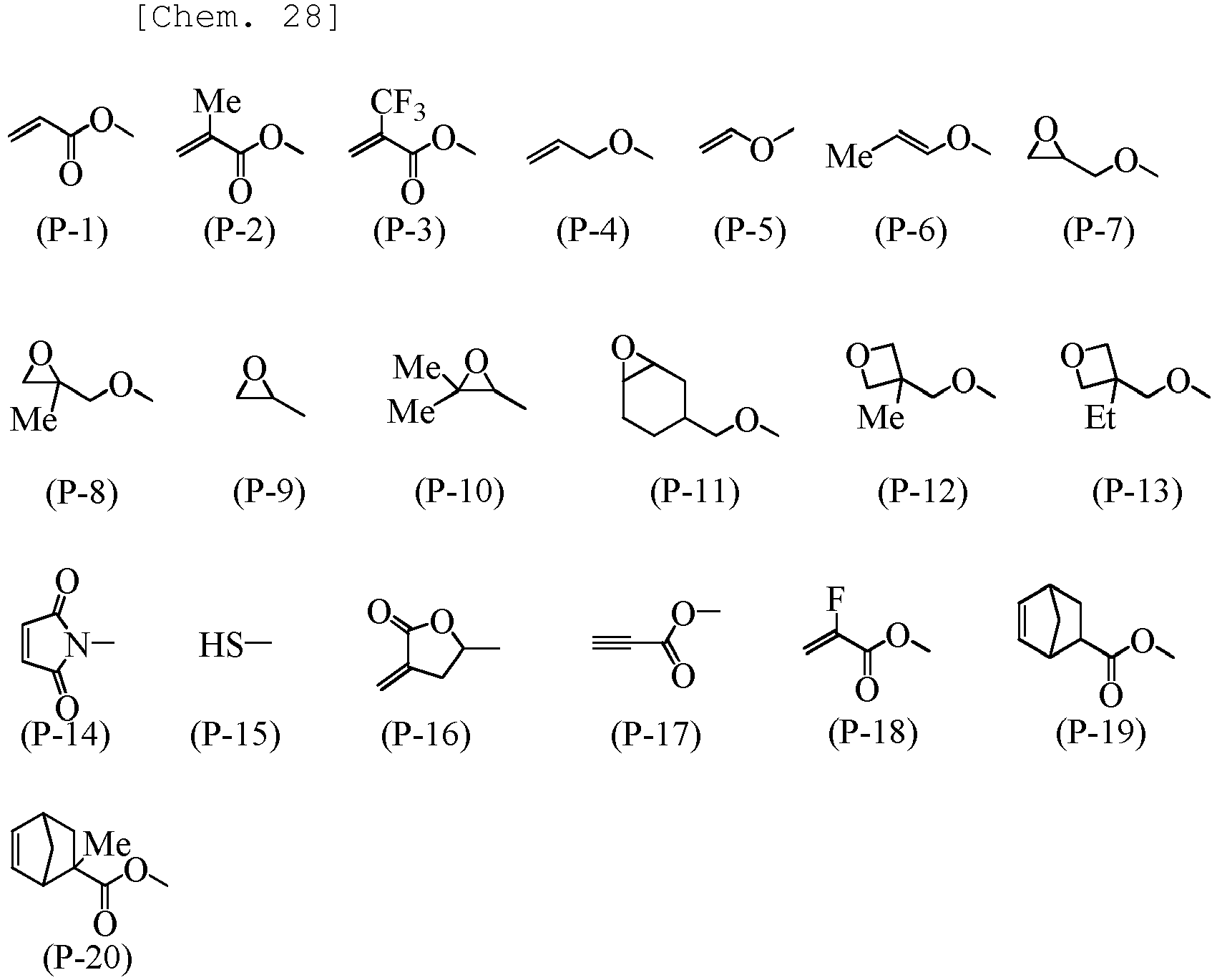
- In addition, in General Formula (3-2), k represents 1, and S11 preferably represents an alkylene group having 1 to 20 carbon atoms in which one -CH2- or two or more -CH2- not adjacent to each other each independently may be substituted with -O-, -COO-, -OCO-, -OCO-O-, -CO-NH-, -NH-CO-, -CH=CH-, or -C=C-.
- The total number of π electrons included in W1 and W2 is preferably 6 to 24.
- The aromatic group included in W1 preferably represents groups represented by the following Formula (W-1) to Formula (W-19).

- In the formulas, these groups may have a valence bond on an arbitrary position, and Q1 represents -O-, -S-, -NR3- (where R3 represents a hydrogen atom or an alkyl group having 1 to 8 carbon atoms), or -CO-. -CH= in these aromatic groups each independently may be substituted with -N=, -CH2- each independently may be substituted with -O-, -S-, -NR4- (where R4 represents a hydrogen atom or an alkyl group having 1 to 8 carbon atoms), or -CO-, without forming a -O-O- bonding. Also, these aromatic groups may be unsubstituted or substituted with one or more L's, and may form a group in which two or more aromatic groups selected from these groups are linked by a single bond.
- Exemplary compounds represented by General Formula (3-2) are shown below, but the exemplary compounds are not limited to these.


- In addition, in the same manner, a compound represented by General Formula (3-3) is exemplified.

- In the formula, P21 and P22 each independently represent a polymerizable group,
- S21 and S22 each independently represent a spacer group or a single bond, but in the case where a plurality of S21's and S22's are present, each of them may be the same as or different from each other, X21 and X22 each independently represent -O-, -S-, -OCH2-, -CH2O-, -CO-, -COO-, -OCO-, -CO-S-, -S-CO-, -O-CO-O-, -CO-NH-, -NH-CO-, -SCH2-, -CH2S-, -CF2O-, -OCF2-, -CF2S-, -SCF2-, -CH=CH-COO-, -CH=CH-OCO-, -COO-CH=CH-, -OCO-CH=CH-, -COO-CH2CH2-, -OCO-CH2CH2-, -CH2CH2-COO-, -CH2CH2-OCO-, -COO-CH2-, -OCO-CH2-, -CH2-COO-, -CH2-OCO-, -CH=CH-, -N=N-, -CH=N-N=CH-, -CF=CF-, -C=C-, or a single bond, but in the case where a plurality of X21' s and X22' s are present, each of them may be the same as or different from each other (however, -O-O- is not included in each P-(S-X)- bonding),
- MG21 represents a mesogenic group, and
- m2 and n2 each independently represent an integer of 0 to 5.
- The mesogenic group MG21 is preferably a group represented by Formula (8-a).


- In the formula, A81 and A82 each independently represent a 1,4-phenylene group, a 1,4-cyclohexylene group, a pyridine-2,5-diyl group, a pyrimidine-2,5-diyl group, a naphthalene-2,6-diyl group, a naphthalene-1,4-diyl group, a tetrahydronaphthalene-2,6-diyl group, a decahydronaphthalene-2,6-diyl group, or a 1,3-dioxane-2,5-diyl group, but these groups may be unsubstituted or substituted with one or more L' s, in the case where a plurality of A81's and/or A82's are present, each of them may be the same as or different from each other,
- Z81 and Z82 each independently represent -O-, -S-, -OCH2-, -CH2O-, -CH2CH2-, -CO-, -COO-, -OCO-, -CO-S-, -S-CO-, -O-CO-O-, -CO-NH-, -NH-CO-, -SCH2-, -CH2S-, -CF2O-, -OCF2-, -CF2S-, -SCF2-, -CH=CH-COO-, -CH=CH-OCO-, -COO-CH=CH-, -OCO-CH=CH-, -COO-CH2CH2-, -OCO-CH2CH2-, -CH2CH2-COO-, -CH2CH2-OCO-, -COO-CH2-, -OCO-CH2-, -CH2-COO-, -CH2-OCO-, -CH=CH-, -N=N-, -CH=N-, -N=CH-, -CH=N-N=CH-, -CF=CF-, -C=C-, or a single bond, but in the case where a plurality of Z81's and/or Z82's are present, each of them may be the same as or different from each other, and
- M represents groups selected from the following Formula (M-1) to Formula (M-8).
- These groups may be unsubstituted or substituted with one or more L's,
G represents a group selected from the following Formula (G-1) or Formula (G-2):
- (In the formulas, R3 represents a hydrogen atom or an alkyl group having 1 to 20 carbon atoms, the alkyl group may be linear or branched, an arbitrary hydrogen atom in the alkyl group may be substituted with a fluorine atom, one -CH2- or two or more -CH2- not adjacent to each other in the alkyl group each independently may be substituted with -O-, -S-, -CO-, -COO-, -OCO-, -CO-S-, -S-CO-, -O-CO-O-, -CO-NH-, -NH-CO-, or -C≡C-, W1 represents a group having 2 to 30 carbon atoms having at least one aromatic group, but the group may be unsubstituted or substituted with one or more L' s, W2 represents a hydrogen atom or an alkyl group having 1 to 20 carbon atoms, but the alkyl group may be linear or branched, an arbitrary hydrogen atom in the alkyl group may be substituted with a fluorine atom, one -CH2- or two or more -CH2- not adjacent to each other in the alkyl group each independently may be substituted with -O-, -S-, -CO-, -COO-, -OCO-, -CO-S-, -S-CO-, -O-CO-O-, -CO-NH-, -NH-CO-, -CH=CH-COO-, -CH=CH-OCO-, -COO-CH=CH-, -OCO-CH=CH-, -CH=CH-, -CF=CF-, or -C=C-, or W2 and W1 may represent the same, or W1 and W2 may be linked to each other to form the same ring structure),
- L represents a fluorine atom, a chlorine atom, a bromine atom, an iodine atom, a pentafluorosulfuranyl group, a nitro group, an isocyano group, an amino group, a hydroxyl group, a mercapto group, a methylamino group, a dimethylamino group, a diethylamino group, a diisopropylamino group, a trimethylsilyl group, a dimethylsilyl group, a thioisocyano group, or an alkyl group having 1 to 20 carbon atoms, but the alkyl group may be linear or branched, an arbitrary hydrogen atom may be substituted with a fluorine atom, one -CH2- or two or more -CH2- not adjacent to each other in the alkyl group each independently may be substituted with a group selected from -O-, -S-, -CO-, -COO-, -OCO-, -CO-S-, -S-CO-, -O-CO-O-, -CO-NH-, -NH-CO-, -CH=CH-COO-, -CH=CH-OCO-, -COO-CH=CH-, -OCO-CH=CH-, -CH=CH-, -CF=CF-, or -C=C-, in the case where a plurality of L' s are present in the compound, they may be the same as or different from each other, and
- j81 and j82 each independently represent an integer of 0 to 5, with the proviso that the total number of j81 and j82 is an integer of 1 to 5.
- The polymerizable groups P21 and P22 each independently represent groups represented by General Formulas (P-1) to (P-20).


- Exemplary compounds represented by General Formula (3-3) are shown below, but the exemplary compounds are not limited to these.


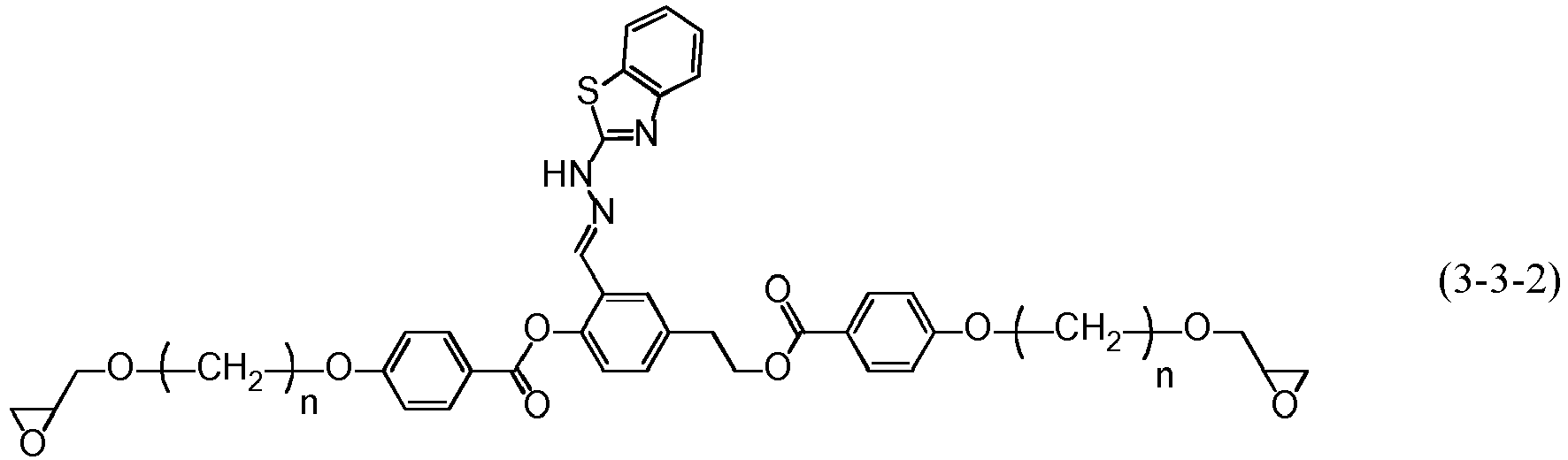


- [Chem. 42]


- These liquid crystal compounds may be used alone or two or more thereof may be used in combination. In addition, monofunctional compounds represented by General Formula (1-1) and General Formula (1-2) and having one polymerizable functional group in a molecule, a bifunctional compound represented by General Formula (2-1) and having two polymerizable functional groups in a molecule, polyfunctional compounds represented by General Formula (4-1) to General Formula (4-7) shown below and having three or more polymerizable functional groups in a molecule can be used in combination.
- The total content of the compounds represented by General Formulas (3-1), (3-2), and (3-3) is preferably 10 to 100% by mass, more preferably 20 to 100% by mass, and particularly preferably 30 to 100% by mass with respect to the total content of the polymerizable composition.
- Among the compounds represented by General Formula (1), the following exemplary compound can be mentioned as the polyfunctional compound having three or more polymerizable functional groups in a molecule.


- The total content of the polyfunctional compound having three or more polymerizable functional groups in a molecule is preferably 0 to 30% by mass, more preferably 0 to 25% by mass, and particularly preferably 0 to 20% by mass with respect to the total content of the polymerizable composition.
- In addition, a compound containing a mesogenic group and not having a polymerization group may be added to the liquid crystal composition of the present invention, and a common compound used for a liquid crystal device such as STN (Super Twisted Nematic) liquid crystal, TN (Twisted Nematic) liquid crystal, and TFT (Thin Film Transistor) liquid crystal is exemplified.
- Specifically, the compound containing a mesogenic group and not having a polymerizable functional group is preferably a compound represented by the following General Formula (5).
[Chem. 49]
R1-MG-R1 (5)
- As the mesogenic group represented by MG, a compound represented by General Formula (5-b) is exemplified.
[Chem. 50]
-Z0-(A1-Z1)n-A2-Z2-A3-Z3- (5-b)
- In the formula, A1, A2, and A3 each independently represent a 1,4-phenylene group, a 1,4-cyclohexylene group, a 1,4-cyclohexenyl group, a tetrahydropyran-2,5-diyl group, a 1,3-dioxane-2,5-diyl group, a tetrahydrothiopyran-2,5-diyl group, a 1,4-bicyclo(2,2,2)octylene group, a decahydronaphthalene-2,6-diyl group, a pyridine-2,5-diyl group, apyrimidine-2,5-diyl group, apyrazine-2,5-diyl group, a thiophene-2,5-diyl group-, a 1,2,3,4-tetrahydronaphthalene-2,6-diyl group, a 2,6-naphthylene group, a phenanthrene-2,7-diyl group, a 9,10-dihydrophenanthrene-2,7-diyl group, a 1,2,3,4,4a,9,10a-octahydrophenanthrene-2,7-diyl group, a 1,4-naphthylene group, a benzo[1,2-b:4,5-b']dithiophene-2,6-diyl group, a benzo[1,2-b:4,5-b']diselenophene-2,6-diyl group, a [1]benzothieno[3,2-b]thiophene-2,7-diyl group, a [1]benzoselenopheno[3,2-b]selenophene-2,7-diyl group, or a fluorene-2,7-diyl group, and may have one or more F's, Cl's, CF3 's, OCF3's, CN groups, alkyl groups having 1 to 8 carbon atoms, alkoxy groups, alkanoyl groups, alkanoyloxy groups, alkenyl groups having 2 to 8 carbon atoms, alkenyloxy groups, alkenoyl groups, or alkenoyloxy groups as a substituent,
- Z0, Z1, Z2, and Z3 each independently represent -COO-, -OCO-, -CH2 CH2-, -OCH2-, -CH2O-, -CH=CH-, -C=C-, -CH=CHCOO-, -OCOCH=CH-, -CH2CH2COO-, -CH2CH2OCO-, -COOCH2CH2-, -OCOCH2CH2-, -CONH-, -NHCO-, an alkyl group having a halogen atom having 2 to 10 carbon atoms, or a single bond,
- n represents 0, 1, or 2,
- R1 represents a hydrogen atom, a halogen atom, a cyano group, or an alkyl group having 1 to 18 carbon atoms, but the alkyl group may be substituted with one or more halogen atoms or CN's, and one CH2 group or two or more CH2 groups not adjacent to each other present in this group each independently may be substituted with -O-, -S-, -NH-, -N(CH3)-, -CO-, -COO-, -OCO-, -OCOO-, -SCO-, -COS-, or -C=C- as long as oxygen atoms are not directly bonded to each other.
- Specific compounds thereof are shown below, and the compounds are not limited to these.

- A chiral compound may be blended in the polymerizable liquid crystal composition of the present invention, for the purpose of obtaining a chiral nematic phase. Among the chiral compounds, a compound having a polymerizable functional group in a molecule is particularly preferable.
- As the polymerizable functional group in the chiral compound, an acryloyloxy group is particularly preferable. It is necessary to appropriately adjust the blending amount of the chiral compound depending on a spiral induction force of the compound, but the blending amount is preferably 0 to 85% by mass, more preferably 0 to 80% by mass, and particularly preferably 0 to 75% by mass with respect to the total amount of the chiral compound and the polymerizable compound to be used.
- Specific examples of the chiral compound include compounds of Formulas (6-1) to (6-8).


- In the formulas, n represents an integer of 2 to 12.
- In addition, specific examples of the chiral compound further include compounds of Formulas (6-9) to (6-12).


- An organic solvent used in the polymerizable liquid crystal composition of the present invention is not particularly limited, an organic solvent in which the polymerizable compound to be used exhibits satisfactory solubility is preferable, and an organic solvent which can be dried at a temperature of 100°C or lower is preferable. Examples of the solvent include aromatic hydrocarbon such as toluene, xylene, cumene, and mesitylene, an ester-based solvent such as methyl acetate, ethyl acetate, propyl acetate, and butyl acetate, a ketone-based solvent such as methyl ethyl ketone, methyl isobutyl ketone, cyclohexnone, and cyclopentanone, an ether-based solvent such as tetrahydrofuran, 1,2-dimethoxyethane, and anisole, an amide-based solvent such as N,N-dimethylformamide and N-methyl-2-pyrrolidone, propylene glycol monomethyl ether acetate, diethylene glycol monomethyl ether acetate, γ-butyrolactone, and chlorobenzene. These may be used alone or two or more thereof may be used in combination, but it is preferable to use at least one of the ketone-based solvent, the ether-based solvent, the ester-based solvent, and aromatic hydrocarbon, from a viewpoint of solution stability.
- The ratio of the organic solvent to be used is not particularly limited, as long as the solvent does not considerably impair the applied state of the polymerizable liquid crystal composition because the composition used in the present invention is normally applied. However, the content of the polymerizable compound included in the polymerizable liquid crystal composition is preferably 1 to 60% by mass, more preferably 3 to 55% by mass, and particularly preferably 5 to 50% by mass.
- When the polymerizable compound is dissolved in an organic solvent, the compound is preferably heated and stirred in order to dissolve the compound uniformly. The heating temperature at the time of heating and stirring may be appropriately adjusted in consideration of solubility of the polymerizable compound to be used in an organic solvent, and the heating temperature is preferably 15°C to 110°C, more preferably 15°C to 105°C, still more preferably 15°C to 100°C, and particularly preferably 20°C to 90°C from a viewpoint of productivity.
- In addition, when the polymerizable liquid crystal composition is prepared, the composition is preferably stirred and mixed by a dispersion stirrer. As specific examples of the dispersion stirrer, a disperser having an impeller such as a disper, propeller, and turbine blade, a paint shaker, a planetary type stirrer, a shaking apparatus, a shaker, or rotary evaporator can be used. In addition to the above, an ultrasonic irradiation apparatus can be used.
- It is preferable to appropriately adjust the number of revolution depending on a stirrer to be used in preparing a polymerizable solution. However, the number of stirring revolution is preferably 10 rpm to 1,000 rpm, more preferably 50 rpm to 800 rpm, and particularly preferably 150 rpm to 600 rpm, in order to obtain a uniform polymerizable solution.
- A polymerization inhibitor and/or an antioxidant are preferably added to the polymerizable liquid crystal composition in order to increase solution stability of the polymerizable liquid crystal composition of the present invention. Examples of such a compound include a hydroquinone derivative, a nitrosamine-based polymerization inhibitor, and a hindered phenol-based antioxidant and specific examples thereof include p-methoxyphenol, tert-butyl hydroquinone, methyl hydroquinone, "Q-1300" and "Q-1301" of Wako Pure Chemical Industries, Ltd., and "IRGANOX 1010", "IRGANOX 1035", "IRGANOX 1076", "IRGANOX 1098", "IRGANOX 1135", "IRGANOX 1330", "IRGANOX 1425", "IRGANOX 1520", "IRGANOX 1726", "IRGANOX 245", "IRGANOX 259", "IRGANOX 3114", "IRGANOX 3790", "IRGANOX 5057", "IRGANOX 565" of BASF SE.
- The addition amount of the polymerization inhibitor and the antioxidant each is preferably 0.01 to 1.0% by mass and more preferably 0.05 to 0.5% by mass with respect to the polymerizable liquid crystal composition.
- It is preferable to include at least one type of photopolymerization initiator. Specific examples thereof include "Irgacure 651", "Irgacure 184", "Irgacure 907", "Irgacure 127", "Irgacure 369", "Irgacure 379", "Irgacure 819", "Irgacure 2959", "Irgacure OXE01", "Irgacure OXE02", "Lucirin TPO", and "Darocur 1173" of BASF SE, "Esacure 1001M", "Esacure KIP150", "Speedcure BEM", "Speedcure BMS", "Speedcure MBP", "Speedcure PBZ", "Speedcure ITX", "Speedcure DETX", "Speedcure EBD", "Speedcure MBB", and "Speedcure BP" of LAMBSON, LTD., "Kayacure DMBI" of Nippon Kayaku Co., Ltd., and "TAZ-A" of Nihon Siberhegner K.K. (currently, DKSH Japan K.K.).
- The use amount of the photopolymerization initiator is preferably 0.1 to 10% by mass and particularly preferably 0.5 to 5% by mass with respect to the polymerizable solution. These may be used alone or two or more types thereof may be used in combination. Also, a sensitizer or the like may be added.
- A thermal polymerization initiator may be used in combination with the photopolymerization initiator in the polymerizable liquid crystal composition of the present invention. Specific examples thereof include "V-40" and "VF-096" manufactured by Wako Pure Chemical Industries, Ltd. and "Perhexyl D" and "Perhexyl I" manufactured by NOF corporation.
- The use amount of the thermal polymerization initiator is preferably 0.1 to 10% by mass and particularly preferably 0.5 to 5% by mass with respect to the polymerizable liquid crystal composition. These may be used alone or two or more types thereof may be used in combination.
- The polymerizable liquid crystal composition of the present invention may include at least one surfactant in order to reduce unevenness of the film thickness when the composition is made into an optically anisotropic body. Examples of the surfactant which can be included include alkyl carboxylate, alkyl phosphate, alkyl sulfonate, fluoroalkyl carboxylate, fluoroalkyl phosphate, fluoroalkyl sulfonate, a polyoxyethylene derivative, a fluoroalkyl ethylene oxide derivative, a polyethylene glycol derivative, an alkyl ammonium salt, and a fluoroalkyl ammonium salt, with a fluorine-containing surfactant being particularly preferable. Further specific examples thereof include "Megaface F-251", "Megaface F-444", "Megaface F-477", "Megaface F-510", "Megaface F-552", "Megaface F-553", "Megaface F-554", "Megaface F-555", "Megaface F-558", "Megaface F-560", "Megaface F-561", "Megaface F-563", "Megaface F-569", "Megaface F-570", "Megaface R-40", "Megaface R-41", "Megaface R-43", "Megaface R-94", "Megaface RS-72-K", "Megaface RS-75", "Megaface RS-76-E", and "Megaface RS-90", (the above are manufactured by DIC Corporation), BYK-3440 (the above are manufactured by BYK Japan K.K.), "N215", "N535", "N605K", and "N935"(the above are manufactured by Solvay Solexis K.K.), EFKA-3277, EFKA-3500, EFKA-3600, and EFKA-3777 (the above are manufactured by Lamberti Co.).
- The addition amount of the surfactant is preferably 0.01 to 2% by mass and more preferably 0.05 to 0.5% by mass with respect to the polymerizable liquid crystal composition.
- The polymerizable liquid crystal composition of the present invention can include at least one compound having a weight average molecular weight of 100 or more and a repeating unit represented by the following General Formula (7), in order to effectively reduce a tilt angle of an air interface when the composition is made into an optically anisotropic body.
[Chem. 54]
(̵CR11R12-CR13R14)̵ (7)
- In the formula, R11, R12, R13, and R14 each independently represent a hydrogen atom, a halogen atom, or a hydrocarbon group having 1 to 20 carbon atoms, and a hydrogen atom in the hydrocarbon group may be substituted with one or more halogen atoms.
- Preferred examples of the compound represented by General Formula (7) include polyethylene, polypropylene, polyisobutylene, paraffin, liquid paraffin, chlorinated polypropylene, chlorinated paraffin, and chlorinated liquid paraffin.
- The compound represented by General Formula (7) is preferably added in the step of mixing the polymerizable compound with an organic solvent, heating, and stirring to prepare a polymerizable solution, but the compound may be added in the step of mixing the photopolymerization initiator to the polymerizable solution after that, or may be added in both steps.
- The addition amount of the compound represented by General Formula (7) is preferably 0.01 to 1% by mass and more preferably 0.05 to 0.5% by mass with respect to the polymerizable solution.
- A chain-transfer agent is preferably added to the polymerizable composition solution of the present invention, in order to improve adhesion to the base material when the polymerizable composition solution is made into an optically anisotropic body. As the chain-transfer agent, a thiol compound is preferable, monothiol, dithiol, trithiol, and tetrathiol compounds are more preferable, and a trithiol compound is still more preferable. Specifically, compounds represented by the following General Formulas (7-1) to (7-12) are preferable.


- In the formulas, R65 represents an alkyl group having 2 to 18 carbon atoms, the alkyl group may be linear or branched, one or more methylene groups in the alkyl group may be substituted with an oxygen atom, a sulfur atom, -CO-, -OCO-, -COO-, or -CH=CH- as long as an oxygen atom and a sulfur atom are not directly bonded to each other, R66 represents an alkylene group having 2 to 18 carbon atoms, and one or more methylene groups in the alkylene group may be substituted with an oxygen atom, a sulfur atom, -CO-, -OCO-, -COO-, or -CH=CH- as long as an oxygen atom and a sulfur atom are not directly bonded to each other.
- The chain-transfer agent is preferably added in the step of mixing the polymerizable compound with an organic solvent, heating, and stirring to prepare a polymerizable solution, but the chain-transfer agent may be added in the step of mixing the polymerization initiator to the polymerizable solution after that, or may be added in both steps.
- The addition amount of the chain-transfer agent is preferably 0.5 to 10% by mass and more preferably 1.0 to 5.0% by mass with respect to the polymerizable liquid crystal composition.
- Further, a non-polymerizable liquid crystal compound or a polymerizable compound having no crystallinity may be added if necessary, in order to adjust physical properties. The polymerizable compound having no crystallinity is preferably added in the step of mixing the polymerizable compound with an organic solvent, heating, and stirring to prepare a polymerizable solution, but the non-polymerizable liquid crystal compound may be added in the step of mixing the polymerization initiator to the polymerizable solution after that, or may be added in both steps. The addition amount of these compounds is preferably 20% by mass or less, more preferably 10% by mass or less, and still more preferably 5% by mass or less with respect to the polymerizable liquid crystal composition.
- Other additives, for example, a thixotropic agent, an ultraviolet ray absorbing agent, an infrared ray absorbing agent, an antioxidant, or a surface treating agent, may be added to the polymerizable mixture or the polymerizable composition of the present invention according to the purpose, to the extent that an aligning ability of the liquid crystal is not remarkably deteriorated.
- In the present invention, a mixture having the content of a silicon compound at a low concentration in a particular range and containing two or more types of the compound containing a mesogenic group, and a composition obtained by mixing the two or more types of the compound containing a mesogenic group in an organic solvent can be obtained by using a compound obtained by performing purification using an adsorbent other than the silicon compound such as a silica gel and mixing a particular amount of the silicon compound with the mixture or the composition,, in the step of synthesizing the compound containing a mesogenic group. However, all of the compounds containing a mesogenic group to be used are necessarily purified by using an adsorbent other than the silicon compound. Here, examples of the adsorbent other than the silicon compound include alumina and activated carbon, and examples of the adsorbent of the silicon compound include a silica gel, florisil, diatom earth, and zeolite.
- In the present invention, as another method for preparing the mixture having the content of a silicon compound at a low concentration in a particular range and having two or more types of the compound containing a mesogenic group, and the composition obtained by mixing the two or more types of the compound containing a mesogenic group in an organic solvent, exemplified is a method for filtering the mixture obtained by mixing two or more types of raw material compounds containing a mesogenic group and going through the purification step using the silicon compound such as a silica gel, or the composition having the two or more types of raw material compounds containing a mesogenic group dissolved in an organic solvent, using a filter. The pore diameter of the filter is preferably 0.1 µm to 1 µm, more preferably 0.1 µm to 0.45 µm, and still more preferably 0.1 µm to 0.22 µm. The film thickness of the filter is preferably 60 µm to 100 µm. In addition, the content of the silicon compound in the mixture and the composition can be reduced by increasing the number of the filtration step from one to a plurality. For example, after filtering the mixture and composition using a filter having a pore diameter of 0.1 µm and by using the mixture or the composition obtained by filtering with the filter having a pore diameter of 0.1 µm, an optically anisotropic body having satisfactory scratch resistance and adhesion can be obtained. In addition, in the case where the composition having the raw material compounds dissolved in an organic solvent is filtered, by allowing the organic solvent to pass through the filter to be used in advance so as to cause the raw material compounds to pass through the pore easily, before performing filtration, the content of the silicon compound in the composition can be reduced effectively. Further, depending on pressurizing conditions at the time of filtration, the content of the silicon compound after the filtration can be adjusted. Therefore, the pore diameter of the filter to be used is preferably and appropriately adjusted in consideration of a purification cost and purification time, in addition to the pressurizing conditions at the time of filtration and the number of filtration.
- Examples of the material of the filter include a paper, a cloth, a non-woven fabric, cellulose, nitrocellulose, ester mixed with cellulose, cellulose acetate, polypropylene, nylon, polytetrafluoroethylene (PTFE), hydrophilic PTFE, polyvinylidene fluoride, polyether sulfone (PES), and a glass fiber, with PTFE or polyvinylidene fluoride being preferable.
- An optically anisotropic body fabricated by using the polymerizable liquid crystal composition of the present invention is obtained by laminating a base material, if necessary, an alignment film, and a polymer of the polymerizable liquid crystal composition in an order.
- The base material used for the optically anisotropic body of the present invention is a base material commonly used for a liquid crystal device, a display, an optical part, or an optical film. The base material is not particularly limited as long as the base material has thermal resistance against heating at the time of drying the applied polymerizable liquid crystal composition of the present invention. Examples of this base material include a glass base material, a metal base material, a ceramic base material, and an organic material such as a plastic base material. In particular, in the case where the base material is an organic material, examples thereof include a cellulose derivative, polyolefin, polyester, polyolefin, polycarbonate, polyacrylate, polyallylate, polyether sulfone, polyimide, polyphenylene sulfide, polyphenylene ether, nylon, and polystyrene. Among these, a plastic base material such as polyester, polystyrene, polyolefin, a cellulose derivative, polyallylate, and polycarbonate is preferable.
- The base material may be surface treated in order to improve coating properties and adhesive properties of the polymerizable liquid crystal composition of the present invention. Examples of the surface treatment include an ozone treatment, a plasma treatment, a corona treatment, and a silane coupling treatment. Also, in order to adjust optical transmittivity or reflexibility, the base material may be a pickup lens, a rod lens, an optical disk, a phase difference film, a light diffusion film, or a color filter, in order to provide an organic thin film, an inorganic oxide thin film, or a metal thin film on the surface of the base material by a method such as deposition, or to provide optical added values. Among these, a pickup lens, a phase difference film, a light diffusion film, and a color filter are preferable, which further increases the added value.
- In addition, the base material may be commonly subjected to an aligning treatment or an alignment film may be provided such that the polymerizable liquid crystal composition is aligned when the polymerizable liquid crystal composition of the present invention is applied and dried. Examples of the aligning treatment include a stretching treatment, a rubbing treatment, an irradiation treatment with polarized a ultraviolet and visible ray, and an ion beam treatment. In the case where the alignment film is used, the well-known alignment film is used. Examples of the well-known alignment film include polyimide, polysiloxane, polyamide, polyvinyl alcohol, polycarbonate, polystyrene, polyphenylene ether, polyallylate, polyethylene terephthalate, polyether sulfone, an epoxy resin, an epoxyacrylate resin, an acryl resin, and compounds such as a coumarin compound, a chalcone compound, a cinnamate compound, a fulgide compound, an anthraquinone compound, an azo compound, and an aryl ethene compound. As a compound for performing the aligning treatment by rubbing, a compound which promotes crystallinity of a material by the addition of the compound in the aligning treatment or the heating step after the aligning treatment is preferable. Among compounds for performing the aligning treatment other than rubbing, an optical aligning material is preferably used.
- Examples of a coating method for obtaining the optically anisotropic body of the present invention include the well-known methods such as an applicator method, a bar coating method, a spin coating method, a roll coating method, a direct gravure coating method, a reverse gravure coating method, a flexo coating method, an ink jet method, a die coating method, a cap coating method, a dip coating method, and a slit coating method. After the polymerizable liquid crystal composition is applied, the composition is dried.
- A polymerization operation of the polymerizable liquid crystal composition of the present invention is generally performed by irradiating the composition with an ultraviolet ray or heating the composition, in a state where the liquid crystal compound in the polymerizable liquid crystal composition is horizontally aligned, vertically aligned, or aligned in a hybrid manner or aligned in a cholesteric manner (plane alignment) with respect to the base material. In the case where polymerization is performed by irradiation with light, specifically, the composition is preferably irradiated with an ultraviolet ray of 390 nm or less and most preferably with light having a wavelength of 250 to 370 nm. However, in the case where the polymerizable composition is decomposed by an ultraviolet ray of 390 nm or less, it is preferable to perform polymerization with an ultraviolet ray of 390 nm or more. The ray is preferably a diffused and unpolarized ray.
- Examples of the method for polymerizing the polymerizable liquid crystal composition of the present invention include a method for irradiating the composition with active energy rays or thermal polymerization. However, a method for irradiating the composition with active energy rays is preferable from a viewpoint of not requiring heating and proceeding the reaction at room temperature. Among these, a method for irradiating the composition with light such as an ultraviolet ray is preferable from a viewpoint of a simple operation. The temperature at the time of irradiation is a temperature in which the polymerizable liquid crystal composition of the present invention can retain a liquid crystal phase, and a temperature of 30°C or lower is preferable as much as possible in order to avoid inducement of thermal polymerization of the polymerizable liquid crystal composition. In addition, the liquid crystal composition normally exhibits a liquid crystal phase within from C (solid phase) - N (nematic) transition temperature (hereinafter, abbreviated as a C-N transition temperature.) to an N-I transition temperature range, in the step of increasing a temperature. Meanwhile, in the step of decreasing a temperature, since the composition takes a thermodynamically non-equilibrium state, the composition may retain a liquid crystal state, without being aggregated even in the C-N transition temperature or lower. This state is referred to as a supercooled state. In the present invention, the liquid crystal composition in a supercooled state is included in a state where the liquid crystal phase is retained. Specifically, the composition is preferably irradiated with an ultraviolet ray of 390 nm or less and most preferably irradiated with light having a wavelength of 250 to 370 nm. However, in the case where the polymerization composition is decomposed by irradiation with an ultraviolet ray of 390 nm or less, it is preferable to perform polymerization with an ultraviolet ray of 390 nm or more. The ray is preferably a diffused and unpolarized ray. The irradiation intensity of the ultraviolet ray is preferably in a range of 0.05 kW/m2 to 10 kW/m2. In particular, in a range of 0.2 kW/m2 to 2 kW/m2 is preferable. In the case where the intensity of the ultraviolet ray is less than 0.05 kW/m2, it takes a great amount of time to complete the polymerization. Meanwhile, in the case where the intensity exceeds 2 kW/m2, there is possibility that a liquid crystal molecule in the polymerizable liquid crystal composition tends to be photodecomposed or generation of a great amount of polymerization heat increases the temperature during the polymerization, and a change in an order parameter of the polymerizable liquid crystal causes a disorder of retardation of the polymerized film.
- After only a particular portion is polymerized by irradiation with an ultraviolet ray using a mask, if an aligned state of the non-polymerized portion is changed by applying an electrical field, a magnetic field, or a temperature, and after that, the non-polymerized portion is polymerized, it is possible to obtain an optically anisotropic body having a plurality of areas with a different aligning direction.
- In addition, when only the particular portion is polymerized by irradiation with an ultraviolet ray using a mask, if an electrical field, a magnetic field, or a temperature is applied to the polymerizable liquid crystal composition in the non-polymerized state in advance so as to control an alignment and the composition is polymerized by irradiating the mask with light, while the non-polymerized state is retained, it is possible to obtain an optically anisotropic body having a plurality of areas with a different aligning direction.
- The optically anisotropic body obtained by polymerizing the polymerizable liquid crystal composition of the present invention can be used as a single optically anisotropic body by separating the optically anisotropic body from a substrate, or as an optically anisotropic body itself without being separated from the substrate. In particular, since the optically anisotropic body is difficult to contaminate other members, it is useful to use the optically anisotropic body as a substrate to be laminated, or to use by attaching the optically anisotropic body to other substrates.
- The polymer obtained by polymerizing the polymerizable liquid crystal composition of the present invention in a state where the composition is horizontally aligned, vertically aligned, or aligned in a hybrid manner or aligned in a cholesteric manner can be used as the optically anisotropic body having alignment performance, for example, as an optical compensation film, a phase difference film, a wide viewing angle film, a luminance-enhancing film, a reflective film, and a polarizing film. Also, the polymer can be used as an adhesive having heat-dissipating properties, a sealant, a heat-dissipating sheet, and an ink for security printing.
- Hereinafter, the present invention will be described using Synthesis Examples, Examples, and Comparative Examples, but originally, the present invention is not limited to these. Also, "parts" and "%" are based on mass unless otherwise mentioned.
- As the raw material compound of the compound containing a mesogenic group, compounds represented by the following Formulas (A1) to (A11), Formulas (B1) to (B12), and Formula (C1) were used. As a result of measuring the content (% by mass) of the silicon compound of each raw material compound by an ICP emission analyzer (measurement condition: measured by dissolving 0.03 g of each raw material compound in 10 g of xylene), each content was as follows. Formula (A1) : 1250 ppm, Formula (A2) : 1100 ppm, Formula (A3) : 1465 ppm, Formula (A4) : 1360 ppm, Formula (A5) : 1340, Formula (A6) : 1440, Formula (A7) : 1330 ppm, Formula (A8): 1155 ppm, Formula (A9): 1570 ppm, Formula (A10) : 1470 ppm, and Formula (A11) : 1400 ppm. Formula (B1) : 1500 ppm, Formula (B2) : 1400 ppm, Formula (B3) : 1340 ppm, Formula (B4) : 1220 ppm, Formula (B5) : 1160 ppm, Formula (B6) : 1450 ppm, Formula (B7): 1560 ppm, Formula (B8): 1560 ppm, Formula (B9) : 1350 ppm, Formula (B10) : 1340 ppm, Formula (B11) : 1260 ppm, (B12) : 1430 ppm, Formula (B13) : 1230 ppm, (B14) : 1400 ppm, and Formula (B15) : 1222 ppm.


-
- Irgacure 907 (D1)
- Lucirin TPO (D2)
- Irgacure 819 (D3)
- TAZ-A (D4) p-methoxyphenol (E1)
- Polypropylene (weight average molecular weight (MW): 1275) (F1)
- Liquid paraffin (F2)
- Megaface F-554 (F3)
- BYK 361N (F4)
- Megaface FC-171 (F5)
- 50 parts of the compound represented by Formula (A1), 10 parts of the compound represented by Formula (A2), 20 parts of the compound represented by Formula (A3), 10 parts of the compound represented by Formula (B1), and 10 parts of the compound represented by Formula (B2), which are raw material compounds (A1 to A11, B1 to B15, and C1), were stirred with 400 parts of propylene glycol monomethyl ether acetate (PGMEA) (H1), which is an organic solvent, 0.1 parts of the compound represented by Formula (E1), 0.1 parts of the compound represented by Formula (F1), and 3 parts of the compound represented by Formula (D1), using a stirrer having a stirring propeller, under conditions of a stirring speed of 500 rpm and a solution temperature of 60°C, for 1 hour. After the resultant was filtrated by using 0.1 µm (PTFE, film thickness: 60 µm) membrane filter and adjusting filtration pressure to 0.20 MPa, the resultant was filtrated by using 0.1 µm membrane filter and adjusting filtration pressure to 0.20 MPa again to obtain a polymerizable liquid crystal composition (1).
- In the same manner as the preparation of the polymerizable liquid crystal composition (1) of the present invention, the compounds represented by Formulas (A1 to A11, B1 to B15, and C1) shown in Table 1, Table 3, Table 5, Table 7, or Table 9, and Formulas (D1 to D4, E1, F1 to F5, and G1 to G4) shown in Table 2, Table 4, Table 6, Table 8, or Table 10 were stirred with an organic solvent selected from PGMEA (H1), cyclopentanone (H2), and toluene (H3) (according to the ratio shown in Table 1, Table 3, Table 5, Table 7, or Table 9) for 1 hour, by using a stirrer having a stirring propeller and setting the same stirring speed and the solution temperature as those of the case of obtaining the polymerizable liquid crystal composition (1). Then, the resultant was filtrated by a membrane filter (PTFE, pore diameter: 0.1 to 1 µm, film thickness: 60 to 100 µm) having a pore diameter shown in Table 1, Table 3, Table 5, Table 7, or Table 9 according to each filtration pressure and the number of filtration to obtain polymerizable liquid crystal compositions (2) to (34) and polymerizable liquid crystal compositions (35) to (68) for comparison, respectively.
- The numerical values shown in the portions of "pore diameter 1", "pore diameter 2", and "pore diameter 3" in Table 1, Table 3, Table 5, Table 7, or Table 9 represent a pore diameter (µm) of the used membrane filter, in the case where the filtration step was performed one time, a pore diameter (µm) of the used membrane filter is shown in the portion of "pore diameter 1", the portions of "pore diameter 2" and "pore diameter 3" show [-], and in the case where the filtration step was performed two times, a pore diameter (µm) of the used membrane filters is respectively shown in the portions of "pore diameter 1" and "pore diameter 2". In the same manner, in the case where the filtration step was performed for three times, a pore diameter (µm) of the used membrane filters is respectively shown in the portions of "pore diameter 1", "pore diameter 2", and "pore diameter 3". Also, the description of "filtration pressure (MPa) " in Table 1, Table 3, Table 5, Table 7, or Table 9 represents pressure at the time of filtration, and in the case where the filtration step is performed a plurality of times, the filtration was performed under the same pressure in both steps. Further, with regard to "whether or not to allow a liquid to pass" in Table 1, Table 3, Table 5, Table 7, or Table 9, the case where a step of allowing an organic solvent used at the time of preparing the polymerizable liquid crystal composition to pass through a filter in advance before performing the filtration has been performed is regarded as "Yes", and the case where a step of allowing the organic solvent to pass through a filter has not been performed is regarded as "No". In addition, in all of the cases where the step of allowing the organic solvent to pass "has been performed" and the filtration step has been performed a plurality of times, the operation of allowing the organic solvent to pass was performed before the filtration step.
[Table 1] Composition Compound (1) (2) (3) (4) (5) (6) (7) (8) (9) (10) (11) (12) (13) (14) (A1) 50 50 30 40 15 50 (A2) 10 10 10 (A3) 20 20 20 20 (A4) 20 40 15 15 25 (A5) 29 13 40 (A6) 30 10 (A7) 14 (A8) (A9) 29 25 (A10) (A11) (B1) 10 10 10 10 35 10 32 35 10 42 (B2) 10 10 10 35 40 10 40 33 (B3) 10 10 32 (B4) 25 25 43 50 (B5) 25 25 43 50 (B6) 10 (B7) (B8) (B9) (B10) (B11) (B12) (B13) (B14) (B15) (C1) 10 (H1) 400 400 400 400 400 400 400 400 400 400 400 450 450 400 (H2) (H3) Pore diameter 1 0.1 0.22 0.45 0.1 0.1 0.1 0.1 0.1 0.22 0.1 0.1 0.45 0.1 0.22 Pore diameter 2 0.1 - - - 0.1 - 0.1 - - 0.1 0.1 - - - Pore diameter 3 - - - - - - - - - - - - - - Filtration pressure 0.20 0.20 0.20 0.20 0.10 0.20 0.10 0.20 0.20 0.20 0.10 0.20 0.20 0.20 whether or not to allow a liquid to pass No No No No Yes No No No No No Yes No No No [Table 2] Composition Compound (1) (2) (3) (4) (5) (6) (7) (8) (9) (10) (11) (12) (13) (14) (D1) 3 3 3 3 3 3 3 0.9 3 3 3 3 3 3 (D2) 0.1 (D3) (D4) (E1) 0.1 0.1 0.1 0.1 0.1 0.1 0.1 0.1 0.1 0.1 0.1 0.1 0.1 0.1 (F1) 0.1 0.1 0.1 0.1 0.1 0.1 0.1 0.1 0.1 0.1 0.1 (F2) 0.2 (F3) 0.1 0.1 (F4) (F5) (G1) 8.5 (G2) (G3) (G4) [Table 3] Composition Compound (15) (16) (17) (18) (19) (20) (21) (22) (23) (24) (25) (26) (27) (28) (A1) (A2) (A3) (A4) (A5) 36 24 (A6) 40 (A7) 9 (A8) 30 (A9) 21 20 (A10) (A11) (B1) 21 5 10 40 55 (B2) 5 5 10 (B3) 22 12 (B4) 20 (B5) 50 (B6) (B7) 50 50 (B8) 45 95 50 100 (B9) 95 100 100 (B10) 90 100 100 (B11) 90 100 100 (B12) (B13) (B14) (B15) (C1) 400 550 400 (H1) 500 500 500 430 350 500 500 500 430 350 (H2) 400 (H3) 0.1 0.1 0.22 0.1 0.1 0.1 0.22 0.22 0.1 0.1 0.1 0.1 0.1 0.1 Pore diameter 1 0.1 0.1 - - - - - - 0.1 - - - 0.1 - Pore diameter 2 - - - - - - - - - - - - - - Pore diameter 3 0.20 0.20 0.20 0.20 0.20 0.20 0.20 0.20 0.20 0.20 0.20 0.20 0.20 0.20 Filtration pressure No No No No No No No No No No No No No No whether or not to allow a liquid to pass [Table 4] Composition Compound (15) (16) (17) (18) (19) (20) (21) (22) (23) (24) (25) (26) (27) (28) (D1) 3 3 3 4 (D2) 0.1 (D3) 0.45 3 3 0.45 3 3 (D4) 0.75 0.75 0.75 0.75 (E1) 0.1 0.1 0.1 0.1 0.1 0.1 0.1 0.1 0.1 0.1 0.1 0.1 0.1 (F1) (F2) (F3) 0.1 0.1 0.1 0.1 0.1 (F4) 0.05 0.05 0.05 0.05 0.05 0.05 (F5) 0.5 (G1) (G2) 3 3 3 3 7.5 (G3) (G4) [Table 5] Composition Compound (29) (30) (31) (32) (33) (34) (35) (36) (37) (38) (39) (40) (41) (42) (A1) 50 50 30 50 (A2) 10 10 10 (A3) 15 20 20 20 20 (A4) 25 20 (A5) (A6) 12 40 (A7) (A8) (A9) 20 (A10) 75 (A11) 47 (B1) 9 9 10 10 10 10 5 40 (B2) 4 10 10 10 5 (B3) 4 10 (B4) (B5) (B6) (B7) 50 (B8) 45 (B9) 95 (B10) 100 (B11) (B12) 50 50 (B13) 50 50 30 (B14) 50 50 50 (B15) 20 (C1) 10 (H1) 400 400 400 400 550 (H2) 500 500 500 500 500 500 500 500 430 (H3) Pore diameter 1 0.1 0.1 0.1 0.1 0.1 0.1 1.0 1.0 1.0 1.0 1.0 1.0 1.0 1.0 Pore diameter 2 - 0.1 - 0.1 - 0.1 - - - - - - - - Pore diameter 3 - - - - - - - - - - - - - - Filtration pressure 0.20 0.10 0.20 0.20 0.20 0.20 0.25 0.25 0.25 0.25 0.25 0.25 0.25 0.25 whether or not to allow a liquid to pass No Yes No No No No No No No No No No No No [Table 6] Composition Compound (29) (30) (31) (32) (33) (34) (35) (36) (37) (38) (39) (40) (41) (42) (D1) 3 3 3 3 3 3 3 3 3 (D2) (D3) 0.45 3 (D4) 0.75 (E1) 0.1 0.1 0.1 0.1 0.1 0.1 0.1 0.1 0.1 0.1 0.1 0.1 0.1 0.1 (F1) 0.1 0.1 0.1 0.1 0.1 0.1 (F2) (F3) 0.1 0.1 0.1 0.1 0.1 (F4) 0.05 0.05 (F5) (G1) (G2) 3 (G3) 5 (G4) 5 [Table 7] Composition Compound (43) (44) (45) (46) (47) (48) (49) (50) (51) (52) (53) (54) (55) (56) (A1) 50 50 30 50 (A2) 10 10 10 (A3) 15 20 20 20 20 (A4) 25 20 (A5) 24 24 (A6) 12 40 (A7) 9 9 (A8) (A9) 20 (A10) 75 (A11) 47 (B1) 55 9 9 10 10 10 10 5 40 55 (B2) 4 10 10 10 5 (B3) 12 4 10 12 (B4) (B5) (B6) (B7) 50 (B8) 45 (B9) 95 (B10) 100 (B11) (B12) 50 (B13) 50 50 (B14) 50 (B15) (C1) 10 (H1) 400 400 400 400 550 400 (H2) 500 500 500 500 500 500 500 430 (H3) Pore diameter 1 0.1 0.1 0.1 0.1 0.1 0.1 0.1 0.1 0.1 0.1 0.1 0.1 0.1 0.1 Pore diameter 2 0.1 0.1 0.1 0.1 0.1 0.1 0.1 0.1 0.1 0.1 0.1 0.1 0.1 0.1 Pore diameter 3 0.1 0.1 0.1 0.1 0.1 0.1 0.1 0.1 0.1 0.1 0.1 0.1 0.1 0.1 Filtration pressure 0.05 0.05 0.05 0.05 0.05 0.05 0.05 0.05 0.05 0.05 0.05 0.05 0.05 0.05 whether or not to allow a liquid to pass Yes Yes Yes Yes Yes Yes Yes Yes Yes Yes Yes Yes Yes Yes [Table 8] Composition Compound (43) (44) (45) (46) (47) (48) (49) (50) (51) (52) (53) (54) (55) (56) (D1) 4 3 3 3 3 3 3 3 4 (D2) (D3) 0.45 3 (D4) 0.75 (E1) 0.1 0.1 0.1 0.1 0.1 0.1 0.1 0.1 0.1 0.1 0.1 0.1 (F1) 0.1 0.1 0.1 0.1 0.1 0.1 (F2) (F3) 0.1 0.1 0.1 (F4) 0.05 0.05 (F5) 0.5 0.5 (G1) (G2) 7.5 3 7.5 (G3) 5 (G4) 5 [Table 9] Composition Compound (57) (58) (59) (60) (A1) (A2) (A3) 15 (A4) 25 (A5) (A6) 12 (A7) (A8) (A9) (A10) 75 (A11) 47 (B1) 9 9 (B2) 4 (B3) 4 (B4) (B5) (B6) (B7) (B8) (B9) (B10) (B11) (B12) 50 (B13) 50 50 (B14) 50 (B15) (C1) (H1) (H2) 500 500 500 500 (H3) Pore diameter 1 0.1 0.1 0.1 0.1 Pore diameter 2 0.1 0.1 0.1 0.1 Pore diameter 3 0.1 0.1 0.1 0.1 Filtration pressure 0.05 0.05 0.05 0.05 whether or not to allow a liquid to pass Yes Yes Yes Yes [Table 10] Composition Compound (57) (58) (59) (60) (D1) 3 3 (D2) (D3) (D4) (E1) 0.1 0.1 0.1 0.1 (F1) 0.1 0.1 (F2) (F3) 0.1 0.1 (F4) (F5) (G1) (G2) (G3) 5 (G4) 5 - The content of the silicon compound included in each polymerizable liquid crystal composition obtained by the aforementioned method was measured, and in the case where the composition is made into a mixture only including two or more compounds containing a mesogenic group (that is, a mixture only including the compounds represented by Formulas (A1) to (A11 ), Formulas (B1) to (B15), and Formula (C1)), the content (% by mass) of the silicon compound included in the mixture after filtration was calculated.
- After a polyimide solution for an alignment film was applied onto a glass substrate having a thickness of 0.7 mm at room temperature using a spin coating method, and dried at a temperature of 100°C for 10 minutes, a coating film was obtained by baking the applied solution at a temperature of 200°C for 60 minutes and the obtained coating film was subjected to a rubbing treatment to obtain a base material. After the prepared polymerizable liquid crystal composition was applied onto the base material at room temperature by a spin coater, the base material was dried at a temperature of 80°C for 2 minutes. After that, the base material was left at room temperature for 2 minutes. Then, the base material was irradiated with UV light using a conveyor type high pressure mercury lamp which was set such that the irradiation intensity is 500 mJ/cm2. The pencil hardness of the coating film was measured based on JIS K5600-5-4.
- After a polyimide solution for an alignment film was applied onto a glass substrate having a thickness of 0.7 mm at room temperature using a spin coating method, and dried at a temperature of 100°C for 10 minutes, a coating film was obtained by baking the applied solution at a temperature of 200°C for 60 minutes and the obtained coating film was subjected to a rubbing treatment to obtain a base material. After the prepared polymerizable liquid crystal composition was applied onto the base material at room temperature by a spin coater (film thickness: 2 µm), the base material was dried at a temperature of 80°C for 2 minutes. After that, the base material was left at room temperature for 2 minutes. Then, the base material was irradiated with UV light using a conveyor type high pressure mercury lamp which was set such that the irradiation intensity is 500 mJ/cm2. An UV coating agent (UNIDIC V-4025) was applied on the surface obtained by polymerizing the polymerizable liquid crystal composition. Cuts were made on the coating film in a grid shape using a cutter according to a crosscut method using a cutter based on JIS K5600-5-6, the cuts were made as a grid of 2 mm square, and adhesion of the multiple-layered coating film was measured.
- Classification 0: Any of the grids are not peeled.
- Classification 1: It is confirmed that the coating film is slightly peeled at a crossing point of the cuts (less than 5%) .
- Classification 2: The coating film is peeled at a crossing point along the line of the cuts (equal to or more than 5% and less than 15%).
- Classification 3: A part or the entirety of the coating film is peeled along the line of the cuts (equal to or more than 15% and less than 35%).
- Classification 4: A part or the entirety of the coating film is greatly peeled along the line of the cuts (equal to or more than 35% and less than 65%).
- Classification 5: More than Classification 4
- After the prepared polymerizable liquid crystal composition was applied on a triacetyl cellulose (TAC) film at room temperature using a bar coater#4, the film was dried at a temperature of 80°C for 2 minutes. After that, the film was left at room temperature for 15 minutes. Then, the film was irradiated with UV light using a conveyor type high pressure mercury lamp which was set such that the irradiation intensity is 500 mJ/cm2 (Aligning properties 1).
- After a polyimide solution for an alignment film was applied on a glass substrate having a thickness of 0.7 mm at room temperature using a spin coating method, and dried at a temperature of 100°C for 10 minutes, a coating film was obtained by baking the applied solution at a temperature of 200°C for 60 minutes and the obtained coating film was subjected to a rubbing treatment to obtain a base material. After the prepared polymerizable liquid crystal composition was applied onto the base material by a spin coater, the base material was dried at a temperature of 80°C for 2 minutes. After that, the base material was left at room temperature for 2 minutes. Then, the base material was irradiated with UV light which was set such that the irradiation intensity is 500 mJ/cm2 (Aligning properties 2).
- In the test of aligning properties 2 of the polymerizable liquid crystal compositions (12) and (16), after a polyimide solution for an alignment film was applied on a glass substrate having a thickness of 0.7 mm at room temperature using a spin coating method, and dried at a temperature of 100°C for 10 minutes, a coating film was obtained by baking the applied solution at a temperature of 200°C for 60 minutes and the polymerizable liquid crystal composition (12) or (16) was applied onto the base material by a spin coater. Then, the base material was dried at a temperature of 80°C for 2 minutes. After that, the base material was left at room temperature for 2 minutes. Then, the base material was irradiated with UV light which was set such that the irradiation intensity is 500 mJ/cm2 (not having the rubbing treatment performed on the coating film).
- A: A defect is not visually observed at all and a defect is not observed at all by a polarizing microscope.
- B: A defect is partially and visually observed and the unaligned portion entirely exists even by the observation of the polarizing microscope.
- The obtained results are shown in the following Tables.
[Table 11] Composition Silicon compound Scratch resistance Adhesion Aligning properties 1 Aligning properties 2 Example 1 Composition (1) 38 ppm 5B 2 A A Example 2 Composition (2) 400 ppm 4B 1 A A Example 3 Composition (3) 800 ppm 4B 1 A A Example 4 Composition (4) 189 ppm 4B 1 A A Example 5 Composition (5) 3 ppm 5B 3 A A Example 6 Composition (6) 171 ppm 4B 1 A A Example 7 Composition (7) 40 ppm 5B 2 A A Example 8 Composition (8) 192 ppm 4B 1 A A Example 9 Composition (9) 415 ppm 4B 1 A A Example 10 Composition (10) 34 ppm 5B 2 A A Example 11 Composition (11) 2 ppm 5B 3 A A Example 12 Composition (12) 789 ppm 4B 2 A A Example 13 Composition (13) 195 ppm 4B 1 A A Example 14 Composition (14) 375 ppm 4B 1 A A Example 15 Composition (15) 24 ppm 5B 2 A A Example 16 Composition (16) 38 ppm 5B 2 A A Example 17 Composition (17) 428 ppm 4B 1 A A Example 18 Composition (18) 168 ppm 5B 1 A A Example 19 Composition (19) 190 ppm 4B 1 A A Example 20 Composition (20) 192 ppm 4B 1 A A Example 21 Composition (21) 382 ppm 4B 1 A A Example 22 Composition (22) 430 ppm 4B 1 A A Example 23 Composition (23) 20 ppm 5B 2 A A Example 24 Composition (24) 190 ppm 4B 1 A A Example 25 Composition (25) 187 ppm 4B 1 A A Example 26 Composition (26) 189 ppm 4B 1 A A Example 27 Composition (27) 40 ppm 5B 2 A A Example 28 Composition (28) 193 ppm 4B 1 A A Example 29 Composition (29) 188 ppm 4B 1 A A Example 30 Composition (30) 3 ppm 5B 3 A A Example 31 Composition (31) 190 ppm 4B 1 A A Example 32 Composition (32) 42 ppm 5B 2 A A Example 33 Composition (33) 188 ppm 4B 1 A A Example 34 Composition (34) 46 ppm 5B 2 A A [Table 12] Composition Silicon compound Scratch resistance Adhesion Aligning properties 1 Aligning properties 2 Comparative Example 1 Composition (35) 1118 ppm 3B 1 B B Comparative Example 2 Composition (36) 1116 ppm 3B 1 B B Comparative Example 3 Composition (37) 1204 ppm 2B 1 B B Comparative Example 4 Composition (38) 1120 ppm 3B 1 B B Comparative Example 5 Composisition (39) 1345 ppm 2B 1 B B Comparative Example 6 Composition (40) 1210 ppm 2B 1 B B Comparative Example 7 Composition (41) 1114 ppm 3B I B B Comparative Example 8 Composition (42) 1360 ppm 2B 1 B B Comparative Example 9 Composition (43) 1333 ppm 2B 1 B B Comparative Example 10 Composition (44) 1315 ppm 2B 1 B B Comparative Example 11 Composition (45) 1340 ppm 2B 1 B B Comparative Example 12 Composition (46) 1100 ppm 3B 1 B B Comparative Example 13 Composition (47) 1124 ppm 3B 1 B B Comparative Example 14 Composition (48) 0.5 ppm 6B 5 A A Comparative Example 15 Composition (49) 0.5 ppm 6B 5 A A Comparative Example 16 Composition (50) 0.5 ppm 6B 5 A A Comparative Example 17 Composition (51) 0.5 ppm 6B 5 A A Comparative Example 18 Composition (52) 0.8 ppm 6B 4 A A Comparative Example 19 Composition (53) 0.5 ppm 6B 5 A A Comparative Example 20 Composition (54) 0.5 ppm 6B 5 A A Comparative Example 21 Composition (55) 0.7 ppm 6B 4 A A Comparative Example 22 Composition (56) 0.7 ppm 6B 4 A A Comparative Example 23 Composition (57) 0.7 ppm 6B 4 A A Comparative Example 24 Composition (58) 0.7 ppm 6B 4 A A Comparative Example 25 Composition (59) 0.5 ppm 6B 5 A A Comparative Example 26 Composition (60) 0.5 ppm 6B 5 A A - From the above results, it is understood that an optically anisotropic body having excellent scratch resistance, adhesion, and aligning properties is obtained from the polymerizable liquid crystal composition of the present invention, which uses a compound containing a mesogenic group with a silicon compound being present therein at a low concentration. In particular, in the case where the composition is made a mixture only including two or more compounds containing a mesogenic group and the content of the silicon compound included in the mixture is 50 ppm or less, an optically anisotropic body having excellent aligning properties and excellent balance between scratch resistance and adhesion can be obtained. However, in the case where the composition is made a mixture only including two or more compounds containing a mesogenic group, in the case where the content of the silicon compound included in the mixture is 1 ppm or less, an optically anisotropic body having deteriorated scratch resistance and adhesion is only obtained.
-(Sp)m-P (1-a)


Claims (8)
- A compound containing a mesogenic group, which includes a silicon compound at a low concentration.
- The compound according to Claim 1,
wherein, with respect to a mixture only including two or more types of the compounds containing a mesogenic group, the content of the silicon compound is 1 ppm% by weight to 1, 000 ppm% by weight with respect to the total amount of the mixture. - A mixture comprising the compound according to Claim 1 or 2.
- The mixture according to Claim 3, which has polymerization performance.
- A composition in which the mixture according to Claim 3 or 4 is dissolved in an organic solvent.
- A polymer obtained by polymerizing the mixture having polymerization performance according to Claim 4 or a polymerizable composition having polymerization performance in which the mixture according to Claim 4 is dissolved in an organic solvent.
- An optically anisotropic body obtained by polymerizing the mixture having polymerization performance according to Claim 4 or a polymerizable composition having polymerization performance in which the mixture according to Claim 4 is dissolved in an organic solvent.
- A phase difference film obtained by polymerizing the mixture having polymerization performance according to Claim 4 or a polymerizable composition having polymerization performance in which the mixture according to Claim 4 is dissolved in an organic solvent.
Applications Claiming Priority (2)
| Application Number | Priority Date | Filing Date | Title |
|---|---|---|---|
| JP2013266991 | 2013-12-25 | ||
| PCT/JP2014/083584 WO2015098702A1 (en) | 2013-12-25 | 2014-12-18 | Compound containing mesogenic group, and mixture, composition, and optically anisotropic body using said compound |
Publications (3)
| Publication Number | Publication Date |
|---|---|
| EP3088426A1 true EP3088426A1 (en) | 2016-11-02 |
| EP3088426A4 EP3088426A4 (en) | 2017-08-23 |
| EP3088426B1 EP3088426B1 (en) | 2021-03-24 |
Family
ID=53478561
Family Applications (1)
| Application Number | Title | Priority Date | Filing Date |
|---|---|---|---|
| EP14874510.2A Active EP3088426B1 (en) | 2013-12-25 | 2014-12-18 | Compound containing mesogenic group, and mixture, composition, and optically anisotropic body using said compound |
Country Status (6)
| Country | Link |
|---|---|
| US (1) | US10473820B2 (en) |
| EP (1) | EP3088426B1 (en) |
| JP (1) | JP6333857B2 (en) |
| KR (1) | KR101910438B1 (en) |
| CN (1) | CN105849137B (en) |
| WO (1) | WO2015098702A1 (en) |
Families Citing this family (25)
| Publication number | Priority date | Publication date | Assignee | Title |
|---|---|---|---|---|
| KR102344285B1 (en) | 2014-02-12 | 2021-12-28 | 닛산 가가쿠 가부시키가이샤 | Film-forming composition including fluorine-containing surfactant |
| JP6217999B2 (en) * | 2014-10-09 | 2017-10-25 | Dic株式会社 | Polymerizable compound and optical anisotropic body |
| JP6597244B2 (en) * | 2014-12-02 | 2019-10-30 | Jnc株式会社 | Liquid crystal compound, liquid crystal composition and polymer thereof |
| JP6387109B2 (en) * | 2014-12-04 | 2018-09-05 | Dic株式会社 | Polymerizable compound, composition, polymer, optical anisotropic body, liquid crystal display device and organic EL device |
| US20180016502A1 (en) * | 2015-01-16 | 2018-01-18 | Dic Corporation | Polymerizable composition and optically anisotropic body using same |
| US11697695B2 (en) * | 2015-01-16 | 2023-07-11 | Dic Corporation | Polymerizable composition and optically anisotropic body using same |
| US20170362508A1 (en) * | 2015-01-16 | 2017-12-21 | Dic Corporation | Polymerizable compound and optically anisotropic body |
| WO2016114348A1 (en) * | 2015-01-16 | 2016-07-21 | Dic株式会社 | Polymerizable composition and optically anisotropic material |
| US20180066189A1 (en) * | 2015-01-16 | 2018-03-08 | Dic Corporation | Polymerizable composition and optically anisotropic body using same |
| JP6729106B2 (en) * | 2015-08-21 | 2020-07-22 | Jnc株式会社 | Polymerizable liquid crystal compound, composition and polymer thereof |
| KR102098616B1 (en) | 2015-09-03 | 2020-04-08 | 디아이씨 가부시끼가이샤 | A composition comprising a compound having a mesogen group, and a polymer obtained by polymerizing the polymerizable composition, an optically anisotropic body, and a retardation film |
| JP6452012B2 (en) * | 2015-11-25 | 2019-01-16 | Dic株式会社 | Polymerizable composition and optical anisotropic body using the same |
| CN108368070B (en) | 2015-12-08 | 2023-04-28 | Dic株式会社 | Polymeric compounds and optically anisotropic substances |
| JPWO2017170443A1 (en) * | 2016-03-30 | 2019-01-31 | 富士フイルム株式会社 | Optical film, polarizing plate and image display device |
| US10981865B2 (en) * | 2016-06-03 | 2021-04-20 | Dic Corporation | Substituted or unsubstituted allyl group-containing maleimide compound, production method therefor, and composition and cured product using said compound |
| WO2018012390A1 (en) * | 2016-07-15 | 2018-01-18 | Dic株式会社 | Phase difference film, elliptically polarizing plate, and display device using same |
| CN109937371A (en) * | 2016-12-12 | 2019-06-25 | Dic株式会社 | Polarized light-emitting film |
| WO2019003934A1 (en) * | 2017-06-29 | 2019-01-03 | Dic株式会社 | Polymerizable liquid crystal composition, and optical film using same and method for production thereof |
| JP7402633B2 (en) * | 2019-07-30 | 2023-12-21 | 住友化学株式会社 | Container containing polymerizable liquid crystal composition liquid and storage method for polymerizable liquid crystal composition liquid |
| JP7382414B2 (en) * | 2019-09-27 | 2023-11-16 | 富士フイルム株式会社 | Optically anisotropic layer, optical film, polarizing plate, image display device |
| WO2021060448A1 (en) * | 2019-09-27 | 2021-04-01 | 富士フイルム株式会社 | Optically anistropic layer, optical film, polarizing plate, and image display device |
| JP7282189B2 (en) * | 2019-09-27 | 2023-05-26 | 富士フイルム株式会社 | Optically anisotropic layer, optical film, polarizing plate and image display device |
| WO2021060437A1 (en) * | 2019-09-27 | 2021-04-01 | 富士フイルム株式会社 | Optically anisotropic layer, optical film, polarizing plate, and image display device |
| CN115315644B (en) * | 2020-03-27 | 2025-09-16 | 富士胶片株式会社 | Optically anisotropic layer, optical film, polarizing plate, and image display device |
| JP7812839B2 (en) * | 2021-03-12 | 2026-02-10 | 富士フイルム株式会社 | Polymerizable composition and decorative film |
Family Cites Families (26)
| Publication number | Priority date | Publication date | Assignee | Title |
|---|---|---|---|---|
| JPS6487685A (en) * | 1987-09-29 | 1989-03-31 | Seimi Chem Kk | Production of liquid crystal composition of high resistivity |
| US5331049A (en) * | 1990-06-22 | 1994-07-19 | Exxon Chemical Patents Inc. | Water-curable, hot melt adhesive composition |
| JP3012419B2 (en) | 1993-01-20 | 2000-02-21 | シャープ株式会社 | Liquid crystal composition purification method |
| JPH083111A (en) | 1993-12-24 | 1996-01-09 | Dainippon Ink & Chem Inc | Polymerizable liquid crystal composition and optical anisotropic body using the same |
| JP3579914B2 (en) | 1994-04-22 | 2004-10-20 | 大日本インキ化学工業株式会社 | Substrate with optical anisotropy |
| JP3579922B2 (en) | 1994-07-14 | 2004-10-20 | 大日本インキ化学工業株式会社 | Optical anisotropic film and liquid crystal display device using the same |
| JPH09291281A (en) | 1996-04-26 | 1997-11-11 | Sumitomo Chem Co Ltd | Method for purifying liquid crystal compound or liquid crystal composition |
| DE69807371T2 (en) | 1997-03-06 | 2002-12-19 | Mitsubishi Gas Chemical Co., Inc. | Process for cleaning liquid crystals |
| DE19835730A1 (en) | 1997-08-18 | 1999-02-25 | Basf Ag | New liquid crystalline carbonic acid ester(s) |
| JP4006608B2 (en) | 1997-09-05 | 2007-11-14 | 大日本インキ化学工業株式会社 | Liquid crystalline (meth) acrylate compound, composition containing the compound, and optical anisotropic body using the same |
| JP4207233B2 (en) | 1997-11-18 | 2009-01-14 | Dic株式会社 | Liquid crystal composition and optical anisotropic body using the same |
| DE10059178C2 (en) * | 2000-11-29 | 2002-11-07 | Siemens Production & Logistics | Method for producing semiconductor modules and module produced using the method |
| JP2002350641A (en) | 2001-05-28 | 2002-12-04 | Fuji Photo Film Co Ltd | Selective reflection film |
| JP4296821B2 (en) | 2002-04-17 | 2009-07-15 | チッソ株式会社 | Maleimide derivatives and polymers thereof |
| US7167861B2 (en) * | 2002-06-28 | 2007-01-23 | Nokia Corporation | Mobile application service container |
| JP4296761B2 (en) | 2002-09-04 | 2009-07-15 | チッソ株式会社 | N-substituted maleimide and polymer thereof |
| JP2006265453A (en) * | 2005-03-25 | 2006-10-05 | Dainippon Ink & Chem Inc | Method for producing liquid crystal composition |
| JP4545095B2 (en) * | 2006-01-11 | 2010-09-15 | 株式会社Adeka | New polymerizable compounds |
| US8268046B2 (en) * | 2008-05-16 | 2012-09-18 | Matheson Tri-Gas | Removal of impurities from hydrogen-containing materials |
| CN104788275A (en) * | 2009-11-20 | 2015-07-22 | Dic株式会社 | Manufacturing method for liquid crystal material |
| JP5705465B2 (en) | 2010-06-22 | 2015-04-22 | 富士フイルム株式会社 | Polymerizable composition, polymer, and film |
| JP5604325B2 (en) | 2011-02-10 | 2014-10-08 | 富士フイルム株式会社 | Surface film for image display device, polarizing plate, and image display device |
| WO2013021826A1 (en) * | 2011-08-08 | 2013-02-14 | Dic株式会社 | Polymerizable liquid crystal composition, and method for producing optically anisotropic body |
| JP5718260B2 (en) | 2011-09-08 | 2015-05-13 | 富士フイルム株式会社 | Polymerizable liquid crystal compound, polymerizable composition, polymer material, and film |
| WO2013039053A1 (en) | 2011-09-15 | 2013-03-21 | 日産化学工業株式会社 | Polymerizable liquid crystal composition and alignment film |
| JP5889031B2 (en) | 2012-02-16 | 2016-03-22 | 富士フイルム株式会社 | Polymerizable liquid crystal composition, polymer material, method for producing the same, and film |
-
2014
- 2014-12-18 US US15/107,422 patent/US10473820B2/en active Active
- 2014-12-18 EP EP14874510.2A patent/EP3088426B1/en active Active
- 2014-12-18 CN CN201480071036.7A patent/CN105849137B/en active Active
- 2014-12-18 KR KR1020167017306A patent/KR101910438B1/en active Active
- 2014-12-18 WO PCT/JP2014/083584 patent/WO2015098702A1/en not_active Ceased
- 2014-12-18 JP JP2015553337A patent/JP6333857B2/en active Active
Also Published As
| Publication number | Publication date |
|---|---|
| KR20160096114A (en) | 2016-08-12 |
| US10473820B2 (en) | 2019-11-12 |
| KR101910438B1 (en) | 2018-10-22 |
| US20170003418A1 (en) | 2017-01-05 |
| CN105849137B (en) | 2018-04-27 |
| JP6333857B2 (en) | 2018-05-30 |
| EP3088426B1 (en) | 2021-03-24 |
| EP3088426A4 (en) | 2017-08-23 |
| CN105849137A (en) | 2016-08-10 |
| WO2015098702A1 (en) | 2015-07-02 |
| JPWO2015098702A1 (en) | 2017-03-23 |
Similar Documents
| Publication | Publication Date | Title |
|---|---|---|
| EP3088426B1 (en) | Compound containing mesogenic group, and mixture, composition, and optically anisotropic body using said compound | |
| US10253125B2 (en) | Polymerizable liquid crystal composition and optically anisotropic body, retardation film, and patterned retardation film using the same | |
| CN107207676B (en) | Polymeric compositions and optical anisotropes | |
| CN105189582B (en) | Polymerizable composition solution and optically anisotropic body using same | |
| US10196568B2 (en) | Production method for polymerizable liquid crystal composition | |
| KR101955952B1 (en) | Polymerizable composition and film using same | |
| CN102325803A (en) | Polymerizable liquid-crystal composition | |
| WO2011155623A1 (en) | Optical film and display device using the same | |
| KR102154219B1 (en) | Polymerizable composition and film using same | |
| CN106030394B (en) | Polymerizable composition, polymerizable composition and its polymer containing the compound with mesomorphic base | |
| KR20170054444A (en) | Layered body and optical film or liquid crystal alignment film using same | |
| KR101866757B1 (en) | Polymerizable composition and film using same | |
| KR20170103775A (en) | Polymerizable liquid crystal composition, and optically anisotropic body, phase difference film, antireflective film, and liquid crystal display element fabricated using same | |
| EP3312258A1 (en) | Polymerizable composition and optically anisotropic body using same |
Legal Events
| Date | Code | Title | Description |
|---|---|---|---|
| PUAI | Public reference made under article 153(3) epc to a published international application that has entered the european phase |
Free format text: ORIGINAL CODE: 0009012 |
|
| 17P | Request for examination filed |
Effective date: 20160713 |
|
| AK | Designated contracting states |
Kind code of ref document: A1 Designated state(s): AL AT BE BG CH CY CZ DE DK EE ES FI FR GB GR HR HU IE IS IT LI LT LU LV MC MK MT NL NO PL PT RO RS SE SI SK SM TR |
|
| AX | Request for extension of the european patent |
Extension state: BA ME |
|
| DAX | Request for extension of the european patent (deleted) | ||
| A4 | Supplementary search report drawn up and despatched |
Effective date: 20170720 |
|
| RIC1 | Information provided on ipc code assigned before grant |
Ipc: G02F 1/13363 20060101ALI20170714BHEP Ipc: C08F 20/30 20060101AFI20170714BHEP Ipc: G02B 5/30 20060101ALI20170714BHEP Ipc: C08F 20/38 20060101ALI20170714BHEP |
|
| RIN1 | Information on inventor provided before grant (corrected) |
Inventor name: ENDOU, KOICHI Inventor name: KOTANI, KUNIHIKO Inventor name: HASEBE, HIROSHI Inventor name: NAKATA, HIDETOSHI Inventor name: ONO, YOSHIYUKI Inventor name: KUWANA, YASUHIRO Inventor name: YAMAMOTO, MIKA |
|
| STAA | Information on the status of an ep patent application or granted ep patent |
Free format text: STATUS: EXAMINATION IS IN PROGRESS |
|
| 17Q | First examination report despatched |
Effective date: 20191018 |
|
| GRAP | Despatch of communication of intention to grant a patent |
Free format text: ORIGINAL CODE: EPIDOSNIGR1 |
|
| STAA | Information on the status of an ep patent application or granted ep patent |
Free format text: STATUS: GRANT OF PATENT IS INTENDED |
|
| INTG | Intention to grant announced |
Effective date: 20201127 |
|
| GRAS | Grant fee paid |
Free format text: ORIGINAL CODE: EPIDOSNIGR3 |
|
| GRAA | (expected) grant |
Free format text: ORIGINAL CODE: 0009210 |
|
| STAA | Information on the status of an ep patent application or granted ep patent |
Free format text: STATUS: THE PATENT HAS BEEN GRANTED |
|
| AK | Designated contracting states |
Kind code of ref document: B1 Designated state(s): AL AT BE BG CH CY CZ DE DK EE ES FI FR GB GR HR HU IE IS IT LI LT LU LV MC MK MT NL NO PL PT RO RS SE SI SK SM TR |
|
| REG | Reference to a national code |
Ref country code: GB Ref legal event code: FG4D |
|
| REG | Reference to a national code |
Ref country code: CH Ref legal event code: EP |
|
| REG | Reference to a national code |
Ref country code: IE Ref legal event code: FG4D |
|
| REG | Reference to a national code |
Ref country code: AT Ref legal event code: REF Ref document number: 1374442 Country of ref document: AT Kind code of ref document: T Effective date: 20210415 Ref country code: DE Ref legal event code: R096 Ref document number: 602014076037 Country of ref document: DE |
|
| REG | Reference to a national code |
Ref country code: LT Ref legal event code: MG9D |
|
| PG25 | Lapsed in a contracting state [announced via postgrant information from national office to epo] |
Ref country code: GR Free format text: LAPSE BECAUSE OF FAILURE TO SUBMIT A TRANSLATION OF THE DESCRIPTION OR TO PAY THE FEE WITHIN THE PRESCRIBED TIME-LIMIT Effective date: 20210625 Ref country code: HR Free format text: LAPSE BECAUSE OF FAILURE TO SUBMIT A TRANSLATION OF THE DESCRIPTION OR TO PAY THE FEE WITHIN THE PRESCRIBED TIME-LIMIT Effective date: 20210324 Ref country code: FI Free format text: LAPSE BECAUSE OF FAILURE TO SUBMIT A TRANSLATION OF THE DESCRIPTION OR TO PAY THE FEE WITHIN THE PRESCRIBED TIME-LIMIT Effective date: 20210324 Ref country code: BG Free format text: LAPSE BECAUSE OF FAILURE TO SUBMIT A TRANSLATION OF THE DESCRIPTION OR TO PAY THE FEE WITHIN THE PRESCRIBED TIME-LIMIT Effective date: 20210624 Ref country code: NO Free format text: LAPSE BECAUSE OF FAILURE TO SUBMIT A TRANSLATION OF THE DESCRIPTION OR TO PAY THE FEE WITHIN THE PRESCRIBED TIME-LIMIT Effective date: 20210624 |
|
| PG25 | Lapsed in a contracting state [announced via postgrant information from national office to epo] |
Ref country code: LV Free format text: LAPSE BECAUSE OF FAILURE TO SUBMIT A TRANSLATION OF THE DESCRIPTION OR TO PAY THE FEE WITHIN THE PRESCRIBED TIME-LIMIT Effective date: 20210324 Ref country code: RS Free format text: LAPSE BECAUSE OF FAILURE TO SUBMIT A TRANSLATION OF THE DESCRIPTION OR TO PAY THE FEE WITHIN THE PRESCRIBED TIME-LIMIT Effective date: 20210324 Ref country code: SE Free format text: LAPSE BECAUSE OF FAILURE TO SUBMIT A TRANSLATION OF THE DESCRIPTION OR TO PAY THE FEE WITHIN THE PRESCRIBED TIME-LIMIT Effective date: 20210324 |
|
| REG | Reference to a national code |
Ref country code: NL Ref legal event code: MP Effective date: 20210324 |
|
| REG | Reference to a national code |
Ref country code: AT Ref legal event code: MK05 Ref document number: 1374442 Country of ref document: AT Kind code of ref document: T Effective date: 20210324 |
|
| PG25 | Lapsed in a contracting state [announced via postgrant information from national office to epo] |
Ref country code: NL Free format text: LAPSE BECAUSE OF FAILURE TO SUBMIT A TRANSLATION OF THE DESCRIPTION OR TO PAY THE FEE WITHIN THE PRESCRIBED TIME-LIMIT Effective date: 20210324 |
|
| PG25 | Lapsed in a contracting state [announced via postgrant information from national office to epo] |
Ref country code: SM Free format text: LAPSE BECAUSE OF FAILURE TO SUBMIT A TRANSLATION OF THE DESCRIPTION OR TO PAY THE FEE WITHIN THE PRESCRIBED TIME-LIMIT Effective date: 20210324 Ref country code: EE Free format text: LAPSE BECAUSE OF FAILURE TO SUBMIT A TRANSLATION OF THE DESCRIPTION OR TO PAY THE FEE WITHIN THE PRESCRIBED TIME-LIMIT Effective date: 20210324 Ref country code: CZ Free format text: LAPSE BECAUSE OF FAILURE TO SUBMIT A TRANSLATION OF THE DESCRIPTION OR TO PAY THE FEE WITHIN THE PRESCRIBED TIME-LIMIT Effective date: 20210324 Ref country code: LT Free format text: LAPSE BECAUSE OF FAILURE TO SUBMIT A TRANSLATION OF THE DESCRIPTION OR TO PAY THE FEE WITHIN THE PRESCRIBED TIME-LIMIT Effective date: 20210324 Ref country code: AT Free format text: LAPSE BECAUSE OF FAILURE TO SUBMIT A TRANSLATION OF THE DESCRIPTION OR TO PAY THE FEE WITHIN THE PRESCRIBED TIME-LIMIT Effective date: 20210324 |
|
| PG25 | Lapsed in a contracting state [announced via postgrant information from national office to epo] |
Ref country code: ES Free format text: LAPSE BECAUSE OF FAILURE TO SUBMIT A TRANSLATION OF THE DESCRIPTION OR TO PAY THE FEE WITHIN THE PRESCRIBED TIME-LIMIT Effective date: 20210324 Ref country code: PL Free format text: LAPSE BECAUSE OF FAILURE TO SUBMIT A TRANSLATION OF THE DESCRIPTION OR TO PAY THE FEE WITHIN THE PRESCRIBED TIME-LIMIT Effective date: 20210324 Ref country code: PT Free format text: LAPSE BECAUSE OF FAILURE TO SUBMIT A TRANSLATION OF THE DESCRIPTION OR TO PAY THE FEE WITHIN THE PRESCRIBED TIME-LIMIT Effective date: 20210726 Ref country code: SK Free format text: LAPSE BECAUSE OF FAILURE TO SUBMIT A TRANSLATION OF THE DESCRIPTION OR TO PAY THE FEE WITHIN THE PRESCRIBED TIME-LIMIT Effective date: 20210324 Ref country code: RO Free format text: LAPSE BECAUSE OF FAILURE TO SUBMIT A TRANSLATION OF THE DESCRIPTION OR TO PAY THE FEE WITHIN THE PRESCRIBED TIME-LIMIT Effective date: 20210324 Ref country code: IS Free format text: LAPSE BECAUSE OF FAILURE TO SUBMIT A TRANSLATION OF THE DESCRIPTION OR TO PAY THE FEE WITHIN THE PRESCRIBED TIME-LIMIT Effective date: 20210724 |
|
| REG | Reference to a national code |
Ref country code: DE Ref legal event code: R097 Ref document number: 602014076037 Country of ref document: DE |
|
| PG25 | Lapsed in a contracting state [announced via postgrant information from national office to epo] |
Ref country code: AL Free format text: LAPSE BECAUSE OF FAILURE TO SUBMIT A TRANSLATION OF THE DESCRIPTION OR TO PAY THE FEE WITHIN THE PRESCRIBED TIME-LIMIT Effective date: 20210324 Ref country code: DK Free format text: LAPSE BECAUSE OF FAILURE TO SUBMIT A TRANSLATION OF THE DESCRIPTION OR TO PAY THE FEE WITHIN THE PRESCRIBED TIME-LIMIT Effective date: 20210324 |
|
| PLBE | No opposition filed within time limit |
Free format text: ORIGINAL CODE: 0009261 |
|
| STAA | Information on the status of an ep patent application or granted ep patent |
Free format text: STATUS: NO OPPOSITION FILED WITHIN TIME LIMIT |
|
| PG25 | Lapsed in a contracting state [announced via postgrant information from national office to epo] |
Ref country code: SI Free format text: LAPSE BECAUSE OF FAILURE TO SUBMIT A TRANSLATION OF THE DESCRIPTION OR TO PAY THE FEE WITHIN THE PRESCRIBED TIME-LIMIT Effective date: 20210324 |
|
| 26N | No opposition filed |
Effective date: 20220104 |
|
| PG25 | Lapsed in a contracting state [announced via postgrant information from national office to epo] |
Ref country code: IS Free format text: LAPSE BECAUSE OF FAILURE TO SUBMIT A TRANSLATION OF THE DESCRIPTION OR TO PAY THE FEE WITHIN THE PRESCRIBED TIME-LIMIT Effective date: 20210724 |
|
| PG25 | Lapsed in a contracting state [announced via postgrant information from national office to epo] |
Ref country code: MC Free format text: LAPSE BECAUSE OF FAILURE TO SUBMIT A TRANSLATION OF THE DESCRIPTION OR TO PAY THE FEE WITHIN THE PRESCRIBED TIME-LIMIT Effective date: 20210324 |
|
| REG | Reference to a national code |
Ref country code: CH Ref legal event code: PL |
|
| GBPC | Gb: european patent ceased through non-payment of renewal fee |
Effective date: 20211218 |
|
| REG | Reference to a national code |
Ref country code: BE Ref legal event code: MM Effective date: 20211231 |
|
| PG25 | Lapsed in a contracting state [announced via postgrant information from national office to epo] |
Ref country code: LU Free format text: LAPSE BECAUSE OF NON-PAYMENT OF DUE FEES Effective date: 20211218 Ref country code: IE Free format text: LAPSE BECAUSE OF NON-PAYMENT OF DUE FEES Effective date: 20211218 Ref country code: GB Free format text: LAPSE BECAUSE OF NON-PAYMENT OF DUE FEES Effective date: 20211218 |
|
| PG25 | Lapsed in a contracting state [announced via postgrant information from national office to epo] |
Ref country code: FR Free format text: LAPSE BECAUSE OF NON-PAYMENT OF DUE FEES Effective date: 20211231 Ref country code: BE Free format text: LAPSE BECAUSE OF NON-PAYMENT OF DUE FEES Effective date: 20211231 |
|
| PG25 | Lapsed in a contracting state [announced via postgrant information from national office to epo] |
Ref country code: LI Free format text: LAPSE BECAUSE OF NON-PAYMENT OF DUE FEES Effective date: 20211231 Ref country code: CH Free format text: LAPSE BECAUSE OF NON-PAYMENT OF DUE FEES Effective date: 20211231 |
|
| PG25 | Lapsed in a contracting state [announced via postgrant information from national office to epo] |
Ref country code: IT Free format text: LAPSE BECAUSE OF FAILURE TO SUBMIT A TRANSLATION OF THE DESCRIPTION OR TO PAY THE FEE WITHIN THE PRESCRIBED TIME-LIMIT Effective date: 20210324 |
|
| PG25 | Lapsed in a contracting state [announced via postgrant information from national office to epo] |
Ref country code: HU Free format text: LAPSE BECAUSE OF FAILURE TO SUBMIT A TRANSLATION OF THE DESCRIPTION OR TO PAY THE FEE WITHIN THE PRESCRIBED TIME-LIMIT; INVALID AB INITIO Effective date: 20141218 |
|
| P01 | Opt-out of the competence of the unified patent court (upc) registered |
Effective date: 20230324 |
|
| PG25 | Lapsed in a contracting state [announced via postgrant information from national office to epo] |
Ref country code: CY Free format text: LAPSE BECAUSE OF FAILURE TO SUBMIT A TRANSLATION OF THE DESCRIPTION OR TO PAY THE FEE WITHIN THE PRESCRIBED TIME-LIMIT Effective date: 20210324 |
|
| PG25 | Lapsed in a contracting state [announced via postgrant information from national office to epo] |
Ref country code: MK Free format text: LAPSE BECAUSE OF FAILURE TO SUBMIT A TRANSLATION OF THE DESCRIPTION OR TO PAY THE FEE WITHIN THE PRESCRIBED TIME-LIMIT Effective date: 20210324 |
|
| REG | Reference to a national code |
Ref country code: DE Ref legal event code: R082 Ref document number: 602014076037 Country of ref document: DE Representative=s name: WEIDNER STERN JESCHKE PATENTANWAELTE PARTNERSC, DE Ref country code: DE Ref legal event code: R081 Ref document number: 602014076037 Country of ref document: DE Owner name: SHIJIAZHUANG CHENGZHI YONGHUA DISPLAY MATERIAL, CN Free format text: FORMER OWNER: DIC CORPORATION, TOKYO, JP |
|
| PG25 | Lapsed in a contracting state [announced via postgrant information from national office to epo] |
Ref country code: MT Free format text: LAPSE BECAUSE OF FAILURE TO SUBMIT A TRANSLATION OF THE DESCRIPTION OR TO PAY THE FEE WITHIN THE PRESCRIBED TIME-LIMIT Effective date: 20210324 |
|
| PG25 | Lapsed in a contracting state [announced via postgrant information from national office to epo] |
Ref country code: TR Free format text: LAPSE BECAUSE OF FAILURE TO SUBMIT A TRANSLATION OF THE DESCRIPTION OR TO PAY THE FEE WITHIN THE PRESCRIBED TIME-LIMIT Effective date: 20210324 |
|
| PGFP | Annual fee paid to national office [announced via postgrant information from national office to epo] |
Ref country code: DE Payment date: 20250919 Year of fee payment: 12 |