EP3081659A1 - Scandium concentrate recovery method - Google Patents
Scandium concentrate recovery method Download PDFInfo
- Publication number
- EP3081659A1 EP3081659A1 EP15740184.5A EP15740184A EP3081659A1 EP 3081659 A1 EP3081659 A1 EP 3081659A1 EP 15740184 A EP15740184 A EP 15740184A EP 3081659 A1 EP3081659 A1 EP 3081659A1
- Authority
- EP
- European Patent Office
- Prior art keywords
- scandium
- alloy
- concentrate
- cooling
- scandium concentrate
- Prior art date
- Legal status (The legal status is an assumption and is not a legal conclusion. Google has not performed a legal analysis and makes no representation as to the accuracy of the status listed.)
- Granted
Links
- 229910052706 scandium Inorganic materials 0.000 title claims abstract description 85
- SIXSYDAISGFNSX-UHFFFAOYSA-N scandium atom Chemical compound [Sc] SIXSYDAISGFNSX-UHFFFAOYSA-N 0.000 title claims abstract description 81
- 239000012141 concentrate Substances 0.000 title claims abstract description 40
- 238000011084 recovery Methods 0.000 title claims abstract description 26
- 238000000034 method Methods 0.000 title claims abstract description 19
- 238000001816 cooling Methods 0.000 claims abstract description 45
- 229910045601 alloy Inorganic materials 0.000 claims abstract description 28
- 239000000956 alloy Substances 0.000 claims abstract description 28
- 229910052782 aluminium Inorganic materials 0.000 claims abstract description 16
- XAGFODPZIPBFFR-UHFFFAOYSA-N aluminium Chemical compound [Al] XAGFODPZIPBFFR-UHFFFAOYSA-N 0.000 claims abstract description 15
- 239000007787 solid Substances 0.000 claims abstract description 13
- 238000002844 melting Methods 0.000 claims description 25
- 230000008018 melting Effects 0.000 claims description 25
- 239000000155 melt Substances 0.000 claims description 4
- 229910000542 Sc alloy Inorganic materials 0.000 abstract description 25
- 229910000480 nickel oxide Inorganic materials 0.000 abstract description 7
- GNRSAWUEBMWBQH-UHFFFAOYSA-N oxonickel Chemical compound [Ni]=O GNRSAWUEBMWBQH-UHFFFAOYSA-N 0.000 abstract description 7
- 150000003325 scandium Chemical class 0.000 abstract description 5
- 238000000638 solvent extraction Methods 0.000 abstract description 5
- XKRFYHLGVUSROY-UHFFFAOYSA-N Argon Chemical compound [Ar] XKRFYHLGVUSROY-UHFFFAOYSA-N 0.000 description 16
- 239000010453 quartz Substances 0.000 description 10
- VYPSYNLAJGMNEJ-UHFFFAOYSA-N silicon dioxide Inorganic materials O=[Si]=O VYPSYNLAJGMNEJ-UHFFFAOYSA-N 0.000 description 10
- 229910052786 argon Inorganic materials 0.000 description 8
- 230000000052 comparative effect Effects 0.000 description 8
- 239000000203 mixture Substances 0.000 description 6
- PNEYBMLMFCGWSK-UHFFFAOYSA-N aluminium oxide Inorganic materials [O-2].[O-2].[O-2].[Al+3].[Al+3] PNEYBMLMFCGWSK-UHFFFAOYSA-N 0.000 description 5
- 230000007423 decrease Effects 0.000 description 5
- 239000007789 gas Substances 0.000 description 5
- 230000005496 eutectics Effects 0.000 description 4
- 238000012545 processing Methods 0.000 description 4
- 238000005516 engineering process Methods 0.000 description 3
- 238000004519 manufacturing process Methods 0.000 description 3
- 238000006467 substitution reaction Methods 0.000 description 3
- 238000004876 x-ray fluorescence Methods 0.000 description 3
- IJGRMHOSHXDMSA-UHFFFAOYSA-N Atomic nitrogen Chemical compound N#N IJGRMHOSHXDMSA-UHFFFAOYSA-N 0.000 description 2
- LUKDNTKUBVKBMZ-UHFFFAOYSA-N aluminum scandium Chemical compound [Al].[Sc] LUKDNTKUBVKBMZ-UHFFFAOYSA-N 0.000 description 2
- QVGXLLKOCUKJST-UHFFFAOYSA-N atomic oxygen Chemical compound [O] QVGXLLKOCUKJST-UHFFFAOYSA-N 0.000 description 2
- 238000005520 cutting process Methods 0.000 description 2
- 230000000694 effects Effects 0.000 description 2
- 238000003780 insertion Methods 0.000 description 2
- 230000037431 insertion Effects 0.000 description 2
- 238000009413 insulation Methods 0.000 description 2
- 229910052751 metal Inorganic materials 0.000 description 2
- 239000002184 metal Substances 0.000 description 2
- 230000003647 oxidation Effects 0.000 description 2
- 238000007254 oxidation reaction Methods 0.000 description 2
- 239000001301 oxygen Substances 0.000 description 2
- 229910052760 oxygen Inorganic materials 0.000 description 2
- 239000002244 precipitate Substances 0.000 description 2
- 239000002994 raw material Substances 0.000 description 2
- 238000004064 recycling Methods 0.000 description 2
- 238000000926 separation method Methods 0.000 description 2
- OYPRJOBELJOOCE-UHFFFAOYSA-N Calcium Chemical compound [Ca] OYPRJOBELJOOCE-UHFFFAOYSA-N 0.000 description 1
- ZAMOUSCENKQFHK-UHFFFAOYSA-N Chlorine atom Chemical compound [Cl] ZAMOUSCENKQFHK-UHFFFAOYSA-N 0.000 description 1
- 238000013459 approach Methods 0.000 description 1
- 238000001354 calcination Methods 0.000 description 1
- 229910052791 calcium Inorganic materials 0.000 description 1
- 239000011575 calcium Substances 0.000 description 1
- 239000000460 chlorine Substances 0.000 description 1
- 229910052801 chlorine Inorganic materials 0.000 description 1
- 230000002950 deficient Effects 0.000 description 1
- 239000010432 diamond Substances 0.000 description 1
- 229910003460 diamond Inorganic materials 0.000 description 1
- 238000007865 diluting Methods 0.000 description 1
- 238000010894 electron beam technology Methods 0.000 description 1
- 238000004453 electron probe microanalysis Methods 0.000 description 1
- 230000005484 gravity Effects 0.000 description 1
- 231100001261 hazardous Toxicity 0.000 description 1
- 239000011261 inert gas Substances 0.000 description 1
- 229910000765 intermetallic Inorganic materials 0.000 description 1
- 238000005342 ion exchange Methods 0.000 description 1
- 238000012423 maintenance Methods 0.000 description 1
- 239000000463 material Substances 0.000 description 1
- 150000002739 metals Chemical class 0.000 description 1
- 239000011268 mixed slurry Substances 0.000 description 1
- 238000012986 modification Methods 0.000 description 1
- 230000004048 modification Effects 0.000 description 1
- 230000007935 neutral effect Effects 0.000 description 1
- 229910052757 nitrogen Inorganic materials 0.000 description 1
- 230000001590 oxidative effect Effects 0.000 description 1
- 230000001376 precipitating effect Effects 0.000 description 1
- 238000001556 precipitation Methods 0.000 description 1
- 238000011160 research Methods 0.000 description 1
- 230000000630 rising effect Effects 0.000 description 1
- HYXGAEYDKFCVMU-UHFFFAOYSA-N scandium oxide Chemical compound O=[Sc]O[Sc]=O HYXGAEYDKFCVMU-UHFFFAOYSA-N 0.000 description 1
- 230000035939 shock Effects 0.000 description 1
- 239000002893 slag Substances 0.000 description 1
Images
Classifications
-
- C—CHEMISTRY; METALLURGY
- C22—METALLURGY; FERROUS OR NON-FERROUS ALLOYS; TREATMENT OF ALLOYS OR NON-FERROUS METALS
- C22B—PRODUCTION AND REFINING OF METALS; PRETREATMENT OF RAW MATERIALS
- C22B21/00—Obtaining aluminium
- C22B21/0038—Obtaining aluminium by other processes
- C22B21/0069—Obtaining aluminium by other processes from scrap, skimmings or any secondary source aluminium, e.g. recovery of alloy constituents
-
- C—CHEMISTRY; METALLURGY
- C22—METALLURGY; FERROUS OR NON-FERROUS ALLOYS; TREATMENT OF ALLOYS OR NON-FERROUS METALS
- C22B—PRODUCTION AND REFINING OF METALS; PRETREATMENT OF RAW MATERIALS
- C22B59/00—Obtaining rare earth metals
-
- C—CHEMISTRY; METALLURGY
- C22—METALLURGY; FERROUS OR NON-FERROUS ALLOYS; TREATMENT OF ALLOYS OR NON-FERROUS METALS
- C22B—PRODUCTION AND REFINING OF METALS; PRETREATMENT OF RAW MATERIALS
- C22B7/00—Working up raw materials other than ores, e.g. scrap, to produce non-ferrous metals and compounds thereof; Methods of a general interest or applied to the winning of more than two metals
- C22B7/001—Dry processes
-
- C—CHEMISTRY; METALLURGY
- C22—METALLURGY; FERROUS OR NON-FERROUS ALLOYS; TREATMENT OF ALLOYS OR NON-FERROUS METALS
- C22C—ALLOYS
- C22C21/00—Alloys based on aluminium
-
- Y—GENERAL TAGGING OF NEW TECHNOLOGICAL DEVELOPMENTS; GENERAL TAGGING OF CROSS-SECTIONAL TECHNOLOGIES SPANNING OVER SEVERAL SECTIONS OF THE IPC; TECHNICAL SUBJECTS COVERED BY FORMER USPC CROSS-REFERENCE ART COLLECTIONS [XRACs] AND DIGESTS
- Y02—TECHNOLOGIES OR APPLICATIONS FOR MITIGATION OR ADAPTATION AGAINST CLIMATE CHANGE
- Y02P—CLIMATE CHANGE MITIGATION TECHNOLOGIES IN THE PRODUCTION OR PROCESSING OF GOODS
- Y02P10/00—Technologies related to metal processing
- Y02P10/20—Recycling
Definitions
- the present invention relates a scandium concentrate recovery method, and in more detail, relates to a method of recovering scandium concentrate from a molten alloy containing scandium and aluminum.
- Aluminum scandium alloys containing aluminum and scandium have a characteristic of being light weight and high strength, and in addition to sports articles, have been used in fields requiring shock resistance. Additionally, in the future, applications as a structural material for aircraft, electric vehicles, high-speed rail, etc. are also expected. However, since the production volume of scandium is very small, scandium is extremely high cost. For this reason, it is not easy to broadly apply scandium industrially.
- Patent Document 1 Japanese Unexamined Patent Application, Publication No. 2003-171724
- the scandium quality of these disposed articles, etc. is far higher than the scandium quality of nickel oxide ores, etc., and recovering scandium from the disposed articles, etc. and reusing is expected to be an effective means.
- an element contained in Al-Sc alloy is aluminum, and the content of scandium is a very small amount comparing with the content of aluminum; therefore, it is not possible to effectively recover scandium concentrate by simply melting Al-Sc alloy.
- the present invention has been made in order to solve the above such problems, and the object thereof is to effectively recover scandium concentrate from Al-Sc alloy.
- the Al-Sc alloy in structures, etc. is widely used by concentrating to 0.1 to 1% Sc.
- the Sc concentration of the Al-Sc master alloy is 1 to 2%.
- the present invention has an object of efficiently recovering scandium concentration of a degree that can be used as is as an Al-Sc master alloy from scrap articles of Al-Sc alloy having an Sc concentration on the order of 0.1 to 1%.
- the present inventors found that the above-mentioned object could be achieved by cooling molten alloy containing aluminum and scandium at predetermined conditions, and subsequently holding at a certain temperature for a certain time, thereby arriving at completion of the present invention.
- the present invention provides the following matters.
- a first aspect of the present invention is a scandium recovery method including: a cooling step of cooling a molten alloy containing aluminum and scandium until reaching 660°C to 700°C while maintaining a cooling rate of 10°C to 100°C per minute; a holding step of holding the temperature of 660°C to 700°C for a certain time; and a recovery step of recovering a solid scandium concentrate.
- the recovery step is a step of dividing a melting furnace that melts the molten alloy into at least two blocks in a depth direction, and recovering a block that is a deepest portion.
- the method performs again the cooling step, the holding step and the recovery step after melting the scandium concentrate recovered in the recovery step in the melting furnace.
- This scandium concentrate can be used as is as a high-quality Al-Sc master alloy.
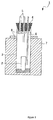
- FIG. 1 is a schematic view showing an example of a melting furnace 1.
- the scandium concentrate recovery method of the present invention includes a cooling step of cooling an aluminum scandium molten alloy (hereinafter also referred to as "Al-Sc molten alloy”) to be 660°C to 700°C, while maintaining the cooling rate of 10°C to 100°C per minute; a holding step of holding this predetermined temperature for a certain time; and a recovery step of recovering a solid scandium concentrate.
- Al-Sc molten alloy aluminum scandium molten alloy
- the melt temperature of Al-Sc alloy is not particularly limited so long as being a temperature able to sufficiently melt the Al-Sc alloy.
- the Sc quality contained in the Al-Sc alloy being 1%, it is possible to sufficiently melt the Al-Sc alloy if at least 800°C.
- the cooling rate is 10°C to 100°C per minute. This cooling rate is preferably 20°C to 50°C per minute, and more preferably 20°C to 30°C per minute. If the cooling rate is faster than 100°C per minute, since the scandium concentrate will finely disperse in the entirety of the Al-Sc alloy, it is not preferable in the point of sufficient concentrating effect not being obtained. If the cooling rate is slower than 10°C per minute, for example, it is not preferable because, even if substituting the inside of the melting furnace with inert gas such as argon and nitrogen and cooling, there is a possibility of reacting with the slight amount of oxygen remaining inside of the melting furnace, and not being able to sufficiently prevent oxidation of scandium during cooling. In addition, it is not preferable in the point of the energy cost for temperature maintenance being great.
- the cooling rate faster than 20°C per minute, it is more preferable because, even in an atmosphere of air, it is possible to prevent scandium from oxidizing during cooling, and obtain a high-quality scandium concentrate.
- the Sc concentration in the Al-Sc molten alloy will decline following the liquidus composition, and Al 3 Sc of an amount matching this will form.
- the temperature is gradually made to decline in this way.
- the eutectic temperature of Al-Sc molten alloy is about 660°C, and the Sc concentration of the eutectic composition is 0.2 to 0.4%; therefore, by causing the temperature to decline to approach the eutectic temperature, it is possible to lower the Sc concentration of the Al-Sc molten alloy, as well as being able to raise the concentration of scandium concentrate precipitating by the specific gravity difference.
- the target temperature for cooling is 660°C to 700°C, and preferably 665°C to 690°C. If the target temperature is higher than 700°C, it is not preferable because the generated amount of Al 3 Sc will decrease, and scandium concentrate will not be satisfactorily recovered. If the target temperature falls below 660°C, it is not preferable because a solid of Al will form, and will not be able to mix with Al 3 Sc due to the temperature becoming lower than the melting point of aluminum. In particular, if the target temperature of cooling is at least 665°C, it is preferable in the point of suppressing a solid of Al from forming.
- the holding step is a step of keeping the above-mentioned target temperature of cooling for a certain time.
- the holding time is decided by the size and shape of the melting furnace, and is not decided as a rule; however, it is sufficient so long as at least 60 minutes, preferably at least 90 minutes, and more preferably at least 120 minutes. On the other hand, the holding time is not necessary better if longer. Even if assuming a holding time of at least 180 minutes, the yield will not necessarily improve remarkably compared to a case of the holding time being 60 minutes.
- the recovery step is a step of cooling the temperature of the melting furnace to room temperature after the holding step, and recovering the solid scandium concentration containing Al 3 Sc from the melting furnace.
- the melting furnace is rotated during cooling so as to further precipitate so that the furnace bottom side faces the outside, and the collecting of scandium at the furnace bottom side may be performed by centrifugal force.
- a solid block that can be obtained after cooling is divided into at least two in the depth direction of the furnace, and scandium can be easily recovered so long as recovering the deepest portions of the block as scandium concentrate.
- the number of blocks is not particularly limited; however, it is more preferably at least 5, and even more preferably at least 10.
- the scandium concentrate of the present invention may be reused as is as a high-quality Al-Sc master alloy, or may be reused after remelting and making into a master alloy.
- by recovering scandium from a scandium concentrate by a known method such as solvent extraction it is possible to very efficiently recover scandium compared to a case of recovering from nickel oxide ore.
- FIG. 1 is a schematic view illustrating the configuration of the melting furnace 1 used in the present example.
- the melting furnace 1 includes: a Tammann tube 2 made of alumina that encloses the Al-Sc alloy, a quartz furnace core tube 3 that encloses this alumina Tammann tube 2, a rubber stopper 4 that seals this quartz furnace core tube 3, an argon gas substitution unit 5 that substitutes the inside of the quartz furnace core tube 3 with argon gas through two tube insertion parts (not illustrated) provided in this rubber stopper 4, a thermocouple 6 inserted inside of the quartz furnace core tube 3 through a thermocouple insertion part (not illustrated) provided in the rubber stopper 4, an electric furnace 7 that keeps the temperature inside of the quartz tube 3 at a predetermined temperature from around the quartz furnace core tube 3, and an insulation board 8 that keeps the adiabaticity of the inside of the quartz furnace core tube 3.
- the electric current value flowing through the electric furnace 1 was controlled so as to cause the temperature to decline maintaining a rate of 20 to 30°C per minute, and the temperature was held for 120 minutes at the point at which the temperature reached 670°C. Subsequently, the power source of the electric furnace 1 was shut off, and the sample was cooled inside of the electric furnace 1. After the sample reached room temperature, the solidified sample was retrieved.
- the alumina Tammann tube 2 was split, and a slag portion thinly adhering to the metal sample surface obtained was stripped off with hammering, followed by cutting at a part corresponding to a volume equivalent to about 10% from the sample bottom using a diamond cutter.
- the composition of the bottom block obtained by this cutting was analyzed using an X-ray fluorescence spectrometer. The results are shown in Table 2.
- the bottom block was obtained by the same method as the Example.
- the composition of this bottom block was analyzed using an X-ray fluorescence spectrometer. The results are shown in Table 2.
- the Sc concentration of the bottom block according to the Example was 7%. Based on this, it was confirmed that the scandium concentrate obtained through the cooling step of cooling the molten alloy containing aluminum and scandium until becoming 660°C to 730°C while maintaining the cooling rate at 10°C to 100°C per minute, the holding step of keeping this cooling temperature for a certain time, and the recovery step of recovering a solid scandium concentrate could be reused as is as a high-quality Al-Sc master alloy. In addition, by performing solvent extraction, etc. on this scandium concentrate, it is possible to recover scandium very efficiently compared to a case of recovering from nickel oxide ore.
Landscapes
- Chemical & Material Sciences (AREA)
- Engineering & Computer Science (AREA)
- Materials Engineering (AREA)
- Mechanical Engineering (AREA)
- Metallurgy (AREA)
- Organic Chemistry (AREA)
- Manufacturing & Machinery (AREA)
- Life Sciences & Earth Sciences (AREA)
- Environmental & Geological Engineering (AREA)
- General Life Sciences & Earth Sciences (AREA)
- Geology (AREA)
- Manufacture And Refinement Of Metals (AREA)
Abstract
Description
- The present invention relates a scandium concentrate recovery method, and in more detail, relates to a method of recovering scandium concentrate from a molten alloy containing scandium and aluminum.
- Aluminum scandium alloys containing aluminum and scandium (hereinafter also referred to as "Al-Sc alloy") have a characteristic of being light weight and high strength, and in addition to sports articles, have been used in fields requiring shock resistance. Additionally, in the future, applications as a structural material for aircraft, electric vehicles, high-speed rail, etc. are also expected. However, since the production volume of scandium is very small, scandium is extremely high cost. For this reason, it is not easy to broadly apply scandium industrially.
- In recent years, the technology for recovering scandium that accompanies nickel oxide ore in a very small amount has progressed, and it is becoming possible to stably obtain larger amounts of scandium than before. However, to recover scandium from nickel oxide ore, since multiple processes such as ion exchange, solvent extraction, neutral precipitation and calcination are required, the matter of scandium being high cost does not change even if using this technology.
- However, since scandium is easily oxidized but has a high melting point, it is not possible to obtain Al-Sc alloy by simply melting scandium and aluminum. Therefore, generally a technique has been adopted to add, to molten aluminum, scandium oxide while reducing with metals such as calcium to obtain a master alloy having a scandium quality on the order of 1-2%, and then diluting this with aluminum to obtain the intended Al-Sc alloy. In addition, it has also been proposed to produce a scandium master alloy with halogenated scandium as the raw material (refer to Patent Document 1).
- Patent Document 1: Japanese Unexamined Patent Application, Publication No.
2003-171724 - By performing processing in the reverse direction to the processing described in
Patent Document 1, it has been considered to separate scandium from Al-Sc alloy. However, in addition to the stability of halogenated scandium, when considering the risks from using hazardous chlorine, and further the industrial facilities and cost, it is not easy to practically realize scandium recovery technology by performing processing in the reverse direction to the processing described inPatent Document 1. - On the other hand, since the expectations for scandium are rising, in the future, the production volume of Al-Sc alloy will increase, and eventually, the disposal of structures made using Al-Sc alloy, and defective articles produced in the manufacturing process of these structures, etc. are also expected to increase.
- The scandium quality of these disposed articles, etc. is far higher than the scandium quality of nickel oxide ores, etc., and recovering scandium from the disposed articles, etc. and reusing is expected to be an effective means. However, even if considering the scandium quality of disposed articles, etc. to be high, an element contained in Al-Sc alloy is aluminum, and the content of scandium is a very small amount comparing with the content of aluminum; therefore, it is not possible to effectively recover scandium concentrate by simply melting Al-Sc alloy.
- The present invention has been made in order to solve the above such problems, and the object thereof is to effectively recover scandium concentrate from Al-Sc alloy. When explained in further detail, the Al-Sc alloy in structures, etc. is widely used by concentrating to 0.1 to 1% Sc. As mentioned above, the Sc concentration of the Al-Sc master alloy is 1 to 2%. The present invention has an object of efficiently recovering scandium concentration of a degree that can be used as is as an Al-Sc master alloy from scrap articles of Al-Sc alloy having an Sc concentration on the order of 0.1 to 1%.
- As a result of accumulating intensive research to solve the above-mentioned problems, the present inventors found that the above-mentioned object could be achieved by cooling molten alloy containing aluminum and scandium at predetermined conditions, and subsequently holding at a certain temperature for a certain time, thereby arriving at completion of the present invention.
- More specifically, the present invention provides the following matters.
- A first aspect of the present invention is a scandium recovery method including: a cooling step of cooling a molten alloy containing aluminum and scandium until reaching 660°C to 700°C while maintaining a cooling rate of 10°C to 100°C per minute; a holding step of holding the temperature of 660°C to 700°C for a certain time; and a recovery step of recovering a solid scandium concentrate.
- In addition, according to a second aspect of the present invention, in the scandium concentrate recovery method as described in the first aspect, the recovery step is a step of dividing a melting furnace that melts the molten alloy into at least two blocks in a depth direction, and recovering a block that is a deepest portion.
- Furthermore, according to a third aspect of the present invention, in the scandium recovery method as described in the first or second aspect, the method performs again the cooling step, the holding step and the recovery step after melting the scandium concentrate recovered in the recovery step in the melting furnace.
- According to the present invention, it is possible to effectively recover a scandium concentrate from Al-Sc alloy. This scandium concentrate can be used as is as a high-quality Al-Sc master alloy. In addition, by passing through solvent extraction, etc., it is also possible to recover scandium very efficiently compared to a case of recovering from nickel oxide ore.
-
FIG. 1 is a schematic view showing an example of amelting furnace 1. - Hereinafter, a specific embodiment of the present invention will be explained in detail; however, the present invention is not to be limited in any way to the following embodiment, and can be realized by applying appropriate modifications within the scope of the object of the present invention. It should be noted that places where explanation would be redundant, the explanation may be omitted as appropriate, but is not to limit the gist of the invention.
- The scandium concentrate recovery method of the present invention includes a cooling step of cooling an aluminum scandium molten alloy (hereinafter also referred to as "Al-Sc molten alloy") to be 660°C to 700°C, while maintaining the cooling rate of 10°C to 100°C per minute; a holding step of holding this predetermined temperature for a certain time; and a recovery step of recovering a solid scandium concentrate.
- The melt temperature of Al-Sc alloy is not particularly limited so long as being a temperature able to sufficiently melt the Al-Sc alloy. For example, in the case of the Sc quality contained in the Al-Sc alloy being 1%, it is possible to sufficiently melt the Al-Sc alloy if at least 800°C.
- The cooling rate is 10°C to 100°C per minute. This cooling rate is preferably 20°C to 50°C per minute, and more preferably 20°C to 30°C per minute. If the cooling rate is faster than 100°C per minute, since the scandium concentrate will finely disperse in the entirety of the Al-Sc alloy, it is not preferable in the point of sufficient concentrating effect not being obtained. If the cooling rate is slower than 10°C per minute, for example, it is not preferable because, even if substituting the inside of the melting furnace with inert gas such as argon and nitrogen and cooling, there is a possibility of reacting with the slight amount of oxygen remaining inside of the melting furnace, and not being able to sufficiently prevent oxidation of scandium during cooling. In addition, it is not preferable in the point of the energy cost for temperature maintenance being great.
- In particular, by making the cooling rate faster than 20°C per minute, it is more preferable because, even in an atmosphere of air, it is possible to prevent scandium from oxidizing during cooling, and obtain a high-quality scandium concentrate.
- As an example, a case of recycling Al-Sc alloy scrap having a Sc quality of 1% will be explained. If cooling the Al-Sc molten alloy at the above-mentioned cooling rate, an intermetallic compound Al3Sc will form that is solid in the Al-Sc molten alloy at about 730°C, which is the liquidus temperature.
- Continuing, when cooling at the above-mentioned cooling rate, the Sc concentration in the Al-Sc molten alloy will decline following the liquidus composition, and Al3Sc of an amount matching this will form. The temperature is gradually made to decline in this way. The eutectic temperature of Al-Sc molten alloy is about 660°C, and the Sc concentration of the eutectic composition is 0.2 to 0.4%; therefore, by causing the temperature to decline to approach the eutectic temperature, it is possible to lower the Sc concentration of the Al-Sc molten alloy, as well as being able to raise the concentration of scandium concentrate precipitating by the specific gravity difference.
- The target temperature for cooling is 660°C to 700°C, and preferably 665°C to 690°C. If the target temperature is higher than 700°C, it is not preferable because the generated amount of Al3Sc will decrease, and scandium concentrate will not be satisfactorily recovered. If the target temperature falls below 660°C, it is not preferable because a solid of Al will form, and will not be able to mix with Al3Sc due to the temperature becoming lower than the melting point of aluminum. In particular, if the target temperature of cooling is at least 665°C, it is preferable in the point of suppressing a solid of Al from forming.
- The holding step is a step of keeping the above-mentioned target temperature of cooling for a certain time. The holding time is decided by the size and shape of the melting furnace, and is not decided as a rule; however, it is sufficient so long as at least 60 minutes, preferably at least 90 minutes, and more preferably at least 120 minutes. On the other hand, the holding time is not necessary better if longer. Even if assuming a holding time of at least 180 minutes, the yield will not necessarily improve remarkably compared to a case of the holding time being 60 minutes.
- When exemplifying the case of recycling Al-Sc alloy scrap having Sc quality of 1%, by holding at 670°C for 120 minutes, it is possible to lower the Sc concentration of the Al-Sc molten alloy to about 0.4%, which is the eutectic composition, a result of which Al3Sc can be sufficiently obtained. The Sc concentration contained by this Al3Sc is about 35%.
- The recovery step is a step of cooling the temperature of the melting furnace to room temperature after the holding step, and recovering the solid scandium concentration containing Al3Sc from the melting furnace.
- Since solid Al3Sc precipitates in the solution, the top part of the molten Al, i.e. aluminum concentrate, is removed by tilting or the like, to recover the solid that is the bottom part, i.e. scandium concentrate, whereby it is possible to obtain a master alloy raw material having high Sc concentration. In practice, perfect separation of the solid Al3Sc and molten Al is difficult, and is recovered in a state in which a mixed slurry has solidified; therefore, it becomes 2 to 23% in Sc concentration.
- In order to efficiently perform separation, although the entirety may be solidified, retrieved and cut; however, it is not practical due to incurring energy cost, and thus it is more preferable to separate in the molten state. For this reason, it is preferable to use a tilt furnace as the industrial melting furnace.
- The melting furnace is rotated during cooling so as to further precipitate so that the furnace bottom side faces the outside, and the collecting of scandium at the furnace bottom side may be performed by centrifugal force.
- In addition, a solid block that can be obtained after cooling is divided into at least two in the depth direction of the furnace, and scandium can be easily recovered so long as recovering the deepest portions of the block as scandium concentrate. The number of blocks is not particularly limited; however, it is more preferably at least 5, and even more preferably at least 10.
- Furthermore, it is possible to collect aluminum mixed in the scandium concentrate at the top part of the melt by loading the block of scandium concentrate retrieved from the above-mentioned melting furnace into the melting furnace again, and repeating the above-mentioned cooling step, holding step and recovery step, and by simply this, it is possible to improve the scandium quality of the scandium concentrate.
- The scandium concentrate of the present invention may be reused as is as a high-quality Al-Sc master alloy, or may be reused after remelting and making into a master alloy. In addition, by recovering scandium from a scandium concentrate by a known method such as solvent extraction, it is possible to very efficiently recover scandium compared to a case of recovering from nickel oxide ore.
- Hereinafter, the present invention will be explained in further detail by way of examples; however, the present invention is not to be subjected to any limitations in these descriptions.
[Table 1] Cooling rate Example Per minute 20-30°C Comparative Example 1 Per minute 110-120°C Comparative Example 2 Per minute 5-8°C -
FIG. 1 is a schematic view illustrating the configuration of themelting furnace 1 used in the present example. Themelting furnace 1 includes: aTammann tube 2 made of alumina that encloses the Al-Sc alloy, a quartzfurnace core tube 3 that encloses thisalumina Tammann tube 2, a rubber stopper 4 that seals this quartzfurnace core tube 3, an argongas substitution unit 5 that substitutes the inside of the quartzfurnace core tube 3 with argon gas through two tube insertion parts (not illustrated) provided in this rubber stopper 4, a thermocouple 6 inserted inside of the quartzfurnace core tube 3 through a thermocouple insertion part (not illustrated) provided in the rubber stopper 4, anelectric furnace 7 that keeps the temperature inside of thequartz tube 3 at a predetermined temperature from around the quartzfurnace core tube 3, and aninsulation board 8 that keeps the adiabaticity of the inside of the quartzfurnace core tube 3. - Into the 99.5% pure
alumina Tammann tube 2, 50 g of Al-Sc alloy having an Sc concentration of 1% was placed, and thisTammann tube 2 was set inside of theelectric furnace 1 that could adjust the atmosphere using the quartzfurnace core tube 3. Since the internal atmosphere of the quartzfurnace core tube 3 is kept inert, after sufficiently substituting the air with argon through the argongas substitution part 5, it was heated to 800°C and maintained, then held for 60 minutes under an argon gas flow. - Subsequently, the electric current value flowing through the
electric furnace 1 was controlled so as to cause the temperature to decline maintaining a rate of 20 to 30°C per minute, and the temperature was held for 120 minutes at the point at which the temperature reached 670°C. Subsequently, the power source of theelectric furnace 1 was shut off, and the sample was cooled inside of theelectric furnace 1. After the sample reached room temperature, the solidified sample was retrieved. - Thereafter, the
alumina Tammann tube 2 was split, and a slag portion thinly adhering to the metal sample surface obtained was stripped off with hammering, followed by cutting at a part corresponding to a volume equivalent to about 10% from the sample bottom using a diamond cutter. The composition of the bottom block obtained by this cutting was analyzed using an X-ray fluorescence spectrometer. The results are shown in Table 2. - Except for the cooling rate being 110~120°C/min, the bottom block was obtained by the same method as the Example. The composition of this bottom block was analyzed using an X-ray fluorescence spectrometer. The results are shown in Table 2.
- Except for the cooling rate being 5~8°C/min, the bottom block was obtained by the same method as the Example. The composition of this bottom block was analyzed using an X-ray fluorescence spectrometer. The results are shown in Table 2.
[Table 2] Sc rate Example 1 7% Comparative Example 1 1.2% Comparative Example 2 7.5-8%
(Note that scandium at surface oxidized) - The Sc concentration of the bottom block according to the Example was 7%. Based on this, it was confirmed that the scandium concentrate obtained through the cooling step of cooling the molten alloy containing aluminum and scandium until becoming 660°C to 730°C while maintaining the cooling rate at 10°C to 100°C per minute, the holding step of keeping this cooling temperature for a certain time, and the recovery step of recovering a solid scandium concentrate could be reused as is as a high-quality Al-Sc master alloy. In addition, by performing solvent extraction, etc. on this scandium concentrate, it is possible to recover scandium very efficiently compared to a case of recovering from nickel oxide ore.
- On the other hand, when the cooling rate was too fast, the scandium concentration lowered to 1.2%, and could not be reused as is as a high-quality Al-Sc master alloy (Comparative Example 1). It was lower than the Example. In addition, when observing the sample cross-section by an electron beam microanalyzer (EPMA), the appearance of fine scandium contents being dispersed over the entire surface was seen also in the Al-Sc alloy phase, and the weight itself that could be retrieved as scandium concentrate was lower than the weight of the Example.
- In addition, even when the cooling rate was too slow, the scandium concentration of the bottom block was not greatly different from the concentration of the Example (Comparative Example 2). In addition, irrespective of substituting inside of the melting furnace with argon and cooling, the remaining scandium in the vicinity of the surface became an oxide. For this reason, in the case of the cooling rate being too slow, it was confirmed that the scandium concentrate cannot be reused as is as a high-quality Al-Sc master alloy. Oxidation of the bottom block is assumed to be caused by reacting with the slight amount of oxygen remaining inside of the melting furnace.
-
- 1 melting furnace
- 2 alumina Tammann tube
- 3 quartz furnace core tube
- 4 rubber stopper
- 5 argon gas substitution unit
- 6 thermocouple
- 7 electric furnace
- 8 insulation board
Claims (3)
- A scandium concentrate recovery method comprising:a cooling step of cooling a molten alloy containing aluminum and scandium until reaching 660°C to 730°C while maintaining a cooling rate of 10°C to 100°C per minute;a holding step of holding the temperature of 660°C to 730°C for a certain time; anda recovery step of recovering a solid scandium concentrate.
- The scandium concentrate recovery method according to claim 1, wherein the recovery step is a step of dividing a melting furnace that melts the molten alloy into at least two blocks in a depth direction, and recovering a block that is a deepest portion.
- The scandium concentrate recovery method according to claim 1 or 2, wherein the method performs again the cooling step, the holding step and the recovery step after melting the scandium concentrate recovered in the recovery step in the melting furnace.
Applications Claiming Priority (2)
| Application Number | Priority Date | Filing Date | Title |
|---|---|---|---|
| JP2014012664A JP5907186B2 (en) | 2014-01-27 | 2014-01-27 | Scandium concentrate recovery method |
| PCT/JP2015/051825 WO2015111695A1 (en) | 2014-01-27 | 2015-01-23 | Scandium concentrate recovery method |
Publications (3)
| Publication Number | Publication Date |
|---|---|
| EP3081659A1 true EP3081659A1 (en) | 2016-10-19 |
| EP3081659A4 EP3081659A4 (en) | 2016-12-28 |
| EP3081659B1 EP3081659B1 (en) | 2018-12-05 |
Family
ID=53681492
Family Applications (1)
| Application Number | Title | Priority Date | Filing Date |
|---|---|---|---|
| EP15740184.5A Not-in-force EP3081659B1 (en) | 2014-01-27 | 2015-01-23 | Scandium concentrate recovery method |
Country Status (3)
| Country | Link |
|---|---|
| EP (1) | EP3081659B1 (en) |
| JP (1) | JP5907186B2 (en) |
| WO (1) | WO2015111695A1 (en) |
Family Cites Families (5)
| Publication number | Priority date | Publication date | Assignee | Title |
|---|---|---|---|---|
| JPH05171304A (en) * | 1991-12-19 | 1993-07-09 | Kobe Steel Ltd | Method for recovering useful metals from aluminum alloys |
| JP4224532B2 (en) * | 2001-12-07 | 2009-02-18 | 青森県 | Method for producing Al-Sc master alloy and Al-Sc master alloy obtained by the method |
| JP5094031B2 (en) * | 2006-03-23 | 2012-12-12 | 大平洋金属株式会社 | Method for producing scandium-containing alloy |
| FR2902800B1 (en) * | 2006-06-23 | 2008-08-22 | Alcan Rhenalu Sa | PROCESS FOR RECYCLING SCRAP OF ALUMINUM ALLOY FROM THE AERONAUTICAL INDUSTRY |
| WO2014207834A1 (en) * | 2013-06-26 | 2014-12-31 | 日本軽金属株式会社 | Al-Sc ALLOY MANUFACTURING METHOD |
-
2014
- 2014-01-27 JP JP2014012664A patent/JP5907186B2/en active Active
-
2015
- 2015-01-23 EP EP15740184.5A patent/EP3081659B1/en not_active Not-in-force
- 2015-01-23 WO PCT/JP2015/051825 patent/WO2015111695A1/en not_active Ceased
Also Published As
| Publication number | Publication date |
|---|---|
| JP2015140443A (en) | 2015-08-03 |
| EP3081659B1 (en) | 2018-12-05 |
| JP5907186B2 (en) | 2016-04-26 |
| WO2015111695A1 (en) | 2015-07-30 |
| EP3081659A4 (en) | 2016-12-28 |
Similar Documents
| Publication | Publication Date | Title |
|---|---|---|
| US10294546B2 (en) | Method for recovering valuable metal | |
| EP2687613A1 (en) | Method for recovering valuable metals | |
| JP5434934B2 (en) | Valuable metal recovery method | |
| CN101855391A (en) | Method for treating silicon powder to obtain silicon crystals | |
| EP3586998B1 (en) | Method for producing ti-al alloy | |
| JP7123834B2 (en) | Impurity removal method | |
| EP3081671B1 (en) | Scandium concentrate production method | |
| Gu et al. | Mechanisms and kinetic of Ti recovery from Ti-bearing blast furnace slag using diamond wire saw silicon waste | |
| EP3081670B1 (en) | Scandium concentrate production method | |
| EP3081659B1 (en) | Scandium concentrate recovery method | |
| WO2019198476A1 (en) | Impurity removal method | |
| Wang et al. | Simultaneous preparation of high-purity Si and eutectic Si-Nd alloy utilizing Nd2O3-containing waste slag and diamond-wire sawing silicon waste | |
| KR20150042018A (en) | Refining method of rare-earth metals by vacuum molten process and apparatus for the manufacturing | |
| JP2012254894A (en) | Method for purifying silicon | |
| KR101391299B1 (en) | Method for scrap metal recovery | |
| EP4339310A1 (en) | Method for producing valuable metal | |
| KR20150076451A (en) | Apparatus and method for reducing rare earth resources | |
| EP3106532A1 (en) | HOMOGENIZATION METHOD FOR Cu ALLOY COMPRISING Ru | |
| EP3078757A1 (en) | Scandium chloride and scandium chloride production method | |
| JP3709466B2 (en) | Separation and recovery method of copper and iron from copper iron scrap | |
| JP5554274B2 (en) | Method for recovering In and Sn and method for recovering In and Sn from an ITO recycled material | |
| TW201718885A (en) | Method for homogenizing ru-containing cu alloy | |
| JP5995275B2 (en) | Method for recovering precious metals contained in crude copper | |
| JP2003105448A (en) | Method of separating and removing copper from iron scrap | |
| DE102012017183A1 (en) | Process for the treatment and / or recycling of saw slurries |
Legal Events
| Date | Code | Title | Description |
|---|---|---|---|
| PUAI | Public reference made under article 153(3) epc to a published international application that has entered the european phase |
Free format text: ORIGINAL CODE: 0009012 |
|
| 17P | Request for examination filed |
Effective date: 20160711 |
|
| AK | Designated contracting states |
Kind code of ref document: A1 Designated state(s): AL AT BE BG CH CY CZ DE DK EE ES FI FR GB GR HR HU IE IS IT LI LT LU LV MC MK MT NL NO PL PT RO RS SE SI SK SM TR |
|
| AX | Request for extension of the european patent |
Extension state: BA ME |
|
| RIN1 | Information on inventor provided before grant (corrected) |
Inventor name: TAKAHASHI, JUN-ICHI |
|
| A4 | Supplementary search report drawn up and despatched |
Effective date: 20161130 |
|
| RIC1 | Information provided on ipc code assigned before grant |
Ipc: C22C 21/00 20060101ALI20161124BHEP Ipc: C22B 9/02 20060101ALI20161124BHEP Ipc: C22B 7/00 20060101ALI20161124BHEP Ipc: C22B 59/00 20060101AFI20161124BHEP Ipc: C22B 21/00 20060101ALI20161124BHEP |
|
| DAX | Request for extension of the european patent (deleted) | ||
| STAA | Information on the status of an ep patent application or granted ep patent |
Free format text: STATUS: EXAMINATION IS IN PROGRESS |
|
| 17Q | First examination report despatched |
Effective date: 20180111 |
|
| GRAP | Despatch of communication of intention to grant a patent |
Free format text: ORIGINAL CODE: EPIDOSNIGR1 |
|
| STAA | Information on the status of an ep patent application or granted ep patent |
Free format text: STATUS: GRANT OF PATENT IS INTENDED |
|
| INTG | Intention to grant announced |
Effective date: 20180627 |
|
| GRAS | Grant fee paid |
Free format text: ORIGINAL CODE: EPIDOSNIGR3 |
|
| GRAA | (expected) grant |
Free format text: ORIGINAL CODE: 0009210 |
|
| STAA | Information on the status of an ep patent application or granted ep patent |
Free format text: STATUS: THE PATENT HAS BEEN GRANTED |
|
| AK | Designated contracting states |
Kind code of ref document: B1 Designated state(s): AL AT BE BG CH CY CZ DE DK EE ES FI FR GB GR HR HU IE IS IT LI LT LU LV MC MK MT NL NO PL PT RO RS SE SI SK SM TR |
|
| REG | Reference to a national code |
Ref country code: GB Ref legal event code: FG4D |
|
| REG | Reference to a national code |
Ref country code: CH Ref legal event code: EP |
|
| REG | Reference to a national code |
Ref country code: AT Ref legal event code: REF Ref document number: 1073141 Country of ref document: AT Kind code of ref document: T Effective date: 20181215 |
|
| REG | Reference to a national code |
Ref country code: DE Ref legal event code: R096 Ref document number: 602015020912 Country of ref document: DE |
|
| REG | Reference to a national code |
Ref country code: IE Ref legal event code: FG4D |
|
| REG | Reference to a national code |
Ref country code: NL Ref legal event code: MP Effective date: 20181205 |
|
| REG | Reference to a national code |
Ref country code: AT Ref legal event code: MK05 Ref document number: 1073141 Country of ref document: AT Kind code of ref document: T Effective date: 20181205 |
|
| REG | Reference to a national code |
Ref country code: LT Ref legal event code: MG4D |
|
| PG25 | Lapsed in a contracting state [announced via postgrant information from national office to epo] |
Ref country code: FI Free format text: LAPSE BECAUSE OF FAILURE TO SUBMIT A TRANSLATION OF THE DESCRIPTION OR TO PAY THE FEE WITHIN THE PRESCRIBED TIME-LIMIT Effective date: 20181205 Ref country code: NO Free format text: LAPSE BECAUSE OF FAILURE TO SUBMIT A TRANSLATION OF THE DESCRIPTION OR TO PAY THE FEE WITHIN THE PRESCRIBED TIME-LIMIT Effective date: 20190305 Ref country code: HR Free format text: LAPSE BECAUSE OF FAILURE TO SUBMIT A TRANSLATION OF THE DESCRIPTION OR TO PAY THE FEE WITHIN THE PRESCRIBED TIME-LIMIT Effective date: 20181205 Ref country code: LT Free format text: LAPSE BECAUSE OF FAILURE TO SUBMIT A TRANSLATION OF THE DESCRIPTION OR TO PAY THE FEE WITHIN THE PRESCRIBED TIME-LIMIT Effective date: 20181205 Ref country code: BG Free format text: LAPSE BECAUSE OF FAILURE TO SUBMIT A TRANSLATION OF THE DESCRIPTION OR TO PAY THE FEE WITHIN THE PRESCRIBED TIME-LIMIT Effective date: 20190305 Ref country code: ES Free format text: LAPSE BECAUSE OF FAILURE TO SUBMIT A TRANSLATION OF THE DESCRIPTION OR TO PAY THE FEE WITHIN THE PRESCRIBED TIME-LIMIT Effective date: 20181205 Ref country code: LV Free format text: LAPSE BECAUSE OF FAILURE TO SUBMIT A TRANSLATION OF THE DESCRIPTION OR TO PAY THE FEE WITHIN THE PRESCRIBED TIME-LIMIT Effective date: 20181205 Ref country code: AT Free format text: LAPSE BECAUSE OF FAILURE TO SUBMIT A TRANSLATION OF THE DESCRIPTION OR TO PAY THE FEE WITHIN THE PRESCRIBED TIME-LIMIT Effective date: 20181205 |
|
| PG25 | Lapsed in a contracting state [announced via postgrant information from national office to epo] |
Ref country code: AL Free format text: LAPSE BECAUSE OF FAILURE TO SUBMIT A TRANSLATION OF THE DESCRIPTION OR TO PAY THE FEE WITHIN THE PRESCRIBED TIME-LIMIT Effective date: 20181205 Ref country code: RS Free format text: LAPSE BECAUSE OF FAILURE TO SUBMIT A TRANSLATION OF THE DESCRIPTION OR TO PAY THE FEE WITHIN THE PRESCRIBED TIME-LIMIT Effective date: 20181205 Ref country code: SE Free format text: LAPSE BECAUSE OF FAILURE TO SUBMIT A TRANSLATION OF THE DESCRIPTION OR TO PAY THE FEE WITHIN THE PRESCRIBED TIME-LIMIT Effective date: 20181205 Ref country code: GR Free format text: LAPSE BECAUSE OF FAILURE TO SUBMIT A TRANSLATION OF THE DESCRIPTION OR TO PAY THE FEE WITHIN THE PRESCRIBED TIME-LIMIT Effective date: 20190306 |
|
| PG25 | Lapsed in a contracting state [announced via postgrant information from national office to epo] |
Ref country code: NL Free format text: LAPSE BECAUSE OF FAILURE TO SUBMIT A TRANSLATION OF THE DESCRIPTION OR TO PAY THE FEE WITHIN THE PRESCRIBED TIME-LIMIT Effective date: 20181205 |
|
| PG25 | Lapsed in a contracting state [announced via postgrant information from national office to epo] |
Ref country code: CZ Free format text: LAPSE BECAUSE OF FAILURE TO SUBMIT A TRANSLATION OF THE DESCRIPTION OR TO PAY THE FEE WITHIN THE PRESCRIBED TIME-LIMIT Effective date: 20181205 Ref country code: IT Free format text: LAPSE BECAUSE OF FAILURE TO SUBMIT A TRANSLATION OF THE DESCRIPTION OR TO PAY THE FEE WITHIN THE PRESCRIBED TIME-LIMIT Effective date: 20181205 Ref country code: PT Free format text: LAPSE BECAUSE OF FAILURE TO SUBMIT A TRANSLATION OF THE DESCRIPTION OR TO PAY THE FEE WITHIN THE PRESCRIBED TIME-LIMIT Effective date: 20190405 Ref country code: PL Free format text: LAPSE BECAUSE OF FAILURE TO SUBMIT A TRANSLATION OF THE DESCRIPTION OR TO PAY THE FEE WITHIN THE PRESCRIBED TIME-LIMIT Effective date: 20181205 |
|
| REG | Reference to a national code |
Ref country code: DE Ref legal event code: R119 Ref document number: 602015020912 Country of ref document: DE |
|
| PG25 | Lapsed in a contracting state [announced via postgrant information from national office to epo] |
Ref country code: RO Free format text: LAPSE BECAUSE OF FAILURE TO SUBMIT A TRANSLATION OF THE DESCRIPTION OR TO PAY THE FEE WITHIN THE PRESCRIBED TIME-LIMIT Effective date: 20181205 Ref country code: SK Free format text: LAPSE BECAUSE OF FAILURE TO SUBMIT A TRANSLATION OF THE DESCRIPTION OR TO PAY THE FEE WITHIN THE PRESCRIBED TIME-LIMIT Effective date: 20181205 Ref country code: IS Free format text: LAPSE BECAUSE OF FAILURE TO SUBMIT A TRANSLATION OF THE DESCRIPTION OR TO PAY THE FEE WITHIN THE PRESCRIBED TIME-LIMIT Effective date: 20190405 Ref country code: SM Free format text: LAPSE BECAUSE OF FAILURE TO SUBMIT A TRANSLATION OF THE DESCRIPTION OR TO PAY THE FEE WITHIN THE PRESCRIBED TIME-LIMIT Effective date: 20181205 Ref country code: EE Free format text: LAPSE BECAUSE OF FAILURE TO SUBMIT A TRANSLATION OF THE DESCRIPTION OR TO PAY THE FEE WITHIN THE PRESCRIBED TIME-LIMIT Effective date: 20181205 |
|
| REG | Reference to a national code |
Ref country code: CH Ref legal event code: PL |
|
| PG25 | Lapsed in a contracting state [announced via postgrant information from national office to epo] |
Ref country code: LU Free format text: LAPSE BECAUSE OF NON-PAYMENT OF DUE FEES Effective date: 20190123 |
|
| PLBE | No opposition filed within time limit |
Free format text: ORIGINAL CODE: 0009261 |
|
| STAA | Information on the status of an ep patent application or granted ep patent |
Free format text: STATUS: NO OPPOSITION FILED WITHIN TIME LIMIT |
|
| REG | Reference to a national code |
Ref country code: BE Ref legal event code: MM Effective date: 20190131 |
|
| REG | Reference to a national code |
Ref country code: IE Ref legal event code: MM4A |
|
| PG25 | Lapsed in a contracting state [announced via postgrant information from national office to epo] |
Ref country code: DK Free format text: LAPSE BECAUSE OF FAILURE TO SUBMIT A TRANSLATION OF THE DESCRIPTION OR TO PAY THE FEE WITHIN THE PRESCRIBED TIME-LIMIT Effective date: 20181205 Ref country code: SI Free format text: LAPSE BECAUSE OF FAILURE TO SUBMIT A TRANSLATION OF THE DESCRIPTION OR TO PAY THE FEE WITHIN THE PRESCRIBED TIME-LIMIT Effective date: 20181205 Ref country code: MC Free format text: LAPSE BECAUSE OF FAILURE TO SUBMIT A TRANSLATION OF THE DESCRIPTION OR TO PAY THE FEE WITHIN THE PRESCRIBED TIME-LIMIT Effective date: 20181205 Ref country code: DE Free format text: LAPSE BECAUSE OF NON-PAYMENT OF DUE FEES Effective date: 20190801 |
|
| 26N | No opposition filed |
Effective date: 20190906 |
|
| PG25 | Lapsed in a contracting state [announced via postgrant information from national office to epo] |
Ref country code: BE Free format text: LAPSE BECAUSE OF NON-PAYMENT OF DUE FEES Effective date: 20190131 |
|
| PG25 | Lapsed in a contracting state [announced via postgrant information from national office to epo] |
Ref country code: CH Free format text: LAPSE BECAUSE OF NON-PAYMENT OF DUE FEES Effective date: 20190131 Ref country code: LI Free format text: LAPSE BECAUSE OF NON-PAYMENT OF DUE FEES Effective date: 20190131 |
|
| PG25 | Lapsed in a contracting state [announced via postgrant information from national office to epo] |
Ref country code: IE Free format text: LAPSE BECAUSE OF NON-PAYMENT OF DUE FEES Effective date: 20190123 |
|
| PG25 | Lapsed in a contracting state [announced via postgrant information from national office to epo] |
Ref country code: TR Free format text: LAPSE BECAUSE OF FAILURE TO SUBMIT A TRANSLATION OF THE DESCRIPTION OR TO PAY THE FEE WITHIN THE PRESCRIBED TIME-LIMIT Effective date: 20181205 |
|
| PG25 | Lapsed in a contracting state [announced via postgrant information from national office to epo] |
Ref country code: MT Free format text: LAPSE BECAUSE OF NON-PAYMENT OF DUE FEES Effective date: 20190123 |
|
| PG25 | Lapsed in a contracting state [announced via postgrant information from national office to epo] |
Ref country code: CY Free format text: LAPSE BECAUSE OF FAILURE TO SUBMIT A TRANSLATION OF THE DESCRIPTION OR TO PAY THE FEE WITHIN THE PRESCRIBED TIME-LIMIT Effective date: 20181205 |
|
| PG25 | Lapsed in a contracting state [announced via postgrant information from national office to epo] |
Ref country code: HU Free format text: LAPSE BECAUSE OF FAILURE TO SUBMIT A TRANSLATION OF THE DESCRIPTION OR TO PAY THE FEE WITHIN THE PRESCRIBED TIME-LIMIT; INVALID AB INITIO Effective date: 20150123 |
|
| PGFP | Annual fee paid to national office [announced via postgrant information from national office to epo] |
Ref country code: GB Payment date: 20211206 Year of fee payment: 8 Ref country code: FR Payment date: 20211217 Year of fee payment: 8 |
|
| PG25 | Lapsed in a contracting state [announced via postgrant information from national office to epo] |
Ref country code: MK Free format text: LAPSE BECAUSE OF FAILURE TO SUBMIT A TRANSLATION OF THE DESCRIPTION OR TO PAY THE FEE WITHIN THE PRESCRIBED TIME-LIMIT Effective date: 20181205 |
|
| GBPC | Gb: european patent ceased through non-payment of renewal fee |
Effective date: 20230123 |
|
| PG25 | Lapsed in a contracting state [announced via postgrant information from national office to epo] |
Ref country code: GB Free format text: LAPSE BECAUSE OF NON-PAYMENT OF DUE FEES Effective date: 20230123 |
|
| PG25 | Lapsed in a contracting state [announced via postgrant information from national office to epo] |
Ref country code: FR Free format text: LAPSE BECAUSE OF NON-PAYMENT OF DUE FEES Effective date: 20230131 |