EP3080212B1 - Stable primer formulations and coatings with nano dispersion of modified metal oxides - Google Patents
Stable primer formulations and coatings with nano dispersion of modified metal oxides Download PDFInfo
- Publication number
- EP3080212B1 EP3080212B1 EP14827304.8A EP14827304A EP3080212B1 EP 3080212 B1 EP3080212 B1 EP 3080212B1 EP 14827304 A EP14827304 A EP 14827304A EP 3080212 B1 EP3080212 B1 EP 3080212B1
- Authority
- EP
- European Patent Office
- Prior art keywords
- primer composition
- primer
- ceria
- silane
- cerium oxide
- Prior art date
- Legal status (The legal status is an assumption and is not a legal conclusion. Google has not performed a legal analysis and makes no representation as to the accuracy of the status listed.)
- Active
Links
- 0 CC(*)C(CCCC1C2)C12C(C[C@]1C)C(CC2)C1=C2C1CCCC1 Chemical compound CC(*)C(CCCC1C2)C12C(C[C@]1C)C(CC2)C1=C2C1CCCC1 0.000 description 2
Images
Classifications
-
- C—CHEMISTRY; METALLURGY
- C09—DYES; PAINTS; POLISHES; NATURAL RESINS; ADHESIVES; COMPOSITIONS NOT OTHERWISE PROVIDED FOR; APPLICATIONS OF MATERIALS NOT OTHERWISE PROVIDED FOR
- C09D—COATING COMPOSITIONS, e.g. PAINTS, VARNISHES OR LACQUERS; FILLING PASTES; CHEMICAL PAINT OR INK REMOVERS; INKS; CORRECTING FLUIDS; WOODSTAINS; PASTES OR SOLIDS FOR COLOURING OR PRINTING; USE OF MATERIALS THEREFOR
- C09D133/00—Coating compositions based on homopolymers or copolymers of compounds having one or more unsaturated aliphatic radicals, each having only one carbon-to-carbon double bond, and at least one being terminated by only one carboxyl radical, or of salts, anhydrides, esters, amides, imides, or nitriles thereof; Coating compositions based on derivatives of such polymers
- C09D133/04—Homopolymers or copolymers of esters
- C09D133/06—Homopolymers or copolymers of esters of esters containing only carbon, hydrogen and oxygen, the oxygen atom being present only as part of the carboxyl radical
- C09D133/10—Homopolymers or copolymers of methacrylic acid esters
- C09D133/12—Homopolymers or copolymers of methyl methacrylate
-
- C—CHEMISTRY; METALLURGY
- C08—ORGANIC MACROMOLECULAR COMPOUNDS; THEIR PREPARATION OR CHEMICAL WORKING-UP; COMPOSITIONS BASED THEREON
- C08G—MACROMOLECULAR COMPOUNDS OBTAINED OTHERWISE THAN BY REACTIONS ONLY INVOLVING UNSATURATED CARBON-TO-CARBON BONDS
- C08G65/00—Macromolecular compounds obtained by reactions forming an ether link in the main chain of the macromolecule
- C08G65/02—Macromolecular compounds obtained by reactions forming an ether link in the main chain of the macromolecule from cyclic ethers by opening of the heterocyclic ring
- C08G65/32—Polymers modified by chemical after-treatment
- C08G65/329—Polymers modified by chemical after-treatment with organic compounds
- C08G65/336—Polymers modified by chemical after-treatment with organic compounds containing silicon
-
- C—CHEMISTRY; METALLURGY
- C08—ORGANIC MACROMOLECULAR COMPOUNDS; THEIR PREPARATION OR CHEMICAL WORKING-UP; COMPOSITIONS BASED THEREON
- C08K—Use of inorganic or non-macromolecular organic substances as compounding ingredients
- C08K3/00—Use of inorganic substances as compounding ingredients
- C08K3/18—Oxygen-containing compounds, e.g. metal carbonyls
- C08K3/20—Oxides; Hydroxides
- C08K3/22—Oxides; Hydroxides of metals
-
- C—CHEMISTRY; METALLURGY
- C08—ORGANIC MACROMOLECULAR COMPOUNDS; THEIR PREPARATION OR CHEMICAL WORKING-UP; COMPOSITIONS BASED THEREON
- C08K—Use of inorganic or non-macromolecular organic substances as compounding ingredients
- C08K5/00—Use of organic ingredients
- C08K5/04—Oxygen-containing compounds
- C08K5/06—Ethers; Acetals; Ketals; Ortho-esters
-
- C—CHEMISTRY; METALLURGY
- C08—ORGANIC MACROMOLECULAR COMPOUNDS; THEIR PREPARATION OR CHEMICAL WORKING-UP; COMPOSITIONS BASED THEREON
- C08K—Use of inorganic or non-macromolecular organic substances as compounding ingredients
- C08K5/00—Use of organic ingredients
- C08K5/04—Oxygen-containing compounds
- C08K5/07—Aldehydes; Ketones
-
- C—CHEMISTRY; METALLURGY
- C08—ORGANIC MACROMOLECULAR COMPOUNDS; THEIR PREPARATION OR CHEMICAL WORKING-UP; COMPOSITIONS BASED THEREON
- C08K—Use of inorganic or non-macromolecular organic substances as compounding ingredients
- C08K5/00—Use of organic ingredients
- C08K5/54—Silicon-containing compounds
- C08K5/541—Silicon-containing compounds containing oxygen
- C08K5/5415—Silicon-containing compounds containing oxygen containing at least one Si—O bond
- C08K5/5419—Silicon-containing compounds containing oxygen containing at least one Si—O bond containing at least one Si—C bond
-
- C—CHEMISTRY; METALLURGY
- C08—ORGANIC MACROMOLECULAR COMPOUNDS; THEIR PREPARATION OR CHEMICAL WORKING-UP; COMPOSITIONS BASED THEREON
- C08K—Use of inorganic or non-macromolecular organic substances as compounding ingredients
- C08K5/00—Use of organic ingredients
- C08K5/54—Silicon-containing compounds
- C08K5/544—Silicon-containing compounds containing nitrogen
-
- C—CHEMISTRY; METALLURGY
- C09—DYES; PAINTS; POLISHES; NATURAL RESINS; ADHESIVES; COMPOSITIONS NOT OTHERWISE PROVIDED FOR; APPLICATIONS OF MATERIALS NOT OTHERWISE PROVIDED FOR
- C09D—COATING COMPOSITIONS, e.g. PAINTS, VARNISHES OR LACQUERS; FILLING PASTES; CHEMICAL PAINT OR INK REMOVERS; INKS; CORRECTING FLUIDS; WOODSTAINS; PASTES OR SOLIDS FOR COLOURING OR PRINTING; USE OF MATERIALS THEREFOR
- C09D5/00—Coating compositions, e.g. paints, varnishes or lacquers, characterised by their physical nature or the effects produced; Filling pastes
- C09D5/002—Priming paints
-
- C—CHEMISTRY; METALLURGY
- C09—DYES; PAINTS; POLISHES; NATURAL RESINS; ADHESIVES; COMPOSITIONS NOT OTHERWISE PROVIDED FOR; APPLICATIONS OF MATERIALS NOT OTHERWISE PROVIDED FOR
- C09D—COATING COMPOSITIONS, e.g. PAINTS, VARNISHES OR LACQUERS; FILLING PASTES; CHEMICAL PAINT OR INK REMOVERS; INKS; CORRECTING FLUIDS; WOODSTAINS; PASTES OR SOLIDS FOR COLOURING OR PRINTING; USE OF MATERIALS THEREFOR
- C09D7/00—Features of coating compositions, not provided for in group C09D5/00; Processes for incorporating ingredients in coating compositions
- C09D7/40—Additives
- C09D7/48—Stabilisers against degradation by oxygen, light or heat
-
- C—CHEMISTRY; METALLURGY
- C09—DYES; PAINTS; POLISHES; NATURAL RESINS; ADHESIVES; COMPOSITIONS NOT OTHERWISE PROVIDED FOR; APPLICATIONS OF MATERIALS NOT OTHERWISE PROVIDED FOR
- C09D—COATING COMPOSITIONS, e.g. PAINTS, VARNISHES OR LACQUERS; FILLING PASTES; CHEMICAL PAINT OR INK REMOVERS; INKS; CORRECTING FLUIDS; WOODSTAINS; PASTES OR SOLIDS FOR COLOURING OR PRINTING; USE OF MATERIALS THEREFOR
- C09D7/00—Features of coating compositions, not provided for in group C09D5/00; Processes for incorporating ingredients in coating compositions
- C09D7/40—Additives
- C09D7/60—Additives non-macromolecular
- C09D7/61—Additives non-macromolecular inorganic
- C09D7/62—Additives non-macromolecular inorganic modified by treatment with other compounds
-
- C—CHEMISTRY; METALLURGY
- C09—DYES; PAINTS; POLISHES; NATURAL RESINS; ADHESIVES; COMPOSITIONS NOT OTHERWISE PROVIDED FOR; APPLICATIONS OF MATERIALS NOT OTHERWISE PROVIDED FOR
- C09D—COATING COMPOSITIONS, e.g. PAINTS, VARNISHES OR LACQUERS; FILLING PASTES; CHEMICAL PAINT OR INK REMOVERS; INKS; CORRECTING FLUIDS; WOODSTAINS; PASTES OR SOLIDS FOR COLOURING OR PRINTING; USE OF MATERIALS THEREFOR
- C09D7/00—Features of coating compositions, not provided for in group C09D5/00; Processes for incorporating ingredients in coating compositions
- C09D7/40—Additives
- C09D7/66—Additives characterised by particle size
- C09D7/67—Particle size smaller than 100 nm
-
- C—CHEMISTRY; METALLURGY
- C09—DYES; PAINTS; POLISHES; NATURAL RESINS; ADHESIVES; COMPOSITIONS NOT OTHERWISE PROVIDED FOR; APPLICATIONS OF MATERIALS NOT OTHERWISE PROVIDED FOR
- C09D—COATING COMPOSITIONS, e.g. PAINTS, VARNISHES OR LACQUERS; FILLING PASTES; CHEMICAL PAINT OR INK REMOVERS; INKS; CORRECTING FLUIDS; WOODSTAINS; PASTES OR SOLIDS FOR COLOURING OR PRINTING; USE OF MATERIALS THEREFOR
- C09D7/00—Features of coating compositions, not provided for in group C09D5/00; Processes for incorporating ingredients in coating compositions
- C09D7/40—Additives
- C09D7/66—Additives characterised by particle size
- C09D7/68—Particle size between 100-1000 nm
-
- C—CHEMISTRY; METALLURGY
- C08—ORGANIC MACROMOLECULAR COMPOUNDS; THEIR PREPARATION OR CHEMICAL WORKING-UP; COMPOSITIONS BASED THEREON
- C08K—Use of inorganic or non-macromolecular organic substances as compounding ingredients
- C08K2201/00—Specific properties of additives
- C08K2201/011—Nanostructured additives
-
- C—CHEMISTRY; METALLURGY
- C08—ORGANIC MACROMOLECULAR COMPOUNDS; THEIR PREPARATION OR CHEMICAL WORKING-UP; COMPOSITIONS BASED THEREON
- C08K—Use of inorganic or non-macromolecular organic substances as compounding ingredients
- C08K9/00—Use of pretreated ingredients
- C08K9/04—Ingredients treated with organic substances
- C08K9/06—Ingredients treated with organic substances with silicon-containing compounds
-
- C—CHEMISTRY; METALLURGY
- C08—ORGANIC MACROMOLECULAR COMPOUNDS; THEIR PREPARATION OR CHEMICAL WORKING-UP; COMPOSITIONS BASED THEREON
- C08K—Use of inorganic or non-macromolecular organic substances as compounding ingredients
- C08K9/00—Use of pretreated ingredients
- C08K9/08—Ingredients agglomerated by treatment with a binding agent
-
- Y—GENERAL TAGGING OF NEW TECHNOLOGICAL DEVELOPMENTS; GENERAL TAGGING OF CROSS-SECTIONAL TECHNOLOGIES SPANNING OVER SEVERAL SECTIONS OF THE IPC; TECHNICAL SUBJECTS COVERED BY FORMER USPC CROSS-REFERENCE ART COLLECTIONS [XRACs] AND DIGESTS
- Y10—TECHNICAL SUBJECTS COVERED BY FORMER USPC
- Y10T—TECHNICAL SUBJECTS COVERED BY FORMER US CLASSIFICATION
- Y10T428/00—Stock material or miscellaneous articles
- Y10T428/31504—Composite [nonstructural laminate]
- Y10T428/31507—Of polycarbonate
-
- Y—GENERAL TAGGING OF NEW TECHNOLOGICAL DEVELOPMENTS; GENERAL TAGGING OF CROSS-SECTIONAL TECHNOLOGIES SPANNING OVER SEVERAL SECTIONS OF THE IPC; TECHNICAL SUBJECTS COVERED BY FORMER USPC CROSS-REFERENCE ART COLLECTIONS [XRACs] AND DIGESTS
- Y10—TECHNICAL SUBJECTS COVERED BY FORMER USPC
- Y10T—TECHNICAL SUBJECTS COVERED BY FORMER US CLASSIFICATION
- Y10T428/00—Stock material or miscellaneous articles
- Y10T428/31504—Composite [nonstructural laminate]
- Y10T428/31652—Of asbestos
- Y10T428/31663—As siloxane, silicone or silane
Definitions
- the invention relates to stable primer formulations and coatings with nano-dispersion of modified metal oxides.
- the formulations produce films having excellent optical and adhesion characteristics, and high UV screening ability and thermal stability.
- Polymeric materials such as polycarbonate
- polycarbonate are promising alternatives to glass for use as structural materials in a variety of applications, including automotive, transportation and architectural glazing applications, where increased design freedom, weight savings, and improved safety features are in high demand.
- Plain polycarbonate substrates are limited by their lack of abrasion, chemical, UV, and weather resistance, and therefore need to be protected with optically transparent coatings that alleviate above limitations in the aforementioned applications.
- polycarbonate substrates are in general coated with thermally curable silicone hardcoat.
- thermally curable silicone hardcoat The poor weatherability of polycarbonate, on the other hand, is addressed with addition of organic or inorganic UV-absorbing materials in the silicone hardcoat layer.
- incorporation of UV absorbers, especially organic based, in the thermal curable silicone layer often leads to inferior abrasion resistance performance.
- One approach to address the limited abrasion resistance performance associated with the use of organic UV-absorbing materials is to use inorganic UV-absorbing materials at least partially in lieu of organic absorbing materials.
- the expected benefit is to avoid the addition of large amount of organic material in the silicone hardcoat, thereby keeping abrasion resistance characteristics intact.
- the use of inorganic UV-absorbing materials can potentially help to achieve weatherability for extended period of time.
- Hardcoat compositions have been disclosed that can provide UV protection and abrasion resistance to the plastic substrates and enable them to go into outdoor applications.
- Organic UV absorbers incorporated in the coating formulations provide weatherability characteristics to the coating.
- inherent photodegradation and volatility of the organic absorbers limit the weatherability performance of these coatings over an extended period of time.
- the addition of organic UV absorbers in primer formulations can reduce the glass transition temperature (T g ) of the primer due to plasticizing effect. This will limit the maximum temperature that the coated article can be subjected to while in service.
- Inorganic metal oxides like cerium oxide, titanium oxide, and zinc oxide particles can provide UV protection in coating formulations.
- WO 2006/073856 A2 discloses ultraviolet curable compositions preferably containing discrete, crystalline zirconia nanoparticles with reactive, or copolymerizable surface modification in a polymerizable monomer/oligomer resin mixture. Therein, in the surface modification of the nanoparticles, acrylate and methacrylate functionality is preferred over non-reactive, or nonpolymerizable functionality.
- inorganic UV-absorbing materials in the form of a colloidal dispersion into an organic-based coating composition, either with or without the presence of colloidal silica in the coating composition.
- the challenges relate to the ability to obtain long-term stability of inorganic UV absorber dispersions, i.e. the ability to inhibit the agglomeration of colloidal particles of the inorganic UV absorbers.
- Stable dispersions of inorganic nano-particles at high concentrations provide the maximum UV screening properties and good coated film uniformity while maintaining transparency and abrasion resistance.
- EP0732356A2 discloses the use of cerium oxide organosol derived from cerium oxide aqueous sol and the incorporation of cerium oxide nano-particles in the acrylic primer formulations.
- the prior art discloses that water is required as a cosolvent in the formulations to stabilize the cerium oxide nano particle in the organic polymer solutions.
- EP0732356A2 discloses in its examples, PMMA containing formulations having water to ceria weight ratios of 0.09 or greater. It should also be noted that PMMA containing formulations with low solids (2.3%) and low water content ( ⁇ 1.6%) were shown to give hazy primer films.
- the present invention is directed to a primer composition, comprising:
- the functional group-containing moiety of R 1 is selected from amino, carbamate, vinyl, amide, ester, carboxylate, and combinations thereof.
- the present invention is directed to a primer film on a substrate, comprising:
- the functional group-containing moiety of R 1 is selected from amino, carbamate, vinyl, amide, ester, carboxylate, and combinations thereof
- the present invention is directed to a substrate, such as a polycarbonate or acrylate substrate, coated with the above primer composition
- the present invention is directed to a substrate, such as a polycarbonate or acrylate substrate, coated with the above primer film.
- a substrate such as a polycarbonate or acrylate substrate
- This substrate may also be coated with a silicone hardcoat.
- the present invention is directed to an article comprising a substrate coated with the above primer film and overcoated with a silicone hardcoat.
- the present invention is directed to the use of surface modified inorganic nanoparticles as UV absorbers in a coating composition, replacing conventional organic UV absorbers.
- the inorganic nanoparticles are compatibilized with the primer matrix by modifying their surface with functionalized silane and dispersing them uniformly in the coating without agglomeration, thus minimizing the negative effects on the optical properties of the final coated substrate and providing long shelf-life of the coating solution.
- the final coated substrates have good optical properties as well as good long term adhesion in harsh testing conditions.
- Functional silanes are used to modify the surface of cerium oxide, and stable nano cerium oxide sols were prepared in organic medium.
- the resulting primer coatings along with a silicone top coat exhibit higher transmittance, lower haze, and good adhesion to polycarbonate substrates under normal and harsh conditions as required for applications such as automotive and architectural glazing.
- Nanoparticles in general can be defined as particles with the dimensions in the range of one to a few hundred nanometers. For clear coat applications, it is required that the size of the nanoparticle should be below a certain limit in order not to scatter light which is passing though the coating. It is generally understood that nano particles with dimensions less than ⁇ /2 do not scatter light of ⁇ , where ⁇ is the wavelength of light and therefore will not disrupt the transparency of the matrix in which they are incorporated. Hence particles with a diameter ⁇ 190 nm could be used in clear coats without disrupting the transmission or haze of visible light passing though the coating film.
- the primer composition of the invention contains (a) metal oxide nanoparticles surface-modified with an organofunctional silane moiety; (b) an organic polymer; and (c) one or more solvents. Each of these components is described in more detail below.
- metal oxide nanoparticles are cerium oxide nanoparticles.
- the amount of the cerium oxide nanoparticles surface-modified with an organofunctional silane moiety in the composition of the invention ranges preferably from 0.1 to 10 wt%, more preferably from 0.1 to 5 wt.%, and most preferably from 0.5 to 3 wt.%, all based on the total weight of the composition.
- the nature of the binding forces between the cerium oxide and the organofunctional moiety is believed to be noncovalent binding.
- the individual silane moieties are believed to offer physical stability to the surface-modified nanoparticles in suspension due to steric repulsion attributable to the silane moieties.
- organofunctional silane moiety used in the composition of the invention preferably has the structure of Formula I or II:
- the organofunctional silane moiety is 2-methoxy(polyethyleneoxy) 9-12 propyl trimethoxysilane, ⁇ -methacryloxypropyltrimethoxysilane, 2-[(acetoxy(polyethyleneoxy)propyl]-triethoxysilane, tripropyleneglycol propyl ether carbamate silane, bis(3-triethoxysilylpropyl)polyethylene oxide, triethyleneglycol monobutyl ether carbamate silane, aminosilane, acrylate silane, N-beta-(aminoethyl)-gamma-aminopropyl-trimethoxy silane, [methoxy(polyethyleneoxy)propyl]-trimethoxysilane and combinations thereof.
- the amount of the organofunctional silane moiety that surface-modifies the cerium oxide nanoparticles preferably ranges from 0.1 to 50 wt.%, based on the total weight of the cerium oxide nanoparticles, and more preferably ranges from 5 to 30 wt.%, based on the total weight of the cerium oxide nanoparticles.
- the organic polymer component of the invention is not particularly limited. Suitable polymers useful in the composition of the invention include, but are not limited to, homo and copolymers of alkyl acrylates, polyurethanes, polycarbonates, urethane hexaacrylates, pentaerythritol triacrylates, polyvinylpyrrolidone, polyvinylbutyrals, poly(ethylene terephthalate), poly(butylene terephthalate), as well as combinations of these. In one preferred embodiment, the organic polymer is polymethylmethacrylate.
- the amount of the organic polymer in the composition of the invention ranges preferably from about 0.5 to about 15 wt.%, more preferably from about 2 to about 10 wt.%, and most preferably from about 3 to about 8 wt.%, all based on the total weight of the composition.
- the primer composition of the invention includes a solvent.
- the solvent is not particularly limited.
- Exemplary solvent includes alcohols, such as methanol, ethanol, propanol, isopropanol, n-butanol, tert-butanol, methoxypropanol, ethylene glycol, diethylene glycol butyl ether, or combinations thereof.
- Other polar organic solvents such as acetone, methyl ethyl ketone, ethylene glycol monopropyl ether, and 2-butoxy ethanol, can also be utilized.
- the solvent used is one or more selected from 1-methoxy-2-propanol, diacetone alcohol (DAA), acetyl acetone, cyclohexanone, methoxypropylacetate, ketones, glycol ether, and mixtures thereof.
- the amount of solvent in the composition of the invention ranges preferably from about 80 to about 99 wt.%, more preferably from about 85 to about 99 wt.%, and most preferably from about 90 to about 97 wt.%, all based on the total weight of the composition.
- the composition of the invention may further include optional additional additives such as UV absorbing agents, antiblushing agents, leveling agents, surface lubricants, antioxidants, light stabilizers, surfactants, IR absorbing agents, and combinations thereof.
- the cerium oxide nanoparticles surface-modified with organofunctional silane moiety may be prepared by mixing the cerium oxide nanoparticles and organofunctional silane in a suitable solvent, removing water and solvent, for example, under vacuum to produce a viscous liquid or gel residue, and dissolving the residue in an organic solvent such as diacetone alcohol or 1-methoxy-2-propanol.
- the primer composition of this invention can be prepared by simply mixing the surface-modified nanoparticles, the acrylic polymer, and any optional ingredients in a solvent. The order of mixing of the components is not critical. The mixing can be achieved through any means known to a person skilled in the art, for example, milling, blending, stirring, and the like.
- the primer compositions with varying loading of surface-modified nanoparticles CeO 2 are found to be stable for several months or greater than 1 year.
- the primer compositions of the invention can be suitably coated onto a polymeric substrate such as a plastic surface.
- plastics include synthetic organic polymeric materials, such as acrylic polymers, for example, poly(methylmethacrylate), and the like; polyesters, for example, poly(ethylene terephthalate), poly(butylene terephthalate), and the like; polyamides, polyimides, acrylonitrile-styrene copolymer, styrene-acrylonitrile-butadiene terpolymers, polyvinyl chloride, polyethylene, and the like, polycarbonates, and copolycarbonates, high-heat polycarbonates.
- the preferred substrate is formed of polycarbonate or an acrylic resin.
- Polycarbonates are especially preferred materials for transparent substrates because of their excellent physical, mechanical and chemical properties. In general, the choice of substrate is ultimately determined by the contemplated end use.
- the primer composition of the invention is coated on a substrate by flow coat, dip coat, spin coat or any other methods known to a person skilled in the field, it is allowed to dry by removal of any solvents, for example by evaporation, thereby leaving a dry coating.
- Heating of the primer composition, to aid in evaporation of solvents, can be done up to a maximum temperature defined by the heat distortion temperature of the substrate to provide a primer layer that is free of solvent.
- the primer layer formed from the primer composition of the invention is effective in providing adhesion of an abrasion resistant topcoat layer to a substrate and can be used as part of a coated article of the invention.
- a coated article including a polymeric substrate, a primer layer disposed on at least one surface of said substrate, and an abrasion-resistant silicone hardcoat layer disposed on said primer layer, wherein said primer layer is made from any of the primer composition of the invention disclosed herein.
- a silicone hardcoat is formed by first applying a coating composition onto the primer layer, followed by curing the composition.
- the silicone hardcoat composition is not particularly limited. Silicone hardcoats comprised of a siloxanol resin/colloidal silica dispersions are one example of a coating composition that may be used as a topcoat.
- the silicone hardcoat may contain additional organic UV-absorbing agents if desired, but the loading can be lower than those that do not have inorganic absorbing agent in either the primer layer or the hardcoat layer. Thus the abrasion integrity is maintained and in some cases improved by limiting the amount of organic UV-absorbing agent, while at the same time, the weatherability is improved.
- cerium oxide dispersion (Aldrich, 20wt% aqueous, stabilized with 2.5% acetic acid) was placed in a round bottom flask equipped with a magnetic stir bar. 1.0g of PEO silane (Momentive Performance Materials, A1230) was then added drop wise to the cerium oxide dispersion followed by the addition of 40g of 1-methoxy-2-propanol. The addition of the solvent raised the temperature of the reaction mixture from 25°C to 34°C. After stirring the reaction mixture for 12hrs, volatile components were stripped out at 50°C under vacuum (30mbar). When the residue in the pot reached a solids of ⁇ 50wt% vacuum stripping was stopped. The final solids content of the ceria nanosol was 49.76%, the final water content was 26.7%. The sol appeared yellow in color, translucent and stable for several months.
- Cerium Oxide dispersion (Aldrich, 20wt% aqueous, stabilized with 2.5% acetic acid) was placed in a round bottom flask equipped with a magnetic stir bar. 3.0g of PEO silane (Momentive Performance Materials, A1230) was then added drop wise to the CeO 2 dispersion followed by the addition of 80 g of 1-methoxy-2-propanol. The addition of the solvent raised the temperature of the reaction mixture from 25°C to 34°C. Volatile components were then stripped out at 50°C under vacuum (30mbar). When the residue in the pot reached a solids of ⁇ 50wt% vacuum stripping was stopped. The final solids content of the ceria nanosol was 51.72%, the final water content was 25.6%. The sol appeared yellow in color, transparent and stable for several months.
- Example S-3 Synthesis of Triethyleneglycol monobutylether (TEGMBE) carbamate silane based ceria sol
- Cerium Oxide dispersion (Nyacol, 20wt%, acetate stabilized, 10-20nm, pH3.0) was placed in a round bottom flask equipped with a magnetic stir bar.
- 2.0g of Triethyleneglycol monobutylether based carbamate silane (synthesized from Triethyleneglycol mono butyl ether and Isocyanatopropyl triethoxysilane) was added drop wise and stirred overnight at room temperature.
- 80 g of 1-methoxy-2-propanol was then added to the mixture and volatile components were stripped out at 50°C under vacuum (30mbar). When the residue in the pot reached a solids of ⁇ 33wt% vacuum stripping was stopped.
- the final solids content of the ceria nanosol was 32.39% and no water remaining in the solution.
- the sol was stable, transparent, and light yellow in color.
- Example S-4 Acetoxy polyethyleneoxy propyl trimethoxy silane based ceria sol
- Example S-5 Preparation of Surface Functionalized Cerium Oxide Sol using 5wt% ⁇ -Methacryloxypropyl trimethoxysilane
- Example S-6 Preparation of surface functionalized cerium oxide sol using 20wt% gamma-Methacryloxypropyl trimethoxysilane
- a related modified process helps to stabilize ceria in lower amount of DAA and successfully stabilized the modified ceria in mixture of MP and DAA solvents.
- the modification is essentially in the stripping of the solvent mixture as given below in example S-7.
- Example S-7 Preparation of surface functionalized cerium oxide sol using 20wt% gamma-Methacryloxypropyl trimethoxysilane Through Modified Solvent Exchange
- Example S-9 Preparation of surface functionalized cerium oxide sol using 20wt% N 1 -(3-(trimethoxysilyl) propyl) ethane-1,2-diamine
- Cerium Oxide dispersion (Aldrich, 20wt% solids, stabilized with 2.5% of acetic acid) was placed in a round bottom flask equipped with a magnetic stir bar. No silane was added during the process. 71g of 1-methoxy-2-propanol was then added and volatile components were stripped out at 50°C under vacuum (30mbar). When the residue in the pot reached solids of ⁇ 21% vacuum stripping was stopped. The ceria nanosol was opaque and straw yellow in color with solid particles which settled in few minutes. The final solids content was 20.79% the water content was 8.3%.
- primer formulations were prepared by mixing a PMMA solution with a given Cerium Oxide sol, and optionally, additional solvent and a flow control agent (Table 1 and Table 2).
- the PMMA solutions were prepared by dissolving PMMA resin in a mixture of 1-methoxy-2-propanol (85wt %) and diacetone alcohol (15wt %). Solvent dilutions were done with an 85:15 (weight ratio) mixture of 1-methoxy-2-propanol: diacetone alcohol. Components were combined in an appropriately sized glass or polyethylene bottle then shaken well to mix. Samples were allowed to stand for at least lhr prior to coating application. Table 1.
- Example Charge (g) Charge (g) Charge (g) 1** 4.26% 40.0 S-1 0.38 - 0.017 >12 months >12 months 2** 4.26% 40.0 S-1 0.60 - 0.017 >12 months >12 months 3** 4.26% 40.0 S-1 0.84 - 0.017 >12 months >12 months 4** 4.26% 40.0 S-1 1.10 - 0.017 >12 months >12 months 5** 4.26% 40.0 S-1 1.44 - 0.017 >12 months >12 months 6** 4.26% 40.0 S-1 1.80 - 0.017 >12 months >12 months 7** 6.14% 35.0 S-2 1.45 - 0.017 >12 months >12 months 8** 6.14% 35.0 S-2 2.50 - 0.017 >12 months >12 months 9 6.40% 20.0 S-3 1.70 8.5 0.017 >12 months >12 months 10 6.40% 2
- the primer formulations in Table 1 were coated on polycarbonate plates according to the following procedure.
- Polycarbonate (PC) plaques (6 ⁇ 6 ⁇ 0.3 cm) were cleaned with a stream of N 2 gas to remove any dust particles adhering to the surface followed by rinsing of the surface with iso-propanol.
- the plates are then allowed to dry inside the fume hood for 20min.
- the primer solutions were then applied to the PC plates by flow coating.
- the solvent in the primer coating solutions were allowed to flash off in the a fume hood for -20 minutes (22°C, 45%RH) and then placed in a preheated circulated air oven at 125°C for 45min.
- the primed PC plates were then flow coated with AS4700 hardcoat solution. After drying for ⁇ 20 minutes (22°C, 45% RH), the coated plates were placed in a preheated circulated air oven at 125°C for 45min.
- the optical characteristics were measured using a BYK Gardner haze guard instrument ASTM D1003.
- the initial adhesion was measured using a cross hatch adhesion test according to ASTM D3002/D3359. The adhesion is rated in a scale of 5B-0B, 5B indicative of highest adhesion.
- Adhesion after water immersion was done by immersing the coated PC plates in 65°C hot water followed by cross hatch adhesion test at different time intervals.
- the particle size of the ceria nanoparticles was measured using Viscotek-Dynamic light scattering instrument on 1% solution of the sols in 1-methoxy-2-propanol.
- the fraction of ceria present in the non-volatile fraction of the ceria sol added into the primer formulation is calculated as shown in Table 4.
- Table 4 Details for calculating wt. % of ceria in the dry primer film Sol Silane MW of silane Wt. Of silane (g) Wt . Of hydrolyzed silane (C) (g) % hydrolyzed silane in non-volatile fraction of sol (B) Wt.
- the ceria sols prepared as mentioned in the examples S-3 to S-7 were all stable for more than a year with solids ranging from 20-50wt%. In general, all the sols appear light yellow to dark yellow in color and were transparent to translucent in appearance. For example, the sol prepared as in examples S-3 and S-4 were light to dark yellow colored and transparent in appearance whereas the sols in examples S-5 ,S-6, S-7 were brownish yellow and translucent.
- the sol described in the comparative example CS-1 was opaque and white in color with poor solution stability, with ceria precipitating within few hours of the preparation. Similar trend on the appearance and stability was observed in the case of comparative example CS-2.
- the primer formulations prepared with ceria sols mentioned in examples S-3 to S-7 were stable in primer formulations at ceria loadings ranging from 10wt% to 35wt% in the dry film.
- the primer solution formulations were transparent and light yellow in color, with excellent stability for more than a year under ambient conditions.
- primer formulations C-2 and C-3, prepared with ceria sols CS-1 and CS-2 respectively were opaque and straw yellow in appearance.
- the primer solution formulations were unstable and the ceria completely precipitated within one day of initial formulation.
- the primer formulation CE-4 was stable and translucent but very viscous, which made it difficult to coat. This was likely due to the high water acting as an anti-solvent for the PMMA in solution.
- the coatings made with the primer formulations containing ceria sols prepared in examples S-3 to S-7 showed very good transparency close to 90% and haze values less than one.
- the average particle size of the ceria nanoparticles in the commercial unmodified aqueous sol is in the range of 5-40 nm. Up on surface functionalization, the particles are covered with the siloxane matrix which results in a slight increase in particle size. Further, the higher light transmission values of the final coatings are evidence that the particle size is below a minimum value for it to affect the final coatings optical properties.
- the hydrodynamic radius of the surface functionalized ceria nanoparticles was measured using Dynamic Light Scattering method. The results are tabulated for the commercial aqueous ceria sol and the modified ceria sols in the Table 5.
- the glass slides were cleaned with water, wiped dry and then flow cleaned with IPA. The remaining IPA was flash dried by hanging the slides inside to fume hood for 20 minutes.
- the glass slides were flushed with a stream of nitrogen and them flow coated with the prepared formulations. After flashing the solvent for 20 minutes inside the fume hood, the slides were cured in an air oven at 125°C for 45 minutes.
- Each formulation had a different ceria loading as shown in Table 2.
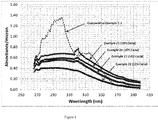
- the UV absorption of these coated primer formulations was measured and compared with the primer formulation from comparative example C-1.
- Figure 1 shows the absorbance of these coatings (which contain 10-20wt% of ceria in primer matrix) at a thickness of ⁇ 2 microns.
- the CeO 2 containing film at a ceria loading of 20wt% shows a similar absorbance value at 330nm compared to C-1 at 2.0 micron thickness.
- Table 6 Ceria loading in primer formulations for UV absorption studies
- Examples 26 - 28, primer formulations containing 5.68, 12.33, and 24.33 wt% respectively of methacryloxypropyltrimethoxysilane modified ceria were prepared by mixing PMMA solution and Ceria sol and BYK331 as described for previous primer examples. A small portion, ⁇ 1g was then placed in an aluminum cup and heated at 125°C for 45 minutes to produce solid flakes of the primer. DSC was performed on the solid materials to measure the T g of the solid. Comparative example C-1 which contains ⁇ 25% of organic UV absorber and that of pure PMMA were prepared in a similar fashion and were also examined using DSC. The ceria loading and T g values are shown in Table 7.
- Table 7 Primer formulation, ceria loading and T g values for primer films containing nanoceria.
- primer formulations in examples 26, 27 & 28 in Table 5 show Tg values of 120, 118 & 117 respectively, showing a minimal deviation from the glass transition temperature of PMMA even at 24 wt% ceria loading. This offers the advantage of allowing higher service temperature conditions with the Ceria containing primer over the organic UV absorber containing primers.
Landscapes
- Chemical & Material Sciences (AREA)
- Organic Chemistry (AREA)
- Engineering & Computer Science (AREA)
- Life Sciences & Earth Sciences (AREA)
- Wood Science & Technology (AREA)
- Materials Engineering (AREA)
- Polymers & Plastics (AREA)
- Health & Medical Sciences (AREA)
- Medicinal Chemistry (AREA)
- Chemical Kinetics & Catalysis (AREA)
- Nanotechnology (AREA)
- Inorganic Chemistry (AREA)
- General Chemical & Material Sciences (AREA)
- Paints Or Removers (AREA)
- Pigments, Carbon Blacks, Or Wood Stains (AREA)
- Compositions Of Macromolecular Compounds (AREA)
- Coating Of Shaped Articles Made Of Macromolecular Substances (AREA)
- Laminated Bodies (AREA)
Description
- The invention relates to stable primer formulations and coatings with nano-dispersion of modified metal oxides. The formulations produce films having excellent optical and adhesion characteristics, and high UV screening ability and thermal stability.
- Polymeric materials, such as polycarbonate, are promising alternatives to glass for use as structural materials in a variety of applications, including automotive, transportation and architectural glazing applications, where increased design freedom, weight savings, and improved safety features are in high demand. Plain polycarbonate substrates, however, are limited by their lack of abrasion, chemical, UV, and weather resistance, and therefore need to be protected with optically transparent coatings that alleviate above limitations in the aforementioned applications.
- To impart abrasion resistance to the polymeric materials, polycarbonate substrates are in general coated with thermally curable silicone hardcoat. The poor weatherability of polycarbonate, on the other hand, is addressed with addition of organic or inorganic UV-absorbing materials in the silicone hardcoat layer. However, incorporation of UV absorbers, especially organic based, in the thermal curable silicone layer often leads to inferior abrasion resistance performance.
- One approach to address the limited abrasion resistance performance associated with the use of organic UV-absorbing materials is to use inorganic UV-absorbing materials at least partially in lieu of organic absorbing materials. The expected benefit is to avoid the addition of large amount of organic material in the silicone hardcoat, thereby keeping abrasion resistance characteristics intact. In addition, given the photo and oxidative stability of inorganic UV-absorbing materials compared with organic UV absorbers, the use of inorganic UV-absorbing materials can potentially help to achieve weatherability for extended period of time.
- Hardcoat compositions have been disclosed that can provide UV protection and abrasion resistance to the plastic substrates and enable them to go into outdoor applications. Organic UV absorbers incorporated in the coating formulations provide weatherability characteristics to the coating. However, inherent photodegradation and volatility of the organic absorbers limit the weatherability performance of these coatings over an extended period of time. Also, the addition of organic UV absorbers in primer formulations can reduce the glass transition temperature (Tg) of the primer due to plasticizing effect. This will limit the maximum temperature that the coated article can be subjected to while in service. Inorganic metal oxides like cerium oxide, titanium oxide, and zinc oxide particles can provide UV protection in coating formulations. However, incorporation of particles in the coating matrix can negatively affect the transparancy of the coatings due to large particle size (>200 nm diameter) and a high refractive index (RI) mismatch between particle and matrix.
WO 2006/073856 A2 discloses ultraviolet curable compositions preferably containing discrete, crystalline zirconia nanoparticles with reactive, or copolymerizable surface modification in a polymerizable monomer/oligomer resin mixture. Therein, in the surface modification of the nanoparticles, acrylate and methacrylate functionality is preferred over non-reactive, or nonpolymerizable functionality. Mixtures containing a majority of nanoparticles ranging in size from 10-30 nm along with a minority of nanoparticles ranging in size from about 80-150 nm result in highly transparent and durable compositions. While commercially available inorganic nano particles are available in aqueous media, incorporation of these sols into non-aqueous polymer matrices/coating formulations often leads to conditions under which particle agglomeration occurs, resulting in unstable coating formulations. - It is therefore technically challenging to incorporate inorganic UV-absorbing materials in the form of a colloidal dispersion into an organic-based coating composition, either with or without the presence of colloidal silica in the coating composition. The challenges relate to the ability to obtain long-term stability of inorganic UV absorber dispersions, i.e. the ability to inhibit the agglomeration of colloidal particles of the inorganic UV absorbers. Stable dispersions of inorganic nano-particles at high concentrations provide the maximum UV screening properties and good coated film uniformity while maintaining transparency and abrasion resistance. For example,
EP0732356A2 discloses the use of cerium oxide organosol derived from cerium oxide aqueous sol and the incorporation of cerium oxide nano-particles in the acrylic primer formulations. The prior art discloses that water is required as a cosolvent in the formulations to stabilize the cerium oxide nano particle in the organic polymer solutions.EP0732356A2 discloses in its examples, PMMA containing formulations having water to ceria weight ratios of 0.09 or greater. It should also be noted that PMMA containing formulations with low solids (2.3%) and low water content (<1.6%) were shown to give hazy primer films. While formulations with higher solids contents (≥5.9%) are disclosed, all examples presented have high water content (≥4.0%) and no information on coatings cast from primer formulation solutions with high solids content and low water content are disclosed. For practical applications, primer formulations of higher solid content and lower water content are preferred. In addition, while stable coating solutions are described and used to cast transparent, low haze, thin films, no information is given on the length of the shelf stability of the coating formulations or the robustness of adhesion to polycarbonate in an extended water soak exposure. Such performance attributes are generally considered important if the coatings are to be deemed useful in applications requiring outdoor exposure. It is important to consider that water is an anti-solvent for PMMA as well as many other acrylic polymers, therefor it is important to limit the concentration of water in the primer formulation in order to prevent precipitation of the polymer resin from solution. - Hence, there is a continuing need for a protective coating method and composition for polymeric substrates that is effective to provide type abrasion resistance, long-term outdoor weatherability at a structure that is easier to manufacture than is currently available in the art to the knowledge of the present inventors. The present invention is believed to provide one answer to that need.
- In one aspect, the present invention is directed to a primer composition, comprising:
- (a) cerium oxide nanoparticles surface-modified with an organofunctional silane moiety, said organofunctional silane moiety having the structure of Formula I or II,


- (b) an organic polymer; and
- (c) one or more solvents.
- Advantageously, the functional group-containing moiety of R1 is selected from amino, carbamate, vinyl, amide, ester, carboxylate, and combinations thereof. Illustratively, the functional group-containing moiety of R1 is suitably selected from -CH2CH2CH2NHCH2CH2NH2, -CH2CH2CH2NHC(O)OMe, -CH2CH2CH2NHC(O)OEt, - CH=CH2, -C(CH3)=CH2, or the organofunctional silane moiety is selected from (MeO)a(EtO)3-a SiCH2CH2NHC(O)C(CH3)=CH2, (i-PrO)3SiCH2CH2CH2OC(O)C(Me)=CH2, (MeO)3SiCH2CH2CH2NHCH2CH2NHCH2CH2C(O)OMe, (i-PrO)3SiCH2CH2CH2OC(O)C(Me)=CH2, (MeO)3Si(CH2)3NHCH2CH2NH(CH2)3Si(OMe)3, (EtO)3SiCH2CH2CH2OC(O)C(Me)=CH2, and combinations thereof.
- In another aspect, the present invention is directed to a primer film on a substrate, comprising:
- (a) about 0.1 to about 50 wt.% of cerium oxide nanoparticles surface-modified with an organofunctional silane moiety, said organofunctional silane moiety having the structure of Formula I or II:


- (b) 50 to 99 wt% of an organic polymer, said weight percents being based on the total weight of said film.
- Advantageously, the functional group-containing moiety of R1 is selected from amino, carbamate, vinyl, amide, ester, carboxylate, and combinations thereof Illustratively, the functional group-containing moiety of R1 is suitably selected from -CH2CH2CH2NHCH2CH2NH2, -CH2CH2CH2NHC(O)OMe, -CH2CH2CH2NHC(O)OEt, - CH=CH2. -C(CH3)=CH2, or the organofunctional silane moiety is selected from (MeO)a(EtO)3-a SiCH2CH2NHC(O)C(CH3)=CH2, (i-PrO)3SiCH2CH2CH2OC(O)C(Me)=CH2, (MeO)3SiCH2CH2CH2NHCH2CH2NHCH2CH2C(O)OMe, (i-PrO)3SiCH2CH2CH2OC(O)C(Me)=CH2, (MeO)3Si(CH2)3NHCH2CH2NH(CH2)3Si(OMe)3, (EtO)3SiCH2CH2CH2OC(O)C(Me)=CH2, and combinations thereof.
- In another aspect, the present invention is directed to a substrate, such as a polycarbonate or acrylate substrate, coated with the above primer composition
- In another aspect, the present invention is directed to a substrate, such as a polycarbonate or acrylate substrate, coated with the above primer film. This substrate may also be coated with a silicone hardcoat.
- In yet another aspect, the present invention is directed to an article comprising a substrate coated with the above primer film and overcoated with a silicone hardcoat.
- The following detailed description of the invention will be better understood when taken in conjunction with the several Figures, in which:
-
Figure 1 is a graph showing UV absorbance of Ceria-containing primer formulations of the invention; -
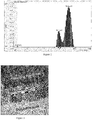
Figure 2 is a graph showing dynamic light scattering data for compositions of the invention; -
Figure 3 is a TEM micrograph for the ceria containing primer of the invention (Primer formulation example 8, Table 2) with the Hardcoat assembly. - The present invention is directed to the use of surface modified inorganic nanoparticles as UV absorbers in a coating composition, replacing conventional organic UV absorbers. The inorganic nanoparticles are compatibilized with the primer matrix by modifying their surface with functionalized silane and dispersing them uniformly in the coating without agglomeration, thus minimizing the negative effects on the optical properties of the final coated substrate and providing long shelf-life of the coating solution. The final coated substrates have good optical properties as well as good long term adhesion in harsh testing conditions. Functional silanes are used to modify the surface of cerium oxide, and stable nano cerium oxide sols were prepared in organic medium. The resulting primer coatings along with a silicone top coat exhibit higher transmittance, lower haze, and good adhesion to polycarbonate substrates under normal and harsh conditions as required for applications such as automotive and architectural glazing.
- Nanoparticles in general can be defined as particles with the dimensions in the range of one to a few hundred nanometers. For clear coat applications, it is required that the size of the nanoparticle should be below a certain limit in order not to scatter light which is passing though the coating. It is generally understood that nano particles with dimensions less than λ/2 do not scatter light of λ, where λ is the wavelength of light and therefore will not disrupt the transparency of the matrix in which they are incorporated. Hence particles with a diameter < 190 nm could be used in clear coats without disrupting the transmission or haze of visible light passing though the coating film.
- The primer composition of the invention contains (a) metal oxide nanoparticles surface-modified with an organofunctional silane moiety; (b) an organic polymer; and (c) one or more solvents. Each of these components is described in more detail below.
metal oxide nanoparticles are cerium oxide nanoparticles. The amount of the cerium oxide nanoparticles surface-modified with an organofunctional silane moiety in the composition of the invention ranges preferably from 0.1 to 10 wt%, more preferably from 0.1 to 5 wt.%, and most preferably from 0.5 to 3 wt.%, all based on the total weight of the composition. Without wishing to be bound by any particular theory, the nature of the binding forces between the cerium oxide and the organofunctional moiety is believed to be noncovalent binding. Further, the individual silane moieties are believed to offer physical stability to the surface-modified nanoparticles in suspension due to steric repulsion attributable to the silane moieties. - The organofunctional silane moiety used in the composition of the invention preferably has the structure of Formula I or II:


- R=1-12 alkyl carbon chain, either same or different
R1 can be groups described under Formula (I) and also amino containing groups like - CH2CH2CH2NHCH2CH2NH2, Carbamates like -CH2CH2CH2NHC(O)OMe,-CH2CH2CH2NHC(O)OEt, Vinyl groups -CH=CH2, -C(CH3)=CH2,
Silanes containing vinyl & amide functionality like (MeO)a(EtO)3-a SiCH2CH2NHC(O)C(CH3)=CH2, Vinyl ester silanes like (i-PrO)3SiCH2CH2CH2OC(O)C(Me)=CH2, (MeO)3SiCH2CH2CH2NHCH2CH2NHCH2CH2C(O)OMe, (i-PrO)3SiCH2CH2CH2OC(O)C(Me)=CH2 (MeO)3Si(CH2)3NHCH2CH2NH(CH2)3Si(OMe)3, (EtO)3SiCH2CH2CH2OC(O)C(Me)=CH2 and also other silanes which contain amino, carbamate, ester, carboxylate functionalities and the combinations thereof.
R2, R5=CO-CH3
R3, R4, R6=H or CH3
x=1-50; preferably 1-25 and more preferably between 5-15
y=1-50; preferably 1-25; more preferably between 2-15
z=1-50; preferably 1-25; more preferably between 5-15 - In some preferred embodiments, the organofunctional silane moiety is 2-methoxy(polyethyleneoxy)9-12 propyl trimethoxysilane, γ-methacryloxypropyltrimethoxysilane, 2-[(acetoxy(polyethyleneoxy)propyl]-triethoxysilane, tripropyleneglycol propyl ether carbamate silane, bis(3-triethoxysilylpropyl)polyethylene oxide, triethyleneglycol monobutyl ether carbamate silane, aminosilane, acrylate silane, N-beta-(aminoethyl)-gamma-aminopropyl-trimethoxy silane, [methoxy(polyethyleneoxy)propyl]-trimethoxysilane and combinations thereof.
- The amount of the organofunctional silane moiety that surface-modifies the cerium oxide nanoparticles preferably ranges from 0.1 to 50 wt.%, based on the total weight of the cerium oxide nanoparticles, and more preferably ranges from 5 to 30 wt.%, based on the total weight of the cerium oxide nanoparticles.
- The organic polymer component of the invention is not particularly limited. Suitable polymers useful in the composition of the invention include, but are not limited to, homo and copolymers of alkyl acrylates, polyurethanes, polycarbonates, urethane hexaacrylates, pentaerythritol triacrylates, polyvinylpyrrolidone, polyvinylbutyrals, poly(ethylene terephthalate), poly(butylene terephthalate), as well as combinations of these. In one preferred embodiment, the organic polymer is polymethylmethacrylate. The amount of the organic polymer in the composition of the invention ranges preferably from about 0.5 to about 15 wt.%, more preferably from about 2 to about 10 wt.%, and most preferably from about 3 to about 8 wt.%, all based on the total weight of the composition.
- In addition to the cerium oxide nanoparticles modified with an organofunctional silane moiety and an organic (e.g. acrylic) polymer described above, the primer composition of the invention includes a solvent. The solvent is not particularly limited. Exemplary solvent includes alcohols, such as methanol, ethanol, propanol, isopropanol, n-butanol, tert-butanol, methoxypropanol, ethylene glycol, diethylene glycol butyl ether, or combinations thereof. Other polar organic solvents such as acetone, methyl ethyl ketone, ethylene glycol monopropyl ether, and 2-butoxy ethanol, can also be utilized. In preferred embodiments, the solvent used is one or more selected from 1-methoxy-2-propanol, diacetone alcohol (DAA), acetyl acetone, cyclohexanone, methoxypropylacetate, ketones, glycol ether, and mixtures thereof. The amount of solvent in the composition of the invention ranges preferably from about 80 to about 99 wt.%, more preferably from about 85 to about 99 wt.%, and most preferably from about 90 to about 97 wt.%, all based on the total weight of the composition. The composition of the invention may further include optional additional additives such as UV absorbing agents, antiblushing agents, leveling agents, surface lubricants, antioxidants, light stabilizers, surfactants, IR absorbing agents, and combinations thereof.
- The cerium oxide nanoparticles surface-modified with organofunctional silane moiety may be prepared by mixing the cerium oxide nanoparticles and organofunctional silane in a suitable solvent, removing water and solvent, for example, under vacuum to produce a viscous liquid or gel residue, and dissolving the residue in an organic solvent such as diacetone alcohol or 1-methoxy-2-propanol. The primer composition of this invention can be prepared by simply mixing the surface-modified nanoparticles, the acrylic polymer, and any optional ingredients in a solvent. The order of mixing of the components is not critical. The mixing can be achieved through any means known to a person skilled in the art, for example, milling, blending, stirring, and the like. The primer compositions with varying loading of surface-modified nanoparticles CeO2 are found to be stable for several months or greater than 1 year.
- The primer compositions of the invention can be suitably coated onto a polymeric substrate such as a plastic surface. Examples of such plastics include synthetic organic polymeric materials, such as acrylic polymers, for example, poly(methylmethacrylate), and the like; polyesters, for example, poly(ethylene terephthalate), poly(butylene terephthalate), and the like; polyamides, polyimides, acrylonitrile-styrene copolymer, styrene-acrylonitrile-butadiene terpolymers, polyvinyl chloride, polyethylene, and the like, polycarbonates, and copolycarbonates, high-heat polycarbonates.
- The preferred substrate is formed of polycarbonate or an acrylic resin. Polycarbonates are especially preferred materials for transparent substrates because of their excellent physical, mechanical and chemical properties. In general, the choice of substrate is ultimately determined by the contemplated end use.
- Once the primer composition of the invention is coated on a substrate by flow coat, dip coat, spin coat or any other methods known to a person skilled in the field, it is allowed to dry by removal of any solvents, for example by evaporation, thereby leaving a dry coating. Heating of the primer composition, to aid in evaporation of solvents, can be done up to a maximum temperature defined by the heat distortion temperature of the substrate to provide a primer layer that is free of solvent.
- The primer layer formed from the primer composition of the invention is effective in providing adhesion of an abrasion resistant topcoat layer to a substrate and can be used as part of a coated article of the invention. Thus in accordance with another embodiment of the invention, there is provided a coated article including a polymeric substrate, a primer layer disposed on at least one surface of said substrate, and an abrasion-resistant silicone hardcoat layer disposed on said primer layer, wherein said primer layer is made from any of the primer composition of the invention disclosed herein.
- A silicone hardcoat is formed by first applying a coating composition onto the primer layer, followed by curing the composition. The silicone hardcoat composition is not particularly limited. Silicone hardcoats comprised of a siloxanol resin/colloidal silica dispersions are one example of a coating composition that may be used as a topcoat. The silicone hardcoat may contain additional organic UV-absorbing agents if desired, but the loading can be lower than those that do not have inorganic absorbing agent in either the primer layer or the hardcoat layer. Thus the abrasion integrity is maintained and in some cases improved by limiting the amount of organic UV-absorbing agent, while at the same time, the weatherability is improved.
- The following examples are illustrative and not to be construed as limiting of the invention as disclosed and claimed herein. All parts and percentages are by weight and all temperatures are degrees Celsius unless explicitly stated otherwise.
- 50g of cerium oxide dispersion (Aldrich, 20wt% aqueous, stabilized with 2.5% acetic acid) was placed in a round bottom flask equipped with a magnetic stir bar. 1.0g of PEO silane (Momentive Performance Materials, A1230) was then added drop wise to the cerium oxide dispersion followed by the addition of 40g of 1-methoxy-2-propanol. The addition of the solvent raised the temperature of the reaction mixture from 25°C to 34°C. After stirring the reaction mixture for 12hrs, volatile components were stripped out at 50°C under vacuum (30mbar). When the residue in the pot reached a solids of ∼50wt% vacuum stripping was stopped. The final solids content of the ceria nanosol was 49.76%, the final water content was 26.7%. The sol appeared yellow in color, translucent and stable for several months.
- 100g of Cerium Oxide dispersion (Aldrich, 20wt% aqueous, stabilized with 2.5% acetic acid) was placed in a round bottom flask equipped with a magnetic stir bar. 3.0g of PEO silane (Momentive Performance Materials, A1230) was then added drop wise to the CeO2 dispersion followed by the addition of 80 g of 1-methoxy-2-propanol. The addition of the solvent raised the temperature of the reaction mixture from 25°C to 34°C. Volatile components were then stripped out at 50°C under vacuum (30mbar). When the residue in the pot reached a solids of ∼50wt% vacuum stripping was stopped. The final solids content of the ceria nanosol was 51.72%, the final water content was 25.6%. The sol appeared yellow in color, transparent and stable for several months.
- 50g of Cerium Oxide dispersion (Nyacol, 20wt%, acetate stabilized, 10-20nm, pH3.0) was placed in a round bottom flask equipped with a magnetic stir bar. 2.0g of Triethyleneglycol monobutylether based carbamate silane (synthesized from Triethyleneglycol mono butyl ether and Isocyanatopropyl triethoxysilane) was added drop wise and stirred overnight at room temperature. 80 g of 1-methoxy-2-propanol was then added to the mixture and volatile components were stripped out at 50°C under vacuum (30mbar). When the residue in the pot reached a solids of ∼33wt% vacuum stripping was stopped. The final solids content of the ceria nanosol was 32.39% and no water remaining in the solution. The sol was stable, transparent, and light yellow in color.
- 20g of Cerium Oxide dispersion (Nyacol, 20wt%, acetate stabilized, 10-20nm, pH3.0) was placed in a round bottom flask equipped with a magnetic stir bar. 0.8g of Acetoxy polyethyleneoxy propyl trimethoxy silane (Gelest) was added drop wise and stirred overnight at room temperature. 35g of 1-methoxy-2-propanol was then added and volatile components were stripped out at 50°C under vacuum (30mbar). When the residue in the pot reached a solids of ∼ 25% vacuum stripping was stopped. The ceria nanosol was a stable yellow transparent sol with a final solids content of 26.59% and no water remaining in the solution.
- 100g of Cerium Oxide dispersion (Aldrich, 20wt% aqueous, stabilized with 2.5% acetic acid) was placed in a round bottom flask equipped with a magnetic stir bar. 1.0g of γ-methacryloxypropyl trimethoxysilane (A174 Momentive Performance Materials) was added drop wise to the CeO2 dispersion followed by the 80g of ethanol. After stirring the mixture for 5hrs at 80°C, the volatile components were stripped out at 50°C under vacuum (30mbar). The resulting residue was a gel that could be re-dissolved in diacetone alcohol to give a stable ceria sol. The final solids of the redissolved sol was 2.81wt%. The sol was dark brownish and translucent in appearance.
- 50g of Cerium Oxide dispersion (Aldrich, 20wt%, stabilized with 2.5wt% of acetic acid) was placed in a round bottom flask equipped with a magnetic stir bar. 2.0g of γ-methacryloxypropyl trimethoxysilane (Momentive Performance Materials, A174) was added drop wise. The reaction mixture was transformed in to a gel within 5 minutes of addition. About 40g of Dowanol was added to the reaction mixture to dissolve the gel and the volatile components were stripped out under vacuum (30mbar). Vacuum stripping was continued until the solids of the pot residue reached ∼15wt%. 15 g of Diacetone alcohol was added to the reaction mixture and volatile removal under reduced pressure was continued. Stripping was stopped once the solids of the pot residue reached 20-22wt%. The final sol had solids of 22wt%, the final water content was 24.7%.
- A related modified process helps to stabilize ceria in lower amount of DAA and successfully stabilized the modified ceria in mixture of MP and DAA solvents. The modification is essentially in the stripping of the solvent mixture as given below in example S-7.
- 200g of Cerium Oxide dispersion (Aldrich, 20wt% solids, stabilized with 2.5% of acetic acid) was placed in a round bottom flask equipped with a magnetic stir bar. 8.0g of γ-methacryloxypropyl trimethoxysilane (from Momentive Performance Materials, A174) was added drop wise followed by of 175g of 1-methoxy-2-propanol. The reaction mixture was stirred at room temperature for 2 hours during which time it transformed it in to an opaque sol. 85g of volatile material was stripped from the reaction mixture under vacuum (290 mbar) at 70°C. An additional 80g 1-methoxy-2-propanol was added to the pot residue and the vacuum stripping was repeated to remove additional volatile components. This process was repeated a total of 3 times after which 30g of diacetone alcohol was added to give a stable, brown, translucent ceria sol (final yield of 105g), which had a final solids of 47%, and no water remaining in the solution. The size of the ceria nanoparticles in the sol was measured using dynamic light scattering (
Figure 2 ). It was observed that 80% of the ceria particles had an average radius of 36 nm. - Examples S-5 was repeated to get a brownish yellow ceria sol in diacetone alcohol with final solids of 23.6wt%
- 20g of Cerium Oxide dispersion (Aldrich, 20wt% aqueous, stabilized with 2.5% acetic acid) was placed in a round bottom flask equipped with a magnetic stir bar. 0.8g of N1-(3-(trimethoxysilyl) propyl) ethane-1,2-diamine (from Momentive Performance Materials, A1120) was added drop wise to the CeO2 dispersion followed by the 20g of methoxypropanol. A white precipitate which was formed initially dispersed after stirring for few minutes to give a translucent greenish sol. After stirring the mixture for 2hrs at 25C, 15g of 1-methoxy-2-propanol was added and the volatile components were stripped out at 50°C under vacuum (30mbar). 1 g of acetyl acetone was added to the residue to give a stable brown translucent sol with a final solids content of 8.8%.
- 50g of Cerium Oxide dispersion (Aldrich, 20wt% solids, stabilized with 2.5% of acetic acid) was placed in a round bottom flask equipped with a magnetic stir bar. No silane was added during the process. 71g of 1-methoxy-2-propanol was then added and volatile components were stripped out at 50°C under vacuum (30mbar). When the residue in the pot reached solids of ∼ 21% vacuum stripping was stopped. The ceria nanosol was opaque and straw yellow in color with solid particles which settled in few minutes. The final solids content was 20.79% the water content was 8.3%.
- 25.13g of Cerium Oxide dispersion (Aldrich, 20wt% solids, stabilized with 2.5% of acetic acid) was placed in a round bottom flask equipped with a magnetic stir bar. 1.0g of Methyltrimethoxysilane (Momentive Performance Materials) was then added drop wise to the CeO2 dispersion and stirred for 2 hours at room temperature. 35g of 1-methoxy-2-propanol was then added and volatile components were stripped out at 50°C under vacuum (30mbar). When the residue in the pot reached solids of ∼ 20% vacuum stripping was stopped. The ceria nanosol was translucent and greenish straw yellow in color with solid particles which settled out within a few minutes. The final solids content was 20.13%, the water content was 13.9%.
- 20g of Cerium Oxide dispersion (Aldrich, 20wt% aqueous, stabilized with 2.5% acetic acid) was placed in a round bottom flask equipped with a magnetic stir bar. 0.8g of Glycidoxy propyl trimethoxy (from Momentive Performance Materials, A-187) silane was added drop wise to the CeO2 dispersion followed by the 20g of 1-methoxy-2-propanol. After stirring the mixture for 2hrs at 25°C, an additional 15 g of 1-methoxy-2-propanol was added to the mixture and then the volatile components were stripped out at 50°C under vacuum (30mbar). The resulting concentrated sol showed the formation of a light yellow precipitate of ceria from the solution. The final solids content was 20%; no water remained in the solution.
- Various examples of primer formulations were prepared by mixing a PMMA solution with a given Cerium Oxide sol, and optionally, additional solvent and a flow control agent (Table 1 and Table 2). The PMMA solutions were prepared by dissolving PMMA resin in a mixture of 1-methoxy-2-propanol (85wt %) and diacetone alcohol (15wt %). Solvent dilutions were done with an 85:15 (weight ratio) mixture of 1-methoxy-2-propanol: diacetone alcohol. Components were combined in an appropriately sized glass or polyethylene bottle then shaken well to mix. Samples were allowed to stand for at least lhr prior to coating application.
Table 1. Formulation of Example Primer formulations Example PMMA Solution CeO2 Sol Solvent BYK331 Stability of Sol* Stability* of Primer Solids Charge (g) Example Charge (g) Charge (g) Charge (g) 1** 4.26% 40.0 S-1 0.38 - 0.017 >12 months >12 months 2** 4.26% 40.0 S-1 0.60 - 0.017 >12 months >12 months 3** 4.26% 40.0 S-1 0.84 - 0.017 >12 months >12 months 4** 4.26% 40.0 S-1 1.10 - 0.017 >12 months >12 months 5** 4.26% 40.0 S-1 1.44 - 0.017 >12 months >12 months 6** 4.26% 40.0 S-1 1.80 - 0.017 >12 months >12 months 7** 6.14% 35.0 S-2 1.45 - 0.017 >12 months >12 months 8** 6.14% 35.0 S-2 2.50 - 0.017 >12 months >12 months 9 6.40% 20.0 S-3 1.70 8.5 0.017 >12 months >12 months 10 6.40% 20.0 S-3 2.13 10.5 0.017 >12 months >12 months 11 6.40% 20.0 S-4 2.07 8.5 0.017 >12 months >8 months 12 6.40% 20.0 S-4 2.59 10.5 0.017 >12 months >8 months 13 5.10% 50 S-6 1.59 0.0006 >12 months >12 months 14 5.10% 50 S-6 2.18 0.0006 >12 months >12 months 15 5.10% 50 S-6 2.95 0.0006 >12 months >12 months 16 5.10% 50 S-6 3.86 0.0006 >12 months >12 months 17 5.10% 50 S-6 5 0.0006 >12 months >12 months 18 4.00% 35 S-7 0.46 - 0.017 >12 months >12 months 19 4.00% 35 S-7 0.61 - 0.017 >12 months >12 months 20 4.00% 35 S-7 0.76 - 0.017 >12 months >12 months 21 4.00% 35 S-7 0.91 - 0.017 >12 months >12 months Comparative example C-1 Organic UVA containing primer - - - NA >12 months Comparative example C-2 5.56% 20.0 CS-1 0.74 0.01 Unstable <30min Opaque Unstable <1min Opaque Comparative example 5.56% 10.0 CS-2 0.69 0.01 Unstable <30min Opaque Unstable <1min Opaque Comparative example C-4 5.56% 8.3 Aldrich 0.866 0.01 Stable >2months Unstable <2days *"Stability" refers to the particle sedimentation/ phase separation was not seen under ambient storage conditions for the indicated time period.
**: not according to the invention, Comparative ExamplesTable 2: Details of primer formulations for UV-Visible spectroscopy and Differential Scanning Calorimetric studies Example PMMA Solution CeO2 Sol BYK331 Primer Stability Solids Charge (g) Example Charge (g) Charge (g) 22 5.99% 50.1 S-8 1.56 0.01 Stable, >12months 23 5.99% 50.12 S-8 2.20 0.01 Stable, > 12months 24 5.99% 30.19 S-8 1.57 0.01 Stable, > 12months 25 5.99% 35.23 S-8 2.35 0.01 Stable, >12months 26 4.1% 55.3 S-5 5.10 0.0006 Stable, >12months 27 4.1% 49.9 S-5 10.78 0.0006 Stable, >12months 28 4.1% 41.0 S-5 20.43 0.0006 Stable, >12months - To a 500 mL 3-neck round bottom flask (RBF) was added 41.85 g of diacetone alcohol and 237.15 g 1-methoxy-2-propanol. The RBF was fitted with a reflux condenser and an overhead stirrer. Stirring was started then 15.77 g of PMMA resin was added slowly through a powder funnel. The mixture was gently heated to reflux to dissolve the PMMA. After cooling back to room temperature, 5.20 g of 2,4-dibenzylresorcinol and 0.03 BYK331 were added to the PMMA solution and allowed to stir for ∼ 1 hr. A total of 300.0 g of light yellow liquid was made. The solution had a solids content of 7.0wt%.
- To 20g of a 5.56wt% PMMA solution was added 0.74g of CS-1 ceria sol along with 0.010g of BYK331. The primer mixture was shaken well to disperse the ceria sol which resulted in an opaque straw yellow formulation. The prepared formulation was unstable and became highly viscous along with the precipitation of the ceria particles.
- To 10g of a 5.56wt % PMMA solution was added 0.69g of CS-2 ceria sol along with 0.010g of BYK331. The primer mixture was shaken well to disperse the ceria sol which resulted in an opaque straw yellow formulation.
- To 8.3g of PMMA solution (5.56wt%), 0.866g of ceria sol (Aldrich, 20wt% solids, stabilized with 2.5% of acetic acid) was added drop wise followed by 0.01g of BYK331 and shaken vigorously. A gel of ceria formed with the addition of the ceria sol to the primer was dispersed by mashing with a spatula for several minutes, which resulted in a very sticky & viscous primer formulation with ceria dispersion.
- The primer formulations in Table 1 were coated on polycarbonate plates according to the following procedure. Polycarbonate (PC) plaques (6 × 6 × 0.3 cm) were cleaned with a stream of N2 gas to remove any dust particles adhering to the surface followed by rinsing of the surface with iso-propanol. The plates are then allowed to dry inside the fume hood for 20min. The primer solutions were then applied to the PC plates by flow coating. The solvent in the primer coating solutions were allowed to flash off in the a fume hood for -20 minutes (22°C, 45%RH) and then placed in a preheated circulated air oven at 125°C for 45min. After cooling to room temperature, the primed PC plates were then flow coated with AS4700 hardcoat solution. After drying for ∼20 minutes (22°C, 45% RH), the coated plates were placed in a preheated circulated air oven at 125°C for 45min.
- The optical characteristics (Transmission and Haze) were measured using a BYK Gardner haze guard instrument ASTM D1003. The initial adhesion was measured using a cross hatch adhesion test according to ASTM D3002/D3359. The adhesion is rated in a scale of 5B-0B, 5B indicative of highest adhesion. Adhesion after water immersion was done by immersing the coated PC plates in 65°C hot water followed by cross hatch adhesion test at different time intervals. The particle size of the ceria nanoparticles was measured using Viscotek-Dynamic light scattering instrument on 1% solution of the sols in 1-methoxy-2-propanol. The morphology of the coatings was studied using the TEM - Tecnai make, on microtomed samples, under bright field transmitted mode.
Table 3: Coated properties of cerium oxide containing primers Example wt% CeO2* wt% Water % T Haze Adhesion Initial Watersoak Duration 1** 9.07 0.30 91.6 0.56 5B 5B ≥10days 2** 13.54 0.39 91.6 0.51 5B 5B ≥10days 3** 17.90 0.55 91.5 0.51 5B 5B ≥10days 4** 22.10 0.71 91.0 0.75 5B 5B ≥10days 5** 26.92 0.93 90.85 0.71 5B 5B ≥10days 6** 31.35 1.15 90.1 2.18 5B 5B ≥10days 7** 22.59 1.02 90.6 0.7 5B 5B ≥10days 8** 32.95 1.71 90.2 0.77 5B 5B ≥10days 9 26.85 0.00 88.8 0.42 5B 5B ≥10days 10 31.20 0.00 88.5 0.45 5B 5B ≥10days 11 25.11 0.00 84 2.47 5B 5B ≥10days 12 29.28 0.00 86.5 1.66 5B 5B ≥10days 13 10.34 0.76 91.2 0.11 5B 5B ≥10days 14 13.57 1.03 89.8 0.35 5B 5B ≥10days 15 17.39 1.38 89.0 0.3 5B 5B ≥10days 16 21.42 1.77 85.0 2.0 5B 5B ≥10days 17 25.84 2.25 80.8 1.52 5B 5B ≥10days 18 11.52 0.00 91.3 0.88 5B 5B ≥10days 19 14.57 0.00 90.3 1.23 5B 5B ≥10days 20 17.37 0.00 90.2 1.3 5B 5B ≥10days 21 19.96 0.00 89.6 1.76 5B 5B ≥10days C-1 - 0.00 91.8 0.69 5B 5B ≥10days C-2 12.05 0.30 85.25 29.96 5B 5B ≥10days C-3 17.32 0.90 85.92 32.24 5B 5B ≥10days C-4 26.86 7.32 83.64 4.41 5B 5B ≥10days * % ceria in dry film = Total wt. of ceria x 100/Total solids
**: not according to the invention, Comparative Examples


- A =Wt. % of ceria in the non-volatile fraction of the sol
- B = Wt.% hydrolyzed silane in the non-volatile fraction of the sol
- C = wt. of Silane hydrolyzate = no. of moles of silane x MW. of silane Hydrolyzed silane
- D = Wt. of commercial aqueous ceria in sol preparation
- The fraction of ceria present in the non-volatile fraction of the ceria sol added into the primer formulation is calculated as shown in Table 4.
Table 4: Details for calculating wt. % of ceria in the dry primer film Sol Silane MW of silane Wt. Of silane (g) Wt.Of hydrolyzed silane (C) (g) % hydrolyzed silane in non-volatile fraction of sol (B) Wt. of ceria taken for sol preparation (D) % of ceria in Non-volatile fraction of sol (A) S-1* Polyethyleneoxypropyl trimethoxy silane 525 1.00 0.92 8.42 10.00 91.58 S-2* Polyethyleneoxypropyl trimethoxy silane 525 3.00 2.76 12.13 20.00 87.87 S-3 TEGMBE carbamate triethoxy silane 354 2.00 1.53 13.24 10.00 86.76 S-4 Acetoxypropyltrimethoxy silane(500-700) 600 0.80 0.74 15.68 4.00 84.32 S-5 Methacryloxy propyltrimethoxysilane 248.35 1.00 0.83 3.99 20.00 96.01 S-6 Methacryloxy propyltrimethoxysilane 248.35 2.00 1.66 14.25 10.00 85.75 S-7 Methacryloxy propyltrimethoxysilane 248.35 8.00 6.65 14.25 40.00 85.75 CS-2 Methyl trimethoxy silane 136.22 1.00 0.69 12.10 5.03 87.90 *: Not according to the invention, Comparative Examples - The ceria sols prepared as mentioned in the examples S-3 to S-7 were all stable for more than a year with solids ranging from 20-50wt%. In general, all the sols appear light yellow to dark yellow in color and were transparent to translucent in appearance. For example, the sol prepared as in examples S-3 and S-4 were light to dark yellow colored and transparent in appearance whereas the sols in examples S-5 ,S-6, S-7 were brownish yellow and translucent. On the other hand, the sol described in the comparative example CS-1 was opaque and white in color with poor solution stability, with ceria precipitating within few hours of the preparation. Similar trend on the appearance and stability was observed in the case of comparative example CS-2. These observations clearly indicated that the silane modification of the ceria imparts very good stability and dispersion in organic solvents, which is essential for the preparation of stable primer formulations with high ceria loading.
- The primer formulations prepared with ceria sols mentioned in examples S-3 to S-7 were stable in primer formulations at ceria loadings ranging from 10wt% to 35wt% in the dry film. The primer solution formulations were transparent and light yellow in color, with excellent stability for more than a year under ambient conditions. In contrast, primer formulations C-2 and C-3, prepared with ceria sols CS-1 and CS-2 respectively, were opaque and straw yellow in appearance. The primer solution formulations were unstable and the ceria completely precipitated within one day of initial formulation. The primer formulation CE-4 was stable and translucent but very viscous, which made it difficult to coat. This was likely due to the high water acting as an anti-solvent for the PMMA in solution.
- The coatings made with the primer formulations containing ceria sols prepared in examples S-3 to S-7 showed very good transparency close to 90% and haze values less than one.
- All the coated samples from examples 9-21 in Table 3 showed good initial adhesion rating of 5B and the adhesion after the water soak testing at 65°C was 5B for a minimum 10 days for all samples, with several stable even up to 30 days. The TEM analysis (
Figure 3 ) of the coating (Example 8 (not according to the invention), Table 3) reveals a uniform distribution of ceria nanoparticles in the PMMA primer layer, which is necessary to give good optical characteristics even at high ceria loadings. It is evident that by using a silane functionalized ceria nano sol, it is possible to incorporate ceria nanoparticle in the coating compositions without significantly affecting the optical and the adhesion properties in the coating assembly. - The average particle size of the ceria nanoparticles in the commercial unmodified aqueous sol is in the range of 5-40 nm. Up on surface functionalization, the particles are covered with the siloxane matrix which results in a slight increase in particle size. Further, the higher light transmission values of the final coatings are evidence that the particle size is below a minimum value for it to affect the final coatings optical properties. The hydrodynamic radius of the surface functionalized ceria nanoparticles was measured using Dynamic Light Scattering method. The results are tabulated for the commercial aqueous ceria sol and the modified ceria sols in the Table 5. The data supports the conclusion that modification the cerium oxide nano particle with the silanes found useful for this invention does not cause an increase in particle size that would cause the scattering of visible light.
Table 5: Particle size measurements as given by DLS method Entry Ceria sol Average DLS Rh(Volume fraction) 1* Commercial unmodified aqueous ceria sol 5nm (63%), 22nm (37%) 2* 15% A1230 modified ceria sol (Example S-2) 54nm (100%) 3 20% A174 modified ceria sol (Example S-7) 9nm (20%), 35nm (80%) *: not according to the invention; Comparative Example - Primer formulations examples 22 - 25, containing 5wt% methacryloxypropyltrimethoxysilane silane modified ceria (S-8), were prepared and coated over plain Corning glass slides. The glass slides were cleaned with water, wiped dry and then flow cleaned with IPA. The remaining IPA was flash dried by hanging the slides inside to fume hood for 20 minutes. The glass slides were flushed with a stream of nitrogen and them flow coated with the prepared formulations. After flashing the solvent for 20 minutes inside the fume hood, the slides were cured in an air oven at 125°C for 45 minutes. Each formulation had a different ceria loading as shown in Table 2. The UV absorption of these coated primer formulations was measured and compared with the primer formulation from comparative example C-1.
Figure 1 shows the absorbance of these coatings (which contain 10-20wt% of ceria in primer matrix) at a thickness of ∼2 microns. As illustrated inFigure. 1 , the CeO2 containing film at a ceria loading of 20wt% shows a similar absorbance value at 330nm compared to C-1 at 2.0 micron thickness.Table 6: Ceria loading in primer formulations for UV absorption studies Example Wt. % Ceria in coating 22 10.45 23 14.10 24 16.23 25 19.88 - Examples 26 - 28, primer formulations containing 5.68, 12.33, and 24.33 wt% respectively of methacryloxypropyltrimethoxysilane modified ceria (from sol example S-5) were prepared by mixing PMMA solution and Ceria sol and BYK331 as described for previous primer examples. A small portion, ∼1g was then placed in an aluminum cup and heated at 125°C for 45 minutes to produce solid flakes of the primer. DSC was performed on the solid materials to measure the Tg of the solid. Comparative example C-1 which contains ∼25% of organic UV absorber and that of pure PMMA were prepared in a similar fashion and were also examined using DSC. The ceria loading and Tg values are shown in Table 7.
Table 7: Primer formulation, ceria loading and Tg values for primer films containing nanoceria. Example % ceria Tg (°C) 26 5.68 120 27 12.33 118 28 24.33 117 c-1* - 81 PMMA* 0% 124 *Comparative Example
Claims (13)
- A primer composition, comprising:(a) cerium oxide nanoparticles surface-modified with an organofunctional silane moiety, said organofunctional silane moiety having the structure of Formula I or II:


 (b) an organic polymer; and(c) one or more solvents.
 - The primer composition of claim 1, wherein said functional group R1 is selected from -CH2CH2CH2NHCH2CH2NH2, -CH2CH2CH2NHC(O)OMe, - CH2CH2CH2NHC(O)OEt, -CH=CH2, -C(CH3)=CH2, or wherein the organofunctional silane moiety is selected from (MeO)a(EtO)3-a SiCH2CH2NHC(O)C(CH3)=CH2, (i-PrO)3SiCH2CH2CH2OC(O)C(Me)=CH2, (MeO)3SiCH2CH2CH2NHCH2CH2NHCH2CH2C(O)OMe, (i-PrO)3SiCH2CH2CH2OC(O)C(Me)=CH2, (MeO)3Si(CH2)3NHCH2CH2NH(CH2)3Si(OMe)3, (EtO)3SiCH2CH2CH2OC(O)C(Me)=CH2, and combinations thereof.
- The primer composition of claim 1, wherein x, y and z are independently integers from 1 to 25.
- The primer composition of claim 1, wherein x, y and z are independently integers from 2 to 15.
- The primer composition of claim 1, wherein said organofunctional silane moiety is selected from the group consisting of 2-methoxy(polyethyleneoxy)9-12 propyl trimethoxysilane, γ-methacryloxypropyltrimethoxysilane, 2-[(acetoxy(polyethyleneoxy)propyl]-triethoxysilane, tripropyleneglycol propyl ether carbamate silane, bis(3-triethoxysilylpropyl)polyethylene oxide, triethyleneglycol monobutyl ether carbamate silane, aminosilane,, , acrylate silane, N-beta-(aminoethyl)-gamma-aminopropyl-trimethoxy silane,, [methoxy(polyethyleneoxy)propyl]-trimethoxysilane, and combinations thereof.
- The primer composition of claim 1, wherein said organic polymer is selected from the group consisting of homo and copolymers of alkyl acrylates, polyurethanes, polycarbonates, urethane hexaacrylates, pentaerythritol triacrylates, polyvinylbutyrals, poly(ethylene terephthalate), poly(butylene terephthalate), and combinations thereof.
- The primer composition of claim 6, wherein said organic polymer is polymethylmethacrylate.
- The primer composition of claim 1, wherein said solvent is selected from the group consisting of 1-methoxy-2-propanol, diacetone alcohol, acetylacetone, cyclohexanone, methoxypropylacetate, ketones, glycol ether, aromatic hydrocarbons, saturated hydrocarbons, and mixtures thereof.
- The primer composition of claim 1 which additionally contains water in an amount of from 0.1 to 4 wt%, based on the total weight of said primer composition.
- The primer composition of claim 9, wherein said water is present in an amount of less than 2 wt%, based on the total weight of said primer composition.
- The primer composition of claim 9, wherein the weight ratio of water to cerium oxide in said composition is 0.01 to 0.08.
- The primer composition of claim 9, wherein said silane moiety comprises from 0.1 to 50wt%, based on the total weight of said cerium oxide nanoparticles, wherein said solvent comprises from 80 to 99 wt%, based on the total weight of the composition, and wherein said cerium oxide nanoparticles surface-modified with an organofunctional silane moiety comprise from 0.1 to 10 wt%, based on the total weight of the composition.
- A primer film on a substrate, comprising:(a) 0.1 to 50 wt% of cerium oxide nanoparticles surface-modified with an organofunctional silane moiety, said organofunctional silane moiety having the structure of Formula I or II:


 (b) 50 to 99 wt% of an organic polymer,
said weight percents being based on the total weight of said film.
Applications Claiming Priority (2)
| Application Number | Priority Date | Filing Date | Title |
|---|---|---|---|
| US14/102,880 US20150159036A1 (en) | 2013-12-11 | 2013-12-11 | Stable primer formulations and coatings with nano dispersion of modified metal oxides |
| PCT/US2014/069306 WO2015089045A1 (en) | 2013-12-11 | 2014-12-09 | Stable primer formulations and coatings with nano dispersion of modified metal oxides |
Publications (2)
| Publication Number | Publication Date |
|---|---|
| EP3080212A1 EP3080212A1 (en) | 2016-10-19 |
| EP3080212B1 true EP3080212B1 (en) | 2019-03-20 |
Family
ID=52347399
Family Applications (1)
| Application Number | Title | Priority Date | Filing Date |
|---|---|---|---|
| EP14827304.8A Active EP3080212B1 (en) | 2013-12-11 | 2014-12-09 | Stable primer formulations and coatings with nano dispersion of modified metal oxides |
Country Status (10)
| Country | Link |
|---|---|
| US (1) | US20150159036A1 (en) |
| EP (1) | EP3080212B1 (en) |
| JP (1) | JP6563924B2 (en) |
| KR (1) | KR102366758B1 (en) |
| CN (1) | CN105829458B (en) |
| CA (1) | CA2931236A1 (en) |
| ES (1) | ES2725432T3 (en) |
| MX (1) | MX390194B (en) |
| TW (1) | TWI687469B (en) |
| WO (1) | WO2015089045A1 (en) |
Families Citing this family (23)
| Publication number | Priority date | Publication date | Assignee | Title |
|---|---|---|---|---|
| JP2015218139A (en) * | 2014-05-19 | 2015-12-07 | 株式会社Kri | Silicon-based compound |
| EP3067887A1 (en) | 2015-03-09 | 2016-09-14 | Fraunhofer-Gesellschaft zur Förderung der angewandten Forschung e.V. | Audio encoder for encoding a multichannel signal and audio decoder for decoding an encoded audio signal |
| EP3394188B1 (en) | 2016-01-27 | 2020-11-11 | Momentive Performance Materials Inc. | Dirt pick-up resistant silicone coating composition |
| US11104814B2 (en) * | 2016-02-15 | 2021-08-31 | Momentive Performance Materials Inc. | Primer formulations with improved photostability |
| GB201608332D0 (en) * | 2016-05-12 | 2016-06-29 | Energenics Europ Ltd | Coating |
| JP2018180099A (en) * | 2017-04-05 | 2018-11-15 | スリーエム イノベイティブ プロパティズ カンパニー | Hydrophilic hard coat laminate and method for producing the same |
| WO2019116181A1 (en) | 2017-12-12 | 2019-06-20 | 3M Innovative Properties Company | Compositions including alpha-alumina particles and methods of their use |
| KR102238702B1 (en) * | 2018-01-25 | 2021-04-08 | 주식회사 엘지화학 | Coating composition and coating film, and composite for shielding magnetic field and electromagnetic wave |
| CN108299635A (en) * | 2018-02-02 | 2018-07-20 | 无锡龙驰氟硅新材料有限公司 | A kind of MS resins and preparation method thereof |
| DE102018108587B4 (en) * | 2018-04-11 | 2026-03-26 | Fraunhofer-Gesellschaft zur Förderung der angewandten Forschung e.V. | Composition for the production of a barrier layer, barrier layer, use of a composition, coated substrate and method for applying a barrier layer |
| CN112513196B (en) * | 2018-07-30 | 2023-01-10 | 3M创新有限公司 | Transparent elastomeric nanocomposite blends |
| CN109401599A (en) * | 2018-09-12 | 2019-03-01 | 安徽康瑞高科新材料技术工程有限公司 | A kind of UV coating and preparation method thereof suitable for BMC |
| BR112021005765B1 (en) | 2018-10-10 | 2023-12-12 | Dow Global Technologies Llc | WATER-BASED COMPOSITION AND MASONRY COATING, SEALANT OR FINISH |
| KR102816240B1 (en) * | 2019-02-25 | 2025-06-05 | 닛산 가가쿠 가부시키가이샤 | Inorganic oxide particles, inorganic oxide particle dispersion and method for producing the same, and method for producing surface modifier |
| US12570870B2 (en) | 2019-04-11 | 2026-03-10 | 3M Innovative Properties Company | Curable compositions, abrasion-resistant articles, and method of thermoforming the same |
| KR102808661B1 (en) * | 2019-12-31 | 2025-05-16 | 삼성디스플레이 주식회사 | Curable composition, method for preparing the curable composition, cured material of the curable composition, method for preparing the cured material and device including the cured material |
| CN113801155B (en) * | 2020-06-15 | 2023-10-31 | 中国石油化工股份有限公司 | Chemical agent suitable for preparing quartz sand anti-adsorption hydrophilic coating, and preparation and application thereof |
| KR102626852B1 (en) | 2021-02-23 | 2024-01-17 | 삼성전자주식회사 | Ink composition, luminescent nanostructure composite, and color conversion panel and display device including the same |
| KR102309458B1 (en) * | 2021-04-15 | 2021-10-06 | 데코민 주식회사 | Wooden furniture panel with excellent antibacterial and flame retardant properties, and method for manufacturing the same |
| KR102549341B1 (en) * | 2021-11-30 | 2023-06-29 | 김홍식 | Concrete repair and reinforcement method in which an eco-friendly salt damage prevention mortar composition with excellent waterproofness and chemical resistance is poured on the concrete structure and a layer of neutralizing protective coating material for concrete protection is formed in turn |
| KR102485610B1 (en) * | 2022-05-20 | 2023-01-09 | (주)펜테크 | Pavement material of slip preventing with excellent abrasion resistance and thermal barrier, and manufacturing method thereof |
| KR102712515B1 (en) * | 2022-11-14 | 2024-10-02 | 주식회사 아이디엠램프 | Pavement material of slip preventing with excellent abrasion resistance, and manufacturing method thereof |
| CN119964674B (en) * | 2025-01-08 | 2025-09-30 | 浙江大学 | Machine learning optimization-based performance prediction method for nano cerium dioxide ultraviolet shielding coating |
Family Cites Families (9)
| Publication number | Priority date | Publication date | Assignee | Title |
|---|---|---|---|---|
| IL84025A0 (en) * | 1986-10-03 | 1988-02-29 | Ppg Industries Inc | Organosiloxane/metal oxide coating compositions and their production |
| US4799963A (en) * | 1986-10-03 | 1989-01-24 | Ppg Industries, Inc. | Optically transparent UV-protective coatings |
| SG38903A1 (en) * | 1995-03-16 | 1997-04-17 | Gen Electric | Acrylic coatings containing inorganic UV screen |
| US7264872B2 (en) * | 2004-12-30 | 2007-09-04 | 3M Innovative Properties Company | Durable high index nanocomposites for AR coatings |
| US20060172136A1 (en) * | 2005-02-01 | 2006-08-03 | Takashi Komori | Coated member |
| WO2010066640A1 (en) * | 2008-12-12 | 2010-06-17 | Basf Se | Silane-modified nanoparticles made of metal oxides |
| JP5496807B2 (en) * | 2010-07-28 | 2014-05-21 | 株式会社クラレ | Intermediate film for laminated glass, method for producing the same, and laminated glass using the same |
| CN103328210A (en) * | 2011-01-20 | 2013-09-25 | 旭硝子株式会社 | Resin substrate provided with hard-coat coating, and method for producing same |
| JP6086771B2 (en) * | 2012-03-30 | 2017-03-01 | 第一工業製薬株式会社 | Primer composition and laminate |
-
2013
- 2013-12-11 US US14/102,880 patent/US20150159036A1/en not_active Abandoned
-
2014
- 2014-12-09 MX MX2016007205A patent/MX390194B/en unknown
- 2014-12-09 TW TW103142913A patent/TWI687469B/en not_active IP Right Cessation
- 2014-12-09 JP JP2016537970A patent/JP6563924B2/en active Active
- 2014-12-09 CA CA2931236A patent/CA2931236A1/en not_active Abandoned
- 2014-12-09 ES ES14827304T patent/ES2725432T3/en active Active
- 2014-12-09 WO PCT/US2014/069306 patent/WO2015089045A1/en not_active Ceased
- 2014-12-09 KR KR1020167016893A patent/KR102366758B1/en active Active
- 2014-12-09 CN CN201480067605.0A patent/CN105829458B/en active Active
- 2014-12-09 EP EP14827304.8A patent/EP3080212B1/en active Active
Non-Patent Citations (1)
| Title |
|---|
| None * |
Also Published As
| Publication number | Publication date |
|---|---|
| ES2725432T3 (en) | 2019-09-24 |
| MX2016007205A (en) | 2016-09-08 |
| KR20160096628A (en) | 2016-08-16 |
| CN105829458B (en) | 2021-09-07 |
| JP6563924B2 (en) | 2019-08-21 |
| CN105829458A (en) | 2016-08-03 |
| CA2931236A1 (en) | 2015-06-18 |
| JP2017508014A (en) | 2017-03-23 |
| EP3080212A1 (en) | 2016-10-19 |
| TWI687469B (en) | 2020-03-11 |
| TW201529656A (en) | 2015-08-01 |
| KR102366758B1 (en) | 2022-02-23 |
| MX390194B (en) | 2025-03-20 |
| WO2015089045A1 (en) | 2015-06-18 |
| US20150159036A1 (en) | 2015-06-11 |
Similar Documents
| Publication | Publication Date | Title |
|---|---|---|
| KR102366758B1 (en) | Stable primer formulations and coatings with nano dispersion of modified metal oxides | |
| EP1997853B1 (en) | Abrasion-resistant coating composition and coated article | |
| EP1914259B1 (en) | Primer composition and coated article | |
| JP3846545B2 (en) | Coating agent composition, coating method and coated article | |
| CN102449072B (en) | Organosiloxane resin composition and laminate comprising same | |
| EP1783185B1 (en) | Coating composition and resin multilayer body | |
| JP5316300B2 (en) | Abrasion resistant silicone coating composition, coated article and method for producing the same | |
| JP5564901B2 (en) | Primer layer forming coating solution, primer layer and highly durable UV cut plastic substrate | |
| JP2005314616A (en) | Silicone coating composition and coated article | |
| KR100831238B1 (en) | Silicone-based hard coating materials with for middle and high refractive index substrate, method for preparing the same, and optical lens prepared therefrom | |
| EP2161297A1 (en) | Method for preparing a primer composition and coated product | |
| EP3417016B1 (en) | Primer formulations with improved photostability | |
| US6790273B2 (en) | Compositions comprising inorganic UV absorbers | |
| JP5661844B2 (en) | Coating composition, cured film and resin laminate | |
| JP2008094956A (en) | Silicone coating composition, method for producing the same, and coated article | |
| JP2021138830A (en) | Clear coat agent, and substrate and laminate with clear coat film | |
| JP4164693B2 (en) | Coating composition and coated article | |
| JP2006036972A (en) | Heat ray shielding synthetic resin laminate and method for producing the same |
Legal Events
| Date | Code | Title | Description |
|---|---|---|---|
| PUAI | Public reference made under article 153(3) epc to a published international application that has entered the european phase |
Free format text: ORIGINAL CODE: 0009012 |
|
| 17P | Request for examination filed |
Effective date: 20160613 |
|
| AK | Designated contracting states |
Kind code of ref document: A1 Designated state(s): AL AT BE BG CH CY CZ DE DK EE ES FI FR GB GR HR HU IE IS IT LI LT LU LV MC MK MT NL NO PL PT RO RS SE SI SK SM TR |
|
| AX | Request for extension of the european patent |
Extension state: BA ME |
|
| DAX | Request for extension of the european patent (deleted) | ||
| STAA | Information on the status of an ep patent application or granted ep patent |
Free format text: STATUS: EXAMINATION IS IN PROGRESS |
|
| 17Q | First examination report despatched |
Effective date: 20170721 |
|
| REG | Reference to a national code |
Ref country code: DE Ref legal event code: R079 Ref document number: 602014043355 Country of ref document: DE Free format text: PREVIOUS MAIN CLASS: C09D0005000000 Ipc: C09D0133120000 |
|
| GRAP | Despatch of communication of intention to grant a patent |
Free format text: ORIGINAL CODE: EPIDOSNIGR1 |
|
| STAA | Information on the status of an ep patent application or granted ep patent |
Free format text: STATUS: GRANT OF PATENT IS INTENDED |
|
| RIC1 | Information provided on ipc code assigned before grant |
Ipc: C09D 7/40 20180101ALI20180904BHEP Ipc: C09D 7/62 20180101ALI20180904BHEP Ipc: C08K 9/08 20060101ALI20180904BHEP Ipc: C09D 133/12 20060101AFI20180904BHEP Ipc: C09D 5/00 20060101ALI20180904BHEP Ipc: C08G 65/336 20060101ALI20180904BHEP Ipc: C08K 9/06 20060101ALI20180904BHEP |
|
| INTG | Intention to grant announced |
Effective date: 20181010 |
|
| GRAS | Grant fee paid |
Free format text: ORIGINAL CODE: EPIDOSNIGR3 |
|
| GRAA | (expected) grant |
Free format text: ORIGINAL CODE: 0009210 |
|
| STAA | Information on the status of an ep patent application or granted ep patent |
Free format text: STATUS: THE PATENT HAS BEEN GRANTED |
|
| AK | Designated contracting states |
Kind code of ref document: B1 Designated state(s): AL AT BE BG CH CY CZ DE DK EE ES FI FR GB GR HR HU IE IS IT LI LT LU LV MC MK MT NL NO PL PT RO RS SE SI SK SM TR |
|
| REG | Reference to a national code |
Ref country code: GB Ref legal event code: FG4D |
|
| REG | Reference to a national code |
Ref country code: CH Ref legal event code: EP |
|
| REG | Reference to a national code |
Ref country code: DE Ref legal event code: R096 Ref document number: 602014043355 Country of ref document: DE |
|
| REG | Reference to a national code |
Ref country code: AT Ref legal event code: REF Ref document number: 1110478 Country of ref document: AT Kind code of ref document: T Effective date: 20190415 |
|
| REG | Reference to a national code |
Ref country code: IE Ref legal event code: FG4D |
|
| REG | Reference to a national code |
Ref country code: NL Ref legal event code: MP Effective date: 20190320 |
|
| PG25 | Lapsed in a contracting state [announced via postgrant information from national office to epo] |
Ref country code: FI Free format text: LAPSE BECAUSE OF FAILURE TO SUBMIT A TRANSLATION OF THE DESCRIPTION OR TO PAY THE FEE WITHIN THE PRESCRIBED TIME-LIMIT Effective date: 20190320 Ref country code: LT Free format text: LAPSE BECAUSE OF FAILURE TO SUBMIT A TRANSLATION OF THE DESCRIPTION OR TO PAY THE FEE WITHIN THE PRESCRIBED TIME-LIMIT Effective date: 20190320 Ref country code: SE Free format text: LAPSE BECAUSE OF FAILURE TO SUBMIT A TRANSLATION OF THE DESCRIPTION OR TO PAY THE FEE WITHIN THE PRESCRIBED TIME-LIMIT Effective date: 20190320 Ref country code: NO Free format text: LAPSE BECAUSE OF FAILURE TO SUBMIT A TRANSLATION OF THE DESCRIPTION OR TO PAY THE FEE WITHIN THE PRESCRIBED TIME-LIMIT Effective date: 20190620 |
|
| REG | Reference to a national code |
Ref country code: LT Ref legal event code: MG4D |
|
| PG25 | Lapsed in a contracting state [announced via postgrant information from national office to epo] |
Ref country code: HR Free format text: LAPSE BECAUSE OF FAILURE TO SUBMIT A TRANSLATION OF THE DESCRIPTION OR TO PAY THE FEE WITHIN THE PRESCRIBED TIME-LIMIT Effective date: 20190320 Ref country code: LV Free format text: LAPSE BECAUSE OF FAILURE TO SUBMIT A TRANSLATION OF THE DESCRIPTION OR TO PAY THE FEE WITHIN THE PRESCRIBED TIME-LIMIT Effective date: 20190320 Ref country code: GR Free format text: LAPSE BECAUSE OF FAILURE TO SUBMIT A TRANSLATION OF THE DESCRIPTION OR TO PAY THE FEE WITHIN THE PRESCRIBED TIME-LIMIT Effective date: 20190621 Ref country code: BG Free format text: LAPSE BECAUSE OF FAILURE TO SUBMIT A TRANSLATION OF THE DESCRIPTION OR TO PAY THE FEE WITHIN THE PRESCRIBED TIME-LIMIT Effective date: 20190620 Ref country code: RS Free format text: LAPSE BECAUSE OF FAILURE TO SUBMIT A TRANSLATION OF THE DESCRIPTION OR TO PAY THE FEE WITHIN THE PRESCRIBED TIME-LIMIT Effective date: 20190320 Ref country code: NL Free format text: LAPSE BECAUSE OF FAILURE TO SUBMIT A TRANSLATION OF THE DESCRIPTION OR TO PAY THE FEE WITHIN THE PRESCRIBED TIME-LIMIT Effective date: 20190320 |
|
| REG | Reference to a national code |
Ref country code: AT Ref legal event code: MK05 Ref document number: 1110478 Country of ref document: AT Kind code of ref document: T Effective date: 20190320 |
|
| REG | Reference to a national code |
Ref country code: ES Ref legal event code: FG2A Ref document number: 2725432 Country of ref document: ES Kind code of ref document: T3 Effective date: 20190924 |
|
| PG25 | Lapsed in a contracting state [announced via postgrant information from national office to epo] |
Ref country code: PT Free format text: LAPSE BECAUSE OF FAILURE TO SUBMIT A TRANSLATION OF THE DESCRIPTION OR TO PAY THE FEE WITHIN THE PRESCRIBED TIME-LIMIT Effective date: 20190720 Ref country code: CZ Free format text: LAPSE BECAUSE OF FAILURE TO SUBMIT A TRANSLATION OF THE DESCRIPTION OR TO PAY THE FEE WITHIN THE PRESCRIBED TIME-LIMIT Effective date: 20190320 Ref country code: SK Free format text: LAPSE BECAUSE OF FAILURE TO SUBMIT A TRANSLATION OF THE DESCRIPTION OR TO PAY THE FEE WITHIN THE PRESCRIBED TIME-LIMIT Effective date: 20190320 Ref country code: RO Free format text: LAPSE BECAUSE OF FAILURE TO SUBMIT A TRANSLATION OF THE DESCRIPTION OR TO PAY THE FEE WITHIN THE PRESCRIBED TIME-LIMIT Effective date: 20190320 Ref country code: IT Free format text: LAPSE BECAUSE OF FAILURE TO SUBMIT A TRANSLATION OF THE DESCRIPTION OR TO PAY THE FEE WITHIN THE PRESCRIBED TIME-LIMIT Effective date: 20190320 Ref country code: EE Free format text: LAPSE BECAUSE OF FAILURE TO SUBMIT A TRANSLATION OF THE DESCRIPTION OR TO PAY THE FEE WITHIN THE PRESCRIBED TIME-LIMIT Effective date: 20190320 Ref country code: AL Free format text: LAPSE BECAUSE OF FAILURE TO SUBMIT A TRANSLATION OF THE DESCRIPTION OR TO PAY THE FEE WITHIN THE PRESCRIBED TIME-LIMIT Effective date: 20190320 |
|
| PG25 | Lapsed in a contracting state [announced via postgrant information from national office to epo] |
Ref country code: PL Free format text: LAPSE BECAUSE OF FAILURE TO SUBMIT A TRANSLATION OF THE DESCRIPTION OR TO PAY THE FEE WITHIN THE PRESCRIBED TIME-LIMIT Effective date: 20190320 Ref country code: SM Free format text: LAPSE BECAUSE OF FAILURE TO SUBMIT A TRANSLATION OF THE DESCRIPTION OR TO PAY THE FEE WITHIN THE PRESCRIBED TIME-LIMIT Effective date: 20190320 |
|
| PG25 | Lapsed in a contracting state [announced via postgrant information from national office to epo] |
Ref country code: IS Free format text: LAPSE BECAUSE OF FAILURE TO SUBMIT A TRANSLATION OF THE DESCRIPTION OR TO PAY THE FEE WITHIN THE PRESCRIBED TIME-LIMIT Effective date: 20190720 Ref country code: AT Free format text: LAPSE BECAUSE OF FAILURE TO SUBMIT A TRANSLATION OF THE DESCRIPTION OR TO PAY THE FEE WITHIN THE PRESCRIBED TIME-LIMIT Effective date: 20190320 |
|
| REG | Reference to a national code |
Ref country code: DE Ref legal event code: R097 Ref document number: 602014043355 Country of ref document: DE |
|
| PLBE | No opposition filed within time limit |
Free format text: ORIGINAL CODE: 0009261 |
|
| STAA | Information on the status of an ep patent application or granted ep patent |
Free format text: STATUS: NO OPPOSITION FILED WITHIN TIME LIMIT |
|
| PG25 | Lapsed in a contracting state [announced via postgrant information from national office to epo] |
Ref country code: DK Free format text: LAPSE BECAUSE OF FAILURE TO SUBMIT A TRANSLATION OF THE DESCRIPTION OR TO PAY THE FEE WITHIN THE PRESCRIBED TIME-LIMIT Effective date: 20190320 |
|
| 26N | No opposition filed |
Effective date: 20200102 |
|
| PG25 | Lapsed in a contracting state [announced via postgrant information from national office to epo] |
Ref country code: SI Free format text: LAPSE BECAUSE OF FAILURE TO SUBMIT A TRANSLATION OF THE DESCRIPTION OR TO PAY THE FEE WITHIN THE PRESCRIBED TIME-LIMIT Effective date: 20190320 |
|
| PG25 | Lapsed in a contracting state [announced via postgrant information from national office to epo] |
Ref country code: TR Free format text: LAPSE BECAUSE OF FAILURE TO SUBMIT A TRANSLATION OF THE DESCRIPTION OR TO PAY THE FEE WITHIN THE PRESCRIBED TIME-LIMIT Effective date: 20190320 |
|
| REG | Reference to a national code |
Ref country code: CH Ref legal event code: PL |
|
| REG | Reference to a national code |
Ref country code: BE Ref legal event code: MM Effective date: 20191231 |
|
| PG25 | Lapsed in a contracting state [announced via postgrant information from national office to epo] |
Ref country code: MC Free format text: LAPSE BECAUSE OF FAILURE TO SUBMIT A TRANSLATION OF THE DESCRIPTION OR TO PAY THE FEE WITHIN THE PRESCRIBED TIME-LIMIT Effective date: 20190320 |
|
| GBPC | Gb: european patent ceased through non-payment of renewal fee |
Effective date: 20191209 |
|
| PG25 | Lapsed in a contracting state [announced via postgrant information from national office to epo] |
Ref country code: GB Free format text: LAPSE BECAUSE OF NON-PAYMENT OF DUE FEES Effective date: 20191209 Ref country code: IE Free format text: LAPSE BECAUSE OF NON-PAYMENT OF DUE FEES Effective date: 20191209 Ref country code: LU Free format text: LAPSE BECAUSE OF NON-PAYMENT OF DUE FEES Effective date: 20191209 |
|
| PG25 | Lapsed in a contracting state [announced via postgrant information from national office to epo] |
Ref country code: CH Free format text: LAPSE BECAUSE OF NON-PAYMENT OF DUE FEES Effective date: 20191231 Ref country code: BE Free format text: LAPSE BECAUSE OF NON-PAYMENT OF DUE FEES Effective date: 20191231 Ref country code: LI Free format text: LAPSE BECAUSE OF NON-PAYMENT OF DUE FEES Effective date: 20191231 |
|
| PG25 | Lapsed in a contracting state [announced via postgrant information from national office to epo] |
Ref country code: CY Free format text: LAPSE BECAUSE OF FAILURE TO SUBMIT A TRANSLATION OF THE DESCRIPTION OR TO PAY THE FEE WITHIN THE PRESCRIBED TIME-LIMIT Effective date: 20190320 |
|
| PG25 | Lapsed in a contracting state [announced via postgrant information from national office to epo] |
Ref country code: HU Free format text: LAPSE BECAUSE OF FAILURE TO SUBMIT A TRANSLATION OF THE DESCRIPTION OR TO PAY THE FEE WITHIN THE PRESCRIBED TIME-LIMIT; INVALID AB INITIO Effective date: 20141209 Ref country code: MT Free format text: LAPSE BECAUSE OF FAILURE TO SUBMIT A TRANSLATION OF THE DESCRIPTION OR TO PAY THE FEE WITHIN THE PRESCRIBED TIME-LIMIT Effective date: 20190320 |
|
| PG25 | Lapsed in a contracting state [announced via postgrant information from national office to epo] |
Ref country code: MK Free format text: LAPSE BECAUSE OF FAILURE TO SUBMIT A TRANSLATION OF THE DESCRIPTION OR TO PAY THE FEE WITHIN THE PRESCRIBED TIME-LIMIT Effective date: 20190320 |
|
| P01 | Opt-out of the competence of the unified patent court (upc) registered |
Effective date: 20230513 |
|
| PGFP | Annual fee paid to national office [announced via postgrant information from national office to epo] |
Ref country code: FR Payment date: 20241227 Year of fee payment: 11 |
|
| PGFP | Annual fee paid to national office [announced via postgrant information from national office to epo] |
Ref country code: DE Payment date: 20241227 Year of fee payment: 11 |
|
| PGFP | Annual fee paid to national office [announced via postgrant information from national office to epo] |
Ref country code: ES Payment date: 20250113 Year of fee payment: 11 |