EP3078640B1 - Bio-umwandlung von raffinerieabfallströmen - Google Patents
Bio-umwandlung von raffinerieabfallströmen Download PDFInfo
- Publication number
- EP3078640B1 EP3078640B1 EP16162616.3A EP16162616A EP3078640B1 EP 3078640 B1 EP3078640 B1 EP 3078640B1 EP 16162616 A EP16162616 A EP 16162616A EP 3078640 B1 EP3078640 B1 EP 3078640B1
- Authority
- EP
- European Patent Office
- Prior art keywords
- mtcc
- biocatalyst
- carbonates
- range
- carbonic anhydrase
- Prior art date
- Legal status (The legal status is an assumption and is not a legal conclusion. Google has not performed a legal analysis and makes no representation as to the accuracy of the status listed.)
- Active
Links
Images
Classifications
-
- B—PERFORMING OPERATIONS; TRANSPORTING
- B01—PHYSICAL OR CHEMICAL PROCESSES OR APPARATUS IN GENERAL
- B01D—SEPARATION
- B01D53/00—Separation of gases or vapours; Recovering vapours of volatile solvents from gases; Chemical or biological purification of waste gases, e.g. engine exhaust gases, smoke, fumes, flue gases, aerosols
- B01D53/34—Chemical or biological purification of waste gases
- B01D53/74—General processes for purification of waste gases; Apparatus or devices specially adapted therefor
- B01D53/84—Biological processes
-
- C—CHEMISTRY; METALLURGY
- C02—TREATMENT OF WATER, WASTE WATER, SEWAGE, OR SLUDGE
- C02F—TREATMENT OF WATER, WASTE WATER, SEWAGE, OR SLUDGE
- C02F3/00—Biological treatment of water, waste water, or sewage
- C02F3/34—Biological treatment of water, waste water, or sewage characterised by the microorganisms used
- C02F3/341—Consortia of bacteria
-
- C—CHEMISTRY; METALLURGY
- C02—TREATMENT OF WATER, WASTE WATER, SEWAGE, OR SLUDGE
- C02F—TREATMENT OF WATER, WASTE WATER, SEWAGE, OR SLUDGE
- C02F3/00—Biological treatment of water, waste water, or sewage
- C02F3/34—Biological treatment of water, waste water, or sewage characterised by the microorganisms used
- C02F3/342—Biological treatment of water, waste water, or sewage characterised by the microorganisms used characterised by the enzymes used
-
- C—CHEMISTRY; METALLURGY
- C10—PETROLEUM, GAS OR COKE INDUSTRIES; TECHNICAL GASES CONTAINING CARBON MONOXIDE; FUELS; LUBRICANTS; PEAT
- C10G—CRACKING HYDROCARBON OILS; PRODUCTION OF LIQUID HYDROCARBON MIXTURES, e.g. BY DESTRUCTIVE HYDROGENATION, OLIGOMERISATION, POLYMERISATION; RECOVERY OF HYDROCARBON OILS FROM OIL-SHALE, OIL-SAND, OR GASES; REFINING MIXTURES MAINLY CONSISTING OF HYDROCARBONS; REFORMING OF NAPHTHA; MINERAL WAXES
- C10G19/00—Refining hydrocarbon oils in the absence of hydrogen, by alkaline treatment
- C10G19/08—Recovery of used refining agents
-
- C—CHEMISTRY; METALLURGY
- C12—BIOCHEMISTRY; BEER; SPIRITS; WINE; VINEGAR; MICROBIOLOGY; ENZYMOLOGY; MUTATION OR GENETIC ENGINEERING
- C12N—MICROORGANISMS OR ENZYMES; COMPOSITIONS THEREOF; PROPAGATING, PRESERVING, OR MAINTAINING MICROORGANISMS; MUTATION OR GENETIC ENGINEERING; CULTURE MEDIA
- C12N11/00—Carrier-bound or immobilised enzymes; Carrier-bound or immobilised microbial cells; Preparation thereof
- C12N11/14—Enzymes or microbial cells immobilised on or in an inorganic carrier
-
- C—CHEMISTRY; METALLURGY
- C12—BIOCHEMISTRY; BEER; SPIRITS; WINE; VINEGAR; MICROBIOLOGY; ENZYMOLOGY; MUTATION OR GENETIC ENGINEERING
- C12P—FERMENTATION OR ENZYME-USING PROCESSES TO SYNTHESISE A DESIRED CHEMICAL COMPOUND OR COMPOSITION OR TO SEPARATE OPTICAL ISOMERS FROM A RACEMIC MIXTURE
- C12P7/00—Preparation of oxygen-containing organic compounds
- C12P7/62—Carboxylic acid esters
-
- B—PERFORMING OPERATIONS; TRANSPORTING
- B01—PHYSICAL OR CHEMICAL PROCESSES OR APPARATUS IN GENERAL
- B01D—SEPARATION
- B01D2251/00—Reactants
- B01D2251/95—Specific microorganisms
-
- B—PERFORMING OPERATIONS; TRANSPORTING
- B01—PHYSICAL OR CHEMICAL PROCESSES OR APPARATUS IN GENERAL
- B01D—SEPARATION
- B01D2255/00—Catalysts
- B01D2255/80—Type of catalytic reaction
- B01D2255/804—Enzymatic
-
- B—PERFORMING OPERATIONS; TRANSPORTING
- B01—PHYSICAL OR CHEMICAL PROCESSES OR APPARATUS IN GENERAL
- B01D—SEPARATION
- B01D2257/00—Components to be removed
- B01D2257/50—Carbon oxides
- B01D2257/504—Carbon dioxide
-
- B—PERFORMING OPERATIONS; TRANSPORTING
- B01—PHYSICAL OR CHEMICAL PROCESSES OR APPARATUS IN GENERAL
- B01D—SEPARATION
- B01D2258/00—Sources of waste gases
- B01D2258/02—Other waste gases
- B01D2258/0283—Flue gases
-
- C—CHEMISTRY; METALLURGY
- C02—TREATMENT OF WATER, WASTE WATER, SEWAGE, OR SLUDGE
- C02F—TREATMENT OF WATER, WASTE WATER, SEWAGE, OR SLUDGE
- C02F2103/00—Nature of the water, waste water, sewage or sludge to be treated
- C02F2103/10—Nature of the water, waste water, sewage or sludge to be treated from quarries or from mining activities
-
- C—CHEMISTRY; METALLURGY
- C02—TREATMENT OF WATER, WASTE WATER, SEWAGE, OR SLUDGE
- C02F—TREATMENT OF WATER, WASTE WATER, SEWAGE, OR SLUDGE
- C02F2103/00—Nature of the water, waste water, sewage or sludge to be treated
- C02F2103/34—Nature of the water, waste water, sewage or sludge to be treated from industrial activities not provided for in groups C02F2103/12 - C02F2103/32
- C02F2103/36—Nature of the water, waste water, sewage or sludge to be treated from industrial activities not provided for in groups C02F2103/12 - C02F2103/32 from the manufacture of organic compounds
- C02F2103/365—Nature of the water, waste water, sewage or sludge to be treated from industrial activities not provided for in groups C02F2103/12 - C02F2103/32 from the manufacture of organic compounds from petrochemical industry (e.g. refineries)
-
- Y—GENERAL TAGGING OF NEW TECHNOLOGICAL DEVELOPMENTS; GENERAL TAGGING OF CROSS-SECTIONAL TECHNOLOGIES SPANNING OVER SEVERAL SECTIONS OF THE IPC; TECHNICAL SUBJECTS COVERED BY FORMER USPC CROSS-REFERENCE ART COLLECTIONS [XRACs] AND DIGESTS
- Y02—TECHNOLOGIES OR APPLICATIONS FOR MITIGATION OR ADAPTATION AGAINST CLIMATE CHANGE
- Y02A—TECHNOLOGIES FOR ADAPTATION TO CLIMATE CHANGE
- Y02A50/00—TECHNOLOGIES FOR ADAPTATION TO CLIMATE CHANGE in human health protection, e.g. against extreme weather
- Y02A50/20—Air quality improvement or preservation, e.g. vehicle emission control or emission reduction by using catalytic converters
-
- Y—GENERAL TAGGING OF NEW TECHNOLOGICAL DEVELOPMENTS; GENERAL TAGGING OF CROSS-SECTIONAL TECHNOLOGIES SPANNING OVER SEVERAL SECTIONS OF THE IPC; TECHNICAL SUBJECTS COVERED BY FORMER USPC CROSS-REFERENCE ART COLLECTIONS [XRACs] AND DIGESTS
- Y02—TECHNOLOGIES OR APPLICATIONS FOR MITIGATION OR ADAPTATION AGAINST CLIMATE CHANGE
- Y02C—CAPTURE, STORAGE, SEQUESTRATION OR DISPOSAL OF GREENHOUSE GASES [GHG]
- Y02C20/00—Capture or disposal of greenhouse gases
- Y02C20/40—Capture or disposal of greenhouse gases of CO2
Definitions
- the present invention relates to a process of conversion of spent caustic from a petroleum refinery into industrially useful products.
- Aqueous alkali metal hydroxide solution is used for removal of various toxicants like sulphides, merceptans, amines, naphthenic acids phenols etc from gaseous and hydrocarbon streams in oil refinery processes. Once these contaminants come in contact and react with caustic solution, it cannot be further utilized and is known as spent caustic.
- the typical composition of spent caustic may contain about 3-12% of the NaOH along with significant quantities of toxic compounds like sulphides, mercaptans, amines, naphthenic acids, phenols and their derivatives, hydrocarbons and few other inorganic and organic compounds. Owing to presence of these contaminants and high salinity and high pH, spent caustics are most difficult of all industrial wastes to dispose properly. Spent caustic is disposed off by very expensive and environmentally reactive methods such as high dilutions and then treatment at ETP, deep well injections, incineration, wet air oxidation, humid hydrogen peroxide oxidation etc.
- waste streams like flue gas containing CO 2 and other air pollutants and desalter washing which contains high concentration of salt are also produced in refinery operation which poised negative impact on environment and need to be treated.
- US 2004/0040671A1 describes a method in which SC effluent is supplied to a submerged combustion gas evaporator in which hot combustion gas containing CO 2 is injected into caustic liquid to concentrate the liquid and convert a hydroxide constituent to a carbonates which is then separated from waste stream.
- US 5244756 describes a process which introduces refinery gas containing CO 2 and hydrogen sulfide into a sodium hydroxide solution to convert the carbon dioxide to sodium carbonates.
- US 7713399 B2 described a method for treatment of spent caustic where CO 2 is used and aqueous sodium sulfate, sodium carbonate and sodium chloride is obtained.
- EP2354099 discloses a process for conversion of divalent cations present in waste brine into useful carbonates, using waste gas stream containing CO 2 in the presence of halotolerant microorganisms exhibiting carbonic anhydrase activity.
- WO 2009/035642 relates to systems and methods for the treatment of caustic wastewater. Specifically, systems and methods are provided for combining refinery spent caustic and ethylene spent caustic solutions and treating the combined spent caustic mixture using a wet air oxidation process.
- EP 2354098A1 relates to the valorisation of elevated divalent cation concentration contained in brines using microbiological precipitation and its associated carbon sequestration.
- MARCO DE GRAAFF ET AL "Biological treatment of refinery spent caustics under halo-alkaline conditions" BIORESOURCE TECHNOLOGY, ELSEVIER BV, GB, vol. 102, no. 15, 27 April 2011 (2011-04-27), pages 7257-7264 demonstrates the biological treatment of refinery sulfidic spent caustics in a continuously fed system under halo-alkaline conditions. Sulfide was completely converted into sulfate by the haloalkaliphilic sulfide-oxidizing bacteria belonging to the genus Thioalkalivibrio.
- US 2006/254930 relates to continuous method for the treatment of a spent aqueous caustic stream used to scrub a hydrocarbon process stream to remove oxidizable sulfur-containing compounds.
- the hypochlorous acid is produced by an electrolyzer that also produces a (1) hydrogen stream and (2) water.
- the present invention addresses the above problems which involves the treatment of refinery waste into industrially useful products by an environment friendly method using a carbonic anhydrase enzyme at high pH (>10) and salinity (0.1-10%) and converting waste refinery streams comprising of spent caustic, brine streams and flue gases containing CO 2 into useful products such as nano-sized carbonates.
- the present invention also addresses the problem of disposal of residual liquid phase by treatment with a consortia of specific microbes.
- the main embodiment of the present invention provides a process of converting refinery waste streams selected from spent caustic, brine and flue gases containing CO 2 into nano-sized carbonates, said process comprising the steps of:
- the terms “Nano-Sized Carbonates” when used in the context of the present invention refer the carbonates/bicarbonates having particle size less than 200 nm.
- Biocatalyst or Biological Catalyst when used in the context of the present invention refers to carbonic anhydrase catalyst obtained from the microbes as herein described in the present invention.
- the microbes are selected from Enterobacter aerogenes (MTCC 25016), Lysinibacillus sp. (MTCC 25029), Bacillus thermoleovorans (MTCC 25023), Bacillus stearothermophilus (MTCC 25030) or Arthrobacter sp. (MTCC 25028).
- Microbial Consortia or Consortia of specific Microbes when used in the context of the present invention refers when used in the context of the present invention refers to consortium containing mixture of multiple microorganisms selected from Pseudomonas putida (MTCC 5869), Bacillus substilis (MTCC 5386), Pseudomonas aeruginosa (MTCC 5389), Pseudomonas aerugiosa (MTCC 5388), Lysinibacillus sp. (MTCC 5666) capable of treating or breaking down contaminants from residual liquid phase or aqueous phase obtained after the removal of carbonates containing contaminants to liquid free contaminants.
- MTCC 5869 Pseudomonas putida
- MTCC 5386 Bacillus substilis
- MTCC 5389 Pseudomonas aeruginosa
- MTCC 5388 Pseudomonas aerugiosa
- the term "Residual liquid phase or Aqueous Liquid Phase or Aqueous Phase or Liquid Phase”, when used in the context of the present invention refers that phase/residue of refinery waste or spent caustic which is obtained after removal or precipitation of carbonates from the refinery waste or spent caustic.
- This phase comprises of contaminants such as sulphides, phenols, hydrocarbons, naphthenic acid, thiols, mercaptans etc.
- the "Residual liquid phase or Aqueous Liquid Phase or Aqueous Phase or Liquid Phase” is that part of spent caustic or refinery waste from which carbonates or nano-sized carbonates have been removed.
- the Industrially useful Products when used in the context of the present invention refers to nanosized carbonates/bicarbonates.
- the nano-particles as herein described in the present invention could be used in other industrial processes such as paper, cement, ink, paint, or coating production plants etc.
- the term "value added product / s" when used in the context of the present invention refers to nanosized carbonates/bicarbonates .
- the nano-particles as herein described in the present invention could be used in industrial processes such as lubricants, paper, cement, ink, paint, or coating production plants etc which make the process economical.
- the present invention relates to a process for treatment of refinery waste streams into industrially useful product using a biological catalyst.
- the present invention relates to a process of conversion spent caustic from a petroleum refinery into carbonates using carbonic anhydrase tolerant to high pH and salinity.
- the present invention also relates to a process treatment of residual liquid phase after removal of carbonates with consortia of microbes to obtain the liquid free from contaminants.
- the present invention addresses the problem that involves the treatment of refinery wastes into industrially useful products by an environment friendly method using a carbonic anhydrase enzyme which is tolerant to high pH (>10) and salinity (0.1- 10%) and capable of converting spent caustic and CO2 in flue gases into useful products such as carbonates.
- the present invention provides a method for disposal of refinery waste streams. Another aspect of the present invention provides a method for transforming refinery waste streams to value added product using biocatalyst. Yet another aspect of the present invention provides an environmental friendly bio- assisted method for disposal of refinery waste streams and transforming such refinery waste streams to value added product using biological catalysts.
- a process for converting refinery waste into nano-sized carbonates wherein spent caustic is kept in a stirred reactor along with biocatalyst carbonic anhydrase enzyme.
- carbonic anhydrase enzyme can be used in free form or in the immobilized form.
- brine solution is passed to maintain the metal ion concentration and an industrial flue gas containing CO 2 is sparged, which results precipitation of metal carbonates.
- the CO 2 may be sparged either in macrobubble or microbubble or nanobubble size using suitable sparger or device.
- gaseous phases were continuously recycled. The recycled gas is first passed to a condenser to recover the volatile components and condensate was collected in another reactor.
- the aqueous phase decanted from precipitated carbonates and its washing contains the sulphides, phenols, hydrocarbons, naphthenic acid, thiols, mercaptans etc.
- the aqueous phase retained after carbonate precipitation was introduced in the reactor having collected the volatile compounds. It was treated using specific consortia as described in the present invention.
- the carbon dioxide can be obtained from various sources like flue gas, bio-gas plant exhaust and combustion exhaust gases, etc.
- the gas may contain CO 2 in the range from 1-25% with other contaminants like NO x and SO x .
- the enzyme composition is stable and effective in presence of 99.99% CO 2 environment.
- the brine solution can be obtained from various sources like crude oil-desalter unit, produced water, reverse osmosis plant reject, cooling tower blow down etc.
- the brine solution which has total dissolved solids (TDS) in the range of 10 ppm to 100000 ppm can be used in the present invention.
- the brine may contain various metal chloride, sulphate, phosphate, nitrate etc.
- the present invention provides a process of transforming refinery waste streams i.e., spent caustic into useful products wherein the first step comprises of formation of the carbonates or obtaining nano sized carbonates using biocatalyst carbonic anhydrase obtained from microbes as herein described, following this the second step involves breakdown of aqueous phase or the liquid phase using microbial consortia to obtain a liquid phase which is having more than 98% reduction in sulphides, phenols, hydrocarbons, naphthenic acid, thiols or mercaptans, etc.
- the another aspect of the present invention provides a process of treating spent caustic into by two-step process, wherein in the first step carbonates or nano-sized carbonates are obtained and thereafter the decanted liquid i.e. the aqueous or liquid phase is further degraded or broken down to obtain a spent caustic which is having 98% reduction in sulphides, phenols, hydrocarbons, naphthenic acid, thiols or mercaptans, etc.
- the biocatalyst is produced by two-step process, wherein in the first step carbonates or nano-sized carbonates are obtained and thereafter the decanted liquid i.e. the aqueous or liquid phase is further degraded or broken down to obtain a spent caustic which is having 98% reduction in sulphides, phenols, hydrocarbons, naphthenic acid, thiols or mercaptans, etc.
- the biocatalyst which is used in the present invention is carbonic anhydrase which can tolerate high pH (>10), tolerate high salinity (0.1-10%) and high temperature (>80°C). This biocatalyst improves the solubility of CO 2 into aqueous phase.
- the biocatalyst can be obtained from wild or genetically modified bacteria, fungi, algae and from other biological sources.
- the microbes from which anhydrase enzyme can be obtained are Enterobacter aerogenes (MTCC 25016), Lysinibacillus sp. (MTCC 25029), Bacillus thermoleovorans (MTCC 25023), Bacillus stearothermophilus (MTCC 25030), Arthrobacter sp. (MTCC 25028).
- the source of the microbes is soil collected from the Indian Oil Corporation Limited Panipat Refinery in Panipat , Haryana, India.
- the geographical origin of the microbes is Indian Oil Corporation Limited R&D Centre in Faridabad, Haryana, India.
- the foresaid microbes have been deposited with the Microbial Type Culture Collection (MTCC), Chandigarh as required under the Budapest Treaty.
- MTCC Microbial Type Culture Collection
- the bacteria or their combination can be grown in media containing Na 2 CO 3 (1-5 g/l), NaHCO3 (0.5-2.5 g/l) KH 2 PO 4 (0.5-4 g/l), K 2 HPO 4 (0.5-4 g/l), MgSO 4 (0.1-1.0 g/l), (NH4) 2 SO 4 (0.25-0.50 g/l), KNO 3 (0.15-4.75 g/l), ZnSO4 (0.2-20 g/l), NaCl (0.2-10 g/l), yeast extract (0.1-4 g/l), nitrogen source (0.2-50 g/l), carbon source (0.2-50 g/l), Trace element (2ml to 15 ml of solution).
- the trace element solution comprises of Nitrilotriacetic acid (0.1-1.0 g/l), FeSO 4 .7H 2 O (0.01-0.15 g/l), MnCl 2 .4H 2 O (0.001- 0.005 g/l), CoCl 2 .6H 2 O (0.005-0.02 g/l), CaCl 2 .2H 2 O (0.01-0.5 g/l), ZnCl 2 (0.01-0.15 g/l), CuCl 2 .H 2 O (0.01-0.03 g/l), H 3 BO 3 (0.002-0.02 g/l), Na 2 MoO 4 (0.001-0.02 g/l), Na 2 SeO 3 (0.005-0.02 g/l), NiSO 4 (0.01-0.03 g/l), SnCl 2 (0.01-0.03 g/l).
- the carbon sources can be used may include inorganic carbon source like sucrose ,glucose, acetate, plant biomass hydrolysate, organic material, glycerol and inorganic carbon source like carbon dioxide, inorganic carbonates/bicarbonates.
- the nitrogen sources may include ammonium chloride, potassium nitrate, urea, corn steep liquor based.
- the microbe In order to produce the carbonic anhydrase enzyme, the microbe can be inoculated in the above media in anaerobic or aerobic or micro-aerophilic conditions using the techniques known in the art and can be incubated at a temperature ranging from 20-65°C.
- the pH of the media used for production of the enzyme may be in range of 6-12 with or without shaking/stirring.
- the microbes are required to be incubated for 10-48 hrs.
- the intracellular and/or extracellular carbonic anhydrase enzyme can be purified by method known the art with respect to purification of proteins like ammonium sulfate precipitation, molecular filtration and agarose bound p-aminomethylbenzenesulfonamide (p-AMBS-agarose) column chromatography.
- the purified enzyme is then characterized with respect to molecular weight, enzyme activity, pH stability, salinity tolerance and thermostability.
- the biocatalyst may also be used in either immobilized or free forms.
- the immobilization agents includes carbon nanotubes, metal organic framework, zeolites, Zinc-ferrite, nickel ferrite, Zinc- nickel (Zn-Ni) ferrite, polyurethane, glass beads or any other suitable matrixes.
- the refinery spent caustic and brine solution obtained from crude desalting process were mixed in a stirred reactor along with biocatalyst.
- the ratio of the refinery spent caustic and brine solution may be in the range of 1:1 to 1: 0.10.
- the enzyme loading may vary from 2-20 units/ml of the reaction mixture.
- the stirring is done by any suitable device in the range from 20-200 rpm.
- industrial flue gas is sparged (0.1-20 L/min) for 0.5-30 minutes at temperature ranging from 25-85°C.
- gas phases were continuously recycled.
- the recycled gas first passed to a condenser (maintained at 1-5°C) to recover the volatile compounds and condensate was collected in another reactor.
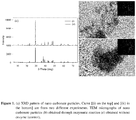
- the TEM analysis shows that nano particle of CaCO 3 was found with size from 60 to 150 nm in presence of enzyme as shown in Figure 1a while without enzyme the size was not irregular in shape with a size around 500 nm as shown in Figure 1b .
- enzyme can be used for converting CO 2 to nano sized CaCO 3 which have several industrial applications such as these nanoparticles could be used in other industrial processes such as paper, cement, ink, paint, or coating production plants etc which make the process economically desirable, and even profitable.
- the aqueous phase that is obtained after carbonate precipitation is then introduced in the reactor having collected the volatile compounds. It was treated using a microbial consortia developed in the present invention.
- the consortia is developed and used as per method described herein.
- a microbial consortium consisting of Pseudomonas putida (MTCC 5869), Bacillus substilis (MTCC 5386), Pseudomonas aeruginosa (MTCC 5389), Pseudomonas aerugiosa (MTCC 5388), Lysinibacillus sp. (MTCC 5666) were prepared and evaluated CSTR with air bubbling system. Treatment is done in batch mode.
- the source of the microbes is soil collected from the Indian Oil Corporation Limited Panipat Refinery in Panipat, Haryana, India.
- the geographical origin of the microbes is Indian Oil Corporation Limited Panipat Refinery in Panipat, Haryana, India.
- the foresaid microbes have been deposited with the Microbial Type Culture Collection (MTCC), Chandigarh as required under the Budapest Treaty.
- MTCC Microbial Type Culture Collection
- the depositor of the microbes is Indian Oil Corporation Limited R&D Centre in Faridabad, Haryana, India. Applicant has given his unreserved and irrevocable consent to the deposited material being made available to the public.
- the aqueous liquid after carbonate precipitation was fed in the reactor.
- nutrient system comprising of K 2 HPO 4 (0.5-10g/l), KH 2 PO 4 (1-4 g/l), MgCl 2 (0.2-2.0 g/l), urea (1-2 g/l) yeast extract (2-15 g/l) sodium nitrate (4 g/l).
- the aqueous phase was used as such without amending the pH.
- the temperature of the reactor maintained in range from 20-60°C.
- the percentage of oxygen saturation was controlled in the range of 50 to 100%.
- the stirring was done at 200-600rpm. To prevent the release of volatile compounds from the system, gas phases were continuously recycled.
- the recycled gas first passed to a condenser (maintained at 1-5°C) to recover the volatile compounds and metabolites.
- An abiotic control with similar conditions was also operated.
- samples were taken and were analyzed for CFU/ml (Colony Forming Unit/ml) on agar plate as well for determining the concentration of contaminant by suitable analytical techniques.
- CFU/ml Coldy Forming Unit/ml
- the treated spent caustic is reduced by more than 98% in total sulfur, sulphides, mercaptans, hydrocarbon, phenol and other contaminants in comparison to abiotic control without the microbial consortia.
- the contaminant reduced to substantial level (i.e.
- the treated spent caustic is removed and biomass of microbial consortia is recovered.
- the recovered biomass of microbial consortia can be recycled and used for treatment fresh aqueous layer of spent caustic after sparging CO 2 in presence of carbonic anhydrase.
- the microbial consortium was prepared to take the benefits of the synergy of microbes' metabolic activity.
- the efficiency of the microbial consortium to degrade contaminants of aqueous media was evaluated in shake flask at 35°C and 120 rpm. The samples were taken at regular time interval and were analyzed for CFU/ml on agar plate as well for concentration of contaminant by suitable analytical techniques. The microbial consortia were found to have higher growth and degradation ability were selected.
- microbial consortium may be used in free form or immobilized form.
- the present invention provides a process of converting spent caustic from a petroleum refinery into nano-sized carbonates, comprising the steps of:
- An embodiment of the present invention provides a wherein the biocatalyst is carbonic anhydrase having a concentration in range of 2-20 units/ml of the reaction mixture and is capable of withstanding pH above 10, salinity in the range of 0.1-10% and temperature above 80°C.
- Another embodiment of the present invention provides a wherein the source of carbon dioxide gas is selected from flue gas or bio-gas plant exhaust.
- brine solution is obtained from sources selected from crude oil-desalter unit, produced water, reverse osmosis plant reject or cooling tower blow down.
- Another embodiment of the present invention provides a wherein the ratio of refinery spent caustic and brine solution is in the range of 1:1 to 1:0.10.
- the biocatalyst may be immobilized in the immobilization agents selected from carbon nanotubes, metal organic framework, zeolites, Zinc-ferrite, nickel ferrite, Zinc-nickel (Zn-Ni) ferrite, polyurethane, glass beads or any other suitable matrixes.
- the immobilization agents selected from carbon nanotubes, metal organic framework, zeolites, Zinc-ferrite, nickel ferrite, Zinc-nickel (Zn-Ni) ferrite, polyurethane, glass beads or any other suitable matrixes.
- the bacterium Bacillus thermoleovorans (MTCC 25023) was inoculated in the media containing Na 2 CO 3 (5 g/l), NaHCO 3 (2.5 g/l) KH 2 PO 4 (2 g/l), K 2 HPO 4 (2.5 g/l), MgSO 4 (0.1 g/l), (NH4) 2 SO 4 (0.25 g/l), KNO 3 (2 g/l), ZnSO4 (3 g/l), NaCl (10 g/l), yeast extract(2 g/l), urea (3 g/l), glycerol (5 g/l), Trace element (2ml).
- the trace element solution comprises Nitrilotriacetic acid (1.0 g/l), FeSO 4 .7H 2 O (0.15g/l), MnCl 2 .4H 2 O (0.005 g/l), COCl 2 .6H 2 O (0.02 g/l), CaCl 2 .2H 2 O (0.5 g/l), ZnCl 2 (0.15g/l), CuCl 2 .H 2 O (0.03g/l), H 3 BO 3 (0.02g/l), Na 2 MoO 4 (0.02g/l), Na 2 SeO 3 (0.02g/l), NiSO 4 (0.03g/l), SnCl 2 (0.03g/l).
- the microbe In order to produce carbonic anhydrase enzyme, the microbe is inoculated in the above media in aerobic conditions and incubated at 40°C temperature at a pH 8 followed by shaking. The bacterium is incubated for 48 hrs. Subsequently, the extracellular and/or extracelluar carbonic anhydrase enzyme is purified by ammonium sulfate precipitation, molecular filtration and agarose bound p-aminomethylbenzenesulfonamide (p-AMBS-agarose) column chromatography. The purified enzyme was having Molecular weight of 30KDa characterized with 3500 units/mg activity. The biocatalyst may be used in free form or immobilized form. The enzyme preparation had tolerance upto pH 13, could tolerate salinity of 10% and high temperature of about 80°C.
- the 1 L refinery spent caustic (composition given in Table 1) and 1 L brine solution obtained from crude desalting process (composition given in Table 2) were mixed in a stirred reactor along with biocatalyst (1750 units).
- industrial flue gas was sparged (2L/min) for 5 minutes at ambient temperature (25°C).
- gas phases were continuously recycled.
- the recycled gas first passed to a condenser (maintained at 5°C) to recover the volatile compounds and condensate was collected in another reactor. This results in precipitation of metal carbonates.
- Table-1 Composition of the spent caustic Component Wt% NaOH 3 Sulphide 1.67 Mercaptide 2.9 Cresylic acids 6 Naphthenic acids 3 Phenol 0.018 Hydrocarbon 0.3 pH 14
- Table-2 Composition of the brine pH 8 TDS 6000 ppm TSS 18857 ppm O&G 300 ppm Hardness 1400 ppm Total Alkalinity 125 ppm Ca 2+ 1200 ppm Mg2+ 589 ppm Table 3.
- the aqueous phase decanted from precipitated carbonates and their washing contained the sulphides, phenols, hydrocarbons, etc.
- the aqueous phase after carbonate precipitation was introduced in the reactor having collected the volatile compounds. It was treated using a microbial consortia developed in the present invention.
- a microbial consortium comprising of Pseudomonas putida (MTCC 5869), Bacillus substilis MTCC 5386, Pseudomonas aeruginosa (MTCC 5389), Pseudomonas aerugiosa (MTCC 5388), Lysinibacillus sp. (MTCC 5666) was prepared and evaluated CSTR with air bubbling system. Treatment is done in batch mode.
- the residual liquid after carbonate precipitation was fed in the reactor.
- nutrient system comprising of 4g/l K 2 HPO 4 , 4 g/l KH 2 PO 4 , MgCl 2 0.2 g/l, 0.5 g/l of trace elements, 2 g/l Urea 5 g/l yeast extract, 4 g/l sodium nitrate.
- the pH and temperature was not maintained.
- the percentage of oxygen saturation was controlled 100%.
- the stirring was done 600rpm.
- gas phases were continuously recycled.
- the recycled gas first passed to a condenser (maintained at 5°C) to recover the volatile compounds and metabolites.
- An abiotic control with similar conditions was also operated.
- the treated spent caustic has more than 98% reduction in total sulfur, sulphides, mercaptans, hydrocarbon, phenol and other contaminants in comparison to abiotic control without the microbial consortia (Table-4).
- the treated reactor was having >10 12 cfu/ml in comparison to 10 2 in abiotic reactor.
- Table 4 Treatment of aqueous phase Contaminant wt % (% degradation) after 24 hrs Treated with microbial blend Control without microbial blend Total sulfur 0.02 (98.3) 2.89 (1.4) Sulphides 0.03 (98.6) 1.62 (2.4) Mercaptans 0.017 (99.4) 2.72 (5.9) Phenol 0.0002 (98.8) 0.017 (2.5) Hydrocarbons 0.0006 (99.8) 0.29 (1.7)
- Nickel ferrite nanoparticles were synthesized via co-precipitation method.
- 0.4 M (25 mL) solution of iron chloride (FeCl 3 ) and a 0.2 M (25 mL) solution of nickel chloride (NiCl 2 ) in deionized water were mixed with vigorous stirring.
- 0.1 g of tannic acid or Polyethylene glycol was added to it and the temperature was raised to 80°C. 3 M NaOH solution was added drop wise till the pH reached to ⁇ 12.
- the brown precipitate obtained was filtered and dried in oven for 24 h.
- NiFe 2 O 4 obtained is then calcined at 600°C for 4 h and stored at room temperature.
- ZnFe 2 O 4 was synthesized using the similar procedure with ZnCl 2 (0.2 M, 25 mL) as zinc precursor.
- the immobilization of carbonic anhydrase (CA) was carried out on NiFe 2 O 4 and ZnFe 2 O 4 by ionic adsorption.
- the solid is stored at ⁇ 4°C for further application.
- the 1L refinery spent caustic and 1 L brine solution obtained from crude desalting process were mixed in a stirred reactor along with biocatalyst (20 mg).
- industrial flue gas was sparged (2L/min) for 10 minutes at ambient temperature (65°C).
- gas phases were continuously recycled.
- the recycled gas first passed to a condenser (maintained at 5°C) to recover the volatile compounds and condensate was collected in another reactor. This results in the precipitation of metal carbonates.
Landscapes
- Chemical & Material Sciences (AREA)
- Engineering & Computer Science (AREA)
- Life Sciences & Earth Sciences (AREA)
- Organic Chemistry (AREA)
- Microbiology (AREA)
- Health & Medical Sciences (AREA)
- Environmental & Geological Engineering (AREA)
- Oil, Petroleum & Natural Gas (AREA)
- Biomedical Technology (AREA)
- General Chemical & Material Sciences (AREA)
- Chemical Kinetics & Catalysis (AREA)
- Wood Science & Technology (AREA)
- Zoology (AREA)
- Bioinformatics & Cheminformatics (AREA)
- Genetics & Genomics (AREA)
- Hydrology & Water Resources (AREA)
- Water Supply & Treatment (AREA)
- Biodiversity & Conservation Biology (AREA)
- Biotechnology (AREA)
- Biochemistry (AREA)
- General Engineering & Computer Science (AREA)
- General Health & Medical Sciences (AREA)
- Analytical Chemistry (AREA)
- Molecular Biology (AREA)
- Inorganic Chemistry (AREA)
- Purification Treatments By Anaerobic Or Anaerobic And Aerobic Bacteria Or Animals (AREA)
- Preparation Of Compounds By Using Micro-Organisms (AREA)
- Processing Of Solid Wastes (AREA)
Claims (6)
- Verfahren zum Umwandeln von verbrauchtem Ätznatron aus einer Erdölraffinerie in Carbonate in Nanogröße, wobei das Verfahren die Schritte umfasst:(a) Mischen des verbrauchten Ätznatrons in einem Reaktor mit Rührwerk, der einen Biokatalysator enthält, wobei der Biokatalysator ein Carbonatdehydrasekatalysator ist, der von Mikroben erhalten wurde, die aus Enterobacter aerogenes (MTCC 25016), Lysinibacillus sp. (MTCC 25029), Bacillus thermoleovorans (MTCC 25023), Bacillus stearothermophilus (MTCC 25030) oder Arthrobacter sp. (MTCC 25028) ausgewählt sind;(b) Hinzufügen einer Laugenlösung zum Gemisch von Schritt (a);(c) Sprühen eines Gases mit hohem Kohlendioxidgehalt in das Gemisch von Schritt (b); und(d) Abtrennen der wässrigen/flüssigen Phase, um ausgefällte Carbonate in Nanogröße zu erhalten;(e) Erzeugen der wässrigen/flüssigen Phase mit einem Mikrobenkonsortium, das ausgewählt ist aus einem Gemisch aus einem beliebigen von Pseudomonas putida (MTCC 5869), Bacillus substilis (MTCC 5386), Pseudomonas aeruginosa (MTCC 5389), Pseudomonas aerugiosa (MTCC 5388) und Lysinibacillus sp. (MTCC 5666); und(f) Erhalten einer flüssigen Phase ohne Verunreinigungen;wobei die Schritte (a) bis (c) 0,5 bis 30 Minuten lang bei einer Temperatur im Bereich von 25 bis 85 °C ausgeführt werden; und wobei Schritt (e) bei einer Temperatur im Bereich von 20 bis 60 °C und das Rühren der Reaktion im Bereich von 200 bis 600 1/min durchgeführt werden.
- Verfahren nach Anspruch 1, wobei es sich bei dem Biokatalysator um Cabonatdehydrase handelt, die eine Konzentration im Bereich von 2 bis 20 Einheiten/ml des Reaktionsgemischs aufweist.
- Verfahren nach Anspruch 1, wobei die Quelle des Kohlendioxids ausgewählt ist aus Rauchgasen oder Biogasanlagenabgasen.
- Verfahren nach Anspruch 1, wobei die Laugenlösung aus Quellen erhalten wird, die ausgewählt sind aus einer Erdölentsalzungsanlage, aufbereitetem Wasser, Abfall aus Umkehrosmoseanlagen und Kühlturmabschlamm.
- Verfahren nach Anspruch 1, wobei der Biokatalysator in den Immobilisierungsmitteln immobilisiert sein kann, die ausgewählt sind aus Kohlenstoffnanoröhrchen, metallorganischem Gerüstmaterial, Zeolithen, Zinkferrit, Nickelferrit, Zink-Nickel-Ferrit (Zn-Ni-Ferrit), Polyurethan, Glaskugeln und beliebigen anderen geeigneten Matrizen.
- Verfahren nach Anspruch 1, wobei die Gesamtmenge gelöster Feststoffe in der Laugenlösung im Bereich von 10 ppm bis 100.000 ppm liegt.
Applications Claiming Priority (1)
| Application Number | Priority Date | Filing Date | Title |
|---|---|---|---|
| IN1467MU2015 | 2015-04-08 |
Publications (2)
| Publication Number | Publication Date |
|---|---|
| EP3078640A1 EP3078640A1 (de) | 2016-10-12 |
| EP3078640B1 true EP3078640B1 (de) | 2019-02-27 |
Family
ID=55696958
Family Applications (1)
| Application Number | Title | Priority Date | Filing Date |
|---|---|---|---|
| EP16162616.3A Active EP3078640B1 (de) | 2015-04-08 | 2016-04-01 | Bio-umwandlung von raffinerieabfallströmen |
Country Status (3)
| Country | Link |
|---|---|
| US (1) | US10195564B2 (de) |
| EP (1) | EP3078640B1 (de) |
| SA (1) | SA116370514B1 (de) |
Cited By (1)
| Publication number | Priority date | Publication date | Assignee | Title |
|---|---|---|---|---|
| CN109957433A (zh) * | 2019-03-21 | 2019-07-02 | 中运建设控股有限公司 | 工业废料制备环保固体燃料的方法 |
Families Citing this family (5)
| Publication number | Priority date | Publication date | Assignee | Title |
|---|---|---|---|---|
| EP3112442B1 (de) * | 2015-06-29 | 2019-04-10 | Indian Oil Corporation Limited | Biounterstützte behandlung verbrauchtes ätzmittels |
| SA119410019B1 (ar) * | 2018-09-07 | 2021-12-21 | انديان اويل كوربوريشين ليمتد | عملية لتقليل الرواسب الحيوية في محطة معالجة تيار متدفق خارج من تكرير الهيدروكربون عن طريق عمليات التدخل الميكروبي |
| US20200347718A1 (en) * | 2019-05-03 | 2020-11-05 | Baker Hughes, A Ge Company, Llc | Detection and monitoring of corrosion inhibitors in oilfield fluids |
| US11952541B2 (en) * | 2021-10-12 | 2024-04-09 | Uop Llc | Process for hydrotreating a feed stream comprising a biorenewable feedstock with treatment of an off-gas stream |
| CN117624262B (zh) * | 2024-01-23 | 2024-03-29 | 昆明理工大学 | 一种从单宁锗渣中提取制备单宁酸的方法 |
Family Cites Families (10)
| Publication number | Priority date | Publication date | Assignee | Title |
|---|---|---|---|---|
| US5244756A (en) | 1991-12-19 | 1993-09-14 | General Motors Corporation | Storage battery and method of connecting case sealed terminals to internal electrode plates |
| CA2353307A1 (fr) | 2001-07-13 | 2003-01-13 | Carmen Parent | Appareil et procede pour le traitement des effluents gazeux |
| US7214290B2 (en) | 2002-09-04 | 2007-05-08 | Shaw Liquid Solutions Llc. | Treatment of spent caustic refinery effluents |
| AU2006217575B2 (en) | 2005-02-24 | 2010-12-23 | Co2 Solutions Inc. | An improved CO2 absorption solution |
| US7713399B2 (en) | 2005-05-12 | 2010-05-11 | Saudi Arabian Oil Company | Process for treating a sulfur-containing spent caustic refinery stream using a membrane electrolyzer powered by a fuel cell |
| FR2904144A1 (fr) | 2006-07-19 | 2008-01-25 | St Microelectronics Rousset | Procede de fabrication d'un wafer de semi-conducteur comprenant un filtre optique integre |
| EP2126090B1 (de) | 2007-01-31 | 2015-04-01 | Novozymes A/S | Wärmestabile kohlenstoffanhydrasen und ihre verwendung |
| WO2009035642A1 (en) * | 2007-09-11 | 2009-03-19 | Siemens Water Technologies Corp. | Treatment of spent caustic waste |
| CN102712919B (zh) | 2009-06-26 | 2017-06-23 | 诺维信北美公司 | 热稳定性碳酸酐酶及其用途 |
| EP2354098A1 (de) | 2010-02-09 | 2011-08-10 | Biomim-Greenloop | Bewertung von divalenten Kationen in Salzlake und zugehörige CO2-Sequestrierung durch Mikroorganismen |
-
2016
- 2016-03-31 US US15/088,094 patent/US10195564B2/en active Active
- 2016-04-01 EP EP16162616.3A patent/EP3078640B1/de active Active
- 2016-04-07 SA SA116370514A patent/SA116370514B1/ar unknown
Cited By (1)
| Publication number | Priority date | Publication date | Assignee | Title |
|---|---|---|---|---|
| CN109957433A (zh) * | 2019-03-21 | 2019-07-02 | 中运建设控股有限公司 | 工业废料制备环保固体燃料的方法 |
Also Published As
| Publication number | Publication date |
|---|---|
| EP3078640A1 (de) | 2016-10-12 |
| SA116370514B1 (ar) | 2018-05-09 |
| US20160296888A1 (en) | 2016-10-13 |
| US10195564B2 (en) | 2019-02-05 |
Similar Documents
| Publication | Publication Date | Title |
|---|---|---|
| US10195564B2 (en) | Bio-conversion of refinery waste streams | |
| Bai et al. | Bioremediation of cadmium by growing Rhodobacter sphaeroides: kinetic characteristic and mechanism studies | |
| Bredberg et al. | Reduction of vanadium (V) with Acidithiobacillus ferrooxidans and Acidithiobacillus thiooxidans | |
| Liang et al. | Aerobic biodegradation of odorous dimethyl disulfide in aqueous medium by isolated Bacillus cereus GIGAN2 and identification of transformation intermediates | |
| Shahabivand et al. | Phenol biodegradation by immobilized Rhodococcus qingshengii isolated from coking effluent on Na-alginate and magnetic chitosan-alginate nanocomposite | |
| US20080169238A1 (en) | Biosorption system produced from biofilms supported in faujasite (fau) zeolite, process obtaining it and its usage for removal of hexavalent chromium (cr(vi)) | |
| Gholipour et al. | Biological treatment of toxic refinery spent sulfidic caustic at low dilution by sulfur-oxidizing fungi | |
| Nazari et al. | The study of biological technologies for the removal of sulfur compounds | |
| Di et al. | Dynamic experiments of acid mine drainage with Rhodopseudomonas spheroides activated lignite immobilized sulfate-reducing bacteria particles treatment | |
| Papizadeh et al. | Growth-phase dependent biodesulfurization of dibenzothiophene by Enterobacter sp. strain NISOC-03 | |
| Rahman et al. | Mobilizing microbes for bioremediation strategies in the context of climate change | |
| US9938175B2 (en) | Bio-assisted process for the treatment and regeneration of spent caustic | |
| Makzum et al. | Study on haloalkaliphilic sulfur-oxidizing bacterium for thiosulfate removal in treatment of sulfidic spent caustic | |
| EP3466894B1 (de) | Behandlung und rückgewinnung von laugen aus verbrauchter lauge durch bioelektrochemische verfahren | |
| Janssen et al. | Development of a family of large-scale biothechnological processes to desukphurise industrial gases | |
| 田崎和江 et al. | Alkane-degrading bacteria and heavy metals from the Nakhodka oil spill-polluted seashores in the Sea of Japan after five years of bioremediation | |
| RU2661679C9 (ru) | Способ очистки сточных вод нефтеперерабатывающих и нефтехимических производств от фенола | |
| JP2007215403A (ja) | 微生物を用いた環境汚染物質の分解方法 | |
| Olguin-Lora et al. | Evaluation of haloalkaliphilic sulfur-oxidizing microorganisms with potential application in the effluent treatment of the petroleum industry | |
| Farahat et al. | Comparative kinetic study of different bioremediation processes for soil contaminated with petroleum hydrocarbons | |
| Chernysh et al. | Ecotechnology for hydrogen sulfide removal and production of elemental sulfur | |
| van Leerdam | Anaerobic degradation of methanethiol in a process for liquefied petroleum gas (LPG) biodesulfurization | |
| US6224750B1 (en) | Producing low sulfur hydrocarbons with biologically regenerated caustic | |
| Emami et al. | Biodesulfurization of Dibenzothiophene by Microorganisms Isolated from Oil-Contaminated Soils | |
| DE68905180T2 (de) | Enzymatische entschwefelung von steinkohlen. |
Legal Events
| Date | Code | Title | Description |
|---|---|---|---|
| PUAI | Public reference made under article 153(3) epc to a published international application that has entered the european phase |
Free format text: ORIGINAL CODE: 0009012 |
|
| AK | Designated contracting states |
Kind code of ref document: A1 Designated state(s): AL AT BE BG CH CY CZ DE DK EE ES FI FR GB GR HR HU IE IS IT LI LT LU LV MC MK MT NL NO PL PT RO RS SE SI SK SM TR |
|
| AX | Request for extension of the european patent |
Extension state: BA ME |
|
| STAA | Information on the status of an ep patent application or granted ep patent |
Free format text: STATUS: REQUEST FOR EXAMINATION WAS MADE |
|
| 17P | Request for examination filed |
Effective date: 20170412 |
|
| RBV | Designated contracting states (corrected) |
Designated state(s): AL AT BE BG CH CY CZ DE DK EE ES FI FR GB GR HR HU IE IS IT LI LT LU LV MC MK MT NL NO PL PT RO RS SE SI SK SM TR |
|
| STAA | Information on the status of an ep patent application or granted ep patent |
Free format text: STATUS: EXAMINATION IS IN PROGRESS |
|
| 17Q | First examination report despatched |
Effective date: 20170913 |
|
| RIC1 | Information provided on ipc code assigned before grant |
Ipc: B01D 53/85 20060101ALI20181003BHEP Ipc: C02F 103/36 20060101ALN20181003BHEP Ipc: C02F 103/10 20060101ALN20181003BHEP Ipc: C02F 3/34 20060101AFI20181003BHEP |
|
| GRAP | Despatch of communication of intention to grant a patent |
Free format text: ORIGINAL CODE: EPIDOSNIGR1 |
|
| STAA | Information on the status of an ep patent application or granted ep patent |
Free format text: STATUS: GRANT OF PATENT IS INTENDED |
|
| RIC1 | Information provided on ipc code assigned before grant |
Ipc: C02F 103/36 20060101ALN20181031BHEP Ipc: B01D 53/85 20060101ALI20181031BHEP Ipc: C02F 103/10 20060101ALN20181031BHEP Ipc: C02F 3/34 20060101AFI20181031BHEP |
|
| RIC1 | Information provided on ipc code assigned before grant |
Ipc: C02F 103/36 20060101ALN20181102BHEP Ipc: C02F 103/10 20060101ALN20181102BHEP Ipc: B01D 53/85 20060101ALI20181102BHEP Ipc: C02F 3/34 20060101AFI20181102BHEP |
|
| INTG | Intention to grant announced |
Effective date: 20181120 |
|
| GRAS | Grant fee paid |
Free format text: ORIGINAL CODE: EPIDOSNIGR3 |
|
| GRAA | (expected) grant |
Free format text: ORIGINAL CODE: 0009210 |
|
| STAA | Information on the status of an ep patent application or granted ep patent |
Free format text: STATUS: THE PATENT HAS BEEN GRANTED |
|
| AK | Designated contracting states |
Kind code of ref document: B1 Designated state(s): AL AT BE BG CH CY CZ DE DK EE ES FI FR GB GR HR HU IE IS IT LI LT LU LV MC MK MT NL NO PL PT RO RS SE SI SK SM TR |
|
| REG | Reference to a national code |
Ref country code: GB Ref legal event code: FG4D |
|
| REG | Reference to a national code |
Ref country code: CH Ref legal event code: EP |
|
| REG | Reference to a national code |
Ref country code: AT Ref legal event code: REF Ref document number: 1101042 Country of ref document: AT Kind code of ref document: T Effective date: 20190315 |
|
| REG | Reference to a national code |
Ref country code: IE Ref legal event code: FG4D |
|
| REG | Reference to a national code |
Ref country code: DE Ref legal event code: R096 Ref document number: 602016010225 Country of ref document: DE |
|
| REG | Reference to a national code |
Ref country code: NL Ref legal event code: FP |
|
| REG | Reference to a national code |
Ref country code: LT Ref legal event code: MG4D |
|
| PG25 | Lapsed in a contracting state [announced via postgrant information from national office to epo] |
Ref country code: FI Free format text: LAPSE BECAUSE OF FAILURE TO SUBMIT A TRANSLATION OF THE DESCRIPTION OR TO PAY THE FEE WITHIN THE PRESCRIBED TIME-LIMIT Effective date: 20190227 Ref country code: NO Free format text: LAPSE BECAUSE OF FAILURE TO SUBMIT A TRANSLATION OF THE DESCRIPTION OR TO PAY THE FEE WITHIN THE PRESCRIBED TIME-LIMIT Effective date: 20190527 Ref country code: LT Free format text: LAPSE BECAUSE OF FAILURE TO SUBMIT A TRANSLATION OF THE DESCRIPTION OR TO PAY THE FEE WITHIN THE PRESCRIBED TIME-LIMIT Effective date: 20190227 Ref country code: PT Free format text: LAPSE BECAUSE OF FAILURE TO SUBMIT A TRANSLATION OF THE DESCRIPTION OR TO PAY THE FEE WITHIN THE PRESCRIBED TIME-LIMIT Effective date: 20190627 Ref country code: SE Free format text: LAPSE BECAUSE OF FAILURE TO SUBMIT A TRANSLATION OF THE DESCRIPTION OR TO PAY THE FEE WITHIN THE PRESCRIBED TIME-LIMIT Effective date: 20190227 |
|
| PG25 | Lapsed in a contracting state [announced via postgrant information from national office to epo] |
Ref country code: LV Free format text: LAPSE BECAUSE OF FAILURE TO SUBMIT A TRANSLATION OF THE DESCRIPTION OR TO PAY THE FEE WITHIN THE PRESCRIBED TIME-LIMIT Effective date: 20190227 Ref country code: RS Free format text: LAPSE BECAUSE OF FAILURE TO SUBMIT A TRANSLATION OF THE DESCRIPTION OR TO PAY THE FEE WITHIN THE PRESCRIBED TIME-LIMIT Effective date: 20190227 Ref country code: BG Free format text: LAPSE BECAUSE OF FAILURE TO SUBMIT A TRANSLATION OF THE DESCRIPTION OR TO PAY THE FEE WITHIN THE PRESCRIBED TIME-LIMIT Effective date: 20190527 Ref country code: GR Free format text: LAPSE BECAUSE OF FAILURE TO SUBMIT A TRANSLATION OF THE DESCRIPTION OR TO PAY THE FEE WITHIN THE PRESCRIBED TIME-LIMIT Effective date: 20190528 Ref country code: IS Free format text: LAPSE BECAUSE OF FAILURE TO SUBMIT A TRANSLATION OF THE DESCRIPTION OR TO PAY THE FEE WITHIN THE PRESCRIBED TIME-LIMIT Effective date: 20190627 Ref country code: HR Free format text: LAPSE BECAUSE OF FAILURE TO SUBMIT A TRANSLATION OF THE DESCRIPTION OR TO PAY THE FEE WITHIN THE PRESCRIBED TIME-LIMIT Effective date: 20190227 |
|
| REG | Reference to a national code |
Ref country code: AT Ref legal event code: MK05 Ref document number: 1101042 Country of ref document: AT Kind code of ref document: T Effective date: 20190227 |
|
| PG25 | Lapsed in a contracting state [announced via postgrant information from national office to epo] |
Ref country code: ES Free format text: LAPSE BECAUSE OF FAILURE TO SUBMIT A TRANSLATION OF THE DESCRIPTION OR TO PAY THE FEE WITHIN THE PRESCRIBED TIME-LIMIT Effective date: 20190227 Ref country code: DK Free format text: LAPSE BECAUSE OF FAILURE TO SUBMIT A TRANSLATION OF THE DESCRIPTION OR TO PAY THE FEE WITHIN THE PRESCRIBED TIME-LIMIT Effective date: 20190227 Ref country code: AL Free format text: LAPSE BECAUSE OF FAILURE TO SUBMIT A TRANSLATION OF THE DESCRIPTION OR TO PAY THE FEE WITHIN THE PRESCRIBED TIME-LIMIT Effective date: 20190227 Ref country code: SK Free format text: LAPSE BECAUSE OF FAILURE TO SUBMIT A TRANSLATION OF THE DESCRIPTION OR TO PAY THE FEE WITHIN THE PRESCRIBED TIME-LIMIT Effective date: 20190227 Ref country code: IT Free format text: LAPSE BECAUSE OF FAILURE TO SUBMIT A TRANSLATION OF THE DESCRIPTION OR TO PAY THE FEE WITHIN THE PRESCRIBED TIME-LIMIT Effective date: 20190227 Ref country code: RO Free format text: LAPSE BECAUSE OF FAILURE TO SUBMIT A TRANSLATION OF THE DESCRIPTION OR TO PAY THE FEE WITHIN THE PRESCRIBED TIME-LIMIT Effective date: 20190227 Ref country code: CZ Free format text: LAPSE BECAUSE OF FAILURE TO SUBMIT A TRANSLATION OF THE DESCRIPTION OR TO PAY THE FEE WITHIN THE PRESCRIBED TIME-LIMIT Effective date: 20190227 Ref country code: EE Free format text: LAPSE BECAUSE OF FAILURE TO SUBMIT A TRANSLATION OF THE DESCRIPTION OR TO PAY THE FEE WITHIN THE PRESCRIBED TIME-LIMIT Effective date: 20190227 |
|
| REG | Reference to a national code |
Ref country code: DE Ref legal event code: R097 Ref document number: 602016010225 Country of ref document: DE |
|
| PG25 | Lapsed in a contracting state [announced via postgrant information from national office to epo] |
Ref country code: SM Free format text: LAPSE BECAUSE OF FAILURE TO SUBMIT A TRANSLATION OF THE DESCRIPTION OR TO PAY THE FEE WITHIN THE PRESCRIBED TIME-LIMIT Effective date: 20190227 Ref country code: PL Free format text: LAPSE BECAUSE OF FAILURE TO SUBMIT A TRANSLATION OF THE DESCRIPTION OR TO PAY THE FEE WITHIN THE PRESCRIBED TIME-LIMIT Effective date: 20190227 |
|
| REG | Reference to a national code |
Ref country code: CH Ref legal event code: PL |
|
| PG25 | Lapsed in a contracting state [announced via postgrant information from national office to epo] |
Ref country code: MC Free format text: LAPSE BECAUSE OF FAILURE TO SUBMIT A TRANSLATION OF THE DESCRIPTION OR TO PAY THE FEE WITHIN THE PRESCRIBED TIME-LIMIT Effective date: 20190227 Ref country code: LU Free format text: LAPSE BECAUSE OF NON-PAYMENT OF DUE FEES Effective date: 20190401 Ref country code: AT Free format text: LAPSE BECAUSE OF FAILURE TO SUBMIT A TRANSLATION OF THE DESCRIPTION OR TO PAY THE FEE WITHIN THE PRESCRIBED TIME-LIMIT Effective date: 20190227 |
|
| PLBE | No opposition filed within time limit |
Free format text: ORIGINAL CODE: 0009261 |
|
| STAA | Information on the status of an ep patent application or granted ep patent |
Free format text: STATUS: NO OPPOSITION FILED WITHIN TIME LIMIT |
|
| PG25 | Lapsed in a contracting state [announced via postgrant information from national office to epo] |
Ref country code: CH Free format text: LAPSE BECAUSE OF NON-PAYMENT OF DUE FEES Effective date: 20190430 Ref country code: LI Free format text: LAPSE BECAUSE OF NON-PAYMENT OF DUE FEES Effective date: 20190430 |
|
| 26N | No opposition filed |
Effective date: 20191128 |
|
| PG25 | Lapsed in a contracting state [announced via postgrant information from national office to epo] |
Ref country code: SI Free format text: LAPSE BECAUSE OF FAILURE TO SUBMIT A TRANSLATION OF THE DESCRIPTION OR TO PAY THE FEE WITHIN THE PRESCRIBED TIME-LIMIT Effective date: 20190227 |
|
| PG25 | Lapsed in a contracting state [announced via postgrant information from national office to epo] |
Ref country code: TR Free format text: LAPSE BECAUSE OF FAILURE TO SUBMIT A TRANSLATION OF THE DESCRIPTION OR TO PAY THE FEE WITHIN THE PRESCRIBED TIME-LIMIT Effective date: 20190227 |
|
| PG25 | Lapsed in a contracting state [announced via postgrant information from national office to epo] |
Ref country code: IE Free format text: LAPSE BECAUSE OF NON-PAYMENT OF DUE FEES Effective date: 20190401 |
|
| PG25 | Lapsed in a contracting state [announced via postgrant information from national office to epo] |
Ref country code: CY Free format text: LAPSE BECAUSE OF FAILURE TO SUBMIT A TRANSLATION OF THE DESCRIPTION OR TO PAY THE FEE WITHIN THE PRESCRIBED TIME-LIMIT Effective date: 20190227 |
|
| PG25 | Lapsed in a contracting state [announced via postgrant information from national office to epo] |
Ref country code: HU Free format text: LAPSE BECAUSE OF FAILURE TO SUBMIT A TRANSLATION OF THE DESCRIPTION OR TO PAY THE FEE WITHIN THE PRESCRIBED TIME-LIMIT; INVALID AB INITIO Effective date: 20160401 Ref country code: MT Free format text: LAPSE BECAUSE OF FAILURE TO SUBMIT A TRANSLATION OF THE DESCRIPTION OR TO PAY THE FEE WITHIN THE PRESCRIBED TIME-LIMIT Effective date: 20190227 |
|
| PG25 | Lapsed in a contracting state [announced via postgrant information from national office to epo] |
Ref country code: MK Free format text: LAPSE BECAUSE OF FAILURE TO SUBMIT A TRANSLATION OF THE DESCRIPTION OR TO PAY THE FEE WITHIN THE PRESCRIBED TIME-LIMIT Effective date: 20190227 |
|
| PGFP | Annual fee paid to national office [announced via postgrant information from national office to epo] |
Ref country code: NL Payment date: 20250426 Year of fee payment: 10 |
|
| PGFP | Annual fee paid to national office [announced via postgrant information from national office to epo] |
Ref country code: DE Payment date: 20250430 Year of fee payment: 10 |
|
| PGFP | Annual fee paid to national office [announced via postgrant information from national office to epo] |
Ref country code: GB Payment date: 20250426 Year of fee payment: 10 |
|
| PGFP | Annual fee paid to national office [announced via postgrant information from national office to epo] |
Ref country code: BE Payment date: 20250426 Year of fee payment: 10 |
|
| PGFP | Annual fee paid to national office [announced via postgrant information from national office to epo] |
Ref country code: FR Payment date: 20250426 Year of fee payment: 10 |