EP3075773A1 - Rubber composition and tire - Google Patents
Rubber composition and tire Download PDFInfo
- Publication number
- EP3075773A1 EP3075773A1 EP14866008.7A EP14866008A EP3075773A1 EP 3075773 A1 EP3075773 A1 EP 3075773A1 EP 14866008 A EP14866008 A EP 14866008A EP 3075773 A1 EP3075773 A1 EP 3075773A1
- Authority
- EP
- European Patent Office
- Prior art keywords
- rubber
- based resins
- mass
- parts
- resins
- Prior art date
- Legal status (The legal status is an assumption and is not a legal conclusion. Google has not performed a legal analysis and makes no representation as to the accuracy of the status listed.)
- Withdrawn
Links
Classifications
-
- C—CHEMISTRY; METALLURGY
- C08—ORGANIC MACROMOLECULAR COMPOUNDS; THEIR PREPARATION OR CHEMICAL WORKING-UP; COMPOSITIONS BASED THEREON
- C08L—COMPOSITIONS OF MACROMOLECULAR COMPOUNDS
- C08L7/00—Compositions of natural rubber
-
- B—PERFORMING OPERATIONS; TRANSPORTING
- B60—VEHICLES IN GENERAL
- B60C—VEHICLE TYRES; TYRE INFLATION; TYRE CHANGING; CONNECTING VALVES TO INFLATABLE ELASTIC BODIES IN GENERAL; DEVICES OR ARRANGEMENTS RELATED TO TYRES
- B60C1/00—Tyres characterised by the chemical composition or the physical arrangement or mixture of the composition
-
- B—PERFORMING OPERATIONS; TRANSPORTING
- B60—VEHICLES IN GENERAL
- B60C—VEHICLE TYRES; TYRE INFLATION; TYRE CHANGING; CONNECTING VALVES TO INFLATABLE ELASTIC BODIES IN GENERAL; DEVICES OR ARRANGEMENTS RELATED TO TYRES
- B60C1/00—Tyres characterised by the chemical composition or the physical arrangement or mixture of the composition
- B60C1/0016—Compositions of the tread
-
- B—PERFORMING OPERATIONS; TRANSPORTING
- B60—VEHICLES IN GENERAL
- B60C—VEHICLE TYRES; TYRE INFLATION; TYRE CHANGING; CONNECTING VALVES TO INFLATABLE ELASTIC BODIES IN GENERAL; DEVICES OR ARRANGEMENTS RELATED TO TYRES
- B60C11/00—Tyre tread bands; Tread patterns; Anti-skid inserts
-
- C—CHEMISTRY; METALLURGY
- C08—ORGANIC MACROMOLECULAR COMPOUNDS; THEIR PREPARATION OR CHEMICAL WORKING-UP; COMPOSITIONS BASED THEREON
- C08K—Use of inorganic or non-macromolecular organic substances as compounding ingredients
- C08K3/00—Use of inorganic substances as compounding ingredients
- C08K3/34—Silicon-containing compounds
- C08K3/36—Silica
-
- C—CHEMISTRY; METALLURGY
- C08—ORGANIC MACROMOLECULAR COMPOUNDS; THEIR PREPARATION OR CHEMICAL WORKING-UP; COMPOSITIONS BASED THEREON
- C08L—COMPOSITIONS OF MACROMOLECULAR COMPOUNDS
- C08L57/00—Compositions of unspecified polymers obtained by reactions only involving carbon-to-carbon unsaturated bonds
- C08L57/02—Copolymers of mineral oil hydrocarbons
-
- C—CHEMISTRY; METALLURGY
- C08—ORGANIC MACROMOLECULAR COMPOUNDS; THEIR PREPARATION OR CHEMICAL WORKING-UP; COMPOSITIONS BASED THEREON
- C08L—COMPOSITIONS OF MACROMOLECULAR COMPOUNDS
- C08L61/00—Compositions of condensation polymers of aldehydes or ketones; Compositions of derivatives of such polymers
- C08L61/04—Condensation polymers of aldehydes or ketones with phenols only
-
- C—CHEMISTRY; METALLURGY
- C08—ORGANIC MACROMOLECULAR COMPOUNDS; THEIR PREPARATION OR CHEMICAL WORKING-UP; COMPOSITIONS BASED THEREON
- C08L—COMPOSITIONS OF MACROMOLECULAR COMPOUNDS
- C08L93/00—Compositions of natural resins; Compositions of derivatives thereof
- C08L93/04—Rosin
-
- C—CHEMISTRY; METALLURGY
- C08—ORGANIC MACROMOLECULAR COMPOUNDS; THEIR PREPARATION OR CHEMICAL WORKING-UP; COMPOSITIONS BASED THEREON
- C08L—COMPOSITIONS OF MACROMOLECULAR COMPOUNDS
- C08L2205/00—Polymer mixtures characterised by other features
- C08L2205/03—Polymer mixtures characterised by other features containing three or more polymers in a blend
Definitions
- a rubber composition and a tire using the same as the tread rubber are disclosed.
- an aroma oil is less compatible with NR and BR, and thus produces insufficient effect of improving performance on a wet road surface.
- a rubber composition compounded with an aroma oil is increased in rolling resistance.
- the rubber composition obtained by compounding C 5 -based resins at 5 parts by mass to 50 parts by mass with the rubber component as 100 parts by mass, the rubber component including natural rubber and/or polyisoprene rubber by at least 30mass% in total is not necessarily high in braking performance on a dry road surface, while failing to exhibit satisfactory wet braking performance on a road surface slipperier than an asphalt road surface.
- the disclosed rubber composition is prepared by compounding a rubber component (A) including natural rubber by 70mass% or more, and by further compounding, with the rubber component as 100 parts by mass: (B) at least one kind of thermoplastic resins selected from among C 5 -based resins, C 5 - to C 9 -based resins, C 9 -based resins, terpene-based resins, terpene-aromatic compound-based resins, rosin-based resins, dicyclopentadiene resins, and alkylphenol-based resins, at 5 parts by mass to 50 parts by mass; and (C) a filler including silica, at 20 parts by mass to 120 parts by mass, in which the filler (C) contains silica by 50mass% to 100mass%.
- thermoplastic resins selected from among C 5 -based resins, C 5 - to C 9 -based resins, C 9 -based resins, terpene-based resins, terpene-aromatic compound-based
- a rubber composition when compounded with the thermoplastic resin (B) selected from among C 5 -based resins, C 5 - to C 9 -based resins, C 9 -based resins, terpene-based resins, terpene-aromatic compound-based resins, rosin-based resins, dicyclopentadiene resins, and alkylphenol-based resins, can be raised in glass transition temperature (Tg), improved in loss tangent (tan ⁇ ) at 0°C, and improved in tire performance on a wet road surface.
- Tg glass transition temperature
- tan ⁇ loss tangent
- the effect to be obtained by compounding the thermoplastic resin (B) is particularly conspicuous in a rubber composition that includes a rubber component including natural rubber by 70mass% or more. Further, the rubber component itself has high flexibility with the content of natural rubber being 70mass% or more, and thus exhibits high braking performance on a dry road surface and on a slippery wet road surface such as a manhole surface.
- silica is dispersed in the rubber component having the thermoplastic resin (B) fully dispersed therein, which allows for more flexible deformation of the rubber, with the result that the rubber is improved in follow-up ability on a road surface that is low in friction coefficient.
- This configuration further improves braking performance on a slippery wet road surface.
- the "C 5 -based resins” refer to C 5 -based synthetic petroleum resins, or a solid polymer obtained by polymerizing C 5 fraction.
- the "C 5 - to C 9 -based resins” refer to C 5 - to C 9 -based synthetic petroleum resins, or a solid polymer obtained by polymerizing C 5 to C 11 fractions.
- the "C 9 -based resins” refer to C 9 -based synthetic resins, or a solid polymer obtained by polymerizing C 9 fraction.
- C 5 to C 11 fractions used in the polymerization of the solid polymer as the "C 5 - to C 9 -based resins" include fractions other than C 5 fraction and C 9 fraction.
- the rubber component (A) may include styrene-butadiene copolymer rubber by 10mass% to 30mass%.
- the rubber component compounded with a certain amount of a styrene-butadiene copolymer rubber is raised in glass transition temperature (Tg), which leads to an improvement in braking performance and driving stability on a dry road surface.
- Tg glass transition temperature
- the filler (C) may contain silica by 90mass% or more.
- the increased content of silica further improves braking performance on a slippery wet road surface.
- the disclosed tire uses, as a tread rubber, any of the aforementioned rubber compositions.
- a tire using any of the aforementioned rubber compositions as a tread rubber becomes excellent not only in braking performance on a wet road surface but also in braking performance on a dry road surface and a slippery wet road surface such as a manhole surface.
- the disclosed rubber composition allows for manufacturing a tread rubber that is high in braking performance on a dry road surface and also high in braking performance on a wet road surface such as a manhole surface that is slipperier than an asphalt road surface.
- the disclosed rubber composition also provides a tire using a tread rubber that is high in braking performance on a dry road surface and also high in braking performance on a wet road surface such as a manhole surface that is slipperier than an asphalt road surface.
- the disclosed rubber composition is prepared by compounding (A) a rubber component including natural rubber by 70mass% or more; and by further compounding, with the rubber component as 100 parts by mass: (B) at least one kind of thermoplastic resins selected from among C 5 -based resins, C 5 - to C 9 -based resins, C 9 -based resins, terpene-based resins, terpene-aromatic compound-based resins, rosin-based resins, dicyclopentadiene resins, and alkylphenol-based resins, at 5 parts by mass to 50 parts by mass; and (C) a filler including silica, at 20 parts by mass to 120 parts by mass, in which the filler (C) contains silica by 50mass% to 100mass%.
- thermoplastic resins selected from among C 5 -based resins, C 5 - to C 9 -based resins, C 9 -based resins, terpene-based resins, terpene-aromatic compound-based
- the rubber component (A) used in the disclosed rubber composition includes: natural rubber (NR) by 70mass% or more, or suitably by 80mass% or more.
- the rubber component (A) contains NR by 70mass% or more, which provides an effect of allowing sufficient effect to be readily produced when C 5 -based resins are compounded, as will be described later.
- the rubber component (A) may further include styrene-butadiene copolymer rubber (SBR) by 5mass% to 30mass%, in particular, by 10mass% to 20mass%.
- SBR styrene-butadiene copolymer rubber
- the rubber composition compounded with SBR is raised in glass transition temperature (Tg), which improves steering stability and braking performance on a dry road surface. Such effects may potentially be insufficient when the SBR content in the rubber component (A) falls below 10mass%.
- the SBR content in the rubber component (A) exceeds 30mass%
- the NR content in the rubber component (A) inevitably falls below 70mass%, which potentially reduces the aforementioned effect to be produced through compounding NR, while potentially causing such problems as increased rolling resistance due to increase of heat generation in the rubber and reduced road surface follow-up ability on a slippery wet road surface due to reduction in flexibility of the rubber.
- the rubber component (A) may contain, as appropriate, butadiene rubber, acrylonitrile-butadiene copolymer rubber, chloroprene rubber, polyisoprene rubber, as other rubber materials.
- the disclosed rubber composition is obtained by compounding at least one kind of thermoplastic resin (B) selected from among C 5 -based resins, C 5 -to C 9 -based resins, C 9 -based resins, terpene-based resins, terpene-aromatic compound-based resins, rosin-based resins, dicyclopentadiene resins, and alkylphenol-based resins, at 5 parts by mass to 50 parts by mass, with the rubber component (A) as 100 parts by mass.
- thermoplastic resin (B) selected from among C 5 -based resins, C 5 -to C 9 -based resins, C 9 -based resins, terpene-based resins, terpene-aromatic compound-based resins, rosin-based resins, dicyclopentadiene resins, and alkylphenol-based resins
- the disclosed rubber composition compounded with the thermoplastic resin (B) to a regulated amount is raised in glass transition temperature (Tg) and improved in loss tangent (tan ⁇ ) at 0°C, and thus can be improved in tire performance mainly on a wet road surface.
- the rubber component (A) contains NR by 70mass% or more as described above.
- the aforementioned thermoplastic resin (B) is highly compatible with NR, which particularly contributes to readily obtaining the aforementioned effect.
- C 5 -based resins refer to C 5 -based synthetic petroleum resins, which is, for example, a solid polymer obtained by polymerizing C 5 fraction using a catalyst for the Friedel-Crafts reaction, such as AlCl 3 and BF 3 .
- Specific examples thereof may include: a copolymer including, as main components, isoprene, cyclopentadiene, 1,3-pentadiene, and 1-pentene; a copolymer of 2-pentene and dicyclopentadiene; and a polymer mainly composed of 1,3-pentadiene.
- C 5 -based resins may be used as the thermoplastic resin (B) so as to further improve braking performance even on an icy and snowy road surface.
- C 5 - to C 9 -based resins refer to C 5 - to C 9 -based synthetic petroleum resins exemplified by a solid polymer obtained by polymerizing C 5 to C 11 fractions using a catalyst for the Friedel-Crafts reaction, such as AlCl 3 and BF 3 .
- Examples of the "C 5 - to C 9 -based resins” may include a copolymer including, as main components, styrene, vinyltoluene, ⁇ -methylstyrene, and indene.
- This C 5 - to C 9 -based resins disclosed herein may preferably include less component of C 9 or more, in view of the compatibility with the component (A).
- including "less component of C 9 or more” means that the component of C 9 or more based on the total amount of the resin is less than 50mass%, or preferably less than 40mass%.
- thermoplastic resin (B) using C 5 - to C 9 -based resins may also improve handling performance.
- the C 5 to C 11 fractions to be used in polymerizing a solid polymer as the "C 5 - to C 9 -based resins" include other fractions than C 5 fraction and C 9 fraction.
- C 9 -based resins refers to C 9 -based synthetic petroleum resins exemplified by a solid polymer obtained by polymerizing C 9 fraction using a catalyst for the Friedel-Crafts reaction, such as AlCl 3 and BF 3 .
- Examples of the “C 9 -based resin” may include a copolymer including, as main components, indene, ⁇ -methylstyrene, and vinyltoluene.
- thermoplastic resin (B) using C 9 -based resins may also improve handling performance.
- the aforementioned terpene-based resin is a solid-state resin obtained by compounding turpentine to be obtained simultaneously in obtaining rosin from trees of Pinus, or a polymerizable component separated from the turpentine, and by polymerizing the turpentine or the polymerizable component using a catalyst for the Friedel-Crafts reaction.
- the terpene-based resin may include: ⁇ -pinene resins; and ⁇ -pinene resins.
- a typical example of the terpene-aromatic compound-based resins may include terpene-phenol resins.
- the terpene-phenol resins may be obtained through various methods including: causing terpenoids and various phenols to react with each other using a catalyst for the Friedel-Crafts reaction, or further condensing the resultant with formalin.
- Terpenoids for use as the material are not particularly limited, and may preferably be a monoterpene hydrocarbon such as ⁇ -pinenes and limonenes, more preferably terpenoids including ⁇ -pinenes, and particularly preferably be ⁇ -pienes.
- terpene-phenol resins with a smaller ratio of phenol component may suitably be used.
- the "smaller ratio of phenol component” refers to the ratio of phenol component to be 50mass% or less, or preferably 40mass% or less in the total amount of resin.
- thermoplastic resin (B) using terpene-aromatic compound-based resins may further improve handling performance.
- the aforementioned rosin-based resins may include, as a natural resin rosin: a gum rosin, a tall oil rosin, and a wood rosin, which are included in a raw rosin or a tall oil; and also include, as a modified rosin, a rosin derivative, and a modified rosin derivative, for example: a polymeric rosin and its partially hydrogenated rosin; a glycerin ester rosin and its partially hydrogenated rosin or completely hydrogenated rosin; and a pentaerythritol ester rosin and its partially hydrogenated rosin or polymeric rosin.
- thermoplastic resin (B) using rosin-based resins may also improve handling performance.
- dicyclopentadiene resins refer to, for example, resins obtained by polymerizing dicyclopentadiene using a catalyst for the Friedel-Crafts reaction, such as AlCl 3 and BF 3 .
- a catalyst for the Friedel-Crafts reaction such as AlCl 3 and BF 3 .
- Specific examples of commercially-available dicyclopentadiene resins may include: Quinton 1920 (Nippon Zeon Co., Ltd.); Quinton 1105 (Nippon Zeon Co., Ltd.); and Marukarettsu M-890A (Maruzen Oil Chemical Co., Ltd.).
- thermoplastic resin (B) using dicyclopentadiene resins may also improve braking performance on an icy and snowy road surface.
- alkylphenol-based resins may be exemplified by an alkylphenol-acetylene resin such as, for example, a p-tert-butylphenol-acetylene resin, and an alkylphenol-formaldehyde resin having a low degree of polymerization.
- an alkylphenol-acetylene resin such as, for example, a p-tert-butylphenol-acetylene resin
- an alkylphenol-formaldehyde resin having a low degree of polymerization.
- thermoplastic resin (B) using an alkylphenol-based resin may also improve handling performance.
- thermoplastic resin (B) is compounded at 5 parts by mass to 50 parts by mass, preferably 10 parts by mass to 30 parts by mass, with the rubber component (A) as 100 parts by mass.
- the compounding amount of the thermoplastic resin (B) may be regulated to 5 parts by mass to 50 parts by mass, with the rubber component (A) as 100 parts by mass, to thereby ensure desired rupture properties and wear resistance.
- the compounding amount of the thermoplastic resin falls below 5 parts by mass, braking performance on a wet road surface is less likely to be satisfactory, while the amount exceeding 50 parts by mass leads to a fear that a desired wear resistance or rupture resistance be less likely to be obtained.
- the disclosed rubber composition is compounded with the filler (C) at 20 parts by mass to 120 parts by mass, preferably 50 parts by mass to 100 parts by mass, with the rubber component (A) as 100 parts by mass.
- the filler (C) contains silica by 50mass% to 100mass%, preferably 80mass% to 100mass%, more preferably 90mass% to 100mass%. That is, the disclosed rubber composition contains, with the rubber component (A) as 100 parts by mass, silica at 10 parts by mass to 120 parts by mass, preferably 45 parts by mass to 100 parts by mass.
- the compounding amount of the filler (C) may be regulated to 20 parts by mass to 120 parts by mass with the rubber component (A) as 100 parts mass, so as to produce an effect of reinforcing the rubber component (A) without impairing such property as flexibility thereof. Further, the filler (C) compounded with silica by 50mass% to 100mass% advantageously provides an effect of reducing rolling resistance and improving in particular braking performance on a wet road surface while suppressing to minimum the degradation of flexibility of the rubber component.
- the disclosed rubber composition compounded with silica provides the following effect. That is, in a state where the NR and the thermoplastic resin (B) are favorably dispersed, the disclosed rubber provides sufficient reinforcing property and low heat generation, without impairing the flexibility thereof. Accordingly, the disclosed rubber composition is flexible enough to have high follow-up property to follow a road surface that is low in friction coefficient (for example, a slippery wet road surface such as a manhole surface), to thereby produce sufficient braking performance on such a slippery wet road surface.
- a slippery wet road surface for example, a manhole surface
- silica may include, for example, wet silica (hydrous silica), dry silica (anhydrous silica), calcium silicate, aluminum silicate, with wet silica being suitably used in particular.
- the wet silica has BET specific surface area of preferably 40 m 2 /g to 350 m 2 /g, more preferably 150 m 2 /g to 300 m 2 /g, and further preferably 200 m 2 /g to 250 m 2 /g.
- Silica having the BET specific surface area falling within the aforementioned ranges can advantageously attain both rubber reinforcing property and dispersiveness into the rubber component.
- silica may preferably have the BET specific surface area falling within a range of 80 m 2 /g to 300 m 2 /g.
- Commercially-available examples of such silica may include "Nipsil AQ”, “Nipsil KQ” (trade name) produced by Tosoh Silica Corporation, and “ULTRASIL VN3” (trade name) produced by Evonik Industries AG, which may be used alone or in combination of two or more kinds thereof.
- the filler (C) may be compounded with, as appropriate, in addition to silica, for example: carbon black, aluminum oxide, clay, alumina, talc, mica, kaolin, glass balloon, glass beads, calcium carbonate, magnesium carbonate, magnesium hydroxide, calcium carbonate, magnesium oxide, titanium oxide, potassium titanate, and barium sulfate.
- silica for example: carbon black, aluminum oxide, clay, alumina, talc, mica, kaolin, glass balloon, glass beads, calcium carbonate, magnesium carbonate, magnesium hydroxide, calcium carbonate, magnesium oxide, titanium oxide, potassium titanate, and barium sulfate.
- the disclosed rubber composition may be compounded with a silane coupling agent for the purpose of further improving the reinforcing property and low heat generation of silica contained in the rubber composition.
- silane coupling agent may include, for example, bis(3-triethoxysilylpropyl)tetrasulfide, bis(3-triethoxysilylpropyl)trisulfide, bis(3-triethoxysilylpropyl)disulfide, bis(2-triethoxysilylethyl)tetrasulfide, bis(3-trimethoxysilylpropyl)tetrasulfide, bis(2-trimethoxysilylethyl)tetrasulfide, 3-mercaptopropyltrimethoxysilane, 3-mercaptopropyltriethoxysilane, 2-mercaptoethyltrimethoxysilane, 2-mercaptoethyltriethoxysilane, 3-trimethoxysilylprpopyl-N,N-dimethylthiocarbamoyltetrasulfide, 3-triethoxysilylpr
- silane coupling agents one kind may be used alone, or two or more kinds may be used in combination.
- a preferred compounding amount of the silane coupling agent which may vary depending on the kind of the silane coupling agent or the like, is preferably selected to fall within a range of 2mass% to 25mass% relative to the amount of silica.
- the amount is less than 2mass%, the silane coupling agent fails to fully exert the effect thereof, while the amount exceeding 25mass% may leads to a fear of causing gelation of the rubber component.
- the compounding amount of the silane coupling agent may more preferably fall within the range of 2mass% to 20mass%, further preferably within a range of 5mass% to 18mass%, and particularly preferably within a range of 5mass% to 15mass%.
- the disclosed rubber composition may be obtained by further compounding a softener (D).
- a softener (D) may include: a petroleum-based softener such as an aroma oil, a paraffin oil, and a naphthene oil; and a plant-based softener such as a palm oil, a castor oil, a cottonseed oil, and a soybean oil.
- the softener (D) to be compounded may preferably be in a liquid state at ordinary temperature such as 25°C in view of handling easiness.
- the rubber composition may be prepared by compounding the softener (D) preferably at 10 parts by mass or less, or more preferably 5 parts by mass or less, with the rubber component (A) as 100 parts by mass.
- the amount of the softener (D) is 10 parts by mass or less with the rubber component (A) as 100 parts by mass, which can enhance the effect of improving braking performance on a wet road surface such as a manhole surface that is slipperier than an asphalt road surface.
- the disclosed rubber composition may be compounded with, in addition to the rubber component (A), the thermoplastic resin (B), the filler (C), and the softener (D) described above, other compounding agents generally used in the rubber industry, such as, for example, an antioxidant, a vulcanization accelerator, a vulcanization accelerator aid, and a vulcanizing agent, which may be selected as appropriate without affecting the object of the present disclosure, within a range of general amount. Commercially-available agents may suitably be used as the compounding agents.
- the disclosed rubber composition may be manufactured by compounding the rubber component (A) including NR, with the thermoplastic resin (B), the filler (C), the softener (D) selected as appropriate, and/or various compounding agents, and by subjecting the resulting compound to such process as kneading, warming, and extrusion.
- the disclosed tire uses the aforementioned rubber composition as the tread rubber.
- the aforementioned rubber composition is used as the tread rubber to form a raw tire, and the raw tire may be vulcanized with a usual method, to thereby manufacture the disclosed tire.
- the tread rubber of the disclosed tire uses the aforementioned rubber composition, and thus, the disclosed tire is particularly excellent both in icy and snowy road performance and wet road performance.
- the disclosed tire may be filled with ordinary air or air adjusted in partial pressure of oxygen, and may also be filled with an inert gas such as nitrogen, argon, and helium.
- the disclosed rubber composition is described in further detail with reference to Examples illustrated in below. However, the disclosed rubber composition is not limited at all to the following Examples.
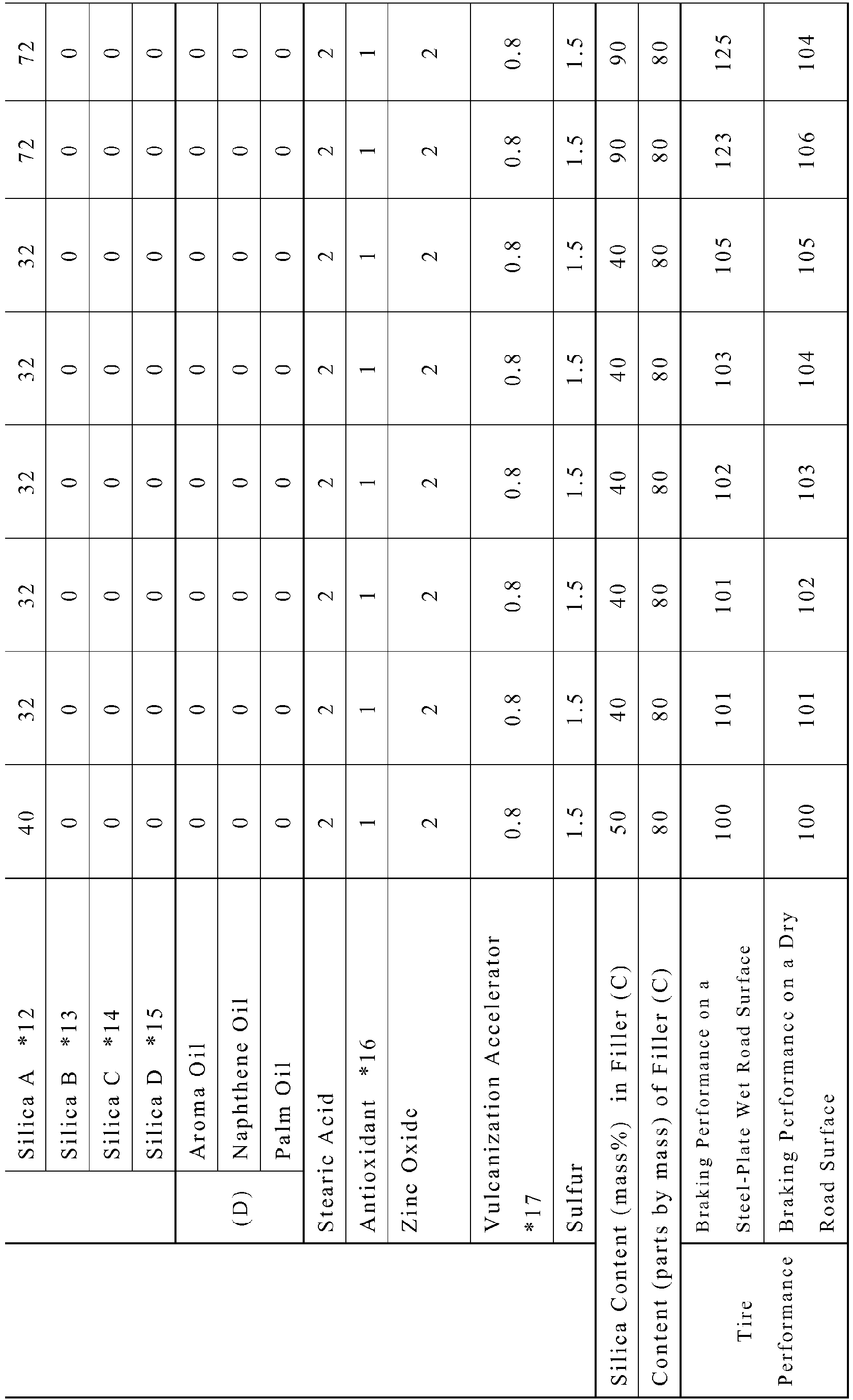
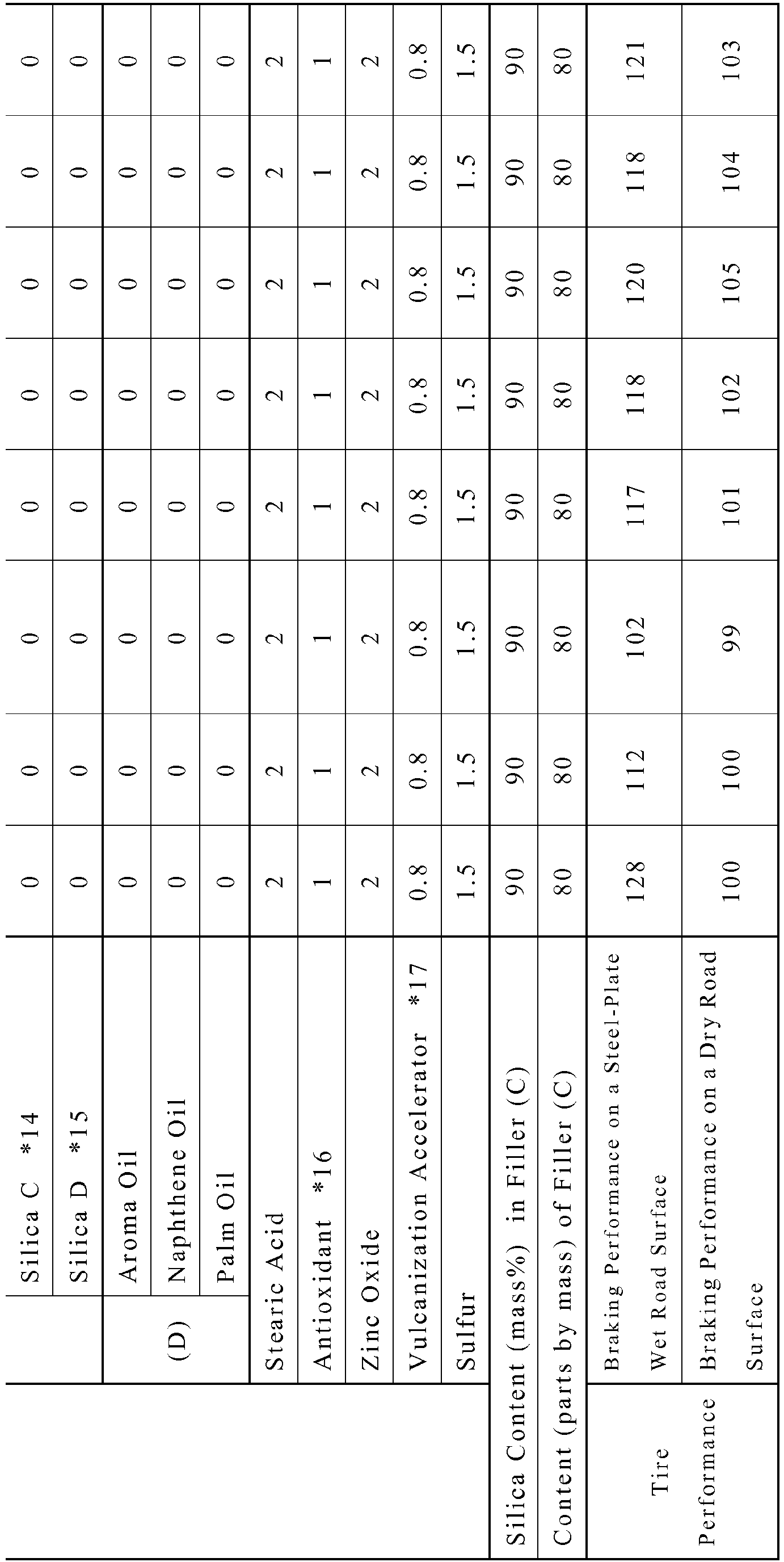
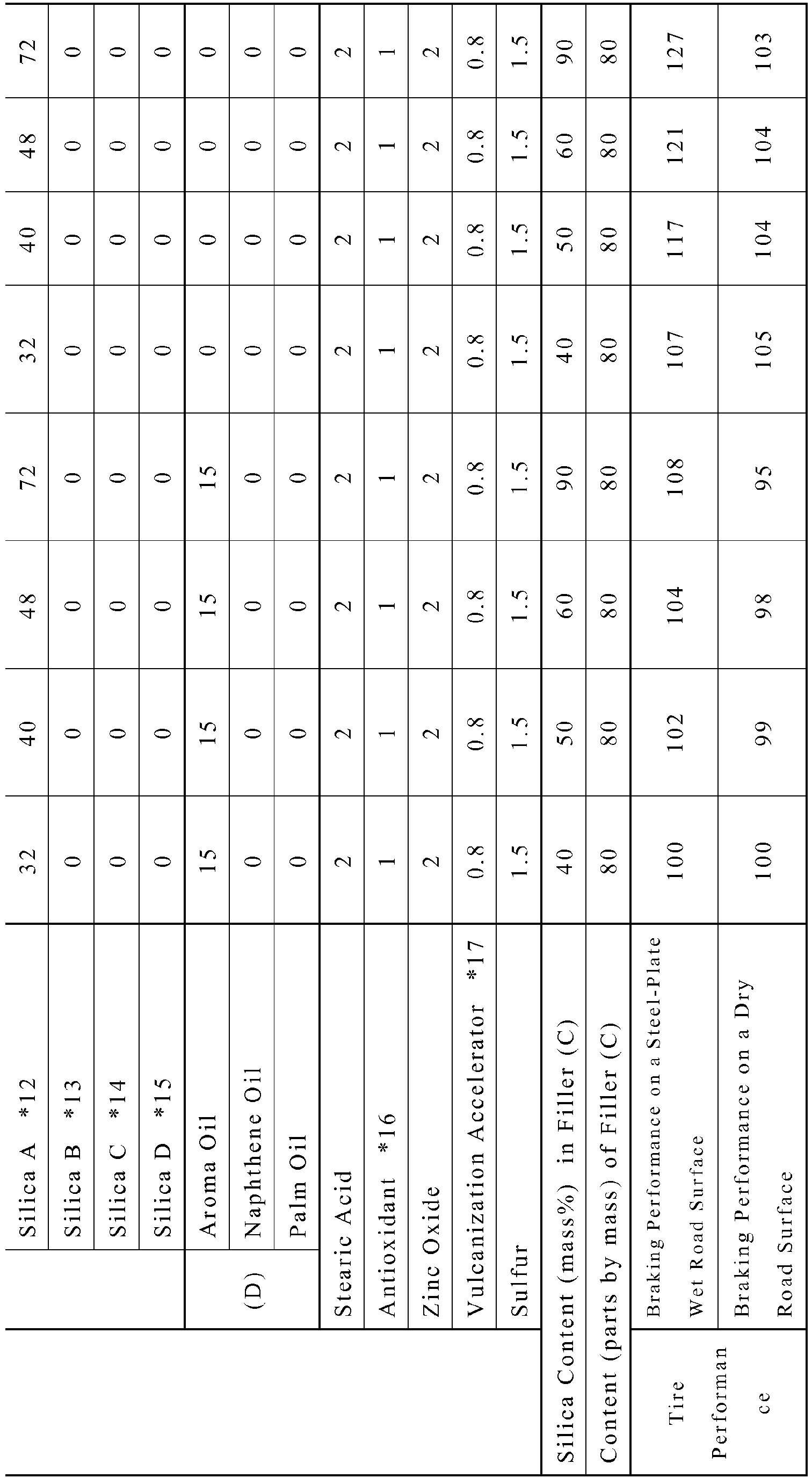
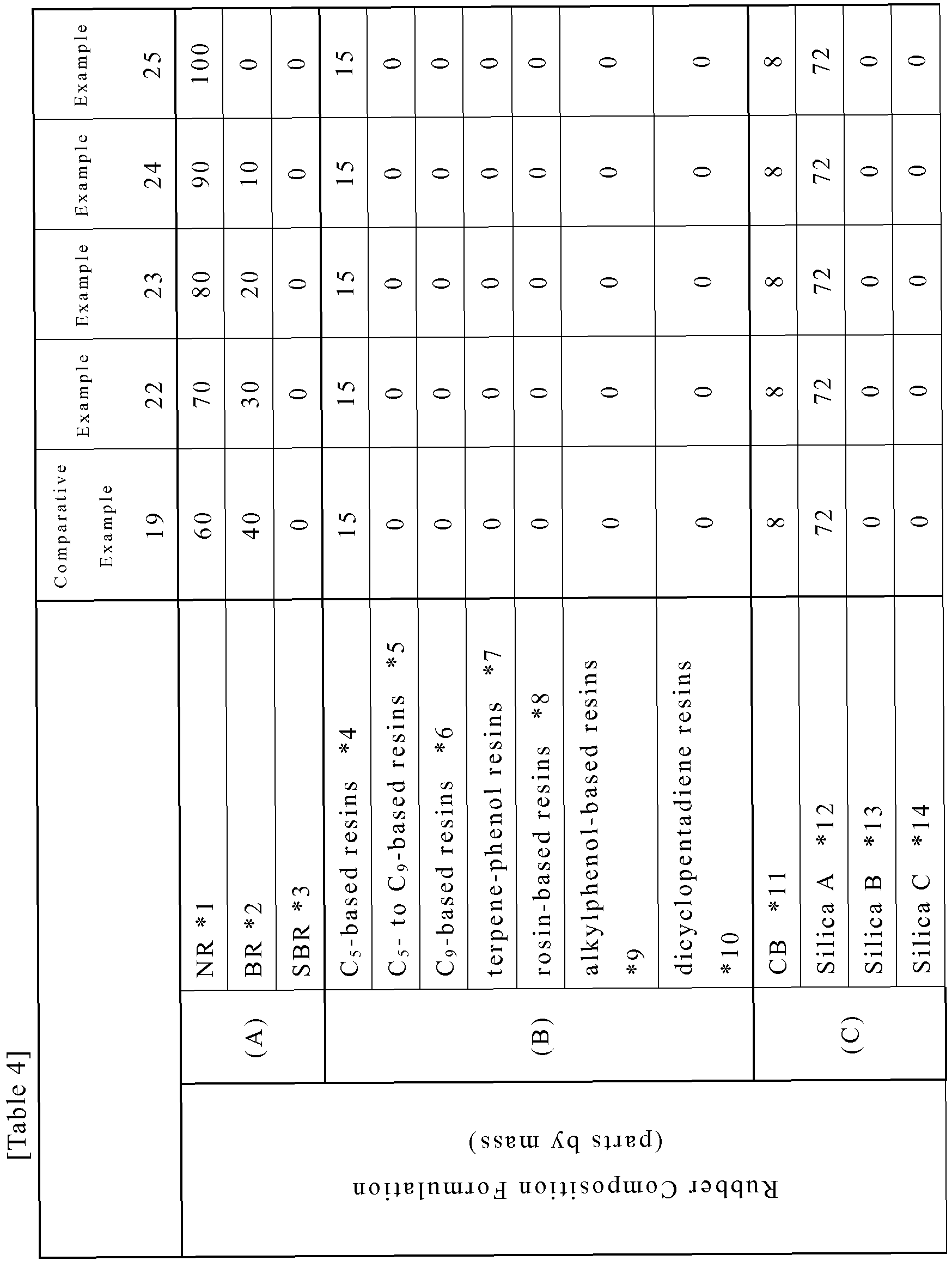
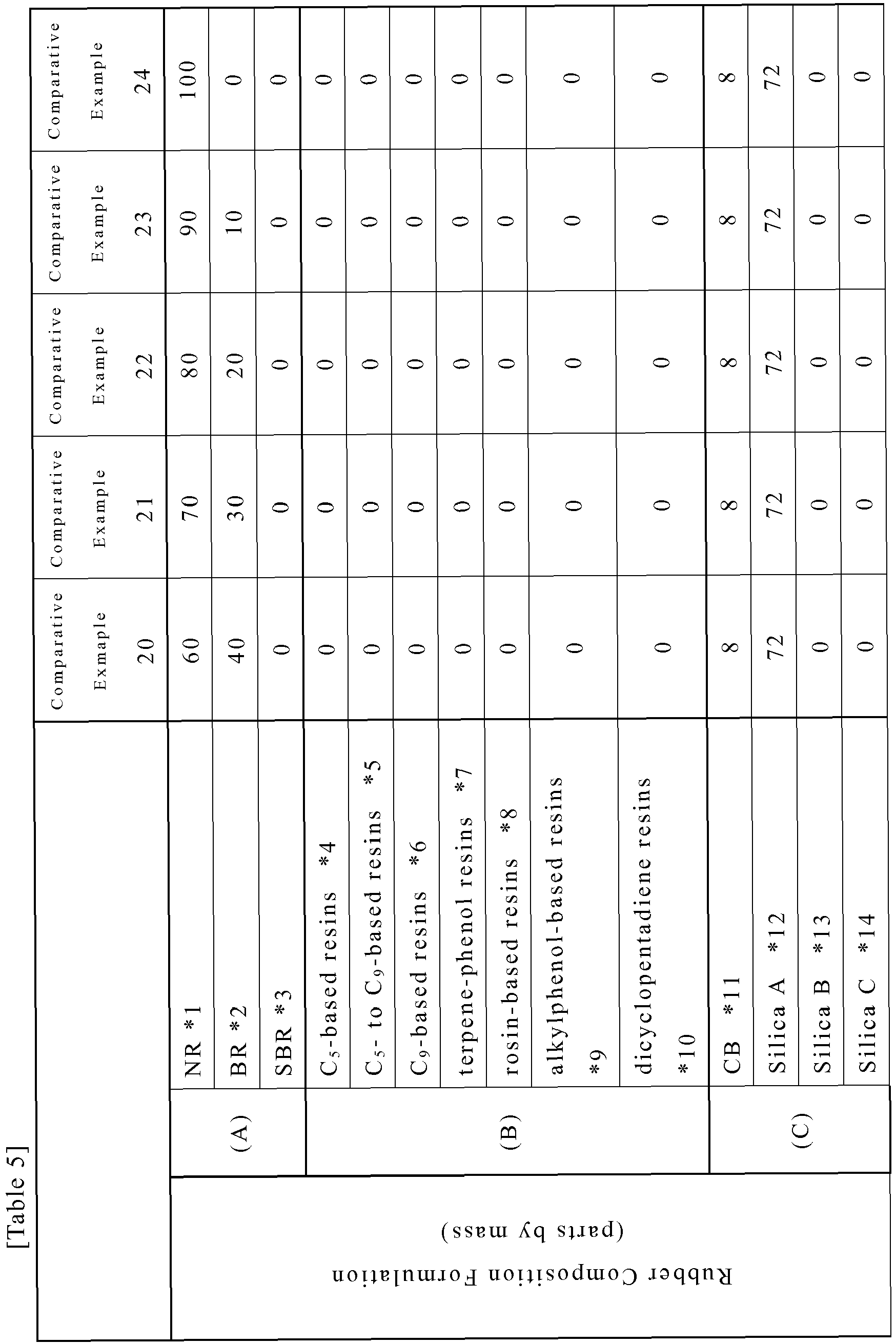
- Rubber compositions were prepared according to the formulations shown in Tables 1-1, 1-2, 2-1, 2-2 and 3 to 6. The rubber compositions thus prepared were each used as the tread rubber to fabricate, with a general method, a radial tire in a size of 195/65R15 for a passenger vehicle.
- test tires were mounted onto a passenger vehicle of 2000 cc displacement.
- the passenger vehicle was run on a steel-plate wet road evaluation path as a test course. Then, the vehicle was braked at the speed of 40 km/h to lock the tires, so as to measure the distance it took to stop.
- the results thereof were indexed using the numeric value of Control as 100 as to the inverse of the distance. The larger index value shows more excellent performance on a steel-plate wet road surface.
- Comparative Example 1 served as Control; in Table 3, Comparative Example 14 served as Control; in Table 4, Comparative Example 19 served as Control; in Table 5, Comparative Example 20 served as Control; and in Table 6, Comparative Example 25 served as Control.
- test tires were mounted onto a passenger vehicle of 2000 cc displacement.
- the passenger vehicle was run on an asphalt evaluation path as a test course. Then, the vehicle was braked at the speed of 80 km/h to lock the tires, so as to measure the distance it took to stop.
- the results thereof were indexed using the numeric value of Control as 100 as to the inverse of the distance. The larger index value shows more excellent performance on a dry road surface.
- Comparative Example 1 served as Control; in Table 3, Comparative Example 14 served as Control; in Table 4, Comparative Example 19 served as Control; in Table 5, Comparative Example
- the disclosed rubber composition is available as tire tread rubber, and may be used mainly in a tire production industry.
Landscapes
- Chemical & Material Sciences (AREA)
- Health & Medical Sciences (AREA)
- Chemical Kinetics & Catalysis (AREA)
- Medicinal Chemistry (AREA)
- Polymers & Plastics (AREA)
- Organic Chemistry (AREA)
- Engineering & Computer Science (AREA)
- Mechanical Engineering (AREA)
- Oil, Petroleum & Natural Gas (AREA)
- Compositions Of Macromolecular Compounds (AREA)
- Tires In General (AREA)
- Manufacture Of Macromolecular Shaped Articles (AREA)
Abstract
Description
- The present disclosure claims priority from Japanese Patent Application No.
2013-244956 (filed on November 27, 2013 - A rubber composition and a tire using the same as the tread rubber are disclosed.
- In view of improving vehicle safety, various studies have been made to improve tire's braking performance and driving performance not only on a dry road surface but on various road surfaces such as a wet road surface and an icy and snowy road surface. There has been known, for example, a technique of using, as a tread rubber, a rubber composition prepared by compounding an aroma oil, together with rubber components such as natural rubber (NR) and butadiene rubber (BR), in order to improve performance on a wet road surface (Patent Literature (PTL) 1).
- In order to improve grip performance on an icy and snowy road surface and a wet road surface, there has also been known a technique of using, as a tread rubber, a rubber composition obtained by compounding C5-based resins at 5 parts by mass to 50 parts by mass with the rubber component as 100 parts by mass, the rubber component including natural rubber and/or polyisoprene rubber by at least 30mass% in total (PTL 2).
-
- PTL 1: JPH5-269884A
- PTL 2:
JP2009-256540A - However, the aforementioned techniques of compounding an aroma oil have involved the following problems. That is, an aroma oil is less compatible with NR and BR, and thus produces insufficient effect of improving performance on a wet road surface. In addition, a rubber composition compounded with an aroma oil is increased in rolling resistance. Meanwhile, the rubber composition obtained by compounding C5-based resins at 5 parts by mass to 50 parts by mass with the rubber component as 100 parts by mass, the rubber component including natural rubber and/or polyisoprene rubber by at least 30mass% in total, is not necessarily high in braking performance on a dry road surface, while failing to exhibit satisfactory wet braking performance on a road surface slipperier than an asphalt road surface.
- It could therefore be helpful to provide a rubber composition that allows for manufacturing a tread rubber that is high in braking performance on a dry road surface as well as having high braking performance even on a wet road surface such as a manhole surface that is slipperier than an asphalt road surface. It could also be helpful to provide a tire using a tread rubber that is high in braking performance on a dry road surface as well as having high braking performance even on a wet road surface such as a manhole surface that is slipperier than an asphalt road surface.
- The disclosed rubber composition is prepared by compounding a rubber component (A) including natural rubber by 70mass% or more, and by further compounding, with the rubber component as 100 parts by mass: (B) at least one kind of thermoplastic resins selected from among C5-based resins, C5- to C9-based resins, C9-based resins, terpene-based resins, terpene-aromatic compound-based resins, rosin-based resins, dicyclopentadiene resins, and alkylphenol-based resins, at 5 parts by mass to 50 parts by mass; and (C) a filler including silica, at 20 parts by mass to 120 parts by mass, in which the filler (C) contains silica by 50mass% to 100mass%.
- A rubber composition, when compounded with the thermoplastic resin (B) selected from among C5-based resins, C5- to C9-based resins, C9-based resins, terpene-based resins, terpene-aromatic compound-based resins, rosin-based resins, dicyclopentadiene resins, and alkylphenol-based resins, can be raised in glass transition temperature (Tg), improved in loss tangent (tanδ) at 0°C, and improved in tire performance on a wet road surface. The effect to be obtained by compounding the thermoplastic resin (B) is particularly conspicuous in a rubber composition that includes a rubber component including natural rubber by 70mass% or more. Further, the rubber component itself has high flexibility with the content of natural rubber being 70mass% or more, and thus exhibits high braking performance on a dry road surface and on a slippery wet road surface such as a manhole surface.
- Further, silica is dispersed in the rubber component having the thermoplastic resin (B) fully dispersed therein, which allows for more flexible deformation of the rubber, with the result that the rubber is improved in follow-up ability on a road surface that is low in friction coefficient. This configuration further improves braking performance on a slippery wet road surface.
- In the subject application, the "C5-based resins" refer to C5-based synthetic petroleum resins, or a solid polymer obtained by polymerizing C5 fraction. The "C5- to C9-based resins" refer to C5- to C9-based synthetic petroleum resins, or a solid polymer obtained by polymerizing C5 to C11 fractions. The "C9-based resins" refer to C9-based synthetic resins, or a solid polymer obtained by polymerizing C9 fraction.
- Here, C5 to C11 fractions used in the polymerization of the solid polymer as the "C5- to C9-based resins" include fractions other than C5 fraction and C9 fraction.
- In the disclosed rubber composition, the rubber component (A) may include styrene-butadiene copolymer rubber by 10mass% to 30mass%.
- The rubber component compounded with a certain amount of a styrene-butadiene copolymer rubber is raised in glass transition temperature (Tg), which leads to an improvement in braking performance and driving stability on a dry road surface.
- The filler (C) may contain silica by 90mass% or more. The increased content of silica further improves braking performance on a slippery wet road surface.
- The disclosed tire uses, as a tread rubber, any of the aforementioned rubber compositions.
- A tire using any of the aforementioned rubber compositions as a tread rubber becomes excellent not only in braking performance on a wet road surface but also in braking performance on a dry road surface and a slippery wet road surface such as a manhole surface.
- The disclosed rubber composition allows for manufacturing a tread rubber that is high in braking performance on a dry road surface and also high in braking performance on a wet road surface such as a manhole surface that is slipperier than an asphalt road surface. The disclosed rubber composition also provides a tire using a tread rubber that is high in braking performance on a dry road surface and also high in braking performance on a wet road surface such as a manhole surface that is slipperier than an asphalt road surface.
- The disclosed rubber composition is prepared by compounding (A) a rubber component including natural rubber by 70mass% or more; and by further compounding, with the rubber component as 100 parts by mass: (B) at least one kind of thermoplastic resins selected from among C5-based resins, C5- to C9-based resins, C9-based resins, terpene-based resins, terpene-aromatic compound-based resins, rosin-based resins, dicyclopentadiene resins, and alkylphenol-based resins, at 5 parts by mass to 50 parts by mass; and (C) a filler including silica, at 20 parts by mass to 120 parts by mass, in which the filler (C) contains silica by 50mass% to 100mass%.
- The rubber component (A) used in the disclosed rubber composition includes: natural rubber (NR) by 70mass% or more, or suitably by 80mass% or more. The rubber component (A) contains NR by 70mass% or more, which provides an effect of allowing sufficient effect to be readily produced when C5-based resins are compounded, as will be described later.
- The rubber component (A) may further include styrene-butadiene copolymer rubber (SBR) by 5mass% to 30mass%, in particular, by 10mass% to 20mass%. The rubber composition compounded with SBR is raised in glass transition temperature (Tg), which improves steering stability and braking performance on a dry road surface. Such effects may potentially be insufficient when the SBR content in the rubber component (A) falls below 10mass%. Meanwhile, when the SBR content in the rubber component (A) exceeds 30mass%, the NR content in the rubber component (A) inevitably falls below 70mass%, which potentially reduces the aforementioned effect to be produced through compounding NR, while potentially causing such problems as increased rolling resistance due to increase of heat generation in the rubber and reduced road surface follow-up ability on a slippery wet road surface due to reduction in flexibility of the rubber.
- The rubber component (A) may contain, as appropriate, butadiene rubber, acrylonitrile-butadiene copolymer rubber, chloroprene rubber, polyisoprene rubber, as other rubber materials.
- The disclosed rubber composition is obtained by compounding at least one kind of thermoplastic resin (B) selected from among C5-based resins, C5-to C9-based resins, C9-based resins, terpene-based resins, terpene-aromatic compound-based resins, rosin-based resins, dicyclopentadiene resins, and alkylphenol-based resins, at 5 parts by mass to 50 parts by mass, with the rubber component (A) as 100 parts by mass. The disclosed rubber composition compounded with the thermoplastic resin (B) to a regulated amount is raised in glass transition temperature (Tg) and improved in loss tangent (tanδ) at 0°C, and thus can be improved in tire performance mainly on a wet road surface. As described above, the rubber component (A) contains NR by 70mass% or more as described above. Here, the aforementioned thermoplastic resin (B) is highly compatible with NR, which particularly contributes to readily obtaining the aforementioned effect.
- In this disclosure, the "C5-based resins" refer to C5-based synthetic petroleum resins, which is, for example, a solid polymer obtained by polymerizing C5 fraction using a catalyst for the Friedel-Crafts reaction, such as AlCl3 and BF3. Specific examples thereof may include: a copolymer including, as main components, isoprene, cyclopentadiene, 1,3-pentadiene, and 1-pentene; a copolymer of 2-pentene and dicyclopentadiene; and a polymer mainly composed of 1,3-pentadiene.
- Here, C5-based resins may be used as the thermoplastic resin (B) so as to further improve braking performance even on an icy and snowy road surface.
- The "C5- to C9-based resins" disclosed herein refer to C5- to C9-based synthetic petroleum resins exemplified by a solid polymer obtained by polymerizing C5 to C11 fractions using a catalyst for the Friedel-Crafts reaction, such as AlCl3 and BF3. Examples of the "C5- to C9-based resins" may include a copolymer including, as main components, styrene, vinyltoluene, α-methylstyrene, and indene. This C5- to C9-based resins disclosed herein may preferably include less component of C9 or more, in view of the compatibility with the component (A). Here, including "less component of C9 or more" means that the component of C9 or more based on the total amount of the resin is less than 50mass%, or preferably less than 40mass%.
- The thermoplastic resin (B) using C5- to C9-based resins may also improve handling performance.
- Here, the C5 to C11 fractions to be used in polymerizing a solid polymer as the "C5- to C9-based resins" include other fractions than C5 fraction and C9 fraction.
- The disclosed "C9-based resins" refers to C9-based synthetic petroleum resins exemplified by a solid polymer obtained by polymerizing C9 fraction using a catalyst for the Friedel-Crafts reaction, such as AlCl3 and BF3. Examples of the "C9-based resin" may include a copolymer including, as main components, indene, α-methylstyrene, and vinyltoluene.
- The thermoplastic resin (B) using C9-based resins may also improve handling performance.
- The aforementioned terpene-based resin is a solid-state resin obtained by compounding turpentine to be obtained simultaneously in obtaining rosin from trees of Pinus, or a polymerizable component separated from the turpentine, and by polymerizing the turpentine or the polymerizable component using a catalyst for the Friedel-Crafts reaction. Examples of the terpene-based resin may include: β-pinene resins; and α-pinene resins. Further, a typical example of the terpene-aromatic compound-based resins may include terpene-phenol resins. The terpene-phenol resins may be obtained through various methods including: causing terpenoids and various phenols to react with each other using a catalyst for the Friedel-Crafts reaction, or further condensing the resultant with formalin. Terpenoids for use as the material are not particularly limited, and may preferably be a monoterpene hydrocarbon such as α-pinenes and limonenes, more preferably terpenoids including α-pinenes, and particularly preferably be α-pienes. In the disclosed rubber composition, terpene-phenol resins with a smaller ratio of phenol component may suitably be used. Here, the "smaller ratio of phenol component" refers to the ratio of phenol component to be 50mass% or less, or preferably 40mass% or less in the total amount of resin.
- The thermoplastic resin (B) using terpene-aromatic compound-based resins, in particular, terpene-phenol resins may further improve handling performance.
- The aforementioned rosin-based resins may include, as a natural resin rosin: a gum rosin, a tall oil rosin, and a wood rosin, which are included in a raw rosin or a tall oil; and also include, as a modified rosin, a rosin derivative, and a modified rosin derivative, for example: a polymeric rosin and its partially hydrogenated rosin; a glycerin ester rosin and its partially hydrogenated rosin or completely hydrogenated rosin; and a pentaerythritol ester rosin and its partially hydrogenated rosin or polymeric rosin.
- The thermoplastic resin (B) using rosin-based resins may also improve handling performance.
- The aforementioned dicyclopentadiene resins refer to, for example, resins obtained by polymerizing dicyclopentadiene using a catalyst for the Friedel-Crafts reaction, such as AlCl3 and BF3. Specific examples of commercially-available dicyclopentadiene resins may include: Quinton 1920 (Nippon Zeon Co., Ltd.); Quinton 1105 (Nippon Zeon Co., Ltd.); and Marukarettsu M-890A (Maruzen Oil Chemical Co., Ltd.).
- The thermoplastic resin (B) using dicyclopentadiene resins may also improve braking performance on an icy and snowy road surface.
- The aforementioned alkylphenol-based resins may be exemplified by an alkylphenol-acetylene resin such as, for example, a p-tert-butylphenol-acetylene resin, and an alkylphenol-formaldehyde resin having a low degree of polymerization.
- The thermoplastic resin (B) using an alkylphenol-based resin may also improve handling performance.
- The aforementioned thermoplastic resin (B) is compounded at 5 parts by mass to 50 parts by mass, preferably 10 parts by mass to 30 parts by mass, with the rubber component (A) as 100 parts by mass. The compounding amount of the thermoplastic resin (B) may be regulated to 5 parts by mass to 50 parts by mass, with the rubber component (A) as 100 parts by mass, to thereby ensure desired rupture properties and wear resistance. When the compounding amount of the thermoplastic resin falls below 5 parts by mass, braking performance on a wet road surface is less likely to be satisfactory, while the amount exceeding 50 parts by mass leads to a fear that a desired wear resistance or rupture resistance be less likely to be obtained.
- The disclosed rubber composition is compounded with the filler (C) at 20 parts by mass to 120 parts by mass, preferably 50 parts by mass to 100 parts by mass, with the rubber component (A) as 100 parts by mass. Further, the filler (C) contains silica by 50mass% to 100mass%, preferably 80mass% to 100mass%, more preferably 90mass% to 100mass%. That is, the disclosed rubber composition contains, with the rubber component (A) as 100 parts by mass, silica at 10 parts by mass to 120 parts by mass, preferably 45 parts by mass to 100 parts by mass. The compounding amount of the filler (C) may be regulated to 20 parts by mass to 120 parts by mass with the rubber component (A) as 100 parts mass, so as to produce an effect of reinforcing the rubber component (A) without impairing such property as flexibility thereof. Further, the filler (C) compounded with silica by 50mass% to 100mass% advantageously provides an effect of reducing rolling resistance and improving in particular braking performance on a wet road surface while suppressing to minimum the degradation of flexibility of the rubber component.
- The disclosed rubber composition compounded with silica provides the following effect. That is, in a state where the NR and the thermoplastic resin (B) are favorably dispersed, the disclosed rubber provides sufficient reinforcing property and low heat generation, without impairing the flexibility thereof. Accordingly, the disclosed rubber composition is flexible enough to have high follow-up property to follow a road surface that is low in friction coefficient (for example, a slippery wet road surface such as a manhole surface), to thereby produce sufficient braking performance on such a slippery wet road surface.
- Examples of silica may include, for example, wet silica (hydrous silica), dry silica (anhydrous silica), calcium silicate, aluminum silicate, with wet silica being suitably used in particular. The wet silica has BET specific surface area of preferably 40 m2/g to 350 m2/g, more preferably 150 m2/g to 300 m2/g, and further preferably 200 m2/g to 250 m2/g. Silica having the BET specific surface area falling within the aforementioned ranges can advantageously attain both rubber reinforcing property and dispersiveness into the rubber component. In light thereof, silica may preferably have the BET specific surface area falling within a range of 80 m2/g to 300 m2/g. Commercially-available examples of such silica may include "Nipsil AQ", "Nipsil KQ" (trade name) produced by Tosoh Silica Corporation, and "ULTRASIL VN3" (trade name) produced by Evonik Industries AG, which may be used alone or in combination of two or more kinds thereof.
- The filler (C) may be compounded with, as appropriate, in addition to silica, for example: carbon black, aluminum oxide, clay, alumina, talc, mica, kaolin, glass balloon, glass beads, calcium carbonate, magnesium carbonate, magnesium hydroxide, calcium carbonate, magnesium oxide, titanium oxide, potassium titanate, and barium sulfate.
- The disclosed rubber composition may be compounded with a silane coupling agent for the purpose of further improving the reinforcing property and low heat generation of silica contained in the rubber composition.
- Examples of the silane coupling agent may include, for example, bis(3-triethoxysilylpropyl)tetrasulfide, bis(3-triethoxysilylpropyl)trisulfide, bis(3-triethoxysilylpropyl)disulfide, bis(2-triethoxysilylethyl)tetrasulfide, bis(3-trimethoxysilylpropyl)tetrasulfide, bis(2-trimethoxysilylethyl)tetrasulfide, 3-mercaptopropyltrimethoxysilane, 3-mercaptopropyltriethoxysilane, 2-mercaptoethyltrimethoxysilane, 2-mercaptoethyltriethoxysilane, 3-trimethoxysilylprpopyl-N,N-dimethylthiocarbamoyltetrasulfide, 3-triethoxysilylprpopyl-N,N-dimethylthiocarbamoyltetrasulfide, 2-triethoxysilylethyl-N,N-dimethylthiocarbamoyltetrasulfide, 3-trimethoxysilylpropylbenzothiazolyltetrasulfide, 3-triethoxysilylpropylbenzolyltetrasulfide, 3-triethoxysilylpropylmethacrylatemonosulfide, 3-trimethoxysilylpropylmethacrylatemonosulfide, bis(3-diethoxymethylsilylpropyl)tetrasulfide, 3-mercaptopropyldimethoxymethylsilane, dimethoxymethylsilylpropyl-N,N-dimethylthiocarbamoyltetrasulfide, dimethoxymethylsilylpropylbenzothiazolyltetrasulfide, among which bis(3-triethoxysilylpropyl)polysulfide and 3-trimethoxysilylpropylbenzothiazoletetrasulfide are suited for use in view of the reinforcement improving effect.
- Of the aforementioned silane coupling agents, one kind may be used alone, or two or more kinds may be used in combination.
- In the disclosed rubber composition, a preferred compounding amount of the silane coupling agent, which may vary depending on the kind of the silane coupling agent or the like, is preferably selected to fall within a range of 2mass% to 25mass% relative to the amount of silica. When the amount is less than 2mass%, the silane coupling agent fails to fully exert the effect thereof, while the amount exceeding 25mass% may leads to a fear of causing gelation of the rubber component. In light of the effect as the coupling agent and preventing gelation, the compounding amount of the silane coupling agent may more preferably fall within the range of 2mass% to 20mass%, further preferably within a range of 5mass% to 18mass%, and particularly preferably within a range of 5mass% to 15mass%.
- The disclosed rubber composition may be obtained by further compounding a softener (D). Here, examples of the softener (D) may include: a petroleum-based softener such as an aroma oil, a paraffin oil, and a naphthene oil; and a plant-based softener such as a palm oil, a castor oil, a cottonseed oil, and a soybean oil. The softener (D) to be compounded may preferably be in a liquid state at ordinary temperature such as 25°C in view of handling easiness. Of those described above, for example, a petroleum-based softener such as an aroma oil, a paraffin oil, and a naphthene oil is preferred, but preferably no plant-based softener should be compounded. Then, in compounding the softener (D), the rubber composition may be prepared by compounding the softener (D) preferably at 10 parts by mass or less, or more preferably 5 parts by mass or less, with the rubber component (A) as 100 parts by mass. The amount of the softener (D) is 10 parts by mass or less with the rubber component (A) as 100 parts by mass, which can enhance the effect of improving braking performance on a wet road surface such as a manhole surface that is slipperier than an asphalt road surface. However, in view of braking performance on a wet road surface, it is particularly preferred not to compound the softener (D) in the disclosed rubber composition.
- The disclosed rubber composition may be compounded with, in addition to the rubber component (A), the thermoplastic resin (B), the filler (C), and the softener (D) described above, other compounding agents generally used in the rubber industry, such as, for example, an antioxidant, a vulcanization accelerator, a vulcanization accelerator aid, and a vulcanizing agent, which may be selected as appropriate without affecting the object of the present disclosure, within a range of general amount. Commercially-available agents may suitably be used as the compounding agents. The disclosed rubber composition may be manufactured by compounding the rubber component (A) including NR, with the thermoplastic resin (B), the filler (C), the softener (D) selected as appropriate, and/or various compounding agents, and by subjecting the resulting compound to such process as kneading, warming, and extrusion.
- The disclosed tire uses the aforementioned rubber composition as the tread rubber. The aforementioned rubber composition is used as the tread rubber to form a raw tire, and the raw tire may be vulcanized with a usual method, to thereby manufacture the disclosed tire. The tread rubber of the disclosed tire uses the aforementioned rubber composition, and thus, the disclosed tire is particularly excellent both in icy and snowy road performance and wet road performance. The disclosed tire may be filled with ordinary air or air adjusted in partial pressure of oxygen, and may also be filled with an inert gas such as nitrogen, argon, and helium.
- The disclosed rubber composition is described in further detail with reference to Examples illustrated in below. However, the disclosed rubber composition is not limited at all to the following Examples.
- Rubber compositions were prepared according to the formulations shown in Tables 1-1, 1-2, 2-1, 2-2 and 3 to 6. The rubber compositions thus prepared were each used as the tread rubber to fabricate, with a general method, a radial tire in a size of 195/65R15 for a passenger vehicle.
- Four test tires were mounted onto a passenger vehicle of 2000 cc displacement. The passenger vehicle was run on a steel-plate wet road evaluation path as a test course. Then, the vehicle was braked at the speed of 40 km/h to lock the tires, so as to measure the distance it took to stop. The results thereof were indexed using the numeric value of Control as 100 as to the inverse of the distance. The larger index value shows more excellent performance on a steel-plate wet road surface.
- Here, in Tables 1-1, 1-2, 2-1 and 2-2, Comparative Example 1 served as Control; in Table 3, Comparative Example 14 served as Control; in Table 4, Comparative Example 19 served as Control; in Table 5, Comparative Example 20 served as Control; and in Table 6, Comparative Example 25 served as Control.
- Four test tires were mounted onto a passenger vehicle of 2000 cc displacement. The passenger vehicle was run on an asphalt evaluation path as a test course. Then, the vehicle was braked at the speed of 80 km/h to lock the tires, so as to measure the distance it took to stop. The results thereof were indexed using the numeric value of Control as 100 as to the inverse of the distance. The larger index value shows more excellent performance on a dry road surface.
- Here, in Tables 1-1, 1-2, 2-1 and 2-2, Comparative Example 1 served as Control; in Table 3, Comparative Example 14 served as Control; in Table 4, Comparative Example 19 served as Control; in Table 5, Comparative Example







-
- *1 ··· natural rubber RSS#3
- *2 ··· butadiene rubber BR01
- *3 ··· styrene-butadiene copolymer rubber #1500
- *4 ··· C5-based resins, ExxonMobil Chemical Company, trade named "ECR1102"
- *5 ··· C5- to C9-based resins, ExxonMobile Chemical Company, trade named "ECR213"
- *6 ··· C9-based resins, Nippon Petrochemicals Co., Ltd., trade named "Neopolymer 140"
- *7 ··· terpene-phenol resins, YASUHARA CHEMICAL CO.,LTD., trade named "YS Polystar T100"
- *8 ··· rosin-based resins, Taisha Sho Seiyu (Taisha Pine Essential Oil Co.,Ltd.), trade named "Hairojin S"
- *9 ··· alkylphenol-based resins, SI GROUP Inc., trade named "R7510PJ"
- *10 ··· dicyclopentadiene resins, Nippon Zeon Co., Ltd., trade named "Quinton 1105"
- *11 ··· Carbon Black ISAF
- *12 ··· Silica A, Tosoh Silica Corporation, trade named "Nipsil AQ", BET specific surface area: 205 m2/g
- *13 ··· Silica B, Evonik Industries AG, trade named "ULTRASIL VN3", BET specific surface area: 175 m2/g
- *14 ··· Silica C, Tosoh Silica Corporation, trade named "Nipsil" as made to order, CTAB: 191 m2/g
- *15 ··· Silica D, Tosoh Silica Corporation, trade named "Nipsil" as made to order, CTAB: 94 m2/g
- *16 ··· antioxidant, 6PPD
- *17 ··· vulcanization accelerator, DPG
- The results shown in Tables 1 to 6 have found that the disclosed rubber composition allows for manufacturing a tread rubber that is high in braking performance on a dry road surface and also high in braking performance even on a wet road surface such as a manhole surface that is slipperier than an asphalt road surface.
- The disclosed rubber composition is available as tire tread rubber, and may be used mainly in a tire production industry.
Claims (4)
- A rubber composition prepared by compounding a rubber component (A) comprising a natural rubber by 70mass% or more, and by further compounding, with the rubber component as 100 parts by mass: (B) at least one kind of thermoplastic resins selected from among C5-based resins, C5- to C9-based resins, C9-based resins, terpene-based resins, terpene-aromatic compound-based resins, rosin-based resins, dicyclopentadiene resins, and alkylphenol-based resins, at 5 parts by mass to 50 parts by mass; and (C) a filler including silica, at 20 parts by mass to 120 parts by mass,
wherein the filler (C) contains silica by 50mass% to 100mass%. - The rubber composition according to claim 1, wherein the rubber component (A) comprises a styrene-butadiene copolymer rubber by 10mass% to 30mass%.
- The rubber composition according to claim 1 or 2, wherein the filler (C) contains silica by 90mass% or more.
- A tire using the rubber composition according to claim 1 or 2, as a tread rubber.
Applications Claiming Priority (2)
| Application Number | Priority Date | Filing Date | Title |
|---|---|---|---|
| JP2013244956 | 2013-11-27 | ||
| PCT/JP2014/005953 WO2015079703A1 (en) | 2013-11-27 | 2014-11-27 | Rubber composition and tire |
Publications (2)
| Publication Number | Publication Date |
|---|---|
| EP3075773A1 true EP3075773A1 (en) | 2016-10-05 |
| EP3075773A4 EP3075773A4 (en) | 2016-10-26 |
Family
ID=53198665
Family Applications (1)
| Application Number | Title | Priority Date | Filing Date |
|---|---|---|---|
| EP14866008.7A Withdrawn EP3075773A4 (en) | 2013-11-27 | 2014-11-27 | RUBBER COMPOSITION AND TIRE |
Country Status (6)
| Country | Link |
|---|---|
| US (1) | US10696823B2 (en) |
| EP (1) | EP3075773A4 (en) |
| JP (8) | JP5837727B2 (en) |
| CN (2) | CN105764973B (en) |
| RU (1) | RU2644167C2 (en) |
| WO (1) | WO2015079703A1 (en) |
Cited By (6)
| Publication number | Priority date | Publication date | Assignee | Title |
|---|---|---|---|---|
| EP3312231A4 (en) * | 2015-06-22 | 2018-04-25 | Bridgestone Corporation | Rubber composition, laminate, and conveyor belt |
| US20180229553A1 (en) * | 2017-02-13 | 2018-08-16 | Cooper Tire & Rubber Company | Tire tread compound |
| EP3517568A4 (en) * | 2016-09-26 | 2020-04-15 | Bridgestone Corporation | Rubber composition, and tire |
| EP3467020B1 (en) | 2016-06-01 | 2020-10-28 | Bridgestone Corporation | Rubber composition and tire |
| US10843508B2 (en) | 2017-02-13 | 2020-11-24 | Cooper Tire & Rubber Company | Guayule tire tread compound |
| EP4311690B1 (en) | 2022-07-28 | 2025-05-21 | The Goodyear Tire & Rubber Company | Rubber composition for a truck tire |
Families Citing this family (34)
| Publication number | Priority date | Publication date | Assignee | Title |
|---|---|---|---|---|
| JP7240080B2 (en) * | 2015-11-12 | 2023-03-15 | 住友ゴム工業株式会社 | tire |
| WO2017165499A1 (en) | 2016-03-23 | 2017-09-28 | Bridgestone Americas Tire Operations, Llc | Resin-extended rubber and process for preparing |
| JP6798141B2 (en) * | 2016-05-11 | 2020-12-09 | 住友ゴム工業株式会社 | Winter tires |
| JP6633972B2 (en) * | 2016-05-27 | 2020-01-22 | 株式会社ブリヂストン | Pneumatic tire |
| US20190194427A1 (en) * | 2016-06-01 | 2019-06-27 | Bridgestone Corporation | Rubber composition and tire |
| US20200032037A1 (en) | 2017-04-06 | 2020-01-30 | Bridgestone Corporation | Rubber composition and tire |
| JP2019006845A (en) * | 2017-06-20 | 2019-01-17 | 株式会社ブリヂストン | Rubber composition and tire using the same |
| US11613144B2 (en) | 2017-08-31 | 2023-03-28 | Bridgestone Corporation | Pneumatic tire |
| WO2019045504A1 (en) * | 2017-08-31 | 2019-03-07 | 코오롱인더스트리 주식회사 | RUBBER COMPOSITION |
| WO2019045062A1 (en) | 2017-08-31 | 2019-03-07 | 株式会社ブリヂストン | Pneumatic tire |
| US20200377696A1 (en) | 2017-10-31 | 2020-12-03 | Bridgestone Corporation | Rubber composition and tire |
| WO2019117263A1 (en) | 2017-12-14 | 2019-06-20 | 株式会社ブリヂストン | Rubber composition and tire |
| WO2019117214A1 (en) | 2017-12-14 | 2019-06-20 | 株式会社ブリヂストン | Rubber composition and tire |
| JP7260268B2 (en) * | 2018-02-22 | 2023-04-18 | 株式会社ブリヂストン | tire |
| US11945952B2 (en) | 2018-12-20 | 2024-04-02 | Total Marketing Services | Rubber composition comprising esters from renewable sources as plasticizers |
| US20230357543A1 (en) * | 2019-11-06 | 2023-11-09 | Bridgestone Americas Tire Operations, Llc | Tire Having Tread Of Specified Rubber Composition And Related Methods |
| JP7360314B2 (en) * | 2019-12-13 | 2023-10-12 | 株式会社ブリヂストン | Rubber composition for base tread and tires |
| WO2021117337A1 (en) * | 2019-12-13 | 2021-06-17 | 株式会社ブリヂストン | Base tread rubber composition and tyre |
| US20230043282A1 (en) | 2019-12-19 | 2023-02-09 | Bridgestone Corporation | Rubber composition and tire |
| KR102813642B1 (en) * | 2020-05-18 | 2025-05-27 | 주식회사 엘지화학 | Method for analyzing abration resistance by distribution of aggregated inorganic filler in rubber composite |
| US20240270945A1 (en) | 2021-05-28 | 2024-08-15 | Bridgestone Corporation | TIRE RUBBER COMPOSITION, TREAD RUBBER, and TIRE |
| EP4349613A4 (en) | 2021-05-28 | 2024-09-11 | Bridgestone Corporation | RUBBER COMPOSITION FOR TIRE, TREAD RUBBER, AND TIRE |
| CN117396550A (en) | 2021-05-28 | 2024-01-12 | 株式会社普利司通 | Rubber composition for tires, tread rubber and tires |
| JPWO2022249766A1 (en) | 2021-05-28 | 2022-12-01 | ||
| JPWO2022259751A1 (en) | 2021-06-08 | 2022-12-15 | ||
| JP2023096741A (en) * | 2021-12-27 | 2023-07-07 | 住友ゴム工業株式会社 | tire |
| JP2024014499A (en) | 2022-07-22 | 2024-02-01 | 住友ゴム工業株式会社 | tire |
| EP4624522A4 (en) | 2022-11-25 | 2026-04-01 | Bridgestone Corp | TIRE RUBBER COMPOSITION, TREAD RUBBER AND TIRES |
| JPWO2024111651A1 (en) | 2022-11-25 | 2024-05-30 | ||
| WO2024111598A1 (en) | 2022-11-25 | 2024-05-30 | 株式会社ブリヂストン | Pneumatic tire |
| WO2024111650A1 (en) | 2022-11-25 | 2024-05-30 | 株式会社ブリヂストン | Tire |
| JP7534681B1 (en) | 2023-03-10 | 2024-08-15 | 横浜ゴム株式会社 | Rubber composition for tires |
| WO2024219257A1 (en) * | 2023-04-19 | 2024-10-24 | 東ソー株式会社 | Rubber composition |
| WO2024224673A1 (en) | 2023-04-28 | 2024-10-31 | 株式会社ブリヂストン | Tire rubber composition, tread rubber, and tire |
Family Cites Families (34)
| Publication number | Priority date | Publication date | Assignee | Title |
|---|---|---|---|---|
| JP3284277B2 (en) | 1992-03-30 | 2002-05-20 | 東洋ゴム工業株式会社 | Tread rubber composition for studless tires |
| JP3523613B2 (en) * | 2001-06-22 | 2004-04-26 | ニッタ株式会社 | High damping rubber composition |
| JPWO2005090463A1 (en) | 2004-03-18 | 2008-01-31 | 株式会社ブリヂストン | Pneumatic tire |
| JP4602716B2 (en) | 2004-08-24 | 2010-12-22 | 住友ゴム工業株式会社 | Rubber composition for tread |
| JP4805584B2 (en) | 2005-01-21 | 2011-11-02 | 住友ゴム工業株式会社 | Rubber composition for tread and tire comprising the same |
| JP2007186567A (en) | 2006-01-12 | 2007-07-26 | Yokohama Rubber Co Ltd:The | Rubber composition for tread of tire |
| JP2007231085A (en) | 2006-02-28 | 2007-09-13 | Yokohama Rubber Co Ltd:The | Rubber composition for tire |
| JP4372171B2 (en) | 2007-02-28 | 2009-11-25 | 横浜ゴム株式会社 | Rubber composition for tire tread |
| US8557937B1 (en) | 2012-05-09 | 2013-10-15 | Sabic Innovative Plastics Ip B.V. | Rubber composition, method for its formation, and automotive tire containing the composition |
| EP2149588B1 (en) | 2007-05-22 | 2013-05-15 | Sumitomo Rubber Industries, Ltd. | Rubber composition and pneumatic tire using the same |
| JP4938562B2 (en) | 2007-06-22 | 2012-05-23 | 住友ゴム工業株式会社 | Rubber composition and pneumatic tire using the same |
| JP2009173783A (en) * | 2008-01-25 | 2009-08-06 | Yokohama Rubber Co Ltd:The | Diene-based rubber composition |
| JP5244444B2 (en) | 2008-04-21 | 2013-07-24 | 株式会社ブリヂストン | Winter tires |
| JP5404090B2 (en) * | 2009-02-20 | 2014-01-29 | 住友ゴム工業株式会社 | High damping composition |
| WO2010123015A1 (en) | 2009-04-21 | 2010-10-28 | 株式会社ブリヂストン | Process for producing resin-extended isoprene rubber, rubber composition obtained by the process, and pneumatic tire |
| JP2011088998A (en) | 2009-10-21 | 2011-05-06 | Bridgestone Corp | Rubber composition and tire |
| FR2954774B1 (en) | 2009-10-30 | 2012-01-06 | Michelin Soc Tech | METHOD OF PREPARING A MASTER MIXTURE OF NATURAL RUBBER AND SILICA |
| JP2011225731A (en) | 2010-04-20 | 2011-11-10 | Bridgestone Corp | Rubber composition and tire using the same |
| JP5508177B2 (en) * | 2010-07-29 | 2014-05-28 | 住友ゴム工業株式会社 | Rubber composition for cap tread and studless tire |
| JP2012087175A (en) | 2010-10-15 | 2012-05-10 | Bridgestone Corp | Rubber composition, method of producing the rubber composition, and pneumatic tire |
| JP5665475B2 (en) * | 2010-10-25 | 2015-02-04 | 株式会社ブリヂストン | Rubber composition and pneumatic tire using the same |
| JP5628751B2 (en) * | 2011-06-08 | 2014-11-19 | 住友ゴム工業株式会社 | Rubber composition and pneumatic tire |
| US9932460B2 (en) | 2011-04-22 | 2018-04-03 | Sumitomo Rubber Industries, Ltd. | Rubber composition and pneumatic tire |
| JP5559234B2 (en) | 2011-08-09 | 2014-07-23 | 住友ゴム工業株式会社 | Rubber composition for tire and pneumatic tire |
| FR2980481B1 (en) * | 2011-09-26 | 2013-10-11 | Michelin Soc Tech | PNEUMATIC WITH IMPROVED ADHERENCE TO WET SOIL |
| FR2980480B1 (en) | 2011-09-26 | 2013-10-11 | Michelin Soc Tech | PNEUMATIC WITH IMPROVED ADHERENCE TO WET SOIL |
| JP2013166826A (en) | 2012-02-14 | 2013-08-29 | Sumitomo Rubber Ind Ltd | Rubber composition for tire, and winter tire |
| JP2013216753A (en) | 2012-04-06 | 2013-10-24 | Bridgestone Corp | Method of manufacturing rubber composition for tire tread |
| JP5770757B2 (en) * | 2012-05-09 | 2015-08-26 | 住友ゴム工業株式会社 | Rubber composition and pneumatic tire |
| KR20150024849A (en) | 2012-06-30 | 2015-03-09 | 가부시키가이샤 브리지스톤 | Rubber composition for tire treads |
| JP5914216B2 (en) | 2012-06-30 | 2016-05-11 | 株式会社ブリヂストン | Rubber composition for tire tread |
| JP6019946B2 (en) * | 2012-08-31 | 2016-11-02 | 横浜ゴム株式会社 | Rubber composition for tire tread |
| JP6196476B2 (en) * | 2013-05-31 | 2017-09-13 | 株式会社ブリヂストン | Rubber composition |
| DE102013110720A1 (en) | 2013-09-27 | 2015-04-02 | Continental Reifen Deutschland Gmbh | Sulfur crosslinkable rubber compound and pneumatic vehicle tires |
-
2014
- 2014-11-27 CN CN201480064640.7A patent/CN105764973B/en active Active
- 2014-11-27 CN CN201811220357.5A patent/CN109553811B/en active Active
- 2014-11-27 US US15/038,850 patent/US10696823B2/en active Active
- 2014-11-27 JP JP2015539986A patent/JP5837727B2/en active Active
- 2014-11-27 RU RU2016121033A patent/RU2644167C2/en active
- 2014-11-27 WO PCT/JP2014/005953 patent/WO2015079703A1/en not_active Ceased
- 2014-11-27 EP EP14866008.7A patent/EP3075773A4/en not_active Withdrawn
-
2015
- 2015-11-05 JP JP2015217867A patent/JP6092986B2/en not_active Ceased
- 2015-11-05 JP JP2015217869A patent/JP6173406B2/en active Active
-
2017
- 2017-02-09 JP JP2017022541A patent/JP6345285B2/en active Active
- 2017-02-09 JP JP2017022538A patent/JP6346325B2/en active Active
- 2017-02-09 JP JP2017022537A patent/JP6367991B2/en active Active
-
2018
- 2018-05-24 JP JP2018099955A patent/JP6600714B2/en active Active
- 2018-07-05 JP JP2018128430A patent/JP6674977B2/en active Active
Cited By (7)
| Publication number | Priority date | Publication date | Assignee | Title |
|---|---|---|---|---|
| EP3312231A4 (en) * | 2015-06-22 | 2018-04-25 | Bridgestone Corporation | Rubber composition, laminate, and conveyor belt |
| EP3467020B1 (en) | 2016-06-01 | 2020-10-28 | Bridgestone Corporation | Rubber composition and tire |
| EP3517568A4 (en) * | 2016-09-26 | 2020-04-15 | Bridgestone Corporation | Rubber composition, and tire |
| US20180229553A1 (en) * | 2017-02-13 | 2018-08-16 | Cooper Tire & Rubber Company | Tire tread compound |
| US10843508B2 (en) | 2017-02-13 | 2020-11-24 | Cooper Tire & Rubber Company | Guayule tire tread compound |
| US11465446B2 (en) | 2017-02-13 | 2022-10-11 | Cooper Tire & Rubber Company | Natural rubber tire tread compound |
| EP4311690B1 (en) | 2022-07-28 | 2025-05-21 | The Goodyear Tire & Rubber Company | Rubber composition for a truck tire |
Also Published As
| Publication number | Publication date |
|---|---|
| JP6346325B2 (en) | 2018-06-20 |
| JP6173406B2 (en) | 2017-08-02 |
| JP2016027176A (en) | 2016-02-18 |
| JP6674977B2 (en) | 2020-04-01 |
| JP6345285B2 (en) | 2018-06-20 |
| JP2017088900A (en) | 2017-05-25 |
| EP3075773A4 (en) | 2016-10-26 |
| JP2017088899A (en) | 2017-05-25 |
| CN105764973A (en) | 2016-07-13 |
| JP2018159086A (en) | 2018-10-11 |
| CN109553811B (en) | 2021-02-19 |
| JP5837727B2 (en) | 2015-12-24 |
| JP6092986B2 (en) | 2017-03-08 |
| JP6600714B2 (en) | 2019-10-30 |
| US10696823B2 (en) | 2020-06-30 |
| JP2018159078A (en) | 2018-10-11 |
| CN109553811A (en) | 2019-04-02 |
| WO2015079703A1 (en) | 2015-06-04 |
| JP2016094600A (en) | 2016-05-26 |
| JPWO2015079703A1 (en) | 2017-03-16 |
| JP2017088901A (en) | 2017-05-25 |
| CN105764973B (en) | 2018-11-13 |
| RU2644167C2 (en) | 2018-02-08 |
| US20160376426A1 (en) | 2016-12-29 |
| RU2016121033A (en) | 2017-11-28 |
| JP6367991B2 (en) | 2018-08-01 |
Similar Documents
| Publication | Publication Date | Title |
|---|---|---|
| US10696823B2 (en) | Rubber composition and tire | |
| US10745545B2 (en) | Tire and method of manufacturing rubber composition | |
| EP3467020B1 (en) | Rubber composition and tire | |
| EP3467019A1 (en) | Rubber composition, method for producing rubber composition, and tire | |
| EP3305546B1 (en) | Tire | |
| EP3305561B1 (en) | Tire | |
| WO2026014194A1 (en) | Tire |
Legal Events
| Date | Code | Title | Description |
|---|---|---|---|
| PUAI | Public reference made under article 153(3) epc to a published international application that has entered the european phase |
Free format text: ORIGINAL CODE: 0009012 |
|
| 17P | Request for examination filed |
Effective date: 20160523 |
|
| AK | Designated contracting states |
Kind code of ref document: A1 Designated state(s): AL AT BE BG CH CY CZ DE DK EE ES FI FR GB GR HR HU IE IS IT LI LT LU LV MC MK MT NL NO PL PT RO RS SE SI SK SM TR |
|
| AX | Request for extension of the european patent |
Extension state: BA ME |
|
| A4 | Supplementary search report drawn up and despatched |
Effective date: 20160926 |
|
| RIC1 | Information provided on ipc code assigned before grant |
Ipc: C08L 93/04 20060101ALI20160920BHEP Ipc: C08L 9/06 20060101ALI20160920BHEP Ipc: B60C 1/00 20060101ALI20160920BHEP Ipc: C08L 7/00 20060101AFI20160920BHEP Ipc: C08L 57/02 20060101ALI20160920BHEP Ipc: C08K 3/36 20060101ALI20160920BHEP Ipc: C08L 61/04 20060101ALI20160920BHEP |
|
| DAX | Request for extension of the european patent (deleted) | ||
| STAA | Information on the status of an ep patent application or granted ep patent |
Free format text: STATUS: EXAMINATION IS IN PROGRESS |
|
| 17Q | First examination report despatched |
Effective date: 20210422 |
|
| STAA | Information on the status of an ep patent application or granted ep patent |
Free format text: STATUS: THE APPLICATION IS DEEMED TO BE WITHDRAWN |
|
| 18D | Application deemed to be withdrawn |
Effective date: 20220823 |