EP3075440A1 - Hydrophilically modified fluorinated membrane - Google Patents
Hydrophilically modified fluorinated membrane Download PDFInfo
- Publication number
- EP3075440A1 EP3075440A1 EP15192121.0A EP15192121A EP3075440A1 EP 3075440 A1 EP3075440 A1 EP 3075440A1 EP 15192121 A EP15192121 A EP 15192121A EP 3075440 A1 EP3075440 A1 EP 3075440A1
- Authority
- EP
- European Patent Office
- Prior art keywords
- porous membrane
- coating
- membrane
- hydrophilic
- composite hydrophilic
- Prior art date
- Legal status (The legal status is an assumption and is not a legal conclusion. Google has not performed a legal analysis and makes no representation as to the accuracy of the status listed.)
- Granted
Links
- 0 FC(C(F)(F)F)(C(*C1(*C2(C(CCS)(*3)F)F)C23F)(C1(F)F)F)F Chemical compound FC(C(F)(F)F)(C(*C1(*C2(C(CCS)(*3)F)F)C23F)(C1(F)F)F)F 0.000 description 4
Images
Classifications
-
- C—CHEMISTRY; METALLURGY
- C09—DYES; PAINTS; POLISHES; NATURAL RESINS; ADHESIVES; COMPOSITIONS NOT OTHERWISE PROVIDED FOR; APPLICATIONS OF MATERIALS NOT OTHERWISE PROVIDED FOR
- C09D—COATING COMPOSITIONS, e.g. PAINTS, VARNISHES OR LACQUERS; FILLING PASTES; CHEMICAL PAINT OR INK REMOVERS; INKS; CORRECTING FLUIDS; WOODSTAINS; PASTES OR SOLIDS FOR COLOURING OR PRINTING; USE OF MATERIALS THEREFOR
- C09D147/00—Coating compositions based on homopolymers or copolymers of compounds having one or more unsaturated aliphatic radicals, at least one having two or more carbon-to-carbon double bonds; Coating compositions based on derivatives of such polymers
-
- B—PERFORMING OPERATIONS; TRANSPORTING
- B01—PHYSICAL OR CHEMICAL PROCESSES OR APPARATUS IN GENERAL
- B01D—SEPARATION
- B01D67/00—Processes specially adapted for manufacturing semi-permeable membranes for separation processes or apparatus
- B01D67/0002—Organic membrane manufacture
- B01D67/0006—Organic membrane manufacture by chemical reactions
-
- B—PERFORMING OPERATIONS; TRANSPORTING
- B01—PHYSICAL OR CHEMICAL PROCESSES OR APPARATUS IN GENERAL
- B01D—SEPARATION
- B01D67/00—Processes specially adapted for manufacturing semi-permeable membranes for separation processes or apparatus
- B01D67/0081—After-treatment of organic or inorganic membranes
- B01D67/0093—Chemical modification
-
- B—PERFORMING OPERATIONS; TRANSPORTING
- B01—PHYSICAL OR CHEMICAL PROCESSES OR APPARATUS IN GENERAL
- B01D—SEPARATION
- B01D67/00—Processes specially adapted for manufacturing semi-permeable membranes for separation processes or apparatus
- B01D67/0081—After-treatment of organic or inorganic membranes
- B01D67/0095—Drying
-
- B—PERFORMING OPERATIONS; TRANSPORTING
- B01—PHYSICAL OR CHEMICAL PROCESSES OR APPARATUS IN GENERAL
- B01D—SEPARATION
- B01D69/00—Semi-permeable membranes for separation processes or apparatus characterised by their form, structure or properties; Manufacturing processes specially adapted therefor
- B01D69/10—Supported membranes; Membrane supports
- B01D69/106—Membranes in the pores of a support, e.g. polymerized in the pores or voids
-
- B—PERFORMING OPERATIONS; TRANSPORTING
- B01—PHYSICAL OR CHEMICAL PROCESSES OR APPARATUS IN GENERAL
- B01D—SEPARATION
- B01D69/00—Semi-permeable membranes for separation processes or apparatus characterised by their form, structure or properties; Manufacturing processes specially adapted therefor
- B01D69/10—Supported membranes; Membrane supports
- B01D69/107—Organic support material
-
- B—PERFORMING OPERATIONS; TRANSPORTING
- B01—PHYSICAL OR CHEMICAL PROCESSES OR APPARATUS IN GENERAL
- B01D—SEPARATION
- B01D69/00—Semi-permeable membranes for separation processes or apparatus characterised by their form, structure or properties; Manufacturing processes specially adapted therefor
- B01D69/12—Composite membranes; Ultra-thin membranes
- B01D69/125—In situ manufacturing by polymerisation, polycondensation, cross-linking or chemical reaction
-
- B—PERFORMING OPERATIONS; TRANSPORTING
- B01—PHYSICAL OR CHEMICAL PROCESSES OR APPARATUS IN GENERAL
- B01D—SEPARATION
- B01D71/00—Semi-permeable membranes for separation processes or apparatus characterised by the material; Manufacturing processes specially adapted therefor
- B01D71/06—Organic material
- B01D71/30—Polyalkenyl halides
- B01D71/32—Polyalkenyl halides containing fluorine atoms
-
- B—PERFORMING OPERATIONS; TRANSPORTING
- B01—PHYSICAL OR CHEMICAL PROCESSES OR APPARATUS IN GENERAL
- B01D—SEPARATION
- B01D71/00—Semi-permeable membranes for separation processes or apparatus characterised by the material; Manufacturing processes specially adapted therefor
- B01D71/06—Organic material
- B01D71/44—Polymers obtained by reactions only involving carbon-to-carbon unsaturated bonds, not provided for in a single one of groups B01D71/26-B01D71/42
-
- B—PERFORMING OPERATIONS; TRANSPORTING
- B01—PHYSICAL OR CHEMICAL PROCESSES OR APPARATUS IN GENERAL
- B01D—SEPARATION
- B01D71/00—Semi-permeable membranes for separation processes or apparatus characterised by the material; Manufacturing processes specially adapted therefor
- B01D71/06—Organic material
- B01D71/76—Macromolecular material not specifically provided for in a single one of groups B01D71/08 - B01D71/74
- B01D71/80—Block polymers
-
- C—CHEMISTRY; METALLURGY
- C08—ORGANIC MACROMOLECULAR COMPOUNDS; THEIR PREPARATION OR CHEMICAL WORKING-UP; COMPOSITIONS BASED THEREON
- C08J—WORKING-UP; GENERAL PROCESSES OF COMPOUNDING; AFTER-TREATMENT NOT COVERED BY SUBCLASSES C08B, C08C, C08F, C08G or C08H
- C08J9/00—Working-up of macromolecular substances to porous or cellular articles or materials; After-treatment thereof
- C08J9/36—After-treatment
- C08J9/365—Coating
-
- B—PERFORMING OPERATIONS; TRANSPORTING
- B01—PHYSICAL OR CHEMICAL PROCESSES OR APPARATUS IN GENERAL
- B01D—SEPARATION
- B01D2323/00—Details relating to membrane preparation
- B01D2323/02—Hydrophilization
-
- B—PERFORMING OPERATIONS; TRANSPORTING
- B01—PHYSICAL OR CHEMICAL PROCESSES OR APPARATUS IN GENERAL
- B01D—SEPARATION
- B01D2323/00—Details relating to membrane preparation
- B01D2323/30—Cross-linking
-
- B—PERFORMING OPERATIONS; TRANSPORTING
- B01—PHYSICAL OR CHEMICAL PROCESSES OR APPARATUS IN GENERAL
- B01D—SEPARATION
- B01D2323/00—Details relating to membrane preparation
- B01D2323/34—Use of radiation
- B01D2323/345—UV-treatment
-
- B—PERFORMING OPERATIONS; TRANSPORTING
- B01—PHYSICAL OR CHEMICAL PROCESSES OR APPARATUS IN GENERAL
- B01D—SEPARATION
- B01D2323/00—Details relating to membrane preparation
- B01D2323/36—Introduction of specific chemical groups
-
- B—PERFORMING OPERATIONS; TRANSPORTING
- B01—PHYSICAL OR CHEMICAL PROCESSES OR APPARATUS IN GENERAL
- B01D—SEPARATION
- B01D2323/00—Details relating to membrane preparation
- B01D2323/40—Details relating to membrane preparation in-situ membrane formation
-
- B—PERFORMING OPERATIONS; TRANSPORTING
- B01—PHYSICAL OR CHEMICAL PROCESSES OR APPARATUS IN GENERAL
- B01D—SEPARATION
- B01D2325/00—Details relating to properties of membranes
- B01D2325/36—Hydrophilic membranes
-
- C—CHEMISTRY; METALLURGY
- C08—ORGANIC MACROMOLECULAR COMPOUNDS; THEIR PREPARATION OR CHEMICAL WORKING-UP; COMPOSITIONS BASED THEREON
- C08J—WORKING-UP; GENERAL PROCESSES OF COMPOUNDING; AFTER-TREATMENT NOT COVERED BY SUBCLASSES C08B, C08C, C08F, C08G or C08H
- C08J2327/00—Characterised by the use of homopolymers or copolymers of compounds having one or more unsaturated aliphatic radicals, each having only one carbon-to-carbon double bond, and at least one being terminated by a halogen; Derivatives of such polymers
- C08J2327/02—Characterised by the use of homopolymers or copolymers of compounds having one or more unsaturated aliphatic radicals, each having only one carbon-to-carbon double bond, and at least one being terminated by a halogen; Derivatives of such polymers not modified by chemical after-treatment
- C08J2327/12—Characterised by the use of homopolymers or copolymers of compounds having one or more unsaturated aliphatic radicals, each having only one carbon-to-carbon double bond, and at least one being terminated by a halogen; Derivatives of such polymers not modified by chemical after-treatment containing fluorine atoms
- C08J2327/18—Homopolymers or copolymers of tetrafluoroethylene
-
- C—CHEMISTRY; METALLURGY
- C08—ORGANIC MACROMOLECULAR COMPOUNDS; THEIR PREPARATION OR CHEMICAL WORKING-UP; COMPOSITIONS BASED THEREON
- C08J—WORKING-UP; GENERAL PROCESSES OF COMPOUNDING; AFTER-TREATMENT NOT COVERED BY SUBCLASSES C08B, C08C, C08F, C08G or C08H
- C08J2447/00—Characterised by the use of homopolymers or copolymers of compounds having one or more unsaturated aliphatic radicals, at least one having two or more carbon-to-carbon double bonds; Derivatives of such polymers
Definitions
- porous fluoropolymer membranes for example, PTFE membrane
- properties of porous fluoropolymer membranes including their mechanical strength, chemical resistance or inertness, non-adhesiveness, excellent dielectric property, thermal stability at high temperature and low coefficient of friction make them very attractive for various applications.
- it will be beneficial to modify the surface of PTFE without affecting its intrinsic properties.
- Efforts have been made to modify the surface and the chemical properties of PTFE membrane in order to improve the suitability of the membrane for specific applications.
- the invention provides a composite hydrophilic porous membrane comprising a porous fluoropolymer support and a coating comprising a crosslinked polymer network, wherein the composite hydrophilic membrane is produced by coating the porous fluoropolymer support with a coating composition comprising a solvent, a crosslinking agent, a photoinitiator, and a telechelic polymer comprising a backbone made of polymerized 1,5-cyclooctadiene repeat units, wherein at least one of the repeat units comprises a pendant hydrophilic group attached thereto and at least another one of the repeat units comprises a pendant fluorinated hydrophobic group attached thereto, and crosslinking in situ the resulting coating.
- a coating composition comprising a solvent, a crosslinking agent, a photoinitiator, and a telechelic polymer comprising a backbone made of polymerized 1,5-cyclooctadiene repeat units, wherein at least one of the repeat units comprises a pendant hydrophilic group attached
- copolymer and the modified homopolymer are useful in modifying the surface of fluoropolymer membranes.
- the present invention further provides methods of preparing the telechelic polymer, and methods of preparing hydrophilically modified fluoropolymer membranes.
- the invention provides a composite hydrophilic porous membrane comprising a porous fluoropolymer support and a coating comprising a crosslinked polymer network, wherein the composite hydrophilic membrane is produced by coating the porous fluoropolymer support with a coating composition comprising a solvent, a crosslinking agent, a photoinitiator, and a telechelic polymer comprising a backbone made of polymerized 1,5-cyclooctadiene repeat units wherein at least one of said repeat units comprises a pendant hydrophilic group attached thereto and at least another one of said repeat units comprises a pendant fluorinated hydrophobic group attached thereto, and crosslinking in situ the resulting coating.
- a coating composition comprising a solvent, a crosslinking agent, a photoinitiator, and a telechelic polymer comprising a backbone made of polymerized 1,5-cyclooctadiene repeat units wherein at least one of said repeat units comprises a pendant hydrophilic group attached thereto
- the end groups of the telechelic polymer can be hydrophobic and/or hydrophilic terminal. In an embodiment, the end groups are hydrophobic. In another embodiment, the end groups are hydrophilic.
- the telechelic polymer comprises at least one of the repeat units B and C, and optionally one or more repeat units A, wherein the repeat units A-C are of the formulae: wherein R is a hydrophilic group.
- the hydrophilic group R is selected from carboxy alkyl, sulfonic alkyl, and hydroxyalkyl groups.
- units A, B, and/or C can be present in any suitable manner, for example, as blocks, or randomly distributed blocks.
- the telechelic polymer comprises units A, B, and C.
- the telechelic polymer comprises hydrophilic terminal end groups.
- the hydrophilic terminal end groups comprise polyhydroxyalkyl ether groups.
- the telechelic polymer has the following formula: wherein R is a hydrophilic group, for example, carboxy alkyl, sulfonic alkyl, or hydroxyalkyl group, and n is from about 10 to about 1000, wherein P is a group capable of initiating polymerization.
- the telechelic polymer can be crosslinked by any suitable crosslinking agent, preferably by a bithiol or a multithiol.
- photoinitiator for example, a photoinitiator selected from camphor quinone, benzophenone, benzophenone derivatives, acetophenone, acetophenone derivatives, phosphine oxides and derivatives, benzoin alkyl ethers, benzil ketals, phenylglyoxalic esters and derivatives thereof, dimeric phenylglyoxalic esters, peresters, halomethyltriazines, hexaarylbisimidazole /coinitiators systems, ferrocenium compounds, titanocenes, and combinations thereof .
- a photoinitiator selected from camphor quinone, benzophenone, benzophenone derivatives, acetophenone, acetophenone derivatives, phosphine oxides and derivatives, benzoin alkyl ethers, benzil ketals, phenylglyoxalic esters and derivatives thereof, dimeric phenylg
- porous fluoropolymer support can be hydrophilically modified, for example, the porous fluoropolymer support can be selected from PTFE, PVDF, PVF (polyvinyl fluoride), PCTFE (polychlorotrifluoroethylene), FEP (fluorinated ethylene-propylene), ETFE (polyethylenetetrafluoroethylene), ECTFE (poly ethylenechlorotrifluoroethylene), PFPE (perfluoropolyether), PFSA (perfluorosulfonic acid), and perfluoropolyoxetane.
- PTFE porous fluoropolymer support
- PVDF polyvinyl fluoride
- PCTFE polychlorotrifluoroethylene
- FEP fluorinated ethylene-propylene
- ETFE polyethylenetetrafluoroethylene
- ECTFE poly ethylenechlorotrifluoroethylene
- PFPE perfluoropolyether
- PFSA perfluorosul
- the crosslinking of the coating is carried by exposing the coating to UV radiation.
- the present invention further provides a method of hydrophilically modifying a porous fluoropolymer support comprising:
- the present invention further provides a hydrophilically modified fluoropolymer membrane produced by the method described above.
- the present invention further provides a method of filtering a fluid, the method comprising passing the fluid through any of the composite hydrophilic porous membranes described above.
- the telechelic polymer can be of any suitable molecular weight, for example, in an embodiment, a number or weight (Mn or Mw) average molecular weight from about 10 kDa to about 1000 kDa, preferably from about 75 kDa to about 500 kDa, and more preferably from about 250 kDa to about 500 kDa.
- Mn or Mw number or weight
- the telechelic polymer of the invention can be prepared by any suitable method, for example, through ring opening metathesis polymerization of 1,5-cylooctadiene (COD).
- COD 1,5-cylooctadiene
- a transition metal catalyst containing a carbene ligand mediates the metathesis reaction.
- ROMP catalyst any suitable ROMP catalyst can be used, for example, Grubbs' first, second, and third generation catalysts, Umicore, Hoveyda-Grubbs, Schrock, and Schrock-Hoveyda catalysts can be employed.
- Grubbs' first, second, and third generation catalysts Umicore, Hoveyda-Grubbs, Schrock, and Schrock-Hoveyda catalysts can be employed.
- Umicore Hoveyda-Grubbs
- Schrock Schrock-Hoveyda catalysts
- Schrock-Hoveyda catalysts examples include the following:
- Grubbs' third generation catalysts are particularly suitable due to their advantages such as stability in air, tolerance to multiple functional groups, and/or fast polymerization initiation and propagation rates.
- the end groups can be engineered to accommodate any compatible groups, and the catalyst can be recycled readily.
- a preferred example of such a catalyst is:
- the above third generation Grubbs catalyst (G3) may be obtained commercially or prepared from a Grubbs second generation catalyst (G2) as follows:
- a suitable solvent for example, solvents generally used for conducting ROMP polymerizations.
- suitable solvents include aromatic hydrocarbons such as benzene, toluene, and xylene, aliphatic hydrocarbons such as n-pentane, hexane, and heptane, alicylic hydrocarbons such as cyclohexane, and halogenated hydrocarbons such as dichloromethane, dichloroethane, dichloroethylene, tetrachloroethane, chlorobenzene, dichlorobenzene, and trichlorobenzene, as well as mixtures thereof.
- the monomer concentration can be in the range of 1 to 50 wt%, preferably 2 to 45 wt%, and more preferably 3 to 40 wt %.
- the polymerization can be carried out at any suitable temperature, for example, from -20 to +100 °C, preferably 10 to 80 °C.
- the polymerization can be carried out for any time suitable to obtain the appropriate chain length of the polymer, which can be from about 1 minute to 100 hours.
- the amount of catalyst can be chosen in any suitable amount.
- the molar ratio of the catalyst to the monomer can be about 1:10 to about 1:1000, preferably about 1:50 to 1:500, and more preferably about 1:100 to about 1:200.
- the molar ratio of the catalyst to the monomer could be 1:n and 1:m, where n and m are the average degrees of polymerization.
- the polymer can be isolated by a suitable technique, for example, precipitation with a nonsolvent.
- the polymer can be characterized for its molecular weight and molecular weight distribution by any known techniques.
- a MALS-GPC technique can be employed.
- the technique uses a mobile phase to elute, via a high pressure pump, a polymer solution through a bank of columns packed with a stationary phase.
- the stationary phase separates the polymer sample according to the chain size followed by detecting the polymer by three different detectors.
- a series of detectors can be employed, e.g., an Ultraviolet detector (UV-detector), followed by a multi-angle laser light scattering detector (MALS-detector), which in turn, is followed by a refractive index detector (RI-detector) in a row.
- UV-detector measures the polymer light absorption at 254 nm wavelength
- the MALS-detector measures the scattered light from polymer chains relative to mobile phase.
- the copolymers of the invention are highly monodisperse.
- the copolymers have an Mw/Mn of 1.05 to 1.5, preferably 1.1 to 1.2.
- polycyclooctadiene (Poly(COD) or PCOD)
- Poly(COD) or PCOD polycyclooctadiene
- polymerization can be terminated in a suitable manner, for example, by the use of alkyl vinyl ether such as ethyl vinyl ether.
- telechelic PolyCOD can be prepared using ROMP as illustrated below:
- the telechelic Poly(COD) can be further modified to provide a telechelic Poly(COD) having multiple hydroxyl groups.
- the above telechelic Poly(COD) can be reacted with hydroxymethyl ethylene oxide to obtain a telechelic Poly(COD) having multiple hydroxyl groups, as illustrated below:
- a fluorophilic part is provided by reaction with a fluorinated thiol.
- the above structure results from the modification of the hyper-branched P(gly-COD-gly) system and is generated in situ on the membrane during the crosslinking step.
- the hyper-branched PCOD is first reacted with glycidol, and the reaction product is modified by the introduction of both the hydrophilic and fluorinated side chain.
- the thiolene reaction introduces both the hydrophilic and fluoro side chain to the PCOD backbone. Either a sequential reaction to react the fluoro side chain with PCOD followed with the hydrophilic component or a mixture of both are reacted with PCOD to introduce both at the same time.
- the molecular weight of the PCOD system is tuned so as to provide enough double bonds for the thiolene functional groups and crosslinking as well.
- the present invention further provides a composite hydrophilic membrane comprising a porous fluoropolymer and a copolymer or a modified homopolymer as described above, wherein the copolymer or modified homopolymer is optionally crosslinked.
- the surface tension of the resulting porous membrane can be determined as follows. For example, a sheet of PTFE membrane is coated at room temperature by optionally pre-wetting the membrane sheet with IPA solvent and soaking the membrane in polymer solution with concentration that ranges between 0.1% and 10% by mass. The PTFE sheet coating time ranges between 1 min and 12 hours. After soaking the membrane, the membrane is dried in convection oven at 100 °C to 160 °C. The drying time ranges between 10 minutes and 12 h. The PTFE membrane wetting characteristics are measured by measuring the critical wetting surface tension.
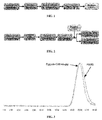
- a process for coating and crosslinking is illustrated in Fig. 1.
- Fig. 2 illustrates a method of crosslinking the coating on a porous fluoropolymer support in accordance with an embodiment of the invention.
- the change in surface modification in terms of surface tension was measured by a method that was developed to measure porous membrane surface tension rather than solid surface.
- the method relies on a set of solutions of certain composition. Each solution has specific surface tension.
- the solutions surface tension ranges from 25 to 92 dyne/cm in small non-equivalent increments.
- To measure membrane surface tension it is positioned on to top of white light table, one drop of a solution of certain surface tension is applied to the membrane surface and the time the drop takes to penetrate through the membrane and become bright white as an indication of light going through the membrane is recorded. Instant wetting is considered when the time the drop takes to penetrate the membrane is ⁇ 10 seconds. If the time > 10 seconds, the solution is considered to partially wet the membrane.
- Crosslinking can be carried out by any suitable method, for example, by the use of a photoinitiator and a high energy radiation, e.g., UV. It is contemplated that the crosslinking would provide a highly stable polymer network in the membrane.
- the crosslinking can be carried out as follows.
- the polymer coated PTFE sheets are pre-wet with IPA, the sheets are then washed with the solvent with which the photo-initiator is prepared in to exchange IPA with that solvent.
- the sheets are then soaked in a solution of photo-initiator with certain concentration for a certain time followed by exposure to UV irradiation.
- the soaking time in photo-initiator solution ranges from 1 minute to 24 hours.
- the UV irradiation time ranges from 30 seconds to 24 hours.
- the membrane critical wetting surface tension (CWST), performance characterization, and/or SPM testing are then measured.
- “SPM” means hot sulfuric acid hydrogen peroxide mixture (H 2 SO 4 (96%): H 2 O 2 (30%) of 80:20 by volume) at 120 to 180 °C.
- the hydrophilic fluoropolymer membrane is a porous membrane, e.g., a nanoporous membrane, for example, a membrane having pores of diameter between 1 nm and 100 nm, or a microporous membrane having pores of diameter between 1 ⁇ m and 10 ⁇ m.
- Hydrophilic fluoropolymer porous membranes can be used in a variety of applications, including, for example, diagnostic applications (including, for example, sample preparation and/or diagnostic lateral flow devices), ink jet applications, lithography, e.g., as replacement for HD/UHMW PE based media, filtering fluids for the pharmaceutical industry, metal removal, production of ultrapure water, treatment of industrial and surface waters, filtering fluids for medical applications (including for home and/or for patient use, e.g., intravenous applications, also including, for example, filtering biological fluids such as blood (e.g., virus removal)), filtering fluids for the electronics industry (e.g., filtering photoresist fluids in the microelectronics industry and hot SPM), filtering fluids for the food and beverage industry, beer filtration, clarification, filtering antibody- and/or protein-containing fluids, filtering nucleic acid-containing fluids, cell detection (including in situ ), cell harvesting, and/or filtering
- diagnostic applications including,
- membranes according to embodiments of the invention can be used to filter air and/or gas and/or can be used for venting applications (e.g., allowing air and/or gas, but not liquid, to pass therethrough).
- Membranes according to embodiments of the inventions can be used in a variety of devices, including surgical devices and products, such as, for example, ophthalmic surgical products.
- the hydrophilic fluoropolymer porous membrane can have a variety of configurations, including planar, flat sheet, pleated, tubular, spiral, and hollow fiber.
- Hydrophilic fluoropolymer porous membranes are typically disposed in a housing comprising at least one inlet and at least one outlet and defining at least one fluid flow path between the inlet and the outlet, wherein at least one inventive membrane or a filter including at least one inventive membrane is across the fluid flow path, to provide a filter device or filter module.
- a filter device comprising a housing comprising an inlet and a first outlet, and defining a first fluid flow path between the inlet and the first outlet; and at least one inventive membrane or a filter comprising at least one inventive membrane, the inventive membrane or filter comprising at least one inventive membrane being disposed in the housing across the first fluid flow path.
- At least one inventive membrane or filter comprising at least one inventive membrane is disposed in a housing comprising at least one inlet and at least two outlets and defining at least a first fluid flow path between the inlet and the first outlet, and a second fluid flow path between the inlet and the second outlet, wherein the inventive membrane or filter comprising at least one inventive membrane is across the first fluid flow path, to provide a filter device or filter module.
- the filter device comprises a crossflow filter module, the housing comprising an inlet, a first outlet comprising a concentrate outlet, and a second outlet comprising a permeate outlet, and defining a first fluid flow path between the inlet and the first outlet, and a second fluid flow path between the inlet and the second outlet, wherein at least one inventive membrane or filter comprising at least one inventive membrane is disposed across the first fluid flow path.
- the filter device or module may be sterilizable. Any housing of suitable shape and providing an inlet and one or more outlets may be employed.
- the housing can be fabricated from any suitable rigid impervious material, including any impervious thermoplastic material, which is compatible with the fluid being processed.
- the housing can be fabricated from a metal, such as stainless steel, or from a polymer, e.g., transparent or translucent polymer, such as an acrylic, polypropylene, polystyrene, or a polycarbonate resin.
- the hydrophilic fluoropolymer porous membrane comprises any suitable porous fluoropolymer support, for example, a support made from PTFE, PVDF (polyvinylidene fluoride), PVF (polyvinyl fluoride), PCTFE (polychlorotrifluoroethylene), FEP (fluorinated ethylene-propylene), ETFE (polyethylenetetrafluoroethylene), ECTFE (poly ethylenechlorotrifluoroethylene), PFPE (perfluoropolyether), PFSA (perfluorosulfonic acid), and perfluoropolyoxetane.
- the porous support can have any suitable pore size, e.g., from about 10 nm to about 10 microns, preferably PTFE and PVDF.
- the present invention further provides a hydrophilically modified fluoropolymer membrane produced by the method described above.
- the present invention further provides a method of filtering a fluid, the method comprising passing the fluid through the hydrophilic fluoropolymer membrane described above.
- Dimethyl 5-norbornene-2,3-dicarboxylate (C3) was purchased from Alfa Aesar,
- Dichloromethane was stored over activated Alumina and purged with Argon before use, Isopropyl alcohol (IPA), dicyclopentadiene (DCPD), tetrahydrofuran (THF), ethyl acetate, N-phenylmaleimide, acetonitrile, methanol, Grubbs second generation catalyst, 3-bromopyridine, and pentane were obtained from Sigma-Aldrich Co. and used without further treatment. Dichloropentane, also obtained from Sigma-Aldrich Co., was treated with basic alumina before use. 1,5-Cyclooctadiene (COD) was purified by vacuum distillation from boron trifluoride and used fresh.
- IPA Isopropyl alcohol
- DCPD dicyclopentadiene
- THF tetrahydrofuran
- ethyl acetate N-phenylmaleimide
- acetonitrile acetonitrile
- methanol
- This example illustrates the preparation of dichloro[1,3-bis(2,4,6-trimethylphenyl)-2-imidazolidinylidene](benzylidene)bis(3-bromopyridine)ruthenium(II) (G3) catalyst.
- the second generation Grubbs catalyst (G2) illustrated above (1.0 g, 1.18 mmol) was mixed with 3-bromopyridine (1.14 mL, 11.8 mmol) in 50 mL flask. Upon stirring at room temperature for 5 min, the red mixture turned into bright green. Pentane (40 mL) was added with stirring for 15 minutes and green solid was obtained. The mixture was cooled in the freezer for 24 h and filtered under vacuum. The resulting G3 catalyst, a green solid, was washed with cold pentane and dried under vacuum at room temperature to give a yield of 0.9 g, 88% yield.
- This example illustrates the gel permeation chromatographic characterization of the homopolymer and copolymers in accordance with an embodiment of the invention.
- This example illustrates a method of synthesis of Polycyclooctadiene (P-COD) in accordance with an embodiment of the invention.
- This example illustrates a method of synthesis of a telechelic polymer having glycidyl terminal groups of the formula (X), Poly(gly-hb-COD-hb-gly), in accordance with an embodiment of the invention.
- This example illustrates a method of post-functionalization of Polycyclooctadiene and a hyperbranched block copolymer thereof with a fluorine-containing reagent.
- PCOD 1.0 g
- Irgacure 2959 photoinitiator 1-[4-(2-Hydroxyethoxy)-phenyl]-2-hydroxy-2-methyl-1-propane-1-one
- UV irradiation 300-480 nm, 150 -250 mWatt, 60 to 180 seconds
- the reaction mixture is used in the PTFE coating and crosslinking processes.
- This example illustrates the coating and crosslinking procedure of PCOD and Poly(gly-hb-COD-hb-gly) on a PTFE porous support.
- the coating and crosslinking procedures for the fluorinated PCOD or fluorinated Poly(gly-hb-COD-hb-gly) hyperbranched-block polyglycerol are substantially the same.
- the following example is based on fluorinated PCOD.
- a porous PTFE membrane is coated with either fluorinated PCOD modified via thiol-ene reaction by soaking the membrane in a solution containing the following:
- CWST values CWST (dynes/cm) Coating ID Instant Timed 10" - 15" PTFE native 25.4 25.4 PTFE PCOD treated-1 33 35 PTFE P(gly-hb-COD-hb-gly) treated-1 37 39
Landscapes
- Chemical & Material Sciences (AREA)
- Chemical Kinetics & Catalysis (AREA)
- Engineering & Computer Science (AREA)
- Manufacturing & Machinery (AREA)
- Inorganic Chemistry (AREA)
- Organic Chemistry (AREA)
- Materials Engineering (AREA)
- Health & Medical Sciences (AREA)
- Polymers & Plastics (AREA)
- Medicinal Chemistry (AREA)
- Life Sciences & Earth Sciences (AREA)
- Wood Science & Technology (AREA)
- Separation Using Semi-Permeable Membranes (AREA)
- Manufacture Of Porous Articles, And Recovery And Treatment Of Waste Products (AREA)
- Toxicology (AREA)
- General Chemical & Material Sciences (AREA)
- Coating Of Shaped Articles Made Of Macromolecular Substances (AREA)
- Treatments Of Macromolecular Shaped Articles (AREA)
- Addition Polymer Or Copolymer, Post-Treatments, Or Chemical Modifications (AREA)
Description
- The properties of porous fluoropolymer membranes, for example, PTFE membrane, including their mechanical strength, chemical resistance or inertness, non-adhesiveness, excellent dielectric property, thermal stability at high temperature and low coefficient of friction make them very attractive for various applications. However, for certain applications, it will be beneficial to modify the surface of PTFE without affecting its intrinsic properties. Efforts have been made to modify the surface and the chemical properties of PTFE membrane in order to improve the suitability of the membrane for specific applications. For example, efforts have included surface coating, blending, high energy surface modification, for example, broad band ultraviolet radiation or BBUV, where the membrane is exposed to a UV radiation of wavelength 250-450 nm, and plasma treatment, free radical, and ozone etching, atomic layer deposition, and synthesis of modified PTFE-like polymers. However, most of the efforts were focused on high energy treatment such as BBUV and plasma. Though the exact mechanism of these surface modification approaches is not reported, it likely results from the formation of free radicals by bond scission since C-C bond strength is known to be ∼ 40% lower than F-F bond. If a majority of the radicals result from C-C scission or main polymer chain scission, it could decrease the mechanical and the chemical stability of the PTFE membrane. It is also known that plasma treatment is limited to the surface of the membrane which makes it less stable during a long period of time.
- The foregoing shows that there exists an unmet need for a surface modification of porous fluoropolymer supports to provide hydrophilic fluoropolymer membranes which are stable, and wherein the surface modification does not significantly affect the mechanical strength of the fluoropolymer support or the resulting membrane.
- The invention provides a composite hydrophilic porous membrane comprising a porous fluoropolymer support and a coating comprising a crosslinked polymer network, wherein the composite hydrophilic membrane is produced by coating the porous fluoropolymer support with a coating composition comprising a solvent, a crosslinking agent, a photoinitiator, and a telechelic polymer comprising a backbone made of polymerized 1,5-cyclooctadiene repeat units, wherein at least one of the repeat units comprises a pendant hydrophilic group attached thereto and at least another one of the repeat units comprises a pendant fluorinated hydrophobic group attached thereto, and crosslinking in situ the resulting coating.
- The copolymer and the modified homopolymer are useful in modifying the surface of fluoropolymer membranes.
- The present invention further provides methods of preparing the telechelic polymer, and methods of preparing hydrophilically modified fluoropolymer membranes.
-
-
Figure 1 illustrates a process for coating the hydrophilic fluorinated polymer in accordance with an embodiment of the invention. -
Figure 2 illustrates a process for coating and crosslinking the hydrophilic fluorinated polymer in accordance with an embodiment of the invention. -
Figure 3 depicts the GPC traces of Poly(COD) and Poly(gly-hb-COD-hb-gly) in CH2Cl2. - In accordance with an embodiment, the invention provides a composite hydrophilic porous membrane comprising a porous fluoropolymer support and a coating comprising a crosslinked polymer network, wherein the composite hydrophilic membrane is produced by coating the porous fluoropolymer support with a coating composition comprising a solvent, a crosslinking agent, a photoinitiator, and a telechelic polymer comprising a backbone made of polymerized 1,5-cyclooctadiene repeat units wherein at least one of said repeat units comprises a pendant hydrophilic group attached thereto and at least another one of said repeat units comprises a pendant fluorinated hydrophobic group attached thereto, and crosslinking in situ the resulting coating.
- The end groups of the telechelic polymer can be hydrophobic and/or hydrophilic terminal. In an embodiment, the end groups are hydrophobic. In another embodiment, the end groups are hydrophilic.
- In accordance with an embodiment, the telechelic polymer comprises at least one of the repeat units B and C, and optionally one or more repeat units A, wherein the repeat units A-C are of the formulae:


- In the above embodiment, the hydrophilic group R is selected from carboxy alkyl, sulfonic alkyl, and hydroxyalkyl groups.
- In embodiments of the invention, units A, B, and/or C can be present in any suitable manner, for example, as blocks, or randomly distributed blocks.
- In an embodiment, the telechelic polymer comprises units A, B, and C. For example, the telechelic polymer is of the formula:

- In an embodiment, the telechelic polymer comprises hydrophilic terminal end groups. For example, the hydrophilic terminal end groups comprise polyhydroxyalkyl ether groups.
- In an embodiment, the telechelic polymer has the following formula:

- In an embodiment, the telechelic polymer is of the formula:


- The telechelic polymer can be crosslinked by any suitable crosslinking agent, preferably by a bithiol or a multithiol.
- Any suitable photoinitiator can be employed, for example, a photoinitiator selected from camphor quinone, benzophenone, benzophenone derivatives, acetophenone, acetophenone derivatives, phosphine oxides and derivatives, benzoin alkyl ethers, benzil ketals, phenylglyoxalic esters and derivatives thereof, dimeric phenylglyoxalic esters, peresters, halomethyltriazines, hexaarylbisimidazole /coinitiators systems, ferrocenium compounds, titanocenes, and combinations thereof .
- Any suitable porous fluoropolymer support can be hydrophilically modified, for example, the porous fluoropolymer support can be selected from PTFE, PVDF, PVF (polyvinyl fluoride), PCTFE (polychlorotrifluoroethylene), FEP (fluorinated ethylene-propylene), ETFE (polyethylenetetrafluoroethylene), ECTFE (poly ethylenechlorotrifluoroethylene), PFPE (perfluoropolyether), PFSA (perfluorosulfonic acid), and perfluoropolyoxetane.
- In accordance with an embodiment, the crosslinking of the coating is carried by exposing the coating to UV radiation.
- The present invention further provides a telechelic polymer of the formula:


- The present invention further provides a method of hydrophilically modifying a porous fluoropolymer support comprising:
- (i) providing a porous fluoropolymer support;
- (ii) coating the porous fluoropolymer support with a solution comprising a solvent, a crosslinking agent, a photoinitiator, and a telechelic polymer as described above;
- (iii) drying the coated fluoropolymer support from (ii) to remove at least some of the solvent from the coated solution; and
- (iv) crosslinking said telechelic polymer present in the coating.
- The present invention further provides a hydrophilically modified fluoropolymer membrane produced by the method described above.
- The present invention further provides a method of filtering a fluid, the method comprising passing the fluid through any of the composite hydrophilic porous membranes described above.
- The telechelic polymer can be of any suitable molecular weight, for example, in an embodiment, a number or weight (Mn or Mw) average molecular weight from about 10 kDa to about 1000 kDa, preferably from about 75 kDa to about 500 kDa, and more preferably from about 250 kDa to about 500 kDa.
- The telechelic polymer of the invention can be prepared by any suitable method, for example, through ring opening metathesis polymerization of 1,5-cylooctadiene (COD). Typically a transition metal catalyst containing a carbene ligand mediates the metathesis reaction.
- Any suitable ROMP catalyst can be used, for example, Grubbs' first, second, and third generation catalysts, Umicore, Hoveyda-Grubbs, Schrock, and Schrock-Hoveyda catalysts can be employed. Examples of such catalysts include the following:


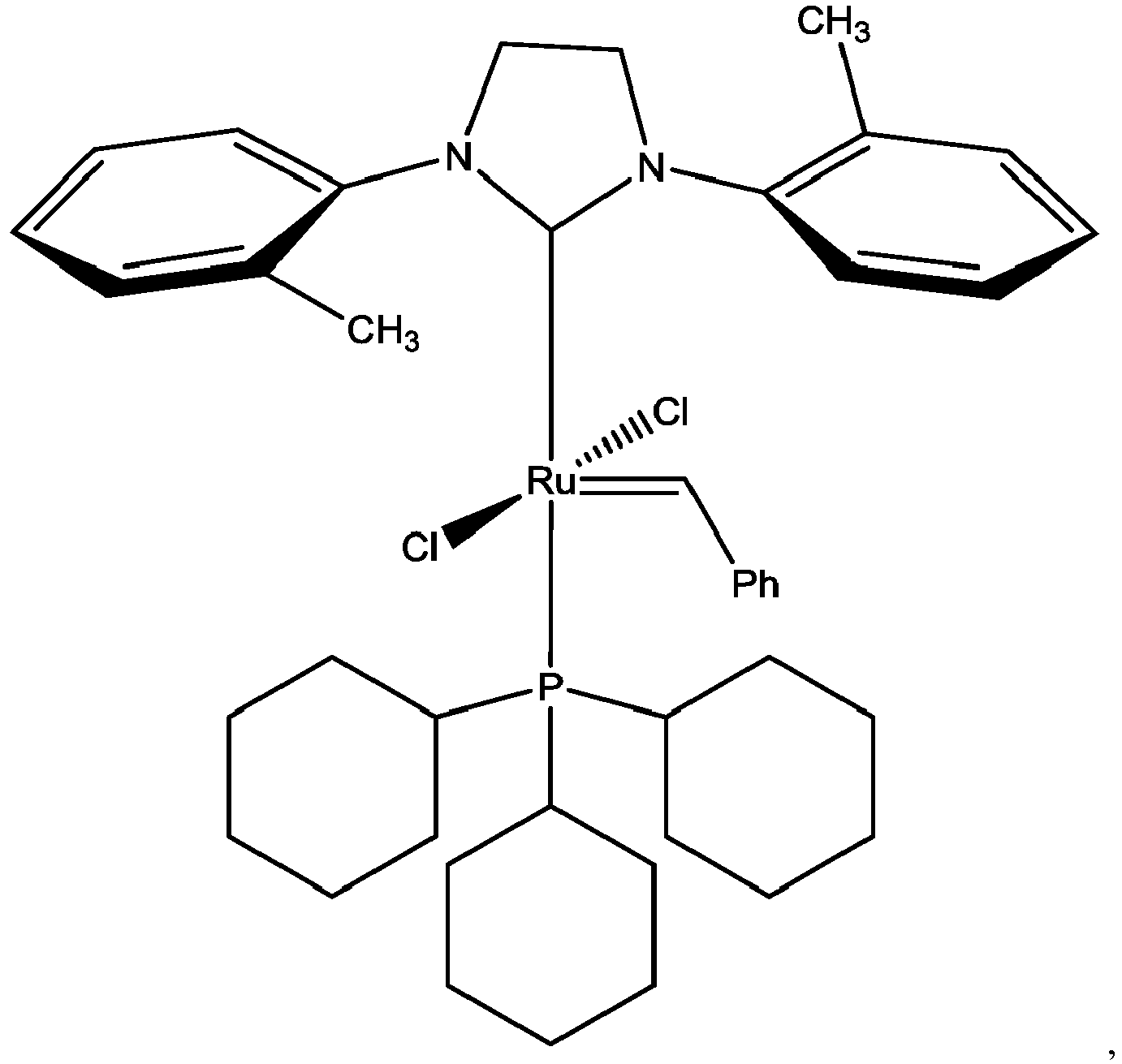


- In an embodiment, Grubbs' third generation catalysts are particularly suitable due to their advantages such as stability in air, tolerance to multiple functional groups, and/or fast polymerization initiation and propagation rates. In addition, with the Grubbs' third generation catalysts, the end groups can be engineered to accommodate any compatible groups, and the catalyst can be recycled readily. A preferred example of such a catalyst is:

- The above third generation Grubbs catalyst (G3) may be obtained commercially or prepared from a Grubbs second generation catalyst (G2) as follows:

- The polymerization of the monomers is conducted in a suitable solvent, for example, solvents generally used for conducting ROMP polymerizations. Examples of suitable solvents include aromatic hydrocarbons such as benzene, toluene, and xylene, aliphatic hydrocarbons such as n-pentane, hexane, and heptane, alicylic hydrocarbons such as cyclohexane, and halogenated hydrocarbons such as dichloromethane, dichloroethane, dichloroethylene, tetrachloroethane, chlorobenzene, dichlorobenzene, and trichlorobenzene, as well as mixtures thereof.
- The monomer concentration can be in the range of 1 to 50 wt%, preferably 2 to 45 wt%, and more preferably 3 to 40 wt %.
- The polymerization can be carried out at any suitable temperature, for example, from -20 to +100 °C, preferably 10 to 80 °C.
- The polymerization can be carried out for any time suitable to obtain the appropriate chain length of the polymer, which can be from about 1 minute to 100 hours.
- The amount of catalyst can be chosen in any suitable amount. For example, the molar ratio of the catalyst to the monomer can be about 1:10 to about 1:1000, preferably about 1:50 to 1:500, and more preferably about 1:100 to about 1:200. For example, the molar ratio of the catalyst to the monomer could be 1:n and 1:m, where n and m are the average degrees of polymerization.
- The polymer can be isolated by a suitable technique, for example, precipitation with a nonsolvent.
- The polymer can be characterized for its molecular weight and molecular weight distribution by any known techniques. For example, a MALS-GPC technique can be employed. The technique uses a mobile phase to elute, via a high pressure pump, a polymer solution through a bank of columns packed with a stationary phase. The stationary phase separates the polymer sample according to the chain size followed by detecting the polymer by three different detectors. A series of detectors can be employed, e.g., an Ultraviolet detector (UV-detector), followed by a multi-angle laser light scattering detector (MALS-detector), which in turn, is followed by a refractive index detector (RI-detector) in a row. The UV-detector measures the polymer light absorption at 254 nm wavelength; the MALS-detector measures the scattered light from polymer chains relative to mobile phase.
- The copolymers of the invention are highly monodisperse. For example, the copolymers have an Mw/Mn of 1.05 to 1.5, preferably 1.1 to 1.2.
- In accordance with an embodiment, polycyclooctadiene (Poly(COD) or PCOD)) can be obtained by polymerizing COD by a ROMP catalyst, followed by termination of the polymerization, as illustrated below:
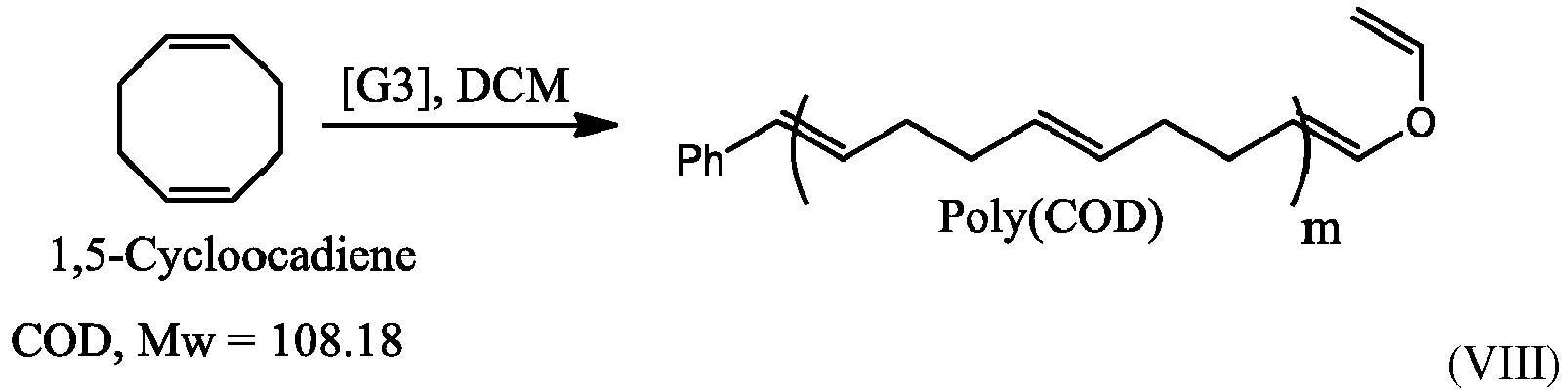
- In the above method, polymerization can be terminated in a suitable manner, for example, by the use of alkyl vinyl ether such as ethyl vinyl ether.
- In accordance with another embodiment, telechelic PolyCOD can be prepared using ROMP as illustrated below:

- The telechelic Poly(COD) can be further modified to provide a telechelic Poly(COD) having multiple hydroxyl groups. For example, the above telechelic Poly(COD) can be reacted with hydroxymethyl ethylene oxide to obtain a telechelic Poly(COD) having multiple hydroxyl groups, as illustrated below:

- For adhesion to porous fluoropolymer supports, e.g., PTFE, a fluorophilic part is provided by reaction with a fluorinated thiol. A hydrophilic functionality can be added through a hydrophilic mono-thiol. The reactions are illustrated below:


- In accordance with an another embodiment, telechelic Poly(COD) can modified as follows:

- The above structure results from the modification of the hyper-branched P(gly-COD-gly) system and is generated in situ on the membrane during the crosslinking step.
- Alternatively, the invention provides a modified linear dendritic Poly(COD) of the formula:

- The hyper-branched PCOD is first reacted with glycidol, and the reaction product is modified by the introduction of both the hydrophilic and fluorinated side chain. The thiolene reaction introduces both the hydrophilic and fluoro side chain to the PCOD backbone. Either a sequential reaction to react the fluoro side chain with PCOD followed with the hydrophilic component or a mixture of both are reacted with PCOD to introduce both at the same time.
- The molecular weight of the PCOD system is tuned so as to provide enough double bonds for the thiolene functional groups and crosslinking as well.
- The present invention further provides a composite hydrophilic membrane comprising a porous fluoropolymer and a copolymer or a modified homopolymer as described above, wherein the copolymer or modified homopolymer is optionally crosslinked.
- The surface tension of the resulting porous membrane can be determined as follows. For example, a sheet of PTFE membrane is coated at room temperature by optionally pre-wetting the membrane sheet with IPA solvent and soaking the membrane in polymer solution with concentration that ranges between 0.1% and 10% by mass. The PTFE sheet coating time ranges between 1 min and 12 hours. After soaking the membrane, the membrane is dried in convection oven at 100 °C to 160 °C. The drying time ranges between 10 minutes and 12 h. The PTFE membrane wetting characteristics are measured by measuring the critical wetting surface tension. A process for coating and crosslinking is illustrated in
Fig. 1. Fig. 2 illustrates a method of crosslinking the coating on a porous fluoropolymer support in accordance with an embodiment of the invention. - The change in surface modification in terms of surface tension was measured by a method that was developed to measure porous membrane surface tension rather than solid surface. The method relies on a set of solutions of certain composition. Each solution has specific surface tension. The solutions surface tension ranges from 25 to 92 dyne/cm in small non-equivalent increments. To measure membrane surface tension, it is positioned on to top of white light table, one drop of a solution of certain surface tension is applied to the membrane surface and the time the drop takes to penetrate through the membrane and become bright white as an indication of light going through the membrane is recorded. Instant wetting is considered when the time the drop takes to penetrate the membrane is ≤ 10 seconds. If the time > 10 seconds, the solution is considered to partially wet the membrane.
- Crosslinking can be carried out by any suitable method, for example, by the use of a photoinitiator and a high energy radiation, e.g., UV. It is contemplated that the crosslinking would provide a highly stable polymer network in the membrane.
- The crosslinking can be carried out as follows. The polymer coated PTFE sheets are pre-wet with IPA, the sheets are then washed with the solvent with which the photo-initiator is prepared in to exchange IPA with that solvent. The sheets are then soaked in a solution of photo-initiator with certain concentration for a certain time followed by exposure to UV irradiation. The soaking time in photo-initiator solution ranges from 1 minute to 24 hours. The UV irradiation time ranges from 30 seconds to 24 hours. The membrane critical wetting surface tension (CWST), performance characterization, and/or SPM testing are then measured. "SPM" means hot sulfuric acid hydrogen peroxide mixture (H2SO4 (96%): H2O2 (30%) of 80:20 by volume) at 120 to 180 °C.
- In accordance with an embodiment of the invention, the hydrophilic fluoropolymer membrane is a porous membrane, e.g., a nanoporous membrane, for example, a membrane having pores of diameter between 1 nm and 100 nm, or a microporous membrane having pores of diameter between 1 µm and 10 µm.
- Hydrophilic fluoropolymer porous membranes according to embodiments of the invention can be used in a variety of applications, including, for example, diagnostic applications (including, for example, sample preparation and/or diagnostic lateral flow devices), ink jet applications, lithography, e.g., as replacement for HD/UHMW PE based media, filtering fluids for the pharmaceutical industry, metal removal, production of ultrapure water, treatment of industrial and surface waters, filtering fluids for medical applications (including for home and/or for patient use, e.g., intravenous applications, also including, for example, filtering biological fluids such as blood (e.g., virus removal)), filtering fluids for the electronics industry (e.g., filtering photoresist fluids in the microelectronics industry and hot SPM), filtering fluids for the food and beverage industry, beer filtration, clarification, filtering antibody- and/or protein-containing fluids, filtering nucleic acid-containing fluids, cell detection (including in situ), cell harvesting, and/or filtering cell culture fluids. Alternatively, or additionally, membranes according to embodiments of the invention can be used to filter air and/or gas and/or can be used for venting applications (e.g., allowing air and/or gas, but not liquid, to pass therethrough). Membranes according to embodiments of the inventions can be used in a variety of devices, including surgical devices and products, such as, for example, ophthalmic surgical products.
- In accordance with embodiments of the invention, the hydrophilic fluoropolymer porous membrane can have a variety of configurations, including planar, flat sheet, pleated, tubular, spiral, and hollow fiber.
- Hydrophilic fluoropolymer porous membranes according to embodiments of the invention are typically disposed in a housing comprising at least one inlet and at least one outlet and defining at least one fluid flow path between the inlet and the outlet, wherein at least one inventive membrane or a filter including at least one inventive membrane is across the fluid flow path, to provide a filter device or filter module. In an embodiment, a filter device is provided comprising a housing comprising an inlet and a first outlet, and defining a first fluid flow path between the inlet and the first outlet; and at least one inventive membrane or a filter comprising at least one inventive membrane, the inventive membrane or filter comprising at least one inventive membrane being disposed in the housing across the first fluid flow path.
- Preferably, for crossflow applications, at least one inventive membrane or filter comprising at least one inventive membrane is disposed in a housing comprising at least one inlet and at least two outlets and defining at least a first fluid flow path between the inlet and the first outlet, and a second fluid flow path between the inlet and the second outlet, wherein the inventive membrane or filter comprising at least one inventive membrane is across the first fluid flow path, to provide a filter device or filter module. In an illustrative embodiment, the filter device comprises a crossflow filter module, the housing comprising an inlet, a first outlet comprising a concentrate outlet, and a second outlet comprising a permeate outlet, and defining a first fluid flow path between the inlet and the first outlet, and a second fluid flow path between the inlet and the second outlet, wherein at least one inventive membrane or filter comprising at least one inventive membrane is disposed across the first fluid flow path.
- The filter device or module may be sterilizable. Any housing of suitable shape and providing an inlet and one or more outlets may be employed.
- The housing can be fabricated from any suitable rigid impervious material, including any impervious thermoplastic material, which is compatible with the fluid being processed. For example, the housing can be fabricated from a metal, such as stainless steel, or from a polymer, e.g., transparent or translucent polymer, such as an acrylic, polypropylene, polystyrene, or a polycarbonate resin.
- In accordance with an embodiment, the hydrophilic fluoropolymer porous membrane comprises any suitable porous fluoropolymer support, for example, a support made from PTFE, PVDF (polyvinylidene fluoride), PVF (polyvinyl fluoride), PCTFE (polychlorotrifluoroethylene), FEP (fluorinated ethylene-propylene), ETFE (polyethylenetetrafluoroethylene), ECTFE (poly ethylenechlorotrifluoroethylene), PFPE (perfluoropolyether), PFSA (perfluorosulfonic acid), and perfluoropolyoxetane. The porous support can have any suitable pore size, e.g., from about 10 nm to about 10 microns, preferably PTFE and PVDF.
- The present invention further provides a hydrophilically modified fluoropolymer membrane produced by the method described above.
- The present invention further provides a method of filtering a fluid, the method comprising passing the fluid through the hydrophilic fluoropolymer membrane described above.
- The following examples further illustrate the invention but, of course, should not be construed as in any way limiting its scope.
- Materials: The following materials were purchased and used as received.
- Dimethyl 5-norbornene-2,3-dicarboxylate (C3) was purchased from Alfa Aesar,
- Dichloromethane (DCM) was stored over activated Alumina and purged with Argon before use, Isopropyl alcohol (IPA), dicyclopentadiene (DCPD), tetrahydrofuran (THF), ethyl acetate, N-phenylmaleimide, acetonitrile, methanol, Grubbs second generation catalyst, 3-bromopyridine, and pentane were obtained from Sigma-Aldrich Co. and used without further treatment. Dichloropentane, also obtained from Sigma-Aldrich Co., was treated with basic alumina before use. 1,5-Cyclooctadiene (COD) was purified by vacuum distillation from boron trifluoride and used fresh.
- This example illustrates the preparation of dichloro[1,3-bis(2,4,6-trimethylphenyl)-2-imidazolidinylidene](benzylidene)bis(3-bromopyridine)ruthenium(II) (G3) catalyst.

- The second generation Grubbs catalyst (G2) illustrated above (1.0 g, 1.18 mmol) was mixed with 3-bromopyridine (1.14 mL, 11.8 mmol) in 50 mL flask. Upon stirring at room temperature for 5 min, the red mixture turned into bright green. Pentane (40 mL) was added with stirring for 15 minutes and green solid was obtained. The mixture was cooled in the freezer for 24 h and filtered under vacuum. The resulting G3 catalyst, a green solid, was washed with cold pentane and dried under vacuum at room temperature to give a yield of 0.9 g, 88% yield.
- This example illustrates the gel permeation chromatographic characterization of the homopolymer and copolymers in accordance with an embodiment of the invention.
- The homopolymer and block copolymer obtained was characterized for their molecular weight and molecular weight distribution properties by the MALS-GPC technique under the following conditions:
- Mobile phase: Dichloromethane (DCM).
- Mobile phase temperature: 30 °C.
- UV wavelength: 245 nm.
- Columns used: three PSS SVD Lux analytical columns (styrene-divinylbenzene copolymer network), columns having as stationary phase beads of diameter 5 µm and pore sizes of 1000A, 100,000A, and 1,000,000A, and guard columns.
- Flow rate: 1 mL/min.
- GPC system: waters HPLC alliance e2695 system with UV and RI detectors
- MALS system: The DAWN HELEOS 8 system with 8 detectors operating a laser at 664.5 nm.
- This example illustrates a method of synthesis of Polycyclooctadiene (P-COD) in accordance with an embodiment of the invention.
- In a 50 ml round-bottomed flask equipped with a stir bar, Grubb's second generation catalyst (3.0 mg, 0.004 mmol), 2-butene-1,4-diol (10.0 mg, 0.12 mmol) and 1,5-cyclooctadiene (490 mg, 4.54 mmol) were combined and degassed with argon for 5 min and transferred to an oil bath at 40 °C. Heating was continued for 1 h followed by the addition of the remaining 1,5-cyclooctadiene (4.5 mg, 4.2 mmol) in 5 ml of DCM to the mixture and continued heating for another 6 h. The hydroxyl terminated polymer (P-COD) was isolated by precipitation in methanol. 1H-NMR (300MHz, CDCl3): δ (ppm) 5.3 to 5.5 (s, broad, 1H), 1.75 to 2.5 (s, broad).
- This example illustrates a method of synthesis of a telechelic polymer having glycidyl terminal groups of the formula (X), Poly(gly-hb-COD-hb-gly), in accordance with an embodiment of the invention.
- In a 50 ml round-bottomed flask equipped with a stir bar, telechelic polycyclooctadiene (hydroxy terminated) (1.0g) was dissolved in diglyme at 90-100 °C. The hydroxyl group was activated with CaH2 (0.5g) with stirring for 1 h. Glycidol (10.0 g,135 mmol) was added to the mixture drop wise over 30 min. The reaction was continued to be heated for 12 h. the polymer was isolated by precipitation in hexane. 1H-NMR (CDCl3): δ (ppm) 5.6 (s 1H), 5.45 to 5.3 (m broad), 2.4 (s 2H), 2.2 to 1.9 (m broad).
- This example illustrates a method of post-functionalization of Polycyclooctadiene and a hyperbranched block copolymer thereof with a fluorine-containing reagent.
- Either PCOD homopolymer or the copolymer of formula A is post functionalized with 1H,1H,2H,2H-Perfluorodecanethiol in the presence of photoinitiator under UV irradiation by following substantially the same process. For example, PCOD (1.0 g) is dissolved in tetrahydrofuran containing up to 15% by mass of Irgacure 2959 photoinitiator (1-[4-(2-Hydroxyethoxy)-phenyl]-2-hydroxy-2-methyl-1-propane-1-one). The solution is exposed to UV irradiation (300-480 nm, 150 -250 mWatt, 60 to 180 seconds). The reaction mixture is used in the PTFE coating and crosslinking processes.
- This example illustrates the coating and crosslinking procedure of PCOD and Poly(gly-hb-COD-hb-gly) on a PTFE porous support.
- The coating and crosslinking procedures for the fluorinated PCOD or fluorinated Poly(gly-hb-COD-hb-gly) hyperbranched-block polyglycerol are substantially the same. The following example is based on fluorinated PCOD.
- A porous PTFE membrane is coated with either fluorinated PCOD modified via thiol-ene reaction by soaking the membrane in a solution containing the following:
- Fluorinated PCOD (1 to 10% mass concentration) in THF, photoinitiator (Irgacure, 1 to 15% mass), sodium salt of 3-mercaptoethanesurfonic acid (1 to 15 % mass, neutralized in aqueous THF with dilute HCl solution(1N) till forming homogenous solution in THF), the membrane is crosslinked with this mixture with UV irradiation (300-480nm, 150-250 mWatt, 60 second to 180 second). The membrane was then washed with DI water and dried at 100 °C for 10 min.
- The GPC traces of PCOD and P(gly-hb-COD-hb-gly) are depicted in
Fig. 3 . - P(gly-hb-COD-hb-gly) was in situ reacted with 1H,1H,2H,2H-Perfluorodecanethiol in the presence of photoinitiator (Irgacure 2959, 10%) under UV irradiation (90 seconds). The resulting polymer mixture was used to coat PTFE membrane and measure CWST by following the same process discussed above. The CWST of the PTFE and treated PTFE surfaces are illustrated in Table 1.
Table 1. CWST values CWST (dynes/cm) Coating ID Instant Timed 10" - 15" PTFE native 25.4 25.4 PTFE PCOD treated-1 33 35 PTFE P(gly-hb-COD-hb-gly) treated-1 37 39 - All references, including publications, patent applications, and patents, cited herein are hereby incorporated by reference to the same extent as if each reference were individually and specifically indicated to be incorporated by reference and were set forth in its entirety herein.
- The use of the terms "a" and "an" and "the" and "at least one" and similar referents in the context of describing the invention (especially in the context of the following claims) are to be construed to cover both the singular and the plural, unless otherwise indicated herein or clearly contradicted by context. The use of the term "at least one" followed by a list of one or more items (for example, "at least one of A and B") is to be construed to mean one item selected from the listed items (A or B) or any combination of two or more of the listed items (A and B), unless otherwise indicated herein or clearly contradicted by context. The terms "comprising," "having," "including," and "containing" are to be construed as open-ended terms (i.e., meaning "including, but not limited to,") unless otherwise noted. Recitation of ranges of values herein are merely intended to serve as a shorthand method of referring individually to each separate value falling within the range, unless otherwise indicated herein, and each separate value is incorporated into the specification as if it were individually recited herein. All methods described herein can be performed in any suitable order unless otherwise indicated herein or otherwise clearly contradicted by context. The use of any and all examples, or exemplary language (e.g., "such as") provided herein, is intended merely to better illuminate the invention and does not pose a limitation on the scope of the invention unless otherwise claimed. No language in the specification should be construed as indicating any non-claimed element as essential to the practice of the invention.
- Preferred embodiments of this invention are described herein, including the best mode known to the inventors for carrying out the invention. Variations of those preferred embodiments may become apparent to those of ordinary skill in the art upon reading the foregoing description. The inventors expect skilled artisans to employ such variations as appropriate, and the inventors intend for the invention to be practiced otherwise than as specifically described herein. Accordingly, this invention includes all modifications and equivalents of the subject matter recited in the claims appended hereto as permitted by applicable law. Moreover, any combination of the above-described elements in all possible variations thereof is encompassed by the invention unless otherwise indicated herein or otherwise clearly contradicted by context.
Claims (15)
- A composite hydrophilic porous membrane comprising a porous fluoropolymer support and a coating comprising a crosslinked polymer network, wherein the composite hydrophilic membrane is produced by coating the porous fluoropolymer support with a coating composition comprising a solvent, a crosslinking agent, a photoinitiator, and a telechelic polymer comprising a backbone made of polymerized 1,5-cyclooctadiene repeat units, wherein at least one of said repeat units comprises a pendant hydrophilic group attached thereto and at least another one of said repeat units comprises a pendant fluorinated hydrophobic group attached thereto, and crosslinking in situ the resulting coating.
- The composite hydrophilic porous membrane of claim 1, wherein the telechelic polymer comprises hydrophobic and/or hydrophilic terminal end groups.
- The composite hydrophilic porous membrane of claim 1, wherein the telechelic polymer comprises at least one of the repeat units B and C, and optionally one or more repeat units A, wherein the repeat units A-C are of the formulae:

optionally wherein R is selected from carboxy alkyl, sulfonic alkyl, and hydroxyalkyl groups. - The composite hydrophilic porous membrane of any one of claims 1-3, which comprises repeat units A, B, and C.
- The composite hydrophilic porous membrane of any one of claims 1-4, which has hydrophobic terminal end groups.
- The composite hydrophilic porous membrane of any one of claims 1-5, wherein the telechelic polymer is of the formula:

- The composite hydrophilic porous membrane of any one of claims 1-5,
wherein the telechelic polymer comprises hydrophilic terminal end groups,
optionally wherein the telechelic polymer has the following formula:
preferably wherein R is selected from carboxy alkyl, sulfonic alkyl, and hydroxyalkyl groups. - The composite hydrophilic porous membrane of any one of claims 1-7,
wherein the crosslinking agent is a bithiol or a multithiol. - The composite hydrophilic porous membrane of claim 7 or 8, wherein the telechelic polymer is of the formula:


- The composite hydrophilic porous membrane of any one of claims 1-9,
wherein the photoinitiator is selected from camphor quinone, benzophenone, benzophenone derivatives, acetophenone, acetophenone derivatives, phosphine oxides and derivatives, benzoin alkyl ethers benzil ketals, phenylglyoxalic esters and derivatives thereof, dimeric phenylglyoxalic esters, peresters, halomethyltriazines, hexaarylbisimidazole /coinitiators systems, ferrocenium compounds, titanocenes, and combinations thereof. - The composite hydrophilic porous membrane of any one of claims 1-10,
wherein the porous fluoropolymer support is selected from PTFE, PVDF, PVF (polyvinyl fluoride), PCTFE (polychlorotrifluoroethylene), FEP (fluorinated ethylene-propylene), ETFE (polyethylenetetrafluoroethylene), ECTFE (poly ethylenechlorotrifluoroethylene), PFPE (perfluoropolyether), PFSA (perfluorosulfonic acid), and perfluoropolyoxetane. - The composite hydrophilic porous membrane of any one of claims 1-11,
wherein the crosslinking of the coating is carried by exposing the coating to UV radiation. - A method of hydrophilically modifying a porous fluoropolymer support comprising:(i) providing a porous fluoropolymer support;(ii) coating the porous fluoropolymer support with a solution comprising a solvent, a crosslinking agent, a photoinitiator, and a telechelic polymer of the formula:


 (iii) drying the coated fluoropolymer support from (ii) to remove at least some of the solvent from the coating; and(iv) crosslinking the telechelic polymer present in the coating.
 - A hydrophilically modified fluoropolymer porous membrane produced by the method of claim 13.
- A method of filtering a fluid, the method comprising passing the fluid through the composite hydrophilic porous membrane of any one of claims 1-12 or the hydrophilically modified fluoropolymer porous membrane claim 14.
Applications Claiming Priority (1)
| Application Number | Priority Date | Filing Date | Title |
|---|---|---|---|
| US14/675,592 US9630151B2 (en) | 2015-03-31 | 2015-03-31 | Hydrophilically modified fluorinated membrane (V) |
Publications (2)
| Publication Number | Publication Date |
|---|---|
| EP3075440A1 true EP3075440A1 (en) | 2016-10-05 |
| EP3075440B1 EP3075440B1 (en) | 2017-12-20 |
Family
ID=54783342
Family Applications (1)
| Application Number | Title | Priority Date | Filing Date |
|---|---|---|---|
| EP15192121.0A Not-in-force EP3075440B1 (en) | 2015-03-31 | 2015-10-29 | Hydrophilically modified fluorinated membrane |
Country Status (7)
| Country | Link |
|---|---|
| US (1) | US9630151B2 (en) |
| EP (1) | EP3075440B1 (en) |
| JP (1) | JP6116642B2 (en) |
| KR (1) | KR101780018B1 (en) |
| CN (1) | CN106010062B (en) |
| SG (1) | SG10201508801PA (en) |
| TW (1) | TWI593725B (en) |
Families Citing this family (11)
| Publication number | Priority date | Publication date | Assignee | Title |
|---|---|---|---|---|
| US9855534B1 (en) * | 2016-12-28 | 2018-01-02 | Pall Corporation | Porous PTFE membranes for metal removal |
| EP3765177A4 (en) | 2018-03-15 | 2021-12-15 | Entegris, Inc. | Fluorinated filter membrane, filters, and methods |
| JP7109536B2 (en) | 2018-03-22 | 2022-07-29 | 富士フイルム株式会社 | Filtration device, purification device, manufacturing method of chemical solution |
| US10942854B2 (en) | 2018-05-09 | 2021-03-09 | Micron Technology, Inc. | Prefetch management for memory |
| US11010092B2 (en) | 2018-05-09 | 2021-05-18 | Micron Technology, Inc. | Prefetch signaling in memory system or sub-system |
| US10714159B2 (en) | 2018-05-09 | 2020-07-14 | Micron Technology, Inc. | Indication in memory system or sub-system of latency associated with performing an access command |
| KR102852560B1 (en) * | 2018-11-30 | 2025-09-01 | 엔테그리스, 아이엔씨. | Hydrophilic filter membrane with pendant hydrophilic groups, and related methods of preparation and use |
| AU2020218790B2 (en) * | 2019-02-08 | 2026-03-26 | The University Of Queensland | Capture of fluorinated carbon compounds |
| KR102695013B1 (en) | 2019-04-24 | 2024-08-13 | 삼성전자주식회사 | Methods of manufacturing pellicle assembly and photomask assembly |
| CN110256724B (en) * | 2019-06-17 | 2021-04-20 | 西安交通大学 | A kind of preparation method of anti-adhesion film for photocuring continuous surface forming 3D printing |
| CN112297475B (en) * | 2020-11-05 | 2021-08-03 | 中国长江三峡集团有限公司 | High-temperature high-linear-pressure micro eutectic method for enhancing strength of PTFE (polytetrafluoroethylene) film |
Citations (6)
| Publication number | Priority date | Publication date | Assignee | Title |
|---|---|---|---|---|
| EP1769841A1 (en) * | 2005-09-30 | 2007-04-04 | General Electric Company | Hydrophilic membrane and associated method |
| US20090188857A1 (en) * | 2008-01-25 | 2009-07-30 | General Electric Company | Permanent hydrophilic porous coatings and methods of making them |
| EP2157430A1 (en) * | 2008-08-18 | 2010-02-24 | Millipore Corporation | Hydrophilic, high protein binding, low fluorescence, western blottimg membrane |
| WO2010117460A1 (en) * | 2009-04-08 | 2010-10-14 | Michigan Molecular Institute | Surface modification of reverse osmosis membranes by hydrophilic dendritic polymers |
| US20130004690A1 (en) * | 2011-06-29 | 2013-01-03 | Mikhael Michael G | Hydrophilic expanded fluoropolymer composite and method of making same |
| ITGE20130096A1 (en) * | 2013-09-27 | 2015-03-28 | Consiglio Nazionale Ricerche | MEMBRANES COVERED BY BICONTINUE POLYMERIZED MICROEMULSIONS FOR WATER TREATMENT. |
Family Cites Families (54)
| Publication number | Priority date | Publication date | Assignee | Title |
|---|---|---|---|---|
| GB1538810A (en) | 1976-08-10 | 1979-01-24 | Sumitomo Electric Industries | Hydrophilic porous fluorocarbon structures and process for their production |
| JPS5833886B2 (en) | 1976-09-14 | 1983-07-22 | 東ソー株式会社 | Cation exchange membrane and its manufacturing method |
| JPS61161103A (en) | 1985-01-10 | 1986-07-21 | Terumo Corp | Hydrophilic porous membrane and its preparation |
| JPS61249503A (en) | 1985-04-25 | 1986-11-06 | Sumitomo Electric Ind Ltd | Hydrophilic polytetrafluoroethylene filter membrane and its production |
| US4975507A (en) | 1987-05-27 | 1990-12-04 | Monsanto Company | Cyclopentanedioxocarbonyl vinylene polymers |
| US5294493A (en) | 1990-12-07 | 1994-03-15 | E. I. Du Pont De Nemours And Company | Polymeric films for second order nonlinear optics |
| US5200470A (en) | 1990-12-19 | 1993-04-06 | Monsanto Company | Norbornene dicarboxy phenylimide polymers |
| US5117327A (en) | 1990-12-19 | 1992-05-26 | Monsanto Company | Norbornene dicarboximide polymer dielectric devices |
| US5219662A (en) | 1991-05-23 | 1993-06-15 | E. I. Du Pont De Nemours And Company | Biocompatible polyurethanes by treatment with polyoxazoline block copolymers |
| US5266076A (en) | 1992-01-24 | 1993-11-30 | E. I. Du Pont De Nemours And Company | Fluorinated finishes for aramids |
| US5418277A (en) | 1994-04-26 | 1995-05-23 | E. I. Du Pont De Nemours And Company | Aqueous ink jet inks containing fluorinated polymers |
| CN1077804C (en) | 1994-07-28 | 2002-01-16 | 米利波尔公司 | Porous composite membrane and its preparation method |
| JP3809201B2 (en) | 1995-04-14 | 2006-08-16 | 住友電気工業株式会社 | Hydrophilic tetrafluoroethylene resin porous membrane and method for producing the same |
| DE69735859T2 (en) | 1996-07-08 | 2006-10-26 | Pall Corp. | Positively charged polymer membranes |
| DE69733022T2 (en) | 1996-10-09 | 2006-02-16 | Nippon Zeon Co., Ltd. | COMPOSITION BASED ON NORBORN POLYMERS |
| US6080826A (en) | 1997-01-06 | 2000-06-27 | California Institute Of Technology | Template-directed ring-closing metathesis and ring-opening metathesis polymerization of functionalized dienes |
| DE69921718T2 (en) | 1998-04-01 | 2005-12-22 | Solvay Solexis, Inc., Wilmington | Compatible blends of polyvinylidene fluoride and aromatic polyimide |
| TW558559B (en) | 1998-06-30 | 2003-10-21 | Ind Tech Res Inst | An oxygen atom-containing heterocyclic dione polymer and photosensitive composition comprising the same |
| US6355081B1 (en) | 1999-06-01 | 2002-03-12 | Usf Filtration And Separations Group, Inc. | Oleophobic filter materials for filter venting applications |
| GB9916235D0 (en) | 1999-07-09 | 1999-09-15 | Univ Durham | Process for polymerisation of olefins and novel polymerisable olefins |
| WO2001014446A1 (en) | 1999-08-25 | 2001-03-01 | Zeon Corporation | Norbornene open-ring polymers, products of hydrogenation thereof and processes for the production of both |
| US6436476B1 (en) | 2000-02-14 | 2002-08-20 | Owens Corning Fiberglas Technology, Inc. | Polyolefin fiber-reinforced composites using a fiber coating composition compatible with romp catalysts |
| DE60236696D1 (en) | 2001-04-27 | 2010-07-22 | Millipore Corp | New coated membranes and other articles |
| JP2005517774A (en) | 2002-02-19 | 2005-06-16 | カリフォルニア インスティテュート オブ テクノロジー | Ring expansion of cyclic olefins by olefin metathesis reaction using acyclic dienes |
| US7628917B2 (en) | 2002-09-03 | 2009-12-08 | Whatman, Inc. | Porous composite membrane and method for making the same |
| JP2005029527A (en) | 2003-07-09 | 2005-02-03 | Central Glass Co Ltd | Fluorine-based cyclic compound, fluorine-based polymerizable monomer, fluorine-based polymer compound, resist material using the same and pattern-forming method using the same |
| PL1577282T3 (en) | 2004-02-26 | 2011-11-30 | Rimtec Corp | Metal complexes for use in olefin metathesis and atom or group transfer reactions |
| WO2006053071A2 (en) | 2004-11-09 | 2006-05-18 | E.I. Dupont De Nemours And Company | Ring opening polymerization of cyclic amides using n-heterocyclic carbene catalysts |
| MY141919A (en) | 2004-12-03 | 2010-07-30 | Siemens Water Tech Corp | Membrane post treatment |
| WO2006064814A1 (en) | 2004-12-15 | 2006-06-22 | Nihon University | Method for producing norbornene based addition (co)polymer |
| GB0428172D0 (en) | 2004-12-23 | 2005-01-26 | Ici Plc | Olefin metathesis polymerisation |
| WO2007034653A1 (en) | 2005-09-22 | 2007-03-29 | Zeon Corporation | Norbornene compound addition polymer, process for producing the same, molded article comprising the polymer, and use thereof |
| TW200736311A (en) | 2006-01-30 | 2007-10-01 | Zeon Corp | Film comprising norbornene compound addition polymer |
| TW200801073A (en) | 2006-03-10 | 2008-01-01 | Asahi Glass Co Ltd | Process for producing fluoropolymer by ring-opening polymerization of fluorinated epoxy compound |
| TW200804479A (en) | 2006-05-23 | 2008-01-16 | Zeon Corp | Oriented film of addition polymer of norbornene compound alone, process for producing the same and use thereof |
| ES2364863T3 (en) | 2006-10-17 | 2011-09-15 | Firestone Polymers, Llc | GOLF BALL NUCLEUS. |
| WO2008068897A1 (en) | 2006-12-05 | 2008-06-12 | Mitsui Chemicals, Inc. | Cyclic olefin polymer composition, use thereof, and cyclic olefin copolymer |
| EP1942125A1 (en) | 2006-12-20 | 2008-07-09 | 3M Innovative Properties Company | Compositions curable by ring opening metathesis polymerarization at low temperatures and their application in the dental field |
| TWI347955B (en) | 2007-07-19 | 2011-09-01 | Univ Nat Taiwan Science Tech | Norbornene monomers with fluorene group and polymer material thereof |
| TWI357416B (en) | 2007-08-08 | 2012-02-01 | Univ Nat Taiwan Science Tech | Norbornene monomers with epoxy group and polymer m |
| US8215496B2 (en) | 2008-01-28 | 2012-07-10 | Promerus Llc | Polynorbornene pervaporation membrane films, preparation and use thereof |
| US8223472B1 (en) | 2008-11-14 | 2012-07-17 | Sandia Corporation | Norbornylene-based polymer systems for dielectric applications |
| US20110266220A1 (en) | 2009-01-07 | 2011-11-03 | Cms Technologies Holdings, Inc. | Separations with highly selective fluoropolymer membranes |
| US9688631B2 (en) | 2009-03-02 | 2017-06-27 | Isp Investments Llc | Thermosetting ring-opening metathesis polymerization materials with thermally degradable linkages |
| US8283410B2 (en) | 2009-03-30 | 2012-10-09 | Isp Investments Inc. | Ring-opening metathesis polymerization of norbornene and oxanorbornene moieties and uses thereof |
| US8143369B2 (en) | 2009-06-02 | 2012-03-27 | International Business Machines Corporation | Polymers bearing pendant pentafluorophenyl ester groups, and methods of synthesis and functionalization thereof |
| JP2011131208A (en) | 2009-11-25 | 2011-07-07 | Fujifilm Corp | Crystalline polymer microporous membrane, method for producing the same, and filtration filter |
| US8207351B2 (en) | 2010-04-30 | 2012-06-26 | International Business Machines Corporation | Cyclic carbonyl compounds with pendant carbonate groups, preparations thereof, and polymers therefrom |
| US8906999B2 (en) | 2011-02-17 | 2014-12-09 | Ccp Composites Us Llc | Styrene-free unsaturated polyester |
| CN103547361B (en) | 2011-04-07 | 2016-11-09 | 索尔维特殊聚合物意大利有限公司 | For the method preparing the fluorinated polymer of crosslinking |
| CN102423642B (en) | 2011-12-13 | 2013-12-11 | 北京碧水源科技股份有限公司 | Permanent hydrophilic modification method for surface of porous membrane and porous membrane obtained by same |
| US9206271B2 (en) | 2012-03-25 | 2015-12-08 | Wisconsin Alumni Research Foundation | Fully backbone degradable and functionalizable polymers derived from the ring-opening metathesis polymerization (ROMP) |
| JP2014042878A (en) | 2012-08-27 | 2014-03-13 | Nitto Denko Corp | Ventilation filter imparted with oil repellency |
| CN105229040B (en) | 2013-02-27 | 2017-05-31 | 马特里亚公司 | Metal carbene olefin metathesis dual catalyst composition |
-
2015
- 2015-03-31 US US14/675,592 patent/US9630151B2/en not_active Expired - Fee Related
- 2015-10-26 JP JP2015209921A patent/JP6116642B2/en not_active Expired - Fee Related
- 2015-10-26 SG SG10201508801PA patent/SG10201508801PA/en unknown
- 2015-10-28 KR KR1020150150184A patent/KR101780018B1/en active Active
- 2015-10-29 EP EP15192121.0A patent/EP3075440B1/en not_active Not-in-force
- 2015-10-29 TW TW104135568A patent/TWI593725B/en active
- 2015-10-30 CN CN201511005707.2A patent/CN106010062B/en not_active Expired - Fee Related
Patent Citations (6)
| Publication number | Priority date | Publication date | Assignee | Title |
|---|---|---|---|---|
| EP1769841A1 (en) * | 2005-09-30 | 2007-04-04 | General Electric Company | Hydrophilic membrane and associated method |
| US20090188857A1 (en) * | 2008-01-25 | 2009-07-30 | General Electric Company | Permanent hydrophilic porous coatings and methods of making them |
| EP2157430A1 (en) * | 2008-08-18 | 2010-02-24 | Millipore Corporation | Hydrophilic, high protein binding, low fluorescence, western blottimg membrane |
| WO2010117460A1 (en) * | 2009-04-08 | 2010-10-14 | Michigan Molecular Institute | Surface modification of reverse osmosis membranes by hydrophilic dendritic polymers |
| US20130004690A1 (en) * | 2011-06-29 | 2013-01-03 | Mikhael Michael G | Hydrophilic expanded fluoropolymer composite and method of making same |
| ITGE20130096A1 (en) * | 2013-09-27 | 2015-03-28 | Consiglio Nazionale Ricerche | MEMBRANES COVERED BY BICONTINUE POLYMERIZED MICROEMULSIONS FOR WATER TREATMENT. |
Also Published As
| Publication number | Publication date |
|---|---|
| US20160288060A1 (en) | 2016-10-06 |
| CN106010062B (en) | 2019-01-15 |
| TW201634537A (en) | 2016-10-01 |
| EP3075440B1 (en) | 2017-12-20 |
| JP2016194037A (en) | 2016-11-17 |
| JP6116642B2 (en) | 2017-04-19 |
| TWI593725B (en) | 2017-08-01 |
| KR101780018B1 (en) | 2017-09-19 |
| KR20160117131A (en) | 2016-10-10 |
| CN106010062A (en) | 2016-10-12 |
| US9630151B2 (en) | 2017-04-25 |
| SG10201508801PA (en) | 2016-10-28 |
Similar Documents
| Publication | Publication Date | Title |
|---|---|---|
| EP3075440B1 (en) | Hydrophilically modified fluorinated membrane | |
| KR101745513B1 (en) | Hydrophilically modified fluorinated membrane (iv) | |
| EP3075765B1 (en) | Hydrophilically modified fluorinated membrane | |
| EP3075762B1 (en) | Hydrophilically modified fluorinated membrane | |
| JP6060448B2 (en) | Hydrophilic modified fluorinated membrane (II) | |
| EP3124100B1 (en) | Hydrophilic porous polytetrafluoroethylene membrane |
Legal Events
| Date | Code | Title | Description |
|---|---|---|---|
| PUAI | Public reference made under article 153(3) epc to a published international application that has entered the european phase |
Free format text: ORIGINAL CODE: 0009012 |
|
| AK | Designated contracting states |
Kind code of ref document: A1 Designated state(s): AL AT BE BG CH CY CZ DE DK EE ES FI FR GB GR HR HU IE IS IT LI LT LU LV MC MK MT NL NO PL PT RO RS SE SI SK SM TR |
|
| AX | Request for extension of the european patent |
Extension state: BA ME |
|
| 17P | Request for examination filed |
Effective date: 20170309 |
|
| RBV | Designated contracting states (corrected) |
Designated state(s): AL AT BE BG CH CY CZ DE DK EE ES FI FR GB GR HR HU IE IS IT LI LT LU LV MC MK MT NL NO PL PT RO RS SE SI SK SM TR |
|
| RIC1 | Information provided on ipc code assigned before grant |
Ipc: B01D 71/32 20060101ALI20170405BHEP Ipc: B01D 67/00 20060101AFI20170405BHEP |
|
| GRAP | Despatch of communication of intention to grant a patent |
Free format text: ORIGINAL CODE: EPIDOSNIGR1 |
|
| INTG | Intention to grant announced |
Effective date: 20170516 |
|
| GRAS | Grant fee paid |
Free format text: ORIGINAL CODE: EPIDOSNIGR3 |
|
| GRAJ | Information related to disapproval of communication of intention to grant by the applicant or resumption of examination proceedings by the epo deleted |
Free format text: ORIGINAL CODE: EPIDOSDIGR1 |
|
| GRAL | Information related to payment of fee for publishing/printing deleted |
Free format text: ORIGINAL CODE: EPIDOSDIGR3 |
|
| INTC | Intention to grant announced (deleted) | ||
| GRAR | Information related to intention to grant a patent recorded |
Free format text: ORIGINAL CODE: EPIDOSNIGR71 |
|
| GRAA | (expected) grant |
Free format text: ORIGINAL CODE: 0009210 |
|
| INTG | Intention to grant announced |
Effective date: 20171108 |
|
| AK | Designated contracting states |
Kind code of ref document: B1 Designated state(s): AL AT BE BG CH CY CZ DE DK EE ES FI FR GB GR HR HU IE IS IT LI LT LU LV MC MK MT NL NO PL PT RO RS SE SI SK SM TR |
|
| REG | Reference to a national code |
Ref country code: GB Ref legal event code: FG4D |
|
| REG | Reference to a national code |
Ref country code: CH Ref legal event code: EP |
|
| REG | Reference to a national code |
Ref country code: IE Ref legal event code: FG4D |
|
| REG | Reference to a national code |
Ref country code: AT Ref legal event code: REF Ref document number: 955869 Country of ref document: AT Kind code of ref document: T Effective date: 20180115 |
|
| REG | Reference to a national code |
Ref country code: DE Ref legal event code: R096 Ref document number: 602015006803 Country of ref document: DE |
|
| REG | Reference to a national code |
Ref country code: NL Ref legal event code: MP Effective date: 20171220 |
|
| PG25 | Lapsed in a contracting state [announced via postgrant information from national office to epo] |
Ref country code: NO Free format text: LAPSE BECAUSE OF FAILURE TO SUBMIT A TRANSLATION OF THE DESCRIPTION OR TO PAY THE FEE WITHIN THE PRESCRIBED TIME-LIMIT Effective date: 20180320 Ref country code: LT Free format text: LAPSE BECAUSE OF FAILURE TO SUBMIT A TRANSLATION OF THE DESCRIPTION OR TO PAY THE FEE WITHIN THE PRESCRIBED TIME-LIMIT Effective date: 20171220 Ref country code: FI Free format text: LAPSE BECAUSE OF FAILURE TO SUBMIT A TRANSLATION OF THE DESCRIPTION OR TO PAY THE FEE WITHIN THE PRESCRIBED TIME-LIMIT Effective date: 20171220 Ref country code: SE Free format text: LAPSE BECAUSE OF FAILURE TO SUBMIT A TRANSLATION OF THE DESCRIPTION OR TO PAY THE FEE WITHIN THE PRESCRIBED TIME-LIMIT Effective date: 20171220 |
|
| REG | Reference to a national code |
Ref country code: LT Ref legal event code: MG4D |
|
| REG | Reference to a national code |
Ref country code: AT Ref legal event code: MK05 Ref document number: 955869 Country of ref document: AT Kind code of ref document: T Effective date: 20171220 |
|
| PG25 | Lapsed in a contracting state [announced via postgrant information from national office to epo] |
Ref country code: HR Free format text: LAPSE BECAUSE OF FAILURE TO SUBMIT A TRANSLATION OF THE DESCRIPTION OR TO PAY THE FEE WITHIN THE PRESCRIBED TIME-LIMIT Effective date: 20171220 Ref country code: GR Free format text: LAPSE BECAUSE OF FAILURE TO SUBMIT A TRANSLATION OF THE DESCRIPTION OR TO PAY THE FEE WITHIN THE PRESCRIBED TIME-LIMIT Effective date: 20180321 Ref country code: LV Free format text: LAPSE BECAUSE OF FAILURE TO SUBMIT A TRANSLATION OF THE DESCRIPTION OR TO PAY THE FEE WITHIN THE PRESCRIBED TIME-LIMIT Effective date: 20171220 Ref country code: RS Free format text: LAPSE BECAUSE OF FAILURE TO SUBMIT A TRANSLATION OF THE DESCRIPTION OR TO PAY THE FEE WITHIN THE PRESCRIBED TIME-LIMIT Effective date: 20171220 Ref country code: BG Free format text: LAPSE BECAUSE OF FAILURE TO SUBMIT A TRANSLATION OF THE DESCRIPTION OR TO PAY THE FEE WITHIN THE PRESCRIBED TIME-LIMIT Effective date: 20180320 |
|
| PG25 | Lapsed in a contracting state [announced via postgrant information from national office to epo] |
Ref country code: NL Free format text: LAPSE BECAUSE OF FAILURE TO SUBMIT A TRANSLATION OF THE DESCRIPTION OR TO PAY THE FEE WITHIN THE PRESCRIBED TIME-LIMIT Effective date: 20171220 |
|
| PG25 | Lapsed in a contracting state [announced via postgrant information from national office to epo] |
Ref country code: ES Free format text: LAPSE BECAUSE OF FAILURE TO SUBMIT A TRANSLATION OF THE DESCRIPTION OR TO PAY THE FEE WITHIN THE PRESCRIBED TIME-LIMIT Effective date: 20171220 Ref country code: EE Free format text: LAPSE BECAUSE OF FAILURE TO SUBMIT A TRANSLATION OF THE DESCRIPTION OR TO PAY THE FEE WITHIN THE PRESCRIBED TIME-LIMIT Effective date: 20171220 Ref country code: CY Free format text: LAPSE BECAUSE OF FAILURE TO SUBMIT A TRANSLATION OF THE DESCRIPTION OR TO PAY THE FEE WITHIN THE PRESCRIBED TIME-LIMIT Effective date: 20171220 Ref country code: SK Free format text: LAPSE BECAUSE OF FAILURE TO SUBMIT A TRANSLATION OF THE DESCRIPTION OR TO PAY THE FEE WITHIN THE PRESCRIBED TIME-LIMIT Effective date: 20171220 Ref country code: CZ Free format text: LAPSE BECAUSE OF FAILURE TO SUBMIT A TRANSLATION OF THE DESCRIPTION OR TO PAY THE FEE WITHIN THE PRESCRIBED TIME-LIMIT Effective date: 20171220 |
|
| PG25 | Lapsed in a contracting state [announced via postgrant information from national office to epo] |
Ref country code: AT Free format text: LAPSE BECAUSE OF FAILURE TO SUBMIT A TRANSLATION OF THE DESCRIPTION OR TO PAY THE FEE WITHIN THE PRESCRIBED TIME-LIMIT Effective date: 20171220 Ref country code: SM Free format text: LAPSE BECAUSE OF FAILURE TO SUBMIT A TRANSLATION OF THE DESCRIPTION OR TO PAY THE FEE WITHIN THE PRESCRIBED TIME-LIMIT Effective date: 20171220 Ref country code: IS Free format text: LAPSE BECAUSE OF FAILURE TO SUBMIT A TRANSLATION OF THE DESCRIPTION OR TO PAY THE FEE WITHIN THE PRESCRIBED TIME-LIMIT Effective date: 20180420 Ref country code: RO Free format text: LAPSE BECAUSE OF FAILURE TO SUBMIT A TRANSLATION OF THE DESCRIPTION OR TO PAY THE FEE WITHIN THE PRESCRIBED TIME-LIMIT Effective date: 20171220 Ref country code: PL Free format text: LAPSE BECAUSE OF FAILURE TO SUBMIT A TRANSLATION OF THE DESCRIPTION OR TO PAY THE FEE WITHIN THE PRESCRIBED TIME-LIMIT Effective date: 20171220 |
|
| REG | Reference to a national code |
Ref country code: DE Ref legal event code: R097 Ref document number: 602015006803 Country of ref document: DE |
|
| REG | Reference to a national code |
Ref country code: FR Ref legal event code: PLFP Year of fee payment: 4 |
|
| PLBE | No opposition filed within time limit |
Free format text: ORIGINAL CODE: 0009261 |
|
| STAA | Information on the status of an ep patent application or granted ep patent |
Free format text: STATUS: NO OPPOSITION FILED WITHIN TIME LIMIT |
|
| PG25 | Lapsed in a contracting state [announced via postgrant information from national office to epo] |
Ref country code: DK Free format text: LAPSE BECAUSE OF FAILURE TO SUBMIT A TRANSLATION OF THE DESCRIPTION OR TO PAY THE FEE WITHIN THE PRESCRIBED TIME-LIMIT Effective date: 20171220 |
|
| 26N | No opposition filed |
Effective date: 20180921 |
|
| PG25 | Lapsed in a contracting state [announced via postgrant information from national office to epo] |
Ref country code: SI Free format text: LAPSE BECAUSE OF FAILURE TO SUBMIT A TRANSLATION OF THE DESCRIPTION OR TO PAY THE FEE WITHIN THE PRESCRIBED TIME-LIMIT Effective date: 20171220 |
|
| REG | Reference to a national code |
Ref country code: CH Ref legal event code: PL |
|
| REG | Reference to a national code |
Ref country code: BE Ref legal event code: MM Effective date: 20181031 |
|
| PG25 | Lapsed in a contracting state [announced via postgrant information from national office to epo] |
Ref country code: MC Free format text: LAPSE BECAUSE OF FAILURE TO SUBMIT A TRANSLATION OF THE DESCRIPTION OR TO PAY THE FEE WITHIN THE PRESCRIBED TIME-LIMIT Effective date: 20171220 Ref country code: LU Free format text: LAPSE BECAUSE OF NON-PAYMENT OF DUE FEES Effective date: 20181029 |
|
| REG | Reference to a national code |
Ref country code: IE Ref legal event code: MM4A |
|
| PG25 | Lapsed in a contracting state [announced via postgrant information from national office to epo] |
Ref country code: BE Free format text: LAPSE BECAUSE OF NON-PAYMENT OF DUE FEES Effective date: 20181031 Ref country code: CH Free format text: LAPSE BECAUSE OF NON-PAYMENT OF DUE FEES Effective date: 20181031 Ref country code: LI Free format text: LAPSE BECAUSE OF NON-PAYMENT OF DUE FEES Effective date: 20181031 |
|
| PG25 | Lapsed in a contracting state [announced via postgrant information from national office to epo] |
Ref country code: IE Free format text: LAPSE BECAUSE OF NON-PAYMENT OF DUE FEES Effective date: 20181029 |
|
| PG25 | Lapsed in a contracting state [announced via postgrant information from national office to epo] |
Ref country code: MT Free format text: LAPSE BECAUSE OF NON-PAYMENT OF DUE FEES Effective date: 20181029 |
|
| PG25 | Lapsed in a contracting state [announced via postgrant information from national office to epo] |
Ref country code: TR Free format text: LAPSE BECAUSE OF FAILURE TO SUBMIT A TRANSLATION OF THE DESCRIPTION OR TO PAY THE FEE WITHIN THE PRESCRIBED TIME-LIMIT Effective date: 20171220 |
|
| PG25 | Lapsed in a contracting state [announced via postgrant information from national office to epo] |
Ref country code: PT Free format text: LAPSE BECAUSE OF FAILURE TO SUBMIT A TRANSLATION OF THE DESCRIPTION OR TO PAY THE FEE WITHIN THE PRESCRIBED TIME-LIMIT Effective date: 20171220 |
|
| PG25 | Lapsed in a contracting state [announced via postgrant information from national office to epo] |
Ref country code: HU Free format text: LAPSE BECAUSE OF FAILURE TO SUBMIT A TRANSLATION OF THE DESCRIPTION OR TO PAY THE FEE WITHIN THE PRESCRIBED TIME-LIMIT; INVALID AB INITIO Effective date: 20151029 Ref country code: MK Free format text: LAPSE BECAUSE OF NON-PAYMENT OF DUE FEES Effective date: 20171220 |
|
| PG25 | Lapsed in a contracting state [announced via postgrant information from national office to epo] |
Ref country code: AL Free format text: LAPSE BECAUSE OF FAILURE TO SUBMIT A TRANSLATION OF THE DESCRIPTION OR TO PAY THE FEE WITHIN THE PRESCRIBED TIME-LIMIT Effective date: 20171220 |
|
| P01 | Opt-out of the competence of the unified patent court (upc) registered |
Effective date: 20230530 |
|
| PGFP | Annual fee paid to national office [announced via postgrant information from national office to epo] |
Ref country code: IT Payment date: 20230913 Year of fee payment: 9 Ref country code: GB Payment date: 20230907 Year of fee payment: 9 |
|
| PGFP | Annual fee paid to national office [announced via postgrant information from national office to epo] |
Ref country code: FR Payment date: 20230911 Year of fee payment: 9 |
|
| PGFP | Annual fee paid to national office [announced via postgrant information from national office to epo] |
Ref country code: DE Payment date: 20230906 Year of fee payment: 9 |
|
| REG | Reference to a national code |
Ref country code: DE Ref legal event code: R119 Ref document number: 602015006803 Country of ref document: DE |
|
| GBPC | Gb: european patent ceased through non-payment of renewal fee |
Effective date: 20241029 |
|
| PG25 | Lapsed in a contracting state [announced via postgrant information from national office to epo] |
Ref country code: DE Free format text: LAPSE BECAUSE OF NON-PAYMENT OF DUE FEES Effective date: 20250501 |
|
| PG25 | Lapsed in a contracting state [announced via postgrant information from national office to epo] |
Ref country code: GB Free format text: LAPSE BECAUSE OF NON-PAYMENT OF DUE FEES Effective date: 20241029 |
|
| PG25 | Lapsed in a contracting state [announced via postgrant information from national office to epo] |
Ref country code: FR Free format text: LAPSE BECAUSE OF NON-PAYMENT OF DUE FEES Effective date: 20241031 |
|
| PG25 | Lapsed in a contracting state [announced via postgrant information from national office to epo] |
Ref country code: IT Free format text: LAPSE BECAUSE OF NON-PAYMENT OF DUE FEES Effective date: 20241029 |