EP3074775B1 - Verfahren zur charakterisierung von lipoproteinen - Google Patents
Verfahren zur charakterisierung von lipoproteinen Download PDFInfo
- Publication number
- EP3074775B1 EP3074775B1 EP14805577.5A EP14805577A EP3074775B1 EP 3074775 B1 EP3074775 B1 EP 3074775B1 EP 14805577 A EP14805577 A EP 14805577A EP 3074775 B1 EP3074775 B1 EP 3074775B1
- Authority
- EP
- European Patent Office
- Prior art keywords
- model
- lipoprotein
- lorentzian
- lipoprotein particle
- particle size
- Prior art date
- Legal status (The legal status is an assumption and is not a legal conclusion. Google has not performed a legal analysis and makes no representation as to the accuracy of the status listed.)
- Active
Links
Images


Classifications
-
- G—PHYSICS
- G01—MEASURING; TESTING
- G01N—INVESTIGATING OR ANALYSING MATERIALS BY DETERMINING THEIR CHEMICAL OR PHYSICAL PROPERTIES
- G01N24/00—Investigating or analyzing materials by the use of nuclear magnetic resonance, electron paramagnetic resonance or other spin effects
- G01N24/08—Investigating or analyzing materials by the use of nuclear magnetic resonance, electron paramagnetic resonance or other spin effects by using nuclear magnetic resonance
- G01N24/087—Structure determination of a chemical compound, e.g. of a biomolecule such as a protein
-
- G—PHYSICS
- G01—MEASURING; TESTING
- G01N—INVESTIGATING OR ANALYSING MATERIALS BY DETERMINING THEIR CHEMICAL OR PHYSICAL PROPERTIES
- G01N24/00—Investigating or analyzing materials by the use of nuclear magnetic resonance, electron paramagnetic resonance or other spin effects
- G01N24/08—Investigating or analyzing materials by the use of nuclear magnetic resonance, electron paramagnetic resonance or other spin effects by using nuclear magnetic resonance
-
- G—PHYSICS
- G01—MEASURING; TESTING
- G01N—INVESTIGATING OR ANALYSING MATERIALS BY DETERMINING THEIR CHEMICAL OR PHYSICAL PROPERTIES
- G01N33/00—Investigating or analysing materials by specific methods not covered by groups G01N1/00 - G01N31/00
- G01N33/48—Biological material, e.g. blood, urine; Haemocytometers
- G01N33/50—Chemical analysis of biological material, e.g. blood, urine; Testing involving biospecific ligand binding methods; Immunological testing
- G01N33/92—Chemical analysis of biological material, e.g. blood, urine; Testing involving biospecific ligand binding methods; Immunological testing involving lipids, e.g. cholesterol, lipoproteins, or their receptors
-
- G—PHYSICS
- G01—MEASURING; TESTING
- G01R—MEASURING ELECTRIC VARIABLES; MEASURING MAGNETIC VARIABLES
- G01R33/00—Arrangements or instruments for measuring magnetic variables
- G01R33/20—Arrangements or instruments for measuring magnetic variables involving magnetic resonance
- G01R33/44—Arrangements or instruments for measuring magnetic variables involving magnetic resonance using nuclear magnetic resonance [NMR]
- G01R33/46—NMR spectroscopy
- G01R33/465—NMR spectroscopy applied to biological material, e.g. in vitro testing
-
- G—PHYSICS
- G01—MEASURING; TESTING
- G01R—MEASURING ELECTRIC VARIABLES; MEASURING MAGNETIC VARIABLES
- G01R33/00—Arrangements or instruments for measuring magnetic variables
- G01R33/20—Arrangements or instruments for measuring magnetic variables involving magnetic resonance
- G01R33/44—Arrangements or instruments for measuring magnetic variables involving magnetic resonance using nuclear magnetic resonance [NMR]
- G01R33/46—NMR spectroscopy
- G01R33/4625—Processing of acquired signals, e.g. elimination of phase errors, baseline fitting, chemometric analysis
Definitions
- the present invention relates to a method for the characterization of lipoproteins and is applicable in the field of biomedicine.
- Lipids are mainly present in the blood in the form of lipoproteins, which are particles synthesized in the liver and intestines that transport cholesterol, triglycerides and other lipids through the blood stream into peripheral tissues. Abnormal levels of blood lipids may be indicative of cardiovascular diseases.
- a standard lipid panel is generally used, which includes the concentration of plasma triglycerides, total cholesterol, LDL cholesterol and HDL cholesterol. All these parameters are measured experimentally except for the LDL cholesterol, which is estimated using the Friedewald formula. A critical limitation of this formula is its inaccuracy under certain conditions.
- the measure of the amount of cholesterol in HDL and LDL lipoprotein fractions does not suffice to predict cardiovascular risk in every case, since also the size and particle number of lipoprotein particles may be relevant for a correct diagnosis of lipid-related diseases.
- lipoprotein particles play a main role in cardiovascular diseases and metabolic disorders.
- Lipoproteins are divided into five main fractions depending on their size and density: chylomicrons (Q; radii 400-2500 ⁇ ), very low density lipoproteins (VLDL; radii 150-400 ⁇ ), intermediate density lipoproteins (IDL; radii 125-175 ⁇ ), low density lipoproteins (LDL; radii 90-140 ⁇ ) and high density lipoproteins (HDL; radii 25-60 ⁇ ). These main fractions can be further divided into different subclasses to obtain a more detailed lipoprotein profile.
- a lipoprotein particle is substantially spherical and comprises an inner core and an outer shell, wherein non-polar lipids (triacylglycerols and cholesteryl esters) are found within the core, while polar lipids (phospholipids and free cholesterol) are distributed through a surface monolayer (shell).
- non-polar lipids triacylglycerols and cholesteryl esters
- polar lipids phospholipids and free cholesterol
- the protein components of lipoproteins are located on the shell together with the polar lipids.
- ALT Advanced lipoprotein testing
- ALT methods are not yet ready for routine clinical use, some of their limitations being the lack of standardization and the varying approaches.
- a method which allows reliable characterization of different lipoprotein fractions and subclasses directly from a blood serum or a blood plasma sample, using a single analysis and without the processing or destruction of the sample. This will be useful for developing and monitoring diet and drug therapies and getting insight into the pathophysiology of cardiovascular diseases.
- Mallol R., et al., Anal Bioanal Chem 2012; 402: 2407-2415 discloses particle size measurement of lipoprotein fractions using diffusion-ordered NMR spectroscopy.
- Document WO 93/03450 A1 discloses a method and an apparatus for analysing blood plasma or serum to determine the concentrations of its lipoprotein constituents, obtaining the NMR chemical shift spectrum of a sample.
- Document WO 2005043171 A1 discloses a method, a computer program product and an apparatus to determine a subject's risk of having or developing CHD using a mathematical model of in vivo concentration of LDL particles.
- Document WO 2005119285 A1 discloses a process for the determination of the concentration distribution and size distribution of lipoprotein classes in body fluids, e.g. blood.
- NMR spectra of a sample to be analysed are measured by magnetic field gradient intensities and temperatures under different conditions.
- the present invention overcomes the above problems by the provision of a method according to claim 1.
- the dependent claims define preferred embodiments of the invention.
- LDL and HDL cholesterol are two factors for cardiovascular risk that are routinely used to assess the cardiovascular risk of an individual.
- a high percentage of individuals suffering a cardiovascular event have normal levels of LDL cholesterol.
- Patients with metabolic disorders such as diabetes tend to have LDL lipoproteins which are smaller, poorer in cholesterol content and more atherogenic. This smaller size is associated with a greater number of particles, thus resulting in a cholesterol concentration similar to that of a pattern with a smaller concentration of larger less atherogenic particles. That is the reason why there is interest in determining the size and number of LDL lipoprotein particles, beyond their lipid load, to assess cardiovascular risk of a patient.
- the size and number of HDL particles are better predictors of cardiovascular risk than HDL cholesterol.
- the present invention allows exhaustive characterization of lipoprotein particles, providing in a fast and reliable way the size and number of particles of the main lipoproteins fractions and subclasses without physical separation of the different lipoprotein fractions and subclasses in the sample.
- the method according to the invention comprises the following steps:
- the side lorentzian functions are equally spaced in the chemical shift axis relative to the central lorentzian function, namely in an amount f 0 .
- the model parameters to be determined for a lipoprotein particle size are one or several from: f, f 0 , h 1 , h 2 , h 3 , w and D.
- the use of triplets of lorentzians as the model functions associated to each lipoprotein particle size results in a more accurate fitting of the NMR signal, when compared to other methods.
- the sample is preferably a blood plasma sample or a blood serum sample, but samples of other biological fluids may be also used, such as cerebrospinal fluid, encephalorachidian fluid or amniotic fluid.
- the NMR methyl signal is decomposed as a number of model functions, each model function corresponding to a lipoprotein particle size.
- Each model function is thus associated with a given lipoprotein fraction and subclass according to its lipoprotein particle size. Not all the model functions included in the fitting will necessarily contribute to the model signal built, since not all the lipoprotein particle sizes included in the fitting are necessarily present in the sample.
- the lipoproteins present in the sample are identified and characterized by determining the intensity, chemical shift, width, and diffusion coefficient of the associated lipoprotein signals.
- additional lipoprotein parameters may be determined in subsequent steps based on the model functions and on the estimated model parameters.
- k is the Boltzmann constant
- G is the gradient strength applied (Gauss cm -1 ).
- the first quotient part of the lorentzian corresponds to a 1D lorentzian, whereas the exponential part includes the attenuation effect by means of the diffusion gradient.
- This preferred form of the lorentzian functions is applicable to each embodiment of the invention.
- the method comprises identifying the lipoproteins present in the sample as those associated to the model functions having a nonzero contribution to the theoretical model signal resulting from the fitting and determining at least one and preferably all of: average size of lipoprotein particle classes, average size of lipoprotein particle subclasses, class and/or subclass lipoprotein particle concentration, lipid concentration of at least one lipoprotein particle class and/or lipid concentration of at least one lipoprotein particle subclass.
- the proportionality factor ⁇ j is made the same for all lipoprotein particle sizes and/or the proportionality factor ⁇ j is made the same for all lipoprotein particle sizes.
- the number of model functions used is greater than or equal to 9, each model function corresponding to a lipoprotein particle size.
- the lipoprotein particle sizes used in the fitting are defined based on experimental results obtained for example by NMR, HPLC, Gradient Gel Eletrophoresis, or Atomic Force Microscope.
- the lipoprotein particle sizes used in the method may be selected based on any other technique.
- lipoprotein particle sizes corresponding to several lipoprotein fractions and/or subclasses are used in the method.
- the surface fitting may be performed taking all the model parameters as free parameters to be determined during the fitting. However, in a preferred embodiment, the surface fitting is performed fixing a number of model parameters and using at least one other model parameter as a free parameter to be determined. More preferably, at least the signal intensity of the central lorentzian ( h 2 ) is used as a free parameter and at least one of the chemical shift, width, and diffusion coefficient are fixed.
- the shift of the side lorentzian functions relative to the central lorentzian function may be estimated during the surface fitting or may be taken as a given value.
- the intensities of the side lorentzian functions may be estimated during the surface fitting or may be taken to be related to the intensity of the central function, preferably to be half the intensity of the central lorentzian function.
- the fixed model parameters used in the surface fitting are determined based on the lipoprotein particle size and on regression models, the regression models relating pairs of fixed model parameters and/or a model parameter and the lipoprotein particle size.
- the regression models used for the fixed parameters are obtained from the deconvolution of the methyl signal of a plurality of NMR spectra using a plurality of model lorentzian functions with the intensity, chemical shift, width, and diffusion coefficient being free model parameters estimated to minimize the difference between the NMR methyl signal and the model signal built as a linear combination of the model functions, the regression models respectively relating at least (i) the chemical shift and the lipoprotein particle size, and/or (ii) the width and the lipoprotein particle size.
- the regression models relating pairs of model parameters are built according to the following steps:
- the regression models respectively relate at least (i) the chemical shift and the lipoprotein particle size, and/or (ii) the width and the lipoprotein particle size.
- the plurality of samples used to build the regression models includes different lipids profiles and the number of samples considered is sufficiently high to be statistically meaningful.
- the number of samples is equal to or greater than 100 and includes samples taken from healthy subjects and samples corresponding to different profiles of atherogenic dyslipidaemia. More preferably the number of samples is equal to or greater than 100 and includes samples taken from healthy subjects and, a percentage of at least 9% of the samples corresponding to individuals having a profile of diabetes mellitus and at least 25% of these patients having a profile of atherogenic dyslipidaemia.
- the shift ( f 0 ) of the side lorentzian functions relative to the central lorentzian function may be determined during the fitting performed to build the regression models.
- a single value of the shift ( f 0 ) may be used for all the lipoprotein sizes.
- the intensities of the side lorentzian functions may be estimated during the fitting performed to build the regression models.
- the method of the invention further includes correcting the estimated diffusion coefficients to take into account dilution effects, using a relation between the NMR area and the diffusion coefficient obtained for several dilutions of a sample wherein the sum of the concentration of total cholesterol and triglycerides of said sample is higher than 300 mg/dL.
- using a corrected diffusion coefficient to take into account dilution effects results in a more accurate surface fitting.
- the NMR area associated to a lipoprotein function is corrected to consider only the contribution of the lipids included in the lipoprotein particle core.
- the proteins in the shell of the lipoprotein particles are called apolipoproteins.
- the ratio p depends on the lipoprotein fraction. For HDL p is approximately 0.5. For other lipoprotein fractions p is smaller.
- apolipoproteins or "apoproteins”, i.e. proteins in the shell of the lipoprotein particles, refer to proteins that bind lipids to form lipoproteins and transport lipids through the circulatory system.
- Apolipoproteins are amphipathic molecules that can surround lipids creating the lipoprotein particle that is itself watersoluble and can thus be carried through water-based circulation (i.e., blood).
- A-H apolipoproteins
- Apo A-I or Apo A1
- Apo A2 is the major protein component of HDL particles wherein Apo A-II (or Apo A2) is also present in a minor concentration.
- Illustrative, non-limitative, methods for determination of apolipoprotein concentration include without limitation, colorimetric methods, Western blot or ELISA. If apolipoprotein concentration is determined in an isolated fraction of lipoproteins any method well-known in the art for determining protein concentrations may be used such as enzymatic methods, colorimetric methods (Biuret, Lowry, Bradford, etc.) or immunochemical techniques (Western blot, ELISA, etc.). If apolipoprotein concentration is determined in a plasma or serum sample immunochemical techniques are used in order to obtain a specific detection of apolipoproteins. Illustrative, non-limitative, immunochemical techniques for apolipoprotein detection include immunoturbidimetric techniques, immunonefelometric techniques, radial immunodiffusion, ELISA, electroimmunoanalysis, and radio immunoanalysis.
- the correction of the area is more important as the lipoprotein particle size decreases, i.e. the correction is greater for HDL particles than for LDL or VLDL particles, due to the smaller size of HDL particles.
- the method additionally comprises determining at least one lipoprotein parameter selected from: average particle size of lipoprotein fractions, average particle size of lipoprotein subclasses, fraction lipoprotein particle concentration, subclass lipoprotein particle concentration and lipid concentration of at least one lipoprotein particle subclass and/or lipid concentration of at least one lipoprotein particle fraction.
- the particle number (PN) for a lipoprotein is determined as: P N j ⁇ A j R j 3 with A(au) and R ( ⁇ ) being respectively the area and lipoprotein particle size associated to a model function j .
- the size of the lipoprotein particle will be understood as the lipoprotein particle radius in Angstroms.
- the number of lipoprotein particles of a specific size is proportional to the ratio of the area associated to the model function corresponding to said lipoprotein between the volume associated to said lipoprotein, the proportionality factor being a calibration parameter of the equipment used.
- the area associated to a lipoprotein function is the area A' corrected to consider only the contribution of the lipids included in the lipoprotein particle core, according to an embodiment of the invention.
- the average size of a lipoprotein particle fraction refers to the average size of the radius of the lipoproteins forming part of a particular lipoprotein particle fraction.
- the lipoprotein particle concentration of a lipoprotein particle fraction is calculated by dividing the lipid volumes by the lipoprotein particle volumes. Lipid volumes are determined by using common conversion factors to convert concentration units into volume units. Total lipoprotein particle concentrations of each main lipoprotein particle fraction are obtained by summing the concentrations of the corresponding lipoprotein particle subclasses.
- the method comprises determining the lipid concentration of at least one lipoprotein particle fraction and/or at least one lipoprotein particle subclass. More preferably, the determination of the lipid concentration is performed using regression models. In a preferred embodiment, the regression models are calibrated with lipid concentrations measured in lipoprotein fractions obtained by ultracentrifugation in the following regions: from 5.4 to 5.15 ppm, from 3.28 to 3.14 ppm, from 2.15 to 1.85 ppm, from 1.45 to 1 ppm and from 1 to 0.7 ppm. Other methods may be used for calibration, such as ELISA, chromatography, NMR or enzymatic methods.
- the determination of the lipid concentration of a lipoprotein particle fraction or subclass includes the determination of at least one of a lipid selected from triacylglycerols, cholesteryl esters, free cholesterol and phospholipids.
- the samples are analysed by 2D diffusion-ordered 1 H NMR spectroscopy.
- a surface fitting is performed of the portion of the spectrum corresponding to the methyl signal.
- a plurality of model functions is used, each model function corresponding to a lipoprotein having a specific lipoprotein particle size and including a plurality of model parameters to be estimated during the fitting.
- the model parameters are estimated during the fitting as the set of model parameters for which the difference between the experimental NMR signal and the model signal built as a linear combination of the model functions is minimized.
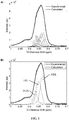
- Figure 1 shows the part of a spectrum corresponding to the methyl signal of a serum sample for a single gradient of a 2D diffusion-ordered 1 H NMR experiment and its fitting.
- the fitting for a single gradient has been depicted for increased clarity, even if a surface fitting is performed for a plurality of diffusion gradients.
- Figure 1A shows in thin trace a plurality of model functions used to fit an experimental NMR spectrum, which is also shown in thick trace. The theoretical model signal built from the fitting with model functions is depicted in dot line. Each model function can be associated to a given lipoprotein particle fraction according to its lipoprotein particle size.
- thin lines correspond to the sum of the model signals associated to each corresponding lipoprotein fraction (in this example VLDL, LDL, HDL).
- the surface fitting is performed fixing all parameters (chemical shift, width and diffusion coefficient) except the signal intensities, instead of estimating all parameters for each triplet of lorentzian functions.
- a third regression model may be built to relate the diffusion coefficient with another parameter.
- the lipoprotein particle sizes are selected based on experiments and corresponding to a number of different lipoprotein particle subclasses, which allows a more complete and reliable lipoprotein profile to be achieved.
- the determined diffusion coefficients are corrected in order to take into account possible dilution effects.
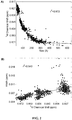
- a serum sample having high triglycerides levels (16 mmol/L) and various dilutions of the same sample (1:2, 1:4, 1:8 and 1:16) are analyzed ( Figure 3 ).
- D 0 D 1 ⁇ k S 1 ⁇ A ⁇ k S 2 ⁇ A
- D 0 is the average diffusion coefficient under dilution conditions
- D and A(au) are the average diffusion coefficient and the total area of the methyl peak, respectively
- k S1 , k S2 are the regression coefficients.
- the signal intensity is determined for each model function in order to minimize the difference between the experimental NMR signal and the model signal built from the plurality of model signals considered.
- NRMSE % ⁇ i n ⁇ j m s exp ⁇ s est 2 max S exp ⁇ min S exp ⁇ 100
- S exp and S est are the experimental and estimated surfaces, respectively
- n is the number of data points considered and m the number of gradients used.
- particle-weighted lipoprotein sizes can be obtained by dividing the NMR area associated to each model function by their associated volume: P N j ⁇ A j R j 3 where A j , R j 3 and PN j are the area (au), volume ( ⁇ 3 ) and particle number (au/ ⁇ 3 ) of a given lipoprotein particle j .
- the proportionality factor relating the particle number with the ratio between area and volume can be easily obtained by known calibration standards, which directly relate the NMR area and the lipid concentration.
- PLS regression models were calibrated to predict the cholesterol and triglyceride concentration of the main lipoprotein particle fractions (VLDL, LDL, and HDL). Regions from 5.4 to 5.15 ppm, from 3.28 to 3.14 ppm, from 2.15 to 1.85 ppm, from 1.45 to 1 ppm and from 1 to 0.7 ppm (shown in Figure 4 ) were used as X-Block and the cholesterol and triglyceride concentrations were used as Y-Block. Both blocks were mean-centered. The optimum number of latent variables (LV) and the validation performance of the PLS models, were assessed using venetian blinds cross-validation splitting the data 10 times. Coefficients of determination between the predicted and reference concentrations ranged from 0.79 to 0.98 in the calibration step. The coefficients of determination of the validation step ranged from 0.81 to 0.98.
- LV latent variables
- the determination of the lipid concentration of a lipoprotein particle fraction or subclass includes the determination of at least one of a lipid selected from triacylglycerols, cholesteryl esters, free cholesterol and phospholipids.
- a triglyceride (or triacylglycerol) is an ester derived from glycerol and three fatty acids which can be found in a lipoprotein particle.
- Illustrative, non-limitative, fatty acids that can be found in lipoprotein triglycerides are palmitic acid, estearic acid, oleic acid, linoleic acid and araquidonic acid.
- Triglycerides are blood lipids that help enable the bidirectional transference of adipose fat and blood glucose from the liver.
- Illustrative, non-limitative, methods for determination of triglycerides concentration include enzymatic determination. Enzymatic determination of triglycerides is also possible because it is specific and sensitive.
- Triglycerides are hydrolyzed by a lipase in glycerol and free fatty acids.
- glycerol kinase glycerol is phosphorylated to glycerol-3-phosphate which is then oxidized with a glycerol phosphate oxidase with formation of hydrogen peroxide.
- peroxidase 4-chlorophenol and 4-aminoantipyrine with hydrogen peroxide yield a red-colored product, quinonimine.
- the staining intensity is directly proportional to the sample concentration of triglycerides.
- Cholesterol is an amphipatic lipid.
- a cholesteryl ester is an ester of cholesterol wherein the ester bond is formed between the carboxylate group of a fatty acid and the hydroxyl group of cholesterol.
- Illustrative, non-limitative, examples of cholesteryl esters present in a lipoprotein particle are cholesterylpalmitate, cholesteryl stearate, cholesteryloleate, cholesteryllinoleate and cholesterylaraquidonate ( Skipski, V.P. In: Blood Lipids and Lipoproteins. Quantitation, Composition and Metabolism. pp.471-483 (ed. G.J. Nelson, Wiley-Interscience, New York) (1972 )).
- Cholesteryl esters have a lower solubility in water than cholesterol and are more hydrophobic. Numerous methods are available for determination of cholesterol concentration, e.g., gravimetric, nephelometric, turbidimetric, or photometric methods, among others. Commercially available kits for quantitative colorimetric/fluorimetric cholesterol and cholesteryl esters determination may be used. Usually, the concentrations of total and free cholesterol (esterified cholesterol being previously precipitated by, for example, digitonin) are determined, whereas the concentration of cholesteryl esters (esterified cholesterol) is calculated from the difference between these two concentrations. Enzymatic determination of cholesterol concentration is specific and sensitive.
- the principle of reaction is as follows: Cholesterol esterase catalyzes hydrolysis of cholesteryl esters to free cholesterol and free fatty acids. In the presence of cholesterol oxidase, cholesterol is oxidized to ⁇ -4-cholestanetriol to form hydrogen peroxide. In the presence of peroxidase, phenol and 4-aminoantipyrine with hydrogen peroxide yield a red-colored product, quinonimine. The staining intensity is directly proportional to the sample concentration of total cholesterol.
- Phospholipids are a class of lipids that are present in the shell of lipoprotein particles and that are a major component of all cell membranes as they can form lipid bilayers. Most phospholipids contain a diglyceride, a phosphate group, and a simple organic molecule such as choline. The structure of the phospholipid molecule generally consists of hydrophobic tails and a hydrophilic head. Illustrative, non-limitative, examples of phospholipids present in a lipoprotein particle are phosphatidylcholine, sphingophospholipids such as sphingomyelin, phosphatidylethanolamine, phosphatidylinositol and phosphatidylserine.
- Illustrative, non-limitative, methods for determination of phospholipids concentration include commercially available assay kits for a quantitative colorimetric/fluorimetric phospholipid determination.
- the principle of reaction is as follows: phospholipids (such as lecithin, lysolecithin and sphingomyelin) are enzymatically hydrolyzed to choline which is determined using choline oxidase and a H 2 O 2 specific dye.
- the optical density of the pink colored product at 570nm or fluorescence intensity (530/585 nm) is directly proportional to the phospholipid concentration in the sample.
- Serum samples were analysed by NMR spectroscopy, recording 1H NMR spectra on a BrukerAvance III spectrometer at 310 K.
- the double stimulated echo (DSTE) pulse program was used with bipolar gradient pulses and a longitudinal eddy current delay (LED).
- the relaxation delay was 2 s, the free induction decays were collected into 64K complex data points and 32 scans were acquired on each sample.
- the gradient pulse strength was increased from 5 to 95% of the maximum strength of 53.5 Gauss cm -1 in 32 steps, where the squared gradient pulse strength was linearly distributed.
- the 9 model functions were associated with a given lipoprotein particle fraction (VLDL, LDL or HDL) according to their NMR size.
- functions F1-F3 were associated to VLDL, functions F4-F6 to LDL, and functions F7-F9 to HDL (Table 1).
- Main lipoprotein particle fractions were defined as VLDL (193-409 ⁇ ), LDL (74-133 ⁇ ) and HDL (30-55 ⁇ ).
- Subject 1 shows a prominent HDL area (shown in dark grey in Figure 5D ), subject 2 has increased LDL area (shown in light grey in Figure 5E ), and subject 3 is characterized by a very high VLDL area (shown in medium grey in Figure 5F ).
- the coefficient of variation (CV) is determined for the signal intensity of the central lorentzian, since the other model parameters have been fixed during the fitting.
- the above expression for the calculation of the coefficient of variation may be generalized for the case where more than one free model parameters is used in the fitting.
- NRMSE Normalized root mean squared errors
- each NMR area by their associated volume: P N j ⁇ A j R j 3
- a j , R j 3 and PN j are the area (au), volume ( ⁇ 3 ) and particle number (au/ ⁇ 3 ) of a given lipoprotein particle j .
- Particle concentrations of each lipoprotein particle subclass were calculated by dividing the lipid volumes by the particle volumes. Lipid volumes were determined by using common conversion factors to convert concentration units into volume units. Total particle concentrations of each main particle fraction were obtained by summing the concentrations of the corresponding particle subclasses.
- Lipid concentration was determined using PLS models calibrated in the regions shown in Figure 4 , namely: from 5.4 to 5.15 ppm, from 3.28 to 3.14 ppm, from 2.15 to 1.85 ppm, from 1.45 to 1 ppm and from 1 to 0.7 ppm.
- the reference lipids were obtained by sequential ultracentrifugation and correspond to cholesterol and triglycerides for three lipoprotein particle fractions (VLDL, LDL and HDL).
- the method of the invention allows to obtain an advanced lipoprotein profile, as shown in Table 1.
- Table 1 The ALT reports for three representative subjects from the whole group are summarized in Table 1 for illustration purposes.
- Subject 1 was normolipidemic
- subject 2 presented high LDL cholesterol levels (hypercholesterolemic)
- subject 3 presented high triglycerides and low HDL cholesterol levels (atherogenic dyslipidemia).
- the method of the invention provides total cholesterol (C), triglycerides (TG) and particle concentration (P) for the main lipoprotein fractions and their subclasses. Additionally, the method of the invention provides the size of the main lipoprotein fractions.
- Subject 1 showed normal lipid levels (defined as VLDL-TG ⁇ 150 mg/dL, LDL-C ⁇ 160 mg/dL, and HDL-C>40 mg/dL), subject 2 showed elevated LDL-C and normal VLDL-TG and HDL-C levels, and subject 3 showed elevated VLDL-TG, decreased HDL-C and normal LDL-C levels. It should also be pointed out that subject 3 had increased LDL-P despite normal LDL-C levels and that its small LDL-P concentration was higher than in subject 2. Thus, subjects with elevated triglycerides levels are associated with increased LDL-P values because an increase in triglyceride concentration leads to the formation of greater concentrations of smaller LDL particles.
Landscapes
- Physics & Mathematics (AREA)
- Health & Medical Sciences (AREA)
- Life Sciences & Earth Sciences (AREA)
- Chemical & Material Sciences (AREA)
- High Energy & Nuclear Physics (AREA)
- Molecular Biology (AREA)
- General Health & Medical Sciences (AREA)
- General Physics & Mathematics (AREA)
- Immunology (AREA)
- Pathology (AREA)
- Analytical Chemistry (AREA)
- Biochemistry (AREA)
- Engineering & Computer Science (AREA)
- Spectroscopy & Molecular Physics (AREA)
- Biomedical Technology (AREA)
- Urology & Nephrology (AREA)
- Hematology (AREA)
- Crystallography & Structural Chemistry (AREA)
- Condensed Matter Physics & Semiconductors (AREA)
- Biotechnology (AREA)
- Cell Biology (AREA)
- Endocrinology (AREA)
- Microbiology (AREA)
- Biophysics (AREA)
- Food Science & Technology (AREA)
- Medicinal Chemistry (AREA)
- Investigating Or Analysing Biological Materials (AREA)
Claims (13)
- In-vitro-Verfahren zum Charakterisieren von Lipoproteinen in einer Probe, umfassend die folgenden Schritte:- Erhalten eines 2D diffusionsgeordneten 1H NMR-Spektrums der Probe,- Durchführen einer Oberflächenanpassung eines Teils des Spektrums entsprechend den Methylsignalen unter Verwendung einer Vielzahl von Modellfunktionen, wobei jede Modellfunktion einer gegebenen Partikelgröße entspricht, die einer Lipoproteinfraktion und Unterklasse zugeordnet ist und zumindest einen Modellparameter umfasst, der während des Anpassens zu bestimmen ist, wobei die bestimmten Modellparameter ein Satz von Modellparametern sind, für die der Unterschied zwischen dem NMR-Signal und dem Modellsignal als eine lineare Kombination von Modellfunktionen minimiert werden, und- Identifizieren der Lipoproteine, die in der Probe vorhanden sind als diejenigen, die den Modellfunktionen zugeordnet sind, beitragend zu dem theoretischen Modellsignal, das aus dem Anpassen resultiert, wobei jede Modellfunktion ein Triplet von Lorentz-Funktionen mit der folgenden Form ist:wobei für jede Modellfunktion:


wobei die festgesetzten Modellparameter basierend auf der Lipoproteinpartikelgröße und auf Regressionsmodellen basierend bestimmt werden, wobei die Regressionsmodelle sich auf Paare von festgesetzten Modellparametern und/oder einem Modellparameter und der Lipoproteinpartikelgröße beziehen und gemäß den folgenden Schritten bestimmt werden:- Erhalten eines 2D diffusionsgeordneten 1H NMR-Spektrums für eine Vielzahl von Proben,- für jede Probe Durchführen einer Oberflächenanpassung für einen Teil des Spektrums entsprechend den Methylsignalen unter Verwendung einer Vielzahl von Modellfunktionen, wobei jede Modellfunktion von festzusetzenden Modellparametern abhängt, wobei alle diese Modellparameter, die festzusetzen sind, während der Oberflächenanpassung derart angenähert werden, um zu einem Satz von Modellparametern, für die der Unterschied zwischen dem NMR-Signal und dem Modellsignal, das durch eine lineare Kombination von Modellfunktionen erhalten wird, minimiert wird, und- Verwenden der Modellparameter, die in dem vorangehenden Schritt angenähert werden, um Regressionsmodelle zu bilden, die sich auf Paare von Modellparametern und/oder einem Modellparameter und der Lipoproteinpartikelgröße beziehen. - In-vitro-Verfahren nach Anspruch 1, wobei die Triplets der Lorentz-Funktionen die folgende Form haben:

- In-vitro-Veriahren nach einem der vorangehenden Ansprüche, wobei


- In-vitro-Verfahren nach einem der vorangehenden Ansprüche, wobei die Lipoproteinpartikelgrößen basierend auf NMR, HPLC, Gradientengelelektrophorese oder Rasterkraftmikroskopexperimenten definiert werden.
- In-vitro-Verfahren nach einem der vorangehenden Ansprüche, wobei zumindest eine der chemischen Verschiebungen, der Breite und des Diffusionskoeffizienten festgesetzt werden und zumindest die Signalintensität des zentralen Lorentz-Parameters (h2 ) als ein freier Parameter verwendet wird.
- In-vitro-Verfahren nach einem der Ansprüche 1 bis 5, wobei die Modellfunktionen, die zum Bilden der Regressionsmodelle verwendet werden, Lorentz-Funktionstriplets der folgenden Form sind:

- In-vitro-Verfahren nach einem der vorangehenden Ansprüche, wobei die Vielzahl der Proben, die zum Bilden der Regressionsmodelle verwendet werden, zumindest 100 Proben umfassen und ein Prozentsatz von zumindest 9% der Proben Individuen entsprechen, die ein Profil von Diabetes mellitus haben und zumindest 25% dieser Patienten ein Profil von atherogener Dyslipidämie haben.
- In-vitro-Verfahren nach einem der vorangehenden Ansprüche, wobei der Diffusionskoeffizient der Modellfunktionen ausgehend von der Lipoproteinpartikelgröße unter Zuhilfenahme der Einstein-Stokes-Gleichung bestimmt wird

- In-vitro-Verfahren nach einem der vorangehenden Ansprüche, wobei das Verfahren ferner das Korrigieren der abgeschätzten Diffusionskoeffizienten, um Verdünnungseffekte zu berücksichtigen, umfasst, basierend auf einem Zusammenhang zwischen der NMR-Fläche und dem Diffusionskoeffizienten, der für verschiedene Verdünnungen einer Probe erhalten wird, wobei die Summe der Konzentration des gesamten Cholesterols und Triglyceride der besagten Probe höher als 300 mg/dl ist.
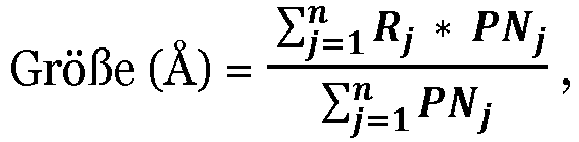
- In-vitro-Verfahren nach einem der vorangehenden Ansprüche, ferner umfassend das Bestimmen einer oder mehrerer von: durchschnittliche Größe der Lipoproteinpartikelfraktionen, durchschnittliche Größe der Lipoproteinpartikelunterklassen, Fraktion und/oder Unterklasse der Lipoproteinpartikelkonzentration, Lipidkonzentration von zumindest einer Lipoproteinpartikelfraktion und/oder Lipidkonzentration von zumindest einer Lipidproteinpartikelunterklasse.
- In-vitro-Verfahren nach Anspruch 10, wobei die durchschnittliche Partikelgröße einer Lipoproteinpartikelfraktion bestimmt wird als:

- In-vitro-Verfahren nach einem der vorangehenden Ansprüche, wobei die Fläche, die einer Lipoproteinmodellfunktion zugeordnet ist, korrigiert wird, um lediglich den Beitrag der Lipide zu berücksichtigen, die in dem Lipoproteinpartikelkern umfasst sind.
- In-vitro-Verfahren nach Anspruch 12, wobei die korrigierte Fläche (A') bestimmt wird unter Verwendung des folgenden Ausdrucks:

Priority Applications (2)
| Application Number | Priority Date | Filing Date | Title |
|---|---|---|---|
| EP14805577.5A EP3074775B1 (de) | 2013-11-27 | 2014-11-27 | Verfahren zur charakterisierung von lipoproteinen |
| PL14805577T PL3074775T3 (pl) | 2013-11-27 | 2014-11-27 | Sposób charakteryzowania lipoprotein |
Applications Claiming Priority (3)
| Application Number | Priority Date | Filing Date | Title |
|---|---|---|---|
| EP13382478 | 2013-11-27 | ||
| EP14805577.5A EP3074775B1 (de) | 2013-11-27 | 2014-11-27 | Verfahren zur charakterisierung von lipoproteinen |
| PCT/EP2014/075873 WO2015079000A1 (en) | 2013-11-27 | 2014-11-27 | Method for the characterization of lipoproteins |
Publications (2)
| Publication Number | Publication Date |
|---|---|
| EP3074775A1 EP3074775A1 (de) | 2016-10-05 |
| EP3074775B1 true EP3074775B1 (de) | 2018-07-11 |
Family
ID=49709596
Family Applications (1)
| Application Number | Title | Priority Date | Filing Date |
|---|---|---|---|
| EP14805577.5A Active EP3074775B1 (de) | 2013-11-27 | 2014-11-27 | Verfahren zur charakterisierung von lipoproteinen |
Country Status (11)
| Country | Link |
|---|---|
| US (1) | US20170160215A1 (de) |
| EP (1) | EP3074775B1 (de) |
| JP (1) | JP6605468B2 (de) |
| CN (1) | CN106415276B (de) |
| AU (1) | AU2014356428B2 (de) |
| CA (1) | CA2931749C (de) |
| DK (1) | DK3074775T3 (de) |
| ES (1) | ES2689323T3 (de) |
| PL (1) | PL3074775T3 (de) |
| PT (1) | PT3074775T (de) |
| WO (1) | WO2015079000A1 (de) |
Families Citing this family (6)
| Publication number | Priority date | Publication date | Assignee | Title |
|---|---|---|---|---|
| CN105241911B (zh) * | 2015-09-23 | 2017-07-21 | 中国石油大学(北京) | 基于lbm模拟低场核磁共振分析流体的方法及装置 |
| DE102016224691A1 (de) * | 2016-12-12 | 2018-06-14 | Numares Ag | Verfahren zur Analyse eines NMR-Spektrums einer lipoproteinhaltigen Probe |
| EP3483619A1 (de) * | 2017-11-13 | 2019-05-15 | Technische Universität München | Automatisierte nicht-invasive bestimmung des geschlechts eines embryos und der fertilität eines vogeleis |
| CN108627510A (zh) * | 2018-06-06 | 2018-10-09 | 临安卡尔生物技术有限公司 | 高密度脂蛋白胆固醇检测试剂盒 |
| JP2020030147A (ja) | 2018-08-23 | 2020-02-27 | デンカ生研株式会社 | 原発性胆汁性胆管炎の検出を補助する方法 |
| CN112986307B (zh) * | 2021-02-21 | 2022-05-03 | 中国科学院精密测量科学与技术创新研究院 | 核磁共振浓度排序谱的构建方法 |
Family Cites Families (6)
| Publication number | Priority date | Publication date | Assignee | Title |
|---|---|---|---|---|
| US4933844A (en) * | 1988-09-26 | 1990-06-12 | Otvos James D | Measurement of blood lipoprotein constituents by analysis of data acquired from an NMR spectrometer |
| WO1993003450A1 (en) * | 1991-07-30 | 1993-02-18 | North Carolina State University | Method and apparatus for measuring blood lipoprotein levels by nmr spectroscopy |
| CA2542107A1 (en) * | 2003-10-23 | 2005-05-12 | Liposcience, Inc. | Methods, systems and computer programs for assessing chd risk using mathematical models that consider in vivo concentration gradients of ldl particle subclasses of discrete size |
| DE102004026903B4 (de) * | 2004-06-01 | 2006-05-18 | Universität Regensburg | Verfahren zur Bestimmung von Lipoproteinen in Körperflüssigkeiten und Messanordnung dafür |
| US20120191417A1 (en) * | 2010-09-24 | 2012-07-26 | University Of Southern California | Noise reduction for spectroscopic signal processing |
| US9470771B2 (en) * | 2012-06-08 | 2016-10-18 | Liposcience, Inc. | NMR measurements of NMR biomarker GlycA |
-
2014
- 2014-11-27 JP JP2016535160A patent/JP6605468B2/ja active Active
- 2014-11-27 ES ES14805577.5T patent/ES2689323T3/es active Active
- 2014-11-27 US US15/039,308 patent/US20170160215A1/en not_active Abandoned
- 2014-11-27 CA CA2931749A patent/CA2931749C/en active Active
- 2014-11-27 PL PL14805577T patent/PL3074775T3/pl unknown
- 2014-11-27 AU AU2014356428A patent/AU2014356428B2/en not_active Ceased
- 2014-11-27 DK DK14805577.5T patent/DK3074775T3/en active
- 2014-11-27 CN CN201480071338.4A patent/CN106415276B/zh active Active
- 2014-11-27 EP EP14805577.5A patent/EP3074775B1/de active Active
- 2014-11-27 WO PCT/EP2014/075873 patent/WO2015079000A1/en not_active Ceased
- 2014-11-27 PT PT14805577T patent/PT3074775T/pt unknown
Non-Patent Citations (1)
| Title |
|---|
| None * |
Also Published As
| Publication number | Publication date |
|---|---|
| US20170160215A1 (en) | 2017-06-08 |
| WO2015079000A1 (en) | 2015-06-04 |
| PL3074775T3 (pl) | 2018-12-31 |
| JP2016538559A (ja) | 2016-12-08 |
| CA2931749A1 (en) | 2015-06-04 |
| CN106415276A (zh) | 2017-02-15 |
| AU2014356428A1 (en) | 2016-06-16 |
| CA2931749C (en) | 2023-06-27 |
| JP6605468B2 (ja) | 2019-11-13 |
| CN106415276B (zh) | 2018-10-16 |
| PT3074775T (pt) | 2018-10-31 |
| EP3074775A1 (de) | 2016-10-05 |
| DK3074775T3 (en) | 2018-10-01 |
| ES2689323T3 (es) | 2018-11-13 |
| AU2014356428B2 (en) | 2021-05-06 |
Similar Documents
| Publication | Publication Date | Title |
|---|---|---|
| Solnica et al. | 2020 Guidelines of the Polish Society of Laboratory Diagnostics (PSLD) and the Polish Lipid Association (PoLA) on laboratory diagnostics of lipid metabolism disorders | |
| Aru et al. | Quantification of lipoprotein profiles by nuclear magnetic resonance spectroscopy and multivariate data analysis | |
| AU2014356428B2 (en) | Method for the characterization of lipoproteins | |
| Matyus et al. | NMR measurement of LDL particle number using the Vantera® Clinical Analyzer | |
| Oostendorp et al. | Diagnosing inborn errors of lipid metabolism with proton nuclear magnetic resonance spectroscopy | |
| Monsonis Centelles et al. | Toward reliable lipoprotein particle predictions from NMR spectra of human blood: an interlaboratory ring test | |
| Gupta et al. | Does LDL-C estimation using Anandaraja’s formula give a better agreement with direct LDL-C estimation than the Friedewald’s formula? | |
| Amigó et al. | Lipoprotein hydrophobic core lipids are partially extruded to surface in smaller HDL:“Herniated” HDL, a common feature in diabetes | |
| Otoki et al. | Accurate quantitation of choline and ethanolamine plasmalogen molecular species in human plasma by liquid chromatography–tandem mass spectrometry | |
| Chung et al. | High resolution plasma lipoprotein cholesterol profiles by a rapid, high volume semi-automated method. | |
| Garcia et al. | High-throughput nuclear magnetic resonance measurement of citrate in serum and plasma in the clinical laboratory | |
| Shiu et al. | Pre-β1 HDL in type 2 diabetes mellitus | |
| JP3899041B2 (ja) | リポタンパク質の分析方法及び分析プログラム | |
| O'Kane et al. | Abnormalities of serum apo A1 containing lipoprotein particles in patients with primary biliary cirrhosis | |
| Whiley et al. | Current strategies in the discovery of small-molecule biomarkers for Alzheimer’s disease | |
| RU2517054C1 (ru) | Способ прогнозирования течения липидемии | |
| Grau | Lipoprotein Analysis by 2d Diffusion-ordered 1h-nmr Spectroscopy | |
| RU2521322C1 (ru) | Способ оценки прогрессирования атерогенности при ишемической болезни сердца | |
| CN108254579B (zh) | 制备一种抗干扰能力强的高密度脂蛋白胆固醇检测试剂盒 | |
| SBIBIH et al. | Verification of the analytical performance of the serum albumin assay on the Abbott Alinity ci | |
| Amigó Grau | Lipoprotein analysis by 2d diffusion-ordered 1h-nmr spectroscopy | |
| Sato et al. | Serum amyloid A does not affect high-density lipoprotein cholesterol measurement by a homogeneous assay | |
| Ugwuezumba et al. | Influence of freeze-thawing and storage on human serum lipid analytes | |
| EP3074774B1 (de) | Verfahren zur bestimmung der lipidverteilung zwischen dem kern und der schale eines lipoproteinteilchens | |
| Ou et al. | Quantitative 1H-NMR spectroscopy identifies metabolites and lipoprotein subclasses associated with intermediate phenotypes of chronic diseases in the Japanese Nagahama Study |
Legal Events
| Date | Code | Title | Description |
|---|---|---|---|
| PUAI | Public reference made under article 153(3) epc to a published international application that has entered the european phase |
Free format text: ORIGINAL CODE: 0009012 |
|
| 17P | Request for examination filed |
Effective date: 20160607 |
|
| AK | Designated contracting states |
Kind code of ref document: A1 Designated state(s): AL AT BE BG CH CY CZ DE DK EE ES FI FR GB GR HR HU IE IS IT LI LT LU LV MC MK MT NL NO PL PT RO RS SE SI SK SM TR |
|
| AX | Request for extension of the european patent |
Extension state: BA ME |
|
| DAX | Request for extension of the european patent (deleted) | ||
| 17Q | First examination report despatched |
Effective date: 20170420 |
|
| GRAP | Despatch of communication of intention to grant a patent |
Free format text: ORIGINAL CODE: EPIDOSNIGR1 |
|
| INTG | Intention to grant announced |
Effective date: 20180130 |
|
| GRAS | Grant fee paid |
Free format text: ORIGINAL CODE: EPIDOSNIGR3 |
|
| GRAA | (expected) grant |
Free format text: ORIGINAL CODE: 0009210 |
|
| AK | Designated contracting states |
Kind code of ref document: B1 Designated state(s): AL AT BE BG CH CY CZ DE DK EE ES FI FR GB GR HR HU IE IS IT LI LT LU LV MC MK MT NL NO PL PT RO RS SE SI SK SM TR |
|
| REG | Reference to a national code |
Ref country code: GB Ref legal event code: FG4D |
|
| REG | Reference to a national code |
Ref country code: CH Ref legal event code: EP |
|
| REG | Reference to a national code |
Ref country code: AT Ref legal event code: REF Ref document number: 1017440 Country of ref document: AT Kind code of ref document: T Effective date: 20180715 |
|
| REG | Reference to a national code |
Ref country code: IE Ref legal event code: FG4D |
|
| REG | Reference to a national code |
Ref country code: DE Ref legal event code: R096 Ref document number: 602014028419 Country of ref document: DE |
|
| REG | Reference to a national code |
Ref country code: DK Ref legal event code: T3 Effective date: 20180924 |
|
| REG | Reference to a national code |
Ref country code: NL Ref legal event code: FP |
|
| REG | Reference to a national code |
Ref country code: SE Ref legal event code: TRGR |
|
| REG | Reference to a national code |
Ref country code: PT Ref legal event code: SC4A Ref document number: 3074775 Country of ref document: PT Date of ref document: 20181031 Kind code of ref document: T Free format text: AVAILABILITY OF NATIONAL TRANSLATION Effective date: 20181001 |
|
| REG | Reference to a national code |
Ref country code: NO Ref legal event code: T2 Effective date: 20180711 |
|
| REG | Reference to a national code |
Ref country code: ES Ref legal event code: FG2A Ref document number: 2689323 Country of ref document: ES Kind code of ref document: T3 Effective date: 20181113 |
|
| REG | Reference to a national code |
Ref country code: LT Ref legal event code: MG4D |
|
| PG25 | Lapsed in a contracting state [announced via postgrant information from national office to epo] |
Ref country code: LT Free format text: LAPSE BECAUSE OF FAILURE TO SUBMIT A TRANSLATION OF THE DESCRIPTION OR TO PAY THE FEE WITHIN THE PRESCRIBED TIME-LIMIT Effective date: 20180711 Ref country code: BG Free format text: LAPSE BECAUSE OF FAILURE TO SUBMIT A TRANSLATION OF THE DESCRIPTION OR TO PAY THE FEE WITHIN THE PRESCRIBED TIME-LIMIT Effective date: 20181011 Ref country code: RS Free format text: LAPSE BECAUSE OF FAILURE TO SUBMIT A TRANSLATION OF THE DESCRIPTION OR TO PAY THE FEE WITHIN THE PRESCRIBED TIME-LIMIT Effective date: 20180711 Ref country code: IS Free format text: LAPSE BECAUSE OF FAILURE TO SUBMIT A TRANSLATION OF THE DESCRIPTION OR TO PAY THE FEE WITHIN THE PRESCRIBED TIME-LIMIT Effective date: 20181111 |
|
| PG25 | Lapsed in a contracting state [announced via postgrant information from national office to epo] |
Ref country code: HR Free format text: LAPSE BECAUSE OF FAILURE TO SUBMIT A TRANSLATION OF THE DESCRIPTION OR TO PAY THE FEE WITHIN THE PRESCRIBED TIME-LIMIT Effective date: 20180711 Ref country code: AL Free format text: LAPSE BECAUSE OF FAILURE TO SUBMIT A TRANSLATION OF THE DESCRIPTION OR TO PAY THE FEE WITHIN THE PRESCRIBED TIME-LIMIT Effective date: 20180711 Ref country code: LV Free format text: LAPSE BECAUSE OF FAILURE TO SUBMIT A TRANSLATION OF THE DESCRIPTION OR TO PAY THE FEE WITHIN THE PRESCRIBED TIME-LIMIT Effective date: 20180711 |
|
| REG | Reference to a national code |
Ref country code: GR Ref legal event code: EP Ref document number: 20180402739 Country of ref document: GR Effective date: 20190225 |
|
| REG | Reference to a national code |
Ref country code: DE Ref legal event code: R097 Ref document number: 602014028419 Country of ref document: DE |
|
| PG25 | Lapsed in a contracting state [announced via postgrant information from national office to epo] |
Ref country code: CZ Free format text: LAPSE BECAUSE OF FAILURE TO SUBMIT A TRANSLATION OF THE DESCRIPTION OR TO PAY THE FEE WITHIN THE PRESCRIBED TIME-LIMIT Effective date: 20180711 Ref country code: RO Free format text: LAPSE BECAUSE OF FAILURE TO SUBMIT A TRANSLATION OF THE DESCRIPTION OR TO PAY THE FEE WITHIN THE PRESCRIBED TIME-LIMIT Effective date: 20180711 Ref country code: EE Free format text: LAPSE BECAUSE OF FAILURE TO SUBMIT A TRANSLATION OF THE DESCRIPTION OR TO PAY THE FEE WITHIN THE PRESCRIBED TIME-LIMIT Effective date: 20180711 |
|
| PLBE | No opposition filed within time limit |
Free format text: ORIGINAL CODE: 0009261 |
|
| STAA | Information on the status of an ep patent application or granted ep patent |
Free format text: STATUS: NO OPPOSITION FILED WITHIN TIME LIMIT |
|
| PG25 | Lapsed in a contracting state [announced via postgrant information from national office to epo] |
Ref country code: SK Free format text: LAPSE BECAUSE OF FAILURE TO SUBMIT A TRANSLATION OF THE DESCRIPTION OR TO PAY THE FEE WITHIN THE PRESCRIBED TIME-LIMIT Effective date: 20180711 Ref country code: SM Free format text: LAPSE BECAUSE OF FAILURE TO SUBMIT A TRANSLATION OF THE DESCRIPTION OR TO PAY THE FEE WITHIN THE PRESCRIBED TIME-LIMIT Effective date: 20180711 |
|
| 26N | No opposition filed |
Effective date: 20190412 |
|
| PG25 | Lapsed in a contracting state [announced via postgrant information from national office to epo] |
Ref country code: MC Free format text: LAPSE BECAUSE OF FAILURE TO SUBMIT A TRANSLATION OF THE DESCRIPTION OR TO PAY THE FEE WITHIN THE PRESCRIBED TIME-LIMIT Effective date: 20180711 Ref country code: LU Free format text: LAPSE BECAUSE OF NON-PAYMENT OF DUE FEES Effective date: 20181127 |
|
| PG25 | Lapsed in a contracting state [announced via postgrant information from national office to epo] |
Ref country code: SI Free format text: LAPSE BECAUSE OF FAILURE TO SUBMIT A TRANSLATION OF THE DESCRIPTION OR TO PAY THE FEE WITHIN THE PRESCRIBED TIME-LIMIT Effective date: 20180711 |
|
| PG25 | Lapsed in a contracting state [announced via postgrant information from national office to epo] |
Ref country code: MT Free format text: LAPSE BECAUSE OF NON-PAYMENT OF DUE FEES Effective date: 20181127 |
|
| PG25 | Lapsed in a contracting state [announced via postgrant information from national office to epo] |
Ref country code: HU Free format text: LAPSE BECAUSE OF FAILURE TO SUBMIT A TRANSLATION OF THE DESCRIPTION OR TO PAY THE FEE WITHIN THE PRESCRIBED TIME-LIMIT; INVALID AB INITIO Effective date: 20141127 Ref country code: MK Free format text: LAPSE BECAUSE OF NON-PAYMENT OF DUE FEES Effective date: 20180711 Ref country code: CY Free format text: LAPSE BECAUSE OF FAILURE TO SUBMIT A TRANSLATION OF THE DESCRIPTION OR TO PAY THE FEE WITHIN THE PRESCRIBED TIME-LIMIT Effective date: 20180711 |
|
| REG | Reference to a national code |
Ref country code: AT Ref legal event code: UEP Ref document number: 1017440 Country of ref document: AT Kind code of ref document: T Effective date: 20180711 |
|
| PGFP | Annual fee paid to national office [announced via postgrant information from national office to epo] |
Ref country code: AT Payment date: 20211119 Year of fee payment: 8 Ref country code: PT Payment date: 20211118 Year of fee payment: 8 Ref country code: SE Payment date: 20211127 Year of fee payment: 8 Ref country code: TR Payment date: 20211118 Year of fee payment: 8 Ref country code: FI Payment date: 20211126 Year of fee payment: 8 Ref country code: DK Payment date: 20211129 Year of fee payment: 8 Ref country code: NL Payment date: 20211126 Year of fee payment: 8 Ref country code: IE Payment date: 20211129 Year of fee payment: 8 Ref country code: NO Payment date: 20211126 Year of fee payment: 8 |
|
| PGFP | Annual fee paid to national office [announced via postgrant information from national office to epo] |
Ref country code: GR Payment date: 20211126 Year of fee payment: 8 |
|
| PGFP | Annual fee paid to national office [announced via postgrant information from national office to epo] |
Ref country code: PL Payment date: 20211118 Year of fee payment: 8 |
|
| REG | Reference to a national code |
Ref country code: DK Ref legal event code: EBP Effective date: 20221130 |
|
| REG | Reference to a national code |
Ref country code: NO Ref legal event code: MMEP |
|
| REG | Reference to a national code |
Ref country code: SE Ref legal event code: EUG |
|
| REG | Reference to a national code |
Ref country code: NL Ref legal event code: MM Effective date: 20221201 |
|
| REG | Reference to a national code |
Ref country code: AT Ref legal event code: MM01 Ref document number: 1017440 Country of ref document: AT Kind code of ref document: T Effective date: 20221127 |
|
| PG25 | Lapsed in a contracting state [announced via postgrant information from national office to epo] |
Ref country code: PT Free format text: LAPSE BECAUSE OF NON-PAYMENT OF DUE FEES Effective date: 20230529 Ref country code: NO Free format text: LAPSE BECAUSE OF NON-PAYMENT OF DUE FEES Effective date: 20221130 Ref country code: AT Free format text: LAPSE BECAUSE OF NON-PAYMENT OF DUE FEES Effective date: 20221127 |
|
| PG25 | Lapsed in a contracting state [announced via postgrant information from national office to epo] |
Ref country code: SE Free format text: LAPSE BECAUSE OF NON-PAYMENT OF DUE FEES Effective date: 20221128 Ref country code: NL Free format text: LAPSE BECAUSE OF NON-PAYMENT OF DUE FEES Effective date: 20221201 Ref country code: GR Free format text: LAPSE BECAUSE OF NON-PAYMENT OF DUE FEES Effective date: 20230609 |
|
| PG25 | Lapsed in a contracting state [announced via postgrant information from national office to epo] |
Ref country code: IE Free format text: LAPSE BECAUSE OF NON-PAYMENT OF DUE FEES Effective date: 20221127 Ref country code: DK Free format text: LAPSE BECAUSE OF NON-PAYMENT OF DUE FEES Effective date: 20221130 |
|
| PGFP | Annual fee paid to national office [announced via postgrant information from national office to epo] |
Ref country code: IT Payment date: 20231122 Year of fee payment: 10 Ref country code: FR Payment date: 20231127 Year of fee payment: 10 Ref country code: DE Payment date: 20231129 Year of fee payment: 10 Ref country code: CH Payment date: 20231201 Year of fee payment: 10 |
|
| PGFP | Annual fee paid to national office [announced via postgrant information from national office to epo] |
Ref country code: BE Payment date: 20231127 Year of fee payment: 10 |
|
| PG25 | Lapsed in a contracting state [announced via postgrant information from national office to epo] |
Ref country code: FI Free format text: LAPSE BECAUSE OF NON-PAYMENT OF DUE FEES Effective date: 20221127 |
|
| PG25 | Lapsed in a contracting state [announced via postgrant information from national office to epo] |
Ref country code: PL Free format text: LAPSE BECAUSE OF NON-PAYMENT OF DUE FEES Effective date: 20221127 |
|
| PG25 | Lapsed in a contracting state [announced via postgrant information from national office to epo] |
Ref country code: TR Free format text: LAPSE BECAUSE OF NON-PAYMENT OF DUE FEES Effective date: 20221127 |
|
| REG | Reference to a national code |
Ref country code: DE Ref legal event code: R119 Ref document number: 602014028419 Country of ref document: DE |
|
| REG | Reference to a national code |
Ref country code: CH Ref legal event code: PL |
|
| REG | Reference to a national code |
Ref country code: CH Ref legal event code: PL |
|
| PG25 | Lapsed in a contracting state [announced via postgrant information from national office to epo] |
Ref country code: CH Free format text: LAPSE BECAUSE OF NON-PAYMENT OF DUE FEES Effective date: 20241130 |
|
| REG | Reference to a national code |
Ref country code: BE Ref legal event code: MM Effective date: 20241130 |
|
| PG25 | Lapsed in a contracting state [announced via postgrant information from national office to epo] |
Ref country code: DE Free format text: LAPSE BECAUSE OF NON-PAYMENT OF DUE FEES Effective date: 20250603 |
|
| PG25 | Lapsed in a contracting state [announced via postgrant information from national office to epo] |
Ref country code: IT Free format text: LAPSE BECAUSE OF NON-PAYMENT OF DUE FEES Effective date: 20241127 |
|
| PG25 | Lapsed in a contracting state [announced via postgrant information from national office to epo] |
Ref country code: BE Free format text: LAPSE BECAUSE OF NON-PAYMENT OF DUE FEES Effective date: 20241130 |
|
| PG25 | Lapsed in a contracting state [announced via postgrant information from national office to epo] |
Ref country code: FR Free format text: LAPSE BECAUSE OF NON-PAYMENT OF DUE FEES Effective date: 20241130 |
|
| PGFP | Annual fee paid to national office [announced via postgrant information from national office to epo] |
Ref country code: GB Payment date: 20251127 Year of fee payment: 12 |
|
| PGFP | Annual fee paid to national office [announced via postgrant information from national office to epo] |
Ref country code: ES Payment date: 20251216 Year of fee payment: 12 |