EP3067973A1 - Aqueous lithium-ion battery - Google Patents
Aqueous lithium-ion battery Download PDFInfo
- Publication number
- EP3067973A1 EP3067973A1 EP14836824.4A EP14836824A EP3067973A1 EP 3067973 A1 EP3067973 A1 EP 3067973A1 EP 14836824 A EP14836824 A EP 14836824A EP 3067973 A1 EP3067973 A1 EP 3067973A1
- Authority
- EP
- European Patent Office
- Prior art keywords
- cathode
- anode
- electrolyte
- limn
- lithium
- Prior art date
- Legal status (The legal status is an assumption and is not a legal conclusion. Google has not performed a legal analysis and makes no representation as to the accuracy of the status listed.)
- Granted
Links
Images


Classifications
-
- H—ELECTRICITY
- H01—ELECTRIC ELEMENTS
- H01M—PROCESSES OR MEANS, e.g. BATTERIES, FOR THE DIRECT CONVERSION OF CHEMICAL ENERGY INTO ELECTRICAL ENERGY
- H01M10/00—Secondary cells; Manufacture thereof
- H01M10/36—Accumulators not provided for in groups H01M10/05-H01M10/34
-
- H—ELECTRICITY
- H01—ELECTRIC ELEMENTS
- H01M—PROCESSES OR MEANS, e.g. BATTERIES, FOR THE DIRECT CONVERSION OF CHEMICAL ENERGY INTO ELECTRICAL ENERGY
- H01M12/00—Hybrid cells; Manufacture thereof
- H01M12/08—Hybrid cells; Manufacture thereof composed of a half-cell of a fuel-cell type and a half-cell of the secondary-cell type
-
- H—ELECTRICITY
- H01—ELECTRIC ELEMENTS
- H01M—PROCESSES OR MEANS, e.g. BATTERIES, FOR THE DIRECT CONVERSION OF CHEMICAL ENERGY INTO ELECTRICAL ENERGY
- H01M4/00—Electrodes
- H01M4/02—Electrodes composed of, or comprising, active material
- H01M4/36—Selection of substances as active materials, active masses, active liquids
- H01M4/38—Selection of substances as active materials, active masses, active liquids of elements or alloys
- H01M4/381—Alkaline or alkaline earth metals elements
-
- H—ELECTRICITY
- H01—ELECTRIC ELEMENTS
- H01M—PROCESSES OR MEANS, e.g. BATTERIES, FOR THE DIRECT CONVERSION OF CHEMICAL ENERGY INTO ELECTRICAL ENERGY
- H01M4/00—Electrodes
- H01M4/02—Electrodes composed of, or comprising, active material
- H01M4/36—Selection of substances as active materials, active masses, active liquids
- H01M4/48—Selection of substances as active materials, active masses, active liquids of inorganic oxides or hydroxides
- H01M4/485—Selection of substances as active materials, active masses, active liquids of inorganic oxides or hydroxides of mixed oxides or hydroxides for inserting or intercalating light metals, e.g. LiTi2O4 or LiTi2OxFy
-
- H—ELECTRICITY
- H01—ELECTRIC ELEMENTS
- H01M—PROCESSES OR MEANS, e.g. BATTERIES, FOR THE DIRECT CONVERSION OF CHEMICAL ENERGY INTO ELECTRICAL ENERGY
- H01M4/00—Electrodes
- H01M4/02—Electrodes composed of, or comprising, active material
- H01M4/36—Selection of substances as active materials, active masses, active liquids
- H01M4/58—Selection of substances as active materials, active masses, active liquids of inorganic compounds other than oxides or hydroxides, e.g. sulfides, selenides, tellurides, halogenides or LiCoFy; of polyanionic structures, e.g. phosphates, silicates or borates
- H01M4/5825—Oxygenated metallic salts or polyanionic structures, e.g. borates, phosphates, silicates, olivines
-
- H—ELECTRICITY
- H01—ELECTRIC ELEMENTS
- H01M—PROCESSES OR MEANS, e.g. BATTERIES, FOR THE DIRECT CONVERSION OF CHEMICAL ENERGY INTO ELECTRICAL ENERGY
- H01M2300/00—Electrolytes
- H01M2300/0002—Aqueous electrolytes
- H01M2300/0005—Acid electrolytes
-
- H—ELECTRICITY
- H01—ELECTRIC ELEMENTS
- H01M—PROCESSES OR MEANS, e.g. BATTERIES, FOR THE DIRECT CONVERSION OF CHEMICAL ENERGY INTO ELECTRICAL ENERGY
- H01M2300/00—Electrolytes
- H01M2300/0017—Non-aqueous electrolytes
- H01M2300/002—Inorganic electrolyte
-
- Y—GENERAL TAGGING OF NEW TECHNOLOGICAL DEVELOPMENTS; GENERAL TAGGING OF CROSS-SECTIONAL TECHNOLOGIES SPANNING OVER SEVERAL SECTIONS OF THE IPC; TECHNICAL SUBJECTS COVERED BY FORMER USPC CROSS-REFERENCE ART COLLECTIONS [XRACs] AND DIGESTS
- Y02—TECHNOLOGIES OR APPLICATIONS FOR MITIGATION OR ADAPTATION AGAINST CLIMATE CHANGE
- Y02E—REDUCTION OF GREENHOUSE GAS [GHG] EMISSIONS, RELATED TO ENERGY GENERATION, TRANSMISSION OR DISTRIBUTION
- Y02E60/00—Enabling technologies; Technologies with a potential or indirect contribution to GHG emissions mitigation
- Y02E60/10—Energy storage using batteries
Definitions
- the invention relates to the electrochemical industry, in particular, to aqueous lithium-ion batteries.
- Objective of the invention development of batteries with a low cost, environmentally safe, providing a reliable work, a high capacity and a long service life.
- the technical result of the invention is to improve operational performances of the battery, to reduce corrosive properties of the electrolyte providing indices of reliability, a service life of it and an environmental safety.
- an intercalation cathode a metallic and/or electroconductive inert anode separated by a separator with a subacid solution of the electrolyte with pH ⁇ 4-5 comprising at least two types of electrochemically active cations, and represented by a combination of one or a quantity of electrochemical elements each of which includes: the metallic anode from zinc, aluminum or another metal from a range of transition metals or the inert anode from stainless steel, carbon, nickel or copper; the cathode from oxides and salts of lithium, sodium, magnesium or other alkaline or alkaline earth metals with manganese, iron, cobalt, nickel and other transition metals, for example: LiCoPO 4 , LiMnPO 4 , LiFePO 4 , LiMn 2 O 4 , LiCoO 2 , LiMn 1/3 Ni 1/3 O 4 and/or their mixtures.
- a main point of the invention is illustrated by following diagrams and graphs:
- a main point of the invention is illustrated by following diagrams and graphs:
- the invention includes:
- the finished cathode 1 and anode 2, sunk into the separator 3, are placed in the box 4 of a cell of an element/battery, see Fig. 1 .
- the separator 3 is made from the mentioned materials according to the sizes required for this or the battery.
- the separator 3 may be used in dried condition and can be wet by an electrolyte at the end of the assemblage or directly before its use.
- the electrolyte represents an aqueous solution of salts of the metals, ions of which may also be comprised in the composition of the cathode 1 and/or the anode 2, with a pH value (the solution acidity) preventing a hydrolysis of the metals ions of the electrolyte.
- pH of the electrolyte solution is maintained equal to ⁇ 4-5.
- the required pH of the electrolyte solution may be lower or higher than this value, but should not exceed pH ⁇ 8, above which the hydrolysis of majority of ions of metals, except alkaline and alkaline earth metals, takes place.
- a deintercalation (extraction) ion process of the alkaline or alkaline earth cation from a structure of the intercalation cathode takes place on the cathode 1; a process of discharge (reduction) of the cation of the anode 2 material or another ion takes place on the anode 2, see fig. 1 and 2 .
- the box 4 provides an isolation of the cells/elements of the battery from each other and from an environment.
- the electrolyte comprising into the separator 3 represents the aqueous solution with pH ⁇ 4-5 comprising at least two electrochemically active cations, that allows a reduction on the anode 2 of the cation (positive ion) which is not included in the composition of the cathode 1, see fig. 2 .
- a chemical energy is transformed into the electric one due to the electrochemical reactions proceeding on the cathode 1 and on the anode 2 of the element.
- An electric current begins to flow through the system when the cathode 1 and the anode 2 are connected via an external circuit.
- a profile of potential variation in the proposed in the invention lithium-ion battery with the aqueous electrolyte, with the LiFePO 4 cathode 2 has a horizontal plateau at its operating voltage which represents a difference of the cathode 1 and anode 2 potentials. Ranges of the potentials, the upper during charge and the lower during discharge, are determined by the materials of the electrodes (cathode 1 and anode 2).
Landscapes
- Chemical & Material Sciences (AREA)
- Chemical Kinetics & Catalysis (AREA)
- Electrochemistry (AREA)
- General Chemical & Material Sciences (AREA)
- Inorganic Chemistry (AREA)
- Engineering & Computer Science (AREA)
- Manufacturing & Machinery (AREA)
- Crystallography & Structural Chemistry (AREA)
- Secondary Cells (AREA)
- Battery Electrode And Active Subsutance (AREA)
Abstract
Description
- The invention relates to the electrochemical industry, in particular, to aqueous lithium-ion batteries.
- There is a known invention comprising a box, an anode, a cathode, an electrolyte (US Patent,
WO 20111044644, 2011 - However, this invention has the following drawbacks:
- 1. Low specific energy capacity, i.e. a prolonged work on one charge is not provided, a frequent recharge is required, which limits their use in large-scale systems of energy storage, for example, from renewable sources;
- 2. Low cyclability, i.e. they lose very rapidly energy capacity and power upon the repeated charge/discharge processes (upon use); the battery is short-life, the service life is limited within several hundreds of charge/discharge cycles; furthermore, upon each cycle the battery capacity decreases considerably, which is due to the use of severe alkaline electrolyte leading to the degradation of intercalation electrodes (both anode and cathode). This is a main reason of low cyclability of the battery in this invention;
- 3. Presence of severe alkaline electrolyte (chemically aggressive, caustic) is dangerous for users and equipment in presence of leakage; it is required a resistant battery box from special severe alkalineproof materials and careful isolation and sealing of battery elements during their production to prevent a leakage of the electrolyte, which leads to a considerable cost increase of the production. There is a known invention, which is closest in view of its technical nature to the proposed solution, this known invention comprising a box, a cathode, an anode, a separator, an electrolyte (US Patent,
US 20090087742, 2009 ). - However, this invention has the following drawbacks:
- 1. Low specific energy capacity, i.e. a prolonged work on one charge is not provided, a frequent recharge is required, which limits their use in large-scale storage systems, for example, of energy from renewable sources;
- 2. Low cyclability, i.e. they lose very rapidly energy capacity and power upon the repeated charge/discharge processes (upon use); the battery is short-life, the service life is limited within several hundreds of charge/discharge cycles; furthermore, upon each cycle the battery capacity decreases considerably, which is due to the use of severe alkaline electrolyte leading to the degradation of intercalation electrodes (both anode and cathode). This is a main reason of low cyclability of the battery in this invention;
- 3. Presence of severe alkaline electrolyte (chemically aggressive, caustic) is dangerous for users and equipment in presence of leakage; it is required a resistant battery box from special severe alkalineproof materials and careful isolation and sealing of battery elements during their production to prevent a leakage of the electrolyte, which leads to a considerable cost increase of the production.
- Objective of the invention: development of batteries with a low cost, environmentally safe, providing a reliable work, a high capacity and a long service life.
- The technical result of the invention is to improve operational performances of the battery, to reduce corrosive properties of the electrolyte providing indices of reliability, a service life of it and an environmental safety.
- This technical result is achieved due to the fact that in the invention are used an intercalation cathode, a metallic and/or electroconductive inert anode separated by a separator with a subacid solution of the electrolyte with pH ∼ 4-5 comprising at least two types of electrochemically active cations, and represented by a combination of one or a quantity of electrochemical elements each of which includes: the metallic anode from zinc, aluminum or another metal from a range of transition metals or the inert anode from stainless steel, carbon, nickel or copper; the cathode from oxides and salts of lithium, sodium, magnesium or other alkaline or alkaline earth metals with manganese, iron, cobalt, nickel and other transition metals, for example: LiCoPO4, LiMnPO4, LiFePO4, LiMn2O4, LiCoO2, LiMn1/3Ni1/3O4 and/or their mixtures.
- A main point of the invention is illustrated by following diagrams and graphs:
-
Figure 1 is a schematic diagram of an aqueous lithium-ion battery where only one of its cell/element is represented; -
Figure 2 is a schematic diagram of work of the aqueous lithium-ion battery; -
Figure 3 is a graph of potential variation of the lithium-ion battery with an aqueous electrolyte, with a LiFePO4 cathode as an example, during its charge and discharge under a constant current between specified ranges of values of the potentials: the upper during the charge and the lower during the discharge; - A main point of the invention is illustrated by following diagrams and graphs:
-
Figure 1 is a schematic diagram of an aqueous lithium-ion battery where only one of its cell/element is represented; -
Figure 2 is a schematic diagram of work of the aqueous lithium-ion battery; -
Figure 3 is a graph of potential variation of the lithium-ion battery with an aqueous electrolyte, with a LiFePO4 cathode as an example, during its charge and discharge under a constant current between specified ranges of values of the potentials:- the upper during the charge and the lower during the discharge;
-
Figure 4 is, as an example, a graph of cyclability and of cyclability efficiency of the lithium-ion battery with the aqueous electrolyte, with the LiFePO4 cathode, and the ranges of values of the potentials: the upper during the charge and the lower during the discharge versus a zinc anode 1 - 4 V. -
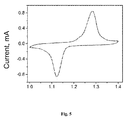
Figure 5 is, as an example, a cyclic voltammogram of the aqueous lithium-ion battery with the aqueous electrolyte, with the LiFePO4 cathode. - The invention includes:
- a
cathode 1 comprising mixed salt of intercalating cations (alkaline and/or alkaline earth metals) with other metals and represent oxides, phosphates, silicates, sulfates, for example: LiCoPO4, LiMnP04, LiFeP04, LiMn204, LiCoO2, LiMn1/3Ni1/3O4 and/or their mixtures; - an
anode 2 consisting in zinc, aluminum or another metal from a range of transition metals or an inert anode from stainless steel or carbon. - a
separator 3 from a porous material (cotton, cellulose or commercial separators for batteries with electrolytes on aqueous base like Absorbed Glass Mat (AGM), nonwoven separators or other separators from natural or synthetic materials); - a
box 4 from polypropylene or other electrically nonconducting synthetic and polymer materials. - Assemblage and operation of the invention are carried out as follows.
- The finished
cathode 1 andanode 2, sunk into theseparator 3, are placed in thebox 4 of a cell of an element/battery, seeFig. 1 . - The
separator 3 is made from the mentioned materials according to the sizes required for this or the battery. For its assemblage theseparator 3 may be used in dried condition and can be wet by an electrolyte at the end of the assemblage or directly before its use. - The electrolyte represents an aqueous solution of salts of the metals, ions of which may also be comprised in the composition of the
cathode 1 and/or theanode 2, with a pH value (the solution acidity) preventing a hydrolysis of the metals ions of the electrolyte. - If the zinc anode and the LiFePO4 cathode are used, in order to prevent the hydrolysis of the zinc ions dissolved in the electrolyte along with the lithium ions, pH of the electrolyte solution is maintained equal to ∼ 4-5.
- In case of other anode and cathode materials, the required pH of the electrolyte solution may be lower or higher than this value, but should not exceed pH ∼ 8, above which the hydrolysis of majority of ions of metals, except alkaline and alkaline earth metals, takes place.
- A mechanism of work of proposed in this invention the lithium-ion element/battery with the aqueous electrolyte, is described as follows.
- During charge: a deintercalation (extraction) ion process of the alkaline or alkaline earth cation from a structure of the intercalation cathode takes place on the
cathode 1; a process of discharge (reduction) of the cation of theanode 2 material or another ion takes place on theanode 2, seefig. 1 and2 . - The
box 4 provides an isolation of the cells/elements of the battery from each other and from an environment. - During discharge, these electrochemical processes proceed in the opposite direction: an intercalation ion process of alkaline or alkaline earth cation into the structure of the
intercalation cathode 1 takes place on thecathode 1, and a process of dissolution (oxidation) of the cation of theanode 2 material or another ion takes place on theanode 2, seefig. 1 and2 . - The electrolyte comprising into the
separator 3 represents the aqueous solution with pH ∼ 4-5 comprising at least two electrochemically active cations, that allows a reduction on theanode 2 of the cation (positive ion) which is not included in the composition of thecathode 1, seefig. 2 . - A chemical energy is transformed into the electric one due to the electrochemical reactions proceeding on the
cathode 1 and on theanode 2 of the element. An electric current begins to flow through the system when thecathode 1 and theanode 2 are connected via an external circuit. - In
fig. 3 , as an example, is shown a profile of potential variation in the proposed in the invention lithium-ion battery with the aqueous electrolyte, with the LiFePO4cathode 2, has a horizontal plateau at its operating voltage which represents a difference of thecathode 1 andanode 2 potentials. Ranges of the potentials, the upper during charge and the lower during discharge, are determined by the materials of the electrodes (cathode 1 and anode 2). - In
fig. 4 shows a high cyclability of this battery. - In
fig. 5 it is shown a cyclic voltammogram of proceeding of the anodic and cathodic processes into the aqueous lithium-ion battery with the LiFePO4cathode 1 and thezinc anode 2. A presence of only reversible peaks of the main cathodic process, oxidation-reduction of LiFePO4, indicates no side processes in his work.
Claims (1)
- nvention comprising a box, an anode, a cathode, an electrolyte, characterized in that it is used in it the intercalation cathode, the metallic and/or electroconductive inert anode separated by a separator with a subacid solution of the electrolyte with pH ∼ 4-5 comprising at least two types of electrochemically active cations, and represented by a combination of one or a quantity of electrochemical elements each of which includes:the metallic anode from zinc, aluminum or another metal from a range of transition metals or the inert anode from stainless steel, carbon, nickel or copper; the cathode from oxides and salts of lithium, sodium, magnesium or other alkaline or alkaline earth metals with manganese, iron, cobalt, nickel and other transition metals, for example: LiCoPO4, LiMnPO4, LiFeP04, LiMn2O4, LiCoO2, LiMn1/3Ni1/3O4 and/or their mixtures.
Applications Claiming Priority (2)
| Application Number | Priority Date | Filing Date | Title |
|---|---|---|---|
| KZ20131705 | 2013-11-06 | ||
| PCT/KZ2014/000001 WO2015023168A1 (en) | 2013-11-06 | 2014-01-30 | Aqueous lithium-ion battery |
Publications (3)
| Publication Number | Publication Date |
|---|---|
| EP3067973A1 true EP3067973A1 (en) | 2016-09-14 |
| EP3067973A4 EP3067973A4 (en) | 2017-04-26 |
| EP3067973B1 EP3067973B1 (en) | 2019-02-20 |
Family
ID=52468493
Family Applications (1)
| Application Number | Title | Priority Date | Filing Date |
|---|---|---|---|
| EP14836824.4A Active EP3067973B1 (en) | 2013-11-06 | 2014-01-30 | Aqueous lithium-ion battery |
Country Status (3)
| Country | Link |
|---|---|
| US (1) | US10347947B2 (en) |
| EP (1) | EP3067973B1 (en) |
| WO (1) | WO2015023168A1 (en) |
Families Citing this family (7)
| Publication number | Priority date | Publication date | Assignee | Title |
|---|---|---|---|---|
| WO2015023168A1 (en) | 2013-11-06 | 2015-02-19 | Частное Учреждение "Назарбаев Университет Рисеч Энд Инновэйшн Систэм" | Aqueous lithium-ion battery |
| CN105489949B (en) * | 2016-01-28 | 2018-06-01 | 吉首大学 | A kind of mixed aqueous solution battery preparation method based on embedding sodium positive electrode |
| CN106229463B (en) * | 2016-07-29 | 2019-04-16 | 天能电池集团有限公司 | A kind of aquo-lithium ion hybrid battery |
| US10868339B2 (en) | 2017-12-05 | 2020-12-15 | Toyota Motor Engineering & Manufacturing North America, Inc. | Aqueous electrolytes with bis(fluorosulfonyl)imide salt electrolyte and ionic liquid system and batteries using the electrolyte system |
| CN108346795A (en) * | 2018-01-25 | 2018-07-31 | 三峡大学 | A kind of water system Zinc ion battery negative material Zn3(OH)2V2O7·2H2The preparation method of O |
| KR20230165831A (en) * | 2021-04-02 | 2023-12-05 | 소테리아 배터리 이노베이션 그룹, 인크. | Base-treated battery separator exhibits hydrofluoric acid removal properties |
| US11978878B1 (en) | 2023-03-30 | 2024-05-07 | AEsir Technologies, Inc. | Bi-polar lithium-zinc-ion batteries |
Family Cites Families (14)
| Publication number | Priority date | Publication date | Assignee | Title |
|---|---|---|---|---|
| JPS5883971A (en) | 1981-11-13 | 1983-05-19 | ユニチカ株式会社 | Production of urine guide cathetel having capacity preventing infection of urinal tract |
| JPS606789A (en) | 1983-06-25 | 1985-01-14 | Agency Of Ind Science & Technol | Wet granulation of dust coal |
| US7189475B2 (en) | 2000-07-27 | 2007-03-13 | Kabushiki Kaisha Toyota Chuo Kenkyusho | Lithium secondary battery |
| JP4581524B2 (en) | 2004-07-22 | 2010-11-17 | 株式会社豊田中央研究所 | Cathode active material for aqueous lithium secondary battery and aqueous lithium secondary battery |
| US8507130B2 (en) * | 2007-07-11 | 2013-08-13 | Kabushiki Kaisha Toyota Chuo Kenkyusho | Water based lithium secondary battery |
| FR2920255B1 (en) | 2007-08-24 | 2009-11-13 | Commissariat Energie Atomique | LITHIUM ELECTROCHEMICAL GENERATOR OPERATING WITH AQUEOUS ELECTROLYTE. |
| KR100889622B1 (en) * | 2007-10-29 | 2009-03-20 | 대정이엠(주) | Highly stable positive electrode active material for lithium secondary battery, manufacturing method thereof and lithium secondary battery comprising same |
| RU2467434C1 (en) * | 2008-10-22 | 2012-11-20 | ЭлДжи КЕМ, ЛТД. | Active cathode material providing improved efficiency and energy density of electrode |
| KR100939647B1 (en) * | 2009-01-22 | 2010-02-03 | 한화석유화학 주식회사 | Anion-deficient non-stoichiometric lithium transition metal polyacid compound as electrode active material, method for preparing the same, and electrochemical device using the same |
| WO2011044644A1 (en) | 2009-10-16 | 2011-04-21 | Murdoch University | Battery |
| KR101838627B1 (en) | 2010-05-28 | 2018-03-14 | 가부시키가이샤 한도오따이 에네루기 켄큐쇼 | Energy storage device and manufacturing method thereof |
| CN105761941B (en) | 2011-03-09 | 2018-07-13 | 亚奎尼能源公司 | Metal-free aqueous electrolyte energy storage device |
| EP2717377B1 (en) * | 2011-06-03 | 2020-08-05 | Positec Power Tools (Suzhou) Co., Ltd | Battery |
| WO2015023168A1 (en) | 2013-11-06 | 2015-02-19 | Частное Учреждение "Назарбаев Университет Рисеч Энд Инновэйшн Систэм" | Aqueous lithium-ion battery |
-
2014
- 2014-01-30 WO PCT/KZ2014/000001 patent/WO2015023168A1/en not_active Ceased
- 2014-01-30 EP EP14836824.4A patent/EP3067973B1/en active Active
- 2014-01-30 US US14/422,534 patent/US10347947B2/en active Active
Also Published As
| Publication number | Publication date |
|---|---|
| EP3067973B1 (en) | 2019-02-20 |
| US10347947B2 (en) | 2019-07-09 |
| WO2015023168A1 (en) | 2015-02-19 |
| US20150207180A1 (en) | 2015-07-23 |
| EP3067973A4 (en) | 2017-04-26 |
Similar Documents
| Publication | Publication Date | Title |
|---|---|---|
| EP3067973B1 (en) | Aqueous lithium-ion battery | |
| US8945756B2 (en) | Composite anode structure for aqueous electrolyte energy storage and device containing same | |
| Yan et al. | Rechargeable hybrid aqueous batteries | |
| RU2686477C2 (en) | Electric battery | |
| TWI463720B (en) | Sodium ion based aqueous electrolyte electrochemical secondary energy storage device | |
| Ghafari et al. | Current and future prospects of Li-ion batteries: a review | |
| AU2012284166B2 (en) | High voltage battery composed of anode limited electrochemical cells | |
| Zhang et al. | Cooperation behavior between heterogeneous cations in hybrid batteries | |
| WO2011079482A1 (en) | Battery | |
| US9531002B2 (en) | Transition metal cyanometallate cathode battery with metal plating anode | |
| Minakshi et al. | Electrochemical energy storage device for securing future renewable energy | |
| Nose et al. | Electrochemical Li+ insertion capabilities of Na 4− x Co 3 (PO 4) 2 P 2 O 7 and its application to novel hybrid-ion batteries | |
| CA2895358C (en) | Electrochemical cell or battery with reduced impedance and method for producing same | |
| US11101485B2 (en) | Flow battery | |
| KR20170031099A (en) | Rechargeable battery containing zinc ions | |
| CN109119635B (en) | Battery with a battery cell | |
| WO2011087883A1 (en) | Glass-fiber containing composite materials for alkali metal-based batteries and methods of making | |
| Shirpour et al. | Sodium-ion batteries:“beyond lithium-ion” | |
| KR20180129383A (en) | Lithium iron phosphate battery charging system | |
| Vujković | Comparison of lithium and sodium intercalation materials | |
| Kelder | Materials for Electrochemical Energy Storage Devices | |
| Lim et al. | Rechargeable Alkaline Zinc-Manganese Oxide Batteries for Grid Storage. | |
| KR20130117054A (en) | Zeolite type battery and manufacyuring mathod thereof | |
| Chalamala | High Performance Rechargeable Battery Technologies. | |
| CN121748551A (en) | A battery system capable of high energy storage efficiency and ultra-fast charging and discharging. |
Legal Events
| Date | Code | Title | Description |
|---|---|---|---|
| PUAI | Public reference made under article 153(3) epc to a published international application that has entered the european phase |
Free format text: ORIGINAL CODE: 0009012 |
|
| 17P | Request for examination filed |
Effective date: 20160330 |
|
| AK | Designated contracting states |
Kind code of ref document: A1 Designated state(s): AL AT BE BG CH CY CZ DE DK EE ES FI FR GB GR HR HU IE IS IT LI LT LU LV MC MK MT NL NO PL PT RO RS SE SI SK SM TR |
|
| AX | Request for extension of the european patent |
Extension state: BA ME |
|
| DAX | Request for extension of the european patent (deleted) | ||
| A4 | Supplementary search report drawn up and despatched |
Effective date: 20170328 |
|
| RIC1 | Information provided on ipc code assigned before grant |
Ipc: H01M 10/24 20060101ALI20170322BHEP Ipc: H01M 4/58 20100101AFI20170322BHEP |
|
| STAA | Information on the status of an ep patent application or granted ep patent |
Free format text: STATUS: EXAMINATION IS IN PROGRESS |
|
| 17Q | First examination report despatched |
Effective date: 20180206 |
|
| REG | Reference to a national code |
Ref country code: DE Ref legal event code: R079 Ref document number: 602014041476 Country of ref document: DE Free format text: PREVIOUS MAIN CLASS: H01M0004580000 Ipc: H01M0010360000 |
|
| GRAP | Despatch of communication of intention to grant a patent |
Free format text: ORIGINAL CODE: EPIDOSNIGR1 |
|
| STAA | Information on the status of an ep patent application or granted ep patent |
Free format text: STATUS: GRANT OF PATENT IS INTENDED |
|
| RIC1 | Information provided on ipc code assigned before grant |
Ipc: H01M 4/38 20060101ALI20181122BHEP Ipc: H01M 10/36 20100101AFI20181122BHEP Ipc: H01M 4/58 20100101ALI20181122BHEP |
|
| GRAS | Grant fee paid |
Free format text: ORIGINAL CODE: EPIDOSNIGR3 |
|
| INTG | Intention to grant announced |
Effective date: 20181221 |
|
| GRAA | (expected) grant |
Free format text: ORIGINAL CODE: 0009210 |
|
| STAA | Information on the status of an ep patent application or granted ep patent |
Free format text: STATUS: THE PATENT HAS BEEN GRANTED |
|
| AK | Designated contracting states |
Kind code of ref document: B1 Designated state(s): AL AT BE BG CH CY CZ DE DK EE ES FI FR GB GR HR HU IE IS IT LI LT LU LV MC MK MT NL NO PL PT RO RS SE SI SK SM TR |
|
| REG | Reference to a national code |
Ref country code: GB Ref legal event code: FG4D |
|
| REG | Reference to a national code |
Ref country code: CH Ref legal event code: EP |
|
| REG | Reference to a national code |
Ref country code: DE Ref legal event code: R096 Ref document number: 602014041476 Country of ref document: DE |
|
| REG | Reference to a national code |
Ref country code: AT Ref legal event code: REF Ref document number: 1099385 Country of ref document: AT Kind code of ref document: T Effective date: 20190315 |
|
| REG | Reference to a national code |
Ref country code: IE Ref legal event code: FG4D |
|
| REG | Reference to a national code |
Ref country code: NL Ref legal event code: MP Effective date: 20190220 |
|
| REG | Reference to a national code |
Ref country code: LT Ref legal event code: MG4D |
|
| PG25 | Lapsed in a contracting state [announced via postgrant information from national office to epo] |
Ref country code: SE Free format text: LAPSE BECAUSE OF FAILURE TO SUBMIT A TRANSLATION OF THE DESCRIPTION OR TO PAY THE FEE WITHIN THE PRESCRIBED TIME-LIMIT Effective date: 20190220 Ref country code: PT Free format text: LAPSE BECAUSE OF FAILURE TO SUBMIT A TRANSLATION OF THE DESCRIPTION OR TO PAY THE FEE WITHIN THE PRESCRIBED TIME-LIMIT Effective date: 20190620 Ref country code: FI Free format text: LAPSE BECAUSE OF FAILURE TO SUBMIT A TRANSLATION OF THE DESCRIPTION OR TO PAY THE FEE WITHIN THE PRESCRIBED TIME-LIMIT Effective date: 20190220 Ref country code: NO Free format text: LAPSE BECAUSE OF FAILURE TO SUBMIT A TRANSLATION OF THE DESCRIPTION OR TO PAY THE FEE WITHIN THE PRESCRIBED TIME-LIMIT Effective date: 20190520 Ref country code: NL Free format text: LAPSE BECAUSE OF FAILURE TO SUBMIT A TRANSLATION OF THE DESCRIPTION OR TO PAY THE FEE WITHIN THE PRESCRIBED TIME-LIMIT Effective date: 20190220 Ref country code: LT Free format text: LAPSE BECAUSE OF FAILURE TO SUBMIT A TRANSLATION OF THE DESCRIPTION OR TO PAY THE FEE WITHIN THE PRESCRIBED TIME-LIMIT Effective date: 20190220 |
|
| PG25 | Lapsed in a contracting state [announced via postgrant information from national office to epo] |
Ref country code: BG Free format text: LAPSE BECAUSE OF FAILURE TO SUBMIT A TRANSLATION OF THE DESCRIPTION OR TO PAY THE FEE WITHIN THE PRESCRIBED TIME-LIMIT Effective date: 20190520 Ref country code: GR Free format text: LAPSE BECAUSE OF FAILURE TO SUBMIT A TRANSLATION OF THE DESCRIPTION OR TO PAY THE FEE WITHIN THE PRESCRIBED TIME-LIMIT Effective date: 20190521 Ref country code: IS Free format text: LAPSE BECAUSE OF FAILURE TO SUBMIT A TRANSLATION OF THE DESCRIPTION OR TO PAY THE FEE WITHIN THE PRESCRIBED TIME-LIMIT Effective date: 20190620 Ref country code: HR Free format text: LAPSE BECAUSE OF FAILURE TO SUBMIT A TRANSLATION OF THE DESCRIPTION OR TO PAY THE FEE WITHIN THE PRESCRIBED TIME-LIMIT Effective date: 20190220 Ref country code: LV Free format text: LAPSE BECAUSE OF FAILURE TO SUBMIT A TRANSLATION OF THE DESCRIPTION OR TO PAY THE FEE WITHIN THE PRESCRIBED TIME-LIMIT Effective date: 20190220 Ref country code: RS Free format text: LAPSE BECAUSE OF FAILURE TO SUBMIT A TRANSLATION OF THE DESCRIPTION OR TO PAY THE FEE WITHIN THE PRESCRIBED TIME-LIMIT Effective date: 20190220 |
|
| REG | Reference to a national code |
Ref country code: AT Ref legal event code: MK05 Ref document number: 1099385 Country of ref document: AT Kind code of ref document: T Effective date: 20190220 |
|
| PG25 | Lapsed in a contracting state [announced via postgrant information from national office to epo] |
Ref country code: IT Free format text: LAPSE BECAUSE OF FAILURE TO SUBMIT A TRANSLATION OF THE DESCRIPTION OR TO PAY THE FEE WITHIN THE PRESCRIBED TIME-LIMIT Effective date: 20190220 Ref country code: RO Free format text: LAPSE BECAUSE OF FAILURE TO SUBMIT A TRANSLATION OF THE DESCRIPTION OR TO PAY THE FEE WITHIN THE PRESCRIBED TIME-LIMIT Effective date: 20190220 Ref country code: EE Free format text: LAPSE BECAUSE OF FAILURE TO SUBMIT A TRANSLATION OF THE DESCRIPTION OR TO PAY THE FEE WITHIN THE PRESCRIBED TIME-LIMIT Effective date: 20190220 Ref country code: CZ Free format text: LAPSE BECAUSE OF FAILURE TO SUBMIT A TRANSLATION OF THE DESCRIPTION OR TO PAY THE FEE WITHIN THE PRESCRIBED TIME-LIMIT Effective date: 20190220 Ref country code: ES Free format text: LAPSE BECAUSE OF FAILURE TO SUBMIT A TRANSLATION OF THE DESCRIPTION OR TO PAY THE FEE WITHIN THE PRESCRIBED TIME-LIMIT Effective date: 20190220 Ref country code: DK Free format text: LAPSE BECAUSE OF FAILURE TO SUBMIT A TRANSLATION OF THE DESCRIPTION OR TO PAY THE FEE WITHIN THE PRESCRIBED TIME-LIMIT Effective date: 20190220 Ref country code: AL Free format text: LAPSE BECAUSE OF FAILURE TO SUBMIT A TRANSLATION OF THE DESCRIPTION OR TO PAY THE FEE WITHIN THE PRESCRIBED TIME-LIMIT Effective date: 20190220 Ref country code: SK Free format text: LAPSE BECAUSE OF FAILURE TO SUBMIT A TRANSLATION OF THE DESCRIPTION OR TO PAY THE FEE WITHIN THE PRESCRIBED TIME-LIMIT Effective date: 20190220 |
|
| REG | Reference to a national code |
Ref country code: DE Ref legal event code: R097 Ref document number: 602014041476 Country of ref document: DE |
|
| PG25 | Lapsed in a contracting state [announced via postgrant information from national office to epo] |
Ref country code: PL Free format text: LAPSE BECAUSE OF FAILURE TO SUBMIT A TRANSLATION OF THE DESCRIPTION OR TO PAY THE FEE WITHIN THE PRESCRIBED TIME-LIMIT Effective date: 20190220 Ref country code: SM Free format text: LAPSE BECAUSE OF FAILURE TO SUBMIT A TRANSLATION OF THE DESCRIPTION OR TO PAY THE FEE WITHIN THE PRESCRIBED TIME-LIMIT Effective date: 20190220 |
|
| PLBE | No opposition filed within time limit |
Free format text: ORIGINAL CODE: 0009261 |
|
| STAA | Information on the status of an ep patent application or granted ep patent |
Free format text: STATUS: NO OPPOSITION FILED WITHIN TIME LIMIT |
|
| PG25 | Lapsed in a contracting state [announced via postgrant information from national office to epo] |
Ref country code: AT Free format text: LAPSE BECAUSE OF FAILURE TO SUBMIT A TRANSLATION OF THE DESCRIPTION OR TO PAY THE FEE WITHIN THE PRESCRIBED TIME-LIMIT Effective date: 20190220 |
|
| 26N | No opposition filed |
Effective date: 20191121 |
|
| PG25 | Lapsed in a contracting state [announced via postgrant information from national office to epo] |
Ref country code: SI Free format text: LAPSE BECAUSE OF FAILURE TO SUBMIT A TRANSLATION OF THE DESCRIPTION OR TO PAY THE FEE WITHIN THE PRESCRIBED TIME-LIMIT Effective date: 20190220 |
|
| PG25 | Lapsed in a contracting state [announced via postgrant information from national office to epo] |
Ref country code: TR Free format text: LAPSE BECAUSE OF FAILURE TO SUBMIT A TRANSLATION OF THE DESCRIPTION OR TO PAY THE FEE WITHIN THE PRESCRIBED TIME-LIMIT Effective date: 20190220 |
|
| PG25 | Lapsed in a contracting state [announced via postgrant information from national office to epo] |
Ref country code: MC Free format text: LAPSE BECAUSE OF FAILURE TO SUBMIT A TRANSLATION OF THE DESCRIPTION OR TO PAY THE FEE WITHIN THE PRESCRIBED TIME-LIMIT Effective date: 20190220 |
|
| PG25 | Lapsed in a contracting state [announced via postgrant information from national office to epo] |
Ref country code: LU Free format text: LAPSE BECAUSE OF NON-PAYMENT OF DUE FEES Effective date: 20200130 |
|
| PG25 | Lapsed in a contracting state [announced via postgrant information from national office to epo] |
Ref country code: IE Free format text: LAPSE BECAUSE OF NON-PAYMENT OF DUE FEES Effective date: 20200130 |
|
| PGFP | Annual fee paid to national office [announced via postgrant information from national office to epo] |
Ref country code: CH Payment date: 20201204 Year of fee payment: 8 |
|
| PG25 | Lapsed in a contracting state [announced via postgrant information from national office to epo] |
Ref country code: MT Free format text: LAPSE BECAUSE OF FAILURE TO SUBMIT A TRANSLATION OF THE DESCRIPTION OR TO PAY THE FEE WITHIN THE PRESCRIBED TIME-LIMIT Effective date: 20190220 Ref country code: CY Free format text: LAPSE BECAUSE OF FAILURE TO SUBMIT A TRANSLATION OF THE DESCRIPTION OR TO PAY THE FEE WITHIN THE PRESCRIBED TIME-LIMIT Effective date: 20190220 |
|
| PG25 | Lapsed in a contracting state [announced via postgrant information from national office to epo] |
Ref country code: MK Free format text: LAPSE BECAUSE OF FAILURE TO SUBMIT A TRANSLATION OF THE DESCRIPTION OR TO PAY THE FEE WITHIN THE PRESCRIBED TIME-LIMIT Effective date: 20190220 |
|
| REG | Reference to a national code |
Ref country code: CH Ref legal event code: PL |
|
| PG25 | Lapsed in a contracting state [announced via postgrant information from national office to epo] |
Ref country code: LI Free format text: LAPSE BECAUSE OF NON-PAYMENT OF DUE FEES Effective date: 20220131 Ref country code: CH Free format text: LAPSE BECAUSE OF NON-PAYMENT OF DUE FEES Effective date: 20220131 |
|
| PGFP | Annual fee paid to national office [announced via postgrant information from national office to epo] |
Ref country code: FR Payment date: 20230128 Year of fee payment: 10 |
|
| PGFP | Annual fee paid to national office [announced via postgrant information from national office to epo] |
Ref country code: GB Payment date: 20230127 Year of fee payment: 10 Ref country code: DE Payment date: 20230130 Year of fee payment: 10 Ref country code: BE Payment date: 20230130 Year of fee payment: 10 |
|
| REG | Reference to a national code |
Ref country code: DE Ref legal event code: R119 Ref document number: 602014041476 Country of ref document: DE |
|
| GBPC | Gb: european patent ceased through non-payment of renewal fee |
Effective date: 20240130 |
|
| PG25 | Lapsed in a contracting state [announced via postgrant information from national office to epo] |
Ref country code: DE Free format text: LAPSE BECAUSE OF NON-PAYMENT OF DUE FEES Effective date: 20240801 |
|
| PG25 | Lapsed in a contracting state [announced via postgrant information from national office to epo] |
Ref country code: GB Free format text: LAPSE BECAUSE OF NON-PAYMENT OF DUE FEES Effective date: 20240130 |
|
| PG25 | Lapsed in a contracting state [announced via postgrant information from national office to epo] |
Ref country code: BE Free format text: LAPSE BECAUSE OF NON-PAYMENT OF DUE FEES Effective date: 20240131 |
|
| PG25 | Lapsed in a contracting state [announced via postgrant information from national office to epo] |
Ref country code: FR Free format text: LAPSE BECAUSE OF NON-PAYMENT OF DUE FEES Effective date: 20240131 |
|
| PG25 | Lapsed in a contracting state [announced via postgrant information from national office to epo] |
Ref country code: GB Free format text: LAPSE BECAUSE OF NON-PAYMENT OF DUE FEES Effective date: 20240130 Ref country code: FR Free format text: LAPSE BECAUSE OF NON-PAYMENT OF DUE FEES Effective date: 20240131 Ref country code: DE Free format text: LAPSE BECAUSE OF NON-PAYMENT OF DUE FEES Effective date: 20240801 Ref country code: BE Free format text: LAPSE BECAUSE OF NON-PAYMENT OF DUE FEES Effective date: 20240131 |
|
| REG | Reference to a national code |
Ref country code: BE Ref legal event code: MM Effective date: 20240131 |