EP3063154B1 - Cross-coupling of unactivated secondary boronic acids - Google Patents
Cross-coupling of unactivated secondary boronic acids Download PDFInfo
- Publication number
- EP3063154B1 EP3063154B1 EP14802743.6A EP14802743A EP3063154B1 EP 3063154 B1 EP3063154 B1 EP 3063154B1 EP 14802743 A EP14802743 A EP 14802743A EP 3063154 B1 EP3063154 B1 EP 3063154B1
- Authority
- EP
- European Patent Office
- Prior art keywords
- group
- alkyl
- boronic acid
- substituted
- chiral
- Prior art date
- Legal status (The legal status is an assumption and is not a legal conclusion. Google has not performed a legal analysis and makes no representation as to the accuracy of the status listed.)
- Active
Links
Images

Classifications
-
- C—CHEMISTRY; METALLURGY
- C07—ORGANIC CHEMISTRY
- C07F—ACYCLIC, CARBOCYCLIC OR HETEROCYCLIC COMPOUNDS CONTAINING ELEMENTS OTHER THAN CARBON, HYDROGEN, HALOGEN, OXYGEN, NITROGEN, SULFUR, SELENIUM OR TELLURIUM
- C07F5/00—Compounds containing elements of Groups 3 or 13 of the Periodic Table
- C07F5/02—Boron compounds
- C07F5/025—Boronic and borinic acid compounds
-
- C—CHEMISTRY; METALLURGY
- C07—ORGANIC CHEMISTRY
- C07B—GENERAL METHODS OF ORGANIC CHEMISTRY; APPARATUS THEREFOR
- C07B37/00—Reactions without formation or introduction of functional groups containing hetero atoms, involving either the formation of a carbon-to-carbon bond between two carbon atoms not directly linked already or the disconnection of two directly linked carbon atoms
- C07B37/04—Substitution
-
- C—CHEMISTRY; METALLURGY
- C07—ORGANIC CHEMISTRY
- C07C—ACYCLIC OR CARBOCYCLIC COMPOUNDS
- C07C1/00—Preparation of hydrocarbons from one or more compounds, none of them being a hydrocarbon
- C07C1/32—Preparation of hydrocarbons from one or more compounds, none of them being a hydrocarbon starting from compounds containing hetero-atoms other than or in addition to oxygen or halogen
- C07C1/321—Preparation of hydrocarbons from one or more compounds, none of them being a hydrocarbon starting from compounds containing hetero-atoms other than or in addition to oxygen or halogen the hetero-atom being a non-metal atom
-
- C—CHEMISTRY; METALLURGY
- C07—ORGANIC CHEMISTRY
- C07C—ACYCLIC OR CARBOCYCLIC COMPOUNDS
- C07C67/00—Preparation of carboxylic acid esters
- C07C67/30—Preparation of carboxylic acid esters by modifying the acid moiety of the ester, such modification not being an introduction of an ester group
- C07C67/333—Preparation of carboxylic acid esters by modifying the acid moiety of the ester, such modification not being an introduction of an ester group by isomerisation; by change of size of the carbon skeleton
- C07C67/343—Preparation of carboxylic acid esters by modifying the acid moiety of the ester, such modification not being an introduction of an ester group by isomerisation; by change of size of the carbon skeleton by increase in the number of carbon atoms
-
- C—CHEMISTRY; METALLURGY
- C07—ORGANIC CHEMISTRY
- C07B—GENERAL METHODS OF ORGANIC CHEMISTRY; APPARATUS THEREFOR
- C07B2200/00—Indexing scheme relating to specific properties of organic compounds
- C07B2200/07—Optical isomers
-
- C—CHEMISTRY; METALLURGY
- C07—ORGANIC CHEMISTRY
- C07C—ACYCLIC OR CARBOCYCLIC COMPOUNDS
- C07C2523/00—Catalysts comprising metals or metal oxides or hydroxides, not provided for in group C07C2521/00
- C07C2523/38—Catalysts comprising metals or metal oxides or hydroxides, not provided for in group C07C2521/00 of noble metals
- C07C2523/48—Silver or gold
- C07C2523/50—Silver
-
- C—CHEMISTRY; METALLURGY
- C07—ORGANIC CHEMISTRY
- C07C—ACYCLIC OR CARBOCYCLIC COMPOUNDS
- C07C2531/00—Catalysts comprising hydrides, coordination complexes or organic compounds
- C07C2531/16—Catalysts comprising hydrides, coordination complexes or organic compounds containing coordination complexes
- C07C2531/24—Phosphines
-
- C—CHEMISTRY; METALLURGY
- C07—ORGANIC CHEMISTRY
- C07C—ACYCLIC OR CARBOCYCLIC COMPOUNDS
- C07C2601/00—Systems containing only non-condensed rings
- C07C2601/02—Systems containing only non-condensed rings with a three-membered ring
-
- C—CHEMISTRY; METALLURGY
- C07—ORGANIC CHEMISTRY
- C07C—ACYCLIC OR CARBOCYCLIC COMPOUNDS
- C07C2601/00—Systems containing only non-condensed rings
- C07C2601/04—Systems containing only non-condensed rings with a four-membered ring
-
- C—CHEMISTRY; METALLURGY
- C07—ORGANIC CHEMISTRY
- C07C—ACYCLIC OR CARBOCYCLIC COMPOUNDS
- C07C2601/00—Systems containing only non-condensed rings
- C07C2601/06—Systems containing only non-condensed rings with a five-membered ring
- C07C2601/08—Systems containing only non-condensed rings with a five-membered ring the ring being saturated
-
- C—CHEMISTRY; METALLURGY
- C07—ORGANIC CHEMISTRY
- C07C—ACYCLIC OR CARBOCYCLIC COMPOUNDS
- C07C2601/00—Systems containing only non-condensed rings
- C07C2601/12—Systems containing only non-condensed rings with a six-membered ring
- C07C2601/14—The ring being saturated
-
- C—CHEMISTRY; METALLURGY
- C07—ORGANIC CHEMISTRY
- C07C—ACYCLIC OR CARBOCYCLIC COMPOUNDS
- C07C2601/00—Systems containing only non-condensed rings
- C07C2601/12—Systems containing only non-condensed rings with a six-membered ring
- C07C2601/16—Systems containing only non-condensed rings with a six-membered ring the ring being unsaturated
-
- C—CHEMISTRY; METALLURGY
- C07—ORGANIC CHEMISTRY
- C07C—ACYCLIC OR CARBOCYCLIC COMPOUNDS
- C07C2602/00—Systems containing two condensed rings
- C07C2602/02—Systems containing two condensed rings the rings having only two atoms in common
- C07C2602/04—One of the condensed rings being a six-membered aromatic ring
- C07C2602/10—One of the condensed rings being a six-membered aromatic ring the other ring being six-membered, e.g. tetraline
Definitions
- the Suzuki-Miyaura reaction is a palladium- or nickel-catalyzed cross coupling between a boronic acid or a boronic ester and an organohalide or an organo-pseudohalide.
- Miyaura A. Chem. Rev., 1995 .
- This cross coupling transformation is a powerful method for C-C bond formation in complex molecule synthesis.
- the reaction is tolerant of functional groups and has become increasingly general and widespread in its use for coupling of organic compounds. Barder, T. E. et al., J. Am. Chem. Soc. 2005, 127, 4685-4696 ; Billingsley, K. et al., J. Am. Chem. Soc.
- protected organoboronic acid compounds comprising a boron having an sp 3 hybridization, a conformationally rigid protecting group bonded to the boron, and an organic group bonded to the boron through a boron-carbon bond; methods of making same; and methods of performing chemical reactions using same.
- the protected organoboronic acid is an N-methyliminodiacetic acid (MIDA) boronate.
- US 8,338,601 and US 2013/0317223 each to Burke et al. , disclose methods of performing chemical reactions using protected organoboronic acid compounds.
- the protected organoboronic acid is a MIDA boronate.
- the reaction is a cross-coupling reaction.
- US 8,557,980 and US 2014/0073785 disclose methods of forming protected boronic acids that provide a wide variety of building blocks for use in chemical reactions.
- the protected boronic acid is a MIDA boronate.
- the reaction is a cross-coupling reaction.
- US 2013/0243670 to Burke et al. discloses methods and an apparatus for purification of MIDA boronates and deprotection of boronic acids from their MIDA ligands to perform cross-coupling reactions. Iterative cycles of deprotection, coupling, and purification can be used to synthesize small molecules.
- US 2014/0094615 to Burke et al. discloses methods of making and using chiral, non-racemic protected organoboronic acid compounds to direct and enable stereoselective synthesis of organic molecules.
- the chiral, non-racemic protected organoboronic acid compounds are chiral derivatives of iminodiacetic acid (IDA).
- Ramesh Garlapati et al. (Organic and Biomolecular Chemistry, vol. 11, no. 29, 21 May 2013, page 4778 ) relates to quinazoline based ⁇ -glucosidase inhibitors for treating diabetes.
- Ling Li et al. (J. Am. Chem. Soc., 2014, 136, 14027-14030 ) relates to the development of a Pd-catalyzed process for the stereospecific cross-coupling of unactivated secondary alkylboron nucleophiles and aryl chlorides.
- WO 2013/149997 relates to substituted tricyclic compounds with activity towards EP1 receptors and the use of such compounds as medicaments for the treatment and/or prophylaxis of diseases or disorders mediated by the EP1 receptor, as well as to pharmaceutical compositions comprising them.
- Sene et al. (Chemistry - A European Journal, 2013, 19, 3, 880-891 ) relates to the use of a combined experimental/computational approach to define the IR and NMR spectroscopic signatures of boronate ligands in the solid state.
- WO 2009/014550 relates to systems and methods for controlling the reactivity of boronic acids.
- the methods comprises performing a chemical reaction that includes contacting a protected organoboronic acid with a reagent, the protected organoboronic acid including a boron having an sp 3 hybridization, a conformationally rigid protecting group bonded to the boron, and an organic group bonded to the boron through a boron- carbon bond.
- Van den Hoogenband et al. (Tetrahedron Letters, 2008, 49, 4122-4124 ) relates to Ruphos-mediated Suzuki cross-coupling between (hetero)aryl bromides and secondary alkyltrifluoroborates using palladium catalysis.
- Cammidge et al. (Organic Letters, 2006, 8, 18, 4071-4074 ) relates to the use of an arylboron species as the organometallic component in palladium catalysed cross-coupling processes.
- the present invention provides a method for site- and stereo-retentive cross-couplings of an aryl halide with an unactivated secondary boronic acid.
- the method is characterized by mild reaction conditions, operationally simplicity, and the use of an air-stable and commercially available catalyst.
- the method can employ chiral non-racemic boronic acids, which are readily prepared via resolution with a non-racemic chiral substituted iminodiacetic acid (IDA).
- IDA non-racemic chiral substituted iminodiacetic acid
- An aspect of the invention is a method of forming a product represented by R 1 R 2 CH-Ar, comprising:
- the secondary boronic acid is achiral.
- the secondary boronic acid is chiral.
- the secondary boronic acid is a racemic mixture.
- the secondary boronic acid is not a racemic mixture.
- the secondary boronic acid has an enantiomeric excess of at least 80 percent. In certain embodiments, the secondary boronic acid has an enantiomeric excess of at least 90 percent. In certain embodiments, the secondary boronic acid has an enantiomeric excess of at least 95 percent.
- the product represented by R 1 R 2 CH-Ar is not a racemic mixture.
- the product represented by R 1 R 2 CH-Ar has an enantiomeric excess of at least 80 percent. In certain embodiments, the product represented by R 1 R 2 CH-Ar has an enantiomeric excess of at least 90 percent. In certain embodiments, the product represented by R 1 R 2 CH-Ar has an enantiomeric excess of at least 95 percent.
- R is an organic group.
- acyloxy or "acyloxy group” as used herein refers to means an acyl group, as defined herein, appended to the parent molecular moiety through an oxygen atom.
- alkenyl or "alkenyl group” means a group formed by removing a hydrogen from a carbon of an alkene, where an alkene is an acyclic or cyclic compound consisting entirely of hydrogen atoms and carbon atoms, and including at least one carbon-carbon double bond.
- An alkenyl group may include one or more substituent groups.
- alkoxy or "alkoxy group” as used herein means an alkyl group, as defined herein, appended to the parent molecular moiety through an oxygen atom.
- Representative examples of alkoxy include, but are not limited to, methoxy, ethoxy, propoxy, 2-propoxy, butoxy, tert-butoxy, pentyloxy, and hexyloxy.
- alkyenyloxy “alkynyloxy”, “carbocyclyloxy”, and “heterocyclyloxy” are likewise defined.
- alkyl or "alkyl group” means a group formed by removing a hydrogen from a carbon of an alkane, where an alkane is an acyclic or cyclic compound consisting entirely of hydrogen atoms and saturated carbon atoms. In various embodiments an alkyl contains 1 to 20, 1 to 15, or 1 to 10 carbon atoms. In one embodiment an alkyl contains 1 to 3 carbon atoms.
- alkyl include, but are not limited to, methyl, ethyl, n-propyl, iso-propyl, n-butyl, sec-butyl, iso-butyl, tert-butyl, n-pentyl, isopentyl, neopentyl, n-hexyl, 2-methylcyclopentyl, 1-(1-ethylcyclopropyl)ethyl and 1-cyclohexylethyl.
- An alkyl group may include one or more substituent groups.
- alkynyl group means a group formed by removing a hydrogen from a carbon of an alkyne, where an alkyne is an acyclic or cyclic compound consisting entirely of hydrogen atoms and carbon atoms, and including at least one carbon-carbon triple bond.
- An alkynyl group may include one or more substituent groups.
- amino refers to -NH 2 and substituted derivatives thereof wherein one or both of the hydrogens are independently replaced with substituents selected from the group consisting of alkyl, haloalkyl, fluoroalkyl, alkenyl, alkynyl, carbocyclyl, heterocyclyl, aryl, aralkyl, heteroaryl, heteroaralkyl, alkylcarbonyl, haloalkylcarbonyl, fluoroalkylcarbonyl, alkenylcarbonyl, alkynylcarbonyl, carbocyclylcarbonyl, heterocyclylcarbonyl, arylcarbonyl, aralkylcarbonyl, heteroarylcarbonyl, heteroaralkylcarbonyl, sufonyl, and sulfinyl groups; or when both hydrogens together are replaced with an alkylene group (to form a ring which contains the nitrogen).
- substituents selected from the group consisting of alkyl, haloalkyl
- amino as used herein means an amino group, as defined herein, appended to the parent molecular moiety through a carbonyl.
- arylalkyl or "aralkyl” as used herein means an aryl group, as defined herein, appended to the parent molecular moiety through an alkyl group, as defined herein.
- Representative examples of aralkyl include, but are not limited to, benzyl, 2-phenylethyl, 3-phenylpropyl, and 2-naphth-2-ylethyl.
- aromatic or "aromatic group” refers to a planar or polycyclic structure characterized by a cyclically conjugated molecular moiety containing 4n+2 electrons, wherein n is the absolute value of an integer.
- Aromatic molecules containing fused, or joined, rings also are referred to as bicyclic aromatic rings.
- bicyclic aromatic rings containing heteroatoms in a hydrocarbon ring structure are referred to as bicyclic heteroaryl rings.
- aryl or "aryl group” means a group formed by removing a hydrogen from a ring carbon atom of an aromatic hydrocarbon.
- An aryl group may by monocyclic or polycyclic and may include one or more substituent groups.
- aryloxy or "aryloxy group” as used herein means an aryl group, as defined herein, appended to the parent molecular moiety through an oxygen atom.
- heteroaryloxy or “heteroaryloxy group” as used herein means a heteroaryl group, as defined herein, appended to the parent molecular moiety through an oxygen atom.
- An aryloxy group may include one or more substituent groups.
- azido as used herein means a -N 3 group.
- chemical transform of a substance means a product of a chemical transformation of the substance, where the product has a chemical structure different from that of the substance.
- chemical transformation means the conversion of a substance into a product, irrespective of reagents or mechanisms involved.
- cyclic pertains to compounds and/or groups which have one or more rings (e.g., spiro, fused, bridged).
- cycloalkyl or "cycloalkyl group” is a subset of alkyl which refers to a cyclic hydrocarbon radical containing from 3 to 15, 3 to 10, or 3 to 7 carbon atoms.
- Representative examples of cycloalkyl include, but are not limited to, cyclopropyl, cyclobutyl, cyclopentyl, and cyclohexyl.
- a cycloalkyl group may include one or more substituent groups.
- enantiomeric excess means the absolute difference between the mole fraction of each enantiomer.
- the term "functional group” means an atom or collection of atoms in a molecule that are responsible for characteristic chemical reactions of the molecule.
- functional groups in connection with the invention are alkenyl (olefinic) groups. Additional examples of organic groups including functional groups that may be present in a protected organoboronic acid are illustrated or described throughout the present application.
- group means a linked collection of atoms or a single atom within a molecular entity, where a molecular entity is any constitutionally or isotopically distinct atom, molecule, ion, ion pair, radical, radical ion, complex, conformer, etc., identifiable as a separately distinguishable entity.
- a group is any constitutionally or isotopically distinct atom, molecule, ion, ion pair, radical, radical ion, complex, conformer, etc., identifiable as a separately distinguishable entity.
- halogen means -F, -Cl, -Br or -I.
- heteroalkenyl or “heteroalkenyl group” means a group formed by removing a hydrogen from a carbon of a heteroalkene, where a heteroalkene is an acyclic or cyclic compound consisting entirely of hydrogen atoms, carbon atoms, and one or more heteroatoms, and including at least one carbon-carbon double bond.
- a heteroalkenyl group may include one or more substituent groups.
- heteroalkyl group means a group formed by removing a hydrogen from a carbon of a heteroalkane, where a heteroalkane is an acyclic or cyclic compound consisting entirely of hydrogen atoms, saturated carbon atoms, and one or more heteroatoms.
- a heteroalkyl group may include one or more substituent groups.
- heteroalkynyl or “heteralkynyl group” means a group formed by removing a hydrogen from a carbon of a heteroalkyne, where a heteroalkyne is an acyclic or cyclic compound consisting entirely of hydrogen atoms, carbon atoms and one or more heteroatoms, and including at least one carbon-carbon triple bond.
- a heteroalkynyl group may include one or more substituent groups.
- heteroarylkyl means a heteroaryl, as defined herein, appended to the parent molecular moiety through an alkyl group, as defined herein.
- Representative examples of heteroarylalkyl include, but are not limited to, pyridin-3-ylmethyl and 2-(thien-2-yl)ethyl.
- a heteroaralkyl group may include one or more substituent groups.
- heteroaromatic or “heteroaromatic group” as used herein means an aromatic group as defined herein, in which at least one carbon atom is replaced by a heteroatom.
- Representative examples of heteroaromatic groups include, without limitation, pyrrolyl, furanyl, thiophenyl, imidazolyl, oxazolyl, thiazolyl, pyrazolyl, pyridinyl, pyrimidinyl, purinyl, quinolinyl, isoquinolinyl, and carbazolyl.
- a heteroaromatic group may include one or more substituent groups.
- heteroaryl or “heteroaryl group” as used herein means a radical of aromatic ring systems, including, but not limited to, monocyclic, bicyclic and tricyclic rings, which have 3 to 12 atoms including at least one heteroatom, such as nitrogen, oxygen, or sulfur.
- heteroaryl groups include, without limitation, aminobenzimidazolyl, benzimidazolyl, azaindolyl, benzo(b)thienyl, benzimidazolyl, benzofuranyl, benzoxazolyl, benzothiazolyl, benzothiadiazolyl, benzotriazolyl, benzoxadiazolyl, furanyl, imidazolyl, imidazopyridinyl, indolyl, indolinyl, indazolyl, isoindolinyl, isoxazolyl, isothiazolyl, isoquinolinyl, oxadiazolyl, oxazolyl, purinyl, pyranyl, pyrazinyl, pyrazolyl, pyridinyl, pyrimidinyl, pyrrolyl, pyrrolo[2,3-d]pyrimidinyl, pyrazolo[3,4-d]pyrimidinyl,
- heteroatom means any atom that is not carbon or hydrogen. In certain embodiments a heteroatom is an atom selected from any of nitrogen, oxygen, sulfur, and phosphorus.
- heterocyclyl refers to a radical of a non-aromatic ring system, including, but not limited to, monocyclic, bicyclic and tricyclic rings, which can be completely saturated or which can contain one or more units of unsaturation, and has 3 to 12 atoms including at least one heteroatom, such as nitrogen, oxygen, or sulfur. For the avoidance of doubt, the degree of unsaturation does not result in an aromatic ring system.
- heterocyclic rings aziridinyl, azirinyl, oxiranyl, thiiranyl, thiirenyl, dioxiranyl, diazirinyl, azetyl, oxetanyl, oxetyl, thietanyl, thietyl, diazetidinyl, dioxetanyl, dioxetenyl, dithietanyl, dithietyl, furyl, dioxalanyl, pyrrolyl, oxazolyl, thiazolyl, imidazolyl, oxadiazolyl, thiadiazolyl, triazolyl, triazinyl, isothiazolyl, isoxazolyl, thiophenyl, pyrazolyl, tetrazolyl, pyridyl,
- a heteroaryl group may by monocyclic or polycyclic and may include one or more substituent groups.
- hydroxyl or "hydroxyl group” as used herein means an -OH group.
- organic group means a group containing at least one carbon atom.
- organoboronic acid means a compound represented by R - B(OH) 2 , where R is an organic group that is bonded to the boron through a boron-carbon bond.
- phosphinyl as used herein includes -PH 3 and substituted derivatives thereof wherein one, two or three of the hydrogens are independently replaced with substituents selected from the group consisting of alkyl, haloalkyl, fluoroalkyl, alkenyl, alkynyl, carbocyclyl, heterocyclyl, aryl, aralkyl, heteroaryl, heteroaralkyl, alkoxy, haloalkoxy, fluoroalkyloxy, alkenyloxy, alkynyloxy, carbocyclyloxy, heterocyclyloxy, aryloxy, aralkyloxy, heteroaryloxy, heteroaralkyloxy, and amino.
- a "polar aprotic solvent” is a solvent that will dissolve many salts, but lacks an acidic hydrogen; these solvents generally have intermediate to high dielectric constants and polarity.
- Non-limiting examples of polar aprotic solvents include acetone, acetonitrile, dichloromethane (DCM), dimethyl sulfoxide (DMSO), ethyl acetate, hexamethylphosphoric triamide (HMPT), N , N- dimethylformamide (DMF), and tetrahydrofuran (THF).
- protected organoboronic acid means a chemical transform of an organoboronic acid, in which the boron has a lower chemical reactivity relative to the original organoboronic acid.
- sil as used herein includes H 3 Si- and substituted derivatives thereof wherein one, two or three of the hydrogens are independently replaced with substituents selected from alkyl, haloalkyl, fluoroalkyl, alkenyl, alkynyl, carbocyclyl, heterocyclyl, aryl, aralkyl, heteroaryl, and heteroaralkyl.
- substituents selected from alkyl, haloalkyl, fluoroalkyl, alkenyl, alkynyl, carbocyclyl, heterocyclyl, aryl, aralkyl, heteroaryl, and heteroaralkyl.
- Representitive examples include trimethylsilyl (TMS), tert-butyldiphenylsilyl (TBDPS), tert-butyldimethylsilyl (TBS/TBDMS), triisopropylsilyl (TIPS), and [2-(trimethylsilyl)ethoxy]methyl (SEM
- sp 3 hybridization means that an atom is bonded and/or coordinated in a configuration having a tetrahedral character of at least 50%.
- the tetrahedral character of the boron atom is calculated by the method of Höpfl, H. (1999) J Organomet Chem 581:129-49 .
- substituent groups can include, without limitation, alkyl, alkenyl, alkynyl, halo, haloalkyl, fluoroalkyl, hydroxy, alkoxy, alkyenyloxy, alkynyloxy, carbocyclyloxy, heterocyclyloxy, haloalkoxy, fluoroalkyloxy, sulfhydryl, alkylthio, haloalkylthio, fluoroalkylthio, alkyenylthio, alkynylthio, sulfonic acid, alkylsulfonyl, haloalkylsulfonyl, fluoroalkylsulfonyl, alkenylsulfonyl, alkynylsulfonyl, alkoxy
- trialkylsilyloxy or “trialkylsilyloxy group” as used herein refers to a trialkylysilyl group, as defined herein, appended to the parent molecular moiety through an oxygen atom.
- an element means one element or more than one element.
- a reference to "A and/or B", when used in conjunction with open-ended language such as “comprising” can refer, in one embodiment, to A only (optionally including elements other than B); in another embodiment, to B only (optionally including elements other than A); in yet another embodiment, to both A and B (optionally including other elements); etc.
- the phrase "at least one,” in reference to a list of one or more elements, should be understood to mean at least one element selected from any one or more of the elements in the list of elements, but not necessarily including at least one of each and every element specifically listed within the list of elements and not excluding any combinations of elements in the list of elements.
- This definition also allows that elements may optionally be present other than the elements specifically identified within the list of elements to which the phrase "at least one" refers, whether related or unrelated to those elements specifically identified.
- At least one of A and B can refer, in one embodiment, to at least one, optionally including more than one, A, with no B present (and optionally including elements other than B); in another embodiment, to at least one, optionally including more than one, B, with no A present (and optionally including elements other than A); in yet another embodiment, to at least one, optionally including more than one, A, and at least one, optionally including more than one, B (and optionally including other elements); etc.
- isotopic variants of compounds disclosed herein are intended to be encompassed by the disclosure.
- any one or more hydrogens in a molecule disclosed can be replaced with deuterium or tritium.
- Isotopic variants of a molecule are generally useful as standards in assays for the molecule and in chemical and biological research related to the molecule or its use. Methods for making such isotopic variants are known in the art. Specific names of compounds are intended to be exemplary, as it is known that one of ordinary skill in the art can name the same compounds differently.
- ionizable groups i.e., groups from which a proton can be removed (e.g., -COOH) or added (e.g., amines) or which can be quaternized (e.g., amines). All possible ionic forms of such molecules and salts thereof are intended to be included individually in the disclosure herein.
- salts of the compounds herein one of ordinary skill in the art can select from among a wide variety of available counterions those that are appropriate for preparation of salts of this disclosure for a given application. In specific applications, the selection of a given anion or cation for preparation of a salt may result in increased or decreased solubility of that salt.
- Certain protected organoboronic acid compounds comprising a boron having an sp 3 hybridization, a conformationally rigid protecting group bonded to the boron, and an organic group bonded to the boron through a boron-carbon bond; methods of making same; and methods of performing chemical reactions using same are disclosed in U.S. Patent Nos. 8,013,203 , US 8,318,983 , and US 2013/0296573, each to Burke et al. .
- Such compounds are represented generally by the following formula: where R 10 represents the organic group, B represents the boron having sp 3 hybridization, and R 20 , R 21 , R 22 , R 23 , and R 24 independently are selected from the group consisting of a hydrogen group and an organic group.
- the protected organoboronic acid is a N-methyliminodiacetic acid (MIDA) boronate; i.e., R 20 is methyl, and each of R 21 , R 22 , R 23 , and R 24 is hydrogen.
- MIDA N-methyliminodiacetic acid
- Protected organoboronic acids according to the foregoing formula may be prepared by reaction of an appropriate N-substituted imino-di-carboxylic acid with the corresponding unprotected boronic acid, as illustrated in the following reaction scheme:
- protected organoboronic acids may be prepared by reaction of N-methyliminodiacetic acid (MIDA) with the corresponding unprotected boronic acid, as illustrated in the following reaction scheme:
- MIDA N-methyliminodiacetic acid
- the protected organoboronic acid may be deprotected by contact with a mild aqueous base, to provide the free boronic acid.
- Certain protected organoboronic acid compounds comprising a boron having an sp 3 hybridization, a conformationally rigid protecting group bonded to the boron, a chiral first organic group bonded to the protecting group, and a second organic group bonded to the boron through a boron-carbon bond; methods of making same; and methods of performing chemical reactions using same are disclosed in U.S. Patent Application Publication No. 2014/0094615 to Burke et al. .
- Such compounds are represented generally by the following formula: where R 10 represents the second organic group, B represents the boron having sp 3 hybridization, R* represents the chiral first organic group, and R 21 , R 22 , R 23 , and R 24 independently are selected from the group consisting of a hydrogen group and an organic group.
- R* is a chiral group represented by wherein:
- R* is a chiral group of at least 90 percent enantiomeric excess.
- R 21 , R 22 , R 23 , and R 24 are independently selected from the group consisting of hydrogen and (C 1 -C 3 )alkyl.
- R 21 , R 22 , R 23 , and R 24 are hydrogen.
- R* is
- R* is
- R* is
- R* is selected from the group consisting of
- R* is selected from the group consisting of
- R* is selected from the group consisting of
- R 31 and R 32 taken together, form a 5-10-membered cycloalkyl or aromatic ring, or form a 5-10-membered heterocyclic or heteroaromatic ring comprising 1-3 heteroatoms independently selected from the group consisting of N, O, and S.
- R* is
- R* is
- R* is
- R* is
- R* is
- R* is
- Protected chiral organoboronic acids according to the foregoing formula may be prepared by reaction of an appropriate N-substituted imino-di-carboxylic acid with the corresponding unprotected boronic acid, as illustrated in the following reaction scheme:
- chiral protected organoboronic acids according to formula ( I ) may be prepared by reaction of N-pinene-iminodiacetic acid (PIDA) with the corresponding unprotected boronic acid ( V ), as illustrated in the following reaction scheme:
- the chiral protected organoboronic acid may be deprotected by contact with a mild aqueous base, to provide the free boronic acid.
- invertive transmetalation 3d and/or an undesired sequence of beta-hydride elimination followed by hydropalladation and reductive elimination from a secondary carbon-palladium bond may cause loss of the stereochemical information present in the starting boronic acid.
- Table 1 Efficient and site-retentive cross-coupling of 1a .
- Buchwald-type dialkyl biaryl phosphine ligands which possess an ipso -interaction between the Pd center and the biaryl moiety on the ligand,9 and thus could theoretically achieve this goal, are ineffective in promoting the desired cross-coupling (entries 11-13).
- a mechanistically analogous but undesirable ⁇ -hydride elimination pathway that competes during C-N cross-coupling with primary alkyl amines was suppressed by the use of Pd(P( o- tol) 3 ) 2 , 10 in which the ortho -methyl groups on the ligand may sterically block the required open coordination site on Pd.
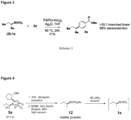
- 5 BIDA boronate 5a is readily amenable to single crystal growth and X-ray analysis, enabling the stereochemistry at the boron-bearing carbon to be unambiguously assigned. 12a Moreover, in stark contrast to 1a , building block 5a is stable for more than a year on the benchtop under air. 12a It was further determined that highly pure and enantiomerically enriched ( S )- 1a can be prepared in nearly quantitative yield via the simple hydrolysis of 5a (Scheme 3 ( FIG. 3 )). This convenient new chiral building block, 5a, and the BIDA ligand will soon be commercially available. 5z
- the present invention provides a method of forming a product represented by R 1 R 2 CH-Ar, comprising:
- Pd catalyst represents Pd(0).
- Pd catalyst represents Pd(II).
- ligand is P( o -tol) 3 (i.e., R is methyl).
- the secondary boronic acid is achiral.
- the secondary boronic acid is chiral.
- the secondary boronic acid is a racemic mixture.
- the secondary boronic acid is not a racemic mixture.
- the phrase "is not a racemic mixture” as used herein shall be understood to be equivalent to the phrase “is a non-racemic mixture”.
- the secondary boronic acid has an enantiomeric excess of at least 80 percent. That is, in various individual embodiments, the secondary boronic acid has an enantiomeric excess of at least 80 percent, at least 81 percent, at least 82 percent, at least 83 percent, at least 84 percent, at least 85 percent, at least 86 percent, at least 87 percent, at least 88 percent, at least 89 percent, at least 90 percent, at least 91 percent, at least 92 percent, at least 93 percent, at least 94 percent, at least 95 percent, at least 96 percent, at least 97 percent, at least 98 percent, or at least 99 percent.
- the secondary boronic acid has an enantiomeric excess of at least 90 percent.
- the secondary boronic acid has an enantiomeric excess of at least 95 percent.
- the product represented by R 1 R 2 CH-Ar is not a racemic mixture.
- the product represented by R 1 R 2 CH-Ar has an enantiomeric excess of at least 80 percent.
- the product represented by R 1 R 2 CH-Ar has an enantiomeric excess of at least 90 percent.
- the product represented by R 1 R 2 CH-Ar has an enantiomeric excess of at least 95 percent.
- R 1 and R 2 are selected from the group consisting of substituted C 1 -C 6 alkyl and unsubstituted C 1 -C 6 alkyl.
- R 1 and R 2 taken together with the carbon to which they are joined, form a substituted or unsubstituted C 3 -C 8 cycloalkyl.
- Ar represents a substituted or unsubstituted phenyl.
- Ar represents a substituted or unsubstituted polycyclic aryl.
- X is Br
- X is I.
- Pd(P( o -tol) 3 ) 2 and AgzO were purchased from Sigma-Aldrich. A gift of Pd(P(o-tol) 3 ) 2 was donated by Johnson Matthey. Solvents were purified via passage through packed columns as described by Pangborn and coworkers 1 (THF, EtzO, CH 3 CN, CH 2 Cl 2 : dry neutral alumina; hexane, benzene, and toluene, dry neutral alumina and Q5 reactant; DMSO, DMF: activated molecular sieves). All water was deionized prior to use. Diisopropylethylamine was freshly distilled under an atmosphere of nitrogen from CaHz.
- racemic 2-butyl boronic acid (+/-)- 1a 710 mg, 5 mmol
- N-methyliminodiacetic acid (MIDA) 2.20 g, 15 mmol
- pyridinium p -toluenesulfonate 126 mg, 0.5 mmol
- acetonitrile 16.7 mL, 0.3 M for the borate
- racemic potassium trans- 2-methylcyclohexyltrifluoro borate 6b (1.02 g, 5 mmol)
- N-methyliminodiacetic acid (MIDA) (2.20 g, 15 mmol)
- pyridinium p -toluenesulfonate 126 mg, 0.5 mmol
- silica gel 900 mg followed by acetonitrile (16.7 mL, 0.3 M for the borate).
- the reaction was sealed and allowed to stir at 80 °C for 12 hours. After cooling down, the mixture was passed through a pad of silica gel before concentration.
- BIDA benzylcyclopentyl iminodiacetic acid
- racemic 2-butyl boronic acid (+/-)- 1a (6 mmol), BIDA (4 mmol), pyridinium p -toluenesulfonate (0.4 mmol) followed by acetonitrile (27 mL, 0.15 M for 5 ).
- the reaction was allowed to stir at 80 °C for 24 hours. After cooling down, the mixture was passed through a pad of Florisil ® before concentration. The light brown solid mixture was then dissolved in EtzO to make a heterogeneous mixture and filtered; the filtrate was washed with copious amount of Et 2 O. The white solid was recrystallized with acetone:Et 2 O twice to give 5a [463 mg, 97:3 d.r. ( 1 H NMR) 31%].
- aryl halide (0.10 mmol), boronic acid (0.20 mmol), AgzO (70 mg, 0.30 mmol) and Pd(P( o -tol) 3 ) 2 (7.15 mg, 0.010 mmol) were taken up in THF (220 ⁇ L) in a 7-mL vial.
- the reaction was sealed, and stirred at 85 °C for 24 h.
- the mixture was then passed through a pad of silica gel and flushed with diethyl ether before concentration in vacuo.
- the desired product was isolated by column chromatography and/or preparative reverse-phase HPLC.
- the stability of 2-butyl boronic acid and 2-butyl BIDA boronates to storage as solids under air at 23 °C was quantified using the following general procedure: Two 7-mL vials were charged with 10 mg of freshly prepared boronic acid or BIDA boronate at 23 °C under ambient atmosphere. The vials containing these solid samples were then sealed with PTFE-lined screwcaps under ambient atmosphere and placed on the bench top at 23 °C. The solid sample present in one of the vials was then immediately analyzed by 1 H-NMR to verify the purity and quantity of boronic acid present at time zero (the NMR assay is described below). After 1 day (boronic acid) or 60 days (BIDA boronates), the solid sample in the second vial was analyzed by 1 H-NMR, again by the method described below, to determine the quantity of boronic acid remaining at the indicated time.
- NMR assay An NMR stock solution was prepared as follows: To a 25 mL volumetric flask was added bromoacetophenone (0.336 g, 1.69 mmol, internal standard for quantification of the boronic acid), tetramethylsilane (1 mL, internal standard for the NMR shifts), and DMSO-d6:D 2 O 95:5 to a final solution volume of 25.0 mL. To a vial containing solid boronic acid or solid BIDA boronate (see above) was added 1.00 mL of this NMR stock solution, and the resulting solution was analyzed by 1 H-NMR.
- the mmol of boronic acid or MIDA boronate present in the sample was determined by comparing the ratio of the integrated 4-bromoacetophenone aryl C-H doublets (7.90 ppm relative to TMS) to that of the boronic acid or MIDA boronate C-H signals.
- racemic secondary alkylboronic acids such as 1a undergo complexation with the chiral derivative of iminodiacetic acid, 8. The resulting diastereomers are resolved by recrystallization.
- Chiral boronate 5a is then converted to the sodium trihydroxyborate salt 12.
- Salt 12 was found to be stable to isolation and storage at room temperature, unlike the unstable boronic acid 1a.
- 1a is obtained as a dioxane solution a form that is competent for cross-coupling. This procedure was found to be highly reproducible, giving nonracemic 1a in a pure form that is competent for cross-coupling, containing no oligomerized boroxine or other impurities resulting from degradation of 1a.
- Racemic 1a obtained from Sigma Aldrich, was combined with DMSO, toluene, and 8 in a round-bottom flask with a stir bar. The flask was fitted with a Dean-Stark trap and reflux condensor. The mixture was stirred at reflux in an oil bath at 170 °C under air with continuous removal of water. After 3 hours, conversion was complete by TLC using 1:1 EtOAc:hexanes and KMnO 4 stain. The toluene was removed by rotary evaporation. 200 mL of DCM and 200 mL were added to the resulting DMSO suspension. In a separatory funnel, the aqueous layer was extracted four times with DCM.
- the catalyst, aryl bromide and AgzO were added to a 7 mL vial with a stir bar.
- 151 ⁇ L (0.2 mmol) of a 1.32 M solution of 1a in dioxane was added by mechanical pipette.
- 69 ⁇ L of additional dioxane was added and the vial was tightly capped and stirred at 85 °C for 14 hours.
- the reaction was opened and filtered through a silica plug in a Pasteur pipette with three washings of 1 mL of EtzO.
- the flow-through was concentrated under vacuum and 500 ⁇ L of benzene-d 6 containing 0.1 M 1,4-dimethoxybenzene was added.
- the substrate was added to a round-bottom flask under N 2 with a reflux condensor containing LAH and THF. The mixture was stirred at reflux for 15 hours. Aqueous Rochelle salt and water were added to quench the reaction. The reaction was extracted three times with DCM. The combined organic phase was dried with Na 2 SO 4 and concentrated under vacuum. The residue was filtered through a silica plug with EtOAc and concentrated again to 311 mg oil. This alcohol (S)-3-phenylbutan-1-ol ( 14 ) was used directly in the next step.
Landscapes
- Chemical & Material Sciences (AREA)
- Organic Chemistry (AREA)
- Chemical Kinetics & Catalysis (AREA)
- Organic Low-Molecular-Weight Compounds And Preparation Thereof (AREA)
- Low-Molecular Organic Synthesis Reactions Using Catalysts (AREA)
Applications Claiming Priority (2)
| Application Number | Priority Date | Filing Date | Title |
|---|---|---|---|
| US201361899296P | 2013-11-03 | 2013-11-03 | |
| PCT/US2014/063692 WO2015066612A2 (en) | 2013-11-03 | 2014-11-03 | Cross-coupling of unactivated secondary boronic acids |
Publications (2)
| Publication Number | Publication Date |
|---|---|
| EP3063154A2 EP3063154A2 (en) | 2016-09-07 |
| EP3063154B1 true EP3063154B1 (en) | 2023-08-30 |
Family
ID=51952004
Family Applications (1)
| Application Number | Title | Priority Date | Filing Date |
|---|---|---|---|
| EP14802743.6A Active EP3063154B1 (en) | 2013-11-03 | 2014-11-03 | Cross-coupling of unactivated secondary boronic acids |
Country Status (4)
| Country | Link |
|---|---|
| US (1) | US10072028B2 (enExample) |
| EP (1) | EP3063154B1 (enExample) |
| JP (1) | JP2016535033A (enExample) |
| WO (1) | WO2015066612A2 (enExample) |
Families Citing this family (5)
| Publication number | Priority date | Publication date | Assignee | Title |
|---|---|---|---|---|
| JP6866583B2 (ja) * | 2016-07-05 | 2021-04-28 | Dic株式会社 | 液晶化合物 |
| US10370393B2 (en) | 2017-04-21 | 2019-08-06 | The Board Of Trustees Of The University Of Illinois | Stereoretentive cross-coupling of boronic acids |
| JP7553547B2 (ja) * | 2020-03-31 | 2024-09-18 | エヌ・イーケムキャット株式会社 | 芳香族化合物の製造方法 |
| WO2022032007A2 (en) * | 2020-08-05 | 2022-02-10 | Skyhawk Therapeutics, Inc. | Process for the preparation of intermediates useful in the preparation of compounds that modulate splicing |
| WO2022031998A2 (en) * | 2020-08-05 | 2022-02-10 | Skyhawk Therapeutics, Inc. | Process for the preparation of intermediates useful in the preparation of compounds that modulate splicing |
Family Cites Families (7)
| Publication number | Priority date | Publication date | Assignee | Title |
|---|---|---|---|---|
| CN101754959B (zh) | 2007-07-23 | 2014-05-14 | 伊利诺斯大学理事会 | 控制硼酸反应性的体系 |
| JP5501656B2 (ja) * | 2008-05-16 | 2014-05-28 | 株式会社半導体エネルギー研究所 | 組成物、薄膜の作製方法、及び発光素子の作製方法 |
| WO2010036921A2 (en) | 2008-09-26 | 2010-04-01 | The Board Of Trustees Of The University Of Illinois | Slow release of organoboronic acids in cross-coupling reactions |
| WO2011103435A2 (en) | 2010-02-18 | 2011-08-25 | The Board Of Trustees Of The University Of Illinois | Methods for forming protected organoboronic acids |
| CA2842410A1 (en) | 2010-07-23 | 2012-01-26 | The Board Of Trustees Of The University Of Illinois | Apparatus and methods for the automated synthesis of small molecules |
| WO2012149182A2 (en) | 2011-04-27 | 2012-11-01 | The Board Of Trustees Of The University Of Illinois | Automated synthesis of small molecules using chiral, non-racemic boronates |
| EP2647628A1 (en) * | 2012-04-02 | 2013-10-09 | Almirall, S.A. | Substituted tricyclic compounds with activity towards ep1 receptors |
-
2014
- 2014-11-03 WO PCT/US2014/063692 patent/WO2015066612A2/en not_active Ceased
- 2014-11-03 JP JP2016526839A patent/JP2016535033A/ja active Pending
- 2014-11-03 EP EP14802743.6A patent/EP3063154B1/en active Active
- 2014-11-03 US US15/034,102 patent/US10072028B2/en active Active
Non-Patent Citations (4)
| Title |
|---|
| ANDREW N. CAMMIDGE ET AL: "Aryl Trihydroxyborates: Easily Isolated Discrete Species Convenient for Direct Application in Coupling Reactions", ORGANIC LETTERS, vol. 8, no. 18, 1 August 2006 (2006-08-01), pages 4071 - 4074, XP055164131, ISSN: 1523-7060, DOI: 10.1021/ol061564w * |
| ROBIN B. BEDFORD ET AL: "Orthopalladated and -platinated Bulky Triarylphosphite Complexes: Synthesis, Reactivity and Application as High-Activity Catalysts for Suzuki and Stille Coupling Reactions", CHEMISTRY - A EUROPEAN JOURNAL, vol. 9, no. 14, 21 July 2003 (2003-07-21), pages 3216 - 3227, XP055164233, ISSN: 0947-6539, DOI: 10.1002/chem.200304997 * |
| SAAD SENE ET AL: "Boronate Ligands in Materials: Determining Their Local Environment by Using a Combination of IR/Solid-State NMR Spectroscopies and DFT Calculations", CHEMISTRY - A EUROPEAN JOURNAL, vol. 19, no. 3, 14 January 2013 (2013-01-14), pages 880 - 891, XP055164136, ISSN: 0947-6539, DOI: 10.1002/chem.201203560 * |
| VAN DEN HOOGENBAND A ET AL: "Ruphos-mediated Suzuki cross-coupling of secondary alkyl trifluoroborates", TETRAHEDRON LETTERS, ELSEVIER LTD, AMSTERDAM, NL, vol. 49, no. 26, 23 June 2008 (2008-06-23), pages 4122 - 4124, XP022678982, ISSN: 0040-4039, [retrieved on 20080427], DOI: 10.1016/J.TETLET.2008.04.129 * |
Also Published As
| Publication number | Publication date |
|---|---|
| EP3063154A2 (en) | 2016-09-07 |
| JP2016535033A (ja) | 2016-11-10 |
| US10072028B2 (en) | 2018-09-11 |
| WO2015066612A3 (en) | 2015-10-29 |
| WO2015066612A2 (en) | 2015-05-07 |
| US20160280721A1 (en) | 2016-09-29 |
Similar Documents
| Publication | Publication Date | Title |
|---|---|---|
| CA2694068C (en) | System for controlling the reactivity of boronic acids | |
| US10072028B2 (en) | Cross-coupling of unactivated secondary boronic acids | |
| WO2011103435A2 (en) | Methods for forming protected organoboronic acids | |
| Wang et al. | Synthesis of chiral ferrocenyl aziridino alcohols and use in the catalytic asymmetric addition of diethylzinc to aldehydes | |
| You et al. | Enantioselective addition of diethylzinc to aldehydes catalyzed by titanium (IV) complexes of N-sulfonylated amino alcohols with two stereogenic centers | |
| Peng et al. | Synthesis and crystal structure of bis [(4S, 5S)-4, 5-dihydro-4, 5-diphenyl-2-(2′-oxidophenyl-χO) oxazole-χN] copper (II) and its application in the asymmetric Baeyer–Villiger reaction | |
| Muñoz-Muñiz et al. | Enantioselective alkylation and protonation of prochiral enolates in the asymmetric synthesis of β-amino acids | |
| US10844081B2 (en) | Protected organoboronic acids with tunable reactivity, and methods of use thereof | |
| Zhao et al. | Axially chiral phosphine–oxazoline ligands in the silver (I)-catalyzed asymmetric Mannich reaction of fluorinated aldimines with trimethylsiloxyfuran | |
| WO2015160688A1 (en) | Functionalized azaborine compounds and azaborine-containing biarylcarboxamides, and compositions and methods thereof | |
| Cadierno et al. | Synthesis of indenyl-ruthenium (II) σ-alkynyl complexes via nucleophilic addition of (1R)-(+)-and (1S)-(−)-camphor enolates on the allenylidene group of [Ru ( C C CPh2)(η5-C9H7)(PPh3) 2][PF6]: Efficient synthesis of novel optically pure vinylidene derivatives | |
| Bauer et al. | Sugar-based monodentate phosphoramidite ligands for Cu-catalyzed enantioselective conjugate addition to enones | |
| Bonini et al. | Cyclopenta [b] thiophene-alkyloxazolines: new nitrogen–sulfur hybrid ligands and their use in asymmetric palladium-catalyzed allylic alkylation | |
| Komatsuzaki et al. | An Anion Receptor Based on Poly-Substituted Cobalticinium Complexes. | |
| Achmatowicz et al. | The synthesis of l-proline derived hexaazamacrocyclic ligands of C3 symmetry via intramolecular methyl ester aminolysis | |
| Pastrán et al. | Camphorpyrazolium-based chiral functional ionic liquids | |
| Lee et al. | Enantioselective conjugate radical addition to α′-phenylsulfonyl enones | |
| CN117050017A (zh) | 轴手性烯基-硫叶立德类化合物及其制备方法 | |
| WO2022263800A1 (en) | Process | |
| CN121673334A (zh) | 膦配体钯金属络合物的制备方法和及其应用 | |
| WO2022101627A1 (en) | Method of synthesis | |
| CN120698838A (zh) | 一种三芳基甲烷化合物的绿色合成方法 | |
| Prater | Remote Enantioselective Functionalization of Alkenes via a Redox-Relay Strategy | |
| CN121673310A (zh) | [6,5,7]-螺七元氧化吲哚衍生物骨架及其制备方法 | |
| Yamamoto et al. | Formation of 1, 4-diphosphinobenzenes via tele-substitution on fluorobenzenechromium complexes |
Legal Events
| Date | Code | Title | Description |
|---|---|---|---|
| PUAI | Public reference made under article 153(3) epc to a published international application that has entered the european phase |
Free format text: ORIGINAL CODE: 0009012 |
|
| 17P | Request for examination filed |
Effective date: 20160524 |
|
| AK | Designated contracting states |
Kind code of ref document: A2 Designated state(s): AL AT BE BG CH CY CZ DE DK EE ES FI FR GB GR HR HU IE IS IT LI LT LU LV MC MK MT NL NO PL PT RO RS SE SI SK SM TR |
|
| AX | Request for extension of the european patent |
Extension state: BA ME |
|
| DAX | Request for extension of the european patent (deleted) | ||
| STAA | Information on the status of an ep patent application or granted ep patent |
Free format text: STATUS: EXAMINATION IS IN PROGRESS |
|
| 17Q | First examination report despatched |
Effective date: 20200914 |
|
| GRAP | Despatch of communication of intention to grant a patent |
Free format text: ORIGINAL CODE: EPIDOSNIGR1 |
|
| STAA | Information on the status of an ep patent application or granted ep patent |
Free format text: STATUS: GRANT OF PATENT IS INTENDED |
|
| RIC1 | Information provided on ipc code assigned before grant |
Ipc: C07C 15/24 20060101ALI20230213BHEP Ipc: C07C 15/14 20060101ALI20230213BHEP Ipc: C07C 1/32 20060101ALI20230213BHEP Ipc: C07B 53/00 20060101ALI20230213BHEP Ipc: C07B 37/00 20060101ALI20230213BHEP Ipc: C07C 69/76 20060101ALI20230213BHEP Ipc: C07C 67/343 20060101ALI20230213BHEP Ipc: C07B 37/04 20060101ALI20230213BHEP Ipc: C07F 5/02 20060101AFI20230213BHEP |
|
| INTG | Intention to grant announced |
Effective date: 20230320 |
|
| P01 | Opt-out of the competence of the unified patent court (upc) registered |
Effective date: 20230518 |
|
| GRAS | Grant fee paid |
Free format text: ORIGINAL CODE: EPIDOSNIGR3 |
|
| GRAA | (expected) grant |
Free format text: ORIGINAL CODE: 0009210 |
|
| STAA | Information on the status of an ep patent application or granted ep patent |
Free format text: STATUS: THE PATENT HAS BEEN GRANTED |
|
| AK | Designated contracting states |
Kind code of ref document: B1 Designated state(s): AL AT BE BG CH CY CZ DE DK EE ES FI FR GB GR HR HU IE IS IT LI LT LU LV MC MK MT NL NO PL PT RO RS SE SI SK SM TR |
|
| REG | Reference to a national code |
Ref country code: GB Ref legal event code: FG4D |
|
| REG | Reference to a national code |
Ref country code: CH Ref legal event code: EP |
|
| REG | Reference to a national code |
Ref country code: DE Ref legal event code: R096 Ref document number: 602014088121 Country of ref document: DE |
|
| REG | Reference to a national code |
Ref country code: IE Ref legal event code: FG4D |
|
| REG | Reference to a national code |
Ref country code: LT Ref legal event code: MG9D |
|
| REG | Reference to a national code |
Ref country code: NL Ref legal event code: MP Effective date: 20230830 |
|
| REG | Reference to a national code |
Ref country code: AT Ref legal event code: MK05 Ref document number: 1605336 Country of ref document: AT Kind code of ref document: T Effective date: 20230830 |
|
| PG25 | Lapsed in a contracting state [announced via postgrant information from national office to epo] |
Ref country code: GR Free format text: LAPSE BECAUSE OF FAILURE TO SUBMIT A TRANSLATION OF THE DESCRIPTION OR TO PAY THE FEE WITHIN THE PRESCRIBED TIME-LIMIT Effective date: 20231201 |
|
| PG25 | Lapsed in a contracting state [announced via postgrant information from national office to epo] |
Ref country code: IS Free format text: LAPSE BECAUSE OF FAILURE TO SUBMIT A TRANSLATION OF THE DESCRIPTION OR TO PAY THE FEE WITHIN THE PRESCRIBED TIME-LIMIT Effective date: 20231230 |
|
| PG25 | Lapsed in a contracting state [announced via postgrant information from national office to epo] |
Ref country code: SE Free format text: LAPSE BECAUSE OF FAILURE TO SUBMIT A TRANSLATION OF THE DESCRIPTION OR TO PAY THE FEE WITHIN THE PRESCRIBED TIME-LIMIT Effective date: 20230830 Ref country code: RS Free format text: LAPSE BECAUSE OF FAILURE TO SUBMIT A TRANSLATION OF THE DESCRIPTION OR TO PAY THE FEE WITHIN THE PRESCRIBED TIME-LIMIT Effective date: 20230830 Ref country code: NO Free format text: LAPSE BECAUSE OF FAILURE TO SUBMIT A TRANSLATION OF THE DESCRIPTION OR TO PAY THE FEE WITHIN THE PRESCRIBED TIME-LIMIT Effective date: 20231130 Ref country code: LV Free format text: LAPSE BECAUSE OF FAILURE TO SUBMIT A TRANSLATION OF THE DESCRIPTION OR TO PAY THE FEE WITHIN THE PRESCRIBED TIME-LIMIT Effective date: 20230830 Ref country code: LT Free format text: LAPSE BECAUSE OF FAILURE TO SUBMIT A TRANSLATION OF THE DESCRIPTION OR TO PAY THE FEE WITHIN THE PRESCRIBED TIME-LIMIT Effective date: 20230830 Ref country code: IS Free format text: LAPSE BECAUSE OF FAILURE TO SUBMIT A TRANSLATION OF THE DESCRIPTION OR TO PAY THE FEE WITHIN THE PRESCRIBED TIME-LIMIT Effective date: 20231230 Ref country code: HR Free format text: LAPSE BECAUSE OF FAILURE TO SUBMIT A TRANSLATION OF THE DESCRIPTION OR TO PAY THE FEE WITHIN THE PRESCRIBED TIME-LIMIT Effective date: 20230830 Ref country code: GR Free format text: LAPSE BECAUSE OF FAILURE TO SUBMIT A TRANSLATION OF THE DESCRIPTION OR TO PAY THE FEE WITHIN THE PRESCRIBED TIME-LIMIT Effective date: 20231201 Ref country code: FI Free format text: LAPSE BECAUSE OF FAILURE TO SUBMIT A TRANSLATION OF THE DESCRIPTION OR TO PAY THE FEE WITHIN THE PRESCRIBED TIME-LIMIT Effective date: 20230830 Ref country code: AT Free format text: LAPSE BECAUSE OF FAILURE TO SUBMIT A TRANSLATION OF THE DESCRIPTION OR TO PAY THE FEE WITHIN THE PRESCRIBED TIME-LIMIT Effective date: 20230830 |
|
| PG25 | Lapsed in a contracting state [announced via postgrant information from national office to epo] |
Ref country code: PL Free format text: LAPSE BECAUSE OF FAILURE TO SUBMIT A TRANSLATION OF THE DESCRIPTION OR TO PAY THE FEE WITHIN THE PRESCRIBED TIME-LIMIT Effective date: 20230830 Ref country code: NL Free format text: LAPSE BECAUSE OF FAILURE TO SUBMIT A TRANSLATION OF THE DESCRIPTION OR TO PAY THE FEE WITHIN THE PRESCRIBED TIME-LIMIT Effective date: 20230830 |
|
| PG25 | Lapsed in a contracting state [announced via postgrant information from national office to epo] |
Ref country code: ES Free format text: LAPSE BECAUSE OF FAILURE TO SUBMIT A TRANSLATION OF THE DESCRIPTION OR TO PAY THE FEE WITHIN THE PRESCRIBED TIME-LIMIT Effective date: 20230830 |
|
| PG25 | Lapsed in a contracting state [announced via postgrant information from national office to epo] |
Ref country code: SM Free format text: LAPSE BECAUSE OF FAILURE TO SUBMIT A TRANSLATION OF THE DESCRIPTION OR TO PAY THE FEE WITHIN THE PRESCRIBED TIME-LIMIT Effective date: 20230830 Ref country code: RO Free format text: LAPSE BECAUSE OF FAILURE TO SUBMIT A TRANSLATION OF THE DESCRIPTION OR TO PAY THE FEE WITHIN THE PRESCRIBED TIME-LIMIT Effective date: 20230830 Ref country code: ES Free format text: LAPSE BECAUSE OF FAILURE TO SUBMIT A TRANSLATION OF THE DESCRIPTION OR TO PAY THE FEE WITHIN THE PRESCRIBED TIME-LIMIT Effective date: 20230830 Ref country code: EE Free format text: LAPSE BECAUSE OF FAILURE TO SUBMIT A TRANSLATION OF THE DESCRIPTION OR TO PAY THE FEE WITHIN THE PRESCRIBED TIME-LIMIT Effective date: 20230830 Ref country code: DK Free format text: LAPSE BECAUSE OF FAILURE TO SUBMIT A TRANSLATION OF THE DESCRIPTION OR TO PAY THE FEE WITHIN THE PRESCRIBED TIME-LIMIT Effective date: 20230830 Ref country code: CZ Free format text: LAPSE BECAUSE OF FAILURE TO SUBMIT A TRANSLATION OF THE DESCRIPTION OR TO PAY THE FEE WITHIN THE PRESCRIBED TIME-LIMIT Effective date: 20230830 Ref country code: PT Free format text: LAPSE BECAUSE OF FAILURE TO SUBMIT A TRANSLATION OF THE DESCRIPTION OR TO PAY THE FEE WITHIN THE PRESCRIBED TIME-LIMIT Effective date: 20240102 Ref country code: SK Free format text: LAPSE BECAUSE OF FAILURE TO SUBMIT A TRANSLATION OF THE DESCRIPTION OR TO PAY THE FEE WITHIN THE PRESCRIBED TIME-LIMIT Effective date: 20230830 |
|
| PG25 | Lapsed in a contracting state [announced via postgrant information from national office to epo] |
Ref country code: IT Free format text: LAPSE BECAUSE OF FAILURE TO SUBMIT A TRANSLATION OF THE DESCRIPTION OR TO PAY THE FEE WITHIN THE PRESCRIBED TIME-LIMIT Effective date: 20230830 |
|
| REG | Reference to a national code |
Ref country code: DE Ref legal event code: R097 Ref document number: 602014088121 Country of ref document: DE |
|
| REG | Reference to a national code |
Ref country code: CH Ref legal event code: PL |
|
| PG25 | Lapsed in a contracting state [announced via postgrant information from national office to epo] |
Ref country code: MC Free format text: LAPSE BECAUSE OF FAILURE TO SUBMIT A TRANSLATION OF THE DESCRIPTION OR TO PAY THE FEE WITHIN THE PRESCRIBED TIME-LIMIT Effective date: 20230830 |
|
| PLBE | No opposition filed within time limit |
Free format text: ORIGINAL CODE: 0009261 |
|
| STAA | Information on the status of an ep patent application or granted ep patent |
Free format text: STATUS: NO OPPOSITION FILED WITHIN TIME LIMIT |
|
| PG25 | Lapsed in a contracting state [announced via postgrant information from national office to epo] |
Ref country code: LU Free format text: LAPSE BECAUSE OF NON-PAYMENT OF DUE FEES Effective date: 20231103 |
|
| PG25 | Lapsed in a contracting state [announced via postgrant information from national office to epo] |
Ref country code: CH Free format text: LAPSE BECAUSE OF NON-PAYMENT OF DUE FEES Effective date: 20231130 |
|
| PG25 | Lapsed in a contracting state [announced via postgrant information from national office to epo] |
Ref country code: MC Free format text: LAPSE BECAUSE OF FAILURE TO SUBMIT A TRANSLATION OF THE DESCRIPTION OR TO PAY THE FEE WITHIN THE PRESCRIBED TIME-LIMIT Effective date: 20230830 Ref country code: LU Free format text: LAPSE BECAUSE OF NON-PAYMENT OF DUE FEES Effective date: 20231103 Ref country code: CH Free format text: LAPSE BECAUSE OF NON-PAYMENT OF DUE FEES Effective date: 20231130 Ref country code: SI Free format text: LAPSE BECAUSE OF FAILURE TO SUBMIT A TRANSLATION OF THE DESCRIPTION OR TO PAY THE FEE WITHIN THE PRESCRIBED TIME-LIMIT Effective date: 20230830 |
|
| REG | Reference to a national code |
Ref country code: BE Ref legal event code: MM Effective date: 20231130 |
|
| 26N | No opposition filed |
Effective date: 20240603 |
|
| REG | Reference to a national code |
Ref country code: IE Ref legal event code: MM4A |
|
| PG25 | Lapsed in a contracting state [announced via postgrant information from national office to epo] |
Ref country code: IE Free format text: LAPSE BECAUSE OF NON-PAYMENT OF DUE FEES Effective date: 20231103 |
|
| PG25 | Lapsed in a contracting state [announced via postgrant information from national office to epo] |
Ref country code: BE Free format text: LAPSE BECAUSE OF NON-PAYMENT OF DUE FEES Effective date: 20231130 |
|
| PG25 | Lapsed in a contracting state [announced via postgrant information from national office to epo] |
Ref country code: IE Free format text: LAPSE BECAUSE OF NON-PAYMENT OF DUE FEES Effective date: 20231103 Ref country code: BE Free format text: LAPSE BECAUSE OF NON-PAYMENT OF DUE FEES Effective date: 20231130 |
|
| PG25 | Lapsed in a contracting state [announced via postgrant information from national office to epo] |
Ref country code: BG Free format text: LAPSE BECAUSE OF FAILURE TO SUBMIT A TRANSLATION OF THE DESCRIPTION OR TO PAY THE FEE WITHIN THE PRESCRIBED TIME-LIMIT Effective date: 20230830 |
|
| PG25 | Lapsed in a contracting state [announced via postgrant information from national office to epo] |
Ref country code: BG Free format text: LAPSE BECAUSE OF FAILURE TO SUBMIT A TRANSLATION OF THE DESCRIPTION OR TO PAY THE FEE WITHIN THE PRESCRIBED TIME-LIMIT Effective date: 20230830 |
|
| PG25 | Lapsed in a contracting state [announced via postgrant information from national office to epo] |
Ref country code: CY Free format text: LAPSE BECAUSE OF FAILURE TO SUBMIT A TRANSLATION OF THE DESCRIPTION OR TO PAY THE FEE WITHIN THE PRESCRIBED TIME-LIMIT; INVALID AB INITIO Effective date: 20141103 |
|
| PG25 | Lapsed in a contracting state [announced via postgrant information from national office to epo] |
Ref country code: HU Free format text: LAPSE BECAUSE OF FAILURE TO SUBMIT A TRANSLATION OF THE DESCRIPTION OR TO PAY THE FEE WITHIN THE PRESCRIBED TIME-LIMIT; INVALID AB INITIO Effective date: 20141103 |
|
| PG25 | Lapsed in a contracting state [announced via postgrant information from national office to epo] |
Ref country code: TR Free format text: LAPSE BECAUSE OF FAILURE TO SUBMIT A TRANSLATION OF THE DESCRIPTION OR TO PAY THE FEE WITHIN THE PRESCRIBED TIME-LIMIT Effective date: 20230830 |
|
| PGFP | Annual fee paid to national office [announced via postgrant information from national office to epo] |
Ref country code: DE Payment date: 20251128 Year of fee payment: 12 |
|
| PGFP | Annual fee paid to national office [announced via postgrant information from national office to epo] |
Ref country code: GB Payment date: 20251127 Year of fee payment: 12 |
|
| PGFP | Annual fee paid to national office [announced via postgrant information from national office to epo] |
Ref country code: FR Payment date: 20251125 Year of fee payment: 12 |