EP3060704B1 - Apparatus for production of polymeric nanofibers - Google Patents
Apparatus for production of polymeric nanofibers Download PDFInfo
- Publication number
- EP3060704B1 EP3060704B1 EP14793719.7A EP14793719A EP3060704B1 EP 3060704 B1 EP3060704 B1 EP 3060704B1 EP 14793719 A EP14793719 A EP 14793719A EP 3060704 B1 EP3060704 B1 EP 3060704B1
- Authority
- EP
- European Patent Office
- Prior art keywords
- spinning
- disk
- web
- edge
- nanofibers
- Prior art date
- Legal status (The legal status is an assumption and is not a legal conclusion. Google has not performed a legal analysis and makes no representation as to the accuracy of the status listed.)
- Active
Links
Images












Classifications
-
- D—TEXTILES; PAPER
- D01—NATURAL OR MAN-MADE THREADS OR FIBRES; SPINNING
- D01D—MECHANICAL METHODS OR APPARATUS IN THE MANUFACTURE OF ARTIFICIAL FILAMENTS, THREADS, FIBRES, BRISTLES OR RIBBONS
- D01D4/00—Spinnerette packs; Cleaning thereof
- D01D4/02—Spinnerettes
- D01D4/025—Melt-blowing or solution-blowing dies
-
- D—TEXTILES; PAPER
- D01—NATURAL OR MAN-MADE THREADS OR FIBRES; SPINNING
- D01D—MECHANICAL METHODS OR APPARATUS IN THE MANUFACTURE OF ARTIFICIAL FILAMENTS, THREADS, FIBRES, BRISTLES OR RIBBONS
- D01D5/00—Formation of filaments, threads, or the like
- D01D5/18—Formation of filaments, threads, or the like by means of rotating spinnerets
-
- D—TEXTILES; PAPER
- D01—NATURAL OR MAN-MADE THREADS OR FIBRES; SPINNING
- D01F—CHEMICAL FEATURES IN THE MANUFACTURE OF ARTIFICIAL FILAMENTS, THREADS, FIBRES, BRISTLES OR RIBBONS; APPARATUS SPECIALLY ADAPTED FOR THE MANUFACTURE OF CARBON FILAMENTS
- D01F6/00—Monocomponent artificial filaments or the like of synthetic polymers; Manufacture thereof
-
- Y—GENERAL TAGGING OF NEW TECHNOLOGICAL DEVELOPMENTS; GENERAL TAGGING OF CROSS-SECTIONAL TECHNOLOGIES SPANNING OVER SEVERAL SECTIONS OF THE IPC; TECHNICAL SUBJECTS COVERED BY FORMER USPC CROSS-REFERENCE ART COLLECTIONS [XRACs] AND DIGESTS
- Y10—TECHNICAL SUBJECTS COVERED BY FORMER USPC
- Y10T—TECHNICAL SUBJECTS COVERED BY FORMER US CLASSIFICATION
- Y10T428/00—Stock material or miscellaneous articles
- Y10T428/29—Coated or structually defined flake, particle, cell, strand, strand portion, rod, filament, macroscopic fiber or mass thereof
- Y10T428/2913—Rod, strand, filament or fiber
- Y10T428/298—Physical dimension
-
- Y—GENERAL TAGGING OF NEW TECHNOLOGICAL DEVELOPMENTS; GENERAL TAGGING OF CROSS-SECTIONAL TECHNOLOGIES SPANNING OVER SEVERAL SECTIONS OF THE IPC; TECHNICAL SUBJECTS COVERED BY FORMER USPC CROSS-REFERENCE ART COLLECTIONS [XRACs] AND DIGESTS
- Y10—TECHNICAL SUBJECTS COVERED BY FORMER USPC
- Y10T—TECHNICAL SUBJECTS COVERED BY FORMER US CLASSIFICATION
- Y10T442/00—Fabric [woven, knitted, or nonwoven textile or cloth, etc.]
- Y10T442/60—Nonwoven fabric [i.e., nonwoven strand or fiber material]
Definitions
- This invention relates to an improved centrifugal nanofiber spinning apparatus for producing the defects-free nanofibrous web and nanofibrous membrane comprising a nanofiber network with a number average nanofiber diameter less than 1000 nm.
- Polymer nanofibers can be produced from solution-based electrospinning or electroblowing, however, they have very high processing cost, limited throughputs and low productivity. Melt blowing nanofiber processes that randomly lay down fibers do not provide adequate uniformity at sufficiently high throughputs for most end use applications. The resulting nanofibers are often laid on substrate layer of coarse fiber nonwoven or microfiber nonwoven to construct multiple layers. A problem with melt-blown nanofibers or small microfibers, exposed on the top of the web, they are very fragile and easily crushed by normal handling or contact with some object. Also, the multilayer nature of such webs increases their thickness and weight, and also introduces some complexity in manufacture. Centrifugal spun nanofiber process has demonstrated lower manufacturing cost in massive nanoweb production.
- US 8,277,711 B2 to DuPont discloses a nozzle-less centrifugal melt spin process through rotational thin film fibrillation.
- the nanofibers with number average diameter less than about 500 nm have been disclosed and shown in examples spun from polypropylene and polyethylene resins.
- the operation window is very narrow for making the uniform nanofibers due to the requirement of uniform and smooth thin film flow on the inner surface of the spinning disk, which requires the right rheological properties of polymer and the right combination of the temperature, the rotating speed and melt feeding rate. Otherwise, there would not be uniform and smooth thin film flow on the inner surface of the spinning disk. Instability of the thin film flow and variation of the thickness in the thin film will cause the formation of larger fibers mixed with the nanofibers.
- the disk temperature is too high, the molten state threads might lose elasticity due to the potential thermal degradation and the break down into droplets, resulting in nanofibers that might be mixed with the micro-particles or powders. If the disk temperature is too low, the shock-wave instability in the melt filming flow on the inner surface of spinning disk might cause the moving fronts of the filming flow broken off and throw off from the spinning disk, resulting in the nanofibers might be mixed with the large size defects, such as, the "tadpoles" and the "spatters".
- the nanofibers made from the process of US 8,277,711 B2 can be laid on a belt collector to form uniform web media using the process of WO 2013/096672 , in which the complicate air flow management needs to be implemented. Otherwise, the uniform web cannot be laid because of the swirling and the twisting of fiber stream due to the "tornado"-like effect under the high speed rotating disk.
- US 8,231,378 B2 to University of Texas discloses a centrifugal nanofiber spinning from rotating spinnerets with nozzles, such as, syringes, micro-mesh pores or non-syringe gaps with a typical openings of diameter sizes of 0.01 - 0.80 mm.
- the microfibers with the number average diameter of one micron or larger and the nanofibers have been shown.
- the nanofiber with number average diameter less than about 300 nm has been disclosed.
- the centrifugal spinning through nozzles has much less throughput due to the capillary flow through the nozzle orifices and the melt die swell at the nozzle exit.
- the only very low basis weight of the thin layer nanofibers can be deposited on scrim when the polypropylene nanofiber spun from melt.
- the PP web has very low strength and difficult to handle without scrim.
- Document WO 2013/096672 A1 discloses a spinning apparatus for making polymeric nanofibres that seeks to prevent the swirling of rotationally spun fibres underneath the rotating member, said apparatus comprising a high speed rotating member comprising a spinning disk wherein the rotating member has an edge.
- the present invention is directed toward a spinning apparatus for making polymeric nanofibers, comprising: (a) a high speed rotating member being a spinning disk or a spinning bowl wherein the rotating member has an edge and, optionally, the rotating member can be heated by induction heating; (b) a protecting shield affixed to the edge of the rotating member to form enclosed serrations wherein the protecting shield is positioned on the top of the spinning disk or the bottom of the spinning bowl; (c) a stationary shield on the bottom of the rotating member; and (d) 15 an optional stretching zone.
- the invention is also directed to a process for making polymeric nanofibers using the above spinning apparatus, as defined in claim 5.
- This invention is further directed toward polymeric nanofibers produced from this spinning apparatus wherein the polymeric nanofibers comprise at least about 99% by number of nanofibers with a number average diameter less than about 500 nm.
- This invention is still further directed toward a nanofibrous web produced from these polymeric nanofibers wherein the nanofibrous web has: (a) less than about 5% Mw reduction of the nanofibrous web as compared to the polymer used for making the nanofibrous web; (b) essentially the same thermal weight loss as compared to the polymer used for making the nanofibrous web as measured by TGA; (c) higher crystallinity of the nanofibrous web as compared to the polymer used for making the nanofibrous web; and (d) average web strength of at least about 2.5 N/cm.
- web refers to layer of a network of fibers commonly made into a nonwoven.
- nonwoven refers to a web of a multitude of essentially randomly oriented fibers where no overall repeating structure can be discerned by the naked eye in the arrangement of fibers.
- the fibers can be bonded to each other, or can be unbounded and entangled to impart strength and integrity to the web.
- the fibers can be staple fibers or continuous fibers, and can comprise a single material or a multitude of materials, either as a combination of different fibers or as a combination of similar fibers each comprising of different materials.
- nanofibrous web refers to a web constructed predominantly of nanofibers. "Predominantly” means that greater than 50% of the fibers in the web are nanofibers.
- nanofibers refers to fibers having a number average diameter less than about 1000 nm. In the case of non-round cross-sectional nanofibers, the term “diameter” as used herein refers to the greatest cross-sectional dimension.
- microfibers refers to fibers having a number average diameter from about 1.0 ⁇ m to about 3.0 ⁇ m
- coarse fibers refers to fibers having a number average diameter greater than about 3.0 ⁇ m.
- centrifugal spinning process refers to any process in which fibers are formed by ejection from a rotating member.
- rotating member refers to a spinning device that propels or distributes a material from which fibrils or fibers are formed by centrifugal force, whether or not another means such as air is used to aid in such propulsion.
- concave refers to an inner surface of a rotating member that can be curved in cross-section, such as hemispherical, have the cross-section of an ellipse, a hyperbola, a parabola or can be frustoconical, or the like.
- spin disk refers to a rotating member that has a disk shape with a concave, frustoconical or flat open inner surface.
- spin bowl refers to a rotating member that has a bowl shape with a concave or frustoconical open inner surface.
- Fibril refers to an elongated structure that may be formed as a precursor to fine fibers that form when the fibrils are attenuated. Fibrils are formed at a discharge point of the rotating member. The discharge point may be an edge, serrations or an orifice through which fluid is extruded to form fibers.
- nozzle-free refers to the fibril or fibers that are not from a nozzle-type spinning orifices, or there are no any nozzles on rotating member.
- charged refers to an object in the process that has a net electric charge, positive or negative polarity, relative to uncharged objects or those objects with no net electric charge.
- spunsetting fluid refers to a thermoplastic polymer in either melt or solution form that is able to flow and be formed into fibers.
- discharge point refers to a location on a spinning member from which fibrils or fibers are ejected.
- the discharge point may, for example, be an edge, or an orifice through which fibrils are extruded.
- sampling refers to a saw-like appearance or a row of sharp or tooth-like projections. A serrated cutting edge has many small points of contact with the material being cut.
- micro-particles and the powders refers to the particles formed from the molten droplets due to the break-up of the threads.
- tadpoles refers to the defect shaped in the form of a tadpole.
- patters refers to the defect formed from the molten droplets thrown forcefully in a violent way onto the collector.
- web defects refers to the defects of micro-particles, the powders, tadpoles, and spatters in the web.
- wave-front instability refers to the instability of the moving front of the thin film flow on the inner surface of the spinning disk.
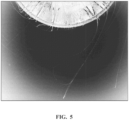
- shock-wave instability refers to the growth of the perturbation of the moving front of the thin film flow on the inner surface of the spinning disk diminished so significantly that there is little that can be identified as a mixing layer formation for a strong rotation, as shown in FIG.6 .
- Rayleigh-Taylor instability refers to the instability in fiber formation due to the competition of the centrifugal force and the Laplace force induced by the surface curvature.
- Chipping instability refers to the bending and whipping movements of the nanofibers driven by the centrifugal force and the aerodynamic force.
- thyroid-like refers to a violently rotating column of fibers that is in contact with both the surface of the collector and a cumulonimbus cloud of the swirling fiber bundles.
- the present invention is directed toward an improved centrifugal nanofiber spinning process of US 8,277,711 B2 .
- the present invention is a melt spinning apparatus, illustrated in FIG. 1 for using a spin disk and FIG. 2 for using a spin bowl, for making a defects-free nanoweb, comprising a high speed rotating disk or bowl with the improvements to the process of US 8,277,711 B2 .
- a nanofiber forming process comprising the steps of: supplying a spinning melt of at least one thermoplastic polymer to an inner spinning surface of a heated rotating disk having a forward surface fiber discharge edge, where the discharge edge has serration on it, issuing the spinning melt along said inner spinning surface so as to distribute the spinning melt into a thin film and toward the forward surface fiber discharge edge, and discharging separate molten polymer fibrous streams from the forward surface discharge edge to attenuate the fibrous streams to produce polymeric nanofibers.
- the protecting shield is on the top of the spinning disk or the bottom of the spinning bowl, as a thermal protecting shield for melt spinning in order to prevent the heating lost to the inner surface of the spinning disk or bowl and as an air protecting shield for solution spinning to prevent the rapidly solvent evaporation from the thin film flow on the inner surface of the spinning disk or bowl.
- the protecting shield is placed to contact the serrations on the edge of the rotating disk to form enclosed serrations.
- the enclosed serrations on the edge of the rotating disk suppress the instability of the thin film flow and variation of the thickness at the edge of the spinning disk. As result, the enclosed serrations lead to a fully defect-free pure nanofibers, and eliminates the formation of the microfibers, the coarse fibers and defects.
- the stationary shield is located on the bottom of the spinning disk or the spinning bowl to protect the further thermal lost, and to prevent the swirling and the twisting of fiber stream due to the "tornado"-like effect under the high speed rotating disk for the uniform web laydown.
- the stretching zone and maintaining its temperature located surrounding the edge of the rotating disk is designed and implemented to keep the threads in molten state to maximize the stretching or elongation by the centrifugal force.
- the stretching zone diameter is about 1.5 time of the diameter of the spin disk.
- the stretching zone temperature is the key element to make the nanofibers.
- FIG. 1 for spinning disk 102 or FIG. 2 for spinning bowl 202 mounted on a high speed rotating hollow shaft 109 or 209 fibers 106 or 206 are shown exiting the discharge points at the edge of the spinning disk 102 or at the edge of the spinning bowl 202.
- a protecting shield 101 or 201 with the same diameter as the spinning disk or the spinning bowl is mounted on top of the spinning disk as a thermal protecting shield for melt spinning in order to prevent the heating lost to the inner surface of the spinning disk and as an air protecting shield for solution spinning to prevent the rapidly solvent evaporation from the thin film flow on the inner surface of the spinning disk.
- the protecting shield is placed to contact to the serrations on the edge of the rotating disk to form an enclosed serrations.
- the enclosed serrations on the edge of the rotating disk suppress the instability of the thin film flow and variation of the thickness at the edge of the spinning disk.
- a stationary shield 104 for the spinning disk or 204 for the spinning bowl is mounted on a stationary shaft through the rotating hollow shaft at the bottom of the spinning disk to protect the thermal loss, and to prevent the swirling and the twisting of fiber stream due to the "tornado"-like effect under the high speed rotating disk for the uniform web laydown.
- a stretching zone surrounding the edge of the rotating disk is indicated in the dash line rectangle area.
- the stretching zone temperature is established by the gentle air comes from the combination of three heating air streams. One is from the gentle heating air 107 or 207 above the spinning disk; another is from a stream of gentle heating air 105 or 205 coming from a stationary hot air tube within the rotating hollow shaft 109 or 209, through the gap between the bottom of the spinning disk and the stationary shield to reach the stretching zone; the other gentle heating air is a downward flow 108 or 208.
- the stretching zone temperature is designed and implemented to keep the threads in molten state to maximize the stretching or elongation by the centrifugal force.
- the stretching zone diameter is about 1.5 time of the diameter of the spin disk.
- the stretching zone temperature is the key element to make the nanofibers. For polypropylene in the Example, the stretching zone temperature is optimized around 180°C by the gentle heating air for the better nanofiber spinning and for the fibers to take electrostatic charging as an option.
- the nanofibers are deposited on the surface of a horizontal scrim belt collector or a vertical tubular scrim belt collector using the web laying process of WO 2013/096672 , then a roll of the web is wind-up as a stand-alone web roll off from the collection belt.
- fibers do not flow in a controlled fashion towards the collector and do not deposit evenly on the collector.
- the improved process of WO 2013/096672 with the stationary shield under the spinning disk is used in the present invention.
- the stationary shield prevents the "tornado"-like affect under the high speed rotating disk, therefore, the swirling and the twisting of fiber stream are eliminated in the present invention.
- a charged ring 100 or 200 is optional with needle assembly or a ring saw with sharp teeth is mounted on the top of stretching zone air heating ring for applying the electrostatic charge to fibrils and fibers 106 being ejected from a spinning disk, or 206 being ejected from a spinning bowl.
- the fully pure nanfibers can only be made from the uniform and smooth thin film flow on the inner surface of the spinning disk, as shown as the high-speed video image in FIG. 3 , which requires the right rheological properties of polymer and the right combination of the temperature, the rotating speed and melt feeding rate.
- the surface of the rotating polymer thin film on the inner surface on the open-end spinning disk would be cooling down due to reaction with the cold air brought in by the high speed rotating.
- the heating to the spinning disk would be to the higher temperature in order to have the right melt viscosity and the uniform thin film flow. Therefore, there was a potential thermal degradation if the temperature was set too high.
- the present invention is about to address this problem.
- a thermal shield on top of the spinning disk is designed to minimize the reduction of the surface temperature of the rotating polymer thin film. With the thermal shield on top of the spinning disk will lower the disk heating temperature to minimize or to eliminate the thermal degradation.
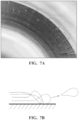
- FIG. 7A shows the possible break-up and thrown-out from the unstable wave fronts of the thin film.
- the large diameter threads will come out and lead to the formation of the microfibers, the coarse fibers; when the large threads breakdown, the defects, such as the micro-particles, the powders, the "tadpoles" and the “spatters", will be generated.
- the edge of the thermal shield is placed to contact to the serrations on the edge of the rotating disk to form an enclosed serrations.
- the enclosed serrations on the edge of the rotating disk suppress the instability of the thin film flow and variation of the thickness at the edge of the spinning disk.
- FIG. 8 illustrates the edge structure of spin disk with serrations on the edge.
- the spin bowl can have the same or similar structure.
- the spinning fluid (polymer solution or melt) can be delivered through stationary device, such as, a tube, a transfer line, a transfer ring, or the like, to a reservoir on the center area of the spinning disk.
- the spinning fluid in the reservoir flows through the side holes on the wall and at the inside bottom of the reservoir to and forms the thin film flow the inner surface of the spinning disk.
- the thin film flow breaks into threads or fibrils through film fibrillation.
- the serrations on the edge of the spinning disk have been shown as 802 in FIG. 8A .
- the protecting shield 800 covers the inner surface of the spinning disk and touches the serration at the edge of the spinning disk 801.
- the parameters define the serration structure are the length, L, the depth, D, and the spacing, d, where the ratio of LID is about 20:1; d/D is about 1:1; with a spacing, d, about in the range of 200 ⁇ m to 500 ⁇ m.
- FIGS. 8C - 8F also illustrates the structural options of the serrations on the inner surface at the edge of the spinning disk or bowl.
- FIG. 8C shows the width of the serration gradually becomes narrower for the film into the serration to out of the disk.
- FIG. 8D shows the width of the serration is constant for the film into the serration to out of the disk.
- FIG. 8E shows the sharper ends as the film into the serrations and the width of the serration gradually becomes narrower for the film into the serration to out of the disk.
- FIG. 8F shows that the serrations are smoothly connected to the inner surface of the spinning disk, and the depth of serration gradually becoming deeper.
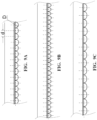
- FIGS. 9A - 9C illustrate another structural option of the serrations on the inner surface at the edge of the spinning disk or bowl.
- the cross-section of a single serration is a half of a round circle as in FIG. 9A , or a half of an ellipse as in FIG. 9B , a half of a parabola as in FIG. 9C .
- the parameters define the serration structure are the length, L, the depth, D, and the spacing, d, where the ratio of LID is about 20:1; d/D is about 1:1; with a spacing, d, about in the range of 200 ⁇ m to 500 ⁇ m.
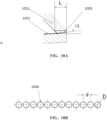
- FIG. 10 illustrates another structure of the edge of the spin disk or bowl with the side holes (spin orifices), as the multiple nozzles disk or bowl.
- the usefulness of the spin orifices on the side of a rotating member is known in the prior art in fiber spinning.
- the fiber spinning was from the bulk polymer through the spin orifices in the prior art and US 8,231,378 B2 .
- the nanofiber spinning was from the sheared thin film flow on the rotating disk or bowl inner surface before through the spin orifices in the present invention.
- the spin orifices 1003 form the channels at the edge of the spin disk or bowl 1001.
- the inner entrances of the spin orifices contact and connect the inner surface 1002 of the spinning disk or bowl.
- FIG. 10A the spin orifices 1003 form the channels at the edge of the spin disk or bowl 1001.
- the inner entrances of the spin orifices contact and connect the inner surface 1002 of the spinning disk or bowl.
- the parameters define the spin orifices structure are the length, L, the entrance diameter, D, and the spacing, d, where the ratio of LID is about 20:1; d/D is about 1.5:1; with a spacing, d, about in the range of 200 ⁇ m to 500 ⁇ m.
- There is an inclining angle, ⁇ about from 0 to 15 degree, at the edge of the spinning disk, which also defines the gradual decreasing in diameter of the cross-section of the spin orifices.
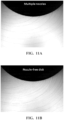
- the spin disk or bowl with multiple nozzles will have less throughput and relatively larger average fiber diameter under the same operation condition, as shown as in FIGS. 11A and 11B , respectively, of the high-speed video images.
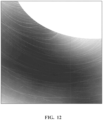
- FIG. 12 shows the top view of the high-speed video image from the spin disk the enclosed serrations in the present invention.
- the spin disk with the enclosed serrations will produce relatively smaller average fiber diameter under the same operation condition.
- the spin disk with the enclosed serrations will eliminate the defects, such as, the micro-particles, the powders, the tadpoles, the spatters and less numbers of the fiber bundles in the web.
- the high-speed video image of FIG. 13 is the side view of the fiber spinning from the spin disk the enclosed serrations and the stationary shield in the present invention.
- the fibers are spinning down circularly with the very well delayed whipping instability. There is no "tornado-like" fiber stream under the spinning disk and above the surface of the web laydown collector.
- ⁇ is the tangential shear stress
- ⁇ is the shear rate
- K is the coefficient of the consistency
- n is the flow index
- the film thickness is (REFFERENCE: O.K. Matar, G.M. Sisoev, and C.J. Lawrence, "The Flow of Thin Film Over Spinning Disk", Canadian Journal of Chemical Engineering, 84, Dec.
- h 2 n + 1 2 ⁇ n n 2 n + 1 Q n 2 n + 1 r n + 1 2 n + 1 ⁇ ⁇ 2 K 1 2 n + 1 and the film velocity in thickness direction is:
- Vz r n n + 1 ⁇ ⁇ 2 r K 1 n h n + 1 n ⁇ h ⁇ z n + 1 n
- ⁇ is the rotating speed
- Q is the melt feeding rate
- ⁇ 0 the viscosity of the polymer melt
- r the disk radius
- ⁇ the melt density
- ⁇ is a collection of parameters.
- the shear rate applied to the thin film is in the range of 10 4 to 10 6 second -1 .
- FIG. 15 shows the relationship of the flow rate feeding to the spinning disk as function of the rotating speed respectively to the thin film thicknesses for a 300 mm disk.
- the flow rate is about 200 g/min with the thin film thickness about to 50 ⁇ m to 60 ⁇ m.
- nanofibrous webs have been made from polypropylene under the melt feeding rate of 60 g/min/disk and 10,000 rpm.
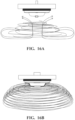
- FIG. 16A illustrates the "tornado"-like phenomena when the laydown without any electrostatic charging and air flow management.
- FIG. 16B illustrates the laydown case without the "tornado"-like phenomena with using the stationary shield under the spinning disk in the present invention.
- the spinning melt comprises at least one polymer.
- Any melt spinnable, fiber-forming polymer can be used.
- Suitable polymers include thermoplastic materials comprising polyolefins, such as polyethylene polymers and copolymers, polypropylene polymers and copolymers; polyesters and co-polyesters, such as polyethylene terephthalate), biopolyesters, thermotropic liquid crystal polymers and PET coployesters; polyamides (nylons); polyaramids; polycarbonates; acrylics and meth-acrylics, such as poly(meth)acrylates; polystyrene-based polymers and copolymers; cellulose esters; thermoplastic cellulose; cellulosics; acrylonitrile-butadiene-styrene (ABS) resins; acetals; chlorinated polyethers; fluoropolymers, such as polychlorotrifluoroethylenes (CTFE), fluorinated-ethylene-propylene (FEP); and polyvinylene
- This invention is directed toward a spinning apparatus for making polymeric nanofibers, comprising: (a) a high speed rotating member comprising a spinning disk or a spinning bowl wherein the rotating member has an edge and, optionally, the rotating member can be heated by induction heating; (b) a protecting shield affixed to the edge of the rotating member to form enclosed serrations wherein the protecting shield is positioned on the top of the spinning disk or the bottom of the spinning bowl; (c) a stationary shield on the bottom of the rotating member; and (d) an optional stretching zone.
- This invention is further directed toward polymeric nanofibers produced from this spinning apparatus wherein the polymeric nanofibers comprise at least about 99% by number of nanofibers with a number average diameter less than about 500 nm.
- This invention is still further directed toward a nanofibrous web produced from these polymeric nanofibers wherein the nanofibrous web has: (a) less than about 5% Mw reduction of the nanofibrous web as compared to the polymer used for making the nanofibrous web; (b) essentially the same thermal weight loss as compared to the polymer used for making the nanofibrous web as measured by TGA; (c) higher crystallinity of the nanofibrous web as compared to the polymer used for making the nanofibrous web; and (d) average web strength of at least about 2.5 N/cm.
- High-speed video image In order to visualize the filming and fiber spinning, high-speed video image has been used for observing the spinning of polyethylene oxide (PEO) in water solutions. Weight percent solutions ranging between 0% and 12% of 300,000 Mw PEO, purchased from Sigma-Aldrich, were prepared in deionized water. A Harvard apparatus PHD2000 Infusion syringe pump was used to control the flow rate of solution to a rotating geometry spinning between 1,000 and 30,000 RPM. Flow rates examined range between 0.01 to 50.00 mL/min. Two Photon FASTCAM SA5 model 1300K-M3 high speed video cameras with Canon 100 mm Macro lenses were used to capture the images included in this case with one camera positioned parallel and one camera positioned perpendicular to the spinning geometry. The camera and lens settings were chosen to maximize clarity at 7,000 fps, shudder speeds ranging between 0.37 and 4.64 ⁇ s, and apertures between f2.8 and f32.
- PEO polyethylene oxide
- Thermal analysis In order to study the thermal degradation and crystallinity, thermal analysis was conducted using TA Instruments a Q2000 series differential scanning calorimeter (DSC) and a Q500 series thermo gravimetric analyzer (TGA). DSC samples underwent a standard heating, cooling, re-heating cycle from room temperature to 250°C at 10°C/min under nitrogen. TGA samples underwent a standard ramp heat from room temperature to 900°C at 10°C/min under nitrogen. TA Instruments Universal Analysis 2000 was used to analyze thermal data. The percent crystallinity of samples was determined using the accepted value for the enthalpy of fusion for 100% crystalline polypropylene equaling 207 J/g. (REFERENCE: A van der Wal, J.J Mulder, R.J Gaymans. Fracture of polypropylene: The effect of crystallinity. Polymer, Volume 39, Issue 22, October 1998, Pages 5477-5481 )
- Molecular weight for polyolefin resins was measured by using high temperature size exclusion chromatography (SEC). This method includes the use of multi-angle light scattering and viscosity detectors in trichlorobenzene (TCB) at 150°C.
- the instruments used include a Polymer Laboratories PL220 liquid chromatograph instrument, with solvent delivery and autoinjector, and a Wyatt Technologies Dawn HELEOS multi-angle light scattering detector (MALS).
- the Polymer Laboratories SEC includes an internal differential viscometer and differential refractometer. Four Polymer Laboratories mixed B SEC columns were used for the separations. The sample injection volume was 200 microliters with a flow rate of 0.5 mL/min.
- the sample compartment, columns, internal detectors, transfer line, and Wyatt MALS were held at a controlled temperature between 150 and 160°C depending on the polymer. After the solution passes through the columns within the Polymer Laboratories SEC, the flow was directed out of the instrument and through a heated transfer line to the Wyatt MALS before being returned back to the Polymer Laboratories SEC.
- the data recovered from the instrumentation was analyzed using Wyatt Technologies Astra software. The concentration was calculated using a dn/dc of 0.092 for polyolefin in TCB. Molecular weights were calculated from the light scattering intensities rather than elution time, and are not relative to standards. In order to ensure instrument performance and accuracy, available NIST polyethylene standards are periodically analyzed.
- SEM Scanning Electron Microscope
- a nanofibrous web media consisting of continuous fibers were made using the centrifugal melt spin process of U.S. Patent No. 8,277,711 .
- Examples in this invention were made by incorporating improved elements, such as, the enclosed serrations and the optimized serration structures at the edge of the spinning disk or the spinning bowl, the stretching zone and its temperature, the stationary shield under the spinning disk or the spinning bowl.
- the Comparative Examples were made by using the open-end spin disk of the centrifugal melt spin process of U.S. Patent No. 8,277,711 B2 .
- the other comparative example made by the force spinning process of US 8,231,378 B2 was received from FibeRio Company.
- PP polypropylene
- melt flow rate 1800 g/10 min (230°C/2.16kg)
- zero shear viscosity of 9.07 Pa S at 200°C A PRISM extruder with a gear pump was used to deliver the polymer melt to the rotating spin bowl through melt transfer line.
- the temperature of the spinning melt from the melt transfer line was set to 240°C.
- the temperature of spin disk edge was about 200°C.
- the stretching zone heating air was set at 200°C.
- the stretching zone air through the gap between the disk and the stationary shield was set at 200°C with the air flow rate of 50 SCFH.
- the downward shaping air was set at 150°C.
- the shaping air flow was set at 50 SCFH.
- the rotation speed of the spin disk was set to a constant 12,000 rpm.
- Example 1 has a fiber diameter mean and median for the total fibers measured of 523 nm and 504 nm from total counts of 154 individual nanofibers in the range of the minimum of 172 nm to the maximum of 997 nm.
- Continuous fibers were made by an open-end spin disk using the process of U.S. Patent No. 8,277,711 B2 , from the same polypropylene (PP) homopolymer used in Example 1.
- a PRISM extruder with a gear pump was used to deliver the polymer melt to the rotating spin disk through melt transfer line.
- the temperature of the spinning melt from the melt transfer line was set to 200°C and the melt feeding rate was 18.14 gram/min.
- the temperature of spin disk edge was to be about 240°C.
- the stretching zone heating air was set at 250°C.
- the downward shaping air was set at 150°C.
- the shaping air flow was set at 15.0 SCFM.
- the rotation speed of the spin disk was set to a constant 10,000 rpm.
- Comparative Example 1 has a fiber diameter mean and median for the total fibers measured of 685 nm and 433 nm from total counts of 583 individual nanofibers in the range of the minimum of 126 nm to the maximum of 8460 nm. There are about 83.88% nanofibers, 14.92% of microfibers and 1.2% coarse fibers. There are some "spatters" type defects with about 10 ⁇ m in diameter and micron-particles with about 1 ⁇ m to 5 ⁇ m in diameter.
- Continuous fibers were made by an open-end spin disk using the process of U.S. Patent No. 8,277,711 B2 , from the same polypropylene (PP) homopolymer used in Example 1.
- the temperature of the spinning melt from the melt transfer line to the rotating spin disk was set to 200°C.
- the temperature of spin bowl edge was about 240°C.
- the stretching zone heating air was set at 250°C.
- the downward shaping air was set at 150°C.
- the shaping air flow was set at 50.0 SCFH.
- the rotation speed of the spin disk was set to a constant 10,000 rpm.
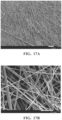
- the fiber size was measured from an image using scanning electron microscopy (SEM) as shown as in FIGS. 19A and 19B .
- SEM scanning electron microscopy
- Comparative Example 3 along with SEM image and the fiber diameter distribution was received from FibeRio Company made by the Force spinning process of US Patent No. 8,231,378 B2 .
- Comparative Example 3A is a 2.0 gsm of PP nanofibers on scrim sample.
- Comparative Example 3B is a 8.0 gsm of PP nanofibers sample taken off from scrim. The number average fiber diameter is 612 nm in a range of fibers from about 300nm to 2400nm. There are some "spatters" type defects and curled thick fibers.
- FIG. 25 shows the web strength measured from 4 different locations. It shows the maximum web strength of 0.1 N/cm and the maximum web elongation of 14%.
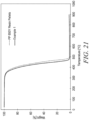
- FIG. 21 shows the almost identical TGA measurement of the nanofibrous web of Example 1 and the polymer resin pellets used in making the web.
- FIG. 22 shows the macromolecules weight measurement of the nanofibrous webs of Example 1 and Comparative Example 1, as well as the polymer resin pellets used in making the web. There is small reduction of macromolecules weight in the nanofibrous webs of Example 1 comparing to the polymer resin pellets used in making the web.
- FIG. 23 shows the crystallinity of the nanofibrous web is higher than the polymer resin used for making nanofibers from the DSC measurement. Overall, the measurements show that the thermal degradation has been reduced to minimum.
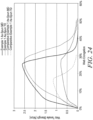
- FIG. 24 shows that the average web strength measurement of the nanofibrous web of Example 1 is 2.5 times higher than the Comparative Example 1.
Landscapes
- Engineering & Computer Science (AREA)
- Textile Engineering (AREA)
- Mechanical Engineering (AREA)
- Chemical & Material Sciences (AREA)
- Chemical Kinetics & Catalysis (AREA)
- General Chemical & Material Sciences (AREA)
- Spinning Methods And Devices For Manufacturing Artificial Fibers (AREA)
- Nonwoven Fabrics (AREA)
- Artificial Filaments (AREA)
Applications Claiming Priority (2)
| Application Number | Priority Date | Filing Date | Title |
|---|---|---|---|
| US201361893958P | 2013-10-22 | 2013-10-22 | |
| PCT/US2014/061737 WO2015061428A1 (en) | 2013-10-22 | 2014-10-22 | Apparatus for production of polymeric nanofibers |
Publications (3)
| Publication Number | Publication Date |
|---|---|
| EP3060704A1 EP3060704A1 (en) | 2016-08-31 |
| EP3060704C0 EP3060704C0 (en) | 2024-10-09 |
| EP3060704B1 true EP3060704B1 (en) | 2024-10-09 |
Family
ID=51862583
Family Applications (1)
| Application Number | Title | Priority Date | Filing Date |
|---|---|---|---|
| EP14793719.7A Active EP3060704B1 (en) | 2013-10-22 | 2014-10-22 | Apparatus for production of polymeric nanofibers |
Country Status (6)
| Country | Link |
|---|---|
| US (2) | US10233568B2 (https=) |
| EP (1) | EP3060704B1 (https=) |
| JP (1) | JP6577945B2 (https=) |
| KR (1) | KR102252127B1 (https=) |
| CN (1) | CN105658851A (https=) |
| WO (1) | WO2015061428A1 (https=) |
Families Citing this family (5)
| Publication number | Priority date | Publication date | Assignee | Title |
|---|---|---|---|---|
| JP6659688B2 (ja) | 2014-11-21 | 2020-03-04 | イー・アイ・デュポン・ドウ・ヌムール・アンド・カンパニーE.I.Du Pont De Nemours And Company | 呼吸装置およびフェイスマスク用の溶融紡糸濾過媒体 |
| KR101884696B1 (ko) * | 2016-01-15 | 2018-08-03 | 나필찬 | 나노섬유 방사 장치 |
| KR101823995B1 (ko) | 2016-01-18 | 2018-02-01 | 경북대학교 산학협력단 | 나노섬유 방사장치 |
| CN116427042B (zh) * | 2023-04-11 | 2026-03-31 | 东华大学 | 一种离心式生产纳米纤维纱线的方法和装置 |
| US11958308B1 (en) | 2023-05-31 | 2024-04-16 | G13 Innovation In Production Ltd | Thermal paper, and methods and systems for forming the same |
Family Cites Families (22)
| Publication number | Priority date | Publication date | Assignee | Title |
|---|---|---|---|---|
| NL236146A (https=) * | 1958-02-15 | |||
| US3475198A (en) * | 1965-04-07 | 1969-10-28 | Ransburg Electro Coating Corp | Method and apparatus for applying a binder material to a prearranged web of unbound,non-woven fibers by electrostatic attraction |
| US4046539A (en) * | 1974-05-28 | 1977-09-06 | Owens-Corning Fiberglas Corporation | Method and apparatus for producing glass fibers |
| US4846643A (en) * | 1985-10-31 | 1989-07-11 | Toshiba Electric Appliances | Apparatus for making cotton candy |
| US5018954A (en) * | 1990-04-16 | 1991-05-28 | Microparticle Technology, Inc. | Shielded counter-rotating spinner assembly for microparticalization of liquid |
| US5326241A (en) * | 1991-04-25 | 1994-07-05 | Schuller International, Inc. | Apparatus for producing organic fibers |
| RU2093618C1 (ru) | 1995-03-16 | 1997-10-20 | Товарищество с ограниченной ответственностью "Везувий-11" | Способ получения волокна из термопластичного материала |
| US6524514B1 (en) * | 1998-01-07 | 2003-02-25 | Microfaser-Repro-Gmbh | Method and device for producing fibrous materials from thermoplastic materials |
| CA2384298C (en) * | 2002-04-29 | 2006-11-07 | Ottawa Fibre Inc. | Hybrid spinner for making a mixture of single-glass and dual-glass fibres right at the fibre forming stage |
| EP1743975B1 (en) * | 2004-02-19 | 2019-04-10 | Toray Industries, Inc. | Nano-fiber compounded solution, emulsion and gelling material and method for production thereof, and nano-fiber synthetic paper and method for production thereof |
| US7244377B2 (en) * | 2005-10-21 | 2007-07-17 | Palo Alto Research Center Incorporated | Acoustic enhancement of particle fabrication by spinning |
| US8303874B2 (en) | 2006-03-28 | 2012-11-06 | E I Du Pont De Nemours And Company | Solution spun fiber process |
| US8277711B2 (en) | 2007-03-29 | 2012-10-02 | E I Du Pont De Nemours And Company | Production of nanofibers by melt spinning |
| WO2009055413A1 (en) * | 2007-10-23 | 2009-04-30 | Ppg Industries Ohio, Inc. | Fiber formation by electrical-mechanical spinning |
| US9834865B2 (en) | 2007-12-17 | 2017-12-05 | E I Du Pont De Nemours And Company | Centrifugal solution spun nanofiber process |
| CN101220544A (zh) * | 2007-12-29 | 2008-07-16 | 中国科学院长春应用化学研究所 | 熔体和溶液离心纺丝制备非织造物的装置 |
| WO2009117363A1 (en) | 2008-03-17 | 2009-09-24 | The Board Of Regents Of The University Of Texas System | Superfine fiber creating spinneret and uses thereof |
| JP2012520176A (ja) | 2009-03-16 | 2012-09-06 | ガバエ テクノロジーズ,エルエルシー | 回転毛細管を用いて粒子を生成する装置、システム及び方法 |
| WO2011040718A2 (ko) * | 2009-09-30 | 2011-04-07 | 주식회사 아모메디 | 웨스턴 블롯용 나노섬유 멤브레인 및 그 제조방법 |
| US9670595B2 (en) | 2011-12-21 | 2017-06-06 | E I Du Pont De Nemours And Company | Process for laying fibrous webs from a centrifugal spinning process |
| US9004893B2 (en) * | 2012-02-08 | 2015-04-14 | Nostalgia Products Group Llc | Hard candy cotton candy maker |
| CN103305947A (zh) * | 2013-05-07 | 2013-09-18 | 青岛中科昊泰新材料科技有限公司 | 一种微分分流离心纺丝法制备纳米纤维的装置 |
-
2014
- 2014-10-22 KR KR1020167010153A patent/KR102252127B1/ko active Active
- 2014-10-22 US US14/520,645 patent/US10233568B2/en active Active
- 2014-10-22 WO PCT/US2014/061737 patent/WO2015061428A1/en not_active Ceased
- 2014-10-22 EP EP14793719.7A patent/EP3060704B1/en active Active
- 2014-10-22 CN CN201480058179.4A patent/CN105658851A/zh active Pending
- 2014-10-22 JP JP2016525866A patent/JP6577945B2/ja active Active
-
2019
- 2019-02-01 US US16/264,809 patent/US10590565B2/en active Active
Also Published As
| Publication number | Publication date |
|---|---|
| EP3060704C0 (en) | 2024-10-09 |
| US10590565B2 (en) | 2020-03-17 |
| KR20160073970A (ko) | 2016-06-27 |
| US20150111455A1 (en) | 2015-04-23 |
| JP2016534240A (ja) | 2016-11-04 |
| WO2015061428A1 (en) | 2015-04-30 |
| EP3060704A1 (en) | 2016-08-31 |
| US10233568B2 (en) | 2019-03-19 |
| US20190161889A1 (en) | 2019-05-30 |
| KR102252127B1 (ko) | 2021-05-17 |
| JP6577945B2 (ja) | 2019-09-18 |
| CN105658851A (zh) | 2016-06-08 |
Similar Documents
| Publication | Publication Date | Title |
|---|---|---|
| US10590565B2 (en) | Polymeric nanofibers and nanofibrous web | |
| KR101519169B1 (ko) | 용융 방사에 의한 나노섬유의 제조 | |
| Jafari et al. | Fabrication of Poly (lactic acid) filter media via the meltblowing process and their filtration performances: A comparative study with polypropylene meltblown | |
| CN1656260B (zh) | 可粘合的取向非织造纤维网及其制造方法 | |
| US8668854B2 (en) | Process and apparatus for producing nanofibers using a two phase flow nozzle | |
| US20150111019A1 (en) | Electret nanofibrous web | |
| Nayak | Polypropylene Nanofibers | |
| US20150111456A1 (en) | Melt-spun polypropylene fine-grade nanofibrous web | |
| KR102304596B1 (ko) | 고분자량 및 저분자량 미세 섬유와 tpu 미세 섬유 | |
| WO2017123293A2 (en) | Gel-electrospinning process for preparing high performance polymer nanofibers | |
| Drabek et al. | Effect of molecular weight and extensional rheology on melt blown process stability for linear isotactic polypropylenes | |
| Joghataei | Effects of Polymer Rheology on Meltblowing Fiber Formation Process and Fiber Diameter Distribution | |
| Afifi et al. | Effect of polymer molecular weight on the electrospinning of polylactides in entangled and aligned fiber forms | |
| US20070248823A1 (en) | Fluorine containing copolymer fiber and fabric |
Legal Events
| Date | Code | Title | Description |
|---|---|---|---|
| PUAI | Public reference made under article 153(3) epc to a published international application that has entered the european phase |
Free format text: ORIGINAL CODE: 0009012 |
|
| 17P | Request for examination filed |
Effective date: 20160322 |
|
| AK | Designated contracting states |
Kind code of ref document: A1 Designated state(s): AL AT BE BG CH CY CZ DE DK EE ES FI FR GB GR HR HU IE IS IT LI LT LU LV MC MK MT NL NO PL PT RO RS SE SI SK SM TR |
|
| AX | Request for extension of the european patent |
Extension state: BA ME |
|
| DAX | Request for extension of the european patent (deleted) | ||
| STAA | Information on the status of an ep patent application or granted ep patent |
Free format text: STATUS: EXAMINATION IS IN PROGRESS |
|
| 17Q | First examination report despatched |
Effective date: 20210611 |
|
| P01 | Opt-out of the competence of the unified patent court (upc) registered |
Effective date: 20230510 |
|
| GRAP | Despatch of communication of intention to grant a patent |
Free format text: ORIGINAL CODE: EPIDOSNIGR1 |
|
| STAA | Information on the status of an ep patent application or granted ep patent |
Free format text: STATUS: GRANT OF PATENT IS INTENDED |
|
| INTG | Intention to grant announced |
Effective date: 20240430 |
|
| RAP1 | Party data changed (applicant data changed or rights of an application transferred) |
Owner name: CUMMINS FILTRATION INC. |
|
| GRAJ | Information related to disapproval of communication of intention to grant by the applicant or resumption of examination proceedings by the epo deleted |
Free format text: ORIGINAL CODE: EPIDOSDIGR1 |
|
| STAA | Information on the status of an ep patent application or granted ep patent |
Free format text: STATUS: EXAMINATION IS IN PROGRESS |
|
| GRAS | Grant fee paid |
Free format text: ORIGINAL CODE: EPIDOSNIGR3 |
|
| STAA | Information on the status of an ep patent application or granted ep patent |
Free format text: STATUS: GRANT OF PATENT IS INTENDED |
|
| GRAA | (expected) grant |
Free format text: ORIGINAL CODE: 0009210 |
|
| STAA | Information on the status of an ep patent application or granted ep patent |
Free format text: STATUS: THE PATENT HAS BEEN GRANTED |
|
| INTC | Intention to grant announced (deleted) | ||
| AK | Designated contracting states |
Kind code of ref document: B1 Designated state(s): AL AT BE BG CH CY CZ DE DK EE ES FI FR GB GR HR HU IE IS IT LI LT LU LV MC MK MT NL NO PL PT RO RS SE SI SK SM TR |
|
| REG | Reference to a national code |
Ref country code: GB Ref legal event code: FG4D |
|
| REG | Reference to a national code |
Ref country code: CH Ref legal event code: EP |
|
| REG | Reference to a national code |
Ref country code: DE Ref legal event code: R096 Ref document number: 602014090992 Country of ref document: DE |
|
| REG | Reference to a national code |
Ref country code: IE Ref legal event code: FG4D |
|
| U01 | Request for unitary effect filed |
Effective date: 20241028 |
|
| U07 | Unitary effect registered |
Designated state(s): AT BE BG DE DK EE FI FR IT LT LU LV MT NL PT RO SE SI Effective date: 20241111 |
|
| U1N | Appointed representative for the unitary patent procedure changed after the registration of the unitary effect |
Representative=s name: MARKS & CLERK LLP; LU |
|
| U20 | Renewal fee for the european patent with unitary effect paid |
Year of fee payment: 11 Effective date: 20250103 |
|
| PG25 | Lapsed in a contracting state [announced via postgrant information from national office to epo] |
Ref country code: IS Free format text: LAPSE BECAUSE OF FAILURE TO SUBMIT A TRANSLATION OF THE DESCRIPTION OR TO PAY THE FEE WITHIN THE PRESCRIBED TIME-LIMIT Effective date: 20250209 Ref country code: HR Free format text: LAPSE BECAUSE OF FAILURE TO SUBMIT A TRANSLATION OF THE DESCRIPTION OR TO PAY THE FEE WITHIN THE PRESCRIBED TIME-LIMIT Effective date: 20241009 |
|
| PG25 | Lapsed in a contracting state [announced via postgrant information from national office to epo] |
Ref country code: ES Free format text: LAPSE BECAUSE OF FAILURE TO SUBMIT A TRANSLATION OF THE DESCRIPTION OR TO PAY THE FEE WITHIN THE PRESCRIBED TIME-LIMIT Effective date: 20241009 |
|
| PG25 | Lapsed in a contracting state [announced via postgrant information from national office to epo] |
Ref country code: NO Free format text: LAPSE BECAUSE OF FAILURE TO SUBMIT A TRANSLATION OF THE DESCRIPTION OR TO PAY THE FEE WITHIN THE PRESCRIBED TIME-LIMIT Effective date: 20250109 |
|
| PG25 | Lapsed in a contracting state [announced via postgrant information from national office to epo] |
Ref country code: GR Free format text: LAPSE BECAUSE OF FAILURE TO SUBMIT A TRANSLATION OF THE DESCRIPTION OR TO PAY THE FEE WITHIN THE PRESCRIBED TIME-LIMIT Effective date: 20250110 |
|
| PG25 | Lapsed in a contracting state [announced via postgrant information from national office to epo] |
Ref country code: PL Free format text: LAPSE BECAUSE OF FAILURE TO SUBMIT A TRANSLATION OF THE DESCRIPTION OR TO PAY THE FEE WITHIN THE PRESCRIBED TIME-LIMIT Effective date: 20241009 |
|
| PG25 | Lapsed in a contracting state [announced via postgrant information from national office to epo] |
Ref country code: RS Free format text: LAPSE BECAUSE OF FAILURE TO SUBMIT A TRANSLATION OF THE DESCRIPTION OR TO PAY THE FEE WITHIN THE PRESCRIBED TIME-LIMIT Effective date: 20250109 |
|
| REG | Reference to a national code |
Ref country code: CH Ref legal event code: PL |
|
| PG25 | Lapsed in a contracting state [announced via postgrant information from national office to epo] |
Ref country code: SM Free format text: LAPSE BECAUSE OF FAILURE TO SUBMIT A TRANSLATION OF THE DESCRIPTION OR TO PAY THE FEE WITHIN THE PRESCRIBED TIME-LIMIT Effective date: 20241009 |
|
| PG25 | Lapsed in a contracting state [announced via postgrant information from national office to epo] |
Ref country code: MC Free format text: LAPSE BECAUSE OF FAILURE TO SUBMIT A TRANSLATION OF THE DESCRIPTION OR TO PAY THE FEE WITHIN THE PRESCRIBED TIME-LIMIT Effective date: 20241009 |
|
| PG25 | Lapsed in a contracting state [announced via postgrant information from national office to epo] |
Ref country code: CH Free format text: LAPSE BECAUSE OF NON-PAYMENT OF DUE FEES Effective date: 20241031 |
|
| PG25 | Lapsed in a contracting state [announced via postgrant information from national office to epo] |
Ref country code: SK Free format text: LAPSE BECAUSE OF FAILURE TO SUBMIT A TRANSLATION OF THE DESCRIPTION OR TO PAY THE FEE WITHIN THE PRESCRIBED TIME-LIMIT Effective date: 20241009 |
|
| PG25 | Lapsed in a contracting state [announced via postgrant information from national office to epo] |
Ref country code: CZ Free format text: LAPSE BECAUSE OF FAILURE TO SUBMIT A TRANSLATION OF THE DESCRIPTION OR TO PAY THE FEE WITHIN THE PRESCRIBED TIME-LIMIT Effective date: 20241009 |
|
| PLBE | No opposition filed within time limit |
Free format text: ORIGINAL CODE: 0009261 |
|
| STAA | Information on the status of an ep patent application or granted ep patent |
Free format text: STATUS: NO OPPOSITION FILED WITHIN TIME LIMIT |
|
| 26N | No opposition filed |
Effective date: 20250710 |
|
| GBPC | Gb: european patent ceased through non-payment of renewal fee |
Effective date: 20250109 |
|
| PG25 | Lapsed in a contracting state [announced via postgrant information from national office to epo] |
Ref country code: GB Free format text: LAPSE BECAUSE OF NON-PAYMENT OF DUE FEES Effective date: 20250109 |
|
| PG25 | Lapsed in a contracting state [announced via postgrant information from national office to epo] |
Ref country code: IE Free format text: LAPSE BECAUSE OF NON-PAYMENT OF DUE FEES Effective date: 20241022 |
|
| U20 | Renewal fee for the european patent with unitary effect paid |
Year of fee payment: 12 Effective date: 20251027 |
|
| PG25 | Lapsed in a contracting state [announced via postgrant information from national office to epo] |
Ref country code: CY Free format text: LAPSE BECAUSE OF FAILURE TO SUBMIT A TRANSLATION OF THE DESCRIPTION OR TO PAY THE FEE WITHIN THE PRESCRIBED TIME-LIMIT; INVALID AB INITIO Effective date: 20141022 |
|
| PG25 | Lapsed in a contracting state [announced via postgrant information from national office to epo] |
Ref country code: HU Free format text: LAPSE BECAUSE OF FAILURE TO SUBMIT A TRANSLATION OF THE DESCRIPTION OR TO PAY THE FEE WITHIN THE PRESCRIBED TIME-LIMIT; INVALID AB INITIO Effective date: 20141022 |
|
| U1H | Name or address of the proprietor changed after the registration of the unitary effect |
Owner name: ATMUS FILTRATION INC.; US |
|
| U1N | Appointed representative for the unitary patent procedure changed after the registration of the unitary effect |
Representative=s name: MARKS & CLERK LLP; GB |