EP3051256A2 - Interface for mems inertial sensors - Google Patents
Interface for mems inertial sensors Download PDFInfo
- Publication number
- EP3051256A2 EP3051256A2 EP16155129.6A EP16155129A EP3051256A2 EP 3051256 A2 EP3051256 A2 EP 3051256A2 EP 16155129 A EP16155129 A EP 16155129A EP 3051256 A2 EP3051256 A2 EP 3051256A2
- Authority
- EP
- European Patent Office
- Prior art keywords
- signal
- actuation
- sense
- excitation
- mems sensor
- Prior art date
- Legal status (The legal status is an assumption and is not a legal conclusion. Google has not performed a legal analysis and makes no representation as to the accuracy of the status listed.)
- Granted
Links
Images







Classifications
-
- G—PHYSICS
- G01—MEASURING; TESTING
- G01C—MEASURING DISTANCES, LEVELS OR BEARINGS; SURVEYING; NAVIGATION; GYROSCOPIC INSTRUMENTS; PHOTOGRAMMETRY OR VIDEOGRAMMETRY
- G01C19/00—Gyroscopes; Turn-sensitive devices using vibrating masses; Turn-sensitive devices without moving masses; Measuring angular rate using gyroscopic effects
- G01C19/56—Turn-sensitive devices using vibrating masses, e.g. vibratory angular rate sensors based on Coriolis forces
- G01C19/5776—Signal processing not specific to any of the devices covered by groups G01C19/5607 - G01C19/5719
-
- G—PHYSICS
- G01—MEASURING; TESTING
- G01C—MEASURING DISTANCES, LEVELS OR BEARINGS; SURVEYING; NAVIGATION; GYROSCOPIC INSTRUMENTS; PHOTOGRAMMETRY OR VIDEOGRAMMETRY
- G01C19/00—Gyroscopes; Turn-sensitive devices using vibrating masses; Turn-sensitive devices without moving masses; Measuring angular rate using gyroscopic effects
- G01C19/56—Turn-sensitive devices using vibrating masses, e.g. vibratory angular rate sensors based on Coriolis forces
-
- G—PHYSICS
- G01—MEASURING; TESTING
- G01P—MEASURING LINEAR OR ANGULAR SPEED, ACCELERATION, DECELERATION, OR SHOCK; INDICATING PRESENCE, ABSENCE, OR DIRECTION, OF MOVEMENT
- G01P15/00—Measuring acceleration; Measuring deceleration; Measuring shock, i.e. sudden change of acceleration
- G01P15/02—Measuring acceleration; Measuring deceleration; Measuring shock, i.e. sudden change of acceleration by making use of inertia forces using solid seismic masses
- G01P15/08—Measuring acceleration; Measuring deceleration; Measuring shock, i.e. sudden change of acceleration by making use of inertia forces using solid seismic masses with conversion into electric or magnetic values
- G01P15/125—Measuring acceleration; Measuring deceleration; Measuring shock, i.e. sudden change of acceleration by making use of inertia forces using solid seismic masses with conversion into electric or magnetic values by capacitive pick-up
Definitions
- MEMS micro-electromechanical
- an excitation signal is needed for detection of capacitance variations in both a sense loop and a drive loop.
- the excitation signal should not affect the actuation applied, for example, to a proof mass (or proof masses) of the MEMS sensor.
- the excitation signal since the excitation signal is applied to the proof mass, and since actuation capacitors share the same proof mass with the detection capacitors, therefore the excitation signal affects the actuation signal content and dynamic range.
- Another issue relates to undesired coupling that can occur between the actuation stream of one channel and detection paths of the same channel, or even different channels (e.g., sense mode to sense mode coupling or sense mode to drive mode coupling, etc.).
- Such coupling can distort the signal and result in severe degradation in the performance of the detection front-end circuits. This effect is exaggerated in sense mode, as the combined effect of parasitic capacitance and process mismatch is on the order of the detection capacitance variation.
- a sense signal may contain a desired sensor input signal AM-modulated at the frequency of a drive signal.
- the drive and the sense signals are multiplied using a multiplier to obtain a demodulated output signal.
- accurate phase adjustment between SNS and DRV bit streams may be required.
- Various approaches to achieving this phase adjustment typically entail power and/or area penalties.
- This patent disclosure describes an ASIC or other circuit to interface with MEMS inertial sensors such as vibratory MEMS gyroscopes and accelerometers, including in closed loop configurations. Closed loop configuration provides best performance in harsh environments. Techniques to improve the sensor interface performance are described, including techniques that allow for extending dynamic range of the MEMS actuation and detection signals, canceling coupling between electrodes in the MEMS module, and achieving fine phase tuning between sense and drive loops for improved demodulation.
- FIG.1 The system architecture of an exemplary ASIC is shown in FIG.1 . Functionally, this system can be divided into main blocks as follows:
- This part of the circuit provides actuation voltages for sense and drive electrodes of the MEMS sensor, through sense actuation (SNS ACT) switches 121 and drive actuation (DRV ACT) switches 111, respectively.
- block 130 PM EXC
- PM EXC provides a proof mass excitation voltage required by capacitance sensing circuits in both the drive and sense loops.
- a sense capacitance-to-voltage converter 123 C/V SNS
- a drive capacitance-to-voltage converter 113 C/V DRV
- the drive loop 110 incorporates a phase shift 115A (DRV Phase) required to achieve an oscillation condition of a drive resonator 119 (including a mechanical element, e.g., a suspended mass) of the MEMS sensor, as well as automatic gain control 115B (AGC) to control the amplitude of oscillation of the mechanical element.
- a phase shift 115A DVR Phase
- ADC automatic gain control
- an ADC 117 (which may be implemented, for example, as a band pass sigma delta modulator) converts the drive loop C/V output from circuit 113 into a single bit reading of the MEMS sensor drive oscillation signal.
- the MEMS sensor includes a sense resonator 129 (including a mechanical element, e.g., a suspended mass).
- the sense resonator 129 is acted upon by an input signal to be sensed (for example, motion) and a feedback signal output of the sense actuation switches 121.
- an excitation signal EXC output by block 130 ( FIG. 1 ) is applied to both the drive resonator 119 and the sense resonator 129.
- the sense loop 120 performs feedback (e.g., force-feedback) motion control of a mechanical element of the sense resonator 129, and provides a digital output reading. This is achieved by implementing closed-loop feedback (e.g., force-feedback) using an electro-mechanical sigma delta modulator 120' for the sense mode.
- the ASIC can also be configured to operate in open loop mode. In this case, the sense loop is opened (switch 129, FIG. 1 ) and the electronic filter H x (z) coefficients are altered, such that the electronic filter 125 operates as a sigma-delta ADC.
- the digital processing core 140 decimates and filters (141) the output of the sigma delta modulators of both the drive and sense loops (110, 120), and performs a final sense signal demodulation operation (143). In addition, the digital processing core 140 performs temperature compensation (145) of the MEMS sensor reading, and controls an SPI interface 150. In one aspect, the digital processing core 140 functions as an electrostatic actuation controller. Additionally, the digital processing core 140 may output a reset signal, disable signal, or power down signal used to reduce undesired coupling of actuation signals as described below.
- This block provides all required biasing currents and supply voltages to different circuit blocks. Moreover, it generates required high-voltage actuation reference signals.
- a band gap reference voltage Vref (161) is generated and buffered (163, 165) for the ADCs (117, 125) and for MEMS sensor excitation and actuation (111, 121, 130).
- the power management block 160 is also responsible for generating necessary voltages for operation of a ROM 170.
- a charge pump 180 is used for this purpose.
- This block senses the die temperature and converts it into a digital reading.
- the PLL generates the master clock of the system.
- an ASIC self-clocking technique is used. This technique simplifies interfacing of the ASIC to different MEMS sensor modules.
- Feedback (e.g., force-feedback) operation reduces system sensitivity to MEMS sensor process variations, increases bandwidth, and allows operation in matched mode. Therefore, a closed loop configuration can achieve best performance in harsh environments.
- Incorporating the MEMS sensor as one part of the feedback (e.g., force-feedback) loop filter converts the system into a hybrid electromechanical ⁇ modulator with a continuous-time (CT) part represented by the mechanical filter and a discrete-time (DT) part represented by the electronic filter.
- CT continuous-time
- DT discrete-time
- the ASIC of FIG.1 uses a PLL 190 to generate the system clock.
- the high Q resonance of the MEMS sensor oscillation (of the drive resonator 119, for example) may be used to generate a clean reference clock for the ASIC PLL 190, resulting in a low noise floor at the ASIC output.
- the ASIC PLL 190 does not need an external crystal as a reference clock, and the ASIC becomes self-clocked.
- Using a MEMS sensor-based reference clock allows fixing the ratio between the system sampling frequency and the mechanical drive resonance frequency (e.g., Coriolis signal carrier). Therefore, this arrangement enables interfacing to a wide-range of MEMS sensor modules. More particularly, the self-clocking technique in the ASIC allows the drive loop 110, sense loop 120 and DSP blocks 140 to track the frequency of the MEMS sensor. Hence, the ASIC can interface to a wide range of MEMS sensor frequencies.
- the drive loop of FIG. 2A works in conjunction with the PLL 190 to enable self-clocking. Since the ASIC is self-clocked, the ADC sampling frequency is locked to the MEMS sensor resonance frequency through the PLL 190, which controls the sampling frequency of the ADC 117.
- Low-jitter self-clocking of the ASIC may be taken advantage of by the MEMS sensor sense loop.
- the MEMS sensor sense loop of FIG. 2B described above, is implemented based on continuous-time ⁇ modulation, because the low-jitter clocking of the self-clocked ASIC achieves better SNR for CT feedback (e.g., force-feedback) operation.
- CT feedback e.g., force-feedback
- the illustrated sense loop is achieved by implementing a 4th order electro-mechanical ⁇ modulator using a switch-cap electronic filter 125.
- the modulator architecture may be based on a feed-forward topology with a feed-back branch to stabilize the loop.
- the noise floor appearing at the output is minimized, as a result of the low-jitter clocking effect on continuous-time ⁇ operation being minimized.
- the ASIC can interface to a range of MEMS sensor modules by using a programmable divider in the PLL 190.
- the digital processing core 140 of FIG. 1 filters the output of the ⁇ modulators of both the drive and sense loops (110, 120), and performs the final output demodulation using the demodulator 143.
- the demodulation output is decimated using a programmable decimation filter 141.
- Two band pass filters (1405, FIG. 14 ), centered at the MEMS sensor resonance frequency, filter out noise of both the drive and sense loops, before multiplying them for demodulation, to avoid mixing and down conversion of quantization noise in the band of interest.
- the poles and zeros of each band pass filter (1405) scale with the sampling frequency (depending on the MEMS sensor module), and therefore the center frequency will be correctly tuned with variations of the MEMS sensor resonance frequency.
- the excitation signal EXC ( FIG. 1 ) is applied to both the drive resonator 119 and the sense resonator 129 and is needed for the detection of capacitance variations in both the sense and drive loops (120, 110). This excitation signal should not reduce the effectiveness of the actuation signals (SNSACT, DRVACT).
- FIG. 3 illustrates, for example, the case of a fully differential MEMS sensor showing an arrangement of the electrodes.
- variable capacitances associated with a sense resonator (129, FIG. 2B ) are arranged in a "Pi" configuration.
- First and second actuation capacitors Ca1 and Ca2 are arranged in the arms of the Pi; sense capacitors Cs1 and Cs2 are arranged in the legs of the Pi and are coupled to inputs of the sense C/V converter 123.
- the excitation signal EXC also referred to as a proof mass voltage V PM
- EXC also referred to as a proof mass voltage V PM
- the excitation signal EXC is added on proof masses of the respective resonators, and since the actuation capacitors (Ca) share the same proof mass with the detection capacitors (Cs), therefore the excitation signal affects the actuation signal content and dynamic range.
- the excitation signal (used to detect capacitance variations) is used to control the value of the actuation signal bit stream to allow the dynamic range of both actuation and detection paths to be maximized and to prevent folding of high frequency components of the actuation bit stream due to mixing with the excitation signal.
- the electrostatic actuation force generated in response to an excitation signal can be calculated according to the following equation, wherein the excitation signal EXC is represented as Vpm: F act ⁇ V act + ⁇ V pm 2 ⁇ V act ⁇ ⁇ V pm 2 F act ⁇ V act + 2 ⁇ V act ⁇ 2 ⁇ 2 * V pm V act ⁇ ⁇ V act ⁇ Note that the third term in the (2) will cause both degradation in actuation dynamic range and folding of high order components of the actuation signal due to mixing with the excitation signal.
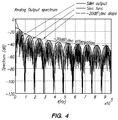
- FIG. 4 shows an example of the resulting high order components of a sample actuation stream.
- FIG. 5 shows the waveforms of one actuation and detection scheme.
- 6dB 6dB
- a block 600 performs digital processing and reference generation and may correspond to blocks 140 and 160 of FIG. 1 .
- the block 600 receives sense and drive bit streams (SNS, DRV).
- the block also uses the excitation signal V PM as an input signal to condition the actuation signals.
- the block 600 outputs actuation signals, for example actuation signals Vsact+/Vsact- and Vdact+/Vdact.
- the notation Vact+, Vact- is used to refer generally to these four actuation signals.
- the actuation signal bit stream may be logically combined (e.g., XORed or XNORed) with the PM signal.
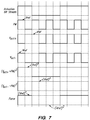
- FIG. 7 shows the waveforms of the actuation signals (Vact+, Vact-), excitation signals and the resulting electrostatic force components (first and second terms in equation (1) above).
- actuation bit stream is XORed with a signal PM (V pm ) to produce Vact+, while the actuation bit stream is XNORed with the PM signal to produce Vact-. From FIG. 7 , it may be seen that no folding of high frequency components occurs (i.e., actuation signal content is preserved intact), and that both the actuation force and excitation signal are represented by the full dynamic range of the reference voltage.
- FIG. 8 shows the actuation and detection waveforms with an added Return-to-Zero (RZ) option, which may be used in continuous time actuation for enhancing the linearity of the DAC.
- the block 600 in one aspect, may be considered as circuitry (or means) for applying a return-to-zero encoding to an actuation signal.
- an actuation stream is applied on the actuation electrodes to produce a certain movement on the proof mass.
- This feedback can be in a positive feedback loop or a negative feedback loop.
- the actuation voltage will affect the mechanical element according to a response characteristic of the mechanical element.
- the actuation bit stream can couple directly to the detection circuit as shown in FIG. 9 .
- Unintended coupling paths Ccop1 and Ccop2 couple from the Vact+ signal to the Cs1 and Cs2 signals, respectively.
- unintended coupling paths Ccom1 and Ccom2 couple from the Vact- signal to the Cs1 and Cs2 signals, respectively.
- This coupling can occur between the actuation stream of one channel and detection paths of the same channel, or even different channels (e.g., SNS mode to SNS mode coupling or SNS mode to DRV mode coupling).
- a disable/reset of at least one of and preferably both of the detection circuitry and the MEMS detection electrodes during actuation signal transitions as shown in FIG. 11 , for example using a reset signal RST as shown in FIG. 10 .
- a control signal may be used to reset, disable, or power down selected circuit elements.
- a reset signal RST is applied to the C/V SNS detection circuitry 123 and to the C/V DRV detection circuitry 113.
- analog switches SWs and SWd are provided between the sense electrodes of the MEMS sensor and the drive electrodes of the MEMS sensor.
- the reset signal RST is used to control the switches SWs and SWd, causing them to close when the reset signal is asserted. Resetting the detection circuitry (113, 123) and the MEMS electrodes cancels the effect of the parasitic coupling paths of the actuation signal.
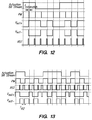
- FIG. 12 shows a time mismatch (t mismatch , FIG. 12 ) between the excitation signal and the actuation signal edges. Furthermore, the foregoing coupling cancellation technique may be used together with the dynamic range improvement technique described previously. The resulting waveforms are shown in FIG. 12.
- FIG. 13 shows a sample timing diagram where: 1) a mismatch in timing between the actuation and detection signals is added; 2) XOR actuation with RZ is applied as previously described; and 3) a reset/disable pulse RST for the detection electrodes and circuitry is added around the actuation signal edges for XOR actuation.
- the SNS sigma delta bit stream 1401 at the SNS loop output contains the input signal (input signal, FIG. 2B ) AM-modulated at the DRV signal frequency.
- the DRV and the SNS signals (1401, 1402) are multiplied using a multiplier 1403 to obtain a signal Demodulation Out as shown in FIG. 14 .
- Two band pass filters (BPF) 1405s and 1405d may be used to remove sigma delta noise before multiplication.
- phase adjustment 1407, FIG.
- phase adjustment 1407 may be implemented using a programmable shift register-i.e., the signal can be delayed by multiples of the operating clock periods. However, this technique can add only coarse phase shift if the system clock period is relatively large.
- the shift register length should be greater than 32 bits.
- the clock frequency can be increased; however, this increases the power consumption of the system and the design complexity with respect to timing.
- the area increases as a result of adding registers in the shift register to get the required phase shift. For example, if the required phase resolution is 2.7 ° 4 , then the clock frequency should increase 4 times.
- the required phase shift is about 87°, then the shift register length should be greater than 128 bits, which is four times the length of the shift register in the previous case.
- the BPFs 1405 may be configured to achieve fine phase tuning by introducing a certain offset in center frequencies of the BPFs.
- the shift register 1407 may be kept for coarse tuning.
- the transfer function of filters that may be used in the ASIC of FIG. 1 is shown in FIG. 15 .
- both filters are identical with bandwidths of 200Hz centered at the MEMS sensor resonance.
- the phase added by the respective filters to the SNS and the DRV signals is exactly the same phase.
- the center frequencies of the two filters can be made different from each other with a very small difference.
- the phase response of the filter is very sharp at the center frequency. As a result, shifting the center of the drive (or sense) filter slightly can add the required phase shift.
- the center frequencies of the filters differ by 10 Hz, then the phase shift between the two filters is about 0.04 rad ( ⁇ 2.7 °).
- 2.7 ° is the maximum phase shift required to be added by the filter, since phase shift in increments of 2.7 ° can be added directly by coarse tuning (using, for example, a shift register as described).
- the center frequencies of the two filters may differ by less than 10 Hz to get a fine phase shift less than 2.7°.
- the center frequencies may be fixed. In other embodiments, the center frequencies may be adjustable.
Landscapes
- Engineering & Computer Science (AREA)
- Physics & Mathematics (AREA)
- General Physics & Mathematics (AREA)
- Radar, Positioning & Navigation (AREA)
- Remote Sensing (AREA)
- Signal Processing (AREA)
- Gyroscopes (AREA)
- Micromachines (AREA)
- Measuring Fluid Pressure (AREA)
Abstract
Description
- This application claims benefit of
U.S. Application 61/382,898 - Numerous applications of micro-electromechanical (MEMS) inertial sensors require a high-performance ASIC interface. Existing interface techniques are not fully satisfactory in various respects.
- For example, in feedback (e.g., force-feedback) systems where a drive loop is present, an excitation signal is needed for detection of capacitance variations in both a sense loop and a drive loop. The excitation signal should not affect the actuation applied, for example, to a proof mass (or proof masses) of the MEMS sensor. However, since the excitation signal is applied to the proof mass, and since actuation capacitors share the same proof mass with the detection capacitors, therefore the excitation signal affects the actuation signal content and dynamic range.
- Another issue relates to undesired coupling that can occur between the actuation stream of one channel and detection paths of the same channel, or even different channels (e.g., sense mode to sense mode coupling or sense mode to drive mode coupling, etc.). Such coupling can distort the signal and result in severe degradation in the performance of the detection front-end circuits. This effect is exaggerated in sense mode, as the combined effect of parasitic capacitance and process mismatch is on the order of the detection capacitance variation.
- Several solutions have been proposed to solve this coupling issue. Some solutions depend on frequency separation between actuation and detection (which works only in the case of coupling between different channels); other solutions depend on estimating the coupling transfer function and compensating this effect in later stages (in digital domain signal processing or-at the cost of increased complexity-in the analog domain). Other proposals have included decreasing the actuation signal level (at the expense of reduced actuation dynamic range), or manual trimming to compensate for the mismatches.
- In feedback (e.g., force-feedback) systems where a drive loop is present, a sense signal may contain a desired sensor input signal AM-modulated at the frequency of a drive signal. Hence, to demodulate the bit stream to get the original signal, the drive and the sense signals are multiplied using a multiplier to obtain a demodulated output signal. To get the demodulated signal to have the lowest possible DC component, accurate phase adjustment between SNS and DRV bit streams may be required. Various approaches to achieving this phase adjustment typically entail power and/or area penalties.
- Hence, an improved interface for interfacing to MEMS inertial sensors is desired.
- The present invention may be further understood from the following Detailed Description in conjunction with the appended drawing figures. In the drawing:
-
FIG. 1 is an architecture block diagram of a circuit (e.g., an ASIC) in which the present interface techniques may be used. -
FIG. 2A is a diagram of a drive loop of the ASIC ofFIG. 1 . -
FIG. 2B is a diagram of a sense loop of the ASIC ofFIG. 1 . -
FIG. 3 is diagram of a MEMS electrical model together with detection circuits of sense loop and drive loop. -
FIG. 4 is a signal plot of a sample actuation spectrum showing high frequency components. -
FIG. 5 is a waveform diagram illustrating actuation and detection waveforms and the consequent effective actuation force. -
FIG. 6 is diagram of a MEMS electrical model illustrating a modified actuation technique in which the excitation signal controls the shape of the actuation signal. -
FIG. 7 is a waveform diagram illustrating modified actuation and detection waveforms and the consequent effective actuation force in accordance with an embodiment ofFIG. 6 . -
FIG. 8 is a waveform diagram like that ofFIG. 7 showing waveforms in accordance with a RZ (retum-to-zero) option. -
FIG. 9 is a diagram illustrating unintended coupling from an actuation path to a detection path. -
FIG. 10 is a waveform diagram showing actuation and excitation signals together with an added reset signal RST. -
FIG. 11 is a diagram showing the reset signal RST applied to detection circuits C/V SNS and C/V DRV and to MEMS electrodes. -
FIG. 12 is a waveform diagram illustrating the modified actuation and detection waveforms ofFIG. 7 used in combination with the reset signal ofFIG. 10 . -
FIG.13 is a waveform diagram like that ofFIG. 12 showing waveforms in accordance with a RZ (return-to-zero) option. -
FIG. 14 is a block diagram of a demodulation portion of the circuit ofFIG. 1 . -
FIG. 15 is a plot showing magnitude and phase responses of the filters ofFIG. 14 . -
FIG. 16 is a plot of a phase shift as a function of filter center frequency for an offset one of the bandpass filters ofFIG. 15 . - This patent disclosure describes an ASIC or other circuit to interface with MEMS inertial sensors such as vibratory MEMS gyroscopes and accelerometers, including in closed loop configurations. Closed loop configuration provides best performance in harsh environments. Techniques to improve the sensor interface performance are described, including techniques that allow for extending dynamic range of the MEMS actuation and detection signals, canceling coupling between electrodes in the MEMS module, and achieving fine phase tuning between sense and drive loops for improved demodulation.
- The system architecture of an exemplary ASIC is shown in
FIG.1 . Functionally, this system can be divided into main blocks as follows: - This part of the circuit provides actuation voltages for sense and drive electrodes of the MEMS sensor, through sense actuation (SNS ACT)
switches 121 and drive actuation (DRV ACT)switches 111, respectively. Moreover, block 130 (PM EXC) provides a proof mass excitation voltage required by capacitance sensing circuits in both the drive and sense loops. Finally, a sense capacitance-to-voltage converter 123 (C/V SNS) and a drive capacitance-to-voltage converter 113 (C/V DRV) perform capacitance-to-voltage sensing in the corresponding loops. - Referring to
FIG. 2A , thedrive loop 110 incorporates aphase shift 115A (DRV Phase) required to achieve an oscillation condition of a drive resonator 119 (including a mechanical element, e.g., a suspended mass) of the MEMS sensor, as well asautomatic gain control 115B (AGC) to control the amplitude of oscillation of the mechanical element. In the illustrated embodiment, an ADC 117 (which may be implemented, for example, as a band pass sigma delta modulator) converts the drive loop C/V output fromcircuit 113 into a single bit reading of the MEMS sensor drive oscillation signal. - Referring to
FIG. 2B , in the illustrated embodiment, the MEMS sensor includes a sense resonator 129 (including a mechanical element, e.g., a suspended mass). Thesense resonator 129 is acted upon by an input signal to be sensed (for example, motion) and a feedback signal output of thesense actuation switches 121. As described more fully hereinafter, in the illustrated embodiment, an excitation signal EXC output by block 130 (FIG. 1 ) is applied to both thedrive resonator 119 and thesense resonator 129. - The
sense loop 120 performs feedback (e.g., force-feedback) motion control of a mechanical element of thesense resonator 129, and provides a digital output reading. This is achieved by implementing closed-loop feedback (e.g., force-feedback) using an electro-mechanical sigma delta modulator 120' for the sense mode. The ASIC can also be configured to operate in open loop mode. In this case, the sense loop is opened (switch 129,FIG. 1 ) and the electronic filter Hx(z) coefficients are altered, such that theelectronic filter 125 operates as a sigma-delta ADC. - The
digital processing core 140 decimates and filters (141) the output of the sigma delta modulators of both the drive and sense loops (110, 120), and performs a final sense signal demodulation operation (143). In addition, thedigital processing core 140 performs temperature compensation (145) of the MEMS sensor reading, and controls anSPI interface 150. In one aspect, thedigital processing core 140 functions as an electrostatic actuation controller. Additionally, thedigital processing core 140 may output a reset signal, disable signal, or power down signal used to reduce undesired coupling of actuation signals as described below. - This block provides all required biasing currents and supply voltages to different circuit blocks. Moreover, it generates required high-voltage actuation reference signals. In the illustrated embodiment, a band gap reference voltage Vref (161) is generated and buffered (163, 165) for the ADCs (117, 125) and for MEMS sensor excitation and actuation (111, 121, 130). The
power management block 160 is also responsible for generating necessary voltages for operation of aROM 170. In the illustrated embodiment, acharge pump 180 is used for this purpose. - This block senses the die temperature and converts it into a digital reading.
- The PLL generates the master clock of the system.
- In one embodiment, an ASIC self-clocking technique is used. This technique simplifies interfacing of the ASIC to different MEMS sensor modules.
- Feedback (e.g., force-feedback) operation reduces system sensitivity to MEMS sensor process variations, increases bandwidth, and allows operation in matched mode. Therefore, a closed loop configuration can achieve best performance in harsh environments. Incorporating the MEMS sensor as one part of the feedback (e.g., force-feedback) loop filter converts the system into a hybrid electromechanical ΣΔ modulator with a continuous-time (CT) part represented by the mechanical filter and a discrete-time (DT) part represented by the electronic filter. The CT nature of the mechanical filter makes the performance of the ΣΔ modulator sensitive to the exact feedback pulse shape. For this reason, a low-jitter clock is required for best performance using force feedback.
- The ASIC of
FIG.1 uses aPLL 190 to generate the system clock. The high Q resonance of the MEMS sensor oscillation (of thedrive resonator 119, for example) may be used to generate a clean reference clock for theASIC PLL 190, resulting in a low noise floor at the ASIC output. Hence, theASIC PLL 190 does not need an external crystal as a reference clock, and the ASIC becomes self-clocked. Using a MEMS sensor-based reference clock allows fixing the ratio between the system sampling frequency and the mechanical drive resonance frequency (e.g., Coriolis signal carrier). Therefore, this arrangement enables interfacing to a wide-range of MEMS sensor modules. More particularly, the self-clocking technique in the ASIC allows thedrive loop 110,sense loop 120 andDSP blocks 140 to track the frequency of the MEMS sensor. Hence, the ASIC can interface to a wide range of MEMS sensor frequencies. - The drive loop of
FIG. 2A , described above, works in conjunction with thePLL 190 to enable self-clocking. Since the ASIC is self-clocked, the ADC sampling frequency is locked to the MEMS sensor resonance frequency through thePLL 190, which controls the sampling frequency of theADC 117. - Low-jitter self-clocking of the ASIC may be taken advantage of by the MEMS sensor sense loop. In the illustrated embodiment, the MEMS sensor sense loop of
FIG. 2B , described above, is implemented based on continuous-time ΔΣ modulation, because the low-jitter clocking of the self-clocked ASIC achieves better SNR for CT feedback (e.g., force-feedback) operation. As an example, the illustrated sense loop is achieved by implementing a 4th order electro-mechanical ΔΣ modulator using a switch-capelectronic filter 125. The modulator architecture may be based on a feed-forward topology with a feed-back branch to stabilize the loop. The noise floor appearing at the output is minimized, as a result of the low-jitter clocking effect on continuous-time ΔΣ operation being minimized. Moreover, the ASIC can interface to a range of MEMS sensor modules by using a programmable divider in thePLL 190. - The
digital processing core 140 ofFIG. 1 , described above, filters the output of the ΔΣ modulators of both the drive and sense loops (110, 120), and performs the final output demodulation using thedemodulator 143. The demodulation output is decimated using aprogrammable decimation filter 141. Two band pass filters (1405,FIG. 14 ), centered at the MEMS sensor resonance frequency, filter out noise of both the drive and sense loops, before multiplying them for demodulation, to avoid mixing and down conversion of quantization noise in the band of interest. The poles and zeros of each band pass filter (1405) scale with the sampling frequency (depending on the MEMS sensor module), and therefore the center frequency will be correctly tuned with variations of the MEMS sensor resonance frequency. - In the illustrated embodiment, the excitation signal EXC (
FIG. 1 ) is applied to both thedrive resonator 119 and thesense resonator 129 and is needed for the detection of capacitance variations in both the sense and drive loops (120, 110). This excitation signal should not reduce the effectiveness of the actuation signals (SNSACT, DRVACT). -
FIG. 3 illustrates, for example, the case of a fully differential MEMS sensor showing an arrangement of the electrodes. In the sense loop, variable capacitances associated with a sense resonator (129,FIG. 2B ) are arranged in a "Pi" configuration. First and second actuation capacitors Ca1 and Ca2 are arranged in the arms of the Pi; sense capacitors Cs1 and Cs2 are arranged in the legs of the Pi and are coupled to inputs of the sense C/V converter 123. The excitation signal EXC (also referred to as a proof mass voltage VPM) is applied between the arms of the Pi. A similar configuration applies to the drive resonator and the drive loop. - Since the excitation signal EXC is added on proof masses of the respective resonators, and since the actuation capacitors (Ca) share the same proof mass with the detection capacitors (Cs), therefore the excitation signal affects the actuation signal content and dynamic range.
- In the following electrostatic actuation technique, the excitation signal (used to detect capacitance variations) is used to control the value of the actuation signal bit stream to allow the dynamic range of both actuation and detection paths to be maximized and to prevent folding of high frequency components of the actuation bit stream due to mixing with the excitation signal.
- In the illustrated embodiment, the electrostatic actuation force generated in response to an excitation signal can be calculated according to the following equation, wherein the excitation signal EXC is represented as Vpm:


FIG. 4 shows an example of the resulting high order components of a sample actuation stream. - Past systems have usually been designed to compromise between the PM signal level (Vpm) and the actuation voltage level, which will either decrease the detection dynamic range if the Vpm value is reduced or the actuation dynamic range if the Vpm value is increased.
FIG. 5 shows the waveforms of one actuation and detection scheme. In this example the actuation signal is assumed to have a voltage level (Vref1), while the excitation signal is assumed to have a voltage level (Vref2). If Vref1 = Vref2, then the effective actuation force dynamic range is equal to zero (positive and negative streams have the same waveform). - Assuming that Vref1=Vref and Vref2=Vref/2 as a compromise between actuation and detection dynamic ranges, a degradation of 6dB is introduced to both the actuation and the detection dynamic ranges.
- To avoid such an impairment of dynamic range, the value of the actuation signal may be controlled according to the current value of the PM signal as shown in
FIG. 6 . Ablock 600 performs digital processing and reference generation and may correspond toblocks FIG. 1 . Theblock 600 receives sense and drive bit streams (SNS, DRV). The block also uses the excitation signal VPM as an input signal to condition the actuation signals. In response to the sense and drive bit streams, and taking into account the excitation signal VPM, theblock 600 outputs actuation signals, for example actuation signals Vsact+/Vsact- and Vdact+/Vdact. The notation Vact+, Vact- is used to refer generally to these four actuation signals. - For a square wave excitation signal, the actuation signal bit stream may be logically combined (e.g., XORed or XNORed) with the PM signal.
FIG. 7 shows the waveforms of the actuation signals (Vact+, Vact-), excitation signals and the resulting electrostatic force components (first and second terms in equation (1) above). InFIG. 7 , actuation bit stream is XORed with a signal PM (Vpm) to produce Vact+, while the actuation bit stream is XNORed with the PM signal to produce Vact-. FromFIG. 7 , it may be seen that no folding of high frequency components occurs (i.e., actuation signal content is preserved intact), and that both the actuation force and excitation signal are represented by the full dynamic range of the reference voltage. -
FIG. 8 shows the actuation and detection waveforms with an added Return-to-Zero (RZ) option, which may be used in continuous time actuation for enhancing the linearity of the DAC. Theblock 600, in one aspect, may be considered as circuitry (or means) for applying a return-to-zero encoding to an actuation signal. - By controlling the actuation stream according to the value of the excitation signal, the following advantages may be achieved:
- Allows AC square wave excitation
- Makes the excitation transparent to the actuation
- Eliminates signal Folding
- Maximizes the available actuation dynamic range
- Maximizes the available detection dynamic range
- Allows smaller supply voltages
- In feedback (e.g., force-feedback) systems, an actuation stream is applied on the actuation electrodes to produce a certain movement on the proof mass. (This feedback can be in a positive feedback loop or a negative feedback loop). Ideally, the actuation voltage will affect the mechanical element according to a response characteristic of the mechanical element.
- Due to process mismatch and parasitic capacitance, the actuation bit stream can couple directly to the detection circuit as shown in
FIG. 9 . Unintended coupling paths Ccop1 and Ccop2 couple from the Vact+ signal to the Cs1 and Cs2 signals, respectively. Similarly, unintended coupling paths Ccom1 and Ccom2 couple from the Vact- signal to the Cs1 and Cs2 signals, respectively. This coupling can occur between the actuation stream of one channel and detection paths of the same channel, or even different channels (e.g., SNS mode to SNS mode coupling or SNS mode to DRV mode coupling). - Obviously, these coupling paths can distort the signal and results in severe degradation in the performance of the detection front-end circuits. This effect is exaggerated in SNS mode, as the parasitic capacitance/process mismatch is on the order of the detection capacitance variation (e.g., Cs1, Cs2 of
FIG. 9 ). - The effects of such coupling may be overcome by performing a disable/reset of at least one of and preferably both of the detection circuitry and the MEMS detection electrodes during actuation signal transitions as shown in
FIG. 11 , for example using a reset signal RST as shown inFIG. 10 . More generally, a control signal may be used to reset, disable, or power down selected circuit elements. In the embodiment ofFIG. 11 , a reset signal RST is applied to the C/VSNS detection circuitry 123 and to the C/VDRV detection circuitry 113. In addition, analog switches SWs and SWd are provided between the sense electrodes of the MEMS sensor and the drive electrodes of the MEMS sensor. The reset signal RST is used to control the switches SWs and SWd, causing them to close when the reset signal is asserted. Resetting the detection circuitry (113, 123) and the MEMS electrodes cancels the effect of the parasitic coupling paths of the actuation signal. - To allow the detection of the excitation signal edges in the presence of the reset pulse RST, a time mismatch (tmismatch,
FIG. 12 ) between the excitation signal and the actuation signal edges may be introduced. Furthermore, the foregoing coupling cancellation technique may be used together with the dynamic range improvement technique described previously. The resulting waveforms are shown inFIG. 12. FIG. 13 shows a sample timing diagram where: 1) a mismatch in timing between the actuation and detection signals is added; 2) XOR actuation with RZ is applied as previously described; and 3) a reset/disable pulse RST for the detection electrodes and circuitry is added around the actuation signal edges for XOR actuation. - Using the foregoing technique to cancel the effect of the parasitic path between actuation and detection in feedback (e.g., force-feedback) systems, the following advantages may be achieved:
- Allows ΣΔ actuation signal
- Removes coupling between actuation signals and different detection channels
- Maximizes the available actuation dynamic range
- Avoids need to decrease actuation signal to decrease the coupled signal
- Maximizes the available detection dynamic range
- Allows detection dynamic range to be completely allocated for detection signal
- Removes need for complex trimming
- Removes the need for complex signal processing in analog or digital domains
- Referring to
FIG. 14 andFIG. 2B , the SNS sigmadelta bit stream 1401 at the SNS loop output (out,FIG. 2B ) contains the input signal (input signal,FIG. 2B ) AM-modulated at the DRV signal frequency. Hence, to demodulate the bit stream to get the original signal, the DRV and the SNS signals (1401, 1402) are multiplied using amultiplier 1403 to obtain a signal Demodulation Out as shown inFIG. 14 . Two band pass filters (BPF) 1405s and 1405d may be used to remove sigma delta noise before multiplication. To get the demodulated signal to have the lowest possible DC component, phase adjustment (1407,FIG. 14 ) between the SNS and DRV bit streams (1401, 1402) may be applied. This phase adjustment can be achieved by adding delay to either theSNS bit stream 1401 or theDRV bit stream 1402. In one embodiment, thephase adjustment 1407 may be implemented using a programmable shift register-i.e., the signal can be delayed by multiples of the operating clock periods. However, this technique can add only coarse phase shift if the system clock period is relatively large. For example, if the MEMS sensor resonance is at 3kHz and the system clock frequency is 400kHz, then the minimum phase shift that can be added using such a shift register is:

- In order to obtain accurate phase alignment without incurring significant power or area penalty, the BPFs 1405 (that are already used to remove the SD noise) may be configured to achieve fine phase tuning by introducing a certain offset in center frequencies of the BPFs. The
shift register 1407 may be kept for coarse tuning. - As an example, the transfer function of filters that may be used in the ASIC of
FIG. 1 is shown inFIG. 15 . In the illustrated embodiment, both filters are identical with bandwidths of 200Hz centered at the MEMS sensor resonance. Hence, the phase added by the respective filters to the SNS and the DRV signals is exactly the same phase. To add fine tuning in the phase adjustment, the center frequencies of the two filters can be made different from each other with a very small difference. As shown inFIG. 15 , the phase response of the filter is very sharp at the center frequency. As a result, shifting the center of the drive (or sense) filter slightly can add the required phase shift. For example, changing the center frequency of one of the filters slightly might mean that one of them can be centered at 3kHz, whereas the other is centered at 3.01 kHz. Therefore, the two filters coincide approximately with respect to magnitude, whereas the phase shifts of the two filters will be different so as to result in a net phase shift of the required value. - As shown in
FIG. 16 , if the center frequencies of the filters differ by 10 Hz, then the phase shift between the two filters is about 0.04 rad (∼2.7 °). In the illustrated embodiment, 2.7 ° is the maximum phase shift required to be added by the filter, since phase shift in increments of 2.7 ° can be added directly by coarse tuning (using, for example, a shift register as described). As a rough estimate therefore, in the illustrated embodiment, the center frequencies of the two filters may differ by less than 10 Hz to get a fine phase shift less than 2.7°. - In some embodiments, the center frequencies may be fixed. In other embodiments, the center frequencies may be adjustable.
- Using the foregoing technique to achieve fine phase adjustment between sense and drive paths in feedback (e.g., force-feedback) systems, the following advantages may be achieved:
- Allows a demodulated output with a low DC component to be obtained
- Avoids power and area penalties imposed by other approaches
- Additional aspects of the present invention are set forth in Appendix I and Appendix II.
- It will be apparent to those of ordinary skill in the art that the present invention can be embodied in other specific forms without departing from the spirit or essential character thereof. The foregoing description is therefore to be regarded as illustrative, not restrictive. The scope of the invention is defined by the appended claims, not the foregoing description, and all changes which some within the range of scope of equivalents thereof are intended to be embraced therein.




Claims (15)
- An integrated circuit for interfacing with a MEMS sensor, comprising:- an electrostatic actuation controller configured to generate an actuation signal and an excitation signal and to receive a sense information signal; and- a sensing capacitance-to-voltage converter responsive to a signal from the MEMS sensor for producing a sense signal;- wherein the electrostatic actuation controller is configured to, during at least some signal transitions of the actuation signal, apply a control signal to the sensing capacitance-to-voltage converter to cause it to be reset, disabled or powered down.
- The apparatus of claim 1, comprising:- a drive capacitance-to-voltage converter responsive to a signal from the MEMS sensor for producing a drive signal; and- a demodulator coupled to the drive signal and the sense signal for demodulating sense information carried by the sense signal to produce the sense information signal.
- The apparatus of claim 1, wherein the electrostatic actuation controller is configured for timing the excitation signal and the actuation signal such that transitions of the actuation signal occur slightly prior to transitions of the excitation signal by a time tmismatch.
- The apparatus of claim 1, wherein the electrostatic actuation controller is configured for timing the excitation signal and the control signal such that the excitation signal is caused to transition in response to a transition of the control signal to an inactive state.
- A method of interfacing with a MEMS sensor comprising a suspended mass, the method comprising:- responsive to a sense signal output by the MEMS sensor, sensing capacitance variations caused by motion of the mass;- producing an actuation signal to be applied to the MEMS sensor for causing an influence to be exerted upon the mass, and an excitation signal to be applied to at least one sense capacitor of the MEMS sensor; and- during at least some signal transitions of the actuation signal, resetting, disabling or powering down said sensing in response to a control signal.
- The method of claim 5, comprising timing the excitation signal and the actuation signal such that transitions of the actuation signal occur slightly prior to transitions of the excitation signal by a time tmismatch.
- The method of claim 5, comprising timing the excitation signal and the control signal such that the excitation signal is caused to transition in response to a transition of the control signal to an inactive state.
- The method of claim 5, comprising applying a logical operation to the excitation signal and a further signal to obtain the actuation signal.
- The method of claim 8, wherein the logical operation is one of an XOR and an XNOR operation.
- The method of claim 9, comprising applying a return-to-zero encoding to the actuation signal.
- The method of claim 5, wherein sensing capacitance variations is performed using a capacitance-to-voltage converter, comprising resetting the capacitance-to-voltage converter in response to the control signal.
- The method of claim 11, comprising setting the sense signal to a known value in response to the control signal.
- The method of claim 5, comprising setting the sense signal to a known value in response to the control signal.
- The method of claim 13, wherein said sensing capacitance variations is performed using a capacitance-to-voltage converter, comprising resetting the capacitance-to-voltage converter in response to the control signal.
- The method of claim 13, wherein the sense signal is a differential signal comprising a positive signal and a negative signal, the method comprising setting the positive signal and the negative signal to be equal.
Applications Claiming Priority (3)
| Application Number | Priority Date | Filing Date | Title |
|---|---|---|---|
| US38289810P | 2010-09-14 | 2010-09-14 | |
| PCT/IB2011/002751 WO2012035439A2 (en) | 2010-09-14 | 2011-09-14 | Interface for mems inertial sensors |
| EP11824658.6A EP2616782B1 (en) | 2010-09-14 | 2011-09-14 | Interface for mems inertial sensors |
Related Parent Applications (2)
| Application Number | Title | Priority Date | Filing Date |
|---|---|---|---|
| EP11824658.6A Division EP2616782B1 (en) | 2010-09-14 | 2011-09-14 | Interface for mems inertial sensors |
| EP11824658.6A Division-Into EP2616782B1 (en) | 2010-09-14 | 2011-09-14 | Interface for mems inertial sensors |
Publications (3)
| Publication Number | Publication Date |
|---|---|
| EP3051256A2 true EP3051256A2 (en) | 2016-08-03 |
| EP3051256A3 EP3051256A3 (en) | 2016-10-12 |
| EP3051256B1 EP3051256B1 (en) | 2019-03-06 |
Family
ID=45832018
Family Applications (2)
| Application Number | Title | Priority Date | Filing Date |
|---|---|---|---|
| EP11824658.6A Active EP2616782B1 (en) | 2010-09-14 | 2011-09-14 | Interface for mems inertial sensors |
| EP16155129.6A Active EP3051256B1 (en) | 2010-09-14 | 2011-09-14 | Interface for mems inertial sensors |
Family Applications Before (1)
| Application Number | Title | Priority Date | Filing Date |
|---|---|---|---|
| EP11824658.6A Active EP2616782B1 (en) | 2010-09-14 | 2011-09-14 | Interface for mems inertial sensors |
Country Status (6)
| Country | Link |
|---|---|
| US (3) | US9013233B2 (en) |
| EP (2) | EP2616782B1 (en) |
| JP (1) | JP2013542411A (en) |
| KR (1) | KR20130118303A (en) |
| CN (2) | CN103119723B (en) |
| WO (1) | WO2012035439A2 (en) |
Families Citing this family (51)
| Publication number | Priority date | Publication date | Assignee | Title |
|---|---|---|---|---|
| US9455354B2 (en) | 2010-09-18 | 2016-09-27 | Fairchild Semiconductor Corporation | Micromachined 3-axis accelerometer with a single proof-mass |
| US9278845B2 (en) | 2010-09-18 | 2016-03-08 | Fairchild Semiconductor Corporation | MEMS multi-axis gyroscope Z-axis electrode structure |
| EP2616771B8 (en) | 2010-09-18 | 2018-12-19 | Fairchild Semiconductor Corporation | Micromachined monolithic 6-axis inertial sensor |
| CN103221331B (en) | 2010-09-18 | 2016-02-03 | 快捷半导体公司 | Hermetic Packages for MEMS |
| WO2012037492A2 (en) | 2010-09-18 | 2012-03-22 | Janusz Bryzek | Multi-die mems package |
| WO2012037501A2 (en) | 2010-09-18 | 2012-03-22 | Cenk Acar | Flexure bearing to reduce quadrature for resonating micromachined devices |
| WO2012040211A2 (en) | 2010-09-20 | 2012-03-29 | Fairchild Semiconductor Corporation | Microelectromechanical pressure sensor including reference capacitor |
| CN103209922B (en) | 2010-09-20 | 2014-09-17 | 快捷半导体公司 | Through silicon via with reduced shunt capacitance |
| DE102010053022B4 (en) * | 2010-12-02 | 2014-01-09 | Hahn-Schickard-Gesellschaft für angewandte Forschung e.V. | Device for measuring a rate of rotation |
| US9062972B2 (en) | 2012-01-31 | 2015-06-23 | Fairchild Semiconductor Corporation | MEMS multi-axis accelerometer electrode structure |
| US8978475B2 (en) | 2012-02-01 | 2015-03-17 | Fairchild Semiconductor Corporation | MEMS proof mass with split z-axis portions |
| US9488693B2 (en) | 2012-04-04 | 2016-11-08 | Fairchild Semiconductor Corporation | Self test of MEMS accelerometer with ASICS integrated capacitors |
| US8742964B2 (en) * | 2012-04-04 | 2014-06-03 | Fairchild Semiconductor Corporation | Noise reduction method with chopping for a merged MEMS accelerometer sensor |
| EP2647955B8 (en) | 2012-04-05 | 2018-12-19 | Fairchild Semiconductor Corporation | MEMS device quadrature phase shift cancellation |
| US9069006B2 (en) | 2012-04-05 | 2015-06-30 | Fairchild Semiconductor Corporation | Self test of MEMS gyroscope with ASICs integrated capacitors |
| EP2647952B1 (en) | 2012-04-05 | 2017-11-15 | Fairchild Semiconductor Corporation | Mems device automatic-gain control loop for mechanical amplitude drive |
| KR102058489B1 (en) | 2012-04-05 | 2019-12-23 | 페어차일드 세미컨덕터 코포레이션 | Mems device front-end charge amplifier |
| US9625272B2 (en) | 2012-04-12 | 2017-04-18 | Fairchild Semiconductor Corporation | MEMS quadrature cancellation and signal demodulation |
| KR101999745B1 (en) | 2012-04-12 | 2019-10-01 | 페어차일드 세미컨덕터 코포레이션 | Micro-electro-mechanical-system(mems) driver |
| DE102013014881B4 (en) | 2012-09-12 | 2023-05-04 | Fairchild Semiconductor Corporation | Enhanced silicon via with multi-material fill |
| US8872683B2 (en) * | 2013-02-28 | 2014-10-28 | Si-Ware Systems | Electronic compensation of capacitive micro-machined sensors parasitic modes in force-feedback interface systems |
| US9103845B2 (en) * | 2013-03-08 | 2015-08-11 | Freescale Semiconductor Inc. | System and method for reducing offset variation in multifunction sensor devices |
| US9506757B2 (en) * | 2013-03-14 | 2016-11-29 | Invensense, Inc. | Duty-cycled gyroscope |
| US9335340B2 (en) * | 2013-07-23 | 2016-05-10 | Freescale Semiconductor, Inc. | MEMS parameter identification using modulated waveforms |
| US9689889B1 (en) * | 2013-07-24 | 2017-06-27 | Hanking Electronics, Ltd. | Systems and methods to stabilize high-Q MEMS sensors |
| WO2015013827A1 (en) | 2013-08-02 | 2015-02-05 | Motion Engine Inc. | Mems motion sensor for sub-resonance angular rate sensing |
| WO2015103688A1 (en) * | 2014-01-09 | 2015-07-16 | Motion Engine Inc. | Integrated mems system |
| US9835647B2 (en) | 2014-03-18 | 2017-12-05 | Fairchild Semiconductor Corporation | Apparatus and method for extending analog front end sense range of a high-Q MEMS sensor |
| US20170030788A1 (en) | 2014-04-10 | 2017-02-02 | Motion Engine Inc. | Mems pressure sensor |
| US11674803B2 (en) | 2014-06-02 | 2023-06-13 | Motion Engine, Inc. | Multi-mass MEMS motion sensor |
| US9379733B1 (en) * | 2014-07-08 | 2016-06-28 | Mcube, Inc. | Synchronous modulation resonator with sigma delta modulator |
| GB2532972B (en) * | 2014-12-03 | 2021-03-10 | Atlantic Inertial Systems Ltd | Successive approximation ADC |
| US11287486B2 (en) | 2014-12-09 | 2022-03-29 | Motion Engine, Inc. | 3D MEMS magnetometer and associated methods |
| RU2577369C1 (en) * | 2014-12-30 | 2016-03-20 | Акционерное общество "Концерн "Центральный научно-исследовательский институт "Электроприбор" (АО Концерн ЦНИИ "Электроприбор") | Method of adjusting phase reference signal of demodulator of output cycle of micromechanical gyroscope |
| US10407299B2 (en) | 2015-01-15 | 2019-09-10 | Motion Engine Inc. | 3D MEMS device with hermetic cavity |
| TWI537933B (en) * | 2015-03-03 | 2016-06-11 | 瑞鼎科技股份有限公司 | Random cutoff control circuit |
| JP2017190997A (en) * | 2016-04-13 | 2017-10-19 | 日立オートモティブシステムズ株式会社 | Capacitive sensor |
| CN105865431A (en) * | 2016-04-15 | 2016-08-17 | 中国电子科技集团公司第十三研究所 | Phase adjusting device and demodulating device for MEMS gyroscope digital circuit |
| JP6805189B2 (en) * | 2018-01-26 | 2020-12-23 | 株式会社東芝 | Physical quantity detector |
| KR102593635B1 (en) | 2018-04-11 | 2023-10-26 | 한국전자통신연구원 | Resonator-based sensor and sensing method thereof |
| DE102018209505A1 (en) * | 2018-06-14 | 2019-12-19 | Robert Bosch Gmbh | Method for operating a micromechanical inertial sensor |
| EP3699610B1 (en) * | 2019-02-22 | 2023-04-19 | NXP USA, Inc. | Capacitance-to-voltage interface circuit |
| US11255670B2 (en) | 2019-06-26 | 2022-02-22 | Stmicroelectronics, Inc. | MEMS gyroscope self-test using a technique for deflection of the sensing mobile mass |
| US11162790B2 (en) * | 2019-06-26 | 2021-11-02 | Stmicroelectronics, Inc. | MEMS gyroscope start-up process and circuit |
| US11320452B2 (en) | 2019-06-26 | 2022-05-03 | Stmicroelectronics, Inc. | MEMS accelerometer self-test using an active mobile mass deflection technique |
| US11175138B2 (en) | 2019-06-26 | 2021-11-16 | Stmicroelectronics, Inc. | MEMS gyroscope control circuit |
| FR3114146B1 (en) * | 2020-09-17 | 2022-08-12 | Safran Electronics & Defense | vibrating sensor with hybridization unit |
| CN117043542A (en) * | 2021-04-01 | 2023-11-10 | 阿尔卑斯阿尔派株式会社 | Operation detection device |
| US12187604B2 (en) * | 2022-01-25 | 2025-01-07 | Stmicroelectronics S.R.L. | Method to estimate phase and amplitude for control of a resonant MEMS mirror |
| DE102024210694A1 (en) | 2024-11-07 | 2026-05-07 | Robert Bosch Gesellschaft mit beschränkter Haftung | Power supply device and sensor unit |
| CN120176740B (en) * | 2025-05-21 | 2025-08-26 | 四川知微传感技术有限公司 | CV detection circuit and method for capacitive MEMS sensor |
Family Cites Families (15)
| Publication number | Priority date | Publication date | Assignee | Title |
|---|---|---|---|---|
| EP1221019B1 (en) * | 1999-10-13 | 2014-08-06 | Analog Devices, Inc. | Gyroscope with feedback mechanism |
| US6467346B1 (en) * | 2000-06-14 | 2002-10-22 | Hughes Electronics Corporation | Coriolis sensor interface |
| US6629460B2 (en) * | 2001-08-10 | 2003-10-07 | The Boeing Company | Isolated resonator gyroscope |
| US6718823B2 (en) * | 2002-04-30 | 2004-04-13 | Honeywell International Inc. | Pulse width modulation drive signal for a MEMS gyroscope |
| US6940433B2 (en) * | 2003-11-14 | 2005-09-06 | Northrop Grumman Corporation | Modulation method for signal crosstalk mitigation in electrostatically driven devices |
| JP4724488B2 (en) * | 2005-02-25 | 2011-07-13 | 日立オートモティブシステムズ株式会社 | Integrated microelectromechanical system |
| JP4405427B2 (en) * | 2005-05-10 | 2010-01-27 | 株式会社東芝 | Switching element |
| JP2006349409A (en) * | 2005-06-14 | 2006-12-28 | Denso Corp | Sensor circuit of electrostatic drive / capacitance detection type gyro sensor |
| WO2007130913A2 (en) * | 2006-05-01 | 2007-11-15 | The Regents Of The University Of California | Metal-insulator-metal (mim) switching devices |
| US7454967B2 (en) * | 2006-07-10 | 2008-11-25 | Lv Sensors, Inc. | Signal conditioning methods and circuits for a capacitive sensing integrated tire pressure sensor |
| EP1959233A1 (en) * | 2007-02-13 | 2008-08-20 | STMicroelectronics S.r.l. | Microelectromechanical gyroscope with self-test function and control method of a microelectromechanical gyroscope |
| DE102007027652B4 (en) * | 2007-06-15 | 2013-06-20 | Litef Gmbh | Operating method and circuit arrangement for a capacitive micromechanical sensor with analog reset |
| EP2060871A3 (en) * | 2007-11-19 | 2012-12-26 | Hitachi Ltd. | Inertial sensor |
| US20120013351A1 (en) * | 2008-09-19 | 2012-01-19 | Physical Logic Ag | Method for converting a sensor capacitance under parasitic capacitance conditions and a capacitance-to-voltage converter circuit |
| US8156805B2 (en) * | 2009-04-15 | 2012-04-17 | Freescale Semiconductor, Inc. | MEMS inertial sensor with frequency control and method |
-
2011
- 2011-09-13 US US13/231,602 patent/US9013233B2/en active Active
- 2011-09-13 US US13/231,731 patent/US8508290B2/en active Active
- 2011-09-13 US US13/231,758 patent/US8476970B2/en active Active
- 2011-09-14 EP EP11824658.6A patent/EP2616782B1/en active Active
- 2011-09-14 CN CN201180044198.8A patent/CN103119723B/en active Active
- 2011-09-14 JP JP2013527702A patent/JP2013542411A/en active Pending
- 2011-09-14 CN CN201610585658.2A patent/CN106289221B/en active Active
- 2011-09-14 WO PCT/IB2011/002751 patent/WO2012035439A2/en not_active Ceased
- 2011-09-14 EP EP16155129.6A patent/EP3051256B1/en active Active
- 2011-09-14 KR KR1020137006355A patent/KR20130118303A/en not_active Ceased
Non-Patent Citations (1)
| Title |
|---|
| None |
Also Published As
| Publication number | Publication date |
|---|---|
| US8476970B2 (en) | 2013-07-02 |
| US20120235724A1 (en) | 2012-09-20 |
| WO2012035439A3 (en) | 2012-06-14 |
| CN106289221A (en) | 2017-01-04 |
| EP3051256A3 (en) | 2016-10-12 |
| US20120235725A1 (en) | 2012-09-20 |
| US20120235726A1 (en) | 2012-09-20 |
| EP2616782B1 (en) | 2016-04-06 |
| JP2013542411A (en) | 2013-11-21 |
| KR20130118303A (en) | 2013-10-29 |
| CN106289221B (en) | 2019-06-21 |
| EP2616782A2 (en) | 2013-07-24 |
| US8508290B2 (en) | 2013-08-13 |
| US9013233B2 (en) | 2015-04-21 |
| EP3051256B1 (en) | 2019-03-06 |
| CN103119723B (en) | 2016-08-03 |
| WO2012035439A2 (en) | 2012-03-22 |
| EP2616782A4 (en) | 2014-07-16 |
| CN103119723A (en) | 2013-05-22 |
Similar Documents
| Publication | Publication Date | Title |
|---|---|---|
| EP2616782B1 (en) | Interface for mems inertial sensors | |
| US10365104B2 (en) | Digital controller for a MEMS gyroscope | |
| US11112248B2 (en) | Secondary sense loop with force feedback capability | |
| Ezekwe et al. | A Mode-Matching $\Sigma\Delta $ Closed-Loop Vibratory Gyroscope Readout Interface With a 0.004$^{\circ} $/s/$\surd {\hbox {Hz}} $ Noise Floor Over a 50 Hz Band | |
| US8752429B2 (en) | Microelectromechanical device with position control driving and method for controlling a microelectromechanical device | |
| Balachandran et al. | A 3-axis gyroscope for electronic stability control with continuous self-test | |
| JP5487546B2 (en) | Angular velocity sensor | |
| CN101842987B (en) | PLL circuit and angular velocity sensor using the same | |
| WO2011045909A1 (en) | Angular velocity sensor | |
| Marx et al. | An automatic MEMS gyroscope mode matching circuit based on noise observation | |
| US20070057830A1 (en) | Apparatus and method for spectrally shaping a reference clock signal | |
| EP3699610B1 (en) | Capacitance-to-voltage interface circuit | |
| JP2010034722A (en) | Pll circuit and angular speed sensor using the same | |
| JP4253456B2 (en) | Method and apparatus for synchronous demodulation of multiple modulated signals | |
| Ismail et al. | A high performance MEMS based digital-output gyroscope | |
| Elsayed et al. | A self-clocked ASIC interface for MEMS gyroscope with 1m°/s/√ Hz noise floor | |
| Northemann et al. | Excess loop delay compensated electro-mechanical bandpass sigma-delta modulator for gyroscopes | |
| Afifi et al. | An automatic tuning technique for background frequency calibration in gyroscope interfaces based on high order bandpass Delta-Sigma modulators | |
| US20250119104A1 (en) | Gyroscope quadrature cancellation | |
| Izyumin | Readout circuits for frequency-modulated gyroscopes | |
| Marx et al. | A Closed-Loop MEMS Gyroscope with Optimized Electronics for Achieving sub-2 m°/√ h Angular Random Walk and sub-4 m°/h Bias Instability | |
| JP5316435B2 (en) | Angular velocity sensor | |
| Oshinubi et al. | Undersampling approach for a capacitive micromachined yaw rate sensor | |
| JP2014021092A (en) | Angular velocity sensor | |
| JP2011153880A (en) | Angular velocity sensor |
Legal Events
| Date | Code | Title | Description |
|---|---|---|---|
| PUAI | Public reference made under article 153(3) epc to a published international application that has entered the european phase |
Free format text: ORIGINAL CODE: 0009012 |
|
| AC | Divisional application: reference to earlier application |
Ref document number: 2616782 Country of ref document: EP Kind code of ref document: P |
|
| AK | Designated contracting states |
Kind code of ref document: A2 Designated state(s): AL AT BE BG CH CY CZ DE DK EE ES FI FR GB GR HR HU IE IS IT LI LT LU LV MC MK MT NL NO PL PT RO RS SE SI SK SM TR |
|
| PUAL | Search report despatched |
Free format text: ORIGINAL CODE: 0009013 |
|
| AK | Designated contracting states |
Kind code of ref document: A3 Designated state(s): AL AT BE BG CH CY CZ DE DK EE ES FI FR GB GR HR HU IE IS IT LI LT LU LV MC MK MT NL NO PL PT RO RS SE SI SK SM TR |
|
| RIC1 | Information provided on ipc code assigned before grant |
Ipc: G01C 19/5776 20120101AFI20160907BHEP Ipc: G01P 15/125 20060101ALI20160907BHEP |
|
| STAA | Information on the status of an ep patent application or granted ep patent |
Free format text: STATUS: REQUEST FOR EXAMINATION WAS MADE |
|
| 17P | Request for examination filed |
Effective date: 20170412 |
|
| RBV | Designated contracting states (corrected) |
Designated state(s): AL AT BE BG CH CY CZ DE DK EE ES FI FR GB GR HR HU IE IS IT LI LT LU LV MC MK MT NL NO PL PT RO RS SE SI SK SM TR |
|
| STAA | Information on the status of an ep patent application or granted ep patent |
Free format text: STATUS: EXAMINATION IS IN PROGRESS |
|
| 17Q | First examination report despatched |
Effective date: 20171205 |
|
| GRAP | Despatch of communication of intention to grant a patent |
Free format text: ORIGINAL CODE: EPIDOSNIGR1 |
|
| STAA | Information on the status of an ep patent application or granted ep patent |
Free format text: STATUS: GRANT OF PATENT IS INTENDED |
|
| INTG | Intention to grant announced |
Effective date: 20181102 |
|
| GRAS | Grant fee paid |
Free format text: ORIGINAL CODE: EPIDOSNIGR3 |
|
| GRAA | (expected) grant |
Free format text: ORIGINAL CODE: 0009210 |
|
| STAA | Information on the status of an ep patent application or granted ep patent |
Free format text: STATUS: THE PATENT HAS BEEN GRANTED |
|
| AC | Divisional application: reference to earlier application |
Ref document number: 2616782 Country of ref document: EP Kind code of ref document: P |
|
| AK | Designated contracting states |
Kind code of ref document: B1 Designated state(s): AL AT BE BG CH CY CZ DE DK EE ES FI FR GB GR HR HU IE IS IT LI LT LU LV MC MK MT NL NO PL PT RO RS SE SI SK SM TR |
|
| REG | Reference to a national code |
Ref country code: GB Ref legal event code: FG4D |
|
| REG | Reference to a national code |
Ref country code: CH Ref legal event code: EP Ref country code: AT Ref legal event code: REF Ref document number: 1105159 Country of ref document: AT Kind code of ref document: T Effective date: 20190315 |
|
| REG | Reference to a national code |
Ref country code: DE Ref legal event code: R096 Ref document number: 602011057024 Country of ref document: DE |
|
| REG | Reference to a national code |
Ref country code: IE Ref legal event code: FG4D |
|
| REG | Reference to a national code |
Ref country code: NL Ref legal event code: MP Effective date: 20190306 |
|
| REG | Reference to a national code |
Ref country code: LT Ref legal event code: MG4D |
|
| PG25 | Lapsed in a contracting state [announced via postgrant information from national office to epo] |
Ref country code: FI Free format text: LAPSE BECAUSE OF FAILURE TO SUBMIT A TRANSLATION OF THE DESCRIPTION OR TO PAY THE FEE WITHIN THE PRESCRIBED TIME-LIMIT Effective date: 20190306 Ref country code: NO Free format text: LAPSE BECAUSE OF FAILURE TO SUBMIT A TRANSLATION OF THE DESCRIPTION OR TO PAY THE FEE WITHIN THE PRESCRIBED TIME-LIMIT Effective date: 20190606 Ref country code: SE Free format text: LAPSE BECAUSE OF FAILURE TO SUBMIT A TRANSLATION OF THE DESCRIPTION OR TO PAY THE FEE WITHIN THE PRESCRIBED TIME-LIMIT Effective date: 20190306 Ref country code: LT Free format text: LAPSE BECAUSE OF FAILURE TO SUBMIT A TRANSLATION OF THE DESCRIPTION OR TO PAY THE FEE WITHIN THE PRESCRIBED TIME-LIMIT Effective date: 20190306 |
|
| REG | Reference to a national code |
Ref country code: DE Ref legal event code: R082 Ref document number: 602011057024 Country of ref document: DE Representative=s name: SGB EUROPE - GRUBERT & DIENWIEBEL PATENTANWAEL, DE Ref country code: DE Ref legal event code: R081 Ref document number: 602011057024 Country of ref document: DE Owner name: SI- WARE SYSTEMS S.A.E., EG Free format text: FORMER OWNER: SI-WARE SYSTEMS INC., KAIRO, EG Ref country code: DE Ref legal event code: R081 Ref document number: 602011057024 Country of ref document: DE Owner name: SHENZHEN GOODIX TECHNOLOGY CO., LTD., SHENZHEN, CN Free format text: FORMER OWNER: SI-WARE SYSTEMS INC., KAIRO, EG Ref country code: DE Ref legal event code: R082 Ref document number: 602011057024 Country of ref document: DE Representative=s name: LIPPERT STACHOW PATENTANWAELTE RECHTSANWAELTE , DE |
|
| PG25 | Lapsed in a contracting state [announced via postgrant information from national office to epo] |
Ref country code: LV Free format text: LAPSE BECAUSE OF FAILURE TO SUBMIT A TRANSLATION OF THE DESCRIPTION OR TO PAY THE FEE WITHIN THE PRESCRIBED TIME-LIMIT Effective date: 20190306 Ref country code: NL Free format text: LAPSE BECAUSE OF FAILURE TO SUBMIT A TRANSLATION OF THE DESCRIPTION OR TO PAY THE FEE WITHIN THE PRESCRIBED TIME-LIMIT Effective date: 20190306 Ref country code: RS Free format text: LAPSE BECAUSE OF FAILURE TO SUBMIT A TRANSLATION OF THE DESCRIPTION OR TO PAY THE FEE WITHIN THE PRESCRIBED TIME-LIMIT Effective date: 20190306 Ref country code: GR Free format text: LAPSE BECAUSE OF FAILURE TO SUBMIT A TRANSLATION OF THE DESCRIPTION OR TO PAY THE FEE WITHIN THE PRESCRIBED TIME-LIMIT Effective date: 20190607 Ref country code: HR Free format text: LAPSE BECAUSE OF FAILURE TO SUBMIT A TRANSLATION OF THE DESCRIPTION OR TO PAY THE FEE WITHIN THE PRESCRIBED TIME-LIMIT Effective date: 20190306 Ref country code: BG Free format text: LAPSE BECAUSE OF FAILURE TO SUBMIT A TRANSLATION OF THE DESCRIPTION OR TO PAY THE FEE WITHIN THE PRESCRIBED TIME-LIMIT Effective date: 20190606 |
|
| REG | Reference to a national code |
Ref country code: AT Ref legal event code: MK05 Ref document number: 1105159 Country of ref document: AT Kind code of ref document: T Effective date: 20190306 |
|
| PG25 | Lapsed in a contracting state [announced via postgrant information from national office to epo] |
Ref country code: EE Free format text: LAPSE BECAUSE OF FAILURE TO SUBMIT A TRANSLATION OF THE DESCRIPTION OR TO PAY THE FEE WITHIN THE PRESCRIBED TIME-LIMIT Effective date: 20190306 Ref country code: ES Free format text: LAPSE BECAUSE OF FAILURE TO SUBMIT A TRANSLATION OF THE DESCRIPTION OR TO PAY THE FEE WITHIN THE PRESCRIBED TIME-LIMIT Effective date: 20190306 Ref country code: RO Free format text: LAPSE BECAUSE OF FAILURE TO SUBMIT A TRANSLATION OF THE DESCRIPTION OR TO PAY THE FEE WITHIN THE PRESCRIBED TIME-LIMIT Effective date: 20190306 Ref country code: CZ Free format text: LAPSE BECAUSE OF FAILURE TO SUBMIT A TRANSLATION OF THE DESCRIPTION OR TO PAY THE FEE WITHIN THE PRESCRIBED TIME-LIMIT Effective date: 20190306 Ref country code: IT Free format text: LAPSE BECAUSE OF FAILURE TO SUBMIT A TRANSLATION OF THE DESCRIPTION OR TO PAY THE FEE WITHIN THE PRESCRIBED TIME-LIMIT Effective date: 20190306 Ref country code: AL Free format text: LAPSE BECAUSE OF FAILURE TO SUBMIT A TRANSLATION OF THE DESCRIPTION OR TO PAY THE FEE WITHIN THE PRESCRIBED TIME-LIMIT Effective date: 20190306 Ref country code: PT Free format text: LAPSE BECAUSE OF FAILURE TO SUBMIT A TRANSLATION OF THE DESCRIPTION OR TO PAY THE FEE WITHIN THE PRESCRIBED TIME-LIMIT Effective date: 20190706 Ref country code: SK Free format text: LAPSE BECAUSE OF FAILURE TO SUBMIT A TRANSLATION OF THE DESCRIPTION OR TO PAY THE FEE WITHIN THE PRESCRIBED TIME-LIMIT Effective date: 20190306 |
|
| REG | Reference to a national code |
Ref country code: DE Ref legal event code: R082 Ref document number: 602011057024 Country of ref document: DE Representative=s name: LIPPERT STACHOW PATENTANWAELTE RECHTSANWAELTE , DE Ref country code: DE Ref legal event code: R081 Ref document number: 602011057024 Country of ref document: DE Owner name: SHENZHEN GOODIX TECHNOLOGY CO., LTD., SHENZHEN, CN Free format text: FORMER OWNER: SI- WARE SYSTEMS S.A.E., KAIRO, EG |
|
| PG25 | Lapsed in a contracting state [announced via postgrant information from national office to epo] |
Ref country code: PL Free format text: LAPSE BECAUSE OF FAILURE TO SUBMIT A TRANSLATION OF THE DESCRIPTION OR TO PAY THE FEE WITHIN THE PRESCRIBED TIME-LIMIT Effective date: 20190306 Ref country code: SM Free format text: LAPSE BECAUSE OF FAILURE TO SUBMIT A TRANSLATION OF THE DESCRIPTION OR TO PAY THE FEE WITHIN THE PRESCRIBED TIME-LIMIT Effective date: 20190306 |
|
| REG | Reference to a national code |
Ref country code: DE Ref legal event code: R097 Ref document number: 602011057024 Country of ref document: DE |
|
| PG25 | Lapsed in a contracting state [announced via postgrant information from national office to epo] |
Ref country code: AT Free format text: LAPSE BECAUSE OF FAILURE TO SUBMIT A TRANSLATION OF THE DESCRIPTION OR TO PAY THE FEE WITHIN THE PRESCRIBED TIME-LIMIT Effective date: 20190306 Ref country code: IS Free format text: LAPSE BECAUSE OF FAILURE TO SUBMIT A TRANSLATION OF THE DESCRIPTION OR TO PAY THE FEE WITHIN THE PRESCRIBED TIME-LIMIT Effective date: 20190706 |
|
| PLBE | No opposition filed within time limit |
Free format text: ORIGINAL CODE: 0009261 |
|
| STAA | Information on the status of an ep patent application or granted ep patent |
Free format text: STATUS: NO OPPOSITION FILED WITHIN TIME LIMIT |
|
| PG25 | Lapsed in a contracting state [announced via postgrant information from national office to epo] |
Ref country code: DK Free format text: LAPSE BECAUSE OF FAILURE TO SUBMIT A TRANSLATION OF THE DESCRIPTION OR TO PAY THE FEE WITHIN THE PRESCRIBED TIME-LIMIT Effective date: 20190306 |
|
| 26N | No opposition filed |
Effective date: 20191209 |
|
| PG25 | Lapsed in a contracting state [announced via postgrant information from national office to epo] |
Ref country code: SI Free format text: LAPSE BECAUSE OF FAILURE TO SUBMIT A TRANSLATION OF THE DESCRIPTION OR TO PAY THE FEE WITHIN THE PRESCRIBED TIME-LIMIT Effective date: 20190306 |
|
| PG25 | Lapsed in a contracting state [announced via postgrant information from national office to epo] |
Ref country code: TR Free format text: LAPSE BECAUSE OF FAILURE TO SUBMIT A TRANSLATION OF THE DESCRIPTION OR TO PAY THE FEE WITHIN THE PRESCRIBED TIME-LIMIT Effective date: 20190306 |
|
| PG25 | Lapsed in a contracting state [announced via postgrant information from national office to epo] |
Ref country code: MC Free format text: LAPSE BECAUSE OF FAILURE TO SUBMIT A TRANSLATION OF THE DESCRIPTION OR TO PAY THE FEE WITHIN THE PRESCRIBED TIME-LIMIT Effective date: 20190306 |
|
| REG | Reference to a national code |
Ref country code: CH Ref legal event code: PL |
|
| PG25 | Lapsed in a contracting state [announced via postgrant information from national office to epo] |
Ref country code: IE Free format text: LAPSE BECAUSE OF NON-PAYMENT OF DUE FEES Effective date: 20190914 Ref country code: LU Free format text: LAPSE BECAUSE OF NON-PAYMENT OF DUE FEES Effective date: 20190914 Ref country code: CH Free format text: LAPSE BECAUSE OF NON-PAYMENT OF DUE FEES Effective date: 20190930 Ref country code: LI Free format text: LAPSE BECAUSE OF NON-PAYMENT OF DUE FEES Effective date: 20190930 |
|
| REG | Reference to a national code |
Ref country code: BE Ref legal event code: MM Effective date: 20190930 |
|
| PG25 | Lapsed in a contracting state [announced via postgrant information from national office to epo] |
Ref country code: BE Free format text: LAPSE BECAUSE OF NON-PAYMENT OF DUE FEES Effective date: 20190930 |
|
| GBPC | Gb: european patent ceased through non-payment of renewal fee |
Effective date: 20190914 |
|
| PG25 | Lapsed in a contracting state [announced via postgrant information from national office to epo] |
Ref country code: GB Free format text: LAPSE BECAUSE OF NON-PAYMENT OF DUE FEES Effective date: 20190914 |
|
| PG25 | Lapsed in a contracting state [announced via postgrant information from national office to epo] |
Ref country code: CY Free format text: LAPSE BECAUSE OF FAILURE TO SUBMIT A TRANSLATION OF THE DESCRIPTION OR TO PAY THE FEE WITHIN THE PRESCRIBED TIME-LIMIT Effective date: 20190306 |
|
| PG25 | Lapsed in a contracting state [announced via postgrant information from national office to epo] |
Ref country code: HU Free format text: LAPSE BECAUSE OF FAILURE TO SUBMIT A TRANSLATION OF THE DESCRIPTION OR TO PAY THE FEE WITHIN THE PRESCRIBED TIME-LIMIT; INVALID AB INITIO Effective date: 20110914 Ref country code: MT Free format text: LAPSE BECAUSE OF FAILURE TO SUBMIT A TRANSLATION OF THE DESCRIPTION OR TO PAY THE FEE WITHIN THE PRESCRIBED TIME-LIMIT Effective date: 20190306 |
|
| PG25 | Lapsed in a contracting state [announced via postgrant information from national office to epo] |
Ref country code: MK Free format text: LAPSE BECAUSE OF FAILURE TO SUBMIT A TRANSLATION OF THE DESCRIPTION OR TO PAY THE FEE WITHIN THE PRESCRIBED TIME-LIMIT Effective date: 20190306 |
|
| PGFP | Annual fee paid to national office [announced via postgrant information from national office to epo] |
Ref country code: DE Payment date: 20250819 Year of fee payment: 15 |
|
| PGFP | Annual fee paid to national office [announced via postgrant information from national office to epo] |
Ref country code: FR Payment date: 20250821 Year of fee payment: 15 |