EP3048605B1 - Information processing device, information processing method, and computer program - Google Patents
Information processing device, information processing method, and computer program Download PDFInfo
- Publication number
- EP3048605B1 EP3048605B1 EP14845445.7A EP14845445A EP3048605B1 EP 3048605 B1 EP3048605 B1 EP 3048605B1 EP 14845445 A EP14845445 A EP 14845445A EP 3048605 B1 EP3048605 B1 EP 3048605B1
- Authority
- EP
- European Patent Office
- Prior art keywords
- environment
- user
- picture
- projector
- data
- Prior art date
- Legal status (The legal status is an assumption and is not a legal conclusion. Google has not performed a legal analysis and makes no representation as to the accuracy of the status listed.)
- Not-in-force
Links
Images





Classifications
-
- G—PHYSICS
- G06—COMPUTING OR CALCULATING; COUNTING
- G06V—IMAGE OR VIDEO RECOGNITION OR UNDERSTANDING
- G06V40/00—Recognition of biometric, human-related or animal-related patterns in image or video data
- G06V40/20—Movements or behaviour, e.g. gesture recognition
-
- A—HUMAN NECESSITIES
- A63—SPORTS; GAMES; AMUSEMENTS
- A63F—CARD, BOARD, OR ROULETTE GAMES; INDOOR GAMES USING SMALL MOVING PLAYING BODIES; VIDEO GAMES; GAMES NOT OTHERWISE PROVIDED FOR
- A63F13/00—Video games, i.e. games using an electronically generated display having two or more dimensions
- A63F13/20—Input arrangements for video game devices
- A63F13/21—Input arrangements for video game devices characterised by their sensors, purposes or types
- A63F13/213—Input arrangements for video game devices characterised by their sensors, purposes or types comprising photodetecting means, e.g. cameras, photodiodes or infrared cells
-
- A—HUMAN NECESSITIES
- A63—SPORTS; GAMES; AMUSEMENTS
- A63F—CARD, BOARD, OR ROULETTE GAMES; INDOOR GAMES USING SMALL MOVING PLAYING BODIES; VIDEO GAMES; GAMES NOT OTHERWISE PROVIDED FOR
- A63F13/00—Video games, i.e. games using an electronically generated display having two or more dimensions
- A63F13/20—Input arrangements for video game devices
- A63F13/22—Setup operations, e.g. calibration, key configuration or button assignment
-
- A—HUMAN NECESSITIES
- A63—SPORTS; GAMES; AMUSEMENTS
- A63F—CARD, BOARD, OR ROULETTE GAMES; INDOOR GAMES USING SMALL MOVING PLAYING BODIES; VIDEO GAMES; GAMES NOT OTHERWISE PROVIDED FOR
- A63F13/00—Video games, i.e. games using an electronically generated display having two or more dimensions
- A63F13/25—Output arrangements for video game devices
-
- A—HUMAN NECESSITIES
- A63—SPORTS; GAMES; AMUSEMENTS
- A63F—CARD, BOARD, OR ROULETTE GAMES; INDOOR GAMES USING SMALL MOVING PLAYING BODIES; VIDEO GAMES; GAMES NOT OTHERWISE PROVIDED FOR
- A63F13/00—Video games, i.e. games using an electronically generated display having two or more dimensions
- A63F13/40—Processing input control signals of video game devices, e.g. signals generated by the player or derived from the environment
- A63F13/42—Processing input control signals of video game devices, e.g. signals generated by the player or derived from the environment by mapping the input signals into game commands, e.g. mapping the displacement of a stylus on a touch screen to the steering angle of a virtual vehicle
- A63F13/428—Processing input control signals of video game devices, e.g. signals generated by the player or derived from the environment by mapping the input signals into game commands, e.g. mapping the displacement of a stylus on a touch screen to the steering angle of a virtual vehicle involving motion or position input signals, e.g. signals representing the rotation of an input controller or a player's arm motions sensed by accelerometers or gyroscopes
-
- A—HUMAN NECESSITIES
- A63—SPORTS; GAMES; AMUSEMENTS
- A63F—CARD, BOARD, OR ROULETTE GAMES; INDOOR GAMES USING SMALL MOVING PLAYING BODIES; VIDEO GAMES; GAMES NOT OTHERWISE PROVIDED FOR
- A63F13/00—Video games, i.e. games using an electronically generated display having two or more dimensions
- A63F13/50—Controlling the output signals based on the game progress
- A63F13/53—Controlling the output signals based on the game progress involving additional visual information provided to the game scene, e.g. by overlay to simulate a head-up display [HUD] or displaying a laser sight in a shooting game
- A63F13/537—Controlling the output signals based on the game progress involving additional visual information provided to the game scene, e.g. by overlay to simulate a head-up display [HUD] or displaying a laser sight in a shooting game using indicators, e.g. showing the condition of a game character on screen
- A63F13/5375—Controlling the output signals based on the game progress involving additional visual information provided to the game scene, e.g. by overlay to simulate a head-up display [HUD] or displaying a laser sight in a shooting game using indicators, e.g. showing the condition of a game character on screen for graphically or textually suggesting an action, e.g. by displaying an arrow indicating a turn in a driving game
-
- A—HUMAN NECESSITIES
- A63—SPORTS; GAMES; AMUSEMENTS
- A63F—CARD, BOARD, OR ROULETTE GAMES; INDOOR GAMES USING SMALL MOVING PLAYING BODIES; VIDEO GAMES; GAMES NOT OTHERWISE PROVIDED FOR
- A63F13/00—Video games, i.e. games using an electronically generated display having two or more dimensions
- A63F13/60—Generating or modifying game content before or while executing the game program, e.g. authoring tools specially adapted for game development or game-integrated level editor
- A63F13/65—Generating or modifying game content before or while executing the game program, e.g. authoring tools specially adapted for game development or game-integrated level editor automatically by game devices or servers from real world data, e.g. measurement in live racing competition
-
- G—PHYSICS
- G06—COMPUTING OR CALCULATING; COUNTING
- G06F—ELECTRIC DIGITAL DATA PROCESSING
- G06F3/00—Input arrangements for transferring data to be processed into a form capable of being handled by the computer; Output arrangements for transferring data from processing unit to output unit, e.g. interface arrangements
- G06F3/01—Input arrangements or combined input and output arrangements for interaction between user and computer
- G06F3/011—Arrangements for interaction with the human body, e.g. for user immersion in virtual reality
-
- G—PHYSICS
- G06—COMPUTING OR CALCULATING; COUNTING
- G06F—ELECTRIC DIGITAL DATA PROCESSING
- G06F3/00—Input arrangements for transferring data to be processed into a form capable of being handled by the computer; Output arrangements for transferring data from processing unit to output unit, e.g. interface arrangements
- G06F3/01—Input arrangements or combined input and output arrangements for interaction between user and computer
- G06F3/017—Gesture based interaction, e.g. based on a set of recognized hand gestures
-
- G—PHYSICS
- G06—COMPUTING OR CALCULATING; COUNTING
- G06F—ELECTRIC DIGITAL DATA PROCESSING
- G06F3/00—Input arrangements for transferring data to be processed into a form capable of being handled by the computer; Output arrangements for transferring data from processing unit to output unit, e.g. interface arrangements
- G06F3/01—Input arrangements or combined input and output arrangements for interaction between user and computer
- G06F3/03—Arrangements for converting the position or the displacement of a member into a coded form
- G06F3/0304—Detection arrangements using opto-electronic means
-
- G—PHYSICS
- G06—COMPUTING OR CALCULATING; COUNTING
- G06N—COMPUTING ARRANGEMENTS BASED ON SPECIFIC COMPUTATIONAL MODELS
- G06N7/00—Computing arrangements based on specific mathematical models
- G06N7/01—Probabilistic graphical models, e.g. probabilistic networks
-
- G—PHYSICS
- G06—COMPUTING OR CALCULATING; COUNTING
- G06T—IMAGE DATA PROCESSING OR GENERATION, IN GENERAL
- G06T19/00—Manipulating three-dimensional [3D] models or images for computer graphics
- G06T19/006—Mixed reality
-
- G—PHYSICS
- G06—COMPUTING OR CALCULATING; COUNTING
- G06V—IMAGE OR VIDEO RECOGNITION OR UNDERSTANDING
- G06V20/00—Scenes; Scene-specific elements
- G06V20/60—Type of objects
- G06V20/64—Three-dimensional [3D] objects
-
- G—PHYSICS
- G06—COMPUTING OR CALCULATING; COUNTING
- G06V—IMAGE OR VIDEO RECOGNITION OR UNDERSTANDING
- G06V40/00—Recognition of biometric, human-related or animal-related patterns in image or video data
- G06V40/20—Movements or behaviour, e.g. gesture recognition
- G06V40/23—Recognition of whole body movements, e.g. for sport training
-
- H—ELECTRICITY
- H04—ELECTRIC COMMUNICATION TECHNIQUE
- H04N—PICTORIAL COMMUNICATION, e.g. TELEVISION
- H04N13/00—Stereoscopic video systems; Multi-view video systems; Details thereof
- H04N13/30—Image reproducers
- H04N13/324—Colour aspects
-
- H—ELECTRICITY
- H04—ELECTRIC COMMUNICATION TECHNIQUE
- H04N—PICTORIAL COMMUNICATION, e.g. TELEVISION
- H04N13/00—Stereoscopic video systems; Multi-view video systems; Details thereof
- H04N13/30—Image reproducers
- H04N13/398—Synchronisation thereof; Control thereof
Definitions
- the present disclosure relates to an information processing device, an information processing method, and a computer program.
- Patent Literature 2 discloses a content projection device, which is aware of objects in its field of view, recognizing such objects as suitable for projection of content thereon.
- Non Patent Literature 1 describes a technique for interacting with physical objects tagged with radio frequency tags that are augmented with a photo-sensor to allow a user with a handheld projector to find the 3D position of a tag and to visualize a projection of the retrieved tag information collocated with the physical object.
- Non Patent Literature 2 relates to a mobile projector-based system that enables new applications and interaction techniques with tangible objects and surfaces in the immediate environment by identifying each object, tracking its position and projecting appropriate content back into the environment.
- Non Patent Literature 3 describes an indoor navigation assistance system for providing way-finding information utilizing handheld projectors on mobile phones to help users navigate by augmenting actual images of a scene while navigating.
- a projected augmented reality system In a projected augmented reality system, the ability to understand the environment is extremely important. This is because with a projected augmented reality system, the projector is movable, and the installation location of the projector is different depending on the user. Consequently, the target of projection which the projector projects onto is not always the same.
- the present disclosure proposes a new and improved information processing device, an information processing method, and a computer program able to automatically understand action possibilities of an environment for a person, and reflect such action possibilities in a picture to project.
- a projected augmented reality system refers to a system using technology that utilizes a projector to overlay and display virtual information onto objects in the real world. For example, there are proposed examples of displaying navigational arrows onto walls and floors, displaying objects on a table, applying virtual colors to a model car, and displaying a watch on one's arm by using a compact projector worn around the neck.
- the ability to understand the environment on which to project a picture is extremely important.
- projection mapping which is a recently-developing technology that projects pictures onto buildings
- the target of projection is predefined, and thus it is possible to take time and manually teach the system information about the environment on which to project a picture.
- the projector is movable, and the installation location of the projector is different depending on the user. Consequently, the target of projection which the projector projects onto is not always the same. For this reason, there is demand for a projected augmented reality system to have the ability to understand the environment automatically.
- the projected augmented reality system is characterized by automatically understanding the affordances (action possibilities) of an environment, and reflect the understood affordances of the environment in a picture to project.
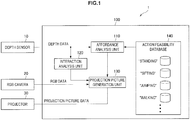
- FIG. 1 is an explanatory diagram illustrating an example configuration of a projected augmented reality system 1 according to an embodiment of the present disclosure.
- FIG. 1 an explanatory diagram illustrating an example configuration of a projected augmented reality system 1 according to an embodiment of the present disclosure.
- an example configuration of the projected augmented reality system 1 according to an embodiment of the present disclosure will be described using FIG. 1 .
- the projected augmented reality system 1 illustrated in FIG. 1 is a system that overlays and displays virtual information onto objects in the real world by projecting a picture onto an environment.
- the environment onto which the picture is projected may be indoor or outdoor without distinction.
- the surface of a person's body may also be treated as a target of projection for a picture.
- the projected augmented reality system 1 includes a depth sensor 10, an RGB camera 20, a projector 30, and a picture playback device 100.
- the depth sensor 10 is a sensor that senses the depth of an object in the environment onto which the projector 30 projects a picture.
- the depth sensor 10 shines infrared light onto an object, for example, and senses the depth of the object according to the degree of reflection of the infrared light.
- the depth sensor 10 provides depth data obtained as a sensing result to the picture playback device 100.
- the depth sensor 10 provided in the projected augmented reality system 1 may be one or multiple sensors.
- the RGB camera 20 is a camera that captures a moving image of the environment onto which the projector 30 projects a picture.
- the RGB camera 20 provides RGB data obtained as a result of picture capture to the picture playback device 100.
- the RGB camera 20 provided in the projected augmented reality system 1 may be one or multiple cameras.
- the projector 30 is a device that projects a picture onto an environment.
- the picture projected onto an environment may be a still image or a moving image.
- a picture to be projected by the projector 30 is generated by the picture playback device 100.
- the projector 30 receives projection picture data from the picture playback device 100, and emits a picture on the basis of the received projection picture data.
- the projector 30 provided in the projected augmented reality system 1 may be one or multiple projectors.
- the environment onto which the projector 30 projects a picture may be indoor or outdoor without distinction. Also, not only may any surface in the environment be treated as a target of projection for a picture from the projector 30, but in addition, the surface of a person's body may also be treated as a target of projection for a picture.
- the depth sensor 10, the RGB camera 20, and the projector 30 may be configured as an integrated device, or configured as separate devices.
- FIG. 2 is an explanatory diagram illustrating an example exterior of a device in the case in which the depth sensor 10, the RGB camera 20, and the projector 30 are formed as an integrated device.
- FIG. 3 is an explanatory diagram illustrating a state in which the depth sensor 10, the RGB camera 20, and the projector 30 are installed as respectively separate devices in an environment C onto which the projector 30 projects a picture. Note that FIG. 3 illustrates a state in which two of the projector 30 are installed in the environment C, but as discussed earlier, the number of the depth sensor 10, the RGB camera 20, and the projector 30 is not limited to that illustrated in FIG. 3 .
- the picture playback device 100 is a device that generates a picture to be projected by the projector 30, on the basis of data sent from the depth sensor 10 and the RGB camera 20.
- the picture playback device 100 is an example of an information processing device according to the present disclosure.
- the picture playback device 100 understands affordances (action possibilities) of the environment onto which the projector 30 projects a picture on the basis of depth data sent from the depth sensor 10, and generates the picture to be projected by the projector 30 on the basis of the understood affordances.
- the picture playback device 100 includes an affordance analysis unit 110, an interaction analysis unit 120, a projection picture generation unit 130, and an action feasibility database 140.
- the affordance analysis unit 110 uses depth data output by the depth sensor 10 to analyze the affordances (action possibilities) of the environment onto which the projector 30 projects a picture.
- the affordance analysis unit 110 is an example of an action possibility analysis unit of the present disclosure. Additionally, on the basis of the analysis result of the affordances of the environment, the affordance analysis unit 110 decides the feasibility of actions that a person may take with respect to the environment onto which the projector 30 projects a picture.
- the affordance analysis unit 110 after deciding the feasibility of actions that a person may take with respect to the environment onto which the projector 30 projects a picture, sends information about the feasibility to the projection picture generation unit 130.
- the interaction analysis unit 120 uses depth data output by the depth sensor 10 to analyze the content of an action performed by a user in the environment onto which the projector 30 projects a picture.
- the interaction analysis unit 120 sends an analysis result of the action performed by the user in the environment onto which the projector 30 projects a picture to the projection picture generation unit 130. For example, if the user performs an action such as walking, sitting, or jumping in the environment onto which the projector 30 is projecting a picture, the interaction analysis unit 120 judges what kind of effect to produce in the picture projected by the projector 30 as a result of the action according to the analysis of depth data.
- the interaction analysis unit 120 may also analyze the content of an action performed by the user by using the difference between the depth data when the affordance analysis unit 110 analyzed the affordances of the environment, and the depth data when analyzing the content of the action performed by the user.
- the depth data when the affordance analysis unit 110 analyzed the affordances of the environment is desirably depth data in an environment in which people, animals, and the like are not present. Consequently, the interaction analysis unit 120 is able to efficiently analyze the content of an action performed by the user by using the difference between the depth data when the affordance analysis unit 110 analyzed the affordances of the environment, and the depth data when analyzing the content of the action performed by the user.
- the projection picture generation unit 130 generates a picture to be projected by the projector 30 by using information about the feasibility of actions that a person may take in the environment onto which the projector 30 projects a picture, which were decided by the analysis of the affordance analysis unit 110. Also, the projection picture generation unit 130 acquires the analysis result of the interaction analysis unit 120 in addition to the information from the affordance analysis unit 110, and generates a picture to be projected by the projector 30.
- the projection picture generation unit 130 by using the analysis result of the affordance analysis unit 110, obviously is capable of generating a picture according to the environment, but is also capable of generating a picture according to an action the user may perform in the environment.
- the projection picture generation unit 130 is not only able to generate a picture that is appropriately displayed on a wall, desk, chair, table, or the like, but is also able to generate a picture so that a graphic, symbol, or the like is displayed at a position reached if the user jumps from on top of the table.
- the projection picture generation unit 130 may also decide the color of the picture to generate on the basis of RGB data sent from the RGB camera 20. For example, the projection picture generation unit 130 may decide a color so that a picture with a red color rather than a white color is emitted from the projector 30 onto a white-colored object. As another example, the projection picture generation unit 130 may decide a color so that a picture with a yellow color rather than a blue color is emitted from the projector 30 onto a blue-colored wall.
- the projection picture generation unit 130 when generating a picture, the projection picture generation unit 130 ascertains the location of the projector 30 in the environment in advance.
- the location of the depth sensor 10 and the location of the projector 30 are treated as being nearly the same. Consequently, the projection picture generation unit 130 is capable of ascertaining the location of the projection picture generation unit 130 from three-dimensional data of the environment obtained by the depth sensor 10.
- the user configures the location of the projector 30 in the projection picture generation unit 130 to thereby enable the projection picture generation unit 130 to ascertain the location of the projector 30.
- the projection picture generation unit 130 may also estimate the position of the projector 30 by using an image captured by the RGB camera 20 of the picture projected by the projector 30. Also, the projection picture generation unit 130 may also correct the picture to be projected from the projector 30 by using an image captured by the RGB camera 20 of the picture projected by the projector 30. As another example, the projection picture generation unit 130 may also use a library for augmented reality (AR) such as ARToolkit to recognize a marker projected by the projector 30 from an image captured by the RGB camera 20, and thereby acquire the position of the projector 30.
- AR augmented reality
- the action feasibility database 140 is a database recording what kinds of actions may be performed or not for what shapes of objects.
- the action feasibility database 140 records the feasibility of actions for individual shapes with respect to each action a person may take, such as sitting, standing, walking, and jumping, for example.
- the action feasibility database 140 approximates a three-dimensional shape with voxel data expressed on a regular grid in three-dimensional space, and then records whether or not a person's action is performable with the voxel data.
- the affordance analysis unit 110 is able to analyze the affordances of the environment onto which the projector 30 projects a picture by using action feasibility data recorded in the action feasibility database 140. Although a specific example will be discussed later, the affordance analysis unit 110 may also analyze the affordances of the environment onto which the projector 30 projects a picture by cross-referencing the information in the action feasibility database 140, for example.
- the action feasibility data recorded in the action feasibility database 140 is generated by performing a physical simulation on randomly generated voxel data.
- the physical simulation constructs a simple model treating the human body as a combination of multiple rigid bodies, for example, and uses the model to verify whether or not a specific action may be performed.
- the verification procedure is different depending on the type of action, but the use of a simple model treating the human body as a combination of rigid bodies is shared in common.
- the accumulation of action feasibility data recorded in the action feasibility database 140 becomes possible.
- FIG. 1 illustrates a configuration in which the action feasibility database 140 is included internally in the picture playback device 100
- the action feasibility database 140 may also be provided in a device separate from the picture playback device 100.
- the picture playback device 100 and the separate device may be connected in a wired or wireless manner.
- the picture playback device 100 is able to automatically understand affordances of an environment from depth data provided by the depth sensor 10, and cause the understood affordances of the environment to be reflected in the generation of a picture to be projected from the projector 30.
- FIG. 4 is a flowchart illustrating example operation of the picture playback device 100 according to an embodiment of the present disclosure.
- the flowchart illustrated in FIG. 4 is example operation when the picture playback device 100 determines action possibilities in the environment onto which the projector 30 shines a picture.
- FIG. 4 will be used to describe example operation of the picture playback device 100 according to an embodiment of the present disclosure.
- the picture playback device 100 utilizes the depth sensor 10 to acquire the three-dimensional shape of the environment in which the projector 30 is installed (step S101).
- the acquisition of the three-dimensional shape may be executed by the affordance analysis unit 110.
- the affordance analysis unit 110 acquires the three-dimensional shape of the environment in which the projector 30 is installed by acquiring depth data provided by the depth sensor 10.
- the depth data provided by the depth sensor 10 is desirably acquired in a state in which people, animals, and the like are not present.
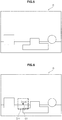
- FIG. 5 is an explanatory diagram illustrating an example of an environment C in which the projector 30 is installed.
- the picture playback device 100 is able to acquire the three-dimensional shape of the environment C in which the projector 30 is installed.
- the picture playback device 100 After acquiring the three-dimensional shape of the environment in which the projector 30 is installed in the above step S101, the picture playback device 100 next acquires three-dimensional data in the vicinity of each coordinate value (x, y, z) in the environment (step S102).
- the acquisition of three-dimensional data in the vicinity of each coordinate value (x, y, z) in the environment may be executed by the affordance analysis unit 110.
- FIG. 6 is an explanatory diagram illustrating an example of acquiring three-dimensional data in the vicinity of each coordinate value (x, y, z) of the environment C.
- FIG. 6 illustrates an example of acquiring three-dimensional data of a range C11 in the vicinity of a predetermined point C1 in the environment C.
- the range C11 is a range for judging whether or not a person is able to perform actions such as standing, sitting, walking, and jumping.
- the affordance analysis unit 110 may also change the range C11 according to the action to analyze. For example, when judging a simple action that a person performs in-place, such as standing or sitting, the affordance analysis unit 110 may treat a range of approximately 50 centimeters surrounding the predetermined point C1 as the range C11 in the vicinity of the point C1.
- the affordance analysis unit 110 may treat a wide range compared to the case of judging an action that a person performs in-place, such as a range of approximately 1 to 2 meters surrounding the predetermined point CI, for example, as the range C11 in the vicinity of the point C1.
- the picture playback device 100 After acquiring the three-dimensional data in the vicinity of each coordinate value (x, y, z) in the environment in the above step S102, the picture playback device 100 next approximates the acquired three-dimensional data in the vicinity of each coordinate value (x, y, z) with a set of voxels expressed in a regular grid in three-dimensional space (step S103).
- the process of approximating the three-dimensional data with a set of voxels may be executed by the affordance analysis unit 110.
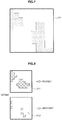
- FIG. 7 is an explanatory diagram illustrating an example of approximating three-dimensional data with a set of voxels.
- the set of voxels illustrated in FIG. 7 is a two-dimensional illustration as seen from an arbitrary direction for the sake of simplicity, but the actual voxels are three-dimensional data.
- the picture playback device 100 After approximating the three-dimensional data with a set of voxels in the above step S103, the picture playback device 100 next evaluates the action feasibility of a person with respect to the set of voxels (step S104).
- the process of evaluating the action feasibility of a person with respect to the set of voxels may be executed by the affordance analysis unit 110.
- data recorded in the action execution feasibility database 140 may be used.
- the data recorded in the action execution feasibility database 140 is information about the feasibility of actions with respect to randomly generated voxel data.
- FIG. 8 is an explanatory diagram illustrating an example of randomly generated voxel data, and the execution feasibilities of actions in the voxel data.
- the voxel data illustrated in FIG. 8 is an example of a case as seen from above. For example, information indicating that sitting is possible on top of a flat surface, but not possible on a spiky environment, is recorded in the action execution feasibility database 140.
- the affordance analysis unit 110 cross-references the three-dimensional data approximated with a set of voxels and the data recorded in the action execution feasibility database 140, and thereby evaluates the execution feasibility of actions at each coordinate value (x, y, z) in the environment. However, the likelihood that the exact same voxels are recorded in the action execution feasibility database 140 is low.
- the affordance analysis unit 110 uses a determiner, such as a support vector machine (SVM) or a Bayesian filter, to evaluate the execution feasibility of actions at each coordinate value (x, y, z) in the environment.
- a determiner such as a support vector machine (SVM) or a Bayesian filter
- SVM support vector machine
- the determiner is able to determine instantaneously whether or not a predetermined action is feasible in the relevant range.
- the affordance analysis unit 110 may perform simple calculations on voxels to be evaluated, without using the determiner. For example, when evaluating the execution feasibility of the action of "standing”, if there is a flat surface of a certain degree of size underneath the standing position, the affordance analysis unit 110 may also determine that a person may stand there.
- the picture playback device 100 After evaluating the action feasibility of a person with respect to a set of voxels, the picture playback device 100 next determines the action feasibility of each coordinate value in the environment on the basis of the evaluation result of the action feasibility of a person (step S105).
- the determination process may be executed by the affordance analysis unit 110.
- the picture playback device 100 is able to automatically determine action possibilities in the environment onto which the projector 30 shines a picture. Additionally, by automatically determining action possibilities in the environment onto which the projector 30 shines a picture, the picture playback device 100 is able to generate a picture to be projected by the projector 30 that matches the action possibilities.
- the projected augmented reality system 1 realizes an action game by projecting a picture generated by the picture playback device 100 from the projector 30.
- the action game described hereinafter is taken to be a game in which points are earned by defeating enemies, capturing items, and the like.
- such an action game may be realized in the real world.
- FIG. 9 is an explanatory diagram illustrating an example of an environment onto which the projector 30 attempts to project a picture.
- the picture playback device 100 is able to generate a picture according to the shape and action possibilities of the environment C, and cause the projector 30 to project the generated picture.
- FIG. 9 illustrates the form of a user U who plays the action game with the picture projected by the projector 30, but as discussed earlier, when the picture playback device 100 determines the action possibilities of the environment C, it is more desirable for the user U to be absent from the environment C.
- FIG. 10 is an explanatory diagram illustrating a state in which a picture is projected from the projector 30 onto the environment C illustrated in FIG. 9 .
- the projector 30 is able to project a picture generated by the picture playback device 100 according to the shape and action possibilities of the environment C.
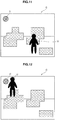
- FIGS. 11 and 12 are explanatory diagrams illustrating a state in which a picture is projected from the projector 30 onto the environment C illustrated in FIG. 9 .
- FIGS. 11 and 12 illustrate a state in which an item I1 is being shined onto the environment C from the projector 30, in addition to the picture from the projector 30 as illustrated in FIG. 10 .
- the projection picture generation unit 130 decides the display position of the item I1 so that the item I1 is displayed at a location that the user U can just barely reach by jumping from the mountain on the left side of the environment C.
- FIG. 13 is an explanatory diagram illustrating a state in which a picture is projected from the projector 30 onto the environment C illustrated in FIG. 9 .
- FIG. 13 illustrates a state in which an enemy E1 is being shined onto the environment C from the projector 30, in addition to the picture as illustrated in FIGS. 11 and 12 .
- the enemy E1 obstructs the user U when the user U attempts to take the item I1.
- an action game in which points are earned if the user U is determined to have touched the item I1 according to the analysis result of the interaction analysis unit 120 becomes realizable by the projected augmented reality system 1. Also, an action game in which points are subtracted if the user U is determined to have touched the enemy E1 according to the analysis result of the interaction analysis unit 120 becomes realizable by the projected augmented reality system 1.
- a whack-a-mole game is a game in which points are earned by hitting successively appearing moles, and with the projected augmented reality system 1 according to the present embodiment, such a whack-a-mole game may be realized in the real world.
- FIG. 14 is an explanatory diagram illustrating a state in which a picture is projected from the projector 30 onto the environment C illustrated in FIG. 9 .
- FIG. 14 illustrates a state in which a mole M1 is being shined onto the environment C from the projector 30, in addition to the picture as illustrated in FIG. 10 .
- a whack-a-mole game in which the mole U disappears if the user U touches the picture of the mole M1 being shined from the projector 30 becomes realizable by the projected augmented reality system 1.
- FIG. 15 is an explanatory diagram illustrating a state in which a picture is projected from the projector 30 onto the environment C illustrated in FIG. 9 .
- FIG. 15 illustrates a state in which the user U has touched the picture of the mole M1 illustrated in FIG. 14 .
- the projection picture generation unit 130 stops the display of the mole M1.
- FIG. 16 is an explanatory diagram illustrating a state in which a picture is projected from the projector 30 onto the environment C illustrated in FIG. 9 .
- FIG. 16 illustrates a state in which a mole M1 is being shined onto the environment C from the projector 30, in addition to the picture as illustrated in FIG. 10 .
- the projection picture generation unit 130 decides the display position of a mole M2 so that the picture of the mole M2 is displayed at a location that the user U can just barely reach if the user U hurries.
- the projected augmented reality system 1 realizes an exercise application by projecting a picture generated by the picture playback device 100 from the projector 30.
- the projected augmented reality system 1 on the basis of the environment onto which the projector 30 projects a picture and preregistered information such as the user's health status, is able to provide optimal exercise for the user in that environment.
- the information such as the user's health status may include information such as the user's sex, age, height, weight, blood pressure, and heart rate, for example.
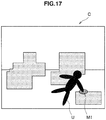
- FIG. 17 is an explanatory diagram illustrating a state in which a picture is projected from the projector 30 onto the environment C illustrated in FIG. 9 .
- FIG. 17 illustrates a state in which a marker M1 to be touched by the hand or foot of the user U is being shined onto the environment C from the projector 30, in addition to the picture as illustrated in FIG. 10 .
- the projection picture generation unit 130 decides the display position of the marker M1 so that the picture of the marker M1 is displayed at a position so as to produce an optimal exercise effect for the user U.
- the display position of the marker M1 may be decided on the basis of not only the affordances in the environment onto which the projector 30 projects a picture, but also the information such as the user's health status.
- the projection picture generation unit 130 generates a picture to be projected from the projector 30 so that the marker M1 is displayed at a position so that the affordance analysis unit 110 judges that the user U is able to place a hand on the marker M1, and also a position judged to produce an optimal exercise effect for the user U.
- the projection picture generation unit 130 may also generate a picture to be projected onto the environment according to a type of exercise desired by the user. For example, when the user desires exercise to train explosiveness, the projection picture generation unit 130 may generate a picture so that the position of the marker changes after a short time, whereas when the user desires exercise to train muscle, the projection picture generation unit 130 may generate a picture so that the position of the marker does not change.
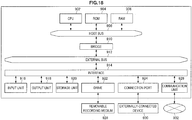
- the hardware primarily includes a CPU 902, ROM 904, RAM 906, a host bus 908, and a bridge 910.
- the hardware additionally includes an external bus 912, an interface 914, an input unit 916, an output unit 918, a storage unit 920, a drive 922, a connection port 924, and a communication unit 926.
- CPU above is an abbreviation of central processing unit
- ROM above is an abbreviation of read-only memory
- RAM above is an abbreviation of random access memory.
- the CPU 902 functions as a computational processing device or control device, for example, and controls all or part of the operation of each structural element on the basis of various programs recorded in the ROM 904, the RAM 906, the storage unit 920, or a removable recording medium 928.
- the ROM 904 is a means of storing information such as programs loaded by the CPU 902 and data used in computations.
- the RAM 906 transiently or persistently stores information such as programs loaded by the CPU 902, and various parameters that change as appropriate when executing such programs, for example.
- a host bus 908 capable of high-speed data transmission, for example.
- the host bus 908 is connected via the bridge 910 to an external bus 912 having comparatively low-speed data transmission, for example.
- Devices such as a mouse, keyboard, touch panel, buttons, switches, sensors, a camera, and levers may be used as the input unit 916, for example.
- a remote control capable of using infrared or other electromagnetic waves to transmit control signals may be used as the input unit 916 in some cases.
- the output unit 918 includes a device capable of visually or aurally reporting acquired information to a user, and may be a display device such as a projector, CRT, LCD, PDP, or ELD, an audio output device such as one or more speakers or headphones, a printer, a mobile phone, or a fax machine, for example.
- CRT above is an abbreviation of cathode ray tube
- LCD above is an abbreviation of liquid crystal display
- PDP above is an abbreviation of plasma display panel
- ELD above is an abbreviation of electroluminescent display.
- the storage unit 920 is a device that stores various data.
- Devices such as a hard disk drive or other magnetic storage device, a semiconductor storage device, an optical storage device, or a magneto-optical storage device may be used as the storage unit 920, for example.
- HDD above is an abbreviation of hard disk drive.
- the drive 922 is a device that reads out information recorded onto a removable recording medium 928 such as a magnetic disk, an optical disc, a magneto-optical disc, or semiconductor memory, for example, and may also write information to the removable recording medium 928.
- the removable recording medium 928 is an instance of DVD media, Blu-ray media, HD DVD media, or various semiconductor storage media, for example.
- the removable recording medium 928 may also be an IC card mounted with a contactless IC chip, or some other electronic equipment, for example. Note that IC above is an abbreviation of integrated circuit.
- the connection port 924 is a port that connects to an externally-connected device 930, such as a USB port, an IEEE 1394 port, a SCSI port, an RS-232C port, or an optical audio terminal, for example.
- the externally-connected device 930 may be a printer, a portable music player, a digital camera, a digital video camera, or an IC recorder, for example.
- USB is an abbreviation of Universal Serial Bus
- SCSI is an abbreviation of Small Computer System Interface.
- the communication unit 926 is a communication device that connects to a network 932, and may be a communication card for wired or wireless LAN, Bluetooth (registered trademark), or WUSB, an optical communication path, an ADSL router, or a device for contact-based or contactless communication, for example.
- the network 932 connected to the communication unit 926 is a network connected in a wired or wireless manner, and may be the Internet, a home LAN, infrared communication, visible light communication, broadcasting, or satellite communication, for example.
- LAN above is an abbreviation of local area network
- WUSB above is an abbreviation of Wireless USB
- ADSL above is an abbreviation of asymmetric digital subscriber line.
- a picture playback device 100 that analyzes the affordances (action possibilities) of an environment, and on the basis of the affordances, generates a picture to be projected onto the environment.
- the picture playback device 100 executes, with the affordance analysis unit 110, the analysis of the affordances of the environment using depth data sent from the depth sensor 10.
- the affordance analysis unit 110 determines the possibility of actions that the user may take for three-dimensional data of the environment obtained from the depth data.
- the affordance analysis unit 110 cross-references information stored in the action feasibility database 140.
- the picture playback device 100 by analyzing the affordances (action possibilities) of an environment and generating a picture to project onto the environment on the basis of the affordances, is able to automatically understand the action possibilities of the environment for a person, and reflect those action possibilities in the picture to project.
- Steps in processes executed by devices in this specification are not necessarily executed chronologically in the order described in a sequence chart or a flow chart.
- steps in processes executed by devices may be executed in a different order from the order described in a flow chart or may be executed in parallel.
- a computer program can be created which causes hardware such as a CPU, ROM, or RAM, incorporated in each of the devices, to function in a manner similar to that of structures in the above-described devices. Furthermore, it is possible to provide a recording medium having the computer program recorded thereon. Moreover, by configuring respective functional blocks shown in a functional block diagram as hardware, the hardware can achieve a series of processes.
- the picture is output from only the projector 30, but the present disclosure is not limited to such an example.
- a picture taking into account the affordances of the environment may also be displayed from a display that displays a picture, in addition to the projector.
Landscapes
- Engineering & Computer Science (AREA)
- Multimedia (AREA)
- Theoretical Computer Science (AREA)
- Human Computer Interaction (AREA)
- Physics & Mathematics (AREA)
- General Engineering & Computer Science (AREA)
- General Physics & Mathematics (AREA)
- Signal Processing (AREA)
- Health & Medical Sciences (AREA)
- Social Psychology (AREA)
- Psychiatry (AREA)
- General Health & Medical Sciences (AREA)
- Computer Vision & Pattern Recognition (AREA)
- Software Systems (AREA)
- Optics & Photonics (AREA)
- Computer Graphics (AREA)
- Computer Hardware Design (AREA)
- Artificial Intelligence (AREA)
- Mathematical Analysis (AREA)
- Mathematical Optimization (AREA)
- Pure & Applied Mathematics (AREA)
- Computing Systems (AREA)
- Mathematical Physics (AREA)
- Evolutionary Computation (AREA)
- Data Mining & Analysis (AREA)
- Computational Mathematics (AREA)
- Algebra (AREA)
- Probability & Statistics with Applications (AREA)
- Controls And Circuits For Display Device (AREA)
- Processing Or Creating Images (AREA)
- User Interface Of Digital Computer (AREA)
Applications Claiming Priority (2)
| Application Number | Priority Date | Filing Date | Title |
|---|---|---|---|
| JP2013191634A JP6263917B2 (ja) | 2013-09-17 | 2013-09-17 | 情報処理装置、情報処理方法及びコンピュータプログラム |
| PCT/JP2014/073570 WO2015041079A1 (ja) | 2013-09-17 | 2014-09-05 | 情報処理装置、情報処理方法及びコンピュータプログラム |
Publications (3)
| Publication Number | Publication Date |
|---|---|
| EP3048605A1 EP3048605A1 (en) | 2016-07-27 |
| EP3048605A4 EP3048605A4 (en) | 2017-05-10 |
| EP3048605B1 true EP3048605B1 (en) | 2019-03-20 |
Family
ID=52688730
Family Applications (1)
| Application Number | Title | Priority Date | Filing Date |
|---|---|---|---|
| EP14845445.7A Not-in-force EP3048605B1 (en) | 2013-09-17 | 2014-09-05 | Information processing device, information processing method, and computer program |
Country Status (5)
| Country | Link |
|---|---|
| US (1) | US10565436B2 (enExample) |
| EP (1) | EP3048605B1 (enExample) |
| JP (1) | JP6263917B2 (enExample) |
| CN (1) | CN105531756B (enExample) |
| WO (1) | WO2015041079A1 (enExample) |
Families Citing this family (11)
| Publication number | Priority date | Publication date | Assignee | Title |
|---|---|---|---|---|
| US10404938B1 (en) | 2015-12-22 | 2019-09-03 | Steelcase Inc. | Virtual world method and system for affecting mind state |
| JP6679966B2 (ja) * | 2016-02-05 | 2020-04-15 | 凸版印刷株式会社 | 三次元仮想空間提示システム、三次元仮想空間提示方法及びプログラム |
| US10181218B1 (en) | 2016-02-17 | 2019-01-15 | Steelcase Inc. | Virtual affordance sales tool |
| US10182210B1 (en) * | 2016-12-15 | 2019-01-15 | Steelcase Inc. | Systems and methods for implementing augmented reality and/or virtual reality |
| CN106803913A (zh) * | 2017-03-10 | 2017-06-06 | 武汉东信同邦信息技术有限公司 | 一种用于自动侦测学生起立发言动作的检测方法及其装置 |
| JP7029722B2 (ja) * | 2017-10-23 | 2022-03-04 | 株式会社Splink | Ar装置、方法及びプログラム |
| CN108635853B (zh) * | 2018-03-23 | 2019-06-21 | 腾讯科技(深圳)有限公司 | 对象的控制方法和装置、存储介质、电子装置 |
| CN109847350A (zh) * | 2019-03-25 | 2019-06-07 | 深圳初影科技有限公司 | 基于ar技术的游戏实现方法、游戏系统、及存储介质 |
| US11494953B2 (en) * | 2019-07-01 | 2022-11-08 | Microsoft Technology Licensing, Llc | Adaptive user interface palette for augmented reality |
| US11832560B1 (en) | 2019-08-08 | 2023-12-05 | Valmont Industries, Inc. | System and method for detecting and aligning the orientation of an irrigation system within a display |
| US12641204B2 (en) | 2023-10-31 | 2026-05-26 | Universal City Studios Llc | Systems and methods for projection mapping onto multiple rigid bodies |
Family Cites Families (21)
| Publication number | Priority date | Publication date | Assignee | Title |
|---|---|---|---|---|
| US5548694A (en) * | 1995-01-31 | 1996-08-20 | Mitsubishi Electric Information Technology Center America, Inc. | Collision avoidance system for voxel-based object representation |
| JPH11300049A (ja) * | 1998-04-20 | 1999-11-02 | Hitachi Ltd | シューティングゲーム装置 |
| US6362817B1 (en) * | 1998-05-18 | 2002-03-26 | In3D Corporation | System for creating and viewing 3D environments using symbolic descriptors |
| US6712703B2 (en) * | 1998-11-19 | 2004-03-30 | Nintendo Co., Ltd. | Video game apparatus and information storage medium for video game |
| JP3944019B2 (ja) * | 2002-07-31 | 2007-07-11 | キヤノン株式会社 | 情報処理装置および方法 |
| US8902227B2 (en) * | 2007-09-10 | 2014-12-02 | Sony Computer Entertainment America Llc | Selective interactive mapping of real-world objects to create interactive virtual-world objects |
| JP5147849B2 (ja) * | 2007-09-14 | 2013-02-20 | パナソニック株式会社 | プロジェクタ |
| JP2009093376A (ja) * | 2007-10-05 | 2009-04-30 | Sony Corp | 信号処理システム及び信号処置方法、並びにプログラム |
| US8126221B2 (en) * | 2008-02-14 | 2012-02-28 | Ecole Polytechnique Federale De Lausanne (Epfl) | Interactive device and method for transmitting commands from a user |
| JP5315111B2 (ja) * | 2009-03-31 | 2013-10-16 | 株式会社エヌ・ティ・ティ・ドコモ | 端末装置、情報提示システム及び端末画面表示方法 |
| US8730309B2 (en) * | 2010-02-23 | 2014-05-20 | Microsoft Corporation | Projectors and depth cameras for deviceless augmented reality and interaction |
| US8217997B2 (en) * | 2010-03-16 | 2012-07-10 | Interphase Corporation | Interactive display system |
| JP5791131B2 (ja) * | 2010-07-20 | 2015-10-07 | アップル インコーポレイテッド | 自然な相互作用のための相互作用的現実拡張 |
| JP2012155655A (ja) * | 2011-01-28 | 2012-08-16 | Sony Corp | 情報処理装置、報知方法及びプログラム |
| JP2012173772A (ja) * | 2011-02-17 | 2012-09-10 | Panasonic Corp | ユーザインタラクション装置、ユーザインタラクション方法、ユーザインタラクションプログラム、及び集積回路 |
| CN103460256B (zh) * | 2011-03-29 | 2016-09-14 | 高通股份有限公司 | 在扩增现实系统中将虚拟图像锚定到真实世界表面 |
| US20140063061A1 (en) * | 2011-08-26 | 2014-03-06 | Reincloud Corporation | Determining a position of an item in a virtual augmented space |
| CN104081307B (zh) * | 2012-02-10 | 2018-02-23 | 索尼公司 | 图像处理装置、图像处理方法和程序 |
| JP2013172432A (ja) * | 2012-02-23 | 2013-09-02 | Panasonic Corp | 機器制御装置、機器制御方法、機器制御プログラム、及び集積回路 |
| US8933970B2 (en) * | 2012-09-11 | 2015-01-13 | Longsand Limited | Controlling an augmented reality object |
| US9552673B2 (en) * | 2012-10-17 | 2017-01-24 | Microsoft Technology Licensing, Llc | Grasping virtual objects in augmented reality |
-
2013
- 2013-09-17 JP JP2013191634A patent/JP6263917B2/ja not_active Expired - Fee Related
-
2014
- 2014-09-05 US US14/917,487 patent/US10565436B2/en not_active Expired - Fee Related
- 2014-09-05 EP EP14845445.7A patent/EP3048605B1/en not_active Not-in-force
- 2014-09-05 WO PCT/JP2014/073570 patent/WO2015041079A1/ja not_active Ceased
- 2014-09-05 CN CN201480050007.2A patent/CN105531756B/zh not_active Expired - Fee Related
Non-Patent Citations (1)
| Title |
|---|
| None * |
Also Published As
| Publication number | Publication date |
|---|---|
| JP2015059965A (ja) | 2015-03-30 |
| WO2015041079A1 (ja) | 2015-03-26 |
| US10565436B2 (en) | 2020-02-18 |
| US20160217323A1 (en) | 2016-07-28 |
| CN105531756A (zh) | 2016-04-27 |
| EP3048605A1 (en) | 2016-07-27 |
| JP6263917B2 (ja) | 2018-01-24 |
| EP3048605A4 (en) | 2017-05-10 |
| CN105531756B (zh) | 2017-11-24 |
Similar Documents
| Publication | Publication Date | Title |
|---|---|---|
| US10565436B2 (en) | Information processing device and information processing method | |
| US10761612B2 (en) | Gesture recognition techniques | |
| US10960298B2 (en) | Boolean/float controller and gesture recognition system | |
| US20220019288A1 (en) | Information processing apparatus, information processing method, and program | |
| US9509981B2 (en) | Projectors and depth cameras for deviceless augmented reality and interaction | |
| US9443353B2 (en) | Methods and systems for capturing and moving 3D models and true-scale metadata of real world objects | |
| US9342160B2 (en) | Ergonomic physical interaction zone cursor mapping | |
| CN102193624B (zh) | 用于基于姿势的用户界面的物理交互区 | |
| CN110555358B (zh) | 用于检测和识别ar/vr场景中的特征部的方法和设备 | |
| US8937663B2 (en) | Camera and sensor augmented reality techniques | |
| JP6609640B2 (ja) | 電子デバイス上における環境マッピング用のフィーチャ・データの管理 | |
| TW201214266A (en) | Three dimensional user interface effects on a display by using properties of motion | |
| TW200941313A (en) | Apparatus and methods for a touch user interface using an image sensor | |
| US20130102387A1 (en) | Calculating metabolic equivalence with a computing device | |
| US12591296B2 (en) | Reducing power consumption of extended reality devices | |
| US20250110333A1 (en) | Augmented reality gaming using virtual eyewear beams | |
| EP2702464B1 (en) | Laser diode modes | |
| CN116755545A (zh) | 基于虚拟现实vr的界面显示方法、装置、电子设备及介质 | |
| CN102866825A (zh) | 显示控制装置、显示控制方法和程序 | |
| CN104951211B (zh) | 一种信息处理方法和电子设备 | |
| Scargill | Environment Analysis and Design Systems for Markerless Mobile Augmented Reality | |
| Bailey et al. | Interactive exploration of historic information via gesture recognition |
Legal Events
| Date | Code | Title | Description |
|---|---|---|---|
| PUAI | Public reference made under article 153(3) epc to a published international application that has entered the european phase |
Free format text: ORIGINAL CODE: 0009012 |
|
| 17P | Request for examination filed |
Effective date: 20160330 |
|
| AK | Designated contracting states |
Kind code of ref document: A1 Designated state(s): AL AT BE BG CH CY CZ DE DK EE ES FI FR GB GR HR HU IE IS IT LI LT LU LV MC MK MT NL NO PL PT RO RS SE SI SK SM TR |
|
| AX | Request for extension of the european patent |
Extension state: BA ME |
|
| DAX | Request for extension of the european patent (deleted) | ||
| REG | Reference to a national code |
Ref country code: DE Ref legal event code: R079 Ref document number: 602014043386 Country of ref document: DE Free format text: PREVIOUS MAIN CLASS: G09G0005000000 Ipc: A63F0013650000 |
|
| A4 | Supplementary search report drawn up and despatched |
Effective date: 20170407 |
|
| RIC1 | Information provided on ipc code assigned before grant |
Ipc: A63F 13/22 20140101ALI20170403BHEP Ipc: A63F 13/65 20140101AFI20170403BHEP Ipc: G06F 3/01 20060101ALI20170403BHEP Ipc: A63F 13/213 20140101ALI20170403BHEP Ipc: G06T 19/00 20110101ALI20170403BHEP Ipc: A63F 13/428 20140101ALI20170403BHEP Ipc: A63F 13/5375 20140101ALI20170403BHEP Ipc: G06K 9/00 20060101ALI20170403BHEP Ipc: A63F 13/25 20140101ALI20170403BHEP Ipc: G09G 5/00 20060101ALI20170403BHEP |
|
| STAA | Information on the status of an ep patent application or granted ep patent |
Free format text: STATUS: EXAMINATION IS IN PROGRESS |
|
| 17Q | First examination report despatched |
Effective date: 20180103 |
|
| GRAP | Despatch of communication of intention to grant a patent |
Free format text: ORIGINAL CODE: EPIDOSNIGR1 |
|
| STAA | Information on the status of an ep patent application or granted ep patent |
Free format text: STATUS: GRANT OF PATENT IS INTENDED |
|
| INTG | Intention to grant announced |
Effective date: 20181001 |
|
| GRAS | Grant fee paid |
Free format text: ORIGINAL CODE: EPIDOSNIGR3 |
|
| GRAA | (expected) grant |
Free format text: ORIGINAL CODE: 0009210 |
|
| STAA | Information on the status of an ep patent application or granted ep patent |
Free format text: STATUS: THE PATENT HAS BEEN GRANTED |
|
| AK | Designated contracting states |
Kind code of ref document: B1 Designated state(s): AL AT BE BG CH CY CZ DE DK EE ES FI FR GB GR HR HU IE IS IT LI LT LU LV MC MK MT NL NO PL PT RO RS SE SI SK SM TR |
|
| REG | Reference to a national code |
Ref country code: GB Ref legal event code: FG4D |
|
| REG | Reference to a national code |
Ref country code: CH Ref legal event code: EP |
|
| REG | Reference to a national code |
Ref country code: DE Ref legal event code: R096 Ref document number: 602014043386 Country of ref document: DE |
|
| REG | Reference to a national code |
Ref country code: AT Ref legal event code: REF Ref document number: 1109937 Country of ref document: AT Kind code of ref document: T Effective date: 20190415 |
|
| REG | Reference to a national code |
Ref country code: IE Ref legal event code: FG4D |
|
| REG | Reference to a national code |
Ref country code: NL Ref legal event code: MP Effective date: 20190320 |
|
| PG25 | Lapsed in a contracting state [announced via postgrant information from national office to epo] |
Ref country code: SE Free format text: LAPSE BECAUSE OF FAILURE TO SUBMIT A TRANSLATION OF THE DESCRIPTION OR TO PAY THE FEE WITHIN THE PRESCRIBED TIME-LIMIT Effective date: 20190320 Ref country code: LT Free format text: LAPSE BECAUSE OF FAILURE TO SUBMIT A TRANSLATION OF THE DESCRIPTION OR TO PAY THE FEE WITHIN THE PRESCRIBED TIME-LIMIT Effective date: 20190320 Ref country code: FI Free format text: LAPSE BECAUSE OF FAILURE TO SUBMIT A TRANSLATION OF THE DESCRIPTION OR TO PAY THE FEE WITHIN THE PRESCRIBED TIME-LIMIT Effective date: 20190320 Ref country code: NO Free format text: LAPSE BECAUSE OF FAILURE TO SUBMIT A TRANSLATION OF THE DESCRIPTION OR TO PAY THE FEE WITHIN THE PRESCRIBED TIME-LIMIT Effective date: 20190620 |
|
| REG | Reference to a national code |
Ref country code: LT Ref legal event code: MG4D |
|
| PG25 | Lapsed in a contracting state [announced via postgrant information from national office to epo] |
Ref country code: LV Free format text: LAPSE BECAUSE OF FAILURE TO SUBMIT A TRANSLATION OF THE DESCRIPTION OR TO PAY THE FEE WITHIN THE PRESCRIBED TIME-LIMIT Effective date: 20190320 Ref country code: BG Free format text: LAPSE BECAUSE OF FAILURE TO SUBMIT A TRANSLATION OF THE DESCRIPTION OR TO PAY THE FEE WITHIN THE PRESCRIBED TIME-LIMIT Effective date: 20190620 Ref country code: RS Free format text: LAPSE BECAUSE OF FAILURE TO SUBMIT A TRANSLATION OF THE DESCRIPTION OR TO PAY THE FEE WITHIN THE PRESCRIBED TIME-LIMIT Effective date: 20190320 Ref country code: HR Free format text: LAPSE BECAUSE OF FAILURE TO SUBMIT A TRANSLATION OF THE DESCRIPTION OR TO PAY THE FEE WITHIN THE PRESCRIBED TIME-LIMIT Effective date: 20190320 Ref country code: GR Free format text: LAPSE BECAUSE OF FAILURE TO SUBMIT A TRANSLATION OF THE DESCRIPTION OR TO PAY THE FEE WITHIN THE PRESCRIBED TIME-LIMIT Effective date: 20190621 Ref country code: NL Free format text: LAPSE BECAUSE OF FAILURE TO SUBMIT A TRANSLATION OF THE DESCRIPTION OR TO PAY THE FEE WITHIN THE PRESCRIBED TIME-LIMIT Effective date: 20190320 |
|
| REG | Reference to a national code |
Ref country code: AT Ref legal event code: MK05 Ref document number: 1109937 Country of ref document: AT Kind code of ref document: T Effective date: 20190320 |
|
| PG25 | Lapsed in a contracting state [announced via postgrant information from national office to epo] |
Ref country code: AL Free format text: LAPSE BECAUSE OF FAILURE TO SUBMIT A TRANSLATION OF THE DESCRIPTION OR TO PAY THE FEE WITHIN THE PRESCRIBED TIME-LIMIT Effective date: 20190320 Ref country code: PT Free format text: LAPSE BECAUSE OF FAILURE TO SUBMIT A TRANSLATION OF THE DESCRIPTION OR TO PAY THE FEE WITHIN THE PRESCRIBED TIME-LIMIT Effective date: 20190720 Ref country code: ES Free format text: LAPSE BECAUSE OF FAILURE TO SUBMIT A TRANSLATION OF THE DESCRIPTION OR TO PAY THE FEE WITHIN THE PRESCRIBED TIME-LIMIT Effective date: 20190320 Ref country code: SK Free format text: LAPSE BECAUSE OF FAILURE TO SUBMIT A TRANSLATION OF THE DESCRIPTION OR TO PAY THE FEE WITHIN THE PRESCRIBED TIME-LIMIT Effective date: 20190320 Ref country code: IT Free format text: LAPSE BECAUSE OF FAILURE TO SUBMIT A TRANSLATION OF THE DESCRIPTION OR TO PAY THE FEE WITHIN THE PRESCRIBED TIME-LIMIT Effective date: 20190320 Ref country code: CZ Free format text: LAPSE BECAUSE OF FAILURE TO SUBMIT A TRANSLATION OF THE DESCRIPTION OR TO PAY THE FEE WITHIN THE PRESCRIBED TIME-LIMIT Effective date: 20190320 Ref country code: RO Free format text: LAPSE BECAUSE OF FAILURE TO SUBMIT A TRANSLATION OF THE DESCRIPTION OR TO PAY THE FEE WITHIN THE PRESCRIBED TIME-LIMIT Effective date: 20190320 Ref country code: EE Free format text: LAPSE BECAUSE OF FAILURE TO SUBMIT A TRANSLATION OF THE DESCRIPTION OR TO PAY THE FEE WITHIN THE PRESCRIBED TIME-LIMIT Effective date: 20190320 |
|
| PG25 | Lapsed in a contracting state [announced via postgrant information from national office to epo] |
Ref country code: PL Free format text: LAPSE BECAUSE OF FAILURE TO SUBMIT A TRANSLATION OF THE DESCRIPTION OR TO PAY THE FEE WITHIN THE PRESCRIBED TIME-LIMIT Effective date: 20190320 Ref country code: SM Free format text: LAPSE BECAUSE OF FAILURE TO SUBMIT A TRANSLATION OF THE DESCRIPTION OR TO PAY THE FEE WITHIN THE PRESCRIBED TIME-LIMIT Effective date: 20190320 |
|
| PG25 | Lapsed in a contracting state [announced via postgrant information from national office to epo] |
Ref country code: IS Free format text: LAPSE BECAUSE OF FAILURE TO SUBMIT A TRANSLATION OF THE DESCRIPTION OR TO PAY THE FEE WITHIN THE PRESCRIBED TIME-LIMIT Effective date: 20190720 Ref country code: AT Free format text: LAPSE BECAUSE OF FAILURE TO SUBMIT A TRANSLATION OF THE DESCRIPTION OR TO PAY THE FEE WITHIN THE PRESCRIBED TIME-LIMIT Effective date: 20190320 |
|
| REG | Reference to a national code |
Ref country code: DE Ref legal event code: R097 Ref document number: 602014043386 Country of ref document: DE |
|
| PLBE | No opposition filed within time limit |
Free format text: ORIGINAL CODE: 0009261 |
|
| STAA | Information on the status of an ep patent application or granted ep patent |
Free format text: STATUS: NO OPPOSITION FILED WITHIN TIME LIMIT |
|
| PG25 | Lapsed in a contracting state [announced via postgrant information from national office to epo] |
Ref country code: DK Free format text: LAPSE BECAUSE OF FAILURE TO SUBMIT A TRANSLATION OF THE DESCRIPTION OR TO PAY THE FEE WITHIN THE PRESCRIBED TIME-LIMIT Effective date: 20190320 |
|
| 26N | No opposition filed |
Effective date: 20200102 |
|
| PG25 | Lapsed in a contracting state [announced via postgrant information from national office to epo] |
Ref country code: SI Free format text: LAPSE BECAUSE OF FAILURE TO SUBMIT A TRANSLATION OF THE DESCRIPTION OR TO PAY THE FEE WITHIN THE PRESCRIBED TIME-LIMIT Effective date: 20190320 |
|
| PG25 | Lapsed in a contracting state [announced via postgrant information from national office to epo] |
Ref country code: TR Free format text: LAPSE BECAUSE OF FAILURE TO SUBMIT A TRANSLATION OF THE DESCRIPTION OR TO PAY THE FEE WITHIN THE PRESCRIBED TIME-LIMIT Effective date: 20190320 |
|
| PG25 | Lapsed in a contracting state [announced via postgrant information from national office to epo] |
Ref country code: MC Free format text: LAPSE BECAUSE OF FAILURE TO SUBMIT A TRANSLATION OF THE DESCRIPTION OR TO PAY THE FEE WITHIN THE PRESCRIBED TIME-LIMIT Effective date: 20190320 |
|
| REG | Reference to a national code |
Ref country code: CH Ref legal event code: PL |
|
| PG25 | Lapsed in a contracting state [announced via postgrant information from national office to epo] |
Ref country code: LU Free format text: LAPSE BECAUSE OF NON-PAYMENT OF DUE FEES Effective date: 20190905 Ref country code: IE Free format text: LAPSE BECAUSE OF NON-PAYMENT OF DUE FEES Effective date: 20190905 Ref country code: LI Free format text: LAPSE BECAUSE OF NON-PAYMENT OF DUE FEES Effective date: 20190930 Ref country code: CH Free format text: LAPSE BECAUSE OF NON-PAYMENT OF DUE FEES Effective date: 20190930 |
|
| REG | Reference to a national code |
Ref country code: BE Ref legal event code: MM Effective date: 20190930 |
|
| PG25 | Lapsed in a contracting state [announced via postgrant information from national office to epo] |
Ref country code: BE Free format text: LAPSE BECAUSE OF NON-PAYMENT OF DUE FEES Effective date: 20190930 |
|
| PG25 | Lapsed in a contracting state [announced via postgrant information from national office to epo] |
Ref country code: CY Free format text: LAPSE BECAUSE OF FAILURE TO SUBMIT A TRANSLATION OF THE DESCRIPTION OR TO PAY THE FEE WITHIN THE PRESCRIBED TIME-LIMIT Effective date: 20190320 |
|
| PG25 | Lapsed in a contracting state [announced via postgrant information from national office to epo] |
Ref country code: MT Free format text: LAPSE BECAUSE OF FAILURE TO SUBMIT A TRANSLATION OF THE DESCRIPTION OR TO PAY THE FEE WITHIN THE PRESCRIBED TIME-LIMIT Effective date: 20190320 Ref country code: HU Free format text: LAPSE BECAUSE OF FAILURE TO SUBMIT A TRANSLATION OF THE DESCRIPTION OR TO PAY THE FEE WITHIN THE PRESCRIBED TIME-LIMIT; INVALID AB INITIO Effective date: 20140905 |
|
| PGFP | Annual fee paid to national office [announced via postgrant information from national office to epo] |
Ref country code: FR Payment date: 20210819 Year of fee payment: 8 |
|
| PGFP | Annual fee paid to national office [announced via postgrant information from national office to epo] |
Ref country code: GB Payment date: 20210820 Year of fee payment: 8 Ref country code: DE Payment date: 20210818 Year of fee payment: 8 |
|
| PG25 | Lapsed in a contracting state [announced via postgrant information from national office to epo] |
Ref country code: MK Free format text: LAPSE BECAUSE OF FAILURE TO SUBMIT A TRANSLATION OF THE DESCRIPTION OR TO PAY THE FEE WITHIN THE PRESCRIBED TIME-LIMIT Effective date: 20190320 |
|
| REG | Reference to a national code |
Ref country code: DE Ref legal event code: R119 Ref document number: 602014043386 Country of ref document: DE |
|
| GBPC | Gb: european patent ceased through non-payment of renewal fee |
Effective date: 20220905 |
|
| PG25 | Lapsed in a contracting state [announced via postgrant information from national office to epo] |
Ref country code: FR Free format text: LAPSE BECAUSE OF NON-PAYMENT OF DUE FEES Effective date: 20220930 Ref country code: DE Free format text: LAPSE BECAUSE OF NON-PAYMENT OF DUE FEES Effective date: 20230401 |
|
| PG25 | Lapsed in a contracting state [announced via postgrant information from national office to epo] |
Ref country code: GB Free format text: LAPSE BECAUSE OF NON-PAYMENT OF DUE FEES Effective date: 20220905 |