EP3048074A1 - Method of eliminating a jerk arising by accelerating an elevator car - Google Patents
Method of eliminating a jerk arising by accelerating an elevator car Download PDFInfo
- Publication number
- EP3048074A1 EP3048074A1 EP15152437.8A EP15152437A EP3048074A1 EP 3048074 A1 EP3048074 A1 EP 3048074A1 EP 15152437 A EP15152437 A EP 15152437A EP 3048074 A1 EP3048074 A1 EP 3048074A1
- Authority
- EP
- European Patent Office
- Prior art keywords
- elevator
- elevator car
- car
- sensor
- jerk
- Prior art date
- Legal status (The legal status is an assumption and is not a legal conclusion. Google has not performed a legal analysis and makes no representation as to the accuracy of the status listed.)
- Granted
Links
Images
Classifications
-
- B—PERFORMING OPERATIONS; TRANSPORTING
- B66—HOISTING; LIFTING; HAULING
- B66B—ELEVATORS; ESCALATORS OR MOVING WALKWAYS
- B66B11/00—Main component parts of lifts in, or associated with, buildings or other structures
- B66B11/02—Cages, i.e. cars
- B66B11/026—Attenuation system for shocks, vibrations, imbalance, e.g. passengers on the same side
- B66B11/0266—Passive systems
-
- B—PERFORMING OPERATIONS; TRANSPORTING
- B66—HOISTING; LIFTING; HAULING
- B66B—ELEVATORS; ESCALATORS OR MOVING WALKWAYS
- B66B5/00—Applications of checking, fault-correcting, or safety devices in elevators
- B66B5/0006—Monitoring devices or performance analysers
- B66B5/0037—Performance analysers
-
- B—PERFORMING OPERATIONS; TRANSPORTING
- B66—HOISTING; LIFTING; HAULING
- B66B—ELEVATORS; ESCALATORS OR MOVING WALKWAYS
- B66B1/00—Control systems of elevators in general
- B66B1/24—Control systems with regulation, i.e. with retroactive action, for influencing travelling speed, acceleration, or deceleration
- B66B1/28—Control systems with regulation, i.e. with retroactive action, for influencing travelling speed, acceleration, or deceleration electrical
- B66B1/30—Control systems with regulation, i.e. with retroactive action, for influencing travelling speed, acceleration, or deceleration electrical effective on driving gear, e.g. acting on power electronics, on inverter or rectifier controlled motor
- B66B1/304—Control systems with regulation, i.e. with retroactive action, for influencing travelling speed, acceleration, or deceleration electrical effective on driving gear, e.g. acting on power electronics, on inverter or rectifier controlled motor with starting torque control
-
- B—PERFORMING OPERATIONS; TRANSPORTING
- B66—HOISTING; LIFTING; HAULING
- B66B—ELEVATORS; ESCALATORS OR MOVING WALKWAYS
- B66B5/00—Applications of checking, fault-correcting, or safety devices in elevators
- B66B5/0006—Monitoring devices or performance analysers
- B66B5/0018—Devices monitoring the operating condition of the elevator system
-
- G—PHYSICS
- G01—MEASURING; TESTING
- G01P—MEASURING LINEAR OR ANGULAR SPEED, ACCELERATION, DECELERATION, OR SHOCK; INDICATING PRESENCE, ABSENCE, OR DIRECTION, OF MOVEMENT
- G01P15/00—Measuring acceleration; Measuring deceleration; Measuring shock, i.e. sudden change of acceleration
Definitions
- the present invention relates to get an unwanted sudden jerk under control being felt when starting or even terminating an elevator ride.
- a special type of such jerk is the one arising in the starting phase of acceleration which is then called "start kick".
- the ride comfort of elevators is an important item being encountered in modern elevator technology. Improving the ride comfort does also mean to diminish the jerks the physical unit of it relating to the variation of acceleration and thus measured in [m/s 3 ]. Jerks are being felt when the car or cabin starts or terminates its movement. A start kick as a special kind of such jerk can be felt at the beginning of a run. The jerking is due to a combination of many factors, like the cooperation of interacting elements or an error in the elevator car load weight measurement, etc.. So, every implementation of an elevator in a building means an individual context and coherence of its compounds in view of their causation.
- the acceleration and deceleration jerks are directly felt by the elevator user on the car-floor and therefore can be measured by installing an auditing tool on the floor during the time of measuring phase.
- a tool comprises a vibration or sound sensor the data of which are analysed by the aid of a vibration analysis software.
- the object of the invention is to diminish the problems in prior art and to disclose a convenient method for getting said jerks under control.
- Claim 4 claims a computer readable medium having stored the computer program of claim 3 and being conveniently integrated into the elevator control system.
- Basic idea of the invention is to embed an automatic detection appliance into an elevator control system to automatically detect and analyse jerks, especially arising when an elevator car starts its ride. To this end, the invention realizes to take details of start sequence signals of the respective drive into account for said analysis.
- a convenient start sequence includes for example the following phases:
- a state machine in a software of the elevator control unit or elevator drive, e.g. including a frequency converter.
- An unwanted start kick is detectable at least in phase 2, when the brakes are opened - wherein a start kick detection may also continue at the beginning of phase 3, because this phase starts very fast after phase 2.
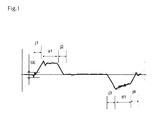
- Fig. 1 shows a devolution of acceleration revealing also the jerks and especially a start kick.
- the position references are disposed such that the measurement device gets a reading when the elevator car is at the door zone, e.g. the position that elevator passengers can enter / exit the car.
- the measurement device gets a linear position reading for an about 30 cm area around the door zone.
- a car velocity and its acceleration and a jerk may be calculated for determining the start kick in question.
- Another possibility is to measure the deviation of the position and/or speed and/or the acceleration from what is the desired value; the desired value can be obtained from an elevator car velocity reference (target value of the elevator car speed control).
- Analytical capabilities include a time history zoom being expanded with data measurement, elevator travel time measurement, comparison of data with respect to user imposed vibration limits, spectral analysis (FFT), and RMS vibration and sound level measurement (A-weighted, fast response).
- Said vibration measurements are processed then to get a start kick magnitude, e.g. amplitude and direction of sway.
- a start kick magnitude e.g. amplitude and direction of sway.
- This is done in that the measurement and/or sampling of the sway is started at certain predefined points in the state machine software and then stopped at another predefined point in said state machine software, and the sampled data is memorized. Then the aforementioned amplitude/direction of sway is/are calculated from the memorized sampled data.
- the measured acceleration at preselected start sequence phase is then compared with threshold values. Based on the comparison non-desired start kicks are determined and the result is reported and/or fed to a corrector.
- this result may be compared with some ride comfort criteria to get a standardized quality value that can be communicated.
- ride quality refers to only a part of the recorded signals detected by the vibration and sound sensor
- a convenient analysis of the data delivered by a sensor is made according to a preferred embodiment of the invention. This means filtering of those vibration and sound data that people actually do feel or hear.
- Probably the most powerful tool for diagnosing problems for it is the Fourier transformation. This allows the vibration to be analysed with respect to its frequency content. For example, 6 inch roller guides on a 2.5 m/s elevator will rotate about 5.3 times per second (5.3 Hz). If roller guides are creating a significant level of vibration, then this will show up in the spectrum (vibration level versus frequency) of the signal.
- the standard ISO2631 shows an experimental research evaluation of the vibration exposure for the health risk prediction during vehicle operation.
- a ride comfort criteria can be established as an analysis algorithm.
- the calculation of it is then carried out by a software program which is conveniently associated with the state machine of an elevator drive software.
- the algorithm software can be embedded on the CPU of the lift controller like KCE device or as software of the drive CPU. Such combination enables to get sufficient information being available to make the determination at an exactly right moment of the elevator starting sequence.
- the lift controller determines the elevator run sequence and evaluates the start kick based on the run sequence.
- the start kick detector thus embedded in the control system detects and reports start kicks according to the specified elevator performance class. Different ride comfort classes do have different acceptable start kick values.
- the algorithm can be started from a signal which enables the drive and brake controller. In case of a KCE-sensor this is called main-safety-output. It combines the sequencing information from the elevator controller with the calculated or measured car acceleration spikes from either one of the above mentioned sensors.
- the algorithm can be stopped as soon as a known jerk rate starts being defined by drive parameters, meaning that the known jerk rate starts at a predefined point in state machine software, i.e. the start sequence of an elevator run has proceeded to a point in which the start kick has ended and the elevator car accelerates towards a maximum constant speed.
- start kick determinator program When the correcting measures are taken by a serviceman a possibility would be to change one or several drive control parameters, to change scaling or an offset of an elevator load weight measurement signal or to change the torque feedforward of the motor what means the current value supplied to the motor at the beginning of the elevator run, when the machinery brakes are opened.
- the analysis of the start kick determinator program is then conveniently realized such that the program suggests the serviceman what parameters should be changed and how much.
- a possibility would be to do the start kick removement procedure remotely from a service centre via remote link.
- the information being provided for the installer during commissioning will assist the installer and can be used as a condition monitoring tool during the life time of the elevator.
- the start kick value can be reported to the installer or serviceman for adjusting the same via KCE maintenance user interfaces. Alternatively or additionally the start kick value can be reported to the service centre via KRM systems.
- Specified or sold ride comfort classes can be communicated from sales organisation to KCE controller via SAP system as part of delivery parameters.
- the elevator system in question comprises a hoisting machine with electric motor acting as the hoisting machine for a car.
- a drive unit (frequency converter) is controlling the hoisting machine.
- An elevator car movement sensor is installed as a motor encoder mounted on the rotating axis of the hoisting machine.
- the drive unit has a microprocessor, which performs a software that takes care of the following adaptable parameters like elevator drive sequence, e.g. opening the hoisting machine brakes, commanding a current to be fed to the hoisting machine motor, calculating a speed control loop such that the elevator car movement measured with the movement sensor approaches a desired movement profile (velocity reference), etc.
- the software includes a state machine evaluation which includes predetermined phases that cause a transition from one phase of the drive sequence to another when the run proceeds. In the end, the result is communicated and correcting actions like amending one of the above parameters can be taken according to the results.
- an automatic detection-method for getting the jerk in question under control is realized very cost-effective, i.e. without any further costs of material. It provides a valuable diagnostic and feedback tool before auditing at handover with an elevator comfort analyser. Secondly it provides a valuable condition monitoring tool via KRM and can be used regularly during elevator lifetime. Combined with an electronic balancing check function the invention eliminates trial and error procedures and e.g. enhances automating of the elevator maintenance and condition monitoring.
- Fig. 1 shows an example of an acceleration graph which is a run up.
- the jerk zones j1-j4 and acceleration zone a1 and deceleration zone (d1) are usually defined accurately by the drive parameters.
- the start jerk (SK) is an undesired acceleration but often present in non-optimally adjusted lifts.
Landscapes
- Engineering & Computer Science (AREA)
- Automation & Control Theory (AREA)
- Physics & Mathematics (AREA)
- General Physics & Mathematics (AREA)
- Fluid Mechanics (AREA)
- Civil Engineering (AREA)
- Mechanical Engineering (AREA)
- Structural Engineering (AREA)
- Elevator Control (AREA)
- Maintenance And Inspection Apparatuses For Elevators (AREA)
- Indicating And Signalling Devices For Elevators (AREA)
Abstract
Description
- The present invention relates to get an unwanted sudden jerk under control being felt when starting or even terminating an elevator ride. A special type of such jerk is the one arising in the starting phase of acceleration which is then called "start kick".
- The ride comfort of elevators is an important item being encountered in modern elevator technology. Improving the ride comfort does also mean to diminish the jerks the physical unit of it relating to the variation of acceleration and thus measured in [m/s3]. Jerks are being felt when the car or cabin starts or terminates its movement. A start kick as a special kind of such jerk can be felt at the beginning of a run. The jerking is due to a combination of many factors, like the cooperation of interacting elements or an error in the elevator car load weight measurement, etc.. So, every implementation of an elevator in a building means an individual context and coherence of its compounds in view of their causation. The acceleration and deceleration jerks are directly felt by the elevator user on the car-floor and therefore can be measured by installing an auditing tool on the floor during the time of measuring phase. Such a tool comprises a vibration or sound sensor the data of which are analysed by the aid of a vibration analysis software. Problems with the above mentioned error in a load measurement or with roller guides, rail joints, motor control systems and other dynamic elements can be thus identified in minutes. However, to recognise and measure the start kick by commercial ride comfort analysers is difficult and requires experience due to that knowledge about the specific elevator starting sequence is needed like door closing or details of the start of run, etc.. Additionally, the known tools do not know the sequencing of the elevator at all and therefore are not able to separate start kicks from some other random vibration peaks.
- The object of the invention is to diminish the problems in prior art and to disclose a convenient method for getting said jerks under control.
- The above object is achieved by the method according to claim 1, which is realisable and carried out by a computer program according to claim 3. Claim 4 claims a computer readable medium having stored the computer program of claim 3 and being conveniently integrated into the elevator control system.
- Basic idea of the invention is to embed an automatic detection appliance into an elevator control system to automatically detect and analyse jerks, especially arising when an elevator car starts its ride. To this end, the invention realizes to take details of start sequence signals of the respective drive into account for said analysis.
- A convenient start sequence includes for example the following phases:
- 1. A DC current (according to the elevator car load weight measurement) is fed to the hoisting motor to hold the car standstill against unbalance of the load;
- 2. Hoisting machinery brakes are opened and the car is kept in standstill with the DC current;
- 3. Velocity is increased softly from zero (with slowly increasing acceleration) until acceleration reaches an allowed maximum, e.g. 1m/s2; after this the velocity is increased linearly;
- 4. When the velocity approaches the allowed maximum velocity, acceleration is decreased slowly to zero such that the elevator car finally runs with a constant maximum velocity;
- 5. When the elevator car approaches a destination floor, the car speed is softly reduced to zero such that the above phases 4 - 1 are performed in reverse order.
- The above sequence is controlled with a state machine in a software of the elevator control unit or elevator drive, e.g. including a frequency converter. An unwanted start kick is detectable at least in phase 2, when the brakes are opened - wherein a start kick detection may also continue at the beginning of phase 3, because this phase starts very fast after phase 2.
Fig. 1 shows a devolution of acceleration revealing also the jerks and especially a start kick. - As a sensor for detecting the start kick jerk one or several of the following devices can operate measuring any movement of the car or that of the traction sheave: motor encoder; KCE (= KONE® controller and Electrification) Door Zone Sensor for linear position; sensor or Z-direction accelerometer placed in the car - for example as a KCEDZS (= KONE® controller and Electrification Door Zone Sensor) being a measuring device mounted to an elevator car and configured to read stationary position references mounted in the elevator shaft. The position references are disposed such that the measurement device gets a reading when the elevator car is at the door zone, e.g. the position that elevator passengers can enter / exit the car. The measurement device gets a linear position reading for an about 30 cm area around the door zone. From this reading a car velocity and its acceleration and a jerk may be calculated for determining the start kick in question. Another possibility is to measure the deviation of the position and/or speed and/or the acceleration from what is the desired value; the desired value can be obtained from an elevator car velocity reference (target value of the elevator car speed control). Analytical capabilities include a time history zoom being expanded with data measurement, elevator travel time measurement, comparison of data with respect to user imposed vibration limits, spectral analysis (FFT), and RMS vibration and sound level measurement (A-weighted, fast response).
- Said vibration measurements are processed then to get a start kick magnitude, e.g. amplitude and direction of sway. This is done in that the measurement and/or sampling of the sway is started at certain predefined points in the state machine software and then stopped at another predefined point in said state machine software, and the sampled data is memorized. Then the aforementioned amplitude/direction of sway is/are calculated from the memorized sampled data. The measured acceleration at preselected start sequence phase is then compared with threshold values. Based on the comparison non-desired start kicks are determined and the result is reported and/or fed to a corrector.
- Alternatively this result may be compared with some ride comfort criteria to get a standardized quality value that can be communicated. Taking into account that the ride quality refers to only a part of the recorded signals detected by the vibration and sound sensor, a convenient analysis of the data delivered by a sensor is made according to a preferred embodiment of the invention. This means filtering of those vibration and sound data that people actually do feel or hear. Probably the most powerful tool for diagnosing problems for it is the Fourier transformation. This allows the vibration to be analysed with respect to its frequency content. For example, 6 inch roller guides on a 2.5 m/s elevator will rotate about 5.3 times per second (5.3 Hz). If roller guides are creating a significant level of vibration, then this will show up in the spectrum (vibration level versus frequency) of the signal. The standard ISO2631 shows an experimental research evaluation of the vibration exposure for the health risk prediction during vehicle operation.
- According to a convenient embodiment a ride comfort criteria can be established as an analysis algorithm. The calculation of it is then carried out by a software program which is conveniently associated with the state machine of an elevator drive software. The algorithm software can be embedded on the CPU of the lift controller like KCE device or as software of the drive CPU. Such combination enables to get sufficient information being available to make the determination at an exactly right moment of the elevator starting sequence. The lift controller determines the elevator run sequence and evaluates the start kick based on the run sequence. In the result thereof, the start kick detector thus embedded in the control system detects and reports start kicks according to the specified elevator performance class. Different ride comfort classes do have different acceptable start kick values.
- The algorithm can be started from a signal which enables the drive and brake controller. In case of a KCE-sensor this is called main-safety-output. It combines the sequencing information from the elevator controller with the calculated or measured car acceleration spikes from either one of the above mentioned sensors. The algorithm can be stopped as soon as a known jerk rate starts being defined by drive parameters, meaning that the known jerk rate starts at a predefined point in state machine software, i.e. the start sequence of an elevator run has proceeded to a point in which the start kick has ended and the elevator car accelerates towards a maximum constant speed.
- Subsequently to the detection and analysis a correction of the start kick is followed which can be done by a serviceman or even also automatically. By means of this, an embedded start kick detection is very helpful to improve the installation quality as a direct feedback from controller to installer.
- When the correcting measures are taken by a serviceman a possibility would be to change one or several drive control parameters, to change scaling or an offset of an elevator load weight measurement signal or to change the torque feedforward of the motor what means the current value supplied to the motor at the beginning of the elevator run, when the machinery brakes are opened. To this end, the analysis of the start kick determinator program is then conveniently realized such that the program suggests the serviceman what parameters should be changed and how much. A possibility would be to do the start kick removement procedure remotely from a service centre via remote link. The information being provided for the installer during commissioning will assist the installer and can be used as a condition monitoring tool during the life time of the elevator. The start kick value can be reported to the installer or serviceman for adjusting the same via KCE maintenance user interfaces. Alternatively or additionally the start kick value can be reported to the service centre via KRM systems. Specified or sold ride comfort classes can be communicated from sales organisation to KCE controller via SAP system as part of delivery parameters.
- In case the start value changes over the time a trend can be evaluated which in turn can be used to estimate the need for the next service visit.
- As a best mode one could exemplary fix the following implementation: The elevator system in question comprises a hoisting machine with electric motor acting as the hoisting machine for a car. A drive unit (frequency converter) is controlling the hoisting machine. An elevator car movement sensor is installed as a motor encoder mounted on the rotating axis of the hoisting machine. The drive unit has a microprocessor, which performs a software that takes care of the following adaptable parameters like elevator drive sequence, e.g. opening the hoisting machine brakes, commanding a current to be fed to the hoisting machine motor, calculating a speed control loop such that the elevator car movement measured with the movement sensor approaches a desired movement profile (velocity reference), etc.. Therefore the software includes a state machine evaluation which includes predetermined phases that cause a transition from one phase of the drive sequence to another when the run proceeds. In the end, the result is communicated and correcting actions like amending one of the above parameters can be taken according to the results.
- By means of the invention an automatic detection-method for getting the jerk in question under control is realized very cost-effective, i.e. without any further costs of material. It provides a valuable diagnostic and feedback tool before auditing at handover with an elevator comfort analyser. Secondly it provides a valuable condition monitoring tool via KRM and can be used regularly during elevator lifetime. Combined with an electronic balancing check function the invention eliminates trial and error procedures and e.g. enhances automating of the elevator maintenance and condition monitoring.
-
Fig. 1 shows an example of an acceleration graph which is a run up. The jerk zones j1-j4 and acceleration zone a1 and deceleration zone (d1) are usually defined accurately by the drive parameters. The start jerk (SK) is an undesired acceleration but often present in non-optimally adjusted lifts.
Claims (4)
- Method of eliminating a start kick jerk of an elevator car, comprisinga) determining an elevator run sequence by an elevator controller,b) measuring an elevator car movement with a sensor at a predetermined phase of the elevator run sequence, andc) determining an elevator car sway from the sensor data,d) comparing the determination result with a pre-set criteria, ande) outputting the comparison result.
- Method according to claim 1, wherein being followed by the steps ofa) filtering the sensor data based on sounds and vibrations felt by human beings,b) releasing the data of the elevator controller and the sensor to a processor unit andf) applying an algorithm by the processor unit for evaluating the car sway, andg) outputting of the evaluation results.
- Computer program carrying out the steps according to claims 1 or 2 when being run on a computer.
- Computer readable medium having stored the computer program of claim 3.
Priority Applications (3)
| Application Number | Priority Date | Filing Date | Title |
|---|---|---|---|
| EP15152437.8A EP3048074B1 (en) | 2015-01-26 | 2015-01-26 | Method of eliminating a jerk arising by accelerating an elevator car |
| US14/984,298 US10472208B2 (en) | 2015-01-26 | 2015-12-30 | Method of eliminating a jerk arising by accelerating an elevator car |
| CN201610020724.1A CN105819311B (en) | 2015-01-26 | 2016-01-13 | For eliminating the method trembled generated by acceleration lift car |
Applications Claiming Priority (1)
| Application Number | Priority Date | Filing Date | Title |
|---|---|---|---|
| EP15152437.8A EP3048074B1 (en) | 2015-01-26 | 2015-01-26 | Method of eliminating a jerk arising by accelerating an elevator car |
Publications (2)
| Publication Number | Publication Date |
|---|---|
| EP3048074A1 true EP3048074A1 (en) | 2016-07-27 |
| EP3048074B1 EP3048074B1 (en) | 2022-01-05 |
Family
ID=52394968
Family Applications (1)
| Application Number | Title | Priority Date | Filing Date |
|---|---|---|---|
| EP15152437.8A Active EP3048074B1 (en) | 2015-01-26 | 2015-01-26 | Method of eliminating a jerk arising by accelerating an elevator car |
Country Status (3)
| Country | Link |
|---|---|
| US (1) | US10472208B2 (en) |
| EP (1) | EP3048074B1 (en) |
| CN (1) | CN105819311B (en) |
Cited By (2)
| Publication number | Priority date | Publication date | Assignee | Title |
|---|---|---|---|---|
| CN107572350A (en) * | 2017-09-27 | 2018-01-12 | 东莞市圣荣自动化科技有限公司 | A kind of inside has the lift car of buffer |
| US11518650B2 (en) * | 2018-06-15 | 2022-12-06 | Otis Elevator Company | Variable thresholds for an elevator system |
Families Citing this family (5)
| Publication number | Priority date | Publication date | Assignee | Title |
|---|---|---|---|---|
| CN108285081B (en) | 2017-01-10 | 2021-08-03 | 奥的斯电梯公司 | Elevator car stabilizing device, control method thereof and elevator system |
| EP3453667B1 (en) | 2017-09-07 | 2022-05-11 | Otis Elevator Company | Elevator sound systems |
| JP7058799B2 (en) * | 2019-03-29 | 2022-04-22 | 三菱電機株式会社 | Elevator control device |
| CN110817625B (en) * | 2019-10-25 | 2022-03-08 | 康力电梯股份有限公司 | Method for reducing non-weighing starting vibration of elevator |
| CN113477689B (en) * | 2021-07-27 | 2022-09-06 | 中煤科工集团武汉设计研究院有限公司 | A soil remediation equipment capable of automatic feeding |
Citations (1)
| Publication number | Priority date | Publication date | Assignee | Title |
|---|---|---|---|---|
| US20090152053A1 (en) * | 2007-08-06 | 2009-06-18 | Rory Smith | Control for Limiting Elevator Passenger Tympanic Pressure and Method for the Same |
Family Cites Families (13)
| Publication number | Priority date | Publication date | Assignee | Title |
|---|---|---|---|---|
| US5635688A (en) * | 1994-10-31 | 1997-06-03 | Otis Elevator Company | Start jerk reduction for an elevator |
| JPH115674A (en) | 1997-06-13 | 1999-01-12 | Nippon Otis Elevator Co | Jerk compensating method of elevator |
| US7004289B2 (en) * | 2003-09-30 | 2006-02-28 | Shrum Iii William M | Elevator performance measuring device and method |
| WO2006100750A1 (en) * | 2005-03-22 | 2006-09-28 | Mitsubishi Denki Kabushiki Kaisha | Car sway detector for elevator |
| US8439168B2 (en) * | 2007-12-27 | 2013-05-14 | Mitsubishi Electric Corporation | Elevator system having brake control |
| KR101229023B1 (en) * | 2008-03-17 | 2013-02-01 | 오티스 엘리베이터 컴파니 | Elevator dispatching control for sway mitigation |
| JP5241919B2 (en) * | 2009-04-28 | 2013-07-17 | 三菱電機株式会社 | Command generator |
| US20120073909A1 (en) * | 2009-06-22 | 2012-03-29 | Mitsubishi Electric Corporation | Elevator device |
| JP2012532078A (en) | 2009-06-30 | 2012-12-13 | オーチス エレベータ カンパニー | Gravity-driven start-up phase in power rescue elevator rescue operations |
| JP5804695B2 (en) * | 2010-11-30 | 2015-11-04 | 東芝エレベータ株式会社 | Elevator car vibration suppression device |
| KR101481930B1 (en) * | 2011-02-28 | 2015-01-12 | 미쓰비시덴키 가부시키가이샤 | Elevator rope sway detection device and elevator apparatus |
| JP5621017B1 (en) * | 2013-07-02 | 2014-11-05 | 東芝エレベータ株式会社 | Elevator rope runout suppression system |
| US20150284214A1 (en) | 2014-04-07 | 2015-10-08 | Thyssenkrupp Elevator Ag | Elevator health check |
-
2015
- 2015-01-26 EP EP15152437.8A patent/EP3048074B1/en active Active
- 2015-12-30 US US14/984,298 patent/US10472208B2/en active Active
-
2016
- 2016-01-13 CN CN201610020724.1A patent/CN105819311B/en active Active
Patent Citations (1)
| Publication number | Priority date | Publication date | Assignee | Title |
|---|---|---|---|---|
| US20090152053A1 (en) * | 2007-08-06 | 2009-06-18 | Rory Smith | Control for Limiting Elevator Passenger Tympanic Pressure and Method for the Same |
Cited By (2)
| Publication number | Priority date | Publication date | Assignee | Title |
|---|---|---|---|---|
| CN107572350A (en) * | 2017-09-27 | 2018-01-12 | 东莞市圣荣自动化科技有限公司 | A kind of inside has the lift car of buffer |
| US11518650B2 (en) * | 2018-06-15 | 2022-12-06 | Otis Elevator Company | Variable thresholds for an elevator system |
Also Published As
| Publication number | Publication date |
|---|---|
| CN105819311B (en) | 2019-09-27 |
| EP3048074B1 (en) | 2022-01-05 |
| US10472208B2 (en) | 2019-11-12 |
| CN105819311A (en) | 2016-08-03 |
| US20160214833A1 (en) | 2016-07-28 |
Similar Documents
| Publication | Publication Date | Title |
|---|---|---|
| US10472208B2 (en) | Method of eliminating a jerk arising by accelerating an elevator car | |
| JP3936578B2 (en) | Elevator hoisting machine and control system | |
| EP1997765B1 (en) | Elevator device | |
| EP3632830B1 (en) | Elevator car position determination | |
| JP2002068626A (en) | Diagnosing method of elevator | |
| US10399818B2 (en) | Arrangement and a method for testing elevator safety gear | |
| US20170355560A1 (en) | System and method for monitoring elevator brake capability | |
| JP2012520219A (en) | Brake torque control | |
| CA2544106C (en) | Method and detection system for monitoring the speed of a lift cage | |
| US20070000735A1 (en) | Elevator arrangement | |
| CN105452140A (en) | Method for controlling an elevator and elevator | |
| CN113979266B (en) | Monitoring system based on brake condition of beam climbing device | |
| EP1997763A1 (en) | Elevator device | |
| US20240025700A1 (en) | Method and system for estimating rope slip in an elevator system | |
| EP3381853B1 (en) | Elevator overtravel testing systems and methods | |
| JP5151153B2 (en) | Elevator brake test apparatus and test method thereof | |
| JPH08310759A (en) | Elevator brake characteristic evaluation device | |
| JP2014201412A (en) | Automatic diagnostic device for elevator | |
| EP4438541A1 (en) | Method for monitoring elevator brakes and elevator arrangement | |
| HK1227375B (en) | Method of eliminating a jerk arising by accelerating an elevator car | |
| JP2021116148A (en) | Wear inspection system of rope-type elevator and wear inspection method | |
| HK1227375A1 (en) | Method of eliminating a jerk arising by accelerating an elevator car | |
| CN114901580A (en) | Elevator determination device | |
| WO2017178495A1 (en) | Method for monitoring the ride quality of an elevator system | |
| JPH0930750A (en) | Elevator brake characteristic evaluation device |
Legal Events
| Date | Code | Title | Description |
|---|---|---|---|
| PUAI | Public reference made under article 153(3) epc to a published international application that has entered the european phase |
Free format text: ORIGINAL CODE: 0009012 |
|
| AK | Designated contracting states |
Kind code of ref document: A1 Designated state(s): AL AT BE BG CH CY CZ DE DK EE ES FI FR GB GR HR HU IE IS IT LI LT LU LV MC MK MT NL NO PL PT RO RS SE SI SK SM TR |
|
| AX | Request for extension of the european patent |
Extension state: BA ME |
|
| STAA | Information on the status of an ep patent application or granted ep patent |
Free format text: STATUS: REQUEST FOR EXAMINATION WAS MADE |
|
| 17P | Request for examination filed |
Effective date: 20170104 |
|
| RBV | Designated contracting states (corrected) |
Designated state(s): AL AT BE BG CH CY CZ DE DK EE ES FI FR GB GR HR HU IE IS IT LI LT LU LV MC MK MT NL NO PL PT RO RS SE SI SK SM TR |
|
| STAA | Information on the status of an ep patent application or granted ep patent |
Free format text: STATUS: EXAMINATION IS IN PROGRESS |
|
| 17Q | First examination report despatched |
Effective date: 20190830 |
|
| GRAP | Despatch of communication of intention to grant a patent |
Free format text: ORIGINAL CODE: EPIDOSNIGR1 |
|
| STAA | Information on the status of an ep patent application or granted ep patent |
Free format text: STATUS: GRANT OF PATENT IS INTENDED |
|
| INTG | Intention to grant announced |
Effective date: 20210826 |
|
| GRAS | Grant fee paid |
Free format text: ORIGINAL CODE: EPIDOSNIGR3 |
|
| GRAA | (expected) grant |
Free format text: ORIGINAL CODE: 0009210 |
|
| STAA | Information on the status of an ep patent application or granted ep patent |
Free format text: STATUS: THE PATENT HAS BEEN GRANTED |
|
| AK | Designated contracting states |
Kind code of ref document: B1 Designated state(s): AL AT BE BG CH CY CZ DE DK EE ES FI FR GB GR HR HU IE IS IT LI LT LU LV MC MK MT NL NO PL PT RO RS SE SI SK SM TR |
|
| REG | Reference to a national code |
Ref country code: GB Ref legal event code: FG4D |
|
| REG | Reference to a national code |
Ref country code: CH Ref legal event code: EP |
|
| REG | Reference to a national code |
Ref country code: AT Ref legal event code: REF Ref document number: 1460377 Country of ref document: AT Kind code of ref document: T Effective date: 20220115 |
|
| REG | Reference to a national code |
Ref country code: DE Ref legal event code: R096 Ref document number: 602015076180 Country of ref document: DE |
|
| REG | Reference to a national code |
Ref country code: IE Ref legal event code: FG4D |
|
| REG | Reference to a national code |
Ref country code: LT Ref legal event code: MG9D |
|
| REG | Reference to a national code |
Ref country code: NL Ref legal event code: MP Effective date: 20220105 |
|
| REG | Reference to a national code |
Ref country code: AT Ref legal event code: MK05 Ref document number: 1460377 Country of ref document: AT Kind code of ref document: T Effective date: 20220105 |
|
| PG25 | Lapsed in a contracting state [announced via postgrant information from national office to epo] |
Ref country code: NL Free format text: LAPSE BECAUSE OF FAILURE TO SUBMIT A TRANSLATION OF THE DESCRIPTION OR TO PAY THE FEE WITHIN THE PRESCRIBED TIME-LIMIT Effective date: 20220105 |
|
| PG25 | Lapsed in a contracting state [announced via postgrant information from national office to epo] |
Ref country code: SE Free format text: LAPSE BECAUSE OF FAILURE TO SUBMIT A TRANSLATION OF THE DESCRIPTION OR TO PAY THE FEE WITHIN THE PRESCRIBED TIME-LIMIT Effective date: 20220105 Ref country code: RS Free format text: LAPSE BECAUSE OF FAILURE TO SUBMIT A TRANSLATION OF THE DESCRIPTION OR TO PAY THE FEE WITHIN THE PRESCRIBED TIME-LIMIT Effective date: 20220105 Ref country code: PT Free format text: LAPSE BECAUSE OF FAILURE TO SUBMIT A TRANSLATION OF THE DESCRIPTION OR TO PAY THE FEE WITHIN THE PRESCRIBED TIME-LIMIT Effective date: 20220505 Ref country code: NO Free format text: LAPSE BECAUSE OF FAILURE TO SUBMIT A TRANSLATION OF THE DESCRIPTION OR TO PAY THE FEE WITHIN THE PRESCRIBED TIME-LIMIT Effective date: 20220405 Ref country code: LT Free format text: LAPSE BECAUSE OF FAILURE TO SUBMIT A TRANSLATION OF THE DESCRIPTION OR TO PAY THE FEE WITHIN THE PRESCRIBED TIME-LIMIT Effective date: 20220105 Ref country code: HR Free format text: LAPSE BECAUSE OF FAILURE TO SUBMIT A TRANSLATION OF THE DESCRIPTION OR TO PAY THE FEE WITHIN THE PRESCRIBED TIME-LIMIT Effective date: 20220105 Ref country code: ES Free format text: LAPSE BECAUSE OF FAILURE TO SUBMIT A TRANSLATION OF THE DESCRIPTION OR TO PAY THE FEE WITHIN THE PRESCRIBED TIME-LIMIT Effective date: 20220105 Ref country code: BG Free format text: LAPSE BECAUSE OF FAILURE TO SUBMIT A TRANSLATION OF THE DESCRIPTION OR TO PAY THE FEE WITHIN THE PRESCRIBED TIME-LIMIT Effective date: 20220405 |
|
| PG25 | Lapsed in a contracting state [announced via postgrant information from national office to epo] |
Ref country code: PL Free format text: LAPSE BECAUSE OF FAILURE TO SUBMIT A TRANSLATION OF THE DESCRIPTION OR TO PAY THE FEE WITHIN THE PRESCRIBED TIME-LIMIT Effective date: 20220105 Ref country code: LV Free format text: LAPSE BECAUSE OF FAILURE TO SUBMIT A TRANSLATION OF THE DESCRIPTION OR TO PAY THE FEE WITHIN THE PRESCRIBED TIME-LIMIT Effective date: 20220105 Ref country code: GR Free format text: LAPSE BECAUSE OF FAILURE TO SUBMIT A TRANSLATION OF THE DESCRIPTION OR TO PAY THE FEE WITHIN THE PRESCRIBED TIME-LIMIT Effective date: 20220406 Ref country code: FI Free format text: LAPSE BECAUSE OF FAILURE TO SUBMIT A TRANSLATION OF THE DESCRIPTION OR TO PAY THE FEE WITHIN THE PRESCRIBED TIME-LIMIT Effective date: 20220105 Ref country code: AT Free format text: LAPSE BECAUSE OF FAILURE TO SUBMIT A TRANSLATION OF THE DESCRIPTION OR TO PAY THE FEE WITHIN THE PRESCRIBED TIME-LIMIT Effective date: 20220105 |
|
| REG | Reference to a national code |
Ref country code: CH Ref legal event code: PL |
|
| REG | Reference to a national code |
Ref country code: DE Ref legal event code: R026 Ref document number: 602015076180 Country of ref document: DE |
|
| PG25 | Lapsed in a contracting state [announced via postgrant information from national office to epo] |
Ref country code: IS Free format text: LAPSE BECAUSE OF FAILURE TO SUBMIT A TRANSLATION OF THE DESCRIPTION OR TO PAY THE FEE WITHIN THE PRESCRIBED TIME-LIMIT Effective date: 20220505 |
|
| PLBI | Opposition filed |
Free format text: ORIGINAL CODE: 0009260 |
|
| REG | Reference to a national code |
Ref country code: BE Ref legal event code: MM Effective date: 20220131 |
|
| PLAX | Notice of opposition and request to file observation + time limit sent |
Free format text: ORIGINAL CODE: EPIDOSNOBS2 |
|
| PG25 | Lapsed in a contracting state [announced via postgrant information from national office to epo] |
Ref country code: SM Free format text: LAPSE BECAUSE OF FAILURE TO SUBMIT A TRANSLATION OF THE DESCRIPTION OR TO PAY THE FEE WITHIN THE PRESCRIBED TIME-LIMIT Effective date: 20220105 Ref country code: SK Free format text: LAPSE BECAUSE OF FAILURE TO SUBMIT A TRANSLATION OF THE DESCRIPTION OR TO PAY THE FEE WITHIN THE PRESCRIBED TIME-LIMIT Effective date: 20220105 Ref country code: RO Free format text: LAPSE BECAUSE OF FAILURE TO SUBMIT A TRANSLATION OF THE DESCRIPTION OR TO PAY THE FEE WITHIN THE PRESCRIBED TIME-LIMIT Effective date: 20220105 Ref country code: MC Free format text: LAPSE BECAUSE OF FAILURE TO SUBMIT A TRANSLATION OF THE DESCRIPTION OR TO PAY THE FEE WITHIN THE PRESCRIBED TIME-LIMIT Effective date: 20220105 Ref country code: LU Free format text: LAPSE BECAUSE OF NON-PAYMENT OF DUE FEES Effective date: 20220126 Ref country code: EE Free format text: LAPSE BECAUSE OF FAILURE TO SUBMIT A TRANSLATION OF THE DESCRIPTION OR TO PAY THE FEE WITHIN THE PRESCRIBED TIME-LIMIT Effective date: 20220105 Ref country code: DK Free format text: LAPSE BECAUSE OF FAILURE TO SUBMIT A TRANSLATION OF THE DESCRIPTION OR TO PAY THE FEE WITHIN THE PRESCRIBED TIME-LIMIT Effective date: 20220105 Ref country code: CZ Free format text: LAPSE BECAUSE OF FAILURE TO SUBMIT A TRANSLATION OF THE DESCRIPTION OR TO PAY THE FEE WITHIN THE PRESCRIBED TIME-LIMIT Effective date: 20220105 |
|
| 26 | Opposition filed |
Opponent name: OTIS ELEVATOR COMPANY Effective date: 20220928 |
|
| PG25 | Lapsed in a contracting state [announced via postgrant information from national office to epo] |
Ref country code: BE Free format text: LAPSE BECAUSE OF NON-PAYMENT OF DUE FEES Effective date: 20220131 Ref country code: AL Free format text: LAPSE BECAUSE OF FAILURE TO SUBMIT A TRANSLATION OF THE DESCRIPTION OR TO PAY THE FEE WITHIN THE PRESCRIBED TIME-LIMIT Effective date: 20220105 |
|
| PG25 | Lapsed in a contracting state [announced via postgrant information from national office to epo] |
Ref country code: LI Free format text: LAPSE BECAUSE OF NON-PAYMENT OF DUE FEES Effective date: 20220131 Ref country code: CH Free format text: LAPSE BECAUSE OF NON-PAYMENT OF DUE FEES Effective date: 20220131 |
|
| PG25 | Lapsed in a contracting state [announced via postgrant information from national office to epo] |
Ref country code: IE Free format text: LAPSE BECAUSE OF NON-PAYMENT OF DUE FEES Effective date: 20220126 |
|
| PG25 | Lapsed in a contracting state [announced via postgrant information from national office to epo] |
Ref country code: SI Free format text: LAPSE BECAUSE OF FAILURE TO SUBMIT A TRANSLATION OF THE DESCRIPTION OR TO PAY THE FEE WITHIN THE PRESCRIBED TIME-LIMIT Effective date: 20220105 |
|
| PLBB | Reply of patent proprietor to notice(s) of opposition received |
Free format text: ORIGINAL CODE: EPIDOSNOBS3 |
|
| P01 | Opt-out of the competence of the unified patent court (upc) registered |
Effective date: 20230525 |
|
| PG25 | Lapsed in a contracting state [announced via postgrant information from national office to epo] |
Ref country code: IT Free format text: LAPSE BECAUSE OF FAILURE TO SUBMIT A TRANSLATION OF THE DESCRIPTION OR TO PAY THE FEE WITHIN THE PRESCRIBED TIME-LIMIT Effective date: 20220105 |
|
| PG25 | Lapsed in a contracting state [announced via postgrant information from national office to epo] |
Ref country code: HU Free format text: LAPSE BECAUSE OF FAILURE TO SUBMIT A TRANSLATION OF THE DESCRIPTION OR TO PAY THE FEE WITHIN THE PRESCRIBED TIME-LIMIT; INVALID AB INITIO Effective date: 20150126 |
|
| PG25 | Lapsed in a contracting state [announced via postgrant information from national office to epo] |
Ref country code: MK Free format text: LAPSE BECAUSE OF FAILURE TO SUBMIT A TRANSLATION OF THE DESCRIPTION OR TO PAY THE FEE WITHIN THE PRESCRIBED TIME-LIMIT Effective date: 20220105 Ref country code: CY Free format text: LAPSE BECAUSE OF FAILURE TO SUBMIT A TRANSLATION OF THE DESCRIPTION OR TO PAY THE FEE WITHIN THE PRESCRIBED TIME-LIMIT Effective date: 20220105 |
|
| RDAF | Communication despatched that patent is revoked |
Free format text: ORIGINAL CODE: EPIDOSNREV1 |
|
| RDAF | Communication despatched that patent is revoked |
Free format text: ORIGINAL CODE: EPIDOSNREV1 |
|
| PLAB | Opposition data, opponent's data or that of the opponent's representative modified |
Free format text: ORIGINAL CODE: 0009299OPPO |
|
| R26 | Opposition filed (corrected) |
Opponent name: OTIS ELEVATOR COMPANY Effective date: 20220928 |
|
| APBP | Date of receipt of notice of appeal recorded |
Free format text: ORIGINAL CODE: EPIDOSNNOA2O |
|
| APAH | Appeal reference modified |
Free format text: ORIGINAL CODE: EPIDOSCREFNO |
|
| APAW | Appeal reference deleted |
Free format text: ORIGINAL CODE: EPIDOSDREFNO |
|
| PG25 | Lapsed in a contracting state [announced via postgrant information from national office to epo] |
Ref country code: MT Free format text: LAPSE BECAUSE OF FAILURE TO SUBMIT A TRANSLATION OF THE DESCRIPTION OR TO PAY THE FEE WITHIN THE PRESCRIBED TIME-LIMIT Effective date: 20220105 |
|
| APBQ | Date of receipt of statement of grounds of appeal recorded |
Free format text: ORIGINAL CODE: EPIDOSNNOA3O |
|
| APAH | Appeal reference modified |
Free format text: ORIGINAL CODE: EPIDOSCREFNO |
|
| PG25 | Lapsed in a contracting state [announced via postgrant information from national office to epo] |
Ref country code: TR Free format text: LAPSE BECAUSE OF FAILURE TO SUBMIT A TRANSLATION OF THE DESCRIPTION OR TO PAY THE FEE WITHIN THE PRESCRIBED TIME-LIMIT Effective date: 20220105 |
|
| PGFP | Annual fee paid to national office [announced via postgrant information from national office to epo] |
Ref country code: GB Payment date: 20260123 Year of fee payment: 12 |
|
| PGFP | Annual fee paid to national office [announced via postgrant information from national office to epo] |
Ref country code: DE Payment date: 20260121 Year of fee payment: 12 |
|
| PGFP | Annual fee paid to national office [announced via postgrant information from national office to epo] |
Ref country code: FR Payment date: 20260123 Year of fee payment: 12 |