EP3045883A1 - Sensor-simulator und system zum testen von drehbaren sensorsignalgebern - Google Patents
Sensor-simulator und system zum testen von drehbaren sensorsignalgebern Download PDFInfo
- Publication number
- EP3045883A1 EP3045883A1 EP16151438.5A EP16151438A EP3045883A1 EP 3045883 A1 EP3045883 A1 EP 3045883A1 EP 16151438 A EP16151438 A EP 16151438A EP 3045883 A1 EP3045883 A1 EP 3045883A1
- Authority
- EP
- European Patent Office
- Prior art keywords
- end portion
- sensor
- pin
- electronically coupled
- electronic component
- Prior art date
- Legal status (The legal status is an assumption and is not a legal conclusion. Google has not performed a legal analysis and makes no representation as to the accuracy of the status listed.)
- Withdrawn
Links
- 238000012360 testing method Methods 0.000 title claims abstract description 20
- WABPQHHGFIMREM-UHFFFAOYSA-N lead(0) Chemical compound [Pb] WABPQHHGFIMREM-UHFFFAOYSA-N 0.000 claims description 18
- 229910000809 Alumel Inorganic materials 0.000 claims description 5
- 229910001179 chromel Inorganic materials 0.000 claims description 5
- 238000000034 method Methods 0.000 description 10
- 230000005540 biological transmission Effects 0.000 description 4
- 239000012530 fluid Substances 0.000 description 4
- 238000012795 verification Methods 0.000 description 4
- 230000000712 assembly Effects 0.000 description 3
- 238000000429 assembly Methods 0.000 description 3
- 239000000463 material Substances 0.000 description 3
- 230000008569 process Effects 0.000 description 3
- 230000008439 repair process Effects 0.000 description 3
- 239000004593 Epoxy Substances 0.000 description 2
- 230000005856 abnormality Effects 0.000 description 2
- 238000001514 detection method Methods 0.000 description 2
- 239000003989 dielectric material Substances 0.000 description 2
- 238000012423 maintenance Methods 0.000 description 2
- 238000012986 modification Methods 0.000 description 2
- 230000004048 modification Effects 0.000 description 2
- 238000011144 upstream manufacturing Methods 0.000 description 2
- 230000001133 acceleration Effects 0.000 description 1
- 239000004020 conductor Substances 0.000 description 1
- 239000012777 electrically insulating material Substances 0.000 description 1
- 239000011521 glass Substances 0.000 description 1
- 230000037361 pathway Effects 0.000 description 1
- 238000004382 potting Methods 0.000 description 1
- 238000012552 review Methods 0.000 description 1
- 238000004088 simulation Methods 0.000 description 1
Images

Classifications
-
- G—PHYSICS
- G01—MEASURING; TESTING
- G01D—MEASURING NOT SPECIALLY ADAPTED FOR A SPECIFIC VARIABLE; ARRANGEMENTS FOR MEASURING TWO OR MORE VARIABLES NOT COVERED IN A SINGLE OTHER SUBCLASS; TARIFF METERING APPARATUS; MEASURING OR TESTING NOT OTHERWISE PROVIDED FOR
- G01D3/00—Indicating or recording apparatus with provision for the special purposes referred to in the subgroups
- G01D3/02—Indicating or recording apparatus with provision for the special purposes referred to in the subgroups with provision for altering or correcting the law of variation
-
- G—PHYSICS
- G01—MEASURING; TESTING
- G01D—MEASURING NOT SPECIALLY ADAPTED FOR A SPECIFIC VARIABLE; ARRANGEMENTS FOR MEASURING TWO OR MORE VARIABLES NOT COVERED IN A SINGLE OTHER SUBCLASS; TARIFF METERING APPARATUS; MEASURING OR TESTING NOT OTHERWISE PROVIDED FOR
- G01D21/00—Measuring or testing not otherwise provided for
-
- H—ELECTRICITY
- H01—ELECTRIC ELEMENTS
- H01R—ELECTRICALLY-CONDUCTIVE CONNECTIONS; STRUCTURAL ASSOCIATIONS OF A PLURALITY OF MUTUALLY-INSULATED ELECTRICAL CONNECTING ELEMENTS; COUPLING DEVICES; CURRENT COLLECTORS
- H01R24/00—Two-part coupling devices, or either of their cooperating parts, characterised by their overall structure
- H01R24/86—Parallel contacts arranged about a common axis
-
- G—PHYSICS
- G01—MEASURING; TESTING
- G01R—MEASURING ELECTRIC VARIABLES; MEASURING MAGNETIC VARIABLES
- G01R31/00—Arrangements for testing electric properties; Arrangements for locating electric faults; Arrangements for electrical testing characterised by what is being tested not provided for elsewhere
- G01R31/28—Testing of electronic circuits, e.g. by signal tracer
- G01R31/282—Testing of electronic circuits specially adapted for particular applications not provided for elsewhere
- G01R31/2829—Testing of circuits in sensor or actuator systems
-
- H—ELECTRICITY
- H01—ELECTRIC ELEMENTS
- H01R—ELECTRICALLY-CONDUCTIVE CONNECTIONS; STRUCTURAL ASSOCIATIONS OF A PLURALITY OF MUTUALLY-INSULATED ELECTRICAL CONNECTING ELEMENTS; COUPLING DEVICES; CURRENT COLLECTORS
- H01R2201/00—Connectors or connections adapted for particular applications
- H01R2201/20—Connectors or connections adapted for particular applications for testing or measuring purposes
-
- H—ELECTRICITY
- H01—ELECTRIC ELEMENTS
- H01R—ELECTRICALLY-CONDUCTIVE CONNECTIONS; STRUCTURAL ASSOCIATIONS OF A PLURALITY OF MUTUALLY-INSULATED ELECTRICAL CONNECTING ELEMENTS; COUPLING DEVICES; CURRENT COLLECTORS
- H01R39/00—Rotary current collectors, distributors or interrupters
- H01R39/02—Details for dynamo electric machines
- H01R39/08—Slip-rings
Definitions
- the present invention generally involves a sensor simulator.
- the present invention involves a system for testing a rotatable sensor signal transmitter that includes a sensor simulator.
- Turbomachines such as wind turbines, gas turbines, steam turbines, pumps, fans, generators, motors, and other forms of commercial equipment frequently include shafts, blades, and other rotating components. It is known in the art to install one or more sensors on the rotating components to measure various characteristics of those components in order to control, monitor, and/or enhance the operation of the rotating components. For example, sensors that measure temperature, velocity, stress, strain, vibrations, and/or other characteristics of the rotating components may allow for early detection of abnormalities, adjustments to repair or maintenance schedules, and/or other actions to enhance operations.
- One system employs a plurality of sensor signal transmitters annularly arranged within a carrier shaft that is configured to couple to an end of a turbomachine rotor shaft.
- Each of the sensor signal transmitters includes multi-pin connectors having multiple terminal pairs of pins that are electronically coupled to individual sensor circuits defined within the sensor signal transmitters.
- the sensor signal transmitters receive discrete analogue signals from the sensors, process the signals and transmit the processed signals to a data acquisition system via a slip ring assembly.
- the sensor signal transmitters may also receive power and/or data from a data acquisition system.
- the inputs to the sensor signal transmitters are open and an operator is not fully able to determine the operability of the system.
- one method for testing and validating operation of the sensor signal transmitters is to electronically couple the actual sensors mounted to the various rotatable components directly to the sensor signal transmitter assemblies.
- this method may not be practical or applicable when the signal transmitter assemblies are off-shaft such as during assembly, test or repair and/or when the turbomachine is non-operational.
- Another method for testing and validating operation of the sensor signal transmitters off-shaft includes placing an actual sensor on each input or at each terminal pair of pins one channel at a time. This can typically only be done while the system is stationary and is not practical for rotating systems.
- Another known method for simulating sensors is to oppose a rotating system with another data transmission system. Simulated signals are then injected through the opposing data transmission system into the data transmission/recording system be tested.
- the present invention is a sensor simulator.
- the sensor simulator includes a first pin that extends through a base.
- the first pin has a first end portion and a second end portion where the first end portion is configured to be electronically coupled to a positive terminal of a sensor circuit of a sensor signal transmitter.
- a second pin extends through the base.
- the second pin has a first end portion and a second end portion where the first end portion is configured to be electronically coupled to a negative terminal of the sensor circuit.
- the sensor simulator further includes an electronic component having a first wire lead electronically coupled to a second wire lead.
- the first wire lead is electronically coupled to the second end portion of the first pin and the second wire lead is electronically coupled to the second end portion of the second pin.
- the electronic component completes the sensor circuit when the sensor simulator plug is electronically coupled to the sensor signal transmitter.
- the system includes a first rotatable sensor signal transmitter having an input connector.
- the input connector includes a plurality of terminal pairs, each terminal pair including a positive terminal and a negative terminal electronically coupled to a corresponding sensor circuit.
- a first sensor simulator is electronically coupled to the input connector.
- the first sensor simulator includes a plurality of pins.
- the plurality of pins comprise a first pin that includes a first end portion and a second end portion where the first end portion is electronically coupled to the positive terminal of a corresponding terminal pair of the plurality of terminal pairs.
- the first sensor simulator also includes a second pin having a first end portion and a second end portion where the first end portion is electronically coupled to the negative terminal of the same terminal pair as the first pin.
- the first sensor simulation further includes an electronic component.
- the electronic component includes a first wire lead that is electronically coupled to a second wire lead where the first wire lead is electronically coupled to the second end portion of the first pin and the second wire lead is electronically coupled to the second end portion of the second pin.
- the electronic component is one of a thermocouple or a resistor.
- upstream and downstream refer to the relative direction with respect to fluid flow in a fluid pathway.
- upstream refers to the direction from which the fluid flows
- downstream refers to the direction to which the fluid flows.
- radially refers to the relative direction that is substantially perpendicular to an axial centerline of a particular component
- axially refers to the relative direction that is substantially parallel and/or coaxially aligned to an axial centerline of a particular component.
- Embodiments of the present invention provide a sensor simulator and a system for testing a rotatable sensor signal transmitter that includes the sensor simulator.
- the sensor simulator is a tool for simulating rotating instrumentation or sensors such as rotatable thermocouples and/or strain gauges coupled to various rotatable components of a turbomachine.
- the sensor simulator electronically simulates the sensor.
- the sensor simulator is installed or electronically coupled to the sensor signal transmitter.
- the sensor simulator allows the sensor signal transmitter to be tested, inspected, and/or validated for proper operation on or off-shaft.
- the sensor simulator allows a sensor circuit of the sensor signal transmitter to be completed and accurately represents the electrical properties of an actual sensor.
- the primary component of the sensor simulator is an electronic component such as a thermocouple or resistor that simulates and/or has the same electrical properties as a corresponding sensor.
- a thermocouple or resistor that simulates and/or has the same electrical properties as a corresponding sensor.
- the sensor simulator is terminated via precision resistors of equivalent resistance to the resistive-based strain gage.
- the sensor simulator is terminated to a thermocouple of equivalent type (per ANSI definition).
- the sensor simulator may be configured to simulate any sensor type such thermal resistance, pressure, acceleration or other sensor types by changing the electronic component.
- Each conductor or lead of the electronic component or simulated sensor may be terminated to a pin or socket that is designed to fit in a printed circuit board or other dielectric material.
- the pins or sockets may crimp onto the leads of the simulated sensor, they made be soldered, or they may be welded.
- the pins or sockets are installed into the printed circuit board or equivalent dielectric material in a pattern that is consistent with the pattern of the input on the data transmission/recording device.
- various rotatable components such as compressor rotor blades, turbine rotor blades, rotor shaft and various other rotatable components are exposed to potentially life limiting thermal and/or mechanical stresses.
- various operating parameters such as temperature, velocity, stress, strain, vibrations, and/or other characteristics of the rotating components which may allow for detection of abnormalities, allow for adjustments to repair or maintenance schedules, and/or other actions to enhance operation and/or efficiency of the turbomachine such as the gas turbine.
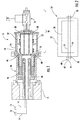
- FIG. 1 illustrates a slip ring or a telemetry system 10 coupled to one end of a rotatable or rotor shaft 12 or in an on-shaft configuration.
- This data is provided as sensor signals 14 that are generated by rotatable sensors 16 or other electronic instrumentation that is coupled to the various rotatable components (not shown) and collected by a data acquisition system 18 that is positioned off-shaft or is stationary with respect to the rotor shaft 12.
- the sensors 16 generally comprise thermal sensors such as thermocouples and/or thermal resistance sensors and strain sensors such as strain gauges.
- the sensor signals 14 are transmitted from the rotating rotor shaft 12 to the data acquisition system 18 via a slip ring or telemetry system 20.
- the slip ring or a telemetry system 20 generally includes a plurality of sensor signal transmitters 22 annularly arranged within a carrier shaft 24 that is configured to be coupled to the rotor shaft 12.
- the slip ring or a telemetry system 20 may also include a slip ring assembly 26 that is electronically coupled to the plurality of sensor signal transmitters 22 and the data acquisition system 18.
- the slip ring or a telemetry system 20 may be coupled to the rotor shaft 12 via a wire barrel 28 which is configured for routing wire bundles from the sensors 16 out of the rotor shaft 12.
- FIG. 2 provides an enlarged simplified view of an exemplary sensor signal transmitter 22.
- the exemplary sensor signal transmitter 22 generally includes at least one circuit board 30 encased within an outer housing 32.
- the circuit board(s) 30 define various channels or sensor circuits 34.
- Each sensor circuit 34 is electronically coupled to an input connector 36 such as a multi-pin connector and an output connector 38.
- the input connector 36 includes a plurality of terminal pairs 40.
- Each terminal pair 40 includes a positive terminal 42 and a negative terminal 44 electronically coupled to a corresponding sensor circuit 34.
- At least one of the sensor signal transmitters 22 may be configured to receive and/or process sensor signals from thermal sensors such as thermo couples or thermal resistance sensors.
- At least one of the sensor signal transmitters 22 may be configured to receive and/or process sensor signals from strain sensors such as strain gauges, accelerometers, or pressure gauges.
- the sensor signal transmitters 22 may comprise hardwired logic, a processor, microprocessor, controller, microcontroller, or other embedded circuitry adapted in any suitable manner to provide the desired functionality.
- one or more processors may be adapted to provide the described functionality by responding to commands sent by the user through control software.
- the sensor signal transmitters 22 discussed herein are not limited to any particular hardware or software architecture or configuration, and a different sensor signal transmitters 22 may be used for each type of sensor 16 being used.
- some systems and methods set forth and disclosed herein may also be implemented by hardwired logic or other circuitry, including, but not limited to, application-specific circuits. Of course, various combinations of computer-executed software and hardwired logic or other circuitry may be suitable as well.
- the sensors 16 are electronically coupled to the sensor signal transmitter 22 via a plurality of corresponding wires or wire bundles 46 and/or connectors 48. Each wire bundle 46 and/or connector 48 is coupled to a corresponding input connector 36.
- the various sensor signal transmitters 22 and/or the sensors 16 may be tested and/or calibrated for example, via the data acquisition system 18 during operation of the turbomachine.
- test and/or verification of the various sensor signal transmitter assemblies 22 becomes challenging and time consuming.
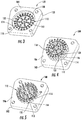
- FIG. 3 provides a perspective view of a front or connection side of a portion of an exemplary sensor simulator 100 for testing the sensor signal transmitters 22.
- FIG. 4 provides a perspective view of a back side of the sensor simulator 100 as shown in FIG. 3 , according to one embodiment of the present invention.
- FIG. 5 provides a perspective view of a back side of the sensor simulator 100 as shown in FIG. 3 , according to one embodiment of the present invention.
- the sensor simulator 100 includes a base 102 having a first side 104 ( FIG. 3 ) and an opposing back side 106 ( FIGS. 4 and 5 ).
- the base 102 may be formed from any suitable electrically insulating material such as but not limited to a glass epoxy laminate.
- a recess or depression 108 may be formed on the front side 104.
- a plurality of pins 110 extend generally axially through corresponding pin holes 112 defined within the base 102.
- the plurality of pins 110 includes a first pin 114 and a second pin 116 that extend through the base 102.
- the first pin 114 may be electrically insulated from the second pin 116 via the material of the base 102.
- the first pin 114 includes a first end portion 118 and a second end portion 120.
- the first end portion 118 may extend at least partially through the first side 104 of the base 102.
- the first end portion 118 is disposed within the recces 108.
- the first end portion 118 is configured to be electronically coupled to one of the positive terminal 42 or negative terminal 44 of a corresponding sensor circuit 34 of a sensor signal transmitter 22.
- the first end portion 118 may be formed to include or define a female receptacle (as shown) or a male terminal or tip.
- the second end portion 120 may be formed to include or define a female receptacle ( FIG. 4 ) or a male terminal or tip ( FIG. 5 ).
- the second pin 116 includes a first end portion 122 and a second end portion 124.
- the first end portion 122 may extend at least partially through the first side 104 of the base 102.
- the first end portion 122 is disposed within the recces 108.
- the first end portion 122 is configured to be electronically coupled to one of the positive terminal 42 or negative terminal 44 of the same sensor circuit 34 as the first pin 114, thus completing the sensor circuit 34.
- the first end portion 122 may be formed to include or define a female (as shown) or male receptacle.
- the second end portion 124 may be formed to include or define a female receptacle ( FIG. 4 ) or a male terminal or tip ( FIG. 5 ).
- the sensor simulator 100 includes a plurality of electronic components.
- Each electronic component electronically couples two or more of the plurality of pins 110 and simulates a particular sensor type.
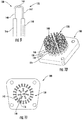
- FIG. 6 provides a side view of an exemplary electronic component 130 according to various embodiments of the present invention.
- the electronic component 130 comprises a resistor 132.
- the resistor 132 includes a first wire lead 134 that is electronically coupled to a second wire lead 136 via the resistor 132.
- the resistor 132 has a resistance that is equivalent to a predefine resistance of a resistive-based strain gage sensor that is mounted to a rotatable component of a turbomachine.
- FIG. 7 provides a perspective view of the sensor simulator 100 including a plurality of the resistors 132 according to one embodiment of the present invention.
- FIG. 8 provides a back side view of the sensor simulator 100 including a plurality of the resistors 132 as shown in FIG. 7 .
- the first wire lead 134 is electronically coupled to the second end portion 120 of the first pin 114.
- the second wire lead 136 is electronically coupled to the second end portion 124 of the second pin 116, thus completing the sensor circuit 34 when the sensor simulator 100 is electronically coupled to the input connector 36.
- the sensor simulator 100 simulates multiple strain sensors being connected to the sensor signal transmitter 22, thus allowing for test, verification and/or calibration of the sensor signal transmitter 22 off-shaft.
- FIG. 9 provides a side view of an exemplary electronic component 130 according to various embodiments of the present invention.
- the electronic component 130 comprises a thermocouple 138.
- the thermocouple 138 includes a first wire lead 140 that is electronically coupled to a second wire lead 142 to create a thermocouple junction 144.
- the first and second lead wires 140, 142 may be made from any suitable material.
- the first lead wire 140 comprises Chromel and the second lead wire 142 comprises Alumel.
- a relationship between temperature and voltage of the thermocouple 138 is substantially equivalent to a relationship between temperature and voltage of a thermocouple or thermal sensor used to sense internal temperatures within a turbomachine such as a gas turbine.
- FIG. 10 provides a perspective view of the sensor simulator 100 including a plurality of the thermocouples 138 according to one embodiment of the present invention.
- FIG. 11 provides a back side view of the sensor simulator 100 including a plurality of the thermocouples 138 as shown in FIG. 10 .
- the first wire lead 140 is electronically coupled to the second end portion 120 of the first pin 114.
- the second wire lead 142 is electronically coupled to the second end portion 124 of the second pin 116, thus completing the sensor circuit 34 when the sensor simulator 100 is electronically coupled to the input connector 36 of the sensor signal transmitter 22.
- the first lead wire 140 may be electronically coupled to the second end portion 120 of the first pin 114 via a first crimp socket 146 and the second lead wire 142 is electronically coupled to the second end portion 124 of the second pin 116 via a second crimp socket 148.
- the sensor simulator 100 simulates multiple thermal sensors being connected to the sensor signal transmitter 22, thus allowing for test, verification and/or calibration of the sensor signal transmitter 22 off-shaft.
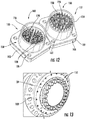
- FIG. 12 provides a back side perspective view of a pair of sensor simulators 100 where a first sensor simulator 150 is configured to simulate a plurality of thermal sensors and a second sensor simulator 152 is configured to simulate a plurality of strain sensors.
- the sensor simulator 100 may include a shell 154 that is coupled to the back side 106 of the base 102.
- the shell 154 circumferentially surrounds the electronic components 130.
- the electronic components 130 such are potted within the shell 154 using a suitable potting material 156 for electronics such as an epoxy.
- FIG. 13 provides a perspective view of a forward portion of the carrier shaft 24 as shown in FIG. 1 according to one embodiment of the present invention.
- a plurality of the sensor simulators 100 may be electronically coupled to the plurality of sensor signal transmitters 22 encased within the carrier shaft 24.
- a plurality of the sensor simulators 100 configured to simulate a plurality of thermal sensors as shown in FIG. 10
- a plurality of sensor simulators 100 configured to simulate a plurality of strain gauge sensors as shown in FIG. 10
Landscapes
- Physics & Mathematics (AREA)
- General Physics & Mathematics (AREA)
- Engineering & Computer Science (AREA)
- Technology Law (AREA)
- Arrangements For Transmission Of Measured Signals (AREA)
- Measurement Of Length, Angles, Or The Like Using Electric Or Magnetic Means (AREA)
- Transmission And Conversion Of Sensor Element Output (AREA)
Applications Claiming Priority (1)
| Application Number | Priority Date | Filing Date | Title |
|---|---|---|---|
| US14/599,590 US20160209237A1 (en) | 2015-01-19 | 2015-01-19 | Sensor simulator and system for testing rotatable sensor signal transmitters |
Publications (1)
| Publication Number | Publication Date |
|---|---|
| EP3045883A1 true EP3045883A1 (de) | 2016-07-20 |
Family
ID=55352994
Family Applications (1)
| Application Number | Title | Priority Date | Filing Date |
|---|---|---|---|
| EP16151438.5A Withdrawn EP3045883A1 (de) | 2015-01-19 | 2016-01-15 | Sensor-simulator und system zum testen von drehbaren sensorsignalgebern |
Country Status (4)
| Country | Link |
|---|---|
| US (1) | US20160209237A1 (de) |
| EP (1) | EP3045883A1 (de) |
| JP (1) | JP2016153783A (de) |
| CN (1) | CN105890645A (de) |
Cited By (1)
| Publication number | Priority date | Publication date | Assignee | Title |
|---|---|---|---|---|
| CN109994906A (zh) * | 2019-04-19 | 2019-07-09 | 杭州宏普机电科技有限公司 | 应用于导电滑环的印制板式中轴 |
Families Citing this family (1)
| Publication number | Priority date | Publication date | Assignee | Title |
|---|---|---|---|---|
| CN115047541A (zh) * | 2022-03-01 | 2022-09-13 | 东方久乐汽车电子(上海)股份有限公司 | 一种用于脚踢传感器的感应信号模拟方法及其装置 |
Citations (3)
| Publication number | Priority date | Publication date | Assignee | Title |
|---|---|---|---|---|
| GB2207297A (en) * | 1987-07-11 | 1989-01-25 | Stc Plc | Encapsulated electronic components |
| US6114856A (en) * | 1998-04-27 | 2000-09-05 | Benz Companies, Inc. | Method for detecting faults in electrical circuits having pin type connector |
| US20140050248A1 (en) * | 2012-08-15 | 2014-02-20 | Bae Systems Controls Inc. | I/o connector incorporating a cold junction |
Family Cites Families (9)
| Publication number | Priority date | Publication date | Assignee | Title |
|---|---|---|---|---|
| US4053830A (en) * | 1976-11-10 | 1977-10-11 | Avtron Manufacturing, Inc. | Armature winding termination continuity tester and method |
| FR2382000A1 (fr) * | 1977-02-25 | 1978-09-22 | Auxitrol | Rampe thermocouples pour la mesure de la moyenne de plusieurs temperatures |
| US4135401A (en) * | 1977-11-23 | 1979-01-23 | Westinghouse Electric Corp. | Temperature measurement system for hollow shaft interiors |
| US5931696A (en) * | 1996-11-06 | 1999-08-03 | Philips Electronics North America Corporation | Electrical connecting device |
| US7481584B2 (en) * | 2006-06-30 | 2009-01-27 | Ocean Design, Inc. | Dry mate connector |
| WO2008119179A1 (en) * | 2007-04-03 | 2008-10-09 | Scanimetrics Inc. | Testing of electronic circuits using an active probe integrated circuit |
| JP5530124B2 (ja) * | 2009-07-03 | 2014-06-25 | 株式会社日本マイクロニクス | 集積回路の試験装置 |
| KR101034386B1 (ko) * | 2010-09-28 | 2011-05-16 | 주식회사 창성에이스산업 | 다중 위치 온도 측정 케이블 |
| US9244117B2 (en) * | 2013-03-15 | 2016-01-26 | Livewire Innovation, Inc. | Systems and methods for implementing S/SSTDR measurements |
-
2015
- 2015-01-19 US US14/599,590 patent/US20160209237A1/en not_active Abandoned
-
2016
- 2016-01-12 JP JP2016003166A patent/JP2016153783A/ja active Pending
- 2016-01-15 EP EP16151438.5A patent/EP3045883A1/de not_active Withdrawn
- 2016-01-19 CN CN201610191914.XA patent/CN105890645A/zh active Pending
Patent Citations (3)
| Publication number | Priority date | Publication date | Assignee | Title |
|---|---|---|---|---|
| GB2207297A (en) * | 1987-07-11 | 1989-01-25 | Stc Plc | Encapsulated electronic components |
| US6114856A (en) * | 1998-04-27 | 2000-09-05 | Benz Companies, Inc. | Method for detecting faults in electrical circuits having pin type connector |
| US20140050248A1 (en) * | 2012-08-15 | 2014-02-20 | Bae Systems Controls Inc. | I/o connector incorporating a cold junction |
Cited By (1)
| Publication number | Priority date | Publication date | Assignee | Title |
|---|---|---|---|---|
| CN109994906A (zh) * | 2019-04-19 | 2019-07-09 | 杭州宏普机电科技有限公司 | 应用于导电滑环的印制板式中轴 |
Also Published As
| Publication number | Publication date |
|---|---|
| CN105890645A (zh) | 2016-08-24 |
| JP2016153783A (ja) | 2016-08-25 |
| US20160209237A1 (en) | 2016-07-21 |
Similar Documents
| Publication | Publication Date | Title |
|---|---|---|
| US8838328B2 (en) | Automotive diagnostic system | |
| KR101503669B1 (ko) | 터빈 기계의 부품들의 작동 상태들을 모니터링하기 위한 진단 시스템 및 방법 | |
| CN111060271A (zh) | 一种小型涡轮发动机涡轮叶片振动应力动测试验方法 | |
| CN110895151B (zh) | 一种发动机叶尖传感器高温性能验证系统及方法 | |
| EP3045883A1 (de) | Sensor-simulator und system zum testen von drehbaren sensorsignalgebern | |
| CN106969828A (zh) | 一种汽轮机瓦振传感器故障诊断及通道校验系统及方法 | |
| CN116438461A (zh) | 飞行器发动机控制单元的诊断 | |
| CN109298378A (zh) | 一种电能表自动化检定系统多功能检测方法及装置 | |
| CN104481608B (zh) | 温度测量装置、涡桨航空发动机和温度测量方法 | |
| JP2014135051A (ja) | 外部入力または互換可能なオペレーティングハードウェアを有するドータボードを使用する振動監視システムにおけるそれぞれ異なるタイプのセンサの対応 | |
| CN116368066A (zh) | 飞行器发动机控制单元的诊断 | |
| CN115265979A (zh) | 叶尖定时法转子叶片振动测试系统评估装置及评估方法 | |
| CN103983400B (zh) | 一种应力应变仪表万能检测装置及方法 | |
| US7135867B2 (en) | Method and apparatus for verifying connectivity of an instrumentation system | |
| CA3160472A1 (en) | Fastener, reader, kit, and signal acquiring method | |
| CN107543574B (zh) | 机载传感器高温老炼试验自动检测仪及操作方法 | |
| CN110907187A (zh) | 用于涡轮发动机的测量系统 | |
| CN113486513B (zh) | 一种管路热应力的测试系统、方法和应变测试软件 | |
| KR101947928B1 (ko) | 전기 제품의 조립 공정의 관리 방법 | |
| CN203714184U (zh) | 导航设备的测试系统 | |
| CN208568135U (zh) | 电连接器保持力测试装置 | |
| CN109001534B (zh) | 一种飞行器激活电阻测量系统和方法 | |
| CN216621390U (zh) | 一种用于核电热散式流量计板卡的标定专用工具 | |
| CN107144369B (zh) | 一种用于dcs产品调试中的温度信号仿真方法和装置 | |
| KR101663219B1 (ko) | 구성품간 인터페이스 신호 모사를 이용한 전기 전자 회로 점검 시스템 및 방법 |
Legal Events
| Date | Code | Title | Description |
|---|---|---|---|
| PUAI | Public reference made under article 153(3) epc to a published international application that has entered the european phase |
Free format text: ORIGINAL CODE: 0009012 |
|
| AK | Designated contracting states |
Kind code of ref document: A1 Designated state(s): AL AT BE BG CH CY CZ DE DK EE ES FI FR GB GR HR HU IE IS IT LI LT LU LV MC MK MT NL NO PL PT RO RS SE SI SK SM TR |
|
| AX | Request for extension of the european patent |
Extension state: BA ME |
|
| 17P | Request for examination filed |
Effective date: 20170120 |
|
| RBV | Designated contracting states (corrected) |
Designated state(s): AL AT BE BG CH CY CZ DE DK EE ES FI FR GB GR HR HU IE IS IT LI LT LU LV MC MK MT NL NO PL PT RO RS SE SI SK SM TR |
|
| 17Q | First examination report despatched |
Effective date: 20171027 |
|
| STAA | Information on the status of an ep patent application or granted ep patent |
Free format text: STATUS: THE APPLICATION IS DEEMED TO BE WITHDRAWN |
|
| 18D | Application deemed to be withdrawn |
Effective date: 20180307 |