EP3040436A1 - Thick steel sheet having excellent fatigue properties, and method for producing same - Google Patents
Thick steel sheet having excellent fatigue properties, and method for producing same Download PDFInfo
- Publication number
- EP3040436A1 EP3040436A1 EP14840332.2A EP14840332A EP3040436A1 EP 3040436 A1 EP3040436 A1 EP 3040436A1 EP 14840332 A EP14840332 A EP 14840332A EP 3040436 A1 EP3040436 A1 EP 3040436A1
- Authority
- EP
- European Patent Office
- Prior art keywords
- less
- steel sheet
- harder
- bainite
- microstructure
- Prior art date
- Legal status (The legal status is an assumption and is not a legal conclusion. Google has not performed a legal analysis and makes no representation as to the accuracy of the status listed.)
- Granted
Links
Images

Classifications
-
- C—CHEMISTRY; METALLURGY
- C22—METALLURGY; FERROUS OR NON-FERROUS ALLOYS; TREATMENT OF ALLOYS OR NON-FERROUS METALS
- C22C—ALLOYS
- C22C38/00—Ferrous alloys, e.g. steel alloys
-
- C—CHEMISTRY; METALLURGY
- C21—METALLURGY OF IRON
- C21D—MODIFYING THE PHYSICAL STRUCTURE OF FERROUS METALS; GENERAL DEVICES FOR HEAT TREATMENT OF FERROUS OR NON-FERROUS METALS OR ALLOYS; MAKING METAL MALLEABLE, e.g. BY DECARBURISATION OR TEMPERING
- C21D8/00—Modifying the physical properties of ferrous metals or ferrous alloys by deformation combined with, or followed by, heat treatment
- C21D8/02—Modifying the physical properties of ferrous metals or ferrous alloys by deformation combined with, or followed by, heat treatment during manufacturing of plates or strips
- C21D8/0221—Modifying the physical properties of ferrous metals or ferrous alloys by deformation combined with, or followed by, heat treatment during manufacturing of plates or strips characterised by the working steps
- C21D8/0226—Hot rolling
-
- C—CHEMISTRY; METALLURGY
- C21—METALLURGY OF IRON
- C21D—MODIFYING THE PHYSICAL STRUCTURE OF FERROUS METALS; GENERAL DEVICES FOR HEAT TREATMENT OF FERROUS OR NON-FERROUS METALS OR ALLOYS; MAKING METAL MALLEABLE, e.g. BY DECARBURISATION OR TEMPERING
- C21D8/00—Modifying the physical properties of ferrous metals or ferrous alloys by deformation combined with, or followed by, heat treatment
- C21D8/02—Modifying the physical properties of ferrous metals or ferrous alloys by deformation combined with, or followed by, heat treatment during manufacturing of plates or strips
- C21D8/0247—Modifying the physical properties of ferrous metals or ferrous alloys by deformation combined with, or followed by, heat treatment during manufacturing of plates or strips characterised by the heat treatment
- C21D8/0263—Modifying the physical properties of ferrous metals or ferrous alloys by deformation combined with, or followed by, heat treatment during manufacturing of plates or strips characterised by the heat treatment following hot rolling
-
- C—CHEMISTRY; METALLURGY
- C22—METALLURGY; FERROUS OR NON-FERROUS ALLOYS; TREATMENT OF ALLOYS OR NON-FERROUS METALS
- C22C—ALLOYS
- C22C38/00—Ferrous alloys, e.g. steel alloys
- C22C38/18—Ferrous alloys, e.g. steel alloys containing chromium
- C22C38/40—Ferrous alloys, e.g. steel alloys containing chromium with nickel
- C22C38/58—Ferrous alloys, e.g. steel alloys containing chromium with nickel with more than 1.5% by weight of manganese
-
- C—CHEMISTRY; METALLURGY
- C21—METALLURGY OF IRON
- C21D—MODIFYING THE PHYSICAL STRUCTURE OF FERROUS METALS; GENERAL DEVICES FOR HEAT TREATMENT OF FERROUS OR NON-FERROUS METALS OR ALLOYS; MAKING METAL MALLEABLE, e.g. BY DECARBURISATION OR TEMPERING
- C21D2211/00—Microstructure comprising significant phases
- C21D2211/002—Bainite
-
- C—CHEMISTRY; METALLURGY
- C21—METALLURGY OF IRON
- C21D—MODIFYING THE PHYSICAL STRUCTURE OF FERROUS METALS; GENERAL DEVICES FOR HEAT TREATMENT OF FERROUS OR NON-FERROUS METALS OR ALLOYS; MAKING METAL MALLEABLE, e.g. BY DECARBURISATION OR TEMPERING
- C21D2211/00—Microstructure comprising significant phases
- C21D2211/004—Dispersions; Precipitations
-
- C—CHEMISTRY; METALLURGY
- C21—METALLURGY OF IRON
- C21D—MODIFYING THE PHYSICAL STRUCTURE OF FERROUS METALS; GENERAL DEVICES FOR HEAT TREATMENT OF FERROUS OR NON-FERROUS METALS OR ALLOYS; MAKING METAL MALLEABLE, e.g. BY DECARBURISATION OR TEMPERING
- C21D8/00—Modifying the physical properties of ferrous metals or ferrous alloys by deformation combined with, or followed by, heat treatment
- C21D8/02—Modifying the physical properties of ferrous metals or ferrous alloys by deformation combined with, or followed by, heat treatment during manufacturing of plates or strips
-
- Y—GENERAL TAGGING OF NEW TECHNOLOGICAL DEVELOPMENTS; GENERAL TAGGING OF CROSS-SECTIONAL TECHNOLOGIES SPANNING OVER SEVERAL SECTIONS OF THE IPC; TECHNICAL SUBJECTS COVERED BY FORMER USPC CROSS-REFERENCE ART COLLECTIONS [XRACs] AND DIGESTS
- Y02—TECHNOLOGIES OR APPLICATIONS FOR MITIGATION OR ADAPTATION AGAINST CLIMATE CHANGE
- Y02P—CLIMATE CHANGE MITIGATION TECHNOLOGIES IN THE PRODUCTION OR PROCESSING OF GOODS
- Y02P10/00—Technologies related to metal processing
- Y02P10/20—Recycling
Definitions
- the present invention relates to a thick steel sheet used as structural materials mainly for ships, buildings, bridges, construction machines, etc., as well as a method for producing the same. More specifically, the invention relates to a thick steel sheet having a tensile strength of 490 MPa or more and 650 MPa or less and excellent in fatigue properties, and a method for producing the same.
- Non-Patent Literature 1 discloses effects of various influence factors on fatigue properties and describes that while the fatigue properties are improved by solid-solution strengthening, precipitation strengthening, crystal grain refinement, and second phase strengthening, improvement of the fatigue properties are less obtained by dislocation strengthening because this accompanies increase of mobile dislocations.
- the process of fatigue failure can be divided into (1) a process till generation of cracks due to repetitive application of loads and (2) a growing process of generated cracks to reach rupture.
- inhibition of the growth of the cracks is effective in the process (2), it is considered that the crystal grain refinement and the second phase strengthening are effective.
- Patent Literature 1 proposes a dual phase microstructure of fine ferrite and hard martensite in which the crack growth rate is suppressed by defining the hardness difference therebetween to improve the fatigue life after generation of cracks.
- this technique since a great amount of dislocations are introduced by a quenching treatment and, in addition, dislocations are further introduced when the second phase transforms from austenite to martensite and it is easily considered that the life to the generation of cracks is lowered and it is difficult to stably improve the total life.
- precipitations of carbonitrides is expected by addition of Nb or V, when rapid cooling is performed as in the quenching treatment, it is difficult to stably ensure such precipitates and attain the improvement of fatigue properties by precipitation strengthening.
- Patent Literature 2 proposes a technique of lowering the crack growth rate by transforming a steel microstructure to a mixed structure of fine ferrite and bainite. By using the technique, improvement of the fatigue life after generation of cracks may be expected also in the fatigue failure, but fatigue properties up to generation of cracks are not considered at all and no remarkable improvement of the fatigue properties can be expected.
- Patent Literature 3 proposes to improve the fatigue strength by precipitation of carbides in the ferrite structure. However, it does not describe the fatigue properties after the generation of the cracks and, in addition, the target is a thin steel sheet, so that it is difficult to satisfy other properties such as toughness necessary for large structures.
- the present inventors have investigated the total life up to the fatigue failure for the ratio between the life to the generation of cracks and the life to the rupture after the generation of the cracks. As a result, it has been found that life to the generation of the cracks occupies about 50% for the total life up to the fatigue failure and the proportion of the life to the generation of the cracks increased as the total life is lengthened by lowering the stress level. In view of the foregoings, in order to extend the total life to the fatigue failure, it is necessary to improve the fatigue properties up to the generation of the cracks as well as fatigue properties after the generation of the cracks. Particularly, the proportion of the life to generation of the cracks tends to be increased near the fatigue limit.
- a technique of improving the fatigue properties is required for the large structures and, in addition, a technique of lowering the crack growing speed (technique of improving the crack growing property) is also required. This is because the damaged portion can be found and repaired before reaching the fracture if the crack growing speed is low even when fatigue crack is generated. Accordingly, it has been demanded for a steel sheet capable of improving the fatigue properties (fatigue strength) of steel per se and also improving the fatigue cracking growing property (lowering the growing speed of fatigue cracks).
- Non-Patent Literature 1 Abe, et al. "Iron and Steel", 70th year (1984), No. 10, 1459 to 1466
- the present invention has been accomplished in view of the foregoing situations and intends to provide a thick steel sheet of excellent fatigue properties not found so far by improving both the fatigue properties up to generation of cracks and fatigue properties after the generation of the cracks, as well as a method useful for producing such a thick steel sheet.
- a thick steel sheet of the present invention capable of solving the subject provides a thick steel sheet comprising, by mass%, 0.010 to 0.1% of C, more than 0% and 0.3% or less of Si, 1.0 to 2% of Mn, 0.5 to 2% of Cr, 0.005 to 1.5% of Mo, and 0.0005 to 0.005% of B, respectively, and comprising one or more elements selected from 0.1 to 1.0% of Cu, and 0.1 to 1.0% of Ni, and one or more element selected from the group consisting of 0.05% or less of V, 0.05% or less of Nb, and 0.05% or less of Ti, in which the elements satisfy the relation of the following formulas (1) to (3), and the remainder consisting of iron and inevitable impurities, in which the micro structure satisfies the following requirements (a) to (d) when measured at an observation position at a depth of 3 mm from the surface of a steel sheet along a vertical cross section parallel to a rolling direction, and precipitates satisfy the following requirement (A): 0.01 ⁇ Nb + 2 Ti
- Car equivalent diameter described above means a diameter when converted into a circle of an identical area (circle equivalent diameter).
- the thick steel sheet of the present invention it is also useful to further incorporate optionally (i) more than 0% and 0.005% or less of Ca, (ii) more than 0% and 0.10% or less of Al, and (iii) more than 0% and 0.010% or less of N, etc. in which the properties of the thick steel sheet are further improved depending on the kind of the elements to be incorporated.
- a production method according to the present invention capable of attaining the purpose described above is characterized by hot rolling a slab of the chemical composition as described above under the following conditions.
- the cooling stop temperature is preferably 450°C or lower.
- both of fatigue properties up to the generation of cracks (crack generation suppressing property) and fatigue property after the generation of cracks (crack growth suppression property) can be improved to achieve a thick steel sheet of excellent fatigue properties.
- the present inventors have investigated means for ensuring the fatigue life after generation of fatigue cracks.
- strengthening by the refinement of crystal grains and by the harder remaining microstructure (second phase) in the main microstructure are effective.
- the crystal grains can be refined by transformation of the microstructure of the steel into the bainitic structure or the martensitic structure.
- such microstructures contain a lot of dislocations, they may possibly lower the crack generation life greatly.
- the present inventors have investigated the effects of the microstructural form on the fatigue properties for various thick steel sheets. As a result, it has been found that a thick steel sheet having fatigue properties more excellent than those of the prior art can be obtained by controlling the microstructure along the cross section in the direction of the thickness (vertical cross section parallel to the rolling direction) at a point of 3 mm depth from the surface of the steel sheet as described below.
- the microstructure at the depth of 3 mm from the surface of the steel sheet is adopted as a target because the microstructure near the surface layer has to be controlled since the cracks are generated at the surface of the steel sheet in usual thick steel sheets, and because the fatigue properties cannot be improved even when the microstructure at t/4 position or t/2 position (t: plate thickness) is controlled.
- the bainitic fraction present in the micro structure is ensured by 80 area% or more and the average length of the crystal grains in the direction of the sheet thickness (hereinafter sometimes referred to as "effective crystal grain size") is defined as 7 ⁇ m or less when the crystal grains of the bainite is determined based on a high-angle grain boundary having an orientation difference between adjacent crystals of 15° or more.
- the bainitic fraction is preferably 85 area% or more and, more preferably, 90 area% or more.
- the effective crystal grain size is preferably 6 ⁇ m or less and, more preferably, 5 ⁇ m or less.
- the microstructure of the steel sheet according to the present invention comprises a microstructure mainly composed of bainite as described above in order to satisfy the strength grade of 490 MPa or more and 650 MPa or less and ensuring excellent fatigue properties.
- "Bainite” used herein includes bainitic structure such as upper bainite, lower bainite, acicular ferrite, granular bainitic ferrite, etc.
- the crystal grain size of the bainite can be made finer compared with that of ferrite, etc. and both of the life to the generation of cracks (crack generation life) and the life after growth of cracks (crack growth life) are improved. Martensite can also provide a fine microstructure. However, since a great amount of dislocations are introduced by shearing deformation caused upon martensitic transformation to deteriorate the crack generation life, improvement of the fatigue properties cannot be obtained as a whole.
- the crystal grain size (effective crystal grain size) is defined along the direction of the sheet thickness (cut length) because the growth of fatigue cracks generated at the surface of the steel sheet is taken into consideration.
- a quenching treatment is often performed usually after rolling in addition to the incorporation of alloying elements such as C or Mn.
- alloying elements such as C or Mn.
- B has to be added in addition to C, Mn, etc. which are added usually to the steel sheet (to be described later). Since B has an effect of suppressing ferritic transformation, a microstructure mainly comprising the bainite can be ensured stably even when the cooling rate is relatively low.
- the circle equivalent diameter of the hard remaining microstructure is 3 ⁇ m or less and the microstructure is harder than the bainite.
- the circle equivalent diameter of the harder remaining microstructure is defined as 3 ⁇ m or less, because other property such as toughness may possibly be deteriorated greatly if the size of the remaining microstructure (average size) is more than 3 ⁇ m.
- a preferred upper limit is 2.5 ⁇ m or less (more preferably, 2.0 ⁇ m or less) and the preferred lower limit thereof is 0.5 ⁇ m or more.
- the harder remaining microstructure basically includes martensite and martensite-austenite mixed structure (MA: martensite austenite constituent) and the harder remaining microstructure can improve the crack growth life.
- a soft microstructure such as ferrite or perlite may be contained partially in the remaining microstructure, the harder remaining microstructure is preferably 1 area% or more (more preferably, 3 area% or more) in order to provide the effect.
- the harder remaining microstructure is present in a great amount, since mobile dislocations may possibly be introduced into the matrix due to martensitic transformation, they not only deteriorate the fatigue properties, but also possibly deteriorate greatly other properties such as toughness, so that the microstructure is preferably 10 area% or less (more preferably, 7 area% or less)
- the difference of the hardness between the bainite and the harder remaining microstructure (hardness of harder remaining microstructure) - hardness of bainite: hereinafter represented by ⁇ H) is Hv 100 or more.
- the hardness difference ⁇ H is preferably Hv 120 or more and, more preferably, Hv 140 or more.
- the upper limit of the hardness difference ⁇ H is about Hv 180 or less.
- the harder remaining microstructure comprises martensite or MA
- dislocations are introduced into bainite due to shearing deformation caused by martensitic transformation tending to deteriorate the crack generation life.
- the hardness difference ⁇ H has to be Hv 100 or more.
- the hardness of the harder remaining microstructure also referred to as "second phase” in the present invention
- the present inventors have investigated also the effect of precipitates on the fatigue properties. As a result, it has been found that a thick steel sheet providing fatigue properties more excellent than usual can be obtained by controlling the precipitates along the vertical cross section parallel to the rolling direction at points of 3 mm depth from the surface of the steel sheet as described below.
- precipitates carbides and carbonitrides
- the critical size at which the precipitates are shared is different depending on the type of the precipitates and the critical size is about 5 nm for the precipitates containing at least one of Nb, Ti, and V.
- precipitation strengthening can be utilized effectively by finely dispersing the precipitates thereby increasing the number density.
- it is customary to add a great amount of alloys or perform a heat treatment such as tempering.
- a heat treatment such as tempering.
- such a method not only increases the material cost and the production cost but also may result a possibility of greatly deteriorating other characteristic such as toughness.
- the present inventors have designed alloys while taking notice on precipitates formability by C (hereinafter referred to as "C activity") thereby enabling to ensure the fine precipitates at a low cost and stably.
- C activity precipitates formability by C
- the addition amounts of elements constituting the precipitates should be controlled properly and, specifically, it is necessary that the contents of Nb, Ti, and V satisfy the following relation (1). 0.01 ⁇ Nb + 2 Ti + 2 V ⁇ 0.10 (in which [Nb], [Ti] and [V] represents respectively the contents (mass%) of Nb, Ti and V in the steel sheet).
- a thick steel sheet exhibiting excellent fatigue properties can be realized by properly adding alloying elements such as C, Mn, B, etc. thereby ensuring a bainitic structure by a predetermined amount and, at the same time, properly adjusting the addition amounts of Mn, Cr and Mo thereby obtaining a phase mainly comprising bainite for improving the crack growth life, as well as properly restricting the addition amounts of Nb, Ti and V as constituent elements of the precipitates and, further, adjusting the relation of the addition amounts of Cu, Ni, and Si giving effect on the C activity, thereby dispersing and precipitating fine precipitates.
- alloying elements such as C, Mn, B, etc.
- each of the components is adjusted as described below.
- the content (%) for each of the chemical components is based on mass%.
- percentage based on mass (mass%) is identical with the percentage (wt%) based on the weight.
- "X % or less (not including 0%)" of the content for each of the chemical components is sometimes represented by "more than 0% and X % or less).
- the C content is an element important for ensuring the strength of the base material (steel sheet), and this is also an element constituting the precipitates.
- the C content is defined as 0.010% or more.
- the C content is preferably 0.02% or more and, more preferably, 0.05% or more.
- the C content is defined as 0.1% or less.
- the C content is preferably 0.08% or less and, more preferably, 0.060% or less.
- Si is an element essential to ensure the strength of the base material (steel sheet), it is also an element of lowering the C activity. Accordingly, it is necessary that the addition amount is restricted to 0.3% or less.
- the Si content is preferably 0.25% or less and, more preferably, 0.2% or less. In order to provide the effect described above, the Si content is preferably 0.01% or more and, more preferably, 0.05% or more.
- Mn is an element important for ensuring the quenchability for obtaining the bainitic structure. Mn is important also for ensuring the hard second phase. For effectively providing such an effect, it is necessary that the Mn content is 1.0% or more.
- the Mn content is preferably 1.2% or more and, more preferably, 1.4% or more.
- the Mn content is 2% or less.
- the Mn content is preferably 1.8% or less and, more preferably, 1.6% or less.
- Cr is an element having the effect identical with that of Mn and can stably provide the bainitic structure. In order to effectively provide such an effect, it is necessary that Cr is contained by 0.5% or more. It is preferably, 0.7% or more and it is recommended more preferably to be contained by 0.9% or more. However, if the Cr content becomes excessive, since the fatigue properties may possibly be deteriorated, it is necessary that the Cr content is 2% or less. A preferred upper limit of the Cr content is 1.7% or less and, more preferably, 1.2% or less.
- Mo is an element having the effect identical with that of Mn and can stably provide the bainitic structure. Further, Mo is an element also essential to obtain the harder remaining microstructure. In order to provide such an effect, it is necessary that Mo is contained by 0.005% or more and it is preferably 0.01% or more and, more preferably, 0.03% or more. However, if the Mo content is excessive, since the hard second phase is formed excessively to rather deteriorate the fatigue properties, it is necessary that the content is 1.5% or less. A preferred upper limit of the Mo content is 0.7% or less and, more preferably, 0.5% or less.
- B is an element of improving the quenchability and also an element of suppressing ferritic transformation thereby facilitating to form the bainitic structure.
- B is contained by 0.0005% or more.
- the B content is preferably 0.001% or more and, more preferably, 0.002% or more.
- a preferred upper limit of the B content is 0.004% or less and, more preferably, 0.003% or less.
- Cu and Ni are elements essential to increase the C activity and form fine precipitates. In order to provide such effects, it is necessary that at least one of them is contained by 0.1% or more. The content is preferably 0.15% or more and, more preferably, 0.2% or more. However, if the contents of Cu and Ni are excessive, precipitates are coarsened and not only the improvement of the fatigue properties cannot be obtained but also other properties such as toughness are also deteriorated. With such a view point, any of them should be 1.0% or less and, preferably, 0.8% or less (more preferably, 0.6% or less).
- CA value the value of [Cu] + [Ni]) - 2[Si] (hereinafter referred to as "CA value") is less than 0%, since the C activity becomes insufficient, no sufficient precipitates are obtained and the fatigue properties cannot be improved. Further, if the CA value is more than 1.0 (%), the C activity becomes excessive to rather form coarse precipitates not only failing to obtain the improvement of the fatigue properties but also possibly deteriorate other properties.
- a preferred lower limit of the CA value is 0.1% or more and, it is preferably, 0.15(%) or more. Further, a preferred upper limit of the CA value is 0.9(%) or less and it is, more preferably, 0.7(%) or less.
- V, Nb, and Ti are elements essential to ensure the bainitic structure by the improvement of quenchability and, in addition, to form precipitates. However, if they are incorporated excessively, precipitates are coarsened failing to obtain sufficient effect of improving the fatigue properties and, accordingly, it is necessary that each of them is restricted to 0.05% or less.
- PR value the value of [Nb] + 2[Ti] + 2[V] (hereinafter referred to as "PR value”) is less than 0.01(%), no sufficient precipitates can be obtained and the improvement of the fatigue properties cannot be attained.
- the PR value is preferably 0.03(%) or more and, more preferably, 0.05(%) or more. If the PR value is excessively large, since the precipitates are coarsened to deteriorate the fatigue properties, the value is defined to 0.10(%) or less.
- the PR value is preferably 0.08(%) or less and, more preferably, 0.06(%) or less.
- Mn, Cr, and Mo satisfy the following equation (3). 2.4 ⁇ Mn + 1.5 Cr + 2 Mo ⁇ 4.5 (where [Mn], [Cr] and [Mo] represent respectively the contents (mass%) of Mn, Cr, and Mo in the steel sheet).
- Kp value the value of [Mn] + 1.5[Cr] + 2[Mo] (hereinafter referred to as "Kp value") is less than 2.4(%), since the hardness of the second phase is no more sufficient, an effect of suppressing the crack growth cannot be provided and sufficient fatigue properties cannot be obtained.
- Kp value is more than 4.5(%), while the hardness of the harder remaining microstructure can be ensured, since the fraction of the harder remaining microstructure increases along with coarsening of the harder remaining microstructure (more than 20 area%), other property such as toughness is deteriorated.
- a preferred lower limit of the Kp value is 2.7(%) or more and, more preferably, it is 2.8(%) or more.
- a preferred upper limit of the Kp value is 4.0(%) or less and, more preferably, it is 3.5(%) or less.
- the basic components in the thick steel sheet of the present invention are as described above with the remainder substantially consisting of iron. Naturally. incorporation of inevitable impurities (for example, P and S) carried into the steel depending on raw materials, materials used, states of production facility, etc. are permitted. Further, in the thick steel sheet of the present invention, positive incorporation of the following elements is also effective and the properties of the thick steel sheet are further improved in accordance with the kind of the elements to be incorporated.
- Ca is an element of decreasing the shape anisotropy of inclusions (for example, MnS) in the steel, which is an element effective to prevent the inclusions from forming fracture origins and improve the fatigue properties.
- MnS shape anisotropy of inclusions
- the Ca content is 0.005% or less and, more preferably, 0.003% or less.
- Al is an element useful as a deoxidizer and, in order to provide such an effect, Al is preferably contained by 0.01% or more. It is more preferably, 0.02% or more. However, as the Al content becomes excessive, since this deteriorates not only the fatigue properties but also the toughness, etc., Al is preferably 0.10% or less and, more preferably, 0.04% or less.
- the N content is preferably 0.010% or less and, more preferably, 0.008% or less. In order to effectively provide the effect due to N, the content is preferably 0.0035% or more and, more preferably, 0.0040% or more.
- precipitates hinder the movement of dislocations, precipitation strengthening suppresses accumulation of dislocations due to repetitive fatigue loading, to thereby improve the fatigue properties.
- thick steel sheets used for ships, bridges, ocean structures, etc. not only the fatigue properties but also the toughness are important factors and coarse precipitates may possibly deteriorate the toughness. Accordingly, it is necessary that fine precipitates are dispersed.
- coarse precipitates may possibly deteriorate the toughness. Accordingly, it is necessary that fine precipitates are dispersed.
- the size of the precipitates decreases, they are sheared by dislocations and the strengthening effect by precipitates cannot be obtained.
- precipitates containing Nb, Ti, V, etc. are not sheared by dislocations even when they are fine precipitates of about 5 nm, they can improve the fatigue properties without deteriorating other properties.
- the number of precipitates (number density) containing at least one of Nb, Ti and V having the circle equivalent diameter of 20 nm or less is 100 N/ ⁇ m 2 or more at a point of 3 mm depth from the surface of the steel sheet.
- the number density of the precipitates is preferably 150 N/ ⁇ m 2 or more and, more preferably, 200 N/ ⁇ m 2 or more.
- the thickness of the thick steel sheet according to the present invention is not particularly restricted but small thickness less contributes to the improvement of the crack growing life. With such a view point, the thickness is preferably 6 mm or more and, more preferably, 10 mm or more. Further, the thick steel sheet of the present invention provides a thick steel sheet of excellent fatigue properties not found in the prior art by making the plurality of factors compatible for improving the fatigue properties as described above.
- the thick steel sheet of the present invention satisfies each of the requirements described above and the production method therefor is not particularly restricted.
- a steel piece for example, slab having the chemical composition as described above and control a heating temperature before hot rolling, a cumulative draft during hot rolling, a finish rolling temperature and a finish rolling draft, a cooling rate and a cooling stop temperature after the hot rolling as described below.
- the slab Before the hot rolling, the slab is preferably heated to a temperature range of 1000 to 1200°C. It is more preferably 1050°C or higher.
- the cumulative draft in the total hot rolling step is defined as 70% or more. It is preferably 75% or more.
- the slab is heated in a temperature range of 1000 to 1200°C to perform sufficient rolling reduction such that 70% or more of cumulative draft can be ensured during hot rolling while preventing the crystal grains from coarsening.
- the cumulative draft during finish rolling which is set to a temperature of the Ar 3 transformation point + 100°C to Ar 3 transformation point is defined as 30% or more (preferably, 40% or more).
- the temperature at which the finish rolling is completed can be set properly so long as the temperature is Ar 3 transformation point or higher and it may be higher than the Ar 3 transformation point so long as a predetermined cumulative draft can be attained.
- the heating temperature upon heating the steel sheet is not particularly restricted and it is preferably defined at about 3 to 10°C/min. If the heating rate is lower than 3°C/min, coarse carbides tend to be precipitated in the slab heating stage, and cannot be sufficiently solid-solubilized in the subsequent step, by which alloying elements are segregated, so that desired precipitates cannot be dispersed finely. On the other hand, if the heating rate exceeds 10°C/min, since the segregation of components in the slab cannot be solved sufficiently, it is difficult to finely disperse desired precipitates.
- [C], [Si], [Mn], [Cu], [Ni], [Cr], [Mo] and [Nb] respectively represent contents (mass%) of C, Si, Mn, Cu, Ni, Cr, Mo, and Nb.
- the slab is cooled at an average cooling rate of 10°C/sec or lower (preferably, 8°C/sec or lower) from the finish rolling temperature to 600°C and the cooling stop temperature at the cooling rate can be preferably as 450°C or lower, by which the remaining microstructure can be made harder while finely dispersing the precipitates.
- the cooling range is defined as "from the finish rolling end temperature to 600°C" because this is a temperature region in which the microstructure of the base metal is formed and in which precipitates are precipitated.
- bainitic structure can be refined while suppressing the formation of ferrite even when the average cooling rate is 10°C/sec or lower.
- the average length of the crystal grain in the direction of the sheet thickness (effective average crystal grain size) is defined as 7 ⁇ m or less.
- the bainitic fraction is preferably 85 area% or more and, more preferably, 90 area% or more.
- the effective average crystal grain size is preferably 6 ⁇ m or less and, more preferably, 5 ⁇ m or less.
- a hard remaining microstructure (harder remaining microstructure) has a circular equivalent diameter of 3 ⁇ m or less and is harder than the bainitic structure.
- Circle equivalent diameter of the harder remaining microstructure is defined as 3 ⁇ m or less because if the average size of the remaining microstructure is more than 3 ⁇ m, this may possibly deteriorate greatly other properties such as toughness.
- the remaining microstructure basically contains martensite and MA and such harder remaining microstructure can lower the crack growth rate.
- the average cooling rate after the hot rolling is preferably defined to 1°C/sec or higher. It is more preferably 2°C/sec or higher.
- the finish rolling draft is a draft attained when finish rolling is completed in a temperature range of Ar 3 transformation point + 100°C to Ar 3 transformation point (cumulative draft).
- “Finish rolling draft” shown in Table 3 is a designed value and when the finish rolling end temperature is higher than the Ar 3 transformation point + 100°C (that is, rolling is completed before reaching Ar 3 transformation point + 100°C ), the finish rolling draft is 0% (that is, no rolling reduction for Ar 3 transformation point + 100°C to Ar 3 transformation point) (for example, Test No. 21 in Table 5). The heating rate during heating is 4 to 5°C/min in each of cases. [Table 3] Rolling condition No.
- bainitic fraction For each of the steel sheets, bainitic fraction, effective crystal grain size, size and fraction of the second phase (harder remaining microstructure), hardness difference ⁇ H between the bainite and the harder remaining microstructure, tensile strength, and fatigue properties, number density and size of fine precipitates of the steel sheet were measured.
- the test specimen was sampled such that the evaluation position is at a 3 mm position from the surface layer of the steel sheet.
- Samples were cut out such that a surface parallel to the rolling direction of the steel sheet and vertical to the surface of the steel sheet was exposed at a position of 3 mm depth from the surface of the steel sheet, the samples were polished by using wet Emery paper at #150 to #1000 and, subsequently, mirror finished by using a diamond abrasive. After etching the mirror polished test specimen with 2% nitric acid - ethanol solution (nital solution), a view field of 150 ⁇ m ⁇ 200 ⁇ m was observed under a microscope at an observation factor of 400X to measure the bainitic fraction (area%) by image analysis. Bainitic fraction was determined for five view fields in total and an average value thereof was adopted (average value for 5 view fields).
- Effective crystal grain size was measured for a cross section parallel to the rolling direction of the steel sheet at a position of 3 mm depth from the surface of the steel sheet by SEM (Scanning Electron Microscope) - EBSP (Electron Backscatter Pattern method).
- SEM Sccanning Electron Microscope
- EBSP Electron Backscatter Pattern method
- an EBSP apparatus manufactured by TEX SEM Laboratories Co. commercial name: "OIM”
- crystal grain size was measured for the boundaries with a tilting angle (crystal orientation difference) of 15° or more as the crystal grain boundary.
- a measuring region was 200 ⁇ m ⁇ 200 ⁇ m and a measuring step was 0.5 ⁇ m spacing, and measuring points with a confidence index showing the reliability of measuring orientation of less than 0.1 were excluded from the object of analysis.
- the cut lengths at 100 positions were measured along the direction of the sheet thickness and the average value thereof was adopted as the effective crystal grain size.
- the effective crystal grain size of 2.0 ⁇ m or less was judged as measurement noises and excluded.
- samples were cut out by the same method as that for the measurement of the bainitic fraction, polished and etched, subsequently, observed under SEM at an observation factor of 1000X and the size of the remaining microstructure (size of the harder remaining microstructure) and the fraction (fraction of the harder remaining microstructure) sere determined by image analysis. For both of them, average values for five view fields were adopted.
- the hardness difference between the bainite and the harder remaining microstructure was measured by using a super micro indentation hardness tester (manufactured by Elionix Co.). Test specimens were cut out and polished and etched in the same manner as that for the measurement of the bainitic fraction, and a super micro indentation hardness test was carried out on the bainite and the hard remaining microstructures for each 10 points under a load of 10 mN and an average value of the obtained hardness difference ( ⁇ H: hardness of harder remaining microstructure - hardness of bainitic structure) was adopted.
- Tensile test specimens each of a sheet thickness of 4 mm and a gauge length of 35 mm were sampled at positions of 2 to 6 mm depth from the surface layer in each of steel sheets and a tensile test was carried out according to JIS Z 2241 (2011) to measure a tensile strength TS.
- Fatigue properties were measured by preparing test specimens as illustrated in Fig. 1 by cutting out steel of 4 mm thickness from positions at 2 to 6 mm depth from the surface layer of the plate thickness. The surface of the test specimen was polished to #1200 by Emery paper to remove the effect of the surface state.
- the fatigue properties undergo the effect of the tensile strength and, in order to remove the effect, a fatigue limit ratio at 5,000,000 cycles was determined and those having a fatigue limit at 5,000,000 cycles of more than 0.51 were evaluated as satisfactory.
- the fatigue limit at 5,000,000 cycles is a value obtained by dividing a fatigue strength at 5,000,000 cycles by a tensile strength and the fatigue strength at 5,000,000 cycles was decided as below.
- a fatigue test was carried out on each of the test specimens at a stress amplitude where the value obtained by dividing a stress amplitude ⁇ a with a tensile strength TS ( ⁇ a/TS) was 0.51, and those not ruptured upon reaching 5,000,000 cycles were evaluated as satisfactory and indicated by "O” in the following Tables 4 and 5 (those ruptured are evaluated as failed and indicated by "X”. Further, a fatigue test was carried out at a stress amplitude of ( ⁇ a/TS) of 0.53 and those not ruptured upon reaching 5,000,000 cycles were represented by "O” in the following Tables 4 and 5.
- Test specimens prepared from samples taken out at 3 mm positions from the surface of a steel sheet by an extraction replica method were observed by a transmission electron microscope (TEM) at an observation factor of 150,000X, for five view fields of observation portions, each view field of 750 nm ⁇ 625 nm, in five view fields of observation portions, and areas of precipitates containing at least one of Nb, Ti and V in the view field were measured by image analysis to calculate a circle equivalent diameter of each of precipitates based on the area. Inclusion of at least one of Nb, Ti and V was judged by EDX (Energy Dispersive X-ray spectrometry). The number of precipitates having a circle equivalent diameter of 20 nm or less was converted per 1 ⁇ m 2 as a number density.
- TEM transmission electron microscope
- Test Nos. 17 to 37 since at least one of the chemical compositions and production conditions of steel sheets was not appropriate, the test result of the fatigue properties was poor. Among them, in Test No. 17, heating temperature before hot rolling was excessively high (rolling condition No. g), the effective crystal grain size was increased to deteriorate the fatigue properties.
- the finish rolling draft was decreased, the effective crystal grain size was excessively large, and the number density of the precipitates was decreased to deteriorate the fatigue properties.
- the finish rolling end temperature was excessively high (rolling condition No. k: the draft in the finish rolling is substantially 0%), the tensile strength was lowered, as well as the bainitic fraction was lowered, the effective crystal grain size was increased and, in addition, the number density of the precipitates was also decreased to deteriorate the fatigue properties.
- the finish rolling end temperature was excessively low (rolling condition No. 1), the bainitic fraction was decreased and, in addition, the number density of precipitates was also decreased to deteriorate the fatigue properties.
- Test No. 25 is an example of using steel with excess C content (steel grade L), in which the bainitic fraction was decreased to deteriorate the fatigue properties.
- Test No. 26 is an example of using steel of less C content (steel grade M) in which predetermined tensile strength was not attained (other properties were not evaluated).
- Test No. 27 is an example of using steel with excess Si content (steel grade N) in which the number density of the precipitates was not attained (fine precipitates were not dispersed) to deteriorate the fatigue properties.
- Test No. 28 is an example of using steel with less Mn content (steel grade O) in which a predetermined tensile strength was not attained (other properties were not evaluated).
- Test No. 29 is an example of using steel with excess Mn content (steel grade P) in which the size and the fraction of the harder remaining microstructure were excessive to deteriorate the fatigue properties.
- Test No. 30 is an example of using steel with the content of Cu and Ni being insufficient and CA value was small (steel grade Q), in which the number of density of the precipitates was decreased to deteriorate the fatigue properties.
- Test No. 31 is an example of using steel with large CA value (steel grade R) (Ni contents was also excessive), in which coarse precipitates were increased and the number density of precipitates was decreased to deteriorate the fatigue properties.
- Test No. 32 is an example of using steel piece with small PR value and CA value (steel grade S), in which the bainitic fraction could not be ensured and the number density of the precipitates was small to deteriorate the fatigue properties.
- Test No. 33 is an example of using a slab of large PR value and a small CA value (steel grade T), in which the number density of the precipitates was decreased to deteriorate the fatigue properties.
- Test No. 34 is an example of using a steel piece with small Kp value (steel grade U), in which the bainitic fraction was decreased, the effective crystal grain size was increased, and ⁇ H was also decreased to deteriorate fatigue properties.
- Test No. 35 is an example of using a steel piece of large Kp value (steel grade V) in which the size and the fraction of the harder remaining microstructure were excessive to deteriorate the fatigue properties.
- Test No. 36 is an example of using a steel piece with less B content (steel grade W), in which the number density of the precipitates was decreased to deteriorate the fatigue properties.
- Test No. 37 is an example of using steel with excess B content (steel grade X), in which the CA value was also decreased and the bainitic fraction was decreased to deteriorate the fatigue properties.
- the bainitic fraction, the effective crystal grain size, and the size of the second phase at the position for 1/4 of the sheet thickness were evaluated by the same method as that shown in Example 1.
- the sampling method of the test specimen was identical with that described above except for setting a position at 1/4 of the sheet thickness. Further, crack growth rate of the steel sheets was measured by the following method.
- a fatigue crack growth test was carried out by an electric servo hydraulic fatigue tester under the following conditions using compact test specimens according to ASTM E647, to measure the crack growth rate.
- the compact test specimen was sampled from a position at 1/2 of the sheet thickness and a shape as illustrated in Fig. 2 was used.
- a compliance method was adopted for the crack length.
Landscapes
- Chemical & Material Sciences (AREA)
- Engineering & Computer Science (AREA)
- Mechanical Engineering (AREA)
- Materials Engineering (AREA)
- Metallurgy (AREA)
- Organic Chemistry (AREA)
- Physics & Mathematics (AREA)
- Thermal Sciences (AREA)
- Crystallography & Structural Chemistry (AREA)
- Heat Treatment Of Steel (AREA)
Abstract
Description
- The present invention relates to a thick steel sheet used as structural materials mainly for ships, buildings, bridges, construction machines, etc., as well as a method for producing the same. More specifically, the invention relates to a thick steel sheet having a tensile strength of 490 MPa or more and 650 MPa or less and excellent in fatigue properties, and a method for producing the same.
- In large size structures such as ships, buildings, bridges and construction machines, the size of the structure has been increased and reliability has been demanded more for the structural material considering the great damages if they should be destroyed. It has been known so far that most of causes for destruction in large size structures are fatigue failure, and various fatigue failure resistant techniques have been developed, but there are not a few cases of suffering from failure owing to fatigue failure still at present.
- Generally, in a portion of a large structure liable to undergo fatigue failure, stress concentration has been moderated by adopting a structural device. However, because of addition of members and use of high strength steel in such a structure often increases the production cost. Accordingly, it has been demanded a technique of improving fatigue properties of the steel per se.
- For example, Non-Patent Literature 1 discloses effects of various influence factors on fatigue properties and describes that while the fatigue properties are improved by solid-solution strengthening, precipitation strengthening, crystal grain refinement, and second phase strengthening, improvement of the fatigue properties are less obtained by dislocation strengthening because this accompanies increase of mobile dislocations. The process of fatigue failure can be divided into (1) a process till generation of cracks due to repetitive application of loads and (2) a growing process of generated cracks to reach rupture. Among the factors of improving the fatigue properties shown before, it is effective to suppress accumulation of dislocations in the process (1) and it is considered that the solid-solution strengthening, precipitation strengthening, crystal grain refinement, etc. are effective. On the other hand, since inhibition of the growth of the cracks is effective in the process (2), it is considered that the crystal grain refinement and the second phase strengthening are effective.
- On the other hand, Patent Literature 1 proposes a dual phase microstructure of fine ferrite and hard martensite in which the crack growth rate is suppressed by defining the hardness difference therebetween to improve the fatigue life after generation of cracks. However, in this technique, since a great amount of dislocations are introduced by a quenching treatment and, in addition, dislocations are further introduced when the second phase transforms from austenite to martensite and it is easily considered that the life to the generation of cracks is lowered and it is difficult to stably improve the total life. Further, while precipitations of carbonitrides is expected by addition of Nb or V, when rapid cooling is performed as in the quenching treatment, it is difficult to stably ensure such precipitates and attain the improvement of fatigue properties by precipitation strengthening.
-
Patent Literature 2 proposes a technique of lowering the crack growth rate by transforming a steel microstructure to a mixed structure of fine ferrite and bainite. By using the technique, improvement of the fatigue life after generation of cracks may be expected also in the fatigue failure, but fatigue properties up to generation of cracks are not considered at all and no remarkable improvement of the fatigue properties can be expected. - Patent Literature 3 proposes to improve the fatigue strength by precipitation of carbides in the ferrite structure. However, it does not describe the fatigue properties after the generation of the cracks and, in addition, the target is a thin steel sheet, so that it is difficult to satisfy other properties such as toughness necessary for large structures.
- The present inventors have investigated the total life up to the fatigue failure for the ratio between the life to the generation of cracks and the life to the rupture after the generation of the cracks. As a result, it has been found that life to the generation of the cracks occupies about 50% for the total life up to the fatigue failure and the proportion of the life to the generation of the cracks increased as the total life is lengthened by lowering the stress level. In view of the foregoings, in order to extend the total life to the fatigue failure, it is necessary to improve the fatigue properties up to the generation of the cracks as well as fatigue properties after the generation of the cracks. Particularly, the proportion of the life to generation of the cracks tends to be increased near the fatigue limit.
- As has been described above, a technique of improving the fatigue properties is required for the large structures and, in addition, a technique of lowering the crack growing speed (technique of improving the crack growing property) is also required. This is because the damaged portion can be found and repaired before reaching the fracture if the crack growing speed is low even when fatigue crack is generated. Accordingly, it has been demanded for a steel sheet capable of improving the fatigue properties (fatigue strength) of steel per se and also improving the fatigue cracking growing property (lowering the growing speed of fatigue cracks).
- Growth of the cracks in the fatigue properties described above occurs particularly in a region where the crack length is short just after the generation of the cracks and, accordingly, evaluation has to be made for a test specimen sampled from the surface layer. On the other hand, crack growth in the crack growth properties occurs in a region where cracks grow stably (so-called long crack), which undergoes the effect of the steel microstructure not in the surface layer but in the inside of the steel. Accordingly, in order to produce a steel sheet also excellent in the crack growth properties in addition to the fatigue properties, it is necessary to control not only the form of the microstructure in the surface layer but also the form of the microstructure inside the steel.
- Non-Patent Literature 1: Abe, et al. "Iron and Steel", 70th year (1984), No. 10, 1459 to 1466
-
- Patent Literature 1: Japanese Unexamined Patent Application Publication No.
H10-60575 - Patent Literature 2: Japanese Unexamined Patent Application Publication No.
2011-195944 - Patent Literature 3: Japanese Unexamined Patent Application Publication No.
2009-84643 - The present invention has been accomplished in view of the foregoing situations and intends to provide a thick steel sheet of excellent fatigue properties not found so far by improving both the fatigue properties up to generation of cracks and fatigue properties after the generation of the cracks, as well as a method useful for producing such a thick steel sheet.
- A thick steel sheet of the present invention capable of solving the subject provides a thick steel sheet comprising, by mass%, 0.010 to 0.1% of C, more than 0% and 0.3% or less of Si, 1.0 to 2% of Mn, 0.5 to 2% of Cr, 0.005 to 1.5% of Mo, and 0.0005 to 0.005% of B, respectively, and comprising one or more elements selected from 0.1 to 1.0% of Cu, and 0.1 to 1.0% of Ni, and one or more element selected from the group consisting of 0.05% or less of V, 0.05% or less of Nb, and 0.05% or less of Ti, in which the elements satisfy the relation of the following formulas (1) to (3), and the remainder consisting of iron and inevitable impurities, in which
the micro structure satisfies the following requirements (a) to (d) when measured at an observation position at a depth of 3 mm from the surface of a steel sheet along a vertical cross section parallel to a rolling direction, and precipitates satisfy the following requirement (A):


- (a) the micro structure comprises a bainitic structure and a remaining microstructure harder than the bainite where the bainitic fraction is 80 area% or more in the whole microstructure,
- (b) when the crystal grain size of the bainite is determined based on a high-angle grain boundary having an orientation difference between adjacent crystals of 15° or greater, the average length of the crystal grains in the direction of the sheet thickness is 7 µm or less,
- (c) a circle equivalent diameter of a harder remaining microstructure is 3 µm or less, and
- (d) a difference of hardness between the bainite and the harder remaining microstructure (hardness of the harder remaining microstructure - hardness of the bainite) is Hv 100 or more, and
- (A) the number of precipitates containing at least one of Nb, Ti, and V each having a circle equivalent diameter of 20 nm or less is 100 N/µm2 or more.
- "Circle equivalent diameter" described above means a diameter when converted into a circle of an identical area (circle equivalent diameter).
- In the thick steel sheet of the present invention, it is also useful to further incorporate optionally (i) more than 0% and 0.005% or less of Ca, (ii) more than 0% and 0.10% or less of Al, and (iii) more than 0% and 0.010% or less of N, etc. in which the properties of the thick steel sheet are further improved depending on the kind of the elements to be incorporated.
- Further, as a result of crack growth test and microstructure observation on various steel sheets, the present inventors have found that a steel sheet also excellent in crack growth properties in addition to the fatigue properties can be obtained by controlling the microstructural form at 1/4 position of the sheet thickness (also referred to as t/4 position).
- (e) The micro structure comprises a bainitic structure and a remaining microstructure harder than the bainite in which the bainitic fraction in the total microstructure is 80 area% or more.
- (f) the average length of the crystal grains in the direction of the thickness is 7 µm or less when crystal grain of the bainite is determined on the basis of a high-angle grain boundary having the orientation difference between adjacent crystals of 15° or larger.
- (g) The circle equivalent diameter of the harder remaining microstructure is 3 µm or less.
- On the other hand, a production method according to the present invention capable of attaining the purpose described above is characterized by hot rolling a slab of the chemical composition as described above under the following conditions. In the method, the cooling stop temperature is preferably 450°C or lower.
- Heating temperature: 1000 to 1200°C
- Cumulative draft during total hot rolling step: 70% or more
- Cumulative draft during finish rolling defined within a range of Ar3 transformation point + 100°C to Ar3 transformation point: 30% or more
- Average cooling rate from finish rolling completion to 600°C is: 10°C/sec or lower.
- According to the present invention, since the microstructure and precipitates are properly controlled together with the chemical composition in the thick steel sheet, both of fatigue properties up to the generation of cracks (crack generation suppressing property) and fatigue property after the generation of cracks (crack growth suppression property) can be improved to achieve a thick steel sheet of excellent fatigue properties.
-
- [
Fig. 1 ] is a schematic explanatory view illustrating a test specimen used for measurement of fatigue properties. - [
Fig. 2 ] is a schematic explanatory view illustrating the shape of a compact test specimen used for measurement of crack growth rate. - First, the present inventors have investigated means for ensuring the fatigue life after generation of fatigue cracks. As has been described above, since the growth of cracks greatly contributes to the fatigue life after the generation of the cracks, strengthening by the refinement of crystal grains and by the harder remaining microstructure (second phase) in the main microstructure are effective. Among them, for the refinement of the crystal grains, the crystal grains can be refined by transformation of the microstructure of the steel into the bainitic structure or the martensitic structure. However, since such microstructures contain a lot of dislocations, they may possibly lower the crack generation life greatly. Further, also in a case of utilizing strengthening by the harder second phase, since the crack generation life may be possibly lowered, and, in addition, the toughness and the strength may be possibly lowered greatly depending on the size and the fraction thereof, an attention has to be paid upon utilizing the same.
- The present inventors have investigated the effects of the microstructural form on the fatigue properties for various thick steel sheets. As a result, it has been found that a thick steel sheet having fatigue properties more excellent than those of the prior art can be obtained by controlling the microstructure along the cross section in the direction of the thickness (vertical cross section parallel to the rolling direction) at a point of 3 mm depth from the surface of the steel sheet as described below. The microstructure at the depth of 3 mm from the surface of the steel sheet is adopted as a target because the microstructure near the surface layer has to be controlled since the cracks are generated at the surface of the steel sheet in usual thick steel sheets, and because the fatigue properties cannot be improved even when the microstructure at t/4 position or t/2 position (t: plate thickness) is controlled.
- The bainitic fraction present in the micro structure is ensured by 80 area% or more and the average length of the crystal grains in the direction of the sheet thickness (hereinafter sometimes referred to as "effective crystal grain size") is defined as 7 µm or less when the crystal grains of the bainite is determined based on a high-angle grain boundary having an orientation difference between adjacent crystals of 15° or more. The bainitic fraction is preferably 85 area% or more and, more preferably, 90 area% or more. The effective crystal grain size is preferably 6 µm or less and, more preferably, 5 µm or less.
- The microstructure of the steel sheet according to the present invention comprises a microstructure mainly composed of bainite as described above in order to satisfy the strength grade of 490 MPa or more and 650 MPa or less and ensuring excellent fatigue properties. "Bainite" used herein includes bainitic structure such as upper bainite, lower bainite, acicular ferrite, granular bainitic ferrite, etc.
- The crystal grain size of the bainite can be made finer compared with that of ferrite, etc. and both of the life to the generation of cracks (crack generation life) and the life after growth of cracks (crack growth life) are improved. Martensite can also provide a fine microstructure. However, since a great amount of dislocations are introduced by shearing deformation caused upon martensitic transformation to deteriorate the crack generation life, improvement of the fatigue properties cannot be obtained as a whole. The crystal grain size (effective crystal grain size) is defined along the direction of the sheet thickness (cut length) because the growth of fatigue cracks generated at the surface of the steel sheet is taken into consideration.
- For forming a microstructure mainly comprising the bainite, a quenching treatment is often performed usually after rolling in addition to the incorporation of alloying elements such as C or Mn. However, when the cooling rate is high, it becomes difficult to ensure desired precipitates (to be described later). Accordingly, in the present invention, B has to be added in addition to C, Mn, etc. which are added usually to the steel sheet (to be described later). Since B has an effect of suppressing ferritic transformation, a microstructure mainly comprising the bainite can be ensured stably even when the cooling rate is relatively low.
- In the microstructure other than the bainitic structure (remaining microstructure), it is necessary that the circle equivalent diameter of the hard remaining microstructure (harder remaining microstructure) is 3 µm or less and the microstructure is harder than the bainite. The circle equivalent diameter of the harder remaining microstructure is defined as 3 µm or less, because other property such as toughness may possibly be deteriorated greatly if the size of the remaining microstructure (average size) is more than 3 µm. For the size of the remaining microstructure, a preferred upper limit is 2.5 µm or less (more preferably, 2.0 µm or less) and the preferred lower limit thereof is 0.5 µm or more. The harder remaining microstructure basically includes martensite and martensite-austenite mixed structure (MA: martensite austenite constituent) and the harder remaining microstructure can improve the crack growth life. A soft microstructure such as ferrite or perlite may be contained partially in the remaining microstructure, the harder remaining microstructure is preferably 1 area% or more (more preferably, 3 area% or more) in order to provide the effect. However, if the harder remaining microstructure is present in a great amount, since mobile dislocations may possibly be introduced into the matrix due to martensitic transformation, they not only deteriorate the fatigue properties, but also possibly deteriorate greatly other properties such as toughness, so that the microstructure is preferably 10 area% or less (more preferably, 7 area% or less)
- As a specific requirement for improving the crack growth life, it is necessary that the difference of the hardness between the bainite and the harder remaining microstructure (hardness of harder remaining microstructure) - hardness of bainite: hereinafter represented by ΔH) is Hv 100 or more. The hardness difference ΔH is preferably Hv 120 or more and, more preferably, Hv 140 or more. The upper limit of the hardness difference ΔH is about Hv 180 or less. Particularly, when the harder remaining microstructure comprises martensite or MA, dislocations are introduced into bainite due to shearing deformation caused by martensitic transformation tending to deteriorate the crack generation life. In order to ensure the improvement of the crack growth life that can overcome the lowering of the crack generation life, the hardness difference ΔH has to be Hv 100 or more. In order to increase the hardness of the harder remaining microstructure (also referred to as "second phase" in the present invention) as much as possible to provide the effect of suppressing the crack growth, it is necessary to properly control also the relation for the contents of Mn, Cr, and Mo (to be described later).
- The present inventors have investigated also the effect of precipitates on the fatigue properties. As a result, it has been found that a thick steel sheet providing fatigue properties more excellent than usual can be obtained by controlling the precipitates along the vertical cross section parallel to the rolling direction at points of 3 mm depth from the surface of the steel sheet as described below.
- In order to improve the fatigue properties of the thick steel sheet, it is necessary to finely disperse precipitates (carbides and carbonitrides) having a circle equivalent diameter of 20 nm or less containing at least one of Nb, Ti and V into the steel sheet. For strengthening by precipitates (precipitation strengthening), it is generally effective to disperse the precipitates more finely and in a greater amount. However, if the precipitates are refined excessively, since the precipitates are sheared by dislocations, it is difficult to obtain precipitation strengthening. The critical size at which the precipitates are shared is different depending on the type of the precipitates and the critical size is about 5 nm for the precipitates containing at least one of Nb, Ti, and V. Accordingly, since finer precipitates contribute to the precipitation strengthening, precipitation strengthening can be utilized effectively by finely dispersing the precipitates thereby increasing the number density. In order to ensure predetermined amount of precipitates, it is customary to add a great amount of alloys or perform a heat treatment such as tempering. However, such a method not only increases the material cost and the production cost but also may result a possibility of greatly deteriorating other characteristic such as toughness.
- The present inventors have designed alloys while taking notice on precipitates formability by C (hereinafter referred to as "C activity") thereby enabling to ensure the fine precipitates at a low cost and stably. With the view point described above, the addition amounts of elements constituting the precipitates should be controlled properly and, specifically, it is necessary that the contents of Nb, Ti, and V satisfy the following relation (1).

- The chemical composition of the steel sheet for improving the fatigue properties after generation of clacks in the present invention is to be described. In the thick steel sheet of the present invention, a thick steel sheet exhibiting excellent fatigue properties can be realized by properly adding alloying elements such as C, Mn, B, etc. thereby ensuring a bainitic structure by a predetermined amount and, at the same time, properly adjusting the addition amounts of Mn, Cr and Mo thereby obtaining a phase mainly comprising bainite for improving the crack growth life, as well as properly restricting the addition amounts of Nb, Ti and V as constituent elements of the precipitates and, further, adjusting the relation of the addition amounts of Cu, Ni, and Si giving effect on the C activity, thereby dispersing and precipitating fine precipitates. With the view point described above, each of the components is adjusted as described below. Unless otherwise specified, the content (%) for each of the chemical components is based on mass%. In the present specification, percentage based on mass (mass%) is identical with the percentage (wt%) based on the weight. Further, "X % or less (not including 0%)" of the content for each of the chemical components is sometimes represented by "more than 0% and X % or less).
- C is an element important for ensuring the strength of the base material (steel sheet), and this is also an element constituting the precipitates. In order to effectively provide such an effect, the C content is defined as 0.010% or more. The C content is preferably 0.02% or more and, more preferably, 0.05% or more. On the other hand, if the C content is excessive, since the harder remaining microstructure is formed coarsely and excessively, the fatigue properties are deteriorated. Accordingly, the C content is defined as 0.1% or less. The C content is preferably 0.08% or less and, more preferably, 0.060% or less.
- While Si is an element essential to ensure the strength of the base material (steel sheet), it is also an element of lowering the C activity. Accordingly, it is necessary that the addition amount is restricted to 0.3% or less. The Si content is preferably 0.25% or less and, more preferably, 0.2% or less. In order to provide the effect described above, the Si content is preferably 0.01% or more and, more preferably, 0.05% or more.
- Mn is an element important for ensuring the quenchability for obtaining the bainitic structure. Mn is important also for ensuring the hard second phase. For effectively providing such an effect, it is necessary that the Mn content is 1.0% or more. The Mn content is preferably 1.2% or more and, more preferably, 1.4% or more. However, as the Mn content becomes excessive, a hard second phase is formed in a great amount to rather deteriorate the fatigue properties. Accordingly, it is necessary that the Mn content is 2% or less. The Mn content is preferably 1.8% or less and, more preferably, 1.6% or less.
- Cr is an element having the effect identical with that of Mn and can stably provide the bainitic structure. In order to effectively provide such an effect, it is necessary that Cr is contained by 0.5% or more. It is preferably, 0.7% or more and it is recommended more preferably to be contained by 0.9% or more. However, if the Cr content becomes excessive, since the fatigue properties may possibly be deteriorated, it is necessary that the Cr content is 2% or less. A preferred upper limit of the Cr content is 1.7% or less and, more preferably, 1.2% or less.
- Mo is an element having the effect identical with that of Mn and can stably provide the bainitic structure. Further, Mo is an element also essential to obtain the harder remaining microstructure. In order to provide such an effect, it is necessary that Mo is contained by 0.005% or more and it is preferably 0.01% or more and, more preferably, 0.03% or more. However, if the Mo content is excessive, since the hard second phase is formed excessively to rather deteriorate the fatigue properties, it is necessary that the content is 1.5% or less. A preferred upper limit of the Mo content is 0.7% or less and, more preferably, 0.5% or less.
- B is an element of improving the quenchability and also an element of suppressing ferritic transformation thereby facilitating to form the bainitic structure. In order to provide such an effect, it is necessary that B is contained by 0.0005% or more. The B content is preferably 0.001% or more and, more preferably, 0.002% or more. However, if the B content is excessive, since no sufficient precipitates can be obtained and the effect of improving the fatigue properties cannot be obtained, it should be 0.005% or less. A preferred upper limit of the B content is 0.004% or less and, more preferably, 0.003% or less.
- Cu and Ni are elements essential to increase the C activity and form fine precipitates. In order to provide such effects, it is necessary that at least one of them is contained by 0.1% or more. The content is preferably 0.15% or more and, more preferably, 0.2% or more. However, if the contents of Cu and Ni are excessive, precipitates are coarsened and not only the improvement of the fatigue properties cannot be obtained but also other properties such as toughness are also deteriorated. With such a view point, any of them should be 1.0% or less and, preferably, 0.8% or less (more preferably, 0.6% or less).
- Since Cu, Ni and Si described above are elements giving an effect on the C activity, it is necessary to control the contents such that the relation of the following formula (2) is satisfied in order to stably obtain fine precipitates.

- If the value of [Cu] + [Ni]) - 2[Si] (hereinafter referred to as "CA value") is less than 0%, since the C activity becomes insufficient, no sufficient precipitates are obtained and the fatigue properties cannot be improved. Further, if the CA value is more than 1.0 (%), the C activity becomes excessive to rather form coarse precipitates not only failing to obtain the improvement of the fatigue properties but also possibly deteriorate other properties. A preferred lower limit of the CA value is 0.1% or more and, it is preferably, 0.15(%) or more. Further, a preferred upper limit of the CA value is 0.9(%) or less and it is, more preferably, 0.7(%) or less.
- V, Nb, and Ti are elements essential to ensure the bainitic structure by the improvement of quenchability and, in addition, to form precipitates. However, if they are incorporated excessively, precipitates are coarsened failing to obtain sufficient effect of improving the fatigue properties and, accordingly, it is necessary that each of them is restricted to 0.05% or less.
- It is necessary that such elements satisfy the relation of the formula (1) described above. If the value of [Nb] + 2[Ti] + 2[V] (hereinafter referred to as "PR value") is less than 0.01(%), no sufficient precipitates can be obtained and the improvement of the fatigue properties cannot be attained. The PR value is preferably 0.03(%) or more and, more preferably, 0.05(%) or more. If the PR value is excessively large, since the precipitates are coarsened to deteriorate the fatigue properties, the value is defined to 0.10(%) or less. The PR value is preferably 0.08(%) or less and, more preferably, 0.06(%) or less.
- For ensuring the harder remaining microstructure to provide the effect of suppressing crack growth, it is necessary to properly control also the relation of the contents of Mn, Cr, and Mo. It is necessary that Mn, Cr, and Mo satisfy the following equation (3).

- If the value of [Mn] + 1.5[Cr] + 2[Mo] (hereinafter referred to as "Kp value") is less than 2.4(%), since the hardness of the second phase is no more sufficient, an effect of suppressing the crack growth cannot be provided and sufficient fatigue properties cannot be obtained. On the other hand, if the Kp value is more than 4.5(%), while the hardness of the harder remaining microstructure can be ensured, since the fraction of the harder remaining microstructure increases along with coarsening of the harder remaining microstructure (more than 20 area%), other property such as toughness is deteriorated. A preferred lower limit of the Kp value is 2.7(%) or more and, more preferably, it is 2.8(%) or more. Further, a preferred upper limit of the Kp value is 4.0(%) or less and, more preferably, it is 3.5(%) or less.
- The basic components in the thick steel sheet of the present invention are as described above with the remainder substantially consisting of iron. Naturally. incorporation of inevitable impurities (for example, P and S) carried into the steel depending on raw materials, materials used, states of production facility, etc. are permitted. Further, in the thick steel sheet of the present invention, positive incorporation of the following elements is also effective and the properties of the thick steel sheet are further improved in accordance with the kind of the elements to be incorporated.
- Ca is an element of decreasing the shape anisotropy of inclusions (for example, MnS) in the steel, which is an element effective to prevent the inclusions from forming fracture origins and improve the fatigue properties. In order to effectively provide such effects, it is preferred that Ca is contained by 0.0005% or more. It is more preferably 0.001% or more. However, if the Ca content becomes excessive, this lowers the cleanliness in the steel, rather deteriorates the fatigue properties and also possibly lowers other properties such as toughness. Accordingly, it is preferred that the Ca content is 0.005% or less and, more preferably, 0.003% or less.
- Al is an element useful as a deoxidizer and, in order to provide such an effect, Al is preferably contained by 0.01% or more. It is more preferably, 0.02% or more. However, as the Al content becomes excessive, since this deteriorates not only the fatigue properties but also the toughness, etc., Al is preferably 0.10% or less and, more preferably, 0.04% or less.
- Since N has an effect of improving the strength by solid-solution strengthening, it is positively contained depending on the necessity. However, if the N content becomes excessive, coarse nitrides are formed to deteriorate the fatigue properties. With such a view point, the N content is preferably 0.010% or less and, more preferably, 0.008% or less. In order to effectively provide the effect due to N, the content is preferably 0.0035% or more and, more preferably, 0.0040% or more.
- Since the precipitates hinder the movement of dislocations, precipitation strengthening suppresses accumulation of dislocations due to repetitive fatigue loading, to thereby improve the fatigue properties. However, in thick steel sheets used for ships, bridges, ocean structures, etc. not only the fatigue properties but also the toughness are important factors and coarse precipitates may possibly deteriorate the toughness. Accordingly, it is necessary that fine precipitates are dispersed. However, as the size of the precipitates decreases, they are sheared by dislocations and the strengthening effect by precipitates cannot be obtained. However, since precipitates containing Nb, Ti, V, etc. are not sheared by dislocations even when they are fine precipitates of about 5 nm, they can improve the fatigue properties without deteriorating other properties.
- As has been described above, in order to improve the fatigue properties of the thick steel sheet, it is necessary that precipitates containing at least one of Nb, Ti and V (carbides and carbonitrides) having the circle equivalent diameter of 20 nm or less are dispersed in the steel sheet. For strengthening by precipitates (precipitation strengthening), it is generally effective to disperse the precipitates more finely and in a greater amount. With such a view point, it is necessary that the number of precipitates (number density) containing at least one of Nb, Ti and V having the circle equivalent diameter of 20 nm or less is 100 N/µm2 or more at a point of 3 mm depth from the surface of the steel sheet. The number density of the precipitates is preferably 150 N/µm2 or more and, more preferably, 200 N/µm2 or more.
- The thickness of the thick steel sheet according to the present invention is not particularly restricted but small thickness less contributes to the improvement of the crack growing life. With such a view point, the thickness is preferably 6 mm or more and, more preferably, 10 mm or more. Further, the thick steel sheet of the present invention provides a thick steel sheet of excellent fatigue properties not found in the prior art by making the plurality of factors compatible for improving the fatigue properties as described above.
- The thick steel sheet of the present invention satisfies each of the requirements described above and the production method therefor is not particularly restricted. For obtaining precipitates of improving the fatigue properties in a series of production steps for a thick alloy sheet of melting and casting the steel and then performing hot rolling, it is preferred to use a steel piece (for example, slab) having the chemical composition as described above and control a heating temperature before hot rolling, a cumulative draft during hot rolling, a finish rolling temperature and a finish rolling draft, a cooling rate and a cooling stop temperature after the hot rolling as described below.
- Heating temperature: 1000 to 1200°C
- Cumulative draft during total hot rolling step: 70% or more
- Cumulative draft during finish rolling which is set within a range of Ar3 transformation point + 100°C to Ar3 transformation point: 30% or more
- Average cooling rate from finish rolling end to 600°C: 10°C/sec or less.
- Before the hot rolling, the slab is preferably heated to a temperature range of 1000 to 1200°C. It is more preferably 1050°C or higher. The cumulative draft in the total hot rolling step is defined as 70% or more. It is preferably 75% or more. In order to decrease the grain size of the bainitic structure, it is necessary to apply a sufficient rolling reduction in a not-recrystallized region. The slab is heated in a temperature range of 1000 to 1200°C to perform sufficient rolling reduction such that 70% or more of cumulative draft can be ensured during hot rolling while preventing the crystal grains from coarsening. For obtaining the bainitic structure, the cumulative draft during finish rolling which is set to a temperature of the Ar3 transformation point + 100°C to Ar3 transformation point is defined as 30% or more (preferably, 40% or more). The temperature at which the finish rolling is completed (finish rolling end temperature) can be set properly so long as the temperature is Ar3 transformation point or higher and it may be higher than the Ar3 transformation point so long as a predetermined cumulative draft can be attained.
- The heating temperature upon heating the steel sheet is not particularly restricted and it is preferably defined at about 3 to 10°C/min. If the heating rate is lower than 3°C/min, coarse carbides tend to be precipitated in the slab heating stage, and cannot be sufficiently solid-solubilized in the subsequent step, by which alloying elements are segregated, so that desired precipitates cannot be dispersed finely. On the other hand, if the heating rate exceeds 10°C/min, since the segregation of components in the slab cannot be solved sufficiently, it is difficult to finely disperse desired precipitates.
- "The cumulative draft" is a value calculated according to the following formula (4). Further, for the Ar3 transformation point, a value determined according to the following formula (5) is adopted (values shown in Tables 1 and 2 to be described later are also identical).


- [C], [Si], [Mn], [Cu], [Ni], [Cr], [Mo] and [Nb] respectively represent contents (mass%) of C, Si, Mn, Cu, Ni, Cr, Mo, and Nb.
- After the completion of the hot rolling, the slab is cooled at an average cooling rate of 10°C/sec or lower (preferably, 8°C/sec or lower) from the finish rolling temperature to 600°C and the cooling stop temperature at the cooling rate can be preferably as 450°C or lower, by which the remaining microstructure can be made harder while finely dispersing the precipitates. The cooling range is defined as "from the finish rolling end temperature to 600°C" because this is a temperature region in which the microstructure of the base metal is formed and in which precipitates are precipitated. Further, in the thick steel sheet of the present invention, bainitic structure can be refined while suppressing the formation of ferrite even when the average cooling rate is 10°C/sec or lower.
- As has been described above in relation with the fatigue properties, strengthening due to refinement of crystal grains or the harder second phase in the main microstructure is effective for suppressing the crack growth. However, in general hot rolling, even when the steel sheet after rolling is forcibly cooled, cooling rate in the inside is slower than that in the surface layer of the steel sheet and, even when the microstructure in the surface layer is a fine bainitic structure, the microstructure size in the inside is coarser, or the bainitic fraction is decreased to increase the crack growth rate. Accordingly, for obtaining a steel sheet of excellent fatigue properties and excellent crack growing properties, it is preferred to control the microstructural form of the surface layer and control the microstructural form in the inside of the steel (steel sheet).
- When the bainitic fraction present in the micro structure at a position for 1/4 of the sheet thickness (t/4 position) is ensured by 80 area% or more and the crystal grains of the bainite is determined based on a high-angle grain boundary having a crystal orientation difference between adjacent crystal grains of 15° or more, the average length of the crystal grain in the direction of the sheet thickness (effective average crystal grain size) is defined as 7 µm or less. The bainitic fraction is preferably 85 area% or more and, more preferably, 90 area% or more. The effective average crystal grain size is preferably 6 µm or less and, more preferably, 5 µm or less.
- For the microstructure other than the bainitic structure (remaining microstructure), it is preferred that a hard remaining microstructure (harder remaining microstructure) has a circular equivalent diameter of 3 µm or less and is harder than the bainitic structure. Circle equivalent diameter of the harder remaining microstructure is defined as 3 µm or less because if the average size of the remaining microstructure is more than 3 µm, this may possibly deteriorate greatly other properties such as toughness. The remaining microstructure basically contains martensite and MA and such harder remaining microstructure can lower the crack growth rate.
- For ensuring such a microstructural form, it is preferred to control the cumulative draft during hot rolling and the cooling rate after the hot rolling as described below.
- Cumulative draft in the total hot rolling step: 80% or more
- Average cooling rate from finish rolling end to 600°C: 1°C/sec or more.
- For making the microstructural size to 7 µm or less at a position of a 1/4 of the steel sheet thickness, it is necessary to increase the cumulative draft in the hot rolling step and the draft is preferably 80% or more. When the cumulative draft is insufficient, even when the microstructure in the surface layer is refined, the microstructure is not refined sufficiently at a position for 1/4 of the steel thickness and the crack growth rate is not lowered sufficiently. This is more preferably 85% or more. Further, for ensuring the bainitic fraction by 80 area% or more at the point for 1/4 sheet thickness, the average cooling rate after the hot rolling is preferably defined to 1°C/sec or higher. It is more preferably 2°C/sec or higher.
- The present invention is to be described more specifically with reference to examples. The present invention is no way restricted by the following examples and can be practiced with addition of appropriate modification within a range conforming to the gist described above and to be described later, any of which is included within the technical scope of the present invention.
- After melting steel of chemical compositions shown in the following Table 1 and Table 2 in accordance with a usual melting method and casting them, they were hot rolled under various conditions shown in the following Table 3 (rolling conditions Nos. a to n) to obtain steel sheets each of 18 to 20 mm thickness. In Table 3, the finish rolling draft is a draft attained when finish rolling is completed in a temperature range of Ar3 transformation point + 100°C to Ar3 transformation point (cumulative draft). "Finish rolling draft" shown in Table 3 is a designed value and when the finish rolling end temperature is higher than the Ar3 transformation point + 100°C (that is, rolling is completed before reaching Ar3 transformation point + 100°C ), the finish rolling draft is 0% (that is, no rolling reduction for Ar3 transformation point + 100°C to Ar3 transformation point) (for example, Test No. 21 in Table 5). The heating rate during heating is 4 to 5°C/min in each of cases.

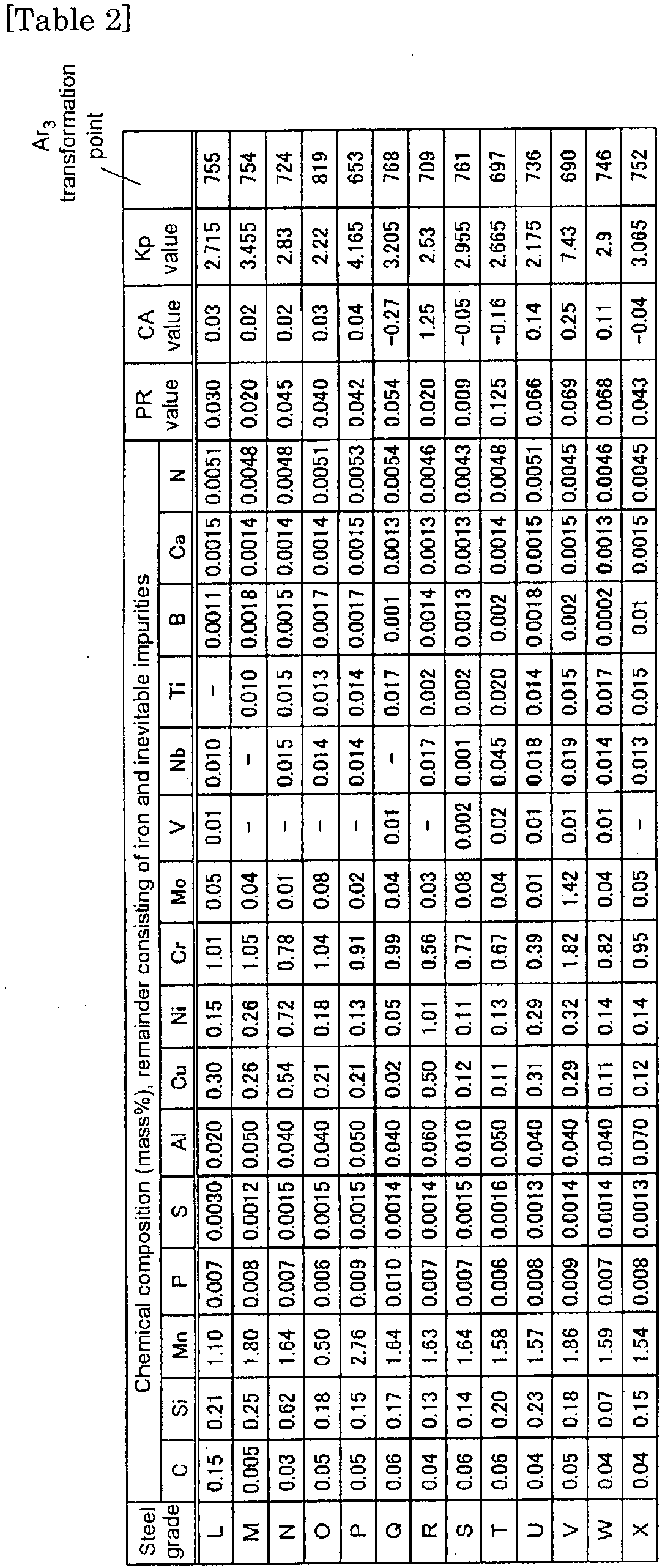
[Table 3] Rolling condition No. Heating temperature [°C] Cumulative draft in total hot rolling step [%] Finish rolling end temperature [°C] Finish rolling draft [%] Average cooling rate [°C/sec] Cooling stop temperature [°C] a 1100 80 820 40 5 400 b 1150 82 780 40 AC* c 1150 75 800 40 5 200 d 1150 80 800 40 5 400 e 1100 80 800 40 8 400 f 1100 80 810 40 2 400 g 1300 80 820 40 5 400 h 900 80 820 40 5 400 i 1100 60 820 40 5 400 j 1100 75 800 10 5 400 k 1100 80 900 35 5 400 l 1100 80 700 40 5 400 m 1100 80 800 40 30 400 n 1100 80 800 40 5 600 * AC: Steel was cooled to room temperature by air cooling (average cooling rate: 0.8°C/sec) - For each of the steel sheets, bainitic fraction, effective crystal grain size, size and fraction of the second phase (harder remaining microstructure), hardness difference ΔH between the bainite and the harder remaining microstructure, tensile strength, and fatigue properties, number density and size of fine precipitates of the steel sheet were measured. In each of measurements, the test specimen was sampled such that the evaluation position is at a 3 mm position from the surface layer of the steel sheet.
- Samples were cut out such that a surface parallel to the rolling direction of the steel sheet and vertical to the surface of the steel sheet was exposed at a position of 3 mm depth from the surface of the steel sheet, the samples were polished by using wet Emery paper at #150 to #1000 and, subsequently, mirror finished by using a diamond abrasive. After etching the mirror polished test specimen with 2% nitric acid - ethanol solution (nital solution), a view field of 150 µm × 200 µm was observed under a microscope at an observation factor of 400X to measure the bainitic fraction (area%) by image analysis. Bainitic fraction was determined for five view fields in total and an average value thereof was adopted (average value for 5 view fields).
- Effective crystal grain size (high-angle crystal grain size) was measured for a cross section parallel to the rolling direction of the steel sheet at a position of 3 mm depth from the surface of the steel sheet by SEM (Scanning Electron Microscope) - EBSP (Electron Backscatter Pattern method). Specifically, an EBSP apparatus manufactured by TEX SEM Laboratories Co. (commercial name: "OIM") was used in combination with SEM and crystal grain size was measured for the boundaries with a tilting angle (crystal orientation difference) of 15° or more as the crystal grain boundary. As the measuring conditions, a measuring region was 200 µm × 200 µm and a measuring step was 0.5 µm spacing, and measuring points with a confidence index showing the reliability of measuring orientation of less than 0.1 were excluded from the object of analysis. For the thus obtained crystal grain boundary, the cut lengths at 100 positions were measured along the direction of the sheet thickness and the average value thereof was adopted as the effective crystal grain size. The effective crystal grain size of 2.0 µm or less was judged as measurement noises and excluded.
- For the size and the fraction of the harder remaining microstructure, samples were cut out by the same method as that for the measurement of the bainitic fraction, polished and etched, subsequently, observed under SEM at an observation factor of 1000X and the size of the remaining microstructure (size of the harder remaining microstructure) and the fraction (fraction of the harder remaining microstructure) sere determined by image analysis. For both of them, average values for five view fields were adopted.
- The hardness difference between the bainite and the harder remaining microstructure was measured by using a super micro indentation hardness tester (manufactured by Elionix Co.). Test specimens were cut out and polished and etched in the same manner as that for the measurement of the bainitic fraction, and a super micro indentation hardness test was carried out on the bainite and the hard remaining microstructures for each 10 points under a load of 10 mN and an average value of the obtained hardness difference (ΔH: hardness of harder remaining microstructure - hardness of bainitic structure) was adopted.
- Tensile test specimens each of a sheet thickness of 4 mm and a gauge length of 35 mm were sampled at positions of 2 to 6 mm depth from the surface layer in each of steel sheets and a tensile test was carried out according to JIS Z 2241 (2011) to measure a tensile strength TS.
- Fatigue properties were measured by preparing test specimens as illustrated in
Fig. 1 by cutting out steel of 4 mm thickness from positions at 2 to 6 mm depth from the surface layer of the plate thickness. The surface of the test specimen was polished to #1200 by Emery paper to remove the effect of the surface state. For the obtained test specimen, a fatigue test was carried out under the following conditions by using an electric servo hydraulic fatigue testing system manufactured by Instron Co.Test circumstance: Room temperature in atmospheric air Control method: Load control Control waveform: Sinusoidal wave Stress ratio: R = -1 Test rate: 20 Hz Number of cycles at test completion: 5,000,000 - The fatigue properties undergo the effect of the tensile strength and, in order to remove the effect, a fatigue limit ratio at 5,000,000 cycles was determined and those having a fatigue limit at 5,000,000 cycles of more than 0.51 were evaluated as satisfactory. The fatigue limit at 5,000,000 cycles is a value obtained by dividing a fatigue strength at 5,000,000 cycles by a tensile strength and the fatigue strength at 5,000,000 cycles was decided as below. A fatigue test was carried out on each of the test specimens at a stress amplitude where the value obtained by dividing a stress amplitude σa with a tensile strength TS (σa/TS) was 0.51, and those not ruptured upon reaching 5,000,000 cycles were evaluated as satisfactory and indicated by "O" in the following Tables 4 and 5 (those ruptured are evaluated as failed and indicated by "X". Further, a fatigue test was carried out at a stress amplitude of (σa/TS) of 0.53 and those not ruptured upon reaching 5,000,000 cycles were represented by "Ⓞ" in the following Tables 4 and 5.
- Test specimens prepared from samples taken out at 3 mm positions from the surface of a steel sheet by an extraction replica method were observed by a transmission electron microscope (TEM) at an observation factor of 150,000X, for five view fields of observation portions, each view field of 750 nm × 625 nm, in five view fields of observation portions, and areas of precipitates containing at least one of Nb, Ti and V in the view field were measured by image analysis to calculate a circle equivalent diameter of each of precipitates based on the area. Inclusion of at least one of Nb, Ti and V was judged by EDX (Energy Dispersive X-ray spectrometry). The number of precipitates having a circle equivalent diameter of 20 nm or less was converted per 1 µm2 as a number density.
- The results are shown in the following Table 4 and Table 5.
[Table 4] Test No. Steel grade Rolling condition No. Tensile strength TS [MPa] Bainitic fraction* [area%] Effective crystal grain size [µm] Size of harder remaining microstructure [µm] Fraction of harder remaining microstructure [area%] ΔH Number density of precipitates [N/µm2] Fatigue properties 1 A a 616 91 5.6 0.7 3.9 111 264 ⊚ 2 A c 601 94 6.1 0.9 4.1 120 271 ⊚ 3 A d 620 93 6.4 0.8 2.7 164 267 ⊚ 4 A e 597 91 5.1 1.2 5.4 114 173 ○ 5 B b 645 88 5.3 1.0 2.8 134 240 ⊚ 6 B e 644 89 4.9 1.1 3.0 121 151 ○ 7 B f 639 86 6.1 1.5 2.6 117 284 ○ 8 c c 554 91 6.4 0.7 4.1 124 191 ○ 9 D a 524 88 5.7 1.4 3.7 121 204 ⊚ 10 E a 574 83 6.1 1.2 5.7 118 231 ○ 11 F b 591 91 5.9 1.0 2.6 117 134 ○ 12 G b 584 93 6.0 0.9 3.9 124 197 ○ 13 H b 581 90 5.8 0.7 1.9 123 204 ⊚ 14 I a 617 83 6.1 0.8 2.4 115 183 ○ 15 J a 587 94 4.9 0.9 3.2 117 211 ⊚ 16 K a 638 90 4.7 1.3 1.7 107 174 ○ * Those other than bainitic fraction and harder remaining microstructure fraction are soft microstructures (ferrite, etc.) [Table 5] Test No. Steel grade Rolling condition No. Tensile strength TS [MPa] Bainitic fraction* [area%] Effective crystal grain size [µm] Size of harder remaining microstructure [µm] Fraction of harder remaining microstructure [area%] ΔH Number density of precipitates [N/µm2] Fatigue properties 17 A g 499 83 10.7 1.2 2.7 145 131 × 18 A h 514 74 7.6 1.5 3.1 131 14 × 19 A i 536 67 6.1 0.9 2.4 110 24 × 20 B j 567 87 11.7 1.4 3.6 113 51 × 21 B k 433 24 8.3 1.3 4.1 123 21 × 22 A l 577 61 6.1 0.9 2.0 110 24 × 23 B m 639 91 4.9 1.1 1.7 121 0 × 24 B n 617 83 6.1 2.8 9.7 24 71 × 25 L a 627 70 8.3 5.4 25.7 156 193 × 26 M b 464 - - 1.0 2.3 - - - 27 N a 634 85 6.6 1.5 3.7 118 0 × 28 O a 441 - - 1.1 4.8 - 127 - 29 P l 713 84 6.1 4.5 10.7 134 41 × 30 Q c 541 83 6.3 1.4 3.9 114 14 × 31 R d 637 91 5.7 1.1 2.1 121 19 × 32 S a 574 70 10.1 1.3 1.7 112 23 × 33 T b 627 93 6.1 0.7 3.4 124 22 × 34 U c 545 54 9.1 0.6 2.7 56 167 × 35 V b 681 91 5.1 3.4 10.4 137 107 × 36 W a 624 96 4.9 0.9 3.6 141 23 × 37 X a 534 64 6.1 1.1 2.7 117 127 × * Those other than bainitic fraction and harder remaining microstructure fraction are soft microstructures (ferrite, etc.) - In view of the results, it can be considered as below. That is, in Test Nos. 1 to 16 (Table 4), since chemical compositions and steel production conditions are appropriately controlled, they satisfy the requirements defined in the present invention (structure, precipitates) and provide excellent fatigue properties.
- On the other hand, in Test Nos. 17 to 37, since at least one of the chemical compositions and production conditions of steel sheets was not appropriate, the test result of the fatigue properties was poor. Among them, in Test No. 17, heating temperature before hot rolling was excessively high (rolling condition No. g), the effective crystal grain size was increased to deteriorate the fatigue properties.
- In Test No. 18, the heating temperature before hot rolling was excessively lower (rolling condition No. h), the bainitic fraction was lowered, the effective crystal grain size was increased and, in addition, the number density of the precipitates was decreased to deteriorate the fatigue properties. In Test No. 19, the cumulative draft during hot rolling was excessively decrease (rolling condition No. i), and the number density of the precipitates was decreased to deteriorate the fatigue properties.
- In Test No. 20, the finish rolling draft was decreased, the effective crystal grain size was excessively large, and the number density of the precipitates was decreased to deteriorate the fatigue properties. In Test No. 21, the finish rolling end temperature was excessively high (rolling condition No. k: the draft in the finish rolling is substantially 0%), the tensile strength was lowered, as well as the bainitic fraction was lowered, the effective crystal grain size was increased and, in addition, the number density of the precipitates was also decreased to deteriorate the fatigue properties. In Test No. 22, the finish rolling end temperature was excessively low (rolling condition No. 1), the bainitic fraction was decreased and, in addition, the number density of precipitates was also decreased to deteriorate the fatigue properties.
- In Test No. 23, the cooling rate after the hot rolling was high and the number density of precipitates was not attained (fine precipitates were not dispersed) to deteriorate the fatigue properties. In Test No. 24, the cooling stop temperature was high (rolling condition No. n), and the number density of precipitates was decreased to deteriorate the fatigue properties.
- Test No. 25 is an example of using steel with excess C content (steel grade L), in which the bainitic fraction was decreased to deteriorate the fatigue properties. Test No. 26 is an example of using steel of less C content (steel grade M) in which predetermined tensile strength was not attained (other properties were not evaluated).
- Test No. 27 is an example of using steel with excess Si content (steel grade N) in which the number density of the precipitates was not attained (fine precipitates were not dispersed) to deteriorate the fatigue properties. Test No. 28 is an example of using steel with less Mn content (steel grade O) in which a predetermined tensile strength was not attained (other properties were not evaluated).
- Test No. 29 is an example of using steel with excess Mn content (steel grade P) in which the size and the fraction of the harder remaining microstructure were excessive to deteriorate the fatigue properties. Test No. 30 is an example of using steel with the content of Cu and Ni being insufficient and CA value was small (steel grade Q), in which the number of density of the precipitates was decreased to deteriorate the fatigue properties. Test No. 31 is an example of using steel with large CA value (steel grade R) (Ni contents was also excessive), in which coarse precipitates were increased and the number density of precipitates was decreased to deteriorate the fatigue properties.
- Test No. 32 is an example of using steel piece with small PR value and CA value (steel grade S), in which the bainitic fraction could not be ensured and the number density of the precipitates was small to deteriorate the fatigue properties. Test No. 33 is an example of using a slab of large PR value and a small CA value (steel grade T), in which the number density of the precipitates was decreased to deteriorate the fatigue properties.
- Test No. 34 is an example of using a steel piece with small Kp value (steel grade U), in which the bainitic fraction was decreased, the effective crystal grain size was increased, and ΔH was also decreased to deteriorate fatigue properties. Test No. 35 is an example of using a steel piece of large Kp value (steel grade V) in which the size and the fraction of the harder remaining microstructure were excessive to deteriorate the fatigue properties.
- Test No. 36 is an example of using a steel piece with less B content (steel grade W), in which the number density of the precipitates was decreased to deteriorate the fatigue properties. Test No. 37 is an example of using steel with excess B content (steel grade X), in which the CA value was also decreased and the bainitic fraction was decreased to deteriorate the fatigue properties.
- For each of steel sheets of Test Nos. 1 to 16 shown in Table 4, the bainitic fraction, the effective crystal grain size, and the size of the second phase at the position for 1/4 of the sheet thickness were evaluated by the same method as that shown in Example 1. The sampling method of the test specimen was identical with that described above except for setting a position at 1/4 of the sheet thickness. Further, crack growth rate of the steel sheets was measured by the following method.
- A fatigue crack growth test was carried out by an electric servo hydraulic fatigue tester under the following conditions using compact test specimens according to ASTM E647, to measure the crack growth rate. The compact test specimen was sampled from a position at 1/2 of the sheet thickness and a shape as illustrated in
Fig. 2 was used. A compliance method was adopted for the crack length.Test circumstance: Room temperature, in atmospheric air Control method: Load control Control waveform: Sinusoidal wave Stress ratio: R = -1 Test rate: 5 - 20 Hz - Values in a stable growth region ΔK = 20 (Mpa · m1/2) where the Paris' Law according to the following formula (6) was established was evaluated as a representative value. Those having a crack growth rate of 5.0 × 10⁻⁵ mm/cycle or less at ΔK = 20 (MPa · m1/2) were evaluated as excellent for the crack growth properties.

- The results are shown in the following Table 6.
[Table 6] Test No. Steel grade Rolling condition No. Bainitic fraction [area%]* Effective crystal grain size [µm] Size of harder remaining microstructure [µm] Crack growing speed (× 10-5 mm/cycle) 1 A a 85 5.6 0.7 1.92 2 A c 88 11.2 0.9 5.21 3 A d 84 6.4 0.8 1.97 4 A e 85 5.1 1.2 1.92 5 B b 70 5.3 1.0 6.31 6 B e 84 4.9 1.1 1.92 7 B f 81 6.1 1.5 1.94 8 c c 85 10.9 0.7 5.14 9 D a 81 5.7 1.4 1.89 10 E a 84 6.1 1.2 3.41 11 F b 87 5.9 1.0 1.97 12 G b 73 6.0 0.9 5.83 13 H b 72 5.8 0.7 6.01 14 I a 82 6.1 0.8 3.24 15 J a 94 4.9 0.9 1.87 16 K a 83 4.7 1.3 1.88 * Those other than the bainitic fraction and harder remaining microstructure fraction are soft microstructures (ferrite, etc.) - In view of the results, it can be considered as below. That is, since the chemical compositions and production conditions of the steel were appropriately controlled in Test Nos. 1, 3, 4, 6, 7, 9 to 11, and 14 to 16, preferred conditions inside the steel sheet (structure, precipitates) were satisfied and excellent fatigue crack growth properties (crack growth rate (crack growth rate of 5.0 × 10⁻⁵ mm/cycle or less) were obtained.
- On the contrary, in Test Nos. 2 and 8, the cumulative draft in the total hot rolling step was decreased to less than the cumulative draft during hot rolling (rolling condition No. c) and the effective crystal grain size was increased to deteriorate the fatigue crack growth properties. Further, in Test Nos. 5, 12, 13, the cooling rate after the hot rolling was lowered (rolling condition No. b) and the bainitic fraction was decreased to deteriorate the fatigue crack growth properties.
- While the present invention has been described specifically with reference to specified embodiments, it will be apparent to a person skilled in the art that various changes and modifications are possible without departing the spirit and the scope of the present invention.
- The present application is based on Japanese Patent Application filed on
August 26, 2013 (Patent Application No. 2013-175024 March 4, 2014 (Patent Application No. 2014-041920
Claims (5)
- A thick steel sheet excellent in fatigue properties comprising, by mass%, 0.010 to 0.1% of C, more than 0% and 0.3% or less of Si, 1.0 to 2% of Mn, 0.5 to 2% of Cr, 0.005 to 1.5% of Mo, and 0.0005 to 0.005% of B, respectively, and comprising one or more elements selected from 0.1 to 1.0% of Cu, and 0.1 to 1.0% of Ni, and one or more element selected from the group consisting of 0.05% or less of V, 0.05% or less of Nb, and 0.05% or less of Ti, in which the elements satisfy the relation of the following formulas (1) to (3), and the remainder of iron and inevitable impurities, in which
the micro structure satisfies the following requirements, (a) to (d) when measured at an observation position at a depth of 3 mm from the surface of a steel sheet for a vertical cross section parallel to a rolling direction, and precipitates satisfy the following requirement (A):

 (a) the micro structure comprises a bainitic structure and a remaining microstructure harder than the bainite where the bainitic fraction is 80 area% or more in the whole microstructure,(b) when the crystal grain size of the bainite is determined based on a high-angle grain boundary having an orientation difference between adjacent crystals of 15° or greater, an average length of the crystal grains in the direction of the sheet thickness is 7 µm or less,(c) a circle equivalent diameter of a harder remaining microstructure is 3 µm or less, and(d) a difference of hardness between the bainite and the harder remaining microstructure (hardness of the harder remaining microstructure - hardness of the bainite) is Hv 100 or more, and(A) the number of precipitates containing at least one of Nb, Ti, and V each having a circle equivalent diameter of 20 nm or less is 100 N/µm2 or more.
 - The thick steel sheet according to claim 1, wherein the sheet further comprises at least one element selected from, by mass %, more than 0% and 0.005% or less of Ca, more than 0% and 0.10% or less of Al, and more than 0% and 0.010% or less of N.
- The thick steel sheet according to claim 1 or 2, wherein
the micro structure satisfies the following requirements (e) to (g) when observed for a vertical cross section parallel to the rolling direction at a position of 1/4 for the sheet thickness (t/4 position): in which(e) the micro structure comprises a bainitic structure and a remaining microstructure harder than the bainite, in which the bainitic fraction in the entire microstructure is 80 area% or more,(f) when the crystal grain of the bainite was determined based on a high-angle grain boundary having an orientation difference between adjacent crystals of 15° or more, the average length of the crystal grain in the direction of the sheet thickness is 7 µm or less, and(g) the circle equivalent diameter of the harder remaining microstructure is 3 µm or less. - A method for producing a thick steel sheet of excellent fatigue properties in which a steel piece of the chemical composition according to claim 1 or 2 is hot rolled under the following conditions
heating temperature : 1000 to 1200°C
cumulative draft in the total hot rolling step: 70% or higher
cumulative draft during finish rolling which is set within a range of Ar3 transformation point + 100°C to Ar3 transformation point: 30% or more
average cooling rate from finish rolling completion to 600°C: 10°C/sec or less. - The method for producing a thick steel sheet according to claim 4 wherein the cooling stop temperature is 450°C or lower.
Applications Claiming Priority (3)
| Application Number | Priority Date | Filing Date | Title |
|---|---|---|---|
| JP2013175024 | 2013-08-26 | ||
| JP2014041920A JP6228491B2 (en) | 2013-08-26 | 2014-03-04 | Thick steel plate with excellent fatigue characteristics and method for producing the same |
| PCT/JP2014/071894 WO2015029873A1 (en) | 2013-08-26 | 2014-08-21 | Thick steel sheet having excellent fatigue properties, and method for producing same |
Publications (3)
| Publication Number | Publication Date |
|---|---|
| EP3040436A1 true EP3040436A1 (en) | 2016-07-06 |
| EP3040436A4 EP3040436A4 (en) | 2017-04-26 |
| EP3040436B1 EP3040436B1 (en) | 2018-04-18 |
Family
ID=52586433
Family Applications (1)
| Application Number | Title | Priority Date | Filing Date |
|---|---|---|---|
| EP14840332.2A Not-in-force EP3040436B1 (en) | 2013-08-26 | 2014-08-21 | Thick steel sheet having excellent fatigue properties, and method for producing same |
Country Status (5)
| Country | Link |
|---|---|
| EP (1) | EP3040436B1 (en) |
| JP (1) | JP6228491B2 (en) |
| KR (1) | KR101747612B1 (en) |
| CN (1) | CN105473752B (en) |
| WO (1) | WO2015029873A1 (en) |
Cited By (1)
| Publication number | Priority date | Publication date | Assignee | Title |
|---|---|---|---|---|
| US11591677B2 (en) | 2017-12-26 | 2023-02-28 | Posco Co., Ltd | High-strength structural steel material having excellent fatigue crack propagation inhibitory characteristics and manufacturing method therefor |
Families Citing this family (5)
| Publication number | Priority date | Publication date | Assignee | Title |
|---|---|---|---|---|
| AU2018414317A1 (en) * | 2018-03-22 | 2020-07-16 | Nippon Steel Corporation | Abrasion Resistant Steel and Method for Producing Same |
| CN113355608A (en) * | 2021-05-14 | 2021-09-07 | 南京钢铁股份有限公司 | API 2W-50 steel plate for offshore oil platform and production method thereof |
| JP7533414B2 (en) * | 2021-09-29 | 2024-08-14 | Jfeスチール株式会社 | Steel plate with excellent fatigue crack propagation resistance and manufacturing method thereof |
| CN114807745B (en) * | 2022-03-21 | 2023-06-16 | 江阴兴澄特种钢铁有限公司 | Steel for automobile piston pin and manufacturing method thereof |
| CN115078040B (en) * | 2022-07-27 | 2024-12-10 | 广东韶钢松山股份有限公司 | Evaluation method of thossoid-type banded structure |
Family Cites Families (15)
| Publication number | Priority date | Publication date | Assignee | Title |
|---|---|---|---|---|
| JPH1060575A (en) | 1996-08-22 | 1998-03-03 | Sumitomo Metal Ind Ltd | Thick steel plate with excellent fatigue crack growth suppression properties |
| JP4254013B2 (en) * | 2000-05-11 | 2009-04-15 | 住友金属工業株式会社 | Thick steel plate with excellent resistance to fatigue crack growth and manufacturing method thereof |
| JP3775279B2 (en) * | 2000-12-15 | 2006-05-17 | Jfeスチール株式会社 | Structural steel with excellent brittle crack propagation stoppage and fatigue crack propagation after plastic deformation and its manufacturing method |
| JP3860763B2 (en) * | 2002-02-19 | 2006-12-20 | 新日本製鐵株式会社 | Thick steel plate with excellent fatigue strength and its manufacturing method |
| JP4926406B2 (en) * | 2004-04-08 | 2012-05-09 | 新日本製鐵株式会社 | Steel sheet with excellent fatigue crack propagation characteristics |
| JP4227563B2 (en) * | 2004-06-08 | 2009-02-18 | 株式会社神戸製鋼所 | High toughness high tension non-tempered thick steel plate |
| JP4502272B2 (en) * | 2005-12-14 | 2010-07-14 | 株式会社神戸製鋼所 | Hot-rolled steel sheet excellent in workability and fatigue characteristics and casting method thereof |
| JP2007191781A (en) * | 2005-12-19 | 2007-08-02 | Kobe Steel Ltd | Steel sheet having superior resistance to propagation of fatigue crack |
| CN100412223C (en) * | 2006-07-20 | 2008-08-20 | 武汉钢铁(集团)公司 | Ultra-high strength steel with excellent corrosion resistance and fatigue resistance and its making process |
| JP4955497B2 (en) | 2007-09-28 | 2012-06-20 | 株式会社神戸製鋼所 | Hot-rolled steel sheet with excellent fatigue characteristics and stretch flangeability balance |
| JP4436419B2 (en) * | 2008-05-02 | 2010-03-24 | 新日本製鐵株式会社 | Hot-rolled steel sheet for machine structural steel pipes with excellent fatigue characteristics and bending formability and its manufacturing method |
| JP5342902B2 (en) * | 2009-03-11 | 2013-11-13 | 株式会社神戸製鋼所 | Steel material excellent in toughness and base metal fatigue characteristics of weld heat-affected zone and its manufacturing method |
| JP2011195944A (en) | 2010-03-24 | 2011-10-06 | Jfe Steel Corp | Method for producing steel excellent in fatigue-crack propagation resistant characteristic |
| JP5643542B2 (en) * | 2010-05-19 | 2014-12-17 | 株式会社神戸製鋼所 | Thick steel plate with excellent fatigue characteristics |
| JP5029748B2 (en) * | 2010-09-17 | 2012-09-19 | Jfeスチール株式会社 | High strength hot rolled steel sheet with excellent toughness and method for producing the same |
-
2014
- 2014-03-04 JP JP2014041920A patent/JP6228491B2/en not_active Expired - Fee Related
- 2014-08-21 WO PCT/JP2014/071894 patent/WO2015029873A1/en not_active Ceased
- 2014-08-21 KR KR1020167004649A patent/KR101747612B1/en not_active Expired - Fee Related
- 2014-08-21 EP EP14840332.2A patent/EP3040436B1/en not_active Not-in-force
- 2014-08-21 CN CN201480046488.XA patent/CN105473752B/en not_active Expired - Fee Related
Non-Patent Citations (1)
| Title |
|---|
| See references of WO2015029873A1 * |
Cited By (1)
| Publication number | Priority date | Publication date | Assignee | Title |
|---|---|---|---|---|
| US11591677B2 (en) | 2017-12-26 | 2023-02-28 | Posco Co., Ltd | High-strength structural steel material having excellent fatigue crack propagation inhibitory characteristics and manufacturing method therefor |
Also Published As
| Publication number | Publication date |
|---|---|
| KR20160033227A (en) | 2016-03-25 |
| CN105473752A (en) | 2016-04-06 |
| EP3040436B1 (en) | 2018-04-18 |
| KR101747612B1 (en) | 2017-06-14 |
| WO2015029873A1 (en) | 2015-03-05 |
| EP3040436A4 (en) | 2017-04-26 |
| JP6228491B2 (en) | 2017-11-08 |
| CN105473752B (en) | 2017-06-06 |
| JP2015063745A (en) | 2015-04-09 |
Similar Documents
| Publication | Publication Date | Title |
|---|---|---|
| EP3040436B1 (en) | Thick steel sheet having excellent fatigue properties, and method for producing same | |
| JP4977185B2 (en) | High-strength cold-rolled steel sheet with excellent balance between elongation and stretch flangeability and method for producing the same | |
| JP4712838B2 (en) | High strength cold-rolled steel sheet with excellent hydrogen embrittlement resistance and workability | |
| WO2009110607A1 (en) | Cold-rolled steel sheets | |
| WO2010114131A1 (en) | Cold-rolled steel sheet and process for producing same | |
| KR101327643B1 (en) | STEEL SHEET FOR LOW YIELD RATIO THICK STEEL PIPE WITH 780 MPa OR ABOVE TENSILE STRENGTH, METHOD FOR PRODUCING THE SAME, AND LOW YIELD RATIO THICK STEEL PIPE WITH 780 MPa OR ABOVE TENSILE STRENGTH | |
| EP3719155B1 (en) | High-strength cold-rolled steel sheet and method for manufacturing same | |
| CN114040988B (en) | High-strength steel sheet and method for producing same | |
| JP2005336526A (en) | High-strength steel sheet with excellent workability and method for producing the same | |
| KR20190112021A (en) | Quenching of hardened steel | |
| EP3633057B1 (en) | Steel plate and method of producing same | |
| KR102714884B1 (en) | hot rolled steel plate | |
| CN105452511B (en) | The steel plate and its manufacture method of excellent in fatigue characteristics | |
| JP6036616B2 (en) | Steel sheet for welded structure excellent in fatigue crack resistance and method for producing the same | |
| EP4534719A1 (en) | Hot stamping part | |
| EP3147379A1 (en) | Thick steel plate | |
| KR20080104940A (en) | Steel plate excellent in fatigue crack propagation suppression and brittle fracture suppression | |
| WO2010109702A1 (en) | Cold-rolled steel sheet | |
| KR20220062603A (en) | hot rolled steel | |
| JP6036615B2 (en) | Steel sheet for welded structure having excellent weldability and fatigue crack propagation resistance and method for producing the same | |
| JP4712839B2 (en) | High strength cold-rolled steel sheet with excellent hydrogen embrittlement resistance and workability | |
| JP2022086737A (en) | Steel sheet and method for producing the same | |
| EP4461838B1 (en) | Steel plate and method of producing same | |
| JP7747127B2 (en) | Steel material with excellent fatigue crack propagation resistance and manufacturing method thereof | |
| EP4502211A1 (en) | Cold-rolled steel sheet and method for producing cold-rolled steel sheet |
Legal Events
| Date | Code | Title | Description |
|---|---|---|---|
| PUAI | Public reference made under article 153(3) epc to a published international application that has entered the european phase |
Free format text: ORIGINAL CODE: 0009012 |
|
| 17P | Request for examination filed |
Effective date: 20160128 |
|
| AK | Designated contracting states |
Kind code of ref document: A1 Designated state(s): AL AT BE BG CH CY CZ DE DK EE ES FI FR GB GR HR HU IE IS IT LI LT LU LV MC MK MT NL NO PL PT RO RS SE SI SK SM TR |
|
| AX | Request for extension of the european patent |
Extension state: BA ME |
|
| DAX | Request for extension of the european patent (deleted) | ||
| A4 | Supplementary search report drawn up and despatched |
Effective date: 20170324 |
|
| RIC1 | Information provided on ipc code assigned before grant |
Ipc: C22C 38/58 20060101ALI20170320BHEP Ipc: C22C 38/00 20060101AFI20170320BHEP Ipc: B21B 1/38 20060101ALI20170320BHEP Ipc: C21D 8/02 20060101ALI20170320BHEP |
|
| GRAP | Despatch of communication of intention to grant a patent |
Free format text: ORIGINAL CODE: EPIDOSNIGR1 |
|
| INTG | Intention to grant announced |
Effective date: 20171207 |
|
| GRAS | Grant fee paid |
Free format text: ORIGINAL CODE: EPIDOSNIGR3 |
|
| GRAA | (expected) grant |
Free format text: ORIGINAL CODE: 0009210 |
|
| AK | Designated contracting states |
Kind code of ref document: B1 Designated state(s): AL AT BE BG CH CY CZ DE DK EE ES FI FR GB GR HR HU IE IS IT LI LT LU LV MC MK MT NL NO PL PT RO RS SE SI SK SM TR |
|
| REG | Reference to a national code |
Ref country code: GB Ref legal event code: FG4D |
|
| REG | Reference to a national code |
Ref country code: CH Ref legal event code: EP |
|
| REG | Reference to a national code |
Ref country code: AT Ref legal event code: REF Ref document number: 990553 Country of ref document: AT Kind code of ref document: T Effective date: 20180515 |
|
| REG | Reference to a national code |
Ref country code: IE Ref legal event code: FG4D |
|
| REG | Reference to a national code |
Ref country code: DE Ref legal event code: R096 Ref document number: 602014024240 Country of ref document: DE |
|
| REG | Reference to a national code |
Ref country code: NL Ref legal event code: MP Effective date: 20180418 |
|
| REG | Reference to a national code |
Ref country code: LT Ref legal event code: MG4D |
|
| PG25 | Lapsed in a contracting state [announced via postgrant information from national office to epo] |
Ref country code: NL Free format text: LAPSE BECAUSE OF FAILURE TO SUBMIT A TRANSLATION OF THE DESCRIPTION OR TO PAY THE FEE WITHIN THE PRESCRIBED TIME-LIMIT Effective date: 20180418 |
|
| PG25 | Lapsed in a contracting state [announced via postgrant information from national office to epo] |
Ref country code: LT Free format text: LAPSE BECAUSE OF FAILURE TO SUBMIT A TRANSLATION OF THE DESCRIPTION OR TO PAY THE FEE WITHIN THE PRESCRIBED TIME-LIMIT Effective date: 20180418 Ref country code: PL Free format text: LAPSE BECAUSE OF FAILURE TO SUBMIT A TRANSLATION OF THE DESCRIPTION OR TO PAY THE FEE WITHIN THE PRESCRIBED TIME-LIMIT Effective date: 20180418 Ref country code: BG Free format text: LAPSE BECAUSE OF FAILURE TO SUBMIT A TRANSLATION OF THE DESCRIPTION OR TO PAY THE FEE WITHIN THE PRESCRIBED TIME-LIMIT Effective date: 20180718 Ref country code: FI Free format text: LAPSE BECAUSE OF FAILURE TO SUBMIT A TRANSLATION OF THE DESCRIPTION OR TO PAY THE FEE WITHIN THE PRESCRIBED TIME-LIMIT Effective date: 20180418 Ref country code: NO Free format text: LAPSE BECAUSE OF FAILURE TO SUBMIT A TRANSLATION OF THE DESCRIPTION OR TO PAY THE FEE WITHIN THE PRESCRIBED TIME-LIMIT Effective date: 20180718 Ref country code: AL Free format text: LAPSE BECAUSE OF FAILURE TO SUBMIT A TRANSLATION OF THE DESCRIPTION OR TO PAY THE FEE WITHIN THE PRESCRIBED TIME-LIMIT Effective date: 20180418 Ref country code: SE Free format text: LAPSE BECAUSE OF FAILURE TO SUBMIT A TRANSLATION OF THE DESCRIPTION OR TO PAY THE FEE WITHIN THE PRESCRIBED TIME-LIMIT Effective date: 20180418 Ref country code: ES Free format text: LAPSE BECAUSE OF FAILURE TO SUBMIT A TRANSLATION OF THE DESCRIPTION OR TO PAY THE FEE WITHIN THE PRESCRIBED TIME-LIMIT Effective date: 20180418 |
|
| PG25 | Lapsed in a contracting state [announced via postgrant information from national office to epo] |
Ref country code: GR Free format text: LAPSE BECAUSE OF FAILURE TO SUBMIT A TRANSLATION OF THE DESCRIPTION OR TO PAY THE FEE WITHIN THE PRESCRIBED TIME-LIMIT Effective date: 20180719 Ref country code: HR Free format text: LAPSE BECAUSE OF FAILURE TO SUBMIT A TRANSLATION OF THE DESCRIPTION OR TO PAY THE FEE WITHIN THE PRESCRIBED TIME-LIMIT Effective date: 20180418 Ref country code: LV Free format text: LAPSE BECAUSE OF FAILURE TO SUBMIT A TRANSLATION OF THE DESCRIPTION OR TO PAY THE FEE WITHIN THE PRESCRIBED TIME-LIMIT Effective date: 20180418 Ref country code: RS Free format text: LAPSE BECAUSE OF FAILURE TO SUBMIT A TRANSLATION OF THE DESCRIPTION OR TO PAY THE FEE WITHIN THE PRESCRIBED TIME-LIMIT Effective date: 20180418 |
|
| REG | Reference to a national code |
Ref country code: AT Ref legal event code: MK05 Ref document number: 990553 Country of ref document: AT Kind code of ref document: T Effective date: 20180418 |
|
| PG25 | Lapsed in a contracting state [announced via postgrant information from national office to epo] |
Ref country code: PT Free format text: LAPSE BECAUSE OF FAILURE TO SUBMIT A TRANSLATION OF THE DESCRIPTION OR TO PAY THE FEE WITHIN THE PRESCRIBED TIME-LIMIT Effective date: 20180820 |
|
| REG | Reference to a national code |
Ref country code: DE Ref legal event code: R097 Ref document number: 602014024240 Country of ref document: DE |
|
| PG25 | Lapsed in a contracting state [announced via postgrant information from national office to epo] |
Ref country code: DK Free format text: LAPSE BECAUSE OF FAILURE TO SUBMIT A TRANSLATION OF THE DESCRIPTION OR TO PAY THE FEE WITHIN THE PRESCRIBED TIME-LIMIT Effective date: 20180418 Ref country code: EE Free format text: LAPSE BECAUSE OF FAILURE TO SUBMIT A TRANSLATION OF THE DESCRIPTION OR TO PAY THE FEE WITHIN THE PRESCRIBED TIME-LIMIT Effective date: 20180418 Ref country code: AT Free format text: LAPSE BECAUSE OF FAILURE TO SUBMIT A TRANSLATION OF THE DESCRIPTION OR TO PAY THE FEE WITHIN THE PRESCRIBED TIME-LIMIT Effective date: 20180418 Ref country code: SK Free format text: LAPSE BECAUSE OF FAILURE TO SUBMIT A TRANSLATION OF THE DESCRIPTION OR TO PAY THE FEE WITHIN THE PRESCRIBED TIME-LIMIT Effective date: 20180418 Ref country code: RO Free format text: LAPSE BECAUSE OF FAILURE TO SUBMIT A TRANSLATION OF THE DESCRIPTION OR TO PAY THE FEE WITHIN THE PRESCRIBED TIME-LIMIT Effective date: 20180418 Ref country code: CZ Free format text: LAPSE BECAUSE OF FAILURE TO SUBMIT A TRANSLATION OF THE DESCRIPTION OR TO PAY THE FEE WITHIN THE PRESCRIBED TIME-LIMIT Effective date: 20180418 |
|
| PLBE | No opposition filed within time limit |
Free format text: ORIGINAL CODE: 0009261 |
|
| STAA | Information on the status of an ep patent application or granted ep patent |
Free format text: STATUS: NO OPPOSITION FILED WITHIN TIME LIMIT |
|
| PG25 | Lapsed in a contracting state [announced via postgrant information from national office to epo] |
Ref country code: IT Free format text: LAPSE BECAUSE OF FAILURE TO SUBMIT A TRANSLATION OF THE DESCRIPTION OR TO PAY THE FEE WITHIN THE PRESCRIBED TIME-LIMIT Effective date: 20180418 Ref country code: SM Free format text: LAPSE BECAUSE OF FAILURE TO SUBMIT A TRANSLATION OF THE DESCRIPTION OR TO PAY THE FEE WITHIN THE PRESCRIBED TIME-LIMIT Effective date: 20180418 |
|
| REG | Reference to a national code |
Ref country code: DE Ref legal event code: R119 Ref document number: 602014024240 Country of ref document: DE |
|
| 26N | No opposition filed |
Effective date: 20190121 |
|
| PG25 | Lapsed in a contracting state [announced via postgrant information from national office to epo] |
Ref country code: MC Free format text: LAPSE BECAUSE OF FAILURE TO SUBMIT A TRANSLATION OF THE DESCRIPTION OR TO PAY THE FEE WITHIN THE PRESCRIBED TIME-LIMIT Effective date: 20180418 |
|
| REG | Reference to a national code |
Ref country code: CH Ref legal event code: PL |
|
| GBPC | Gb: european patent ceased through non-payment of renewal fee |
Effective date: 20180821 |
|
| PG25 | Lapsed in a contracting state [announced via postgrant information from national office to epo] |
Ref country code: CH Free format text: LAPSE BECAUSE OF NON-PAYMENT OF DUE FEES Effective date: 20180831 Ref country code: LI Free format text: LAPSE BECAUSE OF NON-PAYMENT OF DUE FEES Effective date: 20180831 Ref country code: LU Free format text: LAPSE BECAUSE OF NON-PAYMENT OF DUE FEES Effective date: 20180821 |
|
| PG25 | Lapsed in a contracting state [announced via postgrant information from national office to epo] |
Ref country code: SI Free format text: LAPSE BECAUSE OF FAILURE TO SUBMIT A TRANSLATION OF THE DESCRIPTION OR TO PAY THE FEE WITHIN THE PRESCRIBED TIME-LIMIT Effective date: 20180418 |
|
| PG25 | Lapsed in a contracting state [announced via postgrant information from national office to epo] |
Ref country code: DE Free format text: LAPSE BECAUSE OF NON-PAYMENT OF DUE FEES Effective date: 20190301 |
|
| PG25 | Lapsed in a contracting state [announced via postgrant information from national office to epo] |
Ref country code: FR Free format text: LAPSE BECAUSE OF NON-PAYMENT OF DUE FEES Effective date: 20180831 |
|
| PGFP | Annual fee paid to national office [announced via postgrant information from national office to epo] |
Ref country code: BE Payment date: 20190617 Year of fee payment: 6 |
|
| PG25 | Lapsed in a contracting state [announced via postgrant information from national office to epo] |
Ref country code: GB Free format text: LAPSE BECAUSE OF NON-PAYMENT OF DUE FEES Effective date: 20180821 |
|
| PG25 | Lapsed in a contracting state [announced via postgrant information from national office to epo] |
Ref country code: MT Free format text: LAPSE BECAUSE OF NON-PAYMENT OF DUE FEES Effective date: 20180821 |
|
| PG25 | Lapsed in a contracting state [announced via postgrant information from national office to epo] |
Ref country code: TR Free format text: LAPSE BECAUSE OF FAILURE TO SUBMIT A TRANSLATION OF THE DESCRIPTION OR TO PAY THE FEE WITHIN THE PRESCRIBED TIME-LIMIT Effective date: 20180418 |
|
| PG25 | Lapsed in a contracting state [announced via postgrant information from national office to epo] |
Ref country code: MK Free format text: LAPSE BECAUSE OF NON-PAYMENT OF DUE FEES Effective date: 20180418 Ref country code: CY Free format text: LAPSE BECAUSE OF FAILURE TO SUBMIT A TRANSLATION OF THE DESCRIPTION OR TO PAY THE FEE WITHIN THE PRESCRIBED TIME-LIMIT Effective date: 20180418 Ref country code: IE Free format text: LAPSE BECAUSE OF NON-PAYMENT OF DUE FEES Effective date: 20180821 Ref country code: HU Free format text: LAPSE BECAUSE OF FAILURE TO SUBMIT A TRANSLATION OF THE DESCRIPTION OR TO PAY THE FEE WITHIN THE PRESCRIBED TIME-LIMIT; INVALID AB INITIO Effective date: 20140821 |
|
| PG25 | Lapsed in a contracting state [announced via postgrant information from national office to epo] |
Ref country code: IS Free format text: LAPSE BECAUSE OF FAILURE TO SUBMIT A TRANSLATION OF THE DESCRIPTION OR TO PAY THE FEE WITHIN THE PRESCRIBED TIME-LIMIT Effective date: 20180818 |
|
| REG | Reference to a national code |
Ref country code: BE Ref legal event code: MM Effective date: 20200831 |
|
| PG25 | Lapsed in a contracting state [announced via postgrant information from national office to epo] |
Ref country code: BE Free format text: LAPSE BECAUSE OF NON-PAYMENT OF DUE FEES Effective date: 20200831 |