EP3038601B1 - Combination formulation of two antiviral compounds - Google Patents
Combination formulation of two antiviral compounds Download PDFInfo
- Publication number
- EP3038601B1 EP3038601B1 EP14704501.7A EP14704501A EP3038601B1 EP 3038601 B1 EP3038601 B1 EP 3038601B1 EP 14704501 A EP14704501 A EP 14704501A EP 3038601 B1 EP3038601 B1 EP 3038601B1
- Authority
- EP
- European Patent Office
- Prior art keywords
- compound
- sofosbuvir
- hcv
- pharmaceutical composition
- solid dispersion
- Prior art date
- Legal status (The legal status is an assumption and is not a legal conclusion. Google has not performed a legal analysis and makes no representation as to the accuracy of the status listed.)
- Active
Links
- NBRBXGKOEOGLOI-UHFFFAOYSA-N CC(C)(C)c(cc(cc1-c(ccc2c3)cc2ccc3NS(C)(=O)=O)N(C=CC(N2)=O)C2=O)c1OC Chemical compound CC(C)(C)c(cc(cc1-c(ccc2c3)cc2ccc3NS(C)(=O)=O)N(C=CC(N2)=O)C2=O)c1OC NBRBXGKOEOGLOI-UHFFFAOYSA-N 0.000 description 1
- RFGUWOCFYCYEDM-ZOMNBDOOSA-N CC(C)Nc1nc(-c2cc(O[C@H](C[C@H]3C(N[C@](C4)([C@@H]4CCCCCCC[C@@H]4NC(OC5CCCC5)=O)P(Cc(c(F)ccc5)c5F)(O)=O)=O)CN3C4=O)c(ccc(OC)c3Cl)c3n2)c[s]1 Chemical compound CC(C)Nc1nc(-c2cc(O[C@H](C[C@H]3C(N[C@](C4)([C@@H]4CCCCCCC[C@@H]4NC(OC5CCCC5)=O)P(Cc(c(F)ccc5)c5F)(O)=O)=O)CN3C4=O)c(ccc(OC)c3Cl)c3n2)c[s]1 RFGUWOCFYCYEDM-ZOMNBDOOSA-N 0.000 description 1
- LHXVQZHYYJEESE-HTOBMGAISA-N CC(C)[C@@H](C(N(CC1(CC1)C1)[C@@H]1c1nc(-c(cc2)cc(C3(F)F)c2-c(cc2)c3cc2-c(cc2)cc3c2nc(C(C[C@@H]2C[C@H]4CC2)N4C([C@H](C(C)C)NC(OC)=O)=O)[nH]3)c[nH]1)=O)NC(OC)=O Chemical compound CC(C)[C@@H](C(N(CC1(CC1)C1)[C@@H]1c1nc(-c(cc2)cc(C3(F)F)c2-c(cc2)c3cc2-c(cc2)cc3c2nc(C(C[C@@H]2C[C@H]4CC2)N4C([C@H](C(C)C)NC(OC)=O)=O)[nH]3)c[nH]1)=O)NC(OC)=O LHXVQZHYYJEESE-HTOBMGAISA-N 0.000 description 1
- BBCRGAPIBOSJEG-WFLSSLBFSA-N CC(C)[C@@H](C(NC(C(N(CCC1)N[C@@H]1C(N[C@H](C)c1nc2cc(/C=C/C34COC(CF)(CF)OC3)ccc2cc1)=O)=O)=C)=O)OC4=O Chemical compound CC(C)[C@@H](C(NC(C(N(CCC1)N[C@@H]1C(N[C@H](C)c1nc2cc(/C=C/C34COC(CF)(CF)OC3)ccc2cc1)=O)=O)=C)=O)OC4=O BBCRGAPIBOSJEG-WFLSSLBFSA-N 0.000 description 1
- AAHUSZJRPRPGKG-RBAMNZTLSA-N CCC[C@](C)(C(O)=O)NC([C@H](CC(C1)Oc2c(ccc(OCCN3CCOCC3)c3Cl)c3nc(-c3c[s]c(NC(C)C)n3)c2)N1C([C@H](C(C)(C)C)NC(O[C@H](C1)C[C@@H]2[C@H]1[C@@H]2C)=O)=O)=O Chemical compound CCC[C@](C)(C(O)=O)NC([C@H](CC(C1)Oc2c(ccc(OCCN3CCOCC3)c3Cl)c3nc(-c3c[s]c(NC(C)C)n3)c2)N1C([C@H](C(C)(C)C)NC(O[C@H](C1)C[C@@H]2[C@H]1[C@@H]2C)=O)=O)=O AAHUSZJRPRPGKG-RBAMNZTLSA-N 0.000 description 1
Classifications
-
- A—HUMAN NECESSITIES
- A61—MEDICAL OR VETERINARY SCIENCE; HYGIENE
- A61K—PREPARATIONS FOR MEDICAL, DENTAL OR TOILETRY PURPOSES
- A61K31/00—Medicinal preparations containing organic active ingredients
- A61K31/33—Heterocyclic compounds
- A61K31/395—Heterocyclic compounds having nitrogen as a ring hetero atom, e.g. guanethidine or rifamycins
- A61K31/41—Heterocyclic compounds having nitrogen as a ring hetero atom, e.g. guanethidine or rifamycins having five-membered rings with two or more ring hetero atoms, at least one of which being nitrogen, e.g. tetrazole
- A61K31/4164—1,3-Diazoles
- A61K31/4188—1,3-Diazoles condensed with other heterocyclic ring systems, e.g. biotin, sorbinil
-
- A—HUMAN NECESSITIES
- A61—MEDICAL OR VETERINARY SCIENCE; HYGIENE
- A61K—PREPARATIONS FOR MEDICAL, DENTAL OR TOILETRY PURPOSES
- A61K31/00—Medicinal preparations containing organic active ingredients
- A61K31/70—Carbohydrates; Sugars; Derivatives thereof
- A61K31/7042—Compounds having saccharide radicals and heterocyclic rings
- A61K31/7052—Compounds having saccharide radicals and heterocyclic rings having nitrogen as a ring hetero atom, e.g. nucleosides, nucleotides
- A61K31/7056—Compounds having saccharide radicals and heterocyclic rings having nitrogen as a ring hetero atom, e.g. nucleosides, nucleotides containing five-membered rings with nitrogen as a ring hetero atom
-
- A—HUMAN NECESSITIES
- A61—MEDICAL OR VETERINARY SCIENCE; HYGIENE
- A61K—PREPARATIONS FOR MEDICAL, DENTAL OR TOILETRY PURPOSES
- A61K31/00—Medicinal preparations containing organic active ingredients
- A61K31/70—Carbohydrates; Sugars; Derivatives thereof
- A61K31/7042—Compounds having saccharide radicals and heterocyclic rings
- A61K31/7052—Compounds having saccharide radicals and heterocyclic rings having nitrogen as a ring hetero atom, e.g. nucleosides, nucleotides
- A61K31/706—Compounds having saccharide radicals and heterocyclic rings having nitrogen as a ring hetero atom, e.g. nucleosides, nucleotides containing six-membered rings with nitrogen as a ring hetero atom
- A61K31/7064—Compounds having saccharide radicals and heterocyclic rings having nitrogen as a ring hetero atom, e.g. nucleosides, nucleotides containing six-membered rings with nitrogen as a ring hetero atom containing condensed or non-condensed pyrimidines
- A61K31/7068—Compounds having saccharide radicals and heterocyclic rings having nitrogen as a ring hetero atom, e.g. nucleosides, nucleotides containing six-membered rings with nitrogen as a ring hetero atom containing condensed or non-condensed pyrimidines having oxo groups directly attached to the pyrimidine ring, e.g. cytidine, cytidylic acid
- A61K31/7072—Compounds having saccharide radicals and heterocyclic rings having nitrogen as a ring hetero atom, e.g. nucleosides, nucleotides containing six-membered rings with nitrogen as a ring hetero atom containing condensed or non-condensed pyrimidines having oxo groups directly attached to the pyrimidine ring, e.g. cytidine, cytidylic acid having two oxo groups directly attached to the pyrimidine ring, e.g. uridine, uridylic acid, thymidine, zidovudine
-
- A—HUMAN NECESSITIES
- A61—MEDICAL OR VETERINARY SCIENCE; HYGIENE
- A61K—PREPARATIONS FOR MEDICAL, DENTAL OR TOILETRY PURPOSES
- A61K9/00—Medicinal preparations characterised by special physical form
- A61K9/14—Particulate form, e.g. powders, Processes for size reducing of pure drugs or the resulting products, Pure drug nanoparticles
- A61K9/16—Agglomerates; Granulates; Microbeadlets ; Microspheres; Pellets; Solid products obtained by spray drying, spray freeze drying, spray congealing,(multiple) emulsion solvent evaporation or extraction
- A61K9/1605—Excipients; Inactive ingredients
- A61K9/1617—Organic compounds, e.g. phospholipids, fats
- A61K9/1623—Sugars or sugar alcohols, e.g. lactose; Derivatives thereof; Homeopathic globules
-
- A—HUMAN NECESSITIES
- A61—MEDICAL OR VETERINARY SCIENCE; HYGIENE
- A61K—PREPARATIONS FOR MEDICAL, DENTAL OR TOILETRY PURPOSES
- A61K9/00—Medicinal preparations characterised by special physical form
- A61K9/14—Particulate form, e.g. powders, Processes for size reducing of pure drugs or the resulting products, Pure drug nanoparticles
- A61K9/16—Agglomerates; Granulates; Microbeadlets ; Microspheres; Pellets; Solid products obtained by spray drying, spray freeze drying, spray congealing,(multiple) emulsion solvent evaporation or extraction
- A61K9/1605—Excipients; Inactive ingredients
- A61K9/1629—Organic macromolecular compounds
- A61K9/1635—Organic macromolecular compounds obtained by reactions only involving carbon-to-carbon unsaturated bonds, e.g. polyvinyl pyrrolidone, poly(meth)acrylates
-
- A—HUMAN NECESSITIES
- A61—MEDICAL OR VETERINARY SCIENCE; HYGIENE
- A61K—PREPARATIONS FOR MEDICAL, DENTAL OR TOILETRY PURPOSES
- A61K9/00—Medicinal preparations characterised by special physical form
- A61K9/20—Pills, tablets, discs, rods
- A61K9/2004—Excipients; Inactive ingredients
- A61K9/2022—Organic macromolecular compounds
- A61K9/205—Polysaccharides, e.g. alginate, gums; Cyclodextrin
- A61K9/2054—Cellulose; Cellulose derivatives, e.g. hydroxypropyl methylcellulose
-
- A—HUMAN NECESSITIES
- A61—MEDICAL OR VETERINARY SCIENCE; HYGIENE
- A61K—PREPARATIONS FOR MEDICAL, DENTAL OR TOILETRY PURPOSES
- A61K9/00—Medicinal preparations characterised by special physical form
- A61K9/20—Pills, tablets, discs, rods
- A61K9/28—Dragees; Coated pills or tablets, e.g. with film or compression coating
- A61K9/2806—Coating materials
- A61K9/2833—Organic macromolecular compounds
- A61K9/284—Organic macromolecular compounds obtained by reactions only involving carbon-to-carbon unsaturated bonds, e.g. polyvinyl pyrrolidone
-
- A—HUMAN NECESSITIES
- A61—MEDICAL OR VETERINARY SCIENCE; HYGIENE
- A61P—SPECIFIC THERAPEUTIC ACTIVITY OF CHEMICAL COMPOUNDS OR MEDICINAL PREPARATIONS
- A61P1/00—Drugs for disorders of the alimentary tract or the digestive system
- A61P1/16—Drugs for disorders of the alimentary tract or the digestive system for liver or gallbladder disorders, e.g. hepatoprotective agents, cholagogues, litholytics
-
- A—HUMAN NECESSITIES
- A61—MEDICAL OR VETERINARY SCIENCE; HYGIENE
- A61P—SPECIFIC THERAPEUTIC ACTIVITY OF CHEMICAL COMPOUNDS OR MEDICINAL PREPARATIONS
- A61P31/00—Antiinfectives, i.e. antibiotics, antiseptics, chemotherapeutics
- A61P31/12—Antivirals
-
- A—HUMAN NECESSITIES
- A61—MEDICAL OR VETERINARY SCIENCE; HYGIENE
- A61P—SPECIFIC THERAPEUTIC ACTIVITY OF CHEMICAL COMPOUNDS OR MEDICINAL PREPARATIONS
- A61P31/00—Antiinfectives, i.e. antibiotics, antiseptics, chemotherapeutics
- A61P31/12—Antivirals
- A61P31/14—Antivirals for RNA viruses
-
- A—HUMAN NECESSITIES
- A61—MEDICAL OR VETERINARY SCIENCE; HYGIENE
- A61P—SPECIFIC THERAPEUTIC ACTIVITY OF CHEMICAL COMPOUNDS OR MEDICINAL PREPARATIONS
- A61P43/00—Drugs for specific purposes, not provided for in groups A61P1/00-A61P41/00
-
- A—HUMAN NECESSITIES
- A61—MEDICAL OR VETERINARY SCIENCE; HYGIENE
- A61K—PREPARATIONS FOR MEDICAL, DENTAL OR TOILETRY PURPOSES
- A61K2300/00—Mixtures or combinations of active ingredients, wherein at least one active ingredient is fully defined in groups A61K31/00 - A61K41/00
Definitions
- Hepatitis C is recognized as a chronic viral disease of the liver which is characterized by liver disease. Although drugs targeting the liver are in wide use and have shown effectiveness, toxicity and other side effects have limited their usefulness. Inhibitors of hepatitis C virus (HCV) are useful to limit the establishment and progression of infection by HCV as well as in diagnostic assays for HCV.
- HCV hepatitis C virus
- Compound I (see, for example, WO 2013/075029 , U.S. Patent No. 8,575,135 , and WO2012/068234 A2 (Compound 608)) has the following chemical structure:
- Sofosbuvir is a selective inhibitor of non-structural protein 5B (NS5B) (see, for example, WO 2010/132601 and U.S. Patent No. 7,964,580 ).
- the chemical name of sofosbuvir is (S)-isopropyl 2-(((S)-(((2R,3R,4R,5R)-5-(2,4-dioxo-3,4-dihydropyrimidin-1(2H)-yl)-4-fluoro-3-hydroxy-4-methyltetrahydrofuran-2-yl)methoxy)(phenoxy)phosphoryl)amino)propanoate:
- composition comprising: a) an effective amount of Compound I, wherein the Compound I is substantially amorphous; and b) an effective amount of sofosbuvir, wherein the sofosbuvir is substantially crystalline.
- compositions and tablets relate to pharmaceutical dosage forms and tablets.
- the disclosure also provides methods for using the combination in the treatment of hepatitis C.
- solid dispersions disclosed herein would demonstrate one or more of increased bioavailability, elimination of or reduced food-effect, reduced negative drug-drug interaction with acid suppressive therapies, reduced variability across patient populations, and/or improved dose linearity at higher doses when compared with administration of Compound I and/or sofosbuvir alone.
- the term "about” used in the context of quantitative measurements means the indicated amount ⁇ 10%.
- “about 2:8” would mean 1.8-2.2:7.2-8.8.
- amorphous refers to a state in which the material lacks long range order at the molecular level and, depending upon temperature, may exhibit the physical properties of a solid or a liquid. Typically such materials do not give distinctive X-ray diffraction patterns and, while exhibiting the properties of a solid, are more formally described as a liquid. Upon heating, a change from solid to liquid properties occurs which is characterized by a change of state, typically second order (glass transition).
- crystalline refers to a solid phase in which the material has a regular ordered internal structure at the molecular level and gives a distinctive X-ray diffraction pattern with defined peaks. Such materials when heated sufficiently will also exhibit the properties of a liquid, but the change from solid to liquid is characterized by a phase change, typically first order (melting point).
- substantially amorphous as used herein is intended to mean that greater than 50%; or greater than 55%; or greater than 60%; or greater than 65%; or greater than 70%; or greater than 75%; or greater than 80%; or greater than 85%; or greater than 90%; or greater than 95%, or greater than 99% of the compound present in a composition is in amorphous form.
- substantially amorphous can also refer to material which has no more than about 20% crystallinity, or no more than about 10% crystallinity, or no more than about 5% crystallinity, or no more than about 2% crystallinity.
- substantially crystalline as used herein is intended to mean that greater than 50%; or greater than 55%; or greater than 60%; or greater than 65%; or greater than 70%; or greater than 75%; or greater than 80%; or greater than 85%; or greater than 90%; or greater than 95%, or greater than 99% of the compound present in a composition is in crystalline form.
- substantially crystalline can also refer to material which has no more than about 20%, or no more than about 10%, or no more than about 5%, or no more than about 2% in the amorphous form.
- polymer matrix as used herein is defined to mean compositions comprising one or more polymers in which the active agent is dispersed or included within the matrix.
- solid dispersion refers to the dispersion of one or more active agents in a polymer matrix at solid state prepared by a variety of methods, including spray drying, the melting (fusion), solvent, or the melting-solvent method.
- amorphous solid dispersion refers to stable solid dispersions comprising an amorphous active agent and a polymer.
- amorphous active agent it is meant that the amorphous solid dispersion contains active agent in a substantially amorphous solid state form.
- pharmaceutically acceptable indicates that the material does not have properties that would cause a reasonably prudent medical practitioner to avoid administration of the material to a patient, taking into consideration the disease or conditions to be treated and the respective route of administration. For example, it is commonly required that such a material be essentially sterile, e.g., for injectibles.
- carrier refers to a glidant, diluent, adjuvant, excipient, or vehicle with which the compound is administered. Examples of carriers are described herein and also in “Remington's Pharmaceutical Sciences” by E.W. Martin.
- polymer refers to a chemical compound or mixture of compounds consisting of repeating structural units created through a process of polymerization. Suitable polymers useful in this invention are described throughout.
- pharmaceutically acceptable polymer refers to a polymer that does not have properties that would cause a reasonably prudent medical practitioner to avoid administration of the material to a patient, taking into consideration the disease or conditions to be treated and the respective route of administration.
- diluent refers to chemical compounds that are used to dilute the compound of interest prior to delivery. Diluents can also serve to stabilize compounds. Non-limiting examples of diluents include starch, saccharides, disaccharides, sucrose, lactose, polysaccharides, cellulose, cellulose ethers, hydroxypropyl cellulose, sugar alcohols, xylitol, sorbitol, maltitol, microcrystalline cellulose, calcium or sodium carbonate, lactose, lactose monohydrate, dicalcium phosphate, cellulose, compressible sugars, dibasic calcium phosphate dehydrate, mannitol, microcrystalline cellulose, and tribasic calcium phosphate.
- binder when used herein relates to any pharmaceutically acceptable film which can be used to bind together the active and inert components of the carrier together to maintain cohesive and discrete portions.
- binders include hydroxypropylcellulose, hydroxypropylmethylcellulose, povidone, copovidone, and ethyl cellulose.
- disintegrant refers to a substance which, upon addition to a solid preparation, facilitates its break-up or disintegration after administration and permits the release of an active ingredient as efficiently as possible to allow for its rapid dissolution.
- disintegrants include maize starch, sodium starch glycolate, croscarmellose sodium, crospovidone, microcrystalline cellulose, modified corn starch, sodium carboxymethyl starch, povidone, pregelatinized starch, and alginic acid.
- lubricant refers to an excipient which is added to a powder blend to prevent the compacted powder mass from sticking to the equipment during the tabletting or encapsulation process. It aids the ejection of the tablet form the dies, and can improve powder flow.
- lubricants include magnesium stearate, stearic acid, silica, fats, calcium stearate, polyethylene glycol, sodium stearyl fumarate, or talc; and solubilizers such as fatty acids including lauric acid, oleic acid, and C 8 /C 10 fatty acid.
- film coating refers to a thin, uniform, film on the surface of a substrate (e.g. tablet). Film coatings are particularly useful for protecting the active ingredient from photolytic degradation. Non-limiting examples of film coatings include polyvinylalcohol based, hydroxyethylcellulose, hydroxypropylmethylcellulose, sodium carboxymethylcellulose, polyethylene glycol 4000 and cellulose acetate phthalate film coatings.
- glidant as used herein is intended to mean agents used in tablet and capsule formulations to improve flow-properties during tablet compression and to produce an anti-caking effect.
- Non-limiting examples of glidants include colloidal silicon dioxide, talc, fumed silica, starch, starch derivatives, and bentonite.
- an effective amount refers to an amount that is sufficient to effect treatment, as defined below, when administered to a mammal in need of such treatment.
- the therapeutically effective amount will vary depending upon the patient being treated, the weight and age of the patient, the severity of the disease condition, the manner of administration and the like, which can readily be determined by one of ordinary skill in the art.
- treatment or “treating,” to the extent it relates to a disease or condition includes preventing the disease or condition from occurring, inhibiting the disease or condition, eliminating the disease or condition, and/or relieving one or more symptoms of the disease or condition.
- sustained virologic response refers to the absence of detectable RNA (or wherein the RNA is below the limit of detection) of a virus (i.e. HCV) in a patient sample (i.e. blood sample) for a specifc period of time after discontinuation of a treatment.
- a SVR at 4 weeks indicates that RNA was not detected or was below the limit of dectection in the patient at 4 weeks after discontinuing HCV therapy.
- % w/w refers to the weight of a component based on the total weight of a composition comprising the component. For example, if component A is present in an amount of 50% w/w in a 100 mg composition, component A is present in an amount of 50 mg.
- compositions of the disclosure provide for a combination of an effective amount of Compound I and an effective amount of sofosbuvir wherein the sofosbuvir is substantially crystalline.
- the pharmaceutical composition comprises Compound I formulated as a solid dispersion dispersed within a polymer matrix formed by a pharmaceutically acceptable polymer.
- the starting material of the solid dispersion can be a variety of forms of Compound I including crystalline forms, amorphous form, salts thereof, solvates and free base.
- the Compound I is substantially amorphous. In certain embodiments, the Compound I is the free base.
- Melt-extrusion is the process of embedding a compound in a thermoplastic carrier.
- the mixture is processed at elevated temperatures and pressures, which disperses the compound in the matrix at a molecular level to form a solid solution.
- Extruded material can be further processed into a variety of dosage forms, including capsules, tablets and transmucosal systems.
- the solid dispersion can be prepared by dissolving the compound in a suitable liquid solvent and then incorporating the solution directly into the melt of a polymer, which is then evaporated until a clear, solvent free film is left. The film is further dried to constant weight.
- the compound and carrier can be co-dissolved in a common solvent, frozen and sublimed to obtain a lyophilized molecular dispersion.
- the solid dispersion can be made by a) mixing the compound and polymer in a solvent to provide a feed solution; and b) spray drying the feed solution to provide the solid dispersion.
- Spray dried solid dispersions of Compound I provide improved in vivo and in vitro performance and manufacturability/scalability relative to the other formulation approaches, such as wet and dry granulation formulations.
- the Compound I is substantially amorphous. In certain embodiments, the Compound I is the amorphous free base.
- the selection of the polymer for the solid dispersion is based on the stability and physical characteristics of Compound I in the solution.
- Polyvinyl caprolactam-polyvinyl acetate-polyethylene glycol (Soluplus®) and copovidone solid dispersions both showed adequate stability and physical characteristics.
- the polymer used in the solid dispersion is copovidone, which is a hydrophilic and non-ionic polymer. Non-ionic polymers showed benefits in screening solubility experiments.
- the weight ratio of Compound I to polymer is about 1:1.
- the solid dispersion of Compound I may be present in the pharmaceutical composition in a therapeutically effective amount.
- the pharmaceutical composition comprises from about 1% to about 25% w/w of the solid dispersion of Compound I. In further embodiments, the composition comprises from about 1% to about 20% w/w of the solid dispersion of Compound I. In a specific embodiment, the pharmaceutical composition comprises about 8.3% w/w of the solid dispersion of Compound I. In a further specific embodiment, the pharmaceutical composition comprises about 20% of the solid dispersion of Compound I.
- the pharmaceutical composition comprises about 1% w/w, about 5% w/w, about 8% w/w, about 10% w/w, about 20% w/w, or about 25% w/w of the solid dispersion of Compound I.
- Compound I may be present in the pharmaceutical composition in a therapeutically effective amount.
- the pharmaceutical composition comprises from about 0.5% to about 10% w/w of Compound I.
- the pharmaceutical composition comprises about 0.5% w/w, 1% w/w, 2% w/w, 4% w/w, 5% w/w, about 7% w/w, about 10% w/w, or about 12% w/w of Compound I.
- the pharmaceutical composition comprises about 4.2% w/w of Compound I.
- the pharmaceutical composition comprises about 10% w/w of Compound I.
- the mixture can then be solubilized in a solvent.
- solvent based on the drug and/or polymer properties such as solubility, glass transition temperature, viscosity, and molecular weight.
- Acceptable solvents include but are not limited to, water, acetone, methyl acetate, ethyl acetate, chlorinated solvents, ethanol, dichloromethane, and methanol.
- the solvent is selected from the group consisting of ethanol, dichloromethane, and methanol.
- the solvent is ethanol or methanol.
- the solvent is ethanol.
- the mixture may then be spray dried.
- Spray drying is a well known process wherein a liquid feedstock is dispersed into droplets into a drying chamber along with a heated process gas stream to aid in solvent removal and to produce a powder product. Suitable spray drying parameters are known in the art, and it is within the knowledge of a skilled artisan in the field to select appropriate parameters for spray drying.
- the target feed concentration is generally about 10 to about 50% with a target of about 20% and a viscosity of about 1 to about 300 cP, or about 1 to about 80 cP, or about 4 to 60 cP.
- the inlet temperature of the spray dry apparatus is typically about 50-190° C, while the outlet temperature is about 30-90° C.
- the two fluid nozzle and hydrolic pressure nozzle can be used to spray dry Compound I.
- the two fluid nozzle gas flow can be about 1-100 kg/hr
- the hydrolic pressure nozzle flow can be about 15-300 kg/hr
- the chamber gas flow may be about 25-2500 kg/hr.
- the spray-dried material typically has particle size (D 90 ) less than about 200 ⁇ m, or less than about 120 ⁇ m, or about 70 to about 80 ⁇ m, or in some instances, less than about 25 ⁇ m. In some instances, a milling step may be used, if desired to further reduce the particle size. Further descriptions of spray drying methods and other techniques for forming amorphous dispersions are provided in U.S. Pat. No. 6,763,607 and U.S. Pat. Pub. No. 2006-0189633 .
- Spray drying out of ethanol resulted in high yields across a wide range of spray-drying outlet temperatures with no material accumulation on the spray dry chamber. Furthermore, Compound I demonstrated good chemical stability in the ethanolic feed solution.
- Sofosbuvir has previously been described in U.S. Pat. No.: 7,964,580 and U.S. Pat. Pub. Nos: 2010/0016251 , 2010/0298257 , 2011/0251152 and 2012/0107278 .
- the sofosbuvir is provided as substantially crystalline in the pharmaceutical compositions described herein. Examples of preparing crystalline forms of sofosbuvir are disclosed in U.S. Pat. Pub. Nos: 2010/0298257 and 2011/0251152 . Crystalline forms, Forms 1-6, of sofosbuvir are described in U.S. Pat. Pub. Nos.: 2010/0298257 and 2011/0251152 .
- Forms 1-6 of sofosbuvir have the following characteristic X-ray powder diffraction (XRPD) pattern 2 ⁇ -values measured according to the XRPD methods disclosed therein:
- XRPD characteristic X-ray powder diffraction
- Form 6 as described in the patent publications above, may be referred to as Form 2, such as for example, by the Food and Drug Administration.
- Forms 1 and 6 are alternatively characterized by the following characteristic XRPD pattern 2 ⁇ -values as measured according to the methods disclosed in U.S. Pat. Pub. Nos.: 2010/0298257 and 2011/0251152 :
- the crystalline sofosbuvir has XRPD 2 ⁇ -reflections (°2 ⁇ ⁇ 0.2) at about: 6.1, 20.1, and 20.8 °2 ⁇ ⁇ 0.2; (Form 6).
- the crystalline sofosbuvir has XRPD 2 ⁇ -reflections at about: 6.1, 8.2, 10.4, 12.7, 17.2, 17.7, 18.0, 18.8, 19.4, 19.8, 20.1, 20.8, 21.8, and 23.3 °2 ⁇ ⁇ 0.2 (Form 6).
- crystalline sofosbuvir has XRPD 2 ⁇ -reflections at about: 6.1, 8.2, 10.4, 12.7, 17.2, 17.7, 18.0, 18.8, 19.4, 19.8, 20.1, 20.8, 21.8, and 23.3°2 ⁇ ⁇ 0.2.
- crystalline sofosbuvir has XRPD 2 ⁇ -reflections at about: 6.1 and 12.7 °2 ⁇ ⁇ 0.2.
- Sofosbuvir may be present in the pharmaceutical composition in a therapeutically effective amount.
- the pharmaceutical compositions comprises from about 35% to about 45% w/w of sofosbuvir. In further embodiments, the pharmaceutical composition comprises about 35% w/w, about 40%, or about 45% w/w. In a specific embodiment, the pharmaceutical composition comprises about 40% w/w of sofosbuvir.
- compositions provided in accordance with the present disclosure are usually administered orally.
- This disclosure therefore provides pharmaceutical compositions that comprise a solid dispersion comprising Compound I and sofosbuvir as described herein and one or more pharmaceutically acceptable excipients or carriers including but not limited to, inert solid diluents and fillers, diluents, including sterile aqueous solution and various organic solvents, permeation enhancers, solubilizers, disintegrants, lubricants, binders, glidants, adjuvants, and combinations thereof.
- Such compositions are prepared in a manner well known in the pharmaceutical art (see, e.g., Remington's Pharmaceutical Sciences, Mace Publishing Co., Philadelphia, PA 17th Ed. (1985 ); and Modern Pharmaceutics, Marcel Dekker, Inc. 3rd Ed. (G.S. Banker & C.T. Rhodes, Eds .).
- the pharmaceutical compositions may be administered in either single or multiple doses by oral administration. Administration is via the form of a tablet.
- the tablet is a compressed tablet.
- the active ingredient is usually diluted by an excipient and/or enclosed within such a carrier that can be in the form of a tablet.
- the excipient serves as a diluent, it can be in the form of a solid, semi-solid or liquid material (as above), which acts as a vehicle, carrier or medium for the active ingredient.
- the pharmaceutical composition may be formulated for immediate release or sustained release.
- a "sustained release formulation” is a formulation which is designed to slowly release a therapeutic agent in the body over an extended period of time
- an “immediate release formulation” is a formulation which is designed to quickly release a therapeutic agent in the body over a shortened period of time.
- the immediate release formulation may be coated such that the therapeutic agent is only released once it reached the desired target in the body (e.g. the stomach).
- the pharmaceutical composition is formulated for immediate release.
- the pharmaceutical composition may further comprise pharmaceutical excipients such as diluents, binders, fillers, glidants, disintegrants, lubricants, solubilizers, and combinations thereof. Some examples of suitable excipients are described herein.
- the tablet may be uncoated or may be coated by known techniques including microencapsulation to delay disintegration and adsorption in the gastrointestinal tract and thereby provide a sustained action over a longer period. For example, a time delay material such as glyceryl monostearate or glyceryl distearate alone or with a wax may be employed.
- the pharmaceutical composition comprises a diluent selected from the group consisting of dicalcium phosphate, cellulose, compressible sugars, dibasic calcium phosphate dehydrate, lactose, lactose monohydrate, mannitol, microcrystalline cellulose, starch, tribasic calcium phosphate, and combinations thereof.
- a diluent selected from the group consisting of dicalcium phosphate, cellulose, compressible sugars, dibasic calcium phosphate dehydrate, lactose, lactose monohydrate, mannitol, microcrystalline cellulose, starch, tribasic calcium phosphate, and combinations thereof.
- the pharmaceutical composition comprises lactose monohydrate in an amount from about 0 to about 60% w/w, or from about 0 to about 45% w/w, or from about 5 to about 40% w/w, or from about 5 to about 35% w/w, or from about 5 to about 25% w/w, or from about 10 to about 20% w/w.
- the lactose monohydrate is present at about 0% w/w, about 5% w/w, at about 10% w/w, at about 15% w/w, at about 20% w/w, at about 25% w/w, at about 30% w/w, at about 35% w/w, at about 40% w/w, at about 45% w/w, or at about 50% w/w.
- the pharmaceutical composition comprises microcrystalline cellulose in an amount from about 1 to about 40% w/w, and in embodiments, in an amount from about 1 to about 35% w/w, or from about 5% to about 35% w/w, or from about 15 to about 35% w/w, or from about 20 to about 35% w/w.
- the microcrystalline cellulose is present in an amount of about 5%, or about 10%, or about 15%, or about 20%, or about 25%, or about 30%, or about 35%, or about 40%w/w.
- the pharmaceutical composition comprises a disintegrant selected from the group consisting of croscarmellose sodium, crospovidone, microcrystalline cellulose, modified corn starch, povidone, pregelatinized starch, sodium starch glycolate, and combinations thereof.
- the pharmaceutical composition comprises croscarmellose sodium in an amount from about 1 to about 8% w/w, and in embodiments, in an amount from about 2 to about 8% w/w.
- the croscarmellose sodium is present in an amount of about 1%, or about 3%, or about 6%, or about 8%.
- the croscarmellose sodium is in an amount of about 5% w/w.
- the croscarmellose sodium is in an amount of about 3% w/w.
- the pharmaceutical composition comprises a glidant selected from the group consisting of colloidal silicon dioxide, talc, starch, starch derivatives, and combinations thereof.
- the pharmaceutical composition comprises colloidal silicon dioxide in an amount from about 0 to about 5% w/w, or from about 0 to about 4.5% w/w, or from about 0 to about 4% w/w, or from about 0.5 to about 5.0% w/w, or from about 0.5 to about 3% w/w, or from about 0.5 to about 2% w/w, or from about 0.5 to about 1.5% w/w.
- the colloidal silicon dioxide is present in an amount of about 0% w/w, 0.1% w/w, 0.5% w/w, 0.75% w/w, 1.25% w/w, 1.5% w/w, or 2% w/w.
- the colloidal silicon dioxide is present in an amount of about 1% w/w.
- the colloidal silicon dioxide is present in an amount of about 0% w/w.
- the pharmaceutical composition comprises a lubricant selected from the group consisting of calcium stearate, magnesium stearate, polyethylene glycol, sodium stearyl fumarate, stearic acid, talc, and combinations thereof.
- the pharmaceutical composition comprises magnesium stearate in an amount from about 0.5 to about 2.5% w/w, and in embodiments, in an amount from about 0.5 to about 2% w/w, or from about 1 to about 2% w/w.
- the magnesium stearate is present in an amount of about 0.1%, or about 0.5, or about 1%, or about 1.5%, or about 2%, or about 2.5%.
- the magnesium stearate is in an amount of about 1.5% w/w.
- the disclosure provides for tablets, pills, and the like, comprising the pharmaceutical compositions or dosage forms described herein.
- the tablets or pills of the present disclosure may be coated to provide a dosage form affording the advantage of prolonged action or to protect from the acid conditions of the stomach.
- the tablets may also be formulated for immediate release as previously described.
- the tablet comprises a film coating.
- a film coating is useful for limiting photolytic degradation. Suitable film coatings are selected by routine screening of commercially available preparations.
- the film coating is a polyvinylalcohol-based coating.
- the tablets may be formulated into a monolayer or bilayer tablet.
- monolayer tablet comprise the active ingredients (i.e., Compound I and sofosbuvir) co-mixed in a single uniform layer.
- exemplary methods include, but are not limited to coblend (or bi-granulation) and codry granulation.
- Coblend granulation is a multi-step process consisting of separate dry granulations for each active ingredient with excipients followed by the blending of the two granulations together.
- Codry granulation comprises dry granulating both active ingredients and excipients together.
- Bilayer tablets comprise the active ingredients (i.e., Compound I and sofosbuvir) in separate layers and can be made by making a blend comprising excipients and one active ingredient (i.e., Compound I), and making a separate blend comprising the second active ingredient (i.e., sofosbuvir) and excipients.
- One blend may then be precompressed, and the second blend may then be added on top of the first precompressed blends.
- the resulting tablet comprises two separate layers, each layer comprising a different active ingredient.
- the pharmaceutical compositions as described herein are formulated in a unit dosage or pharmaceutical dosage form.
- unit dosage forms or “pharmaceutical dosage forms” refers to physically discrete units suitable as unitary dosages for human patients and other mammals, each unit containing a predetermined quantity of active material calculated to produce the desired therapeutic effect, in association with a suitable pharmaceutical excipient (e.g., a tablet or capsule).
- the compounds are generally administered in a pharmaceutically effective amount.
- each dosage unit contains from 1 mg to 2 g of Compound I.
- the pharmaceutical dosage form comprises from about 1 to about 450 mg, or about 5 to about 300 mg, or about 5 to about 150 mg, or about 5 to about 100 mg, or about 5 to about 50 mg, or about 5 to about 25 mg, or about 50 to about 150 mg, or about 5 to about 10 mg, or about 70 to about 120 mg, or about 90 to about 110 mg.
- the pharmaceutical dosage form comprises about 5, or about 10, or about 15, or about 25, or about 50, or about 100, or about 150, or about 200, or about 250, or about 300, or about 450, or about 600 mg of Compound I.
- the pharmaceutical dosage form comprises about 25 mg of Compound I.
- the pharmaceutical dosage form comprises about 100 mg of Compound I.
- the pharmaceutical dosage form comprises from about 1 mg to about 3g of sofosbuvir. In other embodiments, the pharmaceutical dosage form comprises from about 1 to about 800 mg, or about 100 to about 700 mg, or about 200 to about 600 mg, or about 300 to about 500 mg, or about 350 to about 450 mg, of sofosbuvir. In specific embodiments, the pharmaceutical dosage form comprises about 50, or about 100, or about 150, or about 200, or about 250, or about 300, or about 350, or about 450, or about 500, or about 550, or about 600, or about 650, or about 700, or about 750, or about 800 mg of sofosbuvir. In a further specific embodiment, the pharmaceutical dosage form comprises about 400 mg of sofosbuvir.
- the pharmaceutical dosage form comprises about 400 mg of sofosbuvir and about 100 mg of Compound I. In another specific embodiment, the pharmaceutical dosage form comprises about 400 mg of sofosbuvir and about 25 mg of Compound I.
- the pharmaceutical composition or alternatively, the pharmaceutical dosage form or tablet comprises about 100 mg of Compound I formulated in a solid dispersion comprising a polymer: Compound I ratio of 1:1, about 400 mg crystalline sofosbuvir, microcrystalline cellulose in an amount from about 5 to about 40% w/w, croscarmellose sodium in an amount from about 1 to about 10% w/w, and magnesium stearate in an amount from about 0.1 to about 3% w/w.
- the polymer is copovidone.
- the pharmaceutical composition or alternatively, the pharmaceutical dosage form or tablet comprises about 25 mg of Compound I formulated in a solid dispersion comprising a polymer: Compound I ratio of 1:1, about 400 mg crystalline sofosbuvir, microcrystalline cellulose in an amount from about 5 to about 25% w/w, croscarmellose sodium in an amount from about 1 to about 10% w/w, and magnesium stearate in an amount from about 0.1 to about 3% w/w.
- the polymer is copovidone.
- the pharmaceutical composition, pharmaceutical dosage form, or tablet as described herein is free of negative drug-drug interactions.
- the solid dispersions, pharmaceutical compositions, pharmaceutical dosage forms, and tablets of Compound I and sofosbuvir as described herein are administered to a patient suffering from hepatitis C virus (HCV) in a daily dose by oral administration.
- HCV hepatitis C virus
- the patient is human.
- the solid dispersions, pharmaceutical compositions, pharmaceutical dosage forms, and tablets of Compound I and sofosbuvir as described herein are effective in treating one or more of genotype 1 HCV infected patients, genotype 2 HCV infected patients, genotype 3 HCV infected patients, genotype 4 HCV infected patients, genotype 5 HCV infected patients, and/or genotype 6 HCV infected patients.
- the solid dispersions, pharmaceutical compositions, pharmaceutical dosage forms, and tablets of Compound I and sofosbuvir as described herein are effective in treating genotype 1 HCV infected patients, including genotype 1a and/or genotype 1b.
- the solid dispersions, pharmaceutical compositions, pharmaceutical dosage forms, and tablets of Compound I and sofosbuvir as described herein are effective in treating genotype 2 HCV infected patients, including genotype 2a, genotype 2b, genotype 2c and/or genotype 2d.
- the solid dispersions, pharmaceutical compositions, pharmaceutical dosage forms, and tablets of Compound I and sofosbuvir as described herein are effective in treating genotype 3 HCV infected patients, including genotype 3a, genotype 3b, genotype 3c, genotype 3d, genotype 3e and/or genotype 3f.
- the solid dispersions, pharmaceutical compositions, pharmaceutical dosage forms, and tablets of Compound I and sofosbuvir as described herein are effective in treating genotype 4 HCV infected patients, including genotype 4a, genotype 4b, genotype 4c, genotype 4d, genotype 4e, genotype 4f, genotype 4g, genotype 4h, genotype 4i and/or genotype 4j.
- the solid dispersions, pharmaceutical compositions, pharmaceutical dosage forms, and tablets of Compound I and sofosbuvir as described herein are effective in treating genotype 5 HCV infected patients, including genotype 5a.
- the solid dispersions, pharmaceutical compositions, pharmaceutical dosage forms, and tablets of Compound I and sofosbuvir as described herein are effective in treating genotype 6 HCV infected patients, including genotype 6a.
- the solid dispersions, pharmaceutical compositions, pharmaceutical dosage forms, and tablets of Compound I and sofosbuvir as described herein are pangenotypic, meaning they are useful across all genotypes and drug resistant mutants thereof.
- the pharmaceutical composition, pharmaceutical dosage form, or tablet of Compound I and sofosbuvir as described herein is administered, either alone or in combination with one or more therapeutic agent(s) for treating HCV (such as a HCV NS3 protease inhibitor or an inhibitor of HCV NS5B polymerase), for about 24 weeks, for about 16 weeks, or for about 12 weeks or less.
- one or more therapeutic agent(s) for treating HCV such as a HCV NS3 protease inhibitor or an inhibitor of HCV NS5B polymerase
- the pharmaceutical composition, pharmaceutical dosage form, or tablet of Compound I and sofosbuvir is administered , either alone or in combination with one or more therapeutic agent(s) for treating HCV (such as a HCV NS3 protease inhibitor or an inhibitor of HCV NS5B polymerase), for about 24 weeks or less, about 22 weeks or less, about 20 weeks or less, about 18 weeks or less, about 16 weeks or less, about 12 weeks or less, about 10 weeks or less, about 8 weeks or less, about 6 weeks or less, or about 4 weeks or less.
- the pharmaceutical composition, pharmaceutical dosage form, or tablet may be administered once daily, twice daily, once every other day, two times a week, three times a week, four times a week, or five times a week.
- a sustained virologic response is achieved at about 24 weeks, at about 20 weeks, at about 16 weeks, at about 12 weeks, at about 10 weeks, at about 8 weeks, at about 6 weeks, or at about 4 weeks, or at about 4 months, or at about 5 months, or at about 6 months, or at about 1 year, or at about 2 years.
- the daily dose is 25 mg of Compound I and 400 mg of sofosbuvir administered in the form of a tablet.
- the daily dose is 100 mg of Compound I and 400 mg of sofosbuvir administered in the form of a tablet.
- the patient is also suffering from cirrhosis. In yet a further embodiment, the patient is not suffering from cirrhosis.
- the method can further comprise the administration of another therapeutic agent for treating HCV and other conditions such as HIV infections.
- suitable additional therapeutic agents include one or more interferons, ribavirin or its analogs, HCV NS3 protease inhibitors, alpha-glucosidase 1 inhibitors, hepatoprotectants, nucleoside or nucleotide inhibitors of HCV NS5B polymerase, non-nucleoside inhibitors of HCV NS5B polymerase, HCV NS5A inhibitors, TLR-7 agonists, cyclophillin inhibitors, HCV IRES inhibitors, pharmacokinetic enhancers, and other drugs or therapeutic agents for treating HCV.
- the additional therapeutic agent may be selected from the group consisting of:
- the additional therapeutic agent used in combination with the pharmaceutical compositions as described herein can be any agent having a therapeutic effect when used in combination with the pharmaceutical compositions as described herein.
- the therapeutic agent used in combination with the pharmaceutical compositions as described herein can be interferons, ribavirin analogs, NS3 protease inhibitors, NS5B polymerase inhibitors, alpha-glucosidase 1 inhibitors, hepatoprotectants, non-nucleoside inhibitors of HCV, and other drugs for treating HCV.
- the additional therapeutic agent is selected from the group consisting of non-nucleoside inhibitors of HCV NS5B polymerase (ABT-072 and ABT-333), HCV NS5A inhibitors (ABT-267, ACH-3102 and ACH-2928) and HCV NS3 protease inhibitors (ABT-450 and ACH-1625).
- the additional therapeutic agent used in combination with the pharmaceutical compositions as described herein is a HCV NS3 protease inhibitor.
- HCV NS3 protease inhibitor include one or more compounds selected from the group consisiting of:
- the additional therapeutic agent used in combination with the pharmaceutical compositions as described herein is a cyclophillin inhibitor, including for example, a cyclophilin inhibitor disclosed in WO 2013/185093 .
- a cyclophilin inhibitor disclosed in WO 2013/185093 .
- Non-limiting examples include one or more compounds selected from the group consisiting of: and and stereoisomers and mixtures of stereoisomers thereof.
- the additional therapeutic agent used in combination with the pharmaceutical compositions as described herein is a non-nucleoside inhibitor of HCV NS5B polymerase.
- a non-limiting example includes GS-9669.
- anti-HCV agents examples include, without limitation, the following:
- Compound X-1 is an inhibitor of the HCV NS5A protein and is represented by the following chemical structure: ( see, e.g., . U.S. Patent Application Pub. No. 2010/0310512 A1 .).
- Compound X-2 is an NS5A inhibitor and is represented by the following chemical structure:
- Compound X-3 is an NS5A inhibitor and is represented by the following chemical structure:
- Compound X-4 is an NS5B Thumb II polymerase inhibitor and is represented by the following chemical structure:
- Compound X-5 is a nucleotide inhibitor prodrug designed to inhibit replication of viral RNA by the HCV NS5B polymerase, and is represented by the following chemical structure:
- Compound X-6 is an HCV polymerase inhibitor and is represented by the following structure:
- Compound X-7 is an HCV polymerase inhibitor and is represented by the following structure:
- Compound X-8 is an HCV protease inhibitor and is represented by the following chemical structure:
- Compound X-9 is an HCV protease inhibitor and is represented by the following chemical structure:
- Compound X-10 is an HCV protease inhibitor and is represented by the following chemical structure:
- Compound X-11 is an HCV protease inhibitor and is represented by the following chemical structure:
- a method of treating hepatitis C in a human patient in need thereof comprising administering to the patient a therapeutically effective amount of a pharmaceutical composition as described herein and an additional therapeutic selected from the group consisting of pegylated rIFN-alpha 2b, pegylated rIFN-alpha 2a, rIFN-alpha 2b, IFN alpha-2b XL, rIFN-alpha 2a, consensus IFN alpha, infergen, rebif, locteron, AVI-005, PEG-infergen, pegylated IFN-beta, oral interferon alpha, feron, reaferon, intermax alpha, r-IFN-beta, infergen + actimmune, IFN-omega with DUROS, albuferon, rebetol, copegus, levovirin, VX-497, viramidine (taribavirin), A-831, A-689,
- the present application provides a combination pharmaceutical agent comprising:
- the additional therapeutic agent may be one that treats other conditions such as HIV infections.
- the additional therapeutic agent may be a compound useful in treating HIV, for example HIV protease inhibiting compounds, non-nucleoside inhibitors of HIV reverse transcriptase, HIV nucleoside inhibitors of reverse transcriptase, HIV nucleotide inhibitors of reverse transcriptase, HIV integrase inhibitors, gp41 inhibitors, CXCR4 inhibitors, gp120 inhibitors, CCR5 inhibitors, interferons, ribavirin analogs, NS3 protease inhibitors, NS5b polymerase inhibitors, alpha-glucosidase 1 inhibitors, hepatoprotectants, non-nucleoside inhibitors of HCV, and other drugs for treating HCV.
- HIV protease inhibiting compounds for example HIV protease inhibiting compounds, non-nucleoside inhibitors of HIV reverse transcriptase, HIV nucleoside inhibitors of reverse transcriptase, HIV nucle
- the additional therapeutic agent may be selected from the group consisting of
- the additional therapeutic agent is ribavirin.
- methods described herein include a method of treating hepatitis C in a human patient in need thereof comprising administering to the patient a therapeutically effective amount of ribavirin and a therapeutically effective amount of a pharmaceutical composition, pharmaceutical dosage form, or tablet as described herein.
- the ribavirin and pharmaceutical composition, pharmaceutical dosage form, or tablet comprising sofosbuvir and Compound I is administered for about 12 weeks or less.
- the ribavirin and tablet comprising sofosbuvir and Compound I is administered for about 8 weeks or less, or for about 6 weeks or less, or for about 4 weeks or less.
- the additional therapeutic agent will be administered in a manner that is known in the art and the dosage may be selected by someone of skill in the art.
- the additional agent may be administered in a dose from about 0.01 milligrams to about 2 grams per day.
- the sofosbuvir dose selected for the tablet formulation is 400 mg once daily.
- Support for the 400 mg sofosbuvir dose can be derived from E max PK/PD modeling with early virological and human exposure data which also supports the selection of a 400 mg sofosbuvir dose over others tested.
- the mean sofosbuvir major metabolite AUC tau for the 400 mg sofosbuvir dose is associated with approximately 77% of the maximal HCV RNA change from baseline achievable as determined by this model, a value which is on the cusp of the plateau of the exposure-response sigmoidal curve.
- a sigmoidal E max model there is a relatively linear exposure-response relationship in the 20 to 80% maximal effect range. Therefore, given that sofosbuvir exposure with 200 mg tablets appears dose-proportional with single doses up to 1200 mg, doses below 400 mg are expected to yield considerable reductions in the magnitude of HCV RNA change from baseline.
- substantial increases in exposure (and hence dose) would be needed for an appreciable increase in antiviral effect.
- sofosbuvir dose of 400 mg once daily was associated with higher SVR rates in genotype 1 HCV infected patients as compared to the 200 mg once daily dose when given in conjunction with additional HCV therapeutics for 24 weeks. Safety and tolerability appeared similar across both dose levels. In addition, when sofosbuvir 400 mg once daily plus other HCV therapeutics were given to genotype 2 or 3 HCV infected patients, 100% SVR24 was observed.
- a solid dispersion comprising Compound I was co-formulated with crystalline sofosbuvir.
- the starting material of the solid dispersion can be a variety of forms of Compound I including crystalline forms, amorphous form, salts thereof, solvates and/or free base.
- Compound I is the amorphous free base.
- the spray dry feed solution was prepared by solubilizing Compound I and polymer in the feed solvent. In certain cases, aggressive mixing or homogenization can be used to avoid clumping of the composition.
- the feed solution was initially evaluated for appropriate solvent with regard to solubility, stability, and viscosity. Ethanol, methanol, acetone, and dichloromethane all demonstrated excellent solubility. Ethanol and methanol-based feed stocks were assessed for preparation ease and spray dried at a range of inlet and outlet temperatures to assess the robustness of the spray dry process. Both solvents gave rapid dissolution of Compound I and copovidone.
- Spray drying out of ethanol resulted in high yields across a wide range of spray-drying outlet temperatures with no material accumulation on the spray dry chamber.
- the Compound I solid dispersion in a Compound I to copovidone ratio of 1:1 demonstrated good chemical stability in the ethanolic feed solution.
- Spray drying was conducted using a commercially available spray dryer (e.g., Anhydro, Buchi, or Niro spray dryer).
- a commercially available spray dryer e.g., Anhydro, Buchi, or Niro spray dryer.
- Organic volatile impurities including the spray dry solvent ethanol may be rapidly removed during secondary drying in a tray oven 60 °C, purged with room air or via a double cone dryer. Loss on drying can be attributable to water, which can be confirmed by Karl Fischer titration. Residual ethanol was reduced below ICH guidelines of 0.5% w/w by 6 hours of drying.
- the solid dispersion comprising Compound I was blended with sofosbuvir and excipients and milled to facilitate mixing and blend uniformity. Either a coblend or codry granulation process can be used. Coblend granulation is a multi-step process consisting of separate dry granulations for each active ingredient with excipients followed by the blending of the two granulations together. Codry granulation consisted of dry granulating both active ingredients and excipients together.
- An in-process milling step may be used to deagglomerate relatively small but hard agglomerates present in the drug substance.
- Compound I may be blended with all intragranular excipients prior to milling through a conical screen mill, e.g., with a 125R screen and a tip speed of 6 m/s. A milling step was tested, but found to be unnecessary.
- a secondary blend may be conducted prior to lubrication with magnesium stearate, followed by roller compaction and milling through an in-line oscillating mill. This process results in powder blends with satisfactory flow characteristics and compression properties.
- the granules were then mixed with a lubricant prior to tablet compression.
- the total resulting core tablet weight was about 1000 mg for the 100 mg Compound I/ 400 mg Sofosbuvir tablet.
- the total resulting core tablet weight was about 600 mg for the 25 mg Compound I/ 400 mg Sofosbuvir tablet.
- Film-coating of the tablets is provided to reduce photolytic degradation. Tablets were coated to a target 3% weight gain.
- the film-coating material was a polyvinylalcohol-based coating.
- Exemplary tablet formulations are provided in Tables 2 and 3.
- Table 2 Ingredient % w/w Component Weight (mg/tablet) Sofosbuvir 66.7 400 Compound I Solid Dispersion (Compound I: copovidone 1:1) 8.3 50 Microcrystalline Cellulose 20.5 123 Croscarmellose Sodium 3 18 Magnesium Stearate 1.5 9 Total Tablet Core Weight 100 600 Film coating 3 18 Purified Water -- -- Total Coated Tablet Weight 618 Table 3
- Tablets comprising the co-formulation of a solid dispersion comprising Compound I and crystalline sofosbuvir can also be made as a bilayer tablet wherein each active ingredient is in a separate layer.
- a Compound I:copovidone solid dispersion is made by dissolving Compound I and copovidone into ethanol, and then spray drying the mixture. The spray dried Compound I:copovidone (1:1) solid dispersion is further dried in a secondary dryer. Next, the spray dried Compound I:copovidone solid dispersion is then blended with excipients. The mixture is milled and then blended with lubricant prior to dry granulation. The Compound I granules are blended with extragranular lubricant.
- sofosbuvir drug substance is blended with excipients, and then the mixture is milled and then blended with lubricant prior to dry granulation.
- the sofosbuvir granules are then blended with extragranular lubricant.
- the sofosbuvir powder blend and Compound I powder blend are compressed into bilayer tablet cores.
- the bilayer tablet cores are then film-coated prior to packaging. Representative example compositions of a bilayer tablets comprising the solid dispersion of Compound I and sofosbuvir are shown in Tables 4 and 5.
- a PK drug-drug interaction between SOF and Compound I was evaluated.
- Compound I plasma exposures (AUC tau , C max , and C tau ) were not affected by the coadministration of SOF, and thus no dose adjustment is required for Compound I.
- Sofosbuvir plasma exposures increased approximately 1.8-fold (C max ) and 2.4-fold (AUC) when coadministered with Compound I.
- SOF metabolite I C max and AUC increased approximately 1.6- and 1.8-fold, respectively, when SOF was coadministered with Compound I (solid dispersion, Compound I:copovidone 1:1). approximately 1.8-fold (C max ) and 2.4-fold (AUC) when coadministered with Compound I.
- SOF metabolite II (the predominant circulating nucleoside metabolite of SOF) Cmax decreased approximately 36%, but AUC was unaffected by coadministration of SOF and Compound I. See Table 6.
- Example 4 Safety and Efficacy of Treatment with Interferon-free, Ribavirin-free, Combination of Compound I and Sofosbuvir for 12 Weeks in Treatment Naive Patients with Genotype 1-6 HCV Infection
- Compound I is a HCV NS5A inhibitor that has demonstrated potent activity against genotype 1-6 HCV in a 3-day monotherapy study.
- This example shows the results of the study of the combination of sofosbuvir (SOF) and Compound I solid dispersion (Compound I:copovidone 1:1) in patients with genotype 1-6 HCV infection.
- Treatment naive genotype 1-6 HCV-infected patients without cirrhosis were randomized 1:1 to receive 400 mg of SOF and 25 mg of Compound I once daily or 400 mg of SOF and 100 mg of Compound I once daily for 12 weeks.
- Results 154 patients (36% GT1, 14% GT2, 35% GT3, 9% GT4, ⁇ 1% GT5, and 6% GT6) were randomized and treated; 64% were male, 85% white, and 48% had IL28B CC genotype. All patients had HCV RNA ⁇ LLOQ by week 4 of treatment except one genotype 3 HCV-infected patient treated with 400 mg of SOF and 25 mg of Compound I (this patient stopped treatment for non-response at Week 8). Results through post-treatment week 4 (SVR4) are presented below. Two patients relapsed, one with genotype 1 HCV infection and one with genotype 3 HCV infection, both received 400 mg of SOF and 25 mg of Compound I. The most frequently reported adverse events (> 10%) were fatigue, headache and nausea. There were no discontinuations due to adverse events. Four patients reported 5 SAEs; none were considered related to study drug. There was no evidence of drug related changes in hematologic, chemistry or urinalysis parameters.
- Table 9 SVR4 in Patients Treated with SOF + Compound I for 12 Weeks HCV genotype SOF (400mg) + Compound I (25mg) SOF (400mg) + Compound I (100mg) GT1 96% (26/27) 100% (28/28) GT2 91% (10/11) a 100% (10/10) GT3 89% (24/27) a 100% (27/27) GT4 100% (7/7) 86% (6/7) a GT5 100% (1/1) - GT6 100% (4/4) 100% (5/5) a.
- One patient per group was lost to follow-up prior to posttreatment week 4.
Landscapes
- Health & Medical Sciences (AREA)
- Life Sciences & Earth Sciences (AREA)
- Animal Behavior & Ethology (AREA)
- General Health & Medical Sciences (AREA)
- Public Health (AREA)
- Veterinary Medicine (AREA)
- Chemical & Material Sciences (AREA)
- Medicinal Chemistry (AREA)
- Pharmacology & Pharmacy (AREA)
- Epidemiology (AREA)
- Engineering & Computer Science (AREA)
- Bioinformatics & Cheminformatics (AREA)
- Molecular Biology (AREA)
- Chemical Kinetics & Catalysis (AREA)
- General Chemical & Material Sciences (AREA)
- Nuclear Medicine, Radiotherapy & Molecular Imaging (AREA)
- Organic Chemistry (AREA)
- Biophysics (AREA)
- Virology (AREA)
- Communicable Diseases (AREA)
- Oncology (AREA)
- Gastroenterology & Hepatology (AREA)
- Medicinal Preparation (AREA)
- Pharmaceuticals Containing Other Organic And Inorganic Compounds (AREA)
Description
- Hepatitis C is recognized as a chronic viral disease of the liver which is characterized by liver disease. Although drugs targeting the liver are in wide use and have shown effectiveness, toxicity and other side effects have limited their usefulness. Inhibitors of hepatitis C virus (HCV) are useful to limit the establishment and progression of infection by HCV as well as in diagnostic assays for HCV.
- The compounds methyl {(2S)-1-[(2S,5S)-2-(9-{2-[(2S,4S)-1-{(2R)-2-[(methoxycarbonyl)amino]-2-phenylacetyl}-4-(methoxymethyl)pyrrolidin-2-yl]-1H-imidazol-5-yl}-1,11-dihydroisochromeno[4',3':6,7]naphtho[1,2-d]imidazol-2-yl)-5-methylpyrrolidin-l-yl]-3-methyl-l-oxobutan-2-yl}carbamate, designated herein as Compound I and (S)-isopropyl 2-(((S)-(((2R,3R,4R,5R)-5-(2,4-dioxo-3,4-dihydropyrimidin-1(2H)-yl)-4-fluoro-3-hydroxy-4-methyltetrahydrofuran-2-yl)methoxy)(phenoxy)phosphoryl)amino) propanoate, designated herein as sofosbuvir, are known to be an effective anti-HCV agents, as described for example in
U.S. Patent Nos. 7,964,580 and8,575,135 . However, the therapeutic benefits of the administration of Compound I and crystalline sofosbuvir were not heretofore known. - Compound I (see, for example,
WO 2013/075029 ,U.S. Patent No. 8,575,135 , andWO2012/068234 A2 (Compound 608)) has the following chemical structure:
- Sofosbuvir is a selective inhibitor of non-structural protein 5B (NS5B) (see, for example,
WO 2010/132601 andU.S. Patent No. 7,964,580 ). The chemical name of sofosbuvir is (S)-isopropyl 2-(((S)-(((2R,3R,4R,5R)-5-(2,4-dioxo-3,4-dihydropyrimidin-1(2H)-yl)-4-fluoro-3-hydroxy-4-methyltetrahydrofuran-2-yl)methoxy)(phenoxy)phosphoryl)amino)propanoate:
- Aspects of the disclosure relate to pharmaceutical composition comprising: a) an effective amount of Compound I, wherein the Compound I is substantially amorphous; and b) an effective amount of sofosbuvir, wherein the sofosbuvir is substantially crystalline.
- Further aspects of the disclosure relate to pharmaceutical dosage forms and tablets. The disclosure also provides methods for using the combination in the treatment of hepatitis C.
- It is contemplated that the solid dispersions disclosed herein would demonstrate one or more of increased bioavailability, elimination of or reduced food-effect, reduced negative drug-drug interaction with acid suppressive therapies, reduced variability across patient populations, and/or improved dose linearity at higher doses when compared with administration of Compound I and/or sofosbuvir alone.
- As used in the present specification, the following words and phrases are generally intended to have the meanings as set forth below, except to the extent that the context in which they are used indicates otherwise.
- As used herein, the term "about" used in the context of quantitative measurements means the indicated amount ± 10%. For example, "about 2:8" would mean 1.8-2.2:7.2-8.8.
- The term "amorphous" refers to a state in which the material lacks long range order at the molecular level and, depending upon temperature, may exhibit the physical properties of a solid or a liquid. Typically such materials do not give distinctive X-ray diffraction patterns and, while exhibiting the properties of a solid, are more formally described as a liquid. Upon heating, a change from solid to liquid properties occurs which is characterized by a change of state, typically second order (glass transition).
- The term "crystalline" refers to a solid phase in which the material has a regular ordered internal structure at the molecular level and gives a distinctive X-ray diffraction pattern with defined peaks. Such materials when heated sufficiently will also exhibit the properties of a liquid, but the change from solid to liquid is characterized by a phase change, typically first order (melting point).
- The term "substantially amorphous" as used herein is intended to mean that greater than 50%; or greater than 55%; or greater than 60%; or greater than 65%; or greater than 70%; or greater than 75%; or greater than 80%; or greater than 85%; or greater than 90%; or greater than 95%, or greater than 99% of the compound present in a composition is in amorphous form. "Substantially amorphous" can also refer to material which has no more than about 20% crystallinity, or no more than about 10% crystallinity, or no more than about 5% crystallinity, or no more than about 2% crystallinity.
- The term "substantially crystalline" as used herein is intended to mean that greater than 50%; or greater than 55%; or greater than 60%; or greater than 65%; or greater than 70%; or greater than 75%; or greater than 80%; or greater than 85%; or greater than 90%; or greater than 95%, or greater than 99% of the compound present in a composition is in crystalline form. "Substantially crystalline" can also refer to material which has no more than about 20%, or no more than about 10%, or no more than about 5%, or no more than about 2% in the amorphous form.
- The term "polymer matrix" as used herein is defined to mean compositions comprising one or more polymers in which the active agent is dispersed or included within the matrix.
- The term "solid dispersion" refers to the dispersion of one or more active agents in a polymer matrix at solid state prepared by a variety of methods, including spray drying, the melting (fusion), solvent, or the melting-solvent method.
- The term "amorphous solid dispersion" as used herein, refers to stable solid dispersions comprising an amorphous active agent and a polymer. By "amorphous active agent," it is meant that the amorphous solid dispersion contains active agent in a substantially amorphous solid state form.
- The term "pharmaceutically acceptable" indicates that the material does not have properties that would cause a reasonably prudent medical practitioner to avoid administration of the material to a patient, taking into consideration the disease or conditions to be treated and the respective route of administration. For example, it is commonly required that such a material be essentially sterile, e.g., for injectibles.
- The term "carrier" refers to a glidant, diluent, adjuvant, excipient, or vehicle with which the compound is administered. Examples of carriers are described herein and also in "Remington's Pharmaceutical Sciences" by E.W. Martin.
- The term "polymer" refers to a chemical compound or mixture of compounds consisting of repeating structural units created through a process of polymerization. Suitable polymers useful in this invention are described throughout.
- The term "pharmaceutically acceptable polymer" refers to a polymer that does not have properties that would cause a reasonably prudent medical practitioner to avoid administration of the material to a patient, taking into consideration the disease or conditions to be treated and the respective route of administration.
- The term "diluent" refers to chemical compounds that are used to dilute the compound of interest prior to delivery. Diluents can also serve to stabilize compounds. Non-limiting examples of diluents include starch, saccharides, disaccharides, sucrose, lactose, polysaccharides, cellulose, cellulose ethers, hydroxypropyl cellulose, sugar alcohols, xylitol, sorbitol, maltitol, microcrystalline cellulose, calcium or sodium carbonate, lactose, lactose monohydrate, dicalcium phosphate, cellulose, compressible sugars, dibasic calcium phosphate dehydrate, mannitol, microcrystalline cellulose, and tribasic calcium phosphate.
- The term "binder" when used herein relates to any pharmaceutically acceptable film which can be used to bind together the active and inert components of the carrier together to maintain cohesive and discrete portions. Non-limiting examples of binders include hydroxypropylcellulose, hydroxypropylmethylcellulose, povidone, copovidone, and ethyl cellulose.
- The term "disintegrant" refers to a substance which, upon addition to a solid preparation, facilitates its break-up or disintegration after administration and permits the release of an active ingredient as efficiently as possible to allow for its rapid dissolution. Non-limiting examples of disintegrants include maize starch, sodium starch glycolate, croscarmellose sodium, crospovidone, microcrystalline cellulose, modified corn starch, sodium carboxymethyl starch, povidone, pregelatinized starch, and alginic acid.
- The term "lubricant" refers to an excipient which is added to a powder blend to prevent the compacted powder mass from sticking to the equipment during the tabletting or encapsulation process. It aids the ejection of the tablet form the dies, and can improve powder flow. Non-limiting examples of lubricants include magnesium stearate, stearic acid, silica, fats, calcium stearate, polyethylene glycol, sodium stearyl fumarate, or talc; and solubilizers such as fatty acids including lauric acid, oleic acid, and C8/C10 fatty acid.
- The term "film coating" refers to a thin, uniform, film on the surface of a substrate (e.g. tablet). Film coatings are particularly useful for protecting the active ingredient from photolytic degradation. Non-limiting examples of film coatings include polyvinylalcohol based, hydroxyethylcellulose, hydroxypropylmethylcellulose, sodium carboxymethylcellulose, polyethylene glycol 4000 and cellulose acetate phthalate film coatings.
- The term "glidant" as used herein is intended to mean agents used in tablet and capsule formulations to improve flow-properties during tablet compression and to produce an anti-caking effect. Non-limiting examples of glidants include colloidal silicon dioxide, talc, fumed silica, starch, starch derivatives, and bentonite.
- The term "effective amount" refers to an amount that is sufficient to effect treatment, as defined below, when administered to a mammal in need of such treatment. The therapeutically effective amount will vary depending upon the patient being treated, the weight and age of the patient, the severity of the disease condition, the manner of administration and the like, which can readily be determined by one of ordinary skill in the art.
- The term "treatment" or "treating," to the extent it relates to a disease or condition includes preventing the disease or condition from occurring, inhibiting the disease or condition, eliminating the disease or condition, and/or relieving one or more symptoms of the disease or condition.
- The term "sustained virologic response" refers to the absence of detectable RNA (or wherein the RNA is below the limit of detection) of a virus (i.e. HCV) in a patient sample (i.e. blood sample) for a specifc period of time after discontinuation of a treatment. For example, a SVR at 4 weeks indicates that RNA was not detected or was below the limit of dectection in the patient at 4 weeks after discontinuing HCV therapy.
- The term "% w/w" as used herein refers to the weight of a component based on the total weight of a composition comprising the component. For example, if component A is present in an amount of 50% w/w in a 100 mg composition, component A is present in an amount of 50 mg.
- The pharmaceutical compositions of the disclosure provide for a combination of an effective amount of Compound I and an effective amount of sofosbuvir wherein the sofosbuvir is substantially crystalline.
- Compound I has previously been described (see, for example,
WO 2013/075029 andWO2012/068234 A2 (Compound 608)) and can be prepared by methods described therein. In one embodiment, the pharmaceutical composition comprises Compound I formulated as a solid dispersion dispersed within a polymer matrix formed by a pharmaceutically acceptable polymer. The starting material of the solid dispersion can be a variety of forms of Compound I including crystalline forms, amorphous form, salts thereof, solvates and free base. In one embodiment, the Compound I is substantially amorphous. In certain embodiments, the Compound I is the free base. - Various techniques are well known in the art for preparing solid dispersions including, but not limited to melt-extrusion, spray-drying, lyophilization, and solution-evaporation.
- Melt-extrusion is the process of embedding a compound in a thermoplastic carrier. The mixture is processed at elevated temperatures and pressures, which disperses the compound in the matrix at a molecular level to form a solid solution. Extruded material can be further processed into a variety of dosage forms, including capsules, tablets and transmucosal systems.
- For the solution-evaporation method, the solid dispersion can be prepared by dissolving the compound in a suitable liquid solvent and then incorporating the solution directly into the melt of a polymer, which is then evaporated until a clear, solvent free film is left. The film is further dried to constant weight.
- For the lyophilization technique, the compound and carrier can be co-dissolved in a common solvent, frozen and sublimed to obtain a lyophilized molecular dispersion.
- For spray dried solid dispersions, the solid dispersion can be made by a) mixing the compound and polymer in a solvent to provide a feed solution; and b) spray drying the feed solution to provide the solid dispersion.
- Spray dried solid dispersions of Compound I provide improved in vivo and in vitro performance and manufacturability/scalability relative to the other formulation approaches, such as wet and dry granulation formulations. The Compound I is substantially amorphous. In certain embodiments, the Compound I is the amorphous free base.
- The selection of the polymer for the solid dispersion is based on the stability and physical characteristics of Compound I in the solution. Polyvinyl caprolactam-polyvinyl acetate-polyethylene glycol (Soluplus®) and copovidone solid dispersions both showed adequate stability and physical characteristics. The polymer used in the solid dispersion is copovidone, which is a hydrophilic and non-ionic polymer. Non-ionic polymers showed benefits in screening solubility experiments.
- The weight ratio of Compound I to polymer is about 1:1.
- The solid dispersion of Compound I may be present in the pharmaceutical composition in a therapeutically effective amount. The pharmaceutical composition comprises from about 1% to about 25% w/w of the solid dispersion of Compound I. In further embodiments, the composition comprises from about 1% to about 20% w/w of the solid dispersion of Compound I. In a specific embodiment, the pharmaceutical composition comprises about 8.3% w/w of the solid dispersion of Compound I. In a further specific embodiment, the pharmaceutical composition comprises about 20% of the solid dispersion of Compound I. In further embodiments, the pharmaceutical composition comprises about 1% w/w, about 5% w/w, about 8% w/w, about 10% w/w, about 20% w/w, or about 25% w/w of the solid dispersion of Compound I.
- Compound I may be present in the pharmaceutical composition in a therapeutically effective amount. In some embodiments, the pharmaceutical composition comprises from about 0.5% to about 10% w/w of Compound I. In further embodiments, the pharmaceutical composition comprises about 0.5% w/w, 1% w/w, 2% w/w, 4% w/w, 5% w/w, about 7% w/w, about 10% w/w, or about 12% w/w of Compound I. In a specific embodiment, the pharmaceutical composition comprises about 4.2% w/w of Compound I. In another specific embodiment, the pharmaceutical composition comprises about 10% w/w of Compound I.
- As noted above, after the Compound I is mixed with the polymer, the mixture can then be solubilized in a solvent. It is within the skill of those in the art to select an appropriate solvent based on the drug and/or polymer properties such as solubility, glass transition temperature, viscosity, and molecular weight. Acceptable solvents include but are not limited to, water, acetone, methyl acetate, ethyl acetate, chlorinated solvents, ethanol, dichloromethane, and methanol. In one embodiment, the solvent is selected from the group consisting of ethanol, dichloromethane, and methanol. In a further embodiment, the solvent is ethanol or methanol. In a specific embodiment, the solvent is ethanol.
- Upon solubilization of the compound and polymer mixture with the solvent, the mixture may then be spray dried. Spray drying is a well known process wherein a liquid feedstock is dispersed into droplets into a drying chamber along with a heated process gas stream to aid in solvent removal and to produce a powder product. Suitable spray drying parameters are known in the art, and it is within the knowledge of a skilled artisan in the field to select appropriate parameters for spray drying. The target feed concentration is generally about 10 to about 50% with a target of about 20% and a viscosity of about 1 to about 300 cP, or about 1 to about 80 cP, or about 4 to 60 cP. The inlet temperature of the spray dry apparatus is typically about 50-190° C, while the outlet temperature is about 30-90° C. The two fluid nozzle and hydrolic pressure nozzle can be used to spray dry Compound I. The two fluid nozzle gas flow can be about 1-100 kg/hr, the hydrolic pressure nozzle flow can be about 15-300 kg/hr, and the chamber gas flow may be about 25-2500 kg/hr. The spray-dried material typically has particle size (D90) less than about 200 µm, or less than about 120 µm, or about 70 to about 80 µm, or in some instances, less than about 25 µm. In some instances, a milling step may be used, if desired to further reduce the particle size. Further descriptions of spray drying methods and other techniques for forming amorphous dispersions are provided in
U.S. Pat. No. 6,763,607 andU.S. Pat. Pub. No. 2006-0189633 . - Spray drying out of ethanol resulted in high yields across a wide range of spray-drying outlet temperatures with no material accumulation on the spray dry chamber. Furthermore, Compound I demonstrated good chemical stability in the ethanolic feed solution.
- Sofosbuvir has previously been described in
U.S. Pat. No.: 7,964,580 andU.S. Pat. Pub. Nos: 2010/0016251 ,2010/0298257 ,2011/0251152 and2012/0107278 . The sofosbuvir is provided as substantially crystalline in the pharmaceutical compositions described herein. Examples of preparing crystalline forms of sofosbuvir are disclosed inU.S. Pat. Pub. Nos: 2010/0298257 and2011/0251152 . Crystalline forms, Forms 1-6, of sofosbuvir are described inU.S. Pat. Pub. Nos.: 2010/0298257 and2011/0251152 . Forms 1-6 of sofosbuvir have the following characteristic X-ray powder diffraction (XRPD) pattern 2θ-values measured according to the XRPD methods disclosed therein: - (1) 2θ-reflections at about: 7.5, 9.6, and 18.3 °2θ ± 0.2 (Form 1);
- (2) 2θ-reflections at about: 5.0, 7.3, and 18.1°2θ ± 0.2 (Form 1);
- (3) 2θ-reflections at about: 6.9, 24.7, and 25.1 °2θ ± 0.2 (Form 2);
- (4) 2θ-reflections at about: 19.7, 20.6, and 24.6 °2θ ± 0.2 (Form 3);
- (5) 2θ-reflections at about: 5.0, 6.8, and 24.9 °2θ ± 0.2 (Form 4);
- (6) 2θ-reflections at about: 5.2, 6.6, and 19.1 °2θ ± 0.2 (Form 5); and
- (7) 2θ-reflections at about: 6.1, 20.1, and 20.8 °2θ ± 0.2 (Form 6).
- Form 6, as described in the patent publications above, may be referred to as Form 2, such as for example, by the Food and Drug Administration. Forms 1 and 6 are alternatively characterized by the following characteristic XRPD pattern 2θ-values as measured according to the methods disclosed in
U.S. Pat. Pub. Nos.: 2010/0298257 and2011/0251152 : - (1) 2θ-reflections at about: 5.0 and 7.3 °2θ ± 0.2 (Form 1); and
- (2) 2θ-reflections at about: 6.1 and 12.7 °2θ ± 0.2 (Form 6).
- In one embodiment, the crystalline sofosbuvir has XRPD 2θ-reflections (°2θ ± 0.2) at about:
6.1, 20.1, and 20.8 °2θ ± 0.2; (Form 6). - In certain embodiments, the crystalline sofosbuvir has XRPD 2θ-reflections at about:
6.1, 8.2, 10.4, 12.7, 17.2, 17.7, 18.0, 18.8, 19.4, 19.8, 20.1, 20.8, 21.8, and 23.3 °2θ ± 0.2 (Form 6). - In a further embodiment, crystalline sofosbuvir has XRPD 2θ-reflections at about: 6.1, 8.2, 10.4, 12.7, 17.2, 17.7, 18.0, 18.8, 19.4, 19.8, 20.1, 20.8, 21.8, and 23.3°2θ ± 0.2. In yet a further embodiment, crystalline sofosbuvir has XRPD 2θ-reflections at about: 6.1 and 12.7 °2θ ± 0.2.
- Sofosbuvir may be present in the pharmaceutical composition in a therapeutically effective amount. The pharmaceutical compositions comprises from about 35% to about 45% w/w of sofosbuvir. In further embodiments, the pharmaceutical composition comprises about 35% w/w, about 40%, or about 45% w/w. In a specific embodiment, the pharmaceutical composition comprises about 40% w/w of sofosbuvir.
- The pharmaceutical compositions provided in accordance with the present disclosure are usually administered orally. This disclosure therefore provides pharmaceutical compositions that comprise a solid dispersion comprising Compound I and sofosbuvir as described herein and one or more pharmaceutically acceptable excipients or carriers including but not limited to, inert solid diluents and fillers, diluents, including sterile aqueous solution and various organic solvents, permeation enhancers, solubilizers, disintegrants, lubricants, binders, glidants, adjuvants, and combinations thereof. Such compositions are prepared in a manner well known in the pharmaceutical art (see, e.g., Remington's Pharmaceutical Sciences, Mace Publishing Co., Philadelphia, PA 17th Ed. (1985); and Modern Pharmaceutics, Marcel Dekker, Inc. 3rd Ed. (G.S. Banker & C.T. Rhodes, Eds.).
- The pharmaceutical compositions may be administered in either single or multiple doses by oral administration. Administration is via the form of a tablet. In a further embodiment, the tablet is a compressed tablet. In making the pharmaceutical compositions that include the solid described herein, the active ingredient is usually diluted by an excipient and/or enclosed within such a carrier that can be in the form of a tablet. When the excipient serves as a diluent, it can be in the form of a solid, semi-solid or liquid material (as above), which acts as a vehicle, carrier or medium for the active ingredient.
- The pharmaceutical composition may be formulated for immediate release or sustained release. A "sustained release formulation" is a formulation which is designed to slowly release a therapeutic agent in the body over an extended period of time, whereas an "immediate release formulation" is a formulation which is designed to quickly release a therapeutic agent in the body over a shortened period of time. In some cases the immediate release formulation may be coated such that the therapeutic agent is only released once it reached the desired target in the body (e.g. the stomach). In a specific embodiment, the pharmaceutical composition is formulated for immediate release.
- The pharmaceutical composition may further comprise pharmaceutical excipients such as diluents, binders, fillers, glidants, disintegrants, lubricants, solubilizers, and combinations thereof. Some examples of suitable excipients are described herein. The tablet may be uncoated or may be coated by known techniques including microencapsulation to delay disintegration and adsorption in the gastrointestinal tract and thereby provide a sustained action over a longer period. For example, a time delay material such as glyceryl monostearate or glyceryl distearate alone or with a wax may be employed.
- In one embodiment, the pharmaceutical composition comprises a diluent selected from the group consisting of dicalcium phosphate, cellulose, compressible sugars, dibasic calcium phosphate dehydrate, lactose, lactose monohydrate, mannitol, microcrystalline cellulose, starch, tribasic calcium phosphate, and combinations thereof.
- In further embodiments, the pharmaceutical composition comprises lactose monohydrate in an amount from about 0 to about 60% w/w, or from about 0 to about 45% w/w, or from about 5 to about 40% w/w, or from about 5 to about 35% w/w, or from about 5 to about 25% w/w, or from about 10 to about 20% w/w. In specific embodiments, the lactose monohydrate is present at about 0% w/w, about 5% w/w, at about 10% w/w, at about 15% w/w, at about 20% w/w, at about 25% w/w, at about 30% w/w, at about 35% w/w, at about 40% w/w, at about 45% w/w, or at about 50% w/w.
- The pharmaceutical composition comprises microcrystalline cellulose in an amount from about 1 to about 40% w/w, and in embodiments, in an amount from about 1 to about 35% w/w, or from about 5% to about 35% w/w, or from about 15 to about 35% w/w, or from about 20 to about 35% w/w. In specific embodiments, the microcrystalline cellulose is present in an amount of about 5%, or about 10%, or about 15%, or about 20%, or about 25%, or about 30%, or about 35%, or about 40%w/w.
- In other embodiments, the pharmaceutical composition comprises a disintegrant selected from the group consisting of croscarmellose sodium, crospovidone, microcrystalline cellulose, modified corn starch, povidone, pregelatinized starch, sodium starch glycolate, and combinations thereof.
- The pharmaceutical composition comprises croscarmellose sodium in an amount from about 1 to about 8% w/w, and in embodiments, in an amount from about 2 to about 8% w/w. In specific embodiments, the croscarmellose sodium is present in an amount of about 1%, or about 3%, or about 6%, or about 8%. In a further specific embodiment, the croscarmellose sodium is in an amount of about 5% w/w. In another specific embodiment, the croscarmellose sodium is in an amount of about 3% w/w.
- In other embodiments, the pharmaceutical composition comprises a glidant selected from the group consisting of colloidal silicon dioxide, talc, starch, starch derivatives, and combinations thereof.
- In further embodiments, the pharmaceutical composition comprises colloidal silicon dioxide in an amount from about 0 to about 5% w/w, or from about 0 to about 4.5% w/w, or from about 0 to about 4% w/w, or from about 0.5 to about 5.0% w/w, or from about 0.5 to about 3% w/w, or from about 0.5 to about 2% w/w, or from about 0.5 to about 1.5% w/w. In specific embodiments, the colloidal silicon dioxide is present in an amount of about 0% w/w, 0.1% w/w, 0.5% w/w, 0.75% w/w, 1.25% w/w, 1.5% w/w, or 2% w/w. In a further specific embodiment, the colloidal silicon dioxide is present in an amount of about 1% w/w. In another specific embodiment, the colloidal silicon dioxide is present in an amount of about 0% w/w.
- In other embodiments, the pharmaceutical composition comprises a lubricant selected from the group consisting of calcium stearate, magnesium stearate, polyethylene glycol, sodium stearyl fumarate, stearic acid, talc, and combinations thereof.
- The pharmaceutical composition comprises magnesium stearate in an amount from about 0.5 to about 2.5% w/w, and in embodiments, in an amount from about 0.5 to about 2% w/w, or from about 1 to about 2% w/w. In specific embodiments, the magnesium stearate is present in an amount of about 0.1%, or about 0.5, or about 1%, or about 1.5%, or about 2%, or about 2.5%. In a further specific embodiment, the magnesium stearate is in an amount of about 1.5% w/w.
- The disclosure provides for tablets, pills, and the like, comprising the pharmaceutical compositions or dosage forms described herein. The tablets or pills of the present disclosure may be coated to provide a dosage form affording the advantage of prolonged action or to protect from the acid conditions of the stomach. The tablets may also be formulated for immediate release as previously described. In certain embodiments, the tablet comprises a film coating. A film coating is useful for limiting photolytic degradation. Suitable film coatings are selected by routine screening of commercially available preparations. In one embodiment, the film coating is a polyvinylalcohol-based coating.
- The tablets may be formulated into a monolayer or bilayer tablet. Typically, monolayer tablet comprise the active ingredients (i.e., Compound I and sofosbuvir) co-mixed in a single uniform layer. For making monolayer tablets, exemplary methods include, but are not limited to coblend (or bi-granulation) and codry granulation. Coblend granulation is a multi-step process consisting of separate dry granulations for each active ingredient with excipients followed by the blending of the two granulations together. Codry granulation comprises dry granulating both active ingredients and excipients together.
- Bilayer tablets comprise the active ingredients (i.e., Compound I and sofosbuvir) in separate layers and can be made by making a blend comprising excipients and one active ingredient (i.e., Compound I), and making a separate blend comprising the second active ingredient (i.e., sofosbuvir) and excipients. One blend may then be precompressed, and the second blend may then be added on top of the first precompressed blends. The resulting tablet comprises two separate layers, each layer comprising a different active ingredient.
- In some embodiments, the pharmaceutical compositions as described herein are formulated in a unit dosage or pharmaceutical dosage form. The term "unit dosage forms" or "pharmaceutical dosage forms" refers to physically discrete units suitable as unitary dosages for human patients and other mammals, each unit containing a predetermined quantity of active material calculated to produce the desired therapeutic effect, in association with a suitable pharmaceutical excipient (e.g., a tablet or capsule). The compounds are generally administered in a pharmaceutically effective amount. In some embodiments, each dosage unit contains from 1 mg to 2 g of Compound I. In other embodiments, the pharmaceutical dosage form comprises from about 1 to about 450 mg, or about 5 to about 300 mg, or about 5 to about 150 mg, or about 5 to about 100 mg, or about 5 to about 50 mg, or about 5 to about 25 mg, or about 50 to about 150 mg, or about 5 to about 10 mg, or about 70 to about 120 mg, or about 90 to about 110 mg. In specific embodiments, the pharmaceutical dosage form comprises about 5, or about 10, or about 15, or about 25, or about 50, or about 100, or about 150, or about 200, or about 250, or about 300, or about 450, or about 600 mg of Compound I. In a further specific embodiment, the pharmaceutical dosage form comprises about 25 mg of Compound I. In yet a further specific embodiment, the pharmaceutical dosage form comprises about 100 mg of Compound I.
- In other embodiments, the pharmaceutical dosage form comprises from about 1 mg to about 3g of sofosbuvir. In other embodiments, the pharmaceutical dosage form comprises from about 1 to about 800 mg, or about 100 to about 700 mg, or about 200 to about 600 mg, or about 300 to about 500 mg, or about 350 to about 450 mg, of sofosbuvir. In specific embodiments, the pharmaceutical dosage form comprises about 50, or about 100, or about 150, or about 200, or about 250, or about 300, or about 350, or about 450, or about 500, or about 550, or about 600, or about 650, or about 700, or about 750, or about 800 mg of sofosbuvir. In a further specific embodiment, the pharmaceutical dosage form comprises about 400 mg of sofosbuvir. It will be understood, however, that the amount of Compound I and/or sofosbuvir actually administered usually will be determined by a physician, in the light of the relevant circumstances, including the condition to be treated, the chosen route of administration, the actual compound administered and its relative activity, the age, weight and response of the individual patient, the severity of the patient's symptoms, and the like.
- In a specific embodiment, the pharmaceutical dosage form comprises about 400 mg of sofosbuvir and about 100 mg of Compound I. In another specific embodiment, the pharmaceutical dosage form comprises about 400 mg of sofosbuvir and about 25 mg of Compound I.
- In one embodiment, the pharmaceutical composition, or alternatively, the pharmaceutical dosage form or tablet comprises about 100 mg of Compound I formulated in a solid dispersion comprising a polymer: Compound I ratio of 1:1, about 400 mg crystalline sofosbuvir, microcrystalline cellulose in an amount from about 5 to about 40% w/w, croscarmellose sodium in an amount from about 1 to about 10% w/w, and magnesium stearate in an amount from about 0.1 to about 3% w/w. In one embodiment, the polymer is copovidone.
- In another embodiment, the pharmaceutical composition, or alternatively, the pharmaceutical dosage form or tablet comprises about 25 mg of Compound I formulated in a solid dispersion comprising a polymer: Compound I ratio of 1:1, about 400 mg crystalline sofosbuvir, microcrystalline cellulose in an amount from about 5 to about 25% w/w, croscarmellose sodium in an amount from about 1 to about 10% w/w, and magnesium stearate in an amount from about 0.1 to about 3% w/w. In one embodiment, the polymer is copovidone.
- In further embodiments, the pharmaceutical composition, pharmaceutical dosage form, or tablet as described herein is free of negative drug-drug interactions.
- The solid dispersions, pharmaceutical compositions, pharmaceutical dosage forms, and tablets of Compound I and sofosbuvir as described herein are administered to a patient suffering from hepatitis C virus (HCV) in a daily dose by oral administration. In one embodiment, the patient is human.
- In one embodiment, the solid dispersions, pharmaceutical compositions, pharmaceutical dosage forms, and tablets of Compound I and sofosbuvir as described herein are effective in treating one or more of genotype 1 HCV infected patients, genotype 2 HCV infected patients, genotype 3 HCV infected patients, genotype 4 HCV infected patients, genotype 5 HCV infected patients, and/or genotype 6 HCV infected patients. In one embodiment, the solid dispersions, pharmaceutical compositions, pharmaceutical dosage forms, and tablets of Compound I and sofosbuvir as described herein are effective in treating genotype 1 HCV infected patients, including genotype 1a and/or genotype 1b. In another embodiment, the solid dispersions, pharmaceutical compositions, pharmaceutical dosage forms, and tablets of Compound I and sofosbuvir as described herein are effective in treating genotype 2 HCV infected patients, including genotype 2a, genotype 2b, genotype 2c and/or genotype 2d. In another embodiment, the solid dispersions, pharmaceutical compositions, pharmaceutical dosage forms, and tablets of Compound I and sofosbuvir as described herein are effective in treating genotype 3 HCV infected patients, including genotype 3a, genotype 3b, genotype 3c, genotype 3d, genotype 3e and/or genotype 3f. In another embodiment, the solid dispersions, pharmaceutical compositions, pharmaceutical dosage forms, and tablets of Compound I and sofosbuvir as described herein are effective in treating genotype 4 HCV infected patients, including genotype 4a, genotype 4b, genotype 4c, genotype 4d, genotype 4e, genotype 4f, genotype 4g, genotype 4h, genotype 4i and/or genotype 4j. In another embodiment, the solid dispersions, pharmaceutical compositions, pharmaceutical dosage forms, and tablets of Compound I and sofosbuvir as described herein are effective in treating genotype 5 HCV infected patients, including genotype 5a. In another embodiment, the solid dispersions, pharmaceutical compositions, pharmaceutical dosage forms, and tablets of Compound I and sofosbuvir as described herein are effective in treating genotype 6 HCV infected patients, including genotype 6a. In one embodiment, the solid dispersions, pharmaceutical compositions, pharmaceutical dosage forms, and tablets of Compound I and sofosbuvir as described herein are pangenotypic, meaning they are useful across all genotypes and drug resistant mutants thereof.
- In some embodiments, the pharmaceutical composition, pharmaceutical dosage form, or tablet of Compound I and sofosbuvir as described herein is administered, either alone or in combination with one or more therapeutic agent(s) for treating HCV (such as a HCV NS3 protease inhibitor or an inhibitor of HCV NS5B polymerase), for about 24 weeks, for about 16 weeks, or for about 12 weeks or less. In further embodiments, the pharmaceutical composition, pharmaceutical dosage form, or tablet of Compound I and sofosbuvir is administered , either alone or in combination with one or more therapeutic agent(s) for treating HCV (such as a HCV NS3 protease inhibitor or an inhibitor of HCV NS5B polymerase), for about 24 weeks or less, about 22 weeks or less, about 20 weeks or less, about 18 weeks or less, about 16 weeks or less, about 12 weeks or less, about 10 weeks or less, about 8 weeks or less, about 6 weeks or less, or about 4 weeks or less. The pharmaceutical composition, pharmaceutical dosage form, or tablet may be administered once daily, twice daily, once every other day, two times a week, three times a week, four times a week, or five times a week.
- In further embodiments, a sustained virologic response is achieved at about 24 weeks, at about 20 weeks, at about 16 weeks, at about 12 weeks, at about 10 weeks, at about 8 weeks, at about 6 weeks, or at about 4 weeks, or at about 4 months, or at about 5 months, or at about 6 months, or at about 1 year, or at about 2 years.
- In one embodiment, the daily dose is 25 mg of Compound I and 400 mg of sofosbuvir administered in the form of a tablet.
- In one embodiment, the daily dose is 100 mg of Compound I and 400 mg of sofosbuvir administered in the form of a tablet.
- In further embodiments, the patient is also suffering from cirrhosis. In yet a further embodiment, the patient is not suffering from cirrhosis.
- In the methods described herein, the method can further comprise the administration of another therapeutic agent for treating HCV and other conditions such as HIV infections. In one embodiment, non-limiting examples of suitable additional therapeutic agents include one or more interferons, ribavirin or its analogs, HCV NS3 protease inhibitors, alpha-glucosidase 1 inhibitors, hepatoprotectants, nucleoside or nucleotide inhibitors of HCV NS5B polymerase, non-nucleoside inhibitors of HCV NS5B polymerase, HCV NS5A inhibitors, TLR-7 agonists, cyclophillin inhibitors, HCV IRES inhibitors, pharmacokinetic enhancers, and other drugs or therapeutic agents for treating HCV.
- More specifically, the additional therapeutic agent may be selected from the group consisting of:
- 1) interferons, e.g., pegylated rIFN-alpha 2b (PEG-Intron), pegylated rIFN-alpha 2a (Pegasys), rIFN-alpha 2b (Intron A), rIFN-alpha 2a (Roferon-A), interferon alpha (MOR-22, OPC-18, Alfaferone, Alfanative, Multiferon, subalin), interferon alfacon-1 (Infergen), interferon alpha-nl (Wellferon), interferon alpha-n3 (Alferon), interferon-beta (Avonex, DL-8234), interferon-omega (omega DUROS, Biomed 510), albinterferon alpha-2b (Albuferon), IFN alpha-2b XL, BLX-883 (Locteron), DA-3021, glycosylated interferon alpha-2b (AVI-005), PEG-Infergen, PEGylated interferon lambda-1 (PEGylated IL-29), and belerofon;
- 2) ribavirin and its analogs, e.g., ribavirin (Rebetol, Copegus), and taribavirin (Viramidine);
- 3) HCV NS3 protease inhibitors, e.g., boceprevir (SCH-503034, SCH-7), telaprevir (VX-950), TMC435350, BI-1335, BI-1230, MK-7009, VBY-376, VX-500, GS-9256, GS-9451, BMS-605339, PHX-1766, AS-101, YH-5258, YH5530, YH5531, ABT-450, ACH-1625, ITMN-191, MK5172, MK6325, and MK2748;
- 4) alpha-glucosidase 1 inhibitors, e.g., celgosivir (MX-3253), Miglitol, and UT-231B;
- 5) hepatoprotectants, e.g., emericasan (IDN-6556), ME-3738, GS-9450 (LB-84451), silibilin, and MitoQ;
- 6) nucleoside or nucleotide inhibitors of HCV NS5B polymerase, e.g., R1626, R7128 (R4048), IDX184, IDX-102, BCX-4678, valopicitabine (NM-283), MK-0608, and INX-189 (now BMS986094);
- 7) non-nucleoside inhibitors of HCV NS5B polymerase, e.g., PF-868554, VCH-759, VCH-916, JTK-652, MK-3281, GS-9190, VBY-708, VCH-222, A848837, ANA-598, GL60667, GL59728, A-63890, A-48773, A-48547, BC-2329, VCH-796 (nesbuvir), GSK625433, BILN-1941, XTL-2125, ABT-072, ABT-333, GS-9669, PSI-7792, and GS-9190;
- 8) HCV NS5A inhibitors, e.g., GS-5885, AZD-2836 (A-831), BMS-790052, ACH-3102, ACH-2928, MK8325, MK4882, MK8742, PSI-461, IDX719, ABT-267 and A-689;
- 9) TLR-7 agonists, e.g., imiquimod, 852A, GS-9524, ANA-773, ANA-975, AZD-8848 (DSP-3025), and SM-360320;
- 10) cyclophillin inhibitors, e.g., DEBIO-025, SCY-635, and NIM81 1;
- 11) HCV IRES inhibitors, e.g., MCI-067;
- 12) pharmacokinetic enhancers, e.g., BAS-100, SPI-452, PF-4194477, TMC-41629, GS-9350, GS-9585, and roxythromycin; and
- 13) other drugs for treating HCV, e.g., thymosin alpha 1 (Zadaxin), nitazoxanide (Alinea, NTZ), BIVN-401 (virostat), PYN-17 (altirex), KPE02003002, actilon (CPG-10101), GS-9525, KRN-7000, civacir, GI-5005, XTL-6865, BIT225, PTX-111, ITX2865, TT-033i, ANA 971, NOV-205, tarvacin, EHC-18, VGX-410C, EMZ-702, AVI 4065, BMS-650032, BMS-791325, Bavituximab, MDX-1106 (ONO-4538), Oglufanide, and VX-497 (merimepodib).
- In another embodiment, the additional therapeutic agent used in combination with the pharmaceutical compositions as described herein can be any agent having a therapeutic effect when used in combination with the pharmaceutical compositions as described herein. For example, the therapeutic agent used in combination with the pharmaceutical compositions as described herein can be interferons, ribavirin analogs, NS3 protease inhibitors, NS5B polymerase inhibitors, alpha-glucosidase 1 inhibitors, hepatoprotectants, non-nucleoside inhibitors of HCV, and other drugs for treating HCV.
- In certain embodiments, the additional therapeutic agent is selected from the group consisting of non-nucleoside inhibitors of HCV NS5B polymerase (ABT-072 and ABT-333), HCV NS5A inhibitors (ABT-267, ACH-3102 and ACH-2928) and HCV NS3 protease inhibitors (ABT-450 and ACH-1625).
- In one embodiment, the additional therapeutic agent used in combination with the pharmaceutical compositions as described herein is a HCV NS3 protease inhibitor. Non-limiting examples include one or more compounds selected from the group consisiting of:


- In another embodiment, the additional therapeutic agent used in combination with the pharmaceutical compositions as described herein is a cyclophillin inhibitor, including for example, a cyclophilin inhibitor disclosed in
WO 2013/185093 . Non-limiting examples include one or more compounds selected from the group consisiting of:


- In another embodiment, the additional therapeutic agent used in combination with the pharmaceutical compositions as described herein is a non-nucleoside inhibitor of HCV NS5B polymerase. A non-limiting example includes GS-9669.
- Examples of additional anti-HCV agents which can be combined with the compositions provided herein include, without limitation, the following:
- A. interferons, for example, pegylated rIFN-alpha 2b (PEG-Intron), pegylated rIFN-alpha 2a (Pegasys), rIFN-alpha 2b (Intron A), rIFN-alpha 2a (Roferon-A), interferon alpha (MOR-22, OPC-18, Alfaferone, Alfanative, Multiferon, subalin), interferon alfacon-1 (Infergen), interferon alpha-nl (Wellferon), interferon alpha-n3 (Alferon), interferon-beta (Avonex, DL-8234), interferon-omega (omega DUROS, Biomed 510), albinterferon alpha-2b (Albuferon), IFN alpha XL, BLX-883 (Locteron), DA-3021, glycosylated interferon alpha-2b (AVI-005), PEG-Infergen, PEGylated interferon lambda (PEGylated IL-29), or belerofon, IFN alpha-2b XL, rIFN-alpha 2a, consensus IFN alpha, infergen, rebif, pegylated IFN-beta, oral interferon alpha, feron, reaferon, intermax alpha, r-IFN-beta, and infergen + actimmuneribavirin and ribavirin analogs, e.g., rebetol, copegus, VX-497, and viramidine (taribavirin);
- B. NS5A inhibitors, for example, Compound X-1 (described below), Compound X-2 (described below), ABT-267, Compound X-3 (described below), JNJ-47910382, daclatasvir (BMS-790052), ABT-267, MK-8742, EDP-239, IDX-719, PPI-668, GSK-2336805, ACH-3102, A-831, A-689, AZD-2836 (A-831), AZD-7295 (A-689), and BMS-790052;
- C. NS5B polymerase inhibitors, for example, Compound X-4 (described below), Compound X-5 (described below), ABT-333, Compound X-6 (described below), ABT-072, Compound X-7 (described below), tegobuvir (GS-9190), GS-9669, TMC647055, setrobuvir (ANA-598), filibuvir (PF-868554), VX-222, IDX-375, IDX-184, IDX-102, BI-207127, valopicitabine (NM-283), PSI-6130 (R1656), PSI-7851, BCX-4678, nesbuvir (HCV-796), BILB 1941, MK-0608, NM-107, R7128, VCH-759, GSK625433, XTL-2125, VCH-916, JTK-652, MK-3281, VBY-708, A848837, GL59728, A-63890, A-48773, A-48547, BC-2329, BMS-791325, and BILB-1941;
- D. NS3 protease inhibitors, for example, Compound X-8, Compound X-9, Compound X-10, ABT-450, Compound X-11 (described below), simeprevir (TMC-435), boceprevir (SCH-503034), narlaprevir (SCH-900518), vaniprevir (MK-7009), MK-5172, danoprevir (ITMN-191), sovaprevir (ACH-1625), neceprevir (ACH-2684), Telaprevir (VX-950), VX-813, VX-500, faldaprevir (BI-201335), asunaprevir (BMS-650032), BMS-605339, VBY-376, PHX-1766, YH5531, BILN-2065, and BILN-2061;
- E. alpha-glucosidase 1 inhibitors, for example, celgosivir (MX-3253), Miglitol, and UT-231B;
- F. hepatoprotectants, e.g., IDN-6556, ME 3738, MitoQ, and LB-84451;
- G. non-nucleoside inhibitors of HCV, e.g., benzimidazole derivatives, benzo-1,2,4-thiadiazine derivatives, and phenylalanine derivatives; and
- H. other anti-HCV agents, e.g., zadaxin, nitazoxanide (alinea), BIVN-401 (virostat), DEBIO-025, VGX-410C, EMZ-702, AVI 4065, bavituximab, oglufanide, PYN-17, KPE02003002, actilon (CPG-10101), KRN-7000, civacir, GI-5005, ANA-975, XTL-6865, ANA 971, NOV-205, tarvacin, EHC-18, and NIM811.
- Compound X-1 is an inhibitor of the HCV NS5A protein and is represented by the following chemical structure:

U.S. Patent Application Pub. No. 2010/0310512 A1 .). - Compound X-2 is an NS5A inhibitor and is represented by the following chemical structure:
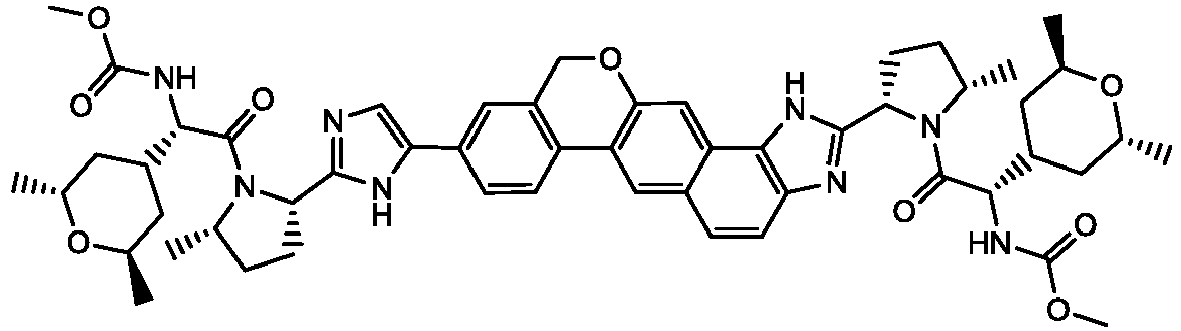
- Compound X-3 is an NS5A inhibitor and is represented by the following chemical structure:

- See
U.S. Publication No. 2013/0102525 and references therein. - Compound X-4 is an NS5B Thumb II polymerase inhibitor and is represented by the following chemical structure:

- Compound X-5 is a nucleotide inhibitor prodrug designed to inhibit replication of viral RNA by the HCV NS5B polymerase, and is represented by the following chemical structure:

- Compound X-6 is an HCV polymerase inhibitor and is represented by the following structure:

- See
U.S. Publication No. 2013/0102525 and references therein. - Compound X-7 is an HCV polymerase inhibitor and is represented by the following structure:

- See
U.S. Publication No. 2013/0102525 and references therein. - Compound X-8 is an HCV protease inhibitor and is represented by the following chemical structure:

- See
U.S. Publication No. 2014/0017198 and references therein.. - Compound X-9 is an HCV protease inhibitor and is represented by the following chemical structure:

- See
U.S. Patent No. 8,178,491 and references therein. - Compound X-10 is an HCV protease inhibitor and is represented by the following chemical structure:

- Compound X-11 is an HCV protease inhibitor and is represented by the following chemical structure:

- See
U.S. Publication No. 2013/0102525 and references therein. - Herein disclosed also is a method of treating hepatitis C in a human patient in need thereof comprising administering to the patient a therapeutically effective amount of a pharmaceutical composition as described herein and an additional therapeutic selected from the group consisting of pegylated rIFN-alpha 2b, pegylated rIFN-alpha 2a, rIFN-alpha 2b, IFN alpha-2b XL, rIFN-alpha 2a, consensus IFN alpha, infergen, rebif, locteron, AVI-005, PEG-infergen, pegylated IFN-beta, oral interferon alpha, feron, reaferon, intermax alpha, r-IFN-beta, infergen + actimmune, IFN-omega with DUROS, albuferon, rebetol, copegus, levovirin, VX-497, viramidine (taribavirin), A-831, A-689, NM-283, valopicitabine, R1626, PSI-6130 (R1656), HCV-796, BILB 1941, MK-0608, NM-107, R7128, VCH-759, PF-868554, GSK625433, XTL-2125, SCH-503034 (SCH-7), VX-950 (Telaprevir), ITMN-191, and BILN-2065, MX-3253 (celgosivir), UT-231B, IDN-6556, ME 3738, MitoQ, and LB-84451, benzimidazole derivatives, benzo-1,2,4-thiadiazine derivatives, and phenylalanine derivatives, zadaxin, nitazoxanide (alinea), BIVN-401 (virostat), DEBIO-025, VGX-410C, EMZ-702, AVI 4065, bavituximab, oglufanide, PYN-17, KPE02003002, actilon (CPG-10101), KRN-7000, civacir, GI-5005, ANA-975 (isatoribine), XTL-6865, ANA 971, NOV-205, tarvacin, EHC-18, and NIM811 and a pharmaceutically acceptable carrier or excipient.
- In yet another embodiment, the present application provides a combination pharmaceutical agent comprising:
- a) a first pharmaceutical composition comprising an effective amount of Compound I; and an effective amount of sofosbuvir wherein the sofosbuvir is substantially crystalline as described herein and
- b) a second pharmaceutical composition comprising at least one additional therapeutic agent selected from the group consisting of HIV protease inhibiting compounds, HIV non-nucleoside inhibitors of reverse transcriptase, HIV nucleoside inhibitors of reverse transcriptase, HIV nucleotide inhibitors of reverse transcriptase, HIV integrase inhibitors, gp41 inhibitors, CXCR4 inhibitors, gp120 inhibitors, CCR5 inhibitors, interferons, ribavirin analogs, NS3 protease inhibitors, alpha-glucosidase 1 inhibitors, hepatoprotectants, non-nucleoside inhibitors of HCV, and other drugs for treating HCV, and combinations thereof.
- The additional therapeutic agent may be one that treats other conditions such as HIV infections. Accordingly, the additional therapeutic agent may be a compound useful in treating HIV, for example HIV protease inhibiting compounds, non-nucleoside inhibitors of HIV reverse transcriptase, HIV nucleoside inhibitors of reverse transcriptase, HIV nucleotide inhibitors of reverse transcriptase, HIV integrase inhibitors, gp41 inhibitors, CXCR4 inhibitors, gp120 inhibitors, CCR5 inhibitors, interferons, ribavirin analogs, NS3 protease inhibitors, NS5b polymerase inhibitors, alpha-glucosidase 1 inhibitors, hepatoprotectants, non-nucleoside inhibitors of HCV, and other drugs for treating HCV.
- More specifically, the additional therapeutic agent may be selected from the group consisting of
- 1) HIV protease inhibitors, e.g., amprenavir, atazanavir, fosamprenavir, indinavir, lopinavir, ritonavir, lopinavir + ritonavir, nelfinavir, saquinavir, tipranavir, brecanavir, darunavir, TMC-126, TMC-114, mozenavir (DMP-450), JE-2147 (AG1776), AG1859, DG35, L-756423, RO0334649, KNI-272, DPC-681, DPC-684, and GW640385X, DG17, PPL-100,
- 2) a HIV non-nucleoside inhibitor of reverse transcriptase, e.g., capravirine, emivirine, delaviridine, efavirenz, nevirapine, (+) calanolide A, etravirine, GW5634, DPC-083, DPC-961, DPC-963, MIV-150, and TMC-120, TMC-278 (rilpivirine), efavirenz, BILR 355 BS, VRX 840773, UK-453,061, RDEA806,
- 3) a HIV nucleoside inhibitor of reverse transcriptase, e.g., zidovudine, emtricitabine, didanosine, stavudine, zalcitabine, lamivudine, abacavir, amdoxovir, elvucitabine, alovudine, MIV-210, racivir (±-FTC), D-d4FC, emtricitabine, phosphazide, fozivudine tidoxil, fosalvudine tidoxil, apricitibine (AVX754), amdoxovir, KP-1461, abacavir + lamivudine, abacavir + lamivudine + zidovudine, zidovudine + lamivudine,
- 4) a HIV nucleotide inhibitor of reverse transcriptase, e.g., tenofovir, tenofovir disoproxil fumarate + emtricitabine, tenofovir disoproxil fumarate + emtricitabine + efavirenz, and adefovir,
- 5) a HIV integrase inhibitor, e.g., curcumin, derivatives of curcumin, chicoric acid, derivatives of chicoric acid, 3,5-dicaffeoylquinic acid, derivatives of 3,5-dicaffeoylquinic acid, aurintricarboxylic acid, derivatives of aurintricarboxylic acid, caffeic acid phenethyl ester, derivatives of caffeic acid phenethyl ester, tyrphostin, derivatives of tyrphostin, quercetin, derivatives of quercetin, S-1360, zintevir (AR-177), L-870812, and L-870810, MK-0518 (raltegravir), BMS-707035, MK-2048, BA-011, BMS-538158, GSK364735C,
- 6) a gp41 inhibitor, e.g., enfuvirtide, sifuvirtide, FB006M, TRI-1144, SPC3, DES6, Locus gp41, CovX, and REP 9,
- 7) a CXCR4 inhibitor, e.g., AMD-070,
- 8) an entry inhibitor, e.g., SP01A, TNX-355,
- 9) a gp120 inhibitor, e.g., BMS-488043 and BlockAide/CR,
- 10) a G6PD and NADH-oxidase inhibitor, e.g., immunitin,
- 11) a CCR5 inhibitor, e.g., aplaviroc, vicriviroc, INCB9471, PRO-140, INCB15050, PF-232798, CCR5mAb004, and maraviroc,
- 12) an interferon, e.g., pegylated rIFN-alpha 2b, pegylated rIFN-alpha 2a, rIFN-alpha 2b, IFN alpha-2b XL, rIFN-alpha 2a, consensus IFN alpha, infergen, rebif, locteron, AVI-005, PEG-infergen, pegylated IFN-beta, oral interferon alpha, feron, reaferon, intermax alpha, r-IFN-beta, infergen + actimmune, IFN-omega with DUROS, and albuferon,
- 13) ribavirin analogs, e.g., rebetol, copegus, levovirin, VX-497, and viramidine (taribavirin)
- 14) NS5a inhibitors, e.g., A-831, A-689, and BMS-790052,
- 15) NS5b polymerase inhibitors, e.g., NM-283, valopicitabine, R1626, PSI-6130 (R1656), HCV-796, BILB 1941, MK-0608, NM-107, R7128, VCH-759, PF-868554, GSK625433, and XTL-2125,
- 16) NS3 protease inhibitors, e.g., SCH-503034 (SCH-7), VX-950 (Telaprevir), ITMN-191, and BILN-2065,
- 17) alpha-glucosidase 1 inhibitors, e.g., MX-3253 (celgosivir) and UT-231B,
- 18) hepatoprotectants, e.g., IDN-6556, ME 3738, MitoQ, and LB-84451,
- 19) non-nucleoside inhibitors of HCV, e.g., benzimidazole derivatives, benzo-1,2,4-thiadiazine derivatives, and phenylalanine derivatives,
- 20) other drugs for treating Hepatitis C, e.g., zadaxin, nitazoxanide (alinea), BIVN-401 (virostat), DEBIO-025, VGX-410C, EMZ-702, AVI 4065, bavituximab, oglufanide, PYN-17, KPE02003002, actilon (CPG-10101), KRN-7000, civacir, GI-5005, ANA-975 (isatoribine), XTL-6865, ANA 971, NOV-205, tarvacin, EHC-18, and NIM811,
- 21) pharmacokinetic enhancers, e.g., BAS-100 and SPI452, 20) RNAse H inhibitors, e.g., ODN-93 and ODN-112, and
- 22) other anti-HIV agents, e.g., VGV-1, PA-457 (bevirimat), ampligen, HRG214, cytolin, polymun, VGX-410, KD247, AMZ 0026, CYT 99007, A-221 HIV, BAY 50-4798, MDX010 (iplimumab), PBS119, ALG889, and PA-1050040.
- In one embodiment, the additional therapeutic agent is ribavirin. Accordingly, methods described herein include a method of treating hepatitis C in a human patient in need thereof comprising administering to the patient a therapeutically effective amount of ribavirin and a therapeutically effective amount of a pharmaceutical composition, pharmaceutical dosage form, or tablet as described herein. In a further embodiment, the ribavirin and pharmaceutical composition, pharmaceutical dosage form, or tablet comprising sofosbuvir and Compound I is administered for about 12 weeks or less. In further embodiments, the ribavirin and tablet comprising sofosbuvir and Compound I is administered for about 8 weeks or less, or for about 6 weeks or less, or for about 4 weeks or less.
- It is contemplated that the additional therapeutic agent will be administered in a manner that is known in the art and the dosage may be selected by someone of skill in the art. For example, the additional agent may be administered in a dose from about 0.01 milligrams to about 2 grams per day.
- In the following examples and throughout this disclosure, abbreviations as used herein have respective meanings as follows:
%CV Percent coefficient of variation AUC Area Under the Curve AUCinf Area under the plasma concentration-time curve from time zero extrapolated to the infinite time AUCtau Area under the plasma concentration-time curve for a dosing interva CL Drug clearance Clast Last observed plasma concentration Cmax Maximum Concentration cP Centipoise EC50 Concentration of a compound inhibiting birus replication by 50% Emax Maximal effect range F Bioavailability FDC Fixed dose combination GLSM Geometric least-squares means GT Genotype h or hr Hour HCV Hepatitis C virus HFM High-fat/high-calorie meal ICH International Conference on Harmonisation; Impurities guidelines kg Kilogram LLOQ Lower limit of quantitation m Meter MFM Moderate-fat/moderate-calorie meal mg Milligram mL Milliliter ng Nanogram °C Degrees Celsius PD Pharmacodynamics PK Pharmacokinetics Q1, Q3 first quartile, third quartile RNA Ribonucleic Acid s Second SAE Serious adverse event SOF Sofosbuvir (GS-7977; formerly PSI-7977) SVR Sustained Virologic Response t1/2 Half-life (h) tlast Time of last observed plasma concentration(h) tmax Time to reach Cmax (h) w Weight XRPD Xray Powder Diffraction µm Micrometer - The sofosbuvir dose selected for the tablet formulation is 400 mg once daily. Support for the 400 mg sofosbuvir dose can be derived from Emax PK/PD modeling with early virological and human exposure data which also supports the selection of a 400 mg sofosbuvir dose over others tested.
- The mean sofosbuvir major metabolite AUCtau for the 400 mg sofosbuvir dose is associated with approximately 77% of the maximal HCV RNA change from baseline achievable as determined by this model, a value which is on the cusp of the plateau of the exposure-response sigmoidal curve. In a sigmoidal Emax model, there is a relatively linear exposure-response relationship in the 20 to 80% maximal effect range. Therefore, given that sofosbuvir exposure with 200 mg tablets appears dose-proportional with single doses up to 1200 mg, doses below 400 mg are expected to yield considerable reductions in the magnitude of HCV RNA change from baseline. Similarly, in order to improve upon an efficacy prediction of 77% in the plateau of the exposure-response curve, substantial increases in exposure (and hence dose) would be needed for an appreciable increase in antiviral effect.
- The sofosbuvir dose of 400 mg once daily was associated with higher SVR rates in genotype 1 HCV infected patients as compared to the 200 mg once daily dose when given in conjunction with additional HCV therapeutics for 24 weeks. Safety and tolerability appeared similar across both dose levels. In addition, when sofosbuvir 400 mg once daily plus other HCV therapeutics were given to genotype 2 or 3 HCV infected patients, 100% SVR24 was observed.
- Following single and multiple oral doses of Compound I, maximum plasma concentrations occurred between 1.50 and 3.25 hours (median Tmax). Compound I exhibited nonlinear PK across the dose range of 5 to 450 mg. Increases in exposure, as assessed by AUC and Cmax, were greater than dose-proportional from 5 to 50 mg and were less than dose-proportional from 50 to 450 mg. Consistent with the half-life of Compound I, modest accumulation was observed with time. After multiple once-daily doses of Compound I greater than 5 mg, the mean plasma concentrations of Compound I at 24 hours postdose were above the protein-adjusted concentration of a compound inhibiting virus replication by 50% (EC50) for genotype 1 to 6 HCV replicons (Table 1)
Table 1 PK Parameter 5 mg 50 mg 100 mg 150 mg 450 mg (N = 12) (N = 12) (N = 24) (N = 12) (N = 12) Single Dose (Cohorts 1-6a) AUClast (ng•h/mL) 134.2 (69.6) 2970.7 (40.1) 4985.6 (44.8) 4925.9 (48.0) 9503.8 (34.5) AUCinf (ng•h/mL) 158.9 (64.0) 3017.2 (40.1) 5055.0 (45.3) 4978.3 (47.8) 9578.1 (34.3) Cmax (ng/mL) 22.4 (55.4) 371.3 (32.7) 574.9 (37.2) 608.4 (46.7) 1121.6 (31.7) Clast (ng/mL) 1.40 (26.9) 2.34 (61.4) 2.85 (80.3) 2.23 (40.1) 3.28 (50.5) Tmax (h) 1.50 2.50 2.50 2.75 3.25 (1.50, 2.00) (2.00, 3.00) (2.50, 3.00) (2.50, 3.50) (2.50, 3.75) Tlast (h) 24.00 72.00 95.00 96.00 96.00 (14.00, 36.00) (48.00, 96.00) (71.50, 96.00) (84.02, 96.00) (96.00, 96.00) t1/2 (h) 11.20 13.62 15.73 16.16 14.97 (5.40, 16.89) (10.62, 16.47) (12.63, 17.11) (14.55, 17.55) (12.91, 16.73) CL/F (mL/h) 58,398.0 19,188.4 24,617.9 72,185.5 53,676.4 (124.4) (39.2) (50.8) (196.4)b (42.5) Multiple Dose (Cohorts 1-4a) PK Parameter 5 mg (N = 12) 50 mg (N = 12) 150 mg (N = 12) 450 mg (N = 12) AUCtau (ng•h/mL) 172.3 (51.7) 3032.6 (40.4) 4890.8 (45.4) 9511.2 (40.9) Cmax (ng/mL) 28.3 (49.3) 411.4 (40.7) 669.4 (48.1) 1195.7 (38.0) Ctau (ng/mL) 2.2 (76.0) 37.9 (59.5) 63.4 (42.8) 127.7 (44.3) Tmax (h) 2.00 (1.25, 2.50) 2.50 (2.25, 3.00) 2.50 (2.50, 3.50) 3.00 (2.50, 4.25) Tlast (h) 24.00 (24.00, 24.00) 24.00 (24.00, 24.00) 24.00 (24.00, 24.00) 24.00 (24.00, 24.00) t1/2 (h) 13.73. (13.19, 15.88) 13.02 (11.43, 16.23) 15.15 (12.03, 15.63) 11.74 (10.64, 13.12) CLss/F (mL/h) 36,095.7 (46.4) 19,593.0 (50.5) 45,082.3 (88.3) 58,804.6 (57.3) Note: All PK parameters are reported as mean (%CV), except for Tmax, Tlast, and t1/2, which are reported as median (Q1, Q3).
a Compound I dosing by cohort: Cohort 1 = 50 mg, Cohort 2 = 150 mg, Cohort 3 = 5 mg, Cohort 4 = 450 mg, Cohorts 5 and 6 (pooled in the fasted state) = 100 mg.
b Mean (%CV) CL/F for the Compound I 150 mg group (excluding one patient) was 31,403.8 (40.5) mL/h. - To make the tablets comprising the combination of sofosbuvir and Compound I as described herein, a solid dispersion comprising Compound I was co-formulated with crystalline sofosbuvir. The starting material of the solid dispersion can be a variety of forms of Compound I including crystalline forms, amorphous form, salts thereof, solvates and/or free base. In certain embodiments, Compound I is the amorphous free base.
- The spray dry feed solution was prepared by solubilizing Compound I and polymer in the feed solvent. In certain cases, aggressive mixing or homogenization can be used to avoid clumping of the composition.
- The feed solution was initially evaluated for appropriate solvent with regard to solubility, stability, and viscosity. Ethanol, methanol, acetone, and dichloromethane all demonstrated excellent solubility. Ethanol and methanol-based feed stocks were assessed for preparation ease and spray dried at a range of inlet and outlet temperatures to assess the robustness of the spray dry process. Both solvents gave rapid dissolution of Compound I and copovidone.
- Spray drying out of ethanol resulted in high yields across a wide range of spray-drying outlet temperatures with no material accumulation on the spray dry chamber. Overall, the Compound I solid dispersion in a Compound I to copovidone ratio of 1:1 demonstrated good chemical stability in the ethanolic feed solution.
- An ethanolic solution of 10% Compound I and 10% copovidone was prepared using homogenization. Viscosity of ethanolic solutions of Compound I:copovidone were low.
- Spray drying was conducted using a commercially available spray dryer (e.g., Anhydro, Buchi, or Niro spray dryer).
- Organic volatile impurities, including the spray dry solvent ethanol may be rapidly removed during secondary drying in a tray oven 60 °C, purged with room air or via a double cone dryer. Loss on drying can be attributable to water, which can be confirmed by Karl Fischer titration. Residual ethanol was reduced below ICH guidelines of 0.5% w/w by 6 hours of drying.
- The solid dispersion comprising Compound I was blended with sofosbuvir and excipients and milled to facilitate mixing and blend uniformity. Either a coblend or codry granulation process can be used. Coblend granulation is a multi-step process consisting of separate dry granulations for each active ingredient with excipients followed by the blending of the two granulations together. Codry granulation consisted of dry granulating both active ingredients and excipients together.
- An in-process milling step may be used to deagglomerate relatively small but hard agglomerates present in the drug substance. To limit any loss of drug substance, Compound I may be blended with all intragranular excipients prior to milling through a conical screen mill, e.g., with a 125R screen and a tip speed of 6 m/s. A milling step was tested, but found to be unnecessary. A secondary blend may be conducted prior to lubrication with magnesium stearate, followed by roller compaction and milling through an in-line oscillating mill. This process results in powder blends with satisfactory flow characteristics and compression properties.
- The granules were then mixed with a lubricant prior to tablet compression. The total resulting core tablet weight was about 1000 mg for the 100 mg Compound I/ 400 mg Sofosbuvir tablet. The total resulting core tablet weight was about 600 mg for the 25 mg Compound I/ 400 mg Sofosbuvir tablet.
- Film-coating of the tablets is provided to reduce photolytic degradation. Tablets were coated to a target 3% weight gain. The film-coating material was a polyvinylalcohol-based coating. Exemplary tablet formulations are provided in Tables 2 and 3.
Table 2 Ingredient % w/w Component Weight (mg/tablet) Sofosbuvir 66.7 400 Compound I Solid Dispersion (Compound I: copovidone 1:1) 8.3 50 Microcrystalline Cellulose 20.5 123 Croscarmellose Sodium 3 18 Magnesium Stearate 1.5 9 Total Tablet Core Weight 100 600 Film coating 3 18 Purified Water -- -- Total Coated Tablet Weight 618 Table 3 Ingredient % w/w Component Weight (mg/tablet) Sofosbuvir 40 400 Compound I Solid Dispersion (Compound I: copovidone 1:1) 20 200 Microcrystalline Cellulose 35.5 355 Croscarmellose Sodium 3 30 Magnesium Stearate 1.5 15 Total Tablet Core Weight 100 1000 Film coating 3 30 Purified Water -- -- Total Coated Tablet Weight 1030 - Tablets comprising the co-formulation of a solid dispersion comprising Compound I and crystalline sofosbuvir can also be made as a bilayer tablet wherein each active ingredient is in a separate layer. To make the bilayer tablet, a Compound I:copovidone solid dispersion is made by dissolving Compound I and copovidone into ethanol, and then spray drying the mixture. The spray dried Compound I:copovidone (1:1) solid dispersion is further dried in a secondary dryer. Next, the spray dried Compound I:copovidone solid dispersion is then blended with excipients. The mixture is milled and then blended with lubricant prior to dry granulation. The Compound I granules are blended with extragranular lubricant. Separately, the sofosbuvir drug substance is blended with excipients, and then the mixture is milled and then blended with lubricant prior to dry granulation. The sofosbuvir granules are then blended with extragranular lubricant. Finally, the sofosbuvir powder blend and Compound I powder blend are compressed into bilayer tablet cores. The bilayer tablet cores are then film-coated prior to packaging. Representative example compositions of a bilayer tablets comprising the solid dispersion of Compound I and sofosbuvir are shown in Tables 4 and 5.
Table 4 Ingredient % w/w Component Weight (mg/tablet) Layer 1 Sofosbuvir 57 400 Microcrystalline Cellulose 13 90 Croscarmellose Sodium 3.5 24 Magnesium Stearate 1 8 Layer 2 Compound I Solid Dispersion (Compound I: copovidone 1:1) 7 50 Microcrystalline Cellulose 14.5 100 Croscarmellose Sodium 3.5 25 Magnesium Stearate 0.5 3 Total Tablet Core 100.00 700 Table 5 Ingredient % w/w Component Weight (mg/tablet) Layer 1 Sofosbuvir 40 400 Microcrystalline Cellulose 14 140 Croscarmellose Sodium 2.4 24 Magnesium Stearate 0.8 8 Layer 2 Compound I Solid Dispersion (Compound I: copovidone 1:1) 20 200 Microcrystalline Cellulose 19 190 Croscarmellose Sodium 3 30 Magnesium Stearate 0.8 8 Total Tablet Core 100 1000 - A PK drug-drug interaction between SOF and Compound I was evaluated. Compound I plasma exposures (AUCtau, Cmax, and Ctau) were not affected by the coadministration of SOF, and thus no dose adjustment is required for Compound I. Sofosbuvir plasma exposures increased approximately 1.8-fold (Cmax) and 2.4-fold (AUC) when coadministered with Compound I. SOF metabolite I Cmax and AUC increased approximately 1.6- and 1.8-fold, respectively, when SOF was coadministered with Compound I (solid dispersion, Compound I:copovidone 1:1). approximately 1.8-fold (Cmax) and 2.4-fold (AUC) when coadministered with Compound I. SOF metabolite II (the predominant circulating nucleoside metabolite of SOF) Cmax decreased approximately 36%, but AUC was unaffected by coadministration of SOF and Compound I. See Table 6.
Table 6 Compound I Compound I PK Parameter Compound I 150 mg (N = 18) SOF 400 mg + Compound 1150 mg (N = 18) % GLSM Ratio (SOF+ Compound I / Compound I) (90% CI) AUCtau(ng•h/mL) 7284.95 8138.22 111.71 (107.54, 116.04) Cmax (ng/mL) 932.27 987.69 105.94 (101.86, 110.20) Ctau (ng/mL) 101.09 118.90 117.61 (111.94, 123.57) SOF SOF PK Parameter SOF 400 mg (N = 18) SOF 400 mg + Compound 1150 mg (N = 18) % GLSM Ratio (SOF+ Compound I /SOF) (90% CI) AUClast(ng•h/mL) 1154.59 2749.10 238.10 (214.62, 264.16) AUCinf (ng•h/mL) 1159.50 2756.96 237.77 (214.27, 263.85) Cmax (ng/mL) 880.28 1593.80 181.06 (149.43, 219.38) SOF metabolite I SOF metabolite I PK Parameter SOF 400 mg (N = 18) SOF 400 mg + Compound I 150 mg (N = 18) % GLSM Ratio (SOF+ Compound I /SOF) (90% CI) AUClast(ng•h/mL) 1861.41 3394.32 182.35 (167.52, 198.50) AUCinf (ng•h/mL) 1926.09 3455.70 179.42 (165.03, 195.06) Cmax (ng/mL) 455.77 736.88 161.68 (145.27, 179.94) SOF metabolite II SOF metabolite II PK Parameter SOF 400 mg (N = 18) SOF 400 mg + Compound I 150 mg (N = 18) % GLSM Ratio (SOF+ Compound I /SOF) (90% CI) AUClast(ng•h/mL) 11,173.87 12,610.86 112.86 (107.90, 118.05) AUCinf (ng•h/mL) 11,842.52 13,774.96 116.32 (110.99, 121.90) Cmax (ng/mL) 1080.97 693.62 64.17 (58.45, 70.44) Note: Data are reported as GLSM. Cohort 7 = SOF 400 mg single dose (Day 1); Compound I 150 mg multiple doses (Days 5-13); Compound I 150 mg + SOF 400 mg single dose (Day 14). - The effect of Compound I on SOF (and SOF metabolite I) exposure is likely due to Compound I inhibition of the intestinal efflux drug transporters p-glycoprotein (Pgp) and possibly breast cancer resistance protein (BCRP), as SOF is known to be a substrate of these transporters. The increase in the systemic exposure of SOF (and SOF metabolite I) by Compound I was similar to that seen previously with Pgp and/or BCRP inhibitors and does not warrant any SOF dose modification.
- The exposure of Compound I solid dispersion (Compound I:copovidone 1:1) administered with a high-fat/high-calorie meal (HFM) as a single agent was modestly reduced (14% decrease in AUC and 25% decrease in Cmax) compared to fasted administration (Table 7). The exposure of Compound I (solid dispersion) when administered with a HFM as part of the sofosbuvir/Compound I (solid dispersion) FDC was comparatively improved, resulting in a modest increase in exposure compared to fasted administration (∼20% increase in AUC and ∼5% increase in Cmax, Table 8). This increase in exposure suggests that the bioavailability of Compound I administered as part of the sofosbuvir/Compound I FDC is improved relative to Compound I as a single agent tablet. Table 8, below shows exposures and GMRs of Compound I from the fixed dose combination under the different fed states.
Table 7 Compound I PK Parameter GLSM % GLSM Ratio (Fed/Fasted) 90% CI Compound I 100 mg Fed (N = 12) Compound I 100 mg Fasted (N = 12) Light Breakfast AUClast(ng•h/mL) 6728.66 5389.63 124.84 (110.02, 141.67) AUCinf (ng•h/mL) 6820.80 5469.11 124.72 (109.94, 141.48) Cmax (ng/mL) 784.70 581.72 134.89 (116.84, 155.74) HFM AUClast(ng•h/mL) 3222.57 3746.30 86.02 (73.17, 101.12) AUCinf (ng•h/mL) 3267.75 3786.61 86.30 (73.43, 101.42) Cmax (ng/mL) 364.39 485.72 75.02 (62.56, 89.97) Table 8 Mean (%CV) SOF/ Compound I FDC MFM/Fasted GMR (90% CI) HFM/Fasted GMR (90% CI) (Fasted, N = 30) (MFM, N = 30) (HFM, N = 30) AUCinf (ng·hr/mL) 4520 (47.6) 5930 (44.3) 5060 (43.4) 1.33 (1.10, 1.63) 1.21 (0.99, 1.48) AUClast (ng·hr/mL) 4440 (47.7) 5850 (44.1) 4990 (43.2) 1.34 (1.09, 1.64) 1.22 (0.99, 1.49) Cmax (ng/mL) 562 (44.6) 710 (39.4) 544 (35.9) 1.29 (1.07, 1.56) 1.05 (0.87, 1.26) - Compound I is a HCV NS5A inhibitor that has demonstrated potent activity against genotype 1-6 HCV in a 3-day monotherapy study. This example shows the results of the study of the combination of sofosbuvir (SOF) and Compound I solid dispersion (Compound I:copovidone 1:1) in patients with genotype 1-6 HCV infection.
- Methods: Treatment naive genotype 1-6 HCV-infected patients without cirrhosis were randomized 1:1 to receive 400 mg of SOF and 25 mg of Compound I once daily or 400 mg of SOF and 100 mg of Compound I once daily for 12 weeks.
- Results: 154 patients (36% GT1, 14% GT2, 35% GT3, 9% GT4, < 1% GT5, and 6% GT6) were randomized and treated; 64% were male, 85% white, and 48% had IL28B CC genotype. All patients had HCV RNA < LLOQ by week 4 of treatment except one genotype 3 HCV-infected patient treated with 400 mg of SOF and 25 mg of Compound I (this patient stopped treatment for non-response at Week 8). Results through post-treatment week 4 (SVR4) are presented below. Two patients relapsed, one with genotype 1 HCV infection and one with genotype 3 HCV infection, both received 400 mg of SOF and 25 mg of Compound I. The most frequently reported adverse events (> 10%) were fatigue, headache and nausea. There were no discontinuations due to adverse events. Four patients reported 5 SAEs; none were considered related to study drug. There was no evidence of drug related changes in hematologic, chemistry or urinalysis parameters.
- The treatment of SOF and Compound I for 12 weeks was well tolerated and resulted in high SVR4 rates in patients with genotype 1-6 HCV infection (Table 9).
Table 9: SVR4 in Patients Treated with SOF + Compound I for 12 Weeks HCV genotype SOF (400mg) + Compound I (25mg) SOF (400mg) + Compound I (100mg) GT1 96% (26/27) 100% (28/28) GT2 91% (10/11)a 100% (10/10) GT3 89% (24/27)a 100% (27/27) GT4 100% (7/7) 86% (6/7)a GT5 100% (1/1) - GT6 100% (4/4) 100% (5/5) a. One patient per group was lost to follow-up prior to posttreatment week 4. - The invention has been described broadly and generically herein. Each of the narrower species and subgeneric groupings falling within the generic disclosure also form part of the invention.
Claims (10)
- A pharmaceutical composition in the form of a fixed dose combination tablet comprising:a) from 1% to 25% w/w of a solid dispersion comprising Compound I dispersed within a polymer matrix formed by copovidone, wherein the weight ratio of Compound I to copovidone in the solid dispersion is 1:1 and wherein Compound I is substantially amorphous having the formula:
 b) from 35% to 45% w/w of sofosbuvir characterized by XRPD 2θ-reflections (° ± 0.2θ) at: 6.1 and 12.7 or at: 6.1, 20.1 and 20.8, wherein the sofosbuvir is substantially crystalline having the formula:
 c) from 1% to 40% w/w of microcrystalline cellulose;d) from 1% to 8% w/w of croscarmellose sodium; ande) from 0.5% to 2.5% w/w of magnesium stearate.
 - The pharmaceutical composition of claim 1, comprising 40% w/w of sofosbuvir.
- The pharmaceutical composition of claim 1, comprising 20% w/w of the solid dispersion.
- The pharmaceutical composition of claim 1, comprising 35% w/w of microcrystalline cellulose.
- The pharmaceutical composition of claim 1, comprising 3% w/w of croscarmellose sodium.
- The pharmaceutical composition of claim 1, comprising 1.5% w/w of magnesium stearate.
- The pharmaceutical composition of claim 1 in the form of a fixed dose combination tablet comprising:a) 20% w/w of a solid dispersion comprising Compound I dispersed within a polymer matrix formed by copovidone, wherein the weight ratio of Compound I to copovidone in the solid dispersion is 1:1 and wherein Compound I is substantially amorphous having the formula:
 b) 40% w/w of sofosbuvir characterized by XRPD 2θ-reflections (° ± 0.2θ) at: 6.1 and 12.7 or at: 6.1, 20.1 and 20.8, wherein the sofosbuvir is substantially crystalline having the formula:
 c) 35% w/w of microcrystalline cellulose;d) 3% w/w of croscarmellose sodium; ande) 1.5% w/w of magnesium stearate.
 - A pharmaceutical composition in the form of a fixed dose combination tablet comprising:a) 200 mg of a solid dispersion comprising Compound I dispersed within a polymer matrix formed by copovidone, wherein the weight ratio of Compound I to copovidone in the solid dispersion is 1:1 and wherein Compound I is substantially amorphous having the formula:
 b) 400 mg of sofosbuvir, wherein the sofosbuvir is substantially crystalline having the formula:
 c) 355 mg of micro crystalline cellulose;d) 30 mg of croscarmellose sodium; ande) 15 mg of magnesium stearate.
 - The pharmaceutical composition of claims 1 to 8, wherein the tablet comprises a film coating.
- The pharmaceutical composition of claim 9, wherein the film coating is a polyvinylalcohol-based coating.
Priority Applications (5)
| Application Number | Priority Date | Filing Date | Title |
|---|---|---|---|
| PL19211345T PL3650014T3 (en) | 2013-08-27 | 2014-01-30 | Combination formulation of two antiviral compounds |
| PL14704501T PL3038601T3 (en) | 2013-08-27 | 2014-01-30 | COMPOUND FORMULATION OF TWO ANTIVIRAL COMPOUNDS |
| EP21200891.6A EP4005560B1 (en) | 2013-08-27 | 2014-01-30 | Combination formulation of two antiviral compounds |
| SI201431584T SI3038601T1 (en) | 2013-08-27 | 2014-01-30 | Combination formulation of two antiviral compounds |
| EP19211345.4A EP3650014B1 (en) | 2013-08-27 | 2014-01-30 | Combination formulation of two antiviral compounds |
Applications Claiming Priority (4)
| Application Number | Priority Date | Filing Date | Title |
|---|---|---|---|
| US201361870712P | 2013-08-27 | 2013-08-27 | |
| US201361898690P | 2013-11-01 | 2013-11-01 | |
| US201361907308P | 2013-11-21 | 2013-11-21 | |
| PCT/US2014/013930 WO2015030853A1 (en) | 2013-08-27 | 2014-01-30 | Combination formulation of two antiviral compounds |
Related Child Applications (3)
| Application Number | Title | Priority Date | Filing Date |
|---|---|---|---|
| EP19211345.4A Division EP3650014B1 (en) | 2013-08-27 | 2014-01-30 | Combination formulation of two antiviral compounds |
| EP19211345.4A Division-Into EP3650014B1 (en) | 2013-08-27 | 2014-01-30 | Combination formulation of two antiviral compounds |
| EP21200891.6A Division EP4005560B1 (en) | 2013-08-27 | 2014-01-30 | Combination formulation of two antiviral compounds |
Publications (2)
| Publication Number | Publication Date |
|---|---|
| EP3038601A1 EP3038601A1 (en) | 2016-07-06 |
| EP3038601B1 true EP3038601B1 (en) | 2020-04-08 |
Family
ID=50102268
Family Applications (3)
| Application Number | Title | Priority Date | Filing Date |
|---|---|---|---|
| EP14704501.7A Active EP3038601B1 (en) | 2013-08-27 | 2014-01-30 | Combination formulation of two antiviral compounds |
| EP21200891.6A Active EP4005560B1 (en) | 2013-08-27 | 2014-01-30 | Combination formulation of two antiviral compounds |
| EP19211345.4A Active EP3650014B1 (en) | 2013-08-27 | 2014-01-30 | Combination formulation of two antiviral compounds |
Family Applications After (2)
| Application Number | Title | Priority Date | Filing Date |
|---|---|---|---|
| EP21200891.6A Active EP4005560B1 (en) | 2013-08-27 | 2014-01-30 | Combination formulation of two antiviral compounds |
| EP19211345.4A Active EP3650014B1 (en) | 2013-08-27 | 2014-01-30 | Combination formulation of two antiviral compounds |
Country Status (19)
| Country | Link |
|---|---|
| US (6) | US20150064253A1 (en) |
| EP (3) | EP3038601B1 (en) |
| JP (2) | JP2016529293A (en) |
| KR (1) | KR102239196B1 (en) |
| CN (1) | CN105517540B (en) |
| AU (3) | AU2014311827B2 (en) |
| CA (1) | CA2921160C (en) |
| EA (1) | EA201690473A1 (en) |
| ES (2) | ES2900570T3 (en) |
| IL (1) | IL243988A0 (en) |
| MX (1) | MX2016002185A (en) |
| NZ (1) | NZ716840A (en) |
| PL (2) | PL3650014T3 (en) |
| PT (2) | PT3650014T (en) |
| SG (1) | SG11201600919UA (en) |
| SI (2) | SI3650014T1 (en) |
| TW (1) | TWI626048B (en) |
| UY (1) | UY35300A (en) |
| WO (1) | WO2015030853A1 (en) |
Families Citing this family (29)
| Publication number | Priority date | Publication date | Assignee | Title |
|---|---|---|---|---|
| BRPI0419345B8 (en) | 2003-05-30 | 2021-05-25 | Gilead Pharmasset Llc | use of (2'r)-2'-deoxy-2'-fluor-2'-c-methyl nucleoside and a pharmaceutical composition comprising it |
| WO2012068234A2 (en) | 2010-11-17 | 2012-05-24 | Gilead Sciences, Inc. | Antiviral compounds |
| PT2907816T (en) | 2011-11-16 | 2018-10-18 | Gilead Pharmasset Llc | Condensed imidazolylimidazoles as antiviral compounds |
| JP2016529293A (en) | 2013-08-27 | 2016-09-23 | ギリアド ファーマセット エルエルシー | Combination preparation of two antiviral compounds |
| EP3113762A1 (en) * | 2014-03-05 | 2017-01-11 | Galenicum Health S.L. | Stable pharmaceutical compositions of sofosbuvir |
| CA2943574A1 (en) * | 2014-04-03 | 2015-10-08 | Sandoz Ag | Solid composition comprising amorphous sofosbuvir |
| TWI721947B (en) | 2014-06-11 | 2021-03-21 | 美商基利法瑪席特有限責任公司 | Solid forms of an antiviral compound |
| TW202014413A (en) | 2014-06-11 | 2020-04-16 | 美商基利法瑪席特有限責任公司 | Processes for preparing antiviral compounds |
| WO2016055576A1 (en) * | 2014-10-08 | 2016-04-14 | Sandoz Ag | High drug load tablets comprising sofosbuvir |
| WO2017023714A1 (en) * | 2015-08-04 | 2017-02-09 | Merck Sharp & Dohme Corp. | Fixed-dose combinations of antiviral compounds |
| US20180228827A1 (en) * | 2015-08-04 | 2018-08-16 | Merck Sharp & Dohme Corp. | Fixed-dose combinations of antiviral compounds |
| US20180228828A1 (en) * | 2015-08-04 | 2018-08-16 | Merck Sharp & Dohme Corp. | Fixed-dose combinations of antiviral compounds |
| ES2907489T3 (en) | 2015-12-14 | 2022-04-25 | X4 Pharmaceuticals Inc | Cancer treatment methods |
| WO2017106332A1 (en) | 2015-12-14 | 2017-06-22 | X4 Pharmaceuticals, Inc. | Methods for treating cancer |
| HUE060517T2 (en) | 2015-12-22 | 2023-03-28 | X4 Pharmaceuticals Inc | Procedures for the treatment of immunodeficiency disease |
| WO2017177230A1 (en) | 2016-04-08 | 2017-10-12 | X4 Pharmaceuticals, Inc. | Methods for treating cancer |
| JOP20170127A1 (en) * | 2016-06-02 | 2017-12-02 | Gilead Pharmasset Llc | A combined formula consisting of three antiviral compounds |
| WO2017223229A1 (en) | 2016-06-21 | 2017-12-28 | X4 Pharmaceuticals, Inc. | Cxcr4 inhibitors and uses thereof |
| CA3027500A1 (en) | 2016-06-21 | 2017-12-28 | X4 Pharmaceuticals, Inc. | Cxcr4 inhibitors and uses thereof |
| JP7054529B2 (en) | 2016-06-21 | 2022-04-14 | エックス4 ファーマシューティカルズ, インコーポレイテッド | CXCR4 inhibitor and its use |
| CN106220639A (en) * | 2016-07-22 | 2016-12-14 | 上海众强药业有限公司 | A kind of Wei Patawei intermediate novel crystal forms |
| CN106432253B (en) * | 2016-09-21 | 2019-06-14 | 上海众强药业有限公司 | A new crystal form of velpatasvir and preparation method thereof |
| RU2619840C1 (en) * | 2016-09-21 | 2017-05-18 | Общество с ограниченной ответственностью "Изварино Фарма" | Pharmaceutical composition for hiv infection treatment |
| CN106667936B (en) * | 2016-12-31 | 2021-02-05 | 江苏科本药业有限公司 | Sofosbuvir tablet and preparation method thereof |
| CN109846899A (en) * | 2017-11-30 | 2019-06-07 | 常州寅盛药业有限公司 | Benzofuran derivatives and GS-7977 combination medicine |
| US10548889B1 (en) | 2018-08-31 | 2020-02-04 | X4 Pharmaceuticals, Inc. | Compositions of CXCR4 inhibitors and methods of preparation and use |
| EA202191372A1 (en) * | 2018-12-14 | 2021-09-16 | Фуджифилм Корпорэйшн | TABLET AND METHOD FOR OBTAINING TABLETS |
| JP2023517956A (en) | 2020-03-10 | 2023-04-27 | エックス4 ファーマシューティカルズ, インコーポレイテッド | Methods of treating neutropenia |
| BR112023026356A2 (en) | 2021-06-17 | 2024-03-05 | Atea Pharmaceuticals Inc | METHOD FOR TREATING HEPATITIS C VIRUS OR A CONDITION RESULTING FROM A HEPATITIS C INFECTION, COMBINATION, USE OF THE COMBINATION, PHARMACEUTICAL COMPOSITION, AND, KIT FOR TREATMENT OF HEPATITIS C VIRUS |
Family Cites Families (424)
| Publication number | Priority date | Publication date | Assignee | Title |
|---|---|---|---|---|
| USRE29835E (en) | 1971-06-01 | 1978-11-14 | Icn Pharmaceuticals | 1,2,4-Triazole nucleosides |
| US3798209A (en) | 1971-06-01 | 1974-03-19 | Icn Pharmaceuticals | 1,2,4-triazole nucleosides |
| US3852267A (en) | 1972-08-04 | 1974-12-03 | Icn Pharmaceuticals | Phosphoramidates of 3{40 ,5{40 -cyclic purine nucleotides |
| US4526988A (en) | 1983-03-10 | 1985-07-02 | Eli Lilly And Company | Difluoro antivirals and intermediate therefor |
| NL8403224A (en) | 1984-10-24 | 1986-05-16 | Oce Andeno Bv | DIOXAPHOSPHORINANS, THEIR PREPARATION AND THE USE FOR SPLITTING OF OPTICALLY ACTIVE COMPOUNDS. |
| US5223263A (en) | 1988-07-07 | 1993-06-29 | Vical, Inc. | Liponucleotide-containing liposomes |
| GB8719367D0 (en) | 1987-08-15 | 1987-09-23 | Wellcome Found | Therapeutic compounds |
| WO1989002733A1 (en) | 1987-09-22 | 1989-04-06 | The Regents Of The University Of California | Liposomal nucleoside analogues for treating aids |
| IL91664A (en) | 1988-09-28 | 1993-05-13 | Yissum Res Dev Co | Ammonium transmembrane gradient system for efficient loading of liposomes with amphipathic drugs and their controlled release |
| US6132763A (en) | 1988-10-20 | 2000-10-17 | Polymasc Pharmaceuticals Plc | Liposomes |
| US5705363A (en) | 1989-03-02 | 1998-01-06 | The Women's Research Institute | Recombinant production of human interferon τ polypeptides and nucleic acids |
| US5194654A (en) | 1989-11-22 | 1993-03-16 | Vical, Inc. | Lipid derivatives of phosphonoacids for liposomal incorporation and method of use |
| US5411947A (en) | 1989-06-28 | 1995-05-02 | Vestar, Inc. | Method of converting a drug to an orally available form by covalently bonding a lipid to the drug |
| US5463092A (en) | 1989-11-22 | 1995-10-31 | Vestar, Inc. | Lipid derivatives of phosphonacids for liposomal incorporation and method of use |
| US5026687A (en) | 1990-01-03 | 1991-06-25 | The United States Of America As Represented By The Department Of Health And Human Services | Treatment of human retroviral infections with 2',3'-dideoxyinosine alone and in combination with other antiviral compounds |
| ES2152922T3 (en) | 1990-04-06 | 2001-02-16 | Genelabs Tech Inc | HEPATITIS VIRUS VIRUS EPITHOPES. |
| WO1991016920A1 (en) | 1990-05-07 | 1991-11-14 | Vical, Inc. | Lipid prodrugs of salicylate and nonsteroidal anti-inflammatory drugs |
| WO1991018914A1 (en) | 1990-05-29 | 1991-12-12 | Vical, Inc. | Synthesis of glycerol di- and triphosphate derivatives |
| AU651835B2 (en) | 1990-06-13 | 1994-08-04 | Arnold Glazier | Phosphorous prodrugs |
| US6060080A (en) | 1990-07-16 | 2000-05-09 | Daiichi Pharmaceutical Co., Ltd. | Liposomal products |
| JP2599492B2 (en) | 1990-08-21 | 1997-04-09 | 第一製薬株式会社 | Manufacturing method of liposome preparation |
| US5372808A (en) | 1990-10-17 | 1994-12-13 | Amgen Inc. | Methods and compositions for the treatment of diseases with consensus interferon while reducing side effect |
| US5543389A (en) | 1990-11-01 | 1996-08-06 | State Of Oregon, Acting By And Through The Oregon State Board Of Higher Education On Behalf Of The Oregon Health Sciences University, A Non Profit Organization | Covalent polar lipid-peptide conjugates for use in salves |
| US5256641A (en) | 1990-11-01 | 1993-10-26 | State Of Oregon | Covalent polar lipid-peptide conjugates for immunological targeting |
| US5149794A (en) | 1990-11-01 | 1992-09-22 | State Of Oregon | Covalent lipid-drug conjugates for drug targeting |
| US5543390A (en) | 1990-11-01 | 1996-08-06 | State Of Oregon, Acting By And Through The Oregon State Board Of Higher Education, Acting For And On Behalf Of The Oregon Health Sciences University | Covalent microparticle-drug conjugates for biological targeting |
| US5595732A (en) | 1991-03-25 | 1997-01-21 | Hoffmann-La Roche Inc. | Polyethylene-protein conjugates |
| US5157027A (en) | 1991-05-13 | 1992-10-20 | E. R. Squibb & Sons, Inc. | Bisphosphonate squalene synthetase inhibitors and method |
| AU668873B2 (en) | 1991-07-12 | 1996-05-23 | Chimerix, Inc. | Antiviral liponucleosides: treatment of hepatitis B |
| US5554728A (en) | 1991-07-23 | 1996-09-10 | Nexstar Pharmaceuticals, Inc. | Lipid conjugates of therapeutic peptides and protease inhibitors |
| TW224053B (en) | 1991-09-13 | 1994-05-21 | Paul B Chretien | |
| US5676942A (en) | 1992-02-10 | 1997-10-14 | Interferon Sciences, Inc. | Composition containing human alpha interferon species proteins and method for use thereof |
| US5405598A (en) | 1992-02-24 | 1995-04-11 | Schinazi; Raymond F. | Sensitizing agents for use in boron neutron capture therapy |
| JP3102945B2 (en) | 1992-02-27 | 2000-10-23 | 財団法人野田産業科学研究所 | Hepatitis treatment |
| US5610054A (en) | 1992-05-14 | 1997-03-11 | Ribozyme Pharmaceuticals, Inc. | Enzymatic RNA molecule targeted against Hepatitis C virus |
| US5426183A (en) | 1992-06-22 | 1995-06-20 | Eli Lilly And Company | Catalytic stereoselective glycosylation process for preparing 2'-deoxy-2',2'-difluoronucleosides and 2'-deoxy-2'-fluoronucleosides |
| MX9303713A (en) | 1992-06-22 | 1994-05-31 | Lilly Co Eli | STEREOSELECTIVE PROCESS TO PREPARE A DERIVATOR IBOFURANOSILO ENRICHED WITH ALPHA ANOMEROUS. |
| US5256798A (en) | 1992-06-22 | 1993-10-26 | Eli Lilly And Company | Process for preparing alpha-anomer enriched 2-deoxy-2,2-difluoro-D-ribofuranosyl sulfonates |
| TW356472B (en) | 1992-09-01 | 1999-04-21 | Lilly Co Eli | A process for anomerizing nucleosides |
| GB9226729D0 (en) | 1992-12-22 | 1993-02-17 | Wellcome Found | Therapeutic combination |
| CN1078478C (en) | 1993-02-24 | 2002-01-30 | 王瑞駪 | Compositions and methods of application of reactive antiviral polymers |
| US6180134B1 (en) | 1993-03-23 | 2001-01-30 | Sequus Pharmaceuticals, Inc. | Enhanced ciruclation effector composition and method |
| AU701574B2 (en) | 1993-05-12 | 1999-02-04 | Karl Y. Hostetler | Acyclovir derivatives for topical use |
| CA2167537A1 (en) | 1993-07-19 | 1995-02-02 | Tsuneo Ozeki | Hepatitis c virus proliferation inhibitor |
| US6156501A (en) | 1993-10-26 | 2000-12-05 | Affymetrix, Inc. | Arrays of modified nucleic acid probes and methods of use |
| US7375198B2 (en) | 1993-10-26 | 2008-05-20 | Affymetrix, Inc. | Modified nucleic acid probes |
| US5951974A (en) | 1993-11-10 | 1999-09-14 | Enzon, Inc. | Interferon polymer conjugates |
| DE69430251T2 (en) | 1993-11-10 | 2002-11-07 | Enzon, Inc. | IMPROVED INTERFERON POLYMER CONJUGATES |
| WO1995024185A1 (en) | 1994-03-11 | 1995-09-14 | Isis Pharmaceuticals, Inc. | Novel pyrimidine nucleosides |
| DE4415539C2 (en) | 1994-05-03 | 1996-08-01 | Osama Dr Dr Med Omer | Plants with virustatic and antiviral effects |
| CA2192950A1 (en) | 1994-06-22 | 1995-12-28 | Danny P.C. Mcgee | Novel method of preparation of known and novel 2'-modified nucleosides by intramolecular nucleophilic displacement |
| DE4432623A1 (en) | 1994-09-14 | 1996-03-21 | Huels Chemische Werke Ag | Process for bleaching aqueous surfactant solutions |
| US5738846A (en) | 1994-11-10 | 1998-04-14 | Enzon, Inc. | Interferon polymer conjugates and process for preparing the same |
| US5696277A (en) | 1994-11-15 | 1997-12-09 | Karl Y. Hostetler | Antiviral prodrugs |
| US5703058A (en) | 1995-01-27 | 1997-12-30 | Emory University | Compositions containing 5-fluoro-2',3'-didehydro-2',3'-dideoxycytidine or a mono-, di-, or triphosphate thereof and a second antiviral agent |
| US6391859B1 (en) | 1995-01-27 | 2002-05-21 | Emory University | [5-Carboxamido or 5-fluoro]-[2′,3′-unsaturated or 3′-modified]-pyrimidine nucleosides |
| DE59609590D1 (en) | 1995-02-01 | 2002-10-02 | Resprotect Gmbh | USE OF 5 'SUBSTITUTED NUCLEOSIDES TO INHIBIT RESISTANCE DEVELOPMENT IN CYTOSTATIC TREATMENT |
| GB9505025D0 (en) | 1995-03-13 | 1995-05-03 | Medical Res Council | Chemical compounds |
| DE19514523A1 (en) | 1995-04-12 | 1996-10-17 | Schering Ag | New cytosine and cytidine derivatives |
| CA2233309A1 (en) | 1995-09-27 | 1997-04-03 | Emory University | Recombinant hepatitis c virus rna replicase |
| US5908621A (en) | 1995-11-02 | 1999-06-01 | Schering Corporation | Polyethylene glycol modified interferon therapy |
| US5767097A (en) | 1996-01-23 | 1998-06-16 | Icn Pharmaceuticals, Inc. | Specific modulation of Th1/Th2 cytokine expression by ribavirin in activated T-lymphocytes |
| GB9602028D0 (en) | 1996-02-01 | 1996-04-03 | Amersham Int Plc | Nucleoside analogues |
| US5980884A (en) | 1996-02-05 | 1999-11-09 | Amgen, Inc. | Methods for retreatment of patients afflicted with Hepatitis C using consensus interferon |
| EP0914421A2 (en) | 1996-02-29 | 1999-05-12 | Immusol, Inc. | Hepatitis c virus ribozymes |
| US5830905A (en) | 1996-03-29 | 1998-11-03 | Viropharma Incorporated | Compounds, compositions and methods for treatment of hepatitis C |
| US5633388A (en) | 1996-03-29 | 1997-05-27 | Viropharma Incorporated | Compounds, compositions and methods for treatment of hepatitis C |
| US5990276A (en) | 1996-05-10 | 1999-11-23 | Schering Corporation | Synthetic inhibitors of hepatitis C virus NS3 protease |
| GB9609932D0 (en) | 1996-05-13 | 1996-07-17 | Hoffmann La Roche | Use of IL-12 and IFN alpha for the treatment of infectious diseases |
| US5891874A (en) | 1996-06-05 | 1999-04-06 | Eli Lilly And Company | Anti-viral compound |
| US5837257A (en) | 1996-07-09 | 1998-11-17 | Sage R&D | Use of plant extracts for treatment of HIV, HCV and HBV infections |
| US5858389A (en) * | 1996-08-28 | 1999-01-12 | Shaker H. Elsherbini | Squalene is an antiviral compound for treating hepatitis C virus carriers |
| US5922757A (en) | 1996-09-30 | 1999-07-13 | The Regents Of The University Of California | Treatment and prevention of hepatic disorders |
| US6509320B1 (en) | 1996-10-16 | 2003-01-21 | Icn Pharmaceuticals, Inc. | Purine L-nucleosides, analogs and uses thereof |
| US6455690B1 (en) | 1996-10-16 | 2002-09-24 | Robert Tam | L-8-oxo-7-propyl-7,8-dihydro-(9H)-guanosine |
| DE69729887T2 (en) | 1996-10-16 | 2005-07-28 | ICN Pharmaceuticals, Inc., Costa Mesa | Purine L nucleosides, analogs and their use |
| AU738170B2 (en) | 1996-10-16 | 2001-09-13 | Icn Pharmaceuticals, Inc. | Monocyclic L-nucleosides, analogs and uses thereof |
| CZ298749B6 (en) | 1996-10-18 | 2008-01-16 | Vertex Pharmaceuticals Incorporated | Inhibitors of serine proteases and pharmaceutical compositions in which the inhibitors are comprised |
| GB9623908D0 (en) | 1996-11-18 | 1997-01-08 | Hoffmann La Roche | Amino acid derivatives |
| IL119833A (en) | 1996-12-15 | 2001-01-11 | Lavie David | Hypericum perforatum extracts for the preparation of pharmaceutical compositions for the treatment of hepatitis |
| US6004933A (en) | 1997-04-25 | 1999-12-21 | Cortech Inc. | Cysteine protease inhibitors |
| UA61962C2 (en) | 1997-06-30 | 2003-12-15 | Мерц Фарма Гмбх Унд Ко. Кгаа | 1-amino-alkylcyclohexane nmda receptors antagonists |
| DK0901786T3 (en) | 1997-08-11 | 2007-10-08 | Pfizer Prod Inc | Solid pharmaceutical dispersions with increased bioavailability |
| EP1012180B1 (en) | 1997-08-11 | 2004-12-01 | Boehringer Ingelheim (Canada) Ltd. | Hepatitis c inhibitor peptide analogues |
| ATE206618T1 (en) | 1997-09-21 | 2001-10-15 | Schering Corp | COMBINATION THERAPY FOR REMOVAL OF DETECTED HCV RNA IN PATIENTS WITH CHRONIC HEPATITIS C INFECTION |
| US6703374B1 (en) | 1997-10-30 | 2004-03-09 | The United States Of America As Represented By The Department Of Health And Human Services | Nucleosides for imaging and treatment applications |
| US5981709A (en) | 1997-12-19 | 1999-11-09 | Enzon, Inc. | α-interferon-polymer-conjugates having enhanced biological activity and methods of preparing the same |
| AU753155B2 (en) | 1998-01-23 | 2002-10-10 | Kiadis Pharma Intellectual Property B.V. | Enzyme catalyzed therapeutic agents |
| US7462605B2 (en) | 1998-01-23 | 2008-12-09 | Celmed Oncology (Usa), Inc. | Phosphoramidate compounds and methods of use |
| EP1058686B1 (en) | 1998-02-25 | 2006-11-02 | Emory University | 2'-fluoronucleosides |
| US6787305B1 (en) | 1998-03-13 | 2004-09-07 | Invitrogen Corporation | Compositions and methods for enhanced synthesis of nucleic acid molecules |
| AU3363499A (en) | 1998-03-27 | 1999-10-18 | George W. Griesgraber | Nucleosides with antiviral and anticancer activity |
| GB9806815D0 (en) | 1998-03-30 | 1998-05-27 | Hoffmann La Roche | Amino acid derivatives |
| TWI277424B (en) | 1998-05-15 | 2007-04-01 | Schering Corp | Combination therapy for eradicating detectable NCV-RNA in antiviral treatment naive patients having chronic hepatitis C infection |
| CN1170543C (en) | 1998-06-08 | 2004-10-13 | 弗·哈夫曼-拉罗切有限公司 | Use of PEG-IFN-α and ribavirin in the treatment of chronic hepatitis C |
| ATE298317T1 (en) | 1998-07-27 | 2005-07-15 | Angeletti P Ist Richerche Bio | DIKETO ACID DERIVATIVES AS INHIBITORS OF POLYMERASES |
| US6323180B1 (en) | 1998-08-10 | 2001-11-27 | Boehringer Ingelheim (Canada) Ltd | Hepatitis C inhibitor tri-peptides |
| CN100387237C (en) | 1998-08-10 | 2008-05-14 | 艾丹尼克斯(开曼)有限公司 | beta-L-2' -deoxy-nucleosides for the treatment of hepatitis B |
| AR021876A1 (en) | 1998-12-18 | 2002-08-07 | Schering Corp | COMBINATION THERAPY FOR HCV INDUCTION OF RIBAVIRINA - INTERFERON ALFA PEGILADO |
| EP1027886B1 (en) | 1999-02-10 | 2008-07-09 | Pfizer Products Inc. | Pharmaceutical solid dispersions |
| EP1200455B1 (en) | 1999-07-22 | 2009-04-22 | Celmed Oncology (USA), Inc. | Enzyme catalyzed therapeutic activation |
| AU1262001A (en) | 1999-11-04 | 2001-05-14 | Biochem Pharma Inc. | Method for the treatment or prevention of flaviviridae viral infection using nucleoside analogues |
| AU784374C (en) | 1999-11-12 | 2007-06-28 | Pharmasset Inc | Synthesis of 2'-deoxy-L-nucleosides |
| US6495677B1 (en) | 2000-02-15 | 2002-12-17 | Kanda S. Ramasamy | Nucleoside compounds |
| CN1427722A (en) | 2000-02-18 | 2003-07-02 | 希拉生物化学股份有限公司 | Method for treatment or prevention of flavivirus infections using nucleoside analogues |
| EP1964569A3 (en) | 2000-04-13 | 2009-07-22 | Pharmasset, Inc. | 3'-or 2'-hydroxymethyl substituted nucleoside derivatives for treatment of viral infections |
| AU2001255495A1 (en) | 2000-04-20 | 2001-11-07 | Schering Corporation | Ribavirin-interferon alfa combination therapy for eradicating detectable hcv-rnain patients having chronic hepatitis c infection |
| PY0111577A (en) | 2000-05-23 | 2017-01-02 | Idenix Cayman Ltd | METHODS AND COMPOSITIONS FOR THE TREATMENT OF HEPATITIS C VIRUS |
| US6787526B1 (en) | 2000-05-26 | 2004-09-07 | Idenix Pharmaceuticals, Inc. | Methods of treating hepatitis delta virus infection with β-L-2′-deoxy-nucleosides |
| AP2006003708A0 (en) | 2000-05-26 | 2006-08-31 | Idenix Cayman Ltd | Methods and compositions for treating flavivirusesand pestiviruses |
| US6596700B2 (en) | 2000-05-26 | 2003-07-22 | Idenix Pharmaceuticals Inc. | Methods of treating hepatitis delta virus infection with β-L-2'-deoxy-nucleosides |
| FR2810322B1 (en) | 2000-06-14 | 2006-11-10 | Pasteur Institut | COMBINATORY PRODUCTION OF NUCLEOTIDE AND NUCLEOTIDE ANALOGUES (XiTP) |
| MY141594A (en) | 2000-06-15 | 2010-05-14 | Novirio Pharmaceuticals Ltd | 3'-PRODRUGS OF 2'-DEOXY-ß-L-NUCLEOSIDES |
| US6815542B2 (en) | 2000-06-16 | 2004-11-09 | Ribapharm, Inc. | Nucleoside compounds and uses thereof |
| UA72612C2 (en) | 2000-07-06 | 2005-03-15 | Pyrido[2.3-d]pyrimidine and pyrimido[4.5-d]pyrimidine nucleoside analogues, prodrugs and method for inhibiting growth of neoplastic cells | |
| CA2418199A1 (en) | 2000-07-21 | 2002-01-31 | Corvas International, Inc. | Peptides as ns3-serine protease inhibitors of hepatitis c virus |
| CN1291994C (en) | 2000-07-21 | 2006-12-27 | 吉里德科学公司 | Nucleotide phosphonate analog prodrug and its screening and preparation method |
| WO2002008187A1 (en) | 2000-07-21 | 2002-01-31 | Schering Corporation | Novel peptides as ns3-serine protease inhibitors of hepatitis c virus |
| AR029851A1 (en) | 2000-07-21 | 2003-07-16 | Dendreon Corp | NEW PEPTIDES AS INHIBITORS OF NS3-SERINA PROTEASA DEL VIRUS DE HEPATITIS C |
| AR034127A1 (en) | 2000-07-21 | 2004-02-04 | Schering Corp | IMIDAZOLIDINONES AS INHIBITORS OF NS3-SERINA PROTEASA OF THE HEPATITIS C VIRUS, PHARMACEUTICAL COMPOSITION, A METHOD FOR THEIR PREPARATION, AND THE USE OF THE SAME FOR THE MANUFACTURE OF A MEDICINAL PRODUCT |
| US6897201B2 (en) | 2000-08-21 | 2005-05-24 | Inspire Pharmaceuticals, Inc. | Compositions and methods for the treatment of glaucoma or ocular hypertension |
| AR039558A1 (en) | 2000-08-21 | 2005-02-23 | Inspire Pharmaceuticals Inc | COMPOSITIONS AND METHOD FOR THE TREATMENT OF GLAUCOMA OR OCULAR HYPERTENSION |
| US7018985B1 (en) | 2000-08-21 | 2006-03-28 | Inspire Pharmaceuticals, Inc. | Composition and method for inhibiting platelet aggregation |
| US20030008841A1 (en) | 2000-08-30 | 2003-01-09 | Rene Devos | Anti-HCV nucleoside derivatives |
| DE10046541A1 (en) | 2000-09-19 | 2002-03-28 | Knoll Ag | Oral dosage form useful as nutritional supplement or medicament comprises solid dispersion of ubiquinone in thermoplastic matrix |
| AU2002213343A1 (en) | 2000-10-18 | 2002-04-29 | Schering Corporation | Ribavirin-pegylated interferon alfa HCV combination therapy |
| JP2004533406A (en) | 2000-10-18 | 2004-11-04 | フアーマセツト・リミテツド | Modified nucleosides for treating viral infections and abnormal cell proliferation |
| US6555677B2 (en) | 2000-10-31 | 2003-04-29 | Merck & Co., Inc. | Phase transfer catalyzed glycosidation of an indolocarbazole |
| CA2429359A1 (en) | 2000-11-20 | 2002-08-08 | Bristol-Myers Squibb Company | Hepatitis c tripeptide inhibitors |
| HUP0303436A2 (en) | 2000-12-12 | 2004-01-28 | Schering Corp. | Diaryl peptides as ns3-serine protease inhibitors of hepatitis c virus, pharmaceutical compositions containing them and their use |
| AU2002230763A1 (en) | 2000-12-13 | 2008-01-03 | Bristol-Myers Squibb Pharma Company | Inhibitors of hepatitis c virus ns3 protease |
| WO2002048157A2 (en) | 2000-12-13 | 2002-06-20 | Bristol-Myers Squibb Pharma Company | Imidazolidinones and their related derivatives as hepatitis c virus ns3 protease inhibitors |
| AU2002232660A1 (en) | 2000-12-15 | 2002-06-24 | Pharmasset Ltd. | Antiviral agents for treatment of flaviviridae infections |
| SI1355916T1 (en) | 2001-01-22 | 2007-04-30 | Merck & Co Inc | Nucleoside derivatives as inhibitors of rna-dependent rna viral polymerase |
| US7105499B2 (en) | 2001-01-22 | 2006-09-12 | Merck & Co., Inc. | Nucleoside derivatives as inhibitors of RNA-dependent RNA viral polymerase |
| GB0112617D0 (en) | 2001-05-23 | 2001-07-18 | Hoffmann La Roche | Antiviral nucleoside derivatives |
| GB0114286D0 (en) | 2001-06-12 | 2001-08-01 | Hoffmann La Roche | Nucleoside Derivatives |
| EP1404694A1 (en) | 2001-06-21 | 2004-04-07 | Glaxo Group Limited | Nucleoside compounds in hcv |
| CA2449504A1 (en) | 2001-07-11 | 2003-01-23 | Vertex Pharmaceuticals Incorporated | Bridged bicyclic serine protease inhibitors |
| WO2003007945A1 (en) | 2001-07-20 | 2003-01-30 | Boehringer Ingelheim (Canada) Ltd. | Viral polymerase inhibitors |
| EP2335700A1 (en) | 2001-07-25 | 2011-06-22 | Boehringer Ingelheim (Canada) Ltd. | Hepatitis C virus polymerase inhibitors with a heterobicylic structure |
| US6962991B2 (en) | 2001-09-12 | 2005-11-08 | Epoch Biosciences, Inc. | Process for the synthesis of pyrazolopyrimidines |
| WO2003022861A1 (en) | 2001-09-13 | 2003-03-20 | Bristol-Myers Squibb Company | Process for the preparation of rebeccamycin and analogs thereof |
| WO2003024461A1 (en) | 2001-09-20 | 2003-03-27 | Schering Corporation | Hcv combination therapy |
| AU2002330154A1 (en) | 2001-09-28 | 2003-04-07 | Centre National De La Recherche Scientifique | Methods and compositions for treating hepatitis c virus using 4'-modified nucleosides |
| JP2005515172A (en) | 2001-11-02 | 2005-05-26 | グラクソ グループ リミテッド | 4- (6-membered) -heteroarylacylpyrrolidine derivatives as HCV inhibitors |
| GB0129945D0 (en) | 2001-12-13 | 2002-02-06 | Mrc Technology Ltd | Chemical compounds |
| EP1569652A4 (en) | 2001-12-14 | 2008-07-02 | Pharmasset Inc | N sp 4 /sp-acylcytosine nucleosides for treatment of viral iinfections |
| AU2002353165A1 (en) | 2001-12-17 | 2003-06-30 | Ribapharm Inc. | Deazapurine nucleoside libraries and compounds |
| AU2002364216A1 (en) | 2001-12-21 | 2003-07-15 | Micrologix Biotech Inc. | Anti-viral 7-deaza l-nucleosides |
| WO2003062256A1 (en) | 2002-01-17 | 2003-07-31 | Ribapharm Inc. | 2'-beta-modified-6-substituted adenosine analogs and their use as antiviral agents |
| KR100664822B1 (en) | 2002-02-01 | 2007-01-04 | 화이자 프로덕츠 인코포레이티드 | Process for preparing homogeneous spray-dried solid amorphous drug dispersions using a modified spray-drying apparatus |
| CA2370396A1 (en) | 2002-02-01 | 2003-08-01 | Boehringer Ingelheim (Canada) Ltd. | Hepatitis c inhibitor tri-peptides |
| US6642204B2 (en) | 2002-02-01 | 2003-11-04 | Boehringer Ingelheim International Gmbh | Hepatitis C inhibitor tri-peptides |
| JP2005523260A (en) | 2002-02-01 | 2005-08-04 | ファイザー・プロダクツ・インク | Method for producing homogeneous spray-dried solid amorphous drug dispersion using pressure nozzle |
| WO2003068244A1 (en) | 2002-02-13 | 2003-08-21 | Merck & Co., Inc. | Methods of inhibiting orthopoxvirus replication with nucleoside compounds |
| US7285658B2 (en) | 2002-02-28 | 2007-10-23 | Biota, Inc. | Nucleotide mimics and their prodrugs |
| WO2003073989A2 (en) | 2002-02-28 | 2003-09-12 | Biota, Inc. | Nucleoside 5'-monophosphate mimics and their prodrugs |
| AU2003241621A1 (en) | 2002-05-24 | 2003-12-12 | Isis Pharmaceuticals, Inc. | Oligonucleotides having modified nucleoside units |
| EP1511751B1 (en) | 2002-06-04 | 2008-03-19 | Neogenesis Pharmaceuticals, Inc. | Pyrazolo[1,5-a]pyrimidine compounds as antiviral agents |
| US7906491B2 (en) | 2002-06-07 | 2011-03-15 | Univisitair Medisch Centrum Utrecht | Compounds for modulating the activity of exchange proteins directly activated by cAMP (Epacs) |
| AU2003248708A1 (en) | 2002-06-17 | 2003-12-31 | Isis Pharmaceuticals, Inc. | Oligomeric compounds that include carbocyclic nucleosides and their use in gene modulation |
| CA2488842A1 (en) | 2002-06-17 | 2003-12-24 | Merck & Co., Inc. | Carbocyclic nucleoside analogs as rna-antivirals |
| JP2005530843A (en) | 2002-06-21 | 2005-10-13 | メルク エンド カムパニー インコーポレーテッド | Nucleoside derivatives as RNA-dependent RNA viral polymerase inhibitors |
| AU2003269892A1 (en) | 2002-06-27 | 2004-01-19 | Isis Pharmaceuticals, Inc. | Nucleoside derivatives as inhibitors of rna-dependent rna viral polymerase |
| EP1525209B1 (en) | 2002-06-28 | 2017-11-15 | Idenix Pharmaceuticals LLC | 1'-, 2'- and 3' -modified nucleoside derivatives for treating flaviviridae infections |
| CN101172992A (en) | 2002-06-28 | 2008-05-07 | 埃迪尼克斯(开曼)有限公司 | Modified 2' and 3'-nucleoside prodrugs for treating flaviviridae infections |
| US7608600B2 (en) | 2002-06-28 | 2009-10-27 | Idenix Pharmaceuticals, Inc. | Modified 2′ and 3′-nucleoside prodrugs for treating Flaviviridae infections |
| PT1523489E (en) | 2002-06-28 | 2014-06-24 | Centre Nat Rech Scient | MODIFIED 2 'AND 3' NUCLEOUS PROPERTIES FOR THE TREATMENT OF FLAVIRIDAE INFECTIONS |
| CN1678326A (en) | 2002-06-28 | 2005-10-05 | 埃迪尼克斯(开曼)有限公司 | 2'-C-methyl-3'-O-L-valine ester ribofuranocytidine for the treatment of flavivirus infection |
| BR0305426A (en) | 2002-07-01 | 2004-08-24 | Upjohn Co | Hsv ns5b polymerase inhibitor compounds as well as pharmaceutical composition comprising the same |
| BR0305259A (en) | 2002-07-01 | 2004-10-05 | Upjohn Co | Hcv ns5b polymerase inhibitors |
| AU2003269902A1 (en) | 2002-07-16 | 2004-02-02 | Isis Pharmaceuticals, Inc. | Nucleoside derivatives as inhibitors of rna-dependent rna viral polymerase |
| US7323449B2 (en) | 2002-07-24 | 2008-01-29 | Merck & Co., Inc. | Thionucleoside derivatives as inhibitors of RNA-dependent RNA viral polymerase |
| AU2003261237A1 (en) | 2002-07-24 | 2004-02-09 | Ptc Therapeutics, Inc. | Use of nucleoside compounds for nonsense suppression and the treatment of genetic diseases |
| EP1527082A2 (en) | 2002-07-25 | 2005-05-04 | Micrologix Biotech, Inc. | Anti-viral 7-deaza d-nucleosides and uses thereof |
| WO2004014852A2 (en) | 2002-08-12 | 2004-02-19 | Bristol-Myers Squibb Company | Iminothiazolidinones as inhibitors of hcv replication |
| AU2003278816A1 (en) | 2002-09-13 | 2004-04-30 | Idenix (Cayman) Limited | ss-L-2'-DEOXYNUCLEOSIDES FOR THE TREATMENT OF RESISTANT HBV STRAINS AND COMBINATION THERAPIES |
| JP2006505571A (en) | 2002-10-15 | 2006-02-16 | リゲル ファーマシューテイカルズ、インコーポレイテッド | Substituted indoles and their use as HCV inhibitors |
| US20040229840A1 (en) | 2002-10-29 | 2004-11-18 | Balkrishen Bhat | Nucleoside derivatives as inhibitors of RNA-dependent RNA viral polymerase |
| UA79834C2 (en) | 2002-11-01 | 2007-07-25 | Viropharma Inc | Benzofuran compounds, compositions and methods for treatment and prophylaxis of hepatitis c viral infections and associated diseases |
| RU2005118421A (en) | 2002-11-15 | 2006-01-20 | Айденикс (Кайман) Лимитед (Ky) | 2'-BRANCHED NUCLEOSIDES AND MUTATION FLAVIVIRIDAE |
| TWI332507B (en) | 2002-11-19 | 2010-11-01 | Hoffmann La Roche | Antiviral nucleoside derivatives |
| PL377287A1 (en) | 2002-12-12 | 2006-01-23 | Idenix (Cayman) Limited | Process for the production of 2'-branched nucleosides |
| US7259186B2 (en) | 2002-12-17 | 2007-08-21 | Abbott Laboratories | Salts of fenofibric acid and pharmaceutical formulations thereof |
| US7223785B2 (en) | 2003-01-22 | 2007-05-29 | Boehringer Ingelheim International Gmbh | Viral polymerase inhibitors |
| AU2003225705A1 (en) | 2003-03-07 | 2004-09-30 | Ribapharm Inc. | Cytidine analogs and methods of use |
| WO2004084453A2 (en) | 2003-03-20 | 2004-09-30 | Microbiologica Quimica E Farmaceutica Ltd. | METHODS OF MANUFACTURE OF 2'-DEOXY-β-L-NUCLEOSIDES |
| EP1629000B1 (en) | 2003-04-16 | 2009-02-18 | Bristol-Myers Squibb Company | Macrocyclic isoquinoline peptide inhibitors of hepatitis c virus |
| JP2006524710A (en) | 2003-04-25 | 2006-11-02 | ギリアード サイエンシーズ, インコーポレイテッド | Kinase inhibitor phosphonate conjugates |
| US7452901B2 (en) | 2003-04-25 | 2008-11-18 | Gilead Sciences, Inc. | Anti-cancer phosphonate analogs |
| US7470724B2 (en) | 2003-04-25 | 2008-12-30 | Gilead Sciences, Inc. | Phosphonate compounds having immuno-modulatory activity |
| AU2004233989A1 (en) | 2003-04-25 | 2004-11-11 | Gilead Sciences, Inc. | Anti-cancer phosphonate analogs |
| WO2005002626A2 (en) | 2003-04-25 | 2005-01-13 | Gilead Sciences, Inc. | Therapeutic phosphonate compounds |
| PL1628685T3 (en) | 2003-04-25 | 2011-05-31 | Gilead Sciences Inc | Antiviral phosphonate analogs |
| US7407965B2 (en) | 2003-04-25 | 2008-08-05 | Gilead Sciences, Inc. | Phosphonate analogs for treating metabolic diseases |
| US20050261237A1 (en) | 2003-04-25 | 2005-11-24 | Boojamra Constantine G | Nucleoside phosphonate analogs |
| WO2004096210A1 (en) | 2003-05-01 | 2004-11-11 | Glaxo Group Limited | Acylated indoline and tetrahydroquinoline derivatives as hcv inhibitors |
| US20040259934A1 (en) | 2003-05-01 | 2004-12-23 | Olsen David B. | Inhibiting Coronaviridae viral replication and treating Coronaviridae viral infection with nucleoside compounds |
| ES2456702T3 (en) | 2003-05-09 | 2014-04-23 | Boehringer Ingelheim International Gmbh | Hepatitis C virus NS5B polymerase inhibitor binding pocket |
| EP1656093A2 (en) | 2003-05-14 | 2006-05-17 | Idenix (Cayman) Limited | Nucleosides for treatment of infection by corona viruses, toga viruses and picorna viruses |
| US20040229839A1 (en) | 2003-05-14 | 2004-11-18 | Biocryst Pharmaceuticals, Inc. | Substituted nucleosides, preparation thereof and use as inhibitors of RNA viral polymerases |
| WO2004106356A1 (en) | 2003-05-27 | 2004-12-09 | Syddansk Universitet | Functionalized nucleotide derivatives |
| BRPI0419345B8 (en) | 2003-05-30 | 2021-05-25 | Gilead Pharmasset Llc | use of (2'r)-2'-deoxy-2'-fluor-2'-c-methyl nucleoside and a pharmaceutical composition comprising it |
| EP1644479A4 (en) | 2003-06-16 | 2008-04-23 | Mark W Grinstaff | MACROMOLECULES AND FUNCTIONAL SYNTHETIC MOLECULES FOR GENES ADMINISTRATION |
| RU2243972C1 (en) | 2003-06-26 | 2005-01-10 | Государственный научный центр вирусологии и биотехнологии "Вектор" | Nucleoside analog phosphoramidates as inhibitors of human immunodeficiency virus reproduction |
| RU2361875C2 (en) | 2003-06-30 | 2009-07-20 | Айденикс (Кайман) Лимитед | SYNTHESIS OF β-L-2'-DESOXYNUCLEOSIDES |
| GB0317009D0 (en) | 2003-07-21 | 2003-08-27 | Univ Cardiff | Chemical compounds |
| DK1658302T3 (en) | 2003-07-25 | 2010-11-22 | Idenix Pharmaceuticals Inc | Purine nucleoside analogues for the treatment of diseases caused by Flavirividae, including hepatitis C |
| KR20060123707A (en) | 2003-08-27 | 2006-12-04 | 바이오타, 인코포레이티드 | New Tricyclic Nucleosides or Nucleotides as Therapeutic Agents |
| CA2538791A1 (en) | 2003-09-18 | 2005-03-31 | Vertex Pharmaceuticals Incorporated | Inhibitors of serine proteases, particularly hcv ns3-ns4a protease |
| US7348389B2 (en) | 2003-09-22 | 2008-03-25 | E. I. Du Pont De Nemours And Company | Method for achieving recoat adhesion over a fluorinated topcoat |
| US20050148534A1 (en) | 2003-09-22 | 2005-07-07 | Castellino Angelo J. | Small molecule compositions and methods for increasing drug efficiency using compositions thereof |
| US7491794B2 (en) | 2003-10-14 | 2009-02-17 | Intermune, Inc. | Macrocyclic compounds as inhibitors of viral replication |
| TW201245229A (en) | 2003-10-14 | 2012-11-16 | Hoffmann La Roche | Macrocyclic carboxylic acids and acylsulfonamides as inhibitors of HCV replication |
| US7026339B2 (en) | 2003-11-07 | 2006-04-11 | Fan Yang | Inhibitors of HCV NS5B polymerase |
| TW200528459A (en) | 2004-01-06 | 2005-09-01 | Achillion Pharmaceuticals Inc | Azabenzofuran substituted thioureas; inhibitors of viral replication |
| JP2007519734A (en) | 2004-01-28 | 2007-07-19 | メルク エンド カムパニー インコーポレーテッド | Aminocyclopentylpyridopyrazinone chemokine receptor activity modulator |
| EP1718150A1 (en) | 2004-02-25 | 2006-11-08 | The Government of the United States of America, represented by the Secretary, Department of Health and Human Services | Methylation inhibitor compounds |
| US7157492B2 (en) | 2004-02-26 | 2007-01-02 | Wyeth | Dibenzo chromene derivatives and their use as ERβ selective ligands |
| WO2005087788A2 (en) | 2004-03-04 | 2005-09-22 | The Regents Of The University Of California | Methods for preparation of nucleoside phosphonate esters |
| AU2005228894B9 (en) | 2004-03-30 | 2011-10-13 | Intermune, Inc. | Macrocyclic compounds as inhibitors of viral replication |
| GB0408995D0 (en) | 2004-04-22 | 2004-05-26 | Glaxo Group Ltd | Compounds |
| AU2005253957B2 (en) | 2004-06-08 | 2011-08-25 | Janssen Pharmaceutica Nv | Pharmaceutical compositions |
| US7534767B2 (en) | 2004-06-15 | 2009-05-19 | Merck & Co., Inc. | C-purine nucleoside analogs as inhibitors of RNA-dependent RNA viral polymerase |
| WO2006000922A2 (en) | 2004-06-23 | 2006-01-05 | Idenix (Cayman) Limited | 5-aza-7-deazapurine derivatives for treating infections with flaviviridae |
| CA2571079A1 (en) | 2004-06-24 | 2006-02-02 | Merck & Co., Inc. | Nucleoside aryl phosphoramidates for the treatment of rna-dependent rna viral infection |
| US7217523B2 (en) | 2004-07-02 | 2007-05-15 | Regents Of The University Of Minnesota | Nucleoside phosphoramidates and nucleoside phosphoramidases |
| PT1773856E (en) | 2004-07-21 | 2012-05-14 | Gilead Pharmasset Llc | Preparation of alkyl-substituted 2-deoxy-2-fluoro-d-ribofuranosyl pyrimidines and purines and their derivatives |
| CN101023094B (en) | 2004-07-21 | 2011-05-18 | 法莫赛特股份有限公司 | Preparation of alkyl-substituted 2-deoxy-2-fluoro-d-ribofuranosyl pyrimidines and purines and their derivatives |
| EP1778251B1 (en) | 2004-07-27 | 2011-04-13 | Gilead Sciences, Inc. | Nucleoside phosphonate conjugates as anti hiv agents |
| US7348425B2 (en) | 2004-08-09 | 2008-03-25 | Bristol-Myers Squibb Company | Inhibitors of HCV replication |
| US7153848B2 (en) | 2004-08-09 | 2006-12-26 | Bristol-Myers Squibb Company | Inhibitors of HCV replication |
| RU2007110531A (en) | 2004-08-23 | 2008-09-27 | Ф.Хоффманн-Ля Рош Аг (Ch) | HETEROCYCLIC ANTIVIRAL COMPOUNDS |
| DE602005015466D1 (en) | 2004-08-23 | 2009-08-27 | Hoffmann La Roche | ANTIVIRAL 4'-AZIDONUCLEOSIDE |
| WO2006029081A2 (en) | 2004-09-02 | 2006-03-16 | Neopharm, Inc. | Nucleoside-lipid conjugates, their method of preparation and uses thereof |
| MX2007003085A (en) | 2004-09-14 | 2007-08-02 | Pharmasset Inc | Preparation of 2' ifluoro-2'- alkyl- substituted or other optionally substituted ribofuranosyl pyrimidines and purines and their derivatives. |
| FR2875409B1 (en) | 2004-09-17 | 2010-05-07 | Sanofi Aventis | PHARMACEUTICAL COMPOSITION COMPRISING A SOLID POLYMERIC MATRIX DISPERSION COMPRISING A CONTINUOUS PHASE OF POLYDEXTROSE AND A CONTINUOUS PHASE OF A POLYMER OTHER THAN POLYDEXTROSE |
| JP2008514639A (en) | 2004-09-24 | 2008-05-08 | イデニクス(ケイマン)リミテツド | Methods and compositions for treating flavivirus, pestivirus and hepacivirus infections |
| AP2007003923A0 (en) | 2004-09-30 | 2007-02-28 | Tibotec Pharm Ltd | Hcv inhibiting bi-cyclic pyrimidines |
| AU2005317081A1 (en) | 2004-10-21 | 2006-06-22 | Merck & Co., Inc. | Fluorinated pyrrolo[2,3-d]pyrimidine nucleosides for the treatment of RNA-dependent RNA viral infection |
| US8133870B2 (en) | 2004-10-29 | 2012-03-13 | Biocryst Pharmaceuticals, Inc. | Therapeutic furopyrimidines and thienopyrimidines |
| CA2589935A1 (en) | 2004-12-09 | 2006-06-15 | Regents Of The University Of Minnesota | Nucleosides with antiviral and anticancer activity |
| WO2006065590A2 (en) | 2004-12-16 | 2006-06-22 | Xtl Biopharmaceuticals Inc. | Pyridine and pyrimidine antiviral compositions |
| EP1828217A2 (en) | 2004-12-16 | 2007-09-05 | Febit Biotech GmbH | Polymerase-independent analysis of the sequence of polynucleotides |
| EP1674104A1 (en) | 2004-12-24 | 2006-06-28 | Institut National De La Sante Et De La Recherche Medicale (Inserm) | Uridine derivatives as antiviral drugs against a flaviviridae, especially HCV |
| CN100528875C (en) | 2005-02-18 | 2009-08-19 | 美德(江西)生物科技有限公司 | Crystal-free type Idi prone and its preparing method |
| WO2006093801A1 (en) | 2005-02-25 | 2006-09-08 | Abbott Laboratories | Thiadiazine derivatives useful as anti-infective agents |
| BRPI0607770A2 (en) | 2005-02-28 | 2009-06-13 | Genelabs Tech Inc | tricyclic nucleoside compounds for treatment of viral infections |
| EP1869037B1 (en) | 2005-03-25 | 2011-07-27 | Tibotec Pharmaceuticals | Heterobicylic inhibitors of hvc |
| TW200720285A (en) | 2005-04-25 | 2007-06-01 | Genelabs Tech Inc | Nucleoside compounds for treating viral infections |
| WO2006121820A1 (en) | 2005-05-05 | 2006-11-16 | Valeant Research & Development | Phosphoramidate prodrugs for treatment of viral infection |
| AR054122A1 (en) | 2005-05-12 | 2007-06-06 | Tibotec Pharm Ltd | PIRIDO [2,3-D] USEFUL PYRIMIDES AS HCV INHIBITORS, AND METHODS FOR THE PREPARATION OF THE SAME |
| AR056347A1 (en) | 2005-05-12 | 2007-10-03 | Tibotec Pharm Ltd | USE OF PTERIDINE COMPOUNDS TO MANUFACTURE PHARMACEUTICAL MEDICINES AND COMPOSITIONS |
| WO2007027248A2 (en) | 2005-05-16 | 2007-03-08 | Valeant Research & Development | 3', 5' - cyclic nucleoside analogues for treatment of hcv |
| US8143288B2 (en) | 2005-06-06 | 2012-03-27 | Bristol-Myers Squibb Company | Inhibitors of HCV replication |
| US20060293752A1 (en) | 2005-06-27 | 2006-12-28 | Missoum Moumene | Intervertebral disc prosthesis and associated methods |
| JP5249028B2 (en) | 2005-07-25 | 2013-07-31 | インターミューン・インコーポレーテッド | Novel macrocyclic inhibitor of hepatitis C virus replication |
| PL1919898T3 (en) | 2005-07-29 | 2011-06-30 | Tibotec Pharm Ltd | Macrocyclic inhibitors of hepatitis c virus |
| US20100120855A1 (en) | 2005-07-29 | 2010-05-13 | Tibotec Pharmaceuticals Ltd. | Macrocylic inhibitors of hepatitis c virus |
| ES2373685T3 (en) | 2005-07-29 | 2012-02-07 | Tibotec Pharmaceuticals | MACROCYCLIC INHIBITORS OF HEPATITIS VIRUS C. |
| DK1919904T3 (en) | 2005-07-29 | 2014-04-07 | Janssen R & D Ireland | MACROCYCLIC INHIBITORS OF HEPATITIS-C VIRUS |
| PE20070211A1 (en) | 2005-07-29 | 2007-05-12 | Medivir Ab | MACROCYCLIC COMPOUNDS AS INHIBITORS OF HEPATITIS C VIRUS |
| JP2009504704A (en) | 2005-08-15 | 2009-02-05 | エフ.ホフマン−ラ ロシュ アーゲー | Antiviral 4'-substituted pronucleotide phosphoramidate |
| GB0519488D0 (en) | 2005-09-23 | 2005-11-02 | Glaxo Group Ltd | Compounds |
| GB0519478D0 (en) | 2005-09-23 | 2005-11-02 | Glaxo Group Ltd | Compounds |
| AU2006324098C1 (en) | 2005-12-09 | 2011-12-08 | F. Hoffmann-La Roche Ag | Antiviral nucleosides |
| JP2009519342A (en) | 2005-12-12 | 2009-05-14 | ジェネラブズ テクノロジーズ インコーポレーティッド | N- (6-membered aromatic ring) -amide antiviral compound |
| US7910595B2 (en) | 2005-12-21 | 2011-03-22 | Abbott Laboratories | Anti-viral compounds |
| GB0602046D0 (en) | 2006-02-01 | 2006-03-15 | Smithkline Beecham Corp | Compounds |
| WO2007092000A1 (en) | 2006-02-06 | 2007-08-16 | Bristol-Myers Squibb Company | Inhibitors of hcv replication |
| EP1832281A1 (en) | 2006-03-10 | 2007-09-12 | Abbott GmbH & Co. KG | Process for producing a solid dispersion of an active ingredient |
| US7879815B2 (en) | 2006-02-14 | 2011-02-01 | Merck Sharp & Dohme Corp. | Nucleoside aryl phosphoramidates for the treatment of RNA-dependent RNA viral infection |
| JP2009528989A (en) | 2006-02-17 | 2009-08-13 | ファイザー・リミテッド | 3-Deazapurine derivatives as TLR7 modulators |
| WO2007109604A2 (en) | 2006-03-20 | 2007-09-27 | Vertex Pharmaceuticals Incorporated | Pharmaceutical compositions |
| US8895531B2 (en) | 2006-03-23 | 2014-11-25 | Rfs Pharma Llc | 2′-fluoronucleoside phosphonates as antiviral agents |
| ES2343914T3 (en) | 2006-05-25 | 2010-08-12 | Bristol-Myers Squibb Company | INDOLOBENZAZEPIN HCV NS5B INHIBITORS CONDENSED WITH CYCLOPROPYL. |
| US8891379B2 (en) | 2006-06-02 | 2014-11-18 | Riverbed Technology, Inc. | Traffic flow inference based on link loads and gravity measures |
| SI2049506T2 (en) | 2006-07-07 | 2024-07-31 | Gilead Sciences, Inc. | Modulators of pharmacokinetic properties of therapeutics |
| EP1881001A1 (en) | 2006-07-20 | 2008-01-23 | Tibotec Pharmaceuticals Ltd. | HCV NS-3 serine protease inhibitors |
| US8329159B2 (en) | 2006-08-11 | 2012-12-11 | Bristol-Myers Squibb Company | Hepatitis C virus inhibitors |
| US7659270B2 (en) | 2006-08-11 | 2010-02-09 | Bristol-Myers Squibb Company | Hepatitis C virus inhibitors |
| US7759495B2 (en) | 2006-08-11 | 2010-07-20 | Bristol-Myers Squibb Company | Hepatitis C virus inhibitors |
| US8303944B2 (en) | 2006-08-11 | 2012-11-06 | Bristol-Myers Squibb Company | Hepatitis C virus inhibitors |
| PL2084174T3 (en) | 2006-10-10 | 2013-12-31 | Gilead Pharmasset Llc | Preparation of nucleosides ribofuranosyl pyrimidines |
| PL216525B1 (en) | 2006-10-17 | 2014-04-30 | Ct Badań Molekularnych I Makromolekularnych Polskiej Akademii Nauk | 5'-0-[(N-acyl) amidophosphate] - and 5'-0- [(N-acyl) amidothiophosphate]- and 5'-0- [N-acyl) amidodithiophosphate] and 5'-0- [N-acyl) amidoselenophosphate] - nucleosides and method for their manufacture |
| GB0623493D0 (en) | 2006-11-24 | 2007-01-03 | Univ Cardiff | Chemical compounds |
| EP2100606A4 (en) * | 2006-12-07 | 2009-12-30 | Daiichi Sankyo Co Ltd | COATED PREPARATION OF A FILM HAVING IMPROVED STABILITY |
| US8148349B2 (en) | 2006-12-20 | 2012-04-03 | Istituto Di Ricerche Di Biologia Molecolare P. Angeletti S.P.A. | Nucleoside cyclic phosphoramidates for the treatment of RNA-dependent RNA viral infection |
| US7951789B2 (en) | 2006-12-28 | 2011-05-31 | Idenix Pharmaceuticals, Inc. | Compounds and pharmaceutical compositions for the treatment of viral infections |
| US8071568B2 (en) | 2007-01-05 | 2011-12-06 | Merck Sharp & Dohme Corp. | Nucleoside aryl phosphoramidates for the treatment of RNA-dependent RNA viral infection |
| EP2144921A2 (en) | 2007-02-27 | 2010-01-20 | K.U. Leuven Research and Development | Phosphate modified nucleosides useful as substrates for polymerases and as antiviral agents |
| US7964580B2 (en) | 2007-03-30 | 2011-06-21 | Pharmasset, Inc. | Nucleoside phosphoramidate prodrugs |
| US7741347B2 (en) | 2007-05-17 | 2010-06-22 | Bristol-Myers Squibb Company | Hepatitis C virus inhibitors |
| GB0709791D0 (en) | 2007-05-22 | 2007-06-27 | Angeletti P Ist Richerche Bio | Antiviral agents |
| CA2692248A1 (en) | 2007-06-19 | 2008-12-24 | Kyorin Pharmaceutical Co., Ltd. | Pyridazinone derivative and pde inhibitor containing the same as active ingredient |
| MX2009013827A (en) | 2007-06-29 | 2010-03-01 | Gilead Sciences Inc | Antiviral compounds. |
| CN101108870A (en) | 2007-08-03 | 2008-01-23 | 冷一欣 | Process for preparation of nucleoside phosphoric acid ester compound and application thereof |
| US7728027B2 (en) | 2007-08-08 | 2010-06-01 | Bristol-Myers Squibb Company | Process for synthesizing compounds useful for treating hepatitis C |
| US8629171B2 (en) | 2007-08-08 | 2014-01-14 | Bristol-Myers Squibb Company | Crystalline form of methyl ((1S)-1-((25)-2-(5-(4'-(2-((25)-1((2S)-2-((methoxycarbonyl)amino)-3-methylbutanoyl)-2-pyrrolidinyl)-1H-imidazol-2-yl)-1-pyrrolidinyl)carbonyl)-2-methylpropyl)carbamate dihydrochloride salt |
| JO2778B1 (en) | 2007-10-16 | 2014-03-15 | ايساي انك | Certain vehicles, installations and methods |
| PE20091041A1 (en) | 2007-10-19 | 2009-08-22 | Abbott Gmbh & Co Kg | SOLID DISPERSION PRODUCT CONTAINING A COMPOUND BASED ON N-ARYL UREA |
| US20090176732A1 (en) | 2007-12-21 | 2009-07-09 | Alios Biopharma Inc. | Protected nucleotide analogs |
| HRP20120440T1 (en) | 2008-02-12 | 2012-06-30 | Bristol-Myers Squibb Company | HEPATITIS VIRUS INHIBITORS C |
| PL2242752T3 (en) | 2008-02-13 | 2012-12-31 | Bristol Myers Squibb Co | Imidazolyl biphenyl imidazoles as hepatitis c virus inhibitors |
| US7704992B2 (en) | 2008-02-13 | 2010-04-27 | Bristol-Myers Squibb Company | Hepatitis C virus inhibitors |
| US8147818B2 (en) | 2008-02-13 | 2012-04-03 | Bristol-Myers Squibb Company | Hepatitis C virus inhibitors |
| US8227431B2 (en) | 2008-03-17 | 2012-07-24 | Hetero Drugs Limited | Nucleoside derivatives |
| WO2009142822A2 (en) | 2008-03-26 | 2009-11-26 | Alnylam Pharmaceuticals, Inc. | 2-f modified rna interference agents |
| WO2009129120A2 (en) | 2008-04-15 | 2009-10-22 | Rfs Pharma, Llc | Nucleoside derivatives for treatment of caliciviridae infections, including norovirus infections |
| US8173621B2 (en) | 2008-06-11 | 2012-05-08 | Gilead Pharmasset Llc | Nucleoside cyclicphosphates |
| EA201170151A1 (en) | 2008-07-10 | 2011-08-30 | Просидион Лимитед | ПИПЕРИДИНИЛОВЫЕ АГОНИСТЫ GPCR |
| US20110111434A1 (en) | 2008-07-15 | 2011-05-12 | Huang Emina H | Colon stem cells associated with colitisand colorectal cancer and methods of use |
| US7906655B2 (en) | 2008-08-07 | 2011-03-15 | Bristol-Myers Squibb Company | Hepatitis C virus inhibitors |
| US20110207660A1 (en) | 2008-08-07 | 2011-08-25 | Schering Corporation | Pharmaceutical formulations of an hcv protease inhibitor in a solid molecular dispersion |
| US20100256184A1 (en) * | 2008-08-13 | 2010-10-07 | Vertex Pharmaceuticals Incorporated | Pharmaceutical composition and administrations thereof |
| KR20110042356A (en) * | 2008-08-13 | 2011-04-26 | 버텍스 파마슈티칼스 인코포레이티드 | Pharmaceutical Compositions and Their Administration |
| US8383094B2 (en) | 2008-10-01 | 2013-02-26 | Bristol-Myers Squibb Company | Hepatitis C virus inhibitors |
| TWI480272B (en) | 2008-10-09 | 2015-04-11 | Anadys Pharmaceuticals Inc | Method for inhibiting hepatitis C virus by a combination of 5,6-dihydro-1H-pyridin-2-one and one or more other antiviral compounds |
| US8729077B2 (en) | 2008-11-28 | 2014-05-20 | Glaxosmithkline Llc | Anti-viral compounds, compositions, and methods of use |
| BRPI0922366B8 (en) | 2008-12-03 | 2021-05-25 | Presidio Pharmaceuticals Inc | compound, pharmaceutical composition and use of a compound |
| EP2774927A1 (en) | 2008-12-03 | 2014-09-10 | Presidio Pharmaceuticals, Inc. | Inhibitors of HCV NS5A |
| JP6104504B2 (en) | 2008-12-23 | 2017-03-29 | ギリアド ファーマセット エルエルシー | Nucleoside analogues |
| TW201026715A (en) | 2008-12-23 | 2010-07-16 | Pharmasset Inc | Nucleoside phosphoramidates |
| CL2009002206A1 (en) | 2008-12-23 | 2011-08-26 | Gilead Pharmasset Llc | Compounds derived from pyrrolo - (2-3-d] -pyrimidin-7 (6h) -tetrahydrofuran-2-yl phosphonamidate, pharmaceutical composition; and its use in the treatment of viral diseases. |
| WO2010080878A1 (en) | 2009-01-07 | 2010-07-15 | Scynexis, Inc. | Combination of a cyclosporine derivative and nucleosides for treating hcv |
| WO2010091413A1 (en) | 2009-02-09 | 2010-08-12 | Enanta Pharmaceuticals, Inc. | Linked dibenzimidazole derivatives |
| TWI438200B (en) | 2009-02-17 | 2014-05-21 | 必治妥美雅史谷比公司 | Hepatitis c virus inhibitors |
| WO2010096462A1 (en) | 2009-02-17 | 2010-08-26 | Enanta Pharmaceuticals, Inc | Linked diimidazole derivatives |
| WO2010094977A1 (en) | 2009-02-23 | 2010-08-26 | Arrow Therapeutics Limited | Novel biphenyl compounds useful for the treatment of hepatitis c |
| WO2010096777A1 (en) | 2009-02-23 | 2010-08-26 | Presidio Pharmaceuticals, Inc. | Inhibitors of hcv ns5a |
| MX340792B (en) | 2009-02-27 | 2016-07-25 | Ortho-Mcneil-Janssen Pharmaceuticals Inc * | Amorphous salt of a macrocyclic inhibitor of hcv. |
| ES2606717T3 (en) | 2009-02-27 | 2017-03-27 | Enanta Pharmaceuticals, Inc. | Hepatitis C virus inhibitors |
| AU2010226466A1 (en) | 2009-03-20 | 2011-10-20 | Alios Biopharma, Inc. | Substituted nucleoside and nucleotide analogs |
| MX2011010132A (en) | 2009-03-27 | 2011-10-14 | Presidio Pharmaceuticals Inc | Fused ring inhibitors of hepatitis c. |
| US8709999B2 (en) | 2009-03-27 | 2014-04-29 | Presidio Pharmaceuticals, Inc. | Substituted bicyclic HCV inhibitors |
| CN102427729B (en) | 2009-03-27 | 2014-09-03 | 默沙东公司 | Inhibitors of hepatitis C virus replication |
| TWI476190B (en) | 2009-03-30 | 2015-03-11 | 必治妥美雅史谷比公司 | Hepatitis c virus inhibitors |
| US8796466B2 (en) | 2009-03-30 | 2014-08-05 | Bristol-Myers Squibb Company | Hepatitis C virus inhibitors |
| TW201038559A (en) | 2009-04-09 | 2010-11-01 | Bristol Myers Squibb Co | Hepatitis C virus inhibitors |
| US8143414B2 (en) | 2009-04-13 | 2012-03-27 | Bristol-Myers Squibb Company | Hepatitis C virus inhibitors |
| EP2419404B1 (en) | 2009-04-15 | 2015-11-04 | AbbVie Inc. | Anti-viral compounds |
| CA2759142A1 (en) | 2009-04-24 | 2010-10-28 | Tibotec Pharmaceuticals | Diaryl ethers |
| US9139569B2 (en) | 2009-05-12 | 2015-09-22 | Merck Sharp & Dohme Corp. | Fused tricyclic aryl compounds useful for the treatment of viral diseases |
| RS56654B8 (en) | 2009-05-13 | 2021-06-30 | Gilead Pharmasset Llc | Antiviral compounds |
| US8618076B2 (en) | 2009-05-20 | 2013-12-31 | Gilead Pharmasset Llc | Nucleoside phosphoramidates |
| TWI583692B (en) | 2009-05-20 | 2017-05-21 | 基利法瑪席特有限責任公司 | Nucleoside phosphoramidates |
| US8138215B2 (en) | 2009-05-29 | 2012-03-20 | Bristol-Myers Squibb Company | Hepatitis C virus inhibitors |
| CA2763140A1 (en) | 2009-05-29 | 2010-12-02 | Schering Corporation | Antiviral compounds composed of three linked aryl moieties to treat diseases such as hepatitis c |
| US8211928B2 (en) | 2009-05-29 | 2012-07-03 | Bristol-Myers Squibb Company | Hepatitis C virus inhibitors |
| US8772505B2 (en) | 2009-05-29 | 2014-07-08 | Merck Sharp & Dohme Corp. | Antiviral compounds composed of three aligned aryl moieties to treat diseases such as hepatitis C |
| US8937150B2 (en) | 2009-06-11 | 2015-01-20 | Abbvie Inc. | Anti-viral compounds |
| EA020031B1 (en) | 2009-06-11 | 2014-08-29 | Эббви Бахамаз Лтд. | Anti-viral compounds |
| US8221737B2 (en) | 2009-06-16 | 2012-07-17 | Enanta Pharmaceuticals, Inc. | Hepatitis C virus inhibitors |
| WO2010148006A1 (en) | 2009-06-16 | 2010-12-23 | Enanta Pharmaceuticals, Inc. | Hepatitis c virus inhibitors |
| WO2011004276A1 (en) | 2009-07-06 | 2011-01-13 | Pfizer Limited | Hepatitis c virus inhibitors |
| EP2454254A2 (en) | 2009-07-16 | 2012-05-23 | Vertex Pharmaceuticals Incorporated | Benzimidazole analogues for the treatment or prevention of flavivirus infections |
| EP2462135A1 (en) | 2009-08-07 | 2012-06-13 | Janssen R&D Ireland | Bis-benzimidazole derivatives as hepatitis c virus inhibitors |
| CA2768637A1 (en) | 2009-08-07 | 2011-02-10 | Tibotec Pharmaceuticals | Phenyl ethynyl derivatives as hepatitis c virus inhibitors |
| FR2949465B1 (en) | 2009-09-01 | 2011-08-12 | Pf Medicament | CHROMIUM DERIVATIVES, PROCESS FOR PREPARING THEM AND THERAPEUTIC APPLICATIONS THEREOF |
| RU2012112824A (en) | 2009-09-03 | 2013-10-10 | Тиботек Фармасьютикалз | BIS-BENZIMIDAZOLE DERIVATIVES |
| EP2473056A4 (en) | 2009-09-04 | 2013-02-13 | Glaxosmithkline Llc | Chemical compounds |
| US9156818B2 (en) | 2009-09-11 | 2015-10-13 | Enanta Pharmaceuticals, Inc. | Hepatitis C virus inhibitors |
| EP2475254A4 (en) | 2009-09-11 | 2013-05-22 | Enanta Pharm Inc | INHIBITORS OF HEPATITIS C VIRUS |
| US8415374B2 (en) | 2009-10-12 | 2013-04-09 | Bristol-Myers Squibb Company | Combinations of hepatitis C virus inhibitors |
| WO2011050146A1 (en) | 2009-10-23 | 2011-04-28 | Glaxosmithkline Llc | Chemical compounds |
| UA108211C2 (en) | 2009-11-04 | 2015-04-10 | Янссен Рід Айрленд | Benzimidazole imidazole derivatives |
| US20110274648A1 (en) | 2009-11-11 | 2011-11-10 | Bristol-Myers Squibb Company | Hepatitis C Virus Inhibitors |
| US20110269956A1 (en) | 2009-11-11 | 2011-11-03 | Bristol-Myers Squibb Company | Hepatitis C Virus Inhibitors |
| US20110281910A1 (en) | 2009-11-12 | 2011-11-17 | Bristol-Myers Squibb Company | Hepatitis C Virus Inhibitors |
| AU2010324871A1 (en) | 2009-11-25 | 2012-06-14 | Merck Sharp & Dohme Corp. | Fused tricyclic compounds and derivatives thereof useful for the treatment of viral diseases |
| US20110137633A1 (en) | 2009-12-03 | 2011-06-09 | Abbott Laboratories | Anti-viral compounds and methods of identifying the same |
| US8476225B2 (en) | 2009-12-04 | 2013-07-02 | Gilead Sciences, Inc. | Antiviral compounds |
| US8653070B2 (en) | 2009-12-14 | 2014-02-18 | Enanta Pharmaceuticals, Inc. | Hepatitis C virus inhibitors |
| US8377980B2 (en) | 2009-12-16 | 2013-02-19 | Bristol-Myers Squibb Company | Hepatitis C virus inhibitors |
| WO2011075607A1 (en) | 2009-12-18 | 2011-06-23 | Intermune, Inc. | Novel inhibitors of hepatitis c virus replication |
| SG181797A1 (en) | 2009-12-18 | 2012-07-30 | Idenix Pharmaceuticals Inc | 5,5-fused arylene or heteroarylene hepatitis c virus inhibitors |
| CA2785488A1 (en) | 2009-12-22 | 2011-07-21 | Merck Sharp & Dohme Corp. | Fused tricyclic compounds and methods of use thereof for the treatment of viral diseases |
| US20130072523A1 (en) | 2009-12-24 | 2013-03-21 | Vertex Pharmaceuticals Incorporated | Analogues for the treatment or prevention of flavivirus infections |
| US8362020B2 (en) | 2009-12-30 | 2013-01-29 | Bristol-Myers Squibb Company | Hepatitis C virus inhibitors |
| WO2011091446A1 (en) | 2010-01-22 | 2011-07-28 | Glaxosmithkline Llc | Chemical compounds |
| EP2545060B1 (en) | 2010-03-09 | 2015-11-25 | Merck Sharp & Dohme Corp. | Fused tricyclic silyl compounds and methods of use thereof for the treatment of viral diseases |
| CL2011000716A1 (en) * | 2010-03-31 | 2012-04-20 | Gilead Pharmasset Llc | Crystalline forms 1 6 of (s) -isopropyl-2 - (((s) - (((2r.3r.4r.5r) -5- (2,4-dioxo-3,4-dihydropyrimidin-1 (2h) -yl) -4-fluoro-3-hydroxy-4-methyl tetrahydrofuran-2-yl) methoxy) (phenoxy) phosphoryl) amino) propanoate; pharmaceutical composition and combination; and its use to treat a hepatitis c virus infection. |
| US9125904B1 (en) | 2010-05-11 | 2015-09-08 | Achillion Pharmaceuticals, Inc. | Biphenyl imidazoles and related compounds useful for treating HCV infections |
| US20110312996A1 (en) | 2010-05-17 | 2011-12-22 | Intermune, Inc. | Novel inhibitors of hepatitis c virus replication |
| EP2571882A1 (en) | 2010-05-21 | 2013-03-27 | Gilead Sciences, Inc. | Heterocyclic flaviviridae virus inhibitors |
| NZ605440A (en) | 2010-06-10 | 2014-05-30 | Abbvie Bahamas Ltd | Solid compositions comprising an hcv inhibitor |
| UY33445A (en) | 2010-06-10 | 2012-01-31 | Gilead Sciences Inc | A DOSAGE SCHEME, METHODS TO TREAT HEPATITIS C VIRUS, PHARMACEUTICAL COMPOSITION, COMPOSITE, ANTI-HCV COMPOUNDS AND KIT |
| EP2616461A4 (en) | 2010-08-26 | 2014-03-26 | Rfs Pharma Llc | POWERFUL AND SELECTIVE INHIBITORS OF HEPATITIS C VIRUS |
| BR112013007696A2 (en) | 2010-09-29 | 2019-09-24 | Merck Sharp & Dohme | compound, pharmaceutical composition, uses of said compound and said composition |
| WO2012048421A1 (en) | 2010-10-14 | 2012-04-19 | Boehringer Ingelheim International Gmbh | Hepatitis c inhibitor compounds |
| US20120107278A1 (en) | 2010-10-29 | 2012-05-03 | Pharmasset, Inc. | Abbreviated hcv therapy for hcv infected patients with il28b c/c genotype |
| WO2012068234A2 (en) | 2010-11-17 | 2012-05-24 | Gilead Sciences, Inc. | Antiviral compounds |
| AU2011349844B2 (en) | 2010-12-20 | 2017-06-01 | Gilead Sciences, Inc. | Combinations for treating HCV |
| WO2012087976A2 (en) | 2010-12-21 | 2012-06-28 | Intermune, Inc. | Novel inhibitors of hepatitis c virus replication |
| EP2562223A1 (en) | 2011-08-26 | 2013-02-27 | Sika Technology AG | Two-part composition on the basis of silane functional polymers |
| SI2709613T2 (en) | 2011-09-16 | 2020-12-31 | Gilead Pharmasset LLC c/o Gilead Sciences, Inc. | Methods for treating hcv |
| US8492386B2 (en) | 2011-10-21 | 2013-07-23 | Abbvie Inc. | Methods for treating HCV |
| CN104023726A (en) | 2011-10-21 | 2014-09-03 | 艾伯维公司 | Combination therapy with one or more DAAs used to treat HCV (eg, with ABT-072 or ABT-333) |
| CA2811203C (en) | 2011-10-21 | 2015-05-05 | Abbvie Inc. | Methods for treating hcv |
| US8466159B2 (en) | 2011-10-21 | 2013-06-18 | Abbvie Inc. | Methods for treating HCV |
| US20130109647A1 (en) * | 2011-10-31 | 2013-05-02 | Gilead Pharmasset Llc | Methods and compositions for treating hepatitis c virus |
| PT2907816T (en) | 2011-11-16 | 2018-10-18 | Gilead Pharmasset Llc | Condensed imidazolylimidazoles as antiviral compounds |
| US8889159B2 (en) | 2011-11-29 | 2014-11-18 | Gilead Pharmasset Llc | Compositions and methods for treating hepatitis C virus |
| US9034832B2 (en) | 2011-12-29 | 2015-05-19 | Abbvie Inc. | Solid compositions |
| HK1201186A1 (en) | 2011-12-29 | 2015-08-28 | Abbvie Inc. | Solid compositions comprising an hcv inhibitor |
| US9079887B2 (en) | 2012-05-16 | 2015-07-14 | Gilead Sciences, Inc. | Antiviral compounds |
| US20130309196A1 (en) | 2012-05-16 | 2013-11-21 | Gilead Sciences, Inc. | Antiviral compounds |
| EP2852604B1 (en) | 2012-05-22 | 2017-04-12 | Idenix Pharmaceuticals LLC | 3',5'-cyclic phosphoramidate prodrugs for hcv infection |
| US8969588B2 (en) | 2012-06-05 | 2015-03-03 | Gilead Pharmasset Llc | Solid forms of an antiviral compound |
| US9056860B2 (en) | 2012-06-05 | 2015-06-16 | Gilead Pharmasset Llc | Synthesis of antiviral compound |
| AR091279A1 (en) | 2012-06-08 | 2015-01-21 | Gilead Sciences Inc | MACROCICLIC INHIBITORS OF VIRUS FLAVIVIRIDAE |
| UA119315C2 (en) | 2012-07-03 | 2019-06-10 | Гіліад Фармассет Елелсі | HEPATITIS VIRUS INHIBITORS C |
| US8841340B2 (en) | 2012-08-17 | 2014-09-23 | Gilead Sciences, Inc. | Solid forms of an antiviral compound |
| US9233974B2 (en) | 2012-12-21 | 2016-01-12 | Gilead Sciences, Inc. | Antiviral compounds |
| NZ729172A (en) | 2013-01-31 | 2018-06-29 | Gilead Pharmasset Llc | Combination formulation of two antiviral compounds |
| KR20140098706A (en) | 2013-01-31 | 2014-08-08 | 닛토덴코 가부시키가이샤 | Epoxy composition and epoxy resin molded article |
| US20140343008A1 (en) | 2013-05-16 | 2014-11-20 | Gilead Pharmasset Llc | Hepatitis c treatment |
| JP2016529293A (en) | 2013-08-27 | 2016-09-23 | ギリアド ファーマセット エルエルシー | Combination preparation of two antiviral compounds |
| US20150064252A1 (en) | 2013-08-27 | 2015-03-05 | Gilead Pharmasset Llc | Solid dispersion formulation of an antiviral compound |
| WO2015084741A2 (en) | 2013-12-02 | 2015-06-11 | Gilead Pharmasset Llc | Methods of treating hepatitis c virus infection in subjects with cirrhosis |
| TW202014413A (en) | 2014-06-11 | 2020-04-16 | 美商基利法瑪席特有限責任公司 | Processes for preparing antiviral compounds |
| TWI721947B (en) | 2014-06-11 | 2021-03-21 | 美商基利法瑪席特有限責任公司 | Solid forms of an antiviral compound |
| JP2016051146A (en) | 2014-09-02 | 2016-04-11 | ウシオ電機株式会社 | Optical detection device |
-
2014
- 2014-01-30 JP JP2016538907A patent/JP2016529293A/en not_active Ceased
- 2014-01-30 US US14/168,340 patent/US20150064253A1/en not_active Abandoned
- 2014-01-30 CA CA2921160A patent/CA2921160C/en active Active
- 2014-01-30 KR KR1020167007662A patent/KR102239196B1/en active Active
- 2014-01-30 SI SI201431900T patent/SI3650014T1/en unknown
- 2014-01-30 EP EP14704501.7A patent/EP3038601B1/en active Active
- 2014-01-30 NZ NZ716840A patent/NZ716840A/en not_active IP Right Cessation
- 2014-01-30 EA EA201690473A patent/EA201690473A1/en unknown
- 2014-01-30 MX MX2016002185A patent/MX2016002185A/en unknown
- 2014-01-30 ES ES19211345T patent/ES2900570T3/en active Active
- 2014-01-30 PT PT192113454T patent/PT3650014T/en unknown
- 2014-01-30 EP EP21200891.6A patent/EP4005560B1/en active Active
- 2014-01-30 WO PCT/US2014/013930 patent/WO2015030853A1/en not_active Ceased
- 2014-01-30 SG SG11201600919UA patent/SG11201600919UA/en unknown
- 2014-01-30 PT PT147045017T patent/PT3038601T/en unknown
- 2014-01-30 SI SI201431584T patent/SI3038601T1/en unknown
- 2014-01-30 PL PL19211345T patent/PL3650014T3/en unknown
- 2014-01-30 PL PL14704501T patent/PL3038601T3/en unknown
- 2014-01-30 EP EP19211345.4A patent/EP3650014B1/en active Active
- 2014-01-30 CN CN201480047195.3A patent/CN105517540B/en active Active
- 2014-01-30 ES ES14704501T patent/ES2792503T3/en active Active
- 2014-01-30 AU AU2014311827A patent/AU2014311827B2/en active Active
- 2014-01-31 UY UY35300A patent/UY35300A/en not_active Application Discontinuation
- 2014-02-05 TW TW103103761A patent/TWI626048B/en active
-
2016
- 2016-02-07 IL IL243988A patent/IL243988A0/en unknown
- 2016-09-30 US US15/282,128 patent/US9757406B2/en active Active
-
2017
- 2017-08-07 US US15/670,283 patent/US10086011B2/en active Active
- 2017-09-27 JP JP2017186384A patent/JP6360607B2/en active Active
- 2017-12-13 AU AU2017276223A patent/AU2017276223B2/en active Active
-
2018
- 2018-09-06 US US16/124,111 patent/US20190240246A1/en not_active Abandoned
-
2019
- 2019-11-14 AU AU2019264624A patent/AU2019264624B2/en active Active
-
2020
- 2020-06-16 US US16/903,178 patent/US11116783B2/en active Active
-
2021
- 2021-08-11 US US17/400,024 patent/US11707479B2/en active Active
Non-Patent Citations (1)
| Title |
|---|
| None * |
Also Published As
Similar Documents
| Publication | Publication Date | Title |
|---|---|---|
| US11707479B2 (en) | Combination formulation of two antiviral compounds | |
| US11338007B2 (en) | Combination formulation of three antiviral compounds | |
| HK40069254B (en) | Combination formulation of two antiviral compounds | |
| HK40069254A (en) | Combination formulation of two antiviral compounds | |
| HK40029323A (en) | Combination formulation of two antiviral compounds | |
| HK40029323B (en) | Combination formulation of two antiviral compounds | |
| HK1225626B (en) | Combination formulation of two antiviral compounds | |
| HK1220392B (en) | Combination formulation of two antiviral compounds |
Legal Events
| Date | Code | Title | Description |
|---|---|---|---|
| PUAI | Public reference made under article 153(3) epc to a published international application that has entered the european phase |
Free format text: ORIGINAL CODE: 0009012 |
|
| 17P | Request for examination filed |
Effective date: 20160217 |
|
| AK | Designated contracting states |
Kind code of ref document: A1 Designated state(s): AL AT BE BG CH CY CZ DE DK EE ES FI FR GB GR HR HU IE IS IT LI LT LU LV MC MK MT NL NO PL PT RO RS SE SI SK SM TR |
|
| AX | Request for extension of the european patent |
Extension state: BA ME |
|
| DAX | Request for extension of the european patent (deleted) | ||
| STAA | Information on the status of an ep patent application or granted ep patent |
Free format text: STATUS: EXAMINATION IS IN PROGRESS |
|
| 17Q | First examination report despatched |
Effective date: 20170614 |
|
| REG | Reference to a national code |
Ref country code: HK Ref legal event code: DE Ref document number: 1225626 Country of ref document: HK |
|
| REG | Reference to a national code |
Ref country code: DE Ref legal event code: R079 Ref document number: 602014063451 Country of ref document: DE Free format text: PREVIOUS MAIN CLASS: A61K0009160000 Ipc: A61K0031707200 |
|
| GRAP | Despatch of communication of intention to grant a patent |
Free format text: ORIGINAL CODE: EPIDOSNIGR1 |
|
| STAA | Information on the status of an ep patent application or granted ep patent |
Free format text: STATUS: GRANT OF PATENT IS INTENDED |
|
| RIC1 | Information provided on ipc code assigned before grant |
Ipc: A61K 31/7072 20060101AFI20191009BHEP Ipc: A61K 9/16 20060101ALI20191009BHEP Ipc: A61K 9/20 20060101ALI20191009BHEP Ipc: A61K 31/4188 20060101ALI20191009BHEP |
|
| INTG | Intention to grant announced |
Effective date: 20191104 |
|
| GRAS | Grant fee paid |
Free format text: ORIGINAL CODE: EPIDOSNIGR3 |
|
| GRAA | (expected) grant |
Free format text: ORIGINAL CODE: 0009210 |
|
| STAA | Information on the status of an ep patent application or granted ep patent |
Free format text: STATUS: THE PATENT HAS BEEN GRANTED |
|
| AK | Designated contracting states |
Kind code of ref document: B1 Designated state(s): AL AT BE BG CH CY CZ DE DK EE ES FI FR GB GR HR HU IE IS IT LI LT LU LV MC MK MT NL NO PL PT RO RS SE SI SK SM TR |
|
| REG | Reference to a national code |
Ref country code: AT Ref legal event code: REF Ref document number: 1253413 Country of ref document: AT Kind code of ref document: T Effective date: 20200415 Ref country code: CH Ref legal event code: EP |
|
| REG | Reference to a national code |
Ref country code: IE Ref legal event code: FG4D |
|
| REG | Reference to a national code |
Ref country code: DE Ref legal event code: R096 Ref document number: 602014063451 Country of ref document: DE |
|
| REG | Reference to a national code |
Ref country code: CH Ref legal event code: NV Representative=s name: E. BLUM AND CO. AG PATENT- UND MARKENANWAELTE , CH |
|
| REG | Reference to a national code |
Ref country code: NL Ref legal event code: FP |
|
| REG | Reference to a national code |
Ref country code: PT Ref legal event code: SC4A Ref document number: 3038601 Country of ref document: PT Date of ref document: 20200630 Kind code of ref document: T Free format text: AVAILABILITY OF NATIONAL TRANSLATION Effective date: 20200622 |
|
| REG | Reference to a national code |
Ref country code: SE Ref legal event code: TRGR |
|
| REG | Reference to a national code |
Ref country code: NO Ref legal event code: T2 Effective date: 20200408 |
|
| REG | Reference to a national code |
Ref country code: SK Ref legal event code: T3 Ref document number: E 34543 Country of ref document: SK |
|
| REG | Reference to a national code |
Ref country code: GR Ref legal event code: EP Ref document number: 20200401720 Country of ref document: GR Effective date: 20200916 |
|
| REG | Reference to a national code |
Ref country code: LT Ref legal event code: MG4D |
|
| PG25 | Lapsed in a contracting state [announced via postgrant information from national office to epo] |
Ref country code: FI Free format text: LAPSE BECAUSE OF FAILURE TO SUBMIT A TRANSLATION OF THE DESCRIPTION OR TO PAY THE FEE WITHIN THE PRESCRIBED TIME-LIMIT Effective date: 20200408 Ref country code: IS Free format text: LAPSE BECAUSE OF FAILURE TO SUBMIT A TRANSLATION OF THE DESCRIPTION OR TO PAY THE FEE WITHIN THE PRESCRIBED TIME-LIMIT Effective date: 20200808 Ref country code: LT Free format text: LAPSE BECAUSE OF FAILURE TO SUBMIT A TRANSLATION OF THE DESCRIPTION OR TO PAY THE FEE WITHIN THE PRESCRIBED TIME-LIMIT Effective date: 20200408 |
|
| REG | Reference to a national code |
Ref country code: ES Ref legal event code: FG2A Ref document number: 2792503 Country of ref document: ES Kind code of ref document: T3 Effective date: 20201111 |
|
| PG25 | Lapsed in a contracting state [announced via postgrant information from national office to epo] |
Ref country code: BG Free format text: LAPSE BECAUSE OF FAILURE TO SUBMIT A TRANSLATION OF THE DESCRIPTION OR TO PAY THE FEE WITHIN THE PRESCRIBED TIME-LIMIT Effective date: 20200708 Ref country code: LV Free format text: LAPSE BECAUSE OF FAILURE TO SUBMIT A TRANSLATION OF THE DESCRIPTION OR TO PAY THE FEE WITHIN THE PRESCRIBED TIME-LIMIT Effective date: 20200408 Ref country code: RS Free format text: LAPSE BECAUSE OF FAILURE TO SUBMIT A TRANSLATION OF THE DESCRIPTION OR TO PAY THE FEE WITHIN THE PRESCRIBED TIME-LIMIT Effective date: 20200408 Ref country code: HR Free format text: LAPSE BECAUSE OF FAILURE TO SUBMIT A TRANSLATION OF THE DESCRIPTION OR TO PAY THE FEE WITHIN THE PRESCRIBED TIME-LIMIT Effective date: 20200408 |
|
| PG25 | Lapsed in a contracting state [announced via postgrant information from national office to epo] |
Ref country code: AL Free format text: LAPSE BECAUSE OF FAILURE TO SUBMIT A TRANSLATION OF THE DESCRIPTION OR TO PAY THE FEE WITHIN THE PRESCRIBED TIME-LIMIT Effective date: 20200408 |
|
| REG | Reference to a national code |
Ref country code: DE Ref legal event code: R097 Ref document number: 602014063451 Country of ref document: DE |
|
| PG25 | Lapsed in a contracting state [announced via postgrant information from national office to epo] |
Ref country code: DK Free format text: LAPSE BECAUSE OF FAILURE TO SUBMIT A TRANSLATION OF THE DESCRIPTION OR TO PAY THE FEE WITHIN THE PRESCRIBED TIME-LIMIT Effective date: 20200408 Ref country code: SM Free format text: LAPSE BECAUSE OF FAILURE TO SUBMIT A TRANSLATION OF THE DESCRIPTION OR TO PAY THE FEE WITHIN THE PRESCRIBED TIME-LIMIT Effective date: 20200408 Ref country code: EE Free format text: LAPSE BECAUSE OF FAILURE TO SUBMIT A TRANSLATION OF THE DESCRIPTION OR TO PAY THE FEE WITHIN THE PRESCRIBED TIME-LIMIT Effective date: 20200408 Ref country code: RO Free format text: LAPSE BECAUSE OF FAILURE TO SUBMIT A TRANSLATION OF THE DESCRIPTION OR TO PAY THE FEE WITHIN THE PRESCRIBED TIME-LIMIT Effective date: 20200408 |
|
| PLBE | No opposition filed within time limit |
Free format text: ORIGINAL CODE: 0009261 |
|
| STAA | Information on the status of an ep patent application or granted ep patent |
Free format text: STATUS: NO OPPOSITION FILED WITHIN TIME LIMIT |
|
| REG | Reference to a national code |
Ref country code: AT Ref legal event code: UEP Ref document number: 1253413 Country of ref document: AT Kind code of ref document: T Effective date: 20200408 |
|
| 26N | No opposition filed |
Effective date: 20210112 |
|
| PG25 | Lapsed in a contracting state [announced via postgrant information from national office to epo] |
Ref country code: MC Free format text: LAPSE BECAUSE OF FAILURE TO SUBMIT A TRANSLATION OF THE DESCRIPTION OR TO PAY THE FEE WITHIN THE PRESCRIBED TIME-LIMIT Effective date: 20200408 |
|
| PG25 | Lapsed in a contracting state [announced via postgrant information from national office to epo] |
Ref country code: LU Free format text: LAPSE BECAUSE OF NON-PAYMENT OF DUE FEES Effective date: 20210130 |
|
| PG25 | Lapsed in a contracting state [announced via postgrant information from national office to epo] |
Ref country code: HU Free format text: LAPSE BECAUSE OF FAILURE TO SUBMIT A TRANSLATION OF THE DESCRIPTION OR TO PAY THE FEE WITHIN THE PRESCRIBED TIME-LIMIT; INVALID AB INITIO Effective date: 20140130 |
|
| P01 | Opt-out of the competence of the unified patent court (upc) registered |
Effective date: 20230518 |
|
| PG25 | Lapsed in a contracting state [announced via postgrant information from national office to epo] |
Ref country code: CY Free format text: LAPSE BECAUSE OF FAILURE TO SUBMIT A TRANSLATION OF THE DESCRIPTION OR TO PAY THE FEE WITHIN THE PRESCRIBED TIME-LIMIT Effective date: 20200408 |
|
| P02 | Opt-out of the competence of the unified patent court (upc) changed |
Effective date: 20230527 |
|
| PG25 | Lapsed in a contracting state [announced via postgrant information from national office to epo] |
Ref country code: MK Free format text: LAPSE BECAUSE OF FAILURE TO SUBMIT A TRANSLATION OF THE DESCRIPTION OR TO PAY THE FEE WITHIN THE PRESCRIBED TIME-LIMIT Effective date: 20200408 |
|
| REG | Reference to a national code |
Ref country code: DE Ref legal event code: R081 Ref document number: 602014063451 Country of ref document: DE Owner name: GILEAD SCIENCES, INC., FOSTER CITY, US Free format text: FORMER OWNER: GILEAD PHARMASSET LLC, FOSTER CITY, CALIF., US |
|
| REG | Reference to a national code |
Ref country code: GB Ref legal event code: 732E Free format text: REGISTERED BETWEEN 20240509 AND 20240515 |
|
| REG | Reference to a national code |
Ref country code: AT Ref legal event code: PC Ref document number: 1253413 Country of ref document: AT Kind code of ref document: T Owner name: GILEAD SCIENCES, INC., US Effective date: 20240717 |
|
| PG25 | Lapsed in a contracting state [announced via postgrant information from national office to epo] |
Ref country code: MT Free format text: LAPSE BECAUSE OF FAILURE TO SUBMIT A TRANSLATION OF THE DESCRIPTION OR TO PAY THE FEE WITHIN THE PRESCRIBED TIME-LIMIT Effective date: 20200408 |
|
| PGFP | Annual fee paid to national office [announced via postgrant information from national office to epo] |
Ref country code: GB Payment date: 20251211 Year of fee payment: 13 |
|
| PGFP | Annual fee paid to national office [announced via postgrant information from national office to epo] |
Ref country code: NL Payment date: 20251215 Year of fee payment: 13 Ref country code: FR Payment date: 20251208 Year of fee payment: 13 |
|
| PGFP | Annual fee paid to national office [announced via postgrant information from national office to epo] |
Ref country code: GR Payment date: 20251210 Year of fee payment: 13 Ref country code: BE Payment date: 20251223 Year of fee payment: 13 |
|
| PGFP | Annual fee paid to national office [announced via postgrant information from national office to epo] |
Ref country code: SE Payment date: 20251210 Year of fee payment: 13 |
|
| PGFP | Annual fee paid to national office [announced via postgrant information from national office to epo] |
Ref country code: IE Payment date: 20251209 Year of fee payment: 13 |
|
| PGFP | Annual fee paid to national office [announced via postgrant information from national office to epo] |
Ref country code: PL Payment date: 20251230 Year of fee payment: 13 |
|
| PGFP | Annual fee paid to national office [announced via postgrant information from national office to epo] |
Ref country code: SK Payment date: 20251223 Year of fee payment: 13 |
|
| PGFP | Annual fee paid to national office [announced via postgrant information from national office to epo] |
Ref country code: SI Payment date: 20251215 Year of fee payment: 13 |
|
| REG | Reference to a national code |
Ref country code: CH Ref legal event code: U11 Free format text: ST27 STATUS EVENT CODE: U-0-0-U10-U11 (AS PROVIDED BY THE NATIONAL OFFICE) Effective date: 20260201 |
|
| PGFP | Annual fee paid to national office [announced via postgrant information from national office to epo] |
Ref country code: ES Payment date: 20260212 Year of fee payment: 13 |
|
| PGFP | Annual fee paid to national office [announced via postgrant information from national office to epo] |
Ref country code: DE Payment date: 20251203 Year of fee payment: 13 Ref country code: NO Payment date: 20260109 Year of fee payment: 13 |
|
| PGFP | Annual fee paid to national office [announced via postgrant information from national office to epo] |
Ref country code: AT Payment date: 20251230 Year of fee payment: 13 |
|
| PGFP | Annual fee paid to national office [announced via postgrant information from national office to epo] |
Ref country code: IT Payment date: 20251219 Year of fee payment: 13 |
|
| PGFP | Annual fee paid to national office [announced via postgrant information from national office to epo] |
Ref country code: TR Payment date: 20260129 Year of fee payment: 13 |
|
| PGFP | Annual fee paid to national office [announced via postgrant information from national office to epo] |
Ref country code: CH Payment date: 20260201 Year of fee payment: 13 Ref country code: CZ Payment date: 20260119 Year of fee payment: 13 Ref country code: PT Payment date: 20260128 Year of fee payment: 13 |