EP3038047A1 - System and method for determining an appropriate time for providing a message to a driver - Google Patents
System and method for determining an appropriate time for providing a message to a driver Download PDFInfo
- Publication number
- EP3038047A1 EP3038047A1 EP15198744.3A EP15198744A EP3038047A1 EP 3038047 A1 EP3038047 A1 EP 3038047A1 EP 15198744 A EP15198744 A EP 15198744A EP 3038047 A1 EP3038047 A1 EP 3038047A1
- Authority
- EP
- European Patent Office
- Prior art keywords
- driver
- message
- motor vehicle
- score
- cognitive load
- Prior art date
- Legal status (The legal status is an assumption and is not a legal conclusion. Google has not performed a legal analysis and makes no representation as to the accuracy of the status listed.)
- Ceased
Links
Images




Classifications
-
- H—ELECTRICITY
- H04—ELECTRIC COMMUNICATION TECHNIQUE
- H04W—WIRELESS COMMUNICATION NETWORKS
- H04W4/00—Services specially adapted for wireless communication networks; Facilities therefor
- H04W4/12—Messaging; Mailboxes; Announcements
-
- B—PERFORMING OPERATIONS; TRANSPORTING
- B60—VEHICLES IN GENERAL
- B60W—CONJOINT CONTROL OF VEHICLE SUB-UNITS OF DIFFERENT TYPE OR DIFFERENT FUNCTION; CONTROL SYSTEMS SPECIALLY ADAPTED FOR HYBRID VEHICLES; ROAD VEHICLE DRIVE CONTROL SYSTEMS FOR PURPOSES NOT RELATED TO THE CONTROL OF A PARTICULAR SUB-UNIT
- B60W40/00—Estimation or calculation of non-directly measurable driving parameters for road vehicle drive control systems not related to the control of a particular sub unit, e.g. by using mathematical models
- B60W40/08—Estimation or calculation of non-directly measurable driving parameters for road vehicle drive control systems not related to the control of a particular sub unit, e.g. by using mathematical models related to drivers or passengers
-
- G—PHYSICS
- G06—COMPUTING OR CALCULATING; COUNTING
- G06Q—INFORMATION AND COMMUNICATION TECHNOLOGY [ICT] SPECIALLY ADAPTED FOR ADMINISTRATIVE, COMMERCIAL, FINANCIAL, MANAGERIAL OR SUPERVISORY PURPOSES; SYSTEMS OR METHODS SPECIALLY ADAPTED FOR ADMINISTRATIVE, COMMERCIAL, FINANCIAL, MANAGERIAL OR SUPERVISORY PURPOSES, NOT OTHERWISE PROVIDED FOR
- G06Q10/00—Administration; Management
- G06Q10/04—Forecasting or optimisation specially adapted for administrative or management purposes, e.g. linear programming or "cutting stock problem"
-
- G—PHYSICS
- G06—COMPUTING OR CALCULATING; COUNTING
- G06Q—INFORMATION AND COMMUNICATION TECHNOLOGY [ICT] SPECIALLY ADAPTED FOR ADMINISTRATIVE, COMMERCIAL, FINANCIAL, MANAGERIAL OR SUPERVISORY PURPOSES; SYSTEMS OR METHODS SPECIALLY ADAPTED FOR ADMINISTRATIVE, COMMERCIAL, FINANCIAL, MANAGERIAL OR SUPERVISORY PURPOSES, NOT OTHERWISE PROVIDED FOR
- G06Q10/00—Administration; Management
- G06Q10/10—Office automation; Time management
- G06Q10/109—Time management, e.g. calendars, reminders, meetings or time accounting
-
- G—PHYSICS
- G06—COMPUTING OR CALCULATING; COUNTING
- G06Q—INFORMATION AND COMMUNICATION TECHNOLOGY [ICT] SPECIALLY ADAPTED FOR ADMINISTRATIVE, COMMERCIAL, FINANCIAL, MANAGERIAL OR SUPERVISORY PURPOSES; SYSTEMS OR METHODS SPECIALLY ADAPTED FOR ADMINISTRATIVE, COMMERCIAL, FINANCIAL, MANAGERIAL OR SUPERVISORY PURPOSES, NOT OTHERWISE PROVIDED FOR
- G06Q50/00—Information and communication technology [ICT] specially adapted for implementation of business processes of specific business sectors, e.g. utilities or tourism
- G06Q50/40—Business processes related to the transportation industry
-
- B—PERFORMING OPERATIONS; TRANSPORTING
- B60—VEHICLES IN GENERAL
- B60W—CONJOINT CONTROL OF VEHICLE SUB-UNITS OF DIFFERENT TYPE OR DIFFERENT FUNCTION; CONTROL SYSTEMS SPECIALLY ADAPTED FOR HYBRID VEHICLES; ROAD VEHICLE DRIVE CONTROL SYSTEMS FOR PURPOSES NOT RELATED TO THE CONTROL OF A PARTICULAR SUB-UNIT
- B60W40/00—Estimation or calculation of non-directly measurable driving parameters for road vehicle drive control systems not related to the control of a particular sub unit, e.g. by using mathematical models
- B60W40/08—Estimation or calculation of non-directly measurable driving parameters for road vehicle drive control systems not related to the control of a particular sub unit, e.g. by using mathematical models related to drivers or passengers
- B60W2040/0818—Inactivity or incapacity of driver
Definitions
- This application relates in general to transmitting messages and, in particular, to a computer-implemented system and method for determining an appropriate time for providing a message to a driver.
- European Patent Application No. EP 2314207 by Werner Otto Volvo Technology Corporation, discloses a process for monitoring and managing driver attention loads. Specifically, upon detection of driver distraction, the driver's gaze is directed to a forward driving scene, such as through the vehicle's front windshield. A wave of light is initiated depending on where the driver's gaze is detected. After the wave, a large circle lights up, as well as a central line of LED lights to focus the driver's attention. This application focuses on redirecting a driver's attention, but fails to consider the driver's ability to handle an incoming message based on past driving experiences or a cognitive load of the driver.
- the appropriate time can be determined based on a cognitive load of the driver.
- the message can be transmitted immediately; however, if the cognitive load is high or bordering on high, a future opportunity to provide the message can be estimated and the importance of the notification can be determined to assist in deciding whether the message should be sent immediately or at a different time. For instance, when a better opportunity is soon approaching, the message can be transmitted at the time of the better opportunity. In contrast, if the message is extremely important, the message can be delivered immediately despite the cognitive load of the user.
- An embodiment provides a computer-implemented system and method for determining an appropriate time for providing a message to a driver.
- a message is received for a driver of a motor vehicle. Movement of the motor vehicle is monitored, and a familiarity of the movement to the driver is determined. Data sensed by the motor vehicle is obtained, and a cognitive load of the driver is calculated based on the familiarity of the movement and the sensed data. The message is provided to the driver when the calculated cognitive load is low.
- FIGURE 1 is a block diagram showing a computer-implemented system for determining an appropriate time for providing a message to a driver, in accordance with one embodiment.
- a sender transmits a message 29 intended for a user recipient who is determined to be driving a motor vehicle 13.
- the message can include a text message, recommendation, email message or social network alert, and can be transmitted from the sender via a mobile telephone 12, laptop (not shown), desktop computer (not shown), tablet (not shown), or another mobile hand held device.
- the message is intercepted by a server 21 that is interconnected to the mobile phone 12 via an internetwork, such as the Internet, and stored in a database 26 connected to the server 21. To prevent an accident, the message can be delivered to the user recipient after an appropriate time for sending the message has been determined.
- the server 21 includes a cognitive determination module 22, an opportunity determination module 23, an importance determination module 24, and an appropriateness determination module 25.
- the cognitive determination module 22 obtains traffic data and information regarding road conditions from third party databases. For instance, the cognitive determination module 22 can obtain maps 19 or traffic data 20 from a database 17 interconnected to a traffic server 16. Additionally, the cognitive determination module 22 can obtain weather data 18 stored in a database 15 interconnected to a weather server 14. Other types of data can be obtained.
- the cognitive determination module 22 can also access data from sensors 30a-c affixed to the motor vehicle 13.
- the sensors 30a-c can be affixed to a front 30a, middle 30b, or back 30c of the vehicle 13 to detect a proximity of other vehicles, a speed or acceleration of the vehicle, whether the vehicle is braking, or turning, and whether a horn is sounding, as well as other sensed data.
- the cognitive determination module 22 can determine a cognitive load of the driver at a particular location and assign a score for the determined cognitive load.
- the opportunity determination module 23 accesses historical driving records 27 for the user and frequently traveled routes 28 from the database 26 to determine whether a better opportunity exists for providing the message to the user in the near future.
- the importance determination module 24 determines an importance of the message 29 based on a sender of the message and content of the message 29.
- the appropriateness module 25 analyzes the cognitive load of the user, any existing future opportunity, and the importance of the message to determine whether the current time for transmitting the message to the user is appropriate or whether the message should be provided at a future opportunity.
- the desktop computer, mobile computing devices, and server can each include a central processing unit and one or more modules for carrying out the embodiments disclosed herein.
- the modules can be implemented as a computer program or procedure written as source code in a conventional programming language and is presented for execution by the central processing unit as object or byte code.
- the modules could also be implemented in hardware, either as integrated circuitry or burned into read-only memory components, and each of the computing devices and server can act as a specialized computer. For instance, when the modules are implemented as hardware, that particular hardware is specialized to perform message prioritization and other computers cannot be used. Additionally, when the modules are burned into read-only memory components, the computing device or server storing the read-only memory becomes specialized to perform the message prioritization that other computers cannot.
- the various implementations of the source code and object and byte codes can be held on a computer-readable storage medium, such as a floppy disk, hard drive, digital video disk (DVD), random access memory (RAM), read-only memory (ROM) and similar storage mediums.
- a computer-readable storage medium such as a floppy disk, hard drive, digital video disk (DVD), random access memory (RAM), read-only memory (ROM) and similar storage mediums.
- a computer-readable storage medium such as a floppy disk, hard drive, digital video disk (DVD), random access memory (RAM), read-only memory (ROM) and similar storage mediums.
- RAM random access memory
- ROM read-only memory
- FIGURE 2 is a flow diagram showing a computer-implemented method 40 for determining an appropriate time for providing a message to a driver, in accordance with one embodiment.
- a message from a sender and directed to a user is received (block 41).
- the message and driving situation of the user is analyzed (block 42).
- a determination (block 43) is made as to whether the current time, or time of receipt of the message, is appropriate for delivering the message to the user, or whether a better opportunity exists.
- the determination can be based on an appropriateness score, which can be calculated based on GPS data, sensor information from the vehicle, past driving routes and records of the user, road and traffic information, as well as other types of data, as further described below with references to FIGURES 3 , 4 , 6 , and 7 .
- a high appropriateness score indicates that the current time is most appropriate for sending the message, while a lower score indicates that the current time is less appropriate for transmitting the message.
- an appropriateness threshold can be applied to determine whether the score for a current time is high enough to be considered appropriate (block 44). If so, the message can be provided (block 45). However, if the score fails to satisfy the threshold, the current time is considered inappropriate (block 44), and a further analysis can occur. The further analysis can occur at predetermined time intervals or randomly until an appropriate time is determined and the message is delivered.
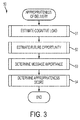
- FIGURE 3 is a flow diagram showing, by way of example, a process for determining an appropriateness score.
- a cognitive load of the driver is calculated (block 51) to determine whether the driver is currently able to handle receipt of the message and the distraction caused by receipt of the message.
- the cognitive load of a user refers to a total amount of activity imposed on the user's working memory, and thus, the amount of mental processing required of the user. For instance, when the driver's cognitive load is high, the driver is less able to handle viewing a message due to the high amount of mental processing required. Conversely, when the cognitive load of the driver is low, the driver may be better able to handle viewing the message since less processing is required by the driver. Determining the cognitive load is further described below with reference to FIGURE 4 .
- a determination regarding whether a better opportunity exists (block 52) in the future for presenting the message is made. Specifically, a route of the driver is determined and used to determine a location along the route that may be a better opportunity for presenting the message to the driver than the current time. Determining whether a future opportunity exists is discussed in detail, infra, with respect to FIGURE 5 . An importance of the message is also determined (block 53) to help identify whether the message should be immediately delivered to the user or whether the message delivery can wait for a better opportunity. Determining the message importance is further discussed below with reference to FIGURE 6 . Subsequently, the appropriateness score is determined (block 54) based on the cognitive load, future opportunity, and message importance factors.
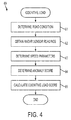
- FIGURE 4 is a flow diagram showing, by way of example, a process 60 for determining a cognitive load of a driver.
- the driver's cognitive load can be based on multiple factors surrounding a current driving condition of the driver at a particular time and location.
- a location of the user is identified using, for example, a global positioning system ("GPS") that can be positioned on or within the motor vehicle of the user to determine a location of the vehicle.
- GPS global positioning system
- the location of the motor vehicle can then be identified on a map using the GPS coordinates to determine the surrounding environment and driving conditions of the driver's location, such as if the driver is stopped at a light or sign or in traffic.
- the road conditions can include the speed limit, traffic density, traffic lights, and number of lanes, as well as other conditions.
- Information regarding the road conditions can be obtained from data provided by third parties, such as Google Maps, by Google Inc., Mountain View, CA and traffic reports from local news stations. Other types of information and information sources are possible.
- a camera can be used to track conditions, such as weather or motor vehicle proximity to other vehicles, as well as user facial expressions.
- Radar sensor readings from the driver's motor vehicle can also be obtained (block 62) and used in the cognitive load determination.
- the sensors can be positioned on or within the motor vehicle, such as on a front, back, top, bottom, or side of the vehicle to obtain data, including a distance to a vehicle in front of the driver and a distance to a vehicle behind a driver.
- In-car sensors can be used to obtain occupancy data or information regarding an action by the motor vehicle, such as whether the brakes are on, a position of the steering wheel, whether the horn is pressed, or whether a turn signal or emergency lights are on.
- a sensor can be positioned under each car seat and when a person sits in one of the seats, the sensor senses the weight of the person. Further, the sensors can be used to determine a speed and acceleration (block 63) of the motor vehicle.
- An anomaly score of the user's actions given the road condition and sensor readings is calculated (block 64).
- the anomaly score measures the user's departure or deviation from "normal," or regular actions and can include a speed anomaly, route anomaly, as well as other types of anomalies.
- a speed anomaly measures an amount of deviation between a user's current speed and an average speed. For example, a user will generally drive slower than normal in unfamiliar locations.
- a route anomaly identifies a route travelled by the user that is different from any other prior traveled routes of the user.
- An anomaly can indicate a high cognitive load of the user, such as when the user is driving in an unfamiliar location.
- the anomalies can be determined using a Support Vector Machine ("SVM”) or via clustering.
- SVM Support Vector Machine
- an anomaly model is first built using historical data of the driver. Specifically, the historical data includes known anomalies that are beyond the boundaries of normal ranges. The anomalies are identified and categorized as anomalies, while the normal or average data is separately categorized. The historical data includes the driver's past records of road conditions, sensor readings, and speed parameters, which are obtained over a period of time.
- the model is a representation of the separate categories for normal or expected data, and anomalies. As new data is received, the data is mapped using the model to determine whether the data resembles expected data or an anomaly. Based on where the new data is located with regards to the model, an anomaly score is assigned.
- the anomaly score can be determined via a standard clustering algorithm, such as k -means clustering. For example, the historical data of the driver is clustered. As new data is received, the data is compared to the centers of each previously-formed cluster and a distance of the data from each of the cluster centers is determined. The anomaly score is determined to be the distance of the data to one of the clusters. The longer the distance, the more dissimilar the data from the cluster and the higher the anomaly.
- k -means clustering For example, the historical data of the driver is clustered. As new data is received, the data is compared to the centers of each previously-formed cluster and a distance of the data from each of the cluster centers is determined. The anomaly score is determined to be the distance of the data to one of the clusters. The longer the distance, the more dissimilar the data from the cluster and the higher the anomaly.
- a user is driving from the University of Washington to downtown Seattle in rush time traffic.
- Bill travels this route Monday through Friday to attend his internship after school.
- Bill travels alone; however, today, two of his friends have asked to catch a ride with Bill so they can watch a movie at the theatre downtown.
- Bill and his friends have just entered I-5 highway from the entrance ramp off 45th Street NE when a sender, Leslie, transmits a text message intended for Bill.
- the text message is intercepted by a message server and includes a request for Bill to perform last minute revisions on a group project that is due tomorrow.
- Bill's location is identified via GPS and is used to determine the road conditions of Bill's current location. Further, radar sensor readings are obtained from the motor vehicle to determine speed parameters. Based on the location data, Bill is determined to be on the I-5 highway, which has multiple lanes, and the road conditions at Bill's location indicate that he is in traffic, with other vehicles surrounding him, and not near any stop lights. Specifically, readings from the radar sensors indicate that a motor vehicle is located 3 feet in front of the driver's motor vehicle and another motor vehicle is located two feet behind the driver's motor vehicle. The sensors also determine that Bill's motor vehicle is moving slowly, the brakes are not applied, and two passengers are riding in the motor vehicle. No anomaly regarding speed or route are identified as Bill frequently travels this same route at the same time. However, Bill's friends are identified as being in the car, which is a departure from Bill's "normal" actions since Bill usually drives to downtown Seattle alone. Upon identification of the passengers, an anomaly score is generated since the presence of passengers can increase Bill's cognitive load.
- the cognitive load score of the user is determined (block 65).
- the overall cognitive load can be determined via rules written by domain experts or machine learning, as further described below. Once determined, the cognitive load plays a role in determining whether to send a message to a recipient user at the time of receipt.
- the cognitive load score can be a value between zero and one. A high cognitive load score generally assumes that the user is distracted and unlikely to be able to handle the message. Meanwhile, if the user's cognitive load is lower, the user has more processing capacity to focus on the message.
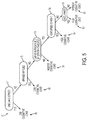
- FIGURE 5 is a block diagram showing, by way of example, a decision tree 70 for determining a cognitive load of a driver.
- the decision tree 70 is generated from rules provided by experts that guide a determination as to a level of cognitive load experienced by the user.
- the rules provided by an expert can include the following:
- the rules are entered into a decision tree, as shown in FIGURE 5 .
- Current vehicle data obtained is then applied to the decision tree to determine a cognitive load of the user.
- the decision tree can include a series of nodes and edges that are organized based on the rules. As the tree is traversed based on the vehicle data, binary values or weights can be assigned. For example, returning to the above example with Bill and his friends, Bill's cognitive load is determined by traversing through the decision tree based on the data collected. Starting at node 71, Bill is driving on I-5, which is a multi-lane highway, so the analysis moves to node 72, which considers whether Bill has applied the brakes. Since Bill is not currently applying the brakes, the density of traffic is analyzed at node 73.
- Bill is in traffic and his vehicle is surrounded by other vehicles.
- a determination is made as to the speed of Bill's motor vehicle.
- Bill is driving slowly 74 and occupants is determined to be present at node 75. Since Bill is driving two passengers, a determination is made that Bill's cognitive load is at a medium level, and a cognitive load score of 0.5 is assigned.
- particular values can be assigned to each edge extending from a node. For example, with respect to node 71, if a user is driving on a one lane highway, the user may receive a value of 0 or 0.1, whereas the user will receive a value of 0.4 if he is not driving on a one lane road.
- the values can be totaled as the cognitive score or an average of the total values can be calculated as the cognitive score.
- the cognitive load can also be determined using machine learning.
- a model is first generated.
- the model for cognitive load can be built using training data, including historical records of vehicle data.
- the model can include multiple vectors of factors and a cognitive level associated with each vector based on the factors.
- the historical data can come from a population of other drivers or can be obtained from the current user, and can include average speed, braking data, routes preferred, such as arterial street versus side street preferences, and occupancy data.
- the model can be based on a generic population of users and subsequently refined for the user based on personalized data. Subsequently, current vehicle data obtained for the user is mapped via the model to determine the cognitive load of the user.
- a vector with the different vehicle data factors can be formed for the current data and numerical values, such as between zero and one, or binary values can be assigned to each factor.
- S A ⁇ (speed, 0.5), (route, 0.75), (occupancy, 0.6) ⁇ .
- historical data observations such as times and situations when the user utilizes his phone or other mobile device can be used to help determine cognitive load.
- a user is generally more likely to use his phone when he is in a low stress situation and has the capacity to talk or read a message. For instance, a user may open and read a message while he is stopped at red light, has his foot on the brakes, is driving in a low traffic area, or has no occupants.
- the historical records can show that the user does not use his phone when driving on the freeway at fast speeds or with occupants.
- times or scenarios when the user uses his phone can be identified as a low cognitive load of the user, while times or scenarios when the user does not use his phone can be identified as high cognitive load.
- the historical phone usage records provides data as to what and when the driver thinks is a convenient time to use the phone and encourages transmission of the message during a convenient time, as defined by the user.
- FIGURE 6 is a flow diagram showing, by way of example a process 84 for determining a future opportunity for providing a message to a driver. Specifically, an estimate regarding whether there is any opportunity in the future to present the message with limited distraction to the user is determined. First, historical driving records of the user are obtained (block 85) over the last n -months.
- the number of n -months can be automatically determined or predetermined via the system or an expert.
- the historical driving records can include previously traveled routes of the user. From the previously traveled routes, one or more frequently traveled routes that match the driver's current driving direction are identified (block 86). The frequently traveled routes can be identified as those previously traveled routes that have been used at least a k number of times. The value of k can be automatically determined or predetermined via the system or an expert.
- routes most popular among other drivers in the user's direction are selected (block 87).
- the most popular routes can be based on aggregated historical data from different drivers or based on labeled routes by domain experts.
- the frequently traveled routes or most popular routes are then analyzed (block 88) and one of the routes is selected (block 89).
- an average time of each of the routes is determined.
- the route with the average time that is closest to the driver's current driving time is selected.
- the selected route is used to identify (block 86) whether any good opportunities exist to present the notification to the driver and a future opportunity score is generated.
- a good opportunity may include stoplights or stop signs, as well as low speed streets, and infrequently traveled roads. Values can be associated with each of the rules to calculate the future opportunity score.
- Bill is travelling from the University of Washington to downtown Seattle. Since Bill is heading south on I-5, Bill's historical driving records are analyzed to determine whether any previously traveled routes match Bill's current driving direction. As Bill drives this route Monday through Friday to go to work, the route from the University of Washington to Bill's workplace is identified, as well as a route from the University of Washington to Bill's favorite restaurant in West Seattle, which Bill frequents. West Seattle is located southwest of downtown Seattle and Bill passes downtown as he drives to West Seattle. Since there are multiple frequent routes that match Bill's current route, the average time of each route is reviewed. The work route is 20 minutes, while the restaurant route is 30 minutes. As provided above, Bill just entered the I-5 highway when a sender transmits a text message intended for Bill.
- Bill has been driving for about 6 minutes. Therefore, the route to Bill's work is selected since this route is the closest to Bill's current driving time.
- time of day can be considered. For example, if Bill is driving at 7:30 a.m. on a Monday morning and is heading south on I-5, he is most likely going to work.
- the selected work route is analyzed and a future opportunity for providing the message is identified on a stretch of I-5 between the 45 th street entrance and the Mercer Street exit since this stretch is generally always backed up and traffic is very slow, around 20 miles per hour.
- a further future opportunity is identified at the Union Street exit, which is about 7 minutes form Bill's current location.
- a stoplight is located right off the exit at a busy intersection so the length of a red light can be fairly long. Based on the multiple instances of future opportunities, the quality of each future opportunity and the proximity of the future opportunities, a high future opportunity score of 0.8 is provided.
- FIGURE 7 is a flow diagram showing, by way of example a process 90 for determining an importance of a message.
- the message importance can be based on multiple factors, as described in further detail in commonly-owned U.S. Patent Application, Serial No. 14/581,945 , titled “Computer-Implemented System and Method for Prioritizing Electronic Messages Based on Importance," Docket No. 20120336 US01, filed on December 23, 2014, the disclosure of which is hereby incorporated by reference.
- the message intended for the driver is analyzed to determine a sender of the message and a score is assigned based on the sender's importance to the user (block 91).
- a perceived importance based on the sender is determined across multiple communication channels, social networks and contexts.
- the score is then based on the communication patterns to determine an importance of the sender. For example, the sender is considered important when he is associated with the user across multiple social networks and frequently communicates with the user.
- the score can be binary with one value indicating an important sender, while the other value indicates a sender that is not important.
- a continuum of scoring such as between zero and one can be used to represent the importance of the sender.
- the message is further analyzed to determine whether the message includes a request or proposed action (block 92).
- a speech act taxonomy is applied to the message to identify terms in the message that are representative of a request or action.
- the speech act taxonomy can be divided into verbs and nouns, while each email message is represented by one or more verb-noun pairs. For example, an email proposing a meeting would include the labels "propose" and "meeting.”
- the most common speech act verbs to identify a request or action are deliver, request, commit, and propose, and the most common nouns are meeting and data.
- a pretrained speech predictor is used to identify the speech acts in the message. The predictor can be trained to recognize the speech acts based on a large email dataset using machine learning methods, such as support vector machines. A higher score is assigned to messages that require immediate actions from the user, such as those messages with high request or propose scores.
- a length of time necessary to read the message is determined (block 93) based on a length of the message, as well as other factors, such as a difficulty of the language and a complexity of the sentence structure used.
- a rule based score for the message is also determined (block 94).
- the rules can include assigning a particular score based an identity of the sender, assigning a score based on particular words that appear within the message, and assigning a particular score based on identified word combinations.
- Each of the rules are applied to the message and scores are assigned based on each of the rules. Subsequently, the scores are totaled for an overall rule based score.
- scores are totaled to determine a score representative of the message's importance. Further different weights can be associated with each of the factors prior to totaling the scores.
- Leslie transmits a message intended for Bill that includes "please proof the handout for tomorrow's presentation.”
- the sender, Leslie is identified as being important since Bill and Leslie have been messaging each other frequently due to their shared work on the project and are connected via multiple social networking sites.
- the action requested by Leslie is identified and a length of time needed to review the message is determined to be short. A value of 0.7 is assigned as the message importance score.
- FIGURE 8 is a block diagram showing, by way of example, processes 100 for calculating an appropriateness score 101.
- the appropriateness score 101 can be determined via rules written by domain experts 102, machine learning methods 103, or by totaling 104 the individual scores for cognitive load, future opportunity, and message importance.
- a high appropriateness score indicates that the message is most appropriate for delivering to the user, while a low appropriateness score indicates less appropriateness for sending the message.
- the cognitive score and the future opportunity score can be normalized.
- a high cognitive load indicates that a high level of mental processing is required of the user, and thus, the user is unlikely able to handle the message, which would require further mental processing, and sending of the message is inappropriate.
- a high future opportunity score indicates that one or more future opportunities exist, which generally decreases the appropriateness of providing the message at a current time, while a low score indicates that a future opportunity is unlikely and the appropriateness of providing the message to the user is high. Therefore, the cognitive load score and future opportunity score should be normalized so the factors are properly considered for calculating the appropriateness score. Normalization can include inverting each of the cognitive load and future importance scores. The inversion ensures that the appropriateness score is high when the cognitive load is low and when the future opportunity is low. Other types of normalization are possible.
- Rule based scoring for the appropriateness score relies on rules written by experts. For example, if the cognitive load score is above 0.2, the future opportunity score is above 0.35, and the message importance is above 0.5, then the message is immediately provided to the user. Further, if the cognitive load score is above 0.3, the future opportunity score is above 0.6, and the message importance is above 0.5, then wait for the soonest future opportunity. Other rule based examples can consider one or more of the factors. For example, when the normalized score for cognitive load is 10 or above, the message should be immediately transmitted to the user since the total amount of activity imposed on the user's working memory is low and the user is likely able to handle receipt of the message.
- the cognitive load score is a little lower, such as 7, but the message is extremely important, the message can be immediately provided to the user without any consideration as to future opportunities.
- Any number of rules can be defined as determined necessary. Alternatively, to simplify the appropriateness score determination, a predetermined number of rules may apply.
- Machine learning methods 103 for determining the appropriateness score can utilize a support vector machine.
- Combinations of the driver's cognitive score, future opportunity score, and message importance score are labeled by domain experts with an appropriateness score and provided as training material to build a model for assigning an appropriateness score for further received combinations of the driver's cognitive score, future opportunity score, and message importance score.
- the model can be built using training data, including historical records identifying when the user or users have previously accepted the message and when the user or users have previously denied the messages, as well as the environment surrounding the users' decision. Subsequently, the obtained cognitive score, future opportunity score, and message importance are compared to the model and an appropriateness of providing the message to the user at the current time is determined.
- the appropriateness score can be calculated by totaling the cognitive load, future opportunity, and message importance scores, taking the average of the scores, or calculating the mean of the scores.
- Each of the weights are represented by w 1 , w 2 , and w 3 .
- Other processes or equations for calculating the appropriateness score are possible.
- a threshold can be applied.
- the threshold can be 9 and any appropriateness scores equal to or above the threshold could dictate providing the message to the user. Other threshold values are possible.
- a cognitive load score of 0.5 has been assigned, two future opportunities for providing the intended message to Bill have been identified and a score of 0.8 is assigned, and the importance of the message is determined as 0.7 since the message includes an action that Bill must complete before tomorrow.
- the scores for cognitive load and future opportunity are normalized by taking the inverse and the normalized scores are now 2 for cognitive load and 1.25 for future opportunity. By totaling the scores for the cognitive load, future opportunity and message importance, an appropriateness score of 3.95 is calculated.
- the predefined threshold for providing the message to the user is 9. Therefore, since the appropriateness score is below the threshold, the message is not currently provided to Bill. However, Bill's location and activity is still monitored and the message is provided at a further time, such as at one of the identified future opportunities based on an appropriateness score at that opportunity.
- a determination of whether to provide the message to the user can be based on a scoring continuum, such that an appropriateness score is assigned to the current instance when the message intended for the user is received by the server, as well as assigned to identified future opportunities so the best opportunity for providing the message along the user's route can be identified.
- the appropriateness for providing the message at an identified future opportunity can be based on the user's cognitive load, other future opportunities, and the message importance, as well as other factors, including a distance of the future opportunity from the user's current location and a quality of the future opportunity.
- a traffic light may be identified as a future opportunity and the quality of the opportunity can be based on a length of a red light at the intersection. The longer the red light, the higher quality opportunity since a user stops at the red light and generally has a low cognitive load.
- determining an appropriate time for sending a message to a driver can be used for driver communication within an audio centric network, as described in U.S. Patent Application, Serial No. 14/582,005 , titled "System and Method for Facilitating Driver Communication via an Audio Centric Network, Docket No. 20130826 US01, filed on December 23, 2014, the disclosure of which is hereby incorporated by reference.
- drivers in nearby vicinities can verbally communicate with one another while driving by selecting another driver within a predetermined range and initiating contact.
Landscapes
- Engineering & Computer Science (AREA)
- Business, Economics & Management (AREA)
- Human Resources & Organizations (AREA)
- Strategic Management (AREA)
- Economics (AREA)
- Physics & Mathematics (AREA)
- Tourism & Hospitality (AREA)
- Entrepreneurship & Innovation (AREA)
- General Physics & Mathematics (AREA)
- Theoretical Computer Science (AREA)
- Marketing (AREA)
- General Business, Economics & Management (AREA)
- Operations Research (AREA)
- Quality & Reliability (AREA)
- Computer Networks & Wireless Communication (AREA)
- Signal Processing (AREA)
- Development Economics (AREA)
- Data Mining & Analysis (AREA)
- Game Theory and Decision Science (AREA)
- General Health & Medical Sciences (AREA)
- Health & Medical Sciences (AREA)
- Primary Health Care (AREA)
- Mathematical Physics (AREA)
- Transportation (AREA)
- Mechanical Engineering (AREA)
- Automation & Control Theory (AREA)
- Traffic Control Systems (AREA)
- Telephonic Communication Services (AREA)
Applications Claiming Priority (1)
| Application Number | Priority Date | Filing Date | Title |
|---|---|---|---|
| US14/581,975 US10009738B2 (en) | 2014-12-23 | 2014-12-23 | System and method for determining an appropriate time for providing a message to a driver |
Publications (1)
| Publication Number | Publication Date |
|---|---|
| EP3038047A1 true EP3038047A1 (en) | 2016-06-29 |
Family
ID=54936758
Family Applications (1)
| Application Number | Title | Priority Date | Filing Date |
|---|---|---|---|
| EP15198744.3A Ceased EP3038047A1 (en) | 2014-12-23 | 2015-12-09 | System and method for determining an appropriate time for providing a message to a driver |
Country Status (3)
| Country | Link |
|---|---|
| US (1) | US10009738B2 (cg-RX-API-DMAC7.html) |
| EP (1) | EP3038047A1 (cg-RX-API-DMAC7.html) |
| JP (1) | JP6948110B2 (cg-RX-API-DMAC7.html) |
Cited By (2)
| Publication number | Priority date | Publication date | Assignee | Title |
|---|---|---|---|---|
| US10368333B2 (en) | 2017-11-20 | 2019-07-30 | Google Llc | Dynamically adapting provision of notification output to reduce user distraction and/or mitigate usage of computational resources |
| US12299485B2 (en) | 2020-09-24 | 2025-05-13 | OnScale, Inc. | Dynamic resource allocation for computational simulation |
Families Citing this family (21)
| Publication number | Priority date | Publication date | Assignee | Title |
|---|---|---|---|---|
| EP3215943B1 (en) | 2014-11-03 | 2021-04-21 | Vectra AI, Inc. | A system for implementing threat detection using threat and risk assessment of asset-actor interactions |
| WO2016073379A2 (en) | 2014-11-03 | 2016-05-12 | Vectra Networks, Inc. | A system for implementing threat detection using daily network traffic community outliers |
| US10104511B2 (en) * | 2015-11-13 | 2018-10-16 | Raytheon Company | Recommendations and notifications over limited connections |
| US11115359B2 (en) * | 2016-11-03 | 2021-09-07 | Samsung Electronics Co., Ltd. | Method and apparatus for importance filtering a plurality of messages |
| US10191462B2 (en) * | 2017-06-06 | 2019-01-29 | International Business Machines Corporation | Vehicle electronic receptionist for communications management |
| US10735367B2 (en) * | 2017-08-03 | 2020-08-04 | Fujitsu Limited | Electronic message management based on cognitive load |
| US10677686B2 (en) * | 2017-11-14 | 2020-06-09 | GM Global Technology Operations LLC | Method and apparatus for autonomous system performance and grading |
| US10498685B2 (en) * | 2017-11-20 | 2019-12-03 | Google Llc | Systems, methods, and apparatus for controlling provisioning of notifications based on sources of the notifications |
| US10850746B2 (en) * | 2018-07-24 | 2020-12-01 | Harman International Industries, Incorporated | Coordinating delivery of notifications to the driver of a vehicle to reduce distractions |
| US10907986B2 (en) * | 2018-08-28 | 2021-02-02 | Here Global B.V. | User familiarization with a novel route for reducing cognitive load associated with navigation |
| US11029171B2 (en) | 2018-08-28 | 2021-06-08 | Here Global B.V. | User familiarization with a novel route for reducing cognitive load associated with navigation |
| US11047697B2 (en) | 2018-08-28 | 2021-06-29 | Here Global B.V. | User familiarization with a novel route for reducing cognitive load associated with navigation |
| US20200219608A1 (en) * | 2019-01-08 | 2020-07-09 | Intuition Robotics, Ltd. | System and method for monitoring and managing a cognitive load of a person |
| US12143900B2 (en) * | 2019-10-19 | 2024-11-12 | Sarath KAKUMANU | Sending or receiving SMS by internet messaging application without using internet |
| US20210350232A1 (en) * | 2020-05-07 | 2021-11-11 | Nec Laboratories America, Inc. | Fault detection in cyber-physical systems |
| US11741381B2 (en) | 2020-07-14 | 2023-08-29 | Optum Technology, Inc. | Weighted adaptive filtering based loss function to predict the first occurrence of multiple events in a single shot |
| US20220244062A1 (en) * | 2021-01-29 | 2022-08-04 | Here Global B.V. | Method, apparatus and computer program product for navigation using behavior and cognitive models |
| US20220340145A1 (en) * | 2021-04-21 | 2022-10-27 | Here Global B.V. | Automatic recommendation of control in a simultaneous mix mode vehicle |
| US12467756B2 (en) * | 2021-09-17 | 2025-11-11 | Intel Corporation | Driver scoring system and method with driving event context normalization using road quality information |
| US12359932B1 (en) * | 2022-06-13 | 2025-07-15 | Waymo Llc | Establishing routines for autonomous vehicle transportation services |
| CN121563455B (zh) * | 2026-01-22 | 2026-04-21 | 湖南数播科技有限公司 | 一种基于学习行为的自适应学习时长管控方法 |
Citations (6)
| Publication number | Priority date | Publication date | Assignee | Title |
|---|---|---|---|---|
| WO2002017786A1 (de) * | 2000-08-29 | 2002-03-07 | Robert Bosch Gmbh | Verfahren und vorrichtung zur diagnosis der fahrtüchtigkeit eines fahrers in einen kraftfahrzeug |
| WO2003070093A1 (en) * | 2002-02-19 | 2003-08-28 | Volvo Technology Corporation | System and method for monitoring and managing driver attention loads |
| US8275348B2 (en) | 2008-05-30 | 2012-09-25 | Volkswagen Ag | Method for managing telephone calls in a vehicle |
| WO2013029258A1 (en) * | 2011-08-31 | 2013-03-07 | Qoros Automotive Co., Ltd. | System and method for managing incoming messages in a vehicle |
| WO2013055487A1 (en) * | 2011-10-12 | 2013-04-18 | Drivecam, Inc. | Drive event capturing based on geolocaton |
| EP2814229A1 (en) * | 2013-06-12 | 2014-12-17 | BlackBerry Limited | Method of processing an incoming communication signal at a mobile communication device |
Family Cites Families (7)
| Publication number | Priority date | Publication date | Assignee | Title |
|---|---|---|---|---|
| US20020151297A1 (en) * | 2000-10-14 | 2002-10-17 | Donald Remboski | Context aware wireless communication device and method |
| US6909947B2 (en) * | 2000-10-14 | 2005-06-21 | Motorola, Inc. | System and method for driver performance improvement |
| JP3639568B2 (ja) * | 2002-08-30 | 2005-04-20 | 日本電信電話株式会社 | 車両内情報配信システム |
| US7292152B2 (en) * | 2003-06-12 | 2007-11-06 | Temic Automotive Of North America, Inc. | Method and apparatus for classifying vehicle operator activity state |
| JP5115354B2 (ja) * | 2008-06-20 | 2013-01-09 | トヨタ自動車株式会社 | 運転支援装置 |
| JP2012194060A (ja) * | 2011-03-16 | 2012-10-11 | Denso Corp | 情報提供装置 |
| JP2014029689A (ja) * | 2013-07-30 | 2014-02-13 | Ford Global Technologies Llc | 運転者インタフェースタスクを管理する方法、及び、車両 |
-
2014
- 2014-12-23 US US14/581,975 patent/US10009738B2/en not_active Expired - Fee Related
-
2015
- 2015-12-08 JP JP2015239404A patent/JP6948110B2/ja not_active Expired - Fee Related
- 2015-12-09 EP EP15198744.3A patent/EP3038047A1/en not_active Ceased
Patent Citations (7)
| Publication number | Priority date | Publication date | Assignee | Title |
|---|---|---|---|---|
| WO2002017786A1 (de) * | 2000-08-29 | 2002-03-07 | Robert Bosch Gmbh | Verfahren und vorrichtung zur diagnosis der fahrtüchtigkeit eines fahrers in einen kraftfahrzeug |
| WO2003070093A1 (en) * | 2002-02-19 | 2003-08-28 | Volvo Technology Corporation | System and method for monitoring and managing driver attention loads |
| EP2314207A1 (en) | 2002-02-19 | 2011-04-27 | Volvo Technology Corporation | Method for monitoring and managing driver attention loads |
| US8275348B2 (en) | 2008-05-30 | 2012-09-25 | Volkswagen Ag | Method for managing telephone calls in a vehicle |
| WO2013029258A1 (en) * | 2011-08-31 | 2013-03-07 | Qoros Automotive Co., Ltd. | System and method for managing incoming messages in a vehicle |
| WO2013055487A1 (en) * | 2011-10-12 | 2013-04-18 | Drivecam, Inc. | Drive event capturing based on geolocaton |
| EP2814229A1 (en) * | 2013-06-12 | 2014-12-17 | BlackBerry Limited | Method of processing an incoming communication signal at a mobile communication device |
Cited By (8)
| Publication number | Priority date | Publication date | Assignee | Title |
|---|---|---|---|---|
| US10368333B2 (en) | 2017-11-20 | 2019-07-30 | Google Llc | Dynamically adapting provision of notification output to reduce user distraction and/or mitigate usage of computational resources |
| WO2019099692A3 (en) * | 2017-11-20 | 2019-08-01 | Google Llc | Dynamically adapting provision of notification output to reduce user distraction and/or mitigate usage of computational resources |
| CN110770705A (zh) * | 2017-11-20 | 2020-02-07 | 谷歌有限责任公司 | 动态调整通知输出的提供以减少分心和/或减轻计算资源的使用 |
| US10624060B2 (en) | 2017-11-20 | 2020-04-14 | Google Llc | Dynamically adapting provision of notification output to reduce user distraction and/or mitigate usage of computational resources |
| US11129134B2 (en) | 2017-11-20 | 2021-09-21 | Google Llc | Dynamically adapting provision of notification output to reduce user distraction and/or mitigate usage of computational resources |
| US11871219B2 (en) | 2017-11-20 | 2024-01-09 | Google Llc | Dynamically adapting provision of notification output to reduce user distraction and/or mitigate usage of computational resources |
| US12213103B2 (en) | 2017-11-20 | 2025-01-28 | Google Llc | Dynamically adapting provision of notification output to reduce user distraction and/or mitigate usage of computational resources |
| US12299485B2 (en) | 2020-09-24 | 2025-05-13 | OnScale, Inc. | Dynamic resource allocation for computational simulation |
Also Published As
| Publication number | Publication date |
|---|---|
| JP6948110B2 (ja) | 2021-10-13 |
| JP2016119080A (ja) | 2016-06-30 |
| US10009738B2 (en) | 2018-06-26 |
| US20160183068A1 (en) | 2016-06-23 |
Similar Documents
| Publication | Publication Date | Title |
|---|---|---|
| US10009738B2 (en) | System and method for determining an appropriate time for providing a message to a driver | |
| Gaspar et al. | The effect of partial automation on driver attention: A naturalistic driving study | |
| US11004357B2 (en) | Pre-license development tool | |
| Strayer et al. | SPIDER: A framework for understanding driver distraction | |
| AbuAli et al. | Driver behavior modeling: Developments and future directions | |
| Regan et al. | Driver distraction: mechanisms, evidence, prevention, and mitigation | |
| US12008610B2 (en) | Implementing and optimizing safety interventions | |
| CN111762147A (zh) | 控制装置、控制方法以及存储程序的存储介质 | |
| Van Dam et al. | The effects of passive mobile phone interaction on situation awareness and driving performance | |
| Strayer | Is the technology in your car driving you to distraction? | |
| CN120548276A (zh) | 用于警示驾驶员的警示模态选择 | |
| Scopatz et al. | Effect of electronic device use on pedestrian safety: A literature review | |
| Osman et al. | Impact of time-to-collision information on driving behavior in connected vehicle environments using a driving simulator test bed | |
| Obeidat et al. | Effects of vehicle’s human machine interface devices on driving distractions | |
| Cooper et al. | Driver behavior while using Level 2 vehicle automation: a hybrid naturalistic study | |
| Caird et al. | A review of novice and teen driver distraction | |
| Craig et al. | In-vehicle work zone messages | |
| Ansariyar et al. | ACCIDENT RESPONSE ANALYSIS OF SIX DIFFERENT TYPES OF DISTRACTED DRIVING. | |
| Lady et al. | The Effects of Using Electronic Maps While Driving on The Driver Performance | |
| Mohanty et al. | Investigation of adolescent accident predictive variables in hilly regions | |
| Creaser | Effectiveness of a Smartphone-based Driver Support System for Reducing the Frequency of Risky Driving Behaviors in Novice Teenage Drivers | |
| Adedeji et al. | Risk analysis of drivers’ distraction: Effect of navigation tools | |
| Atiquzzaman | Exploring distracted driver detection algorithms using a driving simulator study | |
| Bamney | Examining the relationship between driver distraction, crash, and near-crash risk using naturalistic driving data | |
| Jabrah et al. | Street Owl. A Mobile App to Reduce Car Accidents |
Legal Events
| Date | Code | Title | Description |
|---|---|---|---|
| PUAI | Public reference made under article 153(3) epc to a published international application that has entered the european phase |
Free format text: ORIGINAL CODE: 0009012 |
|
| AK | Designated contracting states |
Kind code of ref document: A1 Designated state(s): AL AT BE BG CH CY CZ DE DK EE ES FI FR GB GR HR HU IE IS IT LI LT LU LV MC MK MT NL NO PL PT RO RS SE SI SK SM TR |
|
| AX | Request for extension of the european patent |
Extension state: BA ME |
|
| STAA | Information on the status of an ep patent application or granted ep patent |
Free format text: STATUS: REQUEST FOR EXAMINATION WAS MADE |
|
| STAA | Information on the status of an ep patent application or granted ep patent |
Free format text: STATUS: EXAMINATION IS IN PROGRESS |
|
| 17P | Request for examination filed |
Effective date: 20170102 |
|
| RBV | Designated contracting states (corrected) |
Designated state(s): AL AT BE BG CH CY CZ DE DK EE ES FI FR GB GR HR HU IE IS IT LI LT LU LV MC MK MT NL NO PL PT RO RS SE SI SK SM TR |
|
| 17Q | First examination report despatched |
Effective date: 20170209 |
|
| APBK | Appeal reference recorded |
Free format text: ORIGINAL CODE: EPIDOSNREFNE |
|
| APBN | Date of receipt of notice of appeal recorded |
Free format text: ORIGINAL CODE: EPIDOSNNOA2E |
|
| APBR | Date of receipt of statement of grounds of appeal recorded |
Free format text: ORIGINAL CODE: EPIDOSNNOA3E |
|
| APAF | Appeal reference modified |
Free format text: ORIGINAL CODE: EPIDOSCREFNE |
|
| APBX | Invitation to file observations in appeal sent |
Free format text: ORIGINAL CODE: EPIDOSNOBA2E |
|
| APBT | Appeal procedure closed |
Free format text: ORIGINAL CODE: EPIDOSNNOA9E |
|
| STAA | Information on the status of an ep patent application or granted ep patent |
Free format text: STATUS: THE APPLICATION HAS BEEN REFUSED |
|
| 18R | Application refused |
Effective date: 20220429 |