EP3037398A1 - Method for manufacturing chemical compound - Google Patents
Method for manufacturing chemical compound Download PDFInfo
- Publication number
- EP3037398A1 EP3037398A1 EP14838250.0A EP14838250A EP3037398A1 EP 3037398 A1 EP3037398 A1 EP 3037398A1 EP 14838250 A EP14838250 A EP 14838250A EP 3037398 A1 EP3037398 A1 EP 3037398A1
- Authority
- EP
- European Patent Office
- Prior art keywords
- group
- compound
- producing
- organic base
- carbon atoms
- Prior art date
- Legal status (The legal status is an assumption and is not a legal conclusion. Google has not performed a legal analysis and makes no representation as to the accuracy of the status listed.)
- Granted
Links
- FOQJHZPURACERJ-UHFFFAOYSA-N CB1OC(C)(C)C(C)(C)O1 Chemical compound CB1OC(C)(C)C(C)(C)O1 FOQJHZPURACERJ-UHFFFAOYSA-N 0.000 description 1
- KQVWFBVPBAQTES-UHFFFAOYSA-N CB1OCCCO1 Chemical compound CB1OCCCO1 KQVWFBVPBAQTES-UHFFFAOYSA-N 0.000 description 1
- USMRYMUZKSMTRL-UHFFFAOYSA-N CB1OCCO1 Chemical compound CB1OCCO1 USMRYMUZKSMTRL-UHFFFAOYSA-N 0.000 description 1
- ULFPBVSCYAHJJN-UHFFFAOYSA-N CB1Oc(cccc2)c2O1 Chemical compound CB1Oc(cccc2)c2O1 ULFPBVSCYAHJJN-UHFFFAOYSA-N 0.000 description 1
Classifications
-
- C—CHEMISTRY; METALLURGY
- C08—ORGANIC MACROMOLECULAR COMPOUNDS; THEIR PREPARATION OR CHEMICAL WORKING-UP; COMPOSITIONS BASED THEREON
- C08G—MACROMOLECULAR COMPOUNDS OBTAINED OTHERWISE THAN BY REACTIONS ONLY INVOLVING UNSATURATED CARBON-TO-CARBON BONDS
- C08G61/00—Macromolecular compounds obtained by reactions forming a carbon-to-carbon link in the main chain of the macromolecule
- C08G61/12—Macromolecular compounds containing atoms other than carbon in the main chain of the macromolecule
- C08G61/121—Macromolecular compounds containing atoms other than carbon in the main chain of the macromolecule derived from organic halides
-
- C—CHEMISTRY; METALLURGY
- C07—ORGANIC CHEMISTRY
- C07C—ACYCLIC OR CARBOCYCLIC COMPOUNDS
- C07C1/00—Preparation of hydrocarbons from one or more compounds, none of them being a hydrocarbon
- C07C1/32—Preparation of hydrocarbons from one or more compounds, none of them being a hydrocarbon starting from compounds containing hetero-atoms other than or in addition to oxygen or halogen
- C07C1/321—Preparation of hydrocarbons from one or more compounds, none of them being a hydrocarbon starting from compounds containing hetero-atoms other than or in addition to oxygen or halogen the hetero-atom being a non-metal atom
-
- C—CHEMISTRY; METALLURGY
- C07—ORGANIC CHEMISTRY
- C07C—ACYCLIC OR CARBOCYCLIC COMPOUNDS
- C07C209/00—Preparation of compounds containing amino groups bound to a carbon skeleton
- C07C209/60—Preparation of compounds containing amino groups bound to a carbon skeleton by condensation or addition reactions, e.g. Mannich reaction, addition of ammonia or amines to alkenes or to alkynes or addition of compounds containing an active hydrogen atom to Schiff's bases, quinone imines, or aziranes
-
- C—CHEMISTRY; METALLURGY
- C07—ORGANIC CHEMISTRY
- C07C—ACYCLIC OR CARBOCYCLIC COMPOUNDS
- C07C67/00—Preparation of carboxylic acid esters
- C07C67/465—Preparation of carboxylic acid esters by oligomerisation
-
- C—CHEMISTRY; METALLURGY
- C08—ORGANIC MACROMOLECULAR COMPOUNDS; THEIR PREPARATION OR CHEMICAL WORKING-UP; COMPOSITIONS BASED THEREON
- C08G—MACROMOLECULAR COMPOUNDS OBTAINED OTHERWISE THAN BY REACTIONS ONLY INVOLVING UNSATURATED CARBON-TO-CARBON BONDS
- C08G61/00—Macromolecular compounds obtained by reactions forming a carbon-to-carbon link in the main chain of the macromolecule
- C08G61/12—Macromolecular compounds containing atoms other than carbon in the main chain of the macromolecule
-
- C—CHEMISTRY; METALLURGY
- C08—ORGANIC MACROMOLECULAR COMPOUNDS; THEIR PREPARATION OR CHEMICAL WORKING-UP; COMPOSITIONS BASED THEREON
- C08G—MACROMOLECULAR COMPOUNDS OBTAINED OTHERWISE THAN BY REACTIONS ONLY INVOLVING UNSATURATED CARBON-TO-CARBON BONDS
- C08G61/00—Macromolecular compounds obtained by reactions forming a carbon-to-carbon link in the main chain of the macromolecule
- C08G61/12—Macromolecular compounds containing atoms other than carbon in the main chain of the macromolecule
- C08G61/122—Macromolecular compounds containing atoms other than carbon in the main chain of the macromolecule derived from five- or six-membered heterocyclic compounds, other than imides
-
- C—CHEMISTRY; METALLURGY
- C07—ORGANIC CHEMISTRY
- C07C—ACYCLIC OR CARBOCYCLIC COMPOUNDS
- C07C2531/00—Catalysts comprising hydrides, coordination complexes or organic compounds
- C07C2531/16—Catalysts comprising hydrides, coordination complexes or organic compounds containing coordination complexes
- C07C2531/22—Organic complexes
-
- C—CHEMISTRY; METALLURGY
- C07—ORGANIC CHEMISTRY
- C07C—ACYCLIC OR CARBOCYCLIC COMPOUNDS
- C07C2531/00—Catalysts comprising hydrides, coordination complexes or organic compounds
- C07C2531/16—Catalysts comprising hydrides, coordination complexes or organic compounds containing coordination complexes
- C07C2531/24—Phosphines
-
- C—CHEMISTRY; METALLURGY
- C07—ORGANIC CHEMISTRY
- C07C—ACYCLIC OR CARBOCYCLIC COMPOUNDS
- C07C2603/00—Systems containing at least three condensed rings
- C07C2603/02—Ortho- or ortho- and peri-condensed systems
- C07C2603/04—Ortho- or ortho- and peri-condensed systems containing three rings
- C07C2603/06—Ortho- or ortho- and peri-condensed systems containing three rings containing at least one ring with less than six ring members
- C07C2603/10—Ortho- or ortho- and peri-condensed systems containing three rings containing at least one ring with less than six ring members containing five-membered rings
- C07C2603/12—Ortho- or ortho- and peri-condensed systems containing three rings containing at least one ring with less than six ring members containing five-membered rings only one five-membered ring
- C07C2603/18—Fluorenes; Hydrogenated fluorenes
-
- C—CHEMISTRY; METALLURGY
- C08—ORGANIC MACROMOLECULAR COMPOUNDS; THEIR PREPARATION OR CHEMICAL WORKING-UP; COMPOSITIONS BASED THEREON
- C08G—MACROMOLECULAR COMPOUNDS OBTAINED OTHERWISE THAN BY REACTIONS ONLY INVOLVING UNSATURATED CARBON-TO-CARBON BONDS
- C08G2261/00—Macromolecular compounds obtained by reactions forming a carbon-to-carbon link in the main chain of the macromolecule
- C08G2261/10—Definition of the polymer structure
- C08G2261/14—Side-groups
- C08G2261/142—Side-chains containing oxygen
- C08G2261/1424—Side-chains containing oxygen containing ether groups, including alkoxy
-
- C—CHEMISTRY; METALLURGY
- C08—ORGANIC MACROMOLECULAR COMPOUNDS; THEIR PREPARATION OR CHEMICAL WORKING-UP; COMPOSITIONS BASED THEREON
- C08G—MACROMOLECULAR COMPOUNDS OBTAINED OTHERWISE THAN BY REACTIONS ONLY INVOLVING UNSATURATED CARBON-TO-CARBON BONDS
- C08G2261/00—Macromolecular compounds obtained by reactions forming a carbon-to-carbon link in the main chain of the macromolecule
- C08G2261/10—Definition of the polymer structure
- C08G2261/14—Side-groups
- C08G2261/142—Side-chains containing oxygen
- C08G2261/1426—Side-chains containing oxygen containing carboxy groups (COOH) and/or -C(=O)O-moieties
-
- C—CHEMISTRY; METALLURGY
- C08—ORGANIC MACROMOLECULAR COMPOUNDS; THEIR PREPARATION OR CHEMICAL WORKING-UP; COMPOSITIONS BASED THEREON
- C08G—MACROMOLECULAR COMPOUNDS OBTAINED OTHERWISE THAN BY REACTIONS ONLY INVOLVING UNSATURATED CARBON-TO-CARBON BONDS
- C08G2261/00—Macromolecular compounds obtained by reactions forming a carbon-to-carbon link in the main chain of the macromolecule
- C08G2261/30—Monomer units or repeat units incorporating structural elements in the main chain
- C08G2261/31—Monomer units or repeat units incorporating structural elements in the main chain incorporating aromatic structural elements in the main chain
- C08G2261/314—Condensed aromatic systems, e.g. perylene, anthracene or pyrene
- C08G2261/3142—Condensed aromatic systems, e.g. perylene, anthracene or pyrene fluorene-based, e.g. fluorene, indenofluorene, or spirobifluorene
-
- C—CHEMISTRY; METALLURGY
- C08—ORGANIC MACROMOLECULAR COMPOUNDS; THEIR PREPARATION OR CHEMICAL WORKING-UP; COMPOSITIONS BASED THEREON
- C08G—MACROMOLECULAR COMPOUNDS OBTAINED OTHERWISE THAN BY REACTIONS ONLY INVOLVING UNSATURATED CARBON-TO-CARBON BONDS
- C08G2261/00—Macromolecular compounds obtained by reactions forming a carbon-to-carbon link in the main chain of the macromolecule
- C08G2261/30—Monomer units or repeat units incorporating structural elements in the main chain
- C08G2261/31—Monomer units or repeat units incorporating structural elements in the main chain incorporating aromatic structural elements in the main chain
- C08G2261/316—Monomer units or repeat units incorporating structural elements in the main chain incorporating aromatic structural elements in the main chain bridged by heteroatoms, e.g. N, P, Si or B
- C08G2261/3162—Arylamines
-
- C—CHEMISTRY; METALLURGY
- C08—ORGANIC MACROMOLECULAR COMPOUNDS; THEIR PREPARATION OR CHEMICAL WORKING-UP; COMPOSITIONS BASED THEREON
- C08G—MACROMOLECULAR COMPOUNDS OBTAINED OTHERWISE THAN BY REACTIONS ONLY INVOLVING UNSATURATED CARBON-TO-CARBON BONDS
- C08G2261/00—Macromolecular compounds obtained by reactions forming a carbon-to-carbon link in the main chain of the macromolecule
- C08G2261/30—Monomer units or repeat units incorporating structural elements in the main chain
- C08G2261/32—Monomer units or repeat units incorporating structural elements in the main chain incorporating heteroaromatic structural elements in the main chain
- C08G2261/324—Monomer units or repeat units incorporating structural elements in the main chain incorporating heteroaromatic structural elements in the main chain condensed
- C08G2261/3245—Monomer units or repeat units incorporating structural elements in the main chain incorporating heteroaromatic structural elements in the main chain condensed containing nitrogen and oxygen as heteroatoms
-
- C—CHEMISTRY; METALLURGY
- C08—ORGANIC MACROMOLECULAR COMPOUNDS; THEIR PREPARATION OR CHEMICAL WORKING-UP; COMPOSITIONS BASED THEREON
- C08G—MACROMOLECULAR COMPOUNDS OBTAINED OTHERWISE THAN BY REACTIONS ONLY INVOLVING UNSATURATED CARBON-TO-CARBON BONDS
- C08G2261/00—Macromolecular compounds obtained by reactions forming a carbon-to-carbon link in the main chain of the macromolecule
- C08G2261/40—Polymerisation processes
- C08G2261/41—Organometallic coupling reactions
- C08G2261/411—Suzuki reactions
Definitions
- the present invention relates to a method for producing a compound.
- a coupling reaction between condensing an organohalogen compound and a boron compound under a basic condition is known as a method for producing a compound which gives high versatility.
- Compounds obtained by conducting the coupling reaction are utilized in medical drugs, agricultural chemicals, liquid crystal materials, organic electronics materials and the like.
- Non-patent document 1 Chem. Mater. 2004, 16, 4736-4742
- the present invention includes the following inventions.
- a method for producing a compound showing a high reaction rate can be provided.
- the compound (1) having one or two leaving groups (hereinafter, referred to as a compound (1) in some cases) is usually an organic compound having a molecular weight of 1 ⁇ 10 4 or lower and having one or two leaving groups, and it is a compound dissolvable in an organic solvent.
- the leaving group of the compound (1) is a group which leaves by reacting with the compound (2) having one or two boron atom-containing leaving groups, in the coupling reaction in the present invention.
- the diazonio group usually forms a salt with HSO 4 - , Cl - , Br - , NO 3 - , ClO 4 - , BF 4 - , PF 6 - or the like.
- the leaving group includes preferably a chlorine atom, a bromine atom, a mesylate group and a trifluoromethanesulfonate group, more preferably a chlorine atom and a bromine atom, further preferably a bromine atom.
- R 1 is preferably an organic group having 1 to 60 carbon atoms, more preferably an organic group having 6 to 20 carbon atoms.
- the organic group includes an aromatic group which optionally have a substituent, an organometal group which optionally have a substituent and an aliphatic hydrocarbon group which optionally have a substituent, preferably an aromatic group which optionally have a substituent and an organometal group which optionally have a substituent, more preferably an aromatic group having 6 to 20 carbon atoms which optionally have a substituent.
- the above-mentioned aromatic group is an aromatic hydrocarbon group or an aromatic heterocyclic group.
- the above-mentioned aromatic hydrocarbon group is an aryl group or an arylene group.
- the above-mentioned aromatic heterocyclic group is a heteroaryl group or a heteroarylene group.
- the number of carbon atoms of the aryl group is usually 6 to 60, preferably 6 to 20, more preferably 6 to 13.
- the aryl group includes a phenyl group, a 1-naphthyl group, a 2-naphthyl group, a 1-anthracenyl group, a 2-anthracenyl group, a 9-anthracenyl group, a 1-pyrenyl group, a 2-pyrenyl group, a 4-pyrenyl group, a 2-fluorenyl group, a 3-fluorenyl group, a 4-fluorenyl group, a 2-phenylphenyl group, a 3-phenylphenyl group and a 4-phenylphenyl group.
- a hydrogen atom in these groups are optionally substituted with an alkyl group, an alkenyl group, an alkynyl group, an alkoxy group, an aryloxy group, an aryl group, a heteroaryl group, an amino group, a substituted amino group, a fluorine atom, a group represented by the following formula (E-1): [wherein, X represents an alkylene group or an oxyalkylene group. R' represents a hydrogen atom, an alkyl group or an aryl group. p represents an integer of 0 to 4. When there are a plurality of X, they may be the same or different.], a group represented by the following formula (E-2): [wherein, R' represents the same meaning as described above.
- q represents an integer of 1 to 5.
- R' When there are a plurality of R', they may be the same or different.], a group represented by the following formula (E-3): [wherein, Y represents an alkylene group or an oxyalkylene group. R" represents a hydrogen atom, an alkyl group or an aryl group. Z - represents F - , Cl - , Br - , I - , (C 6 H) 4 B - , CH 3 COO - or CF 3 SO 3 - . r represents an integer of 0 to 4. When there are a plurality of Y, they may be the same or different. The R" s may be the same or different.], and the like.
- the alkylene group represented by X or Y usually has 1 to 8 carbon atoms, and examples thereof include a methylene group, an ethylene group, a propylene group, a butylene group, an octylene group and the like.
- the oxyalkylene group represented by X or Y is a group obtained by linking the above-described alkylene group with an oxygen atom.
- the group represented by the formula (E-1) includes, for example, groups represented by the following formulae. -COOR' -(CH 2 ) 8 -COOR' -O-(CH 2 ) 8 -COOR' -(OCH 2 CH 2 ) 4 -COOR' [wherein, the group represented by R' represents the same meaning as described above.].
- the group represented by the formula (E-2) includes, for example, groups represented by the following formulae. [wherein, the group represented by R' represents the same meaning as described above.].
- the group represented by the formula (E-3) includes, for example, groups represented by the following formulae. -N + (CH 3 ) 2 (CH 2 CH 2 )Z - -(CH 2 ) 3 -N + (CH 3 ) 2 (CH 2 CH 2 )Z - -(CH 2 ) 6 -N + (CH 3 ) 2 (CH 2 CH 2 )Z - -O-(CH 2 ) 2 -N + (CH 3 ) 3 Z - [wherein, Z - represents the same meaning as described above.]
- the alkoxy group is a group obtained by linking an alkyl group with an oxygen atom, and the alkyl group is as described later, and these are equally applicable in the present specification.
- the aryloxy group is a group obtained by linking an aryl group with an oxygen atom, and it is equally applicable in the present specification.
- the number of carbon atoms of the alkenyl group and the alkynyl group is usually 2 to 8.
- the substituted amino group is a group obtained by partially or totally substituting hydrogen atoms of an amino group with a substituent, and the number of carbon atoms thereof, including the number of carbon atoms of a substituent, is usually 1 to 20.
- the substituted amino group includes a diphenylamino group and the like.
- the number of carbon atoms of the arylene group, not including the number of carbon atoms of a substituent, is usually 6 to 60, preferably 6 to 30, more preferably 6 to 18.
- the arylene group includes a phenylene group, a naphthalenediyl group, an anthracenediyl group, a phenanthrenediyl group, a dihydrophenanthrenediyl group, a naphthacenediyl group, a fluorenediyl group, a pyrenediyl group, a perylenediyl group and a chrysenediyl group.
- a hydrogen atom of these groups are optionally substituted with an alkyl group, an alkenyl group, an alkynyl group, an alkoxy group, an aryloxy group, an aryl group, a heteroaryl group, an amino group, a substituted amino group, a fluorine atom, a group represented by the formula (E-1), a group represented by the formula (E-2), a group represented by the formula (E-3), or the like.
- the number of carbon atoms of the heteroaryl group is usually 2 to 60, preferably 4 to 20, more preferably 4 to 10.
- the heteroaryl group includes monovalent groups obtained by removing from a compound in which the heterocyclic ring itself shows aromaticity such as oxadiazole, thiadiazole, thiazole, oxazole, thiophene, pyrrole, phosphole, furan, pyridine, pyrazine, pyrimidine, triazine, pyridazine, quinoline, isoquinoline, carbazole, dibenzosilole and dibenzophosphole one of hydrogen atoms linking directly to a carbon atom or a hetero atom constituting the ring of the compound, and monovalent groups obtained by removing from a compound in which the heterocyclic ring itself shows no aromaticity but an aromatic ring is condensed to the heterocyclic ring such as phenoxazine, phenothiazine, dibenzoborole, dibenzosilole and benzopyran one of hydrogen atoms linking directly to a carbon atom or a hetero atom constitu
- a hydrogen atom of these groups are optionally substituted with an alkyl group, an alkenyl group, an alkynyl group, an alkoxy group, an aryloxy group, an aryl group, a heteroaryl group, an amino group, a substituted amino group, a fluorine atom, a group represented by the formula (E-1), a group represented by the formula (E-2), a group represented by the formula (E-3), or the like.
- the number of carbon atoms of the heteroarylene group, not including the number of carbon atoms of a substituent, is usually 2 to 60, preferably 3 to 20, more preferably 4 to 15.
- the heteroarylene group includes divalent groups obtained by removing from a heterocyclic compound such as pyridine, diazabenzene, triazine, azanaphthalene, diazanaphthalene, carbazole, dibenzofuran, dibenzothiophene, dibenzosilole, phenoxazine, phenothiazine, acridine, dihydroacridine, furan, thiophene, azole, diazole and triazole two of hydrogen atoms linking directly to a carbon atom or a hetero atom constituting the ring.
- a heterocyclic compound such as pyridine, diazabenzene, triazine, azanaphthalene, diazanaphthalene, carbazole, dibenzofuran, dibenzothiophene, dibenzosilole, phenoxazine, phenothiazine, acridine, dihydroacridine, furan
- a hydrogen atom of these groups are optionally substituted with an alkyl group, an alkenyl group, an alkynyl group, an alkoxy group, an aryloxy group, an aryl group, a heteroaryl group, an amino group, a substituted amino group, a fluorine atom, a group represented by the formula (E-1), a group represented by the formula (E-2), a group represented by the formula (E-3), or the like.
- the above-mentioned organometal group is a group obtained by removing from a metal complex having a carbon-metal bond one or two hydrogen atoms.
- the organometal group includes groups obtained by removing from a compound represented by the formula (U) one or two hydrogen atoms linking directly to a carbon atom or a hetero atom, and the like.
- n 1 represents an integer of 1 to 3.
- E 1 and E 2 each independently represent a carbon atom or a nitrogen atom, provided that at least one of E 1 and E 2 is a carbon atom.
- the ring L 1 represents an aromatic heterocyclic ring which optionally have a substituent. When there are a plurality of the substituents, they may be the same or different and may be combined together to form a ring together with an atom to which they are attached. When there are a plurality of rings L 1 , they may be the same or different.
- the ring L 2 represents an aromatic hydrocarbon ring which optionally have a substituent or an aromatic heterocyclic ring which optionally have a substituent.
- substituents they may be the same or different and may be combined together to form a ring together with an atom to which they are attached.
- rings L 2 they may be the same or different.
- W 1 -Y 1 -W 2 represents an anionic bidentate ligand.
- W 1 and W 2 each independently represent a carbon atom, an oxygen atom or a nitrogen atom and these atoms may be an atom constituting the ring.
- Y 1 represents a single bond or an atomic group constituting a bidentate ligand together with W 1 and W 2 .
- W 1 -Y 1 -W 2 When there are a plurality of W 1 -Y 1 -W 2 , they may be the same or different.].
- the compound represented by the formula (U) is constituted of a central metal M, a ligand of which number is ruled by a suffix n 1 and a ligand of which number is ruled by a suffix 3-n 1 .
- M is preferably an iridium atom or a rhodium atom, more preferably an iridium atom.
- E 1 and E 2 are a carbon atom.
- the aromatic heterocyclic ring represented by the ring L 1 may be a monocyclic ring or a condensed ring, and includes preferably a pyridine ring, a pyrimidine ring, an imidazole ring and a triazole ring. These rings optionally have a substituent.
- the aromatic hydrocarbon ring and the aromatic heterocyclic ring represented by the ring L 2 may be a monocyclic ring or a condensed ring, and includes preferably a benzene ring, a naphthalene ring, a fluorene ring, a phenanthrene ring, a pyridine ring, a diazabenzene ring and a triazine ring, more preferably a benzene ring, a pyridine ring and a pyrimidine ring. These rings optionally have a substituent.
- the substituent which the ring L 1 and the ring L 2 optionally have includes an alkyl group, an alkoxy group, an aryl group, an aryloxy group, a heteroaryl group, a fluorine atom, a substituted amino group and the like.
- At least one ring selected from the group consisting of the ring L 1 and the ring L 2 preferably has an aryl group which optionally have a substituent, a heteroaryl group which optionally have a substituent or a substituted amino group which optionally have a substituent (hereinafter, these three kinds of substituents are collectively called "group A of substituent" in some cases.), more preferably has an aryl group which optionally have a substituent.
- the group A of substituent is a dendron.
- the anionic bidentate ligand represented by W 1 -Y 1 -W 2 includes, for example, ligands shown below. [wherein, * represents a site linking to M.].
- the above-mentioned aliphatic hydrocarbon group includes an alkyl group, alkenyl group, alkynyl group and the like.
- the alkyl group may be any of linear, branched and cyclic.
- the number of carbon atoms of the linear alkyl group is usually 1 to 50, preferably 3 to 30, more preferably 4 to 20.
- the number of carbon atoms of the branched or cyclic alkyl group is usually 3 to 50, preferably 3 to 30, more preferably 4 to 20.
- the alkyl group optionally have a substituent, and examples thereof include a methyl group, an ethyl group, a propyl group, an isopropyl group, a butyl group, an isobutyl group, a tert-butyl group, a pentyl group, an isoamyl group, a 2-ethylbutyl group, a hexyl group, a heptyl group, an octyl group, a 2-ethylhexyl group, a 3-propylheptyl group, a decyl group, a 3,7-dimethyloctyl group, a 2-ethyloctyl group, a 2-hexyldecyl group, a dodecyl group and a cyclohexyl group and groups obtained by substituting a hydrogen atom of these groups with an alkoxy group, an aryl group, a heteroaryl group, an
- the alkenyl group may be any of linear, branched and cyclic.
- the number of carbon atoms of the linear alkenyl group, not including the number of carbon atoms of a substituent, is usually 2 to 30, preferably 3 to 20.
- the number of carbon atoms of the branched or cyclic alkenyl group, not including the number of carbon atoms of a substituent, is usually 3 to 30, preferably 4 to 20.
- the alkenyl group optionally have a substituent, and examples thereof include a vinyl group, a 1-propenyl group, a 2-propenyl group, a 2-butenyl group, a 3-butenyl group, a 3-pentenyl group, a 4-pentenyl group, a 1-hexenyl group, a 5-hexenyl group and a 7-octenyl group, and these groups carrying a substituent.
- the alkynyl group may be any of linear, branched and cyclic.
- the number of carbon atoms of the alkynyl group, not including the number of carbon atoms of a substituent, is usually 2 to 20, preferably 3 to 20.
- the number of carbon atoms of the branched or cyclic alkynyl group, not including the number of carbon atoms of a substituent, is usually 4 to 30, preferably 4 to 20.
- the alkynyl group optionally have a substituent, and examples thereof include an ethynyl group, a 1-propynyl group, a 2-propynyl group, a 2-butynyl group, a 3-butynyl group, a 3-pentynyl group, a 4-pentynyl group, a 1-hexynyl group and a 5-hexynyl group, and these groups carrying a substituent.
- the substituent which the above-described aromatic group, the above-described organometal group or the above-described aliphatic hydrocarbon group has includes alkyl groups such as a methyl group, an ethyl group, a n-propyl group, an isopropyl group, a n-butyl group, an isobutyl group, a tert-butyl group, a n-pentyl group, an isoamyl group, a 2-ethylbutyl group, a n-hexyl group, a cyclohexyl group, a n-heptyl group, a cyclohexylmethyl group, a cyclohexylethyl group, a n-octyl group, a 2-ethylhexyl group, a 3-n-propylheptyl group, a n-decyl group, a 3,7-dimethyloct
- R 1 includes a phenyl group, a naphthyl group, an anthracenyl group, a phenanthryl group, an indenyl group, a fluorenyl group, a pyrenyl group, a pyridyl group, a quinazolyl group, a quinolyl group, a pyrimidyl group, a furyl group, a thienyl group, a pyrrolyl group, an imidazolyl group, a tetrazolyl group, a 1-propenyl group, a cyclohexenyl group, a cyclopentenyl group, a 1,4-benzoquinyl group, a 6-oxo-1-cyclohexenyl group, a 5-oxo-1-cyclopentenyl group and the like.
- the compound (1) includes 1-bromooctane, 1-iodocyclohexane, 1-iodopentene, 1,4-dibromoisopentane, benzyl chloride, phenyl bromide, o-tolyl bromide, p-tert-butylphenyl bromide, 2,6-dimethylphenyl bromide, 3,5-dimethylphenyl bromide, 2-hydroxylethylphenyl bromide, 4-cyclohexylphenyl bromide, 3-bromobenzo trifluoride, ⁇ -bromostyrene, 3-bromo-4-chlorobenzo trifluoride, 2-naphthyl bromide, 9,10-dibromoanthracene, 9-bromoanthracene, 1,3-dibromobenzene, m-methoxyphenyl bromide, 4-bromobenzaldehyde, 1,4-dibro
- the compound (1) may be a commercially available or can be produced according to any known methods.
- the use amount of the compound (1) is usually 0.1 to 10 mol, preferably 0.2 to 5 mol, more preferably 0.4 to 3 mol, particularly preferably 0.5 to 2 mol, with respect to 1 mol of the compound (2).
- the compounds (1) may be used singly or in combination with each other.
- the compound (2) having one or two boron atom-containing leaving groups (hereinafter, referred to as a compound (2) in some cases) is usually an organic compound having a molecular weight of 5000 or less and having one or two boron atom-containing leaving groups, and it is a compound dissolvable in an organic solvent.
- the boron atom-containing leaving group of the compound (2) is a group which leaves by reacting with the compound (1) having one or two leaving groups in the coupling reaction such as a cross coupling reaction in the present invention.
- the leaving group includes leaving groups represented by B(R C2 ) 2 , B(OR C2 ) 2 , BF 3 T and the like.
- R C2 represents a hydrogen atom, an alkyl group or an aryl group, and the alkyl group and the aryl group optionally have a substituent.
- the RC 2 s may be the same or different and they may be combined together to form a ring together with the boron atom to which they are attached or together with the oxygen atoms to which they are attached and the boron atom to which the oxygen atoms are attached.
- T represents Li, Na, K, Rb or Cs.
- the leaving group represented by B(R C2 ) 2 includes a group represented by the following formula (G-1), and the like.
- the leaving group represented by B(OR C2 ) 2 includes B(OH) 2 , B(OCH 3 ) 2 , B(OCH 2 CH 3 ) 2 , a group represented by the formula (G-1), a boronic acid ethylene glycol ester (namely, a group represented by the formula (G-2)), a boronic acid pinacol ester (namely, a group represented by the formula (G-3)), a boronic acid trimethylene glycol ester (namely, a group represented by the formula (G-4)), a boronic acid catechol ester (namely, a group represented by the formula (G-5)), a boronic acid trimer anhydride
- B(OH) 2 , B(OCH) 2 , B(OCH 2 CH 3 ) 2 a boronic acid ethylene glycol ester, a boronic acid pinacol ester, a boronic acid trimethylene glycol ester, a boronic acid catechol ester, a boronic acid trimer anhydride and the like, preferably a boronic acid pinacol ester and a boronic acid catechol ester, more preferably a boronic acid pinacol ester.
- the compound (2) is preferably a compound represented by the formula (B) (hereinafter, referred to as a compound (B) in some cases).
- R 2 represents an organic group.
- X 2 represents B(R C2 ) 2 , B(OR C2 ) 2 or BF 3 T, wherein R C2 represents a hydrogen atom, an alkyl group or an aryl group and these groups optionally have a substituent, and the R C2 s may be the same or different and they may be combined together to form a ring together with the boron atom to which they are attached or together with the oxygen atoms to which they are attached and the boron atom to which the oxygen atoms are attached, and T represents Li, Na, K, Rb or Cs. m represents 1 or 2.].
- the organic group represented by R 2 includes the same groups as represented by R 1 .
- X 2 is preferably B(OR C2 ) 2 .
- the group represented by B(R C2 ) 2 includes the same leaving groups as represented by the above-described B(R C2 ) 2 .
- the group represented by B(OR C2 ) 2 includes the same leaving groups as represented by the above-described B(OR C2 ) 2 .
- the compound (2) includes propylboronic acid, (2-methylpropyl)boronic acid, s-butylboronic acid, (E)-1-pentenylboronic acid, n-octylboronic acid, cyclopentylboronic acid, trans-4,4,5,5-tetramethyl-2-(1-octenyl)-1,3,2-dioxaborolane, 2-cyclohexyl-4,4,5,5-tetramethyl-1,3,2-dioxaborolane, 2-benzyl-4,4,5,5-tetramethyl-1,3,2-dioxaborolane, phenylboronic acid, 2-methylphenylboronic acid, 3-methylphenylboronic acid, 4-methylphenylboronic acid, 2,3-dimethylphenylboronic acid, 2,4-dimethylphenylboronic acid, 2,5-dimethylphenylboronic acid, 2,6-dimethylphenylboronic acid, 2,4,6-trimethylphenylboronic
- the compound (2) may be commercially available or can be produced according to any know methods.
- a combination of a compound (A) in which R 1 is an aromatic group which optionally have a substituent and X 1 is Br with a compound (B) in which R 2 is an aromatic group which optionally have a substituent and X 2 is a boronic acid pinacol ester is particularly preferable.
- the compounds (2) may be used singly or in combination with each other.
- the organic base (P) in the present invention is a strongly basic organic compound, preferably an organic compound having a pKa of 11 or more. Further, it is preferably a hydrophilic compound.
- the organic base (P) includes ammonium hydroxide compounds, ammonium carbonate compounds, ammonium bicarbonate compounds, boronic acid ammonium compounds, 1,5-diazabicyclo[4,3,0]non-5-ene (DBN), 1,8-diazabicyclo[5.4.0]undec-7-ene (DBU), guanidine and the like.
- the organic base (P) is preferably an organic base having 4 to 15 carbon atoms, more preferably an ammonium hydroxide compound having 4 to 15 carbon atoms, an ammonium carbonate compound having 4 to 15 carbon atoms or an ammonium bicarbonate compound having 4 to 15 carbon atoms, further preferably an ammonium hydroxide compound having 4 to 15 carbon atoms, particularly preferably a tetraalkylammonium hydroxide having 4 to 8 carbon atoms.
- the above-mentioned ammonium hydroxide compound, ammonium carbonate compound and ammonium bicarbonate compound are preferably a quaternary ammonium compound. Such compounds are preferable because they have high versatility and show high reactivity.
- the ammonium hydroxide compound includes (CH 3 ) 4 NOH (tetramethylammonium hydroxide), (C 2 H 5 ) 4 NOH (tetraethylammonium hydroxide), (C 3 H 7 ) 4 NOH (tetrapropylammonium hydroxide), (PhCH 2 )(CH 3 ) 3 NOH (benzyltrimethylammonium hydroxide), (C 4 H 9 ) 4 NOH (tetrabutylammonium hydroxide), (Ph)(CH 3 ) 3 NOH (phenyltrimethylammonium hydroxide), (C 5 H 11 ) 4 NOH, (C 16 H 33 )(CH 3 ) 3 NOH, (C 16 H 33 )(CH 3 ) 3 NOH, (C 8 H 17 ) 3 (CH 3 )NOH, (C 8 H 17 ) 2 (C 10 H 21 )(CH 3 )NOH, (C 8 H 17 )(C 10 H 21 ) 2 (CH
- the ammonium carbonate compound includes [(CH 3 ) 4 N] 2 CO 3 (tetramethylammonium carbonate), [(C 2 H 5 ) 4 N] 2 CO 3 (tetraethylammonium carbonate), [(C 3 H) 4 N] 2 CO 3 (tetrapropylammonium carbonate), [(PhCH 2 )(CH 3 ) 3 N] 2 CO 3 (benzyltrimethylammonium carbonate), [(C 4 H 9 ) 4 N] 2 CO 3 (tetrabutylammonium carbonate), [(Ph)(CH 3 ) 3 N] 2 CO 3 (phenyltrimethylammonium hydroxide) and the like.
- the ammonium bicarbonate compound includes (CH 3 ) 4 NCO 3 H (tetramethylammonium bicarbonate), (C 2 H 5 ) 4 NCO 3 H (tetraethylammonium bicarbonate), (C 3 H) 4 NCO 3 H (tetrapropylammonium bicarbonate), (PhCH 2 )(CH 3 ) 3 NCO 3 H (benzyltrimethylammonium bicarbonate), (C 4 H 9 ) 4 NCO 3 H (tetrabutylammonium bicarbonate), (Ph)(CH 3 ) 3 NCO 3 H (phenyltrimethylammonium bicarbonate) and the like.
- the boronic acid ammonium compound includes (CH 3 ) 4 NArB(OH) 3 (tetramethylammonium aryl boronate), (C 2 H 5 ) 4 NArB(OH) 3 (tetraethylammonium aryl boronate), (C 3 H 7 ) 4 NArB(OH) 3 (tetrapropylammonium aryl boronate), (PhCH 2 )(CH 3 ) 3 ArB(OH) 3 (benzyltrimethylammonium aryl boronate), (C 4 H 9 ) 4 NArB(OH) 3 (tetrabutylammonium aryl boronate), (Ph)(CH 3 ) 3 NArB(OH) 3 (phenyltrimethylammonium aryl boronate) and the like.
- the above-mentioned aryl group (Ar) which the boronic acid ammonium compound has includes a phenyl group, a 1-naphthyl group, a 2-naphthyl group and the like.
- a hydrogen atom of these groups optionally be substituted with an alkyl group, an alkoxy group, an aryl group, a fluorine atom or the like.
- the use amount of the organic base (P) is usually 0.5 to 100 mol, preferably 0.5 to 70 mol, more preferably 0.5 to 40 mol, further preferably 0.9 to 20 mol, particularly preferably 2 to 10 mol, with respect to 1 mol of the total amount of the compound (1) and the compound (2).
- the organic base (Q) in the present invention is an organic base having a larger number of carbon atoms than the above-described organic base (P), and is a strongly basic organic compound. It is preferably an organic compound having a pKa of 11 more, and is preferably a hydrophilic compound.
- organic bases the organic base to be used in the largest substance quantity and an organic base smaller in the number of carbon atoms than that organic base are called organic bases (P), and an organic base larger in the number of carbon atoms than that organic base to be used in the largest substance quantity is called an organic base (Q).
- organic base to be used in the largest substance quantity is the organic base largest in the number of carbon atoms
- this organic base is called an organic base (Q) and organic bases other than this organic base are called organic bases (P).
- the organic base (Q) includes the same compounds as the organic base (P).
- tetramethylammonium hydroxide and tetraethylammonium hydroxide are used as organic bases in the method for producing a compound of the present invention
- tetramethylammonium hydroxide corresponds to the organic base (P)
- tetraethylammonium hydroxide corresponds to the organic base (Q).
- tetraethylammonium hydroxide and tetrabutylammonium hydroxide are used as organic bases in the method for producing a compound of the present invention
- tetraethylammonium hydroxide corresponds to the organic base (P)
- tetrabutylammonium hydroxide corresponds to the organic base (Q). That is, tetraethylammonium hydroxide corresponds to the organic base (Q) in the former case, and corresponds to the organic base (P) in the latter case.
- the organic base (Q) is preferably an organic base having 16 to 60 carbon atoms, more preferably an ammonium hydroxide compound having 16 to 60 carbon atoms, an ammonium carbonate compound having 16 to 60 carbon atoms or an ammonium bicarbonate compound having 16 to 60 carbon atoms, further preferably an ammonium hydroxide compound having 16 to 60 carbon atoms, particularly preferably a tetraalkylammonium hydroxide having 16 to 24 carbon atoms.
- the above-mentioned ammonium hydroxide compound, ammonium carbonate compound and ammonium bicarbonate compound are preferably a quaternary ammonium compound. Such compounds are preferable because they have high versatility and show high reactivity.
- the use amount of the organic base (Q) is usually 0.001 to 50 mol, with respect to 1 mol of the total amount of the compound (1) and the compound (2). It is preferably 0.005 to 10 mol, more preferably 0.01 to 1 mol, further preferably 0.01 to 0.8 mol, particularly preferably 0.03 to 0.1 mol.
- the use amount (substance quantity) of the organic base (Q) is preferably smaller than the use amount (substance quantity) of the organic base (P).
- the phase transfer catalyst in the present invention is one transferring between an aqueous phase and an oil phase to transport a reaction reagent from one phase to another phase, thereby promoting the reaction.
- the phase transfer catalyst has a larger number of carbon atoms than the organic base (P).
- (CH 3 ) 4 NOH tetramethylammonium hydroxide
- (C 4 H 9 ) 4 NBr tetrabutylammonium bromide
- the phase transfer catalyst includes ammonium compounds, macrocyclic polyethers and the like, preferably ammonium compounds, more preferably ammonium compounds having 16 to 60 carbon atoms, further preferably quaternary ammonium compounds having 16 to 60 carbon atoms, particularly preferably quaternary ammonium halides having 16 to 60 carbon atoms, especially preferably tetraalkylammonium halides having 16 to 24 carbon atoms.
- ammonium compounds preferably ammonium compounds, more preferably ammonium compounds having 16 to 60 carbon atoms, further preferably quaternary ammonium compounds having 16 to 60 carbon atoms, particularly preferably quaternary ammonium halides having 16 to 60 carbon atoms, especially preferably tetraalkylammonium halides having 16 to 24 carbon atoms.
- Such compounds are preferable because they have high function as the phase transfer catalyst.
- the above-described ammonium compound includes (C 4 H 9 ) 4 NF (tetrabutylammonium fluoride), (C 4 H 9 ) 4 NCl (tetrabutylammonium chloride), (C 4 H 9 ) 4 NBr (tetrabutylammonium bromide), (C 4 H 9 ) 4 NI (tetrabutylammonium iodide), (C 5 H 11 ) 4 NF (tetrapentylammonium fluoride), (C 5 H 11 ) 4 NCl (tetrapentylammonium chloride), (C 5 H 11 ) 4 NBr (tetrapentylammonium bromide), (C 5 H 11 ) 4 NI (tetrapentylammonium iodide), (C 16 H 33 )(CH 3 ) 3 NCl, (C 8 H 17 ) 3 (CH 3 )NCl, (C 8 H 17 ) 2 (C 10 H 21 )(
- the use amount of the phase transfer catalyst is usually 0.001 to 50 mol, with respect to 1 mol of the total amount of the compound (1) and the compound (2). It is preferably 0.005 to 10 mol, more preferably 0.01 to 1 mol.
- the use amount of the phase transfer catalyst with respect to 100 parts by mass of the sum of the organic base (P) and the organic base (Q) is usually 0.01 to 1000 parts by mass, preferably 0.1 to 100 parts by mass, more preferably 1 to 10 parts by mass.
- an organic solvent is usually used.
- the organic solvent includes aromatic hydrocarbon solvents such as toluene, xylene and mesitylene; ether solvents such as tetrahydrofuran, 1,4-dioxane and dimethoxyethane; amide solvents such as N,N-dimethylacetamide and N,N-dimethylformamide; alcohol solvents such as methanol, ethanol, ethylene glycol, isopropyl alcohol, propylene glycol, methylcellosolve and butylcellosolve; ketone solvents such as acetone, methyl ethyl ketone, cyclopentanone, cyclohexanone, methyl amyl ketone, methyl isobutyl ketone and N-methyl-2-pyrrolidinone; aliphatic hydrocarbon solvents such as pentane, hexane and heptane; nitrile solvents such as
- organic solvent those immiscible with water at any ratio are preferable. Specifically, aromatic hydrocarbon solvents and ether solvents are preferable, and toluene, xylene and mesitylene are more preferable.
- the organic solvents may be used singly or in combination with each other.
- the use amount of the organic solvent is usually 10 parts by mass to 100000 parts by mass, preferably 100 parts by mass to 70000 parts by mass, more preferably 1000 parts by mass to 50000 parts by mass, further preferably 2000 parts by mass to 20000 parts by mass, with respect to 100 parts by mass of the total amount of the compound (1) and the compound (2).
- water is usually used.
- the use amount of water is usually 10 parts by mass to 100000 parts by mass, preferably 100 parts by mass to 70000 parts by mass, more preferably 1000 parts by mass to 50000 parts by mass, further preferably 2000 parts by mass to 20000 parts by mass, with respect to 100 parts by mass of the total amount of the compound (1) and the compound (2).
- the transition metal catalyst group 10 transition metal catalysts are preferable.
- the group 10 transition metal catalyst includes a 0-valent or divalent nickel catalyst, a palladium catalyst, a platinum catalyst and the like, preferably a palladium catalyst.
- the palladium catalyst includes dichlorobis(triphenylphosphine)palladium, dichlorobis[tris(2-methoxyphenyl)phosphine]palladium, palladium[tetrakis(triphenylphosphine)], [tris(dibenzylideneacetone)]dipalladium, dichlorobis[dicyclopentyl(2-methoxyphenyl)phosphine]palladium, palladium acetate, dichlorobis[dicyclopentyl(2, 6-dimethoxyphenyl)phosphine]palladium and bis[di-tert-butyl(3, 5-di-tert-butylphenyl)phosphine]dichloropalladium, and complexes composed of these palladium catalysts further having a ligand such as triphenylphosphine, tri(tert-butylphosphine), tricyclohexylphosphine, di
- the use amount of the transition metal catalyst is usually 0.00001 to 3 mol, preferably 0.0001 to 0.5 mol, with respect to 1 mol of the total amount of the compound (1) and the compound (2).
- a compound (1) having one leaving group and a compound (2) having one leaving group undergo a coupling reaction
- a compound in which a residue obtained after leaving of the leaving group of the compound (1) and a residue obtained after leaving of the leaving group of the compound (2) are coupled is usually obtained.
- a compound (1) having one leaving group and a compound (2) having two leaving groups undergo a coupling reaction
- a compound in which one residue obtained after leaving of the leaving group of the compound (1) and one residue obtained after leaving of one leaving group of the compound (2) are coupled, or a trimer type compound in which two residues obtained after leaving of the leaving group of the compound (1) and one residue obtained after leaving of two leaving groups of the compound (2) are coupled is usually obtained.
- a compound in which one residue obtained after leaving of one leaving group of the compound (1) and one residue obtained after leaving of the leaving group of the compound (2) are coupled, or a trimer type compound in which one residue obtained after leaving of two leaving groups of the compound (1) and two residues obtained after leaving of the leaving group of the compound (2) are coupled is usually obtained.
- a polymer type compound in which one residue obtained after leaving of the leaving groups of the compound (1) and one residue obtained after leaving of the leaving groups of the compound (2) are coupled repeatedly is usually obtained.
- a coupling reaction between a compound (1) having one leaving group and a compound (2) having one leaving group or a coupling reaction between a compound (1) having two leaving groups and a compound (2) having two leaving groups is preferably conducted, and a coupling reaction between a compound (1) having two leaving groups and a compound (2) having two leaving groups is more preferably conducted.
- R 1 -R 2 (3a) R 1 -R 2 -X 2 (3b) R 1 -R 2 -R 1 (3c) X 1 -R 1 -R 2 (3d) R 2 -R 1 -R 2 (3e) [wherein, n' represents the number of a repeating unit.].
- a coupling reaction between a compound (A) and a compound (B) in which n and m are 1 or n and m are 2 is preferably conducted, and a coupling reaction between a compound (A) and a compound (B) in which n and m are 2 is more preferably conducted.
- the weight-average molecular weight of the compound having a structure represented by the formula (3f) is usually 1000 to 1000000, preferably 5000 to 500000, more preferably 10000 to 250000.
- the weight-average molecular weight can be determined by reducing with polystyrene standard using gel permeation chromatography (GPC).
- the weight-average molecular weight of the compound having a structure represented by the formula (3f) can be controlled by adjusting the substance quantity ratio of a compound (A) to a compound (B) to be subjected to a coupling reaction.
- the compound represented by the formula (3a) includes, specifically, and the like.
- the compound represented by the formula (3b) includes, specifically, and the like.
- the compound represented by the formula (3c) includes, specifically, and the like.
- the compound represented by the formula (3d) includes, specifically, and the like.
- the compound represented by the formula (3e) includes, specifically, and the like.
- the compound having a structure represented by the formula (3f) includes, specifically, [wherein, n' represents the number of a repeating unit.] and the like.
- the temperature of mixing is usually -100 to 200 ° C, preferably 0 to 150 ° C, more preferably 50 to 100 ° C.
- the pressure of mixing is usually atmospheric pressure.
- the stirring power of mixing is usually 0.001 to 10 kW/m 3 , preferably 0.01 to 2 kW/m 3 , more preferably 0.1 to 1 kW/m 3 .
- the order of mixing is not limited.
- a compound After the coupling reaction, a compound can be collected by known methods, such as a method in which the reaction mixture after the coupling reaction and water are mixed and the mixture is separated, a method in which the reaction mixture after the coupling reaction and a lower alcohol such as methanol are mixed and a precipitate deposited is collected by filtration and dried.
- the collected compound can be purified by known methods such as recrystallization, reprecipitation, continuous extraction by a Soxhlet extractor, column chromatography and sublimation purification.
- reaction yield of the compound (3e-1) obtained after the reaction of 1.5 hours in Example 1 was higher than the reaction yield of the compound (3e-1) obtained after the reaction of 1.5 hours in Comparative Example 1, teaching that the production method for the present invention gives a higher reaction rate.
- n' represents the number of a repeating unit.
- Table 2 organic base (P) organic base (Q) phase transfer catalyst number-average molecular weight weight-average molecular weight Comparati ve
- Example 2 10% tetramethylamm onium hydroxide aqueous solution none none 1000 2000
- Example 2 10% tetramethylamm onium hydroxide aqueous solution none tetrabutyla mmonium bromide 42000 135000
- Example 3 10% tetramethylamm onium hydroxide aqueous solution 55% tetrabutylamm onium hydroxide aqueous solution none 38000 141000
- the number-average molecular weight and the weight-average molecular weight of the compound (3f-1) obtained after the reaction of 1.5 hours in Examples 2 and 3 were higher than the number-average molecular weight and the weight-average molecular weight of the compound (3f-1) obtained after the reaction of 1.5 hours in Comparative Example 2, teaching that the production method for the present invention gives a higher reaction rate.
- the number-average molecular weight and the weight-average molecular weight of the compound (3g-1) obtained after the reaction of 0.2 hours in Example 4 were higher than the number-average molecular weight and the weight-average molecular weight of the compound (3g-1) obtained after the reaction of 0.2 hours in Comparative Example 3, teaching that the production method for the present invention gives a higher reaction rate.
- the number-average molecular weight and the weight-average molecular weight of the polymer compound obtained after the reaction of 3 hours in Example 5 were higher than the number-average molecular weight and the weight-average molecular weight of the polymer compound obtained after the reaction of 3 hours in Comparative Example 4, teaching that the production method for the present invention gives a higher reaction rate.
- the present invention is useful as a method for producing a compound which manifests a high reaction rate.
Landscapes
- Chemical & Material Sciences (AREA)
- Organic Chemistry (AREA)
- Chemical Kinetics & Catalysis (AREA)
- Health & Medical Sciences (AREA)
- Medicinal Chemistry (AREA)
- Polymers & Plastics (AREA)
- Organic Low-Molecular-Weight Compounds And Preparation Thereof (AREA)
- Low-Molecular Organic Synthesis Reactions Using Catalysts (AREA)
Abstract
Description
- The present invention relates to a method for producing a compound.
- A coupling reaction between condensing an organohalogen compound and a boron compound under a basic condition is known as a method for producing a compound which gives high versatility. Compounds obtained by conducting the coupling reaction are utilized in medical drugs, agricultural chemicals, liquid crystal materials, organic electronics materials and the like.
- However, the above-described coupling reaction shows an insufficient reaction rate in some cases.
- As the method for raising the reaction rate of the above-described coupling reaction, there are reports on a method for adding a phase transfer catalyst to an inorganic base (patent document 1, non-patent document 1) and a method for using an organic base (patent document 2).
-
- Patent document 1: Japanese Patent Application National Publication No.
2001-520289 - Patent document 2: Japanese Patent No.
3310658 - Non-patent document 1: Chem. Mater. 2004, 16, 4736-4742
- A method for producing a compound showing a further higher reaction rate has been desired.
- The present invention includes the following inventions.
- [1] A method for producing a compound, comprising mixing a compound (1) having one or two leaving groups, a compound (2) having one or two boron atom-containing leaving groups, an organic base (P), and at least one selected from the group consisting of a phase transfer catalyst and an organic base (Q) larger in the number of carbon atoms than the above-mentioned organic base in the presence of a transition metal catalyst, thereby performing a coupling reaction between the above-mentioned compound (1) and the above-mentioned compound (2).
- [2] The method for producing a compound according to [1], wherein the leaving group which the compound (1) has is a halogen atom, a diazonio group or a group represented by -O-S(=O)2RC1, wherein RC1 represents an alkyl group or an aryl group and these groups optionally have a substituent.
- [3] The method for producing a compound according to [1] or [2], wherein the phase transfer catalyst is an ammonium compound.
- [4] The method for producing a compound according to any one of [1] to [3], wherein the phase transfer catalyst is an ammonium compound having 16 to 60 carbon atoms.
- [5] The method for producing a compound according to any one of [1] to [4], wherein the phase transfer catalyst is at least one selected from the group consisting of (C4H9)4NF, (C4H9)4NCl, (C4H9)4NBr, (C4H9)4NI, (C5H11)4NCl, (C5H11)4NBr, (C5H11)4NI, (C16H33)(CH3)3NCl, (C8H17)3(CH3)NCl, (C8H17)2(C10H21)(CH3)NCl, (C8H17)(C10H21)2(CH3)NCl, (C10H21)3(CH3)NCl and (C8H7)4NBr.
- [6] The method for producing a compound according to any one of [1] to [5], wherein the organic base (P) is an organic base having 4 to 15 carbon atoms.
- [7] The method for producing a compound according to any one of [1] to [6], wherein the organic base (P) is an ammonium hydroxide compound having 4 to 15 carbon atoms.
- [8] The method for producing a compound according to any one of [1] to [7], wherein the organic base (Q) is an organic base having 16 to 60 carbon atoms.
- [9] The method for producing a compound according to any one of [1] to [8], wherein the organic base (Q) is an ammonium hydroxide compound having 16 to 60 carbon atoms.
- [10] The method for producing a compound according to any one of [1] to [9], wherein the transition metal catalyst is a palladium catalyst.
- [11] The method for producing a compound according to any one of [1] to [10], wherein the compound (1) is a compound represented by the formula (A) and the compound (2) is a compound represented by the formula (B):

- R1 and R2 each independently represent an organic group.
- X1 represents Cl, Br, I or -O-S(=O)2RC1, wherein RC1 represents an alkyl group or an aryl group and these groups optionally have a substituent.
- X2 represents B(RC2)2, B(ORC2)2 or BF3T, wherein RC2 represents a hydrogen atom, an alkyl group or an aryl group and these groups optionally have a substituent, and the RC2 s may be the same or different and they may be combined together to form a ring (namely, a cyclic structure) together with the boron atom to which they are attached or together with the oxygen atoms to which they are attached and the boron atom to which the oxygen atoms are attached, and T represents Li, Na, K, Rb or Cs.
- n and m each independently represent 1 or 2.].
- [12] The method for producing a compound according to [11], wherein n and m are 1.
- [13] The method for producing a compound according to [11], wherein n and m are 2.
- [14] The method for producing a compound according to any one of [11] to [13], wherein R1 and R2 each independently represent an organic group having 1 to 60 carbon atoms.
- [15] The method for producing a compound according to [14], wherein the organic group is an aromatic group having 6 to 20 carbon atoms and optionally having a substituent.
- According to the present invention, a method for producing a compound showing a high reaction rate can be provided.
- The present invention will be illustrated in detail below.
- The compound (1) having one or two leaving groups (hereinafter, referred to as a compound (1) in some cases) is usually an organic compound having a molecular weight of 1×10⁴ or lower and having one or two leaving groups, and it is a compound dissolvable in an organic solvent.
- The leaving group of the compound (1) is a group which leaves by reacting with the compound (2) having one or two boron atom-containing leaving groups, in the coupling reaction in the present invention.
- The leaving group includes halogen atoms such as a chlorine atom, a bromine atom and an iodine atom; a diazonio group, a group represented by -O-S(=O)2RC1 (wherein, RC1 represents an alkyl group or an aryl group and these groups optionally have a substituent) and the like. The diazonio group usually forms a salt with HSO4 -, Cl-, Br-, NO3 -, ClO4 -, BF4 -, PF6 - or the like. The group represented by -O-S(=O)2RC1 includes a mesylate group, a trifluoromethanesulfonate group, a p-toluenesulfonate group and the like. The leaving group includes preferably a chlorine atom, a bromine atom, a mesylate group and a trifluoromethanesulfonate group, more preferably a chlorine atom and a bromine atom, further preferably a bromine atom.
- The compound (1) is preferably a compound represented by the formula (A) (hereinafter, referred to as a compound (A) in some cases):

- R1 is preferably an organic group having 1 to 60 carbon atoms, more preferably an organic group having 6 to 20 carbon atoms. The organic group includes an aromatic group which optionally have a substituent, an organometal group which optionally have a substituent and an aliphatic hydrocarbon group which optionally have a substituent, preferably an aromatic group which optionally have a substituent and an organometal group which optionally have a substituent, more preferably an aromatic group having 6 to 20 carbon atoms which optionally have a substituent.
- The above-mentioned aromatic group is an aromatic hydrocarbon group or an aromatic heterocyclic group. The above-mentioned aromatic hydrocarbon group is an aryl group or an arylene group. The above-mentioned aromatic heterocyclic group is a heteroaryl group or a heteroarylene group.
- The number of carbon atoms of the aryl group is usually 6 to 60, preferably 6 to 20, more preferably 6 to 13.
- The aryl group includes a phenyl group, a 1-naphthyl group, a 2-naphthyl group, a 1-anthracenyl group, a 2-anthracenyl group, a 9-anthracenyl group, a 1-pyrenyl group, a 2-pyrenyl group, a 4-pyrenyl group, a 2-fluorenyl group, a 3-fluorenyl group, a 4-fluorenyl group, a 2-phenylphenyl group, a 3-phenylphenyl group and a 4-phenylphenyl group. A hydrogen atom in these groups are optionally substituted with an alkyl group, an alkenyl group, an alkynyl group, an alkoxy group, an aryloxy group, an aryl group, a heteroaryl group, an amino group, a substituted amino group, a fluorine atom, a group represented by the following formula (E-1):

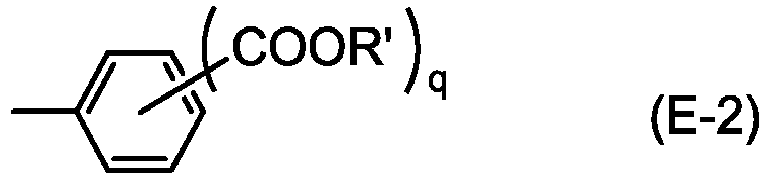

- The explanations of the aryl group described above are equally applicable in the present specification.
- The alkylene group represented by X or Y usually has 1 to 8 carbon atoms, and examples thereof include a methylene group, an ethylene group, a propylene group, a butylene group, an octylene group and the like.
- The oxyalkylene group represented by X or Y is a group obtained by linking the above-described alkylene group with an oxygen atom.
- The group represented by the formula (E-1) includes, for example, groups represented by the following formulae.
-COOR'
-(CH2)8-COOR'
-O-(CH2)8-COOR'
-(OCH2CH2)4-COOR'
[wherein, the group represented by R' represents the same meaning as described above.]. - The group represented by the formula (E-2) includes, for example, groups represented by the following formulae.

- The group represented by the formula (E-3) includes, for example, groups represented by the following formulae.
-N+(CH3)2(CH2CH2)Z-
-(CH2)3-N+(CH3)2(CH2CH2)Z-
-(CH2)6-N+(CH3)2(CH2CH2)Z- -O-(CH2)2-N+(CH3)3Z-
[wherein, Z- represents the same meaning as described above.] - The alkoxy group is a group obtained by linking an alkyl group with an oxygen atom, and the alkyl group is as described later, and these are equally applicable in the present specification.
- The aryloxy group is a group obtained by linking an aryl group with an oxygen atom, and it is equally applicable in the present specification.
- The number of carbon atoms of the alkenyl group and the alkynyl group is usually 2 to 8.
- The substituted amino group is a group obtained by partially or totally substituting hydrogen atoms of an amino group with a substituent, and the number of carbon atoms thereof, including the number of carbon atoms of a substituent, is usually 1 to 20. The substituted amino group includes a diphenylamino group and the like.
- The number of carbon atoms of the arylene group, not including the number of carbon atoms of a substituent, is usually 6 to 60, preferably 6 to 30, more preferably 6 to 18.
- The arylene group includes a phenylene group, a naphthalenediyl group, an anthracenediyl group, a phenanthrenediyl group, a dihydrophenanthrenediyl group, a naphthacenediyl group, a fluorenediyl group, a pyrenediyl group, a perylenediyl group and a chrysenediyl group. A hydrogen atom of these groups are optionally substituted with an alkyl group, an alkenyl group, an alkynyl group, an alkoxy group, an aryloxy group, an aryl group, a heteroaryl group, an amino group, a substituted amino group, a fluorine atom, a group represented by the formula (E-1), a group represented by the formula (E-2), a group represented by the formula (E-3), or the like.
- The number of carbon atoms of the heteroaryl group is usually 2 to 60, preferably 4 to 20, more preferably 4 to 10.
- The heteroaryl group includes monovalent groups obtained by removing from a compound in which the heterocyclic ring itself shows aromaticity such as oxadiazole, thiadiazole, thiazole, oxazole, thiophene, pyrrole, phosphole, furan, pyridine, pyrazine, pyrimidine, triazine, pyridazine, quinoline, isoquinoline, carbazole, dibenzosilole and dibenzophosphole one of hydrogen atoms linking directly to a carbon atom or a hetero atom constituting the ring of the compound, and monovalent groups obtained by removing from a compound in which the heterocyclic ring itself shows no aromaticity but an aromatic ring is condensed to the heterocyclic ring such as phenoxazine, phenothiazine, dibenzoborole, dibenzosilole and benzopyran one of hydrogen atoms linking directly to a carbon atom or a hetero atom constituting the ring of the compound. A hydrogen atom of these groups are optionally substituted with an alkyl group, an alkenyl group, an alkynyl group, an alkoxy group, an aryloxy group, an aryl group, a heteroaryl group, an amino group, a substituted amino group, a fluorine atom, a group represented by the formula (E-1), a group represented by the formula (E-2), a group represented by the formula (E-3), or the like.
- The explanations of the heteroaryl group described above are equally applicable in the present specification.
- The number of carbon atoms of the heteroarylene group, not including the number of carbon atoms of a substituent, is usually 2 to 60, preferably 3 to 20, more preferably 4 to 15.
- The heteroarylene group includes divalent groups obtained by removing from a heterocyclic compound such as pyridine, diazabenzene, triazine, azanaphthalene, diazanaphthalene, carbazole, dibenzofuran, dibenzothiophene, dibenzosilole, phenoxazine, phenothiazine, acridine, dihydroacridine, furan, thiophene, azole, diazole and triazole two of hydrogen atoms linking directly to a carbon atom or a hetero atom constituting the ring. A hydrogen atom of these groups are optionally substituted with an alkyl group, an alkenyl group, an alkynyl group, an alkoxy group, an aryloxy group, an aryl group, a heteroaryl group, an amino group, a substituted amino group, a fluorine atom, a group represented by the formula (E-1), a group represented by the formula (E-2), a group represented by the formula (E-3), or the like.
- The above-mentioned organometal group is a group obtained by removing from a metal complex having a carbon-metal bond one or two hydrogen atoms.
- The organometal group includes groups obtained by removing from a compound represented by the formula (U) one or two hydrogen atoms linking directly to a carbon atom or a hetero atom, and the like.

- M represents a ruthenium atom, a rhodium atom or an iridium atom.
- n1 represents an integer of 1 to 3.
- E1 and E2 each independently represent a carbon atom or a nitrogen atom, provided that at least one of E1 and E2 is a carbon atom.
- The ring L1 represents an aromatic heterocyclic ring which optionally have a substituent. When there are a plurality of the substituents, they may be the same or different and may be combined together to form a ring together with an atom to which they are attached. When there are a plurality of rings L1, they may be the same or different.
- The ring L2 represents an aromatic hydrocarbon ring which optionally have a substituent or an aromatic heterocyclic ring which optionally have a substituent. When there are a plurality of the substituents, they may be the same or different and may be combined together to form a ring together with an atom to which they are attached. When there are a plurality of rings L2, they may be the same or different.
- W1-Y1-W2 represents an anionic bidentate ligand. W1 and W2 each independently represent a carbon atom, an oxygen atom or a nitrogen atom and these atoms may be an atom constituting the ring. Y1 represents a single bond or an atomic group constituting a bidentate ligand together with W1 and W2. When there are a plurality of W1-Y1-W2, they may be the same or different.].
- The compound represented by the formula (U) is constituted of a central metal M, a ligand of which number is ruled by a suffix n1 and a ligand of which number is ruled by a suffix 3-n1.
- M is preferably an iridium atom or a rhodium atom, more preferably an iridium atom.
- It is preferable that E1 and E2 are a carbon atom.
- The aromatic heterocyclic ring represented by the ring L1 may be a monocyclic ring or a condensed ring, and includes preferably a pyridine ring, a pyrimidine ring, an imidazole ring and a triazole ring. These rings optionally have a substituent.
- The aromatic hydrocarbon ring and the aromatic heterocyclic ring represented by the ring L2 may be a monocyclic ring or a condensed ring, and includes preferably a benzene ring, a naphthalene ring, a fluorene ring, a phenanthrene ring, a pyridine ring, a diazabenzene ring and a triazine ring, more preferably a benzene ring, a pyridine ring and a pyrimidine ring. These rings optionally have a substituent.
- The substituent which the ring L1 and the ring L2 optionally have includes an alkyl group, an alkoxy group, an aryl group, an aryloxy group, a heteroaryl group, a fluorine atom, a substituted amino group and the like.
- At least one ring selected from the group consisting of the ring L1 and the ring L2 preferably has an aryl group which optionally have a substituent, a heteroaryl group which optionally have a substituent or a substituted amino group which optionally have a substituent (hereinafter, these three kinds of substituents are collectively called "group A of substituent" in some cases.), more preferably has an aryl group which optionally have a substituent.
- It is preferable that the group A of substituent is a dendron.
- The anionic bidentate ligand represented by W1-Y1-W2 includes, for example, ligands shown below.


- The above-mentioned aliphatic hydrocarbon group includes an alkyl group, alkenyl group, alkynyl group and the like.
- The alkyl group may be any of linear, branched and cyclic. The number of carbon atoms of the linear alkyl group is usually 1 to 50, preferably 3 to 30, more preferably 4 to 20. The number of carbon atoms of the branched or cyclic alkyl group is usually 3 to 50, preferably 3 to 30, more preferably 4 to 20.
- The alkyl group optionally have a substituent, and examples thereof include a methyl group, an ethyl group, a propyl group, an isopropyl group, a butyl group, an isobutyl group, a tert-butyl group, a pentyl group, an isoamyl group, a 2-ethylbutyl group, a hexyl group, a heptyl group, an octyl group, a 2-ethylhexyl group, a 3-propylheptyl group, a decyl group, a 3,7-dimethyloctyl group, a 2-ethyloctyl group, a 2-hexyldecyl group, a dodecyl group and a cyclohexyl group and groups obtained by substituting a hydrogen atom of these groups with an alkoxy group, an aryl group, a heteroaryl group, an amino group, a substituted amino group, a fluorine atom or the like, and examples thereof include a trifluoromethyl group, a pentafluoroethyl group, a perfluorobutyl group, a perfluorohexyl group, a perfluorooctyl group, a 3-phenylpropyl group, a 3-(4-methylphenyl)propyl group, a 3-(3,5-dihexylphenyl)propyl group, a 6-ethyloxyhexyl group, a cyclohexyl group, a cyclohexylmethyl group and a cyclohexylethyl group.
- The explanations of the alkyl group described above are equally applicable in the present specification.
- The alkenyl group may be any of linear, branched and cyclic. The number of carbon atoms of the linear alkenyl group, not including the number of carbon atoms of a substituent, is usually 2 to 30, preferably 3 to 20. The number of carbon atoms of the branched or cyclic alkenyl group, not including the number of carbon atoms of a substituent, is usually 3 to 30, preferably 4 to 20.
- The alkenyl group optionally have a substituent, and examples thereof include a vinyl group, a 1-propenyl group, a 2-propenyl group, a 2-butenyl group, a 3-butenyl group, a 3-pentenyl group, a 4-pentenyl group, a 1-hexenyl group, a 5-hexenyl group and a 7-octenyl group, and these groups carrying a substituent.
- The alkynyl group may be any of linear, branched and cyclic. The number of carbon atoms of the alkynyl group, not including the number of carbon atoms of a substituent, is usually 2 to 20, preferably 3 to 20. The number of carbon atoms of the branched or cyclic alkynyl group, not including the number of carbon atoms of a substituent, is usually 4 to 30, preferably 4 to 20.
- The alkynyl group optionally have a substituent, and examples thereof include an ethynyl group, a 1-propynyl group, a 2-propynyl group, a 2-butynyl group, a 3-butynyl group, a 3-pentynyl group, a 4-pentynyl group, a 1-hexynyl group and a 5-hexynyl group, and these groups carrying a substituent.
- The substituent which the above-described aromatic group, the above-described organometal group or the above-described aliphatic hydrocarbon group has includes alkyl groups such as a methyl group, an ethyl group, a n-propyl group, an isopropyl group, a n-butyl group, an isobutyl group, a tert-butyl group, a n-pentyl group, an isoamyl group, a 2-ethylbutyl group, a n-hexyl group, a cyclohexyl group, a n-heptyl group, a cyclohexylmethyl group, a cyclohexylethyl group, a n-octyl group, a 2-ethylhexyl group, a 3-n-propylheptyl group, a n-decyl group, a 3,7-dimethyloctyl group, a 2-ethyloctyl group, a 2-n-hexyldecyl group and a n-dodecyl group; alkyl groups which optionally have a substituent such as a trifluoromethyl group, a pentafluoroethyl group, a perfluorobutyl group, a perfluorohexyl group, a perfluorooctyl group, a 3-phenylpropyl group, a 3-(4-methylphenyl)propyl group, a 3-(3,5-di-n-hexylphenyl)propyl group and a 6-ethyloxyhexyl group; an alkenyl group, an alkynyl group, an alkoxy group, an aryloxy group, an aryl group, a heteroaryl group, a fluorine atom, a group represented by the formula (E-1), a group represented by the formula (E-2), a group represented by the formula (E-3) and the like.
- R1 includes a phenyl group, a naphthyl group, an anthracenyl group, a phenanthryl group, an indenyl group, a fluorenyl group, a pyrenyl group, a pyridyl group, a quinazolyl group, a quinolyl group, a pyrimidyl group, a furyl group, a thienyl group, a pyrrolyl group, an imidazolyl group, a tetrazolyl group, a 1-propenyl group, a cyclohexenyl group, a cyclopentenyl group, a 1,4-benzoquinyl group, a 6-oxo-1-cyclohexenyl group, a 5-oxo-1-cyclopentenyl group and the like.
- X1 represents Cl, Br, I or -O-S(=O)2RC1 (wherein, RC1 represents an alkyl group or an aryl group and these groups optionally have a substituent), preferably Cl, Br, a mesylate group or a trifluoromethanesulfonate group, more preferably Cl or Br, further preferably Br.
- The compound (1) includes 1-bromooctane, 1-iodocyclohexane, 1-iodopentene, 1,4-dibromoisopentane, benzyl chloride, phenyl bromide, o-tolyl bromide, p-tert-butylphenyl bromide, 2,6-dimethylphenyl bromide, 3,5-dimethylphenyl bromide, 2-hydroxylethylphenyl bromide, 4-cyclohexylphenyl bromide, 3-bromobenzo trifluoride, β-bromostyrene, 3-bromo-4-chlorobenzo trifluoride, 2-naphthyl bromide, 9,10-dibromoanthracene, 9-bromoanthracene, 1,3-dibromobenzene, m-methoxyphenyl bromide, 4-bromobenzaldehyde, 1,4-dibromo-2-fluorobenzene, methyl 2-bromophenylacetate, methyl 3-bromophenylacetate, ethyl 4-bromophenylacetate, methyl 3-bromocinnamate, methyl 5-bromo salicylate, 4-bromobenzamide, 4-bromobenzonitrile, 9-bromophenanthrene, 2-bromofluorene, 5-bromoindanone, 2,7-dibromofluorene, 2,7-dibromo-9,9-dioctylfluorene, bis(4-bromophenyl)[4-(methylpropyl)phenyl]amine, 2,7-dibromo-9,9-bis[3-ethoxycarbonyl-4-[2-[2-(2-methoxyethoxy)ethoxy]ethoxy]phenyl]-fluorene, 2,7-dibromo-9,9-bis(3-phenyl)fluorene, N,N'-bis(4-bromophenyl)-N,N'-bis(4-butyl-2,6-dimethylphenyl)-1,4-phenylenediamine, N,N'-bis(4-bromophenyl)-N,N'-bis(4-methylphenyl)-9,10-anthracenediamine, 3,7-dibromo-N-(4-butylphenyl)phenoxazine, a compound (1-8) described later, 6-bromo-2-naphthol, 4,4'-dibromobiphenyl, 2-pyridyl bromide, 2-bromofuran, 3-bromofuran, 2-bromothiophene, 4-bromopyrazole, 2-bromothiazole-2-methyl-5-bromobenzooxazole, 2-methyl-5-bromobenzothiazole, 5-bromouracil, 8-bromoquinoline, 4-bromoisoquinoline, 1-benzyl-5-bromotetrazole, phenyl chloride, o-tolyl chloride, 3-chlorotoluene, 4-chlorotoluene, 2-chloroacetophenone, 4-chloroacetophenone, p-tert-butylphenyl chloride, 2,6-dimethylphenyl chloride, 3,5-dimethylphenyl chloride, 4-cyclohexylphenyl chloride, 2-chloro-4-fluorotoluene, 1-chloro4-nitrobenzene, methyl 2-chlorophenylacetate, methyl 3-bromophenylacetate, ethyl 4-chlorophenylacetate, 3-chlorobenzophenone, 4-chloro-1-naphthol, 4-chloroaniline, 4-chloro-N,N'-dimethylaniline, 4-chloro-N,N'-diphenylaniline, 5-chloro-N,N'-dimethylaniline, 5-chloro-2-methoxyaniline, 4-chlorobenzoic acid, methyl 3-chlorobenzoate, phenyl 2-chlorobenzoate, 2-chloroacetamide, 4-chloroacetamide, 2-chlorobenzyl cyanide, 2-naphthyl chloride, 9,10-dichloroanthracene, 9-chloroanthracene, 1,3-dichlorobenzene, o-methoxyphenyl chloride, m-methoxyphenyl chloride, p-methoxyphenyl chloride, 3,5-dimethoxychlorotoluene, 3-chlorobenzonitrile, 2,7-dichlorobenzaldehyde, 1,4-dichloro-2-fluorobenzene, 2-pyridyl chloride, 2-chloro-6-trifluoropyridine, 1-(3-chlorophenyl)-3-methyl-2-pyrazolin-5-one, 3-chlorothiophene, 5-chloro-1-methylimidazole, 5-chloro-1-methylbenzotriazole, 2-chloroindole, 2-chlorobenzoimidazole, 8-chloro-5-methoxyquinoline, 2-chlorobenzoxazole, 2-methyl-5-chlorobenzooxazole, 2-methyl-5-chlorobenzothiazole-2,6-dichloropyridine, 3,5-dichloropyridine, 2-chlorobenzothiazole, 6-chloropurine, 2-chloropyrazine, 1,4-dichlorophthalazine, 2,4-chloropyrimidine, phenyl iodide, o-tolyl iodide, p-tert-butylphenyl iodide, 2,6-dimethylphenyl iodide, 3,5-dimethylphenyl iodide, 4-iodoacetophenone, 2-iodobenzoic acid, 2-naphthyl iodide, 9,10-diiodoanthracene, 1,3-diiodobenzene, m-methoxyphenyl iodide, N-tert-butoxycarbonyl-4-iodophenylalaninemethyl ester, 4,4'-diiodobiphenyl, 2-methyl-5-iodo-benzooxazole, 2-methyl-5-iodo-benzothiazole, 1,4-diiodo-2-fluorobenzene, 2-pyridyl iodide, vinyl chloride, vinyl bromide, 1,2-ethylene dichloride, allyl chloride, allyl bromide, cyclohexen-1-yl bromide, cyclopentene-1-yl chloride, 2-methyl-5-(p-toluenesulfonate)-benzooxazole, 2-methyl-5-(p-toluenesulfonate)-benzothiazole-2-pyridyltrifluoromethanesulfonate, 1,1'-bi-2-naphtholbis(trifluoromethanesulfonate), 1,2,2-trimethylvinyl trifluoromethanesulfonate, cyclohexen-1-yl-trifluoromethanesulfonate, 2-methyl-5-trifluoromethanesulfonate benzooxazole, 2-methyl-5-trifluoromethanesulfonate benzothiazole, 4-bromophenyl trifluoromethanesulfonate, 2-methyl-5-methanesulfonate benzooxazole, 2-methyl-5-methanesulfonate benzothiazole, phenyldiazonium tetrafluoroborate salt and the like.
- The compound (1) may be a commercially available or can be produced according to any known methods.
- The use amount of the compound (1) is usually 0.1 to 10 mol, preferably 0.2 to 5 mol, more preferably 0.4 to 3 mol, particularly preferably 0.5 to 2 mol, with respect to 1 mol of the compound (2).
- The compounds (1) may be used singly or in combination with each other.
- The compound (2) having one or two boron atom-containing leaving groups (hereinafter, referred to as a compound (2) in some cases) is usually an organic compound having a molecular weight of 5000 or less and having one or two boron atom-containing leaving groups, and it is a compound dissolvable in an organic solvent.
- The boron atom-containing leaving group of the compound (2) is a group which leaves by reacting with the compound (1) having one or two leaving groups in the coupling reaction such as a cross coupling reaction in the present invention.
- The leaving group includes leaving groups represented by B(RC2)2, B(ORC2)2, BF3T and the like. RC2 represents a hydrogen atom, an alkyl group or an aryl group, and the alkyl group and the aryl group optionally have a substituent. The RC2 s may be the same or different and they may be combined together to form a ring together with the boron atom to which they are attached or together with the oxygen atoms to which they are attached and the boron atom to which the oxygen atoms are attached. T represents Li, Na, K, Rb or Cs.
- The leaving group represented by B(RC2)2 includes a group represented by the following formula (G-1), and the like.

- The leaving group represented by B(ORC2)2 includes B(OH)2, B(OCH3)2, B(OCH2CH3)2, a group represented by the formula (G-1), a boronic acid ethylene glycol ester (namely, a group represented by the formula (G-2)), a boronic acid pinacol ester (namely, a group represented by the formula (G-3)), a boronic acid trimethylene glycol ester (namely, a group represented by the formula (G-4)), a boronic acid catechol ester (namely, a group represented by the formula (G-5)), a boronic acid trimer anhydride
- (namely, a group obtained by removing from boronic acid trimer anhydride one hydrogen atom on a boron atom) and the like, usually, B(OH)2, B(OCH)2, B(OCH2CH3)2, a boronic acid ethylene glycol ester, a boronic acid pinacol ester, a boronic acid trimethylene glycol ester, a boronic acid catechol ester, a boronic acid trimer anhydride and the like, preferably a boronic acid pinacol ester and a boronic acid catechol ester, more preferably a boronic acid pinacol ester.

- The compound (2) is preferably a compound represented by the formula (B) (hereinafter, referred to as a compound (B) in some cases).

- The organic group represented by R2 includes the same groups as represented by R1.
- X2 is preferably B(ORC2)2.
- The group represented by B(RC2)2 includes the same leaving groups as represented by the above-described B(RC2)2.
- The group represented by B(ORC2)2 includes the same leaving groups as represented by the above-described B(ORC2)2.
- The compound (2) includes propylboronic acid, (2-methylpropyl)boronic acid, s-butylboronic acid, (E)-1-pentenylboronic acid, n-octylboronic acid, cyclopentylboronic acid, trans-4,4,5,5-tetramethyl-2-(1-octenyl)-1,3,2-dioxaborolane, 2-cyclohexyl-4,4,5,5-tetramethyl-1,3,2-dioxaborolane, 2-benzyl-4,4,5,5-tetramethyl-1,3,2-dioxaborolane, phenylboronic acid, 2-methylphenylboronic acid, 3-methylphenylboronic acid, 4-methylphenylboronic acid, 2,3-dimethylphenylboronic acid, 2,4-dimethylphenylboronic acid, 2,5-dimethylphenylboronic acid, 2,6-dimethylphenylboronic acid, 2,4,6-trimethylphenylboronic acid, 2,3,5,6-tetramethylphenylboronic acid, 2-ethylphenylboronic acid, 4-n-propylphenylboronic acid, 4-isopropylphenylboronic acid, 4-n-butylphenylboronic acid, 4-tert-butylphenylboronic acid, 1-naphthylboronic acid, 2-naphthylboronic acid, 2-biphenylboronic acid, 3-biphenylboronic acid, 4-biphenylboronic acid, 2-fluoro-4-biphenylboronic acid, 2-fluorenylboronic acid, 9,9-dioctyl-2-(4,4,5,5-tetramethyl-1,3,2-dioxaborolan-2-yl)fluorene, 9-phenanthrenylboronic acid, 9-anthracenylboronic acid, 9,9-dimethyl-2-fluoreneboronic acid, 9,9'-spirobi(fluoren-2-yl)boronic acid, 1-pyrenylboronic acid, 2-trifluoromethylphenylboronic acid, 3-trifluoromethylphenylboronic acid, 4-trifluorophenylboronic acid, 3,5-bis(trifluoromethyl)phenylboronic acid, 2-methoxyphenylboronic acid, 3-methoxyphenylboronic acid, 4-methoxyphenylboronic acid, 2,5-dimethoxyphenylboronic acid, 2,6-dimethoxyphenylboronic acid, 4,5-dimethoxyphenylboronic acid, 2,4-dimethoxyphenylboronic acid, 2-ethoxyphenylboronic acid, 3-ethoxyphenylboronic acid, 4-ethoxyphenylboronic acid, 4-phenoxyboronic acid, 3,4-methylenedioxyphenylboronic acid, 2-fluorophenylboronic acid, 3-fluorophenylboronic acid, 4-fluorophenylboronic acid, 2,4-difluorophenylboronic acid, 2,5-difluorophenylboronic acid, 2,6-difluorophenylboronic acid, 4,5-difluorophenylboronic acid, 3,5-difluorophenylboronic acid, 2-formylphenylboronic acid, 3-formylphenylboronic acid, 4-formylphenylboronic acid, 3-formyl-4-methoxyphenylboronic acid, 2-cyanophenylboronic acid, 3-cyanophenylboronic acid, 4-cyanophenylboronic acid, 3-nitrophenylboronic acid, 3-acetylphenylboronic acid, 4-acetylphenylboronic acid, 3-trifluoroacetylphenylboronic acid, 4-trifluoroacetylphenylboronic acid, 4-methylthiophenylboronic acid, 4-vinylphenylboronic acid, 3-carboxyphenylboronic acid, 4-carboxyphenylboronic acid, 3-aminophenylboronic acid, 2-(N,N-dimethylamino)phenylboronic acid, 3-(N,N-dimethylamino)phenylboronic acid, 4-(N,N-dimethylamino)phenylboronic acid, 2-(N,N-dimethylamino)phenylboronic acid, 3-(N,N-diethylamino)phenylboronic acid, 4-(N,N-diethylamino)phenylboronic acid, 4-(diphenylamino)phenylboronic acid, furan-2-boronic acid, furan-3-boronic acid, 2-formylfuranboronic acid, 3-formylfuran-2-boronic acid, dibenzofuran-4-boronic acid, benzofuran-2-boronic acid, thiophene-2-boronic acid, thiophene-3-boronic acid, 5-methylthiophene-2-boronic acid, 5-chlorothiophene-2-boronic acid, 4-methylthiophene-2-boronic acid, 5-methylthiophene-2-boronic acid, 2-acetylthiophene-5-boronic acid, 3-formylthiophene-2-boronic acid, 5-methylthiophene-2-boronic acid, benzothiophene-2-boronic acid, dibenzothiophene-4-boronic acid, pyrazole-4-boronic acid, 3-methylpyrazole-4-boronic acid, 3,5-dimethylpyrazole-4-boronic acid, 3-nitro-1,2,4-triazole-5-boronic acid, thiazole-2-boronic acid, pyridine-3-boronic acid, pyridine-4-boronic acid, pyrimidine-5-boronic acid, quinolone-8-boronic acid, isoquinoline-4-boronic acid, 1,4-bis(4,4,5,5-tetramethyl-1,3,2-dioxaborolan-2-yl)benzene, 1,3-bis(4,4,5,5-tetramethyl-1,3,2-dioxaborolan-2-yl)benzene, 1,3,5-tris(4,4,5,5-tetramethyl-1,3,2-dioxaborolan-2-yl)benzene, 9,9-dimethyl-2,7-bis(4,4,5,5-tetramethyl-1,3,2-dioxaborolan-2-yl)fluorene, 4-(4,4,5,5-tetramethyl-1,3,2-dioxaborolan-2-yl)biphenyl, 2,7-bis(4,4,5,5-tetramethyl-1,3,2-dioxaborolan-2-yl)-9,9-dioctylfluorene, 2,7-bis(4,4,5,5-tetramethyl-1,3,2-dioxaborolan-2-yl)-9,9-bis[3-ethoxycarbonyl-4-[2-[2-(2-methoxyethoxy)ethoxy]ethoxy]phenyl]-fluorene, 2,7-bis(4,4,5,5-tetramethyl-1,3,2-dioxaborolan-2-yl)-9,9-bis[4-(hexyl)phenyl]-fluorene, 9,10-bis(4,4,5,5-tetramethyl-1,3,2-dioxaborolan-2-yl)anthracene, 1,2-bis(4,4,5,5-tetramethyl-1,3,2-dioxaborolan-2-yl)stilbene and the like.
- The compound (2) may be commercially available or can be produced according to any know methods.
- As the combination of the compound (1) with the compound (2), a combination of a compound (A) in which R1 is an aromatic group which optionally have a substituent and X1 is Br with a compound (B) in which R2 is an aromatic group which optionally have a substituent and X2 is a boronic acid pinacol ester is particularly preferable.
- The compounds (2) may be used singly or in combination with each other.
- The organic base (P) in the present invention is a strongly basic organic compound, preferably an organic compound having a pKa of 11 or more. Further, it is preferably a hydrophilic compound.
- The organic base (P) includes ammonium hydroxide compounds, ammonium carbonate compounds, ammonium bicarbonate compounds, boronic acid ammonium compounds, 1,5-diazabicyclo[4,3,0]non-5-ene (DBN), 1,8-diazabicyclo[5.4.0]undec-7-ene (DBU), guanidine and the like.
- The organic base (P) is preferably an organic base having 4 to 15 carbon atoms, more preferably an ammonium hydroxide compound having 4 to 15 carbon atoms, an ammonium carbonate compound having 4 to 15 carbon atoms or an ammonium bicarbonate compound having 4 to 15 carbon atoms, further preferably an ammonium hydroxide compound having 4 to 15 carbon atoms, particularly preferably a tetraalkylammonium hydroxide having 4 to 8 carbon atoms. Further, the above-mentioned ammonium hydroxide compound, ammonium carbonate compound and ammonium bicarbonate compound are preferably a quaternary ammonium compound. Such compounds are preferable because they have high versatility and show high reactivity.
- The ammonium hydroxide compound includes (CH3)4NOH (tetramethylammonium hydroxide), (C2H5)4NOH (tetraethylammonium hydroxide), (C3H7)4NOH (tetrapropylammonium hydroxide), (PhCH2)(CH3)3NOH (benzyltrimethylammonium hydroxide), (C4H9)4NOH (tetrabutylammonium hydroxide), (Ph)(CH3)3NOH (phenyltrimethylammonium hydroxide), (C5H11)4NOH, (C16H33)(CH3)3NOH, (C16H33)(CH3)3NOH, (C8H17)3(CH3)NOH, (C8H17)2(C10H21)(CH3)NOH, (C8H17)(C10H21)2(CH3)NOH, (C10H21)3(CH3 )NOH, (C8H17)4NOH, benzyltriethylammonium hydroxide and the like.
- The ammonium carbonate compound includes [(CH3)4N]2CO3 (tetramethylammonium carbonate), [(C2H5)4N]2CO3 (tetraethylammonium carbonate), [(C3H)4N]2CO3 (tetrapropylammonium carbonate), [(PhCH2)(CH3)3N]2CO3 (benzyltrimethylammonium carbonate), [(C4H9)4N]2CO3 (tetrabutylammonium carbonate), [(Ph)(CH3)3N]2CO3 (phenyltrimethylammonium hydroxide) and the like.
- The ammonium bicarbonate compound includes (CH3)4NCO3H (tetramethylammonium bicarbonate), (C2H5)4NCO3H (tetraethylammonium bicarbonate), (C3H)4NCO3H (tetrapropylammonium bicarbonate), (PhCH2)(CH3)3NCO3H (benzyltrimethylammonium bicarbonate), (C4H9)4NCO3H (tetrabutylammonium bicarbonate), (Ph)(CH3)3NCO3H (phenyltrimethylammonium bicarbonate) and the like.
- The boronic acid ammonium compound includes (CH3)4NArB(OH)3 (tetramethylammonium aryl boronate), (C2H5)4NArB(OH)3 (tetraethylammonium aryl boronate), (C3H7)4NArB(OH)3 (tetrapropylammonium aryl boronate), (PhCH2)(CH3)3ArB(OH)3 (benzyltrimethylammonium aryl boronate), (C4H9)4NArB(OH)3 (tetrabutylammonium aryl boronate), (Ph)(CH3)3NArB(OH)3 (phenyltrimethylammonium aryl boronate) and the like. The above-mentioned aryl group (Ar) which the boronic acid ammonium compound has includes a phenyl group, a 1-naphthyl group, a 2-naphthyl group and the like. A hydrogen atom of these groups optionally be substituted with an alkyl group, an alkoxy group, an aryl group, a fluorine atom or the like.
- The use amount of the organic base (P) is usually 0.5 to 100 mol, preferably 0.5 to 70 mol, more preferably 0.5 to 40 mol, further preferably 0.9 to 20 mol, particularly preferably 2 to 10 mol, with respect to 1 mol of the total amount of the compound (1) and the compound (2).
- The organic base (Q) in the present invention is an organic base having a larger number of carbon atoms than the above-described organic base (P), and is a strongly basic organic compound. It is preferably an organic compound having a pKa of 11 more, and is preferably a hydrophilic compound.
- When three or more organic bases are used in the method for producing a compound of the present invention, the organic base to be used in the largest substance quantity and an organic base smaller in the number of carbon atoms than that organic base are called organic bases (P), and an organic base larger in the number of carbon atoms than that organic base to be used in the largest substance quantity is called an organic base (Q). When the organic base to be used in the largest substance quantity is the organic base largest in the number of carbon atoms, this organic base is called an organic base (Q) and organic bases other than this organic base are called organic bases (P).
- The organic base (Q) includes the same compounds as the organic base (P).
- When tetramethylammonium hydroxide and tetraethylammonium hydroxide are used as organic bases in the method for producing a compound of the present invention, tetramethylammonium hydroxide corresponds to the organic base (P) and tetraethylammonium hydroxide corresponds to the organic base (Q). When tetraethylammonium hydroxide and tetrabutylammonium hydroxide are used as organic bases in the method for producing a compound of the present invention, tetraethylammonium hydroxide corresponds to the organic base (P) and tetrabutylammonium hydroxide corresponds to the organic base (Q). That is, tetraethylammonium hydroxide corresponds to the organic base (Q) in the former case, and corresponds to the organic base (P) in the latter case.
- The organic base (Q) is preferably an organic base having 16 to 60 carbon atoms, more preferably an ammonium hydroxide compound having 16 to 60 carbon atoms, an ammonium carbonate compound having 16 to 60 carbon atoms or an ammonium bicarbonate compound having 16 to 60 carbon atoms, further preferably an ammonium hydroxide compound having 16 to 60 carbon atoms, particularly preferably a tetraalkylammonium hydroxide having 16 to 24 carbon atoms. Further, the above-mentioned ammonium hydroxide compound, ammonium carbonate compound and ammonium bicarbonate compound are preferably a quaternary ammonium compound. Such compounds are preferable because they have high versatility and show high reactivity.
- The use amount of the organic base (Q) is usually 0.001 to 50 mol, with respect to 1 mol of the total amount of the compound (1) and the compound (2). It is preferably 0.005 to 10 mol, more preferably 0.01 to 1 mol, further preferably 0.01 to 0.8 mol, particularly preferably 0.03 to 0.1 mol. The use amount (substance quantity) of the organic base (Q) is preferably smaller than the use amount (substance quantity) of the organic base (P).
- The phase transfer catalyst in the present invention is one transferring between an aqueous phase and an oil phase to transport a reaction reagent from one phase to another phase, thereby promoting the reaction.
- It is preferable that the phase transfer catalyst has a larger number of carbon atoms than the organic base (P). For example, when (CH3)4NOH (tetramethylammonium hydroxide) having 4 carbon atoms is used as the organic base (P) in the present invention, it is preferable, for example, that (C4H9)4NBr (tetrabutylammonium bromide) having 16 carbon atoms is used as the phase transfer catalyst.
- The phase transfer catalyst includes ammonium compounds, macrocyclic polyethers and the like, preferably ammonium compounds, more preferably ammonium compounds having 16 to 60 carbon atoms, further preferably quaternary ammonium compounds having 16 to 60 carbon atoms, particularly preferably quaternary ammonium halides having 16 to 60 carbon atoms, especially preferably tetraalkylammonium halides having 16 to 24 carbon atoms. Such compounds are preferable because they have high function as the phase transfer catalyst.
- The above-described ammonium compound includes (C4H9)4NF (tetrabutylammonium fluoride), (C4H9)4NCl (tetrabutylammonium chloride), (C4H9)4NBr (tetrabutylammonium bromide), (C4H9)4NI (tetrabutylammonium iodide), (C5H11)4NF (tetrapentylammonium fluoride), (C5H11)4NCl (tetrapentylammonium chloride), (C5H11)4NBr (tetrapentylammonium bromide), (C5H11)4NI (tetrapentylammonium iodide), (C16H33)(CH3)3NCl, (C8H17)3(CH3)NCl, (C8H17)2(C10H21)(CH3)NCl, (C8H17)(C10H21)2(CH3)NCl, (C10H21)3(CH3)NCl, (C8H7)4NBr, benzyltriethylammonium chloride, cetylpyridinium chloride and the like, preferably, (C4H9)4NF, (C4H9)4NCl, (C4H9)4NBr, (C4H9)4NI, (C5H1)4NCl, (C5H1)4NBr, (C5H11)4NI, (C16H33)(CH3)3NCl, (C8H17)3(CH3)NCl, (C8H17)2(C10H21)(CH3)NCl, (C8H17)(C10H21)2(CH3)NCl, (C10H21)3(CH3)NCl and (C8H7)4NBr. The phase transfer catalysts may be used singly or in combination with each other.
- The use amount of the phase transfer catalyst is usually 0.001 to 50 mol, with respect to 1 mol of the total amount of the compound (1) and the compound (2). It is preferably 0.005 to 10 mol, more preferably 0.01 to 1 mol.
- The use amount of the phase transfer catalyst with respect to 100 parts by mass of the sum of the organic base (P) and the organic base (Q) is usually 0.01 to 1000 parts by mass, preferably 0.1 to 100 parts by mass, more preferably 1 to 10 parts by mass.
- In the method for producing a compound of the present invention, an organic solvent is usually used. The organic solvent includes aromatic hydrocarbon solvents such as toluene, xylene and mesitylene; ether solvents such as tetrahydrofuran, 1,4-dioxane and dimethoxyethane; amide solvents such as N,N-dimethylacetamide and N,N-dimethylformamide; alcohol solvents such as methanol, ethanol, ethylene glycol, isopropyl alcohol, propylene glycol, methylcellosolve and butylcellosolve; ketone solvents such as acetone, methyl ethyl ketone, cyclopentanone, cyclohexanone, methyl amyl ketone, methyl isobutyl ketone and N-methyl-2-pyrrolidinone; aliphatic hydrocarbon solvents such as pentane, hexane and heptane; nitrile solvents such as acetonitrile; halogenated hydrocarbon solvents such as chloroform; and the like. As the organic solvent, those immiscible with water at any ratio are preferable. Specifically, aromatic hydrocarbon solvents and ether solvents are preferable, and toluene, xylene and mesitylene are more preferable. The organic solvents may be used singly or in combination with each other.
- The use amount of the organic solvent is usually 10 parts by mass to 100000 parts by mass, preferably 100 parts by mass to 70000 parts by mass, more preferably 1000 parts by mass to 50000 parts by mass, further preferably 2000 parts by mass to 20000 parts by mass, with respect to 100 parts by mass of the total amount of the compound (1) and the compound (2).
- In the method for producing a compound of the present invention, water is usually used. The use amount of water is usually 10 parts by mass to 100000 parts by mass, preferably 100 parts by mass to 70000 parts by mass, more preferably 1000 parts by mass to 50000 parts by mass, further preferably 2000 parts by mass to 20000 parts by mass, with respect to 100 parts by mass of the total amount of the compound (1) and the compound (2).
- As the transition metal catalyst, group 10 transition metal catalysts are preferable. The group 10 transition metal catalyst includes a 0-valent or divalent nickel catalyst, a palladium catalyst, a platinum catalyst and the like, preferably a palladium catalyst.
- The palladium catalyst includes dichlorobis(triphenylphosphine)palladium, dichlorobis[tris(2-methoxyphenyl)phosphine]palladium, palladium[tetrakis(triphenylphosphine)], [tris(dibenzylideneacetone)]dipalladium, dichlorobis[dicyclopentyl(2-methoxyphenyl)phosphine]palladium, palladium acetate, dichlorobis[dicyclopentyl(2, 6-dimethoxyphenyl)phosphine]palladium and bis[di-tert-butyl(3, 5-di-tert-butylphenyl)phosphine]dichloropalladium, and complexes composed of these palladium catalysts further having a ligand such as triphenylphosphine, tri(tert-butylphosphine), tricyclohexylphosphine, diphenylphosphinopropane and bipyridyl, and the like, preferably, dichlorobis(triphenylphosphine)palladium and palladium[tetrakis(triphenylphosphine)]. The transition metal catalysts may be used singly or in combination with each other.
- The use amount of the transition metal catalyst is usually 0.00001 to 3 mol, preferably 0.0001 to 0.5 mol, with respect to 1 mol of the total amount of the compound (1) and the compound (2).
- In the present invention, when a compound (1) having one leaving group and a compound (2) having one leaving group undergo a coupling reaction, a compound in which a residue obtained after leaving of the leaving group of the compound (1) and a residue obtained after leaving of the leaving group of the compound (2) are coupled is usually obtained.
- In the present invention, when a compound (1) having one leaving group and a compound (2) having two leaving groups undergo a coupling reaction, a compound in which one residue obtained after leaving of the leaving group of the compound (1) and one residue obtained after leaving of one leaving group of the compound (2) are coupled, or a trimer type compound in which two residues obtained after leaving of the leaving group of the compound (1) and one residue obtained after leaving of two leaving groups of the compound (2) are coupled, is usually obtained.
- In the present invention, when a compound (1) having two leaving groups and a compound (2) having one leaving group undergo a coupling reaction, a compound in which one residue obtained after leaving of one leaving group of the compound (1) and one residue obtained after leaving of the leaving group of the compound (2) are coupled, or a trimer type compound in which one residue obtained after leaving of two leaving groups of the compound (1) and two residues obtained after leaving of the leaving group of the compound (2) are coupled, is usually obtained.
- Further, in the present invention, when a compound (1) having two leaving groups and a compound (2) having two leaving groups undergo a coupling reaction, a polymer type compound in which one residue obtained after leaving of the leaving groups of the compound (1) and one residue obtained after leaving of the leaving groups of the compound (2) are coupled repeatedly is usually obtained.
- In the production method for the present invention, a coupling reaction between a compound (1) having one leaving group and a compound (2) having one leaving group or a coupling reaction between a compound (1) having two leaving groups and a compound (2) having two leaving groups is preferably conducted, and a coupling reaction between a compound (1) having two leaving groups and a compound (2) having two leaving groups is more preferably conducted.
- In the present invention, when a compound (A) in which n=1 and a compound (B) in which m=1 are subjected to a coupling reaction, a compound represented by the formula (3a) is usually obtained, when a compound (A) in which n=1 and a compound (B) in which m=2 are subjected to a coupling reaction, a compound represented by the formula (3b) or the formula (3c) is usually obtained, when a compound (A) in which n=2 and a compound (B) in which m=1 are subjected to a coupling reaction, a compound represented by the formula (3d) or the formula (3e) is usually obtained, and when a compound (A) in which n=2 and a compound (B) in which m=2 are subjected to a coupling reaction, a compound having a structure represented by the formula (3f) is usually obtained.
R1-R2 (3a)
R1-R2-X2 (3b)
R1-R2-R1 (3c)
X1-R1-R2 (3d)
R2-R1-R2 (3e)

- In the production method for the present invention, a coupling reaction between a compound (A) and a compound (B) in which n and m are 1 or n and m are 2 is preferably conducted, and a coupling reaction between a compound (A) and a compound (B) in which n and m are 2 is more preferably conducted.
- The weight-average molecular weight of the compound having a structure represented by the formula (3f) is usually 1000 to 1000000, preferably 5000 to 500000, more preferably 10000 to 250000. The weight-average molecular weight can be determined by reducing with polystyrene standard using gel permeation chromatography (GPC).
- The weight-average molecular weight of the compound having a structure represented by the formula (3f) can be controlled by adjusting the substance quantity ratio of a compound (A) to a compound (B) to be subjected to a coupling reaction.
- The compound represented by the formula (3a) includes, specifically,

- The compound represented by the formula (3b) includes, specifically,

- The compound represented by the formula (3c) includes, specifically,


- The compound represented by the formula (3d) includes, specifically,


- The compound represented by the formula (3e) includes, specifically,


- The compound having a structure represented by the formula (3f) includes, specifically,


- The temperature of mixing is usually -100 to 200°C, preferably 0 to 150°C, more preferably 50 to 100°C.
- The pressure of mixing is usually atmospheric pressure.
- The stirring power of mixing is usually 0.001 to 10 kW/m3, preferably 0.01 to 2 kW/m3, more preferably 0.1 to 1 kW/m3.
- The order of mixing is not limited.
- After the coupling reaction, a compound can be collected by known methods, such as a method in which the reaction mixture after the coupling reaction and water are mixed and the mixture is separated, a method in which the reaction mixture after the coupling reaction and a lower alcohol such as methanol are mixed and a precipitate deposited is collected by filtration and dried. The collected compound can be purified by known methods such as recrystallization, reprecipitation, continuous extraction by a Soxhlet extractor, column chromatography and sublimation purification.
- The present invention will be illustrated further in detail by examples below.
-
- Measuring apparatus: CBM-20A (manufactured by Shimadzu Corp.)
- Column: L-Column2 ODS (3 µm, 4.6 mmϕ×25 cm)
- Mobile phase A: acetonitrile
- Mobile phase B: THF
- Mobile phase C: pure water
- Gradient: 0.01 minute A=80%, B=0%, C=40%
- 10 minutes A=60%, B=0%, C=40%
- 20 minutes A=100%, B=0%, C=0%
- 100 minutes A=100%, B=0%, C=0%
- 120 minutes A=0%, B=100%, C=0%
- 130 minutes A=0%, B=100%, C=0%
- Flow rate: 1.0 mL/min
- Detection wavelength: 280 nm
-
- Measuring apparatus: HLC-822GPC (manufactured by Tosoh Corporation)
- Column: PLgel 10µm MIXED-B (manufactured by Tosoh Corporation)
- Column temperature: 40°C
- Mobile phase: tetrahydrofuran
- Flow rate: 0.5 mL/min
- Detection wavelength: 228 nm
- Under a nitrogen atmosphere, 4.36 g of a compound (2-1), 3.90 g of a compound (1-1), 0.201 g of phenanthrene (internal standard substance), 0.10 g of benzyltriethylammonium chloride, 31 g of a 28% potassium carbonate aqueous solution and 50 g of toluene were mixed, and further, 0.06 g of palladium[tetrakis(triphenylphosphine)] was added. The resultant mixture was heated at 86°C, and mixed with heating for 1.5 hours at a stirring power of 0.1 kW/m3. The resultant mixture was analyzed by LC, and the reaction yield of the compound (3e-1) was calculated by an internal standard method. The results are shown in Table 1.

- Compound (2-1): As 4-(4,4,5,5-tetramethyl-1,3,2-dioxaborolan-2-yl)biphenyl, a commercially available product purchased from Tokyo Chemical Industry Co., Ltd. was used.
- Compound (1-1): 2,7-dibromo-9,9-dioctylfluorene was synthesized according to
WO2002/045184 . - Compound (3e-1) : 2,7-biphenyl-9,9-dioctylfluorene
- Under a nitrogen atmosphere, 4.36 g of a compound (2-1), 3.90 g of a compound (1-1), 0.201 g of phenanthrene (internal standard), 0.17 g of tetrabutylammonium bromide, 31 g of a 18% tetramethylammonium hydroxide aqueous solution and 50 g of toluene were mixed, and further, 0.06 g of palladium[tetrakis(triphenylphosphine)] was added. The resultant mixture was heated at 86°C, and mixed with heating for 1.5 hours at a stirring power of 0.1 kW/m3. The resultant mixture was analyzed by LC, and the reaction yield of the compound (3e-1) was calculated by an internal standard method. The results are shown in Table 1.
Table 1 organic base (P) inorganic base phase transfer catalyst reaction yield (%) Comparative Example 1 none 28% potassium carbonate aqueous solution benzyltrieth ylammonium chloride 0.1 Example 1 18% tetramethylammon ium hydroxide aqueous solution none tetrabutylam monium bromide 99 - The reaction yield of the compound (3e-1) obtained after the reaction of 1.5 hours in Example 1 was higher than the reaction yield of the compound (3e-1) obtained after the reaction of 1.5 hours in Comparative Example 1, teaching that the production method for the present invention gives a higher reaction rate.
- Under a nitrogen atmosphere, 2.76 g of a compound (2-2), 2.01 g of a compound (1-2), 1.15 mg of dichlorobis[tris(2-methoxyphenyl)phosphine]palladium and 55 g of toluene were mixed, and the mixture was heated at 86°C. To the resultant mixed liquid was added 30 g of a 10% tetramethylammonium hydroxide aqueous solution, and the mixture was mixed with heating for 1.5 hours at a stirring power of 0.1 kW/m3. The resultant mixture was analyzed by GPC, and the polystyrene-equivalent number-average molecular weight and weight-average molecular weight of the compound (3f-1) were determined. The results are shown in Table 2.

Compound (2-2): 2,7-bis(4,4,5,5-tetramethyl-1,3,2-dioxaborolan-2-yl)-9,9-dioctylfluorene was synthesized by a method described inUS patent No. 6169163 .
Compound (1-2): bis(4-bromophenyl)[4-(methylpropyl)phenyl]amine was synthesized by a method described inWO2002/045184 . - Under a nitrogen atmosphere, 2.76 g of a compound (2-2), 2.01 g of a compound (1-2), 1.15 mg of dichlorobis[tris(2-methoxyphenyl)phosphine]palladium and 55 g of toluene were mixed, and the mixture was heated at 86°C. To the resultant mixture was added a mixture of 30 g of a 10% tetramethylammonium hydroxide aqueous solution and 0.14 g of tetrabutylammonium bromide, and the mixture was mixed with heating for 1.5 hours at a stirring power of 0.1 kW/m3. The resultant mixture was analyzed by GPC, and the polystyrene-equivalent number-average molecular weight and weight-average molecular weight of the compound (3f-1) were determined. The results are shown in Table 2.
- Under a nitrogen atmosphere, 2.76 g of a compound (2-2), 2.01 g of a compound (1-2), 1.15 mg of dichlorobis[tris(2-methoxyphenyl)phosphine]palladium and 55 g of toluene were mixed, and the mixture was heated at 86°C. To the resultant mixture was added a mixture of 30 g of a 10% tetramethylammonium hydroxide aqueous solution and 0.21 g of a 55% tetrabutylammonium hydroxide aqueous solution, and the mixture was mixed with heating for 1.5 hours at a stirring power of 0.1 kW/m3. The resultant mixture was analyzed by GPC, and the polystyrene-equivalent number-average molecular weight and weight-average molecular weight of the compound (3f-1) were determined.
- The results are shown in Table 2.
Table 2 organic base (P) organic base (Q) phase transfer catalyst number-average molecular weight weight-average molecular weight Comparati ve Example 2 10% tetramethylamm onium hydroxide aqueous solution none none 1000 2000 Example 2 10% tetramethylamm onium hydroxide aqueous solution none tetrabutyla mmonium bromide 42000 135000 Example 3 10% tetramethylamm onium hydroxide aqueous solution 55% tetrabutylamm onium hydroxide aqueous solution none 38000 141000 - The number-average molecular weight and the weight-average molecular weight of the compound (3f-1) obtained after the reaction of 1.5 hours in Examples 2 and 3 were higher than the number-average molecular weight and the weight-average molecular weight of the compound (3f-1) obtained after the reaction of 1.5 hours in Comparative Example 2, teaching that the production method for the present invention gives a higher reaction rate.
- Under a nitrogen atmosphere, 3.66 g of a compound (2-3), 3.30 g of a compound (1-3), 0.06 g of dichlorobis(triphenylphosphine)palladium, 1.20 g of methyltrioctylammonium chloride (manufactured by Sigma-Aldrich, trade name: Aliquat336 (registered trademark)) and 52 g of toluene were mixed, and the mixture was heated at 105°C. Into the resultant mixed liquid, 36 g of a 2M sodium carbonate aqueous solution was dropped, and the mixture was mixed with heating for 0.2 hours at a stirring power of 0.01 kW/m3. The resultant mixture was analyzed by GPC, and the polystyrene-equivalent number-average molecular weight and weight-average molecular weight of the compound (3g-1) were determined. The results are shown in Table 3.

- Compound (2-3): 2,7-bis(4,4,5,5-tetramethyl-1,3,2-dioxaborolan-2-yl)-9,9-bis[3-ethoxycarbonyl-4-[2-[2-(2-methoxyethoxy)ethoxy]ethoxy]phenyl]-fluorene was synthesized by a method described in
WO2014/046306 . - Compound (1-3): 2,7-dibromo-9,9-bis[3-ethoxycarbonyl-4-[2-[2-(2-methoxyethoxy)ethoxy]ethoxy]phenyl]-fluorene was synthesized by a method described in
WO2014/046306 . - Under a nitrogen atmosphere, 3.66 g of a compound (2-3), 3.30 g of a compound (1-3), 0.06 g of dichlorobis(triphenylphosphine)palladium, 1.20 g of methyltrioctylammonium chloride (manufactured by Sigma-Aldrich, trade name: Aliquat336 (registered trademark)) and 52 g of toluene were mixed, and the mixture was heated at 105°C. Into the resultant mixed liquid, 36 g of a 29% tetraethylammonium hydroxide aqueous solution was dropped, and the mixture was mixed with heating for 0.2 hours at a stirring power of 0.01 kW/m3. The resultant mixture was analyzed by GPC, and the polystyrene-equivalent number-average molecular weight and weight-average molecular weight of the compound (3g-1) were determined. The results are shown in Table 3.
Table 3 organic base (P) inorganic base phase transfer catalyst number-average molecular weight weight-average molecular weight Comparati ve Example 3 none 2M sodium carbonate aqueous solution methyltrioctyl ammonium chloride 1000 3000 Example 4 29% tetraethyla mmonium hydroxide aqueous solution none methyltrioctyl ammonium chloride 19000 116000 - The number-average molecular weight and the weight-average molecular weight of the compound (3g-1) obtained after the reaction of 0.2 hours in Example 4 were higher than the number-average molecular weight and the weight-average molecular weight of the compound (3g-1) obtained after the reaction of 0.2 hours in Comparative Example 3, teaching that the production method for the present invention gives a higher reaction rate.
- Under a nitrogen atmosphere, 4.79 g of a compound (2-4), 1.62 g of a compound (2-2), 4.97 g of a compound (1-4), 0.80 g of a compound (1-5), 0.01 g of a compound (1-6), 0.09 g of a compound (1-7), 0.03 g of a compound (1-8), 0.03 g of tetrakis(triphenylphosphine)palladium and 78 g of toluene were mixed. To the mixture was added 30 g of a 20% tetraethylammonium hydroxide aqueous solution, and the mixture was mixed with heating for 3 hours at a stirring power of 0.01 kW/m3. The resultant mixture was analyzed by GPC, and the polystyrene-equivalent number-average molecular weight and weight-average molecular weight of the polymer compound were determined. The results are shown in Table 4.


- Compound (2-4): 2,7-bis(4,4,5,5-tetramethyl-1,3,2-dioxaborolan-2-yl)-9,9-bis[4-(hexyl)phenyl]-fluorene was synthesized by a method described in
WO2012/086671 . - Compound (2-2): 2,7-bis(4,4,5,5-tetramethyl-1,3,2-dioxaborolan-2-yl)-9,9-dioctylfluorene was synthesized by a method described in
US patent No. 6169163 . - Compound (1-4): 2,7-dibromo-9,9-bis(3-phenyl)fluorene was synthesized by a method described in
WO2011/078391 . - Compound (1-5): N,N'-bis(4-bromophenyl)-N,N'-bis(4-butyl-2,6-dimethylphenyl)-1,4-phenylenediamine was synthesized by a method described in
WO2005/056633 . - Compound (1-6): N,N'-bis(4-bromophenyl)-N,N'-bis(4-methylphenyl)-9,10-anthracenediamine was synthesized by a method described in
WO2008/143272 . - Compound (1-7): 3,7-dibromo-N-(4-butylphenyl)phenoxazine was synthesized by a method described in
US patent No. 2004/0127666 . - Compound (1-8): It was synthesized by a method described in
WO2012/052713 . - Under a nitrogen atmosphere, 4.79 g of a compound (2-4), 1.62 g of a compound (2-5), 4.97 g of a compound (1-4), 0.80 g of a compound (1-5), 0.01 g of a compound (1-6), 0.09 g of a compound (1-7), 0.03 g of a compound (1-8), 0.03 g of tetrakis(triphenylphosphine)palladium, 0.01 g of tetrabutylammonium bromide and 78 g of toluene were mixed. To the mixture was added 30 g of a 20% tetraethylammonium hydroxide aqueous solution, and the mixture was mixed with heating for 3 hours at a stirring power of 0.01 kW/m3. The resultant mixture was analyzed by GPC, and the polystyrene-equivalent number-average molecular weight and weight-average molecular weight of the polymer compound were determined. The results are shown in Table 4.
Table 4 organic base (P) phase transfer catalyst number-average molecular weight weight-average molecular weight Comparative Example 4 20% tetraethylammonium hydroxide aqueous solution none 14000 56000 Example 5 20% tetraethylammonium hydroxide aqueous solution tetrabutylam monium bromide 49000 249000 - The number-average molecular weight and the weight-average molecular weight of the polymer compound obtained after the reaction of 3 hours in Example 5 were higher than the number-average molecular weight and the weight-average molecular weight of the polymer compound obtained after the reaction of 3 hours in Comparative Example 4, teaching that the production method for the present invention gives a higher reaction rate.
- The present invention is useful as a method for producing a compound which manifests a high reaction rate.
Claims (15)
- A method for producing a compound, comprising mixing a compound (1) having one or two leaving groups, a compound (2) having one or two boron atom-containing leaving groups, an organic base (P), and at least one selected from the group consisting of a phase transfer catalyst and an organic base (Q) larger in the number of carbon atoms than the above-mentioned organic base in the presence of a transition metal catalyst, thereby performing a coupling reaction between the above-mentioned compound (1) and the above-mentioned compound (2).
- The method for producing a compound according to claim 1, wherein the leaving group which the compound (1) has is a halogen atom, a diazonio group or a group represented by -O-S(=O)2RC1, wherein RC1 represents an alkyl group or an aryl group and these groups optionally have a substituent.
- The method for producing a compound according to claim 1 or 2, wherein the phase transfer catalyst is an ammonium compound.
- The method for producing a compound according to any one of claims 1 to 3, wherein the phase transfer catalyst is an ammonium compound having 16 to 60 carbon atoms.
- The method for producing a compound according to any one of claims 1 to 4, wherein the phase transfer catalyst is at least one selected from the group consisting of (C4H9)4NF, (C4H9)4NCl, (C4H9)4NBr, (C4H9)4NI, (C5H11)4NCl, (C5H11)4NBr, (C5H11)4NI, (C16H33)(CH3)3NCl, (C8H17)3(CH3)NCl, (C8H17)2(C10H21)(CH3)NCl, (C8H17)(C10H21)2(CH3)NC1, (C10H21)3(CH3)NCl and (C8H17)4NBr.
- The method for producing a compound according to any one of claims 1 to 5, wherein the organic base (P) is an organic base having 4 to 15 carbon atoms.
- The method for producing a compound according to any one of claims 1 to 6, wherein the organic base (P) is an ammonium hydroxide compound having 4 to 15 carbon atoms.
- The method for producing a compound according to any one of claims 1 to 7, wherein the organic base (Q) is an organic base having 16 to 60 carbon atoms.
- The method for producing a compound according to any one of claims 1 to 8, wherein the organic base (Q) is an ammonium hydroxide compound having 16 to 60 carbon atoms.
- The method for producing a compound according to any one of claims 1 to 9, wherein the transition metal catalyst is a palladium catalyst.
- The method for producing a compound according to any one of claims 1 to 10, wherein the compound (1) is a compound represented by the formula (A) and the compound (2) is a compound represented by the formula (B):
 R1 and R2 each independently represent an organic group,X1 represents Cl, Br, I or -O-S(=O)2RC1, wherein RC1 represents an alkyl group or an aryl group and these groups optionally have a substituent,X2 represents B(RC2)2, B(ORC2)2 or BF3T, wherein RC2 represents a hydrogen atom, an alkyl group or an aryl group and these groups optionally have a substituent, and the RC2s may be the same or different and they may be combined together to form a ring together with the boron atom to which they are attached or together with the oxygen atoms to which they are attached and the boron atom to which the oxygen atoms are attached, and T represents Li, Na, K, Rb or Cs, andn and m each independently reprenset 1 or 2.
 - The method for producing a compound according to claim 11, wherein n and m are 1.
- The method for producing a compound according to claim 11, wherein n and m are 2.
- The method for producing a compound according to any one of claims 11 to 13, wherein R1 and R2 each independently represent an organic group having 1 to 60 carbon atoms.
- The method for producing a compound according to claim 14, wherein the organic group is an aromatic group having 6 to 20 carbon atoms and optionally having a substituent.
Applications Claiming Priority (2)
| Application Number | Priority Date | Filing Date | Title |
|---|---|---|---|
| JP2013171999 | 2013-08-22 | ||
| PCT/JP2014/070797 WO2015025719A1 (en) | 2013-08-22 | 2014-07-31 | Method for manufacturing chemical compound |
Publications (3)
| Publication Number | Publication Date |
|---|---|
| EP3037398A1 true EP3037398A1 (en) | 2016-06-29 |
| EP3037398A4 EP3037398A4 (en) | 2017-03-29 |
| EP3037398B1 EP3037398B1 (en) | 2021-03-10 |
Family
ID=52483499
Family Applications (1)
| Application Number | Title | Priority Date | Filing Date |
|---|---|---|---|
| EP14838250.0A Not-in-force EP3037398B1 (en) | 2013-08-22 | 2014-07-31 | Method for manufacturing chemical compound |
Country Status (4)
| Country | Link |
|---|---|
| US (1) | US9982087B2 (en) |
| EP (1) | EP3037398B1 (en) |
| JP (1) | JP6622087B2 (en) |
| WO (1) | WO2015025719A1 (en) |
Families Citing this family (1)
| Publication number | Priority date | Publication date | Assignee | Title |
|---|---|---|---|---|
| GB2588100B (en) * | 2019-10-04 | 2022-09-07 | Sumitomo Chemical Co | Process of forming a conjugated polymer |
Family Cites Families (15)
| Publication number | Priority date | Publication date | Assignee | Title |
|---|---|---|---|---|
| JP3865406B2 (en) | 1995-07-28 | 2007-01-10 | 住友化学株式会社 | 2,7-Aryl-9-substituted fluorene and 9-substituted fluorene oligomers and polymers |
| US5777070A (en) * | 1997-10-23 | 1998-07-07 | The Dow Chemical Company | Process for preparing conjugated polymers |
| JP3310658B1 (en) | 1999-03-05 | 2002-08-05 | ケンブリッジ ディスプレイ テクノロジー リミテッド | Polymer synthesis method |
| GB0028867D0 (en) | 2000-11-28 | 2001-01-10 | Avecia Ltd | Field effect translators,methods for the manufacture thereof and materials therefor |
| US6916902B2 (en) | 2002-12-19 | 2005-07-12 | Dow Global Technologies Inc. | Tricyclic arylamine containing polymers and electronic devices therefrom |
| TW200530373A (en) | 2003-12-12 | 2005-09-16 | Sumitomo Chemical Co | Polymer and light-emitting element using said polymer |
| JP2008056911A (en) * | 2006-07-31 | 2008-03-13 | Sumitomo Chemical Co Ltd | Method for producing polymer compound |
| KR20100017794A (en) | 2007-05-17 | 2010-02-16 | 스미또모 가가꾸 가부시키가이샤 | Anthracene polymer compound and light-emitting device using the same |
| WO2011078391A1 (en) | 2009-12-25 | 2011-06-30 | 住友化学株式会社 | Composition and luminescent element obtained using same |
| US8617724B2 (en) * | 2010-01-28 | 2013-12-31 | Sumitomo Chemical Company, Limited | Polymer compound and light emitting device using the same |
| JP5678552B2 (en) * | 2010-09-29 | 2015-03-04 | 日立化成株式会社 | Polymerization initiator and organic electronics material, organic thin film using the same and method for producing the same, ink composition, organic electronics element, organic electroluminescence element, lighting device, display element, and display device |
| GB2485001A (en) | 2010-10-19 | 2012-05-02 | Cambridge Display Tech Ltd | OLEDs |
| JP5875852B2 (en) | 2010-12-21 | 2016-03-02 | 住友化学株式会社 | Polymer compound and organic EL device using the same |
| JP5982990B2 (en) * | 2012-04-25 | 2016-08-31 | 日立化成株式会社 | Organic electronic material and manufacturing method thereof, polymerization initiator and thermal polymerization initiator, ink composition, organic thin film and manufacturing method thereof, organic electronics element, organic electroluminescence element, lighting device, display element, and display device |
| JPWO2014046306A1 (en) | 2012-09-21 | 2016-08-18 | 住友化学株式会社 | Composition for forming conductive film |
-
2014
- 2014-07-31 US US14/912,946 patent/US9982087B2/en active Active
- 2014-07-31 JP JP2015532800A patent/JP6622087B2/en active Active
- 2014-07-31 WO PCT/JP2014/070797 patent/WO2015025719A1/en not_active Ceased
- 2014-07-31 EP EP14838250.0A patent/EP3037398B1/en not_active Not-in-force
Also Published As
| Publication number | Publication date |
|---|---|
| WO2015025719A1 (en) | 2015-02-26 |
| JP6622087B2 (en) | 2019-12-18 |
| EP3037398B1 (en) | 2021-03-10 |
| JPWO2015025719A1 (en) | 2017-03-02 |
| EP3037398A4 (en) | 2017-03-29 |
| US9982087B2 (en) | 2018-05-29 |
| US20160200861A1 (en) | 2016-07-14 |
Similar Documents
| Publication | Publication Date | Title |
|---|---|---|
| CN108368142B (en) | Method for producing aromatic compound and palladium complex | |
| EP2871199B1 (en) | Method for producing aromatic compound | |
| US9982087B2 (en) | Method for producing compound | |
| CN113490673A (en) | Metal complex and composition comprising the same | |
| JP2012214732A (en) | Polymer compound, and light-emitting element using the same | |
| WO2018139441A1 (en) | Composition and light emitting element which is obtained using said composition | |
| EP2871198B1 (en) | Method for producing aromatic compound | |
| JP2004091465A (en) | Method for producing coupling compound | |
| Lim et al. | Molecular engineering of two-dimensional π-conjugation: expected and unexpected photophysical consequences of a simple particle-in-a-box approach | |
| JP2016064998A (en) | Metal complex and light emitting device using the same | |
| JP6332581B1 (en) | Composition and light-emitting device obtained using the composition | |
| EP3225610B1 (en) | Process for the preparation of polymers by coupling reactions | |
| JP7091030B2 (en) | Method for manufacturing polymer compound | |
| JP6135422B2 (en) | Metal complex and light emitting device using the same | |
| WO2011105549A1 (en) | Method for producing polymer compound |
Legal Events
| Date | Code | Title | Description |
|---|---|---|---|
| PUAI | Public reference made under article 153(3) epc to a published international application that has entered the european phase |
Free format text: ORIGINAL CODE: 0009012 |
|
| 17P | Request for examination filed |
Effective date: 20160311 |
|
| AK | Designated contracting states |
Kind code of ref document: A1 Designated state(s): AL AT BE BG CH CY CZ DE DK EE ES FI FR GB GR HR HU IE IS IT LI LT LU LV MC MK MT NL NO PL PT RO RS SE SI SK SM TR |
|
| AX | Request for extension of the european patent |
Extension state: BA ME |
|
| DAX | Request for extension of the european patent (deleted) | ||
| A4 | Supplementary search report drawn up and despatched |
Effective date: 20170301 |
|
| RIC1 | Information provided on ipc code assigned before grant |
Ipc: C07C 13/567 20060101ALI20170223BHEP Ipc: C07C 1/32 20060101AFI20170223BHEP Ipc: C08G 61/12 20060101ALI20170223BHEP |
|
| STAA | Information on the status of an ep patent application or granted ep patent |
Free format text: STATUS: EXAMINATION IS IN PROGRESS |
|
| 17Q | First examination report despatched |
Effective date: 20191122 |
|
| GRAP | Despatch of communication of intention to grant a patent |
Free format text: ORIGINAL CODE: EPIDOSNIGR1 |
|
| STAA | Information on the status of an ep patent application or granted ep patent |
Free format text: STATUS: GRANT OF PATENT IS INTENDED |
|
| INTG | Intention to grant announced |
Effective date: 20201002 |
|
| GRAS | Grant fee paid |
Free format text: ORIGINAL CODE: EPIDOSNIGR3 |
|
| GRAA | (expected) grant |
Free format text: ORIGINAL CODE: 0009210 |
|
| STAA | Information on the status of an ep patent application or granted ep patent |
Free format text: STATUS: THE PATENT HAS BEEN GRANTED |
|
| AK | Designated contracting states |
Kind code of ref document: B1 Designated state(s): AL AT BE BG CH CY CZ DE DK EE ES FI FR GB GR HR HU IE IS IT LI LT LU LV MC MK MT NL NO PL PT RO RS SE SI SK SM TR |
|
| REG | Reference to a national code |
Ref country code: GB Ref legal event code: FG4D |
|
| REG | Reference to a national code |
Ref country code: AT Ref legal event code: REF Ref document number: 1369671 Country of ref document: AT Kind code of ref document: T Effective date: 20210315 Ref country code: CH Ref legal event code: EP |
|
| REG | Reference to a national code |
Ref country code: IE Ref legal event code: FG4D |
|
| REG | Reference to a national code |
Ref country code: DE Ref legal event code: R096 Ref document number: 602014075630 Country of ref document: DE |
|
| REG | Reference to a national code |
Ref country code: LT Ref legal event code: MG9D |
|
| PG25 | Lapsed in a contracting state [announced via postgrant information from national office to epo] |
Ref country code: NO Free format text: LAPSE BECAUSE OF FAILURE TO SUBMIT A TRANSLATION OF THE DESCRIPTION OR TO PAY THE FEE WITHIN THE PRESCRIBED TIME-LIMIT Effective date: 20210610 Ref country code: BG Free format text: LAPSE BECAUSE OF FAILURE TO SUBMIT A TRANSLATION OF THE DESCRIPTION OR TO PAY THE FEE WITHIN THE PRESCRIBED TIME-LIMIT Effective date: 20210610 Ref country code: LT Free format text: LAPSE BECAUSE OF FAILURE TO SUBMIT A TRANSLATION OF THE DESCRIPTION OR TO PAY THE FEE WITHIN THE PRESCRIBED TIME-LIMIT Effective date: 20210310 Ref country code: GR Free format text: LAPSE BECAUSE OF FAILURE TO SUBMIT A TRANSLATION OF THE DESCRIPTION OR TO PAY THE FEE WITHIN THE PRESCRIBED TIME-LIMIT Effective date: 20210611 Ref country code: FI Free format text: LAPSE BECAUSE OF FAILURE TO SUBMIT A TRANSLATION OF THE DESCRIPTION OR TO PAY THE FEE WITHIN THE PRESCRIBED TIME-LIMIT Effective date: 20210310 Ref country code: HR Free format text: LAPSE BECAUSE OF FAILURE TO SUBMIT A TRANSLATION OF THE DESCRIPTION OR TO PAY THE FEE WITHIN THE PRESCRIBED TIME-LIMIT Effective date: 20210310 |
|
| REG | Reference to a national code |
Ref country code: AT Ref legal event code: MK05 Ref document number: 1369671 Country of ref document: AT Kind code of ref document: T Effective date: 20210310 |
|
| REG | Reference to a national code |
Ref country code: NL Ref legal event code: MP Effective date: 20210310 |
|
| PG25 | Lapsed in a contracting state [announced via postgrant information from national office to epo] |
Ref country code: RS Free format text: LAPSE BECAUSE OF FAILURE TO SUBMIT A TRANSLATION OF THE DESCRIPTION OR TO PAY THE FEE WITHIN THE PRESCRIBED TIME-LIMIT Effective date: 20210310 Ref country code: LV Free format text: LAPSE BECAUSE OF FAILURE TO SUBMIT A TRANSLATION OF THE DESCRIPTION OR TO PAY THE FEE WITHIN THE PRESCRIBED TIME-LIMIT Effective date: 20210310 Ref country code: SE Free format text: LAPSE BECAUSE OF FAILURE TO SUBMIT A TRANSLATION OF THE DESCRIPTION OR TO PAY THE FEE WITHIN THE PRESCRIBED TIME-LIMIT Effective date: 20210310 |
|
| PG25 | Lapsed in a contracting state [announced via postgrant information from national office to epo] |
Ref country code: NL Free format text: LAPSE BECAUSE OF FAILURE TO SUBMIT A TRANSLATION OF THE DESCRIPTION OR TO PAY THE FEE WITHIN THE PRESCRIBED TIME-LIMIT Effective date: 20210310 |
|
| PG25 | Lapsed in a contracting state [announced via postgrant information from national office to epo] |
Ref country code: EE Free format text: LAPSE BECAUSE OF FAILURE TO SUBMIT A TRANSLATION OF THE DESCRIPTION OR TO PAY THE FEE WITHIN THE PRESCRIBED TIME-LIMIT Effective date: 20210310 Ref country code: CZ Free format text: LAPSE BECAUSE OF FAILURE TO SUBMIT A TRANSLATION OF THE DESCRIPTION OR TO PAY THE FEE WITHIN THE PRESCRIBED TIME-LIMIT Effective date: 20210310 Ref country code: AT Free format text: LAPSE BECAUSE OF FAILURE TO SUBMIT A TRANSLATION OF THE DESCRIPTION OR TO PAY THE FEE WITHIN THE PRESCRIBED TIME-LIMIT Effective date: 20210310 Ref country code: SM Free format text: LAPSE BECAUSE OF FAILURE TO SUBMIT A TRANSLATION OF THE DESCRIPTION OR TO PAY THE FEE WITHIN THE PRESCRIBED TIME-LIMIT Effective date: 20210310 |
|
| PG25 | Lapsed in a contracting state [announced via postgrant information from national office to epo] |
Ref country code: PT Free format text: LAPSE BECAUSE OF FAILURE TO SUBMIT A TRANSLATION OF THE DESCRIPTION OR TO PAY THE FEE WITHIN THE PRESCRIBED TIME-LIMIT Effective date: 20210712 Ref country code: PL Free format text: LAPSE BECAUSE OF FAILURE TO SUBMIT A TRANSLATION OF THE DESCRIPTION OR TO PAY THE FEE WITHIN THE PRESCRIBED TIME-LIMIT Effective date: 20210310 Ref country code: ES Free format text: LAPSE BECAUSE OF FAILURE TO SUBMIT A TRANSLATION OF THE DESCRIPTION OR TO PAY THE FEE WITHIN THE PRESCRIBED TIME-LIMIT Effective date: 20210310 Ref country code: RO Free format text: LAPSE BECAUSE OF FAILURE TO SUBMIT A TRANSLATION OF THE DESCRIPTION OR TO PAY THE FEE WITHIN THE PRESCRIBED TIME-LIMIT Effective date: 20210310 Ref country code: SK Free format text: LAPSE BECAUSE OF FAILURE TO SUBMIT A TRANSLATION OF THE DESCRIPTION OR TO PAY THE FEE WITHIN THE PRESCRIBED TIME-LIMIT Effective date: 20210310 Ref country code: IS Free format text: LAPSE BECAUSE OF FAILURE TO SUBMIT A TRANSLATION OF THE DESCRIPTION OR TO PAY THE FEE WITHIN THE PRESCRIBED TIME-LIMIT Effective date: 20210710 |
|
| REG | Reference to a national code |
Ref country code: DE Ref legal event code: R097 Ref document number: 602014075630 Country of ref document: DE |
|
| PLBE | No opposition filed within time limit |
Free format text: ORIGINAL CODE: 0009261 |
|
| STAA | Information on the status of an ep patent application or granted ep patent |
Free format text: STATUS: NO OPPOSITION FILED WITHIN TIME LIMIT |
|
| PG25 | Lapsed in a contracting state [announced via postgrant information from national office to epo] |
Ref country code: DK Free format text: LAPSE BECAUSE OF FAILURE TO SUBMIT A TRANSLATION OF THE DESCRIPTION OR TO PAY THE FEE WITHIN THE PRESCRIBED TIME-LIMIT Effective date: 20210310 Ref country code: AL Free format text: LAPSE BECAUSE OF FAILURE TO SUBMIT A TRANSLATION OF THE DESCRIPTION OR TO PAY THE FEE WITHIN THE PRESCRIBED TIME-LIMIT Effective date: 20210310 |
|
| 26N | No opposition filed |
Effective date: 20211213 |
|
| PG25 | Lapsed in a contracting state [announced via postgrant information from national office to epo] |
Ref country code: SI Free format text: LAPSE BECAUSE OF FAILURE TO SUBMIT A TRANSLATION OF THE DESCRIPTION OR TO PAY THE FEE WITHIN THE PRESCRIBED TIME-LIMIT Effective date: 20210310 |
|
| REG | Reference to a national code |
Ref country code: CH Ref legal event code: PL |
|
| GBPC | Gb: european patent ceased through non-payment of renewal fee |
Effective date: 20210731 |
|
| PG25 | Lapsed in a contracting state [announced via postgrant information from national office to epo] |
Ref country code: MC Free format text: LAPSE BECAUSE OF FAILURE TO SUBMIT A TRANSLATION OF THE DESCRIPTION OR TO PAY THE FEE WITHIN THE PRESCRIBED TIME-LIMIT Effective date: 20210310 |
|
| REG | Reference to a national code |
Ref country code: BE Ref legal event code: MM Effective date: 20210731 |
|
| PG25 | Lapsed in a contracting state [announced via postgrant information from national office to epo] |
Ref country code: LI Free format text: LAPSE BECAUSE OF NON-PAYMENT OF DUE FEES Effective date: 20210731 Ref country code: IT Free format text: LAPSE BECAUSE OF FAILURE TO SUBMIT A TRANSLATION OF THE DESCRIPTION OR TO PAY THE FEE WITHIN THE PRESCRIBED TIME-LIMIT Effective date: 20210310 Ref country code: GB Free format text: LAPSE BECAUSE OF NON-PAYMENT OF DUE FEES Effective date: 20210731 Ref country code: CH Free format text: LAPSE BECAUSE OF NON-PAYMENT OF DUE FEES Effective date: 20210731 |
|
| PG25 | Lapsed in a contracting state [announced via postgrant information from national office to epo] |
Ref country code: IS Free format text: LAPSE BECAUSE OF FAILURE TO SUBMIT A TRANSLATION OF THE DESCRIPTION OR TO PAY THE FEE WITHIN THE PRESCRIBED TIME-LIMIT Effective date: 20210710 Ref country code: LU Free format text: LAPSE BECAUSE OF NON-PAYMENT OF DUE FEES Effective date: 20210731 Ref country code: FR Free format text: LAPSE BECAUSE OF NON-PAYMENT OF DUE FEES Effective date: 20210731 |
|
| PG25 | Lapsed in a contracting state [announced via postgrant information from national office to epo] |
Ref country code: IE Free format text: LAPSE BECAUSE OF NON-PAYMENT OF DUE FEES Effective date: 20210731 Ref country code: BE Free format text: LAPSE BECAUSE OF NON-PAYMENT OF DUE FEES Effective date: 20210731 |
|
| PGFP | Annual fee paid to national office [announced via postgrant information from national office to epo] |
Ref country code: DE Payment date: 20220621 Year of fee payment: 9 |
|
| PG25 | Lapsed in a contracting state [announced via postgrant information from national office to epo] |
Ref country code: HU Free format text: LAPSE BECAUSE OF FAILURE TO SUBMIT A TRANSLATION OF THE DESCRIPTION OR TO PAY THE FEE WITHIN THE PRESCRIBED TIME-LIMIT; INVALID AB INITIO Effective date: 20140731 |
|
| PG25 | Lapsed in a contracting state [announced via postgrant information from national office to epo] |
Ref country code: CY Free format text: LAPSE BECAUSE OF FAILURE TO SUBMIT A TRANSLATION OF THE DESCRIPTION OR TO PAY THE FEE WITHIN THE PRESCRIBED TIME-LIMIT Effective date: 20210310 |
|
| REG | Reference to a national code |
Ref country code: DE Ref legal event code: R119 Ref document number: 602014075630 Country of ref document: DE |
|
| PG25 | Lapsed in a contracting state [announced via postgrant information from national office to epo] |
Ref country code: MK Free format text: LAPSE BECAUSE OF FAILURE TO SUBMIT A TRANSLATION OF THE DESCRIPTION OR TO PAY THE FEE WITHIN THE PRESCRIBED TIME-LIMIT Effective date: 20210310 Ref country code: DE Free format text: LAPSE BECAUSE OF NON-PAYMENT OF DUE FEES Effective date: 20240201 |
|
| PG25 | Lapsed in a contracting state [announced via postgrant information from national office to epo] |
Ref country code: MT Free format text: LAPSE BECAUSE OF FAILURE TO SUBMIT A TRANSLATION OF THE DESCRIPTION OR TO PAY THE FEE WITHIN THE PRESCRIBED TIME-LIMIT Effective date: 20210310 |
|
| PG25 | Lapsed in a contracting state [announced via postgrant information from national office to epo] |
Ref country code: TR Free format text: LAPSE BECAUSE OF FAILURE TO SUBMIT A TRANSLATION OF THE DESCRIPTION OR TO PAY THE FEE WITHIN THE PRESCRIBED TIME-LIMIT Effective date: 20210310 |