EP3034499A1 - Novel FXR (NR1H4) modulating compounds - Google Patents
Novel FXR (NR1H4) modulating compounds Download PDFInfo
- Publication number
- EP3034499A1 EP3034499A1 EP14004260.7A EP14004260A EP3034499A1 EP 3034499 A1 EP3034499 A1 EP 3034499A1 EP 14004260 A EP14004260 A EP 14004260A EP 3034499 A1 EP3034499 A1 EP 3034499A1
- Authority
- EP
- European Patent Office
- Prior art keywords
- alkyl
- group
- halo
- fluoro
- alkylene
- Prior art date
- Legal status (The legal status is an assumption and is not a legal conclusion. Google has not performed a legal analysis and makes no representation as to the accuracy of the status listed.)
- Withdrawn
Links
- 150000001875 compounds Chemical class 0.000 title claims abstract description 128
- 102100038495 Bile acid receptor Human genes 0.000 title abstract description 75
- 101000603876 Homo sapiens Bile acid receptor Proteins 0.000 title abstract description 75
- 208000037265 diseases, disorders, signs and symptoms Diseases 0.000 claims abstract description 40
- 238000011282 treatment Methods 0.000 claims abstract description 28
- 201000010099 disease Diseases 0.000 claims abstract description 27
- 239000003814 drug Substances 0.000 claims abstract description 15
- 125000004169 (C1-C6) alkyl group Chemical group 0.000 claims description 56
- -1 cyclolalkyl Chemical group 0.000 claims description 56
- 125000006273 (C1-C3) alkyl group Chemical group 0.000 claims description 46
- 125000001153 fluoro group Chemical group F* 0.000 claims description 32
- 210000004185 liver Anatomy 0.000 claims description 30
- 125000004435 hydrogen atom Chemical group [H]* 0.000 claims description 29
- 229910052739 hydrogen Inorganic materials 0.000 claims description 28
- 239000001257 hydrogen Substances 0.000 claims description 28
- 150000003839 salts Chemical class 0.000 claims description 24
- 229910052736 halogen Inorganic materials 0.000 claims description 22
- 125000005913 (C3-C6) cycloalkyl group Chemical group 0.000 claims description 21
- 229910052757 nitrogen Inorganic materials 0.000 claims description 21
- 125000001424 substituent group Chemical group 0.000 claims description 21
- 150000002367 halogens Chemical group 0.000 claims description 19
- 125000002023 trifluoromethyl group Chemical group FC(F)(F)* 0.000 claims description 19
- JNCMHMUGTWEVOZ-UHFFFAOYSA-N F[CH]F Chemical group F[CH]F JNCMHMUGTWEVOZ-UHFFFAOYSA-N 0.000 claims description 18
- 125000002496 methyl group Chemical group [H]C([H])([H])* 0.000 claims description 18
- 125000001997 phenyl group Chemical group [H]C1=C([H])C([H])=C(*)C([H])=C1[H] 0.000 claims description 17
- 125000006274 (C1-C3)alkoxy group Chemical group 0.000 claims description 16
- 125000004178 (C1-C4) alkyl group Chemical group 0.000 claims description 16
- 125000002887 hydroxy group Chemical group [H]O* 0.000 claims description 16
- 230000001684 chronic effect Effects 0.000 claims description 15
- 125000004076 pyridyl group Chemical group 0.000 claims description 15
- 229910006069 SO3H Inorganic materials 0.000 claims description 14
- 230000004913 activation Effects 0.000 claims description 14
- 125000003178 carboxy group Chemical group [H]OC(*)=O 0.000 claims description 14
- 238000011321 prophylaxis Methods 0.000 claims description 14
- 208000035475 disorder Diseases 0.000 claims description 13
- 230000000694 effects Effects 0.000 claims description 13
- 125000000714 pyrimidinyl group Chemical group 0.000 claims description 13
- 125000001309 chloro group Chemical group Cl* 0.000 claims description 12
- 230000001587 cholestatic effect Effects 0.000 claims description 12
- 208000019425 cirrhosis of liver Diseases 0.000 claims description 12
- 125000001559 cyclopropyl group Chemical group [H]C1([H])C([H])([H])C1([H])* 0.000 claims description 12
- 150000002632 lipids Chemical class 0.000 claims description 12
- 230000001404 mediated effect Effects 0.000 claims description 12
- 125000000020 sulfo group Chemical group O=S(=O)([*])O[H] 0.000 claims description 12
- LFQSCWFLJHTTHZ-UHFFFAOYSA-N Ethanol Chemical compound CCO LFQSCWFLJHTTHZ-UHFFFAOYSA-N 0.000 claims description 11
- 125000001072 heteroaryl group Chemical group 0.000 claims description 10
- 208000008338 non-alcoholic fatty liver disease Diseases 0.000 claims description 10
- 208000001072 type 2 diabetes mellitus Diseases 0.000 claims description 10
- 125000001449 isopropyl group Chemical group [H]C([H])([H])C([H])(*)C([H])([H])[H] 0.000 claims description 9
- 239000000651 prodrug Substances 0.000 claims description 9
- 229940002612 prodrug Drugs 0.000 claims description 9
- 125000001544 thienyl group Chemical group 0.000 claims description 9
- 206010012601 diabetes mellitus Diseases 0.000 claims description 8
- 125000004786 difluoromethoxy group Chemical group [H]C(F)(F)O* 0.000 claims description 8
- 230000003176 fibrotic effect Effects 0.000 claims description 8
- 125000005842 heteroatom Chemical group 0.000 claims description 8
- 230000000414 obstructive effect Effects 0.000 claims description 8
- 125000000335 thiazolyl group Chemical group 0.000 claims description 8
- 125000000876 trifluoromethoxy group Chemical group FC(F)(F)O* 0.000 claims description 8
- 125000000217 alkyl group Chemical group 0.000 claims description 7
- 125000003118 aryl group Chemical group 0.000 claims description 7
- 125000004432 carbon atom Chemical group C* 0.000 claims description 7
- 230000003463 hyperproliferative effect Effects 0.000 claims description 7
- 230000003211 malignant effect Effects 0.000 claims description 7
- IJGRMHOSHXDMSA-UHFFFAOYSA-N nitrogen Substances N#N IJGRMHOSHXDMSA-UHFFFAOYSA-N 0.000 claims description 7
- 125000002971 oxazolyl group Chemical group 0.000 claims description 7
- 125000003226 pyrazolyl group Chemical group 0.000 claims description 7
- 239000012453 solvate Substances 0.000 claims description 7
- 201000001320 Atherosclerosis Diseases 0.000 claims description 6
- 206010006187 Breast cancer Diseases 0.000 claims description 6
- 208000026310 Breast neoplasm Diseases 0.000 claims description 6
- 208000004930 Fatty Liver Diseases 0.000 claims description 6
- 108090001030 Lipoproteins Proteins 0.000 claims description 6
- 102000004895 Lipoproteins Human genes 0.000 claims description 6
- 125000002950 monocyclic group Chemical group 0.000 claims description 6
- 125000004433 nitrogen atom Chemical group N* 0.000 claims description 6
- 206010053219 non-alcoholic steatohepatitis Diseases 0.000 claims description 6
- 208000032928 Dyslipidaemia Diseases 0.000 claims description 5
- 206010016654 Fibrosis Diseases 0.000 claims description 5
- 208000022559 Inflammatory bowel disease Diseases 0.000 claims description 5
- 208000008589 Obesity Diseases 0.000 claims description 5
- 125000003785 benzimidazolyl group Chemical group N1=C(NC2=C1C=CC=C2)* 0.000 claims description 5
- 125000004603 benzisoxazolyl group Chemical group O1N=C(C2=C1C=CC=C2)* 0.000 claims description 5
- 125000000499 benzofuranyl group Chemical group O1C(=CC2=C1C=CC=C2)* 0.000 claims description 5
- 208000037976 chronic inflammation Diseases 0.000 claims description 5
- 208000037893 chronic inflammatory disorder Diseases 0.000 claims description 5
- 230000007882 cirrhosis Effects 0.000 claims description 5
- 208000029742 colonic neoplasm Diseases 0.000 claims description 5
- 230000007850 degeneration Effects 0.000 claims description 5
- 125000002541 furyl group Chemical group 0.000 claims description 5
- 210000001035 gastrointestinal tract Anatomy 0.000 claims description 5
- 125000000592 heterocycloalkyl group Chemical group 0.000 claims description 5
- 125000001041 indolyl group Chemical group 0.000 claims description 5
- 125000001624 naphthyl group Chemical group 0.000 claims description 5
- 235000020824 obesity Nutrition 0.000 claims description 5
- 125000001715 oxadiazolyl group Chemical group 0.000 claims description 5
- 125000004043 oxo group Chemical group O=* 0.000 claims description 5
- 229910052760 oxygen Inorganic materials 0.000 claims description 5
- 230000037361 pathway Effects 0.000 claims description 5
- 230000002206 pro-fibrotic effect Effects 0.000 claims description 5
- 229910052717 sulfur Inorganic materials 0.000 claims description 5
- 208000011580 syndromic disease Diseases 0.000 claims description 5
- 125000006564 (C4-C8) cycloalkyl group Chemical group 0.000 claims description 4
- 125000006570 (C5-C6) heteroaryl group Chemical group 0.000 claims description 4
- 208000007342 Diabetic Nephropathies Diseases 0.000 claims description 4
- 208000032131 Diabetic Neuropathies Diseases 0.000 claims description 4
- 206010012689 Diabetic retinopathy Diseases 0.000 claims description 4
- 208000001145 Metabolic Syndrome Diseases 0.000 claims description 4
- 208000006011 Stroke Diseases 0.000 claims description 4
- 208000007536 Thrombosis Diseases 0.000 claims description 4
- 206010067584 Type 1 diabetes mellitus Diseases 0.000 claims description 4
- 201000000690 abdominal obesity-metabolic syndrome Diseases 0.000 claims description 4
- 238000009825 accumulation Methods 0.000 claims description 4
- 125000002947 alkylene group Chemical group 0.000 claims description 4
- 125000001164 benzothiazolyl group Chemical group S1C(=NC2=C1C=CC=C2)* 0.000 claims description 4
- 125000004196 benzothienyl group Chemical group S1C(=CC2=C1C=CC=C2)* 0.000 claims description 4
- 125000003354 benzotriazolyl group Chemical group N1N=NC2=C1C=CC=C2* 0.000 claims description 4
- 201000010897 colon adenocarcinoma Diseases 0.000 claims description 4
- 208000033679 diabetic kidney disease Diseases 0.000 claims description 4
- 125000006419 fluorocyclopropyl group Chemical group 0.000 claims description 4
- 208000006454 hepatitis Diseases 0.000 claims description 4
- 231100000283 hepatitis Toxicity 0.000 claims description 4
- 206010073071 hepatocellular carcinoma Diseases 0.000 claims description 4
- 231100000844 hepatocellular carcinoma Toxicity 0.000 claims description 4
- 125000003453 indazolyl group Chemical group N1N=C(C2=C1C=CC=C2)* 0.000 claims description 4
- 125000005956 isoquinolyl group Chemical group 0.000 claims description 4
- 210000000056 organ Anatomy 0.000 claims description 4
- 125000005493 quinolyl group Chemical group 0.000 claims description 4
- 238000002271 resection Methods 0.000 claims description 4
- 125000003831 tetrazolyl group Chemical group 0.000 claims description 4
- UFTFJSFQGQCHQW-UHFFFAOYSA-N triformin Chemical compound O=COCC(OC=O)COC=O UFTFJSFQGQCHQW-UHFFFAOYSA-N 0.000 claims description 4
- 125000000882 C2-C6 alkenyl group Chemical group 0.000 claims description 3
- 125000003601 C2-C6 alkynyl group Chemical group 0.000 claims description 3
- 206010019663 Hepatic failure Diseases 0.000 claims description 3
- 208000017170 Lipid metabolism disease Diseases 0.000 claims description 3
- 206010000891 acute myocardial infarction Diseases 0.000 claims description 3
- 125000002883 imidazolyl group Chemical group 0.000 claims description 3
- 208000028867 ischemia Diseases 0.000 claims description 3
- 231100000835 liver failure Toxicity 0.000 claims description 3
- 208000007903 liver failure Diseases 0.000 claims description 3
- QJGQUHMNIGDVPM-UHFFFAOYSA-N nitrogen group Chemical group [N] QJGQUHMNIGDVPM-UHFFFAOYSA-N 0.000 claims description 3
- 125000001425 triazolyl group Chemical group 0.000 claims description 3
- 208000007788 Acute Liver Failure Diseases 0.000 claims description 2
- 206010000804 Acute hepatic failure Diseases 0.000 claims description 2
- 208000023514 Barrett esophagus Diseases 0.000 claims description 2
- 208000023665 Barrett oesophagus Diseases 0.000 claims description 2
- 206010048832 Colon adenoma Diseases 0.000 claims description 2
- 231100000836 acute liver failure Toxicity 0.000 claims description 2
- 238000002512 chemotherapy Methods 0.000 claims description 2
- 125000000753 cycloalkyl group Chemical group 0.000 claims description 2
- 230000007774 longterm Effects 0.000 claims description 2
- 230000001613 neoplastic effect Effects 0.000 claims description 2
- 201000002094 pancreatic adenocarcinoma Diseases 0.000 claims description 2
- 208000015768 polyposis Diseases 0.000 claims description 2
- 125000005843 halogen group Chemical group 0.000 claims 3
- 125000003473 lipid group Chemical group 0.000 claims 1
- 238000000034 method Methods 0.000 abstract description 21
- 230000015572 biosynthetic process Effects 0.000 abstract description 17
- 230000027455 binding Effects 0.000 abstract description 16
- 238000002360 preparation method Methods 0.000 abstract description 16
- 102000006255 nuclear receptors Human genes 0.000 abstract description 13
- 108020004017 nuclear receptors Proteins 0.000 abstract description 13
- 108020005497 Nuclear hormone receptor Proteins 0.000 abstract description 10
- 238000003786 synthesis reaction Methods 0.000 abstract description 8
- 239000000556 agonist Substances 0.000 abstract description 6
- 230000008569 process Effects 0.000 abstract description 3
- 210000004027 cell Anatomy 0.000 description 28
- 239000000203 mixture Substances 0.000 description 28
- 239000003446 ligand Substances 0.000 description 19
- 239000003613 bile acid Substances 0.000 description 17
- HVYWMOMLDIMFJA-DPAQBDIFSA-N cholesterol Chemical compound C1C=C2C[C@@H](O)CC[C@]2(C)[C@@H]2[C@@H]1[C@@H]1CC[C@H]([C@H](C)CCCC(C)C)[C@@]1(C)CC2 HVYWMOMLDIMFJA-DPAQBDIFSA-N 0.000 description 17
- 239000008194 pharmaceutical composition Substances 0.000 description 17
- XEKOWRVHYACXOJ-UHFFFAOYSA-N Ethyl acetate Chemical compound CCOC(C)=O XEKOWRVHYACXOJ-UHFFFAOYSA-N 0.000 description 16
- 108090000623 proteins and genes Proteins 0.000 description 15
- 108020001756 ligand binding domains Proteins 0.000 description 14
- 239000000725 suspension Substances 0.000 description 11
- FFSWTSURLHNGFQ-UHFFFAOYSA-N 5-[4-[2-chloro-4-[[5-cyclopropyl-3-(2,6-dichlorophenyl)-1,2-oxazol-4-yl]methoxy]phenyl]-4-hydroxypiperidin-1-yl]-1-propan-2-ylpyrazole-3-carboxylic acid Chemical compound ClC1=C(C=CC(=C1)OCC=1C(=NOC=1C1CC1)C1=C(C=CC=C1Cl)Cl)C1(CCN(CC1)C1=CC(=NN1C(C)C)C(=O)O)O FFSWTSURLHNGFQ-UHFFFAOYSA-N 0.000 description 10
- 229940121360 farnesoid X receptor (fxr) agonists Drugs 0.000 description 10
- 230000014509 gene expression Effects 0.000 description 10
- PEDCQBHIVMGVHV-UHFFFAOYSA-N Glycerine Chemical compound OCC(O)CO PEDCQBHIVMGVHV-UHFFFAOYSA-N 0.000 description 9
- 239000002253 acid Substances 0.000 description 9
- 235000001014 amino acid Nutrition 0.000 description 9
- 239000000543 intermediate Substances 0.000 description 9
- 239000007787 solid Substances 0.000 description 9
- XLYOFNOQVPJJNP-UHFFFAOYSA-N water Substances O XLYOFNOQVPJJNP-UHFFFAOYSA-N 0.000 description 9
- TWRXJAOTZQYOKJ-UHFFFAOYSA-L Magnesium chloride Chemical compound [Mg+2].[Cl-].[Cl-] TWRXJAOTZQYOKJ-UHFFFAOYSA-L 0.000 description 8
- 150000001413 amino acids Chemical class 0.000 description 8
- 229910052799 carbon Inorganic materials 0.000 description 8
- 238000006243 chemical reaction Methods 0.000 description 8
- 235000019441 ethanol Nutrition 0.000 description 8
- 235000019439 ethyl acetate Nutrition 0.000 description 8
- RWSXRVCMGQZWBV-WDSKDSINSA-N glutathione Chemical compound OC(=O)[C@@H](N)CCC(=O)N[C@@H](CS)C(=O)NCC(O)=O RWSXRVCMGQZWBV-WDSKDSINSA-N 0.000 description 8
- 230000009467 reduction Effects 0.000 description 8
- 230000002829 reductive effect Effects 0.000 description 8
- HSINOMROUCMIEA-FGVHQWLLSA-N (2s,4r)-4-[(3r,5s,6r,7r,8s,9s,10s,13r,14s,17r)-6-ethyl-3,7-dihydroxy-10,13-dimethyl-2,3,4,5,6,7,8,9,11,12,14,15,16,17-tetradecahydro-1h-cyclopenta[a]phenanthren-17-yl]-2-methylpentanoic acid Chemical compound C([C@@]12C)C[C@@H](O)C[C@H]1[C@@H](CC)[C@@H](O)[C@@H]1[C@@H]2CC[C@]2(C)[C@@H]([C@H](C)C[C@H](C)C(O)=O)CC[C@H]21 HSINOMROUCMIEA-FGVHQWLLSA-N 0.000 description 7
- 239000004480 active ingredient Substances 0.000 description 7
- 238000003556 assay Methods 0.000 description 7
- 201000001883 cholelithiasis Diseases 0.000 description 7
- 235000012000 cholesterol Nutrition 0.000 description 7
- 230000001965 increasing effect Effects 0.000 description 7
- 210000002966 serum Anatomy 0.000 description 7
- VEXZGXHMUGYJMC-UHFFFAOYSA-N Hydrochloric acid Chemical compound Cl VEXZGXHMUGYJMC-UHFFFAOYSA-N 0.000 description 6
- UIIMBOGNXHQVGW-UHFFFAOYSA-M Sodium bicarbonate Chemical compound [Na+].OC([O-])=O UIIMBOGNXHQVGW-UHFFFAOYSA-M 0.000 description 6
- HEMHJVSKTPXQMS-UHFFFAOYSA-M Sodium hydroxide Chemical compound [OH-].[Na+] HEMHJVSKTPXQMS-UHFFFAOYSA-M 0.000 description 6
- 150000007513 acids Chemical class 0.000 description 6
- 230000001580 bacterial effect Effects 0.000 description 6
- 239000002585 base Substances 0.000 description 6
- 210000000941 bile Anatomy 0.000 description 6
- 229940079593 drug Drugs 0.000 description 6
- 239000007788 liquid Substances 0.000 description 6
- 239000000243 solution Substances 0.000 description 6
- 150000003626 triacylglycerols Chemical class 0.000 description 6
- OKTJSMMVPCPJKN-UHFFFAOYSA-N Carbon Chemical group [C] OKTJSMMVPCPJKN-UHFFFAOYSA-N 0.000 description 5
- 206010008635 Cholestasis Diseases 0.000 description 5
- WQZGKKKJIJFFOK-GASJEMHNSA-N Glucose Natural products OC[C@H]1OC(O)[C@H](O)[C@@H](O)[C@@H]1O WQZGKKKJIJFFOK-GASJEMHNSA-N 0.000 description 5
- 239000007832 Na2SO4 Substances 0.000 description 5
- 206010028980 Neoplasm Diseases 0.000 description 5
- 239000004698 Polyethylene Substances 0.000 description 5
- PMZURENOXWZQFD-UHFFFAOYSA-L Sodium Sulfate Chemical compound [Na+].[Na+].[O-]S([O-])(=O)=O PMZURENOXWZQFD-UHFFFAOYSA-L 0.000 description 5
- 239000012267 brine Substances 0.000 description 5
- 201000011510 cancer Diseases 0.000 description 5
- 231100000359 cholestasis Toxicity 0.000 description 5
- 230000007870 cholestasis Effects 0.000 description 5
- 239000003937 drug carrier Substances 0.000 description 5
- 208000001130 gallstones Diseases 0.000 description 5
- 239000008103 glucose Substances 0.000 description 5
- 230000002443 hepatoprotective effect Effects 0.000 description 5
- 229940088597 hormone Drugs 0.000 description 5
- 239000005556 hormone Substances 0.000 description 5
- 230000003993 interaction Effects 0.000 description 5
- 210000000936 intestine Anatomy 0.000 description 5
- 230000007246 mechanism Effects 0.000 description 5
- 150000003904 phospholipids Chemical class 0.000 description 5
- 108090000765 processed proteins & peptides Proteins 0.000 description 5
- 102000005962 receptors Human genes 0.000 description 5
- 108020003175 receptors Proteins 0.000 description 5
- 229910052938 sodium sulfate Inorganic materials 0.000 description 5
- HPALAKNZSZLMCH-UHFFFAOYSA-M sodium;chloride;hydrate Chemical compound O.[Na+].[Cl-] HPALAKNZSZLMCH-UHFFFAOYSA-M 0.000 description 5
- LENZDBCJOHFCAS-UHFFFAOYSA-N tris Chemical compound OCC(N)(CO)CO LENZDBCJOHFCAS-UHFFFAOYSA-N 0.000 description 5
- HBAQYPYDRFILMT-UHFFFAOYSA-N 8-[3-(1-cyclopropylpyrazol-4-yl)-1H-pyrazolo[4,3-d]pyrimidin-5-yl]-3-methyl-3,8-diazabicyclo[3.2.1]octan-2-one Chemical class C1(CC1)N1N=CC(=C1)C1=NNC2=C1N=C(N=C2)N1C2C(N(CC1CC2)C)=O HBAQYPYDRFILMT-UHFFFAOYSA-N 0.000 description 4
- JGLMVXWAHNTPRF-CMDGGOBGSA-N CCN1N=C(C)C=C1C(=O)NC1=NC2=CC(=CC(OC)=C2N1C\C=C\CN1C(NC(=O)C2=CC(C)=NN2CC)=NC2=CC(=CC(OCCCN3CCOCC3)=C12)C(N)=O)C(N)=O Chemical compound CCN1N=C(C)C=C1C(=O)NC1=NC2=CC(=CC(OC)=C2N1C\C=C\CN1C(NC(=O)C2=CC(C)=NN2CC)=NC2=CC(=CC(OCCCN3CCOCC3)=C12)C(N)=O)C(N)=O JGLMVXWAHNTPRF-CMDGGOBGSA-N 0.000 description 4
- 102100039556 Galectin-4 Human genes 0.000 description 4
- 108010024636 Glutathione Proteins 0.000 description 4
- VYPSYNLAJGMNEJ-UHFFFAOYSA-N Silicium dioxide Chemical compound O=[Si]=O VYPSYNLAJGMNEJ-UHFFFAOYSA-N 0.000 description 4
- 239000007983 Tris buffer Substances 0.000 description 4
- 230000009286 beneficial effect Effects 0.000 description 4
- 239000002775 capsule Substances 0.000 description 4
- 230000001419 dependent effect Effects 0.000 description 4
- 239000006185 dispersion Substances 0.000 description 4
- 238000001704 evaporation Methods 0.000 description 4
- 230000008020 evaporation Effects 0.000 description 4
- 229960003180 glutathione Drugs 0.000 description 4
- 230000012010 growth Effects 0.000 description 4
- IXCSERBJSXMMFS-UHFFFAOYSA-N hydrogen chloride Substances Cl.Cl IXCSERBJSXMMFS-UHFFFAOYSA-N 0.000 description 4
- 229910000041 hydrogen chloride Inorganic materials 0.000 description 4
- 230000006698 induction Effects 0.000 description 4
- NOESYZHRGYRDHS-UHFFFAOYSA-N insulin Chemical compound N1C(=O)C(NC(=O)C(CCC(N)=O)NC(=O)C(CCC(O)=O)NC(=O)C(C(C)C)NC(=O)C(NC(=O)CN)C(C)CC)CSSCC(C(NC(CO)C(=O)NC(CC(C)C)C(=O)NC(CC=2C=CC(O)=CC=2)C(=O)NC(CCC(N)=O)C(=O)NC(CC(C)C)C(=O)NC(CCC(O)=O)C(=O)NC(CC(N)=O)C(=O)NC(CC=2C=CC(O)=CC=2)C(=O)NC(CSSCC(NC(=O)C(C(C)C)NC(=O)C(CC(C)C)NC(=O)C(CC=2C=CC(O)=CC=2)NC(=O)C(CC(C)C)NC(=O)C(C)NC(=O)C(CCC(O)=O)NC(=O)C(C(C)C)NC(=O)C(CC(C)C)NC(=O)C(CC=2NC=NC=2)NC(=O)C(CO)NC(=O)CNC2=O)C(=O)NCC(=O)NC(CCC(O)=O)C(=O)NC(CCCNC(N)=N)C(=O)NCC(=O)NC(CC=3C=CC=CC=3)C(=O)NC(CC=3C=CC=CC=3)C(=O)NC(CC=3C=CC(O)=CC=3)C(=O)NC(C(C)O)C(=O)N3C(CCC3)C(=O)NC(CCCCN)C(=O)NC(C)C(O)=O)C(=O)NC(CC(N)=O)C(O)=O)=O)NC(=O)C(C(C)CC)NC(=O)C(CO)NC(=O)C(C(C)O)NC(=O)C1CSSCC2NC(=O)C(CC(C)C)NC(=O)C(NC(=O)C(CCC(N)=O)NC(=O)C(CC(N)=O)NC(=O)C(NC(=O)C(N)CC=1C=CC=CC=1)C(C)C)CC1=CN=CN1 NOESYZHRGYRDHS-UHFFFAOYSA-N 0.000 description 4
- 230000000968 intestinal effect Effects 0.000 description 4
- 230000003834 intracellular effect Effects 0.000 description 4
- 229910001629 magnesium chloride Inorganic materials 0.000 description 4
- 239000007758 minimum essential medium Substances 0.000 description 4
- 239000003960 organic solvent Substances 0.000 description 4
- 239000013612 plasmid Substances 0.000 description 4
- 235000018102 proteins Nutrition 0.000 description 4
- 102000004169 proteins and genes Human genes 0.000 description 4
- 239000011541 reaction mixture Substances 0.000 description 4
- 239000000741 silica gel Substances 0.000 description 4
- 229910002027 silica gel Inorganic materials 0.000 description 4
- 150000003384 small molecules Chemical class 0.000 description 4
- DAEPDZWVDSPTHF-UHFFFAOYSA-M sodium pyruvate Chemical compound [Na+].CC(=O)C([O-])=O DAEPDZWVDSPTHF-UHFFFAOYSA-M 0.000 description 4
- 238000003419 tautomerization reaction Methods 0.000 description 4
- 230000035897 transcription Effects 0.000 description 4
- 238000013518 transcription Methods 0.000 description 4
- RUDATBOHQWOJDD-UHFFFAOYSA-N (3beta,5beta,7alpha)-3,7-Dihydroxycholan-24-oic acid Natural products OC1CC2CC(O)CCC2(C)C2C1C1CCC(C(CCC(O)=O)C)C1(C)CC2 RUDATBOHQWOJDD-UHFFFAOYSA-N 0.000 description 3
- 0 **C[C@](CC*(*)*OCN)N* Chemical compound **C[C@](CC*(*)*OCN)N* 0.000 description 3
- QTBSBXVTEAMEQO-UHFFFAOYSA-N Acetic acid Chemical compound CC(O)=O QTBSBXVTEAMEQO-UHFFFAOYSA-N 0.000 description 3
- 208000008439 Biliary Liver Cirrhosis Diseases 0.000 description 3
- 208000033222 Biliary cirrhosis primary Diseases 0.000 description 3
- 208000011231 Crohn disease Diseases 0.000 description 3
- IAZDPXIOMUYVGZ-UHFFFAOYSA-N Dimethylsulphoxide Chemical compound CS(C)=O IAZDPXIOMUYVGZ-UHFFFAOYSA-N 0.000 description 3
- 102000004190 Enzymes Human genes 0.000 description 3
- 108090000790 Enzymes Proteins 0.000 description 3
- PXGOKWXKJXAPGV-UHFFFAOYSA-N Fluorine Chemical compound FF PXGOKWXKJXAPGV-UHFFFAOYSA-N 0.000 description 3
- 206010022489 Insulin Resistance Diseases 0.000 description 3
- ZDXPYRJPNDTMRX-VKHMYHEASA-N L-glutamine Chemical compound OC(=O)[C@@H](N)CCC(N)=O ZDXPYRJPNDTMRX-VKHMYHEASA-N 0.000 description 3
- OFOBLEOULBTSOW-UHFFFAOYSA-N Malonic acid Chemical compound OC(=O)CC(O)=O OFOBLEOULBTSOW-UHFFFAOYSA-N 0.000 description 3
- OKKJLVBELUTLKV-UHFFFAOYSA-N Methanol Chemical compound OC OKKJLVBELUTLKV-UHFFFAOYSA-N 0.000 description 3
- 241000699670 Mus sp. Species 0.000 description 3
- 102100037223 Nuclear receptor coactivator 1 Human genes 0.000 description 3
- LYIXLYKCVWLBSV-KTKRTIGZSA-N O\C(\C(=O)OCC)=C/C(N1CCC2(OCCO2)CC1)=O Chemical compound O\C(\C(=O)OCC)=C/C(N1CCC2(OCCO2)CC1)=O LYIXLYKCVWLBSV-KTKRTIGZSA-N 0.000 description 3
- 102000016978 Orphan receptors Human genes 0.000 description 3
- 108070000031 Orphan receptors Proteins 0.000 description 3
- MUBZPKHOEPUJKR-UHFFFAOYSA-N Oxalic acid Chemical compound OC(=O)C(O)=O MUBZPKHOEPUJKR-UHFFFAOYSA-N 0.000 description 3
- KWYUFKZDYYNOTN-UHFFFAOYSA-M Potassium hydroxide Chemical compound [OH-].[K+] KWYUFKZDYYNOTN-UHFFFAOYSA-M 0.000 description 3
- 208000012654 Primary biliary cholangitis Diseases 0.000 description 3
- DNIAPMSPPWPWGF-UHFFFAOYSA-N Propylene glycol Chemical compound CC(O)CO DNIAPMSPPWPWGF-UHFFFAOYSA-N 0.000 description 3
- 229920002684 Sepharose Polymers 0.000 description 3
- QAOWNCQODCNURD-UHFFFAOYSA-N Sulfuric acid Chemical compound OS(O)(=O)=O QAOWNCQODCNURD-UHFFFAOYSA-N 0.000 description 3
- YXFVVABEGXRONW-UHFFFAOYSA-N Toluene Chemical compound CC1=CC=CC=C1 YXFVVABEGXRONW-UHFFFAOYSA-N 0.000 description 3
- 230000002378 acidificating effect Effects 0.000 description 3
- 230000003510 anti-fibrotic effect Effects 0.000 description 3
- 210000000013 bile duct Anatomy 0.000 description 3
- 230000037396 body weight Effects 0.000 description 3
- 238000005119 centrifugation Methods 0.000 description 3
- 230000008859 change Effects 0.000 description 3
- 229960001091 chenodeoxycholic acid Drugs 0.000 description 3
- 239000000460 chlorine Substances 0.000 description 3
- KRKNYBCHXYNGOX-UHFFFAOYSA-N citric acid Chemical compound OC(=O)CC(O)(C(O)=O)CC(O)=O KRKNYBCHXYNGOX-UHFFFAOYSA-N 0.000 description 3
- 230000001276 controlling effect Effects 0.000 description 3
- 238000002425 crystallisation Methods 0.000 description 3
- 230000008025 crystallization Effects 0.000 description 3
- 238000011161 development Methods 0.000 description 3
- 230000018109 developmental process Effects 0.000 description 3
- 235000005911 diet Nutrition 0.000 description 3
- 239000012149 elution buffer Substances 0.000 description 3
- 229940088598 enzyme Drugs 0.000 description 3
- SIXXFSWSEUUOGT-UHFFFAOYSA-N ethyl 5-(4-oxopiperidin-1-yl)-1-propan-2-ylpyrazole-3-carboxylate Chemical compound C(C)(C)N1N=C(C=C1N1CCC(CC1)=O)C(=O)OCC SIXXFSWSEUUOGT-UHFFFAOYSA-N 0.000 description 3
- RWFMPWPKCZKCHV-UHFFFAOYSA-N ethyl 5-[4-(2-chloro-4-hydroxyphenyl)-4-hydroxypiperidin-1-yl]-1-propan-2-ylpyrazole-3-carboxylate Chemical compound ClC1=C(C=CC(=C1)O)C1(CCN(CC1)C1=CC(=NN1C(C)C)C(=O)OCC)O RWFMPWPKCZKCHV-UHFFFAOYSA-N 0.000 description 3
- FRQJZCRBMMQENU-UHFFFAOYSA-N ethyl 5-[4-[2-chloro-4-[[5-cyclopropyl-3-(2,6-dichlorophenyl)-1,2-oxazol-4-yl]methoxy]phenyl]-4-hydroxypiperidin-1-yl]-1-propan-2-ylpyrazole-3-carboxylate Chemical compound ClC1=C(C=CC(=C1)OCC=1C(=NOC=1C1CC1)C1=C(C=CC=C1Cl)Cl)C1(CCN(CC1)C1=CC(=NN1C(C)C)C(=O)OCC)O FRQJZCRBMMQENU-UHFFFAOYSA-N 0.000 description 3
- NKWSMUPYKNNPBS-UHFFFAOYSA-N ethyl 5-[4-[4-[tert-butyl(dimethyl)silyl]oxy-2-chlorophenyl]-4-hydroxypiperidin-1-yl]-1-propan-2-ylpyrazole-3-carboxylate Chemical compound [Si](C)(C)(C(C)(C)C)OC1=CC(=C(C=C1)C1(CCN(CC1)C1=CC(=NN1C(C)C)C(=O)OCC)O)Cl NKWSMUPYKNNPBS-UHFFFAOYSA-N 0.000 description 3
- 239000011737 fluorine Substances 0.000 description 3
- 229910052731 fluorine Inorganic materials 0.000 description 3
- 230000006870 function Effects 0.000 description 3
- 108020001507 fusion proteins Proteins 0.000 description 3
- 102000037865 fusion proteins Human genes 0.000 description 3
- 239000004615 ingredient Substances 0.000 description 3
- 208000019423 liver disease Diseases 0.000 description 3
- 239000000463 material Substances 0.000 description 3
- 239000002609 medium Substances 0.000 description 3
- 108020004999 messenger RNA Proteins 0.000 description 3
- 239000012044 organic layer Substances 0.000 description 3
- 239000012074 organic phase Substances 0.000 description 3
- 239000000843 powder Substances 0.000 description 3
- 239000003755 preservative agent Substances 0.000 description 3
- 230000001105 regulatory effect Effects 0.000 description 3
- 229920006395 saturated elastomer Polymers 0.000 description 3
- 229910000030 sodium bicarbonate Inorganic materials 0.000 description 3
- 238000003860 storage Methods 0.000 description 3
- 210000001519 tissue Anatomy 0.000 description 3
- 238000012546 transfer Methods 0.000 description 3
- 230000004580 weight loss Effects 0.000 description 3
- AOFUBOWZWQFQJU-SNOJBQEQSA-N (2r,3s,4s,5r)-2,5-bis(hydroxymethyl)oxolane-2,3,4-triol;(2s,3r,4s,5s,6r)-6-(hydroxymethyl)oxane-2,3,4,5-tetrol Chemical compound OC[C@H]1O[C@](O)(CO)[C@@H](O)[C@@H]1O.OC[C@H]1O[C@H](O)[C@H](O)[C@@H](O)[C@@H]1O AOFUBOWZWQFQJU-SNOJBQEQSA-N 0.000 description 2
- BHQCQFFYRZLCQQ-UHFFFAOYSA-N (3alpha,5alpha,7alpha,12alpha)-3,7,12-trihydroxy-cholan-24-oic acid Natural products OC1CC2CC(O)CCC2(C)C2C1C1CCC(C(CCC(O)=O)C)C1(C)C(O)C2 BHQCQFFYRZLCQQ-UHFFFAOYSA-N 0.000 description 2
- HZAXFHJVJLSVMW-UHFFFAOYSA-N 2-Aminoethan-1-ol Chemical compound NCCO HZAXFHJVJLSVMW-UHFFFAOYSA-N 0.000 description 2
- QGZKDVFQNNGYKY-UHFFFAOYSA-N Ammonia Chemical compound N QGZKDVFQNNGYKY-UHFFFAOYSA-N 0.000 description 2
- 241000894006 Bacteria Species 0.000 description 2
- 102100028282 Bile salt export pump Human genes 0.000 description 2
- ZAMOUSCENKQFHK-UHFFFAOYSA-N Chlorine atom Chemical compound [Cl] ZAMOUSCENKQFHK-UHFFFAOYSA-N 0.000 description 2
- 239000004380 Cholic acid Substances 0.000 description 2
- 229920002261 Corn starch Polymers 0.000 description 2
- RGHNJXZEOKUKBD-SQOUGZDYSA-N D-gluconic acid Chemical compound OC[C@@H](O)[C@@H](O)[C@H](O)[C@@H](O)C(O)=O RGHNJXZEOKUKBD-SQOUGZDYSA-N 0.000 description 2
- 230000004568 DNA-binding Effects 0.000 description 2
- QUSNBJAOOMFDIB-UHFFFAOYSA-N Ethylamine Chemical compound CCN QUSNBJAOOMFDIB-UHFFFAOYSA-N 0.000 description 2
- VZCYOOQTPOCHFL-OWOJBTEDSA-N Fumaric acid Chemical compound OC(=O)\C=C\C(O)=O VZCYOOQTPOCHFL-OWOJBTEDSA-N 0.000 description 2
- 108010001515 Galectin 4 Proteins 0.000 description 2
- 206010017943 Gastrointestinal conditions Diseases 0.000 description 2
- 229920002527 Glycogen Polymers 0.000 description 2
- 101000608765 Homo sapiens Galectin-4 Proteins 0.000 description 2
- CPELXLSAUQHCOX-UHFFFAOYSA-N Hydrogen bromide Chemical compound Br CPELXLSAUQHCOX-UHFFFAOYSA-N 0.000 description 2
- 102000004877 Insulin Human genes 0.000 description 2
- 108090001061 Insulin Proteins 0.000 description 2
- 229930182816 L-glutamine Natural products 0.000 description 2
- 241000254158 Lampyridae Species 0.000 description 2
- 108060001084 Luciferase Proteins 0.000 description 2
- 241000124008 Mammalia Species 0.000 description 2
- 108010093662 Member 11 Subfamily B ATP Binding Cassette Transporter Proteins 0.000 description 2
- 241001465754 Metazoa Species 0.000 description 2
- AFVFQIVMOAPDHO-UHFFFAOYSA-N Methanesulfonic acid Chemical compound CS(O)(=O)=O AFVFQIVMOAPDHO-UHFFFAOYSA-N 0.000 description 2
- 150000001204 N-oxides Chemical class 0.000 description 2
- 102000034570 NR1 subfamily Human genes 0.000 description 2
- 108020001305 NR1 subfamily Proteins 0.000 description 2
- 108090001146 Nuclear Receptor Coactivator 1 Proteins 0.000 description 2
- 101710105538 Nuclear receptor subfamily 5 group A member 2 Proteins 0.000 description 2
- 102100022669 Nuclear receptor subfamily 5 group A member 2 Human genes 0.000 description 2
- 239000012124 Opti-MEM Substances 0.000 description 2
- 208000030831 Peripheral arterial occlusive disease Diseases 0.000 description 2
- NBIIXXVUZAFLBC-UHFFFAOYSA-N Phosphoric acid Chemical compound OP(O)(O)=O NBIIXXVUZAFLBC-UHFFFAOYSA-N 0.000 description 2
- GLUUGHFHXGJENI-UHFFFAOYSA-N Piperazine Chemical compound C1CNCCN1 GLUUGHFHXGJENI-UHFFFAOYSA-N 0.000 description 2
- WTKZEGDFNFYCGP-UHFFFAOYSA-N Pyrazole Chemical compound C=1C=NNC=1 WTKZEGDFNFYCGP-UHFFFAOYSA-N 0.000 description 2
- JUJWROOIHBZHMG-UHFFFAOYSA-N Pyridine Chemical compound C1=CC=NC=C1 JUJWROOIHBZHMG-UHFFFAOYSA-N 0.000 description 2
- 241000283984 Rodentia Species 0.000 description 2
- 240000004808 Saccharomyces cerevisiae Species 0.000 description 2
- FAPWRFPIFSIZLT-UHFFFAOYSA-M Sodium chloride Chemical compound [Na+].[Cl-] FAPWRFPIFSIZLT-UHFFFAOYSA-M 0.000 description 2
- 108010090804 Streptavidin Proteins 0.000 description 2
- CZMRCDWAGMRECN-UGDNZRGBSA-N Sucrose Chemical compound O[C@H]1[C@H](O)[C@@H](CO)O[C@@]1(CO)O[C@@H]1[C@H](O)[C@@H](O)[C@H](O)[C@@H](CO)O1 CZMRCDWAGMRECN-UGDNZRGBSA-N 0.000 description 2
- 229930006000 Sucrose Natural products 0.000 description 2
- 102000040945 Transcription factor Human genes 0.000 description 2
- 108091023040 Transcription factor Proteins 0.000 description 2
- 102000004887 Transforming Growth Factor beta Human genes 0.000 description 2
- 108090001012 Transforming Growth Factor beta Proteins 0.000 description 2
- 230000009471 action Effects 0.000 description 2
- 230000001154 acute effect Effects 0.000 description 2
- WNLRTRBMVRJNCN-UHFFFAOYSA-N adipic acid Chemical compound OC(=O)CCCCC(O)=O WNLRTRBMVRJNCN-UHFFFAOYSA-N 0.000 description 2
- 150000001298 alcohols Chemical class 0.000 description 2
- 229910052784 alkaline earth metal Inorganic materials 0.000 description 2
- HSFWRNGVRCDJHI-UHFFFAOYSA-N alpha-acetylene Natural products C#C HSFWRNGVRCDJHI-UHFFFAOYSA-N 0.000 description 2
- 150000001412 amines Chemical class 0.000 description 2
- 238000004458 analytical method Methods 0.000 description 2
- 238000010171 animal model Methods 0.000 description 2
- 230000002202 anti-cholestatic effect Effects 0.000 description 2
- 239000011324 bead Substances 0.000 description 2
- WPYMKLBDIGXBTP-UHFFFAOYSA-N benzoic acid Chemical compound OC(=O)C1=CC=CC=C1 WPYMKLBDIGXBTP-UHFFFAOYSA-N 0.000 description 2
- 239000011230 binding agent Substances 0.000 description 2
- 210000000481 breast Anatomy 0.000 description 2
- 231100000504 carcinogenesis Toxicity 0.000 description 2
- 239000003153 chemical reaction reagent Substances 0.000 description 2
- 239000003795 chemical substances by application Substances 0.000 description 2
- RUDATBOHQWOJDD-BSWAIDMHSA-N chenodeoxycholic acid Chemical compound C([C@H]1C[C@H]2O)[C@H](O)CC[C@]1(C)[C@@H]1[C@@H]2[C@@H]2CC[C@H]([C@@H](CCC(O)=O)C)[C@@]2(C)CC1 RUDATBOHQWOJDD-BSWAIDMHSA-N 0.000 description 2
- 229910052801 chlorine Inorganic materials 0.000 description 2
- 230000001989 choleretic effect Effects 0.000 description 2
- BHQCQFFYRZLCQQ-OELDTZBJSA-N cholic acid Chemical compound C([C@H]1C[C@H]2O)[C@H](O)CC[C@]1(C)[C@@H]1[C@@H]2[C@@H]2CC[C@H]([C@@H](CCC(O)=O)C)[C@@]2(C)[C@@H](O)C1 BHQCQFFYRZLCQQ-OELDTZBJSA-N 0.000 description 2
- 235000019416 cholic acid Nutrition 0.000 description 2
- 229960002471 cholic acid Drugs 0.000 description 2
- 239000008120 corn starch Substances 0.000 description 2
- 150000003997 cyclic ketones Chemical class 0.000 description 2
- 125000000113 cyclohexyl group Chemical group [H]C1([H])C([H])([H])C([H])([H])C([H])(*)C([H])([H])C1([H])[H] 0.000 description 2
- KXGVEGMKQFWNSR-UHFFFAOYSA-N deoxycholic acid Natural products C1CC2CC(O)CCC2(C)C2C1C1CCC(C(CCC(O)=O)C)C1(C)C(O)C2 KXGVEGMKQFWNSR-UHFFFAOYSA-N 0.000 description 2
- 230000000378 dietary effect Effects 0.000 description 2
- 235000013367 dietary fats Nutrition 0.000 description 2
- 235000014113 dietary fatty acids Nutrition 0.000 description 2
- XBDQKXXYIPTUBI-UHFFFAOYSA-N dimethylselenoniopropionate Natural products CCC(O)=O XBDQKXXYIPTUBI-UHFFFAOYSA-N 0.000 description 2
- 238000004090 dissolution Methods 0.000 description 2
- 239000002552 dosage form Substances 0.000 description 2
- 239000003596 drug target Substances 0.000 description 2
- 238000005516 engineering process Methods 0.000 description 2
- 125000001495 ethyl group Chemical group [H]C([H])([H])C([H])([H])* 0.000 description 2
- 125000002534 ethynyl group Chemical group [H]C#C* 0.000 description 2
- 238000000605 extraction Methods 0.000 description 2
- 239000000194 fatty acid Substances 0.000 description 2
- 229930195729 fatty acid Natural products 0.000 description 2
- 150000004665 fatty acids Chemical class 0.000 description 2
- 239000012091 fetal bovine serum Substances 0.000 description 2
- 235000003599 food sweetener Nutrition 0.000 description 2
- 239000012458 free base Substances 0.000 description 2
- 230000002068 genetic effect Effects 0.000 description 2
- 230000004110 gluconeogenesis Effects 0.000 description 2
- 229940096919 glycogen Drugs 0.000 description 2
- 210000003494 hepatocyte Anatomy 0.000 description 2
- 125000000623 heterocyclic group Chemical group 0.000 description 2
- 210000000987 immune system Anatomy 0.000 description 2
- 230000002757 inflammatory effect Effects 0.000 description 2
- 229940125396 insulin Drugs 0.000 description 2
- 238000001990 intravenous administration Methods 0.000 description 2
- TWBYWOBDOCUKOW-UHFFFAOYSA-N isonicotinic acid Chemical compound OC(=O)C1=CC=NC=C1 TWBYWOBDOCUKOW-UHFFFAOYSA-N 0.000 description 2
- BPHPUYQFMNQIOC-NXRLNHOXSA-N isopropyl beta-D-thiogalactopyranoside Chemical compound CC(C)S[C@@H]1O[C@H](CO)[C@H](O)[C@H](O)[C@H]1O BPHPUYQFMNQIOC-NXRLNHOXSA-N 0.000 description 2
- 125000000468 ketone group Chemical group 0.000 description 2
- 210000003734 kidney Anatomy 0.000 description 2
- 238000011813 knockout mouse model Methods 0.000 description 2
- JVTAAEKCZFNVCJ-UHFFFAOYSA-N lactic acid Chemical compound CC(O)C(O)=O JVTAAEKCZFNVCJ-UHFFFAOYSA-N 0.000 description 2
- CFHGBZLNZZVTAY-UHFFFAOYSA-N lawesson's reagent Chemical compound C1=CC(OC)=CC=C1P1(=S)SP(=S)(C=2C=CC(OC)=CC=2)S1 CFHGBZLNZZVTAY-UHFFFAOYSA-N 0.000 description 2
- KWGKDLIKAYFUFQ-UHFFFAOYSA-M lithium chloride Chemical compound [Li+].[Cl-] KWGKDLIKAYFUFQ-UHFFFAOYSA-M 0.000 description 2
- 201000007270 liver cancer Diseases 0.000 description 2
- 208000014018 liver neoplasm Diseases 0.000 description 2
- 239000000314 lubricant Substances 0.000 description 2
- HQKMJHAJHXVSDF-UHFFFAOYSA-L magnesium stearate Chemical compound [Mg+2].CCCCCCCCCCCCCCCCCC([O-])=O.CCCCCCCCCCCCCCCCCC([O-])=O HQKMJHAJHXVSDF-UHFFFAOYSA-L 0.000 description 2
- 239000002207 metabolite Substances 0.000 description 2
- 229910052751 metal Inorganic materials 0.000 description 2
- 239000002184 metal Substances 0.000 description 2
- VNWKTOKETHGBQD-UHFFFAOYSA-N methane Natural products C VNWKTOKETHGBQD-UHFFFAOYSA-N 0.000 description 2
- BDAGIHXWWSANSR-UHFFFAOYSA-N methanoic acid Natural products OC=O BDAGIHXWWSANSR-UHFFFAOYSA-N 0.000 description 2
- 244000005700 microbiome Species 0.000 description 2
- 150000007522 mineralic acids Chemical class 0.000 description 2
- 102000004233 multidrug resistance protein 3 Human genes 0.000 description 2
- 108090000743 multidrug resistance protein 3 Proteins 0.000 description 2
- 238000006386 neutralization reaction Methods 0.000 description 2
- 239000003921 oil Substances 0.000 description 2
- 235000019198 oils Nutrition 0.000 description 2
- 150000007524 organic acids Chemical class 0.000 description 2
- 230000035790 physiological processes and functions Effects 0.000 description 2
- WLJVNTCWHIRURA-UHFFFAOYSA-N pimelic acid Chemical compound OC(=O)CCCCCC(O)=O WLJVNTCWHIRURA-UHFFFAOYSA-N 0.000 description 2
- 229920001223 polyethylene glycol Polymers 0.000 description 2
- 230000003389 potentiating effect Effects 0.000 description 2
- 238000001556 precipitation Methods 0.000 description 2
- 125000002924 primary amino group Chemical group [H]N([H])* 0.000 description 2
- 239000000047 product Substances 0.000 description 2
- 230000000750 progressive effect Effects 0.000 description 2
- 125000004368 propenyl group Chemical group C(=CC)* 0.000 description 2
- 125000002568 propynyl group Chemical group [*]C#CC([H])([H])[H] 0.000 description 2
- 230000002685 pulmonary effect Effects 0.000 description 2
- 238000000746 purification Methods 0.000 description 2
- YGSDEFSMJLZEOE-UHFFFAOYSA-N salicylic acid Chemical compound OC(=O)C1=CC=CC=C1O YGSDEFSMJLZEOE-UHFFFAOYSA-N 0.000 description 2
- 208000010157 sclerosing cholangitis Diseases 0.000 description 2
- 230000019491 signal transduction Effects 0.000 description 2
- 239000011734 sodium Substances 0.000 description 2
- CDBYLPFSWZWCQE-UHFFFAOYSA-L sodium carbonate Substances [Na+].[Na+].[O-]C([O-])=O CDBYLPFSWZWCQE-UHFFFAOYSA-L 0.000 description 2
- 229940054269 sodium pyruvate Drugs 0.000 description 2
- 239000002904 solvent Substances 0.000 description 2
- 238000000527 sonication Methods 0.000 description 2
- 239000007858 starting material Substances 0.000 description 2
- 239000003270 steroid hormone Substances 0.000 description 2
- 239000005720 sucrose Substances 0.000 description 2
- 235000000346 sugar Nutrition 0.000 description 2
- 238000001356 surgical procedure Methods 0.000 description 2
- 239000003765 sweetening agent Substances 0.000 description 2
- 239000003826 tablet Substances 0.000 description 2
- ZRKFYGHZFMAOKI-QMGMOQQFSA-N tgfbeta Chemical compound C([C@H](NC(=O)[C@H](C(C)C)NC(=O)CNC(=O)[C@H](CCC(O)=O)NC(=O)[C@H](CCCNC(N)=N)NC(=O)[C@H](CC(N)=O)NC(=O)[C@H](CC(C)C)NC(=O)[C@H]([C@@H](C)O)NC(=O)[C@H](CCC(O)=O)NC(=O)[C@H]([C@@H](C)O)NC(=O)[C@H](CC(C)C)NC(=O)CNC(=O)[C@H](C)NC(=O)[C@H](CO)NC(=O)[C@H](CCC(N)=O)NC(=O)[C@@H](NC(=O)[C@H](C)NC(=O)[C@H](C)NC(=O)[C@@H](NC(=O)[C@H](CC(C)C)NC(=O)[C@@H](N)CCSC)C(C)C)[C@@H](C)CC)C(=O)N[C@@H]([C@@H](C)O)C(=O)N[C@@H](C(C)C)C(=O)N[C@@H](CC=1C=CC=CC=1)C(=O)N[C@@H](C)C(=O)N1[C@@H](CCC1)C(=O)N[C@@H]([C@@H](C)O)C(=O)N[C@@H](CC(N)=O)C(=O)N[C@@H](CCC(O)=O)C(=O)N[C@@H](C)C(=O)N[C@@H](CC=1C=CC=CC=1)C(=O)N[C@@H](CCCNC(N)=N)C(=O)N[C@@H](C)C(=O)N[C@@H](CC(C)C)C(=O)N1[C@@H](CCC1)C(=O)N1[C@@H](CCC1)C(=O)N[C@@H](CCCNC(N)=N)C(=O)N[C@@H](CCC(O)=O)C(=O)N[C@@H](CCCNC(N)=N)C(=O)N[C@@H](CO)C(=O)N[C@@H](CCCNC(N)=N)C(=O)N[C@@H](CC(C)C)C(=O)N[C@@H](CC(C)C)C(O)=O)C1=CC=C(O)C=C1 ZRKFYGHZFMAOKI-QMGMOQQFSA-N 0.000 description 2
- 230000001225 therapeutic effect Effects 0.000 description 2
- 238000002560 therapeutic procedure Methods 0.000 description 2
- JOXIMZWYDAKGHI-UHFFFAOYSA-N toluene-4-sulfonic acid Chemical compound CC1=CC=C(S(O)(=O)=O)C=C1 JOXIMZWYDAKGHI-UHFFFAOYSA-N 0.000 description 2
- 230000000699 topical effect Effects 0.000 description 2
- VZCYOOQTPOCHFL-UHFFFAOYSA-N trans-butenedioic acid Natural products OC(=O)C=CC(O)=O VZCYOOQTPOCHFL-UHFFFAOYSA-N 0.000 description 2
- RIOQSEWOXXDEQQ-UHFFFAOYSA-N triphenylphosphine Chemical compound C1=CC=CC=C1P(C=1C=CC=CC=1)C1=CC=CC=C1 RIOQSEWOXXDEQQ-UHFFFAOYSA-N 0.000 description 2
- 230000003827 upregulation Effects 0.000 description 2
- 125000000391 vinyl group Chemical group [H]C([*])=C([H])[H] 0.000 description 2
- 229930003231 vitamin Natural products 0.000 description 2
- 239000011782 vitamin Substances 0.000 description 2
- 235000013343 vitamin Nutrition 0.000 description 2
- 229940088594 vitamin Drugs 0.000 description 2
- CRDAMVZIKSXKFV-FBXUGWQNSA-N (2-cis,6-cis)-farnesol Chemical compound CC(C)=CCC\C(C)=C/CC\C(C)=C/CO CRDAMVZIKSXKFV-FBXUGWQNSA-N 0.000 description 1
- 239000000260 (2E,6E)-3,7,11-trimethyldodeca-2,6,10-trien-1-ol Substances 0.000 description 1
- 125000000229 (C1-C4)alkoxy group Chemical group 0.000 description 1
- 125000006713 (C5-C10) cycloalkyl group Chemical group 0.000 description 1
- BJEPYKJPYRNKOW-REOHCLBHSA-N (S)-malic acid Chemical compound OC(=O)[C@@H](O)CC(O)=O BJEPYKJPYRNKOW-REOHCLBHSA-N 0.000 description 1
- 125000005940 1,4-dioxanyl group Chemical group 0.000 description 1
- JCOXNZIRVHDDAM-UHFFFAOYSA-N 1-(1,4-dioxa-8-azaspiro[4.5]decan-8-yl)ethanone Chemical compound C1CN(C(=O)C)CCC21OCCO2 JCOXNZIRVHDDAM-UHFFFAOYSA-N 0.000 description 1
- 125000004972 1-butynyl group Chemical group [H]C([H])([H])C([H])([H])C#C* 0.000 description 1
- 238000005160 1H NMR spectroscopy Methods 0.000 description 1
- OXQGTIUCKGYOAA-UHFFFAOYSA-N 2-Ethylbutanoic acid Chemical compound CCC(CC)C(O)=O OXQGTIUCKGYOAA-UHFFFAOYSA-N 0.000 description 1
- JKMHFZQWWAIEOD-UHFFFAOYSA-N 2-[4-(2-hydroxyethyl)piperazin-1-yl]ethanesulfonic acid Chemical compound OCC[NH+]1CCN(CCS([O-])(=O)=O)CC1 JKMHFZQWWAIEOD-UHFFFAOYSA-N 0.000 description 1
- QKNYBSVHEMOAJP-UHFFFAOYSA-N 2-amino-2-(hydroxymethyl)propane-1,3-diol;hydron;chloride Chemical compound Cl.OCC(N)(CO)CO QKNYBSVHEMOAJP-UHFFFAOYSA-N 0.000 description 1
- 125000000069 2-butynyl group Chemical group [H]C([H])([H])C#CC([H])([H])* 0.000 description 1
- WHBMMWSBFZVSSR-UHFFFAOYSA-M 3-hydroxybutyrate Chemical compound CC(O)CC([O-])=O WHBMMWSBFZVSSR-UHFFFAOYSA-M 0.000 description 1
- XMIIGOLPHOKFCH-UHFFFAOYSA-N 3-phenylpropionic acid Chemical compound OC(=O)CCC1=CC=CC=C1 XMIIGOLPHOKFCH-UHFFFAOYSA-N 0.000 description 1
- OSWFIVFLDKOXQC-UHFFFAOYSA-N 4-(3-methoxyphenyl)aniline Chemical compound COC1=CC=CC(C=2C=CC(N)=CC=2)=C1 OSWFIVFLDKOXQC-UHFFFAOYSA-N 0.000 description 1
- 108010006533 ATP-Binding Cassette Transporters Proteins 0.000 description 1
- 102000005416 ATP-Binding Cassette Transporters Human genes 0.000 description 1
- 102100028163 ATP-binding cassette sub-family C member 4 Human genes 0.000 description 1
- GUBGYTABKSRVRQ-XLOQQCSPSA-N Alpha-Lactose Chemical compound O[C@@H]1[C@@H](O)[C@@H](O)[C@@H](CO)O[C@H]1O[C@@H]1[C@@H](CO)O[C@H](O)[C@H](O)[C@H]1O GUBGYTABKSRVRQ-XLOQQCSPSA-N 0.000 description 1
- 208000024827 Alzheimer disease Diseases 0.000 description 1
- NLXLAEXVIDQMFP-UHFFFAOYSA-N Ammonia chloride Chemical compound [NH4+].[Cl-] NLXLAEXVIDQMFP-UHFFFAOYSA-N 0.000 description 1
- QGZKDVFQNNGYKY-UHFFFAOYSA-O Ammonium Chemical compound [NH4+] QGZKDVFQNNGYKY-UHFFFAOYSA-O 0.000 description 1
- 238000013258 ApoE Receptor knockout mouse model Methods 0.000 description 1
- 239000004475 Arginine Substances 0.000 description 1
- CIWBSHSKHKDKBQ-JLAZNSOCSA-N Ascorbic acid Natural products OC[C@H](O)[C@H]1OC(=O)C(O)=C1O CIWBSHSKHKDKBQ-JLAZNSOCSA-N 0.000 description 1
- 241000416162 Astragalus gummifer Species 0.000 description 1
- 239000005711 Benzoic acid Substances 0.000 description 1
- BTBUEUYNUDRHOZ-UHFFFAOYSA-N Borate Chemical compound [O-]B([O-])[O-] BTBUEUYNUDRHOZ-UHFFFAOYSA-N 0.000 description 1
- 241000167854 Bourreria succulenta Species 0.000 description 1
- 108091003079 Bovine Serum Albumin Proteins 0.000 description 1
- GAVGYRAGBGVASR-UHFFFAOYSA-N BrC1=C(C=C(O[Si](C)(C)C(C)(C)C)C=C1)Cl Chemical compound BrC1=C(C=C(O[Si](C)(C)C(C)(C)C)C=C1)Cl GAVGYRAGBGVASR-UHFFFAOYSA-N 0.000 description 1
- WKBOTKDWSSQWDR-UHFFFAOYSA-N Bromine atom Chemical compound [Br] WKBOTKDWSSQWDR-UHFFFAOYSA-N 0.000 description 1
- MSGFWOAOTSDHNS-UHFFFAOYSA-N C(COC1)C11CCCCC1 Chemical compound C(COC1)C11CCCCC1 MSGFWOAOTSDHNS-UHFFFAOYSA-N 0.000 description 1
- AVCHBJJVAXRIKT-UHFFFAOYSA-N CC(C)[n](c(N(CC1)CCC1(C(C(C)CC(OCc1c(C2CC2)[o]nc1-c(c(Cl)c[n+](O)c1)c1Cl)=C1)=C1Cl)O)c1)nc1C(N(C)C)=O Chemical compound CC(C)[n](c(N(CC1)CCC1(C(C(C)CC(OCc1c(C2CC2)[o]nc1-c(c(Cl)c[n+](O)c1)c1Cl)=C1)=C1Cl)O)c1)nc1C(N(C)C)=O AVCHBJJVAXRIKT-UHFFFAOYSA-N 0.000 description 1
- ULNDVGUVIQGTPL-VTSVBRGNSA-N CC(C)[n](c([C@H](CC1)CC[C@@]1(c(ccc(OCc1c(C2CC2)[o]nc1-c(c(Cl)cnc1)c1Cl)c1)c1Cl)O)c1)nc1C(O)=O Chemical compound CC(C)[n](c([C@H](CC1)CC[C@@]1(c(ccc(OCc1c(C2CC2)[o]nc1-c(c(Cl)cnc1)c1Cl)c1)c1Cl)O)c1)nc1C(O)=O ULNDVGUVIQGTPL-VTSVBRGNSA-N 0.000 description 1
- OYPRJOBELJOOCE-UHFFFAOYSA-N Calcium Chemical compound [Ca] OYPRJOBELJOOCE-UHFFFAOYSA-N 0.000 description 1
- 208000005623 Carcinogenesis Diseases 0.000 description 1
- 208000024172 Cardiovascular disease Diseases 0.000 description 1
- 108010078791 Carrier Proteins Proteins 0.000 description 1
- 241000282693 Cercopithecidae Species 0.000 description 1
- 206010008609 Cholangitis sclerosing Diseases 0.000 description 1
- 108010077544 Chromatin Proteins 0.000 description 1
- 102000008186 Collagen Human genes 0.000 description 1
- 108010035532 Collagen Proteins 0.000 description 1
- 206010009944 Colon cancer Diseases 0.000 description 1
- 208000035984 Colonic Polyps Diseases 0.000 description 1
- 208000014997 Crohn colitis Diseases 0.000 description 1
- 102000004127 Cytokines Human genes 0.000 description 1
- 108090000695 Cytokines Proteins 0.000 description 1
- RGHNJXZEOKUKBD-UHFFFAOYSA-N D-gluconic acid Natural products OCC(O)C(O)C(O)C(O)C(O)=O RGHNJXZEOKUKBD-UHFFFAOYSA-N 0.000 description 1
- 108020004414 DNA Proteins 0.000 description 1
- 229920002307 Dextran Polymers 0.000 description 1
- FEWJPZIEWOKRBE-JCYAYHJZSA-N Dextrotartaric acid Chemical compound OC(=O)[C@H](O)[C@@H](O)C(O)=O FEWJPZIEWOKRBE-JCYAYHJZSA-N 0.000 description 1
- 235000019739 Dicalciumphosphate Nutrition 0.000 description 1
- KCXVZYZYPLLWCC-UHFFFAOYSA-N EDTA Chemical compound OC(=O)CN(CC(O)=O)CCN(CC(O)=O)CC(O)=O KCXVZYZYPLLWCC-UHFFFAOYSA-N 0.000 description 1
- UPEZCKBFRMILAV-JNEQICEOSA-N Ecdysone Natural products O=C1[C@H]2[C@@](C)([C@@H]3C([C@@]4(O)[C@@](C)([C@H]([C@H]([C@@H](O)CCC(O)(C)C)C)CC4)CC3)=C1)C[C@H](O)[C@H](O)C2 UPEZCKBFRMILAV-JNEQICEOSA-N 0.000 description 1
- 102400000686 Endothelin-1 Human genes 0.000 description 1
- 101800004490 Endothelin-1 Proteins 0.000 description 1
- 241000305071 Enterobacterales Species 0.000 description 1
- 241000588724 Escherichia coli Species 0.000 description 1
- 241001198387 Escherichia coli BL21(DE3) Species 0.000 description 1
- PIICEJLVQHRZGT-UHFFFAOYSA-N Ethylenediamine Chemical compound NCCN PIICEJLVQHRZGT-UHFFFAOYSA-N 0.000 description 1
- 208000030306 Eye degenerative disease Diseases 0.000 description 1
- 108050007372 Fibroblast Growth Factor Proteins 0.000 description 1
- 102000018233 Fibroblast Growth Factor Human genes 0.000 description 1
- 101710153363 Fibroblast growth factor 15 Proteins 0.000 description 1
- 102100031734 Fibroblast growth factor 19 Human genes 0.000 description 1
- 108090000331 Firefly luciferases Proteins 0.000 description 1
- 241000233866 Fungi Species 0.000 description 1
- 230000005526 G1 to G0 transition Effects 0.000 description 1
- 101150083413 GRIP1 gene Proteins 0.000 description 1
- 108010010803 Gelatin Proteins 0.000 description 1
- 108700039691 Genetic Promoter Regions Proteins 0.000 description 1
- 238000012752 Hepatectomy Methods 0.000 description 1
- 208000005176 Hepatitis C Diseases 0.000 description 1
- 241000282412 Homo Species 0.000 description 1
- 101000986629 Homo sapiens ATP-binding cassette sub-family C member 4 Proteins 0.000 description 1
- 101000846394 Homo sapiens Fibroblast growth factor 19 Proteins 0.000 description 1
- 101000955481 Homo sapiens Phosphatidylcholine translocator ABCB4 Proteins 0.000 description 1
- 208000035150 Hypercholesterolemia Diseases 0.000 description 1
- DGAQECJNVWCQMB-PUAWFVPOSA-M Ilexoside XXIX Chemical compound C[C@@H]1CC[C@@]2(CC[C@@]3(C(=CC[C@H]4[C@]3(CC[C@@H]5[C@@]4(CC[C@@H](C5(C)C)OS(=O)(=O)[O-])C)C)[C@@H]2[C@]1(C)O)C)C(=O)O[C@H]6[C@@H]([C@H]([C@@H]([C@H](O6)CO)O)O)O.[Na+] DGAQECJNVWCQMB-PUAWFVPOSA-M 0.000 description 1
- 208000032177 Intestinal Polyps Diseases 0.000 description 1
- SHGAZHPCJJPHSC-NUEINMDLSA-N Isotretinoin Chemical compound OC(=O)C=C(C)/C=C/C=C(C)C=CC1=C(C)CCCC1(C)C SHGAZHPCJJPHSC-NUEINMDLSA-N 0.000 description 1
- 229930194542 Keto Natural products 0.000 description 1
- 102220470475 L-seryl-tRNA(Sec) kinase_C57L_mutation Human genes 0.000 description 1
- GUBGYTABKSRVRQ-QKKXKWKRSA-N Lactose Natural products OC[C@H]1O[C@@H](O[C@H]2[C@H](O)[C@@H](O)C(O)O[C@@H]2CO)[C@H](O)[C@@H](O)[C@H]1O GUBGYTABKSRVRQ-QKKXKWKRSA-N 0.000 description 1
- 206010051589 Large intestine polyp Diseases 0.000 description 1
- 235000010643 Leucaena leucocephala Nutrition 0.000 description 1
- 240000007472 Leucaena leucocephala Species 0.000 description 1
- 239000005089 Luciferase Substances 0.000 description 1
- KDXKERNSBIXSRK-UHFFFAOYSA-N Lysine Natural products NCCCCC(N)C(O)=O KDXKERNSBIXSRK-UHFFFAOYSA-N 0.000 description 1
- 239000004472 Lysine Substances 0.000 description 1
- 206010025421 Macule Diseases 0.000 description 1
- FYYHWMGAXLPEAU-UHFFFAOYSA-N Magnesium Chemical compound [Mg] FYYHWMGAXLPEAU-UHFFFAOYSA-N 0.000 description 1
- 102000000424 Matrix Metalloproteinase 2 Human genes 0.000 description 1
- 108010016165 Matrix Metalloproteinase 2 Proteins 0.000 description 1
- 102000002274 Matrix Metalloproteinases Human genes 0.000 description 1
- 108010000684 Matrix Metalloproteinases Proteins 0.000 description 1
- 102000003939 Membrane transport proteins Human genes 0.000 description 1
- 108090000301 Membrane transport proteins Proteins 0.000 description 1
- 102100039364 Metalloproteinase inhibitor 1 Human genes 0.000 description 1
- 102100026262 Metalloproteinase inhibitor 2 Human genes 0.000 description 1
- 229920000168 Microcrystalline cellulose Polymers 0.000 description 1
- 102000016943 Muramidase Human genes 0.000 description 1
- 108010014251 Muramidase Proteins 0.000 description 1
- 241000699666 Mus <mouse, genus> Species 0.000 description 1
- 101000946797 Mus musculus C-C motif chemokine 9 Proteins 0.000 description 1
- 108010062010 N-Acetylmuramoyl-L-alanine Amidase Proteins 0.000 description 1
- GRYLNZFGIOXLOG-UHFFFAOYSA-N Nitric acid Chemical compound O[N+]([O-])=O GRYLNZFGIOXLOG-UHFFFAOYSA-N 0.000 description 1
- 101710202677 Non-specific lipid-transfer protein Proteins 0.000 description 1
- 108090001145 Nuclear Receptor Coactivator 3 Proteins 0.000 description 1
- 102100022883 Nuclear receptor coactivator 3 Human genes 0.000 description 1
- 108091028043 Nucleic acid sequence Proteins 0.000 description 1
- 208000012868 Overgrowth Diseases 0.000 description 1
- BELBBZDIHDAJOR-UHFFFAOYSA-N Phenolsulfonephthalein Chemical compound C1=CC(O)=CC=C1C1(C=2C=CC(O)=CC=2)C2=CC=CC=C2S(=O)(=O)O1 BELBBZDIHDAJOR-UHFFFAOYSA-N 0.000 description 1
- 102100039032 Phosphatidylcholine translocator ABCB4 Human genes 0.000 description 1
- 102100022428 Phospholipid transfer protein Human genes 0.000 description 1
- 241000254064 Photinus pyralis Species 0.000 description 1
- 239000002202 Polyethylene glycol Substances 0.000 description 1
- 229920002873 Polyethylenimine Polymers 0.000 description 1
- 208000037062 Polyps Diseases 0.000 description 1
- ZLMJMSJWJFRBEC-UHFFFAOYSA-N Potassium Chemical compound [K] ZLMJMSJWJFRBEC-UHFFFAOYSA-N 0.000 description 1
- 208000017855 Progressive familial intrahepatic cholestasis type 1 Diseases 0.000 description 1
- 108010052090 Renilla Luciferases Proteins 0.000 description 1
- 241000242743 Renilla reniformis Species 0.000 description 1
- 108700008625 Reporter Genes Proteins 0.000 description 1
- 102000034527 Retinoid X Receptors Human genes 0.000 description 1
- 108010038912 Retinoid X Receptors Proteins 0.000 description 1
- 239000004189 Salinomycin Substances 0.000 description 1
- 206010070834 Sensitisation Diseases 0.000 description 1
- 229920001800 Shellac Polymers 0.000 description 1
- 229920002472 Starch Polymers 0.000 description 1
- KDYFGRWQOYBRFD-UHFFFAOYSA-N Succinic acid Natural products OC(=O)CCC(O)=O KDYFGRWQOYBRFD-UHFFFAOYSA-N 0.000 description 1
- NINIDFKCEFEMDL-UHFFFAOYSA-N Sulfur Chemical group [S] NINIDFKCEFEMDL-UHFFFAOYSA-N 0.000 description 1
- FEWJPZIEWOKRBE-UHFFFAOYSA-N Tartaric acid Natural products [H+].[H+].[O-]C(=O)C(O)C(O)C([O-])=O FEWJPZIEWOKRBE-UHFFFAOYSA-N 0.000 description 1
- AUYYCJSJGJYCDS-LBPRGKRZSA-N Thyrolar Chemical class IC1=CC(C[C@H](N)C(O)=O)=CC(I)=C1OC1=CC=C(O)C(I)=C1 AUYYCJSJGJYCDS-LBPRGKRZSA-N 0.000 description 1
- 108010031374 Tissue Inhibitor of Metalloproteinase-1 Proteins 0.000 description 1
- 108010031372 Tissue Inhibitor of Metalloproteinase-2 Proteins 0.000 description 1
- 229920001615 Tragacanth Polymers 0.000 description 1
- GSEJCLTVZPLZKY-UHFFFAOYSA-N Triethanolamine Chemical compound OCCN(CCO)CCO GSEJCLTVZPLZKY-UHFFFAOYSA-N 0.000 description 1
- 229930003316 Vitamin D Natural products 0.000 description 1
- QYSXJUFSXHHAJI-XFEUOLMDSA-N Vitamin D3 Natural products C1(/[C@@H]2CC[C@@H]([C@]2(CCC1)C)[C@H](C)CCCC(C)C)=C/C=C1\C[C@@H](O)CCC1=C QYSXJUFSXHHAJI-XFEUOLMDSA-N 0.000 description 1
- HCHKCACWOHOZIP-UHFFFAOYSA-N Zinc Chemical compound [Zn] HCHKCACWOHOZIP-UHFFFAOYSA-N 0.000 description 1
- KRGFOUGVZFEEBW-UHFFFAOYSA-N [5-cyclopropyl-3-(2,6-dichlorophenyl)-1,2-oxazol-4-yl]methanol Chemical compound OCC1=C(C2CC2)ON=C1C1=C(Cl)C=CC=C1Cl KRGFOUGVZFEEBW-UHFFFAOYSA-N 0.000 description 1
- 235000011054 acetic acid Nutrition 0.000 description 1
- 125000000218 acetic acid group Chemical group C(C)(=O)* 0.000 description 1
- 125000005073 adamantyl group Chemical group C12(CC3CC(CC(C1)C3)C2)* 0.000 description 1
- 230000033289 adaptive immune response Effects 0.000 description 1
- 238000007259 addition reaction Methods 0.000 description 1
- 208000009956 adenocarcinoma Diseases 0.000 description 1
- 239000001361 adipic acid Substances 0.000 description 1
- 235000011037 adipic acid Nutrition 0.000 description 1
- 210000004100 adrenal gland Anatomy 0.000 description 1
- 239000000443 aerosol Substances 0.000 description 1
- 230000002776 aggregation Effects 0.000 description 1
- 238000004220 aggregation Methods 0.000 description 1
- 230000001270 agonistic effect Effects 0.000 description 1
- 239000000783 alginic acid Substances 0.000 description 1
- 235000010443 alginic acid Nutrition 0.000 description 1
- 229920000615 alginic acid Polymers 0.000 description 1
- 229960001126 alginic acid Drugs 0.000 description 1
- 150000004781 alginic acids Chemical class 0.000 description 1
- 229910052783 alkali metal Inorganic materials 0.000 description 1
- 150000001342 alkaline earth metals Chemical class 0.000 description 1
- SHGAZHPCJJPHSC-YCNIQYBTSA-N all-trans-retinoic acid Chemical compound OC(=O)\C=C(/C)\C=C\C=C(/C)\C=C\C1=C(C)CCCC1(C)C SHGAZHPCJJPHSC-YCNIQYBTSA-N 0.000 description 1
- UPEZCKBFRMILAV-UHFFFAOYSA-N alpha-Ecdysone Natural products C1C(O)C(O)CC2(C)C(CCC3(C(C(C(O)CCC(C)(C)O)C)CCC33O)C)C3=CC(=O)C21 UPEZCKBFRMILAV-UHFFFAOYSA-N 0.000 description 1
- BJEPYKJPYRNKOW-UHFFFAOYSA-N alpha-hydroxysuccinic acid Natural products OC(=O)C(O)CC(O)=O BJEPYKJPYRNKOW-UHFFFAOYSA-N 0.000 description 1
- 230000004075 alteration Effects 0.000 description 1
- 229910000147 aluminium phosphate Inorganic materials 0.000 description 1
- 230000001668 ameliorated effect Effects 0.000 description 1
- 125000000539 amino acid group Chemical group 0.000 description 1
- 125000003277 amino group Chemical group 0.000 description 1
- 229910021529 ammonia Inorganic materials 0.000 description 1
- 150000003863 ammonium salts Chemical class 0.000 description 1
- 229960000723 ampicillin Drugs 0.000 description 1
- 238000005349 anion exchange Methods 0.000 description 1
- 125000000129 anionic group Chemical group 0.000 description 1
- 230000000879 anti-atherosclerotic effect Effects 0.000 description 1
- 230000000118 anti-neoplastic effect Effects 0.000 description 1
- 239000000427 antigen Substances 0.000 description 1
- 108091007433 antigens Proteins 0.000 description 1
- 102000036639 antigens Human genes 0.000 description 1
- 229940034982 antineoplastic agent Drugs 0.000 description 1
- 239000000010 aprotic solvent Substances 0.000 description 1
- 239000007864 aqueous solution Substances 0.000 description 1
- ODKSFYDXXFIFQN-UHFFFAOYSA-N arginine Natural products OC(=O)C(N)CCCNC(N)=N ODKSFYDXXFIFQN-UHFFFAOYSA-N 0.000 description 1
- 235000010323 ascorbic acid Nutrition 0.000 description 1
- 239000011668 ascorbic acid Substances 0.000 description 1
- 229960005070 ascorbic acid Drugs 0.000 description 1
- 230000000386 athletic effect Effects 0.000 description 1
- 125000004429 atom Chemical group 0.000 description 1
- 150000001539 azetidines Chemical class 0.000 description 1
- 235000010233 benzoic acid Nutrition 0.000 description 1
- 125000004541 benzoxazolyl group Chemical group O1C(=NC2=C1C=CC=C2)* 0.000 description 1
- 125000002619 bicyclic group Chemical group 0.000 description 1
- 102000030904 bile acid binding Human genes 0.000 description 1
- 108091022863 bile acid binding Proteins 0.000 description 1
- 239000003833 bile salt Substances 0.000 description 1
- 230000033228 biological regulation Effects 0.000 description 1
- 210000004369 blood Anatomy 0.000 description 1
- 239000008280 blood Substances 0.000 description 1
- 210000004556 brain Anatomy 0.000 description 1
- GDTBXPJZTBHREO-UHFFFAOYSA-N bromine Substances BrBr GDTBXPJZTBHREO-UHFFFAOYSA-N 0.000 description 1
- 229910052794 bromium Inorganic materials 0.000 description 1
- 239000000872 buffer Substances 0.000 description 1
- KDYFGRWQOYBRFD-NUQCWPJISA-N butanedioic acid Chemical compound O[14C](=O)CC[14C](O)=O KDYFGRWQOYBRFD-NUQCWPJISA-N 0.000 description 1
- 125000004369 butenyl group Chemical group C(=CCC)* 0.000 description 1
- 229910052791 calcium Inorganic materials 0.000 description 1
- 239000011575 calcium Substances 0.000 description 1
- 239000001506 calcium phosphate Substances 0.000 description 1
- 159000000007 calcium salts Chemical class 0.000 description 1
- 230000036952 cancer formation Effects 0.000 description 1
- 150000001721 carbon Chemical group 0.000 description 1
- 238000004177 carbon cycle Methods 0.000 description 1
- 150000007942 carboxylates Chemical class 0.000 description 1
- 150000001732 carboxylic acid derivatives Chemical class 0.000 description 1
- 150000001735 carboxylic acids Chemical class 0.000 description 1
- 230000003293 cardioprotective effect Effects 0.000 description 1
- 239000000969 carrier Substances 0.000 description 1
- 238000005341 cation exchange Methods 0.000 description 1
- 150000001768 cations Chemical class 0.000 description 1
- 238000004113 cell culture Methods 0.000 description 1
- 230000024245 cell differentiation Effects 0.000 description 1
- 230000004663 cell proliferation Effects 0.000 description 1
- 230000036755 cellular response Effects 0.000 description 1
- 239000003610 charcoal Substances 0.000 description 1
- 239000007795 chemical reaction product Substances 0.000 description 1
- 125000003907 chenodeoxycholic acid group Chemical group 0.000 description 1
- 235000019693 cherries Nutrition 0.000 description 1
- 239000007958 cherry flavor Substances 0.000 description 1
- 239000000731 choleretic agent Substances 0.000 description 1
- 150000001841 cholesterols Chemical class 0.000 description 1
- 210000003483 chromatin Anatomy 0.000 description 1
- 230000012085 chronic inflammatory response Effects 0.000 description 1
- 238000003776 cleavage reaction Methods 0.000 description 1
- 238000000576 coating method Methods 0.000 description 1
- 210000001072 colon Anatomy 0.000 description 1
- 239000003086 colorant Substances 0.000 description 1
- 239000012230 colorless oil Substances 0.000 description 1
- 238000004440 column chromatography Methods 0.000 description 1
- 239000002299 complementary DNA Substances 0.000 description 1
- 230000009918 complex formation Effects 0.000 description 1
- 238000010668 complexation reaction Methods 0.000 description 1
- 238000013329 compounding Methods 0.000 description 1
- 239000012141 concentrate Substances 0.000 description 1
- 235000008504 concentrate Nutrition 0.000 description 1
- 230000008878 coupling Effects 0.000 description 1
- 238000010168 coupling process Methods 0.000 description 1
- 238000005859 coupling reaction Methods 0.000 description 1
- 239000006071 cream Substances 0.000 description 1
- 238000006880 cross-coupling reaction Methods 0.000 description 1
- 125000004122 cyclic group Chemical group 0.000 description 1
- 125000001995 cyclobutyl group Chemical group [H]C1([H])C([H])([H])C([H])(*)C1([H])[H] 0.000 description 1
- 125000000596 cyclohexenyl group Chemical group C1(=CCCCC1)* 0.000 description 1
- 125000001511 cyclopentyl group Chemical group [H]C1([H])C([H])([H])C([H])([H])C([H])(*)C1([H])[H] 0.000 description 1
- 210000000172 cytosol Anatomy 0.000 description 1
- 230000007423 decrease Effects 0.000 description 1
- 230000003247 decreasing effect Effects 0.000 description 1
- 230000012969 defense response to bacterium Effects 0.000 description 1
- 238000000586 desensitisation Methods 0.000 description 1
- 238000001514 detection method Methods 0.000 description 1
- NEFBYIFKOOEVPA-UHFFFAOYSA-K dicalcium phosphate Chemical compound [Ca+2].[Ca+2].[O-]P([O-])([O-])=O NEFBYIFKOOEVPA-UHFFFAOYSA-K 0.000 description 1
- 229940038472 dicalcium phosphate Drugs 0.000 description 1
- 229910000390 dicalcium phosphate Inorganic materials 0.000 description 1
- 230000037213 diet Effects 0.000 description 1
- HPNMFZURTQLUMO-UHFFFAOYSA-N diethylamine Chemical compound CCNCC HPNMFZURTQLUMO-UHFFFAOYSA-N 0.000 description 1
- 238000007865 diluting Methods 0.000 description 1
- 239000003085 diluting agent Substances 0.000 description 1
- 239000002270 dispersing agent Substances 0.000 description 1
- 239000002612 dispersion medium Substances 0.000 description 1
- 238000010494 dissociation reaction Methods 0.000 description 1
- 230000005593 dissociations Effects 0.000 description 1
- VHJLVAABSRFDPM-QWWZWVQMSA-N dithiothreitol Chemical compound SC[C@@H](O)[C@H](O)CS VHJLVAABSRFDPM-QWWZWVQMSA-N 0.000 description 1
- 230000003828 downregulation Effects 0.000 description 1
- 210000001198 duodenum Anatomy 0.000 description 1
- UPEZCKBFRMILAV-JMZLNJERSA-N ecdysone Chemical compound C1[C@@H](O)[C@@H](O)C[C@]2(C)[C@@H](CC[C@@]3([C@@H]([C@@H]([C@H](O)CCC(C)(C)O)C)CC[C@]33O)C)C3=CC(=O)[C@@H]21 UPEZCKBFRMILAV-JMZLNJERSA-N 0.000 description 1
- 230000013931 endocrine signaling Effects 0.000 description 1
- 150000002085 enols Chemical group 0.000 description 1
- 210000003238 esophagus Anatomy 0.000 description 1
- 238000010931 ester hydrolysis Methods 0.000 description 1
- 150000002148 esters Chemical class 0.000 description 1
- 229940011871 estrogen Drugs 0.000 description 1
- 239000000262 estrogen Substances 0.000 description 1
- 102000015694 estrogen receptors Human genes 0.000 description 1
- 108010038795 estrogen receptors Proteins 0.000 description 1
- 230000029142 excretion Effects 0.000 description 1
- 239000006277 exogenous ligand Substances 0.000 description 1
- 238000002474 experimental method Methods 0.000 description 1
- 229940043259 farnesol Drugs 0.000 description 1
- 229930002886 farnesol Natural products 0.000 description 1
- 239000010685 fatty oil Substances 0.000 description 1
- 229940126864 fibroblast growth factor Drugs 0.000 description 1
- 101150001783 fic1 gene Proteins 0.000 description 1
- 239000000796 flavoring agent Substances 0.000 description 1
- 239000012530 fluid Substances 0.000 description 1
- 238000002866 fluorescence resonance energy transfer Methods 0.000 description 1
- 235000013355 food flavoring agent Nutrition 0.000 description 1
- 235000019253 formic acid Nutrition 0.000 description 1
- 238000009472 formulation Methods 0.000 description 1
- 235000021588 free fatty acids Nutrition 0.000 description 1
- 239000001530 fumaric acid Substances 0.000 description 1
- 238000010230 functional analysis Methods 0.000 description 1
- 230000004927 fusion Effects 0.000 description 1
- 210000004211 gastric acid Anatomy 0.000 description 1
- 229920000159 gelatin Polymers 0.000 description 1
- 239000008273 gelatin Substances 0.000 description 1
- 235000019322 gelatine Nutrition 0.000 description 1
- 235000011852 gelatine desserts Nutrition 0.000 description 1
- 239000000174 gluconic acid Substances 0.000 description 1
- 235000012208 gluconic acid Nutrition 0.000 description 1
- 230000004190 glucose uptake Effects 0.000 description 1
- ZDXPYRJPNDTMRX-UHFFFAOYSA-N glutamine Natural products OC(=O)C(N)CCC(N)=O ZDXPYRJPNDTMRX-UHFFFAOYSA-N 0.000 description 1
- 150000002334 glycols Chemical class 0.000 description 1
- 239000003979 granulating agent Substances 0.000 description 1
- 230000036433 growing body Effects 0.000 description 1
- 229940093915 gynecological organic acid Drugs 0.000 description 1
- 239000007902 hard capsule Substances 0.000 description 1
- 210000004024 hepatic stellate cell Anatomy 0.000 description 1
- 208000002672 hepatitis B Diseases 0.000 description 1
- 208000010710 hepatitis C virus infection Diseases 0.000 description 1
- 125000006038 hexenyl group Chemical group 0.000 description 1
- 125000004051 hexyl group Chemical group [H]C([H])([H])C([H])([H])C([H])([H])C([H])([H])C([H])([H])C([H])([H])* 0.000 description 1
- 230000013632 homeostatic process Effects 0.000 description 1
- 229910000042 hydrogen bromide Inorganic materials 0.000 description 1
- 230000007062 hydrolysis Effects 0.000 description 1
- 238000006460 hydrolysis reaction Methods 0.000 description 1
- ILULYDJFTJKQAP-UHFFFAOYSA-N hydron;propan-2-ylhydrazine;chloride Chemical compound [Cl-].CC(C)N[NH3+] ILULYDJFTJKQAP-UHFFFAOYSA-N 0.000 description 1
- RCCPEORTSYDPMB-UHFFFAOYSA-N hydroxy benzenecarboximidothioate Chemical compound OSC(=N)C1=CC=CC=C1 RCCPEORTSYDPMB-UHFFFAOYSA-N 0.000 description 1
- 239000001863 hydroxypropyl cellulose Substances 0.000 description 1
- 235000010977 hydroxypropyl cellulose Nutrition 0.000 description 1
- 229940071676 hydroxypropylcellulose Drugs 0.000 description 1
- 230000000055 hyoplipidemic effect Effects 0.000 description 1
- 208000006575 hypertriglyceridemia Diseases 0.000 description 1
- 230000001771 impaired effect Effects 0.000 description 1
- 230000006872 improvement Effects 0.000 description 1
- 125000003406 indolizinyl group Chemical group C=1(C=CN2C=CC=CC12)* 0.000 description 1
- 230000001939 inductive effect Effects 0.000 description 1
- 229940060367 inert ingredients Drugs 0.000 description 1
- 239000012442 inert solvent Substances 0.000 description 1
- 208000015181 infectious disease Diseases 0.000 description 1
- 230000028709 inflammatory response Effects 0.000 description 1
- 239000003112 inhibitor Substances 0.000 description 1
- 230000005764 inhibitory process Effects 0.000 description 1
- 150000007529 inorganic bases Chemical class 0.000 description 1
- 230000004155 insulin signaling pathway Effects 0.000 description 1
- 230000007358 intestinal barrier function Effects 0.000 description 1
- 102000027411 intracellular receptors Human genes 0.000 description 1
- 108091008582 intracellular receptors Proteins 0.000 description 1
- 208000001024 intrahepatic cholestasis Diseases 0.000 description 1
- 230000007872 intrahepatic cholestasis Effects 0.000 description 1
- 238000007918 intramuscular administration Methods 0.000 description 1
- PNDPGZBMCMUPRI-UHFFFAOYSA-N iodine Chemical compound II PNDPGZBMCMUPRI-UHFFFAOYSA-N 0.000 description 1
- 150000002500 ions Chemical class 0.000 description 1
- 125000000959 isobutyl group Chemical group [H]C([H])([H])C([H])(C([H])([H])[H])C([H])([H])* 0.000 description 1
- 125000001972 isopentyl group Chemical group [H]C([H])([H])C([H])(C([H])([H])[H])C([H])([H])C([H])([H])* 0.000 description 1
- 125000002183 isoquinolinyl group Chemical group C1(=NC=CC2=CC=CC=C12)* 0.000 description 1
- 125000000842 isoxazolyl group Chemical group 0.000 description 1
- 150000002576 ketones Chemical class 0.000 description 1
- TYQCGQRIZGCHNB-JLAZNSOCSA-N l-ascorbic acid Chemical compound OC[C@H](O)[C@H]1OC(O)=C(O)C1=O TYQCGQRIZGCHNB-JLAZNSOCSA-N 0.000 description 1
- 239000004310 lactic acid Substances 0.000 description 1
- 235000014655 lactic acid Nutrition 0.000 description 1
- 239000008101 lactose Substances 0.000 description 1
- XMGQYMWWDOXHJM-UHFFFAOYSA-N limonene Chemical compound CC(=C)C1CCC(C)=CC1 XMGQYMWWDOXHJM-UHFFFAOYSA-N 0.000 description 1
- 238000004811 liquid chromatography Methods 0.000 description 1
- UBJFKNSINUCEAL-UHFFFAOYSA-N lithium;2-methylpropane Chemical compound [Li+].C[C-](C)C UBJFKNSINUCEAL-UHFFFAOYSA-N 0.000 description 1
- 102000004311 liver X receptors Human genes 0.000 description 1
- 108090000865 liver X receptors Proteins 0.000 description 1
- 210000005229 liver cell Anatomy 0.000 description 1
- 238000003670 luciferase enzyme activity assay Methods 0.000 description 1
- 239000012139 lysis buffer Substances 0.000 description 1
- 239000004325 lysozyme Substances 0.000 description 1
- 235000010335 lysozyme Nutrition 0.000 description 1
- 229960000274 lysozyme Drugs 0.000 description 1
- 229910052749 magnesium Inorganic materials 0.000 description 1
- 239000011777 magnesium Substances 0.000 description 1
- 159000000003 magnesium salts Chemical class 0.000 description 1
- 235000019359 magnesium stearate Nutrition 0.000 description 1
- IUYHWZFSGMZEOG-UHFFFAOYSA-M magnesium;propane;chloride Chemical compound [Mg+2].[Cl-].C[CH-]C IUYHWZFSGMZEOG-UHFFFAOYSA-M 0.000 description 1
- VZCYOOQTPOCHFL-UPHRSURJSA-N maleic acid Chemical compound OC(=O)\C=C/C(O)=O VZCYOOQTPOCHFL-UPHRSURJSA-N 0.000 description 1
- 239000011976 maleic acid Substances 0.000 description 1
- 230000007257 malfunction Effects 0.000 description 1
- 239000001630 malic acid Substances 0.000 description 1
- 235000011090 malic acid Nutrition 0.000 description 1
- 238000004519 manufacturing process Methods 0.000 description 1
- 208000030159 metabolic disease Diseases 0.000 description 1
- 230000002503 metabolic effect Effects 0.000 description 1
- 230000004060 metabolic process Effects 0.000 description 1
- 150000002739 metals Chemical class 0.000 description 1
- 229940098779 methanesulfonic acid Drugs 0.000 description 1
- 235000010270 methyl p-hydroxybenzoate Nutrition 0.000 description 1
- 239000000693 micelle Substances 0.000 description 1
- 229940016286 microcrystalline cellulose Drugs 0.000 description 1
- 235000019813 microcrystalline cellulose Nutrition 0.000 description 1
- 239000008108 microcrystalline cellulose Substances 0.000 description 1
- 229910000403 monosodium phosphate Inorganic materials 0.000 description 1
- 235000019799 monosodium phosphate Nutrition 0.000 description 1
- 125000002757 morpholinyl group Chemical group 0.000 description 1
- 230000035772 mutation Effects 0.000 description 1
- 208000010125 myocardial infarction Diseases 0.000 description 1
- 125000004108 n-butyl group Chemical group [H]C([H])([H])C([H])([H])C([H])([H])C([H])([H])* 0.000 description 1
- 125000000740 n-pentyl group Chemical group [H]C([H])([H])C([H])([H])C([H])([H])C([H])([H])C([H])([H])* 0.000 description 1
- YZMHQCWXYHARLS-UHFFFAOYSA-N naphthalene-1,2-disulfonic acid Chemical class C1=CC=CC2=C(S(O)(=O)=O)C(S(=O)(=O)O)=CC=C21 YZMHQCWXYHARLS-UHFFFAOYSA-N 0.000 description 1
- 125000001971 neopentyl group Chemical group [H]C([*])([H])C(C([H])([H])[H])(C([H])([H])[H])C([H])([H])[H] 0.000 description 1
- 230000010309 neoplastic transformation Effects 0.000 description 1
- 230000004770 neurodegeneration Effects 0.000 description 1
- 208000015122 neurodegenerative disease Diseases 0.000 description 1
- 229910017604 nitric acid Inorganic materials 0.000 description 1
- 231100000252 nontoxic Toxicity 0.000 description 1
- 230000003000 nontoxic effect Effects 0.000 description 1
- 230000030648 nucleus localization Effects 0.000 description 1
- 239000002674 ointment Substances 0.000 description 1
- 238000010397 one-hybrid screening Methods 0.000 description 1
- 230000003287 optical effect Effects 0.000 description 1
- 239000006186 oral dosage form Substances 0.000 description 1
- 239000007968 orange flavor Substances 0.000 description 1
- 235000005985 organic acids Nutrition 0.000 description 1
- 150000007530 organic bases Chemical class 0.000 description 1
- 210000001672 ovary Anatomy 0.000 description 1
- 230000002018 overexpression Effects 0.000 description 1
- 235000006408 oxalic acid Nutrition 0.000 description 1
- AHHWIHXENZJRFG-UHFFFAOYSA-N oxetane Chemical compound C1COC1 AHHWIHXENZJRFG-UHFFFAOYSA-N 0.000 description 1
- 125000003566 oxetanyl group Chemical group 0.000 description 1
- 230000003647 oxidation Effects 0.000 description 1
- 238000007254 oxidation reaction Methods 0.000 description 1
- FJKROLUGYXJWQN-UHFFFAOYSA-N papa-hydroxy-benzoic acid Natural products OC(=O)C1=CC=C(O)C=C1 FJKROLUGYXJWQN-UHFFFAOYSA-N 0.000 description 1
- 230000014306 paracrine signaling Effects 0.000 description 1
- 230000003071 parasitic effect Effects 0.000 description 1
- 239000008188 pellet Substances 0.000 description 1
- 125000002255 pentenyl group Chemical group C(=CCCC)* 0.000 description 1
- 230000002093 peripheral effect Effects 0.000 description 1
- 210000001428 peripheral nervous system Anatomy 0.000 description 1
- 230000000858 peroxisomal effect Effects 0.000 description 1
- 150000004965 peroxy acids Chemical class 0.000 description 1
- 239000000546 pharmaceutical excipient Substances 0.000 description 1
- 230000000144 pharmacologic effect Effects 0.000 description 1
- 229960003531 phenolsulfonphthalein Drugs 0.000 description 1
- 230000004962 physiological condition Effects 0.000 description 1
- 230000035479 physiological effects, processes and functions Effects 0.000 description 1
- 239000006187 pill Substances 0.000 description 1
- 125000003386 piperidinyl group Chemical group 0.000 description 1
- IUGYQRQAERSCNH-UHFFFAOYSA-N pivalic acid Chemical compound CC(C)(C)C(O)=O IUGYQRQAERSCNH-UHFFFAOYSA-N 0.000 description 1
- 238000007747 plating Methods 0.000 description 1
- 102000054765 polymorphisms of proteins Human genes 0.000 description 1
- 229920005862 polyol Polymers 0.000 description 1
- 150000003077 polyols Chemical class 0.000 description 1
- 208000014081 polyp of colon Diseases 0.000 description 1
- 230000023603 positive regulation of transcription initiation, DNA-dependent Effects 0.000 description 1
- 230000029279 positive regulation of transcription, DNA-dependent Effects 0.000 description 1
- 229910052700 potassium Inorganic materials 0.000 description 1
- 239000011591 potassium Substances 0.000 description 1
- 159000000001 potassium salts Chemical class 0.000 description 1
- 229920001592 potato starch Polymers 0.000 description 1
- 239000002244 precipitate Substances 0.000 description 1
- 238000012746 preparative thin layer chromatography Methods 0.000 description 1
- 230000002335 preservative effect Effects 0.000 description 1
- 230000002265 prevention Effects 0.000 description 1
- 230000003449 preventive effect Effects 0.000 description 1
- 201000000742 primary sclerosing cholangitis Diseases 0.000 description 1
- 102000004196 processed proteins & peptides Human genes 0.000 description 1
- 230000002062 proliferating effect Effects 0.000 description 1
- VVWRJUBEIPHGQF-MDZDMXLPSA-N propan-2-yl (ne)-n-propan-2-yloxycarbonyliminocarbamate Chemical compound CC(C)OC(=O)\N=N\C(=O)OC(C)C VVWRJUBEIPHGQF-MDZDMXLPSA-N 0.000 description 1
- 235000019260 propionic acid Nutrition 0.000 description 1
- 125000001436 propyl group Chemical group [H]C([*])([H])C([H])([H])C([H])([H])[H] 0.000 description 1
- 235000010232 propyl p-hydroxybenzoate Nutrition 0.000 description 1
- 125000003373 pyrazinyl group Chemical group 0.000 description 1
- 150000003217 pyrazoles Chemical class 0.000 description 1
- UMJSCPRVCHMLSP-UHFFFAOYSA-N pyridine Natural products COC1=CC=CN=C1 UMJSCPRVCHMLSP-UHFFFAOYSA-N 0.000 description 1
- 125000000719 pyrrolidinyl group Chemical group 0.000 description 1
- 125000000168 pyrrolyl group Chemical group 0.000 description 1
- IUVKMZGDUIUOCP-BTNSXGMBSA-N quinbolone Chemical compound O([C@H]1CC[C@H]2[C@H]3[C@@H]([C@]4(C=CC(=O)C=C4CC3)C)CC[C@@]21C)C1=CCCC1 IUVKMZGDUIUOCP-BTNSXGMBSA-N 0.000 description 1
- 125000002943 quinolinyl group Chemical group N1=C(C=CC2=CC=CC=C12)* 0.000 description 1
- 125000001567 quinoxalinyl group Chemical group N1=C(C=NC2=CC=CC=C12)* 0.000 description 1
- 238000004064 recycling Methods 0.000 description 1
- 238000006722 reduction reaction Methods 0.000 description 1
- 230000001172 regenerating effect Effects 0.000 description 1
- 230000008929 regeneration Effects 0.000 description 1
- 238000011069 regeneration method Methods 0.000 description 1
- 230000005599 regulation of bile acid biosynthetic process Effects 0.000 description 1
- 230000009711 regulatory function Effects 0.000 description 1
- 238000003571 reporter gene assay Methods 0.000 description 1
- 230000001718 repressive effect Effects 0.000 description 1
- 230000033458 reproduction Effects 0.000 description 1
- 230000004044 response Effects 0.000 description 1
- 229930002330 retinoic acid Natural products 0.000 description 1
- 238000004007 reversed phase HPLC Methods 0.000 description 1
- CVHZOJJKTDOEJC-UHFFFAOYSA-N saccharin Chemical compound C1=CC=C2C(=O)NS(=O)(=O)C2=C1 CVHZOJJKTDOEJC-UHFFFAOYSA-N 0.000 description 1
- 229940081974 saccharin Drugs 0.000 description 1
- 235000019204 saccharin Nutrition 0.000 description 1
- 239000000901 saccharin and its Na,K and Ca salt Substances 0.000 description 1
- 229960004889 salicylic acid Drugs 0.000 description 1
- 230000007017 scission Effects 0.000 description 1
- 238000012216 screening Methods 0.000 description 1
- 230000008313 sensitization Effects 0.000 description 1
- 238000000926 separation method Methods 0.000 description 1
- ZLGIYFNHBLSMPS-ATJNOEHPSA-N shellac Chemical compound OCCCCCC(O)C(O)CCCCCCCC(O)=O.C1C23[C@H](C(O)=O)CCC2[C@](C)(CO)[C@@H]1C(C(O)=O)=C[C@@H]3O ZLGIYFNHBLSMPS-ATJNOEHPSA-N 0.000 description 1
- 239000004208 shellac Substances 0.000 description 1
- 229940113147 shellac Drugs 0.000 description 1
- 235000013874 shellac Nutrition 0.000 description 1
- 230000011664 signaling Effects 0.000 description 1
- 238000010898 silica gel chromatography Methods 0.000 description 1
- 239000002002 slurry Substances 0.000 description 1
- 210000000813 small intestine Anatomy 0.000 description 1
- 229910052708 sodium Inorganic materials 0.000 description 1
- 235000017557 sodium bicarbonate Nutrition 0.000 description 1
- WBHQBSYUUJJSRZ-UHFFFAOYSA-M sodium bisulfate Chemical compound [Na+].OS([O-])(=O)=O WBHQBSYUUJJSRZ-UHFFFAOYSA-M 0.000 description 1
- 229910000342 sodium bisulfate Inorganic materials 0.000 description 1
- 229910000029 sodium carbonate Inorganic materials 0.000 description 1
- 239000011780 sodium chloride Substances 0.000 description 1
- AJPJDKMHJJGVTQ-UHFFFAOYSA-M sodium dihydrogen phosphate Chemical compound [Na+].OP(O)([O-])=O AJPJDKMHJJGVTQ-UHFFFAOYSA-M 0.000 description 1
- 238000002415 sodium dodecyl sulfate polyacrylamide gel electrophoresis Methods 0.000 description 1
- 159000000000 sodium salts Chemical class 0.000 description 1
- 239000007901 soft capsule Substances 0.000 description 1
- LMUMMJCCZMWLEN-UHFFFAOYSA-N spiro[3.3]heptyl Chemical group [CH]1CCC11CCC1 LMUMMJCCZMWLEN-UHFFFAOYSA-N 0.000 description 1
- 239000007921 spray Substances 0.000 description 1
- 235000019698 starch Nutrition 0.000 description 1
- 230000000707 stereoselective effect Effects 0.000 description 1
- 230000000638 stimulation Effects 0.000 description 1
- 238000003756 stirring Methods 0.000 description 1
- 210000002784 stomach Anatomy 0.000 description 1
- 238000007920 subcutaneous administration Methods 0.000 description 1
- 239000000126 substance Substances 0.000 description 1
- 150000008163 sugars Chemical class 0.000 description 1
- IIACRCGMVDHOTQ-UHFFFAOYSA-N sulfamic acid Chemical compound NS(O)(=O)=O IIACRCGMVDHOTQ-UHFFFAOYSA-N 0.000 description 1
- 239000006228 supernatant Substances 0.000 description 1
- 239000013589 supplement Substances 0.000 description 1
- 239000004094 surface-active agent Substances 0.000 description 1
- 239000012730 sustained-release form Substances 0.000 description 1
- 239000006188 syrup Substances 0.000 description 1
- 235000020357 syrup Nutrition 0.000 description 1
- 230000009885 systemic effect Effects 0.000 description 1
- 239000011975 tartaric acid Substances 0.000 description 1
- 235000002906 tartaric acid Nutrition 0.000 description 1
- 125000000999 tert-butyl group Chemical group [H]C([H])([H])C(*)(C([H])([H])[H])C([H])([H])[H] 0.000 description 1
- FPGGTKZVZWFYPV-UHFFFAOYSA-M tetrabutylammonium fluoride Chemical compound [F-].CCCC[N+](CCCC)(CCCC)CCCC FPGGTKZVZWFYPV-UHFFFAOYSA-M 0.000 description 1
- 125000003718 tetrahydrofuranyl group Chemical group 0.000 description 1
- 238000011285 therapeutic regimen Methods 0.000 description 1
- 230000004797 therapeutic response Effects 0.000 description 1
- 125000001113 thiadiazolyl group Chemical group 0.000 description 1
- 239000005495 thyroid hormone Substances 0.000 description 1
- 229940036555 thyroid hormone Drugs 0.000 description 1
- 231100000331 toxic Toxicity 0.000 description 1
- 230000002588 toxic effect Effects 0.000 description 1
- CRDAMVZIKSXKFV-UHFFFAOYSA-N trans-Farnesol Natural products CC(C)=CCCC(C)=CCCC(C)=CCO CRDAMVZIKSXKFV-UHFFFAOYSA-N 0.000 description 1
- 108091006106 transcriptional activators Proteins 0.000 description 1
- 238000001890 transfection Methods 0.000 description 1
- 239000012096 transfection reagent Substances 0.000 description 1
- 230000007704 transition Effects 0.000 description 1
- 238000002054 transplantation Methods 0.000 description 1
- 229960001727 tretinoin Drugs 0.000 description 1
- 230000009452 underexpressoin Effects 0.000 description 1
- 210000004509 vascular smooth muscle cell Anatomy 0.000 description 1
- 235000015112 vegetable and seed oil Nutrition 0.000 description 1
- 239000008158 vegetable oil Substances 0.000 description 1
- 239000003981 vehicle Substances 0.000 description 1
- 235000019166 vitamin D Nutrition 0.000 description 1
- 239000011710 vitamin D Substances 0.000 description 1
- 150000003710 vitamin D derivatives Chemical class 0.000 description 1
- 229940046008 vitamin d Drugs 0.000 description 1
- 239000011534 wash buffer Substances 0.000 description 1
- 229910052725 zinc Inorganic materials 0.000 description 1
- 239000011701 zinc Substances 0.000 description 1
Classifications
-
- A—HUMAN NECESSITIES
- A61—MEDICAL OR VETERINARY SCIENCE; HYGIENE
- A61K—PREPARATIONS FOR MEDICAL, DENTAL OR TOILETRY PURPOSES
- A61K31/00—Medicinal preparations containing organic active ingredients
- A61K31/33—Heterocyclic compounds
- A61K31/395—Heterocyclic compounds having nitrogen as a ring hetero atom, e.g. guanethidine or rifamycins
- A61K31/435—Heterocyclic compounds having nitrogen as a ring hetero atom, e.g. guanethidine or rifamycins having six-membered rings with one nitrogen as the only ring hetero atom
- A61K31/44—Non condensed pyridines; Hydrogenated derivatives thereof
- A61K31/445—Non condensed piperidines, e.g. piperocaine
- A61K31/4523—Non condensed piperidines, e.g. piperocaine containing further heterocyclic ring systems
- A61K31/454—Non condensed piperidines, e.g. piperocaine containing further heterocyclic ring systems containing a five-membered ring with nitrogen as a ring hetero atom, e.g. pimozide, domperidone
-
- A—HUMAN NECESSITIES
- A61—MEDICAL OR VETERINARY SCIENCE; HYGIENE
- A61K—PREPARATIONS FOR MEDICAL, DENTAL OR TOILETRY PURPOSES
- A61K31/00—Medicinal preparations containing organic active ingredients
- A61K31/33—Heterocyclic compounds
- A61K31/395—Heterocyclic compounds having nitrogen as a ring hetero atom, e.g. guanethidine or rifamycins
- A61K31/435—Heterocyclic compounds having nitrogen as a ring hetero atom, e.g. guanethidine or rifamycins having six-membered rings with one nitrogen as the only ring hetero atom
- A61K31/44—Non condensed pyridines; Hydrogenated derivatives thereof
- A61K31/445—Non condensed piperidines, e.g. piperocaine
- A61K31/4523—Non condensed piperidines, e.g. piperocaine containing further heterocyclic ring systems
- A61K31/4545—Non condensed piperidines, e.g. piperocaine containing further heterocyclic ring systems containing a six-membered ring with nitrogen as a ring hetero atom, e.g. pipamperone, anabasine
-
- A—HUMAN NECESSITIES
- A61—MEDICAL OR VETERINARY SCIENCE; HYGIENE
- A61P—SPECIFIC THERAPEUTIC ACTIVITY OF CHEMICAL COMPOUNDS OR MEDICINAL PREPARATIONS
- A61P1/00—Drugs for disorders of the alimentary tract or the digestive system
-
- A—HUMAN NECESSITIES
- A61—MEDICAL OR VETERINARY SCIENCE; HYGIENE
- A61P—SPECIFIC THERAPEUTIC ACTIVITY OF CHEMICAL COMPOUNDS OR MEDICINAL PREPARATIONS
- A61P1/00—Drugs for disorders of the alimentary tract or the digestive system
- A61P1/04—Drugs for disorders of the alimentary tract or the digestive system for ulcers, gastritis or reflux esophagitis, e.g. antacids, inhibitors of acid secretion, mucosal protectants
-
- A—HUMAN NECESSITIES
- A61—MEDICAL OR VETERINARY SCIENCE; HYGIENE
- A61P—SPECIFIC THERAPEUTIC ACTIVITY OF CHEMICAL COMPOUNDS OR MEDICINAL PREPARATIONS
- A61P1/00—Drugs for disorders of the alimentary tract or the digestive system
- A61P1/16—Drugs for disorders of the alimentary tract or the digestive system for liver or gallbladder disorders, e.g. hepatoprotective agents, cholagogues, litholytics
-
- A—HUMAN NECESSITIES
- A61—MEDICAL OR VETERINARY SCIENCE; HYGIENE
- A61P—SPECIFIC THERAPEUTIC ACTIVITY OF CHEMICAL COMPOUNDS OR MEDICINAL PREPARATIONS
- A61P13/00—Drugs for disorders of the urinary system
- A61P13/12—Drugs for disorders of the urinary system of the kidneys
-
- A—HUMAN NECESSITIES
- A61—MEDICAL OR VETERINARY SCIENCE; HYGIENE
- A61P—SPECIFIC THERAPEUTIC ACTIVITY OF CHEMICAL COMPOUNDS OR MEDICINAL PREPARATIONS
- A61P25/00—Drugs for disorders of the nervous system
-
- A—HUMAN NECESSITIES
- A61—MEDICAL OR VETERINARY SCIENCE; HYGIENE
- A61P—SPECIFIC THERAPEUTIC ACTIVITY OF CHEMICAL COMPOUNDS OR MEDICINAL PREPARATIONS
- A61P27/00—Drugs for disorders of the senses
- A61P27/02—Ophthalmic agents
-
- A—HUMAN NECESSITIES
- A61—MEDICAL OR VETERINARY SCIENCE; HYGIENE
- A61P—SPECIFIC THERAPEUTIC ACTIVITY OF CHEMICAL COMPOUNDS OR MEDICINAL PREPARATIONS
- A61P29/00—Non-central analgesic, antipyretic or antiinflammatory agents, e.g. antirheumatic agents; Non-steroidal antiinflammatory drugs [NSAID]
-
- A—HUMAN NECESSITIES
- A61—MEDICAL OR VETERINARY SCIENCE; HYGIENE
- A61P—SPECIFIC THERAPEUTIC ACTIVITY OF CHEMICAL COMPOUNDS OR MEDICINAL PREPARATIONS
- A61P3/00—Drugs for disorders of the metabolism
-
- A—HUMAN NECESSITIES
- A61—MEDICAL OR VETERINARY SCIENCE; HYGIENE
- A61P—SPECIFIC THERAPEUTIC ACTIVITY OF CHEMICAL COMPOUNDS OR MEDICINAL PREPARATIONS
- A61P3/00—Drugs for disorders of the metabolism
- A61P3/04—Anorexiants; Antiobesity agents
-
- A—HUMAN NECESSITIES
- A61—MEDICAL OR VETERINARY SCIENCE; HYGIENE
- A61P—SPECIFIC THERAPEUTIC ACTIVITY OF CHEMICAL COMPOUNDS OR MEDICINAL PREPARATIONS
- A61P3/00—Drugs for disorders of the metabolism
- A61P3/06—Antihyperlipidemics
-
- A—HUMAN NECESSITIES
- A61—MEDICAL OR VETERINARY SCIENCE; HYGIENE
- A61P—SPECIFIC THERAPEUTIC ACTIVITY OF CHEMICAL COMPOUNDS OR MEDICINAL PREPARATIONS
- A61P3/00—Drugs for disorders of the metabolism
- A61P3/08—Drugs for disorders of the metabolism for glucose homeostasis
- A61P3/10—Drugs for disorders of the metabolism for glucose homeostasis for hyperglycaemia, e.g. antidiabetics
-
- A—HUMAN NECESSITIES
- A61—MEDICAL OR VETERINARY SCIENCE; HYGIENE
- A61P—SPECIFIC THERAPEUTIC ACTIVITY OF CHEMICAL COMPOUNDS OR MEDICINAL PREPARATIONS
- A61P35/00—Antineoplastic agents
-
- A—HUMAN NECESSITIES
- A61—MEDICAL OR VETERINARY SCIENCE; HYGIENE
- A61P—SPECIFIC THERAPEUTIC ACTIVITY OF CHEMICAL COMPOUNDS OR MEDICINAL PREPARATIONS
- A61P43/00—Drugs for specific purposes, not provided for in groups A61P1/00-A61P41/00
-
- A—HUMAN NECESSITIES
- A61—MEDICAL OR VETERINARY SCIENCE; HYGIENE
- A61P—SPECIFIC THERAPEUTIC ACTIVITY OF CHEMICAL COMPOUNDS OR MEDICINAL PREPARATIONS
- A61P7/00—Drugs for disorders of the blood or the extracellular fluid
- A61P7/02—Antithrombotic agents; Anticoagulants; Platelet aggregation inhibitors
-
- A—HUMAN NECESSITIES
- A61—MEDICAL OR VETERINARY SCIENCE; HYGIENE
- A61P—SPECIFIC THERAPEUTIC ACTIVITY OF CHEMICAL COMPOUNDS OR MEDICINAL PREPARATIONS
- A61P9/00—Drugs for disorders of the cardiovascular system
-
- A—HUMAN NECESSITIES
- A61—MEDICAL OR VETERINARY SCIENCE; HYGIENE
- A61P—SPECIFIC THERAPEUTIC ACTIVITY OF CHEMICAL COMPOUNDS OR MEDICINAL PREPARATIONS
- A61P9/00—Drugs for disorders of the cardiovascular system
- A61P9/10—Drugs for disorders of the cardiovascular system for treating ischaemic or atherosclerotic diseases, e.g. antianginal drugs, coronary vasodilators, drugs for myocardial infarction, retinopathy, cerebrovascula insufficiency, renal arteriosclerosis
-
- C—CHEMISTRY; METALLURGY
- C07—ORGANIC CHEMISTRY
- C07D—HETEROCYCLIC COMPOUNDS
- C07D261/00—Heterocyclic compounds containing 1,2-oxazole or hydrogenated 1,2-oxazole rings
- C07D261/02—Heterocyclic compounds containing 1,2-oxazole or hydrogenated 1,2-oxazole rings not condensed with other rings
- C07D261/06—Heterocyclic compounds containing 1,2-oxazole or hydrogenated 1,2-oxazole rings not condensed with other rings having two or more double bonds between ring members or between ring members and non-ring members
- C07D261/08—Heterocyclic compounds containing 1,2-oxazole or hydrogenated 1,2-oxazole rings not condensed with other rings having two or more double bonds between ring members or between ring members and non-ring members with only hydrogen atoms, hydrocarbon or substituted hydrocarbon radicals, directly attached to ring carbon atoms
-
- C—CHEMISTRY; METALLURGY
- C07—ORGANIC CHEMISTRY
- C07D—HETEROCYCLIC COMPOUNDS
- C07D401/00—Heterocyclic compounds containing two or more hetero rings, having nitrogen atoms as the only ring hetero atoms, at least one ring being a six-membered ring with only one nitrogen atom
- C07D401/14—Heterocyclic compounds containing two or more hetero rings, having nitrogen atoms as the only ring hetero atoms, at least one ring being a six-membered ring with only one nitrogen atom containing three or more hetero rings
-
- C—CHEMISTRY; METALLURGY
- C07—ORGANIC CHEMISTRY
- C07D—HETEROCYCLIC COMPOUNDS
- C07D413/00—Heterocyclic compounds containing two or more hetero rings, at least one ring having nitrogen and oxygen atoms as the only ring hetero atoms
- C07D413/02—Heterocyclic compounds containing two or more hetero rings, at least one ring having nitrogen and oxygen atoms as the only ring hetero atoms containing two hetero rings
- C07D413/12—Heterocyclic compounds containing two or more hetero rings, at least one ring having nitrogen and oxygen atoms as the only ring hetero atoms containing two hetero rings linked by a chain containing hetero atoms as chain links
-
- C—CHEMISTRY; METALLURGY
- C07—ORGANIC CHEMISTRY
- C07D—HETEROCYCLIC COMPOUNDS
- C07D413/00—Heterocyclic compounds containing two or more hetero rings, at least one ring having nitrogen and oxygen atoms as the only ring hetero atoms
- C07D413/14—Heterocyclic compounds containing two or more hetero rings, at least one ring having nitrogen and oxygen atoms as the only ring hetero atoms containing three or more hetero rings
-
- C—CHEMISTRY; METALLURGY
- C07—ORGANIC CHEMISTRY
- C07D—HETEROCYCLIC COMPOUNDS
- C07D417/00—Heterocyclic compounds containing two or more hetero rings, at least one ring having nitrogen and sulfur atoms as the only ring hetero atoms, not provided for by group C07D415/00
- C07D417/14—Heterocyclic compounds containing two or more hetero rings, at least one ring having nitrogen and sulfur atoms as the only ring hetero atoms, not provided for by group C07D415/00 containing three or more hetero rings
-
- C—CHEMISTRY; METALLURGY
- C07—ORGANIC CHEMISTRY
- C07D—HETEROCYCLIC COMPOUNDS
- C07D451/00—Heterocyclic compounds containing 8-azabicyclo [3.2.1] octane, 9-azabicyclo [3.3.1] nonane, or 3-oxa-9-azatricyclo [3.3.1.0<2,4>] nonane ring systems, e.g. tropane or granatane alkaloids, scopolamine; Cyclic acetals thereof
- C07D451/02—Heterocyclic compounds containing 8-azabicyclo [3.2.1] octane, 9-azabicyclo [3.3.1] nonane, or 3-oxa-9-azatricyclo [3.3.1.0<2,4>] nonane ring systems, e.g. tropane or granatane alkaloids, scopolamine; Cyclic acetals thereof containing not further condensed 8-azabicyclo [3.2.1] octane or 3-oxa-9-azatricyclo [3.3.1.0<2,4>] nonane ring systems, e.g. tropane; Cyclic acetals thereof
- C07D451/04—Heterocyclic compounds containing 8-azabicyclo [3.2.1] octane, 9-azabicyclo [3.3.1] nonane, or 3-oxa-9-azatricyclo [3.3.1.0<2,4>] nonane ring systems, e.g. tropane or granatane alkaloids, scopolamine; Cyclic acetals thereof containing not further condensed 8-azabicyclo [3.2.1] octane or 3-oxa-9-azatricyclo [3.3.1.0<2,4>] nonane ring systems, e.g. tropane; Cyclic acetals thereof with hetero atoms directly attached in position 3 of the 8-azabicyclo [3.2.1] octane or in position 7 of the 3-oxa-9-azatricyclo [3.3.1.0<2,4>] nonane ring system
- C07D451/06—Oxygen atoms
-
- C—CHEMISTRY; METALLURGY
- C07—ORGANIC CHEMISTRY
- C07D—HETEROCYCLIC COMPOUNDS
- C07D471/00—Heterocyclic compounds containing nitrogen atoms as the only ring hetero atoms in the condensed system, at least one ring being a six-membered ring with one nitrogen atom, not provided for by groups C07D451/00 - C07D463/00
- C07D471/02—Heterocyclic compounds containing nitrogen atoms as the only ring hetero atoms in the condensed system, at least one ring being a six-membered ring with one nitrogen atom, not provided for by groups C07D451/00 - C07D463/00 in which the condensed system contains two hetero rings
- C07D471/08—Bridged systems
Definitions
- the present invention relates to compounds which bind to the NR1 H4 receptor (FXR) and act as agonists or modulators of FXR.
- the invention further relates to the use of the compounds for the treatment and/or prophylaxis of diseases and/or conditions through binding of said nuclear receptor by said compounds.
- Multicellular organisms are dependent on advanced mechanisms of information transfer between cells and body compartments.
- the information that is transmitted can be highly complex and can result in the alteration of genetic programs involved in cellular differentiation, proliferation, or reproduction.
- the signals, or hormones are often low molecular weight molecules, such as peptides, fatty acid, or cholesterol derivatives.
- NR nuclear receptors
- Orphan receptors may be indicative of unknown signalling pathways in the cell or may be nuclear receptors that function without ligand activation. The activation of transcription by some of these orphan receptors may occur in the absence of an exogenous ligand and/or through signal transduction pathways originating from the cell surface ( D. J. Mangelsdorf et al., Cell 1995, 83, 835 ; R. M. Evans, Mol. Endocrinol. 2005, 19, 1429 ).
- NRs In general, three functional domains have been defined in NRs. An amino terminal domain is believed to have some regulatory function. It is followed by a DNA-binding domain hereinafter referred to as "DBD” which usually comprises two zinc finger elements and recognizes a specific Hormone Responsive Element hereinafter referred to as "HRE" within the promoters of responsive genes. Specific amino acid residues in the “DBD” have been shown to confer DNA sequence binding specificity ( M. Schena and K. R. Yamamoto, Science 1988, 241, 965 ). A ligand-binding-domain hereinafter referred to as "LBD” is at the carboxy-terminal region of known NRs.
- BBD DNA-binding domain
- Coactivators or transcriptional activators are proposed to bridge between sequence specific transcription factors, the basal transcription machinery and in addition to influence the chromatin structure of a target cell.
- proteins like SRC-1, ACTR, and Grip1 interact with NRs in a ligand enhanced manner ( D. M. Heery et al., Nature 1997, 387, 733 ; T. Heinzel et al., Nature 1997, 387, 43 ; K. W. Nettles and G. L. Greene, Annu. Rev. Physiol. 2005, 67, 309 ).
- Nuclear receptor modulators like steroid hormones affect the growth and function of specific cells by binding to intracellular receptors and forming nuclear receptor-ligand complexes. Nuclear receptor-hormone complexes then interact with a HRE in the control region of specific genes and alter specific gene expression ( A. Aranda and A. Pascual, Physiol. Rev. 2001, 81, 1269 ).
- the Farnesoid X Receptor alpha (hereinafter also often referred to as NR1 H4 when referring to the human receptor) is a prototypical type 2 nuclear receptor which activates genes upon binding to promoter region of target genes in a heterodimeric fashion with Retinoid X Receptor ( B. M. Forman et al., Cell 1995, 81, 687 ).
- the relevant physiological ligands of NR1H4 are bile acids ( D. J. Parks et al., Science 1999, 284, 1365 ; M. Makishima et al., Science 1999, 284, 1362 ).
- chenodeoxycholic acid which regulates the expression of several genes that participate in bile acid homeostasis.
- Farnesol and derivatives, together called farnesoids, are originally described to activate the rat orthologue at high concentration but they do not activate the human or mouse receptor.
- FXR is expressed in the liver, throughout the entire gastrointestinal tract including the esophagus, stomach, duodenum, small intestine, colon, ovary, adrenal gland and kidney. Beyond controlling intracellular gene expression, FXR seems to be also involved in paracrine and endocrine signalling by upregulating the expression of the cytokine Fibroblast Growth Factor 15 (rodents) or 19 (monkeys, humans, J. A. Holt et al., Genes Dev. 2003, 17, 1581 ; T. Inagaki et al., Cell Metab. 2005, 2, 217 ).
- Small molecule compounds which act as FXR modulators have been disclosed in the following publications: WO 2000/037077 , WO 2003/015771 , WO 2004/048349 , WO 2007/076260 , WO 2007/092751 , WO 2007/140174 , WO 2007/140183 , WO 2008/051942 , WO 2008/157270 , WO 2009/005998 , WO 2009/012125 , WO 2008/025539 , WO 2008/025540 , WO 2008/157270 , WO 2009/005998 , WO 2009/012125 , WO 2011/020615 , WO 2012/087519 , WO 2012/087520 and WO 2012/087521 .
- the present invention is directed to a compound according to Formula ( 1 ) as a medicament.
- the present invention is directed to a compound according to Formula (1) for use in the prophylaxis and/or treatment of diseases mediated by FXR.
- the present invention is directed to the use of a compound according to Formula (1) for the preparation of a medicament for the prophylaxis and/or treatment of diseases mediated by FXR.
- the present invention relates to a method for treating or preventing diseases mediated by FXR in a subject in need thereof, the method comprising administering an effective amount of a compound according to Fromula (1) to the subject.
- the disease is selected from chronic intrahepatic or some forms of extrahepatic cholestatic conditions; liver fibrosis; obstructive or chronic inflammatory disorders of the liver; liver cirrhosis; liver steatosis and associated syndromes, cholestatic or fibrotic effects that are associated with alcohol-induced cirrhosis or with viral-borne forms of hepatitis; liver failure or liver ischemia after major liver resection; chemotherapy associated steatohepatitis (CASH); acute liver failure; and/or Inflammatory Bowel Diseases.
- CASH chemotherapy associated steatohepatitis
- the disease is selected from lipid and lipoprotein disorders; Type II Diabetes and clinical complications of Type I and Type II Diabetes, including diabetic nephropathy, diabetic neuropathy, diabetic retinopathy and other observed effects of clinically manifest long term Diabetes; conditions and diseases which result from chronic fatty and fibrotic degeneration of organs due to enforced lipid and specifically triglyceride accumulation and subsequent activation of profibrotic pathways, such as Non-Alcoholic Fatty Liver Disease (NAFLD), or Non-Alcoholic Steatohepatitis (NASH); obesity or metabolic syndrome (combined conditions of dyslipidemia, diabetes or abnormally high body-mass index); and/or cute myocardial infarction, acute stroke or thrombosis which occurs as an endpoint of chronic obstructive atherosclerosis.
- NAFLD Non-Alcoholic Fatty Liver Disease
- NASH Non-Alcoholic Steatohepatitis
- obesity or metabolic syndrome combined conditions of dyslipidemia, diabetes or abnormally high body-
- the disease is selected from non-malignant hyperproliferative disorders and malignant hyperproliferative disorders, specifically of hepatocellular carcinoma, colon adenoma and polyposis, colon adenocarcinoma, breast cancer, pancreas adenocarcinoma, Barrett's esophagus or other forms of neoplastic diseases of the gastrointestinal tract and the liver.
- the compounds of the present invention share a common chemical structure according to Formula ( 1 ) in claim 1.
- R in Formula ( 1 ) is selected from the group consisting of CO 2 H, SO 3 H, CONR 7 R 8 , tetrazolyl, 1,2,4-oxadiazol-5(4H)-one-3-yl and SO 2 NHCOR 7 .
- R 7 is selected from the group consisting of hydrogen, C 1-6 -alkyl, halo-C 1-6 -alkyl, C 1-6 -alkylene-R 9 , SO 2 -C 1-3 -alkyl.
- R 8 is selected from the group consisting of hydrogen, C 1-6 -alkyl, halo-C 1-6 -alkyl.
- R 9 is selected from the group consisting of COOH, OH and SO 3 H.
- A is selected from the group consisting of phenyl, pyridyl, pyrimidyl, pyrazolyl, indolyl, thienyl, benzothienyl, indazolyl, benzisoxazolyl, benzofuranyl, benzotriazolyl, furanyl, benzothiazolyl, thiazolyl, oxadiazolyl, oxazolyl, naphthyl, quinolyl, isoquinolyl, benzimidazolyl, each unsubstituted or substituted with one or two groups independently selected from the group consisting of OH, halogen, CN, O-C 1-6 -alkyl, O-halo-C 1-6 -alkyl, C 1-6 -alkyl, halo-C 1-6 -alkyl, C 3-6 -cycloalkyl and halo-C 3-6 -
- R-A is selected from
- Z is selected from wherein
- Z is selected from wherein
- the moiety is selected from
- the compound is according to Formula (2) wherein
- C 1-6 -alkyl means a saturated alkyl chain having 1 to 6 carbon atoms which may be straight chained or branched. Examples thereof include methyl, ethyl, propyl, isopropyl, n-butyl, isobutyl, tert-butyl, n-pentyl, isopentyl, neopentyl and hexyl.
- halo-C 1-6 -alkyl means that one or more hydrogen atoms in the alkyl chain are replaced by a halogen.
- a preferred example thereof is CF 3 .
- C 2-6 -alkenyl means an alkyl chain having 1 to 6 carbon atoms which may be straight chained or branched, containing at least one carbon to carbon double bond. Examples thereof include ethenyl, propenyl, butenyl, pentenyl, hexenyl or (1E,3Z)-2-methylpenta-1,3-dien-1-yl. Preferred examples are ethenyl, propenyl or (1E,3Z)-2-methylpenta-1,3-dien-1-yl.
- C 2-6 -alkynyl means an alkyl chain having 1 to 6 carbon atoms which may be straight chained or branched, containing at least one carbon to carbon triple bond. Examples thereof include ethynyl, propynyl, 1-butynyl, 2-butynyl, 1-pentynyl, 2-pentynyl, 1-hexynyl, 2-hexynyl or 3-hexynyl. Preferred examples thereof include ethynyl and propynyl.
- C 0-6 -alkylene means that the respective group is divalent and connects the attached residue with the remaining part of the molecule. Moreover, in the context of the present invention, “C 0- alkylene” is meant to represent a bond.
- a C 5-10 -cycloalkyl group means a saturated or partially unsaturated mono-, bi- or spirocyclic ring system comprising 5 to 10 carbon atoms.
- Examples include cyclopentyl, cyclohexyl, cyclohexenyl, bicyclo[2.2.2]octyl, bicyclo[3.2.1]octanyl, spiro[3.3]heptyl, bicyclo[2.2.1]heptyl, adamantyl and pentacyclo[4.2.0.0 2,5 .0 3,8 .0 4,7 ]octyl.
- a C 3-10 -heterocycloalkyl group means a saturated or partially unsaturated 3 to 10 membered carbon mono-, bi- or spirocyclic ring wherein 1, 2 or 3 carbon atoms are replaced by 1, 2 or 3 heteroatoms, respectively, wherein the heteroatoms are independently selected from N, O, S, SO and SO 2 .
- Examples thereof include epoxidyl, oxetanyl, pyrrolidinyl, tetrahydrofuranyl, piperidinyl, piperazinyl tetrahydropyranyl, 1,4-dioxanyl, morpholinyl, 4-quinuclidinyl, 1,4-dihydropyridinyl and 3,6-dihydro-2 H -thiopyranyl.
- the C 3-10 -heterocycloalkyl group can be connected with the remaining part of the molecule via a carbon or nitrogen atom.
- a 5-10-membered mono- or bicyclic heteroaromatic ring system (within the application also referred to as heteroaryl) containing up to 4 heteroatoms means a monocyclic heteroaromatic ring such as pyrrolyl, imidazolyl, furanyl, thiophenyl, pyridinyl, pyrimidinyl, pyrazinyl, pyrazolyl, oxazolyl, isoxazolyl, triazolyl, oxadiazolyl and thiadiazolyl. It further means a bicyclic ring system wherein the heteroatom(s) may be present in one or both rings including the bridgehead atoms.
- Examples thereof include quinolinyl, isoquinolinyl, quinoxalinyl, benzimidazolyl, benzisoxazolyl, benzofuranyl, benzoxazolyl, indolyl, indolizinyl and pyrazolo[1,5-a]pyrimidinyl.
- the nitrogen or sulphur atom of the heteroaryl system may also be optionally oxidized to the corresponding N- oxide, S-oxide or S , S -dioxide. If not stated otherwise, the heteroaryl system can be connected via a carbon or nitrogen atom. Examples for N-linked heterocycles are
- a 6-10-membered mono- or bicyclic aromatic ring system (within the application also referred to as aryl) means an aromatic carbon cycle such as phenyl or naphthalenyl.
- N -oxide denotes compounds, where the nitrogen in the heteroaromatic system (preferably pyridinyl) is oxidized.
- Such compounds can be obtained in a known manner by reacting a compound of the present invention (such as in a pyridinyl group) with H 2 O 2 or a peracid in an inert solvent.
- Halogen is selected from fluorine, chlorine, bromine and iodine, more preferably fluorine or chlorine and most preferably fluorine.
- the compounds of the present invention are partly subject to tautomerism.
- tautomerism For example, if a heteroaromatic group containing a nitrogen atom in the ring is substituted with a hydroxy group on the carbon atom adjacent to the nitrogen atom, the following tautomerism can appear:
- a C 3-6 -cycloalkyl or C 3-6 -heterocycloalkyl group can be connected straight or spirocyclic, e.g. when cyclohexane is substituted with the heterocycloalkyl group oxetane, the following structures are possible:
- the compounds of the present invention can be in the form of a prodrug compound.
- Prodrug compound means a derivative that is converted into a compound according to the present invention by a reaction with an enzyme, gastric acid or the like under a physiological condition in the living body, e.g. by oxidation, reduction, hydrolysis or the like, each of which is carried out enzymatically.
- prodrug examples include compounds, wherein the amino group in a compound of the present invention is acylated, alkylated or phosphorylated to form, e.g., eicosanoylamino, alanylamino, pivaloyloxymethylamino or wherein the hydroxyl group is acylated, alkylated, phosphorylated or converted into the borate, e.g. acetyloxy, palmitoyloxy, pivaloyloxy, succinyloxy, fumaryloxy, alanyloxy or wherein the carboxyl group is esterified or amidated.
- these compounds can be produced from compounds of the present invention according to well-known methods.
- prodrug examples are compounds, wherein the carboxylate in a compound of the present invention is, for example, converted into an alkyl-, aryl-, choline-, amino, acyloxymethylester, linolenoylester.
- Metabolites of compounds of the present invention are also within the scope of the present invention.
- tautomerism like e.g. keto-enol tautomerism
- the individual forms like e.g. the keto and enol form, are each within the scope of the invention as well as their mixtures in any ratio. Same applies for stereoisomers, like e.g. enantiomers, cis/trans isomers, conformers and the like.
- isomers can be separated by methods well known in the art, e.g. by liquid chromatography. Same applies for enantiomers by using e.g. chiral stationary phases. Additionally, enantiomers may be isolated by converting them into diastereomers, i.e. coupling with an enantiomerically pure auxiliary compound, subsequent separation of the resulting diastereomers and cleavage of the auxiliary residue. Alternatively, any enantiomer of a compound of the present invention may be obtained from stereoselective synthesis using optically pure starting materials. Another way to obtain pure enantiomers from racemic mixtures would use enantioselective crystallization with chiral counterions.
- the compounds of the present invention can be in the form of a pharmaceutically acceptable salt or a solvate.
- pharmaceutically acceptable salts refers to salts prepared from pharmaceutically acceptable non-toxic bases or acids, including inorganic bases or acids and organic bases or acids.
- the invention also comprises their corresponding pharmaceutically or toxicologically acceptable salts, in particular their pharmaceutically utilizable salts.
- the compounds of the present invention which contain acidic groups can be present on these groups and can be used according to the invention, for example, as alkali metal salts, alkaline earth metal salts or ammonium salts.
- salts include sodium salts, potassium salts, calcium salts, magnesium salts or salts with ammonia or organic amines such as, for example, ethylamine, ethanolamine, triethanolamine or amino acids.
- the compounds of the present invention which contain one or more basic groups, i.e. groups which can be protonated, can be present and can be used according to the invention in the form of their addition salts with inorganic or organic acids.
- acids include hydrogen chloride, hydrogen bromide, phosphoric acid, sulfuric acid, nitric acid, methanesulfonic acid, p-toluenesulfonic acid, naphthalenedisulfonic acids, oxalic acid, acetic acid, tartaric acid, lactic acid, salicylic acid, benzoic acid, formic acid, propionic acid, pivalic acid, diethylacetic acid, malonic acid, succinic acid, pimelic acid, fumaric acid, maleic acid, malic acid, sulfaminic acid, phenylpropionic acid, gluconic acid, ascorbic acid, isonicotinic acid, citric acid, adipic acid, and other acids known to the person skilled in the art.
- the invention also includes, in addition to the salt forms mentioned, inner salts or betaines (zwitterions).
- inner salts or betaines can be obtained by customary methods which are known to the person skilled in the art like, for example, by contacting these with an organic or inorganic acid or base in a solvent or dispersant, or by anion exchange or cation exchange with other salts.
- the present invention also includes all salts of the compounds of the present invention which, owing to low physiological compatibility, are not directly suitable for use in pharmaceuticals but which can be used, for example, as intermediates for chemical reactions or for the preparation of pharmaceutically acceptable salts.
- solvates such as those which include as solvate water, or pharmaceutically acceptable solvates, such as alcohols, in particular ethanol.
- the present invention provides pharmaceutical compositions comprising at least one compound of the present invention, or a prodrug compound thereof, or a pharmaceutically acceptable salt or solvate thereof as active ingredient together with a pharmaceutically acceptable carrier.
- “Pharmaceutical composition” means one or more active ingredients, and one or more inert ingredients that make up the carrier, as well as any product which results, directly or indirectly, from combination, complexation or aggregation of any two or more of the ingredients, or from dissociation of one or more of the ingredients, or from other types of reactions or interactions of one or more of the ingredients. Accordingly, the pharmaceutical compositions of the present invention encompass any composition made by admixing at least one compound of the present invention and a pharmaceutically acceptable carrier.
- the pharmaceutical composition of the present invention may additionally comprise one or more other compounds as active ingredients like a prodrug compound or other nuclear receptor modulators.
- compositions are suitable for oral, rectal, topical, parenteral (including subcutaneous, intramuscular, and intravenous), ocular (ophthalmic), pulmonary (nasal or buccal inhalation) or nasal administration, although the most suitable route in any given case will depend on the nature and severity of the conditions being treated and on the nature of the active ingredient. They may be conveniently presented in unit dosage form and prepared by any of the methods well-known in the art of pharmacy.
- the compounds of the present invention can be prepared according to schemes I-III.
- M metal, e.g. Li
- Y CH
- two isomers can form (A and Q transannular cis or trans to each other). Under optimized conditions the formation of mainly one of the two isomers can be achieved.
- the two isomers can be separated by appropriate methods known in the art like e.g. silica gel chromatography or preparative RP-HPLC.
- the present invention relates to compounds according to the general Formula (1) which bind to FXR and act as agonists or modulators of FXR.
- the invention further relates to the use of said compounds for the treatment and/or prophylaxis of diseases and/or conditions through binding of said nuclear receptor by said compounds. Further the present invention relates to the use of said compounds for the preparation of a medicament for the treatment and/or prophylaxis of diseases and/or conditions through binding of said nuclear receptor by said compounds.
- the present invention relates to the use of compounds according to Formula (1) in the preparation of a medicament for the prophylaxis and/or treatment of chronic intrahepatic or some forms of extrahepatic cholestatic conditions, of liver fibrosis, of acute intraheptic cholestatic conditions, of obstructive or chronic inflammatory disorders that arise out of improper bile composition, of gastrointestinal conditions with a reduced uptake of dietary fat and fat-soluble dietary vitamins, of inflammatory bowel diseases, of lipid and lipoprotein disorders, of Type II Diabetes and clinical complications of Type I and Type II Diabetes, of conditions and diseases which result from chronic fatty and fibrotic degeneration of organs due to enforced lipid and specifically triglyceride accumulation and subsequent activation of profibrotic pathways, of obesity and metabolic syndrome (combined conditions of dyslipidemia, diabetes and abnormally high body-mass index), of acute myocardial infarction, of acute stroke, of thrombosis which occurs as an endpoint of chronic obstructive atherosclerosis,
- Medicaments as referred to herein may be prepared by conventional processes, including the combination of a compound according to the present invention and a pharmaceutically acceptable carrier.
- FXR is proposed to be a nuclear bile acid sensor. As a result, it modulates both, the synthetic output of bile acids in the liver and their recycling in the intestine (by regulating bile acid binding proteins). But beyond bile acid physiology, FXR seems to be involved in the regulation of many diverse physiological processes which are relevant in the etiology and for the treatment of diseases as diverse as cholesterol gallstones, metabolic disorders such as Type II Diabetes, dyslipidemias or obesity, chronic inflammatory diseases such as Inflammatory Bowel Diseases or chronic intrahepatic forms of cholestasis and many others diseases ( T. Claudel et al., Arterioscler. Thromb. Vasc. Biol. 2005, 25, 2020 ; Y. D. Wang et al., Cell Res. 2008, 18, 1087 .
- FXR regulates a complex pattern of response genes in the liver and in the gastrointestinal tract.
- the gene products have impact on diverse physiological processes.
- the first regulatory network that was analyzed was the regulation of bile acid synthesis. While the LXRs induce the key enzyme of the conversion of cholesterol into bile acids, Cyp7A1, via the induction of the regulatory nuclear receptor LRH-1, FXR represses the induction of Cyp7A1 via the upregulation of mRNA encoding SHP, a further nuclear receptor that is dominant repressive over LRH-1.
- FXR binds the end products of this pathway, primary bile acids such as cholic acid (CA) or CDCA
- CA cholic acid
- CDCA cholic acid
- This can be regarded as an example of feedback inhibition on the gene expression level ( B. Goodwin et al., Mol. Cell 2000, 6, 517 ; T. T. Lu et al., Mol. Cell 2000, 6, 507 ).
- FXR induces a range of so-called ABC (for ATP-binding cassette) transporters that are responsible for the export of toxic bile acids from the hepatocyte cytosol into the canaliculi, the small bile duct ramifications where the bile originates.
- ABC for ATP-binding cassette
- MRP-2 H. R. Kast et al., J. Biol. Chem. 2002, 277, 2908
- MDR-3 MDR-3
- FXR ligand-directed transcriptional activation by FXR
- FXR seems to be the major metabolite sensor and regulator for the synthesis, export and re-circulation of bile acids
- FXR ligands to induce bile flow and change bile acid composition towards more hydrophilic composition.
- This hepatoprotective effect was further narrowed down to an anti-fibrotic effect that results from the repression of Tissue Inhibitors of Matrix-Metalloproteinases, TIMP-1 and 2, the induction of collagen-deposit resolving Matrix-Metalloproteinase 2 in hepatic stellate cells and the subsequent reduction of alpha-collagen mRNA and Transforming growth factor beta (TGF-beta) mRNA which are both pro-fibrotic factors by FXR agonists ( S. Fiorucci et al., Gastroenterology 2004, 127, 1497 ; S. Fiorucci et al., J. Pharmacol. Exp. Ther. 2005, 314, 584 ).
- TGF-beta Transforming growth factor beta
- FXR binding compounds will demonstrate substantial clinical utility in the therapeutic regimen of chronic cholestatic conditions such as Primary Biliary Cirrhosis (PBC) or Primary Sclerosing Cholangitis (PSC) (reviewed in: G. Rizzo et al., Curr. Drug Targets Immune Endocr. Metabol. Disord. 2005, 5, 289 ; G. Zollner et al., Mol. Pharm. 2006, 3, 231 ; S. Y. Cai et al., Expert Opin. Ther. Targets 2006, 10, 409 ).
- PBC Primary Biliary Cirrhosis
- PSC Primary Sclerosing Cholangitis
- FXR activation has on bile acid metabolism and excretion is not only relevant for cholestatic syndromes but even more directly for a therapy against gallstone formation.
- FXR polymorphisms map as quantitative trait loci as one factor contributing to gallstone disease ( H. Wittenburg, Gastroenterology 2003, 125, 868 ).
- the compound according to Formula (1) and pharmaceutical compositions comprising said compound is used for the prophylaxis and/or treatment of obstructive or chronic inflammatory disorders that arise out of improper bile composition such as cholelithiasis also known as cholesterol gallstones.
- the compounds according to the invention and pharmaceutical compositions comprising said compounds are used in the treatment of liver diseases such as HCC, stimulation of liver regrowth and amelioration of side effects associated with major liver resection, liver cirrhosis independent of the etiology and prevention or treatment of liver ischemia in the course of liver transplantation or major liver surgery.
- Urizar et al. Science 2002, 296, 1703 ; G. Lambert et al., J. Biol. Chem. 2003, 278, 2563 ; M. Watanabe et al., J. Clin. Invest. 2004, 113, 1408 ; A. Figge et al., J. Biol. Chem. 2004, 279, 2790 ; S. Bilz et al., Am. J. Physiol. Endocrinol. Metab. 2006, 290, E716 ).
- FXR binding compounds are thought to be good candidates for the treatment of Type II Diabetes because of their insulin sensitization, glycogenogenic, and lipid lowering effects.
- the compounds according to the invention and pharmaceutical compositions comprising said compounds are used in the prophylaxis and/or treatment of Type II Diabetes which can be overcome by FXR-mediated upregulation of systemic insulin sensitivity and intracellular insulin signalling in liver, increased peripheral glucose uptake and metabolisation, increased glycogen storage in liver, decreased output of glucose into serum from liver-borne gluconeogenesis.
- said compounds and pharmaceutical compositions are used for the prophylaxis and/or treatment of chronic intrahepatic, such as PBC, PSC, progressive familiar cholestasis (PFIC), alcohol-induced cirrhosis and associated cholestasis, and some forms of extrahepatic cholestatic conditions, or liver fibrosis.
- chronic intrahepatic such as PBC, PSC, progressive familiar cholestasis (PFIC), alcohol-induced cirrhosis and associated cholestasis, and some forms of extrahepatic cholestatic conditions, or liver fibrosis.
- the invention also relates to a compound of Formula ( 1 ) or to a pharmaceutical composition comprising said compound for the prophylaxis and/or treatment of gastrointestinal conditions with a reduced uptake of dietary fat and fat-soluble dietary vitamins which can be overcome by increased intestinal levels of bile acids and phospholipids.
- said compound or pharmaceutical composition is used for preventing and/or treating a disease selected from the group consisting of lipid and lipoprotein disorders such as hypercholesterolemia, hypertriglyceridemia, and atherosclerosis as a clinically manifest condition which can be ameliorated by FXR's beneficial effect on lowering total plasma cholesterol, lowering serum triglycerides, increasing conversion of liver cholesterol into bile acids and increased clearance and metabolic conversion of VLDL and other lipoproteins in the liver.
- lipid and lipoprotein disorders such as hypercholesterolemia, hypertriglyceridemia, and atherosclerosis
- said compound and pharmaceutical composition are used for the prophylaxis and/or treatment of diseases where the combined lipid lowering, anti-cholestatic and anti-fibrotic effects of FXR-targeted medicaments can be exploited for the treatment of liver steatosis and associated syndromes such as NASH, or for the treatment of cholestatic and fibrotic effects that are associated with alcohol-induced cirrhosis, or with viral-borne forms of hepatitis.
- FXR agonists might have clinical utility as anti-atherosclerotic and cardioprotective drugs.
- the downregulation of Endothelin-1 in Vascular Smooth Muscle Cells might also contribute to such beneficial therapeutic effects ( F. He et al., Circ. Res. 2006, 98, 192 ).
- the invention also relates to a compound according to Formula (1) or a pharmaceutical composition comprising said compound for preventive and posttraumatic treatment of cardiovascular disorders such as acute myocardial infarction, acute stroke, or thrombosis which occur as an endpoint of chronic obstructive atherosclerosis.
- cardiovascular disorders such as acute myocardial infarction, acute stroke, or thrombosis which occur as an endpoint of chronic obstructive atherosclerosis.
- FXR seems to be expressed in breast cancer tissue and cell lines but not in healthy breast tissue and seems to interact with the Estrogen Receptor in ER positive breast cancer cells ( K. E. Swales et al., Cancer Res. 2006, 66, 10120 and F. Journe et al., Breast Cancer Res. Treat. 2009, 115, 523 ).
- FXR also as a potential target for the treatment of proliferative diseases, especially metastasizing cancer forms that express a small molecule responsive form of FXR.
- said compounds and pharmaceutical compositions are used for the prophylaxis and/or treatment of malignant hyperproliferative disorders such as different forms of cancer, specifically certain forms of breast, liver or colon cancer where interference with an FXR ligand will have a beneficial impact.
- FXR seems also to be involved in the control of antibacterial defense in the intestine ( T. Inagaki et al., PNAS. 2006, 103, 3920 ) although an exact mechanism is not provided. From these published data, however, one can conclude that treatment with FXR agonists might have a beneficial impact in the therapy of Inflammatory Bowel Disorders (IBD), in particular those forms where the upper (ileal) part of the intestine is affected (e.g. ileal Crohn's disease) because this seems to be the site of action of FXR's control on bacterial growth.
- IBD Inflammatory Bowel Disorders
- the desensitization of the adaptive immune response is somehow impaired in the intestinal immune system. Bacterial overgrowth might then be the causative trigger towards establishment of a chronic inflammatory response.
- dampening of bacterial growth by FXR-borne mechanisms might be a key mechanism to prevent acute inflammatory episodes.
- the invention also relates to a compound according to Formula (1) or a pharmaceutical composition comprising said compound for preventing and/or treating a disease related to Inflammatory Bowel Diseases such as Crohn's disease or Colitis ulcerosa.
- FXR-mediated restoration of intestinal barrier function and reduction in non-commensal bacterial load is believed to be helpful in reducing the exposure of bacterial antigens to the intestinal immune system and can therefore reduce inflammatory responses.
- the invention further relates to a compound or pharmaceutical composition for the prophylaxis and/or treatment of obesity and associated disorders such as metabolic syndrome (combined conditions of dyslipidemias, diabetes and abnormally high body-mass index) which can be overcome by FXR-mediated lowering of serum triglycerides, blood glucose and increased insulin sensitivity and FXR-mediated weight loss.
- metabolic syndrome combined conditions of dyslipidemias, diabetes and abnormally high body-mass index
- the compounds or pharmaceutical composition of the present invention are useful in preventing and/or treating clinical complications of Type I and Type II Diabetes.
- Such complications include Diabetic Nephropathy, Diabetic Retinopathy, Diabetic Neuropathies, or Peripheral Arterial Occlusive Disease (PAOD).
- PAOD Peripheral Arterial Occlusive Disease
- Other clinical complications of Diabetes are also encompassed by the present invention.
- conditions and diseases which result from chronic fatty and fibrotic degeneration of organs due to enforced lipid and specifically triglyceride accumulation and subsequent activation of profibrotic pathways may also be prevented and/or treated by applying the compounds or pharmaceutical composition of the present invention.
- Such conditions and diseases encompass NASH and chronic cholestatic conditions in the liver, Glomeruloscierosis and Diabetic Nephropathy in the kidney, Macula Degeneration and Diabetic Retinopathy in the eye and Neurodegenerative diseases such as Alzheimer's Disease in the brain, or Diabetic Neuropathies in the peripheral nervous system.
- the compounds of the present invention can be combined as the active ingredient in intimate admixture with a pharmaceutical carrier according to conventional pharmaceutical compounding techniques.
- the carrier may take a wide variety of forms depending on the form of preparation desired for administration, e.g., oral or parenteral (including intravenous).
- any of the usual pharmaceutical media may be employed, such as, for example, water, glycols, oils, alcohols, flavoring agents, preservatives, coloring agents and the like in the case of oral liquid preparations, such as, for example, suspensions, elixirs and solutions; or carriers such as starches, sugars, microcrystalline cellulose, diluents, granulating agents, lubricants, binders, disintegrating agents and the like in the case of oral solid preparations such as, for example, powders, hard and soft capsules and tablets, with the solid oral preparations being preferred over the liquid preparations.
- oral liquid preparations such as, for example, suspensions, elixirs and solutions
- carriers such as starches, sugars, microcrystalline cellulose, diluents, granulating agents, lubricants, binders, disintegrating agents and the like in the case of oral solid preparations such as, for example, powders, hard and soft capsules and tablets, with the solid oral preparations being preferred over the liquid preparation
- tablets and capsules represent the most advantageous oral dosage unit form in which case solid pharmaceutical carriers are obviously employed. If desired, tablets may be coated by standard aqueous or non-aqueous techniques. Such compositions and preparations should contain at least 0.1 percent of active compound. The percentage of active compound in these compositions may, of course, be varied and may conveniently be between about 2 percent to about 60 percent of the weight of the unit. The amount of active compound in such therapeutically useful compositions is such that an effective dosage will be obtained.
- the active compounds can also be administered intranasally as, for example, liquid drops or spray.
- the tablets, pills, capsules, and the like may also contain a binder such as gum tragacanth, acacia, corn starch or gelatin; excipients such as dicalcium phosphate; a disintegrating agent such as corn starch, potato starch, alginic acid; a lubricant such as magnesium stearate; and a sweetening agent such as sucrose, lactose or saccharin.
- a dosage unit form is a capsule, it may contain, in addition to materials of the above type, a liquid carrier such as a fatty oil.
- tablets may be coated with shellac, sugar or both.
- a syrup or elixir may contain, in addition to the active ingredient, sucrose as a sweetening agent, methyl and propylparabens as preservatives, a dye and a flavoring such as cherry or orange flavor.
- the compounds of the present invention may also be used as salts with various countercations to yield an orally available formulation.
- Such pharmaceutically acceptable cations may be amongst others mono- or bivalent ions such as ammonium, the alkaline metals sodium or potassium or the alkaline earth metals magnesium or calcium, certain pharmaceutically acceptable amines such as tris(hydroxymethyl)aminomethane, ethylendiamine, diethylamine, piperazine or others, or certain cationic amino acids such as lysine or arginine.
- the compounds of the present invention may also be administered parenterally. Solutions or suspensions of these active compounds can be prepared in water suitably mixed with a surfactant such as hydroxy-propylcellulose. Dispersions can also be prepared in glycerol, liquid polyethylene glycols and mixtures thereof in oils. Under ordinary conditions of storage and use, these preparations contain a preservative to prevent the growth of microorganisms.
- the pharmaceutical forms suitable for injectable use include sterile aqueous solutions or dispersions and sterile powders for the extemporaneous preparation of sterile injectable solutions or dispersions.
- the form must be sterile and must be fluid to the extent that easy syringability exists. It must be stable under the conditions of manufacture and storage and must be preserved against the contaminating action of microorganisms such as bacteria and fungi.
- the carrier can be a solvent or dispersion medium containing, for example, water, ethanol, polyol (e.g., glycerol, propylene glycol and liquid polyethylene glycol), suitable mixtures thereof, and vegetable oils.
- Any suitable route of administration may be employed for providing a mammal, especially a human, with an effective dose of a compound of the present invention.
- oral, rectal, topical, parenteral, ocular, pulmonary, nasal, and the like may be employed.
- Dosage forms include tablets, troches, dispersions, suspensions, solutions, capsules, creams, ointments, aerosols, and the like.
- compounds of the present invention are administered orally.
- the effective dosage of active ingredient employed may vary depending on the particular compound employed, the mode of administration, the condition being treated and the severity of the condition being treated. Such dosage may be ascertained readily by a person skilled in the art.
- the compounds of the present invention are administered at a daily dosage of from about 0.1 milligram to about 100 milligram per kilogram of animal body weight, preferably given as a single daily dose or in divided doses two to six times a day, or in sustained release form.
- the total daily dosage is from about 1.0 milligrams to about 1000 milligrams, preferably from about 1 milligram to about 50 milligrams.
- the total daily dose will generally be from about 7 milligrams to about 350 milligrams. This dosage regimen may be adjusted to provide the optimal therapeutic response.
- the compounds of the present invention can be prepared according to the procedures of the following Schemes and Examples, using appropriate materials and are further exemplified by the following specific examples. Moreover, by utilizing the procedures described herein, in conjunction with ordinary skills in the art, additional compounds of the present invention claimed herein can be readily prepared.
- the compounds illustrated in the examples are not, however, to be construed as forming the only genus that is considered as the invention.
- the examples further illustrate details for the preparation of the compounds of the present invention. Those skilled in the art will readily understand that known variations of the conditions and processes of the following preparative procedures can be used to prepare these compounds.
- the instant compounds are generally isolated in the form of their pharmaceutically acceptable salts, such as those described above.
- the amine-free bases corresponding to the isolated salts can be generated by neutralization with a suitable base, such as aqueous sodium hydrogen carbonate, sodium carbonate, sodium hydroxide and potassium hydroxide, and extraction of the liberated amine-free base into an organic solvent, followed by evaporation.
- a suitable base such as aqueous sodium hydrogen carbonate, sodium carbonate, sodium hydroxide and potassium hydroxide
- the amine-free base, isolated in this manner can be further converted into another pharmaceutically acceptable salt by dissolution in an organic solvent, followed by addition of the appropriate acid and subsequent evaporation, precipitation or crystallization.
- the carboxylic free acids corresponding to the isolated salts can be generated by neutralization with a suitable acid, such as aqueous hydrochloric acid, sodium hydrogen sulfate, sodium dihydrogen phosphate, and extraction of the liberated carboxylic-free acid into an organic solvent, followed by evaporation.
- a suitable acid such as aqueous hydrochloric acid, sodium hydrogen sulfate, sodium dihydrogen phosphate
- the carboxylic acid, isolated in this manner can be further converted into another pharmaceutically acceptable salt by dissolution in an organic solvent, followed by addition of the appropriate base and subsequent evaporation, precipitation or crystallization.
- Example 1 5-(4-(2-Chloro-4-((5-cyclopropyl-3-(2,6-dichlorophenyl)isoxazol-4-yl)methoxy)phenyl)-4-hydroxypiperidin-1-yl)-1-isopropyl-1 H -pyrazole-3-carboxylic acid ( 1 )
- Step 1 ( Z )-Ethyl 2-hydroxy-4-oxo-4-(1,4-dioxa-8-azaspiro[4.5]decan-8-yl)but-2-enoate ( 1a )
- Step 2 Ethyl 1-isoproppyl-5-(1,4-dioxa-8-azaspiro[4.5]decan-8-yl)-1 H -pyrazole-3-carboxylate ( 1b )
- Step 3 Ethyl 1-isopropyl-5-(4-oxopiperidin-1-yl)-1 H -pyrazole-3-carboxylate ( 1c )
- Step 4 Ethyl 5-(4-(4-(( tert -butyldimethylsilyl)oxy)-2-chlorophenyl)-4-hydroxypiperidin-1-yl)-1-isopropyl-1H-pyrazole-3-carboxylate ( 1d )
- Step 5 Ethyl 5-(4-(2-chloro-4-hydroxyphenyl)-4-hydroxypiperidin-1-yl)-1-isopropyl-1 H -pyrazole-3-carboxylate ( 1e )
- Step 6 Ethyl 5-(4-(2-chloro-4-((5-cyclopropyl-3-(2,6-dichlorophenyl)isoxazol-4-yl)methoxy)phenyl)-4-hydroxypiperidin-1-yl)-1-isopropyl-1 H -pyrazole-3-carboxylate ( 1f )
- Step 7 5-(4-(2-Chloro-4-((5-cyclopropyl-3-(2,6-dichlorophenyl)isoxazol-4-yl)methoxy)phenyl)-4-hydroxypiperidin-1-yl)-1-isopropyl-1H-pyrazole-3-carboxylic acid ( 1 )
- Determination of a ligand mediated cofactor peptide interaction to quantify ligand binding to the nuclear receptor FXR was performed as follows: Preparation of human FXR alpha ligand binding domain: The human FXRalpha LBD was expressed in E. coli strain BL21 (DE3) as an N-terminally GST tagged fusion protein. The DNA encoding the FXR ligand binding domain was cloned into vector pDEST15 (Invitrogen). Expression was under control of an IPTG inducible T7 promoter. The amino acid boundaries of the ligand binding domain were amino acids 187-472 of Database entry NM_005123 (RefSeq).
- Glutathione 4B sepharose beads were pelleted by centrifugation (2000 x g, 15 sec, 4°C) and washed twice in wash buffer (25 mM Tris, 50 mM KCI, 4 mM MgCl 2 and 1M NaCl). The pellet was resuspended in 3 mL elution buffer per liter of original culture (elution buffer: 20 mM Tris, 60 mM KCI, 5 mM MgCl 2 and 80 mM glutathione added immediately prior to use as powder). The suspension was left rotating for 15 min at 4°C, the beads pelleted and eluted again with half the volume of elution buffer than the first time.
- the eluates were pooled and dialysed overnight in 20 mM Hepes buffer (pH 7.5) containing 60 mM KCI, 5 mM MgCl 2 as well as 1 mM dithiothreitol and 10% (v/v) glycerol.
- the protein was analysed by SDS-Page.
- the method measures the ability of putative ligands to modulate the interaction between the purified bacterial expressed FXR ligand binding domain (LBD) and a synthetic biotinylated peptide based on residues 676-700 of SRC-1 (LCD2, 676-700).
- the sequence of the peptide used was B-CPSSHSSLTERHKILHRLLQEGSPS-COOH where the N-terminus was biotinylated (B).
- the ligand binding domain (LBD) of FXR was expressed as fusion protein with GST in BL-21 cells using the vector pDEST15. Cells were lysed by sonication, and the fusion proteins purified over glutathione sepharose (Pharmacia) according to the manufacturers instructions.
- the Perkin Elmer LANCE technology was applied. This method relies on the binding dependent energy transfer from a donor to an acceptor fluorophor attached to the binding partner of interest.
- This method relies on the binding dependent energy transfer from a donor to an acceptor fluorophor attached to the binding partner of interest.
- For ease of handling and reduction of background from compound fluorescence LANCE technology makes use of generic fluorophore labels and time resolved detection Assays were done in a final volume of 25 ⁇ L in a 384 well plate, in a Tris-based buffer (20 mM Tris-HCl pH 7.5; 60 mM KCI, 5 mM MgCl 2 ; 35 ng/ ⁇ L BSA), containing 20-60 ng/well recombinantly expressed FXR-LBD fused to GST, 200-600 nM N-terminally biotinylated peptide, representing SRC1 aminoacids 676-700, 200 ng/well Streptavidin-xIAPC conjugate(Prozy
- DMSO content of the samples was kept at 1%.
- the assay was equilibrated for 1 h in the dark at rt in FIA-plates black 384 well (Greiner).
- the LANCE signal was detected by a Perkin Elmer VICTOR2VTM Multilabel Counter. The results were visualized by plotting the ratio between the emitted light at 665 and 615 nm. A basal level of FXR-peptide formation is observed in the absence of added ligand. Ligands that promote the complex formation induce a concentration-dependent increase in time-resolved fluorescent signal.
- Determination of a ligand mediated Gal4 promoter driven transactivation to quantify ligand binding mediated activation of FXR was performed as follows: The cDNA part encoding the FXR ligand binding domain was cloned into vector pCMV-BD (Stratagene) as a fusion to the yeast GAL4 DNA binding domain under the control of the CMV promoter. The amino acid boundaries of the ligand binding domain were amino acids 187-472 of Database entry NM_005123 (RefSeq).
- the plasmid pFR-Luc (Stratagene) was used as the reporter plasmid, containing a synthetic promoter with five tandem repeats of the yeast GAL4 binding sites, driving the expression of the Photinus pyralis (American firefly) luciferase gene as the reporter gene.
- the plasmid pRL-CMV (Promega) was cotransfected.
- pRL-CMV contains the constitutive CMV promoter, controlling the expression of the Renilla reniformis luciferase.
- Gal4 reporter gene assays were done in HEK293 cells (obtained from DSMZ, Braunschweig, Germany) grown in MEM with L-Glutamine and Earle's BSS supplemented with 10% fetal bovine serum, 0.1 mM nonessential amino acids, 1 mM sodium pyruvate, and 100 units Penicilin/Streptavidin per mL at 37°C in 5% CO 2 . Medium and supplements were obtained from Invitrogen.
- 5 x 10 5 cells were plated per well in 96well plates in 100 ⁇ L per well MEM without Phenol Red and L-Glutamine and with Earle's BSS supplemented with 10% charcoal/dextran treated FBS (HyClone, South Logan, Utah), 0.1 mM nonessential amino acids, 2 mM glutamine, 1 mM sodium pyruvate, and 100 units Penicilin/ Streptavidin per mL, incubated at 37 °C in 5% CO 2 . The following day the cells were >90% confluence.
- OptiMEM polyethylene-imine-based transfection-reagent
- MEM with the same composition as used for plating cells was added 2-4 h after addition of transfection mixture. Then compound stocks, prediluted in MEM were added (final vehicle concentration not exceeding 0.1%). Cells were incubated for additional 16 h before firefly and renilla luciferase activities were measured sequentially in the same cell extract using a Dual-Light-Luciferase-Assay system ( Dyer et al., Anal. Biochem. 2000, 282, 158-161 ). All experiments were done in triplicates.
Landscapes
- Chemical & Material Sciences (AREA)
- Organic Chemistry (AREA)
- Health & Medical Sciences (AREA)
- General Health & Medical Sciences (AREA)
- Public Health (AREA)
- Veterinary Medicine (AREA)
- Medicinal Chemistry (AREA)
- Animal Behavior & Ethology (AREA)
- Life Sciences & Earth Sciences (AREA)
- Pharmacology & Pharmacy (AREA)
- Nuclear Medicine, Radiotherapy & Molecular Imaging (AREA)
- Chemical Kinetics & Catalysis (AREA)
- General Chemical & Material Sciences (AREA)
- Bioinformatics & Cheminformatics (AREA)
- Engineering & Computer Science (AREA)
- Diabetes (AREA)
- Hematology (AREA)
- Epidemiology (AREA)
- Obesity (AREA)
- Heart & Thoracic Surgery (AREA)
- Cardiology (AREA)
- Urology & Nephrology (AREA)
- Pain & Pain Management (AREA)
- Neurology (AREA)
- Endocrinology (AREA)
- Rheumatology (AREA)
- Ophthalmology & Optometry (AREA)
- Child & Adolescent Psychology (AREA)
- Biomedical Technology (AREA)
- Vascular Medicine (AREA)
- Neurosurgery (AREA)
- Gastroenterology & Hepatology (AREA)
- Emergency Medicine (AREA)
- Pharmaceuticals Containing Other Organic And Inorganic Compounds (AREA)
- Plural Heterocyclic Compounds (AREA)
- Nitrogen Condensed Heterocyclic Rings (AREA)
- Peptides Or Proteins (AREA)
- Heterocyclic Carbon Compounds Containing A Hetero Ring Having Nitrogen And Oxygen As The Only Ring Hetero Atoms (AREA)
Abstract
Description
- The present invention relates to compounds which bind to the NR1 H4 receptor (FXR) and act as agonists or modulators of FXR. The invention further relates to the use of the compounds for the treatment and/or prophylaxis of diseases and/or conditions through binding of said nuclear receptor by said compounds.
- Multicellular organisms are dependent on advanced mechanisms of information transfer between cells and body compartments. The information that is transmitted can be highly complex and can result in the alteration of genetic programs involved in cellular differentiation, proliferation, or reproduction. The signals, or hormones, are often low molecular weight molecules, such as peptides, fatty acid, or cholesterol derivatives.
- Many of these signals produce their effects by ultimately changing the transcription of specific genes. One well-studied group of proteins that mediate a cell's response to a variety of signals is the family of transcription factors known as nuclear receptors, hereinafter referred to often as "NR". Members of this group include receptors for steroid hormones, vitamin D, ecdysone, cis and trans retinoic acid, thyroid hormone, bile acids, cholesterol-derivatives, fatty acids (and other peroxisomal proliferators), as well as so-called orphan receptors, proteins that are structurally similar to other members of this group, but for which no ligands are known. Orphan receptors may be indicative of unknown signalling pathways in the cell or may be nuclear receptors that function without ligand activation. The activation of transcription by some of these orphan receptors may occur in the absence of an exogenous ligand and/or through signal transduction pathways originating from the cell surface (D. J. Mangelsdorf et al., Cell 1995, 83, 835; R. M. Evans, Mol. Endocrinol. 2005, 19, 1429).
- In general, three functional domains have been defined in NRs. An amino terminal domain is believed to have some regulatory function. It is followed by a DNA-binding domain hereinafter referred to as "DBD" which usually comprises two zinc finger elements and recognizes a specific Hormone Responsive Element hereinafter referred to as "HRE" within the promoters of responsive genes. Specific amino acid residues in the "DBD" have been shown to confer DNA sequence binding specificity (M. Schena and K. R. Yamamoto, Science 1988, 241, 965). A ligand-binding-domain hereinafter referred to as "LBD" is at the carboxy-terminal region of known NRs.
- In the absence of hormone, the LBD appears to interfere with the interaction of the DBD with its HRE. Hormone binding seems to result in a conformational change in the NR and thus opens this interference (A. M. Brzozowski et al., Nature 1997, 389, 753). A NR without the LBD constitutively activates transcription but at a low level.
- Coactivators or transcriptional activators are proposed to bridge between sequence specific transcription factors, the basal transcription machinery and in addition to influence the chromatin structure of a target cell. Several proteins like SRC-1, ACTR, and Grip1 interact with NRs in a ligand enhanced manner (D. M. Heery et al., Nature 1997, 387, 733; T. Heinzel et al., Nature 1997, 387, 43; K. W. Nettles and G. L. Greene, Annu. Rev. Physiol. 2005, 67, 309).
- Nuclear receptor modulators like steroid hormones affect the growth and function of specific cells by binding to intracellular receptors and forming nuclear receptor-ligand complexes. Nuclear receptor-hormone complexes then interact with a HRE in the control region of specific genes and alter specific gene expression (A. Aranda and A. Pascual, Physiol. Rev. 2001, 81, 1269).
- The Farnesoid X Receptor alpha (hereinafter also often referred to as NR1 H4 when referring to the human receptor) is a prototypical type 2 nuclear receptor which activates genes upon binding to promoter region of target genes in a heterodimeric fashion with Retinoid X Receptor (B. M. Forman et al., Cell 1995, 81, 687). The relevant physiological ligands of NR1H4 are bile acids (D. J. Parks et al., Science 1999, 284, 1365; M. Makishima et al., Science 1999, 284, 1362). The most potent one is chenodeoxycholic acid (CDCA), which regulates the expression of several genes that participate in bile acid homeostasis. Farnesol and derivatives, together called farnesoids, are originally described to activate the rat orthologue at high concentration but they do not activate the human or mouse receptor. FXR is expressed in the liver, throughout the entire gastrointestinal tract including the esophagus, stomach, duodenum, small intestine, colon, ovary, adrenal gland and kidney. Beyond controlling intracellular gene expression, FXR seems to be also involved in paracrine and endocrine signalling by upregulating the expression of the cytokine Fibroblast Growth Factor 15 (rodents) or 19 (monkeys, humans, J. A. Holt et al., Genes Dev. 2003, 17, 1581; T. Inagaki et al., Cell Metab. 2005, 2, 217).
- Small molecule compounds which act as FXR modulators have been disclosed in the following publications:
WO 2000/037077 ,WO 2003/015771 ,WO 2004/048349 ,WO 2007/076260 ,WO 2007/092751 ,WO 2007/140174 ,WO 2007/140183 ,WO 2008/051942 ,WO 2008/157270 ,WO 2009/005998 ,WO 2009/012125 ,WO 2008/025539 ,WO 2008/025540 ,WO 2008/157270 ,WO 2009/005998 ,WO 2009/012125 ,WO 2011/020615 ,WO 2012/087519 ,WO 2012/087520 andWO 2012/087521 . Further small molecule FXR modulators have been recently reviewed (M. L. Crawley, Expert Opin Ther. Pat. 2010, 20,1047; D. Merk et al., Future Med. Chem. 2012, 4, 1015 and C. Gege et al., Curr. Top. Med. Chem. 2014, 14, 2143). - In
WO 2013/007387 we disclosed hydroxy containing cyclobutyl and azetidine derivatives of the following general formula
- Although numerous FXR agonists are disclosed to date, here is still a need to deliver improved FXR agonist.
- Said problem has been solved by a compound according to the following Formula (1), an enantiomer, diastereomer, tautomer, solvate, prodrug or pharmaceutical acceptable salt thereof

- R is selected from the group consisting of hydrogen, halogen, C1-6-alkyl, C2-6-alkenyl, C2-6-alkynyl, halo-C1-6-alkyl, C0-6-alkylene-O-R7, C0-6-alkylene-CN, C0-6-alkylene-NR7R8, O-C3-10-cycloalkyl, O-C0-6-alkylene-O-R7, O-C3-10-heterocycloalkyl, C0-6-alkylene-CO2R7, C0-6-alkylene-C(O)R7, C0-6-alkylene-C(O)NR7R8, C0-6-alkylene-C(O)NR7SO2R7, C0-6-alkylene-N(R7)C(O)R7, C0-6-alkylene-SOx-R7, C0-6-alkylene-SO3H, C0-6-alkylene-SO2-NR7R8, C0-6-alkylene-SO2-NR8COR7, C0-6-alkylene-N(R7)SO2-R8, and C0-6-alkylene-SO2-C3-10-heterocycloalkyl,
wherein alkylene, cycloalkyl, heterocycloalkyl and the 5- or 6-membered heteroaryl are unsubstituted or substituted by 1 to 4 substituents independently selected from the group consisting of halogen, CN, C1-3-alkyl, halo-C1-3-alkyl, OH, oxo, CO2H, SO3H, O-C1-3-alkyl and O-halo-C1-3-alkyl; - R7 is independently selected from the group consisting of hydrogen, C1-6-alkyl, halo-C1-6-alkyl, C0-6-alkylene-C3-8-cycloalkyl, C0-6-alkylene-C3-8-heterocycloalkyl, 5- or 6-membered heteroaryl and phenyl, wherein alkyl, alkylene, cyclolalkyl, heterocycloalkyl, phenyl and heteroaryl are unsubstituted or substituted with 1 to 6 substituents independently selected from the group consisting of halogen, CN, OH, oxo, CO2H, C1-3-alkyl, halo-C1-3-alkyl, O-C1-3-alkyl, O-halo-C1-3-alkyl, SO3H and SO2-C1-3-alkyl;
- R8 is independently selected from the group consisting of hydrogen, C1-6-alkyl, halo-C1-6-alkyl and C3-6-cycloalkyl;
- or R7 and R8 when taken together with the nitrogen to which they are attached may complete a 3- to 8-membered ring containing carbon atoms and optionally containing 1 or 2 heteroatoms selected from O, S or N, wherein the ring is unsubstituted or substituted with 1 to 4 substituents independently selected from the group consisting of fluoro, OH, oxo, C1-4-alkyl and halo-C1-4-alkyl;
- A is a 6-10 membered mono- or bicyclic aryl or a 5-10 membered mono- or bicyclic heteroaryl containing 1 to 5 heteroatoms independently selected from the group consisting of N, O and S, wherein aryl and heteroaryl are unsubstituted or substituted with one or two groups independently selected from the group consisting of OH, halogen, CN, O-C1-6-alkyl, O-halo-C1-6-alkyl, C1-6-alkyl, halo-C1-6-alkyl, C3-6-cycloalkyl and halo-C3-6-cycloalkyl;
- B is a C5-8-cycloalkyl ring or, if Y is N, then is B a C5-8-heterocycloalkyl containing one nitrogen atom, and wherein the substituent Q is not directly adjacent to substituent A;
- Q is selected from the group consisting of phenyl, pyridyl, thiazolyl, thiophenyl, pyrimidyl, oxazolyl, pyrazolyl, imidazolyl and triazolyl, each unsubstituted or substituted with one or two groups independently selected from the group consisting of halogen, C1-4-alkyl, halo-C1-4-alkyl, C1-4-alkoxy or halo-C1-4-alkoxy;
- Y is selected from N, CH or CF;
- Z is selected from

- L is selected from the group consisting of a bond, C1-3-alkylene and C1-3-alkylene-O-;
- Y is selected from phenyl, pyridyl, pyridyl-N-oxide, pyrimidyl, pyridinonyl, pyrimidinonyl, C4-8-cycloalkyl and C4-8-heterocycloalkyl, wherein phenyl, pyridyl, pyridyl-N-oxide, pyrimidyl, pyridinonyl, pyrimidinonyl, C4-8-cycloalkyl and C4-8-heterocycloalkyl are substituted with R2 and R3 and optionally substituted one or two times with a group selected from fluoro, chloro, CN, NH2, NH(C1-3-alkyl), N(C1-3-alkyl)2, C1-3-alkyl, fluoro-C1-3-alkyl, OH, C1-3-alkoxy, fluoro-C1-3-alkoxy, C3-6-cycloalkyl and fluoro-C3-6-cycloalkyl;
- R1 is selected from the group consisting of C1-4-alkyl and C3-6-cycloalkyl, wherein C1-4-alkyl is unsubstituted or substituted with 1 to 3 substituents independently selected from the group consisting of fluoro, hydroxy, C1-3-alkoxy and fluoro-C1-3-alkoxy, and C3-6-cycloalkyl is unsubstituted or substituted with 1 to 3 substituents independently selected from the group consisting of fluoro, hydroxy, C1-3-alkyl, fluoro-C1-3-alkyl, C1-3-alkoxy and fluoro-C1-3-alkoxy;
- R2 and R3 are independently selected from the group consisting of hydrogen, halogen, C1-3-alkyl, halo-C1-3-alkyl, C1-3-alkoxy, halo-C1-3-alkoxy, cyclopropyl and fluoro-cyclopropyl;
- R4 is independently selected from halogen, C1-3-alkyl, halo-C1-3-alkyl, C1-3-alkoxy, halo-C1-3-alkoxy, C3-6-cycloalkyl, and fluoro-C3-6-cycloalkyl;
- R5 is selected from the group consisting of hydrogen, fluoro, CH3, CHF2 and CF3;
- n is selected from 0, 1, 2, 3 and 4; and
- x is selected from 0, 1 and 2.
- In another embodiment, the present invention is directed to a compound according to Formula (1) as a medicament.
- In a further embodiment, the present invention is directed to a compound according to Formula (1) for use in the prophylaxis and/or treatment of diseases mediated by FXR.
- In another embodiment, the present invention is directed to the use of a compound according to Formula (1) for the preparation of a medicament for the prophylaxis and/or treatment of diseases mediated by FXR.
- In yet a further embodiment, the present invention relates to a method for treating or preventing diseases mediated by FXR in a subject in need thereof, the method comprising administering an effective amount of a compound according to Fromula (1) to the subject.
- In another embodiment in combination with any of the above or below embodiments, the disease is selected from chronic intrahepatic or some forms of extrahepatic cholestatic conditions; liver fibrosis; obstructive or chronic inflammatory disorders of the liver; liver cirrhosis; liver steatosis and associated syndromes, cholestatic or fibrotic effects that are associated with alcohol-induced cirrhosis or with viral-borne forms of hepatitis; liver failure or liver ischemia after major liver resection; chemotherapy associated steatohepatitis (CASH); acute liver failure; and/or Inflammatory Bowel Diseases.
- In another embodiment in combination with any of the above or below embodiments, the disease is selected from lipid and lipoprotein disorders; Type II Diabetes and clinical complications of Type I and Type II Diabetes, including diabetic nephropathy, diabetic neuropathy, diabetic retinopathy and other observed effects of clinically manifest long term Diabetes; conditions and diseases which result from chronic fatty and fibrotic degeneration of organs due to enforced lipid and specifically triglyceride accumulation and subsequent activation of profibrotic pathways, such as Non-Alcoholic Fatty Liver Disease (NAFLD), or Non-Alcoholic Steatohepatitis (NASH); obesity or metabolic syndrome (combined conditions of dyslipidemia, diabetes or abnormally high body-mass index); and/or cute myocardial infarction, acute stroke or thrombosis which occurs as an endpoint of chronic obstructive atherosclerosis.
- In another embodiment in combination with any of the above or below embodiments, the disease is selected from non-malignant hyperproliferative disorders and malignant hyperproliferative disorders, specifically of hepatocellular carcinoma, colon adenoma and polyposis, colon adenocarcinoma, breast cancer, pancreas adenocarcinoma, Barrett's esophagus or other forms of neoplastic diseases of the gastrointestinal tract and the liver.
- The compounds of the present invention share a common chemical structure according to Formula (1) in claim 1.
- In a preferred embodiment in combination with any of the above or below embodiments, R in Formula (1) is selected from the group consisting of CO2H, SO3H, CONR7R8, tetrazolyl, 1,2,4-oxadiazol-5(4H)-one-3-yl and SO2NHCOR7.
- In a further preferred embodiment in combination with any of the above or below embodiments,R7 is selected from the group consisting of hydrogen, C1-6-alkyl, halo-C1-6-alkyl, C1-6-alkylene-R9, SO2-C1-3-alkyl.
- In a preferred embodiment in combination with any of the above or below embodiments, R8 is selected from the group consisting of hydrogen, C1-6-alkyl, halo-C1-6-alkyl.
- In another preferred embodiment in combination with any of the above or below embodiments, R9 is selected from the group consisting of COOH, OH and SO3H.
- In a preferred embodiment in combination with any of the above or below embodiments, A is selected from the group consisting of phenyl, pyridyl, pyrimidyl, pyrazolyl, indolyl, thienyl, benzothienyl, indazolyl, benzisoxazolyl, benzofuranyl, benzotriazolyl, furanyl, benzothiazolyl, thiazolyl, oxadiazolyl, oxazolyl, naphthyl, quinolyl, isoquinolyl, benzimidazolyl, each unsubstituted or substituted with one or two groups independently selected from the group consisting of OH, halogen, CN, O-C1-6-alkyl, O-halo-C1-6-alkyl, C1-6-alkyl, halo-C1-6-alkyl, C3-6-cycloalkyl and halo-C3-6-cycloalkyl.
- In a further preferred embodiment in combination with any of the above or below embodiments, R-A is selected from

- In a further preferred embodiment in combination with any of the above or below embodiments, Z is selected from

- L is selected from the group consisting of a bond, C1-3-alkylene and C1-3-alkylene-O-;
- X is selected from the group consisting of CH, CF, N and NO;
- R1 is selected from the group consisting of C1-4-alkyl and C3-6-cycloalkyl, wherein C1-4-alkyl is unsubstituted or substituted with 1 to 3 substituents independently selected from the group consisting of fluoro, hydroxy, C1-3-alkoxy and fluoro-C1-3-alkoxy, and C3-6-cycloalkyl is unsubstituted or substituted with 1 to 3 substituents independently selected from the group consisting of fluoro, hydroxy, C1-3-alkyl, fluoro-C1-3-alkyl, C1-3-alkoxy and fluoro-C1-3-alkoxy;
- R2 and R3 are independently selected from the group consisting of hydrogen, halogen, C1-3-alkyl, halo-C1-3-alkyl, C1-3-alkoxy, halo-C1-3-alkoxy, cyclopropyl and fluoro-cyclopropyl; and
- R5 is selected from the group consisting of hydrogen, fluoro, CH3, CHF2 and CF3.
- In a more preferred embodiment in combination with any of the above or below embodiments, Z is selected from

- X is selected from the group consisting of CH, CF, N and NO;
- R1 is selected from the group consisting of CF3, CHF2, isopropyl and cyclopropyl, wherein isopropyl and cyclopropyl are unsubstituted or substituted with one or two fluoro or one hydroxy;
- R2 is selected from the group consisting of fluoro, chloro, CH3, CHF2, CF3, OCHF2 and OCF3;
- R3 is selected from the group consisting of hydrogen, fluoro, chloro, CH3, CHF2, CF3, OCHF2 and OCF3; and
- R5 is selected from the group consisting of hydrogen, fluoro, CH3, CHF2 and CF3.
- In a further preferred embodiment in combination with any of the above or below embodiments, the moiety


- In a more preferred embodiment, the compound is according to Formula (2)

- A is selected from the group consisting of phenyl, pyridyl, pyrimidyl, pyrazolyl, indolyl, thienyl, benzothienyl, indazolyl, benzisoxazolyl, benzofuranyl, benzotriazolyl, furanyl, benzothiazolyl, thiazolyl, oxadiazolyl, oxazolyl, naphthyl, quinolyl, isoquinolyl, benzimidazolyl, each unsubstituted or substituted with one or two groups independently selected from the group consisting of OH, halogen, CN, O-C1-6-alkyl, O-halo-C1-6-alkyl, C1-6-alkyl, halo-C1-6-alkyl, C3-6-cycloalkyl and halo-C3-6-cycloalkyl;
- R is selected from the group consisting of CO2H, SO3H, CONR7R8, tetrazolyl, 1,2,4-oxadiazol-5(4H)-one-3-yl and SO2NHCOR7, wherein
R7 selected from the group consisting of hydrogen, C1-6-alkyl, halo-C1-6-alkyl, C1-6-alkylene-R9, SO2-C1-6-alkyl;
R8 selected from the group consisting of hydrogen, C1-6-alkyl, halo-C1-6-alkyl; and
R9 is selected from the group consisting of COOH, OH and SO3H; - Q is selected from the group consisting of phenyl, pyridyl, thiazolyl, thiophenyl and pyrimidyl, each unsubstituted or substituted with one or two groups independently selected from the group consisting of fluoro, chloro, CH3, CHF2 and CF3;
- Z is selected from
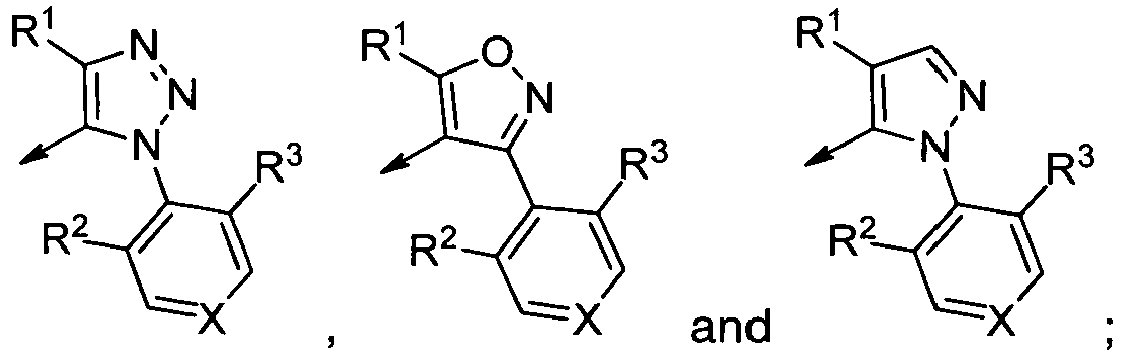
- X is selected from the group consisting of CH, N and NO;
- R1 is selected from the group consisting of isopropyl and cyclopropyl, wherein isopropyl and cyclopropyl are unsubstituted or substituted with one or two fluoro or one hydroxy;
- R2 is selected from the group consisting of fluoro, chloro, CH3, CHF2, CF3, OCHF2 and OCF3; and
- R3 is selected from the group consisting of hydrogen, fluoro, chloro, CH3, CHF2, CF3, OCHF2 and OCF3.
- In the context of the present invention "C1-6-alkyl" means a saturated alkyl chain having 1 to 6 carbon atoms which may be straight chained or branched. Examples thereof include methyl, ethyl, propyl, isopropyl, n-butyl, isobutyl, tert-butyl, n-pentyl, isopentyl, neopentyl and hexyl.
- The term "halo-C1-6-alkyl" means that one or more hydrogen atoms in the alkyl chain are replaced by a halogen. A preferred example thereof is CF3.
- "C2-6-alkenyl" means an alkyl chain having 1 to 6 carbon atoms which may be straight chained or branched, containing at least one carbon to carbon double bond. Examples thereof include ethenyl, propenyl, butenyl, pentenyl, hexenyl or (1E,3Z)-2-methylpenta-1,3-dien-1-yl. Preferred examples are ethenyl, propenyl or (1E,3Z)-2-methylpenta-1,3-dien-1-yl.
- "C2-6-alkynyl" means an alkyl chain having 1 to 6 carbon atoms which may be straight chained or branched, containing at least one carbon to carbon triple bond. Examples thereof include ethynyl, propynyl, 1-butynyl, 2-butynyl, 1-pentynyl, 2-pentynyl, 1-hexynyl, 2-hexynyl or 3-hexynyl. Preferred examples thereof include ethynyl and propynyl.
- A "C0-6-alkylene" means that the respective group is divalent and connects the attached residue with the remaining part of the molecule. Moreover, in the context of the present invention, "C0- alkylene" is meant to represent a bond.
- A C5-10-cycloalkyl group means a saturated or partially unsaturated mono-, bi- or spirocyclic ring system comprising 5 to 10 carbon atoms. Examples include cyclopentyl, cyclohexyl, cyclohexenyl, bicyclo[2.2.2]octyl, bicyclo[3.2.1]octanyl, spiro[3.3]heptyl, bicyclo[2.2.1]heptyl, adamantyl and pentacyclo[4.2.0.02,5.03,8.04,7]octyl.
- A C3-10-heterocycloalkyl group means a saturated or partially unsaturated 3 to 10 membered carbon mono-, bi- or spirocyclic ring wherein 1, 2 or 3 carbon atoms are replaced by 1, 2 or 3 heteroatoms, respectively, wherein the heteroatoms are independently selected from N, O, S, SO and SO2. Examples thereof include epoxidyl, oxetanyl, pyrrolidinyl, tetrahydrofuranyl, piperidinyl, piperazinyl tetrahydropyranyl, 1,4-dioxanyl, morpholinyl, 4-quinuclidinyl, 1,4-dihydropyridinyl and 3,6-dihydro-2H-thiopyranyl. The C3-10-heterocycloalkyl group can be connected with the remaining part of the molecule via a carbon or nitrogen atom.
- A 5-10-membered mono- or bicyclic heteroaromatic ring system (within the application also referred to as heteroaryl) containing up to 4 heteroatoms means a monocyclic heteroaromatic ring such as pyrrolyl, imidazolyl, furanyl, thiophenyl, pyridinyl, pyrimidinyl, pyrazinyl, pyrazolyl, oxazolyl, isoxazolyl, triazolyl, oxadiazolyl and thiadiazolyl. It further means a bicyclic ring system wherein the heteroatom(s) may be present in one or both rings including the bridgehead atoms. Examples thereof include quinolinyl, isoquinolinyl, quinoxalinyl, benzimidazolyl, benzisoxazolyl, benzofuranyl, benzoxazolyl, indolyl, indolizinyl and pyrazolo[1,5-a]pyrimidinyl. The nitrogen or sulphur atom of the heteroaryl system may also be optionally oxidized to the corresponding N-oxide, S-oxide or S,S-dioxide. If not stated otherwise, the heteroaryl system can be connected via a carbon or nitrogen atom. Examples for N-linked heterocycles are

- A 6-10-membered mono- or bicyclic aromatic ring system (within the application also referred to as aryl) means an aromatic carbon cycle such as phenyl or naphthalenyl.
- The term "N-oxide" denotes compounds, where the nitrogen in the heteroaromatic system (preferably pyridinyl) is oxidized. Such compounds can be obtained in a known manner by reacting a compound of the present invention (such as in a pyridinyl group) with H2O2 or a peracid in an inert solvent.
- Halogen is selected from fluorine, chlorine, bromine and iodine, more preferably fluorine or chlorine and most preferably fluorine.
- Furthermore, the compounds of the present invention are partly subject to tautomerism. For example, if a heteroaromatic group containing a nitrogen atom in the ring is substituted with a hydroxy group on the carbon atom adjacent to the nitrogen atom, the following tautomerism can appear:

- A C3-6-cycloalkyl or C3-6-heterocycloalkyl group can be connected straight or spirocyclic, e.g. when cyclohexane is substituted with the heterocycloalkyl group oxetane, the following structures are possible:

- It will be appreciated by the skilled person that when lists of alternative substituents include members which, because of their valency requirements or other reasons, cannot be used to substitute a particular group, the list is intended to be read with the knowledge of the skilled person to include only those members of the list which are suitable for substituting the particular group.
- The compounds of the present invention can be in the form of a prodrug compound. "Prodrug compound" means a derivative that is converted into a compound according to the present invention by a reaction with an enzyme, gastric acid or the like under a physiological condition in the living body, e.g. by oxidation, reduction, hydrolysis or the like, each of which is carried out enzymatically. Examples of the prodrug are compounds, wherein the amino group in a compound of the present invention is acylated, alkylated or phosphorylated to form, e.g., eicosanoylamino, alanylamino, pivaloyloxymethylamino or wherein the hydroxyl group is acylated, alkylated, phosphorylated or converted into the borate, e.g. acetyloxy, palmitoyloxy, pivaloyloxy, succinyloxy, fumaryloxy, alanyloxy or wherein the carboxyl group is esterified or amidated. These compounds can be produced from compounds of the present invention according to well-known methods. Other examples of the prodrug are compounds, wherein the carboxylate in a compound of the present invention is, for example, converted into an alkyl-, aryl-, choline-, amino, acyloxymethylester, linolenoylester.
- Metabolites of compounds of the present invention are also within the scope of the present invention.
- Where tautomerism, like e.g. keto-enol tautomerism, of compounds of the present invention or their prodrugs may occur, the individual forms, like e.g. the keto and enol form, are each within the scope of the invention as well as their mixtures in any ratio. Same applies for stereoisomers, like e.g. enantiomers, cis/trans isomers, conformers and the like.
- If desired, isomers can be separated by methods well known in the art, e.g. by liquid chromatography. Same applies for enantiomers by using e.g. chiral stationary phases. Additionally, enantiomers may be isolated by converting them into diastereomers, i.e. coupling with an enantiomerically pure auxiliary compound, subsequent separation of the resulting diastereomers and cleavage of the auxiliary residue. Alternatively, any enantiomer of a compound of the present invention may be obtained from stereoselective synthesis using optically pure starting materials. Another way to obtain pure enantiomers from racemic mixtures would use enantioselective crystallization with chiral counterions.
- The compounds of the present invention can be in the form of a pharmaceutically acceptable salt or a solvate. The term "pharmaceutically acceptable salts" refers to salts prepared from pharmaceutically acceptable non-toxic bases or acids, including inorganic bases or acids and organic bases or acids. In case the compounds of the present invention contain one or more acidic or basic groups, the invention also comprises their corresponding pharmaceutically or toxicologically acceptable salts, in particular their pharmaceutically utilizable salts. Thus, the compounds of the present invention which contain acidic groups can be present on these groups and can be used according to the invention, for example, as alkali metal salts, alkaline earth metal salts or ammonium salts. More precise examples of such salts include sodium salts, potassium salts, calcium salts, magnesium salts or salts with ammonia or organic amines such as, for example, ethylamine, ethanolamine, triethanolamine or amino acids. The compounds of the present invention which contain one or more basic groups, i.e. groups which can be protonated, can be present and can be used according to the invention in the form of their addition salts with inorganic or organic acids. Examples of suitable acids include hydrogen chloride, hydrogen bromide, phosphoric acid, sulfuric acid, nitric acid, methanesulfonic acid, p-toluenesulfonic acid, naphthalenedisulfonic acids, oxalic acid, acetic acid, tartaric acid, lactic acid, salicylic acid, benzoic acid, formic acid, propionic acid, pivalic acid, diethylacetic acid, malonic acid, succinic acid, pimelic acid, fumaric acid, maleic acid, malic acid, sulfaminic acid, phenylpropionic acid, gluconic acid, ascorbic acid, isonicotinic acid, citric acid, adipic acid, and other acids known to the person skilled in the art. If the compounds of the present invention simultaneously contain acidic and basic groups in the molecule, the invention also includes, in addition to the salt forms mentioned, inner salts or betaines (zwitterions). The respective salts can be obtained by customary methods which are known to the person skilled in the art like, for example, by contacting these with an organic or inorganic acid or base in a solvent or dispersant, or by anion exchange or cation exchange with other salts. The present invention also includes all salts of the compounds of the present invention which, owing to low physiological compatibility, are not directly suitable for use in pharmaceuticals but which can be used, for example, as intermediates for chemical reactions or for the preparation of pharmaceutically acceptable salts.
- Further the compounds of the present invention may be present in the form of solvates, such as those which include as solvate water, or pharmaceutically acceptable solvates, such as alcohols, in particular ethanol.
- Furthermore, the present invention provides pharmaceutical compositions comprising at least one compound of the present invention, or a prodrug compound thereof, or a pharmaceutically acceptable salt or solvate thereof as active ingredient together with a pharmaceutically acceptable carrier.
- "Pharmaceutical composition" means one or more active ingredients, and one or more inert ingredients that make up the carrier, as well as any product which results, directly or indirectly, from combination, complexation or aggregation of any two or more of the ingredients, or from dissociation of one or more of the ingredients, or from other types of reactions or interactions of one or more of the ingredients. Accordingly, the pharmaceutical compositions of the present invention encompass any composition made by admixing at least one compound of the present invention and a pharmaceutically acceptable carrier.
- The pharmaceutical composition of the present invention may additionally comprise one or more other compounds as active ingredients like a prodrug compound or other nuclear receptor modulators.
- The compositions are suitable for oral, rectal, topical, parenteral (including subcutaneous, intramuscular, and intravenous), ocular (ophthalmic), pulmonary (nasal or buccal inhalation) or nasal administration, although the most suitable route in any given case will depend on the nature and severity of the conditions being treated and on the nature of the active ingredient. They may be conveniently presented in unit dosage form and prepared by any of the methods well-known in the art of pharmacy.
- The compounds of the present invention can be prepared according to schemes I-III. As depicted in Scheme I an alicyclic ketone, substituted with substituent A can react with a metalated aromatic or heteroaromatic ring M-Q-O-CH2Z (M = metal, e.g. Li) in aprotic solvents and preferably at low temperatures to afford a hydroxyl substituted alicycle bearing the substituents A and Q. In the case where Y is CH two isomers can form (A and Q transannular cis or trans to each other). Under optimized conditions the formation of mainly one of the two isomers can be achieved. The two isomers can be separated by appropriate methods known in the art like e.g. silica gel chromatography or preparative RP-HPLC.

- In Scheme II is depicted a methods which are used to prepare the cyclic ketones needed for the synthesis of the compounds of this invention. In cases where Y is nitrogen, Cu- or Pd-catalysed C-N cross coupling between cyclic amines and halo-aromatic or halo-heteroaromatic rings afford the corresponding N-substituted cyclic amines bearing a functionality which later can be transformed into a keto group.

- In the case where moiety A is a pyrazole an alternative synthetic route to the compounds of the invention is illustrated in scheme III. Acetyl bearing intermediates a1 can react with oxalic esters in the presence of strong bases to form ketoesters a2. These can undergo a cyclysation with alkyl hydrazines under promotion of Lawesson's reagent to form pyrazole intermediates a3. Intermedaites a3 can be transformed into cyclic ketones (a4) which can undergo an addition reaction according to scheme I and after final ester hydrolysis afford pyrazole analogs of compounds of the present invention.

- As a result, the present invention relates to compounds according to the general Formula (1) which bind to FXR and act as agonists or modulators of FXR.
- The invention further relates to the use of said compounds for the treatment and/or prophylaxis of diseases and/or conditions through binding of said nuclear receptor by said compounds. Further the present invention relates to the use of said compounds for the preparation of a medicament for the treatment and/or prophylaxis of diseases and/or conditions through binding of said nuclear receptor by said compounds. Specifically, the present invention relates to the use of compounds according to Formula (1) in the preparation of a medicament for the prophylaxis and/or treatment of chronic intrahepatic or some forms of extrahepatic cholestatic conditions, of liver fibrosis, of acute intraheptic cholestatic conditions, of obstructive or chronic inflammatory disorders that arise out of improper bile composition, of gastrointestinal conditions with a reduced uptake of dietary fat and fat-soluble dietary vitamins, of inflammatory bowel diseases, of lipid and lipoprotein disorders, of Type II Diabetes and clinical complications of Type I and Type II Diabetes, of conditions and diseases which result from chronic fatty and fibrotic degeneration of organs due to enforced lipid and specifically triglyceride accumulation and subsequent activation of profibrotic pathways, of obesity and metabolic syndrome (combined conditions of dyslipidemia, diabetes and abnormally high body-mass index), of acute myocardial infarction, of acute stroke, of thrombosis which occurs as an endpoint of chronic obstructive atherosclerosis, of persistant infections by intracellular bacteria or parasitic protozoae, of non-malignant hyperproliferative disorders, of malignant hyperproliferative disorders, of colon adenocarcinoma and hepatocellular carcinoma in particular, of liver steatosis and associated syndromes, of liver failure or liver malfunction as an outcome of chronic liver diseases or of surgical liver resection, of Hepatitis B infection, of Hepatitis C infection and/or of cholestatic and fibrotic effects that are associated with alcohol-induced cirrhosis or with viral-borne forms of hepatitis.
- Medicaments as referred to herein may be prepared by conventional processes, including the combination of a compound according to the present invention and a pharmaceutically acceptable carrier.
- FXR is proposed to be a nuclear bile acid sensor. As a result, it modulates both, the synthetic output of bile acids in the liver and their recycling in the intestine (by regulating bile acid binding proteins). But beyond bile acid physiology, FXR seems to be involved in the regulation of many diverse physiological processes which are relevant in the etiology and for the treatment of diseases as diverse as cholesterol gallstones, metabolic disorders such as Type II Diabetes, dyslipidemias or obesity, chronic inflammatory diseases such as Inflammatory Bowel Diseases or chronic intrahepatic forms of cholestasis and many others diseases (T. Claudel et al., Arterioscler. Thromb. Vasc. Biol. 2005, 25, 2020; Y. D. Wang et al., Cell Res. 2008, 18, 1087.
- FXR regulates a complex pattern of response genes in the liver and in the gastrointestinal tract. The gene products have impact on diverse physiological processes. In the course of functional analysis of FXR, the first regulatory network that was analyzed was the regulation of bile acid synthesis. While the LXRs induce the key enzyme of the conversion of cholesterol into bile acids, Cyp7A1, via the induction of the regulatory nuclear receptor LRH-1, FXR represses the induction of Cyp7A1 via the upregulation of mRNA encoding SHP, a further nuclear receptor that is dominant repressive over LRH-1. Since FXR binds the end products of this pathway, primary bile acids such as cholic acid (CA) or CDCA, this can be regarded as an example of feedback inhibition on the gene expression level (B. Goodwin et al., Mol. Cell 2000, 6, 517; T. T. Lu et al., Mol. Cell 2000, 6, 507). Parallel to the repression of bile acid synthesis via SHP, FXR induces a range of so-called ABC (for ATP-binding cassette) transporters that are responsible for the export of toxic bile acids from the hepatocyte cytosol into the canaliculi, the small bile duct ramifications where the bile originates. This hepatoprotective function of FXR became first apparent with the analysis of FXR knockout mice (C. J. Sinal et al., Cell 2000, 102, 731). where under- or overexpression of several ABC-transporters in the liver was shown. Further detailed analysis revealed that the major bile salt excretory pump BSEP or ABCB11 (M. Ananthanarayanan et al., J. Biol. Chem. 2001, 276, 28857; J. R. Plass et al., Hepatology 2002, 35, 589) as well as the key enzyme which mediates lipid transfer from lipoproteins to phospholipids, PLTP (N. L. Urizar et al., J. Biol. Chem. 2000, 275, 39313), and the two key canalicular membrane transporters for phospholipids, MRP-2 (ABCC4) (H. R. Kast et al., J. Biol. Chem. 2002, 277, 2908) and MDR-3 (ABCB4); L. Huang et al., J. Biol. Chem. 2003, 278, 51085) are direct targets for ligand-directed transcriptional activation by FXR (summarized in: M. Miyata, J. Pharmacol. Exp. Ther. 2005, 312, 759; G. Rizzo et al., Curr. Drug Targets Immune Endocr. Metabol. Disord. 2005, 5, 289).
- The fact that FXR seems to be the major metabolite sensor and regulator for the synthesis, export and re-circulation of bile acids suggested the use of FXR ligands to induce bile flow and change bile acid composition towards more hydrophilic composition. With the development of the first synthetic FXR ligand GW4064 (P. R. Maloney et al., J. Med. Chem. 2000, 43, 2971; T. M. Willson et al., Med. Res. Rev. 2001, 21, 513) as a tool compound and of the semi-synthetic artificial bile acid ligand 6-alpha-ethyl-CDCA, the effects of superstimulation of FXR by potent agonists could be analyzed. It was shown that both ligands induce bile flow in bile duct ligated animals. Moreover, in addition to choleretic effects, also hepatoprotective effects could be demonstrated (R. Pellicciari et al., J. Med. Chem. 2002, 45, 3569; Y. Liu et al., J. Clin. Invest. 2003, 112, 1678). This hepatoprotective effect was further narrowed down to an anti-fibrotic effect that results from the repression of Tissue Inhibitors of Matrix-Metalloproteinases, TIMP-1 and 2, the induction of collagen-deposit resolving Matrix-Metalloproteinase 2 in hepatic stellate cells and the subsequent reduction of alpha-collagen mRNA and Transforming growth factor beta (TGF-beta) mRNA which are both pro-fibrotic factors by FXR agonists (S. Fiorucci et al., Gastroenterology 2004, 127, 1497; S. Fiorucci et al., J. Pharmacol. Exp. Ther. 2005, 314, 584). Furthermore, anti-cholestatic activity was demonstrated in bile-duct ligated animal models as well as in animal models of estrogen-induced cholestasis (S. Fiorucci et al., J. Pharmacol. Exp. Ther. 2005, 313, 604).
- Genetic studies demonstrate that in hereditary forms of cholestasis (Progressive Familiar Intrahepatic Cholestasis = PFIC, Type I - IV) either nuclear localization of FXR itself is reduced as a consequence of a mutation in the FIC1 gene (in PFIC Type I, also called Byler's Disease) (F. Chen et al., Gastroenterology 2004, 126, 756; L. Alvarez et al., Hum. Mol. Genet. 2004, 13, 2451) or levels of the FXR target gene encoding MDR-3 phospholipid export pump are reduced (in PFIC Type III). Taken together there is a growing body of evidence that FXR binding compounds will demonstrate substantial clinical utility in the therapeutic regimen of chronic cholestatic conditions such as Primary Biliary Cirrhosis (PBC) or Primary Sclerosing Cholangitis (PSC) (reviewed in: G. Rizzo et al., Curr. Drug Targets Immune Endocr. Metabol. Disord. 2005, 5, 289; G. Zollner et al., Mol. Pharm. 2006, 3, 231; S. Y. Cai et al., Expert Opin. Ther. Targets 2006, 10, 409).
- The deep impact that FXR activation has on bile acid metabolism and excretion is not only relevant for cholestatic syndromes but even more directly for a therapy against gallstone formation. Cholesterol gallstones form due to low solubility of cholesterol that is actively pumped out of the liver cell into the lumen of the canaliculi. It is the relative percentage of content of the three major components, bile acids, phospholipids and free cholesterol that determines the formation of mixed micelles and hence apparent solubility of free cholesterol in the bile. FXR polymorphisms map as quantitative trait loci as one factor contributing to gallstone disease (H. Wittenburg, Gastroenterology 2003, 125, 868). Using the synthetic FXR tool compound GW4064 it could be demonstrated that activation of FXR leads to an improvement of the Cholesterol Saturation Index (CSI) and directly to an abolishment of gallstone formation in C57L gallstone susceptible mice whereas drug treatment in FXR knockout mice shows no effect on gallstone formation (A. Moschetta et al., Nature Medicine 2004, 10, 1352).
- These results qualify FXR as a good target for the development of small molecule agonists that can be used to prevent cholesterol gallstone formation or to prevent re-formation of gallstones after surgical removal or shockwave lithotripsy (discussed in: S. A. Doggrell, Curr. Opin. Investig. Drugs 2006, 7, 344).
- Thus, in one embodiment of the invention, the compound according to Formula (1) and pharmaceutical compositions comprising said compound is used for the prophylaxis and/or treatment of obstructive or chronic inflammatory disorders that arise out of improper bile composition such as cholelithiasis also known as cholesterol gallstones.
- Beyond its strong hepatoprotective and choleretic as well as anti-fibrotic effects that FXR shows upon small molecule stimulated activation in the liver, FXR seems to have a role in protecting the intestine from neoplastic transformation and from the development of polyps and their transition into adenocarcinoma in the gut (S. Modica et al., Cancer Res. 2008, 68, 9589 and R. R. Maran et al., J. Pharmacol. Exp. Ther. 2009, 328, 469). Similar to the situation in the intestine absence of FXR leads to a high increase in the formation of Hepatocellular Cacrcinoma (HCC), the most prominent form of liver cancer (I. Kim et al., Carcinogenesis 2007, 28, 940 and F. Yang et al., Cancer Res. 2007, 67, 863). Whereas a functional FXR prevents the formation of colon adenocarcinoma and hepatocellular carcinoma, FXR activation induces liver regeneration after hepatectomy (W. Huang et al., Science 2006, 312, 233).
- The combined hepatoprotective, anti-neoplastic and liver regenerative effects associated with FXR activation can be therapeutically exploited for the use of FXR agonists in the treatment of sever liver diseases. In one embodiment, the compounds according to the invention and pharmaceutical compositions comprising said compounds are used in the treatment of liver diseases such as HCC, stimulation of liver regrowth and amelioration of side effects associated with major liver resection, liver cirrhosis independent of the etiology and prevention or treatment of liver ischemia in the course of liver transplantation or major liver surgery.
- Since the discovery of the first synthetic FXR agonist and its administration to rodents it became evident that FXR is a key regulator of serum triglycerides (P. Maloney et al., J. Med. Chem. 2000, 43, 2971; T. Willson et al., Med. Res. Rev. 2001, 21, 513). Over the past six years accumulating evidence has been published that activation of FXR by synthetic agonists leads to significant reduction of serum triglycerides, mainly in the form of reduced VLDL, but also to reduced total serum cholesterol (H. R. Kast et al., Mol. Endocrinol. 2001, 15, 1720; N. L. Urizar et al., Science 2002, 296, 1703; G. Lambert et al., J. Biol. Chem. 2003, 278, 2563; M. Watanabe et al., J. Clin. Invest. 2004, 113, 1408; A. Figge et al., J. Biol. Chem. 2004, 279, 2790; S. Bilz et al., Am. J. Physiol. Endocrinol. Metab. 2006, 290, E716).
- But the lowering of serum triglycerides is not a stand alone effect. Treatment of db/db or ob/ob mice with synthetic FXR agonist GW4064 resulted in marked and combined reduction of serum triglycerides, total cholesterol, free fatty acids, ketone bodies such as 3-OH Butyrate. Moreover, FXR activation engages with the intracellular insulin signaling pathway in hepatocytes, resulting in reduced output of glucose from liver gluconeogenesis but concomitant increase in liver glycogen. Insulin sensitivity as well as glucose tolerance were positively impacted by FXR treatment (K. R. Stayrook et al., Endocrinology 2005, 146, 984; Y. Zhang et al., PNAS 2006, 103, 1006; B. Cariou et al., J. Biol. Chem. 2006, 281, 11039; K. Ma et al., J. Clin. Invest. 2006, 116, 1102; D. Duran-Sandoval et al., Biochimie 2005, 87, 93). An effect on reduction of body weight was also recently observed in mice overfed with a high lipid diet (C. Lihong et al., American Diabetes Association (ADA) 66th annual scientific sessions, June 2006, Abstract Number 856-P). This weight loss effect might results from FXR's induction of FGF-19, a fibroblast growth factor that is known to lead to weight loss and athletic phenotype (J. Holt et al., Genes Dev. 2003, 17, 1581; E. Tomlinson et al., Endocrinology 2002, 143, 1741). In recent patent applications, the effect of FXR agonist on reduction of body weight was demonstrated (
WO 2004/087076 ;WO 2003/080803 ). - Taken together, these pharmacological effects of FXR agonists can be exploited in different therapeutic ways: FXR binding compounds are thought to be good candidates for the treatment of Type II Diabetes because of their insulin sensitization, glycogenogenic, and lipid lowering effects.
- In one embodiment, the compounds according to the invention and pharmaceutical compositions comprising said compounds are used in the prophylaxis and/or treatment of Type II Diabetes which can be overcome by FXR-mediated upregulation of systemic insulin sensitivity and intracellular insulin signalling in liver, increased peripheral glucose uptake and metabolisation, increased glycogen storage in liver, decreased output of glucose into serum from liver-borne gluconeogenesis.
- In a further embodiment, said compounds and pharmaceutical compositions are used for the prophylaxis and/or treatment of chronic intrahepatic, such as PBC, PSC, progressive familiar cholestasis (PFIC), alcohol-induced cirrhosis and associated cholestasis, and some forms of extrahepatic cholestatic conditions, or liver fibrosis.
- The invention also relates to a compound of Formula (1) or to a pharmaceutical composition comprising said compound for the prophylaxis and/or treatment of gastrointestinal conditions with a reduced uptake of dietary fat and fat-soluble dietary vitamins which can be overcome by increased intestinal levels of bile acids and phospholipids.
- In a further embodiment, said compound or pharmaceutical composition is used for preventing and/or treating a disease selected from the group consisting of lipid and lipoprotein disorders such as hypercholesterolemia, hypertriglyceridemia, and atherosclerosis as a clinically manifest condition which can be ameliorated by FXR's beneficial effect on lowering total plasma cholesterol, lowering serum triglycerides, increasing conversion of liver cholesterol into bile acids and increased clearance and metabolic conversion of VLDL and other lipoproteins in the liver.
- In one further embodiment, said compound and pharmaceutical composition are used for the prophylaxis and/or treatment of diseases where the combined lipid lowering, anti-cholestatic and anti-fibrotic effects of FXR-targeted medicaments can be exploited for the treatment of liver steatosis and associated syndromes such as NASH, or for the treatment of cholestatic and fibrotic effects that are associated with alcohol-induced cirrhosis, or with viral-borne forms of hepatitis.
- In conjunction with the hypolipidemic effects it was also shown that loss of functional FXR leads to increased atherosclerosis in ApoE knockout mice (E. A. Hanniman et al., J. Lipid Res. 2005, 46, 2595). Therefore, FXR agonists might have clinical utility as anti-atherosclerotic and cardioprotective drugs. The downregulation of Endothelin-1 in Vascular Smooth Muscle Cells might also contribute to such beneficial therapeutic effects (F. He et al., Circ. Res. 2006, 98, 192).
- The invention also relates to a compound according to Formula (1) or a pharmaceutical composition comprising said compound for preventive and posttraumatic treatment of cardiovascular disorders such as acute myocardial infarction, acute stroke, or thrombosis which occur as an endpoint of chronic obstructive atherosclerosis.
- Beyond controlling intestinal and colonic polyp formation, FXR seems to be expressed in breast cancer tissue and cell lines but not in healthy breast tissue and seems to interact with the Estrogen Receptor in ER positive breast cancer cells (K. E. Swales et al., Cancer Res. 2006, 66, 10120 and F. Journe et al., Breast Cancer Res. Treat. 2009, 115, 523).
- This would allow to regard FXR also as a potential target for the treatment of proliferative diseases, especially metastasizing cancer forms that express a small molecule responsive form of FXR.
- In a further embodiment, said compounds and pharmaceutical compositions are used for the prophylaxis and/or treatment of malignant hyperproliferative disorders such as different forms of cancer, specifically certain forms of breast, liver or colon cancer where interference with an FXR ligand will have a beneficial impact.
- Finally, FXR seems also to be involved in the control of antibacterial defense in the intestine (T. Inagaki et al., PNAS. 2006, 103, 3920) although an exact mechanism is not provided. From these published data, however, one can conclude that treatment with FXR agonists might have a beneficial impact in the therapy of Inflammatory Bowel Disorders (IBD), in particular those forms where the upper (ileal) part of the intestine is affected (e.g. ileal Crohn's disease) because this seems to be the site of action of FXR's control on bacterial growth. In IBD the desensitization of the adaptive immune response is somehow impaired in the intestinal immune system. Bacterial overgrowth might then be the causative trigger towards establishment of a chronic inflammatory response. Hence, dampening of bacterial growth by FXR-borne mechanisms might be a key mechanism to prevent acute inflammatory episodes.
- Thus, the invention also relates to a compound according to Formula (1) or a pharmaceutical composition comprising said compound for preventing and/or treating a disease related to Inflammatory Bowel Diseases such as Crohn's disease or Colitis ulcerosa. FXR-mediated restoration of intestinal barrier function and reduction in non-commensal bacterial load is believed to be helpful in reducing the exposure of bacterial antigens to the intestinal immune system and can therefore reduce inflammatory responses.
- The invention further relates to a compound or pharmaceutical composition for the prophylaxis and/or treatment of obesity and associated disorders such as metabolic syndrome (combined conditions of dyslipidemias, diabetes and abnormally high body-mass index) which can be overcome by FXR-mediated lowering of serum triglycerides, blood glucose and increased insulin sensitivity and FXR-mediated weight loss.
- In a further embodiment, the compounds or pharmaceutical composition of the present invention are useful in preventing and/or treating clinical complications of Type I and Type II Diabetes. Examples of such complications include Diabetic Nephropathy, Diabetic Retinopathy, Diabetic Neuropathies, or Peripheral Arterial Occlusive Disease (PAOD). Other clinical complications of Diabetes are also encompassed by the present invention.
- Furthermore, conditions and diseases which result from chronic fatty and fibrotic degeneration of organs due to enforced lipid and specifically triglyceride accumulation and subsequent activation of profibrotic pathways may also be prevented and/or treated by applying the compounds or pharmaceutical composition of the present invention. Such conditions and diseases encompass NASH and chronic cholestatic conditions in the liver, Glomeruloscierosis and Diabetic Nephropathy in the kidney, Macula Degeneration and Diabetic Retinopathy in the eye and Neurodegenerative diseases such as Alzheimer's Disease in the brain, or Diabetic Neuropathies in the peripheral nervous system.
- In practical use, the compounds of the present invention can be combined as the active ingredient in intimate admixture with a pharmaceutical carrier according to conventional pharmaceutical compounding techniques. The carrier may take a wide variety of forms depending on the form of preparation desired for administration, e.g., oral or parenteral (including intravenous). In preparing the compositions for oral dosage form, any of the usual pharmaceutical media may be employed, such as, for example, water, glycols, oils, alcohols, flavoring agents, preservatives, coloring agents and the like in the case of oral liquid preparations, such as, for example, suspensions, elixirs and solutions; or carriers such as starches, sugars, microcrystalline cellulose, diluents, granulating agents, lubricants, binders, disintegrating agents and the like in the case of oral solid preparations such as, for example, powders, hard and soft capsules and tablets, with the solid oral preparations being preferred over the liquid preparations.
- Because of their ease of administration, tablets and capsules represent the most advantageous oral dosage unit form in which case solid pharmaceutical carriers are obviously employed. If desired, tablets may be coated by standard aqueous or non-aqueous techniques. Such compositions and preparations should contain at least 0.1 percent of active compound. The percentage of active compound in these compositions may, of course, be varied and may conveniently be between about 2 percent to about 60 percent of the weight of the unit. The amount of active compound in such therapeutically useful compositions is such that an effective dosage will be obtained. The active compounds can also be administered intranasally as, for example, liquid drops or spray.
- The tablets, pills, capsules, and the like may also contain a binder such as gum tragacanth, acacia, corn starch or gelatin; excipients such as dicalcium phosphate; a disintegrating agent such as corn starch, potato starch, alginic acid; a lubricant such as magnesium stearate; and a sweetening agent such as sucrose, lactose or saccharin. When a dosage unit form is a capsule, it may contain, in addition to materials of the above type, a liquid carrier such as a fatty oil.
- Various other materials may be present as coatings or to modify the physical form of the dosage unit. For instance, tablets may be coated with shellac, sugar or both. A syrup or elixir may contain, in addition to the active ingredient, sucrose as a sweetening agent, methyl and propylparabens as preservatives, a dye and a flavoring such as cherry or orange flavor.
- Since the compounds of the present invention mostly represent carboxylic acids or similar anionic isosters thereof, and since it is well known that salt forms of ionic drug compounds can substantially affect the bioavailability of drug compounds, the compounds of the present invention may also be used as salts with various countercations to yield an orally available formulation. Such pharmaceutically acceptable cations may be amongst others mono- or bivalent ions such as ammonium, the alkaline metals sodium or potassium or the alkaline earth metals magnesium or calcium, certain pharmaceutically acceptable amines such as tris(hydroxymethyl)aminomethane, ethylendiamine, diethylamine, piperazine or others, or certain cationic amino acids such as lysine or arginine.
- The compounds of the present invention may also be administered parenterally. Solutions or suspensions of these active compounds can be prepared in water suitably mixed with a surfactant such as hydroxy-propylcellulose. Dispersions can also be prepared in glycerol, liquid polyethylene glycols and mixtures thereof in oils. Under ordinary conditions of storage and use, these preparations contain a preservative to prevent the growth of microorganisms.
- The pharmaceutical forms suitable for injectable use include sterile aqueous solutions or dispersions and sterile powders for the extemporaneous preparation of sterile injectable solutions or dispersions. In all cases, the form must be sterile and must be fluid to the extent that easy syringability exists. It must be stable under the conditions of manufacture and storage and must be preserved against the contaminating action of microorganisms such as bacteria and fungi. The carrier can be a solvent or dispersion medium containing, for example, water, ethanol, polyol (e.g., glycerol, propylene glycol and liquid polyethylene glycol), suitable mixtures thereof, and vegetable oils.
- Any suitable route of administration may be employed for providing a mammal, especially a human, with an effective dose of a compound of the present invention. For example, oral, rectal, topical, parenteral, ocular, pulmonary, nasal, and the like may be employed. Dosage forms include tablets, troches, dispersions, suspensions, solutions, capsules, creams, ointments, aerosols, and the like. Preferably compounds of the present invention are administered orally.
- The effective dosage of active ingredient employed may vary depending on the particular compound employed, the mode of administration, the condition being treated and the severity of the condition being treated. Such dosage may be ascertained readily by a person skilled in the art.
- When treating or preventing FXR mediated conditions for which compounds of the present invention are indicated, generally satisfactory results are obtained when the compounds of the present invention are administered at a daily dosage of from about 0.1 milligram to about 100 milligram per kilogram of animal body weight, preferably given as a single daily dose or in divided doses two to six times a day, or in sustained release form. For most large mammals, the total daily dosage is from about 1.0 milligrams to about 1000 milligrams, preferably from about 1 milligram to about 50 milligrams. In the case of a 70 kg adult human, the total daily dose will generally be from about 7 milligrams to about 350 milligrams. This dosage regimen may be adjusted to provide the optimal therapeutic response.
- The compounds of the present invention can be prepared according to the procedures of the following Schemes and Examples, using appropriate materials and are further exemplified by the following specific examples. Moreover, by utilizing the procedures described herein, in conjunction with ordinary skills in the art, additional compounds of the present invention claimed herein can be readily prepared. The compounds illustrated in the examples are not, however, to be construed as forming the only genus that is considered as the invention. The examples further illustrate details for the preparation of the compounds of the present invention. Those skilled in the art will readily understand that known variations of the conditions and processes of the following preparative procedures can be used to prepare these compounds. The instant compounds are generally isolated in the form of their pharmaceutically acceptable salts, such as those described above.
- The amine-free bases corresponding to the isolated salts can be generated by neutralization with a suitable base, such as aqueous sodium hydrogen carbonate, sodium carbonate, sodium hydroxide and potassium hydroxide, and extraction of the liberated amine-free base into an organic solvent, followed by evaporation. The amine-free base, isolated in this manner, can be further converted into another pharmaceutically acceptable salt by dissolution in an organic solvent, followed by addition of the appropriate acid and subsequent evaporation, precipitation or crystallization. The carboxylic free acids corresponding to the isolated salts can be generated by neutralization with a suitable acid, such as aqueous hydrochloric acid, sodium hydrogen sulfate, sodium dihydrogen phosphate, and extraction of the liberated carboxylic-free acid into an organic solvent, followed by evaporation. The carboxylic acid, isolated in this manner, can be further converted into another pharmaceutically acceptable salt by dissolution in an organic solvent, followed by addition of the appropriate base and subsequent evaporation, precipitation or crystallization.
- An illustration of the preparation of compounds of the present invention is shown below. Unless otherwise indicated in the schemes, the variables have the same meaning as described above. The examples presented below are intended to illustrate particular embodiments of the invention. Suitable starting materials, building blocks and reagents employed in the synthesis as described below are commercially available from Sigma-Aldrich or Acros Organics, for example, or can be routinely prepared by procedures described in the literature, for example in "March's Advanced Organic Chemistry: Reactions, Mechanisms, and Structure", 5th Edition; John Wiley & Sons or T. Eicher, S. Hauptmann "The Chemistry of Heterocycles; Structures, Reactions, Synthesis and Application", 2nd edition, Wiley-VCH 2003; Fieser et al. "Fiesers' Reagents for organic Synthesis" John Wiley & Sons 2000.
- Compounds of the present invention can be prepared by methods known to those who are skilled in the art. The following examples are only meant to represent examples of the invention and are in no way meant to be a limit of the invention.
-

- To a suspension of 1-(1,4-dioxa-8-azaspiro[4.5]decan-8-yl)ethanone (4.0 g, 21.6 mmol) in dry THF (100 ml) was added t-BuLi (25mL, 1.3M, 32.4mmol) dropwise at -78°C. Then the reaction mixture was allowed to warm to rt, stirred for another 5h, quenched with saturated aq. NH4Cl. The mixture was extracted with EtOAc (100 mL x 2), the organic layer was washed with H2O (80 mL) and brine (80 mL), dried with Na2SO4, filtered, concentrated and the residue was purified by silica gel column (PE:EtOAc = 5:1 to 2:1) to give the title compound as a colorless oil (4.6 g).
- To a suspension of intermediate 1a (2.0 g, 7.0 mmol), isopropylhydrazine monohydrochloride (1.0 g, 9.1mmol) and pyridine (3mL) in THF (40 ml) was added Lawesson's reagent (5.7g, 14 mmol) portionwise at rt. The resulting mixture was heated to 60°C and stirred for 16 h. Then EtOAc (50 mL) was added and the mixture was washed with sat. NaHCO3 (50 m x 2), aq. HCl (1 M, 50 mL) and brine (50 mL). The organic phase was dried with Na2SO4, filtered, concentrated and the residue was purified by silica gel column (PE:EA = 5:1 to 2:1) to give the title compound as a white solid (0.7 g).
- A suspension of intermediate 1b (0.70 g, 2.3 mmol, crude) in THF (10 ml) and H2SO4 (10%, 10 mL) was stirred for 16 h. The mixture was diluted with EtOAc (50 mL), washed with sat. NaHCO3 (50 mL x 2), aq. HCl (1 M, 50 mL) and brine (50 mL). The organic phase was dried with Na2SO4, filtered, concentrated and the residue was purified by silica gel column (PE:EA = 5:1 to 2:1) to give the title compound as a white solid.(0.61 g).
- To a round bottom flask was added LiCl (265 mg, 6.3 mmol), dry THF (10 ml) at rt and i-PrMgCl (1.9 ml, 2.0 M, 3.8 mmol) under N2. The mixture was stirred at rt for 10 min, then a solution of (4-bromo-3-chlorophenoxy)(tert-butyl)dimethylsilane (1.1 g, 3.2 mol) in dry THF (2 ml) was added dropwise and stirring was continued at rt for another 1 hour. After that, the above reaction mixture was added into a solution of intermediate 1c (0.8 g, 2.9 mmol) in dry THF (10 ml) under N2, and the mixture was stirred at rt for one hour. The reaction mixture was quenched with H2O (20 mL), extracted with EtOAc (30 mL x 3). The organic layer was washed with brine (20 mL), dried with Na2SO4, filtered and purified by column chromatography on silica gel (EA/PE = 1/20) to give the title compound as a white solid (350 mg).
- To a suspension of intermediate 1d (0.3 g, 0.67 mmol) in THF (5 ml) was added TBAF (277 mg, 1.01 mmol) at rt and the mixture was stirred at rt for 30 min. Then the mixture was quenched with water (20 mL), extracted with EtOAc (20 mL x 3). The organic phase was washed with brine (20 mL), dried with Na2SO4, filtered and concentrate to give the title compound as a white solid, which was used directly in next step without further purification (0.23 g).
- To a suspension of intermediate 1e (230 mg, 0.56 mol), (5-cyclopropyl-3-(2,6-dichlorophenyl)isoxazol-4-yl)methanol (158 mg, 0.56 mol) and PPh3 (239 mg, 1.1 mmol) in toluene (10 ml) was added DIAD (226 mg, 1.1 mmol) dropwise at 0°C. The resulting mixture was stirred at rt for 4 h. The reaction mixture was diluted with H2O, extracted with EtOAc (20 mL x 3) and the organic layers were concentrated to dryness. The residue was and purified by preparative TLC (EtOAc/PE=1/1) to give the title compound as a white solid (220 mg).
- A suspension of intermediate 1f (180 mg, 0.267 mmol) in MeOH (10 mL) and aq. NaOH (10%, 10 mL) was stirred at 30°C for 4h. The mixture was concentrated under reduced pressure, HCl (1 M) was added until pH = 2-3 and the resulting precipitate was filtered off and dried under vaccum to give Example 1 as a white solid (100 mg). 1H-NMR (400 MHz, CD3Cl): δ ppm 7.43-7.39 (m, 3H), 7.36-7.31 (m, 1 H), 6.83 (d, J = 2.0 Hz, 1 H), 6.72 (dd, J = 8.8 Hz, 2.0 Hz, 1 H), 6.51 (s, 1 H), 4.81 (s, 2H), 4.71-4.65 (m, 1 H), 3.29-3.25 (m, 2H), 2.98-2.93 (m, 2H), 2.2.45-2.37 (m, 2H), 2.17-2.05 (m, 3H), 1.47 (d, J = 6.0 Hz, 6H), 1.32-1.25 (m, 2H), 1.18-1.12 (m, 2H). MS-ESI: m/z 645.3/647.3 [M+H]+ 667.3/669.3 [M+Na]+.
- If one were to use a similar procedure as described above, the following compounds can be prepared:


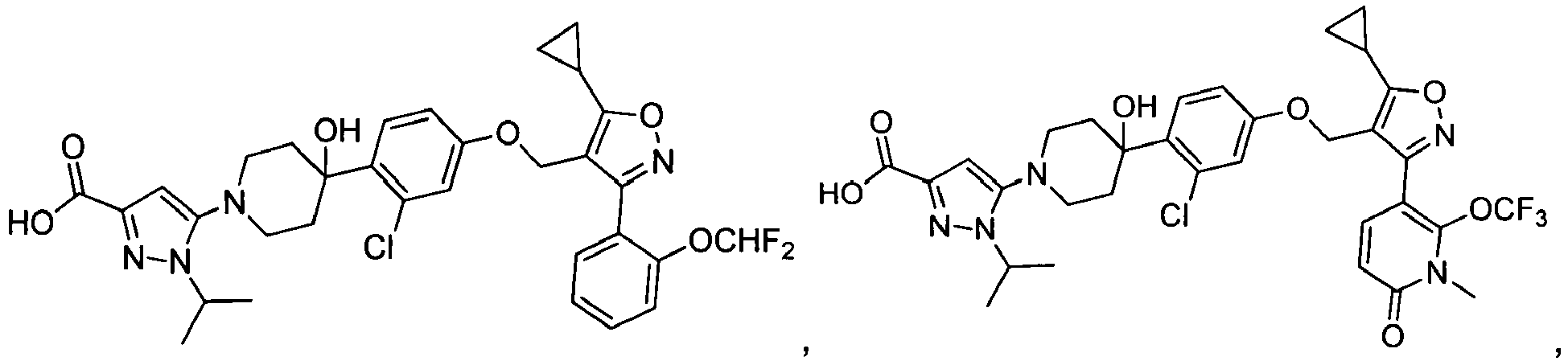


- Determination of a ligand mediated cofactor peptide interaction to quantify ligand binding to the nuclear receptor FXR was performed as follows: Preparation of human FXR alpha ligand binding domain: The human FXRalpha LBD was expressed in E. coli strain BL21 (DE3) as an N-terminally GST tagged fusion protein. The DNA encoding the FXR ligand binding domain was cloned into vector pDEST15 (Invitrogen). Expression was under control of an IPTG inducible T7 promoter. The amino acid boundaries of the ligand binding domain were amino acids 187-472 of Database entry NM_005123 (RefSeq). Expression and purification of the FXR-LBD: An overnight preculture of a transformed E.coli strain was diluted 1:20 in LB-Ampicillin medium and grown at 30°C to an optical density of OD600=0.4-0.6. Gene expression was then induced by addition of 0.5 mM IPTG. Cells were incubated an additional 6 h at 30°C, 180 rpm. Cells were collected by centrifugation (7000 x g, 7 min, rt). Per liter of original cell culture, cells were resuspended in 10 mL lysis buffer (50 mM Glucose, 50 mM Tris pH 7.9, 1 mM EDTA and 4 mg/mL lysozyme) and left on ice for 30 min. Cells were then subjected to sonication and cell debris removed via centrifugation (22000 x g, 30 min, 4°C). Per 10 mL of supernatant 0.5 mL prewashed Glutathione 4B sepharose slurry (Qiagen) was added and the suspension kept slowly rotating for 1 h at 4°C. Glutathione 4B sepharose beads were pelleted by centrifugation (2000 x g, 15 sec, 4°C) and washed twice in wash buffer (25 mM Tris, 50 mM KCI, 4 mM MgCl2 and 1M NaCl). The pellet was resuspended in 3 mL elution buffer per liter of original culture (elution buffer: 20 mM Tris, 60 mM KCI, 5 mM MgCl2 and 80 mM glutathione added immediately prior to use as powder). The suspension was left rotating for 15 min at 4°C, the beads pelleted and eluted again with half the volume of elution buffer than the first time. The eluates were pooled and dialysed overnight in 20 mM Hepes buffer (pH 7.5) containing 60 mM KCI, 5 mM MgCl2 as well as 1 mM dithiothreitol and 10% (v/v) glycerol. The protein was analysed by SDS-Page.
- The method measures the ability of putative ligands to modulate the interaction between the purified bacterial expressed FXR ligand binding domain (LBD) and a synthetic biotinylated peptide based on residues 676-700 of SRC-1 (LCD2, 676-700). The sequence of the peptide used was B-CPSSHSSLTERHKILHRLLQEGSPS-COOH where the N-terminus was biotinylated (B). The ligand binding domain (LBD) of FXR was expressed as fusion protein with GST in BL-21 cells using the vector pDEST15. Cells were lysed by sonication, and the fusion proteins purified over glutathione sepharose (Pharmacia) according to the manufacturers instructions. For screening of compounds for their influence on the FXR-peptide interaction, the Perkin Elmer LANCE technology was applied. This method relies on the binding dependent energy transfer from a donor to an acceptor fluorophor attached to the binding partner of interest. For ease of handling and reduction of background from compound fluorescence LANCE technology makes use of generic fluorophore labels and time resolved detection Assays were done in a final volume of 25 µL in a 384 well plate, in a Tris-based buffer (20 mM Tris-HCl pH 7.5; 60 mM KCI, 5 mM MgCl2; 35 ng/µL BSA), containing 20-60 ng/well recombinantly expressed FXR-LBD fused to GST, 200-600 nM N-terminally biotinylated peptide, representing SRC1 aminoacids 676-700, 200 ng/well Streptavidin-xIAPC conjugate(Prozyme) and 6-10 ng/well Eu W 1024 - antiGST (Perkin Elmer). DMSO content of the samples was kept at 1%. After generation of the assay mix and diluting the potentially FXR modulating ligands, the assay was equilibrated for 1 h in the dark at rt in FIA-plates black 384 well (Greiner). The LANCE signal was detected by a Perkin Elmer VICTOR2VTM Multilabel Counter. The results were visualized by plotting the ratio between the emitted light at 665 and 615 nm. A basal level of FXR-peptide formation is observed in the absence of added ligand. Ligands that promote the complex formation induce a concentration-dependent increase in time-resolved fluorescent signal. Compounds which bind equally well to both monomeric FXR and to the FXR-peptide complex would be expected to give no change in signal, whereas ligands which bind preferentially to the monomeric receptor would be expected to induce a concentration-dependent decrease in the observed signal. The compound of Example 1 shows an agonistic potential of EC50 <25 nM.
- Determination of a ligand mediated Gal4 promoter driven transactivation to quantify ligand binding mediated activation of FXR was performed as follows: The cDNA part encoding the FXR ligand binding domain was cloned into vector pCMV-BD (Stratagene) as a fusion to the yeast GAL4 DNA binding domain under the control of the CMV promoter. The amino acid boundaries of the ligand binding domain were amino acids 187-472 of Database entry NM_005123 (RefSeq). The plasmid pFR-Luc (Stratagene) was used as the reporter plasmid, containing a synthetic promoter with five tandem repeats of the yeast GAL4 binding sites, driving the expression of the Photinus pyralis (American firefly) luciferase gene as the reporter gene. In order to improve experimental accuracy the plasmid pRL-CMV (Promega) was cotransfected. pRL-CMV contains the constitutive CMV promoter, controlling the expression of the Renilla reniformis luciferase. All Gal4 reporter gene assays were done in HEK293 cells (obtained from DSMZ, Braunschweig, Germany) grown in MEM with L-Glutamine and Earle's BSS supplemented with 10% fetal bovine serum, 0.1 mM nonessential amino acids, 1 mM sodium pyruvate, and 100 units Penicilin/Streptavidin per mL at 37°C in 5% CO2. Medium and supplements were obtained from Invitrogen. For the assay, 5 x 10⁵ cells were plated per well in 96well plates in 100 µL per well MEM without Phenol Red and L-Glutamine and with Earle's BSS supplemented with 10% charcoal/dextran treated FBS (HyClone, South Logan, Utah), 0.1 mM nonessential amino acids, 2 mM glutamine, 1 mM sodium pyruvate, and 100 units Penicilin/ Streptavidin per mL, incubated at 37 °C in 5% CO2. The following day the cells were >90% confluence. Medium was removed and cells were transiently transfected using 20 µL per well of a OptiMEM - polyethylene-imine-based transfection-reagent (OptiMEM, Invitrogen; Polyethyleneimine, Aldrich Cat No. 40,827-7) including the three plasmids described above. MEM with the same composition as used for plating cells was added 2-4 h after addition of transfection mixture. Then compound stocks, prediluted in MEM were added (final vehicle concentration not exceeding 0.1%). Cells were incubated for additional 16 h before firefly and renilla luciferase activities were measured sequentially in the same cell extract using a Dual-Light-Luciferase-Assay system (Dyer et al., Anal. Biochem. 2000, 282, 158-161). All experiments were done in triplicates.
Claims (13)
- A compound according to the following Formula (1), an enantiomer, diastereomer, tautomer, solvate, prodrug or pharmaceutical acceptable salt thereof
 R is selected from the group consisting of hydrogen, halogen, C1-6-alkyl, C2-6-alkenyl, C2-6-alkynyl, halo-C1-6-alkyl, C0-6-alkylene-O-R7, C0-6-alkylene-CN, C0-6-alkylene-NR7R8, O-C3-10-cycloalkyl, O-C1-6-alkylene-O-R7, O-C3-10-heterocycloalkyl, C0-6-alkylene-CO2R7, C0-6-alkylene-C(O)R7, C0-6-alkylene-C(O)NR7R8, C0-6-alkylene-C(O)NR7SO2R7, C0-6-alkylene-N(R7)C(O)R7, C0-6-alkylene-SOx-R7, C0-6-alkylene-SO3H, C0-6-alkylene-SO2-NR7R8, C0-6-alkylene-SO2-NR8COR7, C0-6-alkylene-N(R7)SO2-R8, and C0-6-alkylene-SO2C3-10-heterocycloalkyl,
wherein alkylene, cycloalkyl, heterocycloalkyl and the 5- or 6-membered heteroaryl are unsubstituted or substituted by 1 to 4 substituents independently selected from the group consisting of halogen, CN, C1-3-alkyl, halo-C1-3-alkyl, OH, oxo, CO2H, SO3H, O-C1-3-alkyl and O-halo-C1-3-alkyl;R7 is independently selected from the group consisting of hydrogen, C1-6-alkyl, halo-C1-6-alkyl, C0-6-alkylene-C3-8-cycloalkyl, C0-6-alkylene-C3-8-heterocycloalkyl, 5- or 6-membered heteroaryl and phenyl, wherein alkyl, alkylene, cyclolalkyl, heterocycloalkyl, phenyl and heteroaryl are unsubstituted or substituted with 1 to 6 substituents independently selected from the group consisting of halogen, CN, OH, oxo, CO2H, C1-3-alkyl, halo-C1-3-alkyl, O-C1-3-alkyl, O-halo-C1-3-alkyl, SO3H and SO2-C1-3-alkyl;R8 is independently selected from the group consisting of hydrogen, C1-6-alkyl, halo-C1-6-alkyl and C3-6-cycloalkyl;or R7 and R8 when taken together with the nitrogen to which they are attached may complete a 3- to 8-membered ring containing carbon atoms and optionally containing 1 or 2 heteroatoms selected from O, S or N, wherein the ring is unsubstituted or substituted with 1 to 4 substituents independently selected from the group consisting of fluoro, OH, oxo, C1-4-alkyl and halo-C1-4-alkyl;A is a 6-10 membered mono- or bicyclic aryl or a 5-10 membered mono- or bicyclic heteroaryl containing 1 to 5 heteroatoms independently selected from the group consisting of N, O and S, wherein aryl and heteroaryl are unsubstituted or substituted with one or two groups independently selected from the group consisting of OH, halogen, CN, O-C1-6-alkyl, O-halo-C1-6-alkyl, C1-6-alkyl, halo-C1-6-alkyl, C3-6-cycloalkyl and halo-C3-6-cycloalkyl;B is a C5-8-cycloalkyl ring or, if Y is N, then is B a C5-8-heterocycloalkyl containing one nitrogen atom, and wherein the substituent Q is not directly adjacent to substituent A;Q is selected from the group consisting of phenyl, pyridyl, thiazolyl, thiophenyl, pyrimidyl, oxazolyl, pyrazolyl, imidazolyl and triazolyl, each unsubstituted or substituted with one or two groups independently selected from the group consisting of halogen, C1-4-alkyl, halo-C1-4-alkyl, C1-4-alkoxyor halo-C1-4-alkoxy;Y is selected from N, CH or CF;Z is selected from L is selected from the group consisting of a bond, C1-3-alkylene and C1-3-alkylene-O-;Y is selected from phenyl, pyridyl, pyridyl-N-oxide, pyrimidyl, pyridinonyl, pyrimidinonyl, C4-8-cycloalkyl, and C4-8-heterocycloalkyl, wherein phenyl, pyridyl, pyridyl-N-oxide, pyrimidyl, pyridinonyl, pyrimidinonyl, C4-8-cycloalkyl and C4-8-heterocycloalkyl are substituted with R2 and R3 and optionally substituted one or two times with a group selected from fluoro, chloro, CN, NH2, NH(C1-3-alkyl), N(C1-3-alkyl)2, C1-3-alkyl, fluoro-C1-3-alkyl, OH, C1-3-alkoxy, fluoro-C1-3-alkoxy, C3-6-cycloalkyl and fluoro-C3-6-cycloalkyl;R1 is selected from the group consisting of C1-4-alkyl and C3-6-cycloalkyl, wherein C1-4-alkyl is unsubstituted or substituted with 1 to 3 substituents independently selected from the group consisting of fluoro, hydroxy, C1-3-alkoxy and fluoro-C1-3-alkoxy, and C3-6-cycloalkyl is unsubstituted or substituted with 1 to 3 substituents independently selected from the group consisting of fluoro, hydroxy, C1-3-alkyl, fluoro-C1-3-alkyl, C1-3-alkoxy and fluoro-C1-3-alkoxy;R2 and R3 are independently selected from the group consisting of hydrogen, halogen, C1-3-alkyl, halo-C1-3-alkyl, C1-3-alkoxy, halo-C1-3-alkoxy, cyclopropyl and fluoro-cyclopropyl;R4 is independently selected from halogen, C1-3-alkyl, halo-C1-3-alkyl, C1-3-alkoxy, halo-C1-3-alkoxy, C3-6-cycloalkyl, and fluoro-C3-6-cycloalkyl;R5 is selected from the group consisting of hydrogen, fluoro, CH3, CHF2 and CF3;n is selected from 0, 1, 2, 3 and 4; andx is selected from 0, 1 and 2.
 - The compound according to claim 1 whereinR is selected from the group consisting of CO2H, SO3H, CONR7R8, tetrazolyl, 1,2,4-oxadiazol-5(4H)-one-3-yl and SO2NHCOR7;R7 selected from the group consisting of hydrogen, C1-6-alkyl, halo-C1-6-alkyl, C1-6-alkylene-R9, SO2-C1-3-alkyl;R8 selected from the group consisting of hydrogen, C1-6-alkyl, halo-C1-6-alkyl; andR9 is selected from the group consisting of COOH, OH and SO3H.
- The compound according to claim 1 or 2 wherein
A is selected from the group consisting of phenyl, pyridyl, pyrimidyl, pyrazolyl, indolyl, thienyl, benzothienyl, indazolyl, benzisoxazolyl, benzofuranyl, benzotriazolyl, furanyl, benzothiazolyl, thiazolyl, oxadiazolyl, oxazolyl, naphthyl, quinolyl, isoquinolyl, benzimidazolyl, each unsubstituted or substituted with one or two groups independently selected from the group consisting of OH, halogen, CN, O-C1-6-alkyl, O-halo-C1-6-alkyl, C1-6-alkyl, halo-C1-6-alkyl, C3-6-cycloalkyl and halo-C3-6-cycloalkyl. - The compound according to any of claims 1 to 3 wherein R-A is selected from

- The compound according to any of claims 1 to 4 wherein Z is selected from
 L is selected from the group consisting of a bond, C1-3-alkylene and C1-3-alkylene-O-;X is selected from the group consisting of CH, CF, N and NO;R1 is selected from the group consisting of C1-4-alkyl and C3-6-cycloalkyl, wherein C1-4-alkyl is unsubstituted or substituted with 1 to 3 substituents independently selected from the group consisting of fluoro, hydroxy, C1-3-alkoxy and fluoro-C1-3-alkoxy, and C3-6-cycloalkyl is unsubstituted or substituted with 1 to 3 substituents independently selected from the group consisting of fluoro, hydroxy, C1-3-alkyl, fluoro-C1-3-alkyl, C1-3-alkoxy and fluoro-C1-3-alkoxy;R2 and R3 are independently selected from the group consisting of hydrogen, halogen, C1-3-alkyl, halo-C1-3-alkyl, C1-3-alkoxy, halo-C1-3-alkoxy, cyclopropyl and fluoro-cyclopropyl; andR5 is selected from the group consisting of hydrogen, fluoro, CH3, CHF2 and CF3.
 - The compound according to any of claims 1 to 5 wherein Z is selected from
 X is selected from the group consisting of CH, CF, N and NO;R1 is selected from the group consisting of CF3, CHF2, isopropyl and cyclopropyl, wherein isopropyl and cyclopropyl are unsubstituted or substituted with one or two fluoro or one hydroxy;R2 is selected from the group consisting of fluoro, chloro, CH3, CHF2, CF3, OCHF2 and OCF3;R3 is selected from the group consisting of hydrogen, fluoro, chloro, CH3, CHF2, CF3, OCHF2 and OCF3; andR5 is selected from the group consisting of hydrogen, fluoro, CH3, CHF2 and CF3.
 - The compound according to any of claims 1 to 6 wherein


- The compound according to any of claims 1 to 7 with Formula (2)
 A is selected from the group consisting of phenyl, pyridyl, pyrimidyl, pyrazolyl, indolyl, thienyl, benzothienyl, indazolyl, benzisoxazolyl, benzofuranyl, benzotriazolyl, furanyl, benzothiazolyl, thiazolyl, oxadiazolyl, oxazolyl, naphthyl, quinolyl, isoquinolyl, benzimidazolyl, each unsubstituted or substituted with one or two groups independently selected from the group consisting of OH, halogen, CN, O-C1-6-alkyl, O-halo-C1-6-alkyl, C1-6-alkyl, halo-C1-6-alkyl, C3-6-cycloalkyl and halo-C3-6-cycloalkyl;R is selected from the group consisting of CO2H, SO3H, CONR7R8, tetrazolyl, 1,2,4-oxadiazol-5(4H)-one-3-yl and SO2NHCOR7, wherein
R7 selected from the group consisting of hydrogen, C1-6-alkyl, halo-C1-6-alkyl, C1-6-alkylene-R9, SO2-C1-6-alkyl;
R8 selected from the group consisting of hydrogen, C1-6-alkyl, halo-C1-6-alkyl; and
R9 is selected from the group consisting of COOH, OH and SO3H;Q is selected from the group consisting of phenyl, pyridyl, thiazolyl, thiophenyl and pyrimidyl, each unsubstituted or substituted with one or two groups independently selected from the group consisting of fluoro, chloro, CH3, CHF2 and CF3;Z is selected from X is selected from the group consisting of CH, N and NO;R1 is selected from the group consisting of isopropyl and cyclopropyl, wherein isopropyl and cyclopropyl are unsubstituted or substituted with one or two fluoro or one hydroxy;R2 is selected from the group consisting of fluoro, chloro, CH3, CHF2, CF3, OCHF2 and OCF3; andR3 is selected from the group consisting of hydrogen, fluoro, chloro, CH3, CHF2, CF3, OCHF2 and OCF3.
 - A compound according to any of claims 1 to 8 as a medicament.
- A compound according to any of claims 1 to 8 for use in the prophylaxis and/or treatment of diseases mediated by FXR.
- The compound for use according to claim 10 wherein the disease is selected from chronic intrahepatic or some forms of extrahepatic cholestatic conditions;
liver fibrosis;
obstructive or chronic inflammatory disorders of the liver;
liver cirrhosis;
liver steatosis and associated syndromes, cholestatic or fibrotic effects that are associated with alcohol-induced cirrhosis or with viral-borne forms of hepatitis;
liver failure or liver ischemia after major liver resection;
chemotherapy associated steatohepatitis (CASH);
acute liver failure; and
Inflammatory Bowel Diseases. - The compound for use according to claim 10 wherein the disease is selected from lipid and lipoprotein disorders;
Type II Diabetes and clinical complications of Type I and Type II Diabetes, including diabetic nephropathy, diabetic neuropathy, diabetic retinopathy and other observed effects of clinically manifest long term Diabetes;
conditions and diseases which result from chronic fatty and fibrotic degeneration of organs due to enforced lipid and
specifically triglyceride accumulation and subsequent activation of profibrotic pathways, such as Non-Alcoholic Fatty Liver Disease (NAFLD), or Non-Alcoholic Steatohepatitis (NASH);
obesity or metabolic syndrome (combined conditions of dyslipidemia, diabetes or abnormally high body-mass index); and
acute myocardial infarction, acute stroke or thrombosis which occurs as an endpoint of chronic obstructive atherosclerosis. - The compound for use according to claim 10 wherein the disease is selected from
non-malignant hyperproliferative disorders and malignant hyperproliferative disorders, specifically of hepatocellular carcinoma, colon adenoma and polyposis, colon adenocarcinoma, breast cancer, pancreas adenocarcinoma, Barrett's esophagus or other forms of neoplastic diseases of the gastrointestinal tract and the liver.
Priority Applications (25)
| Application Number | Priority Date | Filing Date | Title |
|---|---|---|---|
| EP14004260.7A EP3034499A1 (en) | 2014-12-17 | 2014-12-17 | Novel FXR (NR1H4) modulating compounds |
| CA2971241A CA2971241C (en) | 2014-12-17 | 2015-12-14 | Novel fxr (nr1h4) modulating compounds |
| KR1020177019298A KR101955840B1 (en) | 2014-12-17 | 2015-12-14 | Novel fxr (nr1h4) modulating compounds |
| PL15816666T PL3233831T3 (en) | 2014-12-17 | 2015-12-14 | Novel fxr (nr1h4) modulating compounds |
| NZ732210A NZ732210A (en) | 2014-12-17 | 2015-12-14 | Novel fxr (nr1h4) modulating compounds |
| HK18105262.0A HK1245786B (en) | 2014-12-17 | 2015-12-14 | Novel fxr (nr1h4) modulating compounds |
| TR2019/06401T TR201906401T4 (en) | 2014-12-17 | 2015-12-14 | New fxr (nr1h4) modulating compounds. |
| PT15816666T PT3233831T (en) | 2014-12-17 | 2015-12-14 | Novel fxr (nr1h4) modulating compounds |
| CN201580069222.1A CN107108595B (en) | 2014-12-17 | 2015-12-14 | Novel FXR (NR1H4) modulating compounds |
| SG11201704539TA SG11201704539TA (en) | 2014-12-17 | 2015-12-14 | Novel fxr (nr1h4) modulating compounds |
| MX2017007522A MX2017007522A (en) | 2014-12-17 | 2015-12-14 | Novel fxr (nr1h4) modulating compounds. |
| SI201530645T SI3233831T1 (en) | 2014-12-17 | 2015-12-14 | Novel fxr (nr1h4) modulating compounds |
| EA201791002A EA033642B1 (en) | 2014-12-17 | 2015-12-14 | Fxr (nr1h4) modulating compounds |
| EP15816666.0A EP3233831B1 (en) | 2014-12-17 | 2015-12-14 | Novel fxr (nr1h4) modulating compounds |
| JP2017530026A JP6452821B2 (en) | 2014-12-17 | 2015-12-14 | Novel FXR (NR1H4) modulating compound |
| PCT/EP2015/002512 WO2016096116A1 (en) | 2014-12-17 | 2015-12-14 | Novel fxr (nr1h4) modulating compounds |
| AU2015365945A AU2015365945B2 (en) | 2014-12-17 | 2015-12-14 | Novel FXR (NR1H4) modulating compounds |
| ES15816666T ES2719902T3 (en) | 2014-12-17 | 2015-12-14 | Innovative FXR modulating compounds (NR1H4) |
| US14/971,825 US9938278B2 (en) | 2014-12-17 | 2015-12-16 | FXR (NR1H4) modulating compounds |
| TW104142342A TWI598345B (en) | 2014-12-17 | 2015-12-16 | Novel fxr (nr1h4) modulating compounds |
| BR102015031497A BR102015031497A2 (en) | 2014-12-17 | 2015-12-16 | fxr modulating compounds (nr1h4) |
| ARP150104131A AR103064A1 (en) | 2014-12-17 | 2015-12-17 | FXR MODULATING COMPOUNDS (NR1H4) |
| UY0001036452A UY36452A (en) | 2014-12-17 | 2015-12-17 | NEW MODULATING FXR COMPOUNDS (NR1H4) |
| IL252496A IL252496A0 (en) | 2014-12-17 | 2017-05-24 | Novel fxr (nr1h4) modulating compounds |
| JP2018130741A JP2018162309A (en) | 2014-12-17 | 2018-07-10 | Novel fxr (nr1h4) modulating compounds |
Applications Claiming Priority (1)
| Application Number | Priority Date | Filing Date | Title |
|---|---|---|---|
| EP14004260.7A EP3034499A1 (en) | 2014-12-17 | 2014-12-17 | Novel FXR (NR1H4) modulating compounds |
Publications (1)
| Publication Number | Publication Date |
|---|---|
| EP3034499A1 true EP3034499A1 (en) | 2016-06-22 |
Family
ID=52338777
Family Applications (2)
| Application Number | Title | Priority Date | Filing Date |
|---|---|---|---|
| EP14004260.7A Withdrawn EP3034499A1 (en) | 2014-12-17 | 2014-12-17 | Novel FXR (NR1H4) modulating compounds |
| EP15816666.0A Active EP3233831B1 (en) | 2014-12-17 | 2015-12-14 | Novel fxr (nr1h4) modulating compounds |
Family Applications After (1)
| Application Number | Title | Priority Date | Filing Date |
|---|---|---|---|
| EP15816666.0A Active EP3233831B1 (en) | 2014-12-17 | 2015-12-14 | Novel fxr (nr1h4) modulating compounds |
Country Status (23)
| Country | Link |
|---|---|
| US (1) | US9938278B2 (en) |
| EP (2) | EP3034499A1 (en) |
| JP (2) | JP6452821B2 (en) |
| KR (1) | KR101955840B1 (en) |
| CN (1) | CN107108595B (en) |
| AR (1) | AR103064A1 (en) |
| AU (1) | AU2015365945B2 (en) |
| BR (1) | BR102015031497A2 (en) |
| CA (1) | CA2971241C (en) |
| EA (1) | EA033642B1 (en) |
| ES (1) | ES2719902T3 (en) |
| HK (1) | HK1245786B (en) |
| IL (1) | IL252496A0 (en) |
| MX (1) | MX2017007522A (en) |
| NZ (1) | NZ732210A (en) |
| PL (1) | PL3233831T3 (en) |
| PT (1) | PT3233831T (en) |
| SG (1) | SG11201704539TA (en) |
| SI (1) | SI3233831T1 (en) |
| TR (1) | TR201906401T4 (en) |
| TW (1) | TWI598345B (en) |
| UY (1) | UY36452A (en) |
| WO (1) | WO2016096116A1 (en) |
Cited By (10)
| Publication number | Priority date | Publication date | Assignee | Title |
|---|---|---|---|---|
| CN106995416A (en) * | 2016-01-26 | 2017-08-01 | 上海翰森生物医药科技有限公司 | FXR activators and its preparation method and application |
| WO2017128896A1 (en) * | 2016-01-26 | 2017-08-03 | 江苏豪森药业集团有限公司 | Fxr agonist and preparation method and use thereof |
| WO2019089670A1 (en) * | 2017-11-01 | 2019-05-09 | Bristol-Myers Squibb Company | Alkene compounds as farnesoid x receptor modulators |
| WO2019089665A1 (en) * | 2017-11-01 | 2019-05-09 | Bristol-Myers Squibb Company | Alkene spirocyclic compounds as farnesoid x receptor modulators |
| EP3730491A4 (en) * | 2017-12-22 | 2021-06-09 | Sichuan Kelun-Biotech Biopharmaceutical Co., Ltd. | ISOXAZOLE DERIVATIVE, PROCESS OF PREPARATION AND USE |
| US11254663B2 (en) | 2019-02-15 | 2022-02-22 | Bristol-Myers Squibb Company | Substituted bicyclic compounds as farnesoid X receptor modulators |
| US11370785B2 (en) | 2017-11-01 | 2022-06-28 | Bristol-Myers Squibb Company | Multicyclic compounds as farnesoid X receptor modulators |
| US12030835B2 (en) | 2019-02-15 | 2024-07-09 | Bristol-Myers Squibb Company | Substituted amide compounds useful as farnesoid X receptor modulators |
| US12227496B2 (en) | 2019-02-15 | 2025-02-18 | Bristol-Myers Squibb Company | Substituted bicyclic compounds as farnesoid X receptor modulators |
| US12319676B2 (en) | 2019-02-15 | 2025-06-03 | Bristol-Myers Squibb Company | Substituted amide compounds useful as farnesoid X receptor modulators |
Families Citing this family (54)
| Publication number | Priority date | Publication date | Assignee | Title |
|---|---|---|---|---|
| TWI491606B (en) | 2009-07-13 | 2015-07-11 | Gilead Sciences Inc | Inhibitor of kinases that regulate apoptosis signaling |
| EP2545964A1 (en) | 2011-07-13 | 2013-01-16 | Phenex Pharmaceuticals AG | Novel FXR (NR1H4) binding and activity modulating compounds |
| US10208081B2 (en) | 2014-11-26 | 2019-02-19 | Enanta Pharmaceuticals, Inc. | Bile acid derivatives as FXR/TGR5 agonists and methods of use thereof |
| EP3034499A1 (en) * | 2014-12-17 | 2016-06-22 | Gilead Sciences, Inc. | Novel FXR (NR1H4) modulating compounds |
| IL296496B2 (en) | 2014-12-26 | 2024-10-01 | Univ Emory | N4-hydroxycytidine, history and related antiviral uses |
| TWI698430B (en) | 2015-02-13 | 2020-07-11 | 南北兄弟藥業投資有限公司 | Tricyclic compounds and uses thereof in medicine |
| WO2016161003A1 (en) | 2015-03-31 | 2016-10-06 | Enanta Phamraceuticals, Inc. | Bile acid derivatives as fxr/tgr5 agonists and methods of use thereof |
| WO2017189652A1 (en) | 2016-04-26 | 2017-11-02 | Enanta Pharmaceuticals, Inc. | Isoxazole derivatives as fxr agonists and methods of use thereof |
| US10080742B2 (en) | 2016-04-26 | 2018-09-25 | Enanta Pharmaceuticals, Inc. | Isoxazole derivatives as FXR agonists and methods of use thereof |
| WO2017189663A1 (en) | 2016-04-26 | 2017-11-02 | Enanta Pharmaceuticals, Inc. | Isoxazole derivatives as fxr agonists and methods of use thereof |
| WO2017201152A1 (en) | 2016-05-18 | 2017-11-23 | Enanta Pharmaceuticals, Inc. | Isoxazole derivatives as fxr agonists and methods of use thereof |
| US10144729B2 (en) | 2016-05-18 | 2018-12-04 | Enanta Pharmaceuticals, Inc. | Isoxazole analogs as FXR agonists and methods of use thereof |
| WO2017201155A1 (en) | 2016-05-18 | 2017-11-23 | Enanta Pharmaceuticals, Inc. | lSOXAZOLE DERIVATIVES AS FXR AGONISTS AND METHODS OF USE THEREOF |
| CA3252823A1 (en) | 2016-06-13 | 2025-02-25 | Gilead Sciences, Inc. | Substituted tert-butyl-3-(2-chloro-phenyl)-3-hydroxyazetidine-1-carboxylate compounds |
| BR112018075734A2 (en) | 2016-06-13 | 2019-04-02 | Gilead Sciences, Inc. | compound, pharmaceutical composition, method of treating a patient with a disease or condition mediated at least in part by fxr, and use of a compound. |
| TW201808283A (en) | 2016-08-05 | 2018-03-16 | 廣東東陽光藥業有限公司 | Nitrogen-containing tricyclic compounds and uses thereof in medicine |
| WO2018067704A1 (en) | 2016-10-04 | 2018-04-12 | Enanta Pharmaceuticals, Inc. | Isoxazole analogs as fxr agonists and methods of use thereof |
| CN107973790A (en) * | 2016-10-22 | 2018-05-01 | 合帕吉恩治疗公司 | Heterocyclic FXR conditioning agent |
| US10597391B2 (en) | 2016-10-26 | 2020-03-24 | Enanta Pharmaceuticals, Inc. | Urea-containing isoxazole derivatives as FXR agonists and methods of use thereof |
| CN106588804B (en) * | 2016-12-09 | 2018-11-09 | 都创(上海)医药科技有限公司 | A kind of preparation method of compound as Farnesoid X receptor (FXR) |
| WO2018133730A1 (en) * | 2017-01-20 | 2018-07-26 | 四川科伦博泰生物医药股份有限公司 | Heterocyclic compound, preparation method and use therefor |
| CN110461328A (en) | 2017-03-28 | 2019-11-15 | 吉利德科学公司 | Combinations of treatments for liver disease |
| JP6886074B2 (en) | 2017-04-12 | 2021-06-16 | イルドン ファーマシューティカル カンパニー リミテッド | Isoxazole derivatives that are nuclear receptor efficacy agents and their uses |
| WO2018215070A1 (en) * | 2017-05-24 | 2018-11-29 | Johann Wolfgang Goethe-Universität Frankfurt am Main | Dual modulators of farnesoid x receptor and soluble epoxide hydrolase |
| WO2019089667A1 (en) | 2017-11-01 | 2019-05-09 | Bristol-Myers Squibb Company | Bridged bicyclic compounds as farnesoid x receptor modulators |
| CA3081424A1 (en) | 2017-11-01 | 2019-05-09 | Bristol-Myers Squibb Company | Spirocyclic compounds as farnesoid x receptor modulators |
| KR102626210B1 (en) | 2017-12-07 | 2024-01-18 | 에모리 유니버시티 | N4-hydroxycytidine and derivatives and anti-viral uses related thereto |
| US10689391B2 (en) | 2017-12-12 | 2020-06-23 | Enanta Pharmaceuticals, Inc. | Isoxazole analogs as FXR agonists and methods of use thereof |
| CN108129348B (en) * | 2018-01-12 | 2019-11-01 | 南开大学 | Nitrine trifluoromethoxy compound and its synthetic method |
| CN110128432B (en) | 2018-02-02 | 2021-03-02 | 广东东阳光药业有限公司 | Nitrogen-containing tricyclic compounds and their application in medicine |
| US10829486B2 (en) | 2018-02-14 | 2020-11-10 | Enanta Pharmacueticals, Inc. | Isoxazole derivatives as FXR agonists and methods of use thereof |
| WO2020029908A1 (en) * | 2018-08-08 | 2020-02-13 | 广州市恒诺康医药科技有限公司 | Spiro bridged ring compound, pharmaceutical composition thereof and use thereof |
| US11339153B2 (en) * | 2018-08-08 | 2022-05-24 | Inorbit Therapeutics Ab | Compounds useful in modulating the farnesoid X receptor and methods of making and using the same |
| US11153541B2 (en) | 2018-08-31 | 2021-10-19 | Sony Corporation | Illuminator and display apparatus |
| EP3886854A4 (en) | 2018-11-30 | 2022-07-06 | Nuvation Bio Inc. | PYRROLE AND PYRAZOLE COMPOUNDS AND METHODS OF USE THEREOF |
| EP4360632B1 (en) | 2019-01-15 | 2025-10-29 | Gilead Sciences, Inc. | Fxr (nr1h4) modulating compounds |
| US11524005B2 (en) | 2019-02-19 | 2022-12-13 | Gilead Sciences, Inc. | Solid forms of FXR agonists |
| CN110144349A (en) * | 2019-04-21 | 2019-08-20 | 吉林省农业科学院 | A soybean leaf-specific promoter GmNR1 (Glyma14g33480) and its isolation method and application |
| WO2020231917A1 (en) | 2019-05-13 | 2020-11-19 | Enanta Pharmaceuticals, Inc. | Isoxazole derivatives as fxr agonists and methods of use thereof |
| AU2020312735A1 (en) | 2019-07-18 | 2021-12-16 | Enyo Pharma | Method for decreasing adverse-effects of interferon |
| EP4003349A1 (en) | 2019-07-23 | 2022-06-01 | Novartis AG | Combination treatment of liver diseases using fxr agonists |
| CN114080234A (en) | 2019-07-23 | 2022-02-22 | 诺华股份有限公司 | Treatment comprising FXR agonists |
| CA3153062A1 (en) | 2019-09-03 | 2021-03-11 | Novartis Ag | Treatment of liver disease or disorder comprising actrii receptor antagonists |
| WO2021053618A1 (en) | 2019-09-19 | 2021-03-25 | Novartis Ag | Treatment comprising fxr agonists |
| EP4041233A1 (en) | 2019-09-30 | 2022-08-17 | Novartis AG | Treatment comprising the use of fxr agonists |
| TW202135811A (en) | 2019-12-20 | 2021-10-01 | 瑞士商諾華公司 | Combination treatment of liver diseases using integrin inhibitors |
| US20230060715A1 (en) | 2020-01-15 | 2023-03-02 | INSERM (Institut National de la Santé et de la Recherche Médicale) | Use of fxr agonists for treating an infection by hepatitis d virus |
| US11478533B2 (en) | 2020-04-27 | 2022-10-25 | Novo Nordisk A/S | Semaglutide for use in medicine |
| WO2022101853A1 (en) | 2020-11-16 | 2022-05-19 | Novartis Ag | Method of determining liver fibrosis |
| US20240100125A1 (en) | 2021-01-14 | 2024-03-28 | Enyo Pharma | Synergistic effect of a fxr agonist and ifn for the treatment of hbv infection |
| CN117320722A (en) | 2021-04-28 | 2023-12-29 | 埃尼奥制药公司 | Use of FXR agonists as combination therapy strongly potentiates the effects of TLR3 agonists |
| CA3228655A1 (en) * | 2021-08-12 | 2023-02-16 | Shanghai SIMR Biotechnology Co., Ltd | Substituted triazole derivative, preparation method therefor, pharmaceutical composition thereof, and use thereof |
| CN113876789B (en) * | 2021-10-28 | 2022-05-20 | 兰州大学第一医院 | Application of Licraside in preparation of medicine for treating cholestasis |
| CN117430574B (en) * | 2023-12-20 | 2024-03-22 | 潍坊医学院 | Benzofuran derivative and preparation method and application thereof |
Citations (21)
| Publication number | Priority date | Publication date | Assignee | Title |
|---|---|---|---|---|
| WO2000037077A1 (en) | 1998-12-23 | 2000-06-29 | Glaxo Group Limited | Assays for ligands for nuclear receptors |
| WO2003015771A1 (en) | 2001-08-13 | 2003-02-27 | Lion Bioscience Ag | Fxr nr1h4 nuclear receptor binding compounds |
| WO2003080803A2 (en) | 2002-03-21 | 2003-10-02 | Smithkline Beecham Corporation | Methods of using farnesoid x receptor (fxr) agonists |
| WO2004048349A1 (en) | 2002-11-22 | 2004-06-10 | Smithkline Beecham Corporation | Farnesoid x receptor agonists |
| WO2004087076A2 (en) | 2003-03-31 | 2004-10-14 | The Rockefeller University | Methods for inhibiting adipogenesis and for treating type 2 diabetes |
| WO2007076260A2 (en) | 2005-12-19 | 2007-07-05 | Smithkline Beecham Corporation | Farnesoid x receptor agonists |
| WO2007092751A2 (en) | 2006-02-03 | 2007-08-16 | Eli Lilly And Company | Compounds and methods for modulating fx-receptors |
| WO2007140183A1 (en) | 2006-05-24 | 2007-12-06 | Eli Lilly And Company | Fxr agonists |
| WO2007140174A2 (en) | 2006-05-24 | 2007-12-06 | Eli Lilly And Company | Compounds and methods for modulating fxr |
| WO2008025539A1 (en) | 2006-08-29 | 2008-03-06 | Phenex Pharmaceuticals Ag | Heterocyclic fxr binding compounds |
| WO2008025540A1 (en) | 2006-08-29 | 2008-03-06 | Phenex Pharmaceuticals Ag | Heterocyclic fxr binding compounds |
| WO2008051942A2 (en) | 2006-10-24 | 2008-05-02 | Smithkline Beecham Corporation | Farnesoid x receptor agonists |
| WO2008157270A1 (en) | 2007-06-13 | 2008-12-24 | Smithkline Beecham Corporation | Farnesoid x receptor agonists |
| WO2009005998A1 (en) | 2007-07-02 | 2009-01-08 | Smithkline Beecham Corporation | Farnesoid x receptor agonists |
| WO2009012125A1 (en) | 2007-07-16 | 2009-01-22 | Eli Lilly And Company | Compounds and methods for modulating fxr |
| WO2009081197A1 (en) * | 2007-12-21 | 2009-07-02 | Astrazeneca Ab | Bicyclic derivatives for use in the treatment of androgen receptor associated conditions |
| WO2011020615A1 (en) | 2009-08-19 | 2011-02-24 | Phenex Pharmaceuticals Ag | Novel fxr (nr1h4 ) binding and activity modulating compounds |
| WO2012087519A1 (en) | 2010-12-20 | 2012-06-28 | Irm Llc | Compositions and methods for modulating fxr |
| WO2012087520A1 (en) | 2010-12-20 | 2012-06-28 | Irm Llc | Compositions and methods for modulating farnesoid x receptors |
| WO2012087521A1 (en) | 2010-12-20 | 2012-06-28 | Irm Llc | Compositions and methods for modulating farnesoid x receptors |
| WO2013007387A1 (en) | 2011-07-13 | 2013-01-17 | Phenex Pharmaceuticals Ag | Novel fxr (nr1h4) binding and activity modulating compounds |
Family Cites Families (3)
| Publication number | Priority date | Publication date | Assignee | Title |
|---|---|---|---|---|
| WO2008073825A1 (en) * | 2006-12-08 | 2008-06-19 | Exelixis, Inc. | Lxr and fxr modulators |
| EP3034499A1 (en) * | 2014-12-17 | 2016-06-22 | Gilead Sciences, Inc. | Novel FXR (NR1H4) modulating compounds |
| MA41252A (en) * | 2014-12-23 | 2017-10-31 | Gilead Sciences Inc | SOLID FORMS OF AN ASK 1 INHIBITOR |
-
2014
- 2014-12-17 EP EP14004260.7A patent/EP3034499A1/en not_active Withdrawn
-
2015
- 2015-12-14 NZ NZ732210A patent/NZ732210A/en unknown
- 2015-12-14 CN CN201580069222.1A patent/CN107108595B/en active Active
- 2015-12-14 HK HK18105262.0A patent/HK1245786B/en unknown
- 2015-12-14 TR TR2019/06401T patent/TR201906401T4/en unknown
- 2015-12-14 AU AU2015365945A patent/AU2015365945B2/en active Active
- 2015-12-14 ES ES15816666T patent/ES2719902T3/en active Active
- 2015-12-14 SG SG11201704539TA patent/SG11201704539TA/en unknown
- 2015-12-14 WO PCT/EP2015/002512 patent/WO2016096116A1/en not_active Ceased
- 2015-12-14 KR KR1020177019298A patent/KR101955840B1/en active Active
- 2015-12-14 EA EA201791002A patent/EA033642B1/en not_active IP Right Cessation
- 2015-12-14 JP JP2017530026A patent/JP6452821B2/en active Active
- 2015-12-14 PL PL15816666T patent/PL3233831T3/en unknown
- 2015-12-14 SI SI201530645T patent/SI3233831T1/en unknown
- 2015-12-14 MX MX2017007522A patent/MX2017007522A/en unknown
- 2015-12-14 PT PT15816666T patent/PT3233831T/en unknown
- 2015-12-14 CA CA2971241A patent/CA2971241C/en active Active
- 2015-12-14 EP EP15816666.0A patent/EP3233831B1/en active Active
- 2015-12-16 US US14/971,825 patent/US9938278B2/en active Active
- 2015-12-16 BR BR102015031497A patent/BR102015031497A2/en not_active Application Discontinuation
- 2015-12-16 TW TW104142342A patent/TWI598345B/en active
- 2015-12-17 UY UY0001036452A patent/UY36452A/en not_active Application Discontinuation
- 2015-12-17 AR ARP150104131A patent/AR103064A1/en unknown
-
2017
- 2017-05-24 IL IL252496A patent/IL252496A0/en unknown
-
2018
- 2018-07-10 JP JP2018130741A patent/JP2018162309A/en not_active Withdrawn
Patent Citations (21)
| Publication number | Priority date | Publication date | Assignee | Title |
|---|---|---|---|---|
| WO2000037077A1 (en) | 1998-12-23 | 2000-06-29 | Glaxo Group Limited | Assays for ligands for nuclear receptors |
| WO2003015771A1 (en) | 2001-08-13 | 2003-02-27 | Lion Bioscience Ag | Fxr nr1h4 nuclear receptor binding compounds |
| WO2003080803A2 (en) | 2002-03-21 | 2003-10-02 | Smithkline Beecham Corporation | Methods of using farnesoid x receptor (fxr) agonists |
| WO2004048349A1 (en) | 2002-11-22 | 2004-06-10 | Smithkline Beecham Corporation | Farnesoid x receptor agonists |
| WO2004087076A2 (en) | 2003-03-31 | 2004-10-14 | The Rockefeller University | Methods for inhibiting adipogenesis and for treating type 2 diabetes |
| WO2007076260A2 (en) | 2005-12-19 | 2007-07-05 | Smithkline Beecham Corporation | Farnesoid x receptor agonists |
| WO2007092751A2 (en) | 2006-02-03 | 2007-08-16 | Eli Lilly And Company | Compounds and methods for modulating fx-receptors |
| WO2007140183A1 (en) | 2006-05-24 | 2007-12-06 | Eli Lilly And Company | Fxr agonists |
| WO2007140174A2 (en) | 2006-05-24 | 2007-12-06 | Eli Lilly And Company | Compounds and methods for modulating fxr |
| WO2008025539A1 (en) | 2006-08-29 | 2008-03-06 | Phenex Pharmaceuticals Ag | Heterocyclic fxr binding compounds |
| WO2008025540A1 (en) | 2006-08-29 | 2008-03-06 | Phenex Pharmaceuticals Ag | Heterocyclic fxr binding compounds |
| WO2008051942A2 (en) | 2006-10-24 | 2008-05-02 | Smithkline Beecham Corporation | Farnesoid x receptor agonists |
| WO2008157270A1 (en) | 2007-06-13 | 2008-12-24 | Smithkline Beecham Corporation | Farnesoid x receptor agonists |
| WO2009005998A1 (en) | 2007-07-02 | 2009-01-08 | Smithkline Beecham Corporation | Farnesoid x receptor agonists |
| WO2009012125A1 (en) | 2007-07-16 | 2009-01-22 | Eli Lilly And Company | Compounds and methods for modulating fxr |
| WO2009081197A1 (en) * | 2007-12-21 | 2009-07-02 | Astrazeneca Ab | Bicyclic derivatives for use in the treatment of androgen receptor associated conditions |
| WO2011020615A1 (en) | 2009-08-19 | 2011-02-24 | Phenex Pharmaceuticals Ag | Novel fxr (nr1h4 ) binding and activity modulating compounds |
| WO2012087519A1 (en) | 2010-12-20 | 2012-06-28 | Irm Llc | Compositions and methods for modulating fxr |
| WO2012087520A1 (en) | 2010-12-20 | 2012-06-28 | Irm Llc | Compositions and methods for modulating farnesoid x receptors |
| WO2012087521A1 (en) | 2010-12-20 | 2012-06-28 | Irm Llc | Compositions and methods for modulating farnesoid x receptors |
| WO2013007387A1 (en) | 2011-07-13 | 2013-01-17 | Phenex Pharmaceuticals Ag | Novel fxr (nr1h4) binding and activity modulating compounds |
Non-Patent Citations (72)
| Title |
|---|
| "March's Advanced Organic Chemistry: Reactions, Mechanisms, and Structure", JOHN WILEY & SONS |
| A. ARANDA; A. PASCUAL, PHYSIOL. REV., vol. 81, 2001, pages 1269 |
| A. FIGGE ET AL., J. BIOL. CHEM., vol. 279, 2004, pages 2790 |
| A. M. BRZOZOWSKI ET AL., NATURE, vol. 389, 1997, pages 753 |
| A. MOSCHETTA ET AL., NATURE MEDICINE, vol. 10, 2004, pages 1352 |
| B. CARIOU ET AL., J. BIOL. CHEM., vol. 281, 2006, pages 11039 |
| B. GOODWIN ET AL., MOL. CELL, vol. 6, 2000, pages 517 |
| B. M. FORMAN ET AL., CELL, vol. 81, 1995, pages 687 |
| C. GEGE ET AL., CURR. TOP. MED. CHEM., vol. 14, 2014, pages 2143 |
| C. LIHONG ET AL., AMERICAN DIABETES ASSOCIATION (ADA) 66TH ANNUAL SCIENTIFIC SESSIONS, June 2006 (2006-06-01) |
| D. DURAN-SANDOVAL ET AL., BIOCHIMIE, vol. 87, 2005, pages 93 |
| D. J. MANGELSDORF ET AL., CELL, vol. 83, 1995, pages 835 |
| D. J. PARKS ET AL., SCIENCE, vol. 284, 1999, pages 1365 |
| D. M. HEERY ET AL., NATURE, vol. 387, 1997, pages 733 |
| D. MERK ET AL., FUTURE MED. CHEM., vol. 4, 2012, pages 1015 |
| DYER ET AL., ANAL. BIOCHEM., vol. 282, 2000, pages 158 - 161 |
| E. A. HANNIMAN ET AL., J. LIPID RES., vol. 46, 2005, pages 2595 |
| E. TOMLINSON ET AL., ENDOCRINOLOGY, vol. 143, 2002, pages 1741 |
| F. CHEN ET AL., GASTROENTEROLOGY, vol. 126, 2004, pages 756 |
| F. HE ET AL., CIRC. RES., vol. 98, 2006, pages 192 |
| F. JOURNE ET AL., BREAST CANCER RES. TREAT., vol. 115, 2009, pages 523 |
| F. YANG ET AL., CANCER RES., vol. 67, 2007, pages 863 |
| FIESER ET AL.: "Fiesers' Reagents for organic Synthesis", 2000, JOHN WILEY & SONS |
| G. LAMBERT ET AL., J. BIOL. CHEM., vol. 278, 2003, pages 2563 |
| G. RIZZO ET AL., CURR. DRUG TARGETS IMMUNE ENDOCR. METABOL. DISORD., vol. 5, 2005, pages 289 |
| G. ZOLLNER ET AL., MOL. PHARM., vol. 3, 2006, pages 231 |
| H. R. KAST ET AL., J. BIOL. CHEM., vol. 277, 2002, pages 2908 |
| H. R. KAST ET AL., MOL. ENDOCRINOL., vol. 15, 2001, pages 1720 |
| H. WITTENBURG, GASTROENTEROLOGY, vol. 125, 2003, pages 868 |
| I. KIM ET AL., CARCINOGENESIS, vol. 28, 2007, pages 940 |
| J. A. HOLT ET AL., GENES DEV., vol. 17, 2003, pages 1581 |
| J. HOLT ET AL., GENES DEV., vol. 17, 2003, pages 1581 |
| J. R. PLASS ET AL., HEPATOLOGY, vol. 35, 2002, pages 589 |
| J. SINAI ET AL., CELL, vol. 102, 2000, pages 731 |
| K. E. SWALES ET AL., CANCER RES., vol. 66, 2006, pages 10120 |
| K. MA ET AL., J. CLIN. INVEST., vol. 116, 2006, pages 1102 |
| K. R. STAYROOK ET AL., ENDOCRINOLOGY, vol. 146, 2005, pages 984 |
| K. W. NETTLES; G. L. GREENE, ANNU. REV. PHYSIOL., vol. 67, 2005, pages 309 |
| L. ALVAREZ ET AL., HUM. MOL. GENET., vol. 13, 2004, pages 2451 |
| L. HUANG ET AL., J. BIOL. CHEM., vol. 278, 2003, pages 51085 |
| M. ANANTHANARAYANAN ET AL., J. BIOL. CHEM., vol. 276, 2001, pages 28857 |
| M. L. CRAWLEY, EXPERT OPIN THER. PAT., vol. 20, 2010, pages 1047 |
| M. MAKISHIMA ET AL., SCIENCE, vol. 284, 1999, pages 1362 |
| M. MIYATA, J. PHARMACOL. EXP. THER., vol. 312, 2005, pages 759 |
| M. SCHENA; K. R. YAMAMOTO, SCIENCE, vol. 241, 1988, pages 965 |
| M. WATANABE ET AL., J. CLIN. INVEST., vol. 113, 2004, pages 1408 |
| N. L. URIZAR ET AL., J. BIOL. CHEM., vol. 275, 2000, pages 39313 |
| N. L. URIZAR ET AL., SCIENCE, vol. 296, 2002, pages 1703 |
| P. MALONEY ET AL., J. MED. CHEM., vol. 43, 2000, pages 2971 |
| P. R. MALONEY ET AL., J. MED. CHEM., vol. 43, 2000, pages 2971 |
| R. M. EVANS, MOL. ENDOCRINOL., vol. 19, 2005, pages 1429 |
| R. PELLICCIARI ET AL., J. MED. CHEM., vol. 45, 2002, pages 3569 |
| R. R. MARAN ET AL., J. PHARMACOL. EXP. THER., vol. 328, 2009, pages 469 |
| S. A. DOGGRELL, CURR. OPIN. INVESTIG. DRUGS, vol. 7, 2006, pages 344 |
| S. BILZ ET AL., AM. J. PHYSIOL. ENDOCRINOL. METAB., vol. 290, 2006, pages E716 |
| S. FIORUCCI ET AL., GASTROENTEROLOGY, vol. 127, 2004, pages 1497 |
| S. FIORUCCI ET AL., J. PHARMACOL. EXP. THER., vol. 313, 2005, pages 604 |
| S. FIORUCCI ET AL., J. PHARMACOL. EXP. THER., vol. 314, 2005, pages 584 |
| S. MODICA ET AL., CANCER RES., vol. 68, 2008, pages 9589 |
| S. Y. CAI ET AL., EXPERT OPIN. THER. TARGETS, vol. 10, 2006, pages 409 |
| T. CLAUDEL ET AL., ARTERIOSCLER. THROMB. VASC. BIOL., vol. 25, 2005, pages 2020 |
| T. EICHER; S. HAUPTMANN: "The Chemistry of Heterocycles; Structures, Reactions, Synthesis and Application", 2003, WILEY-VCH |
| T. HEINZEL ET AL., NATURE, vol. 387, 1997, pages 43 |
| T. INAGAKI ET AL., CELL METAB., vol. 2, 2005, pages 217 |
| T. INAGAKI ET AL., PNAS, vol. 103, 2006, pages 3920 |
| T. M. WILLSON ET AL., MED. RES. REV., vol. 21, 2001, pages 513 |
| T. T. LU ET AL., MOL. CELL, vol. 6, 2000, pages 507 |
| T. WILLSON ET AL., MED. RES. REV., vol. 21, 2001, pages 513 |
| W. HUANG ET AL., SCIENCE, vol. 312, 2006, pages 233 |
| Y. D. WANG ET AL., CELL RES., vol. 18, 2008, pages 1087 |
| Y. LIU ET AL., J. CLIN. INVEST., vol. 112, 2003, pages 1678 |
| Y. ZHANG ET AL., PNAS, vol. 103, 2006, pages 1006 |
Cited By (20)
| Publication number | Priority date | Publication date | Assignee | Title |
|---|---|---|---|---|
| CN109071470B (en) * | 2016-01-26 | 2021-10-15 | 江苏豪森药业集团有限公司 | FXR agonist and preparation method and application thereof |
| WO2017128896A1 (en) * | 2016-01-26 | 2017-08-03 | 江苏豪森药业集团有限公司 | Fxr agonist and preparation method and use thereof |
| CN109071470A (en) * | 2016-01-26 | 2018-12-21 | 江苏豪森药业集团有限公司 | FXR agonist and its preparation method and application |
| CN106995416A (en) * | 2016-01-26 | 2017-08-01 | 上海翰森生物医药科技有限公司 | FXR activators and its preparation method and application |
| CN111630051A (en) * | 2017-11-01 | 2020-09-04 | 百时美施贵宝公司 | Spirocyclic compounds of alkenes as farnesoid X receptor modulators |
| CN111511731A (en) * | 2017-11-01 | 2020-08-07 | 百时美施贵宝公司 | Olefin compounds as farnesoid X receptor modulators |
| CN111630051B (en) * | 2017-11-01 | 2023-12-26 | 百时美施贵宝公司 | Alkene spiro compounds as farnesoid X receptor modulators |
| WO2019089665A1 (en) * | 2017-11-01 | 2019-05-09 | Bristol-Myers Squibb Company | Alkene spirocyclic compounds as farnesoid x receptor modulators |
| US11168079B2 (en) | 2017-11-01 | 2021-11-09 | Bristol-Myers Squibb Company | Alkene compounds as farnesoid x receptor modulators |
| WO2019089670A1 (en) * | 2017-11-01 | 2019-05-09 | Bristol-Myers Squibb Company | Alkene compounds as farnesoid x receptor modulators |
| US11286252B2 (en) | 2017-11-01 | 2022-03-29 | Bristol-Myers Squibb Company | Alkene spirocyclic compounds as farnesoid X receptor modulators |
| US11370785B2 (en) | 2017-11-01 | 2022-06-28 | Bristol-Myers Squibb Company | Multicyclic compounds as farnesoid X receptor modulators |
| CN111511731B (en) * | 2017-11-01 | 2023-05-23 | 百时美施贵宝公司 | Olefin compounds as modulators of the farnesol X receptor |
| EP3730491A4 (en) * | 2017-12-22 | 2021-06-09 | Sichuan Kelun-Biotech Biopharmaceutical Co., Ltd. | ISOXAZOLE DERIVATIVE, PROCESS OF PREPARATION AND USE |
| US11667629B2 (en) | 2017-12-22 | 2023-06-06 | Sichuan Kelun-Biotech Biopharmaceutical Co., Ltd. | Isoxazole derivative, preparation method therefor, and use thereof |
| US11254663B2 (en) | 2019-02-15 | 2022-02-22 | Bristol-Myers Squibb Company | Substituted bicyclic compounds as farnesoid X receptor modulators |
| US11713312B2 (en) | 2019-02-15 | 2023-08-01 | Bristol-Myers Squibb Company | Substituted bicyclic compounds as farnesoid X receptor modulators |
| US12030835B2 (en) | 2019-02-15 | 2024-07-09 | Bristol-Myers Squibb Company | Substituted amide compounds useful as farnesoid X receptor modulators |
| US12227496B2 (en) | 2019-02-15 | 2025-02-18 | Bristol-Myers Squibb Company | Substituted bicyclic compounds as farnesoid X receptor modulators |
| US12319676B2 (en) | 2019-02-15 | 2025-06-03 | Bristol-Myers Squibb Company | Substituted amide compounds useful as farnesoid X receptor modulators |
Also Published As
| Publication number | Publication date |
|---|---|
| CN107108595A (en) | 2017-08-29 |
| CA2971241C (en) | 2021-06-22 |
| AU2015365945B2 (en) | 2018-09-27 |
| AU2015365945A1 (en) | 2017-06-15 |
| PT3233831T (en) | 2019-05-09 |
| SI3233831T1 (en) | 2019-05-31 |
| TW201627292A (en) | 2016-08-01 |
| HK1245786B (en) | 2019-11-08 |
| KR20170093969A (en) | 2017-08-16 |
| SG11201704539TA (en) | 2017-07-28 |
| MX2017007522A (en) | 2017-08-22 |
| EA033642B1 (en) | 2019-11-12 |
| EA201791002A1 (en) | 2018-06-29 |
| US20170298068A1 (en) | 2017-10-19 |
| JP2018162309A (en) | 2018-10-18 |
| CN107108595B (en) | 2021-04-06 |
| AR103064A1 (en) | 2017-04-12 |
| US9938278B2 (en) | 2018-04-10 |
| TWI598345B (en) | 2017-09-11 |
| CA2971241A1 (en) | 2016-06-23 |
| WO2016096116A1 (en) | 2016-06-23 |
| JP2018500305A (en) | 2018-01-11 |
| EP3233831B1 (en) | 2019-02-20 |
| ES2719902T3 (en) | 2019-07-16 |
| KR101955840B1 (en) | 2019-03-07 |
| NZ732210A (en) | 2018-11-30 |
| TR201906401T4 (en) | 2019-05-21 |
| PL3233831T3 (en) | 2019-08-30 |
| JP6452821B2 (en) | 2019-01-16 |
| EP3233831A1 (en) | 2017-10-25 |
| UY36452A (en) | 2016-07-29 |
| IL252496A0 (en) | 2017-07-31 |
| BR102015031497A2 (en) | 2016-06-21 |
Similar Documents
| Publication | Publication Date | Title |
|---|---|---|
| US9938278B2 (en) | FXR (NR1H4) modulating compounds | |
| US10485795B2 (en) | FXR (NR1H4) binding and activity modulating compounds | |
| EP3034501A1 (en) | Hydroxy containing FXR (NR1H4) modulating compounds | |
| HK1245786A1 (en) | Novel fxr (nr1h4) modulating compounds | |
| HK1226059A1 (en) | Novel fxr (nr1h4) modulating compounds | |
| HK1224676A (en) | Hydroxy containing fxr (nr1h4) modulating compounds | |
| HK40113314A (en) | Novel fxr (nr1h4) binding and activity modulating compounds | |
| HK1224676A1 (en) | Hydroxy containing fxr (nr1h4) modulating compounds | |
| JP2019214611A (en) | Novel FXR (NR1H4) binding and activity modulating compounds | |
| NZ710770B2 (en) | Novel fxr (nr1h4) binding and activity modulating compounds |
Legal Events
| Date | Code | Title | Description |
|---|---|---|---|
| PUAI | Public reference made under article 153(3) epc to a published international application that has entered the european phase |
Free format text: ORIGINAL CODE: 0009012 |
|
| AK | Designated contracting states |
Kind code of ref document: A1 Designated state(s): AL AT BE BG CH CY CZ DE DK EE ES FI FR GB GR HR HU IE IS IT LI LT LU LV MC MK MT NL NO PL PT RO RS SE SI SK SM TR |
|
| AX | Request for extension of the european patent |
Extension state: BA ME |
|
| 17P | Request for examination filed |
Effective date: 20161209 |
|
| RBV | Designated contracting states (corrected) |
Designated state(s): AL AT BE BG CH CY CZ DE DK EE ES FI FR GB GR HR HU IE IS IT LI LT LU LV MC MK MT NL NO PL PT RO RS SE SI SK SM TR |
|
| GRAP | Despatch of communication of intention to grant a patent |
Free format text: ORIGINAL CODE: EPIDOSNIGR1 |
|
| INTG | Intention to grant announced |
Effective date: 20170217 |
|
| REG | Reference to a national code |
Ref country code: HK Ref legal event code: DE Ref document number: 1226059 Country of ref document: HK |
|
| STAA | Information on the status of an ep patent application or granted ep patent |
Free format text: STATUS: THE APPLICATION IS DEEMED TO BE WITHDRAWN |
|
| 18D | Application deemed to be withdrawn |
Effective date: 20170628 |
|
| REG | Reference to a national code |
Ref country code: HK Ref legal event code: WD Ref document number: 1226059 Country of ref document: HK |