EP3023902A1 - Procédé d'anonymisation de jeux de données médicales - Google Patents
Procédé d'anonymisation de jeux de données médicales Download PDFInfo
- Publication number
- EP3023902A1 EP3023902A1 EP14194513.9A EP14194513A EP3023902A1 EP 3023902 A1 EP3023902 A1 EP 3023902A1 EP 14194513 A EP14194513 A EP 14194513A EP 3023902 A1 EP3023902 A1 EP 3023902A1
- Authority
- EP
- European Patent Office
- Prior art keywords
- patient
- data
- record
- anonymized
- anonymization
- Prior art date
- Legal status (The legal status is an assumption and is not a legal conclusion. Google has not performed a legal analysis and makes no representation as to the accuracy of the status listed.)
- Ceased
Links
Images


Classifications
-
- G—PHYSICS
- G06—COMPUTING OR CALCULATING; COUNTING
- G06F—ELECTRIC DIGITAL DATA PROCESSING
- G06F21/00—Security arrangements for protecting computers, components thereof, programs or data against unauthorised activity
- G06F21/60—Protecting data
- G06F21/62—Protecting access to data via a platform, e.g. using keys or access control rules
- G06F21/6218—Protecting access to data via a platform, e.g. using keys or access control rules to a system of files or objects, e.g. local or distributed file system or database
- G06F21/6245—Protecting personal data, e.g. for financial or medical purposes
- G06F21/6254—Protecting personal data, e.g. for financial or medical purposes by anonymising data, e.g. decorrelating personal data from the owner's identification
-
- G—PHYSICS
- G16—INFORMATION AND COMMUNICATION TECHNOLOGY [ICT] SPECIALLY ADAPTED FOR SPECIFIC APPLICATION FIELDS
- G16H—HEALTHCARE INFORMATICS, i.e. INFORMATION AND COMMUNICATION TECHNOLOGY [ICT] SPECIALLY ADAPTED FOR THE HANDLING OR PROCESSING OF MEDICAL OR HEALTHCARE DATA
- G16H10/00—ICT specially adapted for the handling or processing of patient-related medical or healthcare data
- G16H10/60—ICT specially adapted for the handling or processing of patient-related medical or healthcare data for patient-specific data, e.g. for electronic patient records
Definitions
- the present invention relates to a method for anonymizing medical records.
- the publication US 2011/0119088 A1 relates to a method for exchanging health information via a health exchange system.
- the health exchange system serves to exchange medical information between different units stored in different formats.
- the exchange system provides a channel for the flow of information and patient records across different healthcare facilities that store data in different formats.
- PHI Protected Health Information
- this object is achieved by a method for anonymizing medical data records, comprising the steps of anonymizing a patient data record by separating the patient identification data from a patient data record comprising the patient identification data and patient data on the basis of an anonymization rule; embedding the used anonymization rule in the anonymized patient record; and transmitting the anonymized patient record with the embedded anonymization rule to a data store.
- a method for anonymizing medical data records comprising the steps of anonymizing a patient data record by separating the patient identification data from a patient data record comprising the patient identification data and patient data on the basis of an anonymization rule; embedding the used anonymization rule in the anonymized patient record; and transmitting the anonymized patient record with the embedded anonymization rule to a data store.
- the anonymization rule used is appended to the anonymized patient record.
- the technical advantage is achieved that the anonymization rule can be easily embedded in the anonymous patient data record.
- the data store checks anonymization of the transmitted patient data record on the basis of the anonymization rule.
- the technical advantage is achieved that the anonymity of the patient records is checked redundantly by two different units.
- the data memory applies a character recognition to image data of the anonymized patient data record in order to check the anonymization rule.
- the data memory sends a message in the event of a negative result of the check.
- the technical advantage is achieved that the recipient of the message is informed about the failed check.
- the data memory discards the anonymized patient data record if the result of the check is negative.
- the technical advantage is achieved that only checked anonymized patient records are stored in the data memory.
- the data memory stores the anonymized patient data record in the case of a positive result of the check.
- the technical advantage is achieved that only checked anonymized patient records are stored in the data memory.
- the anonymized patient data record is stored in a file folder with a unique identifier.
- the anonymization rule is checked when retrieving the anonymized patient data record.
- a retrieval of the anonymized patient data set is prevented if the result of the check is negative.
- the technical advantage is achieved that a retrieval of non-anonymized data is prevented.
- the patient data record or the anonymized patient data record is a DICOM file.
- an encrypted patient identification data record is generated on the basis of the separated patient identification data.
- the encrypted patient identification data record is transmitted together with the anonymized patient data record.
- the technical advantage is achieved that the anonymized data records can be personalized again using the encrypted patient information records.
- the patient identification record is a JavaScript object notation file. This, for example, achieves the technical advantage of using a compact data format in an easily readable text form for the purpose of data exchange between applications.
- a computer system for anonymizing medical data records comprising an anonymization device for anonymizing a patient data record by separating the patient identification data from a patient data record comprising patient identification data and patient data on the basis of an anonymization rule; an embedding device for embedding the used anonymization rule in the anonymized patient data record; and uploading means for transferring the anonymized patient record with the embedded anonymization rule to a data store.
- Fig. 1 shows a block diagram of a method for anonymizing records.
- a new patient data record is generated by separating the patient identification data from an original patient data record on the basis of a predetermined anonymization rule.
- the original patient record includes, for example, the patient identification data and patient examination data as additional patient data.
- the used anonymization rule is then embedded in the anonymized patient record in step S102. Thereafter, in step S103, the anonymized patient record having the embedded anonymization rule is transmitted to an external data store.
- the external data store is, for example, a cloud or a data center on the Internet.
- the sensitive patient identification data is separated from non-sensitive patient data.
- the anonymized patient records are then backed up to enable centralized storage and efficient processing of patient records in a public cloud environment.
- the patient identification data can be encrypted so that only the owner of the patient identification data can decrypt and view it (end-to-end encryption).
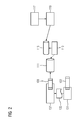
- Fig. 2 shows an entire data flow.
- an upload facility 101 runs on a local computer.
- the uploader 101 receives the patient records 105 from the local databases, such as DICOM (Digital Imaging and Communications in Medicine) records from a PACS (Picture Archiving and Communication System) system, and uploads the patient records 105 after anonymization the receiver 107 of the cloud up.
- DICOM Digital Imaging and Communications in Medicine
- PACS Picture Archiving and Communication System
- the data is transferred to an anonymization device 103 as a subsystem, which identifies the sensitive patient identification data on the basis of predetermined anonymization rules, separates it from the patient data record, and anonymize the original patient record by removing the patient identification data.
- the patient identification data is encrypted as a patient identification record with a key specific to the medical institution.
- the unencrypted portion of the patient record is processed in accordance with medical anonymization standards so that all sensitive patient identification data is removed therefrom.
- the original patient records can be anonymized in different ways from different security profiles or data confidentiality ratings based on different default anonymization rules. Since anonymization can be done in different ways, there are generally no uniformly anonymized patient records in the cloud. Therefore, the patient records differ with regard to their anonymization.
- Data processing in the cloud and the client should therefore consider the manner in which the patient records have been anonymized to avoid interpretation errors in processing. This is achieved by embedding or appending a set of anonymization rules into the anonymized patient record, which are applied as a private metadata value.
- the private metadata as anonymization rules can then be evaluated in the cloud or the client during data processing.
- An example is the anonymization of a date of birth of the patient. This value is stored in each patient record in a predefined format. Based on the anonymization rule, the date of birth can be replaced by a pseudo birth date in the anonymized patient record. To prevent misinterpretation when the patient records are later processed, the application reads in the embedded metadata that specifies the anonymization rules used.
- the sensitive patient identification data is formatted as a JSON record prior to encryption as it is separated from the original patient record, such as a DICOM record.
- any type of client such as pure web clients, can later efficiently work with this patient identification data. In particular, this does not require that DICOM processing libraries be used on the client side. If the DICOM format is retained, this occurs because the DICOM format is treated for decryption due to end-to-end encryption on the client side.
- the encrypted and unencrypted data is then uploaded to the cloud over a secure TLS / SSL communication channel.
- the receiver device 107 validates again with the validation device 109 the absence of sensitive patient information in the received unencrypted patient data sets on the basis of the embedded anonymization rule.
- This may include Optical Character Recognition (OCR) so that even sensitive patient information embedded in medical image files can be captured. If a check or validation fails, the data is immediately discarded and deleted. The uploader 101 is notified of the failed upload.
- OCR Optical Character Recognition
- the data is stored unchanged in a highly scalable data repository 111.
- the structure in this data store 111 follows a simple and scalable naming convention. All medical data is placed in file folders specific to medical studies. Each file folder is named according to the unique identifier of the corresponding study. Within such a File folder, the patient records of the study are stored in files named according to the unique identifier of the patient record. Additional subfile folders are not used. Separate files exist for each record for the anonymized patient record and the encrypted, sensitive patient identification record.
- a structure of the data in the data memory 111 is, for example, as follows: ⁇ Root>
- the receiver 107 sends a notification to the extractor 113 after the new data arrives.
- the extractor 113 processes then the new data in the data memory 111.
- the result is an updated search index in the index database 115 that allows web services to retrieve information flexibly and quickly from the data memory 111.
- An application that is used by users and running on the client 117 may be formed by a web page, a native mobile application, or a classic desktop application.
- Application software retrieves the small or large data sets via a web service 119. Large data sets can also be retrieved directly from the data memory 111.
- the small records passed from the web service 119 to the client 117 refer to large records by means of a URL (Uniform Resource Locator URL). If the application on the client 117 later wants to load the referenced large records, it may use the URL to retrieve them directly from the data store 111. This approach reduces the amount of computation and is scalable.
- Fig. 3 shows a computer system for anonymizing patient records.
- the anonymizer 103 and the uploader 101 are part of an application 121 of a hospital.
- the hospital application additionally includes an anonymization rule embedding device 123 which, for each patient record, inserts the type of anonymization performed by the anonymizer 103 into a particular private DICOM field.
- the cloud 133 includes the recipient device 107, the validator 109, and a notification device 125 that sends a message upon the availability of new patient records. Further, the cloud includes a dosing management back end 127, a scanner usage back end 129, and an image usage back end 131. In addition, the cloud 133 also includes an anonymization rule embedding device 123.
- the anonymization device 103, the uploading device 101, and the anonymization rule embedding device 123 may be formed by an executable program or an electrical circuit.
- the private DICOM field determines what type of anonymization has been performed by the application. Processing of the anonymized patient data record is based on the previously defined anonymization rule.
- the method allows sharing patient records between different medical institutions and individual users.
- the patient data sets can be generated for example by a scanner of a computed tomography or a magnetic resonance tomography or an X-ray or ultrasound method.
- the method makes it possible to use the embedded anonymization rule to check locally with few computational steps whether the patient records have been correctly anonymized.
- the process also allows hospitals to work together in a new way.
- each processing application can determine which portions of the patient data can be processed.
- a second check of the anonymized patient records is made possible when the data is transferred to a data store.
- the data store can automatically discard the anonymized patient record if problems arise during the review.
- a simple and efficient storage structure and identification allow for fast and scalable access to the data, even though they are encrypted end-to-end.
- Using a scalable indexing mechanism allows quick searching and browsing through patient data.
- more efficient two-way access to the patient data can be achieved based on the size of the data, for example, in a web service or direct BLOB memory access.
Landscapes
- Engineering & Computer Science (AREA)
- General Health & Medical Sciences (AREA)
- Health & Medical Sciences (AREA)
- Theoretical Computer Science (AREA)
- Medical Informatics (AREA)
- Bioethics (AREA)
- General Engineering & Computer Science (AREA)
- Computer Security & Cryptography (AREA)
- Software Systems (AREA)
- Physics & Mathematics (AREA)
- Computer Hardware Design (AREA)
- General Physics & Mathematics (AREA)
- Databases & Information Systems (AREA)
- Epidemiology (AREA)
- Primary Health Care (AREA)
- Public Health (AREA)
- Medical Treatment And Welfare Office Work (AREA)
Priority Applications (1)
| Application Number | Priority Date | Filing Date | Title |
|---|---|---|---|
| EP14194513.9A EP3023902A1 (fr) | 2014-11-24 | 2014-11-24 | Procédé d'anonymisation de jeux de données médicales |
Applications Claiming Priority (1)
| Application Number | Priority Date | Filing Date | Title |
|---|---|---|---|
| EP14194513.9A EP3023902A1 (fr) | 2014-11-24 | 2014-11-24 | Procédé d'anonymisation de jeux de données médicales |
Publications (1)
| Publication Number | Publication Date |
|---|---|
| EP3023902A1 true EP3023902A1 (fr) | 2016-05-25 |
Family
ID=52002698
Family Applications (1)
| Application Number | Title | Priority Date | Filing Date |
|---|---|---|---|
| EP14194513.9A Ceased EP3023902A1 (fr) | 2014-11-24 | 2014-11-24 | Procédé d'anonymisation de jeux de données médicales |
Country Status (1)
| Country | Link |
|---|---|
| EP (1) | EP3023902A1 (fr) |
Cited By (2)
| Publication number | Priority date | Publication date | Assignee | Title |
|---|---|---|---|---|
| CN114927188A (zh) * | 2022-05-25 | 2022-08-19 | 北京银河方圆科技有限公司 | 医学影像数据处理方法及系统 |
| EP4339821A1 (fr) * | 2022-09-15 | 2024-03-20 | Siemens Healthineers AG | Procédé de transmission d'ensembles de données médicales |
Citations (3)
| Publication number | Priority date | Publication date | Assignee | Title |
|---|---|---|---|---|
| US20050165623A1 (en) * | 2003-03-12 | 2005-07-28 | Landi William A. | Systems and methods for encryption-based de-identification of protected health information |
| US20110119088A1 (en) | 2009-07-21 | 2011-05-19 | Shane Gunn | Cloud-based healthcare information exchange |
| US20130325805A1 (en) * | 2012-06-02 | 2013-12-05 | Dmitriy Tochilnik | System and method for tagging and securely archiving patient radiological information |
-
2014
- 2014-11-24 EP EP14194513.9A patent/EP3023902A1/fr not_active Ceased
Patent Citations (3)
| Publication number | Priority date | Publication date | Assignee | Title |
|---|---|---|---|---|
| US20050165623A1 (en) * | 2003-03-12 | 2005-07-28 | Landi William A. | Systems and methods for encryption-based de-identification of protected health information |
| US20110119088A1 (en) | 2009-07-21 | 2011-05-19 | Shane Gunn | Cloud-based healthcare information exchange |
| US20130325805A1 (en) * | 2012-06-02 | 2013-12-05 | Dmitriy Tochilnik | System and method for tagging and securely archiving patient radiological information |
Non-Patent Citations (7)
| Title |
|---|
| "Digital Imaging and Communications in Medicine (DICOM) 8 Supplement 142: Clinical Trial De-identification Profiles DICOM Standards Committee, Working Group 18 Clinical Trials Table of Contents", 25 January 2011 (2011-01-25), Rosslyn, VA, USA, pages 1 - 44, XP055182476, Retrieved from the Internet <URL:ftp://medical.nema.org/medical/dicom/final/sup142_ft.pdf> [retrieved on 20150413] * |
| "Digital Imaging and Communications in Medicine (DICOM) Supplement 55: Attribute Level Confidentiality (including De-identification)", 5 September 2002 (2002-09-05), Rosslyn, Virginia, USA, pages 1 - 16, XP055167991, Retrieved from the Internet <URL:ftp://medical.nema.org/medical/dicom/final/sup55_ft.pdf> [retrieved on 20150206] * |
| ANONYMOUS: "Data verification", WIKIPEDIA, 19 November 2013 (2013-11-19), XP055347768, Retrieved from the Internet <URL:https://en.wikipedia.org/w/index.php?title=Data_verification&oldid=582369260> [retrieved on 20170220] * |
| JOHN B FREYMANN ET AL: "Image Data Sharing for Biomedical Research-Meeting HIPAA Requirements for De-identification", JOURNAL OF DIGITAL IMAGING ; THE JOURNAL OF THE SOCIETY FOR COMPUTER APPLICATIONS IN RADIOLOGY, SPRINGER-VERLAG, NE, vol. 25, no. 1, 29 October 2011 (2011-10-29), pages 14 - 24, XP035005994, ISSN: 1618-727X, DOI: 10.1007/S10278-011-9422-X * |
| JULIEN KÜNZI ET AL: "Data-centric protection in DICOM", OPTICAL SENSING II, vol. 7264, 26 February 2009 (2009-02-26), 1000 20th St. Bellingham WA 98225-6705 USA, pages 726419, XP055287512, ISSN: 0277-786X, ISBN: 978-1-62841-971-9, DOI: 10.1117/12.816840 * |
| LIEN CHUNG-YUEH ET AL: "Open source tools for standardized privacy protection of medical images", MEDICAL IMAGING 2011: ADVANCED PACS-BASED IMAGING INFORMATICS AND THERAPEUTIC APPLICATIONS, SPIE, 1000 20TH ST. BELLINGHAM WA 98225-6705 USA, vol. 7967, no. 1, 3 March 2011 (2011-03-03), pages 1 - 7, XP060009629, DOI: 10.1117/12.877989 * |
| MICHAEL ONKEN ET AL: "Reversible anonymization of DICOM images using automatically generated policies", STUDIES IN HEALTH TECHNOLOGY AND INFORMATICS, 1 January 2009 (2009-01-01), Netherlands, pages 861 - 865, XP055182473, Retrieved from the Internet <URL:http://www.ncbi.nlm.nih.gov/pubmed/19745435> [retrieved on 20150413], DOI: 10.3233/978-1-60750-044-5-861 * |
Cited By (4)
| Publication number | Priority date | Publication date | Assignee | Title |
|---|---|---|---|---|
| CN114927188A (zh) * | 2022-05-25 | 2022-08-19 | 北京银河方圆科技有限公司 | 医学影像数据处理方法及系统 |
| EP4339821A1 (fr) * | 2022-09-15 | 2024-03-20 | Siemens Healthineers AG | Procédé de transmission d'ensembles de données médicales |
| US20240095401A1 (en) * | 2022-09-15 | 2024-03-21 | Siemens Healthcare Gmbh | Methods for transmission of medical datasets |
| US12499273B2 (en) * | 2022-09-15 | 2025-12-16 | Siemens Healthineers Ag | Methods for transmission of medical datasets |
Similar Documents
| Publication | Publication Date | Title |
|---|---|---|
| DE102012218329B4 (de) | Verwalten von Funktionsübernahme-Operationen an einem Cluster von Computern | |
| DE10351317B4 (de) | Zugriffsverfahren für ein Bildretrievalsystem in einem nach dem Client/Server-Prinzip organisierten Datenübertragungsnetz, sowie Bildretrievalsystem | |
| DE112010001870T5 (de) | Verfahren und system zum verwalten und anzeigen von medizinischen daten | |
| US12482541B2 (en) | Rule-based low-latency delivery of healthcare data | |
| DE102010043265A1 (de) | Systeme und Verfahren zum Verarbeiten und Verwalten von objektbezogenen Daten zur Verwendung durch mehrere Anwendungen | |
| US10373712B2 (en) | Aggregation, partitioning, and management of healthcare data for efficient storage and processing | |
| EP2766863A1 (fr) | Procédé de traitement d'enregistrements de données relatifs à des patients | |
| EP2759957B1 (fr) | Moyen de transmission pour contenus médicaux d'images à la sécurité critique | |
| DE202010018481U1 (de) | Asynchroner verteilter Objekt-Upload für replizierte Assoziativspeichercluster | |
| US20140330855A1 (en) | Modifying and Searching Metadata Associated with Electronic Medical Images | |
| DE102009018423B4 (de) | Verfahren zur Ausgabe von medizinischen Dokumenten | |
| EP3889806B1 (fr) | Système de classification des données basé sur les séquences de bits | |
| EP3552141B1 (fr) | Système de serveur de type ordinateur destiné à fournir des ensembles de données | |
| DE102021128519A1 (de) | Dokumentzugangskontrolle auf grundlage von dokumentkomponenten-layouts | |
| EP3023902A1 (fr) | Procédé d'anonymisation de jeux de données médicales | |
| DE102007021275A1 (de) | Verfahren zur Übertragung und/oder zur Bereitstellung persönlicher elektronischer Daten eines Inhabers, insbesondere gesundheitsbezogener elektronischer Daten eines Patienten | |
| EP3785159A1 (fr) | Procédé de fusion de données partielles différentes | |
| EP2426617B1 (fr) | Procédé de collecte anonyme de données confidentielles et données d'identification associées | |
| Aryanto et al. | Image de-identification methods for clinical research in the XDS environment | |
| DE102023109178B3 (de) | System und Verfahren zur Speicherung von Daten, insbesondere von personenbezogenen Daten | |
| US11508467B2 (en) | Aggregation, partitioning, and management of healthcare data for efficient storage and processing | |
| DE102012214506A1 (de) | Systeme und Verfahren für das Entnehmen von Bild- und Videodaten | |
| DE102007007326A1 (de) | Multisite-Szenarien beim Speichern und Archivieren von medizinischen Datenobjekten | |
| DE102014202953A1 (de) | Netzbasierte Kollaboration zum gesicherten Datenaustausch von Bilddatensätzen mit vertraulichen Anteilen | |
| DE102014003889A1 (de) | Verfahren und System zur anonymisierten Bereitstellung von medizinischen Bilddaten über das Internet |
Legal Events
| Date | Code | Title | Description |
|---|---|---|---|
| AK | Designated contracting states |
Kind code of ref document: A1 Designated state(s): AL AT BE BG CH CY CZ DE DK EE ES FI FR GB GR HR HU IE IS IT LI LT LU LV MC MK MT NL NO PL PT RO RS SE SI SK SM TR |
|
| AX | Request for extension of the european patent |
Extension state: BA ME |
|
| PUAI | Public reference made under article 153(3) epc to a published international application that has entered the european phase |
Free format text: ORIGINAL CODE: 0009012 |
|
| RAP1 | Party data changed (applicant data changed or rights of an application transferred) |
Owner name: SIEMENS HEALTHCARE GMBH |
|
| 17P | Request for examination filed |
Effective date: 20160606 |
|
| RBV | Designated contracting states (corrected) |
Designated state(s): AL AT BE BG CH CY CZ DE DK EE ES FI FR GB GR HR HU IE IS IT LI LT LU LV MC MK MT NL NO PL PT RO RS SE SI SK SM TR |
|
| 17Q | First examination report despatched |
Effective date: 20160719 |
|
| 18R | Application refused |
Effective date: 20170927 |