EP3023247A1 - Stretchable laminate and article containing same - Google Patents
Stretchable laminate and article containing same Download PDFInfo
- Publication number
- EP3023247A1 EP3023247A1 EP14827117.4A EP14827117A EP3023247A1 EP 3023247 A1 EP3023247 A1 EP 3023247A1 EP 14827117 A EP14827117 A EP 14827117A EP 3023247 A1 EP3023247 A1 EP 3023247A1
- Authority
- EP
- European Patent Office
- Prior art keywords
- layer
- elastomer
- stretchable laminate
- olefin
- woven fabric
- Prior art date
- Legal status (The legal status is an assumption and is not a legal conclusion. Google has not performed a legal analysis and makes no representation as to the accuracy of the status listed.)
- Granted
Links
Images


Classifications
-
- B—PERFORMING OPERATIONS; TRANSPORTING
- B32—LAYERED PRODUCTS
- B32B—LAYERED PRODUCTS, i.e. PRODUCTS BUILT-UP OF STRATA OF FLAT OR NON-FLAT, e.g. CELLULAR OR HONEYCOMB, FORM
- B32B5/00—Layered products characterised by the non- homogeneity or physical structure, i.e. comprising a fibrous, filamentary, particulate or foam layer; Layered products characterised by having a layer differing constitutionally or physically in different parts
- B32B5/02—Layered products characterised by the non- homogeneity or physical structure, i.e. comprising a fibrous, filamentary, particulate or foam layer; Layered products characterised by having a layer differing constitutionally or physically in different parts characterised by structural features of a fibrous or filamentary layer
- B32B5/022—Non-woven fabric
-
- B—PERFORMING OPERATIONS; TRANSPORTING
- B32—LAYERED PRODUCTS
- B32B—LAYERED PRODUCTS, i.e. PRODUCTS BUILT-UP OF STRATA OF FLAT OR NON-FLAT, e.g. CELLULAR OR HONEYCOMB, FORM
- B32B27/00—Layered products comprising a layer of synthetic resin
- B32B27/12—Layered products comprising a layer of synthetic resin next to a fibrous or filamentary layer
-
- B—PERFORMING OPERATIONS; TRANSPORTING
- B32—LAYERED PRODUCTS
- B32B—LAYERED PRODUCTS, i.e. PRODUCTS BUILT-UP OF STRATA OF FLAT OR NON-FLAT, e.g. CELLULAR OR HONEYCOMB, FORM
- B32B27/00—Layered products comprising a layer of synthetic resin
- B32B27/18—Layered products comprising a layer of synthetic resin characterised by the use of special additives
- B32B27/20—Layered products comprising a layer of synthetic resin characterised by the use of special additives using fillers, pigments, thixotroping agents
-
- B—PERFORMING OPERATIONS; TRANSPORTING
- B32—LAYERED PRODUCTS
- B32B—LAYERED PRODUCTS, i.e. PRODUCTS BUILT-UP OF STRATA OF FLAT OR NON-FLAT, e.g. CELLULAR OR HONEYCOMB, FORM
- B32B27/00—Layered products comprising a layer of synthetic resin
- B32B27/30—Layered products comprising a layer of synthetic resin comprising vinyl (co)polymers; comprising acrylic (co)polymers
- B32B27/302—Layered products comprising a layer of synthetic resin comprising vinyl (co)polymers; comprising acrylic (co)polymers comprising aromatic vinyl (co)polymers, e.g. styrenic (co)polymers
-
- B—PERFORMING OPERATIONS; TRANSPORTING
- B32—LAYERED PRODUCTS
- B32B—LAYERED PRODUCTS, i.e. PRODUCTS BUILT-UP OF STRATA OF FLAT OR NON-FLAT, e.g. CELLULAR OR HONEYCOMB, FORM
- B32B27/00—Layered products comprising a layer of synthetic resin
- B32B27/30—Layered products comprising a layer of synthetic resin comprising vinyl (co)polymers; comprising acrylic (co)polymers
- B32B27/304—Layered products comprising a layer of synthetic resin comprising vinyl (co)polymers; comprising acrylic (co)polymers comprising vinyl halide (co)polymers, e.g. PVC, PVDC, PVF, PVDF
-
- B—PERFORMING OPERATIONS; TRANSPORTING
- B32—LAYERED PRODUCTS
- B32B—LAYERED PRODUCTS, i.e. PRODUCTS BUILT-UP OF STRATA OF FLAT OR NON-FLAT, e.g. CELLULAR OR HONEYCOMB, FORM
- B32B27/00—Layered products comprising a layer of synthetic resin
- B32B27/32—Layered products comprising a layer of synthetic resin comprising polyolefins
-
- B—PERFORMING OPERATIONS; TRANSPORTING
- B32—LAYERED PRODUCTS
- B32B—LAYERED PRODUCTS, i.e. PRODUCTS BUILT-UP OF STRATA OF FLAT OR NON-FLAT, e.g. CELLULAR OR HONEYCOMB, FORM
- B32B27/00—Layered products comprising a layer of synthetic resin
- B32B27/32—Layered products comprising a layer of synthetic resin comprising polyolefins
- B32B27/327—Layered products comprising a layer of synthetic resin comprising polyolefins comprising polyolefins obtained by a metallocene or single-site catalyst
-
- B—PERFORMING OPERATIONS; TRANSPORTING
- B32—LAYERED PRODUCTS
- B32B—LAYERED PRODUCTS, i.e. PRODUCTS BUILT-UP OF STRATA OF FLAT OR NON-FLAT, e.g. CELLULAR OR HONEYCOMB, FORM
- B32B27/00—Layered products comprising a layer of synthetic resin
- B32B27/34—Layered products comprising a layer of synthetic resin comprising polyamides
-
- B—PERFORMING OPERATIONS; TRANSPORTING
- B32—LAYERED PRODUCTS
- B32B—LAYERED PRODUCTS, i.e. PRODUCTS BUILT-UP OF STRATA OF FLAT OR NON-FLAT, e.g. CELLULAR OR HONEYCOMB, FORM
- B32B27/00—Layered products comprising a layer of synthetic resin
- B32B27/36—Layered products comprising a layer of synthetic resin comprising polyesters
-
- B—PERFORMING OPERATIONS; TRANSPORTING
- B32—LAYERED PRODUCTS
- B32B—LAYERED PRODUCTS, i.e. PRODUCTS BUILT-UP OF STRATA OF FLAT OR NON-FLAT, e.g. CELLULAR OR HONEYCOMB, FORM
- B32B27/00—Layered products comprising a layer of synthetic resin
- B32B27/40—Layered products comprising a layer of synthetic resin comprising polyurethanes
-
- B—PERFORMING OPERATIONS; TRANSPORTING
- B32—LAYERED PRODUCTS
- B32B—LAYERED PRODUCTS, i.e. PRODUCTS BUILT-UP OF STRATA OF FLAT OR NON-FLAT, e.g. CELLULAR OR HONEYCOMB, FORM
- B32B2250/00—Layers arrangement
- B32B2250/02—2 layers
-
- B—PERFORMING OPERATIONS; TRANSPORTING
- B32—LAYERED PRODUCTS
- B32B—LAYERED PRODUCTS, i.e. PRODUCTS BUILT-UP OF STRATA OF FLAT OR NON-FLAT, e.g. CELLULAR OR HONEYCOMB, FORM
- B32B2250/00—Layers arrangement
- B32B2250/03—3 layers
-
- B—PERFORMING OPERATIONS; TRANSPORTING
- B32—LAYERED PRODUCTS
- B32B—LAYERED PRODUCTS, i.e. PRODUCTS BUILT-UP OF STRATA OF FLAT OR NON-FLAT, e.g. CELLULAR OR HONEYCOMB, FORM
- B32B2250/00—Layers arrangement
- B32B2250/40—Symmetrical or sandwich layers, e.g. ABA, ABCBA, ABCCBA
-
- B—PERFORMING OPERATIONS; TRANSPORTING
- B32—LAYERED PRODUCTS
- B32B—LAYERED PRODUCTS, i.e. PRODUCTS BUILT-UP OF STRATA OF FLAT OR NON-FLAT, e.g. CELLULAR OR HONEYCOMB, FORM
- B32B2262/00—Composition or structural features of fibres which form a fibrous or filamentary layer or are present as additives
- B32B2262/02—Synthetic macromolecular fibres
- B32B2262/0246—Acrylic resin fibres
-
- B—PERFORMING OPERATIONS; TRANSPORTING
- B32—LAYERED PRODUCTS
- B32B—LAYERED PRODUCTS, i.e. PRODUCTS BUILT-UP OF STRATA OF FLAT OR NON-FLAT, e.g. CELLULAR OR HONEYCOMB, FORM
- B32B2262/00—Composition or structural features of fibres which form a fibrous or filamentary layer or are present as additives
- B32B2262/02—Synthetic macromolecular fibres
- B32B2262/0253—Polyolefin fibres
-
- B—PERFORMING OPERATIONS; TRANSPORTING
- B32—LAYERED PRODUCTS
- B32B—LAYERED PRODUCTS, i.e. PRODUCTS BUILT-UP OF STRATA OF FLAT OR NON-FLAT, e.g. CELLULAR OR HONEYCOMB, FORM
- B32B2262/00—Composition or structural features of fibres which form a fibrous or filamentary layer or are present as additives
- B32B2262/02—Synthetic macromolecular fibres
- B32B2262/0261—Polyamide fibres
-
- B—PERFORMING OPERATIONS; TRANSPORTING
- B32—LAYERED PRODUCTS
- B32B—LAYERED PRODUCTS, i.e. PRODUCTS BUILT-UP OF STRATA OF FLAT OR NON-FLAT, e.g. CELLULAR OR HONEYCOMB, FORM
- B32B2262/00—Composition or structural features of fibres which form a fibrous or filamentary layer or are present as additives
- B32B2262/02—Synthetic macromolecular fibres
- B32B2262/0292—Polyurethane fibres
-
- B—PERFORMING OPERATIONS; TRANSPORTING
- B32—LAYERED PRODUCTS
- B32B—LAYERED PRODUCTS, i.e. PRODUCTS BUILT-UP OF STRATA OF FLAT OR NON-FLAT, e.g. CELLULAR OR HONEYCOMB, FORM
- B32B2262/00—Composition or structural features of fibres which form a fibrous or filamentary layer or are present as additives
- B32B2262/04—Cellulosic plastic fibres, e.g. rayon
-
- B—PERFORMING OPERATIONS; TRANSPORTING
- B32—LAYERED PRODUCTS
- B32B—LAYERED PRODUCTS, i.e. PRODUCTS BUILT-UP OF STRATA OF FLAT OR NON-FLAT, e.g. CELLULAR OR HONEYCOMB, FORM
- B32B2262/00—Composition or structural features of fibres which form a fibrous or filamentary layer or are present as additives
- B32B2262/12—Conjugate fibres, e.g. core/sheath or side-by-side
-
- B—PERFORMING OPERATIONS; TRANSPORTING
- B32—LAYERED PRODUCTS
- B32B—LAYERED PRODUCTS, i.e. PRODUCTS BUILT-UP OF STRATA OF FLAT OR NON-FLAT, e.g. CELLULAR OR HONEYCOMB, FORM
- B32B2262/00—Composition or structural features of fibres which form a fibrous or filamentary layer or are present as additives
- B32B2262/14—Mixture of at least two fibres made of different materials
-
- B—PERFORMING OPERATIONS; TRANSPORTING
- B32—LAYERED PRODUCTS
- B32B—LAYERED PRODUCTS, i.e. PRODUCTS BUILT-UP OF STRATA OF FLAT OR NON-FLAT, e.g. CELLULAR OR HONEYCOMB, FORM
- B32B2270/00—Resin or rubber layer containing a blend of at least two different polymers
-
- B—PERFORMING OPERATIONS; TRANSPORTING
- B32—LAYERED PRODUCTS
- B32B—LAYERED PRODUCTS, i.e. PRODUCTS BUILT-UP OF STRATA OF FLAT OR NON-FLAT, e.g. CELLULAR OR HONEYCOMB, FORM
- B32B2307/00—Properties of the layers or laminate
- B32B2307/50—Properties of the layers or laminate having particular mechanical properties
- B32B2307/51—Elastic
-
- B—PERFORMING OPERATIONS; TRANSPORTING
- B32—LAYERED PRODUCTS
- B32B—LAYERED PRODUCTS, i.e. PRODUCTS BUILT-UP OF STRATA OF FLAT OR NON-FLAT, e.g. CELLULAR OR HONEYCOMB, FORM
- B32B2555/00—Personal care
- B32B2555/02—Diapers or napkins
Definitions
- the present invention relates to a stretchable laminate and an article including the stretchable laminate.
- the present invention has been made to solve the problem of the related art, and an object of the present invention is to provide a stretchable laminate having excellent fittability. Another object of the present invention is to provide an article including such stretchable laminate.
- a stretchable laminate according to one embodiment of the present invention is a stretchable laminate, including: an elastomer layer; and a non-woven fabric layer arranged on at least one side of the elastomer layer, the stretchable laminate having a permanent set after a hysteresis test is performed four times of 10% or less.
- the elastomer layer includes an olefin-based elastomer.
- the olefin-based elastomer has a density of from 0.890 g/cm 3 to 0.830 g/cm 3 .
- the olefin-based elastomer has a MFR of from 5.0 g/10 min to 25.0 g/10 min.
- the olefin-based elastomer includes an ⁇ -olefin-based elastomer.
- the ⁇ -olefin-based elastomer includes any one selected from an ethylene-based elastomer, a propylene-based elastomer, and a 1-butene-based elastomer.
- the ⁇ -olefin-based elastomer includes a propylene-based elastomer.
- the ⁇ -olefin-based elastomer is produced by using a metallocene catalyst.
- the olefin-based elastomer includes a blend of two or more kinds of olefin-based elastomers.
- An article according to one embodiment of the present invention includes the stretchable laminate according to the one embodiment of the present invention.
- a stretchable laminate of the present invention is a stretchable laminate including a non-woven fabric layer on at least one side of an elastomer layer.
- the stretchable laminate of the present invention may include any appropriate other layer to the extent that the effect of the present invention is not impaired as long as the stretchable laminate includes a non-woven fabric layer on at least one side of the elastomer layer.
- the number of such any appropriate other layers may be only one, or may be two or more.
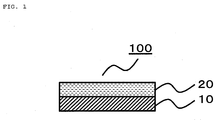
- FIG. 1 is a schematic cross-sectional view of a stretchable laminate according to a preferred embodiment of the present invention.
- a stretchable laminate 100 illustrated in FIG. 1 includes an elastomer layer 10 and a non-woven fabric layer 20 arranged on only one side of the elastomer layer 10.
- a material for bonding the elastomer layer 10 and the non-woven fabric layer 2 0 maybe present therebetween. Examples of such material include an adhesive, a pressure-sensitive adhesive, and a hot-melt pressure-sensitive adhesive.
- FIG. 2 is a schematic cross-sectional view of another stretchable laminate according to a preferred embodiment of the present invention.
- a stretchable laminate 100 illustrated in FIG. 2 includes an elastomer layer 10, a non-woven fabric layer 20a arranged on one side of the elastomer layer 10, and a non-woven fabric layer 20b arranged on the elastomer layer 10 on an opposite side to the non-woven fabric layer 20a.
- a material for bonding the elastomer layer 10 and the non-woven fabric layer 20a and/or for bonding the elastomer layer 10 and the non-woven fabric layer 20b may be present therebetween. Examples of such material include an adhesive, a pressure-sensitive adhesive, and a hot-melt pressure-sensitive adhesive.
- the stretchable laminate of the present invention has a permanent set after a hysteresis test is performed four times of 10% or less, preferably 9% or less, more preferably 8% or less, still more preferably 7% or less, particularly preferably 6% or less.
- the permanent set after a hysteresis test is performed four times falls within the range described above, the laminate has an excellent elastic recovery property and a low permanent set when stretching after the laminate was elongated by a user, and hence a stretchable laminate having excellent fittability can be provided. Details of the hysteresis test are described later.
- the thickness of the stretchable laminate of the present invention varies depending on the thickness of the elastomer layer or the thickness of the non-woven fabric layer and is preferably from 1.0 mm to 0.1 mm, more preferably from 0.8 mm to 0.15 mm, still more preferably from 0.6 mm to 0.15 mm, particularly preferably from 0.5 mm to 0.2 mm, most preferably from 0.45 mm to 0.2 mm.
- the laminate can be easily used as a material used in articles such as sanitary articles, for example, diapers and masks.
- any appropriate elastomer layer may be adopted to the extent that the effect of the present invention is not impaired.
- an elastomer resin serving as a main component in such elastomer layer there are given, for example, an olef in-based elastomer, a styrene-based elastomer, a vinyl chloride-based elastomer, a urethane-based elastomer, an ester-based elastomer, and an amide-based elastomer.
- the content of the elastomer resin serving as a main component in the elastomer layer is preferably from 50 wt% to 100 wt%, more preferably from 70 wt% to 100 wt%, still more preferably from 90 wt% to 100 wt%, particularly preferably from 95 wt% to 100 wt%, most preferably from 98 wt% to 100 wt%.
- the elastomer layer can exhibit a sufficient elastomer characteristic.
- the number of the elastomer layers may be one, or may be two or more.
- the elastomer resin serving as a main component in the elastomer layer is preferably an olefin-based elastomer.
- the olefin-based elastomer is adopted as the elastomer resin, the heat stability is enhanced compared to any other elastomer resin (for example, a styrene-based elastomer), and hence, for example, heat deterioration during film formation in producing the stretchable laminate of the present invention can be suppressed.
- the storage stability is enhanced compared to any other elastomer resin (for example, a styrene-based elastomer), and hence fluctuation of values for physical properties during storage of the stretchable laminate of the present invention can be suppressed.
- a styrene-based elastomer for example, a styrene-based elastomer
- the steps in production of the elastomer layer can be simplified, and hence processing cost can be reduced.
- the other elastomer resin for example, a styrene-based elastomer
- several kinds of styrene-based elastomers need to be blended with one another in order to control values for physical properties, which needs to prepare a master batch.
- extrusion molding can be performed by using fewer kinds of resins in production of the elastomer layer, which can obviate the need to prepare a master batch.
- the olefin-based elastomer when adopted as the elastomer resin, one kind of the olefin-based elastomers may be used alone, or two or more kinds thereof may be used as a blend.
- olefin-based elastomer examples include an olefin block copolymer, an olefin random copolymer, an ethylene copolymer, a propylene copolymer, an ethylene olefin block copolymer, a propylene olefin block copolymer, an ethylene olefin random copolymer, a propylene olefin random copolymer, an ethylene propylene random copolymer, an ethylene (1-butene) random copolymer, an ethylene (1-pentene) olefin block copolymer, an ethylene (1-hexene) random copolymer, an ethylene (1-heptene) olefin block copolymer, an ethylene (1-octene) olefin block copolymer, an ethylene (1-nonene) olefin block copolymer, an ethylene (1-decene)
- the olefin-based elastomer which may be adopted as the elastomer resin has a density of preferably from 0.890 g/cm 3 to 0.830 g/cm 3 , more preferably from 0.888 g/cm 3 to 0.835 g/cm 3 , still more preferably from 0.886 g/cm 3 to 0.835 g/cm 3 , particularly preferably from 0.885 g/cm 3 to 0.840 g/cm 3 , most preferably from 0.885 g/cm 3 to 0.845 g/cm 3 .
- a stretchable laminate having more excellent fittability can be provided, and the heat stability is further enhanced compared to any other elastomer resin (for example, a styrene-based elastomer), and hence, for example, heat deterioration during film formation in producing the stretchable laminate of the present invention can be further suppressed.
- the storage stability is further enhanced compared to any other elastomer resin (for example, a styrene-based elastomer), and hence fluctuation of values for physical properties during storage of the stretchable laminate of the present invention can be further suppressed.
- the steps in production of the elastomer layer can be further simplified, and hence processing cost can be further reduced.
- the olefin-based elastomer which may be adopted as the elastomer resin has a MFR of preferably from 5.0 g/10 min to 25.0 g/10 min, more preferably from 5.0 g/10 min to 23.0 g/10 min, still more preferably from 5.0 g/10 min to 21.0 g/10 min, particularly preferably from 5.0 g/10 min to 20.0 g/10 min, most preferably from 5.0 g/10 min to 19.0 g/10 min.
- a stretchable laminate having more excellent fittability can be provided, and the heat stability is further enhanced compared to any other elastomer resin (for example, a styrene-based elastomer), and hence, for example, heat deterioration during film formation in producing the stretchable laminate of the present invention can be further suppressed.
- the storage stability is further enhanced compared to any other elastomer resin (for example, a styrene-based elastomer), and hence fluctuation of values for physical properties during storage of the stretchable laminate of the present invention can be further suppressed.
- the steps in production of the elastomer layer can be further simplified, and hence processing cost can be further reduced.
- the olefin-based elastomer which may be adopted as the elastomer resin is specifically preferably an ⁇ -olefin-based elastomer. That is, the ⁇ -olefin-based elastomer is a copolymer of two or more kinds of ⁇ -olefins and has elastomer characteristics. Among such ⁇ -olefin-based elastomers, any one selected from an ethylene-based elastomer, a propylene-based elastomer, and a 1-butene-based elastomer is more preferred.
- ⁇ -olefin-based elastomer When such ⁇ -olefin-based elastomer is adopted as the olefin-based elastomer, a stretchable laminate having more excellent fittability can be provided, and the heat stability is further enhanced compared to any other elastomer resin (for example, a styrene-based elastomer), and hence, for example, heat deterioration during film formation in producing the stretchable laminate of the present invention can be further suppressed.
- the storage stability is further enhanced compared to any other elastomer resin (for example, a styrene-based elastomer), and hence fluctuation of values for physical properties during storage of the stretchable laminate of the present invention can be further suppressed.
- the steps in production of the elastomer layer can be further simplified, and hence processing cost can be further reduced.
- a propylene-based elastomer is particularly preferred.
- the propylene-based elastomer is adopted as the olefin-based elastomer, a stretchable laminate having extremely excellent fittability can be provided, and the heat stability is further enhanced compared to any other elastomer resin (for example, a styrene-based elastomer), and hence, for example, heat deterioration during film formation in producing the stretchable laminate of the present invention can be further suppressed.
- the storage stability is further enhanced compared to any other elastomer resin (for example, a styrene-based elastomer), and hence fluctuation of values for physical properties during storage of the stretchable laminate of the present invention can be further suppressed.
- the steps in production of the elastomer layer can be further simplified, and hence processing cost can be further reduced.
- the ⁇ -olefin-based elastomer as described above is also available as a commercial product.
- commercial product examples include some products in the "TAFMER” (trademark) series (such as TAFMER PN-3560) manufactured by Mitsui Chemicals, Inc., and some products in the "Vistamaxx” (trademark) series (such as Vistamaxx 6202 and Vistamaxx 3980FL) manufactured by Exxon Mobil Corporation.
- the ⁇ -olefin-based elastomer which may be adopted as the elastomer resin is preferably produced by using a metallocene catalyst.
- a stretchable laminate having extremely excellent fittability can be provided, and the heat stability is further enhanced compared to any other elastomer resin (for example, a styrene-based elastomer), and hence, for example, heat deterioration during film formation in producing the stretchable laminate of the present invention can be further suppressed.
- the storage stability is further enhanced compared to any other elastomer resin (for example, a styrene-based elastomer), and hence fluctuation of values for physical properties during storage of the stretchable laminate of the present invention can be further suppressed.
- the steps in production of the elastomer layer can be further simplified, and hence processing cost can be further reduced.
- the elastomer layer may contain any appropriate other component to the extent that the effect of the present invention is not impaired.
- other component include any other polymer, a tackifier, a plasticizer, an antidegradant, a pigment, a dye, an antioxidant, an antistatic agent, a lubricant, a blowing agent, a heat stabilizer, a light stabilizer, an inorganic filler, and an organic filler.
- the number of kinds of those components may be only one, or may be two or more.
- the content of the other component in the elastomer layer is preferably 10 wt% or less, more preferably 7 wt% or less, still more preferably 5 wt% or less, particularly preferably 2 wt% or less, most preferably 1 wt% or less.
- the thickness of the elastomer layer is preferably from 200 ⁇ m to 20 ⁇ m, more preferably from 160 ⁇ m to 30 ⁇ m, still more preferably from 140 ⁇ m to 30 ⁇ m, particularly preferably from 120 ⁇ m to 30 ⁇ m, most preferably from 100 ⁇ m to 30 ⁇ m.
- a stretchable laminate having more excellent fittability can be provided.
- the elastomer layer preferably has a three-layer structure, and more specifically, the layers are preferably an intermediate layer including a blend of two or more kinds of olefin-based elastomers and surface layers each including one kind of the same kinds of olefin-based elastomers as the olefin-based elastomers included in the intermediate layer.
- any appropriate non-woven fabric layer may be adopted as the non-woven fabric layer to the extent that the effect of the present invention is not impaired.
- the number of kinds of non-woven fabrics constituting the non-woven fabric layer may be only one, or may be two or more.
- non-woven fabric constituting the non-woven fabric layer examples include a spunbond non-woven web, a raised non-woven fabric (such as a non-woven fabric obtained by a thermal bonding method, a bonding joining method, or a spunlace method), a melt-blown non-woven web, a spunlace non-woven web, a spunbond melt-blown spunbond non-woven web, a spunbond melt-blown melt-blown spunbond non-woven web, an unjoined non-woven web, an electrospun non-woven web, a flashspun non-woven web (such as TYVEKTM of DuPont), and a carded non-woven fabric.
- a spunbond non-woven web such as a thermal bonding method, a bonding joining method, or a spunlace method
- melt-blown non-woven web such as a non-woven fabric obtained by a thermal bonding method, a bonding joining method, or a spunlace method
- melt-blown non-woven web such as a non-woven fabric obtained by
- the non-woven fabric constituting the non-woven fabric layer may contain polyolefin fibers, such as polypropylene, polyethylene, polyester,polyamide,polyurethane,an elastomer,rayon,cellulose, acryl, copolymers thereof, blends thereof, or mixtures thereof.
- polyolefin fibers such as polypropylene, polyethylene, polyester,polyamide,polyurethane,an elastomer,rayon,cellulose, acryl, copolymers thereof, blends thereof, or mixtures thereof.
- the non-woven fabric constituting the non-woven fabric layer may contain a fiber which has a uniform structure and may contain a two-component structure, such as a sheath/core structure, a side-by-side structure, a sea-island structure, or any other two-component structure.
- a two-component structure such as a sheath/core structure, a side-by-side structure, a sea-island structure, or any other two-component structure.
- Detailed descriptions of the non-woven fabric can be found in, for example, " Nonwoven Fabric Primer and Reference Sampler, " E.A. Vaughn, Association of the Nonwoven Fabrics Industry, third edition (1992 ).
- the basis amount of the non-woven fabric constituting the non-woven fabric layer is preferably 150 gsm or less, more preferably 100 gsm or less, still more preferably 50 gsm or less, particularly preferably from 10 gsm to 30 gsm.
- the stretchable laminate of the present invention when the elastomer layer and the non-woven fabric layer are directly laminated with each other (for example, in cases of FIG. 1 and FIG. 2 ), the elastomer layer and the non-woven fabric layer need to be bonded to each other.
- Examples of such bonding method include: (1) a method involving laminating an elastomer layer formed by extrusion molding from a T-die of an extruder and a non-woven fabric layer separately fed from a rolled body; (2) a method involving laminating an elastomer layer and a non-woven fabric layer by co-extrusion; (3) a method involving bonding an elastomer layer and a non-woven fabric layer, which are prepared separately, with an adhesive; (4) a method involving forming a non-woven fabric layer on an elastomer layer formed by any appropriate method through melt-blown method or the like; and (5) thermally laminating or ultrasonically welding an elastomer layer and a non-woven fabric layer.
- the bonding of the elastomer layer and the non-woven fabric layer may be conducted with a hot-melt pressure-sensitive adhesive.
- a hot-melt pressure-sensitive adhesive When the hot-melt pressure-sensitive adhesive is used, the need to add a tackifier as a component of the elastomer layer is obviated, and hence, for example, the extrusion stability is enhanced, a problem in that the tackifier adheres to a molding roll can be suppressed, and a contamination problem of the production line by volatile matter contamination or the like caused by the tackifier can be suppressed.
- the non-woven fabric layer separately fed from a rolled body may be coated with the hot-melt pressure-sensitive adhesive before being laminated with the elastomer layer.
- the hot-melt pressure-sensitive adhesive When the hot-melt pressure-sensitive adhesive is used for bonding the elastomer layer and the non-woven fabric layer, it is not necessary to coat the whole surface of the non-woven fabric layer with the hot-melt pressure-sensitive adhesive.
- the non-woven fabric layer 20 maybe coated with a hot-melt pressure-sensitive adhesive 30 in a striped manner in a flow direction of the production line, or the hot-melt pressure-sensitive adhesive 30 may be applied onto the non-woven fabric layer 20 in a dotted manner.
- portions in which the hot-melt pressure-sensitive adhesive is present and portions in which the hot-melt pressure-sensitive adhesive is absent are formed in a striped manner, and therefore, particularly in a direction perpendicular to the stripe pattern (in the direction of the arrow in FIG. 3 ), the stretchability of the stretchable laminate may be further enhanced.
- the stretchable laminate of the present invention can be subjected to treatments referred to as pre-extension treatment and activation treatment after laminating the elastomer layer and the non-woven fabric layer.
- extension treatment is performed in a width direction of the stretchable laminate or treatment in which a fiber structure of a part of the region of the non-woven fabric layer is mechanically broken can be performed.
- the stretchable laminate can be elongated by a smaller force.
- the stretchable laminate of the present invention can be used in any appropriate article in which the effect of the present invention can be effectively utilized. That is, the article of the present invention includes the stretchable laminate of the present invention.
- a typical example of such article is a sanitary article. Examples of such sanitary article include a diaper (particularly an ear portion of a disposal diaper), a supporter, and a mask.
- the density (g/cm 3 ) of a resin was a value measured in conformity to ASTM D1505.
- a MFR (g/10 min) was a value measured in conformity to ASTM D1238.
- a stretchable laminate was cut into a size of 30 mm in width and 10 cm in length so that a vertical direction (cross-machine direction (CD)) with respect to a film flow direction (machine direction (MD)) constituted a long side.
- CD cross-machine direction
- MD film flow direction
- the resultant stretchable laminate was set on a tension testing machine (manufactured by Shimadzu Corporation: AG-IS 50 kN) so as to have a distance between chucks of 50 mm with a rubber plate and was subjected to a pre-extension step at a tension speed of 300 mm/min and a moving distance of 50 mm (100% extension) (The distance between the chucks was returned by 50 mm immediately after the movement of the chucks by 50 mm. At this time, the stretchable laminate was in a state in which sag corresponding to the permanent set occurred.) .
- the distance between the chucks was extended little by little under the same measurement conditions to move the chucks to a point at which a stress was able to be detected in a load cell (point at which the stress reached 0.1 N/30 mm), to thereby control the sag corresponding to the permanent set (moving amount at this time was defined as permanent set: Xo).
- the point of 0.1 N/30 mm was defined as point zero, an extension test was performed again at a moving distance of 50 mm (the distance between chucks was returned by 50 mm immediately after the movement of the chucks by 50 mm), and the first measurement was performed, followed by measuring a permanent set after the first measurement (X 1 ) in the same manner as described above. This operation was repeated a total of four times.
- the permanent set is measured without performing the pre-extension step in the hysteresis test.
- the stretchable laminate was mounted to a stretchable body for diaper sides (a trapezoidal shape having a diaper body-side adhesion width of 7 cm and a side tape-side width of 4 cm) in a vertical direction (cross-machine direction (CD)) with respect to a film flow direction (machine direction (MD)) and a repetitive bonding property was evaluated in accordance with an actual usage environment.
- a bonding operation at the identical position was serially performed four times and the case where looseness caused by film extension was sensed was marked as Symbol "x", and the case where no looseness was sensed was marked as Symbol " ⁇ ".
- the stretchable laminate was stored for 1 week under an environment of room temperature or 40°C and a relative humidity of 92%, and then the laminate was measured at a tension rate of 300 mm/min in the same sample shape, the same testing machine, and the same distance between the chucks as the hysteresis test until the laminate was broken.
- the strength upon 200% extension was measured and compared to that of the product stored at room temperature. When the strength decreased by 10% or more, the laminate was marked as Symbol "x".
- an elastomer layer (hereinafter also referred to as elastic film) was formed by extrusion molding by extruding three layers in two types (A layer/B layer/A layer) through the use of a T-die molding machine.
- the extrusion temperatures were set under the following conditions.
- the extruded elastic film was bonded with the non-woven fabric onto which a hot-melt pressure-sensitive adhesive had been applied in a striped manner (pressure-sensitive adhesive layer width: 1 mm, interval: 1 mm) on a roll on both surfaces to obtain a stretchable laminate.
- a non-woven fabric (PP carded type, basis weight: 24 gsm) onto which an SIS-based hot-melt pressure-sensitive adhesive (manufactured by Bento Bantçilik, tradename: AC280) had been applied (30 g/m 2 ) in a striped manner (pressure-sensitive adhesive layer width: 1 mm, interval: 1 mm) was laminated, on a cooling roll of the extruded elastic film, on both surfaces of the elastic film to obtain a stretchable laminate (1).
- SIS-based hot-melt pressure-sensitive adhesive manufactured by Bento Bantçilik, tradename: AC280
- a non-woven fabric (PP carded type, basis weight: 24 gsm) onto which an SIS-based hot-melt pressure-sensitive adhesive (manufactured by Bento Bantçilik, trade name : AC280) had been applied (30 g/m 2 ) in a striped manner (pressure-sensitive adhesive layer width: 1 mm, interval: 1 mm) was laminated, on a cooling roll of the extruded elastic film, on both surfaces of the elastic film to obtain a stretchable laminate (2).
- SIS-based hot-melt pressure-sensitive adhesive manufactured by Bento Bantçilik, trade name : AC280
- a non-woven fabric (PP carded type, basis weight: 24 gsm) onto which an SIS-based hot-melt pressure-sensitive adhesive (manufactured by Bento Bantçilik, tradename: AC280) had been applied (30 g/m 2 ) in a striped manner (pressure-sensitive adhesive layer width: 1 mm, interval: 1 mm) was laminated, on a cooling roll of the extruded elastic film, on both surfaces of the elastic film to obtain a stretchable laminate (3).
- SIS-based hot-melt pressure-sensitive adhesive manufactured by Bento Bantçilik, tradename: AC280
- a non-woven fabric (PP carded type, basis weight: 24 gsm) onto which an SIS-based hot-melt pressure-sensitive adhesive (manufactured by Bento Bantçilik, tradename: AC280) had been applied (30 g/m 2 ) in a striped manner (pressure-sensitive adhesive layer width: 1 mm, interval: 1 mm) was laminated, on a cooling roll of the extruded elastic film, on both surfaces of the elastic film to obtain a stretchable laminate (4).
- SIS-based hot-melt pressure-sensitive adhesive manufactured by Bento Bantçilik, tradename: AC280
- a non-woven fabric (PP carded type, basis weight: 24 gsm) onto which an SIS-based hot-melt pressure-sensitive adhesive (manufactured by Bento Bantçilik, trade name: AC280) had been applied (30 g/m 2 ) in a striped manner (pressure-sensitive adhesive layer width: 1 mm, interval: 1 mm) was laminated, on a cooling roll of the extruded elastic film, on both surfaces of the elastic film to obtain a stretchable laminate (5).
- SIS-based hot-melt pressure-sensitive adhesive manufactured by Bento Bantçilik, trade name: AC280
- a white pigment titanium oxide, manufactured by Dupont, tradename: Ti-Pure R103
- a non-woven fabric (PP carded type, basis weight: 24 gsm) onto which an SIS-based hot-melt pressure-sensitive adhesive (manufactured by Bento Bantçilik, trade name: AC280) had been applied (30 g/m 2 ) in a striped manner (pressure-sensitive adhesive layer width: 1 mm, interval: 1 mm) was laminated, on a cooling roll of the extruded elastic film, on both surfaces of the elastic film to obtain a stretchable laminate (6).
- SIS-based hot-melt pressure-sensitive adhesive manufactured by Bento Bantçilik, trade name: AC280
- a non-woven fabric (PP carded type, basis weight: 24 gsm) onto which an SIS-based hot-melt pressure-sensitive adhesive (manufactured by Bento Bantçilik, tradename: AC280) had been applied (30 g/m 2 ) in a striped manner (pressure-sensitive adhesive layer width: 1 mm, interval: 1 mm) was laminated, on a cooling roll of the extruded elastic film, on both surfaces of the elastic film to obtain a stretchable laminate (7).
- SIS-based hot-melt pressure-sensitive adhesive manufactured by Bento Bantçilik, tradename: AC280
- a non-woven fabric (PP carded type, basis weight: 24 gsm) onto which an SIS-based hot-melt pressure-sensitive adhesive (manufactured by Bento Bantçilik, trade name : AC280) had been applied (30 g/m 2 ) in a striped manner (pressure-sensitive adhesive layer width: 1 mm, interval: 1 mm) was laminated, on a cooling roll of the extruded elastic film, on both surfaces of the elastic film to obtain a stretchable laminate (8).
- SIS-based hot-melt pressure-sensitive adhesive manufactured by Bento Bantçilik, trade name : AC280
- a non-woven fabric (PP carded type, basis weight: 24 gsm) onto which an SIS-based hot-melt pressure-sensitive adhesive (manufactured by Bento Bantçilik, tradename: AC280) had been applied (30 g/m 2 ) in a striped manner (pressure-sensitive adhesive layer width: 1 mm, interval: 1 mm) was laminated, on a cooling roll of the extruded elastic film, on both surfaces of the elastic film to obtain a stretchable laminate (9).
- SIS-based hot-melt pressure-sensitive adhesive manufactured by Bento Bantçilik, tradename: AC280
- a non-woven fabric (PP carded type, basis weight: 24 gsm) onto which an SIS-based hot-melt pressure-sensitive adhesive (manufactured by Bento Bantçilik, tradename: AC280) had been applied (30 g/m 2 ) in a striped manner (pressure-sensitive adhesive layer width: 1 mm, interval: 1 mm) was laminated, on a cooling roll of the extruded elastic film, on both surfaces of the elastic film to obtain a stretchable laminate (10).
- SIS-based hot-melt pressure-sensitive adhesive manufactured by Bento Bantçilik, tradename: AC280
- 3 wt% of a white pigment titanium oxide, manufactured by Dupont, trade name: Ti-Pure R103
- a non-woven fabric (PP carded type, basis weight: 24 gsm) onto which an SIS-based hot-melt pressure-sensitive adhesive (manufactured by Bento Bantçilik, tradename: AC280) had been applied (30 g/m 2 ) in a striped manner (pressure-sensitive adhesive layer width: 1 mm, interval: 1 mm) was laminated, on a cooling roll of the extruded elastic film, on both surfaces of the elastic film to obtain a stretchable laminate (11).
- SIS-based hot-melt pressure-sensitive adhesive manufactured by Bento Bantçilik, tradename: AC280
- a white pigment titanium oxide, manufactured by Dupont, trade name: Ti-Pure R103
- a non-woven fabric (PP carded type, basis weight: 24 gsm) onto which an SIS-based hot-melt pressure-sensitive adhesive (manufactured by Bento Bantçilik, trade name : AC280) had been applied (30 g/m 2 ) in a striped manner (pressure-sensitive adhesive layer width: 1 mm, interval: 1 mm) was laminated, on a cooling roll of the extruded elastic film, on both surfaces of the elastic film to obtain a stretchable laminate (C1).
- SIS-based hot-melt pressure-sensitive adhesive manufactured by Bento Bantçilik, trade name : AC280
- 3 wt% of a white pigment titanium oxide, manufactured by Dupont, trade name: Ti-Pure R103
- a non-woven fabric (PP carded type, basis weight: 24 gsm) onto which an SIS-based hot-melt pressure-sensitive adhesive (manufactured by Bento Bantçilik, trade name : AC280) had been applied (30 g/m 2 ) in a striped manner (pressure-sensitive adhesive layer width: 1 mm, interval: 1 mm) was laminated, on a cooling roll of the extruded elastic film, on both surfaces of the elastic film to obtain a stretchable laminate (C2).
- SIS-based hot-melt pressure-sensitive adhesive manufactured by Bento Bantçilik, trade name : AC280
- a non-woven fabric (PP carded type, basis weight: 24 gsm) onto which an SIS-based hot-melt pressure-sensitive adhesive (manufactured by Bento Bantçilik, trade name : AC280) had been applied (30 g/m 2 ) in a striped manner (pressure-sensitive adhesive layer width: 1 mm, interval: 1 mm) was laminated, on a cooling roll of the extruded elastic film, on both surfaces of the elastic film to obtain a stretchable laminate (C3).
- SIS-based hot-melt pressure-sensitive adhesive manufactured by Bento Bantçilik, trade name : AC280
- a non-woven fabric (PP carded type, basis weight: 24 gsm) onto which an SIS-based hot-melt pressure-sensitive adhesive (manufactured by Bento Bantçilik, trade name: AC280) had been applied (30 g/m 2 ) in a striped manner (pressure-sensitive adhesive layer width: 1 mm, interval: 1 mm) was laminated, on a cooling roll of the extruded elastic film, on both surfaces of the elastic film to obtain a stretchable laminate (C4).
- SIS-based hot-melt pressure-sensitive adhesive manufactured by Bento Bantçilik, trade name: AC280
- a non-woven fabric (PP carded type, basis weight: 24 gsm) onto which an SIS-based hot-melt pressure-sensitive adhesive (manufactured by Bento Bantçilik, tradename: AC280) had been applied (30 g/m 2 ) in a striped manner (pressure-sensitive adhesive layer width: 1 mm, interval: 1 mm) was laminated, on a cooling roll of the extruded elastic film, on both surfaces of the elastic film to obtain a stretchable laminate (C5).
- SIS-based hot-melt pressure-sensitive adhesive manufactured by Bento Bantçilik, tradename: AC280
- the stretchable laminate of the present invention may be used in any appropriate article in which the effect of the present invention can be effectively utilized. That is, the article of the present invention includes the stretchable laminate of the present invention.
- a typical example of such article is a sanitary article. Examples of such sanitary article include a diaper (particularly, an ear portion of a disposal diaper), a supporter, and a mask.
Landscapes
- Chemical & Material Sciences (AREA)
- Chemical Kinetics & Catalysis (AREA)
- Engineering & Computer Science (AREA)
- Textile Engineering (AREA)
- Laminated Bodies (AREA)
- Absorbent Articles And Supports Therefor (AREA)
- Adhesives Or Adhesive Processes (AREA)
Abstract
Description
- The present invention relates to a stretchable laminate and an article including the stretchable laminate.
- Various stretchable laminates are proposed for articles such as sanitary articles, for example, diapers and masks (see, for example, Patent Literatures 1 and 2). Regarding such stretchable laminates, it is important for the laminate to have excellent fittability so as to be comfortably fitted to each of various users.
- However, the related-art stretchable laminates have a problem in that such fitting feeling is not sufficient.
-
- [PTL 1]
JP 2012-187857 A - [PTL 2]
JP 3830818 B2 - The present invention has been made to solve the problem of the related art, and an object of the present invention is to provide a stretchable laminate having excellent fittability. Another object of the present invention is to provide an article including such stretchable laminate.
- A stretchable laminate according to one embodiment of the present invention is a stretchable laminate, including: an elastomer layer; and a non-woven fabric layer arranged on at least one side of the elastomer layer, the stretchable laminate having a permanent set after a hysteresis test is performed four times of 10% or less.
- In a preferred embodiment, the elastomer layer includes an olefin-based elastomer.
- In a preferred embodiment, the olefin-based elastomer has a density of from 0.890 g/cm3 to 0.830 g/cm3.
- In a preferred embodiment, the olefin-based elastomer has a MFR of from 5.0 g/10 min to 25.0 g/10 min.
- In a preferred embodiment,the olefin-based elastomer includes an α-olefin-based elastomer.
- In a preferred embodiment, the α-olefin-based elastomer includes any one selected from an ethylene-based elastomer, a propylene-based elastomer, and a 1-butene-based elastomer.
- In a preferred embodiment, the α-olefin-based elastomer includes a propylene-based elastomer.
- In a preferred embodiment, the α-olefin-based elastomer is produced by using a metallocene catalyst.
- In a preferred embodiment, the olefin-based elastomer includes a blend of two or more kinds of olefin-based elastomers.
- An article according to one embodiment of the present invention includes the stretchable laminate according to the one embodiment of the present invention.
-
-
FIG. 1 is a schematic cross-sectional view of a stretchable laminate according to the preferred embodiment of a present invention. -
FIG. 2 is a schematic view for illustrating another stretchable laminate according to a preferred embodiment of the present invention. -
FIG. 3 is a schematic view of a state in which a non-woven fabric is coated with a hot-melt pressure-sensitive adhesive in a striped manner in a flow direction of a production line as viewed from a top surface thereof. - A stretchable laminate of the present invention is a stretchable laminate including a non-woven fabric layer on at least one side of an elastomer layer. The stretchable laminate of the present invention may include any appropriate other layer to the extent that the effect of the present invention is not impaired as long as the stretchable laminate includes a non-woven fabric layer on at least one side of the elastomer layer. The number of such any appropriate other layers may be only one, or may be two or more.
-
FIG. 1 is a schematic cross-sectional view of a stretchable laminate according to a preferred embodiment of the present invention. Astretchable laminate 100 illustrated inFIG. 1 includes anelastomer layer 10 and anon-woven fabric layer 20 arranged on only one side of theelastomer layer 10. A material for bonding theelastomer layer 10 and the non-woven fabric layer 2 0 maybe present therebetween. Examples of such material include an adhesive, a pressure-sensitive adhesive, and a hot-melt pressure-sensitive adhesive. -
FIG. 2 is a schematic cross-sectional view of another stretchable laminate according to a preferred embodiment of the present invention. Astretchable laminate 100 illustrated inFIG. 2 includes anelastomer layer 10, anon-woven fabric layer 20a arranged on one side of theelastomer layer 10, and anon-woven fabric layer 20b arranged on theelastomer layer 10 on an opposite side to the non-wovenfabric layer 20a. A material for bonding theelastomer layer 10 and thenon-woven fabric layer 20a and/or for bonding theelastomer layer 10 and the non-wovenfabric layer 20b may be present therebetween. Examples of such material include an adhesive, a pressure-sensitive adhesive, and a hot-melt pressure-sensitive adhesive. - The stretchable laminate of the present invention has a permanent set after a hysteresis test is performed four times of 10% or less, preferably 9% or less, more preferably 8% or less, still more preferably 7% or less, particularly preferably 6% or less. When the permanent set after a hysteresis test is performed four times falls within the range described above, the laminate has an excellent elastic recovery property and a low permanent set when stretching after the laminate was elongated by a user, and hence a stretchable laminate having excellent fittability can be provided. Details of the hysteresis test are described later.
- The thickness of the stretchable laminate of the present invention varies depending on the thickness of the elastomer layer or the thickness of the non-woven fabric layer and is preferably from 1.0 mm to 0.1 mm, more preferably from 0.8 mm to 0.15 mm, still more preferably from 0.6 mm to 0.15 mm, particularly preferably from 0.5 mm to 0.2 mm, most preferably from 0.45 mm to 0.2 mm. When the thickness of the stretchable laminate of the present invention falls within such range, the laminate can be easily used as a material used in articles such as sanitary articles, for example, diapers and masks.
- As the elastomer layer, any appropriate elastomer layer may be adopted to the extent that the effect of the present invention is not impaired. As an elastomer resin serving as a main component in such elastomer layer, there are given, for example, an olef in-based elastomer, a styrene-based elastomer, a vinyl chloride-based elastomer, a urethane-based elastomer, an ester-based elastomer, and an amide-based elastomer.
- The content of the elastomer resin serving as a main component in the elastomer layer is preferably from 50 wt% to 100 wt%, more preferably from 70 wt% to 100 wt%, still more preferably from 90 wt% to 100 wt%, particularly preferably from 95 wt% to 100 wt%, most preferably from 98 wt% to 100 wt%. When the content of the elastomer resin serving as a main component in the elastomer layer falls within the range described above, the elastomer layer can exhibit a sufficient elastomer characteristic.
- The number of the elastomer layers may be one, or may be two or more.
- In the present invention, the elastomer resin serving as a main component in the elastomer layer is preferably an olefin-based elastomer. When the olefin-based elastomer is adopted as the elastomer resin, the heat stability is enhanced compared to any other elastomer resin (for example, a styrene-based elastomer), and hence, for example, heat deterioration during film formation in producing the stretchable laminate of the present invention can be suppressed. In addition, when the olefin-based elastomer is adopted as the elastomer resin, the storage stability is enhanced compared to any other elastomer resin (for example, a styrene-based elastomer), and hence fluctuation of values for physical properties during storage of the stretchable laminate of the present invention can be suppressed.
- In addition, in the present invention, when the olefin-based elastomer is adopted as the elastomer resin, the steps in production of the elastomer layer can be simplified, and hence processing cost can be reduced. This is, for example, because when the other elastomer resin (for example, a styrene-based elastomer) is adopted as the elastomer resin, several kinds of styrene-based elastomers need to be blended with one another in order to control values for physical properties, which needs to prepare a master batch. When the olefin-based elastomer is adopted as the elastomer resin, extrusion molding can be performed by using fewer kinds of resins in production of the elastomer layer, which can obviate the need to prepare a master batch.
- In the present invention, when the olefin-based elastomer is adopted as the elastomer resin, one kind of the olefin-based elastomers may be used alone, or two or more kinds thereof may be used as a blend.
- Examples of the olefin-based elastomer include an olefin block copolymer, an olefin random copolymer, an ethylene copolymer, a propylene copolymer, an ethylene olefin block copolymer, a propylene olefin block copolymer, an ethylene olefin random copolymer, a propylene olefin random copolymer, an ethylene propylene random copolymer, an ethylene (1-butene) random copolymer, an ethylene (1-pentene) olefin block copolymer, an ethylene (1-hexene) random copolymer, an ethylene (1-heptene) olefin block copolymer, an ethylene (1-octene) olefin block copolymer, an ethylene (1-nonene) olefin block copolymer, an ethylene (1-decene) olefin block copolymer, a propylene ethylene olefin block copolymer, an ethylene (α-olefin) copolymer, an ethylene (α-olefin) random copolymer, an ethylene (α-olefin) block copolymer, and combinations thereof.
- In the present invention, the olefin-based elastomer which may be adopted as the elastomer resin has a density of preferably from 0.890 g/cm3 to 0.830 g/cm3, more preferably from 0.888 g/cm3 to 0.835 g/cm3, still more preferably from 0.886 g/cm3 to 0.835 g/cm3, particularly preferably from 0.885 g/cm3 to 0.840 g/cm3, most preferably from 0.885 g/cm3 to 0.845 g/cm3. When the olefin-based elastomer whose density falls within the range described above is adopted, a stretchable laminate having more excellent fittability can be provided, and the heat stability is further enhanced compared to any other elastomer resin (for example, a styrene-based elastomer), and hence, for example, heat deterioration during film formation in producing the stretchable laminate of the present invention can be further suppressed. Inaddition, the storage stability is further enhanced compared to any other elastomer resin (for example, a styrene-based elastomer), and hence fluctuation of values for physical properties during storage of the stretchable laminate of the present invention can be further suppressed. Further, the steps in production of the elastomer layer can be further simplified, and hence processing cost can be further reduced.
- In the present invention, the olefin-based elastomer which may be adopted as the elastomer resin has a MFR of preferably from 5.0 g/10 min to 25.0 g/10 min, more preferably from 5.0 g/10 min to 23.0 g/10 min, still more preferably from 5.0 g/10 min to 21.0 g/10 min, particularly preferably from 5.0 g/10 min to 20.0 g/10 min, most preferably from 5.0 g/10 min to 19.0 g/10 min. When the olefin-based elastomer whose MFR falls within the range described above is adopted, a stretchable laminate having more excellent fittability can be provided, and the heat stability is further enhanced compared to any other elastomer resin (for example, a styrene-based elastomer), and hence, for example, heat deterioration during film formation in producing the stretchable laminate of the present invention can be further suppressed. In addition, the storage stability is further enhanced compared to any other elastomer resin (for example, a styrene-based elastomer), and hence fluctuation of values for physical properties during storage of the stretchable laminate of the present invention can be further suppressed. Further, the steps in production of the elastomer layer can be further simplified, and hence processing cost can be further reduced.
- In the present invention, the olefin-based elastomer which may be adopted as the elastomer resin is specifically preferably an α-olefin-based elastomer. That is, the α-olefin-based elastomer is a copolymer of two or more kinds of α-olefins and has elastomer characteristics. Among such α-olefin-based elastomers, any one selected from an ethylene-based elastomer, a propylene-based elastomer, and a 1-butene-based elastomer is more preferred. When such α-olefin-based elastomer is adopted as the olefin-based elastomer, a stretchable laminate having more excellent fittability can be provided, and the heat stability is further enhanced compared to any other elastomer resin (for example, a styrene-based elastomer), and hence, for example, heat deterioration during film formation in producing the stretchable laminate of the present invention can be further suppressed. In addition, the storage stability is further enhanced compared to any other elastomer resin (for example, a styrene-based elastomer), and hence fluctuation of values for physical properties during storage of the stretchable laminate of the present invention can be further suppressed. Further, the steps in production of the elastomer layer can be further simplified, and hence processing cost can be further reduced.
- In the present invention, among the α-olefin-based elastomers which may be adopted as the elastomer resin, a propylene-based elastomer is particularly preferred. When the propylene-based elastomer is adopted as the olefin-based elastomer, a stretchable laminate having extremely excellent fittability can be provided, and the heat stability is further enhanced compared to any other elastomer resin (for example, a styrene-based elastomer), and hence, for example, heat deterioration during film formation in producing the stretchable laminate of the present invention can be further suppressed. In addition, the storage stability is further enhanced compared to any other elastomer resin (for example, a styrene-based elastomer), and hence fluctuation of values for physical properties during storage of the stretchable laminate of the present invention can be further suppressed. Further, the steps in production of the elastomer layer can be further simplified, and hence processing cost can be further reduced.
- The α-olefin-based elastomer as described above is also available as a commercial product. Examples of such commercial product include some products in the "TAFMER" (trademark) series (such as TAFMER PN-3560) manufactured by Mitsui Chemicals, Inc., and some products in the "Vistamaxx" (trademark) series (such as Vistamaxx 6202 and Vistamaxx 3980FL) manufactured by Exxon Mobil Corporation.
- In the present invention, the α-olefin-based elastomer which may be adopted as the elastomer resin is preferably produced by using a metallocene catalyst. In the α-olefin-based elastomer produced by using a metallocene catalyst, a stretchable laminate having extremely excellent fittability can be provided, and the heat stability is further enhanced compared to any other elastomer resin (for example, a styrene-based elastomer), and hence, for example, heat deterioration during film formation in producing the stretchable laminate of the present invention can be further suppressed. In addition, the storage stability is further enhanced compared to any other elastomer resin (for example, a styrene-based elastomer), and hence fluctuation of values for physical properties during storage of the stretchable laminate of the present invention can be further suppressed. Further, the steps in production of the elastomer layer can be further simplified, and hence processing cost can be further reduced.
- The elastomer layer may contain any appropriate other component to the extent that the effect of the present invention is not impaired. Examples of such other component include any other polymer, a tackifier, a plasticizer, an antidegradant, a pigment, a dye, an antioxidant, an antistatic agent, a lubricant, a blowing agent, a heat stabilizer, a light stabilizer, an inorganic filler, and an organic filler. The number of kinds of those components may be only one, or may be two or more. The content of the other component in the elastomer layer is preferably 10 wt% or less, more preferably 7 wt% or less, still more preferably 5 wt% or less, particularly preferably 2 wt% or less, most preferably 1 wt% or less.
- The thickness of the elastomer layer is preferably from 200 µm to 20 µm, more preferably from 160 µm to 30 µm, still more preferably from 140 µm to 30 µm, particularly preferably from 120 µm to 30 µm, most preferably from 100 µm to 30 µm. When the thickness of the elastomer layer falls within such range, a stretchable laminate having more excellent fittability can be provided.
- In the present invention, the elastomer layer preferably has a three-layer structure, and more specifically, the layers are preferably an intermediate layer including a blend of two or more kinds of olefin-based elastomers and surface layers each including one kind of the same kinds of olefin-based elastomers as the olefin-based elastomers included in the intermediate layer.
- Any appropriate non-woven fabric layer may be adopted as the non-woven fabric layer to the extent that the effect of the present invention is not impaired. The number of kinds of non-woven fabrics constituting the non-woven fabric layer may be only one, or may be two or more.
- Examples of the non-woven fabric constituting the non-woven fabric layer include a spunbond non-woven web, a raised non-woven fabric (such as a non-woven fabric obtained by a thermal bonding method, a bonding joining method, or a spunlace method), a melt-blown non-woven web, a spunlace non-woven web, a spunbond melt-blown spunbond non-woven web, a spunbond melt-blown melt-blown spunbond non-woven web, an unjoined non-woven web, an electrospun non-woven web, a flashspun non-woven web (such as TYVEKTM of DuPont), and a carded non-woven fabric.
- The non-woven fabric constituting the non-woven fabric layer may contain polyolefin fibers, such as polypropylene, polyethylene, polyester,polyamide,polyurethane,an elastomer,rayon,cellulose, acryl, copolymers thereof, blends thereof, or mixtures thereof.
- The non-woven fabric constituting the non-woven fabric layer may contain a fiber which has a uniform structure and may contain a two-component structure, such as a sheath/core structure, a side-by-side structure, a sea-island structure, or any other two-component structure. Detailed descriptions of the non-woven fabric can be found in, for example, "Nonwoven Fabric Primer and Reference Sampler, " E.A. Vaughn, Association of the Nonwoven Fabrics Industry, third edition (1992).
- The basis amount of the non-woven fabric constituting the non-woven fabric layer is preferably 150 gsm or less, more preferably 100 gsm or less, still more preferably 50 gsm or less, particularly preferably from 10 gsm to 30 gsm.
- In production of the stretchable laminate of the present invention, when the elastomer layer and the non-woven fabric layer are directly laminated with each other (for example, in cases of
FIG. 1 andFIG. 2 ), the elastomer layer and the non-woven fabric layer need to be bonded to each other. Examples of such bonding method include: (1) a method involving laminating an elastomer layer formed by extrusion molding from a T-die of an extruder and a non-woven fabric layer separately fed from a rolled body; (2) a method involving laminating an elastomer layer and a non-woven fabric layer by co-extrusion; (3) a method involving bonding an elastomer layer and a non-woven fabric layer, which are prepared separately, with an adhesive; (4) a method involving forming a non-woven fabric layer on an elastomer layer formed by any appropriate method through melt-blown method or the like; and (5) thermally laminating or ultrasonically welding an elastomer layer and a non-woven fabric layer. - The bonding of the elastomer layer and the non-woven fabric layer may be conducted with a hot-melt pressure-sensitive adhesive. When the hot-melt pressure-sensitive adhesive is used, the need to add a tackifier as a component of the elastomer layer is obviated, and hence, for example, the extrusion stability is enhanced, a problem in that the tackifier adheres to a molding roll can be suppressed, and a contamination problem of the production line by volatile matter contamination or the like caused by the tackifier can be suppressed.
- When the hot-melt pressure-sensitive adhesive is used for bonding the elastomer layer and the non-woven fabric layer, in the case of applying the method (1) described above, the non-woven fabric layer separately fed from a rolled body may be coated with the hot-melt pressure-sensitive adhesive before being laminated with the elastomer layer.
- When the hot-melt pressure-sensitive adhesive is used for bonding the elastomer layer and the non-woven fabric layer, it is not necessary to coat the whole surface of the non-woven fabric layer with the hot-melt pressure-sensitive adhesive. For example, as illustrated in
FIG. 3 , thenon-woven fabric layer 20 maybe coated with a hot-melt pressure-sensitive adhesive 30 in a striped manner in a flow direction of the production line, or the hot-melt pressure-sensitive adhesive 30 may be applied onto thenon-woven fabric layer 20 in a dotted manner. Through the coating with the hot-melt pressure-sensitive adhesive in a striped manner, portions in which the hot-melt pressure-sensitive adhesive is present and portions in which the hot-melt pressure-sensitive adhesive is absent are formed in a striped manner, and therefore, particularly in a direction perpendicular to the stripe pattern (in the direction of the arrow inFIG. 3 ), the stretchability of the stretchable laminate may be further enhanced. - The stretchable laminate of the present invention can be subjected to treatments referred to as pre-extension treatment and activation treatment after laminating the elastomer layer and the non-woven fabric layer. Specifically, extension treatment is performed in a width direction of the stretchable laminate or treatment in which a fiber structure of a part of the region of the non-woven fabric layer is mechanically broken can be performed. When such treatments are performed, the stretchable laminate can be elongated by a smaller force.
- The stretchable laminate of the present invention can be used in any appropriate article in which the effect of the present invention can be effectively utilized. That is, the article of the present invention includes the stretchable laminate of the present invention. A typical example of such article is a sanitary article. Examples of such sanitary article include a diaper (particularly an ear portion of a disposal diaper), a supporter, and a mask.
- The present invention is hereinafter specifically described by way of Examples. However, the present invention is by no means limited by these Examples. It should be noted that, in Examples and the like, test and evaluation methods are as described below. In addition, "part(s) "means "part (s) by weight" and "%" means "wt%" unless otherwise stated.
- The density (g/cm3) of a resin was a value measured in conformity to ASTM D1505.
- A MFR (g/10 min) was a value measured in conformity to ASTM D1238.
- A stretchable laminate was cut into a size of 30 mm in width and 10 cm in length so that a vertical direction (cross-machine direction (CD)) with respect to a film flow direction (machine direction (MD)) constituted a long side.
- The resultant stretchable laminate was set on a tension testing machine (manufactured by Shimadzu Corporation: AG-IS 50 kN) so as to have a distance between chucks of 50 mm with a rubber plate and was subjected to a pre-extension step at a tension speed of 300 mm/min and a moving distance of 50 mm (100% extension) (The distance between the chucks was returned by 50 mm immediately after the movement of the chucks by 50 mm. At this time, the stretchable laminate was in a state in which sag corresponding to the permanent set occurred.) .
- Subsequently, the distance between the chucks was extended little by little under the same measurement conditions to move the chucks to a point at which a stress was able to be detected in a load cell (point at which the stress reached 0.1 N/30 mm), to thereby control the sag corresponding to the permanent set (moving amount at this time was defined as permanent set: Xo).
- The point of 0.1 N/30 mm was defined as point zero, an extension test was performed again at a moving distance of 50 mm (the distance between chucks was returned by 50 mm immediately after the movement of the chucks by 50 mm), and the first measurement was performed, followed by measuring a permanent set after the first measurement (X1) in the same manner as described above. This operation was repeated a total of four times.
- In the same manner described above, permanent sets (X2, X3, and X4) were measured in the respective operations.
- From the data obtained through the operations, the "permanent set after a hysteresis test is performed four times" was calculated based on the following calculation expression.

- It should be noted that in the case where the stretchable laminate is subjected to a pre-extension step (activation step) in the production steps or the like, the permanent set is measured without performing the pre-extension step in the hysteresis test.
- The stretchable laminate was mounted to a stretchable body for diaper sides (a trapezoidal shape having a diaper body-side adhesion width of 7 cm and a side tape-side width of 4 cm) in a vertical direction (cross-machine direction (CD)) with respect to a film flow direction (machine direction (MD)) and a repetitive bonding property was evaluated in accordance with an actual usage environment. A bonding operation at the identical position was serially performed four times and the case where looseness caused by film extension was sensed was marked as Symbol "x", and the case where no looseness was sensed was marked as Symbol "○".
- The stretchable laminate was stored for 1 week under an environment of room temperature or 40°C and a relative humidity of 92%, and then the laminate was measured at a tension rate of 300 mm/min in the same sample shape, the same testing machine, and the same distance between the chucks as the hysteresis test until the laminate was broken. The strength upon 200% extension was measured and compared to that of the product stored at room temperature. When the strength decreased by 10% or more, the laminate was marked as Symbol "x".
- In Examples and Comparative Examples, an elastomer layer (hereinafter also referred to as elastic film) was formed by extrusion molding by extruding three layers in two types (A layer/B layer/A layer) through the use of a T-die molding machine. The extrusion temperatures were set under the following conditions.
- A layer: 200°C
- B layer: 200°C
- Die temperature: 200°C
- The extruded elastic film was bonded with the non-woven fabric onto which a hot-melt pressure-sensitive adhesive had been applied in a striped manner (pressure-sensitive adhesive layer width: 1 mm, interval: 1 mm) on a roll on both surfaces to obtain a stretchable laminate.
- When the film was formed under the molding conditions described above, in the case where a deteriorated resin referred to as die build-up was generated at a die lip portion of a T-die, the film was marked as Symbol "x", and in the case where die build-up was not generated, the film was marked as Symbol "○".
- 100 wt% of an olefin-based resin (manufactured by Exxon Mobil Corporation, trade name: Vistamaxx 6202, density=0.861 g/cm3, MFR=18.0 g/10 min) was loaded into A layer in an extrusion machine and a formulation of 67 wt% of an olefin-based resin (manufactured by Exxon Mobil Corporation, trade name: Vistamaxx 6202, density=0.861 g/cm3, MFR=18.0 g/10 min), 30 wt% of an olefin-based resin (manufactured by Mitsui Chemicals, Inc., trade name: TAFMER PN-3560, density=0.866 g/cm3, MFR=6.0 g/10 min), and 3 wt% of a white pigment (titanium oxide, manufactured by Dupont, trade name: Ti-Pure R103) was loaded into B layer in the extrusion machine to extrude an elastic film having the construction of A layer/B layer/A layer=9 µm/42 µm/9 µm in total of 60 µm.
- Then, a non-woven fabric (PP carded type, basis weight: 24 gsm) onto which an SIS-based hot-melt pressure-sensitive adhesive (manufactured by Bento Bantçilik, tradename: AC280) had been applied (30 g/m2) in a striped manner (pressure-sensitive adhesive layer width: 1 mm, interval: 1 mm) was laminated, on a cooling roll of the extruded elastic film, on both surfaces of the elastic film to obtain a stretchable laminate (1).
- The results are shown in Table 1.
- 100 wt% of an olef in-based resin (manufactured by Exxon Mobil Corporation, trade name: Vistamaxx 6202, density=0.861 g/cm3, MFR=18.0 g/10 min) was loaded into A layer in an extrusion machine and a formulation of 67 wt% of an olefin-based resin (manufactured by Exxon Mobil Corporation, trade name: Vistamaxx 6202, density=0.861 g/cm3, MFR=18.0 g/10 min), 30 wt% of an olefin-based resin (manufactured by Mitsui Chemicals, Inc., trade name: TAFMER PN-3560, density=0.866 g/cm3, MFR=6.0 g/10 min), and 3 wt% of a white pigment (titanium oxide, manufactured by Dupont,trade name:Ti-Pure R103) was loaded into B layer in the extrusion machine to extrude an elastic film having the construction of A layer/B layer/A layer=6.75 µm/31.5 µm/6.75 µm in total of 45 µm.
- Then, a non-woven fabric (PP carded type, basis weight: 24 gsm) onto which an SIS-based hot-melt pressure-sensitive adhesive (manufactured by Bento Bantçilik, trade name : AC280) had been applied (30 g/m2) in a striped manner (pressure-sensitive adhesive layer width: 1 mm, interval: 1 mm) was laminated, on a cooling roll of the extruded elastic film, on both surfaces of the elastic film to obtain a stretchable laminate (2).
- The results are shown in Table 1.
- 100 wt% of an olefin-based resin (manufactured by Exxon Mobil Corporation, trade name: Vistamaxx 6202, density=0.861 g/cm3, MFR=18.0 g/10 min) was loaded into A layer in an extrusion machine and a formulation of 47 wt% of an olefin-based resin (manufactured by Exxon Mobil Corporation, trade name: Vistamaxx 6202, density=0.861 g/cm3, MFR=18.0 g/10 min), 50 wt% of an olefin-based resin (manufactured by Mitsui Chemicals, Inc., trade name: TAFMER PN-3560, density=0.866 g/cm3, MFR=6. 0 g/10 min), and 3 wt% of a white pigment (titanium oxide, manufactured by Dupont, tradename: Ti-Pure R103) was loaded into B layer in the extrusion machine to extrude an elastic film having the construction of A layer/B layer/A layer=9 µm/42 µm/9 µm in total of 60 µm.
- Then, a non-woven fabric (PP carded type, basis weight: 24 gsm) onto which an SIS-based hot-melt pressure-sensitive adhesive (manufactured by Bento Bantçilik, tradename: AC280) had been applied (30 g/m2) in a striped manner (pressure-sensitive adhesive layer width: 1 mm, interval: 1 mm) was laminated, on a cooling roll of the extruded elastic film, on both surfaces of the elastic film to obtain a stretchable laminate (3).
- The results are shown in Table 1.
- 100 wt% of an olefin-based resin (manufactured by Exxon Mobil Corporation, trade name: Vistamaxx 6202, density=0.861 g/cm3, MFR=18.0 g/10 min) was loaded into A layer in an extrusion machine and a formulation of 27 wt% of an olefin-based resin (manufactured by Exxon Mobil Corporation, trade name: Vistamaxx 6202, density=0.861 g/cm3, MFR=18.0 g/10 min), 70 wt% of an olefin-based resin (manufactured by Mitsui Chemicals, Inc., trade name: TAFMER PN-3560, density=0.866 g/cm3, MFR=6.0 g/10 min), and 3 wt% of a white pigment (titanium oxide, manufactured by Dupont, tradename: Ti-Pure R103) was loaded into B layer in the extrusion machine to extrude an elastic film having the construction of A layer/B layer/A layer=9 µm/42 µm/9 µm in total of 60 µm.
- Then, a non-woven fabric (PP carded type, basis weight: 24 gsm) onto which an SIS-based hot-melt pressure-sensitive adhesive (manufactured by Bento Bantçilik, tradename: AC280) had been applied (30 g/m2) in a striped manner (pressure-sensitive adhesive layer width: 1 mm, interval: 1 mm) was laminated, on a cooling roll of the extruded elastic film, on both surfaces of the elastic film to obtain a stretchable laminate (4).
- The results are shown in Table 1.
- A formulation of 67 wt% of an olefin-based resin (manufactured by Exxon Mobil Corporation, trade name: Vistamaxx 6202, density=0.861 g/cm3, MFR=18.0 g/10 min), 30 wt% of an olefin-based resin (manufactured by Mitsui Chemicals, Inc., trade name: TAFMER PN-3560, density=0.866 g/cm3, MFR=6. 0 g/10 min), and 3 wt% of a white pigment (titanium oxide, manufactured by Dupont, tradename: Ti-Pure R103) was loaded into A layer and B layer in an extrusion machine to extrude an elastic film having the construction of A layer/B layer/A layer=9 µm/42 µm/9 µm in total of 60 µm.
- Then, a non-woven fabric (PP carded type, basis weight: 24 gsm) onto which an SIS-based hot-melt pressure-sensitive adhesive (manufactured by Bento Bantçilik, trade name: AC280) had been applied (30 g/m2) in a striped manner (pressure-sensitive adhesive layer width: 1 mm, interval: 1 mm) was laminated, on a cooling roll of the extruded elastic film, on both surfaces of the elastic film to obtain a stretchable laminate (5).
- The results are shown in Table 1.
- A formulation of 27 wt% of an olefin-based resin (manufactured by Exxon Mobil Corporation, trade name: Vistamaxx 6202, density=0.861 g/cm3, MFR=18.0 g/10 min), 70 wt% of an olef in-based resin (manufactured by Mitsui Chemicals, Inc., trade name: TAFMER PN-3560, density=0.866 g/cm3, MFR=6.0 g/10 min), and 3 wt% of a white pigment (titanium oxide, manufactured by Dupont, tradename: Ti-Pure R103) was loaded into A layer and B layer in an extrusion machine to extrude an elastic film having the construction of A layer/B layer/A layer=9 µm/42 µm/9 µm in total of 60 µm.
- Then, a non-woven fabric (PP carded type, basis weight: 24 gsm) onto which an SIS-based hot-melt pressure-sensitive adhesive (manufactured by Bento Bantçilik, trade name: AC280) had been applied (30 g/m2) in a striped manner (pressure-sensitive adhesive layer width: 1 mm, interval: 1 mm) was laminated, on a cooling roll of the extruded elastic film, on both surfaces of the elastic film to obtain a stretchable laminate (6).
- The results are shown in Table 1.
- 100 wt% of an olefin-based resin (manufactured by Exxon Mobil Corporation, trade name: Vistamaxx 6202, density=0.861 g/cm3, MFR=18.0 g/10 min) was loaded into A layer in an extrusion machine and a formulation of 67 wt% of an olefin-based resin (manufactured by Exxon Mobil Corporation, trade name: Vistamaxx 6202, density=0.861 g/cm3, MFR=18.0 g/10 min), 30 wt% of an olefin-based resin (manufactured by Exxon Mobil Corporation, trade name: Vistamaxx 3980FL, density=0.879 g/cm3, MFR=8.3 g/10 min), and 3 wt% of a white pigment (titanium oxide, manufactured by Dupont, trade name: Ti-Pure R103) was loaded into B layer in the extrusion machine to extrude an elastic film having the construction of A layer/B layer/A layer=9 µm/42 µm/9 µm in total of 60 µm.
- Then, a non-woven fabric (PP carded type, basis weight: 24 gsm) onto which an SIS-based hot-melt pressure-sensitive adhesive (manufactured by Bento Bantçilik, tradename: AC280) had been applied (30 g/m2) in a striped manner (pressure-sensitive adhesive layer width: 1 mm, interval: 1 mm) was laminated, on a cooling roll of the extruded elastic film, on both surfaces of the elastic film to obtain a stretchable laminate (7).
- The results are shown in Table 1.
- 100 wt% of an olefin-based resin (manufactured by Exxon Mobil Corporation, trade name: Vistamaxx 6202, density=0.861 g/cm3, MFR=18.0 g/10 min) was loaded into A layer in an extrusion machine and a formulation of 67 wt% of an olefin-based resin (manufactured by Exxon Mobil Corporation, trade name: Vistamaxx 6202, density=0.861 g/cm3, MFR=18.0 g/10 min), 30 wt% of an olefin-based resin (manufactured by Exxon Mobil Corporation, trade name: Vistamaxx 3980FL, density=0.879 g/cm3, MFR=8.3 g/10 min), and 3 wt% of a white pigment (titanium oxide, manufactured by Dupont, trade name: Ti-Pure R103) was loaded into B layer in the extrusion machine to extrude an elastic film having the construction of A layer/B layer/A layer=6.75 µm/31.5 µm/6.75 µm in total of 45 µm.
- Then, a non-woven fabric (PP carded type, basis weight: 24 gsm) onto which an SIS-based hot-melt pressure-sensitive adhesive (manufactured by Bento Bantçilik, trade name : AC280) had been applied (30 g/m2) in a striped manner (pressure-sensitive adhesive layer width: 1 mm, interval: 1 mm) was laminated, on a cooling roll of the extruded elastic film, on both surfaces of the elastic film to obtain a stretchable laminate (8).
- The results are shown in Table 1.
- A formulation of 97 wt% of an SIS-based resin (manufactured by ZEON CORPORATION, trade name: Quintac 3390, styrene content=48%, MFR=15.0 g/10 min) and 3 wt% of a white pigment (titanium oxide, manufactured by Dupont, trade name: Ti-Pure R103) was loaded into A layer and B layer in an extrusion machine to extrude an elastic film having the construction of A layer/B layer/A layer=9 µm/42 µm/9 µm in total of 60 µm.
- Then, a non-woven fabric (PP carded type, basis weight: 24 gsm) onto which an SIS-based hot-melt pressure-sensitive adhesive (manufactured by Bento Bantçilik, tradename: AC280) had been applied (30 g/m2) in a striped manner (pressure-sensitive adhesive layer width: 1 mm, interval: 1 mm) was laminated, on a cooling roll of the extruded elastic film, on both surfaces of the elastic film to obtain a stretchable laminate (9).
- The results are shown in Table 2.
- A formulation of 97 wt% of an SIS-based resin (manufactured by ZEON CORPORATION, trade name: Quintac 3620 , styrene content=14%, MFR=9.0 g/10 min) and 3 wt% of a white pigment (titanium oxide, manufactured by Dupont, trade name: Ti-Pure R103) was loaded into A layer and B layer in an extrusion machine to extrude an elastic film having the construction of A layer/B layer/A layer=9 µm/42 µm/9 µm in total of 60 µm.
- Then, a non-woven fabric (PP carded type, basis weight: 24 gsm) onto which an SIS-based hot-melt pressure-sensitive adhesive (manufactured by Bento Bantçilik, tradename: AC280) had been applied (30 g/m2) in a striped manner (pressure-sensitive adhesive layer width: 1 mm, interval: 1 mm) was laminated, on a cooling roll of the extruded elastic film, on both surfaces of the elastic film to obtain a stretchable laminate (10).
- The results are shown in Table 2.
- A formulation of 97 wt% of an SEBS-based resin (manufactured by Asahi Kasei Chemicals Corp., trade name: Tuftec H1041, styrene content: 30%, MFR=5.0 g/10 min) and 3 wt% of a white pigment (titanium oxide, manufactured by Dupont, trade name: Ti-Pure R103) was loaded into A layer and B layer in an extrusion machine to extrude an elastic film having the construction of A layer/B layer/A layer=9 µm/42 µm/9 µm in total of 60 µm.
- Then, a non-woven fabric (PP carded type, basis weight: 24 gsm) onto which an SIS-based hot-melt pressure-sensitive adhesive (manufactured by Bento Bantçilik, tradename: AC280) had been applied (30 g/m2) in a striped manner (pressure-sensitive adhesive layer width: 1 mm, interval: 1 mm) was laminated, on a cooling roll of the extruded elastic film, on both surfaces of the elastic film to obtain a stretchable laminate (11).
- The results are shown in Table 2.
- A formulation of 97 wt% of an SEBS-based resin (manufactured by JSR Corporation, trade name: DYNARON 8600P, styrene content=15%, MFR=30.0 g/10 min) and 3 wt% of a white pigment (titanium oxide, manufactured by Dupont, trade name: Ti-Pure R103) was loaded into A layer and B layer in an extrusion machine to extrude an elastic film having the construction of A layer/B layer/A layer=9 µm/42 µm/9 µm in total of 60 µm.
- Then, a non-woven fabric (PP carded type, basis weight: 24 gsm) onto which an SIS-based hot-melt pressure-sensitive adhesive (manufactured by Bento Bantçilik, trade name : AC280) had been applied (30 g/m2) in a striped manner (pressure-sensitive adhesive layer width: 1 mm, interval: 1 mm) was laminated, on a cooling roll of the extruded elastic film, on both surfaces of the elastic film to obtain a stretchable laminate (C1).
- The results are shown in Table 2.
- A formulation of 97 wt% of an SEBS-based resin (manufactured by Asahi Kasei Chemicals Corp., trade name: Tuftec H1051, styrene content=67%, MFR=2.0 g/10 min) and 3 wt% of a white pigment (titanium oxide, manufactured by Dupont, trade name: Ti-Pure R103) was loaded into A layer and B layer in an extrusion machine to extrude an elastic film having the construction of A layer/B layer/A layer=9 µm/42 µm/9 µm in total of 60 µm.
- Then, a non-woven fabric (PP carded type, basis weight: 24 gsm) onto which an SIS-based hot-melt pressure-sensitive adhesive (manufactured by Bento Bantçilik, trade name : AC280) had been applied (30 g/m2) in a striped manner (pressure-sensitive adhesive layer width: 1 mm, interval: 1 mm) was laminated, on a cooling roll of the extruded elastic film, on both surfaces of the elastic film to obtain a stretchable laminate (C2).
- The results are shown in Table 2.
- A formulation of 97 wt% of an olefin-based resin (manufactured by Japan Polypropylene Corporation, trade name: WINTEC WFX4, density=0.900 g/cm3, MFR=7.0 g/10 min) and 3 wt% of a white pigment (titanium oxide, manufactured by Dupont, trade name: Ti-Pure R103) was loaded into A layer and B layer in an extrusion machine to extrude an elastic film having the construction of A layer/B layer/A layer=9 µm/42 µm/9 µm in total of 60 µm.
- Then, a non-woven fabric (PP carded type, basis weight: 24 gsm) onto which an SIS-based hot-melt pressure-sensitive adhesive (manufactured by Bento Bantçilik, trade name : AC280) had been applied (30 g/m2) in a striped manner (pressure-sensitive adhesive layer width: 1 mm, interval: 1 mm) was laminated, on a cooling roll of the extruded elastic film, on both surfaces of the elastic film to obtain a stretchable laminate (C3).
- The results are shown in Table 2.
- A formulation of 97 wt% of an olefin-based resin (manufactured by Japan Polypropylene Corporation, trade name: WELNEX RFGV 4A, density=0.890 g/cm3, MFR=6.0 g/10 min) and 3 wt% of a white pigment (titanium oxide, manufactured by Dupont, trade name: Ti-Pure R103) was loaded into A layer and B layer in an extrusion machine to extrude an elastic film having the construction of A layer/B layer/A layer=9 µm/42 µm/9 µm in total of 60 µm.
- Then, a non-woven fabric (PP carded type, basis weight: 24 gsm) onto which an SIS-based hot-melt pressure-sensitive adhesive (manufactured by Bento Bantçilik, trade name: AC280) had been applied (30 g/m2) in a striped manner (pressure-sensitive adhesive layer width: 1 mm, interval: 1 mm) was laminated, on a cooling roll of the extruded elastic film, on both surfaces of the elastic film to obtain a stretchable laminate (C4).
- The results are shown in Table 2.
- A formulation of 97 wt% of an EVA-based resin (manufactured by Du Pont-Mitsui Polychemicals Co., Ltd. , trade name: EVAFLEX P-1007, density=930 g/cm3, MFR=9.0 g/10 min: JIS K7210-1999, 190°C, 2.16 kgw) and 3 wt% of a white pigment (titanium oxide, manufactured by Dupont, trade name: Ti-Pure R103) was loaded into A layer and B layer in an extrusion machine to extrude an elastic film having the construction of A layer/B layer/A layer=9 µm/42 µm/9 µm in total of 60 µm.
- Then, a non-woven fabric (PP carded type, basis weight: 24 gsm) onto which an SIS-based hot-melt pressure-sensitive adhesive (manufactured by Bento Bantçilik, tradename: AC280) had been applied (30 g/m2) in a striped manner (pressure-sensitive adhesive layer width: 1 mm, interval: 1 mm) was laminated, on a cooling roll of the extruded elastic film, on both surfaces of the elastic film to obtain a stretchable laminate (C5).
- The results are shown in Table 2.
[Table 1] Examples 1 2 3 4 5 6 7 8 A layer resin Vistamaxx 6202 ← ← ← The same formulation as B layer The same formulation as B layer Vistamaxx 6202 ← B layer resin (1) Vistamaxx 6202 ← ← ← ← ← ← ← B layer resin (2) TAFMER PN-3560 ← ← ← ← ← Vistamaxx 3980FL ← B layer resin (3) TiO2 ← ← ← ← ← ← ← Blayer formulation (1)/(2)/(3) 67/30/3 ← 47/50/3 27/70/3 67/30/3 27/70/3 67/30/3 ← Thickness of A/B/A µm 9/42/9 6.75/31.5/ 6.75 9/42/9 9/42/9 9/42/9 9/42/9 9/42/9 6.75/31.5/ 6.75 Total thickness of elastic film µm 60 45 60 60 60 60 60 45 Type of hot-melt pressure-sensitive adhesive AC280 AC280 AC280 AC280 AC280 AC280 AC280 AC280 Type of non-woven fabric Carded 24 g/m2 Carded 24 g/m2 Carded 24 g/m2 Carded 24 g/m2 Carded 24 g/m2 Carded 24 g/m2 Carded 24 g/m2 Carded 24 g/m2 Permanent set ratio % 4.4 5 4 3.9 3.8 3.6 6.5 8.6 Fitting feeling - ○ ○ ○ ○ ○ ○ ○ ○ Heat resistance RTx1-week storage Strength upon 200% extension N/30 mm 16.1 14.6 17.2 17.3 17.5 17.5 20.4 18.9 Heat resistance 40°Cx92%RHx1-week storage Strength upon 200% extension N/30 mm 15.6 13.3 16.7 16.9 16.6 16.9 20.2 18.6 Heat resistance decreasing rate % 3.1 8.8 2.9 2.3 5.1 3.4 1 1.6 Evaluation of heat resistance ○ ○ ○ ○ ○ ○ ○ ○ Evaluation of heat resistance upon molding - ○ ○ ○ ○ ○ ○ ○ ○ [Table 2] Examples Comparative Examples 9 10 11 C1 C2 C3 C4 C5 A layer resin Quintac 3390 Quintac 3620 Taftec H1041 Dynaron 8600P Taftec H1051 Wintec WFX4 Welnex RFG4VA Evaflex P-1007 B layer resin (1) Quintac 3390 Quintac 3620 Taftec H1041 Dynaron 8600P Taftec H1051 Wintec WFX4 Welnex RFG4VA Evaflex P-1007 B layer resin (2) Ti02 ← ← ← ← ← ← ← Blayer formulation (1) / (2) 97/3 ← ← ← ← ← ← ← Thickness of A/B/A µm 9/42/9 9/42/9 9/42/9 9/42/9 9/42/9 9/42/9 9/42/9 9/42/9 Total thickness of elastic film µm 60 45 60 60 60 60 60 60 Type of hot-melt pressure-sensitive adhesive AC280 AC280 AC280 AC280 AC280 AC280 AC280 AC280 Type of non-woven fabric Carded 24 g/m2 Carded 24 g/m2 Carded 24 g/m2 Carded 24 g/m2 Carded 24 g/m2 Carded 24 g/m2 Carded 24 g/m2 Carded 24 g/m2 Permanent set ratio % 2.6 6.8 8.4 10.5 10.3 13.5 12.5 10.4 Fitting feeling - ○ ○ ○ × × × × × Heat resistance RTx1-week storage Strength upon 200% extension N/30 mm 14.8 10.5 12.8 14.7 17.4 21.5 16.4 10.3 Heat resistance 40°Cx92%RHx1-week storage Strength upon 200% extension N/30 mm 13.9 9 12.3 13.9 16.5 21.2 16.2 9.7 Heat resistance decreasing rate % 6.1 14.2 3.9 5.4 5.2 1.4 1.2 5.8 Evaluation of heat resistance - ○ × ○ ○ ○ ○ ○ ○ Evaluation of heat resistance upon molding - × × ○ ○ ○ ○ ○ ○ - The stretchable laminate of the present invention may be used in any appropriate article in which the effect of the present invention can be effectively utilized. That is, the article of the present invention includes the stretchable laminate of the present invention. A typical example of such article is a sanitary article. Examples of such sanitary article include a diaper (particularly, an ear portion of a disposal diaper), a supporter, and a mask.
-
- 100
- stretchable laminate
- 10
- elastomer layer
- 20
- non-woven fabric layer
- 20a
- non-woven fabric layer
- 20b
- non-woven fabric layer
- 30
- hot-melt pressure-sensitive adhesive
Claims (10)
- A stretchable laminate, comprising:an elastomer layer; anda non-woven fabric layer arranged on at least one side of the elastomer layer,the stretchable laminate having a permanent set after a hysteresis test is performed four times of 10% or less.
- The stretchable laminate according to claim 1, wherein the elastomer layer comprises an olefin-based elastomer.
- The stretchable laminate according to claim 2, wherein the olefin-based elastomer has a density of from 0.890 g/cm3 to 0.830 g/cm3.
- The stretchable laminate according to claim 2 or 3, wherein the olefin-based elastomer has a MFR of from 5.0 g/10 min to 25.0 g/10 min.
- The stretchable laminate according to any one of claims 2 to 4, wherein the olefin-based elastomer comprises an α-olefin-based elastomer.
- The stretchable laminate according to claim 5, wherein the α-olefin-based elastomer comprises any one selected from an ethylene-based elastomer, a propylene-based elastomer, and a 1-butene-based elastomer.
- The stretchable laminate according to claim 6, wherein the α-olefin-based elastomer comprises a propylene-based elastomer.
- The stretchable laminate according to any one of claims 5 to 7, wherein the α-olefin-based elastomer is produced by using a metallocene catalyst.
- The stretchable laminate according to any one of claims 2 to 8, wherein the olefin-based elastomer comprises a blend of two or more kinds of olefin-based elastomers.
- An article, comprising the stretchable laminate of any one of claims 1 to 9.
Applications Claiming Priority (2)
| Application Number | Priority Date | Filing Date | Title |
|---|---|---|---|
| JP2013149237A JP6321928B2 (en) | 2013-07-18 | 2013-07-18 | Stretchable laminate and article containing the same |
| PCT/JP2014/066947 WO2015008595A1 (en) | 2013-07-18 | 2014-06-26 | Stretchable laminate and article containing same |
Publications (3)
| Publication Number | Publication Date |
|---|---|
| EP3023247A1 true EP3023247A1 (en) | 2016-05-25 |
| EP3023247A4 EP3023247A4 (en) | 2017-03-22 |
| EP3023247B1 EP3023247B1 (en) | 2022-12-07 |
Family
ID=52346066
Family Applications (1)
| Application Number | Title | Priority Date | Filing Date |
|---|---|---|---|
| EP14827117.4A Active EP3023247B1 (en) | 2013-07-18 | 2014-06-26 | Stretchable laminate and article containing same |
Country Status (9)
| Country | Link |
|---|---|
| US (1) | US20160159031A1 (en) |
| EP (1) | EP3023247B1 (en) |
| JP (1) | JP6321928B2 (en) |
| KR (1) | KR20160034290A (en) |
| CN (1) | CN105392629B (en) |
| PL (1) | PL3023247T3 (en) |
| RU (1) | RU2016105135A (en) |
| TW (1) | TW201509657A (en) |
| WO (1) | WO2015008595A1 (en) |
Cited By (4)
| Publication number | Priority date | Publication date | Assignee | Title |
|---|---|---|---|---|
| EP3284775A4 (en) * | 2015-04-15 | 2019-02-27 | Nitto Denko Corporation | STRETCH FILM AND PRODUCT COMPRISING IT |
| US10772984B2 (en) | 2015-04-15 | 2020-09-15 | Nitto Denko Corporation | Elastic porous film and article |
| EP3960442A4 (en) * | 2019-04-26 | 2023-01-25 | Nitto Denko Corporation | STRETCH LAMINATE AND METHOD OF MANUFACTURING THEREOF |
| EP3072685B1 (en) * | 2014-08-26 | 2024-04-10 | Nitto Denko Corporation | Stretchable laminate, and article including same |
Families Citing this family (6)
| Publication number | Priority date | Publication date | Assignee | Title |
|---|---|---|---|---|
| CN116903958A (en) * | 2015-04-15 | 2023-10-20 | 日东电工株式会社 | Stretchable porous films and articles |
| JP6718272B2 (en) * | 2015-04-15 | 2020-07-08 | 日東電工株式会社 | Stretchable laminate and article containing the same |
| JP6650730B2 (en) * | 2015-10-22 | 2020-02-19 | 日東電工株式会社 | Ultra-small fixing tape and articles containing the same |
| JP6884571B2 (en) * | 2016-12-26 | 2021-06-09 | 日東電工株式会社 | Stretch film, stretch laminate, and articles containing it |
| WO2019164696A1 (en) * | 2018-02-23 | 2019-08-29 | A&At Llc | Nonwoven or fabric elasticized with a multiplicity of fiber strands in a close proximity |
| CN112891771B (en) * | 2021-01-19 | 2022-06-14 | 峰春源医疗器械(深圳)有限公司 | Gas mask with adjustable mask attaching degree |
Family Cites Families (31)
| Publication number | Priority date | Publication date | Assignee | Title |
|---|---|---|---|---|
| US4543099A (en) * | 1978-12-06 | 1985-09-24 | H. B. Fuller Company | Method for imparting elastic properties to a flexible substrate |
| US5057097A (en) * | 1988-09-13 | 1991-10-15 | Avery Dennison Corporation | Stretchable but stable film and fastening tape |
| JP3100300B2 (en) * | 1994-01-18 | 2000-10-16 | 株式会社日本吸収体技術研究所 | Composite elastic body having multi-stage elongation characteristics and method for producing the same |
| JPH0978435A (en) * | 1995-07-03 | 1997-03-25 | Mitsui Petrochem Ind Ltd | Composite nonwoven |
| JPH09300504A (en) * | 1996-05-16 | 1997-11-25 | Kao Corp | Breathable composite sheet and absorbent article using the same |
| JP3119443B2 (en) * | 1996-10-08 | 2000-12-18 | 花王株式会社 | Disposable diapers |
| TR199900793T2 (en) * | 1996-10-10 | 2001-11-21 | Tredegar Film Products Corporation | Air permeable elastic polymeric film laminates |
| JPH1148410A (en) * | 1997-08-07 | 1999-02-23 | Tonen Chem Corp | Expandable and contractible film laminate |
| JP2000080553A (en) * | 1998-08-31 | 2000-03-21 | Mitsui Chemicals Inc | Elastic composite nonwoven fabric |
| TW583085B (en) | 2000-01-24 | 2004-04-11 | Tredegar Film Prod Corp | Stiffened lane elastic laminate |
| AR037598A1 (en) * | 2001-11-30 | 2004-11-17 | Tredegar Film Prod Corp | SOFT AND ELASTIC COMPOUND |
| US20040102125A1 (en) * | 2002-11-27 | 2004-05-27 | Morman Michael Tod | Extensible laminate of nonwoven and elastomeric materials and process for making the same |
| US20050215972A1 (en) * | 2004-03-29 | 2005-09-29 | Roe Donald C | Disposable absorbent articles with zones comprising elastomeric components |
| US20060147716A1 (en) * | 2004-12-30 | 2006-07-06 | Jaime Braverman | Elastic films with reduced roll blocking capability, methods of making same, and limited use or disposable product applications incorporating same |
| CN101460123A (en) * | 2006-06-07 | 2009-06-17 | 宝洁公司 | Biaxially stretchable outer cover for an absorbent article |
| US8445744B2 (en) * | 2008-01-24 | 2013-05-21 | The Procter & Gamble Company | Extrusion bonded laminates for absorbent articles |
| EP2242465B1 (en) * | 2008-01-24 | 2014-10-01 | Clopay Plastic Products Company, Inc. | Elastomeric materials |
| US8168853B2 (en) * | 2008-01-24 | 2012-05-01 | The Proctor & Gamble Company | Extrusion bonded laminates for absorbent articles |
| US8603281B2 (en) * | 2008-06-30 | 2013-12-10 | Kimberly-Clark Worldwide, Inc. | Elastic composite containing a low strength and lightweight nonwoven facing |
| US10161063B2 (en) * | 2008-09-30 | 2018-12-25 | Exxonmobil Chemical Patents Inc. | Polyolefin-based elastic meltblown fabrics |
| JP5337464B2 (en) * | 2008-12-10 | 2013-11-06 | 花王株式会社 | Unfolding diaper, unfolding diaper cover, and fastening tape used therefor |
| KR20110100304A (en) * | 2008-12-31 | 2011-09-09 | 쓰리엠 이노베이티브 프로퍼티즈 컴파니 | Stretch detachable adhesive tape |
| WO2010098792A1 (en) * | 2009-02-27 | 2010-09-02 | Exxonmobil Chemical Patents Inc. | Multi-layer nonwoven in situ laminates and method of producing the same |
| FR2943356B1 (en) * | 2009-03-23 | 2011-07-08 | Aplix Sa | ELASTIC AND NON-WOVEN REINFORCED LAMINATE |
| JP5320197B2 (en) * | 2009-07-17 | 2013-10-23 | ダイワボウホールディングス株式会社 | Crimpable composite fiber and fiber assembly using the same |
| TW201125913A (en) * | 2010-01-20 | 2011-08-01 | Zheng Yuan Long | Elastic thin film/thin plate composition |
| US20110262686A1 (en) * | 2010-04-22 | 2011-10-27 | Kathryn Wright | High Tensile Strength Article with Elastomeric Layer |
| FR2965212B1 (en) * | 2010-09-23 | 2012-09-28 | Aplix Sa | REINFORCED RESISTANT ELASTIC LAMINATE |
| JP5851104B2 (en) * | 2011-03-11 | 2016-02-03 | スリーエム イノベイティブ プロパティズ カンパニー | Elastic laminate sheet |
| US20120329353A1 (en) * | 2011-06-27 | 2012-12-27 | H.B. Fuller Company | Olefin based hot melt adhesive compositions and nonwoven and packaging articles including the same |
| AR104645A1 (en) * | 2015-05-29 | 2017-08-02 | Dow Global Technologies Llc | ADHESIVE COMPOSITION FOR MULTIPLE LAYERS FILM THAT CAN BE CLOSED AGAIN |
-
2013
- 2013-07-18 JP JP2013149237A patent/JP6321928B2/en active Active
-
2014
- 2014-06-26 US US14/905,006 patent/US20160159031A1/en not_active Abandoned
- 2014-06-26 KR KR1020167000875A patent/KR20160034290A/en not_active Withdrawn
- 2014-06-26 EP EP14827117.4A patent/EP3023247B1/en active Active
- 2014-06-26 CN CN201480040860.6A patent/CN105392629B/en active Active
- 2014-06-26 RU RU2016105135A patent/RU2016105135A/en not_active Application Discontinuation
- 2014-06-26 WO PCT/JP2014/066947 patent/WO2015008595A1/en not_active Ceased
- 2014-06-26 PL PL14827117.4T patent/PL3023247T3/en unknown
- 2014-07-16 TW TW103124447A patent/TW201509657A/en unknown
Non-Patent Citations (1)
| Title |
|---|
| See references of WO2015008595A1 * |
Cited By (5)
| Publication number | Priority date | Publication date | Assignee | Title |
|---|---|---|---|---|
| EP3072685B1 (en) * | 2014-08-26 | 2024-04-10 | Nitto Denko Corporation | Stretchable laminate, and article including same |
| EP3284775A4 (en) * | 2015-04-15 | 2019-02-27 | Nitto Denko Corporation | STRETCH FILM AND PRODUCT COMPRISING IT |
| US10772984B2 (en) | 2015-04-15 | 2020-09-15 | Nitto Denko Corporation | Elastic porous film and article |
| US11305034B2 (en) | 2015-04-15 | 2022-04-19 | Nitto Denko Corporation | Stretchable film and product including same |
| EP3960442A4 (en) * | 2019-04-26 | 2023-01-25 | Nitto Denko Corporation | STRETCH LAMINATE AND METHOD OF MANUFACTURING THEREOF |
Also Published As
| Publication number | Publication date |
|---|---|
| WO2015008595A1 (en) | 2015-01-22 |
| US20160159031A1 (en) | 2016-06-09 |
| PL3023247T3 (en) | 2023-03-20 |
| CN105392629B (en) | 2018-09-28 |
| RU2016105135A (en) | 2017-08-23 |
| EP3023247A4 (en) | 2017-03-22 |
| JP2015020317A (en) | 2015-02-02 |
| TW201509657A (en) | 2015-03-16 |
| EP3023247B1 (en) | 2022-12-07 |
| KR20160034290A (en) | 2016-03-29 |
| CN105392629A (en) | 2016-03-09 |
| JP6321928B2 (en) | 2018-05-09 |
Similar Documents
| Publication | Publication Date | Title |
|---|---|---|
| EP3023247B1 (en) | Stretchable laminate and article containing same | |
| EP3187333B1 (en) | Stretchable laminate, and article including same | |
| EP3078489B1 (en) | Elastic laminate and article containing same | |
| EP3231604B1 (en) | Elastic laminate, article containing same, stretched elastic laminate article, and article containing same | |
| EP3045311A1 (en) | Stretchable member and article including same | |
| EP3315572B1 (en) | Hot-melt pressure-sensitive adhesive, stretchable laminate, and article | |
| EP3560704B1 (en) | Stretchable film, stretchable laminate and article comprising same | |
| EP3284775B1 (en) | Stretchable film and product including same | |
| EP3072685B1 (en) | Stretchable laminate, and article including same | |
| US20170157888A1 (en) | Stretchable laminate, and article including same | |
| EP3284595B1 (en) | Expanding/contracting laminate and product including same | |
| EP3431281B2 (en) | Stretchable laminate and article comprising same | |
| US11707917B2 (en) | Multilayer co-extruded films and article containing same | |
| JP2015020319A (en) | Elastic laminate and article including the same |
Legal Events
| Date | Code | Title | Description |
|---|---|---|---|
| PUAI | Public reference made under article 153(3) epc to a published international application that has entered the european phase |
Free format text: ORIGINAL CODE: 0009012 |
|
| 17P | Request for examination filed |
Effective date: 20151223 |
|
| AK | Designated contracting states |
Kind code of ref document: A1 Designated state(s): AL AT BE BG CH CY CZ DE DK EE ES FI FR GB GR HR HU IE IS IT LI LT LU LV MC MK MT NL NO PL PT RO RS SE SI SK SM TR |
|
| AX | Request for extension of the european patent |
Extension state: BA ME |
|
| DAX | Request for extension of the european patent (deleted) | ||
| A4 | Supplementary search report drawn up and despatched |
Effective date: 20170221 |
|
| RIC1 | Information provided on ipc code assigned before grant |
Ipc: B32B 27/34 20060101ALI20170215BHEP Ipc: B32B 25/10 20060101AFI20170215BHEP Ipc: B32B 27/30 20060101ALI20170215BHEP Ipc: B32B 27/36 20060101ALI20170215BHEP Ipc: B32B 27/20 20060101ALI20170215BHEP Ipc: B32B 27/40 20060101ALI20170215BHEP |
|
| STAA | Information on the status of an ep patent application or granted ep patent |
Free format text: STATUS: EXAMINATION IS IN PROGRESS |
|
| 17Q | First examination report despatched |
Effective date: 20180522 |
|
| GRAP | Despatch of communication of intention to grant a patent |
Free format text: ORIGINAL CODE: EPIDOSNIGR1 |
|
| STAA | Information on the status of an ep patent application or granted ep patent |
Free format text: STATUS: GRANT OF PATENT IS INTENDED |
|
| INTG | Intention to grant announced |
Effective date: 20220628 |
|
| RIN1 | Information on inventor provided before grant (corrected) |
Inventor name: AZUKIZAWA MAKOTO Inventor name: SUZUKI, TATSUYA Inventor name: IKISHIMA, SHINSUKE |
|
| GRAS | Grant fee paid |
Free format text: ORIGINAL CODE: EPIDOSNIGR3 |
|
| GRAA | (expected) grant |
Free format text: ORIGINAL CODE: 0009210 |
|
| STAA | Information on the status of an ep patent application or granted ep patent |
Free format text: STATUS: THE PATENT HAS BEEN GRANTED |
|
| AK | Designated contracting states |
Kind code of ref document: B1 Designated state(s): AL AT BE BG CH CY CZ DE DK EE ES FI FR GB GR HR HU IE IS IT LI LT LU LV MC MK MT NL NO PL PT RO RS SE SI SK SM TR |
|
| REG | Reference to a national code |
Ref country code: GB Ref legal event code: FG4D |
|
| REG | Reference to a national code |
Ref country code: SE Ref legal event code: TRGR |
|
| REG | Reference to a national code |
Ref country code: CH Ref legal event code: EP Ref country code: AT Ref legal event code: REF Ref document number: 1536073 Country of ref document: AT Kind code of ref document: T Effective date: 20221215 |
|
| REG | Reference to a national code |
Ref country code: DE Ref legal event code: R096 Ref document number: 602014085756 Country of ref document: DE |
|
| REG | Reference to a national code |
Ref country code: IE Ref legal event code: FG4D |
|
| REG | Reference to a national code |
Ref country code: LT Ref legal event code: MG9D |
|
| REG | Reference to a national code |
Ref country code: NL Ref legal event code: MP Effective date: 20221207 |
|
| PG25 | Lapsed in a contracting state [announced via postgrant information from national office to epo] |
Ref country code: ES Free format text: LAPSE BECAUSE OF FAILURE TO SUBMIT A TRANSLATION OF THE DESCRIPTION OR TO PAY THE FEE WITHIN THE PRESCRIBED TIME-LIMIT Effective date: 20221207 Ref country code: NO Free format text: LAPSE BECAUSE OF FAILURE TO SUBMIT A TRANSLATION OF THE DESCRIPTION OR TO PAY THE FEE WITHIN THE PRESCRIBED TIME-LIMIT Effective date: 20230307 Ref country code: LT Free format text: LAPSE BECAUSE OF FAILURE TO SUBMIT A TRANSLATION OF THE DESCRIPTION OR TO PAY THE FEE WITHIN THE PRESCRIBED TIME-LIMIT Effective date: 20221207 Ref country code: FI Free format text: LAPSE BECAUSE OF FAILURE TO SUBMIT A TRANSLATION OF THE DESCRIPTION OR TO PAY THE FEE WITHIN THE PRESCRIBED TIME-LIMIT Effective date: 20221207 |
|
| REG | Reference to a national code |
Ref country code: AT Ref legal event code: MK05 Ref document number: 1536073 Country of ref document: AT Kind code of ref document: T Effective date: 20221207 |
|
| PG25 | Lapsed in a contracting state [announced via postgrant information from national office to epo] |
Ref country code: RS Free format text: LAPSE BECAUSE OF FAILURE TO SUBMIT A TRANSLATION OF THE DESCRIPTION OR TO PAY THE FEE WITHIN THE PRESCRIBED TIME-LIMIT Effective date: 20221207 Ref country code: LV Free format text: LAPSE BECAUSE OF FAILURE TO SUBMIT A TRANSLATION OF THE DESCRIPTION OR TO PAY THE FEE WITHIN THE PRESCRIBED TIME-LIMIT Effective date: 20221207 Ref country code: HR Free format text: LAPSE BECAUSE OF FAILURE TO SUBMIT A TRANSLATION OF THE DESCRIPTION OR TO PAY THE FEE WITHIN THE PRESCRIBED TIME-LIMIT Effective date: 20221207 Ref country code: GR Free format text: LAPSE BECAUSE OF FAILURE TO SUBMIT A TRANSLATION OF THE DESCRIPTION OR TO PAY THE FEE WITHIN THE PRESCRIBED TIME-LIMIT Effective date: 20230308 |
|
| PG25 | Lapsed in a contracting state [announced via postgrant information from national office to epo] |
Ref country code: NL Free format text: LAPSE BECAUSE OF FAILURE TO SUBMIT A TRANSLATION OF THE DESCRIPTION OR TO PAY THE FEE WITHIN THE PRESCRIBED TIME-LIMIT Effective date: 20221207 |
|
| PG25 | Lapsed in a contracting state [announced via postgrant information from national office to epo] |
Ref country code: SM Free format text: LAPSE BECAUSE OF FAILURE TO SUBMIT A TRANSLATION OF THE DESCRIPTION OR TO PAY THE FEE WITHIN THE PRESCRIBED TIME-LIMIT Effective date: 20221207 Ref country code: RO Free format text: LAPSE BECAUSE OF FAILURE TO SUBMIT A TRANSLATION OF THE DESCRIPTION OR TO PAY THE FEE WITHIN THE PRESCRIBED TIME-LIMIT Effective date: 20221207 Ref country code: PT Free format text: LAPSE BECAUSE OF FAILURE TO SUBMIT A TRANSLATION OF THE DESCRIPTION OR TO PAY THE FEE WITHIN THE PRESCRIBED TIME-LIMIT Effective date: 20230410 Ref country code: EE Free format text: LAPSE BECAUSE OF FAILURE TO SUBMIT A TRANSLATION OF THE DESCRIPTION OR TO PAY THE FEE WITHIN THE PRESCRIBED TIME-LIMIT Effective date: 20221207 Ref country code: AT Free format text: LAPSE BECAUSE OF FAILURE TO SUBMIT A TRANSLATION OF THE DESCRIPTION OR TO PAY THE FEE WITHIN THE PRESCRIBED TIME-LIMIT Effective date: 20221207 |
|
| PG25 | Lapsed in a contracting state [announced via postgrant information from national office to epo] |
Ref country code: SK Free format text: LAPSE BECAUSE OF FAILURE TO SUBMIT A TRANSLATION OF THE DESCRIPTION OR TO PAY THE FEE WITHIN THE PRESCRIBED TIME-LIMIT Effective date: 20221207 Ref country code: IS Free format text: LAPSE BECAUSE OF FAILURE TO SUBMIT A TRANSLATION OF THE DESCRIPTION OR TO PAY THE FEE WITHIN THE PRESCRIBED TIME-LIMIT Effective date: 20230407 Ref country code: AL Free format text: LAPSE BECAUSE OF FAILURE TO SUBMIT A TRANSLATION OF THE DESCRIPTION OR TO PAY THE FEE WITHIN THE PRESCRIBED TIME-LIMIT Effective date: 20221207 |
|
| REG | Reference to a national code |
Ref country code: DE Ref legal event code: R097 Ref document number: 602014085756 Country of ref document: DE |
|
| PLBE | No opposition filed within time limit |
Free format text: ORIGINAL CODE: 0009261 |
|
| STAA | Information on the status of an ep patent application or granted ep patent |
Free format text: STATUS: NO OPPOSITION FILED WITHIN TIME LIMIT |
|
| PG25 | Lapsed in a contracting state [announced via postgrant information from national office to epo] |
Ref country code: DK Free format text: LAPSE BECAUSE OF FAILURE TO SUBMIT A TRANSLATION OF THE DESCRIPTION OR TO PAY THE FEE WITHIN THE PRESCRIBED TIME-LIMIT Effective date: 20221207 |
|
| 26N | No opposition filed |
Effective date: 20230908 |
|
| PG25 | Lapsed in a contracting state [announced via postgrant information from national office to epo] |
Ref country code: SI Free format text: LAPSE BECAUSE OF FAILURE TO SUBMIT A TRANSLATION OF THE DESCRIPTION OR TO PAY THE FEE WITHIN THE PRESCRIBED TIME-LIMIT Effective date: 20221207 |
|
| PG25 | Lapsed in a contracting state [announced via postgrant information from national office to epo] |
Ref country code: MC Free format text: LAPSE BECAUSE OF FAILURE TO SUBMIT A TRANSLATION OF THE DESCRIPTION OR TO PAY THE FEE WITHIN THE PRESCRIBED TIME-LIMIT Effective date: 20221207 |
|
| PG25 | Lapsed in a contracting state [announced via postgrant information from national office to epo] |
Ref country code: MC Free format text: LAPSE BECAUSE OF FAILURE TO SUBMIT A TRANSLATION OF THE DESCRIPTION OR TO PAY THE FEE WITHIN THE PRESCRIBED TIME-LIMIT Effective date: 20221207 |
|
| REG | Reference to a national code |
Ref country code: CH Ref legal event code: PL |
|
| GBPC | Gb: european patent ceased through non-payment of renewal fee |
Effective date: 20230626 |
|
| PG25 | Lapsed in a contracting state [announced via postgrant information from national office to epo] |
Ref country code: LU Free format text: LAPSE BECAUSE OF NON-PAYMENT OF DUE FEES Effective date: 20230626 |
|
| REG | Reference to a national code |
Ref country code: IE Ref legal event code: MM4A |
|
| PG25 | Lapsed in a contracting state [announced via postgrant information from national office to epo] |
Ref country code: LU Free format text: LAPSE BECAUSE OF NON-PAYMENT OF DUE FEES Effective date: 20230626 |
|
| PG25 | Lapsed in a contracting state [announced via postgrant information from national office to epo] |
Ref country code: IE Free format text: LAPSE BECAUSE OF NON-PAYMENT OF DUE FEES Effective date: 20230626 |
|
| PG25 | Lapsed in a contracting state [announced via postgrant information from national office to epo] |
Ref country code: IE Free format text: LAPSE BECAUSE OF NON-PAYMENT OF DUE FEES Effective date: 20230626 Ref country code: GB Free format text: LAPSE BECAUSE OF NON-PAYMENT OF DUE FEES Effective date: 20230626 Ref country code: CH Free format text: LAPSE BECAUSE OF NON-PAYMENT OF DUE FEES Effective date: 20230630 |
|
| PG25 | Lapsed in a contracting state [announced via postgrant information from national office to epo] |
Ref country code: IT Free format text: LAPSE BECAUSE OF FAILURE TO SUBMIT A TRANSLATION OF THE DESCRIPTION OR TO PAY THE FEE WITHIN THE PRESCRIBED TIME-LIMIT Effective date: 20221207 |
|
| PG25 | Lapsed in a contracting state [announced via postgrant information from national office to epo] |
Ref country code: BG Free format text: LAPSE BECAUSE OF FAILURE TO SUBMIT A TRANSLATION OF THE DESCRIPTION OR TO PAY THE FEE WITHIN THE PRESCRIBED TIME-LIMIT Effective date: 20221207 |
|
| PG25 | Lapsed in a contracting state [announced via postgrant information from national office to epo] |
Ref country code: BG Free format text: LAPSE BECAUSE OF FAILURE TO SUBMIT A TRANSLATION OF THE DESCRIPTION OR TO PAY THE FEE WITHIN THE PRESCRIBED TIME-LIMIT Effective date: 20221207 |
|
| PGFP | Annual fee paid to national office [announced via postgrant information from national office to epo] |
Ref country code: DE Payment date: 20250429 Year of fee payment: 12 Ref country code: PL Payment date: 20250429 Year of fee payment: 12 |
|
| PGFP | Annual fee paid to national office [announced via postgrant information from national office to epo] |
Ref country code: BE Payment date: 20250516 Year of fee payment: 12 |
|
| PGFP | Annual fee paid to national office [announced via postgrant information from national office to epo] |
Ref country code: FR Payment date: 20250508 Year of fee payment: 12 |
|
| PG25 | Lapsed in a contracting state [announced via postgrant information from national office to epo] |
Ref country code: CY Free format text: LAPSE BECAUSE OF FAILURE TO SUBMIT A TRANSLATION OF THE DESCRIPTION OR TO PAY THE FEE WITHIN THE PRESCRIBED TIME-LIMIT; INVALID AB INITIO Effective date: 20140626 |
|
| PGFP | Annual fee paid to national office [announced via postgrant information from national office to epo] |
Ref country code: TR Payment date: 20250620 Year of fee payment: 12 |
|
| PGFP | Annual fee paid to national office [announced via postgrant information from national office to epo] |
Ref country code: CZ Payment date: 20250618 Year of fee payment: 12 |
|
| PGFP | Annual fee paid to national office [announced via postgrant information from national office to epo] |
Ref country code: SE Payment date: 20250514 Year of fee payment: 12 |
|
| PG25 | Lapsed in a contracting state [announced via postgrant information from national office to epo] |
Ref country code: HU Free format text: LAPSE BECAUSE OF FAILURE TO SUBMIT A TRANSLATION OF THE DESCRIPTION OR TO PAY THE FEE WITHIN THE PRESCRIBED TIME-LIMIT; INVALID AB INITIO Effective date: 20140626 |