EP3023145A1 - Temperature-responsive hygroscopic material and method for producing the same - Google Patents
Temperature-responsive hygroscopic material and method for producing the same Download PDFInfo
- Publication number
- EP3023145A1 EP3023145A1 EP15195525.9A EP15195525A EP3023145A1 EP 3023145 A1 EP3023145 A1 EP 3023145A1 EP 15195525 A EP15195525 A EP 15195525A EP 3023145 A1 EP3023145 A1 EP 3023145A1
- Authority
- EP
- European Patent Office
- Prior art keywords
- temperature
- temperature sensitive
- functional group
- sensitive molecule
- mesoporous body
- Prior art date
- Legal status (The legal status is an assumption and is not a legal conclusion. Google has not performed a legal analysis and makes no representation as to the accuracy of the status listed.)
- Granted
Links
Images




Classifications
-
- B—PERFORMING OPERATIONS; TRANSPORTING
- B01—PHYSICAL OR CHEMICAL PROCESSES OR APPARATUS IN GENERAL
- B01J—CHEMICAL OR PHYSICAL PROCESSES, e.g. CATALYSIS OR COLLOID CHEMISTRY; THEIR RELEVANT APPARATUS
- B01J20/00—Solid sorbent compositions or filter aid compositions; Sorbents for chromatography; Processes for preparing, regenerating or reactivating thereof
- B01J20/28—Solid sorbent compositions or filter aid compositions; Sorbents for chromatography; Processes for preparing, regenerating or reactivating thereof characterised by their form or physical properties
- B01J20/28054—Solid sorbent compositions or filter aid compositions; Sorbents for chromatography; Processes for preparing, regenerating or reactivating thereof characterised by their form or physical properties characterised by their surface properties or porosity
- B01J20/28095—Shape or type of pores, voids, channels, ducts
- B01J20/28097—Shape or type of pores, voids, channels, ducts being coated, filled or plugged with specific compounds
-
- B—PERFORMING OPERATIONS; TRANSPORTING
- B01—PHYSICAL OR CHEMICAL PROCESSES OR APPARATUS IN GENERAL
- B01J—CHEMICAL OR PHYSICAL PROCESSES, e.g. CATALYSIS OR COLLOID CHEMISTRY; THEIR RELEVANT APPARATUS
- B01J20/00—Solid sorbent compositions or filter aid compositions; Sorbents for chromatography; Processes for preparing, regenerating or reactivating thereof
- B01J20/28—Solid sorbent compositions or filter aid compositions; Sorbents for chromatography; Processes for preparing, regenerating or reactivating thereof characterised by their form or physical properties
- B01J20/28002—Solid sorbent compositions or filter aid compositions; Sorbents for chromatography; Processes for preparing, regenerating or reactivating thereof characterised by their form or physical properties characterised by their physical properties
- B01J20/28011—Other properties, e.g. density, crush strength
-
- B—PERFORMING OPERATIONS; TRANSPORTING
- B01—PHYSICAL OR CHEMICAL PROCESSES OR APPARATUS IN GENERAL
- B01J—CHEMICAL OR PHYSICAL PROCESSES, e.g. CATALYSIS OR COLLOID CHEMISTRY; THEIR RELEVANT APPARATUS
- B01J20/00—Solid sorbent compositions or filter aid compositions; Sorbents for chromatography; Processes for preparing, regenerating or reactivating thereof
- B01J20/28—Solid sorbent compositions or filter aid compositions; Sorbents for chromatography; Processes for preparing, regenerating or reactivating thereof characterised by their form or physical properties
- B01J20/28054—Solid sorbent compositions or filter aid compositions; Sorbents for chromatography; Processes for preparing, regenerating or reactivating thereof characterised by their form or physical properties characterised by their surface properties or porosity
- B01J20/28078—Pore diameter
- B01J20/28083—Pore diameter being in the range 2-50 nm, i.e. mesopores
-
- B—PERFORMING OPERATIONS; TRANSPORTING
- B01—PHYSICAL OR CHEMICAL PROCESSES OR APPARATUS IN GENERAL
- B01J—CHEMICAL OR PHYSICAL PROCESSES, e.g. CATALYSIS OR COLLOID CHEMISTRY; THEIR RELEVANT APPARATUS
- B01J20/00—Solid sorbent compositions or filter aid compositions; Sorbents for chromatography; Processes for preparing, regenerating or reactivating thereof
- B01J20/30—Processes for preparing, regenerating, or reactivating
- B01J20/32—Impregnating or coating ; Solid sorbent compositions obtained from processes involving impregnating or coating
- B01J20/3202—Impregnating or coating ; Solid sorbent compositions obtained from processes involving impregnating or coating characterised by the carrier, support or substrate used for impregnation or coating
- B01J20/3204—Inorganic carriers, supports or substrates
-
- B—PERFORMING OPERATIONS; TRANSPORTING
- B01—PHYSICAL OR CHEMICAL PROCESSES OR APPARATUS IN GENERAL
- B01J—CHEMICAL OR PHYSICAL PROCESSES, e.g. CATALYSIS OR COLLOID CHEMISTRY; THEIR RELEVANT APPARATUS
- B01J20/00—Solid sorbent compositions or filter aid compositions; Sorbents for chromatography; Processes for preparing, regenerating or reactivating thereof
- B01J20/30—Processes for preparing, regenerating, or reactivating
- B01J20/32—Impregnating or coating ; Solid sorbent compositions obtained from processes involving impregnating or coating
- B01J20/3214—Impregnating or coating ; Solid sorbent compositions obtained from processes involving impregnating or coating characterised by the method for obtaining this coating or impregnating
- B01J20/3217—Resulting in a chemical bond between the coating or impregnating layer and the carrier, support or substrate, e.g. a covalent bond
-
- B—PERFORMING OPERATIONS; TRANSPORTING
- B01—PHYSICAL OR CHEMICAL PROCESSES OR APPARATUS IN GENERAL
- B01J—CHEMICAL OR PHYSICAL PROCESSES, e.g. CATALYSIS OR COLLOID CHEMISTRY; THEIR RELEVANT APPARATUS
- B01J20/00—Solid sorbent compositions or filter aid compositions; Sorbents for chromatography; Processes for preparing, regenerating or reactivating thereof
- B01J20/30—Processes for preparing, regenerating, or reactivating
- B01J20/32—Impregnating or coating ; Solid sorbent compositions obtained from processes involving impregnating or coating
- B01J20/3214—Impregnating or coating ; Solid sorbent compositions obtained from processes involving impregnating or coating characterised by the method for obtaining this coating or impregnating
- B01J20/3217—Resulting in a chemical bond between the coating or impregnating layer and the carrier, support or substrate, e.g. a covalent bond
- B01J20/3219—Resulting in a chemical bond between the coating or impregnating layer and the carrier, support or substrate, e.g. a covalent bond involving a particular spacer or linking group, e.g. for attaching an active group
-
- B—PERFORMING OPERATIONS; TRANSPORTING
- B01—PHYSICAL OR CHEMICAL PROCESSES OR APPARATUS IN GENERAL
- B01J—CHEMICAL OR PHYSICAL PROCESSES, e.g. CATALYSIS OR COLLOID CHEMISTRY; THEIR RELEVANT APPARATUS
- B01J20/00—Solid sorbent compositions or filter aid compositions; Sorbents for chromatography; Processes for preparing, regenerating or reactivating thereof
- B01J20/30—Processes for preparing, regenerating, or reactivating
- B01J20/32—Impregnating or coating ; Solid sorbent compositions obtained from processes involving impregnating or coating
- B01J20/3231—Impregnating or coating ; Solid sorbent compositions obtained from processes involving impregnating or coating characterised by the coating or impregnating layer
- B01J20/3242—Layers with a functional group, e.g. an affinity material, a ligand, a reactant or a complexing group
- B01J20/3244—Non-macromolecular compounds
- B01J20/3246—Non-macromolecular compounds having a well defined chemical structure
- B01J20/3248—Non-macromolecular compounds having a well defined chemical structure the functional group or the linking, spacer or anchoring group as a whole comprising at least one type of heteroatom selected from a nitrogen, oxygen or sulfur, these atoms not being part of the carrier as such
-
- B—PERFORMING OPERATIONS; TRANSPORTING
- B01—PHYSICAL OR CHEMICAL PROCESSES OR APPARATUS IN GENERAL
- B01J—CHEMICAL OR PHYSICAL PROCESSES, e.g. CATALYSIS OR COLLOID CHEMISTRY; THEIR RELEVANT APPARATUS
- B01J20/00—Solid sorbent compositions or filter aid compositions; Sorbents for chromatography; Processes for preparing, regenerating or reactivating thereof
- B01J20/30—Processes for preparing, regenerating, or reactivating
- B01J20/32—Impregnating or coating ; Solid sorbent compositions obtained from processes involving impregnating or coating
- B01J20/3231—Impregnating or coating ; Solid sorbent compositions obtained from processes involving impregnating or coating characterised by the coating or impregnating layer
- B01J20/3242—Layers with a functional group, e.g. an affinity material, a ligand, a reactant or a complexing group
- B01J20/3268—Macromolecular compounds
- B01J20/3272—Polymers obtained by reactions otherwise than involving only carbon to carbon unsaturated bonds
-
- B—PERFORMING OPERATIONS; TRANSPORTING
- B01—PHYSICAL OR CHEMICAL PROCESSES OR APPARATUS IN GENERAL
- B01J—CHEMICAL OR PHYSICAL PROCESSES, e.g. CATALYSIS OR COLLOID CHEMISTRY; THEIR RELEVANT APPARATUS
- B01J20/00—Solid sorbent compositions or filter aid compositions; Sorbents for chromatography; Processes for preparing, regenerating or reactivating thereof
- B01J20/30—Processes for preparing, regenerating, or reactivating
- B01J20/32—Impregnating or coating ; Solid sorbent compositions obtained from processes involving impregnating or coating
- B01J20/3291—Characterised by the shape of the carrier, the coating or the obtained coated product
Definitions
- the present invention relates to a temperature-responsive hygroscopic material and a method for producing the same.
- a temperature-responsive hygroscopic material which absorbs and releases moisture in the air according to temperature variation, is conventionally used in desiccant type dehumidifiers and air conditioners. Even if the temperature-responsive hygroscopic material degrades its hygroscopicity by absorbing moisture, it can recover the hygroscopicity by releasing moisture under predetermined conditions. Therefore, the temperature-responsive hygroscopic material is repeatedly used as a recyclable hygroscopic material.
- Non-Patent Literature 1 discloses a composite silica gel in which a temperature sensitive polymer and mesoporous silica gel are composited. It is disclosed that the moisture adsorption amount of the composite silica gel decreases at a temperature higher than the phase transition temperature of the temperature sensitive polymer.
- the composite silica gel is produced by: immersing mesoporous silica in a mixture solution of monomers of the temperature sensitive polymer and a polymerization initiator; thereafter causing thermal polymerization.
- Patent Literature 1 discloses: a membrane electrode assembly including a temperature-responsive layer in which a temperature-responsive material is chemically bonded with a porous layer in pores of the porous layer; and living radical polymerization as a method for producing the temperature-responsive layer. It is described that the temperature-responsive material is difficult to be infiltrated or retained in pores of the porous layer when the average pore diameter of the porous layer is less than 50 nm, since the pores are too small.
- Patent Literature 2 discloses a temperature sensitive adsorption material including porous silica whose outer surface (surface other than the inner surfaces of pores) is uniformly covered with a small amount of a temperature sensitive polymer, wherein the inlet diameters of pores of the porous silica can be controlled by temperature control.
- Non-Patent Literature 1 ICHIHASHI Toshio and NAKANO Yoshio, Characteristics of Water Vapor Adsorption and Desorption in Thermo-Sensitive Mesoporous Silica Gel/Polymer Gel, KAGAKU KOGAKU RONBUNSHU, Vol. 34, pp. 471-476, 2008
- the adsorption amount of water vapor increases at a temperature lower than Lower Critical Solution temperature (LCST) of the temperature sensitive polymer in water, and decreases at a temperature higher than the LCST. Therefore, it is possible to lower the temperature at which the composite silica gel regenerates and to reduce energy required for the regeneration.
- LCST Lower Critical Solution temperature
- the composite silica gel disclosed in Non-Patent Literature 1 has a small variation in hygroscopic property according to temperature variation.
- an object of the present invention is to provide a temperature-responsive hygroscopic material having a large variation in hygroscopic property according to temperature variation, and a method for producing the temperature-responsive hygroscopic material.
- the inventors of the present invention found the following: by preliminarily polymerizing monomers of a temperature sensitive molecule to produce the temperature sensitive molecule, and chemically bonding a functional group of the temperature sensitive molecule and a functional group on the surface of a mesoporous body having a predetermined average pore diameter, it is possible to uniformly retain more temperature sensitive molecules in pores of the mesoporous body than before and to have a larger variation in hygroscopic property according to temperature variation than that of conventional materials.
- the present invention has been made based on the above finding.
- a first aspect of the present invention is a temperature-responsive hygroscopic material including a mesoporous body having an average pore diameter equal to or greater than 2 nm and smaller than 50 nm and a temperature sensitive molecule chemically bonded with the mesoporous body inside a pore of the mesoporous body.
- the "temperature sensitive molecule” represents a molecule which has a LCST in water and shows hydrophilicity at a temperature lower than the LCST and hydrophobicity at a temperature higher than the LCST.
- the temperature sensitive molecule has a number average molecular weight equal to or greater than 2000 and smaller than or equal to 5000.
- an introduced amount of the temperature sensitive molecule is equal to or greater than 5.2 mass% and smaller than or equal to 21.4 mass%.
- the second aspect of the present invention is a method for producing a temperature-responsive hygroscopic material, the method including a step of causing, in a solvent including an activator and a coupling agent, a coupling reaction of: a mesoporous body having an average pore diameter equal to or greater than 2 nm and smaller than 50 nm and having a functional group on a surface thereof; and a temperature sensitive molecule having a functional group which can undergo a coupling reaction with the functional group on the surface of the mesoporous body.
- the functional group of the temperature sensitive molecule which can undergo a coupling reaction with the functional group on the surface of the mesoporous body is a functional group which the temperature sensitive molecule does not originally have and is preliminarily added to the temperature sensitive molecule.
- the functional group which can undergo a coupling reaction with the functional group on the surface of the mesoporous body is positioned at an end portion of the temperature sensitive molecule.
- a temperature-responsive hygroscopic material in which temperature sensitive molecules are uniformly retained in pores of the mesoporous body, the temperature-responsive hygroscopic material having a large variation in hygroscopic property according to temperature variation; and a method for producing the temperature-responsive hygroscopic material.
- the first aspect of the present invention is a temperature-responsive hygroscopic material including a mesoporous body having an average pore diameter equal to or greater than 2 nm and smaller than 50 nm and a temperature sensitive molecule chemically bonded with the mesoporous body inside a pore of the mesoporous body.
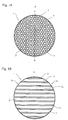
- Fig. 1 is a schematic view of a primary particle (temperature-responsive hygroscopic material particle 10) of the temperature-responsive hygroscopic material according to one embodiment of the present invention.
- the temperature-responsive hygroscopic material particle 10 includes a temperature sensitive molecule 4 (not shown in Fig. 1 ) chemically bonded with a mesoporous body inside a pore 3 of a primary particle (mesoporous particle 1) of the mesoporous body.
- Fig. 1A is a schematic view of the temperature-responsive hygroscopic material particle 10 (in Fig.
- Fig. 1B is a cross-sectional view taken along the line Ib-Ib in Fig. 1A .
- the mesoporous particle 1 includes a particle skeleton 2 and a plurality of pores 3.
- Fig. 2A is an enlarged view of the area shown by IIa in Fig. 1B .
- the temperature sensitive molecule 4 is chemically bonded (shown by X in Fig. 2A ) with the particle skeleton 2 of the mesoporous particle 1 and uniformly retained inside the pore 3.
- the temperature-responsive hygroscopic material including the temperature-responsive hygroscopic material particle 10 having such a structure can be produced for example by a method for producing a temperature-responsive hygroscopic material according to the second aspect of the present invention.
- the second aspect of the present invention is a method for producing a temperature-responsive hygroscopic material, the method including a step of causing, in a solvent including an activator and a coupling agent, a coupling reaction of: a mesoporous body having an average pore diameter equal to or greater than 2 nm and smaller than 50 nm and having a functional group on a surface thereof; and a temperature sensitive molecule having a functional group which can undergo a coupling reaction with the functional group on the surface of the mesoporous body.
- mesoporous silica is immersed in a mixture solution of monomers of a temperature sensitive polymer and a polymerization initiator, thereafter the temperature sensitive polymer is retained inside a pore of the mesoporous body by thermal polymerization.
- this method it is difficult to further introduce monomers and polymerization agent into the pore after the monomers introduced in the pore earlier are polymerized, due to steric hindrance of generally bulky temperature sensitive polymers.
- Non-Patent Literature 1 is small in hygroscopic property according to temperature variation, since temperature sensitive polymers are not uniformly retained in pores of the mesoporous silica gel and the retaining amount of the temperature sensitive polymers is insufficient.
- the production method of the present invention by preliminary polymerizing monomers of a temperature sensitive molecule to produce the temperature sensitive molecule, and chemically bonding a functional group of the temperature sensitive molecule and a functional group on the surface of a mesoporous body having a predetermined average pore diameter, it is possible to uniformly retain more temperature sensitive molecules in pores of the mesoporous body than before. Therefore, it is possible to have a large variation in hygroscopic property according to temperature variation.
- the temperature-responsive hygroscopic material having such a property can absorb and release moisture (regenerate) in wider ranges of temperature and relative humidity than those of conventional materials. Therefore, it can be employed as a dehumidifying material more versatile than conventional materials.
- Fig. 3 is a view schematically showing one embodiment of the production method of the present invention.
- a mesoporous body and a temperature sensitive molecule are used as raw materials.
- a temperature-responsive hygroscopic material is produced by coupling reaction of the mesoporous body and the temperature sensitive molecule, under existence of an activator and coupling agent.
- the mesoporous body used in the production method of the present invention is a porous body having pores (meso pores) whose average pore diameter is equal to or greater than 2 nm and smaller than 50 nm.
- the mesoporous body which can be used for the present invention is not particularly limited as long as having such pores, and for example a mesoporous body described in JPH11-114410 A can be used.
- the average pore diameter of the mesoporous body is preferably equal to or greater than 2 nm and smaller than or equal to 30 nm, more preferably equal to or greater than 2 nm and smaller than 10 nm and further preferably equal to or greater than 2 nm and smaller than or equal to 4 nm.
- Fig. 2B is a view of the mesoporous particle 1 in which the temperature sensitive molecule 4 is not chemically bonded, seen from the same viewpoint as in Fig. 2A .
- the mesoporous particle 1 includes, on the surface of the particle skeleton 2, a functional group 2a having a binding property.
- the functional group 2a can undergo a coupling reaction with a functional group 4a of the temperature sensitive molecule 4 which is described below. Undergoing a coupling reaction with the functional group 4a of the temperature sensitive molecule 4, the functional group 2a can form a chemical bond X, as shown in Fig. 2A . Therefore, the mesoporous body 1 can strongly retain the temperature sensitive molecule 4.
- Examples of the functional group having a binding property which is on the surface of the mesoporous body includes an amino group, carboxyl group, hydroxyl group, epoxy group, vinyl group, isocyanate group, thiol group, sulfide group, ureido group, acryloxy group and methacryloxy group.
- the temperature sensitive molecule used in the production method of the present invention has a LCST in water, and shows hydrophilicity at a temperature lower than the LCST and shows hydrophobicity at a temperature higher than the LCST.
- the temperature sensitive molecule is not particularly limited as long as the molecule has such a property.
- the molecule preferably has a number average molecular weight equal to or greater than 2000 and smaller than or equal to 5000.
- Examples of the temperature sensitive molecule include oligomers which include, as constituent units, monomers forming the temperature sensitive polymers described in D. Roy, W. L. A. Brooks and B. S. Sumerlin, Chem. Soc. Rev., 2013, 42, 7214-7243 ..
- NIPAM N-isopropylacrylamide
- NPAM N-n-propylacrylamide
- NPAM N-cyclopropylacrylamide
- DEAM N,N-dimethylacrylamide
- Fig. 2C is a view showing a state in which the temperature sensitive molecule 4, the activator 5 and the coupling agent 6 are introduced in the pore 3, seen from the same viewpoint as in Figs. 2A and 2B .
- the method of introducing the temperature sensitive molecule, activator and coupling agent into the pore of the mesoporous body is not particularly limited, and for example a method of: dispersing the mesoporous body, temperature sensitive molecule, activator and coupling agent in a suitable solvent; and impregnating the inside of pores of the mesoporous body with the temperature sensitive molecule, activator and coupling agent can be given. At this time, decompression, stirring and the like can be carried out in order to promote introduction of each substance into pores of the mesoporous body.
- the temperature sensitive molecule includes a functional group which can undergo a coupling reaction with the functional group on the surface of the mesoporous body. Therefore, the functional group of the temperature sensitive molecule can react with the functional group on the surface of the mesoporous body, to form a chemical bond. Thus, the mesoporous body can strongly retain the temperature sensitive molecule.
- the temperature sensitive molecule 4 has, on one side thereof, the functional group 4a which can undergo a coupling reaction with the functional group 2a on the surface of the mesoporous body.
- the functional group provided with the temperature sensitive molecule is not particularly limited as long as it can undergo a coupling reaction with the functional group on the surface of the mesoporous body.
- the functional group provided with the temperature sensitive molecule include a carboxyl group, isocyanate group, epoxy group, vinyl group, carbonyl group and hydroxyl group.
- a vinyl group and hydroxyl group cannot undergo coupling reactions directly. However, they convert to functional groups (e.g. carboxyl group) which can undergo coupling reactions via another reaction, to thereby undergo coupling reactions.
- the "functional groups which can undergo coupling reactions” include functional groups which undergo coupling reactions indirectly.
- the functional group of the temperature sensitive molecule may be a functional group which is preliminary added and which the temperature sensitive molecule does not originally have.
- the functional group, which can undergo a coupling reaction with the functional group on the surface of the mesoporous body, is preferably positioned at an end portion of the temperature sensitive molecule.
- some temperature sensitive molecules do not have any functional group which can undergo a coupling reaction with the functional group on the surface of the mesoporous body, or some temperature sensitive molecules have a plurality of functional groups which can undergo coupling reactions.
- a temperature sensitive molecule not having a functional group which can undergo a coupling reaction with the functional group on the surface of the mesoporous body it is possible to cause a coupling reaction with the functional group on the surface of the mesoporous body, by preliminary adding a functional group which can undergo a coupling reaction with the functional group on the surface of the mesoporous body to the temperature sensitive molecule, before causing a coupling reaction.
- a temperature sensitive molecule having a plurality of functional groups which can undergo coupling reactions with functional groups on the surface of the mesoporous body it is possible to prevent movement of the temperature sensitive molecule from being obstructed due to coupling reactions of the plurality of functional groups of the temperature sensitive molecule and the functional groups on the surface of the mesoporous body, by preliminarily adding a functional group different from the functional groups which are originally provided with the temperature sensitive molecule, to a desirable position.
- the method of adding a functional group which is not originally provided with the temperature sensitive molecule to the temperature sensitive molecule is not particularly limited, and a conventional known method can be employed.
- the “movement of the temperature sensitive molecules” means the movement necessary for temperature responsiveness. It means that the temperature sensitive molecules are in a hydration state with the molecular chain extending at a temperature lower than the LCST, and is in a dehydration state with the molecular chain bunching up at a temperature higher than the LCST.
- the activator used in the production method of the present invention is a reagent which activates the functional group on the surface of the mesoporous body or the functional group of the temperature sensitive molecule upon coupling reaction.
- the activator promotes a coupling reaction when used with a coupling agent.
- examples of activators which can be used include activation reagents of carboxylic acid such as N-hydroxysuccinimide (NHS), 1-hydroxybenzotriazole (HOBt), 1-hydroxy-7-azabenzotriazole (HOAt) and pentafluorophenol.
- the coupling agent employed in the production method of the present invention is a reagent which activates the functional group on the surface of the mesoporous body or the functional group of the temperature sensitive molecule upon coupling reaction.
- the coupling agent promotes a coupling reaction.
- the coupling agent is a dehydration condensation agent which promotes an elimination-addition reaction.
- carbodiimide-based condensation agents such as 1-ethyl-3-(3-dimathylaminopropyl)carbodiimide hydrochloride, N,N'-dicyclohexylcarbodiimide (DCC) and N,N'-diisopropylcarbodiimide (DIC).
- the kind of coupling reaction in the production method of the present invention is not particularly limited as long as the functional group on the surface of the mesoporous body and the functional group of the temperature sensitive molecule selectively react with each other to form a chemical bond, under existence of an activator and coupling agent.
- Fig. 2D is a view schematically showing a state in which a coupling reaction partly progresses, in the same viewpoint as in Figs. 2A to 2C .
- the coupling reaction shown in Fig. 2D is an elimination-addition reaction.
- the functional group 2a on the surface of the particle skeleton 2 of the mesoporous particle 1 and the functional group 4a of the temperature sensitive molecule 4 are coupled at a ratio of 1:1.
- intermediates and other various kinds of byproducts can be made in the reaction of: the functional group on the surface of the mesoporous body or the functional group of the temperature sensitive molecule; and the activator or the coupling agent.
- a leaving group 7 is formed when a part of the functional group 2a on the surface of the particle skeleton 2 of the mesoporous particle 1 and a part of the functional group 4a of the temperature sensitive molecule 4 are bonded.
- the functional group 2a is an amino group and the functional group 4a is a carboxyl group
- a water molecule is eliminated as the leaving group 7.
- an amide bond is formed as the chemical bond X.
- Reaction temperature and reaction time in the coupling reaction is adequately determined depending on the kind of coupling reaction and the kinds of activator and coupling agent to be used.
- a coupling reaction (elimination-addition reaction) can be completed with a reaction time of 24 to 48 hours in a temperature range of 0°C to 80°C. If the added amount is insufficient, the step of coupling reaction can be repeated.
- the introduced amount of the temperature sensitive molecule introduced to the mesoporous body is preferably equal to or greater than 5.2 mass% and smaller than or equal to 21.4 mass%, and more preferably equal to or greater than 8.4 mass% and smaller than or equal to 18.9 mass%, in view of realizing a large variation in hygroscopic property according to temperature variation.
- the temperature sensitive molecule can be retained on a surface area other than pores of the mesoporous body.
- a temperature-responsive hygroscopic material according to Example 1 was synthesized by means of introduction steps (1) to (8) shown below. The followings were used as main raw materials.
- Mesoporous body spherical aminopropyl silica gel (manufactured by GL Sciences Inc.) average particle diameter: 10 ⁇ m specific surface area: 412 m 2 /g average pore diameter: 10.1 nm
- Temperature sensitive molecule carboxyl termination N-isopropylamide (NIPAM) oligomer (manufactured by Sigma-Aldrich) number average molecular weight: two kinds of 2000 and 5000
- Weights of the mesoporous body before the temperature sensitive molecule was introduced and the temperature-responsive hygroscopic material after the temperature sensitive molecule was introduced were measured. After that, the mesoporous body and temperature-responsive hygroscopic material were separately put in containers made of alumina with lid, and heated in the atmosphere at 1, 000°C for 24 hours. Thereafter, the weight of residual silica was measured. Then, the introduced amount of the temperature sensitive molecule was calculated by: measuring the weight reduction ratio of the mesoporous body and temperature-responsive hygroscopic material from their weights before and after heating; and subtracting the weight reduction ratio of the mesoporous body from the weight reduction ratio of the temperature-responsive hygroscopic material. Result is shown in Table 1.
- Rh 50 (Rh 50 (L) means Rh 50 at 20°C
- Rh 50 (H) means Rh 50 at 50°C) at which the temperature-responsive hygroscopic material adsorbs 50% of the maximum adsorption amount at each temperature was measured to obtain temperature variation at Rh 50 (Rh 50 (H)-Rh 50 (L)).
- Rh 50 (L) and Rh 50 (H) are shown in Fig. 4 , and measurement result is shown in Table 2.
- Fig. 12 is a view in which Rh 50 (H)-Rh 50 (L) is plotted with respect to the introduced amount of the temperature sensitive molecule.
- a temperature-responsive hygroscopic material according to Example 2 was synthesized in the same way as in Example 1, except that: the following (3)' was carried out instead of the introduction step (3) in Example 1; the powder obtained in the introduction step (8) was collected; and the steps (1) to (8) were repeated. (3)' The contents of the flask were heated to 60°C with argon flow at 50 ml/min of flowing amount, kept for 24 hours, thereafter naturally cooled.
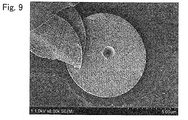
- the primary particle of the temperature-responsive hygroscopic material produced as above was frozen thereafter cut with a microtome (Cryo-Microtome, manufactured by Leica Microsystems). A cross section of the particle was observed by means of an SEM (scanning electron microscope). The observed SEM image is shown in Fig. 9 .
- the hole at the center is made by ion milling processing and does not reflect tissue of sample.
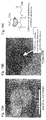
- Fig. 10A shows a mapping image of sum of secondary ion intensities of 12 C, 13 CH, 16 O, 17 OH, 24 C 2 , 25 C 2 H, 26 CN, 42 CNO and 80 SO 3 which were detected relatively strongly by TOF-SIMS.
- FIG. 10B shows an image of secondary ion of 42 CNO which is a unique (not existing in the mesoporous body skeleton or aminopropyl group on the surface) structure to the temperature sensitive molecule.
- Fig. 10C shows the position of 42 CNO structure at the temperature sensitive molecule used in Examples.
- Fig. 11A shows TOF-SIMS spectrum.
- Fig. 11B shows the position of carboxyl group at the temperature sensitive molecule.
- a temperature-responsive hygroscopic material according to Example 3 was produced in the same way as in Example 1, except that: the following (3)" was carried out instead of the introduction step (3); the powder obtained in the introduction step (8) was collected; and the steps (1) to (8) were repeated. (3)" The contents of the flask were heated to 60°C with argon flow at 50 ml/min of flowing amount, kept for 48 hours, thereafter naturally cooled.
- a temperature-responsive hygroscopic material according to Comparative Example 1 was synthesized by the following introduction steps (1) to (9) which are conventional techniques.
- the mesoporous body used in Example 1 was used as a main raw material.
- the mesoporous body used in Examples in which the temperature sensitive molecule was not introduced was used to carry out the following evaluation.
Landscapes
- Chemical & Material Sciences (AREA)
- Analytical Chemistry (AREA)
- Organic Chemistry (AREA)
- Chemical Kinetics & Catalysis (AREA)
- Engineering & Computer Science (AREA)
- Nanotechnology (AREA)
- Inorganic Chemistry (AREA)
- Solid-Sorbent Or Filter-Aiding Compositions (AREA)
- Silicon Compounds (AREA)
- Silicates, Zeolites, And Molecular Sieves (AREA)
- Drying Of Gases (AREA)
Abstract
Description
- The present invention relates to a temperature-responsive hygroscopic material and a method for producing the same.
- A temperature-responsive hygroscopic material, which absorbs and releases moisture in the air according to temperature variation, is conventionally used in desiccant type dehumidifiers and air conditioners. Even if the temperature-responsive hygroscopic material degrades its hygroscopicity by absorbing moisture, it can recover the hygroscopicity by releasing moisture under predetermined conditions. Therefore, the temperature-responsive hygroscopic material is repeatedly used as a recyclable hygroscopic material.
- As an example of such a temperature-responsive hygroscopic material, Non-Patent Literature 1 discloses a composite silica gel in which a temperature sensitive polymer and mesoporous silica gel are composited. It is disclosed that the moisture adsorption amount of the composite silica gel decreases at a temperature higher than the phase transition temperature of the temperature sensitive polymer. The composite silica gel is produced by: immersing mesoporous silica in a mixture solution of monomers of the temperature sensitive polymer and a polymerization initiator; thereafter causing thermal polymerization.
-
Patent Literature 1 discloses: a membrane electrode assembly including a temperature-responsive layer in which a temperature-responsive material is chemically bonded with a porous layer in pores of the porous layer; and living radical polymerization as a method for producing the temperature-responsive layer. It is described that the temperature-responsive material is difficult to be infiltrated or retained in pores of the porous layer when the average pore diameter of the porous layer is less than 50 nm, since the pores are too small.Patent Literature 2 discloses a temperature sensitive adsorption material including porous silica whose outer surface (surface other than the inner surfaces of pores) is uniformly covered with a small amount of a temperature sensitive polymer, wherein the inlet diameters of pores of the porous silica can be controlled by temperature control. - Non-Patent Literature 1: ICHIHASHI Toshio and NAKANO Yoshio, Characteristics of Water Vapor Adsorption and Desorption in Thermo-Sensitive Mesoporous Silica Gel/Polymer Gel, KAGAKU KOGAKU RONBUNSHU, Vol. 34, pp. 471-476, 2008
-
- Patent Literature 1:
JP 2013-131290 A - Patent Literature 2:
JP 2012-035179 A - According to the composite silica gel disclosed in
Non-Patent Literature 1, the adsorption amount of water vapor increases at a temperature lower than Lower Critical Solution temperature (LCST) of the temperature sensitive polymer in water, and decreases at a temperature higher than the LCST. Therefore, it is possible to lower the temperature at which the composite silica gel regenerates and to reduce energy required for the regeneration. However, there is a problem that the composite silica gel disclosed in Non-Patent Literature 1 has a small variation in hygroscopic property according to temperature variation. - Accordingly, an object of the present invention is to provide a temperature-responsive hygroscopic material having a large variation in hygroscopic property according to temperature variation, and a method for producing the temperature-responsive hygroscopic material.
- As a result of intensive studies, the inventors of the present invention found the following: by preliminarily polymerizing monomers of a temperature sensitive molecule to produce the temperature sensitive molecule, and chemically bonding a functional group of the temperature sensitive molecule and a functional group on the surface of a mesoporous body having a predetermined average pore diameter, it is possible to uniformly retain more temperature sensitive molecules in pores of the mesoporous body than before and to have a larger variation in hygroscopic property according to temperature variation than that of conventional materials.
- The present invention has been made based on the above finding.
- In order to solve the above problem, the present invention takes the following means. That is, a first aspect of the present invention is a temperature-responsive hygroscopic material including a mesoporous body having an average pore diameter equal to or greater than 2 nm and smaller than 50 nm and a temperature sensitive molecule chemically bonded with the mesoporous body inside a pore of the mesoporous body.
- In the present invention, the "temperature sensitive molecule" represents a molecule which has a LCST in water and shows hydrophilicity at a temperature lower than the LCST and hydrophobicity at a temperature higher than the LCST.
- In the first aspect of the present invention and a second aspect shown below, it is preferable that the temperature sensitive molecule has a number average molecular weight equal to or greater than 2000 and smaller than or equal to 5000.
- In the first aspect of the present invention, it is preferable that an introduced amount of the temperature sensitive molecule is equal to or greater than 5.2 mass% and smaller than or equal to 21.4 mass%.
- The second aspect of the present invention is a method for producing a temperature-responsive hygroscopic material, the method including a step of causing, in a solvent including an activator and a coupling agent, a coupling reaction of: a mesoporous body having an average pore diameter equal to or greater than 2 nm and smaller than 50 nm and having a functional group on a surface thereof; and a temperature sensitive molecule having a functional group which can undergo a coupling reaction with the functional group on the surface of the mesoporous body.
- In the second aspect of the present invention, it is preferable that the functional group of the temperature sensitive molecule which can undergo a coupling reaction with the functional group on the surface of the mesoporous body is a functional group which the temperature sensitive molecule does not originally have and is preliminarily added to the temperature sensitive molecule. In addition, it is preferable that the functional group which can undergo a coupling reaction with the functional group on the surface of the mesoporous body is positioned at an end portion of the temperature sensitive molecule.
- According to the present invention, it is possible to provide: a temperature-responsive hygroscopic material in which temperature sensitive molecules are uniformly retained in pores of the mesoporous body, the temperature-responsive hygroscopic material having a large variation in hygroscopic property according to temperature variation; and a method for producing the temperature-responsive hygroscopic material.
-
-
Fig. 1A is a schematic view of a primary particle (temperature-responsive hygroscopic material particle 10) of a temperature-responsive hygroscopic material according to one embodiment of the present invention; -
Fig. 1B is a cross-sectional view taken along the line Ib-Ib inFig. 1A ; -
Fig. 2A is an enlarged view of the area shown by IIa inFig. 1B ; -
Fig. 2B is a view of amesoporous particle 1 seen from the same viewpoint as inFig. 2A ; -
Fig. 2C is a view showing a state in which a temperaturesensitive molecule 4,activator 5 andcoupling agent 6 are introduced in apore 3, seen from the same viewpoint as inFigs. 2A and 2B ; -
Fig. 2D is a view schematically showing a state in which a coupling reaction partly progresses, seen from the same viewpoint as inFigs. 2A to 2C ; -
Fig. 3 is a view schematically showing one embodiment of the production method of the present invention; -
Fig. 4 is a view showing measurement results of isothermal lines of water vapor adsorption of Example 1; -
Fig. 5 is a view showing measurement results of isothermal lines of water vapor adsorption of Example 2; -
Fig. 6 is a view showing measurement results of isothermal lines of water vapor adsorption of Example 3; -
Fig. 7 is a view showing measurement results of isothermal lines of water vapor adsorption of Comparative Example 1; -
Fig. 8 is a view showing measurement results of isothermal lines of water vapor adsorption of Comparative Example 2; -
Fig. 9 is a SEM image of a cut surface of a primary particle of a temperature-responsive hygroscopic material according to Example 2; -
Fig. 10A is a TOF-SIMS image of all ion species at a cut surface of the primary particle of the temperature-responsive hygroscopic material according to Example 2; -
Fig. 10B is a TOF-SIMS image of 42CNO ions at the cut surface; -
Fig. 10C is a view showing the position of 42CNO structure in the temperature sensitive molecule used in Examples; -
Fig. 11A is a TOF-SIMS spectrum at the cut surface of the primary particle of the temperature-responsive hygroscopic material according to Example 2; -
Fig. 11B is a view showing the position of a carboxyl group in the temperature sensitive molecule; -
Fig. 12 is a graph in which variation amount (Rh50(H)-Rh50(L)) of relative humidity Rh50 according to temperature when each of the temperature-responsive hygroscopic materials according to Examples 1 to 3 and Comparative Examples 1 and 2 adsorbs moisture in an amount of 50% of the maximum adsorption amount is plotted with respect to the introduced amount of the temperature sensitive molecule. - Hereinafter the present invention will be described. The embodiments shown below are examples of the present invention, and the present invention is not limited to the embodiments shown below.
- The first aspect of the present invention is a temperature-responsive hygroscopic material including a mesoporous body having an average pore diameter equal to or greater than 2 nm and smaller than 50 nm and a temperature sensitive molecule chemically bonded with the mesoporous body inside a pore of the mesoporous body.
-
Fig. 1 is a schematic view of a primary particle (temperature-responsive hygroscopic material particle 10) of the temperature-responsive hygroscopic material according to one embodiment of the present invention. The temperature-responsivehygroscopic material particle 10 includes a temperature sensitive molecule 4 (not shown inFig. 1 ) chemically bonded with a mesoporous body inside apore 3 of a primary particle (mesoporous particle 1) of the mesoporous body.Fig. 1A is a schematic view of the temperature-responsive hygroscopic material particle 10 (inFig. 1 , same as themesoporous particle 1 in appearance) seen from an opening direction of thepore 3 of themesoporous particle 1, andFig. 1B is a cross-sectional view taken along the line Ib-Ib inFig. 1A . As shown inFigs. 1A and 1B , themesoporous particle 1 includes aparticle skeleton 2 and a plurality ofpores 3. -
Fig. 2A is an enlarged view of the area shown by IIa inFig. 1B . As shown inFig. 2A , the temperaturesensitive molecule 4 is chemically bonded (shown by X inFig. 2A ) with theparticle skeleton 2 of themesoporous particle 1 and uniformly retained inside thepore 3. - The temperature-responsive hygroscopic material including the temperature-responsive
hygroscopic material particle 10 having such a structure can be produced for example by a method for producing a temperature-responsive hygroscopic material according to the second aspect of the present invention. - The second aspect of the present invention is a method for producing a temperature-responsive hygroscopic material, the method including a step of causing, in a solvent including an activator and a coupling agent, a coupling reaction of: a mesoporous body having an average pore diameter equal to or greater than 2 nm and smaller than 50 nm and having a functional group on a surface thereof; and a temperature sensitive molecule having a functional group which can undergo a coupling reaction with the functional group on the surface of the mesoporous body.
- According to the production method of the present invention, it is possible to uniformly retain temperature sensitive molecules inside pores of the mesoporous body.
- In the method for producing the composite silica gel described in
Non-Patent Literature 1, mesoporous silica is immersed in a mixture solution of monomers of a temperature sensitive polymer and a polymerization initiator, thereafter the temperature sensitive polymer is retained inside a pore of the mesoporous body by thermal polymerization. With this method, it is difficult to further introduce monomers and polymerization agent into the pore after the monomers introduced in the pore earlier are polymerized, due to steric hindrance of generally bulky temperature sensitive polymers. Thus, it can be considered that the composite silica gel described inNon-Patent Literature 1 is small in hygroscopic property according to temperature variation, since temperature sensitive polymers are not uniformly retained in pores of the mesoporous silica gel and the retaining amount of the temperature sensitive polymers is insufficient. - In contrast, with the production method of the present invention, by preliminary polymerizing monomers of a temperature sensitive molecule to produce the temperature sensitive molecule, and chemically bonding a functional group of the temperature sensitive molecule and a functional group on the surface of a mesoporous body having a predetermined average pore diameter, it is possible to uniformly retain more temperature sensitive molecules in pores of the mesoporous body than before. Therefore, it is possible to have a large variation in hygroscopic property according to temperature variation. The temperature-responsive hygroscopic material having such a property can absorb and release moisture (regenerate) in wider ranges of temperature and relative humidity than those of conventional materials. Therefore, it can be employed as a dehumidifying material more versatile than conventional materials.
-
Fig. 3 is a view schematically showing one embodiment of the production method of the present invention. In the production method shown inFig. 3 , a mesoporous body and a temperature sensitive molecule are used as raw materials. A temperature-responsive hygroscopic material is produced by coupling reaction of the mesoporous body and the temperature sensitive molecule, under existence of an activator and coupling agent. - Hereinafter, each configuration of the method for producing a temperature-responsive hygroscopic material will be described referring to
Fig. 2 . - The mesoporous body used in the production method of the present invention is a porous body having pores (meso pores) whose average pore diameter is equal to or greater than 2 nm and smaller than 50 nm. The mesoporous body which can be used for the present invention is not particularly limited as long as having such pores, and for example a mesoporous body described in JPH11-114410 A can be used. In view of improving the hygroscopic property of the temperature-responsive hygroscopic material produced with the production method of the present invention, the average pore diameter of the mesoporous body is preferably equal to or greater than 2 nm and smaller than or equal to 30 nm, more preferably equal to or greater than 2 nm and smaller than 10 nm and further preferably equal to or greater than 2 nm and smaller than or equal to 4 nm.
-
Fig. 2B is a view of themesoporous particle 1 in which the temperaturesensitive molecule 4 is not chemically bonded, seen from the same viewpoint as inFig. 2A . As shown inFig. 2B , themesoporous particle 1 includes, on the surface of theparticle skeleton 2, afunctional group 2a having a binding property. Thefunctional group 2a can undergo a coupling reaction with afunctional group 4a of the temperaturesensitive molecule 4 which is described below. Undergoing a coupling reaction with thefunctional group 4a of the temperaturesensitive molecule 4, thefunctional group 2a can form a chemical bond X, as shown inFig. 2A . Therefore, themesoporous body 1 can strongly retain the temperaturesensitive molecule 4. Examples of the functional group having a binding property which is on the surface of the mesoporous body includes an amino group, carboxyl group, hydroxyl group, epoxy group, vinyl group, isocyanate group, thiol group, sulfide group, ureido group, acryloxy group and methacryloxy group. - The temperature sensitive molecule used in the production method of the present invention has a LCST in water, and shows hydrophilicity at a temperature lower than the LCST and shows hydrophobicity at a temperature higher than the LCST.
- The temperature sensitive molecule is not particularly limited as long as the molecule has such a property. In view of easy introduction of temperature sensitive molecules into pores of the mesoporous body having an average pore diameter equal to or greater than 2 nm and smaller than 50 nm with the method for producing the temperature-responsive hygroscopic material described below, the molecule preferably has a number average molecular weight equal to or greater than 2000 and smaller than or equal to 5000. Examples of the temperature sensitive molecule include oligomers which include, as constituent units, monomers forming the temperature sensitive polymers described in D. Roy, W. L. A. Brooks and B. S. Sumerlin, Chem. Soc. Rev., 2013, 42, 7214-7243.. Specifically, N-isopropylacrylamide (NIPAM) oligomer, N-n-propylacrylamide (NNPAM) oligomer, N-cyclopropylacrylamide (NCPAM) oligomer and N,N-dimethylacrylamide (DEAM) oligomer can be given. These oligomers have different LCST from each other. Therefore, by employing these different temperature sensitive molecules, it is possible to produce a temperature-responsive hygroscopic material whose hygroscopic property varies according to predetermined temperatures.
-
Fig. 2C is a view showing a state in which the temperaturesensitive molecule 4, theactivator 5 and thecoupling agent 6 are introduced in thepore 3, seen from the same viewpoint as inFigs. 2A and 2B . The method of introducing the temperature sensitive molecule, activator and coupling agent into the pore of the mesoporous body is not particularly limited, and for example a method of: dispersing the mesoporous body, temperature sensitive molecule, activator and coupling agent in a suitable solvent; and impregnating the inside of pores of the mesoporous body with the temperature sensitive molecule, activator and coupling agent can be given. At this time, decompression, stirring and the like can be carried out in order to promote introduction of each substance into pores of the mesoporous body. - The temperature sensitive molecule includes a functional group which can undergo a coupling reaction with the functional group on the surface of the mesoporous body. Therefore, the functional group of the temperature sensitive molecule can react with the functional group on the surface of the mesoporous body, to form a chemical bond. Thus, the mesoporous body can strongly retain the temperature sensitive molecule. In an example shown by
Fig. 2C , the temperaturesensitive molecule 4 has, on one side thereof, thefunctional group 4a which can undergo a coupling reaction with thefunctional group 2a on the surface of the mesoporous body. The functional group provided with the temperature sensitive molecule is not particularly limited as long as it can undergo a coupling reaction with the functional group on the surface of the mesoporous body. In a case where the surface of the mesoporous body has an amino group, preferable examples of the functional group provided with the temperature sensitive molecule include a carboxyl group, isocyanate group, epoxy group, vinyl group, carbonyl group and hydroxyl group. A vinyl group and hydroxyl group cannot undergo coupling reactions directly. However, they convert to functional groups (e.g. carboxyl group) which can undergo coupling reactions via another reaction, to thereby undergo coupling reactions. As described, the "functional groups which can undergo coupling reactions" include functional groups which undergo coupling reactions indirectly. - The functional group of the temperature sensitive molecule may be a functional group which is preliminary added and which the temperature sensitive molecule does not originally have. In addition, the functional group, which can undergo a coupling reaction with the functional group on the surface of the mesoporous body, is preferably positioned at an end portion of the temperature sensitive molecule.
- As the original structure, some temperature sensitive molecules do not have any functional group which can undergo a coupling reaction with the functional group on the surface of the mesoporous body, or some temperature sensitive molecules have a plurality of functional groups which can undergo coupling reactions. In a case where a temperature sensitive molecule not having a functional group which can undergo a coupling reaction with the functional group on the surface of the mesoporous body is used, it is possible to cause a coupling reaction with the functional group on the surface of the mesoporous body, by preliminary adding a functional group which can undergo a coupling reaction with the functional group on the surface of the mesoporous body to the temperature sensitive molecule, before causing a coupling reaction. In a case where a temperature sensitive molecule having a plurality of functional groups which can undergo coupling reactions with functional groups on the surface of the mesoporous body is used, it is possible to prevent movement of the temperature sensitive molecule from being obstructed due to coupling reactions of the plurality of functional groups of the temperature sensitive molecule and the functional groups on the surface of the mesoporous body, by preliminarily adding a functional group different from the functional groups which are originally provided with the temperature sensitive molecule, to a desirable position. The method of adding a functional group which is not originally provided with the temperature sensitive molecule to the temperature sensitive molecule is not particularly limited, and a conventional known method can be employed.
- With the functional group positioned at an end portion of the temperature sensitive molecule and capable of undergoing a coupling reaction with the functional group on the surface of the mesoporous body, it is possible to fixate a sufficient amount of temperature sensitive molecules on the surface of the mesoporous body, without obstructing movement of the temperature sensitive molecules. The "movement of the temperature sensitive molecules" means the movement necessary for temperature responsiveness. It means that the temperature sensitive molecules are in a hydration state with the molecular chain extending at a temperature lower than the LCST, and is in a dehydration state with the molecular chain bunching up at a temperature higher than the LCST.
- The activator used in the production method of the present invention is a reagent which activates the functional group on the surface of the mesoporous body or the functional group of the temperature sensitive molecule upon coupling reaction. The activator promotes a coupling reaction when used with a coupling agent. For example in a case where the functional group on the surface of the mesoporous body is an amino group and the functional group of the temperature sensitive molecule is a carboxyl group, examples of activators which can be used include activation reagents of carboxylic acid such as N-hydroxysuccinimide (NHS), 1-hydroxybenzotriazole (HOBt), 1-hydroxy-7-azabenzotriazole (HOAt) and pentafluorophenol.
- The coupling agent employed in the production method of the present invention is a reagent which activates the functional group on the surface of the mesoporous body or the functional group of the temperature sensitive molecule upon coupling reaction. The coupling agent promotes a coupling reaction. For example in a case where the functional group on the surface of the mesoporous body is an amino group and a functional group provided for the temperature sensitive molecule is a carboxyl group, preferably the coupling agent is a dehydration condensation agent which promotes an elimination-addition reaction. Examples thereof include carbodiimide-based condensation agents such as 1-ethyl-3-(3-dimathylaminopropyl)carbodiimide hydrochloride, N,N'-dicyclohexylcarbodiimide (DCC) and N,N'-diisopropylcarbodiimide (DIC).
- The kind of coupling reaction in the production method of the present invention is not particularly limited as long as the functional group on the surface of the mesoporous body and the functional group of the temperature sensitive molecule selectively react with each other to form a chemical bond, under existence of an activator and coupling agent.
-
Fig. 2D is a view schematically showing a state in which a coupling reaction partly progresses, in the same viewpoint as inFigs. 2A to 2C . The coupling reaction shown inFig. 2D is an elimination-addition reaction. Thefunctional group 2a on the surface of theparticle skeleton 2 of themesoporous particle 1 and thefunctional group 4a of the temperaturesensitive molecule 4 are coupled at a ratio of 1:1. - In an elimination-addition reaction, intermediates and other various kinds of byproducts can be made in the reaction of: the functional group on the surface of the mesoporous body or the functional group of the temperature sensitive molecule; and the activator or the coupling agent. Here, technically, it is regarded that a leaving
group 7 is formed when a part of thefunctional group 2a on the surface of theparticle skeleton 2 of themesoporous particle 1 and a part of thefunctional group 4a of the temperaturesensitive molecule 4 are bonded. For example, in a case where thefunctional group 2a is an amino group and thefunctional group 4a is a carboxyl group, it can be technically regarded that a water molecule is eliminated as the leavinggroup 7. In this case, an amide bond is formed as the chemical bond X. - Reaction temperature and reaction time in the coupling reaction is adequately determined depending on the kind of coupling reaction and the kinds of activator and coupling agent to be used. For example when the functional group on the surface of the mesoporous body is an amino group and the functional group of the temperature sensitive molecule is a carboxyl group, a coupling reaction (elimination-addition reaction) can be completed with a reaction time of 24 to 48 hours in a temperature range of 0°C to 80°C. If the added amount is insufficient, the step of coupling reaction can be repeated.
- The introduced amount of the temperature sensitive molecule introduced to the mesoporous body is preferably equal to or greater than 5.2 mass% and smaller than or equal to 21.4 mass%, and more preferably equal to or greater than 8.4 mass% and smaller than or equal to 18.9 mass%, in view of realizing a large variation in hygroscopic property according to temperature variation. The temperature sensitive molecule can be retained on a surface area other than pores of the mesoporous body.
- A temperature-responsive hygroscopic material according to Example 1 was synthesized by means of introduction steps (1) to (8) shown below. The followings were used as main raw materials.
- Mesoporous body: spherical aminopropyl silica gel (manufactured by GL Sciences Inc.)
average particle diameter: 10 µm
specific surface area: 412 m2/g
average pore diameter: 10.1 nm
Temperature sensitive molecule: carboxyl termination N-isopropylamide (NIPAM) oligomer (manufactured by Sigma-Aldrich) number average molecular weight: two kinds of 2000 and 5000 -
- (1) In a 300 ml four neck flask, 4.50 g of mesoporous body, 3.60 g of temperature sensitive molecule, 0.26 g of hydroxysuccinimide (NHS), 0.42 g of 1-ethyl-3-(3-dimethylaminopropyl)carbodiimide hydrochloride (EDC) and 75 ml of dimethylformamide (DNF) were put.
- (2) In order to deaerate hole portions of the mesoporous body, the inside of the flask was decompressed while the contents of the flask were stirred with a stir bar for 5 minutes, followed by argon flow at 50 ml/min of flowing amount for 5 minutes. This operation was repeated five times in total, whereby the hole portions were deaerated.
- (3) The contents of the flask were cooled to 0°C with argon flow at 50 ml/min of flowing amount, which was kept for 24 hours.
- (4) The reaction liquid thus obtained was added to 525 ml of deionized water. The resulting liquid was put in twelve centrifuge tubes each having a capacity of 50 ml, and subjected to centrifugation at 15000 rpm for 2 minutes.
- (5) Supernatant was removed, and 45 ml of deionized water was added to each of the centrifuge tubes. The contents of the centrifuge tubes were subjected to centrifugation at 15000 rpm for 5 minutes.
- (6) Supernatant was removed, and 45 ml of deionized water was added to each of the centrifuge tubes. The contents of the centrifuge tubes were subjected to centrifugation at 15000 rpm for 7 minutes.
- (7) Supernatant was removed, and 45 ml of deionized water was added to each of the centrifuge tubes. The contents of the centrifuge tubes were subjected to centrifugation at 15000 rpm for 10 minutes.
- (8) The obtained deposition was dried under reduced pressure at 70°C for 12 hours, whereby a temperature-responsive material powder according to Example 1 was obtained.
- Weights of the mesoporous body before the temperature sensitive molecule was introduced and the temperature-responsive hygroscopic material after the temperature sensitive molecule was introduced were measured. After that, the mesoporous body and temperature-responsive hygroscopic material were separately put in containers made of alumina with lid, and heated in the atmosphere at 1, 000°C for 24 hours. Thereafter, the weight of residual silica was measured. Then, the introduced amount of the temperature sensitive molecule was calculated by: measuring the weight reduction ratio of the mesoporous body and temperature-responsive hygroscopic material from their weights before and after heating; and subtracting the weight reduction ratio of the mesoporous body from the weight reduction ratio of the temperature-responsive hygroscopic material. Result is shown in Table 1.
- Isothermal lines of water vapor adsorption of poly(N-isopropylacrylamide) (PNIPAM) at temperatures lower (20°C) and higher (50°C) than the LCST (32°C) were measured by means of BELSORP-max (manufactured by BEL Japan Inc.). Results are shown in
Fig. 4 . - Further, the relative humidity Rh50 (Rh50 (L) means Rh50 at 20°C, Rh50(H) means Rh50 at 50°C) at which the temperature-responsive hygroscopic material adsorbs 50% of the maximum adsorption amount at each temperature was measured to obtain temperature variation at Rh50 (Rh50(H)-Rh50(L)). Rh50(L) and Rh50(H) are shown in
Fig. 4 , and measurement result is shown in Table 2.Fig. 12 is a view in which Rh50(H)-Rh50(L) is plotted with respect to the introduced amount of the temperature sensitive molecule. - A temperature-responsive hygroscopic material according to Example 2 was synthesized in the same way as in Example 1, except that: the following (3)' was carried out instead of the introduction step (3) in Example 1; the powder obtained in the introduction step (8) was collected; and the steps (1) to (8) were repeated. (3)' The contents of the flask were heated to 60°C with argon flow at 50 ml/min of flowing amount, kept for 24 hours, thereafter naturally cooled.
- The introduced amount of the temperature sensitive molecule was calculated in the same way as in Example 1. Result is shown in Table 1.
- Isothermal line of water vapor adsorption and Rh50 were measured in the same way as in Example 1. Results are shown in
Figs. 5 ,12 and Table 2. - The primary particle of the temperature-responsive hygroscopic material produced as above was frozen thereafter cut with a microtome (Cryo-Microtome, manufactured by Leica Microsystems). A cross section of the particle was observed by means of an SEM (scanning electron microscope). The observed SEM image is shown in
Fig. 9 . InFig. 9 , the hole at the center is made by ion milling processing and does not reflect tissue of sample. - Thereafter, the amount of H-C=O bond existing on the cross section was measured by mapping measurement at approximately 1 µm of spacial resolution, by means of TOF-SIMS (TRIFT V nanoTOF, manufactured by ULVAC-PHI, Inc.). Whereby, whether or not the temperature sensitive molecule introduced from the surface of spherical aminopropyl silica reached the center of the sphere was evaluated.
Fig. 10A shows a mapping image of sum of secondary ion intensities of 12C, 13CH, 16O, 17OH, 24C2, 25C2H, 26CN, 42CNO and 80SO3 which were detected relatively strongly by TOF-SIMS.Fig. 10B shows an image of secondary ion of 42CNO which is a unique (not existing in the mesoporous body skeleton or aminopropyl group on the surface) structure to the temperature sensitive molecule.Fig. 10C shows the position of 42CNO structure at the temperature sensitive molecule used in Examples. - Further, in order to confirm whether or not an unreacted temperature sensitive molecule exists, the peak (mass number 45) corresponding to carboxyl group was examined.
Fig. 11A shows TOF-SIMS spectrum.Fig. 11B shows the position of carboxyl group at the temperature sensitive molecule. - A temperature-responsive hygroscopic material according to Example 3 was produced in the same way as in Example 1, except that: the following (3)" was carried out instead of the introduction step (3); the powder obtained in the introduction step (8) was collected; and the steps (1) to (8) were repeated. (3)" The contents of the flask were heated to 60°C with argon flow at 50 ml/min of flowing amount, kept for 48 hours, thereafter naturally cooled.
- The introduced amount of the temperature sensitive molecule was calculated in the same way as in Example 1. Result is shown in Table 1.
- Isothermal line of water vapor adsorption and Rh50 were measured in the same way as in Example 1. Results are shown in
Figs. 6 ,12 and Table 2. - A temperature-responsive hygroscopic material according to Comparative Example 1 was synthesized by the following introduction steps (1) to (9) which are conventional techniques. The mesoporous body used in Example 1 was used as a main raw material.
-
- (1) In a 100 ml recovery flask, 7.00 g (2 mol/l) of N-isopropylamide monomer (NIPAM), 24.41 g of ethanol and 0.01 g (2 mmol/l) of azobisisobuthyronitril (AIBN) were put, and subjected to argon bubbling at 100 ml/min for 15 minutes while stirred with a stir bar.
- (2) In the recovery flask of (1), 7.00 g of mesoporous body was added. The content of the flask was further subjected to argon bubbling at 100 ml/min.
- (3) A three-way cock was attached to the recovery flask. In order to deaerate hole portions of silica, inside of the flask was decompressed for 5 minutes, thereafter subjected to argon flow at 50 ml/min of flowing amount for 5 minutes. This operation was repeated three times in total, whereby deaeration was carried out.
- (4) The recovery flask was sealed being filled with argon. Then, polymerization was carried out at 70°C for 12 hours.
- (5) After polymerization, heat source was removed and the content of the flask was cooled to room temperature.
- (6) The reaction liquid thus obtained was put in a 50 ml centrifuge tube and subjected to centrifugation at 15000 rpm for 10 minutes.
- (7) Supernatant was removed and deposited silica was redispersed in 540 ml of deionized water. The resulting material was divided in twelve 50 ml centrifuge tubes and subjected to centrifugation at 15000 rpm for 10 minutes.
- (8) The cleaning operation of (7) was repeated four times in total.
- (9) The obtained deposition was dried under reduced pressure at 70°C for 12 hours.
- When NIPAM and AIBN were polymerized in ethanol at the same concentration, and temperature for the same retention time as in (1), the average molecular weight was Mn=9,892.
- The introduced amount of the temperature sensitive molecule was calculated in the same way as in Example 1. Result is shown in Table 1.
- The isothermal line of water vapor adsorption and Rh50 were measured in the same way as in Example 1. Results are shown in
Figs. 7 ,12 and Table 2. - The mesoporous body used in Examples in which the temperature sensitive molecule was not introduced was used to carry out the following evaluation.
- The isothermal line of water vapor adsorption and Rh50 were measured in the same way as in Example 1. Results are shown in
Figs. 8 ,12 and Table 2.[Table 1] number average molecular weight introduced amount (mass%) Example 1 2,000 8.4 Example 2 2,000 18.9 Example 3 5,000 21.4 Comparative Example 1 approx. 10,000 3.5 [Table 2] number average molecular weight Rh50(L)[%] Rh50(H)[%] Rh50(H)-Rh50(L) [%] Example 1 2,000 63.1 77.3 14.2 Example 2 2.000 78 86.4 8.4 Example 3 5.000 75 82.3 7.3 Comparative Example 1 approx. 10.000 79.9 82.1 2.2 Comparative Example 2 - 76.3 77.1 0.8 - From Table 1, it was confirmed that each of the temperature-responsive hygroscopic materials according to Examples 1 to 3 synthesized by the production method of the present invention had more temperature sensitive molecules modified to the mesoporous body than that of the temperature-responsive hygroscopic material according to Comparative Example 1 synthesized by the conventional technique.
- From
Figs. 4 to 8 ,12 and Table 2, it was confirmed that each of the temperature-responsive hygroscopic materials according to Examples 1 to 3 synthesized by the production method of the present invention had a larger variation in hygroscopic property according to temperature variation than that of the temperature-responsive hygroscopic material according to Comparative Example 1 synthesized by the conventional technique and the mesoporous body according to Comparative Example 2 not having the temperature sensitive molecule. As for difference in relative humidity Rh50 according to temperature variation, Example 1 which was the most effective example showed 14.2%, and even Example 3 which was the least effective example showed twice the value or more of Comparative Example 1. Further, the curve shown inFig. 12 shows that the difference in relative humidity Rh50 according to temperature variation has a value of 7.3%, which is the result of Example 3, or more, with the introduced amount of the temperature sensitive molecule equal to or greater than 5.2 mass% and smaller than or equal to 21.4 mass%. It can be said that the hygroscopic property according to temperature variation has a variation large enough for practical use, with such a range of difference in relative humidity Rh50 according to temperature variation. - From
Figs. 10A and 10B , it was confirmed that the temperature sensitive molecule was uniformly introduced into mesoporous body in Example 2, since the temperature sensitive molecule was detected even at the center of the primary particle of the temperature-responsive hygroscopic material (mesoporous body), and the detection intensity was nearly uniform over the entire cross section. Further, it can be considered that the temperature sensitive molecule is strongly bonded with the mesoporous body, since the temperature sensitive molecule is distributed over the entire mesoporous body even though cleaning was repeatedly carried out several times in the step of synthesis. - In addition, in TOF-SIMS spectrum shown in
Fig. 11A , the peak (mass number 45) corresponding to a carboxyl group was not detected. Therefore, it was confirmed that the temperature sensitive molecule introduced in a pore of the mesoporous body was bonded with the surface of the mesoporous body via an amide group. -
- 1
- mesoporous particle
- 2
- particle skeleton
- 2a
- functional group
- 3
- pore
- 4
- temperature sensitive molecule
- 4a
- functional group
- 5
- activator
- 6
- coupling agent
- 7
- leaving group
- 10
- temperature-responsive hygroscopic material particle
Claims (7)
- A temperature-responsive hygroscopic material comprising:a mesoporous body having an average pore diameter equal to or greater than 2 nm and smaller than 50 nm; anda temperature sensitive molecule (4) chemically bonded with the mesoporous body inside a pore (3) of the mesoporous body.
- The temperature-responsive hygroscopic material according to claim 1, wherein the temperature sensitive molecule (4) has a number average molecular weight equal to or greater than 2000 and smaller than or equal to 5000.
- The temperature-responsive hygroscopic material according to claim 1 or 2, wherein an introduced amount of the temperature sensitive molecule (4) is equal to or greater than 5.2 mass% and smaller than or equal to 21.4 mass%.
- A method for producing a temperature-responsive hygroscopic material, the method comprising a step of
causing, in a solvent comprising an activator (5) and a coupling agent (6), a coupling reaction of: a mesoporous body having an average pore diameter equal to or greater than 2 nm and smaller than 50 nm and having a functional group (2a) on a surface thereof; and a temperature sensitive molecule (4) having a functional group (4a) which can undergo a coupling reaction with the functional group (2a) on the surface of the mesoporous body. - The method for producing a temperature-responsive hygroscopic material according to claim 4, wherein the temperature sensitive molecule (4) has a number average molecular weight equal to or greater than 2000 and smaller than or equal to 5000.
- The method for producing a temperature-responsive hygroscopic material according to claim 4 or 5, wherein the functional group (4a) of the temperature sensitive molecule (4) which can undergo a coupling reaction with the functional group (2a) on the surface of the mesoporous body is a functional group (4a) which the temperature sensitive molecule (4) does not originally have and is preliminarily added to the temperature sensitive molecule (4).
- The method for producing a temperature-responsive hygroscopic material according to any one of claims 4 to 6, wherein the functional group (4a) which can undergo a coupling reaction with the functional group (2a) on the surface of the mesoporous body is positioned at an end portion of the temperature sensitive molecule (4).
Applications Claiming Priority (1)
| Application Number | Priority Date | Filing Date | Title |
|---|---|---|---|
| JP2014236802A JP6443003B2 (en) | 2014-11-21 | 2014-11-21 | Temperature-responsive hygroscopic material and method for producing the same |
Publications (2)
| Publication Number | Publication Date |
|---|---|
| EP3023145A1 true EP3023145A1 (en) | 2016-05-25 |
| EP3023145B1 EP3023145B1 (en) | 2018-07-11 |
Family
ID=55236110
Family Applications (1)
| Application Number | Title | Priority Date | Filing Date |
|---|---|---|---|
| EP15195525.9A Active EP3023145B1 (en) | 2014-11-21 | 2015-11-20 | A method for producing a temperature-responsive hygroscopic material |
Country Status (4)
| Country | Link |
|---|---|
| US (1) | US9889427B2 (en) |
| EP (1) | EP3023145B1 (en) |
| JP (1) | JP6443003B2 (en) |
| CN (1) | CN105622976B (en) |
Families Citing this family (5)
| Publication number | Priority date | Publication date | Assignee | Title |
|---|---|---|---|---|
| DE4122149A1 (en) * | 1990-07-06 | 1992-01-09 | Toyoda Chuo Kenkyusho Kk | ACCESSORIES AND CRYSTAL ELEMENT FOR INFRARED SPECTROSCOPY WITH DAMPERED TOTAL REFLECTION |
| JP6854196B2 (en) * | 2017-06-09 | 2021-04-07 | 株式会社Kri | Water absorption liquid, draw solution and forward osmosis water treatment method |
| JP7117739B2 (en) * | 2017-09-01 | 2022-08-15 | シャープ株式会社 | Absorbent material |
| CN111936597B (en) | 2018-04-05 | 2022-04-12 | 三菱电机株式会社 | Thermal storage material, method for producing the same, and thermal storage tank |
| CN113426424B (en) * | 2021-06-18 | 2023-02-28 | 浙江理工大学 | Temperature-sensitive composite silica gel desiccant and preparation method thereof |
Citations (5)
| Publication number | Priority date | Publication date | Assignee | Title |
|---|---|---|---|---|
| EP0534016A1 (en) * | 1990-04-16 | 1993-03-31 | W.R. Grace & Co.-Conn. | Liquid chromatographic matrices and liquid chromatography using same |
| US20050013988A1 (en) * | 2003-04-16 | 2005-01-20 | Qiang Fu | Stimuli responsive mesoporous materials for control of molecular transport |
| US20060251610A1 (en) * | 2005-05-06 | 2006-11-09 | Canon Kabushiki Kaisha | Structure for separation of physiologically active agent and method for recovering physiologically active agent |
| JP2012035179A (en) | 2010-08-05 | 2012-02-23 | Akita Univ | Temperature sensitive adsorbent and method of manufacturing the same |
| US20130029242A1 (en) * | 2010-04-12 | 2013-01-31 | Sharp Kabushiki Kaisha | Membrane electrode assembly and fuel cell using same |
Family Cites Families (8)
| Publication number | Priority date | Publication date | Assignee | Title |
|---|---|---|---|---|
| JP4158270B2 (en) | 1999-03-19 | 2008-10-01 | 株式会社デンソー | Adsorbent and air conditioner for vehicle |
| JP2005009703A (en) * | 2003-06-17 | 2005-01-13 | Matsushita Electric Ind Co Ltd | Absorption and emission body and cooling / heating system using the same |
| JP2006327854A (en) * | 2005-05-24 | 2006-12-07 | Canon Inc | Mesoporous material thin film, laser emitting part, laser and method for producing mesoporous material thin film |
| DE102006043672A1 (en) | 2006-08-11 | 2008-02-14 | Fraunhofer-Gesellschaft zur Förderung der angewandten Forschung e.V. | Adsorbent and its use in heat accumulators and heat pumps |
| JP2009160495A (en) * | 2007-12-28 | 2009-07-23 | Tokyo Institute Of Technology | Separation agent and method for producing the separation agent |
| JP2012189562A (en) | 2011-03-10 | 2012-10-04 | Cellseed Inc | Temperature-responsive monolithic porous body, manufacturing method thereof, and temperature-responsive chromatography method using the same |
| CN103497292A (en) * | 2013-09-17 | 2014-01-08 | 南昌大学 | Preparation method for thermo-responsive mesoporous silicon nanoparticles |
| JP2015151436A (en) * | 2014-02-13 | 2015-08-24 | セイコーエプソン株式会社 | Stimulus-responsive gel material |
-
2014
- 2014-11-21 JP JP2014236802A patent/JP6443003B2/en active Active
-
2015
- 2015-11-17 US US14/943,572 patent/US9889427B2/en active Active
- 2015-11-18 CN CN201510794359.5A patent/CN105622976B/en active Active
- 2015-11-20 EP EP15195525.9A patent/EP3023145B1/en active Active
Patent Citations (6)
| Publication number | Priority date | Publication date | Assignee | Title |
|---|---|---|---|---|
| EP0534016A1 (en) * | 1990-04-16 | 1993-03-31 | W.R. Grace & Co.-Conn. | Liquid chromatographic matrices and liquid chromatography using same |
| US20050013988A1 (en) * | 2003-04-16 | 2005-01-20 | Qiang Fu | Stimuli responsive mesoporous materials for control of molecular transport |
| US20060251610A1 (en) * | 2005-05-06 | 2006-11-09 | Canon Kabushiki Kaisha | Structure for separation of physiologically active agent and method for recovering physiologically active agent |
| US20130029242A1 (en) * | 2010-04-12 | 2013-01-31 | Sharp Kabushiki Kaisha | Membrane electrode assembly and fuel cell using same |
| JP2013131290A (en) | 2010-04-12 | 2013-07-04 | Sharp Corp | Membrane electrode composite and fuel cell using the same |
| JP2012035179A (en) | 2010-08-05 | 2012-02-23 | Akita Univ | Temperature sensitive adsorbent and method of manufacturing the same |
Non-Patent Citations (2)
| Title |
|---|
| D. ROY; W. L. A. BROOKS; B. S. SUMERLIN, CHEM. SOC. REV., vol. 42, 2013, pages 7214 - 7243 |
| ICHIHASHI TOSHIO; NAKANO YOSHIO: "Characteristics of Water Vapor Adsorption and Desorption in Thermo-Sensitive Mesoporous Silica Gel/Polymer Gel", KAGAKU KOGAKU RONBUNSHU, vol. 34, 2008, pages 471 - 476 |
Also Published As
| Publication number | Publication date |
|---|---|
| EP3023145B1 (en) | 2018-07-11 |
| CN105622976A (en) | 2016-06-01 |
| CN105622976B (en) | 2018-10-02 |
| US9889427B2 (en) | 2018-02-13 |
| JP2016097359A (en) | 2016-05-30 |
| US20160144342A1 (en) | 2016-05-26 |
| JP6443003B2 (en) | 2018-12-26 |
Similar Documents
| Publication | Publication Date | Title |
|---|---|---|
| EP3023145B1 (en) | A method for producing a temperature-responsive hygroscopic material | |
| RU2676067C2 (en) | Sorbent for binding metals and production thereof | |
| Xiong et al. | Layer-by-layer assembly of multilayer polysaccharide coated magnetic nanoparticles for the selective enrichment of glycopeptides | |
| US9285300B2 (en) | Monolithic silicone and method of separation, purification and concentration therewith | |
| CN103703366B (en) | Porous polymer material is for storing the purposes of biological sample | |
| Shen et al. | Immobilization of trypsin via reactive polymer grafting from magnetic nanoparticles for microwave-assisted digestion | |
| Nagase et al. | Thermoresponsive hydrophobic copolymer brushes modified porous monolithic silica for high-resolution bioseparation | |
| Duan et al. | Magnetic cellulose–TiO 2 nanocomposite microspheres for highly selective enrichment of phosphopeptides | |
| CN108311125B (en) | Solid phase micro-extraction coating based on hollow carbon nano material and preparation method thereof | |
| CN112051246A (en) | Synchronous analysis device, preparation method and application of bisphenol A and its halogenated derivatives | |
| US11123656B2 (en) | Separation/analysis method for mixture of oligonucleotides | |
| CN111484629A (en) | A kind of MOFs type molecularly imprinted polymer and its preparation method, pesticide residue fluorescence detection method | |
| JP2002523742A (en) | Capillary column and preparation method | |
| Tan et al. | Glycosyl imprinted mesoporous microspheres for the determination of glycopeptide antibiotics using ultra-high performance liquid chromatography coupled with tandem mass spectrometry | |
| Li et al. | Efficient enrichment of glycopeptides using phenylboronic acid polymer brush modified silica microspheres | |
| Dinc et al. | Inhibitor-assisted synthesis of silica-core microbeads with pepsin-imprinted nanoshells | |
| CN112979893B (en) | Preparation of magnetic fluorescent material @ molecularly imprinted particle and method for preparing composite membrane by using same | |
| Sekine et al. | Freeze-crosslinking approach for preparing carboxymethyl cellulose nanofiber/zirconium hydrogels as fluoride adsorbents | |
| Shutava et al. | Metal organic framework/polyelectrolyte composites for water vapor sorption applications | |
| Li et al. | Preparation and characterization of alkylated polymethacrylate monolithic columns for micro‐HPLC of proteins | |
| CN107250759A (en) | The sensor for the receptive layers being mixed into by mother metal and bulk material is coated | |
| Li et al. | Efficient synthesis of boronate affinity-based catecholamine-imprinted magnetic nanomaterials for trace analysis of catecholamine in human urine | |
| CN104587988A (en) | Anatase type titanium oxide nanometer material monolithic column as well as preparation method and application thereof | |
| Wang et al. | One-pot preparation of boronic acid and PEG bi-functionalized silica particles for separation and purification of catecholamine from rat serum | |
| JP2018058050A (en) | Temperature-responsive hygroscopic material |
Legal Events
| Date | Code | Title | Description |
|---|---|---|---|
| 17P | Request for examination filed |
Effective date: 20151120 |
|
| AK | Designated contracting states |
Kind code of ref document: A1 Designated state(s): AL AT BE BG CH CY CZ DE DK EE ES FI FR GB GR HR HU IE IS IT LI LT LU LV MC MK MT NL NO PL PT RO RS SE SI SK SM TR |
|
| AX | Request for extension of the european patent |
Extension state: BA ME |
|
| PUAI | Public reference made under article 153(3) epc to a published international application that has entered the european phase |
Free format text: ORIGINAL CODE: 0009012 |
|
| STAA | Information on the status of an ep patent application or granted ep patent |
Free format text: STATUS: EXAMINATION IS IN PROGRESS |
|
| 17Q | First examination report despatched |
Effective date: 20161220 |
|
| GRAP | Despatch of communication of intention to grant a patent |
Free format text: ORIGINAL CODE: EPIDOSNIGR1 |
|
| STAA | Information on the status of an ep patent application or granted ep patent |
Free format text: STATUS: GRANT OF PATENT IS INTENDED |
|
| INTG | Intention to grant announced |
Effective date: 20180201 |
|
| GRAS | Grant fee paid |
Free format text: ORIGINAL CODE: EPIDOSNIGR3 |
|
| GRAA | (expected) grant |
Free format text: ORIGINAL CODE: 0009210 |
|
| STAA | Information on the status of an ep patent application or granted ep patent |
Free format text: STATUS: THE PATENT HAS BEEN GRANTED |
|
| AK | Designated contracting states |
Kind code of ref document: B1 Designated state(s): AL AT BE BG CH CY CZ DE DK EE ES FI FR GB GR HR HU IE IS IT LI LT LU LV MC MK MT NL NO PL PT RO RS SE SI SK SM TR |
|
| REG | Reference to a national code |
Ref country code: GB Ref legal event code: FG4D |
|
| REG | Reference to a national code |
Ref country code: CH Ref legal event code: EP |
|
| REG | Reference to a national code |
Ref country code: AT Ref legal event code: REF Ref document number: 1016329 Country of ref document: AT Kind code of ref document: T Effective date: 20180715 |
|
| REG | Reference to a national code |
Ref country code: IE Ref legal event code: FG4D |
|
| REG | Reference to a national code |
Ref country code: DE Ref legal event code: R096 Ref document number: 602015013324 Country of ref document: DE |
|
| REG | Reference to a national code |
Ref country code: DE Ref legal event code: R084 Ref document number: 602015013324 Country of ref document: DE |
|
| REG | Reference to a national code |
Ref country code: GB Ref legal event code: 746 Effective date: 20180829 |
|
| REG | Reference to a national code |
Ref country code: FR Ref legal event code: PLFP Year of fee payment: 4 |
|
| REG | Reference to a national code |
Ref country code: NL Ref legal event code: MP Effective date: 20180711 |
|
| REG | Reference to a national code |
Ref country code: LT Ref legal event code: MG4D |
|
| REG | Reference to a national code |
Ref country code: AT Ref legal event code: MK05 Ref document number: 1016329 Country of ref document: AT Kind code of ref document: T Effective date: 20180711 |
|
| PG25 | Lapsed in a contracting state [announced via postgrant information from national office to epo] |
Ref country code: NL Free format text: LAPSE BECAUSE OF FAILURE TO SUBMIT A TRANSLATION OF THE DESCRIPTION OR TO PAY THE FEE WITHIN THE PRESCRIBED TIME-LIMIT Effective date: 20180711 |
|
| PG25 | Lapsed in a contracting state [announced via postgrant information from national office to epo] |
Ref country code: GR Free format text: LAPSE BECAUSE OF FAILURE TO SUBMIT A TRANSLATION OF THE DESCRIPTION OR TO PAY THE FEE WITHIN THE PRESCRIBED TIME-LIMIT Effective date: 20181012 Ref country code: NO Free format text: LAPSE BECAUSE OF FAILURE TO SUBMIT A TRANSLATION OF THE DESCRIPTION OR TO PAY THE FEE WITHIN THE PRESCRIBED TIME-LIMIT Effective date: 20181011 Ref country code: SE Free format text: LAPSE BECAUSE OF FAILURE TO SUBMIT A TRANSLATION OF THE DESCRIPTION OR TO PAY THE FEE WITHIN THE PRESCRIBED TIME-LIMIT Effective date: 20180711 Ref country code: BG Free format text: LAPSE BECAUSE OF FAILURE TO SUBMIT A TRANSLATION OF THE DESCRIPTION OR TO PAY THE FEE WITHIN THE PRESCRIBED TIME-LIMIT Effective date: 20181011 Ref country code: PL Free format text: LAPSE BECAUSE OF FAILURE TO SUBMIT A TRANSLATION OF THE DESCRIPTION OR TO PAY THE FEE WITHIN THE PRESCRIBED TIME-LIMIT Effective date: 20180711 Ref country code: LT Free format text: LAPSE BECAUSE OF FAILURE TO SUBMIT A TRANSLATION OF THE DESCRIPTION OR TO PAY THE FEE WITHIN THE PRESCRIBED TIME-LIMIT Effective date: 20180711 Ref country code: FI Free format text: LAPSE BECAUSE OF FAILURE TO SUBMIT A TRANSLATION OF THE DESCRIPTION OR TO PAY THE FEE WITHIN THE PRESCRIBED TIME-LIMIT Effective date: 20180711 Ref country code: RS Free format text: LAPSE BECAUSE OF FAILURE TO SUBMIT A TRANSLATION OF THE DESCRIPTION OR TO PAY THE FEE WITHIN THE PRESCRIBED TIME-LIMIT Effective date: 20180711 Ref country code: IS Free format text: LAPSE BECAUSE OF FAILURE TO SUBMIT A TRANSLATION OF THE DESCRIPTION OR TO PAY THE FEE WITHIN THE PRESCRIBED TIME-LIMIT Effective date: 20181111 Ref country code: AT Free format text: LAPSE BECAUSE OF FAILURE TO SUBMIT A TRANSLATION OF THE DESCRIPTION OR TO PAY THE FEE WITHIN THE PRESCRIBED TIME-LIMIT Effective date: 20180711 |
|
| PG25 | Lapsed in a contracting state [announced via postgrant information from national office to epo] |
Ref country code: ES Free format text: LAPSE BECAUSE OF FAILURE TO SUBMIT A TRANSLATION OF THE DESCRIPTION OR TO PAY THE FEE WITHIN THE PRESCRIBED TIME-LIMIT Effective date: 20180711 Ref country code: AL Free format text: LAPSE BECAUSE OF FAILURE TO SUBMIT A TRANSLATION OF THE DESCRIPTION OR TO PAY THE FEE WITHIN THE PRESCRIBED TIME-LIMIT Effective date: 20180711 Ref country code: LV Free format text: LAPSE BECAUSE OF FAILURE TO SUBMIT A TRANSLATION OF THE DESCRIPTION OR TO PAY THE FEE WITHIN THE PRESCRIBED TIME-LIMIT Effective date: 20180711 Ref country code: HR Free format text: LAPSE BECAUSE OF FAILURE TO SUBMIT A TRANSLATION OF THE DESCRIPTION OR TO PAY THE FEE WITHIN THE PRESCRIBED TIME-LIMIT Effective date: 20180711 |
|
| REG | Reference to a national code |
Ref country code: DE Ref legal event code: R097 Ref document number: 602015013324 Country of ref document: DE |
|
| PG25 | Lapsed in a contracting state [announced via postgrant information from national office to epo] |
Ref country code: EE Free format text: LAPSE BECAUSE OF FAILURE TO SUBMIT A TRANSLATION OF THE DESCRIPTION OR TO PAY THE FEE WITHIN THE PRESCRIBED TIME-LIMIT Effective date: 20180711 Ref country code: RO Free format text: LAPSE BECAUSE OF FAILURE TO SUBMIT A TRANSLATION OF THE DESCRIPTION OR TO PAY THE FEE WITHIN THE PRESCRIBED TIME-LIMIT Effective date: 20180711 Ref country code: CZ Free format text: LAPSE BECAUSE OF FAILURE TO SUBMIT A TRANSLATION OF THE DESCRIPTION OR TO PAY THE FEE WITHIN THE PRESCRIBED TIME-LIMIT Effective date: 20180711 Ref country code: IT Free format text: LAPSE BECAUSE OF FAILURE TO SUBMIT A TRANSLATION OF THE DESCRIPTION OR TO PAY THE FEE WITHIN THE PRESCRIBED TIME-LIMIT Effective date: 20180711 |
|
| PLBE | No opposition filed within time limit |
Free format text: ORIGINAL CODE: 0009261 |
|
| STAA | Information on the status of an ep patent application or granted ep patent |
Free format text: STATUS: NO OPPOSITION FILED WITHIN TIME LIMIT |
|
| PG25 | Lapsed in a contracting state [announced via postgrant information from national office to epo] |
Ref country code: SK Free format text: LAPSE BECAUSE OF FAILURE TO SUBMIT A TRANSLATION OF THE DESCRIPTION OR TO PAY THE FEE WITHIN THE PRESCRIBED TIME-LIMIT Effective date: 20180711 Ref country code: DK Free format text: LAPSE BECAUSE OF FAILURE TO SUBMIT A TRANSLATION OF THE DESCRIPTION OR TO PAY THE FEE WITHIN THE PRESCRIBED TIME-LIMIT Effective date: 20180711 Ref country code: SM Free format text: LAPSE BECAUSE OF FAILURE TO SUBMIT A TRANSLATION OF THE DESCRIPTION OR TO PAY THE FEE WITHIN THE PRESCRIBED TIME-LIMIT Effective date: 20180711 |
|
| 26N | No opposition filed |
Effective date: 20190412 |
|
| REG | Reference to a national code |
Ref country code: CH Ref legal event code: PL |
|
| PG25 | Lapsed in a contracting state [announced via postgrant information from national office to epo] |
Ref country code: MC Free format text: LAPSE BECAUSE OF FAILURE TO SUBMIT A TRANSLATION OF THE DESCRIPTION OR TO PAY THE FEE WITHIN THE PRESCRIBED TIME-LIMIT Effective date: 20180711 Ref country code: LU Free format text: LAPSE BECAUSE OF NON-PAYMENT OF DUE FEES Effective date: 20181120 |
|
| REG | Reference to a national code |
Ref country code: BE Ref legal event code: MM Effective date: 20181130 |
|
| REG | Reference to a national code |
Ref country code: IE Ref legal event code: MM4A |
|
| PG25 | Lapsed in a contracting state [announced via postgrant information from national office to epo] |
Ref country code: CH Free format text: LAPSE BECAUSE OF NON-PAYMENT OF DUE FEES Effective date: 20181130 Ref country code: SI Free format text: LAPSE BECAUSE OF FAILURE TO SUBMIT A TRANSLATION OF THE DESCRIPTION OR TO PAY THE FEE WITHIN THE PRESCRIBED TIME-LIMIT Effective date: 20180711 Ref country code: LI Free format text: LAPSE BECAUSE OF NON-PAYMENT OF DUE FEES Effective date: 20181130 |
|
| PG25 | Lapsed in a contracting state [announced via postgrant information from national office to epo] |
Ref country code: IE Free format text: LAPSE BECAUSE OF NON-PAYMENT OF DUE FEES Effective date: 20181120 |
|
| PG25 | Lapsed in a contracting state [announced via postgrant information from national office to epo] |
Ref country code: BE Free format text: LAPSE BECAUSE OF NON-PAYMENT OF DUE FEES Effective date: 20181130 |
|
| PG25 | Lapsed in a contracting state [announced via postgrant information from national office to epo] |
Ref country code: MT Free format text: LAPSE BECAUSE OF NON-PAYMENT OF DUE FEES Effective date: 20181120 |
|
| PG25 | Lapsed in a contracting state [announced via postgrant information from national office to epo] |
Ref country code: TR Free format text: LAPSE BECAUSE OF FAILURE TO SUBMIT A TRANSLATION OF THE DESCRIPTION OR TO PAY THE FEE WITHIN THE PRESCRIBED TIME-LIMIT Effective date: 20180711 |
|
| PG25 | Lapsed in a contracting state [announced via postgrant information from national office to epo] |
Ref country code: PT Free format text: LAPSE BECAUSE OF FAILURE TO SUBMIT A TRANSLATION OF THE DESCRIPTION OR TO PAY THE FEE WITHIN THE PRESCRIBED TIME-LIMIT Effective date: 20180711 |
|
| PG25 | Lapsed in a contracting state [announced via postgrant information from national office to epo] |
Ref country code: HU Free format text: LAPSE BECAUSE OF FAILURE TO SUBMIT A TRANSLATION OF THE DESCRIPTION OR TO PAY THE FEE WITHIN THE PRESCRIBED TIME-LIMIT; INVALID AB INITIO Effective date: 20151120 Ref country code: MK Free format text: LAPSE BECAUSE OF NON-PAYMENT OF DUE FEES Effective date: 20180711 Ref country code: CY Free format text: LAPSE BECAUSE OF FAILURE TO SUBMIT A TRANSLATION OF THE DESCRIPTION OR TO PAY THE FEE WITHIN THE PRESCRIBED TIME-LIMIT Effective date: 20180711 |
|
| PGFP | Annual fee paid to national office [announced via postgrant information from national office to epo] |
Ref country code: GB Payment date: 20220930 Year of fee payment: 8 |
|
| PGFP | Annual fee paid to national office [announced via postgrant information from national office to epo] |
Ref country code: FR Payment date: 20221010 Year of fee payment: 8 |
|
| P01 | Opt-out of the competence of the unified patent court (upc) registered |
Effective date: 20230427 |
|
| GBPC | Gb: european patent ceased through non-payment of renewal fee |
Effective date: 20231120 |
|
| PG25 | Lapsed in a contracting state [announced via postgrant information from national office to epo] |
Ref country code: GB Free format text: LAPSE BECAUSE OF NON-PAYMENT OF DUE FEES Effective date: 20231120 |
|
| PG25 | Lapsed in a contracting state [announced via postgrant information from national office to epo] |
Ref country code: FR Free format text: LAPSE BECAUSE OF NON-PAYMENT OF DUE FEES Effective date: 20231130 |
|
| PG25 | Lapsed in a contracting state [announced via postgrant information from national office to epo] |
Ref country code: GB Free format text: LAPSE BECAUSE OF NON-PAYMENT OF DUE FEES Effective date: 20231120 Ref country code: FR Free format text: LAPSE BECAUSE OF NON-PAYMENT OF DUE FEES Effective date: 20231130 |
|
| PGFP | Annual fee paid to national office [announced via postgrant information from national office to epo] |
Ref country code: DE Payment date: 20250930 Year of fee payment: 11 |