EP3020504A1 - Flux-cored wire for build-up welding - Google Patents
Flux-cored wire for build-up welding Download PDFInfo
- Publication number
- EP3020504A1 EP3020504A1 EP14822110.4A EP14822110A EP3020504A1 EP 3020504 A1 EP3020504 A1 EP 3020504A1 EP 14822110 A EP14822110 A EP 14822110A EP 3020504 A1 EP3020504 A1 EP 3020504A1
- Authority
- EP
- European Patent Office
- Prior art keywords
- mass
- flux
- welding
- wire
- less
- Prior art date
- Legal status (The legal status is an assumption and is not a legal conclusion. Google has not performed a legal analysis and makes no representation as to the accuracy of the status listed.)
- Withdrawn
Links
Images
Classifications
-
- B—PERFORMING OPERATIONS; TRANSPORTING
- B23—MACHINE TOOLS; METAL-WORKING NOT OTHERWISE PROVIDED FOR
- B23K—SOLDERING OR UNSOLDERING; WELDING; CLADDING OR PLATING BY SOLDERING OR WELDING; CUTTING BY APPLYING HEAT LOCALLY, e.g. FLAME CUTTING; WORKING BY LASER BEAM
- B23K35/00—Rods, electrodes, materials, or media, for use in soldering, welding, or cutting
- B23K35/02—Rods, electrodes, materials, or media, for use in soldering, welding, or cutting characterised by mechanical features, e.g. shape
- B23K35/0255—Rods, electrodes, materials, or media, for use in soldering, welding, or cutting characterised by mechanical features, e.g. shape for use in welding
- B23K35/0261—Rods, electrodes or wires
- B23K35/0266—Rods, electrodes or wires flux-cored
-
- B—PERFORMING OPERATIONS; TRANSPORTING
- B23—MACHINE TOOLS; METAL-WORKING NOT OTHERWISE PROVIDED FOR
- B23K—SOLDERING OR UNSOLDERING; WELDING; CLADDING OR PLATING BY SOLDERING OR WELDING; CUTTING BY APPLYING HEAT LOCALLY, e.g. FLAME CUTTING; WORKING BY LASER BEAM
- B23K35/00—Rods, electrodes, materials, or media, for use in soldering, welding, or cutting
- B23K35/22—Rods, electrodes, materials, or media, for use in soldering, welding, or cutting characterised by the composition or nature of the material
- B23K35/24—Selection of soldering or welding materials proper
- B23K35/30—Selection of soldering or welding materials proper with the principal constituent melting at less than 1550°C
-
- B—PERFORMING OPERATIONS; TRANSPORTING
- B23—MACHINE TOOLS; METAL-WORKING NOT OTHERWISE PROVIDED FOR
- B23K—SOLDERING OR UNSOLDERING; WELDING; CLADDING OR PLATING BY SOLDERING OR WELDING; CUTTING BY APPLYING HEAT LOCALLY, e.g. FLAME CUTTING; WORKING BY LASER BEAM
- B23K35/00—Rods, electrodes, materials, or media, for use in soldering, welding, or cutting
- B23K35/22—Rods, electrodes, materials, or media, for use in soldering, welding, or cutting characterised by the composition or nature of the material
- B23K35/24—Selection of soldering or welding materials proper
- B23K35/30—Selection of soldering or welding materials proper with the principal constituent melting at less than 1550°C
- B23K35/3033—Ni as the principal constituent
-
- B—PERFORMING OPERATIONS; TRANSPORTING
- B23—MACHINE TOOLS; METAL-WORKING NOT OTHERWISE PROVIDED FOR
- B23K—SOLDERING OR UNSOLDERING; WELDING; CLADDING OR PLATING BY SOLDERING OR WELDING; CUTTING BY APPLYING HEAT LOCALLY, e.g. FLAME CUTTING; WORKING BY LASER BEAM
- B23K35/00—Rods, electrodes, materials, or media, for use in soldering, welding, or cutting
- B23K35/22—Rods, electrodes, materials, or media, for use in soldering, welding, or cutting characterised by the composition or nature of the material
- B23K35/24—Selection of soldering or welding materials proper
- B23K35/30—Selection of soldering or welding materials proper with the principal constituent melting at less than 1550°C
- B23K35/3053—Fe as the principal constituent
- B23K35/308—Fe as the principal constituent with Cr as next major constituent
- B23K35/3086—Fe as the principal constituent with Cr as next major constituent containing Ni or Mn
-
- B—PERFORMING OPERATIONS; TRANSPORTING
- B23—MACHINE TOOLS; METAL-WORKING NOT OTHERWISE PROVIDED FOR
- B23K—SOLDERING OR UNSOLDERING; WELDING; CLADDING OR PLATING BY SOLDERING OR WELDING; CUTTING BY APPLYING HEAT LOCALLY, e.g. FLAME CUTTING; WORKING BY LASER BEAM
- B23K35/00—Rods, electrodes, materials, or media, for use in soldering, welding, or cutting
- B23K35/22—Rods, electrodes, materials, or media, for use in soldering, welding, or cutting characterised by the composition or nature of the material
- B23K35/36—Selection of non-metallic compositions, e.g. coatings or fluxes; Selection of soldering or welding materials, conjoint with selection of non-metallic compositions, both selections being of interest
- B23K35/3601—Selection of non-metallic compositions, e.g. coatings or fluxes; Selection of soldering or welding materials, conjoint with selection of non-metallic compositions, both selections being of interest with inorganic compounds as principal constituents
- B23K35/3603—Halide salts
- B23K35/3605—Fluorides
-
- B—PERFORMING OPERATIONS; TRANSPORTING
- B23—MACHINE TOOLS; METAL-WORKING NOT OTHERWISE PROVIDED FOR
- B23K—SOLDERING OR UNSOLDERING; WELDING; CLADDING OR PLATING BY SOLDERING OR WELDING; CUTTING BY APPLYING HEAT LOCALLY, e.g. FLAME CUTTING; WORKING BY LASER BEAM
- B23K35/00—Rods, electrodes, materials, or media, for use in soldering, welding, or cutting
- B23K35/22—Rods, electrodes, materials, or media, for use in soldering, welding, or cutting characterised by the composition or nature of the material
- B23K35/36—Selection of non-metallic compositions, e.g. coatings or fluxes; Selection of soldering or welding materials, conjoint with selection of non-metallic compositions, both selections being of interest
- B23K35/368—Selection of non-metallic compositions of core materials either alone or conjoint with selection of soldering or welding materials
-
- B—PERFORMING OPERATIONS; TRANSPORTING
- B23—MACHINE TOOLS; METAL-WORKING NOT OTHERWISE PROVIDED FOR
- B23K—SOLDERING OR UNSOLDERING; WELDING; CLADDING OR PLATING BY SOLDERING OR WELDING; CUTTING BY APPLYING HEAT LOCALLY, e.g. FLAME CUTTING; WORKING BY LASER BEAM
- B23K35/00—Rods, electrodes, materials, or media, for use in soldering, welding, or cutting
- B23K35/22—Rods, electrodes, materials, or media, for use in soldering, welding, or cutting characterised by the composition or nature of the material
- B23K35/38—Selection of media, e.g. special atmospheres for surrounding the working area
-
- B—PERFORMING OPERATIONS; TRANSPORTING
- B23—MACHINE TOOLS; METAL-WORKING NOT OTHERWISE PROVIDED FOR
- B23K—SOLDERING OR UNSOLDERING; WELDING; CLADDING OR PLATING BY SOLDERING OR WELDING; CUTTING BY APPLYING HEAT LOCALLY, e.g. FLAME CUTTING; WORKING BY LASER BEAM
- B23K35/00—Rods, electrodes, materials, or media, for use in soldering, welding, or cutting
- B23K35/22—Rods, electrodes, materials, or media, for use in soldering, welding, or cutting characterised by the composition or nature of the material
- B23K35/38—Selection of media, e.g. special atmospheres for surrounding the working area
- B23K35/383—Selection of media, e.g. special atmospheres for surrounding the working area mainly containing noble gases or nitrogen
-
- C—CHEMISTRY; METALLURGY
- C22—METALLURGY; FERROUS OR NON-FERROUS ALLOYS; TREATMENT OF ALLOYS OR NON-FERROUS METALS
- C22C—ALLOYS
- C22C19/00—Alloys based on nickel or cobalt
- C22C19/03—Alloys based on nickel or cobalt based on nickel
- C22C19/05—Alloys based on nickel or cobalt based on nickel with chromium
-
- C—CHEMISTRY; METALLURGY
- C22—METALLURGY; FERROUS OR NON-FERROUS ALLOYS; TREATMENT OF ALLOYS OR NON-FERROUS METALS
- C22C—ALLOYS
- C22C19/00—Alloys based on nickel or cobalt
- C22C19/03—Alloys based on nickel or cobalt based on nickel
- C22C19/05—Alloys based on nickel or cobalt based on nickel with chromium
- C22C19/051—Alloys based on nickel or cobalt based on nickel with chromium and Mo or W
- C22C19/055—Alloys based on nickel or cobalt based on nickel with chromium and Mo or W with the maximum Cr content being at least 20% but less than 30%
-
- C—CHEMISTRY; METALLURGY
- C22—METALLURGY; FERROUS OR NON-FERROUS ALLOYS; TREATMENT OF ALLOYS OR NON-FERROUS METALS
- C22C—ALLOYS
- C22C38/00—Ferrous alloys, e.g. steel alloys
- C22C38/18—Ferrous alloys, e.g. steel alloys containing chromium
- C22C38/40—Ferrous alloys, e.g. steel alloys containing chromium with nickel
- C22C38/44—Ferrous alloys, e.g. steel alloys containing chromium with nickel with molybdenum or tungsten
-
- C—CHEMISTRY; METALLURGY
- C22—METALLURGY; FERROUS OR NON-FERROUS ALLOYS; TREATMENT OF ALLOYS OR NON-FERROUS METALS
- C22C—ALLOYS
- C22C38/00—Ferrous alloys, e.g. steel alloys
- C22C38/18—Ferrous alloys, e.g. steel alloys containing chromium
- C22C38/40—Ferrous alloys, e.g. steel alloys containing chromium with nickel
- C22C38/48—Ferrous alloys, e.g. steel alloys containing chromium with nickel with niobium or tantalum
-
- C—CHEMISTRY; METALLURGY
- C22—METALLURGY; FERROUS OR NON-FERROUS ALLOYS; TREATMENT OF ALLOYS OR NON-FERROUS METALS
- C22C—ALLOYS
- C22C38/00—Ferrous alloys, e.g. steel alloys
- C22C38/18—Ferrous alloys, e.g. steel alloys containing chromium
- C22C38/40—Ferrous alloys, e.g. steel alloys containing chromium with nickel
- C22C38/50—Ferrous alloys, e.g. steel alloys containing chromium with nickel with titanium or zirconium
-
- C—CHEMISTRY; METALLURGY
- C22—METALLURGY; FERROUS OR NON-FERROUS ALLOYS; TREATMENT OF ALLOYS OR NON-FERROUS METALS
- C22C—ALLOYS
- C22C38/00—Ferrous alloys, e.g. steel alloys
- C22C38/18—Ferrous alloys, e.g. steel alloys containing chromium
- C22C38/40—Ferrous alloys, e.g. steel alloys containing chromium with nickel
- C22C38/58—Ferrous alloys, e.g. steel alloys containing chromium with nickel with more than 1.5% by weight of manganese
Definitions
- the present invention relates to a flux-cored wire used for build-up welding. More particularly, the invention relates to a technique for improving weldability in build-up welding using a flux-cored wire.
- Build-up welding is a welding method in which base metals are not joined together, but a metal appropriate for the purpose is deposited on the surface of a base metal.
- a flux-cored wire is mainly used (for example, refer to Patent Literature 1).
- the metal-based flux-cored wire described in Patent Literature 1 by adding appropriate amounts of alkali metal compounds, alkaline-earth metal compounds, and alkaline-earth metal alloys, the arc is stabilized, and the amount of spatter generated is reduced.
- a flux-cored wire for build-up welding according to the present invention includes a sheath filled with a flux, in which the filling ratio of the flux is 10.0% to 35.0% by mass, and the formula 1 below is satisfied, where A (mass%) represents the total content (F equivalent) of alkali metal fluorides and alkaline-earth metal fluorides, B (mass%) represents the total content of elemental alkali metals and elemental alkaline-earth metals, and C (mass%) represents the total content of alkali metal oxides and alkaline-earth metal oxides, relative to the total mass of the flux.
- a (mass%) represents the total content (F equivalent) of alkali metal fluorides and alkaline-earth metal fluorides
- B (mass%) represents the total content of elemental alkali metals and elemental alkaline-earth metals
- C (mass%) represents the total content of alkali metal oxides and alkaline-earth metal oxides, relative to the total mass of
- the total content A, in terms of F equivalent, of alkali metal fluorides and alkaline-earth metal fluorides can be 0.2% to 3.0% by mass. Furthermore, the flux can have a composition in which the relationship between the total content B (mass%) of elemental alkali metals and elemental alkaline-earth metals and the total content C (mass%) of alkali metal oxides and alkaline-earth metal oxides satisfies the formula 2 below. [Formula 2] B + 2 C ⁇ 6
- the total content of TiO 2 , SiO 2 , and ZrO 2 may be limited to 3% by mass or less.
- the sheath can be made of austenitic stainless steel, and the flux-cored wire can be used for arc welding that uses a shielding gas having an Ar gas concentration of 95% by volume or more.
- the wire can have a composition including 0.3% to 1% by mass of Si, 0.5% to 2.5% by mass of Mn, 18% to 25% by mass of Cr, 9% to 14% by mass of Ni, 0.04% by mass or less of C, and the balance being Fe and incidental impurities, relative to the total mass of the wire.
- the sheath can be made of a Ni-based alloy, and the flux-cored wire can be used for arc welding that uses a shielding gas having an Ar gas concentration of 95% by volume or more.
- the wire can have a composition including 0.1% to 1% by mass of Si, 0.3% to 10% by mass of Mn, 13% to 24% by mass of Cr, and the balance being Ni and incidental impurities, relative to the total mass of the wire.
- At least one element selected from the group consisting of 0.1% by mass of less of C, 17% by mass or less of Mo, 5% by mass or less of Nb, 0.75% by mass or less of Ti, 5% by mass or less of W, 0.3% by mass or less of V, and 20% by mass or less of Fe, relative to the total mass of the wire, may be added.
- the flux-cored wire of the present invention can be used for hardfacing welding that uses a shielding gas having an Ar gas concentration of 95% by volume or more.
- the wire can have a composition including 0.05% to 1.5% by mass of C, 0.3% to 3.0% by mass of Si, 0.3% to 3.0% by mass of Mn, 0.3% to 10% by mass of Cr, and the balance being Fe and incidental impurities, relative to the total mass of the wire.
- At least one element selected from the group consisting of 9% by mass or less of Mo, 4% by mass or less of W, and 2% by mass or less of V, relative to the total mass of the wire, may be added.
- the balance of forms of alkali metals and alkaline-earth metals added is specified, dilution of the base metal can be suppressed, and it is possible to obtain the intended weld metal composition with a small number of layers.
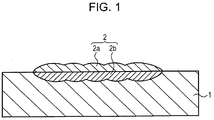
- Fig. 1 is a cross-sectional view illustrating a method for measuring a base metal dilution ratio.
- a flux-cored wire is used for build-up welding and has a structure in which a sheath is filled with a flux having a composition satisfying the formula 3 below at a filling ratio of 10.0% to 35.0% by mass relative to the total mass of the wire.
- A represents the total content (mass%), in terms of F equivalent, of alkali metal fluorides and alkaline-earth metal fluorides
- B represents the total content (mass%) of elemental alkali metals and elemental alkaline-earth metals
- C represents the total content of alkali metal oxides and alkaline-earth metal oxides.
- A, B, and C stipulated in the formula 3 below are the values relative to the total mass of the flux.
- the alkali metals and alkaline-earth metals serve as arc stabilizers and are added, in order to reduce spatter, to a welding wire used for welding that uses CO 2 or a gas mixture as a shielding gas.
- a welding wire used for welding that uses CO 2 or a gas mixture as a shielding gas.
- the experiments and studies conducted by the present inventors have shown that, in an atmosphere having a high Ar concentration, forms of the alkali metals and alkaline-earth metals added to the welding wire have a major effect on arc behavior and penetration shape.
- alkali metals and alkaline-earth metals are added in the form of alloy components or oxides, which serve as electron emission materials, the arc becomes concentrated on the molten pool, resulting in excessive penetration.
- alkali metal oxides and alkaline-earth metal oxides have a low work function and promote electron emission, thus having a function of increasing the concentration of the arc.
- elemental alkali metals and elemental alkaline-earth metals react with oxygen in the molten metal to produce alkali metal oxides and alkaline-earth metal oxides, and therefore have the same function as that described above.
- alkali metal oxides, alkaline-earth metal oxides, elemental alkali metals, and elemental alkaline-earth metals are added in small amounts, it is possible to obtain the effect of reducing incomplete fusion by improving bead wettability.
- alkali metals and alkaline-earth metals which are strong deoxidizing agents, increase the viscosity of the molten pool and have the effect of suppressing dripping of the molten metal.
- addition in excessive amounts will lead to an increase in the amount of slag generated.
- the forms of alkali metals and alkaline-earth metals added are classified into fluorides, elemental metals, and oxides, and the relationship between the contents of these components in the flux is specified.
- the flux composition is set so as to satisfy the formula 3 described above. Note that, when [A/ ⁇ 1 + 0.7 ⁇ (B + 2C) ⁇ ] stipulated in the formula 3 described above is less than 0.3, the arc concentration effect due to alkali metal oxides and alkaline-earth metal oxides produced in the molten pool is larger than the arc spreading effect due to alkali metal fluorides and alkaline-earth metal fluorides. As a result, penetration increases, and base metal dilution increases.
- the flux filling ratio is set in the range of 10.0% to 35.0% by mass relative to the total mass of the wire.
- the flux filling ratio is less than 10.0% by mass relative to the total mass of the wire, it is not possible to perform stable droplet transfer by means of the flux, which is a characteristic of the flux-cored wire, the arc becomes unstable, and good welding cannot be achieved.
- the flux filling ratio is more than 35.0% by mass relative to the total mass of the wire, molten flux is unlikely to be sufficiently stirred in the molten pool, and it is unlikely to obtain a weld metal having a uniform composition.
- the total content of TiO 2 , SiO 2 , and ZrO 2 is limited to 3% by mass or less.
- oxides, such as TiO 2 , SiO 2 , and ZrO 2 are added to the flux for the purpose of improving arc stability and protecting the weld metal from oxidation.
- alloy elements in the wire may be unavoidably oxidized during production or storage to produce metal oxides.
- MIG welding that uses a shielding gas having a concentration of Ar, which is a non-oxidizing gas, of 95% by volume or more, oxidation of the weld metal is suppressed, and a sufficiently sound weld metal can be obtained. Therefore, it is not necessary to add TiO 2 , SiO 2 , and ZrO 2 in order to prevent oxidation of the surface of the bead.
- oxides such as TiO 2 , SiO 2 , and ZrO 2
- the content of TiO 2 , SiO 2 , and ZrO 2 is preferably set at 3% by mass or less relative to the total mass of the flux.
- the total content A in terms of F equivalent, of alkali metal fluorides and alkaline-earth metal fluorides is preferably set at 0.2% to 3.0% by mass.
- the total content A in terms of F equivalent, of alkali metal fluorides and alkaline-earth metal fluorides is preferably set at 0.2% to 3.0% by mass.
- the relationship between the total content B (mass%) of elemental alkali metals and elemental alkaline-earth metals and the total content C (mass%) of alkali metal oxides and alkaline-earth metal oxides satisfies the formula 4 below.
- the components of the flux other than the components described above are not particularly limited, and examples thereof include C, Si, Mn, Cr, Ni, and Mo. These components do not influence the effects described above.
- the composition of the sheath of the flux-cored wire according to the embodiment is not particularly limited, but can be appropriately selected.
- the sheath can be made of various steel materials, Ni-based alloys, and the like.
- the flux-cored wire according to the embodiment is suitable for build-up welding that uses austenitic stainless steel or a Ni-based alloy which is capable of imparting high corrosion resistance to the surface of a structure, and hardfacing welding which imparts high abrasion resistance to the surface of a structure.
- Austenitic stainless steel is a steel material in which Cr and Ni are added in order to obtain high corrosion resistance, and as a welding material, SUS308 including 18%Cr and 9%Ni, or the like is used. Note that the sheath of the flux-cored wire according to the embodiment is not limited to SUS308, and various types of austenitic stainless steel, such as SUS316 including Mo and SUS347 including Nb can be used.
- the wire can have a composition including 0.3% to 1% by mass of Si, 0.5% to 2.5% by mass of Mn, 18% to 25% by mass of Cr, 9% to 14% by mass of Ni, 0.04% by mass or less of C, as necessary, 4% by mass or less of Mo and/or 1% by mass or less of Nb, and the balance being Fe and incidental impurities, relative to the total mass of the wire.
- a Ni-based alloy is an alloy that is designed to have a Ni content of 50% by mass or more in order to achieve a higher corrosion resistance than stainless steel. Examples thereof also include Inconel and Hastelloy in which Cr and Mo are added. In the flux-cored wire according to the embodiment, various Ni-based alloys can be used, and the same effects can be obtained by using any of them.
- the wire can have a composition including 0.1% to 1% by mass of Si, 0.3% to 10% by mass of Mn, 13% to 24% by mass of Cr, as necessary, one or two or more elements selected from the group consisting of 0.1% by mass of less of C, 17% by mass or less of Mo, 5% by mass or less of Nb, 0.75% by mass or less of Ti, 5% by mass or less of W, 0.3% by mass or less of V, and 20% by mass or less of Fe, and the balance being Ni and incidental impurities, relative to the total mass of the wire.
- the wire composition By setting the wire composition in this range, it is possible to obtain a weld metal having excellent high-temperature performance and corrosion resistance.
- hardfacing welding is a welding method for imparting abrasion resistance and high hardness to the surface of a structure.
- a welding material whose hardenability is enhanced by adding C, Cr, Mo, W, and the like to an ordinary carbon steel welding material is used.
- the wire in the case where the flux-cored wire according to the embodiment is used for hardfacing welding, can have a composition including 0.05% to 1.5% by mass of C, 0.3% to 3.0% by mass of Si, 0.3% to 3.0% by mass of Mn, 0.3% to 10% by mass of Cr, as necessary, one or two or more elements selected from the group consisting of 9% by mass or less of Mo, 4% by mass or less of W, and 2% by mass or less of V, and the balance being Fe and incidental impurities, relative to the total mass of the wire.
- the wire composition By setting the wire composition in this range, it is possible to obtain appropriate hardness during hardfacing welding.
- the conditions for performing build-up welding using the flux-cored wire according to the embodiment are not particularly limited.
- the welding current can be set at 200 to 300 A, and the welding speed can be set at 20 to 50 cm/min.
- the shielding gas is not particularly limited, but it is preferable to use a gas having an Ar concentration of 95% by volume or more.
- CO 2 and O 2 contained in the shielding gas accelerate oxidation of the molten metal and promote formation of metal oxides.
- the metal oxides formed on the surface of the molten pool which are electron emission materials, serve as sources for emitting electrons to the arc atmosphere, and have a function of increasing the concentration of the arc. Therefore, when the shielding gas contains CO 2 and O 2 , the penetration depth increases, and base metal dilution increases. Furthermore, CO 2 and O 2 react with fluorides and carbonates in the flux and produce a large amount of spatter, which is also a problem.
- the Ar concentration of the shielding gas is set at 95% by volume or more, formation of metal oxides is suppressed, and the amount of spatter can be decreased. Consequently, dilution of the base metal is suppressed, and weldability can be improved.
- the flux-cored wire according to the embodiment since the relationship between the amounts of fluorides, elemental metals, and oxides of alkali metals and alkaline-earth metals added is specified, dilution of the base metal and the amount of slag generated can be decreased. Consequently, by using the flux-cored wire according to the embodiment, it is possible to obtain the intended weld metal composition with a small number of layers.
- the amount of dripping is small, and it is possible to obtain good bead appearance having a uniform toe. Dripping of the weld metal causes increases in the welding time, the amount of the welding material, and the forming time after welding for obtaining a required shape. Therefore, by using the flux-cored wire according to the embodiment, working efficiency can be improved.
- Wire structure Content of alkali metals and alkaline-earth metals in flux (mass%) Other oxides (mass%) Fluorides Elemental metals and oxides TiO 2 SiO 2 ZrO 2 Total K 2 SiF 6 NaF CaF 2 A (F equivalent) Mg Ca MgO CaO B+2C A/(1+0.7*(B+2C)) 45 1 2 2 1 2.42 0 2.4 0.5 0.5 46 3 1 2 1.5 2.14 0 2.1 0.2 0.2 0.4 47 1 1 3 1 2.35 0 2.4 0.3 0.3 48 4 1 0.52 1 2 0.2 0.4 0.5 0.9 49 1 1 0.5 0.745 1 2 5 0.2 1.2 1 2.2 50 2 0.5 0.5 0.5 0.725 1 1 2 6 0.1 1.5 1.5 51 4 0 0 0.0 0 52 1 0 0 0.0 0 53 2 0 0 0.0 0 54 3 0.1 0.052 0 0.1 0 55 2 0.1 0.045 0 0.0 0 56 4 0.2
- SM490A was used as a test material, and build-up welding was performed thereon (one layer/five passes), under the welding conditions in which the welding current was 250 A and the welding speed was 30 cm/min. Assuming automatic welding, continuous welding was performed without removing slag between passes.
- Fig. 1 is a cross-sectional view illustrating a method for measuring a base metal dilution ratio.
- the base metal dilution ratio was determined by a method in which, regarding a weld metal 2 shown in Fig. 1 , the area a of a portion 2a located above the surface of a base metal 1 and the area b of a portion 2b located below were obtained, and the base metal dilution ratio was calculated in accordance with the formula 5 below.
- the base metal dilution ratio was 25% or less.
- the amount of spatter generated was measured by collecting spatter scattered over the surroundings and spatter attached to the shielding gas nozzle.
- hardfacing welding wire Nos. 1 and 2 in which the amount of spatter generated is larger than that of ordinary carbon steel welding, samples in which the amount of spatter collected was 1.5 g/min or less were evaluated as “passed", and samples in which the amount of spatter collected was 1.0 g/min or less were evaluated as "very good”.
- corrosion-resistant build-up welding using austenitic stainless steel wires (wire Nos. 3 and 4) and Ni-based alloy wires (wire No. 5)
- samples in which the amount of spatter collected was 1.0 g/min or less were evaluated as "passed”
- samples in which the amount of spatter collected was 0.5 g/min or less were evaluated as "very good.
- Wire structure Content of alkali metals and alkaline-earth metals in flux (mass%) Other oxides (mass%) Fluorides Elemental metals and oxides TiO 2 SiO 2 ZrO 2 Total K 2 SiF 6 NaF CaF 2 A (F equivalent) Mg Ca MgO CaO B+2C A/(1+0.7*(B+2C)) 75 2 2 1.04 0 1.0 1 1 2 76 1 2 0.9 0 0.9 0 77 4 1.5 1.5 1.5 2 2 6 0.3 0 78 5 5 2.25 1 1 3 0.7 1 1 2 79 3 0 0 0.0 0 80 2 2 0.9 2 1 4 0.2 0.5 1 1.5 81 1 1 0.52 0 0.5 0.5 0.5 82 2 3 1.35 1 2 5 0.3 0.5 83 5 1 1 0.97 0 1.0 0.5 0.5 [Table 9] No.
- the flux-cored wire of the present invention is particularly effective for build-up welding using a shielding gas having an Ar gas concentration of 95% by volume or more.
Landscapes
- Engineering & Computer Science (AREA)
- Mechanical Engineering (AREA)
- Chemical & Material Sciences (AREA)
- Materials Engineering (AREA)
- Metallurgy (AREA)
- Organic Chemistry (AREA)
- Inorganic Chemistry (AREA)
- Nonmetallic Welding Materials (AREA)
Abstract
Description
- The present invention relates to a flux-cored wire used for build-up welding. More particularly, the invention relates to a technique for improving weldability in build-up welding using a flux-cored wire.
- Build-up welding is a welding method in which base metals are not joined together, but a metal appropriate for the purpose is deposited on the surface of a base metal. In the case where a build-up welding process is performed by gas-shielded arc welding, a flux-cored wire is mainly used (for example, refer to Patent Literature 1). For example, in the metal-based flux-cored wire described in Patent Literature 1, by adding appropriate amounts of alkali metal compounds, alkaline-earth metal compounds, and alkaline-earth metal alloys, the arc is stabilized, and the amount of spatter generated is reduced.
- On the other hand, in build-up welding, it is preferable to avoid melting of the base metal as much as possible during welding from the viewpoint that dilution of the base metal component has a major effect on the weld metal. Accordingly, a flux-cored welding wire has been proposed in which, by using pure Ar as a shielding gas and specifying the wire component, the dilution ratio of the base metal component is decreased while maintaining good weldability (refer to Patent Literature 2).
-
- PTL 1: Japanese Unexamined Patent Application Publication No.
2010-253516 - PTL 2: Japanese Unexamined Patent Application Publication No.
2012-55899 - However, in the case where build-up welding is performed using the existing flux-cored wire, because of increased penetration and the high dilution ratio of the base metal, it is necessary to form three or more build-up layers in order to obtain a predetermined weld metal composition. For example, in the flux-cored wire described in Patent Literature 1, dilution of the base metal is not taken into consideration. Therefore, when the alkali metal compounds and the alkaline-earth metal compounds are added in the form of oxides which are electron emission materials, the concentration of the arc increases, causing an increase in the penetration depth and an increase in the dilution ratio of the base metal.
- Furthermore, in the technique described in
Patent Literature 2, pure Ar is used as the shielding gas, and oxides are not formed immediately below the arc. Consequently, the current density in the arc atmosphere is largely influenced by the components in the welding wire. For example, in the case where large amounts of electron emission materials are added into the welding wire, penetration increases, and it may not possible to obtain a low dilution weld metal. - Accordingly, it is a main object of the present invention to provide a flux-cored wire for build-up welding in which the dilution ratio of the base metal is low, and it is possible to obtain the intended weld metal composition with a small number of layers.
- A flux-cored wire for build-up welding according to the present invention includes a sheath filled with a flux, in which the filling ratio of the flux is 10.0% to 35.0% by mass, and the formula 1 below is satisfied, where A (mass%) represents the total content (F equivalent) of alkali metal fluorides and alkaline-earth metal fluorides, B (mass%) represents the total content of elemental alkali metals and elemental alkaline-earth metals, and C (mass%) represents the total content of alkali metal oxides and alkaline-earth metal oxides, relative to the total mass of the flux.
[Formula 1]
- In the flux, the total content A, in terms of F equivalent, of alkali metal fluorides and alkaline-earth metal fluorides can be 0.2% to 3.0% by mass. Furthermore, the flux can have a composition in which the relationship between the total content B (mass%) of elemental alkali metals and elemental alkaline-earth metals and the total content C (mass%) of alkali metal oxides and alkaline-earth metal oxides satisfies the
formula 2 below.
[Formula 2]
- Furthermore, in the flux, the total content of TiO2, SiO2, and ZrO2 may be limited to 3% by mass or less.
- On the other hand, in the flux-cored wire of the present invention, the sheath can be made of austenitic stainless steel, and the flux-cored wire can be used for arc welding that uses a shielding gas having an Ar gas concentration of 95% by volume or more.
- In such a case, for example, the wire can have a composition including 0.3% to 1% by mass of Si, 0.5% to 2.5% by mass of Mn, 18% to 25% by mass of Cr, 9% to 14% by mass of Ni, 0.04% by mass or less of C, and the balance being Fe and incidental impurities, relative to the total mass of the wire.
- Furthermore, as necessary, 4% by mass or less of Mo and/or 1% by mass or less of Nb may be added, relative to the total mass of the wire.
- In the flux-cored wire of the present invention, the sheath can be made of a Ni-based alloy, and the flux-cored wire can be used for arc welding that uses a shielding gas having an Ar gas concentration of 95% by volume or more.
- In such a case, the wire can have a composition including 0.1% to 1% by mass of Si, 0.3% to 10% by mass of Mn, 13% to 24% by mass of Cr, and the balance being Ni and incidental impurities, relative to the total mass of the wire.
- Furthermore, as necessary, at least one element selected from the group consisting of 0.1% by mass of less of C, 17% by mass or less of Mo, 5% by mass or less of Nb, 0.75% by mass or less of Ti, 5% by mass or less of W, 0.3% by mass or less of V, and 20% by mass or less of Fe, relative to the total mass of the wire, may be added.
- The flux-cored wire of the present invention can be used for hardfacing welding that uses a shielding gas having an Ar gas concentration of 95% by volume or more.
- In such a case, the wire can have a composition including 0.05% to 1.5% by mass of C, 0.3% to 3.0% by mass of Si, 0.3% to 3.0% by mass of Mn, 0.3% to 10% by mass of Cr, and the balance being Fe and incidental impurities, relative to the total mass of the wire.
- Furthermore, at least one element selected from the group consisting of 9% by mass or less of Mo, 4% by mass or less of W, and 2% by mass or less of V, relative to the total mass of the wire, may be added.
- According to the present invention, since the balance of forms of alkali metals and alkaline-earth metals added is specified, dilution of the base metal can be suppressed, and it is possible to obtain the intended weld metal composition with a small number of layers.
- [
Fig. 1] Fig. 1 is a cross-sectional view illustrating a method for measuring a base metal dilution ratio. - Embodiments will be described in detail below. However, it is to be understood that the present invention is not limited to the embodiments described below.
- A flux-cored wire according to an embodiment is used for build-up welding and has a structure in which a sheath is filled with a flux having a composition satisfying the formula 3 below at a filling ratio of 10.0% to 35.0% by mass relative to the total mass of the wire. In the formula 3, A represents the total content (mass%), in terms of F equivalent, of alkali metal fluorides and alkaline-earth metal fluorides, B represents the total content (mass%) of elemental alkali metals and elemental alkaline-earth metals, and C represents the total content of alkali metal oxides and alkaline-earth metal oxides. Note that A, B, and C stipulated in the formula 3 below are the values relative to the total mass of the flux.
[Formula 3]
- The alkali metals and alkaline-earth metals, such as Na, K, Ca, and Mg, serve as arc stabilizers and are added, in order to reduce spatter, to a welding wire used for welding that uses CO2 or a gas mixture as a shielding gas. However, the experiments and studies conducted by the present inventors have shown that, in an atmosphere having a high Ar concentration, forms of the alkali metals and alkaline-earth metals added to the welding wire have a major effect on arc behavior and penetration shape.
- For example, when alkali metals and alkaline-earth metals are added as fluorides to the flux, effects are obtained such that arc spreading increases and penetration decreases. Specifically, metal fluorides decompose into metal ions and fluoride ions in the high-temperature arc atmosphere, and the metal ions produced by the dissociation reaction reduce the electrical resistance of the arc atmosphere, thereby spreading the arc and decreasing the penetration depth.
- On the other hand, when alkali metals and alkaline-earth metals are added in the form of alloy components or oxides, which serve as electron emission materials, the arc becomes concentrated on the molten pool, resulting in excessive penetration. Specifically, alkali metal oxides and alkaline-earth metal oxides have a low work function and promote electron emission, thus having a function of increasing the concentration of the arc. Furthermore, elemental alkali metals and elemental alkaline-earth metals react with oxygen in the molten metal to produce alkali metal oxides and alkaline-earth metal oxides, and therefore have the same function as that described above.
- Consequently, when alkali metal oxides, alkaline-earth metal oxides, elemental alkali metals, and elemental alkaline-earth metals are added in small amounts, it is possible to obtain the effect of reducing incomplete fusion by improving bead wettability. However, when added in excessive amounts, penetration increases and base metal dilution increases. Furthermore, alkali metals and alkaline-earth metals, which are strong deoxidizing agents, increase the viscosity of the molten pool and have the effect of suppressing dripping of the molten metal. However, addition in excessive amounts will lead to an increase in the amount of slag generated.
- Accordingly, in the flux-cored wire according to the embodiment, the forms of alkali metals and alkaline-earth metals added are classified into fluorides, elemental metals, and oxides, and the relationship between the contents of these components in the flux is specified. Specifically, the flux composition is set so as to satisfy the formula 3 described above. Note that, when [A/{1 + 0.7 × (B + 2C)}] stipulated in the formula 3 described above is less than 0.3, the arc concentration effect due to alkali metal oxides and alkaline-earth metal oxides produced in the molten pool is larger than the arc spreading effect due to alkali metal fluorides and alkaline-earth metal fluorides. As a result, penetration increases, and base metal dilution increases.
- On the other hand, when [A/{1 + 0.7 × (B + 2C)}] stipulated in the formula 3 described above exceeds 2.0, the arc spreading effect due to alkali metal fluorides and alkaline-earth metal fluorides becomes excessive relative to the arc concentration effect due to alkali metal and alkaline-earth metal oxides produced on the surface of the molten metal, and it is not possible to sufficiently melt the base metal. As a result, convex beads with poor wettability are produced, which is likely to lead to incomplete fusion. Furthermore, as fluorides are decomposed and ionized in the arc, the volume rapidly increases, resulting in generation of a large amount of spatter.
- In addition, in the flux-cored wire according to the embodiment, the flux filling ratio is set in the range of 10.0% to 35.0% by mass relative to the total mass of the wire. When the flux filling ratio is less than 10.0% by mass relative to the total mass of the wire, it is not possible to perform stable droplet transfer by means of the flux, which is a characteristic of the flux-cored wire, the arc becomes unstable, and good welding cannot be achieved. Furthermore, when the flux filling ratio is more than 35.0% by mass relative to the total mass of the wire, molten flux is unlikely to be sufficiently stirred in the molten pool, and it is unlikely to obtain a weld metal having a uniform composition.
- In the flux used for the flux-cored wire according to the embodiment, preferably, the total content of TiO2, SiO2, and ZrO2 is limited to 3% by mass or less. In general, oxides, such as TiO2, SiO2, and ZrO2, are added to the flux for the purpose of improving arc stability and protecting the weld metal from oxidation.
- Furthermore, in some cases, alloy elements in the wire may be unavoidably oxidized during production or storage to produce metal oxides. However, in MIG welding that uses a shielding gas having a concentration of Ar, which is a non-oxidizing gas, of 95% by volume or more, oxidation of the weld metal is suppressed, and a sufficiently sound weld metal can be obtained. Therefore, it is not necessary to add TiO2, SiO2, and ZrO2 in order to prevent oxidation of the surface of the bead.
- On the other hand, in build-up welding, oxides, such as TiO2, SiO2, and ZrO2, are likely to cause dripping of weld bead due to a decrease in the viscosity of the molten pool, slag removal time during automatic welding, and defects, such as slag inclusion. Therefore, it is preferable to decrease the amounts thereof added. Specifically, the content of TiO2, SiO2, and ZrO2, is preferably set at 3% by mass or less relative to the total mass of the flux. Thereby, it is possible to considerably decrease the amount of slag generated.
- Furthermore, in the flux-cored wire according to the embodiment, the total content A, in terms of F equivalent, of alkali metal fluorides and alkaline-earth metal fluorides is preferably set at 0.2% to 3.0% by mass. Thereby, it is possible to obtain a good bead shape while suppressing dilution of the base metal, and defect-free welding can be carried out. Furthermore, by limiting the total content A to 3.0% by mass or less, it is also possible to suppress the amount of spatter generated.
- Furthermore, in the flux-cored wire according to the embodiment, preferably, the relationship between the total content B (mass%) of elemental alkali metals and elemental alkaline-earth metals and the total content C (mass%) of alkali metal oxides and alkaline-earth metal oxides satisfies the formula 4 below. Thereby, it is possible to form beads having good wettability while avoiding excessive penetration.
[Formula 4]
- By setting A at 0.2% to 3.0% by mass and by setting B and C in the range that satisfies the formula 4 above, the deoxidizing action due to addition of alkali metals and alkaline-earth metals contributes to an increase in the viscosity of the molten metal and bead dripping can be effectively suppressed.
- In the flux-cored wire according to the embodiment, the components of the flux other than the components described above are not particularly limited, and examples thereof include C, Si, Mn, Cr, Ni, and Mo. These components do not influence the effects described above.
- The composition of the sheath of the flux-cored wire according to the embodiment is not particularly limited, but can be appropriately selected. For example, in the case of MIG welding that uses a shielding gas having an Ar concentration of 95% by volume or more, the sheath can be made of various steel materials, Ni-based alloys, and the like. In particular, the flux-cored wire according to the embodiment is suitable for build-up welding that uses austenitic stainless steel or a Ni-based alloy which is capable of imparting high corrosion resistance to the surface of a structure, and hardfacing welding which imparts high abrasion resistance to the surface of a structure.
- Austenitic stainless steel is a steel material in which Cr and Ni are added in order to obtain high corrosion resistance, and as a welding material, SUS308 including 18%Cr and 9%Ni, or the like is used. Note that the sheath of the flux-cored wire according to the embodiment is not limited to SUS308, and various types of austenitic stainless steel, such as SUS316 including Mo and SUS347 including Nb can be used.
- In the case where austenitic stainless steel is used for the sheath, for example, the wire can have a composition including 0.3% to 1% by mass of Si, 0.5% to 2.5% by mass of Mn, 18% to 25% by mass of Cr, 9% to 14% by mass of Ni, 0.04% by mass or less of C, as necessary, 4% by mass or less of Mo and/or 1% by mass or less of Nb, and the balance being Fe and incidental impurities, relative to the total mass of the wire. By setting the wire composition in this range, when corrosion-resistant build-up welding is carried out, it is possible to obtain a weld metal having good corrosion resistance.
- Furthermore, a Ni-based alloy is an alloy that is designed to have a Ni content of 50% by mass or more in order to achieve a higher corrosion resistance than stainless steel. Examples thereof also include Inconel and Hastelloy in which Cr and Mo are added. In the flux-cored wire according to the embodiment, various Ni-based alloys can be used, and the same effects can be obtained by using any of them.
- In the case where a Ni-based alloy is used for the sheath, for example, the wire can have a composition including 0.1% to 1% by mass of Si, 0.3% to 10% by mass of Mn, 13% to 24% by mass of Cr, as necessary, one or two or more elements selected from the group consisting of 0.1% by mass of less of C, 17% by mass or less of Mo, 5% by mass or less of Nb, 0.75% by mass or less of Ti, 5% by mass or less of W, 0.3% by mass or less of V, and 20% by mass or less of Fe, and the balance being Ni and incidental impurities, relative to the total mass of the wire. By setting the wire composition in this range, it is possible to obtain a weld metal having excellent high-temperature performance and corrosion resistance.
- On the other hand, hardfacing welding is a welding method for imparting abrasion resistance and high hardness to the surface of a structure. In order to increase the hardness of the weld metal, a welding material whose hardenability is enhanced by adding C, Cr, Mo, W, and the like to an ordinary carbon steel welding material is used.
- For example, in the case where the flux-cored wire according to the embodiment is used for hardfacing welding, the wire can have a composition including 0.05% to 1.5% by mass of C, 0.3% to 3.0% by mass of Si, 0.3% to 3.0% by mass of Mn, 0.3% to 10% by mass of Cr, as necessary, one or two or more elements selected from the group consisting of 9% by mass or less of Mo, 4% by mass or less of W, and 2% by mass or less of V, and the balance being Fe and incidental impurities, relative to the total mass of the wire. By setting the wire composition in this range, it is possible to obtain appropriate hardness during hardfacing welding.
- The conditions for performing build-up welding using the flux-cored wire according to the embodiment are not particularly limited. For example, the welding current can be set at 200 to 300 A, and the welding speed can be set at 20 to 50 cm/min.
- Furthermore, the shielding gas is not particularly limited, but it is preferable to use a gas having an Ar concentration of 95% by volume or more. CO2 and O2 contained in the shielding gas accelerate oxidation of the molten metal and promote formation of metal oxides. The metal oxides formed on the surface of the molten pool, which are electron emission materials, serve as sources for emitting electrons to the arc atmosphere, and have a function of increasing the concentration of the arc. Therefore, when the shielding gas contains CO2 and O2, the penetration depth increases, and base metal dilution increases. Furthermore, CO2 and O2 react with fluorides and carbonates in the flux and produce a large amount of spatter, which is also a problem.
- In contrast, when the Ar concentration of the shielding gas is set at 95% by volume or more, formation of metal oxides is suppressed, and the amount of spatter can be decreased. Consequently, dilution of the base metal is suppressed, and weldability can be improved.
- As described above in detail, in the flux-cored wire according to the embodiment, since the relationship between the amounts of fluorides, elemental metals, and oxides of alkali metals and alkaline-earth metals added is specified, dilution of the base metal and the amount of slag generated can be decreased. Consequently, by using the flux-cored wire according to the embodiment, it is possible to obtain the intended weld metal composition with a small number of layers.
- Furthermore, in the flux-cored wire according to the embodiment, the amount of dripping is small, and it is possible to obtain good bead appearance having a uniform toe. Dripping of the weld metal causes increases in the welding time, the amount of the welding material, and the forming time after welding for obtaining a required shape. Therefore, by using the flux-cored wire according to the embodiment, working efficiency can be improved.
- The advantageous effects of the present invention will be specifically described below on the basis of examples of the present invention and comparative examples. In the examples, sheaths A to C shown in Table 1 were used, Nos. 1 to 5 shown in Table 2 were used as basic structures, and flux-cored wires Nos. 1 to 74 were fabricated by replacing part of Fe with the components shown in Tables 3 to 5. Among these flux-cored wires, Nos. 1 to 44 correspond to examples, and Nos. 45 to 74 correspond to comparative examples. Build-up welding was performed using the flux-cored wires of examples and comparative examples, and evaluation was made on the dilution ratio of the base metal, slag inclusion, incomplete welding, and the amount of spatter. Note that, in the sheath composition shown in Table 1 below and the content of alloy elements in the flux shown in Table 2, the balance includes incidental impurities.
[Table 1] Sheath type Composition (mass%) C Si Mn P S Cr Ni Mo Nb Fe A Mild steel 0.016 0.01 0.19 0.005 0.005 - - - - Balance B SUS304 0.01 0.28 1.25 0.05 0.05 19.2 9.9 - - Balance C Ni-based alloy 0.01 - - - - 22 Balance 13 - 4 [Table 2] No. Sheath Content of alloy elements in flux (mass%) Flux filling ratio (mass%) C Si Mn Cr Ni Mo Ti W Fe 1 A 1 5 11 11 - 4 3 - Balance 12.5 2 B 3 4.5 7.5 30 - 4 - - Balance 14.5 3 B 0.02 1 5 23 10 - - - Balance 20.0 4 C 0.02 0.5 5 18 21 10 - - Balance 20.0 5 C 0.03 0.3 - 25 Balance 20 - 5 10 30.0 [Table 3] No. Wire structure Content of alkali metals and alkaline-earth metals in flux (mass%) Other oxides (mass%) Fluorides Elemental metals and oxides TiO2 SiO2 ZrO2 Total K2SiF6 NaF CaF2 A (F equivalent) Mg Ca MgO CaO B+2C A/(1+0.7*(B+2C)) 1 1 1 0.52 0 0.5 0 2 2 1 0.45 0 0.5 0 3 3 4 1.92 0 1.9 0 4 4 1 2 1.41 0 1.4 0 5 5 1.5 2 1.68 0 1.7 0 6 2 2 2 2 0 2.0 0 7 1 0.5 1 1 1.19 0 1.2 0 8 4 2 1.04 0 1.0 0 9 2 0.5 0.5 0.465 0 0.5 0 10 3 2 2 2 0 2.0 0 11 5 1 1 1 1.45 0 1.5 0 12 1 2 1.04 0 1.0 0 Example 13 2 3 1.56 1 1 0.9 0 14 3 4 1.8 1 1 1.1 0 15 4 1 0.48 0.5 1 0.3 0 16 2 1 1 1 1.45 1 2 0.6 0 17 1 2 1 1.49 5 1 7 0.3 0 18 5 1 2 1.41 3 1 5 0.3 0 19 2 2 2 2 4 3 1 9 0.3 0 20 1 3 1.56 2 1 4 0.4 0 21 3 4 1 2.28 1 1 3 0.7 0 22 2 2 1 1.52 2 2 0.6 0 23 4 3 1 2.04 2 1.5 5 0.5 0 24 2 5 2.25 0.5 3 0.5 1 6.5 0.4 0 25 1 1 1 1 1.45 2 1 1 5 0.3 0 [Table 4] No. Wire structure Content of alkali metals and alkaline-earth metals in flux (mass%) Other oxides (mass%) Fluorides Elemental metals and oxides TiO2 SiO2 ZrO2 Total K2SiF6 NaF CaF2 A (F equivalent) Mg Ca MgO CaO B+2C A/(1+0.7*(B+2C)) 26 4 2 1.04 3 3 0.3 2 2 27 1 2 0.9 1 1 3 0.3 3 3 3 3 28 2 1 2 1.41 1 1 2 6 0.3 1 1 29 5 1 2 1 1.9 2 4 0.5 1 1 2 30 3 2 1 1.49 2 2 6 0.3 1 1 1 3 31 2 2 1 1.38 3 1 5 0.3 1 0.5 0.5 2 32 3 2 2 1 2.42 2 2 6 0.5 2 1 3 33 1 1 1 0.97 2 1 4 0.3 2 1 3 34 5 3 1.56 0 1.6 1 1 Example 35 1 3 1.35 0 1.4 2 2 36 2 3 1.44 0 1.4 0.5 0.5 37 3 1 1 0.97 0 1.0 1 1 2 38 5 1 0.5 0.69 0 0.7 2 2 39 3 2 1 1.52 0 1.5 1 0.5 1.5 40 2 1 1 2 1.93 0 1.9 2 0.5 2.5 41 3 4 1.8 0 1.8 2 1 3 42 1 3 1 2.01 0 2.0 2 1 3 43 4 1 0.52 0 0.5 0.5 1.5 1 3 44 2 3 1.56 0 1.6 0.5 0.5 0.5 1.5 [Table 5] No. Wire structure Content of alkali metals and alkaline-earth metals in flux (mass%) Other oxides (mass%) Fluorides Elemental metals and oxides TiO2 SiO2 ZrO2 Total K2SiF6 NaF CaF2 A (F equivalent) Mg Ca MgO CaO B+2C A/(1+0.7*(B+2C)) 45 1 2 2 1 2.42 0 2.4 0.5 0.5 46 3 1 2 1.5 2.14 0 2.1 0.2 0.2 0.4 47 1 1 3 1 2.35 0 2.4 0.3 0.3 48 4 1 0.52 1 2 0.2 0.4 0.5 0.9 49 1 1 0.5 0.745 1 2 5 0.2 1.2 1 2.2 50 2 0.5 0.5 0.5 0.725 1 1 2 6 0.1 1.5 1.5 51 4 0 0 0.0 0 52 1 0 0 0.0 0 53 2 0 0 0.0 0 54 3 0.1 0.052 0 0.1 0 55 2 0.1 0.045 0 0.0 0 56 4 0.2 0.096 0 0.1 0 57 1 10 5.2 0 5.2 0 Comparative Example 58 3 6 2.7 0 2.7 0 59 1 2 2 2 2.9 0 2.9 0 60 4 0 15 15 0.0 0 61 4 0 0 0 0 15 5 25 0.0 0 62 5 0 7 5 17 0.0 0 63 3 0 0 0.0 2 2 4 64 2 0 0 0.0 3 1 2 6 65 1 0 0 0.0 4 1 1 6 66 5 5 2 1 3.98 0 4.0 2 3 1 6 67 2 4 1 4 4.45 0 4.5 4 2 1 7 68 3 7 3.15 0 3.2 1 4 1 6 69 1 3 2 1 2.94 7 3 10 0.4 0 70 4 1 4 1 2.8 1 1 1 1.5 7 0.5 0 71 5 2 4 2.82 1 3 1 2 10 0.4 0 72 1 0 5 3 3 1 16 0.0 2 2 2 6 73 2 0 4 4 1 2 14 0.0 3 3 6 74 5 0 3 1 5 2 18 0.0 1 3 2 6 - In the welding test, SM490A was used as a test material, and build-up welding was performed thereon (one layer/five passes), under the welding conditions in which the welding current was 250 A and the welding speed was 30 cm/min. Assuming automatic welding, continuous welding was performed without removing slag between passes.
- First, X-ray inspection was performed on the samples after welding, and the presence or absence of slag inclusion and incomplete fusion was confirmed. As a result, samples in which slag inclusion or incomplete fusion occurred were all evaluated as failed.
- Next, by subjecting the cross section of the weld area to macro observation, the penetration shape was observed, and the base metal dilution ratio was measured.
Fig. 1 is a cross-sectional view illustrating a method for measuring a base metal dilution ratio. The base metal dilution ratio was determined by a method in which, regarding aweld metal 2 shown inFig. 1 , the area a of aportion 2a located above the surface of a base metal 1 and the area b of aportion 2b located below were obtained, and the base metal dilution ratio was calculated in accordance with the formula 5 below. As a result, samples in which the base metal dilution ratio was 25% or less were evaluated as passed.
[Formula 5]
- The amount of spatter generated was measured by collecting spatter scattered over the surroundings and spatter attached to the shielding gas nozzle. Regarding hardfacing welding (wire Nos. 1 and 2) in which the amount of spatter generated is larger than that of ordinary carbon steel welding, samples in which the amount of spatter collected was 1.5 g/min or less were evaluated as "passed", and samples in which the amount of spatter collected was 1.0 g/min or less were evaluated as "very good". Furthermore, regarding corrosion-resistant build-up welding using austenitic stainless steel wires (wire Nos. 3 and 4) and Ni-based alloy wires (wire No. 5), samples in which the amount of spatter collected was 1.0 g/min or less were evaluated as "passed", and samples in which the amount of spatter collected was 0.5 g/min or less were evaluated as "very good".
- The results are summarized and shown in Tables 6 and 7. Note that the shielding gas composition is also shown in Tables 6 and 7. The absence of occurrence of slag inclusion is indicated by "O", and the presence of occurrence of slag inclusion is indicated by "x". The absence of occurrence of incomplete fusion is indicated by "O", and the presence of occurrence of incomplete fusion is indicated by "x". Regarding the amount of spatter generated, "passed" and "very good" are indicated by "○" and ⊙", respectively. Furthermore, the amount of spatter collected being more than 1.5 g/min (failed) is indicated by "x".
[Table 6] No. Shielding gas Evaluation results Base metal dilution Slag inclusion Incomplete fusion Spatter 1 Ar+3%O2 21 ○ ○ ⊙ 2 Ar+3%O2 24 ○ ○ ⊙ 3 Ar+3%O2 19 ○ ○ ⊙ 4 100%Ar 20 ○ ○ ⊙ 5 100%Ar 19 ○ ○ ⊙ 6 100%Ar 20 ○ ○ ⊙ 7 100%Ar 21 ○ ○ ⊙ 8 Ar+4%CO2 23 ○ ○ ⊙ 9 Ar+4%CO2 22 ○ ○ ⊙ 10 Ar+4%CO2 23 ○ ○ ⊙ 11 Ar+4%CO2 22 ○ ○ ⊙ 12 Ar+4%CO2 21 ○ ○ ⊙ 13 Ar+3%O2 24 ○ ○ ⊙ 14 Ar+3%O2 23 ○ ○ ⊙ 15 Ar+3%O2 24 ○ ○ ⊙ 16 100%Ar 23 ○ ○ ⊙ 17 100%Ar 24 ○ ○ ⊙ 18 100%Ar 23 ○ ○ ⊙ 19 100%Ar 22 ○ ○ ⊙ 20 100%Ar 23 ○ ○ ⊙ 21 Ar+4%CO2 23 ○ ○ ⊙ Example 22 Ar+4%CO2 24 ○ ○ ⊙ 23 Ar+4%CO2 23 ○ ○ ⊙ 24 Ar+4%CO2 24 ○ ○ ⊙ 25 Ar+4%CO2 23 ○ ○ ⊙ 26 Ar+3%O2 23 ○ ○ ⊙ 27 Ar+3%O2 22 ○ ○ ⊙ 28 Ar+3%O2 24 ○ ○ ⊙ 29 100%Ar 23 ○ ○ ⊙ 30 100%Ar 22 ○ ○ ⊙ 31 100%Ar 21 ○ ○ ⊙ 32 100%Ar 23 ○ ○ ⊙ 33 100%Ar 24 ○ ○ ⊙ 34 Ar+3%O2 22 ○ ○ ⊙ 35 Ar+3%O2 19 ○ ○ ⊙ 36 Ar+3%O2 21 ○ ○ ⊙ 37 100%Ar 20 ○ ○ ⊙ 38 100%Ar 22 ○ ○ ⊙ 39 100%Ar 21 ○ ○ ⊙ 40 100%Ar 19 ○ ○ ⊙ 41 100%Ar 20 ○ ○ ⊙ 42 Ar+4%O2 22 ○ ○ ⊙ 43 Ar+4%O2 21 ○ ○ ⊙ 44 Ar+4%O2 20 ○ ○ ⊙ [Table 7] No. Shielding gas Evaluation results Base metal dilution Slag inclusion Incomplete fusion Spatter 45 Ar+3%CO2 20 ○ × × 46 Ar+4%O2 19 ○ × × 47 Ar+4%O2 20 ○ × × 48 Ar+2%O2 29 ○ ○ ○ 49 Ar+2%CO2 30 ○ ○ ○ 50 100%Ar 28 ○ ○ ○ 51 Ar+3%O2 30 ○ ○ ○ 52 Ar+3%O2 29 ○ ○ ○ 53 Ar+3%O2 30 ○ ○ ○ 54 100%Ar 27 ○ ○ ○ 55 100%Ar 28 ○ ○ ○ 56 100%Ar 27 ○ ○ ○ 57 Ar+4%CO2 23 ○ × × 58 Ar+4%CO2 21 ○ × × Comparative Example 59 Ar+4%CO2 24 ○ × × 60 Ar+3%O2 27 ○ ○ ○ 61 100%Ar 26 ○ ○ ○ 62 100%Ar 27 ○ ○ ○ 63 100%Ar 21 × ○ ○ 64 100%Ar 23 × ○ ○ 65 100%Ar 23 × ○ ○ 66 Ar+3%O2 23 × × × 67 Ar+3%O2 24 × × × 68 Ar+3%O2 23 × × × 69 100%Ar 21 ○ ○ × 70 100%Ar 22 ○ ○ × 71 Ar+4%CO2 24 ○ ○ × 72 Ar+4%CO2 29 × ○ ○ 73 Ar+4%CO2 28 × ○ ○ 74 Ar+4%CO2 28 × ○ ○ - In Nos. 45 to 74 shown in Table 7 above, since [A/{1 + 0.7 × (B + 2C)}] is outside the range of the present invention, any of the base metal dilution ratio, occurrence of slag inclusion or incomplete fusion, and the amount of spatter generated is failed. In contrast, as shown in Table 6 above, in the wires Nos. 1 to 44, which are examples of the present invention, the base metal dilution ratio is low, slag inclusion or incomplete fusion does not occur, and the amount of spatter generated is small.
- Next, the relationship between the shielding gas and the wire composition was examined. Specifically, using the flux-cored wires shown in Table 8 below, build-up welding was performed with the composition of the shielding gas being varied, and evaluation was made on the base metal dilution ratio, slag inclusion, incomplete welding, and the amount of spatter. The welding conditions and the evaluation method were the same as those of Example 1 described above. The results thereof are shown in Table 9 below.
[Table 8] No. Wire structure Content of alkali metals and alkaline-earth metals in flux (mass%) Other oxides (mass%) Fluorides Elemental metals and oxides TiO2 SiO2 ZrO2 Total K2SiF6 NaF CaF2 A (F equivalent) Mg Ca MgO CaO B+2C A/(1+0.7*(B+2C)) 75 2 2 1.04 0 1.0 1 1 2 76 1 2 0.9 0 0.9 0 77 4 1.5 1.5 1.5 2 2 6 0.3 0 78 5 5 2.25 1 1 3 0.7 1 1 2 79 3 0 0 0.0 0 80 2 2 0.9 2 1 4 0.2 0.5 1 1.5 81 1 1 0.52 0 0.5 0.5 0.5 82 2 3 1.35 1 2 5 0.3 0.5 0.5 83 5 1 1 0.97 0 1.0 0.5 0.5 [Table 9] No. Shielding gas Evaluation results Base metal dilution Slag inclusion Incomplete fusion Spatter 75 Ar+20%CO2 29 ○ ○ ○ 76 Ar+10%CO2 27 ○ ○ ○ 77 Ar+10%O2 28 ○ ○ ○ 78 Ar+3%O2+3%CO2 26 ○ ○ ○ 79 A+6%CO2 26 ○ ○ ○ 80 Ar+6%O2 26 ○ ○ ○ 81 100%CO2 29 ○ ○ × 82 Ar+30%CO2 28 ○ ○ × 83 100%CO2 29 ○ ○ × - As shown in Table 9 above, in the case where a shielding gas having an Ar gas concentration of less than 95% by volume is used, in comparison with the wires Nos. 1 to 44 shown in Table 6, the amount of spatter tends to increase. From the results, it has been confirmed that the flux-cored wire of the present invention is particularly effective for build-up welding using a shielding gas having an Ar gas concentration of 95% by volume or more.
-
- 1 base metal
- 2, 2a, 2b weld metal
Claims (13)
- A flux-cored wire for build-up welding comprising a sheath filled with a flux, wherein the filling ratio of the flux is 10.0% to 35.0% by mass; and the following formula (I) is satisfied:

- The flux-cored wire for build-up welding according to Claim 1, wherein, in the flux, the total content A, in terms of F equivalent, of alkali metal fluorides and alkaline-earth metal fluorides is 0.2% to 3.0% by mass.
- The flux-cored wire for build-up welding according to Claim 1 or 2, wherein, in the flux, the relationship between the total content B (mass%) of elemental alkali metals and elemental alkaline-earth metals and the total content C (mass%) of alkali metal oxides and alkaline-earth metal oxides satisfies the following formula (II):

- The flux-cored wire for build-up welding according to Claim 1 or 2, wherein, in the flux, the total content of TiO2, SiO2, and ZrO2 is limited to 3% by mass or less.
- The flux-cored wire for build-up welding according to Claim 1 or 2, wherein the sheath is made of austenitic stainless steel, and the flux-cored wire is used for arc welding that uses a shielding gas having an Ar gas concentration of 95% by volume or more.
- The flux-cored wire for build-up welding according to Claim 5, wherein the wire has a composition including 0.3% to 1% by mass of Si, 0.5% to 2.5% by mass of Mn, 18% to 25% by mass of Cr, 9% to 14% by mass of Ni, 0.04% by mass or less of C, and the balance being Fe and incidental impurities, relative to the total mass of the wire.
- The flux-cored wire for build-up welding according to Claim 6, wherein the composition further includes 4% by mass or less of Mo and/or 1% by mass or less of Nb, relative to the total mass of the wire.
- The flux-cored wire for build-up welding according to Claim 1 or 2, wherein the sheath is made of a Ni-based alloy, and the flux-cored wire is used for arc welding that uses a shielding gas having an Ar gas concentration of 95% by volume or more.
- The flux-cored wire for build-up welding according to Claim 8, wherein the wire has a composition including 0.1% to 1% by mass of Si, 0.3% to 10% by mass of Mn, 13% to 24% by mass of Cr, and the balance being Ni and incidental impurities, relative to the total mass of the wire.
- The flux-cored wire according to Claim 9, wherein the composition further includes at least one element selected from the group consisting of 0.1% by mass of less of C, 17% by mass or less of Mo, 5% by mass or less of Nb, 0.75% by mass or less of Ti, 5% by mass or less of W, 0.3% by mass or less of V, and 20% by mass or less of Fe, relative to the total mass of the wire.
- The flux-cored wire for build-up welding according to Claim 1 or 2, wherein the flux-cored wire is used for hardfacing welding that uses a shielding gas having an Ar gas concentration of 95% by volume or more.
- The flux-cored wire for build-up welding according to Claim 11, wherein the wire has a composition including 0.05% to 1.5% by mass of C, 0.3% to 3.0% by mass of Si, 0.3% to 3.0% by mass of Mn, 0.3% to 10% by mass of Cr, and the balance being Fe and incidental impurities, relative to the total mass of the wire.
- The flux-cored wire according to Claim 12, wherein the composition further includes at least one element selected from the group consisting of 9% by mass or less of Mo, 4% by mass or less of W, and 2% by mass or less of V, relative to the total mass of the wire.
Applications Claiming Priority (2)
| Application Number | Priority Date | Filing Date | Title |
|---|---|---|---|
| JP2013146227A JP6257193B2 (en) | 2013-07-12 | 2013-07-12 | Flux-cored wire for overlay welding |
| PCT/JP2014/063846 WO2015005002A1 (en) | 2013-07-12 | 2014-05-26 | Flux-cored wire for build-up welding |
Publications (2)
| Publication Number | Publication Date |
|---|---|
| EP3020504A1 true EP3020504A1 (en) | 2016-05-18 |
| EP3020504A4 EP3020504A4 (en) | 2017-02-22 |
Family
ID=52279697
Family Applications (1)
| Application Number | Title | Priority Date | Filing Date |
|---|---|---|---|
| EP14822110.4A Withdrawn EP3020504A4 (en) | 2013-07-12 | 2014-05-26 | Flux-cored wire for build-up welding |
Country Status (5)
| Country | Link |
|---|---|
| US (1) | US20160121433A1 (en) |
| EP (1) | EP3020504A4 (en) |
| JP (1) | JP6257193B2 (en) |
| CN (1) | CN105473277A (en) |
| WO (1) | WO2015005002A1 (en) |
Families Citing this family (21)
| Publication number | Priority date | Publication date | Assignee | Title |
|---|---|---|---|---|
| US4937333A (en) | 1989-08-04 | 1990-06-26 | The Dow Chemical Company | Method for purifying aminomethylenephosphonic acids for pharmaceutical use |
| JP6482404B2 (en) * | 2015-06-23 | 2019-03-13 | 日立造船株式会社 | Grate and manufacturing method thereof |
| EP3374536A4 (en) * | 2015-11-10 | 2019-03-20 | Scoperta, Inc. | TWO WIRE ARC FLOORING MATERIALS WITH CONTROLLED OXIDATION |
| MX395104B (en) * | 2016-03-08 | 2025-03-11 | Nippon Steel Corp | FLUX-CORE WIRE, WELDED JOINT MANUFACTURING METHOD AND WELDED JOINT. |
| CN107262960A (en) * | 2016-04-07 | 2017-10-20 | 海宁瑞奥金属科技有限公司 | High intensity high corrosion resistance austenitic stainless steel flux-cored wire |
| JP6762131B2 (en) * | 2016-04-28 | 2020-09-30 | 株式会社神戸製鋼所 | Flux-cored wire |
| JP6594266B2 (en) * | 2016-06-20 | 2019-10-23 | 株式会社神戸製鋼所 | Gas shield arc welding method and manufacturing method of welded structure |
| CN106112302B (en) * | 2016-07-28 | 2018-08-31 | 江苏科技大学 | A kind of polynary control amount Dispersed precipitate hard phase enhancing self protection pile-up welding flux core welding wire and preparation method thereof |
| CN107297583A (en) * | 2017-05-17 | 2017-10-27 | 安徽飞弧焊业股份有限公司 | A kind of flux-cored wire of low-porosity good toughness |
| JP6877847B2 (en) * | 2018-03-19 | 2021-05-26 | 日鉄溶接工業株式会社 | Hardened Overlaid Gas Shield Arc Fluxed Wire for Welding |
| CA3095046A1 (en) | 2018-03-29 | 2019-10-03 | Oerlikon Metco (Us) Inc. | Reduced carbides ferrous alloys |
| JP7244340B2 (en) * | 2019-04-22 | 2023-03-22 | 株式会社神戸製鋼所 | Ni-based alloy flux-cored wire |
| JP7231477B2 (en) * | 2019-05-09 | 2023-03-01 | 株式会社神戸製鋼所 | FLUX CORE WIRE, WELDING METHOD AND WELD METAL |
| CN110216399B (en) * | 2019-06-19 | 2021-08-03 | 鞍钢未来钢铁研究院有限公司 | Flux-cored wire for laminar flow roller arc spraying and preparation method |
| CA3144335A1 (en) * | 2019-07-01 | 2021-01-07 | Kabushiki Kaisha Kobe Seiko Sho (Kobe Steel, Ltd.) | Austenitic stainless steel flux-cored wire, weld metal, and welding method |
| CN110551951B (en) * | 2019-09-27 | 2020-11-13 | 常州长海焊材有限公司 | Ultralow-carbon high-temperature-resistant welding wire and preparation method thereof |
| KR102197132B1 (en) * | 2019-11-26 | 2020-12-31 | 주식회사 세아에삽 | Stainless steel flux cored wire for welding LNG tank |
| KR102197134B1 (en) * | 2019-11-29 | 2020-12-31 | 주식회사 세아에삽 | Ni based alloy flux cored wire |
| US20210229204A1 (en) * | 2020-01-29 | 2021-07-29 | Lincoln Global, Inc. | Systems and methods for multi-wire submerged arc welding using a flux-cored wire electrode |
| CN112975205B (en) * | 2021-03-02 | 2022-12-23 | 唐山宝航机械制造有限公司 | Wear-resistant powder-cored welding wire for guide plate surfacing and preparation method thereof |
| CN114393342B (en) * | 2022-01-11 | 2022-12-09 | 西安理工大学 | Multi-component transition metal carbide hybrid strengthened copper-based surfacing layer and its preparation method |
Family Cites Families (33)
| Publication number | Priority date | Publication date | Assignee | Title |
|---|---|---|---|---|
| US4042383A (en) * | 1974-07-10 | 1977-08-16 | The International Nickel Company, Inc. | Wrought filler metal for welding highly-castable, oxidation resistant, nickel-containing alloys |
| US4072845A (en) * | 1975-07-28 | 1978-02-07 | Boc Limited | Welding electrode |
| JPS5915756B2 (en) * | 1979-09-04 | 1984-04-11 | 株式会社神戸製鋼所 | Flux-cored wire for gas shield arc welding |
| US4575606A (en) * | 1981-06-25 | 1986-03-11 | Safonnikov Anatoly N | Method of electroslag welding and flux |
| JPS5816793A (en) * | 1981-07-24 | 1983-01-31 | Kobe Steel Ltd | Build up welding method for low alloy steel |
| JPS5823596A (en) * | 1981-08-04 | 1983-02-12 | Nippon Steel Corp | Method for horizontal electroslag build-up welding by tubular wire |
| US4571480A (en) * | 1984-02-27 | 1986-02-18 | Kabushiki Kaisha Kobe Seiko Sho | Flux cored wire electrodes for self-shielded arc welding |
| JPH0313296A (en) * | 1989-06-08 | 1991-01-22 | Kobe Steel Ltd | Method for build-up welding of roll |
| JPH03281090A (en) * | 1990-03-26 | 1991-12-11 | Nippon Steel Corp | Flux cored wire for cast iron |
| JPH05337690A (en) * | 1992-06-08 | 1993-12-21 | Kobe Steel Ltd | Flux cored wire for submerged arc welding having excellent wear resistance and bead mark resistance |
| JP3251351B2 (en) * | 1992-09-30 | 2002-01-28 | 株式会社神戸製鋼所 | Overlay welding method |
| JPH07214376A (en) * | 1994-01-27 | 1995-08-15 | Nippon Steel Weld Prod & Eng Co Ltd | Flux-cored wire for hardfacing welding of cast iron and hardfacing welding method |
| JPH08309583A (en) * | 1995-05-17 | 1996-11-26 | Nippon Steel Corp | Flux-cored wire for 9% Ni steel |
| JP3540889B2 (en) * | 1996-03-07 | 2004-07-07 | 新日本製鐵株式会社 | Flux-cored wire for stainless steel welding |
| JPH1099992A (en) * | 1996-09-30 | 1998-04-21 | Mitsubishi Heavy Ind Ltd | Flux-cored wire of austenitic stainless steel |
| EA009434B1 (en) * | 2004-02-16 | 2007-12-28 | Кевин Фрэнсис Долман | IRON-BASED MATERIALS FOR FILLING WITH SOLID ALLOYS |
| JP2005279768A (en) * | 2004-03-30 | 2005-10-13 | National Institute For Materials Science | Flux-cored wire for welding and welded joint for steel structures |
| JP4506958B2 (en) * | 2004-08-02 | 2010-07-21 | 住友金属工業株式会社 | Welded joint and its welding material |
| JP2006247673A (en) * | 2005-03-09 | 2006-09-21 | Hitachi Ltd | Pipe welding construction method |
| JP5098217B2 (en) * | 2005-09-28 | 2012-12-12 | 新日鐵住金株式会社 | Welded joints of galvanized steel sheets excellent in corrosion resistance and zinc embrittlement cracking resistance of welds and methods for producing the same |
| JP4646764B2 (en) * | 2005-09-28 | 2011-03-09 | 株式会社神戸製鋼所 | Flux-cored wire for gas shielded arc welding |
| US8669491B2 (en) * | 2006-02-16 | 2014-03-11 | Ravi Menon | Hard-facing alloys having improved crack resistance |
| JP5005309B2 (en) * | 2006-10-02 | 2012-08-22 | 株式会社神戸製鋼所 | Gas shielded arc welding flux cored wire for high strength steel |
| CN100467197C (en) * | 2007-08-31 | 2009-03-11 | 北京工业大学 | A P92 steel all-position welding gas shielded flux-cored welding wire |
| CN101481778B (en) * | 2008-01-07 | 2010-12-01 | 宝山钢铁股份有限公司 | A kind of austenitic stainless steel strip and its manufacturing method |
| JP2010234395A (en) * | 2009-03-30 | 2010-10-21 | Kobe Steel Ltd | Flux for electroslag build-up welding |
| JP5361516B2 (en) | 2009-04-27 | 2013-12-04 | 日鐵住金溶接工業株式会社 | Flux-cored wire for metal-based gas shielded arc welding for hardfacing |
| JP4995888B2 (en) * | 2009-12-15 | 2012-08-08 | 株式会社神戸製鋼所 | Stainless steel arc welding flux cored wire |
| JP5198481B2 (en) * | 2010-01-09 | 2013-05-15 | 株式会社神戸製鋼所 | Ni-based alloy flux cored wire |
| JP5411820B2 (en) | 2010-09-06 | 2014-02-12 | 株式会社神戸製鋼所 | Flux-cored welding wire and overlay welding arc welding method using the same |
| JP5389000B2 (en) * | 2010-12-02 | 2014-01-15 | 株式会社神戸製鋼所 | Ni-base alloy weld metal, Ni-base alloy-coated arc welding rod |
| JP5462147B2 (en) * | 2010-12-28 | 2014-04-02 | 株式会社神戸製鋼所 | Flux-cored wire for submerged arc welding |
| CN102430877A (en) * | 2011-11-04 | 2012-05-02 | 武汉铁锚焊接材料股份有限公司 | Metal powder core type flux-cored wire and preparation and application thereof |
-
2013
- 2013-07-12 JP JP2013146227A patent/JP6257193B2/en active Active
-
2014
- 2014-05-26 EP EP14822110.4A patent/EP3020504A4/en not_active Withdrawn
- 2014-05-26 WO PCT/JP2014/063846 patent/WO2015005002A1/en not_active Ceased
- 2014-05-26 US US14/893,347 patent/US20160121433A1/en not_active Abandoned
- 2014-05-26 CN CN201480038910.7A patent/CN105473277A/en active Pending
Non-Patent Citations (1)
| Title |
|---|
| See references of WO2015005002A1 * |
Also Published As
| Publication number | Publication date |
|---|---|
| EP3020504A4 (en) | 2017-02-22 |
| WO2015005002A1 (en) | 2015-01-15 |
| CN105473277A (en) | 2016-04-06 |
| JP6257193B2 (en) | 2018-01-10 |
| JP2015016497A (en) | 2015-01-29 |
| US20160121433A1 (en) | 2016-05-05 |
Similar Documents
| Publication | Publication Date | Title |
|---|---|---|
| EP3020504A1 (en) | Flux-cored wire for build-up welding | |
| US11136654B2 (en) | Low-manganese gas-shielded flux cored welding electrodes | |
| EP3539715B1 (en) | Flux-cored wire, manufacturing method of welded joint, and welded joint | |
| US7829820B2 (en) | Flux cored electrode with fluorine | |
| JP4834191B2 (en) | Flux-cored wire for gas shielded arc welding that can be welded in all positions | |
| EP3208030B1 (en) | Flux-cored wire for arc welding of duplex stainless steel | |
| EP2610361B1 (en) | Flux-cored welding wire for carbon steel and process for arc welding | |
| CN109789519B (en) | Electroslag Welding Wire, Electroslag Welding Flux and Welding Joints | |
| JP2006187805A (en) | Cored electrode for reducing diffusible hydrogen | |
| CN106392369B (en) | Ni-based alloy flux-cored wire | |
| KR101831049B1 (en) | Flux cored wire for gas shielded arc welding | |
| KR101829529B1 (en) | Flux cored wire for gas shielded arc welding | |
| EP3208031B1 (en) | Flux-cored wire for gas shielded arc welding | |
| JP2019048324A (en) | Flux-cored wire for gas shield arc-welding, and method of manufacturing weld joint | |
| JP2019048323A (en) | Flux-cored wire for gas shielded arc welding and method of manufacturing welded joint | |
| CN113613829A (en) | Ni-based alloy flux-cored wire | |
| JP2020015092A (en) | Flux-cored wire for welding two-phase stainless steel, welding method and weld metal | |
| JP2002331384A (en) | Metal based-flux-cored wire for gas shielded arc welding |
Legal Events
| Date | Code | Title | Description |
|---|---|---|---|
| PUAI | Public reference made under article 153(3) epc to a published international application that has entered the european phase |
Free format text: ORIGINAL CODE: 0009012 |
|
| 17P | Request for examination filed |
Effective date: 20151112 |
|
| AK | Designated contracting states |
Kind code of ref document: A1 Designated state(s): AL AT BE BG CH CY CZ DE DK EE ES FI FR GB GR HR HU IE IS IT LI LT LU LV MC MK MT NL NO PL PT RO RS SE SI SK SM TR |
|
| AX | Request for extension of the european patent |
Extension state: BA ME |
|
| DAX | Request for extension of the european patent (deleted) | ||
| A4 | Supplementary search report drawn up and despatched |
Effective date: 20170123 |
|
| RIC1 | Information provided on ipc code assigned before grant |
Ipc: C22C 38/50 20060101ALI20170117BHEP Ipc: B23K 35/368 20060101AFI20170117BHEP Ipc: B23K 35/36 20060101ALI20170117BHEP Ipc: C22C 38/58 20060101ALI20170117BHEP Ipc: C22C 19/05 20060101ALI20170117BHEP Ipc: C22C 38/48 20060101ALI20170117BHEP Ipc: B23K 25/00 20060101ALI20170117BHEP Ipc: B23K 35/02 20060101ALI20170117BHEP Ipc: B23K 35/30 20060101ALI20170117BHEP Ipc: B23K 35/38 20060101ALI20170117BHEP Ipc: C22C 38/44 20060101ALI20170117BHEP |
|
| 17Q | First examination report despatched |
Effective date: 20171214 |
|
| STAA | Information on the status of an ep patent application or granted ep patent |
Free format text: STATUS: THE APPLICATION IS DEEMED TO BE WITHDRAWN |
|
| 18D | Application deemed to be withdrawn |
Effective date: 20180425 |