EP3012157A1 - Tone based control of vehicle functions - Google Patents
Tone based control of vehicle functions Download PDFInfo
- Publication number
- EP3012157A1 EP3012157A1 EP15190105.5A EP15190105A EP3012157A1 EP 3012157 A1 EP3012157 A1 EP 3012157A1 EP 15190105 A EP15190105 A EP 15190105A EP 3012157 A1 EP3012157 A1 EP 3012157A1
- Authority
- EP
- European Patent Office
- Prior art keywords
- tone
- vehicle
- selector
- audible tone
- audible
- Prior art date
- Legal status (The legal status is an assumption and is not a legal conclusion. Google has not performed a legal analysis and makes no representation as to the accuracy of the status listed.)
- Withdrawn
Links
Images




Classifications
-
- B—PERFORMING OPERATIONS; TRANSPORTING
- B60—VEHICLES IN GENERAL
- B60Q—ARRANGEMENT OF SIGNALLING OR LIGHTING DEVICES, THE MOUNTING OR SUPPORTING THEREOF OR CIRCUITS THEREFOR, FOR VEHICLES IN GENERAL
- B60Q9/00—Arrangement or adaptation of signal devices not provided for in one of main groups B60Q1/00 - B60Q7/00, e.g. haptic signalling
-
- B—PERFORMING OPERATIONS; TRANSPORTING
- B60—VEHICLES IN GENERAL
- B60R—VEHICLES, VEHICLE FITTINGS, OR VEHICLE PARTS, NOT OTHERWISE PROVIDED FOR
- B60R16/00—Electric or fluid circuits specially adapted for vehicles and not otherwise provided for; Arrangement of elements of electric or fluid circuits specially adapted for vehicles and not otherwise provided for
- B60R16/02—Electric or fluid circuits specially adapted for vehicles and not otherwise provided for; Arrangement of elements of electric or fluid circuits specially adapted for vehicles and not otherwise provided for electric constitutive elements
- B60R16/037—Electric or fluid circuits specially adapted for vehicles and not otherwise provided for; Arrangement of elements of electric or fluid circuits specially adapted for vehicles and not otherwise provided for electric constitutive elements for occupant comfort, e.g. for automatic adjustment of appliances according to personal settings, e.g. seats, mirrors, steering wheel
-
- B—PERFORMING OPERATIONS; TRANSPORTING
- B60—VEHICLES IN GENERAL
- B60K—ARRANGEMENT OR MOUNTING OF PROPULSION UNITS OR OF TRANSMISSIONS IN VEHICLES; ARRANGEMENT OR MOUNTING OF PLURAL DIVERSE PRIME-MOVERS IN VEHICLES; AUXILIARY DRIVES FOR VEHICLES; INSTRUMENTATION OR DASHBOARDS FOR VEHICLES; ARRANGEMENTS IN CONNECTION WITH COOLING, AIR INTAKE, GAS EXHAUST OR FUEL SUPPLY OF PROPULSION UNITS IN VEHICLES
- B60K35/00—Instruments specially adapted for vehicles; Arrangement of instruments in or on vehicles
- B60K35/10—Input arrangements, i.e. from user to vehicle, associated with vehicle functions or specially adapted therefor
-
- B—PERFORMING OPERATIONS; TRANSPORTING
- B60—VEHICLES IN GENERAL
- B60K—ARRANGEMENT OR MOUNTING OF PROPULSION UNITS OR OF TRANSMISSIONS IN VEHICLES; ARRANGEMENT OR MOUNTING OF PLURAL DIVERSE PRIME-MOVERS IN VEHICLES; AUXILIARY DRIVES FOR VEHICLES; INSTRUMENTATION OR DASHBOARDS FOR VEHICLES; ARRANGEMENTS IN CONNECTION WITH COOLING, AIR INTAKE, GAS EXHAUST OR FUEL SUPPLY OF PROPULSION UNITS IN VEHICLES
- B60K35/00—Instruments specially adapted for vehicles; Arrangement of instruments in or on vehicles
- B60K35/20—Output arrangements, i.e. from vehicle to user, associated with vehicle functions or specially adapted therefor
-
- B—PERFORMING OPERATIONS; TRANSPORTING
- B60—VEHICLES IN GENERAL
- B60K—ARRANGEMENT OR MOUNTING OF PROPULSION UNITS OR OF TRANSMISSIONS IN VEHICLES; ARRANGEMENT OR MOUNTING OF PLURAL DIVERSE PRIME-MOVERS IN VEHICLES; AUXILIARY DRIVES FOR VEHICLES; INSTRUMENTATION OR DASHBOARDS FOR VEHICLES; ARRANGEMENTS IN CONNECTION WITH COOLING, AIR INTAKE, GAS EXHAUST OR FUEL SUPPLY OF PROPULSION UNITS IN VEHICLES
- B60K35/00—Instruments specially adapted for vehicles; Arrangement of instruments in or on vehicles
- B60K35/20—Output arrangements, i.e. from vehicle to user, associated with vehicle functions or specially adapted therefor
- B60K35/26—Output arrangements, i.e. from vehicle to user, associated with vehicle functions or specially adapted therefor using acoustic output
-
- G—PHYSICS
- G08—SIGNALLING
- G08B—SIGNALLING SYSTEMS, e.g. PERSONAL CALLING SYSTEMS; ORDER TELEGRAPHS; ALARM SYSTEMS
- G08B3/00—Audible signalling systems, e.g. audible personal calling systems
- G08B3/10—Audible signalling systems, e.g. audible personal calling systems using electric transmission; using electromagnetic transmission
-
- G—PHYSICS
- G08—SIGNALLING
- G08C—TRANSMISSION SYSTEMS FOR MEASURED VALUES, CONTROL OR SIMILAR SIGNALS
- G08C23/00—Non-electrical signal transmission systems, e.g. optical systems
- G08C23/02—Non-electrical signal transmission systems, e.g. optical systems using infrasonic, sonic or ultrasonic waves
-
- H—ELECTRICITY
- H04—ELECTRIC COMMUNICATION TECHNIQUE
- H04B—TRANSMISSION
- H04B11/00—Transmission systems employing ultrasonic, sonic or infrasonic waves
-
- B—PERFORMING OPERATIONS; TRANSPORTING
- B60—VEHICLES IN GENERAL
- B60K—ARRANGEMENT OR MOUNTING OF PROPULSION UNITS OR OF TRANSMISSIONS IN VEHICLES; ARRANGEMENT OR MOUNTING OF PLURAL DIVERSE PRIME-MOVERS IN VEHICLES; AUXILIARY DRIVES FOR VEHICLES; INSTRUMENTATION OR DASHBOARDS FOR VEHICLES; ARRANGEMENTS IN CONNECTION WITH COOLING, AIR INTAKE, GAS EXHAUST OR FUEL SUPPLY OF PROPULSION UNITS IN VEHICLES
- B60K2360/00—Indexing scheme associated with groups B60K35/00 or B60K37/00 relating to details of instruments or dashboards
- B60K2360/77—Instrument locations other than the dashboard
- B60K2360/782—Instrument locations other than the dashboard on the steering wheel
-
- B—PERFORMING OPERATIONS; TRANSPORTING
- B60—VEHICLES IN GENERAL
- B60K—ARRANGEMENT OR MOUNTING OF PROPULSION UNITS OR OF TRANSMISSIONS IN VEHICLES; ARRANGEMENT OR MOUNTING OF PLURAL DIVERSE PRIME-MOVERS IN VEHICLES; AUXILIARY DRIVES FOR VEHICLES; INSTRUMENTATION OR DASHBOARDS FOR VEHICLES; ARRANGEMENTS IN CONNECTION WITH COOLING, AIR INTAKE, GAS EXHAUST OR FUEL SUPPLY OF PROPULSION UNITS IN VEHICLES
- B60K35/00—Instruments specially adapted for vehicles; Arrangement of instruments in or on vehicles
- B60K35/60—Instruments characterised by their location or relative disposition in or on vehicles
Definitions
- the present disclosure is related to vehicle control systems and, more particularly, to vehicle control systems using audible sounds.
- Voice recognition systems have been devised to allow a control system to take pre-determined actions in response to receiving a particular spoken voice command.
- voice commands can be used to control the audio system of the vehicle as well as to communicate externally of the vehicle.
- US Patent publication US 2012/0229253 discloses a sound activated wireless vehicle door unlock device which is capable of unlocking the vehicle door locks in response to a pre-determined series of knocks or tones issued by the vehicle user.
- US Patent 6,148,251 discloses vehicle control systems using voice or tone commands. This system converts the tones generated by tone generators when a steering wheel mounted push buttons are actuated. The tones are only electrical frequencies which are superimposed over the signal frequency sent from the steering wheel controller to the vehicle controller which then decodes the frequency to take the indicated vehicle function action. This system, however, does not generate audible tones which the vehicle driver can hear.
- An apparatus and method for tone-based control of vehicle function utilizes vehicle function selectors mounted in the vehicle, such as on the vehicle steering wheel. Each selector is associated with a distinct audible tone and a distinct vehicle control function. Any of the vehicle function selectors causes the vehicle control function to be implemented and an audible tone to be generated which can be heard by the driver and the associated vehicle control function to be implemented.
- a discrete tone generator is coupled to each selector to generate the audible tone.
- the audible tone is received and input to a processor which correlates the audible tone with a distinct vehicle control function to implement the vehicle control function.
- the tones are correlated to vehicle control functions and stored in memory. Actuation of the vehicle function selector causes both the associated audible tone to be broadcast within the vehicle as well as the vehicle control function to be implemented. A new tone can be learned and stored in memory and associated with a particular vehicle function selector.
- the present apparatus and method provides audible tone generation associated with manually operated vehicle function selectors mounted in a vehicle cabin or passenger compartment and useable by a vehicle driver to generate audible tones which are associated with pre-assigned vehicle functions.
- the audible tones are capable of being heard by the vehicle driver and provide a distraction alleviating potential driver boredom.
- the tones can be pre-assigned to a vehicle function selector or new tones, selected by the driver, can be input to the apparatus and assigned to a particular vehicle function selector.
- the tones, when generated, are recognized by an audio reception portion of the apparatus which links the generated tone with a selected vehicle function to enable activation or control of the selected vehicle function.
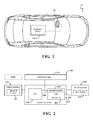
- a vehicle 10 which includes a computing device 100 described here after and shown in Figs. 2 and 5 .
- the computing device 100 can be located within the vehicle 10 as shown in Fig. 1 , or it can be located remotely from the vehicle 10 in an alternate location, not shown. If the computing device 100 is remote from the vehicle 10, the vehicle 10 can include the capability of communicating with the computing device 100.
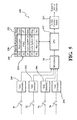
- Fig. 2 is a block diagram of the computing device 100 for implementing an auditory interface in the vehicle 10.
- the computing device 100 can be any type of vehicle-installed, handheld, desktop, or other form of single computing device, or can be composed of multiple computing devices.
- the processing unit in the computing device 100 can be at least one or more conventional central processing units (CPU) 102 or any other type of device, or multiple devices, capable of manipulating or processing information.
- the memory 104 in the computing device 100 can be a random access memory device (RAM) or any other suitable type of storage device.
- the memory can include data 106 that is accessed by the CPU 102 using a bus 108.
- the memory 104 can also include an operating system 110 and installed applications 112, the installed applications 112 including programs that permit the CPU 102 to execute stored program instructions to implement the auditory interface as described below.
- the computing device 100 can also include secondary, additional, or external storage 114, for example, a memory card, flash drive, or any other form of computer readable medium.
- the installed applications 112 can be stored in whole or in part in the external storage 114 and loaded into the memory 104 as needed for processing.
- the computing device 100 can also be coupled to one or more vehicle systems 116.
- vehicle systems 116 can be, for example, various driver selected vehicle functions, such as vehicle functions controlled from within the vehicle cabin, including, for example, HVAC controls, audio system controls, windshield wipers, map lights, interior lighting, etc.
- vehicle control functions may be provided with selectors, such as switches or push buttons located within the vehicle cabin, the actual vehicle function may be performed by a device or system external to the vehicle cabin, such as a control system or device mounted in the engine compartment, etc.
- the computing device 100 can also be coupled to one or more vehicle interfaces 120 configured to receive input from the driver of the vehicle.
- the vehicle interfaces 120 can include, for example, an interactive display 14 shown in Fig. 3 .
- the interactive display 14 can be configured to allow the driver to send commands to the computing device 100 intended to control the operation of vehicle systems 116 as further described in Figs. 5 and 6 .
- a vehicle instrument panel 12 is depicted by example.
- the instrument panel 12 includes a plurality of gauges 13 and various vehicle control selectors mounted on the instrument panel 12, on stalk switches mounted on the vehicle steering column, or on a steering wheel 20.
- the visible interactive display 14 can be mounted on the instrument panel 12 for receiving input from the driver as well as displaying various vehicle functions.
- An audible sound or tone receiver 16 such as a microphone, can also be mounted on the instrument panel 12 for receiving audible tones and converting the audible tones to electrical signals used by the computing device 100, as described hereafter.
- audible tones are stored or provided in a selectable format so as to be audibly generated when a particular tone is selected by various means.
- the apparatus and method link the selected tone in step 152 with a selected vehicle function.
- This enables an audible tone, when selected by a vehicle driver, to be generated and then recognized by the apparatus and method to enable control of the selected vehicle function linked with the specific tone.
- a particular tone as described in detail hereafter, can be linked to a specific vehicle function, such as turning on the vehicle HVAC system.
- a different tone, when selected and generated, can be employed to turn the vehicle HVAC system off.
- one particular tone is selected.
- the tones may include audible sounds, such as “boom,” “bang,” “click,” a door knock, individual musical notes, musical chords, bells, chimes, phone rings, waves, etc., as well as other common tones frequently heard in a home or office environment, or an outdoor environment, such as bird chirps, animal sounds, dog barks, etc.
- the tones are tonal patterns, rather than spoken words. In this matter, sound recognition difficulties encountered with words spoken in different languages or different language dialects can be averted.
- the tone may also include a plurality of tones, such as a musical chord or groups of musical notes played simultaneously or consecutively, etc.
- step 156 the apparatus and method generate the tone selected in step 154.
- the audible generated tone is received by suitable audio tone reception devices or receiver in the vehicle or otherwise recognized by the apparatus and method to enable the vehicle function linked with the selected and generated tone to be activated or controlled in step 158.
- FIG. 5 there is depicted a detailed block diagram of the vehicle audible interface apparatus.
- a plurality of vehicle function selectors (hereafter “selectors”), 30, 32, 34, and 36, which can be push buttons, slide switches, etc., with four selectors 30, 32, 34, and 36 being shown by example only, are mounted within the vehicle 10 in easily accessible positions for access by the vehicle driver, without distracting the vehicle driver's eyes from the road.
- the selectors 30, 32, 34, and 36 can be mounted in the steering wheel 20 in any suitable location, such as on the spokes connecting the outer annular ring portion of the steering wheel 20 to a central base.
- the selectors 30, 32, 34, and 36 may be arranged in groups or individually spaced apart at various locations on the steering wheel 20.
- the selector When the driver selects one of the selectors 30, 32, 34, and 36, the selector generates an electric signal which is coupled, respectively, in one aspect, to a tone generator 200, 202, 204, and 206, mounted in the steering wheel 20.
- the tone generators 200, 202, 204, and 206 are off the shelf components which generate a pre-stored audible tone in response to an input signal.
- Such tone generators 200, 202, 204, and 206 may include integrated circuits which have a flash memory capable of converting digital information to analog audible signals through a speaker or other broadcast element.
- the tone generators 200, 202, 204, and 206 provide the ability to store distinct tones as described above in connection with step 150 in Fig. 4 .
- the direct hard-wired connection or software implemented connection of the selectors 30, 32, 34, and 36, respectively with the tone generators 200, 202, 204, and 206 links a particular vehicle function associated with each selector 30, 32, 34, and 36 with a distinct tone provided by each separate tone generator 200, 202, 204, and 206.
- Each tone generator 200, 202, 204, and 206 generates a unique, distinct tone which can be distinguished by a tone receiver 16, associated with the CPU 102.
- the tone receiver 16 such as a microphone, is an electronic circuit which receives the audible tone from one of the tone generators 200, 202, 204, and 206, and converts the audible tone from analog to digital format, and generates a tone identifier indicating which selector 30, 32, 34, and 36 generated the received tone.
- This tone identifier is input to the CPU 102 which accesses a lookup table 212 in the memory 104 associating each distinct tone with a particular vehicle function as shown in Fig. 6 .
- the CPU 102 outputs the identified vehicle function as a signal from a vehicle function select circuit 214 and sends the signal to a respective vehicle function controller to take the requested vehicle function action, as described in step 158 in Fig. 4
- the tones generated by the tone generators 200, 202, 204, and 206 provide an audible distraction to the vehicle driver to relieve boredom and keep the driver alert during vehicle operation.
- two or more of the selectors 30, 32, 34, and 36 may be actuated simultaneously causing a plurality of distinct tones to be generated by the tone generators 200, 202, 204, and 206.
- the tone receiver 16 is capable of outputting separate tone ID's to the CPU 102 which then can look up the vehicle function associated with each of the plurality of tones and generate the appropriate vehicle function signals. This allows the computing device 100 to control a greater number of vehicle functions than would be possible by a direct single correlation between one selector 30, 32, 34, and 36 and one vehicle control function.
- the computing device 100 can be configured to treat the simultaneous generation and receiving of two audible tones, when two of the selectors 30, 32, 34, and 36 are simultaneously actuated or moved, as separate tones, each associated with a respective pre-assigned vehicle control function as shown in the lookup table 212 in Fig. 5 , or as a new tone associated with a distinct, separate vehicle control function.
- simultaneous depression of the selectors 30 and 32 will cause audible tones in the form of a musical note A# and "boom" to be simultaneously generated.
- the combined A# and "boom" tone can be interpreted by the CPU 102 as a new tone signal for a different vehicle control function, not shown in the lookup table 212.
- a digital form of an audible tone is stored in the memory 104 and accessed through the lookup table 212 and associated with one of the selectors 30, 32, 34, and 36 pre-assigned to specific vehicle functions.
- a unique signal from the activated selector 30, 32, 34, and 36 is input to a detection circuit 230 in the vehicle interface 120.
- the detection circuit 230 identifies the activated selector 30, 32, 34, and 36 and transmits the selector ID through a steering wheel transmission device, such as a sliding ring contact, to a conversion and ID generator 234.
- the output of the converter and selector ID generator 234 is input to the CPU 102 which then uses the selector ID that was actuated to access the lookup table 212 and generate a signal used for the selected vehicle function.
- the lookup table 212 correlates selector IDs 240 with a unique vehicle function 250 and a unique tone 252. For example, if selector 30 is depressed, the generated signal, after passing through the detection circuit 230, the steering wheel transmission device 232 and the converter and ID generator 234, is used by the CPU 102 to access the lookup table 212 and select the vehicle function from column 250 and the audible tone from column 252 associated with the selector ID 240 corresponding to selector 30.
- the CPU 102 then generates a signal to the vehicle function select circuit 214 which is outputted to the vehicle function controller associated with the desired vehicle function, such as the door locks associated with selector 30.
- the CPU 102 takes the digitally stored form of the tone in column 252 associated with the selector 30 and outputs the tone through a speaker, which may be the vehicle audio system speakers 118.
- a speaker which may be the vehicle audio system speakers 118.
- the apparatus and method can also be provided with the capability of learning a new tone.
- a separate tone generator 220 can be provided to generate a new audible tone which the vehicle driver wishes to store as part of the tone associated control of vehicle functions.
- the tone generator 220 although illustrated as an actual element, can take many forms, such as a musical note generated by a musical instrument, such as a guitar, or an audible tone generated by a tone generator from the driver's mobile device, i.e., smart phone, tablet, etc. In the case of the driver's mobile phone, the selected tone can be pre-recorded or stored in the mobile device.
- the tone generated by the tone generator 220 is received by the microphone 16 on the instrument panel 12. This analog signal is then converted by the microphone 16 or a digital receiver and input to the CPU 102 when the learn mode is entered in step 300.
- a select signal to enter the learn mode could be a double tap on any of the selectors 30, 32, 34, and 36, the depression and hold of one of the selectors 30, 32, 34, and 36 for a pre-determined amount of time, such as 5 seconds or more, a separate input switch or signal generating device, not shown, etc.
- a user can generate the tone through the tone generator 220.
- This audible tone is received by the microphone 16 in the vehicle instrument panel 12.
- the microphone 16 can be an analog microphone or a digital receiver which converts the received tone to a digital signal which then is input to the CPU 102.
- the CPU 102 determines that a tone generated in step 302 has been received in step 304, the CPU 102 determines whether the tone is a digital tone or an analog tone in step 306. If the received tone is an analog tone, the CPU 102 digitizes the analog signal received from the microphone 16 in step 310. The output of step 306 or step 310 is temporarily saved by to the CPU 102.
- the CPU 102 then waits for the user to select a particular selector 30, 32, 34, or 36 to be associated with the new tone.
- This can be any of the selectors 30, 32, 34, and 36 mounted on the vehicle steering wheel 20.
- the driver selects the appropriate selector which has been pre-assigned to a particular vehicle function, actuation, by activating the selector 30, 32, 34, or 36 in a manner distinct from the sequence used to select a vehicle function or enter the learn mode in step 300.
- the learn mode is entered in step 300 by a double tap depression in quick succession of a selector
- the step 312 can be implemented by the driver depressing one selector for a longer length of time, such as 5 or 10 seconds.
- the CPU 102 receives a selector assigned signal in step 312, the CPU 102 links the selector ID with the new tone in the lookup table 212 in the memory 104 for the same vehicle function previously associated with the selector.
- a first selector 30, 32, 34, or 36 is located in a conveniently accessible location in the vehicle, such as on the steering wheel or near the steering wheel within easy reach of the driver.
- the selector 30 could be associated with the tone generator 200 or coupled as an input to the CPU 102 to access a plurality of tones stored in a tone storage memory in step 400.
- the selector 30 is activated to select one tone from step 402.
- the same first selector 30 could be activated any number of consecutive times to select different tones in the tone storage.
- the selected tone(s) are generated in step 404 and broadcast through a speaker or other audio sound generator so as to be able to be heard by the driver.
- a third selector 34 is actuated in step 408 to select a specific vehicle function.
- the third selector 34 may be located on the vehicle dashboard or steering wheel and is associated with a particular vehicle function, such as turning the air conditioning on and off, turning the audio system on and off, turning the headlights on and off, etc.
- the actuation of the vehicle function by the third selector 34 associates in step 410 a selected captured audible tone from step 406 with the selected vehicle function from step 408.
- the links associate the tone to the vehicle function in step 412 in memory such that future actuation of the third selector 34 causes the tone linked to the vehicle function selection input to be audibly generated as well as to enable the vehicle function to be actuated.
- Fig. 9 depicts another aspect of the present apparatus and method using a unique automatic tone recognizer.
- a plurality of individual tones are stored in step 500.
- a plurality of discrete individual tones could be stored in a lookup table with respective letters A-Z.
- Individual tones can be utilized in step 502 as a single distinct tone.
- a plurality of individual tones from step 500 can be associated and simultaneously generated as a chord.
- a plurality of individual tones from step 500 can be grouped as a consecutive sequence of separate and consecutively generated tones in step 506.
- step 508 a large number of different vehicle functions and distinct tones can be generated in step 508 by use of suitable selectors or push buttons, including a numeric key pad where an individual number denotes one of the tones from steps 502, 504, and 506. Selecting one of the tones in step 508 can then be used according to any of the methods described above, to link the selected tone with a selected vehicle function selection input in step 510.
- the original equipment manufacturer (OEM) of the vehicle can initially store a plurality of tones in the memory 104 which are accessible through the CPU 102.
- OEM original equipment manufacturer
- individual push button or input selectors on the vehicle steering wheel, door or dashboard are programmed by the OEM to unique tones.
- one interface button may link the tone "bang" with turning the vehicle audio system "on”.
- a second vehicle interface button may be associated with turning the air conditioning "off” and generate a "ring" tone.
- the CPU 102 when the vehicle driver selects a particular function input selector in step 602, the CPU 102 generates the tone linked to that input selector in step 604. This enables the driver to learn to link the audibly heard tone associated with the input selector to the particular vehicle function in step 606.
- step 600 After the driver becomes familiar with the links between specific tones and specific vehicle functions, or after a set time period has elapsed, for example, the original OEM links stored in step 600 can be removed in step 608. From then on, activation of one of the vehicle interface push buttons causes the specific tone associated with the vehicle function to be generated in step 610 in the same manner as described above. At the same time, the generated tone is processed by the apparatus to activate the linked vehicle function in step 612.
- the present apparatus and method provides audible tone generation when the vehicle function selector is manually actuated.
- the audible tones are associated with preassigned vehicle function.
- the audible tones provide a distraction to the driver alleviating potential boredom.
- the audible tones, when generated, are received by an audible tone receiver in the vehicle and used by the processor to identify the selector and the vehicle functions to enable an output signal to be sent to a vehicle controller to implement the selected vehicle function.
Landscapes
- Engineering & Computer Science (AREA)
- Mechanical Engineering (AREA)
- Chemical & Material Sciences (AREA)
- Combustion & Propulsion (AREA)
- Transportation (AREA)
- Physics & Mathematics (AREA)
- General Physics & Mathematics (AREA)
- Computer Networks & Wireless Communication (AREA)
- Signal Processing (AREA)
- Electromagnetism (AREA)
- Human Computer Interaction (AREA)
- Fittings On The Vehicle Exterior For Carrying Loads, And Devices For Holding Or Mounting Articles (AREA)
Abstract
Description
- The present disclosure is related to vehicle control systems and, more particularly, to vehicle control systems using audible sounds.
- Voice recognition systems have been devised to allow a control system to take pre-determined actions in response to receiving a particular spoken voice command. In the vehicle field, such voice commands can be used to control the audio system of the vehicle as well as to communicate externally of the vehicle.
- However, vehicles are produced throughout the world and thus use voice commands in the language spoken in a particular country. This requires different sound recognition interfaces and may not address dialects or languages spoken by only a small percentage of the people in a country.
- US Patent publication
US 2012/0229253 discloses a sound activated wireless vehicle door unlock device which is capable of unlocking the vehicle door locks in response to a pre-determined series of knocks or tones issued by the vehicle user. -
US Patent 6,148,251 discloses vehicle control systems using voice or tone commands. This system converts the tones generated by tone generators when a steering wheel mounted push buttons are actuated. The tones are only electrical frequencies which are superimposed over the signal frequency sent from the steering wheel controller to the vehicle controller which then decodes the frequency to take the indicated vehicle function action. This system, however, does not generate audible tones which the vehicle driver can hear. - It is known that vehicle drivers, particularly drivers with many years of driving experience, frequently become bored or distracted while driving for a considerable length of time, particularly on highways.
- It would be useful to provide an audible recognition system for controlling selected vehicle functions which can also alleviate driver boredom and distraction.
- An apparatus and method for tone-based control of vehicle function utilizes vehicle function selectors mounted in the vehicle, such as on the vehicle steering wheel. Each selector is associated with a distinct audible tone and a distinct vehicle control function. Any of the vehicle function selectors causes the vehicle control function to be implemented and an audible tone to be generated which can be heard by the driver and the associated vehicle control function to be implemented.
- In one aspect, a discrete tone generator is coupled to each selector to generate the audible tone. The audible tone is received and input to a processor which correlates the audible tone with a distinct vehicle control function to implement the vehicle control function.
- Alternately, the tones are correlated to vehicle control functions and stored in memory. Actuation of the vehicle function selector causes both the associated audible tone to be broadcast within the vehicle as well as the vehicle control function to be implemented.
A new tone can be learned and stored in memory and associated with a particular vehicle function selector. - The various features, advantages and other uses of the present tone based control of vehicle functions will become more apparent by referring to the following detailed description and drawing in which;
-
Fig. 1 is a pictorial representation of a vehicle including a computing device used in the present apparatus and method; -
Fig. 2 is a block diagram of the computing device shown inFig. 1 for implementing a tone based control of vehicle functions; -
Fig. 3 is a pictorial representation of a vehicle instrument panel and steering wheel implementing part of the tone based control of vehicle functions; -
Fig. 4 is a process diagram of the operation of the tone generating and vehicle function selection apparatus and method; -
Fig. 5 is a more detailed block diagram of the tone generating and vehicle function selection apparatus and method shown generally inFIG. 2 ; -
Fig. 6 is a block diagram of an alternate tone generating and vehicle function selection apparatus and method; -
Fig. 7 is a logic flow chart of a process performed by the apparatus as shown inFig. 5 for learning a new tone to control a vehicle function; -
Fig. 8 is a process diagram of another aspect of the present apparatus and method; -
Fig. 9 is a process diagram of another aspect of the apparatus and method; and -
Fig. 10 is a process diagram of another aspect of the apparatus and method. - The present apparatus and method provides audible tone generation associated with manually operated vehicle function selectors mounted in a vehicle cabin or passenger compartment and useable by a vehicle driver to generate audible tones which are associated with pre-assigned vehicle functions. The audible tones are capable of being heard by the vehicle driver and provide a distraction alleviating potential driver boredom. The tones can be pre-assigned to a vehicle function selector or new tones, selected by the driver, can be input to the apparatus and assigned to a particular vehicle function selector. The tones, when generated, are recognized by an audio reception portion of the apparatus which links the generated tone with a selected vehicle function to enable activation or control of the selected vehicle function.
- Referring to
Fig. 1 , avehicle 10 is depicted which includes acomputing device 100 described here after and shown inFigs. 2 and5 . Thecomputing device 100 can be located within thevehicle 10 as shown inFig. 1 , or it can be located remotely from thevehicle 10 in an alternate location, not shown. If thecomputing device 100 is remote from thevehicle 10, thevehicle 10 can include the capability of communicating with thecomputing device 100. -
Fig. 2 is a block diagram of thecomputing device 100 for implementing an auditory interface in thevehicle 10. Thecomputing device 100 can be any type of vehicle-installed, handheld, desktop, or other form of single computing device, or can be composed of multiple computing devices. The processing unit in thecomputing device 100 can be at least one or more conventional central processing units (CPU) 102 or any other type of device, or multiple devices, capable of manipulating or processing information. Thememory 104 in thecomputing device 100 can be a random access memory device (RAM) or any other suitable type of storage device. The memory can includedata 106 that is accessed by theCPU 102 using abus 108. - The
memory 104 can also include an operating system 110 and installedapplications 112, the installedapplications 112 including programs that permit theCPU 102 to execute stored program instructions to implement the auditory interface as described below. Thecomputing device 100 can also include secondary, additional, orexternal storage 114, for example, a memory card, flash drive, or any other form of computer readable medium. In one aspect, the installedapplications 112 can be stored in whole or in part in theexternal storage 114 and loaded into thememory 104 as needed for processing. - The
computing device 100 can also be coupled to one ormore vehicle systems 116. Thevehicle systems 116 can be, for example, various driver selected vehicle functions, such as vehicle functions controlled from within the vehicle cabin, including, for example, HVAC controls, audio system controls, windshield wipers, map lights, interior lighting, etc. Although the vehicle control functions may be provided with selectors, such as switches or push buttons located within the vehicle cabin, the actual vehicle function may be performed by a device or system external to the vehicle cabin, such as a control system or device mounted in the engine compartment, etc. - The
computing device 100 can also be coupled to one ormore vehicle interfaces 120 configured to receive input from the driver of the vehicle. Thevehicle interfaces 120 can include, for example, aninteractive display 14 shown inFig. 3 . Theinteractive display 14 can be configured to allow the driver to send commands to thecomputing device 100 intended to control the operation ofvehicle systems 116 as further described inFigs. 5 and6 . As shown inFig. 3 , avehicle instrument panel 12 is depicted by example. Theinstrument panel 12 includes a plurality ofgauges 13 and various vehicle control selectors mounted on theinstrument panel 12, on stalk switches mounted on the vehicle steering column, or on asteering wheel 20. In addition, the visibleinteractive display 14 can be mounted on theinstrument panel 12 for receiving input from the driver as well as displaying various vehicle functions. - An audible sound or
tone receiver 16, such as a microphone, can also be mounted on theinstrument panel 12 for receiving audible tones and converting the audible tones to electrical signals used by thecomputing device 100, as described hereafter. - Referring now to
Fig. 4 , there is depicted a general process flow diagram of the algorithm employed by the present apparatus and method to use audible tones to control selected vehicle functions. Instep 150, as described in various aspects hereafter, audible tones are stored or provided in a selectable format so as to be audibly generated when a particular tone is selected by various means. - The apparatus and method link the selected tone in
step 152 with a selected vehicle function. This enables an audible tone, when selected by a vehicle driver, to be generated and then recognized by the apparatus and method to enable control of the selected vehicle function linked with the specific tone. For example, a particular tone, as described in detail hereafter, can be linked to a specific vehicle function, such as turning on the vehicle HVAC system. A different tone, when selected and generated, can be employed to turn the vehicle HVAC system off. - In
step 154, one particular tone, as described hereafter, is selected. For example, the tones may include audible sounds, such as "boom," "bang," "click," a door knock, individual musical notes, musical chords, bells, chimes, phone rings, waves, etc., as well as other common tones frequently heard in a home or office environment, or an outdoor environment, such as bird chirps, animal sounds, dog barks, etc. - The tones are tonal patterns, rather than spoken words. In this matter, sound recognition difficulties encountered with words spoken in different languages or different language dialects can be averted.
- The tone may also include a plurality of tones, such as a musical chord or groups of musical notes played simultaneously or consecutively, etc.
- In
step 156, the apparatus and method generate the tone selected instep 154. As described hereafter, the audible generated tone is received by suitable audio tone reception devices or receiver in the vehicle or otherwise recognized by the apparatus and method to enable the vehicle function linked with the selected and generated tone to be activated or controlled instep 158. - Referring now to
Fig. 5 , there is depicted a detailed block diagram of the vehicle audible interface apparatus. A plurality of vehicle function selectors (hereafter "selectors"), 30, 32, 34, and 36, which can be push buttons, slide switches, etc., with fourselectors vehicle 10 in easily accessible positions for access by the vehicle driver, without distracting the vehicle driver's eyes from the road. For example, theselectors steering wheel 20 in any suitable location, such as on the spokes connecting the outer annular ring portion of thesteering wheel 20 to a central base. Theselectors steering wheel 20. - When the driver selects one of the
selectors tone generator steering wheel 20. Thetone generators Such tone generators tone generators step 150 inFig. 4 . In addition, the direct hard-wired connection or software implemented connection of theselectors tone generators selector separate tone generator - Each
tone generator tone receiver 16, associated with theCPU 102. - The
tone receiver 16, such as a microphone, is an electronic circuit which receives the audible tone from one of thetone generators selector CPU 102 which accesses a lookup table 212 in thememory 104 associating each distinct tone with a particular vehicle function as shown inFig. 6 . - The
CPU 102 outputs the identified vehicle function as a signal from a vehicle functionselect circuit 214 and sends the signal to a respective vehicle function controller to take the requested vehicle function action, as described instep 158 inFig. 4 - In addition to enabling the vehicle driver to control a selected vehicle function without distraction or removing his or her eyes from the surrounding environment or road, the tones generated by the
tone generators - It will also be understood that two or more of the
selectors tone generators tone receiver 16 is capable of outputting separate tone ID's to theCPU 102 which then can look up the vehicle function associated with each of the plurality of tones and generate the appropriate vehicle function signals. This allows thecomputing device 100 to control a greater number of vehicle functions than would be possible by a direct single correlation between oneselector - It will be understood that the
computing device 100 can be configured to treat the simultaneous generation and receiving of two audible tones, when two of theselectors Fig. 5 , or as a new tone associated with a distinct, separate vehicle control function. For example, simultaneous depression of theselectors CPU 102 as a new tone signal for a different vehicle control function, not shown in the lookup table 212. - It is also possible to configure the
computing device 100 in a form which does not useseparate tone generators specific selectors Fig. 6 , a digital form of an audible tone is stored in thememory 104 and accessed through the lookup table 212 and associated with one of theselectors selectors selector detection circuit 230 in thevehicle interface 120. Thedetection circuit 230 identifies the activatedselector ID generator 234. The output of the converter andselector ID generator 234 is input to theCPU 102 which then uses the selector ID that was actuated to access the lookup table 212 and generate a signal used for the selected vehicle function. - As shown in
Fig. 6 , the lookup table 212 correlatesselector IDs 240 with aunique vehicle function 250 and aunique tone 252. For example, ifselector 30 is depressed, the generated signal, after passing through thedetection circuit 230, the steeringwheel transmission device 232 and the converter andID generator 234, is used by theCPU 102 to access the lookup table 212 and select the vehicle function fromcolumn 250 and the audible tone fromcolumn 252 associated with theselector ID 240 corresponding toselector 30. - The
CPU 102 then generates a signal to the vehicle functionselect circuit 214 which is outputted to the vehicle function controller associated with the desired vehicle function, such as the door locks associated withselector 30. - At the same time, the
CPU 102 takes the digitally stored form of the tone incolumn 252 associated with theselector 30 and outputs the tone through a speaker, which may be the vehicleaudio system speakers 118. Thus, in this manner, depression of one of theselectors - The apparatus and method can also be provided with the capability of learning a new tone. As shown in
Fig. 6 , and in the algorithm ofFig. 7 , aseparate tone generator 220 can be provided to generate a new audible tone which the vehicle driver wishes to store as part of the tone associated control of vehicle functions. Thetone generator 220, although illustrated as an actual element, can take many forms, such as a musical note generated by a musical instrument, such as a guitar, or an audible tone generated by a tone generator from the driver's mobile device, i.e., smart phone, tablet, etc. In the case of the driver's mobile phone, the selected tone can be pre-recorded or stored in the mobile device. - The tone generated by the
tone generator 220 is received by themicrophone 16 on theinstrument panel 12. This analog signal is then converted by themicrophone 16 or a digital receiver and input to theCPU 102 when the learn mode is entered instep 300. - A select signal to enter the learn mode could be a double tap on any of the
selectors selectors - Once the learn mode is entered in
step 300, a user can generate the tone through thetone generator 220. This audible tone is received by themicrophone 16 in thevehicle instrument panel 12. Themicrophone 16 can be an analog microphone or a digital receiver which converts the received tone to a digital signal which then is input to theCPU 102. TheCPU 102 determines that a tone generated instep 302 has been received instep 304, theCPU 102 determines whether the tone is a digital tone or an analog tone instep 306. If the received tone is an analog tone, theCPU 102 digitizes the analog signal received from themicrophone 16 instep 310. The output ofstep 306 or step 310 is temporarily saved by to theCPU 102. - The
CPU 102 then waits for the user to select aparticular selector selectors vehicle steering wheel 20. The driver selects the appropriate selector which has been pre-assigned to a particular vehicle function, actuation, by activating theselector step 300. For example, if the learn mode is entered instep 300 by a double tap depression in quick succession of a selector, thestep 312 can be implemented by the driver depressing one selector for a longer length of time, such as 5 or 10 seconds. When theCPU 102 receives a selector assigned signal instep 312, theCPU 102 links the selector ID with the new tone in the lookup table 212 in thememory 104 for the same vehicle function previously associated with the selector. - Referring now to
Fig. 8 , in another aspect of the present apparatus and method, afirst selector selector 30 could be associated with thetone generator 200 or coupled as an input to theCPU 102 to access a plurality of tones stored in a tone storage memory instep 400. Theselector 30 is activated to select one tone fromstep 402. The samefirst selector 30 could be activated any number of consecutive times to select different tones in the tone storage. The selected tone(s) are generated instep 404 and broadcast through a speaker or other audio sound generator so as to be able to be heard by the driver. Thesecond selector 30, also having electronic memory capabilities, is then activated instep 406. Next, athird selector 34 is actuated instep 408 to select a specific vehicle function. Thethird selector 34 may be located on the vehicle dashboard or steering wheel and is associated with a particular vehicle function, such as turning the air conditioning on and off, turning the audio system on and off, turning the headlights on and off, etc. The actuation of the vehicle function by thethird selector 34 associates in step 410 a selected captured audible tone fromstep 406 with the selected vehicle function fromstep 408. The links associate the tone to the vehicle function instep 412 in memory such that future actuation of thethird selector 34 causes the tone linked to the vehicle function selection input to be audibly generated as well as to enable the vehicle function to be actuated. -
Fig. 9 depicts another aspect of the present apparatus and method using a unique automatic tone recognizer. A plurality of individual tones are stored instep 500. For example, a plurality of discrete individual tones could be stored in a lookup table with respective letters A-Z. Individual tones can be utilized instep 502 as a single distinct tone. Alternately, instep 504, a plurality of individual tones fromstep 500 can be associated and simultaneously generated as a chord. Instep 506, a plurality of individual tones fromstep 500 can be grouped as a consecutive sequence of separate and consecutively generated tones instep 506. - In this manner, a large number of different vehicle functions and distinct tones can be generated in
step 508 by use of suitable selectors or push buttons, including a numeric key pad where an individual number denotes one of the tones fromsteps step 508 can then be used according to any of the methods described above, to link the selected tone with a selected vehicle function selection input instep 510. - Another aspect of the present apparatus and method is depicted in the process flow diagram of
Fig. 10 . Instep 600, the original equipment manufacturer (OEM) of the vehicle can initially store a plurality of tones in thememory 104 which are accessible through theCPU 102. In this manner, individual push button or input selectors on the vehicle steering wheel, door or dashboard, are programmed by the OEM to unique tones. For example, one interface button may link the tone "bang" with turning the vehicle audio system "on". A second vehicle interface button may be associated with turning the air conditioning "off" and generate a "ring" tone. - In this manner, when the vehicle driver selects a particular function input selector in
step 602, theCPU 102 generates the tone linked to that input selector instep 604. This enables the driver to learn to link the audibly heard tone associated with the input selector to the particular vehicle function instep 606. - After the driver becomes familiar with the links between specific tones and specific vehicle functions, or after a set time period has elapsed, for example, the original OEM links stored in
step 600 can be removed instep 608. From then on, activation of one of the vehicle interface push buttons causes the specific tone associated with the vehicle function to be generated instep 610 in the same manner as described above. At the same time, the generated tone is processed by the apparatus to activate the linked vehicle function instep 612. - The present apparatus and method provides audible tone generation when the vehicle function selector is manually actuated. The audible tones are associated with preassigned vehicle function. The audible tones provide a distraction to the driver alleviating potential boredom. The audible tones, when generated, are received by an audible tone receiver in the vehicle and used by the processor to identify the selector and the vehicle functions to enable an output signal to be sent to a vehicle controller to implement the selected vehicle function.
Claims (15)
- A method of controlling vehicle functions comprising:associating a selector (30) in a vehicle (10) to a vehicle function (250);providing a distinct audible tone associated with the selector (30);when the selector (30) is actuated, generating the distinct audible tone associated with the selector (30); andactivating the vehicle function (250) in response to the audible tone being generated.
- The method of claim 1 further comprising:associating each of a plurality of selectors (30, 32, 34, 36) with a respective one of a plurality of distinct vehicle functions (250); andassociating a distinct audible tone with each of the plurality of selectors (30, 32, 34, 36).
- The method of claim 1 further comprising:coupling a tone generator (200) to the selector (30); andgenerating the distinct audible tone on the tone generator (200) when the selector (30) is actuated.
- The method of claim 1 further comprising:using an audible tone receiver (16), mounted in the vehicle (10), for receiving the audible tone generated; andusing at least one processor (102) executing program instructions, in response to the received audible tone from the audible tone receiver (16), to generate an output for a vehicle function associated with the received audible tone.
- The method of claim 1 further comprising:storing the audible tone in memory (104); andin response to identifying an actuated selector (30), generating the audible tone associated with the actuated selector (30).
- The method of claim 5 further comprising:configuring the selector (30) as a push button on a vehicle steering wheel (20).
- The method of claim 1 further comprising;storing the audible tone in a tone generator (200); andcoupling the selector (30) to the tone generator (200) such that actuation of the selector (30) causes the tone generator (200) to generate the audible tone.
- The method of claim 1 wherein the step of providing the distinct audible tone associated with the selector (30) comprises:providing the distinct audible tone as one of a single discrete tone, a plurality of simultaneously generated tones, and a plurality of consecutively generated discrete tones.
- The method of claim 1 wherein the step of providing the distinct audible tone associated with the selector (30) comprises:pre-assigning a plurality of distinct tones to a plurality of distinct selectors (30, 32, 34, 36) such that actuation of each selector (30, 32, 34, 36) generates the audible tone associated therewith.
- A vehicle function control apparatus utilizing audible tones, the apparatus comprising:at least one tone generator (200) capable of emitting at least one audible tone;a selector (30) for a vehicle function (250), the selector (30) being mountable in a vehicle (10) and associated with one audible tone;a memory (104) storing correlations between the at least one audible tone and the vehicle function (250); andat least one processor (102) executing program instructions in response to activation of the selector (30), to generate an output selecting the vehicle function (250) associated with the selector (30).
- The apparatus of claim 10 further comprising:a plurality of tone generators (200, 202, 204, 206, 220) and a plurality of selectors (30, 32, 34, 36), each tone generator (200, 202, 204, 206, 220) generating a distinct audible tone when the selector (30, 32, 34, 36) associated therewith is actuated.
- The apparatus of claim 11 wherein:at least two of the plurality of selectors (30, 32, 34, 36) and at least two of the plurality of tone generators (200, 202, 204, 206, 220) are capable of simultaneous actuation and generation.
- The apparatus of claim 10 further comprising:a plurality of tone generators (200, 202, 204, 206, 220), each generating a distinct audible tone; anda plurality of selectors (30, 32, 34, 36), each selector (30, 32, 34, 36) associated with a respective tone generator (200, 202, 204, 206, 220).
- The apparatus of claim 13 wherein the selectors (30, 32, 34, 36) comprise separate push buttons mounted on a vehicle steering wheel (20).
- The apparatus of claim 10 further comprising:the at least one tone generator (200) including a tone stored in a memory (104); andthe at least one processor (102) executing program instructions, when the vehicle function (250) is selected by the selector (30), to audibly broadcast the audible tone associated with the vehicle function (250) selected and generate a vehicle control function output associated to the audible tone and sending the vehicle control function output to a vehicle function controller.
Applications Claiming Priority (1)
| Application Number | Priority Date | Filing Date | Title |
|---|---|---|---|
| US14/518,248 US9539943B2 (en) | 2014-10-20 | 2014-10-20 | Tone based control of vehicle functions |
Publications (1)
| Publication Number | Publication Date |
|---|---|
| EP3012157A1 true EP3012157A1 (en) | 2016-04-27 |
Family
ID=54703716
Family Applications (1)
| Application Number | Title | Priority Date | Filing Date |
|---|---|---|---|
| EP15190105.5A Withdrawn EP3012157A1 (en) | 2014-10-20 | 2015-10-16 | Tone based control of vehicle functions |
Country Status (3)
| Country | Link |
|---|---|
| US (1) | US9539943B2 (en) |
| EP (1) | EP3012157A1 (en) |
| JP (1) | JP6356649B2 (en) |
Families Citing this family (1)
| Publication number | Priority date | Publication date | Assignee | Title |
|---|---|---|---|---|
| US12592107B2 (en) | 2024-02-28 | 2026-03-31 | Honda Motor Co., Ltd. | Spoken notifications for acoustic vehicle alerting systems |
Citations (9)
| Publication number | Priority date | Publication date | Assignee | Title |
|---|---|---|---|---|
| DE2643912A1 (en) * | 1976-09-29 | 1978-03-30 | Edmund Reinfried Poetsch | Switch for household equipment - has integrated circuit including amplifier to respond to specified sound e.g. whistle, but not to general noise |
| WO1997031437A1 (en) * | 1996-02-20 | 1997-08-28 | Sonic Systems | Digital sonic and ultrasonic communications networks |
| EP1020331A2 (en) * | 1999-01-12 | 2000-07-19 | TRW Inc. | Touchtone electronic steering wheel |
| JP2004282157A (en) * | 2003-03-12 | 2004-10-07 | Denso Corp | Sound switch |
| US20080285388A1 (en) * | 2006-08-28 | 2008-11-20 | Victor Company Of Japan, Limited | Control device for electronic appliance and control method of the electronic appliance |
| US20120229253A1 (en) | 2011-03-07 | 2012-09-13 | John Clinton Kolar | Aftermarket sound activated wireless vehicle door unlocker |
| US20140136050A1 (en) * | 2012-11-09 | 2014-05-15 | Hyundai Motor Company | Vehicle control apparatus |
| US20150063074A1 (en) * | 2013-09-02 | 2015-03-05 | Hyundai Motor Company | Apparatus and method for providing a customized input-service |
| EP2868531A1 (en) * | 2013-10-30 | 2015-05-06 | Powervoice Co., Ltd. | Sound QR system for vehicular services |
Family Cites Families (5)
| Publication number | Priority date | Publication date | Assignee | Title |
|---|---|---|---|---|
| JP2001078276A (en) * | 1999-09-07 | 2001-03-23 | Mitsubishi Electric Corp | Remote control device |
| US7680574B2 (en) | 2004-03-04 | 2010-03-16 | Gm Global Technology Operations, Inc. | Vehicle information system with steering wheel controller |
| JP5096772B2 (en) * | 2007-03-23 | 2012-12-12 | 富士重工業株式会社 | Vehicle message information notification device |
| US20090140878A1 (en) * | 2007-11-30 | 2009-06-04 | Ryan Ii Thomas E | Sound customization for operating actions of automobiles |
| DE102011003976B3 (en) | 2011-02-11 | 2012-04-26 | Fraunhofer-Gesellschaft zur Förderung der angewandten Forschung e.V. | Sound input device for use in e.g. music instrument input interface in electric guitar, has classifier interrupting output of sound signal over sound signal output during presence of condition for period of sound signal passages |
-
2014
- 2014-10-20 US US14/518,248 patent/US9539943B2/en not_active Expired - Fee Related
-
2015
- 2015-10-15 JP JP2015203578A patent/JP6356649B2/en active Active
- 2015-10-16 EP EP15190105.5A patent/EP3012157A1/en not_active Withdrawn
Patent Citations (10)
| Publication number | Priority date | Publication date | Assignee | Title |
|---|---|---|---|---|
| DE2643912A1 (en) * | 1976-09-29 | 1978-03-30 | Edmund Reinfried Poetsch | Switch for household equipment - has integrated circuit including amplifier to respond to specified sound e.g. whistle, but not to general noise |
| WO1997031437A1 (en) * | 1996-02-20 | 1997-08-28 | Sonic Systems | Digital sonic and ultrasonic communications networks |
| EP1020331A2 (en) * | 1999-01-12 | 2000-07-19 | TRW Inc. | Touchtone electronic steering wheel |
| US6148251A (en) | 1999-01-12 | 2000-11-14 | Trw Inc. | Touchtone electronic steering wheel |
| JP2004282157A (en) * | 2003-03-12 | 2004-10-07 | Denso Corp | Sound switch |
| US20080285388A1 (en) * | 2006-08-28 | 2008-11-20 | Victor Company Of Japan, Limited | Control device for electronic appliance and control method of the electronic appliance |
| US20120229253A1 (en) | 2011-03-07 | 2012-09-13 | John Clinton Kolar | Aftermarket sound activated wireless vehicle door unlocker |
| US20140136050A1 (en) * | 2012-11-09 | 2014-05-15 | Hyundai Motor Company | Vehicle control apparatus |
| US20150063074A1 (en) * | 2013-09-02 | 2015-03-05 | Hyundai Motor Company | Apparatus and method for providing a customized input-service |
| EP2868531A1 (en) * | 2013-10-30 | 2015-05-06 | Powervoice Co., Ltd. | Sound QR system for vehicular services |
Also Published As
| Publication number | Publication date |
|---|---|
| JP2016078846A (en) | 2016-05-16 |
| US9539943B2 (en) | 2017-01-10 |
| US20160107569A1 (en) | 2016-04-21 |
| JP6356649B2 (en) | 2018-07-11 |
Similar Documents
| Publication | Publication Date | Title |
|---|---|---|
| US10424298B2 (en) | Voice processing device | |
| US6108631A (en) | Input system for at least location and/or street names | |
| KR102388992B1 (en) | Text rule based multi-accent speech recognition with single acoustic model and automatic accent detection | |
| US12090398B2 (en) | Systems and methods to entertain an occupant of a vehicle | |
| US9704487B2 (en) | Speech recognition solution based on comparison of multiple different speech inputs | |
| EP1300829A1 (en) | Technique for active voice recognition grammar adaptation for dynamic multimedia application | |
| CN104603871B (en) | Method and apparatus for running the information system of for motor vehicle voice control | |
| US7991618B2 (en) | Method and device for outputting information and/or status messages, using speech | |
| JP2000272441A (en) | Method of assisting user of vehicle in operation of components of vehicle and system relative to the same | |
| JP2008193673A (en) | Voice programmable and voice activated vehicle-based appliance remote control | |
| CN101119873A (en) | Method and device for voice control of an appliance or system in a motor vehicle | |
| JP2020086203A (en) | Question answering device, question answering method and program | |
| US9539943B2 (en) | Tone based control of vehicle functions | |
| JP2019121970A (en) | Interactive device | |
| US7548861B2 (en) | Speech recognition system | |
| JP2015028566A (en) | Response control system, on-vehicle device and center | |
| US20020198721A1 (en) | Device having speech-control means and having test-means for testing a function of the speech-control means | |
| JP2011103527A (en) | Control apparatus | |
| JP4999497B2 (en) | Car karaoke system with part singing assist function | |
| CN114084067A (en) | System and method for actively pronouncing outside vehicle and linking lamp language | |
| CN104842899A (en) | System for processing data and method for operationg system | |
| JP4916354B2 (en) | In-vehicle karaoke system with voice selection function | |
| SE531631C2 (en) | Device and method for administering audio messages in a vehicle | |
| JP2015052749A (en) | Voice recognition system | |
| JPH10510081A (en) | Apparatus and voice control device for equipment |
Legal Events
| Date | Code | Title | Description |
|---|---|---|---|
| PUAI | Public reference made under article 153(3) epc to a published international application that has entered the european phase |
Free format text: ORIGINAL CODE: 0009012 |
|
| AK | Designated contracting states |
Kind code of ref document: A1 Designated state(s): AL AT BE BG CH CY CZ DE DK EE ES FI FR GB GR HR HU IE IS IT LI LT LU LV MC MK MT NL NO PL PT RO RS SE SI SK SM TR |
|
| AX | Request for extension of the european patent |
Extension state: BA ME |
|
| STAA | Information on the status of an ep patent application or granted ep patent |
Free format text: STATUS: REQUEST FOR EXAMINATION WAS MADE |
|
| 17P | Request for examination filed |
Effective date: 20161027 |
|
| RBV | Designated contracting states (corrected) |
Designated state(s): AL AT BE BG CH CY CZ DE DK EE ES FI FR GB GR HR HU IE IS IT LI LT LU LV MC MK MT NL NO PL PT RO RS SE SI SK SM TR |
|
| STAA | Information on the status of an ep patent application or granted ep patent |
Free format text: STATUS: EXAMINATION IS IN PROGRESS |
|
| 17Q | First examination report despatched |
Effective date: 20171115 |
|
| STAA | Information on the status of an ep patent application or granted ep patent |
Free format text: STATUS: THE APPLICATION HAS BEEN WITHDRAWN |
|
| 18W | Application withdrawn |
Effective date: 20190218 |