EP3003161B1 - Verfahren zur 3d-erfassung von ultraschallbildern - Google Patents
Verfahren zur 3d-erfassung von ultraschallbildern Download PDFInfo
- Publication number
- EP3003161B1 EP3003161B1 EP14733531.9A EP14733531A EP3003161B1 EP 3003161 B1 EP3003161 B1 EP 3003161B1 EP 14733531 A EP14733531 A EP 14733531A EP 3003161 B1 EP3003161 B1 EP 3003161B1
- Authority
- EP
- European Patent Office
- Prior art keywords
- image
- acquired
- ultrasound
- interest
- volume
- Prior art date
- Legal status (The legal status is an assumption and is not a legal conclusion. Google has not performed a legal analysis and makes no representation as to the accuracy of the status listed.)
- Not-in-force
Links
Images



Classifications
-
- A—HUMAN NECESSITIES
- A61—MEDICAL OR VETERINARY SCIENCE; HYGIENE
- A61B—DIAGNOSIS; SURGERY; IDENTIFICATION
- A61B8/00—Diagnosis using ultrasonic, sonic or infrasonic waves
- A61B8/08—Clinical applications
- A61B8/0891—Clinical applications for diagnosis of blood vessels
-
- A—HUMAN NECESSITIES
- A61—MEDICAL OR VETERINARY SCIENCE; HYGIENE
- A61B—DIAGNOSIS; SURGERY; IDENTIFICATION
- A61B8/00—Diagnosis using ultrasonic, sonic or infrasonic waves
- A61B8/52—Devices using data or image processing specially adapted for diagnosis using ultrasonic, sonic or infrasonic waves
- A61B8/5215—Devices using data or image processing specially adapted for diagnosis using ultrasonic, sonic or infrasonic waves involving processing of medical diagnostic data
- A61B8/5238—Devices using data or image processing specially adapted for diagnosis using ultrasonic, sonic or infrasonic waves involving processing of medical diagnostic data for combining image data of patient, e.g. merging several images from different acquisition modes into one image
- A61B8/5261—Devices using data or image processing specially adapted for diagnosis using ultrasonic, sonic or infrasonic waves involving processing of medical diagnostic data for combining image data of patient, e.g. merging several images from different acquisition modes into one image combining images from different diagnostic modalities, e.g. ultrasound and X-ray
-
- A—HUMAN NECESSITIES
- A61—MEDICAL OR VETERINARY SCIENCE; HYGIENE
- A61B—DIAGNOSIS; SURGERY; IDENTIFICATION
- A61B6/00—Apparatus or devices for radiation diagnosis; Apparatus or devices for radiation diagnosis combined with radiation therapy equipment
- A61B6/02—Arrangements for diagnosis sequentially in different planes; Stereoscopic radiation diagnosis
- A61B6/03—Computed tomography [CT]
-
- A—HUMAN NECESSITIES
- A61—MEDICAL OR VETERINARY SCIENCE; HYGIENE
- A61B—DIAGNOSIS; SURGERY; IDENTIFICATION
- A61B8/00—Diagnosis using ultrasonic, sonic or infrasonic waves
- A61B8/13—Tomography
- A61B8/14—Echotomography
-
- A—HUMAN NECESSITIES
- A61—MEDICAL OR VETERINARY SCIENCE; HYGIENE
- A61B—DIAGNOSIS; SURGERY; IDENTIFICATION
- A61B8/00—Diagnosis using ultrasonic, sonic or infrasonic waves
- A61B8/42—Details of probe positioning or probe attachment to the patient
- A61B8/4245—Details of probe positioning or probe attachment to the patient involving determining the position of the probe, e.g. with respect to an external reference frame or to the patient
- A61B8/4254—Details of probe positioning or probe attachment to the patient involving determining the position of the probe, e.g. with respect to an external reference frame or to the patient using sensors mounted on the probe
-
- A—HUMAN NECESSITIES
- A61—MEDICAL OR VETERINARY SCIENCE; HYGIENE
- A61B—DIAGNOSIS; SURGERY; IDENTIFICATION
- A61B8/00—Diagnosis using ultrasonic, sonic or infrasonic waves
- A61B8/46—Ultrasonic, sonic or infrasonic diagnostic devices with special arrangements for interfacing with the operator or the patient
- A61B8/461—Displaying means of special interest
- A61B8/463—Displaying means of special interest characterised by displaying multiple images or images and diagnostic data on one display
-
- A—HUMAN NECESSITIES
- A61—MEDICAL OR VETERINARY SCIENCE; HYGIENE
- A61B—DIAGNOSIS; SURGERY; IDENTIFICATION
- A61B8/00—Diagnosis using ultrasonic, sonic or infrasonic waves
- A61B8/46—Ultrasonic, sonic or infrasonic diagnostic devices with special arrangements for interfacing with the operator or the patient
- A61B8/461—Displaying means of special interest
- A61B8/466—Displaying means of special interest adapted to display 3D data
-
- A—HUMAN NECESSITIES
- A61—MEDICAL OR VETERINARY SCIENCE; HYGIENE
- A61B—DIAGNOSIS; SURGERY; IDENTIFICATION
- A61B8/00—Diagnosis using ultrasonic, sonic or infrasonic waves
- A61B8/46—Ultrasonic, sonic or infrasonic diagnostic devices with special arrangements for interfacing with the operator or the patient
- A61B8/467—Ultrasonic, sonic or infrasonic diagnostic devices with special arrangements for interfacing with the operator or the patient characterised by special input means
- A61B8/469—Ultrasonic, sonic or infrasonic diagnostic devices with special arrangements for interfacing with the operator or the patient characterised by special input means for selection of a region of interest
-
- A—HUMAN NECESSITIES
- A61—MEDICAL OR VETERINARY SCIENCE; HYGIENE
- A61B—DIAGNOSIS; SURGERY; IDENTIFICATION
- A61B8/00—Diagnosis using ultrasonic, sonic or infrasonic waves
- A61B8/48—Diagnostic techniques
- A61B8/483—Diagnostic techniques involving the acquisition of a 3D volume of data
-
- A—HUMAN NECESSITIES
- A61—MEDICAL OR VETERINARY SCIENCE; HYGIENE
- A61B—DIAGNOSIS; SURGERY; IDENTIFICATION
- A61B8/00—Diagnosis using ultrasonic, sonic or infrasonic waves
- A61B8/52—Devices using data or image processing specially adapted for diagnosis using ultrasonic, sonic or infrasonic waves
- A61B8/5207—Devices using data or image processing specially adapted for diagnosis using ultrasonic, sonic or infrasonic waves involving processing of raw data to produce diagnostic data, e.g. for generating an image
-
- A—HUMAN NECESSITIES
- A61—MEDICAL OR VETERINARY SCIENCE; HYGIENE
- A61B—DIAGNOSIS; SURGERY; IDENTIFICATION
- A61B8/00—Diagnosis using ultrasonic, sonic or infrasonic waves
- A61B8/52—Devices using data or image processing specially adapted for diagnosis using ultrasonic, sonic or infrasonic waves
- A61B8/5269—Devices using data or image processing specially adapted for diagnosis using ultrasonic, sonic or infrasonic waves involving detection or reduction of artifacts
-
- A—HUMAN NECESSITIES
- A61—MEDICAL OR VETERINARY SCIENCE; HYGIENE
- A61B—DIAGNOSIS; SURGERY; IDENTIFICATION
- A61B8/00—Diagnosis using ultrasonic, sonic or infrasonic waves
- A61B8/54—Control of the diagnostic device
-
- A—HUMAN NECESSITIES
- A61—MEDICAL OR VETERINARY SCIENCE; HYGIENE
- A61B—DIAGNOSIS; SURGERY; IDENTIFICATION
- A61B8/00—Diagnosis using ultrasonic, sonic or infrasonic waves
- A61B8/42—Details of probe positioning or probe attachment to the patient
- A61B8/4245—Details of probe positioning or probe attachment to the patient involving determining the position of the probe, e.g. with respect to an external reference frame or to the patient
-
- A—HUMAN NECESSITIES
- A61—MEDICAL OR VETERINARY SCIENCE; HYGIENE
- A61B—DIAGNOSIS; SURGERY; IDENTIFICATION
- A61B8/00—Diagnosis using ultrasonic, sonic or infrasonic waves
- A61B8/52—Devices using data or image processing specially adapted for diagnosis using ultrasonic, sonic or infrasonic waves
- A61B8/5215—Devices using data or image processing specially adapted for diagnosis using ultrasonic, sonic or infrasonic waves involving processing of medical diagnostic data
- A61B8/5238—Devices using data or image processing specially adapted for diagnosis using ultrasonic, sonic or infrasonic waves involving processing of medical diagnostic data for combining image data of patient, e.g. merging several images from different acquisition modes into one image
- A61B8/5246—Devices using data or image processing specially adapted for diagnosis using ultrasonic, sonic or infrasonic waves involving processing of medical diagnostic data for combining image data of patient, e.g. merging several images from different acquisition modes into one image combining images from the same or different imaging techniques, e.g. color Doppler and B-mode
- A61B8/5253—Devices using data or image processing specially adapted for diagnosis using ultrasonic, sonic or infrasonic waves involving processing of medical diagnostic data for combining image data of patient, e.g. merging several images from different acquisition modes into one image combining images from the same or different imaging techniques, e.g. color Doppler and B-mode combining overlapping images, e.g. spatial compounding
Definitions
- the present invention relates to methods and systems used in ultrasound (US) imaging of biological soft tissues. More specifically, it relates to an US-acquisition protocol with an interactive real-time feedback to the user.
- the method allows fast and accurate imaging and localization of a specific anatomical structure of interest for and during, but not limited to, an image guided surgical or diagnostic intervention; particularly inner organs, such as the liver.
- the invention ensures satisfactory image content for further image processing particularly for diagnosis, segmentation (e.g. the partitioning of a digital image into two or more regions corresponding to features of the imaged object such as vessels etc.) and registration.
- Three-dimensional (3D) ultrasound imaging is increasingly used and becoming a widespread practice in clinical environments due to its high potential of applications based on 3D representations of anatomical structures.
- US 2010/0260398 A1 discloses a survey imaging mode implemented to provide a volume image of a relatively large survey area, wherein a target of interest is preferably identified within the survey area for use in a target imaging mode.
- 3D ultrasound (US) imaging and appropriate processing of the image data significantly helps eliminating the above stated disadvantages.
- Further benefits of 3D echography are as follows: In a 3D volume the spatial relationships among so called 2D slices are preserved, which allows offline examination of ultrasound images previously recorded by another physician. Using the so called any-plane slicing technique, image planes that cannot be acquired due to geometrical constraints imposed by other structures of the patient, can now be readily rendered. Further, the diagnostic task can be greatly improved by a volume visualization and an accurate volume estimation [1].
- 3D US-images are acquired using sophisticated ultrasound systems, which are described in various patent applications.
- the 2D phased-array probe technology employs a bi-dimensional array of piezoelectric elements. The volume is scanned by electronically steering the array elements.
- Dedicated 3D US-probes have been introduced for real-time 3D volume acquisition mainly in obstetric and cardiac imaging. Typical device examples are the Voluson ® 730 (GE Medical Systems) and the iU22 ® (Philips Medical Systems, Bothell, WA, USA). Both systems aim to produce high-quality 3D US-images in all spatial directions (axial, lateral and elevational) with high acquisition rates of typically 40 volumes per seconds. Using this technique a completely filled 3D volume may be obtained.
- 3D ultrasound imaging is a promising modality for acquiring such intra-operative data.
- CT computer tomography
- MRI magnetic resonance imaging
- a common challenge with all 3D ultrasound acquisition techniques is the variance in image quality and the lack of measure indicating if the acquired data is sufficient for further image processing (such as diagnosis, segmentation and registration).
- the suitability of the image data for further processing depends on the image content, on the contrast between structures of interest and background, on the amount of artifacts present in the image, and on image homogeneity and density of volume scanning.
- the user performing the scans usually assesses all these factors once the scan is completed or after reviewing the results of further processing (e.g. in navigated surgery a 3D dataset is acquired, and registration is attempted and the registration result is analyzed). If the result of the scanning is insufficient, the entire acquisition process needs to be repeated - this is time-consuming and can be tedious as it is not sure whether the repetition of the scan leads to better results.
- US005645066 a system for guiding free-hand 3D sweeps is described.
- the method trains the user to move at a regular speed over a desired region of interest in order to obtain a regularly spaced set of 2D ultrasound images, which are then compounded into a 3D volume.
- the feedback provided graphically shows the amount of filling of the image buffer user for compounding but does not investigate the image quality nor give any information on the 3D image volume being generated.
- EP1929956 a device for guiding acquisition of cardiac ultrasound is described.
- the system specifically displays the intersection of US image planes with a 3D-anatomical model in order to evaluate progress in data acquisition on the heart.
- the underlying analysis is therefore restricted to the geometric location of the image and does not include additional criteria regarding subsequent use of the image data.
- the problem underlying the present invention is to provide a method that eases the acquisition of a 3D ultrasound data set, i.e., a 3D model of a volume of interest of an object (e.g. body or body part, particularly organ, such as the liver, of a patient, and particularly allows for checking the quality of the acquired 3D model so that a specific further use of the acquired 3D model can be ensured.
- a 3D ultrasound data set i.e., a 3D model of a volume of interest of an object (e.g. body or body part, particularly organ, such as the liver, of a patient, and particularly allows for checking the quality of the acquired 3D model so that a specific further use of the acquired 3D model can be ensured.
- the method according to the invention comprises the steps of: providing a pre-acquired 3D image or model (i.e. a corresponding data set) of an object (e.g. of a body or body part of a person/patient, for instance an organ such as the liver), displaying said pre-acquired image on a display (e.g. a graphical user interface (GUI) of a computer), selecting a volume of interest of the object (i.e. a certain volume of the object shall be examined) in said pre-acquired image (e.g. on the display with help of a GUI of a computer connected to the display), and particularly adjusting the spatial position of said volume of interest with respect to (an e.g.
- a pre-acquired 3D image or model i.e. a corresponding data set
- an object e.g. of a body or body part of a person/patient, for instance an organ such as the liver
- a display e.g. a graphical user interface
- said pre-acquired image by positioning an ultrasound (US) probe with respect to the object (e.g. on a body of the patient) accordingly, particularly visualizing the current spatial position of said volume of interest (also denoted as VOI) on said display with respect to said pre-acquired image, particularly in real-time, as well as particularly displaying a current (e.g. 2D) ultrasound image on said display in real-time acquired in the volume of interest by means of the ultrasound probe, wherein particularly the visualization of the volume of interest is overlaid on the displayed pre-acquired 3D image, and particularly updating the visualization of the volume of interest on said display using the current spatial position of said ultrasound probe, which current spatial position of the ultrasound probe (e.g. in a so called room-fixed, patient-fixed or camera coordinate system) is particularly determined using a tracking system.
- US ultrasound
- VOI current spatial position of said volume of interest
- the acquisition (recording) of ultrasound images in said volume of interest in order to generate a 3D model (i.e. a corresponding data set representing the model or alternatively a 3D ultrasound image) of said object in said volume of interest is triggered, wherein said triggering is particularly performed by means of said ultrasound probe, particularly by means of a specific movement of or a defined gesture with the ultrasound probe with respect to the object (e.g.
- the ultrasound probe is preferably moved such on/over the object that images can be acquired in the VOI of the object, wherein the current image is particularly displayed in real-time on said display, wherein particularly the current image is displayed two-dimensionally on said display and/or three-dimensionally (e.g.
- the current ultrasound image is segmented and compounded into said 3D model to be generated which is displayed in real-time on the display and particularly overlaid on the displayed pre-acquired image, wherein particularly in case a new current ultrasound image is compounded into the 3D model, the displayed 3D model on the display is updated, and automatically determining a quality measure for the 3D model to be generated upon said acquiring of said ultrasound images, wherein said acquiring of said ultrasound images is ended once said quality measure has reached a pre-defined level, wherein particularly said quality measure is at least one of: the number of single (2D) ultrasound images scanned within the volume of interest, the (3D) density of the acquired ultrasound images within the volume of interest (e.g.
- the acquisition is stopped in case the number of acquired (2D) ultrasound images exceeds a pre-defined number, or the acquisition is stopped in case the density of 2D ultrasound images in the VOI exceeds a pre-defined density value, or the acquisition is stopped in case a certain number and/or distribution of specific image features has been detected, or the acquisition is stopped after a pre-defined time period (assuming that the VOI was sufficiently sampled in this time period).
- the generated 3D model is registered to the pre-acquired, 3D image.
- the present method allows for interactively acquiring ultrasound images with the purpose of image registration, i.e. a fusion between image modalities. Due to such a fusion, images which can be acquired during a treatment can be enhanced using much more detailed information acquired outside the treatment room (e.g. ultrasound images with a lower number of small vessels detected and lower contrast during the treatment are fused with high-resolution pre-operative CT or MRI).
- the present invention aims at building an image acquisition framework, which does not merely aim to acquire high resolution images of the patient, but rather aims at acquiring technical information, which enables said fusion.
- the user is guided to acquire images/features required to perform the registration between the pre-acquired data and the current data acquired.
- said provided pre-acquired 3D image is acquired in a first session, whereas said plurality of ultrasound images are acquired in a separate second session that is conducted at a later time.
- the first session can be hours/days/weeks before the second session, e.g. surgery/intervention.
- the period of time between the two sessions is at least 1 hour, at least 12 hours, at least a day, or at least a week.
- said provided pre-acquired 3D image is acquired by using an imaging method other than ultrasound.
- said quality measure is a criterion based on patient-specific data from said pre-acquired 3D image.
- said number and/or distribution is selected depending on the patient-specific anatomy in the volume of interest.
- a user acquiring said plurality of ultrasound images is guided to move the ultrasound probe to a location where image features are expected based on the pre-acquired 3D image, particularly so as to provide a sufficient dataset for registering the generated 3D model to the pre-acquired 3D image.
- the VOI is not necessarily navigated with the ultrasound probe, but defined by placing the US probe at a certain location.
- overlaying particularly means that a visualization of the VOI (e.g. a 3D box etc) is displayed in the pre-acquired 3D image, particularly at the proper position corresponding for instance to the position of the ultrasound probe in the room-fixed (or patient-fixed or camera) coordinate system.
- the invention described herein guides the user for acquiring a 3D ultrasound model/dataset, which fulfills the requirements for further processing.
- Guidance is provided through an online, real-time analysis and display of the acquired 3D model and through a quantitative evaluation of image quality/content with regard to the subsequent processing requirements.
- an initial registration is preferably performed. This allows one to (at least approximately) display US images, VOIs etc. in or on the pre-acquired 3D image at the correct position so that features or content of the displayed US images align with corresponding features or content of the pre-acquired 3D image or model.
- the initial registration can be a landmark-based registration, where the user selects e.g. four points in the pre-acquired 3D image (e.g. a virtual liver model) and then touches them with a tracked tool (in order to acquire the points in the camera, patient-fixed or room-fixed coordinate system).
- a suitable algorithm then automatically calculates the registration transform.
- an ultrasound-based initial registration can be employed, where the user selects a point in the pre-acquired 3D image (e.g. virtual liver surface), where he would like to place the ultrasound probe. Then, the expected ultrasound image at that location is simulated using the pre-acquired 3D image and the user uses the calibrated ultrasound probe on the patient (object) to acquire the same image in the patient (hence in the camera, patient-fixed or room-fixed coordinate system). Based on the simulated virtual image and the acquired real image, the initial registration transform is automatically calculated.
- a point in the pre-acquired 3D image e.g. virtual liver surface
- the expected ultrasound image at that location is simulated using the pre-acquired 3D image and the user uses the calibrated ultrasound probe on the patient (object) to acquire the same image in the patient (hence in the camera, patient-fixed or room-fixed coordinate system). Based on the simulated virtual image and the acquired real image, the initial registration transform is automatically calculated.
- a calibrated ultrasound probe is an ultrasound probe where a relation between the position of the acquired image in the room-fixed (or patient-fixed, or camera) coordinate system and the position of (the position sensor of) the ultrasound probe is known, so that knowing the position of the ultrasound probe means knowing the position of the acquired ultrasound image in the room-fixed (or patient-fixed or camera) coordinate system.
- the generated 3D model is automatically registered to the pre-acquired, particularly preoperatively acquired, 3D image, particularly by matching one or several features of the generated 3D model, whose coordinates in the room-fixed (or patient-fixed or camera) coordinate system are acquired with help of tracking the ultrasound probe, with one or several corresponding features of the pre-acquired 3D image, and particularly by automatically determining a registration transform between the coordinate system of the pre-acquired 3D image and the room-fixed (or patient-fixed or camera) coordinate system of the ultrasound probe using the coordinates of said features and said corresponding features in the respective coordinate systems.
- the user defines a volume of interest (VOI), where the registration shall be performed.
- Definition of the VOI is either performed by clicking on the virtual model (i.e. the pre-acquired image) or by interactively placing the VOI using gestures with the ultrasound probe as described above (if gestures are used, the initial registration or alignment described above is used to display the position of the probe on the virtual model (i.e., the virtual model is mapped into the camera or room-fixed or patient-fixed coordinate system).
- the VOI can also be defined based on the landmarks selected in the initial registration described above (around the landmarks).
- the position of the pre-acquired 3D image, i.e., of the virtual 3D model, relative to the room-fixed (or patient-fixed or camera) coordinate system is known. Therefore, a tool, such as a surgical tool, whose position is tracked in the room-fixed (or patient-fixed or camera) coordinate system can be displayed on the pre-acquired 3D image (virtual model).
- the volume of interest is pre-defined concerning its spatial dimensions in units of voxels (height, width and depth) and is further predefined or selected with respect to certain features or characteristics, particularly with respect to its spatial resolution, density of the detected or segmented structures, and/or homogeneity (i.e. its spatial density, wherein in this sense VOIs in pre-acquired images are preferred which are evenly sampled throughout) or number of artefacts (i.e. VOIs are preferred having a number of artefacts which is as small as possible, preferably no artefacts, as well as a low noise level).
- an artefact detection is automatically conducted for the non-discarded current ultrasound image, particularly using at least one filter algorithm, particularly the Hough transformation and/or low pass filtering, wherein particularly in case an artefact is detected in the current ultrasound image this current ultrasound image is discarded, and wherein particularly an artefact probability is calculated based on patient-specific features of the pre-acquired 3D image.
- filter algorithm particularly the Hough transformation and/or low pass filtering
- said segmentation of the individual current ultrasound image is automatically conducted using at least one (e.g. deterministic) algorithm providing segmentation of specific anatomic structures of the object in the volume of interest, particularly vessels, tumors, organ boundaries, bile ducts, and/or other anatomy, wherein particularly said algorithm is selected depending on patient-specific features of the pre-acquired 3D image.
- at least one e.g. deterministic
- said segmentation of the individual current ultrasound image is automatically conducted using a probabilistic assessment of image features, particularly such as organ boundaries, organ parenchyma, and/or vessel systems, wherein said probabilistic assessment preferably uses patient-specific features of the pre-acquired 3D image.
- the US-volume reconstruction algorithm applies two parallel process steps, one for the segmentation of information from different 2D US images and one for testing for image artefacts, either by directly using the 2D US image content or based on enhancement results, i.e. detected features or structures of the US image (e.g. after segmentation of the image).
- said artefact detection and said segmentation is preferably conducted in parallel, wherein particularly said artefact detection directly uses the individual content of the current ultrasound image or a detected content of said current ultrasound, and wherein particularly the respective algorithms iteratively interact with each other.
- the detected image features in the individual current 2D ultrasound images are then automatically combined to a 3D volume data set (which is also denoted as compounding) representing the 3D model that is successively generated upon acquisition of the series of (current) 2D ultrasound images.
- a 3D volume data set (which is also denoted as compounding) representing the 3D model that is successively generated upon acquisition of the series of (current) 2D ultrasound images.
- guiding information is displayed on said display and/or acoustically provided to the user, particularly verbally, in order to assist and/or guide the user when positioning and/or moving said US probe.
- said guiding information is provided through feedback based on said pre-acquired 3D image and acquired features of the 3D model.
- the ultrasound probe is tracked by deriving the spatial image coordinates (i.e. in the room-fixed, patient-fixed or camera coordinate system) using a coordinate measurement system based on an optical, electromechanical or mechanical measurement principle and/or by deriving relative image coordinates by analyzing the relative shift of image features in subsequent images.
- said guiding information comprises a visualization of at least one or several cubical grids on said display, wherein particularly specific colors represent defined tissue structures and/or anatomic structures. Further, preferably, said grid or grids are displayed on the pre-acquired 3D image.
- missing information in the current ultrasound image is automatically interpolated based on a-priori information or using a priori-information about the object (e.g. organ) or patient-specific features from the pre-acquired 3D image.
- missing information in the current ultrasound image can be interpolated using cohort specific and/or statistical information about the distribution of vascular structures, geometric shapes of the anatomic structures of interest in the object, object parts or lesions, and/or other known anatomical structures.
- the volume of interest is chosen such that it contains sufficient image information to allow for further processing towards diagnosis, visualization, segmentation and/or registration.
- the generated 3D model is e.g. automatically aligned with the pre-acquired 3D image, that is particularly based on an imaging method other than ultrasound and particularly based on a different coordinate system compared to the 3D model, so as to display the current level of progress of the 3D model generation, particularly with respect to previously acquired or dynamically refreshed information content, particularly with respect to parameters such as homogeneity (see above) and/or resolution.
- the visualization of the 3D model on the display uses user-defined static or dynamic color mappings, particularly indicating anatomic structures currently detected and analyzed.
- the successful completion of the ultrasound image acquisition process is signalled to the user, particularly acoustically via a speaker and/or graphically via said display.
- the pre-acquired 3D image is an ultrasound, computer tomography, or magnetic resonance image.
- a system which is particularly designed to conduct the method according the invention, wherein said system comprises: an ultrasound probe connected to a data processing system, which data processing system particularly comprises a control unit for control of said ultrasound probe, a computing means (e.g. a computer, e.g. such as a PC or work station) for the acquisition and analysis of US images, and a display connected to said computer for displaying information, particularly US images and pre-acquired images as well as information for the user (e.g. guiding information). Further, the system comprises a tracking system for tracking the spatial position of the ultrasound probe (e.g.
- the tracking system comprising one or several position sensors arranged on or integrated into the ultrasound probe for detecting the spatial position of the ultrasound probe in said coordinate system, wherein said tracking system (also denoted as coordinate measuring system) is particularly designed to sense the position of the ultrasound probe optically, electromechanically, or mechanically, i.e., said tracking system is based on an optical, electromechanical or mechanical measurement principle for position tracking of the ultrasound probe.
- the tracking system comprises a tracking device, such as a camera, particularly a stereo camera, being designed to detect and track the position of the position sensor(s) in a camera coordinate system that rests with the camera (or tracking device).
- a coordinate system may also denoted as room-fixed or patient-fixed coordinate system since the tracking device usually rests with respect to the room in which the patient is located or with respect to the patient.
- the data processing system is designed to automatically check if a current ultrasound image of an object acquired with the ultrasound probe has at least a pixel in a pre-selected volume of interest of a pre-acquired 3D image of the object, wherein in case the current image has no pixel in the volume of interest, the data processing system is designed to discard the current image, wherein otherwise (i.e.
- the data processing system when the image has a pixel/voxel in the VOI) the data processing system is designed to automatically segment the current ultrasound image and to compound it into a 3D model, and wherein the data processing system is designed to determine a quality measure for the 3D model to be generated, particularly upon acquisition of ultrasound images with the ultrasound probe, wherein the data processing system is designed to end the acquisition of ultrasound images for the 3D model once said quality measure has reached a pre-defined level or dynamically defined level, wherein particularly said quality measure is at least one of: the number of single ultrasound images) scanned within the volume of interest, the density of the acquired ultrasound images within the volume of interest, the number and/or distribution of specific image features, particularly the number of segmented anatomic structures in the volume of interest or particularly a patient-specific number of expected features, and the time needed for the acquisition of the ultrasound images (see also above).
- the data processing system is particularly designed to automatically register the generated 3D model to the pre-acquired 3D image, or vice versa (see also above).
- the system may further comprise a speaker for providing a user with acoustic, particularly verbal, information (e.g. guiding information, see also above).
- a speaker for providing a user with acoustic, particularly verbal, information (e.g. guiding information, see also above).
- the system can be further characterized by the features of the methods according to invention described herein.
- a computer program comprising program commands which cause a computer (e.g. said data processing system or said computer of the data processing system) to conduct the method according to the invention (e.g. according to claim 1) when the computer program is loaded into the computer or executed by the computer.
- a computer e.g. said data processing system or said computer of the data processing system
- the method according to the invention e.g. according to claim 1
- the pre-acquired 3D image, the current (2D) ultrasound images acquired with the ultrasound probe, and/or the VOI are fed to the computer program as an input.
- a computer program comprising program commands which cause a computer (e.g. said data processing system or said computer of the data processing system) to check if a current ultrasound image has at least a pixel in a volume of interest, wherein in case the current image has no pixel in the volume of interest, the current image is discarded, wherein otherwise the current ultrasound image is segmented and compounded into a 3D model to be generated which is particularly displayed in real-time on a display (e.g.
- another aspect of the present invention is a method for the real-time generation and visualization of guiding information for a user to assist in the localization and identification of a suitable position of a volume of interest for placement of an ultrasound probe on an organ's surface.
- tracking of the ultrasound probe is preferably enabled by deriving the absolute spatial image coordinates using a coordinate measurement system based on an optical, electromechanical or mechanical measurement principle and/or by deriving relative image coordinates by analyzing the relative shift of image features in subsequent images.
- guiding information for the user preferably comprises virtual visualizations of cubical grids in a display of a graphic user interface with specific colors representing defined tissue structures, particularly anatomic structures.
- the guiding information for the user is preferably acoustic or verbal (e.g. recorded spoken words or artificial voice).
- a registration method is provided to align acquired 3D ultrasound images with pre-acquired 3D image data sets to display a current level of progress of the 3D volume image acquisition with respect to previously acquired or dynamically refreshed information content, particularly with respect to but not limited to parameters such as homogeneity (see above) and/or resolution.
- the visualization of the 3D ultrasound image data sets preferably employs specific, user-defined static or dynamic color mappings indicating anatomic structures currently detected and analyzed.
- the successful completion of the image acquisition process is preferably signalled to the user acoustically and/or graphically via means of a GUI and/or an acoustic interface, particularly a speaker.
- the pre-acquired images are preferably ultrasound, CT- or MR-images, particularly of heterogeneous quality and image content.
- the method according to the present invention serves for optimizing the acquisition of 3D US images with the principle aim of improving the real-time registration of US images with pre-acquired (e.g. 3D) images, particularly from US, CT and/or MR.
- 3D pre-acquired
- the system/method aims to ensure suitable image content of 3D US images/models for further data processing, i.e. diagnosis, visualization, segmentation and registration.
- the invention is particularly described in relation to image registration for navigated soft tissue surgery but is however not limited to this application.
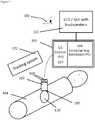
- the method according to the invention particularly uses the following components: A 3D or 2D ultrasound (US) probe 103 connected to a data processing system or unit 105 comprising a control unit 107 for controlling the US probe 103 and a computer (workstation or PC) 106 with a graphic user interface (GUI) 101 for displaying of image- and other relevant user information.
- the display 101 may consist of a screen-display (LCD or similar) and other means of graphical and/or visual display of information to the user 100.
- speakers may be attached to the computer 106 or GUI 101.
- the US probe 103 is tracked by means of an e.g. commercially available tracking system 102.
- the US probe 103 is calibrated and has attached or integrated passive or active tracking sensors or reflectors 108 also denoted as position sensors 108.
- feedback and guidance for the acquisition of suitable image content is based on geometrical information of the acquired image relative to the desired volume of interest as well as on measures of the obtained information content in 3D.
- measures are derived from the segmentation of the acquired images and can be provided to the user as qualitative 3D display or by quantitative indicators of quality.
- the operator is guided to move the US probe to the missing scanning location, to adjust imaging parameters correctly and finally to ensure that sufficient data is acquired for subsequent processing. By controlling image quality during the acquisition process, tedious repetition of the entire imaging process can be avoided.
- the user 100 selects the so-called volume of interest VOI 301 in a pre-acquired image from ultrasound- (US), computed tomography- (CT) or magnetic resonance (MR) imaging, which is displayed in the display 101 of the GUI of the system.
- a pre-acquired image from ultrasound- (US), computed tomography- (CT) or magnetic resonance (MR) imaging, which is displayed in the display 101 of the GUI of the system.
- CT computed tomography-
- MR magnetic resonance
- the position of the VOI 301 is then adjusted by the user placing the US probe 103 on the surface of the organ 110 of interest.
- the current VOI 301 is displayed in the GUI 101 and updated based on real-time tracking information.
- the user 100 thereby receives real-time, visual feedback on the GUI 101 allowing him to interactively select the appropriate VOI 301, i.e. the anatomical structure of interest 302.
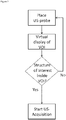
- the algorithm for adjustment of the VOI 301 is illustrated in Fig. 2 .
- the VOI 301 is visualized as a virtual cubical grid with specifically colored lines together with the first US-image ( Fig. 3B ) on the GUI 101.
- the VOI 301 is placed below the virtual model of the tracked US probe 103 and VOI's 301 position is updated with the motion of the probe 103.
- the overlay of the virtual VOI 301 onto the pre-acquired image or model 305 of the anatomy of interest ( Fig 3A ) enables the user to visually analyze the location and orientation of the selected VOI 301, particularly whether the anatomical structure of interest being inside the VOI 301.
- the user 100 moves the US probe 103 over the surface of the organ 110 until the spatial placement of the VOI 301 is satisfactory.
- the VOI 301 is selected holding the probe 103 still on the desired location or by other interaction means within the reach of the user 100 (e.g. by pressing a confirmation button on the GUI 101, or by using a voice command).
- the size of the VOI 301 is determined by the following parameters: the length of the US probe 103, the image depth and the expected anatomical structure of interest.
- the VOI 301 of an inner organ typically entails a branch of a vessel system, a functional segment, a tumor or an accumulation of tumors, organ boundaries, bile ducts or/and organ parenchyma.
- the structure may also be a probabilistic representation of expected features such as organ boundaries (probability of organ boundary being within a certain region).
- Typical VOI 301 dimensions are approx. 40 mm (length) x 80 mm (width) x 90 mm (depth).
- Fig. 3A and 3B show a typical VOI 301.
- 3D data acquisition starts. If the user places the probe 103 for imaging a region outside the VOI 301 during the image acquisition process, he is informed acoustically and/or visually via the GUI 101.
- the information may displayed by a specific symbol / pictogram, such as a colored arrow or hand or/and it may be encoded into a sound (e.g. by means of frequency or amplitude modulation, beep length).
- the acoustic information may also comprise verbal instructions to the user 100 given by means of one or more speakers.
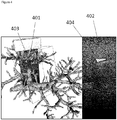
- the individual acquired (e.g. 2D) current US images 401, 402 are displayed in real-time on the GUI 101. In this way the user 100 can interactively, visually check if the anatomical structures of interest are visible in the US image.
- the visualization can be provided as standard 2D ultrasound image 402 and also in a 3D viewer 401.
- the 3D viewer can either display only the ultrasound image and it's location within the VOI 301 (similar to Fig. 3B ) or it can superimpose the acquired image with the corresponding 3D information from pre-acquired images (similar to Fig. 3A ).
- FIG. 5 An example for the image evaluation algorithm is illustrated in Fig. 5 .
- the algorithm takes an acquired (current) US-image and checks whether the location of the image is inside the selected VOI 301. If the image is not inside the selected VOI 301, the next acquired (current) image is analyzed.
- This automatic process uses the spatial information from the tracking system 102 and the tracking sensor(s) 108 attached to the US probe 103. From the tracking information and the US calibration transform (i.e. a transformation which links the position of the US probe 103, e.g.
- the 3D spatial position of the US image is computed and compared with the 3D spatial position of the VOI 301. If no pixel of the US image is positioned inside the VOI 301, the US image is considered as being outside of the VOI 301. Otherwise, the image is considered as valid and used for further processing, which includes artefact removal and segmentation.
- the artefact removal process detects US-specific artefacts such as large black stripes ( Fig. 5B ) in the image.
- the image is segmented and buffered until the artifact detection is completed (see Fig. 5 ). If there are no artefacts present, the segmented image is retained and compounded in the 3D US image/model. Segmentation automatically detects structures of interests in the image (typically vessels, tumors or organ boundaries) and displays them as an overlay onto the 2D image 404. If a new US image is compounded into the 3D US volume, the 3D information 403 on the GUI 101 is updated and displayed to the user 100. By displaying the results of the analysis in real-time on the 2D image, the user 100 can interactively determine whether the segmentation algorithm successfully detects relevant information on the current image. By updating the 3D visualization with recently acquired data, the user 100 further obtains feedback on the overall acquisition process and can judge if there are locations where information is missing and finally determine if a sufficient representation of the anatomy of interest was acquired.
- the GUI 101 can also display all the acquired image planes and thereby provide a visual feedback on the filling of the VOI 301 with ultrasound images. This enables the user 100 to see locations where no image data was acquired and to interactively place the ultrasound probe 103 on these locations.
- the algorithms used for segmentation are chosen according to the anatomical structure of interest. Typical examples are algorithms for vessel detection and for organ surface detection. A vast range of US segmentation algorithms are available in the state of the art [16].
- Typical quality measures in the context of registration for navigated soft tissue surgery include percentage of the VOI 301, which was scanned with the ultrasound probe 103 (e.g. 10% of the voxels in the VOI where scanned) or the amount of anatomical data detected (e.g. number of segmented vessel/tumor/boundary) voxels.
- the measure of currently acquired information content can be put in relation to the required data for further processing.
- the system aims to detect a branch of a vessel system, which is then used for registration.
- the dimensions of the vessel system (and the expected number of vessel pixels) are known from pre-operative imaging and the feedback loop can therefore the percentage vessels detected with intra-operative ultrasound.
- a similar amount of data in both, the pre- and intra-operative dataset is expected to lead to robust and accurate registration.
- Figure 5 depicts the complete 3D image acquisition incorporating all the components described above.
- the process starts with an interactive VOI 301 definition using a virtual display of the planned VOI 301, which is connected to the navigated ultrasound probe 103.
- the system enters a loop where each newly acquired image is analyzed to determine if it depicts structures within the VOI 301 and contains no artefacts. If the image is outside the VOI 301 or contains an artefact, the algorithm returns to image acquisition. If not, the image is segmented and compounded and the resulting data is displayed to the user 100 on the GUI 101. Based on the visual feedback on the GUI 101 and the quantitative measures of information content, a criterion for stopping the US acquisition is evaluated. The criterion for stopping the image acquisition is defined prior or during to the acquisition process and varies with the organ or tissue 110 to be analyzed.
- the criterion there are three fundamental options of definition for the criterion: (a) visual definition by user, (b) a static criterion based on the US data acquired (e.g. number of valid images acquired, percentage of volume filled, percentage of segmented voxels), and (c) a dynamic criterion based on the expected image content (e.g. prediction of number of intra-operative vessels pixels expected based on the pre-operative image data and VOI selection).
- the user 100 or the acquisition algorithm decides whether the acquired image content is sufficient for the desired application (diagnosis, visualization, segmentation, registration) or if additional images need to be acquired. If sufficient data is available, acquisition is stopped, otherwise feedback on the required additional image content is provided to the user 100.
- the feedback to the user 100 includes visual or auditory instruction about the necessary actions (e.g. probe motion to other area of the VOI 301, search of anatomical structures, changes in imaging parameters) for obtaining the required image quality. Based on this feedback, the user acquires a next image and the feedback loop starts from the beginning.
- the necessary actions e.g. probe motion to other area of the VOI 301, search of anatomical structures, changes in imaging parameters
Landscapes
- Health & Medical Sciences (AREA)
- Life Sciences & Earth Sciences (AREA)
- Engineering & Computer Science (AREA)
- Medical Informatics (AREA)
- Surgery (AREA)
- Animal Behavior & Ethology (AREA)
- Radiology & Medical Imaging (AREA)
- Nuclear Medicine, Radiotherapy & Molecular Imaging (AREA)
- Biomedical Technology (AREA)
- Heart & Thoracic Surgery (AREA)
- Biophysics (AREA)
- Molecular Biology (AREA)
- Physics & Mathematics (AREA)
- Pathology (AREA)
- General Health & Medical Sciences (AREA)
- Public Health (AREA)
- Veterinary Medicine (AREA)
- Computer Vision & Pattern Recognition (AREA)
- Vascular Medicine (AREA)
- Computer Graphics (AREA)
- General Engineering & Computer Science (AREA)
- High Energy & Nuclear Physics (AREA)
- Optics & Photonics (AREA)
- Ultra Sonic Daignosis Equipment (AREA)
Claims (15)
- Ein Verfahren zur 3D-Ultraschallbildaufnahme und Registrierung eines 3D-Modells zu einem zuvor aufgenommenen 3D-Bild, das die folgenden Schritte aufweist:- Bereitstellen eines zuvor aufgenommenen 3D-Bildes (305) eines Objekts (110),- Darstellen des zuvor aufgenommenen Bildes (305) auf einem Display (101),- Auswählen eines Volumens von Interesse (301) des Objekts (110) in dem zuvor aufgenommenen Bild (305),- wenn die räumliche Position des Volumens von Interesse (301) wie beabsichtigt ausgewählt oder angepasst ist: Auslösen der Aufnahme von Ultraschallbildern (401, 402) in dem Volumen von Interesse (301), um ein 3D-Modell (403) des Objekts (110) in dem Volumen von Interesse (301) zu erzeugen, und- Aufnehmen einer Vielzahl von Ultraschallbildern (401, 402) zum Erzeugen des 3D-Modells (403) mittels der Ultraschallsonde (103) in dem Volumen von Interesse (301), während die Ultraschallsonde (103) in Bezug auf das Objekt (110) entlang des Volumens von Interesse (301) bewegt wird,dadurch gekennzeichnet, dass das Verfahren ferner die folgenden Schritte aufweist:- Prüfen unter Verwendung eines Datenverarbeitungssystems (105), ob das aktuelle Ultraschallbild (401, 402) mindestens ein Pixel in dem Volumen von Interesse (301) aufweist, wobei für den Fall, dass das aktuelle Bild (401, 402) kein Pixel in dem Volumen von Interesse (301) aufweist, das aktuelle Bild (401, 402) von dem Datenverarbeitungssystem (105) verworfen wird, wobei andernfalls das aktuelle Ultraschallbild (401, 402) von dem Datenverarbeitungssystem (105) segmentiert und zu dem zu erzeugenden 3D-Modell (403) hinzugenommen wird, und- Bestimmen unter Verwendung des Datenverarbeitungssystems (105) eines Qualitätsmaßes für das zu erzeugende 3D-Modell (403) bei der Aufnahme der Ultraschallbilder (401, 402), wobei die Aufnahme der Ultraschallbilder (401, 402) durch das Datenverarbeitungssystem (105) beendet wird, sobald das Qualitätsmaß erfüllt ist oder ein vordefiniertes Niveau erreicht hat,- Registrieren des erzeugten 3D-Modells (403) unter Verwendung des Datenverarbeitungssystems (105) mit dem zuvor aufgenommenen 3D-Bild (305).
- Das Verfahren nach Anspruch 1, wobei das Qualitätsmaß ein Kriterium ist, das auf patientenspezifischen Daten aus dem zuvor aufgenommenen 3D-Bild basiert.
- Das Verfahren nach einem der vorhergehenden Ansprüche, wobei insbesondere das Qualitätsmaß mindestens eines ist von:- der Anzahl der einzelnen Ultraschallbilder (401, 402), die innerhalb des Volumens von Interesse (301) aufgenommen wurden,- der Dichte der aufgenommenen Ultraschallbilder (401, 402) innerhalb des Volumens von Interesse (301),- die Anzahl und/oder Verteilung von Bildmerkmalen, insbesondere die Anzahl der segmentierten anatomischen Strukturen im Volumen von Interesse (301),- die für die Aufnahme der Ultraschallbilder (401, 402) benötigte Zeit,
- Das Verfahren nach einem der vorhergehenden Ansprüche, wobei ein Benutzer, der die Vielzahl von Ultraschallbildern aufnimmt, dazu angeleitet wird, die Ultraschallsonde (103) an eine Stelle zu bewegen, an der Bildmerkmale auf der Grundlage des zuvor aufgenommenen 3D-Bildes erwartet werden, insbesondere um einen ausreichenden Datensatz für die Registrierung des erzeugten 3D-Modells mit dem zuvor aufgenommenen 3D-Bild (305) bereitzustellen.
- Das Verfahren nach einem der vorhergehenden Ansprüche, wobei eine anfängliche Registrierung durchgeführt wird, insbesondere um die Position des Volumens von Interesse (301), des aufgenommenen aktuellen Ultraschallbildes (401, 402) und/oder des 3D-Modells (403) in Bezug auf das zuvor aufgenommene Bild (305) auf dem Display (101) korrekt darzustellen, wobei die anfängliche Registrierung die Schritte beinhaltet: Auswählen eines Punktes im Koordinatensystem des zuvor aufgenommenen Bildes (305), Berechnen eines erwarteten Ultraschallbildes an dieser Stelle, Aufnehmen eines entsprechenden Ultraschallbildes (401, 402) des Objekts (110), wobei die Ultraschallsonde (103), in dem raumfesten oder patientenfesten Koordinatensystem der Ultraschallsonde (103) verfolgt wird, und Bestimmen einer Registrierungstransformation zwischen den Koordinatensystemen unter Verwendung des erwarteten Ultraschallbildes und des aufgenommenen Ultraschallbildes (401, 402).
- Das Verfahren nach einem der vorhergehenden Ansprüche, wobei das aktuelle Bild (401, 402) in Echtzeit auf dem Display (101) dargestellt wird, wobei insbesondere das aktuelle Bild zweidimensional (402) auf dem Display und/oder dreidimensional (401) dargestellt wird, wobei das dreidimensional dargestellte aktuelle Ultraschallbild insbesondere mit dem dargestellten zuvor aufgenommenen Bild (305) überlagert wird, oder wobei der Inhalt des zuvor aufgenommenen 3D-Bildes insbesondere mit dem aktuellen zweidimensionalen Bild überlagert wird.
- Das Verfahren nach einem der vorhergehenden Ansprüche, wobei das 3D-Modell in Echtzeit auf dem Display (101) angezeigt und insbesondere mit dem angezeigten zuvor aufgenommenen Bild (305) überlagert wird, wobei insbesondere bei einem Hinzunehmen eines neuen aktuellen Ultraschallbildes (401, 402) zu dem 3D-Modell (403) das angezeigte 3D-Modell (403) auf dem Display (101) aktualisiert wird.
- Das Verfahren nach einem der vorhergehenden Ansprüche, wobei für das nicht verworfene aktuelle Ultraschallbild (401, 402) eine Artefaktdetektion durchgeführt wird, wobei insbesondere im Falle der Detektion eines Artefakts im aktuellen Ultraschallbild dieses aktuelle Ultraschallbild verworfen wird, und wobei insbesondere eine Artefaktwahrscheinlichkeit anhand von patientenspezifischen Merkmalen des zuvor aufgenommenen 3D-Bildes berechnet wird.
- Das Verfahren nach einem der vorhergehenden Ansprüche, wobei die Segmentierung des einzelnen aktuellen Ultraschallbildes (401, 402) unter Verwendung mindestens eines Algorithmus durchgeführt wird, der eine Segmentierung spezifischer anatomischer Strukturen des Objekts im Volumen von Interesse, insbesondere von Gefäßen, Tumoren, Organgrenzen, Gallengängen und/oder anderer Anatomie, bereitstellt, wobei insbesondere der Algorithmus in Abhängigkeit von patientenspezifischen Merkmalen des zuvor aufgenommenen 3D-Bildes ausgewählt wird.
- Das Verfahren nach einem der vorhergehenden Ansprüche, wobei Führungsinformationen auf dem Display (101) angezeigt und/oder dem Benutzer (100) akustisch, insbesondere verbal, zur Verfügung gestellt werden, um den Benutzer (100) bei der Positionierung und/oder Bewegung der Ultraschallsonde (103) zu unterstützen und/oder zu führen, wobei insbesondere die Führungsinformationen durch Rückkopplung basierend auf dem zuvor aufgenommenen 3D-Bild und erfassten Merkmalen des 3D-Modells bereitgestellt werden.
- Das Verfahren nach einem der vorhergehenden Ansprüche, wobei nach Auswahl eines Volumens von Interesse (301) des Objekts (110) in dem zuvor aufgenommenen Bild (305) die räumliche Position des Volumens von Interesse (301) in Bezug auf das zuvor aufgenommene Bild (305) durch entsprechende Positionierung einer Ultraschallsonde (103) in Bezug auf das Objekt (110) angepasst wird.
- Das Verfahren nach einem der vorhergehenden Ansprüche, wobei die aktuelle räumliche Position des Volumens von Interesse (301) auf dem Display (101) in Bezug auf das zuvor aufgenommene Bild (305) visualisiert wird, insbesondere in Echtzeit.
- Das Verfahren nach Anspruch 12, wobei die Visualisierung des Volumens von Interesse (301) mit dem angezeigten zuvor aufgenommenen Bild (305) überlagert wird.
- Das Verfahren nach einem der vorhergehenden Ansprüche, wobei insbesondere bei der Segmentierung fehlende Informationen im aktuellen Ultraschallbild (401, 402) unter Verwendung von a-priori-Informationen über das Objekt (110) oder insbesondere patientenspezifischen Merkmalen aus dem zuvor aufgenommenen 3D-Bild interpoliert werden.
- Das Verfahren nach einem der vorhergehenden Ansprüche, wobei bei der Segmentierung fehlende Informationen im aktuellen Ultraschallbild (401, 402) unter Verwendung von kohortenspezifischen und/oder statistischen Informationen über die Verteilung von Gefäßstrukturen, geometrischen Formen der anatomischen Strukturen von Interesse im Objekt, Objektteilen oder Läsionen und/oder anderen bekannten anatomischen Strukturen interpoliert werden.
Applications Claiming Priority (2)
| Application Number | Priority Date | Filing Date | Title |
|---|---|---|---|
| EP20130169579 EP2807978A1 (de) | 2013-05-28 | 2013-05-28 | Verfahren und System zur 3D-Erfassung von Ultraschallbildern |
| PCT/EP2014/061106 WO2014191479A1 (en) | 2013-05-28 | 2014-05-28 | Method and system for 3d acquisition of ultrasound images |
Publications (2)
| Publication Number | Publication Date |
|---|---|
| EP3003161A1 EP3003161A1 (de) | 2016-04-13 |
| EP3003161B1 true EP3003161B1 (de) | 2022-01-12 |
Family
ID=48577505
Family Applications (2)
| Application Number | Title | Priority Date | Filing Date |
|---|---|---|---|
| EP20130169579 Withdrawn EP2807978A1 (de) | 2013-05-28 | 2013-05-28 | Verfahren und System zur 3D-Erfassung von Ultraschallbildern |
| EP14733531.9A Not-in-force EP3003161B1 (de) | 2013-05-28 | 2014-05-28 | Verfahren zur 3d-erfassung von ultraschallbildern |
Family Applications Before (1)
| Application Number | Title | Priority Date | Filing Date |
|---|---|---|---|
| EP20130169579 Withdrawn EP2807978A1 (de) | 2013-05-28 | 2013-05-28 | Verfahren und System zur 3D-Erfassung von Ultraschallbildern |
Country Status (5)
| Country | Link |
|---|---|
| US (1) | US20160113632A1 (de) |
| EP (2) | EP2807978A1 (de) |
| JP (1) | JP6453857B2 (de) |
| CN (1) | CN105407811B (de) |
| WO (1) | WO2014191479A1 (de) |
Families Citing this family (64)
| Publication number | Priority date | Publication date | Assignee | Title |
|---|---|---|---|---|
| WO2015124388A1 (en) * | 2014-02-19 | 2015-08-27 | Koninklijke Philips N.V. | Motion adaptive visualization in medical 4d imaging |
| CN106068098B (zh) * | 2014-02-28 | 2020-01-07 | 皇家飞利浦有限公司 | 用于超声引导过程的区域可视化 |
| US20150327841A1 (en) * | 2014-05-13 | 2015-11-19 | Kabushiki Kaisha Toshiba | Tracking in ultrasound for imaging and user interface |
| US11419583B2 (en) * | 2014-05-16 | 2022-08-23 | Koninklijke Philips N.V. | Reconstruction-free automatic multi-modality ultrasound registration |
| WO2015193441A1 (en) * | 2014-06-18 | 2015-12-23 | Koninklijke Philips N.V. | Ultrasound imaging apparatus |
| EP3190975B1 (de) | 2014-08-05 | 2021-01-06 | Habico, Inc. | Vorrichtung, system und verfahren zur hemisphärischen mammographie |
| KR20160046670A (ko) * | 2014-10-21 | 2016-04-29 | 삼성전자주식회사 | 영상 진단 보조 장치 및 방법 |
| WO2016092408A1 (en) * | 2014-12-09 | 2016-06-16 | Koninklijke Philips N.V. | Feedback for multi-modality auto-registration |
| JP6405058B2 (ja) * | 2015-03-31 | 2018-10-17 | コーニンクレッカ フィリップス エヌ ヴェKoninklijke Philips N.V. | 医療イメージング装置 |
| WO2017039663A1 (en) * | 2015-09-03 | 2017-03-09 | Siemens Healthcare Gmbh | Multi-view, multi-source registration of moving anatomies and devices |
| US11045170B2 (en) * | 2015-10-28 | 2021-06-29 | General Electric Company | Method and system for acquisition, enhanced visualization, and selection of a representative plane of a thin slice ultrasound image volume |
| EP3393366B1 (de) * | 2015-12-21 | 2025-02-12 | Koninklijke Philips N.V. | Ultraschallbildgebungsvorrichtung und ultraschallbildgebungsverfahren zur inspektion eines volumens einer person |
| WO2017185240A1 (zh) * | 2016-04-26 | 2017-11-02 | 中慧医学成像有限公司 | 一种成像方法和装置 |
| JP6689666B2 (ja) * | 2016-05-12 | 2020-04-28 | 株式会社日立製作所 | 超音波撮像装置 |
| US10905402B2 (en) | 2016-07-27 | 2021-02-02 | Canon Medical Systems Corporation | Diagnostic guidance systems and methods |
| US10403053B2 (en) * | 2016-11-15 | 2019-09-03 | Biosense Webster (Israel) Ltd. | Marking sparse areas on maps |
| EP3547923B1 (de) * | 2016-11-29 | 2021-01-06 | Koninklijke Philips N.V. | Ultraschallbildgebungssystem und -verfahren |
| FR3059541B1 (fr) * | 2016-12-07 | 2021-05-07 | Bay Labs Inc | Navigation guidee d'une sonde ultrason |
| US11628014B2 (en) * | 2016-12-20 | 2023-04-18 | Koninklijke Philips N.V. | Navigation platform for a medical device, particularly an intracardiac catheter |
| US10636323B2 (en) | 2017-01-24 | 2020-04-28 | Tienovix, Llc | System and method for three-dimensional augmented reality guidance for use of medical equipment |
| EP3422048A1 (de) | 2017-06-26 | 2019-01-02 | Koninklijke Philips N.V. | Ultraschallbildgebungsverfahren und system |
| EP3648692A1 (de) | 2017-07-07 | 2020-05-13 | Canon U.S.A. Inc. | Planung von mehrfachsondenablation |
| AU2018328799B2 (en) * | 2017-09-07 | 2020-10-22 | Imfusion Gmbh | Apparatus and method for determining motion of an ultrasound probe |
| JP7381455B2 (ja) * | 2017-10-11 | 2023-11-15 | コーニンクレッカ フィリップス エヌ ヴェ | インテリジェントな超音波に基づく受胎能監視 |
| CN107854177A (zh) * | 2017-11-18 | 2018-03-30 | 上海交通大学医学院附属第九人民医院 | 一种基于光学定位配准的超声与ct/mr图像融合手术导航系统及其方法 |
| US20190167231A1 (en) * | 2017-12-01 | 2019-06-06 | Sonocine, Inc. | System and method for ultrasonic tissue screening |
| US20190246946A1 (en) * | 2018-02-15 | 2019-08-15 | Covidien Lp | 3d reconstruction and guidance based on combined endobronchial ultrasound and magnetic tracking |
| EP3549529A1 (de) * | 2018-04-05 | 2019-10-09 | Koninklijke Philips N.V. | Ultraschallbildgebungssystem und -verfahren |
| EP3785640B1 (de) * | 2018-04-27 | 2024-10-23 | FUJIFILM Corporation | Ultraschallsystem und verfahren zur steuerung eines ultraschallsystems |
| US10685439B2 (en) | 2018-06-27 | 2020-06-16 | General Electric Company | Imaging system and method providing scalable resolution in multi-dimensional image data |
| US12059298B2 (en) * | 2018-07-18 | 2024-08-13 | Koninklijke Philips N.V. | Acquisition workflow and status indicators in a handheld medical scanning device |
| WO2020037668A1 (zh) * | 2018-08-24 | 2020-02-27 | 深圳迈瑞生物医疗电子股份有限公司 | 超声图像处理设备及方法及计算机可读存储介质 |
| CN108986902A (zh) * | 2018-08-28 | 2018-12-11 | 飞依诺科技(苏州)有限公司 | 四维扫查设备的扫查方法、装置及存储介质 |
| JP7305401B2 (ja) * | 2018-09-06 | 2023-07-10 | キヤノン株式会社 | 画像処理装置、画像処理装置の作動方法、及びプログラム |
| WO2020079077A1 (en) * | 2018-10-16 | 2020-04-23 | Koninklijke Philips N.V. | Deep learning-based ultrasound imaging guidance and associated devices, systems, and methods |
| EP3659505A1 (de) * | 2018-11-28 | 2020-06-03 | Koninklijke Philips N.V. | Relevanteste röntgenbildauswahl für hämodynamische simulation |
| CN111281424B (zh) * | 2018-12-07 | 2024-12-27 | 深圳迈瑞生物医疗电子股份有限公司 | 一种超声成像范围的调节方法及相关设备 |
| EP3683773A1 (de) * | 2019-01-17 | 2020-07-22 | Koninklijke Philips N.V. | Verfahren zur visualisierung einer dynamischen anatomischen struktur |
| US20200245970A1 (en) * | 2019-01-31 | 2020-08-06 | Bay Labs, Inc. | Prescriptive guidance for ultrasound diagnostics |
| DE102019203192A1 (de) * | 2019-03-08 | 2020-09-10 | Siemens Healthcare Gmbh | Erzeugung eines digitalen Zwillings für medizinische Untersuchungen |
| EP3711677A1 (de) | 2019-03-18 | 2020-09-23 | Koninklijke Philips N.V. | Verfahren und systeme zur erfassung von 3d-ultraschallbildern |
| CN111685793B (zh) * | 2019-03-15 | 2025-03-21 | 通用电气公司 | 用于对成像系统参数进行基于图像的控制的装置和方法 |
| WO2020242949A1 (en) * | 2019-05-28 | 2020-12-03 | Google Llc | Systems and methods for video-based positioning and navigation in gastroenterological procedures |
| US20220225963A1 (en) * | 2019-05-31 | 2022-07-21 | Koninklijke Philips N.V. | Methods and systems for guiding the acquisition of cranial ultrasound data |
| GB201910756D0 (en) * | 2019-07-26 | 2019-09-11 | Ucl Business Plc | Ultrasound registration |
| US11844654B2 (en) | 2019-08-19 | 2023-12-19 | Caption Health, Inc. | Mid-procedure view change for ultrasound diagnostics |
| JP7362354B2 (ja) * | 2019-08-26 | 2023-10-17 | キヤノン株式会社 | 情報処理装置、検査システム及び情報処理方法 |
| US11647982B2 (en) * | 2019-09-18 | 2023-05-16 | International Business Machines Corporation | Instrument utilization management |
| DE102019214303B4 (de) * | 2019-09-19 | 2022-07-28 | Siemens Healthcare Gmbh | Verfahren und System zur Unterstützung medizinischen Personals bei einer Resektion und Computerprogrammprodukt |
| US11593933B2 (en) * | 2020-03-16 | 2023-02-28 | GE Precision Healthcare LLC | Systems and methods for ultrasound image quality determination |
| CN111449684B (zh) * | 2020-04-09 | 2023-05-05 | 济南康硕生物技术有限公司 | 心脏超声标准扫查切面快速获取方法及系统 |
| CN111445769B (zh) * | 2020-05-14 | 2022-04-19 | 上海深至信息科技有限公司 | 一种基于小程序的超声教学系统 |
| CN112155596B (zh) * | 2020-10-10 | 2023-04-07 | 达闼机器人股份有限公司 | 超声波诊断设备、超声波图像的生成方法及存储介质 |
| US20240057970A1 (en) * | 2020-12-30 | 2024-02-22 | Koninklijke Philips N.V. | Ultrasound image acquisition, tracking and review |
| JP7824320B2 (ja) | 2021-04-13 | 2026-03-04 | シェバ インパクト リミテッド | 超音波及びカメラ画像から3d画像を再構成するためのシステム及び方法 |
| EP4094695A1 (de) | 2021-05-28 | 2022-11-30 | Koninklijke Philips N.V. | Ultraschallbildgebungssystem |
| CN113217345B (zh) * | 2021-06-17 | 2023-02-03 | 中船重工鹏力(南京)智能装备系统有限公司 | 基于3d视觉技术的压缩机注油管自动检测系统及方法 |
| CN113499099A (zh) * | 2021-07-21 | 2021-10-15 | 上海市同仁医院 | 一种颈动脉超声自动扫查及斑块识别系统及方法 |
| EP4181152A1 (de) * | 2021-11-15 | 2023-05-17 | Koninklijke Philips N.V. | Verarbeitung von bilddaten zur beurteilung einer klinischen frage |
| CN115592789B (zh) * | 2022-11-24 | 2023-03-17 | 深圳市星耀福实业有限公司 | 一种alc板材静养温控方法、装置以及系统 |
| US12626494B2 (en) * | 2023-06-05 | 2026-05-12 | GE Precision Healthcare LLC | Ultrasound image feature segmentation |
| CN116531089B (zh) * | 2023-07-06 | 2023-10-20 | 中国人民解放军中部战区总医院 | 基于图像增强的阻滞麻醉超声引导数据处理方法 |
| US20250152251A1 (en) * | 2023-11-09 | 2025-05-15 | Siemens Medical Solutions Usa, Inc. | Surgical Guidance with Compounded Ultrasound Imaging |
| JP2026079365A (ja) * | 2024-10-30 | 2026-05-15 | 富士フイルム株式会社 | 超音波診断支援装置及び超音波診断支援プログラム |
Family Cites Families (22)
| Publication number | Priority date | Publication date | Assignee | Title |
|---|---|---|---|---|
| US5645066A (en) | 1996-04-26 | 1997-07-08 | Advanced Technology Laboratories, Inc. | Medical ultrasonic diagnostic imaging system with scanning guide for three dimensional imaging |
| US6012458A (en) | 1998-03-20 | 2000-01-11 | Mo; Larry Y. L. | Method and apparatus for tracking scan plane motion in free-hand three-dimensional ultrasound scanning using adaptive speckle correlation |
| US7672491B2 (en) * | 2004-03-23 | 2010-03-02 | Siemens Medical Solutions Usa, Inc. | Systems and methods providing automated decision support and medical imaging |
| JP2006246974A (ja) * | 2005-03-08 | 2006-09-21 | Hitachi Medical Corp | リファレンス像表示機能を有する超音波診断装置 |
| JP4699062B2 (ja) * | 2005-03-29 | 2011-06-08 | 株式会社日立メディコ | 超音波装置 |
| CN101184428B (zh) * | 2005-04-01 | 2013-09-25 | 视声公司 | 利用超声波使血管结构三维可视化的方法 |
| US20070016016A1 (en) | 2005-05-31 | 2007-01-18 | Gabriel Haras | Interactive user assistant for imaging processes |
| US7831076B2 (en) | 2006-12-08 | 2010-11-09 | Biosense Webster, Inc. | Coloring electroanatomical maps to indicate ultrasound data acquisition |
| US7925068B2 (en) | 2007-02-01 | 2011-04-12 | General Electric Company | Method and apparatus for forming a guide image for an ultrasound image scanner |
| JP5394622B2 (ja) | 2007-07-31 | 2014-01-22 | オリンパスメディカルシステムズ株式会社 | 医用ガイドシステム |
| JP2009247739A (ja) * | 2008-04-09 | 2009-10-29 | Toshiba Corp | 医用画像処理表示装置、そのコンピュータ処理プログラム及び超音波診断装置。 |
| CN101474083A (zh) * | 2009-01-15 | 2009-07-08 | 西安交通大学 | 血管力学特性超分辨成像与多参数检测的系统与方法 |
| US8355554B2 (en) * | 2009-04-14 | 2013-01-15 | Sonosite, Inc. | Systems and methods for adaptive volume imaging |
| US8556815B2 (en) * | 2009-05-20 | 2013-10-15 | Laurent Pelissier | Freehand ultrasound imaging systems and methods for guiding fine elongate instruments |
| JP5395538B2 (ja) * | 2009-06-30 | 2014-01-22 | 株式会社東芝 | 超音波診断装置及び画像データ表示用制御プログラム |
| US8900146B2 (en) * | 2009-07-27 | 2014-12-02 | The Hong Kong Polytechnic University | Three-dimensional (3D) ultrasound imaging system for assessing scoliosis |
| US20120065510A1 (en) | 2010-09-09 | 2012-03-15 | General Electric Company | Ultrasound system and method for calculating quality-of-fit |
| US20120108965A1 (en) | 2010-10-27 | 2012-05-03 | Siemens Medical Solutions Usa, Inc. | Facilitating Desired Transducer Manipulation for Medical Diagnostics and Compensating for Undesired Motion |
| WO2012073164A1 (en) * | 2010-12-03 | 2012-06-07 | Koninklijke Philips Electronics N.V. | Device and method for ultrasound imaging |
| US8744211B2 (en) * | 2011-08-31 | 2014-06-03 | Analogic Corporation | Multi-modality image acquisition |
| EP2765918A4 (de) * | 2011-10-10 | 2015-05-06 | Tractus Corp | Verfahren, vorrichtung und system zur vollständigen untersuchung von gewebeproben mit tragbaren bildgebungsvorrichtungen |
| CN102982314B (zh) * | 2012-11-05 | 2016-05-25 | 深圳市恩普电子技术有限公司 | 一种血管内外膜识别、描记和测量的方法 |
-
2013
- 2013-05-28 EP EP20130169579 patent/EP2807978A1/de not_active Withdrawn
-
2014
- 2014-05-28 WO PCT/EP2014/061106 patent/WO2014191479A1/en not_active Ceased
- 2014-05-28 JP JP2016516155A patent/JP6453857B2/ja not_active Expired - Fee Related
- 2014-05-28 US US14/894,523 patent/US20160113632A1/en not_active Abandoned
- 2014-05-28 CN CN201480042479.3A patent/CN105407811B/zh not_active Expired - Fee Related
- 2014-05-28 EP EP14733531.9A patent/EP3003161B1/de not_active Not-in-force
Also Published As
| Publication number | Publication date |
|---|---|
| WO2014191479A1 (en) | 2014-12-04 |
| CN105407811A (zh) | 2016-03-16 |
| EP2807978A1 (de) | 2014-12-03 |
| US20160113632A1 (en) | 2016-04-28 |
| JP2016522725A (ja) | 2016-08-04 |
| EP3003161A1 (de) | 2016-04-13 |
| CN105407811B (zh) | 2020-01-10 |
| JP6453857B2 (ja) | 2019-01-16 |
Similar Documents
| Publication | Publication Date | Title |
|---|---|---|
| US20160113632A1 (en) | Method and system for 3d acquisition of ultrasound images | |
| Mohamed et al. | A survey on 3D ultrasound reconstruction techniques | |
| US20230414201A1 (en) | Ultrasonic diagnostic apparatus | |
| KR102269467B1 (ko) | 의료 진단 이미징에서의 측정 포인트 결정 | |
| RU2654608C2 (ru) | Ультразвуковая система визуализации и способ для процедуры наведения по изображению | |
| US20190066298A1 (en) | System for monitoring lesion size trends and methods of operation thereof | |
| JP5530592B2 (ja) | イメージング・パラメータの記憶法 | |
| US7433504B2 (en) | User interactive method for indicating a region of interest | |
| JP6833533B2 (ja) | 超音波診断装置および超音波診断支援プログラム | |
| US12569226B2 (en) | Ultrasound system and method for guided shear wave elastography of anisotropic tissue | |
| US20240273822A1 (en) | System and Method for Generating Three Dimensional Geometric Models of Anatomical Regions | |
| CN102458256A (zh) | 用于适应体积成像的系统及其方法 | |
| WO2021099171A1 (en) | Systems and methods for imaging screening | |
| CN112545551B (zh) | 用于医学成像设备的方法和系统 | |
| CN106030657B (zh) | 医学4d成像中的运动自适应可视化 | |
| CN115137389A (zh) | 用于超声成像的解剖学对准的多平面重建视图的系统和方法 | |
| CN106028946A (zh) | 用于监测病变尺寸趋势的系统及其操作方法 | |
| US20260000386A1 (en) | Systems and methods for acquiring ultrasonic data | |
| CN115153621B (zh) | 用于超声图像的基于模型的自动导航系统和方法 | |
| Khoshhal | Feasibility and effectiveness of three-dimensional echocardiography in diagnosing congenital heart diseases | |
| JP5487339B2 (ja) | 医用画像処理装置 | |
| Welch et al. | Real-time freehand 3D ultrasound system for clinical applications |
Legal Events
| Date | Code | Title | Description |
|---|---|---|---|
| PUAI | Public reference made under article 153(3) epc to a published international application that has entered the european phase |
Free format text: ORIGINAL CODE: 0009012 |
|
| 17P | Request for examination filed |
Effective date: 20151228 |
|
| AK | Designated contracting states |
Kind code of ref document: A1 Designated state(s): AL AT BE BG CH CY CZ DE DK EE ES FI FR GB GR HR HU IE IS IT LI LT LU LV MC MK MT NL NO PL PT RO RS SE SI SK SM TR |
|
| AX | Request for extension of the european patent |
Extension state: BA ME |
|
| RIN1 | Information on inventor provided before grant (corrected) |
Inventor name: RIBES, DELPHINE Inventor name: WEBER, STEFAN Inventor name: PETERHANS, MATTHIAS |
|
| DAX | Request for extension of the european patent (deleted) | ||
| STAA | Information on the status of an ep patent application or granted ep patent |
Free format text: STATUS: EXAMINATION IS IN PROGRESS |
|
| 17Q | First examination report despatched |
Effective date: 20200623 |
|
| GRAP | Despatch of communication of intention to grant a patent |
Free format text: ORIGINAL CODE: EPIDOSNIGR1 |
|
| STAA | Information on the status of an ep patent application or granted ep patent |
Free format text: STATUS: GRANT OF PATENT IS INTENDED |
|
| INTG | Intention to grant announced |
Effective date: 20201218 |
|
| GRAJ | Information related to disapproval of communication of intention to grant by the applicant or resumption of examination proceedings by the epo deleted |
Free format text: ORIGINAL CODE: EPIDOSDIGR1 |
|
| STAA | Information on the status of an ep patent application or granted ep patent |
Free format text: STATUS: EXAMINATION IS IN PROGRESS |
|
| INTC | Intention to grant announced (deleted) | ||
| GRAP | Despatch of communication of intention to grant a patent |
Free format text: ORIGINAL CODE: EPIDOSNIGR1 |
|
| STAA | Information on the status of an ep patent application or granted ep patent |
Free format text: STATUS: GRANT OF PATENT IS INTENDED |
|
| INTG | Intention to grant announced |
Effective date: 20210720 |
|
| GRAS | Grant fee paid |
Free format text: ORIGINAL CODE: EPIDOSNIGR3 |
|
| GRAA | (expected) grant |
Free format text: ORIGINAL CODE: 0009210 |
|
| STAA | Information on the status of an ep patent application or granted ep patent |
Free format text: STATUS: THE PATENT HAS BEEN GRANTED |
|
| AK | Designated contracting states |
Kind code of ref document: B1 Designated state(s): AL AT BE BG CH CY CZ DE DK EE ES FI FR GB GR HR HU IE IS IT LI LT LU LV MC MK MT NL NO PL PT RO RS SE SI SK SM TR |
|
| REG | Reference to a national code |
Ref country code: GB Ref legal event code: FG4D |
|
| REG | Reference to a national code |
Ref country code: CH Ref legal event code: EP |
|
| REG | Reference to a national code |
Ref country code: DE Ref legal event code: R096 Ref document number: 602014082145 Country of ref document: DE |
|
| REG | Reference to a national code |
Ref country code: IE Ref legal event code: FG4D |
|
| REG | Reference to a national code |
Ref country code: AT Ref legal event code: REF Ref document number: 1461862 Country of ref document: AT Kind code of ref document: T Effective date: 20220215 |
|
| REG | Reference to a national code |
Ref country code: LT Ref legal event code: MG9D |
|
| RAP4 | Party data changed (patent owner data changed or rights of a patent transferred) |
Owner name: CASCINATION AG Owner name: UNIVERSITAET BERN |
|
| REG | Reference to a national code |
Ref country code: NL Ref legal event code: MP Effective date: 20220112 |
|
| REG | Reference to a national code |
Ref country code: AT Ref legal event code: MK05 Ref document number: 1461862 Country of ref document: AT Kind code of ref document: T Effective date: 20220112 |
|
| PG25 | Lapsed in a contracting state [announced via postgrant information from national office to epo] |
Ref country code: NL Free format text: LAPSE BECAUSE OF FAILURE TO SUBMIT A TRANSLATION OF THE DESCRIPTION OR TO PAY THE FEE WITHIN THE PRESCRIBED TIME-LIMIT Effective date: 20220112 |
|
| PG25 | Lapsed in a contracting state [announced via postgrant information from national office to epo] |
Ref country code: SE Free format text: LAPSE BECAUSE OF FAILURE TO SUBMIT A TRANSLATION OF THE DESCRIPTION OR TO PAY THE FEE WITHIN THE PRESCRIBED TIME-LIMIT Effective date: 20220112 Ref country code: RS Free format text: LAPSE BECAUSE OF FAILURE TO SUBMIT A TRANSLATION OF THE DESCRIPTION OR TO PAY THE FEE WITHIN THE PRESCRIBED TIME-LIMIT Effective date: 20220112 Ref country code: PT Free format text: LAPSE BECAUSE OF FAILURE TO SUBMIT A TRANSLATION OF THE DESCRIPTION OR TO PAY THE FEE WITHIN THE PRESCRIBED TIME-LIMIT Effective date: 20220512 Ref country code: NO Free format text: LAPSE BECAUSE OF FAILURE TO SUBMIT A TRANSLATION OF THE DESCRIPTION OR TO PAY THE FEE WITHIN THE PRESCRIBED TIME-LIMIT Effective date: 20220412 Ref country code: LT Free format text: LAPSE BECAUSE OF FAILURE TO SUBMIT A TRANSLATION OF THE DESCRIPTION OR TO PAY THE FEE WITHIN THE PRESCRIBED TIME-LIMIT Effective date: 20220112 Ref country code: HR Free format text: LAPSE BECAUSE OF FAILURE TO SUBMIT A TRANSLATION OF THE DESCRIPTION OR TO PAY THE FEE WITHIN THE PRESCRIBED TIME-LIMIT Effective date: 20220112 Ref country code: ES Free format text: LAPSE BECAUSE OF FAILURE TO SUBMIT A TRANSLATION OF THE DESCRIPTION OR TO PAY THE FEE WITHIN THE PRESCRIBED TIME-LIMIT Effective date: 20220112 Ref country code: BG Free format text: LAPSE BECAUSE OF FAILURE TO SUBMIT A TRANSLATION OF THE DESCRIPTION OR TO PAY THE FEE WITHIN THE PRESCRIBED TIME-LIMIT Effective date: 20220412 |
|
| PGFP | Annual fee paid to national office [announced via postgrant information from national office to epo] |
Ref country code: GB Payment date: 20220530 Year of fee payment: 9 Ref country code: FR Payment date: 20220530 Year of fee payment: 9 Ref country code: DE Payment date: 20220530 Year of fee payment: 9 |
|
| PG25 | Lapsed in a contracting state [announced via postgrant information from national office to epo] |
Ref country code: PL Free format text: LAPSE BECAUSE OF FAILURE TO SUBMIT A TRANSLATION OF THE DESCRIPTION OR TO PAY THE FEE WITHIN THE PRESCRIBED TIME-LIMIT Effective date: 20220112 Ref country code: LV Free format text: LAPSE BECAUSE OF FAILURE TO SUBMIT A TRANSLATION OF THE DESCRIPTION OR TO PAY THE FEE WITHIN THE PRESCRIBED TIME-LIMIT Effective date: 20220112 Ref country code: GR Free format text: LAPSE BECAUSE OF FAILURE TO SUBMIT A TRANSLATION OF THE DESCRIPTION OR TO PAY THE FEE WITHIN THE PRESCRIBED TIME-LIMIT Effective date: 20220413 Ref country code: FI Free format text: LAPSE BECAUSE OF FAILURE TO SUBMIT A TRANSLATION OF THE DESCRIPTION OR TO PAY THE FEE WITHIN THE PRESCRIBED TIME-LIMIT Effective date: 20220112 Ref country code: AT Free format text: LAPSE BECAUSE OF FAILURE TO SUBMIT A TRANSLATION OF THE DESCRIPTION OR TO PAY THE FEE WITHIN THE PRESCRIBED TIME-LIMIT Effective date: 20220112 |
|
| PG25 | Lapsed in a contracting state [announced via postgrant information from national office to epo] |
Ref country code: IS Free format text: LAPSE BECAUSE OF FAILURE TO SUBMIT A TRANSLATION OF THE DESCRIPTION OR TO PAY THE FEE WITHIN THE PRESCRIBED TIME-LIMIT Effective date: 20220512 |
|
| REG | Reference to a national code |
Ref country code: DE Ref legal event code: R097 Ref document number: 602014082145 Country of ref document: DE |
|
| PG25 | Lapsed in a contracting state [announced via postgrant information from national office to epo] |
Ref country code: SM Free format text: LAPSE BECAUSE OF FAILURE TO SUBMIT A TRANSLATION OF THE DESCRIPTION OR TO PAY THE FEE WITHIN THE PRESCRIBED TIME-LIMIT Effective date: 20220112 Ref country code: SK Free format text: LAPSE BECAUSE OF FAILURE TO SUBMIT A TRANSLATION OF THE DESCRIPTION OR TO PAY THE FEE WITHIN THE PRESCRIBED TIME-LIMIT Effective date: 20220112 Ref country code: RO Free format text: LAPSE BECAUSE OF FAILURE TO SUBMIT A TRANSLATION OF THE DESCRIPTION OR TO PAY THE FEE WITHIN THE PRESCRIBED TIME-LIMIT Effective date: 20220112 Ref country code: EE Free format text: LAPSE BECAUSE OF FAILURE TO SUBMIT A TRANSLATION OF THE DESCRIPTION OR TO PAY THE FEE WITHIN THE PRESCRIBED TIME-LIMIT Effective date: 20220112 Ref country code: DK Free format text: LAPSE BECAUSE OF FAILURE TO SUBMIT A TRANSLATION OF THE DESCRIPTION OR TO PAY THE FEE WITHIN THE PRESCRIBED TIME-LIMIT Effective date: 20220112 Ref country code: CZ Free format text: LAPSE BECAUSE OF FAILURE TO SUBMIT A TRANSLATION OF THE DESCRIPTION OR TO PAY THE FEE WITHIN THE PRESCRIBED TIME-LIMIT Effective date: 20220112 |
|
| PLBE | No opposition filed within time limit |
Free format text: ORIGINAL CODE: 0009261 |
|
| STAA | Information on the status of an ep patent application or granted ep patent |
Free format text: STATUS: NO OPPOSITION FILED WITHIN TIME LIMIT |
|
| PG25 | Lapsed in a contracting state [announced via postgrant information from national office to epo] |
Ref country code: AL Free format text: LAPSE BECAUSE OF FAILURE TO SUBMIT A TRANSLATION OF THE DESCRIPTION OR TO PAY THE FEE WITHIN THE PRESCRIBED TIME-LIMIT Effective date: 20220112 |
|
| 26N | No opposition filed |
Effective date: 20221013 |
|
| REG | Reference to a national code |
Ref country code: CH Ref legal event code: PL |
|
| REG | Reference to a national code |
Ref country code: BE Ref legal event code: MM Effective date: 20220531 |
|
| PG25 | Lapsed in a contracting state [announced via postgrant information from national office to epo] |
Ref country code: MC Free format text: LAPSE BECAUSE OF FAILURE TO SUBMIT A TRANSLATION OF THE DESCRIPTION OR TO PAY THE FEE WITHIN THE PRESCRIBED TIME-LIMIT Effective date: 20220112 Ref country code: LU Free format text: LAPSE BECAUSE OF NON-PAYMENT OF DUE FEES Effective date: 20220528 Ref country code: LI Free format text: LAPSE BECAUSE OF NON-PAYMENT OF DUE FEES Effective date: 20220531 Ref country code: CH Free format text: LAPSE BECAUSE OF NON-PAYMENT OF DUE FEES Effective date: 20220531 |
|
| PG25 | Lapsed in a contracting state [announced via postgrant information from national office to epo] |
Ref country code: SI Free format text: LAPSE BECAUSE OF FAILURE TO SUBMIT A TRANSLATION OF THE DESCRIPTION OR TO PAY THE FEE WITHIN THE PRESCRIBED TIME-LIMIT Effective date: 20220112 |
|
| PG25 | Lapsed in a contracting state [announced via postgrant information from national office to epo] |
Ref country code: IE Free format text: LAPSE BECAUSE OF NON-PAYMENT OF DUE FEES Effective date: 20220528 |
|
| PG25 | Lapsed in a contracting state [announced via postgrant information from national office to epo] |
Ref country code: BE Free format text: LAPSE BECAUSE OF NON-PAYMENT OF DUE FEES Effective date: 20220531 |
|
| PG25 | Lapsed in a contracting state [announced via postgrant information from national office to epo] |
Ref country code: IT Free format text: LAPSE BECAUSE OF FAILURE TO SUBMIT A TRANSLATION OF THE DESCRIPTION OR TO PAY THE FEE WITHIN THE PRESCRIBED TIME-LIMIT Effective date: 20220112 |
|
| REG | Reference to a national code |
Ref country code: DE Ref legal event code: R119 Ref document number: 602014082145 Country of ref document: DE |
|
| GBPC | Gb: european patent ceased through non-payment of renewal fee |
Effective date: 20230528 |
|
| PG25 | Lapsed in a contracting state [announced via postgrant information from national office to epo] |
Ref country code: HU Free format text: LAPSE BECAUSE OF FAILURE TO SUBMIT A TRANSLATION OF THE DESCRIPTION OR TO PAY THE FEE WITHIN THE PRESCRIBED TIME-LIMIT; INVALID AB INITIO Effective date: 20140528 |
|
| PG25 | Lapsed in a contracting state [announced via postgrant information from national office to epo] |
Ref country code: MK Free format text: LAPSE BECAUSE OF FAILURE TO SUBMIT A TRANSLATION OF THE DESCRIPTION OR TO PAY THE FEE WITHIN THE PRESCRIBED TIME-LIMIT Effective date: 20220112 Ref country code: DE Free format text: LAPSE BECAUSE OF NON-PAYMENT OF DUE FEES Effective date: 20231201 Ref country code: CY Free format text: LAPSE BECAUSE OF FAILURE TO SUBMIT A TRANSLATION OF THE DESCRIPTION OR TO PAY THE FEE WITHIN THE PRESCRIBED TIME-LIMIT Effective date: 20220112 Ref country code: GB Free format text: LAPSE BECAUSE OF NON-PAYMENT OF DUE FEES Effective date: 20230528 |
|
| PG25 | Lapsed in a contracting state [announced via postgrant information from national office to epo] |
Ref country code: FR Free format text: LAPSE BECAUSE OF NON-PAYMENT OF DUE FEES Effective date: 20230531 |
|
| PG25 | Lapsed in a contracting state [announced via postgrant information from national office to epo] |
Ref country code: MT Free format text: LAPSE BECAUSE OF FAILURE TO SUBMIT A TRANSLATION OF THE DESCRIPTION OR TO PAY THE FEE WITHIN THE PRESCRIBED TIME-LIMIT Effective date: 20220112 |
|
| PG25 | Lapsed in a contracting state [announced via postgrant information from national office to epo] |
Ref country code: TR Free format text: LAPSE BECAUSE OF FAILURE TO SUBMIT A TRANSLATION OF THE DESCRIPTION OR TO PAY THE FEE WITHIN THE PRESCRIBED TIME-LIMIT Effective date: 20220112 |