EP3003077B1 - Garment part with fastening system and manufacturing method thereof - Google Patents
Garment part with fastening system and manufacturing method thereof Download PDFInfo
- Publication number
- EP3003077B1 EP3003077B1 EP14804480.3A EP14804480A EP3003077B1 EP 3003077 B1 EP3003077 B1 EP 3003077B1 EP 14804480 A EP14804480 A EP 14804480A EP 3003077 B1 EP3003077 B1 EP 3003077B1
- Authority
- EP
- European Patent Office
- Prior art keywords
- fastening member
- garment
- layer
- garment portion
- attached
- Prior art date
- Legal status (The legal status is an assumption and is not a legal conclusion. Google has not performed a legal analysis and makes no representation as to the accuracy of the status listed.)
- Active
Links
- 238000004519 manufacturing process Methods 0.000 title description 10
- 238000005728 strengthening Methods 0.000 claims description 39
- 239000004744 fabric Substances 0.000 claims description 38
- 239000006260 foam Substances 0.000 claims description 16
- 238000003475 lamination Methods 0.000 claims description 14
- 239000000463 material Substances 0.000 claims description 6
- 230000008878 coupling Effects 0.000 claims description 3
- 238000010168 coupling process Methods 0.000 claims description 3
- 238000005859 coupling reaction Methods 0.000 claims description 3
- 239000004677 Nylon Substances 0.000 claims description 2
- 239000000203 mixture Substances 0.000 claims description 2
- 229920001778 nylon Polymers 0.000 claims description 2
- 229920000728 polyester Polymers 0.000 claims description 2
- 238000000465 moulding Methods 0.000 description 16
- 239000000853 adhesive Substances 0.000 description 10
- 230000001070 adhesive effect Effects 0.000 description 10
- 210000000481 breast Anatomy 0.000 description 7
- 238000010030 laminating Methods 0.000 description 2
- 238000000034 method Methods 0.000 description 2
- 230000004075 alteration Effects 0.000 description 1
- 238000005304 joining Methods 0.000 description 1
- 239000002184 metal Substances 0.000 description 1
- 238000012986 modification Methods 0.000 description 1
- 230000004048 modification Effects 0.000 description 1
- 239000004033 plastic Substances 0.000 description 1
- 238000003825 pressing Methods 0.000 description 1
- 230000035945 sensitivity Effects 0.000 description 1
- 125000006850 spacer group Chemical group 0.000 description 1
Images





Classifications
-
- A—HUMAN NECESSITIES
- A41—WEARING APPAREL
- A41C—CORSETS; BRASSIERES
- A41C3/00—Brassieres
- A41C3/02—Brassieres with front closures
-
- A—HUMAN NECESSITIES
- A41—WEARING APPAREL
- A41C—CORSETS; BRASSIERES
- A41C3/00—Brassieres
- A41C3/12—Component parts
- A41C3/122—Stay means
- A41C3/124—Stay means with an articulated or bridge construction
-
- A—HUMAN NECESSITIES
- A41—WEARING APPAREL
- A41C—CORSETS; BRASSIERES
- A41C5/00—Machines, appliances, or methods for manufacturing corsets or brassieres
- A41C5/005—Machines, appliances, or methods for manufacturing corsets or brassieres by moulding
Definitions
- the invention relates to a garment part with a fastening system.
- the invention relates to a garment part with a fastening system which may be used in a garment, such as in a brassiere. Further described herein is a method of manufacturing the garment part and a garment.
- Brassieres or in a more common term 'bras', are undergarments worn by women for covering and supporting their breasts. Apart from the fundamental functions of covering and supporting, a bra also serves an important decorative purpose to the body of the wearer.
- bras are made with a variety of designs, which allow them to become appealing fashion items instead of merely as part of clothing necessities.
- a bra commonly includes a front portion for covering breasts of the wearer, a back portion for connecting two ends of the front portion over the back of the wearer in use, and usually shoulder straps for connecting the front portion and the back portion to better support the breasts.
- a clasp is provided at the ends of the back portion so that, when being worn, the clasp is at the back of the wearer.
- the clasp usually includes one or more pairs of small hooks and eyes in the form of looped metal wires, or one or more pins and grooves configuration.
- front closure bras have been developed to allow fastening of the clasp provided at the front of the wearer.
- the problem of the discomfort to the wearers by the traditional clasps remains in the front closure bras.
- the traditional hooks and eyes clasp or clasp of similar designs when used in a front closure bra, are invariably visible at the front of the bra, and therefore may negatively affect the appearance of the bra in use, which works against the decorative purpose of the bra.
- a garment part according to claim 1 According to a first aspect of the present invention, there is provided a garment part according to claim 1.
- a garment which includes at least a garment part, said garment part including a first garment portion having a first fastening member, and a second garment portion having a second fastening member, wherein the first fastening member and the second fastening member are releasably engageable with each other to connect the first garment portion and the second garment portion, and wherein when the first fastening member and the second fastening member are engaged with each other, the first fastening member and the second fastening member are substantially fully encased within the garment part.
- a method of manufacturing a garment part including steps of providing a first fabric layer and a second fabric layer, providing a strengthening member between the first fabric layer and the second fabric layer, attaching a fastening means to the strengthening member, and attaching the first fabric layer, the strengthening member, and the second fabric layer with one another to at least partially encase the fastening means.
- a method of manufacturing a garment including manufacturing at least one garment part, including steps of providing a first fabric layer and a second fabric layer, providing a strengthening member between the first fabric layer and the second fabric layer, attaching a fastening means to the strengthening member, and attaching the first fabric layer, the strengthening member, and the second fabric layer with one another to at least partially encase the fastening means.
- Fig. 1 shows a part, generally designated as 10, of a front closure bra in accordance with an embodiment of the present invention.
- the bra part 10 includes a first garment portion 12 and a second garment portion 14 engaged with each other by a pair of fastening members.
- the fastening members are releasably engageable with each other to connect the first garment portion 12 and the second garment portion 14 so that when the fastening members are engaged with each other, the fastening members are substantially fully encased within the part 10, thereby providing an easily mounted, convenient and substantially invisible closure when viewed from both the front and the back of the junction.
- the substantially full enclosure of the fastening members within the part 10 also allows the fastening members to be shielded from the skin of the wearer, and avoids exposing any portion of the fastening members to the wearer at both the front and the back of the junction. This prevents the fastening members from being in contact with the wearer's skin in use, and therefore minimises the discomfort caused to the wearer.
- the first garment portion 12 and the second garment portion 14 are arranged to cover breasts of the wearer, for example, in the form of bra cups of a bra.
- Fig. 2 shows the bra part 10 of Fig. 1 with the first garment portion 12 and the second garment portion 14 in a disengaged configuration.
- the first garment portion 12 includes a female fastening member 16 attached thereon
- the second garment portion 14 includes a male fastening member 18 attached thereon.
- the first garment portion 12 and the second garment portion 14 are disengaged by having the female fastening member 16 and the male fastening member 18 disengaged from each other.
- the female fastening member 16 comprises a recess
- the male fastening member 18 comprises a protrusion 22.
- the recess 20 of the female fastening member 16 is adapted to releasably receive the protrusion 22 of the male fastening member 18 to form the engagement.
- the female fastening member 16 and the male fastening member 18 are engaged via a snap-fit coupling.
- the female fastening member 16 is substantially fully encased within the first garment portion 12.
- the female fastening member 16 as being 'substantially fully encased' should not be understood as being an entirely enclosed configuration.
- the first garment portion 12 includes at least an opening which provides access to the recess 20 of the female fastening member 16.
- the male fastening member 18 is partially encased within the second garment portion 14, having at least part of the protrusion 22 exposed from the second garment portion 14 and is capable of being received by the recess 20 of the female fastening member 16.
- Fig. 4 shows another embodiment of the female fastening member 16 which further includes a releasing means 24.
- the releasing means 24 is triggerable, e.g. manually, to disengage the female fastening member 16 and the male fastening member 18.
- the releasing means 24 can be provided in the form of a press button.
- the first garment portion 12 and the second garment portion 14 each includes an outer layer 30, an inner layer 40, and a strengthening member 50 between the outer layer 30 and the inner layer 40.
- each of the outer layer 30 and the inner layer 40 includes a fabric layer 32, 42 attached to another fabric layer, such as a respective foam layer 34, 44.
- the fabric layer 32, 42 can be attached to any suitable materials known by a person skilled in this field, for example, a spacer fabric or a synthetic fiberfill.
- the fabric layers 32, 42 are attached to the respective foam layers 34, 44 by an adhesive.
- the fabric layers 32, 42 are attached to the respective foam layers 34, 44 by lamination, which may be heat lamination.
- the fabric layers 32, 42 are attached to the respective foam layers 34, 44 by ultrasonic adhesion.
- the fabric layers 32, 42 are attached to the respective foam layers 34, 44 by stitching.
- the fabric layers 32, 42 can be attached to the respective foam layers 34, 44 by adhesion by using adhesive, heat lamination, ultrasonic adhesion, stitching or any combination thereof.
- Each of the first garment portion 12 and the second garment portion 14 may optionally include at least one wire member 60 between the respective outer layer 30 and the inner layer 40 to provide additional support to the wearer's breasts.
- the wire member 60 can be in the form of a bare wire, a wire being partly or entirely shielded by a tubular layer such as a bra channel, or just the bra channel without any embedded wire.
- the bra channel can be made with any suitable materials known to a person skilled in the art such as fabric or plastic.
- the wire members 60 can be attached to the strengthening members 50a, 50b.
- the additional support can be provided by extended strengthening members 50c, 50d without the wire member 60, as shown in Fig. 11 .
- such a wire member 60 is not necessary in the case of a soft-cup bra.
- the female fastening member 16 and the male fastening member 18 can be attached to the respective strengthening member 50a, 50b or 50c, 50d.
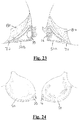
- the female fastening member 16 and the male fastening member 18 are stitched on the respective strengthening members 50a, 50b, as shown in Fig. 23 .
- the strengthening member 50 may include a substantially inelastic fabric layer which is strong enough to withstand the strain applied by the engaged fastening members when the bra is worn by a wearer.
- the substantially inelastic fabric layer of the strengthening member 50 includes a material selected from a group consisting of nylon, polyester and mixtures thereof.
- Such steps include providing a first layer 70 and a second layer 80 of fabric material, providing the strengthening member 50 between the first layer 70 and the second layer 80, attaching a fastening member 16 or 18 to the strengthening member 50, and attaching the first layer 70, the strengthening member 50, and the second layer 80 with one another to at least partially encase the fastening member 16 or 18.
- the step of attaching is performed with heat lamination.
- the step of attaching can be performed with the use of an adhesive, for example, by introducing the adhesive between the first layer 70 and the strengthening member 50, and between the second layer 80 and the strengthening member 50.
- the step of attaching can be performed by stitching.
- the step of attaching can be performed by ultrasonic adhesion. More preferably, the step of attaching is performed by heat lamination, use of adhesive, stitching, ultrasonic adhesion or a combination thereof.
- the first layer 70 includes a top fabric layer 72 and a bottom foam layer 74 attached by means of adhesive and/or lamination, with the bottom foam 74 layer adjacent the strengthening member 50.
- the second layer 80 includes a top foam layer 84 and a bottom fabric layer 82 attached by means of adhesive and/or lamination, with the top foam layer 84 adjacent the strengthening member 50.
- the first layer 70 is premolded into a concave shape by a molding device 90a, 90b, with the bottom foam layer 74 of the first layer 70 defining a concavity of the concave shape.
- the second layer 80 is also premolded into a concave shape by the molding device 90a, 90b, with the bottom fabric layer 82 of the second layer 80 defining a concavity of the concave shape.
- the concavities of the first layer 70 and the second layer 80 accommodate the shape of the breasts of the wearer thereby allowing the garment part to serve as bra cups for covering and supporting breasts of the wearer.
- the molding device 90 can be any suitable molding tools conventionally used in the field, and a person skilled in the art would understand that it should not be limited to a particular molding device, but can be any molding tools suitable for performing the purpose.
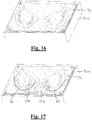
- the step of providing the first layer 70 and the second layer 80 further includes a step of positioning the premolded first layer 70 onto a female mold 91a of the molding device 91 as shown in Fig. 16 .
- the manufacturing steps further include a step of providing a wire member 60 on the first layer 70, followed by a step of attaching the strengthening member 50 to the wire member 60 as shown in Fig. 17 .
- the premolded second layer 80 is then positioned on the wire member 60 and the strengthening member 50 prior to the laminating step as shown in Fig. 18 . As shown in Figs.
- the laminating step includes the step of positioning a male mold 91b of the molding device 91 onto the female mold 91a and subsequently applying pressure to compress the layers in between. It is important that a portion of the bottom edge should be left unsealed to provide an opening 100 as shown in Fig. 21 . After releasing the laminated layers from the molding device 91, the laminated layers are cut to the required size and shape to form garment parts 10.
- the opening 100 provides each of the garment parts with an at least partially opened bottom corner 110, which allows the access of the strengthening member for any further processing. For example, as shown in Fig.
- either the first layer 70 or the second layer 80 at the opened bottom corner 110 can be turned over to expose the intermediate strengthening members 50a, 50b so that the fastening members 16, 18 can be attached to the respective strengthening member 50, such as, by stitching, ultrasonic adhesion, heat lamination, adhesion or a combination thereof.
- Fig. 24 further shows the garment parts 10 when the opened bottom corners 110 are closed, for example, by stitching, and/or an adhesive and/or lamination.
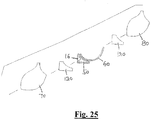
- Fig. 25 is an exploded view showing the composing layers of the garment part 10 in sequence, starting from the first layer 70, the adhesive 120, the strengthening member 50 connected with the wire member 60 and the fastening member 16, another adhesive 120, and the second layer 80.
- the bra part 10 as shown in Fig. 25 can be further processed by forming or joining further fabric materials or parts to the bra part 10 to form a bra.
- shoulder straps and back fabric portions can be connected to the bra part 10 by means of stitching or other engagement means to form a bra.
Landscapes
- Engineering & Computer Science (AREA)
- Textile Engineering (AREA)
- Manufacturing & Machinery (AREA)
- Corsets Or Brassieres (AREA)
- Outer Garments And Coats (AREA)
- Undergarments, Swaddling Clothes, Handkerchiefs Or Underwear Materials (AREA)
- Slide Fasteners (AREA)
- Absorbent Articles And Supports Therefor (AREA)
- Professional, Industrial, Or Sporting Protective Garments (AREA)
Description
- The invention relates to a garment part with a fastening system. Particularly, the invention relates to a garment part with a fastening system which may be used in a garment, such as in a brassiere. Further described herein is a method of manufacturing the garment part and a garment.
- Brassieres, or in a more common term 'bras', are undergarments worn by women for covering and supporting their breasts. Apart from the fundamental functions of covering and supporting, a bra also serves an important decorative purpose to the body of the wearer. Nowadays bras are made with a variety of designs, which allow them to become appealing fashion items instead of merely as part of clothing necessities.
- A bra commonly includes a front portion for covering breasts of the wearer, a back portion for connecting two ends of the front portion over the back of the wearer in use, and usually shoulder straps for connecting the front portion and the back portion to better support the breasts. For a traditional rear fastening bra, a clasp is provided at the ends of the back portion so that, when being worn, the clasp is at the back of the wearer. The clasp usually includes one or more pairs of small hooks and eyes in the form of looped metal wires, or one or more pins and grooves configuration. However, it is known to a bra wearer that, when putting on a rear fastening bra, it could be difficult for the wearer to mate the hooks with the respective eyes, or the pins with the respective grooves, at the back in a blind operation with their arms behind their back. In addition, some wearers may also find that the traditional clasps in use may cause discomfort to their body, as the traditional clasps are usually exposed to and contact the skin in use, and therefore the wearers could feel the presence of the clasp which significantly affect the comfort as required of an intimate clothing. In some circumstances, the exposed clasps may even cause scratches or sensitivities to the skin of the wearers. To overcome or at least mitigate the disadvantages of the rear fastening bras, front closure bras have been developed to allow fastening of the clasp provided at the front of the wearer. However, the problem of the discomfort to the wearers by the traditional clasps remains in the front closure bras. In addition, the traditional hooks and eyes clasp or clasp of similar designs, when used in a front closure bra, are invariably visible at the front of the bra, and therefore may negatively affect the appearance of the bra in use, which works against the decorative purpose of the bra.
- According to a first aspect of the present invention, there is provided a garment part according to claim 1.
- Further described herein is a garment which includes at least a garment part, said garment part including a first garment portion having a first fastening member, and a second garment portion having a second fastening member, wherein the first fastening member and the second fastening member are releasably engageable with each other to connect the first garment portion and the second garment portion, and wherein when the first fastening member and the second fastening member are engaged with each other, the first fastening member and the second fastening member are substantially fully encased within the garment part.
- Further described herein is a method of manufacturing a garment part, the method including steps of providing a first fabric layer and a second fabric layer, providing a strengthening member between the first fabric layer and the second fabric layer, attaching a fastening means to the strengthening member, and attaching the first fabric layer, the strengthening member, and the second fabric layer with one another to at least partially encase the fastening means.
- Further described herein is a method of manufacturing a garment, said method including manufacturing at least one garment part, including steps of providing a first fabric layer and a second fabric layer, providing a strengthening member between the first fabric layer and the second fabric layer, attaching a fastening means to the strengthening member, and attaching the first fabric layer, the
strengthening member, and the second fabric layer with one another to at least partially encase the fastening means. - Garment parts, garments, a method of manufacturing a garment part and a method of manufacturing a garment according to various embodiments of the present invention will now be described, by way of examples only, with reference to the accompanying drawings, in which:
-
Fig. 1 is a front view of a garment part in an engaged configuration according to an embodiment of the present invention; -
Fig. 2 is a front view of the garment part ofFig. 1 in a disengaged configuration; -
Fig. 3 is a front view of a female fastening member and a male fastening member of the garment part ofFig.2 , in which the fastening members are disengaged from each other; -
Fig. 4 is a rear view of the fastening members ofFig. 3 ; -
Fig. 5 is a perspective view of the fastening members ofFigs. 3 and 4 ; -
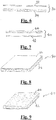
Fig. 6 is a sectional view of a fabric layer and a foam layer forming the outer layer of the first garment portion and the second garment portion ofFigs. 1 and 2 ; -
Fig. 7 is a sectional view of a foam layer and a fabric layer forming the inner layer of the first garment portion and the second garment portion ofFigs. 1 and 2 ; -
Fig. 8 is a perspective view of the outer layer having the fabric layer and the form layer shown inFig. 6 ; -
Fig. 9 is a perspective view of the inner layer having the foam layer and the fabric layer shown inFig. 7 ; -
Fig. 10 is a top plan view of a pair of underwires in the garment part shown as shown inFigs 1 and 2 , the underwires being attached to respective strengthening member according to the present invention; -
Fig. 11 is a top plan view of a pair of strengthening members for use in a garment part ; -
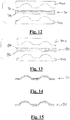
Fig. 12 is a sectional view of a molding device having a female mold and a corresponding male mold for manufacturing the garment part as shown inFigs. 1 and 2 , with the outer layer of the garment portion ofFigs. 6 and 8 placed between them; -
Fig. 13 is a sectional view of a molding device ofFig. 12 having the inner layer of the garment portion ofFigs. 7 and 9 placed between them; -
Fig. 14 is a sectional view of the outer layer after being released from the molding device ofFig. 12 ; -
Fig. 15 is a sectional view of the inner layer after being released from the molding device ofFig. 13 ; -
Fig. 16 is a perspective view showing a step of lamination with the premolded outer layer ofFig. 14 positioned on the female mold; -
Fig. 17 is a perspective view showing a step of lamination following the step ofFig. 16 , with the underwires and the strengthening members positioned on the premolded outer layer; -
Fig. 18 is a perspective view showing a step of lamination following the step ofFig. 17 , with the premolded inner layer ofFig. 15 positioned above the underwires and the strengthening members; -
Fig. 19 is a sectional view of the molding device with the male and the female molds being separated, with the premolded inner layer, outer layer and the strengthening members ofFig. 18 positioned between them; -
Fig. 20 is a sectional view of the molding device ofFig. 19 , with the male and the female molds closed to compress the layers therebetween; -
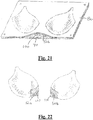
Fig. 21 is a perspective view of the laminated layers after being released from the molding device ofFig. 20 , the laminated layers including an opening at the bottom edge of the laminated layers; -
Fig. 22 is a perspective view of the garment parts after being cut out from the laminated layers ofFig. 21 , the garment parts each having an opened bottom corner; -
Fig. 23 is a perspective view showing attachment of the female and male fastening members to the strengthening members by stitching, in which the strengthening members are accessible at the opened bottom corers ofFig. 22 ; -
Fig. 24 is a front view of the garment parts ofFig. 23 with the opened bottom corners closed; and -
Fig. 25 is an exploded view showing the layers composing the garment part ofFig. 24 . -
Fig. 1 shows a part, generally designated as 10, of a front closure bra in accordance with an embodiment of the present invention. The bra part 10 includes afirst garment portion 12 and asecond garment portion 14 engaged with each other by a pair of fastening members. The fastening members are releasably engageable with each other to connect thefirst garment portion 12 and thesecond garment portion 14 so that when the fastening members are engaged with each other, the fastening members are substantially fully encased within the part 10, thereby providing an easily mounted, convenient and substantially invisible closure when viewed from both the front and the back of the junction. In addition, the substantially full enclosure of the fastening members within the part 10 also allows the fastening members to be shielded from the skin of the wearer, and avoids exposing any portion of the fastening members to the wearer at both the front and the back of the junction. This prevents the fastening members from being in contact with the wearer's skin in use, and therefore minimises the discomfort caused to the wearer. Thefirst garment portion 12 and thesecond garment portion 14 are arranged to cover breasts of the wearer, for example, in the form of bra cups of a bra. -
Fig. 2 shows the bra part 10 ofFig. 1 with thefirst garment portion 12 and thesecond garment portion 14 in a disengaged configuration. Thefirst garment portion 12 includes afemale fastening member 16 attached thereon, and thesecond garment portion 14 includes amale fastening member 18 attached thereon. Thefirst garment portion 12 and thesecond garment portion 14 are disengaged by having thefemale fastening member 16 and themale fastening member 18 disengaged from each other. It is further shown inFigs. 3 to 5 that thefemale fastening member 16 comprises arecess 20, and themale fastening member 18 comprises aprotrusion 22. Therecess 20 of thefemale fastening member 16 is adapted to releasably receive theprotrusion 22 of themale fastening member 18 to form the engagement. In another embodiment, thefemale fastening member 16 and themale fastening member 18 are engaged via a snap-fit coupling. - As shown in
Fig. 2 thefemale fastening member 16 is substantially fully encased within thefirst garment portion 12. In the context of this invention, thefemale fastening member 16 as being 'substantially fully encased' should not be understood as being an entirely enclosed configuration. Instead, thefirst garment portion 12 includes at least an opening which provides access to therecess 20 of thefemale fastening member 16. Themale fastening member 18 is partially encased within thesecond garment portion 14, having at least part of theprotrusion 22 exposed from thesecond garment portion 14 and is capable of being received by therecess 20 of thefemale fastening member 16. -
Fig. 4 shows another embodiment of thefemale fastening member 16 which further includes a releasingmeans 24. When thefemale fastening member 16 and themale fastening member 18 are engaged with each other, the releasingmeans 24 is triggerable, e.g. manually, to disengage thefemale fastening member 16 and themale fastening member 18. The releasing means 24 can be provided in the form of a press button. - The
first garment portion 12 and thesecond garment portion 14 each includes anouter layer 30, aninner layer 40, and a strengtheningmember 50 between theouter layer 30 and theinner layer 40. As shown inFigs. 6 to 9 , each of theouter layer 30 and theinner layer 40 includes afabric layer respective foam layer fabric layer - Each of the
first garment portion 12 and thesecond garment portion 14 may optionally include at least onewire member 60 between the respectiveouter layer 30 and theinner layer 40 to provide additional support to the wearer's breasts. Thewire member 60 can be in the form of a bare wire, a wire being partly or entirely shielded by a tubular layer such as a bra channel, or just the bra channel without any embedded wire. The bra channel can be made with any suitable materials known to a person skilled in the art such as fabric or plastic. As shown inFig. 10 , thewire members 60 can be attached to the strengtheningmembers 50a, 50b. Alternatively, the additional support can be provided by extended strengthening members 50c, 50d without thewire member 60, as shown inFig. 11 . Of course, such awire member 60 is not necessary in the case of a soft-cup bra. - The
female fastening member 16 and themale fastening member 18 can be attached to the respective strengtheningmember 50a, 50b or 50c, 50d. Thefemale fastening member 16 and themale fastening member 18 are stitched on therespective strengthening members 50a, 50b, as shown inFig. 23 . The strengtheningmember 50 may include a substantially inelastic fabric layer which is strong enough to withstand the strain applied by the engaged fastening members when the bra is worn by a wearer. Preferably, the substantially inelastic fabric layer of the strengtheningmember 50 includes a material selected from a group consisting of nylon, polyester and mixtures thereof. - Further steps for manufacturing the garment part 10 are shown in
Figs. 12 to 24 . Such steps include providing afirst layer 70 and asecond layer 80 of fabric material, providing the strengtheningmember 50 between thefirst layer 70 and thesecond layer 80, attaching afastening member member 50, and attaching thefirst layer 70, the strengtheningmember 50, and thesecond layer 80 with one another to at least partially encase thefastening member first layer 70 and the strengtheningmember 50, and between thesecond layer 80 and the strengtheningmember 50. Alternatively, the step of attaching can be performed by stitching. Alternatively, the step of attaching can be performed by ultrasonic adhesion. More preferably, the step of attaching is performed by heat lamination, use of adhesive, stitching, ultrasonic adhesion or a combination thereof. - In one example the
first layer 70 includes atop fabric layer 72 and abottom foam layer 74 attached by means of adhesive and/or lamination, with thebottom foam 74 layer adjacent the strengtheningmember 50. Thesecond layer 80 includes atop foam layer 84 and abottom fabric layer 82 attached by means of adhesive and/or lamination, with thetop foam layer 84 adjacent the strengtheningmember 50. - As shown in
Figs 12 and 14 , thefirst layer 70 is premolded into a concave shape by amolding device 90a, 90b, with thebottom foam layer 74 of thefirst layer 70 defining a concavity of the concave shape. Also as shown inFigs 13 and 15 , thesecond layer 80 is also premolded into a concave shape by themolding device 90a, 90b, with thebottom fabric layer 82 of thesecond layer 80 defining a concavity of the concave shape. The concavities of thefirst layer 70 and thesecond layer 80 accommodate the shape of the breasts of the wearer thereby allowing the garment part to serve as bra cups for covering and supporting breasts of the wearer. The molding device 90 can be any suitable molding tools conventionally used in the field, and a person skilled in the art would understand that it should not be limited to a particular molding device, but can be any molding tools suitable for performing the purpose. - The step of providing the
first layer 70 and thesecond layer 80 further includes a step of positioning the premoldedfirst layer 70 onto a female mold 91a of the molding device 91 as shown inFig. 16 . Preferably, prior to providing the strengthening member, the manufacturing steps further include a step of providing awire member 60 on thefirst layer 70, followed by a step of attaching the strengtheningmember 50 to thewire member 60 as shown inFig. 17 . The premoldedsecond layer 80 is then positioned on thewire member 60 and the strengtheningmember 50 prior to the laminating step as shown inFig. 18 . As shown inFigs. 19 and 20 , the laminating step includes the step of positioning a male mold 91b of the molding device 91 onto the female mold 91a and subsequently applying pressure to compress the layers in between. It is important that a portion of the bottom edge should be left unsealed to provide an opening 100 as shown inFig. 21 . After releasing the laminated layers from the molding device 91, the laminated layers are cut to the required size and shape to form garment parts 10. The opening 100 provides each of the garment parts with an at least partially opened bottom corner 110, which allows the access of the strengthening member for any further processing. For example, as shown inFig. 23 , either thefirst layer 70 or thesecond layer 80 at the opened bottom corner 110 can be turned over to expose theintermediate strengthening members 50a, 50b so that thefastening members member 50, such as, by stitching, ultrasonic adhesion, heat lamination, adhesion or a combination thereof. -
Fig. 24 further shows the garment parts 10 when the opened bottom corners 110 are closed, for example, by stitching, and/or an adhesive and/or lamination.Fig. 25 is an exploded view showing the composing layers of the garment part 10 in sequence, starting from thefirst layer 70, the adhesive 120, the strengtheningmember 50 connected with thewire member 60 and thefastening member 16, another adhesive 120, and thesecond layer 80. - The bra part 10 as shown in
Fig. 25 can be further processed by forming or joining further fabric materials or parts to the bra part 10 to form a bra. For example, shoulder straps and back fabric portions can be connected to the bra part 10 by means of stitching or other engagement means to form a bra. - It should be understood that the above only illustrates and describes examples whereby the present invention may be carried out and serve, for example, as a garment part of a bra, and that modifications and/or alterations may be made according to the claims 1-9. For example, while the specific embodiments are related to front closure bras, a person skilled in the art would understand that the invention could also be used for a rear fastening system of a rear closure bra, or for closure system at any suitable position of the bra. The invention could also be used as a part with fastening system for any undergarments or garments, for example, corsets or swimsuits.
- It should also be understood that certain features of the invention, which are, for clarity, described in the context of separate embodiments, may also be provided in combination in a single embodiment. Conversely, various features of the invention which are, for brevity, described in the context of a single embodiment, may also be provided or separately or in any suitable sub-combination.
Claims (9)
- A garment part (10) including:a first garment portion (12) having a first fastening member (16), anda second garment portion (14) having a second fastening member (18),wherein the first fastening member and the second fastening member are releasably engageable with each other to connect the first garment portion and the second garment portion,wherein when the first fastening member and the second fastening member are engaged with each other, the first fastening member and the second fastening member are fully encased within the garment partwherein the first fastening member is attached to the first garment portion and the second fastening member is attached to the second garment portion characterized in thateach of the first garment portion and the second garment portion includes an outer layer (30), an inner layer (40), and a strengthening member (50, 50a, 50b, 50c, 50d) between the respective outer layer and the inner layer,wherein the first fastening member and the second fastening member are attached to the respective strengthening memberwherein the first fastening member and the second fastening member are attached to the respective strengthening member by stitching, heat lamination, adhesion, ultrasonic adhesion or a combination thereof and wherein each of the first garment portion and the second garment portion includes at least one wire member (60) between the respective outer layer and the inner layer, the wire member being attached to the respective strengthening member.
- The garment part according to claim 1, wherein the first fastening member and the second fastening member are releasably engageable with each other via a snap-fit coupling and optionally wherein the first fastening member includes a recess (20) and the second fastening member includes a protrusion (22), the recess being adapted to releasably receive the protrusion to form the snap-fit coupling.
- The garment part according to claim 1, wherein the first fastening member is substantially fully encased within the first garment portion, and the second fastening member is at least partially encased within the second garment portion
- The garment part according to claim 1 wherein at least one of the first fastening member and the second fastening member includes releasing means (24) which, when the first fastening member and the second fastening member are engaged with each other, is triggerable to disengage the first fastening member from the second fastening member.
- The garment part according to claim 1, wherein the strengthening member includes a substantially inelastic fabric layer.
- The garment part according to claim 5 wherein the substantially inealastic fabric layer includes a material selected from a group consisting of nylon, polyester and mixtures thereof.
- The garment part according to claim 1, wherein at least one of the outer layer and the inner layer includes a fabric layer (32, 42) attached to a foam layer (34, 44) and optionally wherein the fabric layer and the foam layer are attached with each other by stitching, heat lamination, adhesion or a combination thereof.
- A garment or undergarment (e.g. brassiere) including at least a garment part (100 according to claim 1.
- The garment according to claim 8 wherein the first garment portion and the second garment portion of the garment part each includes a bra cup of a brassiere.
Applications Claiming Priority (2)
| Application Number | Priority Date | Filing Date | Title |
|---|---|---|---|
| US13/907,299 US9474309B2 (en) | 2013-05-31 | 2013-05-31 | Garment part with a fastening system and a method of manufacturing thereof |
| PCT/CN2014/076535 WO2014190835A1 (en) | 2013-05-31 | 2014-04-30 | Garment part with fastening system and manufacturing method thereof |
Publications (3)
| Publication Number | Publication Date |
|---|---|
| EP3003077A1 EP3003077A1 (en) | 2016-04-13 |
| EP3003077A4 EP3003077A4 (en) | 2017-03-01 |
| EP3003077B1 true EP3003077B1 (en) | 2019-06-12 |
Family
ID=51985630
Family Applications (2)
| Application Number | Title | Priority Date | Filing Date |
|---|---|---|---|
| EP14804480.3A Active EP3003077B1 (en) | 2013-05-31 | 2014-04-30 | Garment part with fastening system and manufacturing method thereof |
| EP14804585.9A Not-in-force EP3003078B1 (en) | 2013-05-31 | 2014-05-21 | Method of manufacturing a garment incorporating a garment part |
Family Applications After (1)
| Application Number | Title | Priority Date | Filing Date |
|---|---|---|---|
| EP14804585.9A Not-in-force EP3003078B1 (en) | 2013-05-31 | 2014-05-21 | Method of manufacturing a garment incorporating a garment part |
Country Status (11)
| Country | Link |
|---|---|
| US (1) | US9474309B2 (en) |
| EP (2) | EP3003077B1 (en) |
| JP (3) | JP6549101B2 (en) |
| KR (2) | KR102244614B1 (en) |
| CN (2) | CN105120696B (en) |
| AU (4) | AU2014273741A1 (en) |
| CA (2) | CA2909463C (en) |
| ES (2) | ES2744635T3 (en) |
| GB (2) | GB2528795B (en) |
| HK (2) | HK1217271A1 (en) |
| WO (2) | WO2014190835A1 (en) |
Families Citing this family (6)
| Publication number | Priority date | Publication date | Assignee | Title |
|---|---|---|---|---|
| US9295294B2 (en) | 2013-12-19 | 2016-03-29 | Fildan Accessories (Hk) Ltd. | Lingerie fastener |
| CN105124835B (en) * | 2015-08-18 | 2016-08-24 | 佛山市南海适妍科技有限公司 | Assembling combination bra dedicated elas-tic snap close |
| US20170290377A1 (en) * | 2016-04-08 | 2017-10-12 | Regina Miracle International (Group) Limited | Brassiere cups and methods of manufacturing the same |
| USD878244S1 (en) * | 2019-02-20 | 2020-03-17 | Dubrosky & Tracy Patent Services Corp | Garment |
| USD878243S1 (en) * | 2019-02-20 | 2020-03-17 | Dubrosky & Tracy Patent Services Corp | Fastener |
| US12161174B2 (en) * | 2021-12-29 | 2024-12-10 | Judith Racicot Moldstad | Thermally re-castable brassieres |
Family Cites Families (34)
| Publication number | Priority date | Publication date | Assignee | Title |
|---|---|---|---|---|
| US1851730A (en) * | 1929-07-17 | 1932-03-29 | Shoe Hardware Company | Clothing buckle |
| US1993297A (en) * | 1933-05-24 | 1935-03-05 | Greenberg Irvin | Separable slide fastener |
| US2148269A (en) * | 1938-04-12 | 1939-02-21 | Koch Charles | Invisible slide fastener assembly for garments |
| US2346887A (en) * | 1942-09-19 | 1944-04-18 | Winkler Friedrich | Clasp for necklaces, bracelets, and the like |
| US2607921A (en) * | 1949-11-19 | 1952-08-26 | United Carr Fastener Corp | Shirt construction |
| US2765471A (en) * | 1954-11-26 | 1956-10-09 | Cousins Sydne | Brassiere and clasp therefor |
| DE1610339B1 (en) * | 1966-02-02 | 1970-10-08 | Brero & Co | Hook slide fastener made of plastic or the like. |
| US3837049A (en) * | 1971-10-26 | 1974-09-24 | Leading Lady Foundation Inc | Brassiere fastener |
| AT359944B (en) * | 1977-07-28 | 1980-12-10 | Fildan Gerhard | HOOK CLOSURE FOR CLOTHING |
| CN2054265U (en) * | 1989-10-25 | 1990-03-14 | 申时运 | Brassiere with front buttoning |
| CN2077644U (en) * | 1990-11-26 | 1991-05-29 | 李亮甲 | Brassiere with front closure |
| CN2276723Y (en) * | 1995-11-17 | 1998-03-25 | 邹洁 | Bra |
| TW385236B (en) * | 1998-04-27 | 2000-03-21 | Wacoal Corp | Belt connector and female clothes with cups |
| US6149496A (en) | 1999-07-29 | 2000-11-21 | Fildan; Gerhard | Hidden front-closure brassiere |
| US6253424B1 (en) * | 1999-08-30 | 2001-07-03 | Francine Rainville-Lonn | Closure for article of apparel and for use by a person having handicapped hands |
| KR200236465Y1 (en) | 2001-04-06 | 2001-10-11 | 주식회사 좋은사람들 | Brassiere Having Function of Bust Correction |
| US20030166376A1 (en) * | 2002-03-04 | 2003-09-04 | Hanson Victoria K. | Brassiere |
| CN1189110C (en) | 2002-05-31 | 2005-02-16 | 李文彬 | Seamless bra |
| WO2004002248A2 (en) * | 2002-07-01 | 2004-01-08 | Sara Lee Corporation | Methods of making cotton blend glue brassieres |
| US6793556B1 (en) | 2003-07-18 | 2004-09-21 | Fildan Accessories Corporation | Brassiere with invisible front closure |
| US6994606B2 (en) * | 2004-07-02 | 2006-02-07 | Wei Cheng Li | Overall adjustable brassieres |
| JP2006045713A (en) * | 2004-08-04 | 2006-02-16 | Gunze Ltd | Cup body and garment using the same |
| CN2783779Y (en) | 2005-02-03 | 2006-05-31 | 陈明俊 | The structure of the bra |
| US7128635B1 (en) * | 2005-11-04 | 2006-10-31 | Regina Miracle International Ltd. | Molded seamless brassiere incorporating fasteners |
| US7407427B2 (en) | 2006-05-19 | 2008-08-05 | Regina Miracle International Ltd. | Brassiere |
| US7927441B2 (en) | 2006-06-08 | 2011-04-19 | Clover Group International Limited | Method for joining fabric panels and manufacturing brassieres |
| WO2007143928A1 (en) * | 2006-06-08 | 2007-12-21 | Clover Group International Limited | Method for joining fabric panels and manufacturing brassieres |
| US7604526B2 (en) * | 2006-06-21 | 2009-10-20 | Regina Miracle International Enterprises Ltd. | Brassiere with under breast support |
| US20080153388A1 (en) * | 2006-12-21 | 2008-06-26 | Zhen Qiang Liu | Brassieres |
| US7992222B1 (en) * | 2008-10-10 | 2011-08-09 | Rochelle Behrens | Garment with interstitial fastener |
| US8133091B2 (en) | 2008-11-17 | 2012-03-13 | Regina Miracle International Limited | Brassieres |
| JP2011157669A (en) | 2010-02-03 | 2011-08-18 | Bragel Internatl Inc | Brassiere |
| KR101285687B1 (en) * | 2011-08-19 | 2013-07-12 | 문희정 | Fastening means and brassiere using the same |
| CN105433451A (en) * | 2011-12-23 | 2016-03-30 | 维珍妮国际(集团)有限公司 | Cup assemblies and bras containing such cups |
-
2013
- 2013-05-31 US US13/907,299 patent/US9474309B2/en active Active
-
2014
- 2014-04-30 GB GB1515205.1A patent/GB2528795B/en not_active Expired - Fee Related
- 2014-04-30 AU AU2014273741A patent/AU2014273741A1/en not_active Abandoned
- 2014-04-30 EP EP14804480.3A patent/EP3003077B1/en active Active
- 2014-04-30 CN CN201480019769.6A patent/CN105120696B/en not_active Expired - Fee Related
- 2014-04-30 ES ES14804480T patent/ES2744635T3/en active Active
- 2014-04-30 CA CA2909463A patent/CA2909463C/en not_active Expired - Fee Related
- 2014-04-30 KR KR1020157033581A patent/KR102244614B1/en not_active Expired - Fee Related
- 2014-04-30 WO PCT/CN2014/076535 patent/WO2014190835A1/en not_active Ceased
- 2014-04-30 JP JP2016515620A patent/JP6549101B2/en not_active Expired - Fee Related
- 2014-05-21 AU AU2014273682A patent/AU2014273682A1/en not_active Abandoned
- 2014-05-21 KR KR1020157033577A patent/KR102098756B1/en not_active Expired - Fee Related
- 2014-05-21 EP EP14804585.9A patent/EP3003078B1/en not_active Not-in-force
- 2014-05-21 WO PCT/CN2014/078004 patent/WO2014190868A1/en not_active Ceased
- 2014-05-21 HK HK16104946.9A patent/HK1217271A1/en unknown
- 2014-05-21 GB GB1515204.4A patent/GB2529318A/en not_active Withdrawn
- 2014-05-21 ES ES14804585T patent/ES2734575T3/en active Active
- 2014-05-21 JP JP2016515627A patent/JP6433992B2/en not_active Expired - Fee Related
- 2014-05-21 CN CN201480019791.0A patent/CN105101823A/en active Pending
- 2014-05-21 CA CA2909447A patent/CA2909447C/en not_active Expired - Fee Related
- 2014-05-21 HK HK16104948.7A patent/HK1217272A1/en unknown
-
2018
- 2018-08-16 AU AU2018217295A patent/AU2018217295B2/en not_active Ceased
- 2018-08-16 AU AU2018217278A patent/AU2018217278B2/en not_active Ceased
-
2019
- 2019-03-18 JP JP2019050157A patent/JP2019116714A/en active Pending
Non-Patent Citations (1)
| Title |
|---|
| None * |
Also Published As
Similar Documents
| Publication | Publication Date | Title |
|---|---|---|
| AU2018217295B2 (en) | Garment part with fastening system and manufacturing method thereof | |
| US8365313B2 (en) | Reversible sleeved garment accessory | |
| CN101917878B (en) | Bra cups and bras formed therefrom | |
| US8133091B2 (en) | Brassieres | |
| EP2087799A2 (en) | Improvements to brassieres | |
| US7435156B1 (en) | Reversible brassiere | |
| US20100178846A1 (en) | Partial undergarment | |
| US20100285722A1 (en) | Molded breast cup and a brassiere incorporating such a breast cup | |
| US20080153387A1 (en) | Partial core pad incorporating brassiere | |
| US20140357157A1 (en) | Garment Parts, Garment Incorporating Such A Garment Part And Method Of Manufacturing Same | |
| US9596891B2 (en) | Adhesive bra construction for deep plunge apparel | |
| HK1216979B (en) | Garment part with fastening system and manufacturing method thereof |
Legal Events
| Date | Code | Title | Description |
|---|---|---|---|
| PUAI | Public reference made under article 153(3) epc to a published international application that has entered the european phase |
Free format text: ORIGINAL CODE: 0009012 |
|
| 17P | Request for examination filed |
Effective date: 20150826 |
|
| AK | Designated contracting states |
Kind code of ref document: A1 Designated state(s): AL AT BE BG CH CY CZ DE DK EE ES FI FR GB GR HR HU IE IS IT LI LT LU LV MC MK MT NL NO PL PT RO RS SE SI SK SM TR |
|
| AX | Request for extension of the european patent |
Extension state: BA ME |
|
| DAX | Request for extension of the european patent (deleted) | ||
| A4 | Supplementary search report drawn up and despatched |
Effective date: 20170201 |
|
| RIC1 | Information provided on ipc code assigned before grant |
Ipc: A41C 3/02 20060101AFI20170126BHEP |
|
| STAA | Information on the status of an ep patent application or granted ep patent |
Free format text: STATUS: EXAMINATION IS IN PROGRESS |
|
| 17Q | First examination report despatched |
Effective date: 20180508 |
|
| GRAP | Despatch of communication of intention to grant a patent |
Free format text: ORIGINAL CODE: EPIDOSNIGR1 |
|
| STAA | Information on the status of an ep patent application or granted ep patent |
Free format text: STATUS: GRANT OF PATENT IS INTENDED |
|
| RIC1 | Information provided on ipc code assigned before grant |
Ipc: A41C 3/12 20060101ALI20181217BHEP Ipc: A41C 5/00 20060101ALI20181217BHEP Ipc: A41C 3/02 20060101AFI20181217BHEP |
|
| INTG | Intention to grant announced |
Effective date: 20190117 |
|
| GRAS | Grant fee paid |
Free format text: ORIGINAL CODE: EPIDOSNIGR3 |
|
| GRAA | (expected) grant |
Free format text: ORIGINAL CODE: 0009210 |
|
| STAA | Information on the status of an ep patent application or granted ep patent |
Free format text: STATUS: THE PATENT HAS BEEN GRANTED |
|
| RBV | Designated contracting states (corrected) |
Designated state(s): AL AT BE BG CH CY CZ DE DK EE ES FI FR GR HR HU IE IS IT LI LT LU LV MC MK MT NL NO PL PT RO RS SE SI SK SM TR |
|
| AK | Designated contracting states |
Kind code of ref document: B1 Designated state(s): AL AT BE BG CH CY CZ DE DK EE ES FI FR GR HR HU IE IS IT LI LT LU LV MC MK MT NL NO PL PT RO RS SE SI SK SM TR |
|
| REG | Reference to a national code |
Ref country code: CH Ref legal event code: EP |
|
| REG | Reference to a national code |
Ref country code: AT Ref legal event code: REF Ref document number: 1141395 Country of ref document: AT Kind code of ref document: T Effective date: 20190615 |
|
| REG | Reference to a national code |
Ref country code: DE Ref legal event code: R096 Ref document number: 602014048310 Country of ref document: DE |
|
| REG | Reference to a national code |
Ref country code: IE Ref legal event code: FG4D |
|
| REG | Reference to a national code |
Ref country code: NL Ref legal event code: MP Effective date: 20190612 |
|
| REG | Reference to a national code |
Ref country code: LT Ref legal event code: MG4D |
|
| PG25 | Lapsed in a contracting state [announced via postgrant information from national office to epo] |
Ref country code: NO Free format text: LAPSE BECAUSE OF FAILURE TO SUBMIT A TRANSLATION OF THE DESCRIPTION OR TO PAY THE FEE WITHIN THE PRESCRIBED TIME-LIMIT Effective date: 20190912 Ref country code: FI Free format text: LAPSE BECAUSE OF FAILURE TO SUBMIT A TRANSLATION OF THE DESCRIPTION OR TO PAY THE FEE WITHIN THE PRESCRIBED TIME-LIMIT Effective date: 20190612 Ref country code: HR Free format text: LAPSE BECAUSE OF FAILURE TO SUBMIT A TRANSLATION OF THE DESCRIPTION OR TO PAY THE FEE WITHIN THE PRESCRIBED TIME-LIMIT Effective date: 20190612 Ref country code: LT Free format text: LAPSE BECAUSE OF FAILURE TO SUBMIT A TRANSLATION OF THE DESCRIPTION OR TO PAY THE FEE WITHIN THE PRESCRIBED TIME-LIMIT Effective date: 20190612 Ref country code: AL Free format text: LAPSE BECAUSE OF FAILURE TO SUBMIT A TRANSLATION OF THE DESCRIPTION OR TO PAY THE FEE WITHIN THE PRESCRIBED TIME-LIMIT Effective date: 20190612 Ref country code: SE Free format text: LAPSE BECAUSE OF FAILURE TO SUBMIT A TRANSLATION OF THE DESCRIPTION OR TO PAY THE FEE WITHIN THE PRESCRIBED TIME-LIMIT Effective date: 20190612 |
|
| PG25 | Lapsed in a contracting state [announced via postgrant information from national office to epo] |
Ref country code: BG Free format text: LAPSE BECAUSE OF FAILURE TO SUBMIT A TRANSLATION OF THE DESCRIPTION OR TO PAY THE FEE WITHIN THE PRESCRIBED TIME-LIMIT Effective date: 20190912 Ref country code: GR Free format text: LAPSE BECAUSE OF FAILURE TO SUBMIT A TRANSLATION OF THE DESCRIPTION OR TO PAY THE FEE WITHIN THE PRESCRIBED TIME-LIMIT Effective date: 20190913 Ref country code: LV Free format text: LAPSE BECAUSE OF FAILURE TO SUBMIT A TRANSLATION OF THE DESCRIPTION OR TO PAY THE FEE WITHIN THE PRESCRIBED TIME-LIMIT Effective date: 20190612 Ref country code: RS Free format text: LAPSE BECAUSE OF FAILURE TO SUBMIT A TRANSLATION OF THE DESCRIPTION OR TO PAY THE FEE WITHIN THE PRESCRIBED TIME-LIMIT Effective date: 20190612 |
|
| REG | Reference to a national code |
Ref country code: AT Ref legal event code: MK05 Ref document number: 1141395 Country of ref document: AT Kind code of ref document: T Effective date: 20190612 |
|
| PG25 | Lapsed in a contracting state [announced via postgrant information from national office to epo] |
Ref country code: SK Free format text: LAPSE BECAUSE OF FAILURE TO SUBMIT A TRANSLATION OF THE DESCRIPTION OR TO PAY THE FEE WITHIN THE PRESCRIBED TIME-LIMIT Effective date: 20190612 Ref country code: RO Free format text: LAPSE BECAUSE OF FAILURE TO SUBMIT A TRANSLATION OF THE DESCRIPTION OR TO PAY THE FEE WITHIN THE PRESCRIBED TIME-LIMIT Effective date: 20190612 Ref country code: CZ Free format text: LAPSE BECAUSE OF FAILURE TO SUBMIT A TRANSLATION OF THE DESCRIPTION OR TO PAY THE FEE WITHIN THE PRESCRIBED TIME-LIMIT Effective date: 20190612 Ref country code: PT Free format text: LAPSE BECAUSE OF FAILURE TO SUBMIT A TRANSLATION OF THE DESCRIPTION OR TO PAY THE FEE WITHIN THE PRESCRIBED TIME-LIMIT Effective date: 20191014 Ref country code: NL Free format text: LAPSE BECAUSE OF FAILURE TO SUBMIT A TRANSLATION OF THE DESCRIPTION OR TO PAY THE FEE WITHIN THE PRESCRIBED TIME-LIMIT Effective date: 20190612 Ref country code: EE Free format text: LAPSE BECAUSE OF FAILURE TO SUBMIT A TRANSLATION OF THE DESCRIPTION OR TO PAY THE FEE WITHIN THE PRESCRIBED TIME-LIMIT Effective date: 20190612 Ref country code: AT Free format text: LAPSE BECAUSE OF FAILURE TO SUBMIT A TRANSLATION OF THE DESCRIPTION OR TO PAY THE FEE WITHIN THE PRESCRIBED TIME-LIMIT Effective date: 20190612 |
|
| REG | Reference to a national code |
Ref country code: ES Ref legal event code: FG2A Ref document number: 2744635 Country of ref document: ES Kind code of ref document: T3 Effective date: 20200225 |
|
| PG25 | Lapsed in a contracting state [announced via postgrant information from national office to epo] |
Ref country code: IS Free format text: LAPSE BECAUSE OF FAILURE TO SUBMIT A TRANSLATION OF THE DESCRIPTION OR TO PAY THE FEE WITHIN THE PRESCRIBED TIME-LIMIT Effective date: 20191012 Ref country code: SM Free format text: LAPSE BECAUSE OF FAILURE TO SUBMIT A TRANSLATION OF THE DESCRIPTION OR TO PAY THE FEE WITHIN THE PRESCRIBED TIME-LIMIT Effective date: 20190612 |
|
| REG | Reference to a national code |
Ref country code: DE Ref legal event code: R097 Ref document number: 602014048310 Country of ref document: DE |
|
| PG25 | Lapsed in a contracting state [announced via postgrant information from national office to epo] |
Ref country code: TR Free format text: LAPSE BECAUSE OF FAILURE TO SUBMIT A TRANSLATION OF THE DESCRIPTION OR TO PAY THE FEE WITHIN THE PRESCRIBED TIME-LIMIT Effective date: 20190612 |
|
| PLBE | No opposition filed within time limit |
Free format text: ORIGINAL CODE: 0009261 |
|
| STAA | Information on the status of an ep patent application or granted ep patent |
Free format text: STATUS: NO OPPOSITION FILED WITHIN TIME LIMIT |
|
| PG25 | Lapsed in a contracting state [announced via postgrant information from national office to epo] |
Ref country code: PL Free format text: LAPSE BECAUSE OF FAILURE TO SUBMIT A TRANSLATION OF THE DESCRIPTION OR TO PAY THE FEE WITHIN THE PRESCRIBED TIME-LIMIT Effective date: 20190612 Ref country code: DK Free format text: LAPSE BECAUSE OF FAILURE TO SUBMIT A TRANSLATION OF THE DESCRIPTION OR TO PAY THE FEE WITHIN THE PRESCRIBED TIME-LIMIT Effective date: 20190612 |
|
| 26N | No opposition filed |
Effective date: 20200313 |
|
| PG25 | Lapsed in a contracting state [announced via postgrant information from national office to epo] |
Ref country code: IS Free format text: LAPSE BECAUSE OF FAILURE TO SUBMIT A TRANSLATION OF THE DESCRIPTION OR TO PAY THE FEE WITHIN THE PRESCRIBED TIME-LIMIT Effective date: 20200224 Ref country code: SI Free format text: LAPSE BECAUSE OF FAILURE TO SUBMIT A TRANSLATION OF THE DESCRIPTION OR TO PAY THE FEE WITHIN THE PRESCRIBED TIME-LIMIT Effective date: 20190612 |
|
| PG2D | Information on lapse in contracting state deleted |
Ref country code: IS |
|
| PGFP | Annual fee paid to national office [announced via postgrant information from national office to epo] |
Ref country code: FR Payment date: 20200430 Year of fee payment: 7 Ref country code: ES Payment date: 20200504 Year of fee payment: 7 Ref country code: DE Payment date: 20200422 Year of fee payment: 7 |
|
| PGFP | Annual fee paid to national office [announced via postgrant information from national office to epo] |
Ref country code: IT Payment date: 20200428 Year of fee payment: 7 |
|
| PG25 | Lapsed in a contracting state [announced via postgrant information from national office to epo] |
Ref country code: MC Free format text: LAPSE BECAUSE OF FAILURE TO SUBMIT A TRANSLATION OF THE DESCRIPTION OR TO PAY THE FEE WITHIN THE PRESCRIBED TIME-LIMIT Effective date: 20190612 |
|
| REG | Reference to a national code |
Ref country code: CH Ref legal event code: PL |
|
| PG25 | Lapsed in a contracting state [announced via postgrant information from national office to epo] |
Ref country code: LI Free format text: LAPSE BECAUSE OF NON-PAYMENT OF DUE FEES Effective date: 20200430 Ref country code: LU Free format text: LAPSE BECAUSE OF NON-PAYMENT OF DUE FEES Effective date: 20200430 Ref country code: CH Free format text: LAPSE BECAUSE OF NON-PAYMENT OF DUE FEES Effective date: 20200430 |
|
| REG | Reference to a national code |
Ref country code: BE Ref legal event code: MM Effective date: 20200430 |
|
| PG25 | Lapsed in a contracting state [announced via postgrant information from national office to epo] |
Ref country code: BE Free format text: LAPSE BECAUSE OF NON-PAYMENT OF DUE FEES Effective date: 20200430 |
|
| PG25 | Lapsed in a contracting state [announced via postgrant information from national office to epo] |
Ref country code: IE Free format text: LAPSE BECAUSE OF NON-PAYMENT OF DUE FEES Effective date: 20200430 |
|
| REG | Reference to a national code |
Ref country code: DE Ref legal event code: R119 Ref document number: 602014048310 Country of ref document: DE |
|
| PG25 | Lapsed in a contracting state [announced via postgrant information from national office to epo] |
Ref country code: FR Free format text: LAPSE BECAUSE OF NON-PAYMENT OF DUE FEES Effective date: 20210430 Ref country code: DE Free format text: LAPSE BECAUSE OF NON-PAYMENT OF DUE FEES Effective date: 20211103 |
|
| PG25 | Lapsed in a contracting state [announced via postgrant information from national office to epo] |
Ref country code: MT Free format text: LAPSE BECAUSE OF FAILURE TO SUBMIT A TRANSLATION OF THE DESCRIPTION OR TO PAY THE FEE WITHIN THE PRESCRIBED TIME-LIMIT Effective date: 20190612 Ref country code: CY Free format text: LAPSE BECAUSE OF FAILURE TO SUBMIT A TRANSLATION OF THE DESCRIPTION OR TO PAY THE FEE WITHIN THE PRESCRIBED TIME-LIMIT Effective date: 20190612 |
|
| PG25 | Lapsed in a contracting state [announced via postgrant information from national office to epo] |
Ref country code: MK Free format text: LAPSE BECAUSE OF FAILURE TO SUBMIT A TRANSLATION OF THE DESCRIPTION OR TO PAY THE FEE WITHIN THE PRESCRIBED TIME-LIMIT Effective date: 20190612 |
|
| REG | Reference to a national code |
Ref country code: ES Ref legal event code: FD2A Effective date: 20220801 |
|
| PG25 | Lapsed in a contracting state [announced via postgrant information from national office to epo] |
Ref country code: ES Free format text: LAPSE BECAUSE OF NON-PAYMENT OF DUE FEES Effective date: 20210501 |
|
| PG25 | Lapsed in a contracting state [announced via postgrant information from national office to epo] |
Ref country code: IT Free format text: LAPSE BECAUSE OF NON-PAYMENT OF DUE FEES Effective date: 20200430 |