EP3000428A2 - Dental implant - Google Patents
Dental implant Download PDFInfo
- Publication number
- EP3000428A2 EP3000428A2 EP15183400.9A EP15183400A EP3000428A2 EP 3000428 A2 EP3000428 A2 EP 3000428A2 EP 15183400 A EP15183400 A EP 15183400A EP 3000428 A2 EP3000428 A2 EP 3000428A2
- Authority
- EP
- European Patent Office
- Prior art keywords
- dental implant
- head portion
- thread
- body portion
- trench
- Prior art date
- Legal status (The legal status is an assumption and is not a legal conclusion. Google has not performed a legal analysis and makes no representation as to the accuracy of the status listed.)
- Withdrawn
Links
- 239000004053 dental implant Substances 0.000 title claims abstract description 201
- 238000005553 drilling Methods 0.000 claims abstract description 77
- 230000001186 cumulative effect Effects 0.000 claims abstract description 23
- 210000000988 bone and bone Anatomy 0.000 description 89
- 210000001847 jaw Anatomy 0.000 description 62
- 238000001356 surgical procedure Methods 0.000 description 16
- 239000000463 material Substances 0.000 description 12
- 239000012528 membrane Substances 0.000 description 12
- 238000000034 method Methods 0.000 description 12
- 239000011295 pitch Substances 0.000 description 11
- 210000000887 face Anatomy 0.000 description 9
- 238000010586 diagram Methods 0.000 description 7
- 238000002513 implantation Methods 0.000 description 7
- 208000014674 injury Diseases 0.000 description 7
- 235000013305 food Nutrition 0.000 description 6
- 239000007943 implant Substances 0.000 description 6
- 230000001154 acute effect Effects 0.000 description 5
- 230000006378 damage Effects 0.000 description 5
- 208000001132 Osteoporosis Diseases 0.000 description 4
- 230000008901 benefit Effects 0.000 description 4
- 230000000694 effects Effects 0.000 description 4
- 230000008733 trauma Effects 0.000 description 4
- 208000027418 Wounds and injury Diseases 0.000 description 3
- 230000035876 healing Effects 0.000 description 3
- 210000004086 maxillary sinus Anatomy 0.000 description 3
- 210000000256 facial nerve Anatomy 0.000 description 2
- 238000009434 installation Methods 0.000 description 2
- 230000010354 integration Effects 0.000 description 2
- 210000002050 maxilla Anatomy 0.000 description 2
- 230000029663 wound healing Effects 0.000 description 2
- RTAQQCXQSZGOHL-UHFFFAOYSA-N Titanium Chemical compound [Ti] RTAQQCXQSZGOHL-UHFFFAOYSA-N 0.000 description 1
- QCWXUUIWCKQGHC-UHFFFAOYSA-N Zirconium Chemical compound [Zr] QCWXUUIWCKQGHC-UHFFFAOYSA-N 0.000 description 1
- 230000003416 augmentation Effects 0.000 description 1
- 230000003796 beauty Effects 0.000 description 1
- 230000037182 bone density Effects 0.000 description 1
- 229940036811 bone meal Drugs 0.000 description 1
- 239000002374 bone meal Substances 0.000 description 1
- 239000000316 bone substitute Substances 0.000 description 1
- 230000001055 chewing effect Effects 0.000 description 1
- 230000001066 destructive effect Effects 0.000 description 1
- 238000005516 engineering process Methods 0.000 description 1
- 230000003203 everyday effect Effects 0.000 description 1
- 238000004299 exfoliation Methods 0.000 description 1
- 239000012634 fragment Substances 0.000 description 1
- 210000004195 gingiva Anatomy 0.000 description 1
- 210000003128 head Anatomy 0.000 description 1
- 210000004373 mandible Anatomy 0.000 description 1
- 230000002035 prolonged effect Effects 0.000 description 1
- 238000010079 rubber tapping Methods 0.000 description 1
- 230000002459 sustained effect Effects 0.000 description 1
- 229910052719 titanium Inorganic materials 0.000 description 1
- 239000010936 titanium Substances 0.000 description 1
- 229910052726 zirconium Inorganic materials 0.000 description 1
Images



Classifications
-
- A—HUMAN NECESSITIES
- A61—MEDICAL OR VETERINARY SCIENCE; HYGIENE
- A61C—DENTISTRY; APPARATUS OR METHODS FOR ORAL OR DENTAL HYGIENE
- A61C8/00—Means to be fixed to the jaw-bone for consolidating natural teeth or for fixing dental prostheses thereon; Dental implants; Implanting tools
- A61C8/0018—Means to be fixed to the jaw-bone for consolidating natural teeth or for fixing dental prostheses thereon; Dental implants; Implanting tools characterised by the shape
- A61C8/0022—Self-screwing
- A61C8/0025—Self-screwing with multiple threads
-
- A—HUMAN NECESSITIES
- A61—MEDICAL OR VETERINARY SCIENCE; HYGIENE
- A61C—DENTISTRY; APPARATUS OR METHODS FOR ORAL OR DENTAL HYGIENE
- A61C8/00—Means to be fixed to the jaw-bone for consolidating natural teeth or for fixing dental prostheses thereon; Dental implants; Implanting tools
- A61C8/0018—Means to be fixed to the jaw-bone for consolidating natural teeth or for fixing dental prostheses thereon; Dental implants; Implanting tools characterised by the shape
- A61C8/0022—Self-screwing
- A61C8/0024—Self-screwing with self-boring cutting edge
-
- A—HUMAN NECESSITIES
- A61—MEDICAL OR VETERINARY SCIENCE; HYGIENE
- A61C—DENTISTRY; APPARATUS OR METHODS FOR ORAL OR DENTAL HYGIENE
- A61C8/00—Means to be fixed to the jaw-bone for consolidating natural teeth or for fixing dental prostheses thereon; Dental implants; Implanting tools
- A61C8/0089—Implanting tools or instruments
- A61C8/0092—Implanting tools or instruments for sinus lifting
Definitions
- the present invention is related to a dental implant.
- the present invention relates to a dental implant which is a surgical component used in dental restoration surgery.
- dental restoration needs to remove tooth first. After three months, injuries of the removed site are healed over, it needs surgery again to have sinus lift, so that filling bone graft materials (such as bone substitute or bone meal) is hence achieved; then a hole on the upper jaw (maxilla) is drilled for filling the bone graft materials. After the bone graft materials had been filled, it needs to wait for further three to six months for healing; afterward, the dental implant therefore can be stably placed in the drilled hole of the upper jaw. Finally, after three to six months, a dental crown can be positioned on the dental implant to finish the dental restoration. In general, the period of traditional tooth restoration need to spend approximately one and half year.
- Taiwan Patent Application No. 095140364 Fe-In-One Fast Dental Implantation Method Having Beauty Effect
- Taiwan Patent Application No. 095140361 Increased Sinus Implant Surgery Instruments
- the kernel of those methods is only required one medical surgery to finish five procedures, including tooth revmoval, preoperative sinus lifting, bone grafting, implant placing, and dental crown installation. After three to four months, the artificial tooth can be attached.
- the aforementioned dental implantation treatment only takes half year, and the dental patient can use the new implanting artificial tooth to eat.
- the aforementioned dental restoration is less invasive with higher success rate. Those are practicability that not only the number of times of surgery can be reduced for patient, but also the healing period is shortened.
- the aforementioned fast dental implantation needs to drill a pilot hole by dentist, by using a dental drill engine (i.e. dental hand piece), for dental restoration.
- a dental drill engine i.e. dental hand piece
- the pilot hole needs to be gradually expanded by several different diameters of drills for several times. As a result, the duration of dental surgery is prolonged and dental trauma is expanded and deepened, so that the patient endures longer pain and their injuries are difficult to be healed.
- the sinus membrane may be drilled through if the upper jaw (maxillary sinus) is drilled too deep, and the facial nerve may be hurt if the lower jaw (mandible) is drilled too deep.
- bone grafting procedure is necessary if patient lacks of bone (because the dental implant needs to be buried in a plenty of healthy bone).
- the bone grafting surgery needs bone graft materials to fill a defeat portion, and it will increase additional burden for dental clinic.
- a novel dental implant to overcome the above-mentioned problems, which can combine the drilling procedures and placement of dental implant, so as to avoid the conventional restoration problem and repeatedly bone drilling. And then, the implanting surgery time can be shortened, and mouth traumas are reduced, or probably, the self-bone pieces (i.e. natural bone pieces) of dental patient can be guided to a defeat portion in which lacks of bone during the implant drilling process.
- the objective of the present invention is to provide a dental implant for dental restoration which may incorporate the function of the dental drilling procedure (i.e. tapping in the bone) and the implant installation procedure, so that the duration of dental restoration surgery time is shortened and mouth traumas is reduced, and therefore to give dental patient relief from pain and speed wound healing.
- Another objective of the present invention is to provide a dental implant for eliminating the gradual expanding the pilot hoe by repeatedly drilling on jaw bone with several drilling steps, and further to lessen the conditions of fault drilling or over-deep drilling in the jaw bone by the dental drill engine (or called as dental hand piece).
- a further objective of the present invention is to guide bone scraps to approach the defeat portion which lacks of bone, so as to reduce the requirement for filling the bone graft materials.
- a dental implant which comprise a body portion, a first thread portion, a head portion, a plurality of second thread portions and a plurality of trenches.
- the body portion defines a drilling axial direction along a longitudinal direction thereof.
- the first thread portion is formed on one end of the body portion along the drilling axial direction.
- the head portion is formed on another end of the body portion along the drilling axial direction.
- the second thread portion has a pitch larger than a pitch of the first thread portion, and is disposed at radial sides of the body portion; wherein the second thread portions are distributed along the drilling axial direction over the body portion, and each second thread portion has a cutting face and a cumulative face respectively disposed at two ends of a rotative direction in a rotative manner.
- the trenches are formed on radial sides of the head portion and the body portion, and across through the cutting faces and the cumulative faces from the head portion to approach the first thread portion.
- the present invention also provides a dental implant, which comprise a body portion, a first thread portion, a head portion, a plurality of second thread portions and a plurality of trenches.
- the body portion defines a drilling axial direction along a longitudinal direction thereof.
- the first thread portion is formed on one end of the body portion along the drilling axial direction.
- the head portion is formed on another end of the body portion along the drilling axial direction.
- Each second thread portion has a pitch larger than a pitch of the first thread portion, and is formed on a radial side of the body portion; wherein the second thread portions are rotated around the drilling axial direction to form a tangent direction.
- the trenches are formed on radial sides of the head portion and the body portion, and extend from the head portion to approach the first thread portion, wherein an angle ⁇ is intersected by the tangent direction and the trench when the tangent direction rotated toward one end of the drilling axial direction, and the angle ⁇ ⁇ 90 degrees.
- the head portion includes a peak, the peak extending along a contour of the head portion by an inclined angle ⁇ conformed with 0 ⁇ ⁇ ⁇ 30 degrees.
- a diameter H1 of the body portion approximated to the head portion is smaller than or equal to a diameter H2 of the body portion far away from the head portion.
- an interval is formed between a top end of the head portion and a neighboring periphery of the trench conformed with S/H1 ⁇ 0.3.
- each of the second thread portions has a crest, wherein lines connected the crests are extended and intersected to define an intersection angle ⁇ 1, and an axial cross of the body portion defines an intersection angle ⁇ 2 conformed with ⁇ 1 ⁇ ⁇ 2.
- a thread height of the second thread portions approximated to the head portion is smaller than or equal to a thread height of the second thread portions far away from the head portion.
- a trench width of the trench approximated to the head portion is larger than or equal to a trench width of the trenches far away from the head portion.
- a trench depth of the trench approximated to the head portion is larger than or equal to a trench depth of the trenches far away from the head portion.
- each second thread portion has an equal pitch
- an interconnecting portion among the second thread portions and the body portion has a base width
- the base width approximated to the head portion is smaller than or equal to the base width far away from the head portion.
- each of the second thread portions has a crest being peak-shaped, arc-shaped or gear-shaped.
- each of the second thread portions includes a main sustaining face and a secondary sustaining face
- the main sustaining face is faced to the head portion
- the secondary sustaining face is back to the head portion
- an inclined angle of the main sustaining face is smaller than or equal to an inclined angle of the secondary sustaining face.
- a top end of the head portion is flat-shaped or curve-shaped.
- an angle ⁇ 1 is formed between a tangent direction of the cutting face and the cutting face conformed with 20 ⁇ ⁇ 1 ⁇ 90 degrees.
- a radius of the second thread portion is larger than a curvature radius of the cutting face.
- the dental implant of the present invention has advantages as followed.
- First, the jaw bone can be avoid being drilled repeatedly and dug over, so that the duration of dental implantation surgery is shortened and mouth traumas is reduced, and therefore to give dental patient relief from pain and wound healing.
- bone scraps in the trench can be alternatively guided toward radial sides of the dental implant, so as to fill the osteoporosis site in the jaw which close to the radial sides.
- the self-bone (i.e. natural bone) guided is made which can reduce the requirement of bone grafting.
- different structure configuration can fulfill dental patients by various conditions.
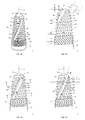
- FIG. 1A to FIG. 1E and FIG. 1H are different views of dental implant according to the present invention.
- a dental implant 1 for dental restoration or dental surgery is placed in a jaw bone 91 (as shown in FIG. 1H ), which includes a body portion 18, a first thread portion 11, a head portion 15, a plurality of second thread portions 12 and two trenches 14.
- the body portion 18 has a drilling axial direction Z along a longitudinal direction thereof.
- the first thread portion 11 is formed on a lower end of the body portion 18 (or one end of the drilling axial direction Z).
- the head portion 15 is formed on an upper end of the body portion 18 (or another end of the drilling axial direction Z).
- the head portion 15 and the first thread portion 11 are respectively arranged at two opposite ends of the body portion 18 along the drilling axial direction Z.
- the first thread portion 11 is a screw thread structure continuously rotated in multiple loops.
- the head portion 15 is arc-shaped head in this emdodiment.
- the second thread portions 12 have a pitch which is larger than a pitch of the first thread portions 11.
- the pitch G2 of the second thread portion 12 is larger than the pitch G1 of the first thread portion 11 (as shown in FIG. 1B ).
- the second thread portion 12 are formed laterally (i.e. approximately along a horizontal direction) on radial sides of the body portion 18. Thus, each second thread portion 12 (as shown in FIG.
- each second thread portion 12 is a piece or a fragment of arc-shaped screw thread (as shown in cross-sectional views of FIG. 1F and FIG. 1G ).
- the second thread portion 12 rotates along the drilling axial direction Z to form a tangent direction J.
- the tangent direction J of the second thread portion 12 and the horizontal line are intersected to form an angle ⁇ (the tangent direction J is generally arranged from lower left toward upper right in FIG. 1D ).
- the angle ⁇ generally is smaller than 20 degrees. Therefore, the direction of the second thread portion 12 (i.e. the direction of the tangent direction J) is substantially arranged in a traverse manner. As a result, when the dental implant 1 is rotated around the drilling axial direction Z , the dental implant 1 can be screwed into the jaw bone 91 gradually by means of the second thread portion 12.
- the plurality of second thread portions 12 are distributed or disposed at different positions along the drilling axial direction Z.
- Each second thread portion 12 has a cutting face 123 and a cumulative face 124 respectively disposed at two opposite ends of the dental implant 1 along the rotative direction P.
- the two opposite ends of the rotative direction P means one end in clockwise direction and another end in counterclockwise.
- the cutting face 123 and the cumulative face 124 are illustrated in detail as shown in FIG. 1C , FIG. 1F and FIG. 1G .
- the X-X cross-sectional view is shown in FIG.
- FIG. 1F the Y-Y cross-sectional view is shown in FIG. 1G .
- the second thread portions 12 are formed at a radial outside of the body portion 18.
- Each second thread portion 12 is substantially arc-shaped along the rotative direction P.
- the cutting face 123 and the cumulative face 124 are arranged at a front and rear ends of the second thread portion 12 along the rotative direction P, namely, one of which is clockwise end and another one is counterclockwise end along the rotative direction P.
- the front end and the rear end (along the rotative direction P) of the second thread portion 12 are contiguous to one of the trenches 14, respectively.
- each of trenches 14 has a front and rear ends along the rotative direction P which are contiguous to one of the second thread portions 12, respectively. Accordingly, the second thread portions 12 and the trenches 14 are formed around a periphery of the body portion 18 in a circle. An interconnecting portion (within the trench 14) between the cutting face 123 and the cumulative face 124 are formed an acute angle corner 149 (i.e. having folding angle). As shown in FIG. 1C , the trench 14 has a trench width D1 approximated to the head portion 15, and a trench width D2 far away from the head portion 15. The trench width D1 is larger or equal to the trench width D2 (i.e. D1 ⁇ D2).
- the trench 14 is filled with bone scrap 92, and therefore the amount of bone scrap 92 at a deeper portion of the jaw bone 91 may be more than the amount of bone scrap 92 at a shallow portion of the jaw bone 91. It therefore provides the dental implant 1 stable fixing structure, and the dental implant 1 in the jaw bone 91 is surrounded and covered by bone or bone scrap 92.
- the trench 14 has a trench depth T1 approximated to the head portion 15, and a trench depth T2 far away from the head portion 15.
- the trench depth T1 is larger than the trench depth T2 (i.e. T1>T2).
- the trench 14 is filled with bone scrap 92, and therefore the amount of bone scrap 92 at a deeper portion of the jaw bone 91 (as shown in FIG. 1F ) may be more than the amount of bone scrap 92 at a shallow portion of the jaw bone 91 (as shown in FIG. 1 G) . It therefore provides the dental implant 1 stable fixing structure.
- a tangent direction of the cutting face 123 and the cutting face 123 are intersected to form an angle ⁇ 1.
- the magnitude of angle ⁇ 1 may affect the difficulty of lateral cutting of the second thread portion 12, in which the lateral cutting is made by the radial sides of the dental implant 1 (i.e. by the cutting face 123).
- a lower end of the dental implant 1 may be formed, connected or coupled with a dental connecting element 17, thus the dental implant 1 can be interconnected or combined with an external piece by the dental connecting element 17.
- the trenches 14 are formed at radial sides of the head portion 15 and the body portion 18, and passed through the plurality of the cutting faces 123 and the cumulative faces 124 from the head portion 15 to the first thread portion 11. In other words, the trenches 14 are downwardly extended from the head portion 15 to the first thread portion 11.
- FIG. 1E of top view which demonstrates embodiment with two trenches 14, being arc-shaped, extended outward in a radial manner from a center of the head portion 15. As shown in FIG.
- the tangent direction J of the second thread portion 12 is intersected with the trench 14 to form an angle ⁇ if the tangent direction J is rotated toward the upper end of the drilling axial direction Z.
- the angle ⁇ is smaller than or equal to 90 degrees (i.e., ⁇ ⁇ 90 degrees).
- the bone scraps 92 can gradually be moved downward inside the trench 14 by moving along a direction away from the head portion 15. If there is osteoporosis at radial sides of the dental implant 1 (the left and right sides as shown in FIG. 1D ), the bone scrap 92 can be pushed to fill the porous portion at the radial sides (i.e. osteoporosis site) during the bone scraps 92 gradually moves downward (along a direction away from the head portion 15).
- the bone scrap 92 could be guided to fill the porous bone at radial sides of the dental implant 1, so that the bone density surrounded the radial side of the dental implant 1 would be increased. Therefore, the surrounding structure around the dental implant 1 is more stable. Further, since the bone scrap 92 is biologically natural components belonged to the patients themselves, the requirements for filling or re-supplying bone graft materials to the radial sides of the dental implant 1 can be reduced, hence the cost of surgery is also reduced.
- the body portion 18 has a diameter H1 approximated to the head portion 15, and a diameter H2 far away from the body portion 18.
- the diameter H1 is smaller than the diameter H2 (that is H1 ⁇ H2).
- the body portion 18 is gradually enlarged from the head portion 15 toward the first thread portion 11 (i.e. taper shaped in cross-sectional view).
- an interconnecting portion between the head portion 15 and the body portion 18 is formed an folding corner (as shown in the partial enlarged view of FIG. 1B ).
- an interval S is formed between the trench 14 and the tip end of the head portion 15.
- the interval S is conformed with an equation of S/H1 ⁇ 0.5, and in a preferred embodiment S/H1 ⁇ 0.3.
- the interval S conformed with the equation of S/H1 ⁇ 0.3 it means the interval S is smaller, and thus the trench 14 is close to the tip end of the dental implant 1 (the lowest end as shown in FIG. 1H ). Accordingly, as the dental implant 1 is rotating along the rotative direction P, the trench 14 can easily cut the jaw bone 91 beneath the dental implant 1. Therefore, the dental implant 1 may be driven to cut downward, and the dental implant 1 may be screwed more deep into the jaw bone 91.
- the arc-shaped head portion can cushion or offset the occlusion force impacted to the jaw bone 91 during biting food.
- the occlusion force is usually exerted the head portion 15 by a vertical force, and the dental implant 1 having blunt head portion 15 can avoid the impact force of chewing food from damage of stress concentration (i.e. biting force is sustained by a relatively small area).
- FIG. 2A Please refer to a cross-sectional view of FIG. 2A .
- the cutting face 123 can shave off the jaw bone 91 thereabout and then accumulate the shaved bone scrap 92 inside the trench 14.
- the cutting face 123 may push and squeeze some of the bone scrap 92, and guide the bone scrap 92 toward a bone defeat portion at the radial side of the dental implant 1 (as shown in FIG. 1D ).
- the second thread portion 12 is able to cut the jaw bone 91. Namely the cutting face 123 located in one end of the second thread portion 12 is able to scrape the jaw bone 91, or squeeze the bone scrap 92.
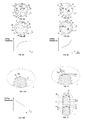
- FIG. 3A to FIG. 3C are diagrams of drilling resistance of the dental implant according to the present disclosure.
- S/H1 means the interval S is bigger
- FIG. 3B and FIG. 1F as the angle ⁇ 1 is approaching to 90 degrees, the drilling resistance of the dental implant 1 into the jaw bone 91 will become greater and greater. Thus, the rotating torque for rotating the dental implant 1 needs to be increased.
- the second thread portion 12 will be easily burst into pieces if the angle ⁇ 1 is too small.
- the angle ⁇ 1 which is formed by intersection of the tangent direction of the cutting face 123 and the cutting face 123, is preferably conformed with 20 ⁇ ⁇ 1 ⁇ 90 degrees, so as to balance the drilling resistance and mechanical strength (which may endure the stress concentration) of the second thread portion 12.
- a radius R1 is formed between an outermost side of the second thread portion 12 and a center of the body portion 18. As the value of T1/R1 approaching 1.0 (means the trench depth T 1 is bigger), the cutting face 123 will become greater and greater, and thus the drilling resistance of dental implant 1 into deep of the jaw bone 91 will also become larger and larger.
- FIG. 4 is a side view of dental implant of second embodiment according to the present disclosure.
- the second thread portion 12 of the dental implant 1 is rotated around the drilling axial direction Z and formed the tangent direction J.
- the tangent direction J of the second thread portion 12 and a horizontal line are intersected to form an angle ⁇ .
- the tangent direction J is generally orientated from lower left toward upper right.
- the tangent direction J of the second thread portion 12 is slightly slanted, and formed an angle ⁇ if the tangent direction J is rotated toward the lower end of the drilling axial direction Z to intersect with the trench 14 (i.e. the angle ⁇ is intersected by the tangent direction J and the trench 14).
- the angle ⁇ is smaller than or equal to 90 degrees (i.e. ⁇ ⁇ 90 degrees). Consequently, as the dental implant 1 is screwing into the jaw bone 91 in the clockwise direction, the cutting face 123 of the second thread portion 12 moves along the track of tangent direction J and squeeze the bone scrap 92 in the orientation of the tangent direction J. In the meanwhile, since the left wall of the trench 14 (formed by the cutting faces 123 showed in FIG. 4 ) has the inclined angle ⁇ , it may provide or exert the bone scrap 92 an upward component of force. Therefore the bone scraps 92 will gradually be moved upward inside the trench 14, and approached the head portion 15. In this manner, the bone scraps 92 may be moved and guided upward, to approach the head portion 15.
- the bone scraps 92 need to be squeezed and sent upward, to fill the sites neighboring to the head portion 15 (such as sinus membrane); in this scenario, the dentist can utilize the dental implant 1 of this embodiment to push the bone scrap 92 of patients themselves (i.e. natural bone pieces) to apporach the site where approximates to the head portion 15 of the dental implant 1. In this manner, the natural bone scrap 92 which is moved toward the head portion 15 can be utilized to push and squeeze the sinus membrane. As a result, it has no need to fill bone graft material while maxilla implanting is made, and thus the cost for maxillary sinus augmentation may have chance to be saved and the possibility of puncturing the sinus membrane may be eliminated.
- the dental implant 1 of this embodiment equipped with the trenches 14 in a slanting manner may have advantages as following : the natural bone scrap 92 can be guided and filled to an upper portion of the dental implant 1 (toward the head portion 15 or the site neighboring to the head portion 15), and hence the bone scrap 92 can be utilized to squeeze and lift the sinus membrane.
- the tangent direction J of the second thread portion 12 toward the head portion 15 is intersected with the trench 14 to form an angle ⁇ , in which the angle ⁇ is smaller than 90 degrees.
- the bone scrap 92 in the trench 14 therefore can be moved far away from the head portion 15 because the inclined angle ⁇ can provide or exert the bone scrap 92 a downward component of force.
- the trenches 14 of the dental implant 1, as shown in FIG. 1A to FIG. 1H can guide the bone scrap 92 to its radial sides, so as to fill the bone porous portion (osteoporosis) around the radial sides.
- the tangent direction J of the second thread portion 12 toward a lower end (far away from the head portion 15) is intersected with the trench 14, to form an angle ⁇ , in which the angle ⁇ is smaller than 90 degree.
- the bone scrap 92 in the trench 14 therefore can be moved toward the head portion 15 because the inclined angle ⁇ can provide or exert the bone scrap 92 an upward component of force. Accordingly, while the sinus lifting process or bone graft materials re-supplying is needed, the dental implant 1 demonstrated in FIG. 4 can guide the bone scrap 92 toward the head portion 15 by the trenches 14 (technically by the direction of the angle ⁇ ), and then utilize the bone scraps 92 to squeeze and lift the sinus membrane, or to fill the bone porous portion around the head portion 15.
- FIG. 5 is a side view of dental implant of third embodiment according to the present invention.
- the head portion 15 is smoothly connected with the body portion 18 in arc-shaped without acute angle corner.
- the interconnecting area of the head portion 15 and the body portion 18 has a smaller friction resistance, which may bring benefit to the implanting process if the dental implant 1 is drilled into the jaw bone 91.
- the blunt head portion 15 can disperse the occlusion impact while biting food (because the bearing pressure is inversely proportional to the area of thrust surface).
- FIG. 6A a perspective view of dental implant of fourth embodiment according to the present invention
- FIG. 6B is a top view of the dental implant of fourth embodiment of the present invention
- FIG. 6C is a cross-sectional view along the rectangular plane of FIG. 6A .
- the dental implant 1 of this embodiment is formed with three trenches 14 on radial sides of the head portion 15 and the body portion 18.
- FIG. 7A is a perspective view of dental implant of fifth embodiment according to the present invention
- FIG. 7B a front view of the dental implant of the fifth embodiment of the present invention
- FIG. 7C to FIG. 7D are top views of the dental implant of fifth embodiment according to the present invention.
- the second thread portions 12 are rotated along the drilling axial direction Z and forms a tangent direction J.
- the tangent direction J of the second thread portion 12 is intersected with the horizontal line to form an angle ⁇ .
- the dental implant 1 Since the tangent direction J is generally orientated from lower right toward upper left, the dental implant 1 needs to be rotated in counterclockwise direction (around the drilling axial direction Z) to screw the dental implant 1 into the jaw bone 91.
- the dental implant 1 of this embodiment is drilled into patient's jaw bone 91 in a counterclockwise direction, comparatively the dental implant 1 in FIG. 1D is drilled in a clockwise direction.
- this embodiment has four trenches 14 on radial sides of the head portion 15 and the body portion 18.
- the tangent direction J of the second thread portion 12 toward an upper end of the drilling axial direction Z is intersected with the trench 14 to form an angle ⁇ as shown in FIGS. 7B , and the angle ⁇ is smaller than 90 degrees (that is, ⁇ ⁇ 90 degrees).
- the dental implant 1 of this embodiment is screwed in the jaw bone 91, the cutting face 123 of the second thread portion 12 will move in the tangent direction J, and squeeze the bone scraps 92 toward the tangent direction J.
- FIG. 7C and FIG. 7D illustrate different types of trench 14 and different head portion 15.
- the trenches 14 are formed around a periphery of the head portion 15 in a circle.
- FIG. 7E is a side view of derivative dental implant according to the fifth embodiment of the present invention.
- the second thread portion 12 of the dental implant 1 is rotated around the drilling axial direction Z and forms a tangent direction J.
- the tangent direction J of the second thread portion 12 is intersected with the horizontal line to form an angle ⁇ .
- the tangent direction J is generally orientated from lower right toward upper left.
- the tangent direction J of the second thread portion 12 toward a lower end of the drilling axial direction Z is intersected with the trench 14 so as to form an angle ⁇ , and the angle ⁇ is smaller than 90 degrees (i.e. ⁇ ⁇ 90 degrees).
- this embodiment can utilize the bone scraps 92 upward moving mechanism (toward the head portion 15) to squeeze or urge the bone scraps 92 to move and fill the site neighboring to the sinus membrane or the head portion 15.
- FIG. 8A to FIG. 8B illustrate the dental implant having different cutting faces according to the present invention.
- FIG. 8A there are three trenches 14 and three second thread portions 12 surrounded around the body portion 18. Two sides of each trench 14 are surrounded with a cutting face 123 and a cumulative face 124 respectively.
- the cutting face 123 of the second thread portion 12 has a curvature radius R3, and the tangent direction of the cutting face 123 is intersected with the cutting face 123 so as to form an angle ⁇ 1.
- the angle ⁇ 1 is preferably about 25 to 60 degrees, so that it may give considerations to the cutting effect and structural strength of the second thread portion 12 (in a practical case, 60 ⁇ ⁇ 1 ⁇ 90 degrees may be available).
- a curvature radius R3 of the cutting face 123 is smaller than a radius R1 of the second thread portion 12 (that is, R3 ⁇ R1).
- an occupied space of the trench 14 is greater than that of the embodiment of FIG. 6C , therefore the trenches 14 in this embodiment can accommodate much more bone scrap 92. If one having tooth with thinner roots (means the bone around the real tooth is relatively sufficient) needs to be extracted, the dental implant 1 of FIG.
- the cutting face 123 of the second thread portion 12 is a plane (revealed in a straight line in FIG. 8B ), so that the curvature radius R3 of the cutting face 123 is infinity.
- the drilling resistance of the dental implant 1 in FIG. 8A and FIG. 8B shown in FIG. 8C , the drilling resistance of the dental implant 1 into the jaw bone 91 is become greater when the curvature radius R3 is increasing along with the cutting face 123. The reason is that more curved cutting face 123 (curvature radius R3 becomes smaller) can guide the bone scrap 92 slightly to move in a radial direction.
- both of the cutting face 123 and the cumulative face 124 have arc-shaped cross-section, and an interconnecting area among the cutting face 123 and the cumulative face 124 at two sides of the trench 14 has an acute angle corner 149.
- cross-sections of the cutting face 123 and the cumulative face 124 are revealed as straight line, and an interconnecting area among the cutting face 123 and the cumulative face 124 at two sides of the trench 14 has no acute angle corner. Since there is no acute angle corner between the cutting face 123 and the cumulative face 124, it helps to guide movement of the bone scrap 92 in the trench 14.
- FIG. 9A and FIG. 9B are cross-sectional views of dental implant with different area of body portion.
- FIG. 9C is diagram showing the drilling resistance related to body portion 18, second thread portion 12 and sectional area (A) of FIG. 9A and FIG. 9B .
- a space of the trench 14 in FIG. 9A is larger than a space of trench 14 in FIG. 9B , so that the body portion 18 with three second thread portions 12 in FIG. 9A has a sectional area (A) smaller than that of the embodiment of FIG. 9B .
- Reason is that the sectional area (A), sum of area of the body portion 18 and the second thread portions 12, will raise difficulty for the dental implant 1 drilling into the deep of the jaw bone 91. As shown in FIG.
- one fictitious circle can be defined by the radius R1 of the second thread portion 12, and the area of the fictitious circle is equal to ⁇ *R1*R1. If a ratio of the sectional area (A) of the body portion 18 plus the second thread portions 12 to the area of the fictitious circle ⁇ *R1*R1 is more approaching 1.0 (means the space of the trench 14 is smaller, and the sectional area (A) is greater), the drilling resistance of the dental implant 1 into the deep of the jaw bone 91 is become larger and larger. The reason is that less space to receive and accommodate the bone scrap 92 may raise difficult for the dental implant 1 to drill into the jaw bone 91. Furthermore, the bone scrap 92 might have chance to stick or block inside the trenches 14 when the bone scrap 92 is naturally generated.
- FIG. 10A is an enlarged view of head portion of dental implant of the present invention.
- FIG. 10B is a diagram of drilling resistance related to inclined angle ( ⁇ ) of head portion according to FIG. 10A .
- the head portion 15 of the dental implant 1 includes a peak 156, which has an inclined angle ⁇ and formed along the contour of the head portion 15.
- the dental implant 1 is easily to have stress concentration occurred at the site of the peak 156 when the jaw bone 91 is bearing the occlusion impact of biting food. The destructive power and impact caused by the stress concentration may damage the jaw bone 91.
- the inclined angle ⁇ is too small (means the head portion 15 is too obtuse), the drilling force of the dental implant 1 into the jaw bone 91 is greater, which is not good for the dentist to perform a dental implantation surgery on the jaw bone 91 (as shown in FIG. 10B ).
- the inclined angle ⁇ conformed with 0 ⁇ ⁇ ⁇ 30 degrees may give consideration to the drilling effect and avoiding the problem of stress concentration.
- FIG. 11 is an enlarged cross-sectional view of head portion of dental implant of sixth embodiment according to the present invention.
- the head portion 15 has a straight section 157 and a curve section 158, and a inclined angle ⁇ is formed by an intersection of the straight section 157 and the peak 156.
- the curve section 158 is arranged outside the straight section 157.
- the head portion 15 could be formed without the peak156, so that a lateral cross-section of the head portion 15 can be arc-shaped or planar.
- the arc or outside of plane can be connected with a straight line of an arc with different curvature, so that the lateral cross-section of the head portion 15 can be configured as many line segments.
- FIG. 12 is a contour view of dental implant of seventh embodiment according to the present invention.
- the body portion 18 of the dental implant 1 has a diameter H1 close to the head portion 15, and a diameter H2 far away from the head portion 15.
- the pitches G2 between the second thread portions 12 are the same, no matter close to or far away from the head portion 15. In this manner, the dental implant 1 rotates by one cycle along the rotative direction P will drill to move a distance of pitch G2 toward the deep of the jaw bone 91.
- the bases of the second thread portions 12 are connected with the body portion 18 to form a base width K1, K2.
- the second thread portion 12 may have more and more surface to contact with the jaw bone 91 because the site of base width K2 has greater surface area than the site of base width K2. More contact surface brings more osseous integration and more friction between the dental implant 1 and the jaw bone 91. Therefore the mechanical strength of dental implant 1 or the resistance against the occlusion force of biting food is absolutely greater and greater.
- FIG. 13 is a contour view of dental implant of eighth embodiment according to the present invention.
- the second thread portion 12 has a thread height F1 close to the head portion 15, and a thread height F2 far away from the head portion 15.
- the thread height F1 is smaller than the thread height F2 (i.e. F1 ⁇ F2). Because F 1 is smaller than F2, the crests 125 of the second thread portions 12 at sides of the dental implant 1 may be extended and intersected to form an intersection angle ⁇ 1.
- the intersection angle ⁇ 1 is about smaller than 30 degrees.
- FIG. 14 is a contour view of dental implant of ninth embodiment according to the present invention.
- the crests 125 of the second thread portion 12 may be extended and intersected to form an intersection angle ⁇ 1, which is conformed with 0 ⁇ ⁇ 1 ⁇ 30 degrees.
- the body portion 18 has a cross-section along an axial direction of the dental implant 1 ( along the drilling axial direction Z), and an intersection angle ⁇ 2 is defined by side edges of the body portion 18. In this embodiment, it conforms with ⁇ 1 ⁇ ⁇ 2.
- the body portion 18 has a diameter H1 close to the head portion 15, in which the diameter H1 is smaller than a diameter H2 of the body portion 18 far away from the head portion 15 (i.e. H1 ⁇ H2).
- this configuration demonstrated in FIG. 14 has thread height F2 greater than the thread height F1, and the base width K2 greater than or equal to the base width K1 (i.e. H2>H1, F2>F1, K2 ⁇ K1).
- FIG. 15 is a contour view of dental implant of tenth embodiment according to the present invention
- FIG. 16 shows a contour view of dental implant of eleventh embodiment according to the present invention
- FIG. 17 shows a contour view of dental implant of twelfth embodiment according to the present invention.
- the second thread portions 12 of the dental implant 1 have crests 125, and the crests 125 are peak-shaped.
- the crests 125 of the second thread portions 12 are jagged-shaped.
- the crests 125 of the second thread portions 12 are arc-shaped.
- the second thread portion 12 further has a main sustaining face 121 and a secondary sustaining face 122.
- the main sustaining face 121 is close to the head portion 15, and the secondary sustaining face 122 is far away from the head portion 15.
- the main sustaining face 121 and the horizontal line are intersected to form an angle ⁇ 1 (means the slanting angle of the main sustaining face 121).
- the secondary sustaining face 122 and the horizontal line are intersected to form an angle ⁇ 2 (means the slanting angle of the secondary sustaining face 122).
- ⁇ 1 can be equal to ⁇ 2.
- ⁇ 1 is smaller than ⁇ 2; namely the main sustaining face 121 has more gradual angle (i.e. less inclined) than the secondary sustaining face 122.
- the second thread portion 12 can resist or sustain a greater occlusion force from biting if the dental implant 1 is buried in the jaw bone 91. More gradual main sustaining face 121 can withstand higher occlusion force.
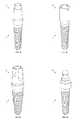
- FIG. 18 to FIG. 22 are perspective views of dental implant of thirteenth embodiment according to the present invention.
- the dental connecting element 17 can be dental abutments with different configurations, dental crowns, dental tools or any connecting structure for dismounting or linking, engaging structure or wedging structure.
- the dental implant 1 and the dental connecting element 17 may be fixed together (one piece structure) as shown in FIG. 18 to FIG. 22 , or may be detachable structure (i.e. can be assembled in separable manner).
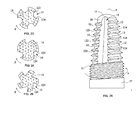
- FIG. 23 is a cross-sectional view of dental implant of fourteenth embodiment according to the present invention.
- the dental implant 1 has four trenches 14. Each trench 14 has a cross-section of half-circle. In other words, each trench 14 is surrounded by the cutting face 123 and the cumulative face 124 which are curve with equal curvature radius.
- FIG. 24 which is a cross-sectional view of dental implant of fifteenth embodiment according to the present invention. In this embodiment, the dental implant 1 has three trenches 14. Each trench 14 is surrounded by the cutting face 123 and the cumulative face 124 which are curved surface with different curvature. Please refer to FIG.
- the dental implant 1 has five trenches 14. Each trench 14 is surrounded by the cutting face 123 the cumulative face 124 which are planar structure.
- the dental implant 1 can be formed by two, three, fourth, five or more trenches 14, and the shape or contour of the cutting face 123 and the cumulative face 124 can be any configuration of above-mentioned embodiments.
- FIG. 26 is a side view of dental implant of fourteenth embodiment according to the present invention.
- the trench 14 is substantially parallel to the drilling axial direction Z.
- the trench 14 is formed at radial sides of the head portion 15 and the body portion 18, and is arranged approximating to the vertical.
- the trench 14 can be exactly parallel to the drilling axial direction Z.
- the trench 14 may be intersected with the drilling axial direction Z to form a small angle (not shown).
- all the structure relationship between the second thread portion 12, trench 14, head portion 15, body portion 18 can be optionally selected from any one of the above-mentioned structural feature.
- the dental implant 1 of the present invention is able to be directly screwed into the jaw bone 91 after real tooth is removed, so that the dentist can screw the dental implant 1 to the site of missing tooth by rotating the dental implant 1.
- the dental drilling engine e.g. dental hand piece, or dental drill
- the time for dental implant surgery can be shortened, and oral injuries and patient's pain can be reduced, as well as the time for gingiva healing period after dental implantation may also be saved.
- the dental implant 1 no matter titanium or zirconium, can be applied to one-piece implant and two-piece implant; thus the indirect advantages are: avoiding the jaw bone 91 from being drilled many times and dug repeatedly, and preventing surgery error happened and over-deep drilling. If the upper jaw which contains maxillary sinus is drilled too deep, it may impale or break through the sinus membrane. If the lower jaw is drilled too deep, the facial nerve may be dug broken. Further, the dental implant 1 has the trenches 14 formed along an orientation angle ⁇ , and the trench 14 is extended from the head portion 15 toward the first thread portion 11. Therefore the bone scraps 92 in the trench 14 can be guided to the head portion 15 (as shown in FIG.
- the dental implant 1 of the present invention has the dental treatment potential for realizing application.
Landscapes
- Health & Medical Sciences (AREA)
- Oral & Maxillofacial Surgery (AREA)
- Orthopedic Medicine & Surgery (AREA)
- Dentistry (AREA)
- Epidemiology (AREA)
- Life Sciences & Earth Sciences (AREA)
- Animal Behavior & Ethology (AREA)
- General Health & Medical Sciences (AREA)
- Public Health (AREA)
- Veterinary Medicine (AREA)
- Otolaryngology (AREA)
- Dental Prosthetics (AREA)
Abstract
Description
- The present invention is related to a dental implant. In particular, the present invention relates to a dental implant which is a surgical component used in dental restoration surgery.
- People rely teeth to eat or bit for subsisting every day. However, if teeth are carelessly maintained and cleaned, they are easily to cause tooth decayed or tooth exfoliation. With the development of science and technology, there are more and more patients who need tooth restoration; therefore the amount of dental clinics are built more and more.
- Traditionally, dental restoration needs to remove tooth first. After three months, injuries of the removed site are healed over, it needs surgery again to have sinus lift, so that filling bone graft materials (such as bone substitute or bone meal) is hence achieved; then a hole on the upper jaw (maxilla) is drilled for filling the bone graft materials. After the bone graft materials had been filled, it needs to wait for further three to six months for healing; afterward, the dental implant therefore can be stably placed in the drilled hole of the upper jaw. Finally, after three to six months, a dental crown can be positioned on the dental implant to finish the dental restoration. In general, the period of traditional tooth restoration need to spend approximately one and half year.
- There are also advanced dental restoration methods, such as
Taiwan Patent Application No. 095140364 Taiwan Patent Application No. 095140361 - However, before placing the conventional dental implant in jaw bone, the aforementioned fast dental implantation needs to drill a pilot hole by dentist, by using a dental drill engine (i.e. dental hand piece), for dental restoration. Before the placement of dental implant, the pilot hole needs to be gradually expanded by several different diameters of drills for several times. As a result, the duration of dental surgery is prolonged and dental trauma is expanded and deepened, so that the patient endures longer pain and their injuries are difficult to be healed. Besides, it may increase the error probability of fault drilling or over-deep drilling if the jaw bone is drilled again and again; in the anatomical viewpoint, the sinus membrane may be drilled through if the upper jaw (maxillary sinus) is drilled too deep, and the facial nerve may be hurt if the lower jaw (mandible) is drilled too deep.
- Besides, bone grafting procedure is necessary if patient lacks of bone (because the dental implant needs to be buried in a plenty of healthy bone). However, the bone grafting surgery needs bone graft materials to fill a defeat portion, and it will increase additional burden for dental clinic.
- Therefore, it is desirable to propose a novel dental implant to overcome the above-mentioned problems, which can combine the drilling procedures and placement of dental implant, so as to avoid the conventional restoration problem and repeatedly bone drilling. And then, the implanting surgery time can be shortened, and mouth traumas are reduced, or probably, the self-bone pieces (i.e. natural bone pieces) of dental patient can be guided to a defeat portion in which lacks of bone during the implant drilling process.
- The objective of the present invention is to provide a dental implant for dental restoration which may incorporate the function of the dental drilling procedure (i.e. tapping in the bone) and the implant installation procedure, so that the duration of dental restoration surgery time is shortened and mouth traumas is reduced, and therefore to give dental patient relief from pain and speed wound healing.
- Another objective of the present invention is to provide a dental implant for eliminating the gradual expanding the pilot hoe by repeatedly drilling on jaw bone with several drilling steps, and further to lessen the conditions of fault drilling or over-deep drilling in the jaw bone by the dental drill engine (or called as dental hand piece).
- A further objective of the present invention is to guide bone scraps to approach the defeat portion which lacks of bone, so as to reduce the requirement for filling the bone graft materials.
- In another aspect of the invention, a dental implant is provided, which comprise a body portion, a first thread portion, a head portion, a plurality of second thread portions and a plurality of trenches. The body portion defines a drilling axial direction along a longitudinal direction thereof. The first thread portion is formed on one end of the body portion along the drilling axial direction. The head portion is formed on another end of the body portion along the drilling axial direction. The second thread portion has a pitch larger than a pitch of the first thread portion, and is disposed at radial sides of the body portion; wherein the second thread portions are distributed along the drilling axial direction over the body portion, and each second thread portion has a cutting face and a cumulative face respectively disposed at two ends of a rotative direction in a rotative manner. The trenches are formed on radial sides of the head portion and the body portion, and across through the cutting faces and the cumulative faces from the head portion to approach the first thread portion.
- The present invention also provides a dental implant, which comprise a body portion, a first thread portion, a head portion, a plurality of second thread portions and a plurality of trenches. The body portion defines a drilling axial direction along a longitudinal direction thereof. The first thread portion is formed on one end of the body portion along the drilling axial direction. The head portion is formed on another end of the body portion along the drilling axial direction. Each second thread portion has a pitch larger than a pitch of the first thread portion, and is formed on a radial side of the body portion; wherein the second thread portions are rotated around the drilling axial direction to form a tangent direction. The trenches are formed on radial sides of the head portion and the body portion, and extend from the head portion to approach the first thread portion, wherein an angle Φ is intersected by the tangent direction and the trench when the tangent direction rotated toward one end of the drilling axial direction, and the angle Φ ≦ 90 degrees.
- According to an embodiment of the aforesaid dental implant, wherein the head portion includes a peak, the peak extending along a contour of the head portion by an inclined angle δ conformed with 0 ≦ δ ≦ 30 degrees.
- According to an embodiment of the aforesaid dental implant, wherein a diameter H1 of the body portion approximated to the head portion is smaller than or equal to a diameter H2 of the body portion far away from the head portion. In the further embodiment, an interval is formed between a top end of the head portion and a neighboring periphery of the trench conformed with S/H1 ≦ 0.3.
- According to an embodiment of the aforesaid dental implant, wherein each of the second thread portions has a crest, wherein lines connected the crests are extended and intersected to define an intersection angle ψ1, and an axial cross of the body portion defines an intersection angle ψ2 conformed with ψ1 ≥ ψ2.
- According to an embodiment of the aforesaid dental implant, wherein a thread height of the second thread portions approximated to the head portion is smaller than or equal to a thread height of the second thread portions far away from the head portion.
- According to an embodiment of the aforesaid dental implant, wherein a trench width of the trench approximated to the head portion is larger than or equal to a trench width of the trenches far away from the head portion.
- According to an embodiment of the aforesaid dental implant, wherein a trench depth of the trench approximated to the head portion is larger than or equal to a trench depth of the trenches far away from the head portion.
- According to an embodiment of the aforesaid dental implant, wherein each second thread portion has an equal pitch, and an interconnecting portion among the second thread portions and the body portion has a base width, the base width approximated to the head portion is smaller than or equal to the base width far away from the head portion.
- According to an embodiment of the aforesaid dental implant, wherein each of the second thread portions has a crest being peak-shaped, arc-shaped or gear-shaped.
- According to an embodiment of the aforesaid dental implant, wherein each of the second thread portions includes a main sustaining face and a secondary sustaining face, the main sustaining face is faced to the head portion, the secondary sustaining face is back to the head portion, an inclined angle of the main sustaining face is smaller than or equal to an inclined angle of the secondary sustaining face.
- According to an embodiment of the aforesaid dental implant, wherein a top end of the head portion is flat-shaped or curve-shaped.
- According to an embodiment of the aforesaid dental implant, wherein an angle α1 is formed between a tangent direction of the cutting face and the cutting face conformed with 20 ≦ α1 ≦ 90 degrees.
- According to an embodiment of the aforesaid dental implant, wherein the cutting face and the adjoining cumulative face are formed curve shape or interconnected without folding angle.
- According to an embodiment of the aforesaid dental implant, wherein a radius of the second thread portion is larger than a curvature radius of the cutting face.
- The dental implant of the present invention has advantages as followed. First, the jaw bone can be avoid being drilled repeatedly and dug over, so that the duration of dental implantation surgery is shortened and mouth traumas is reduced, and therefore to give dental patient relief from pain and wound healing. Second, the conditions of fault drilling or over-deep drilling clinically in the jaw bone are lessened. Third, during the jaw bone is drilled, bone scraps in the trench can be guided toward the head portion, and then the bone scrap can be used to push sinus membrane, so as to reduce possibility of puncturing the sinus membrane; Besides, the bone scrap also can be simultaneously filled to the neighboring of the head portion of the dental implant or toward the neighboring of the sinus membrane. Otherwise, bone scraps in the trench can be alternatively guided toward radial sides of the dental implant, so as to fill the osteoporosis site in the jaw which close to the radial sides. In this manner, the self-bone (i.e. natural bone) guided is made which can reduce the requirement of bone grafting. Finally, different structure configuration can fulfill dental patients by various conditions.
- For further understanding of the present invention, reference is made to the following detailed description illustrating the embodiments and examples of the present invention. The description is for illustrative purpose only and is not intended to limit the scope of the claim.
-
-
FIG. 1A is a perspective view of a dental implant of first embodiment according to the present invention; -
FIG. 1B to FIG. 1D are different side views of dental implant of first embodiment according to the present invention; -
FIG. 1E is a top view of dental implant of first embodiment according to the present invention; -
FIG. 1F is a cross-sectional view along X-X line ofFIG. 1C ; -
FIG. 1G is a cross-sectional view along Y-Y line ofFIG. 1C ; -
FIG. 1H is a partial enlarged view of dental implant of first embodiment drilling a jaw bone according to the present invention; -
FIG. 2A to FIG. 2B are perspective views of the dental implant as cutting a jaw bone according to the present invention; -
FIG. 3A to FIG. 3C are diagrams about drilling resistance of the dental implant according to the present invention; -
FIG. 4 is a side view of dental implant of second embodiment according to the present invention; -
FIG. 5 is a side view of dental implant of third embodiment according to the present invention; -
FIG. 6A is a perspective view of dental implant of fourth embodiment according to the present invention; -
FIG. 6B is a top view of the dental implant of fourth embodiment according to the present invention; -
FIG. 6C is a cross-sectional view along the rectangular plane ofFIG. 6A ; -
FIG. 7A is a perspective view of dental implant of fifth embodiment according to the present invention; -
FIG. 7B is a front view of the dental implant of fifth embodiment according to the present invention; -
FIG. 7C to FIG. 7D are top views of the dental implant of fifth embodiment according to the present invention; -
FIG. 7E is a mirror view of dental implant of fifth embodiment according to the present invention; -
FIG. 8A to FIG. 8B are cross-sectional views of dental implant with different types of cutting face according to the present invention; -
FIG. 8C is a diagram of drilling resistance related to curvature radius of cutting face according toFIG. 8A to FIG. 8B ; -
FIG. 9A to FIG. 9B are cross-sectional views of dental implant with different areas of body portion according to the present invention; -
FIG. 9C is a diagram of drilling resistance related to sectional area(A) of second thread portion of body portion according toFIG. 9A to FIG. 9B ; -
FIG. 10A is an enlarged cross-sectional view of head portion of the dental implant according to the present invention; -
FIG. 10B is a diagram of drilling resistance related to inclined angle (δ) of head portion according toFIG. 10A ; -
FIG. 11 is an enlarged cross-sectional view of head portion of dental implant of sixth embodiment according to the present invention; -
FIG. 12 is a partial cross-sectional view of dental implant of seventh embodiment according to the present invention; -
FIG. 13 is a partial cross-sectional view of dental implant of eighth embodiment according to the present invention; -
FIG. 14 is a partial cross-sectional view of dental implant of ninth embodiment according to the present invention; -
FIG. 15 is a partial cross-sectional view of dental implant of tenth embodiment according to the present invention; -
FIG. 16 is a partial cross-sectional view of dental implant of eleventh embodiment according to the present invention; -
FIG. 17 is a partial cross-sectional view of dental implant of twelfth embodiment according to the present invention; -
FIG. 18 to FIG. 22 are perspective views of dental implant of thirteenth embodiment according to the present invention; -
FIG. 23 is a cross-sectional view of dental implant of fourteenth embodiment according to the present invention; -
FIG. 24 is a cross-sectional view of dental implant of fifteenth embodiment according to the present invention; -
FIG. 25 is a cross-sectional view of dental implant of sixteenth embodiment according to the present invention; and -
FIG. 26 is a side view of dental implant of fourteenth embodiment according to the present invention. - Please refer to
FIG. 1A to FIG. 1E andFIG. 1H , which are different views of dental implant according to the present invention. As shown inFIG. 1A to FIG. 1D , adental implant 1 for dental restoration or dental surgery is placed in a jaw bone 91 (as shown inFIG. 1H ), which includes abody portion 18, afirst thread portion 11, ahead portion 15, a plurality ofsecond thread portions 12 and twotrenches 14. Thebody portion 18 has a drilling axial direction Z along a longitudinal direction thereof. Thefirst thread portion 11 is formed on a lower end of the body portion 18 (or one end of the drilling axial direction Z). Thehead portion 15 is formed on an upper end of the body portion 18 (or another end of the drilling axial direction Z). Therefore, thehead portion 15 and thefirst thread portion 11 are respectively arranged at two opposite ends of thebody portion 18 along the drilling axial direction Z. In this embodiment, thefirst thread portion 11 is a screw thread structure continuously rotated in multiple loops. Thehead portion 15 is arc-shaped head in this emdodiment. Thesecond thread portions 12 have a pitch which is larger than a pitch of thefirst thread portions 11. In other words, the pitch G2 of thesecond thread portion 12 is larger than the pitch G1 of the first thread portion 11 (as shown inFIG. 1B ). Besides, thesecond thread portion 12 are formed laterally (i.e. approximately along a horizontal direction) on radial sides of thebody portion 18. Thus, each second thread portion 12 (as shown inFIG. 1D ) is nearly aligned in the horizontal direction. Specifically, eachsecond thread portion 12 is a piece or a fragment of arc-shaped screw thread (as shown in cross-sectional views ofFIG. 1F and FIG. 1G ). As shown inFIG. 1D , thesecond thread portion 12 rotates along the drilling axial direction Z to form a tangent direction J. The tangent direction J of thesecond thread portion 12 and the horizontal line are intersected to form an angle λ (the tangent direction J is generally arranged from lower left toward upper right inFIG. 1D ). Thus, when thedental implant 1 is rotated clockwise, and thedental implant 1 can be screwed into thejaw bone 91 demonstrated inFIG. 1H . Preferably, the angle λ generally is smaller than 20 degrees. Therefore, the direction of the second thread portion 12 (i.e. the direction of the tangent direction J) is substantially arranged in a traverse manner. As a result, when thedental implant 1 is rotated around the drilling axial direction Z , thedental implant 1 can be screwed into thejaw bone 91 gradually by means of thesecond thread portion 12. - The plurality of
second thread portions 12 are distributed or disposed at different positions along the drilling axial direction Z. Eachsecond thread portion 12 has a cuttingface 123 and acumulative face 124 respectively disposed at two opposite ends of thedental implant 1 along the rotative direction P. The two opposite ends of the rotative direction P means one end in clockwise direction and another end in counterclockwise. The cuttingface 123 and thecumulative face 124 are illustrated in detail as shown inFIG. 1C ,FIG. 1F and FIG. 1G . To obtain a X-X cross-sectional view and a Y-Y cross-sectional view of thedental implant 1 taken from thesecond thread portion 12, the X-X cross-sectional view is shown inFIG. 1F , the Y-Y cross-sectional view is shown inFIG. 1G . As shown inFIG. 1F and FIG. 1G , thesecond thread portions 12 are formed at a radial outside of thebody portion 18. Eachsecond thread portion 12 is substantially arc-shaped along the rotative direction P. The cuttingface 123 and thecumulative face 124 are arranged at a front and rear ends of thesecond thread portion 12 along the rotative direction P, namely, one of which is clockwise end and another one is counterclockwise end along the rotative direction P. The front end and the rear end (along the rotative direction P) of thesecond thread portion 12 are contiguous to one of thetrenches 14, respectively. Similarly, each oftrenches 14 has a front and rear ends along the rotative direction P which are contiguous to one of thesecond thread portions 12, respectively. Accordingly, thesecond thread portions 12 and thetrenches 14 are formed around a periphery of thebody portion 18 in a circle. An interconnecting portion (within the trench 14) between the cuttingface 123 and thecumulative face 124 are formed an acute angle corner 149 (i.e. having folding angle). As shown inFIG. 1C , thetrench 14 has a trench width D1 approximated to thehead portion 15, and a trench width D2 far away from thehead portion 15. The trench width D1 is larger or equal to the trench width D2 (i.e. D1 ≧ D2). Consequently, as thedental implant 1 is drilled and embedded in thejaw bone 91, thetrench 14 is filled withbone scrap 92, and therefore the amount ofbone scrap 92 at a deeper portion of thejaw bone 91 may be more than the amount ofbone scrap 92 at a shallow portion of thejaw bone 91. It therefore provides thedental implant 1 stable fixing structure, and thedental implant 1 in thejaw bone 91 is surrounded and covered by bone orbone scrap 92. Further, refer to inFIG. 1F and FIG. 1G , thetrench 14 has a trench depth T1 approximated to thehead portion 15, and a trench depth T2 far away from thehead portion 15. In a preferred embodiment, the trench depth T1 is larger than the trench depth T2 (i.e. T1>T2). Consequently, as thedental implant 1 is drilled and embedded in thejaw bone 91, thetrench 14 is filled withbone scrap 92, and therefore the amount ofbone scrap 92 at a deeper portion of the jaw bone 91 (as shown inFIG. 1F ) may be more than the amount ofbone scrap 92 at a shallow portion of the jaw bone 91 (as shown inFIG. 1 G) . It therefore provides thedental implant 1 stable fixing structure. As shown inFIG. 1F , a tangent direction of the cuttingface 123 and the cuttingface 123 are intersected to form an angle α1. The magnitude of angle α1 may affect the difficulty of lateral cutting of thesecond thread portion 12, in which the lateral cutting is made by the radial sides of the dental implant 1 (i.e. by the cutting face 123). - As shown in
FIG. 1B to FIG. 1D , a lower end of thedental implant 1 may be formed, connected or coupled with a dental connectingelement 17, thus thedental implant 1 can be interconnected or combined with an external piece by the dental connectingelement 17. Thetrenches 14 are formed at radial sides of thehead portion 15 and thebody portion 18, and passed through the plurality of the cutting faces 123 and thecumulative faces 124 from thehead portion 15 to thefirst thread portion 11. In other words, thetrenches 14 are downwardly extended from thehead portion 15 to thefirst thread portion 11. As shown inFIG. 1E of top view which demonstrates embodiment with twotrenches 14, being arc-shaped, extended outward in a radial manner from a center of thehead portion 15. As shown inFIG. 1D , the tangent direction J of thesecond thread portion 12 is intersected with thetrench 14 to form an angle Φ if the tangent direction J is rotated toward the upper end of the drilling axial direction Z. The angle Φ is smaller than or equal to 90 degrees (i.e., Φ ≦ 90 degrees). Accordingly, as thedental implant 1 of this embodiment is screwing into thejaw bone 91, the cuttingface 123 of thesecond thread portion 12 moves along the track of the tangent direction J, and therefore push and squeeze the bone scraps 92 inside thetrench 14 along the track of the tangent direction J. In the meanwhile, a left wall of the trench 14 (formed by the cutting faces 123 showed inFIG. 1D ) has an inclined angle Φ, so that it can provides or exerts the bone scraps 92 a downward component of force. Therefore the bone scraps 92 can gradually be moved downward inside thetrench 14 by moving along a direction away from thehead portion 15. If there is osteoporosis at radial sides of the dental implant 1 (the left and right sides as shown inFIG. 1D ), thebone scrap 92 can be pushed to fill the porous portion at the radial sides (i.e. osteoporosis site) during the bone scraps 92 gradually moves downward (along a direction away from the head portion 15). In other words, thebone scrap 92 could be guided to fill the porous bone at radial sides of thedental implant 1, so that the bone density surrounded the radial side of thedental implant 1 would be increased. Therefore, the surrounding structure around thedental implant 1 is more stable. Further, since thebone scrap 92 is biologically natural components belonged to the patients themselves, the requirements for filling or re-supplying bone graft materials to the radial sides of thedental implant 1 can be reduced, hence the cost of surgery is also reduced. - As shown in
FIG. 1B , thebody portion 18 has a diameter H1 approximated to thehead portion 15, and a diameter H2 far away from thebody portion 18. In this embodiment, the diameter H1 is smaller than the diameter H2 (that is H1<H2). In other words, thebody portion 18 is gradually enlarged from thehead portion 15 toward the first thread portion 11 (i.e. taper shaped in cross-sectional view). Besides, an interconnecting portion between thehead portion 15 and thebody portion 18 is formed an folding corner (as shown in the partial enlarged view ofFIG. 1B ). As shown inFIG. 1H , an interval S is formed between thetrench 14 and the tip end of thehead portion 15. Generally, the interval S is conformed with an equation of S/H1 ≦ 0.5, and in a preferred embodiment S/H1 ≦ 0.3. Hereto, if the interval S conformed with the equation of S/H1 ≦ 0.3, it means the interval S is smaller, and thus thetrench 14 is close to the tip end of the dental implant 1 (the lowest end as shown inFIG. 1H ). Accordingly, as thedental implant 1 is rotating along the rotative direction P, thetrench 14 can easily cut thejaw bone 91 beneath thedental implant 1. Therefore, thedental implant 1 may be driven to cut downward, and thedental implant 1 may be screwed more deep into thejaw bone 91. After thedental implant 1 was screwed in thejaw bone 91, the arc-shaped head portion can cushion or offset the occlusion force impacted to thejaw bone 91 during biting food. The occlusion force is usually exerted thehead portion 15 by a vertical force, and thedental implant 1 havingblunt head portion 15 can avoid the impact force of chewing food from damage of stress concentration (i.e. biting force is sustained by a relatively small area). - Please refer to a cross-sectional view of
FIG. 2A . When thehead portion 15 of thedental implant 1 is cutting thejaw bone 91, the cuttingface 123 can shave off thejaw bone 91 thereabout and then accumulate the shavedbone scrap 92 inside thetrench 14. When thedental implant 1 is continuously rotated along the rotative direction P, the cuttingface 123 may push and squeeze some of thebone scrap 92, and guide thebone scrap 92 toward a bone defeat portion at the radial side of the dental implant 1 (as shown inFIG. 1D ). - Further, refer to
FIG. 2B . As thedental implant 1 is screwed in thejaw bone 91, thesecond thread portion 12 is able to cut thejaw bone 91. Namely the cuttingface 123 located in one end of thesecond thread portion 12 is able to scrape thejaw bone 91, or squeeze thebone scrap 92. - Please refer to
FIG. 3A to FIG. 3C , which are diagrams of drilling resistance of the dental implant according to the present disclosure. As shown inFIG. 3A ,FIG. 1B andFIG. 1H , the larger the value of S/H1 (means the interval S is bigger) is, the bigger the drilling resistance of thedental implant 1 into thejaw bone 91 may be. As shown inFIG. 3B and FIG. 1F , as the angle α1 is approaching to 90 degrees, the drilling resistance of thedental implant 1 into thejaw bone 91 will become greater and greater. Thus, the rotating torque for rotating thedental implant 1 needs to be increased. The smaller the angle α1 is, the smaller the drilling resistance of thedental implant 1 into thejaw bone 91 may be. However, thesecond thread portion 12 will be easily burst into pieces if the angle α1 is too small. In general, the angle α1, which is formed by intersection of the tangent direction of the cuttingface 123 and the cuttingface 123, is preferably conformed with 20 ≦ α1 ≦ 90 degrees, so as to balance the drilling resistance and mechanical strength (which may endure the stress concentration) of thesecond thread portion 12. As shownFIG. 3C and FIG. 1F , a radius R1 is formed between an outermost side of thesecond thread portion 12 and a center of thebody portion 18. As the value of T1/R1 approaching 1.0 (means thetrench depth T 1 is bigger), the cuttingface 123 will become greater and greater, and thus the drilling resistance ofdental implant 1 into deep of thejaw bone 91 will also become larger and larger. - Refering to
FIG. 4 , which is a side view of dental implant of second embodiment according to the present disclosure. As shown inFIG. 4 , thesecond thread portion 12 of thedental implant 1 is rotated around the drilling axial direction Z and formed the tangent direction J. The tangent direction J of thesecond thread portion 12 and a horizontal line are intersected to form an angle λ. The tangent direction J is generally orientated from lower left toward upper right. The tangent direction J of thesecond thread portion 12 is slightly slanted, and formed an angle Φ if the tangent direction J is rotated toward the lower end of the drilling axial direction Z to intersect with the trench 14 (i.e. the angle Φ is intersected by the tangent direction J and the trench 14). The angle Φ is smaller than or equal to 90 degrees (i.e. Φ ≦ 90 degrees). Consequently, as thedental implant 1 is screwing into thejaw bone 91 in the clockwise direction, the cuttingface 123 of thesecond thread portion 12 moves along the track of tangent direction J and squeeze thebone scrap 92 in the orientation of the tangent direction J. In the meanwhile, since the left wall of the trench 14 (formed by the cutting faces 123 showed inFIG. 4 ) has the inclined angle Φ, it may provide or exert thebone scrap 92 an upward component of force. Therefore the bone scraps 92 will gradually be moved upward inside thetrench 14, and approached thehead portion 15. In this manner, the bone scraps 92 may be moved and guided upward, to approach thehead portion 15. If sinus lifting process or bone graft materials re-supplying is required, the bone scraps 92 need to be squeezed and sent upward, to fill the sites neighboring to the head portion 15 (such as sinus membrane); in this scenario, the dentist can utilize thedental implant 1 of this embodiment to push thebone scrap 92 of patients themselves (i.e. natural bone pieces) to apporach the site where approximates to thehead portion 15 of thedental implant 1. In this manner, thenatural bone scrap 92 which is moved toward thehead portion 15 can be utilized to push and squeeze the sinus membrane. As a result, it has no need to fill bone graft material while maxilla implanting is made, and thus the cost for maxillary sinus augmentation may have chance to be saved and the possibility of puncturing the sinus membrane may be eliminated. Therefore, thedental implant 1 of this embodiment equipped with thetrenches 14 in a slanting manner may have advantages as following : thenatural bone scrap 92 can be guided and filled to an upper portion of the dental implant 1 (toward thehead portion 15 or the site neighboring to the head portion 15), and hence thebone scrap 92 can be utilized to squeeze and lift the sinus membrane. - As shown in
FIG. 1A to FIG. 1H with the above descriptions of thedental implant 1, the tangent direction J of thesecond thread portion 12 toward thehead portion 15 is intersected with thetrench 14 to form an angle Φ, in which the angle Φ is smaller than 90 degrees. Thebone scrap 92 in thetrench 14 therefore can be moved far away from thehead portion 15 because the inclined angle Φ can provide or exert the bone scrap 92 a downward component of force. Thetrenches 14 of thedental implant 1, as shown inFIG. 1A to FIG. 1H , can guide thebone scrap 92 to its radial sides, so as to fill the bone porous portion (osteoporosis) around the radial sides. As for thedental implant 1 inFIG. 4 , the tangent direction J of thesecond thread portion 12 toward a lower end (far away from the head portion 15) is intersected with thetrench 14, to form an angle Φ, in which the angle Φ is smaller than 90 degree. Thebone scrap 92 in thetrench 14 therefore can be moved toward thehead portion 15 because the inclined angle Φ can provide or exert thebone scrap 92 an upward component of force. Accordingly, while the sinus lifting process or bone graft materials re-supplying is needed, thedental implant 1 demonstrated inFIG. 4 can guide thebone scrap 92 toward thehead portion 15 by the trenches 14 (technically by the direction of the angle Φ), and then utilize the bone scraps 92 to squeeze and lift the sinus membrane, or to fill the bone porous portion around thehead portion 15. - The present invention provides other embodiments. Please refer to
FIG. 5 , which is a side view of dental implant of third embodiment according to the present invention. As shown inFIG. 5 and the partial enlarged view, thehead portion 15 is smoothly connected with thebody portion 18 in arc-shaped without acute angle corner. As thehead portion 15 of thedental implant 1 is drilling into the deep of thejaw bone 91, the interconnecting area of thehead portion 15 and thebody portion 18 has a smaller friction resistance, which may bring benefit to the implanting process if thedental implant 1 is drilled into thejaw bone 91. Since thehead portion 15 of thedental implant 1 has a planar top end, theblunt head portion 15 can disperse the occlusion impact while biting food (because the bearing pressure is inversely proportional to the area of thrust surface). - Please refer to
FIG. 6A to FIG. 6C. FIG. 6A a perspective view of dental implant of fourth embodiment according to the present invention;FIG. 6B is a top view of the dental implant of fourth embodiment of the present invention; andFIG. 6C is a cross-sectional view along the rectangular plane ofFIG. 6A . Thedental implant 1 of this embodiment is formed with threetrenches 14 on radial sides of thehead portion 15 and thebody portion 18. - Please refer to
FIG. 7A to FIG. 7D. FIG. 7A is a perspective view of dental implant of fifth embodiment according to the present invention;FIG. 7B a front view of the dental implant of the fifth embodiment of the present invention; andFIG. 7C to FIG. 7D are top views of the dental implant of fifth embodiment according to the present invention. As shown inFIG. 7A and FIG. 7B , according to thedental implant 1 of this embodiment, thesecond thread portions 12 are rotated along the drilling axial direction Z and forms a tangent direction J. The tangent direction J of thesecond thread portion 12 is intersected with the horizontal line to form an angle λ. Since the tangent direction J is generally orientated from lower right toward upper left, thedental implant 1 needs to be rotated in counterclockwise direction (around the drilling axial direction Z) to screw thedental implant 1 into thejaw bone 91. Please note that, thedental implant 1 of this embodiment is drilled into patient'sjaw bone 91 in a counterclockwise direction, comparatively thedental implant 1 inFIG. 1D is drilled in a clockwise direction. Thus it can be seen, whether the drilling direction of thedental implant 1 is clockwise or counterclockwise which is determined by the slanting direction of the tangent direction J. Besides, this embodiment has fourtrenches 14 on radial sides of thehead portion 15 and thebody portion 18. The tangent direction J of thesecond thread portion 12 toward an upper end of the drilling axial direction Z is intersected with thetrench 14 to form an angle Φ as shown inFIGS. 7B , and the angle Φ is smaller than 90 degrees (that is, Φ ≦ 90 degrees). As thedental implant 1 of this embodiment is screwed in thejaw bone 91, the cuttingface 123 of thesecond thread portion 12 will move in the tangent direction J, and squeeze the bone scraps 92 toward the tangent direction J. In the meanwhile, a right wall of the trench 14 (consisted of the cutting faces 123) forming the inclined angle Φ can provide or exert the bone scrap 92 a downward component of force so as to drive the bone scraps 92 moving downward inside the trench 14 (departing from the head portion 15) gradually. Thebone scrap 92 therefore can be guided and filled to the bone porous area around the radial sides of thedental implant 1, and hence the jaw bone surrounded thedental implant 1 may be much solider and more stable. In this manner, the patient's requirements for resupplying the bone graft materials can be reduced, as well as the cost reduction for tooth restoration. Besides,FIG. 7C and FIG. 7D illustrate different types oftrench 14 anddifferent head portion 15. Thetrenches 14 are formed around a periphery of thehead portion 15 in a circle. - Please refer to
FIG. 7E , which is a side view of derivative dental implant according to the fifth embodiment of the present invention. As shown inFIG. 7E , thesecond thread portion 12 of thedental implant 1 is rotated around the drilling axial direction Z and forms a tangent direction J. The tangent direction J of thesecond thread portion 12 is intersected with the horizontal line to form an angle λ. The tangent direction J is generally orientated from lower right toward upper left. The tangent direction J of thesecond thread portion 12 toward a lower end of the drilling axial direction Z is intersected with thetrench 14 so as to form an angle Φ, and the angle Φ is smaller than 90 degrees (i.e. Φ ≦ 90 degrees). As thedental implant 1 of this embodiment is screwed into thejaw bone 91, the cuttingface 123 of thesecond thread portion 12 will move along the tangent direction J, and hence squeezes the bone scraps 92 toward the tangent direction J. In the meanwhile, a right wall of the trench 14 (consisted of the cutting faces 123) with the inclined angle Φ can provide or exert the bone scraps 92 an upward component of force so as to drive the bone scraps 92 moving upward inside thetrench 14 gradually (toward the head portion 15). On condition of lifting sinus or resupplying bone graft materials in dental surgery, this embodiment can utilize the bone scraps 92 upward moving mechanism (toward the head portion 15) to squeeze or urge the bone scraps 92 to move and fill the site neighboring to the sinus membrane or thehead portion 15. - Further, the configuration of the
body portion 18 and thesecond thread portion 12 will also affect the drilling effect of thedental implant 1, not just thetrench 14 and the orientation of thesecond thread portion 12. Please refer toFIG. 8A to FIG. 8B , which illustrate the dental implant having different cutting faces according to the present invention. In the embodiment ofFIG. 8A , there are threetrenches 14 and threesecond thread portions 12 surrounded around thebody portion 18. Two sides of eachtrench 14 are surrounded with a cuttingface 123 and acumulative face 124 respectively. Besides, the cuttingface 123 of thesecond thread portion 12 has a curvature radius R3, and the tangent direction of the cuttingface 123 is intersected with the cuttingface 123 so as to form an angle α1. The angle α1 is preferably about 25 to 60 degrees, so that it may give considerations to the cutting effect and structural strength of the second thread portion 12 (in a practical case, 60 ≦ α1 ≦ 90 degrees may be available). In this embodiment, a curvature radius R3 of the cuttingface 123 is smaller than a radius R1 of the second thread portion 12 (that is, R3<R1). Besides, an occupied space of the trench 14 (or the sectional area of the trench 14) is greater than that of the embodiment ofFIG. 6C , therefore thetrenches 14 in this embodiment can accommodate muchmore bone scrap 92. If one having tooth with thinner roots (means the bone around the real tooth is relatively sufficient) needs to be extracted, thedental implant 1 ofFIG. 8A can be utilized to accommodate muchmore bone scrap 92 by means of thegreater trench 14. Refer to the embodiment ofFIG. 8B again, the cuttingface 123 of thesecond thread portion 12 is a plane (revealed in a straight line inFIG. 8B ), so that the curvature radius R3 of the cuttingface 123 is infinity. Comparing the drilling resistance of thedental implant 1 inFIG. 8A and FIG. 8B , shown inFIG. 8C , the drilling resistance of thedental implant 1 into thejaw bone 91 is become greater when the curvature radius R3 is increasing along with the cuttingface 123. The reason is that more curved cutting face 123 (curvature radius R3 becomes smaller) can guide thebone scrap 92 slightly to move in a radial direction. Further, in the embodiment ofFIG. 8A , both of the cuttingface 123 and thecumulative face 124 have arc-shaped cross-section, and an interconnecting area among the cuttingface 123 and thecumulative face 124 at two sides of thetrench 14 has anacute angle corner 149. In the embodiment ofFIG. 8B , cross-sections of the cuttingface 123 and thecumulative face 124 are revealed as straight line, and an interconnecting area among the cuttingface 123 and thecumulative face 124 at two sides of thetrench 14 has no acute angle corner. Since there is no acute angle corner between the cuttingface 123 and thecumulative face 124, it helps to guide movement of thebone scrap 92 in thetrench 14. - Please refer to
FIG. 9A to FIG. 9C. FIG. 9A and FIG. 9B are cross-sectional views of dental implant with different area of body portion.FIG. 9C is diagram showing the drilling resistance related tobody portion 18,second thread portion 12 and sectional area (A) ofFIG. 9A and FIG. 9B . A space of thetrench 14 inFIG. 9A is larger than a space oftrench 14 inFIG. 9B , so that thebody portion 18 with threesecond thread portions 12 inFIG. 9A has a sectional area (A) smaller than that of the embodiment ofFIG. 9B . Reason is that the sectional area (A), sum of area of thebody portion 18 and thesecond thread portions 12, will raise difficulty for thedental implant 1 drilling into the deep of thejaw bone 91. As shown inFIG. 9C , one fictitious circle can be defined by the radius R1 of thesecond thread portion 12, and the area of the fictitious circle is equal to π *R1*R1. If a ratio of the sectional area (A) of thebody portion 18 plus thesecond thread portions 12 to the area of the fictitious circle π *R1*R1 is more approaching 1.0 (means the space of thetrench 14 is smaller, and the sectional area (A) is greater), the drilling resistance of thedental implant 1 into the deep of thejaw bone 91 is become larger and larger. The reason is that less space to receive and accommodate thebone scrap 92 may raise difficult for thedental implant 1 to drill into thejaw bone 91. Furthermore, thebone scrap 92 might have chance to stick or block inside thetrenches 14 when thebone scrap 92 is naturally generated. - Please refer to
FIG. 10A to FIG. 10B. FIG. 10A is an enlarged view of head portion of dental implant of the present invention.FIG. 10B is a diagram of drilling resistance related to inclined angle (δ) of head portion according toFIG. 10A . As shown in the above figures, thehead portion 15 of thedental implant 1 includes apeak 156, which has an inclined angle δ and formed along the contour of thehead portion 15. In general, if the inclined angle δ is too big (means thehead portion 15 too sharp), thedental implant 1 is easily to have stress concentration occurred at the site of thepeak 156 when thejaw bone 91 is bearing the occlusion impact of biting food. The destructive power and impact caused by the stress concentration may damage thejaw bone 91. If the inclined angle δ is too small (means thehead portion 15 is too obtuse), the drilling force of thedental implant 1 into thejaw bone 91 is greater, which is not good for the dentist to perform a dental implantation surgery on the jaw bone 91 (as shown inFIG. 10B ). Clinically, the inclined angle δconformed with 0 ≦ δ ≦ 30 degrees may give consideration to the drilling effect and avoiding the problem of stress concentration. - Please refer to
FIG. 11 , which is an enlarged cross-sectional view of head portion of dental implant of sixth embodiment according to the present invention. As shown in the cross-sectional view, thehead portion 15 has astraight section 157 and acurve section 158, and a inclined angle δ is formed by an intersection of thestraight section 157 and thepeak 156. Thecurve section 158 is arranged outside thestraight section 157. In other embodiments, thehead portion 15 could be formed without the peak156, so that a lateral cross-section of thehead portion 15 can be arc-shaped or planar. The arc or outside of plane can be connected with a straight line of an arc with different curvature, so that the lateral cross-section of thehead portion 15 can be configured as many line segments. - Please refer to
FIG. 12 , which is a contour view of dental implant of seventh embodiment according to the present invention. Thebody portion 18 of thedental implant 1 has a diameter H1 close to thehead portion 15, and a diameter H2 far away from thehead portion 15. The diameter H1 is equal to the diameter H2 (that is, H1=H2). Besides, the pitches G2 between thesecond thread portions 12 are the same, no matter close to or far away from thehead portion 15. In this manner, thedental implant 1 rotates by one cycle along the rotative direction P will drill to move a distance of pitch G2 toward the deep of thejaw bone 91. The bases of thesecond thread portions 12 are connected with thebody portion 18 to form a base width K1, K2. The base width K1 close to thehead portion 15 is equal to the base width K2 far away from the head portion 15 (that is, K1=K2). In other embodiments, the base width K1 close to thehead portion 15 can be smaller than the base width K2 far away from the head portion 15 (i.e. K1<K2). As thedental implant 1 is drilled into the deep of the jaw bone 91 (means the site of the base width K1 is buried into thejaw bone 91, and afterward the site of the base width K2 is buried), thesecond thread portion 12 may have more and more surface to contact with thejaw bone 91 because the site of base width K2 has greater surface area than the site of base width K2. More contact surface brings more osseous integration and more friction between thedental implant 1 and thejaw bone 91. Therefore the mechanical strength ofdental implant 1 or the resistance against the occlusion force of biting food is absolutely greater and greater. - Please refer to
FIG. 13 , which is a contour view of dental implant of eighth embodiment according to the present invention. In this embodiment, thebody portion 18 of thedental implant 1 has a diameter H1 close to thehead portion 15, which is equal a diameter H2 of thebody portion 18 far away from the head portion 15 (i.e. H1=H2). Thesecond thread portion 12 has a thread height F1 close to thehead portion 15, and a thread height F2 far away from thehead portion 15. The thread height F1 is smaller than the thread height F2 (i.e. F1<F2). BecauseF 1 is smaller than F2, thecrests 125 of thesecond thread portions 12 at sides of thedental implant 1 may be extended and intersected to form an intersection angle Ψ1. In general, the intersection angle Ψ1 is about smaller than 30 degrees. As thedental implant 1 is drilled into the deep of thejaw bone 91, more and more contact surface of thesecond thread portions 12 can be touched with thejaw bone 91 by means of the higher and higher thread height F2. Therefore, the friction generated by thedental implant 1 and the osseous integration can be absolutely increased. The mechanical strength ofdental implant 1 and the resistance against the occlusion force of biting food are greater and greater. In some other embodiments, thethread height F 1 of thesecond thread portion 12 close to thehead portion 15 can be equal to the thread height F2 of thesecond thread portion 12 far away from the head portion 15 (i.e. F1=F2). - Please refer to
FIG. 14 , which is a contour view of dental implant of ninth embodiment according to the present invention. In this embodiment, thecrests 125 of thesecond thread portion 12 may be extended and intersected to form an intersection angle Ψ1, which is conformed with 0 < Ψ1 < 30 degrees. Thebody portion 18 has a cross-section along an axial direction of the dental implant 1 ( along the drilling axial direction Z), and an intersection angle Ψ2 is defined by side edges of thebody portion 18. In this embodiment, it conforms with Ψ1 ≧ Ψ2. Further, thebody portion 18 has a diameter H1 close to thehead portion 15, in which the diameter H1 is smaller than a diameter H2 of thebody portion 18 far away from the head portion 15 (i.e. H1 < H2). In words, this configuration demonstrated inFIG. 14 has thread height F2 greater than the thread height F1, and the base width K2 greater than or equal to the base width K1 (i.e. H2>H1, F2>F1, K2 ≧ K1). - Please refer to
FIG. 15 to FIG. 17. FIG. 15 is a contour view of dental implant of tenth embodiment according to the present invention;FIG. 16 shows a contour view of dental implant of eleventh embodiment according to the present invention; andFIG. 17 shows a contour view of dental implant of twelfth embodiment according to the present invention. As shown inFIG. 15 , thesecond thread portions 12 of thedental implant 1 havecrests 125, and thecrests 125 are peak-shaped. As shown inFIG. 16 , thecrests 125 of thesecond thread portions 12 are jagged-shaped. As shown inFIG. 17 , thecrests 125 of thesecond thread portions 12 are arc-shaped. Thesecond thread portion 12 further has a main sustainingface 121 and a secondary sustainingface 122. The main sustainingface 121 is close to thehead portion 15, and the secondary sustainingface 122 is far away from thehead portion 15. The main sustainingface 121 and the horizontal line are intersected to form an angle θ1 (means the slanting angle of the main sustaining face 121). The secondary sustainingface 122 and the horizontal line are intersected to form an angle θ2 (means the slanting angle of the secondary sustaining face 122). In general, θ1 can be equal to θ2. However, in a preferably embodiment, θ1 is smaller than θ2; namely the main sustainingface 121 has more gradual angle (i.e. less inclined) than the secondary sustainingface 122. Because more gradual main sustainingface 121 may produce smaller lateral component of force, thesecond thread portion 12 can resist or sustain a greater occlusion force from biting if thedental implant 1 is buried in thejaw bone 91. More gradual main sustainingface 121 can withstand higher occlusion force. - Please refer to
FIG. 18 to FIG. 22 , which are perspective views of dental implant of thirteenth embodiment according to the present invention. These embodiments illustrate that thedental implant 1 can be applied, connected, coupled, or mounted to several types of dental connectingelements 17. The dental connectingelement 17 can be dental abutments with different configurations, dental crowns, dental tools or any connecting structure for dismounting or linking, engaging structure or wedging structure. Further, thedental implant 1 and the dental connectingelement 17 may be fixed together (one piece structure) as shown inFIG. 18 to FIG. 22 , or may be detachable structure (i.e. can be assembled in separable manner). - Please refer to
FIG. 23 , which is a cross-sectional view of dental implant of fourteenth embodiment according to the present invention. In this embodiment, thedental implant 1 has fourtrenches 14. Eachtrench 14 has a cross-section of half-circle. In other words, eachtrench 14 is surrounded by the cuttingface 123 and thecumulative face 124 which are curve with equal curvature radius. Please refer toFIG. 24 , which is a cross-sectional view of dental implant of fifteenth embodiment according to the present invention. In this embodiment, thedental implant 1 has threetrenches 14. Eachtrench 14 is surrounded by the cuttingface 123 and thecumulative face 124 which are curved surface with different curvature. Please refer toFIG. 25 , which is a cross-sectional view of dental implant of sixteenth embodiment according to the present invention. In this embodiment, thedental implant 1 has fivetrenches 14. Eachtrench 14 is surrounded by the cuttingface 123 thecumulative face 124 which are planar structure. A supplementary note is that thedental implant 1 can be formed by two, three, fourth, five ormore trenches 14, and the shape or contour of the cuttingface 123 and thecumulative face 124 can be any configuration of above-mentioned embodiments. - Please refer to
FIG. 26 , which is a side view of dental implant of fourteenth embodiment according to the present invention. In this embodiment, thetrench 14 is substantially parallel to the drilling axial direction Z. In other words, thetrench 14 is formed at radial sides of thehead portion 15 and thebody portion 18, and is arranged approximating to the vertical. In detail, if thediameter H 1 of thebody portion 18 is equal to the diameter H2 of the body portion 18 (as shown inFIG. 12 ), thetrench 14 can be exactly parallel to the drilling axial direction Z. If thediameter H 1 of thebody portion 18 is smaller than the diameter H2 of the body portion 18 (as shown inFIG. 1B ), thetrench 14 may be intersected with the drilling axial direction Z to form a small angle (not shown). A supplementary note is that, all the structure relationship between thesecond thread portion 12,trench 14,head portion 15,body portion 18 can be optionally selected from any one of the above-mentioned structural feature. - Therefore, the
dental implant 1 of the present invention is able to be directly screwed into thejaw bone 91 after real tooth is removed, so that the dentist can screw thedental implant 1 to the site of missing tooth by rotating thedental implant 1. In this manner, no need to drill thejaw bone 91 by means of the dental drilling engine (e.g. dental hand piece, or dental drill) many times or repeatedly. Therefore, the time for dental implant surgery can be shortened, and oral injuries and patient's pain can be reduced, as well as the time for gingiva healing period after dental implantation may also be saved. Besides, thedental implant 1, no matter titanium or zirconium, can be applied to one-piece implant and two-piece implant; thus the indirect advantages are: avoiding thejaw bone 91 from being drilled many times and dug repeatedly, and preventing surgery error happened and over-deep drilling. If the upper jaw which contains maxillary sinus is drilled too deep, it may impale or break through the sinus membrane. If the lower jaw is drilled too deep, the facial nerve may be dug broken. Further, thedental implant 1 has thetrenches 14 formed along an orientation angle Φ, and thetrench 14 is extended from thehead portion 15 toward thefirst thread portion 11. Therefore the bone scraps 92 in thetrench 14 can be guided to the head portion 15 (as shown inFIG. 4 ) or to the radial sides of the dental implant 1 (as shown inFIG. 1D ) if thedental implant 1 is screwed intojaw bone 91, so that the patient's bone scraps 92 can be used to push sinus membrane or substitute for the bone graft materials, so that can fulfill the patients with different conditions. Thedental implant 1 of the present invention has the dental treatment potential for realizing application.
Claims (15)
- A dental implant, comprising :a body portion (18), defining a drilling axial direction (Z) along a longitudinal direction thereof;a first thread portion (11), formed on one end of the body portion (18) along the drilling axial direction (Z);a head portion (15), formed on another end of the body portion (18) along the drilling axial direction (Z);a plurality of second thread portions (12), having a pitch (G2) larger than a pitch (G1) of the first thread portion (11), and disposed at radial sides of the body portion (18), wherein the second thread portions (12) are distributed along the drilling axial direction (Z) over the body portion (18), wherein each second thread portion (12) has a cutting face (123) and a cumulative face (124) respectively disposed at two ends of a rotative direction in a rotative manner;a plurality of trenches (14), formed on radial sides of the head portion (15) and the body portion (18), and across through the cutting faces (123) and the cumulative faces (124) from the head portion (15) to approach the first thread portion (11).
- A dental implant, comprising:a body portion (18), defining a drilling axial direction (Z) along a longitudinal direction thereof;a first thread portion (11), formed on one end of the body portion (18) along the drilling axial direction (Z);a head portion (15), formed on another end of the body portion (18) along the drilling axial direction (Z);a plurality of second thread portions (12), each second thread portion (12) having a pitch (G2) larger than a pitch (G1) of the first thread portion (11), and formed on a radial side of the body portion (18), wherein the second thread portions (12) are rotated around the drilling axial direction (Z) to form a tangent direction (J);a plurality of trenches (14), formed on radial sides of the head portion (15) and the body portion (18), and extending from the head portion (15) to approach the first thread portion (11), wherein an angle Φ is intersected by the tangent direction (J) and the trench (14) when the tangent direction (J) rotated toward one end of the drilling axial direction (Z), wherein the angle Φ ≦ 90 degrees.
- The dental implant as claimed in claim 1 or 2, wherein the head portion (15) includes a peak (156), the peak (156) extending along a contour of the head portion (15) by an inclined angle δ conformed with 0 ≦ δ ≦ 30 degrees.
- The dental implant as claimed in claim 1 or 2, wherein a diameter H1 of the body portion (18) approximated to the head portion (15) is smaller than or equal to a diameter H2 of the body portion (18) far away from the head portion (15).
- The dental implant as claimed in claim 4, wherein an interval (S) is formed between a top end of the head portion (15) and a neighboring periphery of the trench (14) conformed with S/H1 ≦ 0.3.
- The dental implant as claimed in claim 1 or 2, wherein each of the second thread portions (12) has a crest (125), wherein lines connected the crests (125) are extended and intersected to define an intersection angle Ψ1, and an axial cross of the body portion (18) defines an intersection angle Ψ2 conformed with Ψ1 ≧ Ψ2.
- The dental implant as claimed in claim 1 or 2, wherein a thread height (F1) of the second thread portions (12) approximated to the head portion (15) is smaller than or equal to a thread height (F2) of the second thread portions (12) far away from the head portion (15).
- The dental implant as claimed in claim 1 or 2, wherein a trench width (D1) of the trench (14) approximated to the head portion (15) is larger than or equal to a trench width (D2) of the trenches (14) far away from the head portion (15).
- The dental implant as claimed in claim 1 or 2, wherein a trench depth (T1) of the trench (14) approximated to the head portion (15) is larger than or equal to a trench depth (T2) of the trenches (14) far away from the head portion (15).
- The dental implant as claimed in claim 1 or 2, wherein each second thread portion (12) has an equal pitch (G2), and an interconnecting portion among the second thread portions (12) and the body portion (18) has a base width (K1, K2), the base width (K1) approximated to the head portion (15) is smaller than or equal to the base width (K2) far away from the head portion (15).
- The dental implant as claimed in claim 1 or 2, wherein each of the second thread portions (12) includes a main sustaining face (121) and a secondary sustaining face (122), the main sustaining face (121) is faced to the head portion (15), the secondary sustaining face (122) is back to the head portion (15), an inclined angle (θ1) of the main sustaining face (121) is smaller than or equal to an inclined angle (θ2) of the secondary sustaining face (122).
- The dental implant as claimed in claim 1 or 2, wherein an angle α1 is formed between a tangent direction of the cutting face (123) and the cutting face (123) conformed with 20 ≦ α1 ≦ 90 degrees.
- The dental implant as claimed in claim 1 or 2, wherein a radius (R1) of the second thread portion (12) is larger than a curvature radius (R3) of the cutting face (123).
- The dental implant as claimed in claim 1 or 2, wherein each of the second thread portions (12) has a crest(125) being peak-shaped, arc-shaped or gear-shaped.
- The dental implant as claimed in claim 1 or 2, wherein the cutting face (123) and the adjoining cumulative face (124) are formed curve shape or interconnected without folding angle.
Applications Claiming Priority (1)
| Application Number | Priority Date | Filing Date | Title |
|---|---|---|---|
| TW103215902U TWM500558U (en) | 2014-09-05 | 2014-09-05 | Implant body of five-in-one implant surgery |
Publications (2)
| Publication Number | Publication Date |
|---|---|
| EP3000428A2 true EP3000428A2 (en) | 2016-03-30 |
| EP3000428A3 EP3000428A3 (en) | 2016-06-29 |
Family
ID=53722347
Family Applications (1)
| Application Number | Title | Priority Date | Filing Date |
|---|---|---|---|
| EP15183400.9A Withdrawn EP3000428A3 (en) | 2014-09-05 | 2015-09-01 | Dental implant |
Country Status (5)
| Country | Link |
|---|---|
| EP (1) | EP3000428A3 (en) |
| AU (1) | AU2015221485A1 (en) |
| BR (1) | BR102015021752A2 (en) |
| RU (1) | RU2015137397A (en) |
| TW (1) | TWM500558U (en) |
Cited By (2)
| Publication number | Priority date | Publication date | Assignee | Title |
|---|---|---|---|---|
| RU2711546C1 (en) * | 2019-04-19 | 2020-01-17 | Александр Васильевич Потапов | Basal implant |
| CN113397735A (en) * | 2020-03-16 | 2021-09-17 | 陈俊龙 | Single-drill tooth implantation system and use method thereof |
Families Citing this family (1)
| Publication number | Priority date | Publication date | Assignee | Title |
|---|---|---|---|---|
| US10188489B2 (en) | 2014-04-17 | 2019-01-29 | Star Generation Limited Taiwan Branch | Sinus implant |
Family Cites Families (5)
| Publication number | Priority date | Publication date | Assignee | Title |
|---|---|---|---|---|
| US20090130631A1 (en) * | 2006-11-30 | 2009-05-21 | Chun-Leon Chen | Implant root for tooth implanting |
| US9962240B2 (en) * | 2008-05-19 | 2018-05-08 | Osstemimplant Co., Ltd. | Dental implant fixture |
| ITPD20090009U1 (en) * | 2009-02-09 | 2010-08-10 | Btlock Internat S R L | PLANT STRUCTURE FOR FASTENING OF DENTAL PROSTHESES |
| TWM390130U (en) * | 2010-04-15 | 2010-10-11 | jun-long Chen | One piece angle implant |
| CN201759692U (en) * | 2010-06-24 | 2011-03-16 | 陈俊龙 | Repairable single-piece dental implant |
-
2014
- 2014-09-05 TW TW103215902U patent/TWM500558U/en unknown
-
2015
- 2015-09-01 EP EP15183400.9A patent/EP3000428A3/en not_active Withdrawn
- 2015-09-02 AU AU2015221485A patent/AU2015221485A1/en not_active Abandoned
- 2015-09-02 RU RU2015137397A patent/RU2015137397A/en not_active Application Discontinuation
- 2015-09-04 BR BR102015021752A patent/BR102015021752A2/en not_active IP Right Cessation
Cited By (2)
| Publication number | Priority date | Publication date | Assignee | Title |
|---|---|---|---|---|
| RU2711546C1 (en) * | 2019-04-19 | 2020-01-17 | Александр Васильевич Потапов | Basal implant |
| CN113397735A (en) * | 2020-03-16 | 2021-09-17 | 陈俊龙 | Single-drill tooth implantation system and use method thereof |
Also Published As
| Publication number | Publication date |
|---|---|
| RU2015137397A (en) | 2017-03-09 |
| AU2015221485A1 (en) | 2016-03-24 |
| TWM500558U (en) | 2015-05-11 |
| EP3000428A3 (en) | 2016-06-29 |
| BR102015021752A2 (en) | 2016-08-30 |
Similar Documents
| Publication | Publication Date | Title |
|---|---|---|
| US20150297321A1 (en) | Dental Implant | |
| JP5562963B2 (en) | Apparatus and procedure for implanting dental implants | |
| AU2013250151B2 (en) | Tooth implant | |
| CA2891823C (en) | Autografting osteotome | |
| EP4108208A1 (en) | Asymmetric zygomatic dental implant | |
| EP1952781A2 (en) | Anchoring element for use in bone | |
| US20100273128A1 (en) | Set of motor-driven instruments to aid the fixing of dental implants | |
| US12419651B2 (en) | Condensing screw for implant procedure having double spiral structure | |
| CN102458299A (en) | Implants, tools, and methods for sinus lift and lateral ridge augmentation | |
| CN207084863U (en) | Tooth-implanting is with rig and has its tooth-implanting drilling apparatus | |
| KR20110039880A (en) | Implant Drills | |
| WO2012154053A1 (en) | Process for securing a dental implant and dental implant | |
| EP3000428A2 (en) | Dental implant | |
| US20140030674A1 (en) | Prefabricated immediate no-drill dental implant | |
| KR20220088642A (en) | Reamer drill for dental implant procedure | |
| KR101234296B1 (en) | Drill for operating implant | |
| EP3253327A1 (en) | Dental implant for implantation facilitation and stabilization | |
| US11660168B2 (en) | Dental implant | |
| TW201540268A (en) | Dental implant | |
| KR100864085B1 (en) | Implant System | |
| KR100743181B1 (en) | Internally bonded fixture for dental emergency implants | |
| KR200429575Y1 (en) | Internally bonded fixture for dental emergency implants | |
| CN204581558U (en) | Dental implant body for five-in-one dental implant surgery | |
| EP4243724B1 (en) | A dental implant implantable without a previous perforation of bone | |
| TWI379666B (en) | Dental implant |
Legal Events
| Date | Code | Title | Description |
|---|---|---|---|
| PUAI | Public reference made under article 153(3) epc to a published international application that has entered the european phase |
Free format text: ORIGINAL CODE: 0009012 |
|
| 17P | Request for examination filed |
Effective date: 20150903 |
|
| AK | Designated contracting states |
Kind code of ref document: A2 Designated state(s): AL AT BE BG CH CY CZ DE DK EE ES FI FR GB GR HR HU IE IS IT LI LT LU LV MC MK MT NL NO PL PT RO RS SE SI SK SM TR |
|
| AX | Request for extension of the european patent |
Extension state: BA ME |
|
| PUAL | Search report despatched |
Free format text: ORIGINAL CODE: 0009013 |
|
| AK | Designated contracting states |
Kind code of ref document: A3 Designated state(s): AL AT BE BG CH CY CZ DE DK EE ES FI FR GB GR HR HU IE IS IT LI LT LU LV MC MK MT NL NO PL PT RO RS SE SI SK SM TR |
|
| AX | Request for extension of the european patent |
Extension state: BA ME |
|
| RIC1 | Information provided on ipc code assigned before grant |
Ipc: A61C 8/00 20060101AFI20160524BHEP |
|
| STAA | Information on the status of an ep patent application or granted ep patent |
Free format text: STATUS: THE APPLICATION IS DEEMED TO BE WITHDRAWN |
|
| 18D | Application deemed to be withdrawn |
Effective date: 20170103 |