EP2999701B1 - 2-phenylimidazo[1,2-a]pyrimidines as imaging agents - Google Patents
2-phenylimidazo[1,2-a]pyrimidines as imaging agents Download PDFInfo
- Publication number
- EP2999701B1 EP2999701B1 EP14724757.1A EP14724757A EP2999701B1 EP 2999701 B1 EP2999701 B1 EP 2999701B1 EP 14724757 A EP14724757 A EP 14724757A EP 2999701 B1 EP2999701 B1 EP 2999701B1
- Authority
- EP
- European Patent Office
- Prior art keywords
- imidazo
- pyrimidin
- pyrimidine
- amine
- methoxyphenyl
- Prior art date
- Legal status (The legal status is an assumption and is not a legal conclusion. Google has not performed a legal analysis and makes no representation as to the accuracy of the status listed.)
- Active
Links
- 0 *N(*)c1nc2nc(I*)c[n]2cc1 Chemical compound *N(*)c1nc2nc(I*)c[n]2cc1 0.000 description 6
- MSNDUJAVTPZBDQ-UHFFFAOYSA-N COc1cccc(-c2c[n](ccc(N3CCCCC3)n3)c3n2)c1 Chemical compound COc1cccc(-c2c[n](ccc(N3CCCCC3)n3)c3n2)c1 MSNDUJAVTPZBDQ-UHFFFAOYSA-N 0.000 description 2
- RULQJYKREISGKD-UHFFFAOYSA-N CN(C)c(cc1)ccc1-c1c[n](ccc(N(C)C)n2)c2n1 Chemical compound CN(C)c(cc1)ccc1-c1c[n](ccc(N(C)C)n2)c2n1 RULQJYKREISGKD-UHFFFAOYSA-N 0.000 description 1
- NZFLWZAGACAXBI-UHFFFAOYSA-N CN(C)c(cc1)ccc1-c1c[n](ccc(N(CC2)CCC2F)n2)c2n1 Chemical compound CN(C)c(cc1)ccc1-c1c[n](ccc(N(CC2)CCC2F)n2)c2n1 NZFLWZAGACAXBI-UHFFFAOYSA-N 0.000 description 1
- JGVYTIGUFMMDRR-UHFFFAOYSA-N CN(C)c1nc2nc(-c(cc3)ccc3OC)c[n]2cc1 Chemical compound CN(C)c1nc2nc(-c(cc3)ccc3OC)c[n]2cc1 JGVYTIGUFMMDRR-UHFFFAOYSA-N 0.000 description 1
- MHYDJFWNKWKAHC-UHFFFAOYSA-N CN(C)c1nc2nc(-c3c[s]cc3)c[n]2cc1 Chemical compound CN(C)c1nc2nc(-c3c[s]cc3)c[n]2cc1 MHYDJFWNKWKAHC-UHFFFAOYSA-N 0.000 description 1
- KTULWOXDIWFWGW-UHFFFAOYSA-N CNc1nc2nc(-c(cc3)cc4c3OCO4)c[n]2cc1 Chemical compound CNc1nc2nc(-c(cc3)cc4c3OCO4)c[n]2cc1 KTULWOXDIWFWGW-UHFFFAOYSA-N 0.000 description 1
- ARYQCYNXXHGAKI-UHFFFAOYSA-N CNc1nc2nc(-c(cc3)ccc3C(OC)=O)c[n]2cc1 Chemical compound CNc1nc2nc(-c(cc3)ccc3C(OC)=O)c[n]2cc1 ARYQCYNXXHGAKI-UHFFFAOYSA-N 0.000 description 1
- QYXDDVAYABKNGP-UHFFFAOYSA-N CNc1nc2nc(-c(cc3)ccc3OCCCF)c[n]2cc1 Chemical compound CNc1nc2nc(-c(cc3)ccc3OCCCF)c[n]2cc1 QYXDDVAYABKNGP-UHFFFAOYSA-N 0.000 description 1
- YIZXEOHRWBROCZ-UHFFFAOYSA-N CNc1nc2nc(-c3cccc(O)c3)c[n]2cc1 Chemical compound CNc1nc2nc(-c3cccc(O)c3)c[n]2cc1 YIZXEOHRWBROCZ-UHFFFAOYSA-N 0.000 description 1
- JPTSSKNKHALQFD-UHFFFAOYSA-N COc(cc1)ccc1-c1c[n](ccc(N(C2)CC2F)n2)c2n1 Chemical compound COc(cc1)ccc1-c1c[n](ccc(N(C2)CC2F)n2)c2n1 JPTSSKNKHALQFD-UHFFFAOYSA-N 0.000 description 1
- ZCNCXTLDOPVUAK-UHFFFAOYSA-N COc(cc1)ccc1-c1c[n](ccc(N2CCN(CCF)CC2)n2)c2n1 Chemical compound COc(cc1)ccc1-c1c[n](ccc(N2CCN(CCF)CC2)n2)c2n1 ZCNCXTLDOPVUAK-UHFFFAOYSA-N 0.000 description 1
- RYKVSIGQKNGSDN-UHFFFAOYSA-N COc1cc(-c2c[n](ccc(N3CCCC3)n3)c3n2)ccc1 Chemical compound COc1cc(-c2c[n](ccc(N3CCCC3)n3)c3n2)ccc1 RYKVSIGQKNGSDN-UHFFFAOYSA-N 0.000 description 1
- PCRGLJHFYILWPC-UHFFFAOYSA-N COc1cccc(-c2c[n](ccc(N3CCOCC3)n3)c3n2)c1 Chemical compound COc1cccc(-c2c[n](ccc(N3CCOCC3)n3)c3n2)c1 PCRGLJHFYILWPC-UHFFFAOYSA-N 0.000 description 1
- ZHQMZOGJJSLVSD-UHFFFAOYSA-N Cc(cc1)ccc1-c1c[n](ccc(N(C)CCF)n2)c2n1 Chemical compound Cc(cc1)ccc1-c1c[n](ccc(N(C)CCF)n2)c2n1 ZHQMZOGJJSLVSD-UHFFFAOYSA-N 0.000 description 1
- CJTXJDQLJZDMOS-UHFFFAOYSA-N Cc(cc1)ccc1-c1c[n](ccc(N2CCC(CCF)CC2)n2)c2n1 Chemical compound Cc(cc1)ccc1-c1c[n](ccc(N2CCC(CCF)CC2)n2)c2n1 CJTXJDQLJZDMOS-UHFFFAOYSA-N 0.000 description 1
- AWYIGBHGXOILQQ-UHFFFAOYSA-N Cc(ccc(-c1c[n](ccc(N2CCC2)n2)c2n1)c1)c1OC Chemical compound Cc(ccc(-c1c[n](ccc(N2CCC2)n2)c2n1)c1)c1OC AWYIGBHGXOILQQ-UHFFFAOYSA-N 0.000 description 1
- USEVOVOCRIRPDY-UHFFFAOYSA-N Cc(ccc(-c1c[n](ccc(NC)n2)c2n1)c1)c1OC Chemical compound Cc(ccc(-c1c[n](ccc(NC)n2)c2n1)c1)c1OC USEVOVOCRIRPDY-UHFFFAOYSA-N 0.000 description 1
- BGEMFZOONFDJCB-UHFFFAOYSA-N Cc1cc(-c2c[n](ccc(N(CC3)CCC3F)n3)c3n2)ccc1 Chemical compound Cc1cc(-c2c[n](ccc(N(CC3)CCC3F)n3)c3n2)ccc1 BGEMFZOONFDJCB-UHFFFAOYSA-N 0.000 description 1
- OEQMFVGWCFGNHS-UHFFFAOYSA-N Cc1cccc(-c2c[n](ccc(N(C)CCF)n3)c3n2)c1 Chemical compound Cc1cccc(-c2c[n](ccc(N(C)CCF)n3)c3n2)c1 OEQMFVGWCFGNHS-UHFFFAOYSA-N 0.000 description 1
- JHMVEHJMJRUEMN-UHFFFAOYSA-N Cc1cccc(-c2c[n](ccc(N3CCC(CCF)CC3)n3)c3n2)c1 Chemical compound Cc1cccc(-c2c[n](ccc(N3CCC(CCF)CC3)n3)c3n2)c1 JHMVEHJMJRUEMN-UHFFFAOYSA-N 0.000 description 1
- HOJHVHBJRGLLMX-UHFFFAOYSA-N FC(CC1)CCN1c1nc2nc(-c(cc3)ccc3F)c[n]2cc1 Chemical compound FC(CC1)CCN1c1nc2nc(-c(cc3)ccc3F)c[n]2cc1 HOJHVHBJRGLLMX-UHFFFAOYSA-N 0.000 description 1
- ZXCQDQCYTYWEKT-UHFFFAOYSA-N FC(CC1)CCN1c1nc2nc(-c(cccc3)c3F)c[n]2cc1 Chemical compound FC(CC1)CCN1c1nc2nc(-c(cccc3)c3F)c[n]2cc1 ZXCQDQCYTYWEKT-UHFFFAOYSA-N 0.000 description 1
- NDTJKZRSEGOXFJ-UHFFFAOYSA-N FC(CC1)CCN1c1nc2nc(-c3cccc(OC(F)(F)F)c3)c[n]2cc1 Chemical compound FC(CC1)CCN1c1nc2nc(-c3cccc(OC(F)(F)F)c3)c[n]2cc1 NDTJKZRSEGOXFJ-UHFFFAOYSA-N 0.000 description 1
- RMUKRXZLTWRPOI-UHFFFAOYSA-N FCCCOc(cc1)ccc1-c1c[n](ccc(N2CCC2)n2)c2n1 Chemical compound FCCCOc(cc1)ccc1-c1c[n](ccc(N2CCC2)n2)c2n1 RMUKRXZLTWRPOI-UHFFFAOYSA-N 0.000 description 1
- DOGAJDFLFFEKNZ-UHFFFAOYSA-N FCCOc(cc1)ccc1-c1c[n](ccc(N2CCC2)n2)c2n1 Chemical compound FCCOc(cc1)ccc1-c1c[n](ccc(N2CCC2)n2)c2n1 DOGAJDFLFFEKNZ-UHFFFAOYSA-N 0.000 description 1
- DJNZRMCXMQVIDS-UHFFFAOYSA-N FCOc1cccc(-c2c[n](C=CC(N3)N4CCC4)c3n2)c1 Chemical compound FCOc1cccc(-c2c[n](C=CC(N3)N4CCC4)c3n2)c1 DJNZRMCXMQVIDS-UHFFFAOYSA-N 0.000 description 1
- FJEZSVYSWXWCIV-UHFFFAOYSA-N FCOc1cccc(-c2c[n](ccc(N3CCC3)n3)c3n2)c1 Chemical compound FCOc1cccc(-c2c[n](ccc(N3CCC3)n3)c3n2)c1 FJEZSVYSWXWCIV-UHFFFAOYSA-N 0.000 description 1
- RWKRYLGCKLBEGP-UHFFFAOYSA-N Oc(cc1)ccc1-c1c[n](ccc(N2CCC2)n2)c2n1 Chemical compound Oc(cc1)ccc1-c1c[n](ccc(N2CCC2)n2)c2n1 RWKRYLGCKLBEGP-UHFFFAOYSA-N 0.000 description 1
- NDJUGCZOWSIXEB-UHFFFAOYSA-N Oc1cccc(-c2c[n](ccc(N(CC3)CCC3F)n3)c3n2)c1 Chemical compound Oc1cccc(-c2c[n](ccc(N(CC3)CCC3F)n3)c3n2)c1 NDJUGCZOWSIXEB-UHFFFAOYSA-N 0.000 description 1
- BZMVUUXFUGHSFZ-UHFFFAOYSA-N Oc1cccc(-c2c[n](ccc(N3CCC3)n3)c3n2)c1 Chemical compound Oc1cccc(-c2c[n](ccc(N3CCC3)n3)c3n2)c1 BZMVUUXFUGHSFZ-UHFFFAOYSA-N 0.000 description 1
Classifications
-
- A—HUMAN NECESSITIES
- A61—MEDICAL OR VETERINARY SCIENCE; HYGIENE
- A61K—PREPARATIONS FOR MEDICAL, DENTAL OR TOILETRY PURPOSES
- A61K51/00—Preparations containing radioactive substances for use in therapy or testing in vivo
- A61K51/02—Preparations containing radioactive substances for use in therapy or testing in vivo characterised by the carrier, i.e. characterised by the agent or material covalently linked or complexing the radioactive nucleus
- A61K51/04—Organic compounds
- A61K51/041—Heterocyclic compounds
- A61K51/044—Heterocyclic compounds having nitrogen as a ring hetero atom, e.g. guanethidine, rifamycins
- A61K51/0459—Heterocyclic compounds having nitrogen as a ring hetero atom, e.g. guanethidine, rifamycins having six-membered rings with two nitrogen atoms as the only ring hetero atoms, e.g. piperazine
-
- A—HUMAN NECESSITIES
- A61—MEDICAL OR VETERINARY SCIENCE; HYGIENE
- A61K—PREPARATIONS FOR MEDICAL, DENTAL OR TOILETRY PURPOSES
- A61K31/00—Medicinal preparations containing organic active ingredients
- A61K31/33—Heterocyclic compounds
- A61K31/395—Heterocyclic compounds having nitrogen as a ring hetero atom, e.g. guanethidine or rifamycins
- A61K31/495—Heterocyclic compounds having nitrogen as a ring hetero atom, e.g. guanethidine or rifamycins having six-membered rings with two or more nitrogen atoms as the only ring heteroatoms, e.g. piperazine or tetrazines
- A61K31/505—Pyrimidines; Hydrogenated pyrimidines, e.g. trimethoprim
- A61K31/519—Pyrimidines; Hydrogenated pyrimidines, e.g. trimethoprim ortho- or peri-condensed with heterocyclic rings
-
- A—HUMAN NECESSITIES
- A61—MEDICAL OR VETERINARY SCIENCE; HYGIENE
- A61K—PREPARATIONS FOR MEDICAL, DENTAL OR TOILETRY PURPOSES
- A61K49/00—Preparations for testing in vivo
-
- A—HUMAN NECESSITIES
- A61—MEDICAL OR VETERINARY SCIENCE; HYGIENE
- A61P—SPECIFIC THERAPEUTIC ACTIVITY OF CHEMICAL COMPOUNDS OR MEDICINAL PREPARATIONS
- A61P25/00—Drugs for disorders of the nervous system
- A61P25/28—Drugs for disorders of the nervous system for treating neurodegenerative disorders of the central nervous system, e.g. nootropic agents, cognition enhancers, drugs for treating Alzheimer's disease or other forms of dementia
-
- C—CHEMISTRY; METALLURGY
- C07—ORGANIC CHEMISTRY
- C07D—HETEROCYCLIC COMPOUNDS
- C07D487/00—Heterocyclic compounds containing nitrogen atoms as the only ring hetero atoms in the condensed system, not provided for by groups C07D451/00 - C07D477/00
- C07D487/02—Heterocyclic compounds containing nitrogen atoms as the only ring hetero atoms in the condensed system, not provided for by groups C07D451/00 - C07D477/00 in which the condensed system contains two hetero rings
- C07D487/04—Ortho-condensed systems
Definitions
- the present invention relates to compounds of general formula wherein
- the present compounds may be used for binding and imaging tau aggregates and related beta-sheet aggregates including besides others beta-amyloid aggregates or alpha-synuclein aggregates, especially for use in binding and imaging tau aggregates in Alzheimer patients.
- AD Alzheimer's disease
- SPs senile plaques
- a ⁇ beta amyloid
- NFTs neurofibrillary tangles
- Tau belongs to the family of microtubule-associated proteins and is mainly expressed in neurons where it plays an important role in the assembly of tubulin monomers into microtubules to constitute the neuronal microtubule network as tracks for axonal transport ( Brain Res. Rev. 2000, 33(1), 95-130 ). Tau is translated from a single gene located on chromosome 17 and the expression is developmentally regulated by an alternative splicing mechanism generating six different isoforms in the human adult brain that can be distinguished by their number of binding domains. The underlying mechanisms leading to tau hyperphosphorylation, misfolding and aggregation are not well understood, but the deposition of tau aggregates follows a stereotyped spatiotemporal pathway both at the intracellular levels as well as on the level of brain topography.
- tau gene mutations leading to frontotemporal dementia (FTD) with parkinsonism linked to chromosome 17 has reinforced the predominant role attributed to tau in the pathogenesis of neurodegenerative disorders and underlined the fact that distinct sets of tau isoforms expressed in different neuronal populations could lead to different pathologies ( Biochim. Biophys. Acta 2005, 1739(2) 240-250 ).
- Neurodegenerative diseases characterized by pathological tau accumulation are termed 'tauopathies' ( Ann. Rev. Neurosci. 2001, 24, 1121-1159 ).
- other tauopathies include progressive supranuclear palsy (PSP), tangle-predominant dementia, Pick's disease, frontotemporal lobar degeneration (FTLD), Down's syndrome and others.
- NFTs pathological tau aggregates
- the degree of NFT involvement in AD is defined by Braak stages ( Acta Neuropathol. 1991, 82, 239-259 ).
- Braak stages I and II are defined when NFT involvement is confined mainly to the transentorhinal region of the brain, stages III and IV are diagnosed when limbic regions such as the hippocampus are involved, and stages V and VI when extensive neocortical involvement is found.
- tau aggregates are only possible by histological analysis of biopsy or autopsy materials.
- In vivo imaging of tau pathology would provide novel insights into deposition of tau aggregates in the human brain and allow to non-invasively examine the degree of tau pathology, quantify changes in tau deposition over time, assess its correlation with cognition and analyze the efficacy of an anti-tau therapy.
- Potential ligands for detecting tau aggregates in the living brain must cross the blood-brain barrier and possess high affinity and specificity for tau aggregates. To this end, successful neuroimaging radiotracers must have appropriate lipophilicity (logD 1-3) and low molecular weight ( ⁇ 450), show rapid clearance from blood and low non-specific binding.
- the object of the present application is to find an imaging tool which will improve diagnosis by identifying potential patients with excess of tau aggregates in the brain, which may be likely to develop Alzheimer's disease. It will also be useful to monitor the progression of the disease. When an anti-tau aggregate drug become available, imaging tau tangles in the brain may provide an essential tool for monitoring treatment.
- a further object of the present invention is a method of imaging tau-aggregate deposits, comprising
- lower alkyl denotes a saturated, i.e. aliphatic hydrocarbon group including a straight or branched carbon chain with 1 - 7 carbon atoms.
- alkyl examples are methyl, ethyl, n-propyl, and isopropyl.
- cycloalkyl denotes a non aromatic hydrocarbon ring, containing from 3 to 6 carbon atoms.
- alkoxy denotes a group -O-R' wherein R' is lower alkyl as defined above.
- halogen denotes chlorine, bromine, fluorine or iodine.
- lower alkyl substituted by halogen denotes an alkyl group as defined above, wherein at least one hydrogen atom is replaced by a halogen atom.
- lower alkoxy substituted by halogen denotes an alkoxy group as defined above, wherein at least one hydrogen atom is replaced by a halogen atom.
- heterocyclyl denotes an unsaturated ring, containing 1 - 3 heteroatoms, selected from N, O or S, for example morpholinyl, piperazinyl, piperidinyl or pyrrolidinyl. 3 H denotes a tritium atom.
- pharmaceutically acceptable salt or “pharmaceutically acceptable acid addition salt” embraces salts with inorganic and organic acids, such as hydrochloric acid, nitric acid, sulfuric acid, phosphoric acid, citric acid, formic acid, fumaric acid, maleic acid, acetic acid, succinic acid, tartaric acid, methane-sulfonic acid, p-toluenesulfonic acid and the like.
- the compounds of formula I may be used for binding and imaging tau aggregates and related b-sheet aggregates including besides others beta-amyloid aggregates or alpha-synuclein aggregates.
- One object of the present invention are compounds of formula wherein
- One object of the present invention are further compounds of formula wherein
- One object of the present invention are further compounds of formula wherein
- the compounds of formula I may be used in binding and imaging tau aggregates, beta-amyloid aggregates, alpha-synuclein aggregates or huntingtin aggregates.
- the preferred use of compounds of formula I is the use in binding and imaging tau aggregates in Alzheimer patients.
- the compounds of formula I may be used in a tau-binding study.
- the invention is also used for diagnostic imaging of tau-aggregate deposits in the brain of a mammal.
- the present compounds of formula I and their pharmaceutically acceptable salts can be prepared by processes described below, which process comprises
- the compounds of formula I can be manufactured by the methods given below, by the methods given in the examples or by analogous methods. Appropriate reaction conditions for the individual reaction steps are known to a person skilled in the art.
- the reaction sequence is not limited to the one displayed in schemes 1 to 4, however, depending on the starting materials and their respective reactivity the sequence of reaction steps can be freely altered.
- Starting materials are either commercially available or can be prepared by methods analogous to the methods given below, by methods described in references cited in the description or in the examples, or by methods known in the art.
- compounds of formula I wherein the substituents R 1 , R 2 and R 3 are as defined above can be prepared via consecutive alkylation reactions of amines V with suitable alkylation reagents, e.g.
- amine V is first converted into a protected amine V-a via reaction with a suitable reagent, e.g. di-tert-butyldicarbonate, in a suitable solvent, followed by an alkylation reaction with a suitable alkylation reagent, e.g. methyliodine or an alkyl halogenide in presence of a base, e.g. sodium hydride in a suitable solvent, e.g. DMF at ambient or elevated temperature. Deprotection is then leading to compounds of formula I.
- a suitable reagent e.g. di-tert-butyldicarbonate
- an activated ketone IV wherein R 1 is as defined above and X is a leaving group, e.g. Cl or Br is reacted with aminopyrimidines III wherein the substituents R 2 and R 3 are as defined above in a suitable solvent, e.g. acetone or ethanol, at elevated temperature to afford compounds of formula I.
- Aminopyrimidines III can be synthesized starting from 2-amino-4-chloropyrimidine VI by heating with amines HNR 2 R 3 and a suitable base, e.g. potassium carbonate or cesium carbonate, in a suitable solvent, e.g. sulfolane or NMP, at elevated temperature or by heating with amines HNR 2 R 3 in water at elevated temperature.
- compounds of formula I wherein the substituents R 1 , R 2 and R 3 are as defined above can also be prepared by coupling of an activated ketone IV wherein R 1 is as defined above and X is a leaving group, e.g. Cl or Br with aminopyrimidines VII wherein X is a leaving group, e.g. Cl or Br in a suitable solvent, e.g. acetone or ethanol, at elevated temperature to afford compounds of formula II.
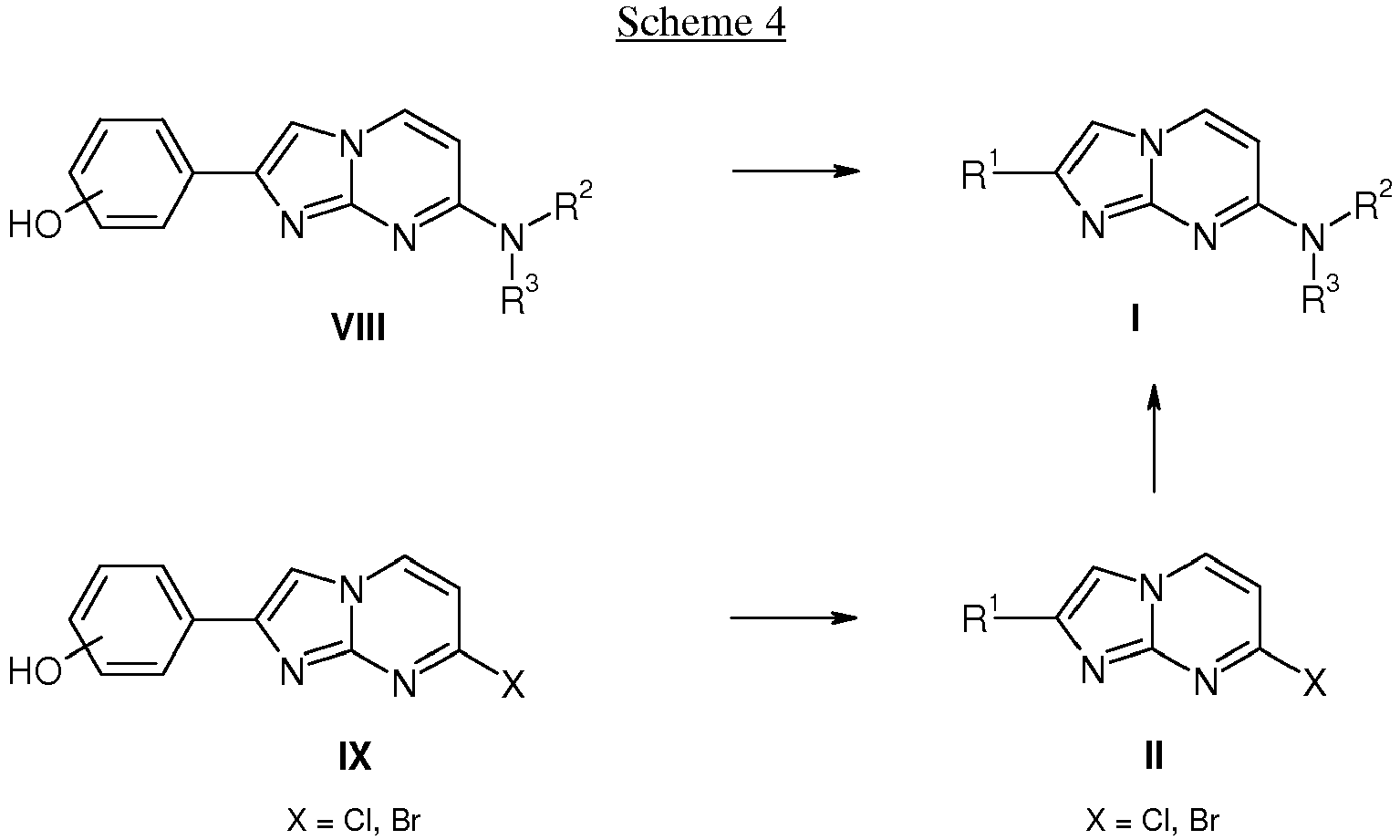
- compounds of formula I wherein the substituents R 1 , R 2 and R 3 are as defined above can also be prepared by alkylation of phenols VIII using a suitable alkylation reagent, e.g. alkyl halides like 1-fluoroethyl bromide or alkyl tosylates like fluoromethyl tosylate, in presence of a suitable base, e.g. cesium carbonate or sodium hydride, in a suitable solvent, e.g. DMF, at ambient or elevated temperature.
- a suitable alkylation reagent e.g. alkyl halides like 1-fluoroethyl bromide or alkyl tosylates like fluoromethyl tosylate
- a suitable base e.g. cesium carbonate or sodium hydride
- a suitable solvent e.g. DMF
- phenols IX can be alkylated to afford compounds of formula II which are then further transformed into compounds of formula I.
- Compounds, wherein the substitution on R 1 is 3 H , OC( 3 H) 3 , O 11 CH 3 or OCH 2 CH 2 18 F or R 3 is C( 3 H) 3 or 11 CH 3 may be prepared in conventional manner starting from compounds of formula I or compounds of formula V as described in the specific examples 100 to 106.
- Isolation and purification of the compounds and intermediates described herein can be effected, if desired, by any suitable separation or purification procedure such as, for example, filtration, extraction, crystallization, column chromatography, thin-layer chromatography, thick-layer chromatography, preparative low or high-pressure liquid chromatography or a combination of these procedures.
- suitable separation and isolation procedures can be had by reference to the preparations and examples herein below. However, other equivalent separation or isolation procedures could, of course, also be used. Racemic mixtures of chiral compounds of formula I can be separated using chiral HPLC.
- the compounds of formula I are basic and may be converted to a corresponding acid addition salt.
- the conversion is accomplished by treatment with at least a stoichiometric amount of an appropriate acid, such as hydrochloric acid, hydrobromic acid, sulfuric acid, nitric acid, phosphoric acid and the like, and organic acids such as acetic acid, propionic acid, glycolic acid, pyruvic acid, oxalic acid, malic acid, malonic acid, succinic acid, maleic acid, fumaric acid, tartaric acid, citric acid, benzoic acid, cinnamic acid, mandelic acid, methanesulfonic acid, ethanesulfonic acid, p-toluenesulfonic acid, salicylic acid and the like.
- an appropriate acid such as hydrochloric acid, hydrobromic acid, sulfuric acid, nitric acid, phosphoric acid and the like
- organic acids such as acetic acid, propionic acid, glycolic acid,
- the free base is dissolved in an inert organic solvent such as diethyl ether, ethyl acetate, chloroform, ethanol or methanol and the like, and the acid added in a similar solvent.
- an inert organic solvent such as diethyl ether, ethyl acetate, chloroform, ethanol or methanol and the like.
- the temperature is maintained between 0 °C and 50 °C.
- the resulting salt precipitates spontaneously or may be brought out of solution with a less polar solvent.
- the acid addition salts of the basic compounds of formula I may be converted to the corresponding free bases by treatment with at least a stoichiometric equivalent of a suitable base such as sodium or potassium hydroxide, potassium carbonate, sodium bicarbonate, ammonia, and the like.
- a suitable base such as sodium or potassium hydroxide, potassium carbonate, sodium bicarbonate, ammonia, and the like.
- This in vitro binding assay assesses the affinity of compounds for native tau aggregates.
- the compounds are co-incubated with the well-established tau specific radioligand [ 3 H]T808 and the compound's displacement potency of [ 3 H]T808 binding is determined by in vitro autoradiography using human Alzheimer's disease (AD) brain sections (see illustration below).
- AD Alzheimer's disease
- AD human brains are purchased from Banner Sun Health Research Institute (Sun City, AZ, USA). Pathological diagnosis of AD is made according to standard NIA-Reagan Institute criteria based on neuropathological data.
- the radioligand [ 3 H]T808 was synthesized in-house ([ 3 H]-2-[4-(2-Fluoro-ethyl)-piperidin-1-yl]-benzo[4,5]imidazo[1,2-a]pyrimidine, radiochemical purity 99.0 %).
- As a reference cold T808 is used (2-[4-(2-Fluoro-ethyl)-piperidin-1-yl]-benzo[4,5]imidazo[1,2-a]pyrimidine).
- FujiFilm Imaging Plates BAS-IP TR 2025
- a FujiFilm IP reader BAS-5000.
- the signal intensity (Dens - PSL/mm2) in the region of interest (ROI) of the autoradiogram is quantified with the software MCID analysis (version 7.0, Imaging Research Inc.).
- the specific binding (SB) of [ 3 H]T808 binding in absence or in presence of a compound is calculated by subtracting the non-specific binding signal in the white matter, thus yielding SB [3H]T808 only and SB compund .
- the compounds of formula I as well as their pharmaceutically acceptable salts can be administered in form of pharmaceutical preparations, normally parenterally, e.g. in the form of injection solutions.
- Suitable excipients for injection solutions are e.g. water, alcohols, polyols, glycerol, vegetable oils etc.
- Table Structure Name % displacement of [ 3 H]T808 (10 nM) at Expl. luM 10 nM N-Methyl-2-phenylimidazo[1,2-a]pyrimidin-7-amine 37 1 7-(4-Fluoropiperidin-1-yl)-2-phenylimidazo[1,2-a]pyrimidine 72 19 2 7-(4-Fluoropiperidin-1--yl)-2-(4-methoxyphenyl)imidazo[1,2-a]pyrimidine 87 31 3 2-(4-Chlorophenyl)-7-(4-fluoropiperidin-1-yl)imidazo[1,2-a]pyrimidine 58 4 7-(4-Fluoropiperidin-1--yl)-2-(3-methoxyphenyl)imidazo[1,2-a
- Step 2 N-Methyl-2-phenylimidazo[1,2-a]pyrimidin-7-amineA yellow suspension of N4-methylpyrimidine-2,4-diamine (50 mg, 403 ⁇ mol) and 2-bromo-1-phenylethanone (120 mg, 604 ⁇ mol) in acetone (2.75 mL) was stirred at 65 °C overnight. The off-white suspension was filtered and washed with water ( ⁇ 1 mL) and acetone ( ⁇ 1 mL). The solid precipitate was suspended into water (1 mL) and ammoniumhydroxide (25 %, 0.9 mL). The suspension was stirred for 10 min at room temperature, filtered again and washed with water to yield after high vacuum drying for 4 h the title compound as light red solid (41 mg, 45 %). MS: m/z 225.5 (M+H) +
- Step 2 7-(4-Fluoropiperidin-1-yl)-2-phenyl-2,3-dihydroimidazo[1,2-a]pyrimidin-2-ol
- Step 3 7-(4-Fluoropiperidin-1-yl)-2-phenylimidazo[1,2-a]pyrimidine
- the precipitate was filtered, washed water, triturated with dichloromethane and dried to obtain 3.1 g product as white solid.
- the separated ethyl acetate phase was dried over MgSO 4 , filtered and concentrated in vacuum.
- the resulting light yellow solid was triturated with dichloromethane and dried to obtain 1.1 g product as white solid.
- the aqueous phase was extracted with dichloromethane (3 x 100 mL), dried over MgSO 4 , filtered and concentrated in vacuum. The resulting light yellow solid was triturated with dichloromethane to obtain another 0.52 g product as white solid.
- the product was obtained starting 4-chloropyrimidin-2-amine (3.24 g, 25.0 mmol) and dimethylamine hydrochloride (2.24 g, 27.5 mmol) and potassium carbonate (10.4 g, 75.0 mmol) according to the method described in example 2, step 1 as white solid (1.48 g, 43 %).
- Step 1 4-(4-(2-Fluoroethyl)piperazin-1-yl)pyrimidin-2-amine
- Step 2 7-[4-(2-Fluoroethyl)piperazin-1-yl]-2-(4-methoxyphenyl)imidazo[1,2-a]pyrimidine hydrochloride
- the crude product was obtained starting from 4-(4-(2-fluoroethyl)piperazin-1-yl)pyrimidin-2-amine (156 mg, 693 ⁇ mol) and 2-bromo-1-(4-methoxyphenyl)ethanone (238 mg, 1.04 mmol) according to method described in example 6.
- the resulting light yellow solid was triturated with heptane.
- the resulting suspension was filtrated, washed and dried in vacuum to yield 243 mg of a light yellow solid.
- THF (1.00 mL) and HCl (4 M solution in dioxane, 1.73 mL, 6.93 mmol).
- Step 2 7-[(3R)-3-Methoxypyrrolidin-1-yl]-2-phenylimidazo[1,2-a]pyrimidine
- Step 2 7-[(3S)-3-Methoxypyrrolidin-1-yl]-2-phenylimidazo[1,2-a]pyrimidine
- Step 2 7-[(3R)-3-Fluoropyrrolidin-1-yl]-2-(4-methoxyphenyl)imidazo[1,2-a]pyrimidine
- Step 2 7-[(3S)-3-Fluoropyrrolidin-1-yl]-2-(4-methoxyphenyl)imidazo[1,2-a]pyrimidine
- the product was obtained starting from 4-piperidin-1-yl-pyrimidin-2-ylamine (250 mg, 1.40 mmol, example 49, step 1) and 2-bromo-1-(3,4-dimethoxy-phenyl)-ethanone (545 mg, 2.10 mmol) according to the method described in example 49, step 2 as off-white solid (49 mg, 10 %).
- Step 4 4-[4-(2-Fluoro-ethyl)-piperidin-1-yl]-pyrimidin-2-ylamine
- Step 5 7-[4-(2-Fluoroethyl)piperidin-1-yl]-2-phenylimidazo[1,2-a]pyrimidine
- Step 1 7-chloro-2-(4-methoxyphenyl)imidazo[1,2-a]pirimidine and 7-bromo-2-(4-methoxyphenyl)imidazo[1,2-a]pyrimidine
- Step 2 N-[2-(2-Fluoroethoxy)ethyl]-2-(4-methoxyphenyl)-N-methylimidazo[1,2-a]pyrimidin-7-amine
- Step 2 N-[2-(2-Fluoroethoxy)ethyl]-N-methyl-2-(3-methylphenyl)imidazo[1,2-a]pyrimidin-7-amine
- Step 2 7-(Azetidin-1-yl)-2-(4-methoxyphenyl)imidazo[1,2-a]pyrimidine
- Step 1 4-(3-Fluoroazetidin-1-yl)pyrimidin-2-amine
- Step 2 7-(3-Fluoroazetidin-1-yl)-2-(4-methoxyphenyl)imidazo[1,2-a]pyrimidine
- the product was obtained starting from 4-chloropyrimidin-2-amine (300 mg, 2.32 mmol) and 2,2,2-trifluoroethylamine (1.26 g, 1.0 ml, 12.7 mmol) according to the method described in example 77, step 1 without final trituration as light yellow solid (121 mg, 26 %).
- a microwave vial was charged with 4-(azetidin-1-yl)pyrimidin-2-amine (70 mg, 466 ⁇ mol, example 69, step 1), 2-bromo-1-(4-hydroxyphenyl)ethanone (105 mg, 489 ⁇ mol) and acetone (0.70 mL).
- the reaction mixture was cooled to room temperature and then diluted with dichloromethane and saturated NaHCO 3 -solution whereof a precipitate formed in the aqueous layer.
- Step 2 7-(3-Methoxyazetidin-1-yl)-2-(4-methoxyphenyl)imidazo[1,2-a]pyrimidine
- Step 2 2-[4-(Dimethylamino)phenyl]-N-(2-fluoroethyl)imidazo[1,2-a]pyrimidin-7-amine
- the solution was cooled by liquid nitrogen and the excess tritium gas in the reaction vessel was reabsorbed on a uranium-trap for waste-tritium.
- the solvent was lyophilized off and labile tritium was removed by lyophilization with a 9:1-mixture of ethanol and water (3 x 1 mL) and toluene (2 x 1 mL).
- the remaining brownish oil was dissolved in ethanol (1.5 mL) and transferred on a SCX-2 cation exchanger.
- Remaining catalyst was eluted with MeOH (10 mL) and discarded, the product was eluted with NH 3 in MeOH (3.5 N, 10 mL), collected separately, and concentrated under reduced pressure.
- the crude product was purified by preparative HPLC (Nucleodur 100-5 Prep C-18, 5 ⁇ m, 10 x 250 mm) using acetonitrile, water, and pH 7 buffer as eluent. 900 MBq (24 mCi) of the title compound were obtained with a radiochemical purity of 94 % and a specific activity of 2.1 TBq/mmol (58 Ci/mmol), determined by MS spectrometry. The compound was stored as an ethanolic solution. MS m/z: 331.2 (M+H) +
- the reaction mixture was portion wise diluted with dichloromethane (30 mL) and transferred to a 50 mL flask. The solvent and volatile by-products were removed by vacuum transfer.
- the crude product was purified by preparative HPLC (XBridge C18, 5 ⁇ m, 10 x 250 mm) using acetonitrile, water, and pH 2.5 buffer as eluent. 460 MBq (12.4 mCi) of the desired compound were obtained with a radiochemical purity of 94 % and a specific activity of 2.6 TBq/mmol (70 Ci/mmol). MS m/z: 244.9 (M+H) +
- reaction mixture was diluted with 1 mL of HPLC water and injected onto the semipreparative HPLC column (XBridge C-18, 10 ⁇ m, 10x150 mm) eluted with 20:80 acetonitrile:water (0.1 M ammonium formate) at 10 mL/min.
- the HPLC effluent was monitored at 254 nm and an in-line radioactivity detector.
- the product, which eluted at approx. 8.5 minutes was collected in 50 mL water containing approx. 250 mg of ascorbic acid.
- the SepPak was washed with 10 mL of water.
- the radiolabeled product was eluted from the SepPak with1 mL of absolute ethanol followed by 10 mL sterile saline through a sterile filter to the final product vial. Aliquots were removed from the final product vial for quality control analysis.
- the final product average specific radioactivity was 5534 mCi/ ⁇ mole with an average radiochemical purity of 95.5 %.
- reaction mixture was diluted with 200 ⁇ L of HPLC solvent and injected onto the semipreparative HPLC column (XBridge C-18, 10 ⁇ m, 10x150 mm) eluted with 25:75 absolute ethanol: pH 7.2 TEA buffer at 10 mL/min.
- the HPLC effluent was monitored at 254 nm and an in-line radioactivity detector.
- the product, which eluted at approx. 7 minutes was collected in 50 mL water containing approx. 250 mg of ascorbic acid.
- the SepPak was washed with 10 mL of water containing approximately 50 mg ascorbic acid.
- the radiolabeled product was eluted from the Sep Pak with1 mL of absolute ethanol followed by 10 mL sterile saline through a sterile filter to the final vial.
- the final product average specific radioactivity was 16870 mCi/ ⁇ mole with an average radiochemical purity of 97.5 %.
- the ion exchange column was eluted with 150 ⁇ L of a stock solution of Krytpofix 2.2.2/potassium carbonate (48 mg of Kryptofix 2.2.2 and 10 mg potassium carbonate dissolved in 600 ⁇ L of 1:1 acetonitrile:water) into the reaction vial followed by 250 ⁇ L acetonitrile.
- the fluoride solution was evaporated to dryness at 110 °C via nitrogen flow and further dried azeotropically by two additions of acetonitrile (250 ⁇ L each).
- the reaction vial was remotely transferred to the microwave cavity (Resonance Instruments) and cooled with compressed air for 2 minutes. The precursor was added and then microwaved at 50 watts for 80 seconds after which the solution was quenched with 1 mL of water.
- reaction mixture was injected onto the semi-preparative HPLC column (XBridge C18, 10 ⁇ m, 10x150 mm) eluted with 30:70 methanol:triethylamine buffer (pH 7.2) at 15 mL/min.
- the HPLC effluent was monitored at 254 nm and an in-line radioactivity detector.
- the semipreparative chromatogram was observed (chromatogram shown below) and the 2-[4-(2-[ 18 F]fluoroethoxy)phenyl]-N-methyl-imidazo[1,2-a]pyrimidin-7-amine product peak was collected in 50 mL of water containing 250 mg ascorbic acid and reformulated using an automated SPE module.
- the product solution was eluted through a Waters Oasis Plus SPE, washed with 10 mL of Milli-Q water, then eluted with 1 mL of absolute ethanol and followed by 10 mL of normal saline into the final product vial via a 0.22 ⁇ m Millipore FG sterilizing filter. Aliquots were removed from the final product vial for quality control analysis.
- Analytical HPLC XBridge C18, 3.5 ⁇ m, 4.6x100mm
- An analytical chromatogram is displayed below.
- the final product had a specific radioactivity of 49,751 mCi/ ⁇ mole and radiochemical purity of 96 %.
- Step 2) 7-(Azetidin-1-yl)-2-(4-(2-fluoroethoxy)phenyl)imidazo[1,2-a]pyrimidine
- Step 2) 7-(Azetidin-1-yl)-2-(3-(2-fluoroethoxy)phenyl)imidazo[1,2-a]pyrimidine
- N-cyclopropyl-2-(4-methoxyphenyl)imidazo[1,2-a]pyrimidin-7-amine (0.095 g, 305 ⁇ mol, example 76) was dissolved in 2.0 mL DMF.
- Sodium hydride, 60 % dispersion in mineral oil (24 mg, 550 ⁇ mol) was added and the reaction mixture was stirred at room temperature for 45 min.
- 1-bromo-2-fluoroethane 47.6 mg, 28 ⁇ L, 375 ⁇ mol
Landscapes
- Health & Medical Sciences (AREA)
- Chemical & Material Sciences (AREA)
- Organic Chemistry (AREA)
- Life Sciences & Earth Sciences (AREA)
- General Health & Medical Sciences (AREA)
- Veterinary Medicine (AREA)
- Animal Behavior & Ethology (AREA)
- Public Health (AREA)
- Medicinal Chemistry (AREA)
- Epidemiology (AREA)
- Pharmacology & Pharmacy (AREA)
- Engineering & Computer Science (AREA)
- Biomedical Technology (AREA)
- Neurosurgery (AREA)
- Neurology (AREA)
- Bioinformatics & Cheminformatics (AREA)
- Physics & Mathematics (AREA)
- Proteomics, Peptides & Aminoacids (AREA)
- Optics & Photonics (AREA)
- Psychiatry (AREA)
- Chemical Kinetics & Catalysis (AREA)
- General Chemical & Material Sciences (AREA)
- Nuclear Medicine, Radiotherapy & Molecular Imaging (AREA)
- Hospice & Palliative Care (AREA)
- Nitrogen Condensed Heterocyclic Rings (AREA)
- Molecular Biology (AREA)
- Urology & Nephrology (AREA)
- Hematology (AREA)
- Immunology (AREA)
- Biotechnology (AREA)
- Microbiology (AREA)
- Cell Biology (AREA)
- Food Science & Technology (AREA)
- Analytical Chemistry (AREA)
- Biochemistry (AREA)
- General Physics & Mathematics (AREA)
- Pathology (AREA)
- Medicines Containing Antibodies Or Antigens For Use As Internal Diagnostic Agents (AREA)
- Pharmaceuticals Containing Other Organic And Inorganic Compounds (AREA)
- Plural Heterocyclic Compounds (AREA)
Description
- The present invention relates to compounds of general formula

- R1
- is phenyl, optionally substituted by one or two substituents, selected from 3H, halogen, lower alkyl, di-methyl-amino, NHC(O)-lower alkyl, C(O)O-lower alkyl, lower alkoxy, OC(3H)3, O11CH3, OCH2CH2 18F, lower alkoxy substituted by halogen, hydroxy, lower alkyl substituted by hydroxy, S-lower alkyl, or by a heterocyclyl group; or is benzo[d][1,3]dioxol-5-yl, 2,3-dihydrobenzo[b][1,4]dioxin-6-yl, indolin-2-one, or is heteroaryl, selected from the group consisting of thiophenyl, benzofuranyl, benzothiophenyl, pyrazinyl or benzothiazolyl;
- R2
- is hydrogen, lower alkyl or lower alkyl substituted by halogen;
- R3
- is lower alkyl, C(3H)3, 11CH3, lower alkyl substituted by halogen, -(CH2)2-O-lower alkyl substituted by halogen or cycloalkyl; or
- R2 and R3
- form together with the N-atom to which they are attach a ring containing -CH2CH2CHRCH2CH2-, -CH2CH2CH2CH2-, -CH2CH2CH2-, -CH2CH2-NR-CH2CH2-, -CH2CH2-O-CH2CH2-, -CH2CH2CHRCH2-, -CH2CHRCH2- or

- R
- is hydrogen, halogen, lower alkyl substituted by halogen or lower alkoxy;
- Similar compounds are described for example in
WO2011/117264 as modulators of phosphodiesterase 10A (PDE10A) for the treatment of central nervous system diseases and inWO2010/068453 andWO2010/068452 as modulators of fatty acid amide hydrolase. 2-Aryl-3-(heteroaryl)-imidazo(1,2-a)pyrimidines are described inWO0134605 - It has been shown that the present compounds may be used for binding and imaging tau aggregates and related beta-sheet aggregates including besides others beta-amyloid aggregates or alpha-synuclein aggregates, especially for use in binding and imaging tau aggregates in Alzheimer patients.
- Alzheimer's disease (AD) is a progressive neurodegenerative disorder characterized by cognitive decline, irreversible memory loss, disorientation and language impairment (Arch. Neurol. 1985, 42(11), 1097-1105). Postmortem examination of AD brain sections reveals abundant senile plaques (SPs), composed of beta amyloid (Aβ) peptides, and numerous neurofibrillary tangles (NFTs) formed by filaments of hyperphosphorylated tau protein.
- Tau belongs to the family of microtubule-associated proteins and is mainly expressed in neurons where it plays an important role in the assembly of tubulin monomers into microtubules to constitute the neuronal microtubule network as tracks for axonal transport (Brain Res. Rev. 2000, 33(1), 95-130). Tau is translated from a single gene located on chromosome 17 and the expression is developmentally regulated by an alternative splicing mechanism generating six different isoforms in the human adult brain that can be distinguished by their number of binding domains. The underlying mechanisms leading to tau hyperphosphorylation, misfolding and aggregation are not well understood, but the deposition of tau aggregates follows a stereotyped spatiotemporal pathway both at the intracellular levels as well as on the level of brain topography.
- The recent discovery of tau gene mutations leading to frontotemporal dementia (FTD) with parkinsonism linked to chromosome 17 has reinforced the predominant role attributed to tau in the pathogenesis of neurodegenerative disorders and underlined the fact that distinct sets of tau isoforms expressed in different neuronal populations could lead to different pathologies (Biochim. Biophys. Acta 2005, 1739(2) 240-250). Neurodegenerative diseases characterized by pathological tau accumulation are termed 'tauopathies' (Ann. Rev. Neurosci. 2001, 24, 1121-1159). Besides AD and FTD, other tauopathies include progressive supranuclear palsy (PSP), tangle-predominant dementia, Pick's disease, frontotemporal lobar degeneration (FTLD), Down's syndrome and others.
- A direct correlation has been established between the progressive involvement of neocortical areas and the increasing severity of dementia, suggesting that pathological tau aggregates such as NFTs are a reliable marker of the neurodegenerative process. The degree of NFT involvement in AD is defined by Braak stages (Acta Neuropathol. 1991, 82, 239-259). Braak stages I and II are defined when NFT involvement is confined mainly to the transentorhinal region of the brain, stages III and IV are diagnosed when limbic regions such as the hippocampus are involved, and stages V and VI when extensive neocortical involvement is found.
- Presently, detection of tau aggregates is only possible by histological analysis of biopsy or autopsy materials. In vivo imaging of tau pathology would provide novel insights into deposition of tau aggregates in the human brain and allow to non-invasively examine the degree of tau pathology, quantify changes in tau deposition over time, assess its correlation with cognition and analyze the efficacy of an anti-tau therapy. Potential ligands for detecting tau aggregates in the living brain must cross the blood-brain barrier and possess high affinity and specificity for tau aggregates. To this end, successful neuroimaging radiotracers must have appropriate lipophilicity (logD 1-3) and low molecular weight (<450), show rapid clearance from blood and low non-specific binding.
- The object of the present application is to find an imaging tool which will improve diagnosis by identifying potential patients with excess of tau aggregates in the brain, which may be likely to develop Alzheimer's disease. It will also be useful to monitor the progression of the disease. When an anti-tau aggregate drug become available, imaging tau tangles in the brain may provide an essential tool for monitoring treatment.
- A further object of the present invention is a method of imaging tau-aggregate deposits, comprising
- introducing into a mammal a detectable quantity of a composition
- allowing sufficient time for the compound of formula I to be associated with tau-aggregate deposits, and
- detecting the compound associated with one or more tau-aggregate deposits.
- The following definitions of the general terms used in the present description apply irrespective of whether the terms in question appear alone or in combination.
- As used herein, the term "lower alkyl" denotes a saturated, i.e. aliphatic hydrocarbon group including a straight or branched carbon chain with 1 - 7 carbon atoms. Examples for "alkyl" are methyl, ethyl, n-propyl, and isopropyl.
- The term "cycloalkyl" denotes a non aromatic hydrocarbon ring, containing from 3 to 6 carbon atoms.
- The term "alkoxy" denotes a group -O-R' wherein R' is lower alkyl as defined above. The term "halogen" denotes chlorine, bromine, fluorine or iodine.
- The term "lower alkyl substituted by halogen" denotes an alkyl group as defined above, wherein at least one hydrogen atom is replaced by a halogen atom.
- The term "lower alkoxy substituted by halogen" denotes an alkoxy group as defined above, wherein at least one hydrogen atom is replaced by a halogen atom.
- The term "heterocyclyl" denotes an unsaturated ring, containing 1 - 3 heteroatoms, selected from N, O or S, for example morpholinyl, piperazinyl, piperidinyl or pyrrolidinyl. 3H denotes a tritium atom.
- The term "pharmaceutically acceptable salt" or "pharmaceutically acceptable acid addition salt" embraces salts with inorganic and organic acids, such as hydrochloric acid, nitric acid, sulfuric acid, phosphoric acid, citric acid, formic acid, fumaric acid, maleic acid, acetic acid, succinic acid, tartaric acid, methane-sulfonic acid, p-toluenesulfonic acid and the like.
- It has been found that the compounds of formula I may be used for binding and imaging tau aggregates and related b-sheet aggregates including besides others beta-amyloid aggregates or alpha-synuclein aggregates.
- One object of the present invention are compounds of formula

- R1
- is phenyl, optionally substituted by one or two substituents, selected from 3H, halogen, lower alkyl, di-methyl-amino, NHC(O)-lower alkyl, C(O)O-lower alkyl, lower alkoxy, OC(3H)3, O11CH3, OCH2CH2 18F, lower alkoxy substituted by halogen, hydroxy, lower alkyl substituted by hydroxy, S-lower alkyl, or by a heterocyclyl group;
- R2
- is hydrogen, lower alkyl or lower alkyl substituted by halogen;
- R3
- is lower alkyl, C(3H)3, 11CH3, lower alkyl substituted by halogen, -(CH2)2-O-lower alkyl substituted by halogen or cycloalkyl; or
- R2 and R3
- form together with the N-atom to which they are attach a ring containing -CH2CH2CHRCH2CH2-, -CH2CH2CH2CH2-, -CH2CH2CH2-, -CH2CH2-NR-CH2CH2-, -CH2CH2-O-CH2CH2-, -CH2CH2CHRCH2-, -CH2CHRCH2- or
- R
- is hydrogen, halogen, lower alkyl substituted by halogen or lower alkoxy;
- One object of the present invention are further compounds of formula

- R1
- is benzo[d][1,3]dioxol-5-yl, 2,3-dihydrobenzo[b][1,4]dioxin-6-yl or indolin-2-one.
- R2
- is hydrogen, lower alkyl or lower alkyl substituted by halogen;
- R3
- is lower alkyl, C(3H)3, 11CH3, lower alkyl substituted by halogen, -(CH2)2-O-lower alkyl substituted by halogen or cycloalkyl; or
- R2 and R3
- form together with the N-atom to which they are attach a ring containing -CH2CH2CHRCH2CH2-, -CH2CH2CH2CH2-, -CH2CH2CH2-, -CH2CH2-NR-CH2CH2-, -CH2CH2-O-CH2CH2-, -CH2CH2CHRCH2-, -CH2CHRCH2- or

- R
- is hydrogen, halogen, lower alkyl substituted by halogen or lower alkoxy;
- One object of the present invention are further compounds of formula

- R1
- heteroaryl, selected from the group consisting of thiophenyl, benzofuranyl, benzothiophenyl, pyrazinyl or benzothiazolyl;
- R2
- is hydrogen, lower alkyl or lower alkyl substituted by halogen;
- R3
- is lower alkyl, C(3H)3, 11CH3, lower alkyl substituted by halogen, -(CH2)2-O-lower alkyl substituted by halogen or cycloalkyl; or
- R2 and R3
- form together with the N-atom to which they are attach a ring containing -CH2CH2CHRCH2CH2-, -CH2CH2CH2CH2-, -CH2CH2CH2-, -CH2CH2-NR-CH2CH2-, -CH2CH2-O-CH2CH2-, -CH2CH2CHRCH2-, -CH2CHRCH2- or

- R
- is hydrogen, halogen, lower alkyl substituted by halogen or lower alkoxy;
- The compounds of formula I may be used in binding and imaging tau aggregates, beta-amyloid aggregates, alpha-synuclein aggregates or huntingtin aggregates.
The preferred use of compounds of formula I is the use in binding and imaging tau aggregates in Alzheimer patients.
Furthermore, the compounds of formula I may be used in a tau-binding study.
The invention is also used for diagnostic imaging of tau-aggregate deposits in the brain of a mammal.
The present compounds of formula I
- a) coupling a compound of formula II (X = Cl, Br)


and, if desired, converting the obtained compounds into pharmaceutically acceptable acid addition salts or into a compound of formula I-2
- b) coupling compounds of formula III
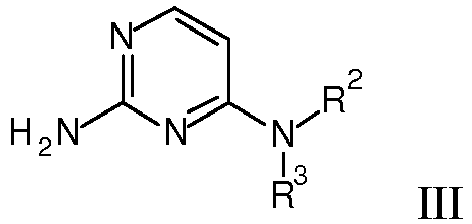
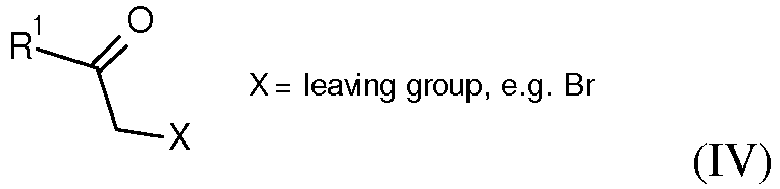

and, if desired, converting the compounds obtained into pharmaceutically acceptable acid addition salts or into compounds of formula I-2
- c) reacting compounds of formula V


- The following schemes 1-4 describe the processes for the preparation of compounds of formula I in more detail. The starting materials are known compounds or may be prepared according to methods known in the art.
- The preparation of compounds of formula I of the present invention may be carried out in sequential or convergent synthetic routes. The skills required for carrying out the reactions and purifications of the resulting products are known to those skilled in the art. The substituents and indices used in the following description of the processes have the significance given herein before unless indicated to the contrary.
- In more detail, the compounds of formula I can be manufactured by the methods given below, by the methods given in the examples or by analogous methods. Appropriate reaction conditions for the individual reaction steps are known to a person skilled in the art. The reaction sequence is not limited to the one displayed in schemes 1 to 4, however, depending on the starting materials and their respective reactivity the sequence of reaction steps can be freely altered. Starting materials are either commercially available or can be prepared by methods analogous to the methods given below, by methods described in references cited in the description or in the examples, or by methods known in the art.
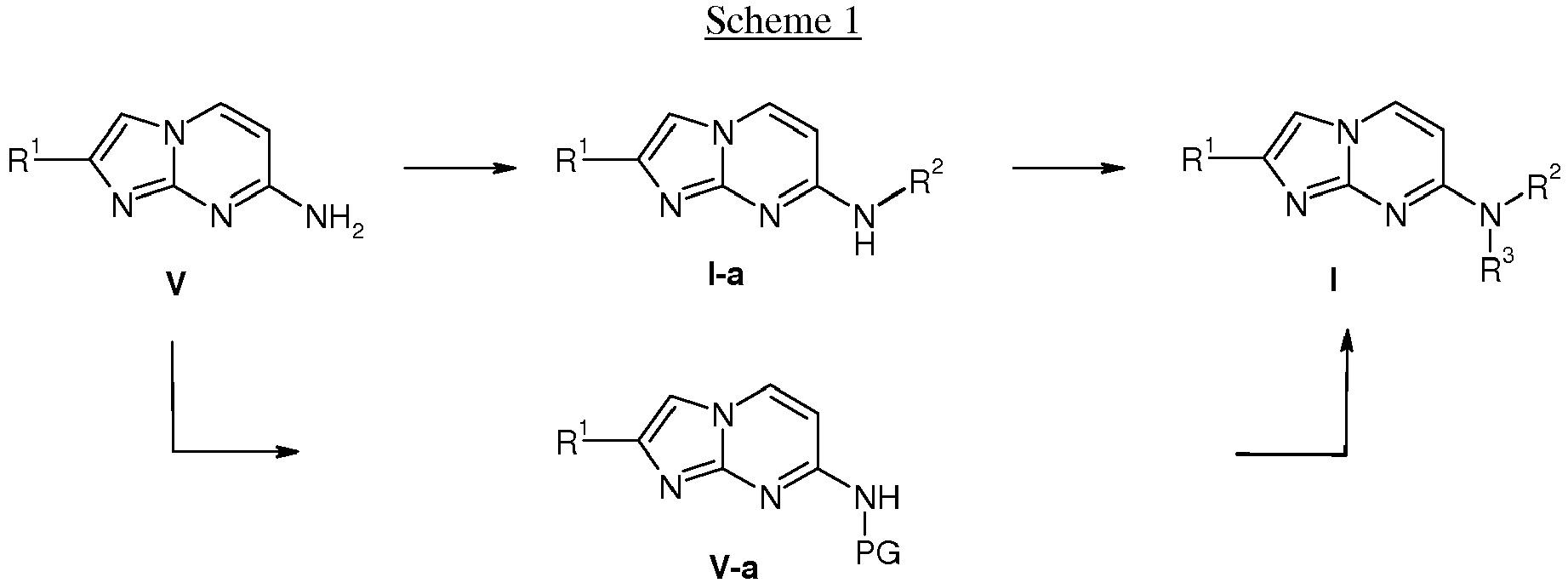

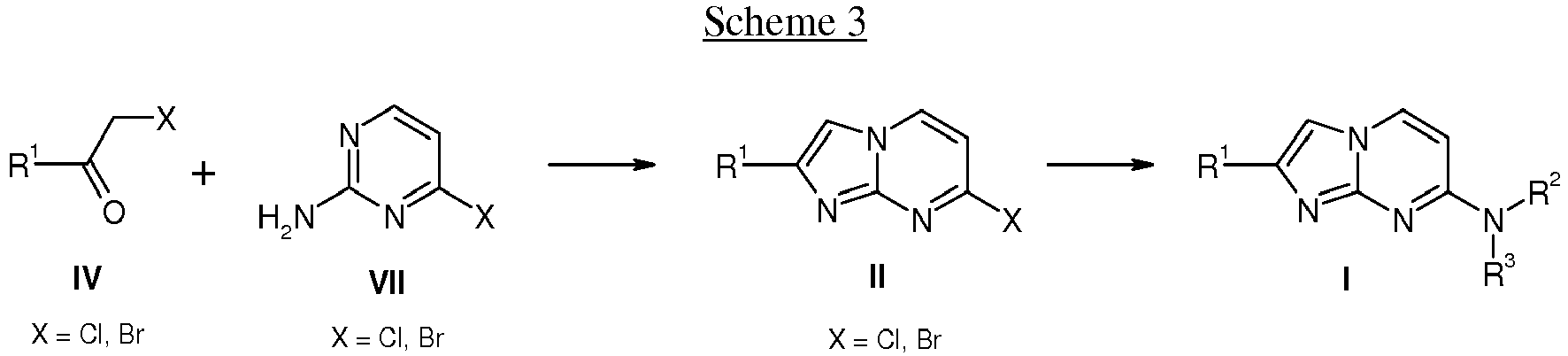
- Isolation and purification of the compounds and intermediates described herein can be effected, if desired, by any suitable separation or purification procedure such as, for example, filtration, extraction, crystallization, column chromatography, thin-layer chromatography, thick-layer chromatography, preparative low or high-pressure liquid chromatography or a combination of these procedures. Specific illustrations of suitable separation and isolation procedures can be had by reference to the preparations and examples herein below. However, other equivalent separation or isolation procedures could, of course, also be used. Racemic mixtures of chiral compounds of formula I can be separated using chiral HPLC.
- The compounds of formula I are basic and may be converted to a corresponding acid addition salt. The conversion is accomplished by treatment with at least a stoichiometric amount of an appropriate acid, such as hydrochloric acid, hydrobromic acid, sulfuric acid, nitric acid, phosphoric acid and the like, and organic acids such as acetic acid, propionic acid, glycolic acid, pyruvic acid, oxalic acid, malic acid, malonic acid, succinic acid, maleic acid, fumaric acid, tartaric acid, citric acid, benzoic acid, cinnamic acid, mandelic acid, methanesulfonic acid, ethanesulfonic acid, p-toluenesulfonic acid, salicylic acid and the like. Typically, the free base is dissolved in an inert organic solvent such as diethyl ether, ethyl acetate, chloroform, ethanol or methanol and the like, and the acid added in a similar solvent. The temperature is maintained between 0 °C and 50 °C. The resulting salt precipitates spontaneously or may be brought out of solution with a less polar solvent.
- The acid addition salts of the basic compounds of formula I may be converted to the corresponding free bases by treatment with at least a stoichiometric equivalent of a suitable base such as sodium or potassium hydroxide, potassium carbonate, sodium bicarbonate, ammonia, and the like.
- The compounds were investigated in accordance with the test given hereinafter.
- This in vitro binding assay assesses the affinity of compounds for native tau aggregates. The compounds are co-incubated with the well-established tau specific radioligand [3H]T808 and the compound's displacement potency of [3H]T808 binding is determined by in vitro autoradiography using human Alzheimer's disease (AD) brain sections (see illustration below).
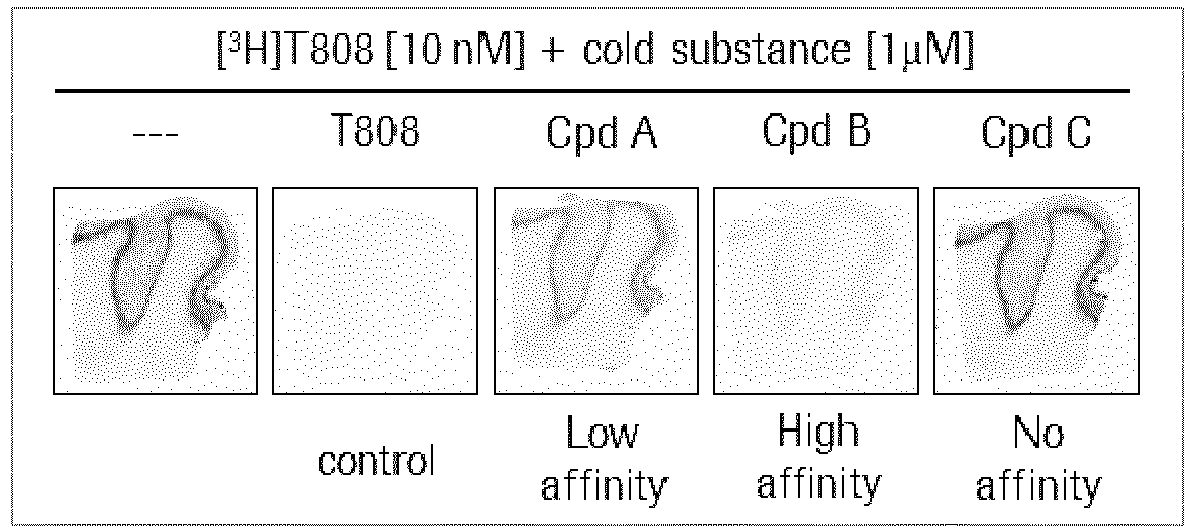
- AD human brains are purchased from Banner Sun Health Research Institute (Sun City, AZ, USA). Pathological diagnosis of AD is made according to standard NIA-Reagan Institute criteria based on neuropathological data. The radioligand [3H]T808 was synthesized in-house ([3H]-2-[4-(2-Fluoro-ethyl)-piperidin-1-yl]-benzo[4,5]imidazo[1,2-a]pyrimidine, radiochemical purity 99.0 %). As a reference cold T808 is used (2-[4-(2-Fluoro-ethyl)-piperidin-1-yl]-benzo[4,5]imidazo[1,2-a]pyrimidine). For the autoradiography FujiFilm Imaging Plates (BAS-IP TR 2025) are exposed to the sections and read with a FujiFilm IP reader (BAS-5000).
- Ten µm thick human AD brain sections are generated with a cryostat (Leica CM3050) at -17 °C chamber temperature and -15 °C object temperature. Sections are transferred to Histobond+ microscope slides (Marienfeld Laboratory Glasware). After drying for 3 hours at room temperature the sections are stored at -20 °C. The sections are incubated with the radioligand (10 nM) and the respective cold compound (at various concentrations) in 50 mM Tris buffer, pH 7.4 at room temperature for 30 min. After washing 3x 10 min at 4 °C in 50 mM Tris buffer, pH 7.4 and 3 quick dips in H2O dist. at 4 °C the sections are dried at 4 °C for 3 h. The sections are placed in a FujiFilm Cassette (BAS 2025), exposed with an Imaging Plate for five days and afterwards scanned with a resolution of 25 µM per pixel.
- The signal intensity (Dens - PSL/mm2) in the region of interest (ROI) of the autoradiogram is quantified with the software MCID analysis (version 7.0, Imaging Research Inc.).The specific binding (SB) of [3H]T808 binding in absence or in presence of a compound is calculated by subtracting the non-specific binding signal in the white matter, thus yielding SB[3H]T808 only and SBcompund. The % displacement by the various compounds is calculated as following:

- In each experiment cold T808 is used as a positive internal control. Co-incubation of equimolar amounts of hot and cold T808 is expected to reduce specific binding by approximately 50 %.
-
- A.K. Szardenings et al. 'Imaging agents for detecting neurological disorders'. US Patent Application
US20110182812 - W. Zhang et al., 'A highly selective and specific PET tracer for imaging of tau pathologies'. Journal of Alzheimer's Disease 31 (2012) 601-612.
- The compounds of formula I as well as their pharmaceutically acceptable salts can be administered in form of pharmaceutical preparations, normally parenterally, e.g. in the form of injection solutions.
- Suitable excipients for injection solutions are e.g. water, alcohols, polyols, glycerol, vegetable oils etc.
Table 
Structure Name % displacement of [3H]T808 (10 nM) at Expl. luM 10 nM 
N-Methyl-2-phenylimidazo[1,2-a]pyrimidin-7-amine 37 1 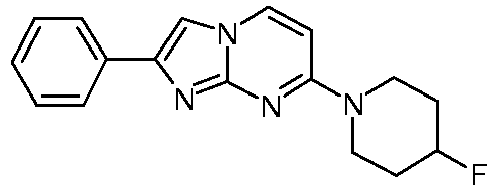
7-(4-Fluoropiperidin-1-yl)-2-phenylimidazo[1,2-a]pyrimidine 72 19 2 
7-(4-Fluoropiperidin-1--yl)-2-(4-methoxyphenyl)imidazo[1,2-a]pyrimidine 87 31 3 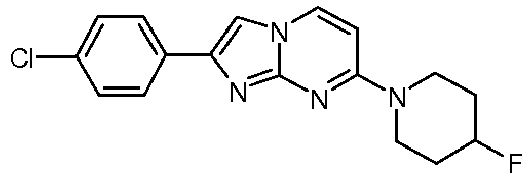
2-(4-Chlorophenyl)-7-(4-fluoropiperidin-1-yl)imidazo[1,2-a]pyrimidine 58 4 
7-(4-Fluoropiperidin-1--yl)-2-(3-methoxyphenyl)imidazo[1,2-a]pyrimidine 74 33 5 
2-(4-Fluorophenyl)-7-(4-fluoropiperidin-1-yl)imidazo[1,2-a]pyrimidine 65 6 
2-(1,3-Benzodioxol-5-yl)-7-(4-fluoropiperidin-1-yl)imidazo[1,2-a]pyrimidine 75 21 7 
2-(2,3-Dihydro-1,4-benzodioxin-6-yl)-7-(4-fluoropiperidin-1-yl)imidazo[1,2-a]pyrimidine 72 8 
4-[4-[7-(4-Fluoropiperidin-1-yl)imidazo[1,2-a]pyrimidin-2-yl]phenyl] morpholine 75 9 
7-(4-Fluoropiperidin-1--yl)-2-(3-methylphenyl)imidazo[1,2-a]pyrimidine 79 10 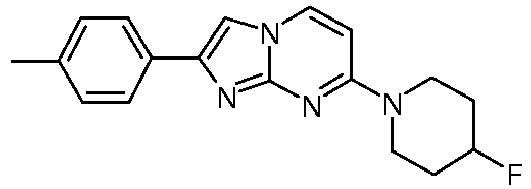
7-(4-Fluoropiperidin-1-yl)-2-(4-methylphenyl)imidazo[1,2-a]pyrimidine 81 4 11 
2-(2-Fluorophenyl)-7-(4-fluoropiperidin-1-yl)imidazo[1,2-a]pyrimidine 50 12 
3-[7-(4-Fluoropiperidin-1-yl)imidazo[1,2-a]pyrimidin-2-yl]phenol 67 13 
7-(4-Fluoropiperidin-1-yl)-2-(4-pyrrolidin-1-ylphenyl)imidazo[1,2-a]pyrimidine 75 18 14 
7-(4-Fluoropiperidin-1-yl)-2-[3-(trifluoromethoxy)phenyl]imid azo[1,2-a]pyrimidine 14 15 
2-[3-(Fluoromethoxy)phenyl]-7-pyrrolidin-1-ylimidazo[1,2-a]pyrimidine 88 27 16 
2-[3-(2-Fluoroethoxy)phenyl]-7-pyrrolidin-1-ylimidazo[1,2-a]pyrimidine 76 17 
N,N-Dimethyl-2-phenylimidazo[1,2-a]pyrimidin-7-amine 92 35 18 
7-[4-(2-Fluoroethyl)piperazin-1-yl]-2-(4-methoxyphenyl)imidazo[1,2-a]pyrimidine 74 19 
7-[4-(2-Fluoroethyl)piperazin-1-yl]-2-(3-methoxyphenyl)imidazo[1,2-a]pyrimidine 51 20 
N-(2-Fluoroethyl)-N-methyl-2-phenylimidazo[1,2-a]pyrimidin-7-amine 84 21 
N-(2-Fluoroethyl)-2-(3-methoxyphenyl)-N-methylimidazo[1,2-a]pyrimidin-7-amine 82 22 
N-(2-Fluoroethyl)-2-(4-methoxyphenyl)-N-methylimidazo[1,2-a]pyrimidin-7-amine 92 33 23 
7-[4-(2-Fluoroethyl)piperazin-1-yl]-2-phenylimidazo[1,2-a]pyrimidine 64 24 
4-[2-(4-Methoxyphenyl)imidazo[1,2-a]pyrimidin-7-yl]morpholine 16 25 
4-[2-(3-Methylphenyl)imidazo[1,2-a]pyrimidin-7-yl]morpholine 13 26 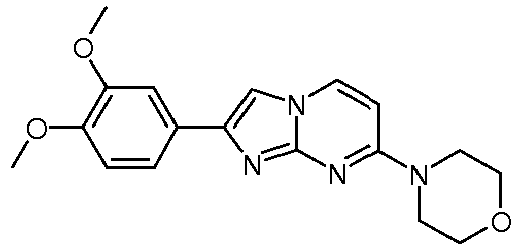
4-[2-(3,4-Dimethoxyphenyl)imidazo[1,2 -a]pyrimidin-7-yl]morpholine 17 27 
4-(7-Pyrrolidin-1-ylimidazo [1,2-a]pyrimidin-2-yl)phenol 22 28 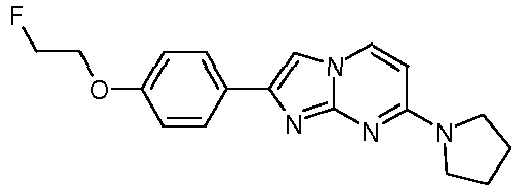
2-[4-(2-Fluoroethoxy)phenyl]-7-pyrrolidin-1-ylimidazo[1,2-a]pyrimidine 15 29 
2-[4-(Fluoromethoxy)phenyl]-7-pyrrolidin-1-ylimidazo[1,2-a]pyrimidine 9 30 
7-[(3R)-3-Methoxypyrrolidin-1-yl]-2-phenylimidazo[1,2-a]pyrimidine 7 31 
7-[(3S)-3-Methoxypyrrolidin-1-yl]-2-phenylimidazo[1,2-a]pyrimidine 13 32 
7-[(3R)-3-Fluoropyrrolidin-1-yl]-2-(4-methoxyphenyl)imidazo[1,2-a]pyrimidine 25 33 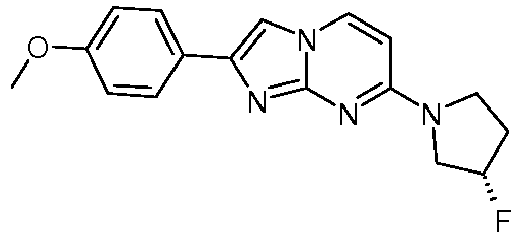
7-[(3S)-3-Fluoropyrrolidin-1-yl]-2-(4-methoxyphenyl)imidazo[1,2-a]pyrimidine 15 34 
2-(3-Methoxyphenyl)-N,N-dimethylimidazo[1,2-a]pyrimidin-7-amine 34 35 
2-(4-Methoxyphenyl)-N,N-dimethylimidazo[1,2-a]pyrimidin-7-amine 47 36 
2-(1,3-Benzodioxol-5-yl)-N,N-dimethylimidazo[1,2-a]pyrimidin-7-amine 46 37 
2-(2,3-Dihydro-1,4-benzodioxin-6-yl)-N,N-dimethylimidazo[1,2-a]pyrimidin-7-amine 37 38 
N,N-Dimethyl-2-(4-methylphenyl)imidazo[1,2-a]pyrimidin-7-amine 49 39 
N,N-Dimethyl-2-(3-methylphenyl)imidazo[1,2-a]pyrimidin-7-amine 51 40 
4-[2-(3-Methoxyphenyl)imidazo[1,2-a]pyrimidin-7-yl]morpholine 16 41 
4-[2-(4-Methylphenyl)imidazo[1,2-a]pyrimidin-7-yl]morpholine 8 42 
2-(4-Methoxyphenyl)-7-pyrrolidin-1-ylimidazo[1,2-a]pyrimidine 29 43 
2-(4-Methylphenyl)-7-pyrrolidin-1-ylimidazo[1,2-a]pyrimidine 28 44 
N,N-Dimethyl-2-(4-morpholin-4-ylphenyl)imidazo[1,2-a]pyrimidin-7-amine 29 45 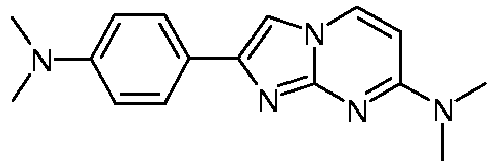
2-[4-(Dimethylamino)phenyl]-N,N-dimethylimidazo[1,2-a]pyrimidin-7-amine 43 46 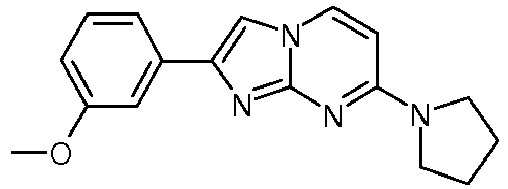
2-(3-Methoxyphenyl)-7-pyrrolidin-1-ylimidazo[1,2-a]pyrimidine 20 47 
2-(3-Methylphenyl)-7-pyrrolidin-1-ylimidazo[1,2-a]pyrimidine 23 48 
2-(4-Methoxyphenyl)-7-piperidin-1-ylimidazo[1,2-a]pyrimidine 17 49 
2-(3-Methoxyphenyl)-7-piperidin-1-ylimidazo[1,2-a]pyrimidine 14 50 
2-(4-Methylphenyl)-7-piperidin-1-ylimidazo[1,2-a]pyrimidine 8 51 
2-(3-Methylphenyl)-7-piperidin-1-ylimidazo[1,2-a]pyrimidine 14 52 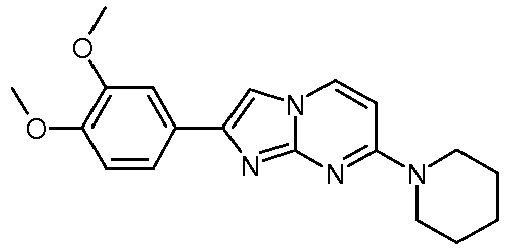
2-(3,4-Dimethoxyphenyl)-7-piperidin-1-ylimidazo[1,2-a]pyrimidine 6 53 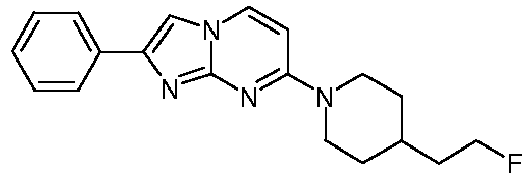
7-[4-(2-Fluoroethyl)piperidin-1-yl]-2-phenylimidazo[1,2-a]pyrimidine 14 54 
7-[4-(2-Fluoroethyl)piperidin-1-yl]-2-(3-methoxyphenyl)imidazo[1,2-a]pyrimidine 10 55 
7-[4-(2-Fluoroethyl)piperidin-1-yl]-2-(4-methoxyphenyl)imidazo[1,2-a]pyrimidine 9 56 
2-(1,3-Benzodioxol-5-yl)-7-[4-(2-fluoroethyl)piperidin-1-yl]imidazo[1,2-a]pyrimidine 9 57 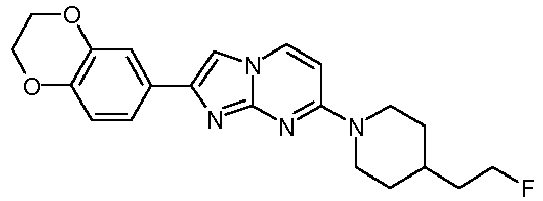
2-(2,3-Dihydro-1,4-benzodioxin-6-yl)-7-[4-(2-fluoroethyl)piperidin-1-yl]imidazo[1,2-a]pyrimidine 18 58 
7-[4-(2-Fluoroethyl)piperidin-1-yl]-2-(3-methylphenyl)imidazo[1,2-a]pyrimidine 10 59 
7-[4-(2-Fluoroethyl)piperidin-1-yl]-2-(4-methylphenyl)imidazo[1,2-a]pyrimidine 15 60 
4-[4-[7-[4-(2-Fluoroethyl)piperidin-1-yl]imidazo[1,2-a]pyrimidin-2-yl]phenyl]morpholine 10 61 
N-Methyl-2-(3-methylphenyl)imidazo[1,2-a]pyrimidin-7-amine 48 62 
7-(4-Fluoropiperidin-1-yl)-2-thiophen-3-ylimidazo[1,2-a]pyrimidine 70 63 
N-[2-(2-Fluoroethoxy)ethyl]-2-(4-methoxyphenyl)-N-methylimidazo[1,2-a]pyrimidin-7-amine 15 64 
7-(2-Azaspiro[3.3]heptan-2-yl)-2-(4-methoxyphenyl)imidazo[1,2-a]pyrimidine 11 65 
N-Ethyl-2-(4-methoxyphenyl)-N-methylimidazo[1,2-a]pyrimidin-7-amine 34 66 
N,N-Diethyl-2-(4-methoxyphenyl)imidazo[1,2-a]pyrimidin-7-amine 19 67 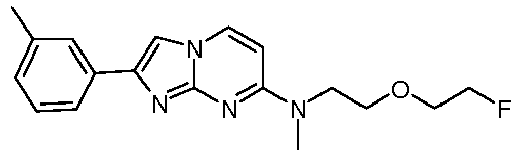
N-[2-(2-Fluoroethoxy)ethyl]-N-methyl-2-(3-methylphenyl)imidazo[1,2-a]pyrimidin-7-amine 14 68 
7-(Azetidin-1-yl)-2-(4-methoxyphenyl)imidazo[1,2-a]pyrimidine 40 69 
7-(3-Fluoroazetidin-1-yl)-2-(4-methoxyphenyl)imidazo[1,2-a]pyrimidine 25 70 
7-(3-Fluoroazetidin-1-yl)-2-phenylimidazo[1,2-a]pyrimidine 18 71 
7-(3-Fluoroazetidin-1-yl)-2-(3-methylphenyl)imidazo[1,2-a]pyrimidine 18 72 
2-(1-Benzofuran-2-yl)-7-(4-fluoropiperidin-1-yl)imidazo[1,2-a]pyrimidine 19 73 
N,N-Dimethyl-4-(7-morpholin-4-ylimidazo[1,2-a]pyrimidin-2-yl)aniline 16 74 
2-(1-Benzothiophen-2-yl)-7-(4-fluoropiperidin-1-yl)imidazo[1,2-a]pyrimidine 18 75 
N-Cyclopropyl-2-(4-methoxyphenyl)imidazo[1,2-a]pyrimidin-7-amine 43 76 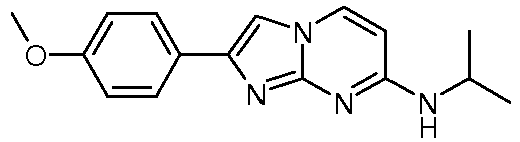
N-Isopropyl-2-(4-methoxyphenyl)-imidazo[1,2-a]pyrimidin-7-amine 15 77 
2-(4-Methoxyphenyl)-N-(2,2,2-trifluoroethyl)imidazo[1,2-a]pyrimidin-7-amine 8 78 
2-[7-(4-Fluoropiperidin-1-yl)imidazo[1,2-a]pyrimidin-2-yl]-1,3-benzothiazole 12 79 
4-[7-(Azetidin-1-yl)imidazo[1,2-a]pyrimidin-2-yl]phenol 25 80 
7-(3-Methoxyazetidin-1-yl)-2-(4-methoxyphenyl)imidazo[1,2-a]pyrimidine 16 81 
N-Methyl-2-(4-methylphenyl)imidazo[1,2-a]pyrimidin-7-amine 38 82 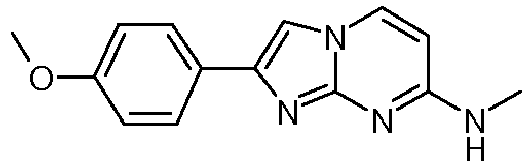
2-(4-Methoxyphenyl)-N-methylimidazo[1,2-a]pyrimidin-7-amine 41 83 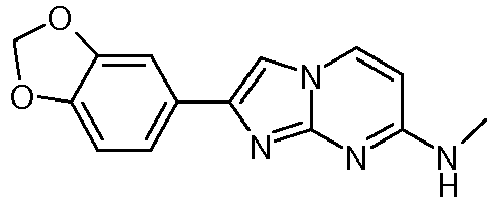
2-(1,3-Benzodioxol-5-yl)-N-methylimidazo[1,2-a]pyrimidin-7-amine 28 84 
N,N-Dimethyl-2-thiophen-3-ylimidazo[1,2-a]pyrimidin-7-amine 35 85 
N-(2-Fluoroethyl)-N-methyl-2-(4-methylphenyl)imidazo[1,2-a]pyrimidin-7-amine 16 86 
2-(1,3-Benzodioxol-5-yl)-N-(2-fluoroethyl)-N-methylimidazo[1,2-a]pyrimidin-7-amine 15 87 
N-(2-Fluoroethyl)-N-methyl-2-(3-methylphenyl)imidazo[1,2-a]pyrimidin-7-amine 22 88 
2-(4-Methoxyphenyl)-7-(3-methylazetidin-1-yl)imidazo[1,2-a]pyrimidine 20 89 
2-[4-(Dimethylamino)phenyl]-N-methylimidazo[1,2-a]pyrimidin-7-amine 38 90 
4-[7-(4-Fluoropiperidin-1-yl)imidazo[1,2-a]pyrimidin-2-yl]-N,N-dimethylaniline 15 91 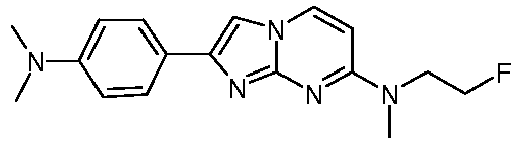
2-[4-(Dimethylamino)phenyl]-N-(2-fluoroethyl)-N-methylimidazo[1,2-a]pyrimidin-7-amine 27 92 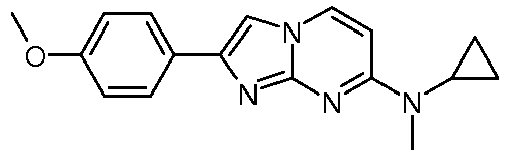
N-Cyclopropyl-2-(4-methoxyphenyl)-N-methylimidazo[1,2-a]pyrimidin-7-amine 42 93 
7-(Azetidin-1-yl)-2-(4-methylphenyl)imidazo[1,2-a]pyrimidine 15 94 
7-(Azetidin-1-yl)-2-(3-methylphenyl)imidazo[1,2-a]pyrimidine 38 95 
2-[4-(Dimethylamino)phenyl]-N-(2-fluoroethyl)imidazo [1,2-a]pyrimidin-7-amine 34 96 
7-(Azetidin-1-yl)-2-[4-(fluoromethoxy)phenyl]imidaz o[1,2-a]pyrimidine 30 97 
2-Methoxy-4-[7-(methylamino)imidazo[1,2-a]pyrimidin-2-yl]phenol 18 98 
2-(3-Bromophenyl)-N-methylimidazo[1,2-a]pyrimidin-7-amine 27 99 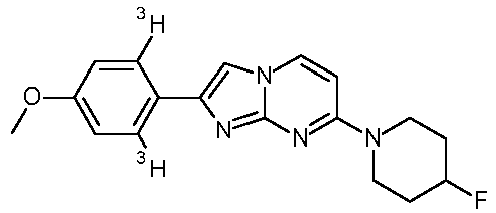
7-(4-fluoropiperidin-1-yl)-2-(4-methoxy-2,6-ditritiophenyl)imidazo[1,2-a]pyrimidine 100 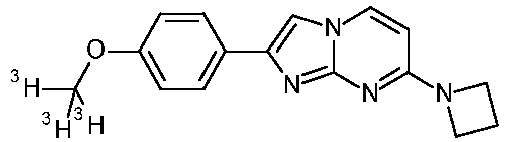
7-(Azetidin-1-yl)-2-[4-(tritritiomethoxy)phenyl)imida zo[1,2-a]pyrimidine 101 
2-(3-Methylphenyl)-N-(tritritiomethyl)imidazo[1,2-a]pyrimidine-7-amine 102 
N-[11C]Methyl-2-(m-tolyl)imidazo [1,2-a]pyrimidin-7-amine 103 
N-Cyclopropyl-2-(4-[11C]methoxyphenyl)imidazo[1 ,2-a]pyrimidin-7-amine 104 
2-[4-(2-[18F]Fluoroethoxy)phenyl]-N-methyl-imidazo[1,2-a]pyrimidin-7-amine 105 
7-(4-Fluoropiperidin-1-yl)-2-(pyrazin-2-yl)imidazo[1,2-a]pyrimidine 20 106 
[4-[7-(Methylamino)imidazo[1,2-a]pyrimidin-2-yl]phenyl]methanol 23 107 
2-(3-Fluoro-4-methoxyphenyl)-N-methylimidazo[1,2-a]pyrimidin-7-amine 36 108 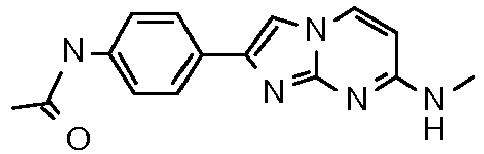
N-(4-(7-(Methylamino)imidazo[1,2-a]pyrimidin-2-yl)phenyl) acetamide 30 109 
5-(7-(methylamino)imidazo[1,2-a]pyrimidin-2-yl)indolin-2-one 18 110 
7-(Azetidin-1-yl)-2-(4-(2-fluoroethoxy)phenyl)imidazo [1 ,2-a]pyrimidine 25 111 
7-(Azetidin-1-yl)-2-(4-(3-fluoropropoxy)phenyl)imidazo [1,2-a]pyrimidine 15 112 
7-(azetidin-1-yl)-2-(3-methoxyphenyl)imidazo[1,2-a]pyrimidine 36 113 
[3-[7-(Methylamino)imidazo[1,2-a]pyrimidin-2-yl]phenyl]methanol 11 114 
7-(Azetidin-1-yl)-2-(3-(2-fluoroethoxy)phenyl)imidazo[1 ,2-a]pyrimidine 5 115 
N-Cyclopropyl-N-(2-fluoroethyl)-2-(4-methoxyphenyl)imidazo[1,2-a]pyrimidin-7-amine 9 116 
2-(3-Methoxyphenyl)-N-methylimidazo[1,2-a]pyrimidin-7-amine 40 117 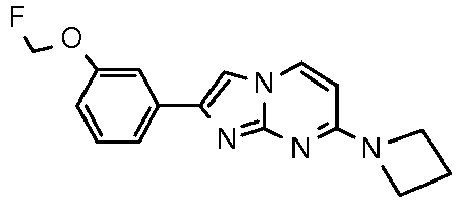
7-(Azetidin-1-yl)-2-(3-(fluoromethoxy)phenyl)imidaz o[1,2-a]pyrimidine 23 118 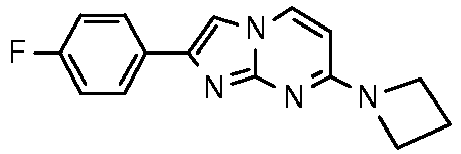
7-(Azetidin-1-yl)-2-(4-fluorophenyl)imidazo[1,2-a]pyrimidine 22 119 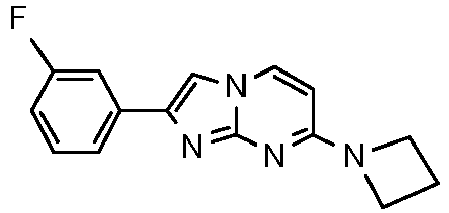
7-(Azetidin-1-yl)-2-(3-fluorophenyl)imidazo[1,2-a]pyrimidine 22 120 
7-(Azetidin-1-yl)-2-(3,5-dimethoxyphenyl)imidazo[1,2-a]pyrimidine 5 121 
4-(7-(Methylamino)imidazo[1,2-a]pyrimidin-2-yl)phenol 32 122 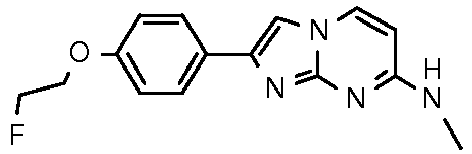
2-(4-(2-Fluoroethoxy)phenyl)-N-methylimidazo[1,2-a]pyrimidin-7-amine 43 123 
2-(4-(3-Fluoropropoxy)phenyl)-N-methylimidazo[1,2-a]pyrimidin-7-amine 40 124 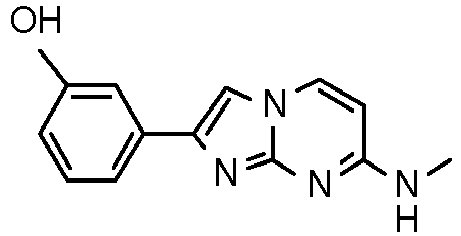
3-(7-(Methylamino)imidazo[1,2-a]pyrimidin-2-yl)phenol 16 125 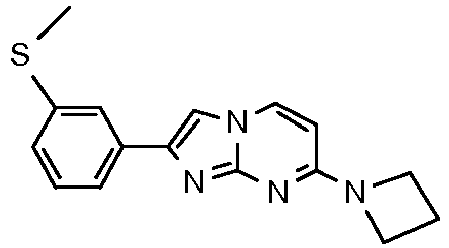
7-(Azetidin-1-yl)-2-(3-(methylthio)phenyl)imidazo[1, 2-a]pyrimidine 15 126 
7-(Azetidin-1-yl)-2-(3-methoxy-4-methylphenyl)imidazo[1,2-a]pyrimidine 11 127 
7-(Azetidin-1-yl)-2-(3,4-dimethoxyphenyl)imidazo[1,2-a]pyrimidine 15 128 
2-(3-(2-Fluoroethoxy)phenyl)-N-methylimidazo[1,2-a]pyrimidin-7-amine 16 129 
2-(3-(3-Fluoropropoxy)phenyl)-N-methylimidazo[1,2-a]pyrimidin-7-amine 12 130 
2-(3-(Fluoromethoxy)phenyl)-N-methylimidazo[1,2-a]pyrimidin-7-amine 33 131 
2-(4-(Fluoromethoxy)phenyl)-N-methylimidazo[1,2-a]pyrimidin-7-amine 36 132 
3-(7-(Cyclopropylamino)imidazo[1, 2-a]pyrimidin-2-yl)phenol 14 133 
N-Cyclopropyl-2-(3-(2-fluoroethoxy)phenyl)imidazo[1 ,2-a]pyrimidin-7-amine 6 134 
[4-[7-(Dimethylamino)imidazo[1,2-a]pyrimidin-2-yl]phenyl]methanol 18 135 
Methyl 4-[7-(methylamino)imidazo[1,2-a]pyrimidin-2-yl]benzoate 27 136 
N-Cyclopropyl-2-(3-(fluoromethoxy)phenyl)imidaz o[1,2-a]pyrimidin-7-amine 18 137 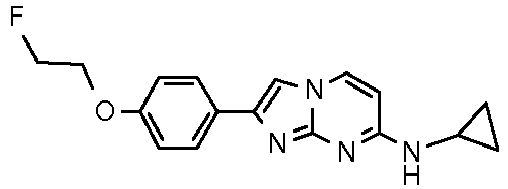
N-Cyclopropyl-2-(4-(2-fluoroethoxy)phenyl)imidazo[1 ,2-a]pyrimidin-7-amine 20 138 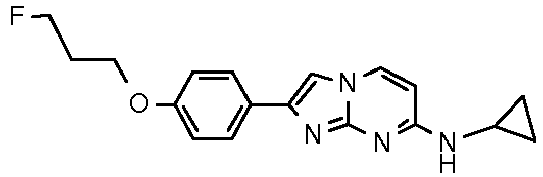
N-Cyclopropyl-2-(4-(3-fluoropropoxy)phenyl)imidazo [1,2-a]pyrimidin-7-amine 22 139 
N-Cyclopropyl-2-(4-(fluoromethoxy)phenyl)imidaz o[1,2-a]pyrimidin-7-amine 11 140 
N-methyl-2-(4-(methylthio)phenyl)imidazo[1, 2-a]pyrimidin-7-amine 34 141 
2-(3,4-dimethoxyphenyl)-N-methylimidazo[1,2-a]pyrimidin-7-amine 21 142 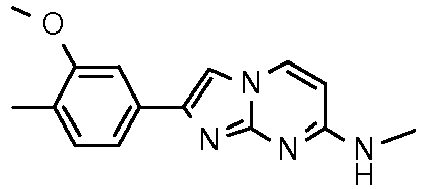
2-(3-Methoxy-4-methylphenyl)-N-methylimidazo[1,2-a]pyrimidin-7-amine 21 143 
2-(3,5-dimethoxyphenyl)-N-methylimidazo[1,2-a]pyrimidin-7-amine 14 144 -
- h - hour(s)
- min - minute(s)
-

- To a yellow solution of 4-chloropyrimidin-2-amine (2.00 g, 15.4 mmol) in N-methyl-2-pyrrolidinone (12 mL) were added under an atmosphere of nitrogen methanamine hydrochloride (1.04 g, 15.4 mmol) and potassium carbonate (4.27 g, 30.9 mmol). The reaction mixture was stirred at 120 °C for 2 h. The reaction mixture was concentrated in vacuum and the crude yellow oil was purified by flash chromatography (using silica gel amine phase and a dichloromethane/methanol/ammonia gradient). The obtained yellow oil was triturated with tert. butyl methylether (40 mL) for 15 min to yield the title compound after high vacuum drying for 4 h as light yellow solid (0.76 g, 40 %).
MS: m/z 125.2 (M+H)+ - Step 2: N-Methyl-2-phenylimidazo[1,2-a]pyrimidin-7-amineA yellow suspension of N4-methylpyrimidine-2,4-diamine (50 mg, 403 µmol) and 2-bromo-1-phenylethanone (120 mg, 604 µmol) in acetone (2.75 mL) was stirred at 65 °C overnight. The off-white suspension was filtered and washed with water (∼1 mL) and acetone (∼1 mL). The solid precipitate was suspended into water (1 mL) and ammoniumhydroxide (25 %, 0.9 mL). The suspension was stirred for 10 min at room temperature, filtered again and washed with water to yield after high vacuum drying for 4 h the title compound as light red solid (41 mg, 45 %).
MS: m/z 225.5 (M+H)+ -

- A mixture of 4-fluoropiperidine hydrochloride (4.9 g, 35.1 mmol), 4-chloropyrimidin-2-amine (5.00 g, 38.6 mmol) and potassium carbonate (14.6 g, 105 mmol) in N-methyl-2-pyrrolidinone (15.0 mL) was stirred under argon for 2 h at 120 °C. The reaction mixture was cooled to room temperature, was poured into NaOH (1 M) and ice and was extracted twice with ethyl acetate. The organic layers were washed with brine, combined, dried over Na2SO4, filtered and the volatiles were evaporated to yield 8.33 g of a light yellow waxy solid. The solid was triturated with tert. butyl methylether (∼10 mL) and stirred for 30 min. Then the suspension was filtrated and dried under high vacuum to yield 6.38 g (83 %, contains residual N-methyl-2-pyrrolidinone) of a light yellow solid. MS: m/z = 197.5 (M+H)+
- A colorless solution of 4-(4-fluoropiperidin-1-yl)pyrimidin-2-amine (89 mg, 454 µmol) and 2-bromo-1-phenylethanone (135 mg, 680 µmol) in acetone was heated under argon to 65°C and stirred for 6 h. The light yellow suspension was filtered over a glass fiber paper and was washed with acetone (1 mL). Ammoniumhydroxide (25%, 2.5 mL) and water (3.1 mL) were added and the white suspension was filtered over a glass fiber paper and washed with H2O. The product was obtained after drying on high vacuum for 3 h as white solid (78 mg, 58 %).
MS: m/z = 315.6 (M+H)+ - To an off-white suspension of 7-(4-fluoropiperidin-1-yl)-2-phenyl-2,3-dihydroimidazo[1,2-a]pyrimidin-2-ol (78 mg, 248 µmol) in toluene (2.6 mL) was added p-toluenesulfonic acid (4.27 mg, 3.99 µl, 24.8 µmol) and the resulting mixture was stirred under argon and heated to 125 °C for 1 h. The light yellow suspension was diluted with little water and ammoniumhydroxide (25 %) was added. The resulting suspension was filtered over a glass fiber paper and the product was obtained after drying on high vacuum for 3 h as off-white solid (56 mg, 76 %).
MS: m/z = 297.5 (M+H)+ -

- The product was obtained starting from 4-(4-fluoropiperidin-1-yl)pyrimidin-2-amine (85 mg, 433 µmol, example 2, step 1) and 2-bromo-1-(4-methoxyphenyl)ethanone (149 mg, 650 µmol) according to the method described in example 1, step 2 as off-white solid (80 mg, 57 %). MS: m/z = 327.5 (M+H)+
-

- The product was obtained starting from 4-(4-fluoropiperidin-1-yl)pyrimidin-2-amine (85 mg, 433 µmol, example 2, step 1) and 2-bromo-1-(4-chlorophenyl)ethanone (152 mg, 650 µmol) according to the method described in example 1, step 2 as light red solid (80 mg, 56 %). MS: m/z = 331.5 (M+H)+
-

- The product was obtained starting from 4-(4-fluoropiperidin-1-yl)pyrimidin-2-amine (85 mg, 433 µmol, example 2, step 1) and 2-bromo-1-(3-methoxyphenyl)ethanone (149 mg, 650 µmol) according to the method described in example 1, step 2 and final purification by flash chromatography (using silica gel amine phase and an heptane/ethyl acetate gradient) as orange foam (76 mg, 51 %). MS: m/z = 327.5 (M+H)+
-

- Using a microwave tube, a solution of 4-(4-fluoropiperidin-1-yl)pyrimidin-2-amine (90 mg, 459 µmol, example 2, step 1) and 2-bromo-1-(4-fluorophenyl)ethanone (149 mg, 688 µmol) in acetone (2.5 mL) was sealed and heated at 70 °C for 20 h. The reaction mixture was filtered and washed with acetone (∼2 mL). To the remaining off white solid was added ammonium hydroxide (25%, 2 mL) and water (3 mL) and the white-grey suspension was filtrated and washed with water (∼2 mL). After drying under high vacuum the title compound was obtained as light yellow solid (51 mg, 35 %). MS: m/z = 315.5 (M+H)+
-

- The product was obtained starting from 4-(4-fluoropiperidin-1-yl)pyrimidin-2-amine (92 mg, 472 µmol, example 2, step 1) and 1-(benzo[d][1,3]dioxol-5-yl)-2-bromoethanone (172 mg, 709 µmol) according to the method described in example 6 as light yellow solid (129 mg, 79 %). MS: m/z = 341.6 (M+H)+
-

- The product was obtained starting from 4-(4-fluoropiperidin-1-yl)pyrimidin-2-amine (93 mg, 477 µmol, example 2, step 1) and 2-bromo-1-(2,3-dihydrobenzo[b][1,4]dioxin-6-yl)ethanone (184 mg, 716 µmol) according to the method described in example 6 as light yellow solid (132 mg, 76 %). MS: m/z = 355.5 (M+H)+
-
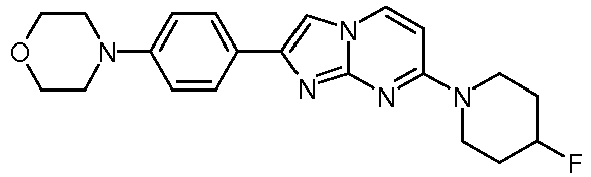
- The product was obtained starting from 4-(4-fluoropiperidin-1-yl)pyrimidin-2-amine (91 mg, 463 µmol, example 2, step 1) and 2-bromo-1-(4-morpholinophenyl)ethanone (197 mg, 695 µmol) according to the method described in example 6 as light yellow solid (58 mg, 32 %). MS: m/z = 382.5 (M+H)+
-
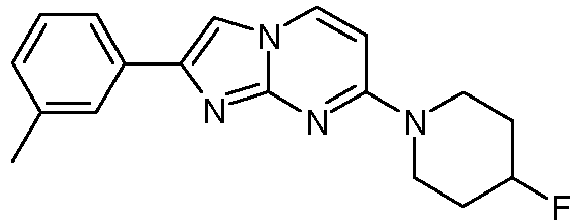
- The product was obtained starting from 4-(4-fluoropiperidin-1-yl)pyrimidin-2-amine (90 mg, 459 µmol, example 2, step 1) and 2-bromo-1-m-tolylethanone (147 mg, 688 µmol) according to the method described in example 1, step 2 as light yellow solid (100 mg, 70 %).
MS: m/z = 311.5 (M+H)+ -
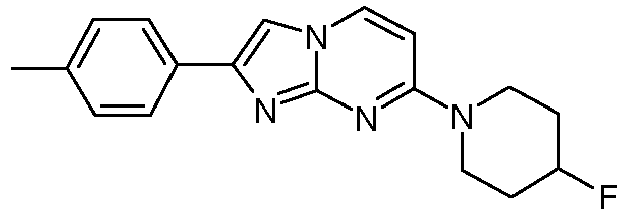
- The product was obtained starting from 4-(4-fluoropiperidin-1-yl)pyrimidin-2-amine (90 mg, 459 µmol, example 2, step 1) and 2-bromo-1-p-tolylethanone (147 mg, 688 µmol) according to the method described in example 1, step 2 as light yellow solid (107 mg, 75 %).
MS: m/z = 311.5 (M+H)+ -

- The product was obtained starting from 4-(4-fluoropiperidin-1-yl)pyrimidin-2-amine (102 mg, 514 µmol, example 2, step 1) and 2-bromo-1-(2-fluorophenyl)ethanone (167 mg, 771 µmol) according to the method described in example 6 as light yellow solid (36 mg, 22 %).
MS: m/z = 315.5 (M+H)+ -

- According to the method described in example 6 and starting from 4-(4-fluoropiperidin-1-yl)pyrimidin-2-amine (96 mg, 491 µmol, example 2, step 1) and 2-bromo-1-(3-hydroxyphenyl)ethanone (158 mg, 736 µmol) an off-white solid was obtained. To the off-white solid (188 mg) was added toluene (2.5 mL) and p-toluenesulfonic acid (12.7 mg, 11.8 µL, 73.6 µmol). The vessel was sealed and heated at 100 °C for 2 h. The reaction mixture was filtered and washed with acetone and water/ammonium hydroxide (9:1 mixture) to yield the product as off-white solid (67 mg, 43 %). MS: m/z = 313.5 (M+H)+
-

- According to the method described in example 6 and starting from 4-(4-fluoropiperidin-1-yl)pyrimidin-2-amine (90 mg, 459 µmol, example 2, step 1), 2-bromo-1-(4-(pyrrolidin-1-yl)phenyl)ethanone (184 mg, 688 µmol) and p-toluenesulfonic acid (7.9 mg, 7.38 µL, 45.9 µmol) a light yellow solid was obtained. To the light yellow solid (176 mg) was added toluene (2.5 mL) and p-toluenesulfonic acid (7.9 mg, 7.38 µL, 45.9 µmol). The vessel was sealed and heated at 100 °C for 2 h. The reaction mixture was filtered and washed with acetone and water/ammonium hydroxide (9:1 mixture) to yield the crude product. The product was obtained after purification by flash chromatography (using silica gel and a dichloromethane/methanol gradient) as light yellow solid (64 mg, 36 %). MS: m/z = 366.5 (M+H)+
-

- The product was obtained starting from 4-(4-fluoropiperidin-1-yl)pyrimidin-2-amine (97 mg, 495 µmol, example 2, step 1) and 2-bromo-1-(3-(trifluoromethoxy)phenyl)ethanone (140 mg, 495 µmol) according to the method described in example 6 and final purification by flash chromatography (using silica gel and a dichloromethane/methanol gradient) as light brown solid (81 mg, 42 %). MS: m/z = 381.6 (M+H)+
-

- A light yellow suspension of 4-chloropyrimidin-2-amine (5.01 g, 38.7 mmol), pyrrolidine (2.50 g, 2.91 ml, 35.2 mmol) and potassium carbonate (9.72 g, 70.3 mmol) in N-methyl-2-pyrrolidinone (15.0 mL) was stirred under argon at 120 °C for 2 h and at room temperature overnight. The reaction mixture was cooled to room temperature and was poured into NaOH (1 M, 200 mL) and ice. The aqueous layer was extracted with ethyl acetate (200 mL) whereof part of the product precipitated in the water phase. The precipitate was filtered, washed water, triturated with dichloromethane and dried to obtain 3.1 g product as white solid. The separated ethyl acetate phase was dried over MgSO4, filtered and concentrated in vacuum. The resulting light yellow solid was triturated with dichloromethane and dried to obtain 1.1 g product as white solid. The aqueous phase was extracted with dichloromethane (3 x 100 mL), dried over MgSO4, filtered and concentrated in vacuum. The resulting light yellow solid was triturated with dichloromethane to obtain another 0.52 g product as white solid. The dichloromethane layers were combined, concentrated in vacuum and the product was purified by flash chromatography (using silica gel and a dichloromethane/methanol/ammonia gradient) to yield another 0.46 g product as light yellow. In total 5.18 g (89.7 %) of a light yellow solid were obtained.
MS: m/z = 165.3 (M+H)+ - The product was obtained starting from 4-(pyrrolidin-1-yl)pyrimidin-2-amine (300 mg, 1.83 mmol) and 2-bromo-1-(3-hydroxyphenyl)ethanone (589 mg, 2.74 mmol) according to the method described in example 1, step 2 as light yellow solid (460 mg, 90 %).
MS: m/z = 281.1 (M+H)+ - To a light yellow solution of 3-(7-(pyrrolidin-1-yl)imidazo[1,2-a]pyrimidin-2-yl)phenol (100 mg, 357 µmol) and fluoromethyl 4-methylbenzenesulfonate (72.9 mg, 357 µmol) in DMF (1.00 mL) was added under argon cesium carbonate (151 mg, 464 µmol). The reaction mixture was heated to 70°C and stirred for 16 h. The yellow suspension was diluted with water (5 mL) and extracted with ethyl acetate (3 x 5 mL). The organic layers were combined, washed with brine, dried over MgSO4, filtered and evaporated. The product was obtained after purification by flash chromatography (using silica gel and a dichloromethane/methanol/ammonia gradient) as light yellow solid (52 mg, 46 %). MS: m/z = 313.5 (M+H)+
-

- The product was obtained starting from 3-(7-(pyrrolidin-1-yl)imidazo[1,2-a]pyrimidin-2-yl)phenol (100 mg, 357 µmol, example 16, step 2) and 1-bromo-2-fluoroethane (45.3 mg, 357 µmol) according to the method described in example 16, step 3 as light yellow solid (57 mg, 49 %). MS: m/z = 327.6 (M+H)+
-

- The product was obtained starting 4-chloropyrimidin-2-amine (3.24 g, 25.0 mmol) and dimethylamine hydrochloride (2.24 g, 27.5 mmol) and potassium carbonate (10.4 g, 75.0 mmol) according to the method described in example 2, step 1 as white solid (1.48 g, 43 %).
- The product was obtained starting from N4,N4-dimethylpyrimidine-2,4-diamine (100mg, 724 µmol) and 2-bromo-1-phenylethanone (216 mg, 1.09 mmol) according to the method described in example 1, step 2 as light brown solid (97 mg, 56 %). MS: m/z = 239.1 (M+H)+
-

- The product was obtained starting from 1-(2-fluoroethyl)piperazine hydrochloride (705 mg, 3.55 mmol), 4-chloropyrimidin-2-amine (506 mg, 3.91 mmol) and potassium carbonate (1.47 g, 10.7 mmol) in N-methyl-2-pyrrolidinone (1.5 mL) according to the method described in example 2, step 1 after overnight heating as light brown solid (642 mg, 79 %). MS: m/z = 226.6 (M+H)+
- The crude product was obtained starting from 4-(4-(2-fluoroethyl)piperazin-1-yl)pyrimidin-2-amine (156 mg, 693 µmol) and 2-bromo-1-(4-methoxyphenyl)ethanone (238 mg, 1.04 mmol) according to method described in example 6. The resulting light yellow solid was triturated with heptane. The resulting suspension was filtrated, washed and dried in vacuum to yield 243 mg of a light yellow solid. To this material was added THF (1.00 mL) and HCl (4 M solution in dioxane, 1.73 mL, 6.93 mmol). Stirring was continued at room temperature for 2 h and the suspension was filtrated, washed with THF and dried in high vacuum. To the resulting light yellow solid was added heptane/ethyl acetate (2:1 mixture) and stirring was continued at room temperature for 15 min. The suspension was filtrated and washed with tert. butyl methylether to obtain the product as light yellow solid (141 mg, 42 %). MS: m/z = 356.2 (M-HCl+H)+
-
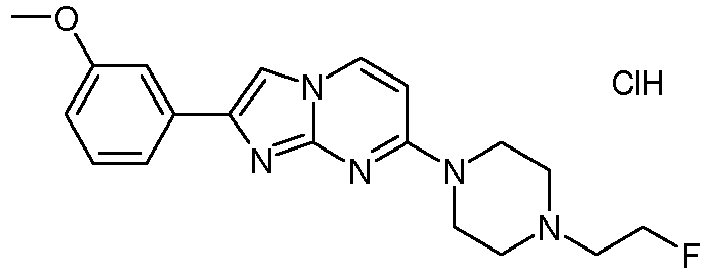
- The product was obtained starting from 4-(4-(2-fluoroethyl)piperazin-1-yl)pyrimidin-2-amine (151 mg, 670 µmol, example 19, step 1) and 2-bromo-1-(3-methoxyphenyl)ethanone (230 mg, 1.01 mmol) according to method described in example 19, step 2 as light yellow solid (114 mg, 35 %). MS: m/z = 356.2 (M-HCl+H)+
-

- The product was obtained starting from 4-chloropyrimidin-2-amine (500 mg, 3.86 mmol), 2-fluoro-N-methylethanamine hydrochloride (482 mg, 4.25 mmol) and potassium carbonate (1.6 g, 11.6 mmol) in N-methyl-2-pyrrolidinone (2.5 mL) according to the method described in example 2, step 1 and final purification by flash chromatography (using silica gel and a dichloromethane/methanol gradient) as yellow solid (263 mg, 40 %). MS: m/z = 171.3 (M+H)+
- The product was obtained starting from N4-(2-fluoroethyl)-N4-methylpyrimidine-2,4-diamine (60 mg, 353 µmol) and 2-bromo-1-phenylethanone (105 mg, 529 µmol) according to the method described in example 1, step 2 as light yellow solid (41 mg, 41 %). MS: m/z = 271.5 (M+H)+
-

- The product was obtained starting from N4-(2-fluoroethyl)-N4-methylpyrimidine-2,4-diamine (60 mg, 353 µmol, example 21, step 1) and 2-bromo-1-(3-methoxyphenyl)ethanone (121 mg, 529 µmol) according to the method described in example 1, step 2 as yellow solid (28 mg, 24 %). MS: m/z = 301.5 (M+H)+
-

- The product was obtained starting from N4-(2-fluoroethyl)-N4-methylpyrimidine-2,4-diamine (85 mg, 499 µmol, example 21, step 1) and 2-bromo-1-(4-methoxyphenyl)ethanone (172 mg, 749 µmol) according to the method described in example 1, step 2 as yellow solid (44 mg, 29 %). MS: m/z = 301.5 (M+H)+
-

- The product was obtained starting from 4-(4-(2-fluoroethyl)piperazin-1-yl)pyrimidin-2-amine (155 mg, 688 µmol, example 19, step 1) and 2-bromo-1-phenylethanone (205 mg, 1.03 mmol) according to method described in example 19, step 2 as off-white solid (57 mg, 18 %).
MS: m/z = 326.2 (M-HCl+H)+ -

- The product was obtained starting from 4-chloro-pyrimidin-2-ylamine (3 g, 23.25 mmol) and morpholine (2.25 mL, 25.6 mmol) according to the method describe in example 49, step 1 as white solid (2.7 g, 64 %). MS: m/z = 181.0 (M+H)+
- The product was obtained starting from 4-morpholin-4-yl-pyrimidin-2-ylamine (350 mg, 1.94 mmol) and 2-bromo-1-(4-methoxy-phenyl)-ethanone (667 mg, 2.91 mmol) according to the method describe in example 49, step 2 as grey solid (240 mg, 40 %). MS: m/z = 311.2 (M+H)+
-

- The product was obtained starting from 4-morpholin-4-yl-pyrimidin-2-ylamine (400 mg, 2.22 mmol, example 25, step 1) and 2-bromo-1-m-tolyl-ethanone (709 mg, 3.33 mmol) according to the method describe in example 49, step 2 as off-white solid (65 mg, 10 %).
MS: m/z = 295.0 (M+H)+ -

- The product was obtained starting from 4-morpholin-4-yl-pyrimidin-2-ylamine (400 mg, 2.22 mmol, example 25, step 1) and 2-bromo-1-(3,4-dimethoxy-phenyl)-ethanone (862 mg, 3.32 mmol) according to the method describe in example 49, step 2 as off-white solid (230 mg, 30 %). MS: m/z = 341.0 (M+H)+
-

- The product was obtained starting from 4-(pyrrolidin-1-yl)pyrimidin-2-amine (500 mg, 3.04 mmol, example 16, step 1) and 2-bromo-1-(4-hydroxyphenyl)ethanone (982 mg, 4.57 mmol) according to the method described in example 1, step 2 as yellow solid (786 mg, 90 %). MS: m/z = 281.5 (M+H)+
-

- To a light yellow solution of 4-(7-(pyrrolidin-1-yl)imidazo[1,2-a]pyrimidin-2-yl)phenol (100 mg, 357 µmol, example 28) and 1-bromo-2-fluoroethane (45.3 mg, 357 µmol) in DMF (1.00 mL) was added under argon cesium carbonate (151 mg, 464 µmol). The reaction mixture was stirred at 70 °C for 22 h. The brown suspension was diluted with water (5 mL) and extracted with dichloromethane (2 x 5 mL). The organic layers were combined washed with brine (5 mL), dried over MgSO4, filtered and evaporated. The product was obtained after purification by flash chromatography (using silica gel and a dichloromethane/methanol/ammonia gradient) as yellow solid (86 mg, 74 %). MS: m/z = 327.5 (M+H)+
-

- The product was obtained starting from 4-(7-(pyrrolidin-1-yl)imidazo[1,2-a]pyrimidin-2-yl)phenol (100 mg, 357 µmol, example 28) and fluoromethyl 4-methylbenzenesulfonate (72.9 mg, 357 µmol) according to the method described in example 29 as yellow solid (52 mg, 47 %). MS: m/z = 313.5 (M+H)+
-
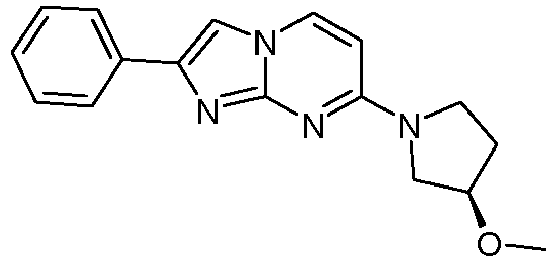
- The product was obtained starting from 4-chloropyrimidin-2-amine (255 mg, 1.97 mmol), (R)-3-methoxypyrrolidine hydrochloride (298 mg, 2.17 mmol) and potassium carbonate (816 mg, 5.91 mmol) according to the method described in example 2, step 1 and final purification by flash chromatography (using silica gel and a dichloromethane/methanol/ammonia gradient) as light yellow solid (321 mg, 84 %). MS: m/z = 195.2 (M+H)+
- The product was obtained starting from R)-4-(3-methoxypyrrolidin-1-yl)pyrimidin-2-amine (80 mg, 412 µmol, Eq: 1.00) and 2-bromo-1-phenylethanone (123 mg, 618 µmol, Eq: 1.5) according to the method described in example 1, step 2 as yellow solid (63 mg, 52 %).
MS: m/z = 295.8 (M+H)+ -

- The product was obtained starting from 4-chloropyrimidin-2-amine (360 mg, 2.78 mmol), (S)-3-methoxypyrrolidine (309 mg, 3.06 mmol) and potassium carbonate (768 mg, 5.56 mmol) according to the method described in example 2, step 1 and final purification by flash chromatography (using silica gel and a dichloromethane/methanol/ammonia gradient) as yellow solid (288 mg, 52 %). MS: m/z = 195.2 (M+H)+
- The product was obtained starting from (S)-4-(3-methoxypyrrolidin-1-yl)pyrimidin-2-amine (70 mg, 360 µmol) and 2-bromo-1-phenylethanone (108 mg, 541 µmol) according to the method described in example 1, step 2 as yellow solid (11 mg, 9 %). MS: m/z = 295.5 (M+H)+
-

- The product was obtained starting from 4-chloropyrimidin-2-amine (250 mg, 1.93 mmol), (R)-3-fluoropyrrolidine hydrochloride (242 mg, 1.93 mmol) and potassium carbonate (533 mg, 3.86 mmol) according to the method described in example 2, step 1 and final trituration with dichloromethane as light yellow solid (192 mg, 54 %). MS: m/z = 183.2 (M+H)+
- The product was obtained starting from (R)-4-(3-fluoropyrrolidin-1-yl)pyrimidin-2-amine (80.0 mg, 439 µmol) and 2-bromo-1-(4-methoxyphenyl)ethanone (151 mg, 659 µmol) according to the method described in example 1, step 2 as light yellow solid (89 mg, 65 %).
MS: m/z = 313.6 (M+H)+ -

- The product was obtained starting from 4-chloropyrimidin-2-amine (360 mg, 2.78 mmol), (S)-3-fluoropyrrolidine hydrochloride (349 mg, 2.78 mmol) and potassium carbonate (768 mg, 5.56 mmol) according to the method described in example 2, step 1 and final trituration with dichloromethane as off-white solid (319 mg, 63 %). MS: m/z = 183.2 (M+H)+
- The product was obtained starting from (S)-4-(3-fluoropyrrolidin-1-yl)pyrimidin-2-amine (70 mg, 384 µmol) and 2-bromo-1-(4-methoxyphenyl)ethanone (132 mg, 576 µmol) according to the method described in example 1, step 2 as light yellow solid (77 mg, 64 %).
MS: m/z = 313.5 (M+H)+ -
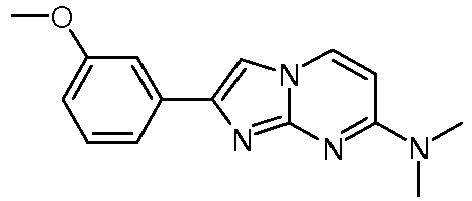
- The product was obtained starting from N4,N4-dimethylpyrimidine-2,4-diamine (100 mg, 724 µmol, example 18, step 1) and 2-bromo-1-(3-methoxyphenyl)ethanone (249 mg, 1.09 mmol) according to the method described in example 1, step 2 as red solid (118 mg, 61 %).
MS: m/z = 269.1 (M+H)+ -

- The product was obtained starting from N4,N4-dimethylpyrimidine-2,4-diamine (100 mg, 724 µmol, example 18, step 1) and 2-bromo-1-(4-methoxyphenyl)ethanone (249 mg, 1.09 mmol) according to the method described in example 1, step 2 as yellow solid (102 mg, 53 %).
MS: m/z = 269.1 (M+H)+ -
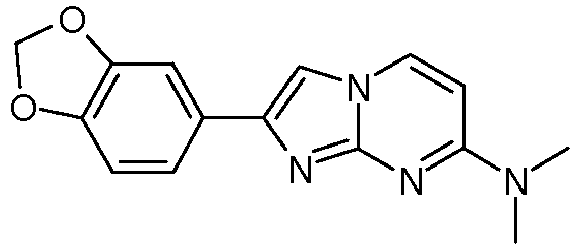
- The product was obtained starting from N4,N4-dimethylpyrimidine-2,4-diamine (100 mg, 724 µmol, example 18, step 1) and 1-(benzo[d][1,3]dioxol-5-yl)-2-bromoethanone (264 mg, 1.09 mmol) according to the method described in example 1, step 2 as off-white solid (127 mg, 62 %). MS: m/z = 283.1 (M+H)+
-

- The product was obtained starting from N4,N4-dimethylpyrimidine-2,4-diamine (100 mg, 724 µmol, example 18, step 1) and 2-bromo-1-(2,3-dihydrobenzo[b][1,4]dioxin-6-yl)ethanone (279 mg, 1.09 mmol) according to the method described in example 1, step 2 as yellow solid (140 mg, 65 %). MS: m/z = 297.3 (M+H)+
-

- The product was obtained starting from N4,N4-dimethylpyrimidine-2,4-diamine (100 mg, 724 µmol, example 18, step 1) and 2-bromo-1-p-tolylethanone (231 mg, 1.09 mmol) according to the method described in example 1, step 2 as yellow solid (86 mg, 47 %). MS: m/z = 253.1 (M+H)+
-

- The product was obtained starting from N4,N4-dimethylpyrimidine-2,4-diamine (100 mg, 724 µmol, example 18, step 1) and 2-bromo-1-m-tolylethanone (462 mg, 2.18 mmol) according to the method described in example 1, step 2 as white solid (117 mg, 64 %).
MS: m/z = 253.1 (M+H)+ -

- The product was obtained starting from 4-morpholin-4-yl-pyrimidin-2-ylamine (400 mg, 2.22 mmol, example 25, step 1) and 2-bromo-1-(3-methoxy-phenyl)-ethanone (763 mg, 3.33 mmol) according to the method described in example 49, step 2 as off-white solid (70 mg, 10 %). MS: m/z = 311.0 (M+H)+
-
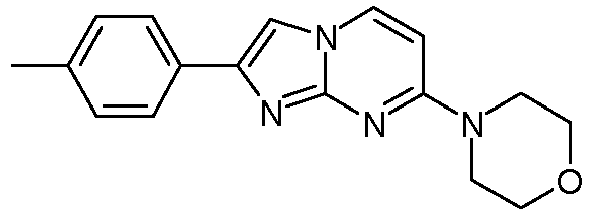
- The product was obtained starting from 4-morpholin-4-yl-pyrimidin-2-ylamine (400 mg, 2.22 mmol, example 25, step 1) and 2-bromo-1-p-tolyl-ethanone (709 mg, 3.33 mmol) according to the method described in example 49, step 2 as white solid (230 mg, 35 %).
MS: m/z = 294.8 (M+H)+ -
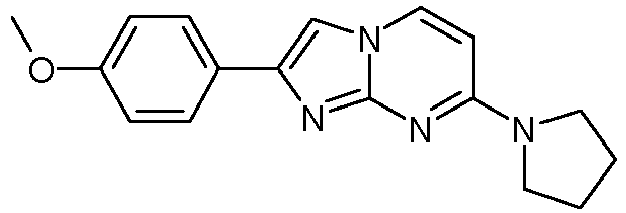
- The product was obtained starting from 4-pyrrolidin-1-yl-pyrimidin-2-amine (400 mg, 2.22 mmol, example 16, step 1) and 2-bromo-1-(4-methoxy-phenyl)-ethanone (762 mg, 3.33 mmol) according to the method described in example 49, step 2 as light brown solid (65 mg, 10 %). MS: m/z = 295.0 (M+H)+
-

- The product was obtained starting from 4-pyrrolidin-1-yl-pyrimidin-2-amine (450 mg, 2.49 mmol, example 16, step 1) and 2-bromo-1-p-tolyl-ethanone (797 mg, 3.74 mmol) according to the method described in example 49, step 2 as off-white solid (130 mg, 19 %).
MS: m/z = 279.0 (M+H)+ -

- The product was obtained starting from N4,N4-dimethylpyrimidine-2,4-diamine (100 mg, 724 µmol, example 18, step 1) and 2-bromo-1-(4-morpholinophenyl)ethanone (308 mg, 1.09 mmol) according to the method described in example 1, step 2 as yellow solid (116 mg, 50 %).
MS: m/z = 324.2 (M+H)+ -
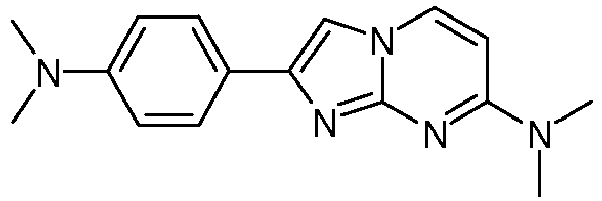
- The product was obtained starting from N4,N4-dimethylpyrimidine-2,4-diamine (100 mg, 724 µmol, example 18, step 1) and 2-bromo-1-(4-(dimethylamino)phenyl)ethanone (263 mg, 1.09 mmol) according to the method described in example 1, step 2 as yellow solid (138 mg, 68 %). MS: m/z = 282.8 (M+H)+
-
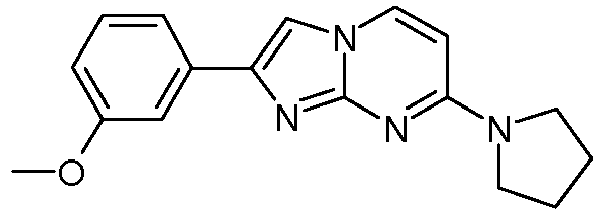
- The product was obtained starting from 4-pyrrolidin-1-yl-pyrimidin-2-amine (300 mg, 1.66 mmol, example 16, step 1) and 2-bromo-1-(3-methoxy-phenyl)-ethanone (572 mg, 2.49 mmol) according to the method described in example 49, step 2 as off-white solid (30 mg, 6 %).
MS: m/z = 295.0 (M+H)+ -

- The product was obtained starting from 4-pyrrolidin-1-yl-pyrimidin-2-amine (300 mg, 1.66 mmol, example 16, step 1) and 2-bromo-1-m-tolyl-ethanone (532 mg, 2.49 mmol) according to the method described in example 49, step 2 as off-white solid (30 mg, 6 %).
MS: m/z = 278.8 (M+H)+ -

- A mixture of 4-chloro-pyrimidin-2-ylamine (4 g, 31 mmol), piperidine (2.9 mL, 34.1 mmol), potassium carbonate (6.42 g, 46.5 mmol) and N-methyl-2-pyrrolidinone (8 mL) was heated in a sealed tube at 120 °C for 12 h. After cooling down to room temperature, the reaction mixture was poured into NaOH (1M aqueous solution, 120 mL) and extracted with dichloromethane (3 x 150 mL). The combined organic layers were dried over anhydrous Na2SO4, filtered, and concentrated in vacuum. The product was obtained after purification by flash chromatography (using silica gel and a dichloromethane/methanol gradient) as off-white solid (3 g, 54 %).
MS: m/z = 179.0 (M+H)+ - To a solution of 4-piperidin-1-yl-pyrimidin-2-ylamine (400 mg, 2.24 mol) in acetone (10 mL) was added under nitrogen 2-bromo-1-(4-methoxy-phenyl)-ethanone (763 mg, 3.33 mmol) and p-toluenesulfonic acid (catalytic amount) at 25 °C. The reaction mixture was stirred at 65 °C for 12 h. All volatiles were removed under reduced pressure. The residue was partitioned between water and dichloromethane, and the aqueous phase was extracted with dichloromethane (3 x 150 mL). The combined organic layers were dried over anhydrous Na2SO4, filtered, and concentrated under reduced pressure. The product was obtained after purification by flash chromatography (using silica gel and a dichloromethane/methanol gradient) as off-white solid (20 mg, 3 %). MS: m/z = 308.8 (M+H)+
-

- The product was obtained starting from 4-piperidin-1-yl-pyrimidin-2-ylamine (350 mg, 1.96 mmol, example 49, step 1) and 2-bromo-1-(3-methoxy-phenyl)-ethanone (676 mg, 2.94 mmol) according to the method described in example 49, step 2 as off-white solid (45 mg, 7 %).
MS: m/z = 309.3 (M+H)+ -

- The product was obtained starting from 4-piperidin-1-yl-pyrimidin-2-ylamine (400 mg, 2.24 mmol, example 49, step 1) and 2-bromo-1-p-tolyl-ethanone (718mg, 3.37mmol) according to the method described in example 49, step 2 as off-white solid (200 mg, 30 %).
MS: m/z = 293.0 (M+H)+ -

- The product was obtained starting from 4-piperidin-1-yl-pyrimidin-2-ylamine (350 mg, 1.96 mmol, example 49, step 1) and 2-bromo-1-m-tolyl-ethanone (628 mg, 2.95 mmol) according to the method described in example 49, step 2 as off-white solid (25 mg, 4 %).
MS: m/z = 293.3 (M+H)+ -
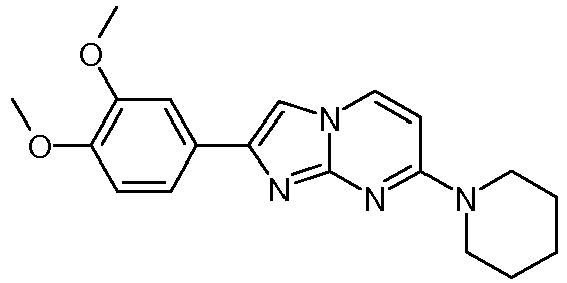
- The product was obtained starting from 4-piperidin-1-yl-pyrimidin-2-ylamine (250 mg, 1.40 mmol, example 49, step 1) and 2-bromo-1-(3,4-dimethoxy-phenyl)-ethanone (545 mg, 2.10 mmol) according to the method described in example 49, step 2 as off-white solid (49 mg, 10 %).
-
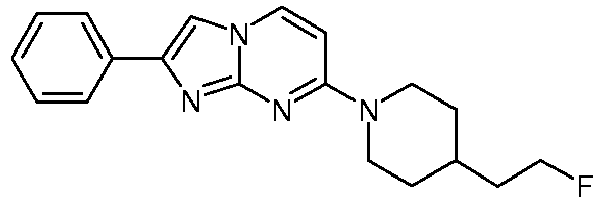
- To a solution of 2-(piperidin-4-yl)ethanol (2.42 g, 18.7 mmol) in dichloromethane (24 mL) was added under nitrogen at 0 °C di-tert-butyl dicarbonate (4.09 g, 4.35 mL, 18.7 mmol). There was a strong gas evolution! The solution was stirred at 0 °C for 15 min and at room temperature for 4 h. The reaction mixture was washed with water (50 mL), potassium hydrogen sulfate (10% aqueous solution, 50 mL) and brine (50 mL). The aqueous layers were back-extracted with dichloromethane (50 mL). The combined organic layers were dried over sodium sulfate to yield colorless oil (4.1 g, 95 %). MS: m/z = 230.5 (M+H)+
- To a solution of tert-butyl 4-(2-hydroxyethyl)piperidine-1-carboxylate (2.22 g, 9.7 mmol) in dichloromethane (20 mL) was added dropwise between 0 - 8 °C diethylaminosulfur trifluoride (1.72 g, 1.41 mL, 10.7 mmol) under nitrogen. The solution was stirred at 0 °C for 1 h and at room temperature for another 2 h. The reaction mixture was diluted with ethyl acetate (50 mL) and was washed with sodium carbonate (1 M aqueous solution, 50 mL), water (50 mL) and brine (50 mL). The aqueous layers were back-extracted with ethyl acetate (50 mL). The combined organic layers were dried over sodium sulfate, filtrated and evaporated. The product was obtained after purification by flash chromatography (using silica gel and a heptane/ethyl acetate gradient) as colorless liquid (1.26 g, 56 %). MS: m/z = 231 (M)+
- A suspension of tert-butyl 4-(2-fluoroethyl)piperidine-1-carboxylate (1.21 g, 5.23 mmol) in hydrochloric acid (4 M in dioxane, 5.23 mL, 20.9 mmol) was stirred at room temperature for 2 h. The solution was concentrated in vacuum and dried on high vacuum to yield the product as white solid (906 mg, 100 %). MS: m/z = 132.2 (M-HCl+H)+
- The product was obtained starting from 4-chloro-pyrimidin-2-ylamine (4 g, 31 mmol), 4-(2-fluoro-ethyl)-piperidine, hydrochloride (5.7 g, 34.1 mmol) and potassium carbonate (6.4 g, 46.5 mmol) according to the method described in example 49, step 1 as light yellow sticky solid (5.4 g, 78 %). MS: m/z = 225.0 (M+H)+
- The product was obtained starting from 4-[4-(2-fluoro-ethyl)-piperidin-1-yl]-pyrimidin-2-ylamine (250 mg, 1.11 mmol) and 2-bromo-1-phenyl-ethanone (332 mg, 1.67 mmol) according to the method described in example 49, step 2 and final purification by preparative HPLC (using Reprosil Gold, 250 x 20 mm, 5µ/C18, methanol/10 mM ammonium acetate in water) as off-white solid (90 mg, 25 %). MS: m/z = 325.3 (M+H)+
-

- The product was obtained starting from 4-[4-(2-fluoro-ethyl)-piperidin-1-yl]-pyrimidin-2-ylamine (250 mg, 1.11 mmol, example 54, step 4) and 2-bromo-1-(3-methoxy-phenyl)-ethanone (383 mg, 1.67 mmol) according to the method described in example 54, step 5 as off-white solid (30 mg, 8 %). MS: m/z = 355.1 (M+H)+
-

- The product was obtained starting from 4-[4-(2-fluoro-ethyl)-piperidin-1-yl]-pyrimidin-2-ylamine (300 mg, 1.34 mmol, example 54, step 4) and 2-bromo-1-(4-methoxy-phenyl)-ethanone (460 mg, 2.0 mmol) according to the method described in example 49, step 2 and final purification by preparative HPLC (using Xterra RP18, 250 x 19 mm, 10µ/C18, acetonitrile/0.1% ammonia in water) as off-white solid (60 mg, 13 %). MS: m/z = 355.2 (M+H)+
-

- The product was obtained starting from 4-[4-(2-fluoro-ethyl)-piperidin-1-yl]-pyrimidin-2-ylamine (250 mg, 1.11 mmol, example 54, step 4) and 1-benzo[1,3]dioxol-5-yl-2-bromo-ethanone (406 mg, 1.67 mmol) according to the method described in example 54, step 5 as off-white solid (20 mg, 5 %). MS: m/z = 369.1 (M+H)+
-

- The product was obtained starting from 4-[4-(2-fluoro-ethyl)-piperidin-1-yl]-pyrimidin-2-ylamine (250 mg, 1.11 mmol, example 54, step 4) and 2-bromo-1-(2,3-dihydro-benzo[1,4]dioxin-6-yl)-ethanone (430 mg, 1.67 mmol) according to the method described in example 54, step 5 as off-white solid (110 mg, 26 %). MS: m/z = 383.2 (M+H)+
-
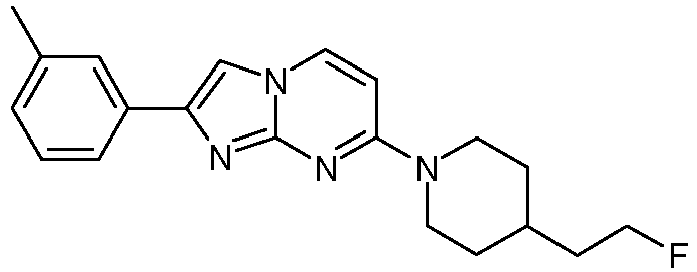
- The product was obtained starting from 4-[4-(2-fluoro-ethyl)-piperidin-1-yl]-pyrimidin-2-ylamine (250 mg, 1.11 mmol, example 54, step 4) and 2-bromo-1-m-tolyl-ethanone (356 mg, 1.67 mmol) according to the method described in example 54, step 5 as off-white solid (90 mg, 24 %). MS: m/z = 339.1 (M+H)+
-
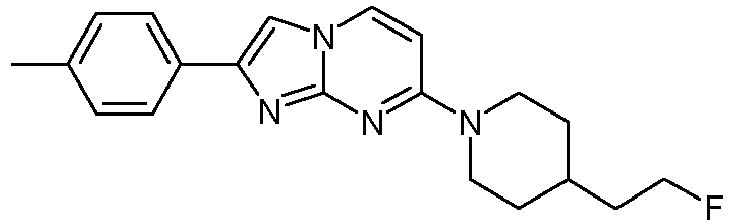
- The product was obtained starting from 4-[4-(2-fluoro-ethyl)-piperidin-1-yl]-pyrimidin-2-ylamine (300 mg, 1.34 mmol, example 54, step 4) and 2-bromo-1-p-tolyl-ethanone (427 mg, 2.00 mmol) according to the method described in example 54, step 5 as off-white solid (15 mg, 3 %). MS: m/z = 339.3 (M+H)+
-

- The product was obtained starting from 4-[4-(2-fluoro-ethyl)-piperidin-1-yl]-pyrimidin-2-ylamine (250 mg, 1.11 mmol, example 54, step 4) and 2-bromo-1-(4-morpholin-4-yl-phenyl)-ethanone (474 mg, 1.67 mmol) according to the method described in example 54, step 5 as off-white solid (30 mg, 6 %). MS: m/z = 410.2 (M+H)+
-

- The product was obtained starting from N4-methylpyrimidine-2,4-diamine (30.0 mg, 242 µmol, example 1, step 1) and 2-bromo-1-m-tolylethanone (77.2 mg, 362 µmol) according to the method described in example 1, step 2 as light yellow solid (18 mg, 31 %). MS: m/z = 239.4 (M+H)+
-
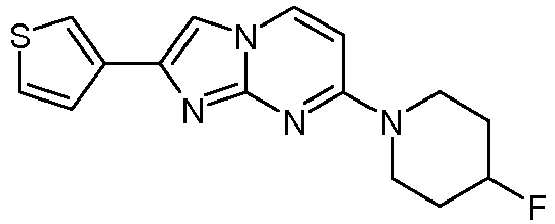
- To a light yellow solution of 4-(4-fluoropiperidin-1-yl)pyrimidin-2-amine (50 mg, 255 µmol, example 2, step 1) and 2-bromo-1-(thiophen-3-yl)ethanone (57.5 mg, 280 µmol) in acetone (1 mL) was added at room temperature p-toluenesulfonic acid monohydrate (48.5 mg, 255 µmol) and the mixture was stirred at 60 °C for 48 h. The solvent was removed in vacuum and the residue was stirred in NaHCO3 (saturated aqueous solution, 5mL). The mixture was extracted with dichloromethane (3 x 15 mL). The organic layers were combined, dried over MgSO4, filtered and evaporated. The product was obtained after purification by flash chromatography (using silica gel and an ethyl acetate/methanol gradient) and subsequent preparative HPLC (using Gemini 5µ C18, 50 x 21.2 mm, 5µ/C18, acetonitrile/0.1% triethylamine in water) as white solid (2.4 mg, 3 %). MS: m/z = 303.5 (M+H)+
-

- A light yellow solution of 4-chloropyrimidin-2-amine (2.0 g, 15.4 mmol) and 2-bromo-1-(4-methoxyphenyl)ethanone (5.3 g, 23.2 mmol) in acetone (94.0 mL) was stirred at 65 °C for 16 h. The reaction mixture was filtered and washed with acetone (∼20 mL) and the resulting yellow solid was dried at high vacuum for 4 h. The crude product was poured into NaHCO3 (saturated aqueous solution, 200 mL) and extracted with ethyl acetate (6 x 100 mL). The organic layers were combined, dried over MgSO4, filtered and evaporated. The mixture of products was obtained after purification by flash chromatography (using silica gel and ethyl acetate) as a light yellow solid (245 mg, 5 %). MS: m/z = 260.0 & 304.0 (M+H)+
- A mixture of 7-chloro-2-(4-methoxyphenyl)imidazo[1,2-a]pyrimidine and 7-bromo-2-(4-methoxyphenyl)imidazo[1,2-a]pyrimidine (50 mg, 193 µmol related to chloride) was combined with DMSO (1.0 mL) under nitrogen to give an off-white suspension. 2-(2-Fluoroethoxy)-N-methylethanamine hydrochloride (36.4 mg, 231 µmol) and diisopropylethylamine, (99.5 mg, 131 µL, 770 µmol) were added and the reaction mixture was stirred at 130 °C for 3 h. The brown solution was diluted with water (5 mL) and extracted with dichloromethane (3 x 5 mL). The organic layers were combined, washed with brine (5 mL), dried over MgSO4, filtered and evaporated. The product was obtained after purification by flash chromatography (using silica gel amine phase and a heptane/ethyl acetate gradient) as yellow solid (45 mg, 67 %).
MS: m/z = 345.5 (M+H)+ -

- The product was obtained starting from 7-chloro-2-(4-methoxyphenyl)imidazo[1,2-a]pyrimidine and 7-bromo-2-(4-methoxyphenyl)imidazo[1,2-a]pyrimidine (50 mg, 193 µmol related to chloride, example 64, step 1) and 2-azaspiro[3.3]heptane hydrochloride (25.7 mg, 193 µmol) according to the method described in example 64, step 2 as light yellow solid (14 mg, 22 %). MS: m/z = 321.5 (M+H)+
-
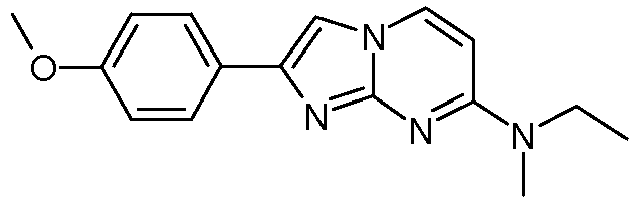
- The product was obtained starting from 7-chloro-2-(4-methoxyphenyl)imidazo[1,2-a]pyrimidine and 7-bromo-2-(4-methoxyphenyl)imidazo[1,2-a]pyrimidine (50 mg, 193 µmol related to chloride, example 64, step 1) and N-methylethanamine (11.4 mg, 193 µmol) according to the method described in example 64, step 2 as yellow solid (10 mg, 18 %).
MS: m/z = 283.5 (M+H)+ -

- The product was obtained starting from 7-chloro-2-(4-methoxyphenyl)imidazo[1,2-a]pyrimidine and 7-bromo-2-(4-methoxyphenyl)imidazo[1,2-a]pyrimidine (50 mg, 193 µmol related to chloride, example 64, step 1) and diethylamine (21.2 mg, 30 µl, 290 µmol) according to the method described in example 64, step 2 as yellow solid (26 mg, 45 %). MS: m/z = 297.2 (M+H)+
-

- The product was obtained starting from 4-chloropyrimidin-2-amine (1.0 g, 7.72 mmol) and 2-bromo-1-m-tolylethanone (2.47 g, 11.6 mmol) according to the method described in example 1, step 2 as brown solid (535 mg, 25 %). MS: m/z = 244.4 (M+H)+
- The product was obtained starting from 7-chloro-2-m-tolylimidazo[1,2-a]pyrimidine (50 mg, 205 µmol) and 2-(2-fluoroethoxy)-N-methylethanamine hydrochloride (38.8 mg, 246 µmol) according to the method described in example 64, step 2 and subsequent preparative TLC (using silica gel 1 mm and ethyl acetate) as light brown oil solid (18 mg, 27 %). MS: m/z = 329.5 (M+H)+
-

- A microwave vial was charged with 4-chloropyrimidin-2-amine (0.300 g, 2.32 mmol), azetidine (271 mg, 0.32 ml, 4.75 mmol), N,N-diisopropylethylamine (363 mg, 0.49 ml, 2.81 mmol) and methanol (3.0 mL). The vial was flushed with argon, closed and stirred at 60°C (oil bath temperature) for 2 h. The reaction mixture was cooled to room temperature and concentrated. The residue (pale yellow solid) was suspended in water, filtered and rinsed with water. The product was obtained after drying of the residue under high vacuum as off-white powder (287 mg, 82 %). MS: m/z = 151.4 (M+H)+
- A microwave vial was charged with 4-(azetidin-1-yl)pyrimidin-2-amine (0.050 g, 333 µmol), 2-bromo-1-(4-methoxyphenyl)ethanone (80 mg, 349 µmol) and Acetone (0.6 mL). The vial was flushed with argon and closed. The reaction mixture was stirred at 70 °C (= oil bath temperature) overnight, cooled to room temperature and extracted with dichloromethane and saturated Na2CO3-solution. The aqueous layer was extracted twice with dichloromethane. The organic layers were combined, dried over Na2SO4, filtered and concentrated. The product was obtained after trituration of the residue (light yellow solid) with ethyl acetate and a few drops of methanol as off-white powder (72 mg, 77 %). MS: m/z = 281.5 (M+H)+
-

- The product was obtained starting from 4-chloropyrimidin-2-amine (0.400 g, 3.09 mmol) and 3-fluoroazetidine hydrochloride (379 mg, 3.4 mmol) according to the method described in example 69, step 1 as off-white powder (257 mg, 50 %). MS: m/z = 169.3 (M+H)+
- A microwave vial was charged with 4-(3-fluoroazetidin-1-yl)pyrimidin-2-amine (0.050 g, 297 µmol), 2-bromo-1-(4-methoxyphenyl)ethanone (72 mg, 314 µmol) and acetone (0.5 mL). The vial was flushed with argon and closed. The reaction mixture was stirred at 70°C (= oil bath temperature) overnight, cooled to room temperature, diluted with acetone (∼0.5ml) and water (1 mL) and basified with ammonium hydroxide solution (∼25 %, ∼0.5 mL). The suspension was stirred at room temperature for 5 min, filtered and washed with water and acetone. The product was obtained after drying of the residue under high vacuum as off-white solid (41 mg, 46.2 %). MS: m/z = 299.4 (M+H)+
-
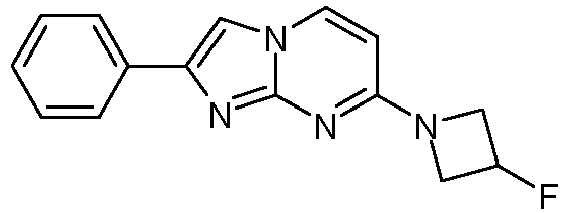
- The product was obtained starting from 4-(3-fluoroazetidin-1-yl)pyrimidin-2-amine (50 mg, 297 µmol, example 70, step 1) and 2-bromo-1-phenylethanone (63 mg, 317 µmol) according to the method described in example 69, step 2 as off-white powder (45 mg, 56 %).
MS: m/z = 269.4 (M+H)+ -

- The product was obtained starting from 4-(3-fluoroazetidin-1-yl)pyrimidin-2-amine (50 mg, 297 µmol, example 70, step 1) and 2-bromo-1-m-tolylethanone (72 mg, 321 µmol) according to the method described in example 69, step 2 as light yellow powder (39 mg, 46 %).
MS: m/z = 283.5 (M+H)+ -

- The product was obtained starting from 4-(4-fluoropiperidin-1-yl)pyrimidin-2-amine (50 mg, 255 µmol, example 2, step 1) and 1-(benzofuran-2-yl)-2-bromoethanone (67.0 mg, 280 µmol) according to the method described in example 63 after single purification by flash chromatography as off-white solid (31 mg, 36 %). MS: m/z = 337.6 (M+H)+
-
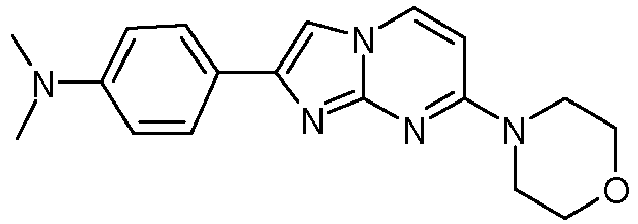
- The product was obtained starting from 4-morpholin-4-yl-pyrimidin-2-ylamine (120 mg, 666 µmol, example 25, step 1) and 2-bromo-1-(4-(dimethylamino)phenyl)ethanone (161 mg, 666 µmol) according to the method described in example 1, step 2 as light yellow solid (19 mg, 8 %). MS: m/z = 324.5 (M+H)+
-

- A suspension of 4-(4-fluoropiperidin-1-yl)pyrimidin-2-amine (74 mg, 377 µmol, example 2, step 1), 1-(benzo[b]thiophen-2-yl)-2-bromoethanone (144 mg, 566 µmol) and NaHCO3 (47.5 mg, 566 µmol) in methanol (1.5 mL) was stirred at 76 °C under argon for 3 h, cooled to room temperature and poured to NaOH (1N aqueous solution). The mixture was extracted twice with dichloromethane. The organic layers were combined, dried over Na2SO4, filtered and concentrated. The product was obtained after purification by flash chromatography (using silica gel amine phase and a heptane/ethyl acetate gradient) as light brown solid (85 mg, 64 %). MS: m/z = 353.4 (M+H)+
-

- To a suspension of 4-chloropyrimidin-2-amine (0.300 g, 2.32 mmol) and potassium carbonate (640 mg, 4.63 mmol) in DMF(3.0 mL) was added cyclopropylamine (1207 mg, 1.49 ml, 21.15 mmol) and the reaction mixture was stirred at 100 °C (= oil bath temperature) overnight. The reaction mixture was cooled to room temperature and extracted with ethyl acetate and water and the aqueous layer was back-extracted with ethyl acetate. The organic layers were washed three times with water and once with brine. The organic layers were combined, dried over Na2SO4, filtered and concentrated. The product was obtained after trituration of the residue (yellow solid) with diethyl ether as off-white solid (193 mg, 55 %). MS: m/z = 151.4 (M+H)+
- The product was obtained starting from N4-cyclopropylpyrimidine-2,4-diamine (50 mg, 333 µmol) and 2-bromo-1-(4-methoxyphenyl)ethanone (81 mg, 354 µmol) according to the method described in example 69, step 2 as light yellow solid (43 mg, 41 %). MS: m/z = 281.5 (M+H)+
-

- A microwave vial was charged with 4-chloropyrimidin-2-amine (300 mg, 2.32 mmol), isopropylamine (828 mg, 1.2 ml, 14.0 mmol) and water (1.0 mL). The vial was flushed with argon, closed and stirred at 180 °C for 30 min under microwave irradiation (caution: the pressure reached >20 bar!). The reaction mixture was cooled to room temperature and extracted with dichloromethane and water. The organic layer was washed with water and the aqueous layers were back-extracted with dichloromethane. The organic layers were combined, dried over Na2SO4, filtered and concentrated. The product was obtained after triturating the residue with diethyl ether and a few drops of ethyl acetate as off-white solid (282 mg, 80 %).
MS: m/z = 153.4 (M+H)+ - The product was obtained starting from N4-isopropylpyrimidine-2,4-diamine (0.050 g, 329 µmol) and 2-bromo-1-(4-methoxyphenyl)ethanone (79 mg, 345 µmol) according to the method described in example 69, step 2 and final purification by flash chromatography (using silica gel and a dichloromethane/methanol gradient) as light yellow solid (59 mg, 64 %).
MS: m/z = 283.5 (M+H)+ -

- The product was obtained starting from 4-chloropyrimidin-2-amine (300 mg, 2.32 mmol) and 2,2,2-trifluoroethylamine (1.26 g, 1.0 ml, 12.7 mmol) according to the method described in example 77, step 1 without final trituration as light yellow solid (121 mg, 26 %).
- The product was obtained starting from N4-(2,2,2-trifluoroethyl)pyrimidine-2,4-diamine (0.055 g, 272 µmol) and 2-bromo-1-(4-methoxyphenyl)ethanone (66 mg, 288 µmol) according to the method described in example 69, step 2 as light yellow solid (47 mg, 54 %).
MS: m/z = 323.4 (M+H)+ -

- A microwave vial was charged with 4-(4-fluoropiperidin-1-yl)pyrimidin-2-amine (50 mg, 255 µmol) and MeOH (849 µl) and stirred for 5 min to give a colorless solution. 1-(Benzo[d]thiazol-2-yl)-2-bromoethanone (91.4 mg, 357 µmol) and sodium bicarbonate (21.4 mg, 255 µmol) were added, the vial was sealed and the reaction mixture was stirred at 76 °C for 3 h. The solvent was evaporated and the residue was diluted with 1 M NaOH and extracted with dichloromethane. The organic phase was dried over MgSO4 and concentrated under reduced pressure. The product was obtained after purification by flash chromatography (using silica gel and a dichloromethane/methanol/ammonia gradient) as orange powder (67 mg, 74 %).
MS: m/z = 354.5 (M+H)+ -

- A microwave vial was charged with 4-(azetidin-1-yl)pyrimidin-2-amine (70 mg, 466 µmol, example 69, step 1), 2-bromo-1-(4-hydroxyphenyl)ethanone (105 mg, 489 µmol) and acetone (0.70 mL). The vial was flushed with argon, closed and stirred at 70°C (= oil bath temperature) overnight. The reaction mixture was cooled to room temperature and then diluted with dichloromethane and saturated NaHCO3-solution whereof a precipitate formed in the aqueous layer. The aqueous layer was filtered, rinsing with water and ethyl acetate and the product was obtained after drying of the residue under high vacuum as light yellow solid (115 mg, 93 %). MS: m/z = 267.5 (M+H)+
-

- The product was obtained starting from 4-chloropyrimidin-2-amine (300 mg, 2.32 mmol), 3-methoxyazetidine hydrochloride (572 mg, 4.63 mmol) and N,N-diisopropylethylamine (888 mg, 1.2 ml, 6.87 mmol) according to the method described in example 77, step 1 after final trituration with ethyl acetate as light yellow solid (179 mg, 43 %). MS: m/z = 181.4 (M+H)+
- The product was obtained starting from 4-(3-methoxyazetidin-1-yl)pyrimidin-2-amine (0.050 g, 277 µmol) and 2-bromo-1-(4-methoxyphenyl)ethanone (67 mg, 292 µmol) according to the method described in example 69, step 2 and final purification by flash chromatography (using silica gel and a dichloromethane/methanol gradient) as light yellow solid (54 mg, 63 %). MS: m/z = 311.5 (M+H)+
-

- The product was obtained starting from N4-methylpyrimidine-2,4-diamine (50 mg, 403 µmol, example 1, step 1) and 2-bromo-1-p-tolylethanone (129 mg, 604 µmol) according to the method described in example 1, step 2 as off-white solid (38 mg, 40 %). MS: m/z = 239.5 (M+H)+
-

- The product was obtained starting from N4-methylpyrimidine-2,4-diamine (200 mg, 1.61 mmol, example 1, step 1) and 2-bromo-1-(4-methoxyphenyl)ethanone (554 mg, 2.42 mmol) according to the method described in example 1, step 2 as yellow solid (284 mg, 69 %).
MS: m/z = 255.5 (M+H)+ -
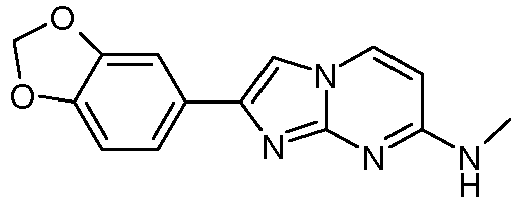
- The product was obtained starting from N4-methylpyrimidine-2,4-diamine (50 mg, 403 µmol, example 1, step 1) and 1-(benzo[d][1,3]dioxol-5-yl)-2-bromoethanone (147 mg, 604 µmol) according to the method described in example 1, step 2 as light yellow solid (57 mg, 53 %). MS: m/z = 269.4 (M+H)+
-

- The product was obtained starting from N4,N4-dimethylpyrimidine-2,4-diamine (100 mg, 724 µmol, example 18, step 1) and 2-bromo-1-(thiophen-3-yl)ethanone (223 mg, 1.09 mmol) according to the method described in example 75 as light yellow solid (40 mg, 23 %).
MS: m/z = 245.4 (M+H)+ -

- The product was obtained starting from N4-(2-fluoroethyl)-N4-methylpyrimidine-2,4-diamine (50 mg, 294 µmol, example 21, step 1) and 2-bromo-1-p-tolylethanone (93.9 mg, 441 µmol) according to the method described in example 1, step 2 as white solid (5.4 mg, 6 %).
MS: m/z = 285.5 (M+H)+ -

- The product was obtained starting from N4-(2-fluoroethyl)-N4-methylpyrimidine-2,4-diamine (50 mg, 294 µmol, example 21, step 1) and 1-(benzo[d][1,3]dioxol-5-yl)-2-bromoethanone (107 mg, 441 µmol) according to the method described in example 1, step 2 as light yellow solid (43 mg, 44 %). MS: m/z = 315.4 (M+H)+
-

- The product was obtained starting from N4-(2-fluoroethyl)-N4-methylpyrimidine-2,4-diamine (50 mg, 294 µmol, example 21, step 1) and 2-bromo-1-m-tolylethanone (93.9 mg, 441 µmol) according to the method described in example 1, step 2 as light brown solid (5 mg, 5 %). MS: m/z = 285.5 (M+H)+
-

- The product was obtained starting from 4-chloropyrimidin-2-amine (0.240 g, 1.85 mmol), 3-methylazetidine benzenesulfonate (680 mg, 2.96 mmol) and N,N-diisopropylethylamine (666 mg, 0.90 ml, 5.15 mmol) according to the method described in example 77, step 1 and final trituration with very little ethyl acetate as light yellow solid (112 mg, 33 %).
MS: m/z = 165.4 (M+H)+ - The product was obtained starting from 4-(3-methylazetidin-1-yl)pyrimidin-2-amine (0.055 g, 301 µmol) and 2-bromo-1-(4-methoxyphenyl)ethanone (76 mg, 332 µmol) according to the method described in example 69, step 2 and final purification by flash chromatography (using silica gel and a dichloromethane/methanol gradient) as light yellow solid (68 mg, 77 %). MS: m/z = 295.5 (M+H)+
-

- The product was obtained starting from N4-methylpyrimidine-2,4-diamine (100 mg, 806 µmol, example 1, step 1) and 2-bromo-1-(4-(dimethylamino)phenyl)ethanone (234 mg, 967 µmol) according to the method described in example 1, step 2 as yellow solid (168 mg, 78 %). MS: m/z = 268.5 (M+H)+
-

- The product was obtained starting from 4-(4-fluoropiperidin-1-yl)pyrimidin-2-amine (50 mg, 255 µmol, example 2, step 1) and 2-bromo-1-(4-(dimethylamino)phenyl)ethanone (92.5 mg, 382 µmol) according to the method described in example 1, step 2 as light yellow solid (13 mg, 15 %). MS: m/z = 340.5 (M+H)+
-

- The product was obtained starting from N4-(2-fluoroethyl)-N4-methylpyrimidine-2,4-diamine (120 mg, 705 µmol, example 21, step 1) and 2-bromo-1-(4-(dimethylamino)phenyl)ethanone (205 mg, 846 µmol) according to the method described in example 1, step 2 after trituration of the crude product with diethyl ether and final purification by flash chromatography (using silica gel amine phase and a heptane/ethyl acetate gradient) as yellow solid (42 mg, 19 %).
MS: m/z = 314.5 (M+H)+ -

- The product was obtained starting from 4-chloropyrimidin-2-amine (300 mg, 2.32 mmol) and N-methylcyclopropanamine (494 mg, 6.95 mmol) according to the method described in example 77, step 1 and final trituration with ethyl acetate as white solid (237 mg, 62 %).
MS: m/z = 165.4 (M+H)+ - The product was obtained starting from N4-cyclopropyl-N4-methylpyrimidine-2,4-diamine (60 mg, 365 µmol) and 2-bromo-1-(4-methoxyphenyl)ethanone (88 mg, 384 µmol) according to the method described in example 69, step 2 and final trituration with acetone as off-white solid (67 mg, 59 %). MS: M = 295.5 (M+H)+
-

- The product was obtained starting from 4-(azetidin-1-yl)pyrimidin-2-amine (60 mg, 400 µmol, example 69, step 1) and 2-bromo-1-p-tolylethanone (90 mg, 422 µmol) according to the method described in example 69, step 2 followed by purification by flash chromatography (using silica gel and a dichloromethane/methanol gradient) and final trituration with ethyl acetate and a few drops of methanol as off-white solid (75 mg, 71 %). MS: m/z = 265.4 (M+H)+
-

- The product was obtained starting from 4-(azetidin-1-yl)pyrimidin-2-amine (60 mg, 400 µmol, example 69, step 1) and 2-bromo-1-m-tolylethanone (90 mg, 422 µmol) according to the method described in example 69, step 2 and final purification by flash chromatography (using silica gel and a dichloromethane/methanol gradient) as light yellow solid (65 mg, 61 %).
MS: m/z = 265.4 (M+H)+ -

- To a yellow suspension of 4-chloropyrimidin-2-amine (0.50 g, 19.3 mmol) in N-metyhl-2-pyrrolidinone (3 mL) were added potassium carbonate (2.67 g, 19.3 mmol) and 2-fluoroethanamine hydrochloride (1.15 g, 11.6 mmol). The reaction mixture was heated to 150 °C under microwave irradiation for 10 min. The mixture was poured into ice-water (50 mL) and NaOH (1N, 4 mL) and extracted with ethyl acetate (3 x 30 mL). The organic layers were combined, dried and evaporated. The product was obtained after purification by flash chromatography (using silica gel and a dichloromethane/methanol/ammonia gradient) as yellow solid (70 mg, 12 %). MS: m/z = 157.1 (M+H)+
- The product was obtained starting from N4-(2-fluoroethyl)pyrimidine-2,4-diamine (70 mg, 448 µmol) and 2-bromo-1-(4-(dimethylamino)phenyl)ethanone (163 mg, 672 µmol) according to the method described in example 1, step 2 as yellow solid (24 mg, 18 %). MS: m/z = 300.2 (M+H)+
-
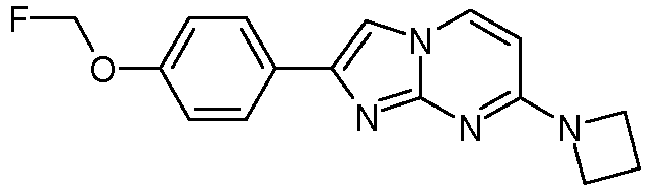
- The product was obtained starting from 4-(7-(azetidin-1-yl)imidazo[1,2-a]pyrimidin-2-yl)phenol (120 mg, 451 µmol, example 80), fluoromethyl 4-methylbenzenesulfonate (129 mg, 631 µmol) and cesium carbonate (294 mg, 901 µmol) according to the method described in example 29 and final purification by flash chromatography (using silica gel and a dichloromethane/methanol gradient) as light brown solid (67 mg, 47 %). MS: m/z = 299.5 (M+H)+
-

- The product was obtained starting from N4-methylpyrimidine-2,4-diamine (70 mg, 564 µmol, example 1, step 1) and 2-bromo-1-(4-hydroxy-3-methoxyphenyl)ethanone (200 mg, 818 µmol) according to the method described in example 1, step 2 after increased reaction time (72 h) as orange solid (56 mg, 37 %). MS: m/z = 271.1 (M+H)+
-

- The product was obtained starting from N4-methylpyrimidine-2,4-diamine (20 mg, 161 µmol, example 1, step 1) and 2-bromo-1-(3-bromophenyl)ethanone (65 mg, 234 µmol) according to the method described in example 1, step 2 after increased reaction time (72 h) as yellow solid (13 mg, 26 %). MS: m/z = 303.0 (M+H)+
-

- In a 2 ml tritiation flask, 7-(4-fluoropiperidin-1-yl)-2-(4-methoxyphenyl)imidazo[1,2-a]pyrimidine (2.2 mg, 6.7 µmol) and Crabtree's catalyst (5.2 mg, 6.5 µmol) were dissolved in dichloromethane (1.0 mL). The flask was attached to the tritium manifold (RC-TRITEC) and degassed by freeze-pump-thaw. Tritium gas was introduced, and the light orange solution was vigorously stirred for 4 hours in an atmosphere of tritium at 1200 mbar. The solution was cooled by liquid nitrogen and the excess tritium gas in the reaction vessel was reabsorbed on a uranium-trap for waste-tritium. The solvent was lyophilized off and labile tritium was removed by lyophilization with a 9:1-mixture of ethanol and water (3 x 1 mL) and toluene (2 x 1 mL). The remaining brownish oil was dissolved in ethanol (1.5 mL) and transferred on a SCX-2 cation exchanger. Remaining catalyst was eluted with MeOH (10 mL) and discarded, the product was eluted with NH3 in MeOH (3.5 N, 10 mL), collected separately, and concentrated under reduced pressure. The crude product was purified by preparative HPLC (Nucleodur 100-5 Prep C-18, 5 µm, 10 x 250 mm) using acetonitrile, water, and pH 7 buffer as eluent. 900 MBq (24 mCi) of the title compound were obtained with a radiochemical purity of 94 % and a specific activity of 2.1 TBq/mmol (58 Ci/mmol), determined by MS spectrometry. The compound was stored as an ethanolic solution. MS m/z: 331.2 (M+H)+
-
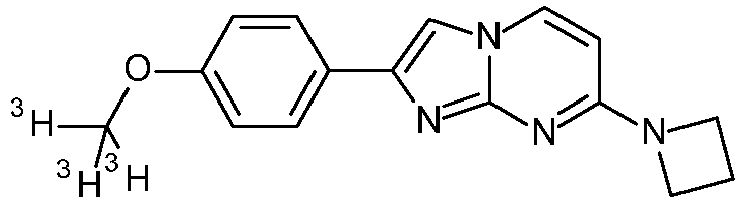
- A solution of [3H3]-methylnosylate in toluene (1 mL, 1.85 GBq, 0.66 µmol) was transferred to a 1.5 mL reactor and concentrated under a stream of argon. A solution of 4-[7-(azetidin-1-yl)imidazo[1,2-a]pyrimidin-2-yl]phenol (220 µg, 0.85 µmol) in DMF (0.2 mL) and cesium carbonate (540 µg, 1.6 µmol) were added, and the reactor was tightly closed. The brown solution was stirred at 55 °C for 3 h. The reaction mixture was diluted with dichloromethane (10 mL) and transferred to a 25 mL flask. The solvent and volatile by-products were removed by vacuum transfer. The crude product was purified by preparative HPLC (XBridge C18, 5 µm, 10 x 250 mm) using acetonitrile, water, and pH 9 buffer as eluent. 150 MBq (4.1 mCi) of the desired compound were obtained with a radiochemical purity of 93 % and a specific activity of 2.8 TBq/mmol (76 Ci/mmol). MS m/z: 286.2 (M+H)+
-

- A solution of [3H3]-methylnosylate in toluene (1 mL, 1.85 GBq, 0.66 µmol) was transferred to a 1.5 mL reactor and concentrated under a stream of argon. A solution of 2-(3-methylphenyl)-imidazo[1,2-a]pyrimidine-7-amine (380 µg, 1.7 µmol) in THF (0.24 mL) and cesium carbonate (1400 mg, 4.3 µmol) were added, and the reaction mixture was concentrated to roughly 50 µL. After rinsing with THF (50 µL) the reactor was tightly closed, and the reaction mixture was stirred for 24 h. The reaction mixture was portion wise diluted with dichloromethane (30 mL) and transferred to a 50 mL flask. The solvent and volatile by-products were removed by vacuum transfer. The crude product was purified by preparative HPLC (XBridge C18, 5 µm, 10 x 250 mm) using acetonitrile, water, and pH 2.5 buffer as eluent. 460 MBq (12.4 mCi) of the desired compound were obtained with a radiochemical purity of 94 % and a specific activity of 2.6 TBq/mmol (70 Ci/mmol). MS m/z: 244.9 (M+H)+
-

- Ten minutes prior to the end of [11C]carbon dioxide production, the precursor, 2-(m-tolyl)imidazo[1,2-a]pyrimidin-7-amine, (0.7 ± 0.3 mg) was dissolved in 200 µL dimethylsulfoxide and 5 µL 6N sodium hydroxide were added. Carbon-11 methyl iodide ([11C]MeI) was produced from starting [11C]carbon dioxide via [11C]methane in a General Electric FXMeI module. After approximately 10 minutes, [11C]MeI was bubbled through the precursor vial. When the radioactivity reached a plateau, the trapping was stopped and the precursor vial was heated at 80 °C for 3 minutes.
- The reaction mixture was diluted with 1 mL of HPLC water and injected onto the semipreparative HPLC column (XBridge C-18, 10 µm, 10x150 mm) eluted with 20:80 acetonitrile:water (0.1 M ammonium formate) at 10 mL/min.
- The HPLC effluent was monitored at 254 nm and an in-line radioactivity detector. The product, which eluted at approx. 8.5 minutes was collected in 50 mL water containing approx. 250 mg of ascorbic acid. After loading the product onto a conditioned C-18 SepPak Plus, the SepPak was washed with 10 mL of water. The radiolabeled product was eluted from the SepPak with1 mL of absolute ethanol followed by 10 mL sterile saline through a sterile filter to the final product vial. Aliquots were removed from the final product vial for quality control analysis. Analytical HPLC (XBridge C-18, 3.5 µm, 4.6x100mm) eluted with 25:75 acetronitrile:pH 7.2 TEA buffer at 2 mL/min monitored at 254 nm was performed to determine radiochemical and chemical purity, specific activity and chemical identity.
- The final product, N-[11C]methyl-2-(m-tolyl)imidazo[1,2-a]pyrimidin-7-amine, was isolated in an average non-decay corrected yield of 7.5 % (n=4) in 32 minutes. The final product average specific radioactivity was 5534 mCi/µmole with an average radiochemical purity of 95.5 %.
-
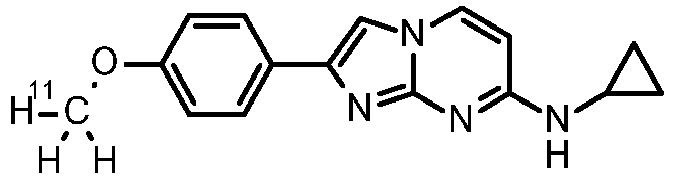
- Ten minutes prior to the end of [11C]carbon dioxide production, the precursor, 4-[7-(cyclopropylamino)imidazo[1,2-a]pyrimidin-2-yl]phenol, (1.0 ± 0.3 mg) was dissolved in 200 µL dimethylsulfoxide and solid sodium hydride (0.6 - 1.0 mg) was added. Carbon-11 methyl iodide ([11C]MeI) was produced from starting [11C]carbon dioxide via [11C]methane in a General Electric FXMeI module. After approximately 10 minutes, [11C]MeI was bubbled through the precursor vial. When the radioactivity reached a plateau, the trapping was stopped and the precursor vial was heated at 80 °C for 3 minutes.
- The reaction mixture was diluted with 200 µL of HPLC solvent and injected onto the semipreparative HPLC column (XBridge C-18, 10 µm, 10x150 mm) eluted with 25:75 absolute ethanol: pH 7.2 TEA buffer at 10 mL/min.
- The HPLC effluent was monitored at 254 nm and an in-line radioactivity detector. The product, which eluted at approx. 7 minutes was collected in 50 mL water containing approx. 250 mg of ascorbic acid. After loading the product onto a conditioned Oasis SepPak Plus, the SepPak was washed with 10 mL of water containing approximately 50 mg ascorbic acid. The radiolabeled product was eluted from the Sep Pak with1 mL of absolute ethanol followed by 10 mL sterile saline through a sterile filter to the final vial.
- Aliquots were removed from the final product vial for quality control analysis. Analytical HPLC (XBridge C-18, 3.5 µm, 4.6x100mm) eluted with 25:75 acetonitrile: pH 7.2 TEA buffer at 2 mL/min monitored at 254 nm was performed to determine radiochemical and chemical purity, specific activity and chemical identity.
- The final product, N-cyclopropyl-2-(4-[11C]methoxyphenyl)imidazo[1,2-a]pyrimidin-7-amine, was isolated in an average non-decay corrected yield of 7.3 % (n=4) in 33.5 minutes. The final product average specific radioactivity was 16870 mCi/µmole with an average radiochemical purity of 97.5 %.
-

- The precursor, 2-[4-[7-(methylamino)imidazo[1,2-a]pyrimidin-2-yl]phenoxy]ethyl 4-methylbenzenesulfonate (2 ± 0.5 mg), was dissolved in 400 µL dimethylsulfoxide prior to end of bombardment (EOB). At EOB, the aqueous [18F]fluoride ion, produced by proton bombardment of [18O]-enriched water, was trapped on an ion exchange column. The ion exchange column was eluted with 150 µL of a stock solution of Krytpofix 2.2.2/potassium carbonate (48 mg of Kryptofix 2.2.2 and 10 mg potassium carbonate dissolved in 600 µL of 1:1 acetonitrile:water) into the reaction vial followed by 250 µL acetonitrile. The fluoride solution was evaporated to dryness at 110 °C via nitrogen flow and further dried azeotropically by two additions of acetonitrile (250 µL each). The reaction vial was remotely transferred to the microwave cavity (Resonance Instruments) and cooled with compressed air for 2 minutes. The precursor was added and then microwaved at 50 watts for 80 seconds after which the solution was quenched with 1 mL of water.
- The reaction mixture was injected onto the semi-preparative HPLC column (XBridge C18, 10 µm, 10x150 mm) eluted with 30:70 methanol:triethylamine buffer (pH 7.2) at 15 mL/min.
- The HPLC effluent was monitored at 254 nm and an in-line radioactivity detector. The semipreparative chromatogram was observed (chromatogram shown below) and the 2-[4-(2-[18F]fluoroethoxy)phenyl]-N-methyl-imidazo[1,2-a]pyrimidin-7-amine product peak was collected in 50 mL of water containing 250 mg ascorbic acid and reformulated using an automated SPE module. The product solution was eluted through a Waters Oasis Plus SPE, washed with 10 mL of Milli-Q water, then eluted with 1 mL of absolute ethanol and followed by 10 mL of normal saline into the final product vial via a 0.22 µm Millipore FG sterilizing filter. Aliquots were removed from the final product vial for quality control analysis. Analytical HPLC (XBridge C18, 3.5 µm, 4.6x100mm) eluted with 20:80 acetonitrile:TEA buffer (pH 7.2) at 2 mL/min monitored at 254 nm was performed to determine radiochemical and chemical purity, specific activity and chemical identity. An analytical chromatogram is displayed below.
- The 40-minute radiosynthesis of 2-[4-(2-[18E]fluoroethoxy)phenyl]-N-methyl-imidazo[1,2-a]pyrimidin-7-amine produced a final product of 145 mCi, 12.5 % (n=1) non-decay corrected yield. The final product had a specific radioactivity of 49,751 mCi/µmole and radiochemical purity of 96 %.
-

- The product was obtained starting from 4-(4-fluoropiperidin-1-yl)pyrimidin-2-amine and 2-bromo-1-(pyrazin-2-yl)ethanone hydrobromide instead of 1-(benzo[d]thiazol-2-yl)-2-bromoethanone according to the method described for example 79 as light yellow solid (25 mg, 31 %). MS: m/z = 299.5 (M+H)+
-
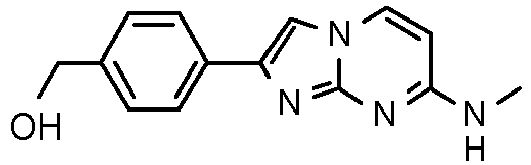
- To a solution of 4-(7-methylamino-imidazo[1,2-a]pyrimidin-2-yl)-benzoic acid methyl ester (100 mg, 0.35 mmol, example 136) in THF (5mL) was added diisobutylaluminum hydride (2 M solution in toluene; 0.35 mL, 0.708 mmol) at 0 °C, and the reaction mixture was stirred at 25 °C for 1 h. To this mixture was added again diisobutylaluminum hydride (2 M solution in toluene; 0.885 mL, 1.77 mmol) at 0 °C, and the mixture was stirred at 25 °C for 30 min. The mixture was quenched with saturated aqueous NH4Cl solution and the solvent was evaporated in vacuo. The crude product was extracted with 30% MeOH in dichloromethane. The organic layer was washed with brine (20 mL), dried over anhydrous Na2SO4, filtered, and evaporated in vacuo. The crude product was purified by prep HPLC to give the product as white sticky liquid (30 mg, 33 %). MS: m/z = 254.8 (M+H)+
-

- The product was obtained starting from N4-methylpyrimidine-2,4-diamine and 2-bromo-1-(3-fluoro-4-methoxyphenyl)ethanone instead of 2-bromo-1-phenylethanone according to the method described in example 1, step 2 as a white solid (65 mg, 45 %). MS: m/z = 273.1 (M+H)+
-

- The product was obtained starting from N4-methylpyrimidine-2,4-diamine and N-(4-(2-bromoacetyl)phenyl)acetamide instead of 2-bromo-1-phenylethanone according to the method described in example 1, step 2 as a white solid (70 mg, 48 %). MS: m/z = 282.1 (M+H)+
-

- The product was obtained starting from N4-methylpyrimidine-2,4-diamine and 5-(2-bromoacetyl)indolin-2-one instead of 2-bromo-1-phenylethanone according to the method described in example 1, step 2 as a light brown solid (137 mg, 93 %). MS: m/z = 280.1 (M+H)+
-

-
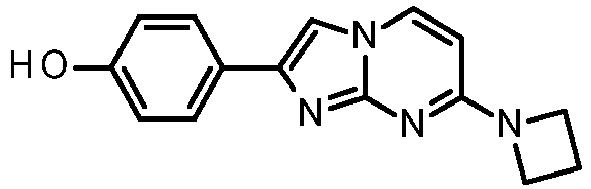
- The product was obtained starting from 4-(azetidin-1-yl)pyrimidin-2-amine and 2-bromo-1-(4-hydroxyphenyl)ethanone instead of 2-bromo-1-(4-methoxyphenyl)ethanone according to the method described in example 69, step 2 as a light yellow solid (302 mg, 77 %). MS: m/z = 267.4 (M+H)+
-

- The product was obtained starting from 4-[7-(azetidin-1-yl)imidazo[1,2-a]pyrimidin-2-yl]phenol instead of 3-(7-(pyrrolidin-1-yl)imidazo[1,2-a]pyrimidin-2-yl)phenol and 1-bromo-2-fluoroethane according to the method described in example 16, step 3 as light brown solid (73 mg, 50 %). MS: m/z = 313.6 (M+H)+
-

- The product was obtained starting from 4-[7-(azetidin-1-yl)imidazo[1,2-a]pyrimidin-2-yl]phenol instead of 3-(7-(pyrrolidin-1-yl)imidazo[1,2-a]pyrimidin-2-yl)phenol and 1-fluoro-3-iodopropane instead of 1-bromo-2-fluoroethane according to the method described in example 16, step 3 as an off-white solid (18 mg, 10 %). MS: m/z = 327.6 (M+H)+
-

- The product was obtained starting from 4-(azetidin-1-yl)pyrimidin-2-amine and 2-bromo-1-(3-methoxyphenyl)ethanone instead of 2-bromo-1-(4-methoxyphenyl)ethanone according to the method described in example 69, step 2 as an off-white solid (18 mg, 15 %). MS: m/z = 281.6 (M+H)+
-

- The product was obtained according to the method described in example 136 starting from N4-methyl-pyrimidine-2,4-diamine (200 mg, 1.63 mmol, example 1, step 1) and 3-(2-bromo-acetyl)-benzoic acid methyl ester (1.5 g, 6.04 mmol) as white solid (135 mg, 12 %). MS: m/z = 283.0 (M+H)+
- The product was obtained according to the method described in example 107 starting from methyl 3-[7-(methylamino)imidazo[1,2-a]pyrimidin-2-yl]benzoate (135 mg, 0.478 mmol) as brown solid (45 mg, 37 %). MS: m/z = 254.8 (M+H)+
-

-

- The product was obtained starting from 4-(azetidin-1-yl)pyrimidin-2-amine and 2-bromo-1-(3-hydroxyphenyl)ethanone instead of 2-bromo-1-(4-methoxyphenyl)ethanone according to the method described in example 69, step 2 as an off-white solid (445 mg, 67 %). MS: m/z = 267.5 (M+H)+
-

- The product was obtained starting from 3-[7-(azetidin-1-yl)imidazo[1,2-a]pyrimidin-2-yl]phenol instead of 3-(7-(pyrrolidin-1-yl)imidazo[1,2-a]pyrimidin-2-yl)phenol and 1-bromo-2-fluoroethane according to the method described in example 16, step 3 as light yellow solid (76 mg, 58 %). MS: m/z = 313.6 (M+H)+
-

- In a 25 mL round-bottomed flask, N-cyclopropyl-2-(4-methoxyphenyl)imidazo[1,2-a]pyrimidin-7-amine (0.095 g, 305 µmol, example 76) was dissolved in 2.0 mL DMF. Sodium hydride, 60 % dispersion in mineral oil (24 mg, 550 µmol) was added and the reaction mixture was stirred at room temperature for 45 min. Then, 1-bromo-2-fluoroethane (47.6 mg, 28 µL, 375 µmol) was added and the reaction mixture was stirred at room temperature overnight.
- Further sodium hydride, 60 % dispersion in mineral oil (24 mg, 550 µmol) was added, and the reaction mixture was stirred at room temperature for 30 min. Then, 1-bromo-2-fluoroethane (47.6 mg, 28 µL, 375 µmol) was added and the reaction mixture was stirred at room temperature for 3 h. The reaction mixture was quenched with water and extracted with ethyl acetate. The aqueous layer was extracted back with ethyl acetate. The organic layers were washed twice with water and once with brine. The organic layers were combined, dried over sodium sulfate, filtered and concentrated. Purification by flash chromatography (dichloromethane:methanol = 100:0 to 95:5) afforded the title compound (41 mg, 39 %) as a light yellow solid. MS: m/z = 327.5 (M+H)+
-
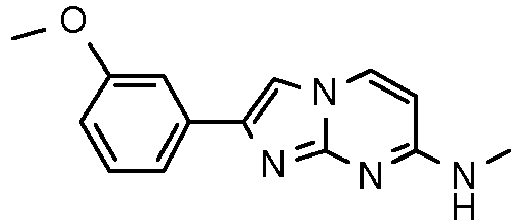
- The product was obtained starting from N4-methylpyrimidine-2,4-diamine and 2-bromo-1-(3-methoxyphenyl)ethanone instead of 2-bromo-1-phenylethanone according to the method described in example 1, step 2 as white solid (93 mg, 73 %). MS: m/z = 255.6 (M+H)+
-

- The product was obtained starting from 3-(7-(azetidin-1-yl)imidazo[1,2-a]pyrimidin-2-yl)phenol and fluoromethyl 4-methylbenzenesulfonate according to the method described in example 29 as yellow solid (34 mg, 19 %). MS: m/z = 299.6 (M+H)+
-

- The product was obtained starting from 4-(azetidin-1-yl)pyrimidin-2-amine and 2-bromo-1-(4-fluorophenyl)ethanone instead of 2-bromo-1-(4-methoxyphenyl)ethanone according to the method described in example 69, step 2 as an off-white yellow solid (61 mg, 54 %). MS: m/z = 269.5 (M+H)+
-
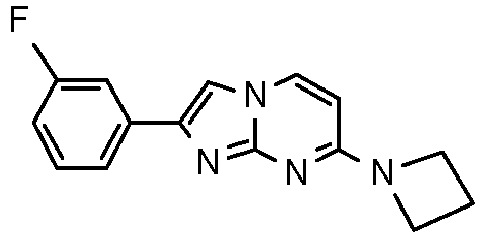
- The product was obtained starting from 4-(azetidin-1-yl)pyrimidin-2-amine and 2-bromo-1-(3-fluorophenyl)ethanone instead of 2-bromo-1-(4-methoxyphenyl)ethanone according to the method described in example 69, step 2 as a light yellow solid (58 mg, 58 %). MS: m/z = 269.5 (M+H)+
-

- The product was obtained starting from 4-(azetidin-1-yl)pyrimidin-2-amine and 2-bromo-1-(3,5-dimethoxyphenyl)ethanone instead of 2-bromo-1-(4-methoxyphenyl)ethanone according to the method described in example 69, step 2 as a white solid (55 mg, 46 %). MS: m/z = 311.5 (M+H)+
-
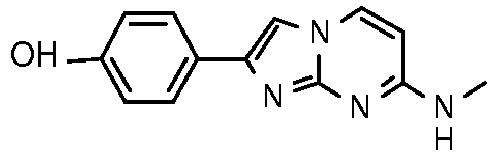
- The product was obtained starting from N4-methylpyrimidine-2,4-diamine and 2-bromo-1-(4-hydroxyphenyl)ethanone instead of 2-bromo-1-phenylethanone according to the method described in example 1, step 2 as a yellow solid (647 mg, 91 %). MS: m/z = 241.6 (M+H)+
-

- The product was obtained starting from 4-(7-(methylamino)imidazo[1,2-a]pyrimidin-2-yl)phenol instead of 3-(7-(pyrrolidin-1-yl)imidazo[1,2-a]pyrimidin-2-yl)phenol and 1-bromo-2-fluoroethane according to the method described in example 16, step 3 as yellow solid (75 mg, 43 %). MS: m/z = 287.6 (M+H)+
-

- The product was obtained starting from 4-(7-(methylamino)imidazo[1,2-a]pyrimidin-2-yl)phenol instead of 3-(7-(pyrrolidin-1-yl)imidazo[1,2-a]pyrimidin-2-yl)phenol and 1-fluoro-3-iodopropane instead of 1-bromo-2-fluoroethane according to the method described in example 16, step 3 as a light yellow solid (73 mg, 42 %). MS: m/z = 301.6 (M+H)+
-

- The product was obtained starting from N4-methylpyrimidine-2,4-diamine and 2-bromo-1-(3-hydroxyphenyl)ethanone instead of 2-bromo-1-phenylethanone according to the method described in example 1, step 2 as a yellow solid (185 mg, 59 %). MS: m/z = 241.6 (M+H)+
-

- The product was obtained starting from 4-(azetidin-1-yl)pyrimidin-2-amine and 2-bromo-1-(3-(methylthio)phenyl)ethanone instead of 2-bromo-1-(4-methoxyphenyl)ethanone according to the method described in example 69, step 2 as an off-white solid (53 mg, 44 %). MS: m/z = 297.5 (M+H)+
-

- The product was obtained starting from 4-(azetidin-1-yl)pyrimidin-2-amine and 2-bromo-1-(3-methoxy-4-methylphenyl)ethanone instead of 2-bromo-1-(4-methoxyphenyl)ethanone according to the method described in example 69, step 2 as an off-white solid (6 mg, 5 %). MS: m/z = 295.5 (M+H)+
-

- The product was obtained starting from 4-(azetidin-1-yl)pyrimidin-2-amine and 2-bromo-1-(3,4-dimethoxyphenyl)ethanone instead of 2-bromo-1-(4-methoxyphenyl)ethanone according to the method described in example 69, step 2 as an off-white solid (21 mg, 18 %). MS: m/z = 311.5 (M+H)+
-
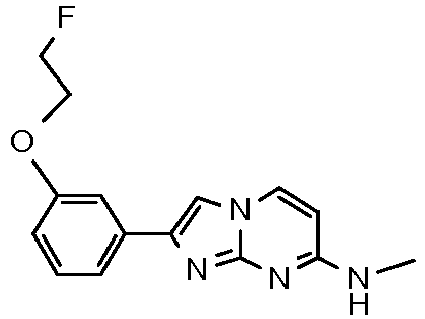
- The product was obtained starting from 3-(7-(methylamino)imidazo[1,2-a]pyrimidin-2-yl)phenol instead of 3-(7-(pyrrolidin-1-yl)imidazo[1,2-a]pyrimidin-2-yl)phenol and 1-bromo-2-fluoroethane according to the method described in example 16, step 3 as an off-white solid (23 mg, 18 %). MS: m/z = 287.6 (M+H)+
-

- The product was obtained starting from 3-(7-(methylamino)imidazo[1,2-a]pyrimidin-2-yl)phenol instead of 3-(7-(pyrrolidin-1-yl)imidazo[1,2-a]pyrimidin-2-yl)phenol and 1-fluoro-3-iodopropane instead of 1-bromo-2-fluoroethane according to the method described in example 16, step 3 as a white solid (29 mg, 21 %). MS: m/z = 301.6 (M+H)+
-
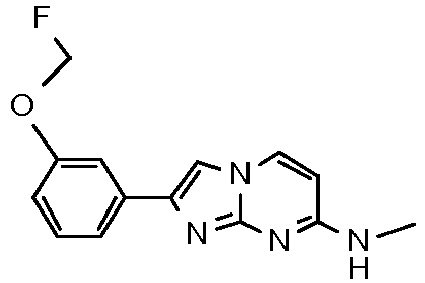
- The product was obtained starting from 3-(7-(methylamino)imidazo[1,2-a]pyrimidin-2-yl)phenol instead of 3-(7-(azetidin-1-yl)imidazo[1,2-a]pyrimidin-2-yl)phenol and fluoromethyl 4-methylbenzenesulfonate according to the method described in example 29 as a white solid (61 mg, 34 %). MS: m/z = 273.5 (M+H)+
-

- The product was obtained starting from 4-(7-(methylamino)imidazo[1,2-a]pyrimidin-2-yl)phenol instead of 3-(7-(azetidin-1-yl)imidazo[1,2-a]pyrimidin-2-yl)phenol and fluoromethyl 4-methylbenzenesulfonate according to the method described in example 29 as a white solid (36 mg, 20 %). MS: m/z = 273.5 (M+H)+
-
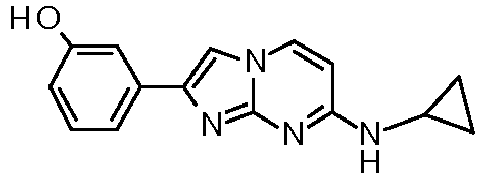
- The product was obtained starting from N4-cyclopropylpyrimidine-2,4-diamine instead of 4-(azetidin-1-yl)pyrimidin-2-amine and 2-bromo-1-(3-hydroxyphenyl)ethanone instead of 2-bromo-1-(4-methoxyphenyl)ethanone according to the method described in example 69, step 2 as a light yellow solid (594 mg, 98 %). MS: m/z = 267.6 (M+H)+
-

- The product was obtained starting from 3-(7-(cyclopropylamino)imidazo[1,2-a]pyrimidin-2-yl)phenol instead of 3-(7-(pyrrolidin-1-yl)imidazo[1,2-a]pyrimidin-2-yl)phenol and 1-bromo-2-fluoroethane according to the method described in example 16, step 3 as an off-white solid (43 mg, 29 %). MS: m/z = 313.6 (M+H)+
-
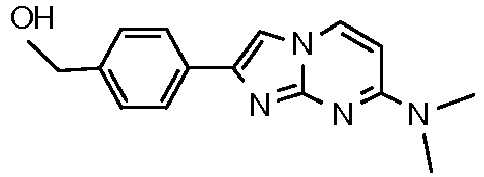
- The product was obtained according to the method described in example 136 starting from N4, N4-dimethyl-pyrimidine-2,4-diamine (500 mg, 3.62 mmol, example 18, step 1) and 4-(2-bromo-acetyl)-benzoic acid methyl ester (1.4 g, 5.44 mmol) as yellow solid (270 mg, 25 %). MS: m/z = 297.0 (M+H)+
- The product was obtained according to the method described in example 107 starting from methyl 4-[7-(dimethylamino)imidazo[1,2-a]pyrimidin-2-yl]benzoate (100 mg, 0.337 mmol) as yellow sticky solid (50 mg, 55 %). MS: m/z = 268.8 (M+H)+
-

- To a solution of N4-methyl-pyrimidine-2, 4-diamine (250 mg, 2.01 mmol, example 1, step 1) in acetone (10mL) was added 4-(2-bromo-acetyl)-benzoic acid methyl ester (780 mg, 3.021 mmol), and the reaction mixture was allowed to stir for 30 min at 25 °C. To this mixture was added p-toluenesulfonic acid (catalytic amount) and the reaction mixture was refluxed for 8 h. All volatiles were removed under reduced pressure and the resultant crude product was quenched with saturated aqueous NaHCO3 solution and extracted with ethyl acetate (2 x 50 mL). The combined organic layer was washed with brine, dried over anhydrous Na2SO4, filtered, and evaporated in vacuo. The resultant crude product was purified by flash chromatography (using silica gel amine phase and 90 % ethyl acetate in hexane) to give the product as off white solid (100 mg, 18 %). MS: m/z = 283.0 (M+H)+
-

- The product was obtained starting from 3-(7-(cyclopropylamino)imidazo[1,2-a]pyrimidin-2-yl)phenol instead of 3-(7-(azetidin-1-yl)imidazo[1,2-a]pyrimidin-2-yl)phenol and fluoromethyl 4-methylbenzenesulfonate according to the method described in example 29 as an off-white solid (49 mg, 33 %). MS: m/z = 299.6 (M+H)+
-

- The product was obtained starting from 4-(7-(cyclopropylamino)imidazo[1,2-a]pyrimidin-2-yl)phenol hydrobromide instead of 3-(7-(pyrrolidin-1-yl)imidazo[1,2-a]pyrimidin-2-yl)phenol and 1-bromo-2-fluoroethane according to the method described in example 16, step 3 as a light yellow solid (28 mg, 22 %). MS: m/z = 313.6 (M+H)+
-

- The product was obtained starting from 4-(7-(cyclopropylamino)imidazo[1,2-a]pyrimidin-2-yl)phenol hydrobromide instead of 3-(7-(pyrrolidin-1-yl)imidazo[1,2-a]pyrimidin-2-yl)phenol and 1-fluoro-3-iodopropane instead of 1-bromo-2-fluoroethane according to the method described in example 16, step 3 as a white solid (67 mg, 50 %). MS: m/z = 327.6 (M+H)+
-

- The product was obtained starting from 4-(7-(cyclopropylamino)imidazo[1,2-a]pyrimidin-2-yl)phenol instead of 3-(7-(azetidin-1-yl)imidazo[1,2-a]pyrimidin-2-yl)phenol and fluoromethyl 4-methylbenzenesulfonate according to the method described in example 29 as a yellow solid (52 mg, 46 %). MS: m/z = 299.6 (M+H)+
-

- The product was obtained starting from N4-methylpyrimidine-2,4-diamine and 2-bromo-1-(4-(methylthio)phenyl)ethanone instead of 2-bromo-1-phenylethanone according to the method described in example 1, step 2 as an off-white solid (14 mg, 12 %). MS: m/z = 271.5 (M+H)+
-

- The product was obtained starting from N4-methylpyrimidine-2,4-diamine and 2-bromo-1-(3,4-dimethoxyphenyl)ethanone instead of 2-bromo-1-phenylethanone according to the method described in example 1, step 2 as an off-white solid (20 mg, 18 %). MS: m/z = 285.5 (M+H)+
-

- The product was obtained starting from N4-methylpyrimidine-2,4-diamine and 2-bromo-1-(3-methoxy-4-methylphenyl)ethanone instead of 2-bromo-1-phenylethanone according to the method described in example 1, step 2 as an off-white solid (43 mg, 39 %). MS: m/z = 269.5 (M+H)+
-

- The product was obtained starting from N4-methylpyrimidine-2,4-diamine and 2-bromo-1-(3,5-dimethoxyphenyl)ethanone instead of 2-bromo-1-phenylethanone according to the method described in example 1, step 2 as an off-white solid (33 mg, 30 %). MS: m/z = 285.5 (M+H)+

Claims (13)
- A compound of formula
 R1 is phenyl, optionally substituted by one or two substituents, selected from 3H, halogen, C1-7-alkyl, di-methyl-amino, NHC(O)- C1-7-alkyl, C(O)O-C1-7-alkyl, C1-7- alkoxy, OC(3H)3, O11CH3, OCH2CH2 18F, C1-7-alkoxy substituted by halogen, hydroxy, C1-7-alkyl substituted by hydroxy, S-C1-7-alkyl, or by a heterocyclyl group, selected from morpholinyl, piperazinyl, piperidinyl or pyrrolidinyl; or is benzo[d][1,3]dioxol-5-yl, 2,3-dihydrobenzo[b][1,4]dioxin-6-yl, indolin-2-one, or is heteroaryl, selected from the group consisting of thiophenyl, benzofuranyl, benzothiophenyl, pyrazinyl, or benzothiazolyl;R2 is hydrogen, C1-7-alkyl or C1-7-alkyl substituted by halogen;R3 is C1-7-alkyl, C(3H)3, 11CH3, C1-7-alkyl substituted by halogen, -(CH2)2-O-C1-7-alkyl substituted by halogen or C3-6-cycloalkyl; orR2 and R3 form together with the N-atom to which they are attach a ring containing -CH2CH2CHRCH2CH2-, -CH2CH2CH2CH2-, -CH2CH2CH2-, -CH2CH2-NR-CH2CH2-, -CH2CH2-O-CH2CH2-, -CH2CH2CHRCH2-, -CH2CHRCH2- or
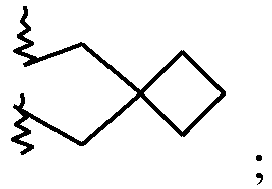 R is hydrogen, halogen, C1-7-alkyl substituted by halogen or C1-7-alkoxy;or a pharmaceutically acceptable acid addition salt, a racemic mixture or its corresponding enantiomer and/or optical isomers thereof.
 - A compound of formula I-1 according to claim 1
 R1 is phenyl, optionally substituted by one or two substituents, selected from 3H , halogen, C1-7-alkyl, di-methyl-amino, NHC(O)- C1-7-alkyl, C(O)O-C1-7-alkyl, C1-7-alkoxy, OC(3H)3, O11CH3, OCH2CH2 18F, C1-7-alkoxy substituted by halogen, hydroxy, C1-7-alkyl substituted by hydroxy, S- C1-7-alkyl, or by a heterocyclyl group, selected from morpholinyl, piperazinyl, piperidinyl or pyrrolidinyl;R2 is hydrogen, C1-7-alkyl or C1-7-alkyl substituted by halogen;R3 is C1-7-alkyl, C(3H)3, 11CH3, C1-7-alkyl substituted by halogen, -(CH2)2-O-C1-7-alkyl substituted by halogen or C3-6-cycloalkyl; orR2 and R3 form together with the N-atom to which they are attach a ring containing -CH2CH2CHRCH2CH2-, -CH2CH2CH2CH2-, -CH2CH2CH2-, -CH2CH2-NR-CH2CH2-, -CH2CH2-O-CH2CH2-, -CH2CH2CHRCH2-, -CH2CHRCH2- oror a pharmaceutically acceptable acid addition salt, a racemic mixture or its corresponding enantiomer and/or optical isomers thereof.
 R is hydrogen, halogen, C1-7-alkyl substituted by halogen or C1-7-alkoxy;
 - A compound of formula I-1 according to any one of claims 1 or 2, wherein the compounds are N-methyl-2-phenylimidazo[1,2-a]pyrimidin-7-amine 7-(4-fluoropiperidin-1-yl)-2-phenylimidazo[1,2-a]pyrimidine 7-(4-fluoropiperidin-1-yl)-2-(4-methoxyphenyl)imidazo[1,2-a]pyrimidine 2-(4-chlorophenyl)-7-(4-fluoropiperidin-1-yl)imidazo[1,2-a]pyrimidine 7-(4-fluoropiperidin-1-yl)-2-(3-methoxyphenyl)imidazo[1,2-a]pyrimidine 2-(4-fluorophenyl)-7-(4-fluoropiperidin-1-yl)imidazo[1,2-a]pyrimidine 4-[4-[7-(4-fluoropiperidin-1-yl)imidazo[1,2-a]pyrimidin-2-yl]phenyl]morpholine 7-(4-fluoropiperidin-1-yl)-2-(3-methylphenyl)imidazo[1,2-a]pyrimidine 7-(4-fluoropiperidin-1-yl)-2-(4-methylphenyl)imidazo[1,2-a]pyrimidine 2-(2-fluorophenyl)-7-(4-fluoropiperidin-1-yl)imidazo[1,2-a]pyrimidine 3-[7-(4-fluoropiperidin-1-yl)imidazo[1,2-a]pyrimidin-2-yl]phenol 7-(4-fluoropiperidin-1-yl)-2-(4-pyrrolidin-1-ylphenyl)imidazo[1,2-a]pyrimidine 7-(4-fluoropiperidin-1-yl)-2-[3-(trifluoromethoxy)phenyl]imidazo[1,2-a]pyrimidine 2-[3-(fluoromethoxy)phenyl]-7-pyrrolidin-1-ylimidazo[1,2-a]pyrimidine 2-[3-(2-fluoroethoxy)phenyl]-7-pyrrolidin-1-ylimidazo[1,2-a]pyrimidine N,N-dimethyl-2-phenylimidazo[1,2-a]pyrimidin-7-amine 7-[4-(2-fluoroethyl)piperazin-1-yl]-2-(4-methoxyphenyl)imidazo[1,2-a]pyrimidine 7-[4-(2-fluoroethyl)piperazin-1-yl]-2-(3-methoxyphenyl)imidazo[1,2-a]pyrimidine N-(2-fluoroethyl)-N-methyl-2-phenylimidazo[1,2-a]pyrimidin-7-amine N-(2-fluoroethyl)-2-(3-methoxyphenyl)-N-methylimidazo[1,2-a]pyrimidin-7-amine N-(2-fluoroethyl)-2-(4-methoxyphenyl)-N-methylimidazo[1,2-a]pyrimidin-7-amine 7-[4-(2-fluoroethyl)piperazin-1-yl]-2-phenylimidazo[1,2-a]pyrimidine 4-[2-(4-methoxyphenyl)imidazo[1,2-a]pyrimidin-7-yl]morpholine 4-[2-(3-methylphenyl)imidazo[1,2-a]pyrimidin-7-yl]morpholine 4-[2-(3,4-dimethoxyphenyl)imidazo[1,2-a]pyrimidin-7-yl]morpholine 4-(7-pyrrolidin-1-ylimidazo[1,2-a]pyrimidin-2-yl)phenol 2-[4-(2-fluoroethoxy)phenyl]-7-pyrrolidin-1-ylimidazo[1,2-a]pyrimidine 2-[4-(fluoromethoxy)phenyl]-7-pyrrolidin-1-ylimidazo[1,2-a]pyrimidine 7-[(3R)-3-methoxypyrrolidin-1-yl]-2-phenylimidazo[1,2-a]pyrimidine 7-[(3S)-3-methoxypyrrolidin-1-yl]-2-phenylimidazo[1,2-a]pyrimidine 7-[(3R)-3-fluoropyrrolidin-1-yl]-2-(4-methoxyphenyl)imidazo[1,2-a]pyrimidine 7-[(3S)-3-fluoropyrrolidin-1-yl]-2-(4-methoxyphenyl)imidazo[1,2-a]pyrimidine 2-(3-methoxyphenyl)-N,N-dimethylimidazo[1,2-a]pyrimidin-7-amine 2-(4-methoxyphenyl)-N,N-dimethylimidazo[1,2-a]pyrimidin-7-amine N,N-dimethyl-2-(4-methylphenyl)imidazo[1,2-a]pyrimidin-7-amine N,N-dimethyl-2-(3-methylphenyl)imidazo[1,2-a]pyrimidin-7-amine 4-[2-(3-methoxyphenyl)imidazo[1,2-a]pyrimidin-7-yl]morpholine 4-[2-(4-methylphenyl)imidazo[1,2-a]pyrimidin-7-yl]morpholine 2-(4-methoxyphenyl)-7-pyrrolidin-1-ylimidazo[1,2-a]pyrimidine 2-(4-methylphenyl)-7-pyrrolidin-1-ylimidazo[1,2-a]pyrimidine N,N-dimethyl-2-(4-morpholin-4-ylphenyl)imidazo[1,2-a]pyrimidin-7-amine 2-[4-(dimethylamino)phenyl]-N,N-dimethylimidazo[1,2-a]pyrimidin-7-amine 2-(3-methoxyphenyl)-7-pyrrolidin-1-ylimidazo[1,2-a]pyrimidine 2-(3-methylphenyl)-7-pyrrolidin-1-ylimidazo[1,2-a]pyrimidine 2-(4-methoxyphenyl)-7-piperidin-1-ylimidazo[1,2-a]pyrimidine 2-(3-methoxyphenyl)-7-piperidin-1-ylimidazo[1,2-a]pyrimidine 2-(4-methylphenyl)-7-piperidin-1-ylimidazo[1,2-a]pyrimidine 2-(3-methylphenyl)-7-piperidin-1-ylimidazo[1,2-a]pyrimidine 2-(3,4-dimethoxyphenyl)-7-piperidin-1-ylimidazo[1,2-a]pyrimidine 7-[4-(2-fluoroethyl)piperidin-1-yl]-2-phenylimidazo[1,2-a]pyrimidine 7-[4-(2-fluoroethyl)piperidin-1-yl]-2-(3-methoxyphenyl)imidazo[1,2-a]pyrimidine 7-[4-(2-fluoroethyl)piperidin-1-yl]-2-(4-methoxyphenyl)imidazo[1,2-a]pyrimidine 7-[4-(2-fluoroethyl)piperidin-1-yl]-2-(3-methylphenyl)imidazo[1,2-a]pyrimidine 7-[4-(2-fluoroethyl)piperidin-1-yl]-2-(4-methylphenyl)imidazo[1,2-a]pyrimidine 4-[4-[7-[4-(2-fluoroethyl)piperidin-1-yl]imidazo[1,2-a]pyrimidin-2-yl]phenyl]morpholine N-methyl-2-(3-methylphenyl)imidazo[1,2-a]pyrimidin-7-amine N-[2-(2-fluoroethoxy)ethyl]-2-(4-methoxyphenyl)-N-methylimidazo[1,2-a]pyrimidin-7-amine 7-(2-azaspiro[3.3]heptan-2-yl)-2-(4-methoxyphenyl)imidazo[1,2-a]pyrimidine N-ethyl-2-(4-methoxyphenyl)-N-methylimidazo[1,2-a]pyrimidin-7-amine N,N-diethyl-2-(4-methoxyphenyl)imidazo[1,2-a]pyrimidin-7-amine N-[2-(2-fluoroethoxy)ethyl]-N-methyl-2-(3-methylphenyl)imidazo[1,2-a]pyrimidin-7-amine 7-(azetidin-1-yl)-2-(4-methoxyphenyl)imidazo[1,2-a]pyrimidine 7-(3-fluoroazetidin-1-yl)-2-(4-methoxyphenyl)imidazo[1,2-a]pyrimidine 7-(3-fluoroazetidin-1-yl)-2-phenylimidazo[1,2-a]pyrimidine 7-(3-fluoroazetidin-1-yl)-2-(3-methylphenyl)imidazo[1,2-a]pyrimidine N,N-dimethyl-4-(7-morpholin-4-ylimidazo[1,2-a]pyrimidin-2-yl)aniline N-cyclopropyl-2-(4-methoxyphenyl)imidazo[1,2-a]pyrimidin-7-amine N-isopropyl-2-(4-methoxy-phenyl)-imidazo[1,2-a]pyrimidin-7-amine 2-(4-methoxyphenyl)-N-(2,2,2-trifluoroethyl)imidazo[1,2-a]pyrimidin-7-amine 4-[7-(azetidin-1-yl)imidazo[1,2-a]pyrimidin-2-yl]phenol 7-(3-methoxyazetidin-1-yl)-2-(4-methoxyphenyl)imidazo[1,2-a]pyrimidine N-methyl-2-(4-methylphenyl)imidazo[1,2-a]pyrimidin-7-amine 2-(4-methoxyphenyl)-N-methylimidazo[1,2-a]pyrimidin-7-amine N-(2-ffluoroethyl)-N-methyl-2-(4-methylphenyl)imidazo[1,2-a]pyrimidin-7-amine N-(2-fluoroethyl)-N-methyl-2-(3-methylphenyl)imidazo[1,2-a]pyrimidin-7-amine 2-(4-methoxyphenyl)-7-(3-methylazetidin-1-yl)imidazo[1,2-a]pyrimidine 2-[4-(dimethylamino)phenyl]-N-methylimidazo[1,2-a]pyrimidin-7-amine 4-[7-(4-fluoropiperidin-1-yl)imidazo[1,2-a]pyrimidin-2-yl]-N,N-dimethylaniline 2-[4-(dimethylamino)phenyl]-N-(2-fluoroethyl)-N-methylimidazo[1,2-a]pyrimidin-7-amine N-cyclopropyl-2-(4-methoxyphenyl)-N-methylimidazo[1,2-a]pyrimidin-7-amine 7-(azetidin-1-yl)-2-(4-methylphenyl)imidazo[1,2-a]pyrimidine 7-(azetidin-1-yl)-2-(3-methylphenyl)imidazo[1,2-a]pyrimidine 2-[4-(dimethylamino)phenyl]-N-(2-fluoroethyl)imidazo[1,2-a]pyrimidin-7-amine 7-(azetidin-1-yl)-2-[4-(fluoromethoxy)phenyl]imidazo[1,2-a]pyrimidine 2-methoxy-4-[7-(methylamino)imidazo[1,2-a]pyrimidin-2-yl]phenol 2-(3-bromophenyl)-N-methylimidazo[1,2-a]pyrimidin-7-amine 7-(4-fluoropiperidin-1-yl)-2-(4-methoxy-2,6-ditritiophenyl)imidazo[1,2-a]pyrimidine 7-(azetidin-1-yl)-2-[4-(tritritiomethoxy)phenyl)imidazo[1,2-a]pyrimidine 2-(3-methylphenyl)-N-(tritritiomethyl)imidazo[1,2-a]pyrimidine-7-amine N-[11C]methyl-2-(m-tolyl)imidazo[1,2-a]pyrimidin-7-amine N-cyclopropyl-2-(4-[11C]methoxyphenyl)imidazo[1,2-a]pyrimidin-7-amine 2-[4-(2-[18F]fluoroethoxy)phenyl]-N-methyl-imidazo[1,2-a]pyrimidin-7-amine [4-[7-(methylamino)imidazo[1,2-a]pyrimidin-2-yl]phenyl]methanol 2-(3-fluoro-4-methoxyphenyl)-N-methylimidazo[1,2-a]pyrimidin-7-amine N-(4-(7-(methylamino)imidazo[1,2-a]pyrimidin-2-yl)phenyl)acetamide 7-(azetidin-1-yl)-2-(4-(2-fluoroethoxy)phenyl)imidazo[1,2-a]pyrimidine 7-(azetidin-1-yl)-2-(4-(3-fluoropropoxy)phenyl)imidazo[1,2-a]pyrimidine 7-(azetidin-1-yl)-2-(3-methoxyphenyl)imidazo[1,2-a]pyrimidine [3-[7-(methylamino)imidazo[1,2-a]pyrimidin-2-yl]phenyl]methanol 7-(azetidin-1-yl)-2-(3-(2-fluoroethoxy)phenyl)imidazo[1,2-a]pyrimidine N-cyclopropyl-N-(2-fluoroethyl)-2-(4-methoxyphenyl)imidazo[1,2-a]pyrimidin-7-amine 2-(3-methoxyphenyl)-N-methylimidazo[1,2-a]pyrimidin-7-amine 7-(azetidin-1-yl)-2-(3-(fluoromethoxy)phenyl)imidazo[1,2-a]pyrimidine 7-(azetidin-1-yl)-2-(4-fluorophenyl)imidazo[1,2-a]pyrimidine 7-(azetidin-1-yl)-2-(3-fluorophenyl)imidazo[1,2-a]pyrimidine 7-(azetidin-1-yl)-2-(3,5-dimethoxyphenyl)imidazo[1,2-a]pyrimidine 4-(7-(methylamino)imidazo[1,2-a]pyrimidin-2-yl)phenol 2-(4-(2-fluoroethoxy)phenyl)-N-methylimidazo[1,2-a]pyrimidin-7-amine 2-(4-(3-fluoropropoxy)phenyl)-N-methylimidazo[1,2-a]pyrimidin-7-amine 3-(7-(methylamino)imidazo[1,2-a]pyrimidin-2-yl)phenol 7-(azetidin-1-yl)-2-(3-(methylthio)phenyl)imidazo[1,2-a]pyrimidine 7-(azetidin-1-yl)-2-(3-methoxy-4-methylphenyl)imidazo[1,2-a]pyrimidine 7-(azetidin-1-yl)-2-(3,4-dimethoxyphenyl)imidazo[1,2-a]pyrimidine 2-(3-(2-fluoroethoxy)phenyl)-N-methylimidazo[1,2-a]pyrimidin-7-amine 2-(3-(3-fluoropropoxy)phenyl)-N-methylimidazo[1,2-a]pyrimidin-7-amine 2-(3-(fluoromethoxy)phenyl)-N-methylimidazo[1,2-a]pyrimidin-7-amine 2-(4-(fluoromethoxy)phenyl)-N-methylimidazo[1,2-a]pyrimidin-7-amine 3-(7-(cyclopropylamino)imidazo[1,2-a]pyrimidin-2-yl)phenol N-cyclopropyl-2-(3-(2-fluoroethoxy)phenyl)imidazo[1,2-a]pyrimidin-7-amine [4-[7-(dimethylamino)imidazo[1,2-a]pyrimidin-2-yl]phenyl]methanol acetic acid adduct methyl 4-[7-(methylamino)imidazo[1,2-a]pyrimidin-2-yl]benzoate N-cyclopropyl-2-(3-(fluoromethoxy)phenyl)imidazo[1,2-a]pyrimidin-7-amine N-cyclopropyl-2-(4-(2-fluoroethoxy)phenyl)imidazo[1,2-a]pyrimidin-7-amine N-cyclopropyl-2-(4-(3-fluoropropoxy)phenyl)imidazo[1,2-a]pyrimidin-7-amine N-cyclopropyl-2-(4-(fluoromethoxy)phenyl)imidazo[1,2-a]pyrimidin-7-amine N-methyl-2-(4-(methylthio)phenyl)imidazo[1,2-a]pyrimidin-7-amine 2-(3,4-dimethoxyphenyl)-N-methylimidazo[1,2-a]pyrimidin-7-amine 2-(3-methoxy-4-methylphenyl)-N-methylimidazo[1,2-a]pyrimidin-7-amine or 2-(3,5-dimethoxyphenyl)-N-methylimidazo[1,2-a]pyrimidin-7-amine.
- A compound of formula I-2 according to claim 1
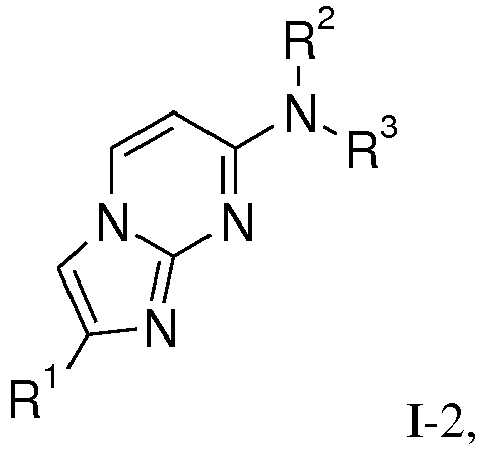 R1 is benzo[d][1,3]dioxol-5-yl,2,3-dihydrobenzo[b][1,4]dioxin-6-yl or indolin-2-one;R2 is hydrogen, C1-7-alkyl or C1-7-alkyl substituted by halogen;R3 is C1-7-alkyl, C(3H)3, 11CH3, C1-7-alkyl substituted by halogen, -(CH2)2-O-alkyl substituted by halogen or C3-6-cycloalkyl; orR2 and R3 form together with the N-atom to which they are attach a ring containing -CH2CH2CHRCH2CH2-, -CH2CH2CH2CH2-, -CH2CH2CH2-, -CH2CH2-NR-CH2CH2-, -CH2CH2-O-CH2CH2-, -CH2CH2CHRCH2-, -CH2CHRCH2- or
 R is hydrogen, halogen, C1-7-alkyl substituted by halogen or C1-7-alkoxy;or a pharmaceutically acceptable acid addition salt, a racemic mixture or its corresponding enantiomer and/or optical isomers thereof.
 - A compound of formula I-2 according to any one of claims 1 or 4, wherein the compounds are 2-(1,3-benzodioxol-5-yl)-7-(4-fluoropiperidin-1-yl)imidazo[1,2-a]pyrimidine 2-(2,3-dihydro-1,4-benzodioxin-6-yl)-7-(4-fluoropiperidin-1-yl)imidazo[1,2-a]pyrimidine 2-(1,3-benzodioxol-5-yl)-N,N-dimethylimidazo[1,2-a]pyrimidin-7-amine 2-(2,3-dihydro-1,4-benzodioxin-6-yl)-N,N-dimethylimidazo[1,2-a]pyrimidin-7-amine 2-(1,3-benzodioxol-5-yl)-7-[4-(2-fluoroethyl)piperidin-1-yl]imidazo[1,2-a]pyrimidine 2-(2,3-dihydro-1,4-benzodioxin-6-yl)-7-[4-(2-fluoroethyl)piperidin-1-yl]imidazo[1,2-a]pyrimidine 2-(1,3-benzodioxol-5-yl)-N-methylimidazo[1,2-a]pyrimidin-7-amine 2-(1,3-benzodioxol-5-yl)-N-(2-fluoroethyl)-N-methylimidazo[1,2-a]pyrimidin-7-amine or 5-(7-(methylamino)imidazo[1,2-a]pyrimidin-2-yl)indolin-2-one.
- A compound of formula I-3 according to claim 1
 R1 is heteroaryl, selected from the group consisting of thiophenyl, benzofuranyl, benzothiophenyl pyrazinyl or benzothiazolyl;R2 is hydrogen or C1-7-alkyl;R3 is C1-7-alkyl, C(3H)3, C1-7-alkyl substituted by halogen, -(CH2)2-O-C1-7-alkyl substituted by halogen or C3-6-cycloalkyl; orR2 and R3 form together with the N-atom to which they are attach a ring containing -CH2CH2CHRCH2CH2-, -CH2CH2CH2CH2-, -CH2CH2CH2-, -CH2CH2-NR-CH2CH2-, -CH2CH2-O-CH2CH2-, -CH2CH2CHRCH2-, -CH2CHRCH2- or
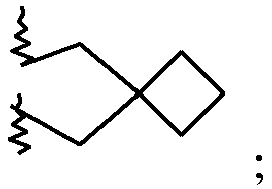 R is hydrogen, halogen, C1-7-alkyl substituted by halogen or C1-7-alkoxy;or a pharmaceutically acceptable acid addition salt, a racemic mixture or its corresponding enantiomer and/or optical isomers thereof.
 - A compound of formula I-3 according to any one of claims 1 and 6, which compounds are 7-(4-fluoropiperidin-1-yl)-2-thiophen-3-ylimidazo[1,2-a]pyrimidine 2-(1-benzofuran-2-yl)-7-(4-fluoropiperidin-1-yl)imidazo[1,2-a]pyrimidine 2-(1-benzothiophen-2-yl)-7-(4-fluoropiperidin-1-yl)imidazo[1,2-a]pyrimidine 2-[7-(4-fluoropiperidin-1-yl)imidazo[1,2-a]pyrimidin-2-yl]-1,3-benzothiazole N,N-dimethyl-2-thiophen-3-ylimidazo[1,2-a]pyrimidin-7-amine or 7-(4-fluoropiperidin-1-yl)-2-(pyrazin-2-yl)imidazo[1,2-a]pyrimidine.
- A compound of formula I according to any one of claims 1 - 7 for use in binding and imaging tau aggregates, beta-amyloid aggregates or alpha-synuclein aggregates.
- A compound of formula I according to any one of claims 1 - 7 for use in binding and imaging tau aggregates in Alzheimer patients.
- A compound of formula I according to any one of claims 1 - 7 for use in a tau-binding study.
- A compound of formula I according to any one of claims 1 - 7 for use in diagnostic imaging of tau-aggregates in the brain of a mammal.
- A pharmaceutical composition comprising a compound of formula I according to any one of claims 1 - 7 and a pharmaceutical acceptable carrier.
- The pharmaceutical composition according to claim 12 for use in a method of imaging tau-aggregate deposits, comprising- introducing into a mammal a detectable quantity of a composition according to claim 12;- allowing sufficient time for the compound of formula I to be associated with tau-aggregate deposits, and- detecting the compound associated with one or more tau-aggregate deposits.
Priority Applications (2)
| Application Number | Priority Date | Filing Date | Title |
|---|---|---|---|
| EP14724757.1A EP2999701B1 (en) | 2013-05-23 | 2014-05-19 | 2-phenylimidazo[1,2-a]pyrimidines as imaging agents |
| SI201430251T SI2999701T1 (en) | 2013-05-23 | 2014-05-19 | 2-phenylimidazo(1,2-a)pyrimidines as imaging agents |
Applications Claiming Priority (3)
| Application Number | Priority Date | Filing Date | Title |
|---|---|---|---|
| EP13168830 | 2013-05-23 | ||
| PCT/EP2014/060203 WO2014187762A1 (en) | 2013-05-23 | 2014-05-19 | 2-phenylimidazo[1,2-a]pyrimidines as imaging agents |
| EP14724757.1A EP2999701B1 (en) | 2013-05-23 | 2014-05-19 | 2-phenylimidazo[1,2-a]pyrimidines as imaging agents |
Publications (2)
| Publication Number | Publication Date |
|---|---|
| EP2999701A1 EP2999701A1 (en) | 2016-03-30 |
| EP2999701B1 true EP2999701B1 (en) | 2017-04-12 |
Family
ID=48446195
Family Applications (1)
| Application Number | Title | Priority Date | Filing Date |
|---|---|---|---|
| EP14724757.1A Active EP2999701B1 (en) | 2013-05-23 | 2014-05-19 | 2-phenylimidazo[1,2-a]pyrimidines as imaging agents |
Country Status (20)
| Country | Link |
|---|---|
| US (1) | US9801961B2 (en) |
| EP (1) | EP2999701B1 (en) |
| JP (1) | JP6130055B2 (en) |
| KR (1) | KR101770494B1 (en) |
| CN (1) | CN105229009B (en) |
| AR (1) | AR096371A1 (en) |
| AU (1) | AU2014270524B2 (en) |
| BR (1) | BR112015025140A2 (en) |
| CA (1) | CA2907605A1 (en) |
| DK (1) | DK2999701T3 (en) |
| ES (1) | ES2629389T3 (en) |
| HU (1) | HUE033612T2 (en) |
| MX (1) | MX2015015893A (en) |
| PL (1) | PL2999701T3 (en) |
| RU (1) | RU2665580C2 (en) |
| SG (1) | SG11201509503QA (en) |
| SI (1) | SI2999701T1 (en) |
| TW (1) | TW201500360A (en) |
| WO (1) | WO2014187762A1 (en) |
| ZA (1) | ZA201506570B (en) |
Families Citing this family (30)
| Publication number | Priority date | Publication date | Assignee | Title |
|---|---|---|---|---|
| EP3280716B1 (en) | 2015-04-08 | 2020-02-12 | Bayer CropScience AG | Imidazo[1,2-a]pyridin-2-yl derivatives as pesticides and intermediates thereof |
| EP3331870B1 (en) | 2015-08-07 | 2021-06-16 | Bayer CropScience Aktiengesellschaft | 2-(het)aryl-substituted condensed heterocycle derivatives as pesticides |
| CN108135175B (en) * | 2015-09-29 | 2021-04-06 | 肿瘤疗法科学股份有限公司 | Bicyclic compounds and their use for inhibition of SUV39H2 |
| PE20181198A1 (en) | 2015-10-26 | 2018-07-23 | Bayer Cropscience Ag | DERIVATIVES OF CONDENSED BICYCLE HETEROCYCLES AS PEST CONTROL AGENTS |
| WO2017093180A1 (en) | 2015-12-01 | 2017-06-08 | Bayer Cropscience Aktiengesellschaft | Condensed bicyclic heterocycle derivatives as pest control agents |
| CN105582168A (en) * | 2016-01-08 | 2016-05-18 | 王明强 | Traditional Chinese medicine preparation for treating valetudinarianism, insufficiency of primordial qi and low immunity |
| WO2017144341A1 (en) | 2016-02-23 | 2017-08-31 | Bayer Cropscience Aktiengesellschaft | Condensed bicyclic heterocycle derivatives as pest control agents |
| WO2017174414A1 (en) | 2016-04-05 | 2017-10-12 | Bayer Cropscience Aktiengesellschaft | Naphthaline-derivatives as pest control agents |
| EP3241830A1 (en) | 2016-05-04 | 2017-11-08 | Bayer CropScience Aktiengesellschaft | Condensed bicyclic heterocyclic derivatives as pesticides |
| MX2019000793A (en) | 2016-07-19 | 2019-06-20 | Bayer Cropscience Ag | Condensed bicyclic heterocycle derivatives as pest control agents. |
| EP3487544A1 (en) | 2016-07-22 | 2019-05-29 | AC Immune S.A. | Compounds for imaging tau protein aggregates |
| EP3487545A1 (en) | 2016-07-22 | 2019-05-29 | AC Immune S.A. | Compounds for imaging tau protein aggregates |
| KR102419244B1 (en) | 2016-08-15 | 2022-07-08 | 바이엘 크롭사이언스 악티엔게젤샤프트 | Condensed Bicyclic Heterocycle Derivatives as Pest Control Agents |
| EP3515921B1 (en) | 2016-09-19 | 2021-10-27 | Bayer CropScience Aktiengesellschaft | Pyrazolo[1,5-a]pyridine derivatives and their use as pesticides |
| WO2018065288A1 (en) | 2016-10-07 | 2018-04-12 | Bayer Cropscience Aktiengesellschaft | 2-[2-phenyl-1-(sulfonyl-methyl)-vinyl]-imidazo-[4,5-b] pyridine derivatives and related compounds as pesticides in plant protection |
| KR102515694B1 (en) | 2017-01-10 | 2023-03-29 | 바이엘 악티엔게젤샤프트 | Heterocycle derivatives as pest control agents |
| KR20230020566A (en) | 2017-01-10 | 2023-02-10 | 바이엘 악티엔게젤샤프트 | Heterocyclene derivatives as pest control agents |
| WO2018138050A1 (en) | 2017-01-26 | 2018-08-02 | Bayer Aktiengesellschaft | Condensed bicyclic heterocyclene derivatives as pest control agents |
| BR112019022273B1 (en) | 2017-04-24 | 2023-04-11 | Bayer Aktiengesellschaft | CAST BICCYCLE HETEROCYCLE DERIVATIVES, THEIR USES, AGROCHEMICAL FORMULATION, METHOD FOR CONTROLING ANIMAL PESTS, AND PEST RESISTANT PLANTS, PARTS OF PLANTS AND/OR SEEDS |
| JP6831802B2 (en) * | 2018-01-12 | 2021-02-17 | 上海富吉医療器械有限公司Shanghai Chartwell Medical Instrument Co., Ltd. | Radionuclide-labeled compound and imaging agent containing it |
| EP3305786A3 (en) | 2018-01-22 | 2018-07-25 | Bayer CropScience Aktiengesellschaft | Condensed bicyclic heterocycle derivatives as pesticides |
| WO2019145291A1 (en) | 2018-01-24 | 2019-08-01 | Ac Immune Sa | Gamma-carboline compounds for the detection of tau aggregates |
| WO2019145292A1 (en) | 2018-01-24 | 2019-08-01 | Ac Immune Sa | Azacarboline compounds for the detection of tau aggregates |
| JP2021514949A (en) | 2018-02-21 | 2021-06-17 | バイエル・アクチエンゲゼルシヤフト | Condensed bicyclic heterocyclic derivative as a pest control agent |
| IL279219B2 (en) * | 2018-06-08 | 2024-08-01 | Ac Immune Sa | New compounds for diagnosis |
| PY2011993A (en) | 2019-02-26 | 2021-07-05 | Bayer Ag | CONDENSED BICYCLIC HETEROCYCLOSE DERIVATIVES AS A PESTICIDE |
| PY2012000A (en) | 2019-02-26 | 2023-07-25 | Bayer Ag | DERIVATIVES OF FUSED BICYCLIC HETEROCYCLES AS PESTICIDES |
| CN114890955A (en) * | 2022-06-23 | 2022-08-12 | 江西瑞威尔生物科技有限公司 | Preparation process of N-substituted morpholine organic compound |
| JP2025526423A (en) * | 2022-07-28 | 2025-08-13 | エーシー・イミューン・エス・アー | new compound |
| AR134414A1 (en) * | 2023-11-21 | 2026-01-14 | Novartis Ag | SUBSTITUTED IMIDAZOARENES AND METHODS FOR THEIR USE |
Family Cites Families (11)
| Publication number | Priority date | Publication date | Assignee | Title |
|---|---|---|---|---|
| ID29514A (en) * | 1999-11-10 | 2001-09-06 | Ortho Mcneil Pharmacetical Inc | 2-ARIL-3- (HETEROARIL) -IMIDAZO [1,2-a] SUBSTITUTED PYRIMIDINE, AND RELATED PHARMACEUTICAL METHODS AND COMPOSITIONS |
| JP2004501109A (en) * | 2000-05-24 | 2004-01-15 | メルク シャープ エンド ドーム リミテッド | 3-phenyl-imidazo-pyrimidine derivatives as ligands for GABA receptors |
| AU2006261917A1 (en) | 2005-06-24 | 2007-01-04 | The Trustees Of The University Of Pennsylvania | Radiolabeled-pegylation of ligands for use as imaging agents |
| WO2007033080A2 (en) | 2005-09-12 | 2007-03-22 | Emory University | Alzheimer's disease imaging agents |
| WO2007034282A2 (en) * | 2005-09-19 | 2007-03-29 | Pfizer Products Inc. | Diaryl-imidazole compounds condensed with a heterocycle as c3a receptor antagonists |
| EP1956013B1 (en) * | 2005-11-30 | 2016-04-13 | Fujifilm RI Pharma Co., Ltd. | Diagnostic and remedy for disease caused by amyloid aggregation and/or deposition |
| US7700616B2 (en) * | 2006-05-08 | 2010-04-20 | Molecular Neuroimaging, Llc. | Compounds and amyloid probes thereof for therapeutic and imaging uses |
| EP2019103B1 (en) | 2006-05-19 | 2011-11-30 | Nihon Medi-Physics Co., Ltd. | Compound having affinity for amyloid |
| US8691187B2 (en) * | 2009-03-23 | 2014-04-08 | Eli Lilly And Company | Imaging agents for detecting neurological disorders |
| US8410117B2 (en) * | 2010-03-26 | 2013-04-02 | Hoffmann-La Roche Inc. | Imidazopyrimidine derivatives |
| RU2015147450A (en) * | 2013-04-29 | 2017-06-05 | Ф. Хоффманн-Ля Рош Аг | Derivatives of 2-phenyl or 2-heteroaryl imidazole [1,2-a] pyridine |
-
2014
- 2014-05-19 DK DK14724757.1T patent/DK2999701T3/en active
- 2014-05-19 SI SI201430251T patent/SI2999701T1/en unknown
- 2014-05-19 MX MX2015015893A patent/MX2015015893A/en unknown
- 2014-05-19 AU AU2014270524A patent/AU2014270524B2/en not_active Ceased
- 2014-05-19 BR BR112015025140A patent/BR112015025140A2/en not_active Application Discontinuation
- 2014-05-19 CA CA2907605A patent/CA2907605A1/en not_active Abandoned
- 2014-05-19 CN CN201480029084.XA patent/CN105229009B/en active Active
- 2014-05-19 JP JP2016514351A patent/JP6130055B2/en active Active
- 2014-05-19 PL PL14724757T patent/PL2999701T3/en unknown
- 2014-05-19 WO PCT/EP2014/060203 patent/WO2014187762A1/en not_active Ceased
- 2014-05-19 SG SG11201509503QA patent/SG11201509503QA/en unknown
- 2014-05-19 RU RU2015149528A patent/RU2665580C2/en not_active IP Right Cessation
- 2014-05-19 ES ES14724757.1T patent/ES2629389T3/en active Active
- 2014-05-19 KR KR1020157033039A patent/KR101770494B1/en not_active Expired - Fee Related
- 2014-05-19 HU HUE14724757A patent/HUE033612T2/en unknown
- 2014-05-19 EP EP14724757.1A patent/EP2999701B1/en active Active
- 2014-05-20 TW TW103117655A patent/TW201500360A/en unknown
- 2014-05-21 AR ARP140102015A patent/AR096371A1/en unknown
-
2015
- 2015-09-07 ZA ZA2015/06570A patent/ZA201506570B/en unknown
- 2015-11-19 US US14/945,969 patent/US9801961B2/en active Active
Non-Patent Citations (1)
| Title |
|---|
| None * |
Also Published As
| Publication number | Publication date |
|---|---|
| ES2629389T3 (en) | 2017-08-09 |
| JP6130055B2 (en) | 2017-05-17 |
| ZA201506570B (en) | 2017-02-22 |
| CA2907605A1 (en) | 2014-11-27 |
| SI2999701T1 (en) | 2017-08-31 |
| EP2999701A1 (en) | 2016-03-30 |
| AU2014270524A8 (en) | 2015-09-24 |
| BR112015025140A2 (en) | 2017-07-18 |
| CN105229009A (en) | 2016-01-06 |
| DK2999701T3 (en) | 2017-07-10 |
| HUE033612T2 (en) | 2017-12-28 |
| WO2014187762A1 (en) | 2014-11-27 |
| KR20150144796A (en) | 2015-12-28 |
| SG11201509503QA (en) | 2015-12-30 |
| HK1213558A1 (en) | 2016-07-08 |
| RU2665580C2 (en) | 2018-08-31 |
| RU2015149528A (en) | 2017-06-28 |
| MX2015015893A (en) | 2016-03-04 |
| PL2999701T3 (en) | 2017-09-29 |
| AR096371A1 (en) | 2015-12-23 |
| CN105229009B (en) | 2017-09-29 |
| US9801961B2 (en) | 2017-10-31 |
| RU2015149528A3 (en) | 2018-03-22 |
| AU2014270524A1 (en) | 2015-09-17 |
| US20170128598A1 (en) | 2017-05-11 |
| TW201500360A (en) | 2015-01-01 |
| AU2014270524B2 (en) | 2018-01-04 |
| JP2016520091A (en) | 2016-07-11 |
| KR101770494B1 (en) | 2017-08-22 |
Similar Documents
| Publication | Publication Date | Title |
|---|---|---|
| EP2999701B1 (en) | 2-phenylimidazo[1,2-a]pyrimidines as imaging agents | |
| EP2991983B1 (en) | 2-phenyl or 2-hetaryl imidazol[1,2-a]pyridine derivatives | |
| US11058781B2 (en) | Diazacarbazole derivatives as tau-PET-ligands | |
| EP3049411B1 (en) | Imidazo[1,2-a]pyridin-7-amines as imaging tools | |
| EP3728234B1 (en) | Radiolabeled compounds | |
| EP2885306B1 (en) | Imidazo[2,1]thiazol-3-one derivatives useful as diagnostic agents for alzheimer's disease | |
| EP4611895A1 (en) | Novel compounds for the diagnosis of tdp-43 proteinopathies | |
| WO2025210087A1 (en) | Novel compounds for the diagnosis of tdp-43 proteinopathies | |
| HK1213558B (en) | 2-phenylimidazo[1,2-a]pyrimidines as imaging agents | |
| NZ714831B2 (en) | Diazacarbazole derivatives as tau-pet-ligands |
Legal Events
| Date | Code | Title | Description |
|---|---|---|---|
| PUAI | Public reference made under article 153(3) epc to a published international application that has entered the european phase |
Free format text: ORIGINAL CODE: 0009012 |
|
| 17P | Request for examination filed |
Effective date: 20151223 |
|
| AK | Designated contracting states |
Kind code of ref document: A1 Designated state(s): AL AT BE BG CH CY CZ DE DK EE ES FI FR GB GR HR HU IE IS IT LI LT LU LV MC MK MT NL NO PL PT RO RS SE SI SK SM TR |
|
| AX | Request for extension of the european patent |
Extension state: BA ME |
|
| DAX | Request for extension of the european patent (deleted) | ||
| GRAP | Despatch of communication of intention to grant a patent |
Free format text: ORIGINAL CODE: EPIDOSNIGR1 |
|
| INTG | Intention to grant announced |
Effective date: 20170116 |
|
| GRAS | Grant fee paid |
Free format text: ORIGINAL CODE: EPIDOSNIGR3 |
|
| GRAA | (expected) grant |
Free format text: ORIGINAL CODE: 0009210 |
|
| AK | Designated contracting states |
Kind code of ref document: B1 Designated state(s): AL AT BE BG CH CY CZ DE DK EE ES FI FR GB GR HR HU IE IS IT LI LT LU LV MC MK MT NL NO PL PT RO RS SE SI SK SM TR |
|
| REG | Reference to a national code |
Ref country code: GB Ref legal event code: FG4D |
|
| REG | Reference to a national code |
Ref country code: CH Ref legal event code: EP |
|
| REG | Reference to a national code |
Ref country code: FR Ref legal event code: PLFP Year of fee payment: 4 |
|
| REG | Reference to a national code |
Ref country code: IE Ref legal event code: FG4D |
|
| REG | Reference to a national code |
Ref country code: AT Ref legal event code: REF Ref document number: 883750 Country of ref document: AT Kind code of ref document: T Effective date: 20170515 |
|
| REG | Reference to a national code |
Ref country code: DE Ref legal event code: R096 Ref document number: 602014008567 Country of ref document: DE |
|
| RAP2 | Party data changed (patent owner data changed or rights of a patent transferred) |
Owner name: F. HOFFMANN-LA ROCHE AG |
|
| REG | Reference to a national code |
Ref country code: NL Ref legal event code: FP |
|
| REG | Reference to a national code |
Ref country code: DK Ref legal event code: T3 Effective date: 20170704 |
|
| REG | Reference to a national code |
Ref country code: SE Ref legal event code: TRGR |
|
| REG | Reference to a national code |
Ref country code: ES Ref legal event code: FG2A Ref document number: 2629389 Country of ref document: ES Kind code of ref document: T3 Effective date: 20170809 |
|
| REG | Reference to a national code |
Ref country code: LT Ref legal event code: MG4D |
|
| PG25 | Lapsed in a contracting state [announced via postgrant information from national office to epo] |
Ref country code: HR Free format text: LAPSE BECAUSE OF FAILURE TO SUBMIT A TRANSLATION OF THE DESCRIPTION OR TO PAY THE FEE WITHIN THE PRESCRIBED TIME-LIMIT Effective date: 20170412 Ref country code: FI Free format text: LAPSE BECAUSE OF FAILURE TO SUBMIT A TRANSLATION OF THE DESCRIPTION OR TO PAY THE FEE WITHIN THE PRESCRIBED TIME-LIMIT Effective date: 20170412 Ref country code: LT Free format text: LAPSE BECAUSE OF FAILURE TO SUBMIT A TRANSLATION OF THE DESCRIPTION OR TO PAY THE FEE WITHIN THE PRESCRIBED TIME-LIMIT Effective date: 20170412 Ref country code: GR Free format text: LAPSE BECAUSE OF FAILURE TO SUBMIT A TRANSLATION OF THE DESCRIPTION OR TO PAY THE FEE WITHIN THE PRESCRIBED TIME-LIMIT Effective date: 20170713 Ref country code: NO Free format text: LAPSE BECAUSE OF FAILURE TO SUBMIT A TRANSLATION OF THE DESCRIPTION OR TO PAY THE FEE WITHIN THE PRESCRIBED TIME-LIMIT Effective date: 20170712 |
|
| PG25 | Lapsed in a contracting state [announced via postgrant information from national office to epo] |
Ref country code: IS Free format text: LAPSE BECAUSE OF FAILURE TO SUBMIT A TRANSLATION OF THE DESCRIPTION OR TO PAY THE FEE WITHIN THE PRESCRIBED TIME-LIMIT Effective date: 20170812 Ref country code: RS Free format text: LAPSE BECAUSE OF FAILURE TO SUBMIT A TRANSLATION OF THE DESCRIPTION OR TO PAY THE FEE WITHIN THE PRESCRIBED TIME-LIMIT Effective date: 20170412 Ref country code: LV Free format text: LAPSE BECAUSE OF FAILURE TO SUBMIT A TRANSLATION OF THE DESCRIPTION OR TO PAY THE FEE WITHIN THE PRESCRIBED TIME-LIMIT Effective date: 20170412 Ref country code: BG Free format text: LAPSE BECAUSE OF FAILURE TO SUBMIT A TRANSLATION OF THE DESCRIPTION OR TO PAY THE FEE WITHIN THE PRESCRIBED TIME-LIMIT Effective date: 20170712 |
|
| REG | Reference to a national code |
Ref country code: HU Ref legal event code: AG4A Ref document number: E033612 Country of ref document: HU |
|
| REG | Reference to a national code |
Ref country code: DE Ref legal event code: R097 Ref document number: 602014008567 Country of ref document: DE |
|
| PG25 | Lapsed in a contracting state [announced via postgrant information from national office to epo] |
Ref country code: MC Free format text: LAPSE BECAUSE OF FAILURE TO SUBMIT A TRANSLATION OF THE DESCRIPTION OR TO PAY THE FEE WITHIN THE PRESCRIBED TIME-LIMIT Effective date: 20170412 Ref country code: EE Free format text: LAPSE BECAUSE OF FAILURE TO SUBMIT A TRANSLATION OF THE DESCRIPTION OR TO PAY THE FEE WITHIN THE PRESCRIBED TIME-LIMIT Effective date: 20170412 Ref country code: SK Free format text: LAPSE BECAUSE OF FAILURE TO SUBMIT A TRANSLATION OF THE DESCRIPTION OR TO PAY THE FEE WITHIN THE PRESCRIBED TIME-LIMIT Effective date: 20170412 Ref country code: RO Free format text: LAPSE BECAUSE OF FAILURE TO SUBMIT A TRANSLATION OF THE DESCRIPTION OR TO PAY THE FEE WITHIN THE PRESCRIBED TIME-LIMIT Effective date: 20170412 |
|
| PLBE | No opposition filed within time limit |
Free format text: ORIGINAL CODE: 0009261 |
|
| STAA | Information on the status of an ep patent application or granted ep patent |
Free format text: STATUS: NO OPPOSITION FILED WITHIN TIME LIMIT |
|
| PG25 | Lapsed in a contracting state [announced via postgrant information from national office to epo] |
Ref country code: SM Free format text: LAPSE BECAUSE OF FAILURE TO SUBMIT A TRANSLATION OF THE DESCRIPTION OR TO PAY THE FEE WITHIN THE PRESCRIBED TIME-LIMIT Effective date: 20170412 |
|
| 26N | No opposition filed |
Effective date: 20180115 |
|
| PG25 | Lapsed in a contracting state [announced via postgrant information from national office to epo] |
Ref country code: LU Free format text: LAPSE BECAUSE OF NON-PAYMENT OF DUE FEES Effective date: 20170519 |
|
| REG | Reference to a national code |
Ref country code: FR Ref legal event code: PLFP Year of fee payment: 5 |
|
| PGFP | Annual fee paid to national office [announced via postgrant information from national office to epo] |
Ref country code: PL Payment date: 20180320 Year of fee payment: 5 |
|
| PGFP | Annual fee paid to national office [announced via postgrant information from national office to epo] |
Ref country code: NL Payment date: 20180430 Year of fee payment: 5 |
|
| PGFP | Annual fee paid to national office [announced via postgrant information from national office to epo] |
Ref country code: ES Payment date: 20180604 Year of fee payment: 5 Ref country code: IE Payment date: 20180425 Year of fee payment: 5 Ref country code: CZ Payment date: 20180426 Year of fee payment: 5 Ref country code: DK Payment date: 20180424 Year of fee payment: 5 |
|
| PGFP | Annual fee paid to national office [announced via postgrant information from national office to epo] |
Ref country code: BE Payment date: 20180523 Year of fee payment: 5 Ref country code: TR Payment date: 20180430 Year of fee payment: 5 Ref country code: BE Payment date: 20180514 Year of fee payment: 5 Ref country code: SI Payment date: 20180504 Year of fee payment: 5 |
|
| PG25 | Lapsed in a contracting state [announced via postgrant information from national office to epo] |
Ref country code: MT Free format text: LAPSE BECAUSE OF NON-PAYMENT OF DUE FEES Effective date: 20170519 |
|
| PGFP | Annual fee paid to national office [announced via postgrant information from national office to epo] |
Ref country code: SE Payment date: 20180507 Year of fee payment: 5 Ref country code: HU Payment date: 20180423 Year of fee payment: 5 |
|
| PG25 | Lapsed in a contracting state [announced via postgrant information from national office to epo] |
Ref country code: CY Free format text: LAPSE BECAUSE OF FAILURE TO SUBMIT A TRANSLATION OF THE DESCRIPTION OR TO PAY THE FEE WITHIN THE PRESCRIBED TIME-LIMIT Effective date: 20170412 |
|
| PG25 | Lapsed in a contracting state [announced via postgrant information from national office to epo] |
Ref country code: MK Free format text: LAPSE BECAUSE OF FAILURE TO SUBMIT A TRANSLATION OF THE DESCRIPTION OR TO PAY THE FEE WITHIN THE PRESCRIBED TIME-LIMIT Effective date: 20170412 |
|
| REG | Reference to a national code |
Ref country code: DK Ref legal event code: EBP Effective date: 20190531 |
|
| REG | Reference to a national code |
Ref country code: NL Ref legal event code: MM Effective date: 20190601 |
|
| PG25 | Lapsed in a contracting state [announced via postgrant information from national office to epo] |
Ref country code: HU Free format text: LAPSE BECAUSE OF NON-PAYMENT OF DUE FEES Effective date: 20190520 Ref country code: SE Free format text: LAPSE BECAUSE OF NON-PAYMENT OF DUE FEES Effective date: 20190520 Ref country code: CZ Free format text: LAPSE BECAUSE OF NON-PAYMENT OF DUE FEES Effective date: 20190519 |
|
| REG | Reference to a national code |
Ref country code: BE Ref legal event code: MM Effective date: 20190531 |
|
| PG25 | Lapsed in a contracting state [announced via postgrant information from national office to epo] |
Ref country code: SI Free format text: LAPSE BECAUSE OF NON-PAYMENT OF DUE FEES Effective date: 20190520 |
|
| REG | Reference to a national code |
Ref country code: SI Ref legal event code: KO00 Effective date: 20200109 |
|
| PG25 | Lapsed in a contracting state [announced via postgrant information from national office to epo] |
Ref country code: DK Free format text: LAPSE BECAUSE OF NON-PAYMENT OF DUE FEES Effective date: 20190531 Ref country code: IT Free format text: LAPSE BECAUSE OF NON-PAYMENT OF DUE FEES Effective date: 20190519 Ref country code: NL Free format text: LAPSE BECAUSE OF NON-PAYMENT OF DUE FEES Effective date: 20190601 Ref country code: IE Free format text: LAPSE BECAUSE OF NON-PAYMENT OF DUE FEES Effective date: 20190519 |
|
| REG | Reference to a national code |
Ref country code: SE Ref legal event code: EUG |
|
| PG25 | Lapsed in a contracting state [announced via postgrant information from national office to epo] |
Ref country code: PT Free format text: LAPSE BECAUSE OF FAILURE TO SUBMIT A TRANSLATION OF THE DESCRIPTION OR TO PAY THE FEE WITHIN THE PRESCRIBED TIME-LIMIT Effective date: 20170412 Ref country code: BE Free format text: LAPSE BECAUSE OF NON-PAYMENT OF DUE FEES Effective date: 20190531 |
|
| PG25 | Lapsed in a contracting state [announced via postgrant information from national office to epo] |
Ref country code: AL Free format text: LAPSE BECAUSE OF FAILURE TO SUBMIT A TRANSLATION OF THE DESCRIPTION OR TO PAY THE FEE WITHIN THE PRESCRIBED TIME-LIMIT Effective date: 20170412 |
|
| REG | Reference to a national code |
Ref country code: AT Ref legal event code: MM01 Ref document number: 883750 Country of ref document: AT Kind code of ref document: T Effective date: 20190519 |
|
| REG | Reference to a national code |
Ref country code: ES Ref legal event code: FD2A Effective date: 20200925 |
|
| PG25 | Lapsed in a contracting state [announced via postgrant information from national office to epo] |
Ref country code: ES Free format text: LAPSE BECAUSE OF NON-PAYMENT OF DUE FEES Effective date: 20190520 |
|
| PG25 | Lapsed in a contracting state [announced via postgrant information from national office to epo] |
Ref country code: AT Free format text: LAPSE BECAUSE OF NON-PAYMENT OF DUE FEES Effective date: 20190519 |
|
| PG25 | Lapsed in a contracting state [announced via postgrant information from national office to epo] |
Ref country code: PL Free format text: LAPSE BECAUSE OF NON-PAYMENT OF DUE FEES Effective date: 20190519 |
|
| PG25 | Lapsed in a contracting state [announced via postgrant information from national office to epo] |
Ref country code: TR Free format text: LAPSE BECAUSE OF NON-PAYMENT OF DUE FEES Effective date: 20190519 |
|
| REG | Reference to a national code |
Ref country code: FR Ref legal event code: PLFP Year of fee payment: 10 |
|
| REG | Reference to a national code |
Ref country code: AT Ref legal event code: UEP Ref document number: 883750 Country of ref document: AT Kind code of ref document: T Effective date: 20170412 |
|
| PGFP | Annual fee paid to national office [announced via postgrant information from national office to epo] |
Ref country code: DE Payment date: 20250423 Year of fee payment: 12 |
|
| PGFP | Annual fee paid to national office [announced via postgrant information from national office to epo] |
Ref country code: GB Payment date: 20250423 Year of fee payment: 12 |
|
| PGFP | Annual fee paid to national office [announced via postgrant information from national office to epo] |
Ref country code: FR Payment date: 20250423 Year of fee payment: 12 |
|
| PGFP | Annual fee paid to national office [announced via postgrant information from national office to epo] |
Ref country code: CH Payment date: 20250601 Year of fee payment: 12 |