EP2996859B1 - Process and apparatus for bordering a corrugated plastic panel and panel thus obtained - Google Patents
Process and apparatus for bordering a corrugated plastic panel and panel thus obtained Download PDFInfo
- Publication number
- EP2996859B1 EP2996859B1 EP14723128.6A EP14723128A EP2996859B1 EP 2996859 B1 EP2996859 B1 EP 2996859B1 EP 14723128 A EP14723128 A EP 14723128A EP 2996859 B1 EP2996859 B1 EP 2996859B1
- Authority
- EP
- European Patent Office
- Prior art keywords
- panel
- laying
- border
- thermoplastic
- corrugations
- Prior art date
- Legal status (The legal status is an assumption and is not a legal conclusion. Google has not performed a legal analysis and makes no representation as to the accuracy of the status listed.)
- Active
Links
Images



Classifications
-
- B—PERFORMING OPERATIONS; TRANSPORTING
- B29—WORKING OF PLASTICS; WORKING OF SUBSTANCES IN A PLASTIC STATE IN GENERAL
- B29C—SHAPING OR JOINING OF PLASTICS; SHAPING OF MATERIAL IN A PLASTIC STATE, NOT OTHERWISE PROVIDED FOR; AFTER-TREATMENT OF THE SHAPED PRODUCTS, e.g. REPAIRING
- B29C48/00—Extrusion moulding, i.e. expressing the moulding material through a die or nozzle which imparts the desired form; Apparatus therefor
- B29C48/15—Extrusion moulding, i.e. expressing the moulding material through a die or nozzle which imparts the desired form; Apparatus therefor incorporating preformed parts or layers, e.g. extrusion moulding around inserts
-
- B—PERFORMING OPERATIONS; TRANSPORTING
- B29—WORKING OF PLASTICS; WORKING OF SUBSTANCES IN A PLASTIC STATE IN GENERAL
- B29C—SHAPING OR JOINING OF PLASTICS; SHAPING OF MATERIAL IN A PLASTIC STATE, NOT OTHERWISE PROVIDED FOR; AFTER-TREATMENT OF THE SHAPED PRODUCTS, e.g. REPAIRING
- B29C48/00—Extrusion moulding, i.e. expressing the moulding material through a die or nozzle which imparts the desired form; Apparatus therefor
- B29C48/25—Component parts, details or accessories; Auxiliary operations
- B29C48/36—Means for plasticising or homogenising the moulding material or forcing it through the nozzle or die
- B29C48/365—Means for plasticising or homogenising the moulding material or forcing it through the nozzle or die using pumps, e.g. piston pumps
-
- B—PERFORMING OPERATIONS; TRANSPORTING
- B29—WORKING OF PLASTICS; WORKING OF SUBSTANCES IN A PLASTIC STATE IN GENERAL
- B29C—SHAPING OR JOINING OF PLASTICS; SHAPING OF MATERIAL IN A PLASTIC STATE, NOT OTHERWISE PROVIDED FOR; AFTER-TREATMENT OF THE SHAPED PRODUCTS, e.g. REPAIRING
- B29C48/00—Extrusion moulding, i.e. expressing the moulding material through a die or nozzle which imparts the desired form; Apparatus therefor
- B29C48/02—Small extruding apparatus, e.g. handheld, toy or laboratory extruders
-
- B—PERFORMING OPERATIONS; TRANSPORTING
- B29—WORKING OF PLASTICS; WORKING OF SUBSTANCES IN A PLASTIC STATE IN GENERAL
- B29C—SHAPING OR JOINING OF PLASTICS; SHAPING OF MATERIAL IN A PLASTIC STATE, NOT OTHERWISE PROVIDED FOR; AFTER-TREATMENT OF THE SHAPED PRODUCTS, e.g. REPAIRING
- B29C48/00—Extrusion moulding, i.e. expressing the moulding material through a die or nozzle which imparts the desired form; Apparatus therefor
- B29C48/03—Extrusion moulding, i.e. expressing the moulding material through a die or nozzle which imparts the desired form; Apparatus therefor characterised by the shape of the extruded material at extrusion
- B29C48/07—Flat, e.g. panels
-
- B—PERFORMING OPERATIONS; TRANSPORTING
- B29—WORKING OF PLASTICS; WORKING OF SUBSTANCES IN A PLASTIC STATE IN GENERAL
- B29C—SHAPING OR JOINING OF PLASTICS; SHAPING OF MATERIAL IN A PLASTIC STATE, NOT OTHERWISE PROVIDED FOR; AFTER-TREATMENT OF THE SHAPED PRODUCTS, e.g. REPAIRING
- B29C48/00—Extrusion moulding, i.e. expressing the moulding material through a die or nozzle which imparts the desired form; Apparatus therefor
- B29C48/15—Extrusion moulding, i.e. expressing the moulding material through a die or nozzle which imparts the desired form; Apparatus therefor incorporating preformed parts or layers, e.g. extrusion moulding around inserts
- B29C48/154—Coating solid articles, i.e. non-hollow articles
- B29C48/155—Partial coating thereof
-
- B—PERFORMING OPERATIONS; TRANSPORTING
- B29—WORKING OF PLASTICS; WORKING OF SUBSTANCES IN A PLASTIC STATE IN GENERAL
- B29C—SHAPING OR JOINING OF PLASTICS; SHAPING OF MATERIAL IN A PLASTIC STATE, NOT OTHERWISE PROVIDED FOR; AFTER-TREATMENT OF THE SHAPED PRODUCTS, e.g. REPAIRING
- B29C48/00—Extrusion moulding, i.e. expressing the moulding material through a die or nozzle which imparts the desired form; Apparatus therefor
- B29C48/25—Component parts, details or accessories; Auxiliary operations
- B29C48/36—Means for plasticising or homogenising the moulding material or forcing it through the nozzle or die
- B29C48/365—Means for plasticising or homogenising the moulding material or forcing it through the nozzle or die using pumps, e.g. piston pumps
- B29C48/37—Gear pumps
-
- B—PERFORMING OPERATIONS; TRANSPORTING
- B29—WORKING OF PLASTICS; WORKING OF SUBSTANCES IN A PLASTIC STATE IN GENERAL
- B29C—SHAPING OR JOINING OF PLASTICS; SHAPING OF MATERIAL IN A PLASTIC STATE, NOT OTHERWISE PROVIDED FOR; AFTER-TREATMENT OF THE SHAPED PRODUCTS, e.g. REPAIRING
- B29C48/00—Extrusion moulding, i.e. expressing the moulding material through a die or nozzle which imparts the desired form; Apparatus therefor
- B29C48/25—Component parts, details or accessories; Auxiliary operations
- B29C48/88—Thermal treatment of the stream of extruded material, e.g. cooling
- B29C48/90—Thermal treatment of the stream of extruded material, e.g. cooling with calibration or sizing, i.e. combined with fixing or setting of the final dimensions of the extruded article
-
- B—PERFORMING OPERATIONS; TRANSPORTING
- B29—WORKING OF PLASTICS; WORKING OF SUBSTANCES IN A PLASTIC STATE IN GENERAL
- B29C—SHAPING OR JOINING OF PLASTICS; SHAPING OF MATERIAL IN A PLASTIC STATE, NOT OTHERWISE PROVIDED FOR; AFTER-TREATMENT OF THE SHAPED PRODUCTS, e.g. REPAIRING
- B29C48/00—Extrusion moulding, i.e. expressing the moulding material through a die or nozzle which imparts the desired form; Apparatus therefor
- B29C48/25—Component parts, details or accessories; Auxiliary operations
- B29C48/88—Thermal treatment of the stream of extruded material, e.g. cooling
- B29C48/911—Cooling
- B29C48/9135—Cooling of flat articles, e.g. using specially adapted supporting means
- B29C48/914—Cooling drums
-
- B—PERFORMING OPERATIONS; TRANSPORTING
- B29—WORKING OF PLASTICS; WORKING OF SUBSTANCES IN A PLASTIC STATE IN GENERAL
- B29C—SHAPING OR JOINING OF PLASTICS; SHAPING OF MATERIAL IN A PLASTIC STATE, NOT OTHERWISE PROVIDED FOR; AFTER-TREATMENT OF THE SHAPED PRODUCTS, e.g. REPAIRING
- B29C48/00—Extrusion moulding, i.e. expressing the moulding material through a die or nozzle which imparts the desired form; Apparatus therefor
- B29C48/25—Component parts, details or accessories; Auxiliary operations
- B29C48/92—Measuring, controlling or regulating
-
- B—PERFORMING OPERATIONS; TRANSPORTING
- B29—WORKING OF PLASTICS; WORKING OF SUBSTANCES IN A PLASTIC STATE IN GENERAL
- B29C—SHAPING OR JOINING OF PLASTICS; SHAPING OF MATERIAL IN A PLASTIC STATE, NOT OTHERWISE PROVIDED FOR; AFTER-TREATMENT OF THE SHAPED PRODUCTS, e.g. REPAIRING
- B29C67/00—Shaping techniques not covered by groups B29C39/00 - B29C65/00, B29C70/00 or B29C73/00
- B29C67/0044—Shaping techniques not covered by groups B29C39/00 - B29C65/00, B29C70/00 or B29C73/00 for shaping edges or extremities
-
- B—PERFORMING OPERATIONS; TRANSPORTING
- B29—WORKING OF PLASTICS; WORKING OF SUBSTANCES IN A PLASTIC STATE IN GENERAL
- B29C—SHAPING OR JOINING OF PLASTICS; SHAPING OF MATERIAL IN A PLASTIC STATE, NOT OTHERWISE PROVIDED FOR; AFTER-TREATMENT OF THE SHAPED PRODUCTS, e.g. REPAIRING
- B29C70/00—Shaping composites, i.e. plastics material comprising reinforcements, fillers or preformed parts, e.g. inserts
- B29C70/68—Shaping composites, i.e. plastics material comprising reinforcements, fillers or preformed parts, e.g. inserts by incorporating or moulding on preformed parts, e.g. inserts or layers, e.g. foam blocks
- B29C70/74—Moulding material on a relatively small portion of the preformed part, e.g. outsert moulding
- B29C70/745—Filling cavities in the preformed part
-
- B—PERFORMING OPERATIONS; TRANSPORTING
- B29—WORKING OF PLASTICS; WORKING OF SUBSTANCES IN A PLASTIC STATE IN GENERAL
- B29C—SHAPING OR JOINING OF PLASTICS; SHAPING OF MATERIAL IN A PLASTIC STATE, NOT OTHERWISE PROVIDED FOR; AFTER-TREATMENT OF THE SHAPED PRODUCTS, e.g. REPAIRING
- B29C70/00—Shaping composites, i.e. plastics material comprising reinforcements, fillers or preformed parts, e.g. inserts
- B29C70/68—Shaping composites, i.e. plastics material comprising reinforcements, fillers or preformed parts, e.g. inserts by incorporating or moulding on preformed parts, e.g. inserts or layers, e.g. foam blocks
- B29C70/74—Moulding material on a relatively small portion of the preformed part, e.g. outsert moulding
- B29C70/76—Moulding on edges or extremities of the preformed part
-
- B—PERFORMING OPERATIONS; TRANSPORTING
- B29—WORKING OF PLASTICS; WORKING OF SUBSTANCES IN A PLASTIC STATE IN GENERAL
- B29C—SHAPING OR JOINING OF PLASTICS; SHAPING OF MATERIAL IN A PLASTIC STATE, NOT OTHERWISE PROVIDED FOR; AFTER-TREATMENT OF THE SHAPED PRODUCTS, e.g. REPAIRING
- B29C2948/00—Indexing scheme relating to extrusion moulding
- B29C2948/92—Measuring, controlling or regulating
- B29C2948/92009—Measured parameter
- B29C2948/92019—Pressure
-
- B—PERFORMING OPERATIONS; TRANSPORTING
- B29—WORKING OF PLASTICS; WORKING OF SUBSTANCES IN A PLASTIC STATE IN GENERAL
- B29C—SHAPING OR JOINING OF PLASTICS; SHAPING OF MATERIAL IN A PLASTIC STATE, NOT OTHERWISE PROVIDED FOR; AFTER-TREATMENT OF THE SHAPED PRODUCTS, e.g. REPAIRING
- B29C2948/00—Indexing scheme relating to extrusion moulding
- B29C2948/92—Measuring, controlling or regulating
- B29C2948/92504—Controlled parameter
- B29C2948/92514—Pressure
-
- B—PERFORMING OPERATIONS; TRANSPORTING
- B29—WORKING OF PLASTICS; WORKING OF SUBSTANCES IN A PLASTIC STATE IN GENERAL
- B29C—SHAPING OR JOINING OF PLASTICS; SHAPING OF MATERIAL IN A PLASTIC STATE, NOT OTHERWISE PROVIDED FOR; AFTER-TREATMENT OF THE SHAPED PRODUCTS, e.g. REPAIRING
- B29C2948/00—Indexing scheme relating to extrusion moulding
- B29C2948/92—Measuring, controlling or regulating
- B29C2948/92504—Controlled parameter
- B29C2948/92704—Temperature
-
- B—PERFORMING OPERATIONS; TRANSPORTING
- B29—WORKING OF PLASTICS; WORKING OF SUBSTANCES IN A PLASTIC STATE IN GENERAL
- B29C—SHAPING OR JOINING OF PLASTICS; SHAPING OF MATERIAL IN A PLASTIC STATE, NOT OTHERWISE PROVIDED FOR; AFTER-TREATMENT OF THE SHAPED PRODUCTS, e.g. REPAIRING
- B29C2948/00—Indexing scheme relating to extrusion moulding
- B29C2948/92—Measuring, controlling or regulating
- B29C2948/92819—Location or phase of control
- B29C2948/92857—Extrusion unit
- B29C2948/92876—Feeding, melting, plasticising or pumping zones, e.g. the melt itself
-
- B—PERFORMING OPERATIONS; TRANSPORTING
- B29—WORKING OF PLASTICS; WORKING OF SUBSTANCES IN A PLASTIC STATE IN GENERAL
- B29C—SHAPING OR JOINING OF PLASTICS; SHAPING OF MATERIAL IN A PLASTIC STATE, NOT OTHERWISE PROVIDED FOR; AFTER-TREATMENT OF THE SHAPED PRODUCTS, e.g. REPAIRING
- B29C2948/00—Indexing scheme relating to extrusion moulding
- B29C2948/92—Measuring, controlling or regulating
- B29C2948/92819—Location or phase of control
- B29C2948/92857—Extrusion unit
- B29C2948/92904—Die; Nozzle zone
-
- B—PERFORMING OPERATIONS; TRANSPORTING
- B29—WORKING OF PLASTICS; WORKING OF SUBSTANCES IN A PLASTIC STATE IN GENERAL
- B29C—SHAPING OR JOINING OF PLASTICS; SHAPING OF MATERIAL IN A PLASTIC STATE, NOT OTHERWISE PROVIDED FOR; AFTER-TREATMENT OF THE SHAPED PRODUCTS, e.g. REPAIRING
- B29C48/00—Extrusion moulding, i.e. expressing the moulding material through a die or nozzle which imparts the desired form; Apparatus therefor
- B29C48/25—Component parts, details or accessories; Auxiliary operations
- B29C48/88—Thermal treatment of the stream of extruded material, e.g. cooling
- B29C48/90—Thermal treatment of the stream of extruded material, e.g. cooling with calibration or sizing, i.e. combined with fixing or setting of the final dimensions of the extruded article
- B29C48/906—Thermal treatment of the stream of extruded material, e.g. cooling with calibration or sizing, i.e. combined with fixing or setting of the final dimensions of the extruded article using roller calibration
-
- B—PERFORMING OPERATIONS; TRANSPORTING
- B29—WORKING OF PLASTICS; WORKING OF SUBSTANCES IN A PLASTIC STATE IN GENERAL
- B29K—INDEXING SCHEME ASSOCIATED WITH SUBCLASSES B29B, B29C OR B29D, RELATING TO MOULDING MATERIALS OR TO MATERIALS FOR MOULDS, REINFORCEMENTS, FILLERS OR PREFORMED PARTS, e.g. INSERTS
- B29K2101/00—Use of unspecified macromolecular compounds as moulding material
- B29K2101/12—Thermoplastic materials
-
- B—PERFORMING OPERATIONS; TRANSPORTING
- B29—WORKING OF PLASTICS; WORKING OF SUBSTANCES IN A PLASTIC STATE IN GENERAL
- B29K—INDEXING SCHEME ASSOCIATED WITH SUBCLASSES B29B, B29C OR B29D, RELATING TO MOULDING MATERIALS OR TO MATERIALS FOR MOULDS, REINFORCEMENTS, FILLERS OR PREFORMED PARTS, e.g. INSERTS
- B29K2105/00—Condition, form or state of moulded material or of the material to be shaped
- B29K2105/25—Solid
- B29K2105/253—Preform
- B29K2105/256—Sheets, plates, blanks or films
-
- B—PERFORMING OPERATIONS; TRANSPORTING
- B29—WORKING OF PLASTICS; WORKING OF SUBSTANCES IN A PLASTIC STATE IN GENERAL
- B29K—INDEXING SCHEME ASSOCIATED WITH SUBCLASSES B29B, B29C OR B29D, RELATING TO MOULDING MATERIALS OR TO MATERIALS FOR MOULDS, REINFORCEMENTS, FILLERS OR PREFORMED PARTS, e.g. INSERTS
- B29K2995/00—Properties of moulding materials, reinforcements, fillers, preformed parts or moulds
- B29K2995/0037—Other properties
- B29K2995/0089—Impact strength or toughness
-
- B—PERFORMING OPERATIONS; TRANSPORTING
- B29—WORKING OF PLASTICS; WORKING OF SUBSTANCES IN A PLASTIC STATE IN GENERAL
- B29L—INDEXING SCHEME ASSOCIATED WITH SUBCLASS B29C, RELATING TO PARTICULAR ARTICLES
- B29L2007/00—Flat articles, e.g. films or sheets
- B29L2007/002—Panels; Plates; Sheets
-
- B—PERFORMING OPERATIONS; TRANSPORTING
- B29—WORKING OF PLASTICS; WORKING OF SUBSTANCES IN A PLASTIC STATE IN GENERAL
- B29L—INDEXING SCHEME ASSOCIATED WITH SUBCLASS B29C, RELATING TO PARTICULAR ARTICLES
- B29L2031/00—Other particular articles
- B29L2031/60—Multitubular or multicompartmented articles, e.g. honeycomb
- B29L2031/608—Honeycomb structures
Definitions
- the present invention is related to a process for bordering a corrugated plastic panel and to a panel obtained by means of such process.
- the invention is related to a process for the production of a corrugated plastic material panel comprising a bordering made in-line or off-line in order to close the openings towards the exterior.
- the invention is also related to an apparatus for bordering according to such process.
- both the plywood fibers and those of the cardboard tend to easily deteriorate when exposed to environmental conditions such as humidity, wind, rain or sun.
- such materials are likewise easily contaminated because they are subject to dirt, fungi spores, and bacteria. As a result they are not well accepted especially in the sector of foodstuffs.
- corrugated plastic panels have a very good resistance compared to their reduced weight, greater insulating properties and production inexpensiveness.
- corrugated panels can be produced from thermoplastic polyolefin which gives, besides the above said advantages, also waterproof qualities and resistance to chemical agents. Further, they can economically be recycled and reused in the same packaging sector such as retaining flaps and interlayers or for separating items, or containers in general, boxes, molded panels, car interior components, walls, supports in general and other similar applications.
- corrugated plastic panels comprise a couple of thermoplastic sheets parallel and connected one to the other by means of longitudinal beams.
- the beams then, form corrugations or divided longitudinal spaces which cover the whole length or width of the panel. Therefore, the panels are open along one or more of its borders, according to the profile and dimension of the corrugations.
- the openings are a problem as they let in dust, dirt and liquids that accumulate in the corrugations. Further, the opening borders are rough and sharp so they can cause scratches to the user or tears to clothes. It is therefore necessary to close the openings, on the one hand, in order to prevent the dirt and liquid entrance and accumulation and on the other hand to avoid sharp borders.
- the first one consists in gluing a strip of the identical plastic material or similar to the one forming the panel on the profile delimiting the open corrugation.
- this process is rather complex because it is necessary to have a strip whereon some glue must be put and to have an adhering system for the strip thus prepared on the open corrugation. Further, the strip hold is rather low.
- the second way more common, consists in heating the two parallel layers which make up the panel, in bending them in a reciprocal approach so as to put the respective free borders into contact and seal them. This process, though simpler and more efficient than the first one, requires the use of rather complex apparatuses.
- the sealed border does not ensure a good shock resistance and, consequently, it is subject to easy breaking and to the same previously highlighted problems concerning open borders.
- a variation to that process consists in folding one of the two layers onto the other in order to increase the shock resistance and cover the border obtained in this way with a further layer of polymeric material or other bordering material.
- such variation is particularly complex and expensive both for the process and for the finished product.
- EP1574264 discloses a light-weight composite sheet, such as a honeycomb core between solid outer layers, fitted with a solid outer edge by applying, e.g. by means of an extruder, a free-flowing material, that partially penetrates the hollow spaces of the core. The material is then smoothed (30), optionally assisted by applying a low pressure, and cooled to harden it.
- WO2010/143310 discloses a process wherein while a first coating gun is being moved along a peripheral edge portion of one surface of a multilayer glass panel horizontally placed on a first worktable, the first coating gun discharges a molding material to coat the peripheral edge portion with the molding material over its entire length, molding a glazing gasket thereon.
- An inverting mechanism inverts the multilayer glass panel with the molded glazing gasket such that the other surface of the multilayer glass panel faces upwardly.
- a second coating gun is moved along a peripheral edge portion of the other surface of the multilayer glass panel, which is horizontally placed on a second worktable, and simultaneously discharges a molding material to coat the peripheral edge portion with the molding material over its entire length, molding a glazing gasket thereon.
- WO2009/112259 discloses a process wherein edging strips for honeycomb structures are foamable and cart be softened and foamed in contact with the edge of the honeycomb structure to bond to the honeycomb.
- a convenient in situ heating system is also provided comprising a, U or C shaped heater which can be placed around the edge of the honeycomb structure carrying the edging material and activated to bond the edging material to the honeycomb structure.
- the problem at the base of the present invention is that of providing a process for bordering a plastic corrugated panel which is simple and efficient so as to obtain a sealed panel and resistant at the borders.
- a first object of the present invention is that of providing a bordering process of a corrugated plastic panel through material laying.
- a second object is a corrugated thermoplastic panel sealed along its perimetric border through smooth and shockproof sealing.
- a third object is a sealed corrugated thermoplastic panel and with a shaped or finished border.
- a fourth object is that of providing a shaped elastic joint, with a hinge effect, between two thermoplastic panels or the union between two borders of the same sheet, in this case in order to close, seal the sheet onto itself.
- a further object of the invention is an apparatus for bordering said corrugated thermoplastic panel so as to seal it.
- Another further object is a plant for making a corrugated thermoplastic panel comprising said bordering apparatus.
- the idea at the base of the present invention is that of making a corrugated panel whose borders are sealed by means of the laying of a material selected in order to ensure from one hand the tightness against dirt and liquids and from the other resistance to shocks.
- the process for bordering a corrugated plastic panel according to the invention comprises the following steps in succession:
- Step a) providing a corrugated plastic panel consists in supplying traditional corrugated plastic panels, preferably polypropylene of various longitudinal, cross and thickness dimensions.
- panels can have a thickness of 3-5 mm with basic weights between 400 and 1500 gr/m 2 , or between 7 and 20 mm with basic weights between 1500 and 4000 gr/m 2 and of standard dimensions for the packaging sector, such as 1200x1000mm, 1200x800 mm, 1418x1120mm.
- Step b) consists in heating a thermoplastic material till its fusion point.
- thermoplastic elastomeric materials among which thermoplastic polyolefin (TPO), thermoplastic styrene (TPS), or polyolefin plastics, in the specific case the same as that of the corrugated panel, polypropylene, high density polyethylene, polycarbonate.
- the selected materials are compounds of polyolefins, thermoplastic elastomers of styrene origin (TPS such as SBS, SEBS) or of polyolefin origin (TPE, TPO), which can be filled with mineral fillers or glass fibers to increase the resistance properties and stability.
- the above mentioned filler material is an open-cell or more preferably closed-cell foamed material.
- the fusion temperatures of the above said materials are known to the skilled in the field and anyway they are comprised between 120-240°C.
- Step c) takes place heating at least the portion of the border of the panel in correspondence of the laying point of the fused elastomeric material to such a temperature so as to make the border to be sealed malleable, that is capable to prepare the contact surface with the material in order to obtain a fusion seal of the two materials.
- the contact surface must be capable of melding with the filler material without forming tensions or swellings.
- the temperature is preferably comprised between 120° and 180°C. The heating is preferably carried out by means of a hot air jet.
- the extrusion step d) preferably occurs at a pressure so as not to compromise the integrity of the employed polymer and sufficient in order to ensure a constant quantity of the material feeding the pump.
- This pressure is comprised between 30 bars and 80 bars, preferably between 50 bars and 80 bars.
- the next step e) that is laying said extruded material is carried out with the lowest possible inclination; it is preferable not to exceed 45°with respect to the tangent of the point where the laying takes place in order to avoid problems connected to the flow and deposit of the filler material.
- the process also comprises a step of blocking the fluid material flow in correspondence of the nozzle or die.
- this step makes it possible to avoid burrs and ravels of the material when the process is not carried out in a continuous way.
- the process also comprises a transport step of the material from the extrusion to the injection.
- the transport step can occur through the contemporary heating of the material so as to keep it in a fluid state.
- the just described operating steps are carried out by selecting well defined operating parameters so as to obtain the best fluidity for the laying of the above said thermoplastic elastomeric material.
- the fluidity has to be calibrated according to the material chosen among those previously specified, both in order to allow an easy injection without any discontinuities caused, for example, by clots or clogging of the die or nozzle, and prevent the too fluid material from dripping once laid.
- such adjustments are easy for the skilled in the field that will make the normal calibrations so as to set the precise operating parameters within the above said intervals for each material.
- the process can further comprise a final cooling and shaping step of the border.
- the cooling can be carried out through a thermoregulated die, air blowing and the shaping through cooled calibration or on cooled and shaped calibrators or on shaped and cooled rollers.
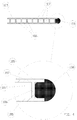
- the just described process is preferably carried out by means of an apparatus as shown in figure 1 .
- the apparatus generally referred to as number 1, comprises a charging hopper 2 of the thermoplastic elastomeric material, an extruder 3, a metering pump 4, downstream the extruder, a flexible conduit 5, to transport the thermoplastic elastomeric material exiting the extruder, a die or a laying or injection nozzle of the thermoplastic elastomeric material 6, a moving system 7 of the die and a moving system of a corrugated panel to be sealed.
- the hopper 2 is charged with the thermoplastic elastomeric material in the form of pellets. From the hopper the pellet falls into the feed portion of the extruder where it can be heated. Subsequently, the material goes into the extruder 3 which is made of a traditional cylinder inside which a worm screw presses the material. Thus, inside it, it occurs the transformation of the pellet from a solid state into a fused state due to the temperature and to the mechanical action of the compression and of the shearing stresses transmitted by the extrusion screw.
- a pressure probe 9 apt at detecting the pressure entering the metering pump.
- the metering pump 4 mounted at the end of the extruder 3, receives the fluid material and releases the amount necessary to continuously feed the die 6 depending on the characteristics of the border to be sealed, for example its thickness and therefore the space to be filled.
- the conduit must be flexible as it is connected to a moving die, as later described in detail.
- the conduit 5 must bear remarkable pressures, up to 150 bars, and temperatures up to 250°C. Consequently, it is made of a material with a high abrasion resistance and a high chemical resistance to all chemical substances, including acids and alkaline solutions of any concentration.
- the flexible conduit is made of a PTFE smooth pipe intertwined with two layers of stainless steel wire, (1.4301) max., operating temperature of 250°C and operating pressure up to 200 bars.
- the conduit is equipped with heating elements.
- the conduit is insulated by means of an insulating material, of the traditional kind, in order to prevent heat dispersion along the route from the pump to the die.
- a sensor 8 is mounted on the die 6 to detect the fluid pressure therein.
- the die 6 is made of a nozzle of any kind, or groups of nozzles or a plate provided with one or more holes calibrated so as to allow the desired profiling of the corrugated panel. Consequently, the die will be adapted according to the thickness and the shape of the border to be sealed.
- the die 6 is mounted on a moving system 7 apt at moving the die along the open border of a panel so that it can always place itself, following its profile, with the same above said angle.
- the system 7 comprises respectively first 71 and second 72 guides or rails apt at moving the die 6 along respectively a first and second direction orthogonal to each other and laying on a horizontal plane.
- the die is mounted in rotation on an orthogonal axis X-X, that is vertical, with respect to said first 71 and second 72 guides ( figure 1 ).
- the moving system is also provided with sensors (not shown) apt at reading the die position with respect to the border profile so as to send a proximity signal to a command and control unit (not shown) of the movement of the same die.
- the movement of the die occurs according to predefined parameters loaded on a command and control unit (not shown) depending on the type of the panel to be sealed.
- the positioning and movement of the die 6 is carried out by means of the instructions sent to the command and control unit.
- the instructions are spatial coordinates stored in the command and control unit based on different types of panels.
- FIG 2A it is shown a starting point of the laying step e) wherein the die 6 is in correspondence of a rounded corner of a panel 100 to be sealed.
- the moving system 7 is activated so as to follow the border profile of the panel 100 always keeping the correct angle of the die.
- the system is capable of following, in a very precise way, the entire profile of the panel so as to place the die in the correct position at every moment and to allow the laying of the filler material to seal the openings.
- the panel movement is carried out through continuous belt or chain or roller haul-off, in particular in the case of the continuous process the continuous sheet is moved by means of roller haul-offs.
- the movement of the sheet must be, both in the continuous and discontinuous cases, constant and synchronized with the laying speed and in the discontinuous case with the tracking system of the die.
- the sealing first occurs on two sides of the panel in the extrusion line or by means of a first transit in order to seal two or three adjacent sides, and two borders by means of the moving system previously described with reference to figures 2A-2F . Then the sheet is turned by 180° and the other two adjacent sides or the remaining side are bordered with the respective borders.
- the die or nozzle 6 comprises a gate with a needle valve of the conventional type.
- the blocking of the canal occurs by means of a needle operated by a pneumatic piston: when the needle is pushed towards the nozzle or the exit channel of the material, it forms a conical seal with the channel walls blocking the flow, when it is lifted, the seal opens letting the material flow (not shown).
- the apparatus comprises a cooling-calibration group 13, as shown in figure 9 .
- the calibration group placed as close as possible to the die or nozzle is a counter mold of the profile to be made.
- the counter mold 14, or mold is cooled, or better thermoregulated, by means of a command and control unit (not shown), and can also operate in a vacuum so that the extruded material can perfectly adhere to the calibrator and can cool down in a controlled way.
- the counter mold 14 is formed by a series of rollers shaped as the resulting border, they too cooled down.
- some air is insufflated by means of, for example, a traditional air knife nozzle 15 (schematically shown in figure 9 ) having the function of lowering the surface temperature of the filler material and of reducing the friction when entering the calibration group.
- a traditional air knife nozzle 15 (schematically shown in figure 9 ) having the function of lowering the surface temperature of the filler material and of reducing the friction when entering the calibration group.
- a corrugated panel 100 according to the present invention comprises a border provided with two first sides 101, two second sides 102 and four rounded corners 103.
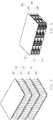
- the sealed panel 100 has, in a sectional view as shown in figure 4 , two sheets parallel and spaced by corresponding inter-layers 106 so as to form corrugations 107.
- the corrugations 107 are closed, that is sealed, by means of laying thermoplastic elastomeric material 108.
- the material 108 fills at least partially the open corrugation and so its contact surface and that of the corrugation are sealed through fusion.
- thermoplastic elastomeric material of the bordering protrudes with respect to the profile of the panel so as to form a sort of protection against shocks. Consequently, the resulting bordering acts not only as a sealing for the corrugations, but also, thanks to the properties of the laid material, it absorbs the shocks in an efficient way.
- the panel 100 has a great number of applications.
- it can be used as an interlayer for separating and packaging food containers such as bottles 12, or to separate mechanical items such as gears 13, (shown in figure 6 ) molded items, etc.
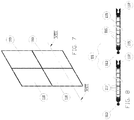
- panels 110 are basically identical to panel 100 previously described and comprise two parallel sheets 115 separated by interlayers 116 which define the corrugations 117.
- these panels can be assembled one with the other in order to form structures which can be assembled with single elements according to space requirements. Therefore, actually any requirements can be fulfilled with only one size.
- the assembling can occur by interlocking of the perimetric borders 111 of adjacent panels 110.
- such borders 111 are provided with interlocking means.
- the borders 111 are provided with at least a first border 112 provided with a groove apt at receiving a corresponding protrusion of a second border 113.
- the interlocking is snap-fitted and with shape coupling.
- the material can comprise a mold 16 wherein the thermoplastic polymeric material coming from the extruder 3 is laid.
- the mold will be already shaped so as to give the border the desired shape.
- such mold 16 will be moved along the borders of the panel 100 so as to achieve the bordering/sealing according to the invention.
- the corrugated panel comprises a leak-proof sealing thanks to the fusion sealing of the contact surface between the perimetric border of the panel and a thermoplastic elastomeric material laid through extrusion and injection. Hence, it is very effectively prevented dirt and liquid from entering that can cause mildew and bacteria growth which is absolutely to be prevented especially when used for packaging foodstuffs.
- the resulting border is profiled; therefore it is possible to make particular shapes such as radial connections or interlocking with shape couplings.
- the bordering gives a high resistance to shocks just at the portion of panels which is more subject to damages, also thanks, at least, to the partial filling of the open corrugations.
Landscapes
- Mechanical Engineering (AREA)
- Engineering & Computer Science (AREA)
- Physics & Mathematics (AREA)
- Thermal Sciences (AREA)
- Chemical & Material Sciences (AREA)
- Composite Materials (AREA)
- Clinical Laboratory Science (AREA)
- Health & Medical Sciences (AREA)
- Extrusion Moulding Of Plastics Or The Like (AREA)
- Laminated Bodies (AREA)
- Shaping Of Tube Ends By Bending Or Straightening (AREA)
- Finishing Walls (AREA)
- Lining Or Joining Of Plastics Or The Like (AREA)
Priority Applications (2)
| Application Number | Priority Date | Filing Date | Title |
|---|---|---|---|
| SI201430334T SI2996859T1 (sl) | 2013-05-17 | 2014-04-18 | Postopek in naprava za obrobljanje valovite plošče iz umetne snovi in tako dobljena plošča |
| PL14723128T PL2996859T3 (pl) | 2013-05-17 | 2014-04-18 | Sposób i urządzenie do obróbki brzegów falistego panelu z tworzywa sztucznego i panel w ten sposób otrzymany |
Applications Claiming Priority (2)
| Application Number | Priority Date | Filing Date | Title |
|---|---|---|---|
| IT000027A ITPN20130027A1 (it) | 2013-05-17 | 2013-05-17 | Procedimento di bordatura di un pannello di materiale plastico alveolare e pannello cosi' ottenuto |
| PCT/IB2014/060836 WO2014184692A1 (en) | 2013-05-17 | 2014-04-18 | Process and apparatus for bordering a corrugated plastic panel and panel thus obtained |
Publications (2)
| Publication Number | Publication Date |
|---|---|
| EP2996859A1 EP2996859A1 (en) | 2016-03-23 |
| EP2996859B1 true EP2996859B1 (en) | 2017-05-31 |
Family
ID=48628820
Family Applications (1)
| Application Number | Title | Priority Date | Filing Date |
|---|---|---|---|
| EP14723128.6A Active EP2996859B1 (en) | 2013-05-17 | 2014-04-18 | Process and apparatus for bordering a corrugated plastic panel and panel thus obtained |
Country Status (13)
| Country | Link |
|---|---|
| US (2) | US20160114541A1 (pl) |
| EP (1) | EP2996859B1 (pl) |
| CA (1) | CA2912869C (pl) |
| DK (1) | DK2996859T3 (pl) |
| ES (1) | ES2637196T3 (pl) |
| HU (1) | HUE035935T2 (pl) |
| IT (1) | ITPN20130027A1 (pl) |
| MD (1) | MD4610C1 (pl) |
| PL (1) | PL2996859T3 (pl) |
| RU (1) | RU2668435C2 (pl) |
| SI (1) | SI2996859T1 (pl) |
| UA (1) | UA117483C2 (pl) |
| WO (1) | WO2014184692A1 (pl) |
Cited By (1)
| Publication number | Priority date | Publication date | Assignee | Title |
|---|---|---|---|---|
| EA038399B1 (ru) * | 2018-04-16 | 2021-08-23 | Павел Иванович Кичигин | Способ усиления полимерных листов или стенок и экструзионная головка для осуществления способа |
Families Citing this family (2)
| Publication number | Priority date | Publication date | Assignee | Title |
|---|---|---|---|---|
| US20230347567A1 (en) * | 2022-04-27 | 2023-11-02 | Not Wood Inc. | Construction components and systems fabricated using extruded materials |
| EP4458544B1 (en) * | 2023-05-04 | 2025-12-10 | Airbus Operations GmbH | A method and apparatus for manufacturing protective liners for structural profile parts of aircraft |
Family Cites Families (19)
| Publication number | Priority date | Publication date | Assignee | Title |
|---|---|---|---|---|
| US3491176A (en) * | 1967-02-13 | 1970-01-20 | Uniroyal Inc | Edge covering process and apparatus |
| DE1704043B1 (de) * | 1967-07-25 | 1970-07-30 | Hoechst Ag | Schweissgeraet zum Schweissen von dickwandigen Teilen aus thermoplastischem Kunststoff |
| US3852149A (en) * | 1972-04-19 | 1974-12-03 | Novogard Corp | Insulating glass window assemblies |
| FR2287278A1 (fr) * | 1974-10-10 | 1976-05-07 | Saint Gobain | Procede et dispositif pour l'enduction des tranches d'un vitrage multiple |
| US4186685A (en) * | 1974-12-11 | 1980-02-05 | Saint-Gobain Industries | Apparatus for applying a thick seal to a glass sheet |
| US4090835A (en) * | 1976-06-01 | 1978-05-23 | The Steelastic Company | Apparatus for applying an elastomeric edge to a sheet of elastomeric fabric |
| DE3601255A1 (de) * | 1986-01-17 | 1987-07-23 | Suboeplast Gmbh Tech Kunststof | Gegenstand aus einem schaumstoffmaterial und einem kunststoffkoerper, sowie verfahren zur herstellung eines derartigen gegenstandes |
| AT390433B (de) * | 1986-09-01 | 1990-05-10 | Lisec Peter | Vorrichtung zum aufbringen von flexiblen abstandhaltern |
| AT397957B (de) * | 1989-04-03 | 1994-08-25 | Lisec Peter | Vorrichtung zum füllen der randfuge von isolierglasscheiben mit versiegelungsmasse |
| WO1997010903A1 (en) * | 1995-09-22 | 1997-03-27 | Jaervelae Pentti | Method for coating a product |
| US5932062A (en) * | 1995-10-25 | 1999-08-03 | Manser; Russell D. | Automated sealant applicator |
| WO2001019603A1 (de) * | 1999-09-16 | 2001-03-22 | Rono Systemtechnik Ag | Verfahren und vorrichtung zur herstellung von randabschlüssen bei sandwichpanelen |
| ITTV20010131A1 (it) * | 2001-09-27 | 2003-03-27 | For El Base Di Vianello Fortun | Macchina automatica per l'estruzione e l'applicazione di sigillante sulle pareti laterali di un telaio distanziatore per vetrocamera e proce |
| DE102004010873A1 (de) * | 2004-03-05 | 2005-09-22 | Homag Holzbearbeitungssysteme Ag | Verfahren und Vorrichtung zur Herstellung einer Leichtbauplatte |
| US20050202215A1 (en) * | 2004-03-12 | 2005-09-15 | Temple Donald L.Ii | Corrugated apparatus having treated edges |
| DE102005056079A1 (de) * | 2004-11-24 | 2006-06-08 | GLÄSER, Willi | Verfahren zum Fertigstellen einer Tragplatte, insbesondere einer Tischplatte |
| ITTV20080032A1 (it) * | 2008-02-20 | 2009-08-21 | For El Base Di Vianello Fortunato & C Snc | Dispositivo automatico e procedimento automatico per la sigillatura perimetrale del vetro isolante composto da almeno due lastre di vetro ed almeno un telaio distanziatore avente profilo complesso differente dal tradizionale. |
| GB0804554D0 (en) * | 2008-03-12 | 2008-04-16 | Zephyros Inc | Edging system |
| WO2010143310A1 (en) * | 2009-06-09 | 2010-12-16 | The Yokohama Rubber Co., Ltd. | Method of and apparatus for molding glazing gasket onto multilayer glass panel |
-
2013
- 2013-05-17 IT IT000027A patent/ITPN20130027A1/it unknown
-
2014
- 2014-04-18 MD MDA20150124A patent/MD4610C1/ro active IP Right Grant
- 2014-04-18 SI SI201430334T patent/SI2996859T1/sl unknown
- 2014-04-18 EP EP14723128.6A patent/EP2996859B1/en active Active
- 2014-04-18 US US14/891,775 patent/US20160114541A1/en not_active Abandoned
- 2014-04-18 HU HUE14723128A patent/HUE035935T2/en unknown
- 2014-04-18 CA CA2912869A patent/CA2912869C/en active Active
- 2014-04-18 PL PL14723128T patent/PL2996859T3/pl unknown
- 2014-04-18 ES ES14723128.6T patent/ES2637196T3/es active Active
- 2014-04-18 WO PCT/IB2014/060836 patent/WO2014184692A1/en not_active Ceased
- 2014-04-18 UA UAA201511771A patent/UA117483C2/uk unknown
- 2014-04-18 DK DK14723128.6T patent/DK2996859T3/en active
- 2014-04-18 RU RU2015153844A patent/RU2668435C2/ru active
-
2018
- 2018-05-23 US US15/987,300 patent/US20180264758A1/en not_active Abandoned
Cited By (1)
| Publication number | Priority date | Publication date | Assignee | Title |
|---|---|---|---|---|
| EA038399B1 (ru) * | 2018-04-16 | 2021-08-23 | Павел Иванович Кичигин | Способ усиления полимерных листов или стенок и экструзионная головка для осуществления способа |
Also Published As
| Publication number | Publication date |
|---|---|
| DK2996859T3 (en) | 2017-08-28 |
| ES2637196T3 (es) | 2017-10-11 |
| EP2996859A1 (en) | 2016-03-23 |
| MD4610B1 (ro) | 2018-12-31 |
| CA2912869A1 (en) | 2014-11-20 |
| RU2015153844A (ru) | 2017-06-22 |
| RU2015153844A3 (pl) | 2018-03-27 |
| ITPN20130027A1 (it) | 2014-11-18 |
| US20180264758A1 (en) | 2018-09-20 |
| CA2912869C (en) | 2020-12-01 |
| PL2996859T3 (pl) | 2017-10-31 |
| RU2668435C2 (ru) | 2018-10-01 |
| SI2996859T1 (sl) | 2017-09-29 |
| MD20150124A2 (ro) | 2016-04-30 |
| UA117483C2 (uk) | 2018-08-10 |
| HUE035935T2 (en) | 2018-05-28 |
| MD4610C1 (ro) | 2019-07-31 |
| US20160114541A1 (en) | 2016-04-28 |
| WO2014184692A1 (en) | 2014-11-20 |
Similar Documents
| Publication | Publication Date | Title |
|---|---|---|
| US3509005A (en) | Ribbed structures of thermoplastic resin | |
| US3664906A (en) | Structural panel of ribbed structures of thermoplastic resin | |
| AU2017297457B2 (en) | Continuous Production Device And Method For Glass Fiber Reinforced Tape Polyethylene Composite Pipe | |
| US20110161036A1 (en) | Method For Measuring The Thickness Of Multi-Layer Films | |
| US20180264758A1 (en) | Process and apparatus for bordering a corrugated plastic panel and panel thus obtained | |
| US4348346A (en) | Polyester film extrusion with edge bead control | |
| US3399095A (en) | Method and apparatus for producing containers of tubular foam laminates | |
| RU2524395C2 (ru) | Составные сэндвич-элементы | |
| US3551945A (en) | Apparatus for producing hot and cold insulating sheet | |
| US10145107B2 (en) | Method of producing a plate-like construction with a double-wall structure | |
| US20190291337A1 (en) | Antislip, heat sealable plastic flexible packaging bag and method and apparatus for its production | |
| WO2008066768A1 (en) | Multi-layer tubes or conduits and manufacturing methods therefor | |
| KR102080268B1 (ko) | 외부결합 합성수지의 이중 압출 다공 패널 제조장치 | |
| IT8520060A1 (it) | Procedimento per la produzione di contenitori tubolari termoplastici con strato. di barriera | |
| CN102481753A (zh) | 充气交叉层合体及其制造方法和设备 | |
| JP6923207B2 (ja) | 熱成形中央フィルムを有するポリプロピレンベースのハニカムサンドイッチシート又はパネル | |
| US20050202213A1 (en) | Insulation structures | |
| CN102883871A (zh) | 用于制造热塑性塑料空心体的方法 | |
| US20170015042A1 (en) | Method of Extruding Polymer Film onto a Mat and Products Incorporating the Resulting Composite Mat | |
| US20100141274A1 (en) | Method for Measuring the Thickness of Multi-Layer Films | |
| EP2718103B1 (en) | Invisible seam laminated article and process of manufacture | |
| KR101189476B1 (ko) | 고정식 발포시스템을 이용한 샌드위치 판넬의 제조방법 및 발포액 토출장치 | |
| GB2080734A (en) | Method and apparatus for producing a packaging material | |
| CN114379158A (zh) | 一种防水型纸塑复合软管及其制备方法 | |
| CN201827532U (zh) | 一种阻氧金属复合管的生产设备 |
Legal Events
| Date | Code | Title | Description |
|---|---|---|---|
| PUAI | Public reference made under article 153(3) epc to a published international application that has entered the european phase |
Free format text: ORIGINAL CODE: 0009012 |
|
| 17P | Request for examination filed |
Effective date: 20151124 |
|
| AK | Designated contracting states |
Kind code of ref document: A1 Designated state(s): AL AT BE BG CH CY CZ DE DK EE ES FI FR GB GR HR HU IE IS IT LI LT LU LV MC MK MT NL NO PL PT RO RS SE SI SK SM TR |
|
| AX | Request for extension of the european patent |
Extension state: BA ME |
|
| GRAP | Despatch of communication of intention to grant a patent |
Free format text: ORIGINAL CODE: EPIDOSNIGR1 |
|
| INTG | Intention to grant announced |
Effective date: 20161212 |
|
| GRAS | Grant fee paid |
Free format text: ORIGINAL CODE: EPIDOSNIGR3 |
|
| GRAA | (expected) grant |
Free format text: ORIGINAL CODE: 0009210 |
|
| AK | Designated contracting states |
Kind code of ref document: B1 Designated state(s): AL AT BE BG CH CY CZ DE DK EE ES FI FR GB GR HR HU IE IS IT LI LT LU LV MC MK MT NL NO PL PT RO RS SE SI SK SM TR |
|
| AX | Request for extension of the european patent |
Extension state: BA ME |
|
| REG | Reference to a national code |
Ref country code: CH Ref legal event code: EP Ref country code: GB Ref legal event code: FG4D |
|
| REG | Reference to a national code |
Ref country code: AT Ref legal event code: REF Ref document number: 897035 Country of ref document: AT Kind code of ref document: T Effective date: 20170615 |
|
| REG | Reference to a national code |
Ref country code: IE Ref legal event code: FG4D |
|
| REG | Reference to a national code |
Ref country code: DE Ref legal event code: R096 Ref document number: 602014010300 Country of ref document: DE |
|
| REG | Reference to a national code |
Ref country code: NL Ref legal event code: FP |
|
| REG | Reference to a national code |
Ref country code: CH Ref legal event code: NV Representative=s name: PATENTANWAELTE SCHAAD, BALASS, MENZL AND PARTN, CH |
|
| REG | Reference to a national code |
Ref country code: DK Ref legal event code: T3 Effective date: 20170822 |
|
| REG | Reference to a national code |
Ref country code: SE Ref legal event code: TRGR |
|
| REG | Reference to a national code |
Ref country code: LT Ref legal event code: MG4D |
|
| REG | Reference to a national code |
Ref country code: ES Ref legal event code: FG2A Ref document number: 2637196 Country of ref document: ES Kind code of ref document: T3 Effective date: 20171011 |
|
| PG25 | Lapsed in a contracting state [announced via postgrant information from national office to epo] |
Ref country code: FI Free format text: LAPSE BECAUSE OF FAILURE TO SUBMIT A TRANSLATION OF THE DESCRIPTION OR TO PAY THE FEE WITHIN THE PRESCRIBED TIME-LIMIT Effective date: 20170531 Ref country code: LT Free format text: LAPSE BECAUSE OF FAILURE TO SUBMIT A TRANSLATION OF THE DESCRIPTION OR TO PAY THE FEE WITHIN THE PRESCRIBED TIME-LIMIT Effective date: 20170531 Ref country code: NO Free format text: LAPSE BECAUSE OF FAILURE TO SUBMIT A TRANSLATION OF THE DESCRIPTION OR TO PAY THE FEE WITHIN THE PRESCRIBED TIME-LIMIT Effective date: 20170831 Ref country code: GR Free format text: LAPSE BECAUSE OF FAILURE TO SUBMIT A TRANSLATION OF THE DESCRIPTION OR TO PAY THE FEE WITHIN THE PRESCRIBED TIME-LIMIT Effective date: 20170901 Ref country code: HR Free format text: LAPSE BECAUSE OF FAILURE TO SUBMIT A TRANSLATION OF THE DESCRIPTION OR TO PAY THE FEE WITHIN THE PRESCRIBED TIME-LIMIT Effective date: 20170531 |
|
| PG25 | Lapsed in a contracting state [announced via postgrant information from national office to epo] |
Ref country code: RS Free format text: LAPSE BECAUSE OF FAILURE TO SUBMIT A TRANSLATION OF THE DESCRIPTION OR TO PAY THE FEE WITHIN THE PRESCRIBED TIME-LIMIT Effective date: 20170531 Ref country code: IS Free format text: LAPSE BECAUSE OF FAILURE TO SUBMIT A TRANSLATION OF THE DESCRIPTION OR TO PAY THE FEE WITHIN THE PRESCRIBED TIME-LIMIT Effective date: 20170930 Ref country code: LV Free format text: LAPSE BECAUSE OF FAILURE TO SUBMIT A TRANSLATION OF THE DESCRIPTION OR TO PAY THE FEE WITHIN THE PRESCRIBED TIME-LIMIT Effective date: 20170531 Ref country code: BG Free format text: LAPSE BECAUSE OF FAILURE TO SUBMIT A TRANSLATION OF THE DESCRIPTION OR TO PAY THE FEE WITHIN THE PRESCRIBED TIME-LIMIT Effective date: 20170831 |
|
| REG | Reference to a national code |
Ref country code: SK Ref legal event code: T3 Ref document number: E 24986 Country of ref document: SK |
|
| PG25 | Lapsed in a contracting state [announced via postgrant information from national office to epo] |
Ref country code: EE Free format text: LAPSE BECAUSE OF FAILURE TO SUBMIT A TRANSLATION OF THE DESCRIPTION OR TO PAY THE FEE WITHIN THE PRESCRIBED TIME-LIMIT Effective date: 20170531 Ref country code: RO Free format text: LAPSE BECAUSE OF FAILURE TO SUBMIT A TRANSLATION OF THE DESCRIPTION OR TO PAY THE FEE WITHIN THE PRESCRIBED TIME-LIMIT Effective date: 20170531 |
|
| PG25 | Lapsed in a contracting state [announced via postgrant information from national office to epo] |
Ref country code: SM Free format text: LAPSE BECAUSE OF FAILURE TO SUBMIT A TRANSLATION OF THE DESCRIPTION OR TO PAY THE FEE WITHIN THE PRESCRIBED TIME-LIMIT Effective date: 20170531 |
|
| REG | Reference to a national code |
Ref country code: DE Ref legal event code: R097 Ref document number: 602014010300 Country of ref document: DE |
|
| PLBE | No opposition filed within time limit |
Free format text: ORIGINAL CODE: 0009261 |
|
| STAA | Information on the status of an ep patent application or granted ep patent |
Free format text: STATUS: NO OPPOSITION FILED WITHIN TIME LIMIT |
|
| REG | Reference to a national code |
Ref country code: FR Ref legal event code: PLFP Year of fee payment: 5 |
|
| 26N | No opposition filed |
Effective date: 20180301 |
|
| REG | Reference to a national code |
Ref country code: HU Ref legal event code: AG4A Ref document number: E035935 Country of ref document: HU |
|
| REG | Reference to a national code |
Ref country code: DE Ref legal event code: R079 Ref document number: 602014010300 Country of ref document: DE Free format text: PREVIOUS MAIN CLASS: B29C0047020000 Ipc: B29C0048150000 |
|
| PG25 | Lapsed in a contracting state [announced via postgrant information from national office to epo] |
Ref country code: MC Free format text: LAPSE BECAUSE OF FAILURE TO SUBMIT A TRANSLATION OF THE DESCRIPTION OR TO PAY THE FEE WITHIN THE PRESCRIBED TIME-LIMIT Effective date: 20170531 |
|
| PG25 | Lapsed in a contracting state [announced via postgrant information from national office to epo] |
Ref country code: LU Free format text: LAPSE BECAUSE OF NON-PAYMENT OF DUE FEES Effective date: 20180418 |
|
| PG25 | Lapsed in a contracting state [announced via postgrant information from national office to epo] |
Ref country code: MT Free format text: LAPSE BECAUSE OF NON-PAYMENT OF DUE FEES Effective date: 20180418 |
|
| PG25 | Lapsed in a contracting state [announced via postgrant information from national office to epo] |
Ref country code: PT Free format text: LAPSE BECAUSE OF FAILURE TO SUBMIT A TRANSLATION OF THE DESCRIPTION OR TO PAY THE FEE WITHIN THE PRESCRIBED TIME-LIMIT Effective date: 20170531 |
|
| PG25 | Lapsed in a contracting state [announced via postgrant information from national office to epo] |
Ref country code: CY Free format text: LAPSE BECAUSE OF FAILURE TO SUBMIT A TRANSLATION OF THE DESCRIPTION OR TO PAY THE FEE WITHIN THE PRESCRIBED TIME-LIMIT Effective date: 20170531 Ref country code: MK Free format text: LAPSE BECAUSE OF NON-PAYMENT OF DUE FEES Effective date: 20170531 |
|
| PG25 | Lapsed in a contracting state [announced via postgrant information from national office to epo] |
Ref country code: AL Free format text: LAPSE BECAUSE OF FAILURE TO SUBMIT A TRANSLATION OF THE DESCRIPTION OR TO PAY THE FEE WITHIN THE PRESCRIBED TIME-LIMIT Effective date: 20170531 |
|
| P01 | Opt-out of the competence of the unified patent court (upc) registered |
Effective date: 20230328 |
|
| PGFP | Annual fee paid to national office [announced via postgrant information from national office to epo] |
Ref country code: SI Payment date: 20250410 Year of fee payment: 12 |
|
| PGFP | Annual fee paid to national office [announced via postgrant information from national office to epo] |
Ref country code: NL Payment date: 20250418 Year of fee payment: 12 |
|
| PGFP | Annual fee paid to national office [announced via postgrant information from national office to epo] |
Ref country code: DE Payment date: 20250422 Year of fee payment: 12 |
|
| PGFP | Annual fee paid to national office [announced via postgrant information from national office to epo] |
Ref country code: ES Payment date: 20250529 Year of fee payment: 12 Ref country code: GB Payment date: 20250423 Year of fee payment: 12 Ref country code: DK Payment date: 20250429 Year of fee payment: 12 |
|
| PGFP | Annual fee paid to national office [announced via postgrant information from national office to epo] |
Ref country code: BE Payment date: 20250418 Year of fee payment: 12 |
|
| PGFP | Annual fee paid to national office [announced via postgrant information from national office to epo] |
Ref country code: FR Payment date: 20250425 Year of fee payment: 12 |
|
| PGFP | Annual fee paid to national office [announced via postgrant information from national office to epo] |
Ref country code: CH Payment date: 20250501 Year of fee payment: 12 |
|
| PGFP | Annual fee paid to national office [announced via postgrant information from national office to epo] |
Ref country code: AT Payment date: 20250423 Year of fee payment: 12 |
|
| PGFP | Annual fee paid to national office [announced via postgrant information from national office to epo] |
Ref country code: TR Payment date: 20250414 Year of fee payment: 12 Ref country code: SK Payment date: 20250416 Year of fee payment: 12 |
|
| PGFP | Annual fee paid to national office [announced via postgrant information from national office to epo] |
Ref country code: CZ Payment date: 20250410 Year of fee payment: 12 |
|
| PGFP | Annual fee paid to national office [announced via postgrant information from national office to epo] |
Ref country code: IE Payment date: 20250422 Year of fee payment: 12 |
|
| PGFP | Annual fee paid to national office [announced via postgrant information from national office to epo] |
Ref country code: SE Payment date: 20250429 Year of fee payment: 12 |
|
| PGFP | Annual fee paid to national office [announced via postgrant information from national office to epo] |
Ref country code: HU Payment date: 20251008 Year of fee payment: 12 |
|
| PGFP | Annual fee paid to national office [announced via postgrant information from national office to epo] |
Ref country code: IT Payment date: 20260313 Year of fee payment: 13 |
|
| PGFP | Annual fee paid to national office [announced via postgrant information from national office to epo] |
Ref country code: PL Payment date: 20260324 Year of fee payment: 13 |