EP2995751A2 - Schutzstruktur und montageverfahren - Google Patents
Schutzstruktur und montageverfahren Download PDFInfo
- Publication number
- EP2995751A2 EP2995751A2 EP15275200.2A EP15275200A EP2995751A2 EP 2995751 A2 EP2995751 A2 EP 2995751A2 EP 15275200 A EP15275200 A EP 15275200A EP 2995751 A2 EP2995751 A2 EP 2995751A2
- Authority
- EP
- European Patent Office
- Prior art keywords
- assembly
- arrangement
- rib
- side joint
- joint assembly
- Prior art date
- Legal status (The legal status is an assumption and is not a legal conclusion. Google has not performed a legal analysis and makes no representation as to the accuracy of the status listed.)
- Withdrawn
Links
Images




Classifications
-
- E—FIXED CONSTRUCTIONS
- E04—BUILDING
- E04H—BUILDINGS OR LIKE STRUCTURES FOR PARTICULAR PURPOSES; SWIMMING OR SPLASH BATHS OR POOLS; MASTS; FENCING; TENTS OR CANOPIES, IN GENERAL
- E04H15/00—Tents or canopies, in general
- E04H15/32—Parts, components, construction details, accessories, interior equipment, specially adapted for tents, e.g. guy-line equipment, skirts, thresholds
- E04H15/34—Supporting means, e.g. frames
- E04H15/44—Supporting means, e.g. frames collapsible, e.g. breakdown type
- E04H15/48—Supporting means, e.g. frames collapsible, e.g. breakdown type foldable, i.e. having pivoted or hinged means
-
- E—FIXED CONSTRUCTIONS
- E04—BUILDING
- E04H—BUILDINGS OR LIKE STRUCTURES FOR PARTICULAR PURPOSES; SWIMMING OR SPLASH BATHS OR POOLS; MASTS; FENCING; TENTS OR CANOPIES, IN GENERAL
- E04H15/00—Tents or canopies, in general
- E04H15/32—Parts, components, construction details, accessories, interior equipment, specially adapted for tents, e.g. guy-line equipment, skirts, thresholds
- E04H15/34—Supporting means, e.g. frames
- E04H15/36—Supporting means, e.g. frames arch-shaped type
- E04H15/40—Supporting means, e.g. frames arch-shaped type flexible
- E04H15/405—Supporting means, e.g. frames arch-shaped type flexible flexible and foldable
-
- E—FIXED CONSTRUCTIONS
- E04—BUILDING
- E04H—BUILDINGS OR LIKE STRUCTURES FOR PARTICULAR PURPOSES; SWIMMING OR SPLASH BATHS OR POOLS; MASTS; FENCING; TENTS OR CANOPIES, IN GENERAL
- E04H15/00—Tents or canopies, in general
- E04H15/32—Parts, components, construction details, accessories, interior equipment, specially adapted for tents, e.g. guy-line equipment, skirts, thresholds
- E04H15/34—Supporting means, e.g. frames
- E04H15/44—Supporting means, e.g. frames collapsible, e.g. breakdown type
- E04H15/48—Supporting means, e.g. frames collapsible, e.g. breakdown type foldable, i.e. having pivoted or hinged means
- E04H15/52—Supporting means, e.g. frames collapsible, e.g. breakdown type foldable, i.e. having pivoted or hinged means parallelogram type
-
- E—FIXED CONSTRUCTIONS
- E04—BUILDING
- E04H—BUILDINGS OR LIKE STRUCTURES FOR PARTICULAR PURPOSES; SWIMMING OR SPLASH BATHS OR POOLS; MASTS; FENCING; TENTS OR CANOPIES, IN GENERAL
- E04H15/00—Tents or canopies, in general
- E04H15/32—Parts, components, construction details, accessories, interior equipment, specially adapted for tents, e.g. guy-line equipment, skirts, thresholds
- E04H15/54—Covers of tents or canopies
Definitions
- the present invention is generally directed to erectable shelter structures, and in particular, to improved erectable shelter structure constructions and improved methods for assembly and disassembly thereof.
- known structural frame buildings comprised of joined rib structures may have hinged joints to fold for storage and assembly, with such structures being joined by cross members (e.g. purlins) that are coupled to the folding rib structures.
- cross members e.g. purlins
- the current prior art designs include constructions where the purlins and other cross rail assemblies may be already preassembled and attached to the rib assemblies, thus adding weight and difficultly to the construction. Such known prior art examples also thus reduce the ease of handling during assembly and disassembly of the shelter structure.
- a top double pivot design as exemplified in Patent No. 3,826,270.
- Such a design heretofore has been required to permit components of the rib assembly to become parallel when collapsed, so as to minimize the size and configuration of the rib assemblies for ease of handling and storage.
- the extra components required to achieve the double pivot add cost and complexity to the rib assembly, it is less than optimal of a design.
- the second pivot at the top joint can create instability while unfolding the rib unless a mechanism is added to maintain positional stability during the folding and unfolding thereof. Such an additional mechanism also adds cost and complexity to the joint design.
- the present invention sets out to overcome such perceived deficiencies.
- the present invention allows for the easier transportation of structure components, the easier assembly and disassembly of the structure and the easier storage thereof.
- Another objective of the present invention to provide an improved rib assembly that provides spacing, creating an increased enclosed volume of the frame of the shelter structure.
- Yet another objective of the present invention to provide improved methods of construction of the shelter structure and improved methods and constructions of attaching the cross members to the rib assemblies.
- Still another objective of the present invention to provide an improved rib assembly that provides for improved folding capabilities to achieve improved surfaces for the cover to be attached thereto.
- an objective of the present invention to provide an improved rib assembly that provides for the rib assemblies to fold inward while using a minimum number of joints, as opposed to prior art constructions that require two joints near the peak, thus reducing the weight and construction costs thereof, while also improving the structural integrity and ease of construction and disassembly thereof.
- an objective of the present invention to provide an improved shelter structure design that is easier and quicker to construct than heretofor known in the art.
- an erectable shelter frame structure comprising at least a first rib assembly and an Nth rib assembly, wherein each of the first rib assembly and the Nth rib assembly comprises a peak joint assembly, a first side joint assembly and a second side joint assembly, a first arch rail arrangement intermediate the peak joint assembly and the first side joint assembly, a second arch rail arrangement intermediate the peak joint assembly and the second side joint assembly, a first leg arrangement coupled to the first side joint assembly, and a second leg arrangement coupled to the second side joint assembly, wherein with respect to the first end rib assembly: the peak joint assembly comprises a receptacle for receiving a first end of a first purlin arrangement, the first side joint assembly comprises a receptacle for receiving a first end of a second purlin arrangement, and the second side joint assembly comprises a receptacle for receiving a first end of a third purlin arrangement, wherein with respect to the Nth rib assembly: the peak joint assembly comprises a
- an erectable shelter frame structure comprising a first rib assembly and at least a second rib assembly, wherein each of the first rib assembly and the second rib assembly comprises a peak joint assembly, a first side joint assembly and a second side joint assembly, and wherein the peak joint assembly, the first side joint assembly and the second side joint assembly are all at least essentially identical in construction; a plurality of purlin arrangements to couple the first rib assembly to the second rib assembly and thereby form a shelter structure; wherein each of the first and second rib assemblies comprises: a non-linear first arch rail arrangement intermediate the peak joint assembly and the first side joint assembly; a non-linear second arch rail arrangement intermediate the peak joint assembly and the second side joint assembly, a first leg arrangement coupled to the first side joint assembly, and a second leg arrangement coupled to the second side joint assembly; and each is foldable such that in a folded state: the first and second leg arrangements are parallely aligned and positioned intermediate the first arch rail arrangement and the second arch rail arrangement.
- an erectable shelter frame structure comprising at least a first rib assembly and an Nth rib assembly, wherein each of the first rib assembly and the Nth rib assembly comprises a peak joint toggle clamp, a first side joint toggle clamp and a second side joint toggle clamp; a plurality of purlin arrangements to couple the first rib assembly to the Nth rib assembly to thereby form a shelter structure; wherein at least the first side joint toggle clamp and the second side joint toggle clamp are at least essentially identical in construction; and wherein each of the rib assemblies comprise a first arch rail arrangement intermediate the peak joint toggle clamp and the first side joint toggle clamp, a second arch rail arrangement intermediate the peak joint toggle clamp and the second side joint toggle clamp, a first leg arrangement coupled to the first side joint toggle clamp, and a second leg arrangement coupled to the second side joint toggle clamp.
- a method of at least one of assembling and disassembling a shelter frame structure comprising at least a first rib assembly and a second rib assembly, wherein each of the first rib assembly and the second rib assembly comprises a peak joint assembly, a first side joint assembly and a second side joint assembly, a first arch rail arrangement intermediate the peak joint assembly and the first side joint assembly, a second arch rail arrangement intermediate the peak joint assembly and the second side joint assembly, a first leg arrangement coupled to the first side joint assembly, and a second leg arrangement coupled to the second side joint assembly, wherein with respect to the first end rib assembly the peak joint assembly comprises a receptacle for receiving a first end of a first purlin arrangement, the first side joint assembly comprises a receptacle for receiving a first end of a second purlin arrangement, and the second side joint assembly comprises a receptacle for receiving a first end of a third purlin arrangement, wherein with respect to the second rib assembly,
- the folding rib assemblies may be constructed as end assemblies or intermediate rib assemblies, which can be joined to purlins on both sides and intermediate to the end rib assemblies.
- Purlin attachments can be such and receptacles positioned so that the rib sections can be used as end or intermediate rib assemblies.
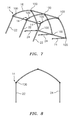
- FIGs. 1A and 1B illustrate two preferred embodiments of a rib assembly, generally indicated at 10. Reference to one of Fig. 1A and 1B shall be deemed to equally apply to the other. Likewise, while the figures generally are consistently illustrated with respect to Fig. 1A designed rib assemblies, all the figures are equally applicable as if rib assemblies as illustrated in Fig. 1B were shown. It should also be understood, even if not explicitly mentioned, that all rib assemblies in any particular shelter structure disclosed or envisioned herein are preferably identically constructed. However, differing shaped shelter structures may be formed using the differently shaped rib assemblies, as illustrated, but not limited, in Fig. 1A and 1B .
- FIGs. 1A and 1B illustrate the preferred rib assembly constructions in a fully folded position.
- Fig. 8 illustrates an exemplary rib assembly 10 in a fully open position.
- the first rib assembly 10 may be unfolded at the peak and stood up on the eave joints, as illustrated in Fig. 2 . In this position, it can be seen that a base 22a of the first leg arrangement 22 is in facing alignment with a base 24a of the second leg arrangement 24;
- the pivoting joint assembly located at the peak may then be secured or latched as will be discussed below.
- the purlin arrangements may then be installed in the respective receptacles.
- the purlins can be locked into position or left to move freely within the receptacle.
- rib assembly 10 may be complete with the purlins located in the respective receptacles thereof.
- a next folded rib assembly may be unfolded and secured to the first rib assembly 10, preferably by coupling the respective peak pivot joint assemblies by a purlin arrangement.
- the rib assembly 50 is then attached to the remaining purlins installed into the first rib assembly 10.
- the next sets of purlin arrangements may be installed into the receptacles of the successive rib assemblies as described above. It should be noted that the purlins are preferably assembled into next rib assemblies and so on to create shelter structure 5. This process can be continued for additional rib assemblies and completed in any order until all of the required components of rib assemblies and purlin arrangements are completed.
- Figs. 5 and 6 illustrate a shelter structure being assembled with more than two (2) rib assemblies.
- Fig. 6 shows a shelter structure with three (3) rib assemblies.
- the number of rib assemblies be at least two (2) and preferably no more than five (5), but this is only limited by the desires and needed functionality and shelter by any user(s) thereof.
- N shall be equal to or less than 10.
- cover(s) it is preferable to place the cover(s) (see Fig. 9B ) over the assembled frame (e.g. see Fig. 9A ) prior to lifting the frame. If the cover is one piece, the cover may be installed over the fully assembled frame structure. If the cover is comprised of multiple sections, such as end panels and top panels, the intermediate rib sections might be covered first. End panels may be installed with the end ribs as part of the frame assembly. The top cover may be laid over the top of the structure prior to the next steps.
- Fig. 7 shows the structure without any covers.
- the cover(s) may be put on the structure prior to lifting as now will be explained, or after lifting, as desired.
- one side of the shelter structure 5 may then be lifted and the leg arrangements (e.g. leg arrangements 22) are pulled out to their final assembled position, the pivoting joint assemblies (e.g. preferably toggle clamps, as further disclosed below) on the opened leg arrangements 22 then being locked or maintained in the open position as disclosed below.
- the lower side e.g. leg arrangements 24
- the pivot joint assemblies e.g.
- toggle clamps of the eaves can be latched or maintained in the open position ( Fig. 8 ) as discussed below. Once the leg arrangements are opened the pivot joints are locked if not done so in the previous steps. Once erect, the cover installation can be completed if not done so in the previous steps, as alluded to above. Cover attachment and anchoring can then be finalized.
- creating a compact assembly when collapsing the structure can be achieved using a single pivot at the peak point assembly by arching or bending the rafter elements.
- the components of the folding frame structure can be manipulated to a manageable size and shape with fewer moving and static parts than in the known prior art.
- the curve or bend(s) in the arch rail arrangements of Figs. 1A, 1B allow the rafter to get wider, thus accommodating the folded leg components from a single pivot point assembly.
- a secondary benefit to the change in rafter shape is the change in bending moment allowing the rafter to also carry higher loads increasing the strength of the building structure itself.
- a tertiary benefit is to allow easier handling and lifting of the rib assembly by providing better clearance to secure and hold the assembly.
- the amount of bending and/or final shape keeping in mind the foregoing objectives and advantages, can be decided by the skilled artisan.
- the shelter frame structure 5 comprises at least two or more rib assemblies 10.
- Each rib assembly 10 comprises a peak joint assembly 12, a first side joint assembly 14 and a second side joint assembly 16.
- the peak joint assembly 12, the first side joint assembly 14 and the second side joint assembly 16 are all at least essentially identical in construction.
- shelter structure 5 will also comprises a plurality of purlin arrangements to couple the successively positioned rib assemblies to one another to thereby form shelter structure 5.
- each of the rib assemblies 10 comprises a non-linear first arch rail arrangement 18 intermediate the peak joint assembly 12 and the first side joint assembly 14; a non-linear second arch rail arrangement 20 intermediate the peak joint assembly 12 and the second side joint assembly 16, a first leg arrangement 22 coupled to the first side joint assembly 14; and a second leg arrangement 24 coupled to the second side joint assembly 16.
- non-linear it is meant that from end to end (i.e. when viewed across the entire length of the rail arrangement), is not one continuous linear or otherwise long linear bar/pole.
- Fig. 1A illustrates curved arch rail arrangements
- Fig. 1B illustrates a plurality of straight segments formed into overall non-linear rail arrangements 18, 20. That is, arrangements 18, 20 in Fig.
- FIG. 1B still meets the definition of a "non-linear" arch rail arrangement as claimed.
- the first and second leg arrangements 22, 24 are parallely alignable and positioned intermediate the first arch rail arrangement 18 and the second arch rail arrangement 20.
- the parallel alignment of the leg arrangements 22, 24 in Figs. 1A and 1B can be achieved without the need for a double pivot joint and thus has the advantages described herein.
- each of the peak joint assembly 12, the first side joint assembly 14 and the second side joint assembly 16 has a respective receptacle, the function and purpose thereof which will be disclosed in further detail below.
- each of the rib assemblies as illustrated in Figs. 1A, 1B can function as an end rib assembly or an intermediate rib assembly.
- Receptacles on one or both sides can therefore be provided as would be understood in the art.
- Such receptacles may be provided by way of attachment to the joint assemblies or the legs by welding, rivets and/or screws.
- Receptacles as disclosed herein have been found to be much easier to use in connection with the disclosed purlin arrangements and for constructing shelter structures such as those disclosed herein, and provide for a much quicker set up and disassembly than such connection joints in the prior art, yet still provide sufficient structural integrity.
- Figs. 9A, 9B illustrate an erectable shelter frame structure, generally indicated at 5, with three (3) rib assemblies, but this is by way of example only.
- the minimum number of rib assemblies is two (2), while in a practical embodiment, the maximum number of rib assemblies is five (5).
- the shelter frame structure 5 comprises N rib assemblies.
- N is equal to three (3).
- shelter frame structure 5 comprises at least a first rib assembly 10 and a second rib assembly 50. It should be understood that different rib assemblies are provided with differing reference numbers but this is for ease of disclosure only, as each rib assembly is preferably functionally identical with all other rib assemblies.
- Each rib assembly comprises a peak joint assembly, generally indicated at 12, a first side joint assembly, generally indicated at 14, and a second side joint assembly, generally indicated at 16, a first arch rail arrangement 18 intermediate the peak joint assembly 12 and the first side joint assembly 14, a second arch rail arrangement 20 intermediate the peak joint assembly 12 and the second side joint assembly 16, a first leg arrangement 22 coupled to the first side joint assembly 14, and a second leg arrangement 24 coupled to the second side joint assembly 16.
- the arch rail arrangements and/or leg arrangements may be comprised of one or more components that are coupled together, for example as disclosed in U.S. Patent No. 7,296,584 . That is, one or more segmented sections may comprise each and/or any of the rail assemblies. Similarly, the leg arrangements may be comprised of segmented bars/poles, or may be telescoping, as would be understood in the art.
- the peak joint assembly 12 comprises a receptacle 26 for receiving a first end 28A of a first purlin arrangement 28
- the first side joint assembly 14 comprises a receptacle 30 for receiving a first end 32A of a second purlin arrangement 32
- the second side joint assembly 16 comprises a receptacle 34 for receiving a first end 36A of a third purlin arrangement 36.
- the peak joint assembly 12 comprises at least a receptacle 38 in facing alignment with the peak joint receptacle 26 of the first end rib assembly 10 that receives the first end 28A of the first purlin arrangement 28, for receiving a second end 28B of the first purlin arrangement 28;
- the first side joint assembly 14 comprises at least a receptacle 40 in facing alignment with the first side joint receptacle 30 of the first rib assembly 10 that receives the first end 32A of the second purlin arrangement 32, for receiving a second end 32B of the second purlin arrangement 32;
- the second side joint assembly 16 comprises at least a receptacle 42 in facing alignment with the second side joint receptacle 34 of the first rib assembly 10 that receives the first end 36A of the third purlin arrangement 36, for receiving a second end 36B of the third purlin arrangement 36.
- each rib assembly may be provided with a different reference number and the receptacles are referenced with different reference numbers, all rib assemblies and all receptacles are preferably identically constructed.
- the erectable shelter frame structure comprises three rib assemblies.
- “N” still equals two (2).
- the peak joint assembly 12 of the N th rib assembly 50 further comprises a receptacle 44 for receiving a first end 46A of an N+2 purlin arrangement 46
- the first side joint assembly 14 of the N th (i.e. second) rib assembly 50 further comprises a receptacle 48 for receiving a first end 52A of an N+3 purlin arrangement 52
- the second side joint assembly 16 of the N th (i.e. 3 rd ) rib assembly 50 further comprises a receptacle 54 for receiving a first end 56A of an N+4 purlin arrangement 56.
- end ribs are preferably identically constructed (i.e. receptacles on only one side thereof), while the intermediate ribs will have receptacles on each side.
- the (N+1) th rib assembly 60 preferably comprises:
- the first arch rail arrangement 18 and the second arch rail arrangement 20 are rotatable with respect to each other about the peak joint assembly 12; the first leg arrangement 22 and the first arch rail arrangement 18 are rotatable with respect to each other about the first side joint assembly 14; and the second leg arrangement 24 and the second arch rail arrangement 20 are rotatable with respect to each other about the second side joint assembly 16.
- a shelter frame structure 5 that is both easy to assemble and disassembly for the reasons noted above is achieved.
- more rib assemblies can easily be fit and incorporated into the desired shelter structure size, thereby making the structure larger or smaller as desired.
- rib assemblies can be added or removed from the structure as desired by merely inserting intermediate ribs having receptacles on both sides as disclosed with respect to rib assembly 50.
- each of the rib assemblies comprise non-linear first arch rail arrangements 18 (as illustrated in each of Figs. 1A and 1B ) intermediate the respective peak joint assemblies 12 and the first side joint assemblies 14; non-linear second arch rail arrangements 20 (also as illustrated in each of Figs. 1A and 1B ) intermediate the respective peak joint assemblies 12 and the second side joint assemblies 14, first leg arrangements 22 coupled to the respective first side joint assemblies 14, and second leg arrangements 24 coupled to the respective second side joint assembly 16.
- the first and second leg arrangements 22, 24 are parallely alignable and positioned intermediate the first arch rail arrangement 18 and the second arch rail arrangement 20, thus making for a much improved constructable, storable and erected structure for the reasons noted above.
- each of the peak joint assembly 12, first side joint assembly 14, and second side joint assembly 16 will comprise a respective joint toggle clamp, generally indicated at 100.
- each such assembly 12, 14, 16 comprises a toggle clamp 100.
- the term "assembly" in this regard is thus also used to convey that the receptacles disclosed herein may be deemed part of the respective peak joint, first side joint and second side joint “assembly.”
- peak joint assembly 12 comprises a toggle clamp 100 and receptacle 26. All assemblies 12, 14, 16 are equally constructed.
- the shelter frame structure 5 comprises a plurality of purlin arrangements 28, 32, 36 to couple the first rib assembly 10 to the Nth rib assembly 50 to thereby form a shelter structure.
- at least the first side joint toggle clamp 100 and the second side joint toggle clamp 100 are at least essentially identical in construction; and wherein each of the rib assemblies 10, 50 comprise a first arch rail arrangement 18 intermediate the peak joint toggle clamp 100 and the first side joint toggle clamp 100, a second arch rail arrangement 20 intermediate the peak joint toggle clamp 100 and the second side joint toggle clamp 100, a first leg arrangement 22 coupled to the first side joint toggle clamp 100, and a second leg arrangement 24 coupled to the second side joint toggle clamp 100.
- the functioning and operation of the disclosed toggle clamps 100 will be appreciated by those skilled in the art, but for completeness the following is provided.
- the preferred toggle clamp operates thorough a linkage system of levers 130, 140 and pivots.
- the fixed-length levers 130, 140 connected by pivot pins (see Figs. 13A, 13B, 13C ), supply the action and clamping force.
- Toggle action has an over-center lock position ( Fig. 13C ) which is a fixed stop and linkage. Once in the over-center position, the clamp 100 cannot move or unlock unless the linkage is moved.
- the amount of over-center travel to produce maximum holding force and yet ensure positive locking is calculated for the particular shelter strictures and would be well within the purview of one skilled in the art and therefore omitted herein.
- the toggle clamps 100 provide an important function. For example, and not limitation, during disassembly of the structure 5, a user may wish to release the latches on each of a particular side joint assemblies (e.g. releasing each of the toggle clamps 100 on each side joint assemblies 14 (e.g. see Figs. 7, 8 ). Such may be deemed the "unlatched but locked position," an "unlocked but over-center position” or the like (see Fig. 13B ). However, because of the over-center position, the entire assembly will not collapse when the toggle clamp is in the "unlatched but locked position" until an additional force is exerted on the lever 140 to move the levers to the "unclamped" position (e.g. Fig. 13A ).
- each of the leg arrangements 22 can be folded in a controlled manner.
- Leg arrangements 24 in Fig. 7 are illustrated in a somewhat collapsed position.
- the sequence of disassembly would preferably include the steps of placing all of the toggle clamps on one side of the structure in an "unlatched but locked position" and then slowly placing each clamp in the unclamped position to control the collapse of the structure on one side (e.g. the side with leg arrangements 22 in Fig. 7 ).
- the same sequence would be performed for the leg arrangements on the other side of the structure (e.g. leg arrangements 24 of Fig 7 ) so that each of the leg arrangements 24 can be folded in a controlled manner.
- first side joint toggle clamp 100 and the second side joint toggle clamp 100 each respectively comprise a first arm 110 and a second arm 120 rotatably coupled to the first arm 100; a linkage assembly comprising a first lever 130 comprising a first end 132 and a second end 134, wherein the first end 132 is pivotably coupled to first arm 110; a second lever 140 comprising a first end 142 and a second end 145, wherein the first end 142 is pivotably coupled to second arm 120; and wherein the second end 134 of the first lever 130 is pivotably coupled to the second lever 140 intermediate the first end 142 and second end 145.
- the toggle clamps 100 each also comprise a latch 150, rotatably coupled to the second lever 140, for latching the second lever in a locking engagement relative to first lever 130.
- a latch 150 rotatably coupled to the second lever 140, for latching the second lever in a locking engagement relative to first lever 130.
- each toggle clamp preferably comprises a shoulder 112 against which a rear edge 122 of the second arm 120 abuts to prevent an over-rotation of the second arm 120 relative to the first arm 100 when in the over-center position.
- the latch 150 has a rear end 154, the pressing of which causes the latch 152 to disengage from the pivot pin 131 (see Fig. 12 ).
- the present invention provides for improved shelter structure constructions and methods of assembly and disassembly thereof.
- the present invention provides an improved rib assembly that provides folding elements at or near the peak of the structure and at or near the eave bends of the structure, allowing the rib structure to be folded for storage and providing for less time to erect and dismantle.
- the present invention also provides for a larger shelter structure than hereto provided.
- the present invention also provides for improved methods of construction of the shelter structure, and provides an improved rib assembly configuration that reduces the weight and construction costs thereof, while also improving the structural integrity and ease of construction and disassembly thereof.
- ends of arms 110 and 120 of toggle clamps 100 may be of a cross-sectional shape (i.e. rounded) to accommodate and be received in the ends of the arch rail arrangements and leg arrangements, respectively.
- the ends of the arms 110, 120 of the toggle clamps 100 may then be coupled to the ends of the arch arrangements and/or leg arrangements by friction fit, welding, riveting, screwing or the like and/or a combination thereof to secure them together.
- the ends of the arch rail arrangements and leg arrangements could be shaped and dimensioned to be received inside the ends 110, 120 of the toggle clamps if so desired or needed.
Landscapes
- Engineering & Computer Science (AREA)
- Architecture (AREA)
- Civil Engineering (AREA)
- Structural Engineering (AREA)
- Buildings Adapted To Withstand Abnormal External Influences (AREA)
Applications Claiming Priority (3)
| Application Number | Priority Date | Filing Date | Title |
|---|---|---|---|
| US201462050332P | 2014-09-15 | 2014-09-15 | |
| US201462050341P | 2014-09-15 | 2014-09-15 | |
| US14/545,986 US9637947B2 (en) | 2014-09-15 | 2015-07-13 | Erectable shelter structures and methods of assembly and disassembly |
Publications (2)
| Publication Number | Publication Date |
|---|---|
| EP2995751A2 true EP2995751A2 (de) | 2016-03-16 |
| EP2995751A3 EP2995751A3 (de) | 2016-06-01 |
Family
ID=54140377
Family Applications (1)
| Application Number | Title | Priority Date | Filing Date |
|---|---|---|---|
| EP15275200.2A Withdrawn EP2995751A3 (de) | 2014-09-15 | 2015-09-09 | Schutzstruktur und montageverfahren |
Country Status (4)
| Country | Link |
|---|---|
| US (2) | US9637947B2 (de) |
| EP (1) | EP2995751A3 (de) |
| CA (1) | CA2908486C (de) |
| HK (1) | HK1216325A1 (de) |
Families Citing this family (5)
| Publication number | Priority date | Publication date | Assignee | Title |
|---|---|---|---|---|
| US9394721B2 (en) * | 2012-02-13 | 2016-07-19 | Alaska Structures, Inc. | Portable shelter and frame |
| US10794080B2 (en) * | 2016-01-26 | 2020-10-06 | Weatherhaven Global Resources Ltd. | Rapidly deployable modular shelter system |
| FR3116846A1 (fr) * | 2020-12-02 | 2022-06-03 | Max Roumagnac | Abri de Chantier modulable pour piscines |
| WO2024206450A2 (en) * | 2023-03-28 | 2024-10-03 | Shelterlogic Corp. | Shelter frame and shelter frame with cover |
| US12556675B1 (en) * | 2025-09-08 | 2026-02-17 | Antonio Stranges | Modular portable spherical scanning system |
Citations (3)
| Publication number | Priority date | Publication date | Assignee | Title |
|---|---|---|---|---|
| US4066089A (en) | 1976-05-17 | 1978-01-03 | Rainwater Orman M | Collapsible shelter structure |
| US5167246A (en) | 1990-05-21 | 1992-12-01 | Magline, Inc. | Rapidly erectable and strikeable shelter frame system and methods of erecting and striking such systems |
| US7296584B2 (en) | 2004-03-04 | 2007-11-20 | Shelterlogic Llc | System and method for storing, assembling and transporting a canopy |
Family Cites Families (21)
| Publication number | Priority date | Publication date | Assignee | Title |
|---|---|---|---|---|
| US1504889A (en) * | 1922-07-11 | 1924-08-12 | Hansen Hans Peter | Tent |
| US2797696A (en) * | 1952-06-16 | 1957-07-02 | Carl B Fritsche | Collapsible shelters and tents |
| GB884378A (en) | 1958-07-07 | 1961-12-13 | Henri Lucien Marcel Pelletier | Improvements in or relating to collapsible tent frame structures |
| US3562975A (en) | 1969-01-14 | 1971-02-16 | Charles W Moss | Prefabricated shelter and method of erecting same |
| US4347690A (en) * | 1979-12-19 | 1982-09-07 | Wallace Jr Brenton G | Skeletal framework structure and junction for use therein |
| US4667692A (en) * | 1982-08-23 | 1987-05-26 | Brunswick Corporation | Expandable soft side shelter |
| GB2200152B (en) * | 1986-12-11 | 1991-06-26 | Glasdon Ltd | A folding tent frame |
| US5069238A (en) * | 1990-10-04 | 1991-12-03 | Marks Lloyd A | Pivotable joint and joint locking mechanism for a foldable frame |
| US5263507A (en) * | 1992-12-16 | 1993-11-23 | Chuang Ching Pao | Collapsible tent frame |
| GB9322182D0 (en) * | 1993-10-28 | 1993-12-15 | Glasdon Ltd | A foldable tent |
| US5584311A (en) * | 1995-09-25 | 1996-12-17 | Schaefer; Gary | Self-supported tent frame coupler |
| JP2819014B2 (ja) * | 1995-11-29 | 1998-10-30 | 孝明 椎名 | 簡易型建家の骨組 |
| US7621289B2 (en) * | 2005-02-15 | 2009-11-24 | Baejin Corporation | Connector of instant set-up foldable tent frame |
| KR100796462B1 (ko) * | 2006-08-07 | 2008-01-21 | 윤건식 | 천막골조 |
| GB2467529B (en) * | 2009-01-30 | 2013-03-06 | Hughes Safety Showers Ltd | Frame for a shelter |
| ITMI20100809A1 (it) * | 2010-05-06 | 2011-11-07 | Covering Di Baldussi Carlo | Tenda di copertura a tunnel ripiegabile. |
| US20130192653A1 (en) * | 2012-01-31 | 2013-08-01 | NBC Service Ltd. | Tents and support frames for tents |
| US9394721B2 (en) * | 2012-02-13 | 2016-07-19 | Alaska Structures, Inc. | Portable shelter and frame |
| US9097034B2 (en) * | 2012-05-24 | 2015-08-04 | California Industrial Facilities Resources, Inc. | Collapsible frame for a shelter |
| US9410343B2 (en) * | 2012-05-24 | 2016-08-09 | California Industrial Facilities Resources, Inc. | Collapsible frame for a portable shelter |
| FR3013374B1 (fr) * | 2013-11-21 | 2015-12-11 | Becher Stp | Structure modulaire pliable pour tente ou abris similaire a montage rapide |
-
2015
- 2015-07-13 US US14/545,986 patent/US9637947B2/en active Active
- 2015-07-13 CA CA2908486A patent/CA2908486C/en active Active
- 2015-09-09 EP EP15275200.2A patent/EP2995751A3/de not_active Withdrawn
-
2016
- 2016-04-14 HK HK16104302.7A patent/HK1216325A1/en unknown
-
2017
- 2017-04-21 US US15/493,491 patent/US10208503B2/en active Active
Patent Citations (3)
| Publication number | Priority date | Publication date | Assignee | Title |
|---|---|---|---|---|
| US4066089A (en) | 1976-05-17 | 1978-01-03 | Rainwater Orman M | Collapsible shelter structure |
| US5167246A (en) | 1990-05-21 | 1992-12-01 | Magline, Inc. | Rapidly erectable and strikeable shelter frame system and methods of erecting and striking such systems |
| US7296584B2 (en) | 2004-03-04 | 2007-11-20 | Shelterlogic Llc | System and method for storing, assembling and transporting a canopy |
Also Published As
| Publication number | Publication date |
|---|---|
| HK1216325A1 (en) | 2016-11-04 |
| US10208503B2 (en) | 2019-02-19 |
| US9637947B2 (en) | 2017-05-02 |
| US20170218655A1 (en) | 2017-08-03 |
| CA2908486C (en) | 2019-09-24 |
| EP2995751A3 (de) | 2016-06-01 |
| US20160076272A1 (en) | 2016-03-17 |
| CA2908486A1 (en) | 2016-03-15 |
Similar Documents
| Publication | Publication Date | Title |
|---|---|---|
| US10208503B2 (en) | Erectable shelter structures and methods of assembly and disassembly | |
| US9834954B2 (en) | Foldable modular structure for a fast-erecting tent or similar shelter | |
| CA2816689C (en) | Foldable tent | |
| US9441358B2 (en) | Folding shed | |
| US6055999A (en) | Collapsible display framework for indoor or outdoor use | |
| JP2819014B2 (ja) | 簡易型建家の骨組 | |
| MX2011004046A (es) | Estructuras plegables para una construccion. | |
| CN201474365U (zh) | 一种折叠帐篷结构 | |
| NZ303108A (en) | Collapsible containers with a pair of opposite panels movable transversely and pivotally, and a further shorter pair of panels lowered pivotally to overlie first pair | |
| US20040144413A1 (en) | Collapsible canopy and framework therefor | |
| WO2016043793A1 (en) | Shelter structure and methods of constructing same | |
| US20220356727A1 (en) | Combination-type large tent frame assembly | |
| CN103195291B (zh) | 用于圆顶型帐篷的多级帐篷框架 | |
| CN112431339B (zh) | 一种快速折叠式应急屋盖 | |
| CN112211479A (zh) | 一种折叠帐篷 | |
| CN214943010U (zh) | 一种与方舱连接的快速展开帐篷 | |
| KR20040107996A (ko) | 조립식 막 구조물 및 막 구조물을 구성하기 위한 방법 | |
| WO2022192933A1 (en) | Hinged joint and method of use | |
| CN222879176U (zh) | 一种脚手架 | |
| CN222640166U (zh) | 一种围栏骨架的侧部结构、围栏骨架及围栏 | |
| CN215907007U (zh) | 一种可装卸建筑结构及可装卸建筑 | |
| RU211679U1 (ru) | Модульный складной каркас для палатки | |
| US20250215722A1 (en) | Foldable tent | |
| CN221073726U (zh) | 可防止辅杆扭转的组合式帐篷 | |
| CA2954708A1 (en) | Erectable shelter structure |
Legal Events
| Date | Code | Title | Description |
|---|---|---|---|
| PUAI | Public reference made under article 153(3) epc to a published international application that has entered the european phase |
Free format text: ORIGINAL CODE: 0009012 |
|
| AK | Designated contracting states |
Kind code of ref document: A2 Designated state(s): AL AT BE BG CH CY CZ DE DK EE ES FI FR GB GR HR HU IE IS IT LI LT LU LV MC MK MT NL NO PL PT RO RS SE SI SK SM TR |
|
| AX | Request for extension of the european patent |
Extension state: BA ME |
|
| PUAL | Search report despatched |
Free format text: ORIGINAL CODE: 0009013 |
|
| AK | Designated contracting states |
Kind code of ref document: A3 Designated state(s): AL AT BE BG CH CY CZ DE DK EE ES FI FR GB GR HR HU IE IS IT LI LT LU LV MC MK MT NL NO PL PT RO RS SE SI SK SM TR |
|
| AX | Request for extension of the european patent |
Extension state: BA ME |
|
| RIC1 | Information provided on ipc code assigned before grant |
Ipc: E04H 15/48 20060101AFI20160427BHEP |
|
| REG | Reference to a national code |
Ref country code: HK Ref legal event code: DE Ref document number: 1216325 Country of ref document: HK |
|
| 17P | Request for examination filed |
Effective date: 20161129 |
|
| RBV | Designated contracting states (corrected) |
Designated state(s): AL AT BE BG CH CY CZ DE DK EE ES FI FR GB GR HR HU IE IS IT LI LT LU LV MC MK MT NL NO PL PT RO RS SE SI SK SM TR |
|
| GRAP | Despatch of communication of intention to grant a patent |
Free format text: ORIGINAL CODE: EPIDOSNIGR1 |
|
| INTG | Intention to grant announced |
Effective date: 20180702 |
|
| RIN1 | Information on inventor provided before grant (corrected) |
Inventor name: LEMOINE, GEORGE Inventor name: CRUTE, JOSEPH |
|
| GRAJ | Information related to disapproval of communication of intention to grant by the applicant or resumption of examination proceedings by the epo deleted |
Free format text: ORIGINAL CODE: EPIDOSDIGR1 |
|
| GRAP | Despatch of communication of intention to grant a patent |
Free format text: ORIGINAL CODE: EPIDOSNIGR1 |
|
| INTC | Intention to grant announced (deleted) | ||
| INTG | Intention to grant announced |
Effective date: 20181129 |
|
| STAA | Information on the status of an ep patent application or granted ep patent |
Free format text: STATUS: THE APPLICATION IS DEEMED TO BE WITHDRAWN |
|
| 18D | Application deemed to be withdrawn |
Effective date: 20190410 |
|
| REG | Reference to a national code |
Ref country code: HK Ref legal event code: WD Ref document number: 1216325 Country of ref document: HK |