EP2994844B1 - Systeme und verfahren zur bereitstellung feedback-hinweisen für berührungsbildschirmschnittstelleninteraktion mit chemischen und biologischen strukturzeichnungsanwendungen - Google Patents
Systeme und verfahren zur bereitstellung feedback-hinweisen für berührungsbildschirmschnittstelleninteraktion mit chemischen und biologischen strukturzeichnungsanwendungen Download PDFInfo
- Publication number
- EP2994844B1 EP2994844B1 EP14728028.3A EP14728028A EP2994844B1 EP 2994844 B1 EP2994844 B1 EP 2994844B1 EP 14728028 A EP14728028 A EP 14728028A EP 2994844 B1 EP2994844 B1 EP 2994844B1
- Authority
- EP
- European Patent Office
- Prior art keywords
- chemical structure
- progress
- connection
- cue
- structure element
- Prior art date
- Legal status (The legal status is an assumption and is not a legal conclusion. Google has not performed a legal analysis and makes no representation as to the accuracy of the status listed.)
- Active
Links
Images



Classifications
-
- G—PHYSICS
- G06—COMPUTING OR CALCULATING; COUNTING
- G06F—ELECTRIC DIGITAL DATA PROCESSING
- G06F3/00—Input arrangements for transferring data to be processed into a form capable of being handled by the computer; Output arrangements for transferring data from processing unit to output unit, e.g. interface arrangements
- G06F3/01—Input arrangements or combined input and output arrangements for interaction between user and computer
- G06F3/048—Interaction techniques based on graphical user interfaces [GUI]
- G06F3/0484—Interaction techniques based on graphical user interfaces [GUI] for the control of specific functions or operations, e.g. selecting or manipulating an object, an image or a displayed text element, setting a parameter value or selecting a range
-
- G—PHYSICS
- G06—COMPUTING OR CALCULATING; COUNTING
- G06F—ELECTRIC DIGITAL DATA PROCESSING
- G06F3/00—Input arrangements for transferring data to be processed into a form capable of being handled by the computer; Output arrangements for transferring data from processing unit to output unit, e.g. interface arrangements
- G06F3/01—Input arrangements or combined input and output arrangements for interaction between user and computer
- G06F3/016—Input arrangements with force or tactile feedback as computer generated output to the user
-
- G—PHYSICS
- G06—COMPUTING OR CALCULATING; COUNTING
- G06F—ELECTRIC DIGITAL DATA PROCESSING
- G06F3/00—Input arrangements for transferring data to be processed into a form capable of being handled by the computer; Output arrangements for transferring data from processing unit to output unit, e.g. interface arrangements
- G06F3/01—Input arrangements or combined input and output arrangements for interaction between user and computer
- G06F3/048—Interaction techniques based on graphical user interfaces [GUI]
- G06F3/0484—Interaction techniques based on graphical user interfaces [GUI] for the control of specific functions or operations, e.g. selecting or manipulating an object, an image or a displayed text element, setting a parameter value or selecting a range
- G06F3/0486—Drag-and-drop
-
- G—PHYSICS
- G06—COMPUTING OR CALCULATING; COUNTING
- G06F—ELECTRIC DIGITAL DATA PROCESSING
- G06F3/00—Input arrangements for transferring data to be processed into a form capable of being handled by the computer; Output arrangements for transferring data from processing unit to output unit, e.g. interface arrangements
- G06F3/01—Input arrangements or combined input and output arrangements for interaction between user and computer
- G06F3/048—Interaction techniques based on graphical user interfaces [GUI]
- G06F3/0487—Interaction techniques based on graphical user interfaces [GUI] using specific features provided by the input device, e.g. functions controlled by the rotation of a mouse with dual sensing arrangements, or of the nature of the input device, e.g. tap gestures based on pressure sensed by a digitiser
- G06F3/0488—Interaction techniques based on graphical user interfaces [GUI] using specific features provided by the input device, e.g. functions controlled by the rotation of a mouse with dual sensing arrangements, or of the nature of the input device, e.g. tap gestures based on pressure sensed by a digitiser using a touch-screen or digitiser, e.g. input of commands through traced gestures
-
- G—PHYSICS
- G06—COMPUTING OR CALCULATING; COUNTING
- G06F—ELECTRIC DIGITAL DATA PROCESSING
- G06F3/00—Input arrangements for transferring data to be processed into a form capable of being handled by the computer; Output arrangements for transferring data from processing unit to output unit, e.g. interface arrangements
- G06F3/01—Input arrangements or combined input and output arrangements for interaction between user and computer
- G06F3/048—Interaction techniques based on graphical user interfaces [GUI]
- G06F3/0487—Interaction techniques based on graphical user interfaces [GUI] using specific features provided by the input device, e.g. functions controlled by the rotation of a mouse with dual sensing arrangements, or of the nature of the input device, e.g. tap gestures based on pressure sensed by a digitiser
- G06F3/0488—Interaction techniques based on graphical user interfaces [GUI] using specific features provided by the input device, e.g. functions controlled by the rotation of a mouse with dual sensing arrangements, or of the nature of the input device, e.g. tap gestures based on pressure sensed by a digitiser using a touch-screen or digitiser, e.g. input of commands through traced gestures
- G06F3/04883—Interaction techniques based on graphical user interfaces [GUI] using specific features provided by the input device, e.g. functions controlled by the rotation of a mouse with dual sensing arrangements, or of the nature of the input device, e.g. tap gestures based on pressure sensed by a digitiser using a touch-screen or digitiser, e.g. input of commands through traced gestures for inputting data by handwriting, e.g. gesture or text
-
- G—PHYSICS
- G06—COMPUTING OR CALCULATING; COUNTING
- G06F—ELECTRIC DIGITAL DATA PROCESSING
- G06F9/00—Arrangements for program control, e.g. control units
- G06F9/06—Arrangements for program control, e.g. control units using stored programs, i.e. using an internal store of processing equipment to receive or retain programs
- G06F9/44—Arrangements for executing specific programs
- G06F9/451—Execution arrangements for user interfaces
- G06F9/453—Help systems
-
- G—PHYSICS
- G16—INFORMATION AND COMMUNICATION TECHNOLOGY [ICT] SPECIALLY ADAPTED FOR SPECIFIC APPLICATION FIELDS
- G16B—BIOINFORMATICS, i.e. INFORMATION AND COMMUNICATION TECHNOLOGY [ICT] SPECIALLY ADAPTED FOR GENETIC OR PROTEIN-RELATED DATA PROCESSING IN COMPUTATIONAL MOLECULAR BIOLOGY
- G16B45/00—ICT specially adapted for bioinformatics-related data visualisation, e.g. displaying of maps or networks
-
- G—PHYSICS
- G16—INFORMATION AND COMMUNICATION TECHNOLOGY [ICT] SPECIALLY ADAPTED FOR SPECIFIC APPLICATION FIELDS
- G16C—COMPUTATIONAL CHEMISTRY; CHEMOINFORMATICS; COMPUTATIONAL MATERIALS SCIENCE
- G16C20/00—Chemoinformatics, i.e. ICT specially adapted for the handling of physicochemical or structural data of chemical particles, elements, compounds or mixtures
- G16C20/80—Data visualisation
Definitions
- Chemical structure, biological sequence, and large molecule rendering software is widely used by research and educational institutions to depict chemical structures, chemical reactions, and biological sequences (including nucleotide and amino acid sequences) of interest.
- chemical structure formulas provide a graphical representation of the molecular structure.
- a graphical chemical structure representation is capable of indicating the arrangements of atoms in a way that a chemical formula cannot.
- large molecules and other biological sequences can be graphically represented in various ways; for example, a biological sequence can be represented textually by a sequence of letters corresponding to nucleotide codes or amino acid codes.
- a two- or three-dimensional graphical representation may be determined from a nucleotide and/or amino acid sequence to depict the arrangements of atoms, nucleotides, and/or amino acid residues of the biological molecule as a chemical structure, a ball-and-stick model, a ribbon diagram, a space-filling model, or an electrostatic model.
- GB 2 493 830 A discloses a gesture based interface for creating drawings of chemical structures. Toennies J. L. et al. (2011) "Toward haptic/aural touchscreen display of graphical mathematics for the education of blind students", World Haptics Conference (WHC), 2011 IEEE, pages 373-378 discloses the use of haptic touchscreen to convey graphical and mathematical concepts through aural and/or vibratory tactile feedback for the purpose of teaching visually impaired students.
- US 2009/217164 A1 relates to tactile-based user interfaces suited for use by visually impaired engineers and engineering students in connection with engineering design software (e.g., CHEMCAD). The disclosure is based on a combination of imbedded audio cues and tactile representations.
- the disclosed user interface for a software application comprises a hardware surface with a plurality of spatially distinct points and an overlay removably fittable to said surface as well as a non-visual cue generated by the software application upon an interaction of a user with the surface points, and a plurality of tactile representations corresponding to the graphical user interface (GUI) elements, wherein said tactile representations are adjustably positionable upon said overlay.
- GUI graphical user interface
- WO 2008/004049 A2 is directed to haptic/tactile user interface input devices for electronic devices such as mobile telephones.
- the behavior and/or appearance of the mechanical user interface input is configured to be adapted by software components to the function and context of an electronic device to give feedback and cues to a user. Giudice N. A. et al.
- Described herein are various embodiments of systems, methods, and apparatus that allow a user to electronically draw and edit a chemical structure while receiving feedback cues related to interaction between biological or chemical structure elements.
- the present disclosure relates to a system for creating a graphical representation of at least one of a chemical structure and a biological structure using a touch screen interface, the system including a processor and a memory having a set of instructions stored thereon, where the instructions, when executed, cause the processor to provide a representation of at least a portion of an in-progress structure for presentation on a graphical display of a computing device, identify one or more connection locations of the portion of the in-progress structure, and identify one or more connection locations of a structure element, where the structure element is separate from the in-progress structure.
- the instructions when executed, may cause the processor to receive a gesture input upon a touch sensitive portion of the graphical display corresponding to movement of the structure element towards the portion of the in-progress structure, and determine whether a distance between a first connection location of the one or more connection locations of the portion of the in-progress structure and a first connection location of the one or more connection locations of the structure element signals an intended connection of the structure element to the in-progress structure at or about the corresponding connection locations.
- the instructions when executed, may cause the processor to, based upon determining the intended connection, analyze a resultant structure formed by connection of the in-progress structure and the structure element at or about the corresponding connection locations of the structure element and the in-progress structure to determine a response, and provide, responsive to analysis, for presentation to a user of the computing device, at least one of a visible cue, an audible cue, and a haptic cue corresponding to the response.
- At least one of i) a strength of the haptic cue, ii) a duration of the haptic cue, iii) a volume of the audible cue, iv) a duration of the audible cue, and v) a tone of the audible cue is selected based at least in part upon the response.
- At least one of i) a strength of the haptic cue, ii) a duration of the haptic cue, iii) a volume of the audible cue, iv) a duration of the audible cue, and v) a tone of the audible cue may be selected based at least in part upon a number of bonds formed between a) the first connection location of the structure element and b) the first connection location of the in-progress structure.
- the response may include one of allow, warn, and prevent.
- the response is allow, and the instructions, when executed, cause the processor to cause presentation, within the graphical display, of formation of the resultant structure.
- the instructions, when executed, may cause the processor to present, to the user, the visible cue of the first connection location of the structure element connecting with the first connection location of the in-progress structure.
- the visible cue may include a zoom display panel presented upon the graphical display.
- the visible cue may include a visible indication of a loss of one or more atoms caused by the formation of the resultant structure.
- the instructions when executed, cause the processor to append the structure element to the in-progress structure at the corresponding connection locations.
- the instructions, when executed, may cause the processor to replace a portion of the in-progress structure with at least a portion of the structure element at the corresponding connection locations.
- the instructions, when executed, may cause the processor to merge the structure element into the in-progress structure at the corresponding connection locations.
- the visible cue includes an alteration in at least one of color, brightness, and contrast of at least a portion of the graphical display.
- Receiving the gesture input may include receiving the gesture input, over a network, from the computing device.
- the computing device may include the processor.
- the present disclosure relates to a method including providing a representation of at least a portion of an in-progress structure for presentation on a graphical display of a computing device, identifying, by a processor of a computing device, one or more connection locations of the portion of the in-progress structure, and identifying, by the processor, one or more connection locations of a structure element, where the structure element is separate from the in-progress structure.
- the method may include receiving a gesture input upon a touch sensitive portion of the graphical display corresponding to movement of the structure element towards the portion of the in-progress structure, and determining, by the processor, whether a distance between a first connection location of the one or more connection locations of the portion of the in-progress structure and a first connection location of the one or more connection locations of the structure element signals an intended connection of the structure element to the in-progress structure at or about the corresponding connection locations.
- the method may include, based upon determining the intended connection, analyzing, by the processor, a resultant structure formed by connection of the in-progress structure and the structure element at or about the corresponding connection locations of the structure element and the in-progress structure to determine a response.
- the method may include providing, responsive to analysis, for presentation to a user of the computing device, at least one feedback cue corresponding to the response, where the feedback cue includes a visible cue, an audible cue, or a haptic cue.
- the feedback cue is selected based at least in part upon at least one of a) a type of the structure element and b) a type of an element of the in-progress structure including the first connection location.
- the type of the structure element may be a molecule, an atom, or a substituent.
- the in-progress structure may be a biological sequence.
- the type of the structure element may be a biological scaffold.
- the structure element may include one or more nucleotides.
- the structure element may include at least one an amino acid residue or amino acid.
- the present disclosure relates to a non-transitory computer readable medium having instructions stored thereon, where the instructions, when executed by a processor, cause the processor to provide a representation of at least a portion of an in-progress structure for presentation on a graphical display of a computing device, identify one or more connection locations of the portion of the in-progress structure, and identify one or more connection locations of a structure element, where the structure element is separate from the in-progress structure.
- the instructions when executed, may cause the processor to receive a gesture input upon a touch sensitive portion of the graphical display corresponding to movement of the structure element towards the portion of the in-progress structure, and determine whether a distance between a first connection location of the one or more connection locations of the portion of the in-progress structure and a first connection location of the one or more connection locations of the structure element signals an intended connection of the structure element to the in-progress structure at or about the corresponding connection locations.
- the instructions when executed, may cause the processor to, based upon determining the intended connection, analyze a resultant structure formed by connection of the in-progress structure and the structure element at or about the corresponding connection locations of the structure element and the in-progress structure to determine a response.
- the instructions when executed, may cause the processor to provide, responsive to analysis, for presentation to a user of the computing device, at least one of a visible cue, an audible cue, and a haptic cue corresponding to the response.
- the instructions cause the processor to, prior to determining whether the distance between the first connection location of the in-progress structure and the first connection location of the structure element signals the intended connection, for each connection location of the one or more connection locations of the structure element, and for each connection location of the one or more connection locations of the in-progress structure, determine a respective distance between the respective connection location of the structure element and the respective connection location of the in-progress structure, and identify whether the respective distance is within a threshold distance.
- the threshold distance may be based at least in part upon a type of the in-progress structure.
- the threshold distance may be based at least in part on one or more of intermolecular forces, intramolecular forces, and van der Waal forces corresponding to one or both of the in-progress structure and the structure element.
- apparatus, systems, and methods of the claimed invention encompass variations and adaptations developed using information from the embodiments described herein. Adaptation and/or modification of the apparatus, systems, and methods described herein may be performed by those of ordinary skill in the relevant art.
- the present invention pertains to apparatus, systems, and methods for drawing chemical structures on a computing device.
- the computing device may be, for example, a personal computer, a workstation, a tablet computer (e.g., an Apple® IPad® by Apple Inc. of Cupertino, CA), or a mobile phone device.
- the term “molecular scaffold” refers to a portion (e.g., a fragment) of a graphical representation of a chemical structure.
- biological scaffold refers to a portion (e.g., a fragment) of a graphical representation of a biological structure.
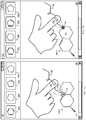
- a series of screen shots illustrate an example user interface of a utility for creating and/or editing a graphical representation of a chemical structure.
- the user interface includes a series of editing tools 102 for building a graphical representation of a chemical structure, e.g., a chemical structure 104 presented within an editing pane 106.
- a user may select one of the editing tools 102 representing a ring of atoms, a bond, or a substituent, in order to place the selected ring, bond, or substituent in the chemical structure 104.
- the user may drag and drop the selected feature into the editing pane 106 to add the selected feature at a desired position within or on the in-progress chemical structure 104.
- the user may add to the chemical structure 104 a heteroatom, a ring substituent, a multi-ring substituent, an acyclic chain, a chair cyclohexane, and/or any other molecular component.
- the drawing/editing utility may determine whether or not a given edit would result in a structure that is chemically feasible and may limit executable edits to only those resulting in feasible chemical structures.
- the drawing/editing utility provides cues to a user to alert the user regarding execution of edits. For example, while working within a smaller display, such as that of a smart phone or tablet computer, a user may become frustrated due to obscured visibility caused by inputting touch gestures (e.g., a "fat finger" is in the way of reviewing alignment of the selected element with the in-progress chemical structure 104). To provide feedback to the user regarding modifications made to the in-progress chemical structure, the drawing/editing utility may provide one or more of haptic, audible, and visible cues.
- the drawing/editing utility determines that the connection at the connection locations 110, 114 is not chemically feasible. For example, based upon bond saturation at the connection location 110, the element 108 may be prevented from attaching at the connection location 110 due to steric hindrance.
- the drawing/editing utility may determine that the user should be prevented from adding the structure element 108 to the in-progress chemical structure 104 at the connection location 110. Responsive to this determination, the drawing/editing utility may present feedback cues to the user, such as a haptic cue interfering with the motion of the gesture input 112 towards the connection location 110 (or, alternatively, a vibration), an audible cue (e.g., buzzer, other sound with negative connotation), or a visible cue (e.g., flashing screen, dimming of screen, adjustment of color of screen to a color with negative connotation, such as red, etc.).
- a haptic cue interfering with the motion of the gesture input 112 towards the connection location 110 or, alternatively, a vibration
- an audible cue e.g., buzzer, other sound with negative connotation
- a visible cue e.g., flashing screen, dimming of screen, adjustment of color of screen to a color
- the user may apply an adjusted gesture movement 122 of the structure element 108 towards the in-progress chemical structure 104 at a second connection location 124.
- the drawing/editing utility determines that the connection at the connection locations 114 and 124 is allowable (e.g., chemically feasible).
- the drawing/editing utility may determine that the user should be allowed to add the structure element 108 to the in-progress chemical structure 104 at the connection location 124.
- the drawing/editing utility may present feedback cues to the user, such as a haptic cue directed with the motion of the gesture input 112 towards the connection location 110, an audible cue (e.g., bell ding, other sound with positive connotation), or a visual cue (e.g., flashing screen, brightening of screen, adjustment of color of screen to a color with positive connotation, such as green, etc.).
- a haptic cue directed with the motion of the gesture input 112 towards the connection location 110
- an audible cue e.g., bell ding, other sound with positive connotation
- a visual cue e.g., flashing screen, brightening of screen, adjustment of color of screen to a color with positive connotation, such as green, etc.
- the drawing/editing utility upon determining the user intends to draw connection location 114 towards connection location 124 for appending the two structures, automatically completes the operation such that the structure element 108 is joined with the in
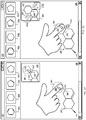
- FIGS. 2A and 2B illustrate another series of screen shots depicting a gesture-based addition of a structure element 204 to an in-progress chemical structure 202 within a utility for creating or editing a graphical representation of a chemical structure, such as the utility described in relation to FIGS. 1A and 1B .
- the user is presented with a visual feedback cue in the form of a zoom pane 210 illustrating a view 204' of structure element 204 as it approaches a portion 202' of the in-progress chemical structure 202 (e.g., at a connection location 206).
- a position of the zoom pane 210 is based in part upon a position of the structure element 204 (e.g., based on an estimation of a portion of the screen obscured by the user during gesture input).
- the position of the zoom pane 210 in some implementations, is stationary or semi-stationary (e.g., drag & drop, user-specified, etc.).
- the user may apply a gesture movement 208 of the structure element 204 towards the in-progress chemical structure 202 at the connection location 206.
- the drawing/editing utility determines that the connection at the connection locations 206 and 212 is allowable (e.g., chemically feasible).
- the drawing/editing utility may determine that the user should be allowed to add the structure element 204 to the in-progress chemical structure 202 at the connection location 206.
- the drawing/editing utility may present feedback cues to the user, such as a visual cue presented within the zoom pane 210 illustrating an arrow 214 moving the view 204' of the element 204 towards the portion 202' at the connection location 206. Additional visual, audio, and/or haptic cue(s) may be supplied to the user as well, such as those described above in relation to FIG. 1B .
- the zoom pane 210 upon connection of the structural element 204 with the in-progress chemical structure 202 at the connection location 206, in some implementations, the zoom pane 210 includes a confirming graphic.
- the zoom pane in the present example, illustrates an animation representing a loss of atoms 212 (e.g., two carbons 212a and 212b, a group of one carbon and two hydrogens for each of 212a and 212b, etc.) due to the forming of the connection between the connection location 206 and the connection location 212.
- a loss of atoms 212 e.g., two carbons 212a and 212b, a group of one carbon and two hydrogens for each of 212a and 212b, etc.
- carbons may be illustrated as spinning away in the distance from the portion of the chemical structure 202'.
- an audible feedback cue 214 may be provided to the user to indicate success.
- the zoom pane 210 may portray the name of a completed molecular structure (if applicable), or the zoom panel may close until pending addition of another structure element or another modification of the in-progress chemical structure 202 is pending.
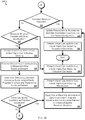
- FIG. 3 is a flow chart of an example method 300 for providing feedback cues during a gesture-based addition of an element to an in-progress structure drawing within a utility for creating or editing a graphical representation of a chemical structure or biological structure.
- the method 300 may be performed by a structure drawing/editing utility executing upon a touch screen computing device, such as a tablet computer, notebook computer, or smart phone.
- the method 300 begins with providing a representation of at least a portion of an in-progress chemical structure or an in-progress biological structure for presentation on a graphical display (302).
- an in-progress chemical structure may be displayed within a chemical structure drawing/editing utility.
- the in-progress structure in some examples, may include a two dimensional or three dimensional graphic representation of a chemical structure, a molecular structure, or a biological structure.
- connection location may be, for example, an atom (e.g., a carbon or heteroatom on a hydrocarbon chain or ring of an in-progress structure which a selected structure element is to be attached to, replace, merge with, or subsume), a bond (e.g., a single, double, or triple bond of an in-progress structure which a bond of a selected structure element is to be attached to or replace, merge with, or subsume), a ring (e.g., a ring of an in-progress structure which a selected structure element is to be attached to or replace, merge with, or subsume), or other moiety of the in-progress structure which a selected structure element is to be attached to, replace, merge with, or subsume.
- an atom e.g., a carbon or heteroatom on a hydrocarbon chain or ring of an in-progress structure which a selected structure element is to be attached to, replace, merge with, or subsume
- a bond e.g.,
- connection locations are identified on a selected structure element separate from the in-progress structure (306).
- the structure element in some examples, may be a molecule, atom, substituent, or biological scaffold.
- the structure element in some implementations, includes one or more nucleotides, an amino acid residue, and/or or an amino acid.
- a connection location may be, for example, an atom (e.g., a carbon or heteroatom on a hydrocarbon chain or ring of an in-progress structure which a selected structure element is to be attached to, replace, merge with, or subsume), a bond (e.g., a single, double, or triple bond of an in-progress structure which a bond of a selected structure element is to be attached to or replace, merge with, or subsume), a ring (e.g., a ring of an in-progress structure which a selected structure element is to be attached to or replace, merge with, or subsume), or other moiety of the in-progress structure which a selected structure element is to be attached to, replace, merge with, or subsume.
- an atom e.g., a carbon or heteroatom on a hydrocarbon chain or ring of an in-progress structure which a selected structure element is to be attached to, replace, merge with, or subsume
- a bond e.g.
- a gesture corresponding to movement of the structure element towards the portion of the in-progress structure is received (308).
- the gesture may be input by a user upon a touch sensitive portion of the graphic display.
- the gesture may include a drag, push, or "flinging" motion of the structure element towards the portion of the in-progress structure.
- connection locations of the portion of the in-progress structure and connection locations of the structure element are determined (310). For example, the nearest pair(s) of respective connection locations of the in-progress structure and the structure element may be identified. The positions, for example, may be determined based upon mapping of pixel data to a screen area of the user device. Because screen sizes may vary, in some implementations, a relative distance is determined. In other implementations, an actual distance is determined. In some implementations, the distances are scaled in relation to a scale of the in-progress structure.
- the threshold distance is established to one of "essentially touching” or “substantially overlapping”.
- the threshold distance is a relative or absolute value used to determine intent of a user to connect the structure element to the in-progress structure at a particular pair (or, optionally, pairs) of connection locations.
- the threshold distance may be based in part upon a type of in-progress chemical structure (e.g., two dimensional or three dimensional, biological, chemical, or molecular, etc.).
- the threshold distance may be based in part upon a type of structure element and/or a type of element corresponding to the identified connection location on the in-progress chemical structure.
- the threshold distance may be based on intermolecular forces, intramolecular forces, and/or van der Waal forces corresponding to the in-progress chemical structure and/or the structure element.
- connection locations are within a threshold distance (e.g., the user intends to connect the structure element to the in-progress structure at an identified connection location)
- a resultant structure formed by connection of the structure element to the in-progress structure at the identified connection locations is analyzed (314).
- a determination may be made as to whether the resultant structure is chemically feasible. For example, based upon bond saturation at the connection location of the in-progress chemical structure, structure element may be prevented from attaching at the connection location due to steric hindrance, saturation, number of existing substituents at the connection location, etc.
- a graphical presentation is updated to illustrate the identified connection locations in connected configuration (318).
- the illustration of connected locations is presented within a zoom pane, for example as described in relation to FIG. 2B .
- the structure element is automatically pulled towards the connection location of the in-progress structure (e.g., as though by magnetic force) to visually complete the connection.
- a visual cue, audible cue, and/or haptic cue is presented to the user indicating success of connection (320). For example, if the connection locations were identified as already being overlapping or substantially overlapping, in some implementations, the graphical presentation may not be updated. However, based upon acceptance of the connection of the structure element to the in-progress structure at the connection location, one or more feedback cues may be provided to the user.
- the feedback cue may include an audible cue (e.g., "click” of the structure element joining with the in-progress chemical structure, "ding” or other bell tone indicating success, fanfare sound, beep, etc.), a haptic cue (e.g., a "pull” of the structure element towards the chemical structure), and/or a visible cue (e.g., change of brightness, contrast, or background color of the display, modulation of display, confirmation animation within a zoom pane area, etc.).
- an audible cue e.g., "click” of the structure element joining with the in-progress chemical structure, "ding" or other bell tone indicating success, fanfare sound, beep, etc.
- a haptic cue e.g., a "pull” of the structure element towards the chemical structure
- a visible cue e.g., change of brightness, contrast, or background color of the display, modulation of display, confirmation animation within a zoom pane
- the resultant structure is further analyzed to determine if a feasible structure could be produced with one or more minor modifications (322). For example, should a replacement of a double bond with a single bond allow for a chemical structure element to attach to an in-progress chemical structure, the resultant structure may be determined to be feasible upon acceptance of modification.
- a feedback cue is presented indicating failure of connection between the in-progress structure and the structure element (320).
- the connection attempted by the user via the gesture 112 may be prevented, and feedback cues such as a haptic repulsion of the gesture movement, a vibration, an audible warning tone, and/or a visual indication of failure (e.g., adjustment of background color, flashing, zoom pane warning of failure, etc.) may be presented to the user.
- an indication may be provided of an alternative connection location upon the in-progress structure. For example, upon the in-progress structure itself and/or within a separate zoom pane, a visual cue may be presented to the user indicating one or more connection locations that would result in a feasible structure.
- a feedback cue is presented indicating a warning (326).
- the warning feedback cue may be provided to the user such that the user is alerted that, although the attempted connection failed, the connection between the in-progress structure and the structure element at the connection may be allowed to complete upon additional attempt.
- a warning feedback cue may include a weaker haptic repulsion than that of a failure cue, a weaker/shorter vibration, an audible warning tone, and/or a visual indication of warning (e.g., adjustment of background color, flashing, zoom pane warning of the need for modification to provide for connection at the identified connection location, etc.) may be presented to the user.
- another gesture input corresponding to movement of the structure element is received (328).
- the gesture may be input by a user upon a touch sensitive portion of the graphic display.
- the gesture may include a drag, push, or "flinging" motion of the structure element towards the portion of the in-progress structure.
- one or more distances between connection locations of the portion of the in-progress structure and connection locations of the structure element are determined (330). For example, distances may be determined as described above in relation to step 310.
- one or more adjustments are automatically applied to at least one of the in-progress structure and the structure element to create a feasible resultant structure (334).
- one or more atoms, bonds, rings, chains, moieties, or other substituents may be removed from the in-progress chemical structure, or appropriately altered, to provide for addition of the structural element.
- a double bond may be converted to a single bond to allow for attachment of a substituent.
- a feedback cue is presented to the user indicating a modification was made to one or both of the in-progress chemical structure and the structure element to provide for a feasible resultant structure (336).
- loss of elements from one or both of the in-progress structure and the structure element may be illustrated within a zoom pane animation.
- a scrolling message presented in a region of the graphic display separate from the main creating/editing pane may describe to the user modifications made to the in-progress structure and/or structure element.
- the user is provided with an undo operation configured, upon selection, to return to the state of the in-progress chemical structure prior to modification.
- a visual feedback cue may identify an option (e.g., selectable control, gesture input, verbal command, etc.) for backing out any modifications automatically made in the effort to support the connection of the structure element to the in-progress chemical structure.
- a timer may be associated with the undo operation. For example, a user may be supplied with a period of time prior to the modifications becoming permanent (e.g., incapable of being automatically backed out of the in-progress chemical structure).
- a "waiting tone" or other audible and/or visual cue may alert the user to the passing of time prior to commitment of the modification.
- the graphical presentation is updated to illustrate the connection locations in a connected configuration (318) and a feedback cue is presented to the user indicating success of connection (320), as described above.
- the various haptic, audible, and/or visual feedback cues may be set in part via user options.
- a user preferences menu of a structure drawing/editing utility may provide audible cue options (e.g., selection of various tones, volume settings, tone durations, etc.), visual cue options (e.g., enable/disable zoom pane, flash screen, present feedback message in scrolling region outside main display pane, etc.), and/or haptic cue options (e.g., enable haptic cues, haptic cue strength, haptic cue durations, enable vibration cue, etc.).
- audible cue options e.g., selection of various tones, volume settings, tone durations, etc.
- visual cue options e.g., enable/disable zoom pane, flash screen, present feedback message in scrolling region outside main display pane, etc.
- haptic cue options e.g., enable haptic cues, haptic cue strength,
- various cues may be refined such that a different cue setting is applicable based upon a type of structure element or a type of connection between the structure element and the in-progress structure.
- cue settings may be specific to atom type or bond type in the structure element or in-progress structure at or near the connection location, and/or the cue setting may be specific to connection type, number or type of replaced atoms or bonds required for creating the resultant structure, etc.
- a portion of the method 300 may be applied to chemical reaction simulations to apply feedback cues (e.g., visual, audible, or haptic) corresponding to chemical structure interaction during the chemical reactions.
- feedback cues e.g., visual, audible, or haptic
- a portion of the method 300 may be applied to molecular dynamics simulations to apply feedback cues (e.g., visual, audible, or haptic) corresponding to molecular interactions between two or more species in a mixture, solution, etc.
- FIG. 4 depicts an example system 400 for drawing or editing graphical representations of chemical structures.
- the system 400 includes client nodes 402a and 402b, a server node 404, a database 406, and, for enabling communications therebetween, a network 408.
- the server node 404 may include a drawing module 410.
- the network 408 may be, for example, a local-area network (LAN), such as a company or laboratory Intranet, a metropolitan area network (MAN), or a wide area network (WAN), such as the Internet.
- LAN local-area network
- MAN metropolitan area network
- WAN wide area network
- Each of the client nodes 402, server node 404, and the database 406 may be connected to the network 408 through a variety of connections including, but not limited to, standard telephone lines, LAN or WAN links (e.g., T1, T3, 56 kb, X.25), broadband connections (e.g., ISDN, Frame Relay, ATM), or wireless connections.
- broadband connections e.g., ISDN, Frame Relay, ATM
- connections may be established using a variety of communication protocols (e.g., HTTP, TCP/IP, IPX, SPX, NetBIOS, NetBEUI, SMB, Ethernet, ARCNET, Fiber Distributed Data Interface (FDDI), RS232, IEEE 802.11, IEEE 802.11a, IEEE 802.11b, IEEE 802.11g, and direct asynchronous connections).
- communication protocols e.g., HTTP, TCP/IP, IPX, SPX, NetBIOS, NetBEUI, SMB, Ethernet, ARCNET, Fiber Distributed Data Interface (FDDI), RS232, IEEE 802.11, IEEE 802.11a, IEEE 802.11b, IEEE 802.11g, and direct asynchronous connections).
- the client node 402a may be any type of wireless device, information appliance, tablet computer, personal digital assistant, cellular phone, handheld device, or other portable computing device that is capable of both presenting information/data to, and receiving commands from, a user of the client node 402a (e.g., an analytical chemist).
- the client node 402b may be any type of personal computer, Windows-based terminal, network computer, wireless device, information appliance, RISC Power PC, X-device, workstation, mini computer, main frame computer, set top box, or other computing device that is capable of both presenting information/data to, and receiving commands from, a user of the client node 402b.
- the client nodes 402 may include, for example, a graphical display device (e.g., a touch screen or a computer monitor), a data entry device (e.g., a keyboard, a touch screen, or a mouse pad), persistent and/or volatile storage (e.g., computer memory), and a processor.
- the client node 402 includes a web browser, such as, for example, Internet Explorer® developed by Microsoft Corporation of Redmond, Washington, to connect to the World Wide Web.
- the server node 404 may be any computing device that is capable of receiving information/data from and delivering information/data to the client nodes 402, for example over the network 408, and that is capable of querying, receiving information/data from, and delivering information/data to the server node 404.
- the server node 404 may receive input (e.g., a touch gesture) from a user of the client node 402, create or edit a chemical structure representation according to the input, and present or display the chemical structure representation to the user at the client node 402.
- the server node 404 may include a processor and persistent and/or volatile storage, such as computer memory.
- the server node 404 may be any computing device that is capable of storing and managing collections of data, such as data relating to chemical structure representations.
- the chemical structure representations may be, for example, of the type described in related U.S. Patent 8,433,723, filed May 3, 2011 , titled “Systems, Methods, and Apparatus for Processing Documents to Identify Structures," related U.S. Application No. 13/239,069, filed September 21, 2011 , titled “Systems, Methods, and Apparatus for Facilitating Chemical Analyses," related International Patent Application No. PCT/US12/26574, filed February 24, 2012 , titled “Systems, Methods, and Apparatus for Drawing Chemical Structures Using Touch and Gestures," U.S. Application No.
- server node is broadly used to refer to any repository of information.
- the data stored within the server node 404 may be harvested from the server node 404 in any manner.
- the harvesting is performed utilizing indexing and structure recognition algorithms, and the harvested data is connected together by examining and correlating the disjointed information that is found.
- the drawing module 410 of the server node 404 may be implemented as any software program and/or hardware device, for example an application specific integrated circuit (ASIC) or a field programmable gate array (FPGA), that is capable of providing the functionality described herein. It will be understood by one having ordinary skill in the art, however, that the illustrated module 410, and the organization of the server node 404, are conceptual, rather than explicit, requirements. For example, it should be understood that the drawing module 410 may in fact be implemented as multiple modules, such that the functions performed by the single module, as described herein, are in fact performed by the multiple modules.
- ASIC application specific integrated circuit
- FPGA field programmable gate array
- any or all of the client nodes 402, the server node 404, and the database 406 may also include its own transceiver (or separate receiver and transmitter) that is capable of receiving and transmitting communications, including requests, responses, and commands, such as, for example, inter-processor communications and networked communications.
- the transceivers (or separate receivers and transmitters) may each be implemented as a hardware device, or as a software module with a hardware interface.
- FIG. 4 is a simplified illustration of the system 400 and that it is depicted as such to facilitate the explanation of various embodiments of the present disclosure.
- the drawing module 410 may instead be implemented on a different computing device (not shown) and such computing devices may communicate with one another directly, over the network 408, or over another additional network (not shown).
- the functionality of the server node 404 may in fact be resident on the server node 404 (e.g., be implemented in the computer memory thereof).
- server node 404 and/or the database 406 may be local to the client node 402 (such that they may all communicate directly without using the network 408), or for the functionality of the server node 404 and/or the database 406 to be implemented on the client node 402 (e.g., for the drawing module 410 and/or the server node 404 to reside on the client node 402).
- the depiction of the system 400 in FIG. 4 is non-limiting.
- the system 400 allows a user to draw and edit a chemical structure representation using one or more fingers on an input interface, such as a touch pad or touch screen, at the client tablet node 402a.
- the system 400 allows a user to draw and edit a graphical representation of a chemical structure using a mouse, stylus, keypad, trackball, or other input interface, such as an input interface at a client personal computer 402b.
- the input interface in some implementations, may include a natural language processing module capable of converting utterances to a series of commands for activating controls of the user interface.
- the drawing module 410 in the server node 404 is configured to draw or revise the chemical structure representation according to the input from the user, as explained above with respect to the prior figures.
- the drawing module 410 may then provide an image (e.g., a collection of pixels) of the graphical representation of the chemical structure for presentation to the user on the graphical display of the particular client node 402.
- the drawing module 410 may provide audio, visual, and/or haptic cues related to potential amendment to a graphical representation of a chemical structure.
- the feedback cues for example, may be related to a result of analysis of a resultant chemical structure formed from the addition of a structure element to an in-progress chemical structure.
- the system 400 may be used to perform any of the methods described herein.
- FIG. 5 shows an example of a computing device 500 and a mobile computing device 550 that can be used to implement the techniques described in this disclosure.
- the computing device 500 is intended to represent various forms of digital computers, such as laptops, desktops, workstations, personal digital assistants, servers, blade servers, mainframes, and other appropriate computers.
- the mobile computing device 550 is intended to represent various forms of mobile devices, such as personal digital assistants, cellular telephones, smart-phones, and other similar computing devices.
- the components shown here, their connections and relationships, and their functions, are meant to be examples only, and are not meant to be limiting.
- the computing device 500 includes a processor 502, a memory 504, a storage device 506, a high-speed interface 508 connecting to the memory 504 and multiple high-speed expansion ports 510, and a low-speed interface 512 connecting to a low-speed expansion port 514 and the storage device 506.
- Each of the processor 502, the memory 504, the storage device 506, the high-speed interface 508, the high-speed expansion ports 510, and the low-speed interface 512 are interconnected using various busses, and may be mounted on a common motherboard or in other manners as appropriate.
- the processor 502 can process instructions for execution within the computing device 500, including instructions stored in the memory 504 or on the storage device 506 to display graphical information for a GUI on an external input/output device, such as a display 516 coupled to the high-speed interface 508.
- an external input/output device such as a display 516 coupled to the high-speed interface 508.
- multiple processors and/or multiple buses may be used, as appropriate, along with multiple memories and types of memory.
- multiple computing devices may be connected, with each device providing portions of the necessary operations (e.g., as a server bank, a group of blade servers, or a multi-processor system).
- the memory 504 is configured to store information within the computing device 500.
- the memory 504 is a volatile memory unit or units.
- the memory 504 is a non-volatile memory unit or units.
- the memory 504 may also be another form of computer-readable medium, such as a magnetic or optical disk.
- the storage device 506 is capable of providing mass storage for the computing device 500.
- the storage device 506 may be or contain a computer-readable medium, such as a floppy disk device, a hard disk device, an optical disk device, or a tape device, a flash memory or other similar solid state memory device, or an array of devices, including devices in a storage area network or other configurations.
- Instructions can be stored in an information carrier.
- the instructions when executed by one or more processing devices (for example, processor 502), perform one or more methods, such as those described above.
- the instructions can also be stored by one or more storage devices such as computer- or machine-readable mediums (for example, the memory 504, the storage device 506, or memory on the processor 502).
- the high-speed interface 508 is configured to manage bandwidth-intensive operations for the computing device 500, while the low-speed interface 512 is configured to manage lower bandwidth-intensive operations. Such allocation of functions is an example only.
- the high-speed interface 508 is coupled to the memory 504, the display 516 (e.g., through a graphics processor or accelerator), and to the high-speed expansion ports 510, which may accept various expansion cards (not shown).
- the low-speed interface 512 is coupled to the storage device 506 and the low-speed expansion port 514.
- the low-speed expansion port 514 which may include various communication ports (e.g., USB, Bluetooth®, Ethernet, wireless Ethernet) may be coupled to one or more input/output devices, such as a keyboard, a pointing device, a scanner, or a networking device such as a switch or router, e.g., through a network adapter.
- input/output devices such as a keyboard, a pointing device, a scanner, or a networking device such as a switch or router, e.g., through a network adapter.
- the computing device 500 may be implemented in a number of different forms, as shown in the figure. For example, it may be implemented as a standard server 520, or multiple times in a group of such servers. In addition, it may be implemented in a personal computer such as a laptop computer 522. It may also be implemented as part of a rack server system 524. Alternatively, components from the computing device 500 may be combined with other components in a mobile device (not shown), such as a mobile computing device 550. Each of such devices may contain one or more of the computing device 500 and the mobile computing device 550, and an entire system may be made up of multiple computing devices communicating with each other.
- the mobile computing device 550 includes a processor 552, a memory 564, an input/output device such as a display 554, a communication interface 566, and a transceiver 568, among other components.
- the mobile computing device 550 may also be provided with a storage device, such as a micro-drive or other device, to provide additional storage.
- a storage device such as a micro-drive or other device, to provide additional storage.
- Each of the processor 552, the memory 564, the display 554, the communication interface 566, and the transceiver 568, are interconnected using various buses, and several of the components may be mounted on a common motherboard or in other manners as appropriate.
- the processor 552 can execute instructions within the mobile computing device 550, including instructions stored in the memory 564.
- the processor 552 may be implemented as a chipset of chips that include separate and multiple analog and digital processors.
- the processor 552 may provide, for example, for coordination of the other components of the mobile computing device 550, such as control of user interfaces, applications run by the mobile computing device 550, and wireless communication by the mobile computing device 550.
- the memory 564 is configured to store information within the mobile computing device 550.
- the memory 564 can be implemented as one or more of a computer-readable medium or media, a volatile memory unit or units, or a non-volatile memory unit or units.
- An expansion memory 574 may also be provided and connected to the mobile computing device 550 through an expansion interface 572, which may include, for example, a SIMM (Single In Line Memory Module) card interface.
- SIMM Single In Line Memory Module
- the expansion memory 574 may provide extra storage space for the mobile computing device 550, or may also store applications or other information for the mobile computing device 550.
- the expansion memory 574 may include instructions to carry out or supplement the processes described above, and may include secure information also.
- the expansion memory 574 may be provide as a security module for the mobile computing device 550, and may be programmed with instructions that permit secure use of the mobile computing device 550.
- secure applications may be provided via the SIMM cards, along with additional information, such as placing identifying information on the SIMM card in a non-hackable manner.
- the memory may include, for example, flash memory and/or NVRAM memory (non-volatile random access memory), as discussed below.
- instructions are stored in an information carrier that, when executed by one or more processing devices (for example, processor 552), perform one or more methods, such as those described above.
- the instructions can also be stored by one or more storage devices, such as one or more computer- or machine-readable mediums (for example, the memory 564, the expansion memory 574, or memory on the processor 552).
- the instructions can be received in a propagated signal, for example, over the transceiver 568 or the external interface 562.
- the mobile computing device 550 may communicate wirelessly through the communication interface 566, which may include digital signal processing circuitry where necessary.
- the communication interface 566 may provide for communications under various modes or protocols, such as GSM voice calls (Global System for Mobile communications), SMS (Short Message Service), EMS (Enhanced Messaging Service), or MMS messaging (Multimedia Messaging Service), CDMA (code division multiple access), TDMA (time division multiple access), PDC (Personal Digital Cellular), WCDMA (Wideband Code Division Multiple Access), CDMA2000, or GPRS (General Packet Radio Service), among others.
- GSM voice calls Global System for Mobile communications
- SMS Short Message Service
- EMS Enhanced Messaging Service
- MMS messaging Multimedia Messaging Service
- CDMA code division multiple access
- TDMA time division multiple access
- PDC Personal Digital Cellular
- WCDMA Wideband Code Division Multiple Access
- CDMA2000 Code Division Multiple Access
- GPRS General Packet Radio Service
- a GPS (Global Positioning System) receiver module 570 may provide additional navigation- and location-related wireless data to the mobile computing device 550, which may be used as appropriate by applications running on the mobile computing device 550.
- the mobile computing device 550 may also communicate audibly using an audio codec 560, which may receive spoken information from a user and convert it to usable digital information.
- the audio codec 560 may likewise generate audible sound for a user, such as through a speaker, e.g., in a handset of the mobile computing device 550.
- Such sound may include sound from voice telephone calls, may include recorded sound (e.g., voice messages, music files, etc.) and may also include sound generated by applications operating on the mobile computing device 550.
- the mobile computing device 550 may be implemented in a number of different forms, as shown in the figure. For example, it may be implemented as a cellular telephone 580. It may also be implemented as part of a smart-phone 582, personal digital assistant, or other similar mobile device.
- implementations of the systems and techniques described here can be realized in digital electronic circuitry, integrated circuitry, specially designed ASICs (application specific integrated circuits), computer hardware, firmware, software, and/or combinations thereof.
- ASICs application specific integrated circuits
- These various implementations can include implementation in one or more computer programs that are executable and/or interpretable on a programmable system including at least one programmable processor, which may be special or general purpose, coupled to receive data and instructions from, and to transmit data and instructions to, a storage system, at least one input device, and at least one output device.
- machine-readable medium and computer-readable medium refer to any computer program product, apparatus and/or device (e.g., magnetic discs, optical disks, memory, Programmable Logic Devices (PLDs)) used to provide machine instructions and/or data to a programmable processor, including a machine-readable medium that receives machine instructions as a machine-readable signal.
- machine-readable signal refers to any signal used to provide machine instructions and/or data to a programmable processor.
- the systems and techniques described here can be implemented on a computer having a display device (e.g., a CRT (cathode ray tube) or LCD (liquid crystal display) monitor) for displaying information to the user and a keyboard and a pointing device (e.g., a mouse or a trackball) by which the user can provide input to the computer.
- a display device e.g., a CRT (cathode ray tube) or LCD (liquid crystal display) monitor
- a keyboard and a pointing device e.g., a mouse or a trackball
- Other kinds of devices can be used to provide for interaction with a user as well; for example, feedback provided to the user can be any form of sensory feedback (e.g., visual feedback, auditory feedback, or tactile feedback); and input from the user can be received in any form, including acoustic, speech, or tactile input.
- the systems and techniques described here can be implemented in a computing system that includes a back end component (e.g., as a data server), or that includes a middleware component (e.g., an application server), or that includes a front end component (e.g., a client computer having a graphical user interface or a Web browser through which a user can interact with an implementation of the systems and techniques described here), or any combination of such back end, middleware, or front end components.
- the components of the system can be interconnected by any form or medium of digital data communication (e.g., a communication network). Examples of communication networks include a local area network (LAN), a wide area network (WAN), and the Internet.
- LAN local area network
- WAN wide area network
- the Internet the global information network
- the computing system can include clients and servers.
- a client and server are generally remote from each other and typically interact through a communication network.
- the relationship of client and server arises by virtue of computer programs running on the respective computers and having a client-server relationship to each other.
- embodiments of the present disclosure may be provided as one or more computer-readable programs embodied on or in one or more articles of manufacture.
- the article of manufacture may be any suitable hardware apparatus, such as, for example, a floppy disk, a hard disk, a CD ROM, a CD-RW, a CD-R, a DVD ROM, a DVD-RW, a DVD-R, a flash memory card, a PROM, a RAM, a ROM, or a magnetic tape.
- the computer-readable programs may be implemented in any programming language. Some examples of languages that may be used include C, C++, or Java.
- the software programs may be further translated into machine language or virtual machine instructions and stored in a program file in that form. The program file may then be stored on or in one or more of the articles of manufacture.
- systems and methods for creating graphical representations of chemical structures and/or biological structures via a touch interface with feedback cues are provided.
Landscapes
- Engineering & Computer Science (AREA)
- Theoretical Computer Science (AREA)
- General Engineering & Computer Science (AREA)
- Physics & Mathematics (AREA)
- Human Computer Interaction (AREA)
- General Physics & Mathematics (AREA)
- Software Systems (AREA)
- Life Sciences & Earth Sciences (AREA)
- Bioinformatics & Cheminformatics (AREA)
- Bioinformatics & Computational Biology (AREA)
- Data Mining & Analysis (AREA)
- Health & Medical Sciences (AREA)
- Biophysics (AREA)
- Biotechnology (AREA)
- Evolutionary Biology (AREA)
- General Health & Medical Sciences (AREA)
- Medical Informatics (AREA)
- Spectroscopy & Molecular Physics (AREA)
- Chemical & Material Sciences (AREA)
- Crystallography & Structural Chemistry (AREA)
- Computing Systems (AREA)
- User Interface Of Digital Computer (AREA)
Claims (15)
- System zum Erzeugen einer grafischen Darstellung einer chemischen Struktur unter Verwendung einer Berührungsbildschirmschnittstelle, wobei das System
einen Prozessor und
einen Speicher mit einem Satz von darauf gespeicherten Befehlen umfasst, wobei die Befehle bei Ausführung den Prozessor veranlassen,eine Darstellung mindestens eines Abschnitts der in Bearbeitung befindlichen chemischen Struktur zur Darstellung auf einer graphischen Anzeige einer Rechenvorrichtung bereitzustellen,eine oder mehrere Verbindungsstellen des Abschnitts der in Bearbeitung befindlichen chemischen Struktur zu identifizieren,eine oder mehrere Verbindungsstellen eines chemischen Strukturelements zu identifizieren, wobei das chemische Strukturelement von der in Bearbeitung befindlichen chemischen Struktur getrennt ist,eine Gesteneingabe auf einem berührungsempfindlichen Abschnitt der graphischen Anzeige zu empfangen, die einer Bewegung des chemischen Strukturelements in Richtung des Abschnitts der in Bearbeitung befindlichen chemischen Struktur entspricht,festzustellen, ob der Abstand zwischen einer ersten Verbindungsstelle der einen oder mehreren Verbindungsstellen des Abschnitts der in Bearbeitung befindlichen chemischen Struktur und einer ersten Verbindungsstelle der einen oder mehreren Verbindungsstellen des chemischen Strukturelements innerhalb eines Schwellenabstands liegt, der eine beabsichtigte Verbindung des chemischen Strukturelements mit der in Bearbeitung befindlichen chemischen Struktur an oder um die entsprechenden Verbindungsstellen ankündigt,die resultierende chemische Struktur basierend auf der festgestellten beabsichtigten Verbindung, die durch die Verbindung der in Bearbeitung befindlichen chemischen Struktur und des chemischen Strukturelements an oder um die entsprechenden Verbindungsstellen des chemischen Strukturelements und der in Bearbeitung befindlichen chemischen Struktur gebildet wird, zu analysieren, um festzustellen ob die resultierende Struktur chemisch möglich ist, undin Reaktion auf die Analyse einen sichtbaren Hinweis, einen hörbaren Hinweis und/oder einen haptischen Hinweis entsprechend der Feststellung, ob die resultierende chemische Struktur chemisch möglich ist, zur Präsentation gegenüber dem Benutzer der Rechenvorrichtung bereitzustellen. - System nach Anspruch 1, wobei i) die Stärke des haptischen Hinweises, ii) die Dauer des haptischen Hinweises, iii) die Lautstärke des hörbaren Hinweises, iv) die Dauer des hörbaren Hinweises und/oder v) die Tonhöhe des hörbaren Hinweises,a) zumindest teilweise auf der Grundlage der Feststellung, dass die resultierende chemische Struktur chemisch möglich ist,b) zumindest teilweise auf der Grundlage der Anzahl von Bindungen, die zwischen a) der ersten Verbindungsstelle des chemischen Strukturelements und b) der ersten Verbindungsstelle der in Bearbeitung befindlichen chemischen Struktur gebildet werden,ausgewählt wird.
- System nach Anspruch 1 oder Anspruch 2, wobeia) die Reaktion auf die Analyse Erlauben, Warnen und/oder Verhindern umfasst, oderb) die Reaktion auf die Analyse Erlauben ist, unddie Befehle bei Ausführung den Prozessor veranlassen, innerhalb der graphischen Anzeige die Bildung der resultierenden chemischen Struktur darzustellen.
- System nach Anspruch 3, wobei die Befehle bei Ausführung den Prozessor veranlassen,a) dem Benutzer den sichtbaren Hinweis darauf anzuzeigen, dass sich die erste Verbindungsstelle des chemischen Strukturelements mit der ersten Verbindungsstelle der in Bearbeitung befindlichen Struktur verbindet, oderb) das chemische Strukturelement an den entsprechenden Verbindungsstellen an die in Bearbeitung befindliche chemische Struktur anzuhängen, oderc) einen Abschnitt der in Bearbeitung befindlichen chemischen Struktur durch mindestens einen Abschnitt des chemischen Strukturelements an den entsprechenden Verbindungsstellen zu ersetzen, oderd) das chemische Strukturelement an den entsprechenden Verbindungsstellen in die in Bearbeitung befindliche chemische Struktur einzugliedern.
- System nach einem der vorhergehenden Ansprüche, wobei der sichtbare Hinweisa) ein Zoom-Anzeigefeld, das auf der grafischen Anzeige dargestellt wird, oderb) eine sichtbare Anzeige des durch die Bildung der resultierenden chemischen Struktur verursachten Verlustes von einem oder mehreren Atomen umfasst.
- System nach einem der Ansprüche 1 bis 4, wobei der sichtbare Hinweis eine Änderung der Farbe, der Helligkeit und/oder des Kontrasts mindestens eines Teils der grafischen Anzeige umfasst.
- System nach einem der vorhergehenden Ansprüche, wobei das Empfangen der Gesteneingabe das Empfangen der Gesteneingabe von der Rechenvorrichtung über ein Netzwerk umfasst.
- System nach einem der vorangehenden Ansprüche, wobei die Rechenvorrichtung den Prozessor umfasst.
- Computerimplementiertes Verfahren zur Erzeugung einer grafischen Darstellung einer chemischen Struktur unter Verwendung einer Berührungsbildschirmschnittstelle, umfassend
Bereitstellen einer Darstellung mindestens eines Abschnitts einer in Bearbeitung befindlichen chemischen Struktur zur Darstellung auf einer grafischen Anzeige einer Rechenvorrichtung,
Identifizieren einer oder mehrerer Verbindungsstellen des Abschnitts der in Bearbeitung befindlichen chemischen Struktur durch den Prozessor der Rechenvorrichtung,
Identifizieren einer oder mehrerer Verbindungsstellen eines chemischen Strukturelements durch den Prozessor, wobei das chemische Strukturelement von der in Bearbeitung befindlichen chemischen Struktur getrennt ist,
Empfangen einer Gesteneingabe auf einem berührungsempfindlichen Abschnitt der graphischen Anzeige, die einer Bewegung des chemischen Strukturelements in Richtung des Abschnitts der in Bearbeitung befindlichen chemischen Struktur entspricht,
Feststellen, ob der Abstand zwischen einer ersten Verbindungsstelle der einen oder mehreren Verbindungsstellen des Abschnitts der in Bearbeitung befindlichen chemischen Struktur und einer ersten Verbindungsstelle der einen oder mehreren Verbindungsstellen des chemischen Strukturelements innerhalb eines Schwellenabstands liegt, der eine beabsichtigte Verbindung des chemischen Strukturelements mit der in Bearbeitung befindlichen Struktur an oder um die entsprechenden Verbindungsstellen ankündigt, durch den Prozessor,
Analysieren der resultierenden chemischen Struktur, die durch die Verbindung der in Bearbeitung befindlichen chemischen Struktur und des chemischen Strukturelements an oder um die entsprechenden Verbindungsstellen des chemischen Strukturelements und der in Bearbeitung befindlichen chemischen Struktur gebildet wird, durch den Prozessor, basierend auf dem Feststellen der beabsichtigten Verbindung, um festzustellen, ob die resultierende Struktur chemisch möglich ist, und
in Reaktion auf die Analyse Bereitstellen mindestens eines Feedback-Hinweises entsprechend der Reaktion zur Präsentation gegenüber einem Benutzer der Rechenvorrichtung, wobei der Feedback-Hinweis einen sichtbaren Hinweis, einen hörbaren Hinweis oder einen haptischen Hinweis entsprechend der Feststellung, ob die resultierende chemische Struktur chemisch möglich ist, umfasst. - Verfahren nach Anspruch 9, wobei der Feedback-Hinweis zumindest teilweise auf der Grundlage a) des Typs des chemischen Strukturelements und b) des Typs eines Elements der in Bearbeitung befindlichen chemischen Struktur, das die erste Verbindungsstelle umfasst, ausgewählt wird.
- Verfahren nach Anspruch 9 oder 10, wobei der Typ des chemischen Strukturelementsa) ein Molekül, ein Atom oder ein Substituent ist,b) ein oder mehrere Nukleotide umfasst oderc) mindestens einen Aminosäurerest oder eine Aminosäure umfasst.
- Nicht-übertragbares computerlesbares Medium mit darauf gespeicherten Befehlen, wobei die Befehle bei Ausführung durch einen Prozessor diesen veranlassen,
eine Darstellung von mindestens einem Abschnitt einer in Bearbeitung befindlichen chemischen Struktur zur Präsentation auf der grafischen Anzeige einer Rechenvorrichtung bereitzustellen,
eine oder mehrere Verbindungsstellen des Abschnitts der in Bearbeitung befindlichen chemischen Struktur zu identifizieren,
eine oder mehrere Verbindungsstellen eines chemischen Strukturelements zu identifizieren, wobei das chemische Strukturelement von der in Bearbeitung befindlichen chemischen Struktur getrennt ist,
eine Gesteneingabe auf einem berührungsempfindlichen Abschnitt der graphischen Anzeige zu empfangen, die einer Bewegung des chemischen Strukturelements in Richtung des Abschnitts der in Bearbeitung befindlichen chemischen Struktur entspricht,
festzustellen, ob der Abstand zwischen einer ersten Verbindungsstelle der einen oder mehreren Verbindungsstellen des Abschnitts der in Bearbeitung befindlichen chemischen Struktur und einer ersten Verbindungsstelle der einen oder mehreren Verbindungsstellen des chemischen Strukturelements innerhalb eines Schwellenabstands liegt, der eine beabsichtigte Verbindung des chemischen Strukturelements mit der in Bearbeitung befindlichen chemischen Struktur an oder um die entsprechenden Verbindungsstellen ankündigt,
die resultierende chemische Struktur basierend auf der festgestellten beabsichtigten Verbindung, die durch die Verbindung der in Bearbeitung befindlichen chemischen Struktur und des chemischen Strukturelements an oder um die entsprechenden Verbindungsstellen des chemischen Strukturelements und der in Bearbeitung befindlichen chemischen Struktur gebildet wird, zu analysieren, um festzustellen ob die resultierende Struktur chemisch möglich ist, und
in Reaktion auf die Analyse einen sichtbaren Hinweis, einen hörbaren Hinweis und/oder einen haptischen Hinweis entsprechend der Feststellung, ob die resultierende chemische Struktur chemisch möglich ist, zur Präsentation gegenüber dem Benutzer der Rechenvorrichtung bereitzustellen. - Computerlesbares Medium nach Anspruch 12, wobei die Befehle den Prozessor veranlassen, vor der Feststellung, ob der Abstand zwischen der ersten Verbindungsstelle der in Bearbeitung befindlichen chemischen Struktur und der ersten Verbindungsstelle des chemischen Strukturelements die beabsichtigte Verbindung ankündigt, für jede Verbindungsstelle der einen oder mehreren Verbindungsstellen des chemischen Strukturelements, und
für jede Verbindungsstelle der einen oder der mehreren Verbindungsstellen der in Bearbeitung befindlichen chemischen Strukturden jeweiligen Abstand zwischen der jeweiligen Verbindungsstelle des chemischen Strukturelements und der jeweiligen Verbindungsstelle der in Bearbeitung befindlichen chemischen Struktur zu bestimmen undfestzustellen, ob der jeweilige Abstand innerhalb eines Schwellenabstands liegt. - Computerlesbares Medium nach Anspruch 13, wobei der Schwellenabstand zumindest teilweise auf dem Typ der in Bearbeitung befindlichen chemischen Struktur basiert.
- Computerlesbares Medium nach Anspruch 13, wobei der Schwellenabstand zumindest teilweise auf intermolekularen Kräften, intramolekularen Kräften und/oder van-der-Waal-Kräften basiert, die der in Bearbeitung befindlichen chemischen Struktur und/oder dem chemischen Strukturelement entsprechen.
Applications Claiming Priority (2)
| Application Number | Priority Date | Filing Date | Title |
|---|---|---|---|
| US13/890,133 US9430127B2 (en) | 2013-05-08 | 2013-05-08 | Systems and methods for providing feedback cues for touch screen interface interaction with chemical and biological structure drawing applications |
| PCT/US2014/035685 WO2014182492A1 (en) | 2013-05-08 | 2014-04-28 | Systems and methods for providing feedback cues for touch screen interface interaction with chemical and biological structure drawing applications |
Publications (2)
| Publication Number | Publication Date |
|---|---|
| EP2994844A1 EP2994844A1 (de) | 2016-03-16 |
| EP2994844B1 true EP2994844B1 (de) | 2021-06-16 |
Family
ID=50884516
Family Applications (1)
| Application Number | Title | Priority Date | Filing Date |
|---|---|---|---|
| EP14728028.3A Active EP2994844B1 (de) | 2013-05-08 | 2014-04-28 | Systeme und verfahren zur bereitstellung feedback-hinweisen für berührungsbildschirmschnittstelleninteraktion mit chemischen und biologischen strukturzeichnungsanwendungen |
Country Status (3)
| Country | Link |
|---|---|
| US (1) | US9430127B2 (de) |
| EP (1) | EP2994844B1 (de) |
| WO (1) | WO2014182492A1 (de) |
Families Citing this family (20)
| Publication number | Priority date | Publication date | Assignee | Title |
|---|---|---|---|---|
| US9977876B2 (en) | 2012-02-24 | 2018-05-22 | Perkinelmer Informatics, Inc. | Systems, methods, and apparatus for drawing chemical structures using touch and gestures |
| US9535583B2 (en) | 2012-12-13 | 2017-01-03 | Perkinelmer Informatics, Inc. | Draw-ahead feature for chemical structure drawing applications |
| US8854361B1 (en) | 2013-03-13 | 2014-10-07 | Cambridgesoft Corporation | Visually augmenting a graphical rendering of a chemical structure representation or biological sequence representation with multi-dimensional information |
| WO2014163749A1 (en) | 2013-03-13 | 2014-10-09 | Cambridgesoft Corporation | Systems and methods for gesture-based sharing of data between separate electronic devices |
| US9751294B2 (en) | 2013-05-09 | 2017-09-05 | Perkinelmer Informatics, Inc. | Systems and methods for translating three dimensional graphic molecular models to computer aided design format |
| JP6260058B2 (ja) * | 2014-09-12 | 2018-01-17 | 三菱重工環境・化学エンジニアリング株式会社 | ストーカ式焼却炉 |
| EP4140649B1 (de) | 2014-12-30 | 2025-11-12 | Saint-Gobain Abrasives, Inc. | Schleifartikel und verfahren zur herstellung davon |
| US9763628B2 (en) | 2014-12-31 | 2017-09-19 | Immersion Corporation | Systems and methods for providing enhanced haptic feedback |
| CN107040493A (zh) * | 2015-07-13 | 2017-08-11 | 广州杰赛科技股份有限公司 | 一种生物动作认证系统 |
| USD849027S1 (en) | 2015-08-03 | 2019-05-21 | Google Llc | Display screen with animated graphical user interface |
| USD888733S1 (en) | 2015-08-03 | 2020-06-30 | Google Llc | Display screen with animated graphical user interface |
| USD848458S1 (en) | 2015-08-03 | 2019-05-14 | Google Llc | Display screen with animated graphical user interface |
| JP6883120B2 (ja) | 2017-03-03 | 2021-06-09 | パーキンエルマー インフォマティクス, インコーポレイテッド | 化学情報を含む文書の検索および索引付けのためのシステムおよび方法 |
| EP3462294A1 (de) * | 2017-09-27 | 2019-04-03 | Siemens Aktiengesellschaft | Verfahren und system zur durchführung von datenoperationen auf datenobjekten |
| US10453560B2 (en) * | 2018-01-30 | 2019-10-22 | Perkinelmer Informatics, Inc. | Context-aware virtual keyboard for chemical structure drawing applications |
| USD888092S1 (en) * | 2018-03-27 | 2020-06-23 | Intuit Inc. | Electronic device with graphical user interface with a shape animation |
| CN108920077B (zh) * | 2018-06-27 | 2021-07-23 | 青岛清原精准农业科技有限公司 | 基于动态手势库识别的化学结构式绘制方法 |
| WO2020180771A1 (en) * | 2019-03-01 | 2020-09-10 | Winter Julia English | Mechanisms authoring tool and data collection system |
| US12347531B2 (en) | 2021-03-12 | 2025-07-01 | Tophatmonocle (Us) Corp. | Method and apparatus of chemistry education |
| US20240169852A1 (en) * | 2022-11-21 | 2024-05-23 | 101 Edu, Inc. | Method and appratus for chemistry education |
Family Cites Families (74)
| Publication number | Priority date | Publication date | Assignee | Title |
|---|---|---|---|---|
| US4967372A (en) * | 1986-05-16 | 1990-10-30 | The United States Of America As Represented By The Department Of Health And Human Services | Automatic orientation and interactive addressing of display |
| US5249137A (en) | 1990-03-23 | 1993-09-28 | Xerox Corporation | Computer-aided chemical illustration system |
| US5434971A (en) | 1991-06-28 | 1995-07-18 | Digital Equipment Corp. | System for constructing a table data structure based on an associated configuration data structure and loading it with chemical sample physical data |
| US5386507A (en) * | 1991-07-18 | 1995-01-31 | Teig; Steven L. | Computer graphics system for selectively modelling molecules and investigating the chemical and physical properties thereof |
| US5461580A (en) | 1993-04-30 | 1995-10-24 | Xerox Corporation | Computer-aided chemical illustration system |
| US5577239A (en) | 1994-08-10 | 1996-11-19 | Moore; Jeffrey | Chemical structure storage, searching and retrieval system |
| US5463564A (en) * | 1994-09-16 | 1995-10-31 | 3-Dimensional Pharmaceuticals, Inc. | System and method of automatically generating chemical compounds with desired properties |
| US6017390A (en) * | 1996-07-24 | 2000-01-25 | The Regents Of The University Of California | Growth of oriented crystals at polymerized membranes |
| US7840912B2 (en) | 2006-01-30 | 2010-11-23 | Apple Inc. | Multi-touch gesture dictionary |
| US7663607B2 (en) | 2004-05-06 | 2010-02-16 | Apple Inc. | Multipoint touchscreen |
| US9292111B2 (en) | 1998-01-26 | 2016-03-22 | Apple Inc. | Gesturing with a multipoint sensing device |
| BR9907964A (pt) | 1998-02-06 | 2000-10-17 | Ilexus Pty Limited | Estruturas tridimensionais e modelos de receptores fc e usos dos mesmos |
| US6582233B1 (en) * | 1999-05-14 | 2003-06-24 | Accelrys Inc. | Apparatus and method for monitoring the validity of a molecular model |
| US20020049548A1 (en) | 2000-04-03 | 2002-04-25 | Libraria, Inc. | Chemistry resource database |
| US20040024493A1 (en) | 2000-05-08 | 2004-02-05 | Magnus Fagrell | Method, system, and sub-system, for processing a chemical reaction |
| US6741986B2 (en) | 2000-12-08 | 2004-05-25 | Ingenuity Systems, Inc. | Method and system for performing information extraction and quality control for a knowledgebase |
| EP1356077A2 (de) | 2000-09-05 | 2003-10-29 | The Althexis Company | Elektronische datenbank von enzym-substrat- und enzym-inhibitor-strukturen |
| US7085773B2 (en) | 2001-01-05 | 2006-08-01 | Symyx Technologies, Inc. | Laboratory database system and methods for combinatorial materials research |
| US7250950B2 (en) | 2001-01-29 | 2007-07-31 | Symyx Technologies, Inc. | Systems, methods and computer program products for determining parameters for chemical synthesis |
| US7030861B1 (en) | 2001-02-10 | 2006-04-18 | Wayne Carl Westerman | System and method for packing multi-touch gestures onto a hand |
| US8865347B2 (en) * | 2001-09-28 | 2014-10-21 | Siluria Technologies, Inc. | Digital alloys and methods for forming the same |
| US7650327B2 (en) | 2002-03-01 | 2010-01-19 | Marine Biological Laboratory | Managing taxonomic information |
| US20050177280A1 (en) | 2002-03-22 | 2005-08-11 | Morphochem Aktiengesellschaft Fur Kombinatorische Chemie | Methods and systems for discovery of chemical compounds and their syntheses |
| US7805437B1 (en) | 2002-05-15 | 2010-09-28 | Spotfire Ab | Interactive SAR table |
| JP2005526314A (ja) | 2002-05-20 | 2005-09-02 | タタ インフォテック リミティド | 文書構造識別器 |
| US7453472B2 (en) | 2002-05-31 | 2008-11-18 | University Of Utah Research Foundation | System and method for visual annotation and knowledge representation |
| US20040122641A1 (en) | 2002-12-20 | 2004-06-24 | Lab2Plant, Inc. (An Indiana Corporation) | System and method for chemical process scale-up and preliminary design and analysis |
| US20050102313A1 (en) | 2003-04-08 | 2005-05-12 | Newriver, Inc. | System for locating data elements within originating data sources |
| US8832577B2 (en) | 2010-10-01 | 2014-09-09 | Z124 | Universal clipboard |
| US20040249791A1 (en) | 2003-06-03 | 2004-12-09 | Waters Michael D. | Method and system for developing and querying a sequence driven contextual knowledge base |
| DE602004023165D1 (de) * | 2003-10-15 | 2009-10-29 | Canon Kk | Selektive Voranzeige und Probedruck von Dokumente oder Layouts, die variablen Daten enthalten |
| US7567987B2 (en) | 2003-10-24 | 2009-07-28 | Microsoft Corporation | File sharing in P2P group shared spaces |
| US8726145B2 (en) | 2003-11-18 | 2014-05-13 | Gh Llc | Content communication system and methods |
| US20050123993A1 (en) * | 2003-12-09 | 2005-06-09 | Stephan Brunner | Methods of determining ligand residue binding affinity |
| US20050131894A1 (en) | 2003-12-11 | 2005-06-16 | Vuong Chau M. | System and method for providing identification and search information |
| CA2554979A1 (en) | 2004-03-05 | 2005-09-29 | Applied Research Systems Ars Holding N.V. | Method for fast substructure searching in non-enumerated chemical libraries |
| US7869647B2 (en) | 2004-04-02 | 2011-01-11 | Agilent Technologies, Inc. | System and method for processing training data for a statistical application |
| US8838795B2 (en) | 2004-12-03 | 2014-09-16 | At&T Intellectual Property I, L.P. | System, method, apparatus, and product for resource sharing |
| WO2007011748A2 (en) | 2005-07-14 | 2007-01-25 | Molsoft, Llc | Structured documents for displaying and interaction with three dimensional objects |
| WO2007035912A2 (en) | 2005-09-21 | 2007-03-29 | Praxeon, Inc. | Document processing |
| US7613574B2 (en) | 2005-10-28 | 2009-11-03 | S-Matrix | System and method for automating scientific and engineering experimentation for deriving surrogate response data |
| US7924270B2 (en) | 2006-02-06 | 2011-04-12 | Abacalab, Inc. | Apparatus and method for mobile graphical cheminformatic |
| US7916002B2 (en) * | 2006-06-30 | 2011-03-29 | Nokia Corporation | Haptic operative user interface input apparatus |
| US7692629B2 (en) * | 2006-12-07 | 2010-04-06 | Microsoft Corporation | Operating touch screen interfaces |
| US7924271B2 (en) | 2007-01-05 | 2011-04-12 | Apple Inc. | Detecting gestures on multi-event sensitive devices |
| US20090171975A1 (en) | 2007-03-06 | 2009-07-02 | Mcconnell Robert S | Method and system for tracking carbon credits and other carbon valuation units |
| US20080228774A1 (en) | 2007-03-15 | 2008-09-18 | Accenture Global Services Gmbh | Collaboration system |
| WO2008119037A1 (en) | 2007-03-27 | 2008-10-02 | Slc Consultants, Inc. | Strategic business management system |
| US8681104B2 (en) | 2007-06-13 | 2014-03-25 | Apple Inc. | Pinch-throw and translation gestures |
| GB2453318A (en) | 2007-09-03 | 2009-04-08 | Idan Zuta | Method and system for authoring a patent application |
| US8201090B2 (en) * | 2007-11-13 | 2012-06-12 | The Board Of Trustees Of The University Of Arkansas | User interface for software applications |
| US8526767B2 (en) | 2008-05-01 | 2013-09-03 | Atmel Corporation | Gesture recognition |
| US20100257457A1 (en) | 2009-04-07 | 2010-10-07 | De Goes John A | Real-time content collaboration |
| US8407578B2 (en) | 2009-09-23 | 2013-03-26 | International Business Machines Corporation | Chemical web browser |
| US20120019488A1 (en) | 2009-12-14 | 2012-01-26 | Mccarthy John P | Stylus for a touchscreen display |
| US20110163944A1 (en) | 2010-01-05 | 2011-07-07 | Apple Inc. | Intuitive, gesture-based communications with physics metaphors |
| KR20130000401A (ko) | 2010-02-28 | 2013-01-02 | 오스터하우트 그룹 인코포레이티드 | 대화형 머리장착식 아이피스 상의 지역 광고 컨텐츠 |
| CA2798294C (en) | 2010-05-03 | 2019-05-28 | Cambridgesoft Corporation | Method and apparatus for processing documents to identify chemical structures |
| US8538983B2 (en) | 2010-09-21 | 2013-09-17 | Cambridgesoft Corporation | Systems, methods, and apparatus for facilitating chemical analyses |
| US20120154440A1 (en) | 2010-11-11 | 2012-06-21 | Openeye Scientific Software, Inc. | Augmented 2d representation of molecular structures |
| RU2582855C2 (ru) | 2010-12-31 | 2016-04-27 | Ибэй Инк. | Методы и системы для отображения контента на множественных сетевых устройствах с помощью простой команды |
| US20120173622A1 (en) | 2011-01-04 | 2012-07-05 | Samsung Electronics Co., Ltd. | Social screen casting |
| US20120246228A1 (en) | 2011-03-21 | 2012-09-27 | Microsoft Corporation | Sharing channels |
| US20120284638A1 (en) | 2011-05-06 | 2012-11-08 | Kibits Corp. | System and method for social interaction, sharing and collaboration |
| US20120311038A1 (en) | 2011-06-06 | 2012-12-06 | Trinh Trung Tim | Proximity Session Mobility Extension |
| US8788947B2 (en) | 2011-06-14 | 2014-07-22 | LogMeln, Inc. | Object transfer method using gesture-based computing device |
| US9754085B2 (en) | 2011-08-17 | 2017-09-05 | Integrated Chemistry Design, Inc. | Systems and methods of editing a chemical structure on a touch-screen |
| US9285592B2 (en) | 2011-08-18 | 2016-03-15 | Google Inc. | Wearable device with input and output structures |
| WO2013126077A1 (en) | 2012-02-24 | 2013-08-29 | Cambridgesoft Corporation | Systems, methods, and apparatus for drawing chemical structures using touch and gestures |
| US9977876B2 (en) | 2012-02-24 | 2018-05-22 | Perkinelmer Informatics, Inc. | Systems, methods, and apparatus for drawing chemical structures using touch and gestures |
| US20140089328A1 (en) * | 2012-09-27 | 2014-03-27 | International Business Machines Corporation | Association of data to a biological sequence |
| US9535583B2 (en) * | 2012-12-13 | 2017-01-03 | Perkinelmer Informatics, Inc. | Draw-ahead feature for chemical structure drawing applications |
| WO2014163749A1 (en) | 2013-03-13 | 2014-10-09 | Cambridgesoft Corporation | Systems and methods for gesture-based sharing of data between separate electronic devices |
| US8854361B1 (en) | 2013-03-13 | 2014-10-07 | Cambridgesoft Corporation | Visually augmenting a graphical rendering of a chemical structure representation or biological sequence representation with multi-dimensional information |
-
2013
- 2013-05-08 US US13/890,133 patent/US9430127B2/en active Active
-
2014
- 2014-04-28 EP EP14728028.3A patent/EP2994844B1/de active Active
- 2014-04-28 WO PCT/US2014/035685 patent/WO2014182492A1/en not_active Ceased
Non-Patent Citations (1)
| Title |
|---|
| None * |
Also Published As
| Publication number | Publication date |
|---|---|
| US20140337725A1 (en) | 2014-11-13 |
| US9430127B2 (en) | 2016-08-30 |
| EP2994844A1 (de) | 2016-03-16 |
| WO2014182492A1 (en) | 2014-11-13 |
Similar Documents
| Publication | Publication Date | Title |
|---|---|---|
| EP2994844B1 (de) | Systeme und verfahren zur bereitstellung feedback-hinweisen für berührungsbildschirmschnittstelleninteraktion mit chemischen und biologischen strukturzeichnungsanwendungen | |
| US9535583B2 (en) | Draw-ahead feature for chemical structure drawing applications | |
| TWI569198B (zh) | 用於經擴充的通訊服務的動態最小化導覽欄 | |
| KR102061363B1 (ko) | 확장형 통신 서비스를 위한 동적인 내비게이션 바를 도킹 및 언도킹하는 기법 | |
| US10331321B2 (en) | Multiple device configuration application | |
| US11164660B2 (en) | Visually augmenting a graphical rendering of a chemical structure representation or biological sequence representation with multi-dimensional information | |
| EP3249512A1 (de) | Verfahren zur einstellung eines symbols und elektronische vorrichtung | |
| US20120005577A1 (en) | Building Mashups on Touch Screen Mobile Devices | |
| US10466878B2 (en) | Screen capturing method and apparatus | |
| CA3089484C (en) | Context-aware virtual keyboard for chemical structure drawing applications | |
| TW201329745A (zh) | 用於經擴充的通訊服務的動態導覽欄 | |
| WO2012158356A1 (en) | Control of a device using gestures | |
| US20210352059A1 (en) | Message Display Method, Apparatus, and Device | |
| EP2743853B1 (de) | Vorzeichnungsfunktion für Zeichnungsanwendungen biologischer Sequenzen | |
| CN110140160B (zh) | 具有庆祝消息的教学和指导用户界面元素 | |
| CN102789480B (zh) | 一种电子地图历史查询结果的展示方法及客户端 | |
| CN108780443A (zh) | 对数字笔划群组的直观选择 | |
| EP2754031B1 (de) | Alias-auswahl in mehrfach-alias-animationen | |
| CN113010059B (zh) | 应用程序图标管理方法、装置及电子设备 | |
| RU2018142911A (ru) | Интеграция местоположения в систему электронной почты | |
| KR102082919B1 (ko) | 웹 기반 핵산 양가닥 절단 위치 검출 방법 및 이를 이용하는 전자 기기 | |
| Werner et al. | MOAW: an agile visual modeling and exploration tool for irregularly structured data | |
| EP2887193A1 (de) | Systeme und Verfahren zur gemeinsamen Benutzung eines Benutzerschnittstellenelements auf Basis von Benutzergesten | |
| JP2017157053A (ja) | 表示制御装置 |
Legal Events
| Date | Code | Title | Description |
|---|---|---|---|
| PUAI | Public reference made under article 153(3) epc to a published international application that has entered the european phase |
Free format text: ORIGINAL CODE: 0009012 |
|
| 17P | Request for examination filed |
Effective date: 20151003 |
|
| AK | Designated contracting states |
Kind code of ref document: A1 Designated state(s): AL AT BE BG CH CY CZ DE DK EE ES FI FR GB GR HR HU IE IS IT LI LT LU LV MC MK MT NL NO PL PT RO RS SE SI SK SM TR |
|
| AX | Request for extension of the european patent |
Extension state: BA ME |
|
| DAX | Request for extension of the european patent (deleted) | ||
| REG | Reference to a national code |
Ref country code: DE Ref legal event code: R079 Ref document number: 602014078132 Country of ref document: DE Free format text: PREVIOUS MAIN CLASS: G06F0019000000 Ipc: G16C0020800000 |
|
| RIC1 | Information provided on ipc code assigned before grant |
Ipc: G16C 20/80 20190101AFI20201124BHEP Ipc: G16B 45/00 20190101ALI20201124BHEP |
|
| GRAP | Despatch of communication of intention to grant a patent |
Free format text: ORIGINAL CODE: EPIDOSNIGR1 |
|
| STAA | Information on the status of an ep patent application or granted ep patent |
Free format text: STATUS: GRANT OF PATENT IS INTENDED |
|
| INTG | Intention to grant announced |
Effective date: 20210122 |
|
| GRAS | Grant fee paid |
Free format text: ORIGINAL CODE: EPIDOSNIGR3 |
|
| GRAA | (expected) grant |
Free format text: ORIGINAL CODE: 0009210 |
|
| STAA | Information on the status of an ep patent application or granted ep patent |
Free format text: STATUS: THE PATENT HAS BEEN GRANTED |
|
| AK | Designated contracting states |
Kind code of ref document: B1 Designated state(s): AL AT BE BG CH CY CZ DE DK EE ES FI FR GB GR HR HU IE IS IT LI LT LU LV MC MK MT NL NO PL PT RO RS SE SI SK SM TR |
|
| REG | Reference to a national code |
Ref country code: GB Ref legal event code: FG4D |
|
| REG | Reference to a national code |
Ref country code: CH Ref legal event code: EP |
|
| REG | Reference to a national code |
Ref country code: DE Ref legal event code: R096 Ref document number: 602014078132 Country of ref document: DE |
|
| REG | Reference to a national code |
Ref country code: AT Ref legal event code: REF Ref document number: 1402997 Country of ref document: AT Kind code of ref document: T Effective date: 20210715 |
|
| REG | Reference to a national code |
Ref country code: IE Ref legal event code: FG4D |
|
| REG | Reference to a national code |
Ref country code: LT Ref legal event code: MG9D |
|
| PG25 | Lapsed in a contracting state [announced via postgrant information from national office to epo] |
Ref country code: LT Free format text: LAPSE BECAUSE OF FAILURE TO SUBMIT A TRANSLATION OF THE DESCRIPTION OR TO PAY THE FEE WITHIN THE PRESCRIBED TIME-LIMIT Effective date: 20210616 Ref country code: FI Free format text: LAPSE BECAUSE OF FAILURE TO SUBMIT A TRANSLATION OF THE DESCRIPTION OR TO PAY THE FEE WITHIN THE PRESCRIBED TIME-LIMIT Effective date: 20210616 Ref country code: BG Free format text: LAPSE BECAUSE OF FAILURE TO SUBMIT A TRANSLATION OF THE DESCRIPTION OR TO PAY THE FEE WITHIN THE PRESCRIBED TIME-LIMIT Effective date: 20210916 Ref country code: HR Free format text: LAPSE BECAUSE OF FAILURE TO SUBMIT A TRANSLATION OF THE DESCRIPTION OR TO PAY THE FEE WITHIN THE PRESCRIBED TIME-LIMIT Effective date: 20210616 |
|
| REG | Reference to a national code |
Ref country code: AT Ref legal event code: MK05 Ref document number: 1402997 Country of ref document: AT Kind code of ref document: T Effective date: 20210616 |
|
| REG | Reference to a national code |
Ref country code: NL Ref legal event code: MP Effective date: 20210616 |
|
| PG25 | Lapsed in a contracting state [announced via postgrant information from national office to epo] |
Ref country code: NO Free format text: LAPSE BECAUSE OF FAILURE TO SUBMIT A TRANSLATION OF THE DESCRIPTION OR TO PAY THE FEE WITHIN THE PRESCRIBED TIME-LIMIT Effective date: 20210916 Ref country code: RS Free format text: LAPSE BECAUSE OF FAILURE TO SUBMIT A TRANSLATION OF THE DESCRIPTION OR TO PAY THE FEE WITHIN THE PRESCRIBED TIME-LIMIT Effective date: 20210616 Ref country code: SE Free format text: LAPSE BECAUSE OF FAILURE TO SUBMIT A TRANSLATION OF THE DESCRIPTION OR TO PAY THE FEE WITHIN THE PRESCRIBED TIME-LIMIT Effective date: 20210616 Ref country code: LV Free format text: LAPSE BECAUSE OF FAILURE TO SUBMIT A TRANSLATION OF THE DESCRIPTION OR TO PAY THE FEE WITHIN THE PRESCRIBED TIME-LIMIT Effective date: 20210616 Ref country code: GR Free format text: LAPSE BECAUSE OF FAILURE TO SUBMIT A TRANSLATION OF THE DESCRIPTION OR TO PAY THE FEE WITHIN THE PRESCRIBED TIME-LIMIT Effective date: 20210917 |
|
| PG25 | Lapsed in a contracting state [announced via postgrant information from national office to epo] |
Ref country code: AT Free format text: LAPSE BECAUSE OF FAILURE TO SUBMIT A TRANSLATION OF THE DESCRIPTION OR TO PAY THE FEE WITHIN THE PRESCRIBED TIME-LIMIT Effective date: 20210616 Ref country code: PT Free format text: LAPSE BECAUSE OF FAILURE TO SUBMIT A TRANSLATION OF THE DESCRIPTION OR TO PAY THE FEE WITHIN THE PRESCRIBED TIME-LIMIT Effective date: 20211018 Ref country code: NL Free format text: LAPSE BECAUSE OF FAILURE TO SUBMIT A TRANSLATION OF THE DESCRIPTION OR TO PAY THE FEE WITHIN THE PRESCRIBED TIME-LIMIT Effective date: 20210616 Ref country code: RO Free format text: LAPSE BECAUSE OF FAILURE TO SUBMIT A TRANSLATION OF THE DESCRIPTION OR TO PAY THE FEE WITHIN THE PRESCRIBED TIME-LIMIT Effective date: 20210616 Ref country code: ES Free format text: LAPSE BECAUSE OF FAILURE TO SUBMIT A TRANSLATION OF THE DESCRIPTION OR TO PAY THE FEE WITHIN THE PRESCRIBED TIME-LIMIT Effective date: 20210616 Ref country code: SM Free format text: LAPSE BECAUSE OF FAILURE TO SUBMIT A TRANSLATION OF THE DESCRIPTION OR TO PAY THE FEE WITHIN THE PRESCRIBED TIME-LIMIT Effective date: 20210616 Ref country code: SK Free format text: LAPSE BECAUSE OF FAILURE TO SUBMIT A TRANSLATION OF THE DESCRIPTION OR TO PAY THE FEE WITHIN THE PRESCRIBED TIME-LIMIT Effective date: 20210616 Ref country code: CZ Free format text: LAPSE BECAUSE OF FAILURE TO SUBMIT A TRANSLATION OF THE DESCRIPTION OR TO PAY THE FEE WITHIN THE PRESCRIBED TIME-LIMIT Effective date: 20210616 Ref country code: EE Free format text: LAPSE BECAUSE OF FAILURE TO SUBMIT A TRANSLATION OF THE DESCRIPTION OR TO PAY THE FEE WITHIN THE PRESCRIBED TIME-LIMIT Effective date: 20210616 |
|
| PG25 | Lapsed in a contracting state [announced via postgrant information from national office to epo] |
Ref country code: PL Free format text: LAPSE BECAUSE OF FAILURE TO SUBMIT A TRANSLATION OF THE DESCRIPTION OR TO PAY THE FEE WITHIN THE PRESCRIBED TIME-LIMIT Effective date: 20210616 |
|
| REG | Reference to a national code |
Ref country code: DE Ref legal event code: R097 Ref document number: 602014078132 Country of ref document: DE |
|
| PLBE | No opposition filed within time limit |
Free format text: ORIGINAL CODE: 0009261 |
|
| STAA | Information on the status of an ep patent application or granted ep patent |
Free format text: STATUS: NO OPPOSITION FILED WITHIN TIME LIMIT |
|
| PG25 | Lapsed in a contracting state [announced via postgrant information from national office to epo] |
Ref country code: DK Free format text: LAPSE BECAUSE OF FAILURE TO SUBMIT A TRANSLATION OF THE DESCRIPTION OR TO PAY THE FEE WITHIN THE PRESCRIBED TIME-LIMIT Effective date: 20210616 |
|
| 26N | No opposition filed |
Effective date: 20220317 |
|
| PG25 | Lapsed in a contracting state [announced via postgrant information from national office to epo] |
Ref country code: AL Free format text: LAPSE BECAUSE OF FAILURE TO SUBMIT A TRANSLATION OF THE DESCRIPTION OR TO PAY THE FEE WITHIN THE PRESCRIBED TIME-LIMIT Effective date: 20210616 |
|
| PG25 | Lapsed in a contracting state [announced via postgrant information from national office to epo] |
Ref country code: IT Free format text: LAPSE BECAUSE OF FAILURE TO SUBMIT A TRANSLATION OF THE DESCRIPTION OR TO PAY THE FEE WITHIN THE PRESCRIBED TIME-LIMIT Effective date: 20210616 |
|
| REG | Reference to a national code |
Ref country code: BE Ref legal event code: MM Effective date: 20220430 |
|
| PG25 | Lapsed in a contracting state [announced via postgrant information from national office to epo] |
Ref country code: MC Free format text: LAPSE BECAUSE OF FAILURE TO SUBMIT A TRANSLATION OF THE DESCRIPTION OR TO PAY THE FEE WITHIN THE PRESCRIBED TIME-LIMIT Effective date: 20210616 Ref country code: LU Free format text: LAPSE BECAUSE OF NON-PAYMENT OF DUE FEES Effective date: 20220428 |
|
| PG25 | Lapsed in a contracting state [announced via postgrant information from national office to epo] |
Ref country code: BE Free format text: LAPSE BECAUSE OF NON-PAYMENT OF DUE FEES Effective date: 20220430 |
|
| PG25 | Lapsed in a contracting state [announced via postgrant information from national office to epo] |
Ref country code: IE Free format text: LAPSE BECAUSE OF NON-PAYMENT OF DUE FEES Effective date: 20220428 |
|
| PG25 | Lapsed in a contracting state [announced via postgrant information from national office to epo] |
Ref country code: HU Free format text: LAPSE BECAUSE OF FAILURE TO SUBMIT A TRANSLATION OF THE DESCRIPTION OR TO PAY THE FEE WITHIN THE PRESCRIBED TIME-LIMIT; INVALID AB INITIO Effective date: 20140428 |
|
| PG25 | Lapsed in a contracting state [announced via postgrant information from national office to epo] |
Ref country code: MK Free format text: LAPSE BECAUSE OF FAILURE TO SUBMIT A TRANSLATION OF THE DESCRIPTION OR TO PAY THE FEE WITHIN THE PRESCRIBED TIME-LIMIT Effective date: 20210616 Ref country code: CY Free format text: LAPSE BECAUSE OF FAILURE TO SUBMIT A TRANSLATION OF THE DESCRIPTION OR TO PAY THE FEE WITHIN THE PRESCRIBED TIME-LIMIT Effective date: 20210616 |
|
| PG25 | Lapsed in a contracting state [announced via postgrant information from national office to epo] |
Ref country code: MT Free format text: LAPSE BECAUSE OF FAILURE TO SUBMIT A TRANSLATION OF THE DESCRIPTION OR TO PAY THE FEE WITHIN THE PRESCRIBED TIME-LIMIT Effective date: 20210616 |
|
| PGFP | Annual fee paid to national office [announced via postgrant information from national office to epo] |
Ref country code: DE Payment date: 20250429 Year of fee payment: 12 |
|
| PGFP | Annual fee paid to national office [announced via postgrant information from national office to epo] |
Ref country code: GB Payment date: 20250428 Year of fee payment: 12 |
|
| PGFP | Annual fee paid to national office [announced via postgrant information from national office to epo] |
Ref country code: FR Payment date: 20250425 Year of fee payment: 12 |
|
| PGFP | Annual fee paid to national office [announced via postgrant information from national office to epo] |
Ref country code: CH Payment date: 20250501 Year of fee payment: 12 |