EP2993214A1 - Verwendung einer Zusammensetzung für ein Packmittel - Google Patents

Verwendung einer Zusammensetzung für ein Packmittel Download PDF

Info

Publication number
EP2993214A1
EP2993214A1 EP14003034.7A EP14003034A EP2993214A1 EP 2993214 A1 EP2993214 A1 EP 2993214A1 EP 14003034 A EP14003034 A EP 14003034A EP 2993214 A1 EP2993214 A1 EP 2993214A1
Authority
EP
European Patent Office
Prior art keywords
thz
coordination
composition
lncl
bipy
Prior art date
Legal status (The legal status is an assumption and is not a legal conclusion. Google has not performed a legal analysis and makes no representation as to the accuracy of the status listed.)
Withdrawn
Application number
EP14003034.7A
Other languages
English (en)
French (fr)
Inventor
Klaus Müller-Buschbaum
Lorenz Meinel
Johannes Stangl
Philipp Matthes
Oliver Germershaus
Current Assignee (The listed assignees may be inaccurate. Google has not performed a legal analysis and makes no representation or warranty as to the accuracy of the list.)
Julius Maximilians Universitaet Wuerzburg
Original Assignee
Julius Maximilians Universitaet Wuerzburg
Priority date (The priority date is an assumption and is not a legal conclusion. Google has not performed a legal analysis and makes no representation as to the accuracy of the date listed.)
Filing date
Publication date
Application filed by Julius Maximilians Universitaet Wuerzburg filed Critical Julius Maximilians Universitaet Wuerzburg
Priority to EP14003034.7A priority Critical patent/EP2993214A1/de
Priority to PCT/EP2015/070085 priority patent/WO2016034643A1/de
Publication of EP2993214A1 publication Critical patent/EP2993214A1/de
Withdrawn legal-status Critical Current

Links

Images

Classifications

    • CCHEMISTRY; METALLURGY
    • C09DYES; PAINTS; POLISHES; NATURAL RESINS; ADHESIVES; COMPOSITIONS NOT OTHERWISE PROVIDED FOR; APPLICATIONS OF MATERIALS NOT OTHERWISE PROVIDED FOR
    • C09KMATERIALS FOR MISCELLANEOUS APPLICATIONS, NOT PROVIDED FOR ELSEWHERE
    • C09K11/00Luminescent materials, e.g. electroluminescent or chemiluminescent
    • C09K11/06Luminescent materials, e.g. electroluminescent or chemiluminescent containing organic luminescent materials
    • BPERFORMING OPERATIONS; TRANSPORTING
    • B42BOOKBINDING; ALBUMS; FILES; SPECIAL PRINTED MATTER
    • B42DBOOKS; BOOK COVERS; LOOSE LEAVES; PRINTED MATTER CHARACTERISED BY IDENTIFICATION OR SECURITY FEATURES; PRINTED MATTER OF SPECIAL FORMAT OR STYLE NOT OTHERWISE PROVIDED FOR; DEVICES FOR USE THEREWITH AND NOT OTHERWISE PROVIDED FOR; MOVABLE-STRIP WRITING OR READING APPARATUS
    • B42D25/00Information-bearing cards or sheet-like structures characterised by identification or security features; Manufacture thereof
    • B42D25/30Identification or security features, e.g. for preventing forgery
    • B42D25/36Identification or security features, e.g. for preventing forgery comprising special materials
    • B42D25/378Special inks
    • B42D25/387Special inks absorbing or reflecting ultraviolet light
    • CCHEMISTRY; METALLURGY
    • C09DYES; PAINTS; POLISHES; NATURAL RESINS; ADHESIVES; COMPOSITIONS NOT OTHERWISE PROVIDED FOR; APPLICATIONS OF MATERIALS NOT OTHERWISE PROVIDED FOR
    • C09KMATERIALS FOR MISCELLANEOUS APPLICATIONS, NOT PROVIDED FOR ELSEWHERE
    • C09K2211/00Chemical nature of organic luminescent or tenebrescent compounds
    • C09K2211/10Non-macromolecular compounds
    • C09K2211/1018Heterocyclic compounds
    • C09K2211/1025Heterocyclic compounds characterised by ligands
    • C09K2211/1029Heterocyclic compounds characterised by ligands containing one nitrogen atom as the heteroatom
    • CCHEMISTRY; METALLURGY
    • C09DYES; PAINTS; POLISHES; NATURAL RESINS; ADHESIVES; COMPOSITIONS NOT OTHERWISE PROVIDED FOR; APPLICATIONS OF MATERIALS NOT OTHERWISE PROVIDED FOR
    • C09KMATERIALS FOR MISCELLANEOUS APPLICATIONS, NOT PROVIDED FOR ELSEWHERE
    • C09K2211/00Chemical nature of organic luminescent or tenebrescent compounds
    • C09K2211/10Non-macromolecular compounds
    • C09K2211/1018Heterocyclic compounds
    • C09K2211/1025Heterocyclic compounds characterised by ligands
    • C09K2211/1044Heterocyclic compounds characterised by ligands containing two nitrogen atoms as heteroatoms
    • CCHEMISTRY; METALLURGY
    • C09DYES; PAINTS; POLISHES; NATURAL RESINS; ADHESIVES; COMPOSITIONS NOT OTHERWISE PROVIDED FOR; APPLICATIONS OF MATERIALS NOT OTHERWISE PROVIDED FOR
    • C09KMATERIALS FOR MISCELLANEOUS APPLICATIONS, NOT PROVIDED FOR ELSEWHERE
    • C09K2211/00Chemical nature of organic luminescent or tenebrescent compounds
    • C09K2211/10Non-macromolecular compounds
    • C09K2211/1018Heterocyclic compounds
    • C09K2211/1025Heterocyclic compounds characterised by ligands
    • C09K2211/1059Heterocyclic compounds characterised by ligands containing three nitrogen atoms as heteroatoms
    • CCHEMISTRY; METALLURGY
    • C09DYES; PAINTS; POLISHES; NATURAL RESINS; ADHESIVES; COMPOSITIONS NOT OTHERWISE PROVIDED FOR; APPLICATIONS OF MATERIALS NOT OTHERWISE PROVIDED FOR
    • C09KMATERIALS FOR MISCELLANEOUS APPLICATIONS, NOT PROVIDED FOR ELSEWHERE
    • C09K2211/00Chemical nature of organic luminescent or tenebrescent compounds
    • C09K2211/18Metal complexes
    • C09K2211/182Metal complexes of the rare earth metals, i.e. Sc, Y or lanthanide
    • GPHYSICS
    • G01MEASURING; TESTING
    • G01NINVESTIGATING OR ANALYSING MATERIALS BY DETERMINING THEIR CHEMICAL OR PHYSICAL PROPERTIES
    • G01N31/00Investigating or analysing non-biological materials by the use of the chemical methods specified in the subgroup; Apparatus specially adapted for such methods
    • G01N31/22Investigating or analysing non-biological materials by the use of the chemical methods specified in the subgroup; Apparatus specially adapted for such methods using chemical indicators
    • G01N31/222Investigating or analysing non-biological materials by the use of the chemical methods specified in the subgroup; Apparatus specially adapted for such methods using chemical indicators for investigating moisture content

Definitions

  • the invention relates to the use of a composition for a packaging, in particular for a packaging of a pharmaceutical product. Furthermore, the invention relates to a packaging with a corresponding composition.
  • a packaging material as such basically serves the packaging of a product and protects it, for example, during transport or storage against external influences or damage. Of particular importance is the packaging used to package sensitive products, such as the packaging of pharmaceuticals and pharmaceuticals.
  • the packaging material offers sufficient protection against loss, oxidative degradation, exposure to light or microbial contamination of the product.
  • the material used in the packaging it can not always be ruled out with certainty that a product stored in it may be damaged by light or moisture, even if the packaging is manufactured under high quality standards. Even reliable statements about the authenticity of a product stored or transported in a packaging material are sometimes not always possible.
  • As a second object of the invention is to provide a packaging with a corresponding characterization and protection function.
  • the first object of the invention is achieved by the use of a composition for a packaging, in particular for a packaging of a pharmaceutical product, wherein the composition is a luminescent coordination compound of the general formula (M x L y ) n with at least one coordination center M, and with a Number of ligands L coordinated at the or each coordination center M, and wherein the or each coordination center M is selected from a group comprising alkaline earth metals, rare earth metals and metals of the 13th group and 15th group of the periodic table.
  • the composition is a luminescent coordination compound of the general formula (M x L y ) n with at least one coordination center M, and with a Number of ligands L coordinated at the or each coordination center M, and wherein the or each coordination center M is selected from a group comprising alkaline earth metals, rare earth metals and metals of the 13th group and 15th group of the periodic table.
  • the invention is based on the fact that the safety of a consumer or a patient in the drug intake is of great importance.
  • patients are increasingly being confronted with counterfeit medicines due to the uncontrolled mail order business on the Internet.
  • These pose a significant health hazard and, in the worst case scenario, may worsen the clinical picture.
  • An authenticity check of the pharmaceuticals is hardly possible, especially for private individuals.
  • the invention takes into account that the review of the usability of a pharmaceutical product in terms of its durability is only possible within limits. Usually, such a durability test is based on the respective expiration date on the appropriate packaging of the pharmaceutical Product. However, since the expiry date presupposes a proper storage, which does not change the quality of the product in terms of quality and effect, the expiration date gives only limited information about the actual usability of the product.
  • a composition which comprises a coordination compound having luminescent properties.
  • the coordination compound having the general formula (M x L y ) n comprises at least one coordination center M and a number of ligands coordinated at the or each coordination center, the or each coordination center being selected from a group consisting of alkaline earth metals, rare earth metals and metals of Group 13 and Group 15 of the Periodic Table.
  • the luminescent properties of the coordination compounds derive from the coordination centers and / or the respective ligands of the coordination compounds used in the composition and are characteristic of the particular coordination compound used.
  • the targeted selection - And combination of one or more coordination compounds can be made or provided a packaging which provides reliable information both in terms of authenticity and in terms of the actual shelf life of stored in a packaging pharmaceutical product.
  • the number of coordination compounds contained in a composition that is used for a packaging material can here be tailored to the products to be stored in the packaging material.
  • other products can also be packaged or stored in a packaging with a corresponding composition. These include in particular all products that are sensitive to light or moisture.
  • coordination compound is to be understood herein as a generic term for variously coordinated compounds. These include compounds in which a number of ligands are coordinated at one or more coordination centers-central atoms and central particles, respectively. Thus, the coordination compounds include "classical" complexes with a number of ligands coordinated at one coordination center, where the ligands both bridge two or more coordination centers, as well as coordinate non-bridging (monomers). In addition, coordination compounds are also included in which the ligands bridge two or more coordination centers to form a polymer-linked structure consisting of alternating coordination centers and ligands.
  • n in the general formula (M x L y ) n denotes the number of respectively linked metal or ligand building units which form the respective coordination compound, while x represents the number of coordination centers and y the number to ligands.
  • a coordination polymer is included as a coordination compound.
  • Coordination polymers are compounds that can crosslink differently depending on the number of coordination centers and the number and nature of the coordinated ligands at the coordination centers. They can either form one-dimensionally networked structures, ie chains or strands.
  • the coordination compounds and, preferably, the coordination polymers preferably form a multidimensional structure, in particular a multi-dimensional network or a strand-like linkage.
  • a multidimensional structure is understood in particular as two- or three-dimensionally linked networks.
  • the coordination centers in coordination polymers are preferably coordinated via bridging ligands for this purpose.
  • linkers The ligands acting as bridging ligands are called “linkers”.
  • linkers for example, three-dimensional spatial networks, so-called organometallic framework structures or “MOFs” (Metal Organic Frameworks) are formed. These networks are formed by the coordination of multiple coordination centers with a sufficient number of ligands.
  • the ligands are composed of metal nodes, the so-called SBUs (Secondary Building Units) and organic molecules (linkers) as connecting elements between the nodes.
  • Ligands based on heterocyclic and homocyclic aromatics are preferably used as bridging ligands which form monovalent, two-dimensional or three-dimensional networks by coordination to the corresponding coordination centers. Another advantage is the coordination of the coordination centers by means of terminal nitrogen-containing, oxygen-containing or sulfur-containing ligands, wherein terminal ligands do not link to another coordination center.
  • the or each coordination center M of the coordination compound is selected from a group consisting of magnesium (Mg), calcium (Ca), strontium (Sr), barium (Ba), scandium (Sc), yttrium (Y), lanthanum (La), Cerium (Ce), praseodymium (Pr), neodymium (Nd), samarium (Sm), europium (Eu), gadolinium (Gd), terbium (Tb), dysprosium (Dy), holmium (Ho), erbium (Er), Thulium (Tm), ytterbium (Yb), lutetium (Lu), aluminum (Al), gallium (Ga), indium (In) and bismuth (Bi).
  • Mg magnesium
  • Ca calcium
  • Ba barium
  • Sc scandium
  • Y lanthanum
  • Cerium Cerium
  • Pr praseodymium
  • Nd neodymium
  • Sm s
  • the coordination centers are expediently ionic in nature, ie ionic metal centers. They can be mixed and reacted with the respective ligands for the preparation of a desired coordination compound, for example in the form of halide salts or as pure metallic elements.
  • suitable ligands L are those which are selected from a group containing azoles, the associated, deprotonated azolates, pyridines and azines.
  • the ligands L are particularly preferably selected from the group consisting of 1H-pyrrole (PyrH), 1H-imidazole (ImH), 1H-pyrazole (PzH), 1H-1,2,3-triazole (tz * H), 1 H-1,2,4-triazole (tzH), thiazole (thz), azole-1H + , pyridine, 4,4'-bipyridine, 4,4'-dipyridylethane (dpa), 4,4'-dipyridylethene ( dpe), 4,4'-dipyridylethine (dpi) and pyrazine (Pyz).
  • the ligands are coordinated at the coordination center (s) and form the corresponding coordination compounds.
  • the composition comprises a coordination compound selected from a group consisting of 1 ⁇ [LnCl 3 (dpe) (py)] • 0.5-2 (dpe.py) 2 ⁇ [Ln 2 Cl 6 (dpe) 3 (py) 2 ] * dpe, 1 ⁇ [Ln 2 Cl 6 (dpe) 2 (thz) 4 ] ⁇ dpe, 1 ⁇ [LnCl 3 (dpe) (thz) 2] ⁇ thz, 2 ⁇ [LnCl 3 (tz) 2 (THz)] • (THz), 1 ⁇ [LnCl 3 (thz) 3 ] * thz, [Ln 2 Cl 6 (thz) 8 ] x 3thz, [Ln 2 Cl 6 (thz) 8 ], [LnCl 3 (thz) 4 ] x 0.5-2 (thz) .
  • a coordination compound selected from a group consisting of 1 ⁇ [LnCl 3 (dpe) (py)] •
  • Ln denotes ions of the elements of the lanthanides and preferably comprises lanthanum (La), cerium (Ce), praseodymium (Pr), neodymium (Nd), samarium (Sm), europium (Eu), gadolinium (Gd) and terbium (Tb), Dysprosium (Dy), Holmium (Ho), Erbium (Er), Thulium (Tm) and Lutetium (Lu).
  • those coordination compounds which, as the coordination center M, comprise ions of the elements of the 13th group of the periodic table and / or the elements of the alkaline earth metals (AE) instead of Ln ions.
  • All coordination compounds regardless of whether they have complex character or form mono- or multidimensional networks as coordination polymers, have in common their intrinsic luminescent properties, which, when used as part of a composition, allow the quality of the origin and the shelf life of the particular pharmaceutical product determine or ensure.
  • the applicability to organic polymer matrices of the packaging material is increased or increased over conventional phosphors.
  • the use of organic ligands with azole and pyridine character allows improved acceptance in particular with regard to the properties of the polymer matrix compared to conventional phosphors based on oxides or nitrides. This is due to the chemical similarity of the organic ligands compared to the organic polymer matrices.
  • the packaging material is preferably coated with the composition containing the or each coordination compound.
  • the coating is preferably carried out as a thin, applied to the packaging layer so that the nature of the packaging, such as transparency is maintained.
  • the coating can take place over the entire surface or even only on partial surfaces.
  • compositions with the corresponding coordination compounds are suitable.
  • the composition is used as a fastness sensor.
  • a sensor that is, the composition applied to or introduced into the packaging material, functions as a UV sensor and is able to absorb and finally emit incident light in a certain wavelength range.
  • the emitted radiation can range from wavelengths in the UV range (200 nm to 380 nm) over the visible range (380 nm to 750 nm) to the infrared range (750 nm to 3000 nm).
  • the absorption and the resulting emission are specific to the composition used, that is, the coordination compounds contained in the composition.
  • compositions applied to a package can be read as a logo, label or bar code.
  • a composition can be used in the form of an "anti-counterfeiting label" as a safety feature for the pharmaceutical products and can significantly increase the security against counterfeiting.
  • matrices Through the use of matrices, a label can be created that luminesces when exposed to UV radiation and thus a guaranteed rapid verification of the authenticity of the respective pharmaceutical products.
  • the function as a UV sensor - ie as a security feature or authenticity sensor of the composition - is based on the specific luminescence of the coordination compounds used. In the case of excitation, expediently via UV radiation, absorption and subsequent emission of longer-wave radiation occur. The absorption wavelengths and emission wavelengths are dependent on the coordination center and the corresponding coordinated at the coordination center ligands of each coordination compound. Depending on the coordination compound selected, the emitted light can be in the UV range between 200 nm and 380 nm, in the VIS range between 380 nm and 750 nm or in the NIR range between 780 nm and 3 ⁇ m.
  • the product authenticity can preferably be checked by means of commercially available UV lamps.
  • a packaging provided with a composition is irradiated with UV light, the corresponding coordination compounds contained in the composition are excited and identified by means of known emission spectra.
  • the security against counterfeiting can be further increased by the design of a luminescent label or bar code, for example by labeling batches or individual products with the corresponding luminescent logos or with logos which have luminescent properties due to the composition. These can then be easily read out with a scanner.
  • a composition comprising a coordination compound selected from a group which is suitable 1 ⁇ [LnCl 3 (dpe) (py)] • 0.5-2 (dpe.py) 2 ⁇ [Ln 2 Cl 6 (dpe) 3 (py) 2 ] * dpe, 1 ⁇ [Ln 2 Cl 6 (dpe) 2 (thz) 4 ] ⁇ dpe, 1 ⁇ [LnCl 3 (dpe) (thz) 2] ⁇ thz, 2 ⁇ [LnCl 3 (tz) 2 (THz)] • (THz), 1 ⁇ [LnCl 3 (thz) 3 ] * thz, [Ln 2 Cl 6 (thz) 8 ] x 3thz, [Ln 2 Cl 6 (thz) 8 ], [LnCl 3 (thz) 4 ] x 0.5-2 (thz) .
  • Ln denotes ions of the elements of the lanthanides and preferably includes lanthanum (La), cerium (Ce), praseodymium (Pr), neodymium (Nd), samarium (Sm), europium (Eu), gadolinium (Gd) and terbium (Tb ), Dysprosium (Dy), holmium (Ho), erbium (Er), thulium (Tm) and lutetium (Lu).
  • those coordination compounds which, as the coordination center M, comprise ions of the elements of group 13 of the periodic table instead of Ln.
  • Coordination compounds with aluminum (Al), gallium (Ga), indium (In) and bismuth (Bi) as the central atom or coordination center M can be used with particular preference.
  • Magnesium (Mg), calcium (Ca), strontium (Sr) and barium (Ba), which represent the elements of the alkaline earth metals (AE), can also be used as the coordination center M.
  • the composition is used as a moisture sensor.
  • a composition which can be used as a moisture sensor makes it possible to detect the degradation of hydrolysis-sensitive pharmaceutical formulations by water diffusing into a packaging material.
  • the loss or change in the luminescence of the composition used, or the luminescence of the coordination compounds is used to indirectly detect the degradation of an active ingredient.
  • the composition reacts during the storage period with water diffusing into the packaging material.
  • the hydrolysis of the coordination compound leads to a loss or a change in the luminescence of the composition, ie the moisture sensor.
  • the real remaining shelf life of the drug can be displayed.
  • the hydrolysis sensitivity and the degradation rates of the composition can be arbitrarily adapted to the properties of the pharmaceutical product or of a drug without the composition acting as a moisture sensor and the active ingredient reacting directly with each other or causing a change of the active ingredient. Only the hydrolysis of the formulation is recorded. In particular, real shelf life data of pharmaceutical products that are independent of rigid shelf life or expiration dates can be checked on the basis of the control of the luminescence.
  • lanthanide ions act as coordination centers because of their high oxophilia, ie the tendency to form bonds to oxygen atoms, upon exposure of the coordination compounds to water, such as atmospheric moisture, to the degradation of the chemical framework surrounding the centers. These transformations cause a loss of luminescence in the composition that binds to the chemical environment of the coordination center. It is possible here to create sensor systems of different sensitivity with different pure coordination compounds or with a combination of several coordination compounds, since the systems or the compositions, depending on the coordination compounds used, have different hydrolysis rates and threshold values at which the sensor reacts.
  • the sensitivity and the threshold value of the humidity sensor or hydrolysis sensor can be set freely via the selection of the coordination compounds as well as their amount and can thus be optimally adapted to the requirements of the active substance.
  • the sighting can be done in particular with the eye, a photometer or with a photoluminescence spectrometer, with in the named order increasing sensitivity of the sensory detection. It thus ranges from a purely visual result to a quantitative determination.
  • a composition selected from a group which is preferably suitable 1 ⁇ [LnCl 3 (dpe) (py)] • 0.5-2 (dpe.py) 2 ⁇ [Ln 2 Cl 6 (dpe) 3 (py) 2 ] * dpe, 1 ⁇ [Ln 2 Cl 6 (dpe) 2 (thz) 4 ] ⁇ dpe, 1 ⁇ [LnCl 3 (dpe) (thz) 2] ⁇ thz, 2 ⁇ [LnCl 3 (THz) 2 (THz)] • (THz), 1 ⁇ [LnCl 3 (thz) 3 ] * thz, [Ln 2 Cl 6 (thz) 8 ] x 3thz, [Ln 2 Cl 6 (thz) 8 ], [LnCl 3 (thz) 4 ] x 0.5-2 (thz) .
  • Ln also denotes ions of the elements of the lanthanides and preferably comprises lanthanum (La), cerium (Ce), praseodymium (Pr), neodymium (Nd), samarium (Sm), europium (Eu), gadolinium (Gd) and terbium (Tb ), Dysprosium (Dy), holmium (Ho), erbium (Er), thulium (Tm) and lutetium (Lu).
  • La lanthanum
  • Ce cerium
  • Pr praseodymium
  • Nd neodymium
  • Sm samarium
  • Eu europium
  • Gd gadolinium
  • Tb terbium
  • Dy Dysprosium
  • Ho holmium
  • Er erbium
  • Tm thulium
  • Lu lutetium
  • coordination compounds which serve as coordination center M instead of Ln ions of the elements of group 13 of the periodic system, in particular aluminum (Al), gallium (Ga), indium (In) and bismuth (Bi), include.
  • Magnesium (Mg), calcium (Ca), strontium (Sr) and barium (Ba) can also be used as elements of the alkaline earth metals (AE) as the coordination center M.
  • compositions which the sensory properties of the selected coordination compounds such combined that the composition absorbs, for example, UV radiation and so can be used as a security feature for a fastness test and at the same time is useful as a moisture sensor, which provides information about the hydrolysis of the composition and thus their durability.
  • Such a composition preferably comprises coordination compounds selected from a group consisting of 1 ⁇ [LnCl 3 (dpe) (py)] • 0.5-2 (dpe.py) 2 ⁇ [Ln 2 Cl 6 (dpe) 3 (py) 2 ] * dpe, 1 ⁇ [Ln 2 Cl 6 (dpe) 2 (thz) 4 ] ⁇ dpe, 1 ⁇ [LnCl 3 (dpe) (thz) 2] ⁇ thz, 2 ⁇ [LnCl 3 (tz) 2 (THz)] • (THz), 1 ⁇ [LnCl 3 (thz) 3 ] * thz, [Ln 2 Cl 6 (thz) 8 ] x 3thz, [Ln 2 Cl 6 (thz) 8 ], [LnCl 3 (thz) 4 ] x 0.5-2 (thz) .
  • coordination compounds selected from a group consisting of 1 ⁇ [LnCl 3 (dpe) (py)] •
  • Ln also represents the ions of the elements of the lanthanides and preferably comprises lanthanum (La), cerium (Ce), praseodymium (Pr), neodymium (Nd), samarium (Sm), europium (Eu), gadolinium (Gd) and terbium (Tb), dysprosium (Dy), holmium (Ho), erbium (Er), thulium (Tm) and lutetium (Lu).
  • La lanthanum
  • Ce cerium
  • Pr praseodymium
  • Nd neodymium
  • Sm samarium
  • Eu europium
  • Gd gadolinium
  • Tb terbium
  • Dy dysprosium
  • Ho holmium
  • Er erbium
  • Tm thulium
  • Lu lutetium
  • coordination compounds which as coordination center M comprise ions of the elements of group 13 of the periodic table and / or elements of alkaline earth metals (AE) instead of Ln.
  • Particularly preferred coordination compounds with aluminum (Al), gallium (Ga), indium (In), bismuth (Bi), magnesium (Mg), calcium (Ca), strontium (Sr) and barium (Ba) can be used as the coordination center M.
  • the composition can be used as a sunscreen.
  • compositions or the coordination compounds contained in the composition serve as UV absorbers whose absorption range can be adapted to the pharmaceutical product to be protected by the use and combination of various available coordination centers and bridging ligands.
  • the protective function of such a composition results from the fact that the incident light on a packaging material can not penetrate to the pharmaceutical product or is greatly reduced in its intensity. Instead, penetration of the packaging material is prevented by the absorption of the radiation, thus preventing an undesirable change or damage to the formulation of a pharmaceutical product.
  • the composition can be such that the absorbed UV radiation is proportionally converted into an emission in the visible spectrum of the light.
  • a composition can be used which releases the absorbed UV radiation in the infrared range without radiation.
  • a combination is also possible if a composition is used whose coordination compounds have different spectroscopic properties.
  • compositions which function as photoprotective agents due to their absorptive power of the UV light suitably cover a wide range of wavelengths and exhibit a great variance in the possible absorption and emission wavelengths.
  • the possible absorption extends over the entire range of UV-A and UV-B radiation.
  • the emission is possible over the entire spectrum of the VIS range up to the NIR.
  • a composition which absorbs radiation over a wide wavelength range due to a plurality of different coordination compounds.
  • a broadband absorber is possible.
  • Such a broadband absorber absorbed due to the coordination compounds contained in the composition
  • the high-energy radiation preferably in the entire UV range or in a certain part of the UV range and is thus particularly suitable for the protection of photolabile substances such as drugs.
  • a composition containing one or more different coordination compounds may be used, which in turn absorb radiation along with conventional absorbers such as glass throughout the UV range.
  • UV absorbers under the influence of UV light compared to commercial organic compounds is given by the additional metal ligand bonds and amplified by the energy conversion and emission as harmless light.
  • a composition comprising a coordination compound from the group which is suitable for use as light protection for a packaging material is suitable 1 ⁇ [LnCl 3 (dpe) (py)] • 0.5-2 (dpe.py) 2 ⁇ [Ln 2 Cl 6 (dpe) 3 (py) 2 ] * dpe, 1 ⁇ [Ln 2 Cl 6 (dpe) 2 (thz) 4 ] ⁇ dpe, 1 ⁇ [LnCl 3 (dpe) (thz) 2] ⁇ thz, 2 ⁇ [LnCl 3 (tz) 2 (THz)] • (THz), 1 ⁇ [LnCl 3 (thz) 3 ] * thz, [Ln 2 Cl 6 (thz) 8 ] x 3thz, [Ln 2 Cl 6 (thz) 8 ], [LnCl 3 (thz) 4 ] x 0.5-2 (thz) .
  • the composition as a moisture sensor and / or as an authenticity sensor can be used as the central atom or central particles M instead of Ln ions of the elements of the 13th group of the periodic table and / or as an alternative to the aforementioned coordination compounds here also such coordination compounds of the elements of the alkaline earth metals (AE).
  • Particularly preferred may be coordination compounds with aluminum (Al), gallium (Ga), indium (In), bismuth (Bi), magnesium (Mg), calcium (Ca), strontium (Sr) and barium (Ba) are used as the central atom or M central particles.
  • composition can be provided which is suitable either for the protection of a particular pharmaceutical product and - additionally or alternatively - enables reliable statements with regard to durability and product authenticity.
  • the second object of the invention is achieved by a packaging, in particular for a pharmaceutical product, comprising a composition containing at least one coordination compound of the general formula (M x L y ) n with at least one coordination center M, and with a number of at or each coordinating center coordinated L comprises, wherein the or each coordination center M is selected from a group containing alkaline earth metals, rare earth metals and metals of the 13th group and the 15th group of the Periodic Table.
  • a packaging material having such a composition offers the possibility, through the specific selection and / or combination of the coordination compounds contained in the composition, to easily control both the quality and the safety of sensitive products due to the luminescent properties of the or each coordination compound.
  • the composition may in this case be applied to primary, secondary and tertiary packaging.
  • Tertiary packaging or containers hereby call so-called "logistic" packaging, such as boxes, pallets or shrink films, which have no direct contact with a product.
  • Secondary packaging materials are outer packaging which, although not in direct contact with the product to be packaged, can nevertheless perform a protective and control function. Instead, primary packaging is in direct product contact and accordingly play a significant role in the quality of a pharmaceutical product in the development of pharmaceutical products.
  • the composition is used as a fastness sensor.
  • An authenticity sensor increases the anti-counterfeiting security of a pharmaceutical product.
  • a label may be applied to the packaging, which luminesces in UV radiation and thus indicates the authenticity of a packaged product.
  • the composition is employed as a moisture sensor which, in the case of a humidity related change, indicates that the pharmaceutical product is no longer usable.
  • composition used as a sunscreen so that a radiation-induced change of the formulation of a stored in the packaging pharmaceutical product can be prevented.
  • the sensor types are irreversible, so that a false detection by subsequent drying is excluded. As a result, an erroneous determination of the drug durability can be avoided in this way by the packaging.
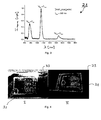
  • Fig. 1 an emission spectrum of the coordination polymer 1 ⁇ [GdCl3 (DPE) (py)] • 0.5 (DPE, py)
  • Fig. 2 an emission spectrum of the coordination polymer 2 ⁇ [EuCl 3 (tz) 2 (thz)] • (thz)
  • Fig. 3 an emission spectrum of the coordination polymer 3 ⁇ [NdCl 3 (dpa) 2 ] • (thz)
  • Fig. 1 an emission spectrum of the coordination polymer 1 ⁇ [GdCl3 (DPE) (py)] • 0.5
  • Fig. 2 an emission spectrum of the coordination polymer 2 ⁇ [EuCl 3 (tz) 2 (thz)] • (thz)
  • Fig. 3 an emission spectrum of the coordination polymer 3 ⁇ [NdCl 3 (dpa) 2 ] • (thz)
  • Fig. 1 an emission spectrum of the coordination polymer 1 ⁇ [GdCl3 (DPE) (py
  • the coordination compounds described below on the basis of their spectra can each be used alone or in combination in a composition which is applied to or introduced into a packing material in order to be able to characterize pharmaceutical formulations or products with regard to their durability and product fastness.
  • the compositions are not limited to the below-mentioned coordination compounds or coordination polymers.
  • Fig. 1 is an emission spectrum 1 of a one-dimensionally linked coordination polymer 1 ⁇ [GdCl 3 (dpe) (py)] • 0.5 (dpe, py) in a plot of absolute intensity I abs [cps] versus wavelength ⁇ [nm].
  • the compound is a part of a composition which acts as a safety feature for a pharmaceutical product and is applied to or incorporated into appropriate packaging material in the form of a coating.
  • the coordination center is Gd 3+ , to which the ligands 4,4'-dipyridyethene (dpe) and pyridine (py) are coordinated.
  • the gadolinium-containing strand 1 ⁇ [GdCl 3 (dpe) (py)] • 0.5 (dpe, py) shows an intense broad emission band at an excitation wavelength of ⁇ exc 300 nm extends from near UV (UV-A) to the blue of the visible spectrum.
  • UV-A near UV
  • Fig. 2 an emission spectrum 11 of the two-dimensional network forming coordination polymer 2 ⁇ [EuCl 3 (tz) 2 (thz)] • (thz) in a plot of absolute intensity I abs [cps] versus wavelength ⁇ [nm].
  • this coordination compound can be used as a component of a composition as a security feature for a pharmaceutical product and applied in the form of a coating on appropriate packaging material or introduced into this. Due to the individual transitions in a narrow wavelength range from 550 nm to 700 nm, the security against counterfeiting is given.
  • Fig. 3 shows an emission spectrum 21 of the one-dimensional network forming coordination polymer 3 ⁇ [NdCl 3 (dpa) 2 ] • (thz) in a plot of normalized intensity I norm [cps] versus wavelength ⁇ [nm].
  • the coordination connection 3 ⁇ [NdCl 3 (dpa) 2 ] • (thz) the ligands 1,3-thiazole (thz) and 4,4'-dipyridylethane (dpa) are coordinated to Nd 3+ ions.
  • the coordination connection 3 ⁇ [NdCl 3 (dpa) 2 ] • (thz) serves as UV absorber also the counterfeit security of a packaging or the corresponding pharmaceutical product.
  • Fig. 4 shows a luminescent label 31 in daylight ( Fig. 4I ) and under UV irradiation ( Fig. 4 II).
  • the label 31 is applied to a packaging material 33 and serves as an "anti-counterfeiting label".
  • the label 31 is produced by means of a mask and an organic matrix which luminesces on UV irradiation and thus guarantees rapid verification of the authenticity of the products ( Fig.5 ).
  • the security against counterfeiting can be further increased by combining the connection and thus the characteristic emission; eg invisible and visible.
  • composition of the label 31 in this case comprises the one-dimensional coordination polymer 3 ⁇ [NdCl 3 (dpa) 2 ] • (thz) and the network forming 2 ⁇ [EuCl 3 (tz) 2 (thz)] • (thz).
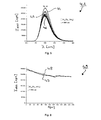
  • FIGS. 5 and 6 are several emission spectra 41 of the three-dimensional network forming coordination polymer 3 ⁇ [Sr 0.9 Eu 0.1 (Im) 2 ] under the influence of atmospheric humidity ( Fig. 5 ), as well as the associated intensity decrease of the luminescence of the 5d ⁇ 4f transition of the coordination compound 3 ⁇ [Sr 0.9 Eu 0.1 (Im) 2 ] ( Fig. 6 ) demonstrating plot 43 against time.
  • the coordination connection 3 ⁇ [Sr 0.9 Eu 0.1 (Im) 2 ] is used as part of a composition which serves as a hydrolysis sensor or as a moisture sensor for a packaging material.
  • the organometallic (MOF) framework undergoes passivation so that no loss of luminescence is detectable.
  • This can also Fig. 6 in which the absolute intensity I abs [cps] is plotted against the time t [min]. From about 200 minutes, no change in the luminescence occurs more, which can be seen from the measurement curve 47 and the extrapolation 48.
  • the passivation is adjustable as a threshold value by the particle size.
  • the hydrolysis threshold, the hydrolysis rate and the completeness of the hydrolysis depend not only on the amount of water but also on the sensitivity of the system used.
  • FIGS. 7 and 8 are accordingly also emission spectra 51 of 2 ⁇ [Tb 2 Cl 6 (4,4'Bipy)] • 2 (4,4'Bipy) under the influence of humidity ( Fig. 7 ), as well as a decrease in the intensity of the luminescence of all transitions of the coordination compound 2 ⁇ [Tb 2 Cl 6 (4,4'Bipy)] • 2 (4,4'Bipy) ( Fig. 8 ) showing the absolute intensity I abs [cps] versus the time t [min].
  • the coordination polymer 2 ⁇ [Tb 2 Cl 6 (4,4'Bipy)] • 2 (4,4'Bipy) is used as a moisture sensor for a package.
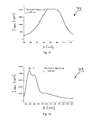
  • FIGS. 9 and 10 are an excitation spectrum 61 of a one-dimensional coordination polymer 1 ⁇ [DyCl 3 (4,4'-bipy) (py) 2 ] • py ( Fig. 9 ), as well as an emission spectrum 63 ( Fig. 10 ), in each case in a plot of the absolute intensity I abs [cps] against the wavelength ⁇ [nm].
  • the coordination connection 1 ⁇ [DyCl 3 (4,4'-bipy) (py) 2 ] • py is used in a composition which, as an absorber in the wavelength ranges 200 nm to 330 nm, 355 nm, 365 nm and 375 nm to 400 nm, provides light protection of in a packaging stored pharmaceutical product.
  • the strand 1 ⁇ [DyCl 3 (4,4'-bipy) (py) 2 ] • py shows in the excitation spectrum 61 at an emission wavelength of ⁇ em 576 nm an intensity-dependent absorption over the entire UV-A range up to the short-wave range of the visible spectrum , where strong absorptions are to be observed in the range from 200 nm to 400 nm ( Fig. 9 ).
  • the emission of the absorbed radiation takes place partly as light, as in the emission spectrum 63 in FIG Fig. 10 shown in the long-wavelength region of the visible spectrum with four defined transitions in a range between about 450 nm and 800 nm ("Downshifting" of energy).
  • FIGS. 11 and 12 show an excitation spectrum 71 of the two-dimensional network-forming coordination polymer 2 ⁇ [Ce 2 Cl 6 (4,4'-bipy) 4 ] • py ( Fig. 11 ), as well as an emission spectrum 73 ( Fig. 12 ), each in a plot of the absolute Intensity I abs [cps] against the wavelength ⁇ [nm].
  • the coordination polymer 2 ⁇ [Ce 2 Cl 6 (4,4'-bipy) 4 ] • py shows in the excitation spectrum 71 a broad absorption band in the range from about 270 nm to 315 nm and thus covers and converts a substantial range of high-energy UV-B radiation in less energetic near UV radiation as well as blue luminescence around.
  • the excitation spectrum 71 of 2 ⁇ [Ce 2 Cl 6 (4,4'-bipy) 4 ] • py shows broad absorption in the UV-B range, with the best light protection for maximum absorption in the range of about 270 nm to 315 nm.
  • the absorbed light is re-emitted bathochromically in the range between 330 nm and 480 nm, as the emission spectrum 73 shows. Again, energy conversion (down-shift) and low heating by self-emission come into play.
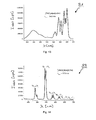
  • Fig. 13 shows an excitation spectrum 81 of the three-dimensional network-forming coordination polymer 3 ⁇ [TbCl 3 (dpa)] • thz in a plot of the absolute intensity I abs [cps] versus the wavelength ⁇ [nm].
  • Fig. 14 shows an emission spectrum 83 of 3 ⁇ [TbCl 3 (dpa)] • thz, also in a plot of the absolute intensity I abs [cps] against the wavelengths ⁇ [nm].
  • the coordination connection 3 ⁇ [TbCl 3 (dpa)] • thz the ligands 1,3-thiazole (thz) and 4,4'-dipyridylethane (dpa) are coordinated to Tb 3+ ions.
  • the excitation spectrum 81 shows a broad absorption in the range of 260 nm to 390 nm, wherein the absorption maximum of the ligands at 280 nm and the absorption maxima of the Tb 3+ ions are between 355 nm and 385 nm.
  • the emission spectrum 83 is a line spectrum and shows the characteristic, sharp transitions for Tb 3+ in the range of 475 nm to 675 nm and thus again a significant downshift.
  • the largest “downshift” of energy is shown by the three-dimensional network of the coordination polymer 3 ⁇ [YbCl 3 (dpa)] • thz.
  • This coordination polymer is also well suited as a moisture sensor, UV absorber and authentication feature for a packaging.
  • Fig. 15 this shows an excitation spectrum 91 of 3 ⁇ [YbCl 3 (dpa)] • thz and
  • Fig. 16 an emission spectrum 93, each in a plot of normalized intensity I norm [cps] versus wavelength ⁇ [nm].
  • the excitation spectrum 91 of 3 ⁇ [YbCl 3 (dpa)] • thz (left) shows absorption in the short-wave range of UV radiation between 250-300nm.
  • the emission spectrum 93 shows a broadband emission in the NIR range from 950 nm to 1050 nm, thus achieving a total energy shift of 700 nm.
  • LIST OF REFERENCE NUMBERS 1 Emission spectrum of 1 ⁇ [GdCl 3 (dpe) (py)] • 0.5 (dpe, py) 11 Emission spectrum of 2 ⁇ [EuCl 3 (tz) 2 (thz)] • (thz) 21 Emission spectrum of 3 ⁇ [NdCl 3 (dpa) 2 ] • (thz) 31 label 33 packaging 41 Emission spectrum of 3 ⁇ [Sr 0.9 Eu 0.1 (Im) 2 ] 43 application 44 Luminescence of 3 ⁇ [Sr 0.9 Eu 0.1 (Im) 2 ] after 1 minute 45 Luminescence of 3 ⁇ [Sr 0.9 Eu 0.1 (Im) 2 ] after 100 minutes 46 Luminescence of 3 ⁇ [Sr 0.9 Eu 0.1 (Im) 2 ] after 200 minutes 47 temporal change

Landscapes

  • Chemical & Material Sciences (AREA)
  • Engineering & Computer Science (AREA)
  • Materials Engineering (AREA)
  • Organic Chemistry (AREA)

Abstract

Die Erfindung betrifft die Verwendung einer Zusammensetzung für ein Packmittel (33), insbesondere für ein Packmittel (33) eines pharmazeutischen Produktes, wobei die Zusammensetzung eine lumineszierende Koordinationsverbindung der allgemeinen Formel (M x L y ) n mit zumindest einem Koordinationszentrum M, sowie mit einer Anzahl von an dem oder jedem Koordinationszentrum M koordinierten Liganden L umfasst, und wobei das oder jedes Koordinationszentrum M ausgewählt ist aus einer Gruppe, die Erdalkalimetalle, Seltene-Erd-Metalle und Metalle der 13. Gruppe und der 15. Gruppe des Periodensystems enthält. Des Weiteren betrifft die Erfindung ein Packmittel (33), welches eine entsprechende Zusammensetzung verwendet. Durch die gezielte Auswahl und/oder Kombination der in der Zusammensetzung enthaltenen Koordinationsverbindungen lassen sich - aufgrund der lumineszierenden Eigenschaften der Koordinationsverbindungen - sowohl die Qualität als auch die Sicherheit von in einem Packmittel (33) aufbewahrten empfindlichen Produkten auf einfache Weise kontrollieren und ein verbesserter UV-Schutz lichtempfindlicher Inhalte eines Packmittels erreichen.

Description

  • Die Erfindung betrifft die Verwendung einer Zusammensetzung für ein Packmittel, insbesondere für ein Packmittel eines pharmazeutischen Produkts. Weiterhin betrifft die Erfindung ein Packmittel mit einer entsprechenden Zusammensetzung.
  • Ein Packmittel als solches dient grundsätzlich der Verpackung eines Produktes und schützt dieses beispielsweise bei Transport oder Lagerung vor äußeren Einflüssen oder Beschädigungen. Eine besondere Bedeutung kommt Packmitteln zu, die zur Verpackung empfindlicher Produkte, wie beispielsweise zur Verpackung von pharmazeutischen Produkten und Arzneimitteln verwendet werden.
  • Da pharmazeutische Produkte bzw. Arzneimittel einen wichtigen Bestandteil der allgemeinen Gesundheitsversorgung darstellen, müssen insbesondere deren Qualität und Wirksamkeit sichergestellt werden. Hierzu muss einerseits eine Wechselwirkung eines verwendeten Packmittels mit den in den Produkten enthaltenen Wirkstoffen oder Formulierungen ausgeschlossen werden, um mögliche Veränderungen der Formulierung bzw. des Arzneimittels auszuschließen. Beispielsweise müssen Diffusionsvorgänge durch das Packmittel oder die Migrationen von Verpackungsbestandteilen in das Produkt komplett ausgeschlossen werden, um die Wirksamkeit eines pharmazeutischen Produktes über dessen Lebenszeit gewährleisten zu können.
  • Andererseits muss sichergestellt werden, dass das Packmittel einen ausreichenden Schutz vor Verlust, oxidativem Abbau, Lichteinwirkung oder vor mikrobieller Kontamination des Produktes bietet. Je nach eingesetztem Material des Packmittels kann jedoch auch bei einem unter hohen Qualitätsstandards gefertigten Packmittel nicht immer sicher ausgeschlossen werden, dass ein in diesem aufbewahrtes Produkt möglicherweise durch Licht oder Feuchtigkeit geschädigt wird. Auch verlässliche Aussagen über die Echtheit eines in einem Packmittel aufbewahrten oder transportierten Produktes sind bisweilen nicht immer möglich.
  • Der Erfindung liegt als eine erste Aufgabe zugrunde, eine Zusammensetzung anzugeben, die sich aufgrund ihrer spezifischen Eigenschaften zur Charakterisierung und zum Schutz empfindlicher Produkte und insbesondere pharmazeutischer Produkte eignet.
  • Als eine zweite Aufgabe liegt der Erfindung zugrunde, ein Packmittel mit einer entsprechenden Charakterisierungs- und Schutzfunktion anzugeben.
  • Die erste Aufgabe der Erfindung wird erfindungsgemäß gelöst durch die Verwendung einer Zusammensetzung für ein Packmittel, insbesondere für ein Packmittel eines pharmazeutischen Produktes, wobei die Zusammensetzung eine lumineszierende Koordinationsverbindung der allgemeinen Formel (MxLy)n mit zumindest einem Koordinationszentrum M, sowie mit einer Anzahl von an dem oder jedem Koordinationszentrum M koordinierten Liganden L umfasst, und wobei das oder jedes Koordinationszentrum M ausgewählt ist aus einer Gruppe, die Erdalkalimetalle, Seltene-Erd-Metalle und Metalle der 13. Gruppe und der 15. Gruppe des Periodensystems enthält.
  • Die Erfindung geht von der Tatsache aus, dass der Sicherheit eines Konsumenten bzw. eines Patienten bei der Arzneimitteleinnahme eine große Bedeutung zukommt. Allerdings werden Patienten beispielsweise durch den unkontrollierten Versandhandel im Internet zunehmend mit Arzneimittelfälschungen konfrontiert. Diese stellen eine erhebliche Gefahr für die Gesundheit dar und können im ungünstigsten Fall ein Krankheitsbild verschlimmern. Eine Echtheitsprüfung der Arzneimittel ist hierbei insbesondere für Privatleute kaum möglich.
  • Weiterhin berücksichtigt die Erfindung, dass auch die Überprüfung der Verwendbarkeit eines pharmazeutischen Produktes hinsichtlich seiner Haltbarkeit nur in Grenzen möglich ist. Üblicherweise erfolgt eine solche Haltbarkeitsprüfung anhand des jeweiligen Verfallsdatums auf dem entsprechenden Packmittel des pharmazeutischen Produktes. Da das Verfallsdatum allerdings eine ordnungsgemäße Lagerung voraussetzt, die die Produktbeschaffenheit im Hinblick auf Qualität und Wirkung nicht verändert, gibt das Verfallsdatum nur bedingt Aufschluss über die tatsächliche Verwendbarkeit des Produktes.
  • So besteht beispielsweise bei Produkten, die über einen langen Zeitraum gelagert oder über weite Wege transportiert werden müssen, die Gefahr einer unerwünschten Exposition durch Feuchtigkeit, Lichteinstrahlung oder ähnlichem, so dass das Produkt trotz noch nicht abgelaufenem Verfallsdatum möglicherweise nicht mehr verwendbar ist. Alternativ besteht die Möglichkeit, dass ein Produkt noch über das Verfallsdatum heraus nutzbar ist, und bei Überschreiten des Verfallsdatums dennoch verworfen wird. Das Verfallsdatum bzw. die Haltbarkeitsfristen lassen so nur begrenzt verlässliche Aussagen über die tatsächliche Qualität eines pharmazeutischen Produktes zu.
  • Unter Berücksichtigung der vorbeschriebenen Problematik erkennt die Erfindung nun, dass die Kontrolle eines pharmazeutischen Produktes vereinfacht und damit die Produktsicherheit als solche erhöht werden kann, wenn ein Packmittel mit einer Zusammensetzung eingesetzt wird, anhand derer auf einfache Art und Weise Aussagen sowohl hinsichtlich der Echtheit, als auch hinsichtlich der zum Zeitpunkt der gewünschten Anwendung vorhandenen Qualität des Produktes getroffen werden können. Hierzu wird eine Zusammensetzung verwendet, die eine Koordinationsverbindung mit lumineszierenden Eigenschaften umfasst. Die Koordinationsverbindung mit der allgemeinen Formel (MxLy)n umfasst zumindest ein Koordinationszentrum M, sowie eine Anzahl von an dem oder jedem Koordinationszentrum koordinierten Liganden, wobei das oder jedes Koordinationszentrum ausgewählt ist aus einer Gruppe, die Erdalkalimetalle, Seltene-Erd-Metalle und Metalle der 13. Gruppe und der 15. Gruppe des Periodensystems enthält.
  • Die lumineszierenden Eigenschaften der Koordinationsverbindungen rühren von den Koordinationszentren und/oder den jeweiligen Liganden der in der Zusammensetzung eingesetzten Koordinationsverbindungen her und sind charakteristisch für die jeweils eingesetzte Koordinationsverbindung. Durch die gezielte Auswahl - und Kombination - einer oder mehrerer Koordinationsverbindungen kann ein Packmittel hergestellt bzw. bereitgestellt werden, welches verlässliche Aussagen sowohl hinsichtlich der Echtheit als auch hinsichtlich der tatsächlichen Haltbarkeit des in einem Packmittel aufbewahrten pharmazeutischen Produktes liefert.
  • Die Anzahl von in einer Zusammensetzung enthaltener Koordinationsverbindungen, die für ein Packmittel verwendet wird, kann hierbei gezielt auf die in dem Packmittel aufzubewahrenden Produkte abgestimmt werden. Neben pharmazeutischen Produkten können selbstverständlich auch andere Produkte in einem Packmittel mit einer entsprechenden Zusammensetzung verpackt oder aufbewahrt werden. Hierzu zählen insbesondere alle Produkte, die empfindlich gegenüber Licht oder Feuchtigkeit sind.
  • Die Begrifflichkeit der Koordinationsverbindung ist vorliegend als ein Oberbegriff für verschieden koordinierte Verbindungen zu verstehen. Hiervon sind solche Verbindungen umfasst, an denen eine Anzahl von Liganden an einem oder an mehreren Koordinationszentren - Zentralatome bzw. Zentralteilchen - koordiniert sind. So sind von den Koordinationsverbindungen "klassische" Komplexe mit einer Anzahl von an einem Koordinationszentrum koordinierten Liganden umfasst, bei denen die Liganden sowohl zwei oder mehrere Koordinationszentren verbrücken, als auch nicht verbrückend koordinieren (Monomere). Zusätzlich sind auch Koordinationsverbindungen umfasst, bei denen die Liganden zwei oder mehrere Koordinationszentren so verbrücken, dass eine polymer vernetzte Struktur aus alternierenden Koordinationszentren und Liganden entsteht.
  • Der Index n in der allgemeinen Formel (MxLy)n bezeichnet hierbei die Anzahl der jeweils aneinander gebundenen bzw. miteinander vernetzten Baueinheiten aus Metall und Ligand, die die jeweilige Koordinationsverbindung bilden, während x für die Anzahl an Koordinationszentren und y für die Anzahl an Liganden stehen. Bei einer Formel (M1L6)1, also mit n=1, handelt es sich um einen "klassischen" Komplex mit einem Zentralatom und sechs an diesem koordinierten Liganden. Bei einer Formel (M1L6)10, also mit n=10, sind zehn Baueinheiten aus Metall und Ligand mit jeweils einem Zentralatom und sechs an diesem koordinierten Liganden ein- oder mehrdimensional miteinander vernetzt.
  • Bevorzugt ist als Koordinationsverbindung ein Koordinationspolymer umfasst. Koordinationspolymere sind Verbindungen, die - je nach Anzahl der Koordinationszentren und nach Anzahl und Beschaffenheit der an den Koordinationszentren koordinierten Liganden - unterschiedlich miteinander vernetzen können. Sie können entweder eindimensional vernetzte Strukturen, also Ketten bzw.- Stränge ausbilden. Vorzugsweise bilden die Koordinationsverbindungen und zweckmäßigerweise die Koordinationspolymere eine mehrdimensionale Struktur, insbesondere ein mehrdimensionales Netzwerk oder eine strangartige Verknüpfung, aus. Unter einer mehrdimensionalen Struktur werden insbesondere zwei- oder dreidimensional verknüpfte Netzwerke verstanden. Die Koordinationszentren in Koordinationspolymeren sind hierzu vorzugsweise über verbrückende Liganden koordiniert.
  • Die als verbrückende Liganden fungierenden Liganden werden als "Linker" bezeichnet. Mithilfe solcher Linker werden beispielsweise dreidimensionale Raumnetze, sogenannte metallorganische Gerüststrukturen oder "MOFs" (Metal Organic Frameworks) gebildet. Diese Netze entstehen durch die Koordination mehrerer Koordinationszentren mit einer hinreichenden Anzahl von Liganden. Die Liganden sind aus metallischen Knotenpunkten, den sogenannten SBUs (Secondary Building Units) und organischen Molekülen (Linkern) als Verbindungselementen zwischen den Knotenpunkten aufgebaut.
  • Als verbrückende Liganden, die durch Koordination an die entsprechenden Koordinationszentren ein-, zwei- oder dreidimensionale Netzwerke bilden, werden bevorzugt Liganden auf Basis von heterozyklischen und homozyklischen Aromaten eingesetzt. Weiter von Vorteil ist die Koordination der Koordinationszentren mittels terminaler stickstoffhaltiger, sauerstoffhaltiger oder schwefelhaltiger Liganden, wobei terminale Liganden nicht zu einem weiteren Koordinationszentrum verknüpfen.
  • Vorzugsweise ist das oder jedes Koordinationszentrum M der Koordinationsverbindung ausgewählt aus einer Gruppe, die Magnesium (Mg), Calcium (Ca), Strontium (Sr), Barium (Ba), Scandium (Sc), Yttrium (Y), Lanthan (La), Cer (Ce), Praseodym (Pr), Neodym (Nd), Samarium (Sm), Europium (Eu), Gadolinium (Gd), Terbium (Tb), Dysprosium (Dy), Holmium (Ho), Erbium (Er), Thulium (Tm), Ytterbium (Yb), Lutetium (Lu), Aluminium (Al), Gallium (Ga), Indium (In) und Bismuth (Bi) enthält. Die Koordinationszentren sind zweckmäßigerweise ionischer Natur, also ionische Metallzentren. Sie können zur Herstellung einer gewünschten Koordinationsverbindung beispielsweise in Form von Halogenidsalzen oder als reine metallische Elemente mir den jeweiligen Liganden vermengt und umgesetzt werden.
  • Insbesondere sind als Liganden L solche geeignet, die ausgewählt sind aus einer Gruppe, die Azole, die zugehörigen, deprotonierten Azolate, Pyridine und Azine enthält. Besonders bevorzugt sind die Liganden L ausgewählt aus einer Gruppe, die 1H-Pyrrol (PyrH), 1H-Imidazol (ImH), 1 H-Pyrazol (PzH), 1 H-1,2,3-Triazol (tz*H), 1 H-1,2,4-Triazol (tzH), Thiazol (thz), Azol-1H+, Pyridin, 4,4'-Bipyridin, 4,4'-Dipyridylethan (dpa), 4,4'-Dipyridylethen (dpe), 4,4'-Dipyridylethin (dpi) und Pyrazin (Pyz) enthält. Die Liganden sind an dem oder den jeweils vorhandenen Koordinationszentren koordiniert und bilden so die entsprechenden Koordinationsverbindungen aus.
  • Bevorzugt umfasst die Zusammensetzung eine Koordinationsverbindung, die ausgewählt ist aus einer Gruppe, die 1
    Figure imgb0001
    [LnCl3(dpe)(py)]•0,5-2(dpe.py), 2
    Figure imgb0002
    [Ln2Cl6(dpe)3(py)2]·dpe, 1
    Figure imgb0003
    [Ln2Cl6(dpe)2(thz)4]·dpe, 1
    Figure imgb0004
    [LnCl3(dpe)(thz)2]·thz, 2
    Figure imgb0005
    [LnCl3(tz)2(thz)]•(thz), 1
    Figure imgb0006
    [LnCl3(thz)3]·thz, [Ln2Cl6(thz)8]·3thz, [Ln2Cl6(thz)8], [LnCl3(thz)4]·0.5-2(thz), 3
    Figure imgb0007
    [LnCl3(dpa)2]•(thz), 3
    Figure imgb0008
    [AE1-xEux(Im)2], 2
    Figure imgb0009
    [Ln2Cl6(4,4'Bipy)]•2(4,4'-Bipy), 1
    Figure imgb0010
    [LnCl3(4,4'-Bipy)(py)2]•(py), 2
    Figure imgb0011
    [Ln2Cl6(4,4'Bipy)4]•(py), 3
    Figure imgb0012
    [LnCl3(dpa)]•0,5-2(thz), 3
    Figure imgb0013
    [LnCl3(dpa)]•0,5-4(thz), 3
    Figure imgb0014
    [LnCl3(dpa)]•0,5-2(py), 1
    Figure imgb0015
    [LnCl3(bipy)(py)2]•(py), 1
    Figure imgb0016
    [Ln2Cl5(bipy)2(py)4]- 1
    Figure imgb0017
    [LnCl4(bipy)], 2
    Figure imgb0018
    [Ln2Cl6(bipy)5]•4(bipy)), 3
    Figure imgb0019
    [Ln(Im)3ImH], 3
    Figure imgb0020
    [Ln(Im)3ImH]•ImH, 3
    Figure imgb0021
    [Ln3(Im)9(ImH)2]·2ImH, 3
    Figure imgb0022
    [Ln2(Im)6(ImH)1.5]·0.5ImH, 3
    Figure imgb0023
    [Ln(Im)3] sowie [Ln2Cl6(pyz)4] und [Bi(2-x)LnxCl6(pyz)4] enthält.
  • Ln bezeichnet Ionen der Elemente der Lanthanide und umfasst bevorzugt Lanthan (La), Cer (Ce), Praseodym (Pr), Neodym (Nd), Samarium (Sm), Europium (Eu), Gadolinium (Gd) und Terbium (Tb), Dysprosium (Dy), Holmium (Ho), Erbium (Er), Thulium (Tm) und Lutetium (Lu). Alternativ oder zusätzlich können auch solche Koordinationsverbindungen eingesetzt werden, die als Koordinationszentrum M anstelle von Ln Ionen der Elemente der 13. Gruppe des Periodensystems und/oder der Elemente der Erdalkalimetalle (AE) umfassen. Besonders bevorzugt können Koordinationsverbindungen mit Aluminium (Al), Gallium (Ga), Indium (In), Bismuth (Bi), Magnesium (Mg), Calcium (Ca), Strontium (Sr) und Barium (Ba) als Koordinationszentrum M eingesetzt werden. Der die Anzahl der jeweils aneinander gebundenen bzw. miteinander vernetzten Baueinheiten aus Metall und Ligand bezeichnende Index n, hat hierbei vorzugsweise einen Wert zwischen x = 0,01 und x = 1.
  • Allen Koordinationsverbindungen, unabhängig davon, ob sie Komplexcharakter aufweisen oder als Koordinationspolymere ein- oder mehrdimensionale Netze bilden, ist deren intrinsische lumineszierende Eigenschaften gemein, die es ermöglicht, bei deren Einsatz als Teil einer Zusammensetzung die Qualität die Herkunft und die Haltbarkeit des jeweiligen pharmazeutischen Produktes zu ermitteln bzw. sicherzustellen. Zusätzlich wird bei einer Zusammensetzung auf Basis von Koordinationsverbindungen die Einbringbarkeit in organische Polymermatrizen des Packmaterials gegenüber herkömmlichen Phosphoren erweitert bzw. erhöht. Dabei erlaubt die Verwendung von organischen Liganden mit Azol- und Pyridincharakter eine verbesserte Akzeptanz insbesondere betreffend die Eigenschaften der Polymermatrix gegenüber herkömmlichen Phosphoren auf Basis von Oxiden oder Nitriden. Diese rührt von der chemischen Ähnlichkeit der organischen Liganden im Vergleich zu den organischen Polymematrizen her. Herkömmliche anorganische Phosphore zeigen diese Ähnlichkeit organischer Baugruppen nicht. Das Packmaterial ist vorzugsweise mit der Zusammensetzung beschichtet, die die oder jede Koordinationsverbindung enthält. Die Beschichtung erfolgt vorzugsweise als dünne, auf das Packmittel aufgetragene Schicht, so dass die Beschaffenheit des Packmittels, wie beispielsweise die Transparenz erhalten bleibt. Die Beschichtung kann vollflächig oder auch nur auf Teilflächen erfolgen. Je nach Herstellungsverfahren des Packmittels und anhängig von den in der Zusammensetzung eingesetzten Koordinationsverbindungen kann es ebenfalls vorteilhaft sein, wenn die Zusammensetzung in das Packmaterial eingebracht ist. Eine solche Einbringung kann beispielsweise direkt bei der Herstellung des Packmaterials erfolgen, so dass eine zusätzliche Beschichtung entfallen kann.
  • Aufgrund ihrer Lumineszenzeigenschaften eignen sich Zusammensetzungen mit den entsprechenden Koordinationsverbindungen insbesondere im Bereich der Sensorik. In einer besonders vorteilhaften Ausgestaltung wird die Zusammensetzung als ein Echtheitssensor eingesetzt. Ein solcher Sensor, also die auf das Packmittel aufgebrachte oder in dieses eingebrachte Zusammensetzung, fungiert als ein UV-Sensor und ist in der Lage, einfallendes Licht in einem bestimmten Wellenlängenbereich zu absorbieren und schließlich wieder zu emittieren. Die emittierte Strahlung kann dabei von Wellenlängen im UV-Bereich (200 nm bis 380 nm) über den sichtbaren Bereich (380 nm bis 750 nm) bis in den infraroten Bereich reichen (750 nm bis 3000 nm). Die Absorption und die resultierende Emission sind hierbei spezifisch für die verwendete Zusammensetzung, also für die in der Zusammensetzung enthaltenen Koordinationsverbindungen.
  • Aufgrund der spezifische Emissionen und Emissionsspektren der Koordinationsverbindungen im sichtbaren Spektrum des Lichts lassen sich auf ein Packmittel aufgebrachte Zusammensetzungen als ein Logo, ein Label oder ein Barcode auslesen. So kann schnell und einfach die Echtheit eines pharmazeutischen Produktes anhand des Packmaterials verifiziert werden. Mit anderen Worten lässt sich eine solche Zusammensetzung in Form eines "anti counterfeiting labels" als ein Sicherheitsmerkmal für die pharmazeutischen Produkte einsetzen und kann die Fälschungssicherheit deutlich erhöhen. Durch den Einsatz von Matrizen kann hierbei ein Label kreiert werden, das bei UV-Einstrahlung luminesziert und so eine schnelle Verifizierung der Echtheit der jeweiligen pharmazeutischen Produkte garantiert.
  • Die Funktion als UV-Sensor - also als Sicherheitsmerkmal bzw. Echtheitssensor der Zusammensetzung - basiert auf der spezifischen Lumineszenz der eingesetzten Koordinationsverbindungen. Hierbei kommt es bei einer Anregung, zweckmäßigerweise über UV-Strahlung, zur Absorption und anschließender Emission längerwelliger Strahlung. Die Absorptionswellenlängen und Emissionswellenlängen sind hierbei abhängig von dem Koordinationszentrum und den entsprechenden an dem Koordinationszentrum koordinierten Liganden jeder Koordinationsverbindung. Das emittierte Licht kann bei je nach ausgewählter Koordinationsverbindung im UV-Bereich zwischen 200 nm und 380 nm, im VIS-Bereich zwischen 380 nm und 750 nm oder im NIR-Bereich zwischen 780 nm und 3 µm liegen.
  • Die Produktechtheit kann vorzugsweise mit Hilfe handelsüblicher UV-Lampen überprüft werden. Hierzu wird ein mit einer Zusammensetzung versehenes Packmittel mit UV-Licht bestrahlt, die entsprechenden in der Zusammensetzung enthaltenen Koordinationsverbindungen angeregt und anhand bekannter Emissionsspektren identifiziert. Zusätzlich kann auch durch das Design eines lumineszierenden Labels oder Barcodes die Fälschungssicherheit weiter erhöht werden, indem beispielsweise Chargen oder einzelne Produkte mit den entsprechenden lumineszierenden Logos, bzw. mit Logos, die aufgrund der Zusammensetzung lumineszierende Eigenschaften aufweisen, gekennzeichnet werden. Diese können dann einfach mit einem Scanner ausgelesen werden.
  • Zur Verwendung als UV-Sensor für ein Packmittel eignet sich insbesondere eine Zusammensetzung, die eine Koordinationsverbindung, die ausgewählt ist aus einer Gruppe, die 1
    Figure imgb0024
    [LnCl3(dpe)(py)]•0,5-2(dpe.py), 2
    Figure imgb0025
    [Ln2Cl6(dpe)3(py)2]·dpe, 1
    Figure imgb0026
    [Ln2Cl6(dpe)2(thz)4]·dpe, 1
    Figure imgb0027
    [LnCl3(dpe)(thz)2]·thz, 2
    Figure imgb0028
    [LnCl3(tz)2(thz)]•(thz), 1
    Figure imgb0029
    [LnCl3(thz)3]·thz, [Ln2Cl6(thz)8]·3thz, [Ln2Cl6(thz)8], [LnCl3(thz)4]·0.5-2(thz), 3
    Figure imgb0030
    [LnCl3(dpa)2]•(thz), 3
    Figure imgb0031
    [AE1-xEux(Im)2], 2
    Figure imgb0032
    [Ln2Cl6(4,4'Bipy)]•2(4,4'-Bipy), 1
    Figure imgb0033
    [LnCl3(4,4'-Bipy)(py)2]•(py), 2
    Figure imgb0034
    [Ln2Cl6(4,4'Bipy)4]•(py), 3
    Figure imgb0035
    [LnCl3(dpa)]•0,5-2(thz), 3
    Figure imgb0036
    [LnCl3(dpa)]•0,5-4(thz), 3
    Figure imgb0037
    [LnCl3(dpa)]•0,5-2(py), 1
    Figure imgb0038
    [LnCl3(bipy)(py)2]•(py), 1
    Figure imgb0039
    [Ln2Cl5(bipy)2(py)4], 1
    Figure imgb0040
    [LnCl4(bipy)], 2
    Figure imgb0041
    [Ln2Cl6(bipy)5]•4(bipy)), 3
    Figure imgb0042
    [Ln(Im)3ImH], 3
    Figure imgb0043
    [Ln(Im)3ImH]•ImH, 3
    Figure imgb0044
    [Ln3(Im)9(ImH)2]·2ImH, 3
    Figure imgb0045
    [Ln2(Im)6(ImH)1.5]·0.5ImH, 3
    Figure imgb0046
    [Ln(Im)3] sowie [Ln2Cl6(pyz)4] und [Bi(2-x)LnxCl6(pyz)4] enthält.
  • Auch hier bezeichnet Ln Ionen der Elemente der Lanthanide und umfasst vorzugsweise Lanthan (La), Cer (Ce), Praseodym (Pr), Neodym (Nd), Samarium (Sm), Europium (Eu), Gadolinium (Gd) und Terbium (Tb), Dysprosium (Dy), Holmium (Ho), Erbium (Er), Thulium (Tm) und Lutetium (Lu). Alternativ oder zusätzlich können auch solche Koordinationsverbindungen eingesetzt werden, die als Koordinationszentrum M anstelle von Ln Ionen der Elemente der 13. Gruppe des Periodensystems umfassen. Besonders bevorzugt können Koordinationsverbindungen mit Aluminium (Al), Gallium (Ga), Indium (In) und Bismuth (Bi) als Zentralatom bzw. Koordinationszentrum M eingesetzt werden. Auch Magnesium (Mg), Calcium (Ca), Strontium (Sr) und Barium (Ba), die die Elemente der Erdalkalimetalle (AE) repräsentieren, können als Koordinationszentrum M eingesetzt werden. Der Index n liegt vorzugsweise in einem Bereich zwischen x = 0,01 und x = 1.
  • In einer weiter vorteilhaften Ausgestaltung - ebenfalls auf dem Gebiet der Sensorik - wird die Zusammensetzung als ein Feuchtigkeitssensor eingesetzt. Eine als Feuchtigkeitssensor einsetzbare Zusammensetzung ermöglicht die Erfassung der Degradation hydrolyseempfindlicher pharmazeutischer Formulierungen durch in ein Packmittel diffundierendes Wasser. Hierbei wird der Verlust oder die Veränderung der Lumineszenz der eingesetzten Zusammensetzung, bzw. der Lumineszenz der Koordinationsverbindungen genutzt, um indirekt die Degradation eines Wirkstoffes nachzuweisen. Im Fall eines Kontaktes des mit der Zusammensetzung versehenen Packmittels mit Wasser reagiert die Zusammensetzung im Verlauf der Lagerdauer mit in das Packmittel hinein diffundierendem Wasser. Durch die Hydrolyse der Koordinationsverbindung kommt es zu einem Verlust oder einer Änderung der Lumineszenz der Zusammensetzung, also des Feuchtigkeitssensors. So kann die reale verbleibende Haltbarkeit des Arzneimittels angezeigt werden. Durch die gezielte Kombination verschiedener Koordinationszentren und/oder Liganden können die Hydrolyseempfindlichkeit und die Degradationsgeschwindigkeiten der Zusammensetzung beliebig an die Eigenschaften des pharmazeutischen Produktes bzw. eines Arzneimittels angepasst werden, ohne dass die als Feuchtigkeitssensor wirkende Zusammensetzung und der Wirkstoff direkt miteinander reagieren bzw. zu einer Veränderung des Wirkstoffes führen. Erfasst wird einzig die Hydrolyse der Formulierung. So können insbesondere von starren Haltbarkeitsfristen bzw. Verfallsdaten unabhängige, reale Haltbarkeitsdaten von pharmazeutischen Produkten anhand der Kontrolle der Lumineszenz überprüft werden.
  • So kommt es bei Lanthanid-Ionen als Koordinationszentren aufgrund ihrer hohen Oxophilie, also der Neigung Bindungen zu Sauerstoffatomen auszubilden, bei Exposition der Koordinationsverbindungen mit Wasser, wie zum Beispiel Luftfeuchtigkeit, zur Degradation des die Zentren umgebenden chemischen Gerüstes. Diese Umwandlungen bedingen einen Verlust an Lumineszenz der Zusammensetzung, dass diese an die chemische Umgebung des Koordinationszentrums gebunden ist. Hierbei ist es möglich, mit verschiedenen reinen Koordinationsverbindungen oder mit einer Kombinationen mehrerer Koordinationsverbindungen unterschiedlich empfindliche Sensorsysteme zu kreieren, da die Systeme bzw. die Zusammensetzungen je nach eingesetzten Koordinationsverbindungen über unterschiedliche Hydrolysegeschwindigkeiten und Schwellenwerte, ab welchem der Sensor reagiert, verfügen.
  • Mit anderen Worten können die Empfindlichkeit und der Schwellenwert des Feuchtigkeitssensors oder Hydrolysesensor über die Auswahl der Koordinationsverbindungen, sowie über deren Menge frei eingestellt werden und so optimal an die Anforderungen des Wirkstoffes angepasst werden. Durch die Korrelation von Koordinationsverbindungen mit Arzneimitteln, die über eine ähnliche Hydrolyseempfindlichkeit und Degradationsgeschwindigkeit verfügen, ist eine visuelle Sichtung der Qualität und der Haltbarkeit eines pharmazeutischen Produktes möglich.
  • Die Sichtung kann dabei insbesondere mit dem Auge, einem Photometer oder mit einem Photolumineszenzspektrometer erfolgen, mit in der genannten Reihenfolge ansteigender Empfindlichkeit der sensorischen Erfassung. Sie reicht somit vom rein visuellen Ergebnis bis hin zu einer quantitativen Bestimmung.
  • Zur Verwendung als Feuchtigkeitssensor für ein Packmittel eignet sich bevorzugt eine Zusammensetzung, die ausgewählt ist aus einer Gruppe, die 1
    Figure imgb0047
    [LnCl3(dpe)(py)]•0,5-2(dpe.py), 2
    Figure imgb0048
    [Ln2Cl6(dpe)3(py)2]·dpe, 1
    Figure imgb0049
    [Ln2Cl6(dpe)2(thz)4]·dpe, 1
    Figure imgb0050
    [LnCl3(dpe)(thz)2]·thz, 2
    Figure imgb0051
    [LnCl3(thz)2(thz)]•(thz), 1
    Figure imgb0052
    [LnCl3(thz)3]·thz, [Ln2Cl6(thz)8]·3thz, [Ln2Cl6(thz)8], [LnCl3(thz)4]·0.5-2(thz), 3
    Figure imgb0053
    [LnCl3(dpa)2]•(thz), 3
    Figure imgb0054
    [AE1-xEux(Im)2], 2
    Figure imgb0055
    [Ln2Cl6(4,4'Bipy)]•2(4,4'-Bipy), 1
    Figure imgb0056
    [LnCl3(4,4'-Bipy)(py)2]•(py), 2
    Figure imgb0057
    [Ln2Cl6(4,4'Bipy)4]•(py), 3
    Figure imgb0058
    [LnCl3(dpa)]•0,5-2(thz), 3
    Figure imgb0059
    [LnCl3(dpa)]•0,5-4(thz), 3
    Figure imgb0060
    [LnCl3(dpa)]•0,5-2(py), 1
    Figure imgb0061
    [LnCl3(bipy)(py)2]•(py), 1
    Figure imgb0062
    [Ln2Cl5(bipy)2(py)4]- 1
    Figure imgb0063
    [LnCl4(bipy)], 2
    Figure imgb0064
    [Ln2Cl6(bipy)5]•4(bipy)), 3
    Figure imgb0065
    [Ln(Im)3ImH], 3
    Figure imgb0066
    [Ln(Im)3ImH]•ImH, 3
    Figure imgb0067
    [Ln3(Im)9(ImH)2]·2ImH, 3
    Figure imgb0068
    [Ln2(Im)6(ImH)1.5]·0.5ImH, 3
    Figure imgb0069
    [Ln(Im)3] sowie [Ln2Cl6(pyz)4] und [Bi(2-x)LnxCl6(pyz)4]. enthält.
  • Ln bezeichnet vorliegend ebenfalls Ionen der Elemente der Lanthanide und umfasst vorzugsweise Lanthan (La), Cer (Ce), Praseodym (Pr), Neodym (Nd), Samarium (Sm), Europium (Eu), Gadolinium (Gd) und Terbium (Tb), Dysprosium (Dy), Holmium (Ho), Erbium (Er), Thulium (Tm) und Lutetium (Lu). Alternativ oder zusätzlich können auch solche Koordinationsverbindungen eingesetzt werden, die als Koordinationszentrum M - anstelle von Ln - Ionen der Elemente der 13. Gruppe des Periodensystems, insbesondere Aluminium (Al), Gallium (Ga), Indium (In) und Bismuth (Bi), umfassen. Auch Magnesium (Mg), Calcium (Ca), Strontium (Sr) und Barium (Ba) können als Elemente der Erdalkalimetalle (AE) als Koordinationszentrum M eingesetzt werden. Der Index n liegt vorzugsweise in einem Bereich zwischen x = 0,01 und x = 1.
  • Insbesondere ist es auch möglich, eine Zusammensetzung einzusetzen, die die sensorischen Eigenschaften der ausgewählten Koordinationsverbindungen derart kombiniert, dass die Zusammensetzung beispielsweise UV-Strahlung absorbiert und so als ein Sicherheitsmerkmal für eine Echtheitsprüfung genutzt werden kann und gleichzeitig als Feuchtigkeitssensor nutzbar ist, der Aufschluss über die Hydrolyse der Zusammensetzung und damit deren Haltbarkeit gibt.
  • Eine solche Zusammensetzung umfasst vorzugsweise Koordinationsverbindungen, die ausgewählt sind aus einer Gruppe, die 1
    Figure imgb0070
    [LnCl3(dpe)(py)]•0,5-2(dpe.py), 2
    Figure imgb0071
    [Ln2Cl6(dpe)3(py)2]·dpe, 1
    Figure imgb0072
    [Ln2Cl6(dpe)2(thz)4]·dpe, 1
    Figure imgb0073
    [LnCl3(dpe)(thz)2]·thz, 2
    Figure imgb0074
    [LnCl3(tz)2(thz)]•(thz), 1
    Figure imgb0075
    [LnCl3(thz)3]·thz, [Ln2Cl6(thz)8]·3thz, [Ln2Cl6(thz)8], [LnCl3(thz)4]·0.5-2(thz), 3
    Figure imgb0076
    [LnCl3(dpa)2]•(thz), 3
    Figure imgb0077
    [AE1-xEux(Im)2], 2
    Figure imgb0078
    [Ln2Cl6(4,4'Bipy)]•2(4,4'-Bipy), 1
    Figure imgb0079
    [LnCl3(4,4'-Bipy)(py)2]•(py), 2
    Figure imgb0080
    [Ln2Cl6(4,4'Bipy)4]•(py), 3
    Figure imgb0081
    [LnCl3(dpa)]•0,5-2(thz), 3
    Figure imgb0082
    [LnCl3(dpa)]•0,5-4(thz), 3
    Figure imgb0083
    [LnCl3(dpa)]•0,5-2(py), 1
    Figure imgb0084
    [LnCl3(bipy)(py)2]•(py), 1
    Figure imgb0085
    [Ln2Cl5(bipy)2(py)4]- 1
    Figure imgb0086
    [LnCl4(bipy)], 2
    Figure imgb0087
    [Ln2Cl6(bipy)5]•4(bipy)), 3
    Figure imgb0088
    [Ln(Im)3ImH], 3
    Figure imgb0089
    [Ln(Im)3ImH]•ImH, 3
    Figure imgb0090
    [Ln3(Im)9(ImH)2]·2ImH, 3
    Figure imgb0091
    [Ln2(Im)6(ImH)1.5]·0.5ImH, 3
    Figure imgb0092
    [Ln(Im)3] sowie [Ln2Cl6(pyz)4] und [Bi(2-x)LnxCl6(pyz)4] umfasst.
  • Ln steht vorliegend ebenfalls für die Ionen der Elemente der Lanthanide und umfasst vorzugsweise Lanthan (La), Cer (Ce), Praseodym (Pr), Neodym (Nd), Samarium (Sm), Europium (Eu), Gadolinium (Gd) und Terbium (Tb), Dysprosium (Dy), Holmium (Ho), Erbium (Er), Thulium (Tm) und Lutetium (Lu).
  • Für den alternativen Einsatz eignen sich auch bei einer Zusammensetzung, die gleichzeitig mehrere Funktionen erfüllt, solche Koordinationsverbindungen, die als Koordinationszentrum M anstelle von Ln auch Ionen der Elemente der 13. Gruppe des Periodensystems und/oder der Elemente der Erdalkalimetalle (AE)umfassen. Besonders bevorzugt können Koordinationsverbindungen mit Aluminium (Al), Gallium (Ga), Indium (In), Bismuth (Bi), Magnesium (Mg), Calcium (Ca), Strontium (Sr) und Barium (Ba) als Koordinationszentrum M eingesetzt werden. Der Index n hat hierbei ebenfalls einen Wert, der vorzugsweise zwischen x = 0,01 und 1 liegt. In einer besonders vorteilhaften Ausgestaltung der Erfindung lässt sich die Zusammensetzung als Lichtschutz verwenden. Die Zusammensetzung bzw. die in der Zusammensetzung enthaltenen Koordinationsverbindungen dienen als UV-Absorber, dessen Absorptionsbereich durch den Einsatz und die Kombination verschiedener zur Verfügung stehender Koordinationszentren und verbrückender Liganden an das zu schützende pharmazeutische Produkt angepasst werden kann. Die Schutzfunktion einer solchen Zusammensetzung ergibt sich daraus, dass das auf ein Packmittel einfallende Licht nicht bis zum pharmazeutischen Produkt vordringen kann bzw. in seiner Intensität stark verringert wird. Stattdessen wird durch die Absorption der Strahlung ein Durchdringen des Packmittels verhindert und so eine unerwünschte Veränderung bzw. Schädigung der Formulierung eines pharmazeutischen Produktes verhindert.
  • Hierbei werden vorzugsweise zwei Arten von UV-Absorbern unterschieden. Zum einen kann die Zusammensetzung derart beschaffen sein, dass die absorbierte UV-Strahlung anteilig in eine Emission im sichtbaren Spektrum des Lichts umgewandelt wird. Alternativ kann eine Zusammensetzung verwendet werden, die die absorbierte UV-Strahlung im Infrarotbereich strahlungsfrei abgibt. Auch eine Kombination ist möglich, wenn eine Zusammensetzung eingesetzt wird, deren Koordinationsverbindungen unterschiedliche spektroskopische Eigenschaft aufweist.
  • Die aufgrund ihres Absorptionsvermögens des UV-Lichtes als Lichtschutz fungierenden Zusammensetzungen decken zweckmäßigerweise einen breiten Wellenlängenbereich ab und zeigen eine große Varianz bei den möglichen Absorptions- und Emissionswellenlängen. Vorzugsweise erstreckt sich hierbei die mögliche Absorption über den gesamten Bereich der UV-A und UV-B-Strahlung. Die Emission ist über das gesamte Spektrum des VIS-Bereiches bis hin zum NIR möglich.
  • In einer besonders vorteilhaften Ausgestaltung wird eine Zusammensetzung verwendet, die aufgrund einer Mehrzahl unterschiedlicher Koordinationsverbindungen Strahlung über einen breiten Wellenlängenbereich absorbiert. Auf diese Weise ist die Darstellung eines Breitbandabsorbers möglich. Ein solcher Breitbandabsorber, absorbiert aufgrund der in der Zusammensetzung enthaltenen Koordinationsverbindungen die energiereiche Strahlung vorzugsweise im gesamten UV-Bereich oder in einem bestimmten Teil des UV-Bereichs und eignet sich so besonders zum Schutz photolabiler Substanzen wie Arzneimitteln. Alternativ kann eine Zusammensetzung eingesetzt werden, die ein oder mehrere unterschiedliche Koordinationsverbindungen enthält, die wiederum gemeinsam mit herkömmlichen Absorbern wie Glas im gesamten UV-Bereich Strahlung absorbieren.
  • Eine erweiterte Haltbarkeit der UV-Absorber unter Einwirkung von UV-Licht gegenüber kommerziellen organischen Verbindungen ist durch die zusätzlichen Metall- Ligandbindungen gegeben und durch die Energiekonversion und Emission als unschädliches Licht verstärkt.
  • Zur Verwendung als Lichtschutz für ein Packmittel ist insbesondere eine Zusammensetzung geeignet, die eine Koordinationsverbindung aus der Gruppe umfasst, die 1
    Figure imgb0093
    [LnCl3(dpe)(py)]•0,5-2(dpe.py), 2
    Figure imgb0094
    [Ln2Cl6(dpe)3(py)2]·dpe, 1
    Figure imgb0095
    [Ln2Cl6(dpe)2(thz)4]·dpe, 1
    Figure imgb0096
    [LnCl3(dpe)(thz)2]·thz, 2
    Figure imgb0097
    [LnCl3(tz)2(thz)]•(thz), 1
    Figure imgb0098
    [LnCl3(thz)3]·thz, [Ln2Cl6(thz)8]·3thz, [Ln2Cl6(thz)8], [LnCl3(thz)4]·0.5-2(thz), 3
    Figure imgb0099
    [LnCl3(dpa)2]•(thz), 3
    Figure imgb0100
    [AE1-xEux(Im)2], [Ln2Cl6(4,4'Bipy)]•2(4,4'-Bipy), 1
    Figure imgb0101
    [LnCl3(4,4'-Bipy)(py)2]•(py), 2
    Figure imgb0102
    [Ln2Cl6(4,4'Bipy)4]•(py), 3
    Figure imgb0103
    [LnCl3(dpa)]•0,5-2(thz), 3
    Figure imgb0104
    [LnCl3(dpa)]•0,5-4(thz), 3
    Figure imgb0105
    [LnCl3(dpa)]•0,5-2(py), 1
    Figure imgb0106
    [LnCl3(bipy)(py)2]•(py), 1
    Figure imgb0107
    [Ln2Cl5(bipy)2(py)4]- 1
    Figure imgb0108
    LnCl4(bipy)], 2
    Figure imgb0109
    [Ln2Cl6(bipy)5]•4(bipy)), 3
    Figure imgb0110
    [Ln(Im)3ImH], 3
    Figure imgb0111
    [Ln(Im)3ImH]•ImH, 3
    Figure imgb0112
    [Ln3(Im)9(ImH)2]·2ImH, 3
    Figure imgb0113
    [Ln2(Im)6(ImH)1.5]·0.5ImH, 3
    Figure imgb0114
    [Ln(Im)3] sowie [Ln2Cl6(pyz)4] und [Bi(2-x)LnxCl6(pyz)4] umfasst.
  • Wie auch bei der Verwendung der Zusammensetzung als Feuchtigkeitssensor und/oder als Echtheitssensor können alternativ zu den vorbenannten Koordinationsverbindungen auch hier solche Koordinationsverbindungen eingesetzt werden, die als Zentralatom bzw. Zentralteilchen M anstelle von Ln auch Ionen der Elemente der 13. Gruppe des Periodensystems und/oder der Elemente der Erdalkalimetalle (AE) umfassen. Besonders bevorzugt können Koordinationsverbindungen mit Aluminium (Al), Gallium (Ga), Indium (In), Bismuth (Bi), Magnesium (Mg), Calcium (Ca), Strontium (Sr) und Barium (Ba) als Zentralatom bzw. Zentralteilchen M eingesetzt werden. Der Wert des Index n liegt insbesondere zwischen x = 0,01 undx=1.
  • Insgesamt kann durch die gezielte Auswahl und Kombination der Koordinationsverbindungen eine Zusammensetzung bereitgestellt werden, die sich entweder zum Schutz eines insbesondere pharmazeutischen Produktes eignet und - zusätzlich oder alternativ - verlässliche Aussagen bezüglich der Haltbarkeit und der Produktechtheit ermöglicht.
  • Die zweite Aufgabe der Erfindung wird erfindungsgemäß gelöst durch ein Packmittel, insbesondere für ein pharmazeutisches Produkt, umfassend eine Zusammensetzung, die zumindest eine Koordinationsverbindung der allgemeinen Formel (M x Ly)n mit zumindest einem Koordinationszentrum M, sowie mit einer Anzahl von an dem oder jedem Koordinationszentrum koordinierten Liganden L umfasst, wobei das oder jedes Koordinationszentrum M ausgewählt ist aus einer Gruppe, die Erdalkalimetalle, Selten-Erd-Metalle und Metalle der 13. Gruppe und der 15. Gruppe des Periodensystems enthält.
  • Ein Packmaterial mit einer solchen Zusammensetzung bietet durch die gezielte Auswahl und/oder Kombination der in der Zusammensetzung enthaltenen Koordinationsverbindungen die Möglichkeit, aufgrund der lumineszierenden Eigenschaften der oder jeder Koordinationsverbindung sowohl die Qualität als auch die Sicherheit empfindlicher Produkte auf einfache Weise zu kontrollieren.
  • Die Zusammensetzung kann hierbei sowohl auf Primär-, Sekundär und Tertiärpackmittel aufgebracht sein. Tertiärpackmittel oder Behältnisse bezeichnen hierbei sogenannte "logistische" Packmittel, wie Kartons, Paletten oder Schrumpffolien, die keinen direkten Kontakt zu einem Produkt haben. Sekundärpackmittel sind Umverpackungen, die zwar ebenfalls nicht in direktem Kontakt zu dem zu verpackenden Produkt stehen, die dennoch eine Schutz- und Kontrollfunktion übernehmen können. Primärpackmittel stehen stattdessen im direkten Produktkontakt und spielen entsprechend bei der Entwicklung pharmazeutischer Produkte eine bedeutende Rolle für die Qualität eines pharmazeutischen Produkts.
  • Bevorzugt ist die Zusammensetzung als ein Echtheitssensor eingesetzt. Ein Echtheitssensor erhöht die Fälschungssicherheit eines pharmazeutischen Produktes erhöht. Hierzu kann beispielsweise ein Label auf das Packmittel aufgebracht sein, welches bei UV-Strahlung luminesziert und so die Echtheit eines verpackten Produktes anzeigt. Vorzugsweise ist die Zusammensetzung als ein Feuchtigkeitssensor eingesetzt, der im Fall einer durch Feuchtigkeit bedingten Änderung anzeigt, dass das pharmazeutische Produkt nicht mehr verwendbar ist.
  • Weiter von Vorteil ist es, wenn die Zusammensetzung als ein Lichtschutz eingesetzt, so dass eine durch Strahlung bedingte Änderung der Formulierung eines im Packmittel aufbewahrten pharmazeutischen Produktes verhindert werden.
  • Die Sensortypen sind irreversibel, so dass eine falsche Detektion durch nachträgliche Trocknung ausgeschlossen ist. Dadurch wird auch eine fehlerhafte Bestimmung der Arzneimittelhaltbarkeit kann auf diese Weise durch das Packmittel vermieden werden.
  • Weitere vorteilhafte Ausgestaltungen für das Packmittel mit einer entsprechenden Zusammensetzung ergeben sich aus den auf die Verwendung der Zusammensetzung gerichteten Unteransprüchen. Die für die Verwendung genannten vorteilhaften Weiterbildungen können sinngemäß auf das Packmittel übertragen werden.
  • Im Folgenden werden Ausführungsbeispiele der Erfindung anhand einer Zeichnung näher erläutert. Dabei zeigen:
    Fig. 1 ein Emissionsspektrum des Koordinationspolymers
    1
    Figure imgb0115
    [GdCl3(dpe)(py)]•0,5(dpe,py),
    Fig. 2 ein Emissionsspektrum des Koordinationspolymers
    2
    Figure imgb0116
    [EuCl3(tz)2(thz)]•(thz),
    Fig. 3 ein Emissionsspektrum des Koordinationspolymers
    3
    Figure imgb0117
    [NdCl3(dpa)2]•(thz),
    Fig. 4 ein lumineszierendes Label, dessen Zusammensetzung
    3
    Figure imgb0118
    [NdCl3(dpa)2]•(thz) und 2
    Figure imgb0119
    [EuCl3(tz)2(thz)]•(thz) enthält, bei Tageslicht und unter UV-Einstrahlung,
    Fig. 5 Emissionsspektren des Koordinationspolymers 3
    Figure imgb0120
    [Sr0.9Eu0.1(Im)2] unter Einfluss von Luftfeuchtigkeit
    Fig. 6 die Intensitätsabnahme der Lumineszenz des 5d→4f Übergangs des Koordinationspolymers 3
    Figure imgb0121
    [Sr0.9Eu0.1(Im)2] gemäß Fig. 5,
    Fig. 7 Emissionsspektren des Koordinationspolymers
    2
    Figure imgb0122
    [Tb2Cl6(4,4'Bipy)]•2(4,4'Bipy) unter Einfluss von Luftfeuchtigkeit,
    Fig. 8 die Intensitätsabnahme der Lumineszenz aller Übergänge des Koordinationspolymers 2
    Figure imgb0123
    [Tb2Cl6(4,4'Bipy)]•2(4,4'Bipy) gemäß Fig. 7,
    Fig. 9 ein Anregungsspektrum des Koordinationspolymers 1
    Figure imgb0124
    [DyCl3(4,4'-bipy)(py)2]•py,
    Fig. 10 ein Emissionsspektrum des Koordinationspolymers 1
    Figure imgb0125
    [DyCl3(4,4'-bipy)(py)2]•py,
    Fig. 11 ein Anregungsspektrum des Koordinationspolymers 2
    Figure imgb0126
    [Ce2Cl6(4,4'-bipy)4]•py,
    Fig. 12 ein Emissionsspektrum des Koordinationspolymers 2
    Figure imgb0127
    [Ce2Cl6(4,4'-bipy)4]•py,
    Fig. 13 ein Anregungsspektrum des Koordinationspolymers 3
    Figure imgb0128
    [TbCl3(dpa)]•thz,
    Fig. 14 ein Emissionsspektrum des Koordinationspolymers 3
    Figure imgb0129
    [TbCl3(dpa)]•thz,
    Fig. 15 ein Anregungsspektrum des Koordinationspolymers 3
    Figure imgb0130
    [YbCl3(dpa)]•thz, sowie
    Fig. 16 ein Emissionsspektrum des Koordinationspolymers 3
    Figure imgb0131
    [YbCl3(dpa)]•thz.
  • Die im Folgenden anhand ihrer Spektren beschriebenen Koordinationsverbindungen können jeweils alleine oder in Kombination in einer Zusammensetzung eingesetzt werden, die auf ein Packmaterial aufgebracht oder in dieses eingebracht wird, um so pharmazeutische Formulierungen bzw. Produkte hinsichtlich ihrer Haltbarkeit und der Produktechtheit charakterisieren zu können. Hierbei sind die Zusammensetzungen nicht auf die im Folgenden benannten Koordinationsverbindungen bzw. Koordinationspolymere beschränkt.
  • In Fig. 1 ist ein Emissionsspektrum 1 des ein eindimensional-verknüpften Koordinationspolymers 1
    Figure imgb0132
    [GdCl3(dpe)(py)]•0,5(dpe,py) in einer Auftragung der absoluten Intensität Iabs [cps] gegen die Wellenlänge λ [nm] gezeigt. Bei der Verbindung handelt es sich um einen Teil einer Zusammensetzung als Sicherheitsmerkmal für ein pharmazeutisches Produkt fungiert und in Form einer Beschichtung auf entsprechendes Packmaterial aufgebracht oder in dieses eingebracht wird. Als Koordinationszentrum dient Gd3+, an welchem die Liganden 4,4'-Dipyridyethen (dpe) und Pyridin (py) koordiniert sind.
  • Der gadoliniumhaltige Strang 1
    Figure imgb0133
    [GdCl3(dpe)(py)]•0,5(dpe,py) zeigt bei einer Anregungswellenlänge von λexc = 300 nm eine intensive breite Emissionsbande, die sich von nahen UV-Bereich (UV-A) bis in den blauen Bereich des sichtbaren Spektrums hinein erstreckt. Die Fälschungssicherheit kann erhöht werden, da ein Teil der emittierten Strahlung unsichtbar ist.
  • In Fig. 2 ein Emissionsspektrum 11 des ein zweidimensionales Netzwerk ausbildenden Koordinationspolymers 2
    Figure imgb0134
    [EuCl3(tz)2(thz)]•(thz) in einer Auftragung der absoluten Intensität Iabs [cps] gegen die Wellenlänge λ [nm] gezeigt. Das auf den Eu3+-Ionen und den daran koordinierten schwefelhaltigen Liganden 1,3-Thiazol (thz) und 1,2,4 Triazol (tz) aufbauende zweidimensionale Netzwerk 2
    Figure imgb0135
    [EuCl3(tz)2(thz)]•(thz) zeigt bei einer Anregungswellenlänge von λexc = 323 nm eine Emission im orange-roten Bereich des sichtbaren Spektrums.
  • Anders als bei den Gd3+- Ionen wie in Fig. 1, welche eine breite Emissionsbande besitzen, zeigt das Emissionsspektrum 11 von 2
    Figure imgb0136
    [EuCl3(tz)2(thz)]•(thz) ein diskontinuierliches Linienspektrum mit klar definierten Signalen, welche eine spezifische Feinaufspaltung besitzen. Auch diese Koordinationsverbindung kann als Komponente einer Zusammensetzung als Sicherheitsmerkmal für ein pharmazeutisches Produkt eingesetzt und in Form einer Beschichtung auf entsprechendes Packmaterial aufgebracht oder in dieses eingebracht werden. Aufgrund der einzelnen Übergänge in einem engen Wellenlängenbereich von 550 nm bis 700 nm ist die Fälschungssicherheit gegeben.
  • Fig. 3 zeigt ein Emissionsspektrum 21 des ein eindimensionales Netzwerk ausbildenden Koordinationspolymers 3
    Figure imgb0137
    [NdCl3(dpa)2]•(thz) in einer Auftragung der normierten Intensität Inorm [cps] gegen die Wellenlänge λ [nm]. In der Koordinationsverbindung 3
    Figure imgb0138
    [NdCl3(dpa)2]•(thz) sind die Liganden 1,3-Thiazol (thz) und 4,4'-Dipyridylethan (dpa) an Nd3+-Ionen koordiniert. Das dreidimensionale Netzwerk wandelt das bei einer Anregungswellenlänge von λexc = 300 nm eingestrahlte UV-Licht in eine langwellige Emission im NIR-Bereich um. Die Koordinationsverbindung 3
    Figure imgb0139
    [NdCl3(dpa)2]•(thz) dient als UV-Absorber ebenfalls der Fälschungssicherheit eines Packmittels bzw. des entsprechenden pharmazeutischen Produktes.
  • Fig. 4 zeigt ein lumineszierendes Label 31 bei Tageslicht (Fig. 4I) und unter UV-Einstrahlung (Fig. 4 II). Das Label 31 ist auf ein Packmaterial 33 aufgebracht und dient als "anti counterfeiting label". Das Label 31 wird mittels einer Maske und einer organischen Matrize hergestellt, das bei UV Einstrahlung luminesziert und somit eine schnelle Verifizierung der Echtheit der Produkte garantiert (Abb.5). Die Fälschungssicherheit kann weiter erhöht werden, indem die Verbindung und damit die charakteristische Emission kombiniert werden; z.B. unsichtbar und sichtbar. Die Zusammensetzung des Labels 31 umfasst hierbei das ein eindimensionales Koordinationspolymer 3
    Figure imgb0140
    [NdCl3(dpa)2]•(thz) und das Netzwerk ausbildende 2
    Figure imgb0141
    [EuCl3(tz)2(thz)]•(thz).
  • In den Fig. 5 und 6 sind mehrere Emissionsspektren 41 des ein dreidimensionales Netzwerk ausbildenden Koordinationspolymers 3
    Figure imgb0142
    [Sr0.9Eu0.1(Im)2] unter Einfluss von Luftfeuchtigkeit (Fig. 5), sowie die zugehörige Intensitätsabnahme der Lumineszenz des 5d→4f Übergangs der Koordinationsverbindung 3
    Figure imgb0143
    [Sr0.9Eu0.1(Im)2] (Fig. 6) verdeutlichende Auftragung 43 gegen die Zeit gezeigt. Die Koordinationsverbindung 3
    Figure imgb0144
    [Sr0.9Eu0.1(Im)2] wird als Teil einer Zusammensetzung eingesetzt, die als Hydrolysesensor, bzw. als Feuchtigkeitssensor für ein Packmittel dient.
  • Anhand des Emissionsspektrums 41 in Fig. 5 ist die Änderung der Intensität der Lumineszenz bei einer Anregungwellenlänge λexc. = 366 nm von 3
    Figure imgb0145
    [Sr0.9Eu0.1(Im)2] aufgrund von Hydrolyseprozessen in einer Auftragung der absoluten Intensität Iabs [cps] gegen die Wellenlänge λ [nm] über einen Zeitraum von 240 min zu sehen. Das Koordinationspolymer 3
    Figure imgb0146
    [Sr0.9Eu0.1(Im)2] zeigt bei ca. 25 % relativer Luftfeuchte eine Abnahme der Intensität der Lumineszenz des 5d→4f Übergangs innerhalb von 200 min bis zu einem Schwellenwert. So nimmt die Intensität der Lumineszenz von 1 Minute (Kurve 44) bis zu 100 Minuten Exposition deutlich ab (Kurve 45). Nach 200 min ist keine Änderung der Lumineszenz mehr zu verzeichnen (Kurve 46).
  • Ab diesem Punkt zeigt das metallorganische Grundgerüst (MOF) eine Passivierung, so dass kein Verlust der Lumineszenz mehr zu detektieren ist. Dies kann auch Fig. 6 entnommen werden, in welcher die absolute Intensität Iabs [cps] gegen die Zeit t [min] aufgetragen ist. Ab etwa 200 min tritt keine Änderung der Lumineszenz mehr ein, was anhand der Messkurve 47 und der Extrapolation 48 zu sehen ist. Die Passivierung ist als Schwellenwert durch die Partikelgröße einstellbar. Die Hydrolyse-Schwelle, die Hydrolyse-Geschwindigkeit und die Vollständigkeit der Hydrolyse hängen hierbei neben der Wassermenge auch von der Sensibilität des genutzten Systems ab.
  • Während es bei 3
    Figure imgb0147
    [Sr0.9Eu0.1(Im)2] zu einer Passivierung kommen kann, wird das System 2
    Figure imgb0148
    [Tb2Cl6(4,4'Bipy)]•2(4,4'Bipy) bei Kontakt mit Luftfeuchtigkeit vollständig hydrolysiert. Dies ist in den Fig. 7 und 8 gezeigt. Das ein zweidimensionales Netzwerk ausbildende Koordinationspolymer 2
    Figure imgb0149
    [Tb2Cl6(4,4'Bipy)]•2(4,4'Bipy) wird ebenfalls in einer Zusammensetzung eingesetzt, die als Feuchtigkeitssensor für ein Packmittel dient. Die Koordinationszentren sind Tb3+. Ionen, an welche die Liganden 4,4'-Bipyridyl (4,4'Bipy) koordiniert sind.
  • In den Fig. 7 und 8 sind entsprechend ebenfalls Emissionsspektren 51 von 2
    Figure imgb0150
    [Tb2Cl6(4,4'Bipy)]•2(4,4'Bipy) unter Einfluss von Luftfeuchtigkeit (Fig. 7), sowie eine die Intensitätsabnahme der Lumineszenz aller Übergänge der Koordinationsverbindung 2
    Figure imgb0151
    [Tb2Cl6(4,4'Bipy)]•2(4,4'Bipy) (Fig. 8) verdeutlichende Auftragung 53 der absoluten Intensität Iabs [cps] gegen die Zeit t [min] gezeigt. Das Koordinationspolymer 2
    Figure imgb0152
    [Tb2Cl6(4,4'Bipy)]•2(4,4'Bipy) wird als Feuchtigkeitssensor für ein Packmittel eingesetzt.
  • Man erkennt anhand des Emissionsspektrums 51, in dem die absolute Intensität Iabs [cps] gegen die Wellenlänge λ [nm] über einen Zeitraum von 15 min aufgetragen ist, dass bei Einwirkung einer definierten Luftfeuchtigkeit, der die Verbindung ausgesetzt wird, zügig eine vollständige Hydrolyse einsetzt. So ist nach 1 Minute noch eine hohe Lumineszenz zu beobachten (Kurve 54), die jedoch schnell deutlich abnimmt. Nach etwa 5 Minuten ist der die Intensität etwa halbiert (Kurve 55) und nach 10 Minuten ist kaum noch eine Lumineszenz zu beobachten (Kurve 56). Dies kann auch anhand der Kurve 57 in der Auftragung 53 in Fig. 8 deutlich gezeigt werden, wo klar zu sehen ist, dass bereits nach etwa 10 Minuten Kontakt nahezu keine Lumineszenz der Koordinationsverbindung 2
    Figure imgb0153
    [Tb2Cl6(4,4'Bipy)]•2(4,4'Bipy) mehr zu verzeichnen ist. Diese Abhängigkeit, also die schnelle Lumineszenzabnahme, eignet sich insbesondere für einen schnell ansprechenden Hydrolysesensor.
  • Diese Sensortypen sind irreversibel, so dass eine falsche Detektion durch nachträgliche Trocknung ausgeschlossen ist. Dadurch wird auch eine fehlerhafte Bestimmung der Arzneimittelhaltbarkeit vermieden.
  • In den Fig. 9 und 10 sind ein Anregungsspektrum 61 des ein eindimensionalen Koordinationspolymers 1
    Figure imgb0154
    [DyCl3(4,4'-bipy)(py)2]•py (Fig. 9), sowie ein Emissionsspektrum 63 (Fig. 10), jeweils in einer Auftragung der absoluten Intensität Iabs [cps] gegen die Wellenlänge λ [nm] gezeigt. Die Koordinationsverbindung 1
    Figure imgb0155
    [DyCl3(4,4'-bipy)(py)2]•py wird in einer Zusammensetzung eingesetzt, die als Absorber in den Wellenlängenbereichen 200 nm bis 330 nm, 355 nm, 365 nm sowie 375 nm bis 400 nm einen Lichtschutz von in einem Packmittel verwahrten pharmazeutischen Produkt darstellt.
  • Der Strang 1
    Figure imgb0156
    [DyCl3(4,4'-bipy)(py)2]•py zeigt im Anregungsspektrum 61 bei einer Emissionswellenlänge von λem = 576 nm eine intensitätsabhängige Absorption über den gesamten UV-A-Bereich bis in den kurzwelligen Bereich des sichtbaren Spektrums, wobei im Bereich von 200 nm bis 400 nm starke Absorptionen zu beobachten sind (Fig. 9). Die Abgabe der absorbierten Strahlung erfolgt teilweise als Licht, wie im Emissionsspektrum 63 in Fig. 10 gezeigt, im langwelligen Bereich des sichtbaren Spektrums mit vier definierten Übergängen in einem Bereich zwischen etwa 450 nm und 800 nm ("Downshifting" der Energie).
  • Die Fig. 11 und 12 zeigen ein Anregungsspektrum 71 des ein zweidimensionales Netzwerk ausbildenden Koordinationspolymers 2
    Figure imgb0157
    [Ce2Cl6(4,4'-bipy)4]•py (Fig. 11), sowie ein Emissionsspektrum 73 (Fig. 12), jeweils in einer Auftragung der absoluten Intensität Iabs [cps] gegen die Wellenlänge λ [nm]. Das Koordinationspolymer 2
    Figure imgb0158
    [Ce2Cl6(4,4'-bipy)4]•py zeigt im Anregungsspektrum 71 eine breite Absorptionsbande im Bereich von etwa 270 nm bis 315 nm und deckt damit einen wesentlichen Bereich der hochenergetischen UV-B-Strahlung ab und wandelt diese in weniger energetische nahe UV-Strahlung sowie blaue Lumineszenz um.
  • Das Anregungsspektrum 71 von 2
    Figure imgb0159
    [Ce2Cl6(4,4'-bipy)4]•py zeigt eine breite Absorption im UV-B-Bereich, wobei der beste Lichtschutz für maximale Absorption im Bereich von etwa 270 nm bis 315 nm erreicht wird. Das absorbierte Licht wird bathochrom verschoben im Bereich zwischen 330 nm und 480 nm re-emittiert, wie das Emissionsspektrum 73 zeigt. Erneut kommen Energiekonversion (Down-Shift) und geringe Aufheizung durch Eigenemission zum Tragen.
  • Fig. 13 zeigt ein Anregungsspektrum 81 des ein dreidimensionales Netzwerk ausbildenden Koordinationspolymers 3
    Figure imgb0160
    [TbCl3(dpa)]•thz in einer Auftragung der absoluten Intensität Iabs [cps] gegen die Wellenlänge λ [nm]. Fig. 14 zeigt ein Emissionsspektrums 83 von 3
    Figure imgb0161
    [TbCl3(dpa)]•thz, ebenfalls in einer Auftragung der absoluten Intensität Iabs [cps] gegen die Wellenlängen λ [nm]. In der Koordinationsverbindung 3
    Figure imgb0162
    [TbCl3(dpa)]•thz sind die Liganden 1,3-Thiazol (thz) und 4,4'- Dipyridylethan (dpa) an Tb3+-Ionen koordiniert. Das Anregungsspektrum 81 zeigt eine breite Absorption im Bereich von 260 nm bis 390 nm, wobei das Absorptionsmaximum der Liganden bei 280 nm und die Absorptionsmaxima der Tb3+-Ionen zwischen 355 nm und 385 nm liegen. Das Emissionsspektrum 83 ist ein Linienspektrum und zeigt die charakteristischen, scharfen Übergänge für Tb3+ im Bereich von 475 nm bis 675 nm und damit erneut einen deutlichen "Downshift".
  • Den größten "Downshift" der Energie zeigt das dreidimensionale Netzwerk des Koordinationspolymers 3
    Figure imgb0163
    [YbCl3(dpa)]•thz. Dieses Koordinationspolymer eignet sich ebenfalls gut als Feuchtigkeitssensor, UV-Absorber und Echtheitsmerkmal für ein Packmittel. Fig. 15 zeigt hierzu ein Anregungsspektrum 91 von 3
    Figure imgb0164
    [YbCl3(dpa)]•thz und Fig. 16 ein Emissionsspektrum 93, jeweils in einer Auftragung der normierten Intensität Inorm [cps] gegen die Wellenlänge λ [nm]. Das Anregungsspektrum 91 von 3
    Figure imgb0165
    [YbCl3(dpa)]•thz (links) zeigt eine Absorption im kurzwelligen Bereich der UV-Strahlung zwischen 250-300nm. Das Emissionsspektrum 93 zeigt eine breitbandige Emission im NIR-Bereich von 950 nm bis1050 nm, womit ein Gesamtshift der Energie von 700 nm erreicht wird. Bezugszeichenliste
    1 Emissionsspektrum von 1
    Figure imgb0166
    [GdCl3(dpe)(py)]•0,5(dpe,py)
    11 Emissionsspektrum von 2
    Figure imgb0167
    [EuCl3(tz)2(thz)]•(thz)
    21 Emissionsspektrum von 3
    Figure imgb0168
    [NdCl3(dpa)2]•(thz)
    31 Label
    33 Packmittel
    41 Emissionsspektrum von 3
    Figure imgb0169
    [Sr0.9Eu0.1(Im)2]
    43 Auftragung
    44 Lumineszenz von 3
    Figure imgb0170
    [Sr0.9Eu0.1(Im)2] nach 1 Minute
    45 Lumineszenz von 3
    Figure imgb0171
    [Sr0.9Eu0.1(Im)2] nach 100 Minuten
    46 Lumineszenz von 3
    Figure imgb0172
    [Sr0.9Eu0.1(Im)2] nach 200 Minute
    47 zeitliche Änderung der Lumineszenz von 3
    Figure imgb0173
    [Sr0.9Eu0.1(Im)2]
    48 Extrapolation
    51 Emissionsspektrum von 2
    Figure imgb0174
    [Tb2Cl6(4,4'Bipy)]•2(4,4'Bipy)
    53 Auftragung
    54 Lumineszenz von 2
    Figure imgb0175
    [Tb2Cl6(4,4'Bipy)]•2(4,4'Bipy) nach 1 Minute
    55 Lumineszenz von 2
    Figure imgb0176
    [Tb2Cl6(4,4'Bipy)]•2(4,4'Bipy) nach 5 Minuten
    56 Lumineszenz von 2
    Figure imgb0177
    [Tb2Cl6(4,4'Bipy)]•2(4,4'Bipy) nach 15 Minuten
    57 zeitliche Änderung der Lumineszenz von 2
    Figure imgb0178
    [Tb2Cl6(4,4'Bipy)]•2(4,4'Bipy)
    61 Anregungsspektrum von 1
    Figure imgb0179
    [DyCl3(4,4'-bipy)(py)2]•py
    63 Emissionsspektrum von 1
    Figure imgb0180
    [DyCl3(4,4'-bipy)(py)2]•py,
    71 Anregungsspektrum von 2
    Figure imgb0181
    [Ce2Cl6(4,4'-bipy)4]•py
    73 Emissionsspektrum von 2
    Figure imgb0182
    [Ce2Cl6(4,4'-bipy)4]•py
    81 Anregungsspektrum von 3
    Figure imgb0183
    [TbCl3(dpa)]•thz
    83 Emissionsspektrum von 3
    Figure imgb0184
    [TbCl3(dpa)]•thz
    91 Anregungsspektrum von 3
    Figure imgb0185
    [YbCl3(dpa)]•thz
    93 Emissionsspektrum von 3
    Figure imgb0186
    [YbCl3(dpa)]•thz

Claims (15)

  1. Verwendung einer Zusammensetzung für ein Packmittel (33), insbesondere für ein Packmittel (33) eines pharmazeutischen Produktes, wobei die Zusammensetzung eine lumineszierende Koordinationsverbindung der allgemeinen Formel (MxLy)n mit zumindest einem Koordinationszentrum M, sowie mit einer Anzahl von an dem oder jedem Koordinationszentrum M koordinierten Liganden L umfasst, und wobei das oder jedes Koordinationszentrum M ausgewählt ist aus einer Gruppe, die Erdalkalimetalle, Seltene-Erd-Metalle und Metalle der 13. Gruppe und der 15. Gruppe des Periodensystems enthält.
  2. Verwendung nach Anspruch 1, wobei als Koordinationsverbindung ein Koordinationspolymer umfasst ist.
  3. Verwendung nach Anspruch 1 oder 2, wobei die Koordinationsverbindungen eine mehrdimensionale Struktur, insbesondere ein mehrdimensionales Netzwerk oder eine strangartige Verknüpfung, ausbilden.
  4. Verwendung nach einem der vorhergehenden Ansprüche, wobei die Koordinationszentren der Koordinationsverbindungen über verbrückende Liganden L koordiniert sind.
  5. Verwendung nach einem der vorhergehenden Ansprüche, wobei das oder jedes Koordinationszentrum M einer Koordinationsverbindung ausgewählt ist aus einer Gruppe, die Magnesium (Mg), Calcium (Ca), Strontium (Sr), Barium (Ba), Scandium (Sc), Yttrium (Y), Lanthan (La), Cer (Ce), Praseodym (Pr), Neodym (Nd), Samarium (Sm), Europium (Eu), Gadolinium (Gd), Terbium (Tb), Dysprosium (Dy), Holmium (Ho), Erbium (Er), Thulium (Tm), Ytterbium (Yb), Lutetium (Lu), Aluminium (Al), Gallium (Ga), Indium (In) und Bismuth (Bi) enthält.
  6. Verwendung nach einem der vorhergehenden Ansprüche, wobei die Liganden L ausgewählt sind aus einer Gruppe, die 1 H-Pyrrol (PyrH), 1H-Imidazol (ImH), 1 H-Pyrazol (PzH), 1H-1,2,3-Triazol (tz*H), 1 H-1,2,4-Triazol (tzH), Thiazol (thz), Azol-1H+, Pyridin, 4,4'-Bipyridin, 4,4'-Dipyridylethan (dpa), 4,4'-Dipyridylethen (dpe), 4,4'-Dipyridylethin (dpi) und Pyrazin (Pyz) enthält.
  7. Verwendung nach einem der vorhergehenden Ansprüche, wobei die Zusammensetzung eine Koordinationsverbindung umfasst, die ausgewählt ist aus einer Gruppe, die 1
    Figure imgb0187
    [LnCl3(dpe)(py)]•0,5-2(dpe.py), 2
    Figure imgb0188
    [Ln2Cl6(dpe)3(py)2]·dpe, 1
    Figure imgb0189
    [Ln2Cl6(dpe)2(thz)4]·dpe, 1
    Figure imgb0190
    [LnCL3(dpe)(thz)2]·thz, 2
    Figure imgb0191
    [LnCl3(tz)2(thz)]•(thz), 1
    Figure imgb0192
    [LnCl3(thz)3]·thz, [Ln2Cl6(thz)8]·3thz, [Ln2Cl6(thz)8], [LnCl3(thz)4]·0.5-2(thz), 3
    Figure imgb0193
    [LnCl3(dpa)2]•(thz), 3
    Figure imgb0194
    [AE1-xEux(Im)2], [Ln2Cl6(4,4'Bipy)]·2(4,4'-Bipy), 1
    Figure imgb0195
    [LnCl3(4,4-Bipy)(py)2]•(py), 2
    Figure imgb0196
    [Ln2Cl6(4,4'Bipy)4]•(py), 3
    Figure imgb0197
    [LnCl3(dpa)]•0,5-2(thz), 3
    Figure imgb0198
    [LnCl3(dpa)]•0,5-4(thz) , 3
    Figure imgb0199
    [LnCl3(dpa)]•0,5-2(py), 1
    Figure imgb0200
    [LnCl3(bipy)(py)2]•(py), 1
    Figure imgb0201
    [Ln2Cl5(bip)2(py)4]- 1
    Figure imgb0202
    [LnCl4(bipy)], 2
    Figure imgb0203
    [Ln2Cl6(bipy)5]•4(bipy)), 3
    Figure imgb0204
    [Ln(Im)3ImH], 3
    Figure imgb0205
    [Ln(Im)3ImH]•ImH, 3
    Figure imgb0206
    [Ln3(Im)9(ImH)2]·2ImH, 3
    Figure imgb0207
    [Ln2(Im)6(ImH)1.5]·0.5ImH, 3
    Figure imgb0208
    [Ln(Im)3] sowie [Ln2Cl6(pyz)4] und [Bi(2-x)LnxCl6(pyz)4] enthält.
  8. Verwendung nach einem der vorhergehenden Ansprüche, wobei das Packmittel (33) mit der Zusammensetzung beschichtet ist.
  9. Verwendung nach einem der vorhergehenden Ansprüche, wobei die Zusammensetzung als ein Echtheitssensor eingesetzt wird.
  10. Verwendung nach einem der vorhergehenden Ansprüche, wobei die Zusammensetzung als ein Feuchtigkeitssensor eingesetzt wird.
  11. Verwendung nach einem der vorhergehenden Ansprüche, wobei die Zusammensetzung als ein Lichtschutz eingesetzt wird.
  12. Packmittel (33), insbesondere für ein pharmazeutisches Produkt, umfassend eine Zusammensetzung, die zumindest eine Koordinationsverbindung der allgemeinen Formel (MxLy)n mit zumindest einem Koordinationszentrum M, sowie mit einer Anzahl von an dem oder jedem Koordinationszentrum koordinierten Liganden L umfasst, wobei das oder jedes Koordinationszentrum M ausgewählt ist aus einer Gruppe, die Erdalkalimetalle, Seltene-Erd-Metalle, und Metalle der 13. Gruppe und der 15. Gruppe des Periodensystems enthält.
  13. Packmittel (33) nach Anspruch 12, wobei die Zusammensetzung als ein Echtheitssensor eingesetzt ist.
  14. Packmittel (33) nach Anspruch 12 oder 13, wobei die Zusammensetzung als ein Feuchtigkeitssensor eingesetzt ist.
  15. Packmittel (33) nach einem der Ansprüche 12 bis 14, wobei die Zusammensetzung als ein Lichtschutz eingesetzt ist.
EP14003034.7A 2014-09-03 2014-09-03 Verwendung einer Zusammensetzung für ein Packmittel Withdrawn EP2993214A1 (de)

Priority Applications (2)

Application Number Priority Date Filing Date Title
EP14003034.7A EP2993214A1 (de) 2014-09-03 2014-09-03 Verwendung einer Zusammensetzung für ein Packmittel
PCT/EP2015/070085 WO2016034643A1 (de) 2014-09-03 2015-09-02 Verwendung einer zusammensetzung für ein packmittel

Applications Claiming Priority (1)

Application Number Priority Date Filing Date Title
EP14003034.7A EP2993214A1 (de) 2014-09-03 2014-09-03 Verwendung einer Zusammensetzung für ein Packmittel

Publications (1)

Publication Number Publication Date
EP2993214A1 true EP2993214A1 (de) 2016-03-09

Family

ID=51485415

Family Applications (1)

Application Number Title Priority Date Filing Date
EP14003034.7A Withdrawn EP2993214A1 (de) 2014-09-03 2014-09-03 Verwendung einer Zusammensetzung für ein Packmittel

Country Status (2)

Country Link
EP (1) EP2993214A1 (de)
WO (1) WO2016034643A1 (de)

Cited By (1)

* Cited by examiner, † Cited by third party
Publication number Priority date Publication date Assignee Title
CN109400901A (zh) * 2018-11-05 2019-03-01 西北师范大学 一种磁性钴(ii)配位聚合物及其制备方法

Citations (3)

* Cited by examiner, † Cited by third party
Publication number Priority date Publication date Assignee Title
US20050178841A1 (en) * 2002-06-07 2005-08-18 Jones Guilford Ii System and methods for product and document authentication
US20140008576A1 (en) * 2012-07-09 2014-01-09 Commissariat A L'energie Atomique Et Aux Energies Alternatives Use of lanthanide complexes for optical marking of products
US20140093664A1 (en) * 2012-09-28 2014-04-03 Sicpa Holding Sa Luminescent lanthanide complex, and articles and inks containing the luminescent complex

Patent Citations (3)

* Cited by examiner, † Cited by third party
Publication number Priority date Publication date Assignee Title
US20050178841A1 (en) * 2002-06-07 2005-08-18 Jones Guilford Ii System and methods for product and document authentication
US20140008576A1 (en) * 2012-07-09 2014-01-09 Commissariat A L'energie Atomique Et Aux Energies Alternatives Use of lanthanide complexes for optical marking of products
US20140093664A1 (en) * 2012-09-28 2014-04-03 Sicpa Holding Sa Luminescent lanthanide complex, and articles and inks containing the luminescent complex

Cited By (2)

* Cited by examiner, † Cited by third party
Publication number Priority date Publication date Assignee Title
CN109400901A (zh) * 2018-11-05 2019-03-01 西北师范大学 一种磁性钴(ii)配位聚合物及其制备方法
CN109400901B (zh) * 2018-11-05 2021-05-04 西北师范大学 一种磁性钴(ii)配位聚合物及其制备方法

Also Published As

Publication number Publication date
WO2016034643A1 (de) 2016-03-10

Similar Documents

Publication Publication Date Title
DE19803997B4 (de) Wertdokument
EP2512821B1 (de) Echtheitsmerkmal in form von lumineszierenden substanzen
EP2591066B1 (de) Alkalimetall- und erdalkalimetall-niobate und -tantalate als sicherheitsmerkmalsstoffe
EP1478715B1 (de) Fluoreszierende materialverbindung vom typ anti-stokes
EP2869997B1 (de) Wertdokument, verfahren zur überprüfung des vorliegens desselben und wertdokumentsystem
DE2223058B2 (de)
EP2120187A1 (de) Mehrstufige Marker
EP3850594B1 (de) Wertdokumentsystem
EP3658066A1 (de) Vorrichtung zur aufnahme und applikation von dentalmaterial und verfahren
EP2655549B1 (de) Sicherheitsmerkmal
DE102018109141A1 (de) Smartphone verifizierbares, leuchtstoffbasiertes Sicherheitsmerkmal und Anordnung zur VerifizierungSmartphone verifizierbares, leuchtstoffbasiertes Sicherheitsmerkmal und Anordnung zur Verifizierung
DE102004064300B3 (de) Wertdokument, Verfahren zu dessen Herstellung, Verfahren zu dessen Echtheitsprüfung, Sicherheitselement und Sicherheitspapier
EP3017017B1 (de) Verbesserter granatleuchtstoff und verfahren zu dessen herstellung sowie lichtquelle
EP4026882B1 (de) Echtheitsmerkmal und verfahren zum prüfen eines echtheitsmerkmals
EP2993214A1 (de) Verwendung einer Zusammensetzung für ein Packmittel
EP4079814A1 (de) Zusammensetzung zur herstellung von beschichtungen mit verbesserten leuchtstoffen
DE102016011180A1 (de) Wertdokument mit Sicherheitsmarkierung und Verfahren zur Identifikation der Sicherheitsmarkierung
AT505007B1 (de) Verwendung eines leuchtstoffs als sicherheitsmerkmal, sicherheitsdruckfarbe, verfahren und vorrichtung zum überprüfen eines dokumentes sowie dokument und sicherheitsmerkmal
DE19912623A1 (de) Verfahren zur Erhöhung der Stabilität bei Lagerung und/oder Anwendung lichtempfindlicher therapeutischer Systeme oder deren Bestandteile
EP3487712B1 (de) Sicherheitsmerkmal und wertdokument
DE2446433C3 (de) Verwendung von wasserlöslichen Alkalimetallpolywolframat-Leuchtstoffkristallen zum Markieren
WO2011029796A1 (de) Gemenge, lumineszierende zusammensetzung, herstellungsverfahren und verwendung
DE2040391C3 (de) Radiothermolumineszenzmaterial auf der Basis von Magnesiumoxyd-Siliciumdioxyd
EP3866126A1 (de) Verfahren zum überprüfen eines smartphone-verifizierbaren sicherheitsmerkmals, smartphone-verifizierbares sicherheitsmerkmal und wert- oder sicherheitsdokument
DE2530905C3 (de) Automatengerechter Verfälschungsschutz für Wertpapiere u.dgl

Legal Events

Date Code Title Description
PUAI Public reference made under article 153(3) epc to a published international application that has entered the european phase

Free format text: ORIGINAL CODE: 0009012

AK Designated contracting states

Kind code of ref document: A1

Designated state(s): AL AT BE BG CH CY CZ DE DK EE ES FI FR GB GR HR HU IE IS IT LI LT LU LV MC MK MT NL NO PL PT RO RS SE SI SK SM TR

AX Request for extension of the european patent

Extension state: BA ME

STAA Information on the status of an ep patent application or granted ep patent

Free format text: STATUS: THE APPLICATION IS DEEMED TO BE WITHDRAWN

18D Application deemed to be withdrawn

Effective date: 20160910