EP2992955A1 - Exhaust-gas purification catalyst - Google Patents
Exhaust-gas purification catalyst Download PDFInfo
- Publication number
- EP2992955A1 EP2992955A1 EP14784916.0A EP14784916A EP2992955A1 EP 2992955 A1 EP2992955 A1 EP 2992955A1 EP 14784916 A EP14784916 A EP 14784916A EP 2992955 A1 EP2992955 A1 EP 2992955A1
- Authority
- EP
- European Patent Office
- Prior art keywords
- palladium
- platinum
- carrier
- catalyst layer
- alumina
- Prior art date
- Legal status (The legal status is an assumption and is not a legal conclusion. Google has not performed a legal analysis and makes no representation as to the accuracy of the status listed.)
- Granted
Links
Images





Classifications
-
- B—PERFORMING OPERATIONS; TRANSPORTING
- B01—PHYSICAL OR CHEMICAL PROCESSES OR APPARATUS IN GENERAL
- B01J—CHEMICAL OR PHYSICAL PROCESSES, e.g. CATALYSIS OR COLLOID CHEMISTRY; THEIR RELEVANT APPARATUS
- B01J23/00—Catalysts comprising metals or metal oxides or hydroxides, not provided for in group B01J21/00
- B01J23/38—Catalysts comprising metals or metal oxides or hydroxides, not provided for in group B01J21/00 of noble metals
- B01J23/54—Catalysts comprising metals or metal oxides or hydroxides, not provided for in group B01J21/00 of noble metals combined with metals, oxides or hydroxides provided for in groups B01J23/02 - B01J23/36
- B01J23/56—Platinum group metals
- B01J23/58—Platinum group metals with alkali- or alkaline earth metals
-
- B—PERFORMING OPERATIONS; TRANSPORTING
- B01—PHYSICAL OR CHEMICAL PROCESSES OR APPARATUS IN GENERAL
- B01D—SEPARATION
- B01D53/00—Separation of gases or vapours; Recovering vapours of volatile solvents from gases; Chemical or biological purification of waste gases, e.g. engine exhaust gases, smoke, fumes, flue gases, aerosols
- B01D53/34—Chemical or biological purification of waste gases
- B01D53/92—Chemical or biological purification of waste gases of engine exhaust gases
- B01D53/94—Chemical or biological purification of waste gases of engine exhaust gases by catalytic processes
- B01D53/9445—Simultaneously removing carbon monoxide, hydrocarbons or nitrogen oxides making use of three-way catalysts [TWC] or four-way-catalysts [FWC]
- B01D53/945—Simultaneously removing carbon monoxide, hydrocarbons or nitrogen oxides making use of three-way catalysts [TWC] or four-way-catalysts [FWC] characterised by a specific catalyst
-
- B—PERFORMING OPERATIONS; TRANSPORTING
- B01—PHYSICAL OR CHEMICAL PROCESSES OR APPARATUS IN GENERAL
- B01J—CHEMICAL OR PHYSICAL PROCESSES, e.g. CATALYSIS OR COLLOID CHEMISTRY; THEIR RELEVANT APPARATUS
- B01J23/00—Catalysts comprising metals or metal oxides or hydroxides, not provided for in group B01J21/00
- B01J23/38—Catalysts comprising metals or metal oxides or hydroxides, not provided for in group B01J21/00 of noble metals
- B01J23/40—Catalysts comprising metals or metal oxides or hydroxides, not provided for in group B01J21/00 of noble metals of the platinum group metals
- B01J23/44—Palladium
-
- B—PERFORMING OPERATIONS; TRANSPORTING
- B01—PHYSICAL OR CHEMICAL PROCESSES OR APPARATUS IN GENERAL
- B01J—CHEMICAL OR PHYSICAL PROCESSES, e.g. CATALYSIS OR COLLOID CHEMISTRY; THEIR RELEVANT APPARATUS
- B01J35/00—Catalysts, in general, characterised by their form or physical properties
- B01J35/30—Catalysts, in general, characterised by their form or physical properties characterised by their physical properties
- B01J35/396—Distribution of the active metal ingredient
-
- B—PERFORMING OPERATIONS; TRANSPORTING
- B01—PHYSICAL OR CHEMICAL PROCESSES OR APPARATUS IN GENERAL
- B01J—CHEMICAL OR PHYSICAL PROCESSES, e.g. CATALYSIS OR COLLOID CHEMISTRY; THEIR RELEVANT APPARATUS
- B01J37/00—Processes, in general, for preparing catalysts; Processes, in general, for activation of catalysts
- B01J37/02—Impregnation, coating or precipitation
- B01J37/024—Multiple impregnation or coating
- B01J37/0244—Coatings comprising several layers
-
- B—PERFORMING OPERATIONS; TRANSPORTING
- B01—PHYSICAL OR CHEMICAL PROCESSES OR APPARATUS IN GENERAL
- B01J—CHEMICAL OR PHYSICAL PROCESSES, e.g. CATALYSIS OR COLLOID CHEMISTRY; THEIR RELEVANT APPARATUS
- B01J37/00—Processes, in general, for preparing catalysts; Processes, in general, for activation of catalysts
- B01J37/02—Impregnation, coating or precipitation
- B01J37/024—Multiple impregnation or coating
- B01J37/0248—Coatings comprising impregnated particles
-
- B—PERFORMING OPERATIONS; TRANSPORTING
- B01—PHYSICAL OR CHEMICAL PROCESSES OR APPARATUS IN GENERAL
- B01D—SEPARATION
- B01D2255/00—Catalysts
- B01D2255/10—Noble metals or compounds thereof
- B01D2255/102—Platinum group metals
- B01D2255/1021—Platinum
-
- B—PERFORMING OPERATIONS; TRANSPORTING
- B01—PHYSICAL OR CHEMICAL PROCESSES OR APPARATUS IN GENERAL
- B01D—SEPARATION
- B01D2255/00—Catalysts
- B01D2255/10—Noble metals or compounds thereof
- B01D2255/102—Platinum group metals
- B01D2255/1023—Palladium
-
- B—PERFORMING OPERATIONS; TRANSPORTING
- B01—PHYSICAL OR CHEMICAL PROCESSES OR APPARATUS IN GENERAL
- B01D—SEPARATION
- B01D2255/00—Catalysts
- B01D2255/10—Noble metals or compounds thereof
- B01D2255/102—Platinum group metals
- B01D2255/1025—Rhodium
-
- B—PERFORMING OPERATIONS; TRANSPORTING
- B01—PHYSICAL OR CHEMICAL PROCESSES OR APPARATUS IN GENERAL
- B01D—SEPARATION
- B01D2255/00—Catalysts
- B01D2255/90—Physical characteristics of catalysts
- B01D2255/91—NOx-storage component incorporated in the catalyst
-
- B—PERFORMING OPERATIONS; TRANSPORTING
- B01—PHYSICAL OR CHEMICAL PROCESSES OR APPARATUS IN GENERAL
- B01D—SEPARATION
- B01D2258/00—Sources of waste gases
- B01D2258/01—Engine exhaust gases
- B01D2258/014—Stoichiometric gasoline engines
-
- B—PERFORMING OPERATIONS; TRANSPORTING
- B01—PHYSICAL OR CHEMICAL PROCESSES OR APPARATUS IN GENERAL
- B01J—CHEMICAL OR PHYSICAL PROCESSES, e.g. CATALYSIS OR COLLOID CHEMISTRY; THEIR RELEVANT APPARATUS
- B01J35/00—Catalysts, in general, characterised by their form or physical properties
- B01J35/50—Catalysts, in general, characterised by their form or physical properties characterised by their shape or configuration
- B01J35/56—Foraminous structures having flow-through passages or channels, e.g. grids or three-dimensional [3D] monoliths
-
- F—MECHANICAL ENGINEERING; LIGHTING; HEATING; WEAPONS; BLASTING
- F01—MACHINES OR ENGINES IN GENERAL; ENGINE PLANTS IN GENERAL; STEAM ENGINES
- F01N—GAS-FLOW SILENCERS OR EXHAUST APPARATUS FOR MACHINES OR ENGINES IN GENERAL; GAS-FLOW SILENCERS OR EXHAUST APPARATUS FOR INTERNAL-COMBUSTION ENGINES
- F01N3/00—Exhaust or silencing apparatus having means for purifying, rendering innocuous, or otherwise treating exhaust
- F01N3/08—Exhaust or silencing apparatus having means for purifying, rendering innocuous, or otherwise treating exhaust for rendering innocuous
- F01N3/10—Exhaust or silencing apparatus having means for purifying, rendering innocuous, or otherwise treating exhaust for rendering innocuous by thermal or catalytic conversion of noxious components of exhaust
- F01N3/24—Exhaust or silencing apparatus having means for purifying, rendering innocuous, or otherwise treating exhaust for rendering innocuous by thermal or catalytic conversion of noxious components of exhaust characterised by constructional aspects of converting apparatus
- F01N3/28—Construction of catalytic reactors
- F01N3/2803—Construction of catalytic reactors characterised by structure, by material or by manufacturing of catalyst support
-
- Y—GENERAL TAGGING OF NEW TECHNOLOGICAL DEVELOPMENTS; GENERAL TAGGING OF CROSS-SECTIONAL TECHNOLOGIES SPANNING OVER SEVERAL SECTIONS OF THE IPC; TECHNICAL SUBJECTS COVERED BY FORMER USPC CROSS-REFERENCE ART COLLECTIONS [XRACs] AND DIGESTS
- Y02—TECHNOLOGIES OR APPLICATIONS FOR MITIGATION OR ADAPTATION AGAINST CLIMATE CHANGE
- Y02T—CLIMATE CHANGE MITIGATION TECHNOLOGIES RELATED TO TRANSPORTATION
- Y02T10/00—Road transport of goods or passengers
- Y02T10/10—Internal combustion engine [ICE] based vehicles
- Y02T10/12—Improving ICE efficiencies
Definitions
- the present invention relates to an exhaust gas purifying catalyst.
- Exhaust gas discharged from internal combustion engines such as vehicle engines contains hazardous substances such as hydrocarbon (HC), carbon monoxide (CO), and nitric oxide (NOx). Since these substances cause air pollution, purification of exhaust gas is necessary.
- HC hydrocarbon
- CO carbon monoxide
- NOx nitric oxide
- Exhaust gas can be purified using exhaust gas purifying catalysts.
- exhaust gas purifying catalysts are composed of a substrate and a catalyst layer disposed on the substrate.
- Such catalyst layer comprises a carrier and a catalyst metal supported on the carrier.
- Noble metals such as platinum, palladium, and rhodium are commonly used as catalyst metals.
- Patent Document 1 discloses an exhaust gas purifying catalyst for NOx purification.
- the catalyst comprises: a substrate; and a lower catalyst layer and an upper catalyst layer disposed on the substrate, wherein the lower catalyst layer comprises rhodium, and the upper catalyst layer comprises rhodium and at least one of platinum and palladium.
- Patent Document 2 also discloses an exhaust gas purifying catalyst for NOx purification.
- the catalyst comprises: a substrate; and a lower catalyst layer and an upper catalyst layer disposed on the substrate, wherein the lower catalyst layer comprises rhodium, and the upper catalyst layer comprises platinum and palladium.
- Patent Documents 1 and 2 there are many known exhaust gas purifying catalysts for NOx purification. Nevertheless, the improvement of further NOx purification performance is still in demand.
- the object of the present invention is to provide a novel exhaust gas purifying catalyst having excellent NOx purification performance.
- the present invention encompasses the following.
- a novel exhaust gas purifying catalyst having excellent NOx purification performance can be provided.
- the present invention relates to an exhaust gas purifying catalyst, which comprises: a substrate; and a catalyst layer disposed on the substrate comprising: a first carrier; and platinum and a first palladium supported on the first carrier, wherein the weight ratio of the platinum to the first palladium is 3:1 to 8:1.
- platinum and palladium are supported together on the same carrier at a certain ratio so that sintering of the platinum can be significantly inhibited. As a result, a decrease in catalyst activity of platinum is suppressed and thus excellent NOx purification performance is achieved.
- the exhaust gas purifying catalyst of the present invention can preferentially purify NOx even in a lean atmosphere. Since, when a lean-burn engine is used, the amounts of NOx emissions are very large though the amounts of HC and CO emissions are small, NOx cannot be sufficiently purified with generally available three-way catalysts. However, with the use of the exhaust gas purifying catalyst of the present invention, NOx discharged from lean-burn engines can be efficiently purified while preventing a decrease in catalyst activity of platinum.
- a substrate that is generally used for exhaust gas purifying catalysts can be used as the substrate of the exhaust gas purifying catalyst of the present invention. Examples thereof include straight-flow-type and wall-flow-type monolith substrates.
- the material of the substrate is not particularly limited.
- a substrate made of ceramic, silicon carbide, metal, or the like can be used.
- the catalyst layer disposed on the substrate comprises: the first carrier; and platinum and the first palladium which are supported on the first carrier.
- the weight ratio of platinum supported on the first carrier relative to the first carrier is preferably 0.04 or less, though it is not particularly limited. NOx purification performance can be further improved by supporting platinum at such weight ratio.
- the lower limit of the weight ratio of platinum is 0.001, 0.005, or the like, for example, though it is not particularly limited.
- the amount of platinum supported on the first carrier is not particularly limited. However, from the viewpoints of efficient NOx purification and production cost, it is preferably 0.1 to 2 g, more preferably 0.5 to 1.8 g, and further preferably 0.8 to 1.6 g per 1 L of the substrate.
- the catalyst layer disposed on the substrate may comprise other optional components in addition to the first carrier and the platinum and the first palladium supported on the first carrier.
- the catalyst layer may further comprise a second carrier and a second palladium supported on the second carrier. It is preferable that platinum is not supported on the second carrier.
- the catalyst layer may further comprise rhodium.
- rhodium is preferably supported on another carrier that is different from the first or the second carrier.
- the first carrier, the second carrier, and the carrier supporting rhodium may be of the same kind, or they may be different kinds of carriers.
- the weight ratio of the first palladium to the second palladium preferably ranges from 1 : 0.5 to 1 : 3, though it is not particularly limited. NOx purification performance can be further improved when the weight ratio is within such range.
- the total amount of palladium contained in the catalyst layer is not particularly limited. However, from the viewpoints of efficient NOx purification and production cost, it is preferably 0.1 to 1 g, more preferably 0.2 to 0.8 g, and particularly preferably 0.4 to 0.6 per 1 L of the substrate.
- the amount of rhodium contained in the catalyst layer is not particularly limited. However, from the viewpoints of efficient NOx purification and production cost, it is preferably 0.1 to 2 g, more preferably 0.1 to 1.5 g, and particularly preferably 0.1 to 1.2 g per 1 L of the substrate.
- Examples of carriers include zirconia, alumina, titania, silica, ceria, and magnesia.
- a composite oxide comprising cerium and at least one member selected from the group consisting of zirconium, hafnium, neodymium, yttrium, lanthanum, praseodymium, and nickel can also be used as a carrier.
- One type of carrier may be used alone or two or more different types of carriers may be used in combination.
- the catalyst layer may further comprise a substance that functions to store NOx (hereafter referred to as an "NOx storage substance(s)").
- NOx storage substance include alkali metals, alkaline-earth metals, and rare-earth elements.
- alkali metals include lithium, sodium, potassium, rubidium, cesium, and francium.
- alkaline-earth metals include beryllium, magnesium, calcium, strontium, barium, and radium.
- rare-earth elements include scandium, yttrium, lanthanum, cerium, praseodymium, neodymium, promethium, samarium, europium, gadolinium, terbium, dysprosium, holmium, erbium, thulium, ytterbium, and lutetium.
- the NOx storage substance may be supported on a carrier or it may be present in a catalyst layer without being supported on a carrier.
- One type of NOx storage substance may be used alone or two or more different types of NOx storage substances may be used in combination.
- the amount of the NOx storage substance is not particularly limited. However, from the viewpoint of efficient NOx purification, it is preferably 0.01 to 5 mol, more preferably 0.05 to 1 mol, and particularly preferably 0.1 to 0.5 mol per 1 L of the substrate.
- the weight ratio of platinum to the first palladium supported on the first carrier is 3 : 1 to 8 : 1 as described above.
- NOx oxidation performance can be improved, thereby allowing efficient NO 2 generation.
- oxygen is excessively present, which makes it difficult to purify (reduce) NOx.
- NOx emission can be reduced by oxidizing NOx to NO 2 in a lean atmosphere and allowing an NOx storage substance to store NO 2 .
- the NOx storage substance is induced to discharge NO 2 so as to allow NO 2 to react with a reductant (e.g., HC or CO), thereby allowing purification of NOx to N 2 . That is, NOx purification performance can be improved by improving NOx oxidation performance.
- a reductant e.g., HC or CO
- the exhaust gas purifying catalyst of the present invention is mainly composed of a substrate and a catalyst layer. It may comprise an optional layer unless the effects of the present invention are impaired. For example, an optional layer may be provided between a substrate and a catalyst layer.
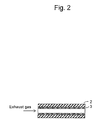
- the catalyst layer may consist of a single catalyst layer ( fig. 2 ) or a combination of a plurality of catalyst layers.
- the catalyst layer preferably comprises, but is not limited thereto, a lower catalyst layer disposed on a substrate and an upper catalyst layer disposed on the lower catalyst layer ( fig. 3 ).
- the catalyst layer comprises rhodium
- rhodium it is preferable that rhodium be present in a catalyst layer other than the catalyst layer in which platinum and the first palladium are present. It is particularly preferable that rhodium be present in the lower catalyst layer while platinum and the first palladium are present in the upper catalyst layer.
- the catalyst layer comprises the second palladium
- the second palladium be present in the same catalyst layer in which platinum and the first palladium are present. It is particularly preferable that the second palladium, platinum, and the first palladium be present in the upper catalyst layer.
- the catalyst layer comprises an NOx storage substance
- the NOx storage substance it is preferable that the NOx storage substance be present in both the upper and lower catalyst layers.
- an exhaust gas purifying catalyst which comprises:
- an exhaust gas purifying catalyst which comprises:
- Table 1 and figs. 4-8 show the results.
- Table 1 Pt : Pd *1 (weight ratio) Pt / 1st Carrier *2 (weight ratio) 1st Pd : 2nd Pd *3 (weight ratio) NOx purification rate (%) Pt particle size (relative value) *4 NO 2 production (relative value) *4
- Example 1 3:1 0.1 1:0.5 85.5 0.568 1.098
- Example 2 5:1 0.1 1:1.5 87.7 0.538 1.434
- Example 3 8:1 0.1 1:3 83.4 0.724 1.530
- Example 4 3:1 0.04 1:0.5 98.0 0.310 1.052
- Example 5 3:1 0.02 1:0.5 97.5 0.352 1.047
- Example 6 3:1 0.02 _ *5 87.6 0.352 0.9807
- Example 7 3:1 0.1 _ *5 75.6 0.568 1.028 Comparative Example 1 2.2:1 0.1 1:0.1 62.0 1 1 1 Comparative Example 2 10:1 0.1 1:
Landscapes
- Chemical & Material Sciences (AREA)
- Engineering & Computer Science (AREA)
- Chemical Kinetics & Catalysis (AREA)
- Organic Chemistry (AREA)
- Materials Engineering (AREA)
- Health & Medical Sciences (AREA)
- Analytical Chemistry (AREA)
- General Chemical & Material Sciences (AREA)
- Oil, Petroleum & Natural Gas (AREA)
- Environmental & Geological Engineering (AREA)
- Biomedical Technology (AREA)
- Combustion & Propulsion (AREA)
- Catalysts (AREA)
- Exhaust Gas After Treatment (AREA)
- Exhaust Gas Treatment By Means Of Catalyst (AREA)
Abstract
Description
- The present invention relates to an exhaust gas purifying catalyst.
- Exhaust gas discharged from internal combustion engines such as vehicle engines contains hazardous substances such as hydrocarbon (HC), carbon monoxide (CO), and nitric oxide (NOx). Since these substances cause air pollution, purification of exhaust gas is necessary.
- Exhaust gas can be purified using exhaust gas purifying catalysts. In general, exhaust gas purifying catalysts are composed of a substrate and a catalyst layer disposed on the substrate. Such catalyst layer comprises a carrier and a catalyst metal supported on the carrier. Noble metals such as platinum, palladium, and rhodium are commonly used as catalyst metals.
- For example,
Patent Document 1 discloses an exhaust gas purifying catalyst for NOx purification. The catalyst comprises: a substrate; and a lower catalyst layer and an upper catalyst layer disposed on the substrate, wherein the lower catalyst layer comprises rhodium, and the upper catalyst layer comprises rhodium and at least one of platinum and palladium. - In addition,
Patent Document 2 also discloses an exhaust gas purifying catalyst for NOx purification. The catalyst comprises: a substrate; and a lower catalyst layer and an upper catalyst layer disposed on the substrate, wherein the lower catalyst layer comprises rhodium, and the upper catalyst layer comprises platinum and palladium. -
- Patent Document 1:
JP Patent Publication (Kokai) No. 2009-285604 A - Patent Document 2:
JP Patent Publication (Kokai) No. 2010-201284 A - As disclosed in
Patent Documents - Therefore, the object of the present invention is to provide a novel exhaust gas purifying catalyst having excellent NOx purification performance.
- After the long-term use of platinum for purification of exhaust gas, sintering of platinum takes place, which results in an increase in platinum particle size. As a result, the catalyst activity of platinum decreases, which causes a decline in NOx purification performance. As a result of diligent studies, the present inventors found that the sintering of platinum can be significantly reduced by allowing platinum and palladium to be supported together on the same carrier at a certain ratio. Accordingly, decrease in catalyst activity of platinum can be prevented, and thereby excellent NOx purification performance can be achieved.
- Specifically, the present invention encompasses the following.
- [1] An exhaust gas purifying catalyst comprising:
- a substrate; and
- a catalyst layer disposed on the substrate, which comprises a first carrier, and platinum and a first palladium supported on the first carrier; wherein
- the weight ratio of the platinum to the first palladium is 3:1 to 8:1.
- [2] The exhaust gas purifying catalyst according to [1], wherein the weight ratio of the platinum supported on the first carrier in relation to the first carrier is 0.04 or less.
- [3] The exhaust gas purifying catalyst according to [1] or [2], wherein the catalyst layer further comprises a second carrier and a second palladium supported on the second carrier while platinum is not supported on the second carrier.
- This description includes all of the contents as disclosed in Japanese Patent Application No.
2013-088405 - According to the present invention, a novel exhaust gas purifying catalyst having excellent NOx purification performance can be provided.
-
-
Fig. 1 shows an example of an exhaust gas purifying catalyst. -
Fig. 2 shows a part of a cross-sectional view of an exhaust gas purifying catalyst. -
Fig. 3 shows a part of a cross-sectional view of an exhaust gas purifying catalyst. -
Fig. 4 shows the relationship between the weight ratio of platinum to the first palladium on the first carrier and the NOx purification rate. -
Fig. 5 shows the relationship between the weight ratio of platinum on the first carrier to the first carrier and the NOx purification rate. -
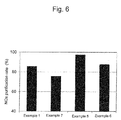
Fig. 6 shows the relationship between the presence or absence of the second palladium and the NOx purification rate. -
Fig. 7 shows the relationship between the weight ratio of platinum to the first palladium on the first carrier and the particle size of platinum. -
Fig. 8 shows the relationship between the weight ratio of platinum to the first palladium on the first carrier and the production of NO2. - The present invention is described in detail below.
- The present invention relates to an exhaust gas purifying catalyst, which comprises: a substrate; and a catalyst layer disposed on the substrate comprising: a first carrier; and platinum and a first palladium supported on the first carrier, wherein the weight ratio of the platinum to the first palladium is 3:1 to 8:1.
- In the exhaust gas purifying catalyst of the present invention, platinum and palladium are supported together on the same carrier at a certain ratio so that sintering of the platinum can be significantly inhibited. As a result, a decrease in catalyst activity of platinum is suppressed and thus excellent NOx purification performance is achieved.
- The exhaust gas purifying catalyst of the present invention can preferentially purify NOx even in a lean atmosphere. Since, when a lean-burn engine is used, the amounts of NOx emissions are very large though the amounts of HC and CO emissions are small, NOx cannot be sufficiently purified with generally available three-way catalysts. However, with the use of the exhaust gas purifying catalyst of the present invention, NOx discharged from lean-burn engines can be efficiently purified while preventing a decrease in catalyst activity of platinum.
- A substrate that is generally used for exhaust gas purifying catalysts can be used as the substrate of the exhaust gas purifying catalyst of the present invention. Examples thereof include straight-flow-type and wall-flow-type monolith substrates. The material of the substrate is not particularly limited. A substrate made of ceramic, silicon carbide, metal, or the like can be used.
- The catalyst layer disposed on the substrate comprises: the first carrier; and platinum and the first palladium which are supported on the first carrier.
- The weight ratio of platinum supported on the first carrier relative to the first carrier is preferably 0.04 or less, though it is not particularly limited. NOx purification performance can be further improved by supporting platinum at such weight ratio. The lower limit of the weight ratio of platinum is 0.001, 0.005, or the like, for example, though it is not particularly limited.
- The amount of platinum supported on the first carrier is not particularly limited. However, from the viewpoints of efficient NOx purification and production cost, it is preferably 0.1 to 2 g, more preferably 0.5 to 1.8 g, and further preferably 0.8 to 1.6 g per 1 L of the substrate.
- The catalyst layer disposed on the substrate may comprise other optional components in addition to the first carrier and the platinum and the first palladium supported on the first carrier.
- The catalyst layer may further comprise a second carrier and a second palladium supported on the second carrier. It is preferable that platinum is not supported on the second carrier. In addition, the catalyst layer may further comprise rhodium. In a case in which the catalyst layer comprises rhodium, rhodium is preferably supported on another carrier that is different from the first or the second carrier. The first carrier, the second carrier, and the carrier supporting rhodium may be of the same kind, or they may be different kinds of carriers.
- The weight ratio of the first palladium to the second palladium preferably ranges from 1 : 0.5 to 1 : 3, though it is not particularly limited. NOx purification performance can be further improved when the weight ratio is within such range.
- The total amount of palladium contained in the catalyst layer is not particularly limited. However, from the viewpoints of efficient NOx purification and production cost, it is preferably 0.1 to 1 g, more preferably 0.2 to 0.8 g, and particularly preferably 0.4 to 0.6 per 1 L of the substrate.
- The amount of rhodium contained in the catalyst layer is not particularly limited. However, from the viewpoints of efficient NOx purification and production cost, it is preferably 0.1 to 2 g, more preferably 0.1 to 1.5 g, and particularly preferably 0.1 to 1.2 g per 1 L of the substrate.
- Examples of carriers include zirconia, alumina, titania, silica, ceria, and magnesia. In addition, a composite oxide comprising cerium and at least one member selected from the group consisting of zirconium, hafnium, neodymium, yttrium, lanthanum, praseodymium, and nickel can also be used as a carrier. One type of carrier may be used alone or two or more different types of carriers may be used in combination.
- The catalyst layer may further comprise a substance that functions to store NOx (hereafter referred to as an "NOx storage substance(s)"). Examples of NOx storage substance include alkali metals, alkaline-earth metals, and rare-earth elements. Examples of alkali metals include lithium, sodium, potassium, rubidium, cesium, and francium. Examples of alkaline-earth metals include beryllium, magnesium, calcium, strontium, barium, and radium. Examples of rare-earth elements include scandium, yttrium, lanthanum, cerium, praseodymium, neodymium, promethium, samarium, europium, gadolinium, terbium, dysprosium, holmium, erbium, thulium, ytterbium, and lutetium. The NOx storage substance may be supported on a carrier or it may be present in a catalyst layer without being supported on a carrier. One type of NOx storage substance may be used alone or two or more different types of NOx storage substances may be used in combination.
- The amount of the NOx storage substance is not particularly limited. However, from the viewpoint of efficient NOx purification, it is preferably 0.01 to 5 mol, more preferably 0.05 to 1 mol, and particularly preferably 0.1 to 0.5 mol per 1 L of the substrate.
- The weight ratio of platinum to the first palladium supported on the first carrier is 3 : 1 to 8 : 1 as described above. With the use of platinum and the first palladium supported on the first carrier at such weight ratio, NOx oxidation performance can be improved, thereby allowing efficient NO2 generation. In a lean atmosphere, oxygen is excessively present, which makes it difficult to purify (reduce) NOx. However, NOx emission can be reduced by oxidizing NOx to NO2 in a lean atmosphere and allowing an NOx storage substance to store NO2. In addition, when the lean atmosphere changes to a rich atmosphere, the NOx storage substance is induced to discharge NO2 so as to allow NO2 to react with a reductant (e.g., HC or CO), thereby allowing purification of NOx to N2. That is, NOx purification performance can be improved by improving NOx oxidation performance.
- The exhaust gas purifying catalyst of the present invention is mainly composed of a substrate and a catalyst layer. It may comprise an optional layer unless the effects of the present invention are impaired. For example, an optional layer may be provided between a substrate and a catalyst layer.
- The catalyst layer may consist of a single catalyst layer (
fig. 2 ) or a combination of a plurality of catalyst layers. The catalyst layer preferably comprises, but is not limited thereto, a lower catalyst layer disposed on a substrate and an upper catalyst layer disposed on the lower catalyst layer (fig. 3 ). - Here, if the catalyst layer comprises rhodium, it is preferable that rhodium be present in a catalyst layer other than the catalyst layer in which platinum and the first palladium are present. It is particularly preferable that rhodium be present in the lower catalyst layer while platinum and the first palladium are present in the upper catalyst layer.
- If the catalyst layer comprises the second palladium, it is preferable that the second palladium be present in the same catalyst layer in which platinum and the first palladium are present. It is particularly preferable that the second palladium, platinum, and the first palladium be present in the upper catalyst layer.
- If the catalyst layer comprises an NOx storage substance, it is preferable that the NOx storage substance be present in both the upper and lower catalyst layers.
- In one embodiment of the present invention, the following is provided: an exhaust gas purifying catalyst, which comprises:
- a substrate;
- a lower catalyst layer disposed on the substrate comprising a carrier, rhodium supported on the carrier, and an NOx storage substance; and
- an upper catalyst layer disposed on the lower catalyst layer comprising a first carrier, platinum and a first palladium supported on the first carrier, and an NOx storage substance, wherein
- the weight ratio of the platinum to the first palladium is 3 : 1 to 8 : 1.
- In another embodiment of the present invention, the following is provided: an exhaust gas purifying catalyst, which comprises:
- a substrate;
- a lower catalyst layer disposed on the substrate comprising a carrier, rhodium supported on the carrier, and an NOx storage substance; and
- an upper catalyst layer disposed on the lower catalyst layer comprising a first carrier, platinum and a first palladium supported on the first carrier, a second carrier, a second palladium supported on the second carrier, and an NOx storage substance, wherein
- the weight ratio of the platinum to the first palladium is 3 : 1 to 8 : 1, and platinum is not supported on the second carrier.
- The present invention is explained with reference to the Examples and Comparative Examples below; however, the technical scope of the present invention is not limited thereto.
-
- (1) Zirconia (30 g) was suspended in water and then rhodium nitrate was added thereto. The mixture was evaporated to dryness to obtain a rhodium-supporting powder. The amount of rhodium supported was 1% by weight in relation to zirconia.
The obtained rhodium-supporting powder, alumina (140 g), and water were mixed to obtain a coating material [1-1]. - (2) Alumina (10 g) (first carrier) was suspended in water and then platinum nitrate and palladium nitrate (first palladium) were added thereto at a weight ratio of 3 : 1 (Pt : Pd). The mixture was evaporated to dryness to obtain a platinum-palladium supporting powder. The amounts of platinum and palladium supported were 10% by weight and 3.3% by weight, respectively, in relation to alumina.
Alumina (5 g) (second carrier) was suspended in water and then palladium nitrate (second palladium) was added. The mixture was evaporated to dryness to obtain a palladium supporting powder. The amount of palladium supported was 3.4% by weight in relation to alumina.
The platinum-palladium supporting powder and palladium supporting powder obtained above, alumina (65 g), and water were mixed to obtain a coating material [1-2]. - (3) A monolith substrate (1 L) was coated with the coating material [1-1] and sintered so that a lower catalyst layer was formed. The lower catalyst layer was coated with the coating material [1-2] and sintered so that an upper catalyst layer was formed. The lower catalyst layer and the upper catalyst layer were allowed to contain barium and potassium. The contents of barium and potassium per 1 L of the monolith substrate were both 0.1 mol.
-
- (1) Alumina (10 g) was suspended in water and then platinum nitrate and palladium nitrate were added thereto at a ratio of 5 : 1 (Pt : Pd). The mixture was evaporated to dryness to obtain a platinum-palladium supporting powder. The amounts of platinum and palladium supported were 10% by weight and 2% by weight, respectively, in relation to alumina.
Alumina (5 g) was suspended in water and then palladium nitrate was added. The mixture was evaporated to dryness to obtain a palladium supporting powder. The amount of palladium supported was 6% by weight in relation to alumina.
The platinum-palladium supporting powder and palladium supporting powder obtained, alumina (65 g), and water were mixed to obtain a coating material [2-2]. - (2) An exhaust gas purifying catalyst was produced in the manner described in Example 1 except that the coating material [2-2] was used instead of the coating material [1-2] of Example 1.
-
- (1) Alumina (10 g) was suspended in water and then platinum nitrate and palladium nitrate were added thereto at a ratio of 8 : 1 (Pt : Pd). The mixture was evaporated to dryness to obtain a platinum-palladium supporting powder. The amounts of platinum and palladium supported were 10% by weight and 1.25% by weight, respectively, in relation to alumina.
Alumina (5 g) was suspended in water and then palladium nitrate was added. The mixture was evaporated to dryness to obtain a palladium supporting powder. The amount of palladium supported was 7.5% by weight in relation to alumina.
The platinum-palladium supporting powder and palladium supporting powder obtained above, alumina (65 g), and water were mixed to obtain a coating material [3-2]. - (2) An exhaust gas purifying catalyst was produced in the manner described in Example 1 except that the coating material [3-2] was used instead of the coating material [1-2] of Example 1.
-
- (1) Alumina (25 g) was suspended in water and then platinum nitrate and palladium nitrate were added thereto at a ratio of 3 : 1 (Pt : Pd). The mixture was evaporated to dryness to obtain a platinum-palladium supporting powder. The amounts of platinum and palladium supported were 4% by weight and 1.32% by weight, respectively, in relation to alumina.
Alumina (5 g) was suspended in water and then palladium nitrate was added. The mixture was evaporated to dryness to obtain a palladium supporting powder. The amount of palladium supported was 3.4% in relation to the amount of alumina.
The platinum-palladium supporting powder and palladium supporting powder obtained above, alumina (50 g), and water were mixed to obtain a coating material [4-2]. - (2) An exhaust gas purifying catalyst was produced in the manner described in Example 1 except that the coating material [4-2] was used instead of the coating material [1-2] of Example 1.
-
- (1) Alumina (45 g) was suspended in water and then platinum nitrate and palladium nitrate were added thereto at a ratio of 3 : 1 (Pt : Pd). The mixture was evaporated to dryness to obtain a platinum-palladium supporting powder. The amounts of platinum and palladium supported were 2.22% by weight and 0.733% by weight, respectively, in relation to alumina.
Alumina (5 g) was suspended in water and then palladium nitrate was added. The mixture was evaporated to dryness to obtain a palladium supporting powder. The amount of palladium supported was 3.4% by weight in relation to alumina.
The platinum-palladium supporting powder and palladium supporting powder obtained above, alumina (30 g), and water were mixed to obtain a coating material [5-2]. - (2) An exhaust gas purifying catalyst was produced in the manner described in Example 1 except that the coating material [5-2] was used instead of the coating material [1-2] of Example 1.
-
- (1) Alumina (45 g) was suspended in water and then platinum nitrate and palladium nitrate were added thereto at a ratio of 3 : 1 (Pt : Pd). The mixture was evaporated to dryness to obtain a platinum-palladium supporting powder. The amounts of platinum and palladium supported were 2.22% by weight and 0.733% by weight, respectively, in relation to alumina.
The platinum-palladium supporting powder obtained above, alumina (35 g), and water were mixed to obtain a coating material [6-2]. - (2) An exhaust gas purifying catalyst was produced in the manner described in Example 1 except that the coating material [6-2] was used instead of the coating material [1-2] of Example 1.
-
- (1) Alumina (10 g) was suspended in water and then platinum nitrate and palladium nitrate were added thereto at a ratio of 3 : 1 (Pt : Pd). The mixture was evaporated to dryness to obtain a platinum-palladium supporting powder. The amounts of platinum and palladium supported were 10% by weight and 3.3% by weight, respectively, in relation to alumina.
The platinum-palladium supporting powder obtained above, alumina (70 g), and water were mixed to obtain a coating material [7-2]. - (2) An exhaust gas purifying catalyst was produced in the manner described in Example 1 except that the coating material [7-2] was used instead of the coating material [1-2] of Example 1.
-
- (1) Alumina (10 g) was suspended in water and then platinum nitrate and palladium nitrate were added thereto at a ratio of 2.2 : 1 (Pt : Pd). The mixture was evaporated to dryness to obtain a platinum-palladium supporting powder. The amounts of platinum and palladium supported were 10% by weight and 4.5% by weight, respectively, in relation to alumina.
Alumina (5 g) was suspended in water and then palladium nitrate was added. The mixture was evaporated to dryness, and thus a palladium supporting powder. The amount of palladium supported was 1% by weight in relation to alumina.
The platinum-palladium supporting powder and palladium supporting powder obtained above, alumina (65 g), and water were mixed to obtain a coating material [1X-2]. - (2) An exhaust gas purifying catalyst was produced in the manner described in Example 1 except that the coating material [1X-2] was used instead of the coating material [1-2] of Example 1.
-
- (1) Alumina (10 g) was suspended in water and then platinum nitrate and palladium nitrate were added thereto at a ratio of 10 : 1 (Pt : Pd). The mixture was evaporated to dryness to obtain a platinum-palladium supporting powder. The amounts of platinum and palladium supported were 10% by weight and 1% by weight, respectively, in relation to alumina.
Alumina (5 g) was suspended in water and then palladium nitrate was added. The mixture was evaporated to dryness to obtain a palladium supporting powder. The amount of palladium supported was 8% by weight in relation to alumina.
The platinum-palladium supporting powder and palladium supporting powder obtained above, alumina (65 g), and water were mixed to obtain a coating material [2X-2]. - (2) An exhaust gas purifying catalyst was produced in the manner described in Example 1 except that the coating material [2X-2] was used instead of the coating material [1-2] of Example 1.
-
- (1) Alumina (10 g) was suspended in water and then platinum nitrate was added thereto. The mixture was evaporated to dryness to obtain a platinum-supporting powder. The amount of platinum supported was 10% by weight in relation to alumina.
Alumina (5 g) was suspended in water and then palladium nitrate was added. The mixture was evaporated to dryness to obtain a palladium supporting powder. The amount of palladium supported was 10% by weight in relation to alumina.
The platinum-supporting powder and palladium supporting powder obtained above, alumina (65 g), and water were mixed to obtain a coating material [3X-2]. - (2) An exhaust gas purifying catalyst was produced in the manner described in Example 1 except that the coating material [3X-2] was used instead of the coating material [1-2] of Example 1.
-
- (1) Each of the exhaust gas purifying catalysts produced in the Examples and the Comparative Examples was built into a converter. Each converter with built-in catalyst was installed in a 2-L engine. Durability tests were performed at a catalyst bed temperature of 750°C and at stoichiometry for 150 hours.
- (2) After the above durability tests, each converter with built-in catalyst was installed in a lean-burn gasoline engine and the NOx purification rate was determined at a cycle of 60 seconds in a lean atmosphere and 3 seconds in a rich atmosphere. In addition, the catalyst bed temperature was set to 400°C.
- (3) The platinum-palladium supporting powders and platinum supporting powders produced in the Examples and Comparative Examples were subjected to durability tests at 700°C for 10 hours. Then, the particle size of platinum supported on the first carrier was assayed by X-ray diffraction.
- (4) The NOx concentration and the NO concentration were determined, and the difference therebetween was used to evaluate NO oxidation performance (N02 concentration).
- Table 1 and
figs. 4-8 show the results.
[Table 1]Table 1 Pt : Pd*1 (weight ratio) Pt / 1st Carrier *2 (weight ratio) 1st Pd : 2nd Pd*3 (weight ratio) NOx purification rate (%) Pt particle size (relative value)*4 NO2 production (relative value)*4 Example 1 3:1 0.1 1:0.5 85.5 0.568 1.098 Example 2 5:1 0.1 1:1.5 87.7 0.538 1.434 Example 3 8:1 0.1 1:3 83.4 0.724 1.530 Example 4 3:1 0.04 1:0.5 98.0 0.310 1.052 Example 5 3:1 0.02 1:0.5 97.5 0.352 1.047 Example 6 3:1 0.02 _*5 87.6 0.352 0.9807 Example 7 3:1 0.1 _*5 75.6 0.568 1.028 Comparative Example 1 2.2:1 0.1 1:0.1 62.0 1 1 Comparative Example 2 10:1 0.1 1:4 56.0 1.14 1.376 Comparative Example 3 _*6 0.1 _*6 53.5 1.23 1.255 *1: Pt on the 1 st carrier: Pd on the 1 st carrier
*2: Pt on the 1 st carrier relative to the 1 st carrier
*3: Pd on the 1st carrier: Pd on the 2nd carrier
*4: Based on the results obtained using the catalyst of Comparative Example 1
*5: No Pd is existed on the 2nd carrier
*6: No Pd is existed on the 1st carrier - 1: Exhaust gas purifying catalyst; 2: Substrate; 3: Catalyst layer; 4: Lower catalyst layer; and 5: Upper catalyst layer
- All publications cited herein are incorporated herein by reference in their entirety.
Claims (3)
- An exhaust gas purifying catalyst comprising:a substrate; anda catalyst layer disposed on the substrate, which comprises a first carrier, and platinum and a first palladium supported on the first carrier; whereinthe weight ratio of the platinum to the first palladium is 3:1 to 8:1.
- The exhaust gas purifying catalyst according to claim 1, wherein the weight ratio of the platinum supported on the first carrier in relation to the first carrier is 0.04 or less.
- The exhaust gas purifying catalyst according to claim 1 or 2, wherein the catalyst layer further comprises a second carrier and a second palladium supported on the second carrier while platinum is not supported on the second carrier.
Applications Claiming Priority (2)
| Application Number | Priority Date | Filing Date | Title |
|---|---|---|---|
| JP2013088405A JP5676679B2 (en) | 2013-04-19 | 2013-04-19 | Exhaust gas purification catalyst |
| PCT/JP2014/060691 WO2014171443A1 (en) | 2013-04-19 | 2014-04-15 | Exhaust-gas purification catalyst |
Publications (3)
| Publication Number | Publication Date |
|---|---|
| EP2992955A1 true EP2992955A1 (en) | 2016-03-09 |
| EP2992955A4 EP2992955A4 (en) | 2017-01-18 |
| EP2992955B1 EP2992955B1 (en) | 2020-12-23 |
Family
ID=51731382
Family Applications (1)
| Application Number | Title | Priority Date | Filing Date |
|---|---|---|---|
| EP14784916.0A Active EP2992955B1 (en) | 2013-04-19 | 2014-04-15 | Exhaust-gas purification catalyst |
Country Status (7)
| Country | Link |
|---|---|
| US (1) | US9522385B2 (en) |
| EP (1) | EP2992955B1 (en) |
| JP (1) | JP5676679B2 (en) |
| CN (1) | CN105121006B (en) |
| BR (1) | BR112015025876B1 (en) |
| WO (1) | WO2014171443A1 (en) |
| ZA (1) | ZA201508158B (en) |
Cited By (1)
| Publication number | Priority date | Publication date | Assignee | Title |
|---|---|---|---|---|
| EP3060335A4 (en) * | 2013-10-22 | 2017-07-19 | SDCMaterials, Inc. | Catalyst design for heavy-duty diesel combustion engines |
Families Citing this family (4)
| Publication number | Priority date | Publication date | Assignee | Title |
|---|---|---|---|---|
| JP6540947B2 (en) * | 2015-03-19 | 2019-07-10 | 株式会社豊田中央研究所 | catalyst |
| GB2554859A (en) * | 2016-10-04 | 2018-04-18 | Johnson Matthey Plc | NOx adsorber catalyst |
| US20200030776A1 (en) * | 2018-07-27 | 2020-01-30 | Johnson Matthey Public Limited Company | Twc catalysts containing high dopant support |
| JP2023135093A (en) * | 2022-03-15 | 2023-09-28 | トヨタ自動車株式会社 | Method for manufacturing exhaust gas purification catalyst |
Family Cites Families (20)
| Publication number | Priority date | Publication date | Assignee | Title |
|---|---|---|---|---|
| CA2011484C (en) * | 1989-04-19 | 1997-03-04 | Joseph C. Dettling | Palladium-containing, ceria-supported platinum catalyst and catalyst assembly including the same |
| JP3296848B2 (en) | 1992-07-24 | 2002-07-02 | マツダ株式会社 | Exhaust gas purification catalyst and method for producing the same |
| JP3741303B2 (en) * | 1997-12-08 | 2006-02-01 | トヨタ自動車株式会社 | Exhaust gas purification catalyst |
| JP2000300962A (en) * | 1999-04-22 | 2000-10-31 | Hitachi Ltd | Exhaust gas purification method for internal combustion engine, purification device and purification catalyst |
| JP2000314311A (en) * | 1999-05-06 | 2000-11-14 | Hitachi Ltd | Exhaust gas purification method for internal combustion engine, purification device and purification catalyst |
| JP4103407B2 (en) * | 2002-02-21 | 2008-06-18 | トヨタ自動車株式会社 | NOx storage reduction catalyst |
| JP2005021880A (en) * | 2003-06-13 | 2005-01-27 | Nissan Motor Co Ltd | Exhaust gas purification catalyst and exhaust gas purification catalyst system |
| US20090062117A1 (en) * | 2004-03-27 | 2009-03-05 | Umicore Ag & Co. Kg | Nitrogen oxide storage material and nitrogen oxide storage catalyst produced therefrom |
| JP4681922B2 (en) | 2005-04-01 | 2011-05-11 | エヌ・イーケムキャット株式会社 | Oxidation catalyst for exhaust gas purification, and exhaust gas purification system using the same |
| CN101410597B (en) * | 2006-03-30 | 2011-07-27 | 株式会社Ict | Internal combustion engine exhaust gas purification method |
| US7534738B2 (en) * | 2006-11-27 | 2009-05-19 | Nanostellar, Inc. | Engine exhaust catalysts containing palladium-gold |
| TWI449572B (en) * | 2006-11-29 | 2014-08-21 | Umicore Shokubai Japan Co Ltd | Oxidation catalyst and the oxidation catalyst using an exhaust gas purification system |
| JP2009285604A (en) | 2008-05-30 | 2009-12-10 | Toyota Motor Corp | Catalyst for cleaning exhaust gas |
| JP5422087B2 (en) | 2008-08-08 | 2014-02-19 | 本田技研工業株式会社 | Low noble metal supported three way catalyst |
| JP5253233B2 (en) | 2009-02-27 | 2013-07-31 | トヨタ自動車株式会社 | Exhaust gas purification catalyst |
| BR112012011292B1 (en) * | 2009-11-12 | 2020-12-08 | Umicore Ag & Co.Kg | improved diesel oxidation catalyst and device for purifying exhaust gases from diesel engines |
| JP2011220123A (en) * | 2010-04-05 | 2011-11-04 | Toyota Motor Corp | Exhaust purification catalyst |
| WO2012029050A1 (en) * | 2010-09-02 | 2012-03-08 | Basf Se | Catalyst for gasoline lean burn engines with improved no oxidation activity |
| JP5938819B2 (en) * | 2011-10-06 | 2016-06-22 | ジョンソン、マッセイ、パブリック、リミテッド、カンパニーJohnson Matthey Public Limited Company | Oxidation catalyst for exhaust gas treatment |
| JP5664520B2 (en) | 2011-10-21 | 2015-02-04 | 東亞合成株式会社 | Concrete structure and manufacturing method thereof |
-
2013
- 2013-04-19 JP JP2013088405A patent/JP5676679B2/en active Active
-
2014
- 2014-04-15 US US14/785,028 patent/US9522385B2/en active Active
- 2014-04-15 EP EP14784916.0A patent/EP2992955B1/en active Active
- 2014-04-15 CN CN201480021826.4A patent/CN105121006B/en active Active
- 2014-04-15 BR BR112015025876-0A patent/BR112015025876B1/en active IP Right Grant
- 2014-04-15 WO PCT/JP2014/060691 patent/WO2014171443A1/en not_active Ceased
-
2015
- 2015-11-04 ZA ZA2015/08158A patent/ZA201508158B/en unknown
Cited By (1)
| Publication number | Priority date | Publication date | Assignee | Title |
|---|---|---|---|---|
| EP3060335A4 (en) * | 2013-10-22 | 2017-07-19 | SDCMaterials, Inc. | Catalyst design for heavy-duty diesel combustion engines |
Also Published As
| Publication number | Publication date |
|---|---|
| WO2014171443A1 (en) | 2014-10-23 |
| EP2992955B1 (en) | 2020-12-23 |
| JP2014210238A (en) | 2014-11-13 |
| EP2992955A4 (en) | 2017-01-18 |
| CN105121006A (en) | 2015-12-02 |
| US9522385B2 (en) | 2016-12-20 |
| BR112015025876A8 (en) | 2019-09-10 |
| CN105121006B (en) | 2017-05-10 |
| JP5676679B2 (en) | 2015-02-25 |
| BR112015025876B1 (en) | 2020-11-10 |
| ZA201508158B (en) | 2017-09-27 |
| BR112015025876A2 (en) | 2017-07-25 |
| US20160074836A1 (en) | 2016-03-17 |
Similar Documents
| Publication | Publication Date | Title |
|---|---|---|
| EP2322274B1 (en) | Exhaust gas purifying catalyst and method for producing the same | |
| EP3260189B1 (en) | Exhaust gas purifying catalyst | |
| CN105722590B (en) | Exhaust gas control catalyst | |
| EP2636447B1 (en) | Lean nox trap type exhaust gas purifying catalyst and exhaust gas cleaning system | |
| JP4648089B2 (en) | Exhaust gas purification catalyst | |
| EP3020474A1 (en) | Catalyst for exhaust gas purification | |
| EP2826560A1 (en) | Catalyst composition for exhaust gas cleaning and catalyst for automobile exhaust gas cleaning | |
| EP4166229A1 (en) | Exhaust gas purification catalyst | |
| EP2774671A1 (en) | Exhaust gas purifying catalyst | |
| EP3072587A1 (en) | Catalyst for exhaust gas purification | |
| EP2992955B1 (en) | Exhaust-gas purification catalyst | |
| JP5583967B2 (en) | Exhaust gas purification catalyst, exhaust gas purification apparatus and exhaust gas purification method using the same | |
| CN100548475C (en) | Catalyst carrier and catalyst using same | |
| JP5328133B2 (en) | Exhaust gas purification catalyst | |
| US20070123418A1 (en) | Catalyst composition containing gallium for purifying exhaust gases of internal combustion engine | |
| JP2013027876A (en) | Exhaust gas purifying catalyst | |
| JP2008012441A (en) | Gas purification catalyst | |
| JP6247922B2 (en) | Exhaust gas purification catalyst | |
| JP4901175B2 (en) | Exhaust gas purification catalyst and method for producing the same | |
| JP2000237589A (en) | Exhaust gas purification catalyst |
Legal Events
| Date | Code | Title | Description |
|---|---|---|---|
| PUAI | Public reference made under article 153(3) epc to a published international application that has entered the european phase |
Free format text: ORIGINAL CODE: 0009012 |
|
| 17P | Request for examination filed |
Effective date: 20151117 |
|
| AK | Designated contracting states |
Kind code of ref document: A1 Designated state(s): AL AT BE BG CH CY CZ DE DK EE ES FI FR GB GR HR HU IE IS IT LI LT LU LV MC MK MT NL NO PL PT RO RS SE SI SK SM TR |
|
| AX | Request for extension of the european patent |
Extension state: BA ME |
|
| DAX | Request for extension of the european patent (deleted) | ||
| A4 | Supplementary search report drawn up and despatched |
Effective date: 20161221 |
|
| RIC1 | Information provided on ipc code assigned before grant |
Ipc: B01J 37/02 20060101ALI20161215BHEP Ipc: F01N 3/28 20060101ALI20161215BHEP Ipc: B01J 23/44 20060101ALI20161215BHEP Ipc: B01D 53/94 20060101ALI20161215BHEP Ipc: B01J 23/58 20060101AFI20161215BHEP |
|
| STAA | Information on the status of an ep patent application or granted ep patent |
Free format text: STATUS: EXAMINATION IS IN PROGRESS |
|
| 17Q | First examination report despatched |
Effective date: 20190618 |
|
| GRAP | Despatch of communication of intention to grant a patent |
Free format text: ORIGINAL CODE: EPIDOSNIGR1 |
|
| STAA | Information on the status of an ep patent application or granted ep patent |
Free format text: STATUS: GRANT OF PATENT IS INTENDED |
|
| INTG | Intention to grant announced |
Effective date: 20200804 |
|
| GRAS | Grant fee paid |
Free format text: ORIGINAL CODE: EPIDOSNIGR3 |
|
| GRAA | (expected) grant |
Free format text: ORIGINAL CODE: 0009210 |
|
| STAA | Information on the status of an ep patent application or granted ep patent |
Free format text: STATUS: THE PATENT HAS BEEN GRANTED |
|
| AK | Designated contracting states |
Kind code of ref document: B1 Designated state(s): AL AT BE BG CH CY CZ DE DK EE ES FI FR GB GR HR HU IE IS IT LI LT LU LV MC MK MT NL NO PL PT RO RS SE SI SK SM TR |
|
| REG | Reference to a national code |
Ref country code: GB Ref legal event code: FG4D |
|
| REG | Reference to a national code |
Ref country code: DE Ref legal event code: R096 Ref document number: 602014073610 Country of ref document: DE |
|
| REG | Reference to a national code |
Ref country code: AT Ref legal event code: REF Ref document number: 1347212 Country of ref document: AT Kind code of ref document: T Effective date: 20210115 |
|
| REG | Reference to a national code |
Ref country code: IE Ref legal event code: FG4D |
|
| PG25 | Lapsed in a contracting state [announced via postgrant information from national office to epo] |
Ref country code: NO Free format text: LAPSE BECAUSE OF FAILURE TO SUBMIT A TRANSLATION OF THE DESCRIPTION OR TO PAY THE FEE WITHIN THE PRESCRIBED TIME-LIMIT Effective date: 20210323 Ref country code: FI Free format text: LAPSE BECAUSE OF FAILURE TO SUBMIT A TRANSLATION OF THE DESCRIPTION OR TO PAY THE FEE WITHIN THE PRESCRIBED TIME-LIMIT Effective date: 20201223 Ref country code: RS Free format text: LAPSE BECAUSE OF FAILURE TO SUBMIT A TRANSLATION OF THE DESCRIPTION OR TO PAY THE FEE WITHIN THE PRESCRIBED TIME-LIMIT Effective date: 20201223 Ref country code: GR Free format text: LAPSE BECAUSE OF FAILURE TO SUBMIT A TRANSLATION OF THE DESCRIPTION OR TO PAY THE FEE WITHIN THE PRESCRIBED TIME-LIMIT Effective date: 20210324 |
|
| REG | Reference to a national code |
Ref country code: AT Ref legal event code: MK05 Ref document number: 1347212 Country of ref document: AT Kind code of ref document: T Effective date: 20201223 |
|
| REG | Reference to a national code |
Ref country code: NL Ref legal event code: MP Effective date: 20201223 |
|
| PG25 | Lapsed in a contracting state [announced via postgrant information from national office to epo] |
Ref country code: SE Free format text: LAPSE BECAUSE OF FAILURE TO SUBMIT A TRANSLATION OF THE DESCRIPTION OR TO PAY THE FEE WITHIN THE PRESCRIBED TIME-LIMIT Effective date: 20201223 Ref country code: LV Free format text: LAPSE BECAUSE OF FAILURE TO SUBMIT A TRANSLATION OF THE DESCRIPTION OR TO PAY THE FEE WITHIN THE PRESCRIBED TIME-LIMIT Effective date: 20201223 Ref country code: BG Free format text: LAPSE BECAUSE OF FAILURE TO SUBMIT A TRANSLATION OF THE DESCRIPTION OR TO PAY THE FEE WITHIN THE PRESCRIBED TIME-LIMIT Effective date: 20210323 |
|
| PG25 | Lapsed in a contracting state [announced via postgrant information from national office to epo] |
Ref country code: NL Free format text: LAPSE BECAUSE OF FAILURE TO SUBMIT A TRANSLATION OF THE DESCRIPTION OR TO PAY THE FEE WITHIN THE PRESCRIBED TIME-LIMIT Effective date: 20201223 Ref country code: HR Free format text: LAPSE BECAUSE OF FAILURE TO SUBMIT A TRANSLATION OF THE DESCRIPTION OR TO PAY THE FEE WITHIN THE PRESCRIBED TIME-LIMIT Effective date: 20201223 |
|
| REG | Reference to a national code |
Ref country code: LT Ref legal event code: MG9D |
|
| PG25 | Lapsed in a contracting state [announced via postgrant information from national office to epo] |
Ref country code: RO Free format text: LAPSE BECAUSE OF FAILURE TO SUBMIT A TRANSLATION OF THE DESCRIPTION OR TO PAY THE FEE WITHIN THE PRESCRIBED TIME-LIMIT Effective date: 20201223 Ref country code: SK Free format text: LAPSE BECAUSE OF FAILURE TO SUBMIT A TRANSLATION OF THE DESCRIPTION OR TO PAY THE FEE WITHIN THE PRESCRIBED TIME-LIMIT Effective date: 20201223 Ref country code: PT Free format text: LAPSE BECAUSE OF FAILURE TO SUBMIT A TRANSLATION OF THE DESCRIPTION OR TO PAY THE FEE WITHIN THE PRESCRIBED TIME-LIMIT Effective date: 20210423 Ref country code: LT Free format text: LAPSE BECAUSE OF FAILURE TO SUBMIT A TRANSLATION OF THE DESCRIPTION OR TO PAY THE FEE WITHIN THE PRESCRIBED TIME-LIMIT Effective date: 20201223 Ref country code: EE Free format text: LAPSE BECAUSE OF FAILURE TO SUBMIT A TRANSLATION OF THE DESCRIPTION OR TO PAY THE FEE WITHIN THE PRESCRIBED TIME-LIMIT Effective date: 20201223 Ref country code: CZ Free format text: LAPSE BECAUSE OF FAILURE TO SUBMIT A TRANSLATION OF THE DESCRIPTION OR TO PAY THE FEE WITHIN THE PRESCRIBED TIME-LIMIT Effective date: 20201223 Ref country code: SM Free format text: LAPSE BECAUSE OF FAILURE TO SUBMIT A TRANSLATION OF THE DESCRIPTION OR TO PAY THE FEE WITHIN THE PRESCRIBED TIME-LIMIT Effective date: 20201223 |
|
| PG25 | Lapsed in a contracting state [announced via postgrant information from national office to epo] |
Ref country code: PL Free format text: LAPSE BECAUSE OF FAILURE TO SUBMIT A TRANSLATION OF THE DESCRIPTION OR TO PAY THE FEE WITHIN THE PRESCRIBED TIME-LIMIT Effective date: 20201223 Ref country code: AT Free format text: LAPSE BECAUSE OF FAILURE TO SUBMIT A TRANSLATION OF THE DESCRIPTION OR TO PAY THE FEE WITHIN THE PRESCRIBED TIME-LIMIT Effective date: 20201223 |
|
| REG | Reference to a national code |
Ref country code: DE Ref legal event code: R097 Ref document number: 602014073610 Country of ref document: DE |
|
| PG25 | Lapsed in a contracting state [announced via postgrant information from national office to epo] |
Ref country code: IS Free format text: LAPSE BECAUSE OF FAILURE TO SUBMIT A TRANSLATION OF THE DESCRIPTION OR TO PAY THE FEE WITHIN THE PRESCRIBED TIME-LIMIT Effective date: 20210423 |
|
| PG25 | Lapsed in a contracting state [announced via postgrant information from national office to epo] |
Ref country code: IT Free format text: LAPSE BECAUSE OF FAILURE TO SUBMIT A TRANSLATION OF THE DESCRIPTION OR TO PAY THE FEE WITHIN THE PRESCRIBED TIME-LIMIT Effective date: 20201223 Ref country code: AL Free format text: LAPSE BECAUSE OF FAILURE TO SUBMIT A TRANSLATION OF THE DESCRIPTION OR TO PAY THE FEE WITHIN THE PRESCRIBED TIME-LIMIT Effective date: 20201223 |
|
| PLBE | No opposition filed within time limit |
Free format text: ORIGINAL CODE: 0009261 |
|
| STAA | Information on the status of an ep patent application or granted ep patent |
Free format text: STATUS: NO OPPOSITION FILED WITHIN TIME LIMIT |
|
| PG25 | Lapsed in a contracting state [announced via postgrant information from national office to epo] |
Ref country code: MC Free format text: LAPSE BECAUSE OF FAILURE TO SUBMIT A TRANSLATION OF THE DESCRIPTION OR TO PAY THE FEE WITHIN THE PRESCRIBED TIME-LIMIT Effective date: 20201223 Ref country code: DK Free format text: LAPSE BECAUSE OF FAILURE TO SUBMIT A TRANSLATION OF THE DESCRIPTION OR TO PAY THE FEE WITHIN THE PRESCRIBED TIME-LIMIT Effective date: 20201223 Ref country code: ES Free format text: LAPSE BECAUSE OF FAILURE TO SUBMIT A TRANSLATION OF THE DESCRIPTION OR TO PAY THE FEE WITHIN THE PRESCRIBED TIME-LIMIT Effective date: 20201223 |
|
| 26N | No opposition filed |
Effective date: 20210924 |
|
| PG25 | Lapsed in a contracting state [announced via postgrant information from national office to epo] |
Ref country code: LU Free format text: LAPSE BECAUSE OF NON-PAYMENT OF DUE FEES Effective date: 20210415 |
|
| REG | Reference to a national code |
Ref country code: BE Ref legal event code: MM Effective date: 20210430 |
|
| PG25 | Lapsed in a contracting state [announced via postgrant information from national office to epo] |
Ref country code: LI Free format text: LAPSE BECAUSE OF NON-PAYMENT OF DUE FEES Effective date: 20210430 Ref country code: CH Free format text: LAPSE BECAUSE OF NON-PAYMENT OF DUE FEES Effective date: 20210430 |
|
| PG25 | Lapsed in a contracting state [announced via postgrant information from national office to epo] |
Ref country code: SI Free format text: LAPSE BECAUSE OF FAILURE TO SUBMIT A TRANSLATION OF THE DESCRIPTION OR TO PAY THE FEE WITHIN THE PRESCRIBED TIME-LIMIT Effective date: 20201223 |
|
| PG25 | Lapsed in a contracting state [announced via postgrant information from national office to epo] |
Ref country code: IE Free format text: LAPSE BECAUSE OF NON-PAYMENT OF DUE FEES Effective date: 20210415 |
|
| PG25 | Lapsed in a contracting state [announced via postgrant information from national office to epo] |
Ref country code: IS Free format text: LAPSE BECAUSE OF FAILURE TO SUBMIT A TRANSLATION OF THE DESCRIPTION OR TO PAY THE FEE WITHIN THE PRESCRIBED TIME-LIMIT Effective date: 20210423 |
|
| PG25 | Lapsed in a contracting state [announced via postgrant information from national office to epo] |
Ref country code: BE Free format text: LAPSE BECAUSE OF NON-PAYMENT OF DUE FEES Effective date: 20210430 |
|
| PG25 | Lapsed in a contracting state [announced via postgrant information from national office to epo] |
Ref country code: HU Free format text: LAPSE BECAUSE OF FAILURE TO SUBMIT A TRANSLATION OF THE DESCRIPTION OR TO PAY THE FEE WITHIN THE PRESCRIBED TIME-LIMIT; INVALID AB INITIO Effective date: 20140415 |
|
| PG25 | Lapsed in a contracting state [announced via postgrant information from national office to epo] |
Ref country code: CY Free format text: LAPSE BECAUSE OF FAILURE TO SUBMIT A TRANSLATION OF THE DESCRIPTION OR TO PAY THE FEE WITHIN THE PRESCRIBED TIME-LIMIT Effective date: 20201223 |
|
| PG25 | Lapsed in a contracting state [announced via postgrant information from national office to epo] |
Ref country code: MK Free format text: LAPSE BECAUSE OF FAILURE TO SUBMIT A TRANSLATION OF THE DESCRIPTION OR TO PAY THE FEE WITHIN THE PRESCRIBED TIME-LIMIT Effective date: 20201223 |
|
| PG25 | Lapsed in a contracting state [announced via postgrant information from national office to epo] |
Ref country code: MT Free format text: LAPSE BECAUSE OF FAILURE TO SUBMIT A TRANSLATION OF THE DESCRIPTION OR TO PAY THE FEE WITHIN THE PRESCRIBED TIME-LIMIT Effective date: 20201223 |
|
| PGFP | Annual fee paid to national office [announced via postgrant information from national office to epo] |
Ref country code: DE Payment date: 20250305 Year of fee payment: 12 |
|
| PG25 | Lapsed in a contracting state [announced via postgrant information from national office to epo] |
Ref country code: TR Free format text: LAPSE BECAUSE OF FAILURE TO SUBMIT A TRANSLATION OF THE DESCRIPTION OR TO PAY THE FEE WITHIN THE PRESCRIBED TIME-LIMIT Effective date: 20201223 |
|
| PGFP | Annual fee paid to national office [announced via postgrant information from national office to epo] |
Ref country code: GB Payment date: 20260313 Year of fee payment: 13 |
|
| PGFP | Annual fee paid to national office [announced via postgrant information from national office to epo] |
Ref country code: FR Payment date: 20260309 Year of fee payment: 13 |