EP2992908A1 - Method for treating surface of implant - Google Patents
Method for treating surface of implant Download PDFInfo
- Publication number
- EP2992908A1 EP2992908A1 EP13883807.3A EP13883807A EP2992908A1 EP 2992908 A1 EP2992908 A1 EP 2992908A1 EP 13883807 A EP13883807 A EP 13883807A EP 2992908 A1 EP2992908 A1 EP 2992908A1
- Authority
- EP
- European Patent Office
- Prior art keywords
- acid
- implant
- group
- factor
- treatment composition
- Prior art date
- Legal status (The legal status is an assumption and is not a legal conclusion. Google has not performed a legal analysis and makes no representation as to the accuracy of the status listed.)
- Granted
Links
Images
Classifications
-
- A—HUMAN NECESSITIES
- A61—MEDICAL OR VETERINARY SCIENCE; HYGIENE
- A61L—METHODS OR APPARATUS FOR STERILISING MATERIALS OR OBJECTS IN GENERAL; DISINFECTION, STERILISATION OR DEODORISATION OF AIR; CHEMICAL ASPECTS OF BANDAGES, DRESSINGS, ABSORBENT PADS OR SURGICAL ARTICLES; MATERIALS FOR BANDAGES, DRESSINGS, ABSORBENT PADS OR SURGICAL ARTICLES
- A61L31/00—Materials for other surgical articles, e.g. stents, stent-grafts, shunts, surgical drapes, guide wires, materials for adhesion prevention, occluding devices, surgical gloves, tissue fixation devices
- A61L31/14—Materials characterised by their function or physical properties, e.g. injectable or lubricating compositions, shape-memory materials, surface modified materials
-
- A—HUMAN NECESSITIES
- A61—MEDICAL OR VETERINARY SCIENCE; HYGIENE
- A61L—METHODS OR APPARATUS FOR STERILISING MATERIALS OR OBJECTS IN GENERAL; DISINFECTION, STERILISATION OR DEODORISATION OF AIR; CHEMICAL ASPECTS OF BANDAGES, DRESSINGS, ABSORBENT PADS OR SURGICAL ARTICLES; MATERIALS FOR BANDAGES, DRESSINGS, ABSORBENT PADS OR SURGICAL ARTICLES
- A61L27/00—Materials for grafts or prostheses or for coating grafts or prostheses
- A61L27/28—Materials for coating prostheses
-
- A—HUMAN NECESSITIES
- A61—MEDICAL OR VETERINARY SCIENCE; HYGIENE
- A61C—DENTISTRY; APPARATUS OR METHODS FOR ORAL OR DENTAL HYGIENE
- A61C8/00—Means to be fixed to the jaw-bone for consolidating natural teeth or for fixing dental prostheses thereon; Dental implants; Implanting tools
-
- A—HUMAN NECESSITIES
- A61—MEDICAL OR VETERINARY SCIENCE; HYGIENE
- A61L—METHODS OR APPARATUS FOR STERILISING MATERIALS OR OBJECTS IN GENERAL; DISINFECTION, STERILISATION OR DEODORISATION OF AIR; CHEMICAL ASPECTS OF BANDAGES, DRESSINGS, ABSORBENT PADS OR SURGICAL ARTICLES; MATERIALS FOR BANDAGES, DRESSINGS, ABSORBENT PADS OR SURGICAL ARTICLES
- A61L27/00—Materials for grafts or prostheses or for coating grafts or prostheses
- A61L27/02—Inorganic materials
- A61L27/04—Metals or alloys
- A61L27/06—Titanium or titanium alloys
-
- A—HUMAN NECESSITIES
- A61—MEDICAL OR VETERINARY SCIENCE; HYGIENE
- A61L—METHODS OR APPARATUS FOR STERILISING MATERIALS OR OBJECTS IN GENERAL; DISINFECTION, STERILISATION OR DEODORISATION OF AIR; CHEMICAL ASPECTS OF BANDAGES, DRESSINGS, ABSORBENT PADS OR SURGICAL ARTICLES; MATERIALS FOR BANDAGES, DRESSINGS, ABSORBENT PADS OR SURGICAL ARTICLES
- A61L27/00—Materials for grafts or prostheses or for coating grafts or prostheses
- A61L27/14—Macromolecular materials
- A61L27/20—Polysaccharides
-
- A—HUMAN NECESSITIES
- A61—MEDICAL OR VETERINARY SCIENCE; HYGIENE
- A61L—METHODS OR APPARATUS FOR STERILISING MATERIALS OR OBJECTS IN GENERAL; DISINFECTION, STERILISATION OR DEODORISATION OF AIR; CHEMICAL ASPECTS OF BANDAGES, DRESSINGS, ABSORBENT PADS OR SURGICAL ARTICLES; MATERIALS FOR BANDAGES, DRESSINGS, ABSORBENT PADS OR SURGICAL ARTICLES
- A61L27/00—Materials for grafts or prostheses or for coating grafts or prostheses
- A61L27/28—Materials for coating prostheses
- A61L27/34—Macromolecular materials
-
- A—HUMAN NECESSITIES
- A61—MEDICAL OR VETERINARY SCIENCE; HYGIENE
- A61L—METHODS OR APPARATUS FOR STERILISING MATERIALS OR OBJECTS IN GENERAL; DISINFECTION, STERILISATION OR DEODORISATION OF AIR; CHEMICAL ASPECTS OF BANDAGES, DRESSINGS, ABSORBENT PADS OR SURGICAL ARTICLES; MATERIALS FOR BANDAGES, DRESSINGS, ABSORBENT PADS OR SURGICAL ARTICLES
- A61L31/00—Materials for other surgical articles, e.g. stents, stent-grafts, shunts, surgical drapes, guide wires, materials for adhesion prevention, occluding devices, surgical gloves, tissue fixation devices
- A61L31/02—Inorganic materials
- A61L31/022—Metals or alloys
-
- A—HUMAN NECESSITIES
- A61—MEDICAL OR VETERINARY SCIENCE; HYGIENE
- A61L—METHODS OR APPARATUS FOR STERILISING MATERIALS OR OBJECTS IN GENERAL; DISINFECTION, STERILISATION OR DEODORISATION OF AIR; CHEMICAL ASPECTS OF BANDAGES, DRESSINGS, ABSORBENT PADS OR SURGICAL ARTICLES; MATERIALS FOR BANDAGES, DRESSINGS, ABSORBENT PADS OR SURGICAL ARTICLES
- A61L31/00—Materials for other surgical articles, e.g. stents, stent-grafts, shunts, surgical drapes, guide wires, materials for adhesion prevention, occluding devices, surgical gloves, tissue fixation devices
- A61L31/08—Materials for coatings
-
- B—PERFORMING OPERATIONS; TRANSPORTING
- B05—SPRAYING OR ATOMISING IN GENERAL; APPLYING FLUENT MATERIALS TO SURFACES, IN GENERAL
- B05D—PROCESSES FOR APPLYING FLUENT MATERIALS TO SURFACES, IN GENERAL
- B05D3/00—Pretreatment of surfaces to which liquids or other fluent materials are to be applied; After-treatment of applied coatings, e.g. intermediate treating of an applied coating preparatory to subsequent applications of liquids or other fluent materials
- B05D3/007—After-treatment
-
- A—HUMAN NECESSITIES
- A61—MEDICAL OR VETERINARY SCIENCE; HYGIENE
- A61C—DENTISTRY; APPARATUS OR METHODS FOR ORAL OR DENTAL HYGIENE
- A61C8/00—Means to be fixed to the jaw-bone for consolidating natural teeth or for fixing dental prostheses thereon; Dental implants; Implanting tools
- A61C8/0012—Means to be fixed to the jaw-bone for consolidating natural teeth or for fixing dental prostheses thereon; Dental implants; Implanting tools characterised by the material or composition, e.g. ceramics, surface layer, metal alloy
- A61C8/0013—Means to be fixed to the jaw-bone for consolidating natural teeth or for fixing dental prostheses thereon; Dental implants; Implanting tools characterised by the material or composition, e.g. ceramics, surface layer, metal alloy with a surface layer, coating
-
- A—HUMAN NECESSITIES
- A61—MEDICAL OR VETERINARY SCIENCE; HYGIENE
- A61L—METHODS OR APPARATUS FOR STERILISING MATERIALS OR OBJECTS IN GENERAL; DISINFECTION, STERILISATION OR DEODORISATION OF AIR; CHEMICAL ASPECTS OF BANDAGES, DRESSINGS, ABSORBENT PADS OR SURGICAL ARTICLES; MATERIALS FOR BANDAGES, DRESSINGS, ABSORBENT PADS OR SURGICAL ARTICLES
- A61L2400/00—Materials characterised by their function or physical properties
- A61L2400/18—Modification of implant surfaces in order to improve biocompatibility, cell growth, fixation of biomolecules, e.g. plasma treatment
-
- A—HUMAN NECESSITIES
- A61—MEDICAL OR VETERINARY SCIENCE; HYGIENE
- A61L—METHODS OR APPARATUS FOR STERILISING MATERIALS OR OBJECTS IN GENERAL; DISINFECTION, STERILISATION OR DEODORISATION OF AIR; CHEMICAL ASPECTS OF BANDAGES, DRESSINGS, ABSORBENT PADS OR SURGICAL ARTICLES; MATERIALS FOR BANDAGES, DRESSINGS, ABSORBENT PADS OR SURGICAL ARTICLES
- A61L2420/00—Materials or methods for coatings medical devices
- A61L2420/02—Methods for coating medical devices
Definitions
- the present invention discloses a method for treating a surface of an implant. More specifically, the present invention discloses a method for treating a surface of an implant, including coating a surface treatment composition containing an organic material having a hydrophilic group on the surface of the implant.
- a method for strongly fixing the implant to bones mechanically by designing the implant in a screw form is generally used.
- a method for increasing the surface area of the implant by granting a roughness to the implant surface through sandblasting and acid etching is one of the surface treatment methods commonly applied by many implant manufacturing companies in order to achieve a strong fixation power between the implant and bone.
- Titanium or titanium alloy used as implant gets contaminated once it is exposed to air even after being surface treated in various manners, and thus the surface loses its activity.
- the surface of titanium or titanium alloy is exposed to air or water, the surface is continuously oxidized by reacting with the surrounding oxygen ( H.P. Boehm, Acidic and Basic Properties of hydroxylated Metal Oxide Surfaces, Discussions Faraday Society, vol. 52, 1971, pp. 264-275 ).
- hydrophilic property right after surface treatment there are methods for preventing contamination of implant surface or maintaining the hydrophilic property of the implant surface right after surface treatment (hereinafter, "hydrophilic property right after surface treatment").
- the hydrophilic property right after surface treatment gradually decreases as the implant surface is exposed to air and contaminated, and goes through continuous oxidation reaction, and in the end the surface is left with a hydrophobic property.
- US 6,702,855 B1 uses a method for blocking contact between air and implant by performing all processes from the step of treating the surface of the implant to the step right before transplant in an inert gas atmosphere, and using water or ion solution packing.
- the method of sealing by impregnating an implant in a pack filled with physiological saline solution in an inert gas atmosphere as in the above may prevent the implant from being exposed to air and be contaminated.
- the implant surface is oxidized continuously by reacting with water in the physiological saline solution, thereby forming a new oxidized layer in an embossed form on the implant surface.
- Korean Patent Application No. 2009-7019196 discloses a method for storing an implant by using a salt-containing aqueous solution and applying gas-sealed or liquid-sealed packing as a method for maintaining the hydrophilic property of the implant surface for a long period of time.
- the method suggests an inorganic salt aqueous solution of high concentration of at least 0.5 M.
- sodium chloride (NaCl) which takes up the greatest part of inorganic ions in human body, its concentration is 0.9 wt%, which is merely about 0.15 M when converted into mol concentration.
- an implant applied with an inorganic salt aqueous solution of high concentration of at least 0.5 M is likely to express toxicity by causing unbalance in inorganic ions in human body.
- An embodiment of the present invention provides a method for treating a surface of an implant, including coating a surface treatment composition containing an organic material having a hydrophilic group on the surface of the implant.
- Another embodiment of the present invention provides a method for treating a surface of an implant, including coating a surface treatment composition containing an organic material having a hydrophilic group and an inorganic salt on the surface of the implant.
- An aspect of the present invention provides a method for treating a surface of an implant, including coating a surface treatment composition containing an organic material having a hydrophilic group on the surface of the implant (coating step), and drying the coated surface treatment composition (drying step).
- the method may further include pre-treating the surface of the implant before the coating step (pre-treating step).
- the pre-treating step may be performed by an operation of at least one of sandblasting, calcium phosphate coating, UV treatment, plasma treatment, acid treatment and alkali treatment.
- the hydrophilic group may include at least one selected from the group consisting of a hydroxyl group (OH), a carboxyl group (COOH), an amino group (NH 2 ) and a sulfonic acid group (-SO 3 H).
- the organic material may include at least one selected from the group consisting of saccharides, proteins, acids and biological buffer or good's buffer.
- the saccharides may include at least one selected from the group consisting of glucose, cellulose, alkyl cellulose, alkyl hydroxyalkyl cellulose, hydroxyalkyl cellulose, cellulose sulfate, carboxymethyl cellulose salt, carboxymethyl cellulose, carboxyethyl cellulose, chitin, carboxymethyl chitin, hyaluronic acid, hyaluronic acid salt, alginate, alginic acid, propylene glycol alginate, glycogen, dextran, dextran sulfate, curdlan, pectin, pullulan, xanthan, chondroitin, chondroitin sulfates, carboxymethyl dextran, carboxymethyl chitosan, chitosan, heparin, heparin sulfate, heparan, heparan sulfate, dermatan sulfate, keratan sulfate, carrageenan, chitos
- the proteins may include at least one selected from the group consisting of gelatin, prothrombin, thrombin, fibrinogen, fibrin, fibronectin, heparinase, X factor, Xa factor, VII factor, VIIa factor, IX factor, IXa factor, XI factor, XIa factor, XII factor, XIIa factor, tissue factor, batroxobin, ancrod, ecarin, von Willebrand Factor, collagen, elastin, albumin, platelet surface glycoproteins, vasopressin, vasopressin analogs, epinephrine, selectin, procoagulant venom, plasminogen activator inhibitor, platelet activating factor and peptide.
- the acids may include at least one selected from the group consisting of pyruvic acid, lactic acid, cysteine, glutamine, tyrosine, leucine, lycine, valine, isoleucine, threonine, phenilalanine, tryptophan, hystidine, arginine, glycine, serine, proline, glutamic acid, aspartic acid, alanine, methionine and asparagine.
- the biological buffer or good's buffer may include at least one selected from the group consisting of MES(2-(N-morpholino)ethanesulfonic acid), ADA(N-(carbamoylmethyl)iminodiacetic acid), PIPES(1,4-piperazinediethanesulfonic acid), ACES(2-(carbamoylmethylamino)ethanesulfonic acid), MOPSO(3-morpholino-2-hydroxypropanesulfonic acid), cholamine chloride, MOPS(3-morpholinopropane-1-sulfonic acid), BES(N,N-bis(2-hydroxyethyl)-2-aminoethanesulfonic acid), TES(2-[[1,3-dihydroxy-2-(hydroxymethyl)propane-2-yl]amino]ethanesulfonic acid), HEPES(2-[4-(2-hydroxyethyl)piperazine-1-yl]ethanesulfonic acid), DIPS
- a concentration of the organic material in the surface treatment composition may be 2,000 mM or less.
- the surface treatment composition may further include an inorganic salt.
- the inorganic salt may include at least one selected from the group consisting of metal chloride, metal phosphate, metal sulfate, metal carbonate and metal nitrate.
- the metal in the inorganic salt may include at least one selected from the group consisting of sodium, calcium, potassium, strontium, manganese and magnesium.
- a concentration of the inorganic salt in the surface treatment composition may be 200 mM or less.
- the surface treatment composition may be in an aqueous solution form.
- the implant may include titanium or titanium alloy.
- the drying step may be performed at a temperature of 200 °C or below.
- the method for treating the surface of the implant according to an embodiment of the present invention has a simple process, has low treatment cost, is easy to handle, and maintains its hydrophilic property even when packing the implant by ordinary packing.
- the method for treating the surface of the implant according to another embodiment of the present invention is a method for maintaining the hydrophilic property of the surface of the implant, which preserves the hydrophilic property of the surface of the implant even without airtight packing, unlike the conventional sealing method.
- the method for treating the surface of an implant according to an embodiment of the present invention includes (coating step) coating a surface treatment composition containing an organic material having a hydrophilic group on the surface of an implant S10, and (drying step) drying the coated surface treatment composition S20.
- the implant surface may have a hydrophilic property and maintain the hydrophilic property for a long period of time by the coating step S10, and/or maintain the hydrophilic property provided in advance by the pre-treating step S1, which will be mentioned later, to the implant surface for a long period of time.
- organic material having a hydrophilic group plays the role of maintaining the hydrophilic property of the implant surface after being implanted in an alveolar bone, etc. by being left on the implant surface after surface treatment.
- organic material plays the role of maintaining the hydrophilic property of the implant surface after being implanted in an alveolar bone, etc. by being left on the implant surface after surface treatment.
- the implant surface maintains the hydrophilic property, the surface has high affinity with blood, allowing the entire surface to be sufficiently soaked in blood so as to quickly form new tissues on the surface, thereby and firmly binding the implant to the surrounding tissues.
- the hydrophilic group may include at least one selected from the group consisting of a hydroxyl group (OH), a carboxyl group (COOH), an amino group (NH 2 ) and a sulfonic acid group (-SO 3 H).
- the organic material may be an organic material used in blood injection or cell culture.
- the organic material may include at least one selected from the group consisting of saccharides, proteins, acids and biological buffer or good's buffer.
- the saccharide may include at least one selected from the group consisting of glucose, cellulose, alkyl cellulose, alkyl hydroxyalkyl cellulose, hydroxyalkyl cellulose, cellulose sulfate, carboxymethyl cellulose salt, carboxymethyl cellulose, carboxyethyl cellulose, chitin, carboxymethyl chitin, hyaluronic acid, hyaluronic acid salt, alginate, alginic acid, propylene glycol alginate, glycogen, dextran, dextran sulfate, curdlan, pectin, pullulan, xanthan, chondroitin, chondroitin sulfates, carboxymethyl dextran, carboxymethyl chitosan, chitosan, heparin, heparin sulfate, heparan, heparan sulfate, dermatan sulfate, keratan sulfate, carrageenan, chitos
- the protein may include at least one selected from the group consisting of gelatin, prothrombin, thrombin, fibrinogen, fibrin, fibronectin, heparinase, X factor, Xa factor, VII factor, VIIa factor, IX factor, IXa factor, XI factor, XIa factor, XII factor, XIIa factor, tissue factor, batroxobin, ancrod, ecarin, von Willebrand Factor, collagen, elastin, albumin, platelet surface glycoproteins, vasopressin, vasopressin analogs, epinephrine, selectin, procoagulant venom, plasminogen activator inhibitor, platelet activating factor and peptide.
- the acid may include at least one selected from the group consisting of pyruvic acid, lactic acid, cysteine, glutamine, tyrosine, leucine, lycine, valine, isoleucine, threonine, phenilalanine, tryptophan, hystidine, arginine, glycine, serine, proline, glutamic acid, aspartic acid, alanine, methionine and asparagine.
- the biological buffer or good's buffer may include at least one selected from the group consisting of MES(2-(N-morpholino)ethanesulfonic acid), ADA(N-(carbamoylmethyl)iminodiacetic acid), PIPES(1,4-piperazinediethanesulfonic acid), ACES(2-(carbamoylmethylamino)ethanesulfonic acid), MOPSO(3-morpholino-2-hydroxypropanesulfonic acid), cholamine chloride, MOPS(3-morpholinopropane-1-sulfonic acid), BES(N,N-bis(2-hydroxyethyl)-2-aminoethanesulfonic acid), TES(2-[[1,3-dihydroxy-2-(hydroxymethyl)propane-2-yl]amino]ethanesulfonic acid), HEPES(2-[4-(2-hydroxyethyl)piperazine-1-yl]ethanesulfonic acid), DIPS
- the concentration of the organic material in the surface treatment composition may be 2,000 mM or less.
- the concentration of the organic material in the surface treatment composition may be greater than 0 mM and equal to or less than 2,000 mM.
- the surface treatment composition may dry well after being coated on the surface of an implant.
- the surface treatment composition may further include an inorganic salt.
- the inorganic salt promotes the drying of the surface treatment composition in the drying step 20, and prevents a stain from being formed on the surface of an implant after the drying step 20 by allowing the entire surface of the implant coated with the surface treatment composition to be dried in a uniform rate.
- the inorganic salt may be an inorganic salt included in a physiological solution.
- the inorganic salt may include at least one selected from the group consisting of metal chloride, metal phosphate, metal sulfate, metal carbonate and metal nitrate.
- the metal in the inorganic salt may include at least one selected from the group consisting of sodium, calcium, potassium, strontium, manganese and magnesium.
- the inorganic salt may include at least one selected from the group consisting of sodium chloride, calcium chloride, potassium chloride, strontium chloride, manganese chloride, magnesium chloride, sodium phosphate, calcium phosphate, potassium phosphate, strontium phosphate, manganese phosphate, magnesium phosphate, sodium nitrate, calcium nitrate, potassium nitrate, strontium nitrate, manganese nitrate, magnesium nitrate, sodium carbonate, calcium carbonate, potassium carbonate, strontium carbonate, manganese carbonate, magnesium carbonate, sodium sulfate, calcium sulfate, potassium sulfate, strontium sulfate, manganese sulfate and magnesium sulfate.
- the concentration of the inorganic salt in the surface treatment composition may be 200 mM or less.
- the concentration of the inorganic salt in the surface treatment composition may be greater than 0 mM and equal to or less than 200 mM.
- the surface treatment composition may not express cytotoxicity even after being coated on the surface of an implant.
- the surface treatment composition may be in an aqueous solution form.
- aqueous solution form as used herein means that at least an organic material and/or an inorganic salt among the components of the surface treatment composition is present in a state dissolved in water.
- the surface treatment composition may be a glucose aqueous solution having a concentration of 10 ⁇ 200 mM.
- the surface treatment composition may be an HEPES aqueous solution having a concentration of 5 ⁇ 150 mM.
- the implant may include titanium or titanium alloy.
- the solvent (e.g., water) of the surface treatment composition coated on the surface of the implant may be removed by the drying step S20, and a solid substance (i.e., organic material and/or inorganic salt) may be extracted and left on the surface of implant.
- a solid substance i.e., organic material and/or inorganic salt
- the drying step S20 may be performed at a temperature of 200 °C or below. In particular, the drying step S20 may be performed at a temperature between -50 °C and 200 °C. When the drying step S20 is performed at a temperature of 200 °C or below, in case the surface treatment composition includes an organic material, the organic material may not be oxidized. When the drying step S20 is performed by freeze-drying (-20 °C) at a temperature below zero, the hydrophilic property of the surface of an implant may be maintained.
- the drying step S20 may be performed at a temperature between 15-70 °C for 20 minutes ⁇ 4 hours.
- the method for treating the surface of the implant may further include (pre-treating step) pre-treating the surface of the implant S 1 before the coating step S10.
- the surface of the implant has a hydrophilic property by the pre-treating step S 1.
- the pre-treating step S1 may be performed by an operation of at least one of sandblasting, calcium phosphate coating, UV treatment, plasma treatment, acid treatment and alkali treatment.
- the implant that goes through surface treatment by the surface treatment method may maintain a hydrophilic surface ever since surface treatment until the implant procedure is completed, even by ordinary packing, not airtight packing.
- UV is irradiated on the surface of a titanium implant (self-produced) for 1 hour using a UV device (ARTEC, AH-1700) (hereinafter, "pre-treatment”).
- pre-treatment a UV device
- post-treatment after coating 10 ⁇ l of the surface treatment composition in Table 1 below on the surface of pre-treated implant, the implant coated with the surface treatment composition is first dried for 20 minutes at 25 °C and then dried for 2 hours at 60 °C (hereinafter, "post-treatment”).
- Example 1 Example 2
- Example 3 surface treatment composition glucose aqueous solution of 200 mM prepared by dissolving glucose powder in distilled water glucose aqueous solution of 150 mM prepared by dissolving glucose power in 0.9 wt% of physiological saline solution
- the surface of the implant is pre-treated by irradiating UV on the surface of a titanium implant (self-produced) for 1 hour using a UV device (ARTEC, AH-1700).
- ARTEC ARTEC, AH-1700
- the steps of coating and drying the surface treatment composition of the pre-treated implant surface i.e., post-treatment are omitted.
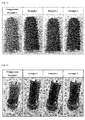
- Photographs showing the surface of an implant that went through only pre-treatment in Comparative Example 1, and the surface of an implant that went through both pre-treatment and post-treatment in Examples 1 ⁇ 3 are taken, and the result is shown in Fig. 1 .
- a solid substance i.e., sodium chloride derived from glucose and/or physiological saline solution having hydrophilic property
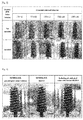
- Photographs of each implant are taken after putting the implant that went through only pre-treatment in Comparative Example 1 and the implant that went through both pre-treatment and post-treatment in Examples 1 ⁇ 3 in human blood, and the result is shown in Fig. 2 .
- Photographs showing the surface condition of an implant according to whether physiological saline solution is included in the surface treatment composition of implant and the concentration of glucose are taken, and the result is shown in Fig. 3 .
- the surface treatment composition not including physiological saline solution is prepared and the surface of the implant is treated in the same manner as Example 1 (the concentration of glucose is different)
- the surface treatment composition including physiological saline solution is prepared and the surface of the implant is treated in the same manner as Example 2 (the concentration of glucose is different).
- a surface treatment composition not including physiological saline solution when using a surface treatment composition not including physiological saline solution, when the concentration of glucose is low (25 ⁇ 100 mM), although the upper surface and lower surface of the implant have a dark color, a band-shaped stain having a bright color is formed in the middle part.
- concentration of glucose is high (200 ⁇ 400 mM)
- a surface treatment composition including physiological saline solution in both the cases where the concentration of glucose is low and high (25 ⁇ 400 mM), it is shown that the entire surface of the implant has a dark color with no stain.
- physiological saline solution i.e., sodium chloride
- Photographs showing the surface condition of an implant according to whether HEPES and/or physiological saline solution is included in the surface treatment composition of implant are taken, and the result is shown in Fig. 4 .
- the titanium implant goes through pre-treatment and post-treatment in the same manner as in Examples 1 ⁇ 3.
- the term “including only physiological saline solution” means using 0.9 wt% of physiological saline solution as a surface treatment composition.
- the term “including only HEPES” means using an HEPES aqueous solution having a concentration of 100 mM prepared by dissolving HEPES powder in distilled water as a surface treatment composition.
- the term “including physiological saline solution and HEPES” means using the surface treatment composition prepared in Example 3 as a surface treatment composition.
- physiological saline solution i.e., sodium chloride
Landscapes
- Health & Medical Sciences (AREA)
- General Health & Medical Sciences (AREA)
- Veterinary Medicine (AREA)
- Public Health (AREA)
- Epidemiology (AREA)
- Life Sciences & Earth Sciences (AREA)
- Animal Behavior & Ethology (AREA)
- Chemical & Material Sciences (AREA)
- Oral & Maxillofacial Surgery (AREA)
- Transplantation (AREA)
- Medicinal Chemistry (AREA)
- Dermatology (AREA)
- Inorganic Chemistry (AREA)
- Heart & Thoracic Surgery (AREA)
- Surgery (AREA)
- Vascular Medicine (AREA)
- Orthopedic Medicine & Surgery (AREA)
- Dentistry (AREA)
- Materials For Medical Uses (AREA)
- Dental Prosthetics (AREA)
Abstract
Description
- The present invention discloses a method for treating a surface of an implant. More specifically, the present invention discloses a method for treating a surface of an implant, including coating a surface treatment composition containing an organic material having a hydrophilic group on the surface of the implant.
- There are various ways to lower the failure rate of dental implant procedures applied to living bodies and increase the fixation power with bones.
- A method for strongly fixing the implant to bones mechanically by designing the implant in a screw form is generally used.
- Also, a method for increasing the surface area of the implant by granting a roughness to the implant surface through sandblasting and acid etching is one of the surface treatment methods commonly applied by many implant manufacturing companies in order to achieve a strong fixation power between the implant and bone.
- In addition to the above methods for strongly fixing the implant surface to bones mechanically and physically, various methods that allow bones to better adhere to the implant by coating calcium phosphate, which is an inorganic ingredient similar to human bone, on the implant surface are used.
- Titanium or titanium alloy used as implant gets contaminated once it is exposed to air even after being surface treated in various manners, and thus the surface loses its activity. When the surface of titanium or titanium alloy is exposed to air or water, the surface is continuously oxidized by reacting with the surrounding oxygen (H.P. Boehm, Acidic and Basic Properties of hydroxylated Metal Oxide Surfaces, Discussions Faraday Society, vol. 52, 1971, pp. 264-275).
- Among the methods for lowering the failure rate of implant procedures and obtaining stable and strong fixation power between the implant and bone, as chemical methods, there are methods for preventing contamination of implant surface or maintaining the hydrophilic property of the implant surface right after surface treatment (hereinafter, "hydrophilic property right after surface treatment"). In general, the hydrophilic property right after surface treatment gradually decreases as the implant surface is exposed to air and contaminated, and goes through continuous oxidation reaction, and in the end the surface is left with a hydrophobic property. As a method for maintaining the hydrophilic property right after surface treatment and preventing contamination of the surface,
US 6,702,855 B1 uses a method for blocking contact between air and implant by performing all processes from the step of treating the surface of the implant to the step right before transplant in an inert gas atmosphere, and using water or ion solution packing. The method of sealing by impregnating an implant in a pack filled with physiological saline solution in an inert gas atmosphere as in the above may prevent the implant from being exposed to air and be contaminated. However, the implant surface is oxidized continuously by reacting with water in the physiological saline solution, thereby forming a new oxidized layer in an embossed form on the implant surface. Due to this, there are problems that the initial quality of the implant surface right after production and the quality in the distribution process may change in the aspect of the structure of the surface and chemical property (European Cells and Materials Vol. 23. Suppl. 1, 2012, page 25). Also, since an airtight packing is required, the process is complex, the treatment cost is high, and the handling may be inconvenient. -
Korean Patent Application No. 2009-7019196 - An embodiment of the present invention provides a method for treating a surface of an implant, including coating a surface treatment composition containing an organic material having a hydrophilic group on the surface of the implant.
- Another embodiment of the present invention provides a method for treating a surface of an implant, including coating a surface treatment composition containing an organic material having a hydrophilic group and an inorganic salt on the surface of the implant.
- An aspect of the present invention provides a method for treating a surface of an implant, including coating a surface treatment composition containing an organic material having a hydrophilic group on the surface of the implant (coating step), and drying the coated surface treatment composition (drying step).
- The method may further include pre-treating the surface of the implant before the coating step (pre-treating step).
- The pre-treating step may be performed by an operation of at least one of sandblasting, calcium phosphate coating, UV treatment, plasma treatment, acid treatment and alkali treatment.
- The hydrophilic group may include at least one selected from the group consisting of a hydroxyl group (OH), a carboxyl group (COOH), an amino group (NH2) and a sulfonic acid group (-SO3H).
- The organic material may include at least one selected from the group consisting of saccharides, proteins, acids and biological buffer or good's buffer.
- The saccharides may include at least one selected from the group consisting of glucose, cellulose, alkyl cellulose, alkyl hydroxyalkyl cellulose, hydroxyalkyl cellulose, cellulose sulfate, carboxymethyl cellulose salt, carboxymethyl cellulose, carboxyethyl cellulose, chitin, carboxymethyl chitin, hyaluronic acid, hyaluronic acid salt, alginate, alginic acid, propylene glycol alginate, glycogen, dextran, dextran sulfate, curdlan, pectin, pullulan, xanthan, chondroitin, chondroitin sulfates, carboxymethyl dextran, carboxymethyl chitosan, chitosan, heparin, heparin sulfate, heparan, heparan sulfate, dermatan sulfate, keratan sulfate, carrageenan, chitosan, starch, amylose, amylopectin, poly-N-glucosamine, polymannuronic acid, polyglucuronic acid, polyguluronic acid and derivatives of the saccharides.
- The proteins may include at least one selected from the group consisting of gelatin, prothrombin, thrombin, fibrinogen, fibrin, fibronectin, heparinase, X factor, Xa factor, VII factor, VIIa factor, IX factor, IXa factor, XI factor, XIa factor, XII factor, XIIa factor, tissue factor, batroxobin, ancrod, ecarin, von Willebrand Factor, collagen, elastin, albumin, platelet surface glycoproteins, vasopressin, vasopressin analogs, epinephrine, selectin, procoagulant venom, plasminogen activator inhibitor, platelet activating factor and peptide.
- The acids may include at least one selected from the group consisting of pyruvic acid, lactic acid, cysteine, glutamine, tyrosine, leucine, lycine, valine, isoleucine, threonine, phenilalanine, tryptophan, hystidine, arginine, glycine, serine, proline, glutamic acid, aspartic acid, alanine, methionine and asparagine.
- The biological buffer or good's buffer may include at least one selected from the group consisting of MES(2-(N-morpholino)ethanesulfonic acid), ADA(N-(carbamoylmethyl)iminodiacetic acid), PIPES(1,4-piperazinediethanesulfonic acid), ACES(2-(carbamoylmethylamino)ethanesulfonic acid), MOPSO(3-morpholino-2-hydroxypropanesulfonic acid), cholamine chloride, MOPS(3-morpholinopropane-1-sulfonic acid), BES(N,N-bis(2-hydroxyethyl)-2-aminoethanesulfonic acid), TES(2-[[1,3-dihydroxy-2-(hydroxymethyl)propane-2-yl]amino]ethanesulfonic acid), HEPES(2-[4-(2-hydroxyethyl)piperazine-1-yl]ethanesulfonic acid), DIPSO(3-(N,N-bis[2-hydroxyethyl]amino)-2-hydroxypropanesulfonic acid), acetamido glycine, TAPSO(3-[[1,3-dihydroxy-2-(hydroxymethyl)propane-2-yl] amino] -2-hydroxypropane-1-sulfonic acid), HEPPSO(N-(2-hydroxyethyl)piperazine-N'-(2-hydroxypropanesulfonic acid), HEPPS(4-(2-hydroxyethyl)-peperazine-1-propanesulfonic acid), Tricine(N-(2-hydroxy-1,1-bis(hydroxymethyl)ethyl)glycine), glycinamide, Bicine(2-bis(2-hydroxyethyl)amino)acetic acid) and TAPS(3-[[1,3-dihydroxy-2-(hydroxymethyl)propane-2-yl]amino]propane-1-sulfonic acid).
- A concentration of the organic material in the surface treatment composition may be 2,000 mM or less.
- The surface treatment composition may further include an inorganic salt.
- The inorganic salt may include at least one selected from the group consisting of metal chloride, metal phosphate, metal sulfate, metal carbonate and metal nitrate.
- The metal in the inorganic salt may include at least one selected from the group consisting of sodium, calcium, potassium, strontium, manganese and magnesium.
- A concentration of the inorganic salt in the surface treatment composition may be 200 mM or less.
- The surface treatment composition may be in an aqueous solution form.
- The implant may include titanium or titanium alloy.
- The drying step may be performed at a temperature of 200 °C or below.
- The method for treating the surface of the implant according to an embodiment of the present invention has a simple process, has low treatment cost, is easy to handle, and maintains its hydrophilic property even when packing the implant by ordinary packing.
- The method for treating the surface of the implant according to another embodiment of the present invention is a method for maintaining the hydrophilic property of the surface of the implant, which preserves the hydrophilic property of the surface of the implant even without airtight packing, unlike the conventional sealing method.
-
-
Fig. 1 illustrates photographs showing the difference in color between an implant which went through both pre-treatment and post-treatment (Examples 1~3), and an implant which went through only pre-treatment (Comparative Example 1); -
Fig. 2 illustrates photographs showing the blood affinity of an implant which went through both pre-treatment and post-treatment (Examples 1∼3), and an implant which went through only pre-treatment (Comparative Example 1); -
Fig. 3 illustrates photographs showing the surface condition of an implant according to whether the surface treatment composition of the implant includes physiological saline solution, and the glucose concentration; and -
Fig. 4 illustrates photographs showing the surface condition of an implant according to whether the surface treatment composition of the implant includes HEPES and/or physiological saline solution. - Hereinafter, the method for treating the surface of an implant according to an embodiment of the present invention is explained in detail.
- The method for treating the surface of an implant according to an embodiment of the present invention includes (coating step) coating a surface treatment composition containing an organic material having a hydrophilic group on the surface of an implant S10, and (drying step) drying the coated surface treatment composition S20.
- The implant surface may have a hydrophilic property and maintain the hydrophilic property for a long period of time by the coating step S10, and/or maintain the hydrophilic property provided in advance by the pre-treating step S1, which will be mentioned later, to the implant surface for a long period of time.
- The organic material having a hydrophilic group (hereinafter, "organic material") plays the role of maintaining the hydrophilic property of the implant surface after being implanted in an alveolar bone, etc. by being left on the implant surface after surface treatment. When the implant surface maintains the hydrophilic property, the surface has high affinity with blood, allowing the entire surface to be sufficiently soaked in blood so as to quickly form new tissues on the surface, thereby and firmly binding the implant to the surrounding tissues.
- The hydrophilic group may include at least one selected from the group consisting of a hydroxyl group (OH), a carboxyl group (COOH), an amino group (NH2) and a sulfonic acid group (-SO3H).
- The organic material may be an organic material used in blood injection or cell culture.
- The organic material may include at least one selected from the group consisting of saccharides, proteins, acids and biological buffer or good's buffer.
- The saccharide may include at least one selected from the group consisting of glucose, cellulose, alkyl cellulose, alkyl hydroxyalkyl cellulose, hydroxyalkyl cellulose, cellulose sulfate, carboxymethyl cellulose salt, carboxymethyl cellulose, carboxyethyl cellulose, chitin, carboxymethyl chitin, hyaluronic acid, hyaluronic acid salt, alginate, alginic acid, propylene glycol alginate, glycogen, dextran, dextran sulfate, curdlan, pectin, pullulan, xanthan, chondroitin, chondroitin sulfates, carboxymethyl dextran, carboxymethyl chitosan, chitosan, heparin, heparin sulfate, heparan, heparan sulfate, dermatan sulfate, keratan sulfate, carrageenan, chitosan, starch, amylose, amylopectin, poly-N-glucosamine, polymannuronic acid, polyglucuronic acid, polyguluronic acid and derivatives of the saccharides.
- The protein may include at least one selected from the group consisting of gelatin, prothrombin, thrombin, fibrinogen, fibrin, fibronectin, heparinase, X factor, Xa factor, VII factor, VIIa factor, IX factor, IXa factor, XI factor, XIa factor, XII factor, XIIa factor, tissue factor, batroxobin, ancrod, ecarin, von Willebrand Factor, collagen, elastin, albumin, platelet surface glycoproteins, vasopressin, vasopressin analogs, epinephrine, selectin, procoagulant venom, plasminogen activator inhibitor, platelet activating factor and peptide.
- The acid may include at least one selected from the group consisting of pyruvic acid, lactic acid, cysteine, glutamine, tyrosine, leucine, lycine, valine, isoleucine, threonine, phenilalanine, tryptophan, hystidine, arginine, glycine, serine, proline, glutamic acid, aspartic acid, alanine, methionine and asparagine.
- The biological buffer or good's buffer may include at least one selected from the group consisting of MES(2-(N-morpholino)ethanesulfonic acid), ADA(N-(carbamoylmethyl)iminodiacetic acid), PIPES(1,4-piperazinediethanesulfonic acid), ACES(2-(carbamoylmethylamino)ethanesulfonic acid), MOPSO(3-morpholino-2-hydroxypropanesulfonic acid), cholamine chloride, MOPS(3-morpholinopropane-1-sulfonic acid), BES(N,N-bis(2-hydroxyethyl)-2-aminoethanesulfonic acid), TES(2-[[1,3-dihydroxy-2-(hydroxymethyl)propane-2-yl]amino]ethanesulfonic acid), HEPES(2-[4-(2-hydroxyethyl)piperazine-1-yl]ethanesulfonic acid), DIPSO(3-(N,N-bis[2-hydroxyethyl]amino)-2-hydroxypropanesulfonic acid), acetamido glycine, TAPSO(3-[[1,3-dihydroxy-2-(hydroxymethyl)propane-2-yl] amino] -2-hydroxypropane-1-sulfonic acid), HEPPSO(N-(2-hydroxyethyl)piperazine-N'-(2-hydroxypropanesulfonic acid), HEPPS(4-(2-hydroxyethyl)-peperazine-1-propanesulfonic acid), Tricine(N-(2-hydroxy-1,1-bis(hydroxymethyl)ethyl)glycine), glycinamide, Bicine(2-bis(2-hydroxyethyl)amino)acetic acid) and TAPS(3-[[1,3-dihydroxy-2-(hydroxymethyl)propane-2-yl]amino]propane-1-sulfonic acid).
- The concentration of the organic material in the surface treatment composition may be 2,000 mM or less. In particular, the concentration of the organic material in the surface treatment composition may be greater than 0 mM and equal to or less than 2,000 mM. When the concentration of the organic material in the surface treatment composition is equal to or less than 2,000 mM, the surface treatment composition may dry well after being coated on the surface of an implant.
- The surface treatment composition may further include an inorganic salt.
- The inorganic salt promotes the drying of the surface treatment composition in the drying step 20, and prevents a stain from being formed on the surface of an implant after the drying step 20 by allowing the entire surface of the implant coated with the surface treatment composition to be dried in a uniform rate.
- The inorganic salt may be an inorganic salt included in a physiological solution.
- The inorganic salt may include at least one selected from the group consisting of metal chloride, metal phosphate, metal sulfate, metal carbonate and metal nitrate.
- The metal in the inorganic salt may include at least one selected from the group consisting of sodium, calcium, potassium, strontium, manganese and magnesium.
- The inorganic salt may include at least one selected from the group consisting of sodium chloride, calcium chloride, potassium chloride, strontium chloride, manganese chloride, magnesium chloride, sodium phosphate, calcium phosphate, potassium phosphate, strontium phosphate, manganese phosphate, magnesium phosphate, sodium nitrate, calcium nitrate, potassium nitrate, strontium nitrate, manganese nitrate, magnesium nitrate, sodium carbonate, calcium carbonate, potassium carbonate, strontium carbonate, manganese carbonate, magnesium carbonate, sodium sulfate, calcium sulfate, potassium sulfate, strontium sulfate, manganese sulfate and magnesium sulfate.
- The concentration of the inorganic salt in the surface treatment composition may be 200 mM or less. In particular, the concentration of the inorganic salt in the surface treatment composition may be greater than 0 mM and equal to or less than 200 mM. When the concentration of the inorganic salt in the surface treatment composition is equal to or less than 200 mM, the surface treatment composition may not express cytotoxicity even after being coated on the surface of an implant.
- The surface treatment composition may be in an aqueous solution form. The term "aqueous solution form" as used herein means that at least an organic material and/or an inorganic salt among the components of the surface treatment composition is present in a state dissolved in water.
- For example, the surface treatment composition may be a glucose aqueous solution having a concentration of 10∼200 mM.
- As another example, the surface treatment composition may be an HEPES aqueous solution having a concentration of 5∼150 mM.
- The implant may include titanium or titanium alloy.
- The solvent (e.g., water) of the surface treatment composition coated on the surface of the implant may be removed by the drying step S20, and a solid substance (i.e., organic material and/or inorganic salt) may be extracted and left on the surface of implant. As a result, an implant having a dry hydrophilic surface may be obtained.
- The drying step S20 may be performed at a temperature of 200 °C or below. In particular, the drying step S20 may be performed at a temperature between -50 °C and 200 °C. When the drying step S20 is performed at a temperature of 200 °C or below, in case the surface treatment composition includes an organic material, the organic material may not be oxidized. When the drying step S20 is performed by freeze-drying (-20 °C) at a temperature below zero, the hydrophilic property of the surface of an implant may be maintained.
- For example, the drying step S20 may be performed at a temperature between 15-70 °C for 20 minutes ∼ 4 hours.
- The method for treating the surface of the implant may further include (pre-treating step) pre-treating the surface of the
implant S 1 before the coating step S10. - The surface of the implant has a hydrophilic property by the
pre-treating step S 1. - The pre-treating step S1 may be performed by an operation of at least one of sandblasting, calcium phosphate coating, UV treatment, plasma treatment, acid treatment and alkali treatment.
- The implant that goes through surface treatment by the surface treatment method may maintain a hydrophilic surface ever since surface treatment until the implant procedure is completed, even by ordinary packing, not airtight packing.
- Hereinafter, the present invention will be explained in more detail with reference to the examples, but the present invention is not limited to these examples.
- First, UV is irradiated on the surface of a titanium implant (self-produced) for 1 hour using a UV device (ARTEC, AH-1700) (hereinafter, "pre-treatment"). Then, after coating 10 µl of the surface treatment composition in Table 1 below on the surface of pre-treated implant, the implant coated with the surface treatment composition is first dried for 20 minutes at 25 °C and then dried for 2 hours at 60 °C (hereinafter, "post-treatment").
[Table 1] Example 1 Example 2 Example 3 surface treatment composition glucose aqueous solution of 200 mM prepared by dissolving glucose powder in distilled water glucose aqueous solution of 150 mM prepared by dissolving glucose power in 0.9 wt% of physiological saline solution HEPES aqueous solution of 100 mM prepared by dissolving HEPES powder in 0.9 wt% of physiological saline solution - The surface of the implant is pre-treated by irradiating UV on the surface of a titanium implant (self-produced) for 1 hour using a UV device (ARTEC, AH-1700). However, the steps of coating and drying the surface treatment composition of the pre-treated implant surface (i.e., post-treatment) are omitted.
- Photographs showing the surface of an implant that went through only pre-treatment in Comparative Example 1, and the surface of an implant that went through both pre-treatment and post-treatment in Examples 1~3 are taken, and the result is shown in
Fig. 1 . - Referring to
Fig. 1 , it may be confirmed that the surface of an implant that went through both pre-treatment and post-treatment in Examples 1~3 changed to have a color different from the surface of an implant that went through only pre-treatment in Comparative Examples 1∼3. From the above result, it may be confirmed that a solid substance (i.e., sodium chloride derived from glucose and/or physiological saline solution having hydrophilic property) is left on the surface of an implant that went through both pre-treatment and post-treatment. - Photographs of each implant are taken after putting the implant that went through only pre-treatment in Comparative Example 1 and the implant that went through both pre-treatment and post-treatment in Examples 1~3 in human blood, and the result is shown in
Fig. 2 . - Referring to
Fig. 2 , it may be confirmed that the surface of an implant that went through both pre-treatment and post-treatment in Examples 1~3 has a larger area soaked in blood than the surface of an implant that went through only pre-treatment in Comparative Examples 1∼3, and thus it has excellent affinity to blood. - Photographs showing the surface condition of an implant according to whether physiological saline solution is included in the surface treatment composition of implant and the concentration of glucose are taken, and the result is shown in
Fig. 3 . Here, the surface treatment composition not including physiological saline solution is prepared and the surface of the implant is treated in the same manner as Example 1 (the concentration of glucose is different), and the surface treatment composition including physiological saline solution is prepared and the surface of the implant is treated in the same manner as Example 2 (the concentration of glucose is different). - Referring to
Fig. 3 , when using a surface treatment composition not including physiological saline solution, when the concentration of glucose is low (25∼100 mM), although the upper surface and lower surface of the implant have a dark color, a band-shaped stain having a bright color is formed in the middle part. When the concentration of glucose is high (200∼400 mM), it is shown that the entire surface of the implant has a dark color with no stain. - Also, referring to
Fig. 3 , when using a surface treatment composition including physiological saline solution, in both the cases where the concentration of glucose is low and high (25∼400 mM), it is shown that the entire surface of the implant has a dark color with no stain. - From the above result, it may be confirmed that physiological saline solution (i.e., sodium chloride) prevents a stain from being formed on the surface of implant after the post-treatment step.
- Photographs showing the surface condition of an implant according to whether HEPES and/or physiological saline solution is included in the surface treatment composition of implant are taken, and the result is shown in
Fig. 4 . In each case ofFig. 4 , except for using the following surface treatment composition, the titanium implant goes through pre-treatment and post-treatment in the same manner as in Examples 1∼3. - In
Fig. 4 , the term "including only physiological saline solution" means using 0.9 wt% of physiological saline solution as a surface treatment composition. The term "including only HEPES" means using an HEPES aqueous solution having a concentration of 100 mM prepared by dissolving HEPES powder in distilled water as a surface treatment composition. The term "including physiological saline solution and HEPES" means using the surface treatment composition prepared in Example 3 as a surface treatment composition. - Referring to
Fig. 4 , when using only "physiological saline solution" as a surface treatment composition, a stain is formed on the surface of implant. When using only "HEPES" as a surface treatment composition, undried residue is present on the surface of implant. When using "physiological saline solution and HEPES" as a surface treatment composition, no stain is formed on the surface of implant and no undried residue is present. - From the above result, it may be confirmed that physiological saline solution (i.e., sodium chloride) promotes the drying of the surface treatment composition coated on the surface of an implant.
- The present invention has been described with reference to the drawings and examples, but it is to be understood that the examples herein described and shown in the drawings are for illustrative purposes only and that various equivalent modifications may be made by those skilled in the art. Thus, the technical scope of the present invention is defined by the technical idea of the appended claims.
Claims (17)
- A method for treating a surface of an implant, comprising: coating a surface treatment composition containing an organic material having a hydrophilic group on the surface of the implant (coating step); and drying the surface treatment composition (drying step).
- The method of claim 1, further comprising pre-treating the surface of the implant before the coating step (pre-treating step).
- The method of claim 2, wherein the pre-treating step is performed by an operation of at least one of sandblasting, calcium phosphate coating, UV treatment, plasma treatment, acid treatment and alkali treatment.
- The method of claim 1, wherein the hydrophilic group includes at least one selected from the group consisting of a hydroxyl group (OH), a carboxyl group (COOH), an amino group (NH2) and a sulfonic acid group (-SO3H).
- The method of claim 1, wherein the organic material includes at least one selected from the group consisting of saccharides, proteins, acids and biological buffer or good's buffer.
- The method of claim 5, wherein the saccharides includes at least one selected from the group consisting of glucose, cellulose, alkyl cellulose, alkyl hydroxyalkyl cellulose, hydroxyalkyl cellulose, cellulose sulfate, carboxymethyl cellulose salt, carboxymethyl cellulose, carboxyethyl cellulose, chitin, carboxymethyl chitin, hyaluronic acid, hyaluronic acid salt, alginate, alginic acid, propylene glycol alginate, glycogen, dextran, dextran sulfate, curdlan, pectin, pullulan, xanthan, chondroitin, chondroitin sulfates, carboxymethyl dextran, carboxymethyl chitosan, chitosan, heparin, heparin sulfate, heparan, heparan sulfate, dermatan sulfate, keratan sulfate, carrageenan, chitosan, starch, amylose, amylopectin, poly-N-glucosamine, polymannuronic acid, polyglucuronic acid, polyguluronic acid and derivatives of the saccharides.
- The method of claim 5, wherein the proteins includes at least one selected from the group consisting of gelatin, prothrombin, thrombin, fibrinogen, fibrin, fibronectin, heparinase, X factor, Xa factor, VII factor, VIIa factor, IX factor, IXa factor, XI factor, XIa factor, XII factor, XIIa factor, tissue factor, batroxobin, ancrod, ecarin, von Willebrand Factor, collagen, elastin, albumin, platelet surface glycoproteins, vasopressin, vasopressin analogs, epinephrine, selectin, procoagulant venom, plasminogen activator inhibitor, platelet activating factor and peptide.
- The method of claim 5, wherein the acids includes at least one selected from the group consisting of pyruvic acid, lactic acid, cysteine, glutamine, tyrosine, leucine, lycine, valine, isoleucine, threonine, phenilalanine, tryptophan, hystidine, arginine, glycine, serine, proline, glutamic acid, aspartic acid, alanine, methionine and asparagine.
- The method of claim 5, wherein the biological buffer or good's buffer includes at least one selected from the group consisting of MES(2-(N-morpholino)ethanesulfonic acid), ADA(N-(carbamoylmethyl)iminodiacetic acid), PIPES(1,4-piperazinediethanesulfonic acid), ACES(2-(carbamoylmethylamino)ethanesulfonic acid), MOPSO(3-morpholino-2-hydroxypropanesulfonic acid), cholamine chloride, MOPS(3-morpholinopropane-1-sulfonic acid), BES(N,N-bis(2-hydroxyethyl)-2-aminoethanesulfonic acid), TES(2-[[1,3-dihydroxy-2-(hydroxymethyl)propane-2-yl]amino]ethanesulfonic acid), HEPES(2-[4-(2-hydroxyethyl)piperazine-1-yl]ethanesulfonic acid), DIPSO(3-(N,N-bis[2-hydroxyethyl]amino)-2-hydroxypropanesulfonic acid), acetamido glycine, TAPSO(3-[[1,3-dihydroxy-2-(hydroxymethyl)propane-2-yl] amino] -2-hydroxypropane-1-sulfonic acid), HEPPSO(N-(2-hydroxyethyl)piperazine-N'-(2-hydroxypropanesulfonic acid), HEPPS(4-(2-hydroxyethyl)-peperazine-1-propanesulfonic acid), Tricine(N-(2-hydroxy-1,1-bis(hydroxymethyl)ethyl)glycine), glycinamide, Bicine(2-bis(2-hydroxyethyl)amino)acetic acid) and TAPS(3-[[1,3-dihydroxy-2-(hydroxymethyl)propane-2-yl]amino]propane-1-sulfonic acid).
- The method of claim 1, wherein a concentration of the organic material in the surface treatment composition is 2,000 mM or less.
- The method of claim 1, wherein the surface treatment composition further comprises an inorganic salt.
- The method of claim 11, wherein the inorganic salt includes at least one selected from the group consisting of metal chloride, metal phosphate, metal sulfate, metal carbonate and metal nitrate.
- The method of claim 12, wherein the metal in the inorganic salt includes at least one selected from the group consisting of sodium, calcium, potassium, strontium, manganese and magnesium.
- The method of claim 11, wherein a concentration of the inorganic salt in the surface treatment composition is 200 mM or less.
- The method of claim 1, wherein the surface treatment composition is in an aqueous solution form.
- The method of claim 1, wherein the implant comprises titanium or titanium alloy.
- The method of claim 1, wherein the drying step is performed at a temperature of 200 °C or below.
Applications Claiming Priority (2)
| Application Number | Priority Date | Filing Date | Title |
|---|---|---|---|
| KR20130049617A KR101404632B1 (en) | 2013-05-02 | 2013-05-02 | Method for treating surface of implant |
| PCT/KR2013/008525 WO2014178489A1 (en) | 2013-05-02 | 2013-09-24 | Method for treating surface of implant |
Publications (3)
| Publication Number | Publication Date |
|---|---|
| EP2992908A1 true EP2992908A1 (en) | 2016-03-09 |
| EP2992908A4 EP2992908A4 (en) | 2016-12-28 |
| EP2992908B1 EP2992908B1 (en) | 2020-09-02 |
Family
ID=51132104
Family Applications (1)
| Application Number | Title | Priority Date | Filing Date |
|---|---|---|---|
| EP13883807.3A Active EP2992908B1 (en) | 2013-05-02 | 2013-09-24 | Method for treating surface of implant |
Country Status (10)
| Country | Link |
|---|---|
| US (1) | US10786602B2 (en) |
| EP (1) | EP2992908B1 (en) |
| JP (1) | JP6383783B2 (en) |
| KR (1) | KR101404632B1 (en) |
| CN (1) | CN105339017B (en) |
| DK (1) | DK2992908T3 (en) |
| ES (1) | ES2828063T3 (en) |
| HU (1) | HUE051263T2 (en) |
| PT (1) | PT2992908T (en) |
| WO (1) | WO2014178489A1 (en) |
Cited By (2)
| Publication number | Priority date | Publication date | Assignee | Title |
|---|---|---|---|---|
| WO2018189185A1 (en) | 2017-04-11 | 2018-10-18 | Straumann Holding Ag | Dental implant |
| WO2020187493A1 (en) * | 2019-03-19 | 2020-09-24 | Qvanteq Ag | Medical device and process of preparing a medical device |
Families Citing this family (26)
| Publication number | Priority date | Publication date | Assignee | Title |
|---|---|---|---|---|
| KR101460976B1 (en) | 2014-07-11 | 2014-11-13 | 오스템임플란트 주식회사 | Surface coated dental implant with improved biocompatibility and preparation method thereof |
| KR101460973B1 (en) | 2014-07-11 | 2014-11-13 | 오스템임플란트 주식회사 | Surface coated dental implant with improved biocompatibility and preparation method thereof |
| WO2016006889A1 (en) * | 2014-07-11 | 2016-01-14 | 오스템임플란트 주식회사 | Surface-coated dental implant with improved bioaffinity and biocompatibility and method for manufacturing same |
| KR101460974B1 (en) | 2014-07-11 | 2014-11-13 | 오스템임플란트 주식회사 | Surface coated dental implant with improved biocompatibility and preparation method thereof |
| EP3034033A1 (en) | 2014-12-16 | 2016-06-22 | Nobel Biocare Services AG | Dental implant |
| CN106011834B (en) * | 2016-06-12 | 2018-12-04 | 天津大学 | The preparation method of the sodium alginate coating of titanium chelated surface strontium |
| CN106581769A (en) * | 2016-12-09 | 2017-04-26 | 苏州纳贝通环境科技有限公司 | Functionalized nano biological ceramic coating and preparation process thereof |
| CN106983908A (en) * | 2017-03-03 | 2017-07-28 | 吕亚林 | Specific planting body for long-term Anti-platelet therapy patient and preparation method thereof |
| US11540866B2 (en) | 2017-03-29 | 2023-01-03 | Bone Solutions, Inc. | Implant of osteostimulative material |
| CN107185055B (en) * | 2017-04-28 | 2019-12-31 | 淮阴工学院 | A kind of surface modification method of medical magnesium alloy |
| CN107260342A (en) * | 2017-06-30 | 2017-10-20 | 青岛大学附属医院 | A kind of 3D printing bionic tooth implant and preparation method thereof |
| WO2019068906A1 (en) * | 2017-10-06 | 2019-04-11 | Dsm Ip Assets B.V. | Method of making an osteoconductive fibrous article and a medical implant comprising such osteoconductive fibrous article |
| US20190125420A1 (en) * | 2017-10-31 | 2019-05-02 | Bone Solutions, Inc. | Bioabsorbable Composite Screw |
| CN108478298B (en) * | 2018-03-01 | 2020-11-10 | 澳门大学 | Implant with polysaccharide coating capable of combining growth factors and preparation method thereof |
| CN109125790A (en) * | 2018-08-25 | 2019-01-04 | 山东康力医疗器械科技有限公司 | A kind of styptic sponge structure made of chitosan |
| EP4331530B1 (en) | 2018-11-12 | 2025-07-02 | Nobel Biocare Services AG | Method of forming a protective layer on the surface of an implantable component, implantable component with the protective layer and use of the protective layer |
| KR102148868B1 (en) | 2019-01-16 | 2020-08-28 | 주식회사 씨에스와이 | Surface etching solution of dental fixture and etching process using it |
| KR102081619B1 (en) * | 2019-01-16 | 2020-02-26 | 주식회사 씨에스와이 | Surface treatment of dental fixture using in-situ process |
| KR101972122B1 (en) * | 2019-01-31 | 2019-04-24 | 주식회사 네오바이오텍 | Method for Preparing Dental Implants with Improved Surface Morphology and Osseointegration |
| KR102462168B1 (en) * | 2019-08-14 | 2022-11-02 | (주)네이처글루텍 | Dental implant coated with mussel adhesive protein |
| KR102344959B1 (en) | 2019-12-06 | 2021-12-28 | 영산대학교산학협력단 | Composition for improving osteointegration of implants comprising rosmarinus officinalis extract |
| CN111744055A (en) * | 2020-06-29 | 2020-10-09 | 北京星云中御科技有限公司 | A kind of hydrophilic implant product and preparation method thereof |
| KR20220090934A (en) | 2020-12-23 | 2022-06-30 | 수바이오 주식회사 | Method of manufacture of implants with hydrophilic surfaces and implants manufactured by the above method |
| JP7083557B1 (en) * | 2020-12-25 | 2022-06-13 | 株式会社エー・アイ・システムプロダクト | Surface treatment method for titanium or titanium alloy |
| WO2022138924A1 (en) * | 2020-12-25 | 2022-06-30 | 株式会社エー・アイ・システムプロダクト | Surface treatment method for titanium or titanium alloy |
| KR102399423B1 (en) * | 2021-03-16 | 2022-05-19 | 주식회사 도이프 | Manufacturering of orthodontic mini screw and method of surface treatment |
Family Cites Families (14)
| Publication number | Priority date | Publication date | Assignee | Title |
|---|---|---|---|---|
| ES2113834B1 (en) * | 1996-11-12 | 1999-01-01 | Univ Vigo | METHOD FOR IMPROVING OSTEOINTEGRATION OF BONE FIXING IMPLANTS. |
| EP1023910A1 (en) | 1999-01-29 | 2000-08-02 | Institut Straumann AG | Preparation of osteophilic surfaces for metallic prosthetic devices anchorable to bone |
| KR100397565B1 (en) * | 2001-01-16 | 2003-09-13 | 엘지산전 주식회사 | Multi-functional hybrid contactor |
| KR20040032297A (en) * | 2002-10-09 | 2004-04-17 | (주)아미티에 | Biodegradable Coating-Implant For Bone Fixation |
| KR100546081B1 (en) | 2003-01-24 | 2006-01-26 | 재단법인서울대학교산학협력재단 | Surface Treatment of Implant Titanium Using Protein |
| PL1737734T3 (en) | 2004-03-10 | 2011-02-28 | Scil Tech Gmbh | Coated implants, their manufacturing and use thereof |
| WO2006056984A2 (en) * | 2004-11-26 | 2006-06-01 | Stentomics Inc. | Chelating and binding chemicals to a medical implant |
| US20060159650A1 (en) * | 2005-01-14 | 2006-07-20 | Bacterin, Inc. | Composition and method for covalently coupling an antithrombotic substance and a hydrophilic polymer |
| DE102007007865A1 (en) * | 2007-02-14 | 2008-08-21 | Jennissen, Herbert, Prof. Dr. | Process for the preparation of storable implants with an ultrahydrophilic surface |
| US20080292779A1 (en) * | 2007-05-22 | 2008-11-27 | Mercuri Gregory M | Coating of implants with hyaluronic acid solution |
| KR100775537B1 (en) | 2007-07-19 | 2007-11-28 | (주)오스테오필 | Surface-Mounted Implant Manufacturing Method and Implants Prepared By Them |
| CN101269242B (en) * | 2008-01-16 | 2012-01-04 | 重庆大学 | Transgenic cell overlapped vascular inner rack and manufacture method thereof |
| ES2545781T3 (en) * | 2008-01-28 | 2015-09-15 | Biomet 3I, Llc | Superficial implant with greater hydrophilicity |
| KR101248785B1 (en) | 2012-04-30 | 2013-04-03 | 오스템임플란트 주식회사 | Titanium implant having ultrahydrophilic surface, surface modification and storing method thereof |
-
2013
- 2013-05-02 KR KR20130049617A patent/KR101404632B1/en active Active
- 2013-09-24 JP JP2016511664A patent/JP6383783B2/en active Active
- 2013-09-24 CN CN201380076261.5A patent/CN105339017B/en active Active
- 2013-09-24 US US14/888,592 patent/US10786602B2/en active Active
- 2013-09-24 EP EP13883807.3A patent/EP2992908B1/en active Active
- 2013-09-24 WO PCT/KR2013/008525 patent/WO2014178489A1/en not_active Ceased
- 2013-09-24 ES ES13883807T patent/ES2828063T3/en active Active
- 2013-09-24 PT PT138838073T patent/PT2992908T/en unknown
- 2013-09-24 HU HUE13883807A patent/HUE051263T2/en unknown
- 2013-09-24 DK DK13883807.3T patent/DK2992908T3/en active
Cited By (3)
| Publication number | Priority date | Publication date | Assignee | Title |
|---|---|---|---|---|
| WO2018189185A1 (en) | 2017-04-11 | 2018-10-18 | Straumann Holding Ag | Dental implant |
| US12521211B2 (en) * | 2017-04-11 | 2026-01-13 | Straumann Holding Ag | Dental implant |
| WO2020187493A1 (en) * | 2019-03-19 | 2020-09-24 | Qvanteq Ag | Medical device and process of preparing a medical device |
Also Published As
| Publication number | Publication date |
|---|---|
| US10786602B2 (en) | 2020-09-29 |
| CN105339017A (en) | 2016-02-17 |
| US20160058920A1 (en) | 2016-03-03 |
| HUE051263T2 (en) | 2021-03-01 |
| ES2828063T3 (en) | 2021-05-25 |
| KR101404632B1 (en) | 2014-06-27 |
| EP2992908A4 (en) | 2016-12-28 |
| EP2992908B1 (en) | 2020-09-02 |
| JP6383783B2 (en) | 2018-08-29 |
| DK2992908T3 (en) | 2020-09-28 |
| PT2992908T (en) | 2020-09-15 |
| JP2016522026A (en) | 2016-07-28 |
| WO2014178489A1 (en) | 2014-11-06 |
| CN105339017B (en) | 2018-10-02 |
Similar Documents
| Publication | Publication Date | Title |
|---|---|---|
| EP2992908B1 (en) | Method for treating surface of implant | |
| Tang et al. | Surface coating reduces degradation rate of magnesium alloy developed for orthopaedic applications | |
| Prodana et al. | A new complex ceramic coating with carbon nanotubes, hydroxyapatite and TiO2 nanotubes on Ti surface for biomedical applications | |
| Wei et al. | Hemocompatibility and selective cell fate of polydopamine-assisted heparinized PEO/PLLA composite coating on biodegradable AZ31 alloy | |
| Yu et al. | Biocompatibility and osteoconduction of active porous calcium–phosphate films on a novel Ti–3Zr–2Sn–3Mo–25Nb biomedical alloy | |
| Chu et al. | Effects of sealing treatment on corrosion resistance and degradation behavior of micro-arc oxidized magnesium alloy wires | |
| CN101411892B (en) | Method for preparing hydroxylapatite/polylactic acid composite biological coating on surface of magnesium alloy | |
| JP6177789B2 (en) | Dilute electrolyte for biocompatible plasma electrolytic coating of magnesium implant materials | |
| Alves et al. | Improved tribocorrosion performance of bio-functionalized TiO2 nanotubes under two-cycle sliding actions in artificial saliva | |
| Huang et al. | Carboxymethyl chitosan functionalization of CPED-treated magnesium alloy via polydopamine as intermediate layer | |
| CN102758202A (en) | Method for preparing biomedical titanium and titanium alloy surface antibacterial coatings | |
| Elia et al. | Electrodeposited silk coatings for bone implants | |
| CN104726836B (en) | The method of surface modification and the titanium metal material of modification are carried out to titanium metal material | |
| WO2023077953A1 (en) | Anti-infection improved iodine-loaded titanium alloy antibacterial implant and production method therefor | |
| Majumder et al. | The influence of silane and silane–PMMA coatings on the in vitro biodegradation behavior of AE42 magnesium alloy for cardiovascular stent applications | |
| NO20013448L (en) | Films for medical use, consisting of linear block polymers of polyurethane and a process for preparing such a film | |
| Shanaghi et al. | Enhanced corrosion resistance and reduced cytotoxicity of the AZ91 Mg alloy by plasma nitriding and a hierarchical structure composed of ciprofloxacin‐loaded polymeric multilayers and calcium phosphate coating | |
| Yadav et al. | Effect of ultraviolet irradiation on the osseointegration of a titanium alloy with bone | |
| Li et al. | rBMSC and bacterial responses to isoelastic carbon fiber-reinforced poly (ether-ether-ketone) modified by zirconium implantation | |
| CN103934184A (en) | Method for preparing degradable magnesium alloy and modified polylactic acid coating composite material | |
| RU2508130C1 (en) | Fabrication of cardio implant from titanium nickelid-based alloy with surface layer modified by ion-plasma processing | |
| EP3586882B1 (en) | Antibacterial biological implant | |
| KR101405859B1 (en) | Dental implant coated with a mixed solution of chemical buffering agent and organic amphoteric substance and a prepareation process thereof | |
| US20160208389A1 (en) | Method for Improving the Biocompatibility of a Surface | |
| Jakubowski et al. | Sustainable plant-derived coatings for titanium implants: dual drug and ion release capabilities |
Legal Events
| Date | Code | Title | Description |
|---|---|---|---|
| PUAI | Public reference made under article 153(3) epc to a published international application that has entered the european phase |
Free format text: ORIGINAL CODE: 0009012 |
|
| 17P | Request for examination filed |
Effective date: 20151103 |
|
| AK | Designated contracting states |
Kind code of ref document: A1 Designated state(s): AL AT BE BG CH CY CZ DE DK EE ES FI FR GB GR HR HU IE IS IT LI LT LU LV MC MK MT NL NO PL PT RO RS SE SI SK SM TR |
|
| AX | Request for extension of the european patent |
Extension state: BA ME |
|
| DAX | Request for extension of the european patent (deleted) | ||
| RIC1 | Information provided on ipc code assigned before grant |
Ipc: A61L 27/06 20060101ALI20161117BHEP Ipc: A61L 27/28 20060101AFI20161117BHEP Ipc: A61L 27/20 20060101ALI20161117BHEP Ipc: A61L 27/34 20060101ALI20161117BHEP Ipc: A61C 8/00 20060101ALI20161117BHEP |
|
| A4 | Supplementary search report drawn up and despatched |
Effective date: 20161125 |
|
| STAA | Information on the status of an ep patent application or granted ep patent |
Free format text: STATUS: EXAMINATION IS IN PROGRESS |
|
| 17Q | First examination report despatched |
Effective date: 20181018 |
|
| GRAP | Despatch of communication of intention to grant a patent |
Free format text: ORIGINAL CODE: EPIDOSNIGR1 |
|
| STAA | Information on the status of an ep patent application or granted ep patent |
Free format text: STATUS: GRANT OF PATENT IS INTENDED |
|
| INTG | Intention to grant announced |
Effective date: 20200316 |
|
| GRAS | Grant fee paid |
Free format text: ORIGINAL CODE: EPIDOSNIGR3 |
|
| GRAA | (expected) grant |
Free format text: ORIGINAL CODE: 0009210 |
|
| STAA | Information on the status of an ep patent application or granted ep patent |
Free format text: STATUS: THE PATENT HAS BEEN GRANTED |
|
| AK | Designated contracting states |
Kind code of ref document: B1 Designated state(s): AL AT BE BG CH CY CZ DE DK EE ES FI FR GB GR HR HU IE IS IT LI LT LU LV MC MK MT NL NO PL PT RO RS SE SI SK SM TR |
|
| REG | Reference to a national code |
Ref country code: GB Ref legal event code: FG4D |
|
| REG | Reference to a national code |
Ref country code: PT Ref legal event code: SC4A Ref document number: 2992908 Country of ref document: PT Date of ref document: 20200915 Kind code of ref document: T Free format text: AVAILABILITY OF NATIONAL TRANSLATION Effective date: 20200908 Ref country code: AT Ref legal event code: REF Ref document number: 1308051 Country of ref document: AT Kind code of ref document: T Effective date: 20200915 Ref country code: CH Ref legal event code: EP |
|
| REG | Reference to a national code |
Ref country code: DE Ref legal event code: R096 Ref document number: 602013072260 Country of ref document: DE |
|
| REG | Reference to a national code |
Ref country code: DK Ref legal event code: T3 Effective date: 20200922 Ref country code: FI Ref legal event code: FGE |
|
| REG | Reference to a national code |
Ref country code: CH Ref legal event code: NV Representative=s name: VENI GMBH, CH Ref country code: IE Ref legal event code: FG4D |
|
| REG | Reference to a national code |
Ref country code: NL Ref legal event code: FP |
|
| REG | Reference to a national code |
Ref country code: SE Ref legal event code: TRGR |
|
| REG | Reference to a national code |
Ref country code: NO Ref legal event code: T2 Effective date: 20200902 |
|
| REG | Reference to a national code |
Ref country code: LT Ref legal event code: MG4D |
|
| PG25 | Lapsed in a contracting state [announced via postgrant information from national office to epo] |
Ref country code: BG Free format text: LAPSE BECAUSE OF FAILURE TO SUBMIT A TRANSLATION OF THE DESCRIPTION OR TO PAY THE FEE WITHIN THE PRESCRIBED TIME-LIMIT Effective date: 20201202 Ref country code: LT Free format text: LAPSE BECAUSE OF FAILURE TO SUBMIT A TRANSLATION OF THE DESCRIPTION OR TO PAY THE FEE WITHIN THE PRESCRIBED TIME-LIMIT Effective date: 20200902 Ref country code: HR Free format text: LAPSE BECAUSE OF FAILURE TO SUBMIT A TRANSLATION OF THE DESCRIPTION OR TO PAY THE FEE WITHIN THE PRESCRIBED TIME-LIMIT Effective date: 20200902 |
|
| PG25 | Lapsed in a contracting state [announced via postgrant information from national office to epo] |
Ref country code: RS Free format text: LAPSE BECAUSE OF FAILURE TO SUBMIT A TRANSLATION OF THE DESCRIPTION OR TO PAY THE FEE WITHIN THE PRESCRIBED TIME-LIMIT Effective date: 20200902 Ref country code: LV Free format text: LAPSE BECAUSE OF FAILURE TO SUBMIT A TRANSLATION OF THE DESCRIPTION OR TO PAY THE FEE WITHIN THE PRESCRIBED TIME-LIMIT Effective date: 20200902 |
|
| REG | Reference to a national code |
Ref country code: HU Ref legal event code: AG4A Ref document number: E051263 Country of ref document: HU |
|
| PG25 | Lapsed in a contracting state [announced via postgrant information from national office to epo] |
Ref country code: SM Free format text: LAPSE BECAUSE OF FAILURE TO SUBMIT A TRANSLATION OF THE DESCRIPTION OR TO PAY THE FEE WITHIN THE PRESCRIBED TIME-LIMIT Effective date: 20200902 Ref country code: EE Free format text: LAPSE BECAUSE OF FAILURE TO SUBMIT A TRANSLATION OF THE DESCRIPTION OR TO PAY THE FEE WITHIN THE PRESCRIBED TIME-LIMIT Effective date: 20200902 |
|
| REG | Reference to a national code |
Ref country code: AT Ref legal event code: UEP Ref document number: 1308051 Country of ref document: AT Kind code of ref document: T Effective date: 20200902 |
|
| REG | Reference to a national code |
Ref country code: ES Ref legal event code: FG2A Ref document number: 2828063 Country of ref document: ES Kind code of ref document: T3 Effective date: 20210525 |
|
| PG25 | Lapsed in a contracting state [announced via postgrant information from national office to epo] |
Ref country code: AL Free format text: LAPSE BECAUSE OF FAILURE TO SUBMIT A TRANSLATION OF THE DESCRIPTION OR TO PAY THE FEE WITHIN THE PRESCRIBED TIME-LIMIT Effective date: 20200902 Ref country code: IS Free format text: LAPSE BECAUSE OF FAILURE TO SUBMIT A TRANSLATION OF THE DESCRIPTION OR TO PAY THE FEE WITHIN THE PRESCRIBED TIME-LIMIT Effective date: 20210102 |
|
| REG | Reference to a national code |
Ref country code: DE Ref legal event code: R097 Ref document number: 602013072260 Country of ref document: DE |
|
| PG25 | Lapsed in a contracting state [announced via postgrant information from national office to epo] |
Ref country code: LU Free format text: LAPSE BECAUSE OF NON-PAYMENT OF DUE FEES Effective date: 20200924 Ref country code: MC Free format text: LAPSE BECAUSE OF FAILURE TO SUBMIT A TRANSLATION OF THE DESCRIPTION OR TO PAY THE FEE WITHIN THE PRESCRIBED TIME-LIMIT Effective date: 20200902 Ref country code: SK Free format text: LAPSE BECAUSE OF FAILURE TO SUBMIT A TRANSLATION OF THE DESCRIPTION OR TO PAY THE FEE WITHIN THE PRESCRIBED TIME-LIMIT Effective date: 20200902 |
|
| PLBE | No opposition filed within time limit |
Free format text: ORIGINAL CODE: 0009261 |
|
| STAA | Information on the status of an ep patent application or granted ep patent |
Free format text: STATUS: NO OPPOSITION FILED WITHIN TIME LIMIT |
|
| 26N | No opposition filed |
Effective date: 20210603 |
|
| PG25 | Lapsed in a contracting state [announced via postgrant information from national office to epo] |
Ref country code: IE Free format text: LAPSE BECAUSE OF NON-PAYMENT OF DUE FEES Effective date: 20200924 Ref country code: SI Free format text: LAPSE BECAUSE OF FAILURE TO SUBMIT A TRANSLATION OF THE DESCRIPTION OR TO PAY THE FEE WITHIN THE PRESCRIBED TIME-LIMIT Effective date: 20200902 |
|
| PG25 | Lapsed in a contracting state [announced via postgrant information from national office to epo] |
Ref country code: MT Free format text: LAPSE BECAUSE OF FAILURE TO SUBMIT A TRANSLATION OF THE DESCRIPTION OR TO PAY THE FEE WITHIN THE PRESCRIBED TIME-LIMIT Effective date: 20200902 Ref country code: CY Free format text: LAPSE BECAUSE OF FAILURE TO SUBMIT A TRANSLATION OF THE DESCRIPTION OR TO PAY THE FEE WITHIN THE PRESCRIBED TIME-LIMIT Effective date: 20200902 |
|
| PG25 | Lapsed in a contracting state [announced via postgrant information from national office to epo] |
Ref country code: MK Free format text: LAPSE BECAUSE OF FAILURE TO SUBMIT A TRANSLATION OF THE DESCRIPTION OR TO PAY THE FEE WITHIN THE PRESCRIBED TIME-LIMIT Effective date: 20200902 |
|
| P01 | Opt-out of the competence of the unified patent court (upc) registered |
Effective date: 20231106 |
|
| PGFP | Annual fee paid to national office [announced via postgrant information from national office to epo] |
Ref country code: NL Payment date: 20250821 Year of fee payment: 13 |
|
| REG | Reference to a national code |
Ref country code: CH Ref legal event code: U11 Free format text: ST27 STATUS EVENT CODE: U-0-0-U10-U11 (AS PROVIDED BY THE NATIONAL OFFICE) Effective date: 20251001 |
|
| PGFP | Annual fee paid to national office [announced via postgrant information from national office to epo] |
Ref country code: FI Payment date: 20250820 Year of fee payment: 13 Ref country code: PT Payment date: 20250821 Year of fee payment: 13 |
|
| PGFP | Annual fee paid to national office [announced via postgrant information from national office to epo] |
Ref country code: DK Payment date: 20250822 Year of fee payment: 13 Ref country code: DE Payment date: 20250820 Year of fee payment: 13 |
|
| PGFP | Annual fee paid to national office [announced via postgrant information from national office to epo] |
Ref country code: GR Payment date: 20250820 Year of fee payment: 13 Ref country code: NO Payment date: 20250821 Year of fee payment: 13 |
|
| PGFP | Annual fee paid to national office [announced via postgrant information from national office to epo] |
Ref country code: IT Payment date: 20250822 Year of fee payment: 13 Ref country code: TR Payment date: 20250822 Year of fee payment: 13 Ref country code: PL Payment date: 20250822 Year of fee payment: 13 |
|
| PGFP | Annual fee paid to national office [announced via postgrant information from national office to epo] |
Ref country code: HU Payment date: 20250929 Year of fee payment: 13 Ref country code: BE Payment date: 20250820 Year of fee payment: 13 Ref country code: GB Payment date: 20250820 Year of fee payment: 13 |
|
| PGFP | Annual fee paid to national office [announced via postgrant information from national office to epo] |
Ref country code: FR Payment date: 20250821 Year of fee payment: 13 Ref country code: AT Payment date: 20250820 Year of fee payment: 13 |
|
| PGFP | Annual fee paid to national office [announced via postgrant information from national office to epo] |
Ref country code: SE Payment date: 20250821 Year of fee payment: 13 |
|
| PGFP | Annual fee paid to national office [announced via postgrant information from national office to epo] |
Ref country code: CZ Payment date: 20250821 Year of fee payment: 13 |
|
| PGFP | Annual fee paid to national office [announced via postgrant information from national office to epo] |
Ref country code: RO Payment date: 20250820 Year of fee payment: 13 |
|
| PGFP | Annual fee paid to national office [announced via postgrant information from national office to epo] |
Ref country code: CH Payment date: 20251001 Year of fee payment: 13 |
|
| PGFP | Annual fee paid to national office [announced via postgrant information from national office to epo] |
Ref country code: ES Payment date: 20251007 Year of fee payment: 13 |