EP2990997A2 - Method and apparatus for controlling vehicle using motion recognition with face recognition - Google Patents
Method and apparatus for controlling vehicle using motion recognition with face recognition Download PDFInfo
- Publication number
- EP2990997A2 EP2990997A2 EP15182736.7A EP15182736A EP2990997A2 EP 2990997 A2 EP2990997 A2 EP 2990997A2 EP 15182736 A EP15182736 A EP 15182736A EP 2990997 A2 EP2990997 A2 EP 2990997A2
- Authority
- EP
- European Patent Office
- Prior art keywords
- face
- motion
- recognizing
- faces
- vehicle control
- Prior art date
- Legal status (The legal status is an assumption and is not a legal conclusion. Google has not performed a legal analysis and makes no representation as to the accuracy of the status listed.)
- Withdrawn
Links
Images

Classifications
-
- G—PHYSICS
- G06—COMPUTING OR CALCULATING; COUNTING
- G06F—ELECTRIC DIGITAL DATA PROCESSING
- G06F21/00—Security arrangements for protecting computers, components thereof, programs or data against unauthorised activity
- G06F21/30—Authentication, i.e. establishing the identity or authorisation of security principals
- G06F21/31—User authentication
- G06F21/32—User authentication using biometric data, e.g. fingerprints, iris scans or voiceprints
-
- B—PERFORMING OPERATIONS; TRANSPORTING
- B60—VEHICLES IN GENERAL
- B60W—CONJOINT CONTROL OF VEHICLE SUB-UNITS OF DIFFERENT TYPE OR DIFFERENT FUNCTION; CONTROL SYSTEMS SPECIALLY ADAPTED FOR HYBRID VEHICLES; ROAD VEHICLE DRIVE CONTROL SYSTEMS FOR PURPOSES NOT RELATED TO THE CONTROL OF A PARTICULAR SUB-UNIT
- B60W50/00—Details of control systems for road vehicle drive control not related to the control of a particular sub-unit, e.g. process diagnostic or vehicle driver interfaces
- B60W50/08—Interaction between the driver and the control system
-
- G—PHYSICS
- G06—COMPUTING OR CALCULATING; COUNTING
- G06V—IMAGE OR VIDEO RECOGNITION OR UNDERSTANDING
- G06V40/00—Recognition of biometric, human-related or animal-related patterns in image or video data
- G06V40/10—Human or animal bodies, e.g. vehicle occupants or pedestrians; Body parts, e.g. hands
- G06V40/16—Human faces, e.g. facial parts, sketches or expressions
- G06V40/172—Classification, e.g. identification
-
- G—PHYSICS
- G06—COMPUTING OR CALCULATING; COUNTING
- G06V—IMAGE OR VIDEO RECOGNITION OR UNDERSTANDING
- G06V40/00—Recognition of biometric, human-related or animal-related patterns in image or video data
- G06V40/10—Human or animal bodies, e.g. vehicle occupants or pedestrians; Body parts, e.g. hands
- G06V40/16—Human faces, e.g. facial parts, sketches or expressions
-
- B—PERFORMING OPERATIONS; TRANSPORTING
- B60—VEHICLES IN GENERAL
- B60Q—ARRANGEMENT OF SIGNALLING OR LIGHTING DEVICES, THE MOUNTING OR SUPPORTING THEREOF OR CIRCUITS THEREFOR, FOR VEHICLES IN GENERAL
- B60Q1/00—Arrangement of optical signalling or lighting devices, the mounting or supporting thereof or circuits therefor
- B60Q1/02—Arrangement of optical signalling or lighting devices, the mounting or supporting thereof or circuits therefor the devices being primarily intended to illuminate the way ahead or to illuminate other areas of way or environments
- B60Q1/04—Arrangement of optical signalling or lighting devices, the mounting or supporting thereof or circuits therefor the devices being primarily intended to illuminate the way ahead or to illuminate other areas of way or environments the devices being headlights
-
- B—PERFORMING OPERATIONS; TRANSPORTING
- B60—VEHICLES IN GENERAL
- B60W—CONJOINT CONTROL OF VEHICLE SUB-UNITS OF DIFFERENT TYPE OR DIFFERENT FUNCTION; CONTROL SYSTEMS SPECIALLY ADAPTED FOR HYBRID VEHICLES; ROAD VEHICLE DRIVE CONTROL SYSTEMS FOR PURPOSES NOT RELATED TO THE CONTROL OF A PARTICULAR SUB-UNIT
- B60W40/00—Estimation or calculation of non-directly measurable driving parameters for road vehicle drive control systems not related to the control of a particular sub unit, e.g. by using mathematical models
- B60W40/02—Estimation or calculation of non-directly measurable driving parameters for road vehicle drive control systems not related to the control of a particular sub unit, e.g. by using mathematical models related to ambient conditions
-
- G—PHYSICS
- G06—COMPUTING OR CALCULATING; COUNTING
- G06F—ELECTRIC DIGITAL DATA PROCESSING
- G06F3/00—Input arrangements for transferring data to be processed into a form capable of being handled by the computer; Output arrangements for transferring data from processing unit to output unit, e.g. interface arrangements
- G06F3/01—Input arrangements or combined input and output arrangements for interaction between user and computer
- G06F3/011—Arrangements for interaction with the human body, e.g. for user immersion in virtual reality
-
- G—PHYSICS
- G06—COMPUTING OR CALCULATING; COUNTING
- G06T—IMAGE DATA PROCESSING OR GENERATION, IN GENERAL
- G06T7/00—Image analysis
- G06T7/20—Analysis of motion
-
- G—PHYSICS
- G06—COMPUTING OR CALCULATING; COUNTING
- G06V—IMAGE OR VIDEO RECOGNITION OR UNDERSTANDING
- G06V20/00—Scenes; Scene-specific elements
- G06V20/50—Context or environment of the image
- G06V20/56—Context or environment of the image exterior to a vehicle by using sensors mounted on the vehicle
-
- G—PHYSICS
- G06—COMPUTING OR CALCULATING; COUNTING
- G06V—IMAGE OR VIDEO RECOGNITION OR UNDERSTANDING
- G06V40/00—Recognition of biometric, human-related or animal-related patterns in image or video data
- G06V40/10—Human or animal bodies, e.g. vehicle occupants or pedestrians; Body parts, e.g. hands
- G06V40/16—Human faces, e.g. facial parts, sketches or expressions
- G06V40/168—Feature extraction; Face representation
-
- G—PHYSICS
- G06—COMPUTING OR CALCULATING; COUNTING
- G06V—IMAGE OR VIDEO RECOGNITION OR UNDERSTANDING
- G06V40/00—Recognition of biometric, human-related or animal-related patterns in image or video data
- G06V40/20—Movements or behaviour, e.g. gesture recognition
-
- H—ELECTRICITY
- H04—ELECTRIC COMMUNICATION TECHNIQUE
- H04N—PICTORIAL COMMUNICATION, e.g. TELEVISION
- H04N5/00—Details of television systems
- H04N5/44—Receiver circuitry for the reception of television signals according to analogue transmission standards
-
- G—PHYSICS
- G06—COMPUTING OR CALCULATING; COUNTING
- G06V—IMAGE OR VIDEO RECOGNITION OR UNDERSTANDING
- G06V40/00—Recognition of biometric, human-related or animal-related patterns in image or video data
- G06V40/10—Human or animal bodies, e.g. vehicle occupants or pedestrians; Body parts, e.g. hands
- G06V40/16—Human faces, e.g. facial parts, sketches or expressions
- G06V40/174—Facial expression recognition
Definitions
- the present invention relates to a vehicle control, and more particularly, a method and an apparatus for controlling a vehicle via face recognition and motion recognition by recognizing and authenticating face of a person outside the vehicle and recognizing a motion of the person, thereby providing various services including controlling the vehicle.
- the Korean Patent Laid-Open Publication No. 10-2011-0040562 (Personalized Service and Apparatus and Method for Using Car) discloses a camera, which is installed on a door next to a driver's seat of a vehicle and captures images of objects outside the vehicle, and a processor, which determines whether an object is a driver registered to the vehicle based on a captured image and, if the object is a driver registered to the vehicle, provides a personalized services to the registered driver by setting up the vehicle according to set values corresponding to the registered driver. Therefore, if a driver is registered to the vehicle in advance, the vehicle may be set up according to set values corresponding to the registered driver, thereby providing a personalized service to the registered driver.
- a time period elapsed for providing a personalized service by determining whether a driver is a registered driver by using an image of the driver captured before the driver enters a vehicle may be reduced.
- services that may be provided according to the above-stated patent include simple re-adjustments of set values according to drivers, such as adjustment of position of a driver's seat.
- a high performance system is required therefor, it is difficult to apply the technical configuration to vehicles in the low-price range.
- the present invention provides a method and an apparatus for controlling a vehicle via face recognition and motion recognition by recognizing and authenticating face of a person outside a vehicle and recognizing a motion to provide various services including controlling of the vehicle inexpensively via a low performance system.
- a vehicle control apparatus including an image obtaining part that obtains an image of outside of a vehicle; a face recognizing part that finds and tracks a face of a person from an image obtained by the image obtaining part based on feature elements human faces and extracts feature information regarding a face of a person; a face authenticating part that compares the feature information extracted by the face recognizing part to feature information regarding faces of persons registered in advance and, if a difference therebetween is less than or equal to a critical value, authenticates that the recognized face as a registered face; the motion recognizing part that, when authentication is completed by the face authenticating part, recognizes a motion; and a control part that recognizes a motion of a face-recognized and face-authenticated person and performs a set function.
- a vehicle control method including storing faces and motions of persons; when an image is obtained via an image obtaining part, recognizing, by a face recognizing part, a face; authenticating, by a face authenticating part, the face by comparing feature information extracted by the image obtaining part to feature information regarding faces of persons stored in a storage part in advance; when the authentication is completed by the face authenticating part, recognizing, by a motion recognizing part, a motion of a person; and recognizing, by a control part, a motion of a face-recognized and face-authenticated person and controlling to perform a set function based on the motion recognized by the motion recognizing part.
- a vehicle when face of a person located outside a vehicle is recognized and authenticated as a person registered in advance, a vehicle may be controlled in a pre-set advance with a face or a body motion registered by the corresponding person in advance.
- a driver may easily control a vehicle or receive various services even when the driver is outside the vehicle, without using an external device.
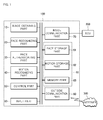
- FIG. 1 is a block diagram for describing a vehicle control apparatus using face recognition and motion recognition according to the present disclosure
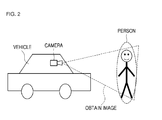
- FIG. 2 is a diagram for describing an example of image capturing operations in a vehicle control process using face recognition and motion recognition according to the present disclosure.
- the vehicle control apparatus consists of an image obtaining part 10, a face recognizing part 20, a face authenticating part 30, a motion recognizing part 40, a control part 50, a storage part 60, an inside communication part 70, an outside communication part 80, and an input part 90.
- the image obtaining part 10 obtains an image of outside of a vehicle, removes noises from an input image, and converts the input image to a binary image, thereby minimizing effects from disturbances outside the vehicle.
- the image obtaining part 10 may be a camera installed inside a vehicle as shown in FIG. 2 , where a face image and a motion image regarding a person outside the vehicle is obtained via the camera.
- FIG. 2 shows that a forward image of a vehicle is obtained, an image of any direction may be input without being limited to a forward image, a backward image, a leftward image, and a rightward image.
- the face recognizing part 20 is a part for finding and tracking a face of a person from an input image based on feature elements constituting human faces and extracts feature information regarding a face of a person. Here, if a plurality of faces exists in the input image, the face recognizing part 20 extracts and tracks feature information regarding all of the plurality of faces.
- the face authenticating part 30 compares the feature information extracted by the face recognizing part 20 to feature information regarding faces of persons registered in advance and, if a difference therebetween is less than or equal to a critical value, authenticates that the recognized face as a registered face. Furthermore, if a plurality of faces is recognized by the face recognizing part 20, each of the plurality of faces is individually authenticated.
- the motion recognizing part 40 When authentication is completed by the face authenticating part 30, the motion recognizing part 40 stands by for a motion recognition, where the motion recognizing part 40 recognizes a change of a face of an authenticated person or a change of a body motion of the authenticated person and determines whether a recognized motion is identical to an appointed motion that is input in advance.
- completion of motion recognition may be notified or, if no motion is recognized (misrecognition), a motion may be requested again.
- the request may be performed via a lamp or a speaker connected to an onboard computer 200 of a vehicle.
- motions may be individually recognized with respect to the respective faces, thereby recognizing motions of a plurality of authenticated persons and interconnecting information of the recognitions.
- Examples of motions may include changes in facial expressions, such as eye-blinking and mouth shape changes, and body motions, such as hand-clapping shapes and a number of times for hand-clapping, feet-stamping shapes and a number of times for feet-stamping, formation of a circle by using arms, outstretching of left and right arms.
- the control part 50 is a part for recognizing a face, recognizing a motion of an authenticated person, and performing a set function, is connected to the onboard computer (ECU) 200 via the inside communication part 70 (e.g., CAN, OBD-II, etc.) or connected to an outside network (wired/wireless internet 300) via the outside communication part 80 (e.g., 3G, LTE, Wi-Fi, BT, etc.), and transmits and receives data for performing functions based on motion recognition.
- the inside communication part 70 e.g., CAN, OBD-II, etc.
- an outside network wireless/wireless internet 300
- the outside communication part 80 e.g., 3G, LTE, Wi-Fi, BT, etc.
- the storage part 60 consists of a face storage part 61, a motion storage part 62, and a memory part 63.
- the face storage part 61 registers and stores faces
- the motion storage part 62 stores motions of persons based on stored faces and functions associated with the motions.
- the memory part 63 stores programs required to control the vehicle control apparatus 100 and identification information (e.g., phone numbers, e-mail addresses, etc.) required to transmit data via the outside communication part 80.
- the vehicle control apparatus 100 may be used as a vehicle black-box. In this case, a separate micro SD card may be mounted.
- the vehicle control apparatus 100 may be set to operate in black-box mode while a vehicle is moving.
- the input part 90 is used to turn the vehicle control apparatus 100 on and off, input and store a face recognition command, input and store a motion recognition command, and to input information regarding a recipient (a phone number or an e-mail address) of data to be transmitted by the outside communication part 80 via the internet 300.
- a face and a motion are input via the image obtaining part 10 and stored in the face storage part 61 and the motion storage part 62, respectively.
- the input part 90 may be configured as a touch input part on a touch screen.
- any of available functions of vehicles including opening/closing of a vehicle door and a trunk, turning on/off of vehicle headlights and lamps inside/outside the vehicle, a function for capturing a currently parked location via a camera (image obtaining part) and transmitting a captured image to a mobile phone corresponding to a registered phone number, turning on/off of a vehicle black-box, etc. may be controlled via particular motions registered in advance.
- the vehicle control apparatus 100 may upgrade or update programs via the internet 300 and the outside communication part 80, thereby adding new services.
- FIG. 3 is a flowchart for describing a method of controlling a vehicle using face recognition and motion recognition according to the present disclosure.
- a face and a motion of a person are stored (operation S10).
- operation S10 if a command for inputting and storing a face and a motion of a person is input via the input part 90, an image is obtained via the image obtaining part 10, where the face and the motion are respectively recognized and authenticated by the face authenticating part 30 and the motion recognizing part 40 and are stored in the storage part 60.
- the face recognizing part 20 extracts feature information regarding a face from the obtained input image to find and track a face of a person from the input image based on feature elements.
- the face recognizing part 20 extracts and track feature information regarding all of the faces simultaneously and recognizes the faces (operation S30).
- operation S50 If it is determined as a result of the determination in the operation S40 that face recognition is not successful, re-recognition is requested (operation S50). Here, if the extraction of feature information is not successful, re-recognition is requested.
- the face authenticating part 30 compares the feature information extracted by the face recognizing part 20 to feature information regarding faces of persons stored in (registered to) the storage part 60 in advance and, if a difference therebetween is less than or equal to a critical value, authenticates that the recognized face as a registered face. Furthermore, if a plurality of faces is recognized, each of the plurality of faces is individually authenticated (operation S60).
- the recognized face is not a stored face of a person, and thus the overall process is terminated.
- the motion recognizing part 40 ready for motion recognition recognizes a change of a face of an authenticated person or a change of a body motion of the authenticated person and determines whether a recognized motion is identical to an appointed motion that is input in advance, that is, a motion stored in the storage part 60 (operation S80).
- completion of motion recognition may be notified or, if no motion is recognized (misrecognition), a motion may be requested again.
- operation S100 If it is determined as a result of the determination in the operation S90 that the motion recognition is not successful, re-recognition is requested (operation S100).
- a recognized motion is not a stored motion or a difference between a recognized motion and a stored motion is less than or equal to a critical value required for motion recognition, re-recognition may be requested due to failure of motion recognition.
- control part 50 recognizes a motion of a face-recognized and face-authenticated person and transmits data to the onboard computer (ECU) 200 via the inside communication part 70 or transmit data to the internet 300 via the outside communication part 80 to perform functions based on motion recognition.
- ECU onboard computer
- the onboard computer 200 may be controlled via the inside communication part 70 to perform any of available functions of vehicles including opening/closing of a vehicle door and a trunk, turning on/off of vehicle headlights and lamps inside/outside the vehicle, and turning on/off of a vehicle black-box, etc. Furthermore, functions including a function for capturing a currently parked location via a camera (image obtaining part) and transmitting a captured image to a mobile phone corresponding to a registered phone number, a function for transmitting video data/audio data stored in a memory of a vehicle black-box to a mobile phone, etc. may be performed via the outside communication part 80 based on motion recognition. Since the vehicle control apparatus 100 includes a camera for capturing images and the storage part 60, the vehicle control apparatus 100 may also be used as a vehicle black-box, and thus the above-stated technical configuration may be easily embodied by one of ordinary skill in the art.
Landscapes
- Engineering & Computer Science (AREA)
- Theoretical Computer Science (AREA)
- Physics & Mathematics (AREA)
- General Physics & Mathematics (AREA)
- Multimedia (AREA)
- Human Computer Interaction (AREA)
- Health & Medical Sciences (AREA)
- General Health & Medical Sciences (AREA)
- Oral & Maxillofacial Surgery (AREA)
- Mechanical Engineering (AREA)
- Computer Vision & Pattern Recognition (AREA)
- General Engineering & Computer Science (AREA)
- Automation & Control Theory (AREA)
- Computer Security & Cryptography (AREA)
- Transportation (AREA)
- Signal Processing (AREA)
- Mathematical Physics (AREA)
- Psychiatry (AREA)
- Computer Hardware Design (AREA)
- Software Systems (AREA)
- Social Psychology (AREA)
- Collating Specific Patterns (AREA)
- Image Analysis (AREA)
Abstract
Description
- The present invention relates to a vehicle control, and more particularly, a method and an apparatus for controlling a vehicle via face recognition and motion recognition by recognizing and authenticating face of a person outside the vehicle and recognizing a motion of the person, thereby providing various services including controlling the vehicle.
- Recently, various types of cameras are being installed on vehicles, and various techniques utilizing the cameras are being researched. Principally, techniques related to driving safety of a vehicle are being researched.
- Particularly, in the field of utilizing face recognition, there are many techniques for providing driving conveniences, e.g., a technique for detecting drowsiness or abnormalities of a driver, a technique for confirming a particular driver and adjusting position of a driver's seat in correspondence to the driver.
- The Korean Patent Laid-Open Publication No.
10-2011-0040562 - According to the above-stated patent, a time period elapsed for providing a personalized service by determining whether a driver is a registered driver by using an image of the driver captured before the driver enters a vehicle may be reduced. However, services that may be provided according to the above-stated patent include simple re-adjustments of set values according to drivers, such as adjustment of position of a driver's seat. Furthermore, since a high performance system is required therefor, it is difficult to apply the technical configuration to vehicles in the low-price range.
- The present invention provides a method and an apparatus for controlling a vehicle via face recognition and motion recognition by recognizing and authenticating face of a person outside a vehicle and recognizing a motion to provide various services including controlling of the vehicle inexpensively via a low performance system.
- According to a first aspect of the present invention, there is provided a vehicle control apparatus including an image obtaining part that obtains an image of outside of a vehicle; a face recognizing part that finds and tracks a face of a person from an image obtained by the image obtaining part based on feature elements human faces and extracts feature information regarding a face of a person; a face authenticating part that compares the feature information extracted by the face recognizing part to feature information regarding faces of persons registered in advance and, if a difference therebetween is less than or equal to a critical value, authenticates that the recognized face as a registered face; the motion recognizing part that, when authentication is completed by the face authenticating part, recognizes a motion; and a control part that recognizes a motion of a face-recognized and face-authenticated person and performs a set function.
- According to a second aspect of the present invention, there is provided a vehicle control method including storing faces and motions of persons; when an image is obtained via an image obtaining part, recognizing, by a face recognizing part, a face; authenticating, by a face authenticating part, the face by comparing feature information extracted by the image obtaining part to feature information regarding faces of persons stored in a storage part in advance; when the authentication is completed by the face authenticating part, recognizing, by a motion recognizing part, a motion of a person; and recognizing, by a control part, a motion of a face-recognized and face-authenticated person and controlling to perform a set function based on the motion recognized by the motion recognizing part.
- According to the present disclosure, the following effects may be expected.
- First, when face of a person located outside a vehicle is recognized and authenticated as a person registered in advance, a vehicle may be controlled in a pre-set advance with a face or a body motion registered by the corresponding person in advance.
- Second, a driver may easily control a vehicle or receive various services even when the driver is outside the vehicle, without using an external device.
-
-
FIG. 1 is a block diagram for describing a vehicle control apparatus using face recognition and motion recognition according to the present disclosure; -
FIG. 2 is a diagram for describing an example of image capturing operations in a vehicle control process using face recognition and motion recognition according to the present disclosure; and -
FIG. 3 is a flowchart for describing a method of controlling a vehicle using face recognition and motion recognition according to the present disclosure. - Hereinafter, exemplary embodiments will be described in detail with reference to accompanying drawings.
- In addition, although the terms used in the present disclosure are selected from generally known and used terms, some of the terms mentioned in the description of the present disclosure have been selected by the applicant at his or her discretion, the detailed meanings of which are described in relevant parts of the description herein. Furthermore, it is required that the present disclosure is understood, not simply by the actual terms used but by the meaning of each term lying within. In the following description of the present disclosure, the detailed description of known functions and configurations incorporated herein is omitted when it may make the subject matter of the present disclosure rather unclear.
-
FIG. 1 is a block diagram for describing a vehicle control apparatus using face recognition and motion recognition according to the present disclosure, andFIG. 2 is a diagram for describing an example of image capturing operations in a vehicle control process using face recognition and motion recognition according to the present disclosure. - As shown in
FIG. 1 , the vehicle control apparatus according to the present disclosure consists of animage obtaining part 10, aface recognizing part 20, a faceauthenticating part 30, amotion recognizing part 40, acontrol part 50, astorage part 60, aninside communication part 70, anoutside communication part 80, and aninput part 90. - Here, the
image obtaining part 10 obtains an image of outside of a vehicle, removes noises from an input image, and converts the input image to a binary image, thereby minimizing effects from disturbances outside the vehicle. Theimage obtaining part 10 may be a camera installed inside a vehicle as shown inFIG. 2 , where a face image and a motion image regarding a person outside the vehicle is obtained via the camera. Here, althoughFIG. 2 shows that a forward image of a vehicle is obtained, an image of any direction may be input without being limited to a forward image, a backward image, a leftward image, and a rightward image. - The
face recognizing part 20 is a part for finding and tracking a face of a person from an input image based on feature elements constituting human faces and extracts feature information regarding a face of a person. Here, if a plurality of faces exists in the input image, theface recognizing part 20 extracts and tracks feature information regarding all of the plurality of faces. - The
face authenticating part 30 compares the feature information extracted by theface recognizing part 20 to feature information regarding faces of persons registered in advance and, if a difference therebetween is less than or equal to a critical value, authenticates that the recognized face as a registered face. Furthermore, if a plurality of faces is recognized by theface recognizing part 20, each of the plurality of faces is individually authenticated. - When authentication is completed by the
face authenticating part 30, themotion recognizing part 40 stands by for a motion recognition, where themotion recognizing part 40 recognizes a change of a face of an authenticated person or a change of a body motion of the authenticated person and determines whether a recognized motion is identical to an appointed motion that is input in advance. Here, completion of motion recognition may be notified or, if no motion is recognized (misrecognition), a motion may be requested again. The request may be performed via a lamp or a speaker connected to anonboard computer 200 of a vehicle. Furthermore, if a plurality of faces is authenticated by theface authenticating part 30, motions may be individually recognized with respect to the respective faces, thereby recognizing motions of a plurality of authenticated persons and interconnecting information of the recognitions. Examples of motions may include changes in facial expressions, such as eye-blinking and mouth shape changes, and body motions, such as hand-clapping shapes and a number of times for hand-clapping, feet-stamping shapes and a number of times for feet-stamping, formation of a circle by using arms, outstretching of left and right arms. - The
control part 50 is a part for recognizing a face, recognizing a motion of an authenticated person, and performing a set function, is connected to the onboard computer (ECU) 200 via the inside communication part 70 (e.g., CAN, OBD-II, etc.) or connected to an outside network (wired/wireless internet 300) via the outside communication part 80 (e.g., 3G, LTE, Wi-Fi, BT, etc.), and transmits and receives data for performing functions based on motion recognition. - Meanwhile, the
storage part 60 consists of aface storage part 61, amotion storage part 62, and amemory part 63. Here, theface storage part 61 registers and stores faces, and themotion storage part 62 stores motions of persons based on stored faces and functions associated with the motions. Thememory part 63 stores programs required to control thevehicle control apparatus 100 and identification information (e.g., phone numbers, e-mail addresses, etc.) required to transmit data via theoutside communication part 80. Furthermore, since theimage obtaining part 10 is arranged, thevehicle control apparatus 100 may be used as a vehicle black-box. In this case, a separate micro SD card may be mounted. Here, thevehicle control apparatus 100 may be set to operate in black-box mode while a vehicle is moving. - The
input part 90 is used to turn thevehicle control apparatus 100 on and off, input and store a face recognition command, input and store a motion recognition command, and to input information regarding a recipient (a phone number or an e-mail address) of data to be transmitted by theoutside communication part 80 via theinternet 300. Here, a face and a motion are input via theimage obtaining part 10 and stored in theface storage part 61 and themotion storage part 62, respectively. Theinput part 90 may be configured as a touch input part on a touch screen. - Meanwhile, any of available functions of vehicles including opening/closing of a vehicle door and a trunk, turning on/off of vehicle headlights and lamps inside/outside the vehicle, a function for capturing a currently parked location via a camera (image obtaining part) and transmitting a captured image to a mobile phone corresponding to a registered phone number, turning on/off of a vehicle black-box, etc. may be controlled via particular motions registered in advance. Meanwhile, the
vehicle control apparatus 100 may upgrade or update programs via theinternet 300 and theoutside communication part 80, thereby adding new services. -
FIG. 3 is a flowchart for describing a method of controlling a vehicle using face recognition and motion recognition according to the present disclosure. - As shown in
FIG. 3 , in the method of controlling a vehicle using face recognition and motion recognition, a face and a motion of a person are stored (operation S10). Here, if a command for inputting and storing a face and a motion of a person is input via theinput part 90, an image is obtained via theimage obtaining part 10, where the face and the motion are respectively recognized and authenticated by theface authenticating part 30 and themotion recognizing part 40 and are stored in thestorage part 60. - Meanwhile, after the face and the motion are stored, if an image is obtained via the image obtaining part 10 (operation S20), the
face recognizing part 20 extracts feature information regarding a face from the obtained input image to find and track a face of a person from the input image based on feature elements. Here, if a plurality of faces exists in the input image, theface recognizing part 20 extracts and track feature information regarding all of the faces simultaneously and recognizes the faces (operation S30). - Next, it is determined whether face recognition is successful (operation S40).
- If it is determined as a result of the determination in the operation S40 that face recognition is not successful, re-recognition is requested (operation S50). Here, if the extraction of feature information is not successful, re-recognition is requested.
- However, if it is determined as a result of the determination in the operation S40 that face recognition is successful, the
face authenticating part 30 compares the feature information extracted by theface recognizing part 20 to feature information regarding faces of persons stored in (registered to) thestorage part 60 in advance and, if a difference therebetween is less than or equal to a critical value, authenticates that the recognized face as a registered face. Furthermore, if a plurality of faces is recognized, each of the plurality of faces is individually authenticated (operation S60). - It is determined whether face authentication is successful (operation S70).
- If it is determined as a result of the determination in the operation S70 that the authentication is not successful, the recognized face is not a stored face of a person, and thus the overall process is terminated.
- However, if it is determined as a result of the determination in the operation S70 that the authentication is successful, if the authentication is completed by the
face authenticating part 30, themotion recognizing part 40 ready for motion recognition recognizes a change of a face of an authenticated person or a change of a body motion of the authenticated person and determines whether a recognized motion is identical to an appointed motion that is input in advance, that is, a motion stored in the storage part 60 (operation S80). Here, completion of motion recognition may be notified or, if no motion is recognized (misrecognition), a motion may be requested again. - Next, it is determined whether motion recognition is successful (operation S90).
- If it is determined as a result of the determination in the operation S90 that the motion recognition is not successful, re-recognition is requested (operation S100). Here, if a recognized motion is not a stored motion or a difference between a recognized motion and a stored motion is less than or equal to a critical value required for motion recognition, re-recognition may be requested due to failure of motion recognition.
- However, if it is determined as a result of the determination in the operation S90 that the motion recognition is successful, the
control part 50 recognizes a motion of a face-recognized and face-authenticated person and transmits data to the onboard computer (ECU) 200 via theinside communication part 70 or transmit data to theinternet 300 via theoutside communication part 80 to perform functions based on motion recognition. - The
onboard computer 200 may be controlled via theinside communication part 70 to perform any of available functions of vehicles including opening/closing of a vehicle door and a trunk, turning on/off of vehicle headlights and lamps inside/outside the vehicle, and turning on/off of a vehicle black-box, etc. Furthermore, functions including a function for capturing a currently parked location via a camera (image obtaining part) and transmitting a captured image to a mobile phone corresponding to a registered phone number, a function for transmitting video data/audio data stored in a memory of a vehicle black-box to a mobile phone, etc. may be performed via theoutside communication part 80 based on motion recognition. Since thevehicle control apparatus 100 includes a camera for capturing images and thestorage part 60, thevehicle control apparatus 100 may also be used as a vehicle black-box, and thus the above-stated technical configuration may be easily embodied by one of ordinary skill in the art. - While the present disclosure has been particularly shown and described with reference to preferred embodiments thereof, it will be understood by those skilled in the art that various changes in form and details may be made therein without departing from the spirit and scope of the present disclosure as defined by the appended claims. The preferred embodiments should be considered in descriptive sense only and not for purposes of limitation. Therefore, the scope of the present disclosure is defined not by the detailed description of the present disclosure but by the appended claims, and all differences within the scope will be construed as being included in the present disclosure. In the drawings, the thicknesses of some elements are exaggerated or reduced for clarity.
Claims (15)
- A vehicle control apparatus comprising:an image obtaining part that obtains an image of outside of a vehicle;a face recognizing part that finds and tracks a face of a person from an image obtained by the image obtaining part based on feature elements human faces and extracts feature information regarding a face of a person;a face authenticating part that compares the feature information extracted by the face recognizing part to feature information regarding faces of persons registered in advance and, if a difference therebetween is less than or equal to a critical value, authenticates that the recognized face as a registered face;the motion recognizing part that, when authentication is completed by the face authenticating part, recognizes a motion; anda control part that recognizes a motion of a face-recognized and face-authenticated person and performs a set function.
- The vehicle control apparatus of claim 1, wherein the image obtaining part obtains images regarding faces and motions of persons outside the vehicle.
- The vehicle control apparatus of claim 1 or 2, wherein the image obtaining part removes noises from an input image and converts the input image to a binary image.
- The vehicle control apparatus of any one of the preceding claims, wherein, if a plurality of faces exist in the input image, the face recognizing part extracts and tracks feature information regarding all of the faces.
- The vehicle control apparatus of any one of the preceding claims, wherein, if a plurality of faces exist in the input image, the face recognizing part authenticates all of the faces individually.
- The vehicle control apparatus of any one of the preceding claims, wherein the motion recognizing part recognizes a change of face of an authenticated person or a change of a body motion of the authenticated person, and
notifies completion of motion recognition or, if no motion is recognized, requests a motion again. - The vehicle control apparatus of any one of the preceding claims, wherein motions recognized by the motion recognizing part comprise changes in facial expressions including changes of shapes of eyes and a mouth and changes of body motions including changes of shapes of palms, hands, and feet.
- The vehicle control apparatus of any one of the preceding claims, to recognize a motion of a face-recognized and face-authenticated person and perform a set function, further comprising:an inside communication part for transmitting data to an onboard computer (ECU) for performing a function based on motion recognition; andan outside communication part for transmitting data to an internet network for performing a function based on motion recognition.
- The vehicle control apparatus of any one of the preceding claims, further comprising:a face storage part that registers and stores faces;a motion storage part that stores motions of persons based on stored faces and functions associated with the motions; anda memory part that stores programs required to control the vehicle control apparatus 100 and identification information (e.g., phone numbers, e-mail addresses, etc.) required to transmit data via the outside communication part.
- A vehicle control method comprising:storing faces and motions of persons;when an image is obtained via an image obtaining part, recognizing, by a face recognizing part, a face;authenticating, by a face authenticating part, the face by comparing feature information extracted by the image obtaining part to feature information regarding faces of persons stored in a storage part in advance;when the authentication is completed by the face authenticating part, recognizing, by a motion recognizing part, a motion of a person; andrecognizing, by a control part, a motion of a face-recognized and face-authenticated person and controlling to perform a set function based on the motion recognized by the motion recognizing part.
- The vehicle control method of claim 10, wherein the image obtaining part obtains images regarding faces and motions of persons outside the vehicle, removes noises from an input image, and converts the input image to a binary image.
- The vehicle control method of claim 10 or 11, wherein the motion recognizing part recognizes a change of face of an authenticated person or a change of a body motion of the authenticated person.
- The vehicle control method of any one of the claims 10 to 12, wherein, if a plurality of faces exist in the input image, the face recognizing part extracts and tracks feature information regarding all of the faces, and
if a plurality of faces are recognized by the face recognizing part, the face recognizing part authenticates all of the faces individually. - The vehicle control method of any one of the claims 10 to 13, wherein each of the recognizing of the face and the recognizing of the motion comprises:determining whether recognition is successful; and,if the recognition is not successful, requesting re-recognition.
- The vehicle control method of any one of the claims 10 to 14, wherein data is transmitted to an onboard computer (ECU) via an inside communication part to perform a function based on the motion recognition or is transmitted to an internet via an outside communication part to perform a function based on the motion recognition.
Applications Claiming Priority (1)
| Application Number | Priority Date | Filing Date | Title |
|---|---|---|---|
| KR1020140112608A KR101586228B1 (en) | 2014-08-27 | 2014-08-27 | Method and apparatus for controlling vehicle using motion recognition with face recognition |
Publications (2)
| Publication Number | Publication Date |
|---|---|
| EP2990997A2 true EP2990997A2 (en) | 2016-03-02 |
| EP2990997A3 EP2990997A3 (en) | 2016-03-30 |
Family
ID=54185828
Family Applications (1)
| Application Number | Title | Priority Date | Filing Date |
|---|---|---|---|
| EP15182736.7A Withdrawn EP2990997A3 (en) | 2014-08-27 | 2015-08-27 | Method and apparatus for controlling vehicle using motion recognition with face recognition |
Country Status (4)
| Country | Link |
|---|---|
| US (1) | US9576189B2 (en) |
| EP (1) | EP2990997A3 (en) |
| KR (1) | KR101586228B1 (en) |
| CN (1) | CN105389490A (en) |
Cited By (2)
| Publication number | Priority date | Publication date | Assignee | Title |
|---|---|---|---|---|
| CN108791308A (en) * | 2018-06-25 | 2018-11-13 | 大连大学 | The system for building driving strategy based on driving environment |
| EP3584730A4 (en) * | 2017-03-31 | 2020-04-22 | Alibaba Group Holding Limited | METHOD AND DEVICE FOR PROCESSING INFORMATION BASED ON THE INTERNET OF OBJECTS |
Families Citing this family (33)
| Publication number | Priority date | Publication date | Assignee | Title |
|---|---|---|---|---|
| US10445603B1 (en) * | 2015-12-11 | 2019-10-15 | Lytx, Inc. | System for capturing a driver image |
| WO2017124482A1 (en) * | 2016-01-23 | 2017-07-27 | 刘建兵 | Method for acquiring technology information during car door opening using facial recognition technology and recognition system |
| WO2017124483A1 (en) * | 2016-01-23 | 2017-07-27 | 刘建兵 | Information pushing method in technology of opening car door by recognizing face image and recognition system |
| JP6833354B2 (en) * | 2016-06-10 | 2021-02-24 | キヤノン株式会社 | Information processing equipment, information processing methods and programs |
| JP2019531560A (en) * | 2016-07-05 | 2019-10-31 | ナウト, インコーポレイテッドNauto, Inc. | Automatic driver identification system and method |
| CN106355679A (en) * | 2016-09-26 | 2017-01-25 | 东莞市锐准电子科技股份有限公司 | A driving recorder |
| KR20180070818A (en) | 2016-12-19 | 2018-06-27 | 씨제이포디플렉스 주식회사 | Nozzle control sheet and nozzle control method using face recognition technology. |
| KR101996414B1 (en) * | 2016-12-30 | 2019-07-04 | 현대자동차주식회사 | Pedestrian collision prevention apparatus and method considering pedestrian gaze |
| US10232814B2 (en) * | 2017-01-18 | 2019-03-19 | Toyota Motor Engineering & Manufacturing North America, Inc. | Inflatable vehicle occupant positioning system |
| JP6525345B2 (en) * | 2017-03-15 | 2019-06-05 | 株式会社Subaru | Vehicle display system and control method of vehicle display system |
| SG11201913444XA (en) * | 2017-07-03 | 2020-01-30 | Gp Network Asia Pte Ltd | Processing payments |
| JP6805996B2 (en) * | 2017-07-28 | 2020-12-23 | トヨタ自動車株式会社 | Information processing equipment, information processing methods and information processing systems |
| CN109421702A (en) * | 2017-08-25 | 2019-03-05 | 上海汽车集团股份有限公司 | A kind of automobile control method and device |
| US11072311B2 (en) * | 2017-09-05 | 2021-07-27 | Future Mobility Corporation Limited | Methods and systems for user recognition and expression for an automobile |
| US10867161B2 (en) * | 2017-09-06 | 2020-12-15 | Pixart Imaging Inc. | Auxiliary filtering device for face recognition and starting method for electronic device |
| CN108162975A (en) * | 2017-12-11 | 2018-06-15 | 厦门蓝斯通信股份有限公司 | A kind of driver identity identification and monitoring and managing method and system |
| US10745018B2 (en) | 2018-09-19 | 2020-08-18 | Byton Limited | Hybrid user recognition systems for vehicle access and control |
| KR102634349B1 (en) * | 2018-10-11 | 2024-02-07 | 현대자동차주식회사 | Apparatus and method for controlling display of vehicle |
| CN110271557B (en) * | 2019-06-12 | 2021-05-14 | 浙江亚太机电股份有限公司 | Vehicle user feature recognition system |
| JP7279804B2 (en) * | 2019-09-26 | 2023-05-23 | 日本電気株式会社 | DOOR LOCK CONTROL DEVICE, VEHICLE DEVICE, DOOR LOCK CONTROL METHOD AND PROGRAM |
| US12198489B2 (en) | 2019-10-04 | 2025-01-14 | Nec Corporation | Information processing apparatus, information processing method, and storage medium |
| US20230090122A1 (en) * | 2020-03-10 | 2023-03-23 | Nec Corporation | Photographing control device, system, method, and non-transitory computer-readable medium storing program |
| JP7419122B2 (en) * | 2020-03-18 | 2024-01-22 | 本田技研工業株式会社 | Vehicle control device, vehicle control method, and vehicle control program |
| CN111625086A (en) * | 2020-04-24 | 2020-09-04 | 爱驰汽车有限公司 | Vehicle interaction method, system, device and storage medium based on user action |
| JP7332535B2 (en) * | 2020-05-27 | 2023-08-23 | 本田技研工業株式会社 | Vehicle control system, server, and vehicle control method |
| JP7410796B2 (en) * | 2020-05-27 | 2024-01-10 | 本田技研工業株式会社 | Vehicle control system and vehicle control method |
| JP7399790B2 (en) * | 2020-05-27 | 2023-12-18 | 本田技研工業株式会社 | Entry support system, entry support method, and entry support program |
| CN112061137B (en) * | 2020-08-19 | 2022-01-14 | 一汽奔腾轿车有限公司 | Man-vehicle interaction control method outside vehicle |
| KR102301426B1 (en) * | 2020-09-07 | 2021-09-14 | 방병주 | heavy equipment control system through analysis of object action patterns |
| KR102301427B1 (en) * | 2020-10-22 | 2021-09-14 | 방병주 | heavy equipment control system through predition of object action patterns |
| EP4064213A1 (en) * | 2021-03-25 | 2022-09-28 | Grazper Technologies ApS | Utility vehicle and corresponding apparatus, method and computer program for a utility vehicle |
| CN114495337A (en) * | 2022-02-28 | 2022-05-13 | 重庆长安汽车股份有限公司 | Intelligent automobile tail door opening system and method based on cameras inside and outside cabin |
| CN114954321A (en) * | 2022-05-05 | 2022-08-30 | 华人运通(上海)云计算科技有限公司 | A vehicle control method, device and vehicle |
Citations (1)
| Publication number | Priority date | Publication date | Assignee | Title |
|---|---|---|---|---|
| KR20110040562A (en) | 2009-10-14 | 2011-04-20 | 현대모비스 주식회사 | Vehicle personalization service device and method |
Family Cites Families (13)
| Publication number | Priority date | Publication date | Assignee | Title |
|---|---|---|---|---|
| US6498970B2 (en) | 2001-04-17 | 2002-12-24 | Koninklijke Phillips Electronics N.V. | Automatic access to an automobile via biometrics |
| WO2005050583A1 (en) | 2003-08-15 | 2005-06-02 | Ziyi Cheng | An automobile security defence alarm system with face identification and wireless communication function |
| CN1579848A (en) * | 2003-08-15 | 2005-02-16 | 程滋颐 | Automobile antitheft alarm with image pickup and wireless communication function |
| KR101165106B1 (en) * | 2006-11-09 | 2012-07-12 | 현대자동차주식회사 | Driver certification device and method that do fetters in face realization |
| KR100887688B1 (en) * | 2007-11-29 | 2009-03-11 | 현대자동차주식회사 | Door opening and closing control device by hand shape |
| JP2012010222A (en) * | 2010-06-28 | 2012-01-12 | Kyocera Corp | Portable wireless communication terminal device |
| KR101172213B1 (en) * | 2010-12-08 | 2012-08-07 | 현대자동차주식회사 | System and Method for face identification |
| DE102010054625A1 (en) | 2010-12-16 | 2012-06-21 | Daimler Ag | Method and device for opening and closing a door and / or a tailgate of a vehicle |
| US9177130B2 (en) * | 2012-03-15 | 2015-11-03 | Google Inc. | Facial feature detection |
| KR101337554B1 (en) * | 2012-03-20 | 2013-12-06 | (주) 세인 | Apparatus for trace of wanted criminal and missing person using image recognition and method thereof |
| KR101983784B1 (en) * | 2012-04-13 | 2019-09-03 | 현대엠엔소프트 주식회사 | Method to update the map data for updating the map data to navigation |
| CN102799868B (en) * | 2012-07-10 | 2014-09-10 | 吉林禹硕动漫游戏科技股份有限公司 | Method for identifying key facial expressions of human faces |
| JP2014164697A (en) * | 2013-02-27 | 2014-09-08 | Canon Inc | Image processing apparatus, image processing method, program, and storage medium |
-
2014
- 2014-08-27 KR KR1020140112608A patent/KR101586228B1/en active Active
-
2015
- 2015-08-26 US US14/836,912 patent/US9576189B2/en active Active
- 2015-08-27 EP EP15182736.7A patent/EP2990997A3/en not_active Withdrawn
- 2015-08-27 CN CN201510536896.XA patent/CN105389490A/en active Pending
Patent Citations (1)
| Publication number | Priority date | Publication date | Assignee | Title |
|---|---|---|---|---|
| KR20110040562A (en) | 2009-10-14 | 2011-04-20 | 현대모비스 주식회사 | Vehicle personalization service device and method |
Non-Patent Citations (1)
| Title |
|---|
| "Network and Parallel Computing", vol. 1843, 1 January 2000, SPRINGER INTERNATIONAL PUBLISHING, Cham, ISBN: 978-3-540-76785-5, ISSN: 0302-9743, article D. M. GAVRILA: "Pedestrian Detection from a Moving Vehicle", pages: 37 - 49, XP055336121, 032548, DOI: 10.1007/3-540-45053-X_3 * |
Cited By (3)
| Publication number | Priority date | Publication date | Assignee | Title |
|---|---|---|---|---|
| EP3584730A4 (en) * | 2017-03-31 | 2020-04-22 | Alibaba Group Holding Limited | METHOD AND DEVICE FOR PROCESSING INFORMATION BASED ON THE INTERNET OF OBJECTS |
| US11461444B2 (en) | 2017-03-31 | 2022-10-04 | Advanced New Technologies Co., Ltd. | Information processing method and device based on internet of things |
| CN108791308A (en) * | 2018-06-25 | 2018-11-13 | 大连大学 | The system for building driving strategy based on driving environment |
Also Published As
| Publication number | Publication date |
|---|---|
| US9576189B2 (en) | 2017-02-21 |
| EP2990997A3 (en) | 2016-03-30 |
| CN105389490A (en) | 2016-03-09 |
| US20160063315A1 (en) | 2016-03-03 |
| KR101586228B1 (en) | 2016-01-18 |
Similar Documents
| Publication | Publication Date | Title |
|---|---|---|
| EP2990997A2 (en) | Method and apparatus for controlling vehicle using motion recognition with face recognition | |
| US10764536B2 (en) | System and method for a dynamic human machine interface for video conferencing in a vehicle | |
| US10465429B2 (en) | Controller, control method, and computer-readable recording medium | |
| US20180290627A1 (en) | Seamless vehicle access system | |
| KR102522415B1 (en) | Apparatus and method for recognizing object in electronic device | |
| US11386678B2 (en) | Driver authentication for vehicle-sharing fleet | |
| US20200074060A1 (en) | User authentication device and method for triggering user-specific target operation | |
| US20180143432A1 (en) | Remote control device, remote control product and remote control method | |
| US9894260B2 (en) | Method and device for controlling intelligent equipment | |
| US12122322B2 (en) | Vehicle control system, server, and vehicle control method | |
| JP6895743B2 (en) | In-vehicle authentication device and in-vehicle authentication method | |
| KR102861723B1 (en) | Method for releasing security by using spatial information related to robot and robot thereof | |
| KR101795701B1 (en) | Face recognition system and method of multiple identification | |
| US11245707B2 (en) | Communication terminal, communication system, communication control method, and recording medium | |
| US11366326B2 (en) | Method for operating a head-mounted electronic display device, and display system for displaying a virtual content | |
| US20200151433A1 (en) | Face recognition apparatus and face recognition method | |
| US20190375426A1 (en) | Methods and systems for generating adaptive instructions | |
| KR102093858B1 (en) | Biometrics-based vehicle control device and vehicle control method using same | |
| WO2021079637A1 (en) | Control device, non-transitory computer-readable medium, and authentication system | |
| KR102343298B1 (en) | Apparatus of recognizing object of vehicle and system of remote parking including the same | |
| US9679129B2 (en) | Information processing device and information processing method | |
| US20220410841A1 (en) | Unlocking vehicle doors with facial recognition | |
| US20200218347A1 (en) | Control system, vehicle and method for controlling multiple facilities | |
| KR101260053B1 (en) | Intelligent vehicle controlling apparatus and method using fusion recognition of user's voice and hand gesture | |
| US20190088058A1 (en) | Onboard system for a vehicle and process for sending a command to a park area access system |
Legal Events
| Date | Code | Title | Description |
|---|---|---|---|
| PUAL | Search report despatched |
Free format text: ORIGINAL CODE: 0009013 |
|
| PUAI | Public reference made under article 153(3) epc to a published international application that has entered the european phase |
Free format text: ORIGINAL CODE: 0009012 |
|
| 17P | Request for examination filed |
Effective date: 20150827 |
|
| AK | Designated contracting states |
Kind code of ref document: A2 Designated state(s): AL AT BE BG CH CY CZ DE DK EE ES FI FR GB GR HR HU IE IS IT LI LT LU LV MC MK MT NL NO PL PT RO RS SE SI SK SM TR |
|
| AX | Request for extension of the european patent |
Extension state: BA ME |
|
| AK | Designated contracting states |
Kind code of ref document: A3 Designated state(s): AL AT BE BG CH CY CZ DE DK EE ES FI FR GB GR HR HU IE IS IT LI LT LU LV MC MK MT NL NO PL PT RO RS SE SI SK SM TR |
|
| AX | Request for extension of the european patent |
Extension state: BA ME |
|
| RIC1 | Information provided on ipc code assigned before grant |
Ipc: G06T 7/20 20060101ALI20160219BHEP Ipc: G06K 9/00 20060101AFI20160219BHEP |
|
| 17Q | First examination report despatched |
Effective date: 20170809 |
|
| STAA | Information on the status of an ep patent application or granted ep patent |
Free format text: STATUS: THE APPLICATION IS DEEMED TO BE WITHDRAWN |
|
| 18D | Application deemed to be withdrawn |
Effective date: 20171220 |